During the Black Lives Matter Movement, A Korean American Mother and Son Spar Over Political Activism

In Which Side Are You On, 21-year-old Reed returns to Los Angeles, his hometown, to call on his ailing grandmother. But once there, he uses the opportunity to finally break the news to his parents: he’s dropping out of Columbia. Why participate in the neoliberal system that perpetuates white supremacy and inequity? He would rather devote his time to the Black Lives Matter movement, organize protests to get justice for Akai Gurley, a Black man, shot at the hands of Peter Liang, an Asian American police officer. 

As Asian Americans advocate for Liang’s innocence in the name of community, Reed, who is half Chinese and half Korean, feels an immense responsibility to play his part in redressing the social injustice and bringing the revolution he thinks is around the corner. To that end, he seeks to learn about his mother’s involvement in the Black-Korean Coalition of the 1980s, hoping it would give him fodder to keep the current movement alive and relevant, and to better organize cross racial solidarity into being. But as conversations between him and his parents ensue, Reed learns the harsh reality of activism and organizing in practice. 

Using electric dialogue, Wong gives the narrative its forward momentum, and expands its scope across time and generations by raising questions of morality and social responsibility in the face of injustice and privilege and by examining historical moments that speak to the importance of cross-racial solidarity.

Ryan Lee Wong was born and raised in Los Angeles—a fact visible in his debut which paints the city with intimate strokes. Wong dedicated two years to living a Buddhist monastic life at the Ancestral Heart Zen Temple. Currently, he lives in Brooklyn where he’s the Administrative Director of Brooklyn Zen Center.

We spoke over Zoom on a Thursday afternoon about the role of social media in activism and organizing movements, empathy as an avenue for understanding, holding space for intergenerational trauma and much more.


Bareerah Ghani: I find it interesting that Twitter comes up a lot in the novel as a source of “woke” news. The book also insinuates the idea of Twitter as an avenue to assert moral superiority and perhaps a proxy for taking actual action against social justice issues. What is your view on the role of social media, in particular Twitter, in opening dialogue on social justice issues and fostering a community?

Ryan Lee Wong: Just like you said, I think Twitter can be both. On one hand, when I was becoming radicalized in my politics, Twitter was a really quick and illuminating way to build up my critical vocabulary. I could log up to Twitter when something happened in the news, and I would get maybe a dozen really smart and interesting takes on something that were often left of what, you know, The New York Times would say about something or other mainstream media outlets, and that felt true to me, on an intuitive level. I thought that was really powerful, and so helpful for me. At the same time, this other thing could happen where I’d be reading those dozen takes, and sometimes they would disagree with each other, and then there would be takes on the takes, and I found it tended towards anxiety and critique; those were the tweets that did the best, those were the kinds of accounts that often got the most followers. And if you are in a world that pushes you towards anxiety and critique it’s actually very hard, I think, to have certain kinds of conversations in which you build relationships and a shared sense of belonging. I didn’t really find that kind of sustained community building on Twitter. I think some people are maybe better at thriving in that kind of environment than I was.

BG: Yeah, my experience with social media is kind of similar—perhaps why the book really spoke to me in how it critiques social media. Even when Reed talks about The Black Lives Matter movement, he says how the movement gained impetus, and essentially made being “radical” “cool”. I thought it was really profound. It got me thinking about this bandwagon effect we now often see after big tragedies such as in the aftermath of George Floyd’s death, everyone on Instagram began posting a black square on their timeline without realizing its significance or reflecting on their own credibility to partake in that action. I was wondering how you view the role of social media platforms and their rapid use in propelling liberal ideologies for social currency.

It actually takes a lot of sustained intimate dialogue to tell the difference between politics and performance; your actions in the world from what you post.

RLW: It’s a double-edged sword. I think that Reed is going through all this way before 2020 and had he been around then, he would’ve been very critical of juice bars posting Black Lives Matter signs in the windows without any kind of progress or social engagement. But then again, Black Lives Matter as a movement is hard to picture at all without social media so you cannot discount the importance of it, and the way that people were able to language and name an experience that was happening nationally and incidents in the country that previously had been seen as isolated incidents of police violence. At the same time, it gets very tricky once influence and celebrity culture get mixed in and there can often be a very facile engagement with politics that’s more about performance. At one point, Reed even says, for our generation it’s really hard to tell performance from your politics and being able to know the difference. And I think that’s one of the challenges of today—it actually takes a lot of sustained intimate dialogue to tell the difference between politics and performance; your actions in the world from what you post.

BG: I’m fascinated by how wide the scope of the narrative is because of its inspection of intergenerational differences. One instance that stood out to me is when Reed points out his mom’s inappropriate use of African American Vernacular English (AAVE), and she goes like, but that’s just how we talked, using AAVE terms was a display of endearment. And Reed says he understands but he could never take his mom’s case to Twitter for “fear of getting dragged.” What are your thoughts on this generational shift on how cross racial solidarity is envisioned now as a celebration of the differences between us, where previously it was about sharing language and culture? Could you speak to this in connection to the role of social media, cancel culture and cultural appropriation.

RLW: One thing that’s really interesting is how, what used to be coalition or solidarity building that happens on a very local, intimate, and geographically specific scale can now be transmitted out globally, almost instantaneously. So when Reed and his mother are having this dialogue about appropriation of Black language and African American vernacular, it’s a question of generational difference and social media, but to me it’s also a difference of geography, time, context and particular movements. So to be politicized in Oakland East Bay in the1970s and five, ten years after the Third World Liberation strikes at Berkeley and SF state, that’s a very different world than Brooklyn with social media in 2016, discussing Akai Gurley, Peter Liang. And it’s also a different world than LA 1980s, South Central and Black-Korean relations there. And so, I think it’s tempting to try to make broad statements about when it is and isn’t appropriate to share and borrow culture. But to me, the only way it’s actually been a constructive and interesting dialogue is when it’s focused in a very specific time, place and context. And so, to take those three moments, my impression is that, in the late ’60s, mid ’70s in the East Bay, there was a much freer sharing of those ideas and cultures—the Black Panthers were being influenced by Maoism, and then were in turn influencing Asian American activists whereas in my experience of Brooklyn in the mid 2010s, there was a lot more care and interest in making sure that non-Black protesters weren’t appropriating or misusing Black language and that also came out of a very real need, which is to think critically about when certain phrases or slogans developed by the Black community are not actually appropriate for non-Black people to use. So it’s all about context.

BG: For me, the heart of the novel lies in how it presents empathy as an avenue to understand one’s community. We see this in Reed’s mom and her being able to be there for her mother while holding space for the difficult emotions attached to that relationship. She teaches Reed to do the same; to understand his grandparents’ greed for money—something he detested—through empathizing with them and trying to feel the pain that led them to worship money. Could you speak to this idea of empathy as a powerful tool to heal and bridge gaps, in connection to your experience at the Ancestral Heart Zen Temple and the lessons you learnt there, in meditation, and community. 

RLW: So you could actually describe the entire movement of the novel as going from the head to the heart. So Reed’s big lesson is that in the beginning of the novel, he’s very cerebral. He’s very intellectual, good at applying theories. He’s kind of like a walking theory dispenser—whatever is happening, he has something to name it in a framework. And what he realizes is that it’s not something that’s going to get him far if his true goal is to build sustained community and movements. He has all these contradictions in his head, and he can’t really reconcile certain aspects of what’s going on, and the only space that can actually hold those differences is the heart. Because the heart does not have to divide the world into binaries, the heart’s more capacious and the heart’s a better listener. That is one of the big things that Zen practice has taught me. 

Of course you would want to try to alleviate all of the pain that we see and of course believing one could do that will absolutely lead to burn out.

The big misunderstanding around Zen Buddhism is that you sit there and kind of wipe your mind blank. But that’s not my experience at all. So much of Zen practice is actually sitting there in meditation and communal practice for long enough that your bodily wisdom actually starts to come forth. So it’s the opposite of what most people think where it comes from your head down. But actually, the wisdom and the grounding moves from the body up.

One of the big turns that happened for me was a very similar thing to what Reed experiences. I had all these ideas about how the world should be. The more I was able to drop those ideas for long enough to meet things with the heart first, the more I was actually able to feel more profound relationships with people, more compassion for myself and for others and more acceptance of the world as it is. And it’s not a passive acceptance as in oh, that’s just how things are. It’s an acceptance as the first step before trying to go out and change things; an acceptance of reality. The mind thinks it knows what’s going on but actually, I think it often has a hard time accepting reality.

BG: Do you think this acceptance of reality by listening to your heart helps in mitigating the burnout and emotional burdens we see Reed facing, as person of color striving to push against the white supremacist establishment?

RLW: Yeah, absolutely. One of the signs of burnout in my understanding is despair or nihilism. To me, Reed is very much on the cusp of that, if not already there. I think we as humans are not built to directly address all of the suffering in the world at the same time, even though I think for those of us who care and are paying attention that desire can arise, and that’s actually a very lovely, wholesome desire—of course you would want to try to alleviate all of the pain that we see and of course believing one could do that will absolutely lead to burn out. Self care is kind of the buzz word or popular phrase for this but actually what Reed starts to realize is it’s not about self-care in the sense that, I’m so important. It’s that you have to care for this body as an extension of a longer lineage. So part of what he understands over the course of the book is that he’s not just caring for him as this important person or not, he’s caring for an entire history that survived so that he could be there. And that helps to take away the egoism, the narcissism that can arise in certain self care circles. Once you start to understand the ancestry and the longer arc of yourself in history, that’s actually what you’re caring for.

BG: The novel also critiques the neoliberal order that we have, especially the college system that fits into and perpetuates that order by maintaining inequity and upholding white supremacy. We see Reed wanting to drop out of Columbia and his parents trying to convince him not to, even though they went through the same route. In this we see this precarious tug of war between Reed having to be practical or pursuing what he believes in. How do you consider the two in the face of wanting to change the world?

RLW: You know, I joked with my MFA Thesis adviser who read an early draft of this, that it almost seems like there’s something primarily human or evolutionary about being 18 to 22 and needing to burn things down, to do things completely differently. That’s why I think student movements have been so critical throughout history because they’re just willing to discard everything. At the same time, hopefully, those students grow up and realize it’s not necessarily the way to move the world for the rest of your life.

I think again and again what Reed’s parents are saying is not necessarily that he’s wrong, and not that this private university isn’t an institution that perpetuates inequality. They’re just saying that in order to actually change that fundamentally, it’s better to have the tools he will gain from staying. And you know, maybe this isn’t actually true of everyone in every context. But again, given where Reed comes from in terms of history, family and lineage, that is what makes sense for him. It was definitely the right way for some students in 1968, to take over university buildings, walk out and shut down campuses—that was really necessary. But that’s not the kind of historical moment Reed lives in. It’s not going to have the effect he thinks it will at the beginning of the novel.

BG: I love how the novel explores the dynamics between the immigrant parent and child. We see a certain kind of austerity alongside expectations held by the immigrant parent– Halmoni disowns Reed’s mother when she drops out of college, CJ’s mother is harsh on her about taking a semester break from Harvard. What are your views on the viability and fairness of such dynamics between the immigrant parent and child where the former considers the latter as an extension of self and thereby, a second chance, or a “do-over” in life?

RLW: As I was writing this novel, one of the really helpful frameworks was this theory of racial melancholia that David L. Eng and Shinhee Han put forth. They’re talking about the Asian American diaspora in particular, but this can be true of any diaspora—there is a perpetual unresolved mourning for the loss of their homeland and that mourning becomes melancholia, becomes kind of like a state. They actually say, unlike Freud, this is not necessarily a pathology, but it’s important to name.

I think one of the most radical things one can do in the first or second, or even third plus generations, is to really attend to and care for that melancholia because without that, we will project our unresolved mourning onto someone else in the next generation. That’s absolutely what’s going on between Halmoni, and Reed’s mother, and Reed and his mother.

Often first-generation immigrants don’t have the resources to do that care work, because they’re just trying to survive, trying to establish material security.

Often first-generation immigrants don’t have the social or financial resources to do that care work, to really start to attend to that mourning, because often they’re just trying to survive, trying to establish material security. So, of course, those feelings of grief and mourning get passed on in the form of needing the next generation to do something that they couldn’t. It’s a lot to hold and grapple with in that relationship. And so, by the end of the novel, what has to happen is that each side has to do its work, essentially—Reeds mother starts to realize some of the ways that she is doing that projection and Reed is more ready to receive the care his mother’s able to offer, and it’s just a small movement but for the purposes of this novel, it’s everything. 

BG: To what extent do you think there’s room for shared healing and holding space for each other?

RLW: When talking about intergenerational trauma and historic trauma, the term healing is used a lot but I’m still not sure what that means. When I think about this novel, and when I think about my own personal work in this area, to me, it’s much more about building the capacity to face those traumas, to really be still with them.

At the beginning of the novel, both Reed and his mother are being thrown around by their individual and shared traumas. They’re miscommunicating; can’t quite seem to ground themselves. And over and over again, Reed is forced to see the reality of his situation; his life, history, social context. As soon as he starts to really see that and develop an honest relationship with that, that’s what allows for real dialogue to happen. Similarly, in real life, my parents made a conscious choice not to talk that much about their past when they grew up. In many ways I think that was a wise choice because I don’t think I was actually ready to hear them until relatively recently. I had to have that emotional capacity and once I did, it all kind of clicked into place.

When we talk about starting to do the work of facing intergenerational trauma and opening a conversation, so much of the work to me is actually internal first. One has to be ready to meet those histories, and to be genuinely surprised by whatever that conversation brings, and that is what allows for a true dialogue to happen.

Ed and the Movies

“Ed and the Movies” by Robert Glück

Seven on a warm June evening. The glossy light is full, the shadows are mild. Little brown birds make thin music, weak metallic trills. I’m walking through Ed’s garden to his front door. It’s overgrown and orderly, the smell of damp earth and heavy roses. There are fronds and branches to duck, red and green marble-sized apples growing out of their flowers on espaliered trees. Something in pots, and the brugmansia, night-scented trumpets, sweet and sinister. I climb the wooden steps. The porch light is on already. I’m empty handed.

No, I hold the string of a white pastry box heavy with two lemon tarts and two chocolate éclairs that satisfy my greed under the pretense of fattening Ed up. He’ll probably eat one bite. I feel sleepy and itchy as though some emotional demand will be made, and what will I do then? I sense his death behind the door. I don’t need to knock, he buzzed me in at the gate. The door swings open, he’s very animated. Would you rather see me lifeless, he mocks. I hold up the pastry box and we moan with satisfaction. Death is too serious for us. I hug Ed and I want to say I love you but choke on the words as though I’m lying (I’m not).

I smell the Japanese half of Ed’s childhood—soy and ginger. He intends to perfect a recipe for barbecued short ribs as he did for lemon bundt cake and sushi rice. It’s Tuesday, my night with Ed, an ongoing joke of self-interest. I contribute to Ed’s welfare by eating complicated meals involving the stove, the oven, and the microwave, that take Ed all day to prepare. The table is set, the food is a picture. Roasted pig—I start chewing before it is served, imagining fat. I can’t get enough of the salty, burnt-sugar succulence. We dissect the flavors—more rice vinegar? ginger? Sophie, a small gray and brown tabby with a vexed expression, heedlessly scrolls against my shoes, burrows into my armpits, and vanishes.

Ed pokes at the meat with his chopsticks, takes a few bites of rice, praises himself for eating as much as he does. When we lived together, he could warm up to dinner with a double bag of potato chips. His voice is strong but the air is seeping out of his posture. He’s down to 120 and wears a disorganized expression. He brings me up to date on the daily horrors. He has neuropathy—the nerves along the soles of his feet strum like electric guitars. Some fungus looks like fur in his throat. He started a new med. Dr. Owen said if the new drug causes pain in his muscles it means they are disintegrating, so his body started pulling apart like taffy as the doctor spoke. Owen added that if Ed feels pain in his liver he should call him at once. Ed tossed and turned all night, a finger jabbing him there. I confess I don’t pay much attention to these sagas, which are, like his blathering when we were together, tedious and appalling. I hear myself recite the same stupid good advice I bestowed on Ed six years ago—and I hear my mother’s voice in mine, calming, distancing. Ed’s days are obviously precious but also lonely, threadbare, and twisted by fear.

What do I have to say? It’s still the eighties. I feel so intensely that the party is happening elsewhere you could call my distraction a disease. That is, I feel like I’m reading a bad translation, with the knowledge that a better one exists. Distance installs itself in me, from thrillingly difficult technical vocabularies to the ascendency of the grid on, say, Calvin Klein sheets. Distance replaces the excesses and heartfelt essences of the seventies. Meanwhile, Ed sustains losses, giving up job, travel, movies—increased nakedness before death. He fights a hollowed out feeling, hard to portray, not dramatic.

I feel so intensely that the party is happening elsewhere you could call my distraction a disease.

Last winter, flattened under the buzzing lights, Owen told Ed he had a few months left. Ed went home and planted a hundred and thirty tulip bulbs. When he worked in the park, he would bonsai two hundred chrysanthemums for Easter. I’m bloated and wan. My life does not seem to apply and resists being shaped into anecdotes. Striving seems vulgar. I’ve eaten too much fat. While Ed talks I actually dream for a few seconds: I can’t find my pen, and when I do it’s on the kitchen table laid out between knife and spoon. Eating words and writing dinner. My dream sees me this way.

What am I leaving out? I remind myself to tape some conversations with Ed. Is that too gruesome? Half asleep, I brew strawberry tea for Ed and black tea for myself in the blue and white spongeware mugs that belonged to Ed and me when we were lovers. I’m almost taking them down from my own cupboard. The clear flavor of the tea is so welcome that some of me goes into it. Ed opens a window—I’m surprised by his initiative because I expect nothing from anyone. He actually does eat his share of the pastry, which is a satisfaction. “You never cooked like this when we were together,” I complain good-naturedly.

As though explaining, Ed says, “Remember Marty?”

“?”

“Who lived next door?”

“That greasy little guy who always wore the same sportcoat?” I’m surprised Ed knows his name.

“We had sex. He’d just finished eating a can of sardines.” Ed exhales to show the sardines swarming in Marty’s breath.


I’m laughing and stung by this thirteen-year-old infidelity. I feel it more deeply because I’m single again. Denny and I broke up two years ago and my insecurity has new life. I experience my only moments of hope when I think of him. How to extinguish the useless surges? The action of the disease makes Ed’s body attractive to me again. Is my love for him realer than I know? I attributed intention to his beauty because it had power over me. I remember the tenderness of snuggling in bed, soft cotton t-shirts and naked below—the cotton erotic, the hot and cold of train stations, a mix of directions. Ed replies with a look, What do you see? The face that detained me for so many years. Galaxies.


Why is Ed telling me about Marty? Ed was not confined to beauty and safety. I used him to experience risk, as I do in this story. The rough desires passed around at night by guys in a park or an alley. I’ll bet Marty is where Ed discovered rimming. One morning Ed seemed to know all about it—what a surprise that was. Pleasure hidden like treasure in that scary place. I hid my face in simple justice of representation and my body made noises that meant it had instincts I’d never considered, like a school of salmon migrating up my butt.

These carnal updates from Ed and his primeval romps give our marriage a weird posthumous life. Since we are on the subject, I remind Ed of the evening fifteen years earlier when I cooked an elaborate birthday dinner for him. He turned up around midnight, explaining without remorse that he had been patiently guiding Sean into bed, a straight friend he was “liberating.” “Having a reason doesn’t mean anything,” I cried. I blinked like a flustered professor and my body stuttered. Ed laughed in alarm and mimicked my frantic gesture. Then he offered, “You’re just a victim of circumstance.”

Ed laughs and says, “Well, weren’t you?” He places a buttery crumb on a desiccated lip. He tastes, separating the flavors into a panorama. I ask him if he’s painting. “Every morning from my studio I see a nanny push a buggy up the hill. I think she’s Nicaraguan. She looks really young. She puts the brake on the buggy, climbs a long set of stairs, unlocks the door, and then goes down for the baby. That buggy points right down the hill and it’s held in place by a thin piece of aluminum. Every day I expect the baby to go flying down the street into traffic.”

We share an expression of horror. Ed lives on a very steep hill down which the buggy already careens. I say, “Someone has to tell that woman!”

Ed solemnly agrees. “One sentence could save that child’s life.”

“But Ed, why don’t you tell her?” I feel a surge of relief—finally I can save someone’s life. “All you have to do is walk across the street and tell her!”

It’s so easy, but Ed has a question. “You think I should tell her?”

“Certainly, tomorrow morning.”

Ed’s head falls forward, his eyes pop and his jaw drops in amazement. Once I thought that was gay body language, but then I learned it’s Japanese.

“Do you know how sick I am?” He’s thinking, Why should all of civilization rise to protect that stupid baby?

In self-defense I think, You are well enough to cook dinner, to paint, to dig in your garden. “You could do it—it’s your responsibility—as a neighbor. Ed, you still go out all the time.” I blanch at the word still.

Ed’s really angry. I’m a whirlwind in his head. The baby I can’t save will not grant me permission to save some other life. His face is rigid and his mouth works on its own. “I am not responsible for that baby. Don’t I have enough to worry about? I don’t know that baby. I don’t know those people. I am trying to stay alive!”

I grin in desolation. Ed is slightly revolting—I remember the absorbing spectacle of that jaw working against me, a perpetual motion of amazing insult, the smashed furniture, the wonder I felt when his fury jumped a quantum level, beyond caring, heedless. His thin body or anything could be thrown onto the blaze. I know when I’m licked. Giving up is hard work. The other baby must live or die without us. The buggy plummets and I lack the willpower to alter its course. I picture Ed by his window, the witness of this drama which inspires no call to action.


Like most of the world, I watch TV to be somewhere else without exerting myself. Exertion is the only way to go somewhere else, so dissatisfaction builds up. It’s hard not to be bitter overall, as though I’d actually seen all those daytime talk shows. The entire message of TV is that life is not fair, more daydream than nightdream, yet the victim has his faults.

Like most of the world, I watch TV to be somewhere else without exerting myself.

Not so with Ed—when we were together we watched TV with joy. In the early seventies, a cousin took pity on us and bought us a little black-and-white Zenith. We watched it through the night in Ed’s studio. Ed painted and I kept him company. I am describing hours of perfect contentment. We liked Fred Astaire and musicals in general, but horror movies were even more histrionic. Ed and I felt delectation for these images of mayhem.

In Ed’s bedroom, light is a translucent rectangle even though it’s almost nine. The white glass arrests dappled shadows. Ed lies under the heavy indigo blanket, wasting; I lie on top, succulent. I’m happy to be lying down and I feel perfectly relaxed on Daniel’s side of the bed. The disease leads some of us into a deeper engagement with the world. Denny became a science writer for AIDS Treatment News, and Loring joined Gran Fury. (At Bo Houston’s funeral, his mother says, “Thank you so much,” as though I’d done anything, and before I can stop myself, I say, “Thank you,” as though she’d done anything.) An epidemic is like a mystery with heroes and villains, but I drift from my bedroom to Ed’s bedroom, where light falls through frosted glass in a certain way. Above us the screen doles out images we love: the pre-WWII unknown lurches basso profundo through shadows and dry ice; the supersized zoo of spiders, locusts, snakes, ants, and lizards climbs out of the squashed air of the 50’s desert. Ed and I love bad horror films for the lyricism of their failed effects. We must be among the few to have twice seen Curucu, Beast of the Amazon, a film that couldn’t afford a visible monster or even gore. Branches twitch on the jungle trail, the mike slides into view, the victim screams from off-screen. Its very artificiality makes Curucu a convincing exploration of the afterlife, like a church service.

Tonight we watch a Mario Bava film in which moist decomposition replaces the genre’s earlier effects, as though a horror of decay is more germane to the present. It’s weird to be watching corpses rock back and forth in their own putrescence while lying next to Ed. The monster shows the world what she is: she throws open her robe with a triumphant expression to reveal a red chest cavity packed with roiling white maggots. Because of this image, I don’t look Ed in the eye, as though I’d accidentally seen something too personal. What does he make of the skeletons with rags of flesh? I am the only one who can ask him this question so I do. He rolls his head on the pillow and reminds me in a mild voice that he will be cremated, and that decay is not the same as death. He says, “My death is an emptiness that I can’t fill.” I am relieved, but why? We both know Ed will soon be reduced to ash. He’s dying in stop action like a good make-up job: the chaotic expression, the skeletal jeer, the pumpkin head wobbling with bon vivance on the broomstick neck, the pinched nose, the eyebrows pulled back, the eyes starved and hurt.

The monsters rise up while Ed and I sink into the pillows. But horror movies are actually comedies because death is reversible. Or it’s a consummation: the one taken by the monster experiences the full extent of his death. In his last scream, the victim faces the monster and dredges horror to the limit. Like a sexual consummation, he groans from the deepest place where his body (the world) begins.

Writing Fanfiction Gave Me Community and Creative Freedom

When the pandemic erupted, I was in the midst of leaving my lucrative corporate job and transitioning to graduate school. I had returned to my parents’ home, logging onto client meetings from my childhood bedroom during the day, losing hours to fanfiction on Archive of our Own (Ao3) at night. As the terror of the pandemic appeared in push notifications on my phone, scrolling through fanfictions about Draco and Hermione’s imagined lives after Hogwarts soothed me. Escaping into stories that continued the plot of a childhood classic also comforted me as I came to terms with leaving the stability of my career for the instability of pursuing my passion. 

I had always wanted to be a writer, but as the only child of two Chinese immigrants, financial security was a religion in my household. I interpreted part of my inheritance to be the achievement of the upward mobility for which my parents had immigrated. Writing, especially the popular conception of a “starving artist,” did not fit into that framework; I spent my first year post-college trying to see if I could repress and extinguish my literary aspirations for a more stable career path. 

Leaving corporate America, I assumed, would return the creativity and writing drive that I had lost.

After graduating, I thought about writing while working on client presentations, molding my prose into corporate-friendly bullet points and sending out concise, “actionable” emails. I left my job to study creative nonfiction writing 14 months later, folding into storage my blazers and A-line dresses. I had a book inside of me; I was convinced of this. I wanted to write about Chinese culture, history, and society. I wanted to explore intergenerational trauma in a nuanced way that still honored tradition and demonstrated cultural competency. Leaving corporate America, I assumed, would return the creativity and writing drive that I had lost assembling PowerPoint decks and customizing Excel spreadsheets. Yet, despite how many creative writing classes I had taken in college, I struggled to articulate what my project was about in my graduate courses. 

My trepidation was multifaceted. On one hand, the pressure to impress my professors and classmates made me freeze up and second-guess my every submission. Given my relatively young age for my cohort, I expected to feel some imposter syndrome. My previous experience in business had also made me feel like a sell out, as if I no longer belonged in the literary world. On the other hand, my tenure as a consultant had forced me to prioritize precision over ingenuity, and I struggled to switch gears and return to creative writing. My perfectionism had also skyrocketed due to the high-stakes demands of client projects: I agonized over every word I wrote out of fear my prose would be lackluster.  

Fanfiction became my refuge. I sometimes read two books a week for my classes, but I’d gorge on Dramione (Draco and Hermione) fanfictions at night as a way of resetting my brain. The comfort of fandom stemmed from its familiarity. I had first discovered fanfiction in middle school, through a chance Google search about Buffy the Vampire Slayer. In the aughts, fanfiction was still contentious, straddling the gray area of copyright laws. The work felt subversive then, due to both the explicit content of the work and the disgruntled reactions from various rights holders over copyright infringement. G.R.R Martin and Anne Rice have both famously spoken out against fandom, with the underlying critique that fanfiction writers should stop being so lazy and start creating their own characters instead of “borrowing” existing ones. 

When I finally re-emerged in fandom, I found an entirely new world. Archive of our Own had debuted, creating a more democratic repository for a dizzying amount of fan works. Rights holders such as Paramount Pictures now consented and, sometimes, encouraged fans to create transformative works from source material. AIM and Livejournal had given way to Discord and Tumblr, both acting as central meeting hubs for fandom, hosting book clubs, allowing for direct and instantaneous contact between writer and readers. Quite a few fanfiction writers were going mainstream, locking down six-figure book deals in YA fiction and fantasy. Fanfiction no longer felt taboo; in fact, it almost felt—wait for it—cool. Through Discord, I  made a contingent of friends I described as my “internet friends,” but my IRL friends also openly admitted to reading fanfic and there are multiple pandemic-era text threads filled with Ao3 links.

The increased interactivity between readers and writers was what intrigued me most about this new-era of fanfiction. Amanda, one of my best (and first) friends in fandom, writes under the screenname mightbewriting. Her story, “Wait and Hope,” is one of the most kudos-ed Dramione fics on Ao3, but I met her when she was still posting the series. I reached out through Tumblr DM with effusive praise, and she became one of my best friends in fandom, the person who introduced me to Discord and encouraged me to start writing my own stories. We’ve gone on vacation twice together, with a group of other writers; this year, I spent my 25th birthday with her and our friends.

I felt immense guilt for all the time fanfiction was taking from my manuscript and my coursework.

Despite my blossoming online writing community and the joy I derived from it, I felt immense guilt for all the time fanfiction was taking from my manuscript and my coursework. I recognized that fandom was serving as escapism for me, but I only saw the surface-level reasons for this. I wasn’t yet acknowledging how my MFA had affected my identity and confidence as a writer. I had taken creative writing courses in college, and while I was familiar with the workshop model–which can sometimes be vulnerable, contentious, and openly hostile–I hadn’t expected the negative critiques I received in my graduate-level workshop to affect me as much as they did. While I believed in the rigor of critique and wanted honest feedback that would help me improve as a writer, I also was writing a memoir about deeply personal topics. Despite the constructs designed to maintain the illusion of critical distance in workshop–substituting “the narrator” instead of “you” when addressing the writer, for instance–hearing that “the narrator” is “self-indulgent” or “immature” was wounding. Workshop environments are also not impervious to interpersonal grudges, a carousel of writers exchanging barbed critiques as a petty way in which to retaliate for having received a negative critique. 

The situation was compounded by the isolation the pandemic had wrought. I had begun my MFA online, and logistical snafus like a fractured internet connection or distracting background noise would prove irritating interruptions during critiques. Yet, the bigger issue was the sterile nature of delivering criticism through a screen, especially when there was no way to commune together afterwards and collectively shake off the sting of critique. Instead, after hearing a variety of commentary, both negative and positive, on my submission, I logged off and stared at my bedroom wall, my classmates’ statements echoing in my head. 

By the second semester of my first year, I dreaded submitting. Sometimes, I would glance at my Apple watch during critique and see my heart was racing at 100 BPM while sitting. It was not that I blamed the course––having finished my two years of coursework, I know that workshop was invaluable to the progress of my manuscript and my overall development as a writer. My problems were internal and personal. I had fallen into the trap of workshop, the reason critics sometimes deride MFAs as “writing factories” that flatten voice and style: I was writing specifically to please an audience, and every sentence I composed was infected by the question of how will this fare in workshop? It was not a particular class that was wounding or brutal; rather, it was the combination of isolation and my insecurity that made writing feel like a chore. I procrastinated relentlessly during the week and wrote feverishly at the 11th hour leading up to my submission deadline. 

My issue, I decided, was discipline. 

I declared that if by the end of summer I had not finished a first draft of my book, I would shave my head.

I devised a draconian system of daily word counts that would ensure 100,000 words by the end of my first year. “I’m going to get a first draft of this manuscript even if it kills me,” I told one of my professors. I set a minimum weekly word count of 10,000 words a week. “It’s not so bad,” I kept rationalizing to friends. “I don’t necessitate a daily word count. I just need to write 10,000 a week.” I didn’t penalize myself for days that were devoid of words, but I had a drastic system of punishments (all recorded in an Excel sheet) for every week in which I did not hit my goal. At one point, I declared that if by the end of summer I had not finished a first draft of my book, I would shave my head. I wrote the punishment on an index card and stuck it above my desk. 

To accommodate my new goals, I reconfigured my schedule, eradicating my nocturnal writing and forced a 6 AM wake up each day so I could drag myself into the foyer and work in tandem with the rising sun. I deleted my social media and installed SelfControl, a website-blocking app that featured a skull as its icon. I put my Dramione WIP (work-in-progress) on hiatus and centered my day around getting my 10,000 manuscript words in, rushing through dinner and social plans so I could sit at my computer and stare at the (sometimes) blank screen. This lasted for three weeks.

I was writing––that wasn’t the problem. If I had been less Manichean in my thinking, I would have celebrated that I was even hitting 500 words a day, but I self-flagellated every week that I missed my 10,000 word goal. With the threat of a buzz cut looming over me, I decided to loosen the guidelines for what type of writing I allowed in my daily word count. I rationalized that if I could finish both my fanfic WIP and a manuscript by the end of summer, then all the better. 

I could not see the irony in my conundrum, that in leaving corporate America, I had decided to appropriate the very rigidity and inflexibility of my former career into my passion, which had tainted an activity I once loved. I was trying to force writing into a consulting framework, calculating ROI, devising a writing schedule the way I would have made a project roadmap for clients. But reintroducing fanfic–and, thus, pleasure–back into my wheelhouse dramatically changed my output. There were weeks where I was writing 20,000 words without feeling depleted. On Discord, my fanfiction friends and I did writing sprints together, setting a timer and trying to get as many words out as possible within the time frame. We had video chat writing hours that transitioned into wine hours. I now had another contingent of writers whom I could call upon to help edit and read over my work, even if neither of us were being paid to do it. I have, on more than one occasion, directly cannibalized my fanfic, cutting lines from my stories and inserting them into my manuscript. Sometimes, these lines are the ones that are complimented most in workshop.

My fanfiction friends and community are sometimes my first readers for pages of my manuscript and other freelance essays.

Fanfic is still stigmatized within the literary community, and I’m particular about whom in my offline life I divulge my fandom identity, but my writing improved during the months I was most active in fandom. Instead of dissolving into a sentimental mess, my prose strengthened as I worked with a diverse range of editors (whom are known as “Alphas” and “Betas” within fandom, wherein Alphas help with big ideas and overall story flow while Betas are called upon for copyediting and syntactical issues) and learned about my blindspots that my MFA classmates hadn’t flagged before. My fanfiction friends and community are sometimes my first readers for pages of my manuscript and other freelance essays I work on. Once, Amanda left me a comment on my document that read, “Sabrina, I am saving you from yourself. Never use the phrase ‘vertiginous pleasure’ again,” and I still have a screenshot of that advice saved. 

The community of readers has also been invaluable and generous in both their praise and their actions: my work has been translated into Chinese and Russian, chosen as a book club pick-of-the-month, and turned into podfics; I’ve had bound copies of my work sent to me and fanart created for different stories. I’m far from a famous Ao3 author, but seeing my work recommended in Reddit threads or featured in TikToks is mind-blowing, and every email I receive notifying me about new kudos or comments on my fics still makes me smile. 

Fanfiction gave me two of the most important things a writer can have: community and creative freedom.

To date, I’ve published 117,542 words of fanfiction, comparable to 261 pages of prose. Some writers may balk at that literary expenditure for a medium in which I don’t receive any type of compensation. Others may feel bemused by why someone with a MFA wants to write about another writer’s characters instead of creating her own. But both of those reasons are precisely why I stay in fandom: in my stories, I don’t have to worry so much about writing the perfect sentence or the most impressive scene. I’m not writing on a deadline, for a fee, or to impress my cohort and professors; I write fanfic entirely for myself. The standard workshop questions around “what are the stakes?” of a piece and “why should readers care about your characters?” are null. Readers flock to these stories because we’re united by a lingua franca, our love for Harry Potter, and they comment on fics out of genuine appreciation for the work, not because it is part of an assignment or built into class expectations.

I’m not always proud of the fanfics I’ve published. In fact, I don’t particularly like re-reading my most-read piece. The writing quality noticeably slips in the later chapters because I rushed to finish; the plotlines stop making sense. At one point, I introduce a truly bizarre and convoluted crisis that I didn’t know how to write myself out of. 

Yet, I keep the stories up because I think it’s a mistake, to eradicate the joy and pleasure in its creation. Fanfiction gave me two of the most important things a writer can have: community and creative freedom. It is important for writers to retain a love of their craft, even though the work can often be isolating and emotionally taxing, even though criticism is inherent in this line of work. I write fanfiction for the same reason people join a recreational soccer league or enroll in a pottery-making class: to find a community where I could practice my passion and skills with like-minded individuals. 

I have a few fanfiction WIPs that linger in my drafts, but recently I’ve had to focus on finishing my manuscript to meet a deadline. Still, on days when words seem impossible to grasp, I log onto Discord and ping a friend, “Do you want to sprint together?”  Knowing they’re writing with me, no matter how far they are in the world, makes the words appear just that much easier. 

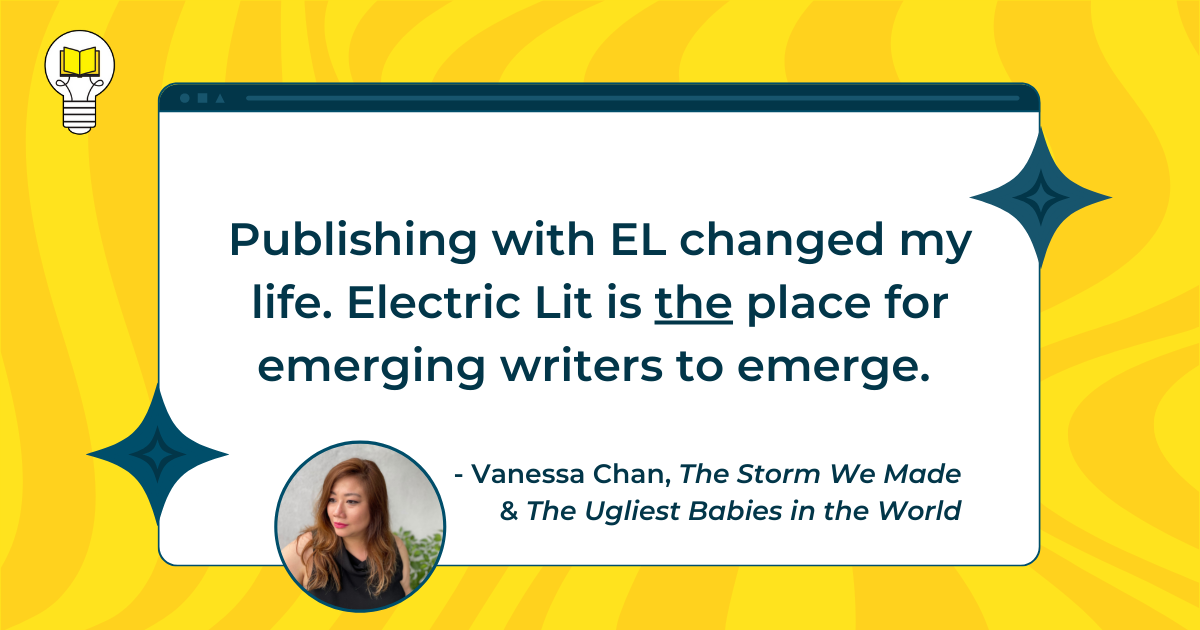
Vanessa Chan Says Publishing With Electric Lit Changed Her Life

Dear Reader,

It is not an exaggeration to say that a large part of the incipient writing career I have, I owe to the platform that Electric Lit gave me when The Commuter published my story, “The Ugliest Babies in the World,” in October 2020. Editor Kelly Luce found my story in the slush pile—me, a then virtually unknown short story writer with only one or two publication credits to my name—and published Ugliest Babies a few weeks later. 

The story went on to live a life I couldn’t have imagined: it became popular, both on Electric Lit and also on social media (via Electric Lit’s immense online support), where literary agents and book editors found it. They began to steadily reach out, days, weeks, and even months after publication, asking to see more of my work. In addition, because the story is written in colloquial Malaysian English, many emerging Malaysian and Southeast Asian writers reached out to me, excited to see an American literary magazine readily and excitedly publishing the colloquialisms of our people.

Two years later, “The Ugliest Babies in the World” is the title story of my forthcoming collection, which alongside my debut novel, “The Storm We Made,” will be published by Marysue Rucci Books, an imprint of Simon & Schuster, as well as in twenty other territories and languages worldwide. Electric Lit’s support of this story—from finding it in slush, to publishing it, to promoting it across all channels—was invaluable in helping me become the author I am today. 

Which is why I’m writing to you on their behalf. Every chance I get, I tell new writers that publishing with EL changed my life. Help Electric Lit continue changing writers’ lives by contributing to their end of year campaign. Their goal is to raise $10,000, and I know it will be put to good use. 

Electric Lit is the place for emerging writers to emerge.  

– Vanessa Chan
Author of The Storm We Made (Jan. 2024) & The Ugliest Babies in the World

8 Schemers and Opportunists in Literature

From Iago, Claudius, Richard III, and the murderous Macbeths in Shakespeare, to Choderlos de Laclos’s master manipulators in Les Liasons Dangereuses, to Nabokov’s silver-tongued Humbert Humbert (who seduces the reader as effectively as he seduces young Lolita), opportunists abound in literature.

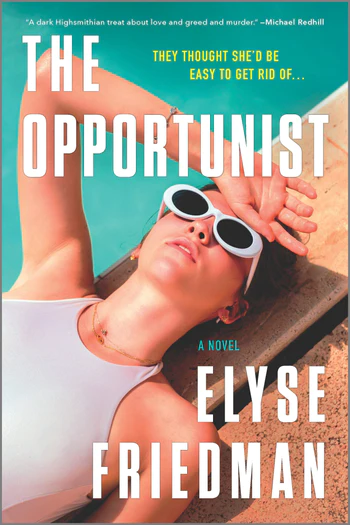
My last novel, The Answer to Everything, was about an impecunious artist who starts a cult to make money. In my most recent book, The Opportunist, I gave myself an entire cast of conniving characters to backstab, menace and double-cross. 

So, why do these odious types show up between the pages so often? Because, while they may be dodgy, even despicable, opportunists are never boring. They hunger for power, sex, revenge, riches (all the juicy stuff!) and will turf any principle to get what they want. If you aren’t acquainted with the opportunists listed below, I urge you to hit up your local bookstore or library forthwith. 

In no particular order, here is an armload of deliciously deceitful reads: 

What Was She Thinking?: Notes on a Scandal by Zoe Heller

Heller creates a wonderfully textured portrait of the treacherous Barbara Covett (maybe a little on point with the name though) in this tale of loneliness, desire and betrayal. Barbara, a friendless spinster who is amusingly contemptuous of almost everyone, becomes infatuated with Sheba, the blithe new pottery instructor at the school where they both teach. Barbara expertly wheedles her way into Sheba’s seemingly perfect life, becoming her key confidante. But when Barbara discovers that she has exaggerated her own standing in Sheba’s heart and mind—spaces occupied by those she deems far less worthy—she becomes enraged, bitter and vengeful. The book is presented as Barbara’s carefully written account of the scandal that explodes her friend’s life: Sheba’s ill-conceived affair with a 15-year-old student. Guess who detonates the bomb?

The Apprenticeship of Duddy Kravitz by Mordecai Richler

Come for the wheeling and dealing young gonif Duddy Kravitz, stay for the authentic flavor of mid-century Montreal, specifically Mile End, a working-class Jewish neighborhood (where breakfast at the cab-stand is a salami sandwich and a Pepsi) and Ste. Agathe, Canada’s answer to the Catskills. Duddy isn’t all bad, and watching him teeter on the edge of decency is what makes this story so ultimately heartbreaking. In becoming a big macher like the notorious Jerry Dingleman, a kid from the block who made good, Duddy betrays his friends, his family, his lover and his soul. 

Laughter in the Dark by Vladimir Nabokov

Love is literally blind in this wonderfully wicked tale of a man who has everything and loses it all. Albinus is a wealthy, respected art critic, living in Berlin with his devoted wife and daughter. One evening at the movies, he spots Margot Peters, an usher with a “pale, sulky, painfully beautiful face.” He pursues the 18-year-old and soon begins an affair. Margot, a vulgar slattern, doesn’t give a toss about Albinus, but she knows a meal ticket when she sees one. Even though he’s an adulterer who eagerly abandoned his spouse and young child, it’s hard not to feel a little sorry for Albinus as first Margot, and then Margot and her dastardly boyfriend Rex, strip him of absolutely everything (including his eyesight). You can almost hear Nabokov chuckling as he gleefully puts Albinus through the Margot/Rex wringer. 

Alys, Always by Harriet Lane

Frances Thorpe is driving home one night when she comes across a crashed car with a dying woman inside. By the time the ambulance arrives, Alys Kyte is dead. Because Frances was the last to speak to her and hear her final words, Alys’s family wishes to meet her. Thus begins Frances’s entry into a world of wealth, privilege and culture. It turns out that Alys was the wife of celebrated author Laurence Kyte, and the mother of two children. Once Frances gets a glimpse of the Kytes’ lifestyle, complete with country house and swimming pool and lunches at the club, it’s as if a veil has been lifted. There’s really no going back to her lowly singleton existence. Frances is a clever woman who knows exactly what makes people tick. That insightfulness, plus an abundance of patience, enables her to infiltrate the world of the Kytes and milk the illustrious connection for all its worth. 

Erasure by Percival Everett

Everyone gets erased—whether through dementia, murder, or an opportunistic act of self-deletion—in this scathing novel about an African American writer and his family. Thelonius Ellison, aka Monk, is an erudite novelist who writes books that the publishing industry doesn’t want—at least not from Black writers. They prefer runaway bestsellers like We’s Lives in Da Ghetto by a contemporary of Monk’s who spent a week in Harlem once. Pissed that his most recent manuscript is failing to attract an offer, he bangs out a parody of what he thinks the White world wants from him: My Pafology— a “gangsta” tale of turmoil (in which chapter four is “Fo” and chapter five is “Fibe”). Alas, the manuscript is taken at face value and his agent sells publishing and movie rights for gazillions, forcing Monk to make a decision. Will he own up to his prank, or will he become Stagg R. Leigh, the ostensible author of the ghetto narrative? Monk isn’t conniving or evil, but he does seize a lucrative opportunity in an unprincipled way, and his literary hoax is too cutting and fun not to include on this list.  

The Switch by Elmore Leonard

The bad guys in Elmore Leonard novels range from slightly adorable to absolutely terrifying. In The Switch, we have two of the former and one of the latter. Louis and Ordell are low-level criminals who kidnap the wife of Frank Dawson, a rich and shady businessman. Richard is the dangerously stupid, heavily-armed neo-Nazi with a convenient place to stash Mickey, the businessman’s wife, until he forks over the ransom. The fly in the ointment: hubby has no intention of paying. Frank filed for divorce from Mickey a few days before she was kidnapped, and he has a buxom young mistress who he hopes to marry when the kidnappers conveniently make it easy for him to do so. The fun is in watching Mickey self-actualize and go from meek housewife/kidnapping victim to full on opportunist when she learns the truth about her asshole of a husband. 

The Plot by Jean Hanff-Korelitz

A fun one, especially for writers. Jacob Finch Bonner’s first novel garnered the “New and Noteworthy” stamp of approval from the New York Times Book Review. His second was a bit of a bust. His third and fourth couldn’t find publishers. Now, the once promising writer is slogging it out as a teacher in a series of third-rate MFA programs around the country. As he begins his latest gig at Ripley College, Jake expects the usual cast of MFA-program types. What he doesn’t expect is Evan Parker, a smug young man who says writing can’t be taught and that he only joined the program to get an agent out of it. Parker informs Jake that he is well into a novel, one with such a compelling plot it will be an unparalleled success, a “sure thing” that Oprah will pick for her book club and everyone will buy and love. One evening, Evan privately shares the plot of his novel with Jake, and Jake realizes with chagrin that the arrogant jerk is right. The story is so good it can’t be messed up. When the program is done, Jake waits for the news of Parker’s outrageous advance and insta-success. But it doesn’t arrive. And Jake learns why: Evan has died. So, Jake pinches the plot and writes the novel himself, and just as Evan predicted, it’s a huge success, propelling Jake to the top of the bestseller lists and back to literary stardom. There’s just one problem: somebody out there knows Jake stole the story, and he’s going to have to deal with the repercussions. 

The Robber Bride by Margaret Atwood

You won’t find a more malevolent force than the beautiful and deadly Zenia, who rampages through the lives of three very unlikely friends: Tony (Antonia), a war historian, Roz, a wealthy businesswoman, and Charis, a hippie-dippy crystal seller who reads auras and raises chickens in her backyard. What bonds these disparate women together is their shared dread and hatred of Zenia, the maneater, the husband stealer, the thief, the liar, the rogue who stirs up strife for the sheer pleasure of it. Bitch on wheels is too gentle a term for cunning, malicious Zenia, whose words are “what a fist sounds like just as it smashes.” When the book was first published, rumors swirled about who Zenia might be based on, and it’s fun to read and speculate on Atwood avenging herself (or her pals) in print. 

The Ocean is Queer and Wondrous

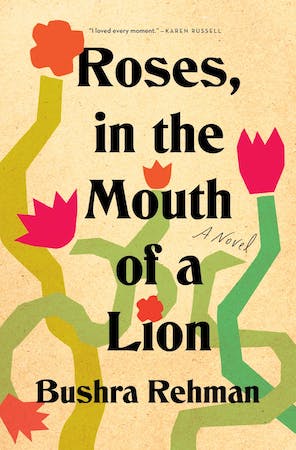
In Sabrina Imbler’s How Far the Light Reaches: A Life in Ten Sea Creatures, the ocean is queer. Survival is subversive. Tiny shrimp scurry around hydrothermal vents on the ocean floor, scrappy and alive in a place hostile to all life. A yeti crab dances for food. The goldfish, an animal we can only imagine as a tiny carnival pet, grows feral when released into the wild, far bigger and browner than the bowl that once confined it. All this time, we realize, we’ve had the wrong idea about goldfish. 

Reading this book, you can feel Imbler, a queer, non-binary writer of mixed race, holding up each sea creature to the light, asking not “what are you?” but “How do you live?” What they imagine for these beings—perhaps hope for—are unstable, wide open futures. Descriptions invite readers below sea level (“personal pan pizza,” “shiny bodies like someone put a dime on a pat of butter”), we watch life bloom in the wake of a whale’s death, and, somehow, there is beauty even in a ten-foot worm with jaws. Yet even when thinking of the butterfly fish, Imbler displays a resistance to the uninterrogated. “Almost every system we exist in is cruel, and it is our job to hold ourselves accountable to a moral center separate from the arbitrary ganglion of laws that so often gets things wrong,” they assert. 

These essays are deeply personal, nuanced, searching. “My Mother and the Starving Octopus” examines Imbler’s relationship with their Chinese mother and their shared anxiety around food. “My Grandmother and the Sturgeon” recounts how Imbler’s family fled Shanghai during occupation, escaping on a small houseboat down the Yangtze and nearly dying of starvation until a Japanese soldier brought them a sack of rice. In a piece that raises questions about sexual autonomy and the gray zone, Imbler juxtaposes the predatory habits of the sand striker with that of boys and men, marveling at the ingenuity of creatures in danger, even themselves. “Hybrids,” an essay “dissecting ourselves,” grapples with the writer’s half-Chinese, half-white identity, confronts histories of miscegenation and eugenics, and recalls how they first encountered the word “half-breed” when they were twelve years old and scoping out a Neopets chat board. (“And this is the part where I might tell you how my parents met”—they write—”but I don’t want to because I have to keep some parts of my family to myself”). 

The collection, reckoning with climate change and disaster, relays anxiety but also wonder, innate curiosity, and adventurousness. “There are many ways to be a predator,” Imbler writes, but even more ways to exist. Ten creatures, they seem to be saying—but one life.


Annie Liontas: Is the ocean queer?

Sabrina Imbler: I was just reading an essay by Sarah Thankam Mathews, the author of All This Could Be Different, where she writes: “Oh me and my friends like to play this game where we look at an object and we’re like, is this gay? Is this light bulb gay? Is this rug gay?” I think that’s a good exercise to apply to everything around you, but, also, the ocean is very frequently described as a queer space. If you look anywhere in the natural world, if you think about it biologically, everything is queer. Things are reproducing and creating more of themselves in ways that are so beyond any kind of frame of heterosexuality that we humans have. I think of the ocean as a space of imagination and impossibility, and I think about queerness also as a place of possibility and imagination and wonder. So, yeah, at least to me, the ocean is gay. But I don’t think anyone looks at the ocean and thinks, “This is straight.”

AL: I’m also thinking about queerness as resilience and how, considering all we’ve done to try to kill the ocean, it keeps coming back in these surprising ways. That was one of my favorite things about your book. You tell us “it is easier to die than live,” but we are shown, time after time, the resilience of these ten creatures, often juxtaposed against the experiences of queer youth. So what do you want us to remember about survival?

SI: I’m happy that you picked up on that word resilience. So much scientific research on biological systems and the ocean is centered around this question of resilience. We often think there’s no way there could be life here, and then we find it, and we’re like, “Why? Why is it here? How is it living? How is it thriving?” These spaces are defined by our very limited human view of what we need to survive and what we find hostile. I’ve been recently reading Ed Yong’s An Immense World, also a book with a bunch of different creatures. It’s very focused on the specific ways these animals can sense their environments. We use light, we use heat, but other creatures have all these different staples for how they experience the world, and are unknowable to us.

How do we manage to be resilient in the face of all these things that seek to destroy us?

If I were to be plunged down to the bottom of the sea, I would die immediately. I don’t belong there—they belong there. Still, I couldn’t help but draw these parallels in the book, using the ways that their bodies have evolved to be perfectly suited for these foreign and alien environments, spaces that might not seem friendly to life. That’s the big thread of the book, How do we manage to survive? How do we manage to be resilient in the face of all these things that seek to destroy us? Whether that’s the chemistry of the earth or, you know, these communities around us that are human or non-human that we may feel threatened by. I could never camouflage my body in the way that a cuttlefish could, I can’t take that directly and apply it to my own life. But all these ways of living, they sort of open new portals, and I start to wonder, how does this make me feel about the way that I move through the world and the way that I am perceived and the agency that I have in my own life?

AL: “My Mother and the Starving Octopus” reads like an act of empathy towards your mother, who immigrated from Taiwan, but it also grapples with your eating disorder. (“If mom grew up wanting to be white, I grew up wanting to be thin”). What did this writing and research illuminate about your relationship with your mother and your own body?

SI: The first time I wrote about the octopus was for Catapult. I didn’t really think about the ethics or understand consent back then, I was just publishing this essay on this website and thinking, my mom’s not gonna see it; who’s gonna see it except for my little community?

When it was time to revise and expand it for this book, I realized my mother was the spark of this story. But I really want to respect her privacy as a person and acknowledge that the reason I’m writing about this octopus and my relationship to it is informed by my own fixations. So I tried to remove a lot, and when I expanded the essay, I expanded my own personal experiences. Then I sent her the final version. I was so nervous. Maybe she would say that I couldn’t write it, or that she didn’t want to appear in it. And I love my mother so much and I’d respect her wishes. But it ended up being a really generative conversation for us, because over the years I had tried to broach a conversation about eating and about food and about weight, and we would hit these walls. It was very raw for both of us, and neither of us really wanted to go to certain places. And my mother is very stubborn. But she read the essay and added some points of clarification, like moments of mismemory that I had had, and that was really interesting. It allowed me to dig deeper and to ask, why did I remember that this way? Why did my mother remember this that way? She helped add a lot of levity in how she talked about her own body and her own eating. She shared an anecdote of this racist doctor being like, “Stop eating so much Chinese food!” and her being like, “Fuck you!” I think that’s so funny, and it also just helped spotlight how my mother pushed back. I was so inspired.

AL: A similar stitching or mirroring also happens in “How to Draw a Sperm Whale,” where you borrow the language of whale autopsy to give us the necropsy report of a queer relationship. But, as with the rest of the essays, you’re never wanting to draw direct lines, it would be too neat. Yet it does seem like you learn something about aloneness versus feeling alone.

SI: I was still reeling from this breakup, not necessarily the breakup itself, nor the relationship itself, but—just trying to understand why this breakup had this magnified impact on me. I found it almost embarrassing, like, why am I still thinking about this person? Also, I really didn’t want to write a breakup essay that looked the same. I needed to find a wrinkle that made it feel like a fresh and generative thing to write about. I kept coming back to Leslie Jamison’s The Empathy Exams because they felt very similar in the ways they asked, how do we use medical language to talk about death or illness or grief? These incredibly emotional human experiences, how does the language of bureaucracy warp them? I read so many whale autopsies, I went through so many weird marine and mammal stranding reports and looked at all of these very graphic photos. I went in many different directions. But the heart of the essay, ultimately, was about how the whale lived. Not just the grief, but what remains after something that large dies or is killed? How can we think about that? What is restored?

I learned that queerness is not tied up with a relationship. It really is tied up with identity and how you live your life and your platonic community.

I started [“How to Draw a Sperm Whale”] as an essay about this particular relationship, and then in writing it, I realized this is much more. It turned out to be about me and how I learned to understand myself as a queer person who could be alone and who could be single. I learned that queerness is not tied up with a relationship. It really is tied up with identity and how you live your life and your platonic community. What it means to be alone, and how there can be joy in that.

AL: Tell us why we should love crabs.

SI: Well I’m a Cancer.

AL: Same!

SI: So I guess this is a biased conversation. We are all pro-crab. I should come out in the pocket of Big Crab. 

I mean, crabs are super cool. I don’t know if you’ve heard of the evolutionary phenomenon called carcinization. It goes viral every so often because it is so funny: this evolutionary trend of more and more separate evolutionary lineages evolving the crab body plan and how there are so many things that we call crabs that are not true crabs. Like porcelain crabs, or spider crabs, or king crabs, or yeti crabs, which are technically squat lobsters, which are also not lobsters. [These] species evolve over time and their bodies realize that actually, the ideal form to be is a crab. You can scuttle, you can walk in all these different directions. You have a hard shell. It just works. I’m less interested in taxonomy debates and am more inspired by the fact that all of these different lineages came independently to the conclusion it just makes sense to be a crab. You find them all over the world. I was in Puerto Rico in March, and I was at a gas station, and there was a crab. It lived in a hole, it would come out and snap its little claw and go back. They’ve been able to conquer all these different niches and little realms on earth, it’s just very, very impressive. 

AL: Who is the unsung hero of the ocean?

SI: My book is absolutely biased towards large or at least visible creatures. A lot of the creatures that I wrote about, such as the salps, which are gelatinous—their body is almost entirely water, they really don’t fossilize—are hard to capture. It’s hard to record them through our own human machines and human contraptions, and yet, they are responsible for cycling so much carbon toward the bottom of the ocean. They’re agents of global cooling, it’s just all happening out of sight and out of mind. As I was learning about the salps, I had this realization that, oh my God, my book is all made up of macroscopic organisms. Maybe I should have a plankton chapter! There’s this whole scale of oceanic creatures that I didn’t even get into, yet they are so vital to the chemistry of the ocean and they feed all of the creatures in my book, in some way. The plankton that are photosynthesizing at the top of the ocean are responsible for all of the nutrients that cycle out into the creatures that I talk about. And krill! Krill do so much! Without krill, so many whales wouldn’t be around. There was a moment when I was looking at all the essays in my book and I was like, where are the tiny guys? 

AL: A frank discussion about climate change is inevitable, grim, heartbreaking. What in the research was hardest to confront? What is our failure of imagination? 

SI: As someone who is a science journalist by day, every day I wake up, I think about climate change at least once. It is so present in so much of the work that I do. I was really trying to figure out how I could talk about climate change in the book. I didn’t want it to feel redundant or preachy or to distract from the connections of these narrative switchbacks, but it was absolutely something that I thought about all of the time, this grief that I held throughout the reporting process. I would learn about a creature, and then I would immediately think, let me just Google it and see what’s happening. And what would come back is [something like] “half of this population will disappear because of climate change,” or a statistic that all sharks are in danger because of climate change. The grief and anxiety that hung over the process helped bring me back to the work when I felt disconnected from it or when I found it hard to write. It creates this urgency around why I want people to know about these creatures and why I want them to care.

Twenty Questions with a Philosopher Iguana

When I Look Up an Iguana Turns His Head Away From the Sun

He asks: What is beginning? 
Something I never notice, like my nails growing.
I hiccup, forgetting why I’m waterside
or that we’re both abandoned 
like balloons at a wedding. 
A foraging pelican winks at me 
twice. Somewhere in Nevada
a goldfish has resolved 
to starve to death. 

He asks: What if aspens aspire to silence,
which the wind has outlawed? 
I trust the expired volcano 
that admits its vulnerability 
more than an escalator step moving 
wearily into the destined position. 

He asks: Are you inculpable 
enough? Drinking down the winter
that brims my southern eye socket,
I freed my ravaged enemy 
with an unrecognizable bear hug. 

He asks: Will you pity a graffitied lamppost 
or the machinist imprisoned by his own gadget?
I, speechless, only think of my father.

He asks: Can you love
in all the ways love is named?


The Frond

Today I bike to work and run over
a coconut leaf the size of my leg,
shaved off by last night’s razor storm. 
No bell tower tolls for this fall;

                                 even the rising sun turns a blind eye. 
                                 The frond blocks the narrow sidewalk 
                                 like a fish bone stuck in the town’s throat.
                                 When I run over it,

the fish bone gives a moan
as if spitting a bubble. 
Celery on the cutting board. A bamboo 
broom sweeping the sea into a ditch. 

                                 Dew splashes. Three tiny lizards 
                                 flee with their tails curled. 
                                 A woman yawns in her fern-green jeep 
                                 waiting at the traffic light. 

Desolation echoes. My porch light 
long broken. Mailbox unchecked,
and I bike to work. Summer is eternal. 
Somewhere, a couch longing 

                                 for my lolling skeleton: if sharp enough,
                                 my ribs could lacerate the moon.
                                 Tire marks all over my spine.
                                 Soul never closer to soil. 

If You Want to Build a Story, Become an Architect

Mary-Alice Daniel has been on a journey, literally, across continents. She documents her experiences in A Coastline Is an Immeasurable Thing, which is a memoir about places, from which she has been uprooted, assimilated into, revisited, and settled, giving the reader a close look into the lives of African diasporas. Daniel has a way of parsing dire childhood experiences into insightful and humorous narratives. My copy of the book is colorful. Passages on every other page are highlighted for profound statements I hope to return to, funny anecdotes, or sentences too beautiful not to acknowledge—I’m not surprised that her next offering is a poetry collection.

In this interview carried out via email, Daniel and I talk about, among other things, the peculiarity of her experiences, the complexity of her relationship to Nigeria, a country that was once simply home, and the varieties of Black experience in the US where she now lives. Her responses here are as interesting as her book, and I am happy for everyone to read both. 


Ladi Opaluwa: Your memoir is focused on place, which seems like an interesting choice considering the tenuous connections that you have with the various places that you’ve lived. Was this lack of rootedness earlier in your life a motivation for the book? 

Mary-Alice Daniel: In my prologue, I talk about my “rootlessness,” but my perspective has shifted, and I can now see that I actually have many, many tangled roots. After leaving my birthplace in Nigeria as a young child, I spent the first decade of my life in Reading, England, before my family moved to the American South. Since adolescence, I have called these places something like “home”: Nashville, Tennessee; suburban Connecticut; suburban Maryland; Brooklyn; Harlem; Ann Arbor; Detroit; Chicago; Los Angeles. My childhood was shaped by the culture shock coloring extended return trips to Nigeria. And it was shaped by the reverse culture clash of coming back to the West, where my immediate family remained alone—just the 5 of us. 

I’ve always been on the outside looking in. A major motivation in writing this book was to reposition myself. Instead of being the misfit, shuttled around from one place to another—the way I long existed in the world—I became an architect. I am drawn to manipulating chaos. In my poetry, which is wildly different in tone and style from this memoir, I’m like a kid with a borderline unhealthy fixation on fire. I like to stoke chaos, watch it proliferate, watch things burn. In this book, however, my instinct was to create order from my personal chaos. The cultural chaos I refer to involves several kinds of incongruity, including the peculiar spiritual ecosystem I come from. My ethnic tribe is 99% Islamic; my native culture cannot be divorced from that religion, and much of my maternal family is Muslim. I was raised in an Evangelical home. But the Christianity I was raised to revere was syncretic and superstitious. It mixed traditions from Islam, from the pre-Abrahamic animism of my region, and from the Catholic and Protestant missionary schools my parents were educated in. I’m now agnostic; I work through religious trauma in writing. 

LO: An adjacent question: At what point did you realize that you could/should collect your experiences into a book, or, to be outrightly nosey, when did you start writing this book?

MAD: I didn’t start writing this book until I’d wasted half the time I had before its first deadline. I had a call with my amazing agent, who read some pages I’d just sent her and asked me bluntly, “You do know that people can tell when you’re writing something you don’t really want to—right?” I did not, in fact, know that. She told me to write what I wanted to write. I was nervous and scared to do so; I’d never written anything of this length in this genre. The book I sold was more of an academic/critical project, which I envisioned becoming a collection of essays. I never intended to write a memoir. I wasn’t comfortable breaking the many, many cultural taboos I had to break in order to divulge intimate details about myself and my upbringing. 

LO: In your narration, Nigeria is a destitute place, but also a homestead that you return to as you move around the world. Even the plotting of the book mirrors this pattern of returning. Now that you have chosen a home for yourself (I do not want to give away the name), and have not returned to Nigeria in over a decade, what is the country to you now?

MAD: It is “Back Home.” That’s what we call it. It’s full of family, most of whom I haven’t seen in a decade. It’s full of fading and false memories. I still don’t often really think of Nigeria as a country. It’s so wildly different from place to place, and I only know my corner of it. Here, I should give a bit of background about Nigeria as a country and what makes the North different. Nigeria is roughly fifty percent Muslim and fifty percent Christian. It is divided geographically, with an overwhelmingly Islamic north above the inverse of an entirely Christianized south. Most Nigerian immigrants in the West are from the southern/central parts of the country, and so are almost all prominent Nigerian writers. As a writer, I represent a rare perspective from my radicalized, remote region. 

I am from the extreme north—the desert region near the border with Niger, which is its own world. People there don’t often emigrate to the West because the way here is through education, and the educational infrastructure is poor. The terrorist group Boko Haram, which was founded in the same city I was born, means “Western education is forbidden,” and they ceaselessly attack secular schools. Literacy rates are low, especially for girls. My mother happened to be the brilliant, lucky exception. Her father converted to Christianity when he was in a missionary hospital recovering from leprosy, and he sent her to Baptist boarding schools; from there, she went on to universities in Nigeria and England. 

The country where I’m from—the places I used to return to as a child—feels like it’s gone: beyond my grasp. Violence and terrorism make it impossible to visit, and there’s no end in sight. The country is a long-distance phone call with a breaking connection. 

LO: You write glowingly about the Fulani tribe. For instance, “If I say I am Fulani, this is to say I go without fears.” However, in Nigeria, the current perception of the Fulani herdsmen as terrorists (which you acknowledge) is vastly different from that of the innocent nomadic herdsmen that I knew growing up. How does this turn of events make you feel about your relationship to the tribe? 

MAD: I am interested in your description of my depiction of the Fulani as “glowing.” I very much intended to be critical of the cultures I came from, as well as the cultures I’ve been carried into. I don’t think that I view any part of my tribal history through rose-colored glasses. My relationship to an ethnic group whose identity is inextricably linked with Islam is complicated, as I am not Muslim. It was the Fulani, specifically, that brought Islam to much of West Africa, in a saga featuring both violence and poetry beginning over a thousand years ago. What you perceive as a glow might just be the intensity of my connection to this tribe in particular—to me, it reflects an identity stronger than “Nigerian.” Nigeria is so nebulous. I am fascinated by the long and unknown (in the West) history of the Fulani. But extremists from this tribe are, in fact, committing acts of atrocity. My Christian relatives in Fulani-land are a persecuted religious minority and the targets of our own tribespeople. 

I still haven’t figured out exactly how to talk about the Fulani mostly because my words will naturally carry more weight due to the scarcity of voices from the Fulani sphere. When I told one of my Black American friends about writing this book, one of the first things she said was that she’s not interested in hearing any more negative narratives about Africa. I agreed with her . . . then proceeded to write some negative things about Nigeria. I had to balance my resistance to adding to awful stereotypes with the equally awful realities about the specific area I’m from. I cannot get away, and should not turn away, from atrocities taking place. While writing, I tried to make it very clear that everything I write applies to this region only—by making it distinctive.

LO: You detail the initial difficulty you had with assimilating in the US, even within the African American community. Something that I struggle with as a Nigerian in the US is being Black and not African American. I find that some people frown at my attempt to define myself strictly as Nigerian (I’m not American). Possibly, they see it as an attempt to avoid the struggles of African Americans. Right now, my cultural identity is Immigrant; as you write, “culture trumped color.” Anyway, all of this is a preface to asking what being American African, as you describe yourself, means to you. Is it about genealogy or about the degree of assimilation into the African American culture?

MAD: I have one foot planted in two worlds—African and American. These two worlds host a Black diaspora that is often in conflict after centuries of estrangement and rupture. I call myself American African because Africans and Americans alike have said that I am not “really” either. If I am not “really” American because I wasn’t born here, and I am not “really” African because I didn’t grow up there—am I just nothing, then? The answer is that I am both. I am “really” both. And I have conflicting feelings about both places and identities. I think my audience is made of others who are told they are not “really” enough because of immigration status or something else. I feel a strong sense of kinship with these people. 

LO: When you write, “Mary is my original mystery,” I instinctively read mystery as misery. My middle name is Mary. It seems that every Mary that I know, especially non-Catholic Marys, have a hang-up about the name. I call this the Mary-trauma. I have gone from promoting it from a middle name to a first name and then reverting, to silence it. You have found peace with the name, but do you ever consider what you would name yourself if you wanted to? 

MAD: I still don’t like my name and have no preference whether people call me Mary or Mary-Alice. Most people shorten it. But it’s actually another thing I find sort of humorous, just because it’s so incongruous. I don’t think I’m a Mary or will ever be a Mary. And “Alice” is semi-ludicrous to me. Still, the idea of changing my name is unappealing because as a serial immigrant, I long ago reached my limit in terms of dealing with bureaucracy and paperwork. The idea of further complicating the boxes of records I already have—some of which already contain troublesome naming errors—doesn’t seem prudent.  

The idea of changing my name is unappealing because as a serial immigrant, I long ago reached my limit in terms of dealing with bureaucracy and paperwork.

The most likely name I would take would be Amina, which was the name I was supposed to have been called. The name is a parallel to Mary, mother of Jesus—Amina is the mother of the Prophet Muhammad. There was also a Queen Amina who ruled part of the Nigerian North in the 16th century (I was raised with the fanciful idea that I’m her direct descendent). She’s famous for allegedly offing the lovers she took in each new territory she conquered, spending a single night with each one and beheading them all the next morning to keep their love affair secret. My mother decided to name me something “aggressively” Christian when her siblings began marrying Muslim spouses and giving their children Arabic names in that tradition. “Mary” was her way of outwardly professing faith through me. 

LO: I had a most uncanny moment while reading the book. One evening, I was sitting beside my mum on a couch, I glanced at her and saw that she was wearing the same wax print that is on the cover of the book. This realization led to a lengthy conversation about the book and the ubiquity of wax print in our culture and the connotations of their design. Has the cover of the book sparked any similar conversation with your mum or any older African woman? 

MAD: It took me a long time to find this cover, which centers a painting by Nigerian artist Adekunle Adeleke. I love the cover, but it hasn’t come up—it’s definitely the book’s content that is of primary concern to relatives. I was raised conservatively—socially, not politically. Raised to be modest, private. Our regional literary tradition features fables, poetry, and novels, but memoir is not really a thing, culturally. The fewer people in my extended family that read this, the better. 

LO: I can’t get enough of your pristine prose and your stories. What is an anecdote that did not make it into the book that you would be willing to share, however briefly? 

MAD: I can share two things. 

1. Adjusting to the different American pronunciation of “Adidas” when we first moved to the U.S. was a Big Moment for me and my siblings. (Ask a British friend how they say it if you don’t know—it’s hilarious.)

2. When my family first moved to Nashville, there was one “fancy” Chinese buffet we reserved for special occasions (if we kids were well behaved in church for a long streak, or if we had out-of-town guests). I was mesmerized by the iridescent blue-green mussels they steamed, and I would always take the prettiest one, clean it, and add it to a growing stockpile. I’d never seen anything like them before and thought they were rare or expensive, that they might increase in value over time. One day, my mom found my gross little collection and threw everything away. I think about that oddball kid who was so impressed with shiny shells. In the book, I describe her as “clueless, shabby.” And now I think I envy her. One of my favorite words is “lucipetal”—seeking or being attracted to bright things like light. She embodied that. I’m circling around it. 

7 Books About Life in Queens by Writers of Color

The thing about being from Queens is that when you leave Queens you realize there’s no other place in the world like it. It lives in your imagination like a wild-flower-weed, its roots deep in the hard rock soil of Queens. 

My novel, Roses in the Mouth of a Lion, takes place in my home neighborhood of Corona, Queens. The main character Razia is a young Pakistani woman growing up in a tight-knit Muslim community. She prays five times a day, reads Quran and goes to extra religious service on the weekends, all the while wearing skin-tight acid wash jeans, feathering her hair and wanting to date boys break-dancing in the schoolyard. 

Razia’s father owns a butcher shop, Corona Halal Meats. It’s on the same block as a Jehovah’s Witness Kingdom Hall, an Episcopalian church and a masjid Razia’s father and uncles are building. Razia’s closest friends are from the neighborhood and they tend to find trouble everywhere they go. When Razia is accepted to a high school in Manhattan and leaves Queens and her childhood friends behind, she makes a new friend, a young woman she is deeply attracted to, and she realizes why she’s always felt different from her community, even her best friends. 

Roses, in the Mouth of a Lion  is a book for anyone who’s ever had to leave the world they grew up in to be who they needed to be. It’s a book for those who remember what it was like to be queer and not have the words to express it, those who struggled to reconcile their religious faith with their desires. It’s a book for anyone who wants to feel the pure sensory experience of living in Queens in the ‘80s. 

Here are 7 books about living and loving in Queens by writers of color:

Angel & Hannah by Ishle Yi Park

There can be no list about Queens that doesn’t include Ishle Yi Park, the first woman and first Asian American poet laureate of Queens. In Angel & Hannah, her gorgeous novel-in-verse, we follow the story of Hannah, a Korean American girl from Queens and Angel, a Nuyorican boy from Brooklyn who fall in love. They fend for themselves, dealing with addiction, disownment, and poverty. Their love’s song is beautiful to witness. Did I mention the entire book is written in incredible hip-hop sonnets? 

Antiman: A Hybrid Memoir by Rajiv Mohabir 

This beautiful memoir, a mix of poetry, song and passion, tells the story of Rajiv, an Indo-Caribbean poet growing up in the United States. Young Rajiv longs to know more about his family’s history in India and the legacy of his ancestors who were indentured laborers working on sugar plantations in Guyana. When he comes to New York City to stay with relatives in Queens, he discovers a community of queer brown activists who share his longing for the past but are also looking towards the future. But even here, Rajiv feels like an outsider. When his cousin outs him as an “antiman”—a Caribbean slur for gay  men—Rajiv is disowned by his family. Healing this pain through music and poetry, he embraces his identity and claims his status as an antiman—forging a new way of being entirely his own. 

Mama Phife Represents by Chery Boyce-Taylor

In Mama Phife Represents Cheryl Boyce-Taylor pays tribute to her departed son Malik “Phife Dawg” Taylor of the legendary hip-hop trio A Tribe Called Quest. This book is a gorgeous tapestry of narrative poems, dreams, anecdotes, and treasured fragments including journal entries, letters, drawings, hip-hop lyrics, and notes Malik wrote to his parents. Boyce-Taylor’s incredible gift for poetry and the depth of this mother-son relationship is a treasure for fans of both artists. In this moving collection, we follow the journey of a mother’s grieving heart.

The Girls in Queens by Christine Kandic Torres  

The Girls in Queens is a skillful novel about female friendship, the secrets we keep, the loyalties we hold, and the reality that we may all know a sexual predator, whether or not we want to admit it. The girls in Queens in this book are Brisma and Kelly, best friends who protect each other. They are each other’s mirrors, at times kind, at times cruel. When they discover a friend and former boyfriend from their community is a sexual predator, their loyalties are divided and they make drastically different choices on how to move forward. An essential book in this time of reckoning. 

House of Sticks by Ly Tran 

Ly Tran is a child when she immigrates from a small town in Vietnam to Queens. As Ly navigates the landscape of her new home in New York City, she works long hours as a manicurist alongside her mother and tries to do well in school. When her eyesight weakens and her father forbids her from getting glasses, calling her diagnosis of poor vision a government conspiracy, Ly struggles to know how to move forward. Her father spent nearly a decade as a prisoner of war in Vietnam and his trauma is held by the family with compassion, even when it wounds them. Ly is a brilliant writer and the deep honesty of this memoir reminded me so much of the vulnerability and pain that is often part of being a girl from Queens. 

Brown Girls by Daphne Palasi Andreades

This creative and energetic novel brings readers into the lives of a group of friends—young women of color growing up in Queens. It’s a collective portrait, written in the second person, a record of the forces that bind friends, families, and communities. As the friends in Brown Girls navigate schools, marriages, motherhood and professional accomplishments, they return again and again to the circle of their friendship and to their hometown of Queens. The passion of their friendship beats at the heart of this book. 

Imposter Syndrome by Patricia Park 

This book is laugh-out-loud funny, compelling and heart-wrenching. Alejandra Kim’s family is from the Korean diaspora in Argentina and it’s not easy for her to fit into any box, whether it’s in her fancy Manhattan private school where she is a scholarship student or her Jackson Heights neighborhood. Alejandra has just lost her father, and she feels she must hide this deep pain, even from her closest friends and especially from her mother who is numb from overwork and grief. When a microaggression at school thrusts Alejandra into the spotlight, she must make a difficult decision and decide who she can trust and who she must be for herself and her family. 

Dorian Gray Drops His Skincare Routine

Hi everyone! Dorian here, back with another vlog. You all were absolutely blowing up the comments section on my last video with things like, “Dorian! How do you look so young?”, “What’s your secret??”, and “It is not humanly possible to look this good for this long.” So flattering! I wanted to give you guys a thank you for being such dedicated subscribers, so today let’s dive into my skincare routine! 

You have to start off with a clean face, so to begin I usually go in with gel cleanser first to get all the dirt and grime, and then a micellar water as a softer way to clean up any residual gunk. Next, have your friend Basil paint a portrait of you. 

Now I know, I know, this part is a splurge. Not everyone has an artistically talented friend who idolizes you so much that their adoration practically spills out of the painting, and even the ones that do may have to cough up some dough for a really good portrait. But trust me, I’ve tried a lot of different things to keep my face looking fresh, and this is the one part of my routine that is non-negotiable. You won’t believe the results. 

While you apply the toner, pledge your immortal soul to the painting.

Ok, moving on! After I cleanse my skin I use a nice moisturizing toner. This is great for hydration which is important to me because I have very dry skin. While you apply the toner, pledge your immortal soul to the painting. Beg it to absorb any sign of age or sin so that you, yourself, can remain youthful and untouched by the wrinkly, gnarled hand of your own wicked nature. Once you’re done with that, you can fan your face a bit to help the toner dry. I know I look soooo silly right now but just trust me! 

So now your face is clean and toned and it’s serum time! A lot of people skip this step, but finding a good serum works wonders! I love this peptide serum in particular because it’s great for anti-aging and making the skin feel plump and springy. By now, you have no doubt done something terrible, like ruefully scorned a lover or acted in a selfish manner—I know because I have! If you look closely, you’ll notice that the painting has changed expressions and now mocks you with a sneer. At this point, I typically pop that baby in the attic so that no one else can be horrified by its transformation. Again, people sometimes want to just skip this step, but I find it’s really important to hide the proof of your iniquity from your friends and family. 

Now that your skin has gotten all its vitamins and nutrients, you should be feeling fresh and clean. For makeup, I’m going to start with a foundation base, and I use this long-lasting one for full coverage. The long-lasting part is really important for me because I need my makeup to stay put all throughout the night. If you’ve seen any of my other videos, you know that when I go out, I go out, so I need a foundation that can keep up, ya know? If you can’t get this particular foundation, a drugstore foundation is also totally fine because, again, your painting in the attic is going to be taking most of the damage anyway. 

Is putting my soul in a painting safe? Does my insurance cover it?

A lot of people ask, is putting my soul in a painting safe? Does my insurance cover it? Will people be able to tell I’ve had work done? And the answers to that are yes, no, and you won’t even care because you’re going to be looking like an absolute snack and they’re just jealous. 

Finally, I like to finish my routine with a little powder foundation just to give my skin that matte look. Don’t want to be out and about with my face looking all oily! Now, if you’ve been engaging in a lot of hedonistic activities, just one bacchanal after another of carnal delights, you’ll notice that your picture looks pretty hideous. This is totally normal! You’ve been fucking and sucking your way through London, and all that action is bound to take a toll. 

At this point you should be feeling pretty guilty and wanting all the proof of your atrocities to disappear. So you’re just going to grab a knife and lunge, blade-first, at the painting that now mocks you and your hypocrisy. Be careful you don’t have any leftover toner on your fingers, or else the blade could slip and you could accidentally stab yourself in the chest. If this happens and you are suddenly made into the crumpled, horrid being you have always known yourself to be, take solace in the fact that you’ll soon be dead and therefore will not have to suffer being ugly for long. 

Thanks so much to Superficiality for sponsoring my video today, be sure to check out some of their other great products like sexism and The Kardashians!