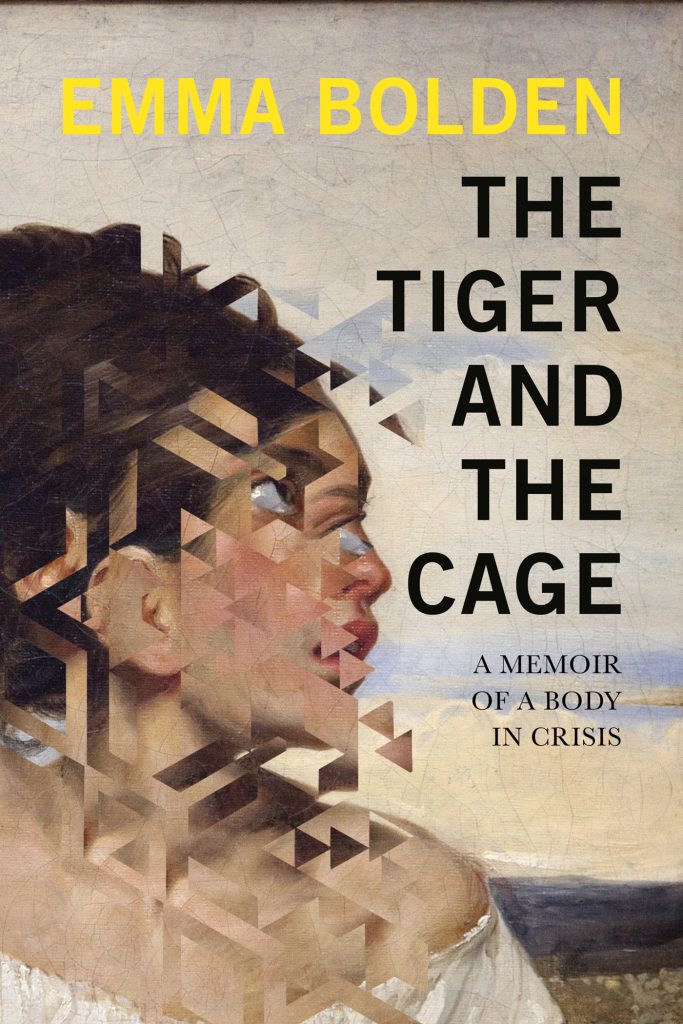
Endometriosis is classified by Mayo Clinic as a “common” condition, “treatable by a medical professional.” And yet, when Emma Bolden began experiencing aggressive symptoms of the illness in elementary school, she was treated for decades by doctors who neither believed her account of her experience nor took her symptoms seriously. In her memoir The Tiger and the Cage, there are scenes—plural scenes, vividly rendered on the page—in which Bolden bleeds profusely for hours at a time while doctors insist, “A little spotting is common.” In another scene, an emergency physician explains aloud what is happening inside Bolden’s body, and the ER technician comments, “Ew.”
Like any number of inescapable experiences—trauma, embarrassment, disappointment, fear—illness is one that society marginalizes. The implicit message, reinforced by a pervasive culture of silence, is that pain is private—shameful. For the over 28 million women (in just the United States) who live with chronic pain, the stigmatization is exhausting. If pain is taboo, then the body becomes a very heavy thing. In The Tiger and the Cage, Bolden carries that weight in gorgeous, poetic prose infused with the kind of honesty that is difficult to turn away from.
Bolden starts her narrative in 5th grade, giving readers an in-depth look at a painful (literally and physically) youth and adolescence. In adulthood, as Bolden’s symptoms intensify, doctors begin insisting that only a hysterectomy will alleviate the pain. In the background of every day, Bolden can hear a clock ticking—because while the surgery might cure the endometriosis, what will it mean for the expected story of her life? How will she answer questions like: Marriage? Kids?—and what will the questions become if it doesn’t work?
For any reader ever cast as the unreliable narrator of their own story, I suspect Bolden’s memoir will feel like fierce, validating balm.
Wynter K Miller: I was really struck by how you opened the memoir with learning about the water cycle in 5th grade, and then you closed the memoir with a line about how living is like floating in a sea in which there’s no such thing as sinking or swimming. Fire is frequently used as a metaphor for chronic pain, but I haven’t seen water used for this sort of thematic lift before. How did that come to you—why did water feel like the appropriate metaphor for your experience?
Emma Bolden: Part of it may be about the transmutability of water, and how, under different conditions and pressures, it turns into different things. If there’s too much heat, it boils. If there’s too much cold, it freezes. And each of those things are painful in their own way.
The pain was always there, it just was there in different forms and transformed in different ways.
I think because I experience so many different kinds of pain, and the kind of pain that I experience transformed in so many ways—I mention in the book that at one point I had an operation that was experimental at the time called LUNA, and afterward I experienced peace for a few years where I didn’t really have much pain. And then when the pain returned, it returned completely transformed. So in a sense, it was like water—the pain was always there, it just was there in different forms and transformed in different ways.
But I think it was also important for me because I had this experience that I talk about in the book a bit when I was about three, and I actually almost drowned. And I just have this very, very strong memory of it being frightening, but then it being incredibly peaceful and looking up through the water and seeing the light come through and just feeling this peace that I’ve never really felt at any other time in my life. I think that when I was in extreme pain, it was that moment that I went back to. And I thought about it as a possibility for something that can happen in the body, that experience of peace.
WKM: You explore different kinds of pressures in the book—social pressures as a student, sexual pressures from romantic partners as you moved into adulthood, peer pressures from your cohort. You were also a badass academic trying to get tenure, so you were experiencing professional and financial pressures. How did those pressures affect your experience of your illness?
EB: There was so much pressure! And there were a lot of things that I couldn’t really get into in the book. For instance, the financial pressure was a huge thing. At the end of the book, I do talk about how, when I finally made my decision to have the hysterectomy, a lot of it was due to financial pressure because I realized, like, I can’t keep working my job like this. Things had gotten to the point where I couldn’t keep working without help. It was when a lot of those pressures combined that I realized I couldn’t do it anymore, for myself or for other people.
WKM: Could you talk a bit about the other people? There are moments in the book—and I think for anyone with chronic pain, this will really, really resonate—where you’re experiencing something horrifying internally and externally, you’re projecting normalcy. I imagine that many of the people in your life, even people that were close to you, had no idea what was going on. How did you make decisions about who to tell and what information to share versus who not to tell and why?
Anybody who deals with chronic pain—it makes you develop a really complicated relationship to your body, because you’re not in control of it.
EB: That is a very complicated question. I think a lot of it started because I was so young when I started my period, I only knew one other person in my grade who had her period, and it was because she had been held back. So she was a year older than us. From the very beginning, it was something that was just totally embarrassing and shameful—I remember in the Catholic school where I went, we had to go to bathrooms according to our grades, and they did not have trash cans in the stalls. So, I would sometimes get in a little bit of trouble for being in the bathroom too long because I would have to wait until nobody else was in there so I could take my pads to the big trash can. And there’s a long, melodramatic, deleted scene from the book that talks about the horrible sound that it made—tossing my pads into that trash can—and things like that. I think that it kind of affected me for a really long time. I did very much schedule things around being able to hide them: I always had surgery either during spring break or during the summer because that way I didn’t have to tell anybody. Most of the time, it was just a need-to-know basis because it was just so difficult to talk about and explain—and not only was it hard to talk about in a general sense, but as I got older, the questions became more and more complicated and people became less and less concerned about not, you know, asking them. And so, strangers would ask things like: well, can you have children, or are you going to freeze your eggs?
It was just all different levels of shame and embarrassment that compounded. The majority of my family did not know that I had a hysterectomy—and there are still people I’m related to who probably don’t know.
WKM: And now you’ve written a very revealing memoir—and it says everything. You’re very, very open about your experiences, and I have to imagine that was difficult. Can you talk about the decision to write the memoir and then the process of writing it, in terms of feeling like you’re finally saying all of the things that you’ve been hiding for so long?
EB: I tend to write about something in poetry before I can do it in prose. Especially if the material is really intense, it’s almost like it’s radioactive. And poetry gives me the gloves that I need to handle the radioactive material. So first I wrote a collection called House Is an Enigma. I actually did not know that the title poem was about my hysterectomy until it was in Best American Poetry and I had to write an artist statement. I was like, “Oh no. I have no idea what this poem is about.” And then I realized. I think going through that process made me start to think: Why is this so intense for me and why is it so secretive? It shouldn’t be. It’s just a body, I should be able to talk about it. There shouldn’t be so much shame attached to [endometriosis and pain], and somebody has to be the one to talk about it.
WKM: In order to remove the stigma.
EB: Yeah, exactly—and it’s weird because, I mean, there’s some stuff in there. People are going to know what kind of underwear I like to wear. And I write about really intense things that happen to the most private parts of my body. But I’m not super uncomfortable about it being out there because I’m just like: This happened. It happened to me. It happens to other women.
WKM: Your comment about it being “just a body”—that idea is something I noticed in the prose itself. There’s a scene where you pass out and you write, “When I returned to my body, I discovered that it and I had somehow ended up on the bathroom floor. I was afraid of what my body had done to the me inside of it.”
There’s a separation there between you and your body, and there’s a giving of agency to your body that is not affiliated with you. It’s doing its own, separate thing. I think that separation captures very much what it can be like to experience chronic pain. How conscious were you of making that separation? Did it happen only in the writing of the memoir? Or were you doing it in your head before then? Were you thinking of your body as something separate from yourself at a young age?
EB: I think that anybody who deals with chronic pain—it makes you develop a really complicated relationship to your body, because you’re not in control of it. You are not in control of how your day is going to go. You’re not in control of what happens in your life. So, you kind of have to recognize, in some sense, that you and your body are separate and that there’s a conflict between them. I think that when I started passing out, as the 6th or 7th grader—sometimes I was just on the floor and had no idea how I got there. So I did sort of see the body as a separate thing even early on. In my case, my body just, it just prevented me from doing a lot of the things that I wanted to do in my life.
WKM: There are so many metaphors for the body, even within your own work. In this memoir, there’s the tiger in the cage. In that sense, your body is a cage or a prison or a thing that you’re trapped inside of, that you cannot escape. And the only escape is escaping the body, which is death. But then I’m thinking of House Is an Enigma, and the idea that the body is a home. If you think of it in that way, it puts a very different perspective on what is happening physically and how you feel about it. At this point in your career, and after everything that you’ve been through, do you think of your body more as a cage or a home? And how does that affect your craft and what you do with it?
EB: Yeah, it’s complicated, right? Because the whole time that I was talking about there being a separation between the body, I was also thinking about how dealing with chronic pain and other kind of illnesses involves a kind of intimacy with your body, and an awareness of how the body functions and what the signs are that things are about to go very, very wrong.
At this point, I’ve come to peace with it all, and come to terms with the way that my life did not turn out, the way that I thought it was going to and expected it to. And that had to do with my body. But I think that [my body and I] have a good detente, we’re okay, we have a better relationship.
And I’m starting to understand things like, sometimes I have to rest—and that has to do with both my body and my creativity.
As an Arab American woman, I can tell you that most Western portrayals of the Middle East in pop culture aren’t great. There’s a lot of war and terrorism. In movies, cities like Cairo and Beirut have that weird orange filter that makes everything look hot and polluted. And don’t get me started on the women. Why are we either a belly dancer or Princess Jasmine?
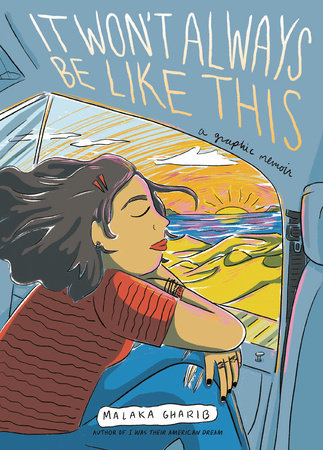
What about a story about a punk-loving Egyptian Filipino American kid from Los Angeles, who spends her summers with her dad and stepmom in the Middle East? That’s the thrust of my new graphic memoir, It Won’t Always Be Like This.
In the book, you’ll find no dusty palette—the sky in Egypt is blue, the ocean is bluer and the desert in Qatar is a vibrant gold. I tried to portray my dad and stepmom as accurately as I could remember (in fact, they helped work on the book too). And with an open heart, I challenge my own misguided American assumptions about the region, while wrestling with my identity as a not-quite Egyptian.
Here are 7 great graphic novels, picture books, and poetry collections by Arab women writers that provide unexpected views and visuals of the Arab world. In one story, a little girl is on the hunt for beauty and inspiration in Yemen. In another, a cartoonist tenderly recounts her father’s upbringing in a Palestinian refugee camp. Each gorgeous book illustrates the profound diversity of storytelling across the region and diaspora.
Meaning “your wish is my command” in Arabic, cartoonist Deena Mohammed’s Shubeik Lubeik draws up a modern-day Egypt in which wishes are for sale. The richest people get the most quality wishes (meaning, if they wish for a BMW, they get a BMW) while the poorest get third-class wishes (if they tried wishing for a BMW, they might get a toy car instead). With illustrations of bustling cityscapes and stories of Egyptians from all walks of life, the book is a thinly veiled nod to the country’s growing inequality and class division.
In Salwa Mawari’s children’s picture book Under the Sana’a Skyline, a young girl named Belquis has a daunting school assignment: write an inspirational story about Yemen. But when your country is in the middle of a civil war—what good is there to say? Belquis travels through the capital asking other Yemenis for help with the assignment, and each person reveals a beautiful facet of the country that she never knew before. This tale of resiliency will leave your heart swelling with pride and solidarity for the Yemeni people.
Baddawi by Leila Abdelrazaq
In this graphic novel about refugee life, boyhood and war, cartoonist and zinester Leila Abdelrazaq tells the story of her father Ahmad as he grows up in the Palestinian refugee camp Baddawi in northern Lebanon in the 1960s. Despite the obstacles of war, poverty and statelessness, Ahmad forges ahead, finding a path to get his education and create a life for himself. Woven into the striking black and white drawings are intricate patterns from traditional Palestinian embroidery—a fitting emblem of Ahmad’s indelible identity. Although Baddawi is just 128 pages, the book offers a rich, emotional overview of the struggles faced by the Palestinian diaspora.
“I have been missing home my entire life,” writes Egypt-born author Marwa Helal in her dazzling collection of poetry, Invasive Species. Helal recounts her quest to find home as she shuttles back and forth between Egypt and the U.S. to gain her American citizenship. Along the way, she questions how she is able to hold both her identities as an Egyptian and American, while at the same time, not being recognized as such in those countries. With themes of dislocation and displacement, Invasive Species contains so much power you can’t help but to read the poems to yourself aloud.
The Arabic Quilt by Aya Khalil, illustrated by Anait Semirdzhyan
The Arabic Quilt, a children’s book written by Aya Khalil, follows the story of Kanzi, a little girl whose family has just moved from Egypt to the States. Feeling out of place in her new school, Kanzi comforts herself with a beautiful quilt that her teita (grandmother in Arabic) gave to her. The quilt ends up being the key to helping her feel accepted by her peers in the classroom. Packed with Arabic words and Egyptian cultural touchstones (like eating a kofta sandwich for lunch), the book is a welcoming and loving picture of Egyptian diasporic life.
What happens when you’re not the only hijabi at school anymore? Egyptian American cartoonist Huda Fahmy tackles this question in her graphic memoir. After her family moves to Dearborn, a town in Michigan with a huge Arab population, Fahmy discovers that there are other girls in her class who wear the hijab, forcing her to explore her identity outside of wearing a veil. With honesty, humor and charming drawings, Fahmy’s teenage self wrestles with crushes, bad grades and sibling rivalry. It’s a refreshing take on the triumphs and tribulations of Arab immigrants and their families in the United States.
Home Is Not a Country, a stunning book of poems by Sudanese American author Safia Elhillo, follows Nima, a Muslim girl who has fled her homeland with her mother in search of the American dream. She befriends a boy named Haitham who understands her frustrations of feeling like an outsider, her desire to reconnect with her country, and her longing to adopt the alter-ego of Yasmeen, a girl she thinks she should have been. Elhillo’s gorgeous prose paints a picture of a young Muslim woman slowly gaining confidence in herself.
Fourteen hours on the plane to Kolkata gave Jonah ample time to feel superior to the other travelers, especially those parents who were bringing along their hapless toddlers. He was traveling to visit his guru in a village that no one knew of. Predictably, the cabdriver tried to cheat him, even though he’d taken this route many times over the past fifteen years. He was still disappointed by the inflated rate, his whiteness announcing itself long before he could switch to a Bengali slang, convince the driver of his adopted roots. His wasn’t a perfect vernacular but should’ve been good enough to avoid the tourist’s fare.
Guruji lived near a sweet shop in a house whose electricity Jonah paid for. With his meager earnings in America, he paid for the gardening as well—a bed of azaleas bright in the sun—and for diabetes pills for Guruji and the education of Guruji’s son. It was his guru’s son who came to greet him.
“Oh, Uncle,” Karna said, touching Jonah’s face as if he were blind. It had been two years since they’d seen each other, and now Guruji’s son seemed more urbane, his face strikingly angular, a fine moustache having found its way onto his upper lip.
Suparna, Karna’s mother, emerged. She was fussing about his suitcase, though it was mostly empty, and fussing about his weight, too. Since his boy had been born, Jonah had been so busy he’d skipped meals more often than he cared to admit.
“You’ve come back to us a ghost,” Suparna said. “But no worries, we’ll fatten you up again.”
Guruji came out, leaning on his cane. “What a ruckus,” he said, though it was clear that he was happy to see his second son.
Jonah had found Guruji at that time in his life when nothing seemed permanent. Twenty-three years old and grasping to call something his own. He used to play folk music at the Bitter End on Bleecker, money out of a hat enough to tide him over from couch to couch, a drink and a lover to boot. He could always play the life out of his guitar, but he never had the voice to attract a label.
Guruji said as much when they first met in Kolkata, all those years ago. “Your voice has a demon in it,” he’d said. “But there is still music in you.”
The flute calmed him. He found he could play for an hour and escape his anxieties for the day. He became Guruji’s first international student and eventually his most devoted, practicing in the mornings and late into the evenings. Year after year while he freelanced in America and pursued a degree in music theory, he’d return to Kolkata to show what he’d learned and to learn the next difficult thing, and every year Guruji would say, “Almost, beta. You are almost there.”
He remembered those words as Suparna poured him tea and asked about Samuel, who’d just turned two.
“It was hard to leave the little guy,” he said, though that was not entirely true. He loved his boy, but once he’d set foot on the plane, he hardly paused to think about him. What he’d thought of instead was sitting with his guru again—one last time, he’d promised his wife. To learn not only from Guruji but also from Karna. “Play something,” he said, smiling at Guruji’s son.
Karna’s lips found their way onto a melody they’d once learned together, an afternoon raga that cut through his jet lag, his sense of city self. When Karna played it sounded like a younger version of Guruji, the plainly hopeful notes breaking through Guruji’s more skeptical, sparse turns.
“Splendid,” Jonah said, his eyes shut, the music leaving the taste of honey in his mouth. When they’d first learned this raga together, Karna had been a five-year-old boy. Now he was months shy of becoming an adult, though even in the early years he’d been serious enough to sit by his father’s feet, for the little boy had no demon in him—he had only song.
“Too sentimental, beta,” Guruji interrupted. He was always harder on his biological son, but Jonah knew what perfection sounded like—the boy wasn’t far off, not at all.
“When do we record the album?” Guruji asked.
“Soon, Baba,” Jonah said. He’d brought along recording equipment to produce an album of Guruji’s best compositions. Though he was surely a gem of his generation, his guru had never made the headlines. He’d never toured the big cities in America or Europe. Instead, he’d worked his whole life as a tax collector, playing music on the evenings or weekends. That hadn’t mattered to Jonah when he’d first heard his guru play a concert in Kolkata. A maestro, Jonah thought, though Guruji’s style, even then, was antiquated, a throwback to a time of courts and minstrels. Jonah would make the album for Guruji, but he doubted that it would bring fame. A few years into his apprenticeship he’d accepted the hard truth that Americans didn’t care for flutes or ragas; the music they played required a commitment to do nothing but listen, and listening was in dying supply, even in Jonah’s own house, where sometimes he’d catch his wife’s eye, her love for him and her doubt of his art; oh, she’d never discouraged his flute playing, but sometimes in the early mornings when she’d mosey into the living room where he practiced, he could sense her bewilderment: Why keep on?
As Karna stopped playing, the weariness of Jonah’s long travel returned. He was shown to the guest room, where Karna had arranged hyacinth petals on the pillow. “For beauty sleep,” Karna said expectantly. From the beginning, Karna had needed acknowledgment for the smallest acts, hanging onto his father’s dhoti for scraps of praise, and now Jonah obliged, stroking the fine hairs on the back of Karna’s neck, before he slipped under the sheets. Karna sat by him on the floor, playing another melody, nothing serious, just whatever came to his lips. There were a few raw notes in the composition, but Jonah didn’t mind. “Play until I fall asleep,” he said, not intending to sound like he was giving a command.
When he awoke from his nap, night had fallen on the village. The house was quiet, and someone had slung a mosquito net over his bed, which he felt grateful for. Guruji’s family might have made a stop at the village temple; they were always throwing flowers into fires, hoping for rain. He needed to call Melanie, so he headed to the phone booth in the village center, with its pay meter that clicked every few seconds.
“Hello,” she said, her voice caught between layers of static.
“I made it,” he said, trying to subdue the elation that he felt. She was three months pregnant with their second child and wouldn’t appreciate the joy he’d felt leaving home. “How is baby?”
“Which one?” she asked.
She was not happy with him, though she’d agreed to give him this week between a toddler and a newborn for himself. One last trip to your motherland, she’d said. The only time she’d joined him in Kolkata she’d caught a case of dysentery so severe she’d spent two days in the hospital; ever since, India had been his motherland, not hers.
“I love you,” he said, watching the pay meter jump with every word he spoke. If only there were such a meter for life itself, you would feel how little time was left in this world; you would say the things that mattered.
“Goodbye,” she said. “I know it’s a fortune to call.”
After she hung up, he imagined her in their railroad apartment in Brooklyn, a coffee in one hand and a cloth diaper in the other. It was much too small now that they had a child and another on the way, but that was true for most anyone in New York. The day before he’d left they’d been trenched in all morning, the branches outside snapping from the wind and the weight of the falling snow. He had strapped his son to his chest to walk into the blizzard. When they returned, Melanie started a bath, and he lay in it with her and with Samuel, who curled close and sucked his thumb. There was still sweetness there, though not as often, not nearly as often as when they’d first called each other beloved.
“Two hundred forty rupees,” someone called, knocking on the booth.
Heading back to Guruji’s, he could see that the family had returned, and they’d put Bollywood songs on the antique turntable. Through the window, he could see Suparna dancing, which was mostly a stationary business with a coquettish flutter of the hands.
“There you are,” said Guruji.
Inside the house, everyone was wearing festive clothes. Someone had put eyeliner under Karna’s eyes, dressed him in a red kurta that was too big for him. It was a party in his honor, Jonah guessed, a welcoming home. Sweet that they’d taken the trouble, though he could’ve done without the music, the lilting high-pitched voice of the playback singer too tawdry for his taste.
“Well, tell him the good news,” Suparna said.
“We were waiting till you returned to us,” Guruji said. “This is engagement party. We are marrying our little boy.”
The sentence confused him. He imagined Guruji marrying his own son, though that was not it, for Suparna was smiling. Now he realized why Karna was dressed for the occasion and why the sweets were finer than any he’d ever been offered.
“She’s just passed her exams,” Suparna said. “The family is well established, living in Howrah. They own two rickshaw repair shops and one shoe store.”
“Karna’s way too young,” Jonah said, unable to control himself.
“Why? He is the age I was married,” Guruji said, the smile on his lips beginning to waver.
“Karna should become a musician who tours the world. He has the talent, Guruji.”
“He will play the music that is in his heart after he finishes his job. I will find a civil service post for him, do not worry.”
“He’s not even twenty-one. Don’t sell him out.”
Guruji lowered his voice. “You are my second son, but not even you can disrespect me in my own house.”
The blood rushed to Jonah’s face, then left it; he worked his jaw from side to side to bring the feeling back. This was a different rebuke than the ones he’d received trying to master the flute. This time Guruji had spoken quietly, as if no one else should hear him being shamed.
“I apologize,” he forced himself to say. He couldn’t make himself meet Guruji’s eyes. He packed his things and left for the village hotel.
He hated the hotel, having stayed there the first few times he’d come to the village, before he and Guruji’s family grew close. At night the roaches would leave their hiding places to crawl over his bedsheets, and in the early mornings the hotel staff would knock and then immediately burst through his door to deliver tea, the enthusiasm of seeing a white man enough to throw propriety out the window. He tried to fall asleep, but the clock in his body was still on the other side of the ocean. Instead, he watched old videos he had filmed of Karna. Whenever Guruji napped, he and Karna would roam the village. Sometimes, Jonah would teach him English. He’d do this by having Karna sing old folk covers.
To everything turn, turn, turn, Karna crooned on the video. At least, when it came to folk songs, Jonah had the upper hand. He’d always wanted to be his guru’s finest student, but from the moment that Karna played the scales, he knew he’d never measure up. There was something Karna had that ten thousand hours of practice hadn’t given him. Sometimes, he blamed his whiteness. Sometimes, he blamed his city life. These days, he mostly blamed the duties of fatherhood, which he’d begrudgingly embraced with body and soul, unlike Guruji, who’d never changed a diaper. It was not in his stars to become a musician, he’d decided with Melanie, so she’d allowed him to visit India a final time. This trip was to be a goodbye to that life. But it needn’t be for Karna, who, from the beginning, quickly progressed from repeating a melody to transforming it into his own language, imbuing feelings he was too young to name.
Someone knocked on his door. “Go away,” he said.
“It’s only me,” Karna said.
It was not so late to consider a visit out of the ordinary. After all, he’d come from a whole continent away. He let Karna in.
For years afterward, he would search for the smell of Karna on the other side of the door, that sliver of life, that musk, and he would remember the aluminum taste in his mouth, his knees frozen. Now he looked for a place to sit. Only the bed was suitable. Jonah fixed the rumpled sheets, searched his bag for snacks, and offered Karna a granola bar.
For years afterward, he would search for the smell of Karna on the other side of the door, that sliver of life, that musk, and he would remember the aluminum taste in his mouth, his knees frozen.
“I’m totally full,” Karna said. “But why did you leave so quickly?”
Now that he was out of the blankets he could feel a chill in the air, not cold, what in his world counted as the first sign of autumn, though back home he knew it was snowing; he knew Melanie had been out that morning with her shovel while Samuel watched from the window. He shivered a little, tore into the granola bar himself. The gesture felt rude, but he was already halfway through. It was chocolate peanut butter, which stuck to his teeth.
“I don’t care for the idea of marriage for you,” Jonah said. “You can be one of the great musicians of our, I mean your, generation.”
“You are too kind, Uncle. The problem is that the girl’s family is very rich, and dowry is very good,” Karna said.
They were forever lampooning their lack of wealth. Along with perfect pitch, Guruji had passed on his miserly attitude to his son, his belief that they were to always live in lack, though over the years Jonah had done his very best to scrape away money for them, delivering a monthly check to Western Union as if it were a piece of his heart.
“I understand money is hard. I just don’t want you to throw your life away.” He had almost said: I just don’t want you to end up like your father. A tax collector with few fans and a single, poor, devoted student.
“Do you remember when you played yaman? Like, when you really understood it? It made me remember the one time I was in Greece, swimming in the ocean at night with the fish glowing greenish blue in the water. The only person who can transport me like that is your father.”
Jonah grabbed one of his flutes and tried to draw out the notes the way Karna had, and though he was capable of a technical fluency he still lacked the fortitude of Karna’s turns. Within the notes were the many microtones, too many to write down; you’d have to remember them in your body. Jonah tried, but it came out a simulacrum.
“Yes, yes, it’s like you’re floating in the ocean a day before the storm,” Karna said. He took Jonah’s flute to his lips and began to play. Yaman was the evening song, and it was meant to be played in the twilight, in that ambiguous hour where dogs appeared like wolves. Karna played slow and fast, bringing in melodies Jonah had never heard. He teased the rhythm structure, which was in twelve beats, and it seemed for moments that there was no ending, no beginning. When he hit a particular low note, it felt to Jonah like the music had changed the work of his heart so that it was beating in time with the music.
Afterward, Jonah sat in silence while Karna cleaned the flutes, but he still heard the music. No one had ever played yaman as Karna just had, Jonah thought. And he had been the one to witness it.
“So, what are my options, Uncle?” Karna said. “We are not people who can change our lives so easily.”
“You must come live in America with us,” Jonah said. He hadn’t meant to speak these words, but as soon as they’d come out he recoiled at how familiar they were. It was no more than a fantasy he’d played in his mind for many years, the prodigy coming to live in their house, Melanie accepting Karna completely. In that moment, he didn’t think of his burgeoning family, their lack of space or funds, or even Melanie’s hardening heart, he thought only of how Karna played the scales, how those refrains traveled up his spine.
“Oh, Uncle,” Karna said. “I feel you’ve unburied me.” Jonah used fingers that still smelled of chocolate to wipe away Karna’s tears. As he did so, he found that Karna’s eyes looked more beautiful with a smudge of black.
Someone lumbered down the hallway and entered the adjacent room. He held his breath. When he laid his hand on Karna’s chest, he could hear Karna’s heart as clearly as when they’d bathed in the village stream together, let the current play on their bare legs. Next door someone tuned the television to what sounded like a Bollywood movie. He breathed again, thankful for the cover, and let his mouth find the boy’s.
Next door, it sounded like a car chase musical: an automatic rifle announced itself, and then a woman began to sing a throaty conniption. He kept his hand by Karna’s heart until its rhythm matched his own. “Don’t call me Uncle,” he said, laying the boy on his bed.
The next morning, he awoke alone with a note on his pillow. Thank you for everything, Jonah, the note said in a fine cursive. He blamed his jet lag for his transgression. His lack of sleep from being a new parent plus the sleeplessness of the plane—he was always wearing dark circles under his eyes—which had meant that once again his lips and hands had roamed where they shouldn’t. It was not only that. For a few hours they’d basked in the possibility of their America. He would take Karna to his stomping grounds, introduce him to the regulars. One of his old contacts might launch the boy on an illustrious career. He imagined Karna at Carnegie Hall as he and Melanie beamed like proud parents from the front row.
But in the morning, he saw the filth of the room, the old stains on the sheets, the desk chip-toothed, the floors cracked. The thin walls between the rooms did little to dampen the snoring that came in stereo. A used condom lay on the floor. Now, he would have to undo that which he’d promised. In the shared hotel bathroom, he dumped a bucket of cold water on his head. A moment of passion—when he’d been with Karna, it had felt as if he were in the center of that glorious, sweet music—was all it had been.
He headed to Guruji’s to triage the situation. He found Suparna in the living room, cleaning the wicker mats where he’d once sat for lessons. “Oh, beta,” she said. “I am so sorry for the disturbance last night.”
What did she know of their tryst? Even those afternoons in the village stream when ankle had grazed ankle, when he’d dried Karna’s back with his towel, his affections hadn’t been more than avuncular. What he’d known of Karna was through the family life, the evenings spent listening to classics on the turntable. But now Karna was older; his music had been like an enchantment. The dogs at dusk had turned into wolves, and the muscles of Karna’s shoulders had been strong enough to sink his teeth into. They’d proceeded through the ritual slowly, for he believed in so doing he might remember the particulars years later. “I had no right to challenge what will surely be a beautiful union, auntie,” he now said. “It’s not my place.”
“Of course, it’s your place,” Suparna said, looking at him as if he were slow. “You are family to us. Do not wonder about that. Anyway, all this morning Karna has been dancing something happy. Now he’s gone to tell Guruji the good news. Guruji had an errand at the post office, but Karna simply could not wait.”
“The good news—you mean about the wedding?”
“Oh, no, the wedding’s been canceled,” Suparna said. “Who needs a little dowry when your boy’s going to America?” She yelped in delight and kissed his cheeks.
“Oh, America,” he said, as something vile caught in his throat. Of course, Karna would already have told his parents about Jonah’s offer. Now Jonah would have to explain how America was mostly a distant possibility, not only to Karna, but also to Guruji and his wife.
“Why don’t we all go celebrate?” she said.
“Celebrate?” he winced.
She took his head onto her bosom, stroked his thinning hair, and cooed into his ear: Thank you, thank you, beta.
The post office was the grandest of buildings. Long ago, in the lore of the village, the British had imagined that this spot of land was to become their capital in India, only to change their mind once they saw how the post office sunk a centimeter into the mossy swamp the village had always been known for. Still, it remained as the last act of gallantry—a stroke of accidental beauty, with Greek balustrades and verandas of marble, and an old mahogany door that could’ve protected a medieval castle.
Given that the locals didn’t receive enough mail to warrant such a building, they’d turned the institution into a mall of sorts. Vendors from nearby villages set up their wares on foldout tables. One could purchase a samosa, try on a faux-silk scarf, or even arrange a marriage with the local matchmaker. They found Guruji and his son at a table that offered thermal underwear and coats.
“Oh, beta,” Guruji said, giving him a great hug. “All my life I wondered why one would buy such a great big coat. Now I know the reason. It is for America.” He held up an ugly green winter coat that looked to have been salvaged from consignment. “Karna will need such a thing, no?”
“It does get cold in New York,” Jonah said.
That afternoon he returned to the phone booth and metered a call to Melanie. “How is everything at home?” he asked.
“Why are you calling again?” she asked. “Your son puked three times last night, and I had to clean the mess three times. Anyway, he’s better now, if you’re one to care.”
“I am one to care. I am definitely one to care,” he said. He tried to imagine how he could broach the subject of bringing someone home with him. “So, Karna’s doing really well.”
“Yes, and?”
“Well, I thought it would be a good time for him to launch his career in New York.”
“Oh no you don’t,” she said. “No way am I spending another dime on that carnivorous family.”
“They’re all vegetarians,” he said.
“Your son’s smearing poop on the walls,” Melanie said, hanging up the phone.
“Very expensive call. Two hundred seventy rupees,” the attendant said, and Jonah fished out of his wallet the exact amount.
He could’ve guessed what Melanie would say. Now, when he returned to America, it would mark an end to his amphibious nature: he would be known not as flautist, nor even as lover, but merely as dad. He would be expected to earn a suitable income. There was a preschool back home that needed a music teacher, and he had a degree for that, if not the desire.
He walked to the river and dipped his toes into the shallows. All around him the birds that had migrated south for the winter flattered themselves and those that remained yearlong carried their own cacophony. A few feet away an old, rotten jackfruit too heavy for its host fell to the earth with a piece of branch. Here, the trees grew heavy with offspring but hardly shed their leaves, a country of perennial sun; even in the so-called winters, there was a significance of bloom.
Here, the trees grew heavy with offspring but hardly shed their leaves, a country of perennial sun; even in the so-called winters, there was a significance of bloom.
That night, he arranged his recording equipment in Guruji’s living room, and though there was no video involved, Guruji emerged in his wedding finery with his oldest instrument in hand. He played an evening raga that soon left Jonah in tears. Before Samuel and before this other baby to come, they’d had a miscarriage. He did not know why the way Guruji played, which that night was perhaps the finest he’d heard, made him think of that crawl of life in his wife’s body, the work of the pregnancy he’d been jealous to inhabit, that being so easily scratched from the world. That was why they hadn’t arrived at a name for Samuel till days after he was born. As Guruji caressed the low notes, Jonah longed for his child and wife and their small apartment. Somewhere in the song Karna joined in, providing harmony, though that was not their usual way. Even Suparna lent her song to the chorus.
“Do you think it will be well received in America?” Guruji asked when they were finished with the cuts.
“Very much,” Jonah said.
In the early morning, he awoke to find everyone else still asleep, Karna’s head on his father’s lap, a trio of snores interrupting birdsong. He felt miserable but clear in what he needed to do: he should have known he was ruined the moment he’d stepped on the plane to Kolkata. A quick peck on Karna’s lips before he repacked his things; Jonah left behind his granola bars and his recording equipment, which he imagined would sell for half the cost of a ticket to the States. It wouldn’t be enough, but perhaps it would count for something.
Soon after he returned home, they moved upstate. It was so much cheaper, and there would be a yard and deer to glimpse through the trees. While Melanie worked five days a week, Jonah cut his teaching load to take care of Samuel and Gandharva, their second son, whose name meant “music.” When Gandharva was still small enough to be carried in a sling, Jonah took the boys into the woods, and one day his second son matched the call of a passing loon with his own sweet voice, note for perfect note. Jonah thought then: Here is the one, though over the years that memory faded into confusion. Even with tutelage from two maestros, Gandharva exhibited no further musical talent. Instead, he became known for writing limericks that made his teachers blush and in second grade changed his name to Gary. Jonah’s boys loved him with a fierceness he found frightening. Sometimes, he’d pretend to be deeply asleep just to feel their anxious hands on his face, cajoling him back to life.
Jonah never responded to Guruji’s letters, or Suparna’s postcards, or even Karna’s emails, which shifted over the years from bewilderment to an imperious rage. Karna had believed that their night together had meant something more than it had. I put my hopes on you, Karna wrote in his last email. Only to find you lack a heart. Jonah had touched his chest when he read the line to confirm the anatomical truth.
A decade later, he found their last recording in his garage, which by then was filled with strollers, bicycles, and the detritus of children growing older. It was the thick of winter, with snowmen arranged on their property like sentries. Only deer walked the woods, though he yearned to hear the forest music that meant the season was finally set to change. As sleet knocked against the garage door, he played Guruji’s tracks, and his heart began to race. Oh, those old familiar notes: evening’s song. For a moment he struggled to breathe as a terror coursed through his chest—what had he done?
But for as plentiful as these books are, the vast majority live in the world of nonfiction—Rebecca Makkai’s excellentThe Great Believers from 2018 is a recent fiction example, notably set not in New York City, but in Chicago. Before that, prominent titles include the later books in Armistead Maupin’s Tales of The Cityseries published in the mid-and-late- ‘80s and Rat Bohemia, also by Sarah Schulman, in 1995.
Fiction is just as important to understanding our history as nonfiction, but it’s the latter that continually takes up the most space, both figuratively and literally, on our bookshelves.
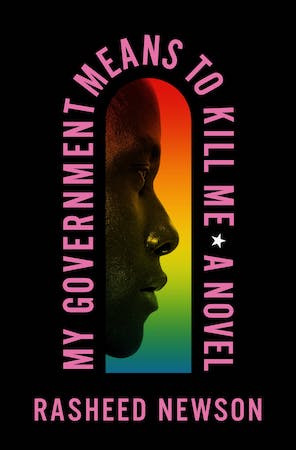
With his crackling debut, My Government Means to Kill Me, Rasheed Newson seeks to change that by offering the queer canon a new hero, one we’ve seen countless times yet rarely at the heart of the story. Trey is Black and queer, effeminate and fearless, unafraid of acting rash when it’s for the good of his community. He’s a character who could easily grow up to be Belize from Angels in America. Reading the book, I felt like I was getting a secret glimpse of how Belize’s last few years as a teenager might have gone before life in the city turned him into a hardened queen. The novel is a sexy, necessary, relentless call-to-action, not to mention an expertly paced read. I got to speak to Newson about his refreshing use of gay sex scenes, fictionalizing the private lives of real historical figures, and why he can’t believe, “something this unapologetically Black and this unapologetically gay is attracting the attention and the positive reception that it has.”
Jeffrey Masters: The novel is written in first person, but from the perspective of someone looking back on their life, as if it’s a memoir. What made you want to tell the story in that way?
Rasheed Newson: Well, I wanted all the newness and excitement of being 17-to-19-years-old. But without the benefit of time and reflection, there would’ve been a lack of maturity in it, right? I wanted it both ways. I wanted a young protagonist who was able to then look at himself with the benefit of age.
JM: It was a profoundly different experience to be Black and gay in the 1980s compared to today. What kind of work or research did you do to get into that mindset for the character?
RN: To really get into that time period, what was good was just reading history, reading ACT UP minutes, and talking to people about what that experience was like.
You send them a white man that they imagine could be at their dinner… because you’re trying to appeal to the power structure.
The first footnote in the book is from Sylvester who died of AIDS and laments that it’s still considered a disease for gay white men. That exclusion is on the lips of everybody from the era and that’s what was happening, politically speaking. The gay rights movement wanted to try to get sympathy from congress. You’re dealing with a bunch of white men and so you send down someone who reminds them of their son. You send them a white man that they imagine could be at their dinner. And you’re doing this because you’re trying to appeal to the power structure. It does, however, silence all those other voices. All the other people suffer.
JM: That’s also reflected in the first major piece of legislation passed to help those living with AIDS, the Ryan White CARE Act. It was named after a nice, young, white, straight boy.
RN: …who got it through no fault of his own. It was a blood transfusion. There was no blame that could be attached to him the way. It was attached to other people who were dying from the disease.
JM: This is the first book I’ve read where Bayard Rustin, a legendary figure in the civil rights movement, pops up half-naked in a bathhouse. His sexuality has been erased in many ways and you gave that back to him.
RN: I wanted to remind everybody. You know he was a gay black man, but you probably never thought about his sexual needs. What were his tastes? What were his appetites? Where did he go to get off? Those aren’t insignificant parts of a person.
I thought it made him more approachable for Trey. In a normal setting, if they met at a cocktail party, Trey probably wouldn’t have had the nerve to go up and start a conversation with him. But there’s something being leveled about the fact that they were in a bathhouse. Like, we’re all here in our towels. We’re all checking out the trade. It humanized him in a way that I think made that relationship possible.
Also, I did feel a little bit of safety—and I don’t think it’s something that besmirches Mr. Rustin’s reputation—but he was arrested in the ‘50s in Pasadena for solicitation. He was in a car and got picked up by the cops. And so, I was like, “Oh, that’s right. He went cruising.” He went cruising and he did it at a time when our sexuality was being criminalized, so he got arrested. That, I think, is the thing that woke me up to the fact of, Yeah, he’s a man. And you know what men like to do? They like to have sex.
JM: There used to be this idea that you can’t write too explicitly about gay sex if you want to sell a lot of books. Did you receive any pushback on the many sex scenes?
RN: No. And I was prepared to have to fight for them. My husband at one point was reading an early draft and he said, “Do you think they’ll let you keep the rimming?” I adore him. I was like, “I love that we’re having this conversation.” And I said, “Well, I’m going to try.”
Nadxieli Nieto at Flatiron is my editor and it never came up. Never once was she like, “You need to pull this.”
JM: You also wrote it so that you can’t delete the sex and still have the book work.
Our sex lives are important to us. They are part of our identity [and] how we relate to the world.
RN: Yeah. I mean, one of the things I’m trying to suggest is that sex is not frivolous. This is not some trashy, tawdry detail.Our sex lives are important to us. They are part of our identity. They’re part of how we relate to the world. They’re part of how we connect to other people and they tell you a lot about a person. And so I don’t think it’s trivial at all to examine the sex life of someone.
JM: All of the sex also helped to keep the book from focusing on trauma, only.
RN: No matter how dark it is in history, people find a way to have joy. They find a way to have a release. They have sex. It’s a part of human history. I just wanted to be honest about it and I wanted to present it in a way that didn’t try to make some sort of moral judgment about it.
JM: One thing you capture is this feeling of whiplash that queer people can experience around how their queerness is treated. For example, Trey’s femininity is a negative thing growing up. He’s called a sissy and made fun of. Then he moves to New York City and suddenly these same qualities are what make him desirable to other men.
RN: I think a lot of us who are queer and move to a bigger city experience that what would have gotten you beaten up in your hometown now has everybody at the bar trying to get at you. And it’s sort of heady and it’s sort of dizzy.
I’d also point out that that feeling of “This is something that’s sort of held me back or held against me it suddenly is celebrated” captures a lot of what I feel about how this book is being received. I can’t believe something this unapologetically Black and this unapologetically gay is attracting the attention and the positive reception thatit has. My plan when we published this was that it would be a book that we’d sell in gay bookstores. I didn’t think it was going be in Barnes and Nobles. I thought there was an audience for this, but I can’t believe it got written about in The New York times.
And part of that is like, “Oh, you like this now?” Something has shifted. I don’t want to be a Pollyanna. It hasn’t all been for the best, but something has shifted where I think this book is able to have a much wider place now than it could five or 10 years ago.
JM: Given those expectations, it doesn’t seem like you changed elements to make it more commercial or “palatable” to non-queer audiences. There are multiple trips to the bathhouse, one of the main characters is a sex worker.
It’s about a queer, femme, Black guy during the height of the AIDS crisis in New York City.
RN: I would love to say I did that out of some kind of courageous, self-righteous stand. I didn’t think there would be any hope in taking those things down. It’s about a queer, femme, Black guy during the height of the AIDS crisis in New York City. I didn’t think there was anything to gain by trying to tone it down. I just said, “Well, you might as well go ahead and just write this the way you think it’s supposed to be written. People who aren’t going to like it, aren’t going to like it anyway. You’re not winning them over.” I couldn’t suddenly walk into a very conservative place and say, “Look, it’s a femme gay hero, but don’t worry, he doesn’t take his pants off.” They still aren’t reading that book.
JM: It seemed to avoid neat storytelling across the board. There’s no happy romantic ending for Trey or grand reconciliation with his family.
RN: There’s also literally no love story, which is something I didn’t even know. A friend of mine pointed that out. There’s sort of this trope that whatever is ailing Trey will be healed when he finds a boyfriend or when he finds someone who loves him just as he is. I don’t know that you get that at 19.
JM: I didn’t register that because, to me, the love story was between Trey and his best friend, Gregory. The love story was their friendship.
RN: At the beginning, when some people read it, they felt like they were waiting for Trey and Gregory to fall into bed together.It led me to tell the audience very early on that these two are not going to get together. Like, it’s never going to happen. Otherwise, the audience wasn’t paying attention to all this other stuff going on. They were almost going into every scene saying, “Oh, is this where it’s going to finally happen?” It’s what your brain does. You’ve been trained to anticipate that.
JM: Trey eventually enters the world of AIDS activism. Did you debate about whether he should contract HIV in the story?
I wanted to live in that space that I feel a lot of people who lived through that time and didn’t contract HIV talk about, which is the sheer randomness of it.
RN: I thought about it, but it would throw the weight of the story off. Suddenly, we’d be dealing with that and I wanted to live in that space that I feel a lot of people who lived through that time and didn’t contract HIV talk about, which is the sheer randomness of it. When they look back on their lives, they don’t understand why someone else they know got it and they didn’t. I liked that space and it felt a little less familiar than what I’ve seen when it comes to other HIV stories.
JM: The book only spans two years. He very well could discover that he’s living with HIV in the years that take place after the book ends.
RN: Yeah, as I explore taking this book to the screen and ask, “Do you do this as a TV show? Or you do this as a movie?” One of my hesitations has been that I thought, “Well, if you do this as a television show, you’re going to blow past the book in the first season. And by season three or four, there’s going to be this drumbeat of “Why doesn’t Trey…why isn’t he HIV-positive?” And, “Are you just doing this because you love the character so much and you don’t want to go through the door?”
JM: Have you found a solution to that?
RN: I don’t know…one of the things that’s interesting about television is that you never know how fast a show is going to move until you are on the show. Like, is this a show that covers years, or is this a show that covers days? And so there is a world where not that much time passes and maybe you don’t have to get very far beyond the calendar in the book. And so then you wouldn’t have to face it.
JM: You’ve spent your career making TV. Why decide to tell his story in a book and not TV?
RN: I didn’t think there would be much of a reception or an appetite for it on TV. Now that it’s IP, that changes the equation. But I thought if I walked in with this as a pilot script, automatically there are only a handful of places I could even think of taking it.
Television is a big tent business. We want as many people to watch and the one example I thought of was Pose, which was incredible. And I think there’s probably a lot of people who would’ve said, “We’ve already covered this territory.” And then Generation came out and had a Black queer lead and it only lasted one season. I wanted this story to be told in the boldest colors without any compromise and television is collaborative by nature. We make compromises in television. That just is how it goes.
Here’s what’s great about television. There are a number of times in television where we’ve been stuck creatively, artistically. And luckily someone else has the answer to a problem and we get to move forward. Writing a book, you have to come up with all the answers.
JM: The origin story of ACT UP as I’ve always heard it has Larry Kramer making a fiery speech at the Lesbian and Gay Community Services Center in New York City. This inspired people to meet and then form ACT UP. In the book, you pose a slightly different story.
RN: I poke at it because…and the thing I made up, I absolutely made up. That’s how I was taught that ACT UP started, that Larry Kramer gave that speech, but when you look at a lot of the original leaders in ACT UP, they weren’t at the speech that night. They weren’t there. And other people had proposed a similar organization with a similar structure for years. So, it was already floating out there.
The people who would pull it together weren’t at this moment that was supposed to inspire the masses, but that’s what storytelling is and that’s what history becomes. It’s this feeling like Larry Kramer gave this incredible speech and ACT UP was born. That everybody went straight from there and hit the streets. And no, no, that’s not exactly everything. In political movements ideas have been flowing around, sometimes for generations before somebody can pluck it out of the air and make it a reality for a little while. But we like a neat story and so it’s just easier to tell those stories that way.
JM: In researching the book, what did you learn or discover that surprised you the most?
RN: I should have known this, but when we talk about HIV/AIDS in this country and we put a timeline together, we normally start with The New York Times writing their first story in 1981. And the fact is that there were hundreds, if not thousands of people in this country dying of AIDS in the ‘70s is something that just sort of escapes our attention and escapes our notice.
JM: That was one of my many takeaways from Sarah Schulman’s history of ACT UP, Let The Record Show. She wrote that HIV can be traced back to the 1940s in New York City’s homeless population. It was so common that they even had a vocabulary for how it transformed the body. They called it Junkie Pneumonia and The Dwindles.
RN: It had been happening for a long time and it shakes us out of our timeline. We like to think the war began on this date. The great depression began on this date. But these things have been rippling and they’re messy and they’re growing and growing and growing. Sarah Schulman’s book is great because it’s reminding you that typically when we pick a date, we’re choosing when did this become of note to the general population? There have been minority groups probably dealing with it for a very long time, suffering for a very long time. The date is just when the masses noticed.
Sara Lippmann’s debut Lech is a difficult to describe, marvelous contradiction of a novel. It is, in the author’s own words, “quiet,” and yet Lech takes an unflinching look at some of the worst, most dramatic parts of human nature—addiction, voyeurism, abuse, antisemitism, violence. Ultimately a narrative driven by characters in various stages of crisis, it also explores the mystery of the decades-old death of a young Orthodox woman who drowned in Murmur Lake, nicknamed “Murder Lake” by the locals. And for a book rooted in distinctly American horrors, Lech is funny as hell.
Set in Sullivan County, New York, the chapters alternate between five points of view. There’s Ira Lecher, affectionately (and appropriately) nicknamed “Lech,” who owns property on Murmur Lake which includes a guest house. Every summer he leases that house, and this year, Beth, along with her young son, have rented it. Beth is taking a hiatus from a challenging marriage to Doug, recovering for an abortion she’s kept secret from him. Then there’s Noreen, a real estate agent trying to convince Lech to sell his property to developers, which would require his neighbors, the Trawler brothers, to sell their land too. Years before, during a particularly hard time for Noreen, the Trawlers took her and her daughter Paige in, during which time Cole Trawler sexually abused the girl. Paige is now a young woman in her early twenties, with a boyfriend addicted to whatever drugs he can get his hands on. Through him, Paige comes into contact with Tzvi, a drug dealer and member of one of the orthodox Jewish communities that summer in the area.
Lippmann, a prolific and acclaimed short story writer, used to live up the street from me—we’ve been friends for many years. And so, when we met for beers one summer afternoon in Brooklyn, the interview began before I officially asked a question, in medias res, as we were talking about how one deals with feedback on your work.
Sara Lippmann: It’s no secret that I’ve got a lot of anxiety, but you can’t control other people’s responses to your work. As soon as you let that go, it’s very freeing.
Brian Gresko: And yet, getting feedback from agents and editors is part of the path to publication. Gatekeepers read your manuscript and say, “I like this, but . . . ” and give you notes. Sometimes, as an author, you have to say, “Thanks, but that’s not what I want to do with this project.” But to some extent you have to be open to feedback, right?
SL: Totally. And this is such a great point, I want to break it down in a couple of ways.
As it relates to teaching, I think feedback is something we as teachers have to be so careful giving. On the one hand, I believe in feedback. Your reader doesn’t live inside your head. There’s a lot that feels intuitive and obvious to us as writers, but if it’s not translating, if your intentionality is not coming through, you need to know. On the other hand, I don’t necessarily need a beta reader to say, “I wish this book were a summer romance!” That’s just not helpful. I think your job as a teacher is to suss out what your student’s intentionality is, and help them realize it on the page—being deliberately dense, approaching the work as the cold reader who would pick the book off the shelf and say, “Wait, I don’t get it.” It’s tricky.
As it relates to my own writing, for sure, there have been a lot of voices wanting to steer my fiction in certain commercial directions. Ultimately, you have to live with yourself, and you have to live with what you’ve set forth to do. It’s been a long road to publish this novel, and I’m happy to talk about that, because it’s easy to fall into the pit of despair when the market seems to be saying one thing and you’re doing something else. As if writers don’t have enough self-doubt as it is! I think you have to own your shit and make peace with that. And pray. And hope. And get your work out there.
BG:What surprised me about Lech is your choral approach to narrative. It’s not a story told by one character but by many, and chapter to chapter, the point of view shifts. How did that develop?
SL: Many years back, I had the idea of a guy renting out his property to another family while still being on that property. There was voyeurism, and elements of predation and intrigue, but it was vague. Still, I had a sense of the rhythm and pace, and it didn’t feel like it was going to be a story form. At that point, I primarily thought of myself as a short story writer, so I did nothing with it for a while.
When I finally started, I only had Ira’s voice. Then it was Ira and Beth, but both of those characters come from someplace else—Ira is a transplant, and Beth a tourist. I realized that the place itself is a character, and in order to render the place as a character, I needed to look at the people of the place. That’s when I began adding more points of view.
BG: At what point did you decide that place was Sullivan County, New York?
SL: I never went to a bungalow colony growing up with my family. Borscht Belt wasn’t my life at all. Instead, I worked at a summer camp in Wayne County, which is on the other side of the river, in Pennsylvania. I spent many years there, and even into adulthood would go back. But I know what fertile ground the Catskills are in the cultural imagination, and so decided to locate the book in Sullivan County.
At first, I used my experiences in Wayne to write about the cultural tension you see in Lech. Then, for a while, I would drive through Sullivan County, exploring it. That’s partly why this book took me so long: I needed to get to know the place. It was just serendipity that in the past couple of years I actually wound up spending time at a bungalow colony, in Orange County.
BG: Were there narrative models you looked to for inspiration?
SL: I think a lot about narrative touchstones. To start with film, obviously Dirty Dancing and A Walk on the Moon were two movies that were integral for me—Dirty Dancing from the time I was young, like seventh grade.
BG:I love Dirty Dancing, but I’ve never seen A Walk on the Moon.
SL: That movie is smoking hot. Viggo Mortensen, Diane Lane, Liev Schreiber. Oh, my gosh. Dirty Dancing shows you a Borscht Belt resort, but A Walk on the Moon is set in a bungalow colony, in 1969.
In terms of book touchstones, I was grappling because, as a short story writer, the whole undertaking of a novel felt very much outside of my comfort zone. One book I looked at was The World Without You by Joshua Henkin, which is a novel that takes place over a Fourth of July weekend, and is poly-vocal. It includes the perspectives of an entire family. Another was Elizabeth Strout’s Olive Kitteridge, which is a book that also deals with place. I read that many years before I even started this project. Another was Allegra Goodman’s Kaaterskill Falls, which takes place in the Catskills, and helped affirm my choice to set Lech there. I also deeply love Virginia Woolf’s The Waves, which is poly-vocal and nonlinear. Those choices affect the pacing, which I struggled with in Lech, but I always felt that the place had to be witnessed and filtered through different people, multiple points of view.
BG: But Ira Lecher came first?
SL: Yeah, Ira was the starter. He was tough, because there are some deeply predatory elements about him, but I also wanted him to be interesting enough that someone would keep reading. It became a question of tonality—not just for him, but for all of the characters. The character I had the most trepidation writing was Tzvi, the closeted Hasid. I had many reservations about approaching him, and when I did, I decided to write his chapters as flash, which was funny, because then his narrative actually came easiest for me.
BG: The pacing felt very musical to me. Sometimes, the register of all the storylines rose, everything tweaked up. So even though the stories were often separate from one another, the energy between them resonated.
SL: I didn’t want all the voices to converge in a pat, overly-orchestrated way, but I did want them to somehow connect, so they center around an act of violence. That also took a long time to get right. At one point, I had a draft of 105,000 words, and the finished book is 73,000. A lot of that reduction process was me asking, of each and every section, “Is this necessary?” If the answer was no, I cut it.
BG: In your short stories, you almost always stay with the character in their present moment, whereas in Lech, the backstories of the characters are paramount. Almost like a kettle lake, I can sense their waters are very deep, even if you don’t plumb them.
SL: Thank you. My friend Steve Almond says this wonderful thing about how every character arrives on the page with everything that’s ever happened to them at all times. I think the trick, like with flash fiction, is to create characters that embody that sense of past without necessarily including the baggage of all that they carry. With this story, Lech is obviously Ira’s last name, and it’s also predation, but there’s also a line from the Hebrew Bible, “lech, lecha,” which literally means “go and go forth.” There are many interpretations of those words, but what became the through line of the book for me was this one: look inside yourself, and figure out how to move forward with everything that you carry.
This is why Sullivan County is so integral. Because the inherited past, the things that we carry, and the way that those things inform and shape us, whether we like it or not, is central to each of the character arcs. Many of them are compromised by what they experienced in the past. Having them arrive at a place where they could move through that and live their present life was at the heart of the book for me.
BG: It was interesting to me that you never put us in the points of view of the abusive characters themselves, like Cole Trawler or Tommy, Paige’s drug addict boyfriend. Did you ever consider that?
SL: I never thought about writing from Tommy’s perspective, but I did think about writing from the Trawler perspective, either Cole or his brother Mark. Ultimately, I decided not to, because it didn’t feel like I was telling either of their stories. Especially Cole’s. I wanted to hold up a mirror to anti-semitism and to American culture as a whole, but I didn’t want my book itself to come across as anti-semitic, nor did I personally want to embody a voice that was anti-semitic—I didn’t feel that kind of voice needed amplification. I was writing this during the 2016 election and through the early years of Trump’s presidency. I was living with enough of that anti-semitic voice in my ear already, I didn’t want it in the book in a direct way.
BG: There’s something different about those men too, because while the other characters might give into selfish impulses, they come across as people who want to be better, and are struggling against their worst impulses. So ultimately, no matter how predatory they might be, I end up rooting for them in ways I never rooted for the Trawlers or even for Tommy.
SL: Beth has a line in the book about being equally repulsed and drawn to Ira, and that’s what I was going for with all of these characters. I want the reader to be drawn to them, but not necessarily want to hang out with them. The characters that achieve that are the ones I remember the most in the books that I love. For instance, Philip Roth does that in many of his books. Roth was very much on my mind while writing Lech. So was David Gates’ novel Jernigan. These books contain characters that make some fucking bad choices, and offend you in many ways, but also challenge you to think and change your temperature in a way that is, I think, what literature is all about.
BG: You once said that every writing project changes the writer. After all these years of work on Lech, how do you feel different from how you started?
SL: First of all, this was a book that almost never was. There was a time period where I had to reconcile with that fact, and take stock of how I spent all these years of my life in service to this book—not going on camping trips or attending certain family functions. I came to feel it worthwhile even if it didn’t ever get published.
In my MFA program, all of my workshops focused on the short story for good reason, because that’s what you can wrangle in the course of a class. But writing a novel is an extremely different narrative muscle. Writing Lech stretched me so far beyond my comfort zone. Through that, I learned how to be a more generous writer toward both myself and the page. I imagine every book has its own set of rules and problems, and every book will crack a person open and teach them anew, so I don’t know if it will be any easier a second go-round. Perhaps next time, when I reach the stage of banging my head against the wall, I’ll be able to normalize it as all part of the process.
We started this conversation talking about feedback, and I remember my agent seeing the original draft of Lech and saying something like, “I don’t know what to say.” When I read that, I was so confused, it sent me into an existential tailspin. But it forced me to ask myself, what am I trying to say in this book? What’s the imperative here? I’ve always been someone who vomits out a draft first and then has to wrangle it, but I’ve never had to wrangle so many words in a row like this, and it made me such a better writer and teacher. It brought me to honor and appreciate plot and momentum, and made me understand that the reader has so many things vying for their attention, what an incredible act of grace that they’re going to come to your book and open it. You better fucking entertain them! In a way, a book is not about the writer; it’s really all in service to the story and, ultimately, to the reader.
I had early inklings that my relationship with alcohol wasn’t healthy—when I turned to addiction memoirs, things only got worse.
When I started drinking—champagne at a party with my parents, when I was 14—I was not thinking about preventing my own addiction. I was not thinking about how addiction has popped up in numerous branches of my family tree like poison fruit. By that age, I was already wrestling with depression, bullying, and my bisexuality— though I didn’t even know there was such a thing at that point, so I just tried to be straight. But drinking was new. It was warm and soothing and dangerous. And nothing else had ever been able to give me the sense of peace and well-being and closeness to others that I found after I’d had a few (or many drinks).
In college, I drank to feel alive, to feel included, and to give my awkwardness an excuse. And I read voraciously. To prop up my love of zines, I also read as much memoir as I could get my hands on. I started with books that were ostensibly about mental health, but included characters with, or an escalation into, addiction. Girl, Interruptedand Elizabeth Wurtzel’s books, Prozac Nation and More, Now, Again were early favorites. I devoured all three in a single week.
Trying not to alarm my librarian, I perused the stacks myself and read quietly in the carousels between classes.
In college, in addition to vodka and more drugs, I also found Buddhist meditation, which helped somewhat with my mental health and feelings of pervasive unease. I read Dharma Punx by Noah Levine, which traced Noah’s path from son of one of the West’s most famous meditation teachers (Stephen Levine) to street punk and addict to sober meditation teacher. Levine was the founder of Refuge Recovery in Los Angeles, and self-proclaimed founder of a new lineage of punk rock Buddhism that was emerging in the early 2000’s. Trying not to alarm my librarian, I perused the stacks myself and read quietly in the carousels between classes. The stories felt exciting, the fun only coming to a stop when the author or characters went just a little too far.
Since I was in middle school, I’d struggled with depression and anxiety; by the time I was 23, I’d added PTSD to the mix. For me, alcohol was a way to quiet my brain. I felt less self-conscious and more relaxed, which is what the addiction memoirs promised would happen. In each one, there was a period of alcohol or drug use where things were not yet off the rails. These sections of the memoirs promised glamorous parties and a rolicking sense of community and fun. Just what I needed, I believed. In this part of the narrator’s arc, the worst thing was showing up to a test hungover or sleeping through a call from one’s parents. After years of feeling depressed and alone, all I could think was: it’s worth it. Of course, I reasoned, having read so many of these books, I’d know how to stop before it was too late. At that stage of my life, I did not read them so much as cautionary tales, but as instruction manuals.
These stories also involved something critical that I longed for: someone would often come to the rescue of the narrator. It was rare that the narrator would simply decide to show up to an AA meeting of their own accord. Often, friends or family would intervene, declaring that the narrator needed help and that they were there to escort them to rehab or a meeting. Having someone show up and decide to see how much I needed help.
But drinking at that level is so socially-acceptable (and even encouraged), that it was impossible to see my pain for what it was.
I identified with the memoirists and characters who were straddling dual diagnosis. According to the National Alliance on Mental Illness, “Substance use disorders — the repeated misuse of alcohol and/or drugs — often occur simultaneously in individuals with mental illness, usually to cope with overwhelming symptoms. The combination of these two illnesses has its own term: dual diagnosis, or co-occurring disorders. Either disorder (substance use or mental illness) can develop first.” In 2020, 17 million U.S. adults experienced both mental illness and a substance use disorder, according to the National Survey on Drug Use and Health.
I identified with these people deeply, except for one glaring issue: I was not nearly as fucked up as they were.
Given my pre-existing mental health issues before I started drinking, it was not surprising that these memoirs drew me in. I identified with these people deeply, except for one glaring issue: I was not nearly as fucked up as they were. This was not, I believed, something to be happy about. You don’t get your redemption arc if you’re not enough of a drunk. So I set out to ruin my own life. Sleeping with the wrong people, going to the wrong places, wearing the wrong thing.
Each story of addiction or mental health recovery follows a familiar, if not predictable arc: the root or beginning of using; the highlights (or lowlights) of the debauchery of using; hitting rock bottom; the turn: the realization and getting clean; and finally making amends. Authors generally gloss over the making amends bit. First of all, that part is boring (both to read about and to live—trust me), and second of all, it’s easier to just put a bow on the story than to create more narrative around the molasses-slow process of making up for mistakes and forging your new, sober self.
As I read more, story after story, I noticed a pattern, not just in the narrative, but within myself. With each one, I would go through periods of losing progress. I would start using my drugs of choice more (sometimes weed, but mostly alcohol), and deepening self-sabotaging behaviors (restricting my eating, self-isolating, and flaking out on important obligations). These stories were supposed to be inspiring, but I felt worse after reading them. Why did my depression and substance use escalate? The problem lies in the arc of the story itself. If only I could make things terrible enough, then I would be worthy of quitting, of redemption, of recovery, of the brilliant promise of the other side.
Over the years, I tried to earn it. There was a New Year’s Eve when, already drunk, I picked up a half-full champagne bottle “for the road,” and polished it off while wandering through the streets of Buenos Aires. There was the way my tolerance increased as I grew older. The way I would wake at 3am, sweating with anxiety at how I might have embarrassed myself. Each time I questioned whether this is it, proof that I had a real problem, I came to the conclusion that everything was fine. The shame would subside and I could go on pretending that this inherited relationship to drinking is just hunky dory.
Years later, well into my thirties, I started reading sobriety stories that weren’t just from people who had barely avoided dying.
There was the way my tolerance increased as I grew older. The way I would wake at 3am, sweating with anxiety at how I might have embarrassed myself.
I listened to podcasts about people who had quit drinking and talked about how amazing it was, and thought, “No thanks! Not for me!” I would go to Buddhist meditation events and sign the precepts, agreeing not to consume drugs or alcohol while on premises or at the event. In Buddhism, there are Five Precepts. They instruct practitioners, from monks to householders, to abstain from: causing harm, stealing, sexual misconduct, lying, and consuming intoxicants. The fifth precept was always the one I paused at when reading. “Not a problem,” I would think, imagining the giant glass of wine I’d have as soon as I was back home. Not realizing that every single day I was breaking the precept of non-harming by continuing to ignore the massive pain I caused myself by keeping alcohol in my life.
As a new mom, I had very strict rules about drinking. Only after my child was asleep. Never more than two drinks (okay, three drinks). Never, ever if I was driving. This white-knuckled control made me feel like I didn’t have a problem at all. I couldn’t. And yet, I am not exaggerating when I say that every drink was killing my soul, just a little bit. But still, I reasoned, I was not like those other addicts. I was not waking up in strange beds or putting my child in harm’s way. My drinking was not threatening my marriage. I was not at risk of losing my job or my home.
Which shows just how insidious respectability is. Respectability polices us, whether through behaviors, aesthetics, language, or tactics of making social change. Historically marginalized groups (BIPOC, women, queer folks, and others) may adopt the mores of respectability to appear palatable to historically dominant groups and to access the benefits of power and social status. Pertaining to substance use, respectability is a way to distance ourselves from the practices and people who are often disrespected by society as a whole: addicts. Those who can’t conform don’t receive help for their addictions because they visibly upset social norms. I couldn’t seem to get help because I wasn’t upsetting social norms enough. From the outside, I looked like a normal, buttoned up mom who drank wine because that is what society teaches moms to do when they are tired of having a child screaming in their ear every single day. “There is no support, sorry,” society seems to say, “But if you drink a lot of wine, we will think that you are cute.” No one would have looked at me and thought that I had a problem. There were friends who actively encouraged me not to quit drinking while I had a really small kid since, they figured, I could use all the coping mechanisms I could get.
They trick us into believing that addiction is easy to spot. It looks like a woman losing—or nearly losing—her children. It looks like a man losing his career.
Addiction memoirs prove that recovery and redemption are possible. Everyone wants a happy ending with a bow on it, and sometimes that’s a realistic outcome. That hero’s journey, however, often relies on a level of pain and sensationalism that simply didn’t fit my life. It feels like too many addiction memoirs are written for non-addicts in a way that makes the addiction feel very straightforward. They trick us into believing that addiction is easy to spot. It looks like a woman losing—or nearly losing—her children. It looks like a man losing his career. They often do not reflect the reality of what contributes to addiction: structural inequalities; interpersonal violence, often as children; and family history of substance use disorder, which was often seen as an acceptable facet of the culture at the time. These stories are often sensational and follow a particular arc of destruction and loss before epiphany and recovery.
There are very few, if any, memoirs about drinking that tackle gray area drinking: that kind of drinking that goes beyond the social, fun, and acceptable, but hasn’t yet crossed into the territory of deeply destructive quite yet. For years, this was me. More fiendish than my husband who could stop after a single glass of wine, but not “enough” to find myself reflected back in an addiction memoir. These books were not written for me. I had to find a different narrative for myself that acknowledged that, for me, alcohol was unsafe in any amount.
My drinking did not look sexy. It was boring, and though it was harming me, that harm was only taking place on the inside. No addiction memoir offered me what I truly needed to hear: “You do not have to burn your life to the ground to earn healing. You are simply allowed to stop hurting yourself.”
What I did remember from all of those addiction memoirs, though, was that a big red flag was when you needed a coping mechanism for your coping mechanisms. In each one, they talked about how the first step was admitting that you had a problem in the first place—a shockingly difficult thing for those of us who spent years (or in my case, more than two decades) using alcohol to numb my problems so that I didn’t have to fess up to them. In Alcoholics Anonymous, the first step is that, “We admitted we were powerless over alcohol and that our lives had become unmanageable.” After a ski trip without my kid in tow, I had one last unmanageable night.
I have now made my own podcast episodes about my journey to sobriety. I celebrate my “sober-versary” each year, quietly and with cake, and I celebrate my friends’ “sober-versaries,” too, and we tell each other how proud we are of one another. I’m sure that there are a lot of people out there who still think that there isn’t a way to have fun and be sober. But the narrative for women getting sober is changing. Being a “wine mom” does not have to be the default. We are writing a new story that isn’t glamorous and sexy, and might not have the same compelling narrative arc of the memoirs of my youth. The message is more simple now. Wherever you are in your story, you don’t have to earn your redemption through suffering. You are allowed to simply stop hurting yourself, even if you haven’t hit bottom yet. You can just decide to stop falling.
For many of us, it’s the most wonderful time of the year: spooky season. The air is getting crisp, the store shelves are filling with candy, and we’re all putting the final touches on our Halloween costumes. Here at EL, you know ours are going to have a literary flair: the ghost of Virginia Woolf, a Freudian slip, David Foster Wallace’s titular lobster… We’re getting ready to go all out—and we want to see yours, too! So we’re holding a costume contest via social media—and the winner gets one of our brand new Reading Into Everything tote bags.
To enter, post a photo of you in your most fabulous literary costume on Instagram or Twitter and use #ELiteraryHalloween. Remember to follow Electric Literature and tag us. The best photos will be featured in a post on Electric Literature. For some inspiration, here is the EL team serving you their best literary inspired costumes, just to get you in the mood!
Editorial intern Laura Schmitt (center) and her friends as the Reading Rainbow.
A supposedly fun costume she’ll never do again—editorial intern Bekah Waalkes as David Foster Wallace.
Part of me
was still on the party bus
with the estranged branch of my family.
Part of me swallowed a wavy
strand of the Niagara Falls.
It rappelled down my throat
like coloured scarves, each knot
a repentance, resentment lost,
while part of me clicked a padlock closed
on the redemption arc for luck.
Part of me was gleeful
at unsnapping the twig and reversing the tape.
Part of me knew the blood was fake
while the dark tunnel shrieked in August heat.
On my knees in the hooded canal, whites turn blue
and bare their teeth at the part of me willing
myself to heal without giving the trick away.
Under the strobe lights, sharp shivering staccato
like a crunched popsicle, part of me was promised
a celebratory pin, I made it throughScreamers House of Horrors,
even after all of this.
Part of me rolled my eyes
through the roadblock of ghosts
and skeletons like bowling pins lined
for a strike. Part of me hit the gutter
hard and came out the other side
into whoops and hollers, pats on the back,
smacked with the black, beaming flashlight
of forgiveness.
While part of me did not believe, not for
one fucking second, in all of that
terrible business.
I Pray to Stop the Blood
I went for a walk on my knees
in the woods. Spiders crunched
under the heels of my hands like
dried flowers. I fell forward

into the stinging, universal privacy
of the singed grass and wondered
whether I was on the earth’s back
or her stomach.
Ever since I joined a friend for a Sunday school class as a kid, I have been fascinated by the concept of Hell. No, Internet, this is not Confessions of a Teenage Satanist. My fascination was neither in fear nor rapture, in either direction. It was logistical. The idea of there being a place somewhere down beneath the dirt where bad people go for all time to be tortured has always brought up a lot of burning (no pun intended, but I’m okay with it!) questions. Who does the torturing, and how do they leave work at work? How is one’s badness determined—what is the algorithm—who does the deciding, and what if their definition of bad is different? How can there always be room for the new people if no one ever leaves? The concept of eternity combined with the promise of zero progress and no exit really got me. If death is off the table, what comes after you give up? What about after that? So, I did what I always do when I have a problem I can’t solve: I turned first to reading, and then to writing.
In my debut novel, Sign Here, Hell is all logistics. Upon arrival, everyone gets a terrible celebrity baby name, a floor assignment, and an orientation packet. Peyote Trip has been on the Fifth Floor for centuries, trading in souls for Deals Department, and has accepted the permanency of his locale. Until the family he’s been tracking takes their teenage daughter’s friend on summer vacation, and Peyote finds that even in the forever of after, nothing is guaranteed.
I am far from the first person to utilize Hell in fiction. When I started looking for answers to my questions, I didn’t just find the stories that take place in Hell, like Milton’sParadise Lostor Dante’s Inferno. I also found books that address Hell as any lack of escape, which, when combined with the tedium and terror of being left outside of time, sharpens into a pain even the most skilled torturer could never inflict. Whether underground or above, whether in our minds, the minds of those we love or crowded with other people, Hell takes many forms. This is my list of those which I have never been able to stop thinking about.
Jitterbug Perfume is an absolute feast for the senses, due to both the drive of the plot and Robbins’ visceral, whacky, and ultimately perfect metaphors. The book follows multiple perspectives, all of which are centered around the search for immortality, this time through scent. Among others, there is a couple who have been evading death for centuries alongside the disappearing goat-god named Pan, who is often mistaken for the devil due to his sulfurous smell and proclivity for wantonness, and an evasive smooth-talking con-man who hopes to profit from it all. This novel captures just how long immortality lasts and what can happen to a soul if the body never gives it up, but the world keeps on changing without them anyway.
In typical Rushdie style, this novel balances real world issues with fantasy in a literal and metaphorical take on the Heaven vs. Hell narrative, which results in something truly unique for both the characters and the reader. Starting with two men falling from a bombed airplane and landing in London, safe but changed, this novel grapples with questions about immortality, the choices for the afterlife and who is really in charge.
Gaiman’s debut novel is a classic, contemporary tale of a man caught in an underworld that both exists and doesn’t, has proximity to our world but plays by very different rules, and promises no escape. Neverwhere follows a man who finds himself trapped in the bizarre, scary and at times hilarious London Below, and his journey with friends and foes as he tries to return to life in London Above. Mind-blowingly creative, Neverwhere sets Gaiman up as one of the best fantasy-writing minds of our time for good reason.
Like Rushdie, Murakami is known for his blend of reality and fantasy, and the Wind-Up Bird Chronicle is no exception. The novel follows a man who loses his cat and finds a netherworld below Tokyo, caught between consciousness and subconsciousness. Dealing with themes of good versus evil and what it means to be in control of one’s own destiny, Murakami creates a world underneath ours and a host of characters who exist on each side of the divide.
This unforgettable YA trilogy begins in a town isolated from all others, in which all of the villagers are male, and all of their thoughts are audible. That’s right: every thought any male had was projected around him, constantly and in real time. But when the young protagonist leaves his village, he encounters a girl for the first time, and is astonished when he realizes he can’t hear her thoughts at all. This series is a great example of creating a whole hellish world around a singular and dividing concept.
The Parade by Dave Eggers
A common take on Hell is repetition with no progress, like Sisyphus and his rock. This short novel plays on that concept, following two contractors, simply called Four and Nine, who are paving a highway between two undisclosed lands after a civil war. The anonymity of both person and place reminds me of Hell, to say nothing of Egger’s ability to make the repetitive actions of paving a highway so gripping and ominous you can’t put it down until the incredible finish.
If Hell is the lack of escape, can life itself be Hell? That question is addressed in this novel, in which the protagonist dies again and again, reborn each time with all the collective knowledge he ever possessed. He remains trapped in this endless loop until, finally, a strange visitor shows up with information that just might break him free and give him a reason to not only die, but to really live.
Emezi’s brilliant debut captures the Hell that one’s own mind can become, when it feels as though someone—or something—has more control over us internally than we do. Freshwater follows Ada, who was prone to violent fits and said to have “one foot on the other side” as she grows up in Nigeria and travels to America for college. But it also follows the spirits who have claimed her body and mind as their own from the beginning and live within her, increasingly demanding more and more space until they threaten to take over completely.
By definition, an elegy is a lament for the dead (usually in the form of song or poem). By design, Namwali Serpell’s latest novel The Furrowsis also a lamentation, one expressed through the eyes of two characters, both intertwined by circumstance not necessarily fate as one would assume.
At age 12, Cassandra Williams loses her little brother Wayne (age 7) in a day that’s rewound on the page. Perhaps it was by accident or sick twisted fate, from how she tells it it depends on what you, and Cassandra (aka C), choose to believe. After this loss, her life and her family’s life will never be the same and in many ways grief envelopes them so strongly it inhibits, it also haunts. As an adult, Cassandra keeps meeting Wayne but it isn’t her Wayne, it’s another Wayne Williams with his own melancholy and woes that have followed him from childhood as well. Together their lives reach an unexpected crescendo, one I can’t wait for more readers to experience.
Serpell has been awarded a Windham–Campbell prize and a Rona Jaffe Award. Her debut novel, The Old Drift, won the Los Angeles Times Art Seidenbaum Award and the Anisfield-Wolf Book Award for Fiction. And, as with all her writing, her prose has a cutting nature to it, sharp and to the point, allowing you to truly feel these characters and their voices so keenly you hold onto what’s said as you turn the page. She and I spoke about the philosophies that came into play in The Furrows and how mourning is at the root of not only the book’s structure but intention and exploration.
Jennifer Baker: It seems like there’s a lack of trust for Cassandra [in The Furrows]. When it comes to her little brother Wayne’s disappearance, she keeps saying, “I don’t want to tell you what happened. I want to tell you how it felt.” Which was incredibly potent.
Namwali Serpell: On one hand, it was an important line to include in the novel, to make it clear or just give the reader the space to not try to figure this out as a kind of cognitive puzzle of parallel universes or multiple worlds. If what we’re reading about is feeling and if what we’re reading is an elegy, then the repetitions of loss are more like the different images that you would encounter when you’re reading a long poem. And so, you’re feeling what those images do to you, what those narratives stir in you, rather than trying to work out: Well, did it happen this way? Or did it happen this way? It didn’t happen that way, did it? So, I’m trying to guide the reader on how to read the novel. On the other hand, it’s a very strong, confident statement from Cassandra! But when you see her saying it at the end of the novel to Wayne, when he’s in the hospital, it reminds him of Mo, a homeless man who has been living on the streets and who clearly has some kind of mental instability. And there’s a sense that her saying that is actually a kind of deflection, right? She’s trying to redirect you to how it felt, instead of addressing what happened, because actually staring in the face of what happened is too painful for her.
JB: We have these moments where we’re getting different stories of what could happen, as well as these really catastrophic moments later on. Is grief a manifestation of, like you said, “I can’t handle this. What I need to do is find a new way to look at how the story goes.” That’s what I found so captivating about the book was when you keep reading something new occurs—and I’m paying attention to who’s speaking. What’s happening seems to be tied to a type of mourning.
NS: There are two different ways to think about it. So, there’s the fact that these forms of loss and forms of reunion keep repeating. And the repetitive quality to the structure is meant to mimic my particular feeling about mourning, which I’ve experienced and also encountered with other people, which is that when a person that you love dies, they don’t just die once—they die every time that you remember that they’re dead. That feeling, that grief is always erupting. It can be triggered by seeing someone who resembles the lost person or by hearing a song… I used to hear my late sister’s voice sometimes. I was really struck with grief once when I realized I couldn’t remember her fingers. So, there’s a kind of iterative quality to grief that I wanted to enact with the repetition.
I could have stuck with repetition as the main argument, which is that you keep returning to the trauma. Having the different versions of what could have happened goes in a couple of different directions for me, psychologically and philosophically.
One of the imperatives for me was to make the loss of [Wayne] felt. I knew that if I repeated the same loss, that you wouldn’t feel it the same way the second time, because we grew distant from a loss when we revisit it, even if we’re revisiting it from a different perspective. So I wanted to re-inscribe this feeling of loss, while making it less important for us to know exactly how that loss happened, if that makes sense. I think there’s also a very basic, straightforward answer to this, which is that I wanted to enact on the page the kinds of dreams that the person who is mourning can have of their loved one. They appear to us again in different forms.
JB: I was thinking about people I have lost and how that fear of forgetting happens. I didn’t quite have dreams [of them] that I could remember. When Cassandra goes back to those moments [of Wayne’s disappearance], she is very detailed. I’ve seen up close how death can disrupt families, because there’s just something to your point where there’s the potential for forgetting, but it’s also the consistency of the way grief comes up.
When a person that you love dies, they don’t just die once—they die every time that you remember that they’re dead.
NS: I didn’t have this in mind when I was writing the novel, but we’ve seen this in the ongoing pandemic, in the way that people are reacting to death. When it comes to great tragedies, the scale of the death sometimes pushes details to the side. I’ve been struck by the fact that in the pandemic, many people could not bury their loved ones, that they couldn’t be with their loved ones on their deathbed, they couldn’t bury them. They couldn’t mourn them. They couldn’t come together as a family to accept that this had happened. This means that a lot more people are going to struggle with coming to a place… not necessarily of healing, but at least to a place of where you can withstand the pain of loss. Because when you don’t register that something catastrophic has happened, or in Cassandra’s mother’s case, when you make that refusal of death into the basis of your life and your career, and allow it to affect how you deal with your own daughter, your living daughter—then it becomes a pathology. It haunts.
JB: And there is haunting throughout The Furrows. There are cinematically rendered catastrophes that made me question if this is psychological because of the inability to grieve. I am curious if that was all tied back to the inability to mourn these really specific moments that come up for Cassandra and the other Wayne.
NS: Catastrophe is the word that I was using in my head, too. One way to explain the direction that I was going has to do with the subtitle “An Elegy.” This is how we understand the function of moments in a poem, or even just of metaphors as such. If you have an image of a catastrophe in a poem, at the volta of a sonnet, for example, then you understand that it’s an attempt to give the reader a feeling of sublimity, but also of shock. In The Furrows, there’s a great wrongness that I’m interested in registering with these particular images of catastrophe.
This is the thinking behind the idea that your environment reflects your feelings—we call it “the objective correlative.” In Tar Baby, [Toni Morrison] has this extended conceit that the landscape of the island that she’s describing reflects the great wrongness of what’s happening among the characters, this very intimate, internally inflicted violence in the home. And, for me, a great sense of wrongness needs to erupt at the very moment that Cassandra recognizes, so to speak, her brother in this man. Part of that is the “wrongness” of the incest taboo that we all have cross culturally, across history. But part of it also for me at a more philosophical level, and again, this is tapping into what I’ve garnered from teaching Morrison’s work recently, and thinking through the ethics of her work. This is the great wrongness of thinking you can replace someone with somebody else, or that you can fill something that’s missing inside you with another person. And that is one of Cassandra’s big mistakes. Our society is built around narratives that look a lot like love stories. And the particular love story that the novel depicts has a lot of the features we recognize in a love story: mutual attraction, sexual desire, a real sense of a homecoming, as Wayne describes it. Sometimes people come together for different kinds of reasons though—not to heal a wound, or fill a hole, but to realize something, to recognize something. I think one of the interesting things for me in writing the book was realizing that Wayne comes to an understanding of something, but Cassandra doesn’t. And that kind of unreliability in her self-awareness, in her self-understanding, is going to be hard for most readers to pick up. So my rendering of catastrophes throughout the novel is meant to register within the story world the wrongness of her impulse to use love to heal herself.
JB: I love what you say about replacing because that’s advice we get. And when it comes to the corporeal loss of a person it seems there was no aim to replace Cassandra’s brother specifically, but he needed to be filled by something else.
[In] our capitalist mentality, [when] you lose something, you can just replace it with something else. You can buy your way out of grief.
NS: Sometimes I feel like we’re living inside these individual movies that don’t all correspond to each other. The closest we can do is draw our worlds next to each other. I think a lot about the lines at the end of Beloved where it says of Paul D and Sethe, “He wants to put his story next to hers.” There is a sense that Sethe wanted to replace Halle with Paul D. and Beloved wanted to replace Paul D in Sethe’s heart—there’s all this desire to displace and replace that is feeding into and coming out of the very logic of possession that slavery is inculcating within that society. And I would say the contemporary version of that is our capitalist mentality, which is that if you lose something, you can just replace it with something else. You can buy your way out of grief.
I think what Morrison is getting at is that you shouldn’t think your story is going to solve mine or sit inside mine or envelop mine. But our stories can sit next to each other. They can resonate like two strings on a harp might; if you pluck one, the other one vibrates. And the structure of my novel as a whole, which puts Cassandra’s story next to Wayne’s, is my attempt to gesture to that as a better solution than what they seem to come to as individual characters. Especially when it comes to C—she’s trying to lose herself to this man, submit to him, but also to replace what’s missing inside her with this alternative brother.
For the most part, I want readers to understand that the novel is both a reenactment and a larger critique of how we do mourning in our contemporary world, especially when we don’t have the rituals to grieve or to accord rest to those whom we have lost.
DON’T MISS OUT
Sign up for our newsletter to get submission announcements and stay on top of our best work.
YOUR INBOX IS LIT
Enjoy absorbing fiction from Recommended Reading on Mondays, strange, diverting work from The Commuter on Wednesdays, and a roundup of our best work of the week on Fridays. Personalize your subscription preferences here.