Iconic drag queen RuPaul was the first person to introduce me to the concept of chosen family. I was 18 and in love with the captain of my college swim team. Having been raised Catholic in the conservative Midwest, I had almost no context for my new self-discovery. I didn’t know anything about Stonewall, or the ball scene depicted in the 1990 documentary Paris is Burning. I couldn’t tell you anything about the HIV epidemic or the Defense of Marriage Act or the legislation that would eventually lead to the Supreme Court’s ruling in Obergefell v. Hodges. I knew only one out gay person in real life. Maybe that’s why I latched so desperately onto Drag Race in the early stages of my dykehood, absorbing RuPaul’s advice and wisdom with such profound appreciation.
“You know,” RuPaul said once, “We as gay people, we get to choose our family. We get to choose the people we’re around. You know what I’m saying?”
After a difficult, lonely childhood and a disastrous coming out, I finally found my own chosen family in a wild, tightly-knit, and highly ranked roller derby team in St. Louis, Missouri, where I moved shortly after college for grad school with my now wife, hungry for community and belonging. My debut memoir, Brace For Impact—a derby term we use to describe the way we prepare for hits on the track—follows my process of building a support system from the ground up, and finding a community that not only accepted my queerness and my quirks but celebrated them. For me, it was a lifesaving discovery.
I love the way these nine books, by authors whose sexualities and gender identities span the gamut, portray the beauty and complexity of chosen family:
Lisicky’s sixth book is set in Provincetown in the early 1990s at the height of the AIDS crisis. He details his time at the Fellowship Program for Visual Artists and Writers, an essential circle of Lisicky’s community in Provincetown. “We catch ourselves behaving like members of an extended family,” Lisicky writes, “one by one jumping up on a makeshift go-go box, or cheering one another on in a line dance.” In a 2022 AWP panel that centered on chosen family, Lisicky reflected that Later describes the process of “finding the siblings I didn’t have.” Fellow panelist Minna Salami posed that perhaps the core notion of family is the desire for security—and Lisicky addresses this both implicitly and explicitly in the way he tackles themes of profound uncertainty in the queer community at this moment in history.
Torrey Peters’ debut novel centers three characters: Reese, a trans woman, Ames (formally, Amy, who recently detransitioned), and Katrina, Ames’ boss, who is pregnant with their child. Peters, who came out as trans at 26, said she was inspired to create Ames’ character after an experience in 2016 in which she dressed in a suit to avoid probing questions from customs agents about her male passport. Not only does this story describe the process of intentionally finding family in the trans community, it also addresses how chosen family can do as much harm and good as blood relatives.
In this debut memoir, Jaquira Diaz writes about growing up in Puerto Rico and the projects of Miami. She deals with abuse, mental illness, poverty, and violence; her writing crackles with life. In the chapter “Girls, Monsters,” Diaz structures the first sentence of every paragraph around a “we,” which, she explains, is, “Boogie and China and Flaca and Shorty and me.” What struck me in Ordinary Girls were these friendships—these deep, female bonds—that buoy the author into her coming-of-age and a discovery of her burgeoning sexuality. After a sexual assault, Diaz writes, “We went right back to drinking, smoking, fighting, dancing dancing dancing, running away. We wanted to be seen, finally, to exist in the lives we’d mapped out for ourselves.” Ordinary Girls helped me feel seen.
I had just finished studying in New York City for a term when I was introduced to Just Kids by Patti Smith. My experience living in a townhouse in Chelsea with twenty other budding artists meant that I could relate to Smith’s longing to find a community at the Pratt Institute. We were both 19, just kids, when we found ourselves in New York.
Smith’s book primarily details her profound relationship with the photographer Robert Mapplethorpe, who died of AIDS in 1989. The two become an inseparable pair, and the artists and writers who surround Smith and Mapplethorpe at art openings and in the Chelsea Hotel become somewhat of a surrogate family. There’s a certain grittiness in Just Kids I hope will resonate with my readers, too.
When Charlie enters high school, he is dealing with the death of both his Aunt Helen and his only friend from middle school who died by suicide. It’s a precarious time in his life—one in which he desperately needs a new tribe. He finds it in two upperclassman, Patrick and Sam, and an English teacher named Bill Anderson who takes Charlie under his wing. Charlie’s biological family play only a small part in this novel, which I consider a keystone coming-of-age book for anyone who’s experienced the isolation and loneliness of reckoning with their own mind.
It should be noted that Danez Smith’s Homie is dedicated, “for the homies who keep me… for you & your friends.” The bonds in the book sustain the speaker, and help steer them away from suicide. Smith says in a Rumpus interview that “I used to worry, and later bore, myself with questions about the white gaze on my work, and I would rather invite the eyes of those who I want to speak to instead of sweat those whose looking has always been assumed, privileged.” In the poem “say it with your whole black mouth,” Smith writes,
“i don’t like thinking about doing to white folks what white folks done to us
when i do
can’t say
i don’t dance
o my people
how long will we
reach for God
instead of something
sharper?”
Like Smith, I wrote Brace for Impact for my people—low-down, working-class, queer people—and I pray they’ll find it.
In this poignant graphic memoir, Maggie Thrash details a summer she spent at Camp Bellflower for Girls at age 15, and falling in love with an older camp counselor. I’ve always been slightly envious of my friends and students with fond camp experiences. The only “camp” I ever attended as a child was Vacation Bible School. There’s inherent tension in Thrash’s memoir in her discovery of her same-sex attraction and the fact that Camp Bellflower is a Southern, Christian camp. However, the way that Thrash manages to braid her story of self-discovery into the camp setting is completely fresh. It inspired me to trust my instincts; I wanted my readers to feel that same uniqueness in my work and the lens through which I was viewing my queerness: the roller derby track.
I was assigned SE Hinton’s The Outsiders in 8th grade, and have read it twice as an adult. The novel is narrated by Ponyboy, a 14-year-old orphan who is a member of the greasers—a class term that represents those on the poor side of town. Ponyboy’s biological older brothers, Darry and Sodapop, are prominent characters in the book, but so are other members of the greasers: Dally and Johnny Cade and Two-Bit Matthews. The gang becomes Ponyboy’s chosen family as he grapples with the recent loss of his parents, violence, and the economic hardships that define greaser life.
Running with Scissors is one of those touchstone memoirs to which I keep returning over the years. Burroughs describes a childhood marked by an alcoholic father and a mentally unstable mother who arranges for him to be raised by her kooky psychiatrist, Dr. Finch. The unconventional circumstances in which Burroughs finds himself coming of age are exacerbated by all of Dr. Finch’s other biological and adopted children, and even some patients who live with them. There’s Natalie, with whom Burroughs has the closest connection—together they demolish the kitchen ceiling—and Neil Bookman, twenty years Burroughs’ senior, who sexually abuses Burroughs for several of his teenage years. Although the circumstances of this memoir are obviously specific to Burroughs’ experience, there’s a universality about Running with Scissors that I hope readers recognize in my memoir, too.
I tightened my fingers around the clipboard, blinking as the letters and numbers on the page moved further away. I had never believed stories of tunnel vision, but fuzzy shadows invaded my peripheral vision. As my shoulders curved inward—my natural reaction when spasms wracked my abdomen—the volume in the room spiked.
“Andria!” My assistant grabbed my arm, pulling me upright, and I blinked, confused. “Are you okay?”
I winced as my intestinal organs spasmed.
She frowned. “I’m calling your mom, and you’re going to the ER.” She guided me to a chair, pulling the clipboard from my hands.
“No,” I said. “They won’t help. It’ll be a repeat of last time.”
“You almost passed out. You’re going to the hospital.”
My coworkers didn’t know I’d already endured a similar experience—minus the loss of consciousness. They only saw what was happening at the moment. I couldn’t explain that after the urgency of a triage nurse escorting me to a bed, hooking me to an ECG for monitoring, and placing an IVC, I would meet a doctor. And then I’d hear those dreaded words spoken in a reassuring tone, “We’ll figure out what’s wrong.”
The words did nothing to ease what felt like iron claws tearing through my intestines.
A false promise of hope.
I’d already braved the ER for the indescribable pain shredding my internal organs four weeks prior, curled on a hospital bed, my arms cupped protectively around my abdomen. I hadn’t passed out, but I couldn’t find a comfortable position to sit or stand and lost sleep tossing and turning. I stared in disbelief at the cheerful ER doctor. He wore a bright smile as he declared a diagnosis of “bloating” and “nothing much to worry about.” The words did nothing to ease what felt like iron claws tearing through my intestines. He squeezed my shoulder, his gaze optimistic. “Schedule a recheck with your gastroenterologist and chat about changing your diet.”
I wanted to protest, my insistence built upon years of intimate knowledge of my body and its pain signals. But I swallowed my words and thanked him, hobbling out of the ER. After battling migraines, fibromyalgia, IBS, and a host of reproductive organ problems, I understood the routine.
The medical community refuses to understand what they can’t see. Pain—invisible, insidious, and intractable—leaves no traces. It doesn’t surface on lab results. And when medicine fails to produce a test or yield a convenient, potentially misleading answer, doctors shrug their shoulders. With backlogs of patients waiting for attention, confusing cases get passed to someone else—assuming they aren’t dismissed outright.
Listening to this list of anticipated tests, I balanced between hope and despair.
When I saw the cover of Meghan O’Rourke’s The Invisible Kingdom: Reimagining Chronic Illness four years later, I sought the promise of a different world. The title alone implied understanding, suggesting hope for a new future. Was there a possibility outside of the misunderstanding, misdiagnosis, and misery my malfunctioning body had taught me to expect?
O’Rourke’s words in the introduction dangled a carrot of optimism I’d believed impossible. “…above all, I wanted recognition of the reality of my experience, a sense that others saw it, not least because human ingenuity might then be applied to the disease that had undone me, so that others might in the future suffer less than I did.”
Throughout the book, O’Rourke documents the years—years!—she spent searching for answers to nebulous and incredibly familiar symptoms: fatigue, brain fog, and electric pulses of pain throughout her body that arrived and departed without warning. Her narrative resembles that of countless chronic illness patients. She brings to light the “often marginalized, contested, or even unrecognized” within the population: people struggling with autoimmune diseases, centralized pain disorders, chronic fatigue syndromes, and long COVID—the newest arrival to the group. Often lost in the compartmentalized boxes of modern medicine, The Invisible Kingdom offers a window into chronic illness and illuminates the reality of medical gaslighting.
“Medical gaslighting” arose as a term from the 1938 play Gaslight by Patrick Hamilton. In the production, an abusive husband attempts to send his wife over the edge by making false accusations, denying previous remarks in their conversations, and manipulating the gaslights in the house. Doctors don’t participate in such underhanded machinations, but their habits of dismissing unspecific symptoms or assigning inappropriate diagnoses often drive patients mad—however unintentional their tendencies. Doctors diagnose as many as 1 in 7 patients incorrectly, and women and people of color make up the majority of the victims.
Often lost in the compartmentaliz-ed boxes of modern medicine, The Invisible Kingdom offers a window into chronic illness.
As O’Rourke details, Western medicine acknowledges three categories of illness: those with a single identifying cause, diagnoses accepted as genuine but exacerbated by stress (chronic illnesses), and those residing “in your head.” Only the first category has definitive testing, easy to assess and document. The other two leave physicians scrambling, usually at the expense of the patient. Vague symptoms and ambiguous test results make doctors sweat. And in the medical profession, a diagnosis of uncertainty is unacceptable—something O’Rourke is fair enough to discuss. Unfortunately, the need to fill in a blank on a record leads to the mistakes and dismissals that plague so many chronic pain patients.
The definition of gaslighting didn’t exist when the first ER doctor sent me away with my diagnosis of bloating. I never called my gastroenterologist—who had already decided my pain symptoms resulted from a lack of sleep—nor did I attempt to adjust the foods I ate. Like O’Rourke, I spent endless hours on online support groups, searching for recommendations and support. My free time devolved into staring at helpful posts on supplements (turmeric, calcium, fish oils) and anti-inflammatory recipes while I pressed my fist tighter and tighter into my abdomen to attempt to relieve the pain. Resigned to a diet of saltine crackers, baby carrots, and water, my calorie count dropped into the negligible range. The twisting and knotting dance inside my body never abated, interfering with my ability to focus, work, and even walk.
I spent endless hours on online support groups, searching for recommendations and support.
Staring into the familiar cartoon faces on the CT machine, I reviewed the list of every failed “remedy” as the rush of contrast spread heat through my veins. Closing my eyes, I silently willed the blue dye to collect somewhere, to cluster onto something in my abdomen.
“You’re a pro at this,” the imaging technician told me, helping me slide over to the gurney. “What’s this—your fourth scan this year?”
“I’ve lost track,” I mumbled.
“I need a disease detective,” O’Rourke writes. “I want a chip implanted in my wrist that could give a readout of the problems in my body.” Struggling after an initial diagnosis of autoimmune thyroiditis, the adjustment of her medications offered no end to her symptoms—a common issue for chronic pain patients. So she moved from traditional Western medicine to alternative practitioners. And then onto integrative medicine and even experimental therapy. I winced through her description of the impossibly high stacks of lab results, endless rounds of imaging, and rows upon rows of supplements and prescription bottles. Her frustration with coordinating care between countless specialists rings true for every chronic illness patient, desperately running from office to office. Every word echoed my desperate fight for diagnoses as doctors sent me chasing impossibilities, mystified by lab results a fraction above or below normal values.
Every word echoed my desperate fight for diagnoses as doctors sent me chasing impossibilities.
Unfortunately, O’Rourke also touches on the distinct reality of medical gaslighting in women patients. The common assumption is that when there is nothing physically wrong with the female sex, the problem lies with her brain. Anxiety and depression appear as diagnoses, despite symptoms consistent with heart disease, autoimmune disease, and even cancer. Meanwhile, these patients receive recommendations to lose weight, improve self-care, or seek professional counseling, delaying appropriate medical treatment.
It’s a theme continued in Haider Warraich’s The Song of Our Scars: The Untold Story of Pain. He presents the case of Lara Birk, a teenager who collapsed while playing soccer. Despite horrific pain, physicians recommended her parents refer her to a psychiatrist. It took days for someone to recognize the truth: a rare case of compartment syndrome. Delaying her diagnosis could have meant the loss of her leg. Young, female, and experiencing pain beyond limits anyone expected, she was initially labeled hysterical. Their constant denial preyed upon her emotions, leading her to doubt the agony, questioning if she might have conjured the insufferable pain. It’s an emotional and psychological dance many chronic illness patients engage in when doctors fail to find the source of their pain.
When the second ER doctor stepped into my room to report my test results, I recognized his expression. The friendly aura of optimistic hope was gone, replaced with stern authority. Towering over me, he crossed his arms. “Everything looks fine. I think this is nothing more than an anxiety attack.” He leaned closer, bending to meet my gaze where I lay doubled over on the bed, sweat beading on my forehead. “This is your second visit to the ER in a month. I want you to schedule an appointment with a psychiatrist and start counseling.”
I cried. Despite my determination to hold onto my dignity, I cried. And the messy sobs only reinforced the diagnosis in the doctor’s eyes.
The medical community refuses to understand what they can’t see. Pain—invisible, insidious, and intractable—leaves no traces.
The following day, unable to stand or draw a proper breath, I called my OB/GYN. The call felt desperate and misplaced. My OB/GYN had removed my uterus and fallopian tubes not six months prior in a partial hysterectomy. I appreciated his frank discussions over my options for handling the adenomyosis, internal and external fibroid tumors, and endometriosis plaguing my body. But I still harbored resentment over the indignity of losing my reproductive capability at thirty-nine years old. Balancing my need to speak with a doctor who listened with lingering emotional grief left me conflicted—a common quandary faced by chronic pain patients. But the office scheduled an immediate appointment, alarmed at my description of the pain’s intensity.
“Why did you wait so long?” the receptionist asked me.
Warraich, a physician and chronic pain patient himself, makes a poetic distinction between acute and chronic pain. “When pain arrives and refuses to leave, suffering is as inevitable as death itself.” He documents the evolution of pain’s influence on medicine, acknowledging the chronic pain patient and granting them visibility. The lack of quantifiable symptoms allows these patients to slide through cracks, continuing to suffer. You feel his regret in the details of Anne Marie Gaudon, a woman with signs of a urinary tract infection, minus bacteria in her urine samples. Rather than offering treatment to relieve her discomfort, multiple doctors continue to hunt for an “official” diagnosis. Eventually, a physician discovers she suffers from interstitial cystitis and bladder pain syndrome—conditions defined by chronic pain. Clearly suffering, she had to wait for someone to take her symptoms seriously before receiving treatment.
When my OB/GYN informed me the emergency ultrasound showed nothing, I feared a repeat recommendation for counseling. Instead, he took a seat that brought his face level with mine and clasped his hands together. “Something’s wrong; I see that much on your face. Let’s get you on the books for exploratory surgery. I can’t promise I’ll find anything, but at least we can say we tried.”
O’Rourke documents fifteen years of symptoms, tests, and treatments before landing on diagnoses of chronic Lyme disease, autoimmune thyroiditis, postural orthostatic tachycardia syndrome (POTS), and hypermobile Ehlers-Danlos syndrome. Fifteen years of doctors noticing abnormalities and dismissing them as insufficiently abnormal. Fifteen years of physicians recommending therapies that resulted in worsening symptoms or improvements that lasted no longer than a few months. This cyclical pattern is typical of the chronic illness patient, their body moving at the whim of the season, changing weather systems, or position of the stars. Her journey parallels that of many with vague symptoms—especially pain.
I woke from anesthesia groggy, disoriented, and braced for the worst. It took me ten long minutes to recognize my abdomen’s lack of pain in the lingering haze. After three months of the shredding sensation a constant part of my life, the sudden absence stunned me.
“Endometriosis,” my doctor said. I looked up. He wore a sad smile as he took the seat beside my bed. “A nasty pocket wrapped around and behind your intestines.”
I frowned, attempting to gather sedation-scattered thoughts. “You removed my uterus, though.”
He nodded. “You can have endometriosis without a uterus. I missed this patch during your last surgery. It was so entrenched I needed to dig it out.” He reached out and placed a hand on my arm. “I’m not surprised you were in so much pain.”
Endometriosis doesn’t appear on CT scans. It’s rarely detected via ultrasound or even MRI. The most accurate detection method is laparoscopy—a surgical procedure doctors are reluctant to recommend. This leaves 2-10% of women with chronic, cyclic pain that evades detection by conventional methods.
But for anyone with a history of the condition? It should appear on a differential list.
Warraich defines chronic pain for anyone with an invisible illness. “…chronic pain is most often akin to an emotion we feel in a part of our body, an overlearned traumatic memory that keeps ricocheting around in our brains, often long after the injury it rehearses has fully healed.” I walked from the outpatient center, spine straight. Yet the sensation of an invisible enemy in my abdomen lingered. Did more endometriosis lie in wait, biding its time to announce a fresh torment? More importantly, would I need to face new battles down the road if the agony returned? My psychological fear of medical rejection and misunderstanding ran deep, scarring my brain alongside the nerve impulses orchestrating the pain signals throughout my body.
O’Rourke and Wairrach make impassioned pleas for better coordination between chronic illness patients and their physicians. I take hope in their reminders that there’s no better expert on the state of my body—and mind—than myself. And I hear the promise in O’Rourke’s words: “This is what it is like. Please listen, so that one day you might be able to help.“
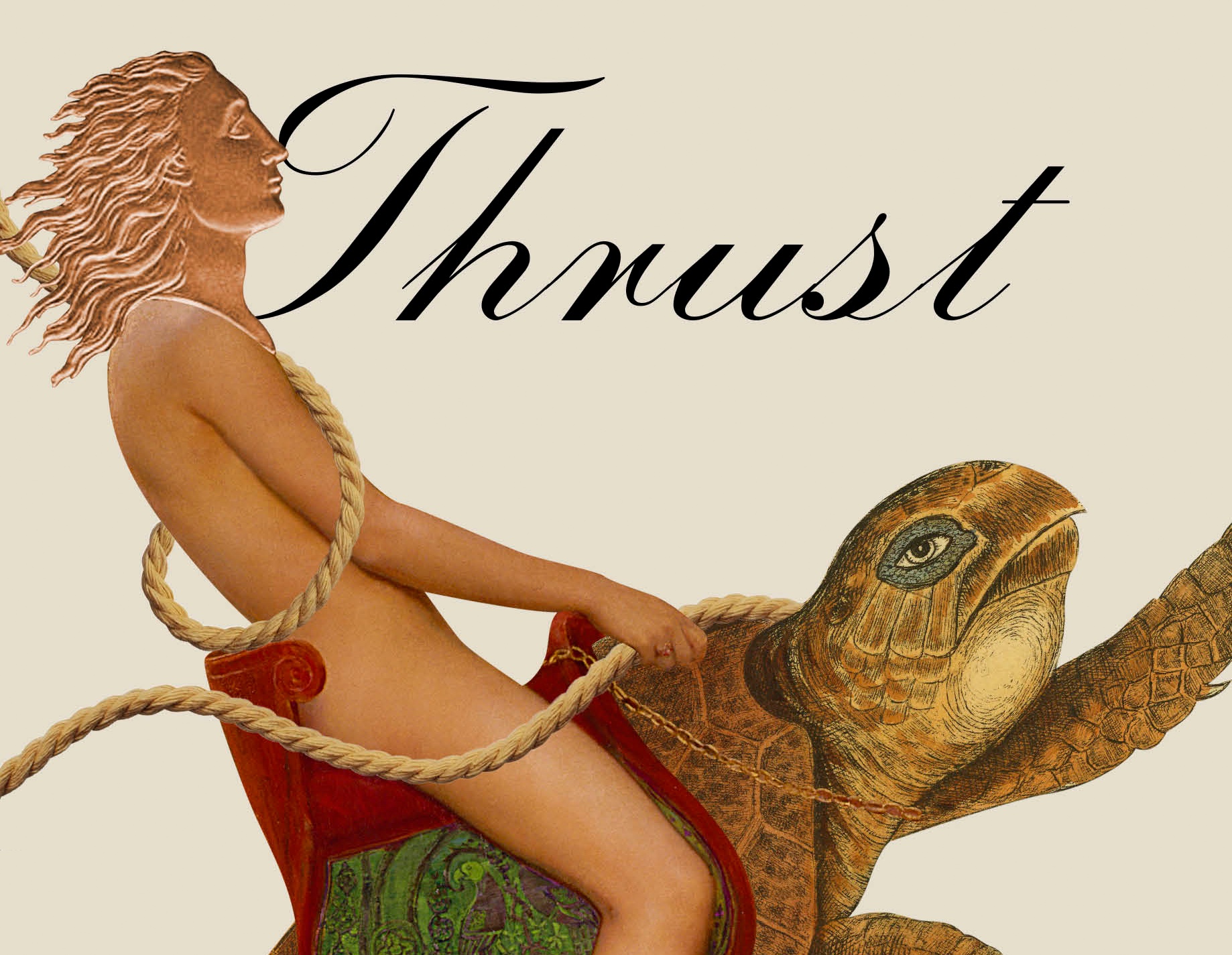
Laisvė, a character in Lidia Yuknavitch’s new novel Thrust, is in the water a lot. Water serves as a conduit for her to move between space and time, a power she uses to save other beings from manmade terrors like a ruined earth and an ever-encroaching police state. In the not-too-distant future in which parts of the novel are set, the surface of the earth is largely covered in water; even the Statue of Liberty is submerged. While the setting carries some connotation of bleakness, there is also a sense of hope.
Thrust isn’t based so much on plot as it is a kaleidoscopic confluence of different storylines. From impassioned letters exchanged between Frédéric Auguste Bartholdi, the real-life French sculptor who designed the Statue of Liberty, and his invented lover, Aurora to segments written from the plural point of view of the Statue’s workers to characters haunted by devastating personal histories to raids conducted by a dystopian future government on citizens, the book chronicles violences big and small that have shaped the course of humanity. And, the novel offers hope in the idea that stories, ever-changing, have the power to carry Laisvė—and others—somewhere new.
I spoke to Yuknavitch over Zoom about living as part of an ecosystem, expressing iterations of grief, and how novels can jostle us into new ways of being.
Jacqueline Alnes: The Statue of Liberty is arguably one of the major characters in this book, or at least one of the most noticeable threads. “Liberty,” as a word itself, suggests freedom in all senses: emotionally, physically, politically, economically, etc. but obviously not everyone in the book, nor in our current world, is free. I figured I’d give you the biggest question first, which is: What does liberty look like to you?
Lidia Yuknavitch: That’s at the heart of Thrust in more than one way. Liberty is beautiful and vital as a possible story. Unfortunately, humanity has packed it with shit. We make those kinds of mistakes of interrupting liberty or binding liberty or making liberty exclusive to some at the expense of others. That’s what I mean by packing it with shit. It becomes about power. For me, the beautiful story is ever-possible and ever-changing, but what we’ve found ourselves doing for epic after epic is, from my point of view, a series of horrible violences and otherings.
JA: Did jumping back and forth in time in the book, between past, present, and future, help you notice those threads related to liberty more clearly?
LY: Humans love linear time because it’s comforting. But if you push linear time to the side over there (and give it a graham cracker, so it’s okay) then I was fascinated by the idea that epics might be in dialogue with each other rather than that old tired out notion that history is the past or the cliche that we are doomed to repeat the past. Those are uninteresting stories to me. A more interesting story is: What if you could dislocate periods and move them around like words in stories and let them talk to each other?
JA: I wanted to talk to you about the loosening of boundaries between animal and human life. Not to be too on the nose and be like “animals have a voice,” but they do in this book. For so long, it seems like written and spoken word have been privileged, at least by the colonizers of any place. But in this book, animals can talk back. I haven’t looked at an earthworm the same since reading this. When I garden I’ve been saying, “Hello! Greetings!” How did being in the world influence your writing of the animals in this novel?
LY: I don’t perceive animals in an existence hierarchy as lower than humans anymore, if I ever did. I certainly don’t now. I live in a forest next to the ocean at this point in my life, so I see more animals than people on a daily basis. That has impacted me.
But it tracks back to childhood. In childhood, we believe we can talk to animals. We believe they say something back. There was a lateral possibility in the story-space and the imagination was part of it. I’m not meaning to make it a traditional children’s book where there are talking animals who are magical beings. They’re not meant to be magical. They’re meant to be realism. It’s meant to be true that Bertrand starts being sassy one day. It’s meant to be real that the worms are like, “We’re busy here! What do you want?” I’m also not trying to romantically anthropomorphize them. That wasn’t the intent. Instead, I’m wondering, what if there was a lateral conversation without humans at the top of the hierarchy? There would be some “here’s what’s what” talk, not some overromanticized drama.
JA: While reading Laisvė, she seems to want to know the world in different ways and loves in languages that were beautiful to me. She loves in knowing characteristics of other beings, she is very present in the world. Did you think about the decolonization of earth-human relationship while writing?
In the U.S., women still aren’t understood as fully human, but I don’t mean woman in a biologically essential way.
LY: Oh yeah. Laisvė is kind of an attempt to say there are other ways to be human—because there are other ways to be human. In my own childhood development, I had some elements of my being that we now understand as having been on the spectrum. I had pica, which means I ate things like pennies and dirt and rocks and paper.
JA: I ate dirt too!
LY: I knew I recognized you. People have all different ways of seeing and receiving the world and the so-called health community thinks of that as a divergence from being “normal” or “healthy” or “full” but we don’t. I was very invested in making a character whose very different ways of experiencing the world are the possibility of changing the story. So when a person with synesthesia, for example, tells you what it’s like to be them—which Laisvė has going on too—her relationships, her life, her ways of being in the world are completely different than someone else’s would be. That we would leave something like that out of the story of who we are is yet another kind of violence.
JA: There’s a real thread of climate crisis in the novel. Parts of the East Coast are underwater and the Statue of Liberty is as well. What was it like writing this reality, and how did reflecting on our current reality (and our own actions/inaction) shape your perception of climate change and how it will impact future generations?
LY: From my point of view, we are already there. I just turn the volume up. You can re-present the world and sure, it’s in fictional terms, but I’ve done heavy duty research on ocean rise and climate change. We’re already there. I was just lamenting to a friend about what’s going on with the Great Salt Lake, which anyone can Google and see uh-oh. The point where the dial went too far I believe already happened. It matters what we tell each other right now about who we are and what we are going to do.
When I wrote into that realm, I was just trying to be precise about the present tense. I don’t think that a story like mine has any power to change the world, but I think novels can jostle us and I think it’s important we jostle each other in our understandings of each other and the world. I think they are part of the thing that can create change.
JA: At one point, Laisvė admires the shapes and colors of the turtle—its shell, the creature’s toenails. And she wonders: “Why had she been born a human girl?” Girlhood and what it means to come of age in turbulent times—as well as finding meaning through water—are themes in this novel and in Chronology of Water. I’ll ask a similar question as Laisvė: Why a girl as the protagonist? Why Laisvė in particular?
LY: Just so you can hear what it’s like from my side of making the story, I think she’s a floating signifier more than a protagonist. She’s an energy pulse who moves between time, space, people, plants, and animals and jostles things or makes them vibrate.
As I conjured her, I thought about how human embryos do sort of look like animal embryos for a while there, before they get really human. And that fascinates the fuck out of me. I can see where humans could have had tails and when I look at shoulder blades I think that’s where our wings used to be. When I look at hands, there are certain creatures like dolphins and whales whose fins had the possibility of fingers for a while but they went flipper. And so those truths get inside my imagination and start blooming. For this girl who sees everything differently, she thinks we are all creatures. And it’s a way to take that hierarchy down of humans on top and imagine that if we all saw each other creature to creature, we would definitely treat each other differently.
And the girlhood thing is important to me as a space of meaning, not so much just girls, because a boy could be in there. I’m still trying to loosen the binary so those words aren’t as important at all: girl or boy or man or woman. In a world from my point of view, the day you come out of a chute, if you’re a girl, you’re entering the world fraught with energy coming at you that asks that you either serve society as a caretaker or wants you kind of erased or dead. It disallows full agency. In the U.S., women still aren’t understood as fully human, but I don’t mean woman in a biologically essential way. I mean the space of a woman. We have hard work forever in that category.
Every book I write I’m trying to shake the word “girl” and “woman” and maybe not get rid of those words, but I think we need better subject positions that give people their full autonomy and agency. These words that are locked in a binary don’t work any more and they are part of the problem.
JA: I’d rather be a creature than a woman, I think. I want to talk to you about water, too. In this novel, water is a means of travel, a place teeming with life, a space of grief, a place that holds deep, deep memories and love. It’s also safe, despite the depth. What did you find in the water while writing this book?
Whether or not it’s in my lifetime—and it probably won’t be—I hope that our definitions of who we are and the stories we are telling each other change radically.
LY: Specific to Thrust, I’d say my daughter died the day she was born and her ashes are in the ocean. Laisvė has some of that in her: the ocean is life and death. Laisvė can be in and out of it. I think of what’s happened to my daughter’s ashes in all these years. I pick up a rock and think, is she in there? Is she in another ocean by this point? I think of the ocean as a metaphor for very close intimacy with the imagination or the subconscious. I am not the first person who’s said that, but it’s true for me. When I stand near the ocean, I feel part of something I’m supposed to be part of. I feel that way about the imagination, too.
JA: That’s beautiful. Have you read Fathoms by Rebecca Giggs?
LY: Oh yeah.
JA: I’m thinking of the way whales drop to the bottom of the ocean when they die and their bodies feed and make beautiful the deepest part of the water that we never see.
LY: I just wrote about that! They make whole ecosystems. That’s exactly why I was talking about my daughter. The sea is a life-death, life-death, life-death motion in your face. It’s spitting shit on shore that’s both alive and dead every day of our lives and carrying it and holding it and making it into something else. It’s this incredible space.
JA:We’ve talked so much about agency and the power of story. Where do you hope our collective story goes from here?
LY: I definitely hope humans learn to see and love each other and everything around them differently than we have in… ever. Whether or not it’s in my lifetime—and it probably won’t be—I hope that our definitions of who we are and the stories we are telling each other change radically. I hope humans understand themselves as particulates of existence and not the owners of existence. What’s happening now in terms of the fluidity of gender and sexuality in generations younger than myself, I hope that takes over the world; it looks like the most beautiful way of being to me.
I think our differences can be so divisive, but I hope they become more fluid as well and that a kind of shared story space challenges us to do what you just said, where you’re standing around in your own life and you think, I’ve never thought about the whale carcass at the bottom of the ocean. To be honest, I’m not doing well with the divisions right now. Rage, rage, rage. But I guess a faster way to say all of this is that I hope adaptation and evolution bring us to something better than we are.
I was a boxer before he met me / blood soppy / after a match on the curb, before he carried me /  home / in a cardboard box, my knees on the ridge & wet feet dangling out. I was a boxer but he  lifted me, defeated, through the dark.

He bandaged my knuckles, kissed them, but could not still the shaking & I would not tell him of  the teeth, the crunched nose, the shattered temples written into my skin a long time ago. A  different time. I had loved the moles on his cheeks, the crooks of his elbows / but only when I  towered over him / the first time. He was just some kid—we both were—crumpled, bent at  strange angles—with the air / twitch / scent of animals held cold / playing or fighting.

Now the linen, so white & clean made me happy. So / instead, I told him how before I was a  boxer, I used to punch holes in the garage walls in case they buried me, like my little brother, in  a coffin box unopen to the sky, alive. The dirt in my mouth & eyes. Yes, yes / if I died, my mother  would dress me in a wine colored pressed velvet dress with white kid gloves & her yellow pearl  necklace / but she would not recognize me if I stumbled back swinging / dress torn, knees  battered, knuckles white / wild haired / Alive. The first time. My hands would never fit the  leather & words never fit my mouth.

So I told him these things—how foxes caught in traps have been known to gnaw off their own  paws to escape, how I’ve dreamt of hopping boxcars & boxes, sealed up evergreen forests in  cardboard boxes / the smell at dusk of trees, the running, the dust in garage windows, the  streamed light—so the wild loneliness would not kill me / the heavy gesture.

The whole time he says nothing / listens / his gaze sweet. He must know / has no reasons / no  wilted dandelions clamped too tight in his fist / and I have no reason—no, I can’t ask the things  he dreams of, if he knows my name, if he recognizes me from somewhere, if he even knows his  own name, or if this / this is his custom—to comb through slush & ticket stubs & empty soda cans / for all kinds of strangers / or me, just me. I don’t know.

I want to tell him about my little brother. I want to tell him about the men I beat up. I want to  tell him about the men I loved.

He must know / they were never gentle / like this, like him / tucking the covers around my jaw.  As if wary of bruises / the cold, snapped traps / staying close, unafraid. But I—no—know no  reason no life animal joy—only boxes—his wrists—the pulse—I am a boxer & I pounce. Pin  him to the ground. Run my tongue along the shell of his ear to hear the sound / escape from his  throat / of him / defeated, comforted.
Ornament Joy
Only the whale is meant to see the whale
etched into the wood of the bow—for you—

before the sharp harpoon plunges, thrown so,
over the icy cold waves and sea ice

into the whale, a beast of rib bones, blood,
meat, and oil—for you—and it has no

choice in the matter of this gift,
or how its mouth will be sewn shut

to bloat to shore with the boats,
or in the great division once

on land, my Captain, in all this ornament
joy, and I worry—for you—with the dogs’

jaws around smaller throats, and I etch
its ancient mammoth heart into my own

heart, eating myself from the lungs, still
in this hunt—for you—if it is enough.
How does the story go? Human man walks into a strange home. Human man gets into trouble with the owner of said home, a monstrous creature with claws, fangs, and fur covering his entire body. Monster makes a deal, bartering the human man’s freedom in exchange for his beautiful human daughter. Human girl, though she is not happy about it, agrees. However after living with said monster, human girl begins to “look” beyond said monster’s appearance and falls for his inner qualities. Human girl’s love for the monster transforms him into a respectable-looking human man. Human girl and monster-turned-man live happily ever after.
Written by French novelist Gabrielle-Suzanne Barbot de Villeneuve, La Belle et la Bête, or Beauty and the Beast tells the story of a beautiful maiden who becomes engaged to a monster as the result of her father’s debts. While the original French fairy tale may have been written in the 18th century, stories of the paranormal romance, often between a human woman and a supernatural male partner, happen to be tales as old as time.
Socio-political implications abound in every iteration of the monster-husband trope.
Around the world, tales of animal bridegrooms, or stories of human women betrothed or married to animal-esque figures, proliferate folklore. Examples of this include “The Snake Prince,” “East of the Sun and West of the Moon,” “Marya Morevna and Koschei the Deathless,” and more. Though monster husband stories have shifted, evolving as time has moved on, the trope has continually carried deeper messaging. Socio-political implications abound in every iteration of the monster-husband trope, especially those related to power and gender roles.
Many scholars theorize that women who were forced into arranged marriages to men they were not familiar with (for instance Gabrielle-Suzanne Barbot de Villeneuve’sLa Belle et la Bête) often conceptualized their future husbands as ominous figures. In these circumstances, animal bridegroom stories may have offered a balm for these fearful brides-to-be, fictionalizing their very real fears and anxieties. As film critic and video essayist Lindsay Ellis commented, “Many an arranged marriage must have seemed like being tethered to a monster…and the telling of stories like ‘Beauty and the Beast’ may have furnished women with a socially acceptable channel for providing advice, comfort, and the consolation of imagination.”
As such, the monster husband trope in this era runs in tandem to more polarized customs of patriarchal control, in which female partners were sometimes considered hostages to the whelms of wealthy men.
And like many classic fairy tales, stories of the monster husband were also taught to carry implicit instructions on gendered behavior and romantic protocol.
As seen in early versions of Beauty and the Beast, Belle’s self-sacrifice, loveliness, and well-mannered grace (all highly treasured “feminine” qualities) were crucial in unlocking the Beast’s potential as a conventionally attractive and appropriate spouse. Her delicate femininity ultimately provided for emotional and financial security.
You can almost hear the unspoken parable: behave as a woman should and the beast can be tamed into a proper man. It should be noted that this lesson continues to be a fixture within modern-day media.Women often expect, or are expected, to tame their more problematic male partner, while men are rarely asked to take responsibility for their emotions and behaviors.
While many heroic narratives, such as Joseph Campbell Hero’s Journey Structure, are often reserved for men venturing outward into the world, classic female narratives often turn the critical gaze inward, towards the realm of intimate relationships. The implication is that even among the limited roles women occupy in society, their power lies in their ability to change their partners for the better, to heal them through the power of love. Belle demonstrates this when the Beast’s curse is removed after his evolution as a man, all of which results, first and foremost, from her affection.
When women are perpetually assigned the caretaker roles in society, they are also simultaneously taught they are responsible for the way their male partner’s actions, as well as the way they are treated by their male partners based on their own behavior.
You can almost hear the unspoken parable: behave as a woman should and the beast can be tamed into a proper man.
And yet the fairy tale idea of redemptive love also becomes a potential trap for an emotionally frustrating, if not abusive, relationship.
Take a modern example of the bad boy monster in television: Cole Turner from the original version of Charmed (1998- 2006). Though Edward and Cole’s monstrosity is not so obvious on the surface, their supernatural abilities—and potential for monstrous destruction, including their ability to literally destroy their partners—make them monstrous. Cole is the literal handsome devil who loves Phoebe (incidentally a witch and not a totally powerless human). She is perpetually tasked with trying to save him from succumbing to his fate: becoming The Source of All Evil, or ruler of the demon world. At first Phoebe believes it is possible to prevent Cole from descending into darkness through the power of her love. However, romantic love—as it does in real life—proves not to be enough.
Their relationship in the show mimics many real-life domestic abuse dynamics, in which Cole attempts to keep Phoebe hostage as his dark queen through distancing her from her family, continually lying to her and manipulating her in hopes of making her stay with him. In a sense, this inverts the early monster husband example, in which the monstrosity in not his appearance—or even his demon heritage—but his own cruelty as a romantic partner.
Within the monster, there is the appeal of the liminal, of finding sadness and loneliness in those cast upon the margins.
However, not everything monstrous is evil or awful in nature.
Many are drawn to monsters for the way they embody or represent the outsider figure within society, the one who is feared yet still yearns for love.
Within the monster, there is the appeal of the liminal, of finding sadness and loneliness in those cast upon the margins. Whether due to their appearance or their abilities, some women, and those of other marginalized identities, have found empathy in their monstrous partners, allowing them to see and embrace their own particular humanity.
In an interview with Guillermo del Toro, the director of The Shape of Water (a story about a human woman falling in love with someone whose appearance was inspired by TheCreature From the Black Lagoon) he states, “I feel it as an immigrant that has been received by this country, but I still feel there is sort of the demonization of ‘the other’ very present. I needed to talk about the beauty of ‘the other.” It should be pointed out that The Shape of Water has its own issues with representing the “other” in its ableism as other disabled writers and activists have noted.)
The monster’s outside underbellies a sensual magnetism, a genuine tenderness for their partner.
Then there are those who, being themselves marginalized in other ways, whether relating to race, disability, or queerness, have mirrored their own experiences of “outsidership” in the monsters they’ve birthed. Many theorize that Howard Ashman, the legendary gay, Jewish Disney songwriter, attributed to “giving a beast his soul,” reflected the cruelty and prejudice experienced by AIDS patients in the treatment of the Beast. As the lyrics in the “The Mob Song” goes, “We don’t like what we don’t / Understand and in fact it scares us / And this monster is mysterious at least,” villagers sing as they march toward Beast’s castle.
(On a related note, it might be telling how so many of Disney’s “villains,” long theorized to have elements of queer-coding, were actually designed by a gay animator, Andreas Deja.)
There is also the dissonance in the contrast between appearance and reality. The monster’s outside underbellies a sensual magnetism, a genuine tenderness for their partner, in turn met by personal agency from their human lovers who confront the strange and unusual with empathy and kindness.
The monster presents a fantasy that embodies a type of masculinity separate from the patriarchal violence of flesh-and-blood men. “Though it may be masculine (in some cases), the monster is not human, and the problem of humanity eliding with the male is circumvented” (p. 9)
In other modern examples of the monster husband, the eventual transformation is physical, as it is in Beauty and the Beast. Rather their monstrous physicality is accepted. No transformation is needed, as seen in The Shape of Water or the titular green ogre love interest of Shrek.
While many monster husbands are still marked by fur, feathers, scales, and the like, modern authors and filmmakers are playing with visual markers.
The monster husband today is less someone to be feared than someone to be known, to be seen and acknowledged as a multifaceted person with vulnerabilities, strengths, and the whole range of emotions, just like any other human being. And while the monster husband’s monstrosity in original mythology and storytelling was marked by an external beastliness, by today’s standards of creative social consciousness, the link between appearance and perceived morality has shifted in recognizing that those who look conventionally attractive, like Prince Charming or Gaston LeGume, (the antagonist of Disney’s Beauty and the Beast) may be more capable of actual villainy or evil than the stigmatized monster husbands themselves.
What’s more, the monster husband continues to shift, physically, in favor of greater diversity. While many monster husbands are still marked by fur, feathers, scales, and the like, modern authors and filmmakers are playing with visual markers, from the beautiful aquatic masculinity of Vladimir Chebotaryov and Gennadi Kazansky’s 1962 film, Amphibian Man (Russian: Человек-амфибия), to the glittery vampires of Stephanie Meyer’s Twilight.
As the movement of feminine rage and agency continues within modern pop culture and politics, we’re seeing more appearances of the monster wife. Books like Squad by Maggie Tokuda-Hall and the Gumihoseries by Kat Cho, show us female characters gaining supernatural strength, and adopting the ferocity that monster husbands have long demonstrated.
Hopefully as more writers continue to explore this dynamic, there will be more stories to reinvent it, perhaps further queering it, as well as giving more opportunities for the feminine monster to shine.
In theory, most assistants are on their way to becoming someone bigger. Head coach. Full professor. Editor-in-chief. A more experienced colleague passes down critical know-how while you, the newbie, build up the skill set needed to advance in the organization. That’s how it’s supposed to work at least, but sometimes things go sideways. You’re not given the right opportunities to develop, or you’re simply too valuable as a grunt, and you’re passed over for promotion, never reaching the mountaintop. For others, there is no mountaintop. When I was a personal assistant to a wealthy family, there was no career trajectory. No matter how hard I worked, I would never become my bosses, and many of the skills I picked up were so specific and outré that they didn’t really transfer to any other role. Even if I’d wanted to be a personal assistant to someone else—and there was no reason to, since they treated me well—I would’ve had to start from scratch, learning another person’s routines and preferences.
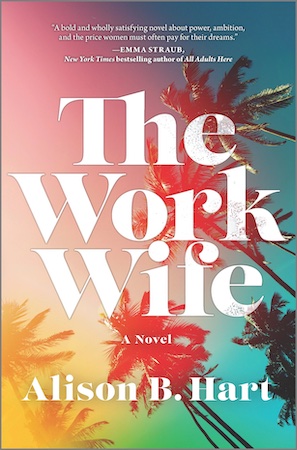
In my debut novel The Work Wife, about three women in the orbit of a Hollywood movie mogul, only one of the protagonists is an assistant proper, landing on his personal staff after burning out in academia. The other two protagonists—his wife and his ex-business partner—helped to incubate his children and projects. But all three women are equally engaged in the work, paid and unpaid, of insulating this one rich man from the ordinary friction of human life.
The twelve novels gathered here tell the tales of the assistants, temps, apprentices, and unpaid laborers who also smooth the way for others. Is it a coincidence that most of these books are debuts? Or that so many of the protagonists are unnamed while their stories tip into satire? Or are these authors merely following the age-old advice to “write what you know,” when what you know is how to be overlooked even though you’re every bit as smart (or smarter) than the guy (it’s usually a guy) making ten times more (at least) than you? You have to laugh, or else you’ll cry.
When the CEO of media conglomerate Titan Corporation hollers for his staff, his 30-year-old assistant Tina Fontana knows he needs her—and not his deputy, senior editor, or executive producer—by his tone. “It was a more intimate sound because with me Robert’s needs were always more personal.” But what good is being the first to know about an upset stomach or a marital spat, or being “essential to the success of this castle of a man,” if your own life is stalled? After six years of expensing her boss’s lavish lifestyle—$19K for a first-class plane ticket, or roughly two trips to Tiffany—while her own student loan balance won’t budge, a chance accounting error presents Tina with a unique opportunity to erase that debt. When Emily in Accounting catches on, a conspiracy is born. Perri’s debut is a gleeful page-turner for anyone who’s ever wondered what might happen if the assistants were put in charge.
Ingrid’s running from her demons when she’s hired aboard the WA, a cruise ship whose staff rotate through a variety of jobs—IT administrator, manicurist, croupier, able seaman, portrait photographer, customer service assistant, you name it. “I wasn’t good at any of these jobs, none of us were, but that wasn’t the point. We were good at pretending.” When she’s accepted into “the program,” a hush-hush apprenticeship with the ship’s captain that’s organized around the principle of Japanese aesthetics known as wabi-sabi, things start to get extra weird. The assistant becomes the leader in this surreal odyssey.
“In a way, it’s tragic when you can do something you don’t like,” says one of the characters of Min Jin Lee’s debut novel Free Food for Millionaires, and it makes a decent thesis for the book. Queens-born Casey Han is a Princeton grad with expensive tastes. When she passes up Columbia Law School to become an entry-level sales assistant at an investment brokerage (a “bullshit job” in the eyes of her new boss), she disappoints her Korean immigrant parents almost as much as she does by living in sin with her white boyfriend. Thrown out of the family home, she’s got to make her own way through the excess of 1990s Manhattan—and moonlighting in the accessories department of a luxury department store doesn’t help, as she brings home more hats than she sells. But she’s poised to rise to the top of either world, if she can just commit to one path. With the same keen eye for emotion that she brings to her National Book Award–nominated epic Pachinko, Lee charts the wants and pangs of a woman on the verge.
The Employees by Olga Ravn, translated by Martin Aitken
Originally presented as a parallel fiction to Lea Guldditte Hestelund’s 2018 installation Consumed Future Spewed up as Present, The Employees retains its roots in the visual arts while succeeding as a science fiction satire of the modern workplace. The novel consists of statements by the half human, half humanoid crew of the Six-Thousand Ship following the extraction of a set of objects from the planet New Discovery. Those deemed sufficiently “clean” are allowed to enter the gallery-like space where the objects are displayed to contemplate them and their own productivity. “When I enter the room containing the objects, I am, in every respect, the ship’s pilot, every remnant of the private person is gone,” the first officer says. The committee collecting these statements must decide whether the ship and its crew will continue their mission or be terminated (and destroyed). The work of the reader is to figure out which crew members are flesh and blood and which are “made for work,” and whether the difference even matters. “Should I hate myself anyway?” asks a humanoid worker who has inadvertently deviated from the program. “Who do I go to for forgiveness? Is there an application procedure?” Shortlisted for the International Booker prize, The Employees is for anyone who’s ever felt less than human in a corporate bureaucracy.
Like her mother, a brainy, feminist lawyer who moved to Los Angeles for the good of her husband’s career and not her own, the unnamed narrator of Isabel Kaplan’s debut novel NSFW “was meant for Harvard, not Hollywood.” Nevertheless, diploma in hand, she maneuvers her way onto the desk of a development exec at XBS, a television network known for its safe choices and cops-and-lawyers shows. Development is where the power is, a mentor tells her, and “if you want to make change in a big, noticeable way… you need power.” The only problem: to build that power, she may have to abandon her principles—maintaining a soul-crushing beauty regimen, reading her quixotic boss’s mind, dumbing down her script coverage, and looking the other way when scandal strikes. Set in the Obama years but presaging the #metoo era to come, this is a smart and frequently hilarious look at the true cost of women’s success.
Told entirely through Slack message threads, Several People Are Typing is a satirical romp through workplace culture and a meditation on the pathos and poetry of digital communication. Gerald is a mid-level employee at a public relations firm when he finds himself somehow stuck inside the app. At first he’s desperate to return to the land of living—no thanks to his coworkers, who are convinced he’s only out to milk his remote setup—but he grows to savor his increased productivity and life inside the matrix. After all, “what is a workplace but a cult where everyone gets paid, really?” He also develops surprisingly intimate relationships with both the coworker he pays to check on his body and Slackbot, a helpful but menacing piece of AI in search of a human form. You don’t have to have the rat-a-tat-tat of Slack’s new message notification etched in your consciousness like one of Pavlov’s dogs to enjoy this book, but it doesn’t hurt.
Editorial assistant Nella Rogers is the only Black woman at Wagner Books, a publisher whose last African American hit came out 35 years ago, so when Hazel-May McCall joins the team, Nella’s thrilled. Finally, a chance to have “a ‘work wife’ who really understood her,” not to mention someone to share the emotional workload at the company’s awkward diversity town halls. But when Hazel encourages her to be frank with their boss about a problematic book going to press, with disastrous results, and then moves ahead of her in the pecking order, Nella knows the other Black girl is not the work wife she hoped for. Throw in a mysterious note telling her to LEAVE WAGNER NOW, and Nella finds herself at the center of a sinister plot that reaches back decades. A former editorial assistant at Knopf, Harris spins a wild thriller that’s also a convincing takedown of the publishing industry.
Originally published in Japan in 2016, Tsumura’s first work to be translated into English makes a fitting companion to the Great Resignation of the Covid years. The unnamed narrator has left her profession due to burnout. When her unemployment insurance runs out, she asks a recruiter to find her job “as close as possible to my house—ideally, something along the lines of sitting all day in a chair.” We follow the narrator through a series of temporary odd jobs that are simple enough, yet still emotionally draining. Is it humanly possible to square her work ethic with the symptoms of burnout syndrome that leave her caught somewhere between wanting “a job that was practically without substance, a job that sat on the borderline between being a job and not” and being “happy when people took pleasure in my work, and it made me want to try harder”? When she lands at “an easy desk job in a hut in a big forest,” the lessons she’s learned from each gig thread together in uncanny ways. Part detective story, part meditation on the demands of late-stage capitalism, There’s No Such Thing as an Easy Job charms.
Emira Tucker, a broke Temple grad about to age out of her health insurance, knows she can’t be a babysitter forever. But she loves sweet three-year-old Briar Chamberlain so much that it’s easy to postpone the inevitable pivot to adulting. If only Briar’s mom Alix, an influencer who’s the epitome of white entitlement, weren’t part of the package. One minute she’s giving Emira a cheesy branded polo shirt to wear as her uniform (and secretly snooping through her texts); the next she’s trying to be her new best friend. When a supermarket security guard accuses Emira of kidnapping her young charge, and a handsome bystander makes a video of the encounter that goes viral, Emira and Alix’s lives become even more entangled. Such a Fun Age is a richly observed study of the domestic workplace and the tensions that compound when white guilt is in the mix.
Back home Patrick Hamlin might be a big deal, a novelist “on the cusp of his 40s” whose book is being adapted into a Hollywood movie, but on set he’s nothing but a lowly production assistant watching his life’s work get butchered. His initial shivers of pride dissipate when he learns he’ll be doing “a job for a kid,” chauffeuring the film’s star, Cassidy Carter, around LA.
Eager to distinguish himself from his peers, a couple of Rosencrantz and Guildenstern PAs who do little but provide comic relief, Patrick decides “in the first week that he doesn’t fetch, or he only fetches important items, items with an integral part to play in the story.” That means helping Cassidy hoard the cases of real water that she receives in lieu of a salary, and trying to get to the bottom of WAT-R, the synthetic substitute everyone in LA unthinkingly glugs while wildfires rage all around them. Working without finding any meaning in it is just one of the horrors uncovered in this dystopic fever dream about the climate crisis.
“There is nothing more personal than doing your job.” The unnamed narrator of Temporary first encounters this adage on a granola bar wrapper but “it’s a sentiment strong enough on which to hang my heart and purpose.” She comes from a long line of temporaries, much like Circe comes from a line of gods, and her life’s purpose is to find “the steadiness,” the near-mythical achievement of a permanent job. Until then, she has “a shorthand kind of career. Short tasks, short stays, short skirts.” In these stints, she fills not just the role, but the person-shaped hole left behind by the absent employee. “It takes an aggressive empathy to accurately replace a person,” whether it’s a pirate, a ghost, a murderer, or the chairman of the board of “the very, very major corporation, Major Corp.” With verve and insight, Leichter embraces the surreal in this sendup of the gig economy.
It’s the spring of 2009 and Cara Romero—56, Dominicana, and unemployed since her factory job of 25 years moved overseas—wants to work. “Write that down,” she tells the counselor she meets with each week at the Senior Workforce Program, because “what is a person without an occupation?”
Through a series of tangent-filled sessions, applications, and questionnaires (“Degree Earned: Survival; Previous Employer: The factory of little lamps; Job Title: Whatever job needs to be done”), we learn Cara’s résumé, both the paid and unpaid obligations (professional, romantic, and otherwise) that fill up the pages of her life story. What emerges is a portrait of a woman who can do it all: care for her community, manage disasters, organize, and problem-solve. Artfully constructed, and by turns laugh-out-loud funny and deeply moving, Cruz’s latest exposes the fragility at the center of American capitalism.
A year ago, my spouse and I abandoned the small northeastern town we’d lived in for more than two decades and moved to a different small northeastern town. Our official reason for moving—the elevator pitch to friends and family—was financial; our original house was suddenly worth more than twice what we’d paid for it, the nicer house we’d found to move into, a fraction of that. The less official reason for our move was change; we didn’t seek a fresh environment to change us, we needed tabula rasa to accommodate our changed selves.
Like many trans and nonbinary folk, I first came out as “gay,” confusing and submerging gender with sexuality. My earliest self-knowledge was being a boy unable to be treated like a boy. During an unhappy childhood—desperately begging to be called “brother,” “son,” “nephew,” “grandson”—I relegated my identity to a religion I practiced alone and in private. Coming out as gay, moments following my shipwreck of a first marriage, I found unprecedented joy and freedom. I was never again questioned for wearing my signature men’s attire (including socks and boxers) nor the plethora of other gender nonconforming behaviors that were simply me being me. As a queer person, I met other people like myself, eventually meeting and marrying (albeit in Canada) my wife Beatrice. Yet I continued answering to the name that had been force-fed to me since birth, and checking a lifetime of gender boxes I knew didn’t describe me. Returning to grad school as part of the pathway towards becoming a full-time writer, my MFA cohort was a mixed age group – some older than I, some of similar years, but most were younger. Being immersed four semesters within this generation stew helped me claim my true self-hood. I re-wrapped my queer mantle around my gender without embarrassing spotlight nor fanfare. When the university president called my updated name at graduation, I nearly lunged for my diploma, cracking open the pigskin binder and grinning at my simple androgenous name while still walking back to my seat. A few months later an essay I wrote about my long and winding gender journey won first prize in a prestigious writing contest, launching my career as an essayist.
A fresh start with neighbors, business owners, insurance agents and car dealerships allowed Beatrice and I to be seen as who we actually are.
Outside of grad school, coming out again was less fluid; reminding circles outside my closest friends to use my correct name and pronouns proved incessant. Moving to a new location instantly solved this; a fresh start with neighbors, business owners, insurance agents and car dealerships allowed Beatrice and I to be seen as who we actually are, rather than through a hazy lens we’d left behind in our former town. Choosing our new home involved gravitating towards lush nature, progressive local government, proximity to some dear friends, (and yes, economy.) Learning shortly after movers deposited our myriad boxes and drove away, that we had unknowingly relocated to a county aptly named “Middlesex” absolutely thrilled me.
Though nonbinary (or non-binary)presence appears recently ubiquitous, the term first entered mainstream use in 2016 (in California and Oregon as legal gender option on driver’s licenses and passports) and only entered Websters Dictionary in 2019. With a hyphen or without, the ranks of those publicly claiming the tag grow daily. Performers Janelle Monae, Demi Lovato, Miley Cyrus and Sam Smith, all use it. Literary notables include Danez Smith, Kate Bornstein, Cyrus Dunham, Masha Gessen, and Eileen Myles. The first Winter Olympian defining themself as nonbinary is Timothy LeDuc. The first State Representative is Mauree Turner of Oklahoma.
Ever since adopting the term myself in 2019, I’ve happily noted when film and television offers representation and increases visibility, but a surprising amount of production falls under sci-fi, fantasy, and animation–genres not included in my regular viewing diet. Yes, “Billions” made history in 2017 with Asia Kate Dillon playing Taylor Mason, but “Umbrella Academy” and “Steven Universe” represent the bulk of what currently proliferates. Similarly, few literary depictions of nonbinary characters align with my reading; While Maia Kobabe’s 2014 graphic novel, “Gender Queer” was groundreaking and remains a favorite, very little fiction crosses my path dealing specifically with the nonbinary journey.
When I learned nonbinary author Jendi Reiter had a poetry book coming out that specifically dealt with their gender journey, I pre-ordered my copy to ensure I’d receive it as early as possible. While I often read poetry, even concentrating on it for much of my masters degree in creative writing, my anticipation for Made Man had more to do with common denominators I share with Reiter. While I didn’t expect to see myself precisely reflected within these poems, something about this book imposed a strong gravitational pull in my direction.
Made Man, a thematic volume of 76 poems, is divided into four sections: “The Obligatory Masking”, “Great Tits of the World”, “American Eclipse” and the fourth sharing the title with the combined work, “Made Man.” Not only does Made Man‘s chronology echo the author’s individual nonbinary experience, it is the first poetry collection explicitly exploring a nonbinary journey (my research found this slim volume has cousins, but no clones.) As Section I flows into Section II, the creature we are witnessing evolves, as readers parse the most intimate of details, those unfamiliar with aspects of transition get an insider look.
Of course this volume doesn’t illuminate every nonbinary journey—rather, just Reiter’s. That fact contributes mightily to making the collection unique; the personal unfolding each poem contains. The second poem in the work, I’m a Laura Ashley Man, Myself, begins “mother desired a sofa but instead she had me…” A few lines later, “…when I watched Tootsie I was sick / in lonely schoolday bed tear-stung comedy of red lame / my dowdy fate to teeter knock-kneed toward mistaken love…” And ends “…her razor prettying my thighs / and so ribboned I raced blindered away.”
Smiling and nodding my way through the familiar cultural touchstones in those lines, I simultaneously imagined Gen-Z thumb-tapping for google clarifications. Do 12- to 24-year-olds relate to cultural references like “Tootsie”? Or in poems immediately thereafter referencing “the people’s princess” and “Mr. Miyagi.”?
When reflecting on my own nonbinary journey, I think about Gen-Z-ers and how utterly different their experience is
I think about this because when reflecting on my own nonbinary journey, I think about Gen-Z-ers and how utterly different their experience is. The Trevor Project’s 2021 reporting that 26% of Generation Z identify as nonbinary follows me around most days, tapping on my shoulder and nudging me to pay attention. I interact with this self-reporting nonbinary population – the largest to date as defined by age– in classrooms, bars, restaurants, gyms. Wherever young people are found, more than a quarter of them define themselves as I do. How can this be? During childhood I met one other kid (like me, assigned female at birth) at sleepaway camp who seemed to share my brand of otherness. Mackie moved through space the way I did, athletic and physically bold, like me, she stuffed her hair into a baseball cap all day, and at night slept wearing a stolen-from-the-lost-and-found boys’ camp shirt (the boys’ shirts were dark navy, the girls’ light blue.) Mackie and I once ran away from camp for the day to avoid a tradition of having nail polish applied (in our case, to bitten and gnawed fingertips) by the senior girls. We hid out at the far side of the lake, swimming and sunning wearing only our shorts, our shirts discarded off to the side. But that was it, Mackie didn’t return the following summer and our worlds never again collided. I otherwise grew up entirely alone in who I was, isolated by what I assumed to be the rarest of birth defects. My Gen-X gut can summon, in a single click of a red sequined heel, the intense alienation born of my innate otherness. So now, how can there be, forty-some years later, so many of me? Will an era soon arrive when visibility couples with sheer numbers to dissipate my hard history? Or, more pointedly, does the generation Reiter and I share traverse such an entirely different trajectory that current and future nonbinary generations can only read such touchstones as historians, absorbing the culture and context via brains rather than hearts?
A few pages later, in a poem entitled Trans Formers the cultural references leapfrog decades ahead: the last stanza beginning:
“Seven-year-olds across America take it in stride
on the next Netflix snowday
when all the striking women have disappeared
from Griffin Rock, Cybertron, and NinjagoCity.
The next most beta-male character takes their place…”
Involved parenting can draw you so close to another generation’s culture, you can internalize it as your own.
Here, those potentially clueless to Reiter’s allusions to “Minecraft”, “Strongarm” “Optimus” and “Grimlock” are Boomers and Gen-Xers (at least the ones not paying attention during their kid’s childhood.) Reiter’s fluency with such a broad range of culture icons makes reading these poems like reading a lush lexicon that a reader can either identify with or decipher via context. There is no judgment to ignorance of a reference point—the poet takes each reader by the hand, making it clear they will be treated as respected insider. In this poem Reiter introduces their son. In many other poems within the volume the boy is referenced in his various stages of growth and development. I relate in spades, having raised a biological son along with four additional children courtesy of my nearly 20 year marriage. Involved parenting can draw you so close to another generation’s culture, you can internalize it as your own; thrilling as much to Nintendo’s release of a new Switch Pro Controller as you did 20 years prior to the original Apple IPod. But relatability stemming only from first-hand experience is beside the point in art . How else could contemporary people purchase tickets and stand in line to view Picasso or Mattise? How else would consecutive generations relate to Dickinson, Clifton, Angelou, and Oliver? This ability to jump era when relating to art is how any reader should understand Made Man’s poems – because the power of transcendent work relies on depth of experience rather than shared experience.
And yet, what if it isn’t cultural iconography I readily identify as the missing link, but rather something deeper? Just as a love of vintage can be nostalgic for some and novel for others, age itself may govern my perspective in ways making me smile and nod when reading Made Man and experience a faint wave of loss when watching nonbinary 20-somethings at work and play.
Was this the source of my sadness last month heading towards our town’s Pride celebration? My t-shirt emblazoned simply with letters across the chest spelling out: boy(ish)garnered a couple compliments from members of my gender tribe, as it usually does. But its essence is an inside joke I share only with myself. Emanating from a generation devoid of acceptance, mainstream medical interventions, and nomenclature, while I knew I was born a boy, my childhood never allowed me to claim it, roadblocking me into tomboy trope and, with puberty, eventual submission to what society tolerated as acceptable cis hetero-normative modeling. While I finally claimed a queerness presenting itself first lesbian and eventually nonbinary, my adult years are marked by the scabs and scars defining that evolution.
There is an ever-present attitude of hope in these lines, a desire to brave the path towards metamorphosis.
Reiter’s poem Don’t Get Your Penis Stuck in the Bubble Wand is about one parent’s daily drudge reasoning with their 3-year-old. The first line “You have a choice” is simultaneously tired repetition, and something greater: “Choice” being the uber gift a parent can offer a child. Moreover it’s the invaluable opportunity one generation can bestow upon the next. In offering the toddler what they know is their child’s modern-day birth-right, the poem’s voice also speaks from a place of healing what they themself had not been offered. The poem’s last lines “The ___ on the bus goes ___ and ___, / ___, ___.” make one read words which are clearly there, though they are represented in absentia. The reference point is core–it need never be filled in; there are constants to every generation, and there are overlays which can improve (to continue the metaphor) the ride. While being queer remains enough of an otherness from mainstream that each individual must still navigate it, the generation currently coming of age grew up with what would have been inconceivable to my (and Reiter’s) early self. They grow up with role models, with increased visibility across entertainment and sports. They grow up with knowledge and (ideally) access to hormone blockers and testosterone and estrogen injections.They grow up with enough controversy surrounding public bathrooms and the amplification of that controversy throughout social media, to understand that while they may not be accepted everywhere, they are clearly a group that exists. I am beyond glad for the progress of my younger gender-peers, but I also feel the sting of having personally missed it.
In Mr. Miyagi Mourns Another Anniversary, “Meanwhile, for a boy/almost like you, one legged bird”, Reiter’s embrace of their own fledgling self is palpable. In How to Lick a Lollypop on Main Street we are told “Risk being ranked as you lick/ the melting cherry swirls/ like a man’s damp secret hair.” so we endure the fraught exploration as we trust it’s necessary process for the burgeoning new self. In Lust it’s the lines:
“and how long must I look at the damn roses
to do them justice they confuse me
with beauty no one really has
the right to walk away from”
that acknowledge the deep pain, but one that has a time limit. Throughout, there is an ever-present attitude of hope in these lines, a desire to brave the path towards metamorphosis.
In the poem Ode to Butternut Squash written to (and about) an oversized gourd “… the War and Peace of vegetables” for guests who, as the last lines explain, “will not be grateful for your sacrifice/ and fill up on pie instead.” is a departure of sorts within the work. Lighthearted, devoid of trauma and seemingly less about the nonbinary, a contemplation on gender still lies within it:
“your brute firmness, flesh pink and unmarked,
sized to give Anna Karenina the shivers.
I do not have the conquering spirit.
Because I am afraid, butternut squash,
that even if I cut you in half without losing a finger,
and you yield your virgin territory”
It’s always an additional encumberment though, having to announce one’s difference.
This poem snapshots what it is to be a gender other than the more famous binaries; to have thoughts of body and flesh never far from one’s conscience as one endeavors to navigate the rest of life…for example, the cooking of a vegetable. For me, because I was queer in ways not always visually recognizable, when meandering through a straight cis world, my presentation often camouflaging me as their cohort, my antennae sensed queerness wherever it hid; in peoples’ unintentional use of language and gesture, in how someone wore their scarf, buttoned their coat, zipped their fly… there was no getting away from my perception, real or imagined, of innuendo, because it was the steady silent baseline playing beneath my life.
The TV series “Sort Of” does similar justice to the experience. I thrilled at “Sort Of”, a scripted half-hour HBOmax dramedy series diverging from other gender fluid content. The shows focus on 25-year-old nonbinary Sabi, a part-time bartender at an LGBTQ club and part-time caregiver to two young children of a married hetero cis couple. Sabi’s best friend 7ven is also nonbinary, and the pair offer two very different representations of gender fluidity throughout nine episodes of season one. Sabi and 7ven have complicated lives and what’s groundbreaking is the fact of being nonbinary is not one of the complications, but rather the thread running through everything else. Bilal Baig (star and co-creator of “Sort Of”) said in an interview with Yahoo Canada, “Understanding that everyone’s transition looks different, the way our world looks at transition is different and they’re not equally the same.” There is a simultaneous inner and outer life of each transition, and the out of sync-ness reverberates within both universes. And yet, Sabi and 7ven have each other, and through Sabi’s workplace we see their gender community is widely populated. A generation earlier, their gender would likely have eclipsed everything else going on in their lives; so seemingly unusual, resolution with it would at best have been delayed by decades.
In Dreaming of Top Surgery at the Vince Lombardi Rest Stop, the opening poem from Made Man’s third section, the reader visits a rest stop bathroom along the New Jersey Turnpike with the poet, long a spouse and parent by this point, whose transition is still commanding center stage. The poet’s voice describes physical FTM transitioning, simultaneously entirely aware of how onlookers view them: “trying to sneak into the Men’s Room / Behind my hopping little boy and patient husband…” then later:
“no one will honor
my Provincetown tank top, shaved scalp and untrimmed chin hair
as more than the forgivable marks
of a 12-hour road trip mom who’s quit trying.”
The poem employs humor to gift wrap its seriousness throughout, abandoning that wrapping only at the final line to pose the quintessential question:
“how do you know where the end zone is
without a trophy, a team
of mighty men drenching you in Gatorade
that shocks you breathless like love?”
“They’re looking for They/Thems” said an old advertising buddy of mine recently, referring to the target market a client is hoping will expand brand sales. The team developed the strategy after viewing the Indeed commercial “New Beginning” which does exactly that: emphasizing comfort in the workplace as the motivation for verbal inclusivity, this internet job recruiter tracks one nonbinary person’s initial job interview where the interviewer first shares his pronouns (he/him) then asks the applicant if they are comfortable sharing theirs…they are, and gladly say “They/them”. A voiceover summarizes, “we can’t show what we can do until we can show up as who we are.”
A generation earlier, their gender would likely have eclipsed everything else going on in their lives.
I wasn’t initially an adopter of “they/them” pronouns. While “they/them” has become the standard since its 2019 introduction, some of us use “E/Eir” (Spivak pronouns developed in 1983). I used “Eir” for a while before trading it in for the easier recognition of “their”. Less common pronouns folks have used include “Xe/Xem”, “Ze/Zir”, and “Fae/Faer”. Performer Justin Vivian Bond has always used “V” (standing for Bond’s middle name.) Personally, I wish everyone used “e”. That is, I wish all hes and shes would just modernize to e. It would underscore that we are all part of one human team, instead of divided so disparately. Before “They” became the hands-down go-to, I floated this to someone at GLAAD who liked it a lot but said I was “too late.” It’s always an additional encumberment though, having to announce one’s difference. Since I wasn’t they in college or in my earlier career, since I wasn’t they when I married my wife or raised my kids, I burden countless others when asking them and reminding them to address me as they. I don’t embrace the spotlight being turned on me in this ask, nor tasking others with the added assignment of updating. Yet I do it because the opposite of being misgendered feels better than incredible—it feels like affirmation that who I am is both valid and true.
The significance of pronouns is explored in an episode of “Sort Of” when Sabi expresses their deep ties to their boss Bessy who asked, at their initial interview, what pronouns Sabi would like to be called. Responding “They/them”, we learn is the first time Sabi had verbally spoken their truth.
Reiter’s poem They Say Don’t Say They offers the most eloquent exploration I’ve encountered of the issue. Beginning, “My pronoun is Oliver Wendell Holmes’ dog. It knows the/difference between being stumbled over and being kicked.” and later in the same poem “…Yes my / antecedent is unclear….” And “…I Could remind you language is a table that of course/ sets no place for those not allowed to exist. …My pronoun is the seder’s open door for Elijah at the end…”
If there exists a common denominator for the nonbinary, for those of Reiter’s and my generation and those just coming up now, perhaps this is it. Not a pronoun, but a presence; not for all nonbinary people, not for all trans folks, not even for all queers – but for all humans. Are we not all, upon reading these lines, ignited somewhere deep within ourselves? Pointing excitedly to the poem on page 97 and screaming within our own heads, “YES! EXACTLY! ‘they’ and ‘their’ is not the point – we are all Elijah hoping a door is left ajar and a seat awaits!”
The world has been getting weird for a while, and in the process the distinctions between reality and fiction, utopia and dystopia, individual and environment have themselves come to feel strange. In her new essay collection, Death by Landscape, novelist and critic Elvia Wilk asks what we mean by “weird” in the first place and considers how the notion might help us—in literature and in life—to think beyond such hard lines.
The book explores writing in the age of extinction, questioning the role of the individual human actor in a world that is intimately connected and in crisis. Wilk, whose first novel, Oval, imagined a buggy, hi-tech eco-development in a creepily corporate Berlin, is interested in the different futures that technology or science fiction promise and project. The essays delve into world-building in real and fictional realms or areas that occupy the hazy zone between—VR games, vampire role plays, and solarpunk futures.
I talked with Wilk about the eerie promise of a frictionless existence, how fiction can come to grasp the scale of the climate crisis and the slow violence of its global effects, and the weirding of “work” during the pandemic.
Olivia Parkes: The title essay of the book tracks the ambivalent fantasy of women becoming plants through folktales, stories, and films. I appreciate how you draw out both the problems of the trope—a view of women as inherently closer to nature, which is itself romanticized and feminized—as well as its potential to reverse what you call the relationship between figure and ground, to establish a different relationship between who and what we perceive to be active versus passive. You keep returning in the essays to this idea of an “ecosystems fiction.” What does an ecosystems approach to fiction look like?
Elvia Wilk: I don’t love to drop terminology and make categories, but when I’m talking about ecosystems fiction, I’m talking about fiction that tries to undermine or decenter or question the human protagonist as the leader of the story. By leader, I mean the figure at the top of the hierarchy of being, as well as the propulsive force that leads the story forward in time. Most fiction is dependent on an idea of the human figure leading us into the future—a better future or worse one, but a future nonetheless.
Ecosystems consist of all sorts of human and non-human entities that can’t be ranked in a hierarchy, and no single element can be seen as leading an ecosystem. In that first essay, I deal with the literary history of systems novels, with this masculinist notion of humans and technologies and ideas and language making up a system that can be parsed by a fairly paranoid—usually white—man in the middle of the story. In contrast, in contemporary ecosystems fiction, which is sensitive to climate change, the workings of the world are not to be puzzled out or to be pinned down by the protagonist. The natural, artificial, technological, material elements all have their own influential leading roles, and this is not a conspiracy against the human actor.
OP: This feels related to the distinction you keep coming back to between the “New Weird” as a development and departure from the “Old Weird”, which is associated with these Lovecraft-era sci-fi tropes in which the “un”natural or the “super”natural—the enormity of the unknown—rises up to threaten the boundedness, or the centrality of the human protagonist’s point of view, which is often our starting point for fiction. Could you talk about some of the problems with that model—what we’re calling the Old Weird—and the potential, as you see it, for the New Weird to do something different?
EW: I think the Old Weird of the late 19th, early 20th century is similarly paranoid to the systems novel, and similarly supposes a conspiracy threatening the human. To a writer like Lovecraft, that conspiracy would be ancient aliens or nonwhite people threatening the way Western imperial figures’ sense of agency over the way the world works. The conspiracy in a systems novel might be a corporation or a government.
The stories I’m interested in are about what happens between, what happens before and after the revolution.
Lovecraft’s books were taken up in arts and humanities discourse in the last ten or fifteen years as a kind of precursor to discussions about the Anthropocene, because they reflect on deep time and the limits of human consciousness. What was the world like before humans? What would it be like after humans? These are questions very relevant to the age of extinction. But those questions were framed by Lovecraft as terrifying ones, about what would happen if the white guy wasn’t in charge, basically. Those questions can certainly be re-purposed and that fiction can be revisited to do something new. Anne and Jeff VanderMeer are the author-editor team who have done the most to make the “New Weird” into a term with some currency within the literary world. Maybe New Weird exists as a genre, maybe it doesn’t. But if you want to identify it as a tendency, it would be fiction that’s picking up on these questions of estrangement, on what it means to see ourselves from the outside. What it means to question the limits of the human. And that for me becomes adjacent to the ideas of ecosystems fiction that I’m exploring.
OP: There’s this sense, in the climate change era in particular, that the future and its various catastrophes are already here. And I wonder how you think that changes the relevance of terms like utopia and dystopia, or how we can more productively think beyond those categories.
EW: An idea I return to in a few different ways is that utopia and dystopia are coterminous. They happen at the same time and are essentially matters of perspective and scale, which is to say that you might have a utopian moment in time, you might have a utopian group, you might have a micro-utopia in the midst of a large dystopia, or vice versa. As any kind of genre writer or reader knows, utopia and dystopia switch places constantly and that one is never present without the other. As theoretical poles, they’re dependent on their theoretical opposites. So in writing one, you’re always writing around or in reaction to the other. For instance, in movies about utopia the drama of the plot is usually when it disintegrates and is revealed to be a terrible dystopia. A lot of the time the plot arc of the utopian story is just showing how it’s dystopian in the end.
OP: Yeah. You describe this disturbing trend in which dystopian fictions and films are a kind of luxury good that allow elites to exorcise some kind of demonic fantasy.
EW: Dystopia is a fantasy for the wealthy, and in this way it’s also a prophylactic. It’s like, if “our” world is not that bad, then we’re still safe. A classic Hollywood dystopia might look like how the movie-makers imagine a refugee camp—something faraway in space and time. And that way “we” can assure ourselves that it’s happening somewhere else or that it happened already in the past, or it’s happening in the future, but it’s not here. It’s not now.
OP: There’s also this resonance with what I think of as the tech utopian elites, who keep promising a better and better future enabled by technology while preparing for one that’s worse and worse, buying bunkers and land in New Zealand. And that’s a very dystopian trend I would say.
Utopia and dystopia switch places constantly and that one is never present without the other. As theoretical poles, they’re dependent on their theoretical opposites.
EW: That’s a good example. These people are operating with full awareness of what’s happening to the planet while peddling and selling utopian products.
Something that comes up frequently in the book is the issue of scale and how hard it is for a person to access the rate of change, the rate of destruction, the global and interconnected nature of the patterns, and especially the enormous, reality of mass extinction. It’s incredibly hard to talk about in a way that is meaningful, because the numbers are too big to grasp. Or the heartbreak is too big to grasp, to feel. The existential threat is too vast. I’m not exactly proposing that we need to put a name or a face to an abstract problem for people to “identify” with it more—like a “save the pandas” campaign. It’s not really so much a problem of abstract versus concrete, of extinction versus pandas. It’s a problem of being able to psychologically and somatically handle something. For me, it’s like, what can I put in my hand? And how can I hold this? I might borrow Ursula le Guin’s carrier bag theory of fiction here, I think that stories are bags that can carry a lot.
OP: Yes, there’s the issue of scale but also of speed. You talk on the one hand about things accelerating, but on the other about “slow violence”—how a lot of the catastrophe in the world doesn’t happen in a big action or moment that blows up. Rather these long and often invisible processes erode or destroy communities and places over time. One thing fiction seems to be able to do is make these processes visible in some way, which feels similar to what you’re saying about scale.
EW: Yeah, I think that because of the way that a narrative lives in time, it can deal with the way that things happen slowly and sometimes imperceptibly. Moments of extreme crisis or rupture are what the news cycle runs on. When it comes to personal history or political history, narratives are often likewise framed in terms of major events. But the stories I’m interested in are about what happens between, what happens before and after the revolution.
OP: The epilogue to the book is a personal essay about writing during lockdown. You talk about the pressure to produce in an atmosphere that combines a sense of pervasive crisis with constant injunctions on social media to practice self-care, which makes individuals personally responsible for overcoming problems (which are often structural) in ways that are profitable for the system overall. What made you want to close the book out in that way?
EW: Part of the reason that the book ends with this very personal, present-tense essay written during the pandemic is because I wanted to structure the book so that it becomes increasingly tied to me and to the moment. It starts with something like third-person literary analysis and then throughout the sections I creep into the frame. By the last section, I’m dealing with some pretty juicy personal stories; the writing becomes increasingly autobiographical, even confessional. I chose this narrative arc because the book is about zooming in and zooming out, relating the micro to the macro, trying to connect big systems to the experience of living in a body.
With the epilogue, I felt like the coda needed to zoom all the way in tight, a last act where I talk about how I actually wrote the book—a lot of which happened during lockdown. During that time my ideas about the future, about how to work, about how to be with others, changed a lot, and that personal shift is mirrored in the topics I deal with in the book.
OP: I’m stuck in this apartment, like all of you.
EW: Exactly. It’s a window into the writing process, which is a way of puncturing the wall between reader and writer. I wanted to show that the labor of writing wasn’t done in a vacuum. We can’t pretend that the structures we’re actually living and working in have nothing to do with the work that is produced.
OP: The pandemic also changed our relationship with time in that the future seemed to be on permanent hold. There’s this recognition that if the future was the place we were always supposed to be rushing into, it’s now also a site of crisis. I think a lot of us are recalibrating that sense of the future as the place that we’re always working so hard to get to, of work as something we do for results in the future. How has your own relationship to work changed?
EW: As you say, with the pandemic the idea of working towards a future was called into question. Or more like radically disrupted or ripped away. In the book I talk about this as a loss of my “structuring principle” for daily life—the idea of working each day toward tangible future goals. What if there is no future to work towards? Why work? What kind of work is writing, actually? That feeling of the loss of the future in your body is not the same as writing about the general loss of the future horizon in fiction.
OP: You capture the way that suddenly having this unlimited space and time to work was a privilege but also a kind of terror. Which makes me think our cultural obsession with optimization—with saving time to somehow liberate work from real life, so that you can fill life with work—is actually a kind of hell.
What if there is no future to work towards? Why work?
EW: Oh no, it’s a total nightmare. I did a five-week residency a few years ago at the Banff Center in Canada to work on my novel, Oval. At the first meeting with all the residents, the coordinator said: Look, your meals are going to be cooked for you. Your bed is going to be made. You’re going to have nothing to do but write for the next five weeks. And most of you are probably going to have a mental breakdown. We have therapy services.
OP: I love that.
EW: At the beginning of the residency I thought, this is paradise. But by the first weekend, it was a catastrophe. How can you be if you have nothing holding you in? How can you create if there’s no friction? It’s hard to work in an artificial vacuum, in a biosphere.
OP: Totally. It’s that inversion of utopia and dystopia, right? The idea that it’s utopian to somehow liberate work from real life, that a frictionless world is paradise, but it’s hell.
It was a holiday, and I was enjoying chatting with two girlfriends from university days over afternoon tea. Through the window, the gray office buildings of the business district sat beneath a cloudless sky. Reservations at this hotel lobby tearoom were hard to come by, and it was thronged with a female clientele. An elegant white-haired lady with a deep purple stole across her shoulders daintily carried a piece of tart to her mouth. At the table next to us, some girls with colorful painted nails were taking photos of their cakes. One of them spilled apricot jam on her white cardigan and hastily started wiping it off with a pink handkerchief.
Yumi opened the menu and ordered a second cup of tea, then noticed the sweater I was wearing.
“Hey, Nana, that sweater… is it human hair?”
“Oh, can you tell?” I beamed at her, nodding. “Yes, one hundred percent.”
“Fantastic! It must have been expensive.”
“Yeah, a bit… I took out a loan. But it’ll last me for life,” I answered rather bashfully, lightly running my fingertips over the garment. The jet-black hair was closely knitted into rows of braids, with an intricate weave at the cuffs and neck, and it glistened alluringly in the rays of light shining in through the lobby windows. Even though it was mine, it was so beautiful, and I gazed at it, enraptured.
Aya was eyeing it enviously too. “A hundred percent human hair is just the thing for winter! Warm, durable, and luxurious. My sweater contains some too, but it’s so expensive I could only afford it mixed with wool. But human hair really does feel completely different, doesn’t it?”
“Thanks. It’s too special to wear every day, and normally I keep it safely stored away, but today I really wanted to dress up—it’s the first time we’ve seen each other for ages, and coming to a hotel, too.”
“Really? But now that you’ve bought it, it’s such a waste not to wear it more,” Yumi said.
Aya agreed. “Expensive clothes are not meant to simply decorate your closet, you know. You have to put them to good use! Nana, you’re engaged to be married now, aren’t you? Human hair is just the thing to wear for formal occasions, like meeting your future in-laws.”
I toyed with my teacup. “Well, yes, but…” I said in a small voice. “You see, my fiancé doesn’t really like clothes made from human hair.”
“Whaaat?” Aya’s eyes widened in bewilderment. “Why on earth not? I can’t understand that!”
“I can’t either, but it’s not just human hair—he doesn’t like any fashion accessories or furnishings made from human materials,” I said, forcing a smile.
“You’re kidding!” Shocked, Yumi put the macaroon she’d been about to put in her mouth back on her plate and looked at me dubiously. “So, what about bone rings? Tooth earrings?”
“He can’t stand them. We’re talking about making our wedding rings platinum, too.”
Aya and Yumi looked at each other.
“Really? But wedding rings made from front teeth are the best!”
“Nana, your fiancé’s a banker, isn’t he? He must be well-off, so isn’t he just being stingy?”
“No, I don’t think it’s that…” I answered vaguely, and smiled. I couldn’t explain it very well myself.
Aya nodded triumphantly. “Yes, there are people like that who are loaded but just don’t understand fashion… but Naoki’s always so well-dressed, I’d never have expected it of him. When it comes to your wedding rings, though, I’d discuss that with him a bit more. After all, they’re what you’ll be using to pledge your eternal love for each other.” She raised her teacup to her mouth. On her left hand was a ring made from pure white bone, her wedding ring, made from a fibula for her marriage last year, and it looked really good on her slender finger. I still clearly remembered how envious I’d felt when she’d happily shown it off to me, even while explaining that it was considerably cheaper than tooth.
I surreptitiously stroked my ring finger. The truth was that I did want a ring made from either tooth or bone. I’d talked about this any number of times with Naoki, and I knew better than anyone how futile it was.
“Look, go once more to the shop together. If he can just see what it looks like on his finger, he’ll change his mind, you know.”
I gave a little nod, looked down to avoid their eyes, and reached for the now-cold scone on my plate.
I’d just said goodbye to Aya and Yumi when I felt my cell phone vibrate. I took it from my bag and saw that an email had arrived from Naoki, who’d had to go in to work even though it was a holiday.
Got away earlier than I thought. How about coming over?
Okay, I replied, and got on a subway headed for his place.
He lived in a neighborhood close to where he worked, with office blocks alongside conveniently located residential condos. Once we were married, we planned to move to a new house in the suburbs, where there was a more natural environment better suited to kids. I was looking forward to living there, but felt a little sad at the thought that I wouldn’t be returning to this neighborhood, where I’d spent so much time over the five years we’d been dating.
I rang the bell, and Naoki’s amiable voice came through the interphone telling me to come in, so I opened the door with my key.
He must have only just arrived home since he was still in his shirt and tie, with a cardigan over his shoulders, and was turning on the underfloor heating.
“I bought dinner on the way,” I said. “It’s cold outside, so I thought hotpot would be good.”
“Sounds great, thanks. How were the girls?”
“They’re both fine. They gave us an engagement present.”
I passed him the bag containing the pair of wineglasses from Aya and Yumi, put down my purse and the bag of groceries, and took off my duffle coat. His smile instantly vanished, replaced by a scowl.
Seeing the undisguised revulsion on his face, I remembered that I was still wearing the sweater.
“Didn’t I tell you not to wear human hair?” he said in a low voice, avoiding my eyes, his face turned away from me so forcefully I thought his neck might snap as he plonked himself onto the couch.
“Um, well, I hadn’t seen my friends for ages, and I wanted to impress them. I haven’t worn it at all lately, and I thought it wouldn’t do any harm to wear it just this once.”
“You should throw it away. You promised me you wouldn’t wear it. Have you gone back on your word?”
“But I haven’t even paid off the loan yet. I promised I wouldn’t wear it in front of you, but I never said I wouldn’t ever wear it again. Why am I being told off for wearing something I bought with my own money?”
I choked up in spite of myself, and Naoki avoided looking at me as he drummed his fingers irritably on the floor.
“It gives me the creeps.”
“But why? It’s no different from your hair, or mine. It’s more natural for us than hair from any other animal—it’s a material really close to us.”
“Yeah, that’s exactly why it creeps me out,” he spat, picking up a packet of cigarettes and a small ashtray from the side table.
Naoki hardly ever smoked, and he only ever reached for his cigarettes when he was really stressed and irritable and needed to calm himself down. I always did my best to comfort him whenever he lit up after work, complaining about being tired, but this time it was my fault he was feeling like this—just because of what I was wearing, I thought miserably.
“You’re going to Miho’s shop to look at new furniture tomorrow, aren’t you?” he said, puffing out smoke. “I can’t go along, so I’ll leave it up to you, but let’s get one thing straight—if you choose even just one item made from human products, I won’t marry you. Teeth, bones, and skin are all out. Otherwise I’ll break off the engagement.”
“Talk about a unilateral decision. What could be more normal than making people into clothes or furniture after they die? How come you’ve got such an aversion to it?”
“It’s sacrilegious! I can’t believe you’re so unfazed by using items hacked from dead bodies.”
“Is using other animals any better? This is a precious and noble aspect of the workings of our advanced life form—not wasting the bodies of people when they die, or at least having one’s own body still being useful. Can’t you see how wonderful it is? There are so many parts that can be reused as furniture, and it’s a waste to throw them away… isn’t that more sacrilegious?”
“No, it isn’t,” Naoki retorted. “What’s wrong with everyone? It’s crazy. Look at this!” he said, ripping out his necktie pin and throwing it to the floor. “It’s made from fingernails pulled from someone’s body. A dead body! It’s grotesque. Horrifying!”
“Stop! Don’t break it! If you hate it so much, why do you wear it?”
“It’s an engagement gift from my boss. It’s revolting— even just touching it makes my skin crawl.”
I held back my tears and yelled, “It’s not like using human material is uncivilized. It’s far more heartless to just burn it all!”
“That’s enough!”
We always ended up fighting over this issue. I couldn’t for the life of me understand why Naoki was so averse to wearing or using anything human.
“I’m sorry,” I said. “I’ll throw it away.” I took off the sleek black sweater and, stifling my sobs, scrunched it up and stuffed it into the kitchen garbage can. As I stood there in my silk undershirt feeling miserable, I felt Naoki put his arms around me from behind.
In any case, one day we’ll all be turned into sweaters or clocks or lamps when we die. We humans are also materials—and that’s wonderful!
“I’m sorry I got so emotional. I don’t think I’ll ever be able to make you understand, but somehow I find human hair sweaters and bone cutlery and furniture terrifying.”
Naoki’s slim arms rubbed gently against my body. His body was enveloped in a soft cashmere cardigan. I couldn’t understand why he thought human hair was so wrong when goat hair was fine. But I noticed his hands were trembling slightly and said in a small voice, “I’m sorry, I was wrong— especially since I knew you didn’t like it.”
“No. I’m wrong for making you put up with me,” he murmured weakly, burying his face in my shoulder. “I just can’t understand why everyone is okay with something so barbaric. Cats or dogs or rabbits would never do anything like this. Normal animals don’t make sweaters or lamps out of the dead bodies of their fellow creatures. I just want to be like other animals and do what’s right…”
I couldn’t think of anything to say to that, and gently stroked the cashmere-enveloped arms that clung to me. Turning to face him, I hugged his hunched-over body to me and rubbed his back. He relaxed a little and sighed, his cold lips touching my neck. With his face buried in my neck, I kept on stroking his backbone for the longest time.
When I told Miho that I’d decided I wouldn’t consider any furnishings made from human material, her eyes widened. “No way! You’re telling me that even with your budget, you’re not going to buy the shinbone chair or the rib cage table or the finger bone clock or the dried stomach lampshade?”
“Nope.”
“Not even the display cabinet of teeth strung together? The warm rug made with human hair?”
“No. I don’t want Naoki to suffer. Our house should be somewhere we can both feel comfortable.”
Frowning, Miho closed the catalogs she’d spread out in front of me. “I wish I didn’t have to say this,” she said in a low voice, “but don’t you think Naoki’s sick? How come he’s so neurotic about human materials?”
“I don’t know. It’s probably got something to do with having had a bad relationship with his father when he was little.”
“He ought to get some counseling. It’s abnormal. In any case, one day we’ll all be turned into sweaters or clocks or lamps when we die. We humans are also materials—and that’s wonderful!”
Miho was right, but I shook my head. “I agree with you, but… anyway, for now I intend to furnish our house in a way that won’t cause any distress for Naoki.”
Miho finally seemed to understand that I wasn’t going to budge, and she sighed. “Okay, okay. But it’s such a waste when, with your budget, you could get some fabulous furniture. Oh well, I guess we’ll go with this dining table and chairs that don’t have any human bone in them.”
“Thanks.”
“I really recommend that chandelier with scales made from human nails for your living room, but I suppose we’re going to have to settle for this glass one.”
“Yes, if I may.”
Sighing, Miho went on sticking Post-it notes in the catalog as we decided on each item.
“I wonder why other animals don’t reuse the bodies of their own dead,” I said.
“Beats me. But the female praying mantis eats the male, doesn’t she? It totally makes sense. I think there are some animals that know to make good use of their dead.”
“Really? I guess…”
“Nana, aren’t you being poisoned by Naoki?”
“Of course not. But I don’t really understand what he means by ‘barbaric.’ That’s what he says about using human products. But I think it’s more barbaric to burn everything without reusing the materials. We use the same word to condemn each other’s values. I wonder if we can really carry on like this…”
“Well, I really couldn’t say. But Nana, you’re doing your best to understand him, aren’t you? If you’re willing to make mutual concessions, you’ll definitely be able to work things out together,” she said warmly, and I gave a sigh of relief.
“Okay then,” she said. “I’ll draw up the invoice on these items and place the orders. It’ll take a while, so feel free to look around.”
“Thanks.”
Miho picked up the catalogs with the Post-it notes and went to the back of the store. I gazed absently around. Time flowed by at a leisurely pace here, maybe because it was afternoon, with happy-looking young couples and genteel elderly ladies all browsing around the furniture. The first floor was full of cheap plastic and glass furnishings, but the second floor had quality furniture on display. Even the armrests of the couch I was now sitting on were of white bone.
There were some bowls made from inverted craniums on a row of dining tables at the other side of the store. Hanging from the ceiling was one of the chandeliers with human nail scales that Miho had recommended. Warm light, somewhere between pink and yellow, filtered out through the nails. How happy I would be sitting down to a special dinner with Naoki beneath such a chandelier, with soup in those skull dishes on the table!
I glanced down at my own nails. They looked identical to the ones on the chandelier. After I died, how lovely it would be to have them made into such a beautiful chandelier for someone to enjoy. However much I made a show of going along with Naoki, I would never stop caring for my body, knowing it would someday be converted into furnishings. I would always feel that I too was a material, that I would continue to be put to practical use after I died. The thought that this was a marvelous and noble process was deeply rooted within me.
I stood up and went over to a nearby bookcase. The dividers were made of bone, probably shoulder blades, given their size. There were several real books placed on the shelves to model what it would look like in the home. Naoki liked books, and I thought how perfect his study would be with such a splendid bookcase in it. I picked up a small dictionary that was leaning against the divider and looked up the word barbaric, which had been niggling me for a while.
Ruthless, merciless, savage, heinous.
But I could only think that this applied more to Nao ki’s idea of burning people’s bodies when they died. He was such a gentle person and I still couldn’t believe he could be so harsh and cruel as to say that we should discard the entire body even though so much could be reused.
But I loved him. For his sake, I was resolved to spend the rest of my life without wearing or using human material, without touching the people who, after their deaths, continued to surround us with their warmth as material and furnishings.
The following Sunday, Naoki and I went to visit his family in Yokohama.
We had already completed the formalities for our engagement, and now there were all kinds of matters to discuss, like what time to hold the ceremony, whom to invite, and so forth. Naoki’s little sister was going to be in charge of receiving guests on the groom’s side, so we had to talk about that, too.
Naoki’s father had died five years previously. His mother and sister welcomed us cheerfully.
“Come on in! Sorry to take up your time when you’re so busy.”
“Not at all! Lovely to see you.”
Naoki’s sister Mami was a graduate student some years younger than him, and had treated me affectionately ever since he and I had started dating.
“I’m so happy you’re going to be my elder sister, Nana,” she said delightedly as she served us homemade brownies.
Their mother poured tea to go with Mami’s treats, and we chatted while enjoying them.
“Naoki, why don’t you play the trumpet at the wedding? Wouldn’t it be a great way to show your love for Nana?” Mami asked.
“No way! It’s years since I’ve played any music, and I’d be far too self-conscious now. Out of the question.”
Naoki looked really cute with his embarrassed smile, and I snuggled up to him happily, feeling that it had been ages since I’d seen him looking so calm and relaxed.
After we’d been talking for a while, Naoki’s mother stood up, saying, “I’ve got something for the two of you.”
She went into another room and came back with a long, thin wooden box. She put it on the table and gently opened the lid. Wondering what it was, I peered inside to see what looked like some thin washi paper.
“What is it?” We both looked at her questioningly.
“It’s a veil made from your father,” she informed us in hushed voice, gazing at it as she took the diaphanous fabric out of the box. It was indeed a billowy, floaty veil made from human skin.
“Five years ago, when your father got cancer, it was his dying wish to be made into a veil. It must have been just around the time you started dating Nana, Naoki. He always was too strict with you, so it was hardly surprising that you rebelled against him. You never did make up after that quarrel ended in fisticuffs when he tried to force you into medical college. He used to say he’d as good as disowned you, and he refused to talk about you. But then, right at the end, he said, ‘The boy’s a fool, but he’s got taste in women,’ and he told me he wanted to be made into a veil for the wedding ceremony.”
“Ah…”
I sneaked a quick look at Naoki. He was staring at the veil, his face utterly expressionless.
“You didn’t come to the funeral, so I never had the chance to tell you about it, but I always believed this day would come. Naoki, please forgive your father. Use this veil for your wedding.
“Nana, why don’t you try it on?” Mami begged me, her eyes red and filled with tears. “Isn’t it magnificent?”
Gingerly I reached out and touched the veil. Human skin was generally considered too flimsy and delicate for garments. It looked like rough Japanese washi paper, but it was supersoft to the touch.
“Nana, look this way.”
I felt as though I were swathed in an infinite number of particles of light residing in each individual cell.
My mother-in-law gently lifted the veil and put it over my head, fixing it with a small comb, so that my upper body was enveloped in its lightness.
The veil reached down to my lower back, covering my ears, cheeks, and shoulders in my father-in-law’s soft skin. It was plain and extremely simple, but if I looked closely, I could see the fine lines of the distinctive mesh of his skin, like delicate lacework. I felt as though I were swathed in an infinite number of particles of light residing in each individual cell.
“It looks amazing on you, Nana!”
My mother-in-law and Mami both looked enthralled. Faint spots and moles left on my father-in-law’s skin formed an intricate pattern, and here and there in the light, the white and yellowish-brown blended to give a bluish tinge, complex hues intertwining in a way that could never be manufactured artificially. The rays of sun shining in through the window were softened by the veil as they gently filtered through and coalesced on my skin.
With my whole body swathed in the skin-tinged glow, I felt as though I were standing in the most sacred church in the world.
I looked at Naoki through the delicate, beautiful veil. Still looking down, he slowly raised his arm and lifted the hem. I half expected him to rip it off, but he murmured in a low voice, “This scar…That was the one from junior high…”
Next to his hand, I saw a small mark in the lacy hem.
“That’s right. It’s from that time you hit him,” his mother said. “It left a scar on his back, you know. I don’t suppose you ever knew it, but whenever he went to a hot spring, he would proudly show it off and say, ‘The boy had backbone after all.’”
Naoki stared at the veil, his expression unreadable. I watched him with bated breath, thinking he might suddenly blow up, the way he did that time he threw away his tiepin. But he kept staring at the veil, saying nothing.
After a while his pale face moved slowly toward me, as though he were falling into my father-in-law’s skin. “Dad…” he muttered hoarsely, burying his face in the veil.
“Naoki!” Mami exclaimed tearfully.
“Son, you forgive him, don’t you?” his mother said, her voice full of emotion.
“Yes… of course. We’ll use the veil at our wedding. Won’t we, Nana?”
I wasn’t sure whether I should smile or not, and just managed a weak nod. The veil trembled and softly tickled my cheeks and back with the movement. The membrane of light passing through my father-in-law’s skin shimmered over my body.
In the car on the way home, I drove while Naoki slumped vacantly in the passenger seat. Despite the cold, he had the window wide open and was gazing outside.
“Hey, are we really going to use that veil?” I asked him as the box rattled on the back seat.
Naoki didn’t answer, but leaned on the open window and lightly shut his eyes, snuggling in the breeze like a child who’d fallen asleep in bed.
“If you really don’t want to use it,” I went on patiently, choosing my words carefully, “we can always find an excuse, like the wedding planner objected to it, or it didn’t go with the dress.”
Naoki still didn’t respond, but just sat there as the breeze messed up his hair and clothes. Irritated, I said more forcefully, “Come on, Naoki, answer me! Which is it? Were you being honest or lying for the sake of your family? Look, if you really do feel moved by your father’s wishes, then we’ll use it, but if you feel using human skin is too barbaric, we won’t. I don’t mind either way, so it’s up to you to say how you feel…
“Which is it? Come on, tell me. Are you moved, or not? Do you think it’s barbaric or not?” I demanded, raising my voice.
“I just don’t know what to think anymore,” he finally said. “Maybe everyone’s right, and making things out of people after they die really is a wonderful, moving thing to do…”
I frowned, and put my foot down on the accelerator, speeding up. “Look, only you can decide whether you’re moved by the idea or not, Naoki. I’m sure I don’t know.”
“I can’t… I don’t… I really don’t know what to think anymore. Until this morning I was confident about how to use words like barbaric and moved, but now it all feels so groundless,” he muttered vacantly. He looked like a half-wit, with his mouth hanging stupidly open, almost as if he were drooling.
“That word barbaric has been standing in judgment over us, though, hasn’t it? Where has its power gone?”
“I don’t know how I could have been so confident of myself… but one thing I can say is that the veil did look lovely on you. And that’s because it’s someone’s skin. Human skin really does suit people.”
Naoki shut his mouth and said no more.
The only sounds in the car were from the breeze and the veil’s box rattling on the back seat.
A hundred years later, what would our bodies be used for? Would we be chair legs or sweaters or clock hands? Would we be used for a longer time after our deaths than the time we’d been alive?
Naoki was leaning back in the seat, his arms hanging limply, as if he’d become a material object. The breeze was ruffling his hair and eyelashes. Beneath his sideburns, there was a slight scar where he’d once cut himself shaving. That scar would probably still be there if he ever became a lampshade or a book cover one day, I mused.
Quietly taking one hand off the steering wheel, I took his hand, which was lying there, abandoned. It was warm, and he squeezed mine back. The sensation of his skin against mine was similar to the way I’d felt earlier, enveloped in the veil. The faint wriggle of finger bones and the pulsing of veins beneath his skin were conveyed through my fingertips.
Right now the live Naoki, not yet converted into a material, was holding my hand. We were spending our very short time as living beings sharing our body heat. Feeling this life was a precious momentary illusion, I squeezed his slim fingers even tighter.
Chris Belcher’s searing memoirabout her work as a professional dominatrix isn’t exactly a comfortable read. Not because of the subject, but because Pretty Baby asks more of the reader than many memoirs. Like the best art does, this book invites introspection and interrogation of both our own lives and society at large.
Belcher grew up in small-town Appalachia before moving to Los Angeles to attend a PhD program. Her girlfriend at the time was a professional dominatrix and soon, to stay afloat, Belcher became one too. Despite a warning she shouldn’t brand herself as as lesbian dominatrix (men would think she’d only want to see women), she did (as the word lesbian never stops men from trying). As a pro-domme, she was paid to make men feel worthless, shameful, and weak—manufacturing experiences that echo abuse women encounter in their daily lives. But sex work isn’t without danger. Belcher found herself in various unsafe situations and had to contend with the ever-present risk of her doctorate program learning about her work as a domme—particularly when a jealous client wanted to expose her as an act of revenge.
Pretty Babydoesn’t simply recount Belcher’s journey into sex work, but in true academic fashion the book examines larger issues, like how our patriarchal, cisnormative, and transphobic society feeds the need for dungeons and dominatrixes. It asks us to consider our understanding of power, gender, sexuality, safety, and consent—and to question how context may alter or complicate these things. Pretty Baby is a must read for anyone interested in seeing the cultural conversation about gender and sexuality pushed further.
Rachel León: Your book was blurbed by Saeed Jones, who said you don’t simply hand the reader your story, but “demand that we interrogate ourselves in the process.” I love that, and it’s very true. I attribute that quality to how the work seems to blend art and academia. How did your work in academia influence your approach to writing this memoir?
Chris Belcher: I was drawn to academia because I thought that feminist and queer theory would help me understand sex and power, and what I found was that professional work in sex was what helped me understand the unjust power dynamics inherent to academia and academic labor. Academia’s respectability politics, in particular, are hostile to sex workers, and low-income students, low-wage workers, and anyone who doesn’t have the privilege to prioritize their intellectual lives over their material circumstances. And so, while sex work was a viable option for a broke grad student to pursue financial stability, I knew that I was supposed to be in school to write and think about sexuality, not to perform sexual labor. These are the issues that I hope the book demands we interrogate.
When I was still in school, I thought that I might write about sex work in a way that could validate it for the university. I could turn labor into art—or into feminist politics—when it was neither: it was labor. From that place of capitulation, I wasn’t yet ready to write the book. But once I finished and started the more precarious work of an adjunct professor, I felt that I had little to lose, and started writing work that would allow me to be both the object of study and the critic, the exhibitionist and the voyeur. Memoir allows for both, and in that way, it’s similar to the work I most admire in feminist and queer studies.
RL: Coming out is centered in this book, both coming out as a lesbian, but also as a sex worker.At one point you talk about closets and how we perceive them as safe. Could you talk aboutthe risks of staying closeted?
CB: I didn’t really “come out of the closet” as a lesbian when I was a teenager, but rather was “found out.” I didn’t feel closeted, as much as I felt I was experiencing my queerness privately as a source of joy and pleasure, and I simply wasn’t ready to share it. I don’t think that closets must be spaces of shame, though certainly they can be. But closets, and the secrets they keep, can be exploited. And so in the book, the second closet I found myself in—the sex work closet—did contain a secret that was marked in many ways by shame, even if it wasn’t my own, and that shame could be used against me. I realized at that point the real risk of staying closeted: that someone else could control my narrative. In its way, writing the memoir was a refusal of that control.
RL: Let’s talk about shame. I loved the line: “Shame moves us simultaneously in two directions: revulsion and empathy.” Later you write about how shame was discussed in academia “like it was something that happened naturally: always on accident, never on purpose.” The shame clients seek for catharsis is manufactured and transactional—do you think that affects the experience of shame?
CB: Much of what goes down in the dungeon is a manufactured and transactional version of affects and experiences that cannot always be safely or spontaneously produced in everyday life: fear, humiliation, pain, pleasure, anticipation and so on. I don’t think that precludes those who pay for the experience from catharsis, nor from transformation, but I also don’t think it’s a sure bet. Some of us encounter art that changes us, or read work that changes us. We might pay for that experience, but I don’t think that cheapens the transformation. And other times we are not moved, or changed. I was changed in many ways by the scenes I enacted with clients in the dungeon, and in other ways, I strived to be able to feel what they felt, and found myself unable. I continue to seek transformation through BDSM practice with lovers and in queer community.
RL: The prologue opens with a scene that clearly illustrates the danger of your work as a domme. And the first chapter begins when you’re ten. I’d love to hear about your decision for these openings.
While sex work was a viable option for a broke grad student to pursue financial stability, I knew that I was supposed to be in school to write and think about sexuality, not to perform sexual labor.
CB: If we fail to acknowledge the potential dangers inherent to sex work, we cannot fight for that which would make the work safer: primarily, destigmatization and decriminalization. I started the book with a prologue that highlighted the potential dangers I faced, choosing to do work that put me into situations where I was alone with strange men, but the book then opens into my youth and coming-of-age, where the threat of men and boys was also present. I wanted to show that the threat of patriarchal violence is with us no matter if we are doing sex work or just growing up as girls in America.
RL: There are different types of sex work, which you touch on, mentioning the hierarchy of sex workers. And there are varying levels of danger: in different roles, and with the identity of the sex worker. You note the higher risk of getting in legal trouble for sex workers of color, and how there can be an expectation for touch put on trans femme dommes. Was it important to you to highlight how privilege plays a role in just how dangerous it can be for some sex workers?
CB: I wanted it to be clear that my experiences in sex work were shaped in every way by my whiteness, by being cisgender, by having access to higher education and the class mobility that could confer. In 2021, I co-edited We Too: Essays on Sex Work and Survival, a book that brought together various sex working writers with diverse backgrounds, experiences in the industry/trades, and experiences of marginalization. Especially after working with these writers and reading their work, it was important to me to highlight my experiences working alongside POC and trans sex workers, because these experiences highlight the ways that my identity kept me safe in ways that more marginalized workers can’t count on.
RL: You had cis male and male-presenting clients who wore dresses in sessions. Sometimes they did because they saw femininity as degrading, but sometimes it was because the dungeon was a safe place to express their true gender identity. Do you think our society’s transphobia and cisnormativity feeds into the need for dungeons and dominatrixes?
Sex workers should be our teachers when it comes to questions of safety and consent.
CB: Stigma toward non-normative desires of all kinds fuels the need for professional BDSM. It’s not the only factor, but it is why my sex worker friends and I would refer to the money we could make touring “the repressive regions,” primarily the South, which was often more lucrative than sessioning in New York, Los Angeles, or San Francisco. Certainly, someone interested in rope bondage might want to be tied by a professional, even if they play at home with their partner. Or it might be easier for some to pay a professional for casual play that only requires payment and courtesy, not an ongoing emotional connection that a lifestyle partner might expect. But in general, I saw countless clients who kept their fantasies, whether about femininity or submission, from their partners and others in their lives. And specifically with AMAB [assigned male at birth] clients who told me that they knew themselves to be women, but did not “transition” and now use the dungeon as a safe space to embody their truth, transphobia does play a role in the need for dungeons and dommes.
RL: Prior to becoming a domme you favored a non-feminine presentation and write how masculinity gave you a way to say “fuck you” to men and how you saw power in subverting hetero-patriarchal expectations. But the work required you to adopt femininity, and after you started accepting money from men you realized money was more powerful than the “fuck you” of having armpit hair. I wondered if you could talk about the shift of power where you’re taking from men, rather than them taking from you.
CB: When I was younger, I believed I could remove myself from a patriarchal economy of desire, and that butchness was the way to do it: to literally make myself undesirable to men. But I moved through the world as a butch, and I was still sexually assaulted and harassed by men, I was still compelled by patriarchy to fear them. When I found my way toward femininity for pay, it was a performance that helped me take from men, and that was revelatory to me, as someone who men had simply taken for themselves. I think this might be surprising to folks who’ve held onto the notion that women who sell sex are selling themselves. Femininity didn’t feel like who I was, any more than butchness did. It was a tool that I used to do a job. And I came to enjoy it outside the dungeon, and to understand that it could be hard and strong, or soft and vulnerable, same as butchness.
RL: The book also explores how you came into your sexuality as an adolescent. You wanted to lose your virginity partially as a thirst for the power you saw sex could bring—so you were clearly aware of the connection between sex and power from a young age.
BDSM, when practiced responsibly, can be a liberatory experience for women, who have been socialized to say no when we mean yes, or to say yes when we don’t want to.
CB: I think that most girls get an education in sex and power way too soon. We are bombarded with purity myth messaging, where virginity is powerful because sex is something only boys want and you have the power to withhold it. And we are told that you can get a boy and keep him if you do have sex, then slut shamed if we take that bait. I was aware of this at a very young age, that there were two roads to take, but it wasn’t until I was older, in middle school and high school, that I started to understand that neither option would keep me safe. The girls who had sex were treated like sluts, and those who didn’t had their self-worth wrapped up in denying their own pleasures and desires.
RL: The book dives into the issue of consent and how the word “no” can be a disruption to femininity. I thought we could wrap up talking about consent and context.
CB: BDSM, when practiced responsibly, can be a liberatory experience for women and those who were AFAB [assigned female at birth] in particular, who have been socialized to say no when we mean yes, or to say yes when we don’t want to. In BDSM play, scenes are pre-negotiated, we have safe words to withdraw consent at any moment. There can be a real sense of safety, one I haven’t always experienced in other forms of sex and eroticism. And yet, for BDSM to be practiced responsibly, everyone has to feel comfortable accessing these tools of consent. In the book, I narrate various instances where my safety was compromised, and I tried to be honest about the fact that these tools must be learned, social scripts around femininity must be unlearned, and that process was difficult for me. It was also complicated by the fact that sex work is part of the service industry, money and sexual desire are very different motivators, and they have different relationships to the concept of consent. The difficulty of these concerns, and the fact that sex workers deal with them on a daily bases, is why sex workers should be our teachers when it comes to questions of safety and consent.
DON’T MISS OUT
Sign up for our newsletter to get submission announcements and stay on top of our best work.
YOUR INBOX IS LIT
Enjoy strange, diverting work from The Commuter on Mondays, absorbing fiction from Recommended Reading on Wednesdays, and a roundup of our best work of the week on Fridays. Personalize your subscription preferences here.