Dan Chaon Wants to Remind Us That We’re Not Getting Any Younger

Acclaimed writer Dan Chaon has a new novel, Sleepwalk, published last week by Henry Holt and Co. A few years ago, Chaon stopped commuting to teach—from his home on a tree lined street in Cleveland Heights, one of the city’s eastern ring suburbs to Oberlin College, a storied institution in Northern Ohio carrying an uneasy relationship with the semi-rural communities that surround it. But he took up a road trip in his writing.
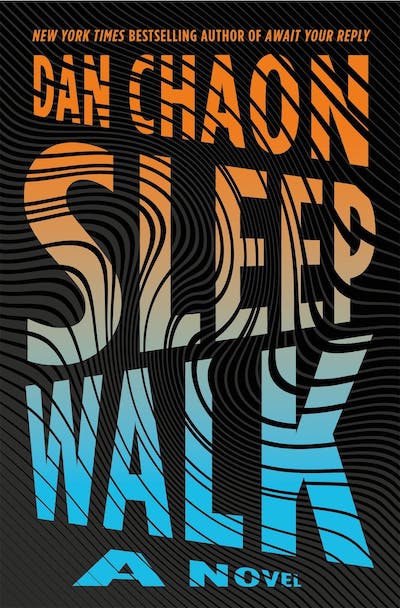
Sleepwalk is a literary picaresque full of dark wit and quirky observations set in an alternate America. Mixed in with the purely imagined are characters, technologies, and events that are real, and taken together, demonstrate just how close we are to things getting really weird.

The protagonist, Will Bear, is a middle-aged mercenary more or less content to live in the shadows, on the road, completing a variety of odd jobs, mostly criminal and often violent, for a Company that he tries not to think too hard about. But when someone claiming to be his daughter from a long ago—misguided— sperm donation, tracks him down despite his usual tricks of evasion, he is forced to confront questions of identity, parenthood, and belonging.

On a cold, clear day in what Clevelanders refer to as early spring, but is, in actuality, the third stage of winter, we spoke over tea at my home in Shaker Heights , another ring suburb. The conversation was fun and rich—punctuated frequently by Dan’s airy staccato laugh, a motorcycle engine failing to turnover and mine, instantaneously intense, like pouring out a bowl of marbles.


Lynda Montgomery: Which came first—the protagonist’s many names or the bucket full of unexpectedly ringing burner phones that spook him in Chapter One?

Dan Chaon: Both at the same time. The burner phones were all calling different aliases. Then, I came up with a long list of aliases. That was really fun—all variations on Will Bear.

LM: A lot of puns arise and it looks terrific on the page. The Barely Blur, or Will Bear, covers many miles from where we meet him in Utah to where the novel ends in Alaska. Have you been to many of these places?

DC: One of the Easter eggs that I wanted to have in the book is to mention all fifty states. And it does, I double checked. In my adult life, I’ve traveled a lot by car. I wanted to have these different locales to give a sense of an alternate version of America. Some of the description I did from memory and for some, Google Maps, or YouTube or whatever. It was fun to go on Street View and drive the route to see what the nine-eyed Google car discovered. Some really amazing things became a part of the novel—the burning wind turbine in Texas and the amusement park GATORS AND FRIENDS in Caddo Parish, Louisiana were both internet discoveries.   

LM: I appreciated the verisimilitude of scenes set in  Mississippi and Alabama, because I know those places well. You conveyed a specific quirkiness with such authority that it enhanced my understanding and appreciation of the scenes set in places unfamiliar to me. Creepy Kentucky was also a favorite.

DC: I’ve spent time in the Daniel Boone National Forest. And that’s a fun place to write about because it is spooky, right?

LM: Definitely. You wrote this novel during a particularly interesting time, starting after the election of 45 and finishing during the first global pandemic in a century. Taking aside the very real possibility that we are indeed near the end, how did you write about the United States in a near possible future? Did current events cause any trouble as you drafted the novel?

DC: I made a deliberate decision to play fast and loose with contemporary detail. Things were moving so fast and changing so much that I didn’t feel like I had a real grip on what America would be like when the book was published. I decided to simply create a version and play it out.

Things that I thought were so funny that turned out not to be—like people wearing masks all over the place. There’s a scene where Will’s driven through downtown Chicago and these businessmen are all wearing gas masks. And I wrote about riots and protests right before the protests of summer 2020.  And I was like, I’d have to be careful not to predict anything too dire. Things came true as I was writing, and I was very disappointed in them coming true.      

In my adult life, I’ve traveled a lot by car. I wanted to have these different locales to give a sense of an alternate version of America.

 LM: Sadly, I guess that that’s where we are now. Did that experience inform what you work on now?

DC: Absolutely. I’m doing a historical novel set in 1915, and I’m so thankful to not have to worry. 1915 is far enough away that I can play with what level of historical detail I want.

LM: The protagonist uses some unique diction. Did that come early in your writing process?

DC: I draw on the voice of my biological father, whom I met when I was about thirty. We had a complicated relationship, but we were close. He grew up in Iowa and had a countrified quality to some things that he’d say like, I reckon, but then he moved to LA. I wanted to play with that mix of 60s LA stoner and country boy—the voice of the novel is more stylized than the way my dad talked, but it definitely gets at some of his weirdness.

LM: Ideas about identity, parenthood, and what constitutes parenthood are themes in Sleepwalk, and, often, in your work more broadly.

DC: As somebody who was adopted, and, fairly late in my infancy, it’s always been on my mind and has had a significant impact on my writing.  I’m interested in the nature/nurture dichotomy and what happens to children. Also the idea that children are blank slates, and they’ll soak up whatever you give them. I don’t think that’s true, but it’s built into the way that we think about unwanted children. Though the philosophies behind adoption and foster care have changed over the years, they have continued to be problematic by defining children as possessions that can be traded.

LM: For me, some of the most compelling parts of the novel are when the protagonist imagines his alternative life as a nurturing father. Not only does he father Cammie, the problematic, possible-daughter character, but he does a lot of parenting throughout the novel. He wants to be a good parent, and he sometimes kind of is, but mostly isn’t.

DC: Yeah. He’s also someone who was like, colossally poorly parented himself. That feeds into his desire and his aversion to being a dad.

I’m interested in the nature/nurture dichotomy and what happens to children. Also the idea that children are blank slates.

LM: Let’s talk about process. You, often co-teaching with Lynda Barry, train writers to allow their subconscious to bring forward images in writing. Many of the exercises involve the constraint of chance, pulling a word at random from a bag full of words written on slips of paper, writing in reaction to visual images, using a semi-random title as a starting point. Do you do any of these exercises or variations as you’re starting work or revising a piece?

DC: Pretty much all the way through the draft I’ll do a subconscious free write. Sometimes that will start with drawing a picture. Or sometimes I’ll give myself a title. All the chapters in Sleepwalk have titles. I had a whole drawer full of titles—sometimes it was just because of the title that the chapter got written. The strange one in Daniel Boone National Forest  [titled “RIP in Peace”] is one of those.

LM: Where do expectations come in during the course of a project?

DC: Sometimes you’re competing with yourself in some ways, or you’re challenging yourself. And there were particular things that I wanted to do because they would be fun. One was to write a novel in first person present tense. I liked the voice that I had come up with, and that was a challenge that seemed fun. And I set out to write something that was lighter and funnier than Ill Will. Even people who were extremely complimentary would mention just how dark and depressing that novel was. With Sleepwalk it’s not obviously completely funny. There’s darkness in this too. There’s scary stuff and triggering stuff, but I feel like it is funnier.

LM: What parts of a novel project do you find the most challenging and does that vary from project to project?

DC: No, it’s always the same. The end. I find that when I start novels I have an idea of who the characters are and of what the plot is. Or, I have a general idea of what the last chapter’s going to be, but no idea how to get there. The mechanics of the third act are hard for me and, to some extent, you can see that in all of the novels, because there’s a creaking and shuttering as they try to get over that third act hump.

LM: I think you’re being a little hard on yourself.

DC: Well, I can see it. If you can’t, then hurray. But, the actual mechanics, the pacing, can be hard. Because people want it to go fast, and in order for it to go fast, you need all the dominoes set up. I very rarely do. A lot of times you can see me in the background scampering around.

LM: How about at the sentence level? Do those intuitive techniques work syntactically also?

DC: Yeah. Often, it’s the sound of language or the music of language that will come first for me. When I’m doing free writes, the language play sometimes takes over in a way that other aspects, like describing an action or a scene, come less natural to me. I can describe a static scene fine. And I love, like, language and dialogue, but when it comes to like, somebody is in a gunfight in a gas station, with two other people and a dog—that’s fucking hard. That took forever.

When I’m doing free writes, the language play sometimes takes over in a way that other aspects, like describing an action or a scene, come less natural to me.

LM: Did you draw some of that action?

DC: I had to draw a map of the actual gas station, and lines where people were walking and running. But in the previous chapter I had a wonderful time describing everything that was on the shelves in this gas station. Most of it had to be cut—it was almost a delaying tactic—because I knew there had to be this action scene. Before the action scene, the Barely Blur is walking through the aisles describing every single piece of candy. I tell myself Look, you can do it, but you know you’re gonna have to cut.

LM: I want to talk music. For a bunch of years, you’ve made an annual song list. [e.g. Dan Chaon’s 200 Songs of 2021 ]

DC: Twenty-two years.

LM: I use your lists along with tips from my children to keep my life filled with new and interesting music. Tell us more about your exploration and curation of great music. You were a DJ?

DC: I was a DJ in college and for a couple years afterwards. However, back when my kids were little, during the 90s, I lost track of contemporary music. It made me feel really bad, because music was such an important part of my creative process. Around ‘98 or ‘99 I started scouring. I’d go on the internet, find stuff, go to the library, find stuff, and start making these mixes and lists. It’s a meditative process for me—looking for music, finding music, making a playlist. During that front of the mind process, I’m doing a rote activity, while the back of my mind, or the subconscious, is doing a lot of work.  I’ll find the song and I’ll be like, Oh, that plugs into the emotion that I need right here. The playlists for one reason or another will reflect whatever I’m working on at the time—the mood and even some of the language.

LM: Does this hold for your recent lists and Sleepwalk?

DC: Some songs, yes, they’re absolutely in the book. And then, there are certain kinds of songs that, while not necessarily contemporary, are touchstones for the novel. Like the song “Sleepwalk.”  And Will has an attachment to 60s music and to 60s girl groups in particular, because his mom claimed that she was in a girl group. The song “He’s so fine” has echoes in the novel.

A lot of the exercises and the things that I would work on with students were the same things I was working on as an artist myself.

LM: Are there other forms of art that align with your creative process?

DC: Photography. I look at a lot of images.

LM: Since your last novel, Ill Will, you retired from Oberlin College to write full time. Aside from the stuff you probably don’t miss—the commute, administrative nonsense, office politics—Are there things that you do miss?

[DC] I love working with students and working with people that age. To some extent the relationship between Will and his possible-daughter Cammie comes out of that. She’s definitely got elements of past students.

LM: Did your work as a creative writing professor contribute to your own art making? Or would you  say that your teaching is simply another way that you’re creative? 

DC: What I was doing in the classroom was what I was doing as a writer. I mean, a lot of the exercises and the things that I would work on with students were the same things I was working on as an artist myself. They were interdependent.

LM: Time for the lightning round. What music, movies, shows, literature should fans of Dan Chaon seek out?

DC: I love the new Beach House album that just came out in February. My favorite movie of 2021 was Nightmare Alley.  I also really loved the movie CODA. I feel like there are echoes of both with my work. And a documentary about skateboarding directed by Bing Liu, Minding the Gap (2018.) I loved that movie so much that I gave it a small cameo in Sleepwalk. Three skateboarders who show up [in South Carolina] are a tribute to Bing Liu.

LM: Would you rather shovel your driveway or pull weeds?

DC: Pull weeds.

LM: If forced to attend one, would it be a Browns game with some serious tailgaters or a black tie gala with a bunch of bankers?

DC: I’d go with the tailgate but I wouldn’t go see the game.

LM: No, you have to go.

DC: Well, hopefully I’ll be really drunk. 

LM: Biggest mixed misconception about Cleveland?

DC: I don’t think people realize how comfortable it is to live here. I feel like I’m not missing anything. For a lot of people, there’s something kind of ooky about it right? I mean, the weather’s okay. But everything else is kind of cool.

LM: Best piece of writing advice you’ve gotten or given?

DC: The best advice that I got and the best advice that I give is that you need to be a reader before you’re a writer. And that in your audience are those writers who made you want to read in the first place. Those people are your family.

LM: Best or worst life advice you’ve gotten or given?

 DC: I don’t know if I’ve ever had any life advice to give to anybody. But my dad used to say something I thought it was really stupid at the time, but now I think it’s profound. He used to say, “You never get any younger.” I used to think, of course, but then you get to a point you’re like Oh, my God. That’s not possible

Dumped at Brunch and Too Jaded to Care

1. 

She’s choking me. She’s really in there, fingers on cartilage, mashing my trachea and I can’t breathe, Maria thinks. She truly can’t breathe, but she can’t bring herself to care. There was a time in her life when this was new, when she was at least as hot for being choked as Steph was for choking her, but now they’ve got an apartment together—a cat, good lighting—and Maria can’t even muster a shiver. 

She acts like she’s into it. She’s thrashing, hands at Steph’s wrists, pulling. Not that hard, although Steph is probably stronger than Maria, so it’s not like Maria could physically make Steph stop if this were for real. And Steph is turned on. She’s pressed up hard on Maria’s leg. Then one of her hands is off Maria’s throat, at her own crotch, and Steph is getting herself off. 

Obviously, there’s an art to faking it. Anybody can tell that a parade of porn star squealing and panting is just acting, but convincing somebody who loves you, who you definitely at least used to love, that you’re present and choking and hot for it, you kind of have to make yourself believe it. So Maria does. 

Her attention is on Steph’s fingers at her throat, Steph’s substantial hips against her own bony ones. On Steph’s face. 

Now Steph’s eyes are closed but you can definitely still fuck this up. You can try to fake it but if you don’t convince anybody, nobody gets off, and then you spend the afternoon talking about your relationship. The end part is great, the wine and cuddling and stuff, but the hours of insecurity and tears and feelings leading up to the reconciliation are totally not worth it. 

Steph is coming. She doesn’t really say anything when she comes, or yell or make noises or anything, but you can feel her shoulders tense and then untense. They tense up really hard. The first time they fucked, Maria was scared that Steph would pull a shoulder muscle. 

Then it’s Maria’s turn. She already knows she’s going to fake it. Maria’s relationship to her body, it’s a mess, she can barely get it together to be naked in front of anybody, much less get off with someone in the room. You’d think it would be impossible to fake it, with junk like Maria’s got, but you can. Maria knows some stuff about faking it. One time somebody told her that when she came in their mouth, they could tell she’d come be cause when that pre-come stuff turned into regular come, it got saltier. But nobody told Steph, because as soon as she’s been going down on Maria long enough for an orgasm to be plausible, Maria tenses up her own shoulders for a second and then releases them. 

Stupid, yeah. And immature. Maria has told Steph that it’s easiest for her to get off from getting head, but the main reason she told Steph that is that when Steph is giving Maria head she can’t tell the embarrassing kinky stories she thinks Maria likes. Which also actually are kind of Maria’s fault. 

This kind of makes Maria sound like an asshole, this manipulative, lying control freak who needs to be in charge of everything, doesn’t have any feelings, hates her girlfriend. But it’s just honesty. You fake orgasms because you want your partner to feel like she’s doing a good job fucking you, because you feel self-conscious about how closed off from your body you are and how hard it is for you to have a real orgasm. You pretend you’re into being choked because she’s into it, and besides, four years ago you established a precedent. And it seems like Steph is still into it. Although, of course, who can tell. 

The short version is that Maria feels hopeless about herself and she’s trying to protect Steph from that. Maria can’t get off with other people. The moment her pants come off, she stops being in her body, and when she’s off in the clouds desperately trying to make an emergency peace with her own junk, trying not to think about how bad her junk has fucked up so much of her life and what can she do about it. Plus, Maria likes Steph’s junk but on some level she kind of hates Steph for just automatically getting that kind of junk just for free. How do you tell your girlfriend that? How do you make that okay? More specifically, how do you make that okay enough to calm down and get off? 

Maria doesn’t know, so she fakes it. She collapses, puts on the relieved face. She says, Oh my god, baby. 

Steph smiles. Crawls up the bed to put her head in the crook of Maria’s shoulder. 

You’re so fuckin hot, Steph says. 

Hold on, Maria says, trying to give the impression that she’s so far gone into the sublime that she can’t even talk. 

Ha. 


2. 

Trans women in real life are different from trans women on television. For one thing, when you take away the mystification, misconceptions and mystery, they’re at least as boring as everybody else. Oh, neurosis! Oh, trauma! Oh, look at me, my past messed me up and I’m still working through it! Despite the impression you might get from daytime talk shows and dumb movies, there isn’t anything particularly interesting there. Although, of course, Maria may be biased. 

She wishes other people could understand that without her having to tell them. It’s always impossible to know what anyone’s assumptions are. People tend to assume that trans women are either drag queens and loads of trashy fun, or else sad, pathetic and deluded pervy straight men—at least, until they save up their money and get their Sex Change Operations, at which point they become just like every other woman. Or something? But Maria is like, Dude, hi. Nobody ever reads me as trans any more. Old straight men hit on me when I’m at work and in all these years of transitioning I haven’t even been able to save up for a decent pair of boots. 

This is what it’s like to be a trans woman: Maria works in an enormous used bookstore in lower Manhattan. It is a terrible place. The owner is this very rich, very mean woman who is perpetually either absent or micromanaging. The managers under her have all been miserable under her for twenty or thirty (or forty or fifty) years, which means they are assholes to Maria and everybody else who works there under them. It’s kind of a famous olde-timey bookstore that’s been around forever. 

Maria’s been working there for something like six years. People quit all the time, because not everybody can deal with the abuse that comes from this job. Maria, though, is so emotionally closed off and has so much trouble having any feelings at all that she’s like, well, it’s union, I’m making enough to afford my apartment, and I know how to get away with pretty much anything I want to get away with. I’m not leaving unless they fire me. But when she started working there, she was like, hello, I’m a dude and my name is the same as the one that’s on my birth certificate. Then, when she had been working there a year or two, she had this kind of intense and scary realization that for a really long time, as boring and clichéd as this is, but for as long as she could remember, she had felt all fucked up. 

So she wrote about it. She laid it out and connected all these dots: the sometimes I want to wear dresses dot, the I am addicted to masturbation dot, the I feel like I have been punched in the stomach when I see an unself conscious pretty girl dot, the I cried a lot when I was little and don’t think I’ve cried at all since puberty dot. Lots of other dots. A constellation of dots. The oh man do I get more fucked up than I mean to, every time I start drinking dot. The I might hate sex dot. So she figured out that she was trans, told people she was changing her name, got on hormones, it was very difficult and re warding and painful. 

Whatever. It was a Very Special Episode. 

The point is just, there are people at her job who remember when she was supposed to be a boy, who remember when she transitioned, and who might at any point tell any of the new people who come to work with her that she is trans, and then she has to do damage control because, remember, how is she supposed to know what weird ideas these people have about trans women? 

Like, what if they are a liberal, and want to show how much compassion they have? ‘I have this trans friend’ instead of ‘Hey trans friend I like you, let’s have a three-dimensional human relationship.’ 

That’s what it’s like to be a trans woman: never being sure who knows you’re trans or what that knowledge would even mean to them. Being on unsure, weird social footing. And it’s not even like it matters if somebody knows you’re trans. Who cares. You just don’t want your hilarious, charming, complicated weirdo self to be erased by ideas people have in their heads that were made up by, like, hack TV writers, or even hackier internet porn writers. It just sucks having to educate people. Sound familiar? Trans women have the same exact shit that everybody else in the world has who isn’t white, het, male, able-bodied or otherwise privileged. It’s not glamorous or mysterious. It’s boring. 

Maria is totally exhausted by it and bored of it, and if you’re not, she is sorry. Terribly, appallingly, sarcastically, uselessly and pointlessly sorry. 


3. 

Maria and Steph get brunch. It’s a Sunday morning and they definitely can’t afford brunch. Maria has been on hormones for four years but she still flinches at best and dissociates completely at worst if somebody touches her below the waist, and she still has to shave every morning. But still, what’s twenty dollars for vegan huevos rancheros and a mimosa? 

Steph is in some kind of bad mood. She’s nervous about something or sad about something. Maria is trying as hard as she can to pay attention, but she’s tired. She can’t stay asleep at night. She wakes up grinding her teeth, or worrying about something totally productive like whether she’s really a straight girl who should be dating straight boys, or else she just wakes up because there’s a cat on her face, purring. Whatever. There are pictures of her from when she was five with bags under her eyes. 

There’s a waiter on the other side of the restaurant. He’s not Maria and Steph’s waiter, but he looks familiar. Maria is trying to place him. The only place she might know him from is the bookstore, but it’s not clicking. 

The tone of Steph’s voice changes and Maria tunes back in. I fucked up, she’s saying. 

You fucked up, Maria asks back. 

I did, Steph says. Do you remember Kieran? 

Maria does remember Kieran. Often. 

Yes, she says, I remember Kieran. 

Remember is kind of a weird word, since he works at the bookstore and Maria sees him most days. 

Steph takes a deep breath, like, I’m just gonna let this all out, and says, I fucked Kieran three nights ago in a broom closet at the Gay Center. 

Three nights ago, Maria repeats. 

Yeah, Steph says. 

Maria still doesn’t feel anything except maybe a little glint in the back of her head that’s like, hey, maybe you can break up over this. She doesn’t acknowledge it. Instead, she’s on autopilot. She can fake it. She’s trying to remember what that waiter bought. Was he in history? Art? 

She asks, You fucked him three nights ago, but you came home and didn’t let on at all for three nights, and you even fucked me this morning without a second thought? 

Look, Steph says, but she doesn’t say anything else. 

Then Maria’s brain goes into full shutdown in this way where she’s still there, still watching, wishing there were something to say, but really all she can think is, okay, whatever. Maybe Irish history? She thinks, maybe I need to leave. But she can’t leave, you can’t just bail on your girlfriend in the middle of brunch. She’s kind of wishing she were on her bike, about to be hit by a bus, swerving heroically out of the way at the last second. She knows, though, that she’s supposed to be thinking about Kieran and Steph in a broom closet. 

A broom closet, she says. 

Are you okay, Steph asks. You’re just being quiet, you’re not even making a face. 

Maria’s brain is shut down because she knows that there are things she’s supposed to be thinking and feeling: betrayal, anger, sadness—but it’s like she’s just watching herself, thinking, hey, you stupid boy-looking girl, why aren’t you having any feelings? 

It’s a familiar sense of removal that has bothered the hell out of every partner she’s ever had. I’m sorry, she always thinks, I learned to police myself pretty fiercely when I was a tiny little baby, internalizing social norms and trying to keep myself safe from them at the same time. I’m pretty astute with the keeping myself safe. 

Steph is staring at Maria, Maria is staring at her plate, Steph takes a sip from her mimosa, Maria sips from her own, and then Maria is tearing up, which is new. It’s about self-pity, though, not about caring about Steph cheating. She could give a fuck who her girlfriend fucks. It’s herself she’s sad about. Mopey ol’ lonely Maria, the little kid with the bags under her eyes, the lonesome romantic bike fucker, the girl who likes books better than people. It’s an easy automatic go-to to characterize things as boring but it is boring to have the same exact things come up whenever anything comes up: poor me. If she were a goth she’d tell you about how broken she is, but since she’s an indie-punk DIY book snob, like, here we are. 

A tear drips down her nose and then that’s it. She wipes her eye near the tear duct, where there isn’t any eyeliner, and asks, Okay, so what do we do? 

What do you mean, Steph says. 

I mean, you boned Kieran, Maria says, enjoying Steph’s flinch. 

Yeah, Steph says. 

Well, do you want to date Kieran? Do you want to be with me? Do we work this out between us? 

You’re so weird, Steph mutters loudly enough that Maria is probably supposed to hear it. 

I’m so weird? 

You’re so weird! she says again, louder. Are you upset? I know, oh, you don’t have access to your feelings, you’re all shut down, if you were a goth you’d say you’re broken—I know you, Maria, but it still freaks me out, the way you deal with things. 

So you’re mad at me, Maria asks. 

I am mad at you! I’m sorry I fucked Kieran but it would be nice if I could get a response to that. It would be nice if I felt like you cared at all. 

Cool, Maria says. You fucked Kieran and you’re mad at me about it. 

She lines up five black beans in a row on her fork and puts them in her mouth. That waiter was definitely in Irish history. He’s sitting at a table across the restaurant, folding forks and knives into paper napkins. 

Steph is crying and Maria is eating. Calm. 

A Lighthouse Keeper Faces an Uncertain Choice When A Stranger Washes Up Ashore

When another body washes ashore, Samuel—the sole resident and lighthouse keeper of an unnamed island—already knows the solemn duty that is required of him: pulling the body clear, before he can bury it beneath a mound of stones. It falls to Samuel every-so-often to receive the drowned refugees that wash up, shattering his already fraught peace. The latest arrival however, if not quite alive, is not yet dead. Samuel must contend with the man—victim or interloper?—as he battles his own legacy and that of his country as he recalls its transition from colonialism to an elusive freedom as an independent nation.

An Island by Karen Jennings

This is the crux of An Island by South African author, Karen Jennings. In her engrossing, yet meditative fourth novel, Jennings examines the ongoing ravages of colonialism on (and off) the African continent. At least, we assume the titular island is just off the African coast. There is much else that is left unsaid in An Island; silences which the author has become adept at offering her readers in her morally complex, always humane, works of literature.

Jennings—who I caught up with in Cape Town, South Africa where she is based—has published an impressive list of six books, while not even 40-years-old, producing one almost every year since 2013. Despite this prolific output, Jennings remains somewhat of an outsider, with her books rarely receiving the sort of attention they deserve, even in her home country of South Africa. That changed in 2021 when An Island was longlisted for the Booker Prize.

I spoke to Jennings, a former editor of mine, about living in isolation, the financial impact of being longlisted, and the universal trend towards far-right conservatism.


C. A. Davids: Congratulations on your newest novel, An Island, and that it was longlisted for the Booker in 2021. How has it felt for your writing to be recognised in this way? 

Karen Jennings: It has been an unusual time—mostly good, of course, but there are aspects that have been more challenging. While I am glad for the book to be given attention, it does also mean that I am receiving attention. That isn’t always easy for a hermit such as myself! Moreover, due to circumstances, I spent the last six years in Brazil, living a very isolated life. I didn’t have a job or friends. I didn’t go anywhere other than the supermarket. It was quite jarring suddenly to find myself with a full inbox and with people wanting to call or Zoom or meet. 

CAD: Now that you mention that you lived an isolated life in Brazil, it brings to mind Samuel, the main protagonist in An Island, and his solitary existence. Do you think that personal experience influenced the novel or developing the main character?

KJ: It really did. Although I had already imagined or started creating the character before I moved to Brazil, it really helped me to understand him. We lived on the 17th floor of a high rise building and I was advised not to go out except to walk the dogs, or to the supermarket on the corner, because it was supposed to be too dangerous for me to be out by myself. I didn’t have friends or speak the language, and so I didn’t have any kind of life there. For that reason you could say that I really do know what it is like to spend hours—not quite like Samuel who was alone for weeks at a time—but to spend hours alone, with not a word passing my lips. 

CAD: I imagine since the Booker news, that sense of feeling left-out has dissipated. Tell me a bit about the impact of the long listing?

KJ: A few things stand out. I am receiving some recognition in South Africa. This is important to me as I consider myself a South African author. Also, I have been incredibly touched by the warmth and support that I have received from writers across Africa (and the diaspora). I am glad that my experiences can bring some joy and hope to others. As I mentioned, I was living in Brazil for 6 years. I was unhappy, and had no prospects and no money of my own. I wanted to return home but didn’t see how it would be possible—coming home includes shipping my belongings and bringing my dogs over too. The financial impact of being longlisted has meant that I have been able to move back to South Africa. This is where I want to be and I am so grateful to be here.

CAD: Damon Galgut, another South African writer recognised by the Booker Prize in 2021 and who went on to win it, commented recently that it was somewhat bemusing (I’m paraphrasing) that the situation still exists where one is given the nod by the establishment (from somewhere up North) and only then are your talents fully acknowledged. For me, such recognition is also practical. What do you think?

KJ: I would agree with Damon. An Island is my fourth novel and sixth book. I was never able to get a South African publisher (Karavan Press, my South African publisher, was only established later and I was so pleased when they agreed to publish as it has always been my dream to be published in my own country). I was lucky if my previous publications received a single review in South Africa. Very few people knew about my books. Since the longlisting, there have been various interviews, reviews and articles.

I must admit to feeling some frustration with the way in which this still happens throughout Africa. We wait for the UK or America to tell us which of our own people are worth reading. In my experience, there is a certain view of Africa and of the stories that can be told and sold that dominates amongst overseas publishers. If those same people are telling us who to read, what to read, what to write, who we are, then we lose authenticity. 

Does that mean that recognition from outside is not useful, that it should be eschewed? No, of course not. As you said, it is practical. It offers a valuable step towards getting people from outside of Africa to pay more attention to what is coming from within Africa. The hope is that the more Africa is being seen, the more open publishers and readers will be to reading its authors. This is one of the reasons why my UK publisher, Robert Peett of Holland House Books, and I decided to start The Island Prize. It is a prize for a debut novel by an African author. Its goal is to serve as a platform from which African authors can let themselves be seen and heard. This is the first year— we have just announced the shortlist and hope to announce the winners in early May. You can read more about the prize here.

CAD: Why do you think there hasn’t been much reception for your work in South Africa, this echoes what I have heard other authors saying here, especially those who do have readers in the rest of the world.

There is a certain view of Africa and of the stories that can be told and sold that dominates amongst overseas publishers.

KJ: I think part of it is the type of books that I write. I don’t write happy (popular) stories. I always get, even from my own family, this question: when is there going to be a happy ending? We are quite disillusioned in South Africa generally, because of the economy, the failures of the government, and so on. That probably translates into people wanting to spend their spare time doing things that are uplifting, rather than reading books that can be quite uncomfortable and upsetting. I think that is part of it, but I also think it is because I write literary fiction, which is not as popular globally. It’s true that there is quite a lot of snobbery around literary fiction, but it also has the perception of being more elitist: that you have to be educated or thinking and living a certain way. That has never been my intention. I want to tell a story in a simple way so that anyone can read it; I do not mean that I am speaking down to my reader, but rather that I want my writing to be accessible and understandable so that it can resonate with anyone. You don’t have to sit with a dictionary to try and decipher what is being said.

CAD: I’m currently reading a novel that I loved at first because of the style, but now that I am a third of the way, I keep thinking ”how pretentious,” mainly because the author is clearly writing for a middle class that she believes the world has been made by and for. I’m now quite disillusioned by a book that has some beautiful writing.

KJ: Yes, I know what you mean. When I think about writing, I think about words as stones and the end product as being a dry-stone wall or maybe a path made with stones. That is how the word should be; a path or a wall that everyone needs and everyone can use. You’re not picking up diamonds and creating a tiara for a few. This is the basic stuff of life: words and communicating.  

CAD: That’s an interesting metaphor. 

Your novel feels in part as if it’s dystopian, but in fact, it is rooted in reality, drawing together multiple crisis: refugees fleeing their homes on overcrowded boats, climate change, racism, poverty, dictatorship, state failure. As beautiful as it is as a work, it is a difficult, complex read. And I wondered, given a general sense of hopelessness in the world, especially because of climate change, what is the place of fiction today?

KJ: There are many periods in history which have seen a sense of fear of the end of the world or about the state of things. One thing that we have now is a wider variety of genres in conveying that. Often people tend to dismiss genres like science fiction, or the increasingly popular ecofiction, yet look at award-winning works like Margaret Atwood’s speculative Oryx and Crake and Cormac McCarthy’s post-apocalyptic The Road. Perhaps the greatest contributor to ecofiction in recent years has been the subgenre of cli-fi—fiction that engages with real ecological issues and has the purpose and intention of revealing what the world might be like if mankind does not consider the ethical consequences of its destructive ways. This is more than just escapism. Another recent subgenre is First Impact Fiction which, rather than exploring possible outcomes in the future, is engaging with the current and emerging impacts of runaway climate change, such as droughts or extreme heat, or changing migration patterns. 

The fact is that we need art to mediate the environmental threats that the world is facing. Art allows us to bridge the gap between knowledge and knowing, where knowledge is depersonalised, abstract science, and knowing is our own subjective understanding. 

CAD: A major theme in the story is about liberatory movements turning to dictatorship and betraying initial convictions. This is not a new theme, and yet, it felt also as if there were a warning: portent of things to still come. This feels quite political. Did you intend it to be so?

KJ: Africa has a long history of military coups and dictatorships, but these largely seemed to have ended by the turn of the century. Yet since 2018 there have been something like five military coups. What has caused this resurgence? Part of the problem is the failure of democracy. Those in power call themselves representatives of the people and promise to be working in their best interests. In the meantime, they are filling their own coffers and are involved in state capture where they appropriate resources for themselves and their cronies. Often these people in power have military affiliations. With the country suffering and people unhappy, they say, “We, the military, must take over or the state will collapse. We will bring stability.” People are desperate and think this is a necessary next step—the only thing that will help them. Of course, there is also a universal trend towards far-right conservatism and totalitarianism. I saw something similar in Brazil with the election of pro-military, pro-dictatorship, misogynistic, homophobic Bolsonaro. Let’s not even get started on Trump and Erdogan. In short, people feel disappointed by democracy in various ways. Often this can lead to a more violent and aggressive attitude.

CAD: You lived in Brazil in a fascinating era, fascinating in the worst way with Bolsonaro recreating elements of a fascist society—a terrible reality but also in a sense, a novelist’s dreamscape.

Art allows us to bridge the gap between knowledge and knowing, where knowledge is depersonalised, abstract science, and knowing is our own subjective understanding.

KJ: I lived in Sao Paolo for six months, then four years in Goiania, and then during the pandemic in Sao Paolo again. It was challenging and a little frightening because I didn’t know what to expect. Would there be a military takeover? Goiania is a conservative area and there were many supporters around there who would blast music and wear military outfits. Our neighbors did that, for example. I had one friend in the lead up to the elections and she became obsessed with Bolsonaro: She was pro violence, pro-military, homophobic, misogynistic and believed that they needed to shoot drug dealers or anyone who looked like a foreigner. I said but I am a foreigner and she replied, yes but it’s ok, because you’re white. So, there was no going forward with that friendship. There was too much that separated our values and ways of viewing others. 

CAD: That brings to mind the conflict in An Island, actually. Two men are fighting over resources and they revert to these base prejudices, which perhaps are always there, under the skin, but heightened when there isn’t enough to go around. It’s a war of two men.

KJ: I think so. When people feel threatened, like Samuel does; whether it is imagined or a genuine threat, but what is certain is that he feels under threat.

CAD: Tell me about the new book that you’re writing, Crooked Seeds

KJ: I will be publishing again with Holland House and Karavan Press because they have been loyal and good to me. They saw the value of An Island when no one else did. Crooked Seeds is set in Cape Town in the suburb where I currently live: it is 2028 and it’s a future in which there is a massive drought and people have to queue every morning for their water. It’s speculative, in a way, of course, but not strongly dystopian or post-apocalyptic novel. It’s an ordinary suburban life, with the added frustration of rationed water.

CAD: Were you in Cape Town when we had the massive drought, two years ago, when the city was fast approaching Day Zero, where we would have run out of water entirely?

KJ: I spent some time in Cape Town then, and I was also in Sao Paulo when there was a drought there. So, I did experience drought in both places and I’ve done quite a bit of research into what people were doing here in South Africa to save water. But the drought is really only the backdrop of the novel, not the main focus. One of the key concerns is the way in which certain people in South Africa have felt that they were handicapped by the end of apartheid, by the new South Africa, and the excuse they hold on to that the new South Africa worked against them. 

7 Books to Help You Resist Productivity Culture

How many things can you use a bullet journal for?  

Paid work. Creative projects. Household tasks. Grocery shopping. Exercise goals. Meditation routines. Expenses. Glasses of water. The list is endless, with the journal (or journals, for the truly committed) serving as a washi-taped repository of large and small tasks. An archive of a life well spent—or, at the very least, spent

The impetus behind bullet journals, including my pink notepad with the word “checklist” printed atop each perforated sheet, is to gain a sense of control over what is inherently uncontrollable: life. By tracking what we need, wish and hope to do, we take a stand against unpredictability. We declare, in the face of the unknown, that we will get shit done

But what shit? And why?

Productivity, an economic term that measures the effectiveness of workers by their output, has become an ethical measure for our non-working lives, too. There is an ethos of “usefulness” that permeates contemporary culture, and in our personal lives, this often takes the form of organization. Whether it’s to-do lists, step trackers, meal prep charts, or the behemoth bullet journal pulling everything together, the underlying principle of productivity declares that human lives can and should be organized

This principle dates back to industrialization. According to Karl Marx, the exploitative condition of factory work meant (and still means) that people were unable to fully inhabit their personhood. With the nature and profits of work removed from people’s control into the hands of a few, factory workers felt alienated from what they did, who they worked with, and ultimately, from themselves. 

In today’s neoliberal brand of capitalism, the relentless drive towards getting shit done turns life itself into work. As we check off items on our to-do lists, fill a growing stack of accomplished bullet journals, and strive towards Inbox Zero, we experience an increasing sense of alienation from our lived experience. Or, at least, I do. I feel more legible to myself on paper, on email, on Instagram than I do as a person inhabiting embodied, physical space. 

These seven authors know what’s up. 

From sleeping away one’s life to orienting ourselves to the rhythms of the nonhuman world, here are some of my favorite books exploring the alienation produced by capitalist society; texts that resist productivity culture at every turn. 

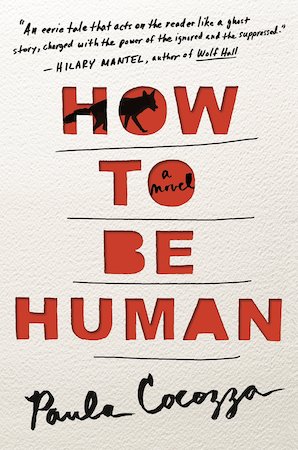
How To Be Human by Paula Cocozza

Mary works for a university department “in shambles,” where she is facing disciplinary action for, among others sins, “entrenched lateness” and “a disappointing attitude.”  She feels “herself irresistibly stepping into the footprints of long term failure” (“[i]t was a delusion to think that working in HR…was stimulating”), when she encounters a fox in her London garden. His keen eyes, auburn pelt and unlikely presence capture her attention day after day, especially once he begins bringing what she believes are presents: a pair of boxers, a single gardening glove. As Mary enters into a sustained encounter with this singular creature, the rhythms of her life come loose from the job and life that held her before. How to Be Human is a beautiful novel about the wildness inside each of us. It is also a story of how much exists in the world — even just in our gardens — when HR and the world of work recede from our lives. 

There’s No Such Thing As An Easy Job by Kikuko Tsumara, translated by Polly Barton

What is an easy job? Suffering from “burnout syndrome”, the unnamed thirty-something narrator of Kikuko Tsumara’s novel There’s No Such Thing As An Easy Job (translated by my favorite Japanese-English translator Polly Barton) embarks on a hesitant quest to find out. She explains:

“I’d left my previous job because it sucked up every scrap of energy I had until there was not a shred left, but…I sensed that hanging around doing nothing forever probably wasn’t the answer either.”

Guided by a surprisingly empathetic recruiter, Tsumara’s narrator accepts a series of entry-level jobs—each with a surreal twist of their own. The Surveillance Job, the Cracker Packet job, the Bus Advertising job, the Postering Job, and the Easy Job in the Hut in the Big Forest comprise little magic realist worlds, woven together by a quiet, awkward woman trying to avoid the devastating psychological effects of a culture devoted to work. I loved this novel so much—perhaps more so because unlike most millennial burnout narratives, Tsumara’s doesn’t have whiteness at its heart.

My Year of Rest and Relaxation by Ottessa Moshfegh

Next to my bed is a scrap of lined paper that reads, “My year of rest and relaxation—Sept 2019” : a testament to the fact that I read Ottessa Moshfegh’s runaway bestseller at the right time. I was very sick that monsoon, and everything I had planned or hoped for the year had fallen apart. So when Moshfegh’s narrator decides to cope with alienation and grief by getting incredibly fucked up on prescription drugs and effectively sleeping away a year, it read to me less like satire and more like a solid plan. At least the part where sleep feels like a reasonable response and resistance to a world that wants you to keep doing things, to keep performing your self without pause.

I almost immediately gave away my copy of My Year of Rest and Relaxation to another chronically sick friend who I thought would also appreciate this determined and deranged pursuit of sleep (she did). Nearly two and a half years after I taped it up in a haze of desperation, that note remains stuck to my bedside wall. A reminder that rest isn’t just a deep tissue massage, but a drastic response to the equally drastic demands made by contemporary culture on our lives. 

Orwell’s Roses by Rebecca Solnit

Best known for her feminist work, Rebecca Solnit is, for me, the most compelling living writer on ecology, place and hope. Her work draws attention—both hers and the reader’s—away from the relentlessness of technology and its attendant busyness, and towards the rhythms of human and nonhuman interactions and lives.

In Orwell’s Roses—Solnit’s book on George Orwell, gardening, refuge, and resistance—we encounter the vast timescale of trees, mutual aid as “inter-species cooperation”, and an Orwell whose pleasures in the natural world informed his resistance to control and power. Just as 18th-century labor struggles advocated “Bread for all, and roses too,” Solnit writes, “you could argue that any or every evasion of quantifiability and commodifiability is a victory against assembly lines [and] authorities.” Productivity culture is built on quantifying output, tasks and time —and like much of her writing, Solnit’s newest book serves as both antidote and balm. 

Earthlings by Sayaka Murata, translated by Ginny Tapley Takemori

“I was a tool for the town’s good, in two senses. Firstly, I had to study hard to become a work tool. Secondly, I had to be a good girl, so that I could become a reproductive organ for the town. I would probably be a failure on both counts…”

Natsuki, the narrator of Earthlings has spent life with her head down, trying to slip by unnoticed in a society that demands from her roles of productivity she cannot fulfill. Spanning childhood summers with her cousin Yuu — with whom Natsuki dreamt of a spaceship coming to take them to their “real” home — and an adulthood living with buried trauma, Earthlings is Murata at her trademark best: a radical, surreal excavation of society’s unquestioned structures and their impact on people unable to fit in. As children, Yuu and Natsuki make a pact: “Survive, no matter what.” In a system that sees individuals as tools, as means to an end, what shapes can survival take? And what happens when people stop trying to pass as acceptable, productive earthlings?

Bird Cottage by Eva Meijer, translated by Antoinette Fawcett

In 1937, at 40-years-old, Len Howard left her city life and career as a violinist in an orchestra to study birds. She moved to a small cottage in the South of England where she lived the rest of her long life alongside a variety of birds: Great Tits, Magpies, Blackbirds, Sparrows.

Bird Cottage, Eva Meijers’s fictionalized account of Howard’s life, may not seem like a resistance to productivity culture at first glance. But as Meijer skillfully intersperses her narrator’s rejection of the life she was trained for with the real Howard’s observations of the birds she loved (these were among the first non-lab studies of birds conducted and widely declared unscientific at the time), the reader, too, is asked to retrain their eyes and attention: to look away from what we “should” do towards beings who are indifferent to our ideas of timekeeping and success. The birds that visit my garden were infinitely more alive as I read Bird Cottage — a redirecting of my attention so complete that I’m sure I will return to this graceful, charming novel time and again. 

How To Do Nothing: Resisting the Attention Economy by Jenny Odell

Speaking of returning to a book as a means to redirecting my attention, a friend recently wondered if I’d ever write an essay that didn’t quote Jenny Odell (as it stands, that seems unlikely). No book has influenced me so deeply as How To Do Nothing, which has served, among myriad purposes, as a guide to disentangling myself from my Type A personality (a direction my chronically sick body very much appreciates).

Through her text that spans “surviving” a culture of usefulness, the impossibility of retreating to a commune, and a reciprocal relationship with nature, Odell seeks to “draw us… out of a worldview in which everything exists for us.” Productivity, in all its goal-based glory, spins on an axis that holds human advancements and progress at its center. For Odell, what matters instead of constant newness and achievements are as slower acts of restoration—of ecology, context, thought, and our sense of place in the face of the internet’s “placelessness”. How To Do Nothing questions where our endless productivity goals come from, and what might open up in their stead if, as Odell suggests, we responded to them in the words of Melville’s Bartleby: “I would prefer not to.” 

A Cairo Meet Cute That’s More Than it Seems

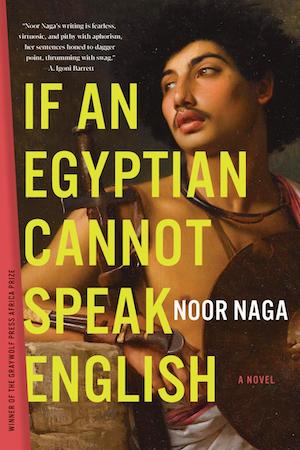
Two people cross paths and their lives are changed forever. It is the oldest and perhaps most universal story. If an Egyptian Cannot Speak English begins when Noor, an Egyptian American returning to Egypt in search of meaning and culture, meets an unnamed Egyptian man whose hopes and dreams have been all but decimated by political turmoil and a worsening drug addiction. 

Filled with imagery and prose that can only be achieved by a brilliant poet like Noor Naga, it is a novel aimed at asking questions (sometimes directly) rather than providing answers. At first, the questions are political— centered around class, identity, culture, globalism—but as the novel carries on (and reveals its metafictionality), it abandon politics and become philosophical and existential, specifically focusing on perception and the act of writing: What do you know? Where do you know it from? Why? What are the moral implications of pretending, as writers do, to know what someone else’s experience of the world is like?


Doma Mahmoud: I love the title of this book. As I read it, these different variations of it kept popping into my head. If an Egyptian cannot speak English, or cannot speak Arabic, or cannot speak either as fluently as others, and all the implications of each of those scenarios. I also thought. If an Egyptian writer cannot write in Arabic, who is she writing for?

Moral questions are my favorite. Who’s in the wrong? What could people have done better?

Noor Naga: I sort of think it in two ways. There is the book that I’m writing and there’s the book the American girl is writing in the book. In many ways, her text is meant to be presented to an American English-speaking audience. In the third part, you realize it’s a memoir and written not just for a general American audience but for this particular group of student-writers. They’re young and steeped in politics they imagine to be universal, but which are actually very culturally specific. I tried to problematize this as much as possible, to pit their value system against a foreign environment where it both fits and doesn’t fit. The character of Noor is telling a story which erases another story as it’s being told. It was very difficult to do that. I was trying to give space to this male character while also making the point that the filter you’re getting even his parts through is fundamentally skewed. And that in some ways you can’t trust this character of Noor or even me, the author of the book. 

DM: I want to ask you about this point about the filter. That point really came through in the book and it was actually quite disorienting because it put in question the trust I had for the story I was reading. I’m sure that was intentional on your part, so I’m wondering what the reason for that choice was.

NN: Originally, I was trying to write both POVs, the boy’s and the girl’s, and giving them equal weight. It was only when I was midway through the book that I realized it wasn’t actually possible for me, as Noor, to write his perspective convincingly. And that it would make more sense to only have one perspective: the American writer. I’m very suspicious of myself and I suppose I wanted the reader to be uncomfortable and suspicious too. That was the whole point for me. To force the reader, in the third part, to question this experience we are creating together, as author and reader, of bringing a fiction to life.  

DM: This book certainly did that to me. I wanted to ask you about the male character. How did you keep a balance between making this point about the limitations and biases of fiction and maintaining the integrity of the male character. To me, it didn’t feel like I was supposed to distrust what I had read about him just because it had been put through this filter. 

It made me think a lot about the Anglophone publishing industry and how it seeks out certain narratives and negates others.

NN: I certainly didn’t want the third part to come across as this deflating revelation that the reader had been tricked into believing this complete lie all along. That’s why the workshop at the end is a memoir writing workshop, not a fiction workshop. We’re familiar with what it means to have an unreliable narrator, but it’s easy to dismiss how unreliable all writers are. The character of Noor is really trying to be honest in her representation, but that doesn’t mean we can trust her. The point of highlighting her limitations and biases was not to paint her as dishonest or malicious. On the contrary, the point was to create a writer character who was aware of her limitations but still trapped by them. 

DM: It was refreshing to read something I walked away from with more questions than answers. In your acknowledgements you thank someone for teaching you to prize a beautiful question over a beautiful answer. That really came through in this novel. Each chapter of Part One begins with a question. I certainly finished the novel with so many questions. I wonder if that was the case for you after completing it. Which question/s remained with you after finishing? And what makes a question beautiful?

NN: Well that’s a really beautiful question! I think I like questions that are really balanced, where there is enough force behind different answers to make things decidedly inconclusive. Moral questions are my favorite. Who’s in the wrong? What could people have done better? For me, there were a lot of driving questions in this book. I’m not sure which I’m left with in the end. Because in a way writing the book was a way of purging the questions out of my system and then no longer being haunted by them. It’s a way of me saying: “I don’t know. But you guys can read it and let me know if you have answers.” One question that remains with me is the question of: who do you feel for? Do you feel more for her or for him? And why? It’s so interesting how people respond depending on who and where they are. So far, many of my friends who were born and raised in Egypt are more sympathetic with the girl than I thought they’d be. They don’t have the same complex in relation to nationhood, they don’t feel threatened in their claim to belonging. In contrast, friends of mine in the diaspora tend to be much harder on the American girl and it seems so obvious that this is a function of their own insecurities. They dislike her because they identify with her or recognize her on some level, and so it’s really a way of punishing the self.

DM: One of the central elements of the book is the power dynamics between the two main characters. The power transforms and mutates constantly depending on where they are, what they’re doing, what they’re talking about. Do you feel that one of the characters ultimately holds the ultimate power over the other? Why?

NN: They do pass the power back and forth between them. Ultimately, though, only one character survives and goes on to tell the story. And it says a lot.

I always wondered what this book would have been like had it been written in Arabic and directed at an Arabic-speaking readership. It made me think a lot about the Anglophone publishing industry and how it seeks out certain narratives and negates others. And the power inherent in participating in that. A lot of my writing of this novel was influenced by my hyper-awareness of my own position. I’m Egyptian but I was also born in the US and hold the US passport. I was raised in Dubai which is sort of an Arab country but also not at all an Arab country. Part of the reason I was able to publish this book is because I tick certain boxes that Egyptians born and raised in Egypt maybe don’t tick, even if they’re writing in English. I have access and currency. So this novel was my way of thinking about that and incriminating myself almost. 

DM: The character of Noor is named after you. That seems to me like a decision you probably spent a good number of hours on. Take me through that. 

NN: Well in the original draft that’s how I had it. Then I changed it because I thought it might distract the reader or that it might be too gimmicky. Too many tricks layered on top of each other. I also wondered if readers who aren’t familiar with metafiction would immediately think that this is autobiographical and I would have to explain, over and over again (to people like my mother and my neighbors!) that it’s still fiction.

Ultimately though I decided to name her Noor because I wanted to make the point that the author of this book is not exempt from the criticisms targeted at the American writer in the novel. It’s certainly a guilt-driven book. I wrote and published the thing. I have benefited from it. But at least I’m aware of it? Maybe that’s a copout but I wanted to highlight all the inherent problems in taking a truth from one world and then publishing and profiting from it in another world. And I wanted to do it playfully. There are so many writers I love who write author characters for this exact purpose. César Aira, Alan Hollinghurst, Youssef Rakha, Ruth Ozeki… I just sort of thought: I can have some fun too! And then hope that the satire comes through.

Sasquatch at the End of the World

Bigfoot Loses Heart

When berries were scarce
I ate the chipmunk who 
ate the berries. 

When my fur made fingers of ice down my back,
I told myself stories of what it must be 
to wake inside the sun. 

When rain would not stop
I waded into the river. I sat on a boulder and spat 
where the current parted around me. 

All was as I wished it to be.  
The notes I scrawled in the mud each sunset
were happy notes. Day this. Day that. 

But now I do not know where I have put those fingers. 
Now I’ve lost the hole inside the hole.

A Meditation

The snow makes some things clear: the deer
has been up before me, as has the fox

            is what I spoke into my phone’s voice-to-text.

No Mike I’m waiting for your call: the beer
has an offer for me, as has the fuck

            is what it heard.  

I wanted to consider how snow compresses time
by showing tracks, one moment layered over the next,

            to visit the waste of each footfall I had stacked 

invisible along a circled path these twenty years—
but I was made instead to wonder 

            where Mike had gone, why he didn’t 

call, what the beer was truly offering, 
and what, the fuck.

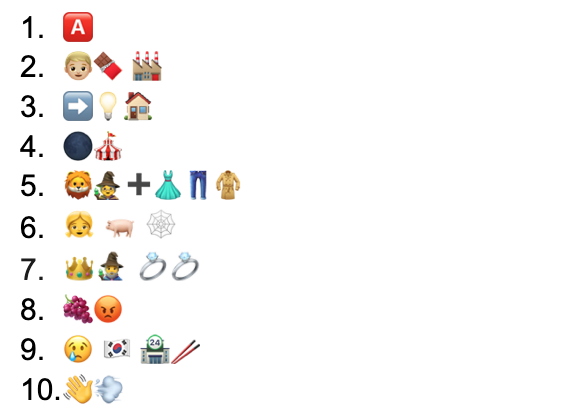
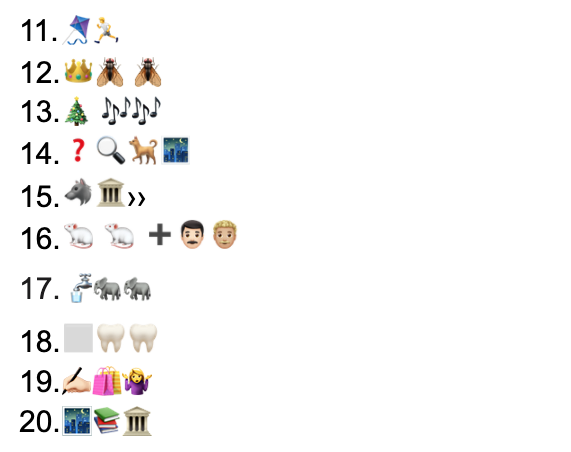
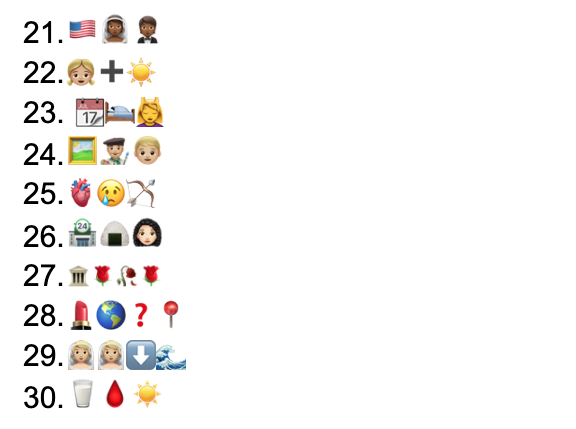
Can You Guess These Book Titles From Just the Emojis?

Annnddddd we’re back with another round of guessing the book titles using only emojis. Show off your booksmarts with our quiz, compiled by editors Jo Lou, Kelly Luce, Alex Juarez, and intern extraordinaire Lauren Hutton.

Stumped? The answers are at the bottom!

Can’t get enough? Click here for the first round of guessing the book title and here for more literary trivia.

Answers:

  1. The Scarlet Letter by Nathaniel Hawthorne 
  2. Charlie and The Chocolate Factory by Roald Dahl 
  3. To The Lighthouse by Virginia Woolf 
  4. The Night Circus by Erin Morgenstern 
  5. The Lion, The Witch and the Wardrobe by C. S. Lewis 
  6. Charlotte’s Web by E. B. White 
  7. The Lord of the Rings by J. R. R. Tolkien 
  8. The Grapes of Wrath by John Steinbeck 
  9. Crying in H-Mart by Michelle Zauner 
  10. Gone With the Wind by Margaret Mitchell 
  11. The Kite Runner by Khaled Hosseini 
  12. Lord of the Flies by William Golding 
  13. A Christmas Carol by Charles Dickens 
  14. The Curious Incident of the Dog in the Night-Time by Mark Haddon 
  15. Wolf Hall by Hilary Mantel 
  16. Of Mice and Men by John Steinbeck 
  17. Water for Elephants by Sara Gruen 
  18. White Teeth by Zadie Smith 
  19. Confessions of a Shopaholic by Sophie Kinsella 
  20. The Midnight Library by Matt Haig 
  21. An American Marriage by Tayari Jones 
  22. Klara and the Sun by Kazuo Ishiguro 
  23. My Year of Rest and Relaxation by Ottessa Moshfegh 
  24. Portrait of The Artist as a Young Man by James Joyce 
  25. The Heart is a Lonely Hunter by Carson McCullers 
  26. Convenience Store Woman by Sayaka Murata
  27. A Court of Thorns and Roses by Sarah J. Maas 
  28. Beautiful World, Where Are You by Sally Rooney 
  29. Our Wives Under the Sea by Julia Armfield 
  30. Milk Blood Heat by Dantiel W. Moniz 

8 Magical Novels by Women Writers

My absolute favorite stories are ones that suggest magic is not just adjacent to our lives, but that it threads its way through our lives. That magic is, in fact, just on the other side of our ordinary existence—if we know when and how to seek it.

Magical stories have shaped my writing over the years, and I find myself bored when my stories veer too closely to realism. My novel The Crocodile Bride tells the story of Sunshine Turner, an eleven year-old girl growing up in the fictional village of Fingertip, Louisiana. To cope with her father’s declining mental health and the boundaries he crosses with her body, she turns to a magical story she’s grown up hearing from him. Deep in the woods that surround Fingertip lies the Black Bayou, where there lives a woman with healing hands and the dangerous crocodile who loves her. Initially, the worlds of Fingertip and the Black Bayou exist side by side—but as the summer drags on, the two grow increasingly intertwined.

This reading list includes novels I love, and novels that—whether through fairy tale, ghosts, heightened worlds, or even heightened prose—marry the wonder and darkness of magic to our mundane, everyday lives. For me, there is no more delicious reading experience than exploring the ordinary through the deeply extraordinary.

The Snow Child by Eowyn Ivey

Ivey’s first novel is a fairy tale about the arrival of a mysterious little girl at the homestead of a lonely, middle-aged couple in Alaska. The story is compelling and moving, the writing gorgeous, and the ending is perfect. I love the way Ivey explores not only the way Faina’s magical appearance enhances Mabel and Jack’s lives, but the way her presence invites them to discover wonder in the ordinary: in friendships, and in passing seasons. 

Circe by Madeline Miller

Circe is set in the world of the Greek gods, and tells the story of our heroine’s journey from her upbringing as the daughter of narcissistic Helios and Perse, to her life as an exiled sorceress. It explores themes of love, connection, family, and solitude—to name a few—but what I found most moving of all was this novel’s exploration of mortality through the lens of immortality. So much of Circe’s journey is about her relationship, not to magic, but to the ordinary aspects of life that magic cannot touch. It is a stunning read, one I think about often.

The God of Small Things by Arundhati Roy

Fraternal twins Estha and Rahel are young children in India, mired in games of the imagination, when they witness an unspeakable tragedy. This novel interweaves the storyline of their eventual reunion as adults and the event that divided them in their childhood. It’s also an exploration of oppression, specifically in the context of India’s longstanding caste system and the aftermath of British colonialism—but its focus is the impact of these larger problems on the lives of human beings, and on the innocent. The magic in this novel exists primarily through the eyes of children—in one moment, for example, they watch as a little girl rises from her coffin to perform a cartwheel—but we also sense a kind of magic in the lush, wondrous prose, which seems to lift the internal worlds of each characters into some strange otherworld. I have never read anything quite like it, and my copy of this novel is so tattered from re-reads that the pages are barely attached to the spine, and it’s entirely missing its cover.

Kindred by Octavia Butler

Kindred’s Black protagonist, Dana, finds herself somehow traveling back in time to the antebellum South, where she encounters her ancestors and must make a critical decision that will impact generations to come—including, of course, her own. Butler’s writing makes visceral both the violence and degradation of the enslaved people Dana encounters (and of which she becomes subject to herself), along with the perpetual sense of danger that infiltrates every corner of their lives. In this novel, magic serves as a portal to the horrors of slavery and its continued impact on the generations that have since followed. It is a painful but illuminating read—not to mention impossible to put down.

The Tiger’s Wife by Téa Obreht

In The Tiger’s Wife, a young doctor named Natalie travels to collect her deceased grandfather’s belongings from his hometown of Galina. Along the way, we learn of two myths connected to her grandfather: that of the Deathless Man and of the Tiger’s Wife. Obreht walks the line between fact and fiction beautifully; it’s never quite clear what is fable and what actually happened. The magical scenes in this novel have haunted me for years, particularly one in which the pragmatic grandfather character encounters the Deathless Man on a hotel balcony as the war looms nearby. I won’t give anything away, but it is a stunningly moving scene in an equally moving novel.

Beloved by Toni Morrison 

A stunning, compelling story about a woman whose murdered child haunts her, Beloved explores the intertemporality of our present lives and past traumas in our personal lives and in our society. At times the story veers into such dark territory that I found myself hopeless, but Morrison’s ending offers a path of healing for her characters. What’s rightfully unsettling is the way white people play no part in that redemption; instead, we are left with the horror and culpability of ourselves and our ancestors. After reading the novel, it’s difficult to ignore the fact that if long-distant trauma can so easily resurface in our present lives, so too can our actions and inactions.

The Children’s Bible by Lydia Millet

This gutting novel tells the story of a group of children left to their own devices while on vacation with their preoccupied, alcoholic parents one summer. Although the narrator is a young girl, her style of narration feels collective—we read the story of not just her and her little brother, but all of the children in this large, rambling, chaotic group. The novel’s heightened world feels like one in which magic is possible—but as Millet skillfully moves us through the novel, we experience not magic but horror. It is a kind not specific to the world of the story, but rather one that threatens our own very real lives in our own very real world.

The Little Stranger by Sarah Waters

In this fantastic, terrifying ghost story, the dreadfully ordinary Dr. Faraday becomes increasingly entwined in the lives of the Ayres family and their aging, haunted English estate, Hundreds Hall. In addition to the perfect plot and gorgeous writing, Waters evokes Brideshead Revisted-esque insight into changing social values. Even more impressively, she explores more personal themes around the darkness we choose to acknowledge or ignore in our past, our present, and ourselves.

Brad Listi Thinks You Should Write as if You Were Already Dead

Brad Listi has made a name for himself by talking to other people. On his podcast, Otherppl with Brad Listi, now in its tenth year, Listi has interviewed hundreds of writers. He’s known for asking questions not just about craft and literature but also about—well, everything. In my favorite episodes, he manages to ask inappropriate questions appropriately, usually within a conversation that appears to have no relevance to writing but actually turns out to be very relevant to writing. I think it’s fair to say that Otherppl is built upon the hypothesis that everything is relevant to writing.

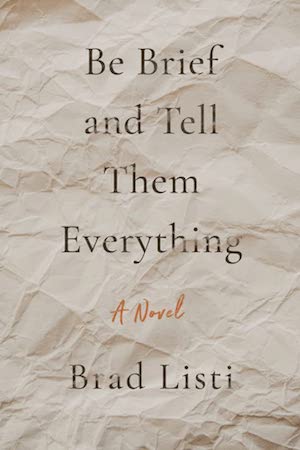
Fittingly, Listi’s sophomore novel, Be Brief and Tell Them Everything, is an autofictious work of both breadth and depth. Structured as a non-linear series of vignettes, the novel opens in the life of a writer named Brad who can’t seem to finish the novel he’s been working on for twelve years. In the midst of this creative crisis, Brad’s six-month-old son is diagnosed with cerebral palsy. The diagnosis is devastating for all the obvious reasons, but it also serves to sharpen Brad’s persistent and pre-existing existential ennui. As he writes and rewrites his novel, he finds himself asking and re-asking a series of questions: Who am I? What happened? What should I do? Be Brief grapples with a diverse array of topics—fatherhood, disability, death, autobiography, creative failure—but it ultimately tells the story of an ordinary life. If readers are looking for Listi on the page, they will undoubtedly find him. That said, I suspect they will also find much more.

Listi and I connected via Zoom to chat about curating a fictional self and the writerly desire to capture the whole world with brevity. It was a pleasure to compel him to answer the sorts of questions he’s usually tasked with asking. 


Wynter K. Miller: On your podcast you’ve been talking a lot about the publication process, and specifically about the anxieties associated with putting this book out into the world. Recently, you said something like, “I worry about how to talk about the book. What if I say something stupid?” So, let’s start there: What are you afraid of saying? What is the stupid thing you’re worried you might let slip?

Brad Listi: I think it’s interesting how much fluctuation there is in the lead-up to a book’s publication, in terms of how you feel about it. And I think in particular, because this is a book that’s very personal, I feel at times uneasy about how it might be received, particularly by those people who are close to me or who might be implicated by the book in some oblong way. But then there are days where I don’t care. And then the anxiety is also maybe about not wanting to sound precious about it. I think it’s emotional for a writer to put a book out in the world—not always, but sometimes you have these little fevered moments of caring a lot, and in those moments you might be more susceptible to preciousness or taking yourself too seriously.

WKM: Be Brief has autobiographical elements, but it’s not autobiography. The main character is named Brad and he runs a podcast called Otherppl, but he isn’t you and things happen to him that have not happened to you. I feel like autofiction can be a messy genre—wouldn’t it have been simpler either to just write a memoir or write a straight novel? 

BL: ​​Well, I would say first that autofiction is very natural for me as a writer, and I also really appreciate it as a reader. Almost always when I’m reading novels, I’m trying to figure out what’s going on with the author, and I’m often frustrated by what I feel like are layers of fiction between me and the author—I wish the author would just talk about what’s going on with them. So, maybe I’m trying to emulate the books that do that.

But I would also say that, to me, my book is a straight novel, and it was much easier to write this than it would have been to write a memoir. I wouldn’t want to be bound to the facts like that. It seems like an impossible adventure for me because I would always be second guessing myself and thinking that I’m fictionalizing anyway. It was helpful for me to have the permission to fictionalize and to move things around and to make things up and to change some details. 

I’m not sure I’m capable of just making something up and rendering it on the page in a way that’s interesting. For whatever reason, I have to grapple with myself. I can’t take pure acts of my imagination seriously or something. I don’t know. Some artists work from the inside out and maybe that’s who I am. When I tried to write the other way, it just fell flat and, eventually, when I started to write from the inside out, it worked better.

WKM: When you’re putting someone on the page who so resembles you in a personal way, do you worry that you won’t be liked?

BL: Yeah, sure, in a natural human kind of way. I think we all want to be liked. But I think you have to be very careful, especially if you’re working in autofiction, about trying to be too cool on the page—readers will often love it because it’s fun to be in the hands of a cool narrator. Somebody with, like, I call it, “Teflon intelligence.” They never say anything that can make them seem mottled and shitty. It’s very subtle, and I see it all the time from very skilled writers. And maybe they’re right—I could be wrong, but my impulse is the opposite. I don’t want to be too cool because I’m not too cool. In real life, there’s none of that in me. I’m a mess. I’m making stupid mistakes or errors in judgment or, you know, stumbling socially. So I think it’s about finding an honest balance between being truthful about the mess, but not to the point where you’re so self-deprecating that it’s insufferable. You don’t want to be too cute, but you don’t want to be bashing yourself all the time or constantly fucking up, either.

WKM: It was really important to you that Be Brief have some levity and funny moments with its darkness. How much of that is that is because you consider yourself a funny person, because you’re thinking of it as “putting yourself on the page,” and how much of it is it that you’re just think about your readers and wanting to give them a balanced reading experience?

BL: I think the rarest experience that I have as a reader is laughing out loud. And it’s the one that I most appreciate. And if I do that while I’m reading your book, you have a fan in me for life. I think as a writer, I try to emulate that. On the level of lived experience, too, I’m trying to render the world as I see it on the page. I have never experienced a world that is all one thing, there’s always laughter amid the darkness for me—and often, in really unexpected ways. These things don’t have any real internal logic, and I think I want my art to reflect that.

WKM: Be Brief is a slim novel, but it contains a lot. How did you make decisions about what to include and what to cut?

It’s about finding an honest balance between being truthful about the mess, but not to the point where you’re so self-deprecating that it’s insufferable.

BL: That’s something that it took me a long time to sort out, and it required a lot of failure. For example, there’s a chapter in the book where I talk about a miscarriage, a single miscarriage, even though there were multiple miscarriages. There was an entire iteration of this book that was like “The Miscarriage Book,” where it was all the miscarriages and it was way too much. When you go through all that failure, you start to get a more developed sense of the reader, which is ultimately what you need to edit yourself and get your book into shape. I finally figured out that I had to pick my spots. I had to keep things moving. I had to be brief. 

WKM: I think the book’s title also functions almost as the book’s thesis statement. 

BL: You know, it’s funny because this book covers a lot of time. But I appreciate brevity and concision in writing. This is another thing that I’m trying to emulate that I’ve really responded to in writing and in books that I love. I feel like compression is part of the project of being a good writer—doing all that work for the reader and also not falling in love with the sound of your own voice, which is something that I can easily do and did quite often in earlier drafts. And frankly, as a reader, I often see it on the page. I feel like most books could be cut. And maybe that’s just my taste, but I didn’t want there to be wasted motion in this book. I wanted it to be concise, but I also wanted it to feel like nothing was missing.

One thing that I’ll say is that I tried to give myself—and this is where I can start to sound precious—but I tried to give myself the directive that I should write it as if I were already dead. What would I say if I were already dead? What’s most important to me? What if I didn’t care or wouldn’t even be around to hear about the outcome? And I got this idea in my head that maybe I should never write a book unless I have something very urgent to say. Like, what’s the point? Why waste anyone’s time? Just to entertain myself and entertain other people? That might be enough [for some people], but I don’t know if it’s enough for me. 

WKM: I think the idea that you shouldn’t write something unless you have something urgent to say can be intimidating, especially for writers who don’t think of themselves yet as writers. The question becomes: how do I know that I have something urgent to say? How urgent is urgent enough? But do you think that mindset can be a helpful way to manage failure and writer’s block?

What would I say if I were already dead? What’s most important to me? What if I didn’t care or wouldn’t even be around to hear about the outcome?

BL: Yeah, I think that. I think everybody probably has something to say. We all have things that are deeply important to us or troubling to us or painful to us. For me, it was about locating the things that were most important and urgent to me. Most difficult for me. And to think about things that I was scared to talk about—and to talk about them. And to slow down when I got to those parts. Not to make it sound melodramatic, but I think it’s very common for writers to avoid that stuff, even if we feel like we have a handle on ourselves. The impulse to skip over those things or move quickly through them is strong. I didn’t want to give myself an out when it came to that stuff. 

WKM: There’s a scene in the novel where Brad purchases a lottery ticket and on the drive home starts having a detailed fantasy about what it will be like to collect the jackpot. But then, mid-fantasy, he realizes that by having so vividly imagined his dream, he has effectively guaranteed it will never happen. I love this scene because we’ve all had this kind of fantasy. Did you ever imagine what it would be like to publish your book and give interviews about the difficulty of writing it?

BL: No, and this is a significant difference between my debut novel and where I am now. It has been significantly less stressful. I have been significantly less neurotic. I think maybe it’s because this book was such a hard one for me. The fact that I was able to get it to a place that I feel really good about, and that I was able to wrestle it to the ground after all that time and failure and struggle—anything that happens beyond this is just gravy to me. 

My Family’s Failures Took Center Stage in “Everything Everywhere All At Once”

The first time Ma told me was my last semester of college. I was in Providence. She’d moved back to Taiwan for good when I left the suburbs for Brown. One winter night, at the movies by myself, I watched Extremely Loud and Incredibly Close. The hero, a whiteboy, copes with the double abandonment of his dead father (9/11) and seemingly absent mother (grief). In the movie’s emotional climax, the boy yells at his mother, I wish you had died instead of him.

I do too, she says.

Ma and I weren’t capable of such honesty together. Still, after watching a son take his mother for granted and feeling how deeply he hurt her, I chose to tell the truth for once. That night, I called my ma and told her that I’m gay. That week, with my brother and sister, both a decade older, she flew out to the farthest coast of America. We went to the beach in winter. On a cliff, in a leather coat with a thick, fur cuff, she told me that she loved me.  

She did? Since when? Why now? 

I didn’t say any of this. I left her for the rental car. We ate somewhere unmemorable.

She’s continued to say it since, mostly on Facebook Messenger. I write it back out of obligation, but I don’t know what it means. How do you love the person who left you when she was supposed to raise you? How do you love a person across space, time, language?

Abandonment is the song that I can’t get out of my head, and unworthiness is my forever fear.

I’m back in the suburbs of Chicago for an artists’ residency. Ma and I moved here from Taiwan when I was in elementary school. Starting in fourth grade, she’d leave me every spring—Taiwan’s tax season, and she was an accountant. In her absence, my siblings were my caretakers, each on academic leave, neither much older than twenty. It won’t surprise you, then, that abandonment is the song that I can’t get out of my head, and unworthiness is my forever fear.

Everything Everywhere All At Once portrays the pain of lifelong silences. The film also puts words to unspeakable things between mother and daughter, wife and husband, adult child and ailing father. 

Directed by the Daniels, Everything Everywhere All At Once is part Matrix and part Multiverse of Madness with the tonal range and mother-daughter themes of Turning Red. It’s as goofy as it is heartbreaking, and it holds all that range with a whole lot of sci-fi. It’s about the Wangs, a Chinese American family in California. Evelyn and Waymond, the parents (played by Michelle Yeoh and Ke Huy Quan, respectively), own a laundromat. It’s tax season, and the IRS is auditing the family. 

In fact, the Wangs are going to the IRS for a meeting. Waymond also plans on serving Evelyn divorce papers. When she’s not berating him, she is brushing him off, and he’s hoping that this rupture will finally get her attention. Bad timing though because the family is hosting a Lunar New Year party that evening. The occasion honors Evelyn’s father, a.k.a. Gong Gong (James Hong), who is visiting from China.

To frazzle Evelyn even more, her daughter Joy (Stephanie Hsu) has shown up at the laundromat with Becky (Tallie Medel), her girlfriend of three years. The couple wants Evelyn’s permission for Becky to attend the party. However, Gong Gong doesn’t know that Joy is queer. Things go left when Joy tries to tell him, so she and Becky leave. Short a translator and a caretaker, Evelyn and Waymond bring Gong Gong to the IRS meeting. The three are going up the elevator to meet their officer, Deirdre (Jamie Lee Curtis), when Waymond takes off his glasses and snaps into a different persona. 

Can this Evelyn carry out the Alpha mission, living up to her potential for the first time in her life? 

This alter ego is Alpha Waymond—Alpha for the Alphaverse, the first universe to make contact with the others in the multiverse. Alpha Waymond believes that Evelyn is the multiverse’s last defense against its worst threat, Jobu Tupaki. To beat Jobu, Evelyn has to learn how to Verse Jump—to access the skills, memories, and feelings of the Evelyns in the other universes. Can this Evelyn carry out the Alpha mission, living up to her potential for the first time in her life? 

As wild and absurd as the film gets, its themes are remarkably straightforward. Everything Everywhere All At Once is about all the possible lives that Evelyn has given up after leaving her parents in China to build a life with Waymond in California. It’s about how a family of the Chinese diaspora falls apart as the second generation acculturates to the U.S. It’s about intergenerational trauma: Evelyn’s rejection by her father, Joy’s compromised acceptance by her mother. Quite literally, it’s about saving your child to save yourself. 

In Taiwan, we lived in an empty apartment with marble floors. I slept in the same room as my parents. It had two beds, a king and a twin. I slept in the big one with Ma. Ba slept on his side in the bed fit for a child. Later, in the Chicago suburbs, I slept in my parents’ room again. Ba wasn’t around. I never knew where he was. An ocean away, probably. Taiwan or China—or not. I stopped keeping track. 

I felt my parents’ distance most whenever I went to my friends’ houses. Their parents lived together and called each other by their names—even as Mom or Dad. They talked to each other at the table, enjoying whole adult conversations while the kids chatted on the side. These parents, all white, showed love so openly. Mine taught me that marriage entraps, turning everyone into monuments of ash.

Everything Everywhere All At Once never uses the words “Asian,” “Asian American,” or “immigrant.” Instead, the characters talk about fraying neighborhoods and crumbling institutions. When Alpha Waymond is explaining the mission to Evelyn, he says she has what it takes to bring everything back to normal. To make things great again.

Say you’re making a movie about global fascism without saying “global fascism.”

Even with all the timelines and Verse Jumps, the film plays out the question of survival pretty neatly. Evelyn has two options: chaos or kindness, ways of being embodied by the villainous Jobu Tupaki and the reliable Waymond Wang.

When the world is ending and everything seems pointless, take care of each other instead of not caring at all. 

At first, Evelyn chooses Jobu. She pulls a “Hold Up” in the laundromat, snatching a baseball bat and smashing a storefront window. I’ve always hated this place, she says. Later, Waymond talks Evelyn off Jobu’s cliff. In the film’s final fight scene, Evelyn tries to save her daughter by fighting like her husband—which is to say, with kindness. She turns the bullets about to break her body into googly eyes, the ones that silly Waymond sticks everywhere, and launches them at her enemies. Then she tends to their needs, aligning a man’s spine, spraying a widower with his dead wife’s perfume, convincing the IRS officer Deirdre that she is not unlovable. 

Peel back all the sci-fi, and the movie’s position is simple. When the world is ending and everything seems pointless, take care of each other instead of not caring at all. 

How is a seemingly race-neutral story so deeply Asian American?

What I have of my family these days is memories from when our lives overlapped. 

Staying up past my bedtime, waiting for Ba to get back from a business trip. 

Listening in the back of the car as Ma drove while my sister talked shit about Ba. For the first time, I chimed in and made a joke about him too. They laughed—they laughed!—and I belonged. 

Sleeping in on weekends in the suburbs. Looking for Ma in her room, finding her face un-made and beautiful. 

Finding my brother hung over on the couch when I needed him to drive me to the Labor Day parade. 

Believing my sister when she said that high school would be hell. The older kids would stuff me into lockers all the time because I was such a pain in the ass. 

Making plans during college to live in Chicago one summer instead of the suburbs. Ma refused, saying it made no sense to pay rent somewhere when I had a house right there, saying that I treated our home like a hotel. 

Beaming with belonging at graduation. Marching with my first real friends in college from the Asian American Studies class I took that final semester. Flaring with anger whenever my parents approached.

What I have of my family these days is sadness and hurt—feelings I have no way of telling them about, feelings I have no way of living down.

Family is the cornerstone of “Asian American culture,” that profitable myth of a monolith. Throw in hard work, boba, and the pains and quirks of migration, and you’ve mapped out the landscape of Asian America—the East Asian territories, at least. 

Everything Everywhere All At Once isn’t content with treading such familiar ground. Its aims are more radical than ethnography and cultural authenticity. Consider the Wangs’ Lunar New Year party. This choice—to highlight that many Asians literally follow a different calendar than the West—cues us to the film’s contribution to Asian American storytelling.

Everything Everywhere All At Once creates a form for Asian American space-time. 

Our lives, crossing hemispheres, spill out of all the boxes built to contain the Joneses.

My Asian family doesn’t take up space like American nuclear families. Our lives, crossing hemispheres, spill out of all the boxes built to contain the Joneses. Living all over the place, we act it too. Ba writes me DMs and red envelopes in Mandarin like he doesn’t know English has surrounded me most my life. Ma sends heart emojis and Pusheen stickers like these charms might repair our relationship, stretched thin across the Pacific for so long. 

We treat time differently too. We take for granted that history unfolds in cycles instead of progressing in a line. There are philosophical differences and mundane ones too. When your family spans oceans and continents, you learn to live around time zones. Long before understanding attachment styles, you accept that you and your parents live at opposite times, in places the other might never see.

Our space and time turn our lives into sci-fi. Think about how our elders’ traumas keep them cycling through the past. Think partitions, carpet bombs, internment camps. It doesn’t take much worldbuilding for us to grasp the multiverse. What we refuse to believe is closed borders and linear time. 

I came back to the suburbs a week before the residency to spend time with my brother’s family. It’s him, my sister-in-law, and their three kids—two nephews and a niece. 

My brother and I also bookend a middle sister. This isn’t the only parallel between my nuclear family and his. It’s only the most harmless.

Both my family and his kill time by eating out and shopping. We know how to be together when the focus is on anything but ourselves. Before, my family being too many even for the SUV, I’d fold myself up in the trunk. To Asian groceries or outlet malls, the drives always felt so long. The landscape was always the same: tall grass and bare trees, identical houses in mazes, strip malls like a checkerboard of the same seven chains. Whatever restaurant we ended up at, one of the six that grounded our routines, my siblings filled the conversation. They always told the same five stories about their childhood, all of them preceding my birth. What was I supposed to say?

I came alive with my friends—I made them my family.

I had so much to say but no way to say it. Neither my world nor my inner life had a place with these people called my family. Not the emo music or morbid TV I dedicated myself to. Not the stream-of-consciousness books I fell in love with. Certainly not the gingers. I came alive with my friends—I made them my family. Around Ma, my sister and brother, his then-girlfriend, and Ba if he was around, I was already gone.

Now, in my brother’s family, the kids sit with their mom. The dad is off to the side. The parents don’t talk to each other except, on occasion, to bicker. Most of the conversation is about the food. Who has eaten the most? Who is falling behind? At the corner of the table, I speak if spoken to. Otherwise, I go on Grindr. Men ignore me, I expect it. Eat. I go on Grindr. Men hit on me, I don’t buy it. 

A familiar immigrant refrain offers a jumping pad for interpreting the multiverse. Your elders sacrificed so much for you to have these opportunities. This saying prompts the current generation to imagine alternative timelines for our elders, possibilities given up so we can work our way to the top. 

The project of America sets up immigrants to fall short. For so many Asian Americans, falling short is failure. 

Everything Everywhere All At Once makes the figurative task literal. Joy’s family members can all tap into the lives they passed up for her to live in Beautiful Country. When the Mandarin name for America is this aspirational, disappointment is inevitable. The project of America sets up immigrants to fall short. For so many Asian Americans, falling short is failure. 

Also consider that Alpha Evelyn’s the one who invented Verse-Jumping technology. She saw so much potential in Alpha Joy to jump from universe to universe—to become anyone she put her mind to—that she pushed Joy past her limit. As a result, Alpha Evelyn turned Alpha Joy into Jobu Tupaki. Mother broke child with too many expectations. Mother made child into enemy. 

The multiverse—all those lives not lived—is the cost paid by one generation for the next to achieve the American Dream. The multiverse is the people abandoned, the passions forsaken, the possibilities deferred. It’s the shadow of the dream, an ashen field of grief. 

Grief is the root of Joy’s sadness. Jobu, Alpha Joy, experiencing everything everywhere all at once, holds her family’s grief for the lives given up for her benefit. All their mourning makes her own life hard to live—so much so that she created a weapon to destroy the multiverse, or so the Alphaverse believes. 

Why have the Alphas labeled Jobu the enemy? As a queer Asian child, Alpha Joy threatens the foreclosure of all future timelines, the waste of all that sacrifice. She’s not the only one. In one of the most recurring timelines (the hotdog one, the phallic one, the gaggiest one—but more on that soon and, yes, the bagel too), Evelyn and Deirdre are lovers. Evelyn’s a failure too. After all, queerness is failure at the nuclear family, that most hetero of social projects. 

Watching Everything Everywhere All At Once the first time was like smashing a dam with a battering ram. I was finally meeting a family like mine, an Asian American failure. 

It’s not like I’d assumed that all of us were happy. I’ve been at enough restaurants and projected onto enough silent Asian American families to believe just the opposite. A lot of us find our families of origin beyond repair. We avoid the same trap by dating people with zero resemblance to our parents. 

No one talks about giving up on family. No one talks about family giving up on you. 

But the power of shame is the silence it compels. So many Asian American stories insist that family is central to life. No one talks about giving up on family. No one talks about family giving up on you. 

What if the families talking the least to one another have the most they need to say?

My ma had cancer when I was in high school. While she was going through chemo in Taiwan, I was taking summer classes at Harvard like a good model minority. 

JK. One was a fiction workshop and the other, a lit class in Modernism and Postmodernism. Discussing To the Lighthouse, the professor told us what Woolf said about imagining your parents as adults. It’s the hardest thing to do.

On top of chemo, Ma was also getting calls and texts from China. A woman claimed to have a video of her sleeping with Ba. She was extorting Ma—money in exchange for silence. 

My sister told me all this in e-mail. She was there for everything. She was there for Ma. 

When I finally made it back to Taiwan, Ma sat me down to talk about her will. 

The day I die, your dad’s going to marry that woman, and she’s going to take everything away from this family. You cannot let that happen.

The parts of Everything Everywhere All At Once I needed the most were the warmest, the softest, the most tender and most raw. I’m not alone. I’ve brought up this movie with a whole lot of people. If they’ve seen it, especially the Asian Americans, I ask a presumptuous question. So where in the movie did you cry? 

If you believe so-called Asian Twitter or the Facebook group Subtle Asian Traits, Asian parents don’t say I love you. Asian moms show care by asking if you’ve eaten, and Asian dads are stoic to death. 

Once, an Asian American made this generalization IRL: Asians aren’t good at communicating. We’re not the most expressive of people.

My skepticism aside, I’ll admit: something seduces me about the consistency of all the tears. It convinces me that Everything Everywhere All At Once is speaking to Asian Americans in a new and distinctive way. That more of us come from fucked-up families than anyone has ever let on.

I’ve watched the movie four times now. A scene that’s made me cry each time comes at the end. Evelyn has just confronted Gong Gong about abandoning her after she left home. 

I don’t know how it was so easy for you to let me go. 

I tried to talk about abandonment with Ma once. We were at a cavernous Italian restaurant with high ceilings and a bicycle on the wall. Why did you leave me when I was growing up? I asked. Without missing a beat, as if she’d been waiting for this question all my life, she told me how normal it was for parents to leave their kids. Your uncle did it with your cousin. He put her in a boarding school. At least I lived with you most of the time. Recognizing right away that she was invalidating my reality—your girl was in therapy, alright?—I left the table to go pace in the parking lot.

I tried to talk about abandonment with Ma once. We were at a cavernous Italian restaurant with high ceilings and a bicycle on the wall.

In the course of standing up for herself, Evelyn drags Joy and her partner Becky into the conversation. The day before, when Joy was trying to tell Gong Gong in Mandarin that Becky is her girlfriend, Evelyn interrupted and introduced Becky as Joy’s good friend. Now, making up for her betrayal, Evelyn tells Gong Gong the truth. Girlfriend, Evelyn says in Mandarin as Joy tries to shake off her mother’s grip. Evelyn has outed Joy. She escapes to the parking lot. 

Evelyn follows, but Joy yells at her to stop. When we’re together, it hurts the both of us, Joy says, so let’s just go our separate ways.

Months after the Italian restaurant, I got a Messenger alert. It was either a bot or a parent, the only entities that DM on Facebook. It turned out to be my ma, and her message, an apology. It was brief and in English, a heartbreaking kindness. 

The message started a conversation that hasn’t moved an inch since. Every subsequent DM has been heart emojis or Pusheen stickers.

So many months separate my calls that I’m never sure she’ll recognize my voice.

Though her sorry softened something in me—I write it back now, “I love you”—we still don’t talk that much. We see each other even less. So many months separate my calls that I’m never sure she’ll recognize my voice. When she picks up, she always sounds a little panicked like I must be calling with bad news. 

Long before “I’m sorry” and “I love you,” we had gone our separate ways.

At first, Evelyn respects what Joy says. She turns around. But right away, she faces her daughter again. She walks up to Joy’s janky car and opens the door. She gets real. 

You are getting fat. You never return my calls. You only come over when you need something. You got a tattoo even though you know I hate tattoos, and I don’t care that it’s supposed to represent our family. Why in the world would I choose this life with you?

Then she gets tender. 

Even though it hurts to be together, you still came looking for me. And even if it’s only a matter of time before something else in the universe makes us feel like even smaller pieces of shit—even if life is just a few specks of light—I would still want to experience them with you.

Even after mother and daughter have come close to killing each other, even after one of them has called it quits, it’s the power of maternal love—the far-from-unconditional but nevertheless limitless commitment—that brings the two to embrace. To try again and differently.

Three days into the residency, I missed a call from my brother, so he texted. “Can you call me back?” When I didn’t respond right away, he texted again. “Can I call you later?” Until we finally got a hold of each other, my one thought was that Ma must have died.

It’s like this every time my family calls. Was I missing yet again when she needed me most?

This song of abandonment. Almost twenty years.

I talk a big game about her leaving me, but I get it now. I’ve abandoned her too.

Everything Everywhere All At Once taught me to do the hardest thing: imagine Ma as an adult.

Everything Everywhere All At Once taught me to do the hardest thing: imagine Ma as an adult. A person of savvy and humor and ambition—the woman who wore shoulder-padded blazers and dresses at the head of her own office, speaking quick and sharp to all the dull men. A person who’s faced betrayal, mortality, abandonment—the woman who wrote me a note on the small blackboard in my room in the suburbs about how alone she was in the house, all of her children gone, in another space and time.

Thanks to Everything, my sadness about Ma, pooling in me for years, has taken the form of questions, things I can ask her one day. 

All those years when it was just me and you in the house, what did you do every time I was gone, escaping? Did you escape too? If you got lost, how did you find your way back? Were you ever lonely? Did you ever despair like I did about all the space between the houses and all the time wasted in crossing? Did I make it worse?  

On my way to the residency, I drive past the box-store lot where Ma taught me how to make turns in the snow. 

By myself now, I wonder about all the times she took these same roads alone.