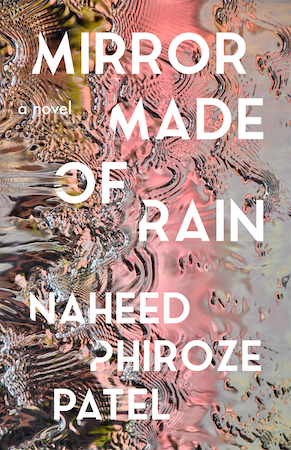
NaheedPhiroze Patel’s debut novel Mirror Made of Rain follows Noomi Wadia, an indignant young woman raised in a Parsi family in India, through a world that is keen to control women and safeguard long-established pecking orders. Since her childhood, Noomi has had a difficult relationship with her mother Asha, who battles severe alcohol dependence. However, coming of age in the affluent but parochial society of Kamalpur, Noomi risks falling into the same patterns of addiction and destructive behaviors she associates with her mother.
As Noomi hankers to overcome her suffocating circumstances, Patel’s novel traces the deep connections between our society’s cruel treatment of women and the catastrophic turns women take in their lives. Mirror Made of Raingrapples with the fundamental question: how to thrive in a society that is hostile to your survival?
While Noomi’s story bears witness to the long-term consequences of a trauma-inducing childhood, it also hints at the possibilities of healing and redemption. Patel excels at portraying damaging relationships with tenderness and humor. Since its publication in India, a few months prior to the US release, the novel has been shortlisted for the Atta Galatta Book Prize, She the People’s The Women Writer’s Prize, and longlisted for an AutHer Award in Fiction.
I spoke with Patel over Zoom about how addiction and trauma are examined in her novel and her portrait of an angry young woman set in contemporary India.
Torsa Ghosal: What struck me immediately reading your book was your approach to anger as a multilayered emotion with roots in a fraught mother-daughter relationship as well as various social contradictions. Both Noomi and Asha hold a lot of anger and resentment, but you deftly show that these women’s feelings are related to social problems. Can you talk to me about what prompted you to explore anger and angst as socially-grounded, gendered issues—gendered not only in the sense of how women embody and express anger, but also how their families pathologize their expressions?
Naheed Phiroze Patel: I think a lot about how men’s anger has always been mythologized—while the anger of women is pathologized—by contemporary society. In India, you have Amitabh Bachchan who rose to Bollywood superstardom playing the “angry young man” in many iconic movie roles. Then decades later, Shahrukh Khan became a household name playing a brand of angry, abusive “anti-hero.” When men get angry it is seen as righteous, their rebellion is framed heroically while women’s anger is—just to riff off your Public Seminar essay—dismissed as melodrama, as making a fuss. Angry women are seen as defying their societally imposed roles of being nurturing and making everyone feel comfortable. When women start making other people feel uncomfortable, they are punished for it. I wanted to start a conversation about how the discomfort angry women elicit is pathologized. It is really a system at work. In my novel, the two main women characters are highly antagonistic to each other, but they are also antagonized by the larger system of the family, of patriarchy, of the social setting in which they must survive.
TG: This certainly comes across. Society is discomfited by women’s anger, desire, and indeed a range of emotions, but it enables men’s violent self-expressions. We get to see several men transgress over the course of your novel and women deal with the repercussions. What was your impetus for depicting difficult relationships between women, particularly the fraught mother-daughter relation?
NP: Yeah, there are a lot of situations in which women become the enforcers of patriarchy, or are enablers of abusive, transgressive men, or are retroactively forgiving of their abuse.
In Asha and Noomi’s relationship, I think the big question that remains unanswered from Noomi’s point of view is, why doesn’t my mother love me? Like, this is a truth universally acknowledged: Mothers are kind. Mothers are self-sacrificing. Mothers give their children comfort and nourishment. So why is Noomi’s mother not able to?
When men get angry, it is seen as righteous, their rebellion is framed heroically while women’s anger is dismissed as melodrama, as making a fuss.
I don’t think she finds the answer to that. The impossibility of answering that question subverts assumptions about women being protective of each other no matter what. If Noomi cannot even rely on the sacrosanct mother-child relationship, what can she rely on? I think the answer is Jeh, her father, who is a better model of maternal love. He displays more of those nurturing characteristics. He is an ally, but even he is constrained by the expectations from his gender. Because he is a man, he is seen as weak or as a pushover, not only by the society, but by Noomi and Asha as well. I wanted to complicate the notion that women are automatic allies of each other. If my reader comes away with more questions than answers after reading about these relationships, I think that’s maybe a really good thing.
TG: You also offer a rather tender and intimate portrait of addiction. I am thinking of the moment when Noomi says “it wasn’t hard to see why Asha drank the way she did. Alcohol was a hug, like religion, music, art, it is the symptoms of living in this world as a woman.” Like anger, you treat addiction as connected with gendered experiences. How did you start perceiving this connection? In your opinion, to what extent are the gendered aspects of addiction recognized in our culture?
NP: There was a larger question to me always about how addiction is understood in popular culture as well as in real life. I remember feeling pretty disturbed with the pictures that came out when Amy Winehouse died. I think it was in 2011. I remember this one picture of her in a red bra with broken shoes, crying hysterically, walking around her London neighborhood, and how the media made fun of her. Coming from a system where addiction is either romanticized, when it is men struggling with alcoholism, or it is hidden and treated as a taboo, when it is women, I just wanted to humanize it, show all its harm, but also approach it with care and empathy. When someone is very sick with something like, say, diabetes or lupus, you don’t make fun of them, and you don’t consider them morally compromised. But we don’t seem to feel the need to do that to people with addiction.
I read Leslie Jamison’s The Recovering, where she talks about her own struggles with drinking and also how the addiction of male writers like Hemingway, Dylan Thomas, Raymond Carver is considered heroic. They are brilliant and restless. Their struggle with alcohol becomes a brick in the edifice of the disturbed male genius writer. However, women like Marguerite Duras, Jean Rhys, Elizabeth Bishop who have struggled out in the open with alcohol are treated as melodramatic wretches, as train wrecks with no heroic spin to their addiction. So, yeah, addiction complicates men, but it flattens women’s personalities, their art, their characters down to one thing, which is want, which is the addict.
TG: You are making me reflect on Ghazal poems from the Indian subcontinent. These poems are haunting and beautiful, but also romanticize the figure of the alcoholic male speaker.
NP: Yes. Let’s not forget the movie, Devadas. I watched it like a hundred years ago, but it’s basically Shahrukh Khan drinking himself to death for “love” that is highly toxic, but it is shown with so much beauty, so much poetry, so much romanticism.
TG: The movie is based on a Bengali novel by Sarat Chandra Chattopadhyay, and the novel is relatively more mindful of class and caste in its depiction of this man’s obsession, but, of course, Bollywood took it to a different direction.
NP: Yes.
TG: I think it’s fair to say your novel offers a troubling picture of motherhood. I am thinking of the experiences you draw attention to, like what happens to women’s bodies at different stages of their lives—including pregnancy—and women’s own inability to understand these changes because so much of this knowledge is kept secret. We don’t know until it is happening to us. And then, there’s the inability of people around to understand these changes. I was struck by the scene where Noomi is in the hospital, has just changed into the hospital gown and her husband thinks the procedure is over because she looks fine to him. He has no clue what’s going on. Was it your intention to generate more awareness about these troubling moments?
NP: You bring up a good point about how women’s bodies inhabit the occult. Even mothers don’t pass down the knowledge of what actually happens during childbirth. Or, as in Indian culture, women are fed this fairy tale of marriage as a grand prize. Elders tell you that once you’re married, your life can begin. Girls are primed like that from such an early age. I wanted to portray these situations without judgment, but also without making any of it pretty or palatable to readers. I do think my novel makes knowledge around these rituals less occult, although I don’t think that I went in with a particular goal. I approached the process as a nature documentary. I wanted to show everything that happens around these ceremonies and strip them of their romanticism. So, the book presents everything in a very straightforward way. I tried very hard not to put my hand on the scales. The narrative does not build up or break down any character. You are never told that this is bad, or this is good, or this is ridiculous. It’s all kind of just laid out for the reader.
TG: Veer, who Noomi chooses to marry, is intriguing in this respect. He will support her, but he is also casually dismissive of her. I found it to be a persuasive representation of the seemingly progressive cis-het masculinity. Here is a man who understands that the values of his family are misogynist, and he does not ostensibly share them. At the same time, when he is in that setting, he is eager to not disturb the system. Was it challenging to write a character like Veer and withhold judgment?
Women are fed this fairy tale of marriage as a grand prize. Elders tell you that once you’re married, your life can begin.
NP: Yeah, so even though Noomi tries to push back against what is fed to her by the society, she has absorbed the idea that once you are married, you no longer have to conform to your family’s rules—the idea of marriage as freedom. Meeting Veer, she believes he is her ticket to a different sort of life. He is a liberal guy. He is not misogynistic. But then all her plans are foiled when she meets his family, and they turn out to be incredibly patriarchal. I mean Noomi, too, comes from a patriarchal family, but in her case, the patriarchy is more subtle, more under the table.
To her disappointment, she finds that Veer, for all his liberal markers, is unwilling to confront his family. Even worse, he doesn’t want her to confront them either. I learned a lot about how the notion of women being malleable, easy-going or adjusting is really a way to dissolve their boundaries. Even though Veer doesn’t want to be that person, he helps his family erode Noomi’s boundaries, which is tragic, considering all the hopes she had for her marriage.
TG: The different ways in which misogyny operates in Noomi’s social world is especially apparent in the various party scenes, and there are many of those in this novel. These large gatherings where people are just saying whatever they want and testing one another’s boundaries are portrayed with humor. Through humor you bring out the complex power games played in social gatherings. Looked at one way, these are toxic events, where people hurt each other. Was humor a conscious craft choice from the outset, or was it the lens you were using to observe and document that resulted in the humor?
NP: I’ve always been influenced by writers who take really harmful or depressing situations and point out their sheer absurdity and make us laugh. I think much of Kafka is funny because of that. Gary Shteyngart is another writer who while depicting drastic or dire situations can still make you laugh. Daniil Kharms is also very funny in a really weird, surreal way. Also, P.G. Wodehouse and Victor LaValle. I read a lot of P.G. Wodehouse growing up. Sometimes just the pompous stuffiness of the English aristocracy is hilarious material. I am thinking of Indian writers too who bring out the absurdity of the Indian bureaucracy, or Indian family traditions. In The God of Small Things, Arundhati Roy writes about toxic and horrifying caste-based oppressions, and yet she makes you laugh. The customs are so ridiculous that you have to take a moment and laugh at them, even if it’s a bitter laughter.
Laughing can give you back your power—just being willing to laugh at or not take seriously these absurd oppressive social conventions gives you some agency. And, you know, my book is so voice driven. The voice had to be compelling, but it also had to have enough humor, enough levity for the reader to kind of go along with it.
“It Is What It Is” by Azareen Van der Vliet Oloomi
Khorshid, whose name in English translates to Sun, arrived from Canada on a dreary February morning. I had been warned that she wouldn’t answer to Sun because her family only ever spoke to her in Farsi, telling her softly, Khorshid bia and Khorshid nakon and Khorshid bia bebin chi vasat kharidam, her favorite of the three commands because it meant a treat had been purchased for her, a sliver of fish or a thread from which lush multi-colored feathers had been strung for her pleasure.Her fate, which had been mostly favorable, had taken a horrifying turn. She had lost her family, a set of parents and their twin children, on the eve of January 8th, 2020, in an explosion at dusk over the Tehran sky. The family was returning to Canada after a brief visit to their homeland to attend a wedding. The pilots had barely drawn the plane’s wheels into the wheel well when it was shot down by two surface-to-air missiles twenty-three seconds apart. As the plane dribbled down the night sky, it appeared to the confused gaze of bystanders to be the descending sun ablaze.
For days, I sat at the kitchen table in my apartment in Chicago scrutinizing the videos of the explosion. I traced the missiles’ upward trajectories as they carved their way toward the passenger plane and then watched the plane light up from the impact and tumble down the bruised sky. I scrolled through social media searching for posts about the explosion. That’s how I found Khorshid. I saw her photo on Twitter. The caption, written by her pet sitter, read: “Cat needs to be rehomed. Owners died. Victims of flight 752 that was shot down in Tehran.” I stared at Khorshid’s high cheek bones and exaggeratedly long whiskers, her green eyes through which she looked out at the world in shock and concluded that her owner’s deaths had been a kind of disappearance. No bodies had been recovered. They had turned to ash mid-air and taken their place next to all of the unburied dead. Next to my father who had never been found.
I wrote instantly to Khorshid’s pet sitter: “I will take her. I will love her with all of my soul.”
I was aware that my language was over the top. I didn’t care. The situation was uncertain, dire. I needed something to be definitive, even if that something was the tone of my voice. I didn’t bother to tell my roommate, Fereshteh. I could hear her furiously typing away at her dissertation on Mahmoud Darwish in the next room. She always typed with aggression, offensively pounding the keyboard. I once asked her why she typed that way.
“When I write I’m taking revenge on the world,” she said curtly and I never brought the subject up again.
I stared out the window at the passersby in their long wind-proof coats, their heads wrapped in wool, walking crookedly, making little jumps to avoid the puddles of black ice that always clog the arteries of Chicago in winter. Then I leaned into my reply, my plea which was also a pledge, and DM’ed the pet sitter again: “I will pay for her to be put on a plane this instant; she is my Khorshid, I can feel it in my bones.” If Fereshteh were to protest, I would tell her that adopting Khorshid was my version of taking revenge on the world. That, I decided, would settle it.
Then I put my coat on and walked to the lakefront. I stood there in the harsh wind and watched the water crash and rebound against the breakwater. I watched the foam and froth lift into the air, shattering into a million brilliant droplets before they dropped again into the black depths that reminded me of the Caspian—just as moody, just as much of a trickster, pulling swimmers into its entrails and yanking them around until they go limp. A sea disguised as a lake, hemmed in by land and in a rage because of it.
I paced around restlessly for hours, hunched up with homesickness and sobbing in my grief. Then I went home and called the pet sitter who had written me back with his name, Roger, and phone number. “Here with my ear to the phone,” wrote Roger. Then, “Other interest, call quickly.”
Roger’s voice was deep, guttural. He told me that on the morning of the accident, at the family’s cul-de-sac home on a quiet tree-lined street in Toronto, Khorshid had sat expectantly at the picture window. The grey domed sky beyond it had dumped snow onto the city all through the long dark winter. Roger was convinced that Khorshid sensed that her family was due to return any minute now because her eyes, fixed on the wide concrete path on either side of which shoveled snow had been piled high, betrayed an expression of longing.
At least that’s what he’d thought initially, he said, pausing gravely, before describing to me in greater detail the view from the window where Khorshid had conducted what had appeared at first to be a ritual act of devotion to her humans. He repeated several times, his tone progressively more confessional, that that’s what he’d thought was happening: that the cat was yearning for the familiar scents of her beloveds, that she was anticipating the hour of their approach. But then, as news of the explosion surfaced on all of his life’s screens—the multiple televisions affixed to the walls of the family’s home, the Twitter feed on his iPhone, and then again on the YouTube channel he’d opened his laptop to—he’d begun to feel that he too was engulfed in flames.
He paused again, and in the deafening silence of his retreat I thought of my father. My father, the poet Ali Shafabaksh, who had disappeared along with a bus load of other poets. They belonged to a literary group called The Truth Bearers. That’s all I know. It happened before I was born, when I was just a fetus. The poets’ remains were never found. They were likely dumped together in an unmarked grave in a remote province of Iran.
“Anyway,” Roger started up again, somewhat irritably. Uncertain about what to do to find relief from the intense heat, from the invisible flames that he felt were devouring him, he’d ran outside into the cold where he’d suddenly snapped back to attention. That’s when he saw that the cat’s eyes bore an expression of horror and disgust not unlike his own. An even stranger feeling had come over him then, Roger said; an inability to recognize the world, and for a moment, which had seemed to him to last an eternity, he felt unable to tell himself apart from the cat. He had seen in her distressed face his own. Khorshid’s pupils, he told me, were dilated, static. Her brow was locked in anger. Her mouth was turned down in grave lament, and as he looked at her, he had the strange sensation that his own mouth was sliding off his face.
To this the sitter added that in the days that followed he had not known how to speak of the disaster to poor Khorshid, who had begun to lick her sides raw in response to her family’s sudden collective death on the other side of the Atlantic. He’d failed, he said, at soothing her. “She must have sensed the end approaching,” he muttered breathlessly into the phone. His voice kept shifting registers, exposing his distress.
“It’s entirely possible,” I said, sensing an opening, then I closed my eyes and saw the concrete path Khorshid had studied through the windows. I don’t remember what the sitter said next. In my mind’s eye, the sidewalk, cracked from the cold and exposed to the elements, suddenly morphed. It became elongated, as though it were made of rubber, and took the shape of the lit runway at Imam Khomeini airport from which the family’s passenger plane had taken off—the same runway from which I’d fled decades earlier, once my mother had given up on waiting for my father to reappear—and my whole body shuddered.
“Are you still there?” the sitter said.
I confirmed that I was. I told him not to worry, that I would adopt Khorshid and give her the best Iranian life ever. I said this so emphatically that he was taken aback. I felt myself getting nervous, growing taut with the energy of madness that stretched me from limb to limb every time I thought of my disappeared father. What does one do with the unburied dead? I filled the silence when I should have kept quiet. I said, “Don’t worry, I promise the samovar will be going at all hours, releasing cardamom vapors, and that she will always have her share of white fish served on decorated ceramic plates.” I spoke as though I were relaying a message of comfort directly to her dead beloveds. I was convinced that any pleasure I provided her with would be conveyed to her deceased humans.
I didn’t explain any of this to the sitter. Sure, he was tender hearted. But still, I considered, this pet sitter, sensitive as he may be, was not my people. There was no one planting grenades at his feet or watching his thermal shadow on a screen or tracking his every move convinced that he was a purveyor of violence. His life, I’d thought, remembering again the black ribbon of the runway which had taken on a liquid aspect as the plane on which I’d fled Tehran took off into a sky stripped of stars, was not conditional. I refrained from providing explanatory notes. Neither did I care nor think about howthis transmission of pleasure from Khorshid to her family, who had been eviscerated mid-air, would take place. I just needed to believe that it would.
It took a few weeks to settle the adoption. In the interim, Fereshteh and I barely spoke a word. She’d taken the news about Khorshid in stride, perhaps because her attention was elsewhere. She was exhausted from her looming dissertation deadline and a severe advisor she was convinced had a mood disorder, a young aspiring poet on his first tenure gig who changed his hair style every semester and who had an uneven email habit that drove Fereshteh mad.
Occasionally, she would come into the kitchen, where I did most of my reading, to make herself some lunch and call home. She would leave her computer open on the counter behind her. The Skype screen displayed her mother, her maman, seated on a sofa beneath wide windows through which I could gleam the triumphant ring of mountains that crown Tehran, making it difficult for the pollution to escape. Each time I saw the Tehran sky on the screen, it appeared to be heavy with artillery, full of ashes and the soot of the dead. Her mother and I would wave at one another politely and shake our heads, as if to say I have run out of words. Fereshteh’s brother, Iraj, a famous wrestler, had been at Evin prison since the Green Movement protests of 2009. No one had heard from him in years. Her uncle, Ahmad, a defender of the Islamic Revolution, had disappeared in the Iran-Iraq war in the early 80’s. A second uncle, alive and locatable, lived in Beirut. There were framed photos of the two missing men—Fereshteh’s brother and first uncle—hanging on the wall behind the sofa where her maman sat. Occasionally, I’d steal a glimpse of their faces. They looked alike: round tanned faces, plump cheeks, a full head of black curls except that Iraj had a clean-shaven dimpled face and bright blue eyes and Ahmad had a wiry speckled beard and piercing black eyes sunken beneath a unibrow. Looking at their faces helped me to imagine my father’s. I’d never seen a picture of him. All ties to him had been destroyed to preserve my life.
In the days leading up to Khorshid’s arrival, Fereshteh and I barely spoke. She was always in a gloomy mood. If we did speak, it was to exchange verses from the latest Darwish book we were reading together and which we kept on the living room bar cart next to the bottles of Arak we had accumulated over the years. That week we were reading Memory of Forgetfulness. Every time we crossed paths in the living room, one of us would pick the book up and recite, “Are you well? I mean, are you alive?”The other, having memorized slivers from the book, would answer, “Don’t die completely,”or, maybe, “Don’t die at all.”
That was the extent of our exchange until Khorshid arrived, bald, her skin raw from all of that anxious licking. The day of her arrival I stood on my toes and squinted beneath the bright overhead lights that lined the low ceiling of the Chicago airport. I strained to look over the beanied heads of passengers and those who’d come to greet them, eager, expectant. My heart was racing. I was trying desperately to spot her crate, sweating despite the fact that the airport air was damp with a biting winter chill. I kept imagining her fearfully pressing her face against the bars of the crate. That face of hers which I’d first seen on my Twitter feed and that had stolen my heart, seized it instantly and with such brute force that later, once she’d settled into our apartment, I would come to forget that I’d ever lived without her weaving between my legs, licking my tired eyes, yawning in my face at dawn.
I kept thinking I’d spotted her amid the parting airport crowd and would squeeze Fereshteh’s hand and whisper “Khorshid!” with a sigh I suspected she found grating but which she nonetheless echoed in solidarity. After all, things had been taken away from our lives more often than they’d arrived. It was hard not to feel giddy.
When I finally saw her, I grew ecstatic. I thought my heart was going to explode. Fereshteh was smiling too, a broad smile that momentarily shattered her icy dissertation mood. On the way home, I said Khorshid’s name over and over again. We drove along the belt that hugged the curves of the lake, so blue that day, bright and full of an unexpected light. Khorshid occasionally emitted a reluctant reply which we took as an indication that she knew she was safe again, that somehow, by the grace of god, if Khorshid, unlike us, was one to believe in god, she’d made it through the worst of it.
Halfway home, Fereshteh’s mood shifted again. She turned serious, austere. I was convinced that the anticipation of sitting again at her desk was making her shut down. Wide shafts of light came through the car window and made her fingers, white from gripping the steering wheel, look translucent. In that oxidized light, she looked to me like a ghost. She turned to me and said, “Today, while I was finishing my second chapter on Darwish’s oeuvre, I had an awful feeling that the world is a book and that we are all characters trapped in separate chapters, on different levels of reality that don’t necessarily intersect, and that the whole thing, this book that is our lives, will be torn to bits soon and that we will all be floundering in a sea of sorrows.” I was alarmed. She was so seldom dramatic. Prosaic in conversation even less often. She was a woman of few words.
The whole thing, this book that is our lives, will be torn to bits soon and that we will all be floundering in a sea of sorrows
I said nothing. I stopped speaking to Khorshid. I looked at the lake. It was beautiful, glittering, immense. I wondered if Fereshteh was quoting Darwish, but I couldn’t recall having read those exact words. I had read almost all of Darwish. I had already finished my dissertation, a study of “revolutionary madman writers” who either lived solitary monkish lives in exile or who, like my father, had disappeared, but who, unlike my father, had left letters and sheaths of poetry behind. I looked over at Fereshteh. Her eyes were shining with remorse, as if she’d betrayed a secret she’d been entrusted with and had been unable to bite her tongue.
I tried to make sense of her words.
“Do you mean to say we need a new script?” I asked. “That this life as we’ve come to know it is about to expire?”
“Worse,” she said, fixing her gaze on the road, “like our lives are going to gradually disappear from us, rather than the other way around, and this vanishing of our lives will feel to us stranger than death, than dying, than the disappearance of our brothers, uncles, fathers, that we will be alive, able to see and hear the world, but we will lack all understanding of how to operate within it.”
“Just us?”
“No. Everyone.”
I didn’t say a word. I thought of what Roger had said, of that odd sensation he’d described to me; how the boundaries of his body had become diffuse and merged with Khorshid’s and pictured his mouth sliding off his face. I thought to myself, great ruptures have happened before. Empires have collapsed. Civilizations have gone extinct. I wished I could read my father’s poems. That some piece of paper, some scrap existed in the gossamer of the universe with his words. I wished my mother had memorized his poems and recited them to me, transcribed and published them under a pseudonym. But she hadn’t and besides, she’d passed away a decade ago.
I looked again at the lake. It appeared swollen to me, as though the water levels had been rising by nearly imperceptible degrees. Up above, the sun was lit. A thousand flames shot out of it. It looked like a wheel caught on fire; it was branding its burning tentacles onto the immense lake.
“I’m telling you,” Feresteh said, turning to look through the passenger side window at that sun, “something sinister is afoot. I can feel it.”
I opened the crate and put my hand on Khorshid’s arched back and felt her slim body twist to find a new shape. I felt her muscles relax. Her engine, that little roar, ancient, subterranean, came on. The sound of her purr kept my heart beating steady even though I could see shadowy figures rising from the glassy blue horizon, plumes of grey smoke being sucked into that rabid sun.
By late April, Khorshid’s fur had mostly grown back. She appeared to be in the spring of her life. In the afternoons, I would often find her pinned to the hardwood floor by a slant of auburn sunlight coming through the east facing windows. If I approached her she would roll on her back and her soft doughy stomach would spread on either side of her; she’d elongate her legs, expose her claws, and let her head bob from side to side in greeting. She was most active at dawn and dusk, during the twilight hours, those electric libidinal hours of uncertainty that impart awe on us feckless humans. I began to suspect that her activities during those charged hours of possibility—her crooked runs at top speed across the length of the apartment, her acrobatic jumps and backflips, the way she crouched in the shadow of an armchair with her nose pointed straight at the floor—were simply a mechanism for communing with her dearly departed, evidence that she was in league with the dead. It was not a leap to think so. Roger, who I hadn’t spoken to since the first time, believed that she had intuited the disaster, that her body had registered the loss before it became a known fact of her life, or to be more precise, that she had perceived the disaster at the exact moment of the explosion. When I shared my thesis with Fereshteh, she merely shook her head in disbelief.
“She’s an average cat,” she said. “Stop projecting on her.”
“But you saw the pandemic coming the day we drove her home from the airport,” I insisted. She said nothing. “Don’t you think it’s possible that Khorshid was intimating news of the cosmic violence we are engulfed in?” I cried in a supplicant tone.
“Coincidence,” she emitted tersely, “and besides, the only prophet here is Darwish.”
The next time she spoke to her maman on Skype, I brought it up again. Maman was slicing a watermelon in their kitchen. The neon-green soot of the Tehran sky was visible through the rectangular window over their sink. For a brief second, before her maman turned her head to look into the camera, I thought I saw Iraj and Ahmad’s faces swimming in that green sky, their curls and Ahmad’s beard bright orange flames of fire. Maman pointed the knife she was holding at us and said: “Life is short. There’s a pandemic raging. It’s summertime. You two should go out and buy yourselves some watermelon. I had to queue for over an hour to get this.” She was always trying to be instructive for Fereshteh’s sake, unaware that seeing her mother whip herself up into false decisiveness when her realm of control was ever diminishing only made Fereshteh feel more weighed down, as if lead had been poured into her veins.
“Seriously,” I objected, “think of all the reasons why cats were revered in ancient Mesopotamia!”
“Hearsay!” Fereshteh whispered under her breath. Maman simply replied that there’s nothing special about our Khorshid, or nothing especially specialshe said, and brought the knife back down into the rind of the watermelon.
“See?” Fereshteh said glaring at me with the white of her eyes. “Don’t confuse myth with life!”
I said nothing. We ended the call shortly after that and maman vanished from the screen with the same electric swoosh of her disappeared family member’s faces as they dragged their tales of fire along.
Days passed, monotonous, tense, foreclosed. All through June the atmospheric humidity in Chicago was unbearably high. Everyone walked around slick with sweat, moist masks obscuring their features, shoulders slumped as they ambled through air loaded with humidity and death. It was like the days of curfew in Tehran, the long nights of silent terror, of search lights and distant sirens when the march of war was interminable, taking everyone hostage. If only my father had lived to see those days. What would he have written? On the streets of Chicago, strangers neither greeted nor acknowledged one another. They marched past one another like zombies, as if they belonged to separate planets and had happened to coincide on earth by way of a terrible accident they had no recollection of, but which they foolishly believed would be reversed, restoring them to the lives they’d known so intimately before the pandemic. Our neighborhood was largely a ghost town except for a few bars and restaurants that had cautiously reopened; they had placed their tables and chairs six feet apart on the sidewalks between giant planters of green elephant leaves, hydrangeas, dense blazing stars. Such remarkable flowers.
By mid-summer, our lives had shrunk to the size of a coffin. Fereshteh and I became increasingly plagued by feelings of homesickness. We barely ever left the house. We felt we were in Tehran again. I would be going about my business—washing dishes, refilling the water in the samovar, reading at the kitchen table—when I’d suddenly hear the awful thud I’d heard when the wheels of the plane detached from the tarmac at Imam Khomeini airport. I’d hear the plane whistle into the thick of night and feel a yawning void in my guts, an abyss that sucked my heart into its bottomless depths. Then I’d turn around to realize it was the samovar signaling a boil. Every once in a while, Fereshteh would lift her head from the sofa where she’d be laying recumbent, reading, and ask, “Do you remember the sound of the creeks in Darvand?”
Yes, I’d say, and I’d hear the water gurgling over the ancient rocks and smell the tender green leaves of the trees. Her mood had softened. She hadn’t seen her advisor in months and his absence from her daily life combined with Khorshid’s presence had changed her in subtle ways only a close observer could identify.
“Did you play hopscotch on the roof?” she’d ask, and I’d see the numbers I’d drawn in chalk appear beneath my feet. I’d smell the bitter scent of hot asphalt. I’d see the courtyards of the neighboring houses with their pruned roses and shallow pools. I’d hear the salt seller as he worked his way down our network of crooked streets, pushing his wheelbarrow of salt around, yelling namaki, even as the war raged on.
After that, Fereshteh and I began to call each other across the apartment that way. Namakiii, we’d say emphatically. But no sooner we’d uttered the word, we’d retreat in anger at the seductive call of nostalgia, its vampiric hunger for snatching souls in the night, leaving bodies to burn from the sting of emptiness. In those bitter moments, I’d find Khorshid at my feet, waiting to receive me as if we were one spirit knocking on the gates of death. Pishi, I’d say, pishi…and we’d trail to my room and lay like suicidal lovers in bed.
I would say to her, “You are as beautiful as language,” and she would purr louder. “Just as mysterious.”
In the morning, I’d find her next to me purring, squinting her eyes ever so slowly, her front paws stretched out before her like a phoenix. She’d pretend she hadn’t been hunting down messages from the dead all through dawn. I’d lay there, and admire her shiny patches of fur which were orange and full of tiny white stripes that looked like commas, semi-colons, em dashes. I would say to her, “You are as beautiful as language,” and she would purr louder. “Just as mysterious,” I’d say and she’d rub her mouth on the crease of my thumb and index finger. She was striking in her simplicity during those lazy morning hours.
Once I got up, she’d move along with me: first to the kitchen where I’d drink my morning coffee—always Turkish, with a generous spoonful of sugar—and then to the dining room where I would sit on the turquoise blue velvet armchair I’d purchased at Goodwill and light a cigarette. I read the news while she languished the morning away sniffing at the window screens, her pupils as narrow as a sentence. Our day would progress calmly, statically, until dusk would arrive and her routine of cartwheels and message retrieval would begin again.
By July, Fereshteh and I decided we needed to bring the noise of Tehran back into our lives. That we should live as though we had never fled Tehran. This impulse, too, I attributed to Khorshid’s presence, as if she were demanding such a life from us, a life that refused to recognize its difference from that other life we would have lived had we never left, a cheap copy, a butchered mimicking job. She was drawing the past back into the apex of our lives, resuscitating memories we had given up for dead.
When the midsummer festival of Tirgan came around at the start of July, we celebrated. We put small bowls of water all over the house and encouraged Khorshid to slap the water with her paws; Fereshteh and I would say to her, look Khorshid jan, like this,and we’d dip our hands in the bowls and flick the water onto one another. Fereshteh played the Daf in the evenings, and as she dragged her slender fingers against the taut sheep skin drawn over the frame, it emitted a deep guttural sound that attracted Khorshid’s attention. The cat would sit at our feet the whole time, and I would read a few lines by Rumi or Khayyam to the rhythm of the Daf, and we’d close our eyes and sway side to side in ecstasy. In those moments, I felt my father was standing next to me. My father whose face I could not picture. My father who had been reduced to energy.
One morning while I was lying in a bath I’d drawn to cool off from the terrible heat, I heard a leak. Khorshid, who was perched on the edge of the tub grooming her tail and paws, stopped instantly and stood in a frozen rictus, attempting to perceive the origin of the noise. It sounded like water was running over the tub, across the floor, coming down the walls in a thin but steady sheet. I wondered if I had gone so deep into homesickness that reality had begun to part altogether in order to clear access to the great beyond. For a moment, I had the odd sensation that the floor was opening up beneath me, that the tub was going to go through it and eject me on the other side. I felt as though I were being birthed again. As though I were floating around in my mother’s uterus and a sudden unannounced pressure were being exerted on me, a force larger than life emerging to suck me through the narrow channels of her groin. For a moment, I thought I heard my father cooing, reciting cliche verses of doves and cherry trees, telling my mother that her face was more beautiful than the full moon to encourage her along. An inside joke, those lines. A wink, as though he was saying to her, the system wants only these tired words, so here they are…your hair is like a river, your mouth sweet as nectar, your breasts soft hills I yearn to climb. Then, again, I heard the water spreading across the floor. I closed my eyes and saw my father for the first time, a thin man, a defeated man with a gaunt face whose pride has been broken, whose spirit has been crushed, standing blindfolded in a soiled linen button down and brown slacks with his hands tied behind his back at the edge of a ravine. I heard the woosh of a bullet as it spliced the air and broke his skin, as it ripped through his flesh and buried itself in his heart which closed around it like a bloodied fist. I saw him stumble backward over the precipice and as his body tore through the air I heard him say down with the shah and the water spread shhh shhh shhhhh until he disappeared from view. It was all very odd. I’d never had a memory of my father before and it seemed impossible to be having one now. I opened my eyes to Khorshid letting out a loud and urgent meow and pointing a stiff paw at the fogged pane of the bathroom window beyond which I could see the white palette of the sky smeared with blood.
Fereshteh appeared at the door with the spent aspect of those returning from a long and brutal war. She was carrying her lap top, the screen open to a news channel. “Another plane!” she said. Khorshid kept rubbing her ears with her paws, first one, then the other. There was something disturbing about the intensity with which she kept flattening her ears. Shrill voices came through the speakers. I felt my vertigo kick into high gear. I climbed out of the tub, hastily wrapped a towel around me and stood next to Fereshteh, whose eyes were fixed to the screen, her face aglow with its pale blue light.
“Look,” she said, and shoved the laptop into my arms. At first, I didn’t know what I was looking at. I could see a cloudless sky recorded by an unstable camera. The patch of sky kept bouncing up and down. The screams grew progressively louder. An F15 fighter jet appeared. So did the wide white wings of the passenger plane. I saw the beaked mouth and elongated sting, the sharp, sturdy wings of the fighter jet as it approached the passenger plane with an intent to kill, or to say, Boo! You can’t see me but I have my eyes on you and I’m ready to draw your blood. Then, as quickly as it had appeared, it departed into the white horizon. The camera flipped to capture the passengers. A man looked numbly into the camera; a river of blood cleaved his face in two. His head was bleeding. He tried, unsuccessfully, to reach for one of the oxygen masks that were dangling from the overhead compartment, but he failed. His hand moved imprecisely through the air. His lips turned blue as the blood dribbled down his chin onto his shirt. The camera panned around to capture weeping children; their mouths looked like shriveled rolls of old bread. In the narrow, carpeted aisles, next to the restroom doors at the rear of the plane, two bodies lay motionless, their eyes closed. It was Fereshteh and I. I was convinced of it. It was as if we had multiplied: one version of us stood in our bathroom in Chicago, warm from the steam coming off the tub, and another version of us was lying supine on the dirty carpeted floor of that plane, flying over the al-Tanf garrison in Syria, leaving Tehran for Beirut on Mahan air. I stood there staring at the screen, trying to figure out what had come over me. Was time bending in recognition that we had been split in two? Were the individual lives of who we’d been in Tehran and who we’d become in the land of the free separated by a wall that acted like a looking glass through which we could view one another without touching? I looked over at Fereshteh. We sat on the floor, Khorshid at our feet, our only witness, and sobbed for so long we felt our ancestors shiver in the heavens above us and in the ground below us, deep inside this dark brown earth.
Weeks passed. It seemed to us, or perhaps we wished, that time would soon cease to exist, that the world which was a book would soon turn to dust, that the days would end their relentless march, that the seasons would stop their eternal change of clothes.
One morning, unable to take the monotony of our days any longer, I decided to leave the house, to go to the lakefront, take a swim even if I had to risk proximity to others. Khorshid climbed into her backpack. As the door shut slowly behind us, I heard again the squeal of that plane as it lifted into the starless Tehran sky and turned westward. I felt like a fugitive, an eternal refugee adrift on the streets of the world. I felt I was running out of time. Time for what, I did not know. I felt as though something momentous was on the precipice of revealing itself.
I walked through the tunnel that runs under Lake Shore Drive and across the lawn to the concrete steps overlooking the water. I noticed there was something sublime in the air, a euphoric energy. People had come to the lakefront in droves despite the restrictions of the pandemic. There were colorful towels spread on the lawns. There were beautiful earringed boys in bright pink and orange speedos tanning together, their limbs oiled and slippery as fish. Chicago’s buildings, handsome and glassy and blue, stood erect as soldiers surveilling the waters from a distance. The lake was green and even. An unblemished surface. Each time someone dove into the water with their legs drawn into their chest, plopping through the surface like a bomb, the lake sealed over them and instantly reestablished its calm indifference. I heard the beautiful boys cheering the divers. Then my cell phone rang. I picked up. It was Fereshteh. I could hear her screaming on the other end.
“Beirut exploded,” she said. “It exploded!”
“What do you mean?” I asked, in disbelief, feeling instinctively for the heat of Khorshid’s body against my back.
“That’s where my second uncle lives, remember?” she said, breathing in gulps, “the one who didn’t disappear in the war.”
I pictured a third photograph going up behind her maman’s sofa, a third martyr, all of them gone to inconclusive causes, disappeared or dead—a framed face all that’s left of them.
“When?” I kept asking. “When?” I repeated the question as though I had gone stupid.
She couldn’t answer.
She breathed heavily into the phone. I sat down and held the cell to my ear. I looked at the lake. I detected an odd movement on the horizon, the water cresting as if it were being rolled back the way I’d sometimes seen her maman roll her Persian carpet on the screen through which we observed her life. I got up with the phone still to my ear and walked closer to the edge of the water. The liquid horizon appeared to be trembling, as if somewhere at the edges the water was registering that distant perturbance in Beirut. I felt the void in my guts open its jaws. I walked even closer, more slowly, as if I were walking toward the water for the first and the last time. I heard Khorshid move around in the bag. I turned the backpack toward me and looked down at her through the clear bubble of her carrier. She looked more orange than ever. Brighter. Warmer. Shinier. I whispered Darwish’s words into Fereshteh’s ear. I said, “There’s no end, no beginning, no first, no last, no presence, no absence.” In the background I could hear Trump’s voice streaming through a boy’s iPhones, his rotten lips moving on their screens which glowed as he said, it is what it is, it is what it is, it is what it is. The beautiful boys had gotten up and begun to dance. They were joining their voices into a chorus, singing: It is what it is, it is what it is, it is what it is. They began to choreograph a dance. They kept putting their masks on and tearing them off, flexing their bronzed arms, moving their lips with the same disturbing suckling motion. They sang with mock astonishment, It is what it is. I looked away from them. We were trapped in different levels of reality. I kept staring at the horizon where the water had begun to move ever so slightly at the edges.
And then it happened. A deafening roar boomed through the air and blasted the lake open. I saw the water shoot out into the sky, shatter into a million shiny droplets, then sink back into the belly of that lake so eager for a hunt. The silver gleaming needle-shaped buildings in the distance reflected the rising waters. Khorshid began to emit a terrific orange light, and her shafts shot out of the holes carved into the bubble of her carrier. I heard Fereshteh’s voice come through the phone. She was finally speaking, reading Darwish back to me, whispering, “Intense bombardment of Beirut! Intense bombardment of Beirut!” She was chuckling nervously in my ear. Her mind was sliding through her hands. I could hear her losing her grip. The cratered surface of the lake made the void in my guts open its jaws even wider. A merciless light came on. A sickly crimson mushroom cloud billowed out from the lake and rose further and further into the sky, a fist of fire rising to land a punch on eternity’s ancient face. Beirut is on fire. It is what it is. Beirut is on fire. It is what it is. I heard the choir chanting those words as I staggered home. I called out, “Father! Mother!” I felt my confusion turn to an icy panic. I asked myself, Whose death shall I mourn? Khorshid and I looked at each other through the bubble of her carrier. I felt so much love. Love spread through my body the way the water had spilled over the tub, shhh shhh shhh, and in that quiet susurrus I heard the song of my ancestors. Whose death shall we mourn? I asked, and they answered, We are all here together.
From the opening sentences of Lan Samantha Chang’s novel, The Family Chao, we learn that Leo Chao, the patriarch, was not a good man. He was aggressive and domineering, and an unfettered capitalist. He carried many desires, and he satiated each of them, all while owning and operating a restaurant that capitalized on feeding the hunger, often excessive, of its patrons in a small Wisconsin town.
When Leo Chao’s body is discovered in a meat freezer, his sons are forced to cope with their father’s well-kept secrets, while trying to solve the mystery of his death. From there, the Chao men continue to defy expectations—both those that they encounter as Asian American men in a very white, American context, and those that readers might bring to the novel.
The Family Chao, long-awaited and highly-praised, is a novel that was written to be subversive. It hinges on hunger, appetite, and desire—all of which are qualities that are rarely attributed to Asian men, and rarely written about in immigrant literature. During her book tour, Lan Samantha Chang and I spoke over the phone, where we talked about the pressure faced by writers of color to write likable characters, the limited characterizations of Asian American men in contemporary literary fiction, and her work as Director of the Iowa Writers Workshop.
Denne Michele Norris: I’m obsessed with learning the origin stories of books that I love. How did The Family Chao come to exist? What were the initial ideas or questions that pulled you into this project?
Lan Samantha Chang: My discovery of the pleasures of writing in present tense got me going. Back in 2005, and as an instructor, I’d always told my students not to write in the present tense. “It doesn’t exist! It’s not an actual representation of any kind of time.” But then I started writing in it, and I realized that it’s very attuned to oral language. You know, if you’re going to tell a story about something that happened to you at the store, one often slips into this present tense. “So I’m going to the store and I see a guy.” Anyway, I wrote 100 pages about a dysfunctional family with this powerful patriarchal figure who was reminiscent of my own father, and I realized I didn’t know where the story was going. And then I got this job at Iowa. I moved, I had a child, life intervened. I wrote a different novel.
And then a few years later, I was in my office chatting with a student, a very smart guy, and he was showing me his thesis, telling me that he always writes with another novel in mind. His thesis was an homage to The Good Soldier by Ford Maddox Ford. And I was sitting there thinking that my present tense discovery would pair well—if I wrote a novel that was steeped in another literary work—with The Brothers Karamazov. The reason I thought this might be a successful pairing is that The Brothers Karamazov uses time in such an interesting way. Time unfolds very slowly, and with great detail, and you spend probably five or six hundred pages in maybe 3-4 days. And I thought, “I’d be interested in trying to create that feeling of surprise that happens as you read this particular novel, in my own novel.” Everything I write appears—at this point—to be an exploration of the human experience of time, which I’m now learning is non-linear, and non-human: for some reason we are stuck moving forward in it while time itself does not exist in that same linear way. In this book I was interested in trying to describe a surprise that sort of blooms out, in many directions, from the present moment.
Everything I write appears—at this point—to be an exploration of the human experience of time.
DMN: Time is probably my favorite craft conundrum. And you’re right about it, too: as humans, we move forward in time in a linear way, but time itself doesn’t operate in that same way. It’s non-linear, and storytelling can explode linear time, correcting that error. This sounds like a very fertile way to set up a novel that features many people, a big novel about a big family. I was aware of all of the comparisons to The Brothers Karamazov, but one of my original questions I wanted to ask was how intentional were those similarities?
LSC: I didn’t realize that my project could be in any way related to it for seven or eight years. I did write another book during that time, but mostly I was living my life—which was quite time consuming. Once I understood that I could connect my project as an homage to The Brothers Karamazov, I became very conscious of the choices I was making, the similarities and the incongruities. Attempting to write an homage to something great has major moments of fear, self-consciousness, doubt, and shame. I think The Brothers Karamazov is one of the greatest books ever written and so trying to write in their minds was an act of hubris. And yet I was so attached to the book that it had taken up permanent residence in my mind, and I felt in a way, that I was having a conversation with it. I wanted to know what would happen if the characters were characters I would’ve grown up with, or known—Chinese American second-generation kids.
DMN: That’s the perfect segue, actually, because we need to talk about Leo Chao. He’s such a complex character, and there are many ways in which he bucks the societal expectations we’ve placed around Asian American men. What were you trying to do, with him, as a character, by placing him at the center of this story, and what was it like writing a character who reminded you of your father in these ways?
LSC: Well, Leo Chao just walked into my mind in 2005. The scene in which he appeared to me is included in the novel. He comes up the stairs with footsteps that are the footsteps of a much larger man. He is, as one of the characters describes him, the consummate American Id—a narcissist who wants to screw everyone. And it’s interesting that I say he reminds me of my father because my father is nothing like this. My father was an erudite and complex, but imaginative and loving man who just happened to have a larger than life personality, a deep baritone, a serious tempter, and extraordinary verbal ability. He could make jokes in two languages and didn’t come to the United States until he was 30. He was a really witty, multi-talented person who just happened to have four daughters and feel the need to, to an extent, control our lives because he was concerned that something dangerous would happen to us here, in the United States, living in this tiny town in Wisconsin, where we were the only Chinese girls. He had a very complex, adventurous life before he came to this country, much of which was mysterious to us. He did not talk about it, so of course he looms large in my mind, and when I started writing this book, this character just appeared to me, and reminded me of my dad.
One of the problems of trying to write about my Dad is that he does not appear in immigrant literature.
But the fact is, one of the problems of trying to write about my Dad is that he does not appear in immigrant literature. You do not read the immigrant story about a man who was like my father or about a family that was as loud and verbal as my family. Phillip Roth was a big influence on this novel because Phillip Roth books are filled with loud immigrants, loud unhappy families—people living lives of noisy desperation. Leo Chao is grasping. He is inconsiderate. He is a philanderer. In some ways, it wasn’t difficult to write him because the most concentrated spurts of writing this novel happened during the Trump presidency. I felt a little worried people might think Leo was my father, but so far nobody has thought that because he’s such a huge character that it’s hard to believe people like him exist. I mostly just had a really good time with his character, to be honest.
DMN: Sometimes those blustery big characters are the most fun to write because they take up so much space and give us so much to work with, as writers. I think it’s interesting, though, that you were just saying that no one has misconstrued Leo Chao as your father because it’s hard to imagine a character like him existing, while simultaneously, you’re also saying that he was easy to write because you had a great example in the White House when you were writing the novel. A really interesting facet of this novel is that we don’t associate that kind of character, and that kind of behavior, with men who are not white, and men who are immigrants.
LSC: Exactly. Exactly! I was consciously aware when I was writing the book that I wanted to write about Asian American male characters that I have not seen in contemporary literature. I wanted the men in the book to have robust romantic lives, I wanted the father to be confident in his masculinity and power, and I wanted the characters to have inner lives and the freedom to do things that are outside the normal script.
DMN: Are people reading The Family Chao in this way? Are they understanding that intention?
LSC: No. I don’t think most readers are reading it in this way. Some of my Asian American male students have noticed it in there, and have been hugely supportive of the book. Some readers are concerned that the book has profanity in it, and they don’t understand why I’m writing characters that are unrelatable—which really means unlikable. They complain, “Leo is so unlikable.” Well, I’m sort of handicapped in that way because I love all the characters, even Leo. Anyway, I loved writing all of them and I also don’t believe a book has to have likable characters to be enjoyable and readable.
DMN: I’m reminded of the days when I was just starting out, that first year or so when my only training was the books that I was reading. And I was reading a lot of Jhumpa Lahiri, and Olive Kitteridge had just won the Pulitzer Prize. It felt like my entire reading world was filled with unlikeable characters, and that, to me, was the joy of writing, and of reading—that I could be so wildly in love with such flawed characters. The idea that you—Sam Chang!—are being told you need to write likable characters makes me think back to all times I read reviews and interviews of Olive Kitteridge when people would say how unlikable she was as a character, and then how delicious it was that she was so unlikable. And it makes me wonder about the pressure for writers of color to make our characters as likable as possible.
I have been told that as an Asian writer, I should write about sympathetic Asian characters, and that if I don’t do this, then I’m doing a disservice to Asian American people.
LSC: I have been told that as an Asian writer, I should write about sympathetic Asian characters, and that if I don’t do this, then I’m doing a disservice to Asian American people. And I do understand this. When I was a kid, whenever we went to a strange city, my Dad would always overtip the cab driver because he didn’t want these people to think that Asians are cheap. He felt like he was representing all Asians in his every action, especially when we stepped out of our own town, because everyone knew us there. So I sympathize with that feeling, but I believe it’s basically just buying into the model minority myth. The dominant culture has pitted Asians against other groups by claiming that we are better behaved. People feel the need to live up to that, even though it was imposed by another, outside gaze. I just want to make it clear that Asian American characters have the permission to behave as badly as they want.
DMN: I think that’s so important, especially in this time of really visible anti-Asian sentiment.
LSC: Yes, exactly. These people who are being stalked and killed and beaten and stabbed are not misbehaving. They are going about their lives walking down the street. So if people think that getting characters in literature to be likable and perfect and well-behaved and quiet is going to help anything, I think they’re wrong.
DMN: I feel like we’ve been having this exact same conversation in the Black community forever, around respectability politics. You can be as professional and appropriate and respectable as you want to be, but it’s not going to protect you from racism.
LSC: The Central Park birding situation is a perfect example.
DMN: Exactly! So then, it’s like why? Why should our art be manipulated to function in service of these stereotypes, this aspirational perfection that would fail to protect us?
LSC: I couldn’t agree with you more. Honestly, nobody has asked me these questions so I’m really grateful to you for giving me the opportunity to talk about it.
DMN: That’s a little bit shocking to me because it was basically all I could think about as I was reading The Family Chao. I didn’t do a ton of research because I didn’t want to be overly influenced by other discourse about the book, but I did read a few interviews and I thought, “They’re talking about desire and hunger, and those themes are important, but how is no one asking about Asian American masculinity and how this book completely destroys that trope?”
It’s meant to be subversive. I try to signal to readers that its not going to be a quiet immigrant book.
LSC: You’re exploding the way people read the book. I think it has something to do with my previous books or perhaps people just expected a quiet immigrant trauma novel. And so some people are upset that it isn’t that. Well, too bad! It’s meant to be subversive. I try to signal to readers that its not going to be a quiet immigrant book. There’s a scene very close to the beginning of the book when James masturbates in a bathroom. I give my editor credit because she didn’t think I should take it out, but some of my very early readers did think I should take it out. And I decided to leave it in because I wanted him to have strong sexual desires.
DMN: Desire is really present in this book. Appetite, both literal and metaphorical is really present in this book. Leo and James both have so many desires that they talk about openly, Dagou has a lot of hunger, and ambition, and in this book, it feels like, desire, appetite, yearning—that this need for more is the blood through which this story runs.
LSC: The strong desires and ambitions these characters have are what propelled them to this country and through this country. So every one of the characters has outsized desire in one way or another. Dagou wants to be the partner of Brenda and this great chef, and at times in the book he literally can’t stop eating. Leo wants to be a success in a different way. He also wants to spread his seed. He says, “that’s why we come to America: to colonize it, to spread our seed.” Ming wants more conventional success, American success. And James has a desire to be an ordinary person. By the end of the novel it’s clear to me that his life will be anything but ordinary. I think he’s going to leave the town, go out into the world, and be a Chao of the world. The problem of course is that these desires backfire in various ways, particularly for Ming and Dagou, but even James, to an extent. You could say the whole novel is about the consequences of the father, and the father’s strong desires. One of the things about being in a country that allows a fair amount of personal choice is that one can act upon their desires in a very open way. And it was pleasurable for me to give the characters a setting in which they could do that.
DMN: I want to ask you about your job at Iowa. You’ve really changed the program in huge ways. There’s so much diversity there, so many people of color and queer people, and I think the identity of American letters has really evolved in the last 10-15 years. And when you talk to so many of these important writers, if they’re graduates of Iowa, they always mention one name: Sam Chang. First, I want to thank you, because so many of my mentors got their start with you—and I didn’t go to Iowa, which tells me that the impact you’ve made is felt far and wide. But second, I’m wondering about your vision for the program when you started running it: did you know immediately that it needed to change, and were you hoping it would, over time, affect change within the larger American literary landscape?
LSC: As a student of the 90s, I remember attending a program that was almost all white and heavily male, but most significantly, I remember that the content of our work was encouraged along certain lines. For example, I remember that Frank Conroy didn’t think I should write about Asian American characters. And his motive was compassionate. He worried I would be pigeonholed as an Asian writer, and that that wouldn’t be good for my career. He was simply describing the realities of the day. Only certain kinds of writing were valued at the time, and he knew I would be in for a hard life if I chose the path I eventually chose, so I understand why he said that. As the director of the workshop, I thought it would be really wonderful to expand the aesthetic range of the work that was encouraged at the program. I wanted people to feel like they could apply to the program, and over time it’s led to a larger community of students of color. And the truth is that I was thinking of the larger literary landscape. I understood the significant role that the Iowa Writers Workshop holds in American letters, and I knew that if I could change the program, the entire landscape would become more open.
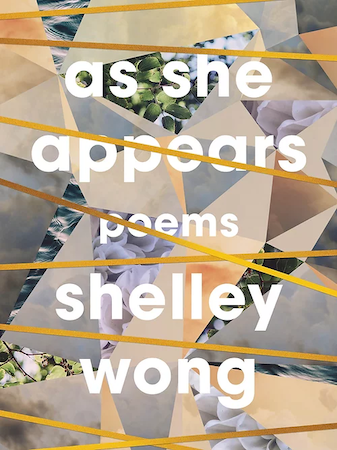
Writing my first poetry book As She Appears was a journey for me as a 41-year old debut poet—I was waiting to find poets like me, who were queer and Asian American. It was a careful writing over a decade, as I considered all of the ways that women—Asian American women, Chinese American women, queer women, and all of their intersections—are distorted and diminished. To come out on the other side, I sought to write about the ongoingness of being a queer women of color and arriving in love exactly as we are.
Today, I am building my own canon of queer women writers of color. The rigorous and inspiring work of these seven poets is a testament to the community of abundance we are living in, in conversation with our elders across the generations. Inventive free verse and hybrid forms, collections that combine layers of research, theory, and diasporic community are only some of the ways in which these poets are imagining into and considering our present, past, and possible futures. Throughout, the work is tender, transformatively joyful, declarative, collective. The work continues, and there is so much to celebrate and honor.
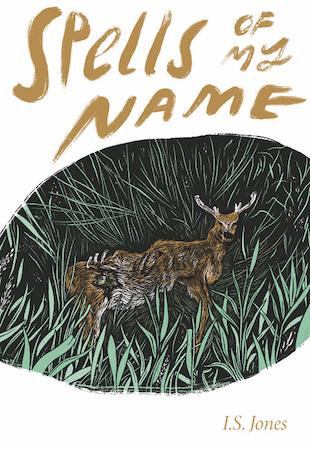
In this assured debut chapbook, speakers search and don’t settle for easy answers; instead, they take a long look, following the shadows and name what is found there. Jones writes about the complexities and clarities of identity as a Nigerian, an American, and as a queer person, using interview and self-portrait verse forms, reshaping the frame of inquiry. “Violence & hope made me an American” co-exists with erasures in the interview poems. This could be censorship, redaction, erasure, or disclosures that are part of a private knowing. Jones does not let any word pass without imaginative notice—a poem about misremembering esperanza to mean “wild horse woman” turns into “a thousand grandmothers/ galloping in the dark.”
Muriel Leung’s second collection is a seven-sided hybrid swarm, merging theory, cancer biology, history, autobiography, and essay into an expansive lyric of interrogative grief:
“Such myths we prepare for ourselves.
In a singular language—a cleansing.
That absence can feel like relief.”
Silences speak in staggered arrangement, the ellipses following like a trail of bees—perhaps signaling time, breathing, repetition, possibilities, omission. This is the swarm of several lives along with the ghosts. “I set out to write a book about [ ] but it was about [ ] instead.” Absences are presences; footnotes expand deeper into narrative, charting the speaker’s parents diagnoses with cancer and the disease’s cellular progression, while tracking the legacy of anti-Asian hate in America. Parallelisms swarm, the generational labor of living with trauma overwhelms, a migratory suffering. At the same time: the speaker kisses the flood, which kisses back. Vengeance is repair. The possibilities of the swarm: a building that “becomes true in its time.” Leung takes us there with “the clarity of bells.”
The electric poems of Paige Quiñones’ first book glow with heat, each taut line suspended and sharpened at its edge. Distinctions in desire—lust, aggression, pain, diversion—are less clear and often fleeting to its softer, tender side. Quiñones writes of desire’s contradictions in all of its mess, the speaker boldly declaring in the opening poem: “I am complicit.”
Throughout the collection, the speaker and her lovers shift and transform, animal to animal, between predator and prey. There is a fable-like haunting in these lyric narratives, often with italicized dialogue cutting through as a spectral threat. The intimacies shift as the poems travel from Puerto Rico to Southern California, to the quieter spaces of a hospital and a museum. Quiñones’ restless lyric compels as it unfurls:
“low howl in my belly
at the sight of you between my thighs.
The impossibility of the thing does not stop me demanding it.”
Reading Aricka Foreman’s debut is to fall into breath and breathlessness, as the lines flow and turn without stopping. She writes:
“When the station’s stuck between suffer
and c’est la vie, who in a body like this
can afford to believe in reincarnation.”
Emotions are conflicting, simultaneous. Everything permeates—there is no separation or relief. Foreman’s lineation, alignment, and spacing create different music with varying tempos depending on their arrangements, as well as unexpected visual and psychic experiences on the page. These lyric poems accumulate, naming violence and its generational harms, and the daily living with “language in limbo.” The speaker says:
“I try
to wrangle these roots respectable but
this morning keeps getting in my way.”
Desire, too, is a journey, and the slow burn of Foreman’s verse is a spellbinding intimacy of precision:
In this book-length work, Lauren Russell writes into the archive of family and history—what we cannot know, and what and who has been denied preservation: “Because history is neither the truth as it happened nor necessarily the truth we most want to believe.”
This complex, layered book came out of years of research. In 2013, Russell acquired the diary of her great-great-grandfather, Robert Wallace Hubert, a Confederate Army captain who fathered twenty children by three of his former slaves—one of which was Peggy Hubert, Russell’s great-great-grandmother. The result is a hybrid collection of voices, similar to a theater piece, intertwining poetry, prose, images, handwritten and typed documents, records, and fragments, overlaying past and present.
Russell’s contemplations are generative, expansive, letting the silences speak, imagining into the gaps, invoking Audre Lorde’s term “biomythography” to give Peggy a voice and a life on the page. Her excavation of her familial past is rigorous and skeptical:
“She has swallowed her voice like a seed. We want to believe that she is a heroine here, that she has some agency, that for once in her life she was given a choice.”
Russell’s sensory poetic precision and exhilarating intellectual curiosity invite a careful read as she dwells in the archive’s indeterminacy.
Through this debut collection, Thea Matthews enacts a vital resurrection, each poem a flower and a declaration on a journey of transformative healing. Matthews, a queer Black Indigenous Mexican poet, writes: “I am Evening Primrose/ I take responsibility for all that is mine,” a floral symbol of eternal love and beauty. Here, beauty coexists with surviving violence and both are brought out into the light, in anger and self-liberation:
“Protea remains
unfolds
dances with the flames chanting
Black and breathing Black and breathing Black and breathing.”
These poems bloom in their emotional depths and clarity, gathering in power and connectedness. The speaker’s body is rooted in the land, in community:
The intergalactic expanse of this collection is a marvel. Brenda Shaughnessy’s echoing (and orbiting) music and use of repetition amplify her enchanting narratives, which are made more disarming by their wit and play. Shaughnessy’s speaker invites the reader into their world as a chosen one:
“Did you receive my invitation?
It is not for everyone.”
And the poems are tender, too, addressing the speaker’s longing for more sisters, her misguided love for a woman at age 23, and most powerfully, the vision of Andromeda, an alternate world of ease for her young son in the book’s final long poem. In this poem that speaks to the enduring, transformative power of family love and a child’s (and a mother’s) imagination to bring us closer to being and knowing, she writes:
What does it mean to be displaced from your homeland? How are families broken and remade? When people lose everything, how do they find the will to survive?
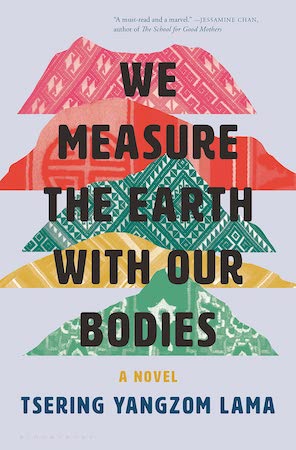
Both vast and intimate, Tsering Yangzom Lama’s riveting debut, We Measure the Earth with Our Bodies, begins with the Chinese invasion of Tibet in the 1950s, when sisters Lhamo and Tenkyi and their parents are embark on a perilous journey to reach Nepal. The novel tells the story of two generations of their family’s life in exile, seamlessly weaving urgent political and moral questions into the narratives of the sisters, Lhamo’s daughter Dolma, and Lhamo’s childhood friend Samphel.
I first met Tsering in 2009, when we were classmates at Columbia University’s MFA program in Fiction. Over the years, our friendship has included so many meals, pep talks, and reading each other’s drafts. As luck would have it, we’re publishing our first novels in the same year and deriving much joy from watching each other realize long-held dreams.
Tsering and I spoke via Zoom about why it’s important to understand the experiences of ordinary Tibetans in exile, the many effects of colonization, survival, resistance, and spirituality.
Jessamine Chan: I’d love to hear about your journey to this first book. What made this the story you wanted to tell?
Tsering Lama: In a way, it’s the story that’s always been there, being born into the exiled Tibetan community in Nepal. I came to Columbia right after having done a couple of years as a community organizer, having done activist work talking about the Tibetan struggle, and I was missing my art. Starting this book in the first semester of Columbia was a way for me to enter this space through a different lens, to get beyond the headlines and abstract understanding of this historical issue and struggle, and basically what colonialism, exile, dispossession from land means at a human level for ordinary Tibetan people, and for my family specifically.
My grandparents were nomads, my parents were refugees, and I’ve lived in Canada, the U.S., and Nepal. This is a huge change in just a few decades, from a nomadic lifestyle to living in in New York, trying to be a writer. I wanted to understand how that happened, what that’s done to us, and who we are as a result. Like a lot of people from immigrant refugee backgrounds, the past is not a space that people often want to go to. There’s a lot of pain there. I wanted to give myself space to explore the past and to research, imagine, and sit patiently, and try to figure out the story.
JC: Silence is often part of growing up in an Asian immigrant family. I was especially moved by your novel’s depiction of how trauma affects a person’s whole life, which you show through Tenkyi’s mental health struggles. Was this question regarding the unknowable past one of the animating forces for the book?
TL: When I would ask my mom or my late grandmother about their village or what it was like in the early days of exile, I’d get a few words here and there, like a little detail about losing all their yaks or what the landscape look like in their old house, but I wouldn’t get the whole thing.
The power of literature is to be able to enter other people’s consciousness and experiences. There’s nothing like that for my community. There’s a fetishization of Tibetan people which can feel positive because, in the West, Tibetans are thought of as peaceful and Buddhist, and that’s true, but that’s because we’ve cultivated a peaceful Buddhist stance and chosen to be nonviolent in our struggle. That doesn’t mean that that’s innately who we are. Like anybody else, dispossession, being stateless, and living like a refugee has profound mental health implications. Aside from all the work that Tibetan people have done in their Buddhist practice, there’s so much that’s unexplored.
I think a lot of Tibetans in exile feel the need to fight for the people inside Tibet, which is effectively a black box. That’s an additional layer of responsibility, something that we all believe in and want to struggle for because it’s so much worse for people inside.
Think about a group of people that have been essentially fighting alone against a major authoritarian state for decades, then add the fact that many are refugees, then add general trauma. I really wanted to get down to the level of individual Tibetan people, especially women, and talk about all the everyday struggles that don’t get discussed in the national struggle for liberation or freedom or human rights. Colonization and exile have many effects. It’s not just the political or the loss of the land. It’s also interpersonal relationships, including individual self-conception, how we see ourselves and our worth.
JC: How did you contend with writing for a Western audience and navigating the white gaze? That’s kind of baked into our daily life and something that I’ve certainly struggled with in my own writing.
TL: It would be a lie to say that it’s not been a struggle for me as well. Writing in English, living in a country where we’re not the dominant culture or dominant race, that’s part of the tension for every writer from a marginal background. I can’t write straight to Tibetans, for Tibetans in Tibet, because this book is banned before it’s ever published.
When a people who have almost no reason to believe that they’re going to succeed continues in their struggle, it’s because of faith, because we believe in our moral perspective.
At the same time, I do want to speak to the white western gaze without censoring them. There’s interest in Tibet, and a lot of it is well-meaning, but it’s not enough. I’m trying to reach those people and expand their awareness. To expand their imagination and their identification with Tibetan people and with refugees writ large.
Our struggle has not been taken seriously by the West or by a lot of countries. I’m not saying that a novel is going to make people take this issue more seriously, but I’m trying to get people to be immersed in the experience of this very specific struggle.
JC: There’s a scene where Dolma says the West is interested in our culture and our religion, but not our suffering. I thought it was so important that you wrote about the physicality of your characters’ suffering, including frostbite and starvation, and how the homes in the refugee camp are vulnerable to the elements, that people are living on one cup of rice a day, how starvation affects things we take for granted like your teeth and going through puberty and how tall you’re going to grow. Was that part of your initial concept for the book or did it develop along the way?
TL: It developed along the way as my research became fuller and I was reading documents from aid organizations about the refugee settlements. I was finding images online of refugee camps in the 1970s and so that developed as I learned more. Because that’s not been the focus. Our suffering in exile hasn’t been the focus because we’re so concerned with the suffering of Tibetans in Tibet.
I think it’s important to focus on the body, on the physicality, because it tells the very specific story of what it’s like to move across the Earth as people who lose everything. That’s happening right now to four million Ukrainians. That’s been happening to people for thousands of years. It’s happening in Yemen.
I wanted to get beyond that nation-level political understanding of occupation and war and talk about what it’s like for ordinary people. When I could get into that level of detail, that’s how I could also begin to understand how people survived. If you lose everything, you can’t survive unless you have resistance, unless you have that spirit. And that’s coming from people’s bodies, from people’s connections with each other. It’s not coming from the government or military power. It was important for me to show that struggle in order to highlight the resilience and the resistance, to show just how inspiring people were, and continue to be, who face these kinds of deprivations.
JC: One element of your book that really impressed me was the novel’s scale. You cover 50 years of time, but you’re also writing about eternity. Can you talk about the role of faith and religion in the book?
TL: Trying to write a novel about Tibetan characters without touching on our spirituality would be an incomplete project. This is a story about colonization and all of the complex and myriad effects of that violence, not just in terms of loss of land, but also spiritually, culturally, interpersonally, and at an individual level. A land is not just soil and or Earth, it’s also all the things that people imbue that soil with. All the meaning. That’s a spiritual thing for my community. This [idea] is thousands of years old, even before Buddhism came to Tibet 1200 years ago. We believe that there are gods in the land, in the water, in the mountains, specific gods that watch over different communities.
On the one hand, it’s nice to have some Western appreciation for Tibetan culture. On the other hand, it’s painful to see how Tibetan culture has been decoupled from Tibetan people.
When people are forced off that land or have to flee, it’s not just their home that they leave. They leave those gods. They leave that protection. Coming to a non-Tibetan space of exile, there really isn’t a place where our metaphysics or beliefs or ways of doing or seeing or being make sense innately. We have to learn other languages. We have to understand other ways of looking at the world. I wanted that violence to be captured in this story, because that’s a spiritual violence.
At the same time, that spirituality is the source of our resistance. Tibetan monks and nuns are at the forefront of resisting the ongoing subjugation of Tibetans. They’re often at the forefront of protests. When a people who have almost no reason to believe that they’re going to succeed continues in their struggle, I think it’s because of faith, because we believe in our moral perspective.
In terms of the mythic scale, it wasn’t the original intent. I thought I would just write a simple story about refugees, but as I got engaged with my research and learned about the oracular tradition in Tibet and the tradition of hiding texts in the land, I saw the mythic scale of Tibetan thought and Tibetan civilization. I had to bring that in because it’s something that I had been cut off from because I always went to Western schools. And of course, I haven’t been to Tibet per se, except for 15 minutes on the border. So I wanted to study that. I felt my characters demanded that.
JC: Can you talk about those 15 minutes.
Colonization and exile has many effects. It’s not just the political or the loss of the land. It’s also individual self-conception, how we see ourselves and our worth.
TL: In the very early years of writing this novel, I decided to make that journey. I trekked to the border of Nepal and Tibet. That’s a landscape that I really needed to know myself because that’s also the pathway that my parents and grandparents took, that a lot of Tibetans have taken over the years to flee. That land is also an ancient passageway for Tibetans to conduct trade. It’s been cut off because of the occupation. There’s a chain link fence and lots of guards. Honestly, I couldn’t even get into Hong Kong, so I had very little hope for going to Tibet.
There are a lot of Tibetans who can’t even make that trek because it’s dangerous. It’s hard on the body and it requires resources. I thought, why not give myself that? And why not give readers that? As a writer living outside of Tibet and not being able to go there, I can’t very easily access my research. If you’re an American writer who’s lived in the U.S. for generations, you have a wealth of knowledge to draw from. If you’re an immigrant, you don’t necessarily have that.
JC: How did you want your book to push back against Western ideas about Tibet?
TL: On the one hand, it’s nice to have some Western appreciation for Tibetan culture. On the other hand, it’s painful to see how Tibetan culture has been decoupled from Tibetan people. There’s a way in which Tibetan culture can be excised from the struggle of Tibetan people and put in a museum, without regard to where it all that came from, and how that’s all been being threatened. Tibetan culture is still threatened in Tibet.
I wanted people in the West to understand that in the chain of power, the Chinese government has the most power, Westerners have less, but Tibetans have the least. Tibetans can’t move freely. You need to get a permit to move from one area to another, and that’s very difficult to get, especially in more politically active spaces. Tibetans who want to go on a pilgrimage to Lhasa, the capital, need a permit. For Tibetans in exile, it’s very, very hard to get to that. And that’s by design. It’s important to acknowledge and understand those power dynamics.
JC: One of the most surprising elements of the book to me was the role of commerce. For example, you have a Canadian art collector who’s obsessed with otherness, and there are questions regarding where museum relics actually come from. Why was that that particular thread of the story important for you?
TL: I think commerce is a major reason for why the West and China have had such a strong relationship for the last several decades and why China has risen to superpower status. That’s impacted ordinary Tibetan people, Westerners, even Chinese people who want to resist a state that is deeply oppressive. The West can’t simply have feel-good notions about Tibetan culture. It has to examine the Western role. One aspect of that is in scholarship or in material culture like art, in feeling that this is a thing that can be owned, this is a thing that can be taken away. That’s a form of colonization, too.
There’s a line in my novel that says colonization doesn’t just happen in Tibet. It extends into academia and the art trade. It extends into so many spaces and requires a reflection on the ways in which all of us continue to turn a blind eye. I think it’s just another phase of the ongoing colonization of Tibet.
A lot of people don’t have a life fulfilling their personal desires. History is often very cruel to a lot of people who don’t get to fulfill their potential, no matter how brilliant.
In more recent years, this has become a topic for a lot of countries, including China, regarding the repatriation of stolen objects. That’s part of the project of empires—to loot and steal from the nations that they take over. For Tibetans, we’ve had things stolen, not just by the Chinese government, but also by the British. In more recent years through the antiques trade, our heritage has ended up all over the world. I wanted to talk about that and question the idea of what it is that people find beautiful about Tibetan culture when it’s a kind of blindness. They can look at an object by itself and not think about that object’s story or meaning to a community.
A lot of the objects that are taken from Tibet are spiritual objects. They’re religiously significant because a lot of Tibetan art is religious. You can take something and put it in a museum, but that’s a deity. That’s something that is also part of the enormous web of consequences of colonization and exile and displacement.
JC: You write about the dreams that Lhamo and Tenkyi have, their yearning for freedom and choices and education. Lhamo didn’t want to be stuck making tourist trinkets. Tenkyi was a teacher, but ends up a maid in Canada. There’s a line that that really resonated with me where Tenkyi says her work makes other lives possible.
TL: A lot of people don’t have a life fulfilling their personal desires. What I’m doing is fulfilling my dream to be a writer. That’s not a possibility for a lot of people. It might be a possibility for their child or their child’s child if things go well. I was recognizing that basic truth, which is that history is often very cruel to a lot of people who don’t get to fulfill their potential, no matter how brilliant.
In a sense, Tenkyi’s journey is the most heartbreaking, because there’s so much potential, yet the conditions of her existence make it so hard for her to accomplish the things that she could accomplish in a different life. But her life has meaning because she’s still fighting for her family, for her niece and sister and uncle, and that’s very noble and meaningful.
A big topic of my book is actually how families are broken and remade in exile because of the violence of leaving your homeland. People die along the way. For most of the characters in my story, they lose people in their families. But they remake families as well, in the camps. Wherever they go, they find new families and that’s how they survive. Yes, it’s very hard, but in another sense, it’s joyous because it gives us focus beyond our individual selves. And that can be a salve against the loneliness that a lot of people experience, or against a sense of meaninglessness that we can often feel in this really difficult world. Having other people to fight for, having other people to take care of, is a source of meaning for my characters.
One section of Hieronymus Bosch’s massive triptych, The Garden of Earthly Delights, depicts a hellish chorus singing a song painted on the buttocks of a sinner. -io9

i.

Of course Jesus is there in the garden already looking into the distance at what comes next while he holds, not your hand, but the wrist above, & you look down, trying not to display your boredom, how you’re already tired of the man who sits on his ass all day waiting for the cat to bring him a creature from the pond dreck to roast & eat. He’s looking right at Jesus while you must avert your eyes, grow your hair long & pretend you are happy to be the last in line. You won’t last long despite your best efforts. Seeing the pond from the corner of one eye you can’t wait to muck it all up – massage your body with mud, stain your pale lips with fruit & desire.


ii.

Tips for relieving boredom: Stay naked. Eat a cherry from a bird’s mouth. Cut your hair short. Ride a peach like a boat & sleep in a clam’s shell. Let a bird go. Hug an owl & stand on your head while wearing a strawberry for a dress. Hold a fish like a baby. Poop out a bouquet. Play all day & turn your skin dark with sun & distraction. Let him touch your naked hip, dip you into the clear blue lake & swim like it will never end.


iii.

Now there’s no sign of Jesus & his pink dress, just a city with all its excess, steel & arrows, the avocado lute & machines that don’t make sense. Be careful little eyes, be careful little ears, Jesus has given up on us. The light no longer comes from the sun & our leaders are cannibalistic fish, use our heads as coffee table books, our bodies for their animal lusts. The song you have written on your ass might be our last chance – the last thing the man strung up on the harp will hear as the knife slides between his ears. & this is our one consolation: at least the scene is intriguing this time. Of the usual smooth grass, the perfectly curved neck of the giraffe & Adam’s shapely rib & thigh there’s no sign. This is what you wanted, finally: the chaos. Freedom. The right & the wrong all in one song.
I had a friend—we’ll call her Kinsley—who was as close to me as a sister for nearly 20 years. As we grew older, our values began to differ, but we both agreed that no difference was profound enough to break our friendship. Kinsley married a man she met on a religious website, sending me a text after one month of long-distance dating that read, “This is Christian [not his real name]! We have decided we are in love and getting married!” The following year she began expressing frustration over their inability to conceive naturally; she was ethically opposed to IVF. I was casually dating in New York and contemplating freezing my eggs.
Then, after 17 years of friendship, Kinsley abruptly ghosted me. The experience left me thinking about relationships that break under the strain of womanhood in all its conflicting forms. I have no doubt that for Kinsley and me, the looming pressures surrounding fertility (and our differing perspectives on motherhood, sex, and reproduction) accelerated our falling out. In her eyes, I was misguided (her word)—a black sheep among women. The last time I felt close to Kinsley was roughly seven years ago at a music festival. There was a torrential downpour and we huddled under a tarp, sharing poutine and drinking beer. When we were in line for poutine round two, we playfully debated the morality of birth control (insofar as that conversation can be playful). Even then, the chasm was widening.
For Maeve, the protagonist in my debut horror novel, Just Like Mother, there’s no fitting in. As a young girl raised in a matriarchal cult that reduces men to chattel for breeding, her misplaced affection for a male relative results in tragedy. As an adult, she cobbles together a flimsy existence that appears normal from the outside but conceals her profound loneliness and inability to connect. When her long-lost cousin—the one person who truly understood her in childhood—reappears in her life, Maeve is thrilled to let her back in, stubbornly ignoring every red flag in favor of the emotional intimacy she craves. Andrea offers Maeve everything she lacks: acceptance, stability, and belonging. But Andrea’s love comes with its own set of conditions; and when Maeve falls short of familial expectations for a second time, she faces brutal consequences.
The following is a list of books about characters like Maeve, who are unable to be the type of women their communities expect them to be.
The Perfect Nanny put Leila Slimani on my radar, but Adèle cemented my devotion to her work. The titular character has, by all accounts, an enviable existence: one she is proud of and in theory, committed to. She has a successful career and a loving family. Some might even consider her life the feminine ideal. But Adèle finds herself plagued by overwhelming dissatisfaction; and because of it, she is emotionally isolated. Her efforts to correct her profound loneliness through illicit sexual only enable the downward spiral. Through her discomfiting descriptions of Adèle’sexploits, Slimani makes it clear that Adèle is a woman who desperately wants to want the life she has, but can’t.
Disquiet by Julia Leigh
Olivia is reunited with her brother Marcus and his wife Sophie after she leaves her abusive marriage and brings her two children to the family chateau. But all is not well with Marcus and Sophie, who can’t bear to part with the corpse of their infant daughter. This gothic novella kept me riveted with its nuanced portrayal of dysfunctional family dynamics and motherhood. Anyone who has ever gone home for the holidays and experienced the gloomy push-pull of what remains unsaid will recognize their own in this unsettling story. Julia Leigh is skilled at emotional brinksmanship, sustaining nerve-shredding atmospheric tension through to the end.
Keiko, a woman working at a convenience store in Tokyo, best understands how to function “normally” within the framework of her job at Smile Mart, where social interactions can be learned by studying a manual. Keiko flourishes at the store and achieves a level of contentment she hasn’t experienced elsewhere; but as she approaches middle age, her lack of ambition and marital status (single, uncoupled) become an increasing affront to her meddling family and coworkers. Keiko contorts herself into a desperate emotional pretzel in an effort to appease her loved ones. The resulting decision is comically aligned with her personality—an unusual arrangement that makes her even more of an aberration, at least by the standards of people who care about such things.
Hisako, the daughter of a local physician, is the only survivor of a birthday party turned foul when more than a dozen people die from cyanide poisoning. Hisako is blind and is unable to provide much to the police by way of details about the horrific event. When the main suspect commits suicide, the town is left with questions; and a decade later, all roads seem to lead to Hisako. The story unfolds through various characters’ testimonies. While the ending is somewhat inconclusive and the motives feel a tad thin, this is nevertheless an exciting mystery and fascinating character study. (And the cover is amazing.)
This novel left a profound impression on me when I first read it five or six years ago. Magda, an educated and privileged writer, develops a complicated and potentially co-dependent friendship with Emerence, her illiterate, cranky housekeeper. Emerence charmed me with her hard-won love, and the emotional restraint of this novel makes the eventual revelation more devastating.
Emerence’s house is closed to outsiders. She alone is allowed to enter. What lies behind her door? It’s difficult to discuss this character-driven plot without spoiling it; but this is a novel you’ll want to read twice, and Emerence is one of the more complex, interesting characters I’ve had the pleasure of reading.
Yeong-hye enjoys a quiet, structured life with her husband until she refuses to eat meat, a consequence of her violent nightmares. The decision is an act of unacceptable rebellion, according to her husband and in-laws. What results is domestic horror: a perverse fight for control that becomes more and more extreme as Yeong-hye stubbornly asserts herself. To be honest, I read this one quite a while ago and remember the details as a fever dream, but I loved this uniquely grotesque take on feminine power and the violence that occurs when a woman fails to fall in line.
In Chemistry,we meet another woman with a life that is by all accounts rewarding, yet fails to deliver happiness. The novel’s narrator is working toward her PhD in chemistry—a goal foisted on her by her parents—and her perfectly lovely boyfriend has proposed. But she’s mired in ambivalence about her career and relationship and struggles to untangle her own wants from the wants foisted on her. As the story develops, the narrator reveals aspects of her childhood that led to her present state of indecision. This is a moving, character-driven illustration of what happens when the presence of others looms so large that there’s no room left to develop your own identity.
“I Took My First Date to the Black Lives Matter Protest”—Refinery 29
“I Spent 35 Years Trying To Convince the World (And Myself) That I’m White”—Huffington Post
“I’m Moving My Family to Canada to Save My Black Son from America”—Cosmopolitan
These are all real essay titles, and they’re also the types of writing it’s easiest for a marginalized writer to pitch, place, and publish. In fact, it sometimes ends up being the only type of writing we’re able to publish. Essays about my race, culture, and chronic illness are accepted as often as my pitches on technology, productivity, and the environment are rejected. It sometimes feels as though there is only one thing I am fit to write about—pain—and as Tajja Isen explains, in the process of writing about pain, “you might find more taken from you than you were willing to give.”
By now, Laura Bennett’s concept of “the first person industrial complex” is well-known and much-discussed, but Isen excavates its nuances much further. She writes of the above essay titles (the title being a decision that typically lies with the editor, not the writer) and their ilk: “There’s an anthropological curiosity in their framing…The only ones who need dispatches about what it’s like to live in a certain body in the age of Black Lives Matter are white people.”
In other words, the reason racialized writers are called upon time and again to write about our “identity” is because the intended audience is always already assumed to be white—an identity so normalized that it’s rarely considered to be one, except in the form of a quick privilege disclaimer; a brief moment of lip service.
In Isen’s debut Some of My Best Friends: Essays on Lip Service, personal essays are only the tip of the iceberg. Her expansive, deeply-researched text explores everything from the burden of being a “diversity hire” to how legal language propagates the myth of “neutrality” to the pitfalls of “authentic representation.”
Isen writes: “If it’s hard to express something true in language that’s been emptied of value, the flip side is that it’s easier than ever to say something while meaning nothing.” In an era of Instagram black squares, the proliferation of Ukrainian flag emojis in bios, and words like “intersectional” and “decolonization” being co-opted by brands, Some of My Best Friends considers the fault-lines of language, action and power, which are also the fault-lines of our world.
Richa Kaul Padte:In a chapter on the law, you talk about “the violence of neutrality,” which is not dissimilar to an idea I was trained in as a young anti-fascist campaigner: there is no neutrality without complicity. “Neutral” assumes a baseline is possible, a universality that exists before positionality. Elsewhere in the book, you discuss the rise of “relatability”, asking the question: relatable to whom? Do neutrality and relatability thus function in similar ways?
Tajja Issen: I suppose they’re similar in the sense that each performs its own kind of flattening, though I think what each thing aims to flatten is very different. With the way that neutrality operates, as I tried to describe it in the law, the goal is to flatten the realities of circumstance and lived experience to conform to a certain standard. The law, as in the rule of it, is not especially interested in particularity. With relatability, the mechanic feels different to me—only a single subset of voices, stories, and perspectives are allowed admission at all. In the book, I also use the terms in very different contexts—neutrality in the legal field, and relatability in the cultural and literary spheres. With relatability, you can ape the tropes if you want to barter your way in. Neutrality will just shear off whatever it needs to in order to make the thing fit.
RKP:Sakina Jaffrey’s term “patank” refers to the “‘the broad Indian accent’ South Asian actors get asked to do.” It’s also, I realize on reading this, what “a certain kind of listener” actuallythinks the Indian accent sounds like. I wonder if this is further complicated, though, by the fact that actors being cast as Indians on-screen are not, in fact, Indian. Dev Patel does not have an Indian accent in Slumdog Millionaire, neither does Simone Ashley in Bridgerton (by comparison, Kunal Nayyar, who grew up in India, is fantastic in The Big Bang Theory).
If the question of authenticity requires, as you point out, a reconfiguration at all levels—producers, directors, writers’ rooms—shouldn’t this include people who actually belong to the geographic locations in question? It seems like this often gets left out of diversity conversations in the West, but is felt deeply by the rest.
TI: Certainly if authenticity is the goal of a project, geographic accuracy feels like a key part of that, and I agree with you that the West tends to flatten that part of the conversation. My goal with that essay on cartoons, though, was really to trouble the idea of authenticity altogether. I think that well-intentioned people who are aware that their project, or workplace, or masthead, or whatever, has an equity problem—and are really keen to solve that equity problem—can get really fixated on the idea of what authentic looks like or sounds like. Because there’s no one answer, right? Authenticity is a worthy goal, but the problems start when it gets treated as a skeleton key to solving every single problem of equity. What I’ve seen and experienced, especially in spaces like the entertainment industry, is that the pursuit of authenticity can end up calcifying into this restrictive standard that winds up doing the exact opposite of what it was meant to do in the first place. The thirst for a certain kind of representation can too easily turn into caricature. We want to do right by marginalized voices can turn into marginalized voices must sound like x or y. The desire to get it right is well-meaning, but like a lot of the other gestures I explore in the book, it can easily slip into a kind of quick fix that’s really not a fix at all.
RKP: You write about the burden of diversity work, of being the only person of a certain marginalization in the room. Being this person often entails “an honest desire to make things better, [only to] be told to rinse scum from dark corners management obviously hadn’t thought to clean in years.” This work is exhausting and individualizes a systemic problem, but there’s also a deeper issue at work here. You write: “To demand better means better is something an institution is capable of, or deserves our help in becoming. But what if the rot goes all the way down?”
Where do we go from here?
It’s useful to be aware of, and even explicit about, the way our subject position influences our access to power and the way power acts upon us. It’s an important part of coalition-building, of listening, of real change.
TI: Where indeed! I think that, if you’re the only person of a certain background in a majority-white space, it’s so easy to get caught up in the idea that it’s your job to make an institution better. At one time in my life, it was very easy for me to get caught up in that idea, and a lot of free labor was wrung out of me because of it. But I think that believing you’re responsible for bettering a workplace or institution—in addition to being an unfair and untenable project—is simply the wrong goal. To me, that kind of framing feels much more oriented toward optics than action. I think a much worthier project is, as Toni Morrison puts it, getting someone else in the room with you. That’s what I consider my goal, my duty, even, when I enter a professional or creative space. This is, technically, a form of institutional improvement. But that subtle shift in focus, from buffing up corporate shine to actually, materially changing the circumstances of the people who’ve been systemically shut out of it—that’s a world of change, to me, and that’s where I think more efforts need to be concentrated. Stop panicking about how you look and just do the thing—and accept that the thing will take time.
RKP: Something I often think about is how the online sphere has given rise to a sense that saying something political is in and of itself an action towards addressing injustice. I’m not advocating for silence, of course, but I’m no longer sure that endless words are contributing to change (a troubling idea as a writer, I suppose). In 1935, Walter Benjamin wrote: “Fascism sees its salvation in giving…masses not their right, but instead a chance to express themselves.” How does this relate to Sara Ahmed’s concept of the “nonperformative speech act,” which you explore so wonderfully in one of my favorite sections of the book?
TI: I’m totally with you, and that’s a point that I keep coming back to in the book—the easy, harmful conflation of speech with action. It’s become easier than ever to say something while meaning, or intending to do, nothing. That makes separating out something like the nonperformative speech act incredibly important, and that’s very much a part of the work that I hope the book does: articulating a pattern that readers have likely noticed in their own lives and worlds and giving them a framework for it. We’ve become so good at spotting these instances of infelicitous speech. When they happen, there’s a distinct sense of wrongness, of what the fuck. Corporations shouldn’t be able to speak, to address us in this way. But the language of social justice circulates so freely that it’s effectively become anyone’s game. This is also why we’ve seen institutions that ostensibly have nothing to do with social justice—like banks or the CIA—spouting the language of inclusion like it’s going out of style. That split between speech and action, which both the Ahmed term and the Benjamin quotes express so deftly, is a murky space in which all sorts of dodgy things can happen. That’s the space I wanted to delve into and muck around in with this book.
RKP: There’s a “line white women walk between privilege and disadvantage,” and you give examples ranging from Lena Dunham’s Girls to pretty much all of Lana Del Ray’s music. You write: “[T]hese creators, having flushed the less convenient forms of marginality from their presence, then exaggerate their own weakness as evidence of their work’s political gravity.” Without having to account for the systemic violence of racism, transphobia or ableism, such works stake a claim to gendered marginalization, while ignoring oppressions that render other women’s pain less prettily packageable. Could you talk a bit about this, including how the supposedly political position of “radical softness” comes into play?
It’s become easier than ever to say something while meaning, or intending to do, nothing.
TI: That argument, from the book’s title essay, is very much in conversation with recent critiques of white femininity by authors like Rafia Zakaria, Koa Beck, and Ruby Hamad. For my part, I wanted to look at how that move—of having access to the structural power of whiteness but being marginalized by virtue of their gender—can lead to certain patterns in art and culture. As I discuss in the book, that tension has come to drive, if not define, so many of the big cultural movements of the last few decades, in genres that span from the ’90s rom-com to the early personal essay. But in trying to account for that tension, something weird tends to happen. In texts like Girls and Del Rey and the films of Nancy Meyers, to take just a few examples, you can see a pattern where white women are often claiming not just their vulnerability, but the fact that they are more vulnerable than anyone else, or whomever is in their immediate vicinity (which is usually just more white women, otherwise that claim falls apart pretty quickly). It can become a weird kind of self-pleasuring hyperbole. Girls has a scene in which two white women are shouting across an apartment about which one of them is truly a “big, ugly wound,” and there’s an obvious kind of glee in it. Something’s Gotta Give has two rich white women talking about how single older women are, “as a demographic, as fucked a group as can ever exist.” As can ever exist? Really? You couldn’t just settle for “fucked,” like the rest of us?
RKP: You write: “Privilege disclaimers are like magic tricks. They can turn complex, awkward material realities—generational wealth, whiteness, the ability to pass within a certain social category—into words, dispensed with as easily as breath.” This is something I think about a lot as an upper caste woman living in India: is the declaration of my caste location a way to demonstrate that I did not get to where I am via India’s favorite falsehood (meritocracy), or is it lip service that allows me to carry on as I was before, i.e. perpetuating caste oppression while reaping the social cache of self-awareness? I, of course, want it to be read as the former, but are privilege disclaimers so inherently messed up that they always lead to a variation of the latter?
TI: I think that, as with anything, especially a statement of your principles, it depends on how you use it. If someone’s trying to use a privilege disclaimer to totally excuse themselves of all wrongdoing or responsibility, like it’s some kind of opt-out clause or waiver, then yeah, that’s always going to be a kind of lip service. But of course it’s useful to be aware of, and depending on the situation even explicit about, the way our subject position influences our access to power and the way power acts upon us. It’s an important part of coalition-building, of listening, of real change.
As a Mexican American, I’ve learned to expect hauntings. That shouldn’t surprise most. The iconography of the Day of the Dead has become well disseminated in American popular culture, from Coco to Halloween face paint to calaveras on sale at Target. For the uninitiated: over two days at the beginning of November, those who celebrate Día de los Muertos welcome spirits of departed loved ones into their homes with ofrendas, altars with photos and offerings of food and mementos. We take time out of our lives to sit with the memories and sometimes presences of family members who have passed on.
But the more I reflect on it, the more I believe that living alongside ghosts is a part of the reality of being Latinx in the United States. Burdened by the so-classic-it’s-cheesy ni de aquí, ni de allá, are we not haunted by the versions of ourselves that we think we should be, the doppelgängers who are American enough, the imaginary doubles who speak better Spanish than us? Likewise, our families are haunted by the sacrifices, traumas, and griefs caused by migration to and life in the United States. Often, these are too heavy to be spoken aloud; they are handed down from one generation to the next like the names that pass through our families, ghostly, silent heirlooms that permeate everything we do.
These hauntings are metaphorical. Others less so. My debut novel The Hacienda imagines the scars left by colonialism as an actual supernatural presence with a bone to pick with the living. When Beatriz’s new husband leaves her at his family’s country estate, Hacienda San Isidro, she is determined to make a home for herself there. At first bemused by the strange behavior of those who live on the property, the sinister darkness of the house after nightfall convinces Beatriz that it is haunted and drives her to seek help from a local priest, Padre Andrés. Like the malicious spirits Beatriz and Padre Andrés face in The Hacienda’s pages, the hauntings that populate the following works are quite tangible. They run the genre gamut from long-buried classics with hauntings-as-political-commentary, to contemporary YA fantasy, to a stiff draught of horror to finish.
“I came to Comala because I had been told that my father, a man named Pedro Páramo, lived there” is as classic a line as “Last night I dreamt I went to Manderley again,” but rare is it that the North American reader has encountered Mexican author Juan Rulfo’s slim opus. When narrator Juan Preciado’s mother dies, he promises her to go to Comala and seek out his father, whom he has never met. Upon setting foot in Comala, however, he discovers that all of the rural town’s inhabitants, from his guide to his hosts—all old friends of his mother or enemies of his father—are dead. Comala is, quite literally, a ghost town. And as Juan Preciado travels deeper into Comala uncovering his father’s past, the town might not let him back out alive. Told in fragments that jump between different plots and narrators, the very structure of this novel lends itself to a haunting, disorienting read.
One of the best known Mexican writers of the Latin American Boom, Carlos Fuentes utilizes magical realism and doppelgängers as he grapples with postcolonial identity in Aura. Narrator Felipe Montero, a young unemployed historian, is hired by an old widow named Conseulo Llorente to edit and publish the memoirs of her late husband, who was a general of the deposed emperor Maximilian I of Mexico. This work requires Felipe to live in Consuelo’s old, crumbling house in Mexico City. Though initially reluctant to do so, Felipe’s attitude changes as he becomes increasingly infatuated with Consuelo’s niece, the hauntingly beautiful Aura. He slowly loses his sense of time and identity as he edits the dead general’s memoirs and in his obsession with Aura, with whom he begins a secret nocturnal affair. Prepare yourself for a gut-wrenching twist at the end of this brief novel, but I implore you to go in spoiler-free for maximum shock value.
“House Taken Over” by Julio Cortázar
Most Anglophone readers know Argentinian writer Julio Cortázar for his short story “Axolotl” or his fragmented novel Hopscotch, but few are familiar with the utterly haunting 1946 short story “House Taken Over” (“Casa Tomada”) from the collection Bestiary. A brother and sister live in an enormous house that becomes taken over by a threatening haunting, slowly forcing them to retreat into smaller and smaller spaces in the house. Cortázar imbues his spare prose with tension and dread; though the antagonist of the story is never heard nor seen, you cannot help but share in the narrator’s claustrophobic terror as it draws closer and closer. At the time the story was published (and for many years after), this brief, disturbing story was read as a political text with incisive commentary on the Peronist regime.
In the YA contemporary fantasy Cemetery Boys, Yadriel, a 16-year-old trans boy is determined to prove his gender to his traditional family. To accomplish this, he performs a ritual that only brujos, male witches, are capable of: summoning ghosts. Though Yadriel meant to summon his murdered cousin, the ghost he is stuck with is none other than his school’s recently-deceased bad boy, Julian Diaz, who refuses to be gotten rid of until he finds out what happened to him. Yadriel agrees to help him so that he can get the acceptance he craves and Julian can find closure, but the longer they spend together, the less Yadriel wants Julian to leave. Part murder mystery, part queer romance, the ghost boyfriend trope of Cemetery Boys is close to my heart, but it is the themes of family acceptance—and how complicated that can sometimes be—that make this novel a modern classic.
I’ve learned that not all ghosts mean ill. Some just want to spend a little time with you. Some, like in J.C. Cervantes’s lighthearted but touching YA contemporary fantasy Flirting with Fate, linger because they have urgent messages they need to pass on. When a flash flood and a fender bender with a strange boy prevent teenage Ava Granados from reaching her beloved grandmother’s deathbed, she forfeits the precious heirloom of their family by mere minutes: a magical blessing passed from woman to woman upon death for generations. Days later, apparitions begin appearing to Ava. Her grandmother’s ghost and the ghost of a medieval saint bear the news that the blessing that should have belonged to Ava was accidentally bestowed upon someone else. With the help of these ghosts and her two sisters, Ava goes on a quest to track down the boy who bears her blessing and somehow get back her grandmother’s last gift.
Though well-known in Latin America, internationally bestselling Argentinian writer Mariana Enríquez burst onto the Anglophone horror scene with the 2017 translation of her collection Las cosas que perdimos en el fuego. Here is where my recommendations take a sharp tonal shift: these macabre stories feature settings in which horrific inequality, violence, corruption, and the vanished desaparecidos of the military dictatorship and its dirty war loom large. Not for the faint of heart, these stories tip their hats to Shirley Jackson and Julio Cortázar as they study brilliantly-realized human characters in horrifying situations, such as one in which a group of women set themselves on fire to protest a viral form of domestic violence. My favorite of these—and the reason this collection is on this list—is “Adela’s House,” in which Adela, a spoiled, one-armed girl, is jeered into visiting the neighborhood haunted house, an abandoned, bricked up monstrosity that turns out to be even more horrific on the inside than it appears on the outside.
Whenever someone tells me they loved Mexican Gothic, I always point them toward this lesser-known work of Silvia Moreno-Garcia. I first encountered her work through her short stories, and while I am as much of a fan of her novels as the next fangirl, I believe her unique voice shines brightest in the brief, intense stories of This Strange Way of Dying. The theme of being haunted—or hunted—runs through this collection, which features hauntings by shape-shifting, stalking nahuales, vampires you just can’t shake, döppelgangers, and even Death himself. Moreno-Garcia’s prose is deft, spare but vivid, and nothing short of masterful in its economy as it moves effortlessly from genre to genre. The evocative imagery of gleaming beetles and clicking scorpions will stay with you for years after you shut the cover.
Billed as taking inspiration from The Craft, V. Castro’s Goddess of Filth opens with a stone-cold classic horror setting: the seance gone wrong. As four female best friends, including Lourdes and Fernanda, become increasingly tipsy, they lose control of what they are summoning, and their laughter dies when Fernanda begins chanting in Nahuatl and crawling toward the other three. In the weeks that follow, Lourdes notices that formerly modest Fernanda smears her face with black makeup, shreds her hands on thorns, and sucks sins out of the mouths of the guilty. She has been possessed by the spirit of an Aztec goddess. Determined to save Fernanda from the increasingly predatory attentions of a self-righteous priest as well as possession, Lourdes enlists the help of her friends and a professor to understand what is happening. While still bearing the trappings of deliciously pulp horror, Lourdes’s journey to help Fernanda enables her to reconnect with her identity and heritage in a uniquely feminist and empowering anti-colonial way.
When I started reading Chloe Caldwell’s new book, The Red Zone, a memoir about identity, love, health, and pain, all told through the lens of her relationship to her period, I didn’t think I had period hang-ups of my own to work through. I do have pudendal neuralgia, a nerve pain condition that I’ll get into more later. It doesn’t have anything to do with my period. But the treatment, in part, involves a pelvic therapist getting very up close and personal with everything going on down there, an experience that’s made me comfortable discussing—and sharing—my vagina.
Plus, I’m a 32-year-old woman with a tote bag that supports Planned Parenthood and a boyfriend I regularly send to the store for tampons, facts I assumed meant I was a well-adjusted human who’s not here for society’s period-shaming BS.
Which is all to say, when it comes to something as normal as my period, I thought: How could I have shame about that?
… Until I got my period while reading Caldwell’s book. Normally, that wouldn’t matter, but this time it was important because my boyfriend’s friend was staying with us for the week. And since I didn’t know if it’d be weird for me or uncomfortable for the friend if he noticed my tampon wrappers in the trash can, I decided to really bury them. But when you’re deep-diving through trash to hide the wrapper of a thing used by thousands of people every day, you have to wonder: Is this, maybe, a sign of shame?
From there, forgotten period stories from my life came back to me:
Like the time in high school when a girl who boys seemed to like better than me said that pads were gross because, “I mean, you’re just sitting in it. Ew.” And apparently I agreed that sitting in period blood was gross because I’ve been a tampons-only girl ever since. Shame. Or all the times growing up we pretended we had cramps to get out of gym or a test or swim practice, knowing the adult in the room would be too embarrassed to question us further. Shame. Because it had felt like we were using period stigma to our advantage. And maybe we were. But weren’t we also sort of reinforcing that stigma? And what about the fact that I’d never use my period as an excuse to get out of anything now? No matter how bad my cramps actually are, I just get up and get on with it because, I guess, I don’t think anyone really wants to hear about my period.
Nothing says deeply entrenched shame like the kind you’ve been conditioned to accept for so long that you don’t recognize it by its name. Because yes, of course, all of that is a kind of shame. But the way to deal with shame is to call it out, to normalize the experiences we’re embarrassed by or afraid of. Naming it helps us realize how stupid it is to hide tampon wrappers in our own trash. The way to deal with shame is to share our stories.
The way to deal with shame is to call it out, to normalize the experiences we’re embarrassed by or afraid of.
That’s exactly what Caldwell does for periods in The Red Zone. From bleeding on her boyfriend’s sheets to real talk about blood clots to sometimes hating her period unapologetically, she tells honest, shame-free stories about learning from, suffering through, and simply having a period. And in doing so, Caldwell gives readers the period story we deserve.
Caldwell’s book is specifically about her life with premenstrual dysphoric disorder, or PMDD, an extreme form of PMS that affects approximately 5.5% of women and AFAB individuals with periods, according to Caldwell’s book. Caldwell didn’t learn about PMDD growing up, which is at least partly why she struggled to make sense of the rage, paranoia, and sadness she started feeling each month after she turned 31, long after she got her first period. She calls these feelings her time in the Red Zone (hence the book’s title), and the book, big-picture, is about learning to understand and live with it in a way where it’s one smaller part of her life, not the thing taking over it.
In writing about PMDD, Caldwell takes what could be the lowest hanging fruit when it comes to degrading period humor—It’s a condition where women act like lunatics on their periods! The jokes write themselves!!—and gives it dignity. She still writes with plenty of humor about things like the rage-texts she sends her partner, Tony, mid-Red Zone, but she’s always in on the joke. And Caldwell takes her episodes seriously, too. Because of course not feeling in control of your body—or your emotions—is terrifying. Because of course emotions caused by period hormones are just as real as any others.
Not feeling in control of your body—or your emotions—is terrifying.
But you don’t have to have PMDD for Caldwell’s book to resonate. There’s plenty about regular ole’ menstruation, including a whole chapter dedicated to people sharing their own first-period memories, which touches on just about every emotion you can feel about a period, whether it’s embarrassed to tell your parents, confused about how to use the menstrual belts of yesteryears or tampons today, or just sick to your stomach with cramps.
There are also brilliant moments where Caldwell calls out the ridiculously half-hearted ways society educates people about periods. My personal favorite: Telling us heavy periods can be bad without actually telling us what a heavy period is. “At least in my middle school or high school, we were never handed three buckets of blood and told which one was light, regular, and heavy,” Caldwell writes as amusing but damning proof. With every story Caldwell shares, she chips away at the shame engrained in so many of us, shame we might not even have known was there.
The Red Zone is the most recent entry into a small but important group of titlesworking to destigmatize the period. TV shows like Amy Schumer’s Life and Beth, in which Schumer’s character is shown bleeding in the shower, or Michaela Coel’s I May Destroy You, where a love interest marvels at Coel’s bloody tampon and blood clot, show moments of Hollywood doing better. That’s compared to, say, 2007’s Superbad, where Jonah Hill’s character screams he wants to puke when period blood gets on him, or 1976’s Carrie, perhaps the most enduringly bad take on periods ever. Meanwhile, books with “PERIOD” splashed across the cover—such as Kate Farrell’s 2018 anthology—are popping up on TBR shelves, finding themselves part of Caldwell’s larger fight to rewrite the narrative of periods by putting real and honest stories out there.
But while reclaiming the period story is an important step, it’s not enough. When it comes to reproductive health, especially for women, there’s so many more stories we need to be better at telling. From pregnancy to menopause, endometriosis to abortion, these topics are the province of the unexplained, the unresearched, the badly covered. And all of that leads to erasure—many important stories not getting told at all. It leads to pain and curiosity and uncertainty being silenced and, ultimately, turned into shame.
In the case of abortion, it leads to an often-routine medical service being ripped away from those who need it most because a handful of judges say so; and increased inequity for non-white, non-straight, non-cis, non-wealthy people; and a general inability to acknowledge that people who can carry babies shouldn’t have to give up their own rights—and sometimes, their own lives—because of it.
But I digress. This is about stories. And shame. Which brings me to my body, my story.
My story is that for four years I’ve lived with nerve pain all over my feet, my shins, my thighs, my hips, my butt, and my vagina. It took four years of doctors’ visits and physical therapy, five so-labeled “unremarkable” MRIs, and countless injections and medications—none of which worked—to figure out that my pain stemmed from pelvic issues, even though chronic pelvic pain is a condition so common it affects an estimated one in seven U.S. women.
One specific source of my pelvic pain is an aggravated pudendal nerve, a.k.a. my aforementioned pudendal neuralgia. To be fair, this is a much less common condition than general chronic pelvic pain. Before I was diagnosed with pudendal neuralgia, I’d never heard of it. That’s probably because it’s the nerve that supplies sensations to our genitals and anus, words we don’t really like to talk about. If I’m being honest, I hated writing them here. But the fact that I feel that way is exactly the point and is very much the problem. When it comes to body shame, the pudendal nerve really is hall-of-fame worthy stuff. “Pudendal” comes from the Latin word pudere, which means to be ashamed. Truly, you can’t make this up.
When I sat in doctors’ offices for all of those years, I didn’t feel ashamed of my symptoms. I felt desperate for someone to help me.
To be clear, when I sat in doctors’ offices for all of those years, I didn’t feel ashamed of my symptoms. I felt desperate for someone to help me. And when a pelvic therapist finally explained that my pudendal nerve was the big issue, I didn’t feel shame then, either. I felt relieved to have an explanation.
But after reading Caldwell’s book, I’m wondering if it was that deeper kind of shame, the same kind of shame I didn’t realize I held about my period, that played a part in me not getting the help I needed for so long. You know, the kind of shame you’ve been conditioned to accept for so long that you don’t recognize it by its name.
For years, I told medical professionals that my nerve symptoms started in my foot. And I said that because I really thought they had. Now, I realize, what I meant was that when the nerve symptoms showed up in my foot, that’s when I decided they were something worth questioning. It was only after I got my pudendal neuralgia diagnosis that I remembered how, months before the foot symptoms showed up, my vagina would sometimes burn and itch for days. But why hadn’t I remembered that sooner? Why did I never think to mention my burning vagina to doctors?
And what about sex? Not every doctor asked me if I had pain during sex, but some did. In response, I always said I had none. And, always, I thought I was telling the truth. But it was also true that after I had sex, I would feel weird, achy, and uncomfortable all over my lower body—the same places I have nerve symptoms. So why didn’t I bring that up?
Because I didn’t know those experiences weren’t normal.
Because I’d never heard anyone talk about pelvic pain, never mind pudendal neuralgia, before.
Because I’d internalized without realizing it that problems with vaginas shouldn’t be talked about.
Because I didn’t consider how all of that is a kind of shame.
I’d internalized without realizing it that problems with vaginas shouldn’t be talked about.
And because of all of that, I understood those earlier warnings my body sent me about as well as Caldwell understood what it meant to have a heavy period. Which is to say, we didn’t have the information we needed to understand our experiences at all.
I hope this doesn’t sound like I think I’m at fault, in any way, for my health problems. I don’t. I’m also uninterested in pointing the finger at any specific doctors, though I’ll admit, I dealt with a few who were infinitely less helpful and kind than others. But as a general worldview, I think there are very few problems that are best solved by calling out individuals. Most of the time, it’s about systems. It’s about society.
Whether it’s our periods or our pudendal nerves, we have a societal problem of not talking about our most intimate experiences and feelings. Of letting crude humor or less direct, more comfortable narratives dictate the conversation. And all of that is a kind of shame.
But the way to deal with shame is to call it out, to normalize the experiences we’re embarrassed by or afraid of. The way to deal with shame is to share our stories.
Caldwell doesn’t say it outright, but I have to think one of her goals is to help raise awareness about PMDD. Like me, it took Caldwell years to fully figure out her condition. So if someone had only told Caldwell their stories about PMDD sooner, that might have made her life easier. Regardless, her book helped me. And I hope my story helps someone, too.
More people need to start telling stories about the body parts and experiences we’re taught to be ashamed of. Vocalizing our stories and fears and pain is the only way we can get rid of it.
DON’T MISS OUT
Sign up for our newsletter to get submission announcements and stay on top of our best work.
YOUR INBOX IS LIT
Enjoy strange, diverting work from The Commuter on Mondays, absorbing fiction from Recommended Reading on Wednesdays, and a roundup of our best work of the week on Fridays. Personalize your subscription preferences here.