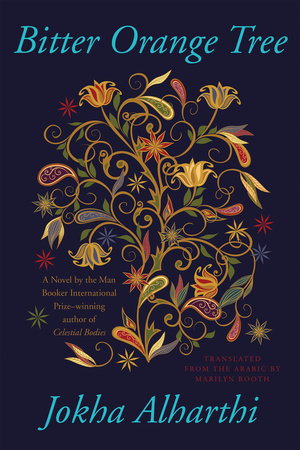
Omani author Jokha Alharthi’s new novel Bitter Orange Tree, translated by Marilyn Booth, is beautifully sad. The book is narrated by Zuhour, a young Omani woman attending university in the cold of England, who is grappling with an unspeakable, internal ache. Her pain could go by many names: depression, nostalgia, homesickness, loneliness, or regret—but it is never able to be fully captured in a singular diagnosis.
As a way of coping with this unpinnable pain, Zuhour sinks into a dreamy web of memories, allowing the past to overlay her present like a palimpsest. Throughout the novel’s image-centric chapters, Zuhour tumbles back into her childhood, and into imagined scenes from her grandmother’s time. She loops back to specific vignettes: a man slapping rice from his son’s hand, the beckoning movement of a crooked black fingernail, a woman’s beaded necklace that trembles with a death to come. Words touch down delicately on each page to evoke these moments, the result of both Alharthi and Booth’s creative labor.
Truly, Alharthi and Booth together make a formidable literary pair. The two dazzled readers worldwide in 2019 with the publication of Alharthi’s novel Celestial Bodiesin Booth’s translation. The multi-generational, women-centric saga of an Omani family won the Man Booker International Prize, and became an international bestseller, garnering a list of “firsts”: Alharthi became the first Omani woman author to be translated into English, and Celestial Bodies the first book originally written in Arabic to win the prize. In a global literary landscape that has long centered on male authors working in English, Alharthi and Booth’s work with contemporary Arabophone literature feels daring and exciting.
Anna Learn: In Bitter Orange Tree, the story shifts from the narrator’s present moment in London, to her memories of her childhood in Oman, to those of her grandmother, and of other women in her family. Jokha, why do you tend to use this fluid and nonlinear mode of narration?
Jokha Alharthi: Actually, I’m not sure that I choose it. It’s just my way of thinking. When I’m thinking about time, I can’t think about it in a linear way. For me, time is open to possibilities. The past is open to possibilities, just as much as the future is open to possibilities. We look at the past differently every time we think about it, or, sometimes we find out new, different information that we didn’t know before, so we start to look at the past differently. Or we grow up, or things happen. We become open to the past in different ways, at different times. I’m always interested in jumping back and forth, and seeing different angles of what happened, in seeing the past from different angles.
AL: Marilyn, what was it that struck you stylistically about Bitter Orange Tree that you wanted to animate in your translation, and what were the main challenges you experienced as a translator?
MB: The main younger characters in the book are a young Omani woman, a young Pakistani woman, and a young Pakistani man who are all studying in the UK. It was quite challenging to deal with their voices as cosmopolitan young people, but [who were still] from certain places. I kept asking myself, “how exactly do I represent that sort of cosmopolitanism?” And also I’m somebody of a certain age, and I do remember a couple of times thinking, “hmm, I wonder if actually getting somebody younger to translate this might be better?” I don’t think the voices of the younger people in Bitter Orange Tree are particularly edgy. In Arabic, their voices are quite standard, they’re not using any kind of youth [slang] or anything. But I did worry whether I was being a little bit too much “of my own generation” to get it right. And that’s a challenge we don’t often think about. We think about, “oh, do I know this society well enough? Do I have the kinds of sensitivities and backgrounds that are needed [to translate a text]?” But I think generation is something that we don’t always think about enough.
AL: The generational difference between the translator and the author or characters is definitely not often discussed! What other issues came up for you?
MB: Another strong feature of Jokha’s writing, that also posed a challenge in translation, is her writing style. She has this sort of deadpan, almost sardonic or abbreviated way of writing. She doesn’t mince words, and she doesn’t waste words. And sometimes, she juxtaposes one sentence with another, and [the reader has] to work a little bit to see the relationship between the two, but it’s very much there. And I really like that—it’s a feature of her writing that I think is very effective. However, the publisher felt that sometimes there were just too many juxtapositions, and that the meaning wasn’t clear enough for the reader. Now, Jokha and I disagreed with the publisher on that. I didn’t want to dilute the effect of her style by adding to it [in order to “clarify” it]. Of course, any kind of writing is a piece of negotiation and compromise… But it was a bit frustrating because I felt like to dilute that aspect of Jokha’s style would be really wrong, and unnecessary. I think that’s just something that happens quite a lot in translation. Sometimes editors want a level of explanation that they don’t ask for in a text that’s written originally in the language of publication, so it can be extremely frustrating for a translator.
AL: Did you consider using an introduction or translator’s note to further frame the book for an Anglophone audience? I ask because, in your academic work, Marilyn, you have also written about the reductive tendency towards “memoir fixation” in the marketing of fiction books by Arabophone Muslim women writers in English translation. Given that Bitter Orange Tree is written in the first person, and that it (mainly) adopts a realist style of narration, do you worry that it might come to be categorized in its English-language reception as a mode of autobiography, muting Jokha’s imaginative capacity as a writer?
MB: Well, that’s a really interesting question. I think if I had decided to use paratext, it would have been more focused on Oman and Omani history… My feeling as a translator is that I’m not responsible for [how readers choose to interpret a book]. If somebody chooses to read it as an autobiography or as autofiction, then that’s kind of their business. All we can do is say, on the front, this is a novel. And then if people choose to read it differently than that, it’s really their issue… First of all, that really drives me crazy when people do that, because it’s almost as if somehow Arab women or Muslim women are not allowed to write fiction. It’s like anything they write is taken autobiographically. And I really, really, really object to that. But also, this is a very persistent, and trans-cultural phenomenon, isn’t it? Women’s fiction in general, across cultures, is so often taken to be autobiographical, as if somehow their fiction is supposed to explain their lives. So it’s almost as if women writers are not allowed to be, you know, novelists of the imagination.
JA: Unless you are writing a crime novel.
AL: I want to talk about the weight that’s put on individual words in this novel. Zuhour, the narrator, regularly thinks about the weight that words carry. She lingers on the meanings of words like “ignore,” “depression,” “remorse,” or “broken” in particular, and describes these words as if they were physical, material things. For example, the word “ignore” is linked to the black nail of Zuhour’s grandmother, a dark presence that grows with time. Jokha and Marilyn, you both have emphasized how important precision in language is to you and in your writing. Were there any words from Bitter Orange Tree that really stuck with you, that you wanted to emphasize, or that you thought a lot about? Was “ignore” one of those words?
MB: I guess for a translator, the problem is that the word in Arabic is always going to be richer than what you can encompass in a single word in translation. I mean, in whatever language you’re translating from [this is the case]. For the word “ignore,” I do think ignore was the right word in the context of [Bitter Orange Tree]. But I also wanted to be able to use both “ignore” and “neglect,” which are not the same thing exactly, but they’re both part of what’s going on in that element of the story. I did decide on “ignore” precisely because I wanted to emphasize the notion that this was an act of choice[by Zuhour to ignore her grandmother]. It wasn’t that Zuhour was sort of neglecting something passively, like she didn’t even notice it. There isn’t that same emphasis on willed action [with the term “neglect”] that I think “ignore” connotes.
Women’s fiction in general, across cultures, is so often taken to be autobiographical—as if their fiction is supposed to explain their lives.
JA: I also just remembered a scene in the beginning of the book when Zuhour wishes that words had strings. She says, “Why don’t words come automatically with threads that we can yank to pull them back inside ourselves?” Thinking about that makes me think that the entire world is made up of words, actually.
MB: And another feature of this in this novel [in regards to word choice] is the question of repetition. It’s clear that in Arabic, a word like “ignore” is important and it needs to be there, and it needs to be repeated in English just as it is repeated over and over in the Arabic. Sometimes, though, the repetition works in Arabic, but it seems a bit clunky in English. So sometimes you have to vary things. I’ve had a few arguments with the editors where I said, No, look, this repetition has to stay there. It’s really, really, really important. And, you know, sometimes just kind of as a matter of style, you’re told, Oh, well, no, it would be better if you vary the vocabulary. And, well, no, there’s a point to the repetition. The author isn’t repeating a word because they don’t have other words to use. If the author wanted to use other words, she would use other words. The repetition is there for a purpose.
JA: I totally agree with Marilyn on this issue of repetition. I think this insistence on avoiding repetition came from all these, sorry, creative writing courses [laughs]. [Students in these courses] are not supposed to use the same word on the same page twice. But when you read classical literature, you see that these great classical authors didn’t hesitate to use the same word again and again, when needed. And for the word like ignore, as you said, Anna, it is a very important word [in Bitter Orange Tree]. Using it more than one time is fundamental for the novel, because [the narrator’s guilt about ignoring her grandmother] is what Zuhour is suffering from, it’s connected to the feeling that she’s fighting. And it’s important for her to, as we say, in Arabic, Marilyn, taqallub ʾiḥtḥmāl ʾlkalima…
MB: [Interpreting] To turn over and sort of reverse and think about the meaning of a word, to let it kind of turn over and generate new things…
AL: Yes, words and names in particular have so much power in this book. What someone is named or how they are labeled affects how they’re treated by others and the opportunities available to them. And often, the act of naming in Bitter Orange Tree is closely tied with violence. Naming almost becomes a form of violence in of itself. For example, there’s the scene in the chapter entitled “The Gypsy Woman” with the ghagariyya in which Zuhour remembers that a woman who came begging at their door was called a “filthy ghagariyya” by her mother. And because the woman was labeled in that way, the community treated her very poorly, and this caused her to end up murdered (in my reading). Marilyn, I’m really interested in your choice of how to convey the really loaded word of ghaghariya in your translation.
Sometimes editors want a level of explanation that they don’t ask for in a text that’s written originally in the language of publication, so it can be extremely frustrating for a translator.
MB: Well, that was really interesting because, to be honest, I started by just using the term “gypsy” in the translation for ghagariyya. I did that because the term “gypsy” is now considered to be a derogatory term. And I thought that “gypsy” would be the term to use, precisely because it’s such a loaded term. It’s not a neutral term at all. But the editor was very nervous about using that term. And I was like, well, they’re using it in a derogatory way [in the Arabic version]. The derogatory element is the whole point. But then I played with it a bit, and tried to use the Arabic language a bit more. It’s also quite a hard-sounding word in Arabic. So I thought maybe [transliterating the Arabic word into English] would be the best way to go. But it was sort of ironic that, you know, the editor was saying, “Well, you can’t use this word ‘gypsy’ because it’s derogatory.” And I’m like, “I know! It’s being used in a derogatory sense in the book!” If it had been somebody speaking respectfully, I might have used the word “traveler,” or something else. That was an interesting example of a moment where my choice of an appropriate way to convey this attitude in a name really made the editor nervous.
JA: Yes, I remember this discussion about the ghagariyya, and it made me nervous as well because [the derogatory use of the term] is meant to be that way. It makes me think of a book I just read. A few hours ago, I finished reading Shuggie Bain by Douglas Stuart. I liked it. It’s a very interesting book. But the point that I want to make is that, in that novel, there are a lot of words that would have to be deleted if treated with the logic [that to use a derogatory word is for the author to condone it]. For example, in Shuggie Bain, Catholics and Protestants who are neighbors are calling each other by derogatory words. And the derogatory word is meant to be there. The character is thinking about it, about people who are different from her, and she is using that word to describe them. So it perfectly fits. You can’t have characters in a novel who all just believe in and only use the modern words that are acceptable. I mean, the normal thing is that we have different people in the world. Some of them look down on other people. And they put certain names on them. And that’s happening all the time, in every culture, just as I said, with the example of Shuggie Bain.
MB: And it is tricky because I mean, obviously, it’s understandable that people have sensitivities towards the use of certain terms. But yeah, this is it. A character has a particular perspective and is expressing it through that use of vocabulary.
I’m told I went catrastic for the first time in 1984, when Jerome Shin (yes, the director) took me up to my bathroom—my gaudy childhood bathroom with the big pink Jacuzzi and mirrors on all four walls—and cut me my first line and asked me to hold his balls while he jerked off. The request was casual, like my stepmother telling me to hold her purse while she fixed her lipstick. “Just hold them?” I said.
“Yeah,” he said, pulling down the top of my dress and looking skeptically at my half-grown tits. “Just hold them.”
The pouch sat on my palm like rotten fruit while he worked his sad, skinny dick. It was a year or so after his young wife drowned. He must have been in his early forties then. I was fourteen.
“Now tug them!” he barked, scrunching up his face.
Startled, I tugged until he came onto my thigh and the hem of my dress. (My stepmother’s dress. I returned it to her closet without cleaning it.) My father’s party murmured through the floor and the pipes. All those people milling around, trying to out-fabulous each other, talking about green lights and opening grosses and sex. Probably every bathroom in the house was hosting some variation on our theme. Jerome cast me in his next movie.
My agent said we had to change my name. “No one uses their real name,” he said, “and yours is terrible.” We were at the Polo Lounge; he was eating a Cobb salad. He reached over with his fork and knocked my hand away from my fries. “Actors’ names are just labels you stick on a fantasy,” he said. “You know, like Armani or something. But it’d be nice to keep some reference to your father.” So I went from being Allison Lowenstein-Karr to being Karr Alison. No one could ever explain why we dropped the second l. “It’s a no-brainer,” my agent told me. “Go with it.”
In retrospect, I don’t think I felt catrastic in the bathroom with Jerome. I remember feeling flattered and grossed out and high and sophisticated. Still, my Helpers identified that night as when my system first became seriously susceptible to degradons, when I started to lose track of my Esteem. Jerome, they told me, was a Usurper—which I’ve never quite been able to sort out because Jerome’s movie is what made me famous, and the Church only ever liked me because I was famous. Jefferson Morris himself told me that the Founder says the important moments in life aren’t just points along a single straight line but are moving, swiveling hubs within a three-dimensional web and belong to multiple trajectories, both ascending and descending. When I held Jerome’s balls, I was beginning my descent into fucked-up druggie despectum, but I’d also hooked into that steep skyward line that would bring me to Billy and Jefferson and the teachings of the Founder. But then there was everything else, too. Like I said, I can’t sort it out.
Businessman, computer businessman, Steelers fan, Asian grandmother, clean-cut guy who’s probably a pervert, sullen punk kid, guy with big gold jewelry, retired couple with too much luggage, harried couple with too many children, Texan. They file past my seat, departing souls taking slow zombie steps down a fluorescent tunnel. “Well, I guess it’s hurry up and wait,” an older blond lady says to no one in particular. We’re all in this together, she is saying. A flight attendant squeezes past to get to the harried couple, who seem defeated by the overhead compartment, by their bags and diaper bags and children’s suitcases bursting with pointless junk. “Don’t mind us,” says the blond lady. But I like the flight attendants, their big hair and sexy blue vests and shiny red nails. The guy in the middle seat doesn’t seem to recognize me, which is just as well. I look out the window at the odd vehicles racing around the tarmac, the shadowy people behind the terminal windows, the transparent flutter of jet exhaust.
I am going to my mother’s house. An act of desperation. The last time I saw her, three years ago, we got in a fight before I could even get through the door—
Where’s Helena?
With Billy.
You left her with that loon?
Don’t even talk to me about leaving. And he’s not a loon.
He’s a loon. Him and that Jefferson Starship guy and their LooneyTunes religion.
It’s my religion, too.
It’s not a religion. It’s a roach motel for idiots.
You don’t know. You don’t know anything about the Founder. You’re just a blip.
What’s a blip?
Someone who doesn’t know anything about the Founder.
You’re brainwashed.
You’re a Nazi.
—and then she slammed the door in my face, and I lifted up the metal flap of the mail slot and hollered through it that she was a cunt and a Usurper and I hoped she and her degradons had a very nice life together. But now I’ve left the Church, or the Church has left me, or we left each other, and Billy of course left me, and Quentin is dead, and I spent all my money trying to get Helena back and failed, and I tried to be in a play, and my friends finally, nicely, suggested I should look for my own place to live.
I’m in coach but near the front, and I see a tall man in a white uniform take a seat in first class. My heart flies up like a flushed dove but gets caught and tangled in a net. If I were hooked up to an Aurograph, it would be going crazy. I remind myself that Quentin is dead. Most everyone’s settled down and buckled up now, except for a paunchy guy who’s going to break the plane apart trying to stuff his huge suitcase into the overhead, his round belly assaulting the face of the woman in the aisle seat, sweat stains in his armpits. A flight attendant comes and splays her red nails across the suitcase as though calming a frightened animal. She lifts it down and takes it away. The pilot comes out of the plane’s little locked brain and shakes the hand of the man in white, bending down, nodding and somber as they exchange a few words.
There are all kinds of stories about me and Billy. The Church bought me for him; he’s gay; I’m gay; I was impregnated with the Founder’s frozen sperm; I was impregnated by Jefferson Morris; I was impregnated by Quentin; I was never pregnant at all.
I’d only been out of Cloudvista a couple of months when my agent called, all excited. “Billy Bjorn wants a meeting. Wear something classy. Don’t swear. Be sugar sweet, and try not to act like a junkie.”
“What’s the script?” I asked.
“Who the fuck cares?”
“Aren’t you coming?”
“He wants to meet you alone. They specified.”
Billy is not tall, but he wasn’t as short as I expected. He moved around his office with the same gymnastic energy as the commando squirrels I watched out the window at Cloudvista while they leapt and dangled and corkscrewed, raiding the bird feeders. He has strong, active hands, and I imagined an invisible tail whirling behind him as he poured me a glass of mineral water, then darted to the window to point out a jet taking off from Santa Monica (“I’ve been thinking about getting one like that myself—what do you think? Do you like it?”), then fiddled with papers on his desk, then flopped down beside me on a long white couch and unleashed his grin. Everyone knows Billy’s smile, but you can’t really understand its effect until you’re confronted by it in person. You lean toward those teeth, swim upstream, struggle closer to the origin of all that dazzle, that gush of stardust. Suddenly I was Suzanne in Tin Can Palace. I was that bitchy lawyer in Pleadings who doesn’t want to be charmed by him but is. I wasn’t a washed up twenty-year-old with a pill problem. I was inside a glorious sphere of light. I was a glorious sphere of light.
“You,” he said. “You are special. I can tell. I’ve always liked you on-screen, but now, talking to you in person, just sitting here looking at you”—he broke off and gave his famous trill of incredulous laughter. “Just look at you,” he said, taking my hand. “You just—you—you have so much to give. There’s something about you. I didn’t expect to react this way—I mean, I wasn’t planning—but—just look at you!”
I echoed his laugh and tried to amp up my smile. My smile is not my strong suit, though, and remembering that, I faltered and looked away. He put a finger under my chin and turned my face back. “And you’ve still got a sweet shyness,” he said. “Great. Really great.”
“I’m just so happy to meet you.”
“Yeah?” He shook his head and laughed again, staring at me, giddy. “Yeah. Am I crazy here? Are you feeling this, Karr? Because I’m feeling something—whew—something big.”
I had to turn away again. On a side table stood a framed picture of a young man in a white uniform with gold braid and colorful rows of ribbons. “Is that your son?” I asked, knowing it was. Quentin was the product of Billy’s first marriage, to his high school sweetheart. After her, he married an ethereal movie star, and after her, he married a model from Ecuador, and after her, he married me.
“Quentin, yeah. My boy.” He sprang off the couch and picked up the photo, staring at it for a moment before he dropped back beside me, closer now, our thighs touching. I felt thrilled and twisted. I felt something big. I felt like I was a shred of myself caught on a sharp hook. I felt like a gust of wind. I felt desperate to get high and certain I would never want to be high again.
“I didn’t know he was in the navy,” I said, looking at Quentin’s face, which was a distorted version of Billy’s square bullet of masculinity, narrower and softer.
“He’s not.” Billy took my hand. “Listen, Karr. Do you ever feel like you need help?”
“What do you mean?” Don’t act like a junkie, don’t act like ajunkie.
“Do you ever have doubts? Do you ever worry about rejection? Do you feel like there are people trying to bring you down?”
I thought about the men in suits who had greeted me in the lobby and ridden with me in the elevator to Billy’s office. They had asked after my father and stepmother by name. I said they’d moved to Hawaii and opened a Zen center, but the men already knew. With a pair of synchronized winks they mentioned an interview I gave when I was seventeen in which I had said I wanted to marry Billy.
“I just got out of rehab,” I said to Billy. “So. Yeah.”
His eyebrows squeezed his forehead into a rift of concern. His gaze fried me like light through a magnifying glass. Just when the tension was about to break me, he said, softly, “I can help you.”
“Ladies and gentlemen,” the pilot says in that twangy, folksy pilot voice, “today we have the honor of transporting the remains of Petty Officer First Class Reginald J. Roberts, who was killed in action in Afghanistan and is being escorted home to his family by Lieutenant Commander Howard Stanton. Out of respect to our fallen warrior, I ask that you remain seated upon arrival until Lieutenant Commander Stanton has deplaned.”
Everyone’s attention goes to the windows. We are curious for a glimpse of the casket being loaded. I can’t see anything. The officer has taken off his white hat, and his bald spot peeks over the back of his seat.
“Do you know anyone who’s died in the war?” the blip next to me says. He looks like he’s in his late twenties but might as well be older. Central casting has printed “Middle Management” on the back of his head shot. A book on how to be an effective leader is stuffed in his seat pocket.
“No.”
“I do. A high school friend of mine. He went into a house and shot a guy who was wired to blow up. Bits of the other guy’s tissue got embedded in him and caused all kinds of infections. That’s what killed him eventually. Imagine having pieces of a dead person rotting inside you, someone you killed, someone who didn’t even speak your language and who’s going to take you with him. Makes me sick. It’s like a horror movie.”
He’s basically describing degradons—invisible little pellets of bad feelings from Usurpers that stick to your body and make their way into your Esteem—but I remind myself that I don’t believe in degradons anymore. I probably never did, not really, but the language of the Church has rooted in me like a fake accent I can’t shake. “Awful,” I say. “I’m sorry.”
“It’s weird to think of that poor guy down in the cargo hold with our bags and everything.” He looks at me, and I can see he wants something but I don’t know what. “It’s weird to think of flying after you’re dead.”
Holding his gaze, I uncoil the cord of my earphones from around my phone and put them in my ears.
A word about the Aurograph. People say it’s nothing more than goofy science-fiction wishful thinking, but I can tell you there’s magic in it. You focus on your life, and energy flows out of your brain and through the electrode bonnet into the monitor. Green waves appear on the black screen, spiking when you hit a catrastic moment, showing where your spirit has gotten all gunked up, and when that happens, you get excited; your Helper gets excited; you feel like undersea explorers who’ve just found a wreck. To maximize your Esteem, you have to isolate all those moments and let yourself be helped through them. “You are a hot air balloon,” Billy told me on one of our first nights, his hand on my belly, his breath in my ear, “and all around you are invisible tethers held by people on the ground, people who are trying to hold you down, usurp your Esteem. They don’t want to let go, Karr. They won’t. But you have to snip those tethers. You have to cut yourself loose so you can fly. You can do it—I know you can. You just need a little help.”
“Think about something that has troubled you recently,” my Helper said after my wedding.
I had planned to think about the helicopters that hovered above the château day and night and the paparazzi who clamored at the gates like angry peasants, but instead, Quentin welled up in my mind, standing at the window where I first saw him. A green line climbed the monitor.
“Okay,” said my Helper, “the Aurograph has registered your distress. What were you thinking about?”
“The night before the wedding,” I said.
“What in particular?”
“We had a big dinner for everyone. I was getting ready to come down to the ballroom, and I was alone in my room after I got my hair done, and I thought I heard someone calling my name. So I went and opened the door, and there was Billy’s son.”
“He was calling your name?”
“No. He was at the other end of the hall, looking out the window. I’d never met him before, actually. He’d been away on the Esteem.”
“Who was calling your name?”
“No one.”
“Why does this memory trouble you?”
(“Quentin?” I said, and he turned. He was wearing his white FounderCorps dress uniform, the one he wore in the picture in Billy’s office. Even from the other end of a long hallway, I could tell Quentin was different from Billy. Everything flows out from Billy, whooshing and blasting you back, and you fight to get closer. But everything pulls toward Quentin, and I felt queasy, like I should brace away.
“Should I call you Mom?” he said, not sarcastically but sadly. I was twenty-one. He was twenty-six.)
“I just wish,” I told my Helper, “I’d had the chance to meet him earlier so we could have felt like more of a family at the wedding.”
Already I had begun to understand that the infallibility of Billy was a cornerstone of the Church, and my Helper looked uncomfortable. “Quentin has very important work to do on the Esteem. He helps people reach the highest levels of study.”
The Esteem is the last of the Founder’s ships. According to Jefferson Morris, the Founder says the ocean is the place where we are most open and compassionate. Anyone who wishes to be really and truly free of degradons must spend time studying on the Esteem. I said, “I know. I don’t mean to be critical. It was just a little awkward.”
“Do you resent Quentin’s obligations to the Church?”
“No.”
“Do you wish your husband paid less attention to the Church and more attention to you?”
“Sometimes.”
“I’m going to recommend a class for you—it’s called Overcoming Selfishness for the Sake of the Self. There’s an intensive version available at the Ranch.”
“Okay.”
“Can you think of another moment in your past that troubled you in the same way?”
I reached, as I often did during Helping sessions, for the years between Jerome Shin and Billy.
You’ve seen my first movie, the one Jerome put me in. I think it holds up pretty well. Kind of gritty but still kind of a caper. Not as good as Jerome’s last movie, but Jerome was one of those people who knew he’d do his best work while he was dying.
When we started filming, I didn’t want anything from him—certainly I had no pressing urge to be reunited with his scrotum—but I was still offended he didn’t try anything with me. He was soft-spoken and professional. He made sure I put in my hours with the set tutors. “Allie, are you comfortable with this?” he asked before we filmed my scene in the bath.
Eventually I figured out he was boinking Genevieve Henry. Her beauty didn’t register with me back then. I thought my knobby knees and flat ass were what every man wanted, not Genny’s mouth like a fat berry and her weary eyes. I ditched my chaperone and went to her trailer and asked if we could talk. She was sprawled on a love seat in a black silk bathrobe patterned with white orchids, reading a paperback spy novel. “Sure, baby,” she said, tenting the book on her chest.
A bottle of white wine stood open in an ice bucket on her table. “Can I have some of that?”
“Sure, baby.”
I poured a glass and took a dramatic swig. As I told her what had happened with Jerome, she kept smiling as though I were some pleasant scene she had paused to admire: a children’s playground, a pretty sunset, a string quartet playing Vivaldi.
When I was done, she said, “That’s all?”
“Well,” I said, “I guess so.” I had never told the story before, and out loud it sounded flimsy and quick. “I just thought you should know Jerome’s a child molester.”
She swung her small mouth off to one side and studied me.
Finally, she said, “You’re not a child. You’re already a bad little chick.” She twisted her lips around some more and looked at her book for a minute. Then she turned a page and said, “Baby, if you want to be in the business, you should think about how much you’re willing to put up with, because if you think you’ve been creamed on for the last time, you’re wrong.”
What did she see when she looked at me? When I rewatch the film, I see a gangly, eager girl pretending to be jaded. I see a little circus pony, a raw nugget of pure ego. Those movie people snorted me and smoked me; they cooked me in a spoon. Now they say I’m weak. They say I’m unfeeling to abandon my child to a cult. But you try getting out of that prenup, the one where you agreed to forfeit any claim to your husband’s tens of millions in case of infidelity, where you certified that any and all of your children would be raised in accordance with the Founder’s teachings, regardless of your own status within the Church. And you wanted your child to grow up happy and secure, sheltered from doubt, able to fly above our despectulated world, and you signed it, not knowing you would be labeled a Usurper, and since your child must be raised in accordance with the teachings of the Founder, and the Founder said children must be shielded from Usurpers at any cost . . . Well, you try getting out of that one. Especially if Helena won’t even talk to you. She knows better than to talk to Usurpers.
It was true I hadn’t been creamed on for the last time. People put me in more movies. My father was getting into drugs, so I did too, the way other fathers and daughters joined Indian Princesses or went out to brunch after church. At first it wasn’t anything major. We’d sit by the pool and share a joint when my stepmother wasn’t around. “Kiddo,” he’d say, “tell Daddy how it feels to be a star.” And I’d say something random like, “Daddy, it feels like biting into a dead mouse” or “Daddy, it feels like really bad gas,” and he’d howl, he’d nearly fall off his chaise. But then my stepmother was around less and less—she couldn’t quite bring her self to leave him, not that she had such a high horse anyway, Our Lady of Dexedrine—and we took our show on the road, driving out to house parties in Bel Air or Malibu, Dad looking like Don Johnson in his blazer and T-shirt behind the wheel of his Corvette (ice blue with a caramel interior, speedometer flickering like a flame as he accelerated). We’d cross the threshold together and part like strangers, wading through shadow worlds where the air was thick with bodies and ash and stardust, neither wanting to witness the other’s search for relief. “Catch you on the flip side,” he’d murmur.
Those were times I was catrastic—no question. I had a trick where I could squeeze the insides of my knees against my ears so hard I created suction. I would do it in cars, bent forward, trying not to puke, and I would do it on my back when I got bored with getting fucked. I could see but not hear the guy say, You’re so flexible. I was walking around covered with a thick fur of degradons, and I didn’t even know it. But I also remember the way the night sky looked from the quiet bottom of a glowing blue swimming pool, the shifting membrane of light that separated me from the darkness, the drunks who drifted and murmured like ghosts around the edges.
In the mornings, my father and I would drink coffee in pained silence until our shame burned off like early fog. Soon we’d be back out by the pool, riding the fizz of my stepmother’s speed back to civility, sharing a copy of Variety and a pitcher of mimosas and gossiping about the night before, pretending I hadn’t been a limp and addled baby bimbo and he hadn’t spilled a baggie of coke and morphed into a crawling, snuffling thing, an anteater with a plastic straw proboscis, hoovering up white dust from the grout of some one’s Spanish tiles.
I remember a party at the Chateau Marmont after I got fired from what would have been my fifth film and someone pulling me down from a balcony railing when I pretended I was going to jump, and then the Corvette’s speedometer was flickering and Dad was saying I was a star and fuck ’em, just fuck ’em, and I yelled at him to go faster because faster was hilarious until the spinning began, a real spinning and not just the world running around trying to catch up with me. They found me sitting on the crumpled hood and smoking a cigarette, barefoot, loopy, apparently unmoved by the moans coming from the driver’s seat. His left leg had to be amputated above the knee.
Just try keeping that out of the papers.
A movie star, especially when he has divorced you and stolen your child with his lawyers and his prenup and his riches, is like God. Omnipotent, omnipresent. His huge grinning face looks down over the road to the airport. He waves his invisible squirrel tail on the little TV in the taxi, talking to Regis, pumping his fist in the air about something while the driver dubs him with whatever guttural language he’s chortling into his phone. At the airport, he walks across the newsstands, holding his new girlfriend by one hand and your daughter by the other. He flickers across seatback screens. His voice whispers out of a hundred cheap headsets. The man beside you has recognized you after all; he gives a quick sideways glance when the guy in the aisle seat chooses Billy’s latest. A buddy comedy. It lost money. Billy can be funny, but self-seriousness clings to his humor like mildew. His career is suffering, not catastrophically but noticeably. People think his zeal for the Church is off-putting. They think he is controlling, a megalomaniac, but they don’t feel sorry for me. They only think I am even more of a fool.
A movie star, especially when he has divorced you and stolen your child with his lawyers and his prenup and his riches, is like God. Omnipotent, omnipresent.
The naval officer stands and walks to the lavatory at the front of the plane. I am relieved to see he is not watching Billy’s movie. Maybe he’s not supposed to partake of the in-flight entertainment. Maybe he’s supposed to sit and think about the guy in the box who’s soaring on his back over the Great Plains. For three years I’ve felt like I should be sitting and thinking about Quentin. I wasn’t allowed to go when they scattered his ashes off the Esteem. Jefferson Morris made an official announcement that the Founder had asked Quentin to cast off his body and move into a new dimension, embarking on a fact-finding mission into the afterlife. He is expected to report back as soon as he is able.
Most gossip within the Church centers around whether the Founder is alive or dead. Jefferson Morris says he is in exile, that he wishes to communicate only through Jefferson so as not to interrupt his state of perfect Esteem. Dozens of blip reporters and disgruntled ex-Church members have tried to track down the Founder, to prove he is dead, but the trail goes cold in 1970, after he sailed away on a solo round-the-world trip. His first communication reached Jefferson Morris five months later, announcing he had found perfect Esteem and declaring his intention to remain in exile. No wreckage was ever found; no SOS call was ever received. There is a photo from an Italian newspaper (June 20, 1973) in which a man sitting at a café in the background is either the Founder or his long-lost Florentine twin. The FounderCorps keeps an office waiting for him at every Church center and a house for him at the Ranch, dusted every day and made up with clean sheets and towels just in case he decides to return. I have nothing I can keep ready for Quentin except myself.
On our honeymoon, Billy woke me up in the middle of the night. “Karr,” he whispered. “Karr. I know the secret.”
“What secret?” I asked, woozy, disoriented by the gilded ceiling of our hotel suite.
“About the Founder.”
I rolled onto my side, facing him. His cheek, jaw, and shoulder were blue; the rest of him was dark. “What about him?”
“Whether he’s alive or dead. I know.”
The room was silent except for his breathing and, in the distance, one of those warbling European police sirens that always make me think of World War II. “Well?” I said.
Billy put his hand on my naked side. “He’s both.” I waited. He rolled me lightly back and forth as though trying to shake a response from me.
“I don’t think I understand.”
“He’s found a way to be both. That’s the miracle. That’s perfect Esteem. None of the burden of life, none of the finality of death. He did it, Karr. He’s the only one in the world, in the history of the world.”
“Wow,” I said.
“Yeah,” he said. Then with true wonder: “Yeah.”
I unbuckle, and Middle Management and the guy on the aisle get up so I can go pee. On my way back, I lift two little bottles of vodka from the drinks cart. Tacky, I know, but I am going to see my mother.
My mother has a talent for disgust and finality, and I’ve always had the impression she left me with my father to prove we deserve each other. But we needed someone who was disgusted with us, someone solid and human who smelled like office supplies. She lives in a small city full of fast-food chains and big-box stores and is a secretary for a personal injury lawyer. After we wrecked the Corvette, she came and checked Dad and his new steel shin and acrylic foot into Cloudvista and took me back with her, driving for fourteen hours straight while I slumped against the door of her Honda, watching the mesas and mountains go by. “No more movies,” she said. “I’m not even going to say ‘not for a while’ or ‘not until you’re old enough to handle it.’ Not ever. Someday you’ll thank me.”
“They won’t forget me,” I told her. “They’ll come find me.”
“Who’s they?” she said. “There’s no one who cares about you in that whole godforsaken city. Maybe they cared about the money you made them, but they didn’t care enough to stop you from flaming out, did they? Your father spent all your money, by the way. Every cent. It’s all gone.”
“No, it isn’t. It can’t be.”
“Gone, Allison.”
I screamed, gripping the dashboard with my fingers. She glanced at me, then back at the road.
She was living with an amiable boyfriend named Tom, who surprised me by not wanting to fuck me. He just wanted to build birdhouses and play the mandolin and bake quiches for my mother. I went to a small school where the other kids were impressed by my celebrity for about a week but then changed their minds when they realized I didn’t have anything to say. After a year, I got called out of history class, and there was Dad waiting in the office to take me away.
“Did you buy this with my money?” I asked about his new black Corvette.
“I’ve got a slam-dunk project,” he said, gunning us away from my school, the speedometer licking up like a green flame, “with a part in it for you. We’re going to get everything back—you’ll see. Daddy just needs your help. Daddy can’t do it without you.”
That was true, and we both knew it. On the other hand, my mother didn’t need us. She didn’t even need us to need her.
When we were back in LA, she called and asked if I had gone with him willingly. When I said yes, she hung up, and I didn’t see her again until I was nineteen and it was my turn to go to Cloudvista. After I got out, she was the one who set me up with the shrink who told me to imagine the tiger. “Imagine a tiger,” he said in his hypnotic voice, “and imagine yourself taming him by feeding him all your doubts, all your worries, all your pain, all your fear. The more he eats, the more he glows. When you find yourself in situations where you’re doubting yourself, just imagine the tiger beside you, radiating light, and imagine everything and everyone else covered with a thick layer of dust.” He had a lot of show business clients. He said he understood the stresses we were under. He told me about an actress who won an Oscar after one year of imagining the tiger.
I want to nap, but as soon as I close my eyes, I have a funny feeling and pop them open. Sure enough, the sullen punk kid in front of me has his phone between the seats and is taking a picture of me. I put my hand over the phone, and it goes away.
“That must be annoying,” Middle Management says.
“Yeah.” People often hit me with a big dose of chummy compassion as an opening gambit, like I’ll be so grateful someone finally understands my plight. Wistfully, I think of Billy’s jet.
“You were amazing in that Jerome Shin movie. We watched it in a film class I took in college.”
“Thanks.” I unscrew the top of one of the little vodka bottles and pour its contents into a paper Starbucks cup I saved. The liquid turns faintly tea-colored from the coffee dregs. I raise the window shade a few inches and look down at a dazzling river, gleaming gold and shaped like a wild jungle vine.
“Is it true they brainwashed you?” the guy asks in a serious tone meant to assure me that my answer would be kept confidential.
I think of a television interview of Jefferson Morris I’d once watched in which he’d said, How do you wash brains? Seriously. I’ve had it on my to-do list to find out, since supposedly it’s all I do all day. Do you put them in a big bucket with some dish soap and scrub? Do you clip them to a line to dry?
“Pretty much,” I say.
“Wow.”
I salute him with my Starbucks cup and empty it. Then I pour in the other bottle.
“Did you believe in Neptunius and all that?”
The sullen punk kid in the next row is watching Billy’s movie too. Billy, his skin slightly orange on the shitty airplane screen, drives a red convertible. He grins and wears sunglasses. He pumps his fist. A man comes down the aisle wearing big headphones and a neck pillow, moving slowly, buoyantly, like he is walking on the bottom of the ocean. The headphones’ cord trails behind him. I crane to see the naval officer, but all I can see is his bald spot. He is the only person on this plane I want to talk to, and so it is to him more than the blip next to me that I say, “The Founder said truth is in the heart of the believer.”
“Who? Oh, right, you mean—right, that guy. X. Genesis Wilderness, or whatever.”
“F. Genesis Inverness. But people in the Church consider it impolite to say his earth name.”
“Isn’t he the one where nobody knows if he’s alive or dead?”
Billy kisses a blond starlet on-screen, and I lean closer to Middle Management and tell him the biggest secret I know. “Actually,” I say, “he’s both.”
He laughs, a high-pitched trill like Billy’s. “He’s both? He’s like a vampire or something? Wait, so, you did believe.” Suddenly, he gets serious, concerned for me. “Do you still?”
“I’m just saying belief isn’t necessarily something you either have or don’t have, like a car or something. You can’t just think ‘Do I believe X, Y, and Z?’ and then go look in the driveway and find out. I mean, do you really believe that book will make you a leader?”
I can see he wants to push his book farther down into the seat pocket. He presses his lips together. He is getting disgruntled, the way people do when our conversations don’t line up with their fantasies. “No offense,” he says, “but it all seems so silly.”
Last year I did a play Off-Broadway, and during previews someone in the crowd shouted when I made my entrance, “Hail, Neptunius!”
I tried to cover the moment by briskly dusting my fake coffee table. My costar’s jaw tightened as he read his fake newspaper. Our plywood living room had been perfectly real a second before, but suddenly its falseness mortified me. What was I doing, a grown woman, a mother separated from her child, dressing up like a fifties housewife and reciting words typed out by a notorious drunk and wife-beater who’s been dead for thirty years? Those people filling up the dark with their glinting eyes—did they pay money to see the play or just to gawk at me? Out in the world, people stare as I go about my business, like I’m a traffic-stopping freak for buying coffee or having lunch in a restaurant. I gaze back at them through the lopsided hole in the Elephant Man’s sack.
What I want to say to the man on the plane is that I’ve spent my whole life believing in silliness.
When we first met, Billy took me on his motorcycle from his office to the Santa Monica airport, and then a helicopter whisked us to Palm Springs, where a big house with a swimming pool was waiting, stocked with foie gras and cold lobster salad and strawberries but no booze. No one heard from me for two weeks, but no one seemed to miss me. After Palm Springs we came back to L.A. and allowed ourselves to be photographed together, the cameras snapping like piranhas, and then Billy drove me in his Aston Martin to the Ranch to meet Jefferson Morris.
“Jefferson,” Billy said over dinner, “I’ve got to tell you, Karr is the most compassionate woman I’ve ever met. She has a real gift for giving and receiving help. It blows my mind. Truly. She’s exactly what I’ve been waiting for. The moment she walked into my office—I don’t know, it was like I reached a new understanding of Esteem right then. I don’t think I was capable of this kind of love before. Maybe I wasn’t ready. But this is the right woman at the right time.”
We were sitting on the deck of a reproduction Spanish galleon that the FounderCorps had built right next to the Ranch’s main swimming pool. Red sails snapped in the breeze; the mast creaked. I half expected us to move, even though we were out in the middle of the desert, the keel fixed in sand, the hot orange sun shooting sideways across the dark horizon as it set. Jefferson looked at me. His four bodyguards in khaki FounderCorps uniforms looked at me.
Jefferson will never say exactly how the Founder communicates with him, if it’s by letter or if they chat on the phone or if the Founder’s whispers travel through the ether from a distant island or another dimension and find their way to his ears. Even oracles have their trade secrets. Blip journalists have tried more than once to tap Jefferson’s phone, unsuccessfully because Jefferson has an uncanny knack for detecting and exposing spies. On the galleon, I first thought that Jefferson was blandly handsome, as harmless as a catalog model, but as he studied me, squinting against the sunset, something in me shifted and sank, like I had just received a blackmail letter.
“Billy needs a gal who can be a strong supporter,” Jefferson told me in a voice that suggested we were negotiating an agreement, just the two of us. “Someone who doesn’t want to get in the way of his faith. Are you that kind of gal?”
“Billy wants to make people’s lives better,” I said solemnly. “I think it’s noble.”
“She’s something special,” Billy said.
“I don’t doubt it,” said Jefferson. “Not for a second.”
At the Ranch, our fantasies popped into reality like toadstools springing from the earth. If I mentioned a food I liked, it would appear in our refrigerator. If Billy admired one of Jefferson’s motorcycles, a duplicate would arrive on a flatbed truck within days. Billy told Jefferson that we had joked about wanting to run through a field of wildflowers together and—poof!—two dozen FounderCorps members were out tilling and seeding the desert behind our villa, laying down rich, dark mulch on top of the sand. The next time we came back, we held hands and ran through a field of wild mustard to a spot where a picnic was waiting for us on a gingham blanket.
Billy pulled me down beside him and said, “If the truth is in the heart of the believer, then you’re my truth. Do you believe in me like that?”
“Of course I do,” I said. “You saved me.”
“That’s all I want,” he said. “All I want is to help you.”
Out the window an enormous moon has risen. We thump across ruts of air, and Middle Management crosses himself. New York buses have little stenciled notices by their doors that say: This Is a Kneeling Bus. When a bus stops to let people on, it lets out a long, sad, hydraulic sigh and lowers itself into the gutter. When I first noticed the sign, I thought it was so beautiful, so artistic how some bus bureaucrat had recognized the buses as kneeling.
I want to talk to the man in white. I want to find out what he knows, for him to help me. We are all on a funeral barge, and he is at the helm. When he leaves us, we will have arrived somewhere; we will have been transformed. In Jerome Shin’s last movie, LA is the afterlife, although no one says so explicitly. I would have been in it, but Billy said no, Jerome was a Usurper. We watched it in our screening room at home. Billy and Quentin sat side by side, and I sat behind them, studying the dark silhouettes of their heads against the bright screen.
The last time I was in bed with Quentin, he said to the ceiling, “Why isn’t it working?”
I touched his chest, the wings of sparse black hair that spread from his sternum. “You don’t think it is?”
“My whole life I’ve done everything they said. I’ve read every word the Founder ever wrote. I’ve treated Jefferson like a god. I’ve disengaged Usurpers—I disengaged my own mother. There shouldn’t be a single degradon left on me. But I feel like my Esteem is just draining away, like I’m nothing but doubt.”
“You have more Esteem than anyone I know.”
“Is it working for you?”
“Have you talked to Jefferson? What does he say?”
“He told me I needed to adjust my attitude.”
We were in my bedroom. One of Helena’s nannies had taken her to ballet. Billy was away on location. The whole staff must have known what we were up to. Probably it was one of them who leaked the story to the tabloids. I hope whoever it was bought a nice house with the money. I hope they didn’t feel too guilty when Quentin hanged himself.
“The first time I went to the Ranch,” I said, “there was this FounderCorps girl who would come collect my laundry. She wasn’t supposed to be around when I was in the bungalow, but one day she was late or I was early and we happened to meet. I had just started dating Billy, and I asked her if she liked being in the Church.”
“What did she say?”
“She said she was born into it, and then she said of course she loved it, that she’d learned so much about herself. And even then I thought, What self? What is there besides what they’ve taught her?”
He looked at me, and I felt that whirlpool sensation, like I was being sucked into him. “That’s what I mean,” he said. “Exactly.”
“Oh, God, sorry, I wasn’t saying—you have a self. You’re not like that. It’s just—sometimes I wonder—”
“What?”
“My mother says it’s wrong to think we’re entitled to avoid bad feelings. She says they’re part of the price we pay for living.”
“No. No one deserves to live with doubt.”
I shrugged.
After a moment he said, “Is she a Usurper?”
“I think Billy’s gearing up to tell me so. It’s okay. She probably won’t notice if I disengage her.”
He was silent for a minute. “But why isn’t it working?” he said.
We lay in silence, two animals that had wandered into the same trap. At the time, I would have said pure lust had drawn me to Quentin, lust and our mutual urge to soil some corner of Billy’s perfect world. But after he died I knew he had been my true love.
“Why don’t you leave?”
“And be a blip?”
“You could do it.”
“Easy for you to say. You’ve lived out there.”
“People would help you. You could do it.”
Again the vertigo of looking at him. “Really?” he said. “Someone who’s spent most of his life on a ship or at the Ranch? Who’s never been to normal schools? Who’s never had a job that didn’t involve Jefferson Morris?”
I didn’t know what to say, so I told him about the glowing tiger and the dust that smothers everything else.
“Excuse me.” I flag down a passing flight attendant. “Would you give this to the man in white?”
She takes the small square napkin from me with her red talons and glances at it, reading the message. I can see she recognizes me and that she thinks she likes me. “I’ll see what I can do.” She starts to turn away, then turns back. “That poor boy,” she says. “That poor, poor boy.”
During Helena’s birth, I was asked to keep silent so as not to attach any degradons to her. She would encounter the despectulation of the world soon enough, but being born should not be traumatic.
“Did Billy eat the placenta?” my mother asked when I called to give her the news. “It says in the magazines that they eat the placenta.”
“Can’t you be happy for me?” I said. “Just this once? Just for giggles? And lots of people eat the placenta.”
I think I remember when my parents were together, but I can’t be sure. They never married, and they split when I was three, but I can picture my father in the kitchen of an unfamiliar house, pretending to tap-dance. My mother is facedown on the counter, one hand over her wild hair, one in a fist, laughing so hard the sound is crushed into silence. Her fist beats three times on the tiles, slowly, like an ominous messenger pounding on a door.
I can’t decide if I understood the risk I was taking when I first found myself kissing Quentin in my bungalow at the Ranch. He walked in on me when I was alone and crying on the sofa, and his embrace, instinctive and meant to comfort, pushed us over a precipice we had not known we were standing on. I was crying because of Helena, because she had told me she would never love me as much as she loved the Founder, and I had realized I did not like my own daughter, that I disdained her infantile conceit, her parroting of Billy, her certainty of her place at the center of a convenient cosmology. I blamed her for her gullibility even though she was only a child, even though I had not been brave enough to warn her by screaming as she emerged from me. Tendrils of contempt wrapped around my love, and perhaps they made me susceptible to the dark gravity that bound my body to Quentin’s. Or perhaps I was simply still the reckless girl who was pulled from swimming pools and prevented from jumping off balconies, who climbed unscathed from crumpled Corvettes, who lived at the center of a different convenient cosmology. Maybe I thought I could get fired from my life, take some time to watch the squirrels, and then present myself for absorption by a revised destiny.
Something is coming apart. Grief bears down on me like a black wave that has traveled thousands of miles and now is nearing shore. I look out the window, but there is only the hugeness of the moon and a few lights scattered like birdseed over the earth. I wait for the naval officer to come and find me, but his bald spot stays where it is. I need to talk to him. I need someone to really look at me. I remind myself that Quentin is dead, but I press the orange plastic cube in the ceiling. The flight attendant leans over me, smiling.
“Did you give it to him?” I ask.
“I sure did.”
“What did he say?”
“He said thank you.”
“Will he come talk to me?”
Her smile freezes around its edges, and I can see she already likes me less than she did. “Well, I don’t know. I didn’t ask him that.”
“Will you ask him, please?” I dig deep and come up with a gritty half handful of stardust that I fling at her. “Please?”
She tilts her head and walks up the aisle. I can see her back as she speaks to him, dipping apologetically.
The shrink I was seeing in New York gave me a mantra to replace the tiger: I am not the center of the universe. He sat back in his Eames chair with the satisfaction of someone who’d just laid down a royal flush, and I said, “You mean I should overcome my selfishness for the sake of myself?”
He beamed. “Exactly.”
We’re all on the same team, I wanted to tell him. We’re all fighting a common enemy: bad feelings. But, unbidden, my mother’s voice offers its two cents: “Self-doubt is not the plague of our time. People starve; the planet is dying; people have terrible diseases; people are wrongly imprisoned; people watch their families get murdered; people die because bits of someone else are decomposing inside them.”
I know, I tell her. Shut up. I get it.
Almost six years passed between the wedding and when I conceived Helena, and I could tell Billy and Jefferson were worried. They had equated youth with fertility, but my womb was still hungover from my teens, I think, and preferred to laze around and watch Billy’s seed float harmlessly by. Now Helena is the age I was when Jerome Shin took me into the bathroom. But she is a girl who holds her father’s hand and not the testicles of tragic film directors. When I see her picture in magazines, an excruciating bloom of love opens in my chest, threatening to break me from the inside. I believe she will come to me someday. I believe doubt will lead her to me.
“Ma’am, I was given a note saying I had a friend in this seat. Would that be you?”
“Yes,” I say, staring up at him. “Yes.”
“Is there something I can help you with, ma’am?”
“Can I do anything? To help you? I’d like to help.”
“Thank you, ma’am, but right now there’s not much for me to do but wait to arrive.”
I nod. Middle Management is staring at me. His big vanilla head crowds my peripheral vision. “Do you recognize me?” I ask. What I mean is Do you see me? Do you know me?
He does. I can always tell. Disgust creeps through his serious, respectful mask, and I am filled with longing for my mother. “Ma’am, my duty is to see that Petty Officer Roberts’s remains are treated with the respect they deserve and that they are delivered safely to his family. Now, if you’ll excuse me, I’d better return to my seat.”
“Wait,” I say. He waits. He thinks I am a spoiled movie star. He thinks I want special treatment, to involve myself in something that has nothing to do with me. He thinks I’m jealous of the attention a dead man is getting. I begin to cry. “I’m just so sorry,” I say.
The officer frowns but out of confusion and no longer disgust. “We all are, ma’am. You have my word I’ll pass along your condolences to his family.”
I lean against the window and cry. I fly through the air at five hundred miles per hour. I cry for Quentin, for the dead soldier, mostly for myself. The seat belt sign comes on, pinging a soothing tone. My mother tells me I am out of touch with reality. My glowing tiger prowls the aisle. Dust settles thickly on the other passengers, obliterating their faces, their T-shirts, their laptops, furring the ice cubes in their plastic cups. Sometimes, late at night, my father and I would find ourselves in the kitchen at the same time, and we would pour half-and-half over bowls of Raisin Bran. We lift spoonfuls of dust to our mouths. Faster, I tell him, drive faster. A field of orange lights swings into my window, and I want to run through it and collapse on a gingham blanket. The landing gear squeals out from under the dead soldier. The buses of the world kneel and ask forgiveness.
The word “psychedelic” is rooted in Ancient Greek, and means something like “mind-revealing” or “mind-manifesting.” To me it means pushing boundaries, revealing new corridors of the mind.
When I was in my twenties, I read all the Anglophone fiction about the border by Mexican American/Chicanx/Latinx writers I could get my hands on. What I found the majority of these works had in common was that they were written in an often stark, realist tradition, much in the style of mid-20th-century American novels. I began to notice the weirdness, humor, and surreal nature of South Texas, the border that I’d grown up with, was absent not only from these works, but the entirety of American literature.
That’s when my reading started to significantly branch out, obsessively reading works from other countries, and in translation, searching for a way to get in touch with this type of story I couldn’t find anywhere written by my people. Along the way I discovered the works of Daniil Kharms, Silvina Ocampo, and Amos Tutuola, among others, whose unique visions and work helped inform my developing style at the time.
With the stories in Valleyesque, my debut short story collection, I reflected on the kind of storytelling that comes from the land I live in. Here are seven short story collections I consider to be psychedelic. They do so many more things than merely being strange, weird, speculative, enchanting, or even fantastical. Each of these risk-taking collections shows us fiction can still be unpredictable and morbid in the best ways.
When The Miniature Wife and Other Stories first came out, and I remember being at once grateful and in awe—here was a Brown writer, from the same city I was from, no less, publishing weird, unique stories, with robots, swamp monsters, and Borgesian capsule biographies I wasn’t seeing anywhere else. This was before the fiction of Yuri Herrera and Valeria Luiselli, and most of the “post-Bolaño boom” had appeared in book form. For a person like me, this book was earth-shattering, and brought me great relief. Where else would you find a story with a black market unicorn that drinks beer, as in the story “One-Horned and Wild-Eyed”?
The Doll’s Alphabet by Camilla Grudova
If you’ve read this book, you unwillingly belong to something like a cult, one where everyone wears ancient wooden clogs that’ve become muddy and mossy. I dare you to find a collection with a shorter, creepier, more impossible-to-describe title story—not to mention the other fictive ingredients, like a sewing machine rigged with special powers; the inner thoughts of a spider; the extraordinary tales of a “sconce,” filled with mermaids and sailors and the sadness of the world. This is a book you’ll want to tell everyone about, as well as keep secret.
I’ll never forget that day, years ago, rummaging through a bookstore’s shelves, when I found There Was Once A Woman Who Tried to Kill Her Neighbor’s Baby. The stories in this morbid collection take place in vague time periods that could be the past, the present, the future, or all three. It has quite possibly, in my opinion, the most punk rock story ever written, “Queen Lir,” in which, among other things, the queen hijacks a bus.
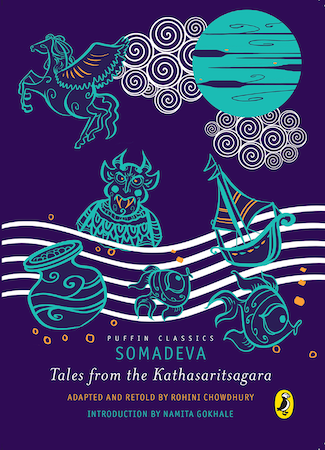
Somadeva: Tales from the Kathasaritsagara, adapted and retold by Rohini Chowdhury
Somadeva: Tales from the Kathasaritsagara illustrates perhaps the oldest (and best?) way short stories work together, flowing into one another in an endless ocean, on the border of the oral and written traditions. All the classic archetypes of demons, kidnapped princesses, magical animals, jealous rich people, fools and kings come alive to enchant us once again. This edition—the first translation of the Kathasaritsagara by a woman—is marketed as a children’s book; and, I guess, it is. But on second thought: is it?
Autobiography of a Corpse by Sigizmund Krzhizhanovsky, translated by Joanne Turnbull with Nikolai Formozov
NYRB Classics has been steadily releasing this previously untranslated Ukrainian-born Russophone writer for a little over ten years now, and every book is worth reading. There’s a story here with a talking white toad from the river Styx; a pianist’s runaway fingers; biblical pieces of silver accidentally “invent” monetary devaluation, or debt. The title story gives a whole new meaning to “autobiographical fiction.l of these stories left me speechless with their audacity, magic, and hidden mathematics.
Body horror, the gothic mundane, an appearance by a whale’s heart in a living room: these are just a few refreshing subjects this book creeps upon. At any turn you’ll laugh, feel unsettled, or be moved with the poetry in Gray’s lines: “I tried to remember myself at her age, but when I tried, I only saw a girl lost in the woods.” I first read Gutshot while listening to The Shaggs, really loud—not sure I recommend that part. Actually, fuck it: I recommend it!
When the galley for this book first fell into my hands, I read it right away, plunging into its world of haunted culinary dishes, and blurred lines between people and feral creatures, such as in “Moses and Gaspar”, where it’s unclear if the titular characters are wild children or beasts trying to be civilized. Dávila manages to describe the indescribable just enough for our minds to fill, and complicate, in those horrors. The intensity and impact of these stories will impact you immediately, and with long-lasting effect.
A sexual coming of age story, Little Rabbit is about a 30-year-old queer writer who meets a choreographer in his early 50s at a residency and quickly feels a spark of desire. The relationship that follows pulls her out of her comfortable life of hanging out with her best friends, working as an administrative coordinator in the Econ Department at Harvard, publishing an experimental novel with a press that immediately folds, and hooking up with women and “firm beta” men from her local and literary circles.
Both the art and the sex that the choreographer brings into her life crack open something new in her. She spends weekends at his apartment in New York and his house in the Berkshires, discovering the pleasure, agency, and power that come with submitting to him sexually. She is captivated by the performances of his dancers, finding his art form uniquely powerful in dissolving the boundaries of the self and making her less alone in her own body, while twining the lovers closer together and drawing them into starring roles in each other’s lives.
Alyssa Songsiridej and I first met as colleagues working at Electric Literature, where she is the managing editor. Though she could never have known it while writing the book, I ended up in a job very similar to her protagonist’s roommate, directing a literary conference in Boston. In our Zoom interview, I asked her about the tensions of being a queer person in a straight-passing relationship, how the truths of our private intimacies are lost in the public faces we present to the world, and how both sex and art allow us to transcend the normal boundaries of our bodies and selves.
Preety Sidhu: The protagonist of Little Rabbit is queer—bisexual or pansexual. And she’s drawn into this powerful attraction with a cisgender man who’s a far cry from all her “firm beta” previous male partners. Because with him, she discovers kinks that make her feel more alive than ever, less alone in her body, perhaps.
How are you thinking about the tension between queer identity, kinky desires, and the appearance of conforming to heteronormative expectations?
Alyssa Songsiridej: I feel like that’s one of the primary anxieties of the book and also maybe one of my own primary and personal anxieties.
Ultimately, I wanted to write a book about self-perception vs. the way others perceive us, and the really murky, inarticulable space between them. And how a person’s lived experience might bump up against the current restrictions of their identity. This kinky relationship was the way for me to play it out in a way that felt empathetic and alive. But I don’t have any clear statements about this tension, I’m just trying to play it out—in fact, I’m really pleased that a lot of people are having different reactions to their relationship, that they’re coming up to me saying, “I don’t know what to think.”
PS: I feel like we keep coming back to the phrase “some man’s little woman” and her not wanting to appear to be “some man’s little woman.” And yet outsiders perceiving that relationship might simply see an older, more successful man and a much younger woman becoming partners, moving in, and sort of taking on those life roles. I think that a central part of the book is that there is some part of her identity that’s not shutting down or getting smaller, but that is opening up or enlarging.
AS: I got the idea to write this book from listening to the Esther Perel audiobookMating in Captivity. There’s a section about women who are strong feminists, but they like to be submissive in bed and so there’s that anxiety of, “Am I a bad feminist for liking this?” And I wanted to write a narrator struggling with those same things, wondering “Am I a bad queer person for ending up in a cisgender relationship? Why do I have those thoughts of what is good or bad queerness?” I wanted her to think, “Where’s all this messaging coming from?” And I wanted to interrogate our assumptions about relationships based on the balance of power between two people. I really think there’s a difference between “power over” and “more power than.” In the first case, you’re getting abuse. But what happens in the second case? In a romantic relationship, it’s impossible to always be perfectly balanced. There’s gender, there’s race and class, someone’s career is going to be going up and someone’s down—there’s always a negotiation of material circumstances. Those differences mean you have to deal with the way that you’re presenting as a couple in public all the time, which is an exhausting phenomenon. Although I guess that has happened a lot less since the pandemic because we don’t really present in public anymore.
So I wanted to focus on a couple that we’re used to reading one way—a friend of mine actually said I took a cliché and made it feel alive. This older man/younger woman relationship that people generally have a lot of assumptions about. It seems cliché; it’s something you’ve seen in Hollywood a lot. We have a lot of inherited assumptions about what’s happening in this relationship. And I wanted to take this relationship and give it a full life, to really inhabit it empathetically and challenge our knee jerk response to what it must be like.
PS: Some characters in the book are named right away, while others have their names revealed only at key moments, which I won’t give away. It’s usually the less important characters who are easily named while the love interests are known by their occupations and the protagonist’s name remains a mystery for some time. What did naming or not naming a character signify for you within the world of this story?
AS: It was really important for me that the two main characters, the narrator and the choreographer, not be named throughout most of the book. They’re only known by their names for each other: Little Rabbit, the choreographer. Because it’s a story about how their private selves—their nicknamed selves—come up against their public selves, the people with their real names. The people who are named, like Annie, are being shown as they present to the world.
PS: The protagonist and her undergrad best friend and current roommate Annie are both attracted to women and proud of their queer identities. From Annie’s first pained response to the choreographer spending the night in their apartment, I wondered if she was in love with the protagonist, and my suspicion only grew as the book went on. But the protagonist herself never explicitly wonders this on the page. What’s going on there? Is there an attraction so deep and buried that neither of them can even voice the question, no matter how much pressure is put on their friendship? Or was it strictly platonic on both sides, and the protagonist had to outgrow it to claim something deeper?
AS: I definitely don’t think it’s only platonic. I mean, I think there are lots of female friendships, even between ostensibly straight women, that can end up being erotically tinged and very intense, especially when you’re really young. And these characters are supposed to have met when they were eighteen and still forming their identities. In my experience, in super intense friendships like that, you end up forming your identities with and against each other. It’s so entangled, it’s hard to name all the parts of your relationship. There’s something almost more threatening about the relationship between Annie and the narrator, in friendships like that, because you’re so focused on the way that you’re similar, it erases the ways that you’re different.
PS: For me, that part made it feel more like a coming of age story. The narrator had this post-college self and was dating around and living the Camberville life with her undergrad friends, and then she sort of outgrew it. That life is no longer big enough to contain her and there’s something more and deeper that she wants, that the choreographer can provide. But then Annie stopped growing up in parallel. Does that sound accurate?
When you hit your late 20s, early 30s, a lot of assumptions about how your life is going to be [is thrown out of] the window. You have to completely start over again. You can’t keep being the person you were.
AS: Yeah, definitely. It was really important to me that this narrator be in her early 30s. I know it might confuse people to be coming of age in your early 30s. But I do feel like there’s something about that time period where you have had some experiences as an adult and you think you’re one way, like you’ve made assumptions about how your life is going to be. And then when you hit your late 20s, early 30s, a lot of that just goes out the window. You have to completely start over again. You can’t keep being the person you were. Otherwise, you get stuck. And I think that’s a big part of what’s happening with Annie and the narrator.
PS: In the first pages of the book, the protagonist is captivated by the dancer Jackie:
“Watching her taught me something I would need years to learn how to say. We’re alone in a body, I thought. Our forms are hollow shells until our souls come to fill them. Then we bumbled, lost to each other, separate and apart.”
Towards the end of the book, she thinks about her relationship with the choreographer and how her “body blossomed into something built by the two of us.” Can you talk more about this idea of being alone in a body and the extent to which the protagonist’s evolving relationship with the choreographer either reinforces or breaks down her sense of aloneness in her body?
AS: 99% of the time we bumble around in the world caught in our own sense of self. We think of ourselves as being separate from everything, separate from—not to sound really woo, but like, the universe. I’m interested in moments that break that aloneness, where we feel merged with other people. Sex is one of those rare moments when you are taken out of yourself, where you get to break the barriers of, or the limits of, who you think you are. I feel like art is similar. When you’re really in the flow of making something, you’re taken out of the lonely sense of being a discrete being. I feel spirituality is another similar experience. I’m really interested in those moments of flow or union, how they help us live our lives. Figuring out how to write about those moments is an important project for me.
PS: It wasn’t like the protagonist had no prior sexual experiences. She had a variety of partners, male and female, but it seemed that the choreographer was breaking open something entirely new in her. How were you thinking more specifically about his character, as opening up possibilities for her in that sense of “aloneness in a body”?
AS: The thing about the sub/dom nature of the relationship is that she can willingly give up control over herself for a discrete period of time. To do that with someone that you trust really opens up a lot of possibilities for experience and pleasure that you might not have if you are 100% always in control, or if you are unable to let go of control. And I think it matters that he does a completely different form of art. He’s had a totally different life experience. Like I said, I don’t think he is the cause of the change in the narrator, but he’s definitely part of it. Embracing their relationship is going to influence her life in ways she doesn’t expect.
Another important part of the book for me is acknowledging the relationship between art and the material world. Like, you have to have money to live, to do stuff. Art takes time, and the way to get time is usually money. I think that’s something the narrator is struggling with. I think she’s a purist and it’s limited her, and he’s muddying the waters for her a bit.
PS: You know that question about her struggling to accept her own desires or work through what her own desires say about her? I feel like she’s on a path to accepting and owning it, discovering it, exploring it, and coming into an identity where she can tell some people about it and even start to see this as just part of her overall life and relationship. Then Annie pops out and pushes back, with what her own previous fears about herself would be. I think that’s why that particular line landed powerfully for me. I was thinking about the worries about what our own desires say about us, and learning to—whatever they might be—claim them as empowering. Do you have more thoughts on that?
Sex is one of those rare moments when you are taken out of yourself, where you get to break the barriers of, or the limits of, who you think you are.
AS: Yeah, 100%. What the narrator’s grappling with, what I wanted to bring to life, is this anxiety and worry about how our—consensual!—desires reflect on how we present ourselves in the world. In some cases, like abuse or hypocrisy, yeah, you should be anxious or concerned. But for the narrator—look, when we talk about kink in mainstream culture, sometimes we operate with ideas that are not quite accurate to the internal experience. I think that’s the case with the narrator. In her relationship with the choreographer, there are lots of ways in which she has more control than he does. It’s a consensual relationship. Everything that he’s doing is for her pleasure, including the domination. So really, he is serving her, you know, and really she is in charge, and she can end up controlling certain scenes. That’s a dynamic I wanted to make clear.
PS: I think she spends a lot of time worrying about how much power he has over her and how her body is responding, and following him all over the East Coast, and how maybe she followed Annie before in a similar way that I think that is interesting. But I want to think about the power she has over him. I really love the scene where they meet Jackie in the dance studio to try and show Jackie something about their relationship so Jackie can better exact the choreographer’s vision for the dance. There’s a great moment where the protagonist drops down in front of the mirror and we’re thinking about the self that she can see in the mirror, the self that she can see as her own flesh, and the bruises even she can’t see under her clothes, what’s hiding there. At the same time, she is kind of torturing him by making some of this public in his professional life. He started it that, of course, but how much of what they’re doing is giving her power over him and more power over her own life? And is it ultimately way more empowering for her than it is about losing power?
AS: In her case it’s definitely empowering. She has to have power in order to give it to him in the first place, and she’s only giving it to him under specific circumstances. There are clear boundaries. There were little things about their not-sex life where I wanted to be clear that he doesn’t have influence over her. Like, he’s a vegan but she’s still eating salami. He wants her to feel equal in their public lives. She can give up power to him in bed because she actually has it. If she didn’t, if she was actually in a disempowered position in the relationship, she wouldn’t be able to really submit to him in the pleasurable way that she does. The fact that it’s a choice and it’s a game actually gives her a lot of power.
On a particular afternoon, I drove my minivan through the rainy streets with the radio on, my 15-year-old daughter sitting at anxious attention next to me. We were at the tail end of a particularly dreadful Supreme Court nomination hearing, and I, like many women in America, felt a crushing sense of ominousness and doom. My daughter and I listened, barely breathing, as Christine Blasey Ford resolutely testified to the details of her sexual assault to a room full of senators who did not seem particularly inclined to listen to what she had to say, to say nothing of altering their vote. I gripped the steering wheel and watched my child shake her head, realizing with a start that I was her exact same age when Anita Hill testified to another similarly disinclined group of senators. I remembered how galvanizing that moment was for me at 15. How enraged I felt. I remembered the looks the senators gave Prof. Hill, and their dismissive and diminishing and offensive comments. And here we were, an entire generation later, facing the same goddamned thing. Nothing had changed. I pulled over and felt my anger and frustration expand within me, igniting my bones and blistering my skin.
I decided right then and there that I was going to write a story about dragons and rage. That I would write a story about a bunch of 1950s housewives who turn into dragons, whereupon they possibly eat their husbands, or former teachers, or physicians, or youth group leaders, or camp counselors, or anyone else who had wronged them once. Men who grasped where they should not grasp, or who felt entitled to claim what was never his. I’ve met men like that in my life. And maybe so have you.
Rage isn’t meant to stay in one place. It movesus from one state to another—like a refiner’s fire, or a catalyst. Rage brings heat, light, and clarity. It burns the chaff away, leaving that which is essential behind. Growing up as a woman, I was raised to mistrust my rage. To feel ashamed of it. To distance myself from it and pretend it never existed in the first place.
I don’t feel that way any longer.
As I wrote, I quickly realized that I wasn’t writing a short story at all. It was a novel, perhaps. Or a series of historical documents. Or the musings of a scientist. Or a memoir. Or maybe all these things at once. I wasn’t sure, but knew enough to trust the story. It would tell me what it wanted to be eventually. As it asserted itself on the page, I started exploring other books that walked through this same territory—rage, feminism, memory, and maybe dragons too. I hope you like them as much as I did.
A Natural History of Dragons is written as a memoir (albeit of a fictional person, in a fictional world) of Lady Isabella Trent, the world’s most famous dragon naturalist. Though her interest in science and natural observation was tolerated as a child, as she grew it became very clear to Isabella that her future was limited by her gender and social status, and that her duty to her family was to make an acceptable matrimonial match. How vexing! And how unacceptable. This is a story about dragons, obviously, and science, and the practice of biological research, as well as a play on manners and expectations and the ridiculousness of society. But it is more besides: persistence, curiosity, attention to detail, a refusal to be dominated, and a profound sense of that deep joy of learning, and wonder. The way that Lady Trent pushes on the boundaries of her society, and deftly steps beyond them, was a thrill to read.
A story of collapse, chaos and perseverance. Taking place in Butler’s imagined post-apocalyptic 2020s, we enter the world of 15-year-old Lauren Olamina, resident of a gated community that offers a thin safety from the ravaged world outside. Her preacher father, along with the rest of the community, stubbornly cling to the truths that once kept them safe, but our perspicacious and pragmatic heroine sees dangers that the adults in her life cannot, and imagines a future that the past itself could never dream of: a new path, a new religion, the birth of a new world.
This is a book I have returned to many times in my life, and every time I find something new. Butler engages furiously with the threat of climate change, the moral injury inflicted by late-stage capitalism, the assault on democracy, the rise of demagoguery, and the generational plague of racism. What emerges is a character so singular, and a vision so profoundly hopeful. There is no other writer who sees so clearly the purpose of rage, and the utility of harnessing the resulting energy from rage as it transforms the self, the community, and indeed the world.
Searing. Terrifying. And utterly believable. A near-future novel about an America that has outlawed abortion, contraception, in-vitro fertilization, and single people adopting children—all of which is couched in the syrupy, maudlin moralization of “won’t you THINK of the children”. We don’t have to look very far to see the rhetoric that could potentially usher us into this particular possibility. I wish this book wasn’t necessary for all of us to read, consider, and fight against. But here we are.
A memoir-in-essays, Paley provides space for the reader to occupy her incisive, agitated, and often furious mind. Paley’s vision is as sharp as razor blades and her gaze is unrelenting. She dissects the world around her with the precision and brutality of a biology teacher, cutting open the guts of the still breathing frog and showing the class the full gamut of what’s inside, leaving nothing unremarked.
This book is a sweeping, searing, riveting exploration of the violence and corruption embedded in the very flesh of the American body politics—clear-eyed slice into the heart of the matter delivered through the slant of alt-history. We meet our heroine, Jane McKeene, on the day of her birth, as a squalling, gooey infant, the Black child born in secret to “the richest white woman in Haller County”, just as she is about to be murdered by the midwife to prevent scandal to the family. Instead, she is rescued and grows up in Ireland’s imagined version of the Reconstruction South—a landscape where the Civil War dead have scrambled and crawled out of their battlefield graves, and are now ravaging the barely-healed nation. They are called the Shamblers, zombies with memories and absolutely out for blood, and they are terrifying.
To protect white families (and by extension, white supremacy), Jane, along with other Black and Native children, are rounded up and sent to re-education camps, where they are taught the art of battle, and to sacrifice their own well-being for the continuation of white society. She trains at Miss Preston’s School of Combat, where she grows into an adept, ambitious and furious fighter, and an unapologetic and incisive young woman—personality traits that get her into trouble. “It’s a cruel world,” Jane muses. “And people are the cruelest part.” Indeed.
Dread Nation is a dense novel, and it doesn’t shy away from the complex and layered permutations of the scourge of racism, the weight of history, the complications of complicity and betrayal coming from both without and within, and the boot of misogyny standing on the necks of every woman, across the social spectrum, no matter how hard they try to move it. At the center of this stands Jane, her talents and her fury, her intellect and her resourcefulness and her unwillingness to suffer fools, and most of all her courage as she battles the creeping, groaning, shambling horrors pouring unrelentingly forth, threatening to destroy them all. Have you read this book yet? Well. Get on it.
How is it that a novel that spans generations, centuries, and even millenia manages to feel so intimate, immediate and brave? Is Madeline Miller a sorceress? I’m starting to think she is.
Miller takes on on a journey through the landscapes of Greek mythology—war, death, betrayal, castle intrigue, lust, possession, dissolution, the insufferable snobbery of gods and the heartbreaking frailty of humanity. This is the story of Circe, a disempowered daughter of a careless god, unappreciated and disparaged by her own kind; she lives in exile among the animals, where she cultivates her skills in witchcraft and discovers a wellspring of power that even the gods don’t understand. Both diminished and demeaned, Circe discovers the roots of her own anger, and both the power and possibility presented by that rage. She is both startled and transformed—as are we, the reader. Rage in this story acts as a fire—it burns away the lies that she has been told and the lies she tells herself. It clears away the debris and clutter, allowing her, at long last, to see a new path, a new self, a new way forward.
How many times have I read this book? I shan’t say. How many more times will I read it? Oh my dears. Many.
This book is dark, lush and profound. An astonishing circus, populated by performers with augmented bodies (bones replaced by lightweight copper; spines embedded with springs; clockwork lungs that gently wheeze out melodies—all possible thanks to the strange magicks of an enigmatic woman known as the Boss), moves through the margins of a world that has lost its mind. The cyborg performers, once upon a time, subjected themselves to the Boss’s knife willingly, often when they had no other options. They are now capable of such beauty, such grace, such astonishments of movement and possibility, all of which came at such a price. So it goes.
There is a war (there is always a war), but the Boss—who is, to the performers, a combination of ringmaster, guardian, and mostly-beloved tyrant—protects her circus, her magic and her autonomy as fiercely as she protects her own secrets. She is larger than life, judicious, fair, beloved, and absolutely terrifying. When the troupe is waylaid in a city known for fomenting trouble, a Government Man proposes a bargain with the Boss—an offer she can’t refuse, as it were—in hopes of regaining what is lost. Or so he says. What results is a death-defying battle of wits, will, and circus acts so marvelous you’ll have to stop and catch your breath. A story of loyalty, truth, commitment and hope set against a backdrop of a grim, post-disaster world. And wings, too. Oh! The wings!
This memoir begins at the deathbed of the author’s mother, who in her last moments, tells Williams, “I am leaving you my journals, but you must promise not to look at them until after I am gone.” But in the aftermath of the death, funeral, and countless tasks that must be done after our mothers leave us, Williams finds the journals—and discovers that they are all blank. So what was her mother trying to say? And why did she ask it at all? The result is an exploration of nature, voice, female presence, marriage, the unnatural rigidity of gender roles, and the particular (and peculiar) language of silence.
Williams unpacks the cultural silencing of women, the promise, joys and predictable failures of orthodoxy and communal faith, the voice of nature and the intelligence of the land, and the thousands of ways that our parents fail us—just as we fail our own children. Willams is a gorgeous writer—each sentence rings like a bell—but more important here, she creates space in the narrative for the reader to stand next to her. She guides us, step by meditative step, through the landscape of own sorrows, loss, frustration and fury, all in the context of her boundless and persistent love. She forces us to pause and breathe, to open our eyes, to bear witness to the mountain, the desert, the gasping, dying cancer patient, the mirror, the marriage bed, the empty page, the words never uttered.
This is the book that made me interrogate the utility of memory, the purpose of image and metaphor, the redemptive potential of righteous rage, and both the process and the gift of motherhood. It is a book that communicates in silence. It is a book that speaks loudly upon the heart.
I saved someone’s life once. A woman drowning in a river, and good thing because it’s my go-to party story. People love a story where someone almost dies. Really, that’s the part they love–not that a hero stepped in to save the day. People are morbid fucks when it comes right down to it. But I was that hero. Me.
And I’m skinny as a rail, so people get even more excited when I tell them I saved a drowner. People look at my scrawny ass and think, if she did it, so could I. If it’s a man, he adds in my being a woman and probably thinks he could save a boatload of people.
But me, I just saved the one. Briana, a visiting cousin of Tonya’s who came with us to swim after our shift was over. In the summer, we swim at the Holy Hole, which is what we call our part of the river. It’s dark and cool by the water, and the moon is fat and beautiful, like Tonya. She thinks she’s too big because her ex-husband made her feel ugly. Pete used to call her a cow, and I think he socked her around. She never said so, but you can only come to work with so many black eyes and klutz stories before people catch on. Pete’s the kind of guy whose party story involves group sex, and he tells it with pride. That’s Pete. Tonya left him two years ago—it took her years to work up to it, but she did because Tonya’s strong. Strong in a quiet way, which is why most people don’t see it. Except me. I know she’s strong.
So anyway, we like to swim in the river after work. We’re sweaty, smell like grease, and are dead tired, but nothing feels better than dunking under that cold water, feeling the current rush against our throbbing legs, wiping clean a night of customers. Tonya treats every customer with kindness, even the rude ones. Once, when I told a pushy trucker that my number was 1-800-nevergonnahappen, she said I was brave. I wanted to tell her that talking brave isn’t the same as being brave, but I just shrugged. When she’s working, Tonya hums to herself softly. Listening to the smooth, low rhythm of her voice reminds me of being in the water—effortless and cool.
Briana, the cousin, hangs at the bar waiting for Tonya’s shift to end and takes advantage of the free drinks she’s getting because Duane, the bartender, thinks she’s cute. Briana’s not fat and beautiful like Tonya. No, Briana’s got muscles everywhere—almost like a man. Her biceps pop when she raises her beer for a swig, and her legs look strong enough to crush someone between them. I wonder what it might feel like to have muscles like that, for people to see how strong you are just by looking at you.
After work we head to the river—me, Tonya, Briana, Duane, and Mickey, one of the dishwashers. We sit on the big rock where the current picks up, and I can feel Tonya next to me, even if we’re not touching. Out of the corner of my eye I see those gorgeous, thick thighs of hers and I want to touch them. But I just run my hands over the cool rock beneath me, look up at the swollen moon above me.
Duane howls like a wolf and cannonballs off the boulder into the cold, rushing water below. The Holy Hole is about twelve feet deep and then gets shallow, real quick, on either side. Come on in, Tonya’s cousin, he yells over to Briana. I don’t want to watch this mating ritual go down, so I jump off the boulder into the water.
I let myself sink until I feel the silky, cold mud and smooth stones at the bottom of the river. Everything is muted and cool and dark, and I can’t feel where my body ends and the water begins. It is my favorite feeling in this world. When I can’t hold my breath any longer, I shoot myself up to the surface to fill my lungs.
Briana tiptoes into the river from the bank instead of jumping off the boulder like the rest of us. It’s strange to see such a muscular creature move so tentatively through the shallows. She hugs herself with her huge biceps and whimpers about the cold. As she baby steps closer to the hole, I yell, “Watch it. It gets deep fast and the current picks up.” Idiot is what I’m thinking. Get in or get out, but stop making a show of it.
And then Briana slips under. One minute she’s standing and holding herself with her big ole guns, and the next, she’s under. It’s almost graceful, except for what comes next, which is that Briana breaks the surface, hair pasted over her eyes, gulping and yelling before the water swallows her again. I think she’s playing, that someone who can’t swim wouldn’t be dumb enough to go past their ankles. But then I hear Tonya’s voice ring through the night, “She can barely swim!” So I dive down for Briana.
Even though the water is murky, there is no way to miss the thrashing close to the river bottom. As I swim towards Briana, she pushes off the riverbed flapping wildly upwards, so I surface with her and give her my arm for her to grab. I know that isn’t what you’re supposed to do now, but it’s all I know in that moment, so I do it.
Does Briana grab my arm like she’s supposed to? No! She grabs my shoulders, clamps down hard, and pushes me under like some kind of human raft she’s trying climb aboard. She’s thrashing and kicking me in the gut, and then we’re fully submerged and she’s sinking us both. It feels like she weighs three hundred pounds, and all I can think is that this bag of muscles is gonna drown me. She’s gonna kill me.
Nothing has ever struck me as clear as the fact that she was going to drown us both. That’s when I start punching and pushing Briana’s rock-hard abs until I finally break free and swim to the surface. I’m gasping for air, hoping she has the sense to push off the bottom again ‘cause there’s no way I’m going back down for her. And then there she is, sputtering and reaching for me. I yell grab my arm, and push back from her so she can’t reach any other part of me. I use my free arm to paddle, and kick hard toward the riverbank.
Briana sits in a heap on the bank, sobbing, and Tonya hugs her, shushing her like a baby. I wait for Tonya to check on me, but it’s Duane and Mickey who huddle around me telling me I’m a hero. They say they were about to dive down but it looked like I could handle it. Why in God’s hell would you think that, I want to ask, but I stay quiet ‘cause who doesn’t want to be called a hero? I watch Tonya hug Briana until Briana gets up and walks over to me—all unsteady and snotty like some kind of monstrous toddler. I know it’s mean to describe her like this ‘cause she was scared down there, but I was too, and you don’t see me blubbering all over everyone.
“You saved my life.” Briana crouches next to me and keeps repeating this. I pat her on the shoulder and say it’s okay so she’ll stop. Tonya comes over and looks at me with her big, brown eyes, little flecks of gold shot through. “Thank God you were here, Holly.” She jerks her head at Duane and Mickey. “Those two are worthless, and you know how slow I am. You saved her, Holly.”
I want Tonya to keep going, but she trudges up the bank behind Briana to leave. Mickey and Duane drive me home and I tell them how Briana felt as heavy as an iron anchor, how tight her grip was, how I punched and pushed at her underwater to free myself. I tell them she was going to drown me and admit that I wanted to save myself more than anything.
What I don’t tell them, what I don’t tell anyone when I tell my best party story, is that I needed to survive because I had to hear Tonya’s voice again—the silvery sound of it when she hums at work. I tell myself that I leave this part out because I know what makes a good party story. People want to hear about slipping beneath the surface, about punching and thrashing: They want to feel death come close. They want to break the surface and be called a hero, so I give them what they want.
I’m barely on Twitter, but I can appreciate an excellent tweet. There are some standard characteristics of the best—they are terse and clever, and, even better, they are well-worded and cutting. It’s no wonder that one of my favorite tweets, a triumphant quip, was drafted by a dictionary account: It’s the tweet from Dictionary.com referencing a particular definition in a quote tweet from Forbes naming Kylie Jenner the youngest “self-made” billionaire.
Now, the account is only a brand personality for the dictionary created by an impressive team (looking at you, social media manager heroes). But it still makes it clear that Dictionary.com, like other dictionaries, takes some stances. It can be tempting to see a dictionary as a completely objective text, a collection of words and their meanings that exist separate from the day-to-day, but we know that’s not the case. Our language evolves, and new words and new meanings arise, so dictionaries need to be paying attention and actively involved. And we do too.
So whether you’re already following all your favorite dictionaries on Twitter or you’re looking for more word-play fixes after Wordle, this list has some required reading. Here are seven books that explore the dictionary and its cultural impact as a scholarly pursuit, as a place to find purpose, as a text to be challenged and changed, and a way to find meaning.
I was in a women and gender studies class in grad school when it finally clicked that referring to a text as a seminal work of feminist literature was, well, wrong. And that’s just one of so many phrases, words, and even grammatical rules with built-in biases. In this work of nonfiction, Amanda Montell explores this sexism inherent in our language—and how we think about “correct” use of language to this day.
Because Montell is a linguist, she deals not only with words but how, when, and why we use them. She covers everything from vocal fry to discourse markers to female pronouns for inanimate objects to the six different forms of like (all of which, Montell argues, you’re free to use.) But Montell’s chapter on insults might be the most entertaining in this book—if also one of the most infuriating. Montell walks you through studies about perceptions of women who swear, as well as the different types of swear words and how often being likened to a woman is an insult. Plus, she leaves you with some feminist suggestions for additions to your cursing vocab.
Eley Williams’ debut novel follows a fictional dictionary during two timelines. In the late 19th century, Peter Winceworth is a lexicographer working on “S” for the Swansby’s dictionary when he decides to enter his own words into the work. In the present day, Mallory is interning at Swansby’s Dictionary for what she thinks might be too long when her boss, the last in a long line Swanby editors, tasks her with finding all of these fake words and removing them before the dictionary is digitized. Mallory commits herself to the project, despite her boss’s general neglect and an anonymous caller threatening the dictionary headquarters.
This book is a delightful glimpse into the lives of two compelling characters who are questioning their vocation and their purpose while working for the dictionary. Even more, the writing is beautiful, with charming, energetic wordplay perfect for a dictionary-based book.
The Great Passage by Shion Miura, translated by Juliet Winters Carpenter
This novel also explores the dictionary as a purpose and a workplace. When Kohei Araki is ready to retire from his role as dictionary editor, he needs to find his replacement to work on the next project, The Great Passage, a new, inclusive, complete Japanese dictionary. Araki finds Mitsuya Majime, a younger colleague in the sales department who is awkward, unsure of what he wants to do, and fascinated by language. He takes the job.
The novel follows Majime over the next 15 years as he falls in love with his landlady’s granddaughter, hires a young editor to join his team, and spends his days poring over the words to include in the nearly 3,000-page, updated edition. The story is sweeping in nature, but the book is short, with compact sentences and, of course, careful, precise wording.
In this sweet, historical novel, Esme is just a kid when she starts collecting words. Her father works as a lexicographer for the Oxford English Dictionary project, and Esme collects the paper slips that her father and the other employees collect, curate, and consider for the first editions of the dictionary. As Esme gets older, she becomes more concerned about the words that she doesn’t see in the published dictionary or on the slips of the men working on the next letters. So she starts keeping records of words that she hears in conversation in the kitchen, at the market, in letters from her aunt—words that women use.
This book reimagines the creation of the OED during the suffrage movement for white women and in the years leading up to World War I. Williams explained that she was inspired to write this novel after hearing about an early critique of the OED that admonished the editors for leaving out bondmaid, such a common word at the time but one that didn’t refer to men, let alone men of means. Williams uses Esme’s project to explore both the intentional and unintentional excision of words from the OED, with the heightened tension from the political movements. The result is a moving novel that not only follows the OED through publication and revision, but follows Esme beyond her childhood as she becomes an adult—one who never loses interest in collecting words.
Like The Dictionary of Lost Words, The Professor and The Madman focuses on the creation of the Oxford English Dictionary. Unlike Williams’ novel, this is a work of nonfiction—dramatic and twisty and thrilling nonfiction, that is.
While creating the OED, Professor James Murray, the editor, solicited and accepted words, definitions, and excerpts from many members of the public in order to accomplish the significant undertaking. Dr. William Chester Minor was an American surgeon who submitted thousands of these words to the project and corresponded with Murray personally for more than twenty years. The entire time he was contributing and declining invitations to visit Murray in Oxford, Minor was in Broadmoor, a criminal psychiatric facility. Simon Winchester unravels the mystery of who exactly Minor was and traces the relationship between Minor, Murray, and the OED.
(N.B. There is a movie adaptation, but it’s starring Mel Gibson. Shame.)
In her memoir Word by Word, Kory Stamper, a lexicographer who worked at Merriam-Webster for more than twenty years, offers an insider’s look at the day-to-day tasks involved in writing dictionaries for a living. Stamper dispels some myths right away—that dictionaries moralize language, that they make the final call on what words make the cut. She provides behind-the-scenes details, like how she and her colleagues answered complaint emails, as well as facts that I can’t forget. (Irregardless was a word long before it was whole-heartedly rejected as not a word? The more you know.)
The best part of this memoir is Stamper’s warmth and enthusiasm. Her excitement in describing everything from her high-school insults to the coffee maker in the disappointingly drab Merriam-Webster offices is palpable, and it makes for a lovely read.
Admittedly, this book isn’t exclusively or primarily about dictionaries. But it does explore the impact that seemingly un-biased reference texts have on our society and one particularly eye-opening chapter on a dictionary that originated American mythology we still see today. Journalist Jess McHugh shares the history of Merriam-Webster’s Dictionary, which was first written by Noah Webster in the 1780s.
Webster’s project was to standardize a distinctly American English language. As McHugh explains, that included dropping the “u” in words like “color” and providing pronunciation guides that matched Webster’s own Connecticut accent. It also included using the right examples to illustrate the uses of these words, drawing from Protestant beliefs and American literature.
Even from its inception, the reference text was anything but neutral. Pick this one up for McHugh’s exploration of this American dictionary, but keep reading for how other benign texts like The Betty Crocker Cookbook and The Old Farmer’s Almanac contribute to our understanding of American identity today.
On Monday night, fashion’s favorite night of the year (part 2) returned with stars and designers coming out to celebrate the Met Gala – The Sequel, as I like to think of it. Officially, the dress code of this year’s famed bash, hosted by Anna Wintour, was “Gilded Glamour,” white tie for the men and floor-length ball gowns and gloves for the women. Unofficially: anything goes (well, almost).
Picking up where September’s installment, titled “In America: A Lexicon of Fashion,” left off, this is the first time the event returned to the first Monday in May since the pandemic (when I last covered the red carpet for Electric Lit). Part two suitably upped the drama.
As someone who worked as a fashion editor for the better part of a decade, I’ve always viewed the Met Gala as an ideal event, marrying stories, sartorial psychology and statement-dressing (otherwise known as three of my favorite things). As stars made their way down the red carpet, I couldn’t help but wonder what literature’s most memorable muses would had worn.
Invitees, numbering 600, were instructed to “Dust off Edith Wharton’s Age of Innocence and The House of Mirth… and embody the grandeur — and perhaps the dichotomy — of Gilded Age New York.”
So that’s where we’ll start.
Old-school glam
Originally coined by Mark Twain, the “Gilded Age” refers to the period from 1870 to 1890, when the country was coming off the high of the Industrial Revolution, and the low of the Civil War; American innovation was booming– a fine time for myth-making. Nowhere was this more apparent than in upper crust society, which found a credible author in Wharton herself, who documented the excesses, entanglements and pitfalls of her class, most notably in The Age of Innocence.
So who was giving off Countess Ellen Olenska vives on the red carpet? That honor belongs to several attendees – no surprise, here– who embodied the unconventional, impassioned fashion sense for whom Wharton wrote: “She was dressed as if for a ball. Everything about her shimmered and glimmered softly, as if her dress had been woven out of candle-beams; and she carried her head high, like a pretty woman challenging a roomful of rivals.”
Tapping into the Countess’ irrepressible grandeur was Blake Lively, one of the night’s hosts, in an embellished Atelier Versace gown, which featured a scene-stealing reversible train inspired by the patina of the Statue of Liberty. Adorned in head-to-toe sequins, Jessica Chastain’s oxblood-colored Gucci gown and matching turban could have come straight out of Ellen Olenska’s wardrobe.
Gigi Hadid in a hooded, corset jumpsuit and puffer-coat by Versace certainly scored points for originality and devil-may-care theatrics. See also: “ “Madame Olenska, heedless of tradition, was attired in a long robe of red velvet bordered about the chin and down the front with glossy black fur.”
Then there was Billie Eilish in custom Gucci, who nailed the mood Wharton seemed to have in mind when she wrote: ““What can you expect of a girl who was allowed to wear black satin at her coming-out ball?” But the starlet who best captured the opulence and drama of Countess Olenska? Kaia Gerber in a silver tassel Alexander McQueen gown.
Wharton’s earlier tome, House of Mirth, opens with its heroine, Lily Bart, on the decline. At 29, Lily’s is fast-approaching spinster territory (kind of amazing-depressing-hilarious). However, when the novel opens, potential suitor Lawrence Selden is “refreshed by the sight of Miss Lily Bart” and then: “he could never see her without a faint movement of interest: it was characteristic of her that she always roused speculation.”
Enter: Sarah Jessica Parker, in a strapless ballgown by Christopher John Rogers with a fitted bodice, cascading skirt, and opera gloves – inspired by the work of Elizabeth Hobbs Keckley, a former slave who went on to become Mary Todd Lincoln’s dressmaker. (Dressing the First Lady made Keckley the first Black female fashion designer in the White House.)
Parker’s fastidious attention to theme is a well-known thing in Met Gala lore, as is her knack for extravagant headpieces. Head art, decorative crown, whatever – this year’s black tulle and fuchsia-flowered confection by Brit milliner Philip Treacy was straight out of the pages of House of Mirth. Throughout the novel, Lily relies on hats as an accessory, later turning to millinery work as she spiraled out of society’s good graces.
“A woman is asked out as much for her clothes as for herself,” Lily quips. “The clothes are the background, the frame, if you like: they don’t make success, but they are a part of it. Who wants a dingy woman? We are expected to be pretty and well-dressed till we drop–and if we can’t keep it up alone, we have to go into partnership.”
Surveying her wardrobe, reflecting on her life near the novel’s end is a scene that could have come straight out of an episode of Sex And The City:
“The remaining dresses, though they had lost their freshness, still kept the long unerring lines, the sweep and amplitude of the great artist’s stroke, and as she spread them out on the bed the scenes in which they had been worn rose vividly before her. An association lurked in every fold: each fall of lace and gleam of embroidery was like a letter in the record of her past. She was startled to find how the atmosphere of her old life enveloped her […] every hint of the past sent a lingering tremor along her nerves.”
Good-time girls
There were plenty of dancing-til-dawn statement looks that would have suited the female friends in Happy Hour, by Marlowe Granados. New to New York, the narrator Isa says: “There is only one rule when we get dressed: if it makes you feel good and there’s a pinch of fear that while in public someone may throw a comment your way or think it’s too much, wear it.” The celebs bringing Isa-levels of glam included Kim Kardashian (in the shimmering slip Marilyn Monroe wore to sing Happy Birthday to JFK), Megan Thee Stallion (in gold feathered Moschino) and Lizzo, who told reporters it took 22 hours to make her embroidered Thom Browne dress, adding that she felt like “a piece of art.”
The multi-million dollar dress has rarely been separated from its muslin-covered dress form, let alone worn by anyone other than Marilyn Monroe. Learn more about how @KimKardashian pulled off the iconic “Happy Birthday, Mr. President” #MetGala look here: https://t.co/lwx4Tlagbhpic.twitter.com/92mAxRJ4Rf
As for Isa? New York nightlife is only as fun as the outfit you wear to greet it. “You never know if someone else may be emboldened to do the same! If you’re going to put something on your body, why not make it look good? People think clothing is frivolous, but it can really instill courage, and that’s a good thing.”
Giving a glimpse of what’s underneath and revealing just enough truth to add intrigue is the skill of a great artist. Kerry’s Washington’s stunning sheer corset gown by Tory Burch illuminated the fine line between show-and-tell that Raven Leilani’s artist narrator in Luster tiptoed. Met Gala-worthy mention: “But the beauty of disco is the too much.” Quite.
“I was dressing for someone in those days and I liked to believe it was me,” says Joan, the narrator of Lisa Taddeo’s carnal novel Animal. In the first few chapters, Joan describes herself as depraved and things are only exacerbated from there. She stews on being judged, and envies those who judge her. “I knew the precise color I wanted my coffee and how to have an orgasm in under thirty seconds. I needed everybody in the world – including waiters – less than they needed me.” Peeling off a red Dior blazer to reveal her gold-painted torso – pasties and all – Cara Delevingne was all Joan. There’s a part midway through the novel where Joan’s going to meet a man she’s having an affair with, wearing a leather top that seemed like an aggressive outfit choice until Irina Shayk stepped out in a head-to-toe black leather look by Burberry, which was pure heat.
Singers Olivia Rodrigo, in a violet Versace stunner, and Phoebe Bridgers, in Jonathan Simkhai, glimmered in the New York night, reminding us of Luz Dunn in Gold, Fame, Citrus, running through a Hollywood starlet’s empty home, pulling out wildly impractical gowns to go traipsing through the water-less abyss. “In the dream Luz had worn every dress all at once, her breasts bestudded with rhinestones and drenched in silver dust, her ass embroidered with coppery alleyways of sequins, pleated plumes of satin fanning from her hips, pale confectioners’ tulle floating like spun sugar at her feet.”
Understated elegance
But it wasn’t all over-the-top, gold-plated everything. Eva Chen, in a chic pale champagne suit jacket that spilled open to reveal a pleated skirt by Peter Do, looked smart and composed, in the vein of the unnamed narrator in Katie Kitamura’s Intimacies. “But a narrative becomes persuasive not through complexity but conviction.”
Taking a subtly refined approach, like Miranda Kerr in Oscar de la Renta or Mindy Kaling in a simply breathtaking lilac gown by Prabal Gurung, seemed befitting of a Salley Rooney character, perhaps Eileen in Beautiful World Where Are You? Who writes: “I could always think of something nice, and sometimes I would even do things for the purpose of putting them in the book like taking a bath or going for a walk.” She describes the pleasures of journaling in a letter to her best friend Alice. “At the time I felt like I was just absorbing life, and at the end of the day I never had to strain to think of anything good I had seen or heard….There was something delicate about living like that. – like I was an instrument and the world touched me and reverberated inside me.”
Fast-forwarding a few decades, Emma Stone, in a short silk, feather-hemmed dress by Louis Vuitton, was giving sleek Great Gatsby style. Effortless in design, yet still party-perfect, the look called to mind a description of Daisy Buchanan’s tennis-star friend, Jordan Baker. “I noticed that she wore her evening dress, all her dresses, like sports clothes–there was a jauntiness about her movements as if she had first learned to walk upon golf courses on clean, crisp mornings.”
Another Gatsby reference? It’s to be expected when we’re talking gilded glamour. Lena Waithe arrived in an ornate blue Versace suit that would have done his Great-ness proud.
Jared Leto and Gucci designer Alessandro Michel upped their game in matching cream suits with black lapels, crystal hair clips, scarlet bowties and bronze velvet bags – an ensemble that seemed to have walked right off the pages of The Picture of Dorian Gray, gesturing to the interplay between art and artist. Who was the muse here, anyway? Or in Oscar Wilde parlance: Dorian or Lord Henry? “Nowadays people know the price of everything and the value of nothing”
Another fine interpretation of the Met Gala’s theme? Joshua Jackson, in Gucci, proved he understood the remit. This year’s dress code called for white tie, which according to a G.Q. style guide, required a black tailcoat and dress pants with a white shirt, vest and matching bow tie. Instead of white gloves (also prescribed for men), Jackson opted for a pinky ring, as you do, in the style of Tinker Grey from Amor Towles’ Rules of Civility.
“His face was flush.The cold New Year’s air emanated from the fabric of his tuxedo. He was grasping a bottle of champagne by the neck and grinning like a truant holding a fish by the tail.” Set in 1930s New York, Towles’ novel is all style, tracking the highs and lows of the Katey Kontent and sly, two-faced Tinker uptown and down. “[His coat] struck me as a bit of a pose—a born and raised New Englander dressed like the hero in a John Ford film. But the smell of the snow-wet wool made it seem more authentic. Suddenly, I could picture Tinker on the back of a horse somewhere: at the edge of the treeline under a towering sky . . . at his college roommate’s ranch, perhaps . . . where they hunted deer with antique rifles and with dogs that were better bred than me.”
Jackson’s better half Jodie Turner-Smith was giving full flapper in a glittering Gucci number.
In The Theory of the Leisure Class, published at the turn of the 20th century, Thorstein Veblen writes: “Elegant dress serves its purpose of elegance not only in that it is expensive, but also because it is the insignia of leisure. It not only shows that the wearer is able to consume a relatively large value, that it argues at the same time that s/he consumes without producing…Our attachment to the skirt is based on this premise: it is expensive and it hampers the wearer at every turn.” But does any of it matter if you can still dance? Till next year, Met Gala!
The first time I read a book about a person who even minorly resembled me, I was 19 and teaching at a creative writing summer camp. My coworker Sophie Lee’s YA novel What Things Mean tells the story of a young Filipina girl named Olive who uses reading to cope with feelings of loneliness and estrangement. As a Filipina-American who grew up within the monotonous landscape of white suburbia, I, too, had used books to escape my reality, oftentimes ditching invitations to ride my bike around the block for the chance to dig into a pile of newly-borrowed library books.
Though some might have me believe that the lack of representation I experienced is because of the absence of Filipino American writers in American literature, that couldn’t be further from the truth. With Filipino settlements in the U.S. dating as far back to 1783, when Filipino fishermen built a village on Saint Malo off the coast of Louisiana, Filipinos and Filipino Americans have been integral to shaping American culture into what we know it to be today. Farmer, activist, and writer Carlos Bulosan wrote what is known as the first Filipino American novel in 1943. America is in the Heartis only one of many works of literature that stand testament to how fully Filipino Americans have shaped the political, economic, and artistic landscapes of the United States.
The following Filipino American authors and their work continue to weave legacies of assertion, of resistance, and of artistic cultural diversity into the fabric of American literature.
Through his signature clear prose and vulnerable storytelling, Jose Antonio Vargas brings us into the inner life of an undocumented immigrant in his memoir, Dear America, Notes of an Undocumented Citizen. Having found freedom in writing, Vargas walks us through 25 years of his life, from his hurried departure from the Philippines to his arrest in Texas, all the while redefining what it means to be an American and to love one’s country.
Exploring feelings of unbelonging along the lines of race, citizenship, and sexuality, Vargas breathes a three-dimensionality not often granted to those we deem outcasts in society. “America was like a class subject I’d never taken, and there was too much to learn, too much to study, too much to make sense of,” he confides. With stories marked by novelty, confusion, and of course, terror, Vargas paints a complex portrait of the painstaking efforts it takes to fit in where you are repeatedly told that you don’t belong.
It only takes one day in Manila for someone to realize that colorism is one of the Philippines’ most pervasive problems. From commercials, to billboards, to whitening products themselves, it is difficult not to notice how the Filipino people hold the quality of light skin in such high regard. The importance ascribed onto her whiteness is one of the many challenges that Meredith Talusan grapples with in her debut memoir Fairest.
Spanning her childhood in the Philippines as a young boy with albinism, to her undergraduate days at Harvard University as a gay man, to her journey as a nonbinary individual, and finally, her life as a trans woman, Talusan’s journey home to herself proves how our self image is inescapably dictated by the importance placed on our different attributes and identities. Crossing borders of land, acceptance, and belonging, Talusan juggles the shifting senses of safety her white skin affords her—though in Manila, her fairness brought her fame and praise, Talusan soon learns that in America, her whiteness as a queer person of color grants her a false sense of inclusion that broods feelings of dishonesty and anxiety within her. Through generous confession and sharp critique, Talusan analyzes the constructed natures of race, gender, and sexuality, and how one can find grace both within and beyond its bounds.
Marianne Chan’s All Heathens explores how it feels to be a castaway: always searching for a soft place to land against the impossibility of homecoming. The poems in this collection illustrate methods of how to conjure up senses of belonging in places that are foreign—the harsh winters of Michigan, the markets of Germany, the parking lot of Seafood City. The poem “When We Lived in Germany” concludes with these lines: “[…] Our children are now the clocks at which / we glance to measure how long, how distant, how cruel,” pointing to the moments in which this practice of home-making still falls short.
In her poetry, Chan speaks to the things that we make sacred amidst exile: holding a mother’s hand, the all-American songs belted at karaoke, the warm homemade dishes of our youth. Challenging the perfect legacies of saints and the ones erased by colonizers, Chan interrogates how we come to revive all that we have lost to death, to time, and to the sea.
The stereotype of the Filipina domestic worker is not an uncommon one—the Filipina migrant is often nicknamed as the best and biggest export that the Philippines has to offer. In her debut novel The Farm, Joanne Ramos takes the character of the Filipina care worker and inserts her in a Handmaids Tale-esque dystopia that challenges ideals of motherhood, fertility, and American meritocracy.
Desperate to provide for her own daughter, the novel’s protagonist Jane finds herself as a “host” at Golden Oaks, a “baby farm” in Massachusetts. As the surrogate of a wealthy white fetus, Jane loses autonomy over her body—at The Farm, her every move is surveilled, from her eating habits to her emails. Intimately familiar with the capitalism constraints and familial duties that Filipina migrants face, Ramos writes, “Because in America you only have to know how to make money. Money buys everything else.” Conflicts of class, race, and integrity are all up for the taking in the world Ramos has carefully crafted—one that, while at times hard to wrap one’s mind around, isn’t entirely different from our own.
For the undocumented person, their body might be the only place where they feel at home. For those who have experienced sexual assault, their body might be the one place from which they are constantly running away. It is these feelings of sanctity and alienation that Grace Talusan delicately navigates in her memoir The Body Papers.
Told through a series of interconnected essays that include excerpts of legal documents and photographs, Talusan explores how her body shifts and changes—to both herself and those around her—as she traverses thresholds of continents, kinship, and memory. Spanning explorations of her own singular body and the collective body of the Filipino people, Talusan makes a daring argument for all that a body can hold: its traumas and its triumphs, its secrets and its histories.
In a new afterword published in 2020, Talusan writes, “From readers, I’ve heard that my book is a balm. My publisher was also right. A book is a bomb.” The Body Papers is undeniably both: a salve for the hurt that others have caused us and an explosion of the parameters of how we reckon with our past, how we come to tell our most harrowing truths.
Aldrin Valdez’s first poetry collection ESL or You Weren’t Here is situated at the edge of various thresholds—perpetually desiring to traverse, always threatening to withdraw. The work orbits around three overarching meditations: the loss of the poet’s grandmother, their immigration to America in their youth, and their journey through accepting their own queerness. Through hypnotic verse and jarring confessions, Valdez paints a dynamic portrait of the self housed in fluidity, occupying the middle-grounds of time, geographical space, and understanding. Meditating on the body’s physical absence and its impact on memory, Valdez proposes in the poem “Her Hand:”
“but each organ remembers.
Perhaps. Each organ has
a soul”
By experimenting with the ever-moving boundaries of language, sex, identity, and death, Valdez holds generous space for the shapes each one takes up in the face of insufferable loss.
Randy Ribay’s untraditional coming of age story Patron Saints of Nothing tells the story of a 17-year-old Filipino American Jay and his quest for justice, truth, and healing in the wake of his cousin Jun’s murder. After hearing about Jun’s death at the hands of Rodrigo Duterte’s War on Drugs, Jay flies to the Philippines, his father’s homeland, to try and unearth all that his family has adamantly shrouded in secrecy. As he pieces together the truth behind Jun’s tumultuous last few years filled with drug addiction and familial conflict, Jay grapples with issues of identity, morality, and whether there is such a thing as pure good or pure evil. As he comes to terms with Jun’s past, Jay learns that embracing one’s heritage isn’t only about its food and tourist destinations, but about owning its complex histories of injustice and corruption. In prose that is as captivating as it is accessible, Ribay has created an opportunity for difficult and often polarizing conversations around politics and secrecy to come to the fore.
In his mesmerizing poetry collection Documents, Jan Henry Gray meditates on how certain bodies within the United States are reduced to papers and legality—or lack thereof. Creatively reimagining immigration documents—both its contents and its implications—Gray interrogates the line between surveillance and intimacy, between disclosure and admission. In a poem titled “I-797-C,” Gray critiques United States Citizenship and Immigration Services’s [USCIS] probing nature and how marriages involving non-citizens are approached with suspicion. It ends with these damning lines:
“do you love him
supporting evidence
why do you love him
Tuesday March 17, 2015 8:00a, USCIS Chicago, IL
don’t mention citizenship
talk about love, how you got married for love.”
Whether through moments like these, or through the Maid Poem series about the plights of housemaids and domestic workers, or in tender notes of love and longing, Gray argues for Filipinos’ right to be seen as whole people by shining a light on all that cannot be encapsulated on a piece of paper.
In her mind-bending novel Insurrecto, Gina Apostol interrogates the notion of history itself: who has the right to claim it and how do we make sense of narratives that grate against one another? More importantly, who is in charge of which stories we remember, and from which perspectives are they told?
Two worlds collide when Filipino American writer and translator Magsalin and American filmmaker Chiara embark on a roadtrip to collaborate on a film about a notorious Philippine-American War massacre that left 300,000 Filipinos dead. Bothered by the fact that Chiara has chosen tell the story from the perspective of an American war photographer, Magsalin tries her hand at rewriting the script and retelling the story from the point of view of the true historical figure Casiana Nasionales, who was considered an “insurrecto.” At once questioning the merit of objectivity and exposing the power of subjectivity, Apostol dares to explore the nuances and legacy and how writing ourselves into our pasts can serve as a way to heal present wounds.
from then poems I wanted to write, with the wanting
being proof that I couldn’t write those poems, that they
were impossible.”
Early on in his poetry collection The Galleons, Rick Barot cuts his work out for himself, as seen through the opening lines of “The Flea.” Faithful to the wandering mind, the poems in this book leave no stone unturned when it comes to the musings of a writer and everything that comes to make up a life. Speaking on everything from literary inspirations like Virginia Woolf and Frank O’Hara, to young loves lost to the constant movement of time and space, Barot samples a wide expanse of human feeling in language both devastatingly specific and painfully universal.
The collection’s namesake, “The Galleons,” is made up of a series of ten poems which work to expand the meanings of odyssey—the states-long rides of long-distance truck drivers, a soul’s passing into death, and of course, the Spanish galleons that traveled to and from the Philippines. Over the course of The Galleons, Barot takes us on a journey himself—through history, through memory, through different planes of knowing.
America is Not the Heart’s protagonist Geronima “Hero” De Vera is a tried and true risk taker—this much is apparent from the book’s epigraph, a quote from Carlos Bulsonan’s America Is in the Heart which reads, “I knew I could trust a gambler because I had been one of them.”
When she moves in with her uncle Pol and his family at their home in Milpitas, California, Hero not only migrates countries, but universes. Fleeing to the only place that will have her after she spent a decade as a doctor in the New People’s Army and as a war prisoner under the Marcos regime, Hero must relearn the ropes of community, care, and family in this strange new land.
In America is Not the Heart,Elaine Castillo explores the terrains of American suburbia, Philippine martial law, and the American dream—their crossroads and intersections, their contradictions and incompatibilities. As she begins to form new bonds with her little cousin Roni and her love interest Rosalyn, Hero fearlessly learns to negotiate the traumas of her past with the unfamiliar norms of her present. Expertly told through a challenging yet enjoyable mix of English, Spanish, Tagalog, Pangasinan, and Ilocano, Castillo uses this family saga to delve into the unexpected people and places we make new havens of, and new lives with, in a land not our own.
Having been raised by my grandparents and great-aunt, my early years were predominantly filled with oral storytelling. Many tales my family shared bordered on the fantastical and incorporated magical elements or hinged on the unexpected. In one story, crickets were transformed into silver coins while in others people levitated or shapeshifted into human-animal hybrids.
When setting out to write a book, my aim was to capture some of the wildness of my childhood. In the twenty-five flash fiction stories that compromise Math for the Self-Crippling, the reader is invited to witness the mysterious coming-of-age of Tatum Vega, a Chicana living in San Antonio, Texas. The book explores mysticism, loss of home and family, dream travel, romance, and self-agency all at a slant. In order to shape my book, I had to dwell deeply in my imagination and embrace surprises.
Imaginative narratives still enrapture me. The following books excel at creating mysterious spaces for the reader to explore.
Winner of the National Book Award, Hell of a Bookis stellar on many fronts. Most appealing to my sensibilities are the parallel narratives. One is rooted in the everyday reality of a famed author on book tour. The other narrative is a more cerebral examination of childhood, which fluidly interacts with time and space. The blurriness of the story makes the reader feel semi-drunk and question what is real.
The narrator of Olga Tokarczuk’s Drive Your Plow Over the Bones of the Deadis unlike any protagonist I’ve encountered in literature. An older woman, living alone with dogs in rural Poland, the protagonist’s action are guided by astrology and her love of animals. It would have been easy for a character fixated on celestial objects to be frivolous, but instead Tokarczuk upends the reader’s expectations and delights with a thriller that feels like a beautifully strange dream about karma and revenge.
Among the most informative and original books today are those that blend racial tensions with ghostly spirits from the beyond. When the Reckoning Comes is a story about a wedding weekend that cleverly explores how everyday life cannot function without a reckoning of historical tragedies. McQueen deftly offers mirages of the past that inform the present and characters who dare not speak the full truth aloud. It is a riveting novel about what people of color sacrifice in order to maintain their sanity and provide for themselves in an unjust system.
No book in adulthood has unsettled me as much as Alam’s Leave the World Behind. A catastrophic event occurs in this novel, but the reader and characters are left to piece together what exactly has happened. Life as we know it has ended but we’re left speculating how much time is left. While reading the first thirty pages, I was convinced someone was trying to break into my apartment. Reader, they were not! Even still, I couldn’t sleep because Alam understands the fringes of the imagination almost too well.
The Only Good Indians opens on the anniversary of a tragic hunt and follows four characters in different states. This horror novel explores family legacies, a cultural relationship to animals, and how past actions haunt future generations. Jones masterfully builds suspense to the point where I felt my heart in my throat while a character dribbled a basketball. The rhythmic echo of the ball felt like a threat. The novel’s pacing and mystery hooked me to the very end.
This thriller about a nanny in France was ubiquitous upon its US release. Undoubtedly it landed with so many readers because it tackles many societal ills within such an engaging narrative. The nanny and mother who employed her are an exquisite protagonist and antagonist duo. Tensions arise between them dealing with domesticity, ageism, racism, class, power, and ambition. The first line of the book spells out the horrible ending but yet the novel offers so many satisfying surprises while astutely examining the boiling point of people society merely tolerates.
In the opening pages of Confessions, a schoolteacher reveals that not only has her only child been murdered, but that the killers are sitting among the students in her classroom. Sentence by sentence, the author carefully strips the reader of comfort while weaving a hypnotic tale of mischief. In less skilled hands, the opening reveal would deflate the tension of the novel, but Minato only ratchets up the intrigue as the novel shifts points of view and the reader begins to learn that everyone has a different truth.
DON’T MISS OUT
Sign up for our newsletter to get submission announcements and stay on top of our best work.
YOUR INBOX IS LIT
Enjoy strange, diverting work from The Commuter on Mondays, absorbing fiction from Recommended Reading on Wednesdays, and a roundup of our best work of the week on Fridays. Personalize your subscription preferences here.