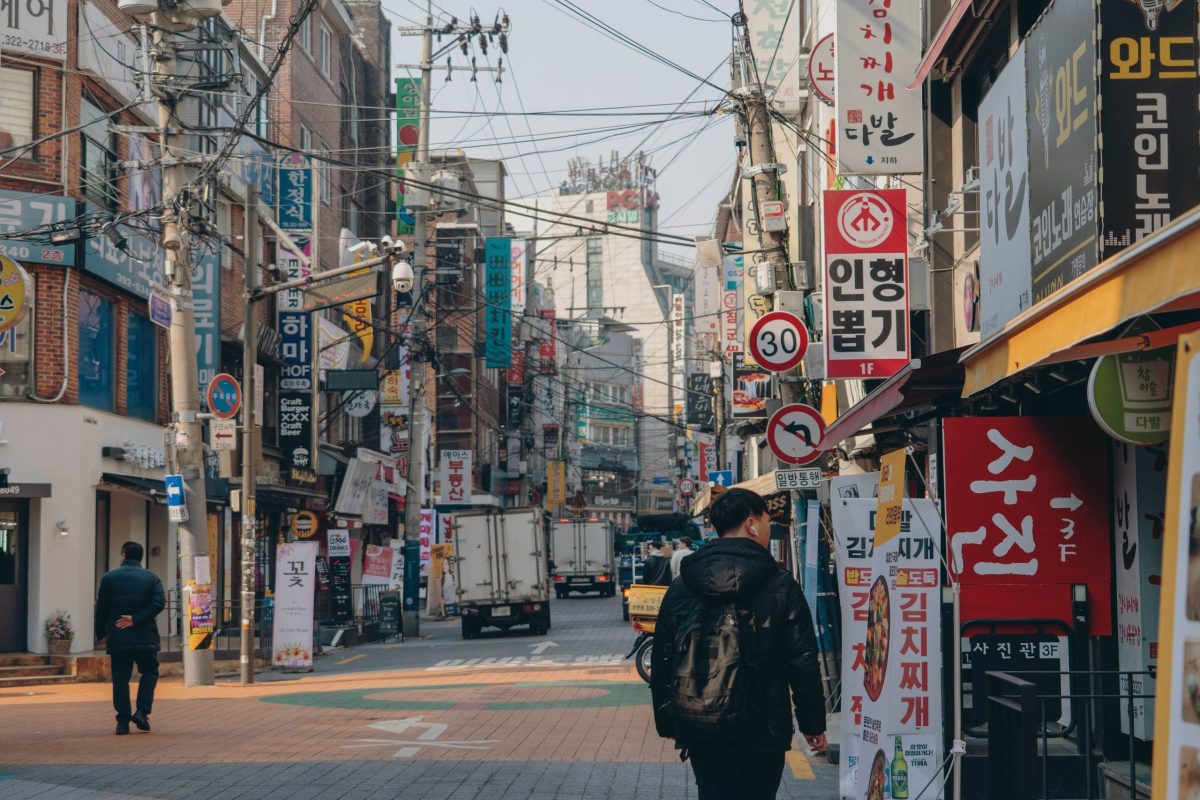
For those that might still think of New York as “The City That Never Sleeps,” I have some bad news: that title should most certainly belong to Seoul. You see, there is no last call in Seoul. And while the capital of South Korea might only have around one million more residents than New York City, it’s the population density where there’s simply no contest. New York City has roughly 27,000 residents per square mile. Seoul? Try 42,000. The city doesn’t just bustle, it roars.
When I started writing my debut novel, When We Fell Apart, I was only certain of two things: it would follow a young man’s search for questions following his girlfriend’s mysterious death, and it would be set in Seoul. Having lived there for a year, I knew first-hand what a rich and textured backdrop the city would be for my characters. From its glitzy high-end shops and all-night karaoke rooms to its world-class art museums and palatial street markets, Seoul isn’t just a cosmopolitan metropolis; it’s a writer’s playground. The city provided the perfect place for my characters to come of age while searching for answers.
I didn’t read any books that took place in Seoul while I was writing When We Fell Apart; I wanted to capture the city as I remembered and imagined it. When I finally finished the novel, the first thing I did was make a stack of the books set in Seoul that I’d been meaning to read. These novels provided me escape and insight; they transported me into that fictional dream we love as readers. Here are those same books. I hope you’ll discover what I did while reading them: Seoul is a character in unto itself.
A captivating exploration of modern Seoul and Korean culture. Frances Cha channels the perspective of four young women as they struggle to find success and fulfillment in a city and society obsessed with unattainable beauty standards, K-pop stars, and familial expectations. With masterful prose and nimble structure, Cha weaves these four stories together, creating a nuanced and deeply satisfying depiction of female friendship.
At Dusk by Hwang Sok-yong, translated by Sora Kim-Russell
In his novel, that at times reminded me of Kazuo Ishiguro’s The Remains of the Day, Hwang Sok-yong tells the story Park Minwoo, an elderly businessman who begins reexamining his past. A rags to riches tale, Park was born into abject poverty and raised in one of Seoul’s poorest districts, only to ride Korea’s rapid modernization to wealth and success. But when his company is the target of a corruption investigation, and he receives a message from an old lover, he begins to reassess the cost of his success.
A historical novel set in 1978 Seoul, Yoojin Grace Wuertz’s novel follows the lives of two women from distinctly different economic means as they struggle to make a life for themselves under Park Chung-hee’s oppressive and industrialization-obsessed regime. Astounding in both its epic scope and intimately drawn characters, Wuertz weaves a tale about friendship, loyalty, and betrayal against the backdrop of national upheaval. This novel will leave you reaching for a history book on one of Korea’s most tumultuous time periods.
A novel that feels like a throwback of sorts, Sang’s first book to be published in English is a humorous and heartbreaking story about Young, a hard-partying university student searching for love in Seoul. When he isn’t attending class and meeting up with his Tinder matches, Young is hanging out at bars with his best friend and roommate, Jaehee, where they drink away their anxieties about their love lives and families. Through boisterous and unadorned prose, Sang explores the intricacies of queer life in Korea, with all its joys and complexities.
A global sensation when it was published in 2016 and translated into English in 2020, Cho’s novel charts the steady and alarming mental decline of a woman as she struggles to retain her dignity within Korea’s patriarchal society. Having quit her job to care for her newborn, as most women are expected to do in Korea, Ji-young spends her days in a small apartment on the outskirts of Seoul. With no one to keep her company but her infant daughter, Ji-young begins exhibiting “strange” behavior and impersonating the voices of other women. Blaming her for her own mental illness, Ji-young’s husband sends her to a male psychiatrist. Told in clinical and matter-of-fact prose, this novel stands as one of the most important contemporary Korean novels yet.
The Plotters by Kim Un-su, translated by Sora Kim-Russell
An alternate take on Seoul, Kim’s sizzling and thrilling novel imagines a city overrun with for-hire killers and assassin guilds vying for business. The novel follows Reseng, a skilled hitman who was an orphan until he was found and raised by an old man named Old Racoon (yes, you read that correctly). Everything is going just fine for Reseng, until he uncovers a devious and astonishing plot, forcing him to choose between his job and a higher calling. Part existential philosophy and part Quinten Tarantino film, this novel will take you on an unforgettable ride.
An international bestseller and winner of the Man Asian Literary Prize, Shin’s brilliant novel tells the story of a family’s frantic search for their missing mother. In a crowded Seoul metro station, 69-year-old So-nyo gets separated from her husband. What follows is a fevered quest to discover her whereabouts and a family coming to grips with their untold secrets. Shin masterfully utilizes four perspectives—mother, husband, daughter, and son—to paint a universal and authentic portrait of contemporary Korean life.
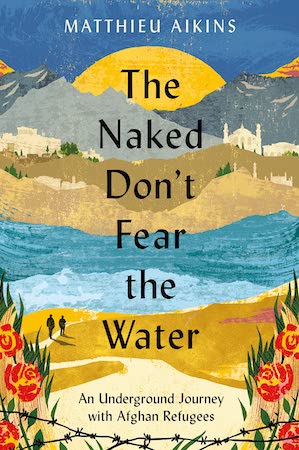
Matthieu Aikins’s olive complexion, dark hair, and ambiguous features means that he is often mistaken as a local in Afghanistan and the Middle East where he has lived since 2008. In his non-fiction book The Naked Don’t Fear the Water, the Japanese Canadian journalist goes undercover as an Afghan refugee to accompany his interpreter and friend Omar on a treacherous journey across land and sea to seek asylum in Europe. Aikens, to his credit, does not purport to speak for the Afghans around him and nor does he lionize the westerners around him. He is a voluntary participant in this journey, a role that comes with culpability and steep risk.
Aikens compels us to follow him on a journey to a land besieged by conflict and corruption, where justice is somewhere under the rubble and love can mean letting go. He brokers an honest conversation on the hypocrisies and unintended consequences of war. But he also invites us to see through the gun smoke and past the toxic global inequalities to the heart of the book, a larger-than-life love story complete with stolen kisses, unanswered phone calls, and tall promises.
I was no stranger to the intrepid and award-winning journalism of Matthieu Aikins. As an Afghan American, I’ve read his reporting from Afghanistan with deep appreciation. In the 2011 Atlantic article “Our Man in Kandahar,”, he shined a flashlight on the relationship between American generals and a corrupt and violent warlord. He witnessed the fall of Kabul firsthand in August of 2021 and wrote about it for the New York Times. He uncovered evidence of grisly war crimes in “The A-Team Killings” for Rolling Stone and broke the news that American drones wrongfully killed an innocent Afghan aid worker and nine members of his extended family, seven of whom were children.
I spoke to Aikins while he was in Paris, making tour stops forhis book, about passing for Afghan, witnessing the difference between how Afghan and Ukrainian asylum seekers are treated in Europe, and whether there is a tangible solution to the migration crisis.
Nadia Hashimi: In writing about the connections with the artists and the culture, you did an incredible job of exposing the humanity of the Afghans around you, and how simple the desires that drive the displaced are. And this isn’t the typical story told about Afghans or Afghanistan, at least not the type that hits the Western media. Do you feel the stories that the American public are receiving are a fair representation or is something missing?
Matthieu Aikins: I wanted to write a story that would show the complexity of people in a way that literature really can do, and often fiction. And I think because very often stories about refugees are told by a certain kind of observer—often a journalist who’s trying to report on the injustice and suffering people are experiencing, which they definitely are—it tends to be written in a certain register, sometimes like a litany of misery.
But of course, people go through these experiences and they have all sorts of different moments, moods, complexities, and they are neither victims nor saints—most of them at least. And I think being among them and sort of having people talk to me as if I was a refugee, I think I had the benefit that I often was able to observe conversations and everyday life in a different register that perhaps brought out some of those complexities.
NH: What was the most difficult part of your journey?
MA: During the years I spent living and reporting in Afghanistan, I had often passed as a local in order to avoid attracting attention to myself in dangerous areas, but this trip was a far deeper commitment. I had to live an alternate identity for months on end. The hardest part was probably when we were trapped in the camp on Lesbos. We didn’t know how long we’d be forced to endure the filthy conditions there.
NH: In this journey, you did pass yourself off as an Afghan refugee. You’ve also spent a good amount of time in Afghanistan. You’ve eaten the food, you’ve made Afghan friends. You’ve learned the language and you wrote beautifully about your ability, because of your phenotype, to pass for an Afghan. Do you feel a tiny bit Afghan and is that even possible for anyone? Is there any amount of time and any amount of immersion that would allow one to cross that line?
MA: It’s a very interesting question and a sensitive one. I often have Afghan friends tell me half-jokingly, that they consider me Afghan or that I’ve somehow become part of their community even though I’m still an outsider. I don’t consider myself Afghan but I am certainly a Persophile, an Afghan-phile. I have a deep love and respect for the culture. The act of passing as an Afghan, it takes place across a yawning gap in terms of the wealth, of the socioeconomic conditions and privilege that I grew up in, compared to most people in Afghanistan and that’s not something you can erase really no matter how well you can pass.
And so, in that sense, I think that’s something I’m conscious that I’m not ever going to eliminate. Of course, there are Afghans who are wealthier than I am, who are more cosmopolitan than I am, who speak more languages than I do, who have more advanced degrees than I do. I don’t want to oversimplify here but we’re talking about that particular Afghan who would be traveling, who were generally migrants. I don’t claim to be one of them.
NH: I could envision people who have spent time with you kind of dubbing you an “honorary” and I believe that comes from a place of trust established.
MA: I think people give you credit for spending the time and effort to learn the language first and foremost.
NH: And to see them in their full light, as three dimensional and flawed, which is, as you said, very, very human. The path of the migrant is a treacherous one. But you decided to part with your passport and, as you call them, the levers of privilege. Did you worry along the way that you had maybe ventured a step too far and taken on too much risk?
Unless we are willing to radically change our political and economic systems in order to more equally redistribute the world’s wealth, then I don’t see an end to the violence that’s happening at borders.
MA: Well, we realized we were risking our lives so I was prepared for the worst as much as you can be. But my whole career has been about risk and taking calculated risks. It’s ultimately a subjective question because everyone’s risk tolerance is different. With regards to my own, I’ve worked in war zones in Syria, Afghanistan, Yemen and we were talking about much greater risks in terms of danger there, which is why people from these countries are willing to risk their lives on the migration trail. They’re fleeing dangerous wars. So the risks of this story were more complex than that. There was a dangerous part of it. There were also legal risks and other people were getting involved, risks with this kind of crossing lines, and I didn’t want to get into situations which we couldn’t get out of. I also felt responsible to Omar and his family.
NH: And in the time since you’ve written this, as seems to happen with stories sometimes, this book has become timely in a way you may not have anticipated when you wrote this. You’ve been watching I’m sure, like everyone else, Ukrainians fleeing a new conflict. The reception that they have been receiving has been a beautiful reception and one that I think we’re all glad to see. What have you been thinking as you’re watching how the crisis has been handled by the international community as compared to other crises?
MA: Well, a lot of people pointed out the severity of that—how Ukrainian refugees are being treated well in the European Union compared to how Afghans and Syrians are being treated and how that’s connected to race and religion. I think that’s absolutely true, and one of the things I try to show in the book is that the question of refugees is part of a bigger problem with global migration and the very unequal world we live in. So I think what’s true is that Ukraine is not being caught up in some kind of web of barriers that exist to prevent people coming from the global south to Europe. And so on that alone, what Ukraine shows us very clearly is that refugee crises, migration crises, are not only the result of wars or other disasters, but also are produced in part by borders and a system of laws that we’ve constructed around them. And so Ukrainians have been able to flee the country. They’re allowed to travel to Europe. They’re allowed travel to the EU without visas. They can drive a car and drive to Poland, across the border. They haven’t been obliged to trek across the mountains and forests with smugglers or risk their lives in tiny, little boats, which is of course a good thing. But that’s the situation that Afghans and Syrians face. And that’s primarily because Afghans and Syrians are just not legally allowed to leave their countries without passports and visas, which are almost impossible to get. And so the suffering that Afghan refugees face, again, it’s not just the result of the war, it’s a result of our border system.
NH: During your time in Greece, you were in the City Plaza Project, which sounded like a wild social experiment—like a co-op for refugees and diehard activists living in community. You wrote: “The City Plaza project called for open borders, but it wasn’t easy to see how that would work.” Do you think there’s a way to get to a practical place of solutions for the displaced— somewhere between the total skepticism and the total idealism—where we can find some tangible solutions?
MA: I think that the migration crisis and the violence that’s inflicted on desperate people trying to cross borders to reach the global north is the result of a world where there’s a drastic inequality in wealth as well as wars and other catastrophes. And unless we are willing to radically change our political and economic systems in order to more equally redistribute the world’s wealth, then I don’t see an end to the violence that’s happening at borders. So in that sense, I am skeptical that there’s a clear solution or reform.
The migration crisis is the result of a world where there’s a drastic inequality in wealth as well as wars and other catastrophes.
But I think that it’s important, first of all, to be conscious of how the system, that we are the beneficiaries of living in this part of the world, requires borders that are violent enough to keep out desperate people. So we have to be honest about that. And if we’re not willing to at least try to imagine a different world, then we have to accept our willingness or complicity in those borders and that’s the kind of, I think the very difficult structural perspective that could be one of skepticism.
But there are two ways to look at this. One is we don’t have to make a situation worse. Very often these calls to further militarize the border and expand surveillance and criminalize migration are not actually benefiting anybody. They’re cynical political strategies. There’s no reason for these kinds of policies. We don’t need to make borders more violent. They could be less violent because there’s no evidence that these border crackdowns solve problems. They actually increase the profits of smugglers. And two, that we also can act as individuals in our own communities. That is what interested me so much about City Plaza: it was an example of people acting in a very concrete way to make the lives of the people around them better while doing that with the utopian political vision in mind. There was a relationship between what they were able to do in their real lives and in their political vision. And it definitely made it easier, though it still wasn’t easy for people with very different backgrounds to get along. We had this egalitarian vision that everybody has the right to move rather than this kind of NGO mindset where people are deserving clients.
It’s a very big issue with no easy answers and yet it can actually be quite simple when we want to, we can reach out and help. For example, we could work in solidarity with refugees in our own communities, and make individuals live better, make our own lives better. We can change ourselves. That’s actually not that complicated.
NH: My last question is about your broader perspective on journalism which had been flourishing in Afghanistan for the last couple of decades and was probably one of the most vital institutions. But it seems to be going a bit dark now, with the Taliban pushing out some Western news outlets and, of course, making horrific attacks on Afghan journalists. Do you see any way to continue those important stories? What do you see happening with journalists in Afghanistan today?
MA: Well, there’s a whole generation of skilled and experienced Afghan journalists who now find themselves in exile and who absolutely should be supported. They are going to be a very valuable voice about what’s happening in the country. But I think it’s also important that they and we and everyone who’s reporting from outside the country, work with people still inside the country, as difficult as that is and will continue to be if the Taliban continue to crack down on freedom of expression, because there’s a danger of the situation in Afghanistan being represented mostly from the outside. There’s also a lot of room for partnerships between people who are on the ground, the next generation of Afghan journalists coming up in their country, and those who’ve gone abroad.
When I was in my early twenties I watched the movie “Annabelle” with my cousins and brother. It did its job in discomforting me, but I’ll never forget what my brother said as he watched, bored, eating popcorn, and checking his phone. “After all our ancestors went through, there is no way they’re just going to sit by and watch us get tortured by some white ghosts.” We all laughed and endorsed his sentiment and while I still had a little trouble sleeping that night, I do think I slept easier with my brother’s words on my mind.
Most of what we consider classic horror was created by white men.
Horror, as a genre, has always fascinated me. As a child I watched the screen adaptation of Stephen King’s IT and wondered why someone had to go so far outside of reality to make something that was considered scary. Why invent an evil clown when there are plenty of real life clowns making decisions about legislation and running corporations that bleed the earth dry? We don’t even have to think that broadly: Have you ever been the only Black girl at a pool party and gotten your hair wet? Are you a woman walking alone to your car at night? Have you ever been Black or Brown and pulled over by the cops? That’s all horror, too.
Are you a woman walking alone to your car at night? Have you ever been Black or Brown and pulled over by the cops? That’s all horror, too.
Most of what we consider classic horror was created by white men. The genre, both in film and in literature, is plagued by the same white male gatekeeping that most entertainment disciplines are subject to. Algernon Blackwood, Joseph Sheridan Le Fanu, W.W. Jacobs, and Edgar Allan Poe all had a part in shaping how we understand classic horror today. The creation of supernatural forests, beings, objects, and obsessions sets a precedent for horror to focus on the invention versus observation. Part of horror’s beauty is its responsibility to invent and create. Where would we be without characters like Frankenstein, Pennywise, or even Chucky? They are beloved, and important. However, the tragic outcome of this gatekeeping for horror, as a genre, is that it’s given us finite access to a limited imagination when it comes to source material. White male writers’ ability to explore the monster in themselves is stunted, at best. I’m not anti-invention, I’m anti-invention without accountability. The aforementioned writers wrote groundbreaking work in so many ways, but the centering of whiteness has never been groundbreaking.
The years surrounding Blackwood’s The Willows were ripe with tense race riots. Le Fanu’s Carmilla came out the same year as the bloody Colfax Massacre. Jacob’s The Monkey’s Paw came out at the same time as the Filipino War, and Poe’s The Tell-Tale Heart was published the same year as the 1843 Cuban Slave Revolts. I am not of the expectation that white men would be able to write anything insightful about the horrific current events that existed during their lives. White people have demonstrated over and over again that while the systematic prejudices white supremacy has created might be embarrassing to them, if they are even aware of them at all, as far as they are concerned they don’t qualify as horror. I am of the expectation that non-white folks, LGBTQIA folks, disabled folks need to write it themselves. And this is not to erase any previous brilliance a white man may have happened to create, but to stand beside it. Racism is a horror and should be explored as such. White folks have made it clear that they don’t think that’s true. Someone else needs to tell the story.
Usher in the needed present era of social horror. Bethany C. Morrow’s new novel, Cherish Farrah is a slow burn social horror that explores race from a multitude of angles: how white liberalism—despite its performative commitment to “the work”—continues to perpetuate dangerous and harmful ideologies rooted in classism and white supremacy, the ills and complicated legacy of transracial adoptions, and the barriers to social mobility for Black families, even those who do everything right.
The story follows two teenage Black girls, Cherish Whitman and Farrah Turner. Cherish Whitman is the product of a transracial adoption: she is Black and both of her parents are white. Blue-blood white, the kind of white that acquired its wealth, at least in part, off the oppression and disenfranchisement of Black people. There are family heirlooms, different houses for different occasions, relationships with powerful and influential people, like judges, that go back decades. Despite this truth, Cherish’s parents are deeply committed to her. Upon finding out that she was going to have a Black daughter, Cherish’s mother, Brianne Whitman, was “… of course … mindful enough to take a class. Not just in Black American studies, either. On hair care, on skin and makeup, too. She wasn’t going to bring home a baby who looked nothing like her and act like her love was enough. That’s not who the Whitmans are.”
Throughout the story we are repeatedly posed with the same question: can the Whitman family work to dismantle systemic injustices while also benefiting off of it? Morrow gives us a conclusion of sorts and the extent to which it will surprise the reader will likely be in direct correlation to their understanding of racism in this country.
White liberalism continues to perpetuate dangerous and harmful ideologies rooted in classism and white supremacy.
Cherish’s relationship with her parents is where the novel explores the power dynamics inherent in transracial adoption. They spoil her to the point of oblivion. Cherish, for all intents and purposes, functions at the same naive and privileged level as her white peers—this point is driven home by Farrah’s nickname for Cherish, “white girl spoiled.” When it comes to the subject of Cherish’s race and the sobering realities that accompany being a young Black woman in America, the Whitmans take the approach that many liberal white people take—they treat systemic racism as a thought experiment. There’s little, if any recognition of racism as a real lived experience that every Black person, including their privileged daughter, must navigate. Their tactics are bizarre and harmful and ultimately end up being their demise. Cherish, the one they want to protect the most, suffers greatly because of it.
Farrah’s horrors, in part because she comes from a traditional Black family, are another reflection of the systemic racism that BIPOC folks are used to. After being hit by financial hardships the Turner family is forced to abandon the cushy lifestyle they were hardly able to afford in the first place. Farrah gets a rude awakening when she asks her parents if they can just “move a few things around for awhile,” meaning money, the same way she saw her classmates’ parents do when they seemingly lost everything. She says: “One year, someone’s family ‘lost everything’—but everything didn’t include houses or boats or memberships. Everything was a feeling, a state of being … how was I to know it wasn’t the same for us?”
The Whitmans take the approach that many liberal white people take—they treat systemic racism as a thought experiment.
When Farrah is invited to stay as a guest at the Whitmans’ house, her obsession with appearances and control clouds her ability to see reality. She thinks she can manipulate the situation, and position herself to take a place beside Cherish on a matching white girl spoiled throne. Her need for control drives her to do some pretty gruesome things, including assault and battery, biting someone’s tongue off, and driving a nail through her foot. There are many times throughout the story where the reader may find themself trying to figure out who is the victim, and who is the victimizer, but it is repeatedly clarified that despite how much power and control Farrah thinks she has, or tries to exhibit, it is nothing compared to the system—represented by the Whitmans—she is up against. The unrest she experiences at the hands of the Whitmans is imaginative and fanciful, but the isolation and self-denial that came with it is an all too real and accurate portrayal of everyday life under white supremacy.
When I was in middle school I was a member of a performing troupe. At any given time I was the only Black person out of forty kids. Everyone else was white. While the public-facing persona told a family story—that we all lovingly worked closely together to ensure that our performances went off without a hitch—that wasn’t always true beyond the facade. There were your standard early-2000s aggressions: asking if my skin got darker in the sun, or if the ponytail piece my mom purchased to make show hair easier was actually my real hair, or even the director of the troupe once telling me—completely out of the blue—that he was part Cherokee. But there were also outright moments of torture: one member calling me a nigger over AIM, and other members’ younger siblings refusing to play with mine because he was Black. Seemingly unprovoked, shortly before I quit, I cried and cried in the dressing room— almost missing my cue. All of my cast mates felt deeply for me: we hated to see each other upset, but they were also confused. They couldn’t possibly comprehend that they were the source of my anguish.
I loved being in that group. It was my introduction to theater and musicals, things I continue to have a relationship with to this day. It was the first time in my life I had permission to pursue something picked by me, as opposed to my parents, and I took it seriously. I practiced dance moves even after rehearsal was done. Oftentimes rehearsing in my basement was the last thing I did before I went to bed. I was good. I was one of the strongest singers. Though I was only twelve, I was often cast in the more advanced numbers with the seventeen and eighteen year olds. This is how I exhibited control. This is how I thought I would secure my throne. But alas, one Black girl’s determination will never be bigger than white supremacy.
My parents, like many Black boomers, had a healthy amount of faith in respectability politics, a mindset I imagine Farrah Turner’s parents might carry as well. Why else would they put their child in such a white environment? My parents went to great lengths to ensure that my siblings and I were distinguishable from the other Black kids in our school district, in part by their achievements. They hoped their exceptionalism would protect us. My mother was the first Black elementary school principal in our school district. She worked her way up to Director of Teaching and Learning, making her the sole Black face in the district office, and as a result, I became the token Black girl. Solid grades, prom court, track records, college scholarships, I did it all. But it didn’t stop two of my white male classmates from threatening to hang me from a tree. It didn’t stop my brother’s classmate from telling him to go back to his slave master. It didn’t stop my sister from being pulled over on her bike. And it definitely didn’t stop any of the daily microaggressions that made those macroaggressions possible.
The dangers of existing as a Black or Brown face drowning in a sea of white is a trope the founders of classic horror could never capture. As Cherish Farrah and my lived experiences demonstrate over and over again, Blackness surrounded by whiteness sometimes evokes the kind of terror that renders you rageful and confused—in my case—or plotting and vengeful, in Farrah and Cherish’s case. All of it is justified. Using the horror genre to examine the everyday cruelty that Black people experience at the hands of white supremacy is perhaps the metaphor we need, and I’ll gladly consume it for as long as I can.
Spring is the sweetest time to discover new poetry. Lingering daylight and blossoms, the chance to open a book on a park bench and be transported, briefly, to a heightened world. Each spring, I find myself gravitating towards collections, both intimate and bold, that wrestle with identity and history, desire and self-definition. Poetry opens up space for us to explore a feminist vision free from the lens of judgment or rational discourse, making imaginative leaps that awaken possibility.
Here are seven new poetry collections that consider intersectional issues of gender and oppression. These poems got into my head, under my skin. Read them and let your world expand.
A fierce, feminist page-turner of a book, Melnick’s third collection is a riveting follow-up to Landscape With Sex & Violence. “You can only hear you look like a hooker so many times/ before you become one,” she writes, recounting the story of babysitting for the rabbi’s son as a teen, a chilling parable about survival under patriarchy. With her signature wit and candor, Melnick reckons with a history of misogyny and anti-Semitism, war and atrocity, sexual and domestic violence, myriad abuses of power—and yet there is humor and hopefulness in her voice, a perpetual sense of discovery. These poems reclaim the power of mother-love and female pleasure, searing rage and desire, as they navigate layers of generational and personal trauma and rework them into art. Refusenik rewrites what it means to live in America today. On July 4th, Melnick insists: “I recognize my own fireworks.”
Shelley Wong is the poet-queen the world needs right now. Her visionary debut, As She Appears, centers queer women of color in shape-shifting poems of becoming and knowing, seeing and being seen. Wong uses white space and silence to pose questions about identity and interiority, femininity and power: “women are familiar with surrender/ & the appearance of it,” she writes, letting the lines float free on the page. Subversive and sensual, Wong’s poems take us from the solitary salt marshes of Fire Island to Pride month in New York, dancing “in strobing summer heat.” She mourns a lost relationship, writes odes to Frida Kahlo, contemplates being a “not-mother,” appraises the rites of courtship and fashion, wanders Golden Gate Park in the pandemic spring. These gorgeous poems are alight with flowers, birds and longing, making a new world in their wake. As She Appears is a stunning feat of self-creation: “As a girl, I never/ saw a woman/ who looked like me./ I had to invent her.”
Forde’s audacious debut won the Saturnalia Books Poetry Prize and offers surprise and delight at every turn. In visceral poems that get up close to the Black female body, its blood and breath and hungers, Mother Body follows the journey of the fat girl as she nicks herself shaving, endures a pelvic exam, savors post-coital bliss, dances, eats, orgasms, exercises. A poetic descendant of Lucille Clifton, Forde writes with femme swagger and fine craft, her language rhythmic and lush. In “Ode to My Stomach,” she revels in naming: “You are/ honey dome. Power house. Piston/ of digestion pump-pumping.” At the beach, fat girl studies “a jellyfish’s rainbowed remains:/ luminescent dew, a gelatinous porkbelly of blues…” These unapologetic poems are full of wonder, refuting a legacy of shame and unworthiness. Mother Body dances with pain but claims joy as a birthright, a coming home to self-love and wholeness.
I confess I expected to dislike a poetry collection about the male experience, written by a straight, white cis-man. Instead, I was captivated and deeply moved by Salerno’s agile poems, which wrestle with masculinity in its complex forms. With tenderness and precision, The Man Grave interrogates the privileges and vulnerabilities of boyhood and manhood, from schoolyard memories of the epithet “fag” to sperm viewed under the microscope at the IVF clinic. Salerno’s speakers try to “leave manliness behind” but can’t stop seeing brutality everywhere, recalling the violence of male relatives, watching an osprey hunt its prey. Shame and anger simmer in a series of “Sports No One Follows” poems: “To learn how to shut another man’s mouth/ you must point at him with the fat end of the bat…” Taut with wordplay and irony, The Man Grave finds sorrow inside laughter, redemption in the act of empathy. A gentle poem about shaving a mustache nearly broke my heart.
Erika Meitner’s sixth collection blazes with eroticism and curiosity. These passionate poems teem with incisive observations of daily life, from night-swimming at a Holiday Inn to buying a pregnancy test at CVS. “I’ve got years in my mouth too, waiting to be fished out,/ laid across a table, and gutted,” she writes. Useful Junk explores memory and the body with relentless lyricism and nostalgia, writing in praise of female pleasure and discovery at midlife. Meitner’s poems want to inhabit everything, and do: perimenopause, infertility, friendship, motherhood, family trauma, sexting, trying to take a selfie of one’s own ass. There is an infectious, headlong energy to the lines, a vision “multitudinous and wild” akin to that of Walt Whitman. I felt these speakers were looking into my own heart, revealing the wonder and vulnerability of its yearning: “Can I ask you again to tell me about my body,” Meitner urges, “to introduce me to my own numinous skin?”
Paul Tran’s astonishing debut is balm for survivors everywhere. Their collection investigates sexual violence and generational trauma while forging a bright path of resilience and healing. Tran is a queer and trans descendant of Vietnamese refugees whose innovative poetic forms reflect the shifting, nonlinear experiences of trauma survivors. Resisting the urge for closure, their poems cycle through memory and recurring imagery; the song of a passing ice cream truck, heard during an assault, replays in the lines. But Tran finds strength in breaking apart language and exposing its trickery, naming slippery homonyms, dancing around the unspeakable act of violation: “Reap. Pear. Pare. Aper. / These are versions of the word/ I won’t say.” The poems recast a legacy of war and abuse, critique the imperial gaze of Renaissance art and the scientific method, retell the tale of Scheherazade until it becomes a story of survival and love. All the Flowers Kneeling affirms poetry’s transformative force: “A poem is a mirror/ I use to look/ not at but into myself.”
The much-anticipated second collection from surrealist poet Kristin Bock explores dystopian dreamscapes, myths, and spells. Glass Bikini channels Barbarella in her silver spacesuit and Mary Shelley in her prophetic brilliance, illuminating our nightmare world. These poems travel from ashen Pluto to the day-glo Dollar Store, populated with robots and rabbits, mannequins and monsters, mirrors revealing what makes us human. Bock mixes deft prose poems with her signature lyricism to heighten emotion. Buttons shine “like opals buried deep inside the moon;” “grief is a boat/ exactly the size and shape of the sea.” And hope exists in the redemptive power of the feminine. The final sequence, “Copilot,” recounts the last days of a doomed planet, a reverie of violence and survival where tenderness between women becomes a promise we can hold: “I want to tell her shhh, I’m here where you left me, in the blue basin, waiting to catch your analogue heart like an egg from the sky.”
Fess Avenue wasn’t a long street. There were only three houses on it, all with attics and fairly large yards. Drawn there by an ad in the classifieds, I moved into the attic room of the middle house, which belonged to a Mrs. MacMillan. She herself occupied the lower floors. Such being the case, I had an excellent view—not only of Mrs. Nolan’s house, but Mrs. Casper’s as well.
Like Mrs. MacMillan, these two neighbors had been without husbands for a long time. Since Mrs. MacMillan never spoke about her own situation, I never found out what happened to Mr. MacMillan. But she told me that Mrs. Nolan lived alone due to her ornery disposition. As a young newlywed, she would often beat her husband. And one day, she’d arbitrarily ordered him to scram, threatening him with further beatings if he made any attempt to return. Since kicking him out, Mrs. Nolan had shown no desire to live with anyone else at all.
Mrs. Casper’s was a different story. She hadn’t cared much about her husband, a traveling salesman who’d rarely been at home. Whether he was in the house or elsewhere, it appeared to make no difference to her. It was the same when he died in a car accident in Cincinnati. She had betrayed no sign of either sorrow or joy.
That was the extent of my knowledge, for that was all that Mrs. MacMillan told me. Don’t try to manage the affairs of others and don’t take an interest in other people’s business. This was what Mrs. MacMillan advised by way of conclusion once she was done telling me about her neighbors. It was the only way, she said, that anyone could ever hope to live in peace.
Furthermore, she continued, for the purpose of maintaining good relations between her and myself, I was only allowed to speak to her when necessary, and only ever on the phone. Therefore, I should get a telephone right away, she told me. And until the phone company came to install my line, I was forbidden from using hers. After all, she said, there was a public phone booth a mere three blocks away. She went on to say that the key she’d lent me could only be used for the side door. Her key was for the front entrance. This way, we could each come and go without bothering the other. Also, she continued, I should leave my monthly rent check in her mailbox—for I had a separate mailbox from hers, located on the side of the house. I must say, initially, I found these terms extremely agreeable, for it wasn’t as if I liked to be bothered by other people myself.
The whole summer passed without any problems. I used my time to attend lectures, visit the library, take walks, and cook. And every now and then I would sit contemplatively in Dunn Meadow, a grassy area where there were always lots of people. I bumped into Mrs. Nolan and Mrs. Casper a few times, but as neither of them showed any desire to become acquainted when I tried to approach, I too became reluctant about speaking to them.
But as summer started to give way to fall, the situation changed. As autumn approached, the town of Bloomington was flooded by thirty-five thousand incoming students—new ones, as well as those who had spent the summer months out of town. But as far as I knew, not a single one of them lived on or in the vicinity of Fess. Bloomington bustled with activity, but Fess Avenue remained deserted. Besides this, as time went on, the days grew shorter, with the sun rising ever later and setting ever sooner. And then the leaves turned yellow and, by and by, began to shed. Not only that—it rained more often, sometimes to the accompaniment of lightning and thunder. Opportunities to go outdoors became few and far between. Only now, under such conditions, did I pay more attention to life on Fess. All three of them—Mrs. MacMillan, Mrs. Nolan, and Mrs. Casper—spent a lot of time in their yards raking leaves. The leaves would then be put into enormous plastic bags, placed in their cars, and driven to the garbage dump about seven blocks away.
Mrs. Nolan had a peculiar habit. If she caught a glimpse of any animal while she was in her yard, she would immediately begin pelting it with rocks that she appeared to keep at hand for this purpose. She always managed to hit her target, even without taking aim. A number of bats dangling from low branches were dispatched; the same went for assorted birds that had just happened to stop by, only to perch within stoning distance of Mrs. Nolan. It wasn’t just her throwing abilities that were impressive, but also the extraordinary vigor that enabled her to wound and terminate the lives of so many animals. Her actions weren’t illegal, of course, but I wondered at how she never attempted to be more surreptitious. How she disposed of the poor creatures’ bodies remained a complete mystery to me. I was positive that both Mrs. MacMillan and Mrs. Casper knew about Mrs. Nolan’s behavior. Yet it came as no surprise to me that they simply let her be, without attempting to raise the matter or report her to the police. Apparently, it was by carrying on without interfering with each other that they were able to get along well.
Mrs. Casper didn’t possess exceptional qualities like Mrs. Nolan, but it was hard to ignore her all the same. She was old and sometimes looked unwell, and when she looked unwell, she was unsteady on her feet. When she was in good health, she was capable of a brisk stride. I often thought to myself that if she ever had cause to run, she would manage a good sprint.
All three women shopped at the local Marsh Supermarket from time to time. It was a small branch, which sold both regular goods and ready-made foods, not far from the nearby phone booth. Naturally, since it was such a quiet area, the store didn’t have many regular customers. The owner himself didn’t seem to expect much business. The main thing was that the store could keep trundling along, and he seemed satisfied on this front. In keeping with the general atmosphere of the neighborhood, he wasn’t friendly, speaking only when required. Personally, I only shopped there if I couldn’t get to College Mall with its many affordable stores, some distance away.
To combat my loneliness, I’d sometimes flip through the phone book. In its pages, I discovered the numbers for Mrs. Nolan, Mrs. Casper, and the nearby Marsh. Over time, once we were well into autumn and the days had grown even shorter, and strong winds had become a regular occurrence, as had lightning and thunder storms, I set about killing the lonely hours by playing telephone. At first, I’d dial the recorded voice that would give me the time, temperature, and weather forecast. That sufficed initially, but over time, grew less effective. I began calling various classmates. They responded in the same way they did when I met them on campus, in as few words as possible, until I exhausted all possible topics of conversation. I began ringing up Marsh, asking if they stocked bananas, or apples, or spaghetti—anything really—which ended up annoying the owner. Mrs. MacMillan didn’t seem too happy either whenever I called her with some made-up excuse. Like the store owner, she seemed to know full well that I had no real reason to talk.
At last, one rainy night, I phoned Mrs. Nolan to ask if I could help clean up her yard. This seemed not only to surprise her, but enrage her as well. Was her yard that filthy, that disgusting, she inquired. When I answered, “No,” she asked what my ulterior motive was. I just thought she might need some help, I said, upon which she asked whether she looked so sickly, so feeble, that I felt compelled to offer my services. Naturally, I replied that she looked perfectly healthy. She promptly told me, “If I need anyone’s help, I’ll place an ad.”
After this conversation, I didn’t dare to phone Mrs. Casper.
One night, as the rain fell outside in a steady drizzle, something changed. There was a light on in Mrs. Casper’s attic. And it remained on every night. I soon found out that someone was living there—an old man who looked about sixty-five years old. Every morning he would poke his head out the window and take aim at the ground below with a pistol, like a child playing with a toy. But I was certain that what he was holding was a real gun. And if I was right, something terrible might happen. So I immediately called Mrs. MacMillan. She thanked me for informing her, but then tried to bring the matter to a close: “If Mrs. Casper really does have a boarder in her attic, then that’s her business. Just like you living here is mine. If he really does have a gun, he obviously has a permit for it. And if he doesn’t have a permit, then they’ll arrest him at some point.”
Every morning he would poke his head out the window and take aim at the ground below with a pistol, like a child playing with a toy.
I made a hasty attempt at protest before she could hang up. “If anything happens, won’t it be bad for us?”
“As long as we don’t bother him, what could happen?” she replied.
And that was the end of the conversation.
The next morning, under the pretext of buying milk, I took a walk to Marsh. Naturally, I took the opportunity to check whether there was a new name on Mrs. Casper’s mailbox, but there was no name to be found. While paying for my milk, I commented to the owner, “Looks like Mrs. Casper has a new boarder.”
“Yeah. He’s already been in a few times to buy doughnuts.”
“What’s his name?” I asked.
“How should I know?” he replied with a shrug.
Coincidentally, on the way back from Marsh I ran into Mrs. Nolan.
“Mrs. Nolan, did you know Mrs. Casper has a new boarder?” I asked.
“Yes, I do,” said Mrs. Nolan, showing no desire of wanting to talk further.
My hope that I would run into Mrs. Casper, unfortunately, remained unfulfilled.
That night, after some deliberation, I phoned Mrs. Casper.
“Mrs. Casper, I see there’s someone living in your attic.”
“Yes, I rented it out, son. Why do you ask?”
“If he needs a friend, I’d like to get to know him,” I said.
“All right, I’ll tell him. What’s your number? If he’s interested, I’ll let him know he should give you a call.”
After giving her my number, I asked for his in return. Mrs. Casper replied that he didn’t have a phone. Nor did she know whether he had any plans to have one installed.
When I asked for his name, she said she had no clue. “If he used checks to pay the rent, I’d know it, of course. But he pays me in cash. The only thing he’s told me about himself is that he fought in World War II.”
On this note, the conversation came to an end.
Things went on as usual after that, except for the weather, which got increasingly worse, and the temperature, which continued to plummet. Every day, the man would point his gun at the ground below, taking aim at a large rock beneath a tulip tree, never firing any bullets. And every night, the light in Mrs. Casper’s attic would shine steadily on. In the meantime, the old man never called me. And I never ran into him. As far as I knew, he never left the house, so I never had the chance to chase after him and pretend to bump into him by coincidence.
One morning, when the weather was particularly bad, I called the phone company to ask if anyone on Fess Avenue had recently installed a line.
“What’s the person’s name?” asked the operator.
“I don’t know. But he lives on Fess.”
“Now that’s a tough one,” answered the operator, “unless you know his name. Keep in mind, sir, since all the new students began arriving for the fall semester, thousands of people have been installing new lines.”
Her answer terminated my desire to pursue the matter further.
The next day I went to Marsh to buy a doughnut.
“Did the old man stop by recently?” I asked. “The one who lives in Mrs. Casper’s attic?”
“Why, yes. Didn’t you see him, son? He just left the store.”
“Oh, really?” I said, somewhat bewildered.
I asked whether he’d ever received a phone call from the man. The store owner shook his head.
I hurried out of the store, but my efforts to run into the old man bore no fruit. Several times I circled the area—South Tenth and Grant, Dunn, Horsetaple, and Sussex—but I saw no trace of him. Then, upon returning home, I found that the old man was already back in his room, aiming his pistol below, as usual, making shooting motions, but never firing a single bullet. I hoped that at some point he’d look my way, but my wish was never granted.
That same night I decided to write him a letter. Since no one knew his name, I could address it to anyone and Mrs. Casper would be sure to pass it along. On the back of the envelope, I wrote, John Dunlap, c/o Mrs. Casper, 205 Fess Avenue.
The letter read as follows:
John,
How about meeting at the Marsh at half past eleven on Wednesday morning? I know you like doughnuts. This time around, the doughnuts are on me, and the coffee, too.
Best wishes,
I printed my name and address.
Also that very night, I dropped the letter in the mailbox near Marsh. I’d nearly reached the mailbox when an old man came out of the supermarket. I mailed the letter and hurried after him, but he’d already vanished, having turned into a small alley connecting South Tenth with South Eleventh. I couldn’t say who this old man was for sure, but there was a chance that he might be Mrs. Casper’s boarder. I hesitated for a moment. Should I chase after him or return to Marsh first, under the guise of buying bread or cake, to find out if he really was the man from Mrs. Casper’s attic? My hesitation was to blame, I suppose, for by the time I decided to follow him into the alley, I’d lost his trail. It was only when I returned to Marsh did I receive confirmation that he was indeed the man I was looking for.
“This time he bought a tuna sandwich,” the store owner said.
Strangely, there was no light on in Mrs. Casper’s attic that night. I kept waiting, but still the light remained off. My fingers began to itch.
In the end, I gave in and phoned Mrs. Casper.
“Mrs. Casper,” I said after apologizing for calling so late, “you did tell the man in your attic about me, didn’t you?”
“Of course I did, son,” she replied promptly. “But he doesn’t seem to be interested in talking to anyone.”
“So . . . just wondering, Mrs. Casper, why isn’t the light in his room on?”
“My, my! How is that any of my business, son? He pays me rent, after all. I’m not going to stop him from doing whatever he wants, as long as he doesn’t damage anything or cause trouble.”
Unsatisfied, I pressed on. “Excuse me for asking, Mrs. Casper, but if I’m not mistaken, doesn’t he have a gun?”
“My, my! This is too much, son. What is it to you if he does have one, and what’s it to you if he doesn’t? Now, goodnight. I hope you won’t ask about him again if it’s not urgent.”
And that was the end of the discussion.
In the days that followed, everything went on as normal. On Wednesday, starting in the morning, I attempted to keep my eyes glued on Mrs. Casper’s house. As usual, at around ten-thirty, the man opened the window and began playing around with his gun. Then he shut the window. Meanwhile, I was prepared to leave the house the minute I saw him heading out through Mrs. Casper’s yard. But he never appeared. Soon it was almost twelve-thirty, and he still hadn’t emerged. Only then did I give up. Leaving the house, I walked dejectedly to Marsh.
The ground was still wet from the rain that had fallen all last night and early that morning. When I reached Marsh, I was startled to see my letter lying on the roadside in the gutter, drenched in rainwater, but saved from slipping into the sewer by a branch that had fallen from a large tree overhead. I found the letter had been opened. I had no idea whether the man had thrown it away on purpose or if he had accidentally dropped it.
“Has that old man been in today?” I asked the owner after getting some milk.
He nodded.
“About what time did he come in?”
“Oh, an hour ago or so,” he replied.
Hmm. If that were the case, then he must have left while I had been in the bathroom.
“Have you found out anything else about him?” I asked.
“Nope,” replied the owner. “Oh, wait. He did mention that he very much wanted to find some young folk to spend time with. People in their twenties, sound in body and mind—to train how to handle a weapon if the need ever arose. Then he began babbling. Said he once dropped a bomb on a Japanese ship. Darned if I know what’s wrong with that guy.”
The owner then turned his attention to sticking price tags on some canned food that had just come in. My attempts to fish for further information about the old man met with failure.
The old man in Mrs. Casper’s attic didn’t open his window that afternoon. But in the evening, I did catch a glimpse of something rather strange: Mrs. Casper leaving her house and making her way unsteadily to her car. Because it was already dark, I couldn’t see her face clearly, but I had the impression that she didn’t seem well. I ran down, but by the time I’d reached the street, Mrs. Casper had already started her car. She veered too far right as she turned the corner and almost grazed the curb.
It grew late, and there was no sign that she had come back yet. The whole house, including the attic, was dark. What I really wanted to do was phone Mrs. MacMillan, but I thought to myself, What’s the use? Then, all of a sudden, I heard a gunshot, so I called her right away. The phone rang for a long time. She must have already gone to bed or fallen asleep. Sure enough, she sounded pretty peeved.
When she asked me what kind of a shot it was, I hesitated. A pistol shot wouldn’t have been that loud, but I answered nonetheless, “A pistol.”
When Mrs. MacMillan asked where the sound came from, I hesitated once more. I’d heard the shot loud and clear, but what wasn’t clear was where it had come from. So once again, nonetheless, I replied as if I knew. “From Mrs. Casper’s attic.”
Mrs. MacMillan said that no one should meddle in Mrs. Casper’s affairs if the woman herself hadn’t asked for help. Then I told her about seeing Mrs. Casper earlier. At this additional information, Mrs. MacMillan expressed her thanks.
“She must be having an attack again. She has bouts of fatigue. Have I told you about it, son?”
When I said, “No,” she explained that Mrs. Casper had suffered for a long time from the terrible malady, and her doctor had advised her to come straight to him or go to the hospital whenever the symptoms came on.
“She should have told us so we could have helped her,” she added.
When I brought up the gunshot again, Mrs. MacMillan replied, “If you think it would do any good to report it to the police, go ahead, son. But be prepared to get a headache from all the questions they’ll ask.”
Without consulting Mrs. MacMillan, I phoned Mrs. Nolan. The phone rang for ages before she picked up. And like Mrs. MacMillan, her voice emanated extreme annoyance. After insisting that she hadn’t heard any noise, she asked if I was absolutely sure I’d heard a shot. When I answered, “Absolutely,” she insisted on knowing where the shot came from.
I answered as if there were no doubt in my mind. “Mrs. Casper’s attic,” I said.
“Then it must have been that old man with his gun. Isn’t that right?” she asked. She sounded as if she wanted me to agree with her.
Again, as if there were no doubt about it, I answered, “Yes.”
Since I didn’t know what else to say, I ended up asking, “So, do you think we should report it to the police?”
“Why by all means, son, by all means. As long as you’re fine with them thinking you’re crazy when you can’t prove it was definitely him who fired the shot.”
My desire to further discuss the gunshot waned. And when I told her about seeing Mrs. Casper, Mrs. Nolan’s response— both in tone and content—was similar to Mrs. MacMillan’s.
I couldn’t bear to stay put any longer. So I left and walked glumly toward Marsh, hoping to see something promising in Mrs. Casper’s house. At the very least, Marsh might still be open. Mrs. Casper’s house was completely dark. Even the little light on the porch was off. Yet, faintly, I could hear the sound of someone sobbing on the porch. I couldn’t do anything, of course. And I didn’t have any reason to enter Mrs. Casper’s yard, apart from curiosity. Let’s say I did go in and something happened. If curiosity was my only excuse, then it might get me into trouble.
It turned out Marsh was closed. So I turned and headed one block over. Like Fess Avenue, this stretch of road was also deserted and dark. An acute regret at renting a place on Fess rose within me once more. Nearly everyone who lived in this neighborhood was old, lived alone, and had no friends and no interest in making any. Historically, this had once been a lively area, but the town activity had long shifted away, to College Mall. On the corner of Park Avenue alone were two abandoned movie theaters that had fallen into disrepair. But I’d agreed to live in Mrs. MacMillan’s attic through December, when the fall semester came to an end. By the time I returned and passed Mrs. Casper’s house again, there were no more sounds. The house was still dark.
If curiosity was my only excuse, then it might get me into trouble.
The next day was busy, and I had to put aside all memory of the previous night’s events. In the morning I had to go to the library, and from there straight to class. And because I had so much reading to do, followed by more classes, I didn’t go home for lunch but ate at the Commons—a cafeteria in the Union building, which formed the center for the majority of campus life.
When I entered the Commons, there were practically no free seats. Over by the entrance was a long line of people waiting for food. After getting something to eat and selecting my drink, I joined another long line of people waiting to check out before taking their meals to the dining area. In the meantime, country-western music blasted over the speakers.
For some reason, I felt a bit shaky. Soon, I found I had a slight headache as well. And wouldn’t you know it, right when I glanced over at the revolving doors leading from the dining area to the lawn, I saw the old man from Mrs. Casper’s attic heading outside.
There were still about five people ahead of me, waiting to pay, and behind me there were around ten. I couldn’t possibly set down my tray of food in order to chase after him. There was no way. All I could do was wait patiently for my turn. Once I paid, another problem arose. Every seat was now taken.
This being the case, I couldn’t possibly set my food down on someone else’s table to dash out and see if the man was still there. In the end, I had no choice but to go downstairs, to the seating area for the Kiva café one level below. And as I made my way down the steps, I felt waves of dizziness wash over me.
After that last incident, there were several things that were worthy of note: Mrs. Casper’s boarder never came to the window to play with his gun anymore; the light in his room remained on all night; Mrs. Casper exhibited no signs of relapse; and I began spending more time hanging out at the Union. It was an enormous building, with many floors and many rooms, with many tables and seats where one could study, equipped with stores, a post office, and other university-owned services. And I found I never happened across the old man again.
I did go to Marsh once, and the owner told me that the old man was still an avid doughnut buyer. What time the man would show up, the owner told me, he never could tell. Something else worth mentioning: whenever I woke up, my head would start to ache, and I would initially see spots of light. I would occasionally experience the same sensations when I stood up after sitting down. And, sometimes, while walking, I would start to feel shaky.
One day, I was in the Union, walking from the bookstore toward the Commons. I was heading to the exit near the Trophy Room in order to get to Ballantine Hall, where I had to take an exam. And of all things, at that exact moment, I spied the old man heading from the Commons to the men’s room. Naturally, I seized my chance. I was at the men’s room in a flash. It was a multitude of mirrors, of sinks and electric hand dryers, of urinals and stalls. I’d just reached the urinal area when the old man swung one of the stalls shut. I didn’t need to pee, but I had no choice. Once again, I felt unsteady on my feet. I finished peeing, but even so, I pretended to keep going. Then I deliberately took my time washing my hands.
Wouldn’t you know it, while I was washing my hands, “Bang! Bang! Bang!” yelled the old man—like a kid playing with a toy gun.
I waited.
“Bang! Bang! Bang!” he kept yelling from inside the stall. A few people began to take notice, but only for a moment, before ignoring him. In order to linger on, I began using the hand dryer. Over the low roar, you could still hear the “Bang! Bang! Bang!” A few others, who’d just come in, looked curious. What happened next, I had no idea. I had to rush off to Ballantine Hall.
After the exam, I felt as if I’d been hit in the head by a sledgehammer, and my whole body felt as if it were engulfed in flames. I had to take a cab home. As we passed Dunn Meadow, I saw some kids playing. The old man was there, too, making a spectacle of himself. He was acting as if he was going to shoot them with his gun, and they were stepping backward, hands raised, as if scared of being shot.
“That vet. He’s at it again,” the taxi driver said.
When I asked what he meant, the driver replied that this wasn’t the first time he’d seen the old man in Dunn Meadow, behaving like this.
“Told me he was a bomber pilot during World War II,” the driver said. “His plane got shot down by the Japanese in the Pacific. He and two other crew members survived, thanks to their life vests. Then they were caught by the Japanese, tortured, starved, and denied medical treatment. His two friends died, and he almost did too—of beriberi. After Japan threw in the towel, he was taken to an army hospital to recover. They fed him five times a day to make up for the starvation, and he wound up marrying one of the nurses. They had two sons—one died in Vietnam and the other drowned while swimming in the Ohio River. He said his wife died, too, only recently. Of colon cancer.”
That night, I couldn’t take it longer. I was sick and needed help. I phoned the student health center, which told me to come in straightaway. Then I called a cab. I couldn’t help but grumble when the taxi took a long time to arrive.
“Sorry, man,” said the driver. “I got held up by some guy when I tried to turn onto South Tenth. I had to go back and take Park Avenue in order to get to Fess. What a moron! Cars on the road, and he’s in the middle of the street, waving a gun!”
I wanted to know more, but the sledgehammer-strength pain in my head kept me from saying anything. The taxi sped on, turning onto Woodlawn Avenue. Then, damn it all, just when we were about to turn onto South Tenth, the old man from Mrs. Casper’s attic ran into the middle of the road, pointing his gun at the driver.
“This guy again!” the driver yelled, veering away toward Memorial Stadium.
The remainder of the night was hazy to me. I think I pretty much half fainted once we reached the health center. I don’t even really know what happened the next day except that my body felt like it was on fire and I had to undergo all sorts of tests. Then, on the third day, I began to feel better. They said my condition wasn’t critical and I would be allowed to leave in a few days’ time.
In the meantime, I’d received a phone call from Mrs. MacMillan who wanted to see how I was doing. She mentioned that Mrs. Casper had returned from Monroe Hospital a few days ago. When I asked about the old man, she told me that he had frightened Mrs. Nolan with his gun, and that Mrs. Nolan had threatened to call the police. Even Mrs. Casper had expressed unhappiness about her boarder, saying he was prone to fits of rage.
That same day, the campus newspaper—which had a circulation of about fifty thousand copies—printed a letter to the editor about the old man. The letter’s writer, a Sue Harris, said that for the past few days, an old man had been roaming around the Union and Dunn Meadow, pointing a gun at anyone who walked by. Speaking for herself, Harris couldn’t tell whether the gun was real or fake. But even if he wasn’t threatening anyone’s safety, wrote Harris, he was certainly spoiling everyone’s view.
The next day the same paper ran three more letters about the old man. One, from a Susan Tuck, took the same tone as Harris. The two others, penned respectively by Cindi Cornell and Paul Smith, took issue, saying anybody and everybody had the right to have fun. If anyone didn’t like having a gun pointed at them, then they shouldn’t go near him. And if anyone felt he was spoiling their view, then they should look away. Both Cornell and Smith then testified to the service that the man was providing to those who did like to have fun. For, whenever he showed up, they said, he and his antics succeeded in amusing people who were otherwise bored.
On the third day, the same newspaper printed a photo of the man, which took up two columns’ worth of space. “The Old Man with No Name,” read the caption. After stating that they had received numerous letters and phone calls about the man, the editor wrote, “This old man, who refuses to give his name, intends to rent the twenty-third story of the Union building tower and fit it out with a machine gun and boxes of ammunition—for the purpose of self-defense if anyone tries to cause him harm.”
That was also the day I was discharged. I left the minute the nurse told me my taxi had come. My mood was overcast, influenced by the bad weather. I wasn’t particularly excited about returning to Mrs. MacMillan’s house. As the taxi pulled away from the health center, the first snowflakes began to fall, marking autumn’s end.
After dropping me off in front of Mrs. MacMillan’s, the taxi sped off. It had just rounded the corner, near Mrs. Nolan’s house, when I heard Mrs. Casper shrieking in fright: “Help! Help! Help!”
At the same time, I heard the old man yell, “Watch out or I’ll shoot you! Watch out or I’ll shoot you!”
Sure enough, there was Mrs. Casper sprinting toward me, followed by the old man, aiming his gun at her. At the sight of her terrified face and his resolute expression, I was determined to block his way in order to give Mrs. Casper a chance to escape. And when I did, it wasn’t he who fell flat, but me. Of course, the pain in my head came back with a vengeance, followed by spots of light. When I got to my feet, I heard a gun go off, followed by another shot. It was the same kind of sound I’d heard the night I watched Mrs. Casper leave her house. I could barely make out anything, but there, to my shock, were two figures lying on the sidewalk—one, the old man, and the other, Mrs. Casper. The snow was now falling thick and fast.
The old man was drenched in blood. It trickled slowly onto the pavement, the snowflakes alighting on the pool of red. I don’t know why, but I knelt beside him. His eyelids flickered open, briefly, as if he had something to tell me. But then they shut once more. And then a bellow—long and loud from his lips. And I don’t know why, but I began stroking his head. And when I tried to close his mouth, I found that his jaw had gone stiff, as hard as steel.
I became aware of an old woman standing nearby. When she spoke, I realized it was Mrs. Nolan.
“Yes, I killed him. The wretch,” she said in a defensive tone of voice. “You know full well he would have killed Mrs. Casper. That’s why I came to the poor woman’s rescue. Just so you know, son, he threatened to finish me off several times.”
When I stood up, I suddenly realized that Mrs. Nolan was carrying a short double-barreled shotgun. And I was convinced—that night, after Mrs. Casper left her house, this was the weapon that had gone off, not the pistol belonging to this poor old man. And I felt hatred for Mrs. Nolan. I remembered the squirrels and birds that had met their destruction at her hands. The woman was nothing other than, and nothing but, a murderer.
When the police and ambulances showed up, I straight out refused to be taken to the police station. Finally, they granted my request to be brought back to the health center instead. And so, under the escort of two campus police officers, I was returned to the student health center.
I couldn’t sleep that night. Even though the night-shift doctor finally let me take sleeping pills, my eyes remained wide open. I found myself pursued relentlessly by the old man’s gaze before his eyes had closed. And I couldn’t erase the memory of his mouth, gaping and unyielding as steel. I wondered, what had he been about to say? How cruel Mrs. Nolan was.
From the police, I received the information that the old man’s gun wasn’t a toy, but it hadn’t been loaded. Mrs. Casper had been lying sprawled on the sidewalk, not because she’d been shot, but because she’d fallen down in terror before fainting when she’d heard the gun go off. And, in keeping with what Mrs. Nolan herself had admitted to me, when Mrs. Nolan had looked out her attic window and seen the old man threatening to kill Mrs. Casper and chasing her with a gun, not to mention Mrs. Casper herself shrieking for help, she had gone straight for her shotgun, fully intending to strike the old man down. Mrs. Nolan also mentioned to the police that the man had threatened to shoot her many times before.
When they spoke to the police, both Mrs. Nolan and Mrs. MacMillan said that I had often seen the old man playing with his pistol, and that one night I had even heard the man fire his gun.
“So, you see, it’s not possible,” said Mrs. Nolan to the police. “The man must have kept bullets.”
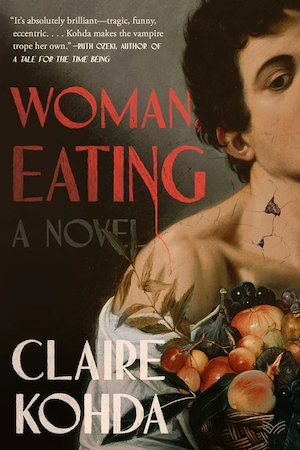
In Claire Kohda’s Woman, Eating, the protagonist Lydia, a 20-something Londoner and artist, is a frustrated foodie. She salivates over the idea of the delicacies of her Japanese father’s homeland, and reads labels of food with interest and desire. But for all the intent, Lydia can’t eat or drink—she is a vampire and can only stomach blood. Her British Malaysian (vampire) mother, a mysterious and forbidding character, has been feeding Lydia pig’s blood since she was a kid.
Lydia not only craves food. She wants a normal life of connection with others. She can’t share dinners with the other artists in the loft building she works out of. She can smell blood everywhere but because she eschews human blood, she is starving. Life should be beginning. Her troublesome mother is tucked away in a nursing home; she’s starting a new internship at a London gallery. But her severe hunger and her unusual constitution (plus some creepy men) get in the way.
I spoke to Claire Kohda, who is a violinist who’s played with the likes of dance music legend Pete Tong and the English Chamber Orchestra, about vampirism as a metaphor for colonialism, taking otherness to the next level, and comparative vampire perceptions across cultures.
J.R. Ramakrishnan: You take “otherness” to the extreme in the novel. A mixed race young woman who is a hungry and conflicted vampire! How did you dream her up?
Claire Kohda: At the time of writing Woman, Eating, I was wondering a lot about how I belong in the places and systems I exist in, wondering whether it’s possible to belong when you are also different. A year earlier, I had been to Japan and felt very foreign there; soon after I came back, we went into our first lockdown, and there was a huge increase in hate crimes against Asians, and that emphasized to me the fact that many people in England believe I’m a foreigner here, too. Being mixed race, the feeling of difference follows you everywhere, even into your home where you are ethnically different to both of your parents. I think all of this was what drew me to writing about a vampire—a creature that is in between so many things: in between life and death, good and evil, human and demon.
All of this happened very organically, almost subconsciously, though. I think of all the themes in Woman, Eating as having been percolating—strengthening and becoming richer—through that first year of the pandemic, without me realizing. I felt so helpless while all the awful things were happening to the Asian communities in the US and UK and elsewhere; but, I think a part of my mind was fighting back, and creating this vampire with Asian heritage, this expression of all those feelings of otherness I’d internalized and struggled with.
Then, one day, Lydia essentially just appeared in my head, fully formed. She appeared sitting at a large dinner table, surrounded by food, watching the other dinner guests breaking bread, sharing wine, and wishing she could eat with them. Food is central to this novel and to Lydia’s life. Asian cuisines are so often used to other Asian people. Names of Chinese dishes have been shouted at my mum and other people I know of Asian heritage, as if our cuisines are so different or weird that they can be used as slurs to dehumanize people. Asian cuisines are also often perceived as cruel too; I often find myself being asked about whaling or dog meat, despite being vegan; It can be hard to not internalize the monstrousness other people (mis)place onto you when they associate the cruelty of a specific food industry with your racial identity. Lydia is, in part, that racism made manifest. She is what many people would consider to be a monster, even though, when it really comes down to it, the only thing that sets her apart from us is her diet; the only thing that sets her apart from humans is what food she can eat.
JRR: I am especially interested in the choice of making her mother have both British and Malaysian roots while Lydia herself is part Japanese. Can you tell us about how you came to this decision?
CK: Traditionally, vampire narratives have been used to tell stories about colonialism. Dracula is thought to have reflected Victorian guilt about imperialism; the colonized other (Dracula) consumes the colonizer (his victims). The vampire is very often a metaphor for consuming, for taking—and that is true in Woman, Eating too. Lydia’s mum, Julie, believes vampirism is a curse inflicted on colonizers as a punishment for taking what was not theirs. She describes this curse as having spread like a disease. I wanted the roots of the vampire to lie in an act, not just a specific person—for vampirism to have come from a kind of imbalance in human society, from something that took place that was so wrong that it manifested a monster.
The way Julie sees it, her vampirism is a legacy of colonialism; it’s trauma that was caused when Malaysia was colonized by Britain, and then again by Japan, that has lasted—because Julie is immortal— for several lifetimes-worth. She is intergenerational trauma made flesh. And Lydia inherits that trauma too; she can’t see the humanity in her mother; she can’t access her Malaysian heritage for so much of the book. Only when she essentially takes it from a British man, does she realize what she was missing.
Vampires are fascinating creatures – they’re kind of timeless things, un-aging, yet ancient. Colonialism is ancient. We’ve always taken from each other. And I wanted the vampire to have come from that. In England, the fact that Western countries colonized so many East and Southeast Asian countries is not a part of our education; so many people don’t know that this happened. When I started writing Woman, Eating, I recognized that I had an opportunity to reinvent the origin of the vampire, to center it around this part of history. I wanted Lydia’s own identity to be complex too. Lydia’s own ethnic heritage contains colonized and colonizer. While growing up, I was always conscious of being two ethnicities that were enemies during the WWII; narratives that positioned one side as the heroes and the other as villains were confusing for my identity. Lydia’s entire identity is divided between sides that seem to her to be opposed to each other.
There’s a lot of taking and taking back in Woman, Eating–a lot of the book is about ownership. The book is partly about colonization, yes, but also about consuming culture through food and through collecting art, consuming and taking lives, and about how sexual assault can be like a kind of colonization of the body, a kind of taking of ownership. These are all examples of types of vampirism. But the first vampire in the world of Woman, Eating was always, in my mind, a colonizer.
JRR: To understand herself, Lydia looks up langsuyar, the female vampire of Malay folklore on Google. I didn’t recall this character from my childhood (I grew up in Malaysia) but remember being terrorized by the idea of the pontianak (apparently the daughter of the langsuyar). You have Lydia observe that vampires in Asian cultures are not revered as in the West and that women vampires are “blamed for their monstrous states.” Yet, poor Lydia has no fault in her condition.
CK: “Poor Lydia” I feel could easily be the subtitle of Woman, Eating! I wanted people to feel for Lydia—to really, deeply feel for a vampire, a creature that we might normally consider a monster. I also wanted people to feel for a character who actually does a lot of things wrong; who is selfish and flawed.
Asian cuisines are so often used to other Asian people.
The Langsuyur and the pontianak both are born from really traumatic experiences—the loss of a child or the death of a woman in childbirth. When Lydia looks up vampiric creatures on Google, she reads all the things she finds in a way that is quite negative; by this point, some of Julie’s self-hatred has passed onto Lydia already. And, so, it felt right that she would take from her research only something negative–that women creatures are blamed for their monstrous states. This is true, to a degree. Many folktales from East and Southeast Asia depict women unable to deal with trauma, or unable to deal with other emotions, and becoming evil or vengeful monsters. Yet, what Lydia misses is that, in the case of the langsuyur, the woman became a vampiric monster because of grief, because she felt so much love towards her daughter, and couldn’t deal with her death. Lydia completely misses that aspect of the story. She’s blind to it. And for a lot of the book she is blind to the love of her own mother, too, whose story mirrors the langsuyur’s. Julie, confronted with the possibility of losing Lydia when she was a baby, turned her into a vampire. So, Lydia’s vampiric state is the result of her mother’s love.
I really wanted to step away from the kind of reverence for the vampire we see in Western vampire stories. I didn’t want to create something that was titillating, or revering of power, or of youth. Lydia, in this novel, isn’t really aware of her power, and she recognizes how terrifying and monstrous humans with power can be; how power itself can be dangerous. This novel isn’t really horror either. The vampire exists mostly in the horror genre in the West; but, in a lot of literature from Asian countries, the supernatural appears in otherwise very grounded novels and doesn’t result in those novels being pigeon-holed as horror or fantasy. I wanted to remove the vampire from the horror genre and look at a vampire in a very grounded way, and see what I could learn about what it is to be human by observing Lydia trying to just simply live her life in our world.
JRR: You take us on quite a tour of London through its contemporary art world. I want to ask about the conversation Lydia and Ben have after The Otter show where he expresses his disenchantment with the art business. Lydia herself reflects on how her artist father’s paintings are owned by other people who can look at them at any time while she cannot. She says, “I think art comes to mean something different to people when it becomes something they can possess.”
I wonder what you think about this concept of visual art (as something to be possessed and boasted about) v. books (which are only owned in a lesser and milder way and people are less impressed by book ownership/boasting, I think) and/or music (which as a non-musician, seems to me to be unpossess-able)?
CK: This is such an interesting question! Art collecting has long been tied to colonialism, and war; once we take an art object and lock it away, it becomes something that no one else can see, that no one else can possess, and so it makes sense, I think, that it is something that is tied to the taking of other countries and cultures. So many museums in the West have in their collections items that were looted during wars, or during colonial “missions.” Gideon, in Woman, Eating, collects art and has a particular interest in what he calls “world art.” He buys art as if he is buying parts of the respective culture that art has come out of; the colonial history of art collecting is reflected in his style of collecting. There’s a part in the book where Julie explains how Western collectors described Lydia’s dad’s art, and those descriptions use language that is based more on stereotypes about Japan (“refined”) than on what his art is actually like (“brutal and violent”).
Her vampirism is a legacy of colonialism; it’s trauma that was caused when Malaysia was colonized by Britain, and then again by Japan, that has lasted for several lifetimes.
There is something unique about collecting visual art–how the more limited a print is, for example, the more expensive it is; or how a one-off is even more expensive. In cases like that, value is ascribed to exclusivity. The less we have a chance to see an artwork, the more value it has. If we are the only one who can see it, that means we have something special. For the artist, that means that selling work is always linked to loss. When an artist sells a piece, they no longer can have it; they have to let it go entirely, and maybe they’ll never see it again.
With music and literature, there isn’t an object that the maker creates. It’s more ephemeral. There’s no sculpture or painting that can be held or touched. When we create a piece of music or literature, it’s automatically shared between the maker and the reader or listener. Even though we can hold books, a book is only a stack of paper with ink, bound together. The novel itself just exists in the mind. And exclusivity doesn’t come into it at all.
This doesn’t mean I don’t love visual art though. I still love making art; and I love working on a sculpture, owning and changing its shape, and being in control of that process; and I understand how people can desire to possess something, to keep it for themselves and themselves only–that’s a very human thing to want I think. But it can get tangled in the terrifying desire to own and possess another person, or another culture. Visual art is such a pure and beautiful thing, until you buy it.
JRR: Finally, Lydia gets to taste all the human food she can’t have and has been hungry her whole life. This (and maybe her revenge was a tonic too?) seems to give her new life. She seems reborn. Can we expect more of Lydia?
CK: Yes, it was definitely a tonic. We get so much from food, not only sustenance. Food helps us connect with friends, family, ancestors, our cultural heritages. We share food together, we cook for each other; we pass recipes down through generations; recipes travel with immigrants and refugees to new countries—they’re a part of home we can take with us anywhere. This is such a huge part of Lydia’s and her mum’s experience of life that is missing, because they can only digest blood, and it stands in the way of Lydia really being able to engage with her heritage.
The Malaysian food Lydia tastes for the first time comes from two real businesses in the UK: the Chinese Malaysian Scottish chef Julie Lin in Glasgow who runs Julie’s Kopitiam and Ga Ga—her food is tied to her exploration of her cultural heritage, and on Instagram she posts often with her mother—and the Malaysian kaya (coconut curd) business Madam Chang’s Kaya, whose kaya recipe was passed down to founder Ae Mi from her grandmother when she was just four. In both these instances, food connects different generations of a family, and connects two countries: everything Lydia has been missing.
Like thescrap collector in one of his stories, Omer Friedlander’s prose sifts through the junk of this world to find those whimsical elements that are otherwise overlooked. Rich in imagery and sprinkled with humor and spice, The Man Who Sold Air in the Holy Landconjures intimate and inventive portraits of Israeli life. Even though Friedlander is only 27, his debut short story collection glides through imagination, reality, and history with the maturity and elegance of a Jewish grandmother’s Shabbat lunch. Seeing right through the small talk around the steaming pot of cholent, Friedlander brings the unseen to the fore, paying tribute to the crumbs on the floor, the twitch of an uncle’s mustache, and the two cousins playing footsie underneath the table, who will forever associate brisket and beans with a kick in the shins.
I first became acquainted with Friedlander’s work during a jazz performance held in a Tel Avivi backyard. After the first set, the upright bassist was approached by an old teacher from his high school, who immediately asked about a certain Omer’s whereabouts. By way of eavesdropping, I found out that the musician, Elam, had a twin brother based in my hometown, New York City, who wrote stories in English about the country in which we both felt like strangers at home. I skipped out on the second set and speed-biked home, where I located the title story of his collection, “The Man Who Sold Air in the Holy Land,” online, and spent the rest of the evening devouring any material I could find. I was immediately taken by the sensitivity of Friedlander’s approach to character, setting, and detail, and have been looking forward to the release of this collection ever since.
Geffen Huberman: Let’s talk about the title of your collection, The Man Who Sold Air in the Holy Land.
Omer Friedlander: The title comes from one of the stories in the collection, which follows a divorced con-artist who sells empty bottles of “holy” air to gullible tourists, together with his young daughter and her one-eyed cat named Moshe Dayan. The father takes the form of the traditional diasporic Jewish archetype of the luftmensch, the man of air, a kind of impractical person who can’t make any money, and the only way he can sustain his relationship with his daughter is through these get-rich-quick schemes and his over-developed imagination. I wanted the title of the collection to give a sense of the tone of the stories, kind of absurd, whimsical, and irreverent, fable-like sometimes, and it also locates us in a very specific place.
GH:In your work, there are characters who collect objects, sometimes things that seem like junk to others but to them has special meaning.
OF: Objects are very interesting to me as a writer because they can function like capsules for memory. They’re etched with the personal history of their owner. I think it becomes even more fascinating when the story attached to the object is invented.
In my story “High Heels,” a teenager working at his father’s shoe-repair shop in Tel Aviv is fascinated by a pair of high heels kept on the top shelf of the store. According to his father, the heels belonged to Franceska Mann, a Polish-Jewish dancer who died in the Shoah. Franceska really did exist. I came across an account of her life and this was the inspiration for my story, and yet the boundaries of fact and fiction in her case have become blurred. In the most famous account of her story, Franceska performed a striptease to distract a Nazi officer, then stabbed him in the eye with the tip of her heel, stole his pistol, and managed to fire a few rounds before she was shot. In another account, she was believed to be a Nazi collaborator. No one really knows exactly what happened, and this is an amazing opportunity to write into the gaps of the conflicting historical accounts.
In “Alte Sachen,” two brothers who are junk collectors struggle with the burden of the memory of their dead father. The memory of the father is contained within a recording device, and they listen to his mechanical voice over and over again. The younger brother believes his father’s spirit is literally reincarnated in the object. I’m very interested in objects acquiring significance because of their history, or in objects being imbued with meaning by their owners through the act of storytelling.
GH: Many of your stories deal with characters on the fringes of society. Why do you think you’re attracted to writing about these unlikely encounters: a love story of a Jewish girl and a Bedouin boy, a friendship between an Arab and a Jew?
OF: The stories in the collection are filled with characters that are outcasts. Junk collectors, con artists, smugglers, loners, and people who, though still alive, seem to only haunt the world. The characters are all looking for intimacy and human contact, yet constantly face the difficulty of shedding their roles. The stories explore the possibility, difficulty, and hope for relationships across divides and boundaries, political and physical borders, between generations and collective identities.
Writing allows us the possibility to imagine a different world. If we can’t imagine anything different, we are doomed to despair, to be stuck in a purgatory of the status quo.
The characters that populate the stories often struggle with an inherited weight of memory, negotiating the burden of living in a war zone during times of violent conflict. But the stories mostly don’t aim to portray directly the violence that constitutes their background landscapes. Rather, they explore private moments of fragile intimacy that are formed through humor and absurdity, and an eye for the grotesque and fantastic in the midst of what for others are sharply drawn lines of conflict.
With such loaded subject matter, I think it was very important for me to approach the stories through character and with empathy. I wanted to avoid it becoming a lecture about politics. It’s my job to raise questions, not to provide easy answers, so I never write in order to make people change their mind about anything. It makes me think of Amos Oz, who had two pens on his desk. One pen to tell stories, and another pen to tell the government to go to hell.
GH:The theme of imagination, of contriving an alternate reality, is salient throughout the stories. Can you speak on the relationship between imagination and writing?
OF: Imagining an alternate reality is definitely a preoccupation of some of the stories, but not in the sense of escapism. I think writing a slightly skewed, absurdist world which is fabulous and fantastic and unreal, at least in the conventional sense, sometimes allows us to see more clearly the strangeness of our own world. When Kafka writes that Gregor Samsa woke up one day as a cockroach, it may not be realistic, but the emotion feels so true.
I think of writing as a form of play. You have to be able to be seriously playful (or playfully serious) even when you’re writing about the most politically charged topics. My writing process is one of discovery. My stories aren’t planned out in advance. It’s a bit like improvisation in jazz. My twin brother and many of my close friends are jazz musicians. They improvise on a certain melody or theme. My writing is the same, at least in the earlier stages of drafting, I’m improvising, seeing where the story takes me.
The theme of imagination is also related to my interest in fables and fairy tales, which comes from my father, who collects old, illustrated children’s books. When I was growing up, I remember my father going to flea markets and used bookstores to scavenge for these books. What I find exciting about fairy tales is that they offer the possibility of metamorphosis, transformation. There’s an instability in fairy tales, boundaries are blurred.
When you’re writing fiction, the world may be invented, but the emotional core behind it is always true. Etgar Keret says humor for him is related to empathy. It appears in times of conflict and despair. It’s like the “airbag in a car,” released only in a state of emergency.
Writing allows us the possibility to imagine a different world. If we can’t imagine anything different, we are doomed to despair, to be stuck in a purgatory of the status quo.
GH: Your stories, some of which are historical in nature, directly deal with topics integral to the Israeli canon such as the Holocaust, but with a refreshing, somewhat distanced perspective.
I have never felt like I truly belonged in Israel… And yet… it is still my home, the place where the people’s way of laughing and being friends and getting into arguments is most familiar to me.
OF: I remember my final-year high school history exam in Israel, it was all about the Holocaust. The way it was taught was problematic. It was this petrified, nationalist symbol. When I was writing about it, years later, I knew that I needed distance and humor. One of the stories in my collection, “The Sephardi Survivor,” is about two brothers who are jealous of their Ashkenazi classmates whose grandparents and relatives are Shoah survivors. It was inspired by a conversation I had in Brooklyn with some Israeli friends. One of my friends, whose family is from Iraq, said that growing up he’s always been jealous of his Eastern European Ashkenazi classmates, who had relatives that were Shoah survivors. It was such a strange, but understandable, sentiment. To be jealous of another person’s suffering was an odd idea, of course, but the Shoah has such prominence in all Israeli discourse, it strangely becomes a kind of social cache, a matter of prestige to have relatives that are Shoah survivors.
In my absurdist story, the brothers decide to kidnap a survivor, Yehuda, to bring to class for a school “Show and Tell” on Holocaust Memorial Day. The story frames the memory of the Shoah in an unusual way, that is absurd and ironic, but more importantly, it focuses on the individual, the human. It’s not abstract, it’s not numbers in a textbook, it’s a person, Yehuda, with his own eccentricities, flaws, and tender longings. This is what fiction can do—it can transform the abstract into the intimate.
GH: Your mother tongue is Hebrew. Why do you write in English?
OF: My decision to write in English, whether conscious or not, has to do with me feeling like both an insider and an outsider in Israel. I have never felt like I truly belonged in Israel, even though I was born in Jerusalem and grew up in Tel Aviv. And yet, even though I feel like a stranger sometimes, it is still my home, the place where the people’s way of laughing and being friends and getting into arguments is most familiar to me. Writing in English allows me a certain distance that is necessary in order to be more probing and ironic, to see all the strangeness and particularity of a place, with its many contradictions and complexities.
Some of my favorite writers write in Hebrew. It’s a fascinating language because it was used for prayer and ritual for two thousand years. It was a holy language, and it was considered sacrilege to even ask for a glass of water in Hebrew. It was revived as a spoken language only in the 19th century, and the gap between Biblical Hebrew and its modern day equivalent is probably not as large as Chaucer’s English and today’s English. As Amos Oz says, Hebrew is a minefield of Biblical allusions. When you’re writing a domestic scene about a son asking his parents for pocket-money, you have to be careful not to bring in Isaiah and the Psalms and Mount Sinai. It is like playing music in a cathedral, he says, there are a lot of echoes.
Hebrew is also constantly changing and adapting. Many of the new slang words introduced into the language come from military jargon, which is so prevalent in day-to-day life in Israel. As Yehuda Amichai writes:
“to speak now in this weary language, a language that was torn from its sleep in the Bible…a language that once described miracles and God, to say car, bomb, God.”
In his poetry, Amichai was always finding new ways to combine the vernacular, everyday Hebrew with the weight of Biblical resonances, creating playful juxtapositions between the sacred and the profane.
GH: You’ve mentioned a number of Hebrew-language authors: Grossman, Oz, Keret, Amihai. Do you view your writing as a continuation of the Israeli literary tradition?
OF: I love the work of Oz and Amichai, but I don’t know whether I’m writing out of this particular tradition. If I am part of a tradition, maybe it’s that of writers that write in a language other than their mother tongue. Maybe it has to do with feeling out of place in your own home. I think many writers have a kind of internal restlessness. They don’t feel at home anywhere. Even at home they’re strangers, but that’s the only way they’ll have the perspective to see clearly.
In the past few years, as I’ve been working on my own book about technology, I’ve been reading books about technology—critiques of Silicon Valley, of internet culture—and wondering: where are all the people of color? Sure, Silicon Valley is known as the home of the tech bro—a white man, probably wearing a Patagonia jacket and a pair of Allbirds. But still. People all around the globe, of all races, use the internet every day, use social media every day—where are these stories about technology?
I was thinking about other questions, too: What is the experience of a woman of color in a world of tech bros? How does the algorithm try to standardize us as people—to suggest that there’s one way to be? How does it feel to be a person who doesn’t fit into the algorithm?
These are some of the questions I grappled with in writing my debut novel, Happy for You, which follows half-Japanese half-Jewish Evelyn Kominsky Kumamoto as she leaves a PhD program in philosophy to join the third-most-popular internet company, where her team is developing an app that objectively measures user happiness. Even as she tries to convince herself that the project is worthwhile—that she is doing good—she confronts the limitations of technology in understanding the nuances of race and cultural context, and, more generally, the algorithm’s general push to make all of us conform to a single standard of success and of happiness.
For this reading list, I wanted to include books that center people of color in stories about contemporary technology, as well as books that center people of color in considering how the way we relate to technology could be different in the future.I’ve also included two books of poetry that I’ve found deeply impactful, works that defamiliarize our contemporary technologies, using programming code and Google Translate to new and surprising linguistic ends. Spanning past, present, and future, these books prompt us to consider the ways technology perpetuates racial biases and injustices—and how we might liberate ourselves from its insidious control.
Edge Case is narrated by Edwina, the sole female employee at a AInstein, a New York City startup that is developing a joke-telling robot. She is also an immigrant from Malaysia with a work visa that will soon expire. When the novel opens, Edwina’s husband—also a Malaysian immigrant, also working in tech, and also on a work visa (that is similarly about to expire)—has gone missing, and the novel follows Edwina as she tries to track her husband down and cope with the possible dissolution of their marriage while simultaneously trying to figure out how to get a green card before she has to either move back to Malaysia or remain, undocumented, in the United States.
This funny, deeply-thoughtful novel is narrated by Alexandra, a 25-year-old Chinese American writer who —at the novel’s start—works as a reporter for a prestigious tech publication in San Francisco. As she grapples with her relationship with her white boyfriend, J., she simultaneously grapples with her predominantly white newsroom and reporting on the predominantly white companies of Silicon Valley. The novel’s fragmentary narrative covers microagressions at the workplace, pay disparities, interracial relationships, and histories of anti-Asian discrimination, forming a kind of collage of thought that is always grounded in the narrator’s specific longing to find her place in the world.
This collection of poems expresses what it feels like to be an Asian American woman—to be objectified, to be fetishized—both in real life and in the virtual world. Choi writes about technology and incorporates technology itself into her poetry as a formal device; in “The Cyborg Wants to Make Sure She Heard You Right,” for example, she runs a series of tweets that were directed at her through Google Translate, showing the startling persistence of Orientalizing language even as it moves through multiple rounds of translation. Another poem inhabits the voiceless android Kyoko from Ex Machina, writing back to the film’s techno-Orientalized vision of the future and insisting on an Asian woman’s right to speak and to be heard.
In Travesty Generator, Bertram uses computer code and programming to create poetry that responds to the hidden racial biases of coding, algorithms, and digital technology and to offer new narratives for the relationship between Black lives and technology. As Bertram writes in the afterword:
“I use codes and algorithms in an attempt [to] create work that reconfigures and challenges oppressive narratives for Black people and to imagine new ones.”
Bertram uses Python, JavaScript, and Perl to produce poems about anti-Black violence, Harriet Tubman, codeswitching, and being a person of color in a zombie apocalypse. The book interrogates the relationship between race, technology, and narrative, producing iterative permutations that are sometimes beautiful, sometimes shocking, and always haunting and alive.
Originally published by Tor in 1992, this cult science fiction novel was reissued by Strange Particle Press in 2016. It’s 2045, and the journalist Xólotl Zapata is living in Tenochtitlán, formerly known as Mexico City. The U.S. is in decline while Africa and Latin America are ascendant centers of technology. The story follows Xólotl after he is infected with a highly-contagious virus that can download beliefs into the human brain; it can instill any kind of beliefs, but in Xólotl’s case, it has made him into a carrier for converting everyone he meets to the Aztec religion. Antic and fast-moving, filled with Spanish, Spanglish, and Nahuatl, the novel upends the typical U.S.-focus of science fiction and technology-driven narratives, offering a vision of a decolonized technological future.
Built on an epic scale, The Old Drift weaves together the stories of three Zambian families (Black, white, and Brown), spanning the course of more than a century (1903 to the near future) and mingling multiple genres (historical fiction, surrealism, fantasy, science fiction). The final section considers an array of technologies, both real and speculative: nanorobots and microdrones, gene-editing and CRISPR, and devices called Digit-All Beads that are implanted in users’ hands and work similarly to smartphones (with similar problems of surveillance). Serpell traces the connection between past colonialism and present-day government control, looking toward a future when technology no longer forces people to submit, but allows them to revolt.
Moving between 19th-century China and the near-future Pacific Northwest, Salt Fish Girl centers on two female characters: Nu Wa, who escapes her Chinese village after an arranged marriage goes awry, and the teenage Miranda, who lives in the corporate-controlled city of Serendipity on the coast of what used to be Canada in 2044. Dissolving the borders between myth and science fiction, Lai creates a mash-up of genetically-engineered beings, shape-shifting, creation stories, reincarnation, virtual reality, and a mysterious sickness called the Dreaming Disease, whose sufferers ultimately voluntarily walk into the sea and drown themselves. Like Serpell, Lai draws a connection between past and future, destabilizing the primacy of Western science and technology. The book is not an easy read; rather, it is poetic, mystical, and sometimes confounding, a kind of fever dream of the body, feminism, and queer intimacy. Its narrative chaos and sensory overwhelm are part of its beauty.
In the Womb I Leave Graffiti for My Younger Brother
You, lithe swimmer with feet you will use
like hands, meet me here—read what I write

on the wall of mum’s uterus the way later we
will cobalt blue spray the field to mark where
to hit, throw, catch whatever it is we try to hold—
baseball, whiffle, bug clot or frog race—here it is
dark and I have been here before you, so allow me

to give you something: she will not
ever be yours. You will break
the waves looking, breathing into the space
left by airplane, foot, abrupt hang up, memory fissures
but for now this room, cozy fluid den
of safety—see what I left behind? Words in their infancy

a blueprint we will not find until this decade but
we found it, brother! Think of it: both of us swimming
in blankness so dark no lighthouse/flashlight/torch/bonfire
can get through and yet here we are, grown and reading
and here, too, is my hand. I beg you, take it. In
the deep I will hold yours.
Sometimes I Apologize to My Children
and sometimes I break open
the pomegranate of my chest
holding each membranous seed
inside while I consider my children
and the ocean of heartache potentially
lapping at them in the future made even
colder despite global warming’s ruin
because they don’t know specifics—death
sure maybe they get that but what about loving
someone who doesn’t love you back or
hurts you or about slack misery jobs or finding
chains across your front door because of bills
unpaid and, too, the sad bright crocuses blooming
in front of that stoop, what about the getting
pregnant at the worst time or being unable
at the best? What about plain old human cruelty
boxed up in elementary construction paper
cutting or the adult-sized lunch tables from which
one might still be excluded and just what can I say
about the underground tracks of desires unmet
crossing lines with well, that’s just the way it is—
and to think I wanted to ring the bell of joy
have it sound out to each of my grown babies so
I am sorry for the splitting open of my chest and
sorrier still for the mess my seepage and the world
slops on you but still, I told you about the crocuses—
bright purple and yellow, green so alive it sews you up—
I told you that, too, right?
Returning to England after two weeks in Nigeria back in 2019, I found myself marveling at how green the grass on the side of the motorway was. The thing I love about coming home from anywhere, is the moment where you can look at everything with a fresh, often rose-tinted, perspective. Maybe it’s partly “absence makes the heart grow fonder” and partly the fact that distance allows us to drink in the details we would ordinarily overlook, but for a brief time, the familiar suddenly becomes novel.
In literature, homecomings are great because the reader begins on the same page as the narrator or protagonist, walking into the party together, so to speak. A well-written homecoming scene immediately situates a character and reveals a lot about their relationships to the place and people around them. We all come from somewhere, and our connection to that place—or the conspicuous lack of one—can quickly and succinctly, say a lot.
My debut novel, Hope and Glory, starts with a homecoming. Glory has been in Los Angeles where she’s been having the time of her life, if you believe her Instagram feed. When her father suddenly dies, she returns to her hometown of Peckham, South London, where she finds her family in complete disarray. Her brother is in prison, her once-ambitious sister is stuck in a problematic marriage, and her mother is very close to mental breakdown. Her return home is not the triumphant victory lap she once imagined it would be, but it is the beginning of her journey to reconnect with her family and herself.
Another thing that I love about homecomings in literature is that they work across multiple levels. Of course there is the physical return to a place, but it could also be revisiting something on an emotional or psychic level, reconnecting with old friends and enemies, or a re-exploration of the inner self. In my humble opinion, the best homecoming stories are mix of all of the above, and below you’ll find a list of some of my favorites.
Memphis is a lush novel that follows three generations of a Black Southern family through tragedy, the civil rights era, loss, estrangement, and reunion. It is a celebration of the bond of women, the resilience of family and the musicality and life of the city of Memphis itself. Tara’s prose is so rich I could almost feel the heat and smell the honeysuckle.
It starts with ten-year-old Joan, her mother and her younger sister returning to the house her grandfather built, escaping their Marine father and a violent home. In Tennessee, they build new lives, chase old dreams and navigate past traumas. Stringfellow writes a coming-of-age story that is filled with love and hope, as much as it challenges the darker side of humanity, and in particular, the harms that men enact on the women in their lives.
26a is the debut novel of Diana Evans, the author of the critically-acclaimed Ordinary People. It is a layered story that is all at once tragic, warm, humorous and dark.
It begins in the attic room of a residential home in Neasden, North London, where twin sisters Georgia and Bessi weave a fantasy world around themselves. They share their home with older sister Bel, younger sister Kemy, their homesick Nigerian mother and emotionally unavailable English father. The narrative moves to Nigeria, where their mother experiences a long-delayed homecoming of her own, but where her children are introduced to various terrors that will haunt them when they return to England. 26a is the story of a family that is as beautiful as it is heartbreaking.
The title of the novel is a Twi word, which literally translates to “go back and get.” It is also the name of an Adinkra symbol, which is used to represent philosophical ideas by the Akan ethnic group, who are primarily found in Ghana and Côte d’Ivoire. Sankofa is a fitting title for a novel that follows a middle-aged woman as she returns to a “home” she has never known, in order to “go back and get” an understanding of who she is at a point in her life where all that she has known is fast falling away.
When we meet Anna, she has separated from her husband, her only daughter is an adult who needs her less and less, and her mother has just died. When Anna finds her father’s diary amongst her mother’s possessions, she sets off on a journey to find out more about a man she never knew who left her mother before she was even born. This journey takes her to Bamana, a fictionalized West African country, where she discovers uncomfortable truths about her father and his legacy, but also has the opportunity to connect with a side of her heritage that has been obscured for most of her life.
Charmaine Wilkerson’s bestselling debut novel begins with estranged siblings, Benny and Byron, forced to reunite at the request of their late mother. They return to the house they grew up in to piece together the fragments of a woman they soon realize they didn’t fully know. Through a voice recording delivered by their mother’s lawyer, they unearth a family history filled with secrets and shame that casts their parents in a completely different light. Through this, Benny and Byron are also grappling with the break down of relationships—with lovers, their parents, and each other.
Black Cake is a unique story, written in fragments and multiple perspectives. It covers decades and continents, flying between a community on a Caribbean island living in quiet terror, a postwar Britain as hostile to immigrants as it is desperate for their labor and finally, modern day California. The novel is also rich in thematic significance, with motifs of the ocean and food resurfacing to provide a satisfying circularity to narrative.
The Salt Eaters starts in the middle of a healing ritual for Velma Henry, a veteran community activist who suffers a breakdown and attempts to kill herself after becoming disillusioned with her life’s work. The ceremony is overseen by Minnie Ransom, a locally famous healer who is guided through the healing by a “haint” named Old Wife, and witnessed by a variety of characters, many of whom know Velma personally.
This novel is beautifully lyrical and experimental in style, written from numerous points of view, including chapters that feature long dialogues between Minnie and her spirit guide, Old Wife. The politics of 1960s and ’70s feminist, anti-war and civil rights movements are apparent in the narrative, without being overbearing or preachy in tone. Ultimately the book is as much about collective healing as it is about Velma finding her way back to herself.
Noo Saro-Wiwa is a travel writer and the daughter of famed Nigerian writer and activist Ken Saro-Wiwa. After her father was murdered by Nigeria’s military regime in the ’90s, she stayed away from Nigeria for many years, finally returning as an adult to make sense of the country her father loved and died for.
In Looking for Transwonderland,there is a different sort of homecoming. There is little sentimentality but a clear-eyed look at a country whose greatness has arguably been squandered due to persistent poor governance. Still, it is revealed to be a country that is as beautiful as it is maddening—something that Nigerian nationals, both home and abroad, will readily agree with. So much of modern Nigerian myth revolves around Lagos, the sprawling mega city that is home to The Giant of Africa’s creative industries. But this travelogue reveals the breadth and diversity of a nation in the way only a Nigerian returning from exile can.
While it goes without saying that Toni Morrison was a writer of singular talent and significance, I feel like her second novel often flies under the radar when it comes to evaluations of her work. Sula, for me, is as much a portrait of town and a people, as it is about the titular protagonist and the evolution of her relationship with Nel, her best friend.
Sula and Nel grow up in Bottom, a fictional town up in the hills of Ohio. They both have strained relationships with their mothers; Nel secretly despises her prim and proper mother, while Sula nurses growing contempt her care-free, openly promiscuous one. A secret tragedy that they witness binds the girls even closer together, but as they get older, Nel decides to stay in Bottom, falling willingly into the role of wife and mother, while Sula leaves the town, travelling, attending college and living a life as care-free abroad as her mother did at home. When Sula returns, her presence sends ripples through the town, which will ultimately test her friendship with Nel the most.
DON’T MISS OUT
Sign up for our newsletter to get submission announcements and stay on top of our best work.
YOUR INBOX IS LIT
Enjoy strange, diverting work from The Commuter on Mondays, absorbing fiction from Recommended Reading on Wednesdays, and a roundup of our best work of the week on Fridays. Personalize your subscription preferences here.