Cheering for the Car in Last Place

To the woman at the NASCAR race cheering only for the winless drivers

You know not to trust luck or easy money: I could tell

by the way you ignored the casino owner who started the race
and the Yeti-toting college boys in their boat shoes, gawking

at your orange bra top, a throwback with the Tide logo 

printed across its front. Fearless as a gerbera daisy, that top, 
and oh how I admired the sly joke about good clean fun
 
once I realized it actually read Tits, how I wished for you
 
always the luxury the teenager who sat in front of us must feel, 
the heedless, hopeful way she draped her hair over the bleachers, 
 
letting it frizz in the mist just to get some air on her neck.
 
You smiled at her. There must be a line long as this racetrack 
of people you’ve comforted with whatever you had in your purse:

tissues, peppermints wrapped in cellophane, tampax, loose change. 
 
I lost you in the rain after you draped a faded beach towel
(one you must have brought from home) over your shoulders, 
 
but I think maybe I saw you again—in the windsock at the helipad 
 
flinging its orange at the relentless low sky, or in the helicopter, 
ready, at once forlorn and giddy that today nobody needed saving.


Foreign Affairs

Back in the city after my lover’s funeral
I met with a man who had treated me,
 
during our months together, like a chore.
He had just moved to the city to write poems,
 
which he’d convinced me I shouldn’t bother doing
because nothing about my life was interesting.
 
He was sorry for my loss, he said. 
He handed me a mug I’d left at his place, 
 

a serious gray mug sent by a magazine
I used to pretend I enjoyed reading.
 
He wanted my gratitude for bringing this mug
across four states, my gratitude for remembering 
 
it was once mine. Clean, empty, it reminded me 
that for a long time all I could manage
 
was to get high and fake orgasms and try
not to die, which I am still learning how to do.

7 Unlikely Love Stories in Literature

In the early stages of writing Castaway Mountain, I recall the narrative taking shape very slowly. My book is set in a world made of Mumbai’s garbage, one that may seem unreal, but is very much rooted in reality. I had written up to the moment when fires burned on the vast Deonar garbage mountains at the edge of Mumbai in 2016. At the center of this story was Farzana Shaikh, a spirited waste picker who was born at the feet of the towering mountains. She grew up on their slopes, getting singed, her life ravaged in the aftermath of the epic fires, months before she turned 18. I wondered if anyone would read ahead, past the fires. Partway into writing my book, I worried about whether I should stop. 

Castaway Mountain by Saumya Roy

But then, I remembered the young man who had entered Farzana’s life like the shimmering pompadour he styled with his hair—filled with style, light and life. The two had met on the mountain tops, as she sorted through the city’s waste that tumbled out of the garbage truck he rode in. The two had fallen in love, keeping their affair secret, shrouded by the smoke from the fires. Even in the absurd landscape of this vast graveyard of belongings, love found a way.     

I wondered if it was the darkness and blight of the garbage mountains that made their love appear to shine particularly bright. It was as if the fires, the opposition of their families, and other hurdles had made their love more unforgettable—like so many love stories I had read and treasured. 

Many of these stories came to my mind as I chronicled Farzana and Nadeem’s travails. It was social, political, and environmental constrictions that made their love unlikely, but also more searing, almost like fiction. The novels that follow trace the unlikely journey of love bucking against constrictions within and without—making us all worthy of romantic love, readers and writers alike.

Maps for Lost Lovers by Nadeem Aslam  

Chanda, “the girl whose eyes changed with the seasons,” falls in love with Jugnu, “the man with luminous hands”, as spring is about to bloom in a small British town. Chanda is trying to put her past filled with failed romances and manipulative men behind, when she meets Jugnu, a scholar of butterflies, while delivering supplies to him. “Chanda and Jugnu would both be dead by the time those flowers became fruit in the autumn.” Their magical love story unfolds within the web of their sometimes bending but hardly unbreaking cultural expectations. As the seasons turn, the web tightens around them and the book turns into a police investigation into their honor killing.

Of Love and Other Demons by Gabriel Garcia Marquez

Informed by his experience as a journalist, Marquez writes of a teenage girl bitten by a dog and is said to be possessed by African slave spirits. Hearing the dire prognosis, her wealthy father offers her up for an exorcism at an abbey. The young priest set to perform the exorcism falls in love with her. We see the battle between colonial Catholicism and Latin American folkloric tradition waged on her body, and then the immensely healing power of love.

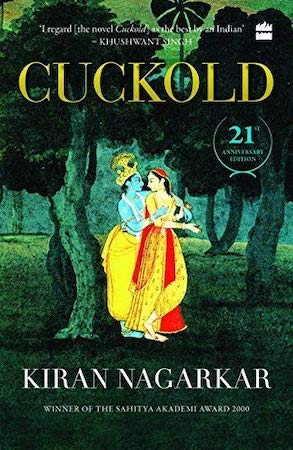
Cuckold by Kiran Nagarkar

“Cuckold” refers to a man whose wife is an adulterer. In this celebrated Indian romance novel, the husband is the king of Mewar, the wife is the real life 18th-century saint and poet Mirabai, and the lover is Lord Krishna, who Mirabai believed she was married to. The tension builds between the real marriage and the mystical one, with the husband attempting to woo his wife back from the God, even as wars rage and his kingdom nearly unravels.   

The God of Small Things by Arundhati Roy

The beautiful and fierce divorcee Ammu lives with her twin children, Rahel and Esthapen, in Ayemenem, a village caught in the throes of communism and the endless entrails of religion and caste. “There are rules for who is to be loved and how. And how much,” Roy writes in her hypnotic, intense, unforgettable love story set in the ‘70s. Ammu’s family runs Paradise Pickles and mostly lives by “the laws that made grandmothers grandmothers, uncles uncles, mothers mothers, cousins cousins, jams jams and jelly jelly.” Then Ammu and the children see Velutha, their Dalit carpenter, in a communist rally. The unbending laws that dictate their lives begin to quiver and crumble. The powerful last scene is a memory of Velutha swimming across the river to meet Ammu: “he folded his fear into a perfect rose. He held it out in the palm of his hand. She took it from him and put into her hair.” 

Blind Assassin by Margaret Atwood

Atwood unravels a story about the interweaving and interchanging lives of two Canadian sisters, Laura and Iris Chase. The novel begins with Laura dying in a car accident and Iris revisiting their lives through Laura’s autobiographical novel, Blind Assassin. Their father, an industrialist, married Laura off to save the family fortune. The marriage was predictably an unhappy one and Laura yearned for Alex Thomas, an old flame and a communist sympathizer who was involved in their father’s factory. Amidst the stories of the Chase sisters’ catering to the needs and whims of the men in their lives, are the memories of Alex recounting science fiction tales about a planet called Zyrcon where anything at all can happen. 

The Remains of The Day by Kazuo Ishiguro

A love so unlikely it may not have existed at all and yet so undying that the main character sets out to find it, and himself, decades later. Working as a butler, Mr. Stevens dutifully spent years holding up the vestiges of a mansion and with it, Britain’s declining post-war power and nobility. Miss Kanton, the housekeeper, waited for Mr. Stevens to tire of his efforts of keeping up with this slipping world and to turn to building a life of his own with her. Was the unarticulated and unexamined self even there? Years later, Stevens leaves on a road trip, in a rapidly transforming Britain, to reclaim himself and a love that had stayed unspoken and nearly unfelt.  

“Mozail” in The Dog of Tithwal by Saadat Hassan Manto

Against the seemingly endless possibilities of a city that feels as vast and star strewn as the sky itself, this love story unfolds between the glamorous Mozail, who is Jewish, and the newly migrated Tarlochan Singh, who is Sikh. In Manto’s short story, Mozail teases and gets close to Tarlochan on Mumbai’s—then known as Bombay—breezy beaches and cafes, but veers away just as Tarlochan thinks she is his. Bombay’s social rifts come into view as the Partition nears. With Mozail seemingly out of reach, Tarlochan settles for a simple Sikh girl instead. But as riots erupt, Mozail returns, and tragically swaps identities to ensure the safety of Tarlochan’s fiancé. 

Some years ago, on a warm afternoon, I walked around the Nagpada area where Manto had lived and where Tarlochan and Mozail’s story was set. I came across an overgrown municipal garden where I had heard a Jewish cemetery had been. I tore down a poster advertising call center jobs from the cement pillar by the gate and saw an engraved Star of David—the only remaining trace of the real life people, the inspiration behind these characters, who lived, loved, and died in this city.

7 Scintillating Thrillers About Romances Gone Wrong

Did we fall into some kind of Twilight Zone of exes?”

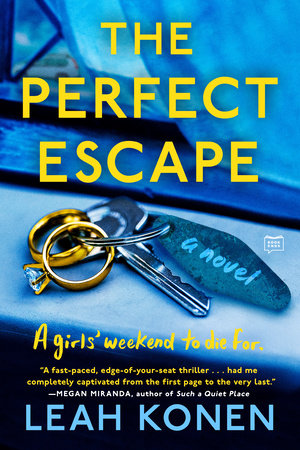
The Perfect Escape by Leah Konen

So Sam asks Margaret in my latest thriller, The Perfect Escape, after yet another soon-to-be-ex-husband has turned up in town. The two women and their friend Diana are all newly estranged from their partners, and their girls’ weekend to Saratoga Springs was meant to be an escape from the heartache and turmoil of their respective divorces.

Instead, mere hours into their trip, they find themselves stranded in a strange town, Diana goes missing, and the men from their pasts begin to turn up in droves—leaving Sam and Margaret to wonder exactly who is pulling the strings on their dangerous would-be getaway. 

To celebrate the release of The Perfect Escape, here are seven scintillating thrillers about romances gone wrong.

My Sister, the Serial Killer by Oyinkan Braithwaite

In Oyinkan Braithwaite’s stunning novella, the exes in question turn up in the form of dead bodies—Ayoola has an unfortunate habit of killing her boyfriends, always turning to her sister, Korede, to cover it up. The plot truly starts to thicken when Ayoola sets her sights on Korede’s kindhearted work-crush, Tade. 

The Wife Between Us by Greer Hendricks and Sarah Pekkanen

A woman is getting ready to marry the man of her dreams, and an ex-wife threatens to bring it all crashing down. This spurned-ex story gets a refreshing twist in the capable hands of Hendricks and Pekkanen, who create a cast of characters—and narrators—who are not who they seem. 

A Good Marriage by Kimberly McCreight

McCreight’s gorgeous murder mystery is set against the backdrop of elite and moneyed Park Slope in Brooklyn, and follows Lizzie, a criminal defense attorney with a marriage on the rocks, as she attempts to defend a wealthy entrepreneur and former classmate, Zach, who’s been arrested for the murder of his wife. Combining multiple points of view and timelines and intercut with grand jury testimony, this spiderweb of a book shows us that marriages are so often not what they seem.

The Last House Guest by Megan Miranda

Set across three summers in idyllic Maine, Miranda’s small-town thriller lifts the lid on the wealthy and powerful Loman family, after Sadie Loman turns up dead and Avery, her best friend and the family’s property manager, suspects foul play. Avery’s investigation leads her into the labyrinths of her own romantic past when she begins to question whether her friend and former flame, Connor, is actually responsible for Sadie’s death. 

The Undoing by Jean Hanff Korelitz

What would you do if the man you thought you loved, the man you’d been married to for years and raised a child with, suddenly disappeared, leaving questions—and a dead body—in his wake? Such is the central question of Korelitz’s emotional and evocative novel, which became the wildly popular The Undoing on HBO. 

The First Mistake by Sandie Jones

When Alice’s husband, Nathan, starts acting suspicious, she turns to her best friend, Beth, for a sympathetic ear and some advice. But as secrets and lies begin to unravel and Nathan’s skeletons (and an ex) come out of the woodwork, Alice comes to suspect that putting her trust in her friend may have been the ultimate mistake. 

The Push by Ashley Audrain

Blythe Connor is just trying to be a good mother, but she can’t help fearing that there is something very wrong with her daughter, Violet—and no amount of assurances from her husband, Fox, can put her fear to rest. It’s only after a family tragedy causes Blythe and Fox’s marriage to unravel that Blythe can finally understand the reality of what happened to her family, no matter how much Fox and his new wife, Gemma, refuse to listen. 

A Novel About Choice Set in an Abortion Clinic

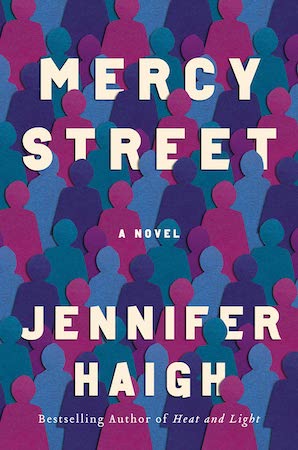
Outside of the titular Mercy Street Clinic, a priest repeats “Hail, Mary, full of grace, the Lord is with thee” into a megaphone. A crowd of people, all bundled in layers against a Boston snowstorm, responds in chorus, all 36 of them united in their protest against abortion. If Jennifer Haigh’s latest novel wasn’t labeled as such, it might be easy to imagine the scene as nonfiction.

Each day, all over the U.S., people make their way through the deceptive advertisements from “crisis pregnancy centers;” through travel, economic, childcare, and schedule-related logistics; through crowds of protestors; and through an increasingly chilling wall of anti-abortion legislation in order to receive sexual health care. And things aren’t getting better. As Elizabeth Nash writes in “State Policy Trends 2021: The Worst Year for Abortion Rights in Almost Half a Century”: “The 108 abortion restrictions enacted in 2021 far surpasses the previous post-Roe record of 89, set in 2011. A total of 1,338 abortion restrictions have been enacted since Roe v. Wade was handed down in 1973—44% of these in the past decade alone.” 

Haigh, New York Times bestselling author and winner of the Massachusetts Book Award and PEN/New England Award in Fiction, explores abortion access through the lens of four unique characters in her latest novel, Mercy Street. Claudia, a counselor at the clinic, offers insight into the lives of patients, as well as the circumstances that complicate their ability to receive care, whereas a man who goes by the name Excelsior11 online, is misogynistic, racist, desperately lonely, and vehemently opposed to abortion.

Over the phone, I talked with Jennifer Haigh about the wave of recent anti-abortion legislation, fake abortion clinics, caretaking, and the ways technology, depending on the context, can foster both sinister and beautiful communities. 


Jacqueline Alnes: There’s a moment where Claudia googles the names of abortion clinics and finds: Women’s Choice, Women’s Options, the Choice Center for Women’s Health, and the Women’s Center for Reproductive Choice. The irony, though, is that it seems like women really don’t have much of a choice, right? 

Jennifer Haigh: I still find it remarkable that these kinds of places exist. They exist in every state, and they really are these dummy clinics. They very intentionally look like real clinics, they are located in the same cities, and all their advertising and their online presence leads you to believe they are actual clinics where actual abortion services are offered. The whole game is just running out the clock. It’s tricking women into making appointments, canceling and rescheduling them, so you run up against the deadline. In every state, though the deadlines vary, the deadlines are very real. Here in Massachusetts, at 24 weeks, it’s over. You have no other options past that point.  

JA: I know you were writing this novel before all of the recent anti-abortion legislation, but I wondered what it was like having this book come into publication at this time, when it seems like the choices people might have are dwindling even further.

JH: Writing a timely novel is impossible if you try to do it on purpose. It just takes too long to gestate. I started writing this one around 2017 and none of this seemed to be on the horizon yet, so that wasn’t at all the motivating factor. The book rose out of my experience volunteering at a clinic. Mercy Street is kind of modeled on that place. I didn’t volunteer with the intention of writing a novel about it. I volunteered there because I believed in what they were doing. 

Over time, I began to wonder: why is nobody writing a novel about this? It seemed to me I had never read anything honest about abortion. I don’t think I have. That’s what led me to write this book. If somebody is going to write about it, it should be done in a way that is true. That’s really the impulse behind it. I never imagined that it would coincide with these horrible political reversals we have seen in the past year. 

JA: There are a few scenes that mark clear disparities in what populations are able to access safe abortions. I’m thinking of the quote, “The Hannah Ramseys of the world—rich white girls torn between Yale and Dartmouth—rarely fell for the con.” There are other populations of people, who don’t have the money, resources, or time, to have an abortion, who might be duped by the fake clinics or run up against the clock because of life circumstances. What was it like writing into those intersections? 

JH: This is in many ways a novel about class, kind of like everything I’ve ever written. It’s a subject I keep coming back to. One thing I discovered in volunteering at this clinic is that class is a complicating factor when it comes to reproductive choice. A character like the Hannah Ramsey character has a mother who goes with her to the appointment, who is eager for her to get this experience behind her, and get on with her life. Not all patients who turn up at the clinic have that kind of support network. 

There is a range of reasons why women choose abortion and that’s something we don’t really talk about. When we talk about abortion and choice, it’s almost never about the woman. It’s about the fetus, it’s about religious convictions, it’s almost never about the very good reasons why women do make this choice. Women from a privileged background have a wider range of options, and are certainly less likely to fall for something like the crisis pregnancy centers and also are less likely to be stopped by regulations like we are seeing in Texas, where abortion access is cut off at 16 weeks. If you have the means to travel somewhere else, if you can buy a plane ticket, if you can get time off work, if you don’t have children, or other relatives to look after, then you can find a workaround. But for a lot of women, that’s just not the case.

JA: I was interested in the consequences of different people in the book choosing to have children, choosing not to have children. Claudia’s mother Deb takes in so many fosters that Claudia finally realizes it’s because “it was one of the few things she could earn money doing” as a woman. She was a caretaker. Claudia obviously works to give pregnant people a choice, a future, but it is clear that people with the ability to become pregnant bear much of the responsibility of childcare. They are responsible for finding the resources—and money—needed to make choices about their bodies. 

What did you consider about caretaking while writing? About motherhood? About the responsibility that people with the ability to become pregnant carry? 

When we talk about abortion and choice, it’s almost never about the woman. It’s about the fetus, it’s about religious convictions.

JH: There’s a moment early in the book where Claudia thinks about this idea that women are supposed to love children, this assumption that there is such a thing as maternal instinct. Claudia reflects that she loves them on a case by case basis, and that’s a result of the way she has grown up, where she has seen these kids in foster care who are hard to love because they have been abused or neglected or suffered some terrible trauma. It does make them really hard to love, and yet someone has to care for them. 

All the caretakers in the book are women. The whole staff of the clinic, except the security guards, are women. I don’t think that is universally true, but it is not uncommon; the clinic where I worked was that way.

JA: There is this pervasive idea, I think, that women should naturally want to be mothers.  I read Arianna Rebolini’s recent tweet about how she does not enjoy being a mom, even though she is a mom, and how she wants to imagine possibilities for communal childcare. As you can imagine, posting that publicly led to some extreme pushback, with people asking, “Why don’t you want to be a mom?” or “How could you post this when you have kids?” In thinking about all these different messages given to women surrounding motherhood, so many of them are tied to morality or the way women can be construed as saints or whores. 

JH: I really think this is the root of a lot of pushback against abortion rights. It really is punishing women for sexuality. It’s not presented that way. It’s presented as being about the fetus and preservation of the fetus, but there is a real punitive element to it. It’s women’s sexual choices that are at the root of this. There’s this idea that if you are pregnant and don’t want to be, well you should have thought of that before you had sex. That is your fault. That is something you should have to live with. And nowhere in this is there a conversation about the man who contributed to this. For every woman who has ever had an abortion, there has been a man involved. It’s striking how seldom that is part of the conversation.

JA: Speaking of men, I feel like we have to talk about Victor and company. Victor is a longhaul trucker who is indoctrinated by a radio host who spews conspiracy theories. He is a prepper, creator of a website called the “Hall of Shame,” which features photos of women heading into abortion clinics (taken without their consent), and he paints his own anti-abortion signs. How did you decide to write about them? 

JH: When I was volunteering at this clinic, there were men protesting outside all the time. Sometimes there were women, too, but there were always men. Sometimes there were only men. When I was conceiving of this story, I knew there would be some male antagonist to Claudia. 

I grew up in Western Pennsylvania, it’s part of Appalachia, in a tiny little town that is overwhelmingly Christian, It really is a part of the world where you see handmade signs along the road, things like “Abortion stops a beating heart,” the kinds of things Victor Prine is painting. I grew up hearing this really adamant anti-abortion rhetoric, and so I do associate that with the sort of town where I grew up. It was very natural for me to create Victor Prine as someone who is from that part of the world, because it is a part of the world I knew well. 

JA: When Victor Prine uses his Excelsior11 username, he seems to perceive he has a lot more power than he might in other spaces. The anonymity of the internet seems to embolden people who are against abortion. 

If you do not want to give birth, you should not be forced to carry a child, whatever your age, whatever your circumstances, nobody should be forced to do that.

JH: That is certainly true. Had I written this novel thirty years ago, there could not have been a Victor Prine character who functions the way this one does. The truth is, now, all of us live some part of our lives online, and some of us live most of our lives online. That’s true for Victor Prine and Anthony. The two of them have struck up a friendship online, which could not have happened thirty years ago. It’s a product of technology. Certainly, there are all kinds of communities online—people who are against abortion, people who are in favor—these natural online communities. Victor Prine is a product of that.

JA: Was it uncomfortable occupying Victor’s head space? 

JH: It became very comfortable, and that is sort of worrying to say. I believe this firmly: it’s the magic of point of view for a fiction writer. Whatever character you are writing, you have to take that character’s side while you’re writing that character, even if that character holds beliefs that are repugnant to you or that are entirely different from your own. When you’re writing the character, you have to make common cause with that character. It’s kind of like being an actor. The actor doesn’t pass judgment on the character she is playing; you become the character. I think that’s true if you are going to write any character’s point of view. You have to show some loyalty to that character and see the world through his eyes, at least while you’re writing him, even knowing that a month from now you might be writing a character with entirely different views. 

JA: Did you learn anything from writing Victor? Or have any takeaways from that experience?

JH: I underestimated his loneliness when I started writing him, and it was something I came to understand as I spent more time with him on the page. They are all lonely people in this book. Victor is by far the loneliest, and he’s been loneliest for the longest; he’s not a young man. He has been lonely since childhood. He did not have a nurturing kind of family, he did not have a mother, he had a very difficult neglectful father, he has never had successful relationships with women. He is an isolated creature and has been isolated for so long that it has warped him.

JA: Smartphones and other forms of technology can be a form of safety, as Claudia notes while watching Dateline, but also can be weaponized, as we see through the online chat rooms where misogynistic, racist users congregate to talk about the everything from abortion to the end of the world. And on the flip side, photos are used to make women less anonymous, in a public “Hall of Shame.” And as Claudia notes, everyone has a smartphone in their pocket; we could all presumably infringe on the privacy of another.

JH: In the book, technology is a way that people lose privacy. The women walking into the clinic are fair game, they are out there on the street walking into a health center. Anyone could have taken those photos, and that’s a reality we all live with. We can all be photographed at any time. We all often have the sense that our phones are eavesdropping on us or that Siri is eavesdropping on us. It is a feature of modern life. The need for privacy around abortion is extreme because having an abortion is like having a target on your back. 

There is a reason why women don’t talk about their experiences with abortion. You feel very vulnerable; it leaves you wide open to this vicious sort of attack.

I had said earlier that I had never read anything true about abortion, and there is a good reason for that. There is a reason why women don’t talk about their experiences with abortion. You feel very vulnerable; it leaves you wide open to this vicious sort of attack. The book is dedicated to the one in four women who will have an abortion at some point in their lives. That’s a huge number. It means that everybody knows someone who has had an abortion, and probably several people who have had an abortion, even if you are not aware of it. Claudia thinks at one point that it is a secret some people probably carry to their graves because people’s reactions to abortion are so extreme.

JA: Have you heard of Shout Your Abortion

JH: Yeah.

JA: I’m interested in what you thought about reading those stories. For me, there was an interesting array of emotions I encountered on the page that maybe I had not associated with abortion before. I remember people expressing joy, expressing relief. I’m curious how you might see this as a complementary text to yours, or a true text. 

JH: I think it’s a terrifically brave thing that someone would have done that. It’s not possible for everyone. Here again, it’s a question of your circumstances. Having an abortion is something that someone would have a very good reason to be secretive about. I understand that it is empowering to other people if you share your experience; I think it is a brave thing to do, but it might not be possible for everyone. The moment I knew I had to write this novel—and it’s actually something that comes up in the story—there was a caller to the hotline I worked on at this clinic who wanted to schedule an abortion. She wanted to schedule it quickly and she said, if my ex finds out I’m pregnant, he’ll come to my house and shoot me and my kids. She really said that. I have no way of gauging the veracity of that, but I’m taking her word for it. She would certainly know better than I would. I was a volunteer on a hotline. People have all sorts of reasons for choosing abortion and all sorts of reasons for keeping it a secret. So I’d never judge someone for being secretive about it. I think it’s great that there is a trend that more women feel able to be open and transparent about it, but unfortunately, that’s not the world yet we live in for everyone.

JA: Since you’ve volunteered and now written this novel, what would you hope to see changed or what stories would you hope to see out in the world?

JH: What I would like to see changed, of course, is for women to be completely in control of this. There are lots of people who are pro-choice but believe that some of these restrictions, like restricting late term abortions, are okay. I used to be like that. Having learned a bit more about the experiences of women who need abortions, I’m inclined to think that maybe those restrictions are not a very good idea. What they mean, in effect, is that someone is going to be forced to carry a child she does not want to bear, and I don’t think that is ever acceptable, no matter what the circumstances. If you do not want to give birth, you should not be forced to carry a child, whatever your age, whatever your circumstances, nobody should be forced to do that. 

7 Novels About All-Women Households and Communities

Depictions of women living without men can be found in literature since the advent of the novel. From Sense and Sensibility to The Golden Notebook to Bridget Jones’ Diary, such women are often unconventional, either unwilling or unable to fit the mould prescribed to them by society. They’re threats, failures, outcasts, but they can also be trailblazers—women who want to determine their own paths. 

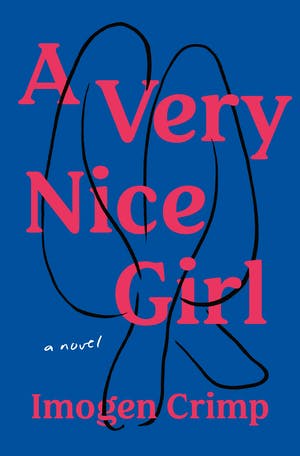
A Very Nice Girl

In my novel, A Very Nice Girl, 24-year-old Anna is training to be a singer in London. At first, she lodges in an eccentric couple’s house with Laurie, a woman who she meets through the flat share, and who becomes her best friend. Later, they move to an “experiment in feminist communal living,” run by Mil, who believes that women can only fulfill their potential, can only know what they might be, without men. 

The following books are all about women who are, in different ways, living without men—either out of choice, or because they’ve been compelled to, or simply because, unintentionally, that’s how their lives have turned out. Their situations are used contrastingly by each writer to explore women’s position in the world, their relationship to men and to society. 

The Water Cure by Sophie Mackintosh

In Sophie Mackintosh’s fairy-tale-like dystopia, three girls—Grace, Lia and Sky—live alone on an island with their parents, Mother and King. The girls were too young when they moved to now remember the outside world, but they know that it’s filled with toxins, and that the main source of these toxins are men. The girls have always relied on King for survival, but one day he leaves to get supplies and doesn’t come back, and the women are left alone. An exploration of toxic masculinity and patriarchy, Mackintosh creates a closed world which is meant to prioritize the safety of women, but where a sadistic man—King —remains entirely in charge. Only when he disappears, and three young men unexpectedly arrive on the island, do the girls start acting with autonomy and questioning what they’ve been told. 

To the North by Elizabeth Bowen

To the North, Bowen’s 1932 novel, tells the story of two young women who live together—Cecilia, recently widowed after less than a year of marriage, and Emmeline, the sister of Cecilia’s late husband. The novel follows Cecilia’s reluctant move towards a second marriage, and Emmeline’s destructive love affair with the selfish and predatory Markie. Set during the interwar period, a time of much debate about the position of the single or “surplus” woman after the deaths of so many men in World War I, Bowen’s novel explores the predicament of unconventional women pursuing independent lives. The cohabitation of Emmeline and Cecilia is treated with great suspicion by the other characters in the novel, a sign of the women’s dislocation from society, in a world where “home” for a woman means the home you find with your husband. As Emmeline reflects, when she discovers that Cecilia will remarry, “houses shared with women are built on sand.”

Breasts and Eggs by Mieko Kawakami 

Breasts and Eggs is about Natsuku, a woman in her 30s who is living alone in Tokyo while trying to be a writer. In the first part of the novel, she’s visited by her sister Makiko, an aging hostess who wants to get breast implants, and Makiko’s daughter Midoriko, who has recently hit puberty and stopped speaking. The second half of the book takes place eight years later. Natsuko, who is asexual, single and still living alone, thinks about having a baby and starts to look for sperm donors. Although punctuated by some wonderful and surprising surreal scenes, the tone of the novel is largely reflective—a ruthlessly honest exploration of the rights and wrongs of motherhood, of the different ways that women can live without men, and of whether, as a woman, you are inevitably defined and limited by having a female body. 

The Empress and the Cake by Linda Stift, translated by Jamie Bulloch

One of the madder all-women households in literature, The Empress and the Cake is a psychological thriller by Austrian writer Linda Stift. It begins with an elderly lady, Frau Hohenembs, offering a slice of cake to the young narrator, which triggers a relapse of the narrator’s bulimia. This is the start of an increasingly disturbing relationship with Frau Hohenembs, who believes herself to be (or perhaps really is?) the 19th-century Austrian Empress Elizabeth, known as Sissi.

Before long, the narrator has moved in with Frau Hohenembs and her housekeeper, Ida, and is sucked into performing a series of increasingly bizarre tasks for them, including stealing the Empress Sissi’s cocaine syringe from a museum, and taking part in an Empress Sissi lookalike competition. Concurrently, the narrator falls deeper into an eating disorder which dominates and limits her life. The arbitrary and increasingly restrictive rules that Frau Hohenembs exert over the narrator mirror the arbitrary restrictions of her eating disorder, with Frau Hohenembs herself also obsessed with controlling food-intake—both her own and other people’s—insisting on daily weigh-ins and food diaries for both the narrator and Ida. Haunting and surreal, The Empress and the Cake explores delusion, obsession and control, subtly demonstrating how easy it is to fall under someone—or something—else’s power. 

Animal by Lisa Taddeo 

Joan, 36 and single, has spent most of her life having cold and transactional relationships with men. After witnessing her former lover shoot himself in front of her at the restaurant where she’s having dinner with a new lover, she drives to Los Angeles to rent a house. She’s on a mission to meet and befriend Alice, a woman with an as yet unspecified connection to Joan’s past, and at the same time, she’s being pursued by the daughter of the deceased lover, who blames her for his death. The present day is set alongside flashbacks of Joan’s past, which gradually expose the traumas she’s experienced at the hands of men—traumas that have made her, as she terms it, “depraved.” Animal is a novel about female desire, consent and the extent to which we are defined and shaped by our pasts. In this dark and compulsive depiction of female rage, Taddeo explores the cost of surviving as a woman in a man’s world. 

Burnt Sugar by Avni Doshi 

A novel which focuses on the relationship between mother and daughter, Burnt Sugar explores the extent to which you can escape the legacy left by neglectful parenting. In 1980s Pune in West India, Tara is determined to pursue her own desires, regardless of their impact on her daughter Antara. Tara leaves her husband and takes Antara to live in an ashram, largely abandoning her daughter to be looked after by another woman. Three decades later, Tara has dementia, and Antara allows her to move into her house so she can look after her. The novel alternates between the past—where Antara and Tara live in instability and poverty while Tara seeks personal freedom—and the present—where a now comfortably middle-class Antara must come to terms with caring for a woman who didn’t care for her. A fiercely intelligent and nuanced novel about the complexities of the mother-daughter relationship, and the moral ambiguities inherent in seeking freedom.   

Matrix by Lauren Groff

Set in a 12th-century English convent, Matrix is a reimagining of the life of Marie de France, a visionary poet about whom not much is known. Groff has creatively filled in the gaps, opening the novel with the 17-year-old Marie arriving at an English nunnery. She’s been thrown out of her beloved Queen Eleanor of Aquitaine’s court because she’s too unattractive to be married, and has been sent to an impoverished royal abbey to become prioress. Initially, Marie is lonely and depressed, but then she decides to take charge of the nunnery, becoming prioress and then abbess. In the creation of an all-women utopia, men are expelled from the lands surrounding the convent, and a labyrinth is constructed to protect the nuns from attack. Matrix is a beautiful and profound novel about visionary leadership and the addictive nature of power. 

Sleeplessness is the Insomniac’s Only Friend

“Sandman” by Kim Fu

The person sitting at the end of Kelly’s bed wore a gray, hooded cloak. The hood hung over his forehead and drooped across his shoulders in an elongated oval, his unseen face recessed in the depths of the fabric. The hem covered his feet, even in his seated position, and wide bell sleeves covered his hands to the fingertips. One shrouded hand rested on her shin. Kelly was not afraid. The way he sat—his knees and hips facing out over the side of the bed, his torso turned toward her, his hand low on her leg—seemed parental, benevolent.

Monsters rarely figured in Kelly’s dreams. In her most frequently recurring dream, she was lost in a large building, looking for a specific room among hallways of endless doors. For most of her life, it had been an infinite, shifting school; recently it had become an infinite, shifting hotel, hosting a conference.

The figure climbed onto Kelly’s bed on his hands and knees. He traveled up her body until his face—where his face would be—hovered over hers, holding himself up with his hands by her head, every inch of him covered by the puddling fabric. In the darkened room, she stared into the featureless hole at the center of his hood. He carried the metallic scent of someone who had just come in from outside in the winter.

A trickle of sand touched her lower lip. Sand poured out from within his hood, in a thin, continuous stream. She parted her lips, opened her throat as if to sing. She still couldn’t see his face, but she sensed that the sand was traveling from his mouth and into hers, the matte gold dust glowing dully, catching the faint light that leaked around her drawn curtains.

The sand flowed faster. She felt the grains coursing down her throat, entering her abdomen, entering a cavity she hadn’t known was there, a cathedral emptiness where her organs should have been. She swallowed without gagging, almost without breathing. The sand filled her, weighing her down. She could feel the sand spreading, swelling her belly and traveling into her limbs, pinning her body slowly to the mattress, too heavy to lift under her own power. She had never felt so full, so satisfied.


The longest Kelly had ever gone without sleeping was four days and three nights, when she was thirteen. The details were fuzzy to her now. She remembered that she had begun to hallucinate bugs at the periphery of her vision, white moths and sparkling, winged beetles dancing along her hairline and jaw, and she knew that the streak ended with a visit to the pediatrician. Yet she couldn’t recall talking to her parents about her insomnia—not then, not ever. She remembered the doctor saying she wasn’t getting enough exercise and stimulation during the day; she must be sitting around idle, watching too much TV, eating too much sugar. A friend of Kelly’s, a doctor herself, later told her that sleeping pills were almost never prescribed to children, then or now, but Kelly vividly remembered the pills she took: round and yellow, with a rectangular notch across the middle, as though to fit a very fine screwdriver.

Kelly no longer thought of her insomnia as remarkable or pathological. Her friends who had children often complained of their “problem sleepers”—the elaborate bedtime routines, the seven-year-olds still in their parents’ beds, the songs and books and glasses of water and white-noise-producing, vibrating, oscillating gadgets. Kelly’s parents had locked their bedroom door at night. As a child, Kelly had frequently climbed out of bed to wait for morning in the hallway outside her parents’ room. She’d start out sitting or kneeling and eventually slide to the floor, lying on her side with the cool linoleum against her cheek. She’d wake there, the narrow windows framing gray predawn light, her neck kinked from the hard floor, and hurry back to her room before her parents got up.

In college, everyone stayed up all night to party or to cram. She’d look up from her library carrel in the small hours of the morning and see her fellow students wandering by in pajamas. She’d spent the nights before a project was due in a twenty-four-hour café, ordering a double espresso every two hours, watching the barista wilt and disappear into the back for covert naps, his eyes reddened and shadowed in tandem with hers. She was often the last one awake at the end of a house party, alone with the full force of daylight on a fire escape.

Now, in adulthood, everyone complained about not sleeping enough, not sleeping well. They stayed up to work, they stayed up to worry, the baby kept them up, they got caught up in a TV show or fell down an internet rabbit hole, who could rest in these troubled times? In her twenties, Kelly had had bursts of middle-of-the-night productivity, where she scrubbed the overlooked crevices of her apartment—the tops of the baseboards, the ice trays, the overflow drain in the bathroom sink—or cooked large batches of soup, reorganized her closets. In her thirties, these spikes of energy faded, but sleep didn’t replace them. She just rolled over to the side of the bed and reached for her phone, the portal of light that made the room around her disappear, the articles and videos and jokey, self-deprecating reassurance that millions of others were doing the same. When she went to the doctor, she ticked off “trouble falling asleep” and “trouble staying asleep” on the check-in form, but it was never the reason she’d come, and her doctor never mentioned it.

These unbroken stretches of consciousness, days sometimes blurring into one another, seemed just a feature of modern life, not worth complaining about.


A week before her first visit from the man in the cloak, as Kelly was getting coffee from the break room, her coworker Thibault came in and asked, “Did you sleep well?” as a greeting. Thibault was originally from Belgium and retained an accent. His job title was one level below hers, on a team that worked with the one Kelly managed. Not her direct subordinate. Technically. He had wispy blond hair and large, shallow-set blue eyes, and the broad-boned, sunken, two-dimensional look of someone too lean for his frame. In a vague, lackadaisical way, Kelly wanted to sleep with him.

She answered honestly, in her calibrated office-small-talk voice. “No, not really. But that’s not unusual. I’m not a great sleeper.”

Thibault lit up. “How’s your sleep hygiene?”

Everyone else in the office found him tedious. They dreaded hearing why he was putting butter in his coffee or why his latest cleanse had lent him a sickly, herbaceous smell. His schemes and diets seemed, to Kelly, driven by a misguided belief in the perfectibility of the human body. His dumb optimism made it impossible to imagine him fucking, to imagine a shadow of brutality crossing his face, that any part of him wanted to split another person in half. It felt like a challenge.

“My what?” She stirred her coffee longer than necessary.

“The things you do to improve your sleep quality.” He sounded pleased she didn’t know the term. He reeled off a list of prescriptions: sunlight, an empty bedroom used only for sleep, no caffeine past noon. “Like everything else,” he concluded, “it’s about trying to live the way we were evolved to, back in our caveman days. I’ll send you some links!”

When she next saw Thibault that week, he asked if she’d read the articles he’d emailed her, and she lied that she hadn’t yet. Showering at night, trying to find time during the day to go outside, eating an earlier dinner, not bringing her phone and laptop and snacks into bed with her, removing all traces of work and clutter from her bedroom, laundering her gritty sheets, hanging blackout curtains, giving up her afternoon coffee—it seemed like a lot. Thibault’s manager overheard, and later, when they crossed paths in the ladies’ room, asked if Kelly wanted her to intervene. “You can’t give that health nut an in,” she said, in a tone that was only half-teasing. “He’ll never let up.”

Kelly was slow to answer. “I am tired, though.”

“We’re all tired.”

That Saturday, Kelly sat in one of the dented, unused chairs in the overgrown courtyard of her apartment complex, her head throbbing with caffeine withdrawal. She closed her eyes as the sun hit her face, forcing herself to stay awake—no naps allowed. In the evening, she took a picture of her emptied bedroom from the perspective of her clean, neatly made bed, one of her bare and freshly showered legs at the edge of the frame. She’d done everything except the blackout curtains. She texted the picture to Thibault, hoping it came off as flirty but indistinct.

He texted back, “Good for you!!! Sleep well!!!”

She plugged in her phone in the kitchen, out of reach. As usual, once she turned off the light and crawled under the covers, she felt the muscles in her face and back tightening, snapping alert. As usual, the room felt bright, the snow-white duvet cover aglow, and she longed for her phone. She tucked her fingers into the boxer shorts she slept in and got herself off in a few minutes, her mind blank, unable to fantasize about anything in particular, and felt no more relaxed. She closed her eyes, counting the seconds, her thoughts interrupting and jumbling the numbers.

When she opened her eyes, the man in the cloak was there.

Afterward, after he’d filled her, after he’d rearranged her internal workings and made her swell and buried her from the inside, she discovered that it was late the next morning. She’d been in bed for fourteen hours straight.


For the first few hours of her day, Kelly felt both sharpened and dazed, her spine lengthened, her eyelids pulled back, the contrast on the world turned up, black shadows and startling edges to every surface. Her feet felt in looser contact with the floor, a floating ballerina brush-step as she walked, her neck a loose, springy tether on her head’s helium drift. Her face looked different in the mirror—younger, wide-eyed. Credulous and undamaged.

She had lunch with Gillian, a friend from college she rarely saw, as they lived in different boroughs with an infrequent bus between them. She showed Gillian the picture of Thibault from her company’s online directory. Gillian’s nose squished up in distaste. Kelly expected Gillian to say that she didn’t think he was cute, but a more disturbing phrasing rolled out: “Is this really your best option? Is this the best of the men you know?”

“I’m not marrying him,” Kelly said. “I’m not even dating him. It’s just a work crush.”

“It’s a waste of energy,” Gillian said. She looked closer at the photo on Kelly’s phone. “He kind of looks like Brendon.”

Brendon had been Kelly’s college boyfriend. He could be described in the same broad strokes as Thibault: slim, sandy-haired, blue-eyed. But unlike Thibault, Brendon had been unequivocally, conventionally beautiful, in the manner of a teen idol—delicate features, long eyelashes, large white teeth.

When Kelly thought of Brendon, she pictured him asleep. He’d slept deeply and easily, snoring the moment the lights went out. Asleep through fire engine sirens, through jackhammers and leaf blowers, through neighbors’ radios and drum kits and dogs. Through heat waves, as Kelly sweated and thrashed beside him, as Kelly got up and left the room, as she jangled her keys and clomped around in her shoes and banged shut the front door and went to wander the empty streets. His jaw slack and a small, tender smile on his lips. Kelly had spent many hours watching him sleep, directing the fury of her wakefulness in his direction, willing him to join her in the hot, noisy, agitating realm of the conscious.

Kelly virtuously refused the end-of-meal coffee she wanted and parted ways with Gillian. On the way home, she bought cheap polyester blackout curtains and a pair of fabric shears. After she’d cut them to size and attached them to her existing curtains, she stood back to admire her efforts. She considered sending another picture to Thibault. Gillian’s question troubled her. The best of the men you know. Like Kelly should put all the single men she knew into bracketed tiers until only one remained, worthy of her love. More distressing was the thought that Thibault might actually be the best of them. He meant well, he took care of himself, he had that accent. She didn’t text.

She slept in the nude that night, moving quickly from the warm steam of another nighttime shower through her bedroom to slide under the weight of the duvet. She had almost forgotten about the new curtains, and when she tugged the pull-cord on her bedside lamp, the purity of the darkness startled her. She couldn’t see her own arms as she extended them in front of her. She had to trust a kinesthetic sense of where they were, that they remained attached to her. Her palms and the pads of her fingers tingled, as though she were standing on a high cliff and looking down. The dark seemed to have substance, a pudding-like resistance that slowed the movement of her invisible arms. When she pulled the duvet back, the darkness seemed to descend upon her, cool to the touch, making her conscious of the highest peaks of her body: the tip of her nose, her toes, her upturned nipples.

Lying dead center on the mattress, Kelly could neither see nor reach any edge of the bed, like it went on forever. She lay surrounded by empty, eternal, starless space.

She felt him in the room with her.

The skirt of the cloak brushed against her bare legs, the fabric heavy but soft. As he had the previous night, he hovered above her, his hands out to the side, not touching her. There was a long, suspended moment where he might have been observing her, except there was nothing to see and nothing to do the seeing—no eyes shone in the cavernous hood, both of their forms submerged in the dark.

She parted her lips and exhaled a purposeful stream, like she was trying to cool a cup of tea. It was the only way she could think to ask for what she wanted. This time, he lowered his face onto hers, the hood coming down around her ears and the top of her head, enclosing her in a smaller, closer, even richer darkness. A kiss, at first not unlike any other good kiss. Then she opened, as she had the night before, widening inside her throat, her chest, her gut, her pelvis. That sensation of being enormous and hollow on the inside, as though she contained acres of open field under a prairie sky, as though she contained a cenote that descended to the center of the earth.

Deep in their kiss, the sand flowed from his throat and down hers. She moved around experimentally, as more and more of her body became immobilized: first her core grew leaden, then she could no longer move her limbs, then her twiddling fingers and toes ceased. Lastly her mind. The sweep of sand like a veil draped over her mind, her thoughts dissolving into wordlessness, an inner silence as total as the darkness of the room.


The spritely, elongated feeling lasted longer the next day, until almost two p.m. When she felt it fading, she went to buy a coffee from the cart downstairs, in the office lobby, breaking the rule against afternoon caffeine. She was determined to finish the documentation she’d been working on. She brought her work laptop home and gave up around midnight. She hadn’t bothered to turn on the lights as the daylight had faded, and her living room was now illuminated only by the computer screen. She rubbed her strained eyes and the afterimage of text and figures swam across her vision.

She streamed reruns of a 1980s sitcom on her TV. As she lay on her side on the couch, the speckled image and spackled makeup and canned laughter were like landscape passing through a car window. She thought of the man in the cloak, imagined her body heavy and powerless, and under her strumming fingers she came as she hadn’t in years, ropes of electricity whip-cracking through her.

She returned to the report and wrapped it up quickly, a little shoddily, emailing it to her team at three in the morning. Some of them would be awoken by the vibration of their phones, the demanding growl as the devices convulsed in place. They would mutter about it to their partners, in bed beside them, and to one another the next day: Kelly is always working, Kelly doesn’t sleep, Kelly doesn’t have a life, does she expect the same of us? Kelly hit the send button and sent a ripple of anxiety and spite out into the city, into the night. She felt better. She put the TV show back on and dozed, the volume low, so familiar she could almost see it through her eyelids. Morning light replaced it, penetrating the thin layer of flesh, the backlit blood vessels glowing pink.


The next night—Tuesday—Kelly went to her twenty-four-hour gym at two a.m., empty save for a janitor pushing his vacuum between the machines. She slept on a recumbent bicycle while still pedaling, the resistance at zero, her legs spinning free and her head lolling. A cable news anchor barked from a hanging TV overhead.

On Wednesday, after work, she napped in her apartment building’s courtyard, sleep with the texture of tattered lace, frayed threads of dream woven into reality’s edge. She noticed a neighbor watching her from his window. She waved.

On Thursday evening, she gathered all the food wrappers and papers and mostly empty bottles and unread books and dirty clothes that had gathered in and around her bed, as though they’d washed up there in the tide, and tossed them onto the kitchen table for later sorting. She re-tucked the sheet corner that had come loose, shook the dust and crumbs out of the duvet, changed the pillowcases. She vacuumed. She drank a chamomile tea. She left her phone in the kitchen again, facedown. She did a series of stretches on the floor. She took a hot shower. She drew the blackout curtains and tucked herself in.

The man in the cloak didn’t come.

Once Friday morning had firmly arrived, Kelly went to an all-night diner. She ordered fried eggs, bacon, sausage, hash browns, white toast. She curled up in the booth, her feet tucked under her on the bench and her head pushed into the corner between the booth and the wall. Her eyes closed, she listened to the scrape of cutlery on plates, the hiss of the flattop grill. The waitress shook her shoulder, not unkindly. “You can’t sleep here,” she said. Kelly nodded. She ate everything, cutting it into small cubes, chewing each one at length, drawing out the meal as it consumed the last of the night, the bites turned lukewarm and rubbery. Her dozen refills of coffee seared in her gut as she left for work. By the diner wall clock, shaped like a sunburst, it wasn’t quite seven.

Thibault stood alone at the bank of elevators as she came in, still in his comical-looking biking gear: helmet, fingerless gloves, skintight jersey and shorts, the melon-bulge of his calves and crotch. They hadn’t spoken since the week before. She steeled herself for another cheery conversation about her sleep habits, the text she’d sent.

Thibault looked uncommonly lost in thought, and he didn’t notice her until she was right beside him. They both said hello, the o’s drooping and lost, like there wasn’t enough air in the room. He was visibly sweaty, but her own smell was stronger, the diner coffee gone even more acrid.

“You’re still not sleeping well,” he said.

She shook her head.

“And you tried . . .” He went through all the things she’d done the day before and she confirmed each one, until he reached things she hadn’t. Giving up caffeine entirely. Giving up sugar, meat, dairy, alcohol. Meditation, hypnosis, acupuncture, massage, nasal rinsing, tinted lenses, melanin. How much cardiovascular exercise did she get in a week? There was a conscious relaxation app he could send her. And she shouldn’t expect it to work all the time, right away. It might take weeks or months of consistent—

“Fucking ridiculous,” Kelly said. Her voice was low and clipped, almost a whisper.

“What?”

“Working this hard at relaxing. Turning rest into work. Making it stressful, making it a competition, another way you can feel like you’re better than everyone else. Can’t you see how absurd that is?”

Thibault rubbed his hand along the side of his bike shorts, a seemingly unconscious gesture, the slick spandex stretched over his sinewy thigh. “I don’t think I’m better than you,” he said. “I was just trying to help.”

The elevator pinged, opened, swallowed them. In the brushed steel of the elevator doors, she could see their warped, impressionistic reflections, two smudges of color.

Moving slowly, as though through water, Thibault reached toward her. He cupped her face with one hand, turning it toward him. His thumb stroked the curve of bone at the bottom of her eye socket, slid down over the puffy, bruise-violet skin, his gaze following.

The elevator pinged their arrival. He stepped back. She waited for him to speak. When he didn’t, she strode out the elevator doors, already starting to close.


The following week, Kelly, the other managers, and a selection of senior employees went to a two-day seminar at their corporate headquarters in Indianapolis. Her hotel room, otherwise unremarkable, was freezing, cold air blasting from an unidentified source despite the tepid weather. She fiddled with the digital thermostat, turning it up and changing the modes to no effect. No one answered the phone at the front desk. She took all the extra bedding out of the closet, piled it onto the bed, and burrowed underneath, her socks still on, her knees curled into her chest.

She alternated between tucking her head under the heap to warm her nose and cheeks and coming up again for air. She’d arrived at the airport too early for the short flight and had had to endure hours of chitchat with her colleagues. Then a group dinner, where she’d nursed a single glass of white wine and maintained a bland, thin-lipped smile. The beige furniture and beige walls of her hotel room, punctuated only by a single two-toned color-block painting, were a relief.

Her fingers caught at fabric that differed from the rough coverlet and scratchy sheets and spongy, fire-retardant blankets. She pulled the fabric toward herself. She knew by feel that it was the cloak. He was lying behind and beside her, one arm wrapped around her waist.

She reached into the sleeve and felt for his hand and forearm, surprised to find it was just that—five fingers, a veiny wrist, and the tender depression at the inside of his elbow. She wasn’t sure what she had expected. A skeleton, a claw, the featureless flipper of a dolphin. She realized then what she’d hoped for: an empty cloak, held up by spectral magic. A bodiless force. She drew her hands back.

They lay together in a bubble of space, the blankets tented overhead by unseen supports, a dome-like roof she could sense but not see. Without touching her skin, he lifted off her loose nightshirt. She rolled and settled on her back. She opened and closed her eyes and found there was no difference. She couldn’t see anything at all, no shadows or the suggestion of motion, no variations in the darkness.

She felt sand trickling across her right arm, accumulating slowly, each pinpoint as barely perceptible as a snowflake. This was new: he was burying her arm from the outside, an increasing mound of sand that left her hand and shoulder exposed. The sand had a nighttime cool, the faintest suggestion of damp. He moved to the other arm. He was precise, few grains straying from the tight pack around her arms.

More sand, poured at a faster clip, blanketed her feet and her shins. A heavy collar of sand pressed down on her throat. She was like an animal with markings that show where it’s the most vulnerable, her face and underbelly left exposed to the air as the rest of her disappeared.

The hotel bed was no longer at her back, the pillow no longer cradling her head. She was lying on a stretch of sand, a midnight desert. She was sinking. She let her hands fall, slip under. She relaxed her shoulders and felt them vanish. The sand made a soft, shushing sound as it gathered, as hillocks formed and collapsed. Soon she was craning her head back, just her face floating above the surface of the dunes. His kiss descended on her, the same comforting, crushing pressure of the sand that surrounded her, and she was gone.


Kelly sat up in bed. Past her hotel window, dawn rose over the clustered skyline, the sun doubled on the canal running through downtown. She could hear stirring in a neighboring room, water in pipes, twittering birds on the concrete sill. She looked at the bulky armoire in the corner, stern-looking wood with a reddish finish, and felt a sudden conviction that she could lift it. She could lift anything in the room. She felt superhuman.

In the T-shirt and sweatpants she’d slept in, her card key tucked in the waistband and her feet bare, she stepped into the hallway. She knocked on the door she knew was Thibault’s. With the same heightened clarity, like it was a movie she’d seen many times before, she envisioned herself pushing past him and into the room, crowding him to the edge of the bed, shoving him onto his back, stripping them both while he gaped, straddling him and fucking him senseless, not a word exchanged.

It was a long time before she heard footfalls on his side of the door. A pause while he must have been looking at her through the peephole. He opened the door a crack, then pulled it back and stepped into the gap so they could face each other.

She started forward and he held out a hand, level with her shoulder, stopping her. He shook his head, his eyes downcast and his lips slightly curled, an expression of pity, politeness, gratitude-but. He held the handle as he let the door shut again, slowing its swing so the closure was almost soundless.

Kelly stood there, stunned. A door opening down the hall finally sprung her into motion and she scurried back to her room.


The man in the cloak didn’t return for nearly a month. Day bled into night into day. She slept in a bathroom stall at work. She slept on the bus. She slept while getting her hair cut. She slept during conversations. She slept upright with her eyes open at her desk. At best, she slept for the first or last couple hours of the night. None of it was sleep, exactly—she could perceive how much time was passing or when the bus was nearing her stop; she could appear to be listening and catch the gist of what was being said. She lost small shards of time, a few seconds or less, the film reel of the world stuttering forward.

One night, she walked to a movie theater across town that had midnight showings of old movies on weekdays. She settled into a seat at the back, upholstered in worn green velvet, her feet sore from the hour-long walk in flats. The movie that night was Singin’ in the Rain, and before the opening credits were over, the loud, jaunty orchestration and yellow typeface over umbrellas, her eyes fluttered shut.

When she opened them, the theater was empty, and her first thought was that she’d slept through the whole film. Except the house lights remained off, and the screen was still glowing without a picture, just a lit gray rectangle.

The man in the cloak sat in the seat beside her, his sleeve spilling over the armrest.

She spoke directly into the sagging, empty hood. “Why am I like this?” she said. “Why don’t you come to me every night, like you do everyone else?”

She reached inside his sleeve to take his hand. Her fingers found only a loose configuration of sand. She recoiled. A thin, anemic stream of sand ran out onto the floor.

Above them, the glass of the projection booth shattered, an explosive change in pressure. The booth had been filled with sand, now gushing down onto their heads through the hole. Sand burst open all the theater doors, front and back.

Waves of sand as high as the doorframes cascaded down the aisles, piled up over the seats, higher and higher. She jumped out of her seat. The sand was up to her knees, too yielding to run on, making her stumble as she tried to escape. Up to her waist in an instant, the theater filling fast, corner to corner.

The empty cloak floated by on a current of incoming sand, flat as a paper doll.

She clawed and fought and tried to stay above it, in the vanishing air, trying to protect her stinging eyes, the sand coating her mouth, sucking the moisture from her. The doorframes burst, the walls caved in. The world beyond the theater was made entirely of sand, eager to occupy the void. A torrent of sand knocked her sideways. She was quickly covered under a choking, scraping blanket of darkness.


Kelly opened her eyes. Everything was quiet and still. She was back in the desert, but this time she could see: undulating dunes stretched in all directions, curves snaking to the horizon. The sky was an unnatural color, a collision of blues, indigo and electric, emanating a flat light absent sun, moon, or stars. She was sitting upright and naked in a wide, high-backed chair sculpted from sand. A throne, decorated in an intricate pattern of whorls. She picked up a handful of sand and let it run through her fingers, the texture unnervingly different from before—powdery as flour, no grit.

She realized the man in the cloak was sitting at her feet, facing away from her, his back against the base of the throne. His head—through the hood—leaned lightly against her knee. When he spoke, his voice seemed to come from all around her, from nowhere in particular, directly into her mind.

Do you think, he said, I come to everyone the way I come to you?

He rose to his feet, turning around, like a column of sand rising out of the ground before her. The cloak sleeves settled over her hands and arms, facing up on the armrests of her throne. His hidden hands cinched around her wrists and locked them in place.

He leaned forward. A pinch of sand sprinkled across her brow, sparkly as craft-store glitter. She blinked it away. He released her wrists and stood upright again, turned as if to leave. And she understood, though he was silent: There, now you’re like everyone else.

The hood was angled over his shoulder, as though he were looking back at her, expecting her to call him back, to beg for his occasional, ecstatic visits between long seasons of wakefulness. To keep her secret knowledge of the workings of the universe, of every hour of the night, the changing shadows across the sleep-softened faces of friends and lovers. She said nothing. She craned her head back and rolled it side to side across the top of the throne’s backrest, to carve out a cradle for her skull in the soft-packed sand. At the edges of her vision, the desert blew away, curling in the wind like ocean surf, dissipating into the air. She closed her eyes and slept the dreamless, nourishing, ungrateful sleep of the innocent.

Don’t Conflate Courageous Writing With The Courage of Bearing a Difficult Life

Before I was interested in poetry, I was interested in courage. It seemed to me a noiseless thing, an almost secret thing. It wore patched clothing and cloth slippers, it kept its wedding jewelry in folded paper boxes, and it walked to the factory, or to the school, or to the market. Only rarely did it show its sharp intensity, a searing shape—during nights that ground salt into the skin, or days in which a thing, or a body, was burned. For much of the time, it remained indistinguishable from the very shape of the days. Only later, when I put together the pieces between what I had seen and what I had only heard of, could I point to all those bright tracks it left in the fields of history, and name it for the thing it was. Courage.

When courage is felt in poetry, it often carries with it the profound, overarching politics of witness, subversion, or transgression. Anna Akhmatova’s stark I can. Audre Lorde’s I have been woman / for a long time. Courage rivets around the I, flattening the self out into a realm of sights, experiences, consequences. Roused with the moralism of truth-seeking and truth-saying, our lauding of this performance stems from a fear of misery, of suffering; the love of bravery is the rejection of one’s own fallibility. We use the testament of another to confirm an idea of what it could mean to survive, to fortify the ranges of human capability. Summoned to define the most vividly realized texts of living, courage is transportive—a mirror that, as was once feared, could capture one’s soul. 

Moonlight Rests on My Left Palm by Yu Xiuhua

Though we speak of it often with awe, there is a dissonance when courage is made into accolade for individuals who speak openly and undauntedly: courage in writing being conflated with the courage of being able to bear a difficult life. When the brief, diaristic verses of Chinese poet 余秀华 Yu Xiuhua first rose to staggering virality, comment after comment lauded her courage, her ability to strip herself seemingly nude, to take a scalpel to flesh, and cut. The poet 刘年 Liu Nian compared her arrival in poetry to that of “a murderer entering a group of damsels.” Her poems were unsparing with emotion, and steeled with attention. They sharpened speech to a serrated edge, then tempered it with dewy romance. She spoke of violence, of lust, of loneliness in formless, almost placid lines that could be read in a sigh. Though Chinese poetics is long familiar with the brutal, Yu’s work sent an immense reverb through the country—this seemingly effortless coalescing of classic poetic tenets and contemporary recklessness, which dragged womanhood, and all its distinct desires, to face. What amplified this sense of reverence in the public scheme, however, was that these poems—by the supposed “Emily Dickinson of China”—were written by an uneducated woman with cerebral palsy, amongst a rurality silent with grains and camphors, deep in the Jianghan plain. 

wheat-stalks silent in the moonlight, the slight grazes between them

is the lovemaking of all living things

. . .

I am very happy to land here

like a sparrow crossing the sky through its blue

Say between the bars of the world, we reach one another by the solid and liquid of recognition. Touches are solid, and impressions are liquid. Features—lips, breasts, hands—are solid, and voices are liquid. Eyes are solid, and vision is liquid. When someone sees you, their sight lands on something solid. When someone opens to be moved by you—this is the quality of water.

She spoke of violence, of lust, of loneliness in formless, almost placid lines that could be read in a sigh.

Yu’s poems veer at times towards the pointedly confessional, the urge to tell, breaking away from the refinements of metaphor. In this, she tells us about her loveless marriage (let me leave, give me freedom), her body (all these parts exchanging pain), her frustration at being unloved (I sense that what he has with everyone else is love / only with me it is not). “I chose poetry because of my cerebral palsy. Writing a word is strenuous. . . poetry uses the least words,” she reveals. In interviews and prose, she continually grounds her craft down to the habitual and the platitudinous, to “daily thoughts” and a “literary hobby.” Despite this humility, however, it has become clear from their spectacular reception that her readers have not met her poems on such simple terms, but look upon them as if encountering something oceanic.

In the documentary Still Tomorrow, Yu arrives at Peking University to talk with a crowded lecture hall of admiring students. During the Q&A portion, a young woman stands up and asks, with a genuine, almost desperate urgency: “How do you accept yourself? How can you be a happy woman?” One knows—can intuit from this tone which is on the brink of tears—that though her interrogations carry with them the strain of pity, she is truly in need of an answer. Yu listens, the apples of her cheeks softly red, her mouth holding, and responds: “I have not yet accepted myself. . . And as for how to be a happy woman, I don’t have any experience, so I cannot tell you.”

still what I know more of is

why a tree that no longer flowers

still greens

Poetry is a craft of mutual confidences. The page, a vehicle by which the hidden tumult of thinking travels to the broad meters of the world, is the solution to secrecy’s fallibility—that something concealed in the mind can never become certainty. The impetus behind the writing is many, but all such motivations share the understanding that one’s life does not belong to anyone alone, that trueness occurs in the meeting between minds. To give over to language any semblances we have of truth or destiny, the corpus of our beliefs and our fantasies—it is the pouring into a vessel to see the liquid’s shape. As such, poems are autobiographies not from the materiality of history, but from the convictions of knowledge. They wring, from the solid facts of being, the waters of experience. Navigating the multiplicities of language, the poet creates her own arena for words to enact: a place where they, as Wittgenstein said, are “not used in the language-game of giving information”—where they serve not utility but imagination. Poetic language looks ahead at a world in which the thing it speaks of is already true. 

Poems are autobiographies not from the materiality of history, but from the convictions of knowledge.

The distance carved between Yu Xiuhua—the woman—and the entity of her poems is the same distance that occurs between the music and the instrument, yet the fact remains that music contains within its very form the body that produced it. The woman that asked how do you accept yourself, how do you live is not asking Yu because she thinks the poet has unearthed some universal formula; she asks because she has discovered an intelligence in the existence of the poems, the poems which hold the shape of the poet’s body, realised. For what stood out to me in her question, posed shakingly in the static of a crowded room, is how to be a happy woman. Perhaps she could have better asked, how do I realise my body like that, too? In an essay on feminine writing, Hélène Cixous claimed: “If women were to set themselves to transform History, it can safely be said that every aspect of History would be completely altered. Instead of being made by man, History’s task would be to make woman, to produce her.” The specificity of writing about a body that moves through the world, that receives sensations and translates them into words, is a determination to contribute to the remaking of woman. Yu Xiuhua does not bring up a distinct politics of feminism in her work—she generates it. She cannot answer the question because the answer is contained in the act of writing, not in the act of living.

I also think of rain, always letting the hour glow brighter

coming down like that

tearing the sadness to pieces, settling them on the surfaces of leaves

In poetry the emphasis is to never resemble anything, and that is always political. New recognitions can only take place when a subject comes to be disassociated with its assumed presences: when one can witness what they have not seen before, and at the same time understand that it has always been there—the yellow in the green, the electricity in the air. Atwood’s fish hook and open eye. Adrienne Rich’s trees. Lyn Hejinian said, “The incapacity of language to match the world permits us to distinguish our ideas and ourselves from the world and things in it from each other.” That the word woman so little resembles a woman, and that the word disability is so apart from its actual condition, is something that poetry builds into a politics of liminality, wherein one thing—as harnessed by idea—can metamorphose indefinitely from their objective reality, throwing open the concrete cell of a singular definition.

Suffering is one such cell. It initiates a visceral aversion in those who confront it, and simultaneously creates a system by which one can differentiate oneself—via indignance, or compassion, or admiration. None of these reactions are necessarily harmful, but they serve to reaffirm our predetermined beliefs about pain and the people who bear it. When we pity or commend someone for enduring a condition that we ourselves do not meet, we are essentially asserting that we understand what suffering is—the catastrophic dimensions, the terrifying closeness. Suffering becomes a flat, incomparable fact; its edges are too rigid to be breached, and we can only approach it with lingering fear and self-preservation. And because it is undefinable and unmeasurable by anything other than itself, it cannot change. 

When suffering is given a place in letters, it gains fullness not by exacerbating the distance between those who feel it and those who do not, but by divorcing suffering from being an affliction of the body (another body), to engage with it as a dynamic substance, a direction of the mind. Writing is the only place where pain and rage can be suffered in a way in which they do not hurt, do not constrict, but can speak to their greater elucidation of humanity. To give suffering a poetics is to distill agony into an essentiality of human existence, to give lucidity to the oblivion. It is a rejection of pain’s barren, lonely insistence of domination, and to affirm its residence as a mere component of the world. 

One of my favourite Yu Xiuhua poems is entitled “the details of life light me from afar.” It begins:

in speaking of distance, one attains vastness: the flat northern plains

the damp southern towns

one dazzling detail: a woman in a large red dress has a reason

to bring water up from the deepest well, pouring it from dawn until dusk

In poetry the emphasis is to never resemble anything, and that is always political.

To be bound by a single compartment is to understand oneself as a subject in someone else’s vision—vision that aims to teach us about ourselves, to instruct so that we do not fail to receive the perceptions of others when they are presented to us. The psychic weight of definition is always borne by she who is looked at; the one who looks merely imparts. It seems to me that Yu’s work was able to capture the greater consciousness of her readers because of a gentle—and perhaps unintended—inversion of perspective. Within the viewfinder of presumptive types and renderings, her poems express an ability to see herself from a distance, to become a subject of her own findings and impressions. I say unintended not to minimize her skill, but because this shift between writer and subject is an in-between state of intimations and flickers; there is no wholeness in either occupation. Only when the reader approaches the poem and bestows on it a recognition, is the subject made firm—when the public has met and understood the knowledge of the private. W. J. T. Mitchell once said of paintings that they desire “to change places with the beholder, transfix or paralyze the beholder, turning him into an image for the gaze of the picture…” There seems to me a similar exchange in poems. To be moved by a text is to be moved along with it. So the poet is not only looking at herself but looking at the reader. So the reader is not only looking at the poet but looking at herself. My pain fits into the contours of your pain. To be unfixed, yet recognised.

Still, we know that poetry is not salvation. “The book I wrote with such violent feeling to relieve that immense pressure will not dimple the surface. That is my fear,” wrote Virginia Woolf. It is from this admittance, this is my fear, that we can begin to understand the appearances of courage. 

The psychic weight of definition is always borne by she who is looked at; the one who looks merely imparts.

There is a sense that indefatigable strength is something that lies outside of the body—one summons courage, one gathers courage. Yet, from what I have seen, this sense of receiving something from the beyond misguides the actualities of courage. For it is not an act that is intentionally performed, but something that we imbue onto the situation to understand it. Only when standing outside of an experience can we celebrate the courage it must’ve taken. “I suppose when others praise us as strong,” Yu said, “we should acknowledge them with silence.” Poetry, no matter how arduous the conditions of its writing, does not present model emblems of fortitude, nor simple answers to insistent questions. Instead, it gives us the opportunity to contact something far more generous: the mutable borders between self and other, the incommensurability between things and definitions. We name this gift courage. When this notion was just a word—a forthright commendation—I believed it to be a choice, something boldly selected in the face of peril. Now I see it as a reading. 

To connect, to commune, to conversate—the confessional is a radical act of transformation. This is my fear, says the poet, opening up the passage for us to say no—this is your courage.

“Crazy Ex-Girlfriend” and “Wuthering Heights” Have Horny Wind in Common

The gloomy moors of Wuthering Heights are famously vulnerable to the wind—so, too, are the unfortunate families who call them “home.” It’s basically Emily Brontë’s whole deal, right? From the first pages of her only novel, we’re introduced to a home beleaguered by “pure, bracing ventilation … at all times.” And it shows! Trees slant against the titular homestead, contributing to a super moody landscape. Characters get sick—and sometimes die—after bouts of bad weather. All the while, they mirror the violent weather in impulsive, lashing actions against each other.

Wuthering Heights by Emily Bronte

Naturally, this kind of gusty, Gothic setup is good terrain for dramatic angst. So it’s no wonder that shades of Wuthering Heights can be seen in contemporary media, from music (“There were nights when the wind was so cold,” croons Celine Dion) to film (hi, Crimson Peak). Though the creators of both works have acknowledged a direct Wuthering influence, one of the novel’s more surprising scions is a little less direct (and, OK, maybe completely accidental): Crazy Ex-Girlfriend. Specifically, Season 2, Episode 11—“Josh is the Man of My Dreams, Right?”

If you haven’t watched the CW musical dramedy—co-created by Rachel Bloom (who also stars) and Aline Brosh McKenna—this episode follows protagonist Rebecca Bunch as she fends off intense feelings for her too-hot, too-tall, too-corporate snob of a new boss, Nathaniel. She’s newly engaged to Josh, the very sweet guy she’s liked since they were teenagers—and finally, for once, her life seems perfect. So the new crush is pretty inconvenient, to say the least.

Rebecca’s attraction to Nathaniel is so wrong that she can’t even admit it’s happening, much less that she’s behind it. How convenient, then, that the Santa Ana winds roll in and provide the perfect scapegoat for her ill-placed passion? After all, as relayed by a Frankie Valli-esque meteorologist (who also plays the literal wind), the Santa Anas “make things weeeeird.”

The Santa Anas’ power has been documented throughout pop culture—I’m thinking of The Holiday, where Jack Black’s lovable Miles says that “all bets are off” when the winds blow into town every winter. Joan Didion also wrote about the Santa Anas’ “violent extremes,” and how the winds “show us how close to the edge we are.” These are definitely not the same winds that plague Brontë’s moors (the Santa Anas are hot and SoCal-specific, for starter) but they serve a similar purpose: chaos.

In Crazy Ex-Girlfriend, a gust of wind cracks Rebecca’s shirt open, revealing her bra underneath, and Nathaniel’s interest in her spikes.

First, there’s the physical impact of the wind blowing events into place. In Crazy Ex-Girlfriend, a gust of wind cracks Rebecca’s shirt open, revealing her bra underneath, and Nathaniel’s interest in her spikes. She rushes home for a desperate attempt to rekindle her passion with Josh, but he’s knocked out on allergy meds, at which point she delivers a particularly Brontë-ish line: “Damn you, winds of the devil.” The Santa Anas cause a power outage that traps Rebecca and Nathaniel in an elevator, forcing them to spend time together and realize they actually have a lot in common. And chemistry—they share a pretty passionate kiss, too.

It’s like nature is conspiring to make this very wrong relationship happen, a point driven home by the fact that this personified iteration of the wind laughs as he wreaks his havoc:

“You might say don’t do it, wind

Leave these poor people alone!

But I’m a prankster

Tee-hee-hee-heeee!”

In Wuthering Heights, bad, blustery weather manifests its own brand of misfortune. The night that Heathcliff runs away after overhearing Nelly and Catherine talk about him, “there was a violent wind … a huge bough fell across the roof, and knocked down a portion of the east chimney-stack.” To further complicate things, Catherine gets sick from spending all that time outside looking for Heathcliff—so sick that she’s sent to recuperate at Thrushcross Grange, and infects the Lintons with her fever, killing both of her future in-laws. She marries Edgar three years later, permanently ruling out any future with Heathcliff.

Sure, the wind here is not a gleeful, anthropomorphic trickster. But all the same, the people in its path are powerless—victims of forces they can’t control. Or at least, maybe it’s easier to see things that way.

Those stormy winds from the night Heathcliff leaves? They happen at the height of Catherine’s heartbreak.

In addition to using wind as a physical plot device—the way it damages people and things—the women behind Wuthering Heights and Crazy Ex-Girlfriend both play it as a sort of stand-in for emotions too thorny to own up to. Those stormy winds from the night Heathcliff leaves? They happen at the height of Catherine’s heartbreak. Her love for Heathcliff is so complicated that she can’t extricate him from her own identity—so the wind has to take on some of the work of expressing that pent-up passion.

Sure, 170 years later, fictional heroines are a little freer to make questionable choices in their love lives—but Rebecca still faces her share of inhibitions. She’s spent most of her life believing she was not normal, and desperately wishing she were (Bloom’s debut essay collection, I Want to Be Where the Normal People Are, further explores the concern). And by this point in the show, Rebecca’s still one season away from receiving a diagnosis for borderline personality disorder, and the tools to help manage it. So right now, her feelings for Nathaniel represent something worse than a workplace crush. Rather, it’s a perceived moral failing she takes as yet another confirmation of her not-normalcy. It’s easier for her to blame the wind when she kisses Nathaniel in that tiny elevator, than confront the ambivalence of her current relationship. But the windy metaphor isn’t having any of it. “I just reveal your deepest wishes and fears,” he reminds her after the smooch. “So it’s you, Rebecca, it’s not me / Who is super weird.”

In both Crazy Ex-Girlfriend and Wuthering Heights, the windy weather kicks up at times of great personal turbulence for each woman—as much as they might like to think otherwise, the violent wind isn’t really happening to them. It is them. Lord David Cecil, who approached Wuthering Heights as an exploration into the principles of “storm” and “calm,” said that for Brontë, “an angry man and angry sky are not just metaphorically alike, they are actually alike in kind; different manifestations of a single spiritual reality.” Sure enough, when Rebecca’s wind tells her “You ruined everything, you stupid bitch,” he’s not being excessively harsh for no reason—he’s simply parroting her own self-talk from Season 1 back at her. Like Cecil said, Catherine and Heathcliff weren’t hapless victims of the wind. Neither is Rebecca. They’re all agents in their own undoing.

But hey, it’s not all gloom! Even within the rigors of network TV standards and practices, Crazy Ex-Girlfriend makes explicit something Wuthering Heights could only ever gesture at: horniness. Specifically, the kind when you’re attracted to someone you have zero business being attracted to. As Mark Kinkead-Weekes said of Brontë’s novel, Catherine and Heathcliff’s relationship “looks as much like hate as love,”—an observation that just as easily fits Rebecca and Nathaniel nearly two centuries later. As the couple dances to an Ed Sheeran-y “Let’s Have Intercourse,” the lyrics speak to that exact kind of confused crush: “Sometimes my body wants things that my mind does not / My body wants things that make my mind go, ‘uh, body what?’”

For Kinkead-Weekes, the tension between Catherine and Heathcliff goes beyond mere physical lust. It’s a matter of “breaking beyond the self, metaphysical and impersonal.” Now, Nathaniel and Heathcliff both give their respective love interests plenty of reason to run away. But as Catherine says, “Whatever our souls are made of, his and mine are the same.” He gets her on a fundamental level. Is it really that different from Rebecca finding out her mean boss has a soft spot for Harry Potter, too, and considers the books modern classics?

Is it really that different from Rebecca finding out her mean boss has a soft spot for Harry Potter, too, and considers the books modern classics?

None of this is to say that Crazy Ex-Girlfriend is directly inspired by Wuthering Heights although, why not? In an earlier episode, Rebecca lists a hardcover copy of the book as one of the many things that can fit under her breasts (in a song aptly named “Heavy Boobs”). And Brosh McKenna also penned Jane, a modern graphic-novel retelling of the elder Brontë’s Jane Eyre. So even if the pair weren’t actively thinking about Gothic romance when writing this episode, we know Brontë could have been floating around somewhere in their collective, creative psyche. As she does.

Even beyond this one very windy entry, Crazy Ex-Girlfriend sometimes feels like a modern, musical companion to Wuthering Heights. In an earlier episode, Rebecca reflects on scratch marks she left on a living room table as a kid—and though they were born from a place of anxiety, she acknowledges them with a small kind of pride. “I was a strong, feral little girl,” she says. In Wuthering Heights, Catherine has her own reminiscence. “I wish I were a girl again, half savage and hardy, and free,” she says on her sickbed, “and laughing at injuries, not maddening under them! Why am I so changed? why does my blood rush into a hell of tumult at a few words?”

Like her literary predecessor, Rebecca spends a lot of Crazy Ex-Girlfriend preoccupied with that kind of question. Fortunately, over the course of four seasons and more than 150 original songs, she starts to figure it out.

What You Lose as a Daughter of the Iranian Revolution

In They Said They Wanted Revolution: A Memoir of My Parents, Iranian American author and Vice journalist Neda Toloui-Semnani reconstructed the story of her parents as young, leftist Iranian activists radicalized at Berkeley in the late ’60s and who came to see communism as the political answer to Iran’s monarchy.

Her parents supported the 1979 revolution that brought down Iran’s Shah. What they wanted was a democratic government. What they got was a takeover of power by Ayatollah Ruhollah Khomeini and his religious followers, and a purging of the opposition. Toloui-Semnani’s father was arrested, and her pregnant mother flees across the border to Turkey along with some family members and the author then aged three. 

The adage “the revolution devours its children” is particularly well suited to Toloui-Semnani’s story. Beyond politics though, this book to me is about the choices made by a generation of Iranians—including my own parents—whose lives collided with the revolution. Choices which would mark and define the lives of their children for decades to come. 

This book is “not only an interrogation of history, it’s also my own record of it,” writes Toloui-Semnani. It’s a reflection “on how we continue like threads stitched across decades, connecting generations.” In scenes taking place across countries and decades, from San Francisco to Tehran; from Washington DC to Van, Turkey; from Rolla, Missouri to Semnan, Iran; she weaves together US-Iran history with her family’s stories. They Said They Wanted Revolution blends hard facts and emotional truths and is as much a work of journalism as it is literary.  

Toloui-Semnani and I convened in a video call late December. We spoke about the loss of father and fatherland, the redeemable power of storytelling and her reflections on what she inherited as a daughter of revolutionaries.


Ladane Nasseri: Growing up you heard your mother tell stories like taking over the Statue of Liberty as an activist or fleeing Iran after the revolution. Certain stories are part of the family narrative and with time they become myths. What made you want to revisit and research these stories? What did you feel was left unaddressed? 

Neda Toloui-Semnani: All families have these mythologies to them. As a child you get used to hearing these stories again and again, the same way the person gets used to telling it, and it becomes almost like a bedtime story. It feels comforting, part of the fabric of who are, of the family that you understand. There isn’t any reason to interrogate them. But being a journalist, I always found that every story changes as soon as you start asking questions—I’m sure it’s similar for you. You think you understand a pretty basic story and then you ask basic questions and the texture and the flavor of the story changes. I decided to try to tell the story of my parents, how we ended up back in the US, why my dad was executed, why we escaped. Once I started asking basic questions, they led me to other questions. I realized the stories I had in my head growing up were not always accurate. 

LN: In an oral history interview with your mom on StoryCorps, which you listened to after her death, she tells the interviewer that you are “haunted” by your father. As a child, you always knew that he had been killed. Later, as an adult, you write in a journal entry that by paying tribute to him repeatedly you had “trapped” your father. What was it like growing up knowing he had been killed, and to have him absent from your life and yet so present in your mind? 

NTS: I lost my dad in a violent way. Violence for a young person does not make sense. I was not able to let it go: Why did it happen? Why my dad? Why me? Why my family? I remember vividly as a child thinking that they had gotten it wrong, that he had managed to escape. I remember, a small part of me thinking other people escape from prison, maybe he did. I spent a lot of time writing short stories where the daughter would lose the father, and he was not really gone, he was trying to get to her. Part of that was because we were in the States and this all happened in Iran, which felt very far away when I was growing up. It almost felt like he was trapped in another world. It all sounds crazy saying it out loud. 

LN: It makes sense to me. Have you heard the term ambiguous loss? It’s coined by social scientist Pauline Boss who studied families with a missing member. It’s a complex form of grieving when someone goes missing or in cases like dementia when the person is physical present but emotionally absent.

NTS: Yes, and the other thing is Dad died six months after his arrest, and we had escaped. So tied up with losing my father was losing Iran, losing my family—we are such a tight family culture. Only now do I realize that losing your language, family, home and also your father as a toddler is very destabilizing. 

As I grew older, I started realizing that this version of my father that I had created for myself had stayed static. I kept obsessing over how he died, why he died, what kind of a person he was because good people aren’t killed, and he is a good person. By my mid 20s, I realized in that journal entry, I had trapped him in one version of him. This book is my best effort to free him, to let him be as complicated a person that he was, and to mourn the fact that he was only 39 when he died. You change as you grow. The best way I can help him change and mature was for my understanding of him to change and grow, and to have a lot of compassion for him, which meant interrogating some of his choices, treating him like any other adult, where you might have empathy, but you can also sit with the fact that maybe sometimes they didn’t make great choices.

LN: I’d like to address choice, because it’s a theme I have been exploring in my own writing about the choices a generation of Iranians had to make at the turn of the revolution. Choice is a theme that runs explicitly and implicitly in your book. How did you settle on opening your book with your mother’s dilemma of staying or leaving Iran, which in some ways was also a choice between being a loyal spouse or a responsible mother? 

NTS: My aunt had given me a recording of my mother and my aunt talking about the escape. The interview was done 9-10 years after the escape. The most interesting thing to me was Mom’s ambivalence. It was something she expressed to her sister, how ambivalent she felt about leaving my father. Mom always said when I asked, “why didn’t you leave earlier?,” she said, “your dad needed to come to his own decision in his own time to escape Iran or not, he wasn’t there yet.” In my mind I thought, “that’s crazy why wouldn’t you just force him to go? You were pregnant, he was in danger for crying out loud, our family was in danger.”

The other thing is that my mom loved my father so profoundly up, until the end of her life, in a way that was hard for her to articulate. If she hadn’t had kids, she would have stayed in Iran—that’s my sense that she would have wanted to be as close to him as possible, even if that meant risking her own life. I opened the book with this because these choices that would seem obvious to some people were so difficult to her. 

LN: How did she talk about her life as a political activist? 

NTS: She was very proud of some of the things they did. Mom could hold so many things at once. She could hold being proud and regretful. She wasn’t somebody who had a simple emotional vocabulary. I don’t think she ever regretted being part of the Confederation. She believed that the Shah and his government were for the most part corrupt. Mom and Dad both recruited a lot of young people during their many years working for the movement. They recruited people who lost a lot and I think the regrets, the sadness, the guilt maybe stemmed from that. 

As a child you get used to hearing these stories again and again, and it becomes almost like a bedtime story. It feels comforting, part of the fabric of who you are.

I hear people scream revolution, “let’s burn it down,” but one of the things that I know to be true—I’m sure you know to be true, any child of the revolution knows to be true—is what comes up in its place is always going to be flawed. She wished that they had more of a plan in place, that they did not trust and take a risk on Khomeini and his people. Mom never went in for certainty after that. If anyone was too certain about a thing, she called bullshit. That comes from the fact that they brought down one monarch and helped bring in a demagogue, whether or not that was their intent, it happened.

LN: One of the most interesting things to me is how closely intertwined the US and Iran were at certain stages in history. The US intervened in Iran’s politics with the 1953 coup that overthrew the democratically elected Prime Minister of the time, but also had an indirect influence. A wave of students came from Iran and studied in the US at a time that coincided with the anti-war movement in the US. This nourished them with idealism and gave them revolutionary zeal. What surprised you in your research or would be surprising to American readers?

NTS: I don’t think I realized how young the CIA was as an agency when the 1953 Coup happened. How the Iran Coup was kind of its coming out party. The other part is Kermit Roosevelt with the CIA. He had this fictionalized, heroic vision of himself, which was very much a colonialist, orientalist vision of how he was going to approach the Middle East. He was one of the people who started the American Friends of the Middle East. The CIA helped fund it. The American Friends of the Middle East started the Iranian student association, which in turn grew to become one of the umbrella organizations for these smaller political cells that helped overthrow the Shah, or at least helped foment the dissatisfaction abroad. 

When we think about revolutionary movements, we think homegrown, coming from inside, a bursting forward of dissatisfaction and idealism. What I found fascinating about the Iranian student movement is that it was a transnational movement. Because dissent was pushed so far underground, part of the consequences was that these students were sent abroad in the 60s and most of them came to the US, to Europe as these bigger movements were happening. It became this really sophisticated anti-establishment movement. Those who left Iran in the mid 50s or 60s were not necessarily radical. They might have been against the Shah and a significant number of people were not pro Shah, but timing is everything in love and I guess in revolution too. That to me is so fascinating. The US has tried in so many ways to win hearts and minds and part of that was to bring students over and teach them how great America is, the mythos of America. In this situation, it ultimately did not pay off for America. 

LN: Your mom was a revolutionary and her sister was a minister of women’s affairs under the Shah. It’s as if the chasm at the national level also existed within your family. How do you explain that two sisters from the same generation had such diverging beliefs?

NTS: My aunt is a reformist rather than a revolutionary. During the late ’60s and ’70s, reform hadn’t worked. You could argue that things were changing, but it seemed like the government had other priorities than justice, whether in the US or in Iran. In Mom’s case, I think timing had everything to do with it. She found her people. She was smart, a passionate communicator. Being generally pro justice and coming up during the anti-war movement… you’re young and you’re changing the world, that’s an alluring thing. Also, compromise isn’t pretty and if you govern, you compromise. The sisters didn’t talk for years. My aunt had a maternal relationship with my mom, so that fissure was painful for my aunt certainly and for my mom as well. It took a long time to heal. 

LN: You traveled back to Iran in 2003. How did that impact your understanding of your story and your family’s? 

NTS: It was a trip that made things fall into place for me.

LN: How so?

There was a profound realization that I come from somewhere, that I am not just from DC, not just from America… There is a whole history, a whole different version of myself that I don’t know.

NTS: It took me a while to realize all the different ways it did. I thought it was going to be like when my mom went back to Iran when she was in her late teens, early 20s. She felt at home, like a hand in a glove. When I went back to Iran, I felt very unsettled. Obviously, Mom and I went back to two very different Irans. She went back to the Shah’s Iran, and I went back to Iran 25 years after the revolution. But also, Iranians kept calling me do-rageh, two-blooded. That was really painful for me, and I couldn’t figure out why it was painful because I kept calling myself an American. I didn’t feel completely embraced by the country. 

Part of that is for obvious reasons: I felt contained in Iran. I don’t wear the hijab and so being told that I had to was hard. Paying for a bus ticket at the front and having to go sit in the back—putting aside the fact that the women’s section of the bus was always smaller, and you’re smooshed up together—there is something deeply uncomfortable especially growing up in America about being told you have to go to the back of the bus.

At the same time, I was with family I hadn’t seen since we had left, I was seeing places in real life that I had only seen in pictures. There was a profound realization that I come from somewhere, that I am not just from DC, not just from America. I am from this other place and that means that there is a whole history, a whole different version of myself that I don’t know. That’s still true. One of the sad things for me is the distance between myself and modern Iranian culture. Sometimes, it doesn’t come easy to me, it’s not instinctive. That speaks to loss.

LN: In the section where you address your son, you write: “I want to show you that loss is only part of the story, not the whole of our story.” Your need to retell that story by bringing in the meaning you found while writing this book is clear.

NTS: There are times that this story of my family felt sad and hard to hold. There was a time when all I could see was that darkness, the absence that was left. I do think that stories are living things, history is a living thing, and we decide which version we’re going to hold. I worked hard to see the beauty and the hope and the light in it. 

Popsicles Can’t Fix This New Heat

Heat Dome

We are slicing fruit and fixing cold sandwiches, swiping mayonnaise on slices of multigrain bread and tearing leafy greens into salads for supper. Of course we aren’t cooking, we’re under a heat dome. It’s nearly 100-degrees in our kitchens, even with the windows wide open and every fan blowing. Our bare feet stick to linoleum floors. 

Outside, the fruit trees are motionless; not a leaf twitches on the dogwood that didn’t bloom this year, its leaves already gone brown. The neighbor’s weathervane, a sailboat with an aged patina and a post that creaks during windstorms, is dead in the water. 

We move slowly, especially Cori who is pregnant, and pause our meal preparations to wipe the backs of our necks with dishtowels, to hold glasses of ice water to our foreheads. 

Around six o’clock, just as we’re about to call the kids to eat, it’s Alex in the group chat who texts that she’s going to lose her shit. Em says she’s already lost it and sends the smiling poop emoji. Alex types back, “Sea Otter Cove? 8?” Cori texts, “I’ll drive.” So now we just have to make it to bedtime. 

We knew it was coming. We checked the forecast and sent our husbands into attics for dusty box fans. They leaned step stools against our houses and secured AC units to bedroom windows, holding screws between their teeth and balancing cold beers on windowsills. We bought popsicles and sports drinks and filled our coolers with gas station bags of ice. When temperatures first broke triple digits, we made shakes with frozen bananas and sipped them while soaking our feet in kiddie pools, ignoring the dirt and grass and dog hair gathering at our ankles. 

We took the kids to the lake and waded in after them, splashing cool water on our arms and legs, skimming the toddlers across the surface and sprinkling plastic watering cans on their heads. When the fire department showed up to spray a truck’s hose into the air, showering the roped off swimming area in cold water, we laughed and shook our heads that there weren’t more urgent matters. Wasn’t this a state of emergency? 

Yesterday, we still had the energy to make things fun. We filled water bottles with electrolyte tablets and ice cubes and left the strollers and bikes in our garages and instead drove, air conditioning on high, to the splash pad at the city park. While the children shrieked and skinned their knees running too quickly across slick concrete, we worried about the weather. “Did you see the melted power cables?” asked Em. “Even the asphalt is buckling in this heat.” 

There are headlines about elders dying, so today, we checked in on our neighbors, especially the ones who live alone. We brought along our kids, who squirmed on front porches and handed over scribbled drawings and sports drinks. We donated cartons of bottled water to the homeless shelter. Cori gave the mail carrier a can of bubbly water. 

All day we were thirsty, and there are quarter-empty drinks on the counters, the tables, the arms of lawn chairs. Em’s youngest keeps grabbing for her breast and the constant nursing has increased her milk supply. She sent us a photo of the milk she pumped yesterday before her shift. Three, four ounce freezer bags of breastmilk, captioned 11 fucking ounces. She’s soaked through her second bra of the day, and she’s not sure whether it’s due to sweat or milk. 

Meteorologists are calling it a once-in-a-millennia heat wave. Each day we’ve broken record temperatures set the day before. And we are starting to break. 

It’s impossible to eat indoors, so we ask our husbands to haul picnic tables into whatever shade we can find. At supper, the toddlers in their high chairs pull apart sandwiches and lick the mayonnaise from the bread. They peel chilled hardboiled eggs and make faces as they crunch down on tiny flecks of stuck-on eggshell. 

The older kids refuse to sit still. All day they have subsisted on water and sugar—popsicles, juice pouches, melon slices—and now they’re wired. They spray each other with garden hoses until someone starts crying, comes back to the picnic table to pout while picking at food from their mother’s plate. Alex’s kids have worn their swimsuits for three days straights and are refusing to bathe. Em’s have foregone clothing altogether and are stuffing their mouths with handfuls of potato chips, then sprinting to the slip and slide still chewing. We call out warnings halfheartedly, unable to muster the energy to shout. We’re worn out just by sitting, by breathing; even our nostrils feel swollen, stuffy with heat.

Shortly after seven we herd the children indoors. They flop to the floor as if their bones have melted or dart into other rooms, contorting themselves into corners and under beds, anywhere but the bathroom. Cori muscles her toddler upstairs, prying his hands from the spindles and nudging the back of his head down the hallway with her pregnant belly. Em’s toddler refuses the little potty and instead throws it across the bathroom, laughing as hours-old warm pee sprinkles the walls. Em yells, “No!” Then bites her tongue to keep from cussing and instead narrates a script from Instagram: “Mama is feeling frustrated. Mama needs to take a big, deep breath.” The older kids lie about brushing their teeth and we let them. 

We can hear the youngest kids still crying in their cribs while we stuff our tote bags with beach towels and swimsuits. Alex packs her son’s insulated lunch box with mochi ice cream and canned rosé. In parting, we say, “love you,” to our husbands in the way that means, I need this, don’t ask when I’ll be home. And Cori picks us up in her CR-V, air conditioning so loud we can barely hear her pool party x goop (tropical drink emoji) playlist. The bank sign flashes the time and temperature on our way out of town. 8:27 PM. 94 degrees. 

We take the old two-lane highway down the coast and it curves along sandstone cliffs that slope to shore. Cori opens the sunroof and we look up as golden light flashes through moss-draped trees. She shoulder parks and we descend a trail through redcedar, fir, and madrona. Even the forest smells sun warmed.

At sea level, we cross the railroad track that cuts a line between forest and cove. A sandstone bluff separates two beaches. Voices echo on the western beach, so we follow the point around to the other beach, and find it empty. We unfold a cotton blanket over sand and crushed shells, slide out of our sandals and lean back on driftwood to watch the sunset. 

We are sweaty, but together. Alex offers mochi, and we let the rice flour and ice cream melt in our mouths, cold and sweet. Em passes around a can of rosé. When the sun sinks below the islands, darkness falls without its usual reprieve. 

Cori gulps from her water bottle and finally says it. “I hate that this is our new normal.” She leans her head on Em’s shoulder and wipes at a hot tear. We sigh with our mother tongues. Alex scratches Cori’s back. “I know, sweetie. Me, too.” 

And then, Cori is running toward the bay. She lifts her tank top and lets it fall behind her to the beach. She wriggles out of her maternity shorts and plunges into the waves. She goes under. When her head reappears she howls, a cry so feral it scares us. It calls beneath our skin. We are burning up and running naked into the waves, and howling. 

Cori is floating on her back, belly raised to the moonless sky, when we see that her rage glows. Faint blue lightning crackles through the waves with each stroke of her hand. She is cupping fire. 

It’s too early in the season for bioluminescent plankton, but they flicker at our fingertips. We are charged. Em splashes to shore and returns with two mussel shells held to her swollen breasts. “I’m a goddamn mermaid,” she yells before diving into the next wave, her whole body aglow. 

She surfaces beside Cori and floats beside her. She slips her hand into Cori’s and the water sparkles. “Like sea otters,” Em says. We wade over and join them on our backs as the littlest lights flare above and below us and we hold hands to keep from drifting apart.