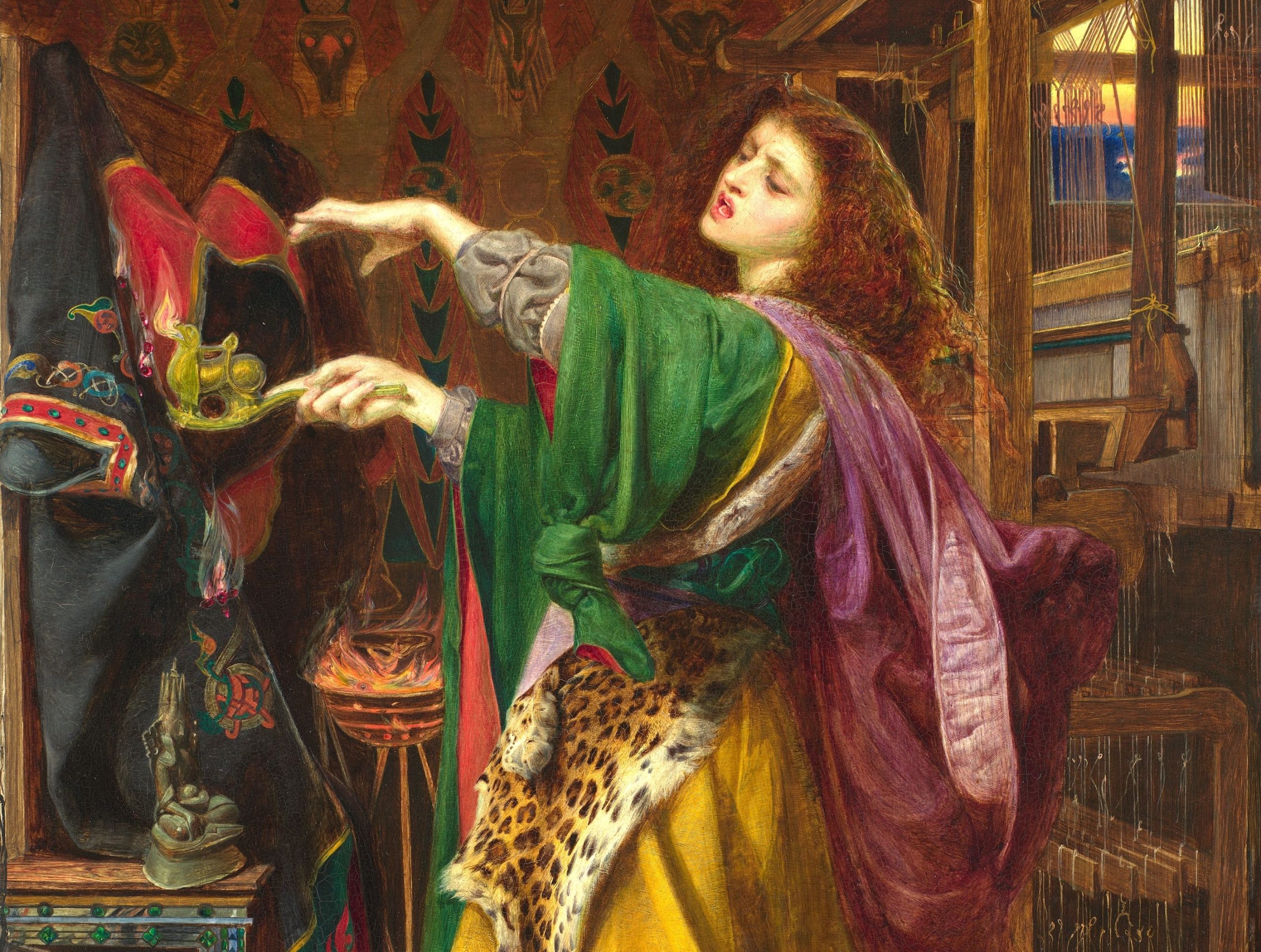
Perhaps that’s why when Lauren Groff released her most recent novel Matrix, a fictitious account of French poet Marie de France’s life in which she lives as an abbess for a 12th-century nunnery, readers were quick to gravitate toward the seemingly clear-cut, utopian depiction of an all-female community. From unfussy descriptions of sapphic desire to a protagonist who is ambitious rather than beautiful, the story allows women to exist as more than reproductive vessels. When Marie arrives, both the abbess’ structures and inhabitants are in a state of decay, but her arduous path toward rebuilding the community is not detached from her quest for individual status to garner the attention of Queen Eleanor, with whom she is in love. Marie is no selfless, submissive, sacrificing leader—she undertakes her given motherly role alongside a perhaps lifesaving belief in the morality of her own desires.
Marie goes to great lengths to keep her nuns and power safe, building a near impenetrable labyrinth, expelling men from the grounds entirely, and developing an international network of spies. In having or claiming to have mystic visions, she weaponizes religion (which is not to say she does not believe) to justify architectural projects that reinforce the self-sufficiency of the community. And although Marie is the visionary, her nuns prove no less formidable as they establish themselves as engineers, laborers, and even warriors, defeating jealous villagers using feminine wit rather than brute force.
There’s something universally enticing about the feminist impulses explored in Matrix. The characters are living in an inherently darker, more repressed era, and perhaps it makes the smaller wins—allowing women to write, for example—so compellingly welcome, so indisputable. The version of feminism enacted in the nunnery poses no threat; it feels safe and cozy to modern readers. But even Marie’s most faithful nuns were distraught by her assuming the duties of a priest to administer mass or hear confession. Immersing ourselves in the feminist impulses of the past may remind us that progress often feels uncomfortable or radical, but that when a woman, “Of her own mind and hands … has shifted the world,” it must be celebrated.
For those of us who want a reminder of how far feminism has come, the following 7 novels promise equal levels of historical immersion, women unafraid to claim agency in a time period unwilling to permit it, and the same celebration of female solidarity Groff so effortlessly crafts in Matrix.
Better known for Kristin Lavransdatter, her trilogy about a young girl sent to a 14th-century nunnery, Sigrid Undset first wrote a different historical fiction novel equally worthy of recommendation. Gunnar’s Daughter is set in 11th-century Norway and Iceland and follows Vigdis Gunnarsdatter, a young woman who conceives as a result of rape and raises her son by herself. Just as Marie is distrustful of men and the trouble that seems to too often accompany their presence, this story is haunted by male violence and its lasting impact on Vigdis. In a Norway newly accepting of Christianity, religion also towers over these pages as we watch a young woman battle for her autonomy in a patriarchal and carefully socially coded society.
While Marie had to cling to what little power she had outside of the Royal courts, the woman at the heart of this Shan Sa marvel manages to sleuth her way into extreme power as China’s first and only female empress. Empress Wu’s intelligence and political know-how not only allow her to assume the elite position, but also see her use it to great effect: opening international trade routes and quelling insurrections while also allowing the arts to flourish. This 7th-century story brings to light the brilliance of a woman who helped shape the Tang Dynasty’s Golden Age, without sacrificing suspense or romance along the way.
British historical fiction so often focuses on the kings and knights and not the wives and mothers and daughters lurking in the shadows, playing pivotal roles in the making of history. In this novel, readers follow Duchess of York Cecily Neville, an ancestor to every English monarch to date, as the War of the Roses unfolds. While a far more political novel in terms of historical context than Matrix, we still get a close look at Cecily’s homestead and the intimacies of her love marriage to Richard of York. We even see her, like Marie, experience visions from the Virgin Mary. For readers who enjoyed Matrix’ssubtle hinting at the wider politics of the era, this book explores a high stakes political situation in the region while still centering a domestic perspective.
Peasant girl Grey is raised as a boy until the revelation of her womanhood in adolescence alters the course of her life, forcing a journey to discover her true identity—and who she will be in spite of it. The Church, political tensions of 14th-century Ireland, and the ever-terrifying Black Death shape Grey’s life as she meditates on the various privileges of being raised a boy while ultimately still succumbing to certain feminine vulnerabilities, including her sexual exploitation at the hands of men and the toils of motherhood. Grey is a character who prevails despite the unfairness of her circumstances, a character I think Groff’s Marie would respect.
While Matrix deals surprisingly little with Marie as poet, the written word proves itself an incredible lifeline for heroine Julyana Berners. While under the care of 14th-century Queen Anne, Julyana meets the greatest of literary teachers: Chaucer. He teaches her not only to write, but also the power of the written word and being able to tell one’s own story. Her resulting chronicling of her life makes for a welcoming and remarkable look at Plantagenet England.
In a nunnery rendered as richly as Marie’s, this story similarly spans many decades of both everyday life and more dire turns of fate in a 14th-century Benedictine convent. This is a quiet and somehow still miraculous novel, immersing readers more in the feeling of this life and the priory’s inhabitants than specific plot points.
Taking place in Warwickshire in the 1580s, this work technically misses the medieval mark but still predates the origins of feminism by a few hundred years. Just as Groff reimagines the life of a true historical figure, O’Farrell draws from Shakespeare’s personal life and the loss of his son, Hamnet. However, the novel refocuses the narrative on Agnes, Shakespeare’s wife, to tell a distinctly feminine story of marriage and the gut-wrenching loss of a child. We can’t help but celebrate writing women’s voices more tangibly into the historical record.
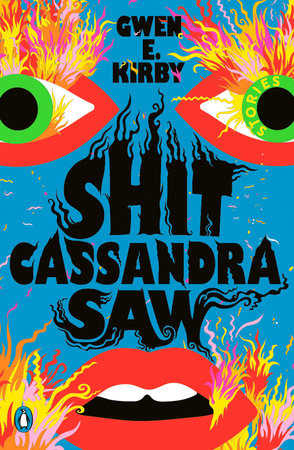
The first time I see the ghost of George Whitefield, I’m fucking my neighbor Karl. We’re going at it with more enthusiasm than finesse, the way you do when things are new. I lift my head, I’m going to kiss or perhaps bite Karl’s neck, and that’s when I see him: George, sitting at the end of the bed in knickers, vest, and long coat, hair tied back in a cue. Whore, the ghost whispers, and damn, he knows what gets me off. Whore whore whore. I come so hard I get a foot cramp and Karl says fuck yeah. He can’t see George. Karl lacks imagination. It’s one of his best qualities.
I’ve never seen a ghost before, but then I’ve never had an affair before either. Karl and I have known each other for a few years— I teach English at the Academy, he teaches physics. Karl’s handsome of course and we’d drunkenly made out once, ages ago, after a faculty party, stupid and sloppy like the teenagers we teach. Neither of us ever brought it up again. When we finally have sex, it’s because I ask him to come up to my apartment. I’m going to lend him a book. I stand by the bookshelf, he stands by the bed, and then I move to him and we’re on each other. Now, Karl is lying on my breast, breathing hard, while George Whitefield looks slightly up and away from our tangle, reminding us that though we’ve forgotten our modesty, he has not. Outside, the academy kids are hurrying down the sidewalks to their dorms, hunched into the cold wind. I run a finger down Karl’s belly. I’m less lonely than I’ve been in a long time, warm inside with a lover, a ghost, and a secret to keep me company. And I don’t mean the affair, though that’s a secret too. No, the secret I’ve just learned is that I can fuck without caring for the other person at all.
The fucking seems momentous, the beginning of an adventure, and at first I’m in a bit of a fog: horny, guilty, and proud. Whore, George says every day when I leave and again when I come home. He’s perched atop his stone marker in the strip of grass between the road and the sidewalk outside my house. It reads: George Whitefield Here Preached His Last Sermon, September 29, 1770. Moss grows in the letters and the snow almost buries it. I like to blow George a kiss, which makes him scowl. For a few glorious months, I feel like I’m getting away with something, fucking Karl and still living my boring life. Do you have to call it fucking? Karl will sometimes ask and I say, Isn’t the fact that it’s fucking what makes it fun? Sometimes he laughs. Every so often, though, he rolls his eyes and looks away instead, like I’ve hurt his feelings, and I have to coax him into feeling better, which I hate. Are you okay? What’s wrong? Karl says nothing’s wrong, but do I have to be so crass?
Karl, I think, doesn’t like to be reminded that we’re doing a bad thing for no other reason than it feels good.
“I’m sorry,” I say to him even though I’m not, and before he distracts me with a kiss, I wonder why I’m risking so much just to have another person to apologize to.
When I’m not teaching, coaching the varsity soccer team, or having an affair, I am busy worrying about my daughter Emmy. She is six, and so happy I think it can only be a bad sign. She loves pink and princesses, which I was prepared for, but she also makes friends easily and never seems to bully or be bullied. I don’t see myself in her, which is good, but now I fear that a happy, well-adjusted child will be even more wounded by the world than an anxious, angry child with a large gap between her two front teeth. My daughter does not know what it is to hesitate. When she comes home from school, she throws herself into my arms. When she gets out of the car in the morning, she throws herself into the playground, scattering her classmates like crows. At swimming lessons, she doesn’t notice that the water is different than the air— she leaps. My husband tells me that I am literally making trouble out of happiness. I tell him he’s a man and doesn’t know any better and then we fight. My best friend, Suze, agrees with me, of course. She knows the world is hard for girls who haven’t learned to be cautious.
The varsity soccer team is the opposite of my daughter. They seem to do nothing but hesitate. You’re never going to win a header by asking permission, I tell them. But they refuse to attack the ball. They’d rather lose than look like they’re trying to win. It’s a feeling I remember, though as a teenager I preempted failure in different ways. Baggy shirts, scuffed sneakers, thick black eyeliner, a belly-button piercing. I didn’t know if I wanted boys to look at me— men had already been looking for a while—and so I made sure if they did look they’d see a girl who didn’t give a shit. The belly-button piercing got so infected after a month that I had to tell my mother, who instead of being furious with me was just exasperated. Ten days of antibiotics and a scar that, when I was pregnant with Emmy, stretched in an angry twist away from my navel. I liked to trace it with my finger and wonder what scars my baby would get someday. Ones, I hoped, with better stories behind them.
I yell at the girls on the field that they better start hustling or we’ll be doing extra sprints at the end of practice. I loved playing soccer in high school, running until I was about to collapse, letting the work of it hollow me out.
“Shoot the ball!” I yell as the center forward passes to her teammate even with a clear shot on the open net. The center forward kicks the grass with her cleat and looks at her watch. We’re running over, she’s telling me.
Practice goes long. Then I meet with three students about their papers. Then I answer a series of emails all from the same parent. Emmy and I eat macaroni and cheese with chopped up hotdog. Emmy takes forever to go to sleep, excited that tomorrow her class gets to visit Mr. Lettuce, the school guinea pig. I get in bed beside her and read her favorite book, about a little girl mouse who writes all her wishes on pieces of paper and plants them in the garden. When the little girl mouse wakes up the next day, the garden is bursting with strange plants: polka dot flowers, a tree that reaches to the clouds, a fly trap so big it could eat little girl mouse in one bite. Noomf! I say, and my hand bites Emmy’s arm. One day, the little girl mouse plants a wish for a best friend and the next morning she finds an egg. When she breaks it open, a bright red bird cries out and flies away, to the top of a hill, then a mountain. The little girl mouse plants wishes on her journey, so that when she finds the bird, they can both go home. I read the book to Emmy twice before she admits that she’s sleepy. Before she drifts off she asks if tomorrow we can plant some of her wishes.
Whore whore whore, he whispers, and I keep drinking, more than I should on a Wednesday night, or any night, and eventually he switches to glutton glutton glutton.
My husband is not here to help with this. He’s gone a lot, helping companies whose workflows aren’t flowing. Right now he’s in Japan. At least I have George, who sits with me in the kitchen. He’s decent company. A little doom and gloom, but he likes to laugh.
“We’re going to get creamed by Valley City High on Saturday,” I tell George. I pour a glass of wine and pull out a stack of papers to grade, the gesture entirely symbolic. I take a deep drink.
You are an adulteress who is destined for hellfire, George responds. But fear not. I reside in heaven and, for all its beauties, its holy ecstasies, it is not everything which man has promised.
“Is that right?” I ask. He laughs and laughs.
No, he says. Do not be absurd. And Hell is not the way you imagine it. The ways of Satan are more subtle, more inventive.
“Really?” I ask.
No. He does not laugh. There is no need for subtlety. Only foolish sinners like you imagine there is some thing worse than pain.
I pour myself another glass of wine.
“It’s a big game,” I say. “We need to win it if we want a chance at the playoffs.”
George doesn’t respond. He seems to have lost steam and reverts to the tried and true. Whore whore whore, he whispers, and I keep drinking, more than I should on a Wednesday night, or any night, and eventually he switches to glutton glutton glutton.
Next afternoon, I’m in a hurry, late to get Emmy from afterschool care. Spring is mud season in New Hampshire, and I pick my away across campus, avoiding the puddles that have formed in the sidewalk’s depressions. It surprises me every year, how the melted snow discovers this hidden topography, everything flat revealed to be craggy. I’m almost there when I get a text from Karl. you free for a faculty meeting tonight? Karl’s wife is not in Japan and he worries a lot about his wife seeing our messages. busy with emmy, I reply, and usually I’d send a little something else, a sorry or a let’s reschedule the meeting, with an emoji that is friendly without being obviously sexual, an ear of corn or a fireman, but in the brief moment that my typing distracts me I step ankle deep into a small lake. The water is so cold I feel the bite before I realize I’m wet through my shoes and my socks. My first impulse is to swear but I laugh instead and put my phone away. I am a woman who lacks the sense to watch where she’s going. When I pick up Emmy, I tell her I’ve been playing in puddles and I offer to carry her on my back while I do it again. I tell her that since my shoes are already wet, it doesn’t matter if I get them a bit wetter, but we have to make sure her feet stay warm. We splash and splash until my jeans are soaked too and shiver our way home.
Thursday night is Spring Fling! at Emmy’s elementary school and I am in charge of making her costume. Her grade is performing “Twist and Shout” and I’ve sewn together a pink poodle skirt, the kind I would have killed for when I was six. Emmy stands on a box for fitting. The hem is crooked and the poodle’s eye is weeping with dried super glue like it’s infected.
“You look great,” I say. Emmy does a twirl. I wonder if she is too young to see the flaws. The other mothers will certainly notice. The other little girls will too.
My pocket vibrates. Karl has texted me again. we need to talk, he says.
everything ok??
having some thoughts on faculty meeting
I tell him I’ll see him tomorrow after his class. Emmy is twisting hard in her skirt, jumping up and down, and then she’s fallen over and she’s crying. A pin holding the hem of the skirt has stabbed her leg.
“Look, baby,” I say, and I hold up the skirt to show her the smallest dot of blood on her skin. “You’re okay.” The poodle gazes at me, sick and hateful.
My pocket vibrates again, Emmy has stopped crying and is inspecting the blood now, blotting it with the tip of her finger, about to get it on the skirt, which is the last thing that skirt needs, and I am done with Karl, I swear, I am already writing him the message that ends everything when I see that the text is from my husband instead. It’s very early in the morning, too early for him to be awake, but he can’t sleep. He says he misses me. He says the cherry blossoms will bloom soon, but he’ll be home just before they do. Figures, he texts, and adds a smiley face, as if to say, oh this wild dance we call life, what can you do, and right about now, as I try to remember if Emmy has white tights with no holes, as she yanks on the hem of the dress and I wait for the howl that says she’s stabbed herself again, I hate him.
When I get to the kitchen, George is there. My eyes are red and I’ve stabbed my own fingers on the skirt’s pins too many times to count, too many times for what is still an ugly, hopeless thing. George shakes his head and says, These are the wages of sin, and I throw my wine into his face and it passes right through him, stains my perfectly nice kitchen chair, surprises us both.
“Shit,” I say, and grab a roll of paper towels, yanking off sheets and pressing them through George’s body, and though of course we can’t touch and he tries to pretend he cannot see me (oh George, I know your looks now, how you gaze into the middle distance when you aren’t comfortable with what’s happening right before your eyes), I can sense him squirm. I slow down just a little, patting the seat dry gently and thoroughly. The wine has stained the cheap wicker. I’m kneeling in front of George, the mess absorbed into a dripping clot of paper towels. I wonder, whore that I am, if he ever had a woman on her knees in front of him. I want to ask but, I admit, I’m afraid. I’m afraid I’d ask and when he said no, offer to suck his cock. I get up, throw the paper towels away, and pour myself another glass of wine. I sit primly and say, “I forgive you.”
And the best thing happens. George smiles, which I’ve never seen before. It’s short lived and after he calls me whore with such enthusiasm that I know he means it but I also know he wishes he didn’t like me.
“Have you ever been in love?” I ask, which is not the question I had wanted to ask, but maybe in George’s time love and a blowjob had been one and the same. George does not answer.
“I have,” I say, which is obvious. I’m married, aren’t I? But I think married people aren’t given enough credit for being in love. For being in love with each other— which everyone treats as a given, as mandatory, which is the hardest way to love— but also for remembering what it’s like to be in love with someone else, for knowing that every love is different and sticking with the love you have. Of course I’ve loved other men. That boy in Introduction to Astronomy who had sex with me in my dorm room— we’d been studying the names of star clusters— and then told me he had a long-distance girlfriend. A man who restored furniture and cooked elaborate meals for me. I could think of no greater sign of devotion. I moved to New Mexico with him for three months and for the last month he refused to touch me, called it a religious practice, but eventually confessed he had gotten chlamydia from another woman. Eventually my husband, who I do love, even though some days that love is hard to find.
I don’t say all of this to George. Good old George, who sits on his stone and watches the academy kids walk by, the small dogs in sweaters, the old couples who lean close but still can’t hear each other. George feels Jesus’ love for all of them, but no sympathy for me. At this point I’m a little drunk and edging dangerously close to self-pity.
It is love which brings man closest to God, George says.
“Thank you, George,” I say, and I’m so surprised by his kindness that I almost cry.
Love and sincere repentance.
“Okay, George,” I say. “I get it.”
When I get to his class, Karl is at the whiteboard, spraying then rubbing at the traces of past lessons. He looks good, better looking and a little younger than me. His wife is better looking than me too. The two of them go hiking and cross-country skiing on the weekends. Though we’ve had sex many times, I am often struck with the improbability of it. Why bother with fucking me? I shut the classroom door behind me, ready for him to break up with me, assuming he will and hoping for it. I’d break up with him but I don’t have the energy. I’m thinking about whether I put Emmy’s dance shoes in her bag for the show tonight.
“I have to tell my wife about us,” Karl says. He puts down the whiteboard eraser, runs his hand through his hair.
“What’s happened?” I ask, but I already know. “I have to tell her how I feel,” he says.
“You don’t have to do anything,” I say.
“She deserves to know.”
“We can stop seeing each other.”
“It isn’t fair to her.”
“We have to stop seeing each other.”
“I know you feel the same way I do.” Karl takes my hand in his and presses a tender kiss to my knuckles, something he has never done before. I yank my hand away. This is absurd, I want to say. We don’t feel anything. And as I clutch my hand to my chest, I imagine my mother in the audience, shaking her head at this mess, saying, sweetie, you always did make life harder for yourself.
George Whitefield sits beside her. Good madam, he says, this is why I turned away from the passions of the stage to become a preacher. Your daughter is already a fornicator and a sinner. All this pageantry will not save her immortal soul.
“She knows about us,” I say.
“No,” he says. “She suspects.”
He backs me up against the desk, angry, a little scary. I’m afraid but also turned on and confused, because I’ve never had the kind of sex we’re about to have. He lifts me up onto the desk, pulls my underwear down, and then we’re fucking and he’s not even trying to get me off. I look over his shoulder at the periodic table. Karl is a good teacher. He knows a lot about baseball and loves football but doesn’t watch anymore because he thinks it’s morally wrong. He has a scar on his arm from where a small tumor was removed and sometimes I feel an urge to touch it, as if scars are where we’re most vulnerable and not the thickened skin where we feel the least.
After he comes, he holds me, murmurs in my ear that he’s sorry, that he loves me. He’s confused me, what we just did, for someone and something else.
“I don’t love you,” I say. He flinches. “Don’t do something you can’t take back.”
“We’ve already done that,” he says.
“You don’t love me,” I say, but he insists he does. As I said, he lacks imagination, and so he imagines that love is the only excuse for what we’ve done.
Oh, Karl, I think. You’re an idiot.
I want to go home and pass out and forget that I’m a wife and a mother and a lover and a teacher but it’s Spring Fling! so I put on fresh deodorant and get my daughter into her costume. She wiggles with so much excitement while I put it on her that the zipper breaks again and Jesus fucking Christ I feel my cell phone vibrate and I bet it’s fucking Karl and I have one of those moments where I think I’m going to lose it. But I don’t lose it because I can’t. I safety pin my daughter into her skirt and say, “Hope that holds, munchkin.”
I brush her fine hair into a pony tail. Other mothers will have made better skirts and done fancier hairdos.
Other mothers aren’t fucking the science teacher either, I think, and sigh. George Whitefield leans against the wall as I work, no help at all, and when my daughter is out of the room I tell him to not even start with me. A horn honks outside and there’s Suze, who has a son in the same grade. We choose seats in the back of the auditorium like delinquents and watch the kids perform. My daughter’s poodle skirt stays on and she’s front and center and happy to be there. Suze’s son is in the back row of kids and his hair is gelled into a helmet. He doesn’t twist much but boy, oh, boy the kid can shout.
Suze knows about Karl but not about the ghost of George Whitefield.
After the show, while the teachers are talking to their classes, I show Suze Karl’s latest texts:
still thinking about what happened
don’t think you meant to be hurtful
i have to do what i think is right
Suze has never approved of me fucking Karl, but she doesn’t say I told you so.
“If I were you,” she says, “I’d say you were lying, that you do love him too. That way, he’ll say it’s too much pressure and realize he doesn’t love you after all.”
Suze says that this has worked on countless of her past boyfriends.
I wonder what I can do to hurt Karl so badly he’ll never think of loving me again. I try to remember who I’ve alienated and how. A girl in fourth grade was my friend until I realized that no one else liked her. So I told the girl she smelled weird and stopped eating lunch with her. I had a boyfriend who said I never opened up to him, which wasn’t true. I’d told him everything there was to know about me; it just turned out that there wasn’t much to know. So I started to make up things to confess until he left me because I was too much of a burden. My childhood cat never liked me. She pissed in my room.
“Maybe I can wait him out,” I say, and Suze shakes her head. “He’s a man,” she says and leaves it at that.
I take my daughter for ice cream as a special treat for doing such a great job twisting and shouting. Mint chip for me, bubble gum with chunks of real blue bubble gum for her. We sit outside even though it’s a little too cold, our sweaters pushed up our arms because our cones are dripping. She sees a spider and she tries to feed it ice cream. She dabs the melted drips in the spider’s path. The spider walks around the ice cream. I tell her that some spiders are picky. “For that spider,” I say, “ice cream could be like pickles.” My daughter hates pickles. “Pickle ice cream!” she giggles and she wipes her hand against the poodle skirt and the poodle’s eye comes away on her sticky finger. She gazes at the eye, jiggles it to watch the pupil dance.
“I’m going to plant this,” she says. “It’s a wish.” Emmy screws her eyes shut and thinks hard. I want to ask what she’s wished for, but I don’t. I know wishes are sacred and secret. I’ve taught her that. And I think for the first time that that’s a mistake. Why, of everything we think, should our wishes be unspoken?
I regret that it took me this long to learn to use my body for its own sake, to let my only emotion during sex be lust, be greed.
“Now you too,” she says, and hands me a piece of bubble gum from her melted ice cream.
I would like to plant a wish and watch it grow, but right now I don’t know what to ask for. I suppose I should wish that I’d never had sex with Karl. I would like to wish that, but I can’t. I don’t regret cheating on my husband, even now. Instead I regret other things. I regret that it took me this long to learn to use my body for its own sake, to let my only emotion during sex be lust, be greed. I don’t know what to do with this information, wasted as it seemed on my forties, on my marriage. I did not expect my affair to make me so angry. I regret that my husband is a good man but far away.
Sometimes, I wish I could tell my daughter about all this. Not now, of course, but when she’s older. I want to tell her, sweetheart, before you get married, have casual sex and remember: nothing matters.
I suppose that sounds bleak. I suppose that’s not what I mean.
And remember: be selfish.
I plant the bubble gum as deep as I can and pat the dirt down over it.
Emmy smiles and I lick my finger and dab her cheeks as she tries to wriggle away. Her ponytail is half fallen out, the poodle skirt filthy. My phone buzzes in my pocket. She sees a friend of hers and runs over to her, and the other mom waves at me like we’re confirming a prisoner transfer.
Karl texts again. Each buzz is aggressive.
meet me tmr at soccer practice, I text to him, just to make it stop.
“Maybe I’ll become a nun,” I say to George.
After this, George says, no man will cleave to you. Including God. He laughs and laughs. Whore, he chuckles.
“Whore,” I agree.
George has never asked me why I fuck Karl. To him, there are no degrees of wrong, there is simply the wrong itself. There are no degrees of repentance, only absolute abasement, and I have failed. I think George likes that I never try to explain my actions to him. But I’ve explained them to myself. Justified them, I suppose. Here is what I think. Every day I wake up. I shower but I don’t pay much attention to how it feels. I eat what I always eat and I chew my bite of toast as I chase my daughter around, and button her up, and feed her too, and I couldn’t tell you what the bread tastes like. Half the time I’ve burned it. I go to work and I use my mind and sometimes my students use my mind and other times they let their minds wander and it is just my mind and their bodies in the room. I would love for them to see the beautiful poem or passage I’m showing them, I’m straining at them with love for it, but they aren’t there. I go home and take care of my daughter, who is all body, and I strain with love for her and talk to her father on the phone and miss him some but not enough because I am so angry that he has left me here all alone and at night I am finally, finally, truly alone and I drink a glass of wine or three, anything to put my mind to sleep, to knock myself unconscious for as long as I can before it starts all over again.
Why would I not fuck Karl?
Soccer practice isn’t going well. It’s cold for late March and though it’s above freezing, the sky is somehow spitting flecks of snow. The game is tomorrow and the girls are scrimmaging, ten on ten, no goalies. They’re supposed to be taking it easy but also focusing on keeping wide, keeping the field open, creating space for opportunities.
“Amanda,” I shout, “You are the left wing, left!” I wave my arm and she moves slowly back toward the far side. “Do you not see Rachel open at the post?” I yell, when, instead of crossing the ball, my midfielder dribbles straight into a clump of defenders.
I blow my whistle. The girls jog over, gather up. I tell them that since they don’t seem interested in playing, we’re going to run sprints instead. I shouldn’t do this. They need their legs fresh for tomorrow. Karl hasn’t arrived yet.
I send them to the goal post and back. Fence and back. The tall bush at the end of the field and back and every girl has to bring me a leaf or, if there aren’t enough new leaves, a twig. When one doesn’t hand over anything, I make them run it again. I know how they are feeling, I remember it— legs limp, mind empty, pushed to the edge of what I could endure. It had felt good when I was young, to be run like an animal. The leaf trick— my own high school coach used that. I think it was meant to show us that we were all in it together, that if one of us tried to cheat we would all be let down. But that wasn’t the lesson I’d learned from it. I’d learned that people cheated even when they knew they’d be caught. That sometimes getting caught is a form of defiance.
“Again,” I say, and on the run back one girl falls to her knees and throws up. Number twelve kneels next to her, holds her ponytail out of the way, pats her back until the girl is done. These girls who don’t play as a team all look at me with the same expression of loathing and I realize that I hate them too, a little, for not loving the same thing I did.
I say, “Okay, girls.” Practice is over.
I turn to start putting the equipment back in the bag and there is Karl. I don’t know how long he’s been watching but it’s long enough. It is easy to read his face. Disgust at first, at the vomit, at me turning away instead of moving toward the girl on the ground, as I should. Disbelief, briefly, and then every other emotion is chased away by anger, like I’ve tricked him, made him believe I was someone else.
He holds my gaze for a few moments and then turns and walks away. No need for me to say anything more. I am bad enough, exactly as I am, and I wish George were there to simply say it aloud, to comfort me with his honesty.
That night, George isn’t at my kitchen table, though I sit and wait for him. Eventually, I go upstairs and fall asleep atop the covers, still dressed, and when I wake, it’s a little after two in the morning. My phone says I have eighteen text messages from an unknown number and after seeing the first one, you fucked my husband— straight to the point— I turn my phone off. The street light is shining in my window and when I go to close the curtain, I see George, standing beside his stone as if waiting for something. In the kitchen he usually looks solid, though he seems to hover rather than sit. Right now, though, he looks spectral, emitting an almost pagan blue glow. I put on my coat and go out into the street.
It is snowing in earnest now, drifting sideways across the streetlights, landing in my hair, sticking to the flower stalks that have misjudged the arrival of spring. George doesn’t notice me. There is no trace of contempt on his face, only anticipation. He paces a little, directs unseen spectators to give him more room and I realize I know what he’s preparing for. I’ve researched George, of course. Went to the library and read about the ghost who sat outside my house, who kept me company. He came to this town to preach in the town hall but when he got here there were far too many people, thousands too many, and so even though he was very sick, he decided to preach outside. George loved to preach outside. Outside there was room for everyone. Room even for me. He placed a wooden board across two barrels, right at this spot where the granite marker is, so that people could see him. It is cold and my toes are getting numb in my slippers but I have to stay. George is about to preach his last sermon.
I can’t see the hand that George takes to help him up onto the stone. Every time he coughs, his body shakes like his soul is trying to rip free. He raises his hands for silence and waits several beats, his face fierce. When he begins to speak, I can’t hear him. I clench my jaw to keep my teeth from chattering. His right hand slices wide, his eyes flash. He coughs. At times, he pauses, as if unsure he’ll go on, but then he does, more frantically than before, gesticulating, serious one moment, then smiling the next as if he can see the Lord before him, is conjuring him here for the assembled to see. He is so sure of himself. Oh, George. You know, don’t you, that those thousands of ears are like cracked bowls, like the ears of my students, my daughter. You fill them, yes, George, but most of what you say leaks out onto the wet earth and disappears. Not everything, though, I suppose. Someone remembered to plant this stone.
I know that when George is done, the story will change. I will go upstairs and read those text messages. I will face my colleagues, who will all know what I’ve done. My husband will come home, just before those cherry blossoms bloom. Everything will become messy. But right now, the story isn’t about him. The story is about me, and I watch George preach until he can barely stand, until I can’t feel my fingers. When he finally gets down from the stone, he turns to a man I cannot see and shakes his hand. He turns to another and claps him on the back, puts a hand to his own powdered wig to steady it. His step is slow and tired through the invisible crowd. He has a word for everyone, and though I can’t hear what he says to the others, though he leaves me farther behind every moment, in my ear I can still hear him whisper joyfully whore whore whore.
And I say yes yes yes. Yes, I’m here, I’m here, a body, just a body, and it’s not promised to anyone, it’s mine, only mine, and I miss that, God, oh God, oh George, I miss it.
Too often, popular fiction welcomes convenient last-minute solutions to the end of the world, even if the old cliché that things are darkest just before the dawn doesn’t match our lived experience. This misleading pattern lends itself well to epic-scale narratives largely reliant on a hero/villain dichotomy. Set the stage for total societal demise and no character can remain unaffected or out of the action. Think of Game of Thrones, Star Wars, or The Avengers—the direst situation in each plot revolves around a genocidal crisis, a whole society or galaxy on the brink of oblivion. The looming reality of mass death in these narratives is glossed over; the resolution hinges on nothing more than an easy and well-timed gamble at salvation. A snap of the fingers and everything returns to normal, a symbolic triumph becomes an all-encompassing pardon. The universe is saved. The good guys win. The buzzer beater is a sure thing.
The drama of this narrative pattern is irresistible. Audiences thrive on the ups and downs of these scenarios and subconsciously maintain faith that humanity will overcome. For writers, I imagine the matter is usually much more practical—this pattern leads to a surefire narrative fix. Sustainable change takes time and doesn’t provide the instant satisfaction of a brief climax. It’s more effective to save the day, fade to black, and include some iteration of, “there’s still so much more work to be done.” At best, this resolution is optimistic, but it’s precisely the feel-good nature that’s the problem. These dramatic swings mask the reality of humanity’s slow downfall, and suggest a convenient panacea is inevitably around the corner, when the truth is that there may be no such thing.
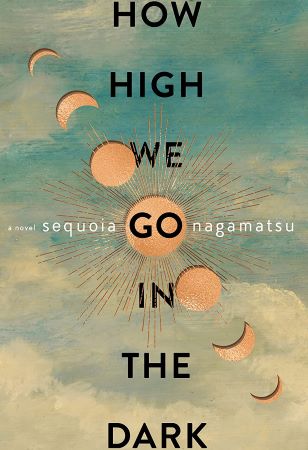
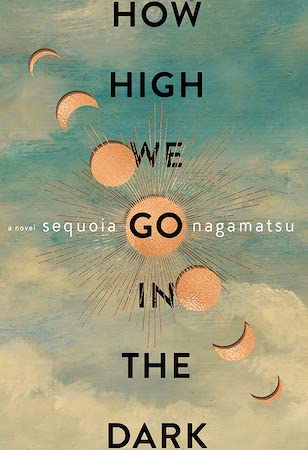
Sequoia Nagamatsu’s debut novel, How High We Go in The Darkrethinks and challenges the specious plot devices deployed in stories of humanity on the verge of an apocalypse. In this case, the primary threat comes by way of an arctic plague that emerges in melting Siberian permafrost. While Nagamatsu does ultimately launch a crew of characters (many chosen by lottery) on an interstellar search for a new world to colonize, the mission is not introduced until the second half of the book, long after extensively exploring how the unflinching pandemic decimates communities and economies around the world. This is to say the author grapples with the reality of unimaginable death for more than 150 pages before the idea of space travel even enters the picture. Instead, How High We Go in The Dark finds an orchestral cast of Japanese characters across interlinked stories working at euthanasia theme parks for terminally ill children, experimenting on hyper-intelligent pigs to develop donor organs, fixing malfunctioning robot pets to cope with grief, and preserving corpses in hotels as they await long lines for cremation, all while dealing with ongoing anti-Asian racism in the midst of global chaos.
It is precisely the author’s willingness to stare down the acute horrors of a world unprepared for environmental and societal collapse that makes it special.
If this description hits close to home—and, yes, the word “prescient” appears on the jacket copy—Nagamatsu’s practical imagination is a major part of what makes this novel so impressive. It is precisely the author’s willingness to stare down the acute horrors of a world unprepared for environmental and societal collapse that makes it special. Rethinking how we tell stories of immense tragedy could be essential to changing attitudes toward a sustainable future before it is too late. Another way of thinking about this: why are we so willing to simply adapt to the horrors of our current reality, waiting passively for a convenient cure to imminent mass extinction?
Nagamatsu writes:
“But something snapped in us when the dead could no longer be contained, when people didn’t really say goodbye. Cryogenic suspension companies proliferated, death hotels, services that preserved and posed your loved ones in fun positions, travel companies that promised a ‘natural’ getaway with your recently departed.”
We’re already experiencing the deleterious consequences of climate crisis in real time—the trauma is especially intense for people of color—but meaningful change remains sluggish and inconsistent. Recommendations too often pivot toward individual responsibility—eat less meat, don’t fly, recycle—rather than against government and corporate greed. With its first chapter beginning in 2030, How High We Go in The Dark portrays a rapidly approaching future that sees society shift toward industries profiting off death. The urgency shifts to an economy of grief and mourning.
For example, Dennis, a specialized worker at an elegy hotel, reflects:
“They gave bereavement coordinators like me studio apartments on the top floors of the elegy hotels. Some of my colleagues had native ideas about saving the world, but really we were just glorified bellhops for the mountains of Arctic plague victims awaiting cremation, for the families who wanted to curl up in a suite beside the corpses of their loved ones and heal. On any given day, the deceased from local hospitals lined the basement halls in biohazard bags, waiting to go through the three-part preservation process—sterilization, embalming, and our antibacterial plasticizing treatment. This bought families time to say goodbye while our crematoriums struggled to keep up with demand.”
The idea that the rich and powerful will swoop in and save the day is not only counterproductive to action, but also reinforces systemic oppression using a narrative formula that has become all too recognizable. After all, billionaire white men have the least to sacrifice, because if their fraudulent philanthropic ventures to clear their conscience don’t pan out, they imagine a well-stocked bunker or oceanic ark or lonely rocket available to whisk them away to permanent safety. How High We Go in The Dark, instead, reveals a brand of capitalist pandering that pivots mostly toward loss, while hinting at the ongoing protection of the most privileged.
How High We Go in The Dark reveals a brand of capitalist pandering that pivots mostly toward loss, while hinting at the ongoing protection of the most privileged.
This is to say that a colony on the moon or Mars is precisely the type of distracting narrative boondoggle that stunts progress toward any kind of actually sustainable solutions regarding our current environmental catastrophe. The space travel dreams of the ultra-rich neglect to mention that only a select few will ever have a chance at survival beyond the atmosphere while billions of people on terra firma deal with the realities of famine, rising tides, natural disasters, fatal temperatures, and climate genocide. In Scientific American, astronomer and JustSpace Alliance co-founder Lucianne Walkowicz argues, “I’m sure the extremely wealthy will continue to take expensive joyrides, occasionally offering seats to others and perhaps hoping that their antics will distract us enough to forget that the gluttonous accumulation of wealth wouldn’t be possible under any kind of just system.” Even if space were to become a feasible solution, the systemic inequities by which opportunities for space travel are dictated would need to dramatically change if there was any hope for those without tremendous wealth.
Yet, Nagamatsu never takes the easy way out. The irony of How High We Go in The Dark comes in its concluding chapters. While the space crew spends thousands of years, mostly frozen, bouncing from planet to planet in hopes of finding a safe home, humans back on Earth gradually come together to create a stable environment for future generations. In other words, interplanetary colonization is a moot bandage by the time it’s viable. The crew populating Earth II might tangentially contribute to saving the species, but since they spend most of their time preserving their bodies, in terms of the technological developments that have taken place back home they are in fact thousands of years behind. Those remaining on Earth, then, end up much more technologically advanced. The death toll on Earth continues to rise until a cure for the pandemic is developed, and that’s where and when the real progress begins.
On this interstellar mission, an artist tasked with painting and providing notes on the expedition, mentions, “When we arrived at the Centauri system, we received a decades-old message from Earth, informing us that a people began to rebuild their lives. Funerary corporations expanded to focus on climate projects, building seawalls around coastal cities, sponsoring the solar shade project until the end of the century.” The answer was there the whole time, then, even if the action comes long after the interstellar mission ship departs. There’s some trenchant wisdom in Nagamatsu’s suggestion that eventually those remaining have to deal with being left behind, and that it’s the money-flush funerary corporations that can take advantage of this society-wide need, and spend money to look like saviors right after having struck it rich exploiting so much devastation. Is this so different from Amazon advertising about its climate initiatives while Bezos simultaneously invests his vast personal wealth in vanity trips to space, a half-a-billion-dollar mega-yacht, and the ongoing underpayment and exploitation of Amazon’s warehouse employees?
Of course, Nagamatsu isn’t the sole writer developing this brand of climate fiction, but the attention the novel has already received is noteworthy, a sign that perhaps publishing is willing to see the commercial value in the literary portrayal of a more realistic kind of future. For another example, Allegra Hyde’s debut novel, Eleutheria, forthcoming in March 2022, could nearly be imagined in the same world as How High We Go in The Dark, if you don’t spend too much time overthinking it.
Years after the deaths of her doomsday prepper parents, as the environment collapses and late capitalism remains fruitful for the privileged few, Willa Marks, Hyde’s protagonist, inserts herself in an environmentalist cult in the Bahamas felicitously called Camp Hope. Willa’s perspective on climate crisis is clearly influenced by her upbringing, but the realities of the present are clear:
“Meanwhile, a real plague, unthawed from the Siberian permafrost, wreaked havoc in Russia. The global water shortages had started, along with local water contaminations…Bad news was heralded with grim constancy—and yet, in Boston at least, such news was forgotten with equal regularity. As difficult as everything had become, people looked ahead.”
Where the plague in How High We Go in The Dark is swift and worldwide, Eleutheria explores a more gradual decline, a kind of mass indifference lulled by routine comforts. After Willa finds Camp Hope, she opines of humanity, “We were moored in apathy, in the comfort of willful blindness…In America, we still had our guns, our flags, our stranglehold on exceptionalism. We still had the distraction of virtual realities, the Hollywood phantasmagoria, the pharmaceutical raft of painlessness. We still had the audacity to call climate change a problem for another time—another country—as if we weren’t already proverbial frogs, our skin sloughing off in hot water.”
Willa eventually discovers the environmentalist utopia she has committed herself to is not so far from the control of the privileged few who want to take advantage of the optics of a green future for political gain. “Everyone was talking about Geoengineering. Cap and trade. Smog futures. Undergirding the platform, the same old principles applied: consolidation of power, resources for the elite. A dead planet, after all, wouldn’t keep anyone in bratwurst and brandy and sixty-foot sailboats.” It’s the same con with new branding.
Much like many of us, their characters are trapped in banal, unquestioned patterns and rituals that ultimately cause a great deal of harm.
Nagamatsu and Hyde’s novels are distinctly different in genre and tone, but there is an underlying connective tissue between them found in their mutual intention to not look past the gritty details of real-time environmental decimation. They both find the tragedies of ecological disaster in the mundane. Much like many of us, their characters are trapped in banal, unquestioned patterns and rituals that ultimately cause a great deal of harm. But their characters also reveal how our survival instincts as humans can falter as we attempt to maintain a deleterious sense of normalcy.
In a recent article in The Nation, Mary Annaïse Heglar argues the imagination will be central to our fight against climate crisis: “For too long, the climate fight has been limited to scientists and policy experts. While we need those skills, we also need so much more. When I survey the field, it’s clear that what we desperately need is more artists.” It’s unfair to expect writers to solve everything or to uproot an established tradition of dramatic structure, but it’s not unreasonable to challenge the narrative crutch that a cure-all solution will always be waiting. The eureka moment has long since passed. We can’t cue the clean-up montage. There’s too much at stake for us to continue to wait for a last-second save.
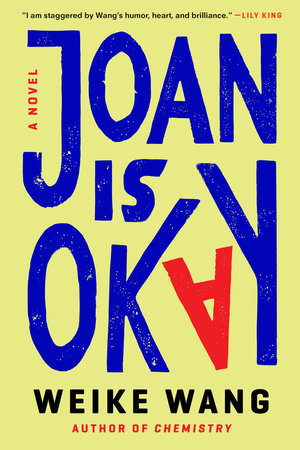
Weike Wang’s witty, moving new novel tells the story of Joan, a thirtysomething ICU doctor. The daughter of Chinese immigrants who have since returned to China, Joan is not only incredibly good at her job—she loves it, finding a deep sense of purpose in the long hours, grueling shifts, and day-to-day routine of her busy New York City hospital, despite her family’s attempts to shape her to their own expectations and worries that she is overworking herself.
When Joan’s father suddenly dies and her mother returns to America, Joan is shaken out of her comfort zone as she reckons with the sacrifices that her parents have made for her and her brother, the cost of migration, and the unbridgeable gulfs between families. Into this mix comes Mark, an overbearing white neighbor whose cast-off belongings begin finding their way into Joan’s apartment as he offers her unsolicited advice and recommendations. Joan wonders how to live life on her own terms and grapples with her unresolved grief, just as her hospital, her city, and the world are upended by the COVID-19 pandemic.
I spoke with Weike Wang over Zoom during the last days of 2021. We discussed the origins of Joan Is Okay, gendered double standards in the sciences and in the humanities, misconceptions around the model minority myth, and the drive to feel useful.
Gina Chung: How did you decide to incorporate the pandemic into Joan Is Okay?
Weike Wang: I had been writing a failed novel right at the end of Chemistry. It was about two friends, and I was tracking their trajectory from college onward. I was having a lot of trouble with the book, until one of the characters started to interest me a little bit more, and this character eventually morphed into Joan. I found that I was more interested in this doctor figure and thinking about the forces that created her. I just knew so many of these characters in real life. I came from a pretty intense STEM background; most of my friends are attendings now.
I had finished the novel in February 2020. Then obviously, stuff hit the fan, and my editor was like, “We have to have a discussion about this, and how you’d incorporate present-day events.” Given that I had created Joan as a pulmonary specialist, it just seemed like either a missed opportunity or like I would be making an intentional choice to exclude it, and I didn’t know if I wanted to do that. Realistically, it would make sense that she is engaged in this situation.
GC: While working on the book, did you learn anything about how doctors and nurses were coping with the pandemic that surprised you?
WW: It depends on how the person approaches medicine. If they approach medicine like a job, they’re almost clinically detached from it, because you have to be. My aunt’s a nurse, and she was dealing with some of this. Nurses are just more hands-on. They have to be there all the time. They’re seeing a lot of things that doctors don’t see. I imagine the burnout comes from physician assistants, nurse practitioners, nurses, residents, who are there doing the grunt work of what the doctors assign. But the actual attendings themselves are probably just trying to organize everything.
And then I had friends where their calling is medicine, so they just wanted to be on the frontlines. They really, really wanted to prove themselves. So I also saw some of that as well, this desire to be there because your utility cannot be denied. You are irrefutably useful, and that must be a good feeling. As a writer, I’m totally useless, in many ways. But to be totally useful, that’s somewhat of an ego-boosting feeling, and I think some people do enjoy that.
GC: Why do you think no one else in the book believes that Joan is mostly content with her life?
WW: I think when you make certain choices that other people wouldn’t make, there’s a sense of projection. One of the things about Joan is that she is so taken with medical training, and she’s so willing to be edited down at work, to be the most efficient worker that she can be. And that’s taken a lot of her personhood, and that’s true—when you go into medicine, you’re told you’re going to be standardized. She’s very good at that, and I think in doing that, she just closes the door to so much of her other choices. I think her neighbors, her coworkers, and certainly her family have this mantra of “You could have it all,” and as a result, be this “fuller person,” instead of maybe a person that’s pulled in multiple directions.
Joan has this admirable focus. She’s able to focus for a very long period of time, and be okay with it, whereas others, I think, can’t see themselves being happy with that choice and so assume that she must not be and say, “You must be like this because it was forced upon you, or because society told you that you had to be a model minority, or because of some terrible trauma.” I was trying to play with that a little bit, obviously playing with the cliches and tropes, but also playing with a character who could lean into this in a baffling way that could create some absurdism.
GC: A lot of the characters surrounding Joan are preoccupied with appearances. Her brother Fang and his wife Tami are very focused on the trappings of material success, while her neighbor Mark is obsessed with consuming the right kinds of media, having the right furniture, etc. What do you think that indicates about their worldviews, versus Joan’s?
WW: Joan needs rules. She loves the ICU because she has total control over this very, very small area of space, and that’s really all she needs. As long as she has control there, she doesn’t need to impose her will on everyone else. I think I wrote these characters because I’m also exploring this: why do some people have this deep desire to push their own sets of standards onto you? With the family, I get it, because you’re related. Fang is also older, so there’s this sense of “I need to take care of you. This is out of love,” but it’s very oppressive, because family is very oppressive.
If you’re an authority figure in the sciences and you’re too nice, they just think you’re soft. If you’re too mean, they just think you’re a bitch.
With Mark, it’s gendered, like maybe he’s mansplaining certain aspects of life. He sees how empty her apartment is, how emptiness must mean that she lacks any sort of personhood, and he finds that completely unacceptable. He feels that he’s doing this out of a sense of kindness, and he’s trying to save her. I was also trying to play with this sense of “distributing culture,” exploring who owns culture, who decides culture, the control of culture. I think I wrote this because I’ve experienced this, not coming from a background where I grew up watching Seinfeld and Friends every other day. If you’re watching different things, you’re told, “How could you not know this?” and that if you didn’t do so and so, you’re not a New Yorker, you’re not an American. Who decides these things? No one, actually.
GC: There are many insights in the book on the challenges that women face in the workplace, even in fields as seemingly “merit-based” as medicine. Joan is also seen as having certain advantages because she is a woman and a minority. Can you talk a bit about your own relationship to those challenges and assumptions, as someone who’s worked in the sciences and is now a writer?
WW: It’s very prevalent. Being told “You’re very ambitious” can be either a compliment or an insult for women. That’s true in the sciences, definitely. If you’re an authority figure in the sciences and you’re too nice, they just think you’re soft. If you’re too mean, they just think you’re a bitch. The standards are just not set for a certain type of personality, because they’re so defined by men. There’s this assumption that if you are choosing your job, you must not be choosing family, and that makes you a terrible person, because all women choose their family. Some of the measures of how good you are at a job are just defined by your hours of work, and I think that’s just quite black-and-white, and not inclusive.
In writing, I think, it is certainly gendered—like this sense of, “This is a female story,” or “This is about domestic issues,” or “This is not about ideas.” Ann Patchett even said she always gets asked why she doesn’t have children, and one time I think she asked this radio announcer if he would ask Jonathan Franzen this, because he doesn’t have children. Men are just able to be asked about their work, but if you ask women purely about their work, you have to factor in “They gave up on family,” and I don’t even know why that’s in that equation.
In terms of race, that’s almost a separate issue. You worry that, “Am I capitalizing on these identity issues, or are these things that just naturally make sense for the story?” I’ve gotten a lot of feedback questioning my success: “Did you get here because you were writing this at the right time, at the right moment?” instead of, “Maybe you just worked hard, and luck and timing matter, but you also have to work hard for something.” Having your success questioned is a bummer. It really is. But I do think that women get that so much. You always have to talk about what you gave up to achieve something.
GC: You also write about the racism and discrimination that Joan and her family experience in her childhood, as well as the anti-Asian violence that occurs during the pandemic. Can you talk about what writing about that felt like for you?
There’s this assumption that if you are choosing your job, you must not be choosing family, and that makes you a terrible person, because all women choose their family.
WW: It’s hard. The easy solution is to not write about it, to sweep it under the rug, which is, I think, how I personally and maybe people in my close community have actually dealt with racism—you just pretend it doesn’t exist, or you just take it as an inevitability. My choice to mention it in this setting was my first attempt to say, “This is a problem that she is actually dealing with.” She’s dealing with this weird stereotype “boost” at work, that she’s this great worker. It is very insidious. This compliment of “You’re such a good worker” can be pretty racist, in terms of deciding what she is and what she isn’t.
Asians represent—I just saw a statistic on the Association of American Medical Colleges (AAMC) website—23% of all upcoming residents, even though we’re like 5% of the population. We’re a force of the medical field. That’s huge. And to go to work and to hear what the virus was being called—you go into this field hoping that essentially erases your identity, which has its own kind of assimilation problems. I think there are subtle things at hospitals that doctors just think are normal, like you have to make sure to let them know that you speak English; if they really don’t want to be treated by an Asian doctor, you have to stand aside. So I knew I had to put that in here, just to question this path a little bit, of what we give up to achieve this jump.
GC: I found the book’s explorations of grief and trauma particularly poignant, in great part because of how understated they are. Much of Joan’s grief over her father’s death has to do with the things that were left unsaid between them. Was it your intention to keep that grief understated?
WW: Yes, a little bit. One of my favorite books in college was The Stranger. I really liked the idea of this death of the father catalyzing this apathetic person. Obviously Joan’s not a murderer, but I was interested in the idea of this one huge event that really starts to tear this character apart. Fang is grieving in his own way by trying to throw money at the problem, and Joan is just thinking, “My mother is here, I should go see her.” She’s trying to figure out how she feels with her dad gone, because they didn’t really talk that much. She might have only talked to her father once a year, every few months. Him being permanently gone—she doesn’t quite realize it, except as more time goes on, it does sink in. There are no more memories of him. There are just past memories of him. I think the more she starts thinking about these memories, the more it makes her think about, “What did my dad mean at that time? Why was he saying that? Why was he like this?” And that reflection makes her a little bit more self-aware.
GC: The book is also very funny, and there are a lot of discussions about humor and how culturally specific it is. For instance, in the scene where Mark throws a party for Joan in her apartment, her Korean neighbor says that she learned English by watching Friends, and that “you had to be funny in English. . . or else it was no go.” What is your own relationship to humor as a writer?
WW: That line was taken from my mother, when she first started watching television. American commercials always have this sense of humor to them, whereas Asian commercials just sell you the product in this very specific voice. My development of humor has mostly been a coping mechanism—if you can make someone laugh, they’ll like you better, or they won’t be so threatened by you. Given the background that I’ve had, I think people would think “You’re too intense, you’re too scary,” especially guys. Like, “You’re smarter than me.” That’s all true, maybe, but if you can make them laugh, they think you’re a real person.
My development of humor has mostly been a coping mechanism—if you can make someone laugh, they’ll like you better, or they won’t be so threatened by you.
One of the nicest things about learning to write was that humor was not something that I had to be taught, which was a relief, since writing humor is hard. Teaching how to write humor in workshop is almost impossible. When I first started writing, one of the reasons I got into it was because having the ability to be funny on the page was nice. I didn’t know I could be funny on the page. I didn’t know that people cared about writers who are funny on the page, because you want writing that has gravitas and ideas. There’s this sense that humor is a cheap shot, in writing. But humor makes so many things better. It adds lightness to the tragedy, otherwise there’s just no way to bear it.
GC: There’s also something so powerful in being funny as an Asian American woman—since people don’t expect you to be funny.
WW: They expect you to be sad. Or quiet and sad. Sure, you go through a lot of crap, but you can also laugh about some of it.
GC: How does it feel to have this book coming out now, in January 2022?
WW: I was like, “Well, what if it gets totally better? I guess it’ll just be a relic and be dated.” But I don’t know. It’s not March 2020, but there is still this fear. I don’t think this virus is going to go away, and I’m sort of despondent to say that I don’t think the borders of Asia are going to open anytime soon, so I think that we’re in a standstill, until something changes. Everybody’s in this depressed place, because the world’s just falling apart, world leaders kind of suck, and now we all have to be at home all the time again. And no one knows anything. I just feel like I’m being gaslighted. That’s just the perpetual feeling now, that “Is this real? Is this not real? I guess it’s real.”
GC: What do you hope readers will get from the book?
WW: I guess I hope that a reader will read a character like Joan and come to an understanding of what created her, but not have this judgment of “She’s definitely A, B, and C” the way her counselors are like, “She definitely needs to get diagnosed with something or be on this medication.” Or not compartmentalize her by saying, “She’s just this model minority” or “She’s just this blank slate,” and see a little bit of her interiority, and not just assume that when you see your doctor and they happen to be Asian, that they’re just this vacuum of feelings, like they have no emotional life, no landscape.
A “model minority” can be a myth, but it’s also a reality. If we never write about that kind of person, so many people disappear. I think about my parents, who worked really hard to get me here. They were model citizens, and I don’t think that I would have been able to do the luxury of writing—which is a complete privilege—if they didn’t do what they did, to give me that chance. If I don’t write about these characters, I’m also erasing them, and I’m pretending that they don’t exist when they do.
GC: I’m thinking now of a moment from your first book Chemistry, when the character is watching a cooking show and she sees a Chinese American contestant being praised by the judges for rebelling against her parents’ expectations by becoming a chef. For many Asian Americans, there’s this idea that you have to repudiate where you’ve come from to be successful. It feels like Joan is a response to that.
My parents were model citizens, and I don’t think that I would have been able to do the luxury of writing—which is a complete privilege—if they didn’t do what they did, to give me that chance.
WW: It’s something I think about a lot. I love the arts. I love the humanities. I love creating art. But sometimes being around writers is kind of strange. I love them, but sometimes there’s just this sense of impracticality with writing. It’s just such an inefficient system. I feel like I’m always straddling the middle place. I have no desire to write this character that’s a repudiation, because that in and of itself is a stereotype. That is defined by white marketing, I think—the dominant race marketing whatever they think “good Asian people” or “cool Asian people” are supposed to be. I don’t want it to be that tidy. I don’t want people to dismiss Joan—I want them to really stay with her and see how she’s managing this difficult year in her life.
GC: Lastly, what do you think Joan would make of where we are now, in terms of the pandemic, and do you think she’s okay?
WW: I think she is. She probably took on a lot of shifts. She was built for this. And I think because I modeled her after three of my closest friends, I’m thinking about how these three friends are doing, and they’re kind of thriving in certain ways, and obviously not thriving in other ways. I do think this is Joan’s moment. This is almost what she wanted, this continuous work, and no time off, and no thoughts about wellness. She would have loved it—not because it’s heroic, but because she’s thinking about utility, what she can do. And maybe during this time, no one’s asking her about getting married or having kids.
But obviously she’d be a little bit sad, since, if her mother left the States, and I do think she would have, I don’t think her mother would be coming back anytime soon. There’s a certain sense of loss in the family that she’s just now more aware of, not that she can do anything about it. She lost her mother before, when they went back. She’s just more aware of that absence now.
Time passes stunningly; perhaps never more so than in the last two years of the breakneck movement in global events, as well as the unending, stop-start pace of our collective anxiety and fear. Still even in normal years, you might wake up one day and find yourself past the age requirements for certain clubs, awards and/or lists. Maybe it’s 26 or 31. Perhaps it’s 46. Or 70. The literary world, much like the broader one, is obsessed with youth and genius, but everyone (if lucky) grows up (and arguably, writes way more textured books than they ever could at say, 22).
As someone who is deeply suspicious of peaking early and chronological age mandates, I was thrilled to discover these fully grown-up writers with thoughtful, diverse books out in early 2022. Their subjects are both fiction and nonfiction, and include outstanding women from other eras living well outside the society’s prescribed lines, difficult historical moments (Australia’s aboriginal family separation policy and World War II), and contemporary senior lives in Philadelphia and Covid-hit New York. Collectively, they’ve had careers in the literary world and out of it, some only got their literary starts well over the age of 30, and two are writing luminously in their eight and ninth decades! Age seems rather irrelevant and “it’s too late” might just be a fictional construct.
Sculptor, poet, and novelist Barbara Chase-Riboud has had a career that is mind-blowingly productive for just one lifetime. One of the first Black female artists to show work at the Whitney and subsequently showing at the world’s great museums, Chase-Riboud entered the literary world with a collection of poetry edited by Toni Morrison, and proceeded to win multiple awards. Her 1979 best-selling, first novel Sally Hemings came at a time when the relationship between Thomas Jefferson and Hemings was still officially unacknowledged.
Now 82-years-old, Chase-Riboud’s latest novel The Great Mrs. Elias is based on a true story of a Black businesswoman in early 1900s New York City, which feels so palpable and jumps off the novel’s pages. I am hoping that Chase-Riboud is working on a memoir of her own expansive, transatlantic, character-filled life.
A historian of the American West and in particular its criminal elements, John Boessenecker (68-years-old) narrates the story of Pearl Hart, who in 1899 robbed a stagecoach in Arizona, and became the most infamous woman in the country at the time. From her Tucson jail cell, she conducted interviews and crafted her image as “The Bandit Queen.” She smoked cigarettes, wrote poetry, knit, used morphine, and read books. In short, a total bad bitch of her time, when most women, with some exceptions, were rarely allowed outside the domestic sphere. In Wildcat, Boessenecker investigates the true stories behind the Hart myths, and offers a different portrait of the women of that era.
If you’re worrying about being too old (a trap, and a voluntary one!) for anything, least of all, writing, then take note that the now 91-year-old Hilma Wolitzer wrote her first story at 36 and published her first novel in her 40s. Since then she’s published a bookshelf of nine novels and one craft book. A self-proclaimed “late-blooming novelist,” Wolitzer also created a novelist—Meg Wolitzer.
This collection includes that very first published story—and a new one “The Great Escape” which has the pandemic as its main frame. In real life, Wolitzer recovered from the illness, but her husband did not. The story will probably crack your heart in multiple ways.
68-year-old Diane McKinney-Whetstone’s novels have charted Black Philadelphia lives from previous historical moments, but in her latest, she takes on the contemporary—and how to live now, beyond a certain age. Cynthia enters Our Gen (short for Sexagenarian), a retirement community where she becomes friends with two Black residents and an Indian woman. They hang out, smoke weed, dance and talk politics, as if they were back at their college dorms. McKinney-Whetstone takes on the coming of (older) age trope in a humorous fashion, and moves back and forth between different eras of the women’s lives. Figuring out how to grow up is apparently eternal.
In the rural Australian town of The White Girl by Tony Birch, Odette Brown tries to save her light-skinned granddaughter from the government’s forced family separation policy. It’s the 1960s and the policy would continue for another decade—in this time, Aboriginal Australians are not yet “recognized” as citizens. One of Australia’s leading contemporary literary voices, Birch, who is 64 and of Koorie descent, portrays the harshness of the time and intense racism experienced by the family in understated prose. An absolute (and unsettling regardless if you are unfamiliar with the country’s shameful recent past or not) page-turner, Birch’s novel, his third, gets its American debut in March. It was published in Australia in 2019 and bestowed multiple awards; read this review by Indigenous novelist Claire G. Coleman for an idea of the novel’s resonance there.
“A person who is able to measure life in journeys taken is a lucky one,” writes Marcia deSanctis in her collection of her global wanderings, which begins in early 1980s in Moscow, and proceeds to travel through France, Rwanda, New England, Cape Town, and elsewhere. An experienced news producer, de Sanctis did not publish her first essay till she was 50, and did so fabulously (and brutally and beautifully about her marriage surviving her infidelity) in Vogue and is part of this collection. Now in her early 60s, deSanctis meditates on travel and why we do it, but also the nature of staying home: “there are such enticing mysteries everywhere, even at home. The world is full of them.”
The Second World War and its traumas are the focus of 73-year-old Richard Overy’s Blood and Ruins. In it, the renowned British historian argues for a reconsideration of the narrative of the War in a more global frame to include the Asian and Pacific fronts, as well as, to view it as a war of many different civil conflicts. The “last imperial war” was seeded almost a century before, Overy writes. The why question—of why did it happen when it did—is treated engagingly, probably more so than most might recall from high school. A (refreshed) look back to another traumatic global moment could prove to be instructive—on how the War was viewed and re-seen, and perhaps, the different ways that we might view the stories of our current worldwide tumult.
In good towns, good houses mourn what dies
outside by closing windows.

Bullfrog caught in a mower black-red. Driveway
chalk gray-red. Tire-tracked doe red-red.

Under a sycamore my throat whirls from pity to
nausea. The suburban sky does nothing, sees less.

Another small chest deflates at the edge of my vision
before gas tank heaves & gut tries to follow.

The angel on my left shoulder finds something of
interest in the windshield blur of road then red,

body then blood. He bites my ear, pulls hard
my lashes. Look, he insists, where I point.

Where shells split. Where color leaks. Look, he
demands. My own palms spangled with crime.

He walks across my blades & drags a fleshy bone
behind him. In lurid dreams I resurrect them all,

or they refuse to leave, guilt dressed as clemency.
A frog or my fingers, the blade always a blade.

In good towns, good children collapse
snake holes, heel away ant hills for sport.

Above us, a grey-necked warbler shrieks & shrieks,
trills a humdrum dirge for these ordinary deaths.

I drive on, bound by time. He sings, knitted
to his perch on a telephone wire, eyes

fixed to each body I blur past, blooming car
after car like poppies on pool water, red.
Photo Op at Antelope Canyon
Where light passes through
Where light is most mercurial
Where light flees the ingress of deeper water
Where light works best on an iPhone, vivid warm
Where light, a certain slant of hibernal Light, oppresses
Where light praises the canyon of water-whipped stone
Where light fails to detect the mercury in nearby water
Where light leadens in my arms, a crowd forming Where
light, poisoned, rasps of the mercury in the water Where
light paints the evening wall & I take
          an expected photograph
Where light probes my polluted skin
Where light harbingers a kiss or cancer
Where light illumes the days of
          the dictator, actor, & poet
Where light or night triumphs
Where lighght
Where light boasts an illustrious vocabulary
Where light brightens the graves of those righteous
Where light flees from the mercury in the water
Where light comes to coax color from my eyes
Where light is a technology that allows looking
                    to control looking
What light shows me & I look away
Where the light of God is the same light that allowed mercury
          in the water
Where light, what light
          is liable

          —is light liable
          for mercury, the water?
          Before the light flees I take
          a photograph,
cluck, what a shame, all that mercury in the water.
I’ve noticed a trend on social media where readers (and writers) have said they don’t want to engage with pandemic fiction. As a writer who is releasing a book with a plague thread, I’ll be honest that I both understand these posts but am also deeply hurt by them. I understand this reaction because we are of course living in our own pandemic. Many of us (including myself) have had our own losses, have had to lock down and cautiously emerge only to lock down again, perhaps just as fearful of the actions of our fellow human beings as we are of contagion.
In the early days of Covid, I fell into a malaise—a combination of lack of sunlight, fear that a book I had worked on for over ten years might never be published, and, even for a somewhat introverted writer, coming to the realization that writing in a café, going to a movie, or even visiting family was not an option. And yet despite these realities and in the wake of welcome escapes like The Queen’s Gambit, The Tiger King, and a newfound hydroponic gardening hobby, I saw people re-reading novels like Station Eleven because, after all, a novel like that isn’t really about a virus but about people, community, and our capacity to dream. The process of selling How High We Go in the Dark helped me articulate that a good deal of pandemic and post-pandemic fiction (more than I realized) isn’t really about a virus, but about our emotional, societal, and cultural reaction to it—the way we come together (or not), how we continue to love, how we are forced to reimagine grief, how we hold onto hope and memory in the face of a changed world.
I started writing the seeds of How High We Go in the Darkpartly as a way for me to explore my own grief and lack of closure regarding the death of my grandfather in the early 2000s. Living in Japan at the time, I was fascinated by how an aging populace—in a country where technology and tradition rub elbows—was addressing issues of space and cost (and yes reimagining traditions) when it came to saying goodbye to loved ones. These funerary explorations organically evolved as plague and cosmic/speculative narratives were incorporated during the following years, thinking about the beating heart of franchises likeStar Trek and the humanistic messages of Carl Sagan. And while my novel was drafted pre-pandemic, I edited the novel in 2020 and 2021, faced with the realities of just how much a world altering event would is forcing us to reimagine our relationship with not only death and grief, but also how we choose to live.
While reading any kind of pandemic narrative might be difficult for some to varying degrees, there are so many books that never privilege the trigger or cause of trauma, but seek to enter into a dialogue with what comes after—How does grief become a part of our history? How do we as individuals and as a society use a difficult moment to reimagine our future? How does a pandemic act as a lens to inspect climate change, racism, and other important issues? These books aren’t beach reads or stories to be taken lightly. And they aren’t supposed to be. You’ll cry. You’ll think about your own past. You’ll think about how the human species navigates this planet in both beautiful and highly problematic ways.
The following novels all deal with a world changing event (a viral pandemic or something just as significant), but for all the background nods to cataclysm, these wildly inventive and deeply affecting stories ultimately focus on what it means to be human, what it means to be part of a community and the world at large. And in that way, perhaps pandemic and post-pandemic fiction, regardless of if you choose to engage with it now, is an important part of our journey as we move forward.
Like Blindness, Saramago entertains another world altering/inexplicable event. But instead of exploring humanity when something is taken away from them, Saramago plays with the idea of how an unnamed country might respond if everybody simply stopped dying. Ranging from financial consequences for hospitals and funerary homes to philosophical issues for religious leaders to the dilemmas of the elderly, the novel interrogates how important death is as a biological process and as a spiritual and philosophical concept in how we define humanity. But beyond this larger scale exploration is also another narrative of a personified Death who is undertaking this experiment, which takes up much of the latter part of the novel. Her own fascination and infatuation with a cellist who refuses to die once the deathless experiment ends allows for Death herself to experience humanity.
Imagine a fantastical affliction that didn’t make you ill, but laid bare whatever physical, emotional, or even spiritual malady you had through glowing light. This is the general premise of The Illuminations. The book is structured with independent sections each following another character, although a diary appears in all of them lending a loose overarching structure.
I debated about includingThe Brief Histories of the Dead here, but that seemed like a too obvious choice for this list, and I wanted to share the quiet beauty that shines through these pages. If you could see a co-workers secret illness glowing within them, how would you behave? What would you say (if anything)? What if you walked down the street and everybody’s heads were glowing b/c nearly everyone was dealing with some kind of depression? It is the acknowledgement of pain, the living with pain, the community of pain that makes the snapshots of lives in this collection of character studies resonate beyond the fantastical premise.
In a collapsed world where large segments of the population have lost their shadow (and with it their memories), war has emerged between those with shadows and the shadowless, who have also developed the ability to shift objects into weapons. Much of the novel focuses on an interracial couple, Max and Ory, simply trying to survive in this upturned world, with Max suddenly leaving when she loses her shadow, fearing herself to be a danger, and Ory searching for her. Unlike the first two entries in this list, Shepherd’s Book of M is less quiet (full of twists and apocalyptic tension) but this does not mean she sacrifices smart, layered (and notably diverse) character work that digs at what it means to live and hope when the world is spun into chaos. For fans of literary speculative thrillers like The Passage, Station Eleven, and Angelology.
Although there is a pandemic in this novel, the virus that has decimated large segments of the populace takes a backseat to the technological wonder of uploading your consciousness into artificial companions (everything from very robotic-like contraptions to models that could potentially replace you). The primary thread of the novel focuses on the companion, Lilac, as she ventures to find out who killed her in her real/original life. We soon meet other primary POV characters that help both Lilac and the worldbuilding of this future. As the pandemic subsides, questions of mortality are understandably present but the technology also raises questions about the fundamental nature of identity/self and humanity. Readers who liked Ishiguro’s Never Let Me Go and Klara and the Sun should check this out.
Set in a world six years after a devastating pandemic, the novel starts with three characters in a recovering San Francisco: a widowed father raising a daughter, a famous musician whose fame is kept under wraps, and a wedding planner. In this world, trauma and anxiety (Post Apocalyptic Stress Disorder) take center stage where people are not ready or willing to seek out new connections and form families to the degree that a Family Stability Board is created to protect a precious resource: children. When this Board threatens to take Sunny (the daughter) away from Rob (her father), hard truths about the past are revealed which leads Sunny to run away. The following journey of the book’s primary characters in search of Sunny provides a post-apocalyptic canvas for interrogating each character’s past and how they are moving through trauma through their newfound connections.
At times, I almost forgot there was a pandemic in this novel due to Van Den Berg’s beautifully written and layered exploration of life in a hospital ward. But this isn’t One Flew Over the Cuckoo’s Nest. The book is split in two primary parts: The first focuses on the life of Joy and the other “inmates”, members of an experiment, often ending in death, on those who appeared to be immune to an epidemic of memory loss. The second focuses on the protagonist’s escape from the hospital in search of a woman she thinks is her mother. Like much of Van Den Berg’s work, there is an ethereal, fabulist quality to Joy’s journey (and this is a novel that is happy to reside in the ether of belief). And although Joy herself has not been afflicted by the strange memory loss, her journey is about reclaiming an uncertain and coveted past (and future), breathing it into life through hope and story.
Okay, there’s not really a central pandemic here, but I need to include this one for the short story lovers. As the title promises, there are a lot of narratives (some more traditional in arc than others) in this book and each showcases the genre blurring and defying acrobatics of Corin. The first part of the book comprises of three short stories with the latter half being taken up by the aforementioned apocalypses. What I love about this book is that many of the apocalypses don’t fall within the realm of zombies or viruses or asteroid impacts but are entirely mundane. There are divorces and breakups and family losses (outside of a pandemic) that are juxtaposed with the more stereotypical (but often self-aware and intentional) images of the post-end times. Many readers might come to a collection like this thinking they’ll read out of order. I don’t trust or like those people. Read as a whole, Corin gives us a kaleidoscopic and compounding vision of how the world and people react when the chips are down that is often both funny and heart wrenching.
The ’90s are back, as if they could ever truly peace out. Between Fear Street and Captain Marvel and the Alanis Morissette musical, the last mostly-offline decade is getting a gargantuan nostalgia polish.
For my memoir Sticker—an exploration of my childhood in Charlottesville, Virginia via 20 stickers—I immersed myself in the sparkle of Lisa Frank binders, the whiff of clove cigarettes, and books by friends and kindred spirits. Queer authors in all genres—’90s kids or those who came of age in that era, who carried the detritus of a gritty analogue world into the seismic event that was the internet—are reflecting on this formative decade in brilliant recent and forthcoming works.
Here are 8 of my faves, because you can turn the number 8 on its side to make infinity, and the ’90s are 4ever.
This essential gay coming-of-age memoir—cataloguing everyone the author met from the internet from 1997-2009 —perfectly captures the flashpoint moment when AOL entered the lives of queer young people, opening the world in delightful and dangerous ways. Van Dyck’s epic in micro-meetups—thoroughly indexed by year, location, screenname—is an unflinching odyssey of sex, loss, and liberation.
A vital experimental novel, Milks’ queer/trans reimagining of ’90s YA is packed with nostalgia bombs, from Fiona Apple to The Babysitter’s Club to The Magic School Bus. Margaret unfolds via a bold range of forms—case files, gender theory, ghost stories—and vacillates between the surreal fun of middle school and the stark brutality of high school, deftly chronicling the protagonist’s bodily struggles.
This Pulitzer prize-winning meta-musical takes its title from the closing track of Liz Phair’s ’90s staple Exile in Guyville. In the same way that album used the structure of The Rollings Stones’ Exile on Main Street to dismantle the male-dominated rock star persona, Jackson’s protagonist—struggling writer-composer named Usher, gay and Black and from a conservative Christian family—threads his play-within-a-play with odes to his inner white girl—a mashup of the icons of his youth, like Phair—who helps him find catharsis.
Equal parts true crime narrative and survivor memoir, this harrowing hybrid is awash in the attitude, the rage, the defiance of the era, all linked to Gurba’s formative experiences as a mixed-race queer Chicana in California. A rallying cry for meanness as defense against a homophobic, misogynist world, voiced by one of the most riveting prose stylists of our time.
Jenny Johnson is a writer and teacher to whom I owe an immense debt of gratitude, who at the tail end of the ’90s introduced teen me to queer theory, Sadie Benning, and the Velvet Underground at the UVA Young Writers’ Workshop. A prescient poetry collection, In Full Velvet assembles an alternate ecology of desire and queer formations, dappled with evocative early memories of difference. Celebrations of endless variance in animals and odes to gay elders give this canon-worthy sequence the rich texture of timelessness, and crystalized scene-poems like “There Are New Worlds” and “Ladies’ Arm Wrestling Match at the Blue Moon Diner” capture tiny, infinite moments.
A powerful organ gets a powerful exploration in Hall’s bullet-point nonfictional cacophony. Embedded throughout the graphic and gratifying clitoral history, science, and theory are fragments of Hall’s isolated rural upbringing and metropolitan adulthood, vivid ruminations on sexuality and the body, pain and pleasure intersecting and laid bare. An exhaustive-yet-all-too-brief wonder of a book-length essay.
The warring privilege and precarity of Madden’s childhood in Boca Raton (“the rat’s mouth”), Florida glitter in her skillful authorial hands. Late ’90s hallmarks—the celebs, the products—become closely tied to queer kid awakenings and traumas, all presented with transcendent honesty and rapturous style. The epic third part “Tell the Women I’m Lonely” spans eras of deep secrets, and what unfolds is a striking family saga, as layered and revelatory as any classic novel.
Conklin is a true virtuoso of fiction, showcasing a brand of humorous and always surprising realism all their own in this deep and rewarding debut collection. In the mix are youthful ’90s gems like the title story, in which two teens arrange a meetup with one’s adult lesbian AIM crush, and “Pioneer,” a sharp exploration of trans identity, as a 5th-grader refuses to conform to an assigned gender role while reenacting the Oregon Trail, instead choosing to play an ox, and to survive.
A little over a year ago, I was working as a cocktail server at a gay bar in Hell’s Kitchen, putting my MFA to good use by writing what I could on my cell phone between rushes. One night, I had an idea for a story and dashed into a bathroom stall to jot down some quick notes. Once inside, I saw I had a new WhatsApp message from my mom. Apparently, she’d been watching late-night TV and this ad came on she thought I might be interested in: one of those companies my professors had warned me about that tries to convince writers to pay them thousands of dollars to publish their book.
For a long time, I kept large parts of my life hidden from my mom. After I came out to her in high school, she’d reacted in unpredictable ways. At times, she was seemingly accepting, playing Madonna around the house or patting the empty seat next to her on the couch so we could watch Ellen. But there were other moments when I was certain she thought I was a monster: the afternoon she tackled my locked bedroom door after looking through my phone and finding a photo of me taken with a drag queen. Or the day she stopped me as I left the house to go out with friends and warned me not to get AIDS. As a teenager, I felt safer, and easier to love, when I withheld anything that might trigger her anger. Essentially that meant avoiding all personal details that would remind her I was gay. I didn’t talk to her about my confusing relationship to gender, about boyfriends, or even about my regular friends, who were mostly queer.
But now that we weren’t under the same roof and she had no control over how I lived my life, as a test I’d begun to share little things about what I was up to, including that I was writing a memoir. She might not have known much about the publishing industry (like that it’s usually the publisher who pays the writer, not the other way around), yet standing in the bathroom stall at the gay bar, reading her WhatsApp message, I felt the kind of support I’d always wanted from her. Could it really be this easy? I wondered. I imagined us as a perfect sitcom family, sitting together at the dinner table, asking her advice about crushes, my career ….
Just as quickly, another thought brought that fantasy crashing down. Thank you, I messaged her back in Spanish, but I gave up on the book. I’m thinking of trying teaching. At work. Call you tomorrow!
I didn’t. Instead, I waited for a week to pass before dialing her number, hoping it would be enough time for her to forget the publishing ad, and the memoir I’d foolishly told her I was writing, and every memory she still carried with her of me begging her to drive us to the library as a kid.
In Manhattan, I carried trays of whiskey sours over my head while dodging messy, heartbroken twinks flailing their arms to Dua Lipa.
My mom worked as a barista at the Orlando airport Starbucks. In Manhattan, I carried trays of whiskey sours over my head while dodging messy, heartbroken twinks flailing their arms to Dua Lipa. Despite the obvious differences, my mom’s life and mine are quite alike: we served expensive drinks to people on vacation. I suspect that when I shared with her my plan to give up writing, my first love, all of the dreams she’d had to give up because of money flashed through her mind: doing hair, opening a Nicaraguan restaurant, traveling—her job at the airport a constant reminder of how little of the world she’s gotten to see. I suspect this because, ever since I told her I was through with the book, she’s done anything but forget. Several times a month, she calls to ask me if I’m writing anything new. When I say no, she says, But you’re the artist in the family! I remember when you were little you were always reading. You have to follow your dreams. And, when you’re rich, you can buy your mama a Jaguar.
I try my best to change the subject. How’s the garden going? You ready for hurricane season? What’d you have for breakfast? Anything to avoid telling her my dreams have already come true.
Not long before I started working at the gay bar, I sent my memoir, High-Risk Homosexual, to a literary agent, who agreed to represent me. The title was meant to be ironic, a phrase I’d borrowed from the doctor who diagnosed me a high-risk homosexual when I asked to be put on PrEP, a medication that reduces your risk of HIV infection. After the pandemic hit New York and I lost my job, I realized how risky my life had actually become: I was unemployed, on Medicaid, unsure how I was going to support myself, or my mom if I had to, because she also lost her job. We were in quarantine, under curfew. Every day I woke up to the sound of ambulances carrying COVID victims to the hospital and fell asleep listening to police helicopters circling the sky.
With an unexpected amount of free time, I threw myself into editing my book, burying my anxiety under the hope that once it sold, I’d have some level of financial security. When I had a solid draft ready, my agent sent it around to some publishers. One by one the rejections started pouring in. I sat alone in my cramped Brooklyn bedroom laughing despairingly as I read about the six-figure book deal a white woman had gotten for writing a novel about Mexican cartels, at the thought that I’d ever be successful, at how silly my dreams were. And then I got an email from my agent: SOFT SKULL LIKES YOUR BOOK! The following week, I signed a publishing deal with an independent press. My advance was hardly enough to buy my mom a Jaguar, but it’s kept my fridge stocked throughout the pandemic. Suddenly my life was slightly less risky.
I’ve wanted this from the moment I discovered being a writer was even a thing. My mom might want it for me even more. The trouble is: I don’t know how to share the news.
My advance was hardly enough to buy my mom a Jaguar, but it’s kept my fridge stocked throughout the pandemic.
Although her message about the publishing ad sent me into a panic, it also reminded me how far I’d come as a writer, even if I paid most of my bills cocktail serving. Throughout graduate school, despite being confident in my abilities and knowing I had a good story, I’d always been skeptical about my memoir selling. I’d had the statistics about what books get published shoved down my throat enough to know it’s rarely the coming-of-age story about a queer child of a Central American immigrant. Strangely, it was those statistics that kept me going. While writing my memoir—in particular the chapters that deal with family—I didn’t feel inhibited by how they might react to the book, because I figured no publisher would ever buy it.
Reading my mom’s message, it occurred to me that I didn’t need to piece together thousands of dollars to get my memoir out in the world through a company that aired ads between episodes of Telemundo novelas. By then, I had an agent. She’d read and liked my book! She had a fancy office in Manhattan because she was good at selling books! Maybe my memoir would sell, I thought. I might really become a published writer. Yet any validation that might have brought me didn’t last, because it meant my book might actually find its way into my mother’s hands.
There are certain things my family doesn’t talk to anyone but God about. We keep our problems within the walls of our house. Perhaps that’s in response to the narratives that are pushed on us as immigrants, as Latinx people, as the working poor. The world demands our suffering, so we smile. Even amongst ourselves, admitting that anything is wrong is out of the question. Should I foolishly bring up trauma, my mom will quickly let me know I’m confused: The only mistake she made raising me, she’ll say, was when she put too much salt in the empanadas for Christmas.
My book is not sad. My mom is not a villain. But I am honest about the complicated journey we shared regarding my life and my queerness. Part of the reason I wrote this book was to untangle the messiness of my upbringing and give meaning to the memories that haunt me. I’m done crying over the past. It’s time to move on. I don’t believe writing is therapy, but spending hours attempting to understand why people did what they did, their motivations, and how they impacted me, helped me reach a place of acceptance and forgiveness. I dedicated my book to my mom because writing it reminded me why I love her and want her to be a part of my life. Maybe if I hadn’t, I would still be angry about the day she tackled my bedroom door. Maybe I would still resent that, after the shooting at Pulse Nightclub a half hour drive from our house in Orlando, the only thing she asked me is if I’d seen the news, as if my universe hadn’t just imploded. Writing my memoir, while not a substitute for therapy, helped heal our relationship.
Part of the reason I wrote this book was to untangle the messiness of my upbringing and give meaning to the memories that haunt me.
I’ve always been purposefully vague with my family about my writing. They’re not big readers, and even if they were, they would read in Spanish, and they likely wouldn’t pick up a memoir. Compared to poetry and fiction, in Latin America, memoir isn’t a hugely popular genre. The combination of those things and my not believing I’d ever get published allowed me to write freely in graduate school without worrying that I’d ever have to deal with the repercussions.
I didn’t wonder if my family seeing themselves reflected through my eyes would put a strain on our already complicated relationships, or if they’d take my attempt to discuss the afflictions that plague many Latinx folk—homophobia, machismo, addiction, violence—as a betrayal. I didn’t wonder, to put it simply, if my uncles or my brother or my mom would be mad at me. And if so, would they forgive me for telling strangers our business? Or would they ice me out like they did when I came out at 16? Over a decade later, there are still relatives who don’t speak to me beyond the obligatory hello at family gatherings, others who constantly tell me I’m in their prayers. It took years for me to learn how to navigate conversations about my queerness with my family. Would my book reopen old wounds and force us to start from scratch?
While I was getting my MFA, the problem of writing about people you know came up often in my memoir classes. If they did something bad to me, I should at least be able to write about it, a classmate of mine once said regarding a story she was working on about sexual assault. A woman who was going through a divorce worried that her memoir would be used against her in a custody battle. I can’t do that, she countered. I could lose my kids. Don’t ever let anyone tell you what you can and can’t write about, another chimed in.
Everyone had an opinion: Always try to find one good thing to say. Change their descriptions a bit and just deny it’s them. You have to ask yourself if writing the story is worth sacrificing the relationship.
Writing the story is what helped me rebuild those relationships, and now having it published might put them in jeopardy again.
I listened with interest, but these conversations always seemed irrelevant to me. I could write whatever I wanted because what I wrote wouldn’t end up anywhere. The moment my book sold, I realized how wrong I had been, and worse, that it was too late to ask myself whether the story was worth sacrificing the relationship. Even if I had asked myself that, there was the added catch-22: Writing the story is what helped me rebuild those relationships, and now having it published might put them in jeopardy again.
Terrified after reading her WhatsApp message about the publishing ad, I did the only thing I could think to do. I told my mom I was quitting writing to pursue teaching. Maybe she wouldn’t Google me. Or walk into a bookstore and see my name on a bright, beautiful cover with the words HIGH-RISK HOMOSEXUAL. Maybe I could publish my memoir in secret. Perhaps I still can, but a side-effect I didn’t expect is that instead of letting the subject go, she’s only become more supportive. It breaks my heart, because whenever she writes me a message asking if I’m doing okay, I want to be able to tell her: Guess what? I did it! I made it. You don’t have to worry about me going hungry anymore. I want to tell her: I wrote about our lives, Mom, and yes, there are some things in this book you might not like, but there is also so much tenderness, like how after you kicked down my door that day and I thought you would kill me for being gay, you climbed into my bed and told me you loved me, te quiero, perdóname.
I want to say: I didn’t write this book to hurt you. I wrote it because I didn’t know what else to do with my hurt. I wrote it because I love you, too. La quiero más. Perdóneme.
I want to say: I didn’t write this book to hurt you. I wrote it because I didn’t know what else to do with my hurt.
I’ve made my career out of words, but right now it feels impossible to speak them. One day, I hope I’ll have the courage to take her to a bookstore, open my memoir to the dedication page, run my finger down to her name, and say: Look, mami, here you are. At the very front. For you.
Until then, I have to think about what’s best for me. My mom had to set her dreams aside because of money, to feed our family. Am I going to set aside my dreams for her, for anyone?
If I could go back and give my teenage self a piece of advice, it would be to wait to come out of the closet until I’d reached a place of safety and didn’t have to depend on my family’s support. I can’t change the past, but I can follow the same advice now: I lost my family once for being gay. I want to wait a little longer before I risk losing them for writing about it.
Gwen Kirby’s collection Shit Cassandra Saw is structured around a handful of women lost to the annals of history, with a modern twist added. There are ancient warrior queens turned contract hitters, cross-dressing pirates, and lady duellists in a Seurat-like tableau.
Like its cursed prophetess namesake, Kirby’s collection is obsessed with the act of seeing as witnessing, but also how the narratives of history obscure the people trapped within it. In most cases, history and the structures it seeds shun those who choose to live beyond its borders, like women hanged for witchcraft or adulterous professors haunted by dead preachers.
And in the case of these unruly women, all dead, do they exist if they remain unrecorded by history? For Kirby, the answer is yes.
The collection’s electrifying opener is instructive: Cassandra offers a rambling list that starts with lightbulbs and washing machines before peeling off into hilarious, bittersweet spite. The Trojans who damned Cassandra are nearly an afterthought—she remains with us to the end. Dead but holding onto the last word, even if it belongs to no one but herself.
What you need to know about Kirby is that she’s deeply invested in hope. That might not be obvious if you only have the title of her debut collection to go on, but look closely and it’s right there in the marrow.
Sometimes, Kirby’s brand of hope looks like teenage potential of the female variety: in “Casper,” summer swelters with theft and convenient but transient friendship, while the protagonist of “The Disneyland of Mexico” yearns for love in all the wrong places. Other times, it’s the gritted determination to endure a baseball game to the end, embodied in the players of “Mt Adams at Mar Vista.” And, often, hope is a rage hot enough to burn a city to the ground.
As 2021 drew to a close, Kirby and I talked over video call about the ways in which women use narrative to reclaim their inner lives, the limits and propulsive power of form, and her ambivalent love for young teenage girlhood.
Samantha Cheh: Aside from the obvious stuff, do you think much has changed for women since Cassandra’s time?
Gwen Kirby: I think not as much as changed as one might wish, or as much as we would like to tell ourselves that they have—while at the same time recognizing how much they’ve changed and how grateful I am for all the ways that they have changed.
I think the story“Shit Cassandra Saw”is really trying to get at that. There’s so many things now, like vibrators and washing machines, all this great stuff—but at the same time, so much still has to be done. A lot of the stories in my collection are contemporary stories about women who are still angry and frustrated, who are still taken advantage of and not allowed to be themselves.
When I wrote “Shit Cassandra Saw,” it was right after the 2016 election. I just sort of let it rip. I let myself play with a historical figure in a way that I never had the confidence to do before, but I started to realize that I was so hungry for stories about women in the past. For women in the past who were like me: angry, funny—just normal people.
SC: I love how the women talk to each other across history. You chose to write about less obvious figures from history. I mean, Cassandra is one and maybe Boudicca, but Gwen Ellis Ferch? That’s pretty left field.
GK: I wish I could say I did all this research and whatever, but I just love history so I try to constantly expose myself to it. I was listening to this podcast where they talked about the first woman hanged for witchcraft in Wales was named Gwen and I was like holy shit! I have this little folder full of women from history, fighting pirates and things. I felt like the historical spine could kind of hold the collection together in a way that it had been missing before. I could lean into my own playfulness, passions and enthusiasms.
SC: It’s really interesting the way in which these women have this deep wisdom, but it’s a wisdom that they know has no place in the world that they inhabit.
GK: I really wanted the book to feel like I had opened up a space for that wisdom. Before, no one was asking that Welsh prostitute what she thought of the world, or how she felt about how men treat her. I just wanted the book to be my own little world for them to speak.
SC: You allow these women to narrate these inner selves within the story, but there’s no impulse to share or explain them to the other characters in the world. Cassandra sees all these things she doesn’t bother to tell the Trojans; Boudicca has this unstated wish to be a man, while Gwen Ellis Ferch has this rich inner life that she keeps secret from her mother and the world.
GK: I don’t think it’s that they didn’t want to share their thoughts and feelings, but there’s a certain feeling with all of them that you would have to earn that from them—and the people around them haven’t earned it yet.
SC: Your characters wield significant control over their stories and their anger, but it’s hard to ignore the fact that most of these women can’t escape death in their stories—Nakano dead from gunshot; Gwen Ellis Ferch hanging at the end of a rope. Even as she describes it as a glorious fight, Mary Read still dies in childbirth. History can’t seem to change.
You can be as empowered, angry or self-aware as you want, but you are still a part of the world. Your choices are still circumscribed—not just by our future but by being alive.
GK: I think that all of those stories get at a melancholy truth, which is that even as these women own themselves, they’re not independent of history. They’re not independent of society. As much as I feel that you can be as empowered, angry or self-aware as you want, but you are still a part of the world. Your choices are still circumscribed—not just by our future but by being alive.
The paths narrow before you as you go through life and there is a kind of sadness but also strength in that they are owning their own lives. In telling their own stories, they are liberated from them. I talk about women so much with this book, but I think that feeling that all the paths behind you have closed is very universal.
SC: Oddly enough, the few men who are in the stories are also trapped by the form and structure of your stories, especially in the hermit crab pieces.
GK: I really enjoy writing stories that feel like they circle back on themselves and accrue meaning, which flash can do really nicely and quickly. You set up this structure that is like a little tiny watch—Boudicca goes up to bat three times and it accrues; or Cassandra just lists objects and it accrues by itself. I like how tightly wound those stories are. They can capture a single moment in a story.
The other thing is I love watching form pushed to its limits and fall apart, like a character starts out retiling a bathroom or writing a Yelp review and it just spirals out of control. That feeling of pressure that lives inside all of us—pushing up against the self and form—that’s pretty central in all the stories.
SC: I defo see it in “A Scene in A Public Park at Dawn” where you have this high octane duel with big emotions and guns going off, but it’s also very tightly controlled. Everything seems choreographed.
GK: I just feel like that’s what life is like. You look at the insane the way the world is right now—how frickin’ hard everything is—but we still move through the world in all of these prescribed forms. We go do our jobs and act a certain way. We act a certain way in our marriages, towards our parents, even as it can feel like everything is falling apart.
In “Scene”, there are all these emotions that are chaotic internally but they’re also going through this dance that’s been choreographed for centuries that allows them to express anger. It’s an outlet and a constraint. I feel that way about form but also life.
Some days, it’s absolutely, freaking maddening to have to go to work while the planet is burning and there are fascists everywhere—but also, thank God I have to go to work! Because if I just sat at home, I would lose my mind. There’s that tension in a lot of my stories between the comfort that form and ritual can give us, and also how much we can feel trapped in that—how much we are trapped in that.
SC: Sort of how your young teenage girls in “Casper” have jobs and shared experience to give structure to the shapelessness of summer, but also the individual wants and desires they never speak aloud.
GK: Yeah, those three girls weren’t together because they were destined to be best friends—it was just sort of a quirk of fate in this small town, for this summer. And they’re also so, so afraid of the things they’re learning about themselves. There are things they really want from one another, but don’t want to have to admit to because to admit that you want a friend or love or someone to like you—it’s to expose themselves in ways that they maybe don’t really have the maturity to do. Or maybe they see that they’re not each other’s right confidant.
SC: Your affection for young teen girls is palpable throughout your work, especially in “The Disneyland of Mexico.” You deal so tenderly with the very specific experience of growing up uncertain of who you should be—not just as a young adult but a female one.
GK: I think those stories are me working and thinking through what my own young adulthood was like. As someone who developed a woman’s body long before she was one, you get this feeling that suddenly you are something to the world that you are not to yourself. Something that you’re not ready to be yet. That was a time that I felt like I had a lot of cognitive dissonance: I wanted so badly to be grown up and the world was treating me that way, but at the same time, I was 12.
You look at the insane the way the world is right now—how frickin’ hard everything is—but we still move through the world in all of these prescribed forms.
I have a very vivid memory of just turning 15, and I was sitting outside after driving training and this group of men just came over and—under the guise of flirting—wouldn’t leave me alone. I was definitely scared, but it’s weird because I was also flattered.. Which is, you know, ridiculous but I wanted to be a woman and I was not. I remember wanting to reach towards the next thing and being really scared and unsure of what that even meant.
I’m fascinated by coming of age stories about girls and the way in which our bodies are changing. Our ambitions are changing. That’s maybe when we first start to really hit some of the hard and fast expectations about womanhood. There’s something kind of pure, wonderful and fascinating and messy about that time of life. I think it’s just really good fodder for stories.
SC: In stories like “Disneyland,” “Mt Adams at Mar Vista” and “We Handle It,” what is very clear is the resilience that young girls have in face of very difficult scenarios. I think it’s a resilience that is very particular to the female experience.
GK: I think those girls at that time in their lives have something of the cynicism that we acquire as we go—or at least, they pretend to wear it. But I also feel like at that age especially, when you see something that’s not right, it’s followed by a desire to change it. There’s this feeling of hope and possibility and potential in the face of the world, which I think is just also a feature of being young,
All of those stories also speak to the way in which teenage girls and women are there for each other—the way in which those friendships are where we find that resilience and hope. We get to have relationships that help us, especially in times like teenagerhood when we’re lost. I do think that’s one of the ways in which patriarchy is worse to men.
SC: There’s a very deep hopefulness and those stories. I always feel that lit fic about young women tends to be characterized by a very deep sense of unhappiness—but there’s so much tender hope in the way that you approach those kinds of moments.
GK: I’m full of tender hope! But there’s a lot to be said for knowledge, as well. When you’re growing up, there’s things about that that are lost forever, but there are also beautiful things that you gain. I’m a hopeful person and when I write, I want that for my characters too, even when they go through things that are hard. That’s how I live with feeling angry and still avoid becoming embittered.
DON’T MISS OUT
Sign up for our newsletter to get submission announcements and stay on top of our best work.
YOUR INBOX IS LIT
Enjoy strange, diverting work from The Commuter on Mondays, absorbing fiction from Recommended Reading on Wednesdays, and a roundup of our best work of the week on Fridays. Personalize your subscription preferences here.