It was February of 2014. I had recently finished my debut novel,I Love You More, which would be published that summer. I was in the early phase of formulating a new novel in my head, a shadowy and jumbled process. I kept seeing a mother and daughter on the run from a phantom man, but they felt more like fugitives than mere runners, two innocent souls that through no fault of their own needed to hide or fade from life to survive. As both a writer and artist, I knew of the little-known art term fugitive pigment, paint that fades over time due to light and atmospheric conditions. I was feeling that this term might define their experience. But I wasn’t certain.
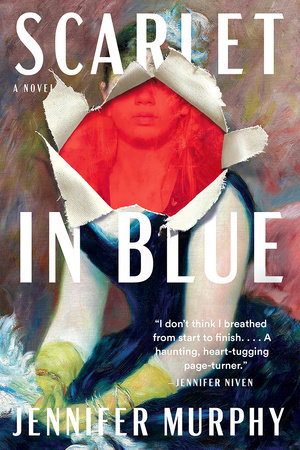
At The Chicago Art Institute, while strolling through works by Van Gogh and Matisse and Seurat, I came across an ancillary exhibit entitled Renoir’s True Colors. The exhibit featured duplicate paintings of Pierre Auguste Renoir’s Madame Léon Clapisson. The canvas to my left was noted as the original painted by Renoir in 1883. The one to the right was a digitized reproduction. I was struck by how much brighter the reproduction was. Confused, I began reading the explanation of the exhibit displayed on the wall. When removing the canvas from its frame to clean it, conservators discovered that the painting had significantly faded over time as a result of the artist’s use of fugitive pigments. A few months later, my new novel,Scarlet In Blue, began to take shape.
There is a long tradition of writers exploring art in literature. Why they choose art as a focus is different for each of them. But based on my findings and the ten novels I’ve included below (in publication order), there are also similarities. For readers, there is a hint of synchronicity in these novels, a feeling that we’ve happened upon them for a reason. There is also an eerie fascination, a hope that we will be entering a world that is exotic, that offers the voyeur in us an opportunity to safely watch characters engage in situations that are both beautiful and dangerous. But mostly, these novels do what art itself does best. They intrigue. They seduce. They grab our attention and pull us inside.
Laura Hunt, a successful and alluring young advertising professional, and femme fatale, has been murdered, shot when she answered the door to her apartment. Set in the sophisticated world of New York journalism, the novel has been described as both a detective story and a love story. Told in alternating viewpoints, it begins with the first-person narration of Waldo Lydecker, a prominent journalist and friend of Laura’s, followed by Detective Mark Mcpherson, and then two witnesses. During the investigation, McPherson becomes obsessed with a painted portrait of Laura, falling prey to her wiles even in death. Critics praised the story’s surprising twist ending, and Caspary’s use of multiple perspectives as a device to create unreliable narration. And many, including me, were most drawn to Caspary’s use of a painting to seduce McPherson, and thus readers.
Cat’s Eye tells the story of Elaine Risley, a fictional painter, who returns to her home in Toronto, Canada for a retrospective exhibit. The novel’s title comes from a cat’s eye marble, a special possession Elaine kept from her childhood of playing marbles with her brother. The cat’s eye is a continued motif in her paintings, and she isn’t sure why. Soon after her return to Toronto, lost memories begin to surface of a girl named Cordelia who led a group of girls that treated Elaine cruelly. In honest and elegant prose, Atwood probes the psychological ramifications of bullying on Elaine’s life, from her childhood through her successful painting career, but also, in true Atwood form, uses fiction to deliver timely social commentary. I am a huge Margaret Atwood fan, and this novel doesn’t disappoint.
Girl with a Pearl Earring is a historical novel about the Dutch painter Johannes Vermeer, and his painting of the same name. In 1664, following an accident that leaves her father blind, 16-year-old Griet leaves her family home to earn money as a maid in Vermeer’s household. Griet becomes increasingly interested in Vermeer’s paintings and begins mixing and grinding his pigments. Griet soon finds herself mingling with Vermeer’s wealthy patrons… with no way to escape given her status. Chevalier’s reimagining of the story behind Vermeer’s most recognizable painting is a joy to read and offers a look into the art and social structures of the Baroque period.
Winner of the 2013 Pulitzer Prize for Fiction, The Goldfinch is primarily a coming-of-age story about 13-year-old Theodore Decker whose mother is killed in a terrorist bombing at the Metropolitan Museum of Art, which he survives. Just prior to the bombing, he was fixated on an old man and red-headed girl. On his way out, he comes across the old man, who is dying in the rubble. The man gives him a ring he is to give to a man named Hobie, and points toward The Goldfinch painting, prompting Theo to grab it on the way out. We follow Theo in the years following the bombing, and the hidden theft, which weighs on him more and more heavily as the years go by. Tart’s novel is a complex examination of how tragedy and loss, and one painting, effected the trajectory of a boy’s life.
Peter Heller tells the story of successful fictional painter Jim Stegner, whose life takes a turn when he shoots a man in a bar for making lewd comments about his daughter, a scene which he later paints in an “explosion of colors.” His marriage has also ended. He leaves New Mexico and starts a fresh life in Colorado where he attempts to lose himself in his paintings and fishing. Heller does an amazing job of using his protagonist’s paintings to reflect the violence of his life. The prose has a clean, hard-boiled detective edge to it, instilling the novel with mystery and urgency.
Station Eleven chronicles the effects of a pandemic on the world. The story begins with the death of a famous actor named Arthur Leander who has a heart attack on stage during a production of King Lear. Shortly after the play, a deadly flu ravages the entire globe, killing almost everyone. Fifteen years later, we follow a group of traveling Shakespearian actors, performing around Lake Michigan in the aftermath. The groups’ motto is a line from Star Trek: “Because survival is insufficient.”
Mandel weaves together several seemingly disparate story lines, each with their own cast of characters. While the entire journey is compelling, what I find most extraordinary about this novel is Mandel’s assertion that in a time of unimaginable destruction and loss, it is art that ultimately restores hope.
Tripp reimagines the relationship between actual painter Georgia O’Keefe and photographer Alfred Stieglitz. Tripp’s imaginings feel so real that I—a painter and student of art history, who is familiar with the affair between O’Keefe and Stieglitz—believed, or at least wanted to believe, it all to be true. An author’s note prefaces the novel, explaining the detailed research Tripp did in portraying the artists’ relationship and lives. The second paragraph of the novel reads, “This is not a love story. If it were, we would have the same story. But he has his, and I have mine.” These words set the tone for the relationship itself: the initial attraction between O’Keefe and Stieglitz, their passion and turbulence, and their lifelong affair. And along the way, through sheer grit and undeniable talent, Georgia O’Keefe becomes a strong, independent woman and renowned artist. This story and its authoritative prose at times left me breathless.
The story begins with a house on fire. The house belongs to the Richardson family. The year is 1997. They live in Shaker Heights, an actual neighborhood in Ohio, chosen by Ng because, as Cosmopolitan magazine said (in a quote Ng uses in the book), it is “utopia,” and its residents are well-to-do and “happy.” The story backtracks to a time before the fire. A photographic artist named Mia Warren and her daughter, Pearl, are moving into a rental property owned by the Richardsons. We learn that Mia and Pearl move a lot, for inspiration.
Before long, the Warrens and Richardsons become intertwined in each other’s lives, which leads to strained relations. Tensions escalate when friends of the Richardsons attempt to adopt a Chinese baby that belongs to a friend of Mia’s. And all the while Mia is keeping a big secret. Ng’s characters are so well drawn, we believe they could be our neighbors, and her story of a community divided by opposing beliefs is both heartbreaking and timely.
Hummel introduces us to the L.A. art scene and fictional, avant-garde feminist icon Kim Lord, whose new exhibit features compelling and disturbing self-portraits of herself as famous murdered women such as the Black Dahlia, Chandra Levy, and Nicole Brown Simpson. All of L.A. is abuzz with the exhibit’s opening and Hummel’s appearance. But the artist doesn’t show.
The story is told in first person through the eyes of Maggie Richter, who works at the financially struggling Rocque Museum where the exhibition is taking place. What follows is an engaging whodunnit-type mystery surrounding Lord’s disappearance, a commentary on society’s attraction to violence, and the money and secrets inherent in the art industry.
Hummel tells a convincing story of the L.A. art world, grounding it with references to actual famous artists and their art styles. Her bio indicates that she worked as a writer and editor at the Los Angeles Museum of Contemporary Art.
Alicia Berenson is a painter, who generally takes painstaking time sketching the images in her paintings beforehand. Out of nowhere, at least that’s how it appears, Alecia brutally murders her husband. Alecia is silent when the police arrive on the scene and doesn’t speak thereafter. She is sentenced to a mental institution where her paintings become more expressive and spontaneous.
Over time the initial sensationalism and interest in the crime fades. But forensic psychotherapist, Theo Faber, remains fascinated by both the crime and the woman. When a position becomes available at the institution where Alecia was sent, Theo applies for the job. The story is told in first person through Theo’s eyes, interspersed with diary entries Alecia made before the murder. The Silent Patient is a compelling account of violence and obsession with a surprising and memorable twist ending.
In Sensorium by Tanaïs is, at once, a sensuous and gut-wrenching experience in expansive memoir that bleeds across genre and time. Using perfume as a framework, Tanaïs builds the work slowly, moving from the base to the heart to the head notes, recounting alienation and life on the margins as a Brown Muslim growing up in pre- and post- 9/11 America, tracing similar erasure of their ancestors at the hands of colonizers and fascists borne out of the caste system, the genocidal birth of their homeland Bangladesh, the blood-stained lineage of its people—Bengali Muslims, women and femmes—alongside the racism and capitalist greed behind the art and commodification of perfumery.
An exposé of the orientalist gaze, a battle against the eons of patriarchal notions that have oppressed women and femmes and created molds for sexual and gender identities, In Sensorium emerges as “an act of sensuous resistance”—much like a perfume—confronting what Tanaïs terms patramyths, “foundational lies and mythologies recorded in history to protect the powerful.” Trauma, pain, shame—there’s space held for it all, carved meticulously for the ones who have been denied visibility throughout history, encapsulated in exquisite writing, driven toward generational healing.
Tanaïs is a Brooklyn-based Bangladeshi American Muslim femme, a writer, an artist, a perfumer, founder of TANAÏS, the beauty and fragrance company. Above all, they are proof of the magnificence of manifesting your authentic self, beyond the noise and corruption of the dominant culture.
On a Wednesday afternoon, Tanaïs and I spoke over Zoom about our Muslim, non-Indian South Asian identity and reality, decolonization and liberation, and perfume as language, freedom, and much more.
Bareerah Ghani: You speak of perfume as a sensuous act of resistance. Given that you’ve used perfume as a structure, the memoir too is a force of opposition against what you term patramyths. While the memoir and the perfume seem inextricable from one another, there is a liminal space. You’ve spoken about this before, this idea of erasure happening even as you speak of erasure. But perfume, the way you envision it as a language in itself, transcends patramyths. Did the use of perfume as a lens allow you to bridge that liminal space to a certain extent?
Tanaïs: For me, perfume is a way of understanding how the patramyths of purity, male and white supremacy and Brahmanical patriarchy have been established, and I wanted to use this kind of shape of a book to explore how the patramyths around scent have allowed the powerful to wield their domination over others. This shape kind of emerged and there’s an act of transcendence laced into that process, but I also think that, like the book, it’s emerging out of the patramyths too. It’s hard not to be the very thing that we’re trying to throw away.
Becoming a part of a record is part of why I seek writing as my medium. A book is impermanent in many ways, but we write to create a body that lasts beyond our time. There’s comfort in knowing that a perfume is ephemeral. It’s an experience that’s in the moment, on the body, then it disappears. There’s something to that that felt like the perfect metaphor for borderlessness, for becoming someone who makes an impression, and then is not recorded. A perfume can never fully be expressed through language too, so that’s another aspect of being chosen by perfume and choosing perfume that tries to tell the narrative, the history, eschewing the patramyths because it’s not bound by language in the same way.
BG: You’ve spoken about the intersection of your creative practices of perfumery and writing in the context of rejecting Western rules and respecting your instincts. Can you speak to some of the media, institutions or individuals you’ve relied on in your journey to decolonize yourself, exact your agency and identity in white-centered spaces?
There’s comfort in knowing that a perfume is ephemeral. It’s an experience that’s in the moment, on the body, then it disappears.
T: I really try to avoid white centered spaces as much as possible. Even among Muslim diaspora, we’re reckoning with casteism, colorism, and history, so I really tried to be aware of the work that’s happening. The people whose work influenced this book like Poulomi Saha (Empire of Touch), Julietta Singh (No Archive Will Restore You)—they’re working to complicate the notion of an archive and what representation is because it really fails to hold the nuance of our lives. The act of us finding each other as Muslim diaspora, writing narratives that have that nuanceI really seek to experience that. Laila Lalami, Randa Jarrar, these writers who are giving us this breath of Muslimah writing that’s flexing the powers of actually writing, not just about our identity. I find great inspiration in that.
Responding to white-centered spaces is exhausting because they don’t necessarily listen to us, they don’t see us, they don’t accept our work as saying something universal. But I think our faith, our cultural milieu gives us a very deep insight into what’s universal because there’s so many people who are brought together under it. That’s something I’ve come to find as a gift. That’s not easy in America. They try to make us feel ashamed about that. And it’s not just the bigoted white person. It’s liberals, upper caste and Indian people. Pakistanis and Bangladeshis have a certain role in their mind, so you have to really assert your feminist femme power of your mind. You have to reject what whiteness imagines you as, keep clear and tell our story in a way that feels rife with the complexity of human experience.
BG: In your author’s note, you say: “I make perfume to encapsulate the notes of desh, homeland that has never been my home.” I’ve essentially belonged to two places and have long grappled with this idea of belonging and home. In your memoir, you mention visiting Bangladesh in your teens and not liking it there. What is home to you? How do you contend with this idea of a homeland where at least at some point, you didn’t feel at home?
T: To me, home is where my beloveds are. My parents kept moving from state to state, I don’t necessarily feel connected to the home I grew up in. My parents live in Florida now and part of this new home is just not only being with my beloveds but going to the ocean. There was this moment where we went to the beach in Florida and I was with my mother and father. I was finishing the book. It was the full moon rising, this gorgeous ruby red orb. And then my mom was like, let’s just do our namaz here. My parents pull out their beach chairs, my mom covers, they start doing their namaz-e-maghrib. It’s sunset and we’re all praying on the beach, and I was just like, this is exactly how I want to feel connected to the earth, to my family, my beliefs, to the universe. This is home. I don’t live here but this is where I feel at home. Sometimes you have to escape the bounds of an actual physical sense of home.
Going to desh as a younger person, struggling to find my way in Bangladesh, of course it’s going to be a mix of different things. I’m pretty tall there. So I’m moving around and feeling like people are perceiving me as Indian and I’m like, no, I’m Bengali. There’s this idea of, well you’re not from here, so are you home? But don’t we feel that way here? So I think you have to find it in these moments that don’t necessarily belong to a nation, or even a physical place that’s bound by anything. You can literally find your home anywhere, find your connection to the divine anywhere and that’s deeply laced into this book —seeking and yearning for the divine. That’s my true home.
Finding the place where the binaries dissolve, where my gender is not a limitation, but abundance—that to me is also a powerful site of feeling at home in our body. This book came out of a desire to establish the reason I matter. Not appearing on certain discourses around writing, not being perceived makes me feel like I had to write this, create a home for myself as book, as a person who has a lineage that matters. Even being a Pakistani person and a Bangladeshi person, having a warm dialogue about literature, it doesn’t happen as often as it should. It’s happening for us now but for many years in human history that’s been beyond our grasp, and this is seeking to find a home for us. We have to write our home into being.
BG: Speaking of Pakistani and Bangladeshi history, in the memoir, you talk about being hesitant to close camaraderie with Pakistanis because of the 1971 Liberation War and the lineage of its traumas. How do you reckon with ancestral trauma and contend with the ensuing emotions as you interact with those whose ancestors have possibly inflicted said trauma?
T: Queerness, femmehood and connection do not belong to the patramyth of war. My Pakistani friends who are my kindred would’ve been my kindred in any lifetime, we’re not bound by the idea of being Pakistani and Bangladeshi.
You have to reject what whiteness imagines you as, keep clear and tell our story in a way that feels rife with the complexity of human experience.
When I meet Pakistani people who are ignorant of that history, it does bring up a discomfort and challenge. We cannot change what our ancestors did, what men did in the name of nation, what women and femmes have suffered at the hands of those men, and God knows the patriarchy is affecting women and femmes in Pakistan, Bangladesh, India, in the diaspora, so it’s like we’re connected through the experience of our lives. It’s painful to always be like, I hate these people. I don’t want to live like that, especially not with other South Asians. And part of this book is a reckoning, and I hope it reaches my readers who are Pakistani and Indian and Dalit and Brahmin and Bangladeshi and Muslim—all these different identities that are very divisive. I want to create these liminal spaces of connection. They’re healing for us, we really deserve that.
BG: I love that! In the memoir though you talk about being Muslim and non-Indian South Asian and this idea of the term South Asian being monolithic and problematic. Can you speak to that a little more?
T: It’s interesting to me when I hear the word South Asian wielded and it’s a discussion or gathering of Indian people. I think the idea of the word is to create a sense of inclusivity, but the people who have the space, the power, the connections happen to be Indian and often, Indian upper caste people. So then the term sort of leaves us feeling like we’re not included. Including people means really diversifying and creating a space in which you’re representing the broader community and too often that’s not happening because we’re not even in the room!
Being in the beauty and fragrance business, I’ve noticed the new South Asian brands with models who are Pakistani or Bangladeshi, Tamil or Sri Lankan, but the people who can build a brand and create something are those who have money and oftentimes it’s Indian people. It’s hard to get the work out there if you’re coming from a Muslim or Dalit, or non-majority background, so I think the limitation of any identity that’s trying to encapsulate a large group of people is that you are creating dominant culture.
Even the term South Asian is sort of like saying all the Brown people of the subcontinent without saying the subcontinent. These are arbitrary terms to delineate people under some sort of dominant idea of how we’re all to be collected, understood and imagined. I want to have the freedom to reject that even though I very much belong to that, at the same time. It’s not as simple as: we’re all South Asian, it’s all good here. Actually, seeing a “Tinted” Barbie being celebrated as progress is very triggering for me. I don’t feel seen or witnessed or represented in this. To me, it’s an implication that the default setting is white. And white is not my fucking default.
BG: In one place, you also note: “…the pain of my brownness is not just that I am invisible to white people; it is that my people—Muslims—are considered to be difficult, dangerous, dissenting, by our own South Asian kin?” How do you think Muslim writers and artists can change this narrative?
T: I think we need to seek refuge in the writers who are pushing the narrative beyond the patramyth, the limits of the imagination of Muslim femme identity. They’re the ones I gravitate towards not only as writers, but as people. Being irreverent and fighting the system is so deeply a Muslim femme experience and that we’re not seen as speaking to a universal truth is maddening!
I don’t know if I’ve ever felt truly witnessed for my mind in that way of white reward and institutional support. But I have felt that through speaking to my readers who feel so moved and witnessed, and that’s where I return to—that private experience of reading and getting feedback because you realize you’re not just shouting in the dark. You’re being witnessed by people, but it’s not people who will bestow upon you money, fame or power. To write free is something I learned to do with this book. Because I was like fuck the establishment way of giving me a makeover to belong to the American public. I don’t want that.
BG: You talk about writing in the language of power and feeling powerless yourself. Language polices, holds one captive to the dominant culture, but perfume frees. You say you find comfort in using perfumed language, resorting to the olfactory, sensory as an avenue to feel more embodied. Could you speak to that more in connection to decolonization and liberation?
T: Perfumed language is very florid, full of images that are relational. It’s hard to describe, like a perfume. Seeking that language is a complex and more nuanced process than seeking plain language when you write. I found it liberating because it forces me to hold language in a way that’s uncomfortable but very true to the ways I’ve been trying to find myself in this country that I grew up in. It’s such a profound way of wielding language that it doesn’t feel like the language I read growing up. It was very liberating to reject that.
I feel that ideas of how language, writing and craft are don’t work for us because we’re not writing with the same experience and embodiment. English became our medium of understanding because of colonization. How do we hold that gift of boundarylessness and colonization in the same sentence? I really tried to decolonize my mind. For me, one of the things of not centering whiteness is choosing to do something that might not have a precedent or a form and being free to create that form. Because if we always center narratives of whiteness, will we ever truly be free?
BG: In several places, you bring up shame associated with the body, self identity, and even with writing about it all. How do you hold space for this shame and move beyond it?
Being irreverent and fighting the system is so deeply a Muslim femme experience and that we’re not seen as speaking to a universal truth is maddening!
T: Writing about shame in the context of In Sensorium was really about holding space for survivors and myself as a survivor. I started writing this book in the middle, with the chapter called Mala, the note of curry clinging to my body, being a survivor. I wrote about the women, femmes and queer people in Bangladesh who were harmed by men from Pakistan, India, Bangladesh in the name of nation, who were survivors of rape. That’s the heart notes in this book. I started there, I started with shame. I stared at it, held it.
So shame becomes a way that we go to the core of the story. And when we go to that place we realize that there’s so much more to our experience than shame. We’re moving beyond language, beyond nation and shame exists in that space. But so does our healing, our future, our possibility. Shame is something you have to hold simultaneously to the process of letting it go. Perfume is like that too—it exists and is disappearing, at the same time.
BG: This idea of perfume as freedom is an important throughline of the memoir. And in building In Sensorium like a perfume, the memoir too is a vehicle for liberation—a way to free yourself from the anger over ancestral and personal erasure by the dominant culture, a way to be free to write yourself the fiction you want to write. You’ve spoken about this in the context of your second novel being rejected partially because of the dominant cultural notion of, “nobody cares/will care about these people.” Now that In Sensorium is out, how do you feel about what lies ahead for you and other people of color in terms of writing and publishing?
T: What’s interesting about speaking with you is that I feel completely witnessed and understood and it’s very profound to feel that. If I sit with it, it’s like oh my gosh, this is why I wrote the book. To reach someone who’s from Karachi, from a writing background, but also trying to find their way through the dominant culture as a Muslim femme and not fall into tropes that are harmful to us as they’re doing that. But going back to the institutional support and being written about, I haven’t really experienced that in dominant culture media. This work doesn’t reach those people but powerfully reaches my people and I’ve had to sit with that. This is definitely the last part of my decolonization process—not giving a damn about this. It feels like an erasure—the way it’s not appraised, critiqued, reviewed, or shared in the dominant culture. But wasn’t that the point of this book?
Who doesn’t love a creepy house? When the wallpaper is peeling and the floorboards creak, it summons up everything there is to love about the Gothic genre. The atmosphere, the vibes, the feeling of being trapped in a place that is home but doesn’t quite feel welcome. Or maybe… maybe it welcomes you with a little bit too much enthusiasm.
To someone like me, the creepy estates of the Gothic genre feel like home in a way that isn’t easy to explain. It is a strange kind of love, but it is also why when I was writing my debut, Tripping Arcadia, I fell deep for the crumbling Gilded-Age manor home Arrow’s Edge, and seemed to smile writing every horrific, opulent scene.
A good Gothic estate can be as much of a character as a protagonist. When we think of stories like Rebecca or The Haunting of Hill House, what is it that we think of first? Hill House, standing alone, not sane..
You get my point.
There’s just so much to love when a house loves you back. When it hungers. When it digs its claws into you and begs you to stay long past the story is over and the lights have been turned out for one last time.
Read on for some recent Gothic novels with homes that do just that.
A horrifying delight from beginning to end, this novel is one I picked up after falling in love with Starling’s novella, Yellow Jessamine (a sapphic Gothic you should also check out if you like poison-filled fun). In The Death of Jane Lawrence, a young woman marries a handsome doctor under the condition that she must never under any circumstances visit his ancestral estate, Lindridge Hall. Naturally, on a rainy night and with a terrified doctor in tow, she does just that, and all I can say is that this house is the perfect setting for the horrors that ensue. Immensely creepy, and set in a dark-mirror version of post-war England with a Crimson Peak flair, this novel by Starling is a fantastic addition to the Gothic canon. This is a house of terror that will have you remembering the name Lindridge Hall for a very long time.
Heatherbrae House isn’t a normal house, it’s a “smart” house, and somehow that makes it all the more horrifying. As a fan of Ruth Ware’s ability to write contemporary mysteries with a Gothic lens, THE TURN OF THE KEY is a classic Gothic about a woman hired to care for children at a luxurious, but remote estate, and how she ends up being blamed for the tragic murder that ensues. With constant surveillance via the cameras found everywhere in the glitching house, the malfunctioning technology adds a refreshing but creepy update to the classic Gothic manor home trope that you can’t help but love. Afterall, who doesn’t enjoy when a shiny, luxurious facade hides darker secrets deep within?
I can’t help but owe a lot to this book. Rarely is there a novel that captures audiences in such a way that it revives an entire genre. Well, Mexican Gothic did just that, and High Place was the best (worst?) home for such a tale. In it, a socialite in 1950s Mexico is summoned to the English estate of her newly-wed cousin, who pleads to her, desperate for help. Thrust into a mystery filled with poison and grotesque horror, the story becomes more horrifying with every page. As a reader, High Place captured one of my favorite topics that Gothic literature explores, which is the underlying social horror and tension that a wealthy estate like High Place represents. In Mexican Gothic, there is no escaping the colonialism woven throughout, and High Place portrays that horror with skill. From the small details within the house, to the way the protagonist Noemi describes it at each terrifying turn, there is no forgetting the oppressive force that High Place came from, and what it holds.
I don’t know where to begin with this one, other than if you want a creepy, falling apart school for your Gothic manor house, look no further than Brookhants School for Girls. A story within a story (within a story), Plain Bad Heroines is an unforgettable trip into something that feels like Dark Academia meets Gothic. The book follows a small group of girls at Brookhants in 1902, who form a secret society ala Dead Poets Society, only to all be found dead at their meeting place one day via a swarm of yellowjackets and a copy of the scandalous book that inspired their club. Cut to the present day, where the filming of a Hollywood version of their sorrowful tale has opened up Brookhants for the first time in decades and possibly summoned the mysterious curse that has plagued the school ever since. I love a book that features a return to the scene of the crime, and Brookhants is the perfect setting for this dual-timeline Gothic tale.
This YA novel goes on the list for its clear love of the genre and for having such a lush estate, dripping with everything one could crave in a decaying familial home. It’s hard not to love, especially when there’s lake horror. Lakesedge features the protagonist Leta, who arrives at the haunted estate expecting to find a monster thanks to the rumors that surround the heir that she’s now tied to. Of course, not everything is as it seems, and the rumors aren’t the only lore that surround the place. With death gods, sacrifices, family curses, and more, this is a Gothic tale that has found an ideal home in its watery setting, making the estate memorable for its rich atmosphere, and ensuring it will stay with you after the last page is done.
If you’re looking for a claustrophobic Gothic mansion, this retelling of Jane Eyre inspired by Ethiopia is certainly one to add to the TBR pile. As a setting, the Rochester Mansion is eerie and perfect for the story that unfolds, capturing that feeling of being trapped without escape so very well.
In Within These Wicked Walls, the main character is a debtera—an exorcist hired to cleanse households of the Evil Eye. However, when she is hired by a new client, Andromeda finds herself in a house filled with horrifying manifestations at every turn, and secrets that may be beyond her help. This Gothic leans heavily into the supernatural side, and feels more like a cousin to The Exorcist (not that I’m complaining!), but that only makes the house all the more ideal of a setting for everything the story holds.
Catherine House Boarding School: Catherine House by Elisabeth Thomas
Another school (because is there anything creepier than a school?) Catherine House had to be on this list for its horrifying decadence and for being the perfect school to linger in my mind long after I was finished reading. Catherine House is a place that has raised Supreme Court justices, presidents, artists, writers and more—all with tuition, room, and board for free. The only catch? You give your life, and everything you own over to it. The outside world forgets you, and your life becomes bound to the school for the three years you attend. The opulent campus is an ideal contrast to the both gritty and Gothic tone to the book, with all of its velvet and timeworn leather serving as a delicious playground for Thomas’ prose, and feeling like an unforgettable Gothic setting that beckons you to attend, no matter how bad of an idea it may seem.
Yanyi shows me his SAD lamp within the first two minutes of our interview. He’s somewhere in Vermont and I’m in Brooklyn, and the sky is gray from both our windows. He tries to impart some of his manufactured sunlight to me, via Zoom, so neither of us descends further into a chasm of guilt and existential despair. Sadly, it doesn’t work.
“I feel like I’ve had this thing on for all of winter,” he laughs. It’s 9 a.m. where we are, too early for jokes about the sincere burden of living. Instead, we talk about it reverently and tie it back to art, the way serious artists do.
Yanyi’s poems in Dream of the Divided Field, his second book of poetry,is a broad, existential meditation on the past—specifically, how the past is always present. It’s about life as we’ve lived it, and how that affects the life we’ve yet to live and the people we’ve yet to meet. His works are philosophical and lyrical, personal essay and fiction, and fuse binaries and trinaries together as one unit. In a recent interview with the publisher, Yanyi said that this new book “is about how our past loved ones, past homes, and past lives never leave us. It is about how our lives are necessarily played on top of our other lives—that we don’t escape or leave anything behind. We return, always, in our bodies and dreams.”
With this in mind, his poems should be read not by, but through the body, in order to feel their weight on our own lives. Split into five parts, each section isn’t necessarily categorized thematically. Space is important to Yanyi, and often it’s the gaps on the pages that encourage readers to reflect on their own interpersonal relationships—with lovers, with families, with strangers, and most saliently, with ourselves.
Arya Roshanian: You recently said in another interview: “As I wrote at the beginning of 2019’s The Year Of Blue Water, ‘we carry our homes with us.’ Dream of the Divided Field is my second offering for how.” I was wondering if you could also maybe elaborate on that and how this book is a continuation of that?
Yanyi: I feel like the idea of “we carry our homes with us” is the first prose poem in my first book. And there was a moment when I realized that I was doing really similar things in this book, and still look completely different. There’s this search for “home” we all do. I was talking to someone the other day about when I first moved to New York. There was this formless search of looking for things that would be right for me or feel like home. There was a lot of “I don’t want to be where I am right now” or “I want to be somewhere else.” And so, in this book, I’m reflecting on the past places where I’ve felt at home.
In my first book, I was writing about things that I was discovering. It was really about the external world, in a way. Whereas Dream of the Divided Field is more introspective. How do I move through the past and actually be in it now that I’m not there and am able to be present with it? I’m reconciling with and releasing myself from the past by entering into it and feeling everything that I did not allow myself to feel when it was actually happening. So there are a lot of things that ended in this book that I did not expect.
I reconsider and think about my transition with my body, and I reconsider this previous relationship that was really, really difficult for me to come to terms with. Facets of it were abusive, and it’s been difficult for me to name it as such. And I think part of that comes from how the story that we talk about abuse is very much modeled by heterosexual and patriarchal dynamics. Queer people have had some interventions with that, like Carmen Maria Machado’s In the Dreamhouse. But anyway, those were all things that I was thinking through.
AR: The past, and our memories of the past, are often, but not always, different. At times, they can be contradictory. How do your past and the past relate to one another, if that makes sense?
[When I first moved to New York], there was this formless search of looking for things that would be right for me or feel like home.
YY: Yeah, I know what you mean. Part of the reason why the book is called Dream of the Divided Field is because I’m really interested in this idea of the illusion of what we perceive of another person, similar to this idea of your past is the past. There’s an objective reality in terms of things that have or haven’t happened, and what those realities really mean. One person can, and will, interpret something or someone differently than I. No matter how objective you try to be, there’s always some level of distortion. It’s almost impossible for there not to be, especially when it concerns interpersonal relationships. And that makes it really difficult to settle on one story. So, part of this book is me working through and coming to terms with that distortion. In a way, you never know what actually happened. Like, was I in an abusive relationship, or was it just a really complicated queer relationship where both of us were traumatized? We don’t have many models for what is right or wrong, at least in my case. I grew up in an immigrant household with parents who don’t really like each other. I put a lot into the idea of falling in love, and thinking it’s going to be absolutely perfect. That’s not really a great way of moving through the world. I feel like we all cope with that, at least in the queer community. As younger queer people, a lot of us moved through the world as our parents did, or didn’t realize that we had more options than what we’re used to doing. It can be difficult, and it can be very unhealthy.
AR: How comprehensive is your past in the collection? Do you feel it covers every part of yourself, or is it narrower than that?
YY: In a way, it’s a very narrow slice. I wasn’t necessarily writing to inform anyone else about what was going on. I was writing through it, and reading through the poems to understand myself. I would say that they’re a representation of what I was thinking about at the time that I was writing them. But I also hold myself permission to not think the same things anymore. The ability to change my mind, or the right to change my mind, is something that I feel very strongly for. In what ways can we love the people who have hurt us? Can we still love them? Are we allowed to? Inevitably, I talk about my parents a bit, insofar as the kind of love that they expected from me, and the kind of love that I was truly willing to give them. Part of reconciling with my past is tied to how I feel about a particular part of my background, without only remembering the really painful or difficult part. This is really a book about being willing to love, believing in love, and trying to love, despite everything else that happened.
AR:I could be totally wrong, but I interpreted the part breaks in the collection as the distinctions between the phases of your life. Can you explain the decision behind these clusters?
I’m reconciling with and releasing myself from the past by entering into it and feeling everything that I did not allow myself to feel when it was actually happening.
YY: When I’m putting together a book, I’m usually thinking about the emotional stream that moves through it, something that can be represented only through a collection of poems. So, in a lot of ways, the form is predetermined by the work that’s already there. Memory is a big part of this book, like moving through my memories, or the point of memories in my own life. But this book also went through quite a few iterations. I’ve tried, for example, placing the poems about family next to the poems about my abusive relationship, and the subsequent grief I felt during the breakup. There was an impulse to interweave the strings a little more than in my first book. But there was also a very distinct difference in the voice. How do these poems, and the space that follows, resonate when I put them in the particular order? I wanted to be clear when I was putting them together in categories.
AR: I think there is also a tendency to want to categorize everything singularly, whether it’s an experience or a mood or a feeling or whatever. Many things occupy many things simultaneously, and we encompass multitudes at once. But disregarding all that, how would you categorize your past in one word?
YY: The first word that comes to mind is “transformative”, actually. And that’s ironic, because the themes between my books have not changed much, and I think that has to do with the fact that, in some ways, I’m still the same person. But transformative is the first word. It’s important for me to learn what stories I’m telling myself, and ones that are being told about myself, and then choosing the story that I’ll take into the future. And that, I think, is transformative.
AR: When you look back at this phase of your life, what word, or words, would you choose?
YY: To be very, very honest, probably “lost” and “confused”. I think that’s how a lot of people feel as well, with the world we’re living in right now. But I don’t think it’s a bad thing to be lost or confused, because there’s always a valley that we have to move through. And I’m trying to take this experience of where I am right as an opportunity to move through the morass. And that’s actually how I know another book is coming—when I’m in this valley, there’s probably something that I don’t understand. The best thing about being a writer is that my uncertainty is prized, rather than looked down upon. We all have to go through the unknown, and that’s exciting to me.
AR: One of the poems has a line that I think about a lot. In “Dream in Which I Try to Disappear in Front of My Aunt, or, Interrogation,” you write: “My father is terrible with details, so I’ve spoken to him with my real voice and my real body.” There’s a lot to unpack here, and more importantly, there’s an existential quality to it as well that I’d love for you to elaborate on.
In what ways can we love the people who have hurt us? Can we still love them? Are we allowed to?
YY: I love that you noticed that in that poem. The thing that I was talking about—or rather, dreaming about—at the time was about how, in a way, my father and I are very similar. We never talk. He expects me to call him, but I don’t call him, because … it’s complicated. But that line is about not being afraid to speak to someone in a way they don’t. They don’t see or can’t perceive the differences that you have, whether you’re trans or changed your outfit or something. I got a tattoo, who knows if my parents know I have a tattoo. I guess they will now.
But I do feel my dad and I are kindred spirits, and are, in a way, artists searching for something more. But we’re so engrossed in our work that we can’t reach or see or be with each other, at least in this life. So, I’m sure I’ll meet him again. But sometimes the nice thing about dreams is that you can meet people in different forms and speak to them in different ways and feel connected to them. I think that literature is one dreamscape that we can enter into, and still talk to the people who we wish we could talk to, or who we no longer can reach in some way. And going back to your point about our past versus the past, I think dreams can very much inform a part of our past. There’s a lot that can be revealed from our subconscious or our memories that we can only perceive through dreams.
AR: As a fiction and nonfiction writer, one thing about poetry I find exciting is that the aural and visual experience can be so different, even contradictory. I’ve read so many poems that were enhanced when they were read aloud by the poet. Through which sense is your preferred way to experience poetry?
YY: It really depends on the person and the ways that you comprehend stuff. I’ve always read quietly to myself, because I had to be a quiet child. My experience of the aural in poetry is very much an internal sense, so when I’m really stuck with a poem that has kind of a more propulsive sound to it, I will say it out loud. I hear things, basically, and then I write them down. There are some poems that I do enjoy reading out loud. I enjoy reading my poems out loud because I’m constantly thinking aurally, even though I’m not reading or composing aloud or composing out loud. And it was really delightful to, I guess, give myself permission to write poems that felt very almost like a cliché, almost, but to do so in a way that’s like candy to me. Sonically, it was delicious. I think even if you’re reading it silently, you can still get that.
I’ve always been intensely fascinated by Antarctica: the huge white continent at the bottom of the globe which is the coldest, windiest and driest place on Earth. It inspires a sort of horror vacui, a fear of all-encompassing isolation and whiteness that might find its place in a Herman Melville novel. My debut novel, All The White Spaces, uses the eerie nature of the continent as the perfect backdrop for a story about loss, trauma, and personal identity. While the expedition narratives of the Heroic Age (Scott, Shackleton et al) contained plenty of reflections on the fear, awe and beauty of the great white spaces, I also sought out modern, and sometimes unexpected, books which offered fresh perspectives on what it feels like to be human in an inhuman place.
All The White Spacesis a story about who you are when circumstances and the elements strip you down to your essence and allow you to rebuild. My protagonist, Jonathan Morgan, was raised as a girl, but longs to take his place in the world of men, and prove to himself (and everyone else) that he can live up to the reputation and legacy of his dead war-hero brothers. Reputation and expectations—both societal and personal—stalk the pages of these books, and offer the chance for us to see the world through very different sets of eyes: sometimes dark and troubled, other times joyful and inspiring: but always, ultimately, transformative.
Lean Fall Stand opens with a detailed, stark description of three men—Luke, Doc, and Thomas—caught in a sudden, overwhelming, and very scary storm which cuts them off from their remote observation station on Antarctica’s windy and exposed peninsula. Exploring the fine line between heroism and hubris, the rest of the novel unpicks the implications of a single event spun out into tragedy, seen through Doc’s post-stroke rehabilitation. McGregor’s novel is a deeply intimate portrayal of courage and endurance, the loss of senses and the self.
Knowing what’s real and what’s an illusion—or even self-deception—is taken to another level in this stunning YA novel about a deaf teenager who’s taken to the South Pole by her troubled and domineering “uncle” who’s an obsessive believer in theories of a Hollow Earth. Sym is accompanied by an invisible companion: Captain Titus Oates, famed for his heroic “I may be some time” self-sacrifice in a bid to save the lives of his companions on Scott’s doomed 1912 expedition to the Pole. He’s unflappable, endearing and obtuse by turns, and this imaginary figure allows Sym to interrogate the boundaries of her own reality and free herself from the influences of fantasy and fantasists. A brilliant, inspiring read.
Taking us back to that Heroic Age known by Oates, Victim Of The Aurora (by famed Schindler’s Ark author Keneally) immerses the reader in the overwinter huts of an Edwardian Antarctic expedition: full of stiff upper lips, the expectations of class, and a rigid understanding of masculinity. The narrative point of view is skillfully chosen and allows the novel to show all the certainties of “the innocent years before the First World War” challenged and undermined by the Antarctic void and the spectre of a murderer in their midst. A deeply frightening book at times, this explores all the subtleties found in the heart of man.
Antarctica On A Plate by Alexa Thompson
An entirely different register is found in Antarctica On A Plate: joyful, exuberant and full of mischief and adventure. Alexa Thompson was a web designer working in Sydney, “disaffected by the hollowness of [her] fabulous city lifestyle”, who leapt on the unique opportunity to pack it all in for a job as a cook at a blue-ice runway station in Antarctica’s Dronning Maud Land. She’s a fabulous companion and her account is full of friendships forged, love, camaraderie, and the very real day-to-day challenges of feeding a crowd from a tent on the ice. She leaves us with an image of one of the bamboo poles marking the station’s runway (once it is packed up and evacuated), “bending with the winds that sweep across the desert”. So, too, does Thompson bend and adapt to her unique way of life over the course of this book.
Cold Skin by Albert Sánchez Piñol
From the familiar to the extremely alien: Piñol’s dark and compulsive novel is about the most shocking and deranged circumstances imaginable, but manages to shine a light on its narrator’s most intimate heart. From the book’s opening lines: “We are never very far from those we hate. For this very reason, we shall never be truly close to those we love,” the story sets out to show us the familiar in the unfamiliar.
The narrator is to be the sole occupant of a weather station on an uninhabited island in the Antarctic Circle just after the First World War. But when he arrives, he finds signs of violence—predation by inhuman creatures—and a sinister and callous lighthouse-keeper, who emerges as a general in a nightly war against the “toads.” Cold Skin is a starkly written and thought-provoking book about the boundaries of humanity and our own impulses towards territorialism and violence.
Another Antarctic thriller of a very different kind, Haughton takes us to a modern-day research station and the struggles of its (somewhat coldly welcomed) substitute doctor. As the Polar winter and night descends, Kate has to deal with her own demons, including addiction, while descending into a paranoid and disorientating search for who might be the “killer” on base—if there even is one. Madness seems to beckon from every corner of this tight, claustrophobic book.
A non-fiction book that reads like the very best possible thriller, Endurance—although dated—is a compulsive page-turner which recounts the true story of Shackleton’s failed Antarctic expedition of 1914. All of human life is here: disputes over the “doggies,” cheerfulness in the face of certain death, moments of heartbreaking loss, and hair-cutting competitions. The personalities of the men shine out clear as a lantern, meaning that the scope of the disaster and awe-inspiring rescue can be even better appreciated.
Bernadette Fox is an eccentric woman with agoraphobia. Once an acclaimed architect, her attempts to come to terms with this loss of personal identity and the (sometimes petty) concerns of motherhood and community in a suburb of Seattle make for a funny, moving epistolary read. On what was to be a family cruise to Antarctica, she disappears entirely. Her daughter, Bee, is left unraveling the strands which make up her mother’s story, searching for her through the Drake Passage and ultimately onto the Antarctic Peninsula itself.
Semple’s book is razor-sharp and witty, but deals with the trauma of genius and shattered dreams, asking us what we are when our “purpose” in life is stolen. This, ultimately, is the theme which can be found over and over again in these books, as in so many books on Antarctica: when everything is stripped away, what is the core self? Apsley Cherry-Garrard, writing about his experiences on the Terra Nova expedition to the South Pole, puts it memorably:
“In civilisation men are taken at their own valuation because there are so many ways of concealment, and there is so little time, perhaps even so little understanding. Not so down South.”
Antarctica is both a mirror to our innermost selves and a blank page on which we can construct our own stories and our own identities: the proverbial “clean slate.”
He sat in a landlord’s office in a strip mall off the interstate. The landlord, Franco, was known to rent out houses that were undesirable as a result of their peculiar needs and could be had for cheap. Franco was in his forties, a thickset man with plump fingers and wide, colorless lips. He wore aviator-style glasses with gold rims, and sat behind a gray metal desk, a hulking piece of institutional furniture whose severity seeded in Karl a strange docility, a readiness to take what came.
Franco leaned back in his swivel chair, appraising Karl. “It’s a very special house,” he continued. “Other men have attempted to care for it, with limited and temporary success. The house is very dry, and only the most diligent tenant can provide it all the moisture it needs.”
Karl wanted to laugh. “Have you tried a humidifier?”
“It’s not that kind of dryness, I’m afraid.”
“I can keep the house moist.”
“You say that now.”
Karl shifted in his seat, noting that the office was cold. The room was empty, walls unadorned, scarred desktop bereft of computer or phone, and Karl wondered how long Franco had worked out of this space. He’d been referred here by his mother, who now lived in Argentina with her younger boyfriend, a retired soccer star who modeled in billboard ads for vitamin supplements and sweat-wicking sportswear. Karl’s mother had known Franco’s father in the seventies, in Berkeley, her radical days. When she and Karl last spoke on the phone, she referenced this man in the misty, oblique way she employed when recalling a former lover.
Franco had brought out a thin manila folder and was examining a document inside it. “I won’t charge you rent,” he said.
Karl was taken aback. “Thank you so much.”
Franco snapped the folder closed. “Your gratitude is misplaced. I am hiring you to care for the house that needs moisture.”
“I understand.”
“I’m afraid you don’t,” Franco said. “I doubt you’ve encountered a house such as this one.”
“Well, I’m eager to learn. My options are limited at the moment. I don’t know what my mother told you about my . . . situation.”
Franco waved his hand dismissively. “The house doesn’t care about your past life. It cares only about the moisture you can provide it.”
He led Karl to a supply closet. “The house is accustomed to this type of lotion,” he said, hauling out a five-gallon bucket by its wire handle and placing it at Karl’s feet. “It will stave off the worst of the dryness, but you must apply it many times daily.” He ran his palm up his forehead, slicking back the thin hair. “In fact, you must apply the lotion almost constantly. And in the meantime you might devise new ways to keep the house moist.”
Karl smiled. Now that the initial shock of Franco’s temperament had dulled, he found the man’s devotion to the house endearing. He reasoned that landlords were often eccentric. “How moist does the house need to be, in ideal conditions?” he asked.
“There is truly no limit.” Franco told Karl he could have this first bucket of lotion for free, but would need to procure his own going forward. It would be a considerable expense, but an acceptable one, as he’d be paying no rent. Karl agreed, thinking there was no way he’d stay in the house long enough to exhaust the first bucket of lotion. He doubted he’d bother with the lotion at all. He only needed a few weeks of shelter, in order to regain his bearings and find a new job.
Karl signed the lease and shook Franco’s hand. He conveyed the bucket of lotion to the passenger seat of his Subaru, securing it with the seatbelt. He was in high spirits, feeling like he’d pulled off an incredible scam. He examined the bucket more closely. Advanced Therapy Massage Lotion, the label read. The word “massage” roused in Karl’s mind the image of youthful female bodies splayed on his bed, their backsides gleaming with the freshly applied lotion; girls like Tatiana, though of course not Tatiana herself, after what she had put him through.
The turns on Karl’s GPS brought him through redwood forest, then to narrow roads etched into cliffs overlooking the sea. In a small town ten miles south of his destination, he stopped at a market for provisions. As he surveyed the prices on the dusty shelves, Karl cursed himself for not having gone to the Safeway by Franco’s office. He had to be frugal with the nine hundred dollars remaining in his secret Wells Fargo account. In his shopping basket, Karl placed a two-pound sack of rice, six cans of black beans, two cans of chickpeas, and a lemon to fortify his immune system. He felt rugged and resourceful as he made these selections. The cashier, an old woman in a bulky wool sweater, offered Karl no bag. Her indifference wounded him. She was perhaps the same age as his mother. Unlike the cashier, however, his mother had refused to relinquish her beauty as she aged; in the pictures she sent over email, selfies with the soccer player while they hiked or drank juice with their beach volleyball club, she appeared toned and tan, her hair dyed the same auburn Karl had always known.
“Thank you very much,” Karl told the cashier, ostentatiously. He slowly gathered the groceries in his arms, making it out to be more difficult than it was in order to spite the woman for her rudeness. Back in the Subaru, he plunged into more redwoods, careening around blind twists until the road climbed again and broke onto an open plain of grass made tawny by recent drought. One last turn, onto the narrowest road yet, a single lane of mud sprinkled with gravel. In the distance, on a plateau halfway up a knob of mountain, sat the white cottage, a cube of sugar spotlit by the sun. The road terminated in a bulb-shaped patch of dirt to the right of the house, which was where Karl parked.
Karl stepped into the brisk sea air. He walked around the house, inspecting it from all angles. It was indeed a perfect cube. Its exterior was whitewashed, like the cottages he’d seen on a trip to the Irish countryside as a teenager; he’d gone with his mother, who was studying IRA tactics with her boyfriend at the time. Its slate roof sloped gently, so that any precipitation would roll over the edge overhanging the front door. The door was painted red, like a mouth with lipstick. Karl was charmed by the house’s simplicity. It was like a drawing he might have made as a child, after learning to render three-dimensional shapes.
Karl paused at the front of the house. He turned to face the ocean, and was overcome by vertigo, feeling he might tip forward and tumble over the cliff. He was struck by the desolation of the region, this house the only dwelling for miles on all sides, and he imagined he was the last person left in the world. If his enemies wished to find him here, they would have to work hard to accomplish it.
The door opened with a shucking sound, like the lid peeling from a vacuum-sealed container. The interior air of the house was thick and yeasty, forming a second skin on his face. He was glad, however, to find the room clean and sufficiently appointed. A single bed was pushed into the far corner, covered by a white quilt. A table and chair were placed beneath the south-facing window, alongside a shelving unit that housed a microwave and a mini-fridge. Karl had assumed he’d have a full kitchen, and saw he’d have no way of cooking the overpriced rice he’d bought from the hateful old hag at the market. Through a doorway in the east wall, Karl found a small bathroom with a stall shower, toilet, and sink. He stood at this wall and ran his palm down its surface, which appeared to have been freshly painted. The wall seemed fine to him, not at all dry, and again Karl felt like he’d gotten away with a crime. He almost felt guilty for taking advantage of Franco, who he’d begun to suspect was mentally ill.
Karl brought in the groceries, along with a duffel bag containing a few changes of clothes. He sat in the chair and looked at his phone, but found he had no service. No sign of Wi-Fi in the house, either. This was a relief; even if he felt tempted, he couldn’t go online and see what new lies had been spread about him. It was after 6:00 p.m. and the sun was at a forty-five-degree angle, golden light pouring through the windows, so that Karl felt enveloped by a harmless fire. He watched one patch of the north wall, upon which a trapezoid of sunlight was projected. Drops of water began to sprout and gather within the golden shape, the area surrounding it taking on a sheen of condensation. The sight unnerved Karl. Wary of mildew, he brought the single beige towel from the bathroom and wiped down the wall. Franco had gotten it wrong. If anything, the house appeared overly moist.
When the sun was gone Karl turned on the lamp beside the bed. He poured a can of beans into a ceramic bowl and microwaved it. He ate the beans with a spoon, then washed the bowl and spoon in the bathroom sink with liquid hand soap. He lay on the bed, watched a few clips of pornography he’d saved on his phone, and fell asleep holding his cock.
Karl dreamed the house was speaking to him. “Dry,” it said, again and again, until it screamed the word, and he woke. It was morning. The room appeared transformed. Its formerly smooth walls were now rough and flaking. In some places, the dryness looked painfully deep, tinged red, like scraped skin. The patch above the bed, the same area he’d wiped with a towel the night before, appeared driest of all. Karl ran his palm down the cool surface, loosing a shower of white flakes that were sharp to the touch. He was alarmed by the condition of the walls, and wondered if the house was afflicted with a novel form of mold.
There was no harm, Karl reasoned, in applying lotion to the walls as Franco had advised. He brought the bucket in from the car and got to work, beginning with the spot above the bed. Karl gathered a handful of lotion and transferred it to the wall, then rubbed in the lotion using the pads of his fingers. The lotion slicked the flakes down to the wall’s surface, and Karl realized he’d need to “exfoliate,” a verb Caroline was fond of. He wiped the first coat off with the towel, bringing the flakes with it. He then slathered an additional coat of lotion onto the exfoliated wall, after which it appeared healthy and glowing. He recalled the serums Caroline would apply to her face before bed, and was surprised by a rush of longing for his wife, while at the time he’d found her habits tedious.
He was alarmed by the condition of the walls, and wondered if the house was afflicted with a novel form of mold.
Karl stood back from the patch he had moistened, which appeared fresh and gleaming, in contrast with the dull area surrounding it. The walls’ dryness now seemed obvious. Karl didn’t know how he hadn’t perceived it before.
He moved all the furniture to the center of the room, then brought the chair to the corner where the bed had stood, and climbed up with cupped palms full of lotion. He worked his way across the east wall, applying lotion, then rubbing with the sodden towel before applying still more lotion.
By the time Karl finished moistening the walls, it was past noon. He’d planned to drive to a café in town so he could use the Wi-Fi to search for jobs. But he saw the moistening of the house was a far greater commitment than he’d anticipated. Already, the top corner of the east wall had gone dry again. Karl shivered, troubled by the thought that Franco was not insane after all. The house needed moisture, all right.
Karl ate a late breakfast of beans, then went for a walk. The wind whipped his cheeks, and he perceived for the first time his own skin’s lack of moisture, the lines around his eyes and mouth cracking as he winced into the sun. Karl was thirty-eight, and within the last year had begun to feel—not old, exactly, but no longer young. This impression had been amplified by his relationship with Tatiana, a twenty-two-year-old receptionist at the consulting firm where Karl had worked for nearly a decade. As he ascended the hill that rose behind the house, Karl’s blood teemed with a familiar indignation. He had not asked for such intimacy with Tatiana. It was she who’d begun messaging him on Instagram, she who had poured out the indignities of her personal life, with particular focus on the callow young men she attempted to date. Tatiana had been the aggressor all along, Karl insisting they remain friends, for the sake of his marriage, until finally he’d given in, because he’d been raised to please women, to placate them. And it was Tatiana, in the end, who’d betrayed him to Gayle in HR, and wrecked his life.
Karl stood at the top of the hill, surveying the sea. He resolved not to think of Tatiana. It made him too angry. He would find a new job, and eventually, if he wanted one, a new wife. As he made his way back down the hill, the sight of the house somehow bolstered this ambition. There it was, resplendent in its nest of brown grass. Karl propped open the door and began rubbing the walls with a fresh coat of lotion.
That afternoon, Karl perfected his technique. He learned, through trial and error, to work the lotion into the wall slowly, rubbing in small circles until it was fully absorbed before moving on to the next patch. He found the process meditative. As he rubbed, he felt the wall warm to his touch. The house seemed to purr around him. He stood at the center of the room and closed his eyes, listening to the low vibration. When he opened his eyes the walls appeared lustrous, as though lit from within.
Soon dusk had fallen, and all he could do was settle in for another meal of beans. The same sequence repeated the next day. When he woke, Karl told himself he needed to get to town quickly, perhaps after a cursory moistening, and start looking for jobs. But as soon as he began smoothing lotion onto the walls, his desire to leave the house receded. The need for employment, for money and status, felt like an abstraction, a pointless flailing of his ego. The house’s needs, meanwhile, were tangible and immediate. Karl kept telling himself, just one more wall, but he could hardly moisten one wall without moistening the wall that adjoined it. By the time he’d applied lotion to all four walls and arrived at the original one, that wall had gone dry again. So the process continued, until another day had been lost to the house.
Karl’s food supplies diminished at the same rate as the lotion. On the fourth day, the bucket, which had been only halfway full to begin with, was nearly depleted. Karl roused himself to action. He lunched on the last can of beans spritzed with juice from the lemon he’d gouged open with a spoon, then drove to the café in town, purchased a small black coffee, and settled in to use the internet on his phone. On Amazon, he found the lotion Franco had given him, and was shocked to find that a single bucket cost $233. At the rate he was using it, he’d need a new bucket every week. The house’s moisture needs far outstripped what he could afford.
Karl stepped onto the broad pine porch of the café, and called Franco.
“I told you the house was very dry,” Franco said mildly.
“I can’t afford this much lotion.”
“That is not my concern.”
Karl considered. He had no one to turn to. Caroline refused to speak to him. His mother was in Argentina, having sex. He knew if he called her, she’d coo and say something like “Poor Karl,” but it would be obvious she was merely performing what she thought to be the minimum requirements of motherhood so that she could get off the phone and back to her glamorous life. There was no other housing in the area he could afford. “Perhaps I will devise alternative means,” he said.
Franco laughed. “You are welcome to try.”
With some distance from the house, Karl was appalled that he’d let four days pass without any progress in his search for employment. How had he been seduced into endless moistening, as though he were an automaton? Perhaps his trance state was the result of an odorless fume produced by the lotion. Whatever the cause, he’d behaved foolishly, and for a moment he despised the house and its interminable need for moisture. “What about the other houses you have for rent?” Karl ventured. “Maybe one of those would be a better fit.”
“What’s the matter?” Franco said. “It’s like I said, isn’t it? Four days in, and already you can’t keep the house moist.”
“I’m keeping the house very moist.” Karl now regretted having called Franco. “I was simply curious,” he said, “what other houses you have.”
“You don’t belong in any of the other houses. You’re committed to this house.”
“What happens if I don’t keep the house moist?”
There was a pause on the line. “It would be better to abandon the house entirely,” Franco said, “than to accept its shelter while refusing to provide the moisture it needs.”
Franco’s tone made Karl shiver, and he hastened to end the call. Back in the café, he ordered a bucket of the lotion from Amazon, seeing no other option. He set the delivery to a local post office; for some reason, the prospect of a stranger coming to the house unnerved him. He then checked his email, hoping for a reply from Caroline, or perhaps an apology from Tatiana, or Gayle in HR. Karl felt despondent as he reviewed his uncluttered inbox, the only new message an order confirmation for the lotion.
From the café, he returned to the market. The old woman was there again, on a stool behind the counter. “Hello!” he shouted; she flinched, glancing up from her Sudoku, and nodded.
Karl cruised the aisles, propelled by a manic desire to pamper himself, as if spending $233 on lotion had exposed his life as fundamentally stupid, and thus worthy of extravagance. Into his basket he placed organic mac and cheese, rice pilaf, instant oatmeal, English tea, and a glass bottle of whole milk from a local dairy. In the produce aisle, he selected four hard bananas, an organic pink apple, and a head of broccoli he planned to eat raw, for fiber.
As the cashier rang up his purchases, Karl’s mouth twitched in anticipation of an opening. He didn’t know why she should despise him. “Can I get a bag?” he said.
She didn’t look up, simply added the bag charge to his bill using a button on the register, and began placing items into a paper bag.
“How’s it going?” he said. “I just moved into a house ten miles north.”
“Lots of rentals around here,” she said. “Those Airbnbs.”
“Maybe you’ve heard about it. It needs moisture.”
The woman met his gaze. “I think I know that one.”
Karl’s chest fluttered with excitement. “You do?”
“Seems like every six months there’s a new tenant. They never last long.”
“Why’s that?”
She shrugged and placed the last of his groceries in the bag, the fragile thread of her interest snapping under the pressure of his question. Still, Karl felt he’d made headway. “The thing is, the lotion is pretty expensive,” he said.
“What about oil?”
“Oil,” Karl repeated, in a tone of revelation. “What kind?”
The cashier led Karl to the middle aisle, where she selected bottles of coconut and olive oil. These were far more expensive, ounce for ounce, than the lotion, but they were surely more potent, and could perhaps be stretched to greater lengths. Karl brought the oils to the register, but the cashier waved away his debit card. “It’s on me, honey,” she said, with a wink.
Karl flinched at her kindness. He realized now who she reminded him of—a woman named Tara who’d attended his mother’s feminist reading group when they lived in Berkeley. He’d spent his childhood under the group’s benign gaze. As a boy he had sought their approval, growing his hair long and joining them in marches against war and patriarchal oppression. He had done everything they wanted, and they loved him until he grew into a man, at which point he learned to hate them for how they shuddered to silence when he came home from football practice during their Wednesday night meetings. Suddenly he was an intruder, their enemy. His mother continued to dote on him; she tried to draw him over to the couch, to discuss whatever text they’d been reading, which Karl would have done with enthusiasm only a year prior. But now, he saw he wasn’t wanted. He began performing his masculinity for them, a grotesque parody that made him hate himself. He cut his hair short. He paused at the fridge to guzzle milk from the jug, belching into the taut silence of their disgust.
Karl shuddered at these memories. He muttered a thank-you and rushed out of the market. He drove to a hardware store he’d seen on the way into town, and in the aisles approached the first employee he saw—a plump teenage boy in a burgundy smock—and peppered him with aggressive questions about interior house painting.
By the time Karl left the hardware store, now armed with sponges, paint pans, and brushes, he’d regained his composure, and was eager to get back to the house. Upon entering, he found the walls retained little of the moisture he’d left them with. The morning calm had fractured into a sharp wind that made the house groan, heightening his sense that it was suffering, and that he was the only one who could soothe it. Around the windowpanes, he saw fissures forming, and he knew he’d have to work quickly.
He first poured some of the olive oil into a pan and applied it with a foam brush, starting at the top left corner of the east wall, as usual. The olive oil left a yellow hue, and on the west wall he switched to coconut, which was slower going, as he first had to warm cloudy chunks of the oil in his palms until they melted to a consistency that could be spread across the house. He worked steadily, hoping to rouse the house to its intoxicating hum. But this time, the house remained mute, its walls cold. By the time the sun had set, he was finished. The room smelled pleasant, vaguely tropical. He’d used only half of each jar, and again Karl was grateful to the cashier; at this rate he’d be able to moisten the house far more cheaply than if he were using the lotion. Perhaps he could even buy cooking spray and cut his moistening time significantly, simply spritzing the house’s walls with Pam every few hours.
Karl washed the head of broccoli in the bathroom sink, then sat in the chair and tore florets from stem with his teeth. He finished half the head in this manner, then made a carton of mac and cheese in the microwave, which he ate while surveying the walls. They appeared greasy with the oil, which Karl found unsettling. The oil seemed not to have penetrated through to the root of dryness, as the lotion had done. He hoped the oil would continue to be absorbed through the night.
Karl slept, and when he woke his ears were filled with a high-pitched ringing, as in the moments following a great explosion. He opened his eyes to find the east and south walls, to which he’d applied olive oil, had fissured into a spider-webbing of cracks. The west and north walls, which had received coconut oil, were in worse shape, resembling burned skin, a seeping red pocked with blisters. Karl was so shocked by the sight, he was slow to register sensation on his own body. His skin felt tight and hot, like a bad sunburn. He lifted his shirt to find the skin on his chest had fissured. His lips were crusted with dryness, and when he darted his tongue out to wet them, his bottom lip cracked, filling his mouth with the taste of blood.
Karl hobbled to the bathroom, where he filled a fresh tray with warm water and soap. In the mirror above the sink he saw that every line in his face had deepened, so that he looked suddenly twenty years older. Karl felt an itchy sensation in his crotch; he pulled down his boxers and was horrified to find blisters wreathing the base of his penis. The ringing in his ears had grown louder, making it difficult for Karl to think straight. Somehow, the condition of the walls corresponded to his skin. Karl cursed himself for using the cooking oils, to which the house seemed to be having an allergic reaction. How could he have been so stupid? The house wasn’t a chicken cutlet. He suspected that only by first relieving the house of its agony would his own agony be lifted.
He began by wetting the bath towel in warm water and gently swabbing the walls until all trace of the oils was vanquished. Eventually the towel was soiled beyond utility, so Karl removed his T-shirt, wetted it, and began pressing it to the blisters. As he worked, he spoke to the wall. “There, does that feel better?” he whispered as he soaked up the wall’s fluids with the shirt. He recalled his honeymoon in Puerto Vallarta, the night Caroline had gotten food poisoning from a shrimp. How he’d carried her to bed and wiped her face with a warm washcloth. He had been tender with her, then. Over the years he’d hardened to Caroline, and now, as he cleansed the walls of the oils he had harmed them with, he could not understand why his feelings had changed.
The blisters responded to his touch, healing over even as he watched. By the time he was ready to apply the lotion, the sores had diminished to pink patches. Karl peered into his boxers, relieved to see that his own blisters had similarly healed. The ringing in his ears had dwindled to a faint whine, the house nearly restored to its neutral state. He brought the half-empty oil jars outside and pitched them, one by one, toward the sea.
In the afternoon he drove to the post office, but the new bucket of lotion had not yet arrived. He checked the tracking number on his phone, and found it would not come until the next day at the soonest. In the meantime, Karl would have to find a suitable substitute. He drove ten miles inland to a Walgreens, where he spent an hour reviewing ingredient lists on bottles of lotion, cross-referencing them with the list on the bucket, which he’d taken a photo of. After a long deliberation, he purchased several bottles of expensive unscented lotion designed for sensitive skin. When he returned to the house, he found the usual faults had formed around the windowpanes. He warmed some lotion in his hands and rubbed it into the wall.
“I know this isn’t the usual kind,” he said softly, “but I’m getting a shipment of the kind you like soon.”
The house seemed to listen. The wall gently throbbed, pressing into his palm. Its purring intensified until it rattled Karl’s teeth. He sighed, sensing he’d finally sated the house’s needs. It was a difficult feat, but the difficulty only made its accomplishment more gratifying. That night he lay on the floor against the east wall, stroking the house’s inner face as he drifted to sleep.
Weeks passed, and Karl became further rooted in his moistening regimen. The new bucket of lotion arrived, and he ordered several more, putting the expense on a high-interest Discover card he found in his wallet. One afternoon, in his fourth week of tenancy, Karl’s arm rubbed against a patch of wall he’d just moistened, prompting him to realize he could use his entire body as a brush. He stripped off his T-shirt and boxers, both of which were addled with lotion anyway. Karl rubbed the front of his naked body across the wall. Its surface warmed more quickly than usual, and Karl felt himself harden against it.
Karl no longer fantasized about naked women in his bed, bodies gleaming with moisture. He could not spare the lotion even in his imagining. The house needed all of it, every drop. One morning, three months after he’d arrived at the house, Karl was naked as usual, rubbing lotion across the north wall with his torso, when a knock came at the door. He crouched at the baseboard, turning to see his wife’s face in the front window. The sight of her was a shock. For months she’d ignored his texts and emails. On his last night in their house in Paso Robles, he’d confessed to his affair with Tatiana, aware he had no other choice. He’d been fired, disgraced on social media by Tatiana and her friends, who claimed Karl abused his power in pursuing Tatiana, when in fact it was she who’d pursued him. He’d tried to explain this to Caroline, who remained stoic throughout. She went into their bedroom and closed the door, and in the morning, calmly told him he would have to move out.
The wall gently throbbed, pressing into his palm. Its purring intensified until it rattled Karl’s teeth.
Now, Caroline had arrived at his doorstep, and he wondered if, by some miracle, she’d decided to forgive him after all. Karl didn’t know how she’d found him; in the last email he sent, he’d been vague regarding his location, assuming she wouldn’t care where he’d wound up. Her eyes scanned the interior of the house. Karl followed her gaze, perceiving the room through Caroline’s eyes. The space was littered with empty lotion buckets, paintbrushes, and trays, like an artist’s studio. He was suddenly aware of the room’s smell, thick with his body odors, his semen and sweat and oily scalp, along with the faintly gluey odor of the otherwise unscented lotion.
“Karl?” she called through the cracked window. “Are you all right?”
Karl grabbed a T-shirt from the floor. He held the wadded cloth over his genitals as he stood to face his wife. “How did you find me?”
“I spoke to your mother. She put me in touch with the landlord. An odd man.” Caroline moved her face closer to the gap between window and frame, squinting at Karl as though something about him remained obscure. “Can you open the door, honey? I want to talk.”
The house’s humming had ceased, by which Karl knew it was displeased. He approached the window, observing Caroline more closely. Her blond hair was cut into a bob with wispy bangs, as it had been when they’d first met in college. She wore a silver windbreaker and black yoga pants with a pink band at the waistline. Her small mouth was set in determination.
“Why did you come here?” Karl said. “I thought you hated me.”
“I miss you, Karl. Whatever happened with that girl—it’s okay. I forgive you. I want to move on.”
“I’ve missed you, too,” Karl said, and the walls of the house lurched. Karl turned to find a fissure of dryness opening on the wall behind him.
“It’s time to come back to Paso Robles,” Caroline continued.
“I can’t.”
“Why not?”
“I can’t leave the house,” Karl said. “I have to keep its walls moist.”
Caroline laughed. “The house will be fine.”
“It won’t be fine,” he said. “And neither will I, if I don’t apply the lotion soon.”
“So put some lotion on it,” Caroline said, without missing a beat. “I’ll help you. Then we can go.”
“I can’t do it while you’re here.” He knew the house was already upset by the presence of his wife, and to allow her to enter would be disastrous. “Please, Caroline. You have to leave.”
“I’m not leaving you here. Karl, you’re scaring me.”
The doorknob rattled. Caroline was trying to force her way in. Luckily, he’d locked the door. He felt the skin on his chest tighten. A corresponding dry patch on the north wall was spreading. If the house suffered, so would he. “Go home, and I’ll join you there soon,” Karl said.
“Forget the house! Just leave it.”
Karl shook his head. “I can’t do that.” He remembered all the lies he’d told women in college, to maintain their hope in his affection after he’d begun to lose interest, just in case he changed his mind, and because he didn’t want them to hate him. “Actually, I won’t join you soon,” he admitted. “The house needs me.” He turned away from Caroline and resumed rubbing lotion into the north wall.
“Karl!” he heard from behind him. “Karl, I love you. Please come home. Let me in. We can talk.” The doorknob rattled more violently. Karl surrendered to the wall, which hummed at his touch. It provided a scrim of noise, muffling Caroline’s pleas, until, after several hours, Karl stood back from the wall and realized she’d stopped speaking entirely. He turned, and she was gone, the window’s ocean view restored. Karl exhaled, feeling a great pressure lifted. He looked out at his Subaru parked in the patch of dirt. It occurred to him that he could not recall seeing Caroline’s car.
The mood of the house seemed disturbed by Caroline’s visit. For several days after, its walls accepted the lotion less readily. Karl was eager to get back to their routine. He purchased five buckets of lotion, along with the market’s entire stock of beans, which would enable him to remain in the house for several weeks without interruption. He’d maxed out the Discover card and begun drawing money from his 401k, which he was pleased to find would buy plenty of lotion. He kept the furniture clustered in the middle of the room, preferring to sleep on the floor, his body tucked against one wall or another.
One foggy morning, he heard his mother’s voice calling to him. “Karl,” she said. “What are you doing in there, honey? Poor Karl.”
He turned from his work upon the south wall, and found his mother’s face in the window. This sight was more shocking than Caroline’s had been, and Karl doubled over, his stomach clenching. He had not seen his mother in six years. She looked more beautiful than he remembered, her skin stretched smooth over her long, regal face. She wore a pink zip-up hoodie, likely a garment made by the company her boyfriend did ads for. Her breasts appeared rather large, and Karl wondered if she’d gotten implants.
Karl approached the window transfixed, without bothering to cover himself.
“Caroline called,” his mother said, seeming unfazed by his nakedness. “I came as soon as I could.”
“Where’s Rodrigo?”
“He had to stay in Buenos Aires to shoot a commercial.” Karl imagined stroking his mother’s face. Her intelligent eyes scanned his body. “Poor Karl,” she said again. “Let me in, honey. Let me take care of you.”
Tears formed in Karl’s eyes. He wanted it to be true, that she’d come to find him. But over his mother’s shoulder, he saw only his own car. “How did you get here?”
“I walked from the town.” As she said this her eyes flattened and took on a dull malevolence. “Come on, Karl. Open the door.”
Karl went back to rubbing lotion into the south wall. “My little starfish,” the apparition said—it was a name his mother had once called him, that he’d forgotten long ago. “My beautiful boy.”
The house fiercely hummed, drowning out the specter of his mother. Her voice faded, and after a few hours Karl allowed himself to check the window and confirm she was gone.
Fall edged toward winter. The fog thickened to rain. As the outer world grew wetter, the house’s interior dryness persisted. In November the ceiling began to flake. Karl invested in a ladder, which he placed in the center of the room. The ceiling became part of his moistening regimen. Next, Karl realized the floor, too, needed moisture. Of course it did.
Two months passed without another visitor. Karl hoped there would be no others, that he and the house would be allowed to live together in peace. But then, one rainy afternoon, Tatiana appeared in the window.
He had turned for more lotion and caught a glimpse of darkness, which was Tatiana’s form blotting out the watery daylight. She was wet, her white T-shirt soaked through to expose a black bra. Mascara streaked her round cheeks, and she wore a placid expression that seemed full of patient malice. Karl was shaken by the sight of her, though he attempted to conceal this reaction.
“Go ahead and ignore me,” Tatiana jeered through the window. “You’re good at that.”
Karl did not respond. He kept rubbing lotion into the wall, his heart pounding.
“Do you remember the morning we woke up at your house?” Tatiana said. “You told me you loved me. Then on Monday you ignored me again.”
Karl did remember that Sunday morning, but he couldn’t recall saying those words. He thought he’d been more careful than that, though obviously not careful enough. Caroline had been at a realtor’s convention in Stockton that weekend. Saturday night, he and Tatiana had cooked dinner together: salmon filets, a Greek salad, two bottles of white wine. They had taken a bath. He spent several hours, Sunday afternoon, working to ensure he’d washed all trace of her from the house before his wife’s return.
“You made me think I was crazy,” Tatiana said. “Like I imagined all of it.”
“What was I supposed to do?” Karl said mechanically, without turning from the wall. “I told you from the start that it could never become more than what it was.”
“I let you off easy,” Tatiana said.
At this, Karl’s rage boiled over. He walked to the door and placed his hand on the knob before realizing what he was doing. He glanced at the window to find Tatiana watching him, sly as a cat. “You let me off easy, all right,” he said. “You ruined my life.”
“Let me in, Karl,” she said, her lips curling into a smile. “I’ll make it up to you.”
“You’re trying to trick me.”
“I thought we were friends, Karl.”
“I was your friend. You were the one who betrayed me.”
“I was angry,” she said. “I was hurt.”
Mention of hurt feelings stalled Karl’s anger. For a moment, he pitied her. He remembered the shock of her allegation, which his boss had awkwardly paraphrased over the phone. Karl had been stunned to hear himself described as a predator. In those first terrible days, he had attempted to contact Tatiana, hoping she’d admit it was all a lie, that she’d slandered him because she felt rejected when he cut her off, citing the need to preserve his marriage. But she’d blocked him everywhere.
Now was his chance. “You wanted it, didn’t you?” Karl asked.
“Of course I did,” Tatiana said. “I love you, Karl.”
At these words, Karl’s body flooded with a warm relief, until he realized the house had stopped humming. He backed away from the window, appalled by his weakness. This was not the real Tatiana. The house was testing his devotion. He’d dispatched his wife and mother easily, but this time, he’d nearly capitulated.
“Go away,” he said.
“Let me in, Karl.” Her voice was plaintive now. “I’m cold. I’m all alone out here. The sun’s going down.”
She began to weep, which would once have made Karl nauseous with guilt. In the past, he’d say anything to stop a woman from crying, especially if he was the cause of her distress. But now, he had the house. On behalf of their bond, he renounced all sympathies that tied him to the world. He ignored Tatiana, continuing his work upon the south wall.
Tatiana proved more stubborn than the others. She remained in the window through the night, begging Karl to let her in. “Please, Karl,” she mewled. “I’m so cold and hungry. Don’t leave me out here all alone.” Karl caressed the house back to a hum, and he hummed along with it. Together, they drowned out the sound of Tatiana’s pleas. Near dawn—delirious, throat ragged—Karl emerged from his moistening trance to find that her voice had ceased. He opened the door and stepped into the gray, filling his lungs with fog. He had reckoned with the specter of Tatiana, and now she was gone, and he was free.
Months passed and there were no more visitors. Karl knew he had proven himself. He was alone with the house that needed moisture. No—the house that was always moist, now that he was its partner.
On an April day, five years after he’d come to the house, Karl lost his footing on the ladder. He had been moistening for ten hours. He’d long subsisted on a single can of beans per day, and his bones were brittle. The top step of the ladder was slick with gobs of lotion he had dropped in his moistening zeal. His hands were slippery with lotion, too, and could not break his fall.
He landed hard. Some part of his spine was broken. He was still alive, and might have recovered had he received medical treatment. But he could not reach his phone, which he’d powered down long ago and left in the Subaru, a relic of his past life. Karl watched a gash of dryness spread down the center of his abdomen, corresponding to the wound opening across the east wall of the house. The pain was annihilating, yet Karl’s only regret was that in the end, he had not been able to provide the house with the moisture it needed.
Months passed before Franco registered dryness on his own skin, and ventured out to the house. He had taken Karl’s silence, over the years, as a positive sign. He’d been happy for Karl and the house, which had been so particular in choosing its mate. Franco knew what he would find when he opened the door, yet he recoiled from the sight. Karl’s desiccated corpse lay curled in the center of the room, next to the ladder from which he had fallen. The sun’s golden light played across the many lotion buckets and dirty brushes and scraps of rotten food. A salted breeze pushed at Franco’s back as he inspected the walls of the house, which appeared fresh as the day they’d been painted. They were unblemished, perfectly moist.
Years ago, I had a conversation with another writer, Allison Wyss, about the utter unfairness of being trapped in a single timeline, a single life. I had no interest in life extension, but life expansion—all the things at once, “Garden of Forking Paths” style—was becoming an obsession. And she responded that she thinks story was primarily a mechanism for this type of life expansion: I may be seated on a bus to Philly, but I can simultaneously be standing in Kublai Khan’s garden while he converses with Marco Polo even though they share no spoken language. I can be loved and warm and in a home of my own making while also experiencing a chicken’s understanding of the infinite in its moment of death. Story makes a life broader by pressing outward at the edges of any given moment.
For my novel Quantum Girl Theory, I toyed with this idea by creating multiple timelines, multiple lifelines, for a 18-year-old girl who disappeared in 1946. I found delicious potential in the idea that the lives we don’t live could still insert themselves into our experience, expanding the meaning and edges of each life, every life, through incorporation of what might have been.
The following novels explore this idea of multi-layered reality, of the expanded moment, in radically different ways. Many of these books are award-winners, so I’m under no delusions that I’m introducing you to anyone new—but I find it pleasing to place these novels side by side, to see how they may be in conversation with each other or with the common idea of one (linear) life not being enough.
In Canada, a writer named Ruth finds the water-logged diary of a Japanese girl named Nao; Ruth finds herself responding with intense urgency to events that, by virtue of having been written down years earlier, had already resolved themselves. Separated by continents and years, it should be impossible for Ruth to change the already sailed course of Nao’s life—and yet Ozeki gives us a story where every moment we live has the capacity to expand outward, both backward and forward in time.
In the middle of a chaotic pastoral home, to her mother’s growing consternation, Madeleine lies sleeping, and dreaming. Both Madeleine’s dream world and the world of her French village are fully realized, drawing on the entrenched realm of fairy tale to deepen the movements and interplay between the two. As the novel progresses, the boundary between dream and reality becomes increasingly porous, multiplying the reader’s experience of time by enriching every gesture, every moment, with its dream-double.
In everything Kiese Laymon writes, I think, he’s doing careful work with time and language. He makes repetition into a tool for language and idea formation; he forges revision into a mechanism for liberation. In this novel, characters are doubled, troubles and traumas are doubled, and the ability to visit (and change) the past makes every prior event present and future, as well. In Long Division, no moment has ever passed—it is always ripe for revisiting, revising, expanding, rewriting into a fuller, freer existence.
Narrated by the just-born child of the protagonist in the elongated moment of his first breath, this novel complicates and shatters the concept of a discrete point in time. Over and over, each gesture, sentiment, reaction becomes a hyperlink to prior experience, to trauma and heartbreak and desire and embedded instinct. This is what novels can do for us: capture humans’ deeply layered experience of the present moment, particularly for those whose lives and identities compel them to live multiple versions of themselves simultaneously.
You have a script, and at each turn you must play your character, interact with the other characters, and maintain your relationships with the actors playing the other characters (who are also your neighbors, and maybe your dad), all while adding to the forward momentum of the TV show you’re in, while also trying to become a breakout star without looking too much like you are trying to become a breakout star, and participating (or trying to fight) the tired cultural story the TV show is playing out over and over. Interior Chinatown employs the novel form and the script format to make space for the breadth and contradiction and import of a scene, a minute, a life—and the dizzying, spirographic effect of both roles willingly accepted and those imposed from outside.
The multivalent storylines in Delayed Rays unfurl from an Alfred Eisenstaedt photograph of Marlene Dietrich, Leni Riefenstahl, and Anna May Wong taken at a party in 1928 Berlin. Each woman’s path spirals outward and returns back to the making of the photograph, retrofitting the moment of the camera’s flash with 40, 60, 75 years of future events, desires, and loss.
Samantha’s mother had frequent complaints about her relationship to the truth, we are told, so when Samantha unfurls an increasingly bizarre and compulsively readable story (shape-shifting! incantations! blood sacrifice!), we’re left to sit with a sort of blurred fact/fiction, madness/reality state, and a multi-dimensional idea of mundane life overlaid by, or embellished with, the more interesting story it might be.
The day of the incident it had been only me and Ms. Roberts at the circulation desk. I was one month into the job and used to calling these kinds of things “incidents” by then. The yelling was coming from the Adult Fiction section, an area with four tables that made up the far-right corner of the larger square that was the library. Walls of tall bookcases made it into its own square, and it was impossible to see into it unless you were standing right within it. Only one chair, tucked in between the emergency exit and a single bookcase—the Fiction A’s—could be seen from the circulation desk. A few weeks earlier, a patron had overdosed while sitting in it, his skin already blue by the time someone at the desk noticed and called 911.
I knew it was Christian who was yelling before I reached him. He was a regular patron who kept his cell phone in a holster on his hip and a Bluetooth piece in his ear, loudly taking frequent phone calls until an employee would tell him to hang up or take it outside. The other two people sitting at the table with him kept their eyes fixed down as he yelled up at an older woman who was standing near him. I recognized her by the long flowing dress and colorful silk headscarf she always wore, but I did not know her name. The woman often annoyed other patrons by asking to borrow items from them—a cell phone, a tissue, a bit of their food—and would hover until she got a yes. Whatever she had asked him for that day annoyed him to a point where he had been saying “fuck you” for a while, obviously angry, but I don’t know that anyone expected what happened next.
Christian stood and used both of his hands to shove the woman backward as hard as he could. Her thin body flew into the wooden bench behind her and her head audibly cracked on contact before she rolled to the floor.
I instantly started to yell. “Out! Out! Get out!”
The other patrons finally looked up, most of them staring at me. I was the woman with pink hair, the newest hire who was usually the most patient and friendly at the circulation desk, yet here I was now, angry and yelling.
How many times had I been called a bitch that week? Five times? Ten?
Christian turned toward me, shouting how he’d done nothing and I didn’t know shit. Spit was flying from his mouth. Two patrons I didn’t know were cradling the woman’s head as she lay sprawled out on the floor next to the bench. I tried to check for blood while simultaneously watching Christian.
“Bitch, you don’t fucking know me,” he said, this time pointing two fingers in my face. “I’ll be waiting for you after your shift. I’ll be right outside.” He kept jabbing the air with his fingers, closer and closer to my face.
How many times had I been called a bitch that week? Five times? Ten? I knew meeting aggression with aggression rarely ended well, but here I was. Christian yelled and I yelled back and we moved toward the exit. The incident reminded me of one from many years ago when I was in high school. I had dated someone who tried to attack me outside a party a few weeks after we broke up as I was waiting in the back seat of a two-door Pontiac Sunfire while friends went inside to check if the coast was clear for me to come in. We had all been invited, but Stew did not want me anywhere near him if I wasn’t “his.” I had not expected what happened next then, either, which was that he came flying out of the front door of the house toward the car. I scrambled to reach for the window crank of the driver’s door from the back seat, but his fists came in at me anyway. Two of his fellow football players were close behind and pulled him off. I knew that Stew was capable of violence, but I hadn’t expected he would turn it on me. I felt the same way about Christian and a few other regulars at Northwest One. There was always this state of waiting to see.
Three of my coworkers had appeared from the back room and shadowed Christian and me silently, prepared to intervene if necessary. They could see I had snapped. Each one of them had, too, but this was my first time. Christian was long gone before we had a chance to discuss calling Library Police, and he was miles away by the time they finally arrived. But he kept his word to me for the next two days: at the end of my shifts, he was just across the street, standing, waiting, watching. On the third day, he followed me and two coworkers on a mile-long walk to a restaurant, keeping pace on the opposite side of the street. When I finally looked over, he was staring back at me.
Libraries are often referred to in warm language: safe place, sanctuary, freedom granting, for all. There is the famous Jorge Luis Borges quote: “I have always imagined that Paradise will be a kind of library.” And similar sentiments from Albert Einstein: “The only thing that you absolutely have to know, is the location of the library.” From Ray Bradbury: “Without libraries what have we? We have no past and no future.” From Judy Blume: “I think of libraries as safe havens for intellectual freedom. I think of how many times I’ve been told about a librarian who saved a life by offering the right book at the right time.” And Margaret Atwood: “There is not such a cradle of democracy upon the earth as the Free Public Library.”
Warm understandings of libraries have long permeated our media as well: the Breakfast Club members find comradery in their school library, Hermione and Harry and Ron discover life-saving solutions and spells at the Hogwarts Library, Belle finds sanctuary and a sense of Beast’s humanity in his private library, Mrs. Phelps offers Matilda the beginning of her exit from an abusive home, the cast of The Magicians frequent the library for answers and deep conversations, and so on.
There remains a perplexing assumption that libraries are social equalizers and asylums from the rest of the world in ways that no other American institutions are.
There is nothing incorrect about any of these beautiful assertions or imagined scenarios. But there remains a somewhat perplexing overarching social assumption that libraries are social equalizers and asylums from the rest of the world in ways that no other American institutions quite are—that libraries are good, as opposed to the bad people sometimes ascribe to museums and other shared spaces that have been criticized for being elitist and otherwise exclusionary or fraught.
When I tell someone for the first time that I was a librarian for seven years, their face usually lights up. Sometimes they want to tell me about their childhood library, or the last time they went to their local branch, or ask if I’ve read a particular book. Sometimes they just want to know what the work was really like. Was it quiet all the time? Did I read books all day? Did I have to go to school for that? Do I have glasses? Did I shhh?
They often tell me, last, about how much they love libraries. I tell them I do too.
And I do.
But I have stood in these conversations knowing that there are glaring omissions from their questions about, and their understandings of, libraries. This leaves me with the same general dilemma again and again: do I tell them something a little truer?
When I tell someone for the first time that I was a librarian for seven years, their face usually lights up.
In my own social circles, I don’t know anyone who doesn’t like libraries, even if they haven’t patronized one in decades. According to the American Library Association’s (ALA) State of America’s Libraries Report 2019, there are more public libraries—16,568—in the United States than Starbucks cafés—14,606. 100 percent of those public libraries provide Wi-Fi and nearly 100 percent offer no-fee access to computers. The ALA’s 2020 report notes that “the popularity of libraries is surging” and cites a 2019 Gallup survey poll that visiting the library is the most common cultural activity Americans engage in “by far,” with US adults taking an average of 10.5 trips to the library, “a frequency that exceeded their participation in eight other common leisure activities. Americans attended live music or theatrical events and visited national or historic parks roughly four times a year on average and visited museums and gambling casinos 2.5 times annually.”
The State of America’s Libraries reports are released during National Library Week every April as annual summaries of library trends, and they include statistics and issues affecting all types of libraries, including public ones. The State of America’s Libraries Report 2019 notably states that public libraries “are a microcosm of the larger society. They play an important and unique role in the communities that they serve and provide an inclusive environment where all are treated with respect and dignity. No longer just places for books, our public libraries serve as a lifeline for some of our nation’s most vulnerable communities.” The report goes on to note that “homelessness and addiction are two of the most difficult issues facing communities today. They often go hand in hand.”
The ALA notes on its website that “[unhoused people] face a wide range of challenges including lack of affordable housing, employment opportunities, healthcare, and other needed services. As many public librarians know, with no safety net to speak of, homeless citizens often turn to the library for help.” It is common for libraries to be patronized by marginalized and vulnerable groups, whether they are in rural, suburban, or city settings, for a wide variety of reasons including free access to a temperature-controlled environment, clean drinking water, and Wi-Fi, and computers—because, of course, all public libraries are shared spaces. They do not exclude anyone, including people suffering from addiction, trauma, mental health struggles, and other internal, and often externalized, battles.
While library usage remains statistically prevalent and on the rise, I continue to be interested in the question of by whom, where, and for what reasons.
That unhoused people regularly patronize libraries has become more commonly known in recent years and is a fact that impacts some library users’ desire to visit certain branches in their local library systems. Although there is no statistic on this, my own experience working within the DC Public Library system showed me time and again that the majority of middle- and upper-class library patrons who wanted to sit and work at a library preferred to visit branches in certain neighborhoods around the District over others, even if it was not their closest neighborhood branch. These same people would comfortably pick up holds from their local branch because it did not require them to linger in the space, but they opted for other libraries if they wanted to stay for longer than a few minutes. I have close friends in New York City, Portland, Seattle, Bethlehem, Buffalo, and DC who have similar practices and preferences. Some of them take their children to library story times as well, but again, there are branches in their local library systems where they would choose not to take their children and where they would prefer not to pick up books or try to work, whether that is something they can comfortably admit or not. It is obvious through data that libraries are still regularly used all over the country by people from all races and socioeconomic statuses, but the reasons they use libraries differ greatly. While library usage remains statistically prevalent and on the rise, I continue to be interested in the question of by whom, where, and for what reasons.
Two weeks before Christian assaulted the woman, I had been in the Adult Fiction area reshelving books. The collection was often disorganized—a side effect not so much of being understaffed, but of staff never agreeing whose job it was to reshelve—and the disarray often doubled how long it took to find the correct place for books on the shelf. Generally, I didn’t mind reshelving, but I tried to never linger in the area. Male coworkers had warned me early on not to—female employees were particularly vulnerable back there. If something was going to go wrong, it was going to go wrong in the Adult Fiction area.
I was on my tiptoes that day, impatiently searching spines for the letters PAT when I heard him from behind me.
“There’s my White girl with a booty.”
I had spent most of my adult life trying to avoid this exact situation: feeling cornered and vulnerable, especially around men.
I went momentarily stiff and then shrank the only way I could shrink in the moment—back down to flat feet, arms crossed protectively over my chest, book pinned against my sternum with my pointer finger hooked slightly on the plastic of the spine label, pressing my flesh into it. I had spent most of my adult life trying to avoid this exact situation: feeling cornered and vulnerable, especially around men. There was laughter—three, four, five male echoes of it—and I moved my body sideways instead of turning around to look. I tossed the James Patterson paperback on an otherwise emptied cart and beelined to our small back work office.
This was different from the times I had been harassed at the circulation desk. The circ desk was familiar territory and its height gave me a sense of having some physical boundary. Christian had made flirtatious comments there before, leaning against the desk to tell me how nice my hair was and then, a few days later, asking me if I had a boyfriend, but nothing this inappropriate, demeaning, and public. Our previous interactions were harmless enough—the kind of conversations I’d had with hundreds of men while sitting on a barstool before a friend arrived for happy hour or standing waiting for a delayed Metro train. I could deflect—answer in short replies, busy myself with organizing something on the desk’s surface, respond that I needed to get back to my work, show them the subway face I had developed while living in New York City—but this was my workplace, and Christian was someone I knew I would be seeing on a regular basis. Northwest One was a weekly, if not daily, part of his life.
When I got into the back office my manager, Frank, was sitting in front of his two computers. “I just want to tell you about something that just happened,” I began, speaking to his back. It was the first time I had ever come to him like this. He knew by my voice that I was angry, and when he turned, he saw my face was red. Frank arranged himself into what I had started to think of as his “listening pose”: direct eye contact, square shoulders, softened face. Neutral. Listening.
“Christian made a comment while I was trying to reshelve books. This isn’t the first time he’s made me uncomfortable and I’m not really sure what to do at this point.”
When I explain the reality of the work… I push directly against the romanticization of what libraries are and who they are for.
I was hoping Frank would know what to do. He had been working in public libraries for almost ten years and I had very little experience at that point, having recently transitioned from six years in elementary school libraries.
“What did he say?”
I repeated the line and Frank frowned and nodded sympathetically. “You know, in his culture, that’s a compliment.”
I stood there silently. Christian was a Latino man. Frank was White. I didn’t know how to respond to the comment or the fact that Frank seemed to think I simply wasn’t understanding the situation correctly. Until that moment, he had always made me feel like he empathized with the many layers of being a female employee at Northwest One. His wife was a branch manager at another library and sometimes called during her shifts, clearly upset, sometimes crying. Caller ID on the government phones showed the name of her branch and if I saw the call come in I tried to answer before it rang more than a few times, thinking how each ring must have made her feel more helpless and alone. I’d heard Frank be gentle and understanding with her on these calls and so I stood silent, hopeful, still, waiting for what he might say next.
“I can try to go talk to him if you’d like, but… ” He trailed off. I blinked and stood for a few more moments before I told Frank some thing along the lines of “OK, never mind,” and went back out onto the library floor. Years of similar situations—at school, at work, in private and public—passed through my mind, but I compartmentalized them and sat down at a chair behind the circulation desk. Christian stayed where he was.
With years of distance, I now more fully understand there is another story here of Christian’s life. In some ways, Frank had been correct. There was a difference in our lived experiences. Christian had learned to respond to both affronts and minor annoyances with violence, and there is no calm or peaceful way to learn that. He acted, spoke, and behaved in ways that made sense to him. I did the same, trying to maintain the relative sense of safety I had established in my adult life, feeling like I deserved at least that. If we had anything in common, it was this—a desire to protect ourselves.
These incidents with Christian were two of hundreds of incidents with dozens of patrons in the nine months that I worked at Northwest One. In all of them, there was self-protection at play for everyone involved. It was a shared experience I could find no comfort in. Our common ground came from operating in a shared environment that was unsafe. There was never any reliable way to predict what might happen next at Northwest One, no matter how hard I, or anyone else, tried to. And when things inevitably came to a head, there was no reliable plan of response in place either.
This has become a common story of libraries and library work in America.
I have upset people, from library administrators and other librarians to journalists and close friends, by candidly discussing my job as a librarian at the Northwest One branch of the Washington, DC, public library system. When I explain the reality of the work and the many ways it embodies the most fractured pieces of American society and culture, I push directly against the romanticization of what libraries are and who they are for. It is complicated to hear and it is also complicated to share. But as with most broadly accepted accounts of American history and culture, there are extensive misunderstandings and omissions from the story that have become especially difficult to sit with.
We want, and need, institutions that embody hope—now more than ever. Public libraries, maybe above all else, have a long history of providing just that. And there is deep and resounding hope in libraries and library work. But if that hope expects to grow and evolve, it is essential that a full and accurate story be told.
Famed astronomer and astrophysicist Carl Sagan hits a little closer to a more complete truth about libraries: “The health of our civilization, the depth of our awareness about the underpinnings of our culture and our concern for the future can all be tested by how well we support our libraries.”
To continue to laud libraries and librarians as ever-present equalizers and providers of some version of magic reduces them to something negligible.
Libraries are resolutely radical institutions. They are free to use and open to the public, spaces that demand nothing from you to enter and nothing for you to stay. No exchange of money occurs between library user and library, save for overdue book fees, which are becoming more and more obsolete. Libraries are sanctuaries for the mind, body, and spirit. They are repositories of language, literature, community care, and human growth. And they are also places of objectification, racism, sexual assault, and other human atrocities. They are embodiments of our history and culture, for better, and also for worse.
It can be uncomfortable to think of libraries as social institutions that plainly tell the many and layered stories of racism, classism, and deep rooted neglect of marginalized and vulnerable populations in our communities and across our nation. It is perhaps even more uncomfortable to think of libraries as places that house specific and horrifying incidents of trauma and violence. But to continue to laud libraries and librarians as ever-present equalizers and providers of some version of magic reduces them to something wistfully—and sometimes dangerously—negligible. It also inevitably prevents them from making meaningful changes and progress. We can continue to broadly (and rightly) accept that libraries are open to everyone in society and deserve praise for what they embody. But to keep doing so from a removed view—and often from the brief and incomplete perspectives of the most advantaged people—is a disservice to the true scope of the work libraries and librarians are doing. Libraries have existed as far back as the Library of Ashurbanipal in the 7th century bc and as early as Benjamin Franklin’s Library Company in colonial Philadelphia. They have been here, housing information, stories, answers, and potential answers—and not just within their individual stacks and collections, but in their history, their marrow, their library workers, and their patrons. Without an understanding of a more complete history of the American public library it is impossible to accurately and productively discuss their current state. It is impossible to move forward without meaningfully and purposefully looking back. This kind of reflection, the kind born from inquiry and research and telling, from deep, honest reckoning, cannot be fully realized without examining it more closely. I think of Sagan’s words often: “the depth of our awareness about the underpinnings of our culture.” A shallow depth, one with an insufficient or incomplete awareness and understanding, has led to the problematic idea of libraries as institutions that allow all people to pull themselves up by their metaphorical bootstraps.
I can’t think of a better metaphor for our country—where it has been, where it is now, and where it is headed or could be headed—than in the story of our libraries. Libraries hold possibilities and answers for our future in ways no other institutions do. I believe this as a former librarian trained in the gathering, assessment, and accessibility of information, and also as a writer who seeks to put it all together in a cohesive narrative. I believe this as a human being, to my core. In the space I have created since leaving library work for good, in the parts of me that are most calm, observant, and present.
Who would’ve thought academia involved house break-ins and over-the-counter drug hallucinations? In Elaine Hsieh Chou’s debut novel, Ingrid Yang is struggling to finish her doctoral dissertation on Xiao-Wen Chou, a famed Chinese American poet—or so she thinks. Disorientationtakes us on a whirlwind romp that combines academic satire with a who-dunnit mystery thriller. Chou extensively explores the consequences of yellowface in today’s universities, both for the perpetrators and those fooled by the deception. Ingrid’s archival research turns into a frantic search to discover the “real” identity of this poet, sparking chaos throughout the university. Meanwhile, these events shed new, uncomfortable light on her relationship with her white fiance, Stephen, and her own sense of identity.
I must include a disclaimer here: as an East Asian, female PhD student studying Asian American literature (in other words, very similar to Ingrid), I have zero distance from Ingrid’s world. Perhaps that’s why I read this book in one delirious sitting, simultaneously validated and disturbed. As I got into Ingrid’s headspace, I kept on thinking about my own minor feelings, as defined by Cathy Park Hong: emotions like shame, melancholy, and paranoia that result from being a marginalized identity, feelings that are constantly invalidated by white society. Ingrid’s memorable narration expresses the pain of these minor feelings and micro-/macro-aggressions, but is also threaded through with side-splitting humor. Chou doesn’t just skewer the ivory (or, more accurately, pasty-white) tower of academia; she tackles Ingrid’s perspective and “woke” student culture with an equally critical eye.
I was thrilled to connect with Chou over Zoom, where we talked about being gaslighted by systems of power, satire as control, and the ubiquitousness of Asian fetishes.
Jaeyeon Yoo: Was there any particular inspiration for Disorientation?
Elaine Hsieh Chou: When I first conceived of the novel, it was going to be a very serious novel set on campus, revolving around a sexual assault case. I was really struck by what happened at Columbia, with the student who carried around a mattress. Then, shortly after I started trying to plan out that version of the novel—do you remember Michael Derrick Hudson? You know, the one who published the bad poem [by pretending to be Chinese American]. That came out and I was so bowled over by what happened. I love Jenny Zhang’s essay on it. I was so disturbed, but I thought it was also hilarious that this man really thought, “Oh, I can benefit from pretending to be Asian.” The yellowface aspect then came in, and it changed the novel. When I started writing, put pen to paper, [I realized,] I think I’m so angry that what’s coming out sounds really snarky. Suddenly, I was writing satire—although my original plan was a very serious, not funny novel.
JY: Can you talk more about the role of humor in Disorientation, and what you found through the satire form?
I thought it was also hilarious that this man really thought, ‘Oh, I can benefit from pretending to be Asian.’
EHC: Maybe part of it was what I was reading at that time. I had fallen in love with Paul Beatty’s The Sellout. I was so obsessed with it and I had never read anything like it before. I was like, “Oh shit, people are writing literature that doesn’t even really acknowledge white people. That is so cool.” [Then] there is the element of control, because when I write satire, we’re in power. We’re the ones that get to wield the pen. When you’re powerless in real life, it’s this outlet. I don’t have power, outside in the street. Satire is a way to [create] some semblance of control. Also, sometimes it’s just too painful to write head-on. This is a whole other question, but when we write really intense stuff—do we want to read it ourselves? I think this novel would have been too difficult to write if I wrote it “straight” without satire, if it was just straight drama. I needed the humor to mitigate my rage.
JY: You’ve mentioned Paul Beatty; I also saw that you cited your historical facts at the back of the book. What resources and/or other authors helped inform this book?
EHC: My research process was very informal; I wasn’t planning on putting the notes in the back. But when I started thinking about the novel in 2015, then writing it in 2016, and all the way until the whole publishing process last year—there were so many things I was reading in the news.
Being in the world, hearing these stories, gathering all this information, and then writing it down—because I would read things that were insane, things I couldn’t make up. A lot of times, if you put something satirical in fiction, people will say, “That’s so unbelievable!” I should say, not even satirical—something that jars against what white people assume is “normal,” or in the range of their believability. So, I think [the notes and citations] were for me to safeguard myself, to prove I’m not making this shit up. This is how fucked-up America actually is. You know the magician William Robinson, that magician I mention? I found out about him purely by accident. I had almost finished the book and was working at a bookstore. Someone came in and asked for this book on William Robinson; they started talking to me about it, and I was like, “You’re kidding. This is real?” There was also Jessica Krug, the academic who pretended to be Black. All these things kept happening that I had sort of imagined in the novel, but real life kept trumping.
JY: To jump off that word choice—trump—you said you wrote a lot of the novel in 2016. Watching the figure of Professor Michael Bartholomew develop, I really saw a lot of Trump’s ascendancy playing out. How did Trump and America’s very obvious unraveling shape this book?
EHC: I’m glad you mentioned that, because I think Michael’s arc was definitely influenced by Trump and of seeing America become more and more illogical, unreasonable. It was like seeing your country gaslight you; where you’re like, “No, I know that one plus one equals two, don’t tell me it doesn’t.” But then on the news everyday, and from the President’s mouth, it’s “no, no, one plus one is five. You’re wrong. Shut up.” We had four years of that, lived through four years of questioning, “Am I insane?” When you think about it, it’s so damaging. I was actually living in France until I moved to New York for my MFA, so I was watching the election from afar. That distance makes it seem even more like a circus show; you feel so powerless and so far away from “my country,” whatever that means. It was a lot of anxiety and fear, and I think it came out in the book.
JY: I was fascinated by this through-line of performativity in Disorientation; not just the main yellowface debacle, but even in smaller instances like [an author] pretending to write “autofiction” and Ingrid reflecting on her childhood as a 24/7 assimilation performance. I’d be curious to hear your thoughts on the performance of identity.
People are often unperceivable, and we just understand them through our specific lens.
EHC: Thank you for pulling those threads together. I didn’t consciously plan until much later, when I’d finished making revisions. Stepping back, I had the distance to realize, “Why does everyone turn out to be someone [else]? That’s interesting.” It’s always interesting to explore this idea that people aren’t who you think they are. People are often unperceivable, and we just understand them through our specific lens. Going back to around 2015, we had this surge of these conversations that were about who you can be, who has the right to “you.” Another figure that fascinated me [in addition to Michael Derrick Hudson] was Rachel Dolezal, who no longer goes by that name. She has never, to this day, admitted her farce in any interview. All around the country, we were just starting to have these conversations about identity. Cultural appropriation seemed like a new term that we were thinking about, which really obsessed me and permeated the writing in a lot of ways.
JY: Your point here about new terminology makes me think about Ingrid; she needs to not only reflect, but also learn a new way of speaking in order to understand herself.Do you have thoughts on the link between identity and language?
EHC: For me, when I look at the writing of Angela Davis, Audre Lorde—they knew a long time ago: dismantling the master’s house, you know? They knew. But all I can speak to is for me, and only for me; I was not reading Audre Lorde or Angela Davis. I didn’t know about their books or what was in them until 2014. In my circle, people started having these conversations because of the murders of Michael Brown and Eric Garner. I was in Paris with other American friends, and we were all outraged at what was happening. I was helping organize protests, becoming a part of that world, and meeting different activists. I had to learn. I had to catch up. I think the reason [political language] ended up being such a big part of the book is that it was so fascinating, around 2014 up until now, how we are collectively talking about race and identity and gender. It felt like a shift, and that we did have a lot of new words. I do want to acknowledge that the Black, queer community have been saying these messages for a while, since the ’60s and before. But yeah, America went through—is still going through—a lot of shit, and we had to find that language.
JY: From what you’ve said, this has always been a campus novel from the beginning. I was curious: why the campus novel? Why an elite, higher education setting?
EHC: I guess part of it was that [academia] was comfortable for me at that point; it was a world I kind of knew. I did two and a half years of a PhD, then I quit the program around the time I started writing. The truth is, I don’t know American academia; my PhD was in France, even though it was on English literature. But there was still the comfort of writing about that world—of leaving it and maybe [this being] a way for me to reclaim what I went through. I wonder if you also feel this, since you’re going through it right now—sometimes academia feels like a microcosm. It’s this sometimes absurd distillation of what is happening in the real world. I feel like in the past few years, we have seen these news stories that are examples of that; there’s a university that created a safe space for white people! It’s like the sanctuary in the novel, which I think comes off as insane. So academia tends to just show us these things that are happening in larger society, often in a very concentrated, ridiculous way.
JY: I really relate to that. I’ve started keeping notes because it’s like, no one would believe me that this still happens.
EHC: Yeah, exactly. We have to keep notes because people are constantly telling us either something isn’t believable, or we’re overreacting, or it was a one time thing, and so on. We need to keep notes, simply to prove my lived reality is not fake. Don’t tell me it’s not real.
JY: Were you studying similar topics to Ingrid at all, in your PhD program?
EHC: No, not at all. I was doing modernist lit from 1910-1930s American and British women writers. And they were all white. People like Gertrude Stein, Djuna Barnes—who I still really love a lot. Part of when I started disassociating from academia is when I had these moments, “Why am I researching all these dead white women?” I remember reading a racist slur in one of Virgina Woolf’s diary entries, and feeling shocked. But then it was a moment of wait: why do I feel shocked? No matter how much we think she reached beyond her time and, yes, she’s an incredible writer, she was still a white woman. She wore brownface, there’s a photo of her in it, and she is a product of that time. There was this emotional logic of how Virginia Woolf and these other white women would treat me, if I were alive in that same time period. And here I was, literally losing my youth in a basement while reading their diaries! Archival research is basically digging through people’s trash, reading intimate love letters and things like that. It is an act of love, to devote yourself that way. I started feeling, “Is there love coming back?! They’re all dead, they’ve been dead for so long, and I don’t even know what they would call me if they saw me!” That was definitely a moment where I pulled back and asked myself, “What am I doing?”
JY: Speaking of university structures, I was struck by how you addressed the idea of “pigeonholing” in academia, where people of marginalized identities are sometimes expected to research those very identities/communities and then educate the dominant culture (i.e. cis white men). It’s a double bind—for example, people often expect me to study Korean or postcolonial literature, but then also dismiss me for “only” limiting myself to my identity. I wondered, is this similarly applicable within the world of fiction-writing?
EHC: This is a conversation we’ve been having for a while. In my MFA program, this came up a lot. Well, here’s a story. I don’t have answers, I only have my own weird little things that happened to me.
Part of when I started disassociating from academia is when I had these moments, ‘Why am I researching all these dead white women?’
When I was in undergrad, that’s when I took my first creative writing classes. I ended up loving it a lot. What’s funny now is that I wrote several short stories in these different classes and, without fail, all my characters were white. This was the early-mid 2000s, and I don’t think it was seen as odd. Today, maybe, I might get a little more side-eye for that. At the same time, today there’s this idea that we shouldn’t be expected or pigeonholed into writing anything. We can write whatever we want. But in this one class, I wrote this story about these two white boys in North Dakota, who work on this wheat farm. I’m convinced I was writing shit like that because we were constantly reading Raymond Carver. So I would write these poor white characters because I guess I thought that was great literature, and I needed to do that? I wrote this story, and the professor loved it. She fucking loved it. I remember after class, this white boy came up to me and was like, “How did you think of that?” And in my memory, I keep trying to figure out, am I adding the emphasis on “you”? I remember feeling a little defensive, [of thinking] why not? I do find it funny that this white student bristled, as if he was like, “this is my territory, I write about the wheat farm!” Honestly, though, I think I did have things I needed to work through—for me, specifically, about why I had literally zero Asian characters.
JY: I’d love to hear more about Stephen’s character and what that relationship means for the novel. The whole gaslighting white boyfriend was so painfully accurate for me—I mean, I’ve been with a Stephen. So many of us have all been there, at one point or another.
EHC: That was a huge motivation to write about this relationship between a fetishizing white man and an Asian woman. It’s something that has affected me and also a ton of my Asian friends, of all genders and orientations. It seems such a big part of our experience. But I guess I hadn’t read something that delved super deeply into it, where it was really one of the central storylines. So I wanted to see it [in literature] and also I probably needed to work through it by writing about it. [The writing process] was so cringy. I just wanted to hurt Steven, even though he comes off in the end as pretty awful and irredeemable and everything. But it was really difficult to reel it in at times. At the end of the day, he does stand for a type of man. And in that way, I kept questioning, “why do I have to humanize him?” Because in my head, he does stand for this archetype that a lot of us know. He’s literally next-door ubiquitous. He’s your neighbor. He’s your boss. He’s your everywhere. I did want to make [Ingrid’s breakup with Stephen] hard because I think in truth, it is hard. The harder question to ask is if they actually did love each other. Ingrid just can’t get over not knowing for certain, even if he says he does love her—the doubt is there. I think that is a hard question that lots of people have to grapple with. Or maybe it’s too hard to grapple with, so we just don’t.
JY: Is there something you hope readers come away with?
EHC: I think lots of novels have explored this, but I really wanted to show an Ingrid-specific experience of being in a “harmless,” small East Asian body and how people treat her. People assume she’s docile, that she can be walked over. What it feels like to be in that body and mind. That’s something I wanted to see back, for myself.
Apply lipstick to your dead mouth to bring it back to life. Quirk one side of your mouth up in a smirk. Trace your invisible lips once more, a touch too full, a touch too vivid. A red, rotting mouth is less terrifying after this moisturizing treat!
Do not open the bathroom door to your husband’s red face. He’s stopped shouting. He hasn’t shouted since–
Now, the eyebrows! You don’t have any hair left, so use short, quick strokes to fill in the space an inch above where you remember your eyes being. Your brows should be sisters, not twins.
There. Now you have eyebrows and a whore’s mouth.
Do not open the door.
Apply your foundation. Take care not to mess up your lips or brows. Put in your preferred color of contacts and use a white eyeliner pencil to draw in the whites of your eyes. This may itch a little!
Then, some blush. Eyeshadow. Eyeliner. And mascara. A little more blush. You don’t want to look too ghoulish.
The face in front of you should be a fair copy of the one on your corpse, still in bed with your husband’s fury.
“Honey?”
Press your ear to the door and hear the breath rattling in his throat. Hear him suck oxygen into his body, hold it, claim it for himself. “Are you almost ready?”
Do not open the door.
It’s important to stick to a routine! Time to move on to your breasts. Feel how full they are, resting your invisible hands on your invisible chest. Your mind might produce a much less developed version. The last time you really studied your body – before it belonged to the world, to bikini pics, and to your husband – was when it was changing. Anxious, teenaged boobs.
Color in the nipples with lip gloss, sparkling pink, before filling in the rest of the chest and torso with foundation. It’s a good idea to pick up a value-sized foundation at your local store. Walk right in and grab it. No one will stop you.
Bridge the disconnected parts of yourself by blending foundation up your neck. Be careful where the feeling of bruised muscle has yet to fade, where a bit of your throat has been broken and sunk into the esophagus.
The pain of it will not fade, but it shouldn’t hurt much more as you rub foundation across your trachea. Don’t think about how cold you are compared to the friction of your makeup sponge against your skin. Do not start shivering or you will shake forever.
Do not open the door.
If you plan to wear clothes to the event, there’s no need to cover your entire, incorporeal body in foundation. Unless you’d like to claim some more time, some more privacy after being stripped of your mortality. Your husband might jiggle the doorknob as much as he pleases. Take the time to paint your legs and hips with foundation. He will babble about the time.
For a fun look, open the locked bathroom door. Watch your husband take in the sight of you, the horror of your half-there body. Open your mouth – wider than it’s ever gone in life, wider than he ever forced it for his pleasure – and release an unholy shriek.
He will shut up, staring into the black hole of your mouth.
If you can hold it long enough, your face will stay that way. Frozen beauty.
Close the door.
Choose a wig that matches your mood! Black is a popular color this time of year.
Paint your nails red to match your lips. Be sure to let each coat dry completely. Your husband will not interrupt again.
Put on your sexiest bra, then a blouse and a skirt.
As you open the bathroom door, say the following: “I’m not wearing any underwear.” Your husband will scream.
He’s been trying to convince himself that you aren’t dead, that he hadn’t–
Say, “I’m ready to go now.”
That was his line. Before.
Let your husband drive, tears running freely from his eyes for your beauty. If he tries to make small talk about whether your friend is having a boy or a girl, do not respond.
Try to arrive when the baby shower is in full swing. Retrieve your gift from the backseat, tighten the green ribbon over the yellow-wrapped package and carry it up the yard to the wide, white tent. Remember to hold it out in front of your body to avoid more smearing.
Stay under the tent. You wouldn’t want your makeup to melt away in the summer heat. See the people laughing and drinking. A few couples dancing in the sunlight. If you are unable to look away, try not to imagine their warmth.
Place your present on the gift table. Your husband has abandoned you by now. You are free to admire the cake.
It’s glorious. Luscious, white frosting with fresh strawberries crowning the top tier.
You have not eaten in two weeks.
Reach your half-smeared arm towards the strawberries on top, melting in sugar and their own juices. Select the very best one. A strawberry redder than your nail polish.
Bring the strawberry to your red lips and bite down. Juice spurts and dribbles down your chin. Feel the warm burst of it in your mouth. Smell the freshness of it in your nose. You still can’t taste it.
Drop the strawberry, let it tumble down to the grass. Swallow the hunk of fruit in your mouth without chewing. Your throat, your mouth is a wide hole again.
See your husband looking concerned. That fake-concerned look that you only learned to spot three years into your marriage. He looked that way standing over your body. A hank of your hair in his hand. Still half shouting about how you cut it too short, how you were depriving him. His other hand retreating from your throat as he fell silent. As if he no longer wished to claim your body now that it was–
Stare back at him. Unblinking. Wait for him to approach. To offer you comfort. Or a shoulder to cry on. To offer you his killing hand.
Your friend is speaking. With her husband, a nice man as far as you know. A gender reveal. The crowd gathers round. After a short speech, they each jab a needle into a black balloon floating above them. Pink confetti rains down. A girl.
A hole opens in your chest. A chasm. It fills up with freezing water, fills you up with freezing water. What bad luck.
Next comes presents. Your friend and her husband open gift after gift. Baby clothes and diapers and strollers and tiny tiny shoes. And then, your gift. They pull on the green ribbon and claw at the yellow wrapping paper to reveal a cardboard box. Your friend opens it, peers inside.
“What’s this supposed to mean?” She looks up. “Why would someone–?”
Her husband takes the box and begins to pull out yards and yards of hair. The strands are split and tangled together. Knotted. He gets his hand stuck, trying to dig himself out, but more hair appears, pulling at him. His hand sinks into the hair more and more.
You don’t move. “Oh, that’s so embarrassing,” you say. “So embarrassing. Why would I do that? That’s so embarrassing. Why would I embarrass them like that? I didn’t mean to. Oh. Oh. Oh.”
Reach for your wig, pull a hank of plasticky hair into your mouth. You begin to shiver.
The icy water in your body sloshes side to side and up your throat. Your throat that has been on fire since the night your husband wrapped his hands around it. Since he pulled your hair and yanked you back by it to stop you from running and held your neck so tight he squeezed the life out of you. Your husband. Your husband. You had thought you would go then, go to heaven or somewhere other than an earthly bed, but he pulled you back. Kept you.
Oh oh oh. He’s gone. Your car is gone. Oh oh. Fly down the street, your dead feet not touching the ground. Fly towards home, follow the route you took here. Find your car. His car. His hands gripping the steering wheel. Settle into the passenger’s seat as the car continues at fifty miles per hour down the residential road.
“My husband,” you say. Take a moment to spit out the fake hair in your mouth.
“You killed me. You pulled my hair, like a boy, and you killed me.”
Your husband shakes his head. “No. You’re not dead. I didn’t do that.”
He will never understand you. Not your fear. Not willingly. But maybe he can see.
Reach a hand towards your husband’s throat. As your fingertips make contact, his skin burns. There’s no fire. No flames. But your husband burns and suffers and chokes under your hand.
As the car speeds down the road, swerving this way and that, open the black hole of your mouth to laugh at his pain, know that it’s spreading from his throat to his brain, down his chest and his hips and legs to the ends of his toes. Laugh and laugh until it becomes a shriek. Unhinge your jaw and swallow your burning husband whole.
The car crashes into a mailbox. In the yard beyond is a garden. See the strawberries in their tangled vines. They will be warm from the sun. Float out of the car and onto the lawn. Step into the garden and feel your makeup melt off all at once. Your hair, your real hair, brushes against the top of your shoulders. Kneel down in the garden, knees pressing into the warm dirt, and reach your fingers out for a red strawberry.
DON’T MISS OUT
Sign up for our newsletter to get submission announcements and stay on top of our best work.
YOUR INBOX IS LIT
Enjoy absorbing fiction from Recommended Reading on Mondays, strange, diverting work from The Commuter on Wednesdays, and a roundup of our best work of the week on Fridays. Personalize your subscription preferences here.