Let me crack open a time capsule for you: it’s 2001 and I, a Catholic, 16-year-old high school dropout, have just walked to Blockbuster in my billowing JNCOs to rent a VHS tape of A Clockwork Orange. I will watch the film on the upstairs TV while Fox News blares on the downstairs TV. I am unaware of the fact that the movie received a “C” rating (for condemned) from the National Catholic Office for Motion Pictures, which means I’m committing a mortal sin by watching it—and because I don’t know, I won’t mention it when I go to confession.
Something else I don’t know at this time: on the other side of the country, The Boston Globe is investigating the systematic cover-up of child sexual abuse by Catholic priests. Their bombshell report will spark similar investigations all over the world, and one of the findings of these reports will be the fact that previously, the Church’s system for dealing with pedophile priests was to quietly send them off to addiction rehab centers before reassigning them, because that’s what Church hierarchy believed sexual abuse to be: sexual addiction. It wasn’t abuse and trauma; it was out-of-control desire and a failure of willpower. This general narrative isn’t unfamiliar to anyone who’s grown up going to confession, where you’re told that you were born with original sin and you’re doomed to spend your whole life in a Sisyphean fight against your monstrous nature. You’re going to slip up, and that’s okay—that’s what confession is for. You start over with a clean slate and get back up on that horse and try to be better (or try not to be a sexual predator anymore).
But, for me, The Boston Globe report will uncover more than the Church’s refusal to protect children. It will erode my religious narrative of sexuality as a struggle between repressive will power and monstrous desire—a narrative that presupposes sexual violence as an inevitability. It’s this narrative that A Clockwork Orange will invert but not destabilize when I watch it on its 30th anniversary.
Given the choice between sexual repression and sexual monstrosity, Alex chose to be the monster.
This year marks the movie’s 50th anniversary, and when I watched it 20 years ago, I did so with no awareness of the fact that I’d spent my whole life steeping in the conservative Catholic language of monstrous sexuality. I was dazzled by the surrealist interplay of lighting and music, the alternating wooden and over-the-top performances, and the incomprehensible teen slang that was both playful and dangerous. More than anything, I was dazzled by Alex. Who was this dark, complicated boy for whom Beethoven and sexual violence came together as a synesthetic high art? In the language of destructive sexuality, Alex was someone who wasn’t trying to rein in his desire. His violence wasn’t a failure of self-control; it was an abandonment of any pretense of restraint. Given the choice between sexual repression and sexual monstrosity, he chose to be the monster.
Around this time I was also chatting with adult men on AIM and ICQ. I’d been receiving messages from men since I was 14 and I thought that it was because they’d read my profile and found in me an intellectual equal. I even had a running joke with them: when they told me how old they were (34/m, 36/m, 39/m), I said, “you’re the same age as my mom,” regardless of what number they gave me. It was important that I address the elephant in the room, which allowed me to believe they wanted to talk to me because I was clever. They sent me pictures of themselves. Some weren’t bad looking, but there was the occasional horror movie sequence of a slow-loading picture revealing first a shining bald scalp, followed by gray eyebrows, and finally bearded jowls. Sometimes they asked me for pictures of myself, but I didn’t have any because I didn’t have access to a scanner. There was the occasional request to “cyber,” for which I was always game. (I never thought of this as a breach of the purity pledge I signed in my catechism class when I was 13 because it wasn’t real sex, so I never mentioned it in confession.) The chats gave me a secret backchannel through which to explore sex, desire, and power. When the men pursued me despite my joke about them being the same age as my mother, it fulfilled the narrative I’d contrived of a failure of willpower in the face of monstrous desire: unable to control their desire, they became monstrous. I reveled in the power this afforded me while identifying with the men who had failed to stay on the path of righteousness.
A Clockwork Orange offered an alternative narrative. Instead of a failure of self-control, there was agency: a choice to be monstrous. In identifying with the men I talked to online, I also identified with the frustration of trying and failing to be good. The concept of choosing to be bad was exhilarating, and I read the book along with every scrap of trivia I could find. I learned that the author, Anthony Burgess, had also grown up Catholic and was an extreme political conservative who fled the U.K. to avoid paying taxes on his considerable wealth. For Burgess, the story of Alex and the post-capitalist Russo-British near future was a story of the State versus free will. As he explained in a 1986 introduction to the novel:
By definition, a human being is endowed with free will. He can use this to choose between good and evil. If he can only perform good or only perform evil, then he is a clockwork orange—meaning that he has the appearance of an organism lovely with color and juice but is in fact only a clockwork toy to be wound up by God or the Devil or (since this is increasingly replacing both) the Almighty State. It is as inhuman to be totally good as it is to be totally evil. The important thing is moral choice.
Stanley Kubrick’s summary of his film adaptation was less focused on the moral implications of the story, but rather the political implications; he explaineditas “a social satire dealing with the question of whether behavioral psychology and psychological conditioning are dangerous new weapons for a totalitarian government to use to impose vast controls on its citizens and turn them into little more than robots.” Is it? Watching the movie, one might notice the directorial choice to center the straightjacket and eye prongs as the true dystopian horror—the image of tears running down Alex’s cheeks while wires and electrodes spill out of the halo on his head foregrounded as the real violence of the story. But this is after we’ve just watched several grisly yet playful and balletic scenes of sexual violence—the implication being that the suffering of Alex’s victims is bad, but the suffering he endures at the hands of the State is worse. The question Burgess pursues, and Kubrick underlines, throughout the story is whether a person (specifically, a man) can be truly “good” if he has no choice. In other words: the individual soul’s journey to moral righteousness is more important than a functioning society where women can live free from sexual violence. Art factors into this equation as well, as the aversion therapy that Alex endures, the Ludovico Technique (Ludovico being Italianate for Ludwig), is underscored by the music of Beethoven. In killing his violent compulsions, the State also kills Alex’s artistic compulsions. The argument Burgess and Kubrick seem to be making, then, is that women’s suffering is necessary for both the moral and artistic triumph of men’s souls.
The argument Burgess and Kubrick seem to be making is that women’s suffering is necessary for the moral and artistic triumph of men’s souls.
I sensed dishonesty in the centering of the straitjacket and eye prongs the first time I watched the movie. If Kubrick was going to ask me to revel with him in the playful scenes of violence against women, I didn’t see how he could then ask me to be horrified by the State’s violence. But I understood fear of the State as I read the novel with the ambient chatter of Fox News in the background. As in A Clockwork Orange, the narrative on Fox News, as I understood it then and as I understand it today, was that the State was the enemy; collectivism was the enemy; pro-social policy (from the diaphragm: socialism!) was the enemy. I was already primed for the zero-sum world of A Clockwork Orange before I started writing fanfic about the fourth droog (a girl—me—obviously). In draft after draft, I crafted a world in which a girl could be chosen to join in the ultraviolence because she wasn’t like other girls. I wrote within the same zero-sum logic in which Alex goes directly from perpetrator of violence to victim of violence, with nothing in between—because in his world and mine, there was no third option. It was the same zero-sum logic in which I understood a dollar for one person was a dollar out of another person’s pocket; in which good was equaled and opposed by evil; in which I could be the target of predatory men online or I could get in on the joke.
The year after I rented A Clockwork Orange for the first time, my best friend’s mom found out that her husband was having sexually explicit chats with teenage girls on the Internet. They got a divorce, and I stopped responding to messages from men. That might have been the moment I realized I had never been in on the joke. Or maybe it was the following year, when my 65-year-old boss started sexually harassing me on the day of my 18th birthday. Or maybe it was the day a man followed me home from work. Or the day a man followed me in a cemetery and raged when I asked him to leave me alone. At some point along the way, it became clear that I could never be the fourth droog. In the epic battle between good and evil for the fate of the soul, I had never been the soul in question; I had always been the stumbling block on someone else’s journey.
I don’t know if A Clockwork Orange would’ve appealed to me at all if I hadn’t been ready to recognize the narrative of the struggle between moral control and monstrous sexuality. And I don’t know that I would’ve truly recognized how problematic that narrative was if I hadn’t learned about the Catholic Church’s sexual abuse cover-up, predicated on that very same binary. But both A Clockwork Orange and the sex abuse scandal employed the same intellectual dishonesty that troubled that sexual narrative. In A Clockwork Orange, it was the centering of the straitjacket and the eye prongs as the true violence. In the Catholic sex abuse scandal, it was the treatment of pedophilia as an addiction. In both cases, the implication was that the suffering of the victims was not the focus of the story.
There is a picture on my grandparents’ wall of the beloved family priest who baptized several of their children and grandchildren, myself included. He died in the late ‘80s, but a few years ago my mother learned that he had been accused of molesting a five-year-old girl back in the ‘60s. In the picture on my grandparents’ wall, the priest is sitting on the couch with one of my aunts—six or seven at the time—on his lap. I can look at that picture and imagine what he probably saw: a moral man in control of his monstrousness. The head controlling the heart. The superego controlling the id. I wonder if anyone saw the little girl in danger.
“Well. Kenny Bond is dead,” Mom says over pie. “And I, for one, am not sorry.” She lays her fork down in a satisfied way.

Kenny Bond was a celebrity in our town. He owned the biggest auction pavilion in Green County. When someone in your family died, Kenny Bond auctioned off their furniture.

He looked like a news anchor. He was tall and blonde, and when all the other men in Green County were hard-pressed to produce a decent-fitting suit even for a funeral, Kenny Bond wore one every day, looking down from his billboard on State Road 47.

Our family had a long-standing feud with Kenny Bond. He shot our dog.

Personally, I didn’t really even like the dog all that much. He was fat and mean and he never would play with you. But he was our dog anyway, so everyone was bent out of shape. Especially Owen.

Kenny Bond’s step-grandkids told us on the playground, “Our stepgrampa shot your dirty old dog.”

Owen was only in the first grade, and he took the news badly. When Dad came home from his shift at the hospital lab, Owen had wedged his head under the cushions of the sofa and wouldn’t let up crying till supper.

The dog had been let run, and he ended up on Kenny’s perfectly green lawn chasing one of his prized peacocks. I’m guessing I don’t have to mention that Kenny Bond is the only person in Green County who owns peacocks.

So Dad comes up with what he calls his Plan of Ultimate Retribution. Owen asks what that means—retribution, and Dad says, “Never mind what's retribution. Are you sad?”

Owen doesn’t answer, but that doesn’t matter to Dad, who keeps talking. “Your dog’s dead—of course you’re sad. Well, you just stay sad till Saturday, you hear?”

Saturdays were auction nights. Back then, on auction nights, you could hardly back out of the driveway for the traffic, everyone parking their vehicles along the side of the road. Kenny Bond had built his auction pavilion smack between his house and ours. We’d run off to play after dinner, and Mom would call after us, “You kids be careful—it’s auction night!”
Saturday night was going to be Kenny Bond’s auction of old Ms. Kerrick’s estate. Kenny Bond always called it an estate sale, even when everyone knew you’d lived your whole life in a run-down three-room trailer at the end of East Southwest Pike.

Mom knew all about the Kerricks, as they had come into the emergency room under what she called “suspicious circumstances.” She said they were trash. But the whole county would probably show up to the auction anyway to see what was what. Folks would line up outside the refreshment stand Kenny Bond had built just off the side of the auction pavilion, where his mom sold chocolate pie and hot dogs. She was a mean old lady who pretended not to hear kids when they spilled their change out on the counter and asked what they could get for it.
Saturday at 4 p.m. prompt, Dad put Owen in the car and drove him just down the road to the entrance of Kenny Bond’s auction pavilion.

“Son, here’s where you get out,” he said. “Remember. Your dog’s gone. And he ain’t never coming back.” Dad patted Owen hard on the back once and said, “I’ll be waiting right over there.” Then he hammered a big wooden sign into the ground beside Owen. Kenny Bond Shot My Dog, it read.

Owen was pretty much over the dog by then, but upset enough about having to stand in the hot sun as a steady stream of cars kicked up the dust and gravel of Stop 11 Road that he started right back up with the crying. The line of cars slowed down as they passed. Dad, across the road, leaned against his car, nodding in satisfaction.

Kenny Bond did poorly that day, though really it was the Kerricks’ “estate” that took the beating. Everyone underbid. Kenny Bond made only a hundred and fifty bucks in commission that weekend, and everyone knew it. Dad felt victorious. “You see, kids,” he told us, putting his feet up on the coffee table and opening a beer with his pocketknife, “that’s what you do when people are assholes to you.”

Later, Dad, never one to waste good lumber, used the sign as a lid for the toy box he built for Owen. Poor kid—every time he got told to put away his basketball, he’d open up the toy box and there’d be that sign: Kenny Bond Shot My Dog.
Mom tells me three different stories about how Kenny Bond died.

“It was hot out and he come in for a cold drink. Tia, his third wife, was right there in the kitchen handing him the glass, and damned if he didn’t up and die right there in her kitchen.”

“Mom. That’s not true,” I say.

“I know,” she says. “It was because of the booze. He was a drinker, you know.”

“No, he wasn’t.”

And all she says is: “Well.”

In the end, the story she settles on, and which is mostly true as far as I can make out, is this: Kenny Bond went into the hospital with chest pains. He sat down in the ER waiting room while Tia filled out the paperwork, and right there, before she could even finish, he was dead.

We know this is true because Dad said he heard it over the intercom in the lab that someone was coding in the ER. He just didn’t know it was Kenny Bond.

“Which is a good thing,” he says later, “cause I would have gone in there and given him something to tangle with."

“But, Dad,” I say. “He was already—”

“I know.”
It's not long before Kenny Bond’s house, the auction pavilion, even the refreshment stand, all go up for sale.

“Looks like his wife is fixing to hightail it out of here about as quick as she can,” Mom says, as though this is to be expected.

The last auction will be for all the stuff Tia doesn't want in her new condominium up in Indianapolis. I picture a tall, shiny skyscraper looking out over the city.

On Saturday, the traffic is busier than ever. Everyone’s comes out to see this—Kenny Bond’s estate auctioned off at his own pavilion. After supper, Dad trots us all over to have a look, Owen slow-poking behind us. Dad shouts over his shoulder, “Let’s see some hustle, son!” and Owen reluctantly picks up the pace.

The pavilion’s filled with people, but no one’s bidding. Up on stage there’s a six-foot-tall oil painting of Kenny Bond. The auctioneer’s standing at the podium, holding his gavel like any minute now someone’s going to jump in with a decent bid.

Over at the refreshment stand, Kenny Bond’s mom looks heartbroken. She leans over the counter, feeding chocolate pie and hot dogs to the peacocks, who probably don’t know they’re about to be auctioned off just like everything else.

“All right,” Dad says after a while, and we head back home, Owen racing ahead, jumping up and over the spot at the property line Dad marks out with a can of orange spray paint every time it fades out. He doesn't really need to, though. From here you can see plain as day where Kenny Bond’s perfect green lawn stops and our patchy scrub-grass takes over.
I wrote large chunks of what would go on to become my novel, Highway Blue, whilst leaning against the windows of various moving trains, buses, cars, and planes. I remember in particular one evening half-curled on the seat of a train carriage as it moved through the darkness of a January night along the German-Austrian border with the arm-rest of the next seat digging into my side, feet up on the little prop which ran along beneath the black window and the small table on the seat-back in front of me folded down, tapping away at the keys. It was 3 a.m. or 2:30 a.m. or something like that, my eyes were hurting and the plump sleeping woman in the seat beside me kept slipping slowly over onto my shoulder. The train compartment smelled faintly of stale bodies and cigarettes and coffee.
The book that I went on to write is the story of Anne Marie and Cal, a young couple on the run from their own past in a beaten-up old car, moving through a mythologized landscape towards an unknown future.
I have always gravitated towards the image of the character on the run, whether in literature or film or music, the person with that certain something in their past or their own psyche that for whatever reason prevents them from living within the parameters of the day-to-day.
The character on the run is the misfit, often hyper-romanticized (whether intentionally or not), enshrined in the smoke-wreathed, sun-faded, stylized imagery of pop culture.
The writers I’ve included in this list have created what are, for me, some of the best examples of those figures—figures who look in at society from their own strange and sometimes shocking perspectives, yielding material that can be uncomfortable, beautiful, or chilling, but one way or another is hard to forget.
What follows are some of my personal go-to picks about people on the run from their own troubled pasts, whether physically or emotionally. From the deluded, the insane, the lost, the healing, to the passionate—here are a few of my favorites, along with the characters that make them great:
In the opening pages of Mishima’s novel, Koji looks back from the deck of a moving ship as it leaves the town of Numazu behind him on the shore. The ship is a prison boat, and Koji has just been discharged from the penitentiary where he has served out his sentence for attacking his lover’s husband with a metal wrench. Waiting for him on the other side of his journey are Yuko, his lover, and Ippei, her husband and Koji’s victim, whose life has been irrevocably changed by his injuries.
The narrative is punctuated regularly by Mishima’s often-startling, bad-dream imagery that sometimes borders on the surrealistic—pale fetuses, wilting lilies, the shadow of a rat thrown across a face. In many places, this imagery is linked to regression or stilted growth, as ideas of the traditional loving, respectful man-woman dynamic—so important to the Japanese society of the time—are twisted out of shape, refracted through the panel of dark glass that Mishima holds against them.
At the novel’s opening, Therese Desqueyroux sits in a carriage traveling down a dark road. The carriage is taking her away from a trial, at which she has just been acquitted of the attempted poisoning of her husband. At this point, as she makes her way towards her family estate, Therese is not so much running from a troubled past as moving towards a troubled future—she is going home, to face her husband and young child, and the emotional punishment that she knows is waiting for her there.
Through Therese’s memories, we see her existence leading up to the trial, trapped in a marriage that is not only loveless but also abusive. The people who surround her are obsessed only with maintaining the tight social rigors of the day, unable and unwilling to offer help.
Therese fantasizes of making her escape to the longed-for crowds and conversations of Paris. She is razor-sharp, complex, literate, constantly chain-smoking—her hands stained yellow with nicotine—a walking subversion of the docile ideal held up by her rural society as the epitome of female beauty in early 1900s France. Mauriac’s portrait of a complicated woman making her way from an abusive past to a place in the world where she can live with autonomy is written with a raw grace.
The first novel in what would go on to become McCarthy’s Border trilogy, All The Pretty Horses is a lyrical ode to the loss of innocence; a book about the conflict between romanticized ideas of adventure and the American West, and their violent reality. McCarthy eschews traditional Western punctuation and instead writes in a lilting, hypnotic stream-of-consciousness.
After the death of 16-year-old John Grady’s grandfather, he learns that his beloved family ranch, where he has been raised, is to be sold. Faced with the prospect of moving away from the ranch into the local town, John Grady and his best friend Rawlins instead decide to take off on horseback, making for Mexico to find work as cowboys. There they encounter the true realities of the violent border world into which they’ve stepped.
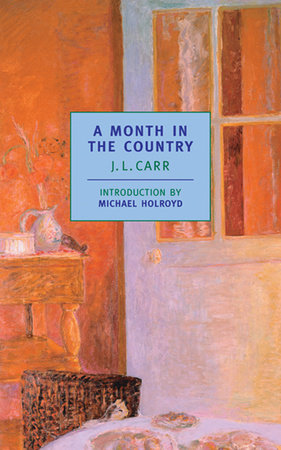
Tom Birkin leaves behind the horrors of World War I, and memories of his recently broken marriage, to travel to a small village in the English countryside in which he has been commissioned to uncover and restore a mural hidden under whitewash on the wall of the village’s old church. As he begins the work, Tom meets Alice Keach, wife of the local reverend, and they begin to form an emotional bond that teeters on the edge of being called love, both of them knowing that if they ever choose to do so it will break the idyl in which they’re living.
A Month in the Country is told with aching nostalgia for the memories of a lost summer. This is a quiet book whose beauty lies in its subtlety, its emotional nuance. Its impact is all the greater for it.
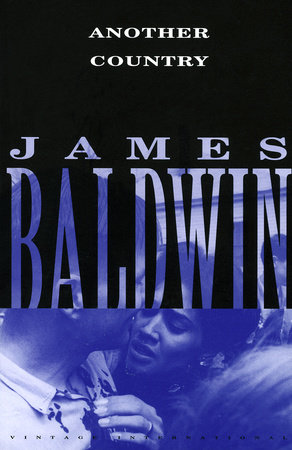
In Baldwin’s masterpiece, a group of young, Bohemian friends—living to the insistent jazz beat of Greenwich Village and Harlem in the 1950s—are each running in their own physical or emotional ways: Leona is escaping a broken marriage and separation from her child in the South. The beautiful, brilliant jazz musician, Rufus, grapples with the heart-breaking self-destructiveness that has grown within him as a consequence of his struggle against his societal position as a Black man in the New York of the ’50s. Eric is returning to New York, after many years in Paris, to face the memories of his complex relationship with Rufus.
Baldwin writes about race, sexuality and loneliness with such unflinching viscerality, always looped around by the sensuous, unrelenting rhythm of late-night jazz clubs. The humanity and the rawness of Another Country are, for me, unparalleled.
An emotional running from the past here, in Jackson’s pitch-dark gothic mystery.
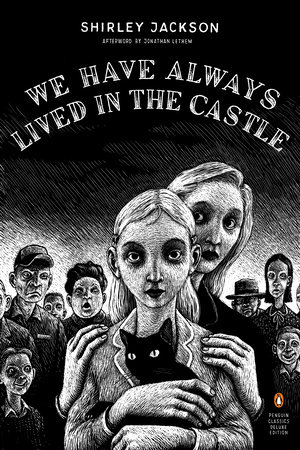
After the unsolved poisoning of the entire rest of their family, the two surviving Blackwood sisters withdraw from the outside world into the environs of the family home. The love between the two sisters is simultaneously beautiful and chilling—unconditional and completely without blame, no matter what one or the other of them may have done. Their relationship is all the more complicated for its simplicity.
The novel’s central theme is one recurrent in many of Jackson’s novels—the persecution within small-town communities of those who appear to be different. The village in We Have Always Lived in the Castle bears a strong resemblance to the small Vermont town in which Jackson and her academic husband lived, themselves encountering strong anti-Semitic feelings from the townsfolk, as well as a general mistrust of the couple’s intellectualism.
Strange, unapologetic, full of savagely dark humor, at its heart We Have Always Lived in the Castle is a fierce protestation against those who attempt to push others who show difference onto the margins of society.
In an attempt to escape the suffocation of his life in New York, Paul Kemp boards a plane to Puerto Rico to take up a post as a journalist at the chaotically dysfunctional Daily News. Kemp’s fellow journalists at the paper live in varying degrees of physical and mental degeneration, as they swill rum in the humid oppression of mosquito-laden nights.
Written while Thompson was in his early 20s and unpublished for years, The Rum Diary resurfaced amongst some of his old papers, was brushed off before finally being put out into the world in 1998. The book is permeated throughout with the anxiety of growing old, the fear of succumbing to the suffocation of the day-to-day, and the need to kick out constantly against the looming threat of the unremarkable. Thompson’s writing is blunt, brutal, ragged, wild, redolent with a thirst to wring what’s there to be wrung out of life.
In the spring of 2020, Ben Philippe was in the middle of drafting a book on “the quirks and maybe the light trauma of having been the Black friend in white spaces” all his life. It was supposed to be a conversational, gently satirical take on the things white people should and shouldn’t do if they aspire to have a Black friend: Don’t touch the hair. Don’t ask if Black guys are bigger “down there.” Don’t say that you “just really don’t think about race” because you’ve never had to. Don’t claim white privilege isn’t a thing because the term “implies a boat full of Leonardo DiCaprio clones and a seven-digit bank account” and all you have is a stack of unpaid bills and a backache.
And then last summer happened. As if the coronavirus pandemic weren’t enough, Black people kept dying at the hands of police and the pattern stood out to the world in a new way: Ahmaud Arbery, Breonna Taylor, George Floyd. If 2019 was the Hot Girl Summer, thanks to an eponymous song by rapper Megan Thee Stallion, 2020 became the summer of Black Lives Matter.
Having known Ben for almost a decade and enjoyed his two young adult novels, The Field Guide to the North American Teenager and Charming as a Verb, I couldn’t wait to take the plunge. What I discovered was a book—part literary memoir, part study guide, and part sardonic etiquette primer—as deep, probing, humane, and, yes, funny, as the man himself.
Ben was born in Haiti and raised in Montreal, Canada, where he was often the only Black kid at school. He grew up speaking French at home and learned English by watching shows like Gilmore Girls on the WB (he still can’t go the length of one interview without mentioning the show. See below. I did not bring it up. He did!). Eventually, he moved to New York to go to Columbia, and then to Austin, Texas to attend the Michener Center for Writers, where we met.
I talked with Ben—one of the warmest and wittiest people I know, with the wholesome good looks of a Disney Channel kid—over email about the beauty of friendship when you’re young, being Black in three countries, and coming out the other end of the Trump era.
Greg Marshall: Why do you think friendships in our youth are so formative?
Ben Philippe: It sometimes feels like the number of people we can say “I love you” to gets smaller as we get older. Your partner, your immediate family, your kids. There’s something sad about that to me. In elementary school, your best friend being seated 20 feet from you felt like a canyon! I used to use my friend’s deodorant stick on road trips. In college, my best friend would just sleep in my unmade bed. Now, friends get hotel rooms when they visit and we have dinner together, talk about mortgage rates. It’s part of growing up and I don’t need to use another 32-year-old man’s deodorant, but there’s also something sad about that distance to me. Something was lost there. I think that’s why adult friendships are no longer sacrosanct spaces that allow for political discourse and fraught conversations. They’re not magic anymore, lame as that is to say.
My friend has a line that I love and that I wish I could have shoehorned into the book: “Anyone who thinks you’re friendly is probably not your actual friend, Ben.” My few friends are the first barrier to all my, err, for lack of a better word, bullshit. The rage, the whininess, the moodiness, the insecurity, the dark memes…there’s an intimacy that comes with that. I love reflecting on that.
GM: Why were you interested in explicitly addressing white readers? What are you hoping they take from the book?
It sometimes feels like the number of people we can say ‘I love you’ to gets smaller as we get older.
BP: I did want the reader to think of me as a friend. I tried to artificially create that comfort level on the page, starting with blunt questions you might ask a Black friend who you know will not hold them against you—and then said Black friend goes on 20-page tangents about his childhood here and there because he’s kind of a narcissist.
Friendships are uneven constructs. You talk about heavy politics one moment, about pop culture the next, about your bad dates the moment after, and your friend might just angrily vent at you about the state of the world. Sometimes, you simply throw book recommendations at each other. I wanted the book to hit a few of those notes all at once.
I think coating everything I wanted to say in the highs and lows of a friendship made it easier to write without pretending to know more than I do. I have no grand thesis about the diaspora of Black America or the Haitian-Canadian-American migration narrative, just my thoughts as your Black friend Ben.
GM: Did writing about your life make you see it differently?
BP: Well, life doesn’t always have a satisfactory resolution. It’s a life lesson I had to learn; narrative closure is a lie taught to us by [beloved Michener instructors] Jim Magnuson and Elizabeth McCracken. If you’re very lucky, life just kind of goes on. You keep waiting for the dust to settle—work, romance, friendship, family, racial discourse, politics—but then you realize the unsettled dust is just life happening… I got that last line from an X-Men comic! Boom!
GM: You have some incredible Black women in your life, starting with your mom, Belzie. In the essay “Sister, Sister,” you reckon with your male privilege. Was that a tough thing to do?
BP: I need to stop writing about my mom. She Googles herself now. I’ve created a monster.
Honestly, I don’t think anyone likes to “wrestle with their privilege” or even interrogate it. It doesn’t feel good! So you can’t “tsk-tsk” white people for their privilege if you’re not willing to at least acknowledge your own. I’ve had plenty. The one I’ll never shake off is male privilege.
You can’t ‘tsk-tsk’ white people for their privilege if you’re not willing to at least acknowledge your own.
The essays where I gripe about my love life felt like the setup to a punchline where you widen the shot to reveal a row of exhausted Black women side-eyeing me, and wondering if this fool is serious. (That might still happen.) I’ve had enough Black women in my life to at least glimpse this massive chasm and it felt wrong not to at least mention it.
GM: 2020 was one hell of a year. What has writing about that journey been like for you?
BP: Groan. Exhausting! I’m sure a pithier version of the book would exist if the summer of 2020 didn’t happen in the middle of my writing it. It was overwhelming in a lot of ways. For a while there, I was just looking to burn bridges, ha. On paper, via email, in person. I wanted to yell at someone. Anyone! Like, please, tell me you’re calling the cops on me, Amy Cooper, watch me emotionally eviscerate you into a puddle.
But while anger is fun to ride (and write), it’s not very productive beyond the immediate catharsis. It’s kind of like putting any underlying thought in bold+underline+italics. It just covers the content you’re trying to get across. I couldn’t write an Angry Book—it would desiccate me—but I did manage to write a book with a couple of angry chapters in it.
GM: You describe the book as a “tell-some, not a tell-all.” In this book where so much about your life is on the table, what were some of the things you wouldn’t write about?
BP: Hmm. My current relationship. My last conversation with my dad. Trying to make it as a screenwriter. (I’m not coy about it; it just felt like a massive tangent.) Some racist encounters that were just kind of boring. Some bridges were too dull to even bother burning. How terrified I am that this, writing as a career with a credit score of three digits, is all going to go away in the blink of an eye. Snakes.
GM: What’s your take on social media as a writer? We should note that you are verified on Twitter, you bastard.
BP: That blue checkmark both means nothing and people are despondent when it goes away, ha. I probably would be too, to be honest. But I at least try to remember that it’s all just 1s and 0s in our phone and not to take it too seriously? My followers count also plateaued at around 6K, so luckily the publisher never puts too much weight into it when they buy one of my books. This guy ain’t no influencer, thank God.
I don’t think social media has changed my writing habits too much beyond the absolute cringe of mandatory self-promotion. I block liberally; I only engage if I feel like it; I tell Ted Cruz he sucks regularly. It’s all about striking that healthy balance.
I remember making a joke about Rory Gilmore from Gilmore Girls being a literal bastard once and a very nice mom replied something like, “What does this say to the single parents of your readers?” I blocked her right away. Like, no. I’m not getting into a serious exchange about this because you process jokes from the great internet abyss as commentary on your life, Helen. You live inside my phone; I don’t live inside yours.
GM: I know a lot of the book was written during the Trump era. Are you feeling more optimistic now that we have Biden in office?
BP: I am! I am feeling more optimistic with Biden in office than Trump. It feels like the least controversial statement in the world but people get mad about that sentiment, too!
“The Democrats suck, too!” “Now’s not the time to get complacent!” It’s like going “Hurray! My arm isn’t on active fire anymore!” and having someone answer, “Ok, but have you even checked your cholesterol lately?”
I’ve always been a prolific reader, but until the year I graduated from college, I hadn’t read a single book by an author of Indian origin who’d grown up, like me, in America. Year after year, I searched for authors from the Indian diaspora whose work had something to do with my own life, until eventually I realized several years ago that, for me, the descriptive term “Indian” feels flattening and false. “India” is a nation; it’s a national identity, not a culture, nor an aesthetic. There are too many distinctive cultures, languages, faiths, castes, customs, practices originating within the boundaries of India, all of which affect the materiality of people’s lives, the material of their storytelling.
So why a list of diaspora novels?
There’s long been a danger within the ethos of “multiculturalism” that one vision of a nation or diaspora will stand in for the whole. A reader from another country might read a single book by an author of the Indian diaspora and feel that’s enough, now I know, in spite of the cultural heterogeneity of the nation and the diaspora. This year is a banner year for inventive and stirring and memorable books by us, the diaspora. It might be the most exciting year so far for Indian diaspora books within my lifetime.
Books can feel like doors, permission, freedom. This list of the 8 books from the Indian diaspora that feel new and thrilling is a starting point, not the last word. There are more of our stories coming, I know.
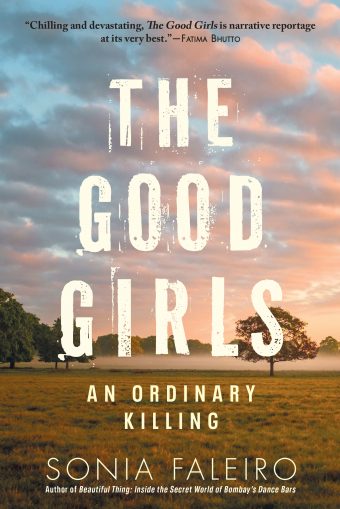
Sonia Faleiro’s The Good Girls is one of the best works of narrative nonfiction I’ve read. I’m pretty sure, by the end of the year, it will be one of this year’s best books, period. It’s the true crime story of two girls in an Uttar Pradesh village who are found hung from a mango tree. It’s also a feminist work about the girls’ death and the murder investigation that follows. The book unearths the way power works in an Indian village, and how that power is upheld and reproduced, not only by the legal system, but also by ordinary people who don’t believe they’re doing anything wrong. What sets it apart for me is that even though it’s highly particular and specific, it reflects a much larger story about how power works in insular communities to disadvantage and harm girls, especially poor ones that nobody shelters, everywhere around the world. This power can be as simple as rabid gossip. More importantly, perhaps, this power works through the emotion of shame, and that’s an insight of which everyone should be aware.
Sanjena Sathien’s debut novel Gold Diggers is magical realism about striving upper-middle-class Indian Americans. Told in first-person, the protagonist is a hapless teenager in Georgia with second-hand ambitions. He’s surrounded by academically achieving Indian Americans and other Asian Americans. He longs to be as talented as them, and one night, when he sees his beautiful neighbor—the object of his lust—drinking gold, he figures out how he might do it. There are scenes in this novel that so accurately reproduce the affluent Indian American experience of the aughts, I wondered if it was really intended as satire. Around halfway through, the novel breaks open. There’s a scene—and speech—that made me recognize just how brilliant this book is. The second half, in particular, is a dazzling gold heist story. Mindy Kaling is adapting this book, which makes perfect sense, but get in on the ground floor.
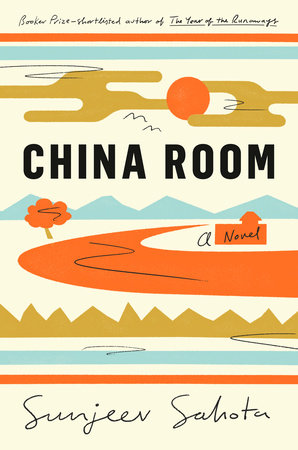
Sunjeev Sahota’s China Room is the diaspora novel I most anticipated this year. His first book, the unsettling Ours Are the Streets, is about a young man of Pakistani origin who grew up never belonging in England and returns to Kashmir and Afghanistan where he is radicalized. His second book The Year of the Runaways is phenomenal, detailing caste and racial discrimination in India and Britain’s Sikh communities. The China Room is utterly different, but it did not disappoint. It’s a dual narrative of a young bride in rural Punjab prior to Independence who is trying to figure out which of three husbands is hers, as well as the story of her great-grandson. Her great-grandson comes back to his uncle’s house in Punjab from a racist small-town in England, in hopes of shaking his addiction. It’s intimate and startling.
Jhumpa Lahiri’s Whereabouts is a departure but retains her usual grace and close attention to moments. Told in brief chapters, Lahiri wrote the novel in Italian and then translated it into English. It’s a subtle, unadorned story in small movements, but less culturally-situated than her other fiction. A solitary narrator wanders around a European town and makes observations and thinks about her life. In another writer’s hands, this might be dull, but she somehow makes it a luminous consideration of estrangement. The narrator says at one point: “Solitude: it’s become my trade. As it requires a certain discipline, it’s a condition I try to perfect. And yet it plagues me, it weighs on me in spite of my knowing it so well.”
Akwaeke Emezi’s work has genius in it. I’ve never seen anything like what they do to bind language to their identity as a Black trans person of mixed Indian Tamil and Nigerian Igbo descent. Their language also expresses an overlapping reality as an ogbanje, or spirit who looks like a human.
In Dear Senthuran, Emezi writes their memoir in letters. Each letter is addressed to a different person in their life, but together the letters form a narrative about growing up trans in Nigeria, transition through two surgeries, gender identity, relationship struggles, an MFA program, the experience of writing and publishing their innovative debut novel Freshwater, and the aftermath of that publication. As they put it, “What words do you chant into the space between spaces, to bend your desires into reality?” This is language that stuns, rather than aims for pretty construction, while also revealing so much of a brilliant inner life. It’s a must-read, perhaps especially for experimental writers or artists of color who are trying to figure out a place for themselves in the existing market.
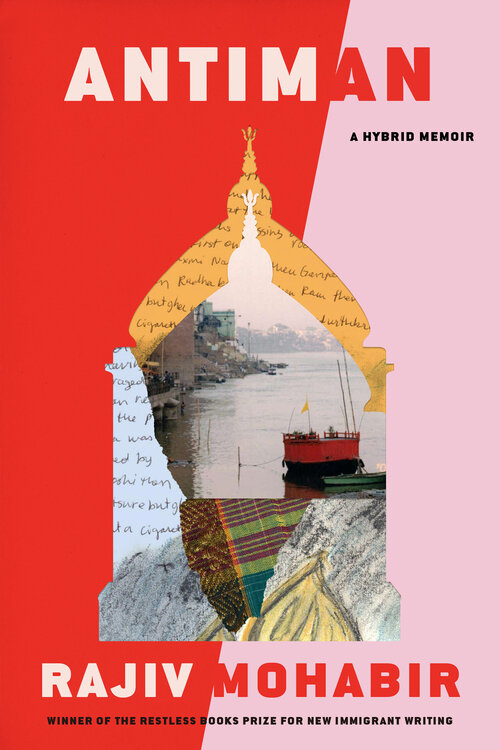
Rajiv Mohabir’s Antiman is a hybrid memoir about coming of age as an Indo Guyanese queer poet. It’s striking in its play with genre, and vivid in its imagery and metaphor. Mohabir weaves together fragments of his grandmother’s Bhojpuri songs with his own poems and prose about growing up queer—first in Florida with his family, and then his later coming of age in Queens, New York City. His family, which has coolie, mixed-caste ancestry and a history of indenture in Guyana, converted to Christianity. Mohabir sees in his father’s resistance to Hinduism a kind of self-hatred; he attributes this to colonialism.
The memoir is an unusual, lyric glimpse into Mohabir’s perspective, as well as a window onto a world that is severely underrepresented in English letters. It’s artistically unique, although it shares a bit of background with Gaiutra Bahadur’s earlier Coolie Woman, which is a well-researched family history and narrative of indenture. In contrast, Mohabir takes a personal, confessional approach, fusing poetry and fragmented memoir together to tell the story of a sexual and political coming of age.
Anjali Enjeti’s Southbound is a thoughtful essay collection about growing up multiracial and Indian American in America and her journey of activism. Like Sejal Shah’s collection This is One Way to Dance, it brings to light nuances of growing up in America as a person of Indian ancestry. It pays particular attention to hybrid or mixed-race identity—Enjeti is of Indian, Puerto Rican, and Austrian descent. She has a talent for illuminating personal transformation. Repeatedly, she writes about starting out with one view and then transforming her outlook based on lived experience and learning more. She writes essays about the complexity of experience and belief. For instance, she writes about the distinctions in feeling between her support for women who choose abortion before having children, and her view afterward. It’s important in these next several years to stay involved in activism and the political process, to build a better America, and to avoid a repeat of the last four years. Southbound is timely, speaking to this need.
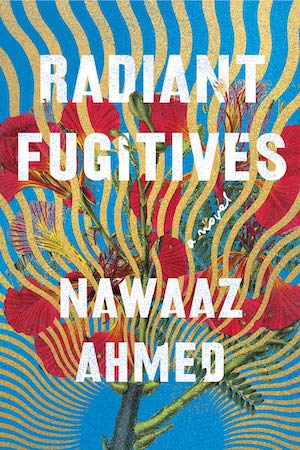
I’ve never read a novel like Nawaaz Ahmed’s Radiant Fugitive, and, I kid you not, I’ve been waiting for this tremendous, complex, moving novel for years, but never expected to receive it. It’s the inventively-told story of three generations of a Tamil Muslim family in Chennai, San Francisco, and Texas. Two Tamil Muslim sisters take different approaches to their faith and lives before and during the Obama years. Seema is a lesbian Muslim activist in San Francisco who gets pregnant with a straight-edge Black lawyer she met at a protest. Her sister Tahera is orthodox, working and raising children in Texas, while struggling with Seema’s sexual orientation. Memorably, gorgeously, parts of the book are narrated by Seema’s baby in a direct address to his grandmother as he’s being born. I cried. There is so much of life in this book.
The 90-minute drive from my childhood home to visit my grandmother necessitates passing a pair of gigantic road signs written in all-caps white lettering on a black background. “IF YOU DIED / TODAY,” the first inquires, “WHERE / WOULD YOU SPEND / ETERNITY?” The second advises that “HELL IS / REAL.” The “H” in that one gets its own special red color to signify how seriously the sign wishes itself to be taken. This is some biblical shit, some hefty contemplation for the cars trundling innocently toward the nearby outlet mall.
My brother and I have always loved these signs. We chuckled at them growing up, snarkily admiring their confidence with the self-satisfied glee of children who have recently discovered irony. What, exactly, was ironic about the signs we surely could not say, not then. Recently it has been much easier. In part this is because we have learned the definition of irony; mostly this is because the sicker Grandma got the more likely it became that, as we sped toward her condominium and then nursing home and then funeral site, contemplations of eternity had filled the vehicle long before the signs appeared.
The conversations about my grandma’s future had started around the time I moved home, early in the pandemic. Grandma isn’t doing so well, we were told in low, pained tones. Grandma doesn’t know how poor her health is, Grandma needs help, Grandma might have to move. She’ll be better off in a home, we agreed, agonizing over logistics. Then, later, when she began her quick descent, the conversations grew vaguer, more equivocating. Grandma was slipping away and Grandma forgot things and Grandma couldn’t eat or walk or speak but it was okay, really, because now she is in pain but soon she won’t be, and that will be a relief, really, actually, if you think about it.
I understand that life’s value derives from its finiteness, but I find nothing inherently beautiful about the dying itself.
I do not and have never liked death. I understand that life’s value derives from its finiteness, and that dying imposes such a necessary truncation on existence. But I find nothing inherently beautiful about the dying itself, not conceptually and certainly not in practice. There was no glamor in watching my grandmother’s brain disease spread into her synapses, eating through her memories, dulling her opinions, depriving her of the ability to rearrange her pristine collection of antique cow figurines or dress herself in colorful beaded sweaters. Her impending death seemed manageable when we talked of it in abstractions, when my parents fed us sinewy assurances crowded together in the kitchen. It seemed okay until I had to think about it in any substantive, material way. When I tried to envision what went on inside her head, all I could picture was a white noise machine with the volume all the way up, drowning out everything that comprised her selfhood, making the world look like a staticky television.
In the dead of the pandemic winter, I drove past those two prosthelytizing signs to visit my grandmother for what I did not yet know would be the last time. My family stood awkwardly in the soil of a dead garden and waved to Grandma in her wheelchair through a looming picture window in the hospice unit. We spoke across the glass through a phone whose corollary a nurse held to my grandma’s ear. That woman’s arm must be getting sore, I kept thinking, watching it slowly start to quiver, though she never once complained. My mother kept motioning me to talk—she responds to your voice, she whispered—but the words stuck like too much peanut butter down my throat. I imagined how lonely it must feel for her, straining through the brain fog toward people who seemed to slip further and further out of reach. She pointed to her chest and then through the window, toward my father, her son. She groaned and hummed and repeated the gestures. We know, we said each time, as she pointed and shrieked, pointed and let out a horrible, high-pitched scream. We know you love us, we kept repeating, but she couldn’t make the noises into words. Her body was tired, the nurse was saying, but I could see her eyes and they didn’t look sleepy at all. I’ve watched horses’ eyelids stretch open in a lightning storm; this looked like that.
Whatever I had told myself about the gentle transition from life to death seemed belied by the obvious pain she was in.
The nurse told us, after, that we shouldn’t worry about the noise grandma was making, the horrifying screeching that sounded to me like some staggering blend of fear, frustration, and pain. “She’s developed her own language,” the nurse explained calmly, warmly. It’s a common symptom of dementia, apparently, this sort of nonverbal communication. I didn’t know whether to believe her; I still don’t. Whatever I had told myself about the gentle transition from life to death seemed belied by the obvious pain she was in. What I heard sounded to me like a primal distillation of human suffering. It seemed ludicrous to pass it off as an alternate means of conversance.
No one commented on the road signs that day on our drive back home. Frankly, I found their scare tactics unconvincing. I didn’t so much fear what came next for her; it was the getting there that troubled me.
“We have all agreed,” announces Marian Leatherby’s son early on in The Hearing Trumpet, “that she would be much better off in a home.” The “she” in this edict is Marian, the 92-year-old protagonist of Leonora Carrington’s 1974 surreal novel about a home for elderly women that becomes the epicenter of the apocalypse. The pronouncement is news to Marian, who has lived peaceably with her family in Mexico for the past fifteen years. “She would be much happier in an institution where there’s proper help to take care of her,” Marian’s daughter-in-law continues. “She ought to be dead,” concludes the grandson. “At that age people are better off dead.”
I felt ashamed to envision how she might feel, hearing us speak about her like a child.
Marian’s family speaks about her callously, unaware that Marian is now equipped with the eponymous hearing trumpet, which makes their conversation discernible. They say things no reasonably empathetic person would say about the elderly, but the first time I read The Hearing Trumpet, about a month after my grandmother passed away, this scene elicited in me a trickle of guilt, a rising heat around my neck. It recalled those pained conversations in my parents’ kitchen when we articulated, however kindly, a similar sentiment: this woman does not understand the reality of her suffering. I imagined with a pang that my grandma, like Marian, crouched nearby, jotting down notes as we spoke. I felt ashamed to envision how she might feel, hearing us speak about her like a child. But as I pictured her scoffing at our sighs about her future, I was surprised also to feel a thrill of satisfaction on her behalf, imagining that where we perceived a senile brain draining of consciousness there was, instead, an astonishingly colorful internal life.
Marian’s family soon recedes from the plot of The Hearing Trumpet, and their early remarks serve mostly to establish a contrast between the drab world Marian inhabits at the beginning of the novel and the resplendence of her inner life. Most of the narrative, in fact, focuses on Marian’s adventures upon arrival at the Well of Light Brotherhood, a home for elderly women. Here, Marian witnesses a murder and prevents another, leads a coordinated hunger strike against the home’s tyrannical religious leaders, and uncovers and then enters into a centuries-old mystery. Though early sections of the novel are written in a quirky but plausibly realistic style, its central portions consist of an increasingly fantastical story about a heretical nun who acquires sinister, supernatural gifts on her quest to find the Holy Grail. Apocalypse descends, heralding catastrophic climate change, Marian’s rebirth via pot of boiling stew, the arrival by ship of a wolf-woman, and a composite queen made of bees. The novel culminates in a dreamlike haze, gloriously liberated from the bounds of earthly logic.
Most critics have framed the novel’s construction this way, anyhow: as an ascent toward surreality, and a triumph of that form—delightfully absurd, inventive, cannily psychological, without the Freudian phallocentrism of much traditionally male surreal writing. But encountering this novel as I did in the immediate aftermath of my own grandmother’s death, I found a complementary storyline buried within The Hearing Trumpet’s surrealism.
Reading that early scene wherein Marian’s family sends her away, I wondered if the family, however selfish and unkind their remarks, had gotten something right. Perhaps they were watching a very old woman approach death; perhaps that very old woman narrating the novel did not and could not know this. Perhaps that family conversation is the last trace in the book of a world external to Marian’s narration, one watching warily as Marian’s formidable soul outgrows its container. And perhaps in addition to all the reasons I admired the book—its feisty, feminized surreality, the droll wit of its nonagenarian narrator—it might do something else less glamorous, which is to tell a first-person story of someone dying. Marian, after all, begins the story clinging to the last vestiges of her human sentience. She transcends reality through the apocalypse. I wondered if she might simultaneously transcend life through, well… death. If this is so, the vision it presented was, for me, a revelatory one. The Hearing Trumpet replaced my claustrophobic imagining of my grandmother’s death with a lavish narrative of adventure and cataclysmic triumph. In doing so, the novel presented a liberating framework for envisioning her passing, one that granted it a semblance of beauty.
If this is indeed death, the process seems remarkably pleasant.
The conversation among Marian’s family was the first clue that I might read an end-of-life story within Marian’s narration. Others followed. Despite the acuity of Marian’s observations and the prowess with which she unravels the mystery set at the elderly home, she admits occasional lapses in lucidity. “Sleeping and waking are not quite as distinctive as they used to be,” she reflects at one point. “I often mix them up.” Even before the book has departed from its early realistic portions, Marian refers to a geographically distant living mother. Marian is ninety-two; a living mother would have to be well over 100, but Marian never acknowledges this preternaturally advanced age. Could this detail, I wondered, present merely an early suggestion of the surrealism to follow in later portions of the novel? Or might the reference to a living mother signify a fracture in Marian’s cognizance, a hint that she was not, after all, gripping so tenaciously to her consciousness? As the novel’s plot accelerates, logical barriers slip away. The world seems to bend to Marian’s will; every barrier to her aims resolves with a curious neatness. When the weather grows ice-cold, for example, Marian’s friend drops by, announcing herself newly a millionairess, and distributes fur coats and provisions to the women. Marian, it seemed to me, might well be losing hold of reality just as the book does, inserting her own fanciful narrative in its place.
If this is indeed death, the process seems remarkably pleasant. Marian’s passing does not seem to deprive her of any capability. In fact, the book offers a touchingly humanizing, invigorating portrait of old age. Marian and her peers are liberated from the norms that confine younger people, especially young women, within prescriptive social boundaries. As the residents begin their rebellion, one of the other elderly women delivers a rousing speech. “Although freedom has come to us somewhat late in life,” she informs the home’s matron, “we have no intention of throwing it away again.” She continues:
Many of us have passed our lives with domineering and peevish husbands. When we were finally delivered of these we were chivvied around by our sons and daughters who not only no longer loved us, but considered us a burden and objects of ridicule and shame. Do you imagine in your wildest dreams that now we have tasted freedom we are going to let ourselves be pushed around once more?
The old women in this novel are not enfeebled by their proximity to death, but seem freshly aware of their worth. As the writer and activist Olga Tokarczuk reflects in the afterword in the New York Review of Books’reissued version, out this past January, there is an inherent feminism in writing such a protagonist. “In old age a person becomes eccentric,” Tokarczuk observes. “This appears to be a natural law of development, once adapting to society is no longer essential, and the paths of the individual and the community start to diverge. Perhaps old age is actually the only time in life when we can finally be ourselves, without worrying about the demands of others or conforming to the social norms that we have been constantly instructed to follow.” That the book proves legitimately empowering of Marian and her fellow elderly women presents a vision of old age and even death that seemed exhilarating. In this way, The Hearing Trumpet gave me a story about my grandmother’s passing in which the world inside her head grew more vibrant, not less, as I had imagined.
The Hearing Trumpet gave me a story about my grandmother’s passing in which the world inside her head grew more vibrant, not less.
Crucially, though, the novel doesn’t make death seem desirable, the way troubling narratives that romanticize suffering sometimes can. Marian seems to relish being alive. “With age one becomes rather less sensitive to the idiosyncrasies of others,” she reports early on. “For instance at the age of forty I would have hesitated to eat oranges in a crowded tram or bus, today I would not only eat oranges with impunity but I would take an entire meal unblushingly in any public vehicle and wash it down with a glass of port which I take now and again as a special treat.” She seems amused by the increasingly turbulent turn of events, responding with as much composure to her friend’s makeover in a matching lilac wig and lilac limousine as to global climate destruction and famine. The Hearing Trumpet counsels not that death is good but merely that death will come, and that when it does, it might do so gloriously.
My father spoke even less than I did at that final visit to my grandmother’s nursing home. The last thing he said came out quiet and strangled, slipped in as we were saying our goodbyes. “Don’t be afraid, ma,” he managed, and then he was trampling flower stems in his haste to return to the car. I didn’t ask, because I didn’t want to know, whether he said this in the hopes that she understood, or with a prayer that she was already beyond comprehending that there might be anything to fear.
I don’t know what it felt like for her, those final months, weeks, and days, that slipping away from here toward elsewhere. I cannot possibly know if it was pain and fear and then a sea of blackness, the way I imagined it went. It doesn’t make a difference, in any case; the period of her life that we termed the dying part is finished. But the dead remain in memories, in the stories we tell of them. And the story I choose to tell of my grandmother, the one I hope for though may not entirely believe in, is one in which the end felt like or perhaps consisted of a harrowing, glorious adventure. A cabal of fearsome old ladies swaddled in furs, sharing a tin of biscuits, sailing home.
JonMooallem’s This is Chance! is disaster lit for people who still have faith in humanity. In a time when most news stories seem like they were beamed in from a dystopian YA novel, it can sound unreasonable to recommend a book about a major natural disaster—in this case, the Great Alaska Earthquake of 1964—to offer solace. However, This is Chance! is one of the most optimistic books I’ve read in a long time, and reading it during the pandemic offered me comfort beyond anything I could get from a set of statistics.
The nonfiction book, now out in paperback, is set in the blossoming metropolis that was Anchorage, Alaska in the 1960s. It follows Genie Chance, a news reporter who became the voice of Alaska to the outside world as she covered the aftermath of the disaster over the radio. Ultimately, though, Mooallem’s book isn’t just about the second largest earthquake ever recorded, but about the real people who lived through it and the community they built together. Throughout the book, Mooallem expertly weaves in the Thornton Wilder play Our Town; Anchorage was preparing for a local theater production when the earthquake hit, but the play also speaks to themes of both community and mortality.
As someone who grew up, and currently resides, in Anchorage, I was excited to talk to Mooallem over the phone about a book that captures the culture and community of Anchorage more than any other book I’ve read.
McKayla Coyle: In the book, you talk about how disasters happen all over the world and people tend to react in the same way, which is with rationality and selflessness. You even point out that in response to disaster, “Anchorage was just like every other city in America.” Obviously this book has to be set in Alaska because it’s about the Great Alaskan Earthquake, but is there anything else about this particular setting that was especially useful or inspiring to you as you were writing this book?
Jon Mooallem: So the first thing is to clarify that it’s absolutely true that the response in Anchorage was typical of other communities in the world. But it’s typical only in the broadest sense: that people helped one another. People were cooperative and industrious and they managed to solve problems for themselves. However, Anchorage’s response to the quake is still 100% ripped through with the specific idiosyncrasies and character of Alaska. It’s the Alaskan version of that phenomenon. In general, when there’s a disaster in the community, people will rush in to help. In Alaska, some of them showed up with their own bulldozers, which is not something that’s going to happen in Manhattan. To me the first, most basic thing is to clarify that point.
What drew me to this story originally was the character of Anchorage at the time. The community of Anchorage was in this very particular moment in its history where it was really starting to feel confident and proud of itself, it was starting to feel like a real place in the world. The irony that this moment was when the buildings that they were so proud of were randomly knocked down by this disaster—the cruelty of that was really poignant to me. It would’ve been a completely different story in a different place. No one worried after 9/11 that Manhattan was going to go away, but there were legitimate fears about Anchorage disappearing after the quake. So, in my mind the details and the emotional weight of the story is absolutely specific to it being an Alaskan story.
No one worried after 9/11 that Manhattan was going to go away, but there were legitimate fears about Anchorage disappearing after the quake.
MC: I loved the details about how excited everyone in Anchorage was to have a JC Penney building. When I was in high school, we got an Olive Garden and there was like a one month wait to get a table there for literally the first six months. Things like that feel very special up here.
JM: That’s actually interesting to hear because Anchorage is obviously such a different place now than it was in ’64, right? But it doesn’t surprise me that there’s still an energy of always trying to be a little bit bigger and a little more like other places. I related to that on a personal level too, I go through the world thinking, “I think I’m pretty good, am I good?” So this whole idea that there’s always this force that’s waiting to pummel you, I can relate to that.
MC: Definitely. So I read another piece that you wrote about Alaska in TheNew York Times about a kayaking accident with your friends, and in that piece you talk about looking for meaning in disaster and there’s a question of whether there’s ever meaning in disaster. With This Is Chance!, did it feel like you were creating meaning in the disaster of the ’64 earthquake just by writing about it? Did you feel like you found any meaning?
JM: The thing I was talking about in that kayaking piece was that the randomness of things happening is inarguable. You can’t really pick apart questions like, “Why did a tree fall on my friend?” or “Why was there an earthquake?” I was resisting having any kind of mystical, magical-thinking answer to that, and instead I was just accepting that this is the world: it’s dangerous and erratic. That doesn’t mean that there’s no duty or meaning to be found in the aftermath of those events though, right? Specifically in the way people behave and respond.
I hadn’t thought of it like that, but of course when you spend time writing about something, you’re giving it a shape and therefore you’re leading it towards meaning. I wouldn’t say I was giving it meaning, but I would say I was highlighting possible meanings. I think that’s what we have to do just to survive. We have to be able to tell ourselves a story about what we’re living through. I think I’m feeling that right now, a year plus into the pandemic. I’m just beginning to have a little bit of perspective on what the whole thing has been like, to even begin to think of it in terms of a story.
I think that’s what we have to do just to survive. We have to be able to tell ourselves a story about what we’re living through.
MC: The idea that structure creates meaning, and the question of whether writing confers importance were things I was thinking about a lot while I was reading this. I didn’t know much about the earthquake before I read this book, and I live in Alaska. I had never heard of Genie Chance, and I hadn’t even considered that the earthquake caused damage in Alaska outside of Anchorage. You don’t think about the fact that you’re only hearing one story.
JM: That was actually something that really worried me while I was writing this book. It feels awesome that now people know about Genie Chance because I found her junk in a basement and wrote a book about her. But at the same time, there’s a cosmic unfairness. The idea that—in addition to her story being a pretty incredible story—the reason why this book hangs in large part on her story was because she was the one whose stuff I had access to. Even she knew that her story was just one story that could be told about the disaster. That’s what I was thinking about when you were talking about writing giving things this weight, or this emphasis, is how that doesn’t seem fair to me. The best I could do to remedy that is to say explicitly in the book, “There are other stories that someone else might tell or that no one will ever be able to tell, so let’s pause and keep that in our heads.” I guess you could say that telling the story of a woman from that time is corrective to the record, but it only goes a tiny step beyond. The unfairness of it still seems to outweigh the good.
MC: Related to that, you focus a lot on the mortality of the people that you’re writing about, but by writing about them you’re immortalizing them in a way. Did you ever felt like you were bringing people back from the dead, or rescuing them from death, or anything along those lines?
JM: The problem is there’s truth to that, but the words we use to talk about it are so overblown. I’m clearly not immortalizing anyone, my book could be out of print next year. But there’s something real that’s happening, and I don’t want to sound too woo-woo, but I’ve got to believe there’s something positive if just one other person in the world knows these peoples’ names after all this time. That seems good, just in a small way.
I never really thought of it as immortalizing them. To me, the takeaway wasn’t, “Look at this person.” It wasn’t about the individual people. It was this overwhelming sense of “My lord, there’s so many people!” They all have these stories, and they all come and go. I guess it sounds a little sappy when you put it like that, but there’s a visceral experience when you actually realize that there are so many people with their own stories and lives. We walk around thinking we’re the protagonists of our own life—and we are—but the stories of our lives are not that indispensable in the long run. I don’t mean that as a bummer, I just think that’s what it is.
MC: That was something I really liked about the Our Town strand in the book. The moments when you were jumping between first introducing someone and then being like, “And then a year later he would be dead and there’d be a plaque for him right next to where he’s standing right now,” really hit me. There’s transiency but there’s also repetition.
We walk around thinking we’re the protagonists of our own life—and we are—but the stories of our lives are not that indispensable in the long run.
JM: I love that you had that response, because that was sincerely what it felt like to work on the book. I had so many documents, it was absurd. For something that happened 50-some-odd years ago, the resolution at which these stories were preserved was like magic. I was spending all my time within those three days. I’d spend hours a day obsessing over the smallest details about what a particular person did on one day, and then I would think “I should Google this guy,” and without fail the first thing I’d find was an obituary. That’s not a perspective that we walk around with in daily life.
I think there’s something parallel to this in the story of the earthquake. It’s a reminder that the way you see the world around you is pretty limited, and that the earth can move and all these shops on Fourth Avenue can drop underground. That’s not in your vocabulary of possibilities as you just make your way through the world. You’re not conscious of that—why would you be? But it’s kind of incredible, and things start to happen when your life becomes imbued with the realization of these possibilities.
That’s the whole point of Our Town, so it made sense to me to write the book like this. It just seemed like the natural way to tell the story if you were talking to a friend. If I were to tell you, “There was this guy Bill Davis and he was a kind of hobbyist mountaineer, he ended up running the search and rescue thing,” then your next question would be, “Did you talk to him?” and I’d say, “Yeah I talked to him, he was 80-something years old and he died a year after I talked to him. He never got to see the book.” I’m just being honest, but it changes the story to know all that.
MC: So we’ve been talking about the characters a lot—I’m gonna call them characters, they’re obviously real people, but they carry a particularly large amount of weight in this book. There are parts where you talk about how the city has lost all familiarity, and that it’s been “reduced to a wilderness.” In that space, the people of Anchorage aren’t just the heroes, they become the setting of the book, too. I think that’s why this book rang so true to Anchorage for me, because you focus so heavily on the personalities and the anecdotes and the weird people who live here. That felt more real than just writing, “Oh, there’s a lot of trees and there’s bears sometimes,” you know what I mean? I was wondering how it’s different to lean primarily on people to create your setting rather than leaning on a physical environment?
JM: That’s a really cool way to think of it. I think in the book I say something about how the people became this kind of alternate infrastructure, but you’re right, “setting” is a much more literary way to think about it. I do think that the physical space and the community are related.
That’s the upshot of the book: you hold onto everyone, because that’s what keeps you from sliding off the face of this moving earth.
I think these people who were in Anchorage at the time really did see themselves as mid-century frontierspeople. Genie talks about this explicitly, as does almost everyone in Anchorage at that time, that this mindset fosters interdependence. So I think that people are the setting in the sense that, even before the quake, there’s not much in the city itself. The spareness of the environment makes you notice the people more, and how they relied on each other in very obvious ways.
That’s the upshot of the book: you hold onto everyone, because that’s what keeps you from sliding off the face of this moving earth. When the earthquake comes and knocks down the little bit of quote-unquote metropolitan civilization that exists there, suddenly everyone is living in the bush. People in the middle of downtown Anchorage are getting their news via ham radio and going to their neighbor’s meat locker for food. All the things that disguise their interdependence in a more developed, 20th century community are suddenly gone. Maybe the people are always the setting, but you don’t notice it as much.
MC: I think that the thesis of your book can basically be summed up with your line, “Our goodness is ordinary.” How has your belief in human goodness changed from when you began writing this book to now that we’re a year into the pandemic?
JM: That’s one that I don’t exactly have an answer for, though it’s one that I’m asking myself constantly. There’s definitely been moments in the past year when I was like, “My book is all wrong,” you know? Like, “People are vile,” and, “Look at these idiots!” I’ve gone through all kinds of ups and downs on that front. And it’s been weird to also have this strange, personal-slash-professional stake in whether or not people are going to turn out to be good. So on top of all the moral and spiritual aspects of it, I’m like, “Am I right? Am I wrong?”
I do think that there’s been so much failure of human ingenuity and leadership along the way, large and small, and I’m incredibly cognizant of that. But given that’s the case, there was a lot of good at work; I definitely did way more good this year, in a civic context, than I’ve done in my life, and I’ve seen other people doing the same thing. And good isn’t always in the doing, but in thinking and in challenging the ways that we think about things. There’s been a lot of really positive action, but there’s also been positive soul searching and quiet contemplation that’s happening. So I think if it’s a yes no, “Are people good?” Then yeah, I still come out on “People are good.”
MC: In the book, there’s a difference between being quote-unquote good in an active, visible way in the short term, versus being that same kind of good in the long term. Like you said about introspection, there’s variety to what it means to be good.
JM: I’m really glad you mentioned that, actually, because that’s one thing that I was trying to make clear when the book first came out at the beginning of the pandemic. The book is about three days, it’s the first three days after this completely devastating, confusing disaster—at the end of the book, they’ve only just figured out how many people died. When you look at disaster studies, that’s a very particular window of time. It’s when you see this altruistic collaboration at its peak. After that is when all the bullshit starts to happen. There’s a lot of bureaucracy and impatience and frustration. In some ways, it’s not a good analog to a pandemic, because we haven’t been in that honeymoon period this whole year. We’ve been moving in and out of thorniness and confusion. It’s not a question of “Are people perfect all the time,” it’s that there are these windows where you see what’s possible.
MC: I was so sad when I was reading the book and I got to the end of those three days. All of a sudden, the bureaucracy came in, and I was like, “Oh, fuck, I guess they can’t keep this up.” They have to live in a different society now than they’ve been in for the last three days, and this other society has radically different expectations.
There’s something we can do right now to fix this: there’s something people can do to help. That’s such a relief after going through this whole year.
JM: I think that’s totally right. And I feel like, with the vaccine, it’s a chance to be in that moment again. Now there’s just one big project, which is to get these vaccines in peoples’ bodies. There’s something we can do right now to fix this: there’s something people can do to help. That’s such a relief after going through this whole year where that has often not been the case.
MC: Yeah, it’s a clear-cut opportunity to do good. I got my first vaccine two weeks ago, and I was thinking about how I hadn’t been around this many people in a year, but I also hadn’t been around this many happy people. You go into a grocery store, and there’s a lot of people, but they’re all at their wit’s end. But you go to a clinic and everyone’s like, “We’re getting the vaccine!” They’re so elated.
JM: I’ve heard that from so many people. There’s something about being in proximity to that many people. Everyone feels like they’re part of something substantial, they’re not side-eyeing each other, like at the grocery store. It feels like the fellowship I’m describing in the book, and it’s very welcome.
“Hương, 1978” from Things We Lost to the Water by Eric Nguyen
Hương and her sons had been in the country for only a month, but already they were having problems.
Their sponsor, a white Catholic priest, paired them with the Minhs. “Both thirty-two,” he said while driving. “You will like them.”
The priest—she never remembered his name—was old and serious and restrained. He walked with his hands behind his back as he took long, sweeping strides and had a habit of keeping his head slightly bent forward as if he were listening to something everyone else could not hear, giving him a look of arrogant superiority. He reminded her of the priests who came to her childhood village with hard European candies and boxes of Bibles in hopes of converting someone in their bad Vietnamese. She remembered one priest who couldn’t pronounce bạn and instead said bàn and they made fun of him behind his back, calling him Father Table. Still, Hương did not not like this New Orleans priest. She was lucky, she told herself. She was alive. She made it to America.
The priest took an exit onto another highway. He didn’t use his blinker.
They had been on and off highways all morning, dropping off other “refugees”—the word still felt strange in her mouth, in her mind—at temporary homes. Earlier that morning, the priest dropped off a couple from Vũng Tàu at a tall building. Then a single Saigonese girl at a short house painted pink. Another family of three was given to an American fisherman and his wife, and they greeted each other with hugs as if they had known each other all their lives; the wife gave their son a pink stuffed elephant. Hương and her boys were the last to be dropped off.
Bình slept in an infant seat as Tuấn kneeled by the window and watched as the world slipped by, pointing and calling out the names of everything he saw: xe hơi, xe đạp, cây, nhà. What Hương noticed the most was the concrete—the buildings, the roads, the sidewalks, the fountains, the statues. So much concrete, she thought. She imagined them rubbing against her, scraping her knees and hands, leaving bruises and scrapes and marks. She was thinking that way nowadays: what can hurt her, what can leave a scar.
The priest turned onto a road, and just like that, the hardness of the city disappeared, replaced by flat plots of parched grass and a traffic light. Beyond that, a billboard advertised a deep red sausage with rice grains inside.
As they waited, the priest glanced up into his rearview mirror and smiled. “Gần tới rới,” he said, Almost there, in an accent Hương found oddly charming, like the way the Australian English teachers at the refugee camp spoke, and that gave her something to latch on to, a type of comfort. The van continued down the long stretch of road for another five minutes before slowing down into a turn. In front of a house, a fat Vietnamese man waited.
“Mr. Minh!” the priest chuckled. Mr. Minh waved when he saw them.
“Welcome to America!” Mr. Minh shouted as the priest parked the car. He pulled the door open and bowed extravagantly, making a show of the gesture. His large hands came at her next and grabbed her wrists. He shook them furiously. “Chị will like it here very much!” he said. “It’s America! We’re all friends here!” His face glowed red. How unlike her husband he was. Công was thin and suave, bookish and reserved, and, above all, neat; this man was chubby and rude, drunk and loud—above all, loud. She could have pictured Mr. Minh spending his time at bars and his poor wife coming to get him at three in the morning. She thought, not without bitterness, that they never would have been friends in Vietnam. They were two different types of people; a friendship had little chance.
“We’re all friends here!” Mr. Minh repeated, confidently, caressing her sloppily, stupidly. It made Hương feel little, like a bug waiting to be squashed. She held on to her baby boy and motioned for her other son to stand closer. The wife—Hương noticed her now—stood aside as if this were the regular order of things.
“He used to be a police officer,” the wife said in her scratchy voice. “Now, he drinks!” She laughed and Hương didn’t know if she was supposed to laugh out of courtesy or just nod sadly in agreement. She decided on doing neither and stayed silent and stiff.
“Very well,” the wife said. Then, in English, she said something to the priest, shook his hand, and grabbed Hương’s suitcase. The priest drove away.
“This way,” she said.
Hương walked up the porch steps and crossed the threshold. Right away, she smelled the rotting wood, disarming at first but only because it came so suddenly. The lights were off, and in the darkness, the room felt vast and empty. As her eyes adjusted, she realized the room was small and arranged at its center were a floral fabric sofa, a white plastic chair, and a small television. A fan spun lazily above.
The wife told Hương it was called a “shotgun house.” Ngôi nhà súng, she clarified. “See?” she said. She placed the suitcase down and mimed the shape of a gun with one hand. With her other, she held her wrist. Closing one eye, she looked through an invisible scope and the appearance of intense concentration fell onto her face. For a few seconds, she stood silently, so focused on something in the distance that Hương looked toward where the wife stared, too. Then “Psssh!”—the imitated sound of gunfire. It was so unexpected but also so childish, Hương jumped back and felt stupid for doing so. Like a child tricked in a schoolyard, she immediately hated the Minhs, their poverty, their obnoxiousness, their immaturity.
“See?” the wife said. “A house for guns.” She made the motion of dusting off her hands. “But you don’t have to worry about that here. No war, not here, not ever.”
“Of course,” said Hương, composing herself.
“That’s all in the past now,” the wife said.
“Yes,” said Hương, “the past.”
“Just stay out of the doorways to be on the safe side.” She broke out into a cackle, though Hương didn’t find any of it funny. Nothing in America was funny. Mrs. Minh’s tricks weren’t funny, their situation as người Việt wasn’t funny, and Hương felt outraged that people like the Minhs should even think about laughing.
“Let me show you more,” said the wife. She led Hương through the doorways and into the kitchen and the couple’s bedroom in the back. “You’ll sleep up front. The phòng khách,” said Mrs. Minh.
The next morning, the priest arrived to take Hương downtown, dropping her off at the church. Before coming to America, Hương had never been inside a church. In Mỹ Tho there was none. In Saigon, only a handful. But here they were everywhere, and all the other Vietnamese seemed grateful for that. The first few weeks, as they slept in the pews, they seemed at peace. Hương, for her part, slept uneasily under the watch of the statue of Jesus on the cross. His sad, pleading eyes made her want to cross herself like all the other Catholics did. She knew Công would have laughed at her for it, so she didn’t.
“Here,” the priest said before letting her go. He tore out a sheet of yellow paper from a legal pad he carried everywhere. For the last week they had been finding her a job. “Because you need money to survive in New Orleans,” he said as if he thought life in other countries were any different. They had often gone out in groups, but today was her first day alone. Franklin’s Seafood, said one line, followed by an address. Poydras Street Dry Cleaners, said another.
“Franklin’s looking for cashiers,” he said, “and Poydras a clothes folder. Oh, and…” He wrote something else down and gave another sheet to Hương. “Be on the lookout for signs that say HIRING.” She held the loose sheet of paper and sounded out the word with her lips.
“Hi-Ring,” she whispered.
“Hi-er-ing,” he said.
“Hi-yering.”
“Hi-er-ing.” Hương mouthed the words and folded the paper away. The priest gave her directions and she was on her way, pushing the stroller she’d borrowed from the church for Bình with one hand and leading Tuấn with the other. By the time she was on Magazine Street, she looked up and wondered how a city could be so empty. Down one way, a driver had parked his school bus and was reading the newspaper and eating a doughnut. Down another, two women talked to each other in smart business skirts.
As she walked, Hương reached into her purse for a pocket-sized notebook, a gift from the church. Từ vựng căn bản, she had written at the top of the first page, followed by the phrases she had remembered from her English lessons:
Hello.
How are you?
I am fine.
Thank you.
She practiced the words aloud, repeating them in whispers, analyzing the pronunciation, the tones. English was such a strange language. Whereas in Vietnamese, the words told you how they wanted to be pronounced, in English the words remained shrouded in mystery.
She scanned the priest’s list, then returned to the notebook. So many words, so many ideas, so many meanings. If only Công could see her now! She imagined that she spoke English the way he spoke French, like he was born there. She saw them sitting together on a porch looking out on a garden—maybe like one of the gardens she’d passed here in New Orleans, with immaculate flower beds and sprinklers and birdbaths—and she’s holding up the words, helping him pronounce them. What she would tell him then, when they were settled, successful, American, reminiscing of all that life threw at them, the improbability of their survival, and yet nonetheless…
Suddenly, Tuấn pulled her arm. “Look!” he said. “A cat!”
“Tuấn!” Hương grabbed him before he stepped into the street. A car passed by. A horn sounded.
“But it was a cat,” her son said, “and it wasn’t like any other cat. Didn’t you see it?”
“Stay with mẹ,” she said.
They walked two more blocks before finding the first address on the list. A cartoon fish with huge eyes stared back at her from a tin sign. Leaning her forehead against the glass, she peered inside and imagined herself holding a tray of drinks and chatting with customers.
A girl at the front counter waved at Hương to get her attention. When Hương didn’t come in, the girl came to the door and asked her something she couldn’t understand. Hương reached for the notebook in her purse then, but it was gone. A sense of panic came over her. After emptying everything into her hands, she realized she must have dropped it while Tuấn was running into the street. She found the note the priest gave her—there at the bottom of her purse, a piece of shining gold—and handed it over.
“Please,” Hương said in an almost whisper, unsure if it meant làm ơn. Surely, it meant làm ơn! She forced a smile and hoped it didn’t appear too eager. Then she stopped smiling altogether to avoid any possibility of looking desperate. She remembered the women in their business suits. How confident they were. How successful.
The girl looked at the word, then at Hương. She did this several times, confused. “No,” the girl said. “No,” she said again, this time more forceful, like the word was a pebble and she was flicking it toward what must have been a strange Vietnamese woman, a woman who did not belong here, a foreigner. “Do you want to eat?” the girl continued, slow and loud. “We serve food. Do you want to eat?”
“Eat?” Hương asked. She didn’t know what that meant. It sounded like a hiccup, one that you tried to suppress. Eat! Eat! Eat! What was the girl talking about?
The girl became impatient, angry even, pointing inside, where people were enjoying their grotesquely large meals.
“I am sorry,” Hương said, giving up, using the phrase she knew by heart: I am sorry. It was a good phrase to know. This was what the Australian English teachers taught her at the refugee camp. I am sorry for what happened.
Before the girl could say anything else, Hương turned around and walked away with a steady stride. She didn’t know what had just happened, but she felt, in the pit of her stomach, that she had done something wrong. The last thing she saw on the girl’s face was a grimace. She was being told, she was sure, that she had done something rude, against the country’s laws. They would arrest her. They would arrest a woman and her children for not knowing the rules. Would they even let her stay because she was arrested? What would happen to them all then? They crossed the street and took another corner. She walked faster.
She didn’t know what had just happened, but she felt, in the pit of her stomach, that she had done something wrong.
“Mẹ, what’s wrong?” Tuấn asked. He looked back toward where they had come from.
“Don’t look back,” said Hương. She pushed the stroller and led Tuấn away. “Don’t you look.”
Suddenly, she noticed, all around her people were talking. There were couples talking, groups talking, children talking, a woman held a dog in her arms and she, too, was talking to that small animal. Yet the words they were saying didn’t make any sense. She repeated the words she knew in her head, a chaotic mantra of foreign sounds that contorted her mouth comically, strangely, like a puppet’s—Yes, no, thank you, please, yes, no, sorry, hello, goodbye, no, sorry. The important part was to keep moving. She knew that much. She saw a fenced-in and empty park across the street and without looking ran toward it, but before she reached the gate, a man with beads around his neck and oversized sunglasses bumped into her. She could smell the alcohol on him. All of a sudden, the whole city smelled of alcohol and everyone everywhere was drinking and smiling and laughing. What was wrong with these people? What was wrong with this place?
She turned back and was stepping into the street, pushing the stroller with both hands, when a car slammed its brakes and the driver pressed down on his horn. It stopped before hitting her or the stroller. She looked down at her shaking hands: she had let go. In the surprise of the car coming and its horn sounding, so suddenly and so loudly—she had let go. The first sign of danger and her first instinct was to let go and she’d nearly killed her son and the man pressed down on his horn again and she realized she was still in the middle of the street and she felt ashamed, the most shame she’d ever felt in her life. She held back tears, but Bình cried. She clasped the handlebar of the stroller more tightly.
“Stupid fucking lady!” the driver screamed.
“What did he say?” Tuấn asked.
“Let’s go home,” she replied. “He said we should go home.” They crossed the street and headed down another.
“But home is so far away,” said her son. “I’m tired.”
“What?” She had forgotten what she told him. She looked around for anything that might have been familiar.
“Home is far away,” her son repeated.
“I know,” she said, more to herself than to him. “I know.”
The Minhs were home when Hương returned. After dinner, Mrs. Minh left for a job cleaning at a university. Hương’s sons slept peacefully. She kept a watchful eye on Bình. Did he understand that he’d nearly died today? Did he know he had a horrible, reckless mother? She would have to tell Công, wouldn’t she, about all that had happened? She would confess it to him, everything she’d ever done—if only she were given the chance, an opportunity to talk to him, to learn what had happened, to get him to America and plan a way forward. For that she would confess it all.
At the camp, she had written him and mailed the letter to their home in Mỹ Tho. When she received no answer, she wrote to their old home in Saigon. She wrote as soon as she was able to. She must have sent a letter every day. Noticing how many letters she had been sending off, another woman at the camp reprimanded her.
“Are you so stupid?” the woman asked.
“What do you mean?”
“The Communists, when they see the letters, they’ll know you escaped and they’ll know who to punish: your husband!” Hương stopped writing then.
As the sun rose, Mrs. Minh arrived home, smelling of detergent and rubber gloves. Without a word, she joined Hương on the couch and watched TV, which Hương had turned on for its soft glow. From her seat, Mrs. Minh would glance at her temporary guest every few minutes as if to say something important but ended up talking only about the shows. In this show, a witch causes havoc by her misunderstandings but her husband loves her anyway. In this one, there’s a magical talking horse. Here, a group of Americans are shipwrecked.
They settled on the shipwreck show, or at least Mrs. Minh did. In black and white, it looked far away, a different place, a different time. Even if it was a different language, it was easy to laugh at, easily understood.
Except Hương wasn’t laughing. It didn’t even look like she was paying attention. The light on the screen bounced off her eyes.
This would happen multiple nights: Hương staring blankly at the screen in the dark while Mrs. Minh sat on the edge of the couch in contemplation. It made the air heavy, both of them knew, but neither one knew how to fix it.
Then one night Mrs. Minh asked, “What do you think of America?”
“Dạ thích,” Hương said. “It’s not Vietnam, but it’s not bad, either.” She coughed to clear her throat. All day she hadn’t been talking to anyone in Vietnamese except her sons. It felt so strange after so much silence, and the words came out muddy and sticky.
“The priest said you left on a boat,” the wife continued. “Is that true?”
“Vâng.” Hương wanted to tell the wife about the way the water moved, how you never got used to it, about the men on the boat and their constant fighting, about the uneasy sense of knowing only water, knowing that it connected the entire world—one shore to another—yet not knowing when you might see land. There were so many things to say, and finally she decided to ask a question, the most important question she could ask, the only one that mattered—“Do you know how to get a message back to Vietnam? I have a husband. He was left behind…”—but Hương stopped short of finishing when there was shuffling noise in the bedroom, the rustling of sheets, the bouncing of bedsprings.
She bit her lips and held her breath. Something was coming; she could feel it. Mrs. Minh’s eyes wandered to the back of the house. Then came a scream and the sound of glass hitting wall, one clash of impact followed by the rain-like sound of hundreds of shards falling. The baby woke with a cry and Hương got up to calm him. Tuấn stirred from his corner of the couch and asked what was going on.
“Nothing,” she told him. “Nothing to be afraid of.” She bounced the baby as footsteps made their way across the hardwood floor and the bathroom door closed and the shower turned on. The baby leaned his head on her chest and quieted.
“I’ll go check on him,” Mrs. Minh said, standing up. “Yes. I’ll go do that.”
The couple would fight into the morning. Something else would break. At one point, Hương thought she heard a smack on skin but she wasn’t sure.
By eight, Mr. Minh had left, slamming the door so hard Hương was sure the house would fall down. Mrs. Minh mumbled as she prepared breakfast, “Damn that man. Worthless…”
The next afternoon, Hương left the Minhs. With Bình in her arms and Tuấn following behind, she walked several blocks until she saw a motel. The word, she remembered, meant place to stay. She would stay at the motel for a week, find a way to get in touch with Công, and get him here to New Orleans. No one told her how to, but, she decided, no more waiting. It was time for action. She paid in cash. The room was twenty-five dollars. She put the thirty dollars she had left in her front pocket, holding her hand over it to make sure it was secure.
After she called him, the priest arrived the next morning. He sat in his van as Hương led the boys out. The radio played gospel hymns, but he turned it off as they made their journey downtown.
He had been searching for her all morning, he said when they were on the highway. The window was down and the wind was more hot than cool. The Minhs had told him she “just up and left,” without telling them where she was heading. She hadn’t even left a note about where she was going, how to reach her, or what her intentions were. She could have “dropped off the face of the earth”— she had no idea what that could possibly have meant.
“I nearly had a heart attack,” the priest said. Did she know New Orleans could be a dangerous place? he went on. People get murdered here. Robbed. Beaten. She was a recent immigrant, and people could have taken advantage of her. Why did she leave?
She didn’t answer him right away. It could have been a rhetorical question. But he didn’t have to live with them. He didn’t have to live with Mr. Minh’s night terrors or his drunkenness. Or the couple’s arguments. He didn’t have to live as if in a nightmare, where everywhere she turned something was strange, askew, incoherent. That was what her time in New Orleans had been like. He couldn’t have understood any of this. His life wasn’t complicated. He was a priest, for God’s sake! He didn’t know a thing about suffering.
At the church, they filed into his office. The priest turned on the air-conditioning and searched through the mess on his desk.
“They don’t like us,” she said finally. She didn’t know what she expected him to say or do. Anger bubbled inside her. “You don’t understand,” she managed to say before taking a seat.
She realized she was less of a person and more of a test to this man. She was a puzzle to figure out, a jigsaw, a number among other numbers.
The walls of the room were lined with certificates with fancy writing and gold seals; crosses, some plain wood, others decorated with gold; and there were photos, mostly of him—here with a group of nuns, there with a youth baseball team, another a group portrait with other priests. And among all this, a framed cream-colored piece of paper. An emblem sat in the middle and below it, a motto: In service to One, in service to All.
Finally the priest said, “I’ve been a priest for ten years.” He took off his glasses, rubbed them with a cloth, and put them back on. “And I don’t think I’ve ever taken on more than I have this year.” He went on to talk about God, bringing up Bible stories about tests and hardships. God was testing him, he told her.
For the first time since she’d met him, she realized she was less of a person and more of a test to this man. She was a puzzle to figure out, a jigsaw, a number among other numbers. He lived to serve not humanity but his ideas and career. In that way, she thought, Catholics were not too dissimilar from the Communists. She had been hoping this man was different. How foolish she was to put her life in his hands.
“Don’t you understand?” he asked, rhetorically. He smiled dumbly, as if he had reached an epiphany.
She breathed in and exhaled. She was exhausted. “Yes,” she said and left.
As she closed the door, a woman’s voice, somewhere, squealed, “Trời ơi!”
Hương looked up. She scanned the pews to see if anyone was there, and her eyes stopped at a closet door left ajar, a thin strip of light streaming out. She paused at the threshold. Inside, Thủy, a girl younger than Hương whom she knew from the church, was bent over a table.
“Chị Hương!” Thủy opened the door and cried out her name again. The girl jumped up and down and reached out for Hương’s hands. “Come! You have to hear this!” she said. Hương didn’t know how to react as Thủy moved aside and showed her the cassette player on the table. She pressed a button and it began to click. Soon, through the static, a man spoke.
“Thủy ơi!” said the grainy voice. “How I miss you so! It is raining here again, my love. Can you hear the water? The heavens cry.” The voice quieted to the sound of water pelting against mud.
The man was probably a young boy Thủy’s age. Hương wanted to laugh at their young, naïve love. Instead, she took a step closer, inspecting the cassette player—the spinning of the tape reel, the clicking of the movement, the smooth buttons with their colorful symbols on top. She focused on the spinning of the wheels. For a moment, there was no other sound except that clicking as it echoed in that small closet.
“Thủy?” the man’s voice came on again. Hương stepped back.
“There he is!” Thủy squealed and clapped her hands in excitement. She hugged Hương, and then, embarrassed, restrained herself.
“Thủy, when you return home, we should get married! I know that’s not what your parents want, but…”
Thủy turned down the volume and Hương left the girl to her tape message.
Walking down Camp Street, Hương thought about the ease of making a cassette. Unlike the letter, its content wasn’t obvious; instead, it was hidden, unless the tape was played. But people would play it only if it looked suspicious. If she were to label it “Uncle Hổ’s Teachings” or maybe just “Communism,” they would not even bother looking any further into the matter. Yet there was the cost of sending it. And would she mail it to their Mỹ Tho address or their Saigon one? Would Công still be there? Was Công safe? What if the Communists captured him? No, she had to wipe those uncertainties from her mind. She needed to think positively; it was the only way. She would have to ask the priest about the tape recorder. After apologizing for her behavior that morning, she would say politely, “Cha, cho con mượn cái này.” Coyly, she would add, “I will return it, I swear. Just one night.”
Công would be reached. They would be reunited. New Orleans looked brighter and happier then. She smiled. It was the first time in weeks. Perhaps even months.
The last painting my father did before he got sick is a picture of me. In it, I’m posed with my hands resting atop my head, so that my arms create the shape of an eye with my face standing in as the pupil. The background of the painting is a wash of blue so dense it swirls around me like the deepest parts of an ocean. My head is shaved (a visual clue that dates the piece to my college days when I decided to cut off all my hair) and centered within a ring of honey yellow, flowers cut out around the edges like lace. It is the last work he completed before his heart failure diagnosis changed everything. Now, my father no longer paints, his fingers too stiff from fluid retention. He can no longer swim in the ocean, and if he wants to take a shower, he must thoroughly secure his LVAD—an electrical device that pumps his heart for him—in a waterproof bag to keep it from getting wet. He is a man attached to a machine, a tiny electrical box that controls revolutions of the pump buried in his torso, attached to his heart. When I put my head to his chest to hug him, I can hear its electric whir.
I worry that he sees himself as an obsolete machine, something to store away in a drawer or prop up in a corner to collect dust.
He often mentions all of the things he can no longer do. His brushes and paints are packed away in boxes. He sold his fishing poles. He no longer owns a bike. He spends the days seated in a recliner chair in his living room, only getting up to move between the kitchen, the bathroom, and back to the chair, and he sees his days as one long continuation of an After that’s forever unwilling to let him return to the Before. Despite all of this—his slowing, his increasing need for help—when I look at him, all I see is my father alive, still in possession of his own, unique, self-contained radiance. Even so, I know he often contemplates his body’s newly altered flexibility, and I worry that he sees himself as an obsolete machine, something to store away in a drawer or prop up in a corner to collect dust. Sometimes I catch him shaking his head in disbelief when trying to accomplish seemingly simple things like opening a can of soda or pinching a tissue from the Kleenex box. He tells me he doesn’t want to be a burden and warns me, almost apologetically, about all the things he cannot do anymore.
When I recently read Kazuo Ishiguro’s new book Klara and the Sun, I was struck by how much the narrator Klara, an extremely advanced robot known as an AF or Artificial Friend, reminded me of my father. In order to function properly, Klara must get her energy from the sun. If deprived from sunlight for too long, she begins to slow down and “get short.” Much like my father, she is reliant on an unconventional outside energy source to fuel her. For my father, his energy comes from electrically charged batteries that must be switched out every few hours on a controller that hangs in a bag permanently slung around his neck. If the controller stops, the pump stops, which stops his heart, which stops everything. Like Klara, he is a sort of hybrid human—a part of him operates by machinery, and he occasionally refers to himself as “the Bionic Man”—and as with Klara, this machinery often creates limitations.
Klara is a B2 model robot, meaning her programming and abilities only extend as far as her specific model allows. She does not possess the agility or basic sense of smell that the newer B3 model AFs have been designed with, and she is constantly aware of these shortcomings in relation to her role as AF to Josie, a young girl with a mysterious, undefined sickness. As an AF, it is Klara’s job to be a companion to Josie, helping her through the ups and downs of childhood, much like my father did with me in his role as “parent.” If my father were an AF, he would be a B2, or maybe even a B1, not quite as dexterous as the newest models and lacking a defined sense of smell. Still, like Klara, his humanity is both separate from and not dependent on the mechanical device that keeps him alive.
Within the world of Klara and the Sun, illness and disability are seen as weaknesses, and much like ours, Klara’s world values productivity and efficiency over everything else. Parents subject their children to a dangerous, undisclosed gene editing process in the hopes of giving them a better chance at achieving success, and those who haven’t been “lifted” in this way are viewed as deformed and uncivilized. Josie’s best friend and neighbor, Rick, is one of the “unlifted,” and when in the presence of lifted children, he is ridiculed and treated with apprehension. Rick’s mother is living with an undefined mental health condition that keeps her locked in the house, occasionally experiencing bouts of mania. Other parents regard her with uneasiness and ostracize her from their groups. Josie herself is ironically unwell from the gene editing designed to enhance her biology, and she often tries to mask her sickness from everyone, always aware of the fact that it limits her in the eyes of those around her. We understand all of this through Klara’s imperfect and sometimes confused perception—but she is crystal-clear on her own limitations as an outdated model. Both Klara and her owners frequently reference her status as inferior to the B3 AFs, and she occasionally wonders “how much [Josie] really did wish she’d chosen a B3” over her. Unlike her owners, though, Klara typically understands her B2 capabilities to be fact rather than misfortune. Being a B2 doesn’t make her inferior—it just makes her not a B3. The mechanical body her artificial intelligence inhabits is a structure unique to her, one that gives shape to her entire consciousness. To Klara, bodies, whether physical or mechanical, are just as unique as the minds that inhabit them. They are to be appreciated as-is, and to swap one’s identity from one body into another would be to risk dilution of the very thing that makes each person uniquely human.
Often, our society measures human worth by a person’s output, and we praise those whom we see as defying the odds.
Klara exhibits significant growth over the course of the book, but her body, by design, is intended to be static. She will not age like a real human, and she will only ever be as efficient as the B2 capabilities allow. The more the AF models are updated to include better technology, the further away Klara will get from her marketed usefulness. Eventually, she will experience a “slow fade,” a term used to denote the decline of a robot’s technological ability. She will no longer be able to keep up with the needs and wants of the fast-paced lives of human beings. When this happens, she will be discarded, much like everything society comes to label, however falsely, as obsolete. I think about my father sitting in his easy chair. Like Klara, his machinery—heart and LVAD—is deteriorating, but his essence, the things that make him quintessentially my father, are still here. The heart failure is a diagnosis, yes, but it is not his entire personality. Often, our society measures human worth by a person’s output, and we praise those whom we see as defying the odds. I struggle with this notion of “overcoming” and the way it allows for illness and disability to be viewed like hurdles that should be cleared gracefully so a person can get back to the business of living. The life my father lives now looks very different from the one he led prior to his heart failure, but it is still his life.
There is a part in the novel where Josie is explaining to Rick the importance of “having society.” She describes it as “when you walk into a store or get into a taxi and people take you seriously,” and she deems it necessary to “have society” if you want to succeed. By this definition, society is something to be possessed, a personality or appearance that immediately grants you respect and visibility. Josie tells Rick that his mother does not have society and that if he’s not careful, he will be just like her. It is implied that society is something to be gained and lost, and that Rick’s mother has lost it by living with a mental health condition. Society, then, leaves little room for inclusion of those living with illness and disability. To be taken seriously, one must be considered “functional,” and like Klara and her eventual outdated technology, illness and disability have the potential to render a person obsolete in the eyes of civilization.
Humanity is more than just being a productive cog in the machine.
When my father’s heart failed, he lost many of the things that defined him. He lost his job, his driver’s license, his ability to climb up and down an average flight of stairs without difficulty. By society’s standards, he is no longer contributing, and yet he is still here. I’m not sure if my father, by Josie’s definition, “has society” any longer. I’m made acutely aware of this fact during doctor’s appointments where nurses ask me questions instead of him. So often, I fear the world views my father as an object to quickly skirt around. There is a refusal to stop and address, to look him in the eye. I balk at the disrespectful distress I often observe people experiencing when interacting with my father. Just talk to him, I think. Ask him his name instead of me. Ultimately then, “having society” is solely dependent on the opinions of others, a shallow concept that is significantly less meaningful than having humanity. Humanity is more than just being a productive cog in the machine, and even though Klara’s journey might end in obsolescence, it is her humanity that elevates her and sets her apart from everyone else.
The LVAD has changed many things for my father—or more accurately, the end stage heart failure determines everything about his days. He is fragile now, his world revolving around his access to electricity. He spends his days watching the news and taking frequent naps. I suppose you could say he, like Klara, has begun his slow fade. When I call to ask him how he’s doing, he says things like, Not so steady on my pins today, or I’m just here, sitting in the museum. In his mind he has become put on display, relegated to a glass cabinet pushed against a wall as the rest of the world moves past, stopping on occasion to peer in. Like Klara sitting in the window of the AF store, he watches as the sun’s nourishing rays wash over the houses on his street.
Recently, we’ve begun talking about color, and when I ask him to tell me about yellow, he comes to life. Yellow to me is like the color of the desert, the warmth of it, he says. But it’s also the color of the sun when you close your eyes in the summer. You’re outside and you close your eyes and you see yellow. I bask with him in this memory, this notion of sunlight filtering through closed eyelids. Like Klara, we believe, however briefly, that the sun’s rays will be kind to us, and for a moment it’s as if we’ve transcended our bodies so that all we are feeling, all we are thinking about is that blazing light, lemon-y and soft as it nourishes our skin. What a moment to exist in. What a gift. What a way to be alive.
Make sure to keep the broth. No melons, just broth. It’s Christmas and I am writing the recipe for my favorite food. My mother is cooking the melons, boiling the seeds over the stove to make egusi soup, a red-orange thick stew with a chunky, gritty consistency—or what I, a terrible no-good African daughter with no good cooking skills, mistakenly thought to be “African peanut soup.” What I would like to do is to produce a heartfelt story that will precede my recipe for egusi soup.
My goal is to tell you how to be a terrible no-good African daughter before I get to the actual recipe.
My goal here is not to be one of those cooking blogs like “Casey’s Cooking Corner” (a name I make up for a clever take on clunky alliteration). Casey’s Cooking Corner would tell you all about my seven-year-old son and our day making my famous Casey’s Chocolate Cupcakes before I get to the actual recipe. Instead, my goal is to tell you how to be a terrible no-good African daughter before I get to the actual recipe.
1. Allow Toto to kill your dreams of Africa.
Never in my life did I hear the song “Africa” by Toto until I moved to Ohio. After that, I heard it more times than I could count. Once when I was at a small Midwestern dive bar, the song played in the background as a friend of mine (knowing that my parents were Nigerian immigrants) asked me how I felt about it. Since I hadn’t heard the song much until then, I had never paid much attention to the lyrics.
I hear the drums echoing tonight The wild dogs cry out in the night I bless the rains down in Africa Gonna take some time to do the things we never had (ooh, ooh)
At first, I wasn’t sure what she was getting at by asking me what I thought of it. A way to capitalize on the mythical nature of Africa? Perhaps I had bought into the whole thing, joining my white friends in humming the tune. When I hear the song on the radio I can’t help but think of that conversation, one that pretty much sparked my latest identity crisis.
2. Allow your killed dreams to manifest in a need for approval by possible Toto fans.
In one of my literature classes, we read Nnedi Okorafor’s Who Fears Death. Days before, I sit across from a friend who speed reads the first 20 chapters in two hours. Meanwhile, I am only reaching chapter 10 or so. I don’t tell my friend that the reason for this is because I struggle to read the names of the Nigerian characters. I go syllable by syllable, making sure to pronounce them the way my dad would in his thick accent—though it’s waned after 30 years spent in the United States. I often tell people how I wish I, too, had an accent where I call for my “bruddah” to bring up a plate of Insallah from downstairs.
While we discuss the book, I’m conscious of being the only person in the room with a direct connection to an African heritage. My white classmates stumble over Okeke and Binta, Mwinta and Onyesonwu. Mwinta is also always a struggle for me. I trip between the “m” and “w.” After a few attempts, I realize that the “m” makes an “mmm” sound and the “wi” reads as “we.” “Mmm-we-tah,” I say slow and steady.
While we discuss the book, I’m conscious of being the only person in the room with a direct connection to an African heritage.
My name is pronounced “Free-duh Eyy-poom.” For my entire life I have pronounced my last name as “Eee-pum.” It was what I was instructed to do when I was a kid. My dad would answer to “Eyy-poom” in our house, but outside it just felt more natural to me to go by “Eee-pum.” It was easier for non-Africans to say and since they were who I interacted with on a daily basis, that’s how it was. I never questioned it. I never felt any sense of whitewashing. I never felt like I was lying to myself or disrespecting my parents until I heard actress Uzo Aduba speak about her mother and the pronunciation of her name: “I went home and asked my mother if I could be called Zoe. I remember she was cooking, and in her Nigerian accent she said, ‘Why?’ I said, ‘Nobody can pronounce it.’ Without missing a beat, she said, ‘If they can learn to say Tchaikovsky and Michelangelo and Dostoyevsky, they can learn to say Uzoamaka.’” Having read and studied Michelangelo, I knew that I did not want to be a Zoe or an Eee-pum. At an awards ceremony, they called my name (pronouncing it correctly) and all of my friends noted how the announcer called my name out incorrectly. Perhaps that was how much I unconsciously was ashamed of my culture. My curly-haired other half would kiss my hand and call me “Free-duh Eyy-poom,” earnestly knowing how much it meant to me. Still, when I leave messages on the phone, the Eee-pum escapes like a Freudian slip. I bet you know how to pronounce Freud.
3. Add in a few pleasant adolescent memories based on interactions with the children of Toto fans.
I flashback to high school and middle school where boys and girls in English class study the Iliad, play tetherball in gym class, and eat the circle-shaped pizzas. Then I hear it loud and clear: “CLICK.” The Xhosa language of the Bantu people in South Africa is oh-so-very-humorously adapted by sweaty seventh graders as a follow-up greeting after I tell them my parents are from Nigeria. It’s made to represent all Africans in America. If a sweaty seventh grader happened to be a bit more worldly, he’d ask me if I “speak Nigerian.” No, I do not “speak Nigerian,” TJ, because in Nigeria alone there are over a hundred languages given the diversity of each tribe. No, I do not speak the language of my parents, grandparents, or great-grandparents. It is quite possible that my language will die with me, as I am unable to extend it to my children or children’s children. I become an island with no bridge to other generations.
4. Allow your killed dreams to manifest in an Identity Crisis ™. Leave with an idea for a new band name— Identity Crisis ™.
No, I do not ‘speak Nigerian,’ TJ, because in Nigeria alone there are over a hundred languages given the diversity of each tribe.
Months ago, I travelled to Boston after I was awarded a scholarship to attend a conference on getting your book published. I spent much of the three-day conference alone, too shy to ask many questions after embarrassing myself in front of an intimidating type-A agent from a large agency.
“I’m a nobody MFA student trying to get published. Where do I start?” I had asked.
“Your first mistake is describing yourself as a nobody.”
As she made this remark, adding that putting oneself down first was the type of thing that only women do, her biting confidence stung. Just a little. She was beautiful. A self-assured Black women who I wanted to stand closer to so I could better smell what must have been some expensive brand of perfume that I hoped I could purchase at the nearest #blackgirlmagic store in hopes that a little bit of the magic would rub off on me. I would soon find that this trip would reveal a lot more than my lack of publishing knowledge. It revealed a different sense of lack that I had in myself. A lack of blackness. A lack of Africanness. A lack of proximity to community.
A few days ago I was reading about the late Kenyan author Binyavanga Wainaina. I had only heard of him after his death upon reading his piece “How to Write about Africa,” a satirical critical examination of the way the continent is often shrunken down to a country filled with tropes of “taboo subjects: ordinary domestic scenes, love between Africans (unless a death is involved), references to African writers or intellectuals, mentions of school-going children who are suffering from yaws or Ebola fever or female genital mutilation.” A critique that could only be written by a real African, I thought to myself.
My entire life I have been plagued by the question of what makes A Real African™ and how can I become one. I found myself often relating to other first-generation immigrants like myself, often not of African descent. There weren’t many families that spoke with the recognizable Igbo accent of my parents while I was growing up in Arizona. By the time I reached 25 years old, I had no friends with whom I could share my life experiences without having to explain nearly every aspect of myself. I felt different from my friends who were Korean American, Japanese American, Taiwanese American, Mexican American, and Palestinian American, all of whom had deep ties to their places of origin through language, food, living relatives, or community. I had none of these things. I could not speak Igbo, I could not cook Nigerian food—not fufu, jollof rice, egusi, insallah, puff-puff. I had no living grandparents to connect me to another generation, I did not grow up around other Nigerians or other Africans, I had never walked the same land my parents walked for the first 22 years of their lives. When I meet others, I often say that “my parents are from Nigeria.” It took the insistence of a stranger for me to actually say: “I am Nigerian.” Maybe because when I hear these three words that declare my Naija pride, I also hear another set of three words: I could not, I had none, I am not.
How could I ever possibly write about Africa when I couldn’t possibly be a real African?
After all, wasn’t I just like the people that Wainaina was critiquing? “Always use the word ‘Africa’ or ‘Darkness’ or ‘Safari’ in your title.” How could I ever possibly write about Africa when I couldn’t possibly be a real African? Was I still the same little girl that would play in her dad’s wicker hat pretending to be on a safari because that’s all she knew of Africa?
5. Thank Toto for allowing you to wax lyrical about your relationship inspired by Mark Zuckerberg.
I thought of how different my racial upbringing has been from that of my parents. I thought of my dad who told me that the first white man he ever saw was a Christian missionary in church when he was about six years old. Yet here I am fucking what Black Panther’s Shuri would call a colonizer. And yeah, love is love and all of that crap (good crap, but crap nonetheless) they tell you in the West, but I still couldn’t stop wondering what it would be like if I brought my avid jort-wearing, Pokemon Go enthusiast, Mark Zuckerberg-look-alike boyfriend to the motherland.
A possible future mini Zuckerberg-Epum’s 4th grade family tree project would have to begin with Tinder. And though a mini version of the two of us was not yet a blip in the radar, now two years into our relationship, we were making plans to deepen our commitment to one another by moving in. I’m a bit of an obsessive media consumer, and it just so happened that our planning coincided with my recent binge-watching of the new Netflix show Tuca and Bertie, about two anthropomorphic animal BFFs in their thirties going through life together. Bertie, a bird (unsurprisingly), had just moved in with her boyfriend and was having a bit of a crisis as she was forced to come to terms with the notion that she was settling down. And so as I watched this talking songbird struggle with the idea of marrying Steven Yeun, I was forced to come to terms with the realities of my own interracial relationship.
Blended families, like all families, are beautiful, though I struggled with the idea that maybe my children would face their own inner turmoil over their “lack.” I struggled with the idea that I would somehow feel as though I was the one who erased Nigerian culture from my own lineage. Little Zuckerberg would be gaining a life filled with goetta breakfasts and Midwestern manners, but would they too feel “I am not?” If my siblings and I all grew to have white partners (not yet a reality, but a possibility), what would that say about us? Is there any real point in trying to place blame on the situation? Shouldn’t I just be with the individual that makes me the happiest? But then again, even Bertie only dates other birds.
I had a friend who also indulged in colonizer-fucking (though I would not say this out loud myself, sometimes humor helps). She was about to marry her white fiancé, an adorable nerd like my Mr. Zuckerberg. Interracial dating had always been a strange occurrence for me. Somehow I ended up dating white people from the least diverse states in the U.S. While on a trip to Philadelphia, walking hand in hand with a white boy from Iowa, I walked past a group of Black men who broke into applause. Were they clapping for him? A very masculine congratulations on getting with a “pretty Black girl.” Was it for me? For assimilating to whiteness (in bed, I joke in my head)? Was it for both of us given the hypothetical situation of producing a mixed-race child? It wasn’t the first time that I had heard the narrative that mixed-race women were better—“good hair,” “light-bright,” “redbone.” All of the rappers sang of their conquests with mixed-raced women. I think back to my friend and her relationship. She, too, was on the street holding hands with a white boy when a man walked up to her to say: “You will ruin your family.” As I am getting older, I suddenly am thinking about babies. There are fucking babies everywhere now. My uterus is about ready to jump out of my skin and pop out a slimy little freeloader while walking down the street. Is it true that my friend and I would be ruining our families? Lightening our deep roots to the homeland of our parents? To the ephemeral home of myself?
Mr. Zuckerberg and I were starting to get pretty serious. It had been months since we said the big “I love you,” after deciding to get an apartment together in Cincinnati. Him, one night apparently when I was sleeping. Me, during an argument about the prospect of me moving away after finishing my graduate degree. I was used to difference in my relationships. Him, a German, Scott-Irish, American (read: white). A nerdy small town boy from Kentucky with dreams of becoming a rich and famous writer. Me, a Nigerian American from Arizona who had already left home by seventeen.
I felt resentment towards my parents, grateful for their sacrifice but resentful for what I felt deprived of: a sense of self.
During one late night drunk with nose kisses, uninhibited burp contests, and flirty smiles, I once asked him if he would come with me to Nigeria for a year. It had become a part of my five-year plan, to spend a year in Nigeria hopefully on a Fulbright scholarship to work on my next book project about a girl’s trip home for the first time. To my surprise, he said yes, with a sharp nod that pushed his full head of curls forward. Our love was some pretty good crap.
When I talked to my mom on the phone about my plans of going to Lagos and possibly to the villages where she and my dad grew up, she sounded concerned. Her tone of voice was of perpetual concern. Whether I had graduated from college or gotten my first job, always a hint of concern. “Why would you go back if you don’t know anyone there?” That stung, more than a little. I felt resentment towards my parents, grateful for their sacrifice but resentful for what I felt deprived of: a sense of self. I asked her: “How would you feel if you knew nothing of the place your parents were from? If you always felt disconnected wherever you went?” She was quiet for a beat. “I don’t know.” Though it felt fruitless to try to explain what I knew she would never understand, her concern-tinged voice still comforted me as I laid in my bed 2,000 miles away from the only home I had known and 6,000 miles away from the home I had never known.
6. Cook your recipe for delicious egusi soup with the intensity of 1000 Arizona summers. Somehow email Toto the recipe so they too can be terrible no-good African daughters.
But what was I even hoping to find there? Was I like every other Black American that claimed a desire to go to “the motherland,” the ever-expansive land that was taken from them? I joke with Mr. Zuckerberg that it’s his job to grab the umbrella during our trip to the beach while I’m too lazy to do so because it’s my reparations. The joke lands and we both laugh at the taboo whilst glossing over the fact that my family would be unlikely to receive reparations due to the fact that we haven’t endured generational racism. A Black American friend’s teasing over my lack of real Blackness (the kind attached to the Transatlantic Slave Trade) rings in my ear. Again I hear the “I am not.” I remember Wainaina’s words: “Readers will be put off if you don’t mention the light in Africa. And sunsets, the African sunset is a must. It is always big and red. There is always a big sky. Wide empty spaces and games are critical—Africa is the Land of Wide Empty Spaces.”Oh, how I wished to see an African sunset just like the Arizona sunsets I watched growing up. Blending maroon with red hot orange with pale pinks. Maybe that would be the only place I felt real, with the sun.
Egusi Recipe
Ingredients: Egusi (melon seeds) from the African market; bell peppers; chicken broth; diced can tomatoes; onions; habanero peppers; beef (cut into small portions); chicken thigh; salsa; spinach
Directions: Cook and add the sweat of one terrible no-good African daughter while listening to the musical sensations of Toto.
DON’T MISS OUT
Sign up for our newsletter to get submission announcements and stay on top of our best work.
YOUR INBOX IS LIT
Enjoy strange, diverting work from The Commuter on Mondays, absorbing fiction from Recommended Reading on Wednesdays, and a roundup of our best work of the week on Fridays. Personalize your subscription preferences here.








![Thérèse Desqueyroux (Penguin Modern Classics) [ Language:English ]: Mauriac, Francois: 9780141394053: Amazon.com: Books](https://electricliterature.com/wp-content/uploads/2021/04/81E29mM1zoL.jpg)