Courtney Maum Thinks the 27th Draft Is Where It Gets Good

In our series “Can Writing Be Taught?” we partner with Catapult to ask their course instructors all our burning questions about the process of teaching writing. This month we’re talking to Courtney Maum, who is leading an independent study on landing yourself a book contract—all the detailed, comprehensive information she includes in her book Before and After the Book Deal, but with exercises and guidance. This class is offered on a rolling basis, so sign up whenever you’re ready to get serious about selling your book.


What’s the best thing you’ve ever gotten out of a writing class or workshop as a student?

At the Wesleyan Writers workshop back in 2010, I took a masterclass with Michelle Hoover who taught us this thing called “The Desire Test.” Five questions that help you determine your characters’ internal conflicts. It changed the way I thought about story building and helped me develop plot. And Alexander Chee told me at the same conference that if you have a cliché in your story, you need to put a funny hat on it and make it dance around.

What’s the worst thing you’ve ever gotten out of a writing class or workshop as a student?

You should think like a writer every day, observe life as a writer. But even those lucky enough to be writing full time don’t write every day.

Anybody who has ever said that you have to write every day to be a writer is not a friend of mine. You should think like a writer every day, observe life as a writer. But even those lucky enough to be writing full time don’t write every day. Life gets in the way, obligations, work, email. If you can write in a solid way three times a week right now, you’re doing more than fine.

What is the lesson or piece of writing advice you return to most as an instructor?

Revision is where the writing actually takes place. That is a lesson I’ve had to learn the hard way, by spending many years thinking I was a first-draft kind of lady, and then realizing that I’m actually a 27th draft kind of gal. Revision is a privilege. Think of actors, when they audition—they usually get one shot. But we’re in a business where we get to hide our mistakes for quite a while.

Does everyone “have a novel in them”?

Probably. But not everyone will be the author of that novel. Some people are meant to share their stories in ways that don’t involve the written page.

Would you ever encourage a student to give up writing? Under what circumstances?

I regularly encourage people to give up the idea that they will make money from writing. That is pretty much the first thing that I tell aspiring writers. I’m very big on having a stream of income that is not dependent on your writing until you have, say, two books out or some kind of established career path. I blame our ingénue obsessed culture with making every writer think that they must make a living off their work, and that a published book is the only way to “make” it. 

What’s more valuable in a workshop, praise or criticism?

I regularly encourage people to give up the idea that they will make money from writing.

Maybe silence. I have complicated feelings about the workshop structure. The problem, as I see it, is that the feedback (positive and negative) is often going toward a recipient who doesn’t yet know what to do with that feedback. And the setting is so public! I think you have to be pretty darn mature to understand what your writing needs.

Should students write with publication in mind? Why or why not?

I think 70% no and 30% yes. Write most of the time like nobody is going to read you, and then once in a while, write for a specific outlet or magazine to keep your game on point.

In one or two sentences, what’s your opinion of these writing maxims?

  • Kill your darlings: Yes, without remorse.
  • Show don’t tell: Show for three paragraphs, tell for one, and keep up this ratio through a book-length project.
  • Write what you know: Write what you know, sure, but always keep learning so that you know a lot about the world. When you don’t know something, research and get in touch with people who do know something about it. Interview people. Get out of your house.
  • Character is plot: Character can be plot if the character has a job and some problem in their life that can not be solved by sitting on the couch and thinking about it for a lot of pages.

What’s the best hobby for writers?

Sewing.

What’s the best workshop snack?

Crispy roasted chickpeas. But you have to bring enough to share.

Why Are We Learning About White America’s Historical Atrocities from TV?

Black Americans have one hell of a story.

It’s a horror story. The 400-year-long exile of Africans in America started with slavery and shifted to slavery-in-all-but-name under private prisons. Meanwhile, blacks have been subjected to a genocide that over the centuries has never relented, only changed in regards to the tools used to kill us. The fact that white Americans would sooner surrender their own civil rights to authoritarians than allow a smidgen of humanity for blacks highlights the cyclical nightmare of anti-blackness. Erasure also figures into the horror story. Not only does the U.S. government enact violence against black people, they use the education system to ensure our story is hidden—both atrocities we have survived and our stories of heroism in battling white supremacy.

Growing up, I knew better than to trust my majority white school to teach me my actual history.

Growing up, I knew better than to trust my majority white school—where I was learning Confederate revisionism about happy slaves though we lived in 1990s Pennsylvania—to teach me my actual history. Instead, I learned the truth about the past and present of white terrorism from my parents, who grew up in the Jim Crow South and had firsthand experience. And I learned by seeking out black culture. Through novels like Beloved, movies like Rosewood, and Afrocentric books I was able to piece together the history of slavery and genocide in America. A terrifying lesson, but it prepared me for life as a black man. It still manages to upset me how little those stories are known to the general public. 

It wasn’t until graduate school that I learned about the 1921 Tulsa Race Riot, now more accurately called the Tulsa Massacre, and this because I was researching Jim Crow pogroms. The information I found online was organized by black scholars from first-person accounts of the survivors, not sanctioned by any mainstream outlet. Thus I took interest in David Lindelof’s HBO series Watchmen, a sequel to Alan Moore’s game-changing 1986 graphic novel, when I learned the story focused around the massacre. 

The pogrom began like many American stories of racial violence—a black man accused of attacking a white woman. When black citizens of Greenwood, many of them World War I veterans, marched to the courthouse to prevent the young man from being lynched, white citizens seized on the excuse to attack Greenwood, known then as Black Wall Street for its many successful businesses. In a move that feels all too familiar for 2020, the National Guard joined with racist vigilantes in an assault on Greenwood that left between 75 to 300 black people dead—reports vary, but, given this is America, we can assume that it was closer to 300. Thousands of black people were displaced, their homes and property destroyed or looted. With a plot based around Tulsa, Watchmen became a touchstone of the 2019 television season and was nominated for 26 Emmys.

Many people I spoke had never heard of the Tulsa Massacre until they’d learned about it from a superhero show.

It is easy to be cynical about Hollywood’s new interest in black history. The Black Lives Matter movement has created opportunities for certain creators to tell their stories now that representation is a bullet point at quarterly shareholder meetings. Corporations are no more “woke” nowadays than when they were selling Elvis records to white teenagers while failing to cite the black artists who originally wrote the songs. In an age where Broadway has to turn the Founding Fathers black to make them seem cool—never mind they waged a revolution in defense of slavery—this could simply mean Hollywood is finally running out of stories to tell about white people. And it is certainly bemusing to find black stories told in the format of prestige television, a genre that has spent twenty years championing white maleness in the form of “antiheroes.” However, beyond cynicism, I was disgusted at how efficiently America has hidden its racial crimes, considering many people I spoke had never heard of Tulsa until they’d learned about it from a superhero show.

Tulsa was far from the only black neighborhood to be razed during Jim Crow. Like similar incidents large and small, it fit the pattern of white men using the “purity” of white women as an excuse for what were in fact economic attacks against upwardly mobile blacks. What makes Tulsa unique is that an atrocity of this scale—the thousand burning buildings, the mass graves—could be thoroughly censored by the U.S. education system, making it the Tiananmen Square of anti-black violence. In erasing the massacre, the government also erased the courage of the black population, who, not long after the invention of the airplane, were shooting back at whites firing on them from the sky.

As expected, the online chatter regarding Watchmen included complaints about introducing “politics” into Moore’s work, these complaints coming from white men who idolized the rightwing vigilantes written by Moore as villains and satirical figures. Moore is an anarchist who sought to deconstruct the fascist subtext in superhero comics, a fact that for decades has been misinterpreted by, well, fascists. Using Watchmen as a jumping-off point for exploring racist atrocity seemed more in line with the graphic novel than the hyper-violent fetishism of Zack Snyder’s inert 2009 film, or the endless nostalgic cash grabs from DC Comics. 

I yearn for a world where someone could present the Tulsa Massacre without sandwiching it in a story about an alternate reality where a giant squid got dropped on New York.

Watchmen is also a weird program. It is a vision of a liberal dystopia where the cops mask up for their own safety from rightwing vigilantes, rather than our world where police collaborate with them. Robert Redford is president and reparations have been made to the victims of Tulsa. It uses Moore’s mythos to explore racism in policing and the idea of vigilantism as black empowerment. However, the very real historical trauma of Tulsa, an event that long went unacknowledged without reparations, is interspersed with scenes of Jeremy Irons comically trying to escape a steampunk prison by torturing and murdering human clones. So weird. It makes me yearn for a world where someone could present the Tulsa Massacre without sandwiching it in a story about an alternate reality where a giant squid got dropped on New York. This very fact highlights how insidiously genocide has been erased in our collective knowledge. 

Lovecraft Country, the adaptation of Matt Ruff’s novel currently in its first season, also illustrates this erasure. The point of the book was to pay homage to the imagery while also critiquing the ideology behind the Lovecraft mythos. It’s a worthy premise. The idea of eldritch abominations with complete cosmic power over humanity loses its horror when put in the context of the black experience, where any mediocre white man can murder you and get away with it. H.P. Lovecraft was an unpleasant hypocrite who served up racism in a glossy sheen of faux-nihilism. “All life is pointless and the universe is cruel,” he would say, then turn around and say, “But these people’s lives are more pointless and we should treat them cruelly.” 

Lovecraft Country is a loving homage to the pulps, each episode referencing tropes from vampires to secret societies to Treasure of the Sierra Madre style adventure serials. I fully expect them to fit some Flash Gordon space opera into the story, and I am here for it. It is deliberately set in the 1950s, a period mythologized as a golden era in American whiteness while grotesque levels of racist violence were occurring; the Emmett Till murder that sparked the Civil Rights Movement happened in the ‘50s. What stands out to me so far in the show is its theme of the black family and reconciliation. Atticus (Jonathan Majors) wishes to become a Magical Negro, and use that magic in his bloodline to keep his family safe. Episode three features a seance that evokes Beloved, in which Leti (Jurnee Smollett) summons the ancestral powers of black spirituality to defeat the kind of antagonistic ghost common in European folklore, and blackness wins. I was especially thrilled in that same episode by a scene of black resistance: when a cross is burned on her lawn, Leti sets about smashing the white men’s cars while black men with shotguns flank her, the closest I’ve seen a mainstream show acknowledge armed black resistance like the Deacons for Defense and Justice.

The show found its way onto the pop cultural radar in the first episode with its most effective moment of horror. The protagonists are attempting to have lunch in a diner when they are attacked by a white lynch mob, and have a car chase out of town with a firetruck in pursuit. It is a terrifying use of the snub-nosed, blood-red fire trucks of old that calls to mind the role of fire departments in enforcing Jim Crow. This breathtakingly tense sequence leads into the final stretch of the episode, when the trio is terrorized by a racist sheriff and his deputies, who are intent on murdering them because they dared to exist as black people in a “sundown town.” As we see these days in Kenosha and Portland (and Minneapolis and Chicago and Baltimore and L.A. and Ferguson and…), police forces have always been active as white nationalist death squads, and Lovecraft Country provides a historical context often ignored.

Frustratingly, this show, like Watchmen, also has to serve as education. Following the premiere, I found much talk online about sundown towns, something that is not taught in American schools. The showrunners seem to be aware that they have the platform to make up for decades of propaganda, as within the scope of four episodes they fit in references to nickel rides, eugenicist experimentation on black subjects, racist hiring practices, rape of slaves, resistance to neighborhood integration, and the looting of colonized peoples among a litany of horrors black people endured and still endure. These efforts, however noble, are also late in the game, and should not be the burden of a horror series on HBO.

The time to teach these lessons was years ago, and in schools instead of on streaming services.

The success of Watchmen and Lovecraft Country highlights the erasure of genocide, and the disastrously belated moment in which America is having its racial reckoning. In 2019, Ava DuVernay’s Netflix series When They See Us provided a long overdue challenge to anti-black bias in the legal system, and it is hard for me not to think about how a certain man called for the execution of the Central Park 5. Maybe it would have been more useful to tell their story while The Apprentice was on the air. Recently a superhero show hinted at a villain being a Neo-Nazi by saying they came from Portland, a reference to Oregon’s Black Exclusion Laws that went over a lot of people’s heads. The time to teach these lessons was years ago, and in schools instead of on streaming services. 

The fact that history is now learned through the commoditized form of media and not presented in daily life has emphasized the intentional blindspot towards anti-black violence, itself proof of the swiftly eroding myth of American Exceptionalism. If another fun pulpy show arises that challenges white supremacy, I would watch it, but it would not make me happy. The concentration camps are already here.

7 Books About the Making and Unmaking of Women Politicians

One of my primary goals in writing Impersonation was to examine the many personae that we adopt in our lives, both in private and public, both in our relationships and in our work. When we encounter others for the first time, what assumptions do we make, and how does this guide our interactions with them?

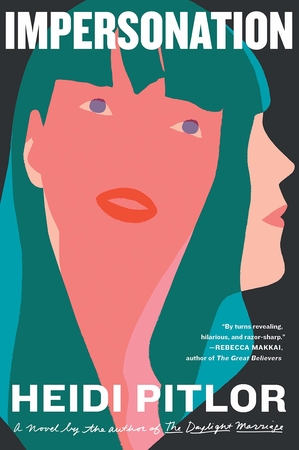
Impersonation by Heidi Pitlor

Impersonation is the story of a single-mom ghostwriter, Allie Lang, who is hired to write a memoir of motherhood for Lana Breban, a high-powered lawyer and woman’s rights activist. Lana is known for her fierce, no-holds-barred language on social media and her galvanizing feminist stunts that have gone viral. Allie must write a book that will soften Lana’s public image and ideally make her more electable.

It should be news to no one that women politicians are held to absurd standards: one must be intelligent but not intimidatingly so; well-dressed but not showy; warm but not weak. The following books address this issue in myriad ways. The intersection of image-making and gender construction is not a small one. My hope is that someday, we may progress beyond judging politicians by outdated norms of gender, and instead choose candidates based on their abilities, intelligence, and effectiveness. One study showed that women leaders have been the most effective at handling the spread of COVID 19 in their countries. Enough said.

When Women Win: Emily’s List and the Rise of Women in American Politics by Ellen R. Malcolm and Craig Unger

How are women groomed to run for and win campaigns? This fascinating book traces the inception and rise of Emily’s List, an organization whose goal is to help get women, like Elizabeth Warren, elected to public office.

Rodham by Curtis Sittenfeld

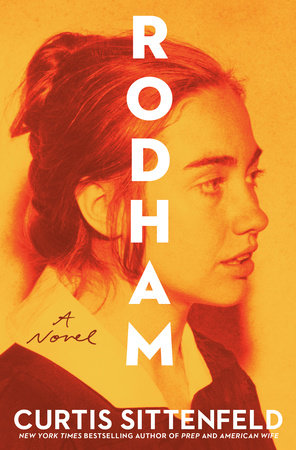
Rodham by Curtis Sittenfeld

What if Hillary never married Bill? This absorbing novel offers a kinder alternate reality in which Hillary is given a fair or at least fairer chance at the highest office in our country. What would the world look like from Hillary’s point of view? What would she have thought about her image makers—and about Bill’s?

Becoming

Becoming by Michelle Obama

This has to be one of the best written political memoirs that I’ve read, possibly because it is so personal. On the page, Michelle Obama comes across just as warm, intelligent, and funny as in her public appearances. I have no wisdom about the possibility of a ghostwriter here, but imagine and hope that Michelle herself provided most, if not all of the words here.

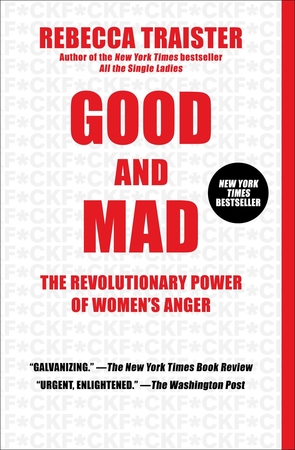
Good and Mad: The Revolutionary Power of Women’s Anger by Rebecca Traister

Traister writes:

“This is about the specific nexus of women’s anger and American politics, about how the particular dissatisfactions and resentments of America’s women have often ignited movements for social change and progress.” 

From one of our best writers on women’s rights, an examination of the political potential for women’s anger, “feminine” or not.

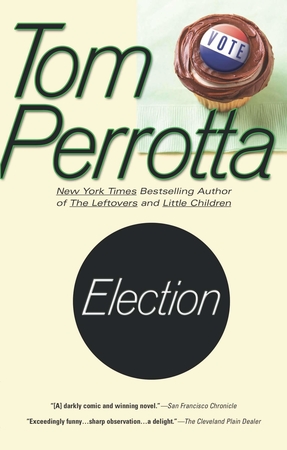
Election by Tom Perrotta

I love a good satire, and this is one of the best. Tracy Flick is a cult hero in her own right, willing to do anything to win a student council election. But how others treat her is just as revealing as how she treats them. And in many ways, she gets the last word.

The Firsts - Workman Publishing

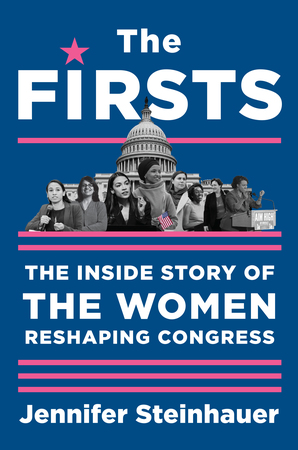
The Firsts: The Inside Story of the Women Reshaping Congress by Jennifer Steinhauer

This book offers a behind-the-scenes look at the first year in Congress of “the squad,” or Alexandra Ocasio-Cortez, Ayanna Pressley, Rashida Tlaib, and Ilhan Omar. It provides context and a look at Congress, and the ways that it has become rather ineffective and bogged down in tradition.

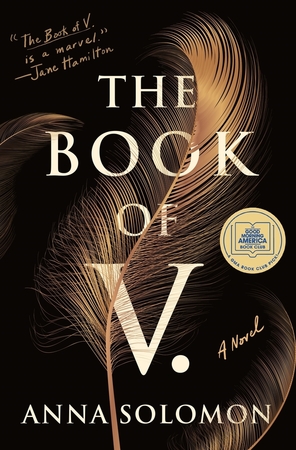
The Book of V. by Anna Solomon

Ostensibly a novel about the Jewish holiday, Purim, but in fact, a gorgeous exploration of women near and in power, The Book of V. rages on the page against the overuse of the Madonna and whore archetypes. It is possible to be both Vashti and Esther, after all. Even the disgraced wife of a rising senator in 1970s Washington can rise up against authority and become the narrator of her own story.

The Ugliest Babies in the World

The way we’ve been told, my girl cousins and I were born with broken faces.

“You know ah–,” my grandma says, “–all your mothers were so beautiful, skin no pores hor, and fair like Princess Hang Li Po. But then every single one of you popped out with the ugliest faces we had ever seen.”

Her little bungalow sweats, as though in anticipation. The ceiling fan is on the lowest setting, moving so slow it makes a whining noise, but my grandma shivers. I reach around her thin, sloping shoulders to pull her cardigan tightly around her. My own palms become damp as I clasp them together, steepled under my chin as we – the house and I – prepare for our favorite tale.

First there is Cousin Ah Leng, the oldest of us, who was premature, and came out, the story goes, with only one eye, crusted completely closed.

“Like a cyclops, you know–,” my grandma says, pronouncing it ‘See-Claps,’ “– her eyelid right in the middle of her forehead pressed shut like a vagina fold.”

My grandma says Ah Leng was so hideous when she was born that her mother screamed “I want a new baby!” and snuck into the hospital’s incubator room to try to steal another mother’s baby.

“Grandma, that can’t be true,” I say. “Cousin Ah Leng has two eyes now.”

We are both tired. It has been a day filled with emotional exhaustion, of family members screaming about what to do, and where to put her. The doctor has asked that she stay in the hospital; he even offered to get her a single room. But Ah Leng’s mother, my grandma’s eldest daughter, was adamant that she come home, said our traditions demand my grandma not die in a hospital bed, that she be with family.

“Nonsense! Ah Leng has four eyes!” My grandma cackles, because my cousin has evolved into one of those Cool Asian Girls that I will never be, with an under-shave haircut and huge, horn-rimmed glasses that magnify both her smudgy, kohl-lined eyes.

“Aiyah, sometimes her eyes so bulgy behind the glasses she look like a fly, you know? Must be trying to make up for being born with one eye,” grandma says, every time Ah Leng wafts into a room, smelling like artisanal coffee and spilled fountain pen ink.

Second there is Cousin Ah Hooi, who was born jaundiced – yellow and speckled all over like an overripe starfruit.

“And ah, her parents had to leave her in the hospital under a UV light for a few weeks, but then she got burned, which is why she’s so dark now!” 

Ah Hooi spent her childhood being called, Gelap, which means “dark” in Malay, even as her mother scrubbed the skin of her face raw every day to try to “get to the fairer layers.” Ah Hooi’s mother also covered Ah Hooi in whitening creams that made her body sting, redden, and flake.

“Grandma,” I try to explain, “The UV light didn’t darken her. That’s genetic.”

Before, my grandma would ignore me, usually more preoccupied with the greater issue of Ah Hooi’s marriageability.

“Poor thing you know, no man will want her,” my grandma would groan every time she saw Ah Hooi.

In an exciting twist of fate, Cousin Ah Hooi grew up, changed her name to Venus, moved to Australia, and became a catalog model for a multi-level marketing cosmetics company. My grandma now clips Ah Hooi’s face out of every print catalog that gets delivered via airmail to the house, and with the little bit pension money she saves – money she used to spend on weekly lottery tickets – she makes sure to purchase every item that Ah Hooi models – foundation that is too fair, lipstick that is too pink, blush that is too shimmery.

Third there is Cousin Elaine, the only one with a Christian name because her mother married a white man. There were high hopes for Cousin Elaine because as my grandma said, “Mixed up babies, always pretty!”

Elaine turned out to be a disappointment because she was born with a flat head.

“She was so late to be born that the doctor had to use the forcep to drag her out of her mother–,” grandma would tell as my cervix flinched, “–and the forcep smash down the back of Elaine’s head till it was flat!”

Because of her flat head, Cousin Elaine was forced to only sleep on her stomach, face mashed into the pillow. During the day, Elaine had to wear a special helmet that made her look like a toadstool. Elaine’s flat head did not remedy itself as she grew into toddlerhood, despite the expensive helmets, nonstop herbal soups, and interminable amount of tummy time, so her mother then forced her to maintain waist-length hair to draw focus away from the flat head. Elaine’s hair grew so long that she would accidentally sit on it and pull thick black strands right out of her head, a nest of broken hairs collecting on every surface she sat on.

These days my grandma lives in a nest of her own, cocooned in a bastion of blankets and pillows. Like a chick waiting to be fed, her head pops out and her eyes open wide when someone comes over to visit. In the beginning after her fall, there was an endless stream of visitors, a cacophony of cousins and aunts and uncles and grandchildren all sweating together, backs pressed to the tiled floor to stay cool. Now the visits have grown fewer, the occasional guilty relative flitting in and out like a ghost.

Cousin Elaine’s rebellion was decidedly on the nose.

“Aiya she walks around so shameless with that shaved head!” my grandma complains, when Elaine comes home for Sunday family dinner. Elaine and her girlfriend Josita, whom my grandma adores, have matching close-cropped hair.

And finally, there is me.

“Ah San, you were the ugliest baby of all!”

“How so, grandma?” I ask, knowing the story by heart.

“When you came out of your mother, your skin was blue, like that Hindu god, what’s it called?”

“Vishnu?”

“Ya, ya, Vishnu. And your eyes wouldn’t open, and your skin was cold, and your face was all mashed together like someone punch you in the womb.”

“And then what happened?”

“And then we waited and waited and waited and waited…”

“So, you waited, grandma?”

“Ya, ya, we waited but still you didn’t cry. And the doctor said, this baby is dead.”

My grandma starts feeling tired and begins to lean on me. Her little house, the one I spent many after-school hours in, playing with Ah Leng, Ah Hooi, and Elaine, swelters in the mid-afternoon heat, its breath held before the tropical evening storms. I knead her arms through her fluttering cotton blouse and stiffen my fingers against her back, feeling the puzzle of bones in her spine. I steady her so she can finish her story.

“They only allowed your parents in the delivery room, but I knew something was wrong, so I rushed in, and then I saw you! I picked you up, your little mashed blue body, and I slapped you across the face! I shouted, “It’s time to wake up!”

“Grandma, no! You slapped a newborn baby?”

“Ya lah, lucky I did, because… Poof! You started crying and screaming so loud, louder than any baby I ever heard. Then everyone started crying, your mother, and your father, and even the doctor. But I didn’t cry.”

“And then what happened?”

“Wah, then you bite me!”

“Grandma how could I have bitten you? I was a newborn. I didn’t have teeth!”

But this is where she always ignores me and jumps straight to my favorite part of the story. She straightens herself, pulls her shoulders back as if to summon as much volume as she can from her diaphragm, filling out her yellow cardigan with the strength of her upcoming punchline.

“Ah San, that’s why we named you 珊.”

I let the air fill with a pause before my next question. She relishes her victorious ascent to the story’s peak.

“But what does 珊 mean, grandma?”

“Aiyah you know what it means! It means “coral,” because coral is so hard and tough. It stays very still, seems like it’s dead in the ocean. But once someone kicks it, you will know it’s alive because ah, it will bite you. Painful you know! Tough like you!”

My grandma is exhausted by this point. She breathes slowly, and the house falls quiet, its creaks subsiding as if to respect its owner’s fatigue. I fluff up her pillows behind her, pillows my cousins and I used to fling at each other when we fought. I pull the thin Smurfs blanket over her body, the one I used to demand whenever I was sick or sad. I kiss her papery cheek, blue veins creeping across cheekbones, smell the sour milk in her breath, the coconut oil in her permed white hair.

As she drifts off to sleep, my grandma says, “Ah San, you were the most beautiful ugly baby in the world.”

Tomorrow, I will return to this humid house. I will fluff up her pillows, tuck in her Smurfs blanket, and hold my post by the bed. I will ask her to tell me the story again.

A Mother and Son Scam Their Way Into the American Dream

Maxima in the dark. Half-lit by a Virgin Mary night-light and the glow of a screen saver, a slow-motion sweep of stars and planets—Jupiter, Saturn, Earth. Dressed in denim cutoffs and a Mickey Mouse tee, she doesn’t shiver, despite her wide-open bedroom window and the cold night beyond. She sits at the foot of her bed, cleaning her nails with the tip of a switchblade. “May bakas ka bang nakikita sa aking mukha?” she sings. “Masdan mo ang aking mata.” Like all her favorite Filipino love songs, this one is about heartbreak.

Prologues like the one that opens Lysley Tenorio’s The Son of Good Fortune don’t come by often: in tender, vivid strokes, it introduces us to Maxima Maxino, former Pinay B-movie action star, survivor, and undocumented immigrant mother to the book’s protagonist—its eponymous son, Excel, also undocumented. 

The adventures these two will undertake, both together and separately—from scamming older white men on the Internet, to arguing with crusty middle-class Filipinx academics, to escaping for dusty off-the-grid towns like Hello City—make The Son of Good Fortune a new kind of Western: an enormously big-hearted and distinctly 21st-century story about just who defines our “outlaws,” and what contemporary America looks and sounds like from the margins.  

At the end of our interview, Tenorio mentioned the peculiar reality of publishing a novel during the COVID-19 pandemic: “It’s just really bad timing,” he said wryly.  I said, “There’s never bad timing for a good book.”


Elaine Castillo: This is going to be one of those questions that starts off as a comment—the dreaded Question as Comment—I’m that white dude in the audience. For book research, I’ve been in this phase of reading books by white authors that mentioned Filipino characters, so I’ve re-read both J.M. Coetzee’s Diary of a Bad Year and Philip Lopate’s The Stoic’s Marriage, and it’s…interesting: both of them are about white dudes being scammed by Filipina women, in a way that—

Lysley Tenorio: Whoa!

EC: Yeah, exactly. In a way that isn’t in any way, really, interested in the interiority of those characters. The Coetzee does a little bit better, but still, the narrative is not in service to that character. And when I was reading those books, I kept thinking: well, I want to read the book about this supposed Filipina scammer. I want to read the book that’s from the perspective of this supposed Filipina scammer. And when I started to read The Son of Good Fortune, which, I mean, that prologue—hello, welcome to a book! What I realized, without knowing what I was walking into, was that this was that book. This was the book that was about that perspective. 

So I just wanted to ask: how did Maxima, her son Excel, how did these characters come to you? How did that world appear to you? Especially a character like Maxima—I mean, I think for most of us in the diaspora, many of us either know this character or are on the way to becoming her.

LT: Well, originally, this novel was about DVD pirates trying to assassinate DVD-sniffing dogs. Based on a true story! In the Philippines and Southeast Asia, there are these dogs that were sort of famous for taking down the DVD piracy underworld, so there was a bounty on these dogs’ heads. So the character that was Excel in the earlier version was this aspiring dog assassin. It was fun to write, and there was a mother who kept appearing in flashbacks—the mother was actually deceased—and as I worked on the book, I realized the most important relationship, and really the most important characters, were this mother and son.  

And once I realized, okay, I need to invest in this relationship and figure out the story around this relationship, I knew that I wanted to have a strong woman figure be at the center or near the center of the book.  I knew she would be emotionally and psychologically strong—and I think we see that a lot in a lot of immigrant stories, where you sort of have this fiercely strong but also kind of reserved immigrant mother. I wanted that strength to really be externalized, that she be physically formidable [Maxima’s background as a Pinay B-movie action star has left her with considerable fighting skills]; that she be cunning, that she do whatever it takes to make the most of her life.  

I’d also been researching these online scams—one website had called it the Filipina Marriage Scam—and I thought, what if Maxima was a scam artist?  I was a little hesitant at first about writing an undocumented character who was involved in unethical dealings, right, but, at the same time, I just want to make her an interesting, complicated character—someone who’s willing to do even unsavory things in order to provide her son with a life, and try to fulfill her own life as best as she can.

EC: We have this sort of stereotypical image of immigrants and particularly undocumented immigrants, that there has to be this pose of the perfect, grateful immigrant. This pushes against that.

LT: Yes. And I think that was a conscious decision as I moved forward with the book. One of the things I wanted to address in the book—but I didn’t want to overstate it—was that those who are here, those who are born in the States or are documented, American citizens, they have the luxury and the privilege to aspire to mediocrity; they can aspire to just live their lives in peace and be left alone.  

I didn’t want these undocumented characters to be these, like, Nobel-winning scientists in the making. I think all Excel really wants is to be able to walk down the street and not worry. To just have a job, pay his rent. I think Maxima wants more than that, but I think that’s all Excel really wants. And I wanted to write a character who—not that he doesn’t aspire to things or has no vision, but he’s wanting a very basic privilege that so many of us have.

EC: Because it’s such a specific portrait of Colma, and the West Coast, and the Bay Area, when I was reading the book, I also had the impression that I was reading this fantastic contemporary Western, especially with the introduction of Hello City [the off-the-grid town where Excel escapes to for much of the book]. We have this frontier myth of Outlaws and—look, in lockdown time, I’ve been playing a lot of Red Dead Redemption II so outlaw myths are very much on my mind now, anyway. But what I felt when I was reading your descriptions of Hello City and this Western town on the margins, was that this felt like a new way of writing a Western; writing about so-called “outlaws.” Was that in your conceptualizing of Hello City? How did you come to start writing about Hello City into the rest of the narrative?

LT: As I progressed in the novel, I did start thinking of Hello City as a kind of frontier—this kind of untamed landscape where one goes for rebirth or reinvention. For Excel, it’s a place where—at least he believes, anyway—that he can be free. But of course, we realize that it’s still a form of hiding, to be in Hello City. But I did see it as a kind of frontier landscape.  

American citizens, they have the luxury and the privilege to aspire to mediocrity.

But it was actually based on an off-the-grid city in the desert in Southern California called Slab City. So, a lot of research, a lot of YouTube videos.  Slab City was, I believe, a former military base, or it had been intended to be a military base but it was abandoned, and what was left behind were these concrete slabs.  

I kind of tweaked that and thought, what if it’s just these helipads with H all over them, so you have this whole landscape dotted with the letter H. And I just thought, what could H mean? So once I started playing with this idea of H—hello, home, hiding, here—Hello City came to me a little more clearly.

EC: Well, it’s interesting, you talking about this linguistic echo with the letter H, hello and hiding, because another thing I found moving in the book was how you use language. It’s a reversal, in a way, of the kind of typical use of non-English words in American literature. I think a lot times, we’ll use—I myself use Filipinx languages, I’ll use Tagalog, Pangasinan, and Ilocano, sometimes without translation, sometimes with translation in context, and that’s kind of the customary way that diasporic writers do this, and you do that as well, but there’s something else you do in the book.  

It starts in the beginning of the book: you’ll write what looks like an English phrase, and it is, but to a Tagalog-speaking reader, they’ll hear the kind of Filipino language that’s buried and embedded in that English. So there’s an early description of Excel being “hiding and hiding.” To an English reader, they might go, “Okay, hiding and hiding,” dramatic effect, but to a Tagalog-speaking reader, I immediately heard “tago ng tago” [literally translated as hiding and hiding, but also the Tagalog phrase for undocumented people, also abbreviated as TNT].  

It’s a way that I haven’t seen before, of not just writing in other languages, but in understanding the different Englishes that we all operate within. At some point the book describes “unpayable debts”: of course, a Tagalog speaker would hear utang na loob. It’s almost as if you create this kind of ghostly, sort of spectral echo to the English, within English, and also posits this idea that there isn’t only one English, you know—that “English” is also multiple types of diasporic English, itself. I found it inspirational. How did that landscape, that use of language—that soundscape, even historyscape—how did you come to it in the book?

LT: I like your use of the word soundscape, I think that makes a lot of sense.  Because—I mean you know this—as Filipino writers, when we want to put in Tagalog in our work, we don’t want to have to accommodate a reader. It just doesn’t feel right: you sort of break the dream and you slip away from the consciousness of the narrative. At the same time, you hope that a lot of the readers can still keep up, somehow; so sometimes you provide context clues, sometimes you don’t… With the Tagalog, I just figured, they’ll get it or they won’t get it, if I can put in a context clue that’s organic to the moment, I’ll do it, otherwise they’re on their own.  

As Filipino writers, when we want to put in Tagalog in our work, we don’t want to have to accommodate a reader.

But this idea of the English within English, that is something I really had to think about in terms of people like Maxima speaking to other people like Maxima. So what it really was this idea of just closing my eyes and imagining these conversations in a Filipino household: what kind of English would pop out, what are the particular idiosyncrasies of their English, and how do I transcribe that in a way that captures that Filipino English, if that makes sense? In that sense, I kind of just crossed my fingers and did my best to transcribe, hoping that some readers—like you—might pick up on it, and I’m happy to hear that you did.  

With non-Filipino readers, they might not pick up on that nuance, but hopefully they can at least find it particular to a voice.  So in terms of how I did it, I think it was just a matter of closing my eyes and thinking about Filipino moms we grew up with, family we grew up with, sometimes it was just as simple as that—but really trusting in that moment, this idea of transcription.

EC: The dialogue does feel so lively throughout the book—you do feel like you’re overhearing people’s conversations, as opposed to conversations that seem designed for [a reader’s] kind of comfort and understanding, which a lot of fiction that seeks to translate non-English speech for, essentially, a white audience, can sound like.

LT: Yeah, yeah—I also didn’t italicize, I didn’t want italics in the book for the Tagalog. That was really important to me, not to italicize.

EC: —mm, this refusal to italicize, this refusal to mark as Other Tagalog speech or words for people who are living here, in America. That language is part of the American landscape, and the American linguistic landscape.

LT: Absolutely.

EC: You were talking about what Maxima sounds like talking to other people, and of course it brings to mind Roxy [Maxima’s best friend, a trans woman], the person that she’s often talking to the most.

Obviously, reading this as a bi reader—LGBTQ people have always been a huge part of our community and our diaspora, and you have always written about that.  I do remember that there’s a short story in Monstress, “The Brothers.” It’s a very difficult story about a cis brother dealing with the death of his trans sibling. And it’s a story in which he does misgender her and deadname her repeatedly. And it does also end with a violent act of trans erasure by the mom, upon the sibling’s body.  

It’s painful to read.  It’s also profoundly realistic—I’ve definitely had to confront cis dude family members who would misgender and deadname trans Filipinx public figures and trans friends. How did this commitment to portraying queer and trans character in your fiction, how has that evolved from Monstress to now—or has it—and what does it mean to you write about these characters?

LT: Right. You know, “The Brothers” was written a long time ago. I think it was published in 2006, but really I wrote it in like 2002, so—at least in my memory at that time—the idea of deadnaming, I didn’t even know that time. So in recent years when I’ve given readings, I’ve been asked about why would I write about trans issues or a trans character, and there’s deadnaming going on in the story—and I do try to make clear that it comes from the maybe-unrealized transphobia on the part of the narrator.

I don’t know that ‘The Brothers’ is the kind of story I would write now.

Nonetheless, I do understand that it’s a very difficult read, especially now.  But I did want Roxy to be a trans character because I wanted some kind of stability in the life of Maxima and Excel, and for the idea of stability and normalcy to come in the form of a trans Filipina character… She kind of lives the better life, “the good life,” if you want to say—they go to her for help, and I like this idea that, you know—I try to make my work inclusive, and I wanted to include a trans character because it just—it felt right for their story. But I also understand that it’s such a different climate now that I didn’t want to overstep the lines this time around with the trans character in the way that I think some readers have felt I overstepped with “The Brothers.” So I try to be mindful of the impact that my characters—whatever groups or identities they represent—I do try to be more mindful about it.  

Roxy, in some ways, was a character inspired by my own life. Growing up, —you know Filipinos are known for being super social and for having tons of family—but for some reason, we didn’t have a lot of family friends! I don’t know why. But one of the people that did come visit, not often, but at least recurrently, was a trans woman—we didn’t call her trans at the time—a trans friend who would do our hair. And every time she was over, it was like, oh, we have company. And it just felt like—it made me feel normal.  Like, oh, just like all my other Filipino friends, we have company coming over. And I thought, what if that was the case for Maxima and Excel? So that’s how Roxy came about. 

EC: Roxy as the stabilizing figure pushes back against some of the narratives around trans characters [written by cis authors], which are often overwhelmingly about trans death and trauma; I remember this book that I used to love, Banana Yoshimoto’s Kitchen, and I read it when I was maybe thirteen or fourteen. And it was one of the first books that I ever read that had a trans character in it—but looking back at it, that trans character in the book is ultimately killed off in the story [and her death is one of the central tragedies upon which the novel is founded, centering a developing cis hetero relationship]. The spectacle of trans trauma and death as it’s trafficked by cis writers is all-too-common. So the idea of Roxy being this normalizing figure in Maxima and Excel’s lives makes sense—why wouldn’t she be? The concept of trans people not being “normal” is obviously part of transphobia.

When I read the Roxy character, she reminded me of one of my godparents, who—the tricky thing about being in diaspora, is that the epithets are not necessarily the ones that the people themselves might use, just because English is not necessarily their language for self-expression—so this godparent was someone who would probably most closely identify as genderqueer. Queer and trans and nonbinary and gender-nonconforming people have always been an enormous part of what’s often thought of (and of course, still is) a heteropatriarchal Catholic culture; to not show these facets is to not really see the community.

LT: Yeah. I don’t know that [“The Brothers”] is the kind of story I would write now.

EC: It’s good to confront, I think, though—to confront and face—to be able to look back at the work that we wrote, or read, or valued back then; important for our ability to be present in the world now.

LT: It’s evolved, for sure.

EC: I also wanted to know a little bit about genre in the book. There are a lot of mentions of anime and comic books—lots of Filipinx kids grew up on anime, certainly I did—as well as the nod to the Western genre: what were the extra-literary influences that sort of made up the book?

LT: I was definitely thinking about those ‘80s and even ‘90s Filipino action films that sometimes I’d catch glimpses of if I was in a turo-turo joint or on YouTube: it’s the over-the-top-ness, the campiness—that’s just something I’m drawn to in general.  

What I’m drawn to with camp, or anything that might seem like camp, is that I love the challenge of taking something that’s mean to be [un]serious, and giving it real emotional weight. So that when Excel, who’s just been beat up by his boss, sees an old movie of his mother’s where she’s climbing out of the rubble after an earthquake hits, he realizes, This is so cheesy, but he’s also in that moment thinking: She’s a tough woman. So I’m drawn to these things that might be seen as lowbrow or low culture and trying to find something emotionally substantial in those things.

Comic books, I grew up with—comic books definitely informed my sense of drama, and hopefully the visual; I try to be a visual writer.  So I think those two things really informed not just the book but my writing sensibility.  

I tend to overwrite early on, and I go for big drama and melodramatic dialogue, because I always tell my students: When you’re drafting, just go for broke. Be as over the top as you need to be because you’ll always pull back. So that exchange of dialogue that might seem snatched out of that 80s primetime soap Dynastyso over the top—if you get that on the page, you can find little dramatic moments. You just tame them, and you find little nuances. So these big broad strokes of drama that I so enjoyed as a kid, whether they come from TV or comic books or movies, have in many ways taught me how to write.

EC:  I think that’s so apparent in the book, especially in that one scene, when Maxima confronts these academics who are speaking really patronizingly about her life’s work—this work that means absolutely everything to her, and which she does not see with this kind of detached irony.   So much of the book, its moral conviction, is about pushing back against that detached irony; going right into feeling.

LT: Yeah. And that to me feels very Filipino. When you’re in the Philippines and you still hear taxis still playing Air Supply or the Carpenters, I mean, that’s meaningful stuff. That’s not kitsch, you know. And even though I didn’t grow up there, I can still feel the emotion of that. I mean, if I’ve had a few martinis and I’m alone in my office, I’m playing the Carpenters. Karen Carpenter singing to me—we can laugh at it, from a more American perspective, but I remember how meaningful those songs were, especially when we were new to the country, and English was not the primary language in the household. How can that be cheese?

How Playing “Myst” Taught Me to Write Fiction

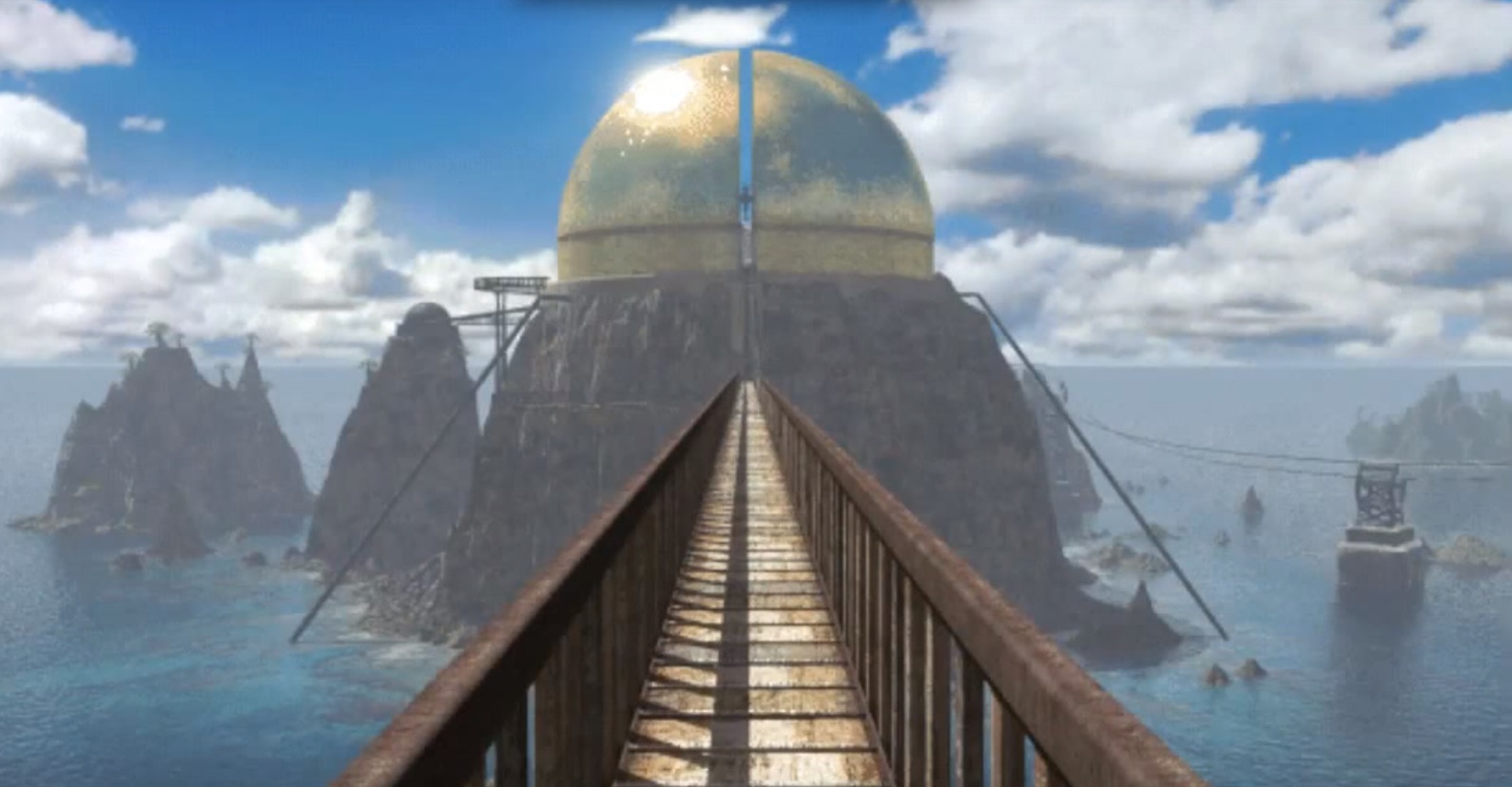
In the 1990s I was a lonely, nerdy girl writer. Nobody else I knew was simultaneously obsessed with learning HTML and parsing the sentences of F. Scott Fitzgerald. This meant I spent a lot of time alone, curled in my chair reading—but I spent nearly as many hours clicking and tapping on my mother’s beige, boxy computer, playing computer games. I liked puzzle games, and the bigger the world to explore, the better. In particular, I was a fan of Cyan’s original island-linking puzzler, Myst. For those growing up in the ‘90s, just discovering the engrossing world of first-person computer games, Myst and its sequel, Riven, are a touchstone. The pop culture we absorb and obsess over has a funny way of shaping us when we’re not noticing. I can only see a couple of decades out how Myst and Riven drove my own fixation on negative space in narrative, and showed me how it’s possible to tell a story in an empty room.

Myst and Riven were revolutionary games for their time, and are still cult favorites today. Unlike the fast-moving, pixelly platformers of this era, Myst and Riven relied almost entirely on clicking through still images of painstakingly drawn natural environments, making the most of limited ‘90s computer processors. You move through a static world, like flipping through one matte painting after another. You open steam valves and record musical note codes and collect keys. You don’t know what might be significant to solve a different puzzle elsewhere on the island, and so you keep a notebook open by your keyboard, and scribble down strange symbols carved on the walls, or the number five popping up in odd places. Beneath the codes and puzzles and labyrinths is a surprisingly complex story, full of patricide, family rivalries, colonialism and Apocalypse Now-like riffs on Godhood and exploitation. In Riven, a mad genius capable of designing worlds through the writing of books has been exiled in one of his own worlds by his son, who believes him twisted with power. But the father has turned the local inhabitants of the world into his slaves, posing as a god of the realm, and is exploiting them through fear and violence. It’s your job to enter the dangerous, unstable world he’s running and trap him, helping the rebels wall him off in a different book that is secretly a prison.

It was a kind of playground for wandering, for putting together the clues of who had once lived here and what stories they had left behind.

Whenever I decided to pop one of the five Riven CD’s into my mom’s CD-ROM drive and start up a game that seemed to have no ending, I’d fall into an intense, quiet, and focused state. My mother’s little office darkened and quieted around me when the fuzzy blue-gray graphics of the Cyan logo resolved itself. The setting was a sunny, semi-tropical world that seemed only recently abandoned, strewn with the debris of a hastily departed people. It was a kind of playground for wandering, for putting together the clues of who had once lived here and what stories they had left behind. The quiet, contemplative mindset I could find when I leaned close to the bright computer screen, ruining my eyes, moving image by image through the deserted world felt like meditation. It also felt like the kind of focused, curious, imaginative journey that I went on when I was trying to write stories of my own, solving the puzzles of sentences, writing with half creation, half discovery. 

The makers of Riven and other games of the era were fighting a constant and cleverly-waged war against the limitations of hard drive and RAM space; while CDs could hold an astonishing amount of data compared to previous disks, the speed and processing power of personal computers at the time kept most of the images static and the worlds tightly contained. Like Main Street in the movie Pleasantville, which loops right back onto itself after a few blocks, the worlds of ‘90s computer games had to come up against walls, or cleverly loop on themselves to give the illusion of space. In Riven, the island motif worked because you could plausibly be trapped on these small land masses, surrounded by perfect cyan-blue seas. The gimmick of Riven— that these island worlds were in fact, written creations by a madman master creator, bound by his own imaginative limits — suited the limitations of their technology well. 

The puzzles of Riven were legendarily fiendish. While Myst was solvable, given enough time and diligence, some of the puzzles in Riven were outlandishly obscure. An example: you had to find where a dome-shaped stone was located on each of five islands, then compare it to a hidden topographical map of the islands, then place colored marbles precisely on a 50×50 grid representing the domes. Spin a revolving chamber five times and nothing would happen—but spin it back once and you’d find a hidden door. Remember to extend a walkway when you were on the near side of a bridge, because an hour later on another island, you wouldn’t be able to make it back. Boil water in a chamber to make a floor panel rise, then drain the water, then lower the panel again, and you’d find a secret ladder. Colors were linked with animals in an exact order. Doors hid other doors. Throwing a hidden switch would result in turning off a fan you encountered hours later, enabling you to climb through an air duct. If you pushed a button that appeared to do nothing at the very beginning of the game, you’d be able to finish; if you pushed it fruitlessly an even number of times, it would do nothing at the end, and you’d be unable to win. Rotating chambers with shifting doorways, and locked prisons with sound pattern codes, confounded my ten-year-old brain. I never finished the game on my own power. I had to resort to cycling through the few intriguing zones I could reach, somehow soothed by the realistic lapping water and the cranks and pulleys and levers I could turn off and on again, not knowing their effect.

I sought it not just as a game to play, but a full-body experience.

Years later, I finally bought a guide book to the game, blew the dust off the CDs (they remarkably still worked), and played all the way through, following the walkthrough as the book guided me. It was exhilarating to finally see how the puzzles worked, and to open new rooms I had not noticed, but it was also disappointing, as it always is when you’re given the answer to a riddle or the secret behind a magic trick. Still, the pleasure of returning to that world was intense. My nostalgia for the experience of playing Riven is wrapped up in the sensory experience of sliding the CDs into that fragile ejecting tray; listening to the hum and whir of the CD starting up; the fact that you had to switch CDs every time you arrived on a new island, one of five, and the buggy way the computer would jerk and freeze as it labored to load a video clip. I liked to imagine myself into the jumpy digital rooms and islands and underground tunnels. I pretended I was an explorer really visiting these places. When characters spoke to me, saying, “You must have come to help us,” I took my role seriously. The experience of immersion, which I talk to my creative writing students about, can be achieved with such paltry tricks: a stranger who seems to know you, or an entreaty, a riddle begging to be solved. An open door, with a light on in the room beyond; a winding pathway through the trees. There were other islands on the horizon of the game, and locked doors I couldn’t enter, and it made me want to visit the world again and again. I sought it not just as a game to play, but a full-body experience, a deep, entrancing pleasure to place myself in another person’s puzzle.

The idea of traveling through an uninhabited world, deciphering its clues, has since been explored in many games, from the clearly Myst-inspired puzzler The Witness to the poignant coming-out story in an empty house suggested by Gone Home and the solitary, woodsy wanderings of Firewatch, where you’re stationed at a forest watch tower. In these games, you discover the rules of a world by traveling through empty rooms, picking up objects, reading through the scattered notes left on a desk, discovering the signs of struggle or heartbreak in mementoes stashed under a bed. NPCs (non-player characters) speak enigmatically of the events that happened before you arrived; it’s up to you to piece together what has happened here.

The anonymous nature of the first person gameplay lets you step into the world and imagine the hypotheticals.

You’re a cipher, an invisible first-person observer with all the possibilities of a fictional character but none of the locked-in personality. The anonymous nature of the first person gameplay lets you step into the world and imagine the hypotheticals, making choices and focusing on what carefully laid details you find intriguing. In Gone Home, there’s a sense of dread as you poke through the dark corridors and abandoned rooms of your family’s home; you keep expecting a zombie to jump out or a ghost to drift by. But instead, through the discovery of journal entries and bus tickets, you realize your family is in the middle of a quiet crisis. Your younger sister has come out to your parents, and in their cold reception to the news, she’s decided to run away. By putting the first person observer right in the middle of this drama, gamers are encouraged to empathize with a problem and a character rarely depicted in the world of video games. The problem is yours. It’s up to you how to feel about it, but you’ll have to live in the world for a little while and experience it as your own.

I didn’t always manage to finish these games on my own steam, but it didn’t really matter; the pleasure is in the exploration, not the win. You’re yourself, stepping through a looking-glass.

Sometimes, characters you might encounter later will know who you are, and pull you into their schemes. In others, you’re anyone and no one, and your job is to witness and discover, and eventually draw your own conclusions of sympathy and allegiance. In Riven, you learn a code by stumbling into a schoolhouse and playing a children’s hangman’s game, turning a crank and watching a toy figure dangle over a shark and lower itself a certain number of clicks for each turn. Then you put two and two together, and realize the children’s game is a replica of the strange gallows structure you’ve been circling outside, and that people are being executed on the island using just this method. No one tells you what to think or how to feel. The story is all suggestion and silence.

This process of discovery through negative space, through unanswered questions and objects that speak, has had a powerful effect on my own writing. I’ve written many stories that involved people passing through empty rooms, sorting through objects left behind, hovering in doorways or leaning in on the edges of conversations, trying to divine the secrets of the people who are living their lives just out of the story’s frame. I—and my characters—are fascinated by the clues and hints and misdirections that suggest conflict, desire, a life being lived in privacy. My favorite fiction offers lives up to the reader in glimpses.

We are detectives, prowling around the edges of each others’ lives.

There’s an ethical and political dimension to spying and eavesdropping, picking up the story through suggestions and clues, that I only picked up on when I revisited Riven this year. When we try to inhabit the lives of other characters, the process is necessarily incomplete; we can’t perfectly slip into the experience of others, and must acknowledge the partial, fragmentary nature of our disappearing. Authors know this. In the recent furious arguments in lit circles about appropriation, #ownvoices, or the difficult question of who is entitled to tell whose story, that problem is beating at the center of every debate. Ultimately I think suggestion and limitation might be the only way to honestly show the experience of others—to acknowledge that we are detectives, prowling around the edges of each others’ lives.

Playing Riven, I used to perch on the  edge of my mother’s computer chair and crane into the screen as though I could see deeper into the corners of the digital rooms, looking for easter egg details left, lovingly, by the game’s creators. I felt myself entering a trance of discovery. Surely there were more secrets—locked rooms and hidden basement stairs, pathways through the cricket-keening forest, other houses that would open to my knock. I spent so many hours of my childhood in this quiet, thrilling discovery mode. The games were not at all the flashing lights and shoot-em-ups that non-gamers sometimes imagine. They were an escape, a place to explore the boundaries of a fictional world, a daydream.

The disappointment of a computer game is ultimately its finite nature; with its limitations of how much data can fit on five CD-ROMS, only so much world could exist. Every gamer has encountered and pushed up against those invisible walls in the edges of a game: arcade players of Donkey Kong striving for the kill screen, or players of Mario or Zelda leaping into the voids surrounding their colorful land masses, or running into blank barriers of pixels, hoping for a moment that they might punch through to the other side of the universe, and see it continue on. The land beyond those digital boundaries is mysterious, intriguing, no-space.

As a young writer, I returned to the game, and still return to games like it as an adult, old and anxious with a baby of my own to care for during a pandemic. I’m temporarily soothed by the balm of digital immersion. The quiet thrill of fiction—and game life— is to get a glimpse into a world that exists without you, and yet allows you to enter and participate, like a virtual trip through the spaces that we’re now prevented from entering. I can imagine games being created during this quarantine period — quiet walks through a grocery store, jostling among crowds at a concert or stadium, riding a train. We’re seeking an escape into normal life as an exotic luxury now. I can imagine scores of lonely people settling into the screen-lit darkness of their living rooms, playing virtual lives, exploring normalcy, living its forgotten pleasures.

8 Books About Hexing the Patriarchy

First, a few key terms. Patriarchy is not, at the end of the day, defined by the gender of one’s leaders. It’s a societal model based on the rigid binaries and hierarchies necessary to divide, conquer, and control—e.g., men over women, men over nature, straight and cis over queer and trans, rich over poor, and, often, white over Black and Brown. Magic is energy moved with the intention of transforming reality. Therefore, for our purposes, #HexingThePatriarchy is channeling energy to dismantle this hierarchical world order and then cast a new, freer world. 

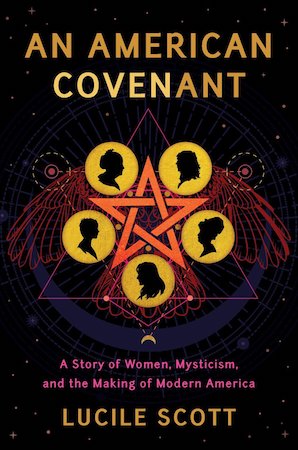
In An American Covenant, I set out to do my own small part in this large-scale quest by telling the stories of five powerful feminist mystics over three centuries who helped transform America—though by and large we’ve forgotten their names. It’s a story about resistance. It’s a story about power, control, and freedom. It’s also a story about a slight blonde lesbian in her mid-30s seeking transcendence while navigating personal and cosmic chaos—me. 

In most American mystic traditions, the natural world, including each and every one of us, stands as divine as anything on high in the sky. This belief has long beget radical notions of the equal right of all to a decent life here on earth—regardless of race, gender, profession, etc. This, of course, has the bonus of dovetailing nicely with our nation’s founding words. However, this alternate spiritual basis for the American experiment threatens the patriarchal powers that be by empowering all those they seek to control. And so, once we could no longer acceptably burn (or hang) feminist mystics, we were taught to mock them and their oft mainstream traditions into a spectral historical footnote. This book aims to help #HexThePatriarchy by pulling five of our feminist mystic leaders back into the direct light of herstory and their rightful place as American (s)heroes.

Below, I’ve included eight other books that aim to stick a flaming pebble in the spokes of the patriarchal machine—as eight connotes new beginnings and new societal orders. Some of the books are fiction, some non-fiction. Many emerged during, and are evocative of, a major wave of American feminism. Others explore a mystic or mystic tradition discussed in my book. All can help us recognize and touch the divine, mystic spark deep within so we can keep up the fight for however long it takes to win it. 

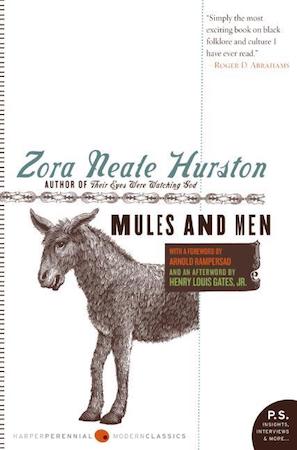
Mules and Men by Zora Neal Hurston

In the late 1920s, Zora Neal Hurston, then a leading light of the Harlem Renaissance, headed South to New Orleans and her “native village” of Eatonville, Florida, on a mission to create the first great anthology of African American myths, rituals, and songs. The result was Mules and Men—a book chock full of poetic resistance to the patriarchal powers that be. 

In my personal favorite section, Zora meets Luke Turner, who attests he is the nephew of New Orleans greatest Voodoo Queen, Marie Laveau. Zora then apprentices with Luke, learning his and Marie’s Hoodoo ways. She also learns of Marie Laveau’s true legacy, nearly lost to history—that she served as a symbol of liberation to people of color throughout New Orleans, both in life and after her 1881 death. Or as Luke put it:

“Time went around pointing out what God had already made. Moses had seen the Burning Bush. Solomon by magic knowed all wisdom. And Marie Laveau was a woman in New Orleans.” 

Radical Spirits, Second Edition: Spiritualism and Women's Rights in  Nineteenth-Century America / Edition 2 by Ann Braude | 9780253215024 |  Paperback | Barnes & Noble®

Radical Spirits by Ann Braude

In the late 1850s, up to 10% of the American free adult populace adhered to Spiritualism in some form or fashion. This mystic movement is rooted in ideals of equality and spiritual autonomy, eschewing biblically ordained hierarchies of gender, race, and class. Many early suffragists were Spiritualists—and nearly all Spiritualists supported women’s suffrage. Spiritualism’s popularity, therefore, helped fuel the spread of this “radical” notion, that women deserved the vote, across the nation. Plus, more oft than not, women served as mediums and the de facto heads of this largely headless movement. Braude’s book, which came out in 1989, was among the—if not the—first to chronicle Spiritualism’s pivotal role in giving 19th-century women a public political and social voice. It’s a fascinating read that lends a new mystic lens to American progressive culture and politics. 

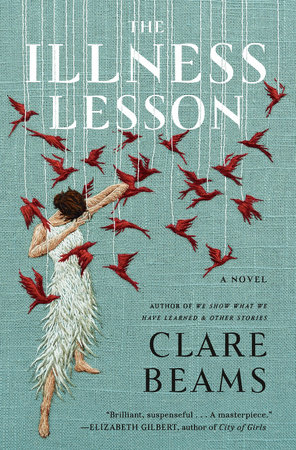
The Illness Lesson by Clare Beams

The Illness Lesson by Clare Beams

In the late 1800s, the American male medical establishment coined the term “mediomania,” in an effort to link insanity to Spiritualism, and cut down the threat to the patriarchal order. They then redefined insanity’s symptoms as the most common side effects of entrancement—rigidity, seizure, ecstasy. Eventually, they settled on the more widely employed “hysteria,” derived from the Greek hystera, meaning uterus. 

Beams riveting slow burn of a novel tells a story of “teenage hysteria” set in 1871 in New England. The prose is so thick with mystic symbols and smoldering repression that it reads like a startlingly lucid dream or nightmare—one that explores how, even when well meaning, the male medical and philosophical establishments can hex a woman by convincing her that her flawed, weak body, not the strict limits society puts on her, are responsible for her ills. It also poignantly expresses the power of pulling back that curtain and seeing the truth: you are strong.

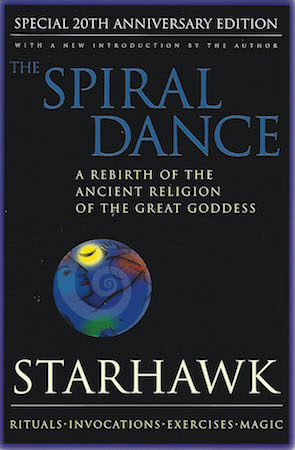
The Spiral Dance by Starhawk

In this second-wave feminist mystic classic, Starhawk codifies her nature-loving withcraft tradition, called Reclaiming, and her ideas on how the Craft can realign energy towards social justice. She also presents a potent book of spells, all helpful for dismantling the patriarchy, and her own take on the feminist legend that, circa 3,000 BCE, war and its Gods emerged to snuff out ancient matriarchies. Humanity, the story goes, then replaced that matriarchal order based on equality and personal autonomy with one of rigid hierarchical control. I’d say she stands as the high theologian of the Feminist Craft (though she’d probably not like my hierarchical terminology). 

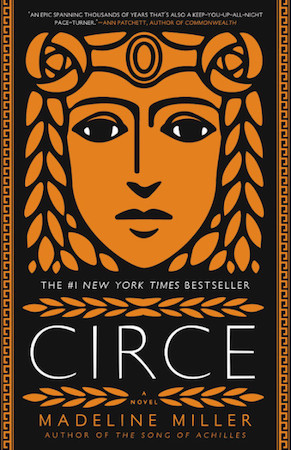
Circe by Madeline Miller

One’s cultural myths should reflect the values one holds most sacred, as our myths shape our psyches and life choices—even if we don’t think they do. However, most Western myths, told only from the perspective of white men, do not reflect the values I hold most sacred. And many of these myths began with the Greeks. In Circe, Madeline Miller recasts these archetypal tales through the gaze of the witch Circe, revealing the bombastic brittleness that always undergirded the patriarchal originals equating brutality with valor and narcissism with honor. 

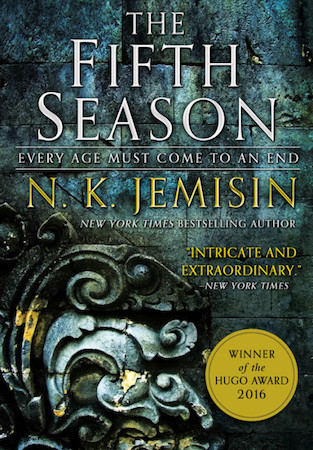
The Fifth Season by N.K. Jemisin 

In addition to recasting old myths, forging new but equally resonant ones can help shift how we perceive and therefore construct our world. In this, the first book in her Broken Earth trilogy, N.K. Jemisin reflects our own more lamentable values back to us via her mythic land, called the Stillness, where the earth is a violent father, not a nurturing mother, and the only way to survive seems to be to cling to a rigid cast system. By the end of the book, this belief is not just revealed as an illusion, but something far more sinister in this tale of how, exactly, the Stillness came to seem bent on destroying itself. 

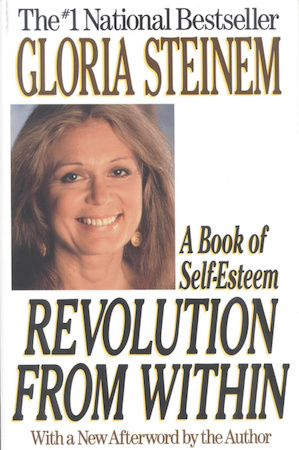
Revolution from Within by Gloria Steinem 

In the 1970s, many “second”-wave feminists believed if they changed the laws limiting women’s standing in society, the revolution would follow. By the 1990s and the “third” wave of American feminism, it had grown clarion it was a much longer game. In this incredibly well-researched book published in 1992, Gloria Steinem, the most famous of second-wavers, chronicles how to dismantle the carefully constructed muzzle the patriarchy puts on all of our “inner voices”—be we men, women, or in-between and beyond. She then provides historic and personal anecdotes demonstrating that, so freed, this inner-voice—often mystically referred to as a light—alters a person, makes them far less willing to accept powerlessness and near-impossible to control. 

Image result for wide sargasso sea book

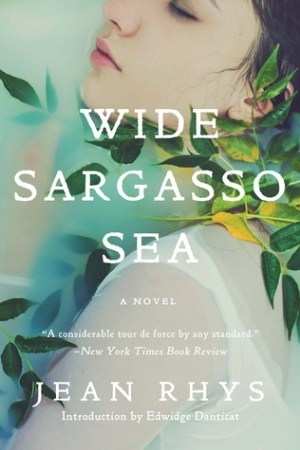
Wide Sargasso Sea by Jean Rhys

After I finished writing An American Covenant and pondering mystic journeys through my unconscious mind, I took a deep dive into French feminist psychoanalytic theory. From these thinkers, I learned how “the phallic order” employs many tools to dominate our minds. A clutch one is an over-reliance on highly linear narrative structures that confine our thinking to strictly prescribed, rationale boxes—cutting off access to all that lies beneath this mental veneer. 

Wide Sargasso Sea undermines that “phallic order” through its meandering impressionistic narrative style redolent with natural imagery and inner emotional states. It also undermines it via the plot itself. Rhys recasts Jane Eyre’s crazy woman in the attic into her protagonist and that classic 19th-century British novel into a mid-20th century anti-colonial, feminist treatise. The madwoman, Antoinette, is, in Rhys’ telling, a young Creole heiress married off to a broke but British—and therefore socially desirable—Mr. Rochester. From the early days of her Jamaican youth, Antoinette’s life is defined by the patriarchy’s urge to violently expunge in others all its been told is abject in itself. They may call you insane. They may call you uncivilized. They may call you Satanic. But you can, in turn, tell stories that hex them right back—and free us all in the process. 

Where Is Hong Kong Literature When We Need It Most?

One of my most vivid childhood memories took place in an English bookshop in Causeway Bay, a short minibus ride from my family home in Hong Kong. I was a voracious reader growing up, eyes constantly trained on any printed text available, even during dinnertime and when brushing my teeth. Intent on nourishing this interest, my mother took me to the children’s library at City Hall often, a floor above the marriage registry. And around once a month we would go to the bookshop, where I could take a book or two home.

I remember standing between the general fiction and the young adult aisles during one of these visits, my eyes scanning each of the titles and the names of their authors. I must have been less than ten years old. “Mom, why aren’t there any books written by Hong Kong people here?” I asked. “Why are all these books about other people in other places?”

“Maybe you’ll grow up and write them one day,” my mother said encouragingly. “Stories about Hong Kong people, by a Hong Kong person.”

It was more natural to me to imagine being on a different continent than to write about my immediate surroundings.

Yet when I ended up writing my first English book as a child, it was about an Australian girl who wanted a treehouse—a frivolity almost nonexistent in the concrete jungle I grew up in. It was more natural to me to imagine being on a different continent than to write about my immediate surroundings.

Twenty years later, that bookshop has long been shuttered, but the dearth of Hong Kong literature in English endures. I matured through a high school English curriculum consisting of tales that, though empowering for young girls, were based in faraway lands and eras: Little Women and Jane Eyre, plenty of Shakespeare, Sylvia Plath. On the rare occasion that the authors and protagonists resembled me at all—as in Amy Tan’s The Joy Luck Club and Maxine Hong Kingston’s Woman Warrior—their stories were so specific to the postwar Chinese American experience that I strained to see their relevance in my personal story, a love for mahjong aside.

Granted, English writing produced outside of the Western sphere has only achieved mainstream popularity over the past decade or two, when one could start finding a rush of names instead of a token representative narrative. I watched as South Asian authors started gaining ground in the noughts (Arundhati Roy, Kiran Desai, Mohsin Hamid, Suketu Mehta), then a surge of literature from Latin America past and present. Finally, for the past couple of years, Chinese writers have entered the spotlight, epitomized by the hype surrounding Liu Cixin’s The Three-Body Problem. But Hong Kong, with a population double L.A.’s and a millions-strong diaspora, is yet to produce stories of its own that enter the global consciousness.

There are so many stories about this fishing-village-turned-metropolis that are deserving of an audience outside its immediate borders, stories that help the world understand the economic, social, and political miracle that is Hong Kong. There is the brilliant work produced by the prolific sibling duo Ni Kuang and Yi Shu, forebears of the homegrown science fiction and romance genres, and Xi Xi, whose name resembles a little girl jumping from one hopscotch square to another, among many others. But I have never seen the English translations of their work available anywhere, either in my hometown or abroad.


Hong Kong certainly does not lack representation in the global imagination. It is a perennial favorite among expats and tourists, with its English fluency, abundance of mountains and beaches, accommodating nightlife, and breathtaking efficiency. From the 1968 The Thunders song “She’s in Hong Kong” to the 2015 film Already Tomorrow in Hong Kong, the city has long held fascination as a commercialized Shangri-la where East meets West, where Victorian architecture stands alongside dai pai dong stalls, and where organized crime gangs can ostensibly be observed from afar while basking in the safety of colonial-era laws. This sexy, highly fetishizable image is represented by the figures Hong Kong is most known for: kung fu stars Bruce Lee and Jackie Chan, stylish film director Wong Kar-wai.

The Wikipedia section for ‘Hong Kong literature in English’ lists not a single writer who was born and brought up in the city.

The problem with these portrayals is that they represent, at best, an outsider’s view of the city, however positive. The truth is, Hong Kong can be interpreted as two parallel spheres: one populated by locals, and another by the foreigners, who peruse our bars and pursue careers without ever having to speak the language. Our literary chroniclers tend to hail from the latter. The current Wikipedia section for “Hong Kong literature in English” lists not a single writer who was born and brought up in the city. While we can take pride in the volume of foreign interest in our hometown, whose tales certainly merit their own value, the lack of our own stories makes no sense. Is there only an appetite for imported viewpoints of Hong Kong, even in our own people? When can we start telling our own stories to the world?

Educator Emily Style famously posited that literature serves as both “windows and mirrors” to young readers: windows that offer them a perspective on the world and its multitudes, and mirrors that reflect themselves, building and affirming their identities in the process. A balanced curriculum of both windows and mirrors allows us to develop a healthy understanding of the self’s relation to the world. For English readers in Hong Kong, however, there are only windows, no mirrors. When we lose sense of what we look like, how are we able to show our true selves?


This question became all the more pertinent over the last year, when widespread protests wracked Hong Kong, turning our sleek malls and underground stations into battlegrounds of tear gas and Molotov cocktails. The milieu of both foreign and mainland Chinese media descended upon the city, quick to populate international headlines with political analysis and hot takes, painting the protesters as victimized martyrs, or spoiled brats ungrateful for the motherland’s contributions, or simply political pawns in the midst of the trade war. And because Hong Kong has always been a porous space where media from elsewhere is revered and quickly amplified, the lack of our own stories has made us highly susceptible to being understood as these simplistic tropes—both to the global audience, and to ourselves.

To use a parallel: When the Black Lives Matter protests erupted, the public turned quickly to the canon of BIPOC writing to understand the history and lived experiences of racism that persist to the present day. The patient work of writers such as James Baldwin, Toni Morrison, and Jesmyn Ward, to name but a few, finally paid off in educating and activating the public. But in Hong Kong, people held on to translated soundbites from foreign commentators and lukewarm political statements for ideological deliverance, reproducing them endlessly via social media memes.

The characterization of Hong Kong in the global imagination has once again been written by observers on the sidelines, not ourselves.

But we are yet to hear about the unique experiences of growing up in Hong Kong that are central to the ethos of the movement. How does it feel to need an immigration document in order to travel anywhere outside the one-hour radius that spans our city? To be told you’re part of a country, and yet somehow not; to speak, read, and write differently from the rest of said country? To learn the national anthem of one country, yet have your legal protection be underwritten by the institutions of another? To be told you’re special, and to have that status enshrined in law and in name, then have your privileges gradually drawn away? These are questions that are all pertinent to the Hong Kong identity and that speak to the core of the ongoing crisis. Yet mainstream coverage has centered predominantly on the angst and bitter defiance against the Chinese government, a narrative arc supported by cherry-picked quotes. After all, everyone loves a David and Goliath story, especially when it turns on the world’s burgeoning superpower, and the people cast as Davids rarely object to being glorified. And so the characterization of Hong Kong in the global imagination has once again been written by observers on the sidelines, not ourselves.


Perhaps this predicament is unsurprising. Writing is far from a popular profession in Hong Kong’s cutthroat, capitalist society; if you have a talent for English language and expression, you are shuffled into a career in law. For all of my mother’s comments that day in the bookshop, when I seriously informed her that I wanted to become a writer when I grew up, her initial reaction was, “Writing does not make money. It can be your night job, maybe, but it cannot be your profession.” This is reflected in students’ subject choices for the DSE, Hong Kong’s standardized high school exam: in 2019, only just over 3% of candidates chose to study either Chinese or English literature. When there isn’t much writing coming from Hong Kong to begin with, the chances of it capturing the attention of English-language publishers are low.

Meanwhile, along with Taiwan and Singapore, Hong Kong is easily sidelined to make way for the wider “China” narrative. With the protests, we are only able to win a supporting role as a righteous figure standing firm against a feared power; there is little room for more diversity and complexity. And of course, one can argue that with the gradual erosion of the freedom of speech in Hong Kong, locals have become more afraid to tell their stories than ever before, preferring to stick to the relative security of online forums and private messaging.

When all you read about is stories about people from elsewhere, it is easy to wish to be elsewhere.

The lack of Hong Kong representation in the English medium, and the Western aspirations it fosters, is self-reinforcing from a young age. When all you read about is stories about people from elsewhere, it is easy to wish to be elsewhere, particularly when one’s lived reality seems bleak and decidedly unrosy. The Hong Kong population has always been transient: one-sixth of local residents departed before the 1997 Handover, and another outgoing wave is expected in light of the city’s recent political turmoil. It is hard not to wonder whether the lack of local representation in the media has accelerated Hong Kong people’s wishes to leave.


There are many, many stories about this one-of-a-kind city that deserve to be told, beyond our political demands and Instagrammable urbanity. Stories that cannot be easily reduced to dramatic character tropes and loud headlines; stories written by people who have lived its ruthless optimism and messy reality, not just fascinated bystanders. A clear example I can think of is the McMug and McDull comics, created by Alice Mak and Brian Tse, about two anthropomorphic piglets struggling to grow up as they make sense of Hong Kong. A kindergarten storybook series turned sharp social critique, its language is simple yet laugh-out-loud punny, its culinary references mouth-watering, and its cruelly gentrifying backdrop recognizable to any visitor to the city. Its tone of voice is emblematic of our people: bitterly resigned to our capitalistic destiny, yet steeped in a let’s-get-on-with-it attitude. Such stories exist, and I’d like to believe there are people who’d like to read them.

The power of literature is in its ability to enable deep identification and empathy with one another’s experiences. If Hong Kong’s stories were made more accessible to a worldwide audience, perhaps we can start to be seen as full-bodied people with our own needs and foibles, not simply passive puppets under the specter of whichever political power is in charge. At a time when our city is under the global spotlight more than ever, the need to tell our own stories has never been more pressing.

Translating Love in the Time of Brexit

I’m willing to bet most of us have copy-and-pasted a phrase we don’t know into Google Translate, only to be confronted with a string of gibberish. Even in an era where translation is immediately available, there are always glitches. Novelist Xiaolu Guo is a master at exploring both the humor and the poignancy of mistranslation. 

When I first read her 2008 debut novel, A Concise Chinese-English Dictionary for Lovers, I was floored by the way Guo explored the sometimes daunting, sometimes thrilling process of learning English. Zhuang, or “Z,” is a young Chinese woman who comes to London and begins a relationship with an older British bachelor. While her English grammar and vocabulary improve throughout the course of the novel, Z learns that speaking the same language as your lover does not always lead to better understanding. 

Guo’s latest novel, A Lover’s Discourse, explores transnational communication and immigration through a similarly interracial couple: a Chinese woman, who is a Ph.D. anthropology student, and a German-Australian man, who is a landscape architect. They meet at a book club in London, just as the Brexit movement is reaching its peak. While their relationship blossoms, they struggle to find a place that they both can call “home.” The novel also shares the title with Roland Barthes’ A Lover’s Discourse. Barthes, a French theorist, was fascinated by fragmentation and the idea of communication. Fittingly, Guo’s new novel is also structured in fragments, each chapter starting with a snippet of unidentified dialogue. It pays homage to Barthes, while simultaneously crafting its own “discourse” of love and (mis)communication. 

Guo, a filmmaker as well as a writer, offers an astute visualization of language learning. In her world, language is a being unto itself: viscerally alive—something (or someone?) that you can fall in love with, find a home in, or rub up against. Her meditations on “translation” are never as simple as translating words from one language to another—she uses mistranslation in interracial relationships as a way to examine cultural differences, lifestyle preferences, and interpersonal relationships. 

I had the chance to speak to Xiaolu in September, when we spoke about the importance of transnational identities, supermarkets, and, of course, Roland Barthes. 


Jae-Yeon Yoo: Your novel shares the same title as theorist Roland Barthes’ A Lover’s Discourse, and references Barthes throughout the narrative—whether that’s through narrative fragmentation or exploring the philosophy of love. Could you talk about your relationship with Barthes and how he influenced your work?

Xiaolu Guo: I was very attached to a few European authors when I was in Beijing, as an art school student. Barthes was one of the very important ones when I was studying film writing; [he offered] a different type of narrative, of fragments–not a complete narrative. I read Barthes’ A Lover’s Discourse in Chinese translation in my film school in Beijing. I loved it, without knowing any background information. Later on, I read his Empire of Signs. It was amazing to understand how Chinese characters, Hànzì (汉字), was a pure media of visual representation for someone like Barthes. I guess reading two works by Barthes really told me how the Western cultures see the Eastern cultures and how, actually, these cultures are different. I left China from all these kinds of influences; I wanted to see the West. 

I have to mention the first novel I wrote in English, A Concise Chinese-English Dictionary for Lovers. I wrote in broken English, and I was making an attempt to somehow make my own “lover’s discourse,” [of] when I first came to London, 18 years ago. In a way, Chinese-English Dictionary is a kind of naive attempt to record my journey in England, and to somehow pay homage to the certain Western writers I was so much in love with when I was in China. I just continued to write other books after that, making documentary films, going back and forth between China and Europe. My recent memoir [Nine Continents] is this farewell letter to all sorts of memories I had about China and how I grew up. I felt I needed a break, a kind of intellectual break. And therefore, I began to write this one. It’s a return to my earlier attempt—this is my continuation of the concerns in Chinese-English Dictionary. I thought, after all these years, perhaps I can court myself and court Barthes again to write this book. 

JY: I’m fascinated by how you explore imperfect, “broken” English. What initially spiked your interest in mistranslations and the untranslatable? 

XG: I’ll [start with] identity, when you talk about this word, untranslatability. I left China when I was 30-years-old, which is very old to start a new life as a second language writer. As a writer, you have this very loyal linguistic identity. Because if you’re a painter, you have a visual identity, and the visual is more universal than a specific linguistic identity, right? So if you are a writer, the linguistic identity is your first identity, beyond nationality. Say, I’m an American Chinese and I grew up speaking English. Even though my parents might be Chinese, I will still see myself as an Anglophone writer. When I came to the West, I was 30-years-old and I just saw myself as [a] monolingual Chinese linguistic. I transplanted myself in the West and that was this identity crisis: how do I interpret my vision through this broken English? 

That’s one of the reasons I just invented two characters [in A Lover’s Discourse]. The woman comes from a different language—of Chinese ideograms—that is so remote from the European alphabetical language of the man. With this novel, I thought not only about linguistic differences but also their different visions about life. For example, the Anglophone German man is a landscape architect. He believes in the human attempts to transform the landscape, and make use of that landscape. But the woman character is much more naturalistic in her belief; if you come from an East Asian Buddhist background, you sort of believe in human and nature as one entity. Whereas in modern life, humans have treated nature as an enemy, killing all the animals in order to somehow conquer nature. I tried to create the man and woman as these opposite forces. They hold opposite visions of life, not only linguistically, but culturally, philosophically. 

JY: I’d love to hear more about the narrator’s work as a Ph.D. anthropology student; I particularly enjoyed reading about her research, which focuses on a Chinese artisan village that produces copies of Western classical paintings. 

XG: Absolutely. I mean, this is a very big section which comes quite late in the book. The Chinese village is a real experience from my life. My father and my brother are professional painters—but they’re not artists like in a Western sense. Both were trained as propaganda painters. During the Cultural Revolution, my father was trained to paint Mao’s portrait, Red Army peasants. They were extremely skillful state artists to paint wherever they needed to paint for the Communist Party, but they might not paint what they wanted to paint in their private lives. Or if there was ever “private life” in China in the 60s, 70s, 80s—everything’s public; we belong to the state, we belong to the public. I wanted to write about that, but without involving my own memory of my father and brother. Then, a few years ago, I went to that village to do some research. I discovered how wonderful these artisans are—they are peasants, self taught–but they can do a “Mona Lisa” in one afternoon, Caravaggio in two days. They won’t even paint Picasso, because it’s just too easy to copy. I made a documentary called “Five Men and a Caravaggio,” about this Chinese artisan painting a Caravaggio work in three days. In the novel, I write about [a copy of] this well-known painting, “The Virgin of the Rock ” by Leonardo da Vinci. It’s such a representation of a Western ideal, of Virgin Mary and Christianity. In a way, I also wanted to say the Western religious painting is a copy, a reproduction of the idea of Jesus Christ and the Virgin Mary. The idea is reproduced, though the actual paintings might be original from one another. 

So, that was the thinking, how [the narrator] would use her experience as an argument against this fanatic worship of originality. I wanted to put the Ph.D. defense scene earlier in the book, when she challenged, “What is authenticity?” And the idea of authenticity or originality actually doesn’t exist. It’s just a discussion of history, in a way, about which history we belong to. I wish I could add a few more pages in the book to present the argument about originality. You know, to write a book is very painful. There are a lot of painful but almost random decisions, about what is the main bone for the book. I found it very easy to write about this Chinese village with all these crazy artisans painting Western art, because that’s how I grew up. But in this novel, I had to delete a lot of Chinese sections in order to shape the lovers’ relationship. In the China part, the male lover is not present, so I had to make the woman return to the U.K. sooner than she should. It’s really about control and, you know, giving up some sections in order to say the main theme. 

JY: In that exact Ph.D. defense scene, I was intrigued by the narrator’s thoughts on industrialization and capitalism—she talks about “a capitalistic system where reproduction was the main engine. All the things I wrote about originality were kind of beside the point. Originality is a fetish of people who want to control the art market and the publishing industry.” You’ve talked before about the censorship and self selecting nature of U.S. and U.K. publishing; I’d love to hear if you have any thoughts on what it means to be kind of an anti-capitalist consumer and/or creator of literature. 

If you are a writer, the linguistic identity is your first identity, beyond nationality.

XG: I mean, anti-capitalist. I don’t know. It’s a perhaps simplistic slogan from the character. But I think my vision of the current world, of art and life, is rooted in a kind of agricultural society where I see nature as part of my daily life. I somehow believe in this beautiful balance or harmony between individual life or collective life, nature and the environment. I have a very deep attachment to the rural countryside where I grew up, but I live in this very internet-oriented, speedy world. I travel everywhere, I live a very modern life in London, in Berlin or in another big place. I just have this kind of deep disconnection all the time. It’s who I am. I’m a mad gardener, a flower maniac; I need to grow plants in my tiny garden. It’s kind of a sad attempt of my lost past. As an artist, I know I live in this very contradictory state. I think this conflict and alienation permeates a lot of my novels.

Maybe I’d use that term, anti-capitalist, because I’m clearly in love with a few books [such as] The Society of the Spectacle by a French Marxist philosopher called Guy DeBord. He wrote about [how] authentic life has disappeared after, let’s say, the Industrial Revolution. We live in this very super-supermarket, where our life is decided by supermarkets and the choices we’re being offered have already been made by the market. We have some kind of organic thing for breakfast, but yet we don’t know where those organic things grow or where the farms are. I was very affected by that book and that kind of post-Marxist theory. There’s no way to go back to the agricultural world because, after the Industrial Revolution, we have divorced with our past. I think it’s incredible, our loneliness and sadness of urban life. Not only the sadness, there’s joy and wonderful excitement. But there’s an alienation of urban life; in a way, everyone is constantly uprooted and we’ve all adapted to this modern, urban, work-oriented life. Work is purely for capitalistic gain. I think about these things when I write and when I make films. I try to present those thoughts with narrative, with characters. 

JY: Yes, I noticed that uprootedness, foreignness, and home are really integral themes of the book. It’s also set during Brexit; how did those political circumstances shape this book?

With the pandemic and the Trump era, the dream about being American seems to be becoming deconstructed in such a powerful way, in a violent way.

XG: A storyteller knows that you need a crisis or an uncertainty. In this book, it’s post-Brexit, so she is not welcome. When I came to the U.K. 19 years ago, I could prolong my student visa another year. I remember it was very easy. And now you cannot do that. And there are many, many things about being an immigrant now in post-Brexit Britain. It’s all about leaving—it’s about not coming in or leaving basically, [becoming a] country that is shrinking in cultural difference. So that’s the background for the two characters. This means they might not settle in the country where they met. And so they are up and down, down and out, looking for a common home between the two. I didn’t want to write about Brexit at all, because you don’t want the novel to be dated, right? Once it’s published, it’s become dated news, old news, and I just wanted Brexit as the background. She came, Brexit happened, and then she immediately lost a future in that country. So that is a constraint to the future that they have. There is also the uncertainty of being in Europe or the U.S. as a foreigner, a non-white immigrant. You know, if I were a new immigrant, I would think twice if I would move to the U.S. It seems that with the pandemic and the whole Trump era, the whole dream or fantasy about being American seems to be becoming deconstructed in such a powerful way, in a violent way. 

JY: Any final thoughts or words?

XG: One thing I always say about my novels and documentaries and films, they’re kind of novelistic images. I try to minimize narrative, to reveal the ideas and discussions of our current life. The stories are always quite simple in my books because I can’t bear a confusing story in the novel—then I can’t really say those thoughts. A Lover’s Discourse is really an attempt of doing that. I also wanted to talk about identities through languages and through translation—the power of transnational identities, the work of translation. This novel is basically sort of suggesting that those are the very important limits in our modern international life, of multilingualism, of transnational identities. And if you don’t consider those things, the world becomes very insular, very conservative.

I Married a Stranger to Be Left Alone

An excerpt from Earthlings by Sayaka Murata

I felt something on my ankle and looked down thinking it was a bug, but it was just the laces of my sneaker. I couldn’t be bothered to put down the supermarket bags I was carrying in each hand, so I decided to leave my laces undone and started walking again.

I was on my way back to the condo by the station where I now lived, about a fifteen-minute walk from the house I had grown up in.

I got married three years ago, at the age of thirty-one. My parents had urged me and my husband to rent a condo by the station in Mirai New Town in Chiba where I was born and raised. I had resisted at first since it was inconvenient for commuting into Tokyo and also because I found the lack of change in my life depressing, but now I felt it was convenient in its own way, being located close to the station and supermarket.

I should have bought the mineral water online as I usually did I thought, adjusting my grip on the shopping bags as the plastic handles cut into my palms. I’d seen it was on sale and had picked up two bottles.

The breeze blowing in from the balcony that morning felt chilly so I’d worn a light trench coat, but now I was too hot. The sun was still strong even though it was already almost October.

When I finally got home, my husband was out on the balcony tending to the plants. He peeked his head around the curtain to greet me.

“This one with a thick trunk has gotten pretty dried out.”

“You don’t need to water that one until spring. I read in a book that when it gets cold, it sheds all its leaves and hibernates, and when spring comes around it puts out new shoots.”

“Oh, really? Plants are incredible!”

My husband was a meek guy and easily impressed. He gently touched the trunk with a respectful look, as though he were standing before the bronze statue of some great personage.

“You wouldn’t believe what plants are like in Akishina! They’re so rampant there you can easily be swallowed up by them. You have to constantly tend to the house and vegetable gardens or they’ll immediately succumb to the force of nature.”

“I never get tired of hearing about Akishina. It just sounds so amazing! So different from Tokyo. Your stories of your grandparents’ house are like a dream. Someday I really want to go there.”

He loved it when I talked about Akishina. He came in from the balcony.

“Tell me more!” he said happily. “Oh, I know. Tell me about the silkworm room again.”

“Well, I only ever heard about it from my uncle. I never actually saw it myself. But the silkworms were started off in an upstairs room. The room isn’t all that big, but according to what my uncle told me, the worms were kept in rows of bamboo baskets in there and fed mulberry leaves. They grew really fast, so before long the whole house would be full of them.”

He listened entranced, as though I was telling him a fairy tale. I always ended up feeling as though the stories I’d heard from my uncle were actually my own experiences, and I would get carried away talking about them.

“Oh, and in spring, they would always buy five chicks to raise for eggs, and after two or three years they would wring their necks and eat them at Obon or New Year.”

“You must have eaten those chickens at Obon, right, Natsuki?”

“Maybe, but I don’t think they kept any chickens at the Akishina house when I was little.”

“Oh, it’s wonderful, like the gift of life itself! I’ve only ever seen meat wrapped up in packs in the supermarket. Tokyo’s awful. You can’t learn any of the things that are important to being human there.”

He seemed to have the intense longing for the countryside that was typical of city people. My family never mentioned Akishina, so when he listened so intently to me I felt soothed by nostalgia.

As we chatted, I put a pan of water on to boil.

“What are you eating today?”

“I was thinking of having pasta, but after talking with you, Tomoya, I think I’ll have soba noodles instead. My uncle told me that back in Akishina they would boil the chicken with onions and shiitake and things to make soup. That made me think of kamo nanban soba noodles with duck and onion soup.”

“Mmm, sounds tasty.”

I put one portion of noodles into the pan. We rarely ate together, even on weekends. In that sense, too, it was comfortable having him as a life partner.

For his own meals, he usually bought whatever he felt like eating at the convenience store, like bento or rice balls. He hated his mother’s cooking and didn’t particularly want to eat anything homemade. When I was tired, I sometimes did the same, but I would often make something quick and easy like noodles.

“I think I’ll have a quick nap,” he said.

“Go ahead. It is the weekend, after all.”

“Okay, then.”

I had really wanted to get away from the place I’d grown up in, but the main reason I was glad I was still living here was not the proximity to the station but the cheap rent, which afforded us the luxury of renting a condo large enough to sleep separately, each in our own bedroom.

My husband sleepily drank a glass of cold mineral water from the refrigerator then went to his room. I’d never set foot in there, but I’d caught a glimpse of some shelves of his favorite books and some model figures that had been precious to him since childhood. We both spent a lot of time holed up in our respective rooms, but there was nobody here to harass us about it as there had been when we were little, so it was a pleasant enough existence.

I sat at the table to eat the soba noodles I’d made from my uncle’s memories and my imagination. They didn’t taste of anything. My husband had left the window open, and a breeze carrying the smell of autumn blew in and fluttered the tablecloth.


My husband was a full-time employee of a family restaurant an hour’s commute away in Tokyo, and I was an office temp at a company that rented out construction equipment. My contract had just come to an end, and since I had some savings I was taking my time to find a new job.

If too much time passed it would look bad when I went for interviews, so I was thinking of taking two weeks off at most. Still, I’d had to do a lot of overtime in my old job and was enjoying being able to laze around the house all day.

The only slight annoyance was that a number of my childhood friends still lived in the area. Some were single and living with their parents, but like us others were renting condos aimed at young families near the station, and some had even taken out loans to buy their own place. Hearing them all talk about how much easier it was to find day care nurseries here than in Tokyo and how being close to the grandparents was ideal for bringing up children, I thought idly that our town really was an ideal factory for raising children, just as I’d felt back when I was still in elementary school.

Gossip spread fast through the network of classmates left in the area. As soon as I stopped work, a text came from Shizuka.

Been ages 🎵 Bumped into your mom in the mall the other day. She said you’re off work at the mo ⭐ I left my job too and am working part-time now ~🎵 I’m free every Tuesday. Come over for lunch sometime?

I just wanted to relax and enjoy my break so I was a bit reluctant to respond, but I wrote back anyway.

Yay, it’s been ages! I’d love to 🎵 I’ll bring cakes ⭐

Ever since I was little I’d had the habit of imitating my friends’ use of emoji and style when texting. Shizuka never used that many emojis, but she did favor stars and musical notes, so I used them in my answer to her too. I didn’t mean anything much by it. I just thought that matching myself to others might help reduce the chances of causing offense if, for example, my words came across as too tense or gloomy or perhaps too curt and cold.

Shizuka lived in a nearby high-rise. We had ended up at different high schools and universities and had lost contact for a long time, but she had gotten back in touch after she married and moved back to the area six years ago.

I wasn’t the sort to have many friends, and whenever she texted me I found it annoying but was also kind of relieved. Without her to ground me, I thought, I and my husband could easily be left behind together by society.

We quickly decided on a date, and two days later I rang her doorbell carrying some cakes I’d bought from the mall by the station. She had started wearing even heavier makeup since getting married, but otherwise she hadn’t changed much since she was little. She greeted with me with an angelic smile.

“Natsuki, I haven’t seen you for ages! Come on in!”

She was much flashier than she’d been when we were little I thought as she welcomed me effusively. Taking the cakes from me, she showed me through to the living room.

The baby she had produced was sleeping in its cot in the living room. Shizuka’s place always reminded me of the silkworm room in Akishina. The sight of her baby lying here melded in my mind with the rows of baby silkworms in the silkworm room. I had started to think that maybe we, too, were made to breed by a huge invisible hand.

“How have you been?”

“Nothing’s particularly changed. Just I’m thinking that for my next temp job, I’ll look for something closer to home.”

“Definitely a good idea. After all, you’ll be thinking of having kids soon, right? Best get a job where you don’t have to do much overtime. Otherwise you won’t be able to cope with the housework, and you’ll be worn out even before you start raising a child.”

“In our house, my husband and I both do the housework and clean up after ourselves as much as we can.”

When I explained to Shizuka that we even shared the laundry, she sighed.

“That’s wonderful. You’re so lucky to have a husband who does his share of the housework, Natsuki.”

“I guess.”

My husband and I each cleaned our own rooms, and in the shared spaces like the living room, kitchen, and bathroom we had a rule that after using them we would return them to their original clean state within twenty-four hours. That way, since we mostly ate our meals separately, we could avoid burdening the other with our own washing up and cleaning. To begin with we’d set the time limit at twelve hours, but I’m the type that likes to go straight to sleep after eating and I couldn’t keep up.

It would probably be different if we had children, but it worked well for us to live according to these very simple rules. Shizuka seemed really envious of our situation.

“Your husband sounds like he’ll make a great dad, Natsuki.”

I laughed.

To avoid Shizuka’s inquisitive gaze, I automatically covered my belly with a handkerchief I’d placed on my knees.

She had at times nonchalantly tried to find out whether I was pregnant. If I happened to drink caffeine-free tea or refrained from alcohol, for example, she would immediately pick up on it and say, “I understand, it’s normal not to tell anyone until you’re sure, isn’t it?”

To be certain she wouldn’t make the mistake of thinking I was pregnant now, I asked for another espresso. She looked disappointed as she took my cup and headed for the kitchen.

“I might be jumping the gun a bit here, but don’t hesitate to tell me if you need help looking for a day care nursery or a good hospital or that sort of thing. That sort of information is so important, isn’t it?”

“Thank you. But we haven’t any plans at the moment.”

“Really? It’s not for me to poke my nose into your marriage, but you’d better not leave it too long. A friend of mine currently undergoing infertility treatment said that the hospital she’s going to is really good. If you’re interested, I’m sure she’ll give me the details. There’s a good herbal remedy for that kind of thing too,” she said, smiling.

Shizuka had changed, but in some ways she hadn’t changed at all. She’d grown up, but even now she still believed strongly in society. She had always been exemplary in learning to be a woman, truly a straight-A student. It looked excruciatingly tiring.

When the time came for her to collect her other child from day care, she picked up her baby, and I went back home. I felt rather tired and, without going into our living room, went straight to my bedroom and lay down on the bed.

I’d only been out for lunch and cake in the neighborhood, but I felt strangely exhausted. I decided to change out of my dress so I could sleep and sluggishly got up and opened the closet.

Inside was a tin box. Uncle Teruyoshi had found it in the storehouse when I was little and had given it to me. After taking off my dress, I gently took it out and opened it.

Inside was Piyyut’s blackened corpse, the yellowing marriage pledge, and the wire ring.

“Popinpobopia,” I murmured in a small voice.

I had the feeling that the ring flashed in response, as if that word were a magic spell.


My life had completely changed after what happened between Yuu and me.

Dad had always been taciturn, but after that incident he stopped talking to me altogether. Mom and my sister took turns to keep watch on me. Even after I went on to college and got a job, I was not allowed to leave home.

When I started working as a temp after leaving college, I’d said I’d wanted to live alone, but Dad had refused. “I never know what you’ll get up to without anyone to keep an eye on you,” he said, not looking at me. “It’s my duty to ensure you don’t bring dishonor on the Sasamoto family name.”

I was still expected to become a component for the Factory. It was like a never-ending jail sentence. I thought I probably wouldn’t ever be able to be an effective Factory component. My body was still broken, and even after becoming an adult I wasn’t able to have sex.

In the spring three years ago, when I’d just turned thirty-one, I registered on surinuke dot com. As its name suggested, this was a site where people seeking to evade society’s gaze for some reason, such as marriage, suicide, or debts, could appeal for information or find collaborators. I went to the MARRIAGE page and checked the category for NO SEX • NO CHILDREN • REGISTERED MARRIAGE to search for a partner.

Thirty-year-old male, Tokyo resident, urgently seeks marriage partner to escape family surveillance. Businesslike arrangement with all housework shared, separate finances, and separate bedrooms preferred. Absolutely no sexual activity, and preferably no physical contact beyond a handshake. Someone who refrains from showing bare skin in shared spaces preferred.

Quite a few men checked the box for NO SEX, but this one had caught my eye for having stipulated especially detailed rules. I’d be marrying a complete stranger on the verbal promise of no sex, so the less anxiety a potential partner provoked in me the better. I immediately sent him a message, and after meeting two or three times in a café, we came to a mutual agreement and tied the knot.

My husband was heterosexual, but he’d had to bathe together with his mother until the age of fifteen and simply couldn’t handle a real woman’s body. He did have sexual appetites but he could satisfy them with fiction and wanted to avoid seeing female flesh as much as possible. I never asked him for details, but from what he’d told me his father was extremely strict. If by getting married he could get them off his back, he would be grateful.

When we lodged our marriage papers at city hall, my parents and sister were so delighted it was almost creepy. Neither my husband nor I had many friends, and I didn’t want to see my relatives after what had happened, so we didn’t hold a ceremony. My sister strongly recommended we take a commemorative photo at least, but we decided against that too.

My husband had an elder brother, but they didn’t get along very well. In that respect, too, our family environments were similar. It made things easier.

I’d hoped that after my marriage I’d be able to leave the area I’d grown up in, but due to my parents’ strong wishes and the fact that it would have been astronomically expensive to rent a two-bedroom place in Tokyo, we chose this condo near the Mirai New Town station. My sister had also tried to persuade us to buy a place instead of renting, but we rejected that idea.

Life with my husband was pleasant in its own way. We ate our meals separately. If there were any leftovers we sometimes shared them. We also washed our clothes and underwear separately, me on Saturday, he on Sunday. We each washed our own towels, and we would do the shared items like the curtains, toilet mats, and so forth together on a day off once every few months or so. We took turns to clean the toilet every weekend. There were lots of rules, but as long as we kept to them it meant we didn’t have to do anything bothersome. Once I got used to the arrangement, I found it comfortable.

I was extremely relieved about his insistence on absolutely no sexual contact. He was more neurotic about it than I was. The loungewear I’d previously worn at home exposed my calves, which revolted him, so I started wearing a tracksuit instead. We hadn’t even so much as shaken hands. At most our fingertips had brushed handing over a parcel.

I’d always vaguely assumed that I would automatically become a Factory component when I grew up, but this didn’t happen, and with this arrangement we really did slip past the gaze of relatives and friends and others who lived in the neighborhood.

Everyone believed in the Factory. Everyone was brainwashed by the Factory and did as they were told. They all used their reproductive organs for the Factory and did their jobs for the sake of the Factory. My husband and I were people they’d failed to brainwash, and anyone who remained unbrainwashed had to keep up an act in order to avoid being eliminated by the Factory.

I once asked my husband why he’d registered at surinuke dot com. “I thought it was written into our contract not to pry into that,” he said, clearly uncomfortable.

“I’m sorry, that was out of order. I didn’t mean to infringe on our contract.”

“No, it’s okay. I feel surprisingly relaxed talking with you, Natsuki.”

It wasn’t that my husband had no interest in sex. Instead he thought it wasn’t something to do but rather something to observe. He enjoyed watching, but he was apparently disgusted by the notion of touching or being touched by someone who was discharging fluid. Another problem my husband had was that he hated working. This was obvious in his behavior at work, so he found it hard to hold a job down.

“Deep down everyone hates work and sex, you know. They’re just hypnotized into thinking that they’re great.” My husband was always saying that.

His parents, his brother and his wife, and his friends sometimes came to spy on us. My and my husband’s womb and testes were quietly kept under observation by the Factory. Anyone who didn’t manufacture new life—or wasn’t obviously trying to—came under gentle pressure. Couples that hadn’t manufactured new life had to demonstrate their contribution to the Factory through their work.

My husband and I were living quietly in a corner of the Factory, keeping our heads down.

Before I knew it, I had turned thirty-four, and twenty-three years had passed since that night with Yuu. Even after all this time, I still wasn’t living my life so much as simply surviving.

Early the following week my husband was fired from his seventh job.

“I can’t believe that company flouted the labor standards law so blatantly. I’ll get my revenge, just you wait!”

He couldn’t handle alcohol so he was guzzling Coke, shaking with rage. He had often felt uncomfortable at work and changed jobs of his own volition, but this was the first time he’d been fired. I was surprised too.

It appeared he’d been caught using money from the safe at the restaurant he’d been working at for the past year to play pachinko. After he told me about this, I thought it was hardly surprising he’d been fired. I was just glad the police hadn’t been involved.

“But all I did was invest money to make more out of it, then gave it back! What’s wrong with using the store’s money to do that? It’s so unfair.”

“Anyone who breaks the rules in the Factory is harshly judged. It can’t be helped. You’ll just have to find another job.”

My husband threw himself down on the sofa, pushing his face into a cushion. “Dad’s going to be on my back every day again now. I want to go somewhere far away!”