10 Books About Polyamorous and Open Relationships

Is there such a thing as too much love and desire? Is it possible to negotiate intimate relationships with multiple partners at once without invoking jealousy and hurt? Are there people for whom desire will always be so multifaceted that it can never be satisfied by a single significant other? Navigating an open relationship, or simultaneous relationships with multiple people, means being prepared to engage with all these tricky questions.

But if you’re not quite ready to challenge conventional ideas of sexual and emotional intimacy in your own life, especially in pandemic times, the same questions about love, jealousy, exclusivity, and freedom make for great memoirs and fiction, so consider exploring them through one of the following books. (Also, you may enjoy checking out Recommended Reading’s short story “Sundays” by Emma Copley Eisenberg, about a young woman who has sex with three different partners, six days a week.) 

Next Year, For Sure

Next Year, for Sure by Zoey Leigh Peterson

Kathryn and Chris have been together for nine years and all their friends think they are the perfect couple. When Chris develops feelings for his friend Emily, Kathryn encourages him to act on them and he in turn encourages Kathryn to explore additional relationships as well. They embark on a yearlong experiment in nonmonogamy, from which at least one person will emerge stronger, more grounded, more open, and with new family in their life.

Luster

Luster by Raven Leilani

Edie, a 23-year-old Black painter working an ill-fitting administrative job at a children’s publishing house, grows infatuated with Eric, a white man twice her age whom she meets online and who enjoys violently dominating her. Breaking the rules of his open marriage, she goes to his house and is invited to dinner by his wife Rebecca, who knows who she is. After Edie loses her job for being “sexually inappropriate,” Rebecca invites her to move in, partly to bother Eric and partly on the assumption that she will know how to help Rebecca and Eric’s traumatized, adopted Black daughter Akila.

This Heart Holds Many: My Life as the Nonbinary Millennial Child of a Polyamorous Family by Koe Creation

In this memoir Creation, the nonbinary child of a queer polyamorous family, tells of their upbringing in a household with three moms, from the crowded parent-teacher conferences to the struggles sure to be found in any family. Though a poster child for their loving alternative community, Creation eventually realizes they must strike out on their own to realize their full self beyond the “shadow of their tribe” and dedicates their life to helping others find extraordinary love.

Open Earth by Sarah Mirk

Rigo is born on the space station California shortly after Earth’s complete political and ecological collapse. To her, Earth is just history while the space station is a sex-positive utopia where she and her peers can explore their honest desires in queer, polyamorous relationships. When Rigo’s feelings for one of her three primary partners begins to deepen, she must balance her wish to move into their living quarters with another partner who has the same idea, with an eye to maintaining the overall harmony and happiness of the crew. Spanish-speaking Rigo is a refreshing heroine who takes pleasure in her own curvy body in this erotic, sci-fi graphic novel.

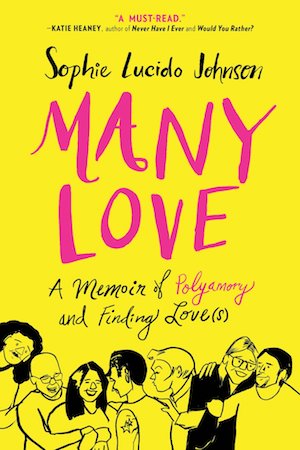
Many Love: A Memoir of Polyamory and Finding Love(s) by Sophie Lucido Johnson

Johnson, whose parents have a close monogamous relationship of over 50 years, grows up rarely questioning conventional dating and relationship norms, but finds herself feeling intense emotional attractions to women in college and beyond. Eventually, she seeks relationships that allow her to not only date multiple men but also spend significant time with the women she is close to. With a polyamory FAQ section in the beginning, and her own comic book-style drawings and information about the history and culture of polyamory sprinkled throughout the memoir, Johnson works to demystify a practice she considers much more about “emotional consideration and communication” than unrestrained hedonism.

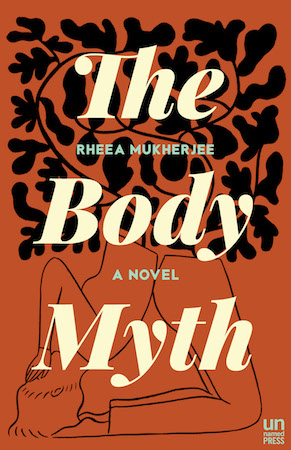
The Body Myth by Rheea Mukherjee

After the death of her husband in a car accident, a young widow in a fictional Indian city retreats from the world and devotes herself to her teaching job and the care of her aging father. When she meets young married couple Sara and Rahil as Sara is having a seizure in the park, she is soon drawn into their world and becomes a lover to both partners, an arrangement that sets her on the road to healing.

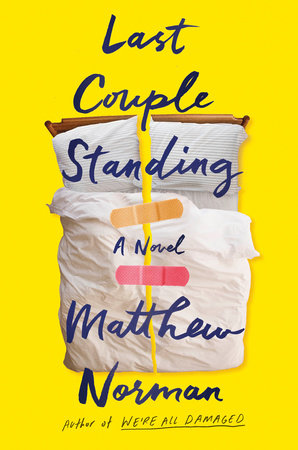
Last Couple Standing by Matthew Norman

Last Couple Standing by Matthew Norman

Baltimore therapist Jessica and high school English teacher Mitch have been married for 15 years and have two kids. When three of their closest couple friends divorce around the same time, they decide to try an evolved marriage where they can sleep with other people, though no social media friends or repeat encounters. Jessica quickly finds herself a hot bartender but Mitch struggles to connect with other women, and both soon discover that dating has changed a lot due to apps. Will their experiment succeed as they attempt to balance their new freedoms with work, children, and other pesky aspects of reality?

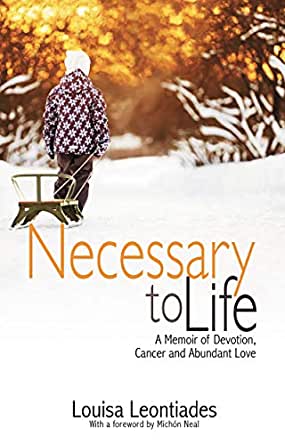
Necessary to Life: A Memoir of Devotion, Cancer and Abundant Love - Kindle  edition by Leontiades, Louisa, Neal, Michón. Health, Fitness & Dieting  Kindle eBooks @ Amazon.com.

Necessary to Life: A Memoir of Devotion, Cancer and Abundant Love by Louisa Leontiades

Though openly non-monogamous, in this memoir Leontiades tells of a time when years of caring for toddlers has left her anxious, exhausted, and virtually celibate. Her partner falls for a Muslim woman, Yasmin, whose family will never let them be together unless he leaves her, while she falls for a terminal cancer patient, Janus, hoping to find a mother for his children after he dies. When her own potentially fatal tumor is discovered, Leontiades must decide whether to start a family with Janus if she lives and whether Yasmin will be a good stepmother to her children if she dies.

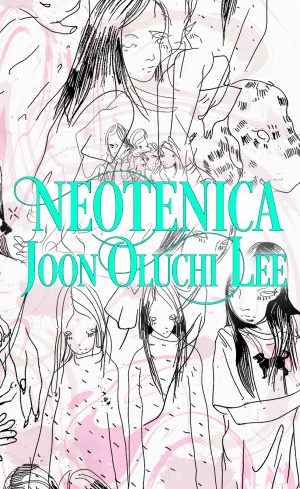
Neotenica by Joon Oluchi Lee

In this avant-garde novella, an unnamed 28-year-old Korean American man is engaged to a Korean-born woman named Young Ae and also explores his sexuality by having sex with men. After a homophobic attack on a BART train returning from a house party in West Oakland, he refuses to describe his assailants to police, stating that he does not believe in crime prevention. Young Ae is attracted to him, and after marriage the couple continue to have many sexual encounters with other partners. This episodic story takes many leaps forward in time, including to when the couple have a 10-year-old son.

Vanishing Twins' Follows One Woman's Search For Individuality Amid  Coupledom

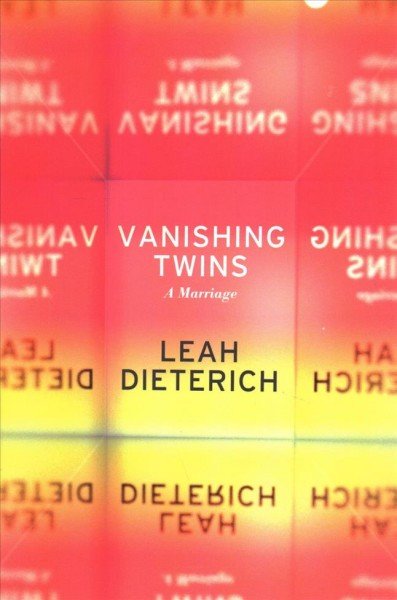
Vanishing Twins: A Marriage by Leah Dieterich

In short sections that read like prose poems, essayist Dieterich explores intimate relationships through ideas of twinning and fetal vanishing twin syndrome, in which a less viable fetus is subsumed by a more viable twin in the womb. Though as a child she felt she had found her other half in an intense female friendship, Dieterich eventually moves across the country to marry a man whom she feels to be practically “the same person” as herself, which is what she supposes she should want from love. Yet she soon grows discontent with the sameness of having one partner. As her marriage opens to allow her to explore relationships with women, Dieterich finds herself strongly attracted to filmmaker Elena, and wondering if she and her husband can live in different cities with different partners and still maintain their original passionate bond.

By Telling New Stories, We Build a New Future

In order to fit more texts into my Asian American literature course, I sometimes assign the play adaptation of Jessica Hagedorn’s novel Dogeaters. The novel is canonized within Asian American literature and features an imagined version of the Philippines made from film and radio tropes, found texts, political discourse, talk shows, rumor, gossip, and multiple perspectives. The truth is constructed—this is the point. Likewise, the play opens with a radio broadcast and a talk show (titled “Dat’s Entertainment!”) in which the hosts interview the dead white author of a nineteenth-century travelogue, The Philippines, that hugely influenced the image of the islands in the West. 

In the play adaption, the concern with where a story comes from and who tells it comes across powerfully in a scene in which two characters sit on a sofa and watch the audience. The soundtrack indicates that the characters are watching an erotic film—but the film does not exist. Instead, the audience becomes the screen for eros. An image is as much, or more, about who is doing the looking as it is about what is being looked at.


In a way, this essay is a response to a question my daughter posed during a recent Facetime with my mother. My mother (who is white and adopted me from Korea when I was two) was reading aloud a novel about a half white, half Asian girl, which was set around the end of the 19th century. I had filled in some missing context: that Chinese Americans call this period the “Driving Out,” because in the years leading up to the 1882 Chinese Exclusion Act, white people lynched, scalped, and burned Chinese Americans alive, destroying their property and branding their bodies, in attempts to drive them out of the country. The Chinese Exclusion Act was the official government response, in effect condoning white terror. 

In the novel, a white father moves his half-Asian daughter out of L.A.’s Chinatown to start a clothing shop for white people. Despite this premise, I felt hopeful about an Asian American girl protagonist. I have been taught to take what I can get. Five minutes in, however, my nine-year-old had already asked my mother to say “Native American” instead of the terms the book uses; I also wanted to strike “Chinamen” and other slurs. “That’s just how people talked then,” my mother said, a familiar argument. Racist terms are too often used to denote historical accuracy, even when the rest of a text remains contemporary.

My daughter wasn’t having it. “So what?” she talked back. “Can’t you say Native American?” 

So what? 

I had never heard it put so simply.


Postmodernism is dead, the critics tell us, but an ongoing concern with the constructedness of culture is alive in every protest. To fight injustice is always to fight a certain idea of the world. An idea has the power to change reality. The sticking point is: Whose idea? And whose reality?

An idea has the power to change reality. The sticking point is: Whose idea? And whose reality?

Fiction began as rumor, as gossip, as counterculture, as tales told by regular citizens rather than by scholars in the capitol. In the West, fiction that refers to its own artifice—for example, an author appearing as a character in his novel—has come to be associated with postmodernism. But this move is much older. Scholar Ming Dong Gu writes in Chinese Theories of Fiction that in Chinese tradition, the “author, narrator, commentator, and reader may all appear [as characters] in the same fictional work.” Gu traces Chinese fiction to its early roots as stories that resisted “official” historical records. It makes sense, in that context, for fiction to emphasize who tells a story and even who listens to a story as important aspects of what the story is.


My American students often read Dogeaters as if Hagedorn’s Philippines is completely other from their experience, while at the same time investing the book with their own very American concerns. (Most recently: a corrupt presidency, racism, sexism, and gender fluidity.) I am reminded of Viet Thanh Nguyen’s comment in Race and Resistance that an Asian setting, versus an American one, may make it easier for fiction to critique American culture, since it can be interpreted (or excused) as a critique of Asia.

Readers sometimes forget that setting is always the work of the imagination—the author’s imagination, and also the audience’s.

Readers sometimes forget to remember that setting is always the work of the imagination—and more than one imagination at that. The author’s imagination, and also the audience’s.

The scene in Dogeaters in which the characters watch the eroticized audience is a reminder that the watching matters. The actors catch the audience in the act of looking. It’s like when you observe someone from across the room and they suddenly catch your eye: your gaze is the gaze you become most aware of.


The Good Story is a book-length conversation between novelist J.M. Coetzee and psychoanalyst Arabella Kurtz, in which they discuss the similarities and differences between fiction and therapy. For much of the conversation, Coetzee keeps insisting that psychoanalysis is truthless and simply replaces a worse fiction about the self with a better one. It’s all a construct, he complains; what about the truth? 

Surprisingly, Kurtz has to be the one to defend stories. She pushes Coetzee to consider that the context is construction, that selfhood is constructed and that it would be a mistake to think of stories as a search for absolute, irreducible truth. The therapist does not stand apart from her client and judge what is real and not real about her client’s story. The therapist is part of and takes part in the construction—Kurtz describes how she “comes to adopt the curious position of being both inside [her] patient’s story and commenting upon it as it unfolds.” To intervene, the therapist doesn’t simply show the client that she is making up a story, but must help the client realize whom she is telling the story to. 

That is, the client is telling the story not to her therapist but to herself.


It doesn’t surprise me if psychoanalysis has become more useful to contemporary fiction than postmodernism. It’s an Alanis Morissette kind of irony, at best, that a discourse intended to describe a world in which discourse has failed us has itself failed us. Talk may be cheap, but it sure buys a lot. A reality TV star for president may be a postmodernist punchline, but it is also a reality postmodernism never prepared us to confront. 

We have accepted that artifice is a fact of life. There is no longer anything more unreal than reality.

The trouble with irony is that our troubles are serious. As are our attempts to meet them. Perhaps this is why we want art to help us replace a worse fiction with a better fiction, rather than to point out its own artifice. We have accepted that artifice is a fact of life. There is no longer anything more unreal than reality. 


When our critics fail us, it is often because they insist that art can replace not only other art but reality itself. Before Adam Johnson’s The Orphan Master’s Son won the Pulitzer in 2013, a Washington Post review announced: “Johnson has taken the papier-mâché creation that is North Korea and turned it into a real and riveting place that readers will find unforgettable.” The lack of irony in this sentence is, if not ironic itself, at least appalling. Author Catherine Chung puts it this way in The Rumpus: “North Korea, a nation, an actual nation with real people, is the papier-mâché creation in this review, and the novel, a work of fiction, is the real and riveting place. This is a breathtaking reversal.” (Chung’s italics.)

The characters in The Orphan Master’s Son are unrecognizable as Korean. Chung is able to make sense of the novel only by seeing it for what it really is: a Western about essentially American characters with essentially American concerns. 

It is nothing new for American critics to herald white writers who rewrite Asia for white people. In 1954, in an eerie echo, Newsweek called James Michener the man “who makes Asia real to us.” In 1938, Pearl S. Buck won the Nobel Prize for her racist depictions of Chinese. In certain stories, ones written by certain people, transference seems to be just as good as realism. But when we put fictional characters in the role of our therapists, how are they supposed to help us?


Transference (the phenomenon by which the client projects her story onto the therapist) is what marks the brilliance of the Dogeaters scene. What Hagedorn realizes is how easy it is for the audience to forget that it has a role in the story, to forget that it has power. America teaches us to believe that the act of watching is a non-act, that observation is neutral, that we are innocent of the images we see. 

America teaches us to believe that the act of watching is a non-act, that observation is neutral, that we are innocent of the images we see.

The play stages a necessary intervention. For one scene, the audience is forced to watch itself being watched. In order to identify itself, to understand itself in the context of looking, the audience must see itself through the eros of the characters.

This is the kind of breathtaking reversal I can get behind. It is a reversal that asks the audience to take responsibility for looking. 


One question a writer might ask himself about his craft is: how does the story intervene in its own telling? I had this question in mind as I wrote my latest novel, about a Korean American man who believes he is disappearing. Disappearance is often a matter of why and how we look. Certain kinds of appearance are really disappearances—tokenism, for example, or stereotyping. The Asian sidekick, the Asian gangster, the Asian doctor. When a stranger identifies me as a suspect for “kung flu,” do they even see me? And, if what they see is only a figment of their own imagination, where has the rest of me gone?

This is what the narrator of my novel wants to know. How do you get out of someone else’s story? Especially once you start telling the story to yourself.


One of the most interesting things about protest, to me, are the signs. Protest and its signs understand that to change something, you have to change how people look at it. “Respect existence or expect resistance” is a favorite of mine. “Love is collective, not corrective.” “This is not a moment, it’s a movement.” “If you were peaceful, we wouldn’t have to protest.” “Ally is a verb.” 

When the president of the United States calls COVID-19 the “China virus,” he is telling his followers that the virus has nothing to do with them. My father asked me years ago if I was anti-life—I told him, of course, that I was pro-choice. A single term changes the story; it changes who the story is for. 

A single term changes the story; it changes who the story is for.

A character who looks back, or a therapist, or a pun or the question “so what?” can sometimes get the audience to notice what it is noticing. Postmodernism might approve. From there, however, the next step is to tell a better story. It is not: no story is real.

Dogeaters presents an artifice dependent on the stories we tell about it. It’s a text made up of other texts: from radio melodramas to the entertainment business to crooked politics. But it isn’t interested in calling certain stories empty or fake. Sometimes a story may fool us, but we would be fools to stop listening to and telling stories as a result. To stop participating in story is to accept a disappearance as an appearance. In other words, talk isn’t cheap after all—saying “talk is cheap” is cheap. It’s a way of shutting down stories with more at stake in the discourse. The discourse can change the reality it describes. It can ask its audience to look better, to recognize its role in making and maintaining culture. In order to see more clearly, we have to change how and for whom we look.

“Homeland Elegies” Examines What It Means to Be Muslim American Post-9/11

Ayad Akhtar’s new novel Homeland Elegies is a song to and about America, subverting the idea of the so-called “American Dream.” The Pulitzer Prize-winning author, like the narrator of the story who shares his name, was born in Staten Island to Pakistani immigrant parents and raised in Wisconsin. Despite the similarities to his own life, Akhtar wants us to know that this novel is a work of fiction, one in which he takes the events of his and his parents’ lives and dramatizes them.

A fragmented tale that jumps through time, this novel depicts a realistic version of a post-9/11 America. The narrator’s mother, homesick for Pakistan, is disillusioned with her place in this country. The father, a doctor who fondly reminisces on his former patient Donald Trump, is dealing with a malpractice lawsuit, and is unable to see that America has shattered him. Through his characters, Akhtar offers a nuanced critique of capitalism and today’s political landscape.

I spoke to Akhtar about what it means to be American and the feeling of being an outsider in one’s own home.


Deena ElGenaidi: I just want to start by saying that this was such an interesting novel for me, because I was raised in a Muslim family, and I’m Egyptian. And I remember 9/11, even though I was still young at the time, but I was old enough for it to have an impact. So, there’s just so many things in the book that really rang true to me, and I appreciate that something like that exists and is coming out in the world.

What made you want to write this story?

Ayad Akhtar: I didn’t plan to write this novel. My father had a court case late in his life—a malpractice lawsuit, which inspires the lawsuit that’s at the end of this book, and I’ve been toying for some time about writing a book about that, but that was the only thing that had been in my consciousness. 

But you know, the political events of the last four or five years—they just coalesced in the end, and this is what came out. I started writing, and it kind of poured out of me. I would write for two weeks, and then I would stop for two weeks, and then I would write for two weeks. I kept writing to a place of exhaustion. And then I would recover. And as soon as I was recovered, it would keep coming out of me. [The book] has this kind of breathless movement to it that mirrored how it emerged. So, that’s the truth.

Beyond that, of course, I could say, well, it represents a few decades worth of thinking about this country, especially in the last ten years, recognizing certain divides—rural, urban divides, racial divides, and money divides that are really defining of the American experience and how some of the ideology around money has transformed America. It’s transformed America from the country that my parents came to and the one that they imagined they were coming to, to the country that it is today.

DE: Yeah, one interesting thing is that the characters seem very lost and looking for a sense of home throughout the story. Early in the novel, the narrator’s mother says about America: “It’s not our home, no matter how many years you spend here, it won’t ever be our home.” And I don’t think the father realizes this until the end. Do you think that feeling of not being home, no matter how long you’re here, is true for immigrants in America?

AA: I, of course, wouldn’t want to make any kind of general characterizations about that at all. I just know that in the case of so many folks that I’ve grown up with, yeah, that’s been the experience. Many of us have tried on the American experience, and tried on the American identity, and I think that so many of us have found it an odd experience. So even if you’re born here, it’s a weird experience. I think what the mother says—there’s truth to it for some, that’s for sure.

DE: Well, my next question was actually going to be about the narrator, who is born and raised in America. He also says at one point, “I was going to stop pretending that I felt American.” So what is it about his experience that makes him feel this way? And what does it even mean to be American in that sense?

AA: I think the book makes the case that being American has to do with race and money. It doesn’t have to do with all these highfalutin ideas about equality that we still seem to think represent America. What America appears to be about, for the most part, is the ability to succeed and the ability to have what you want. That’s why people come here. It’s not like people in Europe are any less free to express their opinions. It’s not like people are coming to this country to necessarily be able to express what they think—that they can’t do it somewhere else. So what is the American freedom? The American freedom is freedom to prosper, and often at other people’s expenses. Because it’s part of the system. 

I don’t remember the first part of the question.

DE: The first part was, what is it about the narrator’s experience that makes him feel like he has to stop pretending to be American?

AA: Well, I wouldn’t want to speak for the book. The book is the book. I think he had lots of experiences that make him feel that folks aren’t sure he is American. And in a post 9/11 world, being Muslim is complicated in the West. So it’s a totally logical and perfectly reasonable conclusion that he comes to. There’s no obvious answer to that.

DE: Well, that leads me to my next question, which is about religion. Religion plays a pretty big role in the book, even though the main characters themselves aren’t very religious. They’re Muslim by name, but they don’t necessarily follow all of the rules. What role did you intend for Islam to play in the character’s lives, and how does it affect their identities?

What is the American freedom? The freedom to prosper, and often at other people’s expenses. Because it’s part of the system.

AA: It really plays the role that it plays. I didn’t intend for it to play a particular role. Each of them has their own relationship to it. Riaz, the financier, is not exactly a practicing Muslim, but he’s not exactly not a practicing Muslim. And he’s certainly very preoccupied by how Muslims are perceived. He is doing stuff as a Muslim, he’s fasting on occasion. I know a lot of Muslims wouldn’t think of him as being particularly Muslim, but I think he thinks of himself as Muslim. Asha is maybe even less religious than Riaz but certainly more than the narrator, and the narrator himself comes from a family of a lot of people who feel differently about religion. The father has one feeling about it, the mother has others, so it’s like anything. Any Catholic family or any Jewish family—there’s a whole range of what people go through and experience.

DE: Yeah, I think that’s very realistic, in that there’s just varying levels of religiosity, and people identify however they want to identify. One moment that stood out for me was when the narrator describes how in childhood, he never felt different or other, even though he knew he wasn’t white, like a lot of his peers. But at the same time, he would feel taken aback looking at himself in the mirror and seeing that his skin was darker than those around him.

AA: Even though he didn’t want to have white skin because he thought it was disgusting.

DE: Yeah, exactly. And I thought that was so interesting because my cousin has actually described that exact feeling to me, but I’ve never seen it articulated in writing like that. Can you delve into that a little bit more and explain for other readers what it means to be taken aback by your own reflection in that way?

AA: What I could say about it is just that a lot of times people say, “You know, folks who aren’t white wish they had white skin.” That’s actually not true. A lot of times folks who aren’t white are happy they don’t have white skin. They just don’t necessarily want the associations that come with not having white skin. And it’s complicated. I think the thing that the book tries to explore—maybe express and sort of dramatize—is the transformation of that core into something like desire and desiring white skin as a symbol or as a sexual object, right? The way in which society and the social structure actually create our desires, even though they may be contrary to our own instinct, is a process that started to find itself and manifest in the story of the book.

DE: I also want to talk about 9/11 being a very central topic in the novel. We jump around through time, but the occurrence of 9/11 is always looming in the background, and there’s certain incidents when the narrator will experience racism, all routed back to Americans’ perceptions of Muslims or people of color after 9/11. What would you say is the main idea you want readers to understand about what changed for Muslims in America after 9/11?

AA: You know, it’s interesting. The book is called Homeland Elegies. And the homeland is of course not just the parents’ homeland, but this American homeland. In a way, the book, as an elegy, is making the case for the passing of something—that something is over. Something about America is finished, is dead. This is a song to try to understand what happened. I think 9/11 plays an important part in what I would call the crumbling of the Republic, which we are fully in the midst of. 

We’re living in a world where the daily news is a better soap opera and a better thriller than anything we encounter on streaming.

I wrote this book before all of the stuff that’s happening now. I wrote it a year ago. But it’s basically describing the widespread disintegration of society that we are now seeing because of the virus. All of those things were apparent to anybody who was watching for the last ten years. It was clear that finance had gutted the country and that our response to 9/11 had destroyed the world. We had destroyed the world order because of our inability to process the tragedy that had befallen us. 

I think 9/11 is at the center of the book not just for Muslims; it’s at the center of the book for America because in a way, 9/11 could have presented an opportunity for us to recognize what was happening, because what happened is not random. There was a reason for it, and our inability still to understand how to think about the reason 9/11 may have happened is directly connected to everything that’s going on right now.

DE: Yeah, absolutely. I want to ask also, at the beginning of the book, you have a note saying, you wrote this book to remember the lives of your parents and what brought them here.

AA: That’s just in the advanced readers copy. That’s not in the actual novel.

DE: Oh, okay, sorry about that. 

AA: That’s okay. You can ask me about that. But no other readers will ever see that. It’s only for people who are getting early copies. 

DE: Okay. Well, I just wanted to know, why did you make the choice to fictionalize this story rather than telling yours and your parents’ story as a memoir?

AA: I don’t think memoir necessarily has the kind of dramatic juice to cut through the bullshit. I’m a dramatic writer, and I yearn for the sharp angle and the cutting scene. I want my actions to be decisive and bold, and the kind of story I tell is a story in which a character moves from one pole to its opposite. So I was going to use the fodder—the material of my actual life—and shape a story that was a far more dramatic and poetically truthful version. 

I think art is better at expressing the essence of something than life is. And also in this age of the collapse of fact and fiction, I wanted to find a form that was going to actually speak to the reader’s sense of unreality. We’re living in a world where the daily news is a better soap opera and a better thriller than anything we encounter on streaming. And we’re more addicted to the actual events of the ongoing story of our nation’s collapse than we are in any streaming story. I wanted to find a literary form to engage with the reader at that level. 

A lot of people talk about autofiction. To me, it’s not autofiction because autofiction implies a kind of distance between the narrator and the reader in which there’s a kind of wink, wink, fly literary maneuver, like, oh, this is different. This is almost like a literary version of reality television where the book is constantly seducing you into thinking it’s all real. There’s no sense of distance. I’m not searching for distance between the narrator and the reader. I want to ensnare the reader and all of their preoccupation with daily breaking news and the Instagram scroll and all that stuff. I want to ensnare that attention in this tale.

The Secret Lives of Yoga Instructors

“Pros and Cons” by Jenny Bhatt

For the first session of the day, Urmi stands next to Jaideep on the dais.  He  makes  eye  contact  with  the  five  students—holding each one’s gaze for a couple of seconds before moving to the next. In Hindi, he murmurs to her, “As if their limbs are about to break off,” and then that flashing brilliance of a smile.

Urmi scans the room too. It is near the end of the week-long yoga retreat. By this point, almost every student’s face is marked with the ascetic suffering of an ancient saptarishi. They rarely imagine yoga to be hard work—more so emotionally than physically. And this class has had more of a strenuous workout because of the atypically smaller size.

Ankita rests against a wall massaging a lavender-infused lotion onto her hands and, as if absentmindedly, the red and black fleur-de-lis tattoo around her belly button. Her branded yoga wear draws the eye to every curve and swell. Next to her, Bernd, the German, flexes his biceps and keeps shaking his bow legs out as if getting ready for a run. His bald head glows redder under the fluorescent lights. Behind them, the two American women whose names Urmi cannot keep straight—Blonde and Blonder, she has named them privately—titter to each other. They’ve nested themselves with bricks, belts, bolsters, and bottles around their mats. And at the very end, Farrokh, who is either from Oman or Yemen, slumps against the back wall. His hooded eyelids confirm that he has already enjoyed a pre-class spliff.

Urmi looks down at her feet, sucking her stomach in so she can see more than her toes. They often pair her with the newer instructors like Jaideep to “break them in.” And though he comes with some teaching experience, Jaideep has made her more aware of how, with each such break-them-in instructor—mostly male, mostly good-looking—she gets older while they remain about the same age. Enunciating each English syllable carefully because Blonde and Blonder always remind him to speak slower, Jaideep describes again why sun salutations are important in every kind of yoga practice. Demonstrating the twelve-step sequence as if he hasn’t been doing it every day of his career, he calls out the names of each asana in both English and Sanskrit and points to the placement of each foot and hand, and nods toward the direction of the eyeline. In each asana, his entire being ripples with a strength that seems to nourish them all. As they join him, Urmi walks around to check their form—adjusting a drooping arm, nudging a straying foot, aligning a tilting head.

Ankita, not quite twenty yet, needs the most attention. Although, Urmi suspects, it is not her attention so much as Jaideep’s that the girl seeks with her audible grunts and shallow breaths.

“How much of this basic stuff do we have to do?” Ankita says as Urmi straightens her knee. She has asked this every morning although she can’t get through even three rounds without those cries and gasps.

“How many could you manage a week before?” Urmi says. 

“What?”

“At least twelve rounds done in full,” Urmi says, placing a finger on her lips.

The girl opens her mouth to speak again but turns to Jaideep instead. After a couple of beats, she drawls, “Oh . . . ‘kay . . .” still staring at him. His silhouette is radiant from the light of the rising sun behind him. The ocean beyond is a writhing sheet of blue-grey silk.

As she scatters her gawky limbs along the floor for Chaturanga, Ankita’s hair tumbles down from her topknot and she wobbles to her left. Jaideep steps off the dais and goes over immediately.

“Straight hips, Ankita,” he says, placing his hands on her waist before lowering them to her hips to twist and thrust them down. As he steps away, his hands round over the small firmness of her butt. “Good,” he says with a pat.

Her expression is fragile and with a joy-like shimmer on it.

Very suddenly, he lays down on the floor beside her and raises his palms and feet. “Here,” he nods at her.

Ankita widens her eyes. Urmi sees the rush of red to her cheeks. He nods again. The girl moves sideways over him, mapping her fingers and toes to his so they interlock. The rest stop to watch. Grasping, he lifts her even higher. She is looking down on him with about a foot between them. Her hair grazes his shoulders and chest. She teeters a bit. He grips her harder. She giggles.

“That’s it!” Jaideep bellows. “See the balance now!”

They all look. Urmi looks too and feels the entire room focused on the two figures. There is something about the way they are clutching at each other with all fours: her faith and his power holding them together.

“Up,” Jaideep commands.

Ankita arches her shoulders so that her breasts thrust forward and her face rises like a fresh blossom.

In that moment, she is any young, skinny girl: eager to please, alternating between simpering and simmering modes, contorting herself readily for the world’s approval. An approval that, Urmi has come to realize, never lasts and is never enough.

The pose holds; Ankita’s focus and balance are flawless. Then, she collapses onto Jaideep and the moment passes.

Urmi watches as Jaideep stands, helping the girl to her feet as well.

“Excellent,” he beams at everyone.

After breakfast, the students wander about the private beach. Blonde and Blonder wade into the water, letting off peals like twin temple bells; Bernd settles with his iPad on the open porch, staying close to the weak wifi router; and Ankita and Farrokh fling a frisbee about on the sand, neither managing to catch it before it falls each time.

It is Urmi’s first time at this location and she has not been sleeping well in this storybook palace with its high-ceilinged rooms and uniformed staff. Time seems to have slackened as if dragging itself forward from the previous century. Every night, she has lain on the Victorian bed in her room, staring at the full-length mirror across for hours. In the dark, the reflection of the iron bed-frame—with its intricate floral flourishes, opulent scrolls, and antique knobs—floats and shifts about like some hulking otherworldly creature.

The breeze, though cool, carries traces of sand that feels gritty against her skin as she sits on the porch steps. She had read online that, after September, the weather gets unpredictable in this part of the country and most of these fancy resorts close up till after the New Year. A raggedy old man, hunched over with a cattail basket filled with football-sized green coconuts on his back, appears trudging as if from nowhere. The women run to him. As if frightened by their excitement, he mumbles and hurries on, one heavy step after another on the gold-white sand.

The session before lunch is their last anatomy lecture of the week. The local doctor, hired at an exorbitant rate for a daily hour and a half, arrives fifteen minutes late. She hands out square booklets with cartoon figures and dense paragraphs in tiny typography. Chuckling nervously at her own jokes, she keeps asking for Jaideep or mentioning his name. Urmi sits in the back with her headphones on, trying to hold off asking one of the staff again to hunt down the frequently disappearing instructor.

Lunch is a quick meal, then everyone lazes about on the bamboo recliners in the shaded corner near the coconut grove. At some point, the women bury Bernd to his stomach in sand while Farrokh keeps saying, “Duuuude,” as if a terrible thing is happening. When Jaideep finally shows up, he sits on the recliner next to her and pulls off her headphones.

“Welcome, O Moon of Eid,” Urmi lights two cigarettes and hands him one. They watch the women skipping around Bernd’s bare torso while he tries to catch a leg or two. After savoring a couple of drags, she asks, “What are the pros and cons of doing this?”

Jaideep raises his eyebrows. “This?”

He has changed into a rose-colored kurta, unbuttoned and crumpled. Closer, he is like those old-school Hindi movie heroes from the ’60s and ’70s with their studied, practiced charm.

“This. All this.” She draws a large circle in the air with both hands. He shakes his head so she continues. “Teaching yoga for a living to rich men and women who won’t remember any of it—or you—in a month.”

Placing a pair of sunglasses onto his nose, he waggles his chin in a droll, dramatic manner and says, “All is fleeting. Time flows endlessly like this ocean.”

“Oh, come on.” Urmi smirks. “You can do better than that. There are plenty of perks, obviously. There must be some cons too.” 

The wood creaks as Jaideep lies back as far as he can go. “Sure,” he says, “as with everything in life, hain na?

“Tell me,” says Urmi.

A wind has picked up, making the trees behind them swish and sigh. The women have changed to swimwear and are shrieking as they run into the tossing waves.

“You don’t think it’s a decent way to make a living?” he asks.

She clicks her tongue at him, annoyed that he has turned the question around on her.

Flicking away his cigarette butt, Jaideep signals a uniformed man closer and tells him to bring lemon sherbet. When the cold, sweating glasses arrive, buzzing flies land on their rims. He swats them away and gives her a glass.

“To making pros out of cons,” he says, raising his glass to her.

Urmi sits up and throws her head back, exposing the length of her neck. She feels him watching her throat move as she swallows. “To conning the pros,” she says back.

The students come over, clustering in twos on the available recliners. Ankita, dripping wet from the dip, perches on the edge of Jaideep’s recliner. They talk about going out as it is their last night. 

“There are no restaurants or clubs nearby,” Jaideep tells them again, removing his sunglasses. “The driver will have to take you close to the airport and wait.”

Ankita pouts with the perfect duck face and slouches next to his arm.

“My back,” she moans.

Jaideep glances at Urmi and presses a palm on Ankita’s slick back, then runs it up and down. She shivers and scrambles closer so that her head is almost nestling in the crook of his shoulder. With blazing adoration, she looks up at him. A hush falls.

She squirms against Jaideep, trying to get his hand to go lower. It does not. Giving up, she scrambles back onto her feet. “Well,” she says, her voice brittle, “Another swim. Come one, come all?”

The others join her as if obeying an order.

Ankita squeals and jumps onto Bernd, making him stumble forward. Jaideep says, “Oye hoye, patakha guddi . . .” in a guttural, singsong tone.

When he lays back with his arms under his head, Urmi reaches over and touches him. Lightly at first, then with urgency.

Jaideep blinks sharply at her and his lips part.

How you can just do this to a man, she thinks, and get his complete attention. Even though that attention does not always work to your advantage. She was probably younger than Ankita when she had discovered the first of those two things.

Lifting her half-empty glass with her free hand, she sips without removing the other hand.

“What are the pros and cons of this?” she says.

His face flushes to almost the same shade as his kurta. “Let’s go upstairs,” says Urmi.


They walk into the hotel and climb the single flight of stairs to the rooms. Urmi sways her hips against his. She is more nervous than she has been in a while. At the top, Jaideep tugs at the fastening of her pants. Heat erupts between her legs and rises up through her belly.

“Your room,” she says, pushing him to the end of the corridor.

Jaideep’s room is considerably larger than hers and the bed is a mahogany four-poster with thick burgundy damask stripe bed linens. There are screened floor-to-ceiling windows and distant yelps and shouts drift up along with humid, fishy odors. He closes the bedroom door and goes into the bathroom. She stands by one of the windows and sees boats and nets laid to dry out below, toward the left. An endless expanse of water spreads to the right.

When the toilet flushes, she stands up straighter, waiting for him to come up behind her. Instead, the bed groans as he pitches himself across it.

“There’s good and bad about this view,” she says, leaning out. 

“Everything has to be about pros and cons?”

“Maybe. Yes. Why not?”

“Why not . . . just take things as they come?” 

Arrey . . . because you want to be prepared.” 

“Are you always prepared?”

“Nope,” she raises her arms high to the top of the window frame, standing on her tippy-toes, and leans further out.

Jaideep is quiet.

Pivoting away from the window, she catches herself in the wall mirror opposite the bed.

“Well, then?” He also looks at her reflection.

Urmi takes off her top. Her breasts are round, if not perky; full, if not bouncy. She tries to take care of herself but the aging process continues to astonish her.

She turns around to him. “But at least I’m ready for the worst then.”

Sprawled on the bed, his arms and legs are flung wide. His longish, uncombed hair is more tousled than ever. And his quick yoga instructor’s eye assesses her.

She knows he has seen better form. She wants to cover herself up again. Instead, she asks, “Changed your mind?”

He shakes his head.

A gust of salty air from the window is like a blow on her naked shoulders and back. Nearby, on the edge of the TV stand, there is a cigarette pack. She walks to it, takes two out, then sifts among the notes, coins, cards, and crumpled payment receipts for a lighter. A battery-thin platinum one has the letters “ANKITA” spelled out with sparkling rhinestones.

“What do you think of her?” She says, picking up the lighter and brandishing it.

“Pros and cons?” He laughs.

“She’s mad about you,” Urmi says, “It’s more than a crush.” 

Patakha Guddi?” he says, “She’ll be married off to some lakhpati-crorepati in a couple of years.”

Urmi twirls the lighter. She is reminded of the first time she saw the girl hand it to Jaideep—at the airport when they were all waiting for the bus that would bring them here. The two had instantly become friendly and sat together in the back for the two-hour journey. She had sat in the front, just behind the driver but had listened to Ankita’s giggling and Jaideep’s gravelly murmuring almost the entire way.

“So. All yours now?” she asks, flicking her thumb so that a flame jumps up.

Jaideep props himself up on one arm. “No, baba. Too dhinchak for me.”

“Sure, boss,” Urmi says.

She puts the unlit cigarettes and the lighter back and moves toward him. Lust and jealousy, she thinks, always make a good combination. Sitting on the bed, she wonders what it would have been like if he had made the first move. She would have liked him to. But men like him don’t do that with women like her.

She lies down beside him, easing into a stretch that releases some of the knots in her. “So,” she says, “are you going to show her your Kama Sutra asanas?”

“What?”

“Ankita.”

“Are you always so . . .?” he asks.

She puts her hands around his face, brings it down to hers, and kisses his mouth with a fierce hunger. It tastes of mint against her smokiness. Should she have gone to her room and brushed her teeth too? Pulling his kurta up, she presses herself against his skin, which smells of the ocean. His chest is not as hairy as she had imagined.

“What is it, yaar?” he peers at her. Then, he pushes her back and, with a single motion, removes her pants and underwear so smoothly that she wants to congratulate him. Instead, she runs her nails down his arms—the arms she has been watching all week in various asanas—leaving long, white scratches on them. He doesn’t make a sound. His eyes are half-closed as if intoxicated. She could be any woman. And yet, she has him in this moment now.


Later, when even the noises outside have died down in the evening twilight, they lie side by side. The sweat is drying off their bodies in the now-cooler breeze from the windows.

“I stayed in a palace like this once in Jaipur. When I was in the salon business and went to weddings to do bridal parties,” she says, licking her dry lips.

“Salon business?”

“Yeah,” she says, “I’ve had a few different careers.” She rolls on her side, facing him. “I used to be young and pretty then. People thought I was one of the rich and famous too when I got all dressed and made up.”

“You don’t think you’re pretty now?” Jaideep says. Urmi says nothing.

Jaideep places a hand at her waist, moves it at a measured pace up her arm and shoulder, and lets it stop in the curve of her neck.

“How old are you?” he asks. 

“Forty-five.”

“Wow.”

She touches the cradle of her hips, where his hand had not been. “I did the teacher training course ten years ago. Thought I would have my own yoga studio by now.”

“What’s stopping you?”

Silence fills the room. Urmi thinks she should leave. This conversation is not what she wanted. What did she want? Whatever it was, the good part—the pro—is over. This is the con part.

“What were the other careers?” His fingers are playing gently with her earlobe now.

She moves his hand away and sits up. “Don’t do this.” 

“You don’t like conversation?”

“Yeah,” she says, swinging off the bed. “Too many questions.” 

Going to the TV stand, she lights two cigarettes and offers him one. It’s a useful trick she learned from a past lover. Smoking means less talking. Though, it doesn’t prevent other undesirable, even dangerous, things from happening.

“Which was your favorite job of all?” Jaideep asks, stubbing his out in a glass, unsmoked.

“None. Dunno. Never stuck at any long enough to really find out. If I got bored or I wasn’t good at it, I left.” Urmi shrugs.

“You’re good at this—teaching,” Jaideep smiles, holding out both arms to her.

Relenting, she stubs out her cigarette and goes to him.

“I don’t think so,” she says, lying back down. “I might find something else. With less travel.”

“Travel? Part of the pros, hain na?

“Only if you’re an instructor.” She sighs. “Anyway, I’ve never even led a class on my own since the certification exam. I don’t have that expert confidence.”

Jaideep nods. “I never have enough confidence in front of a full room. But I love to push my body as far as I can and to show— teach—others what theirs can do too. So, bas, that’s what I do.”

As if he has shared an intimate secret, she whispers back, “Yes, that’s what I love too.” She should have left ages ago, probably. She might stay only a few more minutes.

Spinning onto her side again, she puts a tentative hand out toward him. He grabs it and places it onto his stomach, holding it there.

“Did you never . . . want to settle down?” Jaideep asks.

This question is one of the reasons she hates getting into any question-and-answer game. Sooner or later, it comes up. She tries to take her hand away but he holds it tighter.

“I was. Settled. Once. I left him,” she says. “That’s all you’re getting.”

Jaideep relaxes his grip on her hand and moves it up to his chest. A low hum vibrates from his diaphragm.

That sudden resonance and the even rhythm of his heart are soothing. She feels the tension of her clenched jaw and loosens it.

When Jaideep lets her hand go, she leaves it there.

“It’s not everything people say it is—being settled.” He uses air quotes for the last word. He speaks so softly now, she could cry.

Moving up close, he slides a leg between hers. Raising her chin, he says, “Pros and cons, hain na?

He’s teasing her now, she knows. She cannot speak; her throat hurts.

They remain still like that for three, maybe five, minutes—her hand on his chest, his leg between hers. Then he whirls her up above him and laughs, “Well, then. Show me what you can do, Miss Yoga Instructor.”


The group assembles the next morning, their exhaustion tinged with relief because this is the last class before everyone leaves for separate destinations. At this hour, the light from the windows all around the studio is so pale, it has also bleached the ocean almost white.

Jaideep and Urmi are a full ten minutes late. The room’s restlessness is palpable when they enter. As they take their usual spots on the front dais, Jaideep scratches his overnight stubble distractedly. Urmi, standing alongside, feels his every movement as if he is touching her. Five pairs of eyes stare curiously at them. Urmi wonders if they have guessed. She hopes so.

“Asleep on their feet,” she murmurs to him in Hindi. 

“Them? Or us?” His sense of humor, at least, is still alert.

“Both.”

She flies out tomorrow to another part of the country to assist another instructor. He leaves today to instruct some other group in some other place too.

“Pros and cons to that,” she adds after a beat.

Hand still on chin, Jaideep grins at her, “Yes, true.”

He steps forward and addresses the group. “Urmi is teaching this last class. I must see to some travel arrangements. My apologies.”

Reaching an arm back, he takes her wrist and draws her forward. She looks at him, mouth slightly open.

“Well, then. Show us what you can do, Miss Yoga Instructor,” he says and her stomach flips over. He squeezes her fingers before letting go.

As he walks out, Urmi notices Ankita’s eyes narrowing into slits of ice. The girl sags against the wall.

Urmi takes a deep breath. But there is something thrilling in having the room all to herself; in having everyone’s attention to herself. She hasn’t felt like this in such a long time that she cannot even recall when. She starts them off with six leisurely rounds of sun salutations.

Ankita shows her rebellion by not holding any asana for the required duration and acting as if she’s only going through the motions. When Urmi goes over to encourage her to raise her arms straighter, the girl does not respond. There is something wounded in her, something unyielding. Her chin juts out so that the line of her jaw is sharp, and her eyes are glittering bright.

Urmi marvels at how the girl’s infatuation or crush or whatever it is for Jaideep has developed so rapidly in a matter of days; how it is as savage as a wild animal inside of her. And, just as easily, in a couple of months or so, Urmi thinks, she will recall this time only when she sees the photos on her phone. In a year or so, she will likely not even remember the names of people she has met here. Several years later, she will share the story of her luxury beachside yoga retreat with that lakhpati-crorepati husband’s friends over some elaborate dinner, joking about how the male instructor flirted with her in class.

“Come on, Ankita,” Urmi coaxes, “a few more rounds.”  

“I’m aching all over,” Ankita glares past Urmi at the liquid gold of the ocean through the windows.

“You’re going to let a bit of pain stop you?” Urmi signals to the rest to continue.

Ankita’s mouth tightens.

Next to that sulky gloom, Urmi allows herself a little surge of pride. “It’s a good kind of ache. I mean, you get beyond a point and it stops hurting. You’re stronger then. Here, let me help you,” she says.

“Jaideep knows how to help me.” Ankita says, looking every bit the frail child she is.

How easily, Urmi thinks, we place our trust everywhere except in the one precious sanctuary that is ours alone, ours forever. She smooths the stray hairs away from Ankita’s forehead and the girl startles like a bird.

Going back to the dais, Urmi sits cross-legged on her mat, waiting while the class follows suit. Then she announces, “We’re going to do something new. A parting gift from me.” She pauses carefully before adding, “Let your body’s wisdom guide you. Trust your body—it knows you best.”

And she begins to take them through a slow Yin yoga session, guiding them through deeper stretches than they have done all week. Holding each floor-based asana for a longer duration than the one before, she encourages them to loosen and relax various individual parts of their bodies. Speaking in a low, languid tone, she asks them to let everything—thoughts, emotions, sensations— flow and fall away.

Sunlight streams onto their supine forms. Like a single body, they all inhale and exhale together. The energy in the room becomes so calm and still that the only sounds, other than her voice, are the waves breaking and birds chirping.

Something is shifting and changing within her too though she does not try to identify what or why. A deep-rooted hardness is thawing inside. An ever-present weight is lifting away. She feels light enough that she could glide in mid-air.

Without moving, she senses that Jaideep is standing in the doorway. A warmth washes over her as they look at each other. Between them, the students lying on the floor are like gossamer threads connecting them. When he lifts an arm in farewell, the ache that begins inside her is, she knows, the good kind. The need it reveals has nothing to do with him.

In a month or so, Urmi thinks, she will still remember this week as vividly as the day before. In a year or so, she will still recall the man in his crumpled rose kurta and sunglasses lying back on a recliner as if he is right next to her. And, a couple years later, when she is running her own studio, she will still evoke the touch of his hands on her skin and the sound of his words: “Show me what you can do, Miss Yoga Instructor.” But now, as she looks away from the empty space he has left and back to her class, she knows this is her moment to make all those future ones possible.

“Piranesi” Is a Portal Fantasy for People Who Know There’s No Way Out

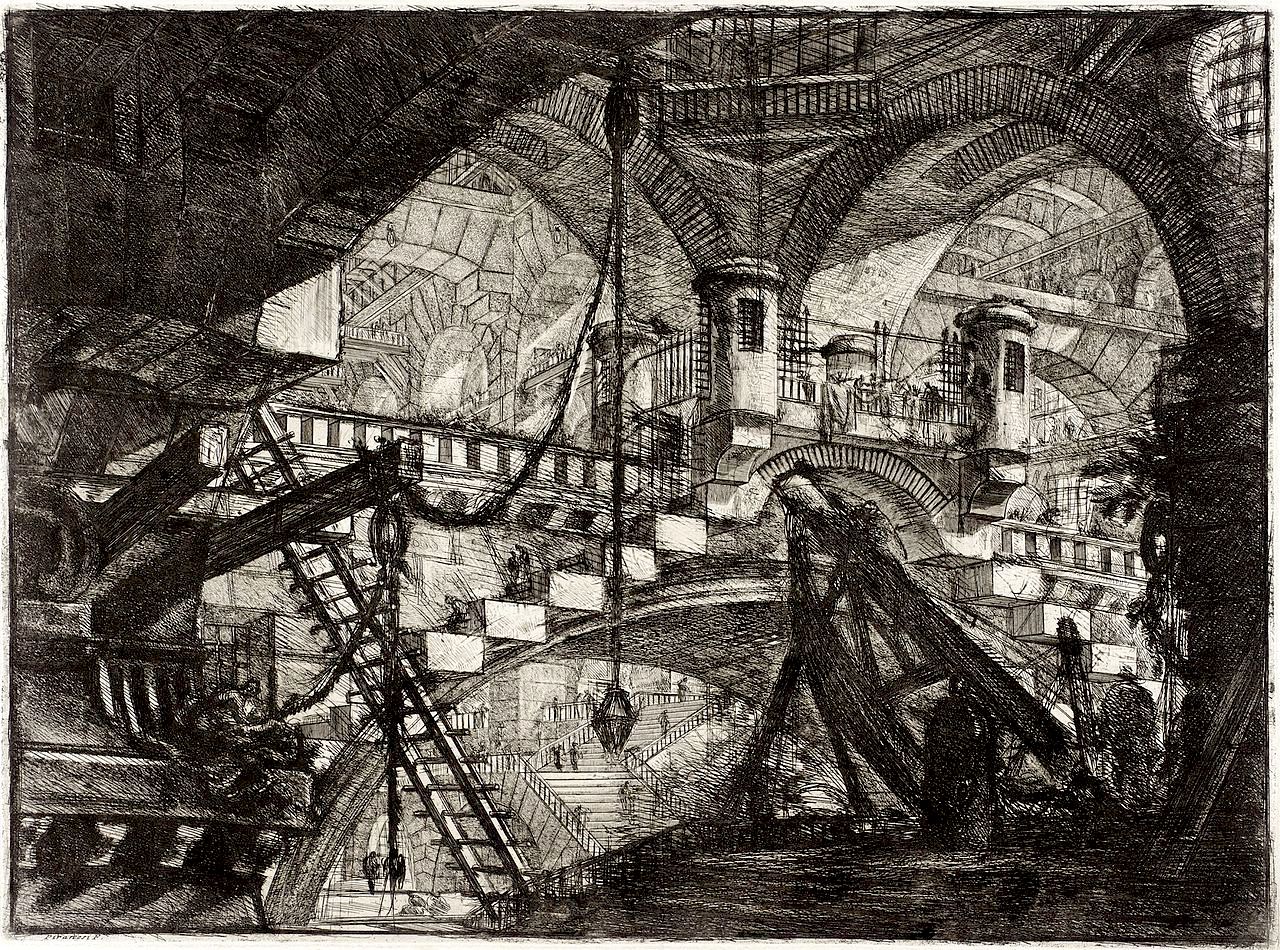
In 1742, the Italian engraver Giovanni Battista Piranesi fell ill. Malaria, a seasonal epidemic that killed thousands of Italians every year until the middle of the 20th century, afflicts sufferers with high fever, chills, and pounding headaches, among other nasty symptoms. Delirious with fever, the 22-year-old aspiring architect hallucinated prisons.

When he recovered, instead of doing his best to forget about the nightmarish dungeons he’d imagined while he was sick, Piranesi set them to copper plates and had them published. The Carceri d’Invenzione (imaginary prisons), first sold as a set of fourteen prints, were a flop, especially compared to the images of Roman ruins Piranesi would make later in his career. But the sinister, unique and inscrutable prisons, though unpopular during Piranesi’s lifetime, later became the darling subject of moody writers and critics. Piranesi’s goth genius was like catnip for Herman Melville and Victor Hugo. Marguerite Yourcenar, the novelist and member of the French Academy, borrowed Hugo’s description of the engraver for the title of her long essay about his work: “The Dark Brain of Piranesi.”

Susanna Clarke is the latest writer to draw inspiration from the endless halls, staircases and arches of the prison engravings. The eponymous hero of her new novel Piranesi lives alone in a version of them, a salt-soaked and sun-drenched series of halls he calls the House. And reading her novel in 2020 makes it clear why Piranesi’s Carceri have, in the end, become even more indelible than his images of Rome’s decaying grandeur. In Piranesi, and in Piranesi, it’s prisons all the way down.

Clarke’s novel comes at a moment with an unfortunate resemblance to Piranesi’s Italy. The COVID pandemic has constrained our lives in various ways, forcing most of us to live in greater confinement than we’d like, making travel more difficult, and death more likely. Even those of us who shared quarantine with family and loved ones have at least a passing familiarity with Piranesi’s monastic life in the House. Anyone who’s taken off a mask after hours of breathing stale air can appreciate Piranesi’s strange, almost somnolent satisfaction with the most common comforts of life (shoes are a joyful luxury for him). 

At times the book celebrates escapism, the purity of isolation from society and the Waldenesque hope that it might make us better people. At the same time Clarke condemns it as a trap, questioning the value of fantasy’s love affair with portals to new and beautiful worlds.  

Clarke’s Piranesi is a prisoner, but the nature of his predicament isn’t immediately clear, and the House is as virtuous as Piranesi’s Prisons are depraved. In fact, the hero is profoundly happy, living in a distinctly un-Hobbesian state of nature. He passes time by exploring the halls of the House, fishing for his dinner, and looking at the statues on the walls. He makes things out of seaweed, spends almost all of his time alone, and considers himself blessed. He’s unaware of any other world but the House, and he has no enemies that he knows of—only one other person lives in the House. The Other, as Piranesi calls him, seems friendly enough, and is sometimes even helpful. 

Seeking to reconcile his faith in God with the reality of evil, the economist Malthus wrote that “evil exists in the world not to create despair, but activity.” Piranesi stays busy. With no long-term goals other than exploring the House, Piranesi fixates on basic tasks like making broth to keep up his strength, repairing fishing nets, or cataloging the statues in the House. It’s a suspended animation familiar to those of us who have spent months studying the minutiae of social media, bingeing Netflix, and worrying over houseplants. You can easily lose a day, a week, and then a month. Next year is no longer a concrete fact of our reality, but a nebulous bundle of expectations about the future condition of the world, out of order and incoherent as Piranesian architecture. Clarke’s Piranesi is similarly focused on the present, writing the journal entries that comprise the book in present tense, and marking them with whatever event he finds most significant: “The One- Hundred-and-Ninety-Second Western Hall,” “I resolve to take better care of Myself,” “I write a letter,” “The other explains that he has said this all before.”

For critics like Yourcenar, time stood still in the Prisons too: “Nor does time move any more than air; the perpetual chiaroscuro excludes the very notion of the hour, and the dreadful solidity of the structure defies the erosion of the centuries.” As the mystery of Piranesi unravels, it becomes clear that the House itself induces forgetfulness—a psychiatric symptom sometimes induced by lingering malaria—and that its basic units of time, the constantly changing tides, are more reliable than months or years. The House is no paradise.

Generally, in escapes to other, unfamiliar worlds—a common trope in fantasy writing—readers hope to find new ones in which the usual confinements, tortures and various injustices of our world have no power. In different worlds, talking animals throw us banquets because we’re the right species. Personal limitations are overcome. Lions and protagonists alike find their courage. And visitors who know nothing about the world they’ve stumbled into resolve long-held grievances nonetheless, restoring balance and order. This kind of wish fulfillment, common in fantasy, is darkly reversed by Clarke’s trapped naif.

This isn’t the first time Clarke has played with genre conventions. Jonathan Strange and Mr. Norrell also questioned long-held values of fantasy, a story that, as noted by Elizabeth Hoiem in a 2008 essay published in Strange Horizons, ended with women saving the world, power-obsessed aristocrats trapped in a column of perpetual darkness, and a Black hero with godlike magic power. Its refusal to conform with the time-honored trope of Carlylean Great Magicians saving the day is echoed in Piranesi’s disturbing vision of the traditional portal fantasy.

The only tortures in this parallel world are the ones humans brought to it.

The confined but benevolent world of the house is dangerous because of the people who traveled there. A self-sufficient master of the tides, Piranesi would be completely safe if the Other would just leave him alone. The only tortures in this parallel world are the ones humans brought to it. This is true in the prison universe Piranesi etched as well, which is stuffed with the machinery of pain: chains, hooks, nooses, racks; a giant St. Catherine’s Wheel. Among them, tiny figures stroll, apparently indifferent to the dungeon paraphernalia around them, the suffering close at hand. “Such gnats do not seem to notice they are buzzing on the brink of the abyss,” wrote Yourcenar.

In Piranesi, the hero is happy in his prison world because he is ignorant of ours, as oblivious as the gnats. When he contemplates the skeletons of former prisoners, he isn’t afraid but comforted by the idea that one day he’ll be numbered among them. Unseen dangers lurk even closer. The duplicitous Other pretends to be Piranesi’s friend, but is actually his jailer. Yourcenar, in “The Dark Brain of Piranesi,” noticed the same perversity in the Prison plates, comparing Piranesi’s work to de Sade, who “both express that abuse which is somehow the inevitable conclusion of the Baroque will to power.” While Clarke’s Piranesi shivers in the dark, The Other sleeps in a warm, dry bed.

Our world isn’t so different. Public officials call for citizens to stay at home, but the rich flee the cities, finding solace in abandoning the world for a cabin with a nice back deck and contactless delivery services. The pandemic has given us claustrophobia and agoraphobia, afflicting us with the same symptoms as the feverish artist. The unsettling idea put forward in Piranesi is that such a solitary confinement might be good, inspiring, or beautiful.

The lamp-post is knocked over, and the wardrobe’s smashed to bits.

Piranesi’s cover depicts a satyr that evokes Mr. Tumnus from The Chronicles of Narnia, and begins with an ominous epigraph from The Magician’s Nephew: “I am the great scholar, the magician, the adept, who is doing the experiment. Of course I need subjects to do it on.” Like the Pevensies in Narnia before him, Piranesi’s been behind the wardrobe a long time, long enough to forget that he was once a citizen of our world. He lives in the House as both its High King and the unwitting victim of an adept’s cruelty. But instead of succumbing to dread and listlessness, the malarial hangover of the enchantment at work in the House, he adopts its logic and reality as his own, thriving in a way that surprises his jailer. Like the oblivious figures in the engraver’s Prisons, Piranesi’s confinement is only a state of mind. The Piranesi we meet at the beginning of the book is enjoying a much richer life in his lonely Narnia than the one he left behind on Earth. At the end of The Lion, The Witch, and the Wardrobe, the Pevensies “lived in great joy and if ever they remembered their life in this world it was only as one remembers a dream.”

Reading Clarke’s novel makes me think there’s no coming back to Earth, for us or for her Piranesi. The lamp-post is knocked over, and the wardrobe’s smashed to bits. At times, Piranesi seems to suggest that the world is better off without us in it, and that we’d all be a lot happier if we were confined, alone, to a prison of endless halls, birds, statues, and water. In another, less interesting book, the drowned halls and crumbling statues of the House might suggest a ruined monument to long-dead humanity, the result of climate cataclysm. But Clarke’s Piranesi is protean. We bring to it what we take with us, and it offers no glib self-explanation. From the world of one dark brain to another, we can recognize genius; but its aims and reasons are ultimately inscrutable, as hidden to us as the conjurer’s tricks.

Announcing the Winners of the 2020 Rona Jaffe Foundation Writers’ Awards

The Rona Jaffe Foundation has been recognizing outstanding emerging women writers since 1995—past recipients include Elif Batuman, Chelsea Bieker, Eula Biss, Rivka Galchen, Vanessa Hua, Helen Phillips, Namwali Serpell, and Tracy K. Smith. This year, six extraordinary writers will receive grants of $30,000 each to support their work. In the past, Electric Literature has published Rona Jaffe Awards ceremony keynote addresses from Tayari Jones and Jacqueline Woodson. For 2020, since the in-person event has been canceled, we are instead honored to make the exclusive announcement of the winners.

The 2020 winners are Hannah Bae (nonfiction), Mari Christmas (fiction), Yalitza Ferreras (fiction), Temim Fruchter (fiction), Elisa Gonzalez (poetry), and Charleen McClure (poetry). Read on for their bios, a description of their work, and quotes from their anonymous nominators.

In celebration of this year’s awards, the 2020 winners will be giving a virtual reading in New York University’s Creative Writing Program Reading Series on Thursday, September 17, at 7 p.m. Eastern. The event is free and open to the public, and you can register here.

“Our 2020 award winners are reframing and revisioning our world and bringing it into focus in important and inventive ways. Their work is surprising, inspiring, challenging, and deeply personal,” says Beth McCabe, the Foundation’s Executive Director. “The Foundation is honored to support these original literary voices. They remind us that Rona Jaffe’s vision remains vital and necessary as her generous legacy continues to support and inspire women writers in their creative endeavors.” In the 26 years since novelist Rona Jaffe (1931–2005) established the award, the foundation has disbursed over $3 million to 164 uniquely promising women writers, who have gone on to earn such recognitions as the National Book Award, the National Book Critics Circle Award, the Guggenheim Fellowship, the Lambda Literary Award, the Pulitzer Prize, and poet laureate of the United States. We can’t wait to see what the 2020 cohort has in store.


Photo by Gaby Demeike

Hannah Bae (nonfiction) is a Korean American freelance journalist and writer living in Brooklyn, NY. Her essays have appeared in Catapult, Slice Magazine, Bitch Media, Pigeon Pages, among other publications. She is the recipient of recent fellowships from The Writers’ Colony at Dairy Hollow, Asian American Writers’ Workshop, and The Poynter Institute. She received her B.A. from the University of Miami. Her essay, “Survival Mode,” was published in the anthology, Don’t Call Me Crazy: 33 Voices Start the Conversation About Mental Health (Algonquin, 2018). Bae is currently working on a memoir entitled Way Enough about family estrangement, mental illness, childhood trauma, and cultural identity. Her nominator writes, “Her chilling, closely rendered depictions of feeling unwanted as a child by both biologic and foster parents are made even more complex by feeling ostracized in school because of her class and race. With heartbreaking vulnerability she recounts her struggles to free herself from her parents’ manipulations, while also empathetically exploring their own history of trauma, growing up in war ravaged Korea with parents whose own mental illness went untreated. Hannah’s life story is as unique as it is inspiring. Already her work has brought comfort to so many.” Bae plans to use her Writer’s Award “to assist with my reporting and research needs; continue my self-guided education in the craft of creative nonfiction and the business of publishing; and most of all, to benefit from the gift of uninterrupted time.” She concludes, “I am writing my memoir because I felt alone in navigating familial estrangement and mental illness, especially as a person of color. By completing this book, I hope to reach readers who will see parts of themselves in my pages and realize that they are not alone, either.”

Mari Christmas (fiction) is an assistant professor at Allegheny College and splits her time between Idaho and Pennsylvania. She received her B.A. from Haverford College, her M.F.A. from the University of Notre Dame, and she has just completed her Ph.D. from SUNY Albany. Her fierce, darkly humorous, emotionally riveting work explores and embodies today’s world reflecting our deepest anxieties and the complexities of current-day feminism, motherhood, and modern love. Christmas’s fiction has appeared in Cosmonauts Avenue, New Ohio Review, Juked, Fence, and Black Warrior Review. She has received fellowships from Kimmel Harding Nelson Center for the Arts and Surel’s Place. She has also begun a novel entitled Fugue States that traces the path of the narrator as she navigates her own difficult relationship to new motherhood. Her nominator writes: “Mari Christmas is an independent, thoughtful, and ambitious thinker, and has what I have come to believe is one of the most unique writing voices of her generation. Transgressive and socially engaged, her fiction is informed by her identity as Japanese and American, her existence between languages and cultures. She pushes the boundaries of possibility in order to forge new ground for thinking about not only what it means to be a writer but also human. The questions that she asks are urgent: What are the ethics of aesthetics? And, how can the female body, particularly a body that has experienced loss, be mapped onto the page?” Her Writer’s Award will allow her to reduce her teaching load next year and pay for child care so she can focus on these writing projects. She says, “This award is not just a financial gift. It is an affirmation of the ways in which women continue to reach out to one another, and how we are able to nourish and support each other as artists and thinkers in times of crisis.”

Yalitza Ferreras (fiction) is a Dominican American writer who lives in San Francisco. Her stories have appeared in Kenyon Review, Bellevue Literary Review, The Southern Review, Aster(ix) Journal, and The Colorado Review among other publications. Her story “The Letician Age” was selected for inclusion in the 2016 Best American Short Stories. She received her B.A. from Mills College and her M.F.A. from the University of Michigan. Ferreras has also received fellowships from Djerassi Residents Artists, Yaddo, Voices of Our Nations, and the Tin House Writing Workshop. She also held the 2014–15 Steinbeck Fellowship from San Jose State University. Her nominator writes, “What I love about Ferreras’s singular voice is the way it catches the reader by surprise. You read her and immediately understand she can write beautifully, with rigor and insight, but then like an undercurrent, she snatches the reader by their feet with the story’s emotional power. The stories are intimate and fueled with her passion for strong women in challenging situations who must and will survive.” In 2011 Ferreras was struck by a car and suffered a traumatic brain injury. She has spent the ensuing years working toward recovery and pursuing her writing. She is currently working on a novel, The Four Roses, about the ambitious Altagracia, a poor young woman who emigrates from the Dominican Republic to Spain in the early 1990s and seeks to make art amidst her struggle for survival. Ferreras will use the support from her Writer’s Award to rent a dedicated writing space and take time off from her design work in order to focus her attention on completing her novel. She says, “I am grateful for the progress I have made, for the support of my writing mentors, and the generosity of my writing community. The question I pose at the heart of my novel is one I have struggled to answer for myself—how does someone who is in the act of survival make art?”

Photo by Sindayiganza Photography

Temim Fruchter (fiction) is working on both a short story collection and her first novel, City of Laughter. These projects reflect and celebrate her deeply-rooted Jewish heritage and her queer identity combining a keen intellect with playful inventiveness and deep wisdom. She says, “My novel spans four generations of women in an Eastern European Jewish family and dreams of a queer ancestral line. The story zigzags geographically and temporally, moving from Poland in the 1920s to Brooklyn in the 1950s, to Maryland in the 1980s, and finally, to contemporary Warsaw. Part speculative queer family history and part polyphonic sacred encyclopedia, the novel’s central story is interspersed with a body of invented Jewish folklore that, while heavily remixed, is inspired by the stories that raised me and the superstitions that shaped my imagination.” Fruchter began her career as a musician and in 2013 turned her creative attention to writing. She received her M.F.A. from the University of Maryland in 2019. Her work has appeared in Tupelo Quarterly, Foglifter, NPR, Brevity, and PANK. In 2020 she received fiction awards from New South and American Literary Review as well as a fellowship from Vermont Studio Center. She says, “I feel a kind of urgency—the most excited and hungry kind—to finish this first book and launch it into the universe. My path has been non-linear, and, as such, I take the hard work and spiritual maintenance of building a writing life very seriously.” Fruchter works for an education non-profit and has recently returned to New York City. She will use her Writer’s Award to create time and opportunities outside of her day job to devote more attention to completing her novel.

Elisa Gonzalez’s (poetry) work ranges widely, investigating childhood and family history, social inequalities, estrangement, God and language. Her first collection of poetry, currently in progress, includes wild elegies to lost selves, sharp-edged essays in lyric, and poems of eerie delicacy and strangeness. A queer, half-Puerto Rican writer who was raised in the Midwest, she says, “What binds the poems is travel in diverse forms: I’ve crossed geographies, languages, beliefs, class lines. It’s a story of departure and pursuit. It’s a story of the island my father left; of the island of the family; of Cyprus, the island that enthralled me in part because of my separation from Puerto Rico. And of the island of the self, uneasy and alone wherever she is.” Gonzalez received her B.A. from Yale University and her M.F.A from New York University. Her work has appeared in The New Yorker, The Literary Review, Hyperallergic, and other publications. A Fulbright scholar in Poland from 2016-2018, Gonzalez has also held scholarships from Bread Loaf Writers’ Conference. Her nominator writes: “Elisa is truly a thinking poet who values both clarity and doubt in her lines. … You feel the work constantly driving at something beyond the safe or easy thing to say, while also avoiding what is emotionally manipulative or overwrought. The poems are never glib or easy. They are brave, wild, precise, and honest.” Gonzalez’s Writer’s Award will allow her to reduce her work as a freelance editor while she finishes the collection, as well as a novel. She lives in Brooklyn, NY.

Photo by Raven Jackson

Charleen McClure (poetry), the daughter of Jamaican immigrants, was born in London and raised in the suburbs of Atlanta. She earned her B.A. from Agnes Scott College, her M.A. in TESOL from Hunter College, and is currently pursuing her M.F.A. in poetry at New York University. A Fulbright scholar, she has received fellowships from The Conversation Literary Arts Festival, Cave Canem, Callaloo Creative Writing Workshop, and VONA. Her work has been published in The Offing, Poetry Project, Mosaic, Muzzle, and elsewhere. Currently, she is at work on her first collection of poems entitled Kiss Your Teeth, which explores black women’s refusal through the lens of desire. “The book,” she says, “elaborates on the ways that black women have come to articulate and assert what they want. The poems sort through the myths and models of black femininity with speakers attempting to reconcile competing desires. Yet, at the same time, they revel in the body’s bad attitudes and wild appetites to reclaim it from the historical and ongoing systems of oppression that have sought to abuse it.” Her nominator writes, “In Charleen McClure’s poems the body—its needs, desires, repulsions, ghostly impulses, also its il/legibility, its immediacy and mediation—is central. She possesses bone-aching patience in the presence of revelation’s slow arrival, working in unpretentious, serious counter-partnership with the word.” To meet the demands of her book project, she plans to use her Writer’s Award to further and deepen her research from materials and archives housed at the Schomburg Center as well as the libraries at Harvard and Spelman College. She lives in New York City. 

For more information about these writers and the Foundation’s program, please see www.ronajaffefoundation.org.

Walter Mosley on Writing Awkward Black Nerds

Three decades ago, Walter Mosley published Devil in a Blue Dress, his first novel, a mystery featuring the now-famous private investigator Easy Rawlins. Almost 60 books (including 15 staring Easy Rawlins) and several awards later, Mosley has earned an imposing place in Black literature. Last week, he was awarded the Medal for Distinguished Contribution to American Letters from the National Book Foundation. The first Black man to achieve that high honor. His oeuvre spans time and genre. From the Post-WWII Los Angeles of Easy Rawlins to dystopian futures, there exist few subjects Mosley hasn’t touched.

His latest project, The Awkward Black Man, is a wide-ranging story collection and meditation on Black life, where quiet and odd protagonists struggle for purpose and acceptance. In one story, a teenage modern-day cowboy moves to Harlem with his mother. “Showdown on the Hudson” exemplifies Mosley’s ability to balance heroics, sensitivity, empathy, beauty, humor, and style. There’s a murder. There’s shame. There’s raw awkward emotion. At the center: a loving friendship.

Before the world locked down and caught fire, Mosley was writing for Snowfall, a series about crack and Los Angeles in the ‘80s. On an afternoon in late July, I spoke with Mosley on the phone about his new collection, America’s current unrest, hope, and much more. I was in Buffalo, New York. He was in Los Angeles. 


Gabriel Bump: In previous interviews, you’ve discussed a desire and need to depict Black heroes in fiction. The characters in The Awkward Black Man are woefully unheroic. 

Walter Mosley: In what way?

GB: They’re bumbling. They’re unspectacular. 

WM: That’s the heroes. The real heroes are those people. You have heroes like Captain America, right? There really are no Captain Americas. You have them, but they don’t exist. What people are looking for, I think—people who reflect them. Most of us are kind of bumbling, right? 

Some of them do extraordinary things, but other ones are just normal people. I want to write about them. So often Black male characters fall into five or six characterizations and that’s it. 

GB: Tell me more about those characterizations.

WM: Well, you have the sidekick, the pimp, the craven criminal, the sex machine. They’re people. They exist too. And a lot of people want to be some of those people. The thing is: what about the guy that’s the bookkeeper, who’s raising a koala bear in his attic? Those kinds of people. If you’re not talking about it, if you’re not thinking about it, then we lose the benefit of literature. 

GB: You have an Easy Rowlins novel coming out in January. These characters are inhabiting a different world. And right now you’re writing for Snowfall.  How is it placing people in these different aspects of Black life?

WM: It’s the way I think. We have such extraordinary people, who are so complex in their way of thinking, in their way of acting. And, indeed, the world around them is really complex. 

One of the stories, called “Haunted”, it’s about a guy who’s 68. He’s married. He’s written a thousand stories, none of them have been published. And he’s just full of bile and bitterness. He has a heart attack. He ends up being haunted by his own inability, his own commitment to himself, which was so misplaced. Rather than the ghost haunting the people. The people are haunting the ghosts, which is the way I see it happening. Of course, I’m a writer. I’ve written a whole lot. I’ve been rejected all over the place for all kinds of books, for all kinds of reasons. So, THAT’S ME. That character is me. And not just me in my writer’s life. But me all through life: trying to imagine being someone and not being that perfect cutout person that we all want to be. 

GB: But none of us are.

WM: Very few. Even the people who are, aren’t, you know? 

GB: “Showdown on the Hudson” was my favorite story in this collection because you are able to combine this Western-feel in this urban environment. It’s also touching, especially at the end where we have these letters exchanged. 

So often Black male characters fall into five or six characterizations and that’s it.

WM: This was a story I wanted to write. I always wanted to write a Western. It was the only genre that I haven’t written. I really wanted to. Because so many Black people, especially from Texas, you say “what are you?” and they say “Well, I’m a cowboy.” Because everybody from Texas is a cowboy.

GB: Even in LA, there are famous cowboys. 

WM: Listen, they all came from Texas. They came up here. In many ways, Billy (a protagonist) can do everything. He can ride a horse. He can shoot a gun, seduce the girl. He does everything.

GB: Even talk to police.

WM: He approaches everybody as an individual because he’s a cowboy and individualism is a big part of that. He also has a creed. There are things he won’t do. There are things that are wrong. The killing that he does is wrong. He knows it’s wrong. That’s what fun about doing this. Even though he’s so perfect in some ways, in others he’s not. He’s so different from everybody. But everybody understands exactly what he’s doing. 

GB: It’s shocking that you’ve written so much and just now getting around to writing this thing you’ve really wanted to write.  

WM: Well, nobody’s really interested in you writing it. It’s not a very interesting genre. I had to make money. Also, I couldn’t really figure out how to do it. I decided: I’ll just put it contemporary in Harlem, but it’ll be a cowboy from Texas. Because I had been down to Texas. Houston has this gigantic rodeo, livestock thing going on. All these people, from way out in the middle of nowhere, show up. They got the biggest pig. They got the biggest pumpkin. They ride horses. Well, these are cowboys and they’re living today. So, I can use them. I don’t have to go back to 1842. It was so different. It’s so telling that the most evocative Westerns about America are made in Italy. 

GB: Why do you think that is? 

WM: Because people want heroes. You’re trying to develop a hero. 

GB: I guess Cowboys in real American History aren’t necessarily heroic figures.

WM: Exactly. They might have been the hero for the people there because they killed somebody. But, really, it’s so ugly and debilitating. I saw this thing the other day about this guy. He was a sheriff of some kind. But he just murdered people. They figured he murdered like 51 people. 

GB: We’re living through a historic moment, in terms of Blackness. How have you been experiencing this moment? You were in LA during the ’92 riots, right?

WM: I wasn’t living here in the ’92 Riots. I did happen to be here. 

GB: In the last couple months we’ve seen unrest in major cities, like LA.

WM: It’s nothing like the ’60s. 

GB: Tell me about the difference. I’m 29. For young Black people, young Black artists around my age, we’re trying to process this moment. It feels huge.

In order to mark your place in history, you have to be able to see where everything has come from.

WM: More people got killed in the LA Riots of ’65 than got killed over the whole country in this most recent uprising. I look at it as waves, slowly, like the tide coming in. It’s one wave at a time. There has never not been an interesting moment in Black history in America. When you look at Oklahoma. People of color lived in the Oklahoma territory. All kinds. Native Americans. Mexicans. Chinese. Blacks. When the radical Republican congress lost power, they came and killed all those people. There are moments all through history where we struggled. The great thing about today is that it’s everybody’s history. It’s not just Black people out there saying “We’re mad.” It’s all kinds of people out there saying “no, this is not right. What’s wrong with you? Killing people and sitting on a man’s neck for eight and a half minutes—what’s wrong with you?” That’s beautiful.

In order to mark your place in history, you have to be able to see where everything has come from. From the NAACP with a sign hanging out front of their offices in New York every time somebody was lynched. Billie Holiday singing “Strange Fruit”. All of our involvement throughout the history of America. The only people that haven’t been here as long as Black people are Native Americans. Everybody else—we’ve been here longer than everybody. The Irish and the Italians, all those people—they came later. All of this is incredibly difficult and challenging history. Today is no different. 

GB: How hopeful do you feel this moment will lead to change? You say this is now our shared history. Does that make you feel hopeful? I can’t tell how I feel. 

WM: Listen, great things are happening. When you have police chiefs around the country saying the guy that sat on [George] Floyd’s neck should be arrested, tried, and sentenced—when you have policemen saying that about other policemen that’s a major change. Change has already happened. When you have a country where people are saying “maybe we should defund the police department.” Just saying the words—it’s a major event. 

GB: It looks like it might not happen.

WM: But it’s like those waves. It may not happen everywhere. It’s already happened in a couple places. That’s one thing. But something is going to happen. Somebody’s going to say “oh, yeah. The police are still like in the old days when they use to enforce runaway slave laws. That was their job. But it’s different now. We need people that understand people with mental problems, racial issues, sexual biases.” All that stuff is really happening. Seeing what has already happened means there’s already been a change. I don’t have to be optimistic about it because it’s happened. 

GB: This idea of general progression. 1965 is different than 1992 which is different than 2015 which is different than 2020. 

WM: Yeah.

GB: Do you think the shifting national perspective has influenced how you approach your work? 

I’m just writing stories about odd Black protagonists trying to live their lives.

WM: It might very well. I wouldn’t be able to tell you how. I’m just writing stories about odd Black protagonists trying to live their lives. 

GB: Do you feel like your job has remained the same? 

WM: When you say “job”, what do you mean exactly?

GB: Well, your goals as a writer.

WM: I’m not completely sure that I have goals. 

GB: You say you want to portray a certain type of character.

WM: And I do. And that’s what that book is about. But, you know, I write different books. I wrote Blue Light. A whole bunch of science fiction stuff. I’ve written nonfiction. Books about writing. Each book has an idea. I’m not sure—it may, like waves, be generally going in that direction. That’s nothing something I feel like I need to make a decision about. Because I love writing. 

GB: To me, your ability to move through genres is enviable. At some point, does it get frustrating that people know you primarily for Easy Rawlins? 

WM: That’s the thing. I don’t really think about it. I keep writing other books. They keep on getting published. I talk to people about them, like I’m talking to you. That’s enough for me. Literary fiction is never going to the genres anyway. I’m not trying to say “Why don’t you pay attention to this book?” People read all the books. The Socrates stories. So, no, I don’t get bothered. 

Are you in LA or Chicago?

GB: I live in Buffalo now.

WM: Oh, you’re in Buffalo. My God.

GB: I like it here. 

WM: Are you teaching? 

GB: I was teaching. Now I’m mainly working on my second book and screenplays. The film industry is a lot different than literary publishing.

WM: It’s a lot better and a lot worse.

GB: What do you mean by that?

WM: 1. You make real money. E. L. Doctorow once suggested to the people running the writing program at NYU that they should have me in. Someone called me in. I could tell by the way they were talking to me—they weren’t very happy with me. At one point, they told me how much I’d be making, which was basically an adjunct’s salary. I said, “Listen, E.L. Doctorow told you I’d be a great addition here.” And they said, “Well, that’s what we offer.” I had a lot of friends who worked for NYU. I knew what they were making. Okay, well, no thank you. This guy I knew was making 15 times what you just offered me. You can make your career in the university.

In my book, Elements of Fiction, the penultimate chapter is an attack on universities teaching writing, which I don’t think is their province. What they do to the writing students and they writing teachers. I think they just drain away all your creativity. If that’s what you want to do: read books and talk about them, which is great, that’s a wonderful thing to do. But if you’ve going to talk about writing—writing is always changing. And the university is always looking back. In things like literature and history. Maybe even in physics and biology. 

GB: Last year, you wrote about your experience in a writer’s room. That didn’t sour it for you.

WM: Listen, I live in America. Somebody comes up to me and says, “So-and-so is a racist.” And I go, “Uh-huh.” 

“Isn’t that terrible?” 

“Well, yeah. It’s terrible that everybody in America is a racist.” 

That’s it. Everybody in America is a racist. What am I supposed to do about that? And they go, “He said that word! He did that thing! They blah-blah-blah.” This is America, man. This is where we live. The idea that you’re going to defeat this thing without completely opening the wound and airing it out. I don’t know. Anyway…

GB: That’s interesting to hear after what you said earlier about feeling hopeful. 

WM: You ever watch those nature shows about the ocean?

GB: Yeah. Of course.

The fact that everybody is a racist in America doesn’t bother me. It’s complex. It’s not an absolute thing.

WM: It’s so beautiful down there, right? The coral. These creatures that are so perfect. Like sharks, for instance. But every one of them eats the rest of them. I watched this thing once where they showed this one fish that came up and ate that one. And another fish came up and ate that one. And another fish came up and ate that one. I was like, “Damn.” HBO had this great series called Rome. God, it was so good. These two guys, plebes. One guy goes up to the other one and says, “I want to join you.”

“Well, we’re doing some very dark stuff. This is going to be really bad. I don’t know where it’s going to end up.”

“Look, man. Everybody ends up in the same place.”

“Yes. You’re right about that brother.”

And I just loved it. Life is beautiful. Life is beautiful. It’s difficult. It’s hard. We’re very small. The systems we belong to are very large. That can always cause a problem. But I—I—I don’t care. I’m happy to be in the world and living in the world. The fact that everybody is a racist in America doesn’t bother me. It’s complex. It’s not an absolute thing. A lot of people are just ignorant. They have to be disabused of that ignorance. 

GB: For me, it seems like the ignorance now is pretty malevolent. It seems like a lot of anger. Certainly not to the same degree as the sixties.

WM: Or the ’30s, or the ’20s, or the ’70s, or the 1840s. When you go back it gets worse. Like right now, you’re writing novels and publishing them. There was a time when that wasn’t happening. I remember when there were about ten or twelve people getting published, Black people. You could be writing all the books you wanted to write. Nobody was going to publish them. Because of unconscious racisms. Like, “Well, Black people don’t read.” “Nobody’s interested in reading Black stories.” That’s what everybody was thinking, who ran publishing. And, if you think it, it becomes true if you’re in charge… Things are getting better. It’s still hard. But things are getting better. Still, someone can sit on your neck in the middle of the day, downtown, and kill you. And nobody’s going to stop them, without becoming a murderer themselves. 

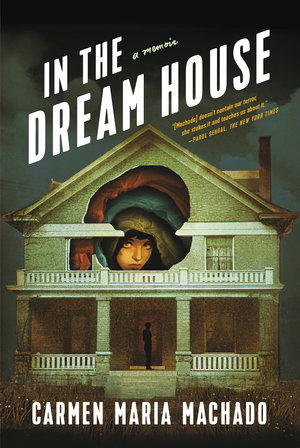
GB: That’s an example of something that’s happened for centuries. 

WM: Oh, sure. Every day. Every day somewhere.

Everything Is Filthy and I Am All Chores

A Clean Story

I was taking a bath in the old clawfoot tub and noticed a lot of garbage floating around me so I pulled the chain to drain it. My daughter and I watched as the water left a pile of black bananas and carrot coins behind. “Where did all this come from,” I asked her.

“I was cleaning out the fridge and threw all this in the tub. I didn’t want to stop up the sink.”

I started filling buckets with the stuff so that she could dump them outside in the compost box. I noticed both shepherds were nudging the door to be let out. I couldn’t remember how long it had been since they went out. The door was locked so I had to get the key. When I came back with the key, the large male, Hazard, was squatting over a rolled-up rug and I stopped him. Behind lay what looked like one segment of a super-size Tootsie Roll. Not too bad. It could have been worse—it could have been soft. I opened the door and both dogs ran downstairs. The outside door had been left open and snow had drifted up, covering the basement door. I could see the jobs, with my name on them, piling up.

Standing on the porch, I noticed the service door on the garage was open. There was a white van in the drive with men going in and out of the garage. They saw me. Quickly I jumped into my white sedan and blocked their vehicle from moving. The overhead garage door was open too and I saw my red pickup decked out with a red cap looking like a miniature fire truck. “What the hell?” I said.

The man in charge said, “We’re only doing our job. We were hired to do this.”

I said, “I want your names and your driver’s licenses now.”

The one in charge reached into his pocket and pulled out a scrap of paper with a name scribbled on it. Another scrap had a license number scribbled on it, which had been crossed out and corrected about five times.

“None of this is real,” I said. “I’m calling the police.” When I turned I felt a hand slip under my shirt and a cold knife against my back. I fainted.

When I came to I was back in the bathroom. My daughter had removed the tub and was trying to dig more carrots out of the pipe. “You can’t just put the tub back in place and expect it not to leak.”

Water had leaked out all over the floor and soaked about thirty pairs of her dirty jeans that she had stuffed behind the tub because she was too lazy to take them downstairs to the wash room. I pulled the jeans out and handed them to her to take into the basement. I went outside to check the yard and garage. The men had left. I noticed a side window in the lower flat was open. I peered inside and heard noises. I tried to yell, “You better leave,” but no sound came out of my moving lips. So I slapped my hand a few times against the inside wall to make them hear me and leave. I pulled the window down to keep out the weather.

I went back in for a new bath. While I was in the water my daughter came in with a plate. On it was that pooper that looked like a brown sushi. “What should I do with this?” she said.

“Why is it on a plate?” I asked.

“I didn’t want to touch it, so I used a fork to push it onto this plate.”

“Throw it outside,” I said.

“Okay.” She set it on the edge of the sink and started to put her makeup on. She was at that age where she couldn’t go outside without makeup. She adjusted her shirt and smiled at herself a few times in the mirror. Then she reached over for the hairbrush and her sleeve brushed over it. This really got her flustered. “I can’t wear this now.” And she started taking off her shirt and accidentally knocked the plate into the tub. I quickly moved back and the tub tipped backwards. The water came out in a wave and took off into the kitchen. I tried to imagine how I was going to get all this cleaned up, and do all the chores I had lined up for the day. Everything was wet and I still wasn’t clean.

10 Books about Doomed Love

The pleasures of sex, like life, are temporary. Love is perhaps more complicated, but if we are being honest with ourselves, I think we have to admit that many love relationships have an expiration date, as evidenced by the fact that so many of them end. Being time-bound, however, does not make sex or love less desirable. Quite the opposite. 

Earnest, Earnest?

Eleanor and Earnest, the two ill-suited lovers in my first book of poetry, Earnest, Earnest?, are not meant to be together, but something drives them to return to each other again and again. To seek the connection of sex and love knowing this connection is likely to die is either reckless, or brave, or both. Beyond the prurient, this is what draws me to tales of doomed love—in these unions and breakups, I see a microcosm of the human predicament. My favorite visions of lovers who lose each other are contained in these ten books:    

Crush by Richard Siken

“The entire history of human desire takes about seventy minutes to tell,” writes Richard Siken, “Unfortunately, we don’t have that kind of time.” And it is at breakneck pace that the lovers in Siken’s poems come together and split apart. Before he wrote Crush, Siken’s boyfriend died in a car accident, but that loss is transmuted in the book, so the lovers are torn apart for different reasons across the three sections—sometimes the cause is death, sometimes choice, but the result is always heartbreak. 

Brute by Emily Skaja

When we want someone to love us, we want them to love our body and our mind, yet this is rarely what we get. In Brute, the man the speaker lives with says to her, “I could never love someone so heavy.” What proceeds from here is an exquisite portrait of a brutal love affair. 

The House of Deep Water by Jeni McFarland

The House of Deep Water by Jeni McFarland

After the dissolution of her marriage and the loss of her job, Elizabeth DeWitt is forced to move back to River Bend, Michigan, the small town where she grew up, but—because of the color of her skin—never quite felt she belonged. Beth’s return is an unhappy one, and it leads her to reunite with her first doomed love, a man who dated her and her best friend simultaneously, and, ultimately, married her friend. The novel confronts not just the consequences of being the other woman, but also the consequences of being labeled other in the place you call home—it’s an exploration of how trauma and loneliness, like everything else in America, are not equally distributed. 

Bluets by Maggie Nelson

In Bluets, Maggie Nelson describes being left by a man, then falling in love with a color: blue. Part nonfiction, part prose poetry, what I love particularly is how the common wisdom of getting over or moving past a lost or unrequited love is interrogated and found to be lacking:

“For to wish to forget how much you loved someone—and then, to actually forget—can feel, at times, like the slaughter of a beautiful bird who chose, by nothing short of grace, to make a habitat of your heart.” 

Image result for dream house by carmen maria machado

In the Dream House by Carmen Maria Machado

This memoir writes into the silence surrounding domestic abuse, and in particular domestic abuse in lesbian relationships; and asks whether knowledge can save us:

“Would knowing have made you dumber or smarter? If, one day, a milky portal had opened up in your bedroom and an older version of yourself had stepped out and told you what you know now, would you have listened?”

The inventive architecture ensures that with every section, the story changes and it stays the same. 

An Equal Music by Vikram Seth

An Equal Music by Vikram Seth

Michael Holme, a talented and accomplished violinist, is in love with Julia McNicholl, an equally gifted and skilled pianist, but he has a nervous breakdown and he leaves. Ten years later, a chance encounter reunites them in London, and they resume their relationship, but now Julia is married and has a secret. It’s a story about how we can be precise in work and imprecise in love. 

Autobiography of Red by Anne Carson

Autobiography of Red by Anne Carson

What slays Geryon is not violence, it’s Herakles’ carelessness and indifference: “It was raining on his face. He forgot for a moment that he was a brokenheart / then he remembered. Sick lurch.” But this is only the beginning of this novel in verse. 

Tea by D. A. Powell

After the end of a relationship, D. A. Powell did not write for a year. When he began again, he “took my failed relationship as subject” and “turned my notebook sideways, pushing into what would traditionally be the margins of the page.” The result is this book of brief-but-long-lined poems, impeccable in their observation of how bodies tangle and disentangle, hardcore in their longing: 

. . . we rubbed each other out:     a pair of erasers

what happened to “significant” out of bed: abolished in the act of standing. like a “lap”

Indecency by Justin Phillip Reed

Sex and love are not entirely private matters. Rather, our most intimate acts and feelings are policed by what the larger political realm deems decent and indecent. Indecency explores how this societal policing limits access to pleasure for the queer Black speaker, and imagines how this could change:

. . . For a second, you realize

that every single man in the room

has his back to another. Suppose

this were not true all the time. 

Troilus and Cressida by William Shakespeare

Troilus and Cressida by William Shakespeare

We give too much time and space to Romeo & Juliet. My preferred tale of doomed love is Troilus & Cressida. Set against the backdrop of the Trojan War, which is also the backdrop of Western literature, Troilus (a teenager) swears undying love to Cressida (another teenager), yet after their first night together, he agrees to trade her to the Trojans. He promises to visit Cressida in the opposing camp, but spies on her instead, which is how he witnesses her first tryst with Diomedes. Troilus then calls Cressida a “whore,” and this is more or less how history remembers her. It’s a stark reminder that when things end, blame is rarely evenly assigned. 

A Scientist Tries to Understand Her Family Problems Through Mice

Yaa Gyasi’s debut novel Homegoing told the story of two branches of a Ghanaian family, one descended from a woman who marries a white slave trader and whose line stays in Ghana, another descended from her half-sister who is captured and sent to America in bondage.

Transcendent Kingdom by Yaa Gyasi

Gyasi’s second novel Transcendent Kingdom follows Gifty, a Ghanaian-American doctoral student at Stanford studying the neuroscience of addiction and depression in mice. Gifty’s mother immigrated to Alabama, her father reluctantly in tow. When the Chin Chin Man, as Gifty and her older brother Nana call him, finds the racism and joylessness of life in Huntsville too much to endure, he returns to Kumasi and the family is never quite the same. Nana, a talented rising star on the basketball court, is prescribed opioids after an injury and ends up a heroin addict. After his death, her mother falls into a deep depression, often not leaving her bed for weeks on end. Though a pious member of her family’s otherwise all-white church as a child, Gifty struggles with a loss of faith, efforts to coax her mother back to life, and the alienation she finds in even her closest relationships as she attends Harvard and moves on to graduate school.

I spoke with Gyasi about writing a novel inspired by neuroscience, the unique challenges faced by Black immigrants to America, and the meaning of transcendence and salvation.


Preety Sidhu: Her mother’s depression is a major issue that Gifty grapples with throughout this book, and it comes about in part because Gifty’s father abandons their family, but more significantly in the wake of Gifty’s brother’s death from a heroin overdose. In Gifty’s research, there is a really interesting neural twinning between depression and addiction: “in depression, where there is too much restraint in seeking pleasure, or in drug addiction, where there is not enough.” To what extent do you see Nana’s addiction and Gifty’s mother’s depression as two sides of the same coin? Possibly as different responses to similar pressures?

Yaa Gyasi: In terms of me personally, I don’t think I actually thought about the fact that addiction and depression existed on this same continuum. That wasn’t something that was really on my mind until I started researching the neuroscience aspect of the novel, particularly the research that one of my close friends from childhood does. Right now she’s a postdoc at Stanford but when I started the novel she was a Ph.D. candidate in neuroscience. She researches the neural pathways of reward-seeking behavior. The way she always explained it to me, in lay terms so that I could understand it, was that she studied addiction and depression. I didn’t really think too deeply about what that meant until I started digging further into her work. That was when I started to see the connections—there’s the reward-seeking that mice do where they don’t care about risk and then there is the reward-seeking that the mice do not do even though there is a chance of pleasure. And I liked that. I liked that doubling and I felt like it would be a nice way to explore the relationships in the novel. 

PS: But you perfectly set up my next question, which is that you mentioned that Gifty’s research is based on the scholarship of your friend Christina Kim at Stanford University. In a literary sense, Gifty’s research is also so precisely and poetically aligned with the circumstances of her life and family history. How did this alignment come about? Did you have a sense of what Gifty’s family would go through and track down the corresponding science, or dig in farther? Or did you encounter this really compelling science and wonder how these issues might shape the lived experience of a family?

YG: The science really came first. It was my friend’s research that came first. I found it really interesting. I also found it interesting the way that she would talk about it to non-scientists, which felt to me to be this narrative-driven thing about addiction and depression. She would illustrate what the mice were going through and that felt like something that you could quite easily map on to human experience.

This book almost felt like a writing prompt, like: write a novel about a woman who studies addiction and depression. And you could go a million different directions with that kind of a prompt but I thought it would be nice to have a woman working on this research, who is also experiencing the things that she researches in real time in her life. So the aspects of addiction and depression that her mother and her brother go through really were born out of wanting to write about this specific field of neuroscience. 

PS: Gifty’s family are the only Black people at their Alabama church, because their immigrant mother doesn’t know any better, and it’s an incredibly isolating experience. After Nana’s death, Gifty and her mother are physically alone at a time when they shouldn’t be, until their white pastor finally decides to show up for them. Before that, her mother might be the lone person at that church still believing God can heal her son. Yet Huntsville is about two-thirds white, it does have a significant Black population who are not recent immigrants. Do you think having a local Black support system might have changed anything for this family? Can you speak more to your decision to not explore this kind of connection or community for them, in this particular story?

YG: Yes, I absolutely think that having a local Black community would have made a world of difference. For Gifty, in particular, perhaps also for her mother. But her mother is such a standoffish and reticent character. There’s a moment later in the book where it talks about how she never goes to the Ghanaian gatherings even. And I’m not sure why that is, but I think for some immigrants—and perhaps we’ll just speak specifically for Gifty’s mother—there can be this sense of, well I’m already isolated within this community in America, what does it matter to be isolated further? There isn’t a desire to assimilate or enmesh with the communities that already exist within the country. I’m thinking of Black immigrants, specifically, but you’re right that Huntsville has a pretty large African American population. I would venture a guess that Gifty’s mother does not really consider herself African American, and wouldn’t feel ease or comfort around that community, but also just doesn’t feel at ease or have any comfort around any community. So her choice to isolate herself has this ripple effect on her children, who would clearly benefit from any kind of engagement with their Blackness. Any kind of engagement with community in general. Her isolation isolates her kids in these really specific ways that I think are damaging both for Nana and Gifty.

PS: Do you think Alabama’s Black community may have embraced them if they pursued that option? 

YG: I think they would have been embraced. It might have been hard in the beginning, as they were just learning to fit in with American culture in general. But I think the avenue is open, particularly in a place like Alabama or like Huntsville that doesn’t have a large immigrant population. If you move to somewhere like New York that has plenty of Ghanaian Americans, I think you can settle easily into a Ghanaian American community and keep kind of separate from the African American community.

PS: For me, one incredibly painful moment in the book was learning after his death that Nana’s father wanted to take him back to Ghana as a child, and his mother’s anguish at having said no. The Chin Chin Man does paint a compelling, if perhaps overly simplistic, vision of Ghana as a much happier place than America, where “no one is enjoying” (which also was a very resonant comment at the moment). While Gifty doesn’t connect strongly with Ghanaian culture, she is aware that Ghanaian schizophrenics hear kinder voices than their American counterparts, that the smiles and ease with which her Aunt Joyce moves in the world could have been her mother’s, maybe. Do you think things might have worked out differently for Nana if he’d gone back, or even just known that his father wanted to take him? That he hadn’t been completely abandoned? 

I think for some immigrants, there can be this sense of ‘well I’m already isolated within this community in America, what does it matter to be isolated further?’

YG: Yes, I do think that things might have gone differently for him if he knew that his father wanted to take him or if he hadn’t felt so utterly abandoned. At the same time, I think there’s still a difference between wanting to bring somebody back with you and, after being told or feeling like you can’t do that, giving up entirely on the relationship. So it’s hard to say if the Chin Chin Man was the kind of person who would have the follow-through to go through with that, had he gotten a yes out of their mother, or if Nana would have encountered other related issues because of the nature of this father figure. So, hard to say, though I think probably it would have meant a great deal to him, just to have his father continue to attempt to be in his life in more significant ways. Whether that was bringing him to visit or bringing him to stay, but also following through on his promises to come see them, and keeping the lines of communication open. So yeah, I think it’s a good thought experiment, but hard to know. 

PS: And of course it’s only so useful to speculate about the versions that you didn’t write. I think what I’m trying to get at is it felt like there’s this underlying tragic thing that, it’s such a quick moment on the page but you could tell that it was pointing to something so much deeper.

YG: Well I think the mother probably felt that things would have gone differently if she had allowed it and I think she feels a lot of guilt around the fact that she didn’t do it. So yes, I do think there’s that. And there are fewer people suffering from addiction in Ghana, certainly, so the kind of access to that particular way of coping wouldn’t have been present for Nana, necessarily, had he gone back to Ghana. So yes, perhaps.

PS: I love how you claim the word “pioneer” for Gifty’s mother. You first set us up with the more standard cultural image of white American settler colonialists heading west in wagons, before dropping the line: “[t]hough she didn’t ford a river or hike across mountains, she still did what so many pioneers before her had done, traveled recklessly, curiously, into the unknown in the hopes of finding something just a little bit better.” What are your thoughts on the power of the word “pioneer” when used to describe the experience of immigrants of color moving to America?

YG: I liked that reclamation of the word for Gifty. You’re right, the associations with it here, you think of the West, you think of settler colonialism, you think of people killing the indigenous population and building their houses, you think of Laura Ingalls Wilder and Little House on the Prairie. Gifty is able to reclaim that term and say my mother is doing a similar thing, without any support and without much success, but she is also trying to make a space for herself in a hostile territory. If that is what pioneer-ism could be defined as, then she is also doing that. 

PS: I find Gifty’s relationship with her college friend Anne quite compelling, especially in how it ends. Anne is one of the closest and most loving—however imperfectly so—relationships Gifty has ever experienced, and yet after Gifty shares how Nana died, her heart hardens and she never speaks to Anne again. Either she doesn’t forgive Anne for extracting this information or for the privileges that allow Anne’s sibling to thrive despite experimenting with drugs. Gifty says “The last text Anne ever sent to me said, ‘I love you. You know that right?’ and it took everything I had not to respond, but I gave it everything I had. I took pleasure in my restraint.” Reading that line, I think of her experimental mice who show restraint and don’t fall into addiction, but Gifty has also established that too much restraint is correlated with depression. Do you feel that it is a healthy choice for Gifty to cut Anne off? Is there anything Anne could or should have done differently to avoid this fate?

YG: I do not think it was a healthy choice to cut Anne off. I think that Gifty suffers from it for many years. That choice to cut off the significant relationship in her life, you see reverberate through how she deals with relationships in general. I think of Gifty as a character who has built all of these walls around this particular part of her that hurts, built so many walls around this wound that is her father’s leaving, her brother’s death, her mother’s depression. Anytime anyone attempts to breach the wall, she cuts them off or distances herself or is just emotionally distant. I do think that the healthier option, the better option, would have been to be honest with Anne and keep her in her life. But I don’t think that college-aged Gifty was at a place in her life where she could recognize that.

PS: So I guess Anne was doomed, that there’s nothing she could have done differently.

YG: Poor Anne. 

PS: We get a clue or key to understanding this book’s title early on, as Gifty looks at a mouse’s brain and wonders what it might point to about the “comparable organ inside [her] own head.” She remembers the words of a high school biology teacher, that Homo sapiens are “the most complex animal, the only animal who believed he had transcended his Kingdom.” What does the idea of a person transcending their kingdom mean to you? Is it linked to what one of Gifty’s friends says about her: “You’re like taking the pain from losing your brother and you’re turning it into this incredible research that might actually help people like him one day.” Is there even more to it than that?

Salvation means being able to make choices that change the course of your life. Not being beholden to the faulty workings of [the] pathway in your brain.

YG: I think that’s part of it. I do think there’s more to it. There’s the moment later where Gifty says something like that she had spent her whole life hearing that humans have dominion over animals without ever hearing that she herself was an animal. This idea that humans are somehow set apart in a way that makes them different than other animals is one that Gifty is concerned with, particularly as she does this research that involves the manipulation of another animal in order to hopefully eventually serve the human animal. It’s a combination of things but it’s mostly about this idea of the dominance of the human-animal and does that cut us off from seeing things in a different way—being more charitable, being more attuned to the idea that we are, in Eula Biss’s words, continuous with everything on the earth.

PS: After seeing that she can inhibit reward-seeking behavior in addicted mice, Gifty says, “[t]hat saving grace, amazing grace, is a hand and a touch, a fiber-optic implant and a lever and a refusal, and how sweet, how sweet it is,” linking that church idea and language of salvation with the addicted mouse’s salvation, and by extension what salvation might have looked like for Nana. What does salvation mean to Gifty?

YG: I think for Gifty, in terms of her research and her obsessions, salvation means being able to make choices that change the course of your life. Not being beholden to the faulty workings of this pathway in your brain that has continued to allow you to press the lever, even when you consciously, or on some level, do not want to be pressing the lever. When it comes to her work salvation is about a refusal. For the other aspects of her life, I think it’s about freedom and transcendence—that word again—and an understanding of what she calls in some parts of this book “the whole animal,” the fullness of one’s life, being able to tap into the wholeness of your life.