The Han Kang I know is a true artist. Someone for whom issues of art, humanity, and the beauty of the world and of people are more pressing and real than awards. Someone who feels and empathizes with the pain of others, who ponders over a question she is asked for days. Someone haunted by history, someone private, fiercely compassionate and as uncompromising as the books she writes.
To much of the English-reading public, Kang is best known for the 2016 Man Booker International Prize-winning novel The Vegetarian, as well as the novel Human Acts about the 1980 Kwangju Uprising and its aftermath. The White Book, her most recent novel in Korean and English, may appear to be new territory for Kang in terms of material and form, but readers of Han Kang’s oeuvre know that each book is a new expression, a tunneling into experience. The White Book is about the cycle of birth, death, and resurrection in both its metaphorical and literal meanings. It is also, obviously, about the color white, a symbolic color with multiple significances in many cultures, including Korea.
Han Kang and I met one sunny spring afternoon in Seoul to talk about the significance of the color white and the death of her sister.
Krys Lee: The structure of The White Book is held in as fine a balance as the book’s themes, and from a writer’s point of view, an exciting journey. Did form come first in the writing of The White Book, or the material that had to find a form? And did you intend to collapse the line between genres?
Han Kang: With The White Book, I originally intended to make a book out of fragments. I started with a list of white things then gave each of those white things a title, and intended to make small fragments out of those. Some of those fragments were a few pages long, and others, a few lines. As a result, it stands at the border between poetry and fiction.
I’ve always liked lyrical essay collections, but I didn’t embark on the book planning to write something between the essay and the poem. I just knew I wanted to write about white things, and decided later that this was the best form to express what I wanted to do. Usually when I write a book, it’s ignited by an idea, or a feeling, but I can’t properly begin the book until I discover its structure.
In the case of The White Book, the sense I had from the beginning from was that it would begin with the swaddling bands associated with birth, and progress from birth to death. I was in Poland when I began the book, at an art residency. Another aspect of the structure that I discovered there while writing was the relationship between me and the narrator of The White Book. That I was imagining her and calling up her presence in part one, and in the second part, I realized that she was living through me. In part three, we would have to part from each other,since our lives can’t co-exist. For one to live, the other has to die. So that became the other way the book found its structure. The book might go from swaddling bands to mourning robes, but then there was me, her, and our parting at the end. That was how I perceived the book. Only when I sent the manuscript it in, my editor—who is also a poet—asked me, what should we call it when we send it to bookstores? The White Book is poetry, a novel, and also in some sense, an essay, so I said, let’s just call it a book. She said that was impossible since bookstores require a genre to display it, and asked me to make a decision. I thought about it a lot, and decided that it was a novel for me, and in retrospect, I believe it really is that: a novel.
KL: Traditionally, “white” has multiple meanings in Asian and Western cultures. How did you take those meanings and made them your own in The White Book?
White is the color of mourning. It’s also a color without a true color, maybe a color somewhere between life and death.
HK: I’ve always been interested in the color white. It seems to me the most fundamental color. Like salt. Also light, if we had to identify light as a color, I think it would be white. Also, perhaps this is a custom unique to Korea, but when a baby is born, he is wrapped in white swaddling bands as soon as he emerges from the mother’s womb. The color is also the color of mourning. It’s also a color without a true color, maybe a color somewhere between life and death, so I was always interested in it. I’ve mentioned this elsewhere before, but the word “횐” is different than the word “하얀”, though they both mean white in Korean. “하얀” has a lovely connotation, all that is pure, clean, bright. But “희다” has more room for darkness, sadness, and death. So I was already very interested in the color white, but when I was thinking about my older sister who died at birth, I thought back on the color. When I first started with the baby clothes, that naturally brought me to the subject of my older sister. I realized then that this book would be dedicated to her. I end with the mourning robes, and saw then that the book would all come together.
KL: The White Book seems to be partly inspired by the landscapes of the many places you’ve been. Can you share some of those places with us? In general, how does place influence your writing?
HK: First when my parents first got married and my father became an elementary school teacher and as newlyweds, I was told that they went to Gwansan with one suitcase in each hand, and began married life together. They told me this story many times when I was young. I don’t know everything but I often imagined what had happened to them there, the death that happened, and their pain afterward. The place where they had they loved each other so much and suffered so much together, is re-imagined in my novel.
Then when I was in Poland, I didn’t know much about the city before arriving. I knew its very basic history, but as I also wrote in the novel, I went to the Warsaw Uprising Museum and saw a film about the city in ruins. I’d only known it as a city covered in snow, but the city in the film was one shattered into stone fragments and completely destroyed. This shocked me. I realized then that all the streets I had wandered through had been ruined and rebuilt. It was so surreal, to realize that this was a city that had been resurrected. I then began imagining my resurrected older sister walking through the resurrected city. I decided to walk through the city and experience it through her eyes.
KL: Was that a difficult time for you?
HK: No, it wasn’t. Once I decided to see the city through her eyes, everything started looking different to me. It was as if I was looking through her innocent eyes, maybe because she left the world before she had a chance of being scarred or hurt. The only thing she’d ever experienced was my mother saying “don’t die, please don’t die,” so imagining her walking through those streets made everything new, fresh. I also wanted to show her good things, since I imagined myself giving her these experiences, so I tried to have good thoughts, and tried to see good things. That’s why I didn’t feel sad at all. In fact I felt comforted. In a sense it was as if I wasn’t alone. so I felt less lonely. I wasn’t as if I’d become a ghost or anything, since of course she was me, too, so in that sense it was as if I were loaning my eyes and senses to my older sister. I had a similar experience when writing Human Acts. I had thought then that I was loaning the dead my eyes and my senses. But I hadn’t disappeared; we were together.
KL: Beauty and suffering are often companions in your work. There seems to be suffering, dying, destruction, and birth, that can potentially lead to regeneration that run throughout. There is never a simple pain, or happiness, or beauty. Can you talk about what this relationship is, for you?
Suffering and beauty seem to intensely exist together.
HK: There is another layer of suffering that lies underneath the surface of The White Book. I actually began it during a difficult period in my life. It was also after writing Human Acts, when I still hadn’t recovered from how difficult writing that novel was for me. That suffering is subsumed in the book. That city I was living in had been destroyed, experienced violence, then over time buildings had risen from those empty spaces. This characterized the city. The narrator who comes to the city is also that kind of person, as she gains a strange set of new eyes while in the city, so the city and the narrator resemble each other. So death, regeneration, birth, all of this exists together, which is why the “횐,” not the “하얀.”
KL: There is also beauty, and happiness. Is this what cleanses and brings us to the condition of white, or is beauty and happiness aspects of white itself?
HK: I still am not sure what happiness is, not yet. When I look at something, I don’t think I have a way to measure happiness. I don’t think of a person as happy or not happy, but I think of it more as light. I think more of what their state of mind is. Or of their dark, light, or their texture. Questions I asked myself when I was young was, Why was I born? Why do we suffer? Why do we die? Also, why is the world so beautiful? I think beauty has the power to constantly surprise me, moment to moment. But naturally, pain also exists in equal measure. Since I can’t ignore that, when I gaze at life both pain and suffering walk dramatically.
Light and texture is largely how I approach life, the world, and people, and when I consider the senses and emotions that we rely on. It might be the influence of poetry, which was what I first wrote when I was young. Countless sensations exist in light and darkness, and pain and tenderness.But there doesn’t seem to be any way to measure happiness, for me. Luminous, beautiful, or tender moments exist, but I don’t think those moments can necessarily be called happiness.
There are beautiful people, and even people who aren’t “beautiful,” are beautiful at moments. Like beautiful decisions. So I’m not saying that I judge a person by whether they are beautiful or not, but that I’m often surprised by the moments of beauty in people. Suffering and beauty seem to intensely exist together.
I don’t have much faith in happiness but I do often think about people. It’s a very important theme in the book I’m working on right now. Human suffering, violence, love, light, and beauty are all things I want to explore and am still exploring.
All my different thoughts above seem to say something about my attitude toward life. This question had me thinking a lot the last few days, and it led me to look deeply within myself.
KL: “Clean, cold light that had bathed her eyes, scouring her mind of all memory.” (page 87, The White Book) That sense of a necessary cleansing reminded me also of Human Acts: I wonder if history can also be cleansed in the way that the narrator is cleansed of memory.
HK: The cleansing here was about emptying my head of what I had to, and what was right to, let go of. But I believe that mourning is very important. So in one sense this is a book of mourning. It was the same with Human Acts. One can’t do that with history. In Poland, how they memorialize tragic historical events and conflicts in statues and monuments in public made an impression on me. That made me think about my own country. South Korea, in contrast, seems to replace the old with the new, or erect memorials where they are hidden from view, when they should be located downtown, visible to all.
Last March, I did a fifth performance at the Carnegie International exhibition titled, ”I Do Not Bid Farewell.” It was related to what happened in Gwangju and Jeju Island. When I was looking into opportunities to perform the piece, I looked into performing at the Ilmin Museum of Art in downtown Gwanghwamun. It would have been the perfect location for such a performance, to be able to mourn together in the heart of Seoul. It didn’t work out, but we have to return to the historical memory and mourn, and mourn again.
KL: Any last words or thoughts?
HK: My oldest sister was never given a name since she died so early, so in the book, I gave her the name Seol-yeong. (which means Snow Flower.) By chance, I heard about how the writer Park T’ae-won gave his daughter this name. Sometimes I still think about the time I spent loaning my body to my sister, and wonder to myself if that time was a kind of prayer. What I remember was walking a lot. It was a strange silence since I didn’t know any Polish, and inside me was only my native language. Even though I was surrounded by so many people talking and street signs, it was a strange silence. I was like an island. I thought about white, about my book, about my sister. Every day, I would take notes on the bus. I walked then wrote bits down at a traffic light, and after walking all day I would write some more when I returned home. I spent four months there, and after a month of settling in, I spent the rest of the time this way after I realized that I was in a white city. That process felt like a kind of prayer. Even now when I look back, writing The White Book felt like a kind of prayer.
We argue
over the squirrel
flat on his belly,
clinging with
his tiny nails
to the rough bark
branch, stomach
contracting every time
he screeches—
sounding more
like a house cat
than the animal he is,
tail going stiff
as if electrified
in the process.
You think
it’s a mating thing.
I think he’s saying
something terrible
is happening,
proclaiming danger or
his own desperate
suffering. Either way
the squirrel goes on
screaming. Because
we don’t know
what is happening, we keep watching.
Observance
I wanted to watch tadpoles grow into frogs
so I brought my plastic yellow bucket to the lake,
caught dozens of the squirmy things
and carried them home, careful not to let any creature
or water spill out over the rim as I walked.
I left them by the side of the house in the sun,
thinking, like plants, the tadpoles would need light.
Then I went inside, played Monopoly with my sister
and forgot about the future-frogs.
Days later I returned with a handful of grass to feed them.
Instead of frogs, I found a bucket of floating skeletons.
I could see all the tiny, terrifying bones in their spines,
their tails hanging down like sad dogs.
Their skin had disappeared, but their eyes were still there
staring up at me.
I can’t remember what I did with the bodies—
maybe I poured them back into the lake
or dumped the bucket behind a pine tree.
Whatever I did, I did it fast and didn’t tell anyone
what I’d done, murderer that I was.
Bad mother, bad mother, I remember saying to myself,
banging my empty bucket against my knees,
punishing myself in the small ways I could.
In my haste to hide the evidence, I didn’t plan
a funeral. It was different with the birds
that hit the kitchen window on sunny mornings
while I was eating Lucky Charms—
their deaths were not my fault.
I helped my mother dig holes for their feathered bodies
in the garden, where we buried them among the marigolds
and bowed our heads. I made crosses
out of broken twigs tied together with grass,
marking their graves so we wouldn’t forget
where each bird was, wings folded, waiting
to be turned into something else by the eyeless worms.
Remakes, reboots, and sequels, oh my! There have been six Transformers films and somehow Hollywood still wants more. It’s not just the mega-blockbuster franchises that are getting milked dry. Perfectly good ’80s comedies and action flicks like Overboard and Red Dawn were remade for… some reason.
In mid-July, another film that should have been left in the past had a remake announced: Jon Hamm will be starring in a new Fletch. More power to you if that sentence didn’t make you audibly groan and slouch in your chair as you give up at the lack of originality in Tinseltown. Hollywood is obsessed with remaking existing intellectual property because it’s less of a gamble. That’s why books are a rich source for them as well. This year alone we’ve seen Normal People and Little Fires Everywhere become runaway hits on Hulu. And with the hundreds of Stephen King adaptations only batting .250, why not adapt new books by debut authors instead?
Film scouts, here are ten adaptations of brilliant new books that should be greenlit immediately!
Logline: A new student unravels the twisted secrets of her mysterious college.
Director: Nia DaCosta has one of the best new eyes in Hollywood. While people keep giving Jordan Peele credit for the new Candyman, it is DaCosta who deserves all of the praise.
Writer: Lena Waithe’s strengths are in telling tightly wound stories in off-kilter ways. This gothic novel will give her a new challenge by taking her away from the slice-of-life style she does so well.
Writer: Brandon Taylor is one of the most talented writers around, whether it’s this novel, his essays, or his hilarious Twitter feed. Screenwriting is his next evolution.
Starring: Sullivan Jones (Slave Play), Timothée Chalamet (Ladybird)
Logline: A coming-of-age story about a teenage girl caught in a cult in small-town California.
Director: Greta Gerwig.
Writer: Greta Gerwig has already proven she can craft both amazing original and adapted films. Giving her the fresh voice of Bieker to follow will put this film more in line with Lady Bird than Little Women, and that’s the breath of fresh air that Hollywood needs right now.
Starring: Kaitlyn Dever (Unbreakable), Sarah Paulson (American Horror Story)
Logline: A Chinese American woman explores race and belonging in America.
Director: Lulu Wang charmed us with her bittersweet movie The Farewell, starring Awkwafina who returns to China to be with her terminally ill grandmother who doesn’t know that she’s dying. We’d love to see Wang and Awkwafina reunite for an adaptation of this introspective novel.
Writer: Alice Wu finally followed up her 2004 debut Saving Face with this year’s Netflix movie The Half of It.
Starring: Awkwafina (The Farewell), Lucas Hedges (Manchester By The Sea)
Logline: An intimate portrait of a headstrong woman living in a tight-knit community in rural North Carolina.
Director: Lee Daniels knows how to direct powerful actors and the leading actress in this needs to be a tour-de-force.
Writer: Steven Canals’ Pose is one of the most diverse and visionary shows on television right now. He knows how to write strong characters who can command a scene with just a close-up of their face. Give him a crack at Azalea “Knot” Centre.
Starring: Viola Davis (How To Get Away With Murder), Paapa Essiedu (I May Destroy You)
Logline: A Cold War thriller about an FBI agent who travels to Burkina Faso to take down the “African Che Guevara.”
Director: Donald Glover teaming with actors from his Emmy-winning show Atlanta (see below) to recreate that well-oiled magic.
Writer: Lauren Wilkinson is currently working in a writer’s room in Hollywood. Given that experience, she’s the logical choice to turn her novel into a unique spy film that avoids all of the typical cliches.
Logline: A Millennial Londoner has a queer sexual awakening.
Directed by: Phoebe Waller-Bridge. This smart, raunchy, and funny novel is perfect for fans of Fleabag.
Written by: Phoebe Waller-Bridge can do no wrong. Fleabag stopped everybody in their tracks. Killing Eve is a killer adaptation. She’s even done rewrites on the latest Bond film.
In our series “Can Writing Be Taught?” we partner with Catapult to ask their course instructors all our burning questions about the process of teaching writing. This month, we’re talking to A.E. Osworth, New School instructor and author of the forthcoming We Are Watching Eliza Bright, who’s teaching a class about something notably rare and precious these days: joy. Osworth’s class on “joy-first drafting” helps writers break free of the over-structuring and self-seriousness that sometimes hinders creativity, so we were excited to get their thoughts on how they maintain that sense of delight through their teaching.
What’s the best thing you’ve ever gotten out of a writing class or workshop as a student?
I have a lot of best things; my identity as a writer and my process have been deeply impacted by the act of workshopping and being in community with writers there-in. I could talk for days on the things workshop has given me and I will try to stick to the highlight reel. My first novel, We Are Watching Eliza Bright (forthcoming from Grand Central in April 2021) actually started as a two-page literature seminar assignment in Shelley Jackson’s class at The New School, where I got my MFA. If we take “thing” as literal, that’s the best “thing.” But I’m also grateful for all the concepts I’ve learned as part of workshop—a lot of my pedagogical framework is based off things I learned from Tiphanie Yanique, who mentored my teaching as well as my writing. Helen Schulman gave me The Ninety-Ten Rule (you will discount ninety percent of what you hear in workshop and act on ten percent of it) to keep us all from our desire to please our peers and workshop leaders. Just this last January, Namwali Serpell introduced me to asking for “wild speculation” in workshop as a tool to reflect the groundwork an author has already laid out but is not yet aware of. Ugh, so many things! Workshop is such a gift.
What’s the worst thing you’ve ever gotten out of a writing class or workshop as a student?
I’ve rarely been in a workshop where I couldn’t find something of value, but one time I did rewrite some sections of my book because the professor and a fellow student thought I should be nicer to cops in my fiction—I really did not trust my taste, my skill or my moral compass at the time. Don’t worry, all those parts are changed back now.
What is the lesson or piece of writing advice you return to most as an instructor?
Potters can’t make something without any clay; first drafts are the ‘clay’ of writing. Formless, messy.
I really do remind my students (and myself) often that all first drafts are shitty. Potters can’t make something without any clay; first drafts are the “clay” of writing. Formless, messy. They’re the raw material.
Does everyone “have a novel in them”?
You know, I have no idea because I don’t think it’s a valuable lens through which to consider writing! It doesn’t actually matter if an individual has a novel in them; it matters if they’re able to get it out of them. I mean that in the normie personal discipline way—do you sit down and write it? Do you do that every chance you get?—and also in a structural justice way. Who has the opportunity, the unstructured time, to sit down and write? Who is able to partake in the world of traditional publishing and who is being impacted by bias, and at which stages? Mostly I don’t care if everyone has a novel inside them, but I deeply care that we as writers and readers do our best in making sure that if someone stumbles upon a novel in them, they have the tools and time to get it out of their body where it belongs.
Would you ever encourage a student to give up writing? Under what circumstances?
My original answer was no, but upon reflection I do think I would encourage a student to quit if they were using writing as self-harm in some way. Storytelling is one of the things I value the highest in this life and, even then, it should never cost someone their happiness and sanity.
What’s more valuable in a workshop, praise or criticism?
Given the workshops I’ve taken, I feel like my take is hot: praise. Infinitely more valuable, especially when workshopping first or early drafts. If a workshop identifies what is working or electric and an author is given the encouragement to write and edit toward those things, most of what’s “not working” falls away.
Should students write with publication in mind? Why or why not?
You can’t be an artist without people’s interaction with your work, and that interaction is thrilling magic.
I feel like there are two things this could mean, and one of them I strongly like and the other I strongly dislike. I don’t think students, or any author really, should chase what they think is “publishable.” The recent past means nothing anyway (things are always changing!) and you can’t write to trends unless your heart just happens to be really into whatever the world is fashionably loving at the moment. But the other way to take this is to remember that books are for readers the same way music is for listeners, plays are for audiences. You can’t be an artist without people’s interaction with your work, and that interaction is thrilling magic. Trust your readers and treat them well as you write. Remember that every reader will read your text differently than you thought they would, and differently from each other. As a writer, you are building a jungle gym and readers will play on it however they play on it. Give them fun brain shit to do.
In one or two sentences, what’s your opinion of these writing maxims?
Kill your darlings: Great advice—not everything you love will work for the story you wind up telling. But if your darling includes your only gay or trans character and killing them means either taking them out or their death in the plot, think real hard about why they’re the only one and why they have to die.
Show don’t tell: Great advice—but not everything in the story weighs the same. Help guide a reader to the buried gold by not over-describing the dirt and the shovel.
Write what you know: Great advice—writing what you know is a one way to cut down on your research time and make sure you’re staying in your lane. But it’s not particularly brave or particularly sustainable; write toward what you want to know as well, accept that you will fuck several somethings up royally and ask questions with a beginner’s mind.
Character is plot: I’ve actually never heard this one before and had no idea it was a maxim! But given what I think it means, why stop there? Everything is everything—all the elements of the story are playing in concert to create one joyous, glorious whole.
What’s the best hobby for writers?
Anything that brings you joy; anything that brings you into a community you love.
What’s the best workshop snack?
Normally I would say anything without a smell or a crunching sound but it’s pandemia—you are in your own home and you can mute your mic, rock on with your tuna melt and your Doritos.
InRodham, Curtis Sittenfeld tells a story about someone we think we know: Hillary Rodham. Of course we all know about Hillary Clinton, Yale graduate, ambitious, at the forefront of women’s rights, the woman who met and fell in love with Bill Clinton, a man with the charisma and drive to match Hillary’s. We all know about the soon-to-be Mrs. Clinton. But, who we don’t know is Hillary Rodham. Sittenfeld has created the character Hillary Rodham through a course of reimagining history in order to answer the question, I believe more than one of us has had throughout our knowing of Hillary as a public figure: What if Hillary had never married Bill?
It is an interesting premise, the idea of reimagining the life of someone by changing one crucial fact that leads them down the path to the person we all know in our reality and presenting an entirely separate universe of possibility. Over the four decades following her decision not to marry Bill Clinton, Hillary Rodham creates her own political path. The journey of reading Hillary Rodham’s life feels like a deep dive into a parallel universe, that in some ways would be a refreshing reprieve from our current political woes but also present some lasting changes without such positive outcomes.
I spoke with Curtis Sittenfeld about genre labels, her choice to write about someone so famous, and what 2020 would look like if Hillary were our president.
Tyrese L. Coleman: While I don’t know exactly how I would label Rodham, to me, it is more along the lines of historical fiction, however, there are others who have referred to the novel, or parts of it, as fanfiction. Not to disparage the term or imply anything negative about fanfiction, but is Rodham fanfiction, why and why not, and how do you feel about the novel being compared as such?
Curtin Sittenfeld: I have no problem with Rodham being called fanfiction. I think it meets the definition, though I also have wondered if all fiction is fanfiction. In general, it seems to me that genres and labels are used more as sales tools by publishers and bookstores and less by readers or writers.
TLC: Like Rodham, your 2008 novel American Wife is also about a woman whose life is complicated by politics, her own and that of the men in her life. What draws you to writing about the private lives of women within the public sphere, specifically politics?
I have no problem with Rodham being called fanfiction. I think it meets the definition, though I also have wondered if all fiction is fanfiction.
CS: I’m still making sense of what made me write both American Wife and Rodham. I’m tempted to say it’s the particular stories of individual people, but two very political books do start to seem like a pattern. In politics, pushing some sort of agenda is supposed to be in the forefront, and personalities are supposed to be in the background, which has the perverse effect of making me more interested in the personalities. Meanwhile, when personalities are in the forefront—in many reality TV shows, for example—I’m less interested in them.
TLC: American Wife was the story of a fictional First Lady whose life is similar to Laura Bush, but the book is not explicitly about Laura Bush. Why did you decide to make Rodham about a specific historical figure instead of fictionalizing the main character like before? What did you want to reveal or what did you hope to reveal by personalizing this character and making her the actual person we know and whose history we are already familiar with?
CS: I used real names in Rodham for a rather small and mundane reason, which is that I didn’t want to confuse the reader. If I changed Hillary and Bill’s names to, say, Helen and Bob and I also changed the historical timeline—having “Helen” choose not to marry “Bob”—I worried that the two changes together would confuse or distract the reader. The reader might think, I thought this was about the Clintons at first, but maybe it’s not. My logic was similar to that in a science experiment where you change only one variable at a time.
TLC: As I read, I often found myself comparing the history that I know about the real Hillary Clinton and the story presented by Hillary Rodham that you give to us. I realized that I ran two separate narratives in my mind: the real history vs. the fictional one. I am sure you anticipated that readers would do this. How do you want readers or how do you expect readers to balance the different narratives? Especially when historical events occur that are very similar but significantly changed, for example, the interview that Bill and his wife, in real life and in Rodham, have with 60 Minutes regarding sexual assault allegations.
CS: When I was a graduate student at the Iowa Writers’ Workshop, the then-director, Frank Conroy, would say that fiction is a conversation between the writer and the reader. I think this conversation is especially complicated and interesting when the reader brings certain knowledge or expectations to the story, and the writers knows the reader is doing so, and the reader knows the writer knows. I suspect that each reader’s experience of Rodham is a little different, but of course that’s true with every novel.
TLC: How did you decide what real life historical events were necessary to include in Rodham and which ones to change or omit?
One of the reasons I’m drawn to novels as both a reader and a writer is how they’re complex, open to interpretation, and subjective.
CS: I went on a case by case basis in terms of thinking of what was most interesting or held the most resonance. Certain events from the past can feel like they contain a different meaning than they did at the time based on everything that’s happened since. For instance, the Supreme Court confirmation of Clarence Thomas has extra echoes after the Supreme Court confirmation of Brett Kavanaugh.
TLC: There are two relationships that I find myself drawn to the most. One is obviously her relationship with Bill. Would you say that Bill is the villain or antagonist of this book or is Hillary her own antagonist?
CS: This is a great question that I think might be better left to others to debate. One of the reasons I’m drawn to novels as both a reader and a writer is how they’re complex, open to interpretation, and subjective.
TLC: I am going to admit something that would probably get me kicked out of any feminist group I try to join, but toward the end of the book, I started to actually feel sympathetic toward Bill. Granted, I don’t think he deserves my sympathies, but I found myself sucked in by the charm you gave him on the page. I couldn’t tell what was real and what was part of his innate politician nature, or, have I been brainwashed by patriarchy toward these emotions.
CS: Interestingly, during his presidency, a lot of feminists supported Bill Clinton (including in their assessment of his involvement with Monica Lewinsky). My goal in Rodham wasn’t to eliminate Bill from the historical record or to make marrying him seem ridiculous or off-putting. In fact, my goal was the opposite—I wanted Bill and Hillary’s fictitious break-up to be devastating. Making difficult choices isn’t usually fun in real life, but it can make for a gripping novel.
TLC: The other significant relationship is between Hillary and her mentor Gwen Greenberger, a Black woman legal professional from Yale and who is one of Hillary’s closest friends in the novel. Is she based on a real life character in Hillary Clinton’s life? If so, who? If not, why did you choose to include this character?
CS: While some parts of the novel are based loosely on real-life events that are part of the public record, I didn’t attempt to specifically portray any real people or situations. That said, I did want to grapple with the way white feminists have often, going back hundreds of years, failed Black feminists.
TLC: For me, what Gwen reveals are two things: 1) a certain level of blind ambition on the part of Hillary Rodham where she is more concerned about her own historical rise than what her success would mean in the long run for others, and 2) the complexities of race v feminism. For me, Gwen’s feelings and her behavior rings true to how many Black women feel when it comes to white women like Hillary Rodham (and in some ways, Hillary Clinton) — that when push comes to shove, they will think of themselves over the good of minority women.
CS: The plotline you’re alluding to (where, spoiler alert, fictional Hillary chooses in 1992 to run in the Illinois Democratic primary for the U.S. Senate seat against Carol Moseley Braun) is another example of the writer and reader being in conversation. In real life, Carol Moseley Braun won the primary and went on to become the first Black female Senator in history. In the novel, fictional Hillary decides Carol Moseley Braun is not electable and runs against her. Of course, most readers know that fictional Hillary’s assessment of her opponent is incorrect, and that the assessment says more about Hillary than about Moseley Braun. Ultimately, though it takes a long time, fictional Hillary herself also comes to this realization.
TLC: We are suffering with a global pandemic that has taken millions of lives all over the world. In this country and aboard we have seen widespread protests and outrage over the police murder of George Floyd, Breonna Taylor and others, giving renewed vigor to the Black Lives Matter movement. 2020 in real life feels like a much more volatile time than it could’ve been because Hillary Clinton did not win the 2016 election. How do you imagine Hillary Rodham would handle these unpredictable, unprecedented times?
CS: There are so many reasons I wish Hillary had been elected in 2016. I certainly think she’d have approached the pandemic in an organized, compassionate, science-focused way. I also think that even though the real Hillary does not have a perfect record when it comes to fighting racism and racial inequality, she has worked toward racial justice for most of her career, and she made continuing to do so an explicit part of her presidential platform.
When I watched news clips or read articles from the 2016 presidential campaign cycle while writing Rodham, I was often struck by the cynicism, skepticism, and hostility directed at Hillary, as if the fact that she’s not perfect (and I don’t believe any political candidate is perfect) meant she was no better than her opponent. I sometimes think that if she had become President, an unprecedented level of ugliness and criticism would have been directed at her. Still, I’d vastly prefer a contentious world where she was President than the contentious one where she isn’t.
Dreams of chaos were Wishart’s meat; he was proud of their diversity, and of his trick of emerging from mortal danger unscathed. The slightest change in pace provoked a nightmare, so that it was no surprise to him when, falling asleep in his compartment a few seconds before the train arrived at Cannes, he had a dream that lasted hours about a sinking ferryboat outside the harbor. Millions of limp victims bowled elegantly out of the waves, water draining from their skin and hair. There were a few survivors, but neither they nor the officials who had arrived in great haste knew what to do next. They milled about on the rocky shore looking unsteady and pale. Even the victims seemed more drunk than dead. Out of this deplorable confusion Wishart strode, suitably dressed in a bathing costume. He shook his head gravely, but without pity, and moved out and away. As usual, he had foreseen the disaster but failed to give warning. Explanations unrolled in his sleeping mind: “I never interfere. It was up to them to ask me. They knew I was there.” His triumph was only on a moral level. He had no physical vanity at all. He observed with detachment his drooping bathing trunks, his skinny legs, his white freckled hands, his brushed-out fringe of graying hair. None of it humbled him. His body had never given him much concern.
Like many spiteful, snobbish, fussy men, or a certain type of murderer, Wishart chose his friends among middle-aged solitary women.
Wishart was pleased with the dream. No one was gifted with a subconscious quite like his, tirelessly creative, producing with- out effort any number of small visual poems in excellent taste. This one might have been a ballet, he decided, or, better still, because of the black-and-white groupings and the unmoving light, an experimental film, to be called simply and cryptically “Wishart’s Dream.” He could manipulate this name without conceit, for it was not his own. That is, it was not the name that had been gummed onto his personality some forty years before without thought or care; “Wishart” was selected, like all the pieces of his fabricated life. Even the way he looked was contrived, and if, on bad days, he resembled nothing so much as a failed actor afflicted with dreams, he accepted this resemblance, putting it down to artistic fatigue. He did not consider himself a failed anything. Success can only be measured in terms of distance traveled, and in Wishart’s case it had been a long flight. No wonder I look worn, he would think, seeing his sagged face in the glass. He had lived one of society’s most grueling roles, the escape from an English slum. He had been the sturdy boy with visions in his eyes. “Scramble, scrape, and scholarship” should have been written on his brow, and, inside balloons emerging from his brain, “a talent for accents” and “a genius for kicking the past from his shoes.” He had other attributes, of course, but it wasn’t necessary to crowd the image. Although Wishart’s journey was by no means unusual, he had managed it better than nearly anyone. Most scramblers and scrapers take the inherited structure with them, patching and camouflaging as they can, but Wishart had knocked his flat. He had given himself a name, parents, and a class of his choice. Now, at forty-two, he passed as an English gentleman in America, where he lived, and as an awfully decent American when he went to England. He had little sense of humor where his own affairs were concerned, no more than a designer of comic postcards can be funny about his art, but he did sometimes see it as a joke on life that the quirks and crotchets with which he was laced had grown out of an imaginary past. Having given himself a tall squire of a father who adored horses and dogs, Wishart first simulated, then genuinely felt a disgust and terror of the beasts. The phantom parent was a brandy-swiller; Wishart wouldn’t drink. Indeed, as created by his equally phantom son, the squire was impeccably bien élevé but rather a brute; he had not been wholly kind to Wishart, the moody, spindly boy. The only person out of the real past he remembered without loathing was a sister, Glad, who had become a servant at eleven and had taught him how to eat with a knife and fork. At the beginning, in the old days, before he had been intelligent enough to settle for the squire but had hinted at something grand, he had often been the victim of sudden frights, when an element, hidden and threatening, had bubbled under his feet and he had felt the soles of his shoes grow- ing warm, so thin, so friable was the crust of his poor world. Nowadays, he moved in a gassy atmosphere of good will and feigned successes. He seemed invulnerable. Strangers meeting him for the first time often thought he must be celebrated, and wondered why they had never heard of him before. There was no earthly reason for anyone’s having done so; he was a teacher of dramatics in a preparatory school, and once this was revealed, and the shoddiness of the school established, it required Wishart’s most hypnotic gifts, his most persuasive monologue, to maintain the effect of his person. As a teacher he was barely adequate, and if he had been an American his American school would never have kept him. His British personality—sardonic, dry—replaced ability, or even ambition. Privately, he believed he was wasted in a world of men and boys, and had never bothered giving them the full blaze of his Wishart creation; he saved it for a world of women. Like many spiteful, snobbish, fussy men, or a certain type of murderer, Wishart chose his friends among middle-aged solitary women. These women were widowed or divorced, and lived in places Wishart liked to visit. Every year, then, shedding his working life, a shining Wishart took off for Europe, where he spent the summer alighting here and there, depending on the topography of his invitations. He lived on his hostesses, without shame. He was needed and liked. His invitations began arriving at Christmas. He knew that women who will fret over wasting the last bit of soap, or a torn postage stamp, or an unused return ticket, will pay without a murmur for the company of a man. Wishart was no hired companion—carrier of coats, fetcher of aspirin, walker of dachshunds. He considered it enough to be there, supplying gossip and a listening ear. Often Wishart’s friends took it for granted he was homosexual, which was all to the good. He was the chosen minstrel, the symbolic male, who would never cause “trouble.” He knew this and it was a galling thought. But he had never managed to correct it. He was much too busy keeping his personality in place so that it wouldn’t slip or collapse even in his dreams. He had never found time for such an enervating activity as proving his virility, which might not only divert the movement of his ambitions but could, indeed, take up an entire life. He had what he wanted, and it was enough; he had never desired a fleet of oil tankers. It sufficed him to be accepted here and there. His life would probably have been easier if he had not felt obliged to be something special on two continents, but he was compelled to return to England now, every year, and make them accept him. They accepted him as an American, but that was part of the buried joke. Sometimes he ventured a few risks, such as, “We were most frightfully poor when I was a child,” but he knew he still hadn’t achieved the right tone. The most successful impostures are based on truth, but how poor is poor, and how closely should he approach this burning fact? Particularly in England, where the whole structure could collapse for the sake of a vowel.
The most successful impostures are based on truth, but how poor is poor, and how closely should he approach this burning fact?
He got down from the train, holding his artfully bashed-up suitcase, and saw, in the shadow of the station, Mrs. Bonnie McCarthy, his American friend. She was his relay in the South of France, a point of refreshment between the nasal sculptress in London, who had been his first hostess of the season, and a Mrs. Sebastian in Venice. It would have been sweet for Wishart at this moment if he could have summoned an observer from the past, a control to establish how far he had come. Supposing one of the populated waves of his dream had deposited sister Glad on shore? He saw her in cap and apron, a dour little girl, watching him being greeted by this woman who would not have as much as spat in their direction if she had known them in the old days. At this thought he felt a faint stir, like the rumor of an earthquake some distance away. But he knew he had nothing to fear and that the source of terror was in his own mistakes. It had been a mistake to remember Glad.
“Wishart,” his friend said gravely, without breaking her pose. Leaning on a furled peach-colored parasol, she gave the appearance of living a minute of calm in the middle of a hounding social existence. She turned to him the soft, myopic eyes that had been admired when she was a girl. Her hair was cut in the year’s fashion, like an inverted peony, and she seemed to Wishart beautifully dressed. She might have been waiting for something beyond Wishart and better than a friend—some elegant paradise he could not imagine, let alone attain. His admiration of her (her charm, wealth, and aspirations) flowed easily into admiration of himself; after all, he had achieved this friend. Almost tearful with self-felicitation, he forgot how often he and Bonnie had quarreled in the past. Their kiss of friendship here outside the station was real.
His admiration of her (her charm, wealth, and aspirations) flowed easily into admiration of himself; after all, he had achieved this friend.
“Did you get my telegram?” he said, beginning the nervous remarks that preceded and followed all his journeys. He had pre- pared his coming with a message: “Very depressed London like old blotting paper longing for sea sun you.” This wire he had signed “Baronne Putbus.” There was no address, so that Bonnie was unable to return a killing answer she would have signed “Lysistrata.”
“I died,” Bonnie said, looking with grave, liquid eyes. “I just simply perished.” After the nasal sculptress and her educated vowels, Bonnie’s slight drawl fell gently on his ear. She continued to look at him gaily, without making a move, and he began to feel some unease in the face of so much bright expectancy. He suddenly thought, “Good God, has she fallen in love?,” adding in much smaller print, “With me?” Accidents of that sort had happened in the past. Now, Wishart’s personality being an object he used with discretion, when he was doubtful, or simply at rest, he became a sort of mirror. Reflected in this mirror, Bonnie McCarthy saw that she was still pretty and smart. Dear darling Wishart! He also gave back her own air of waiting. Each thought that the other must have received a piece of wonderful news. Wishart was not envious; he knew that the backwash of someone else’s good fortune can be very pleasant indeed, and he waited for Bonnie’s tidings to be revealed. Perhaps she had rented a villa, so that he would not have to stay in a hotel. That would be nice.
“The hotel isn’t far,” Bonnie said, stirring them into motion at last. “Do you want to walk a little, Wishart? It’s a lovely, lovely day.”
Now, Wishart’s personality being an object he used with discretion, when he was doubtful, or simply at rest, he became a sort of mirror.
No villa, then; and if the hotel was nearby, no sense paying a porter. Carrying his suitcase, he followed her through the station and into the sudden heat of the Mediterranean day. Later he would hate these streets, and the milling, sweating, sunburned crowd; he would hurry past the sour-milk-smelling cafés with his hand over his nose. But now, at first sight, Cannes looked as it had sounded when he said the word in London—a composition in clear chalk colors: blue, yellow, white. Everything was intensely shaded or intensely bright, hard and yellow on the streets, dark as velvet inside the bars.
“I hope you aren’t cross because Florence isn’t here,” Bonnie said. “She was perishing to meet your train, but the poor baby had something in her eye. A grain of sand. She had to go to an oculist to have it taken out. You’ll love seeing her now, Wishart. She’s getting a style, you know? Everyone notices her. Somebody said to me on the beach—a total stranger—somebody said, ‘Your daughter is like a Tanagra.’”
“Of which there are so many fakes,” Wishart remarked. He did not have a great opinion of his friend’s intelligence, and may have thought that a slight obtuseness also affected her hearing. It was insensitive of her to mention Flor now, just when Wishart was feeling so well. From the beginning, their friendship had been marred by the existence of Bonnie’s daughter, a spoiled, sulky girl he had vainly tried to admire.
“There are literally millions of men chasing her,” Bonnie said. “I’ve never seen anything like it. Every time we go to the beach or the casino—”
“I’m surprised she hasn’t offered you a son-in-law,” he said. “But I suppose she is still too young.”
“Oh, she isn’t!” Bonnie cried, standing still. “Wishart, that girl is twenty-four. I don’t know what men want from women now. I don’t even know what Flor wants. We’ve been here since the eighth of June, and do you know what she’s picked up? A teeny little fellow from Turkey. I swear, he’s not five three. When we go out, the three of us, I could die, I don’t understand it—why she only likes the wrong kind. ‘Only likes,’ did I say? I should have said ‘only attracts.’ They’re awful. They don’t even propose. She hasn’t even got the satisfaction of turning them down. I don’t understand it, and that’s all I can say. Why, I had literally hundreds of proposals, and not from little Turkeys. I stuck to my own kind.”
He wanted to say, “Yes, but you were among your own kind. The girl is a floater, like me.” He sensed that Bonnie’s disappointment in what she called her own kind had affected her desires for Flor. Her own kind had betrayed her; she had told him so. That was why she lived in Europe. Outside her own kind was a vast population of men in suspenders standing up to carve the Sunday roast. That took care of Americans.
They walked on, slowly. A store window they passed reflected the drawn, dried expression that added years to Wishart’s age but removed him from competition and torment. He found time to admire the image, and was further comforted by Bonnie’s next, astonishing words: “Someone like you, Wishart, would be good for Flor. I mean someone older, a person I can trust. You know what I mean—an Englishman who’s been in America, who’s had the best of both.”
He knew that she could not be proposing him as a husband for Florence, but he could have loved her forever for the confirmation of the gentleman he had glimpsed in the window, the sardonic Englishman in America, the awfully decent American in England. He slipped his hand under her elbow; it was almost a caress. They reached the Boulevard de la Croisette, crossed over to the sea side, and Bonnie put up her parasol. Wishart’s good humor hung suspended as he looked down at the beaches, the larva-like bodies, the rows of chairs. Every beach carried its own social stamp, as distinct as the strings of greasy flags, the raked pullulating sand, and the squalid little bar that marked the so-called “students’ beach,” and the mauve and yellow awnings, the plastic mattresses of the beach that were a point of reunion for Parisian homosexuals. Wishart’s gaze, uninterested, was about to slide over this beach when Bonnie arrested him by saying, “This is where we bathe, Wishart, dear.” He turned his head so suddenly that her parasol hit him in the eye, which made him think of her falsehood (for it was a falsehood, unquestionably) about Flor and the grain of sand. He looked with real suspicion now at the sand, probably treacherous with broken bottles, and at the sea, which, though blue and sparkling, was probably full of germs. Even the sky was violated; across the face of it an airplane was writing the name of a drink.
“Oh, my sweet heaven!” Bonnie said. She stood still, clutching Wishart by the arm, and said it again. “Sweet heaven! Well, there she is. There’s Flor. But that’s not the Turk from Turkey. No, Wishart, her mother is to have a treat. She’s got a new one. Oh, my sweet heaven, Wishart, where does she find them?”
“I expect she meets them in trains.”
From that distance he could admire Bonnie’s girl, thin and motionless, with brown skin and red hair. She leaned on the low wall, looking down at the sea, braced on her arms, as tense as if the decision between this beach and some other one was to decide the course of her life. “She does have extraordinary coloring,” he said, as generously as he could.
“She gets it from me,” said Bonnie, shortly, as if she had never noticed her own hair was brown.
The man with Florence was stocky and dark. He wore sneakers, tartan swimming trunks of ample cut, a gold waterproof watch, a gold medal on a chain, and a Swedish-university cap some sizes too small. He carried a net bag full of diving equipment. His chest was bare.
He could detect an intimate situation from a glance, or a quality of silence. It was one more of his gifts, but he would have been happier without it.
“Well, I don’t know,” Bonnie said. “I just don’t know.”
By a common silent decision, the two rejected the beach and turned and came toward Bonnie. They made an impression as harsh and unpoetical as the day. The sun had burned all expression from their faces—smooth brown masks, in which their eyes, his brown and hers green, shone like colored glass. Even though Wishart had never dared allow himself close relations, he was aware of their existence to a high degree. He could detect an intimate situation from a glance, or a quality of silence. It was one more of his gifts, but he would have been happier without it. Pushed by forces he had not summoned or invented, he had at these moments a victim’s face—puzzled, wounded, bloodless, coarse. The gap between the two couples closed. Bonnie had taken on a dreamy, vacant air; she was not planning to help.
“This is Bob Harris,” Florence said. “He’s from New York.”
“I guessed that,” Bonnie said.
It was plain to Wishart that the new man, now sincerely shaking hands all around, had no idea that Mrs. McCarthy might want to demolish him.
Every day after that, the four met on Bonnie’s beach and lunched in a restaurant Bonnie liked. If Wishart had disapproved of the beach, it was nothing compared to the restaurant, which was full of Bonnie’s new friends. Wine—Algerian pink—came out of a barrel, there were paper flags stuck in the butter, the waiters were insolent and barefoot, the menu was written on a slate and full of obscene puns. Everyone knew everyone, and Wishart could have murdered Bonnie. He was appalled at her thinking he could possibly like the place, but remembered that her attitude was the result of years of neuter camaraderie. It didn’t matter. On the tenth of July he was expected in Venice. It was not a pattern of life.
It was plain to Wishart that the new man, now sincerely shaking hands all around, had no idea that Mrs. McCarthy might want to demolish him.
It seemed to Wishart that Bonnie was becoming silly with age. She had developed a piercing laugh, and the affected drawl was becoming real. Her baiting of Bob Harris was too direct to be funny, and her antagonism was forming a bond between them—the last thing on earth she wanted. Bob had the habit of many Americans of constantly repeating the name of the person he was talking to. Bonnie retaliated by calling him Bob Harris, in full, every time she spoke to him, and this, combined with her slightly artificial voice, made him ask, “Is that a Southern accent you’ve got, Mrs. McCarthy?”
“Well, it just might be, Bob Harris!” Bonnie cried, putting one on. But it was a movie accent; she did it badly, and it got on Wishart’s nerves. “Well, that’s a nice breeze that’s just come up,” she would say, trailing the vowels. “We’re certainly a nice little party, aren’t we? It’s nice being four.” Nice being four? Nice for Wishart—the adored, the sought-after, Europe’s troubadour? He closed his eyes and thought of Mrs. Sebastian, Venice, shuttered rooms, green canals.
Then Florence burst out with something. Wishart guessed that these cheeky outbursts, fit for a child of twelve, were innocent attempts to converse. Because of the way her mother had dragged her around, because she had never been part of a fixed society, she didn’t know how people talked; she had none of the coins of light exchange. She said in an excited voice, “The Fox, the Ape, the Bumblebee were all at odds, being three, and then the Goose came out the door, and stayed the odds by making four. We’re like that. Mama’s a lovely bumblebee and I’m fox-colored.” This left Wishart the vexing choice between being a goose and an ape, and he was the more distressed to hear Bob say placidly that it wasn’t the first time he had been called a big ape. All at once it seemed to him preferable to be an ape than a goose.
“Have you got many friends in Paris, Bob Harris?” said Bonnie, who had seen Wishart’s face pucker and shrink.
“Last year I had to send out one hundred and sixty-nine Christmas cards,” said Bob simply. “I don’t mean cards for the firm.”
“The Bambino of the Eiffel Tower? Something real Parisian?”
Bob looked down, with a smile. He seemed to feel sorry for Mrs. McCarthy, who didn’t know about the cards people sent now—nondenominational, either funny or artistic, depending
on your friends.
He stayed in one of the spun-sugar palaces on the Croisette, and Wishart’s anguished guess had been correct: Flor went to his room afternoons, while Bonnie was having her rest. The room was too noisy, too bright, and it was Flor who seemed most at ease, adjusting the blind so that slats of shade covered the walls, placing her clothes neatly on a chair. She seemed to Bob exclusive, a prize, even though the evidence was that they were both summer rats. He had met her in a café one afternoon. He saw his own shadow on her table, and himself, furtive, ratlike, looking for trouble.
Wishart had decided that Bob was no problem where he was concerned. His shrewdness was not the variety likely to threaten Wishart, and he took up Flor’s time, leaving Bonnie free to listen to Wishart’s chat. He did not desire Bonnie to himself as a lover might, but he did want to get on with his anecdotes without continual interruptions.
Alone with him, Bonnie was the person Wishart liked. When they laughed together on the beach, it was like the old days, when she had seemed so superior, enchanting, and bright. They lived out the fantasy essential to Wishart; he might have been back in London saying and thinking “Cannes.” They had worked out their code of intimate jokes for the season; they called Bonnie’s young friends “les fleurs et couronnes,” and they made fun of French jargon, with its nervous emphasis on “moderne” and “dynamique.” When Bonnie called Wishart “un homme du vingtième siècle, moderne et dynamique,” they were convulsed. Flor and Bob, a little apart, regarded them soberly, as if they were a pair of chattering squirrels.
“Wishart is one of Mama’s best friends,” said Flor, apologizing for this elderly foolishness. “I’ve never liked him. I think he thinks they’re like Oberon and Titania, you know—all malice and showing off. Wishart would love to have wings and power and have people do as he says. He’s always seemed wormy to me. Have you noticed that my mother pays for everything?”
In point of fact, Bob paid for everything now. He expected to; it was as essential to his nature as it was to Wishart’s to giggle and sneer. “Wishart doesn’t like the way I look. The hell with him,” he said placidly.
Lying on her back on the sand, Flor shaded her eyes to see him properly. He was turned away. He seemed casual, indifferent, but she knew that he stayed on in Cannes because of her. His holiday was over, and his father, business- and family-minded, was waiting for him in Paris. The discovery of Flor had disturbed Bob. Until now he had liked much younger girls, with straight hair and mild, anxious eyes; girls who were photographed in the living room wearing printed silk and their mother’s pearls. His ideal was the image of some minor Germanic princess, whose nickname might be Mousie, and who, at sixteen, at twenty-nine, at fifty-three, seems to wear the same costume, the same hair, and the same air of patient supplication until a husband can be found. This picture, into which he had tried to fit so many women, now proved accommodating; the hair became red, the features hardened, the hands were thin and brown. She stared at him with less hopeless distress. At last the bland young woman became Flor, and he did not remember having held in his mind’s eye any face but hers, just as he would never expect to look in the mirror one morning and see any face except his own.
“Bob is just a deep, creative boy looking for a girl with a tragic sense of life,” Wishart said to Bonnie, who laughed herself to tears, for, having tried to trap Bob into saying “Stateside” and “drapes” and having failed, she needed new confirmation of his absurdity. The conversation of the pair, devoid of humor, was repeated by Wishart or Bonnie—whichever was close enough to hear. “Do you know what they’re talking about now?” was a new opening for discussion, amazement, and, finally, helpless laughter.
“They’re on birds today,” Wishart would say, with a deliberately solemn face.
“Birds?”
“Birds.”
They collapsed, heaving with laughter, as if in a fit. The fleurs et couronnes, out of sympathy, joined in.
“Do you know what bothered me most when I first came over here?” Wishart had heard Flor say. “We were in England then, and I didn’t recognize a single tree or a single bird. They looked different, and the birds had different songs. A robin wasn’t a robin anymore. It was terrible. It frightened me more than anything. And they were so drab. Everything was brown and gray. There aren’t any red-winged blackbirds, you know—nothing with a bright flash.”
“Aren’t there?” The urban boy tried to sound surprised. Wis-hart sympathized. The only quality he shared with Bob was ignorance of nature.
“Didn’t you know? That’s what’s missing here, in everything. There’s color enough, but you don’t know how I miss it—the bright flash.”
Bob saw the sun flash off a speedboat, and everywhere he looked he saw color and light. The cars moving along the Croisette were color enough.
“Will you always live here now?” said Flor. “Will you never live at home again?”
“It depends on my father. I came over to learn, and I’m practically running the whole Paris end. It’s something.”
“Do you like business?”
“Do you mean do I wish I was an actor or something?” He gave her a resentful look, and the shadow of their first possible difference fell over the exchange.
“My father never did anything much,” she said. Her eyes were closed, and she talked into the sun. The sun bleached her words. Any revelation was just chat. “Now they say he drinks quite a lot. But that’s none of my business. He married a really dull thing, they say. He and Mama are Catholics, so they don’t believe in their own divorce. At least, Mama doesn’t.”
He noticed that Flor kissed her mother anxiously when they met, as if they had been parted for days, or as if he had taken Flor to another country. The affection between the two women pleased him. His own mother, having died, had elevated the notion of motherhood. He liked people who got on with their parents and suspected those who did not.
This seemed to him insufficient. He expected women to be religious. He gave any amount of money to nuns.
“I suppose he thinks he shouldn’t be living with his second wife,” Flor said. “If he still believes.”
“How about you?”
“I’d believe anything I thought would do me or Mama any good.”
This seemed to him insufficient. He expected women to be religious. He gave any amount of money to nuns.
These dialogues, which Wishart heard from a distance while seeming to concentrate on his tan, and which he found so dull and discouraging that the pair seemed mentally deficient, were attempts to furnish the past. Flor was perplexed by their separate pasts. She saw Bob rather as Bonnie did, but with a natural loyalty to him that was almost as strong as a family tie. She believed she was objective, detached; then she discovered he had come down to Cannes from Paris with a Swedish girl, the student from whom he had inherited the cap. Knowing that “student” in Europe is a generous term, covering a boundless field of age as well as activity, she experienced the hopeless jealousy a woman feels for someone she believes inferior to herself. It was impossible for Bonnie’s daughter to achieve this inferiority; she saw the man already lost. The girl and Bob had lived together, in his room. Flor’s imagination constructed a spiteful picture of a girl being cute and Swedish and larking about in his pajamas. Secretly flattered, he said no, she was rather sickly and quiet. Her name was Eve. She was off somewhere traveling on a bus. Cards arrived bearing the sticky imprint of her lips—a disgusting practice. Trembling with feigned indifference, Flor grabbed the cap and threw it out the window. It landed on the balcony of the room below.
Bob rescued the cap, and kept it, but he gave up his hotel and moved into Flor’s. The new room was better. It was quiet, dark, and contained no memories. It was in the basement, with a window high in one wall. The walls were white. There was sand everywhere, in the cracked red tiles of the floor, in the chinks of the decaying armchair, caked to the rope soles of their shoes. It seemed to Flor that here the grit of sand and salt came into their lives and their existence as a couple began. When the shutters were opened, late in the afternoon, they let in the peppery scent of geraniums and the view of a raked gravel path. There must have been a four-season mimosa nearby; the wind sent minute yellow pompons against the sill, and often a gust of sweetish perfume came in with the dying afternoon.
He saw for the first time that the two were alike, and perhaps inseparable; they had a private casual way of speaking, and laughed at the same things.
Flor had not mentioned the change to Bonnie, but, inevitably, Bonnie met her enemy at the desk, amiable and arrogant, collecting his key. “Has that boy been here all along?” she cried, in despair. She insisted on seeing his room. She didn’t know what she expected to find, but, as she told Wishart, she had a right to know. Bob invited her formally. She came with Flor one afternoon, both dressed in white, with skirts like lampshades, Bonnie on waves of Femme. He saw for the first time that the two were alike, and perhaps inseparable; they had a private casual way of speaking, and laughed at the same things. It was like seeing a college friend in his own background, set against his parents, his sisters, his mother’s taste in books. He offered Bonnie peanuts out of a tin, brandy in a toothbrush glass. He saw everything about her except that she was attractive, and here their difference of age was in the way. Bob and Florence avoided sitting on the lumpy bed, strewn with newspapers and photographs. That was Bonnie’s answer. They knew she knew; Bonnie left in triumph, with an air she soon had cause to change. Now that Bonnie knew, the lovers spent more time together. They no longer slipped away during Bonnie’s rest; they met when they chose and stayed away as long as they liked. If they kept a pretense of secrecy, it was because to Bob a façade of decency was needed. He had not completely lost sight of the beseeching princess into whose outline Flor had disappeared.
When he and Flor were apart, he found reason to doubt. She had told him the birds of Europe were not like the birds at home, but what about human beings? She never mentioned them. The breath of life for him was contained in relations, in his friendships, in which he did not distinguish between the random and the intense. All his relationships were of the same quality. She had told him that this room was like a place she had imagined. The only difference was that her imagined room was spangled, bright, perfectly silent, and full of mirrors. Years after this, he could say to himself “Cannes” and evoke a season of his life, with all the sounds, smells, light and dark that the season had contained; but he never remembered accurately how it had started or what it had been like. Their intimacy came first, then love, and some un-clouded moments. Like most lovers, he believed that the beginning was made up of these moments only, and he would remember Flor’s silent, mirrored room and believe it was their room at Cannes, and that he had lived in it, too.
The difference between Bob and herself was that he had no attachments to the past. This was what caused him to seem inferior in her mother’s view of life
One afternoon at the beginning of July, they fell asleep in this room, the real room, and when Flor woke it was dark. She knew it had begun to rain by the quickening in the air. She got up quietly and opened the shutters. A car came into the hotel drive; a bar of light swept across the ceiling and walls.She thought that what she felt now came because of the passage of light. It was a concrete sensation of happiness, as if happiness could be felt, lifted, carried around. She had not experienced anything of the kind before. She was in a watery world of perceptions, where impulses, doubts, intentions, detached from their roots, rise to the surface and expand. The difference between Bob and herself was that he had no attachments to the past. This was what caused him to seem inferior in her mother’s view of life. He had told them freely that his father was self-educated and that his mother’s parents were illiterate. There were no family records more than a generation old. Florence had been taught to draw her support from continuity and the past. Now she saw that the chain of fathers and daughters and mothers and sons had been powerless as a charm. In trouble, mistrusting her own capacity to think or move or enjoy living, she was alone. She saw that being positive of even a few things—that she was American, and pretty, and Christian, and Bonnie’s girl—had not helped. Bob Harris didn’t know his mother’s maiden name, and his father’s father had come out of a Polish ghetto, but Bob was not specifically less American than Florence, nor less proud. He was, if anything, more assertive and sure.
She closed the shutters and came toward him quietly, so that he would not wake and misinterpret her drawing near. Lacking an emotional country, it might be possible to consider another person one’s home. She pressed her face against his unmoving arm, accepting everything imperfect, as one accepts a faulty but beloved country, or the language in which one’s thoughts are formed. It was the most dangerous of ideas, this “Only you can save me,” but her need to think it was so overwhelming that she wondered if this was what men, in the past, had been trying to say when they had talked to her about love.
Lacking an emotional country, it might be possible to consider another person one’s home.
The rainstorm that afternoon was not enough. Everyone agreed more rain was needed. Rain was wanted to wash the sand, clean the sea, cool their tempers, rinse the hot roofs of the bathing cab- ins along the beach. When Wishart thought “Cannes” now, it was not light, dark, and blueness but sand, and cigarette butts, and smears of oil. At night the heat and the noise of traffic kept him awake. He lay patient and motionless, with opened owl eyes. He and Bonnie compared headaches at breakfast; Bonnie’s was like something swelling inside the brain, a cluster of balloons, while Wishart’s was external, a leather band.
He could not understand what Bonnie was doing in this place; she had been so fastidious, rejecting a resort when it became too popular, seeming to him to have secret mysterious friends and places to go to. He still believed she would not be here, fighting through mobs of sweating strangers every time she wanted a slopped cup of coffee or a few inches of sand, if there had not been a reason—if she had not been expecting something real.
After a time, he realized that Bonnie was not waiting for anything to happen, and that her air of expectancy the day he arrived had been false. If she had expected anything then, she must have believed it would come through him. She talked now of the futility of travel. She said that Flor was cold and shallow and had broken her heart. There was no explanation for this, except that Flor was not fulfilling Bonnie’s hopes and plans. Self-pity followed; she said that she, Bonnie, would spend the rest of her life like a bit of old paper on the beach, cast up, beaten by waves, and so forth. She didn’t care what rubbish she said to him, and she no longer tried to be gay. Once she said, “It’s no good, Wishart; she’s never been a woman. How can she feel what I feel? She’s never even had her periods. We’ve done everything—hormones, God knows what all. I took her to Zurich. She was so passive, she didn’t seem to know it was important. Sometimes I think she’s dumb. She has these men—I don’t know how far she goes. I think she’s innocent. Yes, I really do. I don’t want to think too much. It’s nauseating when you start to think of your own daughter that way. But she’s cold. I know she’s cold. That’s why we have no contact now. That’s why we have no contact anymore. I’ve never stopped being a woman. Thank God for it. If I haven’t married again, it hasn’t been because I haven’t men after me. Wishart! It’s tragic for me to see that girl. I’m fifty and I’m still a woman, and she’s twenty-four and a piece of ice.”
He was lying beside her on the sand. He pulled his straw hat over his face, perfectly appalled. It was a pure reaction, unplanned. If he let his thoughts move without restraint into the world of women, he discovered an area dimly lighted and faintly disgusting, like a kitchen in a slum. It was a world of migraines, miscarriages, disorder, and tears.
Another day, complaining of how miserable her life had been in Europe, she said, “I stopped noticing when the seasons changed. Someone would say that the trees were in bud. I hadn’t even noticed that the leaves were gone. I stopped noticing everything around me, I was so concentrated on Flor.”
She talked to him about money, which was new. When he discovered she was poor, she dwindled, for then she had nothing to make her different or better than anyone else. She had always been careful over pennies, but he had believed it was the passionate stinginess of the rich. But she was no better than Wishart; she was dependent on bounty, too. “I get no income at all, except from my brothers. And Stanley isn’t required to support me, although he should, as I’ve had the burden of the child. And Flor’s money is tied up in some crazy way until she’s thirty. My father tied it up that way because of my divorce; he never trusted me again. Believe me, he paid for it. I never sent him as much as a postcard from that day until the day he died. Family, Wishart! God! Lovely people, but when it comes to m-o-n-e-y,” she said, spelling it out. “Flor’s allowance from Stanley was only until her majority, and now he hardly sends her anything at all. He forgets. He isn’t made to do anything. She’ll have to wait now until he dies. They say the way he’s living now there won’t be anything left. Wishart, my brain clangs like a cash register when I think about it. I never used to worry at all, but now I can’t stop.”
“You thought she would be married by the time her allowance from Stanley stopped,” Wishart said. No tone could make this less odious. He thought he had gone too far, and was blaming her for having started it, when she relieved him by being simply angry.
“Do you think it’s easy? Marriage proposals don’t grow on trees. I can’t understand it. I had so many.”
Their conversation showed how worn their friendship had become. It was used down to the threads; they had no tolerance for each other anymore, and nothing new to give. They were more intimate than they needed to be. He blamed her. He had tried to keep it bright. Once, Bob had asked Bonnie why she lived in Europe, and Wishart had replied, “Bonnie had Flor and then, worn out with childbearing, retired to a permanently sunny beach.” This was a flattering version of Bonnie’s divorce and flight from home. “Don’t you listen,” Bonnie had said, immensely pleased. (She was pleased on another count: they were sitting on the outer edge of a café, and Bob was repeatedly jostled by the passing crowd. He had once said he liked people and didn’t mind noise, and Bonnie saw to it that he had a basinful of both when it could be managed.) Wishart wanted their holiday to go on being as it had sounded when he said, in London, “I am going to Cannes to stay with a delightful American friend.” The American friend now questioned Wishart about his plans. He perceived with horror that she was waiting for a suggestion from him. He might have been flattered by Bonnie’s clinging to him, but in friendship he was like a lover who can only adore in pursuit.In a few days, he would be in Venice with Mrs. Sebastian—blessed Mrs. Sebastian, authentically rich. Snubbing Bonnie, he talked Venice to the fleurs et couronnes. Rejected by Wishart, abandoned by Flor, Bonnie took on a new expression; even more than Wishart, she looked like the failed comedian afflicted with dreams. He knew it, and was pleased, as if in handing over a disease he had reduced its malignant powers. Then, in time to bump him off his high horse, Wishart received a letter from Mrs. Sebastian putting him off until August. There were no apologies and no explanations; she simply told him not to come. He remembered then that she was cold and vulgar, and that she drank too much, and that, although she was a hefty piece, her nickname was Peewee and she insisted on being called by it. She was avaricious and had made Wishart pay her for a bottle of ddt and a spray one summer when the mosquitoes were killing him. He remembered that in American terms Bonnie was someone and Mrs. Sebastian nothing at all. Bonnie became generous, decent, elegant, and essential to Wishart’s life. He turned to her as if he had been away; but as far as she was concerned he had been away, and he had lost ground. The dark glasses that seemed to condense the long curve of the beach into a miniature image were turned elsewhere. Even a diminished, penitent Wishart could not see his own reflection.
He might have been flattered by Bonnie’s clinging to him, but in friendship he was like a lover who can only adore in pursuit.
For her part, Bonnie was finding her withering Marchbanks tedious. His pursy prejudices no longer seemed delicious humor. He made the mistake of telling her a long, name-studded story of school politics and someone trying to get his job. It established him in reality—a master afraid for his grubby post—and reality was not what Bonnie demanded. She had enough reality on her hands: in the autumn that girl would be twenty-five.
Wishart tried to get back on their old plane. “Distract her,” he said lazily. “Move on. Divert her with culture. Inspect the cathedrals and museums. Take her to the Musée de l’Homme.”
“You don’t meet any men in museums,” said Bonnie, as if this were a sore point. “Anyway, what’s the good? She only comes to life for slobs.” After a moment she said quietly, “Don’t you see, that’s not what I want for Flor. I don’t want her to marry just anybody. It may sound funny to you, but I don’t even want an American. They’ve always let me down. My own brothers—But I don’t want to go into it again. I want a European, but not a Latin, and one who has lived in the States and has had the best of both. I want someone much older than Flor, because she needs that, and someone I can trust. That’s what I want for my girl, and that’s what I meant when I said proposals don’t grow on trees. Neither do men.” But what did Wishart know about men? He was a woman-haunter, woman’s best friend. She put on her sunglasses in order to hide her exasperation with him, because he was a man but not the right person.
Her expression was perfectly blank. There was no doubt now, no other way of interpreting it. In spite of his recent indifference to her, she had not changed her mind. Wishart was being offered Flor. He had never been foolish enough to dream of a useful marriage. He knew that his choice one season might damn him the next. He had thought occasionally of a charming but ignorant peasant child, whom he could train; he had the town boy’s blurry vision of country people. Unfortunately, he had never met anyone of the kind. Certainly his peasant bride, who was expected to combine with her exceptional beauty a willingness to clean his shoes, was not Flor.
This was not the moment for false steps. He saw himself back in America with a lame-brained but perfect wife. Preposterous ideas made him say in imagined conversations, “The mother was a charmer; I married the daughter.”
He forgot the dangers, and what it would be like to have Bonnie as a mother-in-law. A secret hope unfurled and spread. He got up, and in a blind, determined way began to walk across the beach. Not far away the lovers lay on the sand, facing each other, half asleep. Flor’s arm was under her head, straight up. He saw Bob’s back, burned nearly black, and Flor’s face. They were so close that their breath must have mingled. Their intimacy seemed to Wishart established; it contained an implicit allegiance, like a family tie, with all the antagonism that might suggest as well. While he was watching, they came together. Wishart saw that Flor remained outside the kiss. Two laurels with one root. Where had he heard that? Each was a missing part of the other’s character, and the whole, in the kiss, should have been unflawed.
Flor wondered what it was like for a man to kiss her, and remembered words from men she had not loved. It was a narcissism so shameful that she opened her eyes, and saw Wishart. He was the insect enemy met in an underground tunnel, the small, scratching watcher, the boneless witness of an insect universe—a tiny, scuttling universe that contained her mother, the pop-eyed Corsican proprietor of this beach, the fleurs et couronnes, her mother’s procession of very best most intimate friends. (Before Wishart a bestial countess, to whom Flor, as a girl, had been instructed to be nice.) In a spasm of terror, which Bob mistook for abandonment, she clung to him. He was outside this universe and from a better place.
Wishart returned to Bonnie and sank down beside her on the sand, adjusting his bony legs as if they were collapsible umbrellas. If he continued in error, it was Bonnie’s fault, for she went on again about men, the right man, and Flor. The wind dropped. Cannes settled into the stagnant afternoon. The fleursetcouronnes were down from their naps and chattering like budgerigars. Bonnie had been polishing her sunglasses on the edge of a towel. She stopped, holding them, staring. “Last night I dreamed my daughter was a mermaid,” she said. “What does it mean? Wishart, you know all about those things. What does it mean?”
“Ravissant,” said one of her court. “I see the blue sea and the grottoes, everything coral and blue. Coral green and coral blue.”
“There is no such thing as coral blue,” said Wishart mechanically.
“And Florence, la belle Florence, floating and drifting, the bright hair spread like—”
“She sang and she floated, she floated and sang,” took up a minor figure who resembled a guppy. At a look from Bonnie he gave a great gasp and shut up.
“It was nothing like that at all,” said Bonnie snappily. “It was an ugly fishtail, like a carp’s. It was just like a carp’s, and the whole thing was a great handicap. The girl simply couldn’t walk. She lay there on the ground and couldn’t do a thing. Everybody stared at us. It was a perfectly hopeless dream, and I woke up in a state of greatdistress.”
Wishart had been so disturbed by the kiss that moved into blankness. He could not form a coherent thought. What interested him, finally, was the confirmation of his suspicion that Flor was a poseuse. How conceited she had been, lying there exploring her own sensations as idly as a tourist pouring sand from one hand into the other. He recalled the expression in her eyes— shrewd, ratty eyes, he thought, not the eyes of a goddess—and he knew that she feared and loathed him and might catch him out. “It won’t do,” he said to Bonnie.
“It wouldn’t do, a marriage with Flor.” He heard the words, “She has a crack across the brain,” but was never certain afterward if he had said them aloud.
Bonnie turned her pink, shadowed face to him in purest amazement. She noticed that Wishart’s eyes were so perturbed and desperate that they were almost beyond emotion—without feeling, like those of a bird. Then she looked up to the sky, where the plane was endlessly and silently writing the name of a drink. She said, “I wish he would write something for us, something useful.” His mistake in thinking that Bonnie considered him an equal and would want him for her daughter had been greater than the gaffe about Flor. Everything trembled and changed; even the color of the sky seemed extraordinary. Wishart was fixed and paralyzed in this new landscape, wondering if he was doing or saying anything strange, unable to see or stop himself. It was years since he had been the victim of such a fright. He had believed that Bonnie accepted him at his value. He had believed that the exact miniature he saw in her sunglasses was the Wishart she accepted, the gentleman he had glimpsed in the store window that first day. He had thought that the inflection of a voice, the use of some words, established them as a kind. But Bonnie had never believed in the image. She had never considered him anything but jumped-up. He remembered now that she had never let him know her family back home, had never suggested he meet her brothers.
His mistake in thinking that Bonnie considered him an equal and would want him for her daughter had been greater than the gaffe about Flor.
When Bonnie dared look again, Wishart was picking his way into the sea. He was wearing his hat. He did not mind seeming foolish, and believed eccentricity added to his stature. After standing for a time, knee-deep, looking, with the expression of a brooding camel, first at the horizon and then back to shore, he began to pick his way out again. The water was too dirty for swimming, even if the other bathers had left him room. “Large colored balls were being flung over my head, and sometimes against it,” he composed, describing for future audiences the summer at Cannes. “The shrieking children of butchers were being taught to swim.”
Farther along the beach, Bob Harris carried two bottles of beer, crowned with inverted paper cups, down to Flor. Bonnie watched without emotion. Their figures were motionless, printed against her memory, arrested in heat and the insupportable noise.
Everyone around Bonnie was asleep. The sirocco, unsteady, pulled her parasol about on the sand. Sitting, knees bent, she clasped her white feet. There was not a blemish on them. The toes were straight, the heels rosy. She had tended her feet like twin infants, setting an example for Flor. Once, exasperated by Flor’s neglect, she had gone down on her knees and taken Flor’s feet on her lap and shown her how it ought to be done. She had creamed and manicured and pumiced, while Flor, listless, surreptitiously trying to get on with a book, said, “Oh, Mama, I can do it.” “But you won’t, honey. You simply don’t take care of yourself unless I’m there.” She had polished and tended her little idol, and for whom? For a Turk not sixty-three inches high. For Bob Harris in tartan trunks. It was no use; the minutes and hours had passed too quickly. She was perplexed by the truth that had bothered her all her life—that there was no distance between time and events. Everything raced to a point beyond her reach and sight. Everyone slid out of her grasp: her husband, her daughter, her friends. She let herself fall back. Her field of vision closed in, and from the left came the first, swimming molecules of pain.
She was perplexed by the truth that had bothered her all her life—that there was no distance between time and events.
Wishart, returning from the sea, making a detour to avoid be- ing caught up and battered in a volleyball game, came up to Bonnie unobserved. Patting his yellowed skin with a towel, he watched the evolution of his friend’s attack. Her face was half in sun. She twisted to find the shadow of the rolling parasol. Bitter, withdrawn, he was already pulling about himself the rags of imaginary Wishart: the squire father; Mrs. Sebastian, rolling in money above the Grand Canal. Bonnie believed she was really dying this time, and wondered if Flor could see.
Flor said, “I think Mama has one of her headaches.”
“You two watch each other, don’t you?” Bob Harris said.
A haze had gone over the sky. She finished her beer, spread her striped beach towel a little away from him, and lay still. He had told her that his father had telephoned from Paris, and that this time it was an order. He was leaving soon, perhaps the next day. This was July. The summer, a fruit already emptied by wasps, still hung on its tree. He was leaving. When he had gone, she would hear the question, the ghost voice that speaks to every traveler: “Why did you come to this place?” Until now, she had known; she was somewhere or other with her mother because her mother could not settle down, because every rented flat and villa was a horrible parody of home, or the home she ought to have given Flor. When he had gone, she would know without illusion that she was in Cannes in a rotting season, that the rot was reality, and that there was no hope in the mirrored room.
“Are you coming to Paris later on?” he asked. His father was waiting; he spoke with a sense of urgency, like someone trying to ring off, holding the receiver, eyes wandering around the room.
“I don’t know. I don’t know where we’ll go from here, or how long Mama will stay. She and Wishart always finish with a fight, and Mama loses her head and we go rushing off. All our relations at home think we have such a glamorous life. Did you ever go out in the morning and find a spider’s web spangled with dew?” she said suddenly. “You’ll never find that here. It’s either too hot and dry or it rains so much the spider drowns. At my grandmother’s place, you know, summers, I used to ride, oh, early, early in the morning, with my cousins. All my cousins were boys.” Her voice was lost as she turned her head away.
When he had gone, she would hear the question, the ghost voice that speaks to every traveler: ‘Why did you come to this place?’
“Flor, why don’t you go home?”
“I can’t leave my mother, and she won’t go. Maybe I don’t dare. She used to need me. Maybe now I need her. What would I do at home? My grandmother is dead. I haven’t got a home. I know I sound as if I feel sorry for myself, but I haven’t got anything.”
“You’ve got your mother,” he said. “There’s me.”
Now it was here—the circumstance that Bonnie had loathed and desired. He moved closer and spoke with his lips to Flor’s ear, playing with her hair, as if they were alone on the beach or in his room. He remembered the basement room as if they would never be in it again. He remembered her long hair, the wrinkled sheets, the blanket thrown back because of the heat. It was the prophetic instant; in it was the compression of feeling that occurs in childhood and in dreams.Wishart passed them; his shadow fell over their feet. They were obliged to look up and see his onion skin and pickled eyes. They were polite. No one could have said that they had agreed in that moment to change the movement of four lives, and had diverted the hopes, desires, and ambitions of Bonnie and of Bob’s father, guides whose direction had suddenly failed.
Wishart went back to his hotel. It was the hour when people who lived in pensions began to straggle up from the sea. Whole families got in Wishart’s way. They were badly sunburned, smelled of Ambre Solaire and Skol, and looked as if they couldn’t stand each other’s company another day. Wishart bathed and changed. He walked to the post office and then to the station to see about a bus. He was dryly forgiving when people stepped on his feet, but looked like someone who will never accept an apology again. He sent a telegram to an American couple he knew who had a house near Grasse. He had planned to skip them this year; the husband disliked him. (The only kind of husband Wishart felt easy with was the mere morsel, the half-digested scrap.) But he could not stay with Bonnie now, and Mrs. Sebastian had put him off. He summed up his full horror of Cannes in a heart-rending message that began, “Very depressed,” but he did not sign a funny name, for fear of making the husband cross. He signed his own name and pocketed the change and went off to the station. This time he and Bonnie were parting without a quarrel.
That night there was a full moon. Bonnie woke up suddenly, as if she had become conscious of a thief in the room; but it was only Flor, wearing the torn bathrobe she had owned since she was fourteen and that Bonnie never managed to throw away. She was holding a glass of water in her hand, and looking down at her sleeping mother.
“Flor, is anything wrong?”
“I was thirsty.” She put the glass on the night table and sank down on the floor, beside her mother.
“That Wishart,” said Bonnie, now fully awake and beginning to stroke Flor’s hair. “He really takes himself for something.”
“What is he taking himself for?”
Bonnie stroked her daughter’s hair, thinking, My mermaid, my prize. The carp had vanished from the dream, leaving an iridescent Flor. No one was good enough for Florence. That was the meaning of the dream. “Your hair is so stiff, honey. It’s full of salt. I wish you’d wear a bathing cap. Flor, have you got a fever or something?” She wants to tell me something, Bonnie thought. Let it be anything except about that boy. Let it be anything but that.
At dawn, Wishart, who had been awake most of the night, buckled his suitcase. No porter was around at that hour. He walked to the station in streets where there was still no suggestion of the terrible day. The southern scent, the thin distillation of lemons and geraniums, descended from the hills. Then heat began to tremble; Vespas raced along the port; the white-legged grub tourists came down from the early train. Wishart thought of his new hostess—academic, a husk. She chose the country behind Grasse because of the shades of Gide and Saint-Ex—ghosts who would keep away from her if they knew what was good for them. He climbed into the bus and sat down among workingmen who had jobs in Grasse, and the sea dropped behind him as he was borne away.
Could this be Wishart, clinging, whining, crying “Stay with me”?
In the rocking bus, his head dropped. He knew that he was in a bus and traveling to Grasse, but he saw Glad, aged twelve, going off at dawn with her lunch wrapped in an apron. What about the dirty, snotty baby boy who hung on her dress, whose fingers she had to pry loose one at a time, only to have the hand clamp shut again, tighter than before? Could this be Wishart, clinging, whining, crying “Stay with me”? But Wishart was awake and not to be trapped. He took good care not to dream, and when the bus drew in at Grasse, under the trees, and he saw his new, straw-thin hostess (chignon, espadrilles, peasant garden hat), he did not look like a failed actor assailed with nightmares but a smooth and pleasant schoolmaster whose sleep is so deep that he never dreams at all.
Did the recent Netflix adaptation of the Baby-Sitters Club series leave you feeling nostalgic? Us too. Not just for landline phones or the sleepy town of Stonybrook, but also for the books, with their smart depictions of entrepreneurial pre-teens and their childcare escapades.
From Mary Poppins to Amelia Bedelia, children and their caretakers seem to be a staple in children’s literature. But although we may not read a Baby-Sitters Club book a day like we used to, we don’t necessarily have to outgrow babysitter narratives; the themes of family, childcare, equitable pay, and labor transactions also prove to be rich fodder for literary fiction. (There’s a lot more murder in these than in the original BSC, though.) As a New York Times article notes, “the nanny novel lives on, showcasing complex and imperfect nannies whose personal stories intersect with thorny larger questions about race, class, immigration and parenthood.” Below are nine books that tackle the nanny novel from a variety of angles.
Aren’t kids fun?Emira Tucker is a young Black babysitter working for a rich white family. Alix Chamberlain, her boss, is a white woman who prides herself on self-confidence and doing the “right thing.” When a grocery store security guard accuses Emira of having kidnapped the white girl she is babysitting, the racist incident sets off a whole series of complications for the Chamberlains and Emira. Reid’s acclaimed, page-turning debut explores the intersections of babysitting, class privilege, and race.
Single mother Patsy can only get an American visa if she agrees to leave her 5-year-old daughter Tru behind in Jamaica. Sending Tru to live with her father, Patsy heads to New York, hoping to reunite with her friend and former lover Cicely. But Cicely has married an abusive man and is unwilling to give up the lifestyle his wealth affords her. Meanwhile Patsy can only find work as a bathroom attendant at first, though eventually she secures steady work as a nanny. Caring for someone else’s child leaves her haunted by the absence of her own daughter, who is growing up motherless—struggling with depression and self-harm but also with a burgeoning interest in soccer kindled by her father—back in Jamaica.
In 1936 Singapore, recent mission school graduate Chen Su Lin has aspirations of attending secretarial school, but agrees to fill in as a temporary nanny for Singapore’s acting governor Sir Henry Palin after his family’s previous Irish nanny is killed in a fall from a balcony. Su Lin soon discovers from her charge Dee-Dee, Palin’s adult daughter who never developed mentally past the age of 7 due to a fever, that she suspects someone murdered the previous nanny and intends to murder her as well. Su Lin investigates, navigating the British family’s racism and distrust while gathering evidence for the murder case, at great risk to herself.
Due to an unexpectedly disastrous arrival when her cousin fails to show up at the New York airport, Grace Caton winds up nannying for a rich Jewish family. Grace, a sixteen-year-old from Trinidad, learns the ins and outs of nannying in Manhattan, from gossiping in Union Square to weird employer requests. She also stumbles into a community of friends in Crown Heights, Brooklyn. Set against the 1990s backdrop of the Crown Heights race riots, Minding Ben showcases the diverse turbulence of New York and the individual struggles it takes to make a living.
In Moroccan author Slimani’s Goncourt Prize-winning novel, a Parisian lawyer and music producer hire Louise, a middle-aged widow with an estranged adult daughter, to look after their two small children. Louise seems perfect at first, winning the children over with her playfulness and creative games and the parents with her delicious cooking and constant readiness to take on more household work. She soon does prove too good to be true, as the pathologies underlying her perfectionism begin to emerge. The couple prepare to confront Louise but she murders their children first—a fact known from the very beginning of the book—in a crime propelled by extreme loneliness, compulsive behavior, and financial desperation within the secret economy of nannies in Paris’s wealthier professional neighborhoods.
This 1990 coming-of-age novella by Kincaid is now considered a postcolonial feminist classic. Lucy comes to the U.S. from the West Indies to work as an au pair for a wealthy white family. However, she soon starts to notice that neither the U.S. nor the family are as flawless as they initially appeared. She also struggles to communicate with her own mother, who is steeped in traditional values that Lucy is trying to escape.
When she was 7, Jo Holt’s beloved nanny Hannah disappeared, and her distant aristocratic parents seemed unconcerned about this. After the death of her husband, Jo moves back to her family’s English mansion Lake Hall with her own daughter. When the two of them discover a 30-year-old skull near the lake, investigators suspect it might be Hannah. But then an older woman shows up claiming to be Hannah and Jo, desperate to reconnect, believes her and invites her to take care of her own young daughter—a catastrophic mistake.
Who is the perfect family for a babysitter with no childcare experience? The answer: a family who does not yet have a child, but has a turbulent and tragic backstory. Tassie Keltjin is a college student, looking for a side job—instead, she becomes embroiled in a local family’s efforts to adopt a biracial child. With sharp, melancholic insight, Moore has crafted a crash course in grief, loss, and the limits of love.
Simpson’s novel alternates between the perspectives of Claire, a successful composer and less-than-confident new mother, and Lola, a nanny from the Philippines and veteran mother of five children. Claire just wants to make sure she is doing her best for her young son; Lola is earning money to finance her children’s higher education. Set in L.A., Simpson explores how domestic workers are used as power symbols amongst the Hollywood elite, and the familial costs—on both sides of the equation—of the nanny industry.
As Crown Publishing predicted, readers eagerly anticipated Michelle Obama’s Becoming. Autobiography and memoir are best-selling categories because virtually everyone enjoys learning about the private life of public figures. In this case, many were curious about the woman who seemed to rise above peculiar controversies and non-stop criticism. How had Mrs. Obama felt about being portrayed as “some angry Black woman”? A meticulous biographer had engaged these issues, but this was an opportunity to hear from the source. Did it bother her that she was criticized for wearing shorts in warm weather? Did appearing in political cartoons make her lose sleep?
Becoming delivers in that it unfolds powerfully and is a pleasure to read. Beginning with a portrait of her family of origin—including ancestors—the book shows readers how a young Michelle’s confidence was cultivated and then strengthened by challenges to it. The narrative allows readers to understand what empowered Michelle to come into her own and to maintain her sense of self as she, Barack, Sasha and Malia navigated life on the world stage. Nevertheless, the memoir is less revealing than it seems. As a result, one might learn more about Michelle Obama by seeing how little has changed since another exceptionally accomplished Black woman wrote an autobiography informed by her time in the White House.
In 1868, the self-emancipated Elizabeth Keckley published a post-Civil War slave narrative, Behind the Scenes; Or, Thirty Years a Slave and Four Years in the White House. As Mary Todd Lincoln’s primary dressmaker and confidante, Keckley wrote the book to clear Mrs. Lincoln’s name. Lincoln had sparked an “Old Clothes Scandal” by trying to sell her wardrobe to keep afloat financially because Congress failed to provide for the widow after her husband’s assassination. Keckley’s narrative style is striking for how skillfully she shields personal experiences while telling her life story. She declares, “The veil of mystery must be drawn aside” because “my own character, as well as the character of Mrs. Lincoln, is at stake”—but she places the Lincoln family on display, not her own.
Mrs. Obama has mastered seeming to be available to the American public while fiercely protecting one’s inner life.
Mrs. Obama has mastered the same skill that shapes Keckley’s work, seeming to be available to the American public while fiercely protecting one’s inner life. As Mrs. Obama continues Keckley’s legacy, they both participate in what historian Darlene Clark Hine famously termed “a culture of dissemblance.” African American women create “the appearance of disclosure, or openness about themselves and their feelings, while actually remaining an enigma.”
Hine’s concept is about more than the simple desire for privacy. A “culture of dissemblance” has developed because “the relationship between Black women and the larger society has always been, and continues to be, adversarial.” That is, American culture maligns Black women in every possible way, arguably as a matter of course, beginning with the constant portrayal of them as natural whores who cannot be raped. Insisting that Black women so willingly gave themselves and indeed ensnared white men was the foundation on which the United States literally built its wealth in human property. Not surprisingly, then, Keckley’s life story was shaped by rape. Behind the Scenes recounts: a white man “had base designs upon me. … Suffice it to say, that he persecuted me for four years, and I—I—became a mother.”
Just as Keckley refuses to offer specifics, Michelle Obama need not dwell on details for her experience to spotlight American culture’s adversarial approach to Black women. Becoming mentions the political cartoon in which Mrs. Obama was depicted with a machine gun, fist-bumping her husband, but it omits how predictably she was compared to a man, an ape, and a gorilla. And yet, because American culture is geared toward reminding everyone who isn’t a straight white man of their “proper” place as subordinates, these responses are common. When I tweeted “The Secret to Michelle Obama’s ‘Most Admired’ Status,” my Twitter mentions suddenly contained masculinized images of the former First Lady. A Black woman is succeeding? Time to take her (and those who value her) down a peg.
In a society invested in casting Black women as deviants, withholding one’s full humanity is not simply reactive; it’s proactive.
Super-dignified moments like “When they go low, we go high” should be understood as part of this culture of dissemblance. In a society invested in casting Black women as sexual deviants and unfit mothers as well as financially and morally bankrupt leeches, withholding one’s full (flawed) humanity is not simply reactive; it’s proactive. According to Hine, “achieving a self-imposed invisibility” allows Black women to “collectively create alternative self-images and shield from scrutiny these private, empowering definitions of self.” In other words, when Black women remain enigmas while seeming to share so much, they create proxies at a distance from their psychic and spiritual realities because they are so rarely safe in public. Despite the release of her memoir, audiences will never be privy to who Michelle Obama actually knows herself to be, and that is more than appropriate.
In Keckley, dissemblance shows up most profoundly around sorrow. When the Lincolns lose their son Willie, Keckley offers particulars that highlight the family’s pain. She follows this detailed scene with a single paragraph about the death of her own son. She says, “previous to this I had lost my son,” who had joined the Union army after having attended Wilberforce. Immediately after this paragraph, she exposes the Lincolns’ mourning even more by reproducing a newspaper tribute to Willie that Mrs. Lincoln had saved in a scrapbook. By making brief, passing mention of her son’s death in a story about her own life, Keckley keeps her struggle private. This is remarkable because, as a genre, slave narratives rely on the conflation of Black identity with pain. As literary critic Janet Neary explains, Keckley applies her sewing expertise to writing, by “ripping the slave narrative apart at the seams and refashioning it.” Dissembling is key to this refashioning. Keckley appears to reveal so much while shielding from public view her innermost thoughts and feelings. In a space synonymous with whiteness and power, the White House, Keckley claims privacy for herself and her family. She secures what the nation robbed her of when she lived in a slave cabin… and in the white home she later occupied as housekeeper when she was raped.
Mrs. Obama has been as deliberate as Keckley in constructing her self-image both in how she embodies her role in public and in her memoir. Michelle Obama’s persona as FLOTUS was one of welcoming warmth—an absolute feat in a society determined to see Black women as angry. Mrs. Obama’s comforting aura hinged on her insistence upon performing Mom-in-Chief, complete with an emphasis on gardening. Her Princeton and Harvard degrees faded into the background, along with her executive experience at the University of Chicago Medical Center. Another strategy she consistently used, which didn’t surprise anyone familiar with the nation’s tendencies toward Black people, was to take what seemed to be every opportunity to teach white folk how to dance.
Mrs. Obama’s success as First Lady required helping Americans to forget the fullness of her humanity.
The Michelle Obama who performed in these ways was no less aware of the nation’s racial politics than she had been before becoming First Lady, but she had seen how swift punishment could be for speaking her truth. The Obama campaign had to take her out of the public eye in February 2008 after she admitted, “for the first time in my adult lifetime, I am really proud of my country.” Given the vitriol white Americans felt justified spewing after that remark, Mrs. Obama’s success as First Lady—because of Americans’ shortcomings, not her own—required helping them to forget the fullness of her humanity.
FLOTUS needed to conceal not only her understanding of who she was and who her family was, but also her awareness of who white Americans often proved themselves to be. To appreciate the labor required for, in Hine’s words, “achieving a self-imposed invisibility,” please recall Obama’s February 2007 60 Minutes interview. When asked if she feared for her husband’s life as a Black candidate, Mrs. Obama responded, “I don’t lose sleep over it because the realities are that . . . as a Black man . . . Barack can get shot going to the gas station” (emphasis added). Inevitably, Mrs. Obama’s performance as Mom-in-Chief was inflected by her awareness that racist violence undergirds U.S. culture. To recognize that her husband could be shot going to the gas station was to evoke the realities of the racial profiling that results in Black and Brown men disproportionately dying at the hands of police.
Even if one insists that, given her familiarity with gun violence in Chicago, Michelle Obama had been thinking of Black men dying from other Black men’s gunfire, that would still gesture toward the country’s systematic devaluation of Black life. As cultural critic Ta-Nehisi Coates has explained, the structures that all but ensure African Americans’ civic, social, and economic exclusion also cause their deaths. “Spare us the invocations of ‘black-on-black crime,’” Coates writes, “I will not respect the lie. . . . The most mendacious phrase in the American language is ‘black-on-black crime,’ which is uttered as though the same hands that drew red lines around the ghettos of Chicago are not the same hands that drew red lines around the life of Jordan Davis [and Hadiya Pendleton].” Likewise, Michelle Obama had suggested that, whether political candidates or ordinary citizens, African Americans become targets because the nation consistently casts them as not only unfit for inclusion but downright disposable.
It feels like a stretch to connect a Michelle Obama comment to Coates’s condemnation of the violence woven into purportedly civil discourse, doesn’t it? That’s a testament to the skill with which she participates in the culture of dissemblance, which allows her to enjoy privacy in public. Like Keckley, she recognizes that the mainstream gaze cannot be trusted when it lands on a Black woman’s truth. When Keckley foregrounds the Lincoln family’s grief and glides past her own, she reverses the spectacle expected in a slave narrative. Her story begins with an account of enslavers separating her family of origin, but her memoir later places the spotlight on a white family in distress. The reversal is not about exacting textual vengeance on white people; it’s about highlighting the achievement of having moved from slave cabins to the White House.
Mrs. Obama’s public persona is a success-oriented cultural production—even if, or especially because, most Americans fail to see it as such.
White Americans devastated Black families and swore they never existed, and that is the lens through which to view black cultural production that spotlights African American accomplishment. Mrs. Obama’s public persona is one such success-oriented cultural production—even if, or especially because, most Americans fail to see it as such. Indeed, as Mrs. Obama joins Keckley in cultivating a culture of dissemblance, she takes lessons from her younger friend, Beyoncé, who has mastered privacy in public in the era of not only the 24-hour news cycle but also social media. Besides modeling how to control access to one’s inner life, Beyoncé’s singular status and fashionista tendencies align her with both Obama and Keckley.
Mrs. Obama’s facility with securing privacy in public might be best illustrated in how Becoming engages fashion and beauty. She speaks passionately about wearing Jason Wu’s designer gown on inauguration night, insisting that it captured “the dreaminess of my family’s metamorphosis, … transforming me if not into a full-blown ballroom princess, then at least into a woman capable of climbing onto another stage. I was now FLOTUS….” Embodying that new level of capability proved especially meaningful as she and Barack attended “the Neighborhood Ball, the first inaugural ball ever to be broadly accessible and affordable to the general public and where Beyoncé—real-life Beyoncé—sang….”
Acknowledging the meaning-making power of clothing beyond inauguration night, Obama’s memoir grapples with the dilemma American culture would not let her escape: “As a Black woman, too, I knew I’d be criticized if I was perceived as being showy and high end, and I’d be criticized also if I was too casual.” Meanwhile, the memoir says close to nothing about the tensions that always arise around African American hair.
Obama’s memoir grapples with the dilemma American culture would not let her escape.
Allow me to paint a portrait of a Black woman who is creating privacy in public. She shares her life story with a nation eagerly awaiting it, and a world that will soon make it the bestselling memoir in history, and she has accepted help from a ghostwriter, adding distance between herself and the page. Even more telling, the depth of discussion about her tresses amounts to: “When I decided to get bangs cut into my hair, my staff would feel the need to first run the idea past Barack’s staff, just to make sure there wouldn’t be a problem.”
What could be more relevant than hair, especially Black hair, when engaging the politics and power of fashion and beauty? When Mrs. Obama was interviewed by Phoebe Robinson and Jessica Williams for their podcast 2 Dope Queens, the hosts gushed about how good she looked. She returned the compliments, saying “you got your hair games on!” and that was just the beginning of the conversation. As I demonstrate in From Slave Cabins to the White House, Mrs. Obama’s hair choices did a lot of (unspoken) work not only in navigating white hostility, including comparisons to men and monkeys, but also in actively affirming Black women. The full meaning and complexity will remain unspoken, but Mrs. Obama offered a hint when interacting with Robinson and Williams: “There’s a whole other life to Black hair, Black wardrobe in the public eye.”
Please notice that hair is on par with wardrobe here. So, minimizing decisions about how to wear her hair had been deliberate, as deliberate as Keckley’s single paragraph about her son’s death. Most people failed to notice, but I could feel the pride emanating from the ancestral realm as Michelle Obama’s forerunner Elizabeth Keckley nodded in approval. And that’s to say nothing of the joy in this realm as Mrs. Obama’s friend Beyoncé did, too.
Student travelers take themselves out of one story and place themselves in another, one in which they have little control. With expectations based on their race, gender, and class replaced, they may find freedom in once-unbroachable relationships, or have to summon up the courage to push back against new strictures.
One of my favorite characters to write in my novel Where the Sun Will Rise Tomorrow was Nash, the kid who returns from study abroad and will not shut up about it. Nash is an Indian student studying abroad in Japan, a position that has several international resonances in the early 1900s when the novel is set. Though Nash is from India, he’s still a British colonial subject. Japan, meanwhile, has recently triumphed over Russia in the Russo-Japanese war, and foreign students in Japan are instrumental in the formation of a new pan-Asian solidarity that will not cohere for decades yet. Leela, the villain-protagonist, faithfully read and responded to his letters while he was in Japan, but after he returns, she wants him to go back to being who he was. Leela wants their anti-colonial agitation to be grounded in Indian—and to her mind, Hindu—symbolism; Nash has her attention, but like many of the student travelers on this list, not quite the wherewithal to articulate what he’s learned from where he’s been until it’s much too late.
With study abroad yet another casualty of 2020, and with all of us perhaps in need of a story in which someone takes on disorientation and survives, these novels offer glimpses into student travelers’ attempts to make sense of where they are, and who they have become.
Paradise of the Blindby Dương Thu Hương, translated by Nina McPherson & Phan Huy Đường
This novel—possibly the most stunningly lyrical I’ve ever read—has been banned in Vietnam for its denouncement of the post-war Vietnamese government, but the story’s present takes place in the USSR. Hang, who’s been forced to leave college and go abroad to make money for her family, struggles to make sense of what she owes her family, who themselves have as many different valuations of what she owes as they do political opinions. Only in her interactions with The Bohemian, a boy she’d had chemistry with back home who’s now a student in Moscow, does she get a respite from responsibility.
Days of Longing by Nirmal Verma, translated by Krishna Baldev Vaid
An Indian student in 1960s Prague, wandering and drinking his way through a Czech winter, serves as a translator for a slightly older Austrian woman and falls in love. He doesn’t think of himself as an immigrant, and so his loneliness, and that of his fellow stranded international student friends, feels both unanchored and quite precisely tethered to being on the edge of adulthood.
The German Room by Carla Maliandi, translated by Frances Riddle
A middle-aged Argentinian woman blows up her life to return to her natal city of Heidelberg, Germany where she pretends to be a student in order to secure cheap housing in the student dorms. Divested of her mobile phone and laptop (which I loved, as someone else who left their laptop at home), she forces herself to drift. Her dormmate’s determination to draw her into friendship via karaoke runs a sly, sad line through her muddled self-sabotage.
Poultry farmer Nonso’s desire to become an international student is real—he wants to achieve a European sheen to make him worthy of his rich beloved, Ndali—but when he finds out he’s been scammed when he leaves Nigeria for university in Northern Cyprus (a country that doesn’t officially exist). A transcreated Odyssey, Nonso strives to get himself home before Ndali stops waiting. Narrated by a guardian spirit, it’s a dense book in the best way, tracing a tale of someone with a great deal of knowledge—not only of poultry but also of Igbo cosmology—immediately rendered useless.
In this novel by Sarah Moss, British literature student Nina joins a group of archeologists on a trip to Greenland. While Nina tries to ascertain whether the dig is haunted or whether she’s simply unable to bear its realities, the group learns that a virus that was just a blip on the news radar when they left has become a global pandemic, and they may be student travelers forever.
Lintang’s father was exiled from Indonesia during Suharto’s reign and he made a comfortable life for himself in France. Leaving the Sorbonne, Lintang returns to Indonesia to understand her roots just in time for the 1998 student protests leading to Suharto’s resignation.
In fellow American-in-Norway Emily Robbins’ debut, Bea is an American studying in Syria just before the unrest. From her outsiders’ perspective, she is perfectly placed to witness the romance between her host family’s migrant worker maid, Nisrine, and a local policeman, Adel. Bea travels the world only to spend most of her time inside the walls of her host family’s home—a rare, realistic depiction that allows the quiet relationships she forges with them to shine.
“I am no Othello. Othello was a lie.” In this postcolonial classic, a man returns to his Sudanese village from his studies in England only to meet Mustafa Sa’eed, who has also studied abroad and can recite English poetry to prove it. Mustafa, however, is overtaken by his bitterness about that time in his life, particularly about his relationships with fetishizing white women. After Mustafa’s death—possibly suicide—the narrator must grapple with his own relationship to his time abroad and his changed identity.
DON’T MISS OUT
Sign up for our newsletter to get submission announcements and stay on top of our best work.
YOUR INBOX IS LIT
Enjoy strange, diverting work from The Commuter on Mondays, absorbing fiction from Recommended Reading on Wednesdays, and a roundup of our best work of the week on Fridays. Personalize your subscription preferences here.










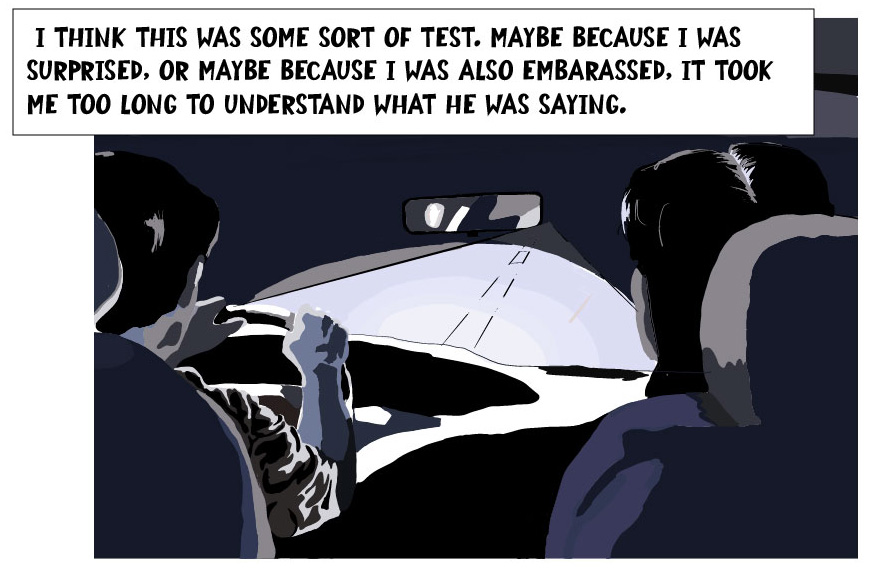
![When I was six, my English teacher asked my parents to stop speaking to me in my first language.
[Picture of Hasanthika as a six-year-old]
Teacher, offscreen:"Well, Mrs. Sirisena, she's very quiet in class."](https://electricliterature.com/wp-content/uploads/2020/08/Me-in-Kindergarten-Panel-7.jpg)
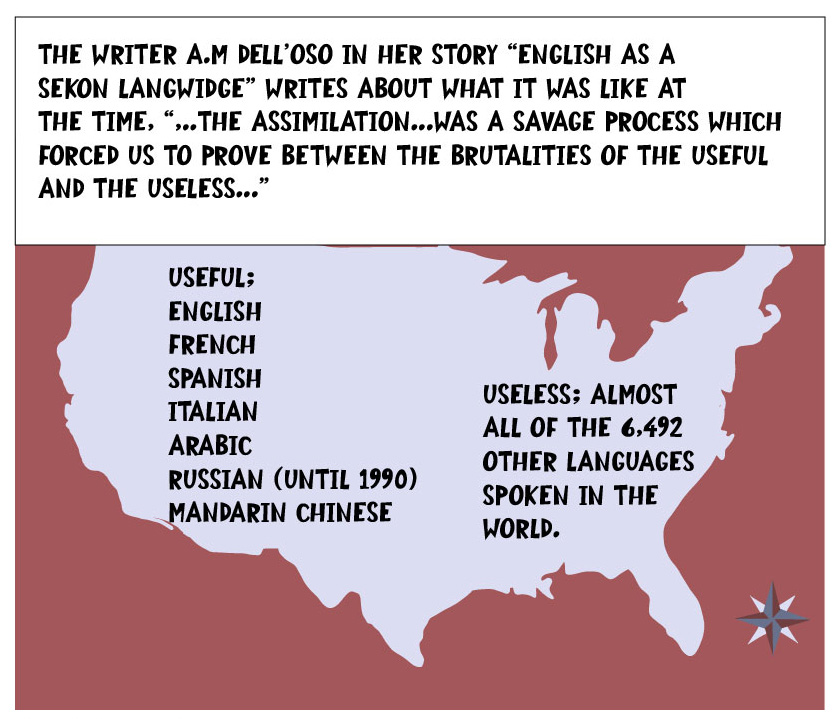
![My mother still sometimes spoke to me in Sinhala. Even though I understood I wouldn't speak it. This hurt her most when strangers asked why she hadn't taught me.
Hasanthika's mother, offscreen: "Oyaa thawma laesthi naethe?"
Hasanthika, as a preteen: "I'm ready!"
[Next panel]
A woman with long dark hair: "She speaks only one language?"
A man in an orange robe: "It is her mother tongue?"
A man in a polo shirt: "My kids speak three languages fluently."](https://electricliterature.com/wp-content/uploads/2020/08/PANELS-9-10_Ghost-Language-Comic-Sirisena-1024x458.jpg)
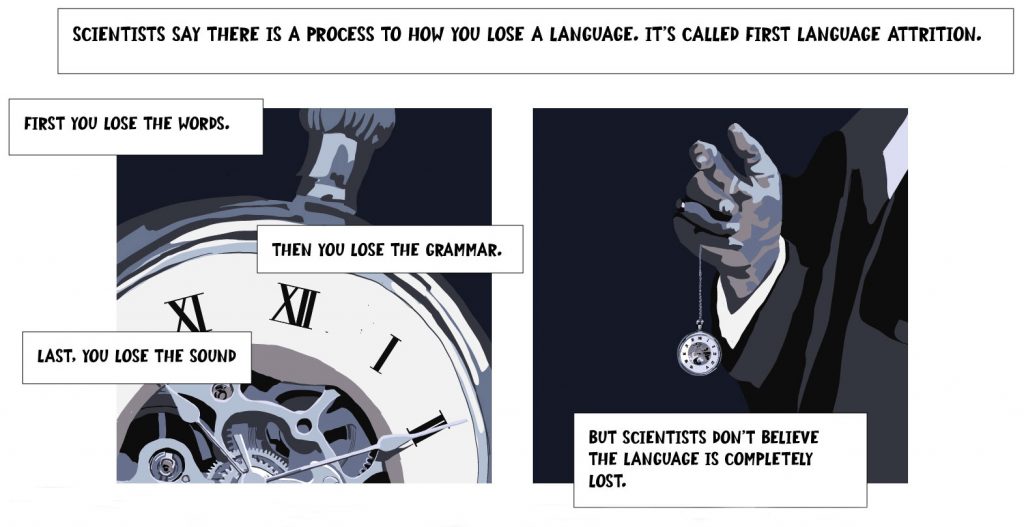

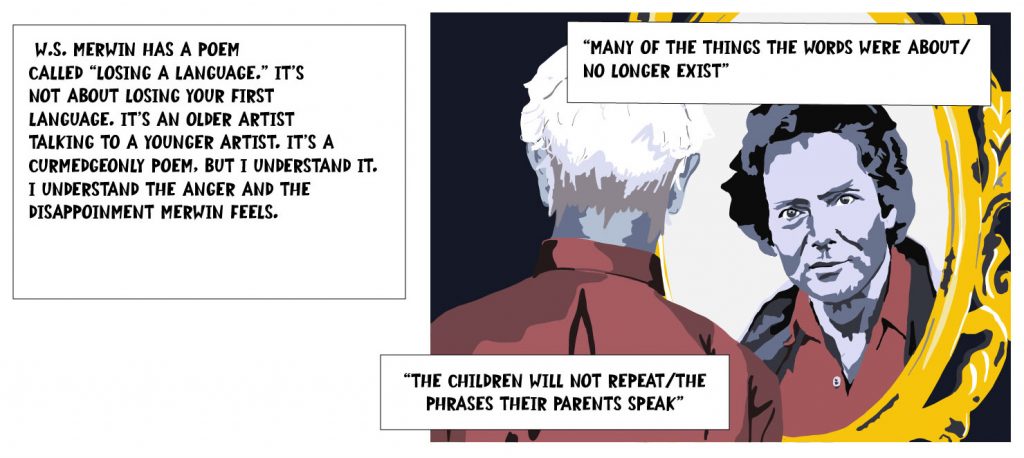
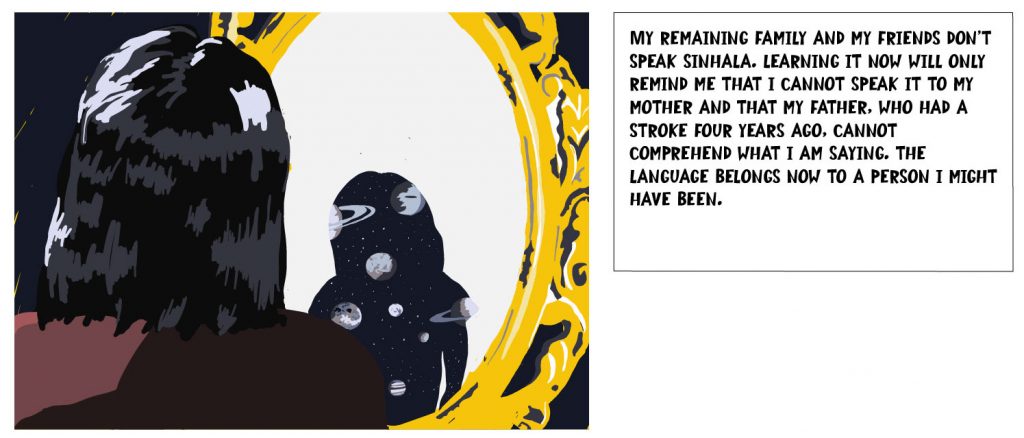
![[Portraits of Hasanthika as a baby with her parents, labeled Amma (mother) and Thatha (father)]](https://electricliterature.com/wp-content/uploads/2020/08/PANELS-20-21_Ghost-Language-Comic-Sirisena-1024x490.jpg)