The Brutal Secret I Share with My Neighbor

“The Neighbors”
by Shruti Swamy

At that time my daughter was eight, and my son had just been born. I sat on the front lawn with him and stopped him from putting fists of grass into his mouth. It was late July, and hot, a rich, thick heat that reminded me of the descent into summers of my childhood in India. My son gazed up at the trees in wonder. Still small enough to look slightly absurd, almost like a fish with the gaping mouth and eyes, but then he would move his head a little bit, wave his arms, and he would look suddenly, startlingly human.

My daughter came running down the street with no shoes on. Only this morning I had combed her hair, but you wouldn’t know it to look at her.

“Mom, someone’s moving in to Mrs. Hildebrandt’s house.”

There was a moving truck pulled up in the driveway of the empty house at the end of the street. We could see them through the trees. A girl—then two—emerged from the passenger’s side of the cab, from the driver’s a tall man, then a short-haired woman.

“Where are your shoes?” I said. I watched the family as they opened the door to their new house. In fact I had been keeping an eye on the place since it became vacant. It had a similar floor plan to ours, all the houses on the street were Eichlers, but better sun in the yard, and the last owner, an elderly woman who had died some months ago, planted roses that bloomed even in her absence, and not one but two fruit trees, lemon and orange. The girls ran in first. The woman stood a few paces away from the door, and the man behind her. She turned to the man to say something to him. She was much smaller than him, and had to lean up to do it. The man put his hand on her head, right at the nape of her neck. She looked so vulnerable there, at the back of the head, with her hair so short, short like a baby’s, so close to the soft skull. His hand there was familiar to me, the gesture full of the brutal tenderness of husbands. I couldn’t see her face to tell if she was happy or sad.

That evening I lay my son down in his crib and went to the bathroom to comb my hair. Almost as soon as I put him down he began to cry, and the door didn’t blunt the noise. I wanted to comb my hair. When I was younger, my hair was thick and rich and scented, after washing I used to spread it on a wicker basket under which burned a lump of frangipani. Once as a girl, finishing the thread I was using to sew a dress for my home crafts class, I had plucked a strand of my own hair and threaded the needle with it. It was long enough and it held.

Of course I lost quite a bit of my hair after my two pregnancies, which my gynecologist told me is common. For a while I thought my hair would grow back, but it never did. Then I began to comb it less frequently, sometimes I forgot for days. I had remembered today because of the woman and her short hair, which had shocked me. But she had seemed beautiful, even from such a distance. I could hear the mewling cries of my son, rising in pitch and frequency. The reflection in the mirror surprised me. Who was that woman? I thought of myself as young, a girl, and hardly ever looked at myself anymore. Then I began to comb my hair, tugging hard at the snarls, so hard that my scalp bled. When I was finished it lay flat and shining against my skull.

It was three days later when I opened the door to the neighbor woman. She had baked a batch of pale cookies and seemed to be visiting the entire neighborhood with them. Up close she was older than I expected, older than me, her face all angles, as well as her body, which was so slender it was boney. She wore a pale blue dress that left her legs and freckled arms bare. Under the right eye the skin was slightly darkened, the ghost of a bruise. Her two girls stood behind her. The elder was surely my daughter’s age, the younger, no more than three, plump, with bright gold hair, like a little doll.

“God it’s hot as anything out here,” the woman said, handing me the cookies. A bit of hair stuck to her damp forehead. “I didn’t feel like baking, but when you move you should always bake something for the neighbors, I think. Anyway, I hope you’re not allergic to anything or vegan, they’re lemon cookies—lemons from the tree—” she pointed to her yard, “I didn’t want them to go to waste. I’m making marmalade with the rest of them—the oranges are too sour to eat. I don’t know anything about orange trees.”

The sound of the sprinkler, two houses down, hissed up between us. The woman smelled of flowers, yellow flowers I imagined. Other neighbors had made similar overtures over the years. But after a little while, they left me alone. “I don’t know anything either about orange trees,” I said.

“I’m sorry, I didn’t even say my name,” she said. She was older than me, but her face looked young, and flushed slightly like a girl’s. “I’m Luisa. And this is Camille and Geenie. My husband, Richard, is at work. We moved in to the house down the street. They’re shy, the girls are. Say hi, girls.”

“Hi,” they said. The elder’s voice sounded bored, the younger’s was a whisper.

“Would you like to come in?” I said. “My husband is also at work.”

Luisa looked down at her two girls, then looked back at me. A strand of gold, terminating in a tiny star, hung from each ear. “That would be wonderful.”

I led them inside—seeing the shoes at the door, they took theirs off on instinct—and sat them down in the living room, where the baby, in his swing, had began to bunch up his face, but he relaxed when he saw me, held out his arms. I carried him so much in those days that my body had gotten used to the extra weight. When I put him down, there was a feeling that came over me, almost like vertigo, a mixture of dizziness and exhilaration, of terrible, terrific lightness. It wasn’t like this with my daughter, who was always independent and self-contained as a cat, and who had learned to read when she was five, which was when I lost her to her mind’s vast interior. She was her father’s child.

“A baby!” said Luisa, “He’s beautiful. How old is he?”

“Four months,” I said. He smelled of milk, my baby, and he grasped my shirt in his hands and wiped his nose against my shoulder. “His name is Manoj. I’ll get my daughter, I think she’s your age, Geenie.”

Then I went to the bottom of the stairs and called her, sweetly and urgently, so they would think I was a good mother. “Manisha!”

She took a while to appear. Backlit by the window at the top of the stairs, there was a crown of hair frizzed around her head, and I couldn’t see her eyes. The soles of her feet were also out of my vision, but their state I could guess; black from her barefoot summer, black and leathery, like the child of a beggar. “What.”

I spoke to her in Hindi. “The neighbors are downstairs. The new neighbors. Will you come down?”

Her body held the heaviness of a sleepwalker, but she came, and followed me back into the living room. Luisa sat on the sofa with a girl on either side of her, and they were talking in low voices. I could hear the unmistakable sound of whining, and the equally unmistakable sound of stern hushing. “Manisha?” said Luisa, she said it like an Indian, with a soft uh sound instead of a hard a Americans put in the first syllable. Manisha, my daughter came home crying with anger her first day at school from the cruel mispronunciation. “This is Geenie, and Camille, and I’m Luisa. Geenie’s going to be starting fifth grade in the fall.”

“Manisha too,” I said. Geenie was a year older, then: Manisha had skipped a grade. She had been a misfit before the change, and she was a misfit now, because of her age, and, I suspected, her solitariness, which came off as cool pride. “Manisha, do you want to show Geenie your room?” Manisha looked at me, not a little warily. The mention of school had shaken her out of something, the thick dreaminess I had seen on her at breakfast. “You can show her all your books,” I said.

“Okay,” she said. I could see her eying Geenie, her pretty clothes, the little ribboned clips in her hair. Their feet were quiet on the stairs, carpeted to cushion a child’s fall, dark to hide stains. I shifted the baby in my arms. He was sucking his heel, then his fist.

“Can I hold the baby?” Camille whispered to her mother.

“Babies aren’t dolls, Cami, they’re not toys.”

“I know,” she said. Her eyes were caught on my son’s. Hers were pale blue, like her mother’s dress. “Can I?”

It was all addressed to her mother, but I said, “Go wash your hands, the bathroom is just right over there. Then you can hold him.” We watched her pad out of the room.

“You have a beautiful house,” said Luisa. The sink turned on. Camille was on her tiptoes, we could see her through the open door.

“Same as yours,” I said.

“No, I mean, the way you’ve arranged it. The furniture is so beautiful. It’s very bright and friendly. You have a good eye for things—you and your husband, I should say.” Of course, it had all been me, and I smiled with pleasure. It wasn’t often I had guests, though I did my best to keep the house clean. “Come, let’s have some of these cookies.”

“No, no. I’ve had enough already,” she said. “You have them later.”

“Where did you move from?”

“Colorado—Denver. Richard had a job there.”

“What does he do?”

“He’s in sales. And I’m an artist.”

“An artist?”

“Yes. I paint. Mostly watercolor.”

“What do you paint?”

“Oh, lots of things, really. I paint those two a lot, if they sit still. We lived in Arizona before Denver, and I liked living in the desert. I liked painting how dry and red everything was out there, especially in the evenings. Richard calls it my Georgia O’Keeffe period, of course.”

“How do you have the time for it?”

“It’s just a matter of practice.” She had slipped her legs beside her on the couch. There was something avian about her, the elegance and ease of her pose. Yet I felt something unsettled in her too.

“But the space I mean.”

“The space?” she said. “Usually we make some space in the garage.”

“Not that kind of space,” I said,  but I  didn’t  know how to say what I meant, and let it drop. A small silence followed.

“And you, what do you do?”

“When I was young I wanted to be a pilot,”  I said. The sink switched off. Camille’s little hands were red. “Come here,” I said. She sat next to me on the love seat.

She smelled of my soap—sandalwood— and kid’s sweat, and thinly, the floral scent of her mother. Sitting with her back against the back of the love seat, her feet just reached the end of the cushion. “If he cries you mustn’t be upset, okay? He’s shy, just like you.”

I eased Manoj into her arms. “Keep the head up, like this.”

I could see the storm gathering in his face. I held his hand, and sang to him the Indian anthem, which always soothed him. He began to laugh.


Late at night, I was awoken by the sound of glass breaking, or glass broke in my dream, and I awoke. I was flung awake. My husband lay on his back, sleeping, and the baby was asleep too, in his crib, which we kept in our room. Father and son slept dead like each other, bodies gone thick and heavy and soft, slept without moving, barely breathing until they woke. My son’s sleep was particularly disconcerting, because he slept with his eyes half open, and during the weeks after he was born I had often held a mirror under his nose, to see if it fogged up with his breath. I went to my daughter’s room, and stood in the doorway, casting my shadow over the floor. The room had filled up with her breathing, warm and not wholly pleasant. She curled on her bed with all the blankets flung off dramatically. Her window looked onto the street, from the vantage of the second story. I stood there in my nightgown. The lawn below me was nearly blue in moonlight and streetlight. There was someone in the street. I saw him, his shoulders, his hot blonde hair, then lifted my gaze, to where all the lights were on in the house down the street. I must have stood there for a long time. I felt my own mind, tingling like a limb come awake. The street was empty, then the light went off in the house, still I stood, remembering a night long ago, when I stood at a window in another country. It wasn’t nostalgia. My life was crowded then with family, and I worked hard. Yet this space was there. I thought about it for a long time. I couldn’t say whether I was happy, or sad, or sorry for myself.

Then my daughter cried out in her sleep, and just like that, the space closed. My mind and body turned to her. She blinked up at me, like she had as a baby, with her black eyes. “Mom?”

 Was she awake or dreaming? I felt irritation and tenderness in equal parts. “Go back to sleep,” I said.

“I was being eaten, someone was eating me,” she said.

“Just a dream,” I said. She was scared, shaking and I held her, she allowed me.

“You don’t want me anymore,” she said.

“What?”

“You don’t want me anymore.”

“You’re dreaming,” I said. “You’ll feel embarrassed about this in the morning.”


Every morning, I combed my daughter’s hair before I fed both the children breakfast. It was a challenge, because the baby was always clingy right after he woke up and my daughter had trouble sitting still for more than a few minutes at a time. If I put the baby down, he would begin to cry, and Manisha would use the distraction to run off. Then I would have to start the whole process over.

“You said Manisha means mind. You said that the mind is the most important. That’s what you said.”

“Mind is important, hair is important. Already you run around the neighborhood like a wild thing.”

“So my hair is as important as my mind?”

“No.” I had put the baby in a sling against my chest, so my hands were free. The sling reminded me of the peasant women in the fields, who worked for hours with their babies tied to their bodies in old saris. But mine I bought at Target. “It is important to look nice for people.”

“Why?”

“I don’t know why. I don’t know why you are so difficult, why you don’t just listen to me.”

“Because you don’t make sense!”

July mornings were cool and felt strange on the skin after waking; afterward the days became brutally hot. The baby was still small enough to bathe in the sink, and I bathed him often and massaged his body with oil. Manisha came in only when she got hungry, and I cleaned the house and made sure the dishes were out of the dishwasher, made lists of things I needed to get from the store, paid all the bills and called the health insurance company about a birth-related expense they had not yet reimbursed. I was in the process of applying for citizenship, which also produced a large amount of paperwork. I fed the baby, changed the baby, put the baby to sleep and picked him back up when he woke, sang to the baby, talked to the baby, read to him. Manisha came in and reported that Luisa was letting her kids run through the sprinklers. “Geenie has a bikini!”

“You don’t want a bikini.” 

“Yes, I do.”

I sighed. “Wasn’t it you who was only caring about the mind this morning?”

She shrugged.

“Do you want to go and run out in the sprinklers with them?”

“I don’t know.”

“We could put the sprinklers on here.”

“Then we’ll be copying them.”

“Fine.”

Luisa was stretched out on a plastic lawn chair in shorts and a tank top and a hat that covered her face. She was reading a gigantic magazine. She waved when she saw us approaching.

“Glad you’re back, Manisha. Brought your suit?”

Manisha pulled up her T-shirt, showing the swimsuit underneath.

“Go on then.”

Manisha hesitated. Geenie and Camille had not taken any notice of her. They looked half-wild on the lawn. They would grow up to be beautiful, like their mother, with their small faces, Geenie’s heart-shaped, and Camille’s oval, their wide eyes and little noses and soft, elegant mouths. Their beauty was startling because they were so unaware of it; it was strange to see them act with such abandon, like children, with those faces. Like two princesses from a storybook I read Manisha, one dark, one fair, the water glittering on their skin. As the sprinkler changed direction, it fanned into a rainbow. Manisha took off her shirt and shorts and stood barefoot in her yellow bathing suit. Her belly puffed out, and the way she stood with her feet turned outward made her look like a duck.

“Girls, Manisha’s here,” said Luisa. The girls looked up from their play. Camille’s knees were stained with mud. Her little pink tongue came out of her mouth and licked her cheek. “We’re playing cats.”

“No we’re not,” said Geenie. She was, as reported, wearing a ruffled pink two-piece, the top of which lay flat against her chest. She cast a scornful look at her sister. “Cats hate water.”

“Not all do,” said Camille.

“Yeah, all do. They’re from the desert.”

“I like cats,” I heard Manisha say. She was allergic, and had an instinctual fear reaction to most animals, throwing her hands up to protect her face when they came near.

“We’re going to get one, Mom says,” offered Camille.

“We’ll see,” said Luisa.

The baby and I were both sweating, but I was glad at least that I wasn’t pregnant in this heat. “It’s hard enough being responsible for the two of you. Though at this point maybe a third life wouldn’t make any difference.” She had put down her magazine, and she took her hat off to fan herself. On the underside of her arm there was a constellation of yellow marks. “Tell me, how long have you lived in the neighborhood?”

“Well, let’s see. Manisha was four and a half when we moved. So I would say about three and a half years.”

“I hope we stay here that long.”

“How long were you in Denver?”

“Only a few months. Richard’s job. Three schools in two years.”

“That must be hard on them.”

“But you know, I moved around a lot as a kid, my dad was in the army—so I think of myself as sort of a gypsy now. Richard says I romanticize my childhood, but he wasn’t there, was he? I like change, moving around.”

The baby sneezed. It was a tiny noise, but it rocked him. He looked up at me, bewildered, and I stroked his cheek so he would feel reassured. Ever so slightly, I shifted him in my arms, so that the bruises at my throat would be visible between my dupatta and the neck of my blouse. I looked to see if Luisa noticed; if she had her face didn’t register it. “Moving around so much—it must be nice, in some ways.”

“Yes, it is.”

“To feel . . . how does it feel?”

“Just about how you’d expect, I think. Sometimes it’s hard, you get so attached to a place. There are so many places to miss. And you just have to pack everything up, your clothes and pots and things, you start to hate your stuff. You want to throw it all away and start over on the other end.”

I remembered how I felt when I was young, slight as a plastic bag, caught on nothing, riding the wind. But I had been caught. Again, I shifted the baby in my arms, more clumsily, less carefully, to show her where, three days ago, hands had squeezed my neck as though pulping a fruit. I stood there with her in an expectant silence, feeling the start of a sweeping relief, like a person in a wreck who sees through the windshield the Jaws of Life. I had, until this moment, never said it to anyone, not even to myself. Instead I had extinguished each event at the root of the candle, before it had time in my mind to burn. Then I looked at her and realized she was refusing. Not only to say it, but to see, just to see it, to see me. Her eyes were hard and faraway, the eyes of a stranger—which, of course, she was. With haste I covered the spots on my neck and looked away.

There was a cry from the girls, and I turned around to see Manisha tripped or fallen in the grass. She was wet now, and lay for a minute stunned on the ground, facedown. Geenie and Camille stood still, grazed every now and then by the edge of the sprinkler, Geenie’s face proud, Camille’s full of the innocence I hoped she would always have, would never leave her.

“She tripped,” said Geenie.

“Are you okay, Manisha?” said Luisa. She rose from her lawn chair but didn’t approach my daughter. Manisha lifted her wet face. There was grass stuck in her hair. For a moment I could not bear to look at her face, full of humiliated anger. She looked too much like me.

“Manisha?” I said.

She would not cry. She came to her hands and knees, then picked herself up gingerly, and, as though her legs were untrustworthy, treaded carefully over the wet lawn. When she had reached the sidewalk, she began to run.

“Manisha!” I called. She didn’t turn around. I watched the black soles of my daughter’s feet slapping the pavement.
9 Books Where Women of Color Tell Their Own Stories About Mental Health

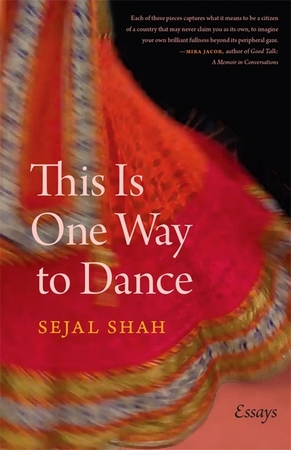
I often describe my debut collection, This Is One Way to Dance, as essays about race, place, and belonging written across twenty years. But they are also meditations on friendship, time, and love; on how to keep moving in the face of trauma and loss. My book is about making one’s way in the world, finding and claiming home. This Is One Way to Dance includes travel narratives, linear narratives, and several lyric essays. At some point I learned the name for a form I had begun writing: the lyric essay—a hybrid form between the essay and the lyric poem, in which utterances, circling, unparaphrasable plot is the norm.

Although I shaped and revised essays to make a memoiristic arc, when I reread This Is One Way to Dance, the gaps and silences in the narrative surprised me. In an essay I wrote about my relationship to food and cooking, I mentioned that I spent much of one year on my couch, depressed, watching reruns of Friends. But I didn’t mention the story behind the story: that I had been diagnosed with a major mood disorder and had a terrible time finding a medication that allowed me to speak, that didn’t have the side effect of aphasia, my sentences trailing off; that I had lost my confidence after repeated harassment by a professor in my program; and that I had struggled to make sense of myself as a writer of color in a creative writing program with a racist and silent workshop model, standard at the time.

Last year, in an essay not in my book, I wrote about neurodiversity and manic depression. I could only write that essay after other essays that were, in so many ways, about what could not be said at various points in my life. During those years, I looked to writers and books who showed me a way forward: women of color who had reference points other than Western medicine or binary models of illness and health. Books helped me feel less alone. They helped me find words to talk back. 

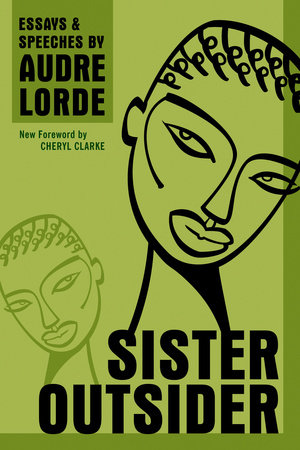
Sister Outsider by Audre Lorde

Sister Outsider by Audre Lorde

Sister Outsider has been a touchstone for me ever since reading Audre Lorde’s essay, “The Transformation of Silence into Language & Action,” in college. In an interview with Adrienne Rich, Lorde said, “One thread in my life is the battle to preserve my perceptions–pleasant or unpleasant, painful or whatever…I kept myself through feeling. I lived through it.” This belief in Lorde’s value of her experience as a Black lesbian showed me that you can choose to value your perception in a world that would rather gaslight you. Rereading “The Transformation of Silence” helped me survive racism and sexism in academia, health care, and the workplace–and to fight for my mental health and to write about it. The titles of Lorde’s essays are keys and seem especially prescient right now: “The Master’s Tools Will Never Dismantle the Master’s House.” Lorde reminds us, “In a world of possibility for us all, our personal visions help lay the groundwork for political action.” 

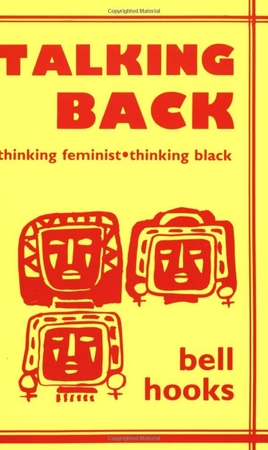
Talking Back: Thinking Feminist, Thinking Black by bell hooks

In these essays, hooks writes of the difficulty of claiming a voice, the anguish of speech, the use of a family name as a pseudonym. I bought this book in the ’90s when I was in graduate school and continued to refer to it over the years. Hooks described a “fear of madness” and how she was sure madness was the “destiny of daring women born to intense speech.” Like many women, she was taught to talk in a way that was also a kind of silencing. In Talking Back, hooks connects the defiant speech that could be seen as madness to the same impulse that allowed her to claim herself an independent thinker and writer.

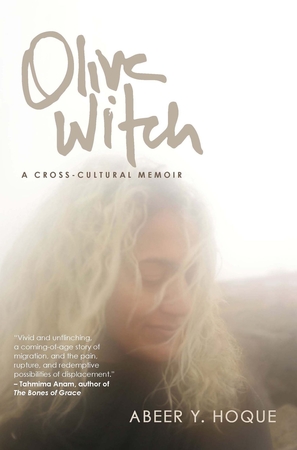
Olive Witch: A Cross-Cultural Memoir by Abeer Y. Hoque

In this lyrical memoir, Abeer Y. Hoque writes about her childhood in Nigeria, her Bangladeshi heritage and family, and coming of age in the United States. Weather conditions and poems frame each chapter. We travel through Hoque’s childhood in Nigeria and her later life in the United States through institutions and cultures: high school, universities, academia, a psychiatric ward, to Dhaka, Bangladesh with extended family. The entire meta-framing of the memoir resists a Western binary of illness and health. Our whole concepts of health and illness are cultural, which is made clear by this memoir that spans continents and cultures. During her stay at a hospital for atypical depression, Hoque points out that “silence is a terrible spokesperson.”

Since my mother grew up in Kenya, I especially appreciated reading about Hoque’s third culture and the specificities of being a child in Nssuka, and her relationship to Bangladeshi culture and to various parts of the U.S. 

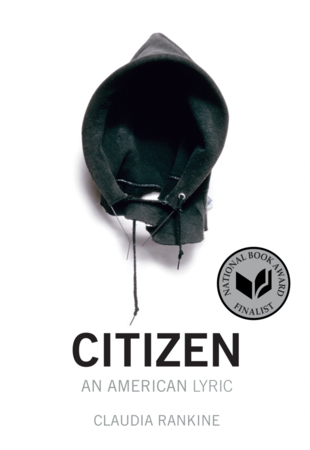
Citizen: An American Lyric by Claudia Rankine

I heard Claudia Rankine read from Citizen: An American Lyric in 2016 on the last day of November. I saw a book-length lyric essay make something visible that was all too visible to some of us in the U.S. and completely invisible to others. Rankine’s use of white space, images, and words link microaggressions to macro aggressions, explore issues from the exhaustion of anti-Black racism on elite college campuses, to Serena Williams, to a list of Black men killed just for existing. For a time, I used an excerpt from Citizen as an epigraph to my book:

“You take in things you don’t want all the time. The second you hear or hear or see some ordinary moment, all its intended targets, all the meanings behind the retreating seconds, as far as you are able to see, come into focus. Hold up, did you just hear, did you just say, did you just see, did you just do that?”

And I felt as though I was not crazy—to see the range and kinds of ways these words injure, it made me feel sane. It wasn’t just me. Of course, it wasn’t just me. It’s a system. It helped to see this Black essayist write as resistance to a world that harms. Rankine’s artistry is a call to fight back.

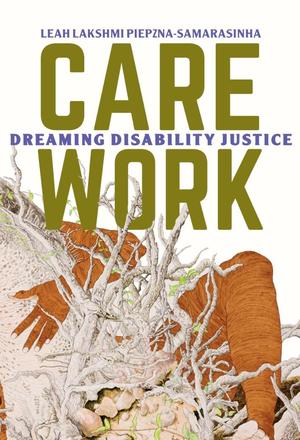
Care Work - Dreaming Disability Justice

Care Work: Dreaming Disability Justice by Leah Lakshmi Piepzna-Samarasinha

Care Work: Dreaming Disability Justice opened my mind from the preface, where Leah Lakshmi Piepzna-Samarasinha, a queer, disabled, femme writer, organizer, performance artist of Burgher/Tamil Sri Lankan and Irish/Roma ascent, writes about the long tradition of writing from bed.

Disability justice allowed me to understand that me writing from my sickbed wasn’t me being weak or uncool or not a real writer but a time-honored crip creative practice. And that understanding allowed me to write from a disabled space, for and about sick and disabled people, including myself, without feeling like I was writing about boring, private things that no one would understand.

And suddenly, I saw a framework for the way that I, too, had worked. Piepzna-Samarasinha writes about the history of the term “disability justice” and its connection to disabled Black and Brown queer liberation. Reading Care Work helped me write into the silences in my essays and helped me to write about and claim my neurodiversity and invisible disabilities. From Care Work: “We know we are powerful not despite the complexities of our bodies, but because of them.”

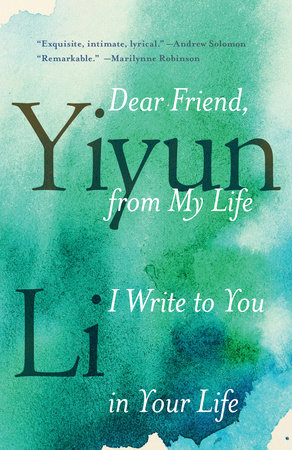
Dear Friend, from My Life I Write to You in Your Life by Yiyun Li

Dear Friend, from My Life I Write to You in Your Life by Yiyun Li

The dedication page of Dear Friend reads, “This book is part of a conversation with Brigid Hughes.” So many books and works of art come out of conversations and collaborations with long-time friends, many of them other writers. This book is an exploration of living with depression and suicidal thoughts, recoiling from the autobiographical I (Li is a primarily a fiction writer), but using it nonetheless to tell a story. To write, “What kind of life permits a person the right to become his own subject?” I appreciated Li’s definition of memory, of memoir: “Memory is a collection of moments rearranged–recollected–to create a narrative. Moments, defined by a tangible space, are like sculptures and paintings.”

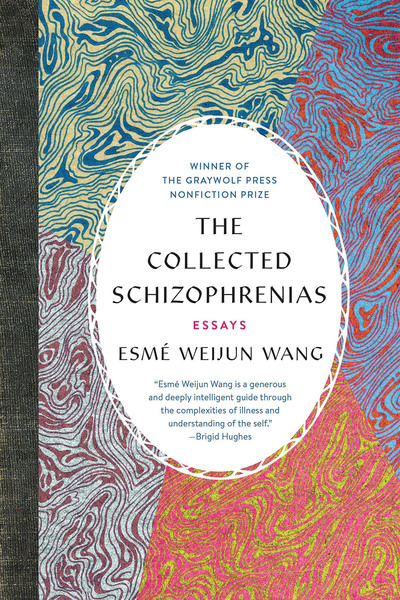
Image result for collected schizophrenias by esmé weijun wang

The Collected Schizophrenias: Essays by Esmé Weijun Wang

In this sharp collection, Wang shows us what it is like to be the crazy subject, but even then, the tone is cool, collected, smart, considered. A few essays stand out: In one of my favorites, “Yale Will Not Save You,” Wang writes, “‘I went to Yale’ is shorthand for I have schizoaffective disorder, but I’m not worthless.’” In “High Functioning,” Wang notes, “There are shifts according to any bit of information I dole out. Some are slight. Some tilt the ground we stand on.” She considers the ways those who have mood disorders or other disabilities perform our worth, our competence, our value in our capitalist culture. I admire her awareness of identity as complicated, situational, multi-valenced. Her essays argue that we are each more than our histories or backgrounds or diagnoses.

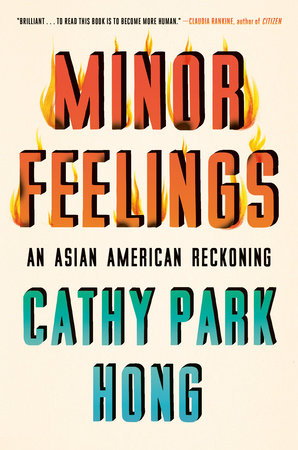
Minor Feelings

Minor Feelings: An Asian American Reckoning by Cathy Park Hong.

I, like many Asian Americans, loved this book so much—was waiting for it. Hong, a gifted poet and essayist, names and defines “minor feelings: the racialized range of emotions…built from the sediments of everyday racial experience and the irritant of having one’s perception of reality constantly questioned or dismissed.” Hong draws upon Rankine’s work in Citizen and looks at what happens to Asian Americans who are often read as or considered white-adjacent, or the dreaded model minority.

One of the many things I admire is that Hong opens the book with this line: “My depression began with an imaginary tic,” and wrote, in the first essay, “United,” about looking for a Korean American therapist because “I thought I wouldn’t have to explain myself as much. She’d look at me just know.” This is the dream, I’ve seen writers exclaim on Twitter. It doesn’t quite work out that way in Minor Feelings, but I appreciated that a book that was so far-ranging as to cover Richard Pryor’s standup, the cross-genre artist Theresa Hak Kyung Cha’s memoir, Dictee, college friendships, Chinese Exclusion Acts, the 1965 Immigration Act began, simply, with Hong’s depression and the search for a good therapist. 

How We Show Up: Reclaiming Family, Friendship, and Community by Mia Birdsong

Mia Birdsong’s How We Show Up: Reclaiming Family, Friendship, and Community is a book we all need now. Written well before COVID-19, How We Show Up was released in June 2020. Birdsong, a Black activist, writer, and storyteller, captures the loneliness and isolation for so many in our fractured American culture. How We Show Up addresses the ways in which the American Dream, never an option for many, and “toxic individualism in family-unit form” is failing even those who may appear to have achieved it, as she has. “Not having deep connection is causing us mental and physical harm,” she writes.

Birdsong offers us a map to reimagine and extend kinship and belonging, looking to Black and queer communities, who have historically defined family more broadly. Drawing from research, interviews, and her own experiences as the daughter of a white American mother and a Black Jamaican father, Birdsong has written a guide for how we can live more connected lives, investing in friendships and community. Raised by a single mother, Birdsong grew up poor and working class and built the family network she needed to thrive.

I met Mia through our close friend, Cat, chosen family for us both. How We Show Up has made me feel hopeful, even during the pandemic. Birdsong reminds us: “All of us have ancestral memory of what it’s like to live connected, interdependent lives…this is a process of decolonization.” 

8 Books to Take You Back to the 1980s

Ah, the 1980s. New Wave, post-punk, huge hair, the brat pack. Dancing next to Grace Jones at AREA, eating at The Empire Diner at 4 a.m., and spying artist Keith Haring drawing on New York subway walls with chalk. The ’80s was an age of fantasy and freedom. So why are novels set in the 1980s so sad? Because beneath a veneer of hedonism and fun, the 1980s was an era of intractable social stratification, racism, and thousands of deaths from AIDS. There was little sympathy in the air—the 1980s was a materialistic, cynical, and mean decade. Television shows like Dynasty and Dallas glamorized corruption and competition. Reagan’s trickle-down economics and tax cuts for the 1% sharpened the divide between the haves and the have-nots. It is chilling and inevitable to compare the US government’s reaction to AIDS to COVID-19. Just as the Trump administration has allowed the virus to run rampant and to ravage the U.S., the Reagan administration denied AIDS as a health crisis for most of the decade.

Age of Consent by Amanda Brainerd

I was a teenager in the 80s, and in my novel, Age of Consent, I explore themes from the decade through the lens of my teenage characters. My protagonist, Justine Rubin, a Jewish scholarship student from an intellectual but impoverished family, arrives at boarding school in Connecticut. Justine befriends Eve Straus, a sheltered girl from a wealthy New York family. Both Jewish, they hail from different backgrounds, yet forge a deep friendship. Justine must navigate complex class hierarchies, and slowly learns the nuances between the wealth of the Upper East Side and Soho and how her friends Eve, India and Clay fit into this unfamiliar class and wealth puzzle. The novel is set in 1983 when the United States was in the grip of AIDS but in deep denial. 

February Grace Notes | Mac's Backs-Books on Coventry

The Prettiest Star by Carter Sickels 

Sickels’ novel is a beautiful and poignant portrait of a young man returning to die in the rural community that rejected him. It is a new kind of portrait of the AIDS crisis, told as a closely observed family drama.

Christodora by Tim Murphy

The Christadora is a famous apartment building in NYC’s East Village, and its evolution from a squat to luxury apartments has become a symbol of the neighborhood’s gentrification. This ambitious novel moves between the Tompkins Square riots of the 1980s, which were aimed at eliciting a proper governmental response to AIDS, to the glass high rises of today. Murphy paints a compelling picture of the community of activists that transformed queer life in the 1980s, and the people who stood in solidarity to show the world that AIDS was a disease that affected more than just gay men. 

Sag Harbor by Colson Whitehead

Sag Harbor by Colson Whitehead

An intimate portrait of the wealthy Black community in the Hamptons, Whitehead’s coming of age novel is set in 1985 and follows 15-year-old Benji during a summer in Sag Harbor at his moneyed parents’ house. Growing up, I was keenly aware of the racism and anti-Semitism in the Hamptons, which was the New York City version writ large, fueled by money and hidden behind private hedges. 

Swing Time by Zadie Smith

Swing Time by Zadie Smith

This is a tale of the bond between two teenage girls from the projects, and the story of how friendship can tether us to home and comfort even if we travel far away.

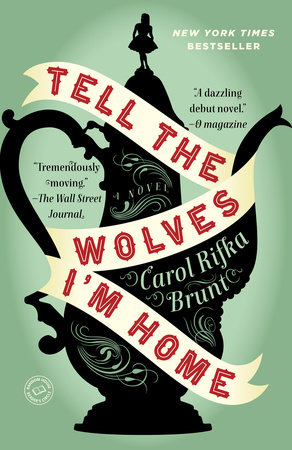
Tell the Wolves I'm Home

Tell the Wolves I’m Home by Carola Rifka Blunt

Another beautiful and personal story of loss. June adores her uncle Finn, a successful artist. When he dies of a mysterious disease that June’s mother cannot bear to name, June sees a strange man hanging around Finn’s funeral. A few days later, she receives her uncle’s teapot, with a note from this man, Toby, her uncle’s lover. June and Toby form an unlikely friendship, sharing stories and memories of Finn in order to heal, while June’s sister Greta is unraveling. 

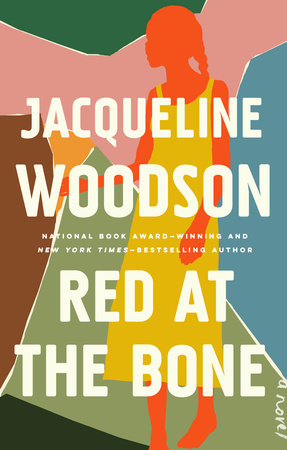
Red at the Bone by Jacqueline Woodson

Red at the Bone by Jacqueline Woodson

Woodson’s glorious story of an unexpected teen pregnancy bursts with stunning prose. The story revolves around Iris, a Black teen from a prosperous family, and Aubrey, the son of a struggling single mother. When Iris gets pregnant, the story explodes, divides, and mutates. Woodson examines the choices we make and the ripples that never dissipate.

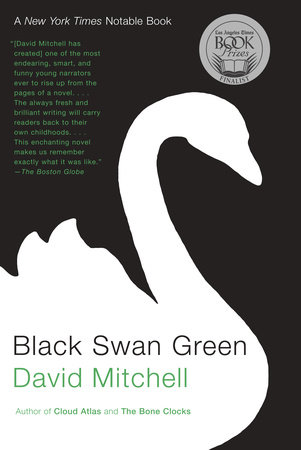
Black Swan Green by David Mitchell

Black Swan Green by David Mitchell

An exquisite coming of age novel is set in a rural British village in the 1980s. The novel is composed of thirteen chapters that stand alone as stories themselves. I loved the precocious voice of 13-year-old Jason, and how Mitchell portrays the world, once magical, sometimes macabre, through Jason’s young eyes.

Veronica by Mary Gaitskill

Veronica by Mary Gaitskill

Gaitskill is a master of the deadpan. But beneath her vicious descriptions of cruelty, debauchery, and self-harm, lies a tenderness towards her characters, which once discovered is all the more incisive. Veronica alternates between the present and the past of the 1980s, a narrative that the New York Times accurately described as a “’where are they now’ for the Nan Goldin crew.”

It’s Time to Radically Rethink Online Book Events

Before the stay-at-home orders came down in Baltimore, the last thing I did in person was participate in a panel conversation about—ironically—“art and the apocalypse.” In retrospect, we should have cancelled, but the threat in Maryland still felt surreal; those were the days when it seemed like we could beat the pandemic by washing our hands.

Internet readings have lacked some of the magic of human connection. Is there a way to recapture that magic online?

I’ve been thinking about that panel a lot lately because my first novel is coming out in August, and I’ve been trying to envision a book launch without an in-person event. I’m embarrassed to be grieving for this tiny problem, which is less than negligible compared to all we have witnessed this year. But publishing a novel has been a lifelong dream for me, and book events have been an important part of that dream—because other authors’ events have been such meaningful parts of my own inspiration. I have vivid memories of electric readings by Victor LaValle, César Aira, and Tim O’Brien. I got teary-eyed watching a hundred public school kids crowd in to see D. Watkins at the Baltimore Book Festival. After hearing Valeria Luiselli speak about The Story of my Teeth, I was so inspired I wrote an entire short story in an afternoon. When my dreams have felt far away, when my fiction has seemed meager and hopeless, I have gone to a bookstore and sat on a folding chair and been reminded that books are my spirituality—they are my connection to my own humanity, and to my understanding of grace in others. The magic of a book event is in the revelation, fresh every time, that my very favorite thing to do, a thing I do mostly alone, is also the thing that connects me most closely to other people. 

As COVID has become our new normal, book events have started up again, in virtual formats. But like every other online substitute we’ve instituted—family Zoom calls, Instagram birthday wishes—these internet readings have lacked some of the magic of human connection. Is there a way to recapture that magic online?


For the first week of isolation, it was easy to imagine a return to normalcy. I think many of us saw ourselves emerging from a fourteen-day quarantine having drunk a little too much, maybe, but also having written King Lear. Personally, I did more drinking than writing. But I still felt optimistic. 

By the third week, I had swung from denial to despair at the never-ending stream of news of illness and death, health care system failures and government malfeasance. The experience of these months reminds me of when I fall asleep on the couch watching a movie and then refuse to get up to go to bed. I know that I will feel terrible sleeping on the couch, but all I want to do is keep sleeping on the couch. My friend Nicole calls this feeling “special features,” because back in the days of DVD, she would demand her partner play the special features after the movie so that she could continue to sleep. By my fifth week of staying at home, I felt like I was living in special features.

To alleviate the loneliness, I found solace in online book events. Bookstores and literary festivals, podcasts and grassroots publicity efforts, and publishers and authors had intrepidly brought their work and energy online, gathering readers together despite the pandemic with heroic success. I went to more book events online in April than I have ever been to in a physical month; there were nights I hopped between three different conversations, from Zoom to Crowdcast to Instagram Live; it was like wandering through a literary night market, the tents all patchwork-stitched together but the doorways tacked open to warm, inviting fires inside. In those first three lonely months, wandering through this nightly market has been a comfort.

But lately, I’ve started to wonder why these events have not yet evolved. Most events are still following the old-fashioned format of the in-person bookstore event, where two authors have a conversation, maybe with a short reading, maybe with an audience Q&A. Rather than developing new ideas for book events to suit the technology we’re using, the literary community is by and large continuing to do what we’ve always done. 

The internet rarely mimics the conventions of the physical world. So why are we still limiting book events to what is possible in person? 

Don’t get me wrong—many of these events have been truly excellent. But the internet, which can be thrilling and inspiring and creative, rarely mimics the conventions of the physical world. So why are we still circumscribing book events according to the limits of what is possible in person? 
These restrictions are not ideal for digital space. In bookstores, the “in conversation” model works because it gives you the inspiration of being in the same room as the author, as well as the excitement of being part of an audience. Neither of those translates organically to Zoom or Instagram Live, where it doesn’t really feel like you’re in the same room. And while there is often a chat box, or little hearts floating up the screen when people “like” something, the sensation of being part of the crowd is abstract. Without this sense of community, some online book events have left me feeling lonelier than I was before. 

It’s time to start experimenting—and to try radically reinventing what a “book event” can be, in this radically different year. 

I’ve started bringing this up with friends, looking for new ideas and possibilities of what an online book event can be. The general answer I’ve been getting is: Nobody knows! This is a new frontier, and it’s going to take a lot of playful experimentation to figure out what works. But as reopening plans falter nationwide, and it’s clear that gathering 30 or 50 people into a bookstore isn’t going to be a responsible choice anytime soon, it’s time that we start playing around. 

I’ll go first. I’ve been throwing spitballs at the wall, and I came up with these nine ideas for ways an author could reinvent the book launch format: 

  1. MTV Cribs: The author gives a tour of their workspace, from the desk where the book was written to the research library that inspired it to the corkboard string-map of characters to the spot on the floor where the author laid prone in despair. (Update: Baltimore’s Pratt Library and The Ivy Bookshop have been hosting a similar “Writer’s CRIBS” series since April!)
  2. Bookshelf Bingo: The author hosts a Bingo game based around a tour of their bookshelf, pulling out a selection of favorite works that inspired the new book. The first audience member who also owns a copy of four of the featured books hits bingo, and wins a prize. 
  3. Pet Readings: Pets are the internet’s staple food; the author gives a reading from their book to their cat or dog (or, inspired by the Barcelona opera, their houseplants).  
  4. Two Truths and a Lie: In each round of this game, the author makes three statements about the book, only two of which are true; the audience guesses (in the chat box) which is a lie. 
  5. Short Film Festival: The author curates a YouTube playlist of videos related to the book—movie clips, interviews, classroom science films, news footage, home movies—and screens the playlist live, offering running commentary and answers to audience questions in a chat box alongside. 
  6. Wildly Unprofessional Powerpoints: Several authors host a raucous, high-energy online lecture showcase—telling stories or explaining topics of interest to their books, alongside screenshared powerpoints (perhaps in the model of the Drunk Education series in Brooklyn or Trampoline Hall in Toronto). 
  7. Live Cooking Class: The author shares a recipe (or cocktail) that has some connection with the book, then makes the dish or cocktail on a livestream platform. It might be fun if the audience has a couple of days to gather ingredients, so they can cook (or drink) along with the show.
  8. Google Documents Editing Tour: The author shares a Google Document that shows early drafts of the book, pointing out specific changes and talking about their editing process. (This is obviously for truly hard-core craft nerds only). 
  9. Virtual Book Signing: With the support of a moderator/gatekeeper, the author takes 5-minute individual video calls with people who have purchased the book. Similar to the few moments you get at the front of a real book signing line, this is a chance to ask a question, or give the author a compliment, before getting your book “signed” (the author writes a bespoke message for the reader on a piece of paper, then holds it up for a screenshot—it’s a selfie AND a signature in one!). 

If we start playing with these tools, we can make online ‘readings’ feel like their own kind of event rather than a substitute.

This list is just a first draft. Some of these ideas probably won’t work at all. Others will be more comfortable for some authors than others, and not every book will have a natural tie-in to these ideas. The point, though, is that we need to start thinking outside the “in conversation” box. Online events don’t have to feel like placeholders for the “real” thing while we wait for an increasingly far-off return to crowded rooms. The internet offers incredible varied tools for storytelling, playing, creating meaning, and connecting. If we start playing with these tools, we can make online “readings” feel like their own kind of event rather than a substitute, offering experiences that aren’t possible in physical space.

It’s important to note that all online events come with real safety concerns, which can be a serious barrier to experimentation. The flood of attacks from racists and bigots has made many bookstores and authors rightfully cautious about online events; it is especially infuriating because the attacks mainly hurt people of color, LGBTQ+ people, immigrants, and so many others who have too rarely received their deserved publishing deals and attention. I’m grateful for and impressed by the work many have done in developing effective ways to block trespassers; as we experiment with new formats, security measures are a non-negotiable prerequisite. 

I hope we can deepen and extend the literary community through online events, not just keep it afloat. The writer and critic Maris Kreizman wrote on Twitter that she hopes “any author tour, no matter how many cities are on the agenda, will also have a live digital element” because livestreams are so much more accessible. It’s not a perfect solution—for one thing, there are still far too many people without access to computers or the internet at home—but online events are a big improvement for people with disabilities and chronic illnesses, those caring for children, those in rural or poor areas without bookstores, and others with countless barriers to weeknight events. 

The more we can make online experiences exciting and engaging, the more we can cement an enduring tradition of truly accessible events.

Innovation is part of the push for universal access—the more we can make online experiences exciting and engaging, the more we can cement an enduring tradition of truly accessible events. And we can also open the door to people who might never walk into a bookstore. In 2017, the artists Yara Trevieso and Bridghid Greene performed La Medea—a musical dance performance designed to be experienced over livestream, with live audience voices in the role of Greek Chorus—on the Twitch platform. The artists found Twitch attracted entirely new audiences to their work: “[it was a] major turnout in viewers that were predominately male watching a hyperfeminist musical.” Maybe—if we get this online thing right—book events can attract new audiences, too. 


I started this essay by describing a March panel conversation about art and the apocalypse. But I didn’t tell you how that event turned out.

Nobody came! The panel went great, except for the fact that we had no audience. We talked about art, hope, feminism, and the future, in an empty auditorium. In the old days, that event would have felt like a failure. In the context of COVID, it felt strange and kind of magical, like something that would happen in a novel. It was my moment of realization: Talking about the apocalypse, to an apocalyptically empty auditorium, I was faced with the fundamental change sweeping the globe. 

In the past few months, I’ve gathered hope from the ways our art and literature is shifting to reflect and respond to these new times. I’m looking forward to seeing all the ways our literary events evolve. 

Who Do You Confess Your Sins To?

Set in a small town in an abstracted American South, Catherine Lacey’s Pew traces a week in the life of its eponymous narrator, shortly after they are discovered sleeping on a church bench by the congregation and promptly nicknamed—like a dog—after the place they were found.

Pew is difficult to classify: androgynous and ethnically ambiguous, itinerant and without memory of either past or origin. They become first an object of Christian charity, and soon, a challenge to conservative Christian values and the townspeople’s need to “know what kind of person” a person is, in order to know how to treat them. Tension rises as the book approaches a mysterious “Forgiveness Festival” and Pew hears the stories and confessions of the town’s inhabitants. Pew, whose face cannot be pictured, presents a portrait of a community faced with the impossible: a body, bare of signifiers, that is only human.

I spoke on the phone with Catherine Lacey about complicity, forgiveness, growing up in the South, and more. 


Olivia Parkes: From the moment they are discovered, Pew refuses to speak. Why and how did you make that choice? 

Catherine Lacey: I think this is the first time I wrote something where I just knew the container of the book from the very beginning. I just had this question of what would it mean if we weren’t able to determine someone’s gender, race, background, or age? What would it mean to look at a person who was like that? And I think that once I had that question, it basically required this person not to speak. Because speech carries these different indicators in it. So the whole conceit of the book sort of required the central character not speak. And I was interested in the challenge of that. 

OP: One function of that choice is that the book is made up largely of the monologues of other characters. Many of those monologues end up being confessions of one kind or another. It emerges over the course of the book that certain kinds of crimes have in fact been committed and are still being committed by the community there. How were you thinking about the ways in which the crimes of the individual and the crimes of a community intersect?

CL: It’s interesting that you frame it in terms of a crime that has been committed, and these different people having to confess to different ways in which they’ve been a party to these crimes. Because I do think that’s a part of any society. Being a part of any government, being a part of history, being a part of the community means that you are a party to all different sorts of violence and oppression that occurred long before you’ve gotten there. And so how do you reconcile that? Especially if you’re confronted with what in one way is just a sort of void. You know, this person, this character, this body in need or body in an absence of context. I guess it seems like the appropriate place to confront your position in this society, or for these characters to confront their positions in their society. 

OP: The book moves towards a mysterious Forgiveness Festival, which is framed by the townspeople as a way of trying to “actively reconcile with the past” and “unite both sides of the community.” But it emerges that that’s not really how the festival is functioning. Could you talk about your skepticism of forgiveness as it’s handled in Pew

CL: I remember having this question really early on: If all sins can be forgiven, then what is the meaning of justice? In the town that I grew up in, in Mississippi, every single person went to a church. It was not a weird question to ask somebody what church they went to. There was an assumption that you belonged to one. So from a really young age, because I believed the adults around me, and because I was a reader, I read the Bible quite intensely. And it was really hard for me to reconcile the world that I was living in with the messages as I understood them in the Bible. To me, that’s the interesting question of the South. How do you have this place that’s so built around the teachings of Jesus, ostensibly, and yet has some of the most vile human rights problems in the country? I can’t stop thinking of that question but I also can’t answer it, but fiction never answers anything directly. 

OP: Pew gets taken in by a traditional cis-gendered hetero white family, and the problems of the book begin as soon as they try to identify Pew, or in the face of Pew’s inability or unwillingness to answer the question: What are you? Why is it so dangerous to this community to leave that question unanswered? 

CL: Well I think it would be dangerous in any context. You know, the conceit of the book is one that’s basically impossible. There’s no such thing as a person who has no racial background, gender, no identifying anything. There’s always something, right? But if we could imagine what it would mean to interact with someone who we knew was a human being, but we didn’t know anything else beyond that, I’m not sure if any community would know how to deal with that in a way that would be comfortable or reasonable. I don’t think there’s anything about the South or about this abstracted community that is more poorly suited for it than anywhere else. It’s just the place I know the most intimately.

OP: One of the ways the book dramatizes Pew’s indeterminate appearance is by having them look different ways to different people. What other characters see seems like a projection of their own minds, which affects how they want to “deal” with Pew. For example: Do they see a white female child of twelve, or a black male teenager of fifteen? How were you thinking about projection or that range of identity in Pew

Being a part of the community means that you are a party to all sorts of violence and oppression that occurred long before you’ve gotten there.

CL: I’m really interested in the psychological concept of dysmorphia—both physical and mental. At different times in your life, even different moments of the day, you might see vastly different people in the mirror. It’s difficult to reconcile the difference between the self you invent and the much more mutable, unknowable self that is actually out here living your life.

With the fact that the characters all see something different in Pew, I never envisioned each character seeing what they wanted to see, just that their interpretations would conflict. In some ways, I think you can read a novel as a kind of dream in which you’re being asked to identify with every character. In this novel, however, the main character you’re being asked to identify with has nothing for you to latch onto. What does it mean to confront a void or an absence or the part of you that isn’t gender or the part of you that doesn’t have a background? Where is that in your body and in your psyche?

OP: Pew is an impossible person—a person with no background or fixed characteristics–and also an unconventional character. They don’t really want anything, and are often passive—they stay, for example, in the town, even when it becomes unpleasant for them to do so. How conscious were you of playing with literary conventions around agency, or the idea that narrative is driven by a character’s wants and the thwarting or forwarding of those desires?

CL: I’ve always had a hard time with this concept of agency. I did an MFA, but in creative nonfiction, and I would overhear conversations between fiction people about this at the bar. This whole concept that every character in a story has to have something they want, and try to go get it—I just never liked that idea as a rule. Maybe some books function that way, but not all books. It’s a very alpha male view of the world and of narrative and what narrative is supposed to do. There are so many books that have no fucking clue what the main character wants the whole time, and I’m willing to follow them. 

OP: As you said earlier, you’re from Mississippi. This is the first novel you’ve written that’s set in the South and is perhaps also the first book that is explicitly political in this way. What prompted that turn for you? 

CL: I think the fiction I’ve written in the past has been more obliquely political, but in general I’ve been much more focused on interior, psychological questions. You might say my first novel was about the psychology of depression and abandonment and the second was about the psychology of heterosexuality. The later contained more social questions, and now Pew, I guess you could say it’s about the psychology of how we judge others. 

I’ve always been very hesitant to write about Mississippi, or maybe just too hurt by that place, too exasperated, but ultimately it’s more a portrait of an idea than it is a portrait of a real place. It’s a portrait of white supremacy short-circuiting. 

OP: Despite having no memory or past to draw on, Pew seems to address the reader from a position of experience, proffering statements about life, or people and their condition. Without those conventional anchors of background, how did you understand for yourself where Pew was speaking from?

If all sins can be forgiven, then what is the meaning of justice?

CL: I’ve been feeling these two, conflicting feelings as I get older—One, I’ve started feeling more capable, more willing to dig into an idea and get to the bottom of it, and two, I suspect that this capability and this ambition or drive is probably hindering me from knowing more subtle, silent things I already know. Part of the problem is that as you learn to navigate the world, you also acquire all this other crap that inhibits you from what you know innately. Things everyone knows. Things a person knows in a way that is wordless and completely without context. So I think I wanted to have a character that was made up of just that – all the stuff that people already know. 

OP: I think that’s a great answer. It’s funny because it maps directly onto the Clarice Lispector story that prompted me to ask the question— “The Smallest Woman in the World”. 

CL: I love that story. It’s the story of hers that’s stayed with me the clearest and longest. 

OP: That makes sense. The story has a lot in common with Pew. It catalogs reactions to an explorer’s discovery of a foot-high woman from a Lilliputian tribe, which range from tenderness to unease. Like Pew, the tiny woman does not speak. There’s a line in the story after the woman experiences equal love for both the explorer and the explorer’s boots: “This love might be must be called profound love, since having no other resources, she was reduced to profundity.” That idea, of being reduced to profundity, is pretty much exactly what you said.

CL: Well I’m glad you gave me that quote because now I can just use the Clarice Lispector answer. 

OP: Reduced to profundity. Thank you Clarice! 

CL: Yeah, I think that’s the funny thing about reading. I haven’t thought about that story in several years, but I totally see how it was like a pea under the mattress. It’s a reminder that you have to be very careful about what you read, because everything goes in and you don’t necessarily get to control what comes out. In my 20s, I read a bunch of Thomas Bernhard back to back, and four years later when I was writing Nobody Is Ever Missing, all the Thomas Bernhard was being expressed—it had that same kind of ranting cadence—but I really had no clue until I had published the book and somebody asked me about him as an influence. And I had nearly forgotten that I had even read him. So, you know, everything goes in, and you don’t really get to decide what comes out. You have to be careful about what you put in. 

I Remember the Drowning Years

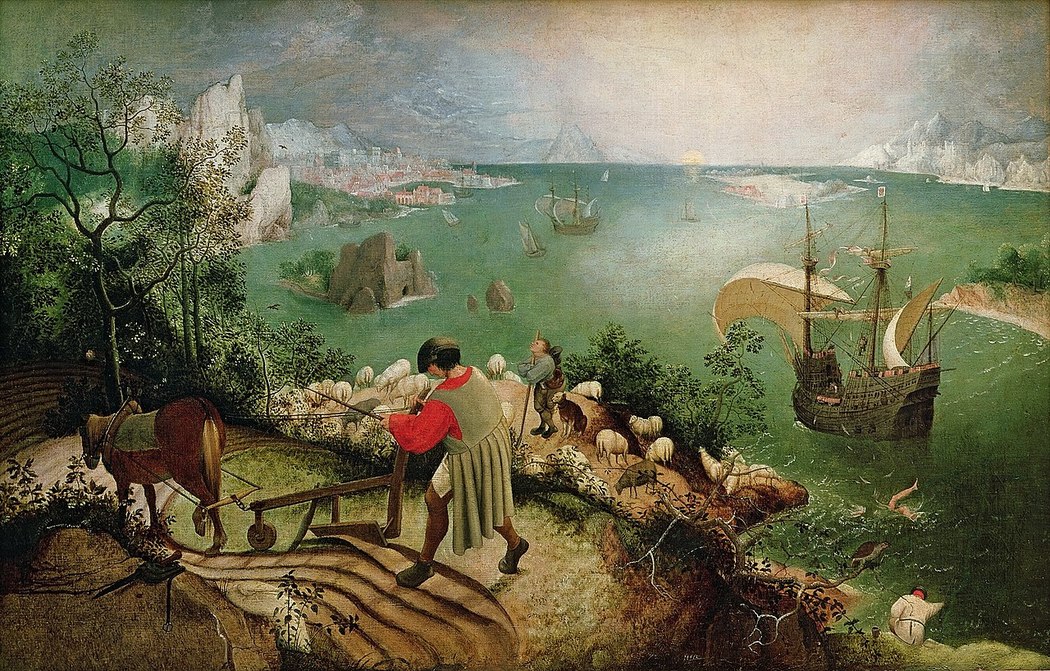
Landscape with Self-Actualization

after Bruegel’s Landscape with the Fall of Icarus

Let’s start with the horse: sometimes,
especially when working, I’m the horse,
as well as the ploughman whipping the horse

Too much time online and I become
the shepherd with his back turned,
arms folded into a firm no-thank-you

I really like when I’m the dog, loyal
only to my basic canine needs:
companionship, kibble, a bone

Sure, I’ve been the flock of sheep
led around to this place or that –
too much time online does that

Now, once – years ago – I became
the harbored city in the distance
and had to travel great lengths to find myself

Likewise, I have also been white mountains
to the east, cold and mysterious –
but since taking Lexapro, less so

Most days these days I’m the hatted fisherman
seated in the corner with a cup of coffee,
waiting for a bite, from a bass, or an angel

But yes, I guess, if forced to admit
(and I don’t like to talk much about this)
I do remember the drowning years

When everyone else seemed a full-sailed ship
and I was underwater with loss –
broken. From which I got up, dried off,

and lived all this life that came after

Pallbearers

The grandkids were tasked
with carrying her casket

I nodded and waved to Zoe
from the other side of the body

It was awfully heavy
the box I mean but the moment too

Teary-eyed Zoe, sixteen,
all youth and bloom

On Z’s left hand
written in pen: Hot Pockets

Cuz, I whispered over our grandmother,
why does it say Hot Pockets

To remind myself, she replied,
that I like Hot Pockets

We laughed –
We were sad, and we laughed –

The great inheritance

How to Listen to Judy Garland in 2020

Judy Garland and I spent a lot of time together last spring. For months on end she kept me company on subway rides, New York Public Library trips, and writing sprints at my desk. I was hard at work on my book, Judy at Carnegie Hall, a small tome on the 1961 concert the famed performer staged at the New York City institution. My book on the Grammy-winning double album, which captures what was then called “the greatest night in show business history,” made me intimately familiar with all 26 of the album’s tracks— from the instrumental “Overture” to Judy’s rousing rendition of “Chicago,” her fourth encore of the night. These songs became the soundtrack to my life for much of 2019 as I researched, wrote, and later proofread and copy-edited the final manuscript. 

When I needed a pick-me-up, all I needed to do was put on Judy’s first number, “When You’re Smiling (The Whole World Smiles With You)” and follow the song’s lead in grinning my troubles away. “When you’re laughing,” she sings, “the sun comes shining through. But when you’re crying you bring on the rain; so stop your sighing, be happy again.” The song is an apt opening number for an act that, despite featuring its fair share of broody ballads, depends on Garland’s unwavering optimism. Ever since, as a little girl, she’d sung about going somewhere over the rainbow where bluebirds sang, Garland has come to embody a shining beacon of sunny cheerfulness amid dreary doldrums. If Dorothy could make it all the way to colorful Oz and back home again, so could we weather whatever storms our tears bring on. 

I knew merely smiling couldn’t make all my troubles disappear. But hearing Judy’s voice could. Rufus Wainwright saw a similar kind of power in Judy’s live album. “Whenever I put on that record, that Judy Garland record, that concert,” he remembered, looking back at the months he spent listening to it on loop following 9/11, “everything brightened. And I just couldn’t help but sing along.” It’s what drove him to attempt the Herculean feat of putting on Garland’s concert in its entirety for a new generation of fans with Rufus Does Judy at Carnegie Hall back in 2006. Wainwright was right to hone in on the unbridled joy that runs through the 1961 album, which merely captured the energy of the 1961 concert itself. The cheers from the audience, for instance, give merit to Lewis Funke’s description of the concert in his New York Times review as something akin less to a live performance than to a revival meeting. 

Garland’s album scored what was, back in 2019, a transitional moment in my life as my husband and I began plotting our departure from New York City. The prospect of leaving the place I’d come to call home after more than a decade was daunting. Overwhelming, almost. It helped that I had Judy to keep me company. For many weeks my days were spent alternating between finishing a draft of the manuscript and packing up our apartment with precious little time spent wondering what was ahead. “Why should I care?” Judy sings at one point in one of the most jubilant songs on the album, “Life is one long jubilee, so long as I care for you and you care for me!” This was the Judy I keyed into last year, the one who made her acrobatic belts feel effortless and who’d turned herself into an icon of resilience. Her devil-may-care attitude was invigorating and helped make the choice to leave New York City without having settled on where we’d arrive feel less careless than it sounded. Our summer was as close to one long jubilee as we could make it as we spent time in Chicago, Austin, and Los Angeles, trying each city on for size. Judy would approve, I hope, of our current West Hollywood address, which is but a short drive away from her own Hollywood Star of Fame. 

Lately, all I hear are the darkened edges of Garland’s delivery: the melancholy that ran through her best performances.

But if sunny anthems like “When You’re Smiling” and “Who Cares?” helped me make peace with leaving New York City and saying goodbye to my friends, I’ve recently been revisiting the album through a decidedly darker lens. Last year, these life changes felt promising — necessary even. Judy’s infectious enthusiasm felt like fuel. Lately, though, all I hear are the darkened edges of Garland’s delivery: the melancholy that ran through her best performances, the sadness she conjures as she sings about heartbreak and loneliness, even the grievances she couldn’t help but make into punchlines in her banter. The sunniness is still there in numbers like “The Trolley Song,” but it’s her torch songs and sorrowful ballads which now occupy my mind. 

Titles like “Alone Together,” “How Long Has This Been Going On?” and “Just You, Just Me,” ring differently amid a pandemic that all but derailed what was to be a moment of celebration about getting Judy at Carnegie Hall out into the world. “I’m weary all the time,” Judy sings in “Stormy Weather,” before the lyric itself echoes such weariness with its repetition: “the time, so weary all the time.” But reading the words alone doesn’t do justice to Judy’s delivery. She stretches her syllables, making you feel the added effort it takes for her to go from one word to another. She doesn’t just sing about weariness, she embodies it. She had good reason to feel weary. For years on end, and after her Hollywood career came to a standstill, she’d had to book live engagements to keep debtors at bay, at times quite literally singing for her supper. There are moments in the recording when you can almost hear the audience wanting to lift Judy’s spirits; they cheer loudly after she bungles a note and clamor uncontrollably when she flubs a line. Inherent in those moments was the conviction that her moving performances were nothing more than cathartic insights into her troubled personal life. 

The sorrows Judy sang about then continue to rankle us precisely because they’re so familiar.

As I spend my days wondering how, if at all, we’ll make it past this pandemic and musing whether my own anxieties about my inability to properly launch my Judy book in a crisis that dwarfs such concerns, Judy’s lamentations feel more personal than ever. “I have a machine in my throat that gets into many people’s ears and affects them,” she recalled in 1964. “There’s something about my voice that makes them see all the sadness and humor they’ve experienced. It makes them know they aren’t too different; they aren’t apart.” That’s not quite as comforting as it sounds. The sorrows Judy sang about then continue to rankle us precisely because they’re so familiar. It’s hard not to listen to the Carnegie Hall record and remember how much Judy craved and feared being alone, apart from others. How days by herself in a hotel room was ultimately what cost her her life. It’s there in the way her voice breaks in “Somewhere Over the Rainbow” and the way the crowd loses it when she hits and elongates the final note in what has to be one of the saddest lyrics ever written—a question many of us are asking ourselves while locked in our small apartments wishing we could be merry outside: “Why, oh why can’t I?”

Chronicler of the gay community Vito Russo once described Judy Garland as “an iron butterfly.” Her strength, he posited, was always laced with fragility; one couldn’t think about Judy’s resilience without somehow also calling up the frailty it kept at bay. Writing 20 years after Garland died, Russo mused instead about what it had meant for so many gay men to have clung to such a icon. (He even wondered aloud whether her death in 1969 had somehow caused the Stonewall riots. Answer: no.) “Her audience was never sure whether she’d fall into the abyss or soar like a phoenix,” he wrote, getting at precisely why certain men felt both so protective of her while also seeing in her a towering strength they themselves looked to. Until last year, this kind of assessment had been nothing more than an intellectual exercise for me. I’ve long been fascinated with how Judy once appealed to what one reviewer in 1967 had euphemistically referred to as “those boys in the tight trousers.” Now, though, I find myself enraptured with the potency of what that iron butterfly once stood for and what she keeps teaching us boys more than fifty years after her death. In the last year, Garland has been a comforting presence even as listening to her songs on loop can feel like its own form of masochism. She’s been both my rainstorm and my rainbow.

Now, though, there’s an added layer to finding solace and (dis)comfort in Judy at Carnegie Hall. The singer’s rousing renditions of songs like “Rock-a-Bye Baby with a Dixie Melody” and “Swanee” (“Swanee, Swanee, I’m coming back to Swanee! Mammy, Mammy, I love the old folks at home!”) for instance, conjure up a nostalgia wrapped up in visions of the South that, amid Black Lives Matter protests and images of toppled Confederate statues, feel even more insidious than they did last year when my research necessarily pushed me to reckon with the minstrelsy roots of those Judy staples. As bands like Lady Antebellum (now “Lady A”) and The Dixie Chicks (now just “The Chicks”) remind us, our musical lexicon keeps traces of deep-rooted racism alive. Garland is no exception. She was, after all, always dubbed the heir apparent to Al Jolson, a famed performer known as the preeminent practitioner of blackface on Broadway in the early 20th century: “There is Judy Garland. And there was Al Jolson. And then the mold is broken!” read The Hollywood Reporter in its review of the Carnegie Hall concert: “Ask anyone who remembers the days when ‘Jolie’ took over the Winter Garden runway and they will tell you that never since has a singer of songs been able to mesmerize an audience as Judy can.” 

In singing of bluebirds, she encouraged us to look away from the colorless lives laid bare before us. What place is there, in 2020, for such a call? 

And so I’m left with an album that last year made me giddy—at the prospect of possibility in ways both creative and professional—and which has soured as I experience it in a much different world than the one I hoped to reintroduce it to when I finished writing about it this time just last year. “One wanted to hold her and protect her because she was a lost lamb in a jungle,” Russo pointed out back in 1989 about Garland, “and yet be held by her because she was a tower of strength, someone who had experienced hell but continued to sing about bluebirds and happiness.” In singing of bluebirds, though, she encouraged us to look away from the colorless lives laid bare before us, a uniquely privileged move that can feel like an embrace of willful indifference. What place is there, in 2020, for such a call? 

To listen to Judy at Carnegie Hall—whether in anticipation of a cross-country move when its rousing cheers felt emboldening, in the midst of a pandemic when those same cheers feel like taunts from ghostly crowds, or now as a relic of a sunny vision of white America—is to experience firsthand why Garland is a figure that demands you speak in oxymorons, for that is the only way you can make sense of the contradictions she embodies and inspires in equal measure. She was both bluebird and phoenix, as much a balm as an irritant. But she was also an iron butterfly that could just as easily nudge you to go on as invite you to give up. Judy and I will continue to spend a lot of time together. Just yesterday, six comp copies of my book arrived and now sit tidily next to the original vinyl my husband got me ahead of my pub date to celebrate. We’ll continue to be together, not just “come rain or come shine,” as she sings, but ideally both. How else will we conjure up that rainbow of hers? 

A Ghost Haunts the Tokyo Olympics

“I used to think life was like a book: you turn the first page, and there’s the next, as you go on turning page after page, eventually you reach the last one. But life is nothing like a story in a book. There may be words, and the pages may be numbered, but there is no plot. There may be an ending, but there is no end.” 

Yu Miri begins her exploration of the life of Kazu, a manual laborer from the country’s Fukushima prefecture, with this meditation from him as he walks the afterlife, which turns out to be exactly the (homeless) life he left behind. Yu Miri chills the reader’s blood over and over with lines like this: “I did not live with intent, I only lived.” 

Tokyo Ueno Station by Yu Miri

Kazu came to Tokyo to build the city for the 1964 Olympics, the games which delivered a gleaming Tokyo, a mere two decades after World War II, to the world’s eyes. Kazu’s story is the backstory of the city’s builders, invisible and marginalized. He experiences the untimely loss of his son, and later his wife, and ends up in the homeless village in Ueno Park. Kazu’s fate is contrasted by a series of connections with the imperial family, who exist in a much loftier realm. 

Tokyo Ueno Station’s final scene devastates in a dream-like fashion. Without totally giving it away, the crescendo involves the 2011 tsunami in Kazu’s hometown. The 2020 Summer Olympics, which was scheduled to begin in July but has been postponed to 2021 with the global pandemic, shadows the book. Kazu’s contemporary counterparts toiled as he did to enable the games. 

With the gracious assistance of the novel’s translator Morgan Giles, I interviewed Yu Miri—who is a part of the country’s Korean minority population—about listening to the dead, her personal (and political) history with the Olympics Games, and what pandemic life is like in Fukushima, which is still recovering from the 2011 nuclear accident’s devastation. 


J.R. Ramakrishnan: “I thought that once I was dead, I would be reunited with the dead…But then I realized that I was back in the park.”  In terms of afterlives, this seems like the worst. How did this novel begin for you? 

Yu Miri: The truth is, Tokyo Ueno Station is the fifth in my series of novels involving the Yamanote Line [a subway line in Tokyo]. In the first in the series, the short story “The Inner Loop of the Yamanote Line,” which was published in 2003, a woman who’s thinking about jumping in front of a Yamanote Line train goes into a bathroom in the station and masturbates, then gets on the train, gets off at another station and masturbates again. I depicted the destinationless impulses toward sex and death (eros and thanatos) of this protagonist who is shut out from life. And in this story, the protagonists of the four other novels in the series that I went on to write make their appearances. 

I’ve depicted the directionless lives and deaths of characters whose diverse lives radiate out from the ticket gates of Yamanote Line stations, who get knocked out of life and, passing through the gates heading toward the center of the circle, find themselves standing on a precipice—the edge of the station platform.

The second in the series, Goodbye Mama, is about a mother who has separated from her husband and is raising a preschooler on her own (set at Takadanobaba Station, Toyama Entrance). The third, Gotanda Station, East Entrance is about a man who works at a securities company; he and his wife do not speak to each other at home. The fourth, Meeting, is about a high school girl who runs a website recruiting people for a group suicide. And the fifth is Tokyo Ueno Station, with a homeless man from Fukushima as the protagonist.

The Yamanote Line is a loop line that runs around the center of the capital, Tokyo; it’s a double circle, actually. The circle that runs clockwise is on the outside and is called the “Outer Loop,” while the line that runs counterclockwise on the inside is the “Inner Loop.” At the center of this double circle, right in the middle of the donut hole, is the palace where the Emperor lives; it is surrounded by moats, a construction that makes it impossible to approach it or look inside.

There are two themes that deeply influence my Yamanote Line series. The first is suicide, which every year over 20,000 Japanese people lose their lives to. The other is the multiple spheres that arise from the Imperial system, and from the Emperor himself who is designated in the first article of the Japanese constitution as “the symbol of the State and of the unity of the People.”

Japan has one center and multiple spheres, which creates a huge gap between rich and poor, fortunate and unfortunate. Tokyo Ueno Station is the story of the suffering and death of a homeless man, born in Fukushima on the same day as the Emperor, who had to leave home for work as a young man due to poverty, losing his home and family.

The four protagonists in the earlier works in my Yamanote Line series all stand on the platform, a precipice between life and death. I didn’t write scenes where they are hit by trains. In the few moments while the train is approaching, they might hesitate and be pulled back toward life. I decided to let the reader’s imagination guide what happened to those characters next.

JRR: You begin the novel, as you end it with sound. In between, there are snatches of overheard conversations, sounds of the rain, the station’s sonics, and then finally the sirens and roars of the book’s ending. As a reader, I could hear so much! 

YM: It makes me very happy to hear someone from a different country who speaks a different language say that they could hear so much.

Japan has one center and multiple spheres, which creates a huge gap between rich and poor, fortunate and unfortunate.

I think that the role of a writer is to listen to the voices of the voiceless. It’s my job to listen to the voices of the spirits of those who die in the midst of discrimination, poverty, and loneliness, unable to bring anyone’s attention to their suffering.

We can’t save the dead, but by listening, we can give comfort to their spirits. By listening to their suffering, we can bandage their burning, bleeding skin, no matter how many tears that bandage might have or how patched together it might be.

JRR: You take us to Tokyo’s fringes. The homeless community has work, interests, pets, and suffers threats of crime. How did you imagine these characters? 

YM: What first inspired this novel was seeing a homeless man in the bathroom at Ueno Station 18 years ago. Afterwards, when I’d talk with the homeless men living in Ueno Park, one of them told me this: “You have a house. We do not. The haves don’t understand how the have-nots feel.” 

I couldn’t find any words to say back to him.

Since then, I kept going back to Ueno Park and listening to the stories of the homeless men living there, but those words—the haves don’t understand how the have-nots feel—stuck in my heart like a thorn I couldn’t remove.

Then, on March 11th, 2011, the earthquake, tsunami and nuclear disaster happened. I started visiting the area around the reactor a month later, in April. From March 2012, I hosted a radio show on the emergency radio station in Minami-Soma, Fukushima, an area which was part of the designated evacuation zone due to the nuclear disaster; on my radio program, I interviewed 600 local people about their experience of the disaster.

Through listening to the stories of people who had been forced to evacuate due to the tsunami and nuclear disaster, I was again faced with “the difference between the haves and have-nots,” with the issues of poverty and discrimination that exist in Japan, known globally as a rich country.

“The haves don’t understand how the have-nots feel.” That certainly might be the case, but the pain of those who are discriminated against isn’t something that can be gained as information from the outside; actually feeling that pain in your own body and to live (and die) with it is something that can be made real through writing a novel or reading one.

I think if you read Tokyo Ueno Station and it feels to you like the lives and struggles of the homeless are incredibly real, then that’s because I’ve written a novel not as one of the haves but as one of the have-nots, that I was brought up in poverty with discrimination, and this novel is based on empathy with the homeless.

Right now, we’re all told to “stay at home” as one of the measures touted to prevent infection during this pandemic—indeed, this has become a keyword globally—and I just think, well, you’re only speaking to people with homes. These words must sound awfully cruel and ironic to those without.

JRR: Kazu works as a laborer on the sites for the 1964 Tokyo Olympics. The world would have been cheering the start of the 2020 Olympics this July—without much thought to the people like Kazu who did the work this time around—if it were not for the global pandemic. How do you feel about the event’s cancellation? 

YM: In Japan, it was presented not as a “cancellation” but as a “postponement” to 2021. I’ve been opposed to Tokyo holding the 2020 Olympics from the beginning.

It’s my job to listen to the voices of the spirits of those who die in the midst of discrimination, poverty, and loneliness, unable to bring anyone’s attention to their suffering.

This is because the demand for building materials for the Tokyo Olympics and the construction of infrastructure such as roads have caused the price of construction materials to jump throughout Japan, and this has also resulted in a shortage of construction workers for civil engineering projects. And as a result, the recovery and reconstruction of the Tohoku coastal area, which was the area affected by the earthquake and tsunami, has obviously been delayed.

To start with, the official name of the nuclear power plant that caused the accident in Fukushima on March 11, 2011 is “Tokyo Electric Power Fukushima Dai-ichi Nuclear Power Station.” As the name implies, all the electricity generated by the nuclear power plant was supplied to the Tokyo metropolitan area and was not used in Fukushima Prefecture. The cause of the accident lies in the way people live in the metropolis of Tokyo—it’s clearly there, in the lifestyle of urban residents who use electricity like hot water, but even when such a serious accident occurred, Tokyo still looked at Fukushima’s reality as somebody else’s problem. And unfortunately, very few Tokyo residents know that, as of January 2020, there are still over 41,000 evacuees from the nuclear accident.

I would like to see the huge amount of money that we plan to invest in the Tokyo Olympics be spent on the reconstruction of the Tohoku coastal area, as well as for the tsunami victims and  those displaced by the nuclear accident.

JRR: The last time a Tokyo Olympics was cancelled was in 1940. I read in an interview with (the novel’s translator) Morgan Giles that your grandfather was a marathon runner who might have participated in that event and that your next novel to be translated into English, The End of August, is based on your family’s history in Korea and Japan. Could you give us a brief preview of it? 

YM: My grandfather was born and raised in a small town called Miryang in Gyeongsangnam-do, South Korea. He was a long-distance runner on the Japan National Team in Korea, which was then a colony of Japan. He was likely to get a spot on the team for the Tokyo Olympics, which was scheduled to be held in 1940, but then the Olympics was canceled due to World War II.

The Korean Peninsula was liberated from colonial rule by Japan’s defeat in the war, but the joy of independence was covered over by ideological confrontations. Due to the Korean War that broke out in 1950, Miryang, where my grandfather’s family lived, became a battlefield where residents informed on and killed each other. My grandfather’s 23-year-old brother, who was a leader of the student movement, was hit in the leg while running in the schoolyard and taken away by the police; his whereabouts are still unknown.

My grandfather was also accused of being a communist and was imprisoned, but just before his execution he broke out of jail and escaped to Japan on his own. My grandmother boarded a small fishing boat with her four children, including my mother, and smuggled them into Japan as refugees.

When my grandfather, who due to the war ran off with just the clothes on his back and lived a life with what seem like constant emergency crash landings, realized that he had cancer and was going to die soon, he went back to the small town in Korea where he was born, and he died there at age 68.

The End of August is a long novel that follows in my grandfather’s footsteps throughout his life as an unknown long-distance runner. I am convinced that my grandfather’s difficult life is tied in the present day to the hardships of many who are almost crushed by the struggle between countries.

In the conflicts created by the innumerable differences of religion, race, ethnicity and ideology, we are letting go of the ideal senses of freedom and equality.

Do we go from this enclosure out into the light, or do we choose to strengthen the walls of our enclosures and live in the dark?

JRR: You live in Fukushima. Would you tell us what life is like there right now? I can’t begin to imagine how the pandemic must feel to survivors of the nuclear disaster. 

YM: I live in a town called Odaka, part of Minami-Soma, Fukushima. Odaka is about ten miles north of the Fukushima Dai-ichi reactor that caused a level 7 nuclear accident on March 11, 2011, in the former “exclusion zone” where, due to the accident, the population once dropped to zero. The evacuation order was lifted on July 12, 2016, but only 3,663 inhabitants have returned (from a population of 12,842 before the nuclear accident).

I’m running a bookstore for the locals in a part of my home, located a 2-minute walk from Odaka Station on the Joban Line. In the area where I live, even before the coronavirus, I rarely pass by others when I’m walking or running.

However, even in the areas affected by the nuclear accident, there are repeated announcements from disaster preparedness loudspeakers installed around the town, telling us we should refrain from going out to “to protect your own life and the lives of your loved ones” and to spend time at home. When a person whose connections with others were cut off by the nuclear accident loses their few points of contact with others, what happens to them?

The most unbearable suffering is loneliness.

In the emergency public housing where the elderly people who lost their homes in the tsunami and nuclear disaster live, the daily exercise they look forward to in the courtyard every morning, the tea times in the common room, and the individual visits by social workers have all been canceled. 

An act “to protect your own life and the lives of your loved ones” is to have contact with others so that you do not feel isolated, in my opinion.

The most unbearable suffering is loneliness.

The magic phrase “stay at home” is correct when it comes to preventing the spread of coronavirus. But when I imagine the insides of all the homes where residents of the area affected by the nuclear accident are staying, I wonder if that phrase might be inappropriate.

Because in this town, filled with empty houses and vacant lots, there are lots of people isolated in the houses they returned to. On April 8 this year, in the midst of the pandemic, an 87-year-old man and his 58-year-old daughter’s bodies were found in a house not far from mine. Their cause of death wasn’t coronavirus. According to the police report, they both died of suffocation. The house was locked from the inside, no evidence of a third person’s presence was discovered, and inside the house there was a suicide note, they said.

Fukushima is currently facing the issue of these solitary deaths and suicides. As of May 31, there were 2,307 deaths in Fukushima Prefecture related to the disasters, far exceeding the 1,830 direct deaths due to the earthquake and tsunami. Among the related deaths, 115 people committed suicide; 12 people took their own lives last year. 

I am depressed and frightened.

In Fukushima, the recommendations to “stay at home” and practice “social distancing” may put people in mental and economic distress, and might cause more “related” deaths than direct deaths due to the coronavirus.

The human soul suffocates without interaction. Interaction means being acted on by others, or acting on others. There is no greater joy than making others feel joy, enjoyment, and healing with your own words and actions.

This is an “intimate” experience in which one responds to the call of others by leaving the self, interacting with the souls of others, penetrating the depths of each other’s emotions, and breaking the boundary between oneself and others.

Before the second wave of the pandemic locks down cities around the world again, we have to think about how we can build “intimate” relationships with people who are isolated.

What to Read After Bingeing “Indian Matchmaking” on Netflix

In mid-July, Netflix dropped the 8-episode series Indian Matchmaking, which follows Mumbai matchmaker Sima Taparia as she travels around the United States and India, attempting to find true love—or at least acceptable compromises—for the marriage-seeking young people who can afford her services. “Arranged marriage” for Taparia’s clients often means little more than having family and a hired consultant heavily involved in a process that otherwise looks a lot like online dating.

To non-Desi audiences not already familiar with the shaadi scene, it might come as a surprise to see how considerations like skin color, socioeconomic status, and height—prejudices that are often kept more covert in Western dating—are explicitly and unapologetically baked into this centuries-old tradition. The show also completely fails to acknowledge that queer people exist, that not every boy is looking for the perfect girl and vice versa, and that non-binary people might want and make great partners.

Despite these very valid caveats, there is something undeniably compelling about the idea of a dedicated professional who learns as much as possible about your preferences and then criss-crosses the globe in search of your soul mate. Perhaps someday we will see more inclusive and progressive versions of this service. In the meantime, if Indian Matchmaking—which ends with most storylines unresolved—has left you craving more tales of young South Asians balancing traditional marriage expectations with contemporary romantic aspirations, check out any of the following books.

The Marriage Clock, A Novel eBook by Zara Raheem | 9780062877932 ...

The Marriage Clock by Zara Raheem

Leila Abid is a 26-year-old American-born Muslim from Los Angeles. When her Indian parents, whose happy arranged marriage has lasted three decades, decide to find her a match because of her “advancing age,” Leila negotiates a three-month reprieve to try and find a suitable Muslim man for herself. Unwilling to compromise her independence or her desire for a Bollywood-style love story, Leila goes on a series of awkward dates before accompanying her mother to India for a cousin’s wedding and recognizing at last what she must do.

Marriage of a Thousand Lies by SJ Sindu

Marriage of a Thousand Lies by SJ Sindu

Genderqueer Tamil author SJ Sindu’s debut features Lucky, a second-generation Tamil Sri Lankan from Boston who meets Indian student Kris at their elite college. Recognizing each other as the only other South Asian queer students on campus, they decide to marry to get Kris a green card and placate their parents while continuing to pursue their own affairs in private. However, this plan is thrown into disarray when Lucky travels home to care for her grandmother and reunites with her high school lover Nisha, who is facing her own arranged marriage to a man she’s never met.

Thirst

Thirst by Shree Ghatage

During World War II, intelligent but sheltered Vasanti is thrown into an arranged marriage with wealthy and accomplished Baba. Though neither particularly wishes for this, they work their way from tolerating one another to falling deeply in love, in a narrative that moves between India and London during the Blitz as it hurtles towards a shocking conclusion.

Marrying Anita

Marrying Anita by Anita Jain

In her 2008 memoir, Harvard-educated journalist Jain recounts her 2005 move to Delhi after she grows weary of the dating scene in New York. Though she has long resisted her parents’ interest in arranging a marriage for her, she now permits her father to put a matrimonial ad in the Times of India. However, dating in a rapidly modernizing Delhi in which technology and tradition mix and Western values begin to take hold, proves to be no less confusing than New York. The traditional doctors and engineers she meets on the arranged marriage circuit don’t quite live up to the ideal of the literate, feminist-minded, well-traveled man she hopes to meet, but Jain enjoys playfully analyzing the situation and the forces that give rise to it nonetheless.

The Matchmaker's List by Sonya Lalli

The Matchmaker’s List by Sonya Lalli

Raina’s grandmother is horrified that she hasn’t found a nice man and settled down yet. Raina, a 29-year-old who works at an international bank in Toronto, agrees to look at the men her nani has picked out for a possible arranged marriage, though the globe-trotting banker she had previously fallen in love with is back in the picture and still perfectly noncommittal. As she prepares for her best friend’s wedding to a white fellow pediatrician, Raina permits her grandmother to believe she is a lesbian to ease the matchmaking pressure, but suffers backlash for this as well. Even while navigating their stifling expectations and pressure, Raina appreciates the strength of her community and how they support each other during difficult times, and works to claim a life of her own within it.

The Heart is a Shifting Sea by Elizabeth Flock

PBS NewsHour and Forbes India Magazine reporter Flock tells a story of marriage in modern India through the lives of three Mumbai couples—two Hindu and one Muslim—whom she came to know well. The couples navigate getting to know online matches as they prepare to wed, marriages arranged in the wake of unrequited love, infidelity, strict laws preventing divorce, infertility, and tradition-defying adoption, against a background of Bollywood-influenced expectations and the rise of the far right in one of India’s most progressive cities.

Arranged Marriage by Chitra Banerjee Divakaruni

Arranged Marriage: Stories by Chitra Banerjee Divakaruni

This 1995 story collection from Indian-born, U.S.-based poet Divakaruni centers young Indian women—mostly students and brides—attempting to navigate the demands of traditional parents and husbands and often alienating middle-class American culture, while creating independent and fulfilling lives for themselves.

Modern Romance by Aziz Ansari and Eric Klinenberg

Modern Romance by Aziz Ansari

Comedian Ansari’s own parents had an arranged marriage. As his father tells it, one prospective bride was too tall and another too short, but Aziz’s mother was a good height so he chose her. Inspired by his own romantic woes and the tyranny of choice in modern dating, Ansari teams up with sociologists to conduct a survey of modern dating practices, including a cross-cultural look at the scenes in Tokyo, Paris, and Buenos Aires, and a historical look at how the classified ads and video dating of the 1980s gave rise to dating industry giants like Tinder today.

The Trouble With Hating You by Sajni Patel

Liya Thakker, a biochemical engineer from Austin, Texas, is perfectly happy being single. When her conservative father surprises her at dinner with a nice Hindu boy from a respectable family he’s hoping to set her up with, Liya sneaks out the back door. However Jay soon turns up again, as the lawyer who is bailing her company out of a legal mess, which means the two will have to work together closely despite the awkwardness between them.

Marriage Material - Sathnam Sanghera

Marriage Material by Sathnam Sanghera

Arjan, the only child of Sikh immigrant parents who run a convenience store in a crummy town in the West Midlands, U.K., works as a graphic designer in London and is engaged to a white woman named Freya. When his father dies from a supposed heart attack, he hurries back to help his mother, once again dealing with all the indignity and racism of standing behind the counter for long hours at the store. He grows increasingly appreciative of his parents’ generation, whose story of leaving India in turmoil also involves a nontraditional marriage, while growing more apprehensive about whether he and Freya are truly right for each other.

The Marriage Bureau for Rich People

The Marriage Bureau for Rich People by Farahad Zama

In an effort to stay out of his wife’s hair, retired civil servant Mr. Ali starts a matchmaking service on the veranda of his South Indian home. Business thrives and he is able to hire Aruna, who has an aptitude for this line of work but has given up hope of marrying herself because her family cannot afford a lavish wedding and dowry. When a handsome doctor and his family walk in looking for potential brides, he and Aruna take a liking to each other, and it’s up to Mr. Ali to see if it is possible to find a solution that will make everyone happy.

Ayesha At Last by Uzma Jalaluddin

Ayesha at Last by Uzma Jalaluddin

This list would not be complete without at least one Desi Jane Austen retelling (there are plenty). Jalaluddin’s novel is a Pride & Prejudice adaptation set in a Toronto Muslim community full of scheming aunties. As the first chapter states, “while it is a truth universally acknowledged that a single Muslim man must be in want of a wife, there’s an even greater truth: To his Indian mother, his own inclinations are of secondary importance.” High school teacher and aspiring poet Ayesha first assumes that handsome Khalid—with his traditional beard, flowing white robes, and disinclination to challenge his overbearing mother—is too conservative for her tastes. However, as the two must work together to plan a conference, it becomes clear there is more to both their stories than meets the eye. 

9 Books About Being Homesick for A Place That Doesn’t Exist Anymore

Gov. Pritzker issued a stay-at-home order for Illinois starting on March 21st. Ever since then, I’ve been watching Chicago out of my third-floor apartment window, walking the streets of Chicago with my daughter (both of us masked, edging around others at a six-foot distance), and all the time, missing Chicago. It’s right there, out my window. It’s right there, on Clark Street, Broadway, Devon. But it may as well be 2000 miles away.  

COVID, I know, will change my city, has already changed my city. I’m afraid to imagine all the ways it will change my city. Will my favorite restaurants, bars, bookstores make it? Will I still get to make a wish on a gingersnap at Simon’s Tavern over a mug of glögg in the implacable Chicago winter?  What about Ravenswood Used Books, where I could ask—mustering my courage, controlling my blush—the shop owner, a titillating cross between Rupert Giles and the Outlaw Josey Wales, for some obscure bit of fiction, and he’d always know whether he had it and where in his teetering piles to find it?

What will be left when all of this passes? It makes me gut-wrenchingly homesick, just thinking about it.

I’m not from Chicago. I grew up in Louisiana, raised by a Cajun French family whose language may not see another generation of speakers, in a state that has been losing a football-field size plot of land to coastal erosion, on average, every hour since 1985. Preemptive nostalgia is a way of life. I can’t remember a time when I was not aware that home would not always be what I knew it to be, that it would, both figuratively and literally, disappear. My story collection, Last One Out Shut Off the Lights, is about the damage done to the spirit by a dying homeplace, but it’s also about the awful yearning you feel when you’re homesick for a place that does not exist anymore—and maybe never did exist as you imagined it. That loss may be due to climate change, gentrification, war, or even a change in oneself—a growing up or a growing away. In 2020, it’s due, at least some, to pandemic. 

Here are some of my favorite literary expressions of that peculiar brand of homesickness.

Fiction

This image has an empty alt attribute; its file name is 1*KGhfZI1bqeu6wKhBfW870Q.jpeg

The Sellout by Paul Beatty

With satire that will singe your eyebrows, Paul Beatty tells the story of Bonbon, a young Black man raised in Dickens, an “agrarian ghetto” on the outskirts of Los Angeles. After racially profiled and much maligned Dickens is removed from the California map, Bonbon campaigns to redraw the borders (literally, with white paint, but in other ways too) of a home that is oppressed, oppressive, and still, despite that, home.

Inheritors by Asako Serizawa

Inheritors by Asako Serizawa

The interwoven stories in this new collection by Asako Serizawa follow a Japanese family through 150 years of history. In a kaleidoscope of places and points of view, Serizawa explores the lives of characters whose sense of home and history is disrupted by war, imperialism and migration.

Pin on ✒Wordy

Severance by Ling Ma

Ling Ma’s Severance is a literary zombie-apocalypse novel, irresistible as a stack of sugar cookies but packing a wallop of heartbreak. A mysterious illness transforms its victims into walking dead, doomed to act out repeating loops of nostalgia until they waste away completely. Meanwhile, the central character Candace Chen photographs devastated, empty New York, her adopted home, reluctant to leave even as her world is falling apart around her. 

Poetry

Books To Watch Out For: August 2019, Guest Edited by Krystal Languell

Losing Miami by Gabriel Ojeda-Sagué

The bilingual and prose poems in Losing Miami reflect on Gabriel Ojeda-Sagué’s Cuban American upbringing and the potential loss of his home city to rising sea levels. Ojeda-Sagué wonders “what it would be like to be exiled from Miami, to have the city be an effect only of memory and simulation as Havana is for the Cuban exile generation, to have any description of the city be a dangling modifier.”

Image result for poster

Everything Must Go by Kevin Coval & Langston Allston

In this collection of poems and illustrations, poet Kevin Coval and artist Langston Allston take on the gentrification of Wicker Park and Humboldt Park in Chicago. “Humboldt’s beautiful,” Coval writes, “& changing like all / the neighborhoods / for how long / we will live / here / how long / will we call / this / home.”

Flood

Flood by J. Bruce Fuller

My Louisiana Cajun compatriot J. Bruce Fuller’s poems place two floods in counterpoint:  the Mississippi River Flood of 1927 and the deluge that followed Hurricane Katrina. Drawing on family stories, survivor accounts and personal experience, Fuller reveals how tenuous a home the Mississippi Delta is. In the title poem, he writes of the river, “If she dries up / changes course / we wilt and brown / like chaff / And if she is angry / her belly constricted / by our levees / she will erupt / silt like ash.”

Non-Fiction

The Yellow House by Sarah Broom

Sarah Broom’s memoir The Yellow House explores a family’s long relationship with a beloved but decrepit shotgun house in the forgotten neighborhood of New Orleans East. When Hurricane Katrina wipes away the house and neighborhood and scatters her family across the country, Broom faces a reckoning. “The Yellow House was witness to our lives,” Broom writes. “When it fell, something in me burst.”

Strangers in Their Own Land by Arlie Russell Hochschild 

Berkeley sociologist Arlie Russell Hochschild ventures into my hometown of Lake Charles, Louisiana, to make sense of the “Great Paradox,” far-right political activists’ opposition to the federal help they seem desperately to need. With astonishing empathy, Hochschild describes the exasperating, often misguided perspective of people whose home and health have been destroyed by the same petrochemical companies that keep them afloat.

1939453

A Month and a Day & Letters by Ken Saro-Wiwa

Before he was executed under Sani Abacha’s military dictatorship in 1995, Nigerian writer and activist Ken Saro-Wiwa led a peaceful movement to hold foreign oil companies like Shell accountable for the destruction of the Ogoni people’s land and waterways in the Niger Delta. A Month and a Day is a record of his detention in 1993 and of his fierce love for a homeland turned wasteland by the callous indifference of the oil industry and the complicity of the Nigerian government.