A Mother-Daughter Cult Experience

Chelsea Bieker’s dazzling, propulsive, and deeply affecting debut novel, Godshot, announces a remarkable talent. Fourteen-year-old narrator Lacey May is dealing with immense internal and external struggles: her mother suffers from alcoholism, and the two of them (along with almost the entire community of Peaches, their tiny, drought-addled town in California’s Central Valley) turn to a cult leader named Pastor Vern for guidance and relief.

Godshot: A Novel by Chelsea Bieker

As you might suspect, things go from bad to worse under the pastor’s care, and just as he gives Lacey May a secret “assignment” to bring back the rain, he excommunicates Lacey’s mother from the church, leaving Lacey May alone in a filthy house with her widowed grandmother. Soon Lacey finds herself in a tremendously vulnerable position (“A gun in the face lets you know in an instant just how badly you want to live,” she laments) and an unlikely coterie of women comes to her aid. These circumstances are crushing and unthinkably bleak, yet in Bieker’s deft hands it’s Lacey’s strength, resilience, and hope that resonate. 

The plot of Godshot is multi-faceted and compelling, covering topics as wide-sweeping as motherlessness, addiction, poverty, and adolescent yearning, but what sets this novel apart is the ambition, style, and grace of the prose itself. Lacey May’s voice is as urgent and darkly funny as a late-night phone call from your troubled best friend, but its Bieker’s skillful swerves and breathless rhythms that make the story gleam. 

Chelsea Bieker and Leni Zumas, acclaimed author of Red Clocks, recently spoke about these masterful sentences, as well as resilience, friction, female friendships, arranging art around one’s family life, and more.

– Kimberly King Parsons
Author of Black Light


Leni Zumas: I’m struck by so many kinds of powerful friction in this novel: emotional, familial, sexual, class-based, gender-based. Friction is not quite the same as conflict, to me—for one thing, a text might enact friction in subtler ways, even at the level of a single image or phrase. What do you see as the most vital sites of friction in Godshot, and why?

Chelsea Bieker: I love this idea of friction. The first thing I think of is my experience with the actual writing of Godshot in terms of place. The thrill of writing this barren and monochromatic droughted town of Peaches, California, and the way it bumped up against the more garish and unexpected details of the objects and people inhabiting it. Everything is dead, beige, dusty and dry, but the characters wear sequined capes and clear platform shoes with stars floating in them, they are shaving the tops of their heads to receive God’s messaging and adorning themselves in bright makeup and driving magenta hearses. One of the characters is setting out to make his fortune painting dead lawns neon green. This need for color and brightness and specialness amid the desolate landscapes was an important contrast for me, and really fun to write. 

Another vital site of friction here is the way Lacey May, our fourteen-year-old narrator is forced to self educate about her body and sex through found materials—romance novels and the wisdom of sex workers and birth workers, and books and magazines smuggled around—because she is not receiving this education formally in school or church, or from her mother. There exists a friction between her initial understanding of her body (something of use to the church and to men) and then a new definition, the education she seeks herself. 

LZ: Motherhood is at the core of your novel. You are a mother. How did your own experiences of parenting and of being parented come to bear on this book? 

CB: The answer to this question is everything. My own experience with motherhood and my experience being parented formed the heart and soul of this narrative, which, after you strip away all the cult glitter and soda pop baptisms, is really about a young girl forced to raise herself and reckon with the living grief that comes when a parent deserts you.

The idea of mothering someone was spiritually daunting when I had felt so unmothered and abandoned all my life.

It was striking to me when I became pregnant with my daughter over six years ago, that I would need to conjure an unknown love. I knew on some practical level I would be able to do it, because I had broken many familial cycles before this one, but there was something spiritually daunting about the idea of mothering someone when I had felt so unmothered and abandoned all my life. It seemed I would have to perform a sort of imaginative magic to do it, some deep reach into myself to find a new strength and resilience in the face of such a huge life shift. And now, six years into mothering my daughter and son, feelings will come up to the surface as they reach the ages I was when certain things happened, and I’m forced to re-process my own loss and traumas all over again.

I knew I would have to write a book where the narrator is dealing with the grief that comes with being the child of an alcoholic and having a parent leave you but not die. The book is also about living in the simultaneous space of unresolved anger and sadness but also persistent love. I never stopped loving my mother deeply and I never will. Lacey, too, never will. I think there’s something beautiful about that but also really sad. I’ve learned that sitting with sadness and feeling its dark edges and then putting it away is something I can survive. 

LZ: How does your identity as a mother most keenly inform, intersect with, and/or collide with your identity as a writer?

CB: First let me say how honored I am to be the mother of my children. Not a moment goes by that I’m not mowed over by my good fortune that they chose me, and I believe that love finds its way into my writing. On the other hand, being both a writer and a mother can be very difficult. I wrote this book pregnant and then ravaged and sleep deprived, nursing, bleeding, pumping, and then just as I was sleeping again semi-normally, I did it all again and through it all I grasped to my writing practice like it would save my life. Writing was all my own when nothing else was, not even my body. Even as I’m writing this, I’m interrupted by my child’s need for one more snuggle. There’s always someone’s needs to attend to, and to say that that is easy for me, is a lie. Loving them is easy for me. But the rigor of full time parenting on top of writing is intense. But I wanted and still want both hard things.

Recently, I heard someone describe my book in just one word: raw. I think that’s right. I’ll own that. Motherhood is raw. Loss and grief and addiction are really raw. I’m not interested in art that doesn’t reckon with that in some way. 

LZ: For me, one of Godshot’s biggest pleasures is its nuanced exploration of friendships among women. How would you describe the role of female friendship in Lacey’s story?   

CB: For Lacey May, female friendship is a crucial part of her survival. It’s her way out of her circumstances. The unlikely friendships she makes were a joy to write because usually when we come through trauma, we aren’t doing it all alone, and I wanted that to be painted here. When we are coming of age and looking for other ways to be and live beyond our own limited scope, friends can show us new truths. The role of Lacey’s friendships here move her and empower her, and force her to call into question the way she has always perceived the world. It’s also a source of happiness in her world, a source of hope. It’s healing too, when someone sees something in you you had never seen before. It expands your consciousness of what is possible for your life, and I think that happens to Lacey here.

LZ: Place is a crucial (and fascinating) ingredient of Godshot. How did your own ties to California’s Central Valley shape the book?

I’ve learned that sitting with sadness and feeling its dark edges and then putting it away is something I can survive.

CB: I grew up in the Central Valley and experienced so much formative trauma there that I spent most of that time imagining my way out. The reality of that place for me is chock full of difficult memories, but once I was away from it, a new curiosity formed and I was drawn in. I closed my eyes and saw the flat landscapes and the hazy blue sky. I felt the heat of summer in my body and in my own way, I became reacquainted with it. I was out of my trigger zone and able to explore it on my own terms through writing.

To me, the Central Valley is a fascinating place, full of contradictions. I wanted to explore these in this book, and how a place makes you. I’m not sure that the old adage wherever you go, there you are, holds up for me there. When I am there, I am not myself. I need distance from it to see it clearly. To be the person I am meant to be. In real life I don’t want to drive by the liquor store my mom used to frequent and be thrown into memory, but I feel compelled to write about it. That’s my way of loving a place that didn’t love me back. Though I do crave the way that particular sun looks setting over the fields, or the ticking by of rows out the window as I drive by an orchard. 

LZ: What’s most important for you in the making of sentences? 

CB: All sentences for me are rooted in voice. I hear the music of a sentence and I transcribe. It is as though I’m channeling characters speaking and I feel the buzz of their aliveness. Usually I abandon work on a piece when the sentences don’t seem to have that musical magic anymore. I like playing with variation, rhyme, and in revision of course, rewriting sentences to be more surprising and succinct, or winding and breathless. But there’s something energetic about that first burst of sound I hear with a story or a voice. I like to follow that and not question it. 

LZ: In what ways did this book change as you were writing it? And in what ways did writing this book change you?

CB: Writing this book asked me to evaluate the things I was taught and (mainly) not taught growing up about my body and consent and sex and feminism. As Lacey May was self-educating, so was I. When I first began writing the book, it struck me that I was a pregnant adult and had never seen someone give birth before. Had never seen someone breastfeed. It had all been kept behind closed doors from me which just caused me to file it in with all the other shameful womanly acts. The energy of my rage over my own experience heightened as my rage over what Lacey May experiences in the book did. Each draft felt like a deepening of discovery, rage, and then, empowerment. 

LZ: In Aja Gabel’s 2018 novel The Ensemble, which is about classical musicians, a composer says: 

It had long been a dream of mine to do something like this, to arrange my life around the people I love, to create a shared life with every one of them. I think probably many of you have considered this at one point or another, but thought it impossible. I think many of us strive for community and family but often find it difficult to participate in because of, well, life gets in the way. But it is possible. It is possible to arrange your life around art, and to find, in that art, a kind of love that grows like corn, from way down here to way up here, that changes, goes away, comes back.

At this particular moment in your art-making life, how does the composer’s ambition resonate with you?

CB: What a beautiful book. I love Aja’s writing. I love the hope here. But it is possible. A life arranged around art and family describe my dream. I am lucky to have found both despite, yes, it not being a second nature for me to participate. That was a learned skill. In this current moment of physical distancing, I find my connection to other writers heightened. I find the exchange of stories and books ever more important as we find ways to survive our times. And when I think maybe things are hopeless, I can go back to the mantra of the composer: But it is possible. I love that spiritual nudging, that interruption of doomsday thinking. That delightful and staggering expansion of a possible beautiful and better reality.

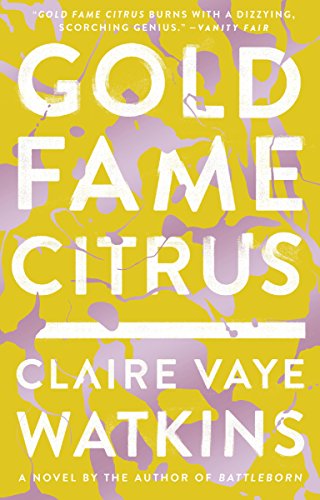
We Are Not Going Back to Normal

I’ve always had a thing for disaster novels. When Gold, Fame Citrus—a drought apocalypse novel set in Los Angeles—was published in the fall of 2015, I immediately knew it was for me. I tore through it on flights between Los Angeles and San Francisco, while the water was running out and the dry brush around both cities was begging to be lit up. We seemed to be on the precipice of disaster then, but ultimately never fell off. Even when the wild fires burned in subsequent years and we made a run on N95 masks, we (in the cities) largely kept our innocence.

I often reflect on Gold, Fame, Citrus. The way in which Claire Vaye Watkins envisioned a starkly changed world has stuck with me over the years. Now that we are faced with a disaster—albeit one of a different nature—that is irrevocably altering the way we live, I find myself returning to it again, looking for solace as I watch my old existence of health and restaurants and meetings over coffee and gleefully dancing in crowds crumble around me. 

While the shape of the particular disaster that the novel images may be different from our own, the details and logistics of it are ultimately irrelevant. Disaster is disaster, and the result is the same: our lives are upended, and we must navigate the wreckage. The emotional experience of finding our way through is what Vaye Watkins captures so compellingly, and it eerily mirrors the arc of what we are experiencing now:

  1. Shelter in place. Fight boredom. 
  2. Console yourself with small, sensory pleasures left over from your old life. Overspend on specialty food.  
  3. Discover how deeply our world has been disfigured. 

Today, we’re deep into phase one, and beginning to enter phase two. But waiting at the end of this crisis—whenever that may be—is phase three.

“Things went one-at-a-time in the lifeless waking world.”

The novel opens in Los Angeles, which has become a skeletal, abandoned city. The protagonist, an ex-model named Luz Dunn, and her boyfriend Ray are squatting in a movie star’s vacant home in the Hollywood Hills. Having decided to hunker down in the city after most of its other residents decided to abandon ship, they are essentially sheltering in place, doing their best to fend off boredom with an array of time-killing projects. 

It was important to have a project, Ray said, no matter how frivolous. The Santa Anas winged through the canyon now, bearing their invisible crazy-making particulate, and Ray said she should try to keep her hands busy. She should try not to sleep so much. Some of Ray’s projects included digging out the shitting hole and siphoning gasoline from the luxury cars abandoned throughout the canyon.

Our self-quarantine began in earnest on Wednesday, March 11th. That was the day my partner stopped going into his office, in favor of working from home. The next day, rumors of a complete lockdown of New York City—no one in or out—circulated like a wildfire over text. Thankfully, it was debunked as a hoax. But it was enough to push us over the edge to leave the city that weekend. We decamped for rural Connecticut, where two friends are renovating a house. 

Our friends are good at projects: tiling the kitchen, building furniture, hunting down toilet paper. I still struggle against the desire to sleep in. The first week of our quarantine here, I’d sleep until 10 am. I found it nearly impossible to apply myself to my work, which proved to be fine, because my work was dwindling. Clients put work on “pause.” Editors went dark. New business prospects put proposals on ice. Projects were evaporating and everything felt frivolous. 

Things started getting better when I started forcing myself out of bed early enough to have breakfast with the rest of the house. When I didn’t have work to do, I occupied myself with the pantry: taking inventory of what we had, what we were running low on, and what we needed to make whatever it was I wanted to make. I kept a meticulous grocery list and volunteered to do the shopping.

“Tomorrow they would eat berries.”

To console Luz after a particularly rough day, Ray offers to take Luz to the “raindance”: a grotesque, moonshine-fueled party and makeshift illegal swap meet in the dried up, trashed Venice Canals, which feels like the Tenderloin in San Francisco, if the Tenderloin were transformed into Burning Man. Fresh berries, he suggests. Rumor has it that someone has brought a batch of fresh blueberries down from Seattle, where things still grow. 

Now, dusk was coming to the dry rills of raindance. Luz followed Ray along the berm and, though it scared her, into a man-high rusty corrugated drainage culvert, where the berry man was supposed to be. […] From the darkness materialized a shirtless, ashy-skinned daddy-o, bald head glistening, tiny mouth gnawing on a black plastic stir straw. […] [He] held a drained cola can aloft in the darkness. “King County blues. One-fifty.”

Ray tries to negotiate the price down, but Luz is a dead giveaway that they have money—she’s wearing jewelry pilfered from the movie star’s house—and the berry man instead ups the price to $200. They pay it. 

If you had an abundance of cash and nothing to spend it on, wouldn’t you too pay an exorbitant price for a taste of your old life? To moisten your dry, bored tongue with a few drops of familiar luxuries?  

Ray took the can and examined it. He handed it to Luz. A handful of berries padded inside the aluminum. She put the can to her nose and thought she smelled the dulcet tang of them.

But the smell—or her belief in the smell—is a false promise. It’s only a projection of her desire. When she puts a berry in her mouth, she is dismayed to find it “a tasteless mucus.”

I have a Californian sentimentality about things like fresh produce. When I lived in San Francisco, I used to pay about $8 for a half a pint of fresh blueberries at the midsummer farmers markets. They were firm and delightfully sweet. I don’t think I savored them enough. 

Have we savored anything enough? Restaurant meals—even the mediocre ones. Expertly made espresso drinks. Picnics in public parks.

Have we savored anything enough? Restaurant meals—even the mediocre ones. Expertly made espresso drinks. Picnics in public parks. Bread from the local bakery. A leisurely walk down the street to buy fresh produce. This year, I’ll miss the first ramps of the season at the farmers market. We might all miss the entire growing season. There are much greater things to be sad about in this pandemic, but these are the things I’m sad about right now. Desirous, impractical: I am Luz. 

“This was no forest but a cemetery.” 

Luz and Ray load into their car and flee the city. Some distance outside, they approach a forest of trees: yuccas, date palms. They stop to explore it.

The yuccas were white in the moonlight and some had holes bored into their shaggy trunks, holes so perfect the wind would have whistled through them, except there was no wind. […] “These are ancient,” said Luz. “They must be.”

They reach out and touch one, hold the leaf in between their fingers. Things are not as they seem.

There was a sound then, an incongruous sound, like the tearing of very delicate fabric. Gossamer, or cheesecloth. A crepe-ish rip, and the massive hairy yucca swayed, somehow. Luz and Ray staggered back and the tree fell between them, sending up a dry veil of dust. […] They investigated the broken stump and found it completely hollow, save for some dry, twiny marrow inside. […] “They’re dead,” Luz said. “All of them.” Dead, without moisture enough to rot.

A forest; a city. A hollow tree; a vacant building. What will our cities look like when the curve is flattened, the virus abated? Some estimate that 75% of independently-owned restaurants may never reopen. It has also been suggested that one-third of American museums may never reopen. Imagine: summer comes, restrictions are slowly lifted, but the fabric of our cities is irreparably ripped. The restaurants, bars, galleries, museums—all of the institutions we love—are but shadows in our memories, ghostly figments of our imagination as we walk through cemetery streets. 

What will our cities look like when the curve is flattened, the virus abated?

Recession hits; unemployment skyrockets; even those who still have jobs take pay cuts. Will we continue to pay the price to live in the city? If the culture and lifestyle we fell in love with dies with this virus, can we justify the rent? Is home still home if it’s disfigured beyond belief? 

There’s a new word for this: solastalgia. It refers to the emotional distress that we feel when the environment around us is being changed for the worse. It’s mostly been used in the discussion of climate change, but as the virus reshapes our urban landscape, it takes on a broader application. “[Solastalgia] is connected to ‘dis-ease,’ or a lack of ease due to a hostile environment that a person is powerless to do anything about,” medical journal The Lancet reports. 

Ray and Luz trample the petrified forest. “Desiccation vibrated in their sinews, destruction tingled in their molars.” They are delirious with fear. For them, it’s a terrible omen of what awaits them on the coming pages.  

Finally, they stood breathing in a clearing of their own gleeful debris, no night breeze chilling them in their sweat. A supernatural stillness overtook them, the fear they had tried to laugh away.

The next chapter hasn’t been written for us. Here, in quarantine, we’re in a prolonged moment of stillness, watching, waiting, hoping for the best. Maybe we daydream about all the things we’ll do when this is all over. But Ray and Luz’s misadventures in their radically altered world are a reminder: the world will not be normal when we finally return to it. 

Luz believed only the most absurd Disney fantasies—the canyon menagerie, the Hollywood escape—so that their failure to materialize was proof that all things would always fail to materialize. […] The ultimate project: to believe. 

There will be no Hollywood escape. The best we can do is obey the rules, offer whatever support we can to those who need it most, and hope that the rain comes to our cities before they completely dry up. That way, when the day comes—though some fermentation of will and time and miracle—that we emerge from this desert, we are able to find our way through the wreckage, having learned new depths of our humanity along the way.

God Said Let There Be Light & I Said No Thanks

God Said Let There Be Light & I Said No Thanks

I have a headache, 
though with the SAD lamp’s magic glow and all, 
I receive it like a gift. 
opening my palms for that hollow 
shock of recognition: the familiar whine of too much, too bright. 

what’s artificial?
which rays will hurt me most? 
sitting on a stool in the bookstore, looking up 
at the artfully caged bulbs 

standing in line at the grocery store, the CVS 
all the string lights flicker, all these people 

wearing their own
respective underwear & all these hands 
holding things 
tasting their own leftover mouths.


Keep & Touch

I got lost so much 
today, looping in circuits of dark 
streets, my maps and various brains 
clogging up with the faster 
and slower routes. 

My frozen phone 
pushed me over the edge. 
I passed an ER and felt urged to enter
all, excuse me, I have an emergency, 
I need to use your wifi. 

I’m tired of walking 
down all these narratives!  
Sometimes I want 
to sit around all day 
and describe things.  
 
Legs parallel
to the blue. Buildings rising 
up to reach the nightclouds 
who resist the turn 
from day. 

The heart not a heart, 
but a clot stuck pulsing 
through a chest full 
of bone & wind, breathing 
as if the body were not predetermined
to end. 

Emily St. John Mandel Did Not Predict the Pandemic

I’ve seen more than one person wonder on Twitter lately: how is Emily St. John Mandel doing this month? It’s a fair question—she wrote an extremely successful novel about a pandemic five years ago, and now we’re in the midst of… a pandemic. Not only that, but she also released a new novel, her first since Station Eleven, another epic parable about collapse, human folly, and the intimacies that lay behind destruction. 

The Glass Hotel by Emily St. John Mandel

But The Glass Hotel shouldn’t be judged as a Station Eleven follow-up, no matter how relevant the latter seems right now. The Glass Hotel is a deeply engrossing story of our times in its own regard, in a way that captures the present the same way Station Eleven captured a not-so-distant future. 

The Glass Hotel has several beating hearts at the center of it’s narrative—there’s billionaire Jonathan Alkaitis, whose investment firm’s return statements simply can’t be correct, and the billionaire’s young wife, Vincent, a beauty with a mysterious past. Alkaitis’s investors range from a downtown painter to oil oligarchs and securities contractors to a man who runs a beautiful hotel on an island in Vancouver, the hotel that gives the book its name.

But back to the question: how is Emily St. John Mandel doing? I was lucky enough to speak to her (over the phone, of course) last month, and though we spent plenty of time discussing our relative pandemic situations in New York (we are both lucky to have terraces), we managed to get our minds off of COVID-19 for an hour of discussing her masterful new novel.


Rebecca Schuh: Obviously as your fans have noted, there are many ways in which your last book, Station Eleven seems so relevant right now given that it’s a pandemic, but I feel like The Glass Hotel is also very relevant…how has it been to have two such relevant books in this moment of upheaval?

Emily St. John Mandel: Yes, this moment with pandemics and financial crises. It’s been a weird time. The thing with Station Eleven—what became clear to me as I was researching it, as I was reading about the history of pandemics—is that an unfortunate reality of human history is that there will always be another pandemic. This is not to minimize the horror of the current situation, but it’s something that happens. So I’ve got a lot of tweets about Station Eleven having predicted the future, which I find really uncomfortable. I didn’t predict anything, this is something that happens every so often. It’s been a little weird to navigate. It’s gotten a bit better though. The bulk of those weird tweets came in the first couple weeks, and people have gotten it out of their system. 

And then with The Glass Hotel, I’ve been kind of painfully aware this week that of course it is a narrative about financial collapse. And yeah, I was really thinking of it as historical fiction when I wrote it, the 2008-2009 financial collapse. It’s definitely some unfortunate parallels here between the books I’ve written and our time. It’s been… it’s been a little weird to navigate.

RS: When you were starting The Glass Hotel, how did you decide that a financial crisis and a Ponzi scheme was going to be your next fictional focus?

ESJM: I was fascinated by the Bernie Madoff story. A massive Ponzi scheme which collapsed in December 2008, so at the height of the last economic collapse. My fascination with the story was partly the scale of it, and partly it was the staff involved. Something I like to emphasize with The Glass Hotel is that every character in this book is fictional. It’s not a novel about Madoff or Madoff’s actual family or actual investors or actual staff, but what really interested me is that Madoff had a staff of six or seven people who all went to prison. 

An unfortunate reality of human history is that there will always be another pandemic. I didn’t predict anything, this is something that happens every so often.

When the story broke, I had this really great day job. I was working in a cancer research lab at the Rockefeller University in New York, I was an administrative assistant, and I just found myself fascinated by the idea of a Ponzi scheme staff. I was thinking about the camaraderie that I had with my coworkers, who I really liked. That was the best thing about the job. And thinking about how much I liked these people, speaking of the camaraderie one has with any group of people who show up to work together every day, and then imagining how much weirder and more intense if you’re all showing up at work on Monday to perpetrate a massive fraud. I mean that’s crazy. It’s so weird how heightened everything would seem. How high the stakes are. So the first chapter of the book that I started writing was a chapter that ended up being kind of toward the middle of the book, about the Ponzi staffers. That was my point of fascination. I was really interested in the scale of that particular crime. But because I don’t write from an outline, my books can sometimes go off in unexpected directions, and somehow it went over the years from being a book narrowly focused on a Ponzi scheme to being a ghost story with a Ponzi scheme in it.

RS: I really loved that aspect of it, there’s something that I’ve noticed with both of your books where I don’t quite know how to say it, but it’s this idea that… it’s these gigantic things that have happened or are happening or will happen in the future, but then the focus on these little threads/stories running through it, by the end of both of them I was just like, this is the story of our time. 

ESJM: Thank you. It’s hard to parse exactly why we’re drawn to writing about the things we write about. Part of the project for me in both books has been to try to humanize these massive events. Both books ended up being about these massive large scale collapses. 

RS: Everybody thinks they’re living in a time of a collapse, but in terms of capitalism and the U.S. political system, we really are living in a time of collapse, so it’s like if you’re writing a book with such large themes, it’s almost inevitable that it would all feel so relevant. 

ESJM: There might be something to that. It took a really long time to write this book, it took about five years. So when I started writing this book, I guess back in the lost paradise of the Obama administration, it was a different world. I really felt like I was writing historical fiction. 2008-2009 economic collapse, way in the past. But something really interesting about Madoff that I remember from that time is that there was tremendous popular rage directed toward him. He seems like the embodiment of the era. But back then, we thought our economy was solid. It turned out to have been somewhat built on a house of cards. And here was this conman, this spectacularly wealthy swindler who’d just been playing poker with people’s retirement savings and spent it all. As the political situation has, I was going to say changed, but I’ll say deteriorated over the past several years, it seems to me that there’s a horrible relevance in that idea, the figure of the con man. 

Even before this crisis or the pandemic broke, there was such a feeling that we’re back in the era of the man in the empty suit.

Even before this crisis or the pandemic broke, there was such a feeling that we’re back in the era of the man in the empty suit. Trump’s the obvious one, consider also the Prime Minister of Australia insisting that climate change is a political problem while his country is literally on fire, or Brexit in the U.K. All these guys with their empty promises, who—as it’s become painfully clear as the coronavirus has unfolded—are absolutely incapable of leadership, on both sides of the Atlantic. There is a relevancy to this book that frankly none of us would want. 

RS: There’s a couple lines that I’ve written down that I was interested in talking about and expanding on. The first one is, “Do you find yourself sort of secretly hoping that civilization collapses just so that something will happen?”

ESJM: I think that’s a kind of naive idea that people have probably mostly when they’re young. If there was some event, then I could prove my secret heroism. Rise to the occasion. Maybe what I’d say to that is, we’ve all seen too many Hollywood movies. We’re steeped in that narrative. The reality of it is something terrible happens and you just think oh my god, let this stop. 

RS: About the book’s conman, Jonathan Alkaitis, another character says: “He carried himself with the tedious confidence of all people with money, that breezy assumption that no serious harm could come to him.” Money and the lack thereof is a major theme of the book, can you talk about how you developed that? 

ESJM: I was raised in a very working-class environment, there are some obvious downsides there, but also some pretty serious advantages in the way that you’re required to step into adulthood pretty early. You don’t get this sort of extended adolescence.

Growing up in a really working-class environment and then finding myself in a life where I was surrounded by people who grew up middle class, or upper-middle class, or even quite wealthy, there’s a real cultural difference between people who grew up with money and people who didn’t. I don’t mean that in any kind of derogatory way, I know a lot of people who grew up with a lot of money and I really adore them, they’re great people. But they do absolutely have a different understanding of the world. A different understanding of the way the world works and what they can expect from life. And they do have this confidence about them because they’ve always had a safety net. Even if they don’t really realize it or admit it to themselves. It’s not derogatory, I try to emulate that confidence in the way I move through the world. Of course, harm does come to them, they’re just as susceptible to cancer as all the rest of us are, but they’re just protected from this enormous swath of human misery. The way that not having enough money limits your options in life. That breeziness and that confidence is kind of remarkable to me. It’s notable. It’s a real difference that I’ve observed between people who grew up with money versus people who grew up without.

RS: Over the past year or two, the “Age of the Scammer” was becoming more of a zeitgeist thing in popular culture. How was that for you watching that become a thing, knowing that you were writing this book on a somewhat similar subject matter? 

ESJM: I didn’t really tie it to the book to be honest, but I’m fascinated by those stories. There’s something about raising yourself into a new life, by sheer force of will, that most people who are able to do that, do that by honest means. But the way some people kind of invent this… I don’t know how to describe it, but they invent sort of this thing around them. This crazy scam. Caroline Calloway or Adam Neumann, the last couple years there’s been so many of them, and it makes me wonder how many of them are undetected. 

RS: Yeah, over the past few years it felt like every couple of weeks there was a scammer in this industry or that industry. 

There’s a moment in the book where Leon is talking about what’s a performance versus presenting yourself in the best possible light, and connecting that to Vincent going from being a bartender to fashioning herself into Alkaitis’s wife, how it relates to all the characters in the book, this idea of making oneself—it’s all very relevant. 

ESJM: I’m really interested in this idea of performance, which is of course at the heart of a con man or woman’s art. They’re presenting this false persona and performing that to the highest degree that they can. Then, of course, we’re all always performing. It’s interesting the way that we’re different people on this phone call than we would be talking to really close friends, or you’re a different person with your family than with anyone else in your life. I think about Vincent, where she does force herself—no, that’s too negative, she fashions herself into this role where she’s playing the trophy wife and it is really performative in a way that’s almost a little bit creepy. But at the same time, is it any worse than what we all do every day with our jobs? 

RS: Even her being a bartender wasn’t so different. 

ESJM: Exactly, there’s such an element of performance to bartending and waitressing, any customer-facing job. Any job! You’re different in the office than you are at home. What interests me about that is the idea that you can have different personas without any of them being false, necessarily. You’re not necessarily less yourself at work than you are at home, it’s just different. It’s the idea of multiple personas that kind of interests me. 

RS: I found, as I was reading, I was almost jealous of that ability in Vincent. Even though bad things happen to her eventually, there’s this moment where I found myself being like wow, I wish that I had the skills to just make myself into someone that a millionaire would want to marry! Obviously there are negatives, ha, but you know. There are so many people in real life who are able to do that, who are able to make themselves into the person that can accomplish seducing a millionaire or doing whatever job, and I think there are downsides to it but I find that very intriguing and seductive, and I was jealous.

You can have different personas without any of them being false. You’re not necessarily less yourself at work than you are at home.

ESJM: But here’s a question, are we sure we couldn’t do that? I’ve worked in restaurants too and the way that one can be really quite charming and sparkling because there are tips at stake, it’s not so different. It’s just an exaggeration of that. 

RS: And how that applies in certain instances, right. 

ESJM: So I don’t know that it’s a skill, it might just be a kind of ruthlessness. A willingness to go for it.

RS: All of these characters are people who really embraced confidence at the exact right moment, that cross section of confidence and luck. 

ESJM: Yes, I think there’s something to that. Confidence is so important. 

RS: You had this whole passage about the idea of opportunity, and I feel like that’s the other thing that’s going in with this little triad is luck, confidence, opportunity: “A lonely man walks into a bar and sees an opportunity, an opportunity walks into a bar and meets a bartender…” I found that to be very evocative.

ESJM: The implication of that passage is not just about recognizing opportunity, but how mercenary and opportunistic was Vincent in that moment. But what if she was? Is that such a bad thing? She willed herself out of a life where she was stuck into this crazy existence she never could have imagined. There’s a power in that. Even if what she’s doing is kind of morally questionable. 

RS: I found her to be such a fascinating character for all those reasons. Alkaitis was starting on a higher base, if you’re thinking of the phrase being born on third base and thinking you hit a home run, but Vincent seems like someone who really did start from the beginning and watching her rise and then fall again like that was such a parable of being a woman in America.

ESJM: I keep talking about force of will, which has been an important idea in my own life, but yeah, the way she willed herself out of one life and into another. But what I found interesting writing her was where she finds true happiness is on the ship. That is truly a happy life. And I like that idea, of trying something, that thing causes catastrophe and ruination, and then finding something else. There’s kind of a redemption in that. It’s nice to think about. Especially something that’s maybe a little bit off the beaten track. We have such rigid ideas about success in our culture, you have to find the husband or the wife and have the 2.5 kids, have the big house or the big apartment and the high-status job, but what if you’re truly genuinely happy to be a cook. It’s a classism in our culture that we don’t really think about that much. 

RS: I’ve thought about that a lot recently with restaurants closing in the pandemic because you know most people try to be pretty nice to me about working in a bar, but I still feel this classism coming through. Especially now, it’s like pretty often… people aren’t really overt about it because they’ve been taught not to be, but I still feel it a lot. And now seeing how much everyone misses bars and misses restaurants, I’m like will there be a change in this attitude afterwards, or will things just go back to the way they were?

ESJM: It’s a fascinating thing. When I was in the cancer research lab, my boss was great, he would read my books, and I kept this weird kind of double life. I was in that job for a year after Station Eleven came out. To be honest, when you’re from a working-class environment, it’s really hard to quit the day job, it’s terrifying. So I had this funny experience where a philanthropist came into the lab, someone who’d given money to the university. And my boss was giving him a tour and introduced me as a novelist, and the guy could not have been lovelier or more interested. But maybe a year later, he came back to the lab, this time my boss wasn’t there, and I don’t know if he’d forgotten the previous conversation, but I found it fascinating, he couldn’t quite see me. His eyes just went across me. I was like a filing cabinet. It was fascinating to get that from both sides from the same person. 

RS: Another line that I had noted was, “It seemed to her that Jonathan was describing a woman who dissolved into his life and became what he wanted, a disappearing act essentially.” That struck me because it’s almost this dark side of Vincent’s ambition. Like I said, I found a lot of inspiration in Vincent, but then reading that line I was like eek, it freaked me out. 

EM: It is dark, but at the same time, it’s kind of… it’s a very negative interpretation, and I’m not saying it’s wrong, but what if she did? What if she did kind of chameleon herself into a different kind of person, but that gave her what she wanted. That was the price that she paid, which she didn’t find to be too high of a price, to have what she thinks of as an extraordinary life. 

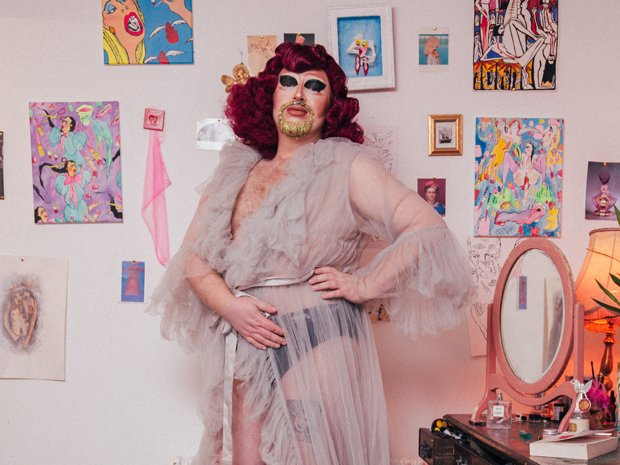
A Drag Queen Recommends 7 Books About Rejecting Normality

In 1987, Barbara Cartland and Jackie Collins sat on Terry Wogan’s couch. Both deeply abnormal people (in a good way), both in deep disagreement. “It’s evil really,” says conservative Cartland. “What?” asks Jackie in a gold pleather jacket. “The books that you write, quite frankly.”

Now the similarities between these two powerhouses of fiction are manifold, but the difference between them is that one of them (Cartland) isn’t aware that she’s not normal, while Jackie is proud of the fact that she is. Cartland campaigns against a permissive society, sat there like a drag queen in a frou-frou pink dress, white face paint and diamonds, while Jackie’s books are testament to what happens when people are given permission. 

When I was writing my book Diary of a Drag Queen, I thought about these two authors a lot. The book is wildly different in style to both of their writings—it would be foolish for anyone to try to emulate either—but I found it fascinating that both of them played with the concept of normality so much. To me, normality is a terrifying prospect. For some reason, the idea of normality has always felt synonymous with mediocrity, boredom, dissatisfaction. And neither of these writers traded in any of these things at all. I tried to write a book for people who have always found the prospect of normality scary, whatever their reason. For me, it started with not having an option to be so—I’m gay, non-binary, fat and a drag queen from a small town in the North of England—but when I’d finished my book I realized that being not normal had been the greatest gift I could have possibly received from society. 

The following are books that view the world from different positions, but all from places of not being “the norm.”

Image result for michelle tea against memoir

Against Memoir: Complaints, Confessions & Criticisms by Michelle Tea

All I ever want is to be inside the mind of Michelle Tea. When my friends and I first discovered her books some years ago we passed them around like wildfire, creating WhatsApp groups to claim characters in Michelle’s real life as our own. Tea has lived the queerest life. No, Tea has lived five of the queerest lives, and she writes about it with such a knowledge of who is going to be reading her words. These books are so precious to so many queers because she’s written them for us. There’s no explainers, it’s just her writing about us, parts of us, for us.

Against Memoir is a collection of essays on topics that interest the author. It’s my favorite of her books—Black Wave a close second—because you can pick it up and imbibe a slice of Tea’s mind in five minutes. More than that, it helped all of our friends become a little bit more like our idol: now we love Gene loves Jezebel and Erin Markey follows me back on Instagram. She reminds so many of us lost queers of the joy of it all, of why we were all drawn to this life lived elsewhere.

Secret Diary of a Call Girl by Belle De Jour

This was the first book I ever read cover to cover. I was 18 and on holiday in Benidorm (if Miami and Vegas had a cheaper, slimier baby) and I borrowed it off a girlfriend who had always been obsessed with sexy chick-lit. It’s arguably an easy read, a sort of erotic Bridget Jones, with a devolved sense of its own politic. But in a pre-woke world this iconic piece of pop culture, or low culture as many literary snobs would like to name it, was where my obsession with life writing started. The book details the life of Belle De Jour—a book-smart sex worker who is incredibly expensive to hire, and who, like the rest of us, is trying to work out how to balance a widely castigated means of income with her personal life.

We didn’t read much growing up, because in Northern working-class culture gossip and soap operas are what make up the bulk of our entertainment. I’d found books we were forced to read at school—Dickens, Shakespeare — dull, not for or about me at all. But when I opened Belle’s book, it was the first time I’d felt understood by a character. Perhaps because she was living on the outside of sanctioned society, as was I, or perhaps because the prose is personable, playful and oftentimes powerful. Whenever I come to write personal essay, I think of Belle, of how scandalous simply writing your experience can be, and if that doesn’t help get through the block I’ll often put on a sky-scraping pair of heels and channel my inner De Jour. 

Image result for Poor Little Bitch Girl

Poor Little Bitch Girl by Jackie Collins

As expected, I’ve always been obsessed with Jackie—from her life story to the fact that so many people thought of her as vulgar and yet she’s one of the best-selling authors of all time. I think it’s remarkable, and truly very camp, that to achieve such sales figures many of her detractors must have been secretly stashing their Jackie tomes under their pillows, out of sight of judgemental friends who were probably doing the exact same. 

Jackie’s writing is the definition of glamour, even when the scene is scary or tragic. She paints pictures with the worlds we know, by looking at them always from the viewpoint of the insider. Because, even though the books aren’t about her per se, you know that everything in them is something she has seen. Roman a clef. Which makes reading them all the more glorious—like a game of Guess Who!

Poor Little Bitch Girl is on this list because it’s the one I most recently read, about high school friends reunited through a mysterious, high profile death. But really, I could put any Jackie on this list and be happy with the choice. She is unmatched and her very existence proves the deep immaturity of our society: that people are still shocked by her work, as a woman writing about men and sex, belies how conservative our world really is. Jackie taught me to lean into the shock. Jackie taught me how to be a drag queen.

The Vegetarian by Han Kang

The Vegetarian by Han Kang

I’m not a vegetarian, but this book is about more than meat. It’s about finding a metaphor by which to reject and renegotiate patriarchal control. In this instance, it’s giving up meat and, eventually by the end of part three, becoming a tree. It’s a book which goes deep, yet remains subtle, into the depths of despair that can be brought about by being controlled or oppressed. It’s about domesticity, and about how rejection institutions—both big and small—create friction that eventually spreads through this family structure like wildfire. This book rejects normalcy, but it doesn’t scream about its doing so. 

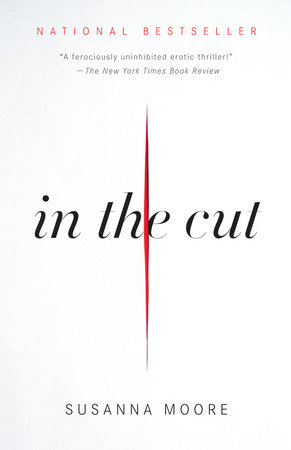
In the Cut by Susanna Moore

In The Cut by Susanna Moore

I haven’t seen the film, but I’ve read this book twice (the only book I’ve ever read twice). Moore’s lead is complicated and judgemental—a woman obsessed with language, a teacher whose fantasies are laid bare. This book is so powerful because its gender politics are uncomfortable. It’s about male violence and desire for men. It’s an erotic book, and yet it confronts violence towards women, at the hands of men, within the same scenario, unpicking the fact that these two things might well be linked. That’s hard to do: when male writers do it, it’s often with stories of murder and assault. And while In The Cut is set around a murder, that Frannie (Moore’s lead) and the detective she’s sleeping with are both linked to in different ways, it’s not insensitive to the violence, but it doesn’t obsess over it either. It illustrates the way so many women navigate the world when male violence is a constant threat, and while it was published in the ‘90s, it’s as brand new a book as anything released today. 

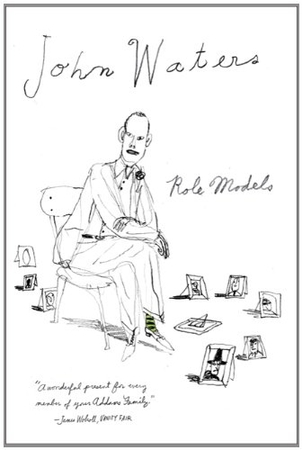
Role Models by John Waters

Waters’ writing is so beautifully non-judgemental, it makes an art out of seeing everything with value—venerating low and high culture with equal importance. This practice has informed so much of how I both write and see, treating people’s emotions and tastes as something valid to their experience. What Waters also does so dextrously is expect the highest of people, never applauding people for being good people—simply expecting it of them. Icons is a rare insight into what creates an abnormal auteur. Some of the book is uncomfortable, and Waters’ viewership can often feel exploitative, but when it clicks, it clicks so powerfully that Waters, as in his movies, subverts acts deemed socially so shameful into things so powerful, so iconic. An interview with his friend Leslie Van Houten, a Manson devotee who remains in prison, caused a stir. But what Waters communicates to those of us who live on the edges of society is that everyone deserves a chance to be heard. And that is a powerful thing to understand when you belong to a community that so often isn’t. I love this book. 

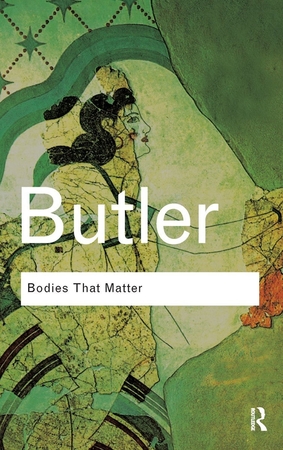
Bodies That Matter: On the Discursive Limits of Sex by Judith Butler

I’m unsure whether Butler meant for every word in this book to be understood, but most of them can be felt. Inside these pages was where so many of us who find ourselves diverging from the normative gender binary understood, for the first time, not only that what we are is real, but why we are real. Or more accurately why binary gender is not real. Until reading Butler, I’d only ever understood a construct to be something that was made in a physical sense, not in a metaphorical or social sense. I can’t describe what a 22-year-old wearing a dress in a stuffy university library felt when they found such a mirror to themselves. And really Butler sits at the top of the pile of which I am at the bottom. So much of my book Diary of a Drag Queen aims to explain what Butler taught me in language my mother can understand, that I can understand.

Why “Ok.” Is the Most Terrifying Text You Could Ever Receive

Could you pick up some bread on your way back please?
– Sure.

I’ll be home by 8pm!
– Ok.

Do these text exchanges make you reel in discomfort, squeezing your emotional core? Or do they seem perfectly normal, an everyday occurrence? If you feel slightly sick inside, welcome to the club. If you’re wondering what the problem is: are you my mother? 

I’ve spent the better part of several years trying to explain to my mum how her two-letter “ok”s and overuse of periods makes me feel. She, in turn, tells me that all her friends text this way. It’s true, they do. (I checked.) But despite my concerted efforts, I can never quite find the words to explain what exactly the problem (or rather, my problem), is. Because internet. 

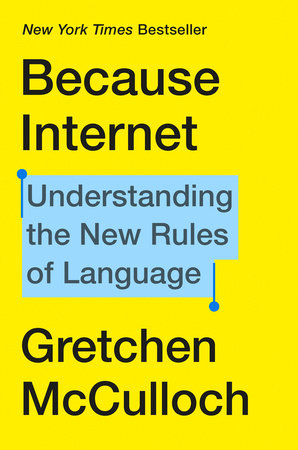
Because Internet by Gretchen McCulloch

No, really. In her book Because Internet: Understanding the New Rules of Language, Gretchen McCulloch writes: “Getting an Internet Person to stop overthinking a text message is just as impossible as getting people of any age to stop reading emotional nuances from tone of voice. We can’t help it.” 

This debut nonfiction book from Wired’s resident linguist is located deep within “the internet as a cultural context,” taking readers on a clear-eyed and often funny journey into the intricacies of online language. From exploring “an inequitable distribution of typographical emotional labor” to drawing a beautiful comparison between memes and embroidery, Because Internet is written for readers across linguistic generations.

Whether it’s punctuation marks, memes or deciding whether to capitalize words, the internet is constantly shaping how we write—and, as McCulloch tells us, “how you write is who you are.” Because Internet allows us to know ourselves that little bit better. 

I spoke to Gretchen McCulloch about sexy emojis, ellipses, the anti-authoritarianism of all-lowercase texts, and how democratic online language really is. 


Richa Kaul Padte: Please let’s start with emoji, because the way you situate them totally blew my mind! Emoji, you explain, are gestures— the way we talk with our bodies as well as with our words. You write: “We use emoji less to describe the world around us, and more to be fully ourselves in an online world.”

Last month, Facebook banned “sexual uses” of emoji on its platforms, including 🍆 the eggplant emoji (sometimes used to connote a dick) and 🍑 the peach emoji (sometimes a butt). While the impetus for this policy was a continued hostile offensive against sex workers online, your book also made me wonder: has this ban completely misunderstood how emoji actually work? 

Gretchen McCulloch: Facebook’s ban of emoji sort of confuses the result with the cause. The eggplant wasn’t initially a sexual emoji; in fact, there still aren’t any overtly sexual emoji. It’s people using the eggplant in sexual contexts that makes us interpret it sexually. So what I’ve seen most people predicting as a result of this particular ban is that people will find something else to use as a sexual emoji—here are lots of other objects in the emoji spectrum that one could potentially use! So while it may have a short-term effect, I don’t think the ban will actually do much in the long term. 

RKP: You write not just of emoji, but of all internet language: “once we had the technology…we used it to restore our bodies to our writing.” This makes me think of the French theorist Hélène Cixous, for whom writing, and especially women’s writing, is always an embodied act. She also believes that it is a necessary act: not just for women’s words, but for our bodies and our selves. 

There’s a study you cite in Because Internet which finds that “women lead 90 per cent of linguist change,” making them primary “language disruptors.” And I wonder, to what extent is the embodied nature of online writing born from women’s needs? Not just for communication and community, but to restore our bodies to our selves? 

What English speakers take for granted is that the internet is available primarily in their language.

GM: That’s an interesting theory! I think that as we do more writing, and as writing becomes more a part of our everyday experiences—something we do as regular communicators, and not just in the form of professionalized remote writing—its embodied aspect becomes more interesting and even more essential. So whether that’s combined specifically with women’s writing because women have often been excluded from spaces, or whether that’s simply a human need to connect with each other, I think both of those things can be true. 

RKP: Gretchen, your book is full of explanations I didn’t know I needed but now consider e s s e n t i a lespecially when trying to understand people who text differently to me (namely, my mum). Take the use of ellipses to separate sentences.  Prior to the real-time interwebz, ellipses were a way of indicating informality: from letters to recipe cards to (embarrassingly) my own early emails to friends. This also explains why people who never had an informal writing context outside the internet didn’t understand why anyone would use them. Were they trailing off? Was there a hidden message?

But now, ellipses have made a comeback! I find myself using them all the time, in texts and tweets and emails. What does this…mean?

GM: Ellipses can mean a bunch of different things depending on the context. As you said, your mum sometimes uses them to indicate informality. Other people use them to indicate a kind of trailing off. But now there’s a rising use of ellipses to sort of parodize the tendencies of older people to use ellipses a lot. In these cases, it’s used to express an incredulity or a lack of familiarity with technology—or as an ironic distancing mechanism. Essentially, they’re context-dependent, but so are a lot of things we communicate. 

RKP: Many of us have shifted to using all-lowercase letters in our internet sentences—a minimalist typography that you trace from its first days on Tumblr to its present moment in the sun as “a soft/weird aesthetic” on Twitter.  

But compared to dot dot dot, which felt very intuitive, I was a lot more conscious of this shift to minimalism in my online speech. It’s almost as if I realized that everyone I liked had started doing this thing and now I needed to…do it too? You talk often about how we use language to project who we want to be, or as a means of aligning ourselves with particular groups. Does this mean we’re all simply trying to be cool, or does emulation indicate a desire for belonging? Is there even a difference?

When smartphones capitalize everything automatically, all-lowercasing shifted into being anti-authoritarian.

GM: Dot dot dot is something that emerged from a set of existing cultural practices: it had an offline [life], so using it online for some of those purposes involved a more gradual emergence. And while minimalist typography does have historical antecedents—like e.e. cummings poems—I think its moment in the sun starts with a reaction against automatic capitalization. When smartphones capitalize everything automatically, lowercasing things takes more effort and can have additional semiotic value: “Here’s this thing I’m doing in rebellion against what the phone is trying to get me to do.”

I also think people are aware that all-lowercasing was considered a sort of lazy practice in the early days of the internet—because it was the default thing to do. And when it became no longer the default, it shifted into being anti-authoritarian, while also invoking in an ironic sense the stereotypes of those early internet users. So there are many levels of interpretation. And because all-lowercasing involves a multi-step reaction against default capitalization, I think it is something that all people do tend to do more self consciously—and less as a natural outgrowth of existing practices.

RKP: Internet language serves as community, but it also acts as a tool for exclusion. You explain how it can be “a way of repelling outsiders, of saying, ‘I don’t care if you take this the wrong way.’” That’s so true, and very much reflects how I respond to unwanted comments online: by using language that primarily makes sense to my own linguistic community. Do trolls/men/other people understand? ngl idgaf. 

But this “you can’t sit with us” energy also works to solidify existing hierarchies: class, race, caste and so on. In India, where I live, it is a visibly felt truth that internet access does not equal internet literacy—and that neither equal English fluency, much less fluency in the shape-shifting English of the internet. If “language is the ultimate participatory democracy,” does the online world still need to catch up?

GM: I think saying that language is a democracy can mean that it has the same problems that offline democracies also have. So technically we all have equal votes in a democracy, but that doesn’t mean that democracies are paragons of inclusion, or that they’re perfect and don’t need to continually address hierarchies of class, race, gender, caste and so on. I think you can be a democracy and still have lots of things to work on, and I think that’s true of both the online and the offline world. 

I definitely think there is still a lot of English dominance on the internet, though. What English speakers take for granted, especially in English speaking countries, is that the internet is available primarily in their language. And that’s definitely not true for a large portion of the world. So having phone interfaces in your language, having Wikipedia articles in your language, or when you’re trying to code a website, having keywords in a language that you can already understand—these are areas in which the internet really needs to catch up for speakers who aren’t in the top ten languages of the world.

Why We Keep Getting New Adaptations of “The Turn of the Screw”

There is a word that more than one movie critic has used to describe the novels of Henry James: “unfilmable.” Others prefer “unadaptable”; still others, “untheatrical.” Semantics aside, the underlying diagnosis remains the same: the very traits that make the Master’s oeuvre catnip for literary scholars—labyrinthine sentence structures, deep attention to characters’ inner lives, and subtle commentary on nineteenth-century social structures—have proved serious hindrances to directors looking to bring the likes of The Ambassadors or The Portrait of a Lady to the stage or screen. 

Critics therefore often conclude, as did Lisa Zeidner writing for the New York Times, that “most [adaptations of the novels] lose James in the translation.” Filmmakers usually bungle the Modernist author’s nuance, she continues, either by succumbing to “deadly dull[ness]” or by so ludicrously inflating the drama of a given narrative that the resulting movie bears no resemblance to its delicate source text. (Tellingly, James’s own attempts to write for the theater, the most popular dramatic medium during his lifetime, failed bombastically: Guy Domville, his only play ever to reach the stage, was famously greeted with “tumultuous hooting, groaning, and hissing” on opening night.)

The Turn of the Screw

But against this backdrop of ho-hum James interpretations, one exception emerges, as glaringly out of place as a ghost in the daylight. James’s 1898 novella The Turn of the Screw has been brought to film, TV, and the stage at least 27 times, dwarfing the closest contender for most-adapted James book (The Aspern Papers, with approximately 17 performing arts iterations). Between the first Turn adaptation (a 1950 Broadway play directed by Harold Pinter) and the latest (the second season of the Netflix series The Haunting of Hill House, which will take place in the Turn universe and is slotted for release sometime this year), the slip of a tale has been transported to a stunning variety of historical contexts. These settings have ranged from the swinging ‘60s (dir. Rusty Lemorande, 1992) to a World War-I era psychiatric asylum (dir. Tim Fywell, 2009) to the melancholic overkill of mid-1990s Maine, replete with a grunge soundtrack and wardrobe (January’s The Turning, dir. Flora Sigismondi).

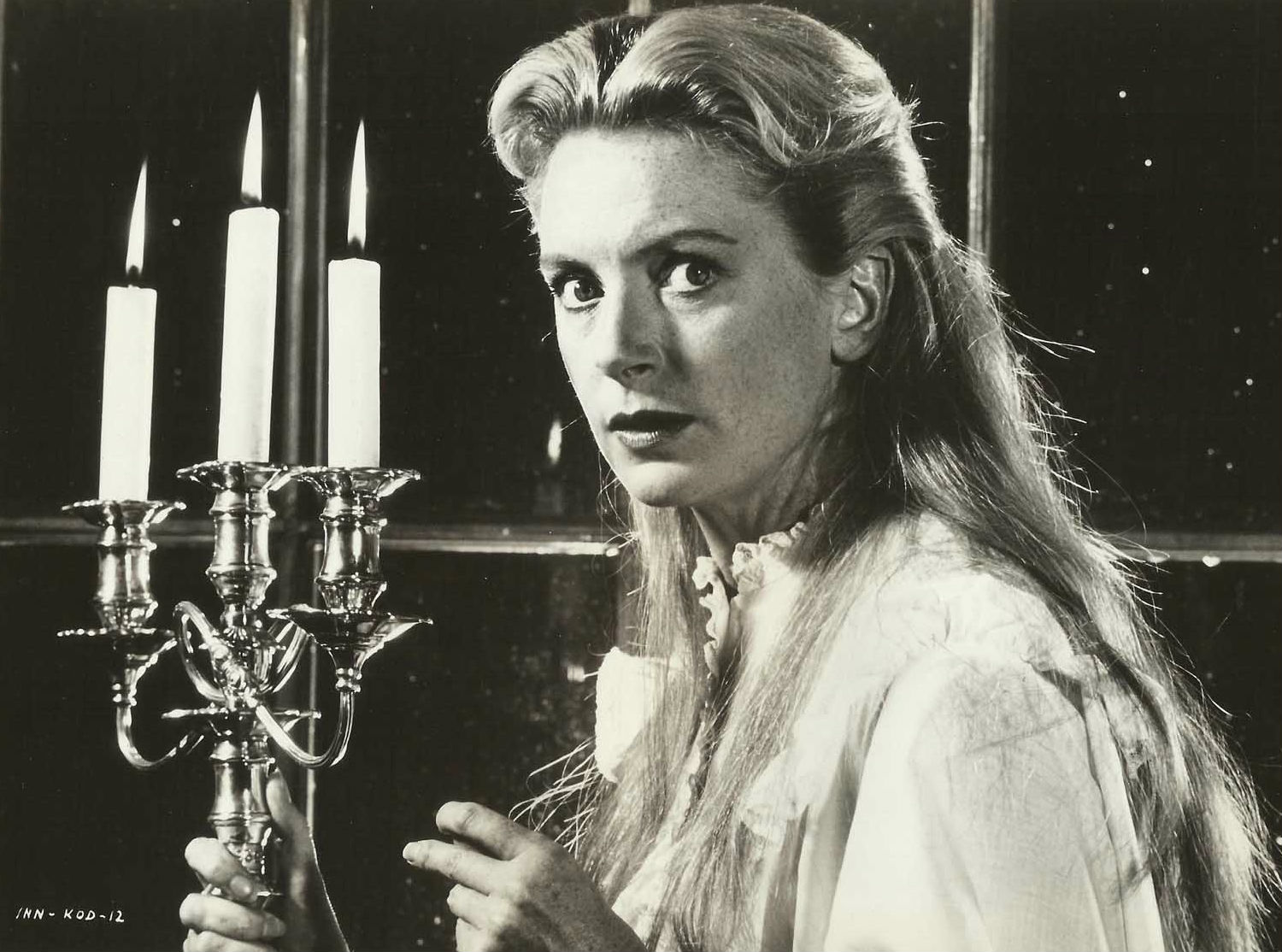
And it isn’t simply that there are a good number of Turns out in the world; there are a number of good ones, too. Jack Clayton’s 1961 film The Innocents features a screenplay by Truman Capote and routinely ranks on lists of the greatest horror movies of all time; Benjamin Britten’s opera has been deemed a masterpiece by several major critics; a 1959 television production starred Ingrid Bergman in the leading role; Alejandro Amenábar’s The Others (2001, starring Nicole Kidman), which riffs loosely on the original novella, earned wide praise for its brooding atmosphere and psychological thrills.

The very factor that makes most other James narratives so colossally difficult to adapt also makes Turn of the Screw an inviting prospect: its congenital ambiguity.

Why does Turn break the mold? It may be that the very factor that makes most other James narratives so colossally difficult to adapt also makes Turn of the Screw such an inviting prospect: its congenital ambiguity. In other works, James’s characteristic nuance manifests primarily at the levels of sentence and mental event, resulting in entire scenes given over to “people thinking about what others are thinking,” scenes that seem custom-designed to “stymie … directors,” as scholar Lee Clark Mitchell puts it. But in James’s best-known Gothic tale, this nuance largely takes the far more cinematic forms of perceptual and supernatural doubt. 

Or, rather, doubts. The sources of eerie uncertainty in Turn of the Screw are legion, despite—or, in fact, because of—its deceptively simple plot: an unnamed woman of indeterminate background takes a job as a governess to two wealthy orphans at a remote country estate, all too readily accepting the condition that she never contact her employer about any problems that may arise during her stay. The governess is charmed by the lovely Bly Manor and by her two lovely young charges, Miles and Flora—until she becomes convinced that the ghosts of Bly’s disreputable previous employees, Peter Quint and Miss Jessel, are bent on physically and/or spiritually destroying the children.

It is because this skeleton of a setup leaves so very many questions hanging that directors, playwrights, and critics have so eagerly flocked to answer them. What exactly in the governess’s mysterious past and personality has compelled her to accept this strange posting? Are the ghosts real, or merely a product of the governess’s unraveling mind? (This particular line of inquiry dominated Turn criticism for a somewhat embarrassingly long time, with Edmund Wilson advancing the most famous “non-apparitionist” reading.) Which acts did Quint and Jessel commit with one another—or with the children—to earn such wicked reputations among the current employees of Bly? Have Miles and Flora been irreversibly corrupted by their malevolent caretakers, or are they truly as innocent as they first appear? 

It is because this skeleton of a setup leaves so very many questions hanging that directors, playwrights, and critics have so eagerly flocked to answer them.

Any one of these questions might provide—and has indeed provided—more than ample temptation for a screenwriter to contribute her own fresh turn of the screw. For instance, even if a filmmaker takes up the seemingly straightforward stance that the governess is mad and the ghosts a product of the poor woman’s fevered imagination, this choice soon proves a garden of forking paths, each route leading to a unique interpretation of the original. 

A number of adapters have suggested, for example, that the lecherous spirits are a sublimation of the governess’s repressed lust for her employer (see, e.g., the films by Jack Clayton [1961], Graeme Clifford [1989], and Rusty Lemorande [1992]). Others have invented a panoply of traumatic backstories to explain the governess’s present-day instability, a multiplicity only possible because her history is so sparsely sketched in the novella. We learn in Presence of Mind (dir. Antoni Aloy, 2000), for instance, that the governess was physically abused in her youth; The Turn of the Screw (dir. Rusty Lemorande, 1992) and In a Dark Place (dir. Donato Rotunno, 2006) posit that this childhood abuse was sexual in nature; in another Turn of the Screw (dir. Dan Curtis, 1974), the governess was orphaned early in life, like Flora and Miles; The Turning (2020) hints that the governess has inherited some form of mental illness from her institutionalized mother. Because each of these alternatives has major repercussions for the movie’s plot and symbolism, a filmmaker can use even the slightest interpretative tweak to justify her desire to create yet another Turn adaptation.

The particular nature of Turn’s gray areas also bears noting. Many of the ambiguities that James sows throughout Turn coyly hover at the edges of our culture’s two most luridly profitable taboos—sex and death—without naming the specific events entailed. Characters merely describe Quint’s and Jessel’s past actions as “horrors,” or “dreadful,” or an instance of people living “much too free[ly].” These winking half-revelations conveniently allow each new generation of creator to provide freshly provocative interpretations as cultural mores change and audiences become harder to shock. 

Many of the ambiguities coyly hover at the edges of our culture’s most luridly profitable taboos—sex and death—without naming the specific events entailed.

Thus the only thing that Jack Clayton’s 1961 film The Innocents had to do to get a rise out of viewers was to obliquely suggest that a cross-class romance had budded between Quint and Jessel. By contrast, Michael Winner’s The Nightcomers (1972) was born in the wilder era of the sexual revolution (and three years after the restrictive Motion Picture Production Code was lifted), and therefore ups the ante with explicit portrayals of BDSM between Quint (played by a rakish Marlon Brando) and Miss Jessel. A 2006 production (Donato Rotunno’s In a Dark Place), surfing the rising tide of lesbian representation in TV and movies of the mid-2000s, adds a frankly baffling erotic subplot between the governess and Mrs. Grose. Perhaps most enduringly of all, incest and child molestation have retained their capacity to disgust across the ages, and several films have exploitatively sought to disturb increasingly jaded audiences by placing Miles and/or Flora in sexual situations (The Nightcomers, Dan Curtis’s Turn of the Screw, Tom McLoughlin’s The Haunting of Helen Walker, Presence of Mind, The Turning). 

Film was still a tenderly young medium when James wrote Turn of the Screw, and it would be preposterous to suggest that he consciously wrote the story with an eye towards motion picture adaptation. (James did happen to see—and fall in love with—his first movie in 1898, the year of the novella’s release, but it wasn’t until later that his fiction  would explicitly reference the cinema.) However, the particular strategy of Gothic suspense that the novella both theorizes and embodies still undergirds our contemporary understanding of what makes a horror film maximally engaging to its audience. Which is to say: the realist virtuoso was one of literature’s earliest advocates of the notion that horror thrives in understatement. 

In this regard, the enigmas baked into the work’s plot and phenomenology are just the beginning; every element of the novella is an intentional exercise in withholding. But it is perhaps James’s own writings about Turn that most explicitly spell out his strategy for generating readerly chills. In a Preface published a decade after the original novella’s release, James bemoaned the way in which “the new type” of ghost story that had come into vogue in the late nineteenth century defanged itself by describing its specters in too much detail. Such tales “washed [their ghosts] clean of all queerness as by exposure to a flowing laboratory tap,” he complained. So, too, did narratives that explicitly described evil human acts succumb to “the comparative vulgarity, inevitably attending […] the offered example, the imputed vice, the cited act,” and in so doing run the risk that “they shouldn’t seem sufficiently bad” to the reader.

If Turn succeeds in its goal, the reader herself effectively serves as an adapter of the text.

It was to avoid these pitfalls, James continued, that he decided to paint Quint and Jessel’s crimes with such vagueness that “the spectator’s, the critic’s, the reader’s […] own experience, his own imagination […] will supply him quite sufficiently with all the particulars. Make him think the evil, make him think it for himself, and you are released from weak specifications.” In this framing, the ideal Gothic narrative makes the reader into an active participant in the narrative, his imagination the silver screen onto which he projects a fuller backstory by “think[ing] the evil […] for himself.” If Turn succeeds in its goal, then, the reader herself effectively serves as an adapter of the text—and conversely, any would-be adapter, be he a filmmaker, librettist, or playwright, must act as a reader, an interpreter making conscious choices about how to tie up James’s many loose ends. Unsurprising, then, that so many directors would eventually take the next step and immortalize in celluloid their respective answers to the novella’s myriad questions. (It is a cruel irony of adapting Turn, however, that as soon as a filmmaker offers up such an answer, even if only at the movie’s end, she chips away at the audience’s experience of the original text’s unremitting ambiguity. Adaptations of the novella wherein the screenwriter and director resist the urge to fill in Turn’s blanks, and instead fully reproduce those blanks for their audience, are rare indeed.)

In case this theoretical blueprint were not sufficient, though, the novella also provides the would-be adapter with a fictional role model as to how to retain an audience’s attention through Gothic delay. Turn of the Screw’s frame narrative opens on a cluster of friends exchanging spooky stories around a fire. A member of the group named Douglas will eventually relate the novella’s central tale of the hauntings at Bly. But Douglas, like a good horror filmmaker, coquettishly builds as much suspense as possible before he’ll give up the ghosts: he waits two whole nights to speak up at all, and even then, it is only to say that he must write into town for a manuscript that contains a tale of “dreadful—dreadfulness.” The document then takes another three days to arrive, and Douglas sits on it for another evening before finally spilling the beans. 

Douglas’s listeners protest each time he postpones and equivocates, yet also grow progressively more excited due to these very same withholdings. “Oh how delicious!” a woman declares after he provides a teaser on the first night. It’s this same reaction that James, like his fellow creator of Gothic narrative, Douglas, undoubtedly hoped to evoke in his own audience. Turn of the Screw was originally published in Collier’s Weekly magazine in serial form, over the course of four months, so its author was banking on readers’ attraction to slow-release scares. (He was right: initial responses to the novella were overwhelmingly positive, with a typical reviewer gushing in October 1898 that the story “rivet[s] the reader’s attention on every sentence.”) 

Even the work’s title evokes the kind of masochistic pleasure that arises from delayed revelation. The medieval practice of thumbscrew torture was typically inflicted with deliberate slowness, each “turn of the screw” very gradually bringing the vice tighter and tighter around a person’s finger. Anticipation was therefore part of the torment, the victim foreseeing greater levels of suffering long before he felt them. So, too, does each chapter of Turn disclose information with such painful slowness that the reader’s imagination runs wild with the “delicious” horrors to come. 

The increasingly unusual experience of deprivation can provide a unique kind of joy.

James’s short tale permanently established suspense, withholding, and ambiguity as major virtues on the rubric by which we still evaluate horror today. Of course, some entries in the genre, such as David Cronenberg’s gore-fests or Eli Roth’s torture porn, intentionally aspire to maximalism. But for the larger portion of horror media, which aims to sustain slow-burn dread over a longer period of time, common wisdom holds that such narratives—be they books, movies, creepypasta, or TV shows—become decidedly less scary as soon as they overshare. This excess might take the form of showing their monster too soon, the insultingly obvious exposition of a character’s traumatic past, or a reliance on visually overwhelming CGI. (The predominantly negative responses that greeted The Turning a few months ago have accused the film of all three of these sins, with one reviewer objecting that “Nothing is subtle here, least of all the scary bits” and another begging director Sigismondi to “show us your ghosts, but please do so sparingly and tastefully,” rather than relying on an “unsubtle overuse of CGI spirits.”) 

Precisely because our age is one that offers instant visual and digital gratification, the increasingly unusual experience of deprivation can provide a unique kind of joy. We experience a rare kind of suspense when we are temporarily blocked from seeing, hearing, or knowing something that, we predict, will thrill us. Halfway through Turn, in a metaphor that uncannily prefigures the cinema, the governess imagines herself as just such a blocking force between the impressionable children and the darkly sensual forces at Bly that seek to corrupt them: “I was a screen—I was to stand before [Miles and Flora]. The more I saw the less they would.” Horror fans still hope that a film or novel’s creator will stand between us and the main terrors for as long as possible—not so that we will be protected from the horrors, oh no, but so that we might stew just a while longer in the “‘delicious’” sauces of our own imagination. It’s these frissons of the invisible and the unsaid that will always be greater than the ones that actually take shape on the screen.

Why Is Everyone Suddenly Obsessed With Sourdough?

All of a sudden, everyone is making sourdough. Cooped up and anxious from shelter-in-place orders, we turned to bread-making in such numbers that yeast became impossible to find. Denied commercial yeast, we thundered forward with sourdough, which relies instead on a starter made of flour and water, fermented by wild yeast and lactobacillus bacteria. Quarantine sourdough has gotten so popular that we’re already getting backlash. Is it a forward-looking attempt to develop post-collapse skills? A way of bragging that you got your hands on some flour? The restless desire to make something tangible and useful? Or is it just a function of our collective depression and resulting desire for carbs?

For help interpreting this sourdough fixation, I turned to Robin Sloan, author of Sourdough. Sloan’s book, which came out in 2017, predated our current moment, but also kind of prefigured it; it features an adrift and alienated tech worker who is brought back to herself when she’s given a mysterious, almost otherworldly sourdough starter and begins baking perfect bread. I asked him what sourdough is doing for us right now, and what lessons it can teach us for the future.


Jess Zimmerman: Sourdough came out a few years ago, but it’s newly relevant today because sourdough has become the hot quarantine hobby for people who are lucky enough to be able to think beyond survival. What have you observed about the rise (sorry) in sourdough culture (sorry)? I feel like it goes beyond “I want bread and I don’t have yeast.”

The reality of a sourdough starter is honestly SHOCKING. It’s as much a weird roommate as a kitchen ingredient.

Robin Sloan: Well, this is what happened to me, and I think it’s true for a lot of people, especially people who have lost touch with old foodways: the reality of a sourdough starter is honestly SHOCKING. That it’s as much a weird roommate as a kitchen ingredient, I mean. It’s probably not a very kind commentary on me, or people like me, and the way we live and eat that it should seem so strange at first—but, oh well! You’ve got to learn sometime. And I really do think that, beside being a key part of this iconic (delicious) substance, sourdough starter also offers this broader “ohhh” about cooking and eating and like, the whole natural world.

JZ: What’s the substance of the “ohhh”? If people are making a sourdough starter because they don’t have yeast, or because everyone else is doing it, or whatever, what can they expect to be sort of passively learning from that experience?

RS: I think the big surprise, ESPECIALLY if you get into sourdough baking because it means delicious carbs (rather than because of an interest in fermentation), is just how truly and palpably alive the starter is. I mean it MOVES. It expands and contracts. Sometimes it spills out over the lip of the jar. It has moods and very specific needs, in terms of temperature and humidity. It is really a different (LITERAL) animal than a sack of flour or even its desiccated cousins in the dry yeast packet. And when you reckon with that, I think it opens up a whole bunch of new questions and, maybe, preoccupations.

JZ: Is it possible that the fad for quarantine sourdough is not unrelated to the drive for quarantine pets?

RS: I feel like, for me, that’s more aspirational than actual. This is where the fiction comes into it! I mean, I really DO believe that sourdough starters are strange, powerful, complex communities of life… but I wish they had a little bit more personality. The kind that’s parsable by a human mind, anyway. So… I wrote one! (I think some of the really great sourdough bakers really are in tune with their starters that way. I have to confess I never got there; my fictional singing, burping starter was my “cheat,” in a way.)

I do think that starters, like pets, are VERY happy with the situation we’re in. They’ve never gotten more love and  attention!

JZ: Your protagonist is a tech worker who’s deeply alienated from a lot of aspects of human life, like eating normal food instead of a Soylent analogue. Baking bread and caring for her sourdough starter put her back in touch. We’re experiencing a different kind of alienation now; can we still look to sourdough to ground us, at a time when a lot of us are actually way too connected to our kitchens?

RS: Well, the thing about sourdough that’s extra special—and this is true for anything that calls for some microbial ferment—is that not only CAN you share the starter, doing so is basically required. So it’s inherently social. I think the appeal of something like this [person who was tacking bags of free sourdough starter to telephone poles in the Bay Area] is not only its quirkiness, but the fact of sharing something (weirdly?) personal and incredibly abundant. A starter might be one of the all-time great gifts.

JZ:  Have YOU been baking sourdough in social seclusion?

RS: I confess: I haven’t! Here is the truth: I’m not a very good sourdough baker. I do have a starter, but mostly acts as a little factory producing excess for sourdough pancakes.

JZ: Wait, sourdough pancakes sound amazing though.

RS: Oh there is SO much you can do with all the “extra” material your starter produces after you feed it. Sourdough pancakes, sourdough waffles…

Turns out, just the tiniest bit of hardship unlocks this part of our brains that was always there, always waiting.

JZ: I wonder if this is going to be the next bit of frontiersmanship we all learn—I feel like I’m getting WAY better at figuring out what to do with what would otherwise be food waste. Although I guess one of the beauties of sourdough starter is that the leftovers are never waste, they’re just potential new bread.

RS: Absolutely! Turns out, just the tiniest bit of hardship unlocks this part of our brains that was always there, always waiting. I’m sure you’ve felt the (mild) thrill of coming up with a use for some weird scrap. It’s like a puzzle game. (All humans who lived a hundred years ago and before roll their eyes in sync.)

JZ: Okay, for the first time I understand my unprecedented excitement about making improvised soup the other day! I hate cooking but I love puzzles.

RS: Have you ever heard of the M.F.K. Fisher book How to Cook a Wolf?

JZ: Yes, we ran an essay on it!

RS: Oh that’s terrific. Well, AS YOUR READERS KNOW, it’s great. Her style was a huge (aspirational) influence on Sourdough, and I think this book in particular has fresh resonance.

JZ: The sourdough starter in your book is of Mysterious Origin and has almost fairy-tale powers, but it’s also not that far removed from real-life sourdough starter, which still involves catching invisible creatures and bending them to your will. Does sourdough have an inherently science-fictional aspect? Does that make it feel familiar in an inherently science-fictional time?

RS: One of the things I love about all fermentation is that, for as ancient and established as it is, as crucial as it’s been to the whole human story… we still don’t totally understand how it works? Microbial communities can be, and routinely are, complex beyond comprehension. Like little curled up global macroeconomic models just bubbling quietly in a jar on your countertop. It’s pretty clear to me that the richness of the microbiome—our own and others’—is going to be one of the things about which humans in a century say, totally condescendingly, “I can’t believe they didn’t understand that.” And anytime the world outpaces our understanding of it, yeah, I think it’s ripe for science fiction.

One of the things these microbial communities are amazing at is coordination, and I think there’s something about that worth dwelling on in this moment. Of course, I don’t want to be a lactobacillus, even if it means I can work in perfect harmony with a community of billions; but… I guess I’d be willing to LEARN some things from a lactobacillus?

One of the things these microbial communities are amazing at is coordination, and I think there’s something about that worth dwelling on in this moment.

JZ: What should we learn from a lactobacillus, in these times?

RS: Oh, EVERYTHING. Resilience: you can put a jar of starter into the fridge and forget about it for Y E A R S and then (almost certainly) revive it with no problem. What else? Cooperation! The way these communities of microbes—who are NOT homogenous, by the way—all pedal together to grow and flourish, and respond to hardship, too… it’s amazing. Microbial communities are very VERY good at communication, and we could also use that. THERE’S SO MUCH.

JZ: Do you have any tips for new sourdough bakers, besides “pay close attention to the microbes and apply their lessons in your daily life”?

RS: Yes. It’s the thing I never mastered, even though I always knew about it (and it’s especially tricky here in the Bay Area): the temperature of your starter is really, REALLY important. A few degrees overnight can be the difference between a starter that froths full of life and delicious potential, and one that’s sort of… gloomy.

JZ: So sourdough may get us through the pandemic but it won’t get us through climate change. Sorry! Too dark!

RS: I’ll tell you what… when it’s 2096 and you’re floating the messed-up ocean currents on your solar barge, living off of krill chips, you’ll be glad you have your starter with you.

Mom Is in Love with Randy Travis

“Randy Travis”
by Souvankham Thammavongsa

The only thing my mother liked about the new country we were living in was its music. We had been given a small radio as part of the welcome package from the refugee settlement program. There were other items in the box, such as snow pants, mittens, and new underwear, but it was the radio she cherished most. A metal box with a dial that picked up a few channels. The volume button had only three ticks, and then it couldn’t go any farther to the right. She held this little radio up  to her ear like a seashell and listened. The host always spoke briefly between songs and there was the occasional laugh. A laugh, in any language, was a laugh. His laugh was gentle and private and welcoming. You got the sense that he, too, was alone somewhere. Grateful for the sound of a human voice and for the music that kept her company, she listened to the radio constantly while I was at school and my father was at work.

My mother especially loved American country music, because it reminded her of the way the women in her family talked among themselves. It felt familiar. The pleas, the gossip, the dreams of the big city, what it was like to come from a place no one had ever heard of. The songs always told a story you could follow—ones about heartbreak, or about love, how someone can promise to love you forever and ever and ever, Amen. My mother did not know what Amen meant, but she guessed it was something you said at the end of a sentence to let people know the sentence was finished. “Three apples, Amen,” she would say at the corner grocery store. Because of this, our neighbors thought my mother was religious, and even though our family was Buddhist, she caught a ride to church with them every Sunday. She made friends easily, was quick to smile, and was never shy about practicing her English.

My mother did not know what Amen meant, but she guessed it was something you said at the end of a sentence to let people know the sentence was finished. “Three apples, Amen,” she would say at the corner grocery store.

At church, she told us they ate one cracker and took one swallow of red wine and the rest of the time there was a man talking. She did not know exactly what he said, but he said it for a long time. Sometimes, just to give her hands something to do, she would pick up the heavy book in front of her seat and open it. Even though she didn’t understand everything they were singing, she moved her lips anyway. It was just like at the citizenship ceremony. Whether or not you understood the oath you made, you had to move your lips.

After a while, for some reason she seemed to lose interest in going. She didn’t say why.


When my father got his first paycheck, he wanted to buy something that wasn’t a necessity. We were living  in a new country now. We could have grand ideas of owning something luxurious. My mother suggested a car so he wouldn’t have to take a bus to work, but that was out of our price range. They thought of going to a fancy restaurant like the ones their friends took them to, but they did not like the way the steaks were cooked, thick slabs fried in butter. There was no fish sauce with hot spices and herbs at the table. They talked about getting a wooden bed frame to put their mattress on, but beds were for sleeping on, not for show. There were many things my father could have bought with his first paycheck, but in the end he decided on a record player. In Laos, it was something only rich people owned.

My mother loved the control the record player gave her. With the radio, she had to wait for what she wanted to hear. It could be days before she heard her favorite song again. Now she could drop the needle onto the black disc and watch it turn and turn, and listen to her favorite songs whenever she wanted. She never went back to the radio after that.

Later, once we could afford a TV and a VCR, she taped the country music award shows. After the nominations were read, she’d yell out her pick for the winner. If she got any wrong, she would memorize the winners in each category and replay the show and yell out the correct names. Whenever Dolly Parton was nominated, she chose her, and she was right every time. She’d yell, “I won!” I didn’t understand why she did that. What she’d won was nothing but being right.

The songs my mother loved most were by Randy Travis. Whenever we saw a new Randy Travis music video on television, she would quickly hit the Record button, and everything else slipped from her mind. She would kneel with her face close to the screen, then reach over and hit Rewind and Play, watch him sing again and again. After a while, the labels on the buttons began to fade and disappear.

By then, she didn’t care much for the things she usually did around the house. The laundry would be done but the clothes remained unfolded, dishes washed but not dried or put away. Then, she discovered frozen dinners. You could warm them up in minutes. And these dinners were my favorite for a time. It was what all my friends ate at home. I loved having mashed potatoes and corn and steak and roast chicken. My father did not. He wanted papaya salad, padaek, pickled cabbage, blood sausage, and sticky rice. But those dishes took days to prepare and getting the ingredients meant long bus rides to the market in Chinatown. It took time to ferment fish sauce, to pickle, to chop up a whole chicken into its parts, and to soak the rice to soften it. Time that my mother wanted to spend listening to Randy Travis sing.

My father was nothing like Randy Travis. No one noticed who he was or what he did for his living.

My father was nothing like Randy Travis. No one noticed who he was or what he did for his living. He never used the word love or showed much sentiment. For my mother’s birthday, he gave her a few twenty-dollar bills. Not even a birthday card or plans for a night out. He thought that because he was there, that was all that was needed to show his love. He thought his silence was love, his restraint was love. To say it out loud, to display it so openly, was to be shameless. He thought it was ridiculous to be moaning about love so much. What kind of man was Randy Travis, with his health, his looks, his fame, and his money, that he should ever have anything to cry about?

One morning, my mother gave me some money to buy one of those teen Bop magazines so we could find a mailing address for Randy Travis at the back of it. She brought out a card printed with a pink heart on the front, but because she couldn’t read or write English, she told me to write a note to him for her. I did not know what to write. I must have been about seven. What could I know then about the language of adult love? While she curled a few strands of her hair around a finger and broke out in small fits of giggles, I stood there, unable to decide how to even begin a sentence to him. I didn’t like how she was acting, and I was afraid of what would happen to my father if Randy Travis ever wrote back.

So I wrote, I do not like you.

My mother would never know what I had written.

I told her I’d written I love you forever and ever, just like his song.

She smiled, and then signed her name underneath.

We sent these cards to Randy Travis again and again, and though no one ever wrote back, my mother insisted we keep on sending them. I tried to think of what to write and thought of the things people wrote in the bathroom at school or spray-painted on the brick outside our building. You’re ugly. Go back home. Loser. Sometimes I didn’t even get the chance to write anything before she signed her name on the card, sealed it inside an envelope, and pushed it down into the dark slot of the mailbox at the corner of our street. We must have sent out hundreds of these cards, spending money on stamps and envelopes, my mother always hoping to get something back. It wasn’t any different than what she had done to come to this country, she said.

Of course I told my father about what we were doing, thinking he could put a stop to her obsession. It was getting out of hand. By then I’d refused to help her anymore, saying I had homework, thinking this would stop the letters, but she kept mailing them on her own with just her name inside. I showed one of the cards to my father. He pointed to her signature. It looked like pretzels, loopy and knotted, and he laughed and said to my mother, “Randy Travis reads English. He’s gonna look at your name and see a doodle. That address you got, who knows what they really do there. For all we know, the cards probably go straight to the dump.”

Randy Travis reads English. He’s gonna look at your name and see a doodle.

But my mother continued to send those cards with her name written out in Lao. Randy Travis was all she could think of and talk about. When the pipe in the kitchen sink clogged and my father didn’t know how to fix it, my mother said, “Oh, I bet Randy Travis knows how to do that.” And then there was the time she said out loud over dinner, “I bet Randy Travis would like to have dinner with me.” She’d stare outside the window at the sky, the moon, the sun, or a cloud and say, “Randy Travis could be looking at the very same thing I’m looking at right now. Wherever he is.”

It was inevitable that my father got tired of hearing about Randy Travis, and he finally said to her, sadly, that the man was famous and that our lives would never cross his. “He doesn’t even know we exist. We’re not even a single glitter of light to him,” he said. Then he brought his hand to his face, formed a circle around his eye with his fingers, and closed the space inside until there was nothing left except a tight fist. But you could not talk her out of her Randy Travis love. It was a shadow that covered her up, and all you could do was wait for some light to come through. She even started dressing up like Dolly Parton, thinking this was the kind of woman he’d want. She dyed her hair blond, teased its strands, and tied it in an upsweep. She played his music and sat by the window, waiting and gazing out onto the street below, as if he was going to drive up and take her away.

Hoping for some of this Randy Travis love to brush off on him, my father started wearing these cowboy boots my mother got for him at a garage sale. Pretty soon, he was wearing jeans and flannel tops, and standing like Randy Travis. He’d hook a thumb into the belt loop of his jeans and stand there with one leg straight and the other loose at the knee so it jutted forward. It made my mother happy to see him change in this way. But then when my mother asked him to sing, he failed spectacularly.

He did not know how to pronounce the words.

Her broad and hopeful smile vanished from her face, but my father only tried harder, belting out the chorus louder, holding on to the vowels, trying to produce a southern twang. He was no star. He was no  leading man. He packed store furniture into cardboard boxes for a living. No one would pay to see him sing, but he didn’t care. He was only trying to be what my mother wanted.


One day, my father told me we were going to a Randy Travis concert. He said, “It’s what your mother wants. We have to do this for her.” He rented a car and we drove down south. In those days, there was no such thing as buying things online. You had to walk up to a concert venue and buy a ticket right there at the box office.

My mother was so thrilled, she made the kinds of food my father liked to eat. She spent the three days before we set out soaking sticky rice, and when it was done cooking, she put it in a thip khao and bundled that in a blanket so it would keep its warmth. She made papaya salad and crushed tiny dry shrimps into it, and fried up two quails and wrapped them up in aluminum foil. I hadn’t noticed how beautiful Lao food was before. After the bland yellows and browns of those TV dinners, it felt like a homecoming. Arranged together, the colors were so bold and bright, the flavors popped and sharpened. Every meal tasted like a special occasion. It was a reminder of where she came from and her love. I could now see why my father insisted on eating nothing but this.

I do not remember much about the drive there except seeing a blue-and-red sign with the number 75 on it. We followed it for many days. I couldn’t see much out the window. I only saw black wires like underlines in the blue of the sky and then the dark and my own little face staring back at me.

At the concert, we were so high up on the outer ring of the audience I could not tell if it really was Randy Travis onstage. His face was the size of a pin. I closed my left eye and measured him with my thumb and index finger from where we were. He wasn’t more than an inch between my two fingers. And I don’t know why, but I closed that space he took up until I couldn’t see him anymore. It was when he started to sing that I opened my other eye and realized it had to be Randy Travis on that stage. His voice matched exactly the one from our records.

He did not move around much onstage. He mostly just stood there, strumming his guitar. He actually seemed shy, casting his eyes to the ground whenever the crowd rose to their feet with applause. He’d nod to acknowledge their praise, then begin another song. He did not look at anyone in particular. Didn’t single out anyone to sing to. He stared out into the crowd and the spotlight lit him with a glow I hadn’t seen before. He seemed to sparkle. Once in a while, he would wave in our direction and my mother would wave back. But we were just a black dot in the dark to him. I thought of what it must have cost my father to bring us to this concert. The hours he put in lifting and packing all that furniture into homes we could never own ourselves. Homes owned by the kind of people who could afford to sit closer to Randy Travis. From where we were sitting, the stage lights lit up their heads so they gleamed.

After the concert, we waited with all the young teenage girls by the tour bus, but I was too small to see anything besides people’s backsides. I saw my father reach for my mother’s hand, but he missed. So he put both his hands in his pockets and looked to the ground, at his cowboy boots.


When I think of it now, I’m not surprised that, a few years later, my mother would find something else to devote herself to. This time it was slot machines. She sat up close as those machines lit up her face and swallowed her hope coin by coin. I knew my mother was no stranger to hoping; it’s how we all ended up here in this country in the first place. She got in the habit of not coming home, sleeping in the car most nights in the parking lot of some casino, my father waiting up to see if she’d come home. It wasn’t long after that we were told she was found collapsed in the parking lot. People die sometimes, and there doesn’t have to be a reason why. That’s just the way life is.

I saw my father reach for my mother’s hand, but he missed. So he put both his hands in his pockets and looked to the ground, at his cowboy boots.

It seems wrong to say, but I felt relief for her then.


Last month, it was my forty-second birthday. I went to visit my father in that old apartment. Everything was the same, except the view. There was a building now where there had once been a park. It had become a place where the light did not get in. My father took out his wallet, which was made of brown leather and frayed at the edges. It was packed with receipts, coins, and mints. He grabbed a bunch of twenty-dollar bills and held them out for me, but I waved the money away and said I didn’t need it. He asked me if I had eaten and when I said I hadn’t, he fried fish with grated ginger and brought out a plate of papaya salad and sticky rice. We didn’t say much to each other. We were eating. I got choked up at the first taste of the papaya salad. Fermented fish sauce is like a fingerprint—you could trace who it belonged to by how it was made. My father added crabs to his sauce, which was thick and dark, fermenting for years. That wasn’t how my mother made her sauce.

After dinner, my father and I went into the living room to watch television. He came upon the country music channel and there was a Randy Travis special on. We watched a few of his music videos and then my father got up and turned on his karaoke machine. I was nervous for him, cringing at the memory of how he had sung all those years ago, when he didn’t know the lyrics or how to pronounce the words. Now, with the help of that machine, he knew what to do. I was the only one there, and I was sitting up close. The instruments started and a white dot hovered over the words. Then, he opened his mouth, and I was astonished.

A Book About Undocumented Americans That Doesn’t Pander to White Expectations

Now, with COVID-19 spreading at horrifying rates in the United States, and social distancing in effect, we are having to reckon with who is most vulnerable in our country: who gets jobs security, who gets to work from home, who has savings to live on, who has health insurance, who has the protection of intergenerational wealth, who is eligible for the $1,200 stimulus check, who, who, who. A book like The Undocumented Americans by Karla Cornejo Villavicencio is so vital right now. It’s an intimate, probing book, it is both documentary and poetry, a punk manifesto.

Cornejo Villavicencio was born in Ecuador and came to the United States when she was five. She started the book the morning after Donald Trump was elected president:

“I wanted to write about our daily lives, how we survive, how we thrive, how we cope. I would not ask undocumented subjects why they came to America, no focus on push/pull factors, because I believe migration is a human right. I would not ask, except in rare cases, how they came to America. No thrilling, explicit, border crossing stories. I would not ask them if they felt American. No apologizing for our illegality. But I would ask them if they had regrets. I would ask them if they had nightmares.

I was the American dream incarnate—one of the first undocumented students to graduate from Harvard, getting a PhD at Yale, pitching TV shows in Hollywood—I knew the American Dream was a pyramid scheme at which at the bottom were immigrants meant to recruit other immigrants. I knew children of immigrants have to carry the carcasses of those dreams from generation to generation. My book tells those stories throughout my visits to various cities, but it also tells the story of a prodigal daughter—me—finding chosen family in the migrants I met, and finding emancipation from the American Dream I had been striving after my whole life.”  

The Undocumented Americans by Karla Cornejo Villavicencio

Throughout the book, Cornejo Villavicencio travels across the U.S. interviewing undocumented people, interspersing her and her family’s experiences: day laborers in Staten Island, New York’s whitest, most conservative borough; women who frequent pharmacies in Miami, where they are able to buy low-cost medicines without prescriptions; residents affected by the water crisis in Flint, Michigan; among other lives. Cornejo Villavicencio participates in a vodou cleansing ritual for protection from ICE, visits children in Ohio whose father has been deported to Mexico, and she removes her outerwear so as not to overtly give away the passing of time, when she visits a man living in a church to resist a deportation order. The effect is that migrant bodies that are used as talking points in political debates are finally rendered fully human. 

I was delighted to speak to Karla Cornejo Villavicencio by email about empathy, humanizing the political, emotional and mental health for migrant bodies, immigrant feminism, and more.  


Alexia Arthurs: I believe that books have lives that go beyond what we can anticipate when we’re dreaming them up and writing them, and later when we publish. Or, that’s been my experience. How do you hope your book, The Undocumented Americans, lives in the world? 

Karla Cornejo Villavicencio: I’d like it to be a red string around the wrists of young migrants, children of immigrants, grandchildren of immigrants who feel the heavy weight of the American dream, who feel an all-encompassing affect towards their parents that we know is love but is also muddled by guilt and obligation and like oil and water is hard to separate. I hope my book emancipates them from that burden, even a little. Or allows them to acknowledge it, to name it, which can put them on a path to that emancipation. To fuck shit up. 

And for non-immigrants, I hope this book moves them towards something other than pity, or inspiration, or charity, or looking at us and then feeling #blessed about their lot in life. I hope it makes them see undocumented people as fully human. 

AA: Reading The Undocumented Americans, I recognized the shame of being undocumented. Growing up, I knew that people like me were referred to as “illegal immigrants” on the news, language that fed my shame, the fact that we were unaccounted for, unwanted, and were doing something bad. You write, “As an undocumented person, I felt like a hologram,” and you write about the unidentified undocumented bodies at Ground Zero. I love that your book puts language to lives that have been forced into the shadows of American life. 

In the essay, “A Poetry of Proximity,” Solmaz Sharif writes, “The maiming and obliteration of language preempts and attempts to excuse the maiming and obliteration of bodies.” I wonder, what was the experience of language-making, naming experiences that have been so absent from our social and political lives and literary imaginations? 

KCV: My father works with his hands, my mother works with her hands, and they will die prematurely because of it. Because of their sacrifices, I am able to make a living working with my hands too through the most extravagant career—writing. But as my job was paid in blood, I have the ability to kill who I have to kill and resuscitate who I have to resuscitate and that’s what I did in this book. 

AA:  I’m really interested in hearing your thoughts on this moment of this conversation between poets Natalie Diaz and Leslie Contreras Schwartz in the Kenyon Review. Schwartz asked, “Do you consider yourself a poet of witness? What issues emerge out of bearing witness, so to speak, to a Native experience for an audience that includes non-Native and white readers?” Diaz responds:

“I think witness is sometimes a performance, sometimes a distance, so I am skeptical of what witness has become in poetry. Bearing witness is an interesting term. Most people don’t bear it at all, they just look, they just look with their eyes and write with their eyes, and go to sleep. I don’t believe in empathy. Which might mean I don’t believe in witness right now. Definitely, I don’t believe in empathy. Empathy is selfish. We can’t have empathy for the people we drop bombs on because we aren’t afraid bombs will be dropped on us. Empathy is selfish. If a person can’t imagine (the violence or pain) happening to their body or to a body beloved to them, they can’t possibly understand it.”

I’m interested in how a book like yours humanizes the political—how it can serve as a call to empathize, as a call to action. What do you think? How do you contend with this idea of personalizing the political? Is empathy really selfish? 

My parents work with their hands, and they will die prematurely because of it. Because of their sacrifices, I am able to work with my hands too through the most extravagant career: writing.

KCV: My goal was to address a failure of imagination on the part of people who wrote about immigrants, which was a failure to depict us as something other than long-suffering, laboring marvels with an innate connection to the land. And that was true both for fiction and non-fiction. It was a literary quest. Of course it was political, because those depictions depended on beliefs about our abilities to experience pain, or on colonialism, but as an artist I wanted to really play with genre and use genre to force the reader to experience empathy. 

Empathy can never be selfish. Empathy is godly. Art allows us to feel for the pain of others who have or will experience pain we cannot imagine or cannot ever happen to us. Even if we cannot feel it, or imagine it, that’s just human limitation. A failure of imagination can be compensated by the construction of a sturdy enough bridge of artistic articulation of that pain, and if it’s honest enough, we may not feel it—though in some cases we may— but we will feel for our fellow humans, and that is the job of the artist. If I only cared about the violence I could imagine realistically happening to me or my loved ones, I would be a Trump supporter and that’s selfish.

AA: I really appreciated how The Undocumented Americans explores the psychological lives of undocumented Americans. I probably had an eating disorder in my early twenties—it’s why I first went to therapy when I got graduate school insurance—and I’ve wondered if my disordered eating and my health issues now, in my early thirties, are because of the thirteen years I lived in the U.S. without documentation. I have an easier time aligning my anxiety with my former immigration status because somehow as a culture we forget that trauma lives in the body. Did you set out to write a book so interested in the emotional and mental lives of undocumented immigrants? 

KCV: Yes. My parents’ marriage was falling apart as I was writing this book, and it was causally correlated with my father’s depression and overall decline in health after he turned 50. This happened after his father died and he couldn’t go back to Ecuador to bury him. I had also explored my mental illnesses for about a decade and realized a lot of the symptoms that were co-morbid in my diagnoses were related to my experiences as a migrant. It was a theory I had.

Roberto Gonzales at Harvard told me about the ulcers and headaches and anxiety and actual health problems that he’s seen in younger undocumented populations so I knew that. So when I started asking aging migrants I interviewed whether they had nightmares, for example, or if they drank, or if they experienced anxiety, or if they were lonely and depressed, and the answers started lining up with my hypothesis, I thought about how to depict the reality of our mental and emotional state without depicting us as a sick population, which feeds into the propaganda, but rather a lovely wounded beast, fierce and gentle, fighting till the last breath. We’re really brave.

AA: I’m curious to hear your thoughts on what I would describe as immigrant feminism, a particular kind of feminism I don’t hear included in the conversations my queer white women peers are having. You write about your own mother’s feminist awakening, and you interview so many incredible undocumented women, who organize and care for their communities, but whose voices and experiences are left out of mainstream (i.e. white) feminism. I’m angry that mainstream feminism doesn’t center the most marginalized women, women like the ones in my family, who took care of white children and cleaned in white homes.  

I was scared of flying, scared of ICE, and scared of looking into the eyes of other undocumented people and seeing pain I wouldn’t know what to do with.

KCV: The migrant women I met through my research are incredible organizers, activists, and public speakers. They know they’re smart, they know they’re capable. They just don’t have resources and don’t know where to find them unless they’re already connected into activist networks. I think a lot of undocumented women reach this feminist awakening at an older age, once their kids are a bit older, and white, black, queer feminist allies could welcome them by providing them with resources to empower them.

Think, what would a middle-aged undocumented divorced, separated, or single woman need? Well, tools for empowerment include conversations for sure. But also find or translate information in Spanish about domestic violence, divorce, financial independence, financial literacy, getting your GED, taking classes at the local community college, if the woman is a nail tech, teach her how to put up her designs on Instagram! Remember, with undocumented Latinx women, a lot of them married young, and many of them migrated with their husbands or married their husbands as soon as they arrived in America. They don’t know America without their husbands. Encourage them to know America without their husbands! 

AA: Let’s talk writing process. I loved your voice throughout the book—it’s intimate, at times, really funny, and searching. For me, the book reads kind of like a quest—you travel across the U.S. interviewing undocumented Americans, reflecting on your and your family’s experiences in the U.S. How did the nature and intent of the project feed the writing process and the crafting of the book? 

KCV: I’m a very lonely person. I have few friends, and most of the people I am close to are my neighborhood’s dogs. I was scared when I set out to write this book, scared of flying, scared of ICE, and scared of looking into the eyes of other undocumented people and seeing pain I wouldn’t know what to do with. I wondered if I was putting my parents at risk. 

Throughout the journey, I met so many people I grew to love. I wanted them to live, I wanted them to spit in the face of Stephen Miller, all in a row, taking turns. I wanted them to live long lives, eat their favorite childhood foods, never suffer a single day more in their lives, and die peacefully in their sleep in a field of poppies. Obviously I am in therapy. But I now know that there are dozens of homes across the country where there is a couch and a warm meal waiting for me should I need it, and a very long hug, and I’ve never really had that before.

AA: I believe I first heard the term “UndocuJoy” from activist and poet Yosimar Reyes. The movement challenges victimization narratives about undocumented people. I thought about UndocuJoy when I was reading The Undocumented Americans because I was getting to know about undocumented lives beyond the trials of their immigration status. Did you think about joy when you were compiling these interviews? Do you see your book in conversation with the UndocuJoy movement?   

The United States does not want immigration reform. They want our people to work for little pay, break their bodies in half, and die in anonymity.

KCV: My priority was depicting complexity and dignity, and dignity doesn’t always look happy. Sometimes dignity looks hysterical. I will preface this by saying, I’m a bit of a Larry David type, so nobody listen to me. But I don’t really like portmanteaus. Making up words with Undocu- as the prefix is something I’m not into. It’s a type of community building that seems inspired by branding. But I appreciate the sentiment. I mean, I also don’t like imperatives so if you tell me to look joyful and post it on Instagram with a hashtag, I will put a thumbtack through my eyeball and tag Sofia Vergara. 

In this book, as in all my writing, I wrote and write against people depicting undocumented people as crouched over, with calloused hands, and dirty fingernails, I wrote us as heirs to the myths that people love about this country, I wrote us as frontiersmen. But yes, when people try to pitch me to media, they’re like, she was born in a literal ditch and somehow made her way to Harvard which angers me 50% of the time, and makes me laugh 50% of the time. But the imperative to perform joy—for whom? As undocumented people, our joy can be rage. Our joy can look like revenge. Our joy can look like allowing yourself to cut class one day. Our joy can look like finding a wallet with cash in it and keeping the money but returning the wallet. Our joy doesn’t have to be ready for consumption. Joy is fucking joy. We’re just fucking people. They’re just fucking kids.

AA: I loved the probing nature of your book—“I’m looking to interview children of immigrants partly to get a blueprint for myself because I’m lost and I’m scared…”. I was particularly impacted by the questions you asked about caring for aging migrant parents who aren’t eligible for social security benefits and don’t have retirement plans. Personally, I worry about this too—A woman was telling me recently about her parents’ retirement lives in which they catch up on the Academy Award nominations, and it made me sad, as I couldn’t help drawing comparisons to my mother, who will continue to work for a long time. I’ve published what could be described as a well-received book and yet I still feel shitty for not choosing a more lucrative profession.

Researching and writing The Undocumented Americans, what did you learn about yourself—as a person and as a writer? Did you find the blueprint you were seeking? Interviewing undocumented people, did you learn anything you didn’t know before?

KCV: I learned that the United States does not want comprehensive immigration reform. They want our people to work for little pay, break their bodies in half, and die in anonymity. That was the plan. But our African American and Native brothers and sisters could have told us that. I will still keep fighting for all American citizens I know to vote Democrat. A lot of them don’t, because they’re moral purists. My family feels the consequences of that. But they’ll keep on with their lives, writing for Jacobin, gentrifying Brooklyn. 

I have learned that my back is as long as it is wide and I can fit 11 million people on it, and I will feed them all, and clothe them all, and nurse them all back to health, because I am an immigrant’s daughter, and my freedom was paid for in blood, and I have to pay my dues. I’ve learned that I want to stop writing about immigration but I can’t because I can hear all their sighs every time they realize God has let them down but they don’t give up their faith in God yet. I learned that I may have gone insane. And I learned that undocumented immigrants, not Mary, are the people Jesus left to John’s care when he was dying on the cross.