Bringing the Baby Back to Life

Losing someone you love means learning how to love an absence, to make shape out of nothing. When the person you love isn’t someone who lived a whole life—when they didn’t grow up, didn’t have friends or a job, didn’t do anything to leave a full imprint on the world—then the work of mourning is made more difficult, more lonely. This is death out of order, and so it also strikes fear into our collective hearts, makes us cower. 

My second child, a daughter named Pearl, never made it outside my body. She never took a breath. Technically, then, the world insists that she never existed, whispers softly that it might be better to forget. But I know different. The work of mourning her is a little bit like blowing smoke into the wind—she was right there, but I’m the only one who can see her, unless I find just the right angle, just the right words. 


When Mary Shelley wrote Frankenstein in 1816, she was eighteen years old, on a holiday with her lover and a few of their friends. The famous story of how this famous novel came to be is that Mary and the poet Percy Shelley, who she would marry later that year, were staying at a house in Geneva for the summer, with Lord Byron and Mary’s stepsister Claire. One night while reading ghost stories aloud to each other, they decided on a challenge—each of them would write a scary story, and the best scary story would win. Mary, with her tale of a monster brought to life, was the winner.

I don’t know how old I was when I learned the origin story of Frankenstein, but I know it intrigued me. I was a young girl who loved writing, and I’d always been drawn to the monstrous and strange. It wasn’t until much later that I learned Mary Shelley was more than just a carefree teenager that summer. I can still picture her the way I first imagined her—laughing and lovely, drinking and eating with friends, playing house with her still-married lover, casually penning a masterpiece—but she was also a grieving mother, mourning the loss of a dead infant. More than 200 years ago, across a vast ocean and visible only in old black and white photographs, sometimes we stumble upon recognizable loss. In January of that year, she had given birth to her first child, a daughter named Clara. The baby was born early, and died a few weeks after her birth. 

When I first learned about Mary Shelley, I was drawn to her youth and precociousness. Now a grieving mother, I find a grieving mother.

When I first learned about the author of the famous Frankenstein, I was drawn to her youth and precociousness. Now a grieving mother, I find a grieving mother. Reencountering Frankenstein’s monster, after my own loss, and after knowing more about the author’s life, I couldn’t help but think of a different kind of creature, one Mary Shelley would have been thinking about constantly that summer. Little Clara, small and pink and helpless, lying in a crib next to Mary. 

A few weeks after Clara died, Shelley wrote in her journal: “Dream that my little baby came to life again—that it had only been cold and that we rubbed it by the fire and it lived—I awake and find no baby—I think about the little thing all day.” 


What I wanted most in the early days was a time machine. I would travel back to a few days earlier, when everything had been fine, and I would beg them to take the baby from me now, while she was still alive and couldn’t get tangled in her umbilical cord. If we had known, we could have saved her. The intensity of this desire, and the impossibility of it, makes me feel monstrous. I remember once, in great detail, imagining all of the ways I would let them open my body in order to take her out, if only it would allow her to live. I would defy gravity and time, I would undergo any horrors that would save her and leave my family whole.

The death of a baby forces us to reckon with the meaning of mortality itself. Nothing quite like a tiny body, silent and still, to shake the world from its axis. If we don’t even get to grow up and grow old, then why are we here? What’s the purpose of all this heartbreak? Someone once told me that life and death are always on the line, with every birth. The only difference between me and the rest of the world is that I would now always be aware of this truth. 

Mary Shelley’s own life started with maternal heartbreak, with the death of her mother, the famous writer and scholar Mary Wollstonecraft, just a few days after she was born. Bookends of unimaginable grief, eighteen years apart: her mother, her daughter.


The title character in Frankenstein is a scientist, and he spends a great deal of time in the beginning of the novel ruminating on the meaning of life and death, describing his efforts to discover the meaning of life so that he might be able to create it anew. Notably, this search for life leads him into the very darkest of places. He doesn’t go to gardens where plants are bursting forth or to springs where water bubbles up clean from the earth—he goes to the slaughter-houses, the charnel-houses, the graves. “I collected bones,” he says, “and disturbed, with profane fingers, the tremendous secrets of the human frame.” We are treated to pages of Shelley’s lush prose about the study of decomposition and death, sections both gorgeous and gross. This is not prayer and rainbows and the power of hope. This is mortality in all its messiness, as Frankenstein tells us, “with unrelaxed and breathless eagerness, I pursued nature to her hiding-places.” 

Frankenstein is a tale told securely in the land of the flesh, in all its mortal, decomposing glory.

I can’t know whether Shelley’s focus on wrenching life from death was based on her own loss, but I know my own experience left me with the intense desire to control the universe in that particular way, to harness the kind of magic that could restore the rhythm of a beating heart. No matter the difficulty, no matter the cost. That summer in Geneva with her friends, no doubt still heavy with grief, Mary Shelley began writing Frankenstein. By the time she was finished writing it, she was pregnant again, so she was literally creating life within her body as she was making shape of the work, breathing life into Frankenstein and his monster, imagining the aftermath of his momentous creation. Note that there are no sterile metal robots here; this is all flesh and brittle bones. We aren’t detached from any of it, not in the story, and not on the page. Frankenstein is a tale told securely in the land of the flesh, in all its mortal, decomposing glory. 

Finally, after much intense study and work, Frankenstein succeeds. He discovers the secret of life, and collects all the necessary ingredients for his new being. One rainy midnight in his lab, the grand experiment is commenced and one of the creature’s eyes opens, he begins to move. But somehow even after all that deliberation and all that labor, it is too soon, too thoughtless—just a collection of dead body parts collected and sewn messily together. Too close to a human frame to be that far. It is what Frankenstein had most wanted and worked for, and it is also terrible. He immediately abandons his creation in horror: “…Now that I had finished, the beauty of the dream vanished, and breathless horror and disgust filled my heart.” 


Frankenstein is a novel thick with loss, but the primary loss at the center is not the creator’s grief for his progeny. Immediately after the creature is born we are reminded that Frankenstein is no mother—he is repulsed and runs away. Luckily, the author herself is much kinder to the creature, and as the novel shifts to his point of view, we’re able to witness the growth of his consciousness, as he begins to understand the world around him and his place in it. Of course, this awakening is only to end in great tragedy, as he realizes his own monstrosity. He begs Frankenstein to make another like him, to make him a mate so that he can have someone to love, who won’t be terrified by his face—but Frankenstein, after briefly considering the idea, refuses in disgust. In this story, the creature is the one who is filled with loss, and who continues to seek his creator. Although in his grief and horror he does monstrous things, Shelley has also shown us his heart, so we can be more horrified for knowing that all the monster ever truly wanted was a quiet life and someone to smile at him when he came home. 

It is our first, and perhaps our most deeply-felt desire—bring them back.

Shelley never wrote directly about her loss, outside of the spare lines in her journals, and Frankenstein is too rich and deep a novel to be distilled down to one piece of real-life inspiration. But I do see many echoes throughout, and the novel becomes both sadder and more powerful when I read it with this lens. Frankenstein himself voices the ultimate possible implication of his work, during the long section as he toils toward it, “I thought, that if I could bestow animation upon lifeless matter, I might in process of time…renew life where death had apparently devoted the body to corruption.” It is our first, and perhaps our most deeply-felt desire—bring them back


Before losing Pearl, I wasn’t interested in writing non-fiction. Purely fiction for me, the more distant from my own reality the better. And then she died, leaving in her wake this lifetime of empty space, and I wanted to tell everyone about her.  I took a biography class and became obsessed with the idea of writing a biography about her, about a life that only existed inside the confines of my body. As writers, we are always breathing life into something. Sometimes a flight of fancy, sometimes a real creature we held close and had to let go. My daughter populates my work in ways she’ll never populate the world. She’s there in my non-fiction, essays that explore my loss directly, and in fiction, too, in babies lost and stolen, in women who know what it’s like to live with this particular kind of emptiness. I write Pearl into my work for the same reason I say her name—because it’s the only way she lives.


There’s an intense connection between Frankenstein and his monster. Although they don’t have a familial relationship, and Frankenstein doesn’t care about the monster at all, they are bound to one another forever, tangled as only the the creator and created can be, which is to say: eternally. After everything falls apart, after Frankenstein’s monster in his rage has killed the people Frankenstein loved most in the world, after all of their collective heartache and grief, it isn’t until after Frankenstein has finally died that the monster is free to die himself. As he contemplates his own death, and the freedom from pain that will come with it, he makes note of their connection: “He is dead who called me into being; and when I shall be no more, the very remembrance of us both will speedily vanish.”

Not so, of course. Although in Shelley’s story the bond between them may have held them both on earth longer than they may otherwise have stayed, neither of them vanishes with death. Their story lives on, and so therefore, do they. We exist until we’re forgotten. We hold on to the dead and tell their stories so that they’ll never leave us. Pearl won’t truly die until the stories about her are gone, until no one remembers.


In her journal, Shelley wrote “This is foolish, I suppose; yet, whenever I am left alone to my own thoughts, and do not read to divert them, they always come back to the same point—that I was a mother, and am so no longer.” 

But of course, she was a mother. It changed her forever. It ran rich and deep and painful through her art.

6 Anthologies Written By, For, and About Disabled People

Even though minority literature is growing in popularity at a fast pace, there are still books that don’t authentically represent the disability experience. Either the characters are bathed in stereotypes or the disability is erased by way of a cure or similar.

While this isn’t an exhaustive list, here’s some books that are written by fellow disabled people, for disabled people. What makes these selections so unique is the fact that all of the main characters have a disability. But they’re not reduced to their disabilities; all of the books feature a wide character arc, as well. In these books, the disabled finally get to tell our stories.

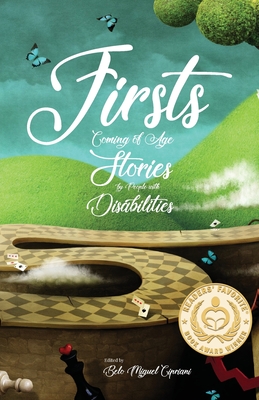
Firsts cover

Firsts: Coming of Age Stories by People with Disabilities, edited by Belo Miguel Cipriani

Doing anything for the first time has a profound impact on your life. In this collection, eleven authors write about their first time experiencing something. The firsts could be anything from raising a hearing child as a deaf parent, to navigating the complexities of a caregiver that isn’t a family member. What makes this anthology stand out is the different voices presented. Each writer has a very distinctive writing voice that makes it easy to like another story even if you didn’t care for the previous one.

Nothing Without Us cover

Nothing Without Us, edited by Cait Gordon and Kohenet Talia C. Johnson

I’m a sucker for fiction, especially speculative and realistic fiction featuring stories where disabled people are the heroes of their own story. Nothing Without Us is a multi-genre, own-voices anthology where the lead characters identify as disabled, Deaf, neurodiverse, chronically ill, and/or mentally ill. There’s something for everyone in these 22 stories that range the gamut from satirical to thrilling and suspenseful. The anthology has a vast contributor pool, which helps to spread out the many kinds of writing styles. The stories are evenly placed so you won’t get shocked because you’re suddenly jumping jarringly to a very different genre.

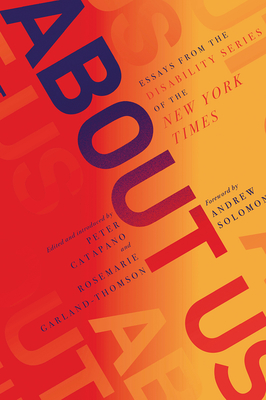
About Us cover

About Us: Essays from the Disability Series of the New York Times, edited by Peter Catapano and Rosemarie Garland-Thomson

If you’ve never read the disability section of The New York Times, this is a great, packaged, introduction to the column. If you have, it could be a complementary binding for offline reading. This anthology includes 61 essays originally published as part of a New York Times series on disability. The essays are organized into the topics of justice, belonging, working, navigating, coping, love, family, and joy. Essayists have physical, motor, sensory, and cognitive disabilities.

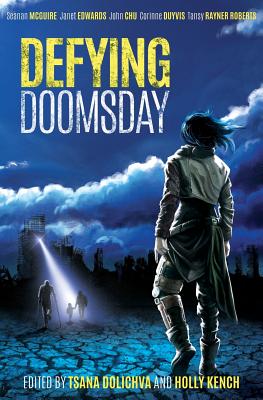
Defying Doomsday cover

Defying Doomsday, edited by Tsana Dolichva and Holly Kench

This anthology is pure fun. Defying Doomsday is an anthology of apocalypse fiction featuring disabled and chronically ill protagonists, proving it’s not always the “fittest” who survive—it’s the most tenacious, stubborn, enduring and innovative characters who have the best chance of adapting when everything is lost. There were a lot of good stories in here that had me hooked from the first sentence. A Deaf scavenger. A fellow blind person who’s just trying to survive but does everything wrong without giving up. There’s a lot here, mixed in with a lot of different genres and writing styles (and, thank goodness, a variety of ethnic backgrounds—not all the survivors are white). Even if you don’t like science fiction, I can guarantee there’s a story in here for everyone.

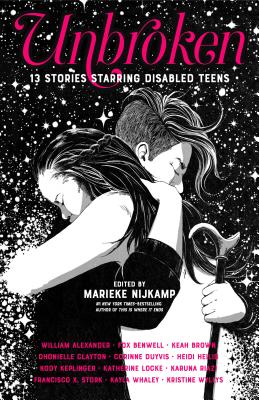
Unbroken cover

Unbroken: 13 Stories Starring Disabled Teens, edited by Marieke Nijkamp

I love a good young adult anthology and this one did not disappoint. In this anthology, thirteen short stories in various genres, each featuring characters with disabilities, present a lot of everyday emotions and experiences. The stories encompass everything from travel stories to war stories, to stories about riding a tandem bike with someone that you don’t know very well but shouldn’t judge. I really enjoyed all the stories and I especially loved the flexibility of the genres presented. Unbroken will offer today’s teen readers a glimpse into the lives of disabled people in the past, present, and future.

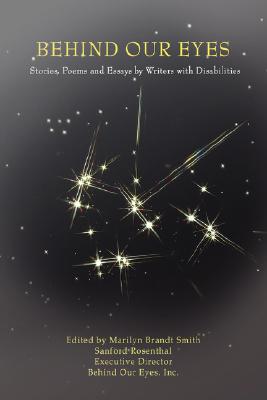
Behind Our Eyes cover

Behind Our Eyes: Stories, Poems and Essays by Writers with Disabilities, edited by Marilyn Brandt Smith and Sanford Rosenthal

This collection centers around the visually impaired experience. There are 27 contributors but most of the stories feature blindness or some kind of visual impairment. The stories in this collection are more contemporary , dealing with varying situations and emotions, such as the story “Rebel with a Cane,” in which a blind teenager defies her extremely protective parents and travels home, by herself, relying on her cane and her mobility skills. There are also stories about suffering strokes at age 25 and dealing with that emotional aftermath. Readers looking for contemporary stories will definitely like the pacing of this anthology.

A Love Story That Looks Like Me

Black queers deserve joy

 i deserve joy

 i want to read the story about 
 the awkward Black queer walking into a wall 
 cause they get startled by that fine ass human 
 who returns their gaze, with smiling eyes and says 
 “hell-- oh no are you hurt? can i help you?” 
 rushing over to help with their fioone ass 
 and that is the love story
 tripping, stumbling in silly embarrassing ways–
         like one of them opening their work computer at the office and having a heated scene from 
         crashpad playing loudly cause they forgot to close out incognito properly, and the other 
         covering for them in sort of romcom-esque scenario where they happened to stop by the 
         office that day and sayin IT WAS ME, THE PORN WAS ME, DON’T FIRE MY LOVE– 
 that’s the love story, lifting each other up
 and no one dies cause that’s not the point of this one, 
 not this one

 i deserve joy
 
 i want to watch the indie film about the 
 Black queer weirdo who gets anxious about their words 
 but speaks anyway and it's always okay 
 always
 and one day they realize it's cause their sibling saw them crying over their words 
 and summoned an eloquence elf to support them 
 and this isn’t any enslavement ass summoning either 
 the elf can only work its magic if it consents 
 and this elf saw this show of love
 and was happy to lend its power 
 and the Black queer weirdo writes the most brilliant ode to their dope ass sibling 
 
 i deserve joy 
 
 i want to hear the poem about the 
 Black non-binary kid 
 the one who wears gowns and joggers 
 while people keep telling them clothes are womenswear or menswear 
 but none of that matters to them
 and the kid is out and about in their mesh and gators, 
 glitter and snapbacks 
 decorating themselves for fun 
 imagine that?
 for fun!
 and naturally while they’re out there celebrating themselves 
 they meet another dope nonbinary being 
 and they get to be friends-
 and there’s no bullshit, 
 just friendship, 
 and the love and trust of being seen 
 
 i deserve joy
 
 i want a story about 
 how beautiful it was 
 for this black miracle to put their feet in the ocean for the first time
          or the snow
          or the sand
          or fuzzy socks 
          or whatever tactile joy comes their way
 and how it was at that moment of touching 
 they knew 
 they deserved joy too 

Can You Heal From Ancestral Trauma?

It’s a lonely existence, when you occupy the margins of the margins. We grow on the outskirts, looking for abundance, when the world insists in telling us that people like us will never be “normal,” will always need to fight to carve out spaces that we can exist in peace, in forgiveness, and in safety. I’m always in such gratitude when I find people who make me feel less lonely, less discarded by the side of the road. Fariha Róisín is one of those people: someone that I look to through my various chasms of loneliness, someone who I see part of myself in, who I can hope for a better future alongside. 

This past fall Fariha Róisín released a collection of poetry, How To Cure A Ghost, a lyrical exploration of trauma, loss and rebuilding. The book is expansive, touching on queerness, Islam, and institutionalized racism and structures of power, among many other things. As a fellow South Asian queer Muslim writer, I found myself gravitating towards its topics and the perspectives and lyricism that Fariha was bringing to the page. What struck me most about Fariha’s work was the insistence on healing, the commitment to being able to write through pain not to just get through it, but to heal it.  Alongside the poetry book Fariha published a journal workbook, Being In Your Body, as a space to expand the healing impulse so prevalent in their poetic work.  

In How To Cure A Ghost, Fariha writes “nurture makes you hate yourself less.” These poems are a project in nurturing, a poetics that interrogate the nurturing of an abusive mother-daughter relationship, the nurturing of a brown girl unloved by her various countries, the nurturing of having to walk through the world as a person of color under white supremacist violence. I’m grateful for Fariha’s words and Fariha’s friendship, and for this opportunity to talk to them and do a deep dive into their work.


Fatimah Asghar: A thing that struck me about your book was the deep explorations of family and trauma, particularly through the lens of your mother. What are your thoughts on intergenerational trauma, and the way that your book looks to name and grapple with it?

Fariha Róisín: Ancestral trauma, and not knowing how to handle it, is something that I find so often in South Asian communities. We all seem to be locked into some kind of horror show without knowing it’s abuse or violence that we’re witnessing. I remember telling a Sri Lankan friend of mine that my mother would regularly beat me, and her response was a bemused so what, my mother beats me all the time. It was at that moment (I was 14 at the time, so was she) I think I first understood how deep this normalization of violence was, how pathetic its normalcy was.  

The thing I didn’t know how to articulate back then is that even then, there’s always a difference between who administers that violence. For me, my mother was not affectionate. She’s probably said something nice to me a handful of times, truly. Growing up was painful because it meant there was no reprieve from the trauma she’d inflict. 

It’s something that my father, sister and I have suffered the most from… the onslaught of violence that we’ve systematically experienced from her. But also the lack of a solution. It’s been that way since she and my father married; since my sister and I was born—it’s not changed. So, what to do with the feeling of being a lost cause? 

I feel like a failure because I didn’t save her, I also feel like she’s failed us because she hasn’t saved herself. 

I was tired of not being seen, I was tired of suffocating. So I wrote this book.

I’ve rarely (if ever) read anything that described my experience of growing up. It’s lonely having been raised with no tenderness. When her hands did touch my body they were always cruel… which has led to a host of problems on my end: extreme sexual and physical trauma that’s leaked into my feeling of inadequacy in both relationships as well as my professional life. It’s extremely hard for me to feel good about myself… but this year, with How To Cure A Ghost coming out, I understood the cycle needed to stop. I had to start facing my demons. I started seeing a trauma therapist.

This is my roundabout way of saying: intergenerational trauma is not only real, its insidious. Having said that, it’s really not talked about. At least not in the context that I talk about it. I think I was tired of not being seen, I was tired of suffocating. So I wrote this book. 

FA: How has it been having a book that’s so personal, particularly around family, released in the world?

FR: I’ve probably told you this before, but I truly went insane this summer. I just had ego death upon ego death. After I journeyed (through ayahuasca) the first time something began to click… it didn’t really matter if no-one liked this book—because my god do I like this book. I still cry when I read my book. That’s real. Every time I read it… I feel closer to liberation. There’s something unimaginably powerful in saying your truth out loud. So I take a deep amount of solace and gratitude in that. I’m so fortunate to have been allowed to say what I needed to say. 

My dad is staying with me as we speak. He hasn’t been back to America since 2002, after he was detained (there’s a poem named after him and this ordeal called Being An Immigrant) as he’s a professor that’s pretty anti-American. I really seriously thought he’d ever come back—he’s a Leo, so he’s extremely prideful. I’m a Capricorn, but we’re the same in that sense—we don’t like being disrespected. And the normalization of dehumanizing Muslims after 9/11 was something that we were being socialized to take and accept… But he’s here, and it’s incredibly soothing because I’m not in hiding anymore, and he’s accepting the person that I am… not the person he thinks I should be. I’m crying. This feels like a kind of liberation, too. He seems proud of the Muslim woman I’ve become. 

When he knew I was writing HTCAG he told me, “Don’t make ammu look bad.” It’s stuck with me, but I don’t know if it’s possible if I also want to tell the truth. I don’t know if he’s read the book, I don’t know if he ever will. But I’m not hiding it, I’m letting him take his time, and I’ll be here to talk when he’s ready. I guess what I’m trying to say, is it’s a process. And I accept the process.  

FA: I love that your book also came along with a guided journal, Being In Your Body. Why was it important for you to release both of these books at the same time, and what did the construction of Being In Your Body mean to you?

FR: Karrie Witkin, who is my editor for Being In Your Body, really listened to what I wanted to achieve with this journal. I insisted it to be for any woman/femme-identifying or non-binary person to relate to because having an honest conversation about bodies is something that I also never had. There was never any transparency over a woman’s body when I was growing up and so much was shrouded in secrecy or code. I was sexualized really young as well, as a survivor, so I never really had a full understanding or command of myself. That’s why I hold a lot of trauma in my body, which means I actually need a lot of bodywork done on the regular so I don’t disassociate. 

I didn’t even know I disassociated until late last year. The process of healing is so non-linear, and our bodies are so unknown—even to ourselves. Doesn’t that say something about how unaware we are?

If I had known what non-binary was at 10, I think I would have felt a deep understanding of myself that I didn’t have until much later. That’s why it’s imperative, as writers, we speak to the things we need… because usually, that means other people need them as well. 

FA: I also love the illustrations in your book. What was the process of working with your illustrator, and why was it important to you to include visual art inside the book, alongside the poetry?

FR: Monica Ramos is such a talented, tender human. Her interpretation of the poems are her own, but what’s so intense is that they feel like me. I really enjoyed the process of being read in a different sense. I wanted her to find the ghost, the shapes and squeaks between the lines—the phantom feeling of longing, the serendipity of pain, the spirit of loneliness—and she got it all. She’s Filipina and I really love that juxtaposition against me, a Bangladeshi writer. There’s a symmetry between Bangladesh and the Philippines in many ways, the sort of feeling of a jungle… and so she picked up on so many in-between characteristics that I really enjoyed her interpretation of. It felt important to not only have a visual aid to the book but also to have a participating guide that could ease and soothe the reader. Because this book is heavy. It looks cute, but it’s a Trojan horse of healing. 

FA: On a craft level, what really excites you about your book and the process of poetry? 

FR: That even despite my own hesitations of not being a formal or trained “poet” I have an interesting way of expressing lyric that is very counter-culture, and anti-establishment in the best and most honest sense. Because I’m so naive about poetry, it actually allows me a freedom that I really enjoyed exercising with my book. I wasn’t trying to emulate anyone, I was just channeling myself. I’m proud of the integrity of the work, in that sense. 

FA: Are there any topics that you feel like you really struggled to write about or come to terms with in this book? What did the process of writing your own book teach you?

FR: Nothing comes to mind. I’ve been writing about my mother enough that I’ve come to accept my own positioning of being a writer, creator who is inspired by their own life. There’s always a moral conundrum to write about people that are real, and I don’t have any answers for the morality of it other than I try and be a person who is honest, with perspective and generous in retrospect. Maybe writing this book taught me it was okay to talk about my trauma, finally… Especially because I’m not trying to demonize my mother, I’m trying to understand her. 

FA: Your book also grapples with some of the loneliness of South Asian and Muslim identity. What does it mean to you, in particular to be a South Asian author? A Muslim Author? What is a vision for your people that you hope for?

FR: Wow. What a hard question.

Well, you and I have talked this before… how lonely it is being South Asian in our respective fields. There’s not a lot of togetherness, and then there’s just not a lot of us. You were one of my first South Asian writer friends, Tanaïs is the other. Over the years I’ve become friends with Vivek Shraya, Alok Vaid-Menon, Rupi Kaur—but the pool is small and not everyone wants to be friends which always hurts, but it’s also life. 

I get a lot from my friends that are younger SA folks… but I’ve also just started buying a lot from South Asians. I love buying my friend Tanaïs’ brand HiWildflower, I bought a painting from my friend Salman Toor, and Ayqa Khan, I love my friend Prinita Thevarajah’s glassware, Kapu… I mean the list is endless. But also, I’m loving Anupa Mistry’s podcast/newsletter Burnt Out, as well as Thanu Yakupitiyage and Rage Kidvai’s Bad Brown Aunties (Full disclosure: I’m one of the interview guests, and it’s one of the most heart-searingly honest ones I’ve ever done!). I’m loving Samavai’s photography and beautiful, genderless sari shirts

Being Muslim in this world comes with blinding pain. It’s watching your people get burned everyday.

I’m trying to invest in us. I think the future is generosity. The future is an embrace. It’s knowing we’re stronger together. That’s my vision for our people—to truly decolonize, we need to understand there is no division. But, we need to get there first. 

I talk about this with Tanaïs all the time… what it means to be Bangladeshi is different. In her words, we are a syncretic people. To be Bangla AND Muslim… is so specific of an experience. 

I’d be remiss if I didn’t say that there are lynchings happening of Muslims throughout India. I’m reading Arundhati Roy’s The End of Imagination right now and she’s talking about the pogroms of Muslims throughout India—men, women, children are being taken out of their homes and shot dead, hung—by civilians. The numbers are devastating. To have Modi as PM right now is chilling, especially as he is said to have been behind the massacre of Gujrati Muslims in 2002, where thousands of Muslims (children included) were slaughtered. Then you have what’s happening to Rohingyas, majority of whom are Muslim, in Burma—over a million refugees fleeing from Buddhist monks to Bangladesh. 

Being Muslim in this world comes with blinding pain. It’s watching your people get burned everyday—whether its with the Uighurs in China, whose organs are being harvested! Who are in concentration camps right now, one million of them! Or what’s happening in Palestine, Syria, Iraq, Sudan, Afghanistan… my people. It hurts. 

But now that’s why we have to write, we have to work. We have to protect us. But, I also see a future where we are all protecting one another. Because we understand there’s a beauty in difference. I know I’m corny, but we’re better together—as humanity. I want to get us to that kind of enlightenment.   

FA: You write across genre a lot, and I wonder if you can speak to that process—how the craft of your different writing practices inform each other? When do you know what you have in front of you is an essay, or a poem, or a novel?

I write high a lot and then I’ll edit sober.

FR: Writing is very intuitive to me. I write high a lot and then I’ll edit sober. I don’t drink anymore, so there’s never that these days but I used to love drinking a glass or two and just releasing whatever came to me. Pure creativity!

I guess I always have a sense a few sentences in what I’m writing. God, I love that flow. It’s tantric. When the creativity starts purring through your body, my god. What a feeling. I just go with it. I really just go where it takes me. 

FA: What were the books that you found yourself reaching for when writing your book? What books do you think are your books siblings?

FR: I don’t know if it has any book siblings but I’ll tell you the books that floored me while writing this: Dictee by Theresa Hak Kyung Cha, Asmarani by Safia Elhillo, Voyage of the Sable Venus and Other Poems by Robin Coste Lewis, Jane: A Murder by Maggie Nelson, Breath of Life by Clarice Lispector (Lispector is my favorite writer, and I read her voraciously while writing this book), Sleepless Nights by Elizabeth Hardwick, Look by Solmaz Sharif, Bright Lines by Tanwi Nandini Islam (now Tanaïs), Night Sky with Exit Wounds by Ocean Vuong, Seam by Tarfia Faizullah, Islands of Decolonial Love by Leanne Simpson, The Chronology of Water by Lidia Yuknavitch. And your book last year babe, it gutted me.

How “Knives Out” Turns the Whodunit on Its Head

Edmund Wilson was not a fan of detective fiction. In a 1944 essay titled “Why Do People Read Detective Stories?” he detailed his befuddlement at this newly burgeoning genre attracting all kinds of fans, from Woodrow Wilson to T.S. Eliot. “Almost everybody I know seems to read them,” he bemoaned, which is why he set out to figure out what all the fuss was about. What he found, in reading the likes of Agatha Christie, Rex Stout, and Dashiell Hammett, was in his estimation a hollow type of novel, a page-turner that demanded little of its readers other than to rush along its propulsive plotting. His essay, a hot take of its time, angered his readers who sent in irate letters that in turn became fodder for a follow-up piece, “Who Cares Who Killed Roger Ackroyd?,” in which he doubled down on his criticism of the whodunnit genre. 

Wilson’s rather snobbish critique sounds familiar because it’s been lobbed at detective fiction for decades since. Derided for producing the kind of novels one solely reads for the plots and dismissed for creating self-contained worlds that at best mirror and at worst perpetuate the status quo, the murder mystery genre has long been a punching bag of sorts. But after a century of such criticism, Rian Johnson’s Knives Out is punching back. This modern twist on an old classic understands that the genre’s formulas are fertile ground on which to hang strident critiques of privilege and class—not by modernizing its tropes but by weaponizing them for a new audience. All the elements of the genre remain (an unsolved murder, a parade of possible suspects, a keen-eyed detective). Here, though, they are used to reveal not just who did, indeed, do it, but why such a mystery poses a danger to those most eager to have it solved. In a way Johnson pushes past Wilson’s critiques, creating a narrative where the question of “who killed Harlan Thrombey?” is both necessary and irrelevant at the same time.

After a century of criticism of the murder mystery genre, Knives Out is punching back.

As with most classic whodunnits, Knives Out begins in an overly cluttered and perfectly manicured large Victorian house. An estate, really. The Thrombey family has been gathered to celebrate its patriarch’s birthday. Christopher Plummer’s Harlan Thrombey is, in one of the film’s many cheeky nods to its generic lineage, a crime novelist known for his very successful murder mysteries. But the day after the festivities, Harlan is found dead, his throat slit open by his own hand. As open-and-shut a case as you’re likely to find—except that an anonymous tip has led famed private detective Benoit Blanc (Daniel Craig, sporting an absurd-sounding Southern accent) to reexamine the events that led to Harlan’s death, all in the days before the wealthy writer’s will is to be read. 

Again, as per the stipulations of the genre, the film introduces us to the members of the Thrombey family—all of whom, given their proximity to Harlan (they were all staying at his home after the party) are suspects in Blanc’s eyes. There’s his devoted daughter Linda (Jamie Lee Curtis) alongside her husband Richard (Don Johnson) and the black sheep of the family, their son Hugh (Chris Evans); Harlan’s son Walt (Michael Shannon), who managed his literary estate, along with his wife Donna (Riki Lindhome) and their teenage son Jacob (Jaeden Martell); as well as his daughter-in-law Joni (Toni Collette), who depends on financial assistance from Harlan to pay for her daughter Meg’s school (Katherine Langford). The other two key characters in the picture are Harlan’s housekeeper Fran (Edi Patterson) and his nurse Marta (Ana de Armas). 

Johnson sets up exactly the kind of puzzle that Wilson dismissed: a plot-riddled parlor trick that demands readers become sleuths-in-the-making. Here was an obvious suicide that nevertheless kicks off an investigation that reveals an entire family as plausible suspects, guilty perhaps not of murder but of something much more insidious. Wilson may have hated detective fiction, but his rant about it illuminates why the genre so captures people’s imaginations. It wasn’t surprising to him that whodunnits had become all the rage during the interwar period. “The world during those years was ridden by an all-pervasive feeling of guilt,” he wrote, “and by a fear of impending disaster which it seemed hopeless to try to avert because it never seemed conclusively possible to pin down the responsibility. Who had committed the original crime and who was going to commit the next one?” There will, he stresses, always be a second crime—and Knives Out quite diligently follows suit, reminding viewers that we can’t trust anyone on screen. 

Paranoia, after all, is the guiding principle of any respectable whodunnit, and its resolution is the genre’s most tantalizing promise. But Johnson is aware that our paranoia cannot be so easily dispelled. At a time when fears of the other are rampant, especially when talking about immigrants, Knives Out sets out to challenge our assumptions about who is seen as a villain and who is a victim. By the time our trusted detective announces who was behind it all and how the improbable series of circumstances led to Harlan’s death, we are firmly distrustful of our gut instincts as well as of our more logical hunches. For Wilson, this was why the genre was so well-suited for the interwar generation. “Everybody is suspected in turn, and the streets are full of lurking agents whose allegiances we cannot know,” he adds. “Nobody seems guiltless, nobody seems safe.” 

The neat resolutions that are the hallmark of the genre (the murderer is revealed) insist upon restoring order: “The mur­derer is spotted, and—relief!—he is not, after all, a person like you or me. He is a villain—known to the trade as George Gruesome—and he has been caught by an infal­lible Power, the supercilious and omniscient detective, who knows exactly where to fix the guilt.” Here’s where Knives Out refuses to play by the rules. Solving Harlan’s death becomes an exercise in showing how various members of the Thrombey family may well be variations on “George Gruesome,” villains in their own right—but they are also recognizable everyday people, whose guilt may not be easily pinned down to any one crime. Rather than reminding us that evil people are not “a person like you or me,” Knives Out stresses how fallible such distinctions can be by focusing precisely on the one guiltless party in the film.

The resolution of this ‘whodunnit’ isn’t about who done it. It’s about revealing how people like Marta are always suspects even before there is even a crime.

When the film first introduces us to the Thrombey family, they aren’t worried about being blamed for Harlan’s death; this was, they know, an unlikely but clear-cut suicide. Rather, the fear they betray when talking to Blanc is  that their wealth and accomplishments will be challenged. Linda insists she built herself from the ground up (not mentioning the loan she got from her father); Walt establishes himself as a business savvy literary executor who was hamstrung by Harlan’s decision to forgo adaptations (others all but call him a moocher); while Joni boasts about her lifestyle brand (again, making little mention of how financially dependent she was on Harlan). The more we witness that final night in the Thrombey house, the more we realize Harlan was intent on making each of his family members understand the privilege he’d afforded them, having conversations with several of them that put their own futures in jeopardy. It’s no surprise when it’s Marta, the young nurse with an undocumented mother, who emerges as the film’s beating heart, even if all signs point to her having kicked off the series of events that led to Harlan’s death. The dramatic tension at the center of Knives Out hinges on Marta’s acquittal, an outcome that becomes, as the Thrombeys soon find out, a risk to their status quo. 

The face-off between Marta and the moneyed and well-connected Thrombeys (whose self-serving liberal ideas of themselves are best encapsulated by the fact that none can remember where exactly Marta’s family is from) becomes the key to the puzzle at the heart of Knives Out. The picture-perfect facade of the family starts crumbling down once they learn not only more about Harlan’s death but about his will, which rewards Marta for her friendship and cuts his leeching family members off from Harlan’s fortune. That this causes young Marta to be persecuted, threatened, cajoled, and intimidated is the point of the film: the niceties they all afforded her when she cared for Harlan fall apart the moment she may well become their equal. The paranoia of the whodunnit is transformed; it’s not the fear of who might be next to die, but the more inchoate fears seemingly nice, liberal people still harbor about those who are unlike them. To the Thrombeys, Marta needn’t be guilty of killing Harlan; the threat she poses is her mere existence as their financial and social superior. Indeed, their legal fight against her and Harlan’s will doesn’t hinge on her guilt; she only needs to be credibly suspected of murder for the Thrombey family to get what they believe is rightfully theirs. When the villain of the piece is revealed and their scheme explained by Blanc, the paranoia is not dispelled. The resolution of this “whodunnit” isn’t about who done it at all. It’s about revealing how people like Marta were and are always suspects even before there is even a crime.

Unlike the novels Wilson was reading, this “George Gruesome” is indeed, a person like you and me, which makes his machinations all the more discomfiting. The guilt is not magically washed away by finding the culprit. Instead, the hunt for them has served as a way to unearth the ugliness that was there, around us, all along. Order is not restored. In fact, it’s turned upside down. The mistrust and paranoia that drive a whodunnit are here deployed not as a way to simply root out the guilty party (aka the person who caused Harlan’s death) but as a way to reveal how structures of power and privilege are similarly premised on near-crippling suspicion of the other. 

What Women Talk About When Men Aren’t in the Room

Miranda Popkey’s compact, powerful novel Topics of Conversation begins when its narrator is 21and spans nearly two decades, revolving around the conversations she has with those around her. These conversations, mostly with women—friends (or frenemies), mothers (the narrator’s own, plus the ones she encounters), and strangers (on the screen and in the ocean)—span a range of topics, of secrets, of fears and of desires. 

Topics of Conversation by Miranda Popkey

“There is, below the surface of every conversation in which intimacies are shared, an erotic current… This is the natural outcome of disclosure, for to disclose is to reveal, to bring out into the open what was previously hidden,” reflects the narrator as she listens to another woman tell the story about her marriage’s end. The women of Popkey’s novel are searching, skeptical, and hyperaware. They are spiked with equal doses of hurt and want. 

I had the chance to talk with Popkey over the phone about her book, as well as women’s anger, power dynamics in relationships, how desire is formed by the stories to which we’re exposed, and the ways narrative functions in our lives.


Alexandra Chang: You write that you believe a writer shoves into her first novel “more or less everything she has ever thought, seen, read, loved, hated, experienced.” In your book, you do tackle so many topics—desire, power dynamics, class, art, motherhood, anger, friendship, storytelling, and more. What was your entry point? How did you navigate fitting all of this into the novel? 

Miranda Popkey: One entry point was that I had wanted, and I’d been trying for some time, to write about a particular relationship dynamic that I have experienced, which is exaggerated in the story that the narrator tells when she is at a new moms’ group. She talks about having an affair with a professor. I, to be clear, never had an affair with any of my professors. But I have been in relationships where the power dynamic was unequal in a way that was both appealing and, in retrospect, damaging. I was interested in trying to write a story about that somehow. I tried for a while and it wasn’t working for whatever reason.

The most obvious thing to say is that what happened in the fall of 2017, the allegations about Harvey Weinstein—sexual assault, sexual abuse, sexual harassment, rape—all of those started coming out. Suddenly there was much more of a conversation about these kinds of relationships in which someone has much more power than the other person, and the conversation expanded so that it was possible to also talk about situations where the power dynamic was more equal, but still troubling. I worked in publishing for a long time and there was quite a spirited discussion about various people who had potentially been sexual harassers or had been otherwise inappropriate. I don’t know why, but that was a way that things got unlocked. It certainly played a role—just having that be in the air and having women’s anger be a topic of news, and not in a negative way. We were talking about good reasons that women might be angry. 

AC: The voice of this novel, with the narrator especially, there’s such a strong sense of ambivalence, which I really loved because, at least for me, ambivalence is a really productive state for inquiry. I was wondering if you, especially in depicting these relationships with older men, could talk about how ambivalence played a role in your writing.

MP: I do want to answer this question but I’m not totally sure exactly what you’re getting at. 

AC: Several of the women who appear in the book talk about having relationships with older men, and to me, I guess there’s a strong ambivalence toward that. The women almost enjoy the relationships because the power dynamics are very clear. And then there are women who, some of them the same women, sabotage their relationships with “kind” men, as the narrator does. So there’s both a sense of ambivalence toward relationships, and of not being able to trust one’s own desires as a woman.

MP: Okay. Totally. In my mind this is very much a novel about being socialized as a woman in a particular moment. The novel is not meant to speak for all women. My particular experience is quite narrow—middle class, white, cis, straight. But I don’t think I was the only woman who was surrounded by images of a certain kind of dynamic in popular culture in heterosexual relationships. It’s inevitable that you are absorbing, especially when you’re younger and you’re not thinking as critically, all of these models without really knowing how influential they might end up being. 

Part of writing the book was trying to go back and figure out, what’s my damage?

What is appealing about the power dynamic that you described is—and you sort of hit it right on the head of as you were expanding on the question—the power dynamic in that situation, older man with power, younger woman with less power, is quite clear. I think that’s appealing because that is a model that we have seen. Though it is also a model that is coming to be challenged more and more. 

I didn’t watch the second season of Fleabag until after I finished writing, but it’s the moment where she’s in the confessional and she asks the hot priest, Tell me what to do. I think it’s very hard to be a person in the world right now. It’s quite appealing to consider, what if I just ceded control to someone else? That’s especially appealing to women because it is a paradigm that’s been so available and that, in fact, has been presented as the right paradigm, the model. That’s where that ambivalence comes from. There were not a lot of models that I saw growing up, when all of these ideas were solidifying in my mind, of women who were seeking sexual or romantic partnership on their own terms.

AC: What I found so interesting, too, is that a lot of the women in your book when they’re talking about those kinds of relationships, there’s this awareness that the dynamic is not great, but because of the socialization and the stories you’re talking about, they’re still drawn to it. 

MP: Yeah, that’s the particular bind of being alive in this moment. When you know it’s bad for you, but you’ve been told you want it for so long. And it’s hard for those two things to coexist. I think that there are lots of different reasons why stories written by women, stories written by queer people and people of color and trans people and nonbinary people, are important to tell. One reason is that there are a lot of people whose understanding of sexuality, of their own sexuality, would be so much more expansive if the cultural offerings were broader or had been broader when they were growing up. This is very true of myself. And part of writing the book was trying to go back and figure out, what’s my damage? What the hell is going on with my brain, that this is the kind of thing I have at times wanted? 

AC: So when you were trying to figure that out, were you re-watching these movies and going back to other source material?

MP: Yes. One that was really important was LA Confidential, which is a movie I watched once a month for a year when I was like 12 or 13. I was obsessed with that movie. Have you seen that movie?

AC: No, I haven’t. 

MP: I’m not going to recommend it. It certainly did a number on me. But the central romance of that movie, set in the 50s in Los Angeles, is between a cop who is obsessed with wife beaters, and who is himself quite violent towards them because his father beat his mother, and a high-class call girl who is styled to look like Veronica Lake. The central romance is between these two characters, a very angry man and the sex worker who unwillingly falls in love with him, so that was a movie that, in retrospect, I don’t think I should have been watching. 

I find it impossible to think of life as other than a narrative.

I mean, honestly, the Veronica Lake look-alike character was so much less important to me than the fury that is contained within the angry cop. He’s played by Russell Crowe, and he’s a ball of fury, and the movie presented it as tantalizing. The idea that he could at any moment snap. And he does at one point hit her. Anyway, it’s a really sad movie. But I was like, okay, yes, I see what I like. My dumb little adolescent brain was like, Yes. You are a cold woman. You have sex for money, but an angry man comes and he sweeps you off your feet. Yes, this is correct. 

That one was a real trip to watch for a second time or for, I mean, a 200th time.

AC: That’s related to the long “Works (Not) Cited” section in the back of your book. Your novel is, like most works of art, in dialogue with a lot of other texts, including books, but also movies, TV shows, podcasts. I liked that you made it explicit in that section. I was wondering if you could talk a bit more about how you understand that dialogue taking place, and how these other texts shaped your book. 

MP: The book owes a really obvious debt to Rachel Cusk. Reading Outline broadened my understanding of the ways in which a novel could be structured. Also, I had read in my MFA, Rings of Saturn, the Sebald novel. There’s a thing that he does, I think more than once, where the narrator of a section will change mid-sentence. You’ll sort of continue reading a couple pages and realize you’re not sure who’s speaking, and you go back and you try and find the moment of the handoff, and it was in the middle of a sentence. I just thought that was so cool. It didn’t occur to me that you were allowed to do that. 

Azareen Van der Vliet Oloomi’s Fra Keeler has a list of works that influenced the novel at the back. I loved it, because it gave such a clear picture of the places that her mind had drawn from. And it also gave you more things to read. I don’t think of myself as a very creative person. I don’t think of myself as someone with a great imagination. For that reason, it was important to me not to present this novel as a work that had sprung fully formed, or even formed at all from my brain. Of course, it did come from my brain, but my brain is a soup with all this other stuff. It felt really important to me to acknowledge that. 

Once I’d seen someone else do it, and once I decided I really can’t publish a book that does these things and not credit Rachel Cusk and not credit Sebald, then it became a real pleasure to think about where all this was coming from and do some of that exploration and rediscovery. I would keep adding to that list forever. 

Also, I had a lot of fun admitting to myself and to the reader some of the garbage that I was inhaling as I was writing. Like, I literally watched 11 seasons of Frasier in the space of a couple of months.

AC: That’s pretty amazing.

MP: It’s something, yeah. One stands amazed before such an accomplishment. But at its core, I just really, really wanted people to know, this isn’t all mine. It comes from so many other places. My fondest hope is that my book gets dropped into the soup of someone else’s brain and that some writer at some point in the future is thinking about it when they write.

AC: The act of storytelling in the book is so important. There’s one chapter where the narrator is with the group of new single mothers and asks them to tell the story of how they got there. “There,” being single motherhood. Another woman calls her out and says life is just a series of accidents and coincidences and demographics, and that there’s no point in understanding the why and the how. There’s no reason. The narrator later, alone, counters that take. I was curious about your own thoughts on the function of narrative in our lives. 

MP: I find it impossible to think of life as other than a narrative. And I recognize that tendency in myself and I try and be quite careful not to try and build a narrative out of my life. If, retrospectively, it helps to see a story, to understand why things happen, I think that’s fine. The thing that I really have tried, as I’ve gotten older to avoid is what the narrator says casually, early on in the book, about wanting or looking for the better story. I think that there is a kind of fatalism or determinism there that helps her feel absolved of certain kinds of responsibility that she should actually be bearing the full burden of. If you think that once you’ve put certain plot points in motion, that you can see the end of the narrative, it sort of absolves you of responsibility for the further choices that lead you closer to what you’ve decided is the end point. I think that is the kind of thinking that leads her to make some of the more damaging decisions in her life. 

Like I said, though, I can’t think of my life other than as a narrative. I was once involved with a person who told me that they did not think of their life as a narrative. I truly did not know what to do with this information. This seemed so psychotic to me, that you could actually look back at your life and not try to make a story out of it. But there are those people out there. And perhaps they are more well-adjusted, they are living more fulfilled lives, because they don’t have that urge to complete the narrative. 

10 Collections By Latinx Poets You Might Have Missed in 2019

Poetry serves to disrupt, to inquire, to interrogate the nature of being. Latinx communities are, more than ever, subverting the narrative that there is a singular expression of Latinidadan expression that has historically centered the mestizo, largely Mexican experience. Some are even rejecting the label of Latinidad in favor of celebrating other aspects of their identity: queer, indigenous, African, or Carribbean. What it means to be Latinx (still an evolving term) is celebrating the intersections of Latinx cultures with race, class, migration, disability, and access to our own stories. 

In a time where Latinx peoples have continued to be made both hyper-visible and invisible by the current administration, it is exciting to see a multitude of Latinx poetic voices interrogating the identities that have been imposed on them and blazing new paths for themselves.

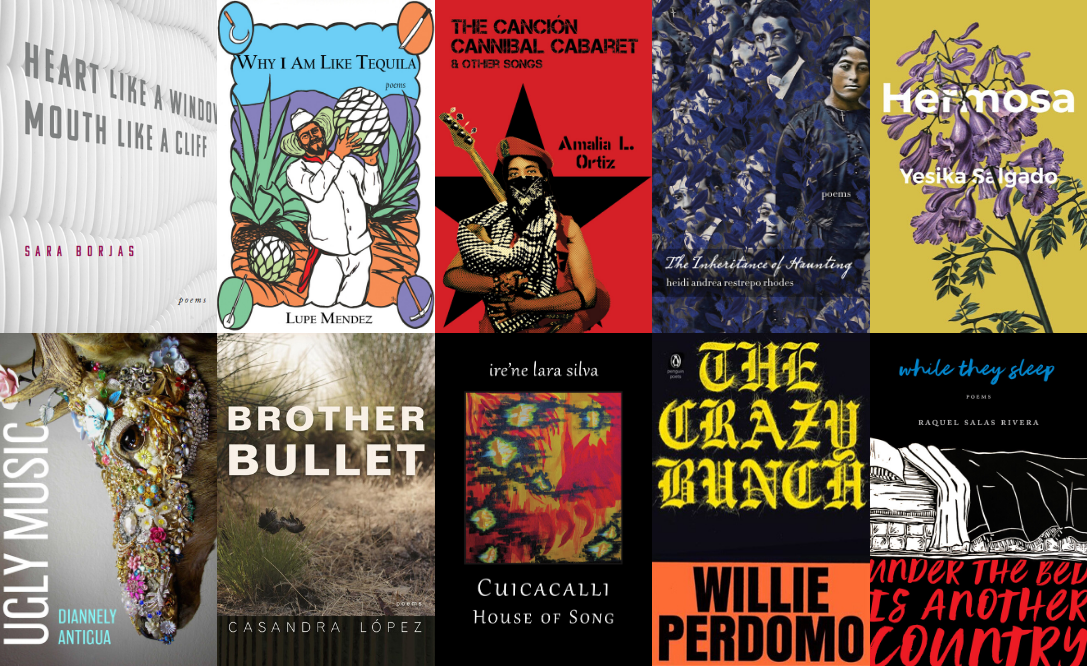
Ugly Music by Diannely Antigua

In her debut collection, Diannely Antigua searches for identity amidst the murkiness of a religiously oppressive adolescence, past traumas, and mental illness.

Heart Like a Window, Mouth Like a Cliff by Sara Borjas

In my interview with poet Sara Borjas, we discussed how her new collection explores being a “pocha” poet, the struggle to feel Mexican enough in the face of stereotypes, and what being Chicana means to her.  

The Crazy Bunch by Willie Perdomo

The Crazy Bunch by Willie Perdomo

Set in 1990s East Harlem, this collection tells the story of a crew over one summer weekend. Read an interview with Willie Perdomo about storytelling as a bonding agent and recreating a memory about a neighborhood that no longer exists.

Hermosa by Yesika Salgado

Hermosa, the third book in Yesika Salgado’s poetic series, explores how healing allows the poet to find a home within herself. Her previous two collections were about finding love, both familial and romantic, after mistreatment and loss. Hermosa is about the poet contending with her past, her family history, the Salvadoran diaspora, and how this affirms the self she has always hoped for.

Image result for While They Sleep (Under the Bed Is Another Country) electric lit

While They Sleep (Under the Bed is Another Country) by Raquel Salas Rivera

In one of the poems in the collection, the poet asks “how could i just move on?” calling to the in-between place that many Puerto Ricans find themselves in the wake of Hurricane Maria and the continued fractured relationship between homeland and the colonial power of the United States. In the collection, the questions are partly in English, speaking to the perspective and concerns of American imperialism, while the answers are in Spanish, speaking for the colony that will not remain silent.

The Canción Cannibal Cabaret & Other Songs by Amalia L. Ortiz

Amalia Ortiz is a spoken word performer and poet who has been performing with other young, queer Xicana artists around Texas, even playing at the border fence in the Rio Grande Valley. The Canción Cannibal Cabaret, a punk rock post-apocalyptic opera, shows her ability to combine lyrical style with theatrical performance. The book depicts la Madre Valiente, a radical matriarch, and her Hijas de la Madre, a gang of revolutionaries who combat racist and misogynist violence at the hands of the State. The collection includes both narrative and lyrical poems and sheet music for the performed songs, transcending what we understand as the traditional poetry collection by affirming that poetry should be radical and accessible. 

Image result for Brother Bullet: Poems

Brother Bullet by Casandra López

An unflinching look at grief in the wake of personal, familial and historical violence, Casandra López’s debut collection explores life after the unsolved murder of her brother. The poet is tender with the memory of her brother while also indicting the historic violence against young indigenous men in the US. These haunting poems illustrate how grief is a means of survival. 

Why I Am Like Tequila by Lupe Mendez

In his debut collection, poet and performer Lupe Mendez acts as witness to the elders, neighbors, and children of the Tejanx and Mexican communities he is a part of. Codeswitching across English and Spanish, the poems show the work, the love, the beauty created by these communities while also depicting the violence levied against them by outside forces.

Cuicacalli: House of Song by Ire’ne Lara Silva

Ire’ne Lara Silva is a prolific poet who often writes in cycles, ruminating on pressing issues in the Chicanx community. This collection speaks to the responsibilities of Chicanx elders to help a younger generation struggling with their identities to get free from the colonial legacies that created a border and fracturing families. 

Image result for inheritance of haunting

The Inheritance of Haunting by Heidi Andrea Restrepo Rhodes

Winner of the 2018 Andrés Montoya Poetry Prize, this collection is a rumination on the memories, the violence and the acts of liberation that live in the body across generations of colonization, war, and upheaval. In an interview about the collection, the poet said that “that which haunts us also entrusts us with what we will make of it all, urging us to labor, to conjure ungovernable life against the hold.” Representing the voices of individual and collective ghosts from across Latin America, this collection asks us to account for the past and to celebrate the lives that come after. 

Tristan and Isolde But Make It Queer

“Tristan”
by Lucy Hughes-Hallett

“You’ll have to go and meet her.”

“Why? Is she a half-wit?”

“Her flight gets in at eleven fifty-five. Find her. Be sweet. Take her to lunch in Windsor––she’ll like that.”

“What makes you think she”ll like it?”

“Then bring her back here. Why are you being like this? It’s a question of politeness.”

“Why can’t she just get the train. Is she a cripple or something?”

“She’s physically perfect. As near to perfect as it’s possible to be.”

“What’s she coming for?”

“To marry me.”

“What the fuck? Are you joking?”

“No. This is real.”

Silence

“Why aren’t you meeting her then?”

“You know I can’t. Not with the Fair on.”

“You won’t miss half a day’s business for her, and you expect her to marry you.”

“It’s a pity but…We discussed it. She knows I have to work. She kind of likes it. She likes knowing her man is this big busy deal-maker.”

“She doesn’t. Nobody would. You’ve got to be there when she comes through the gate. Next to all the drivers with their bits of cardboard. You put your hand on the barrier and you vault lightly over it and you put your arms around her and lift her up so her feet are two inches off the floor and you bury your face in the side of her neck and she’s dropping things––passport, wallet, everything, the duty-free vodka, and you say…”

“She’s actually appreciably taller than me.”

“Oh. Oh. In that case I have to revise all my ideas. In that case you stand quite still at the end of the barrier and let her come to you, and she walks with long easy strides, she lopes, and she’s wearing a linen dress that’s like a coat and it billows out behind her and it’s unbuttoned at the front so that her legs are half bare and they’re burnished like bronze swords and she doesn’t wear jewelry but there’s a leather thong around her neck and when she reaches you she puts a hand on your shoulder and she dips her head and she bites…”

“Shut up, Tristan. She is actually a real person.”

“Yes? So? Where did I say she wasn’t?”

“She’s real so there’s no need to make her up.”

“I like making people up. The people I make up are much more amusing.”

“More amusing than…?”

“More amusing than you, you literal-minded old faggot.”

“No more cheek. And no more homophobic language. I’m getting married.”

“So you say.”

“That’s right.”

Silence

“And have you considered the possibility––has it crossed your mind for even one single second––and if it did would you give a toss about it––has it occurred to you that if you really are doing this thing, then you might be breaking my heart?”

“Eleven fifty-five. Terminal 3. Car keys on the hall table. Have dinner with us tonight.”

“Us?”

“With me and my girl.”


The things that Mark Cornwall bought and sold were––at least purportedly––very old indeed. Their monetary value was more closely related to their antiquity than to their beauty. His regular clients liked to hold an Egyptian basalt hawk, or an agate bull from Mesopotamia, and feel the centuries thrumming through the stone. No matter that the carving tended to be crude and the creatures depicted barely identifiable in the lumpen forms. You didn’t have to be superstitious to feel the potency of a thing that had been held and treasured and very, very gradually worn away by the stroking hands of generation upon generation of long-dead human beings.

To get the non-specialist buyers in, though, you needed some straightforwardly lovely stuff. Alabaster always looked good, so long as you knew how to light it (Mark’s tech-guy really, really did). Fragments of Roman wall-paintings for color. A Macedonian gold tiara for flash. Anything that had once been animate got attention. Mark had recently been amassing a stock of mammoths” bones. Dutch trawlers brought them up in their nets from the bed of the North Sea. Quite a few people were interested. The big draw at his stall at this year’s Fair, more popular even than the tiny silken shoe of a Han dynasty princess, was the shoulder blade of a bison scratched all over with twig-like bipeds––a three-thousand-year-old hunting scene depicted by the predator on a left-over part of the prey.

Mark was nervous, which was a condition so unfamiliar to him that he initially mistook it for oxygen-deprivation. “I’m going out for a breather,” he said to the intern. “Text me at once if anyone looks like they’re getting serious.” The intern had a vapid face, but there was something about the turn of her neck that reminded him of Izza and he felt the ground shift beneath him again. “Back in ten,” he said.

The park was full of football games. He stood on the temporary decking outside the Art Fair’s enormous marquee and watched groups of boys running, red-faced and determined, around and about each other. Viewed from above, he thought, they would have made swirling centripetal shapes, kinetic art. From his viewpoint they merely looked desperate.

Kurt was there––fellow-dealer, rival, nosey-parker. He started to say something. Mark knew in advance the tenor of it––some innuendo about the footballers––and wanted nothing to do with it.

“Congratulate me,” he said. “I’m getting married.”

“You?” said Kurt, as though the first person singular pronoun might possibly have applied to someone else. “I had no idea you and Tristan had got that far.”

“She’s called Izza,” said Mark. “I saw her at the Biennale. She’s arriving today.”

“Christ,” said Kurt. “You’re not serious? You are serious. But you’re not . . .”

“The marrying kind? Turns out I am. Tristan’s at Heathrow now, picking her up.”

“You sent Tristan?”

“Sure. They’re the same age. Nice for her.”

“But not so nice for Tristan. The boy must be devastated.”

“Oh well. He’ll live.”

Kurt looked at him for a couple of beats. “You are a reptile, Mark Cornwall.”

Mark said, “Hang on. I’m just a station he stopped off at.”

Kurt said, “On the whole I’d say an absence of vanity was a positive attribute, but this is callous. You don’t know the effect you have on people.”

“My oh my. Are you owning up to being besotted with me, Kurt?”

“You shit.”

The two men each put an arm across the other’s shoulder, and they walked together back into the Fair.


Naturally enough, Tristan was expecting an androgynous being with a shaved head poised on a long etiolated body. Something not unlike the Ife terracotta deity (awfully late for Mark, but aesthetically bang up his street) that stood on the first-floor landing in the Little Boltons. Tristan wasn’t ready for the woman walking towards him, looking as though she was about to cry, or perhaps was already crying. He hadn’t imagined her to be someone he would ever get to know, so he had been staring at her shamelessly and without any kind of greeting on his face or welcome in his posture. She was pretty much right on top of him when she began speaking. On top, yes, because Mark was right, she really was tall.

“Do you get met at airports often? I never have. I’d never thought. It’s so difficult isn’t it, getting the right expression on your face as you come through those doors? Did you think it was me? Of course not. Obviously. How could you know? And how to handle the luggage. It’s so awkward. This is Bronwen. Mark said you live with him. He implied he had teams of ephebes and so forth to fetch and carry for him, but I’m not going to be surprised if they turn out to be figments. Are you one of legions?”

Which, if any, of her questions required an answer? Tristan said, “I’m Tristan.”

Izza said, “Isolde.”

Bronwen, neatly packaged in denim, was as compact as Isolde was wafty. She said, “You take this one, would you?” and passed him the handle of one of the two immense mauve metal suitcases she’d been trundling. “You brought a car?” He hadn’t expected another person. There was a lot about this encounter for which he hadn’t been prepared.

Isolde, if that was what she was really called, looked like a bride. Not that she was in a big white dress, although her clothes were much more in evidence, more in need of tossing and twitching and generally tending, than the sleek suits and close-fitting dresses of the women who hung around the gallery. It was more the impression she gave of being entirely, defenselessly, on offer that was bridal. Her face was pale and the skin on it looked damp, as though she had been newly peeled. Her lips trembled slightly as she talked. Her large pale eyes shifted and misted, suggesting she needed glasses, not to see with, but to provide protective cover. Tristan thought that she would never initiate a contact, a relationship, a love affair, but always wait to be found, and that sometimes the person who sought her out might not wish her well, and that she was aware of that danger. Ungainly, superior, nervous, she reminded him of a horse he sometimes groomed. He had many little jobs.

She said, “Where’s Mark?”

“Didn’t he tell you, the Fair?”

Evidently Mark had not told her.

Bronwen stood silently waiting for something to resolve itself.

Tristan said, “Mark thought you might like to go to Windsor, have lunch. He’ll be through by evening.” He was beginning to rather like the idea of an afternoon in the Great Park with these odd young women. “I brought a picnic.”

Again that look of imminent tears. He’d get used to it. It didn’t signal grief. Bronwen took over. “Let’s do it then. I can’t stand these places. You’re in short-stay?”

She set off in the right direction. He followed and so did Izza, talking in her breathy, curiously elderly voice, telling some story that, what with the recorded announcements, and the rattle of the suitcases” wheels, he couldn’t follow. Something about someone getting injured in Venice, and her nursing him, and Mark being tied up in it somehow. How trite, he thought. Didn’t Mark know that everyone falls in love with nurses? It’s fear that triggers it, and then euphoria at being still alive, and so you think some perfectly ordinary overworked health-worker is your delivering angel. And when you go back for your check-up you get a bit of a jolt to see how they no longer have a halo, just grey panda-rings around their exhausted eyes. His interest in exploring ways of altering his consciousness had occasioned quite a few trips to A&E. After his last little mishap he’d actually made a date with an anesthetist. Mistake.


The Great Park, where kings have been hunting down stags and damsels for two millennia, is surrounded by mile upon mile of suburbia, of pebble-dash semis and harsh, unweathered red-brick mansions with high walls and electronic gates and security cameras that crane their necks to follow visitors up the driveways like dispassionate predatory birds. Even inside the park there are clumps of housing scattered among the clumps of trees. But for all the way that modern Outer London has infiltrated it, the park is still a wilderness. It is not hard at all to get lost there.

“I think if we go that way we”ll get to the Long Walk,” said Tristan, who was prone to claustrophobia. He wanted openness and majestic scale, not fidgety changes of mood between pinewoods and pools of bracken and driveways leading to Tudorbethan houses in bosky glades. Bronwen went ahead the way he indicated, hands clutching rucksack straps. Her gait was as neat and purposeful as the rest of her demeanor. Would she, he wondered, be moving into the Little Boltons as well? He rather hoped so. Izza’s softness and scattiness was beginning to tire him. Her conversation was elaborate. She was clever, obviously. She made sure everyone knew that. But she was also, he thought, helpless as a baby, and needed almost as much attention. Bronwen, like a confident nanny, was quite brusque with her. It was obvious they adored each other. Did Mark know that Bronwen looked like being a part of the marital ménage? Did Mark know anything?

“So, when did you meet Mark?”

“Oh, we haven’t actually met.”

“But aren’t you…?”

“Getting married? Yes, it’s too impossibly silly, isn’t it.”

They were picking their way now between lightning-struck oaks, their charred and riven trunks festooned with irrepressible green. “He wrote to me about the accident, you see, and I wrote back, and long after there was anything for us to discuss these emails kept pinging back and forth. Very long ones from me because, as you may possibly have noticed, I am a babbling brook in human form, and laconic, witty short ones from Mark, and then just as I was thinking I really should stop wasting this man’s time with my reflections on this that and the other thing, he suddenly wrote, “I think we should get married, don’t you?” And he probably just meant it as a rhetorical flourish, but I thought Yes, Yes, and then we could carry on this conversation night and day and well…’the marriage of true minds.’ So, met, no, we haven’t yet. It’s actually kind of clarifying not to have any idea how he smells or to be aware of any of that mind-fuddling carnal stuff.”

Bronwen had found a perfectly circular dell and was sitting cross-legged at the centre of it. They paced around her, Tristan too agitated to settle.

“But marriage. I mean. Suppose you don’t find him attractive.”

“Oh, sex. Well. It’s not very difficult, is it? I mean guinea pigs do it all the time. Actually, guinea pigs are very clever, they can virtually talk. But llamas too. And God knows what. I’ve always been rather in favor of arranged marriage, haven’t you, it cuts out all that shy-making courtship. And failing a Pandar to arrange one for me, I thought let’s give it a go. I mean people manage to procreate, don’t they, without having felt they were drowning in the deep deep pools of a lover’s eyes or whatever. Haven’t you ever had sex with someone you hadn’t previously found physically attractive?”

Oh yes. Yes, he had. Tristan had done that often enough. He didn’t reply. He laughed it off. This woman might be verbally incontinent, but he knew how to keep his thoughts to himself. He spread his jacket gallantly, and when she folded herself down, ignoring it, he sat himself neatly on its denim square.


Tristan had brought sausage rolls and salmon quiche and cold asparagus and punnets of tiny tomatoes, yellow and red, and a bottle of rather good white and one of mineral water, and proper glasses to drink them out of (but only two because he hadn’t been aware of the existence of Bronwen––the women shared). For afters there was bitter chocolate and a bag of cherries. This is what Mark liked to have on a picnic, and Tristan had seen no need to vary the formula. Bronwen had brought three pale pink tablets. Fourteen minutes after they had taken them Tristan and Izza were deeply, ecstatically, helplessly in love.

Love swept Izza up onto her feet and blew her, a tossed veil, spinning around the dell. She wasn’t small but her movements were airy. She undulated. She drifted. Tristan danced after her. As Mark had sometimes observed (not always kindly) he was a natural-born partner, a lifter and catcher, a twirler and supporter of more sparkling beings. As the prince or woodcutter’s son kneels, his legs well-muscled in tights, so that the ballerina can use his thigh as a mounting block to spring up from, Tristan was obliging, reliable, gorgeous but in a boring sort of way. Mark, frankly, was not a ballerina. Too clearly defined as a personality, insufficiently ingratiating, too self-engrossed. Izza was much better in the role. She floated around Tristan. He was her core, the pole to her banner, the peg to her blown-away tent. She appreciated him. She could make use of him.

Bronwen narrowed her eyes and smiled and sang and drummed on the biscuit-tin for them until they withdrew into the bracken, whereupon she put on her headphones and lay back. The afternoon passed.


Mark liked keeping an eye on people. Izza had been less startled by his proposal of marriage than she was by his request for her consent to his following her on the where-the-hell-are-you app. Tristan, of course, he’d been tracking for months. As soon as the Fair began to fall apart into a multitude of champagne-moments he checked his phone. What he saw made him smile. He texted both of them, “Well done you found my favorite spot…hold on I”m coming.” Kurt dropped him home, and he took off westward on the Ducati. He was vain, he knew it, and vain enough to be amused by his own vanity. She probably thought he was a middle-aged smoothie. It would be fun, he thought, to roar into her life on the bike and carry her away in a whirl of black leather and hot metal. Tristan wouldn’t mind, surely. He could pack up the picnic and bring the car back. He really seemed to like the car. Mark thought he might give it to him. Why? A sort of consolation prize.


Bronwen stood up and positioned herself so that Mark had to turn his back to the hollow full of bracken in order to greet her, but the respite that bought the hidden pair wasn’t long.

“I was looking…” said Mark, nonplussed.

“Yeah. I came with Isolde,” said Bronwen.

The picnic things lay scattered. The empty bottles, the two glasses, the cherrystones that Izza had arranged in a triangle on a patch of bare ground as she talked.

“They went for a walk. Her and Tristan. I’ve been sleeping.”

The last statement was implausible. Bronwen was brisk as ever. Her irises had dwindled to pinpricks but you would still have trusted her to book a holiday for you, or to draw up a table-plan.

Mark dismounted ponderously. Roaring up is one thing, but you can’t just swing down from the saddle of a bike and stride off. There’s a lot of dragging and positioning to be done, and careful extending of the supporting leg. This other young woman needed to be absorbed into his planned future somehow––short-term only, he hoped. By the time his intended emerged from somewhere behind him, Tristan trailing her and doing that rather annoying thing with his thumb in his right ear, Mark was furious with himself for getting into this awkward situation. Why hadn’t he waited at home and greeted Izza with poise intact, and a good bottle chilling in the fridge? He needed someone to kick. “You’ve made a right mess, haven’t you?” he said. “This patch was pretty once, before you dropped all this crud around.”

Tristan, who knew what he was talking about, who had been trained up to Mark’s extremely high standards of litter-awareness, began to pick up the plates. Izza came forward and put out her hands, taking his, and said, “My life’s partner!” in a high warbling voice. He thought, She’s barking, and then, a moment later, She’s off her face.

He got them all home in the car. The next day he sent Tristan to retrieve the bike from the Windsor police compound. It took all day and some acrimonious exchanges of opinion and lots of money. At least it got the boy out of Mark’s hair while he accustomed himself to his bride.


Time passed. Love grew.

Mark’s love for Izza, because he’d been right. He’d first seen her when she was dithering about in the centre of the Campo San Barnaba. She hadn’t noticed him then, why should she, he was just another of the art-bods eating linguini with bottarga, one of the lucky ones who had got a table on the shady side opposite the church. He thought at once that she was fine and unusual and would need careful conservation work. He thought he would enjoy that. His companion knew who she was. Mark watched her. She looked tremulous and arrogant simultaneously, and the light reflected ripplingly off the canal accentuated her paleness as water brightens polished pebbles. Her hair was almost transparent. When the person she was waiting for arrived (in retrospect he realized it was Bronwen) she began to talk, to gush, not in the lazy colloquial sense of the word but like a spring after heavy rain. He saw that all her awkwardness, which was sexy in his eyes, came from the superfluity of words in her and that once she had someone to talk to she found grace.

Then their mutual friend Morris fell off some scaffolding while squinting at a frescoed ceiling, and Mark and Izza were the only people in Venice who were prepared to help the poor guy. (Actually it was Bronwen who sorted out the insurance.) So they had each other’s numbers, and they used them a lot. And then Mark made his reckless offer because he was bored of the life he had, and Tristan was proving hard to shake, and though they’d yet to have their first date he felt truly excited by her, as he had been by the Thracian cup––and look how well that had turned out. Once he’d got her, the sex was a pleasant surprise too––not because she was much of a performer but because her swooning disengagement from the process made him into one. He’d had women before, of course.

Tristan’s love for Izza. That was delirium. Astonishing. Chemically-induced to start with, and chemically sustained, but only because it was so utterly fantastic when they took the tabs together that why wouldn’t you keep doing it? Everything else faded out. Work, food, clubbing, clothes, movies, his thesis on the tension between the sacred and the secular in Renaissance depictions of the Virgin––all gone. It baffled him to remember how much time and energy he’d put into thinking about that stuff. All that was left was her––waiting for her, then being with her, then waiting until he could be with her again. In those waiting periods he was suspended, going through the motions, observing from very far away the manikin that was his everyday self, amazed at how trivial that banal self’s occupations were––evenings prattling nonsense with his mates, mornings in the gallery smiling and suave, and let-me- know-if-you-need-any-help. And then, like the tide coming in with a rush, it would be time to see her again and he’d be right there, present, in his skin, every receptor alert, talking back when she talked to him (Christ how she talked!) kissing when she kissed him, dying, just totally dying of the bliss of it, when she dragged him into bed.

Bronwen’s love for Izza. That was the strongest and truest. They all knew it. Bronwen couldn’t abide compromise. Her mind was lucid, her thoughts consistent. Izza was the most important person for her, and so it would have been ridiculous for her not to devote herself entirely to Izza’s care, Izza’s happiness.

Mark accepted her. She was an asset to the gallery. It was so rare to find someone you could rely on absolutely. She instigated the practice whereby, each afternoon when he was in London, between three and five, he went through everything with her: every acquisition, every enquiry, every sale, every contact that needed following up, every piece of research that needed to be incorporated into an object’s cataloguing. By the end of the afternoon he’d have made it through more work than he’d previously have done in a week, and felt light and free and joyful for it. As he left the gallery Bronwen would call Izza and, though they never picked up, the lovers, recognizing her ringtone, would haul themselves back from whatever circle of paradise they were in. When Mark got home, Tristan would be on the way out for the evening, waving to him from the basement steps (he’d moved down into the flat when the women arrived), and Izza would be upstairs, on the sofa in her study wearing spectacles, reading. Bronwen, watching over them from Cork Street, kept them all out of harm’s way and by the time she came home, looking forward to a run and a shower and an arthouse movie delivered to her by MUBI, Izza and Mark would be out (so many openings to go to) or cooking together and she could congratulate herself on another day during which her darling had got away with it.

Mark’s love for Tristan. That had always been a puny thing.No one missed it much.

Tristan’s love for Mark. The funny thing about that was it was still flourishing. So much so that Tristan longed to tell Mark about his rapturous afternoons, just as he’d been used to telling him pretty well everything that passed through his mind. Knowing that they shared a woman made him feel tender towards his ex-lover. It was a bit of an odd emotion, he realized that, but jealousy wasn’t any part of it. Whatever loving Izza felt like to Mark, it couldn’t come near to resembling what was happening to Tristan. He was flying. He was melting. He was burning. He was expanding until he filled the sky and dwindling until he was a pill she could hold beneath her tongue. Mark didn’t know how to cut loose. He was too good-looking ever to lose sight of himself. He couldn’t possibly know what it was to feel any of this. Tristan felt sorry for him. He would like to have shared a little of his felicity, but he knew that would have been cruel. His silence was all he could offer as a token of his love. Or loving-kindness, more like, nowadays.

Izza’s love. Who did Izza love? Did she love any of them? On the day of the wedding she had been luminous. It wasn’t only the dress, the layer upon layer of sequined grey chiffon, the floating sleeves, the skirts artfully tattered so that their diaphanous panels had no edges. That teary look, that made it seem she was never quite securely contained within her own skin, was more pronounced than ever. She walked in a miasma of glittering vapor, not that there was really a fog in the registry office. Beauty is as baffling as mist.

Mark, looking at her, saw treasure. Tristan saw a kind of nimbus into which he could fall and which would transport him, as golden painted clouds bear the Virgin up in depictions of the Assumption. Bronwen saw heartbreaking vulnerability. But Izza’s glass-pale eyes showed no sign of seeing anyone – only the fixtures and fittings. She leant down to Mark and murmured to him about the ferociously varnished yellow pine benches, about the fitted carpet which crackled with static electricity, about the registrar’s magenta lipstick. She was being funny, Mark realized that, but he was hurt. This was his life he was giving her. It wasn’t a joke.

She was soft. She was fine as gossamer. But she was also somehow impervious. Was there even perhaps something wrong with her? He didn’t really like to think this, but frankly wasn’t it a bit odd the way she had agreed so readily to marry a stranger? As though actually she couldn’t care less––as though she was so uninterested in anyone other than herself that any presentable man would do. “Shut up,” he told himself. “She’s beautiful. She’s the making of me. The new me. This is what I wanted. It’s great, isn’t it?” And, for a good long while, it was.


When Mark went to New York, as he fairly often did, or Dubai (he had a very loyal and appreciative client there), Izza began to drift into the gallery of a morning. She hadn’t wanted to work there. It was essential to her, she told Mark, that her professional life should be independent of his. But despite all the people with whom she went for coffee––she had a well- filled address book––none of the encounters led to any job offers that she considered worth her while financially or helpful in terms of her personal development. So she was often in Cork Street. She’d be on her way to the London Library, where she might find inspiration for something or other. Or she’d be meeting someone for lunch so she might as well drop in first. Or it was raining, so whatever she’d planned was no-go. Tristan would look around and see her and it was as though the dove that comes rushing down the golden shaft of light to impregnate the Virgin of the Annunciation had tobogganed down into his heart. The sight of her filled him up, to bursting point, with joy.

They stood about together. Bronwen had a chair in her little back room but, while in the gallery, personnel were required to stay on their feet. They were absorbed in each other, but they were also very attentive to walk-ins. They didn’t touch each other in public, or murmur endearments, or even look at each other too markedly, and their self-control generated a shimmering warmth. One visitor, after Izza had offered her fizzy water, and a hand-sheet, and had shown her the pre-Columbian crystal jaguar that seemed to pulse and emit sparks beneath the cunningly positioned laser-lights, put out a hand and said, “What’s happening to you, babe? Your aura’s like off the graph!” and Tristan, hearing, thought, Yes. She’s transfigured, isn’t she? I didn’t realize anyone else could see.


You know how this ends. Mark surprised them. It could have happened in any number of ways. Perhaps they were in the backroom, poring over a depiction of Lancelot and Guinevere, their shoulders touching, when he came in hours earlier than expected, having got fed up with the woman he’d been placed next to at the Met Gala dinner and taken a cab to JFK in time to make the red-eye. Perhaps Bronwen had a doctor’s appointment (even Cerberus’s eyes sometimes close) and wasn’t there to hear Mark as he called from the doorway, “I’m meeting Donatella for lunch in Le Bistro so I’ll go straight on home after.” Perhaps he said to Izza one night, “Is that a love-bite? You’ve not been doing it with Tristan have you?” (because he was familiar with Tristan’s ways) and she, thinking he already knew everything, told him straight out.

It could have been any which way. The point is––he found out.

Nobody died. Liebestod is actually quite a rare occurrence. But Mark was taken aback to discover that, for all his sophistication, and for all his varied sexual history which might, you would have supposed, have made him immune to anything as dully conventional as jealousy, he deeply disliked the condition of cuckoldry. Was it because it was Tristan, who’d been his lover, and his protégé, and his kind of son? Not really. He’d never been possessive of the boy before––there were plenty of nights in the old days when they’d gone their separate ways.

He was astonished by how absolutely livid with rage he was at Izza’s placidity. She never apologized. She moved around the Little Boltons, for days, packing up her preposterous quantity of gauzy dresses, talking serenely all the time about how love was a drug and an enchantment. She acted as if it was she and Tristan who were to be pitied when, as far as Mark could tell, they’d done exactly what they fucking well felt like without a moment’s thought for anyone else. What a cow. Once he’d been delighted by the theatrical way she dressed. Now he thought “blowsy.”

He didn’t throw things or slam doors. He didn’t cry. He didn’t let himself down. The only person he yelled at was Bronwen because in stories like this it’s never the perpetrators who seem loathsome, only the enablers who haven’t, poor things, had even so much as a nibble of the forbidden fruit.

The two women moved to Lisbon. Bronwen became a highly successful dealer in pre-Isabelline Iberian ceramics. Mark told people she’d picked up all she knew from him, but when he was being honest with himself (which he usually was––it’s what made him so quick and flexible as a businessman) he knew how much she’d taught him too. The gallery was much better run thanks to her systems. Izza became, in sequence, a junkie, a psychotherapist, a contessa, and then, to everyone’s surprise, a nun.


Time passed. Love, and its attendant jealousies and resentments, dwindled to a manageable size.

Mark and Tristan met in Kensington Gardens. They hadn’t seen each other for nearly a decade. Although there was a fifteen-year age gap between them they had arrived simultaneously at an appreciation of the pleasures of middle age: gardening, Schubert, dogs. Mark had a rough-haired Pointer (female), Tristan an Airedale (male).

The dogs sniffed each other’s backsides and at once they were deeply, ecstatically, helplessly in love. Their human companions stood watching them while they twirled and pounded the earth, celebrating the wonder that was the other, and the miraculous good fortune that had brought them together. The pointer performed clumsy earth-bound pirouettes. The terrier leapt up and down on the spot, yapping.

“Is this what it was like for Bronwen, do you suppose?” asked Tristan.

“Watching the two of us, you mean?”

“Being driven crazy by her. Yes.”

“So,” said Mark. “You’re suggesting that Bronwen stood in relation to Isolde as you and I do to Biscuit and…what’s yours called?”

“Willesden.”

“Good name. That’s where you live?”

“Yes.”

“With?”

“You’re asking am I available?”

“Dearest Tristan, no. No. I’m not. I’m not asking that. I’m a married man.”

“Yeah. I was at the wedding, remember. I handed you the rings.”

“And very lovely you looked. How could I forget? But no. Not that marriage. He’s called Brian. You?”

“The love potion worked for me. No one else has come close. I think about her every day. I was with someone for a while. Guess what. She was called Izza, short for Isabella. Not exactly moving on.”

“Another woman?”

“Yes. That stuck too.”

“Why did you let her go, then?”

Tristan looked out over the Round Pond. It was a late afternoon in September. The light was piercingly beautiful, silver-gilt and icy clear and loaded with the melancholy of summer’s passing and the irrecoverability of lost time. The dogs were now performing a pas de deux which involved Willesden’s lying flat to the ground, barking, while Biscuit made repeated lunge-and-retreat moves. “Shall we walk?” he said.

And so they walked and they talked and by the time  they had passed under the bridge into Hyde Park, and called the dogs off when they tried to steal bread-crusts from a Japanese family who were feeding the ducks, and scoffed at the Diana fountain, and remembered the time they got locked into the park after an opening at the Serpentine Gallery and took off all their clothes and swam together, and kissed very carefully because they really really hadn’t wanted to swallow any of that soupy brown water, they were fond friends again.

“What happened?” said Mark. “Why haven’t we seen each other all these years?”

“Because I adored you and you dumped me. Because you’re a heartless bastard. And because then I betrayed you,” said Tristan, but he wasn’t very interested in that question. Instead he reverted to the earlier one. He said, “I think part of the reason I didn’t go after her was that she didn’t ask me to. But I can see now that was absurd. I was supposed to be the wooer. I wasn’t very confident back then. But also…She wasn’t the kind of person you could run off with. Insubstantial. Do you remember telling me off for making her up?”

“No. What did I mean by that?”

“You’ve forgotten all about me, haven’t you?” Now Tristan sounded really hurt. “It was a thing we did. I’d tell you silly stories about the people we met. It was fun. We didn’t really have that much to talk about so…Well. It was a private thing we had.”

Mark said, “And so?”

“I still do it,” said Tristan. “I teach. All the kids love stories.” 

“Great. But…”

“What I mean is you were right. We both made her up. You more than me. You invented a woman you could marry. And I invented one who could whisk me up to heaven. You said she was real, but that wasn’t actually true.”

Mark considered. His memories of that time were full of hectic color and jittery excitement. It was when the dealership was really getting going. It was while he was with Izza that he had made his first sale to the British Museum. He remembered coming back from meetings, strung to the maximum tension with adrenalin. He remembered how her languor and her tallness had turned him on. He remembered very exactly how he had felt about her archaic vocabulary and the slow way she drew out her complex sentences, how he’d relished it as he relished the virtuosity of a glass-blower or, for that matter, of a football team playing perfectly in concert. He remembered her scent. He remembered how naked she seemed, far more so than any of the other people with whom he’d been to bed. The softness of her thighs. The blueness of her veins. She’d seemed pretty real to him.

“Now you’re making things up again,” he said.

“Probably,” said Tristan. “That’s what lovers do.”

8 Stories About What Really Happens on Campus

I find the siren call of a campus novel as irresistible as the next reader, and because the only piece of writing advice I endorse without caveat is that writers should write the novel they want to read, one of the first things I knew about my novel We Wish You Luck is that it would be set on a campus where my characters would roam wild and misbehave mightily. 

We Wish You Luck

I personally think of the campus novel as the anti-beach read, often demanding to be read under a flannel blanket with a glass of red or a stout, because there often is a naughty, scandalous, or just plain dark element at work in them. What is it about an uninterrupted stretch of lawn or a few steepled buildings that makes us behave so badly? In any case, it’s no surprise to me that many of the books below were originally published in January or one of the other ungodly cold, early months of the year. Now that the festive, cheerful weeks of winter are behind us, and there’s still three plus months of the grey, blank cold ahead, it’s time: kick off your shoes and pull the bar cart up alongside one of these master works. Just make sure the chair you choose allows for frequent turns of the head to see who’s behind you.

Prep

Prep by Curtis Sittenfeld

Prep is the consummate campus novel—its jacket still pops up in my mind like a billboard on an abandoned highway when I consider the genre. I remember being at first puzzled and then completely thrilled upon reading it my senior year of college, that this big, serious novel everyone was talking about didn’t have some epic, winding plot or live or die stakes—it was simply about the interior life of a young girl at a prestigious east coast boarding school who sometimes struggles to make sense of her place in the world, and connect meaningfully with people around her. Yes, there was a pink belt on the jacket, but everything else about the book’s packaging—from its trim size to the Tom Perrota blurb on the cover—made it clear that it was meant to be taken as more than a beach read or chick-lit despite its young heroine. And rightly so—the journey through this one high school career manages to say meaningful, memorable things about race and class. And I still remember being completely scandalized by that cheese or fish dichotomy! (I’ll avoid expounding not to avoid spoilers, but because as a repressed Catholic school girl I’m already blushing. Just read the book.) 

On Beauty by Zadie Smith

On Beauty by Zadie Smith

You might think the characters in a novel about university faculty would be better behaved than those in a student gazing novel. Not so, but it’s lucky for us. I personally think this is Zadie Smith’s very best work—so few literary novels are as Will Ferrell-level funny as this one, which also happens to be incredibly wise and profound. Smith has managed to make a philosophical story about one family’s entanglements in academic life as gripping as Gone Girl. 

Image result for separate peace

A Separate Peace by John Knowles

Did Gene really mean to bounce Phineas out of the tree or was it an accident? I’VE READ THIS BOOK HALF A DOZEN TIMES AND I STILL DON’T KNOW! Phineas doesn’t know! Even Gene doesn’t really know! This was one of the central questions of my high school English career, and if you want to know what a nerd I am, I’ll tell you that it’s still one of the dozen or so questions that rotates through my mind in a loop when I can’t sleep. In fact, the list I am probably much more qualified to put in front of you is pieces of evidence in favor of and against the fateful sway of that tree branch having been an actual, intentional act of violence. The novel is set at an all-boys boarding school in New England at the start of World War II, and while its secluded campus might shelter the boys’ from the raging war, it can’t protect them from their own dark impulses. 

Image result for prime of miss jean brodie book cover

The Prime of Miss Jean Brodie by Muriel Spark 

My copy of The Prime of Miss Jean Brodie is an elegant 137 pages, and how Muriel Spark manages to so fully contain the rich, often surprising lives of the girls at the Marcia Blaine School for Girls in Edinburgh, Scotland and their beloved Miss Brodie in such little space is as much a mystery to me as how murderous Gene was really feeling up there in the tree the day Phineas fell. I suppose one of the great advantages to a writer of keeping your manuscript slim is that you’re all the more poised to make sure every last word is in just the right spot, and that no one of the sentiments you’re trying to convey might not be better served by a different choice. Here, Spark employs that advantage masterfully. I’ll never forget the day James Wood gave a lecture on this book during one of my MFA residencies at Bennington, perhaps the most eerily gorgeous campus in all of fiction or life. He showed us just how much mileage Spark was getting out of words most writers would consider completely functional, throwaway words—words traditionally used to prop up the real showbirds of a sentence. He put one of my own favorite passages of the book up on an overhead projector and asked us to pinpoint the exact word that gave it its power. Spoiler alert: it wasn’t the word we were expecting. But then, a master like Spark doesn’t need showbirds.  

The Secret History

The Secret History by Donna Tartt

Part of the magic of The Secret History is that it may be the only book in the history of the written word that has as much to recommend it to Dateline fans as it does to classics scholars. But anyone who’s ever stepped onto Bennington’s campus knows that its real power is in its setting—a place that haunted is practically begging to have rapturously dark things committed there. Tartt famously attended the school with Bret Easton Ellis and Jonathan Lethem, and her changing its name to Hampden in her now classic debut did little to disguise her alma mater (or some of her classmates). I had the distinctly unsettling pleasure of reading The Secret History across one snowy January residency on Bennington’s campus, an experience further heightened by the few undergrads on campus during that stretch, who were all too eager to point out the spots that had inspired the backdrops for various scenes in the book. There’s no recapturing that for you here, but pointing you to Lili Anolik’s brilliant oral history of the college during Tartt and co’s time there is a close second.

Never Let Me Go by Kazuo Ishiguro

Never Let Me Go by Kazuo Ishiguro 

Hailsham, the exclusive English boarding school where Ishiguro’s novel begins, feels more like a grand old manor than it does a traditional campus, but that’s ultimately the least strange detail of the many unorthodox elements at work there. The sci-fi twist that ultimately explains many of the mysteries that the book’s earnest, heartbreaking narrator tries to untangle across the story does nothing to diminish how real and raw her experience is. Like all the best science fiction—like all the best fiction—the book ultimately speaks to what it means to be a human. How a middle-aged man managed to so realistically inhabit the voice of a young girl coming of age and harness it to convey all the capital T Truths he illuminates here may be the greatest mystery of all.

Infinite Jest by David Foster Wallace 

I know I know, it’s a first-sip-of-hot-chocolate hot take to try to file Infinite Jest away as a campus novel, but hear me out: some of the best, most memorable scenes of this brain-breaking book take place at the Enfield Tennis Academy, perhaps the most singular, whack-a-doodle campus of all time? And part of the book’s greatness is that it is so many different things at once—campus novel, spy novel, treatise on addiction, commentary on our pop culture—that it becomes a new thing entirely. Something so rare and unwieldly that you finish wondering if you can even call it a novel. I’m often a little bashful to admit that it took several false starts before I finally read this one cover to cover. I much more readily follow up with the fact that David Foster Wallace gave my commencement speech on the day I left my first-love campus, Kenyon College, in 2005. He delivered a now-famous speech that, even at the time, felt life-changing to me. Before he had finished I swore to myself I would finish Infinite Jest, my copy currently face down on the floor of my still unpacked dorm room after I abandoned it twenty pages in, no matter how many tries it took me. That day he finished his speech by saying “I wish you way more than luck.” I had already been planning to move to New York with my college roommates when he dispatched us that way, but I had assumed it would be a short-lived adventure—a year or so of spectacularly messy nights out and story gathering—and those seven little words changed how seriously I took myself, or how grand I let my post-collegiate scheming get. It changed the shape of the life I felt allowed to imagine for myself. His final words—his being there at all—felt like a benediction, and I took the luck he offered and I ran.
Of the many, many things that have happened in my life since I left Kenyon’s campus that make me feel lucky, that David Foster Wallace being my commencement address giver made me return to this novel again and again until I was ready to read it in full is near the top of the list. Yes, it’s difficult, but it’s also great. It’s warm and funny and very very human, despite its superhuman ambitions. And like so many impossible-seeming things in life, it’s worth the work and effort. And sure, it may be passe in 2020 to admit you’re a DFW devotee, but who cares—that’s a terrible reason not to love something. Which is just about the best set of lessons any campus or commencement speech or novel can impart. 

Image result for Room
Photo by Nuno Alberto on Unsplash

The Suicide Room” by Adam Ross

I know it’s kind of cheating to put a short story on a list of novels but cheating is a hallmark of the campus novel tradition, so I’m going for it. Plus, any story that begins “We were sitting on the floor of Will’s dorm room, smoking pot, when the conversation turned to death” has to be taken as a serious contender in this genre, regardless of its length. And the rest of the story is just as grimly Great. 

Celebrate Zora Neale Hurston’s Posthumous Legacy

I once heard a joke that Zora Neale Hurston is the literary 2Pac because she continues to release material years after her death, sparking debate on how much more of her writing will be unearthed in time. 

This month we’ll be met with new(ish) work and a republication of one of the collections that actively recirculated her into the Canon. These titles include “found” texts, which presumes Hurston’s stories had been previously “lost,” rather than going out of print and needing to be resurfaced. I’m grateful to the publishers and editors who recognize how her work needs to be back in heavy rotation in the public consciousness. Often I wonder: How dare it have ever left. 

Hurston, as writer and anthropologist, burgeoned during the Negro Renaissance (aka Harlem Renaissance). Most of her short stories (and several essays) were published in the 1920s prior to her novels. Since the Harlem Renaissance there’ve been other periods where the “establishment” saw and invested in Black stories every few decades. Sadly this interest has waned when the consumerist link to Black engagement appears to fade. The fact is that publisher made only negligible outreach to those who needed these stories most. Ebbs and flows are bound to arise in every area of the arts and by extension business in general. Many stories from before, during, and after the Harlem Renaissance remain due to their everlasting quality and the multifaceted depictions of Black stories by Black people. This explains their everlasting presence. This also explains Hurston’s continuous rise and visibility on shelves 100 years after the Negro Renaissance began. 

Below is a short list of titles from Hurston released and re-released since her passing in 1960. 

Hitting a Straight Lick With a Crooked Stick (2020)

Including published and unpublished short fiction by Hurston in her early years of publication to the early 1930s, this is one of the more up-to-date collections of short fiction along with The Collected Works (listed below). The majority of these stories take place in the South—Eatonville, Florida, to be exact—and a few in Harlem. The stories are organized in order of publication so you can read the full trajectory of Hurston’s short fiction from start to finish.  

I Love Myself When I Am Laughing… (2020)

Rereleased by Feminist Press, Alice Walker’s 1979 anthology was a resurrection of Hurston’s catalogue. This anthology concludes with Walker’s popular essay “Looking for Zora” about her own travels to find and mark Hurston’s final resting place. This book may be one of the best “starters” for reading Hurston because it includes excerpts of her novels, short stories, essays, reportage, and folktales. 

Barracoon: The Story of the Last “Black Cargo” (2018)

The previously unpublished Barracoon is based on interviews Hurston conducted in the late 1920s, it was finally released in hardcover last year by Amistad Books. (The paperback published this month.) Professor Deborah Plant takes the helm to collate Hurston’s interview with Cudjoe Lewis (née Kossola), the “last Black cargo,” who remembered being taken from his home on the African coast and brought to America illegally to serve as a slave. Hurston’s methods as reporter and ethnographer reveal her empathy for Kossola and her attention to the importance of letting the storyteller speak in the way that befits the story. This has become one of the more talked-about Hurston books in contemporary times thanks to its pertinence, length (it’s short at slightly more than 200 pages), and the emotional impact of Kossola’s story along with the bond created between him and Hurston.

Every Tongue Got to Confess: Negro Folktales from the Gulf States (2002)

Hurston is known for her extensive work in collecting folktales and Black history. This compilation of stories Hurston acquired during extensive travels doesn’t just exhibit her tenacity, ability, and focus; it also gives added weight to the fact that her anthropological roots boosted her approach to all kinds of narrative. 

Zora Neale Hurston: A Life in Letters (2002)

One of my personal favorites, this collection of letters, compiled by Carla Kaplan, from Hurston to those she had relationships with over the years (including Carl Van Vechten and Langston Hughes) really immerses you in who she was, her work ethic, and her thought process. Her personality is not simply a persona but a complete entity of someone with a steadfast nature, great humor, and much capability. 

Zora Neale Hurston: The Complete Stories (1995)

One of the most circulated collections of Hurston’s short fiction was compiled by Henry Louis Gates. This was one of the first books I acquired after reading Their Eyes Were Watching God to absorb Hurston’s mastery of the short form aside from The Eatonville Anthology. The short fiction within are also arranged in order of publication at the time. (You’ll find some stories here in Hitting a Straight Lick.)