A Novella About Chilean History, Structured Like an Arcade Game

Nona Fernández’s novella Space Invaders takes its name and its physical structure from the 1980s video game of the same name. Those who grew up in that more pixelated era of gaming will recall the engrossing hours they spent killing off aliens on Atari or in arcades. Fernández’s book, an astonishing pastiche of dreams, memory, documents, and an episode of Chilean history which intruded into Fernández’s own childhood, is slender—a mere 64 pages—but it does invite the same level of obsessive attention, even long after its end, as the classic game did for many. 

The novella, set during the dictatorial regime of General Augusto Pinochet in the 1980s, narrates in piercing little fragments the remembrances of a group of friends about a classmate, Estrella, the daughter of a military police agent. As opposition to the regime grows, Estrella disappears from the children’s lives. The unexpected turn in the novel’s final pages, which Fernández deftly delivers by leaping slightly ahead in time before the twist, is only part of what makes the novel stunning. Fernández’s vignettes contain multitudes in the way of historical, emotional, and psychic notes. There is, for example, the presence of a red Chevy, driven by Estrella’s bodyguard, “Uncle” Claudio. The car is a source of fascination for the kids, as well as a subtle point towards America’s intervention in the country’s political trajectory. 

Space Invaders was first published in 2015. This year, the book—translated by Natasha Wimmer, who is also responsible for bringing the works of Chilean writer Roberto Bolaño (himself a fan of Fernández’s aesthetic) to English readers—was longlisted for the National Book Award for Translated Literature.

I interviewed Nona Fernández, an actor and screenwriter, whose many accolades include the Sor Juana Inés de la Cruz Prize, via email and through the translation generosity of Natasha Wimmer. We spoke about constructing a literary collage out of an interrupted childhood, not having to make up or imagine violence for fiction, and her hope for the current generation of young people engaged in protests against the Chilean government’s policies. 


JR Ramakrishnan: The book is dedicated to Estrella, who is also your main character, and you mention Maldonado, another character in your novel, in the acknowledgements. Would you tell us about the personal history that informs the novel? From what I read, Estrella’s life mirrors that of the real-life daughter of one of the Caso Degollados agents. 

Nona Fernández: The personal history of Space Invaders is the story I tell in the book. Estrella González was my classmate, like Maldonado and the rest of the chorus of voices narrating this dream or memory. Trying to write Estrella meant confronting my childhood, my experience as a student under an authoritarian regime, and my entrance into the world, the street. When I decided to tackle the subject, I gathered some old friends to share memories of Estrella and each of us remembered someone different, making it clear how arbitrary and personal memory can be. So the book grew to be about Estrella, our schooling back then, what it was like to be a child under dictatorship, how capital H History creeps into our small individual stories, but also how we remember when we remember; how we build collective memories; how we deal with fragmented, diffuse, and capricious memory; how we handle a collective memory that is the sum of many different versions. 

JRR: Was fiction (as opposed to memoir) always going to be the form for this story? How did you consider the pastiche aspect of this work, especially the inclusion of the super endearing letters of Estrella? How long did the book take to come together as it did? 

It’s sad to see how in Chile today, more than thirty years later, we’re living the same story again.

NF: The book was written out of wisps of air, constructed of snippets of dreams and memories, mine and others, like a collage, trying to account for the workings of fragmented, diffuse memory. Estrella’s letters are real. They were shaped literarily to make sense in the book, but the contents are what she wrote. I wove the materials together little by little. At first I thought it would be a story, but it got longer, and later the game—Space Invaders—turned up to give it a framework. I’d say it took about a year for the book to find its final shape. 

JRR: Space Invaders, the video game, which structures the book’s sections and re-occurs in the text, made the novel feel like an ’80s period piece. Many people of a certain age have fond memories of the game but probably much less have had to deal with the trauma of the collective loss of innocence as your characters do. The book centers this trauma on the disappearance of Estrella, who happens to be connected to the regime’s enforcers via her police father. You also throw us back further into Chilean history with the reenactment of the War of the Pacific the kids do in school, and Space Invaders the game is about war too. Would you talk about the violence that permeates the novel? 

NF: I’m part of a generation that grew up very exposed to violence. That was the context we grew up in and we were so much in the middle of it that we didn’t realize it. From the micro-world of our school—reenacting battles, raising flags, lining up daily in military formation to walk into class, celebrating the anniversaries of each of the armed forces—to the broader space of the country, full of death and human rights violations. When we realized that one of the killers in the Caso Degollados—which I write about in the book—was the father of a classmate, a man we knew, it became clear to what extent we had lived surrounded by violence in our innermost universe. 

JRR: Related to the above, I was reading the news of the current protests in Chile and saw an item about how around 100 protesters were shot in the eyes and have been partially blinded. This detail brought to mind the most chilling line (to me) about Riquelme’s mother: “Crosses had been cut into her nipples with a razor blade.” The accessibility and mundane nature of a razor blade somehow made it the most brutal. How did you consider the specificities of the horrors of the period? Were they mostly from memories/reporting or were some dreamed up as fiction? 

NF: It’s all real and it’s a part of what we lived as children. A compilation of collective memories. None of it is fiction, I’m afraid. And it’s sad to see how today, more than thirty years later, we’re living the same story again. We never really left it behind, I think. 

JRR: Your book is being published in the U.S. just as Chile is dealing with human rights turmoil and mass protests. How does it feel to see this generation of youth (who have no direct memories of what Estrella and the rest of your cast went through in the ’80s) experience a version of the past? How does your novel, which was first published six years ago, seem to you in light of recent events?

Space Invaders is a metaphor for the children we were, exposing ourselves to the glow-in-the-dark green bullets of the military.

NF: President Piñera’s wife, Cecilia Morel, described the unrest in the streets as being a lot like an alien invasion. That single remark has made the image of extraterrestrial invaders very present these days in the streets of Chile. In my book, Space Invaders is a metaphor for the children we were, taking to the streets, exposing ourselves to the glow-in-the-dark green bullets of the military. Now that image is incarnated by today’s children. Children who aren’t afraid, and who don’t hesitate to stand up in the face of the future as glimpsed from our present reality. Their bravery is fierce and uncompromising, and they’re not open to dialogue. They don’t believe in it anymore and if it weren’t for their radical energy, none of this would be happening. Our children exploded: they decided to jump turnstiles after a fare hike; they decided to vandalize metro stations after a fare hike. The thirty pesos extra for the ticket was the culmination of thirty years of successive abuses that they’ve seen and see visited on their parents’ and grandparents’ bodies. They’re a new generation of Space Invaders. And all I can do is applaud them and do my best to take care of them. 

JRR: The news made me think also of your meditations on time and memory. In particular: “Time isn’t straightforward, it mixes everything up, shuffles the dead, merges them…leaving us with no assurance of continuity or escape.” Do you feel hope for change in the contemporary situation? 

NF: Chile is living a historic moment. I think we’ve never been closer to breaking out of the cycle we’ve been stuck in since the military coup. The arrival of democracy confused us, spun us around, and it felt as if we’d escaped from the lab cage where we’d been shut up like rats. But the military-written constitution that governs us to this day and the neoliberal system that was tested and implemented here have blocked any way out. All of this is in addition to a bland political class that has always given way to the military and to those on the economic right. That’s why we’ve been spinning in place for so long. Nevertheless, today we have the chance to open the cage and let all the rats out together. I’m optimistic and I sincerely hope that we achieve it. That we put an end in Chile to the abusive neoliberal system that got its start here. 

JRR: Finally, would you share with us some of the new Chilean writing you are excited about? 

NF: There are very few Chilean writers translated into English. But I can mention the names of three notable colleagues whom I admire and very much enjoy reading. Alia Trabucco (nominated for the Booker Prize this year), Lina Meruane, and Alejandro Zambra. 

Help Us Reach 1000 Members by 2020

As we approach both a new year and a new decade, let’s be honest: we all kind of feel like crap. Media seems to be crumbling, and also the country, and also the planet. Electric Literature can’t fix that—we’re just an online literary magazine. But we can offer one place on the internet that elevates art, engenders thoughtful discussion, and isn’t beholden to corporate interests. It’s also one cause where your support makes a real and measurable difference. If you’re looking for a way to feel just a tiny bit of hope, good news: We’re trying to reach 1000 members by the beginning of 2020, and you, all by yourself, can get us 0.1 percent of the way to our goal. (By contrast, each vote counts for… you know what? Never mind, nobody needs those numbers.)

Join Now

Electric Literature’s survival over the last decade is due in large part to our adaptability. The publishing industry, particularly on the internet, is constantly changing and we’ve had to reinvent ourselves every year to stay out in front. EL was launched in the summer of 2009, and after six issues as a radically optimistic, multi-platform literary journal, we started over from scratch with $0 and plan to relaunch Electric Literature online.

Ten years and a few more relaunches later, we have become a $300,000 organization that has served over 15 million readers, 6 million of them in the last 2 years. We pay all of our writers, and everything we publish is free to read. 

But the truth is that, like many outwardly successful people who came of age in the 2000s, we’re often one missed check away from broke. Our budget is a patchwork of individual donations, fundraising events, grants, advertising, sponsorships, and merchandise sales. We make it work, but it’s not seamless. There have been many months when we zeroed out our bank account, or weren’t able to pay our staff and writers on time. We’ve faced five-figure budget deficits and sleepless nights, and been buffeted by the whims of companies much larger and better funded than us. (Twice in the last two years, we’ve had to start our membership campaign from scratch because of pivots by the platforms we relied on. That won’t happen again—we’ve since brought the whole thing in-house.)

Like many outwardly successful people who came of age in the 2000s, we’re often one missed check away from broke.

Our situation is not unusual. These are the realities of running an independent nonprofit that has no institutional affiliation or individual benefactor. The reason I’m sharing these struggles with you now is we’ve mapped a clear path for this to change. While one-off fundraising campaigns have helped us launch important initiatives like Read More Women and meet long-held goals like raising writers’ payments, if we are going to survive in the long term, we need to think long term.

That’s why I’ve set a goal of 1000 members by 2020. Each member of Electric Literature who contributes $5 or more a month gets exclusive benefits like store discounts and year-round submissions with a shorter response time, plus a tax deduction and the knowledge that you are part of our community—and an integral part of our survival.

Join Now

One thousand members would mean $60,000 annually, which would allow EL to:

  1. Always pay writers on time
  2. Stop using Amazon affiliate links
  3. Improve benefits for staff members
  4. Pay off credit card debt
  5. Cover unexpected and emergency expenses

In 2014 Electric Literature became a registered nonprofit so that our mission—to make literature more exciting, relevant, and inclusive—would always be our top priority. As an independent nonprofit, we can never be bought or sold, we have no owner and no corporate affiliation, and we exist through public support. This means that our only obligations are to our writers and to you, our readers. We’re invested in you, and we hope you also feel invested in us.

We’re starting this push on November 12, 2019 with 166 members, down 400 after yet another reset due to corporate whims. We’ll end it on New Year’s Eve at midnight.

For ten years, Electric Literature has been dancing perilously close to the edge. Now we’re asking you—834 of you, specifically—to be our guardrail. 

Two Women Navigate Racism, A Hundred Years Apart

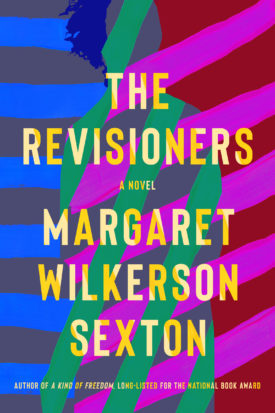
Margaret Wilkerson Sexton is no stranger to intergenerational family stories. Her first novel, A Kind of Freedom, which was nominated for the National Book Award, followed a New Orleans family over the course of 70 years, skillfully depicting the broader history of the city within the struggles and triumphs of one family lineage. In her new book, The Revisioners, Wilkerson builds her already expansive narrative skills.

Covering several generations of a family from 1855 to 2017, this sweeping novel focuses on two Black women, one in the present day and her great-great-great grandmother, whose stories converge in unexpected ways as they navigate their familial relationships, their relationships with white women, and trying to raise their sons safely in America. Braiding the parallel stories and complex interpersonal dynamics of a family and their communities, The Revisioners is a story that’s both timely and timeless. 

I sat down with Margaret Wilkerson Sexton to talk about Black women’s power, white women voters, who decides what it means to be realistic, the subtleties of physical vs. psychological danger, and writing about really good food.


Sarah Neilson: In a recent interview with The Millions, you said that you’re “really interested in the disparity between white women voters and black women voters in the recent election, and the history of black women and white women.” This history is something you explore in The Revisioners through interpersonal relationships between white and Black women, especially in terms of what those friendships can look like in a white supremacist society in which the legacy of the enslavement of Black people plays out in everyday interactions. Can you talk about the process of writing these relationships, what you feel you got from it, and what you hope readers will take away from that particular aspect of the novel?

Margaret Wilkerson Sexton: Writing the relationship between Josephine and her neighbor, Charlotte, in 1924, conjured all sorts of emotions for me. To frame a relationship like that—one that had a foundation in such tragic history: the history of lynching, of the Klan, of white women having chosen to side with patriarchy over the rights of black women, and even over their own rights—it was definitely triggering to delve into that history and the emotions that go along with it. But I’ve learned about all of the historical factors for so many years, and they weren’t new to me. I think I had more of a personal connection, more of a cathartic reaction, to the contemporary relationship between Ava and her grandmother. I was really trying to work through how it feels to be around well-intentioned white women, who think of themselves as progressive, and who check many of the boxes in that area, but who aren’t asking themselves the hard questions, aren’t really in deep relationships with people who aren’t white, and aren’t holding themselves accountable for the condition of the country we’re in right now.

I was trying to work through how it feels to be around well-intentioned white women who aren’t holding themselves accountable.

So that was the more cathartic section for me, because I come into contact with white women like that every day. I think it’s interesting to shed light on this very particular type of reaction to the world’s woes, because it’s something you see a lot, especially now, because there’s so many exaggerated examples of racism in this country. And there are so many people who aren’t anywhere near that level, who are very quick to shine attention on the more exaggerated examples, and who aren’t holding themselves accountable for the “minor ways” in which they’re contributing to the same problem.

SN: Much of the experience of the characters is felt and expressed through their bodies—birth is a big one, but there’s a lot of intentional physical grounding that the characters practice, including within the spiritual practice of the Revisioners. The intergenerational connections between characters are also very physical. Can you talk about the importance of the corporeal in the book, and how that ties in with the broader story of this family?

MWS: I thought a lot about how I wanted to showcase danger in this book, particularly in King’s section. I had drafts of this book that went to my publisher, even late in the process, where I had King being physically endangered by the house that he’s living in with his mom, and by the grandmother indirectly. The idea was that across the three narratives, there would have been three examples of physical danger, of the danger that black bodies are under. But I was never quite comfortable with the King section in that way. It became clear to me that it was a little bit repetitive to have the body be the most threatened part of each section. I thought it might be really interesting to play around with the psychological damage that racism can do. It would have been easy to have him be injured by the police. That was a draft. That’s obviously happening, and it’s not cliché, it’s just what’s happening right now.

But I thought, “Well, you know, we [already] have the other examples of that that are not as subtle,” and in that last section I wanted to look at what’s happening psychologically because of what Black people are up against every day.

SN: Nourishment is another major theme in the book. There’s a lot of food in it, which is closely tied to spiritual and familial nourishment. It’s mostly the women who prepare it, and it’s a kind of power they have. Can you talk a little about the use and presence of food in the book?

MWS: First I’ll just answer it in a very basic way. I just love food. Every time I write a book, I’m going to talk about food. It’s my favorite way to express one of the senses, and it’s an easy way for me to do it, because I’m genuinely interested in it. 

It’s interesting that you identify their ability to prepare food in that way, as a power. That is such a good way to say it. I grew up with women who had that power, and it’s such a power, such a gift, that not everyone has. My maternal grandmother was the most amazing cook, and everyone would come to her house and just be transported into another world because her food was that good. These are people who don’t use recipes. There’s such a power in that, the confidence of knowing that they can wield that power whenever they want to. Especially because we’re dealing with, in the book, women who really were limited in terms of their power and freedom. So, that ability to create in that way, to provide in that way, would have been one of the most fulfilling things they could do, because of how limited they were.

SN: The term “magical realism” is used to describe a lot of stories that don’t fit rigid Western standards of what reality is. Do you see the seemingly otherworldly abilities of Josephine, her mother, and Jupiter as magical realism? What brought about that aspect of the story?

MWS: I never thought about magical realism, I always thought about speculative fiction. Once I started doing interviews, the term magical realism kept coming up. I wasn’t surprised by it. I had this really interesting conversation with someone where we were talking about who gets to decide what’s standard and what’s realistic. In so many cultures, these elements are realistic, and they are such inherent parts of the story. Obviously, it is supernatural and it is spiritual, but when I was writing it, I didn’t think of it as far-fetched. To me, it’s just a fundamental part of the way these families work, and it’s also a fundamental part of the way my families have worked. It is spiritual and that is supernatural. But to me, it’s also realistic.

SN: The Revisioners’ protagonists are mainly women, but a vital pillar of this story is women raising sons, specifically Black women raising Black boys in America. The parallels drawn between Josephine’s childhood and King’s childhood, for example, point out how the targeting of Black boys and men has changed only enough to remain the same. Can you talk about writing the relationships between mothers and sons, about writing the Black men in the book, and about how you approach character development in general?

MWS: I consciously lined up Josephine and Major’s section with Ava’s and King’s, including in the naming of the characters—the fact that Major is named Major, and King is named King, is a method of protection, an attempt these mothers made to protect their children. Inevitably, the children won’t be safe. But I feel like it was a good way to introduce a very high-stakes vulnerability for the characters, because the thing they care about most, and the thing that they have no control over, even in contemporary time, is the thing that’s most precious to them. It was a good way to get that tension in there immediately. We have this very vulnerable position, and how is that going to be tracked? How is that precious commodity going to be kept safe, if it can be?

I have two Black sons, so I didn’t have to develop that part of the story, because I just know.

I have two Black sons, so I didn’t have to develop that part of the story, really. I didn’t have to think about it when I was writing it, because I just know. I have a daughter and I have two sons, and I don’t worry as much about the baby, because he’s a baby, but my six-year-old son, I worry about him so much. And it’s not that I worry about his physical safety, because I don’t yet, but I worry about how he’s going to be treated by people at school. I don’t worry about that as much with my daughter, and part of that is because of the way society treats Black boys versus Black girls. My six-year-olds are twins, a boy and a girl. I’ve already seen the discrepancy in how they’re treated. So, I didn’t even have to think about writing the emotions of those two relationships between the mothers and the sons in that book, I just know. I know that vulnerability. It’s a chronic, very high-pitched vulnerability.

SN: The Revisioners reads like a suspense novel, a family epic, and historical fiction at once. How do you go about structuring a book like this, with so many characters and taking place over several generations, and from where do you draw inspiration? 

MWS: I’m so glad. That’s always my goal, to pace it well and have it feel like a page-turner, because that’s what I like to read. I feel like I don’t have to work on the themes. The heavy themes come naturally to me. I just read The Other Americans, for instance, by Laila Lalami, which was very similar. When I read it, I thought, “Oh, this reminds me of my book.” It’s a totally different subject matter, but the themes are very similar, the heavy-handedness of them. It also reads like a thriller, even though it’s literary. And that’s always my goal, is to just have the reader enjoying learning about whatever I’m trying to teach.

How Literary Translation Can Shift the Tides of Power

Close your eyes. What do you picture when you hear China? How about Japan, or Korea? Did a particular scene, person, or image come to mind? If you’ve never lived in or travelled to one of these countries—and even if you have—those images probably came from something you watched or read. Whether it came from a news report, travel blog, film or work of fiction, our understanding of these far-flung countries is limited by what gets translated into our language. But who and what determines which voices and whose stories we get to hear? Whose voices are we not hearing?

Translation holds a particular and peculiar power. It is how we come to understand the world outside our own; that is, the world that exists outside of our own language. The Latin root word for translation comes from latus, the past participle of ferre or “to carry”; in Teju Cole’s beautiful metaphor, the translator is a ferry operator, carrying words from one shore to the other. To take this metaphor further: if the translator is the ferry operator, language is a current. Ocean currents shift and change speed; some are more dominant than others. In previous centuries the English current was propelled by the British empire, summoning all the boats of the Commonwealth towards it; America is the great ocean current of our time.

Prior to the 19th century, classical Chinese was the dominant ocean current in East and parts of Southeast Asia. Chinese characters (hanzi / hanja / kanji) were the lingua franca of the ruling class and in diplomatic communications; without needing a ferry operator, Confucian values, ideas and knowledge traveled the seas, underpinning societies in China, Korea, Japan and Vietnam for centuries. But as Western imperialism swept over much of Asia and the Chinese tide receded, translation took on a new urgency. Translation was the primary means for the subjugated to understand a new, Western-defined and often disturbing modernity: a means for the powerless to understand those in power. 

Translation was the primary means for the powerless to understand those in power. 

The powerless have no choice but to learn about those in power, yet those with power are uninterested in learning the language of the powerless. Western colonizers, apart from practical needs, did not bother learning or uplifting the language of the colonized, whom they saw as inferior. When Colonel William Farquhar, Singapore’s first administrator, learned Malay and picked up Malay customs (also fathering six children with a half-Malay mistress in the process), it was seen as a weakness, not a political strength, and he was targeted by Singapore’s official founder Sir Stamford Raffles for “going native.” 

South Korea, a Japanese colony for almost half a century, has entire bookstores dedicated to books translated from Japanese, with many from the pre-war generation still able to speak the language. Haruki Murakami is particularly popular; it is estimated that at least three times as many Murakami novels are available in Korean compared to English. But until recently, Japanese readers had little interest in Korean literature. During the East Asia Literature Forum in Seoul last October, a gathering of the region’s most well-known writers, Japanese novelist Keiichiro Hirano, expressed that “it is very difficult for me to think of any Japanese writer of the same generation as remarkable as Kim Yeonsu and Eun Heekyung,” and yet very few Japanese writers, let alone readers, have even read their work. Korean culture, thanks to its colony status, was considered inferior to Japanese culture for years, particularly amongst the older generation. Japan’s zainichi or ethnic Korean community have been discriminated against for decades, many stripped of citizenship, as documented in Japanese novels and films like Kazuki Kaneshiro’s Go and Yang Seok-il’s Chi to Hone (“Blood and Bones”), made into an Oscar-nominated film starring Takeshi Kitano. At the same forum, Japanese author Kyoko Nakajima, the child of French literature professors, spoke about only discovering Korean literature in her 40s when she met Korean writers at the University of Iowa. When she discovered the poetry of Yi Sang and Yoon Dongju, both poets who lived in Japan-occupied Korea, and learning they had died of police violence in Japan, she was shocked into silence. 

And yet the currents between Japan and South Korea are shifting, with wave after wave of Korean popular culture (hallyu) washing up on Japanese shores. Korean literature made its biggest splash in Japan yet in 2018, with Cho Nam Joo’s Kim Ji Young, Born 1982, released at the end of the year, selling over 130,000 copies and topping bestseller charts. Bungei, one of Japan’s leading literary magazines, published a special issue titled Korea, Feminism, Japan in July this year, featuring leading Japanese and Korean women writers. It was an unexpected hit, with the magazine running emergency reprints for only the second time in 86 years, selling over 14,000 copies within a few weeks, and a fourth reprint out in September. “The oyajis (older men) are the only ones blind to the popularity of hallyu,” writes cultural critic Minako Saito, also the older sister of Mariko Saito, translator of Kim Ji Young, Born 1982. “It is the Oyajis,” she writes, “in politics and the media who are stirring anti-Korean sentiment.” Japanese women and the young, she says, share the opposite sentiment. Underlying her words is a scathing critique: the arrival and spread of Korean culture in Japan is an affront to Japanese men, upending belief in their own cultural superiority.


At a recent translation conference in Singapore in September, I listened to children’s book translator Helen Wang speak of the high demand for translated children’s books in China. Chinese parents, especially educated professionals, believe imported children’s books, especially those from the West, teach “greater self-confidence and ambition.” Even with children’s literature, translation is a one-way street: in the U.S., translated children’s literature is almost non-existent. Most translated children’s books are works from Western Europe.

Most translated children’s books are works from Western Europe. What does that do to a young child not from the West?

What does that do to a young child not from the West, to read almost exclusively about the exploits of the Hungry Caterpillar, Bear Hunts or Fantastic Mr. Fox? I was that young child growing up in Singapore, devouring Enid Blyton, Roald Dahl, and later Beverly Cleary and Judy Blume. These are fine writers who wrote great works of children’s literature. But I also longed to see myself in the books I read: a bookish, curious Singaporean Chinese girl with the habit of putting my foot in my mouth and stepping out of line in a conservative society. In my teenage years I discovered Chinese writers like Eileen Chang and Chiung Yao, but their tragic heroines troubled me: falling in love, in their feudal-era stories, always came with a price. Why did bad things always happen to girls who pursued their own desires? Nothing in the books I read then satisfied me, and as a mother of a little girl (and boy) today, I continue to struggle with the question. 

Soon after I gave birth, my writer friends arrived at my house with piles of classic English picture books. Determined to have my children rooted in their own culture, I set out to find children’s books with characters that not only looked like them, but stories that would help them navigate the complex world they will inherit. Just by the act of searching, I came to read wonderful writers from Japan, South Korea, and China with a completely different sensibility from Western children’s literature. 

Reading children’s literature again as an adult, the difference between Western and East Asian stories was startling: Western children’s books are often centered on the individual’s journey, while stories by Chinese, Japanese and Korean authors emphasize respecting other people’s feelings, patience, and acceptance. As a child, I found many of these old Chinese stories moralistic and preachy. But to my surprise, I also discovered many wonderful children’s books which conveyed these same values without being didactic, and helped me as a mother understand my own feelings and moderate my response towards my child’s behavior. I am just one parent. What if more parents read translated books with their children? Would this be enough to shift the winds in the publishing and bookselling industry? And more importantly, would this help our children build a kinder, nicer world?


How do we get publishers and booksellers to acquire and push more translated books? Prizes, especially major literary prizes, play a big part. Awards like the Man Asian Literary Prize have propelled the careers of writers like Han Kang in the English-speaking world. In fact, Han Kang, like Shin Kyung Sook who won the Man Asian Literary Prize in 2012, may be said to have paved the way for English-speaking audiences to even consider reading Korean literature, and for publishers to push more writers and translated works from South Korea.

Translation is an act of selection, a personal choice as well as a subjective judgment.

And yet, curiously enough, even as Han Kang has garnered international acclaim, emerging as a representative of Korean literature in the West, back home she remains on the periphery of her home country’s literary scene—just like Haruki Murakami with Japanese literature in the earlier stages of his career. Translators play an enormous, outsized role in interpreting foreign cultures for their home audience. Translation is an act of selection, a personal choice as well as a subjective judgment that something is more worthy of becoming known by one’s home audience than everyone else. To borrow Teju Cole’s metaphor again, how does the ferry operator choose which passenger to ferry across the ocean? The choice we as translators make has far greater impact than we may realize.

At the East Asian Literature Forum last year, I heard one after another beautiful story from writers that almost no one in America would have recognized. Even as a scholar of East Asian languages myself, I was startled by how few writers I had heard of, and how much of what I read in Chinese, Japanese, and Korean was to a large extent pre-defined by what had already been picked up and translated by the West. Reading takes time, and reading beyond the canon takes effort. If I, as a scholar of East Asian languages, found that difficult, what sort of scholar am I? What more of publishers and readers in America and the West, who have scant knowledge of writers from East Asia beyond the few names that have won awards in their home countries? 

These stories had to be heard by a wider international audience. I reached out to one of the Japanese writers I had met at the forum—and received her permission to translate a story she had read out, a powerful story on womanhood that had many in the audience crying. Despite winning multiple domestic awards, she has never been published in English. If we never hear from these writers, how blinkered and piecemeal is our understanding of the world outside the dominant American cultural current? 

As readers and translators, it takes effort to recognize our blinkers and even more effort to look beyond them. We may not be strong enough to shift oceans—but maybe, just maybe, our collective effort will make it easier to swim against the tide.

A Ghost and a Skeleton Meet on a Beach

The Ghost at the Beach

A ghost rides a longboard to the beach. It’s late summer. The ghost has on a pair of sunglasses and board shorts. Saturdays are the busiest days at the beach, but luckily for the ghost, no one can see him. He likes to surf and bodyboard, but today he’s just going to sit in the sand and take it easy, maybe read a book.

When the ghost arrives on the sand, he spreads out his towel of the Pittsburgh Pirates. The ghost is from Anaheim, CA, but he just likes the pirate imagery. The ghost sits down and stares at the waves. He’s been coming to the beach since young ghosthood. He used to go with his father, a former professional surfer. The ghost was born on Halloween, 1966 at 6PM. The ghost doesn’t believe in superstitious things like astrology or politics, but he does love rock n’ roll music and existential poetry. The ghost’s favorite band is The Cultured Demons. His favorite poet is Marosa di Giorgio.

After reading a book recommended to him by his therapist, El Río Solitario by Francisco “El Monstruo” Vargas, the ghost takes a nap. The ghost dreams of Costa Rica. He’s never been to Costa Rica, but he imagines it the most beautiful place on Earth. The ghost plans to visit one day, perhaps next summer. He dreams of seeing spider monkeys and quetzal birds. Also, surfing and more surfing.

When the ghost wakes up, he notices a skeleton in a fedora playing the guitar next to him. The skeleton smokes a cigarette and plays “La Vida Tombola” by Manu Chao. The ghost stands up and joins him with a cigarette. What luck, he thinks, a cigarette and a serenade at sunset. He takes a photo of the sunset and the skeleton guitarist and puts it on InstaGhost.

The ghost rides his longboard home in the last moments of sunset. He feels free on the board. He knows he’s getting too old for it, but he’s still able to maintain balance, so he doesn’t give it up just yet. On the bottom of the board, there is an illustration of a flame with sunglasses with an ace of spades in its hand.

Eventually, the ghost arrives at his apartment and makes a turkey club sandwich. He goes online until bedtime. He dreams about surfing with his father as a boy. His father no longer exists because he went to the world beyond the stars. Not even ghosts can escape such worlds. In the dream, the ghost is surfing with his dad, and neither of them are ghosts. They are human and alive and they feel the coldness of the water. The ghost loves being alive and human, if only in a dream. When he wakes up he goes to church for the first time in years. He prays he’ll be human again, one day, and reunited with his family. Amen.

The Skeleton at the Beach

A skeleton walked along the Venice Beach Boardwalk. It was just turning into summer. He had on a pair of sunglasses and a camouflaged hat, but he wasn’t a soldier. It was a mild day, high 70’s. The skeleton had just begun his summer vacation. He’s a music teacher at a local high school. He plays the guitar.

There were plenty of seagulls around. A group of skeletons played volleyball on the sand. Beautiful palm trees lined the beach. The skeleton walked without a care in the world. He was going to go on vacation to Vera Cruz, Mexico, later that summer, but for now he was content in just appreciating his local beach.

He walked by some art vendors on the boardwalk. A lady skeleton sold a Cubist drawing of a woman holding a palm tree and sun in her hands. He was impressed. He saw another skeleton selling a black-and-white drawing of a marijuana plant. He chuckled and continued walking. All along the shore, skeletons rode longboards, beach cruisers, and rollerblades. The skeleton felt at home by the beach.

Then he decided to have a slice of pizza. He visited his favorite pizza parlor: Ned’s Pizza. He bought one slice of pepperoni and a Coke. As he ate, he noticed the graffiti murals on the beach. One of the artists, “Rage One,” had painted a radical raptor on a wall. It was painted in red and turquoise fragments; it was juxtaposed with a sheep’s head. The skeleton was very impressed. Predictably, on the main street, was a mural of Jim Morrison in front of a palm tree and the sunset. The skeleton still liked the painting despite its status as a cliché. Next, he saw a mural by a graffiti artist whose name he couldn’t decipher: it looked like “Craft” or “Draft.” The red-orange lettering was jagged and wild. On the left side of the letters was a woman’s head with sunglasses. On the right was the word “California” written in light-blue lettering. That was the skeleton’s favorite piece, hands down.       

Later, when he finished his slice of pizza and Coke, the skeleton took out a cigarette and strolled closer to shore. He loved looking at the waves crash onshore as he smoked. He remembers back when he was in high school, body boarding at the beach frequently with his friends. All of his skeleton friends had since moved on with their lives and now had grown-skeleton responsibilities. Most had families. Some were chefs. Some were clerks. Some were teachers. Some were business-skeletons. A handful were still lost and not looking to be found. Eventually, the skeleton recycled his cigarette and walked to his car. When he got home, he wrote a song about his day at the beach. It was called “The Skeleton at the Beach.”

The Memoir of a Political Prisoner Who Never Stopped Imagining a Better World

Update: Since the publication of this interview, Ahmet Altan was rearrested by the Turkish authorities a week after his initial release.

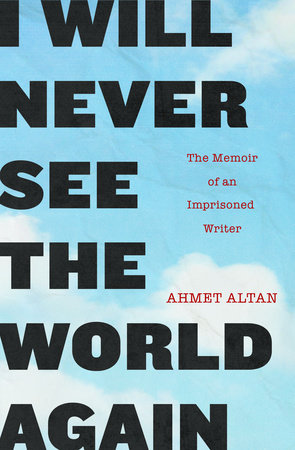
Virtually none of us will ever know what Ahmet Altan has gone through, and continues to live through. After the 2016 Turkish coup d’etat attempt, the writer was arrested along with his brother on such claims as “sending subliminal messages to coup supporters.” In 2018, they were sentenced to life in prison. On November 4th 2019, Altan was released from prison after three years of incarceration, but his memoir written from prison remains a testament to the cost of oppression and the power of human imagination.

Image result for will never see the world again

I Will Never See the World Again is Ahmet Altan’s remarkable response to what PEN America rightly calls an “unjust sentence.” The book consists of short pieces penned by Altan in prison, many detailing his mental journeys to transcend the dehumanizing environment imposed upon him. As he writes: “I had to blow a whiff of air into this dead life. […] How was I supposed to do this? There was only one way to perform this miracle. To imagine.”

Though the Altan brothers’ life sentences have since been overturned, Ahmet Altan was still incarcerated when I interviewed him. From Silivri Prison, Istanbul, he answered the following questions through his translator Yasemin Çongar, describing his daily conditions, and the novel he recently completed. Prison did not put a stop to his writing life. “Because, like all writers, I have magic. I can pass through your walls with ease.”


YZ Chin: I Will Never See the World Again was longlisted for the Baillie Gifford prize. And you recently finished a new novel, described by The Guardian as a comedy. Your tenacity is admirable. How do you write each day?

Ahmet Altan: The book I wrote in prison is not a comedy, but it’s a novel with more than a few amusing parts in it.

In the darkness created by oppressive regimes, writers’ words are the light of matches.

Unfortunately, I don’t have the luxury of determining the circumstances in which I work. In our cell, there is a small table. Three of us share this table. We eat at this table, we drink coffee at this table, we read the newspapers at this table, we watch our small TV, sitting at this table. My cellmates are too kind to complain about it, but when I sit and write at this table with my papers spread all over it, their daily life becomes a bit harder. I asked the prison administration to let us have a second table in our cell, so that I can work without disturbing my cellmates, but that request was denied. Sometimes, when I lose myself in my writing, my cellmates either go out to the courtyard or retreat to their beds, but I can’t expect them to do this all the time. When the weather is nice, they like spending time in the little courtyard. Then I stay inside and work. When it is cold or rainy outside, they don’t have a choice. They have to sit at the table. So my work hours also depend on meteorology. There isn’t a set time during which I write.

YZC: You wrote beautifully about temporarily losing your capacity to imagine in prison, and then regaining that vast power. Do you think imagination is like a muscle that responds to training?

AA: Ever since my childhood, I’ve been somewhat of a dream addict. Daydreaming is a crucial part of my life. But sometimes my imagination can get overworked and exhausted, and it quietens down. My imagination becomes arid. Those are hard times for me. When my imagination quietens down, especially when it does so here in prison, my inner strength also weakens.

YZC: Why do you think regimes around the world are so afraid of writers? Is it because those in the regimes lack imagination?

AA: You can turn on a projector lamp on a bright day and its light, no matter how strong, will be hard to notice. On a dark night, however, a single candle’s tiny flame can be seen from afar. In the darkness created by oppressive regimes, writers’ words are similar to the light of matches; they are easily noticed and thus have to be snuffed out. Even a tiny matchstick can shed light onto a part of what the oppressors are trying to hide. Even the tiniest piece of truth scares them.

YZC: You have constructed whole worlds out of your imagination in prison. Do you share these worlds with others detained? Are you able to converse with other imprisoned writers?

AA: I can’t converse with other writers. When my brother was also a prisoner here, I wasn’t allowed to see him for an entire year.

My cellmates and I usually talk about the quotidian problems of life in prison. We don’t much talk about ourselves, our personal problems or our dreams. No one invades another’s territory with his own worries and dreams.

YZC: You also wrote movingly about how creating fiction allows you to transcend your circumstances. What about reading fiction—what part has that played? 

AA: A good novel or essay can also change your circumstances at once. You can latch on to another writer’s imagination to escape from prison.

YZC: You said that you “like to read novels in which characters’ emotions and relationships have the upper hand.” What are you reading right now?

AA: I am one of those “classic” readers who likes books that have a solid plot, through which we learn about people’s emotions and relationships.

At the moment, I’m reading Olivier Remaud’s long essay, “Voluntary Solitude.” I must say, being in prison, I find it especially pleasurable to read about how a person relates to solitude and hard conditions.

YZC: Your new novel has been described as a very funny book set against a dystopian background. I’m curious whether you deliberately set out to write a comedy as a way to subvert your surroundings and defy your jailors, given that you’ve said a novel is “something that relies purely on instinct and intuition” to be written.

Being in prison, I find it especially pleasurable to read about how a person relates to solitude and hard conditions.

AA: Yes, I believe instincts and intuitions are more important for a novelist than ideas.

The fact that there are more funny parts in this novel than in my previous work may indeed be an instinctual act of defiance, as you’ve suggested. It may also be the result of a need to entertain myself in a place where there’s absolutely no entertainment. But honestly, I don’t really know why I did what I did.

YZC: Did you make yourself laugh while writing the novel?

AA: When I write, I hear the characters’ dialogues in my head. When they say something funny, I laugh. I’m spared a diagnosis of schizophrenia simply because I write the voices I hear.

YZC: Will your new book be available in Turkey?

AA: My new book will not come out in Turkey for a while yet. I think it will be published in English first.

Please Write More Books About Cryptids

I am not an expert cryptozoologist and I will not claim to be one. I’m simply a person with a vested, professional interest in mysterious, supernatural creatures that may or may not exist; creatures like Bigfoot, Mothman, the Jersey Devil, etc. These beings are the stuff of legend, but apparently that’s not enough for the literary community. It’s easy to find books about “sexy” supernatural creatures like vampires and witches, but it seems that authors are too good to look down from their ivory towers and into their local woods, where the Flatwoods monster is probably rolling around in its big metal suit, hissing at children and emitting a noxious gas. I’m sick of all the fanfare going to the popular crowd of unexplainable beings; here are some book ideas that would celebrate the outcasts and weirdos who actually deserve celebration.

Mothman: Nightlight

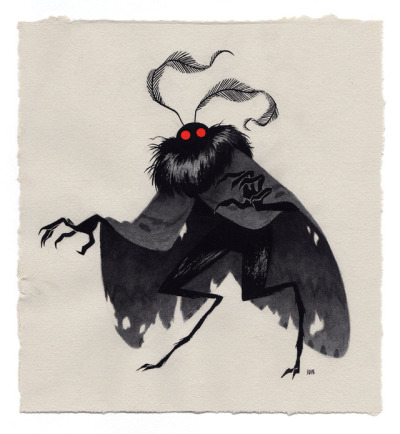
Mothman is a seven-foot-fall humanoid with wings, glowing red eyes, and the ability to fly over 100 mph. I think they deserve some love, so I suggest a graphic novel where a teenaged Mothman lives in the woods next to a skatepark and falls in love with a skater girl named Light who frequents the park at night. When she notices glowing red eyes watching her from the woods, she surprises Mothman by inviting them to skate with her. As Mothman falls harder for Light, they must overcome their fear of her world in order to be with her.

Bigfoot: The Silent Woods

Bigfoot loves hanging out in the woods of the Pacific Northwest and avoiding detection. In Bigfoot’s book, he grew up alone in the woods, never knowing a life outside of isolation. But when he finds a girl wandering in the woods, mute and lost, he tries to take care of her. Over time, Bigfoot discovers that the girl ran into the woods after her father died, her grief so extreme it rendered her speechless. Bigfoot and the girl use an invented sign-language to communicate, and help each other heal from their different types of loneliness.

Jersey Devil: Daughter Devil

The Jersey Devil is generally believed to be a sort of horse-dragon crossover, although accounts vary. It can fly and breathe fire, and its origins date back to the 1700s. The Jersey Devil’s book would be a historical fiction novel beginning with the Jersey Devil’s birth as the cursed thirteenth child of a witch. The book traces the Devil (named 13) as she grows up in with her abusive, magical mother in the Pine Barrens of New Jersey. After her mother threatens her life, 13 escapes. She happens upon a tough woman living alone near the edge of the Barrens who gives 13 something she didn’t know existed—unconditional love. 

Flatwoods Monster: The Town

When a family moves to a small town in West Virginia, they immediately notice something strange is happening. There’s no phone service, electronics rarely work, and town-wide blackouts and earthquakes are common. The people of the town say they just live in a technology dead zone, but the family is suspicious. One night, their son Justin stays out late and notices none of the townspeople are in their houses. He smells something odd coming from the church basement, and there he finds the townspeople gathered around a ten-foot-tall robotic monster. Will the family escape this cult, or fall victim to the Flatwoods’ hissing call?

Loch Ness Monster: Eventide

A group of teenagers walking around Loch Ness late one night gets a shock when they notice a beady eye watching them from the water. When the eye becomes a head and long neck, the teenagers realize they’re looking at the famous Loch Ness monster, but before they can react, they hear Nessie’s voice in their heads. She needs their help to solve a mystery, and they have to travel through time with her in order to do it. As the friends begin helping Nessie, they must unravel a mystery that goes back hundreds of years, and hits closer to home than any of them expected. 

Two-Toed Tom: A Fortune-Teller’s Guide to Reptiles 

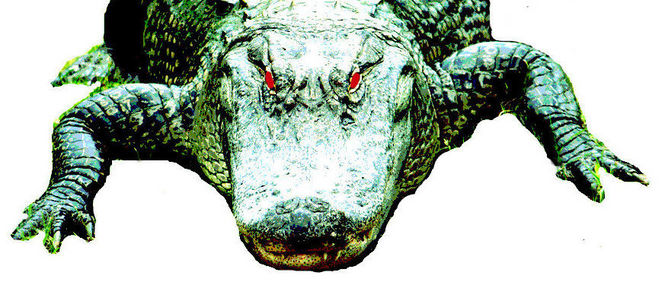
A lesser-known cryptid hailing from the Florida-Alabama border, Two-Toed Tom is a 30-foot-long demonic alligator known for attacking both animals and people. In southern Alabama, a woman named Bea runs a psychic business out of her trailer. What her clients don’t know, however, is that Bea’s powers are real. While practicing her magic one night, Bea accidentally summons a demon in the form of an alligator who offers to grant her wishes. Bea begins making wishes before realizing the consequences: for each wish made, Tom will devour someone in town. Now, Bea must defeat Tom before he becomes too powerful. 

Teakettler: The Teakettlers

In a small cottage in the middle of the woods, Esther lives unhappily. The cottage felt full when Esther’s wife was alive, but now that she’s gone the garden has wilted, the paint is peeling, and most of the lights are burnt out. Esther is bored, lonely, and considering ending her life—until she hears a funny whistling noise outside her kitchen window. In the wilted garden are three little dogs that look like corgis, but they whistle like tea kettles, walk backwards, and blow steam out of their mouths. While Esther is originally suspicious, she soon comes to love the teakettlers and, over time, the pups help her get her life back.

7 Choose-Your-Own-Escapade Books for Adults

Ask anyone writing a book, and they’ll tell you: writing a book is very hard. (You don’t actually have to ask: we’ll tell you anyway.) Your classic, run-of-the-mill, hard-to-write book contains exactly one ending. One and a half, if you count epilogues (I don’t). But there’s a certain genre of book that dispenses with the conventional wisdom that books should have one to one and a half endings. There’s a certain genre of book that believes that books should in fact have dozens of endings, and — more than that — that the reader should have some control over the plot along the way.

I’m talking about books where the reader chooses his or her own path, the type of books made popular by the Choose Your Own Adventure series of the ‘80s and ‘90s. These books were formatted so that after every couple of pages of reading, a choice would be presented to the reader: you would make your choice, which would lead to other choices, which would lead to any number of endings. In my experience as a young Choose Your Own Adventure reader, those endings usually involved my horrifying and violent death. It robbed me of my remaining nine-year-old innocence, but I still kept coming back for more.

Image result for Build Your Own Christmas Movie Romance: Pick Your Plot, Meet Your Man, and Create the Holiday Love Story of a Lifetime

My own first book, Build Your Own Christmas Movie Romance, is inspired by three things: first, by a deep, abiding belief that Santa is real and walks among us; second, that there is no one on Earth more evil than luxury condo executives descended upon a small town; and third, that there is nothing more fun than the kaleidoscope of plot possibilities that a “choose your own path” book allows. 

Build Your Own Christmas Movie Romance is like a Hallmark Christmas movie pumped full of steroids. A satire of the “made for TV Christmas movie” genre, Build Your Own Christmas Movie Romance follows our heroine, Chrissy, a busy businesswoman from the big city who loves money and hates Christmas. But when her business boyfriend dumps her and her business job fires her, she has no choice: she has to return to her simple small town, Candy Cane Falls, for Christmas. Chrissy has no choice, but you, the reader, do: from small decisions (what Christmas hold music should be playing on the phone when her mom calls?) to big ones (when her terrible business boyfriend comes to her small town to win her back, should she accept his proposal or not?), you, the reader, are the the one in charging of building the most magical, insane holiday romance ever.

When I was writing this book, I went looking for inspiration. I wanted to read books that were similar to the Choose Your Own Adventure series… but written for adults. And I found quite a few. The titles below, in no particular order, are some of my recommendations for any adult looking to recreate the magic, joy, and occasional terror you once experienced while reading Choose Your Own Adventure books.

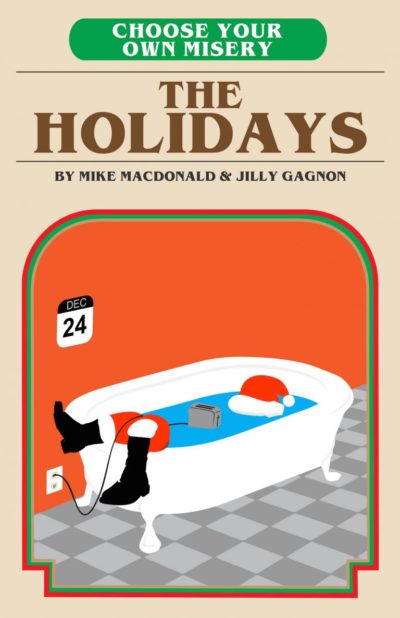
Choose Your Own Misery: The Holidays by Mike MacDonald and Jilly Gagnon

Mike MacDonald and Jilly Gagnon, alums of The Onion, are the masters of the “what if a choose-your-own-path book tackled the excruciatingly mundane travails of adulthood?” genre. Aptly named, the Choose Your Own Misery series features three books so far, and #2 in the series is The Holidays. The hilarious parody that’s perfect for scrooges of all stripes, Choose Your Own Misery: The Holidays is predicated on the idea that you, the narrator, are desperately trying to skip out on family holidays. But who could know how much disaster and misfortune would await you? There’s only one way to find out (read this book).

Image result for ryan north romeo and or juliet

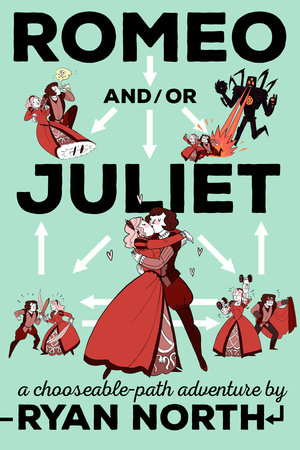
Romeo and/or Juliet by Ryan North

Choose-your-own-path-books-for-adults master Ryan North believes that when it comes to Shakespeare, “Plays aren’t meant to be read. They were meant … to be played.” Romeo and/or Juliet, North’s hilarious deep dive into all of the possibilities of Shakespeare’s most famous tragedy, features over one hundred different endings, and explores questions like: what if Romeo and Juliet never met in the first place? What if, instead of moping around the castle, Juliet just got super buff? What if—and who couldn’t have seen this coming—the two star-crossed lovers teamed up and took over Verona while wearing robot suits? If you need the answers to these questions (and trust me, you do), this is the book for you. 

My Lady's Choosing by Kitty Curran and Larissa Zageris

My Lady’s Choosing by Kitty Curran & Larissa Zageris 

In My Lady’s Choosing, you get to play as a plucky but penniless young Regency maiden who works as a bitter dowager’s companion. What’s there to do but … find love? Who will you choose: he “bantering baronet” Sir Benedict Granville? Or the handsome highlander, Captain Angus McTaggart? Or the wild and mad Lord Garraway Craven? (That last name should tip you off.) For lovers of historical romances and Byronic heroes, My Lady’s Choosing offers dozens of hilarious potential paths, misfortunes, adventures, and romances… all that await whatever lords or ladies pick up this book.

Build Your Own Romantic Comedy

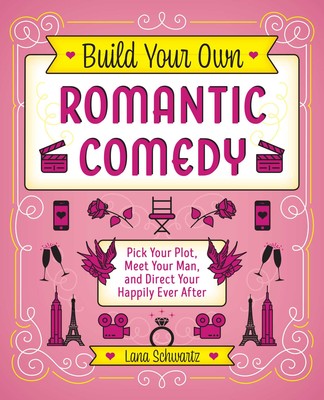
Build Your Own Romantic Comedy by Lana Schwartz

Schwartz’s forthcoming book, Build Your Own Romantic Comedy, delivers exactly what the title promises: it lets you, the reader, help piece together your own perfectly stereotypical romantic comedy plot. A loving send-up of all your favorite romantic comedies, Build Your Own Romantic Comedy puts you in charge of all the classic tropes: will the heroine be able to save the struggling bakery? Will the undercover journalist meet her deadline? Will we finally find out what the quirky best friend really thinks? That’s up to you decide.

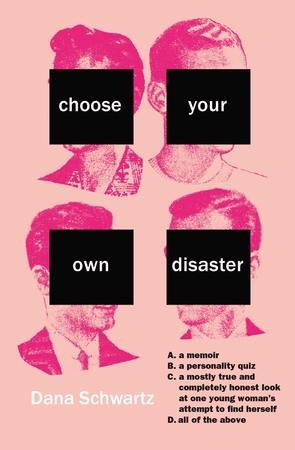
Choose Your Own Disaster by Dana Schwartz

Choose Your Own Disaster is the only piece of nonfiction on our list. Unlike most of the other “choose your own path” books on our list, Choose Your Own Disaster uses made-up personality quizzes as its way of guiding the reading through its chapters. The reader gets to choose his or her path by taking quizzes such as “Which fake rom-com lady career should you pursue?” or “What sort of writer will you become?” or “Which Lord of the Rings character are you, based on your eating disorder?” Equally hilarious and dark, Choose Your Own Disaster brings the adult “choose your own path” storyline to memoir.

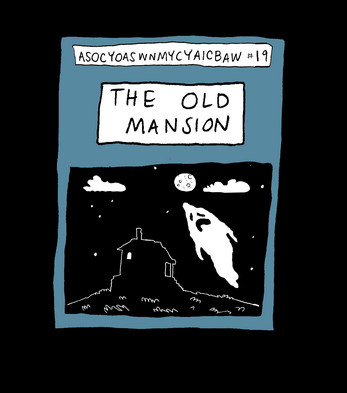
A Series of Choose Your Own Adventure Stories Where No Matter What You Choose You Are Immediately Eaten by a Werewolf by Luke Burns

This brief, hilarious interactive online story, conveniently abbreviated to ASOCYOASWNMWYCYAIEBAW, lets you choose from five different adventures for your starting point. But no matter what you choose, from The Old Mansion to The Pizza Parlor of Peril to The Mystery of Werewolf Forest, be warned now: it is exactly as the title promises. Whatever narrative choices you click on, you are absolutely and immediately going to be eaten by a werewolf. Which is, in its own strange way, somehow kind of comforting.

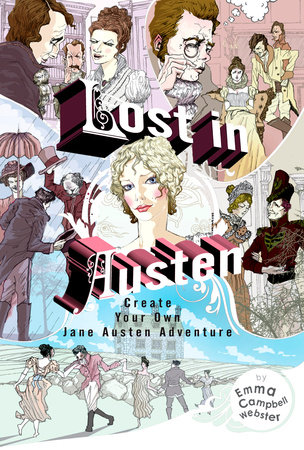
Lost in Austen by Emma Campbell Webster

Lost in Austen: Create Your Own Jane Austen Adventure by Emma Campbell Webster 

Your name? Elizabeth Bennett. Your mission? To marry prudently (first), and for love (hard second). How are going to do this? It’s up to the reader. Lost in Austen: Create Your Own Austen Adventure is a delightful, hilarious, romantic romp through Austen-land: all of the landmarks, halls, gentlemen callers, and sisters playing wist you could ever imagine populate the pages of Lost in Austen. It is a truth universally acknowledged that a single man in possession of a good fortune must be in want of this book.

Can I Write Fictional Stories About Real People?

The Blunt Instrument is an advice column for writers, written by Elisa Gabbert (specializing in nonfiction), John Cotter (specializing in fiction), and Ruoxi Chen (specializing in publishing). If you need tough advice for a writing problem, send your question to blunt@electricliterature.com.

Dear Blunt Instrument,

I’m fascinated by a particular cultural event from recent history. (Not a huge one, and not a negative one—think “the first season of Real World” in scope more than, like, #MeToo.) I’ve been wondering lately whether that fascination would lend itself to a novel, but I’m not sure how to walk the line of turning fact into fiction. If we continue with the Real World metaphor, could I write about Kevin, one of the actual contestants, which would mean ascribing thoughts and offscreen experiences to a real person who is presumably still alive? (It’s not actually Real World, so I had to look up the contestants’ names, please don’t anyone get mad if Kevin was boring.) Should I add a little more distance and write about a fictional fan, but still use real events from the show? Or should I write about a very popular and somewhat genre-defining fictional early reality show called, say, True Life? 

I realize some of these are just questions of preference, but I feel like there must be some general rules or at least suggestions. What considerations should I take into account when deciding how much to rewrite history, versus simply being inspired by it?

Sincerely,

I really thought the first season was the Puck one


Dear IRTtFSwtPO,

Blunt Instrument is many things—a critic, a taskmaster, a style icon—but Blunt Instrument is not a licensed lawyer. Before we talk about the ethics and aesthetics of your question, we’ll outline some potential legal issues you may want to discuss with an actual lawyer before you make a final call. 

Defamation is a notoriously weaselly area of the law, a discipline rich in weasels.

Let’s keep using the example you suggested, Kevin from Real World Season One. Just as a TV watcher or reviewer back in 1992 might have found Kevin either heroic or unsavory, and been free to say so, Kevin’s televised personality is fair game for your characters to snark on or stan. If they’re watching him on TV. 

The trickiness appears when you depict not only what TV watchers think about Kevin, but what Kevin thinks about Kevin, or you begin to invent things for him to do behind the scenes. Then you get into the realm of potential defamation. This is a notoriously weaselly area of the law, a discipline rich in weasels. “Perplexed with minute and barren distinctions,” defamation (like its cousin, slander) can be boiled down to three broad-strokes questions: 

  • Is the person you’re writing about dead? If so, knock yourself out. Dead people can’t sue you for what you write about them and neither can their heirs nor fans. Breakfast on their ashes, you monster.
  • Is the person you’re writing about famous enough to qualify as a Public Figure? Are they a big-name actor, musician, politician? If so, good news for you, because public figures have to clear a higher bar in a defamation case: they have to prove you were acting with “actual malice,” about which more below.
  • Is the person you’re writing about an obscure private citizen? If they aren’t in the least bit famous, you may have a problem. Especially if what you write is construed as implying an actual, real-life (insulting) truth about them, rather than pure invention. 

If something is so absurd that no one could possibly believe it—say a story in which Real World Kevin teleports back in time to seduce Marie Antoinette—you’re fine: no reasonable person would think that’s something Kevin might do; no one’s under the suspicion you’re making “actual statements of fact about the plaintiff.”

But let’s say it isn’t Kevin, rather my friend Gil, a non-famous person. If I write Gil into my novel but depict him only as a reasonable and forthright dude … well, I’ll probably be fine. If I tell the reader I don’t like him very much that’s also probably fine; “I don’t like Gil” isn’t actionable. “Gil’s objectively a shit” may be more so. To answer your question above, if I fictionalize Gil but everyone who knows him can tell it’s Gil, then we haven’t solved much. 

Let’s shift away from jurisprudence for a moment and into the realm of aesthetics. The trick with non-famous real people is not just to rename them but actually fictionalize them. Rather than giving real Gil the fictional name Gus and describing him as detestable, I’d do better to use my fiction for something other than settling a score with Gil. Fiction is a poor tool for revenge. In my role as a fiction instructor, I’ve read probably hundreds of stories expressly written for the purpose of revenge and almost all of them were dull, partial, not-quite-credible affairs. 

The trick with non-famous real people is not just to rename them but actually fictionalize them.

The dirty secret of humanity as a species is that people don’t differ from one another as much as we might like to think they do; what differs are their circumstances. Let’s say I’m writing a story about a standup comedian—I’m doing this because standup is an interesting and perennially topical subject. Let’s say I have an idea for a story and need to select my characters. I don’t know any professional standup comedians, so the first question I’ll ask myself is, “Who do I know who could be a standup comedian?” Not just who do I know who’s funny, because I know lots of funny people—who do I know who would actually have the guts to get onstage and be laughed at? 

Got someone: my friend Kirsten, a professional public speaker and also funny. Okay, so the standup comedian in my story—for pure story reasons—needs to be elected to the California State Senate, and then forced to resign. Eventually, for story purposes, I realize they need to be a man. Shoot, Kirsten may not work. But my friend Kenny will. Am I basing the character of the senator on Kenny, such that the senator is, basically, Kenny? Not as such. The Senator is an embezzler (Kenny never stolen a dime) and hotly religious (Kenny agnostic). But Kenny has a teasing way of greeting people he knows well—he squeezes their bicep, pinches their stomach. I’m porting that to the senator. Now I’m figuring out how to depict the Senator’s shamefaced return to standup in the ruin of his Senate career, so I’ll make use of the pursed, frozen frown Kenny greeted us with on his return from Florida after a bad breakup; I’ll keep in mind, too, the way that frown became, in the course of a week, boasts about how things were better without her, about how he’d been scheming to get out of that relationship all along. I’ll use lots of Kenny in the story, whole pages worth, and if I do it right he’ll never recognize himself. No one else will either. 

We think of ourselves as unique, partially because we’re trying to market that uniqueness. But in truth we’re collections of gestures and perceptions and received ideas, united mostly by whatever fiction we’re using to provide ourselves with coherence. (Rimbaud: Je est un autre. I am someone else). Even when we write about the very famous—people so constantly in the public eye the Public Figure defense protects our work—we’re inventing them, supposing, projecting. 

I’m thinking here of Chimamanda Ngozi Adichie’s wicked short story “The Arrangements,” a half-burlesque of Mrs. Dalloway that imagines Melania Trump reviewing the week just past as she prepares for the arrival of her Pilates instructor. What’s so effective about the story is the way Melania remains on the side of satire but resists becoming absurd. There’s a richly imagined world here. Her jealousy of Ivanka, protectiveness of Baron, even her fondness for Donald ring true (“even the way he nursed his grudges, almost lovingly, unleashing in great detail slights from 20 years ago, made her protective of him.”)

Public figures can’t sue The Onion, or Saturday Night Live. Satire is a legal shield.

The Trumps are a litigious family, but if Melania tried to sue Adichie for “The Arrangements” it wouldn’t survive summary judgement. Public figures can’t sue The Onion either, or Saturday Night Live. Satire is a legal shield. Even when Adichie’s Melania rubs caviar cream onto her son’s face, or fantasizes about seducing her instructor, or when “just thinking of Ivanka brought an exquisite, slow-burning irritation,” Adichie’s exercising her rights. 

There’s a deeper truth here too, which is that Adichie’s story isn’t about Melania at all, not the real person Melania may suspect herself to be. It’s about an actor in a Melania mask. Gore Vidal, who knew something about writing history (recent history included) wrote, “Each writer is born with a repertory company in his head. Shakespeare has perhaps 20 players … I have 10 or so, and that’s a lot. As you get older, you become more skillful at casting them.” To create a fictional character is to fit somebody for a mask. 

The law is mutable but the law is also for sale. On the one hand, the fiction writer ought to have godlike rein to invent and un-invent what she likes. On the other hand, there are lot of assholes out there. The First Amendment protects most books, but if you want to be on the safe side, denature your characters (or, as a smart editor told me of a too-autobiographical story I showed him: “Next time, chew your meat a little better.”)

I’ll leave you with an interesting coincidence. I know the example you chose in your letter was chosen at random, but Real World’s Kevin was, in fact, sued for slander only last year, thanks to something he’d written and published. The woman who sued him won

Writing Is Always a Political Act

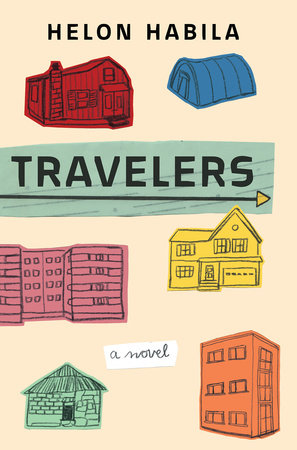
In 2013, Helon Habila crossed paths with many migrants and refugees in Germany, some of whom had fled his home country Nigeria to escape the Boko Haram militancy that had displaced millions. Urged by these migrants to record their experiences, Helon Habila began his new novel in search of answers to his long-held questions about the meaning of home, if one could return to the home they’d fled, and the possibility of making a home away from home.

Image result for travelers helon habila

Travelers is a fictional record of the real and harrowing experiences of  migrants fleeing certain death for uncertain survival in Europe. It follows the unnamed narrator, a Nigerian academic in Berlin—an expatriate really but for his skin color—who befriends a group of African refugees and their activist friends fighting for documentation and better life conditions. The slight advantage the narrator has over the African asylum seekers soon disappears when he misplaces his papers and accidentally boards a train heading for the refugee camps. In the camp, he learns how quickly lives can become displaced.


Kenechi Uzor: Your books have always struck me as interventive, political, always responding or reacting to some issue. Would you agree?

Helon Habila: We all write in reaction to something, what we often call the inspiration or the muse that triggers creativity. My muse happens to be more inclined towards social and political concerns, perhaps because of my history and the milieu in which I grew up in. In my country, and I guess in most other places, writing is always a very political act, it cannot afford not to be.

KU: “What is the point of art if it is not to resist?” How would you respond to this question posed by Mark, one of the characters in the Travelers?

In my country, and in most other places, writing is always a very political act, it cannot afford not to be.

HH: I think the best, and the most relevant writing, is always an act of protest. A refusal to keep quiet in the face of whatever seeks to dehumanize us—be it power, or oppression, or even simple lack of taste. Here I am referring especially to a long tradition of protest writing in Africa and other formerly colonized countries, and even in African American literatures—literatures described by Deleuz and Guttari as “minor literatures”—literatures subsisting within or underneath other, more dominant literatures, or within a dominant language. Such literatures, intentionally or otherwise, will always be political through their themes or aesthetics or use of language; such writers will always be seen as spokespersons for their community whether they like it or not. For such writers, to pretend not to be political will be futile.

KU: In the early pages of the book, the unnamed protagonist reflects on the “immigrant’s temperament,” the dilemma of wanting home and permanence in a new world but at the same time being reluctant and fearful of long-term commitments that could provide such permanence. I don’t think there’s been much conversation around this particular experience, at least not as much as the identity crisis that attends immigration.

HH: My image of the migrant is a person living out of a suitcase, with one foot always at the door, no matter how long he or she has lived in their new home. This image I guess is predicated on the trauma and uncertainty that always accompanies migration or exile—as Edward Said said, exile is compelling to think about, but painful to experience. This experience is manifested in many different ways, some over-compensate by embracing their new homes and not wanting to hear about the home they had left, associating it with all that is bad and evil; others can’t seem to feel at home in their new home, pining for their old country and never really making a life in the new place. This is what my character here calls his “immigrant’s temperament”—a permanent inability to fit in.

KU: In book 4, the narrator wonders why people etch their names in walls “only in places of bitterness and suffering and sweat” but never in “fancy hotels or restaurants or churches.” I’ve been thinking a lot about that and I’m wondering if you have some thoughts on this. 

HH: Well, they say that suffering forms character, meaning you benefit more from adversity than you do from a lack of it. To survive adversity is to have proven something, it means to have been tested and to have survived that test. This on the surface of it, like most axioms, makes absolute sense, but in a way, I am also questioning this common assumption that suffering is good for us, while the truth is that we’d rather not suffer at all. Wars teach us to hate violence but think of all the dying and the privation we have to go through just to learn that lesson. That quote from the book links to another section where Gina, the main character’s wife, prefers to paint migrants whose bodies bear visible marks of their suffering. She refuses to paint Mark because his face is too smooth and unmarked by suffering. She thinks these markers of suffering makes them more interesting, and more convincing, but the truth is that these migrants would rather have stayed at home, in their countries, with their loved ones. That is the irony of it.

KU: Your novel made me rethink my idea of nostalgia as a wistful longing of pleasant past. A few of the refugees like Karim seem to reflect with longing for not only their pleasant past but also on the past that held their travails as refugees and asylum seekers. Is it still nostalgia if the reflections are of unpleasant experiences? Is this a phenomenon similar to Stockholm Syndrome? What is it about the human psyche that longs for a past suffering?

HH: I guess for most migrants nostalgia isn’t only for a past, it can also be for the present and for the future. They miss the present that they cannot share with their families and friends back home, they miss the future they will never witness with their childhood friends and their families.

If I were white I guess they’d call me an expatriate.

One of the best books I have read to this subject of nostalgia and migration is Eva Hoffman’s memoir, Lost in Translation. She grew up in Poland post-WWII. It was by no means a paradise, especially for a Jewish family having to deal with the vestiges of the WWII antisemitism and the new resurgence of it—yet, when her family finally leaves Poland and moves to Canada, she is heartbroken. She doesn’t remember all the privations and the antisemitism they faced in Warsaw, she only remembers the good times. Psychologists call this a dissociative mechanism. Because our mind is unable to cope with the pains of losing our home and the challenges of making a new home in an alien and often hostile place, it escapes to the past and paints a pleasant picture of the past, even the unpleasant past, rather than face the present.

KU:  Language is often the first complication of traveling. In the refugee prison, where the segregation is by race and language, Karim’s two boys enjoy some privileges due to their ability to speak multiple languages. Can you speak a bit on the complication language brings to the immigrant experience?

HH: Language is the most common and the most effective tool humans have of expressing themselves, meaning of expressing their intelligence. Imagine if that is taken away from you. The characters in the camp have all been reduced to incoherence and even silence. I have often met adult migrants who—because they are not fluent in the new language, or because they speak with an accent, or because they cannot quickly understand a joke or cannot tell a joke—are looked upon as idiots. Sometimes, they have to depend on their children who are more fluent in the new language, to speak for them. And sometimes even their own children, who didn’t know who their parents were in their former life, begin to look upon their parents as not very smart.

In a way that is what I am playing with here, these adult characters have to rely on these kids to interpret this brave new world for them. For these kids the new world is not as frightening as it is for their parents because for them, it is normal, they have nothing to compare their situation with. They are fluent in the language of the present, whereas their parents are more fluent in the language of the past.

KU: Portia refers to her father, the resistant poet as a “professional exile” who “developed a taste for exile” and preferred to move from one asylum city to another rather than return home to his wife and daughter. Going by what happens to her father when he returns to Zambia, is the novel engaging with this idea that one can prefer and get so used to being in exile that returning home even in peacetime might not be the best for them?

HH: There are two types of exiles, those who never fit in and continuously hold on to the past, and the second are those that don’t want to hear about the past or the home they just left; instead they embrace the new home and overidealize it. Both are extreme cases, and both are dissociative mechanisms, they are not normal. James Kariku, Portia’s father, is on the end of the spectrum where exiles don’t want to hear about their home countries and even the family they left behind. In his case he has some justification, his country jailed him because of his political writing. He becomes a perpetual exile, a professional exile. Note that he is also an artist, a poet. Sometimes writers need that kind of opposition, even an imaginary one, to keep writing. A case in point is James Joyce, who kept alive his argument with Ireland and refused to go back or to hear anything good about Ireland; instead he decided to invent his own ideal city of Dublin, perhaps the way it used to be when he lived there. Clearly James Kariku can’t cope with the realities of the present, he can’t get over the slight done to him by his country and its rulers. He’d rather rot in exile than to go back—for people like him, to return is to die, both literally and figuratively. 

KU: Travelers point to the plight of refugees and the need for activism and resistance to the world status quo, but it also seems to reinforce the hopelessness of the human condition. There is so much futility expressed through the experiences of Mark, Karim, Mousa, Portia, James Kariku,  and the other characters that makes one wonder, like the narrator, if any change is possible, if there’s any point to resistance. Is futility the underlying theme of the novel? 

HH: I must disagree that futility is the ruling sentiment in the book. I think most of the characters would look at themselves as heroes, they refused to lay down and die in their own countries, they refused to give in to tyranny and hopelessness, instead they took the risk to seek a new beginning in a new land. I also try to look at their motives for doing so—for most of them they do it because they love their families, they want their children to have a better future and they are willing to face humiliation and even death to achieve that.

These characters refused to give in to tyranny and hopelessness. Instead they took the risk to seek a new beginning in a new land.

Karim, the Somali character, leaves Mogadishu and enters exile because a warlord wants to marry his ten-year-old daughter. His options are to stay and watch his beloved daughter marry this crazed warlord or to run into an uncertain future, but a future that offers his daughter better odds than the one he is leaving behind. There are no easy choices. In a way I am interrogating a world order that has left some people so far behind, leaving them no option but to escape from their native homes. I don’t call their actions futile, I call it heroic.

KU: Travelers also engages with existentialism. Have you always been interested in existentialist concepts in your writing?

HH: If by existentialism you mean the search for meaning in a meaningless world, and the individual’s drive to survive at all cost, especially in a world that tries to stifle the individual impulse, I will say yes. My characters fight and resist “group-think,” sometimes rebelling against tradition because tradition should be a starting point, not a destination. It is there to guide us, and in the end, we have to find out what works for us and fight for that with all our resources.

KU: How has living and teaching in America influenced your writing? Would you have written a book like Travelers if you weren’t living outside Nigeria?

HH: I doubt I would have, or could have. Living outside one’s country gives one a deeper perspective into the discourse around travel and migration. There’s a sense of recognition I felt while talking to African migrants in Europe for the book—of course there are all sorts of migrants and travelers, my travel is less traumatic in the sense that I didn’t have to escape war or persecution, if I were white I guess they’d call me an expatriate, an expert in his field who is working in another country other than his. Migrant, refugee, émigré, expatriate—sometimes these terms are created to limit and confine. That is why I decided to go with Travelers, because in the end we are all traveling.

KU: Who should tell the immigrant story? Who can tell the immigrant story and tell it, right? Who should tell any story?

HH: Whoever is inspired or compelled by circumstance can tell it. It is not a competition. Migrant narratives are some of the oldest genre in literature. Think of the Odyssey, think of the Iliad, these are among the oldest western texts, and they are on travel. I guess we have come to associate the immigrant story with stories of black or brown people seeking refuge or opportunity in western countries. But the colonialists who went to Africa to conquer and to live there were also migrants, the experience is the same whether you are a soldier or a refugee, you still have to deal with the nostalgia of losing your native home, you all have to deal with the challenges of self-reinvention in a new place. It is the oldest story ever told or written: a man or woman goes on a journey, or a man or a woman comes to town.

KU: Some writers often say they have no readers in mind when they write. Is this the same for you? Who would you consider as the primary audience for Travelers?

HH: I really wasn’t thinking of any particular reader when I wrote it. All I wanted to do was to do justice to the people who entrusted me with their stories and to go beyond the statistics and the headlines and in the process to humanize them as much as possible.

KU: What problems, if any, have you noticed with how African writers have been telling their own stories? If we’ve been doing so, have we really been telling it different, or do we still propagate the same flaws we accuse foreign media and writers of doing?

HH: There isn’t any wrong way or right way of telling a story, as long as one does it with sincerity and humility. Each writer has his or her own approach to telling a story. I know I have in the past been uncomfortable with certain modes of representation of the African experience by African authors, but in the end I think it is a matter of style. Some writers are more subtle, some are more nuanced, some are less so. But if I were to offer an advice, I’d say we need to write more about our heroes and less about our villains and dictators, but the truth is that stories about villains are often more compelling than about good people. So, there you have it.