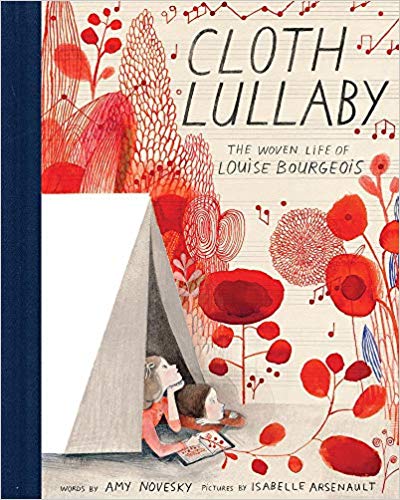
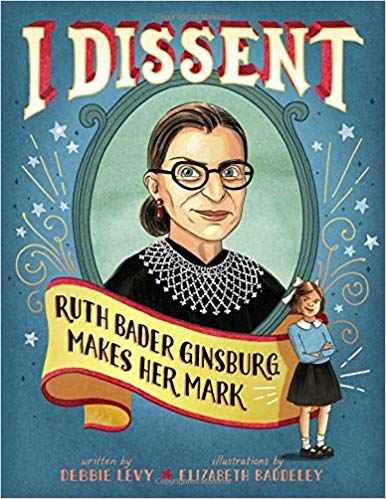
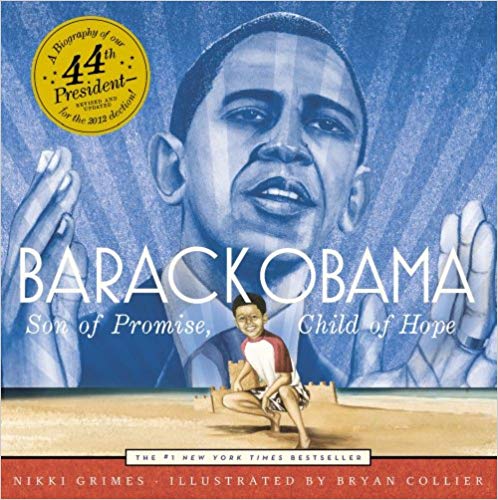
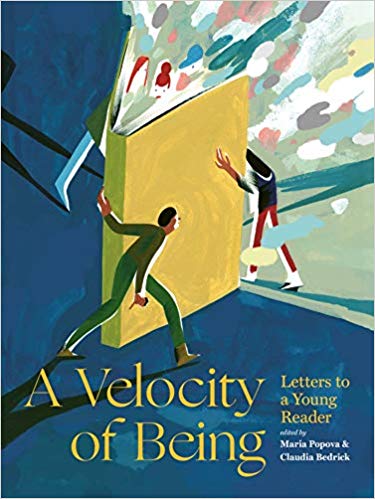
It’s Thanksgiving, and whether you’re visiting relatives you’d rather forget you had or celebrating alone in your apartment for reasons you just don’t want to get into, stop asking, you’re probably taking this opportunity to eat a lot of food. What could take your mind off of your racist uncle, the problematic history of the holiday, and your nascent indigestion? Reading some of the best articles we’ve published about food and cooking, of course.
This personal essay opens up with a tale as old as, well, the beginning: the one about Eve and the apple. Kristen Zory King delves into her lifelong fascination with this origin story and traces back to the origin of her own eating disorder, along with the conditions that fostered it.
“I would venture to say that the numbers of reported eating disorders are a low estimate, made up of the lucky few who are able to seek help. How could they not be? We are surrounded by conceptions of womanhood directly perpetuated by this story. It’s on the periphery of comical, overt, obvious. But whether we are a product of our culture or our culture is a product of us, it is clear that the question of the female body, of what to do with female desire, is all-consuming.”
Most of us have, at one point or another, eaten alone before. Gina Mei is a master at it but has a lot to learn when it comes to cooking and generally caring for herself. Former Top Chef contestant Anita Lo’s cookbook provides much needed wisdom during a tough year.
“In many ways, I’m Solo’s target audience: I eat most of my meals alone, and I can’t afford to eat out for every meal. Unlike Chopped, Top Chef Masters, and Iron Chef America veteran Anita Lo, however, I hate cooking for myself. So, I often don’t. Instead, I stock up on frozen dinners. I make a second meal out of my work lunch. I order containers of spicy pad Thai, or boxes of thin Neapolitan pizza, and stretch them out over the week. I relish asking for a “table for one” — which has somehow always felt less depressing to me than eating alone at my tiny kitchen table.”
When you’re the only child of a working single mother, you’re left home alone a lot. Learning to cook for yourself becomes a necessity and the first thing you make turns into an integral part of who you are, following you to different kitchens or life stages.
“Mom worked during the day and went to school at night. Having me stay home was a big deal. The first thing I was taught was how to cook for myself…”
If you want to believe in love again then Emily Everett’s short story is sure to convince any doubters. Told in the form of a product review on Amazon, readers watch on as a decades-spanning marriage unfolds. Who knew you could feel so emotional reading about kitchen appliances?
“But we were still young in our own quiet way: we read poetry aloud in the den, Frank O’Hara and John Ashbery, and sang Beatles covers around an acoustic guitar. Surrounded by friends, everyone swaying into the couch cushions—I always felt so pleased with us in those moments. Later when the house was quiet, arms full of cups and ashtrays, I’d tell my husband what a nice night it had been, and he’d say that every night with me was a nice night.”
There are two things Abby Walthausen is struggling to figure out in this essay: how to effectively use her old gas-guzzling stove and how to “put [herself] in the mindset of a 1942 manual for cooking during wartime.” On her journey to answers, connections between our modern living conditions and the doom of World War 2 come into focus.
“If I feel awkward and small scraping my restaurant leftovers into an old yogurt container, or planning a meal with tofu when the meat looks so good, that is no new phenomenon. The folks we think of as bleeding heart, crunchy granola types now were once the thrifty church ladies who populate Fisher’s book. But as she reminds us on page after page, the tips she writes about in this book, some extreme, others practical, are mostly gleaned from the pages of cookbooks put out by just such dowdy church groups or ladies’ circles.”
What do reality television bakers and writers have in common? While crafting her newest novel, Becky Mandelbaum begins taking nightly writing breaks to watch the hit TV show The Great British Bake Off to de-stress. However, she soon begins to see similarities between her struggle to write and that of the bakers.
“At some point it dawned on me why I felt so connected to the show: it is, emotionally and often structurally, exactly like a writing workshop or, more loosely, like the art of writing as a whole. A cookie in place of a poem, a cake in place of a story. All day, the bakers stand at their little islands, feverishly attempting to create something that is both beautiful and tempting, that others might enjoy.”
So, we’ve established that baking and writing aren’t so different after all. But how does a pastry chef recreating mass-produced snacks on YouTube fit in? The art of failure, of loving the process, reveals itself to be not only the main tenet of the show but of writing in general.
“Many of the foods Claire attempts to remake so obviously require mass-manufacturing tools and ingredients that her attempts are all but designed to fail. The writer in me is particularly tickled by such a proposition. Claire’s goal is to replicate an ideal she knows she can only ever approximate. In this pursuit she’s no different than many of us who write for a living, where every sentence can feel like an approximation of the ideal we aspire to but must understand we’ll never accomplish.”
A funny comic that has compiled, as you can guess from the title, reviews people leave on Yelp about popular fast food chains. As creative as it is side-splitting, from regular customer complaints to conspiracies on where Taco Bell gets ideas for the menu are sure to entertain.
“Tacos are still crunchy and tasty. Diet Sierra Mist too is a plus. I do have a theory though that everything Taco Bell makes is made out of the same thing.”
Before you go: Electric Literature is campaigning to reach 1,000 members by 2020, and you can help us meet that goal. Having 1,000 members would allow Electric Literature to always pay writers on time (without worrying about overdrafting our bank accounts), improve benefits for staff members, pay off credit card debt, and stop relying on Amazon affiliate links. Members also get store discounts and year-round submissions. If we are going to survive long-term, we need to think long-term. Please support the future of Electric Literature by joining as a member today!
Growing up, cousin Phip sold puppies from the alley by the deli there. He leaned out from the alleyway and said, “Doggies have ’em have ’em” quietly as people walked past so it sounded less like someone wanting to sell you something and more like the idea of it came from inside your very own head. This was smart selling. You never knew what sort of puppy you were getting. Sometimes it’s foxes, sometimes it’s dog, sometimes it’s wolfies, sometimes something in between. He got out of poor, did Phip. But then he became not rich, not poor, just nothing, because they sent him to jail. They didn’t like him selling the breeds on the street. Another cousin, Ruby, she had her business. She used the bed in my dad’s room for her business. She went in, came out, and flashed a palmful of cash. “So easy,” she’d say. Lie.
My dad worked dyeing fabric and purple stained his fingertips. The skin on the tips and the skin below his nails. Like all the blood was gone to all his fingertips in the moment when they’re purple before they turn white and fall off. The way cousin Phip did with the dog tails sometimes. Elastic banded them. Red purple white, flimp, off they fell. Tails on the ground. My dad, though, bent over barrels of purple and breathed in the purple particulars—I think that’s what they’re called—all day. He had purple specks around his mouth when he came home, and purple specks on his neck. My dad had purple freckles. He leaned over a barrel all day with cloth in his hands and he leaned over the sink soon as he was home. Some of the purples washed off him down the drain. Some stayed on his skin. Always on his fingertips. And purple in his lungs, inhaling it that way. The particulars float up. Just because you can’t see a thing doesn’t mean it isn’t there. Back bent, fingers stained, lungs stained, and my dad was good at the work and proud of the work and he’d come home and tell me some piece of cloth he’d dyed had sold for a bag full of cash to some rich-bitch princess wanting deep color for a cape—except he never called her a rich-bitch princess, that’s what I’m calling her. He showed nothing but respect, and I always wanted to ask, if they buy it for so much, how come you make so little. But I never asked it.
He brought home scraps and he showed me sewing. He showed me how to weave. He told me, “Not like Phip, not like Ruby. You don’t sell dogs on the street. You don’t wear lipstick if you don’t want. You find your way.” He said those words a lot. You find your way. They’re words that don’t make a lot of sense even if you think hard about them, that only come to make sense out of a long time and thinking about it, but not in a direct way, like letting it sort of linger at the side of your brain instead of it occupying the center of it. You find your way. It was always there in my brain and I didn’t know what it meant, but then I did.
I liked the loom from when I was small. I learned early and it’s most of what I did. I got taught the basics, then I taught myself more and I just kept doing and doing and I impressed my own self. I’d finish up a tapestry and I’d lay it down on the floor. I’d stand above and think, Goddamn. It wasn’t there, now it is. Every time it felt like a miracle. I’d look at the skeins in a heap by the loom, all their separate threads, and I’d think, Goddamn, first strands one by one, then this all together. This thing whole. Something out of something else. I made this transformation. The act of art is metamorphosis. It’s where I found my pride.
I made this transformation. The act of art is metamorphosis.
And it turned out I wasn’t the only one impressed. Neighbors on the block, when they stopped in, maybe to bring a casserole, maybe to bring some pastry, maybe to just see by me to make sure I was okay (no mom, good-but-gone-a-lot dad, people’s concerns), they saw, too. And they said, “Oh oh ooooooh. Look at you. Look at what you’ve done.” And first I thought, this is just nice people being nice. But nice isn’t telling others and having others tell others about how wowed they were. That’s when you can start to believe it might be good.
So people started coming. They came to look and I’d sit there and take their praise. Oh the colors oh the way they bleed one to the next oh the detail oh the scene it’s like a painting it’s like it’s real, you got a gift, you were touched by the gods, you own skills like no one’s ever seen. One thread on top of the next, one hour on top of the next, I just kept bettering. You find your way. This was my way. I was young but my name was known, and not just on my block and not just in my village, but in places miles away. People heard some things about me. They heard I was good.
They heard I was the best.
Rich people, besides money, got options. They’ve got options so much they don’t even realize the options they’ve got. Poor, less options, sometimes none. I think people forget that it’s not just money. So my dad sells a purple robe to some fancy dan, and this fancy dan sees the color’s special and he’s feeling all puffed up for having good taste enough to find my dad. He thinks the difference is that he can afford to buy this robe, and my dad can’t. That’s a difference, but that’s not the difference. Fancy dan has time to figure out what his path is. He has time to wonder: What do I want? How do I get it? Poor, harder to think about what you want. Less time wondering, more time worrying. More time making sure enough purple cloth is made so there’s money enough for food and roof. Plus, you think too much about what you want, you’re swallowed whole. Rich, you’ve got to worry less about having to sell puppies from a box by the alley and whether they’ll take your body into jail for it. Rich, you’ve got to worry less about being bent over a barrel so your back’s curving even when you’re not bent over the barrel. Rich, you’ve got to worry less about questions of roofs, questions of sweaters, questions of bread.
I paid attention, I stayed awake, I knew about options, what it was to have them, what it was to not, and I knew I wanted some. One way to options is being fine at something, being finest best of all. So each day I sat at my loom and sometimes it’s the last place I ever wanted to be, but I sat there for knowing it was the one way to get better, to keep doing and doing.
I watched the people I knew reach the limits of their options. Again and again. It was as though the kids I grew up with, my pals on the block, from the village, it was like all of a sudden there were these walls erected, these tall, smooth white walls, and they’d be walking along, living their lives, and then, slam, straight into this wall. And there was no going over and no going around, just dead-ended a hundred percent. Eagle, BenBen, Paulo, they went to prison. Kevin, he got killed by the police. Spice Rack, Henrietta, they got killed that way, too. Alma went wrong in her head because she kept drinking from this one well we knew had the poisons, but she drank anyway because that’s the way she always did it and there was nothing that would change her mind. Gloria got sick and the doctors said, We’ll cure you, but you need this much. She didn’t have that much. She died. Sylvia talked so much about being tired. “It’s tiring being poor,” she said, and then one day she gave herself permanent rest. Sometimes when things go so bad, when there’s no hope of bettering, that’s where you get led. Maybe where my mom got led. Or where she led herself. To her own end, that is.
I tried to keep that big white wall from arriving in my life. And what I learned is that it’s not just about being finest at something, not just about being the very best. It’s about speaking it that way, too, about knowing it and owning it and saying it. I knew it. I knew I was the finest. And I said it. I had pride.
“This is the most amazing weave work I’ve ever seen,” people said.
“Thank you. I haven’t seen work that’s finer myself,” I’d say. Grateful, yes, and also knowing. Say what you know.
Once a person whispered: “You must have learned from Minerva.”
Wrong. I learned from my dad and I learned from myself. And the fact of it was, I was better than Minerva.
And then I wondered why I wasn’t saying that out loud. You don’t get to be big in this world if you don’t know how to own your skill. You don’t get over that smooth wall if you don’t go after the thing you’re good at with everything you’ve got. And even then, other walls might rise.
So I started saying it out loud. “I taught myself, and I’m better than that weaving goddess. Any single day of the week I could outweave Minerva. She should come and try me.” I liked the way it sounded. “Get yourself down here and we’ll see who’s best,” I dared her. They’ve got a lot of power, but we’ve got power, too. More than they want us to think.
An elder lady with a gray knot of hair and cheeks that dangled off her face like thin-sliced meat had the nerve to tell me to take it easy. “It’s enough to be the best in the world that you know,” she said. “You don’t have to outdo the gods.” She said something against outgrowing my britches, that I should think about taking back what I’d said about outweaving Minerva. That I should think about apologizing.
Old ladies think they know. She comes into my place to watch me weave and look at what I’ve made and thinks she can tell me a thing? No. She’s lucky I didn’t smash her face, because that’s what I wanted to do. All people do is tell you why you can’t or won’t or never will or shouldn’t try. These scared old ladies. “You’re old,” I told her. “You’re old and the years got you dim. I never asked once for your advice. I advise myself. I’m sure of myself, and it’s hard for you to hear. And I’ll keep standing by what I said. Minerva should come and try me.”
Minerva should come and try me.
“So be it,” the old lady said, and she showed herself to be Minerva in disguise. The other folks in the room bowed and gasped and clutched their hearts. Not me. I stood with my shoulders back and my eyes front. I hold my own is why. The blood that rose to my cheeks in blush, it was surprise, and it was pleasure. I was getting what I wanted.
That’s a chance.
I sat at my loom. She had hers. We started. My blood moved faster. I raced the shuttle back and forth across the warp, the strands collecting. It’s what I’d spent most of my eyes-open hours doing. The weight of the shuttle in my hand, the speed of the slip through the wool, the treadles up and down, the squeaking, I knew this all, like it was my own body, as familiar as the inside of my mouth, as familiar as the weight of my leg, the sighs from my belly after a meal. I was motion and color and threads combining and I could tell, in a blurred way, that I was doing the finest I’d ever done. The patterns and shapes kept coming and awareness as to how it happened left me, like I had disintegrated into just the making, gone from myself, and just aiming energy toward the wool. The best of all feelings. And never more so than in this session at the loom.
At some long periphery, like she was in another galaxy, Minerva worked with fury. Now and then I heard her breath and heard her swish the shuttle across the wool. The sweat slid down my back, my shoulders ached. I didn’t care what she was doing. I barely knew what I was doing, only that I was doing it, it was happening, and it was fine.
Minerva finished first. She spread the tapestry and all I saw from the side of my eye was a weave of olive branches around the edges. Peace offering. It made me work harder and faster and bolder. She wanted peace because she knew I was going to win. There’d be no peace.
I near collapsed off my stool when I finished and a woman nearby had to hold me up. I couldn’t believe it when I saw what I’d done. I’d painted with wool. I painted my whole poor world versus all the deathless gods who live guiltless. Who live guiltless and without consequences. All we know is consequences. We’ve got mountains of consequences on top of us that press us and bury us and keep us down.
That’s the bull raping Europa, and the waves looked so real you’d think your hand would come away wet if you touched it.
That’s the eagle before he violates Asterie, carrying her off in his talons.
That’s Leda, getting herself crushed underneath the swan.
That’s Jove disguised as a satyr giving Antiope twins inside her.
That’s Jove turned into gold spray and entering Danae unconsenting.
That’s Jove in the form of fire, tricking Aegina.
That’s Jove playing a shepherd, fucking Mnemosyne nine nights in a row.
And Neptune, as a bull, Neptune as a ram, a stallion, a bird, a dolphin, tricking us on earth. All the lies. All the power over people. Power born of layers and layers of lies. And Phoebus as a hawk, a lion, a shepherd, lying, tricking, fucking. And all those gods, all those deathless ones. They never met regret. They don’t fear mistakes because they don’t know consequences. Never guilty, never punished. I showed you all, showed each crime, showed all you criminals. And yet we’re the ones to pay. How’s it work? You murder. You rape. You violate. And it’s us who fall. Why am I the only one to say it?
I say the names of all the fallen.
Europa, Asterie, Leda, Antiope, Alcmena, Danae, Aegina, Mnemosyne, Proserpina, Bilsaltes’s daughter, Aeolus’s daughter, Medusa, Melantho, Erigone, and so many more. Taken down in innocence. I showed the truth.
And was it an accident that I showed this guardian of virginity as many sexual violations as I could fit on a tapestry? Nope, it sure wasn’t. And of course she didn’t like being bested, and of course she didn’t like the feeling one bit that some poor mortal could outdo her. But I’ll go ahead and bet that her reaction came from this mirror held up to her and her world, seeing the twisted immoral forms “love” could take, knowing she’d done nothing to guard in them what was sacred in her.
And was it an accident that I showed this guardian of virginity as many sexual violations as I could fit on a tapestry? Nope, it sure wasn’t.
So what did she do? She acted like a brat child. She grabbed what I’d just made. And she started tearing. She shredded it. This god, this deathless one. All those scenes. All that color. All those crimes made clear for all eyes to see. Too much. She tore it apart. I stood. I watched. Finest thing I’d ever made, truest tales told, in tatters. Something drained out of me, seeing that work a wreck. Some force I had just seemed to slide right out of me and a tired landed on me like it had never landed before.
But tearing it apart wasn’t enough for her. She needed me to know better what was what so she took my boxwood shuttle in her hand, whose weight I knew like it was my own bones and blood. She grabbed it and she hit me. I have been in fights. I know how it feels to be in danger that way. When there you are maybe yelling some, maybe fighting, and you’re on your two legs and then your arms get grabbed and you get thrown and you fly through the air into a bureau or a wall, tossed like a sack of laundry. It hurts but it doesn’t hurt because you know how to leave yourself. It hurts but it doesn’t hurt because all your thoughts are on exits.
But all the fight was out of me. All the energy was out of me. It had left me when I saw what I’d made in shreds on the floor. Like I could do the very finest thing of all, and still, instead of praise, I get punished. You do wrong. You get punished. You eat Skittles. You get punished. You stand in the wrong place. You get punished. What drained the energies right out of me is that you do right, you do finest, you do the best undeniable, you still get punished. That big white wall I’d been trying to avoid, it rose up in the moment where all the walls should have come right down. I got tired the way Sylvia got tired. Minerva hit me once, twice, three times. I took it. Four, five, six. Across the forehead. I felt the blood slide down and in toward my eye. Seven and that’s when I knew enough. And I took what energies I had and I grabbed a rope and I noosed the loop and quick I strung it over my head to end it. There was no going any further.
Oh, but then Minerva takes pity. She says, “You’re deserving not to die, but you’re still deserving punishment.” You know what’s next? I live, but I live eight-legged. An angry little spider. Weaving webs, and they’re as fine as you’ve seen. I still go. I find my way. She thinks: harmless spider. She thinks: she doesn’t do harm and her webs can be invisible except in the dew, and they’re weak enough to get swatted through with a broom, and people won’t come to look and sigh and wow. And if they do, the next thing they’ll do is wipe the web away because folks don’t want spiders all around. Let her think it. Let her think how harmless. Let her think she did a good job punishing. But I learned about consequences. I learned how certain choices echo back and pin you.
Besides being turned into a spider, I heard Minerva say another thing. So it wasn’t just the finest thing I’d made, and it wasn’t just the beating, and it wasn’t just the being turned into a spider. “This is how you’re going to live. And this is how all who descend from you will live.” If I had babies, they’d be spider babies, is what she was saying. She went on. “Understand what it means? You fear the future.”
Didn’t she know? I guess she didn’t. You live the way I live, you grow up the way I grew up, you watch what happens to the people it happens to, all you do is fear the future. There’s no other choice. You’re rich, you’re guiltless, you’re deathless, the future’s something to fill with boats, ambrosia, giant pets, afternoons that last forever, every sunset seeming like it’s there for you. It just becomes a question of what to do with the fear. Same way I had my dad’s words and I found my way before at the loom, I find my way now. I fear the future, so you know what I do?
I have babies. I have babies and babies and babies. And they live for a bit and then what happens, my babies have babies. Each of my babies has babies. There are already babies beyond you can count. Picture as many of us as you can. And then more because it keeps going. And how many babies will my babies’ babies have, and how many babies will my babies’ babies’ babies have? Oh, more than you can count. We will be so many. And we will keep coming. More and more together. We find our way. We’re doing it right now. Do you know? Who should fear the future? You.
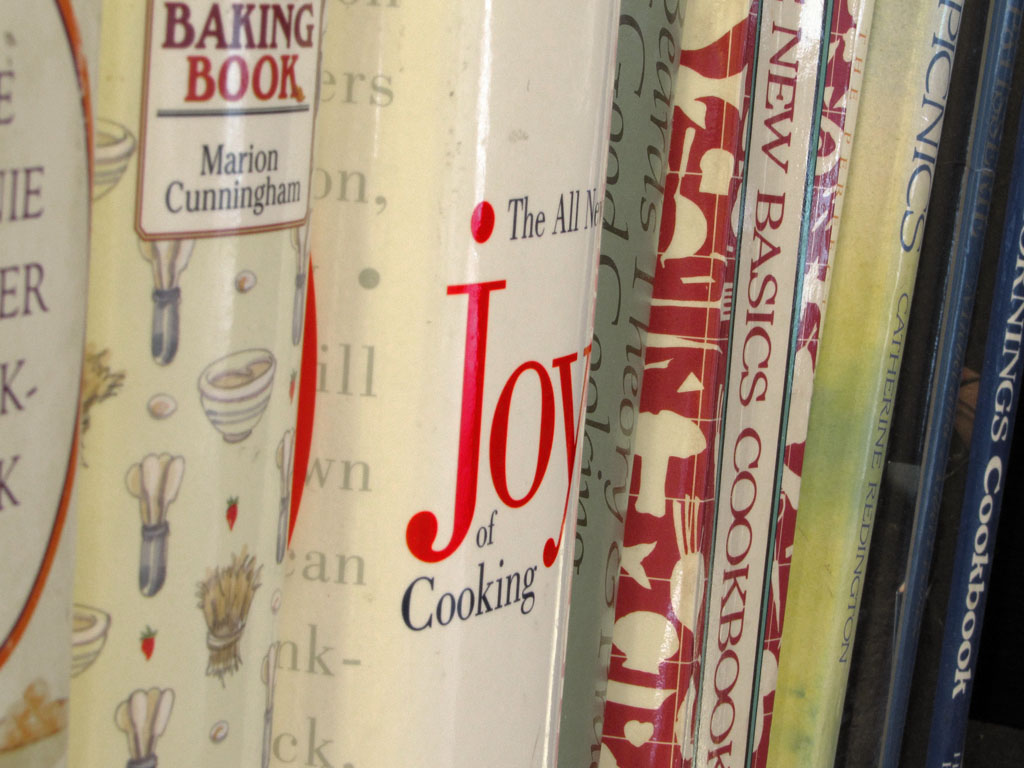
It was a rainy, snuggly night in November 2018, perfect for making mushroom barley soup or stuffed cabbage. I was walking home from the train when I saw it, inexplicably abandoned at the Little Free Library on my block. There, lying on its side as if after a long day of work, was that unmistakable thick white tome with the feisty red lettering on its spine: Joy of Cooking.
I didn’t need it, of course. I’d brought my copy, used so relentlessly the backstrip dangled like a hangnail, when my partner and I moved in together—even though he, no slouch in the kitchen, had his own. No, I didn’t need it. But taking it felt like a moral imperative. It was the same as if I’d seen a stray kitten cowering under a bush. I told my mom,and later my best friend, who was at the time a new mother, about the intense reaction I’d had to the sight of an abandoned Joy. They both said they would have felt exactly the same way.
In November 2019, Scribner brought out the ninth edition of Joy of Cooking, which first appeared in 1931 as the self-published venture of an amateur cook and writer. Other books Americans were buying in 1931 include The Good Earth by Pearl S. Buck, Dash Hammett’s The Glass Key and Faulkner’s Sanctuary. The memoir of the Russian Grand Duchess Maria Pavlovna, granddaughter of Tsar Alexander II, was also a bestseller. In other words, books that were popular in 1931 feel very 1931.
Bestselling cookbooks reflect the cultural moment. But what if a cookbook could avoid that fate, by changing with the times?
Indeed, popular books are always a shorthand for an entire era—and this is doubly true of cookbooks. Aesthetically and gastronomically, cookbooks capture the zeitgeist; they both reflect and create the cultural moment. Do you have a bottle of pomegranate molasses in your cupboard, from which is missing a scant quarter-cup? If so, you probably also have a copy of Ottolenghi (2008) on your shelf, now neglected in favor of something simpler, say, Nothing Fancy (2019). Today the marketplace for cookbooks is more robust than ever, catering to every possible palate and diet, but these titles have long been ephemeral. Julia Child published her epochal Mastering the Art of French Cooking in 1961, and it taught Americans how to cook Dover sole (filleted) and how much butter to use (more). Only ten years later, Frances Moore Lappé ushered in an era of environmentally conscious cooking with her revolutionary vegetarian cookbook-manifesto Diet for a Small Planet. A lot changed in that intervening decade, and yet today, both those books read, and cook, like time machines. Because of changes in taste, technology, nutrition and entertaining, bestselling cookbooks quickly become culinary bugs trapped in amber. But what if a cookbook could avoid that fate, by changing with the times?
The story of Joy of Cooking is every bit as surprising as the recipe for braised bear (p. 530 in the 2019 edition). Irma Rombauer was the sociable St. Louis housewife and mother of two who, following her husband’s death by suicide in 1930, decided to parlay her savings into creating a crowd-sourced cookbook. The project was a bold choice considering the recent stock market crash, and the fact that she was not a particularly gifted cook. But Irma was a hustler. She had her modest volume stocked in gift shops as well as bookstores, and personally delivered copies to local buyers. The first readers responded most of all to her tone, which was casual, playful and above all, encouraging. A trade publication was arranged in 1936 by Bobbs-Merrill, then the largest press in the Midwest. The professionalized text lost none of its personality, as when Irma digresses from the nominal subject of wild duck to reassure her readers:
Since you may be burdened by tradition amounting in some instances to misinformation, and will in addition read and hear many things that are confusing, approach the matter of cooking with an open mind. Draw your conclusions from your experiences and be guided by your tastes and impulses. This book is supposed to be a beacon (I devoutly hope it is!) to light your way. Your path is your own and a healthy curiosity should lead you into many agreeable byways, provided you use your mind.
The full title was The Joy of Cooking: A Compilation of Reliable Recipes with a Casual Culinary Chat. Uniquely among American cookbooks, it has never been out of print.
Irma pioneered a personal mode of recipe-writing, opening the door for people like Nigella Lawson and Deb Perelman. She’s friend who sits on a stool in your kitchen to gossip and tell you when it’s done. Her recipe for cream puffs begins, “Please cease to think of these as something to try out in your more adventurous moments. Try them at any time. They will soon prove to be stand-bys.” On banana cake, she writes, “I wish I might comment on all the cakes in this book. Please try this one if you like bananas and make the comments yourself.” The fact of Prohibition did not stop my girl from beginning her book with recipes for cocktails.
Irma’s daughter Marion was an artist, organizer, and educator, and she helped develop her mother’s harebrained project into a title with staying power. In its pages, Marion’s enthusiasm for organic gardening translated into a concern with nutrition and food science. In 1940, she moved with her husband, the architect John Becker, to Cincinnati where she became the director of the Modern Art Society (today the Contemporary Arts Center). He designed a Bauhaus-style house for them, a home they dubbed “Cockaigne” after a mythical land of ease and luxury from the French medieval imagination. All the “cockaigne” recipes in the Joy, like the fudgy brownies (pp. 764–765) I grew up eating, were developed in that Cincinnati kitchen. “Not just brownies,” my dad would say, slicing diamonds into the still-warm pan. “Brownies cockaigne.” We all just thought it was French for decadent.
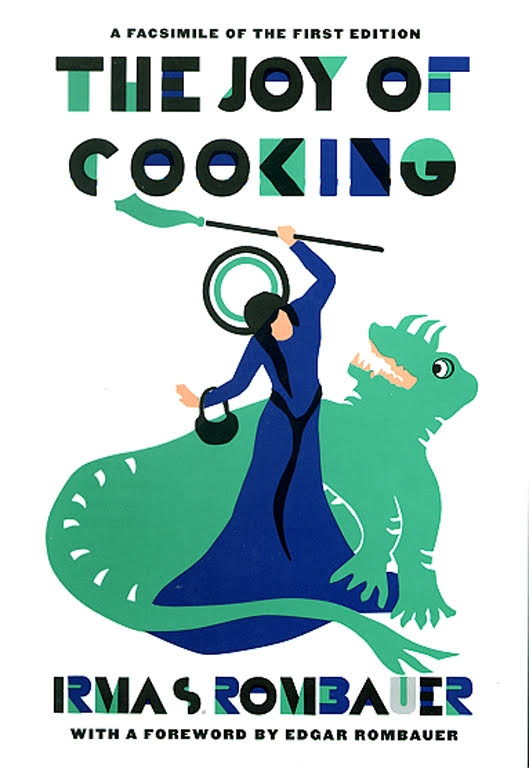
The cover Marion designed for the 1936 edition is a masterpiece of modernist graphic art: a woman in a floor-length royal blue dress with a small cauldron slung over her wrist confidently raises a broom over the head of a threatening teal dragon. She is Saint Martha of Bethany, the patron saint of cooks. The dragon represents the tedium and drudgery of kitchen work, or maybe he’s just hangry. There’s a 1998 facsimile imprint that also contains the Marion’s illustrations from the first commercial editions (1936, 1943, and 1946). They’re playful and whimsical images, produced using the medium preferred by Marion and, contemporaneously, Henri Matisse: paper cut-outs. Puffed heads of dandelions introduce a section on soufflés, and two snails, cautiously touching feelers to get acquainted, crawl above the chapter on hors d’oeuvres.
Of the 1951 edition, for which Marion was named co-author, New York Times food critic Jane Nickerson wrote, “When its enthusiastic users get together, they play an ‘it even has’ game.” We played the same game in my family, and the winning entry was always squirrel, from the section on game. That edition also marked the replacement of Marion’s paper-cuts with diagrammatic illustrations by Ginnie Hofmann, including a now infamous drawing of said squirrel being relieved of its coat, the tail pinned down under the slender boot of an elegant and capable woman wearing thick gardening gloves to protect her hands from rodent entrails. These same long-fingered hands appear throughout the book, confidently shelling clams and weaving the lattice top on a fruit pie. Newer versions still rely on pen-and-ink drawings; the hands, degendered now, demonstrate how to roll sushi and de-rib kale.
Photo by Abigail Weil
Irma died in 1962 and Marion, with significant input from her husband, assumed full control over the project. This was the first time that authorship shifted decisively from one generation to the next. A subtler shift occurred on the title page. The 1964 edition, and all the others after it, is technically called Joy of Cooking. (I like to imagine John Becker gliding through an editorial meeting with the single suggestion, “Drop the ‘the.’ It’s cooler.”) But the Rombauer-Becker family, like my own, continued to call it simply The Joy.
In the 1964 dedication, Marion writes:
In revising and reorganizing “The Joy of Cooking” we have missed the help of my mother, Irma S. Rombauer. […] We look forward to a time when our two boys—and their wives—will continue to keep “The Joy”a family affair, as well as an enterprise in which the authors owe no obligation to anyone but themselves—and you.
The work Marion put into this revision is unfathomable; as the mother’s health declined, it fell to the daughter to add editorial and legal work to her design tasks. This dedication, however, is egoless. It’s about the parent who preceded her in building a tradition, and the children who she trusts will follow. Mutability became crucial to the book’s identity. Marion, more process-oriented and health conscious than Irma, transformed it, and counts on her sons to someday do the same. Moreover, she recognizes that families grow laterally, allowing for the influence of her sons’ future wives, as her husband influenced her. It’s worth noting, too, that although the first transfer of the project was, conventionally enough, mother to daughter, Marion disregards the historically gendered dimension of cooking. The Joy belongs to the family, whatever its future permutations may be, and to the readers.
The Joy belongs to the family, whatever its future permutations may be, and to the readers.
History has borne out Marion’s hopes. The full author list of the 2019 edition is: Irma S. Rombauer, Marion Rombauer Becker, Ethan Becker (Marion’s son), John Becker (Ethan’s son), and Megan Scott (John’s wife). “An index,” Irma wrote in 1936, “isn’t literature, but a careful perusal of it will sometimes produce a poem.” The same can be said of a contributors list.
The Joy has continued to change its shape and meaning right along with American culinary culture. Marion’s triumphant 1975 edition, a full-fledged encyclopedia of cookery, remains the best-selling version in Joy history. It was the version I was raised on, my parents having received it as a wedding present in 1981. Notorious is the 1997 edition, when Ethan Becker, the only culinary school graduate in the family, hired a slate of “experts” to revise appointed chapters. John Becker confesses in the introduction to his new revision that this experiment was widely panned, and it must have come across, to Joy loyalists, as a gimmick in the dawning age of celebrity chefs. But it was good enough for me when I shipped off to college, and it’s the same volume I brought it with me 15 years later when my partner and I established our two-Joy household. You can learn more about the history of The Joy from Anne Mendelson’s Stand Facing the Stove, and the New School panel discussion The Culinary Legacy of Joy of Cooking, featuring Mendelson, culinary historian Laura Shapiro, librarian Rebecca Federman and anthropologist Amy Trubek.
Irma’s plucky voice faded after Marion took over, and Marion’s ideas about nutrition, while still compelling, are not the book’s main draw. Amazingly, neither of these pioneering authors conclusively defined the book. Instead, the infrastructure they both engineered helped it become what it is today: a reliable, updatable reference book. At least since the Enlightenment, reference is a genre not defined by individual authors, but by collective efforts; Diderot didn’t write the Encyclopédie, he edited it. The Joy’s greatest strength, I’m convinced, is the flexibility that has allowed a single title to expand, to express changing priorities and encompass new ideas, to make room for new generations. You can’t tell a Joy dish from the way it tastes as much as from the way you feel while cooking it. If there is a Joy of Cooking style, it’s not culinary but literary, a voice that is clear and reassuring. For a cookbook to speak to you, it has to understand you, not the other way around. It helps if you both come from boisterous omnivorous families, unafraid of change.
In the end, I didn’t take that errant Joy. My dedicated cookbook bookshelf was overflowing, and all my friends who cook already owned a copy. But I like to imagine someone else finding it, recognizing it from a delicious childhood memory, and taking it home to an entirely different life than it would have had in my kitchen. In the preface to the 1943 edition, Irma wrote, “My daughter says that when my book is praised I purr like a cat.” I hope she’s looking down on her great-grandson’s edition, the book’s ninth life, and purring up a storm.
Before you go: Electric Literature is campaigning to reach 1,000 members by 2020, and you can help us meet that goal. Having 1,000 members would allow Electric Literature to always pay writers on time (without worrying about overdrafting our bank accounts), improve benefits for staff members, pay off credit card debt, and stop relying on Amazon affiliate links. Members also get store discounts and year-round submissions. If we are going to survive long-term, we need to think long-term. Please support the future of Electric Literature by joining as a member today!
Say you’re writing a story and the protagonist is a baseball player, or a war veteran, or a typist. Now, since you’re a person in the world, you’ve of course also been conditioned on the media we all are, meaning you’re also familiar with, say, Marathon Man. Amazing William Goldman novel, amazing William Goldman-scripted movie, I don’t mean to take a single thing away from it, would only ever try to heap even more praise on it, and urge us all to ever do even half as good as it does.
For anyone out there who hasn’t read or seen Marathon Man: this one dude’s a runner, maybe not Prefontaine-good, just Dustin Hoffman-good, but still, he’s committed, it’s always on his mind, it’s always getting his feet out there slapping the asphalt day after day. Through a series of Hitchcock-ish shenanigans, this self-styled runner ends up embroiled in a Nazi plot involving stolen Jewish diamonds. Lots of intrigue and close shaves and torture, just as the story doctor always orders, all culminating in this runner, in serious mortal jeopardy, using his… can you already guess?
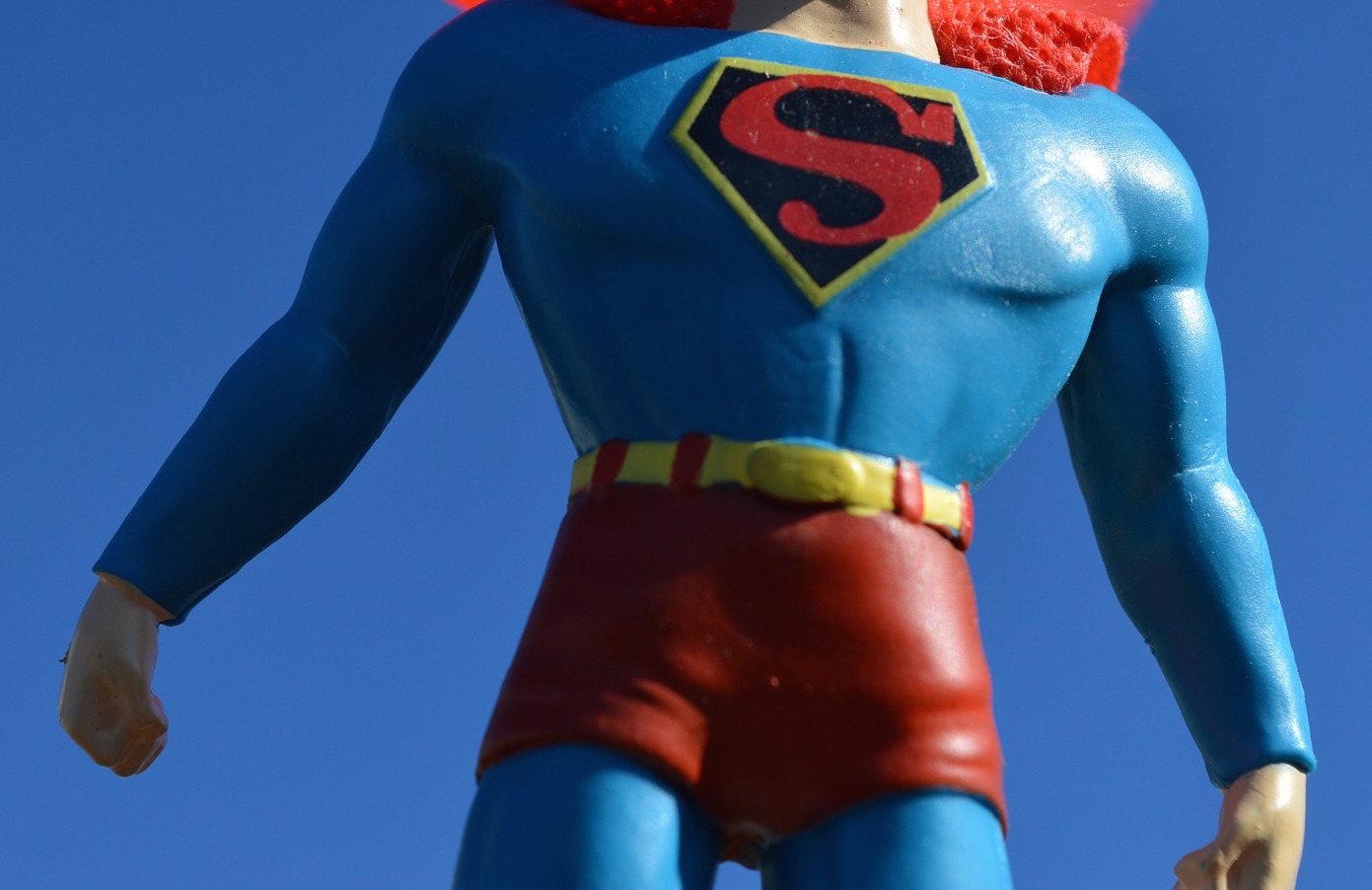
His running turns out to be his “superpower,” the surprise ability that allows him to escape, survive, win the day.
Nothing at all wrong with that, you’ve seen it before, it tends to work. Writers are magicians, always slipping things into your pocket early on, when you’re not paying attention, then pulling them out precisely when they need you to go ahh.
Trick with Marathon Man, though? This runner, he elected to be a runner. His using that running to save his own life and win the day is an investment finally paying off. No, he didn’t know he was going to need his conditioning and technique to escape some Nazi holdovers, but now that he really-really needs to run, it’s not like he’s not going to use that conditioning and technique, right?
This build is golden, is bulletproof, is hardly the wrong move.
Except when it is.
My characters had always been Blackfeet all along. Just, I wasn’t hanging dreamcatchers and braids all over them.
Back when I was coming up through grad school, I had this kind of a-ha moment in fiction workshop. In my second or third story for the semester, I mentioned that my protagonist was Blackfeet. Nothing momentous, just, somebody in the story happened to ask, the character answered, move along now, it’s still the same story. But the workshop couldn’t quit talking about him being Indian. Which was pretty weird to me, since all of my characters had always been Blackfeet all along. There was never any reason to actually say it, but they always were. Just, I wasn’t hanging dreamcatchers and braids all over them, as that would be a lot like making them wriggle into loincloths so they could fit the limited expectations of . . . everyone, pretty much.
The workshop was now reading my story completely differently, though. They kind of put on tragic glasses, they set their eyebrows in that way that indicates “We’re talking about issues now,” and their voices were all sort of kinder, predisposed to pity and charity instead of carving up my pages as my pages needed carving up.
Like I say, it was weird and kind of off-putting, and was my first time to encounter that. It wasn’t my last. Once I started publishing novels, I quickly found that, at book events, I’d get questions that focused on Indian culture and life and history and “tragedy” (always the tragedy) more than on the story itself. It had stopped being weird by then, just felt wrong, like I was part of some unwholesome transaction—like I was selling my identity or my heritage along with my books. So I ran away, said screw this, I’m going to write about zombies and slashers and werewolves and private detectives and toilets and haunted houses and demons and—and giant invisible time-traveling caterpillars—and they’re going to be so loud and bloody that nobody will be able to ask those Indian questions anymore, and I can start selling books, not myself.
Worked great, and now I’m kind of able to still do the horror I love, but while also writing the people I know.
Still, though?
Every once and again, I’ll give a draft of a story to someone, and they’ll come back with the old saw I’m always hoping isn’t a thing anymore: Okay, so this character is Indian, but… why does that matter to the story? When will this Indian-ness, you know, activate? Or, to say it differently: So, this guy’s a runner, you say? What if his running can be the thing that he uses like a surprise at the end?
Okay, so this character is Indian, but when will this Indian-ness, you know, activate?
Sub in the baseball player using her fast-pitch or the war veteran using his military training or the typist using their speedy fingers to enter a page of dictated code just in time to save the missiles from deploying.
When you sub in other things for “Indian,” that question of “Why is this character Indian?” wants to make perfect story sense: to employ the kind of economy the reader expects, you of course use all the pieces of this puzzle you’ve already laid out.
Except the baseball player wasn’t born with the diamond in her eyes, the soldier didn’t come out knowing the chain of command, the typist doesn’t have QWERTY actually in the tangled letters of their genetic code. All these characters went the direction they went, made the choices they made, and so became a baseball player, a soldier, a typist.
Being Indian, though, that’s not a choice. You’re born Indian, you die Indian, and you’re Indian pretty much the whole way through, except maybe at Halloween, when other people get to buy a costume of you. You may end up also being a baseball playing typist on a submarine, but before and underneath all that, you’re Indian, man. Nothing to do about that.
And we can take that question apart a little, can’t we? Why is this character Indian? The assumption underneath that is that the default setting is “non-Indian,” not Native, un-indigenous. But that’s probably a bit too wide, a touch too charitable of a read.
The real default setting that question assumes isn’t just non-Native, it’s “white.”
So the question is actually “Why is this character not white?” And it’s not meant to be asked (I tell myself) in any violent or damaging way, it’s not intended as colonialism in action, it’s just some close reader’s awareness of fiction’s impulse—obligation, even—to utilize what’s there, and justify its presence.
I submit that a character being Indian doesn’t need justification, though.
I submit that, while I might want being Indian to be a superpower, a special ability, actually, contrary to popular myth, being Indian doesn’t even get you free college, right? It doesn’t jack you into casino money, it doesn’t make you automatically in tune with nature, and it doesn’t make you any sadder than everyone else about unrecycled cans in the creek. It also doesn’t make your cheekbones or your nose like this or like that, your name exotic to American ears, your hair long or short, your religion here, there, or anywhere.
It just means you’re Indian, in a world that’s largely not Indian. It means you probably don’t see yourself in the main role on the television show. It means you’re reduced to being the most insulting mascot as often as not. It means that people will be rocked back on their heels a little bit to learn you’re—gasp—vegetarian? But how can that be?
We don’t use every part of the buffalo anymore, no. Nowadays, we use every part of our self-control just to get through the day.
You don’t even have to be interesting at all. You just have to, you know, keep being.
And, yes, there’s heritage there if you want it, there’s community to plug into, there’s history to engage and resist, there’s fights to fight and stereotypes to undercut. But there’s also just, and simply, being born as you were born. There’s being Indian. At a certain point in your story, you’re not compelled to tie a bandanna around your head, unsheathe a tomahawk, and become the opposite of John Wayne. You’re not only interesting when standing at the barricade of a televised protest. You don’t even have to be interesting at all. You just have to, you know, keep being.
The best way to be the protagonist of your own story—which is also, I submit, the best way to write the protagonist of your story—is just to assume Indian-ness. Say it out loud on the page if you want, or don’t, it doesn’t matter. You’ll know.
But what if being Indian were a superpower, right? Whatever situation I’m in that I don’t want to be in, I just peel my shirt open to reveal my uniform beneath, the one with CUSTER DIED FOR YOUR SINS tooled into the belt, the one with MY HEROES HAVE ALWAYS KILLED COWBOYS beaded on the back, the one with FRYBREAD POWER stretched across the gut, and then a hawk screeches and the sun flashes and like that—
You get the picture. Or I do, each time I’m asked “why does it matter to the story that this character is Indian?”
The early trailers for Dickinson, the heavily fictionalized Apple TV+ series based on the life of Emily Dickinson, left me baffled. Why is she in a plunging red satin dress? What is Jane Krakowski doing there? Was that a shot of Hailee Steinfeld covered in tattoos? Wiz Khalifa??? What is this show?
This show, my friends, absolutely fucks.
The answer, it turns out, is: it’s delightful. It’s a flippant take on Dickinson’s life that’s super queer, extremely fun, and somehow never disrespectful. The characters speak like they live in 2019. The Dickinson siblings throw a house party where everyone gets high on opium and Emily hallucinates a giant bee voiced by Jason Mantzoukas. Emily and her best friend/lover /future sister-in-law fuck to a Mitski song. John Mulaney guest-stars as Henry David Thoreau. Wiz Khalifa shows up occasionally as an extremely sexy personification of death, in a carriage drawn by spectral horses (Emily only busts out the red dress for these visits). This show, my friends, absolutely fucks. It’s a vital little adventure into the past, and a refreshing reminder that biopics don’t have to be staid slogs.
It’s such a pleasant surprise, in fact, that I couldn’t stop thinking about other authors whose life stories deserve the Dickinson treatment. I’m currently working on spec scripts for all of the following, so if you have an enormous amount of money and nothing to do with it, please call me immediately.
“Multitudinous”
Synopsis: We follow Walt Whitman (Timothée Chalamet) through his early adulthood, as he tries to make ends meet with a combination of freelance writing, teaching, and ill-fated newspaper jobs. In his off hours, he brings a series of men back to his sparsely-furnished, questionably-legal loft apartment, furiously writing poetry as they sleep beside him. Frustrated at his lack of recognition and fresh off a peyote trip with friends at a popular sculpture park upstate, Whitman decides to self-publish Leaves of Grass, a move met with derision from his traditionally-published peers. Directed by Tanya Saracho.
Self-aware anachronistic music cue: Perfume Genius’s “Queen” kicks in the first time someone recognizes Whitman from his engraving in the frontispiece to Leaves of Grass.
“Delete This”
Synopsis: An office comedy set in the Random House offices during Toni Morrison’s (Viola Davis) time as an editor there in the 1960s and 1970s. Standard office drama ensues (from passive-aggressive wars over desk chairs to stolen lunches in the break room), with Morrison contributing cutting commentary directly to the audience. Directed by Lee Daniels.
Self-aware anachronistic music cue: After successfully pushing for the publication of The Black Book over executive uncertainty, Morrison strides out of the office to SZA’s “Broken Clocks.”
“One of Us”
Synopsis: The town of Milledgeville, Georgia, is filled with weirdos, crackpots, and characters, and Flannery O’Connor (Ellie Kemper) is no exception. The show is a Letterkenny-style ensemble comedy (mostly live action with occasional animation in the style of O’Connor’s cartoons) anchored by O’Connor, whose ability to converse with birds isn’t even the most exceptional eccentricity in town. Though the town is rife with interpersonal drama and family secrets, a warped sense of camaraderie pervades, and when a killer known as The Misfit comes to town seeking his next victim, he’s run off by a motley crew of townsfolk, led by O’Connor’s trained peacocks. Directed by David Lynch.
When a killer comes to town, he’s run off by a motley crew led by O’Connor’s trained peacocks.
Self-aware anachronistic music cue: The drums on They Might Be Giants’ “Birdhouse in Your Soul” kick in as O’Connor throws open the front doors of her house and a frankly improbable number of birds spill out and take wing.
“Zora”
Synopsis: In 1920s Harlem, in the early stages of her literary career, Zora Neale Hurston’s (Tessa Thompson) friendship with Langston Hughes (Lakeith Stanfield) takes center stage among the luminaries of the Harlem Renaissance. The show focuses on Hurston and Hughes’s tempestous working relationship and rumored love triangle with Louise Thompson (Amandla Stenberg), their typist and collaborator on their doomed play, “Mule Bone.” Directed by Issa Rae.
Self-aware anachronistic music cue: Hurston’s first gathering of writers and artists at her apartment is tracked to “L.E.S. Artistes” by Santigold.
“Busy Ape”
Synopsis: A bawdy comedy about the misadventures of five monkeys in a doublet and cloak who’ve accidentally become a celebrated playwright. Calpurnia, Lysander, Dorcas, Ajax, and Bob, having escaped from a cruel life as animal actors, must work together to escape detection as they navigate Elizabethan London and the cut-throat theater scene. The primary antagonist is Christopher Marlowe (Adam DeVine), who suspects Will Shakespeare isn’t what he seems. Directed by Terry Gilliam.
A bawdy comedy about the misadventures of five monkeys who’ve accidentally become a celebrated playwright.
Self-aware anachronistic music cue: After a close run-in with Marlowe, the needle drops on “Everybody’s Got Something to Hide (Except Me and My Monkey)” by The Beatles as our heroes escape into the bustling streets of London and the credits roll.
“No There There”
Synopsis: A Broad City-style stoner comedy about Gertrude Stein (Merritt Wever) and Alice B. Toklas (Jenny Slate), whose infamous pot brownies are the driving force behind Stein’s legendary literary salons. Turns out Hemingway is a lot more enjoyable when you’re high. Misadventures ensue, including a stoned outing to the Louvre that turns frantic when the group loses track of F. Scott Fitzgerald (Daniel Radcliffe), until he’s discovered near-catatonic behind the Winged Victory of Samothrace, muttering about boats and currents. Directed by Stephen Falk.
Self-aware anachronistic music cue: Stein and Toklas attempt to perfect their brownie recipe in a montage set to “La Vie En Rose,” as covered by Lucy Dacus.
“Actually, Frankenstein”
Synopsis: The show opens in Mary Godwin’s (Diana Silvers) late teenage years, in the early stages of her relationship with Percy Bysshe Shelley (Ezra Miller, sorry, I don’t make the rules). They meet secretly by night in the graveyard where her late mother is buried, in defiance of her father’s wishes. Though Mary never knew her mother, she has frequent conversations with her mother’s long-suffering, sardonic ghost (Kristen Bell). After Mary and Percy elope and run away to Europe, they form a polycule with a number of other writers and luminaries, including Lord Byron, who dismisses Percy’s writing with a hand-wave and a “Bysshe, please.” Directed by Madeleine Olnek.
Self-aware anachronistic music cue: Billie Eilish’s “bad guy” (honestly, what else) plays as Mary loses her virginity on her mother’s grave.
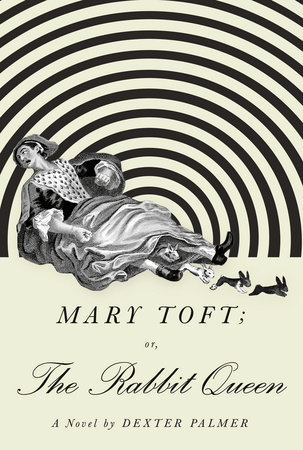
Rabbits are having a moment. Last year in Oscar-winning movie The Favourite, Queen Anne was depicted as having a room in her home dedicated to the 17 pet rabbits, each of which represented one of her dead children. Now, in Dexter Palmer’s historical novel Mary Toft; Or, The Rabbit Queen, Mary Toft is giving birth to 17 dead ones.
Although in reality, Queen Anne did not have pet rabbits, Mary Toft did—sort of, but not really—give birth to rabbits in an elaborate hoax that bamboozled some of London’s top surgeons in 1726. Author Dexter Palmer reexamines this scheme, which has been a joke for centuries, through the eyes of the surgeon’s apprentice that sees Toft’s first “birth” in Godalming, England. The 14-year-old boy and his very rational mentor John Howard don’t know what to make of this event, especially as Mary continues to produce dead rabbits. Everything they thought they knew is thrown in question.
Before the rabbits, John Howard posed a question to his young apprentice after the two attend the sideshow Exhibition of Medical Curiosities. The audience is shown what is said to be a two-headed woman behind a curtain. They can’t really see her in any kind of detail to tell whether she actually has two heads or not. “If all of us believed in her, would not her existence be a matter of fact, and not a fraud?” he asks. Palmer weaves this question throughout his novel.
Palmer is no stranger to tackling multi-faceted subjects and big questions. He published his debut novel The Dream of Perpetual Motion, which is a sci-fi steampunk novel, in 2011, and followed it up with Version Control, a sci-fi novel that examines the relationship between technology and relationships, in 2016. He deftly combines history, horror and comedy into his jump in historical fiction.
Alicia Kort: Where did you first learn about Mary Toft and why did you become interested in her story?
Dexter Palmer: At graduate school—my Ph.D. was in English Literature at Princeton—and there was one class in 1996 and its title was “Representation of the Improbable.” It covered certain works of 18th-century literature. One week, one of the general topics of the class was fraud, and this Mary Toft story came up. I thought it was interesting, but I didn’t ever think that I would do anything with it back then. Except every once in a while when I came across some piece of literature related to the Mary Toft case, I would photocopy it or make a note of it and file it away. Eventually, I had enough material to think that I actually had a novel here.
AK: Let’s talk more about the characters, Zachary, a surgeon’s apprentice, is the main character of the book. I was wondering why you decided to make him your main character instead of Mary Toft?
DP: The first reason is when my editor and I were talking about how to structure the book, one of the things we decided on was having a protagonist who knows little about the world but is learning about it as a way to convey information to the reader without being too obvious about it. The second is that weirdly other than the fact that Mary Toft hoaxes people into thinking she’s giving birth to rabbits, she’s not that narratively interesting. If you can imagine like a story that’s entirely about her, then Chapter X [is] “I gave birth to another rabbit” and so on—plain and simple. The third is that the book is a book about women’s identities, but it’s also a book about how men view women. There are ways that I can get that at that subject—and I think that subject is important to discuss—but involve me focusing on these men looking at a woman who they don’t understand or are deceiving themselves into thinking that they’re seeing something other than they are and what the consequences of that are.
AK:In the beginning, both Zachary and John are both very affected by having to deliver these rabbits. How did you decide how the rabbits were going to be delivered?
DP: In the past, I feel like I’ve turned in work with chapters that were scary, but clearly this is actually horrifying. But at the same time, a woman giving birth to rabbits is also… I hate to say it, really funny. As I found as I was writing, horror and comedy have a lot of the same formal techniques in common. It turns on a surprise for the audience that’s either unsettling or makes them laugh. I was trying to get over the fact that it’s terrifying. The novel is also in some ways kind of a farce.
With respect to the actual research, I did look at some of the publications from the doctors who worked with Mary Toft. I forget how many doctors offhand, but I want to say I condensed them into basically three. They were fairly specific given the conventions of the time with describing things. They described the parts and stuff like that. I’ve used a couple of narrative devices to draw a veil over some things I didn’t want to explicitly describe because the thing about horror is if you leave something undescribed, people fill things in.
AK:Well, the thing I found comical about it personally, the first birth John and Zachary both go run outside to vomit. I’m sure that’s a very natural reaction to seeing that but at the same time, this woman just gave birth to a dead rabbit, and she seems to be processing it slightly differently, better than the doctors who are helping her. Could you talk about her relationship with the surgeons?
DP: There was a way in which I detected the surgeons as seeing her as both… it depends which character you’re talking about. They either see her as someone who is afflicted by a problem, someone who is perhaps a means to their own personal gain or someone who’s just thinking “We should watch this person and see what happens—just out of our own curiosity.” But they do tend to see her as a body. Some of that is just the way surgeons, as I’m depicting them, actually are. “This person is a machine that needs to be fixed. If we get too emotionally attached, we might not get the optimal result.” There’s another chapter later on that involves another pregnant woman. There’s an implicit discussion there about what it is like to view a female patient as a human being with her own thoughts, identity and soul versus what it is like to view her as an object that needs repair, so to speak, and how to split the difference between one or the other or whether or not one should do that.
AK:You have several passages in the book where people seek out things that are out of the ordinary, disturbing or even violent. The wealthy in particular seem to go out of their way to do this in your book. Why did you decide to include these in addition to Mary Toft’s story and what do you think those passages say about human nature?
DP: The passages in which people pay money to see out of the ordinary or violent things—often, violence against animals—are almost entirely based on historical fact. Adding those events was primarily a matter of portraying the period accurately, insofar as a novelist worries about accuracy. In a couple of instances, I’ve actually toned things down from what I found in my research.
What’s going on in people’s heads to convince them to believe something that is just obviously materially false?
There was some discussion during the writing process about how faithful to be to that aspect of the setting—a weird thing about contemporary readers is that in general they’ll sit for the portrayal of all sorts of violence against humans, but are more likely to be bothered by the portrayal of violence involving animals, especially those that can be domesticated. The film John Wick arguably satirizes this tendency. But in the end, I decided that the reader needs that context about how callously many people of the period viewed animals in order for some of the story involving Mary to make complete sense.
AK: People have always been fascinated by things they can’t explain or they’d rather not know the details of, which is shown when Zachary and John visit the Exhibition of Medical Curiosities. I think that’s still true. We’re very interested in hoaxes—Elizabeth Holmes, Caroline Calloway, Anna Delvy. They’re still a part of our culture. Was this something you were thinking about while you were writing?
DP: Yeah, as I was writing it, the thing I found myself thinking about is the philosophical reason to write the book: What’s going on in people’s heads to convince them to believe something that is just obviously materially false?
And with Elizabeth Holmes, I listened to the audiobook of Bad Blood, which was about the whole Theranos thing. It was super fascinating because Holmes presents people with basically this sci-fictional idea—she just basically describes a Star Trek tricorder—somehow gets lots and lots of money to build this thing with no real demonstration of the credentials to be able to do this. Other than to say it’s fascinating that this sort of thing happened, at the time I wasn’t completely certain why someone would do this.
I think the answer I’ve sort of landed on is that the ability to deceive oneself is much more powerful than we would like to believe that it is. Because there’s so much information in the world and so little we can actually see, we’re necessarily working on a limited amount. Given that we work with these limited amounts of information, we are likely to believe what we feel would be best to be true. Those things might either be materially false or silly or something like that. I’m thinking about this because Mark Zuckerberg gave this interview about whether or not politicians should be able to post ads on Facebook that make false claims. His claim is “Well this is just something we’ll have to deal with.” That just seems really reckless and careless and bad to me. It seems like a basic misunderstanding of human nature.
AK:Is there anything surprising or unexpected you found when you were researching Mary Toft or your book?
Bottom left: Mary Toft giving birth to rabbits. Artwork by William Hogarth—Credulity, Superstition, and Fanaticism via Wikipedia. Click to enlarge.
DP: There was one thing I found surprising that I couldn’t include, because it turns out that there just wasn’t room for it, which is that Voltaire would have lived in London at the time that this was happening. Handel the composer would have also been in London as this was happening. I thought “I wish there was a way I could include these characters just sort of walking through.” I actually made a pass at it, but the problem with writing Voltaire is that you have to be as good as Voltaire. You know when you read a novel or see a film and William Shakespeare is a character and even in the best versions, it’s not going to seem quite right? That’s just what was happening there. In my dream version of this book, if I had infinite space and an infinite amount of talent, I would have had a scene with Voltaire meeting Handel or something like that.
AK:Your book is in the trend of going back into women’s or other marginalized people’s lives and rewriting or reframing it, whether it’s fictional or nonfictional. Is there any other person in history that you would like to rewrite or reframe their story or give them their proper due?
DP: I’ve been thinking about that. I don’t have an answer yet, because after I finished my last book I was like “I need a long break from writing this kind of fiction.” And now I have Mary Toft out the door, I’ve been thinking “I need a break from writing this sort of historical fiction.” I didn’t think it would not be terribly difficult to do, but it turned out to be excruciatingly challenging just to get it out the door. Eventually, I could see myself going back to historical fiction for sure, but I haven’t settled on anything yet.
Before you go: Electric Literature is campaigning to reach 1,000 members by 2020, and you can help us meet that goal. Having 1,000 members would allow Electric Literature to always pay writers on time (without worrying about overdrafting our bank accounts), improve benefits for staff members, pay off credit card debt, and stop relying on Amazon affiliate links. Members also get store discounts and year-round submissions. If we are going to survive long-term, we need to think long-term. Please support the future of Electric Literature by joining as a member today!
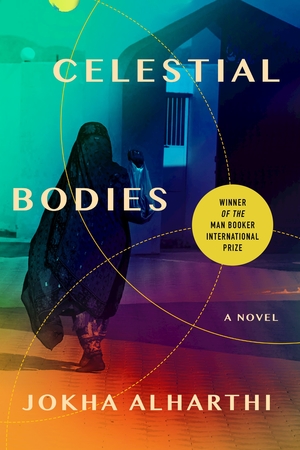
Celestial Bodies by Jokha Alharthi won the Man Booker International Prize this year for its beautifully rendered portrayal of a family’s tangled history in the village of al-Awafi in Oman. The novel was the first book translated from Arabic to win the prize, and more surprisingly, it was the first novel by an Omani woman to be translated into English at all. This trifecta of achievements encapsulates what makes Celestial Bodies vital reading for Americans: it’s a wonderful novel that stands on its own, and it also provides us with the increasingly rare opportunity to engage with a celebrated work that is in no way about or for Americans, that is not intended to curry either their favor or their outrage but simply isn’t concerned with them at all.
Alharthi is the author of three books of short stories and three novels. A native of Oman, she was living in Edinburgh and studying for her Ph.D. when she felt a longing for home. She told The Guardian, “I just sat there with my laptop thinking about—not exactly Oman, but a different life, and a different language. And because I love my language so much, I felt the need to write in my own language.” Celestial Bodies jumps back and forth between perspectives and time, creating an intricate tapestry of the village of al-Awafi in rural Oman over the last half-century. We hear most from Abdallah, the son of a wealthy merchant who is in an unhappy marriage to a wife who doesn’t love him back. But though Abdallah is at the center of the story’s web, he isn’t the book’s protagonist, because there isn’t one. Instead, we hear from the entire village, everyone from Abdallah’s wife and daughter (named London, a choice that brings ridicule from more traditional family members) to the village beggar and the slave woman who acted as a surrogate mother for Abdallah.
Americans, especially white Americans, need to read books that allow us to be the Other.
This experience is crucial at a time when Americans are (even more than usual) limiting themselves to art and media that reflects their own views back to them. Whether it’s through partisan news networks or Americanized books, films, and TV shows, many Americans are losing the ability to feel comfortable in worlds that aren’t designed for them. Americans of all backgrounds, but especially white Americans, need to read books like Celestial Bodies that present another culture on its own terms and allow us to be the Other.
One of the effects of this large canvas of characters is that Celestial Bodies becomes as much a portrait of a rapidly changing country as it is of a single family. Oman, which sits next to the UAE, Saudi Arabia, and Yemen on the southeastern coast of the Arabian Peninsula, has seen immense change over the last 50 years under the rule of one man, Sultan Qaboos. Sultan Qaboos deposed his father in 1970 and began to reform his country, turning a traditional, slave-owning society into a country that has claimed its place among the modernized Gulf states. Alharthi shows how this modernization affects every generation, but especially young people who are torn between their family traditions and their own desires. A classic scenario is when the newly married Abdallah has to choose between his father, who wants him to stay in al-Awafi to run the compound where the wealthy merchant historically housed his family and slaves, and his wife, who wants to move to Muscat, where young families are flocking to create their own homes.
Over the years Oman has inevitably contended with the Western influence, which Alharthi acknowledges through telling details like the wealthy character’s affinity for Western perfumes and cars. But Celestial Bodies never portrays Oman’s evolution as one specifically towards Western values. Rather, there is a progression of the native culture, whose long-established roots remain at the heart of society. Take, for example, Alharthi’s description of the house of Masouda, one of the village’s poorest women: “The walls were lined with images on thin, dog-eared paper of the Grand Mosque in Mecca and the Prophet’s Mosque in Medina, and one luridly colored image in a wood frame of Buraq[…] Thin mattresses — just cheap fabric stretched over a layer of sponge — were propped against the wall next to an assortment of plastic implements: baskets of various sizes and colors, big ladles, and pots with white lids.” While Masouda’s house reflects the common detritus of modern life, Alharthi makes it clear what comes first, both in her description and in Masouda’s life: the woman’s faith. Even Abdallah, a successful businessman who narrates his story from a plane headed to Frankfurt, spends his entire ride thinking about al-Awafi rather than his destination. In America, modernization is often understood to mean a shift towards Western values and practices, and we asses a culture’s progress by comparing it to our own. Alharthi offers another scenario and asks us to consider other cultures as independent from American standards.
Alharthi conveys Oman’s cultural independence by not catering to an American audience. Her book is densely packed with details about Omani culture and history, but she rarely elaborates on or contextualizes it for us. For example, when the bookish Asma reads her many texts, there is no aside to let us know what religious or historical work she’s taking it from or what it means. When Azzan, a businessman, visits the Bedouin, there is no explanation about the Bedouin people’s complicated nomadic history in Oman, only the attraction he feels for Najiya, a beautiful woman “of such resolution and valour, a woman named after the moon itself.”
When you get used to engaging with art that reflects only your own worldview, you also get the message that interacting with other cultures isn’t worth the effort.
Soon after I started Celestial Bodies, I did some reading about Oman’s history so that I could better understand the political and social forces that were shaping the book. This isn’t absolutely necessary—you don’t need any prior knowledge to enjoy Celestial Bodies as a compelling story of love and loss that’s full of vibrant details of Oman. But I’m thankful that literature can expose my lack of knowledge, not as a challenge, but as an opportunity to learn more. Because while not every American needs or wants to be catered to, we live in a country where art often comes with cultural scaffolding. Look at our insistence on remaking foreign TV shows and films into “Americanized“ versions, or how we fix the Harry Potter books for American readers, changing phrases like “tinned soup” to “canned soup,” “changing room” to “locker room,” and “straight away” to “right away,” as if even young readers wouldn’t understand. The point of Americanizing art is to make it more comfortable, more enjoyable, and thus more profitable. The problem is that when you get used to engaging with art that reflects only your own worldview, you also get the message that interacting with other cultures isn’t worth the effort.
Reading books in translation is an important way to immerse ourselves in other cultures, but unfortunately America reads hardly any books in translation—only an estimated 0.7% of fiction and poetry published in this country in a given year is in translation, far below the norm in other countries. Instead we’re reading books that were written in English and are, by their nature, more culturally accessible and easier to understand. Americans need to think critically about what kind of books we read and what exists for us in the publishing landscape. There is finally a conversation happening about increasing diversity in publishing, and I hope we will consider cultural diversity as well. To publish, buy, and read books like Celestial Bodies makes a statement that we value non-Western ideas. More overlooked but equally as important, these books give us the experience of being the other—and the opportunity to realize that isn’t always a negative thing.
Before you go: Electric Literature is campaigning to reach 1,000 members by 2020, and you can help us meet that goal. Having 1,000 members would allow Electric Literature to always pay writers on time (without worrying about overdrafting our bank accounts), improve benefits for staff members, pay off credit card debt, and stop relying on Amazon affiliate links. Members also get store discounts and year-round submissions. If we are going to survive long-term, we need to think long-term. Please support the future of Electric Literature by joining as a member today!
November is Picture Book Month, so these illustrated little gems are deservedly in the spotlight. In a recent blog post for Books Are Magic, novelist and bookstore owner Emma Straub curated a list of picture books. Among Straub’s picks for the best picture books of 2019 is a wonderful biography of Margaret Wise Brown—which also included a bold claim about this lesser known, sub-genre of Kid Lit: “Most picture book biographies are deadly boring. There, I said it!”
Well, I’m here to respectfully contest this! Emma Straub, a novelist I deeply admire, is like, totally wrong—and okay, also kind of right. It’s true that there are many sucky picture book biographies (let’s call them PBBs), just like there are many sucky books of every genre. The good news about bad books is that they only amplify the gloriousness of the excellent books by comparison. And there are many excellent picture book biographies out there.
In a very short time, you can learn about the most influential artists, intellectuals, politicians, and changemakers in history.
Reading PBBs is an amazing hack for readers who want to knowthe general beats of notable lives. In a very short time, you can learn about the most influential artists, intellectuals, politicians, and changemakers in history. But beyond acquiring facts and increasing your Jeopardy! score, what I relish most about PBBs is how they infuse history with much-needed empathy and emotion.
There’s also one more hidden benefit: reading them will make you a better writer. A biography in a picture book format is a master class in distillation. All writing involves making choices, sometimes excruciating choices, of what to leave in and what to leave out—but the art of a biographer takes this excision to the next level. And the scissory task of a picture book biographer is even more arduous: how to fit an entire life into a 32-page container. It’s no coincidence that some of the best PBBs have the fewest words.
Ultimately, I wonder if too many writers (and non-writers)stumble back into picture books only when they start procreating. So I’m here to say: there’s no need to wait to be a parent to (re)discover picture books. Go ahead and plunk yourself down on one of those miniaturized chairs in the children’s section of your local library with a fat stack of PBBs. Sure, you’ll be hella uncomfortable, and you might get some serious side eye from a sticky-fingered toddler suspicious of you infiltrating her turf, but trust me—it’s totally worth it. And hey, there might even be a tub of crayons waiting for you on those tiny tables.
Here’s a list of 8.5 of my favorite PBBs to get you started.
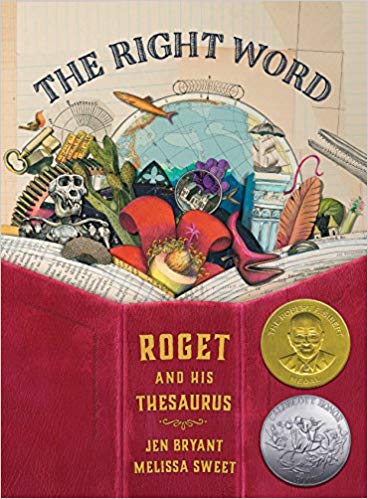
This book is a word nerd’s and fellow list-maker’s dream. It’s the story of a shy, skinny Latin- and Linnaeus-loving boy who begins to compile lists of words to cope with the death of his father. As he grows up, Peter Roget continues to gather his epic collection of synonymous language, and becomes the creator of the almighty thesaurus, which I learned from this book (be still my geeky heart) means “treasure house” in Greek.
Fun factoid: Peter Roget was in fact, a doctor, and was only 19 years old when he graduated medical school in Edinburgh, Scotland in 1798.
This is one of the sweetest books on this list (and maybe ever), but don’t let the tenderness fool you—the sparseness and economy of this storytelling, in its ability to pack both a biographical and emotional punch, is pretty astounding. The story begins with Jane Goodall, as a little girl, and her loyal companion, Jubilee, a stuffed toy chimpanzee. Together they comprise a dynamic duo on the hunt for joy and wonder, as they spy on the miracle of life in Grandma Nutt’s chicken coop. Readers are transported into the inner life of a little girl who dreams about helping animals in Africa, and then realizes these dreams. Jane, of course, grows up to be one the world’s foremost experts on chimpanzees. But still, beware of the last page: it pulls off a sudden and remarkable narrative and visual turn. Your heart might leap out of the book and right onto the page.
Fun factoid: Jane Goodall quite literally read her way into her future, reading and re-reading Tarzan of the Apes, about another girl named Jane.
Famed writer-illustrator Kalman is one of my all-time favorite artists, and she doesn’t disappoint with her bright take on the legacy of Abraham Lincoln. With her signature mix of wit, whimsy, and that unmistakable handwriting, readers are in for a treat. Kalman (or “the speaker”) inserts herself into the story at the very beginning of the book with a walk in the park. There, the narrator sees a man who looks familiar, and later, while paying her breakfast bill using a five dollar bill, realizes the stranger looks like Lincoln. This spurs a creative deep-dive into one of the most beloved American presidents (Kalman reveals over 16,000 books were written about him) and the result is this magnificent book. Beyond a very well-researched Lincoln mini-biography, the narrator continues to insert herself throughout the book to include pretty hilarious and delightful observations and riffs. I love how Kalman models what it means to be an engaged and curious human being and artist—how such a tiny moment or observation can grow. How a perceptiveness combined with wonder and a good dose library of research can be transformed into incredible art.
Fun factoids: Lincoln’s signature tall hat was apparently used as portable receptacle for the many notes he wrote and placed inside it. Also, if you take the second page of this book at face value—Kalman loves pancakes.
Bonus books: What began as a column in The New York Times turned into Kalman’s And The Pursuit of Happiness, a year-long artistic inquiry into American democracy. For more presidential artistry, here is an illustrated piece on George Washington. Kalman also wrote and illustrated the picture book, Fireboat: The Heroic Adventures of John J. Harvey, which tells the true story of a restored fireboat that was used during September 11.
Possibly one of the most ambitious and lush picture books I have ever encountered, this book engages all of the five senses in a reading synesthesia that ignites the whole body, firing the right and left sides of the brain and every chamber of the heart. Telling the story of artist and sculptor Louise Bourgeois, the book is particularly powerful in language and narrative arc. Bourgeois’s upbringing is fascinating, as she learns tapestry restoration from her mother, who is also her best friend. This is a searing tribute to the mother/daughter bond, particularly as Bourgeois reels from the death of her beloved mother, and uses art and weaving, as a way to try to make herself whole again and honor her childhood memories. Spiders delicately crawl through the pages as the inspiration behind the giant steel spider sculptures that Bourgeois is most known for as an adult artist. Novesky reminds us that these spiders are not scary, but sweet weavers—just like Bourgeois’ mother. They are the heartbreaking and healing art of a motherless child.
Fun factoids: At university, Bourgeois originally studied mathematics, and enjoyed subjects like geometry and cosmology, before focusing on art. PSA: artists (and girls) can also rock at math!
Bonus book: Novesky has a new PBB coming out in Fall 2020 called Girl on a Motorcycle, illustrated by Julie Morstad. It’s the story of Anne-France Dautheville, the first woman to ride solo around the world on her motorcycle in 1973.
From the streets of her 1940s Brooklyn childhood home to the halls of law school and then the Supreme court in her trademark collars, the throughline of this book is Ginsburg’s glorious history of dissenting, disagreeing, objecting, and resisting—her determination to fight injustice and change the world. Ginsburg was one of nine women in law school, and she tied for first place in her class. Her marriage to Marty Ginsburg, who was also a lawyer but managed to cook family dinners and master French cooking, is legit Couples Goals of epic proportion.
Fun factoids: Ginsburg got a D on her penmanship test because she was a lefty and her teacher forced her to write with her right hand. Her extracurricular life was pretty colorful too, and included baton twirling—but her voice was so bad, her teacher asked her not to sing aloud in chorus.
Radiant Child focuses on the childhood of self-taught artist Basquiat and his formative years in Brooklyn, with the encouragement of his mother, Matilde, who fed him poetry, jazz, and arroz con pollo. Tragically, Matilde is removed from the home due to her mental health issues, and this deep loss serves to fuel Basquiat’s dream to be a famous artist. We travel with him as a teenager to the Lower East Side, where the streets become his canvases. Basquiat’s graffitied art blazes the Big Apple, and eventually makes its way to the gallery walls of some of the world’s most famous museums.
Fun factoid: The medical textbook Gray’s Anatomywas an important influence in Basquiat’s work and was given to him by his mother as a child.
Swan is a deeply poetic and touching story about Anna Pavlova, a Russian ballerina, who grew up the daughter of a laundress in 1881. Written in intensely spare language, the words dance across the page in staggered lines and stanzas. Despite the fact that Pavlova did not fit the ideal ballerina body, with her “all wrong” feet, she still persisted and went on to become what some believe to be one of the greatest ballerinas of all time. Famous for her role in The Dying Swan, the metaphor of Anna as a bird is quite frankly breathtaking. The way the author uses this as a delicate device to allude to Pavlova’s tragic death closes this book with immense power and a bittersweet compassion.
Fun factoid: In her quest to bring art to everyone, Anna Pavlova traveled the world and performed in unconventional places like bullfighting rings.
Bonus book: Brave Ballerina: The Story of Janet Collins, by Michelle Meadows and Ebony Glenn, the story of the first African American prima ballerina to dance with the Metropolitan Opera House in 1951.
What makes this biography stand out is the unique narrative structure. This book is framed as a story within a story, as a mother and her son David watch Obama on television. As his mother narrates Barack’s story, the little boy interrupts the unfolding biography to ask his mother questions and to make astutely touching comments, in colorful text boxes on the corners of all the pages. Hope is not just part of the title; it is literally personifiedthroughout the book, and even kicks off the first line: “One day Hope stopped by for a visit.” Hope is a woven thread through the lives of David and Obama—bringing the little boy and the president together as well. The book has a strong focus on Obama’s childhood in Honolulu, but takes the reader along the ride to Indonesia, Hollywood, Harlem, Chicago, Kenya, then ultimately the White House. Particularly moving is the depiction of the father/son relationship, and the enduring effects of the absence, reconciliation, then loss of Obama’s father.
Fun factoid: When Obama moved to Djakarta as a child, he attended school taught in Indonesia and can still speak the language today.
Okay, so this book might not technically qualify as a PBB, but it still deserves half credit. Maria Popova, of Brainpickings, my most cherished weekly email, collaborated with Claudia Bedrick of Enchanted Lion, an independent publisher of children’s books, to compile over 120 letters written to children about the experience of reading. Contributers include: Dani Shapiro, Regina Spektor, Neil Gaiman, Lena Dunham, Alain de Botton, a 100 year-old Holocaust Survivor, Janna Levin, Jacqueline Woodson, Shonda Rhimes, Elizabeth Gilbert, Rebecca Solnit, Daniel Handler, Judy Blume, Arcelis Girmay, Ann Patchett, Tavi Gevinson, and surprisingly, my personal TV Hero, Law & Order SVU’s, Mariska Hargitay. Each letter is juxtaposed with an illustrated work of art. So, A Velocity of Being definitely contains pictures, and it certainly reveals biography—just in a more nuanced way. Allow me to make the argument that the letters we write reveal who we are, and therefore belong in the realm of (auto)biography. And maybe what and how we read, are actually the most accurate indicators of who we really are. There are too many fun factoids to mention, so I won’t even try to capture them. What I will say is that A Velocity of Being is one of the most exquisite text/art objects I have ever encountered, and something every writer/reader (or person inhaling oxygen) should be required to own. There is something spooky-beautiful to this book. Like you are in a time travel portal, reading to the childhood version of you—it’s as if you are mothering yourself.
Before you go: Electric Literature is campaigning to reach 1,000 members by 2020, and you can help us meet that goal. Having 1,000 members would allow Electric Literature to always pay writers on time (without worrying about overdrafting our bank accounts), improve benefits for staff members, pay off credit card debt, and stop relying on Amazon affiliate links. Members also get store discounts and year-round submissions. If we are going to survive long-term, we need to think long-term. Please support the future of Electric Literature by joining as a member today!
1. Norman, insurance salesman, thrice-married, for a long time carried his anger like a glove on his right hand, where he saw it every time he glanced down. But in his later years he came to think he didn’t need such a close reminder of his ire and resentment, so he pulled it off and slapped it onto his back, where he wouldn’t see it. This worked very well, he thought, and he wished he had done it long ago. However, while he wasn’t paying attention, it slipped into his spine. There it became very hard, and, unfortunately, not very straight.
2. Max, a second grader who disliked being told what to do, was supposed to be reading during reading period but instead he used a contraband Crayon to draw his anger onto a bit of construction paper. He was ready to throw it away, but there was no trashcan, so he shoved it in his pocket. Every time he reached into his pocket, his fingers brushed against it, a reminder. He looked around, but there was no trashcan nearby. Years passed; still, no trashcan.
3. Derek, a successful businessman, carried his anger as a head in the shape of his own head, but bigger. This larger head formed itself around his regular head—a large head on his shoulders that no one else could see. He liked it. It was distinctive. Of course many successful people had large heads, but his wasn’t ego or pride; it was his anger. Over the years it grew, and the larger it grew, the more he enjoyed its great, invisible shape, like one of the giant creatures that floated above parades. If only people could see, they would cower. Sometimes, in meetings, he sat faintly rocking, bobbing it forward and back, while everyone waited for him.
4. Perhaps you have met William, the small friendly man with a winning smile who carried his anger inside his penis? He was often horny, yet he hated for anything to touch his penis when it was burdened in this way, and so he was at odds with himself and very unhappy.
5. Jordan was motivated by his anger and wanted to never forget it. He shaped his anger into a little ball and put it in his mouth, where he chewed on it and his tongue played with it. After only a few days, however, he began to grow accustomed to this, and he stopped thinking about it. Then he jammed it into his nose, so he would be reminded every time he breathed. But, to his amazement, after a couple of weeks, again he began to forget. So he sharpened it to a point and set it inside his shoe, where it stabbed painfully at every step. This worked for about three months, but, again, even this he noticed less and less often. Finally, he shaped his anger into a blade, turned it in his hands, and drove it between his ribs, deep into his heart. Now he doubted if he could take it out if he wanted to, and to his great satisfaction every heartbeat struck with a rage impossible to ignore. But, as time passed, he began to wonder if there was actually any difference between always remembering, and always forgetting.
6. Aaron—who ran a very profitable high-end restaurant, but nonetheless was convinced that everyone thought he was a failure—shaped his anger into a stick for breaking things (crockery, mirrors, indifference), which he did in terrible frenzies that seemed to relieve a dreadful need. Afterward, however, he was haunted by the thought that the things he broke were not really destroyed but only rearranged, and so even in this he had failed.
7. Tyrone carried his anger in a silver bracelet on his wrist. One day, however, he came to believe that he was after all a peaceful and forgiving person, so he threw the bracelet into the sea. To celebrate he got a tattoo of his favorite mandala on his ankle. But he soon realized, to his horror, that he had only moved the anger from the bracelet to the tattoo. He liked the mandala very much, but he decided that nonetheless it had to be removed. They used a laser, and he felt relief as he gazed at the bleeding place where the tattoo had been. But presently he grew depressed. He wasn’t sure why. One day, as he trudged from house to car, a path he had followed many hundreds of times, he tripped. As he lay on the gravel, aching and defeated, he realized it had been a mistake to destroy his anger, that he still needed it. He pushed himself upright in a panic. He fell against the driver’s door with both hands. Gasping, he saw himself in the window. And he realized that his anger was not gone. It was still with him. To his relief, it was right there, in his haircut.
8. Toby was a thin, pale toddler who received little love. He seemed listless, but in fact he was working hard at forming his anger into an invisible sphere. The sphere floated around him at a diameter of precisely eight feet. Because he was so young he later had no memory of creating it, and because it was invisible he could not see it. He often wondered why other people never came very close.
9. Cooper carried his anger like a baby. It slept in a sling on Cooper’s chest, and Cooper gave it tickles and played peekaboo to make it giggle. If it whined or thrashed, Cooper stopped whatever he was doing to tend to it. Was it hungry? Was it tired? Was it bored? He could always quiet it down again. Cooper gave his anger his love, and for a time they got along very well. But one night it woke him and wanted to be rocked, for hours on end. This happened again the next night, and again the next night. His anger howled monstrously, demanding his attention in this way every night. In a sleep-deprived state, Cooper couldn’t focus. He stumbled into doors. He saw things (holes, eyes) that weren’t there. He felt like he was going mad. So one night he set his anger down on a table, cut it open, and flayed it. He tanned the skin and made it into a nice belt.
10. Perhaps you have noticed that many men carry their anger in their belly? Frederick was one of these. It swallowed his bellybutton and spilled over the top of his pants and went always before him. But one day he became determined to lose weight. He tried diets: low fat diets, low carb diets, liquid diets, color-based diets, a raw egg diet. He tried exercise: walking, biking, rowing, stairs, high impact, low impact. He tried yoga and aromatherapy. He tried herbal supplements and healthy thinking and hypnosis and ice baths. He tried a technique of his own invention that involved sandpaper and hose clamps. None of these worked. Finally, he went into the garage, took the crosscut saw off its hook, breathed a breath, and began to work. It went more easily than he expected, like sawing balsa wood or styrofoam. His anger detached with a last soft splintering sound. He carried it into the living room. His wife was watching TV. He said, “Will you hold this for me?” She took it, frowning. “What is it?” “Yes,” he said, nodding. He backed away. He turned for the door. “I’ll be right back.”
11. Of course no man can ever truly be rid of his anger; the question is where he will put it, in what shape, whether he will hide or show it, from himself or others, how he will remember it, which part of him will remember it. I think of George, the sort of quiet, steady, reliable man that no one thinks about very much. He carried his anger in his wallet, along with a little cash, a credit card, his driver’s license, some receipts, a library card from a town he no longer lived in, a photograph of his niece, an expired bus pass. When he opened his wallet he sometimes glanced at his anger, and he thought, well, if he needed it, it would be there.
12. And me? As you have probably guessed, I carry mine right here.
To write his latest novel, Nadeem Zaman had to steal away from his day job teaching at St. Mary’s College of Maryland, escaping from his peaceful surroundings to the quiet rebellion of struggles and survival that is life in his chaotic city of birth, Dhaka. In Up in the Main House and Other Stories, he tracks contemporary Bangladesh through vignettes of everyday life in its capital. These seven empathetic stories amount to an insightful introduction by an urgent voice to a city, a country, and a people that are largely absent in global literary discourse.
I spoke to this Bangladeshi American writer (Zaman stresses, “I am a Bangladeshi by birth and by heritage, a Bengali by culture, and an American by nationality and the place I call home now”) via Skype about the sabbatical in Dhaka that birthed his debut short story collection.
Ikhtisad Ahmed:Writers often take the scenic route in pursuit of their careers. You were on the supposedly traditional track of reading literature and creative writing at university, culminating in a doctorate, but traveled halfway across the world, in order to break through as a writer before returning to the U.S. What made you leave the U.S.?
Nadeem Zaman: What made me leave the U.S. was 1) I was completely and utterly tired of making the rounds of agents here that said they didn’t see the books selling to an “American” readership, whatever that means, and 2) because I wanted to be in Dhaka, where my novel takes place, to do the final revision. I needed to get back in touch after being away over two decades, as well as to authenticate my sense of the places and locations by visiting them. After Kanishka Gupta at Writer’s Side offered to represent the novel and Picador picked it up in India, it finally saw the light of day.
The short story collection had a separate journey. It was first published by Bengal Lights Books in Bangladesh, then discovered by Unnamed Press in the U.S. Indie presses take the risks big publishing never will, which is why they’ve grown so rapidly and promoted so many voices that we would otherwise not encounter. If there is such a thing as a unique journey in publishing, this, so far, has been mine.
IA: Quite a journey too! Did you feel like an American expatriate in Bangladesh, or a Bangladeshi returning home for a year, only to then resume your life as a Bangladeshi expatriate (or should that be immigrant?) in the U.S.?
NZ: Makes one reel just to get the designations straight, right? It’s along the same lines of white Europeans and Americans being expats when they relocate outside Europe and the U.S., but people from Asia, Africa, Latin America, in other words, brown and black and other people of color are immigrants. Nowadays, not even that. Refugees, displaced and unwanted, is the terrible truth. American is something I continue to struggle with attaching to my identity. Perhaps it’s because of the post-9/11 traumas inflicted on people like me, and the continuing legacy of that keeps this disconnect alive by the powers that be of what “American” is and should be instead of what it has, in reality, been continually redefined as throughout the history of the Republic.
I was a Bangladeshi returning to my birthplace after a long separation. That sums it up. Only this time I was there with a U.S. passport that required a Bangladeshi visa. Go figure. I do think there’s a marked difference between a writer of non-Bangladeshi heritage writing about Bangladesh and one of Bangladeshi heritage. The best part about the year I spent in Bangladesh, all of it in Dhaka, was getting to know the city in a way unlike I had ever known it when we still lived there. Of course, I was young, and my life contained within a set number of places and ruled over by parental dictates, but still there were places I’d only heard of and never seen. Going back as an adult, with all my time to explore as much as I wished, it was glorious. It changed the way I looked at my novel, for one, as well as reconcile images stuck in memory with where reality had gone. Yes, Dhaka is a “different city” from the one of my childhood, but it’s also not. I will say that by the end of the trip, I was happy to return to the U.S., not as an expat or immigrant necessarily but as the place I’ve known as home longer than where I was born. I don’t know how to live day-to-day in Dhaka because I became an adult in the U.S., and so my routines have to do with life lived and known here.
IA:The day-to-day life in Dhaka is, in many ways, what the stories in Up in the Main House are about. Yet, you wrote them while becoming an adult in the U.S. Did you revisit them in Dhaka? Did the year you spent there change how you viewed them, or change them?
NZ: That’s right. They were all written in the U.S. over two years. I didn’t revisit them in Dhaka, because by then the novel was the center of all my writing energies and focus. Also, I had put the book of stories together and felt good about where they stood, and figured I’d revisit them if and when they got published as a collection. As for the substance and the content of the book, no, the year I spent there didn’t so much change my view as reinforce what I tried to do in the book, that is, to show this upstairs-downstairs existence of Dhaka, which is more or less unchanged from when I lived there. I was very much part of the upstairs, and the people that were downstairs existed only in their capacity as servants and drivers and peons and caretakers. I never knew them to have a life otherwise. Writing these stories was a way to imagine it. They formed out of the bits and pieces I carried from childhood, snatches of conversations, interactions between them when they were not “on duty,” and filling in huge gaps with made up, but probable, trials and joys and ups and downs.
Indie presses take the risks big publishing never will, which is why they’ve grown so rapidly and promoted so many diverse voices.
As it happens, in the moneyed circles, in the realm of the rich and the elite, that upstairs-downstairs narrative not only is alive but is kept alive—the same mentalities of master and servant, privilege of birth, family pedigree, old money and old ways that refuse to let go or see the end of that era, you know, your usual set up of systemic privilege and inequities that’s the norm in the world we live in. Just in its own, specific Bangladeshi garb. I would even say South Asian. This is a similarity with India and Pakistan as we all come out of the same history and can trace back the lineage of these systems to the same roots.
IA:How much of that is a hangover from the colonial era, do you think? Where does this South Asian mentality fit in its postcolonial literature?
NZ: I think it’s all a hangover from the colonial era, along with a host of other qualities, and no small amount of status quo maintenance by the emergent social elites of the country. How about the obsession with “fair” skin? I’m a case in point. No one takes me for a Bengali when I’m there. Strangers will address me in English and have also called me a “foreigner,” in the sense that the word is used in Bangla to mean, usually, white Europeans or Americans. I think this is one of the foundations that drive postcolonial literature, so much of which is invested in reclaiming identity, rewriting misrepresentations and false representations, and turning the gaze on the colonial past by examining its follies for what they are and also to take stock of where things are because of them. Whether it’s “chutnified” fiction, or whitewashed stories about “assimilated” South Asians in the U.S. and U.K., the lineage is one and the same—the colonial era. In the case of Bangladesh, there was a second period of colonization under the military regimes of Pakistan, which reinstated those colonial-era worldviews of pedigree, bloodlines, and inherited privilege.
IA:That is difficult to disagree with. I would add that, at least as far as English writing from Bangladeshis goes, the focus is very much on the upstairs people, those with pedigree and inherited privilege. The downstairs people are as invisible or neglected in literature as in real life, but they are the subjects of the stories in your collection. Aside from the snippets from childhood you have carried with you, what made you write against the grain?
NZ: The mystery. I had no idea of these people’s inner lives, and as a writer that’s what we do, right? We write to discover, and my curiosity had to do with the downstairs life I didn’t see, I couldn’t know, and would never live. Upstairs was my life. That’s not to say there aren’t stories to tell about it that can’t be as engaging, full of humanity and conflict and trials and revelations, and everything else stories bring us; but at the time I was writing these stories, I was definitely specifically interested in the downstairs lives. Who knows? Perhaps an upstairs counterpart sometime in the future? It’s not in the works, I assure you. Not yet.
But you know, if John Updike can make rich white suburban American life the stuff of literature and create people that one can care about even if nominally at best—and by care I don’t mean human kinship but care about as characters experiencing life as they are—then Dhaka upstairs life is really not too far off in its ways and means. The parties, the drinking, the marriages that have one face in public and a crumbling reality in private, the illusions, the delusions, and the moments that can come out of all these complexities and find refuge and transformation in and through fiction. That’s where they become the writer’s domain.
IA:From In The Time of The Others to Up In The Main House, Dhaka has been your canvas. In the former, it was Dhaka before you were born, and in the latter, it was the city long after you had left it. What draws you to Dhaka? In writing about two periods separated by almost fifty years, what stood out to you about it?
NZ: You’re right to point out that in my novel In the Time of the Others, it is a Dhaka that existed before I was born. It’s the Dhaka of my parents’ youth and experiences, and it’s a Dhaka I know only through their stories and countless other stories of the Liberation War. In that regard, in the case of the novel, it was because of the subject matter that I revisited Dhaka. Of course, there are hundreds of stories of the war once it spread out to the countryside, but I was focused on what unfolded in the city because that was ultimately the center.
Dhaka is a metropolis, unmanageable for the faint of heart, exciting, dangerous, old and new, and bursting at the seams
In the case of Up in the Main House, again, you make the important point that I was writing about Dhaka after I’d left it and been away. Now it was my memory of the city that I was recalling. The first attraction to writing Dhaka in my stories came from the same place of realizing after reading Midnight’s Children that this can happen in fiction with people like me and my experiences; that is, I had this moment where I thought, writers like Rushdie and Vikram Chandra and Anita Desai, Rohinton Mistry and Suketu Mehta had been writing Mumbai for decades, and so (I’m sure you see where this is headed) the same not only could be but needed to be done with Dhaka.
For me, it was a new realization in the sense that I’d never written at length about Dhaka in any way. And suddenly, there it was. The catch was, I only had memories, having not been back at that point in more than two decades. Which served me very well, because I could concentrate on the stories and the people in them first, and have Dhaka be the canvas, their refuge, and the common factor in their survival. The difference? I don’t imagine much. Especially in the context of the stories. As we’ve already discussed, this class and socioeconomic hierarchy has long been part of the Subcontinent’s DNA. What stood out, to answer your question, was how unchanged it is. Really, that’s the heart of it. And then, when I finally went back in 2017 and lived there for a year, I saw more how that class structure is still alive and well. And Dhaka, the physical city, is the quintessential 21st-century postcolonial space—colonized by extreme capitalism and under assault of corporate and financial venality, foreign and local. Modernity is in a clash with barebones existence round the clock.
IA: If this Dhaka that you have discovered—or perhaps rediscovered?—had to be placed in the U.S., in your mind, where does it fit? How does today’s America react to this metropolis that is bursting at the seams?
NZ: Dhaka is indeed a metropolis, overcrowded, unmanageable for the faint of heart, exciting, dangerous, old and new, and, as you rightly say, bursting at the seams. Outside of the predictable U.S. cities like New York and Chicago and Los Angeles, Dhaka is absorbing within its city limits what the U.S. as a country has no choice but to accept: the influx and movement of people because they can no longer live in their homes, countries, cities because of war and climate change.
Bangladesh’s countryside is under direct assault by climate change, and so people are moving in huge numbers to the city. Bangladesh doesn’t have multiple city centers like the U.S. There’s Dhaka, the capital, and that’s it. America today—depending on the perspective, and order of importance—would likely have ideas about Dhaka that are either badly informed, inadequately informed, or not at all informed. Just as climate change deniers here, there will be uninformed views that will point to poverty in Dhaka but not accept all the reasons for it. They’ll see the inequities but not see the corporate colonialism (Suketu Mehta’s very apt term) that is a huge contributor. They’ll point to corruption, and rightly so, among the rich and the powerful, but not include the huge multinational corporate greed that adds to that corruption on a global scale.
There’s definitely need for better and more representation in world literature. I hope these stories contribute in ways that make for more complex conversations, raise questions out of more questions, and keep the space open not for answers but for ongoing exploration.
Before you go: Electric Literature is campaigning to reach 1,000 members by 2020, and you can help us meet that goal. Having 1,000 members would allow Electric Literature to always pay writers on time (without worrying about overdrafting our bank accounts), improve benefits for staff members, pay off credit card debt, and stop relying on Amazon affiliate links. Members also get store discounts and year-round submissions. If we are going to survive long-term, we need to think long-term. Please support the future of Electric Literature by joining as a member today!
DON’T MISS OUT
Sign up for our newsletter to get submission announcements and stay on top of our best work.
YOUR INBOX IS LIT
Enjoy strange, diverting work from The Commuter on Mondays, absorbing fiction from Recommended Reading on Wednesdays, and a roundup of our best work of the week on Fridays. Personalize your subscription preferences here.