It’s a cliché among authors that we write the books we wish existed, but two of the many reasons I set out to write The Lager Queen of Minnesota was because I wanted to read literary fiction set in a brewery, and frankly, I also wanted a reason to bum around the country researching contemporary beer. Like any American in the last fifteen years, I’ve noticed the incredible expansion of craft breweries, and in recent years I’ve also been pleased to see the emergence of bookstores paired with beer lists and even taprooms. Growing up in a world where the intoxicant of choice for readers was often wine or whiskey, I want to continue to fight for the assertion that books and beer are a natural pair.
Buy the book
To that end, I’ve compiled a short list of books that, in my opinion, share affinities with a particular beer or beer style. I felt it made little sense to pair beer with, say, The Great Gatsby in a world where countless worthy books haven’t yet received the attention they deserve, so with two notable exceptions, I’ve mostly paired beer with books that have received (as of the time of this writing) less than twenty reviews on Goodreads and Amazon. In many cases, depending on where you live, the books may be easier to find than the beer—order from your local indie if you have one—but if you’re fortunate enough to also have a local brewery, try their version of the relevant style. It’s beyond time to move book clubs out of living rooms and into brewpubs. I hope that this list gets you started.
The stories of Alice Munro was perhaps my biggest influence while writing my first novel, Kitchens of the Great Midwest. Her masterfully observed, kind, but unsparing portraits of rural Canadians were strikingly familiar to me as a native Minnesotan. If you haven’t read her work since college, or at all, start here with her second collection, which contains my favorite story of hers, “How I Met My Husband.” Read it with a cool, rustic Midwestern ale, like LiftBridge Brewery’s Farm Girl Saison.
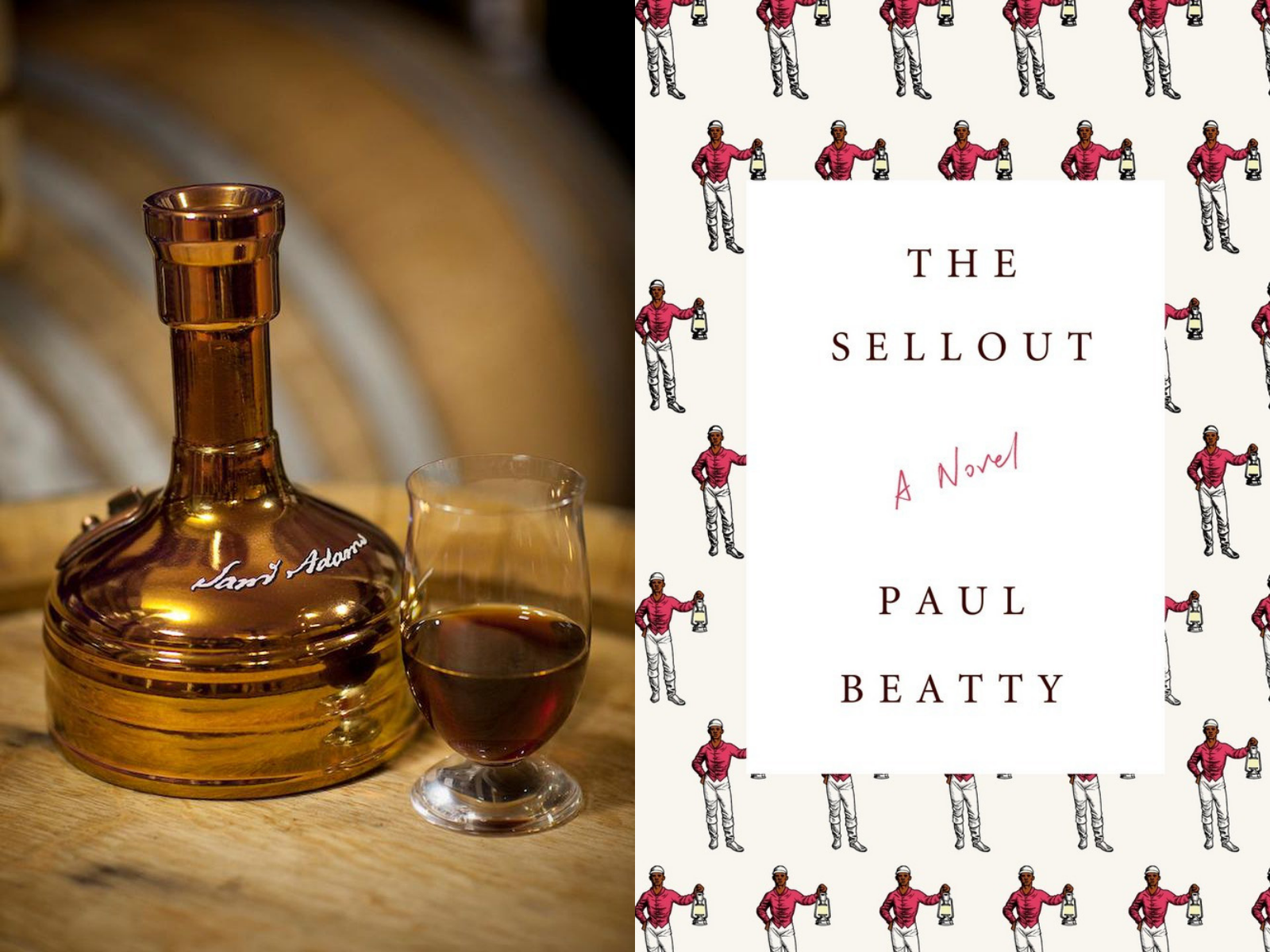
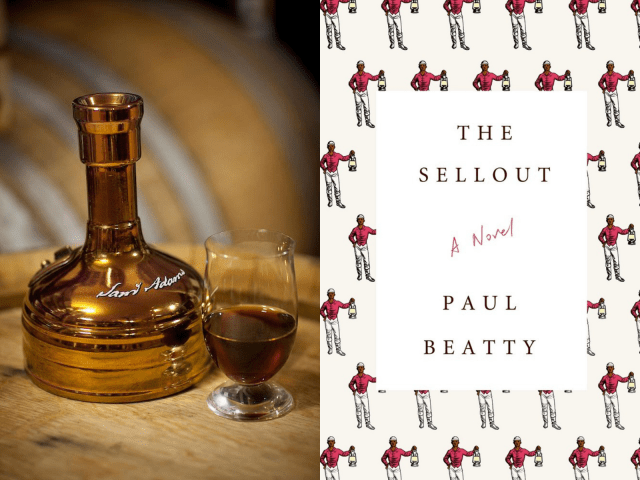
To drink with The Sellout by Paul Beatty: Utopias by Samuel Adams
Man, I wish I could write like this. There have been many books I’ve admired over the last five years, but none gave me such delirious pleasure and envy as this novel. An ambitious, provocative story told with great verve and seamless craft, it’s earned a rarified realm in my mind, and therefore can only be paired with a rarified beer. There are a lot out there, but I’ll choose Samuel Adams Utopias, “the craft beer community’s most renowned and sought-after extreme barrel-aged beer,” according to the brewer. Seek out and savor them both.
To drink with Dog Years by Melissa Yancy: Stout by Central Waters Brewing
Melissa Yancy’s award-winning, masterful collection of thematically-linked stories, Dog Years, is another book that’s never left my mind. Inspired by her career as a fundraiser for medical causes, these stories all tackle different elements of modern medicine, from kidney transplants to facial reconstruction, and the recipients, caregivers, loved ones, and strangers who participate in a person’s trauma and recovery. Maybe because I read it over a rainy winter weekend, I imagine it as an inclement or cold weather book, and in this case, I’d pair it with a toasty stout. If I had to choose one brewery, I’d pick any of the stouts brewed by Central Waters Brewing Co. out of Amherst, Wisconsin.
To drink with The Cook by Maylis de Kerangal: Winter Garde by Sante Adairius Rustic Ales
I loved this novel. Due to its brevity (it’s a mere 100 pages) I’d go back and re-read sections, linger over especially gorgeous descriptions of food, and leave bookmarks scattered in places I wanted to revisit when finished. This lovely tale of the rise and maturation of a French cook was right in my personal wheelhouse. If it’s not too on the nose, you should pour a French Bière de Garde or two while you read it yourself. Unfortunately, I don’t yet know French beer well enough to make an educated, specific pairing, but Sante Adairius Rustic Ales, near Santa Cruz, has a Winter Garde that, while being different in character, will be an equal in complexity and satisfaction.
To drink with Learning by Andrew Choate: Or Xata by The Bruery
Every city should be fortunate enough to have a citizen like Andrew Choate. A curator and producer of avant-garde music and performance, Choate has been directly responsible for bringing some of the world’s most groundbreaking artists to whatever city he’s living in at the time. He’s also the writer of dazzlingly inventive works of poetry and prose, the latest of which is Learning. An autobiographical account in which he explores the circumstances of a brutal attack on his father, intermeshed with inquiries of ecstatically varying concurrent stimuli, Learning is a free-jazz poem of true crime, self-help, mystery, and personal exegesis. I’ll pair it with something from innovative California brewers The Bruery, perhaps their cinnamon and vanilla-infused blonde ale, Or Xata.
Sebastian Khan is not often a likeable protagonist. Like the privileged, impulsive youth out of a 1980s brat pack novel, he seems plenty smart but extremely unwise as he navigates the sex, politics, and sexual politics at a Model U.N. convention. You may be amused by his solipsism and depravity; I read actively wishing for his opprobrium, but Aatif Rashid’s debut novel is a pleasure either way. For the amount of time Sebastian spends drinking and drunk, there’s no reason you shouldn’t play along at home with an imperial IPA. One of the best widely-distributed brews of this variety is Dogfish Head’s 90-Minute IPA. At 9% alcohol, it pairs sufficiently with college kids behaving badly.
This powder keg of a book, from the 33 1/3 series, was perhaps my favorite read in 2018. Recommended by a neighborhood bookseller at Skylight Books, I instantly started reading it upon arriving home, and never needed a bookmark. Unpacking both the history and legend surrounding Merle Haggard and the recording of this album, Rubin tells a story of class, authenticity, and success fit for a book three times as long. You sincerely need no prior knowledge of Haggard or this album to enjoy this volume, and you will certainly see its themes echoing in our present political climate. That said, I’m tempted to pair a book on Merle’s divisive album with something else that’s been both unfairly denigrated and ignorantly celebrated—lager. A favorite of mine is Surly Hell from my home state of Minnesota, but your local favorite should go just fine with this book. Just pour one out for Merle.
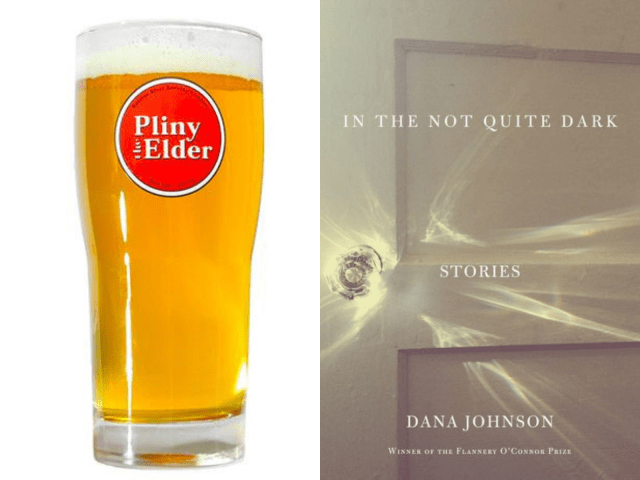
To drink with In the Not Quite Dark by Dana Johnson: Pliny the Elder by Russian River
Dana Johnson is, in my opinion, the most underrated chronicler of California life in contemporary fiction. The unerringly powerful stories in her collection In The Not Quite Dark are the kind that stick to your brain for weeks, beg for debate among book clubs, and, most importantly, reveal the lives of the people around us. For this book, I’m choosing a fellow Californian that isn’t remotely underrated but is equally mighty: Russian River’s Pliny The Elder.
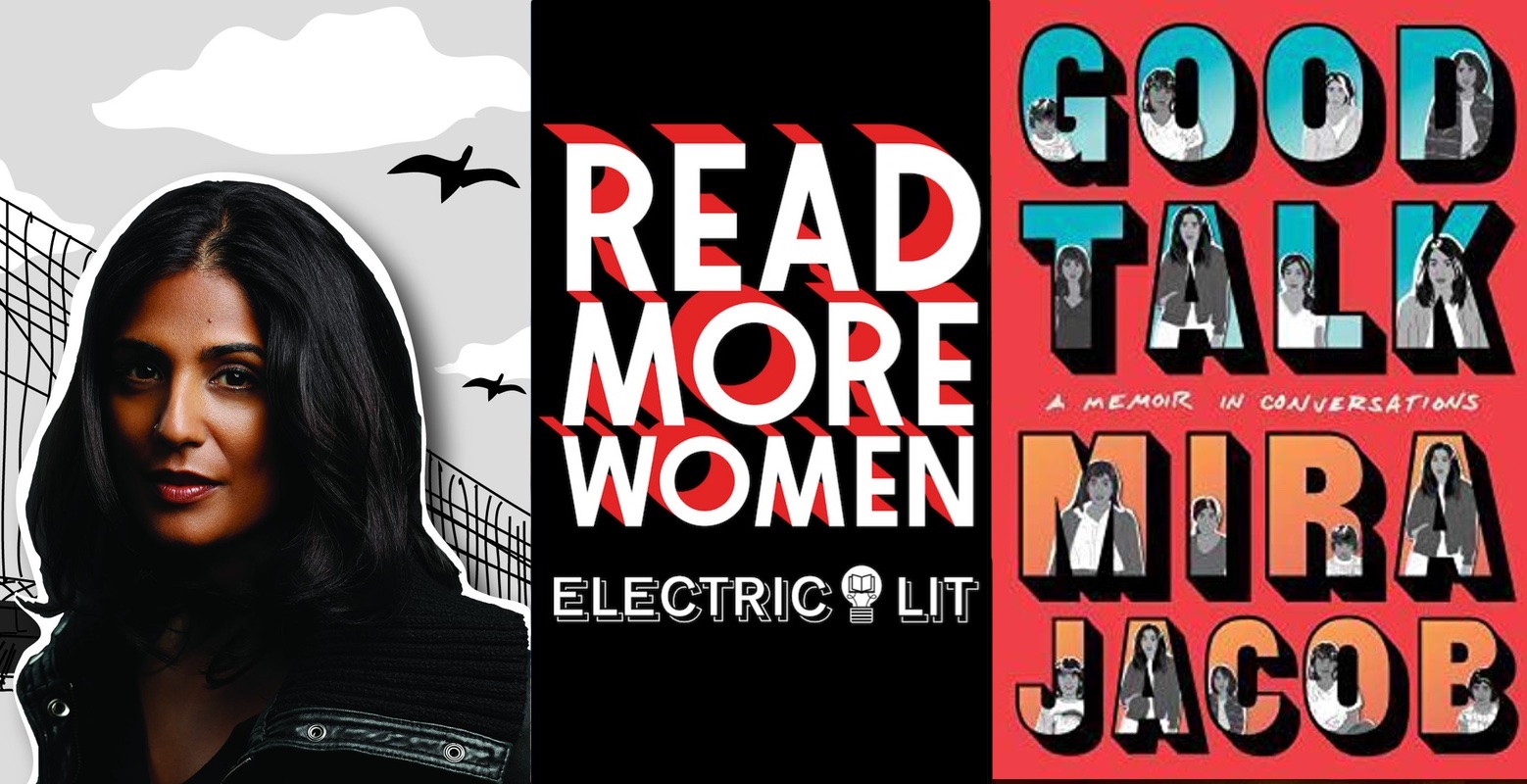
It doesn’t feel like an exaggeration to say that Mira Jacob’s latest book Good Talkis a blueprint for a kinder world. In this graphic memoir, Jacob details a lifetime of difficult conversations—about politics, about race, about love and relationships. Seeing her handle these tricky talks, sometimes awkwardly and imperfectly, is like a survey course in how we disagree—and how we learn to live together anyway.
Jacob narrowed down her picks for our Read More Women series by choosing, she said, books that gave her the permission that the world doesn’t always give—books “that kept me going with their inventiveness, their ability to march outside borders.”
Read More Women is Electric Literature’s series, presented in collaboration with MCD Books, in which we feature prominent authors, of any gender, recommending their favorite books by women and non-binary writers. Twice a month, you’ll hear about the five non-male authors who most delight, inspire, and influence your favorite writers.
A few years ago, I sat down to draw a book about America. I had never drawn a book before. I had never even said out loud, “I’m going to draw a book.” To complicate things, as a brown kid of immigrants, I’ve always felt a little behind on everything—less entitled to takes huge risks or even small steps into uncharted territory. Wasn’t I lucky just to be in the novelist room at all? Shouldn’t I stay there?
But as things started getting worse in the country, as friends started showing up at my house scared and sickened, and my family splintered along race lines, something in me cracked open and no amount of well-wrought sentences could seal it back up. Drawing, though, helped. Drawing people especially—the ones I was worried for, the ones I was worried about. Some of these books I listened as I drew, some I reached for on nights when I could not sleep, some I remembered and re-read because I found them brave and wild and inventive in ways that made me feel like many things were possible.
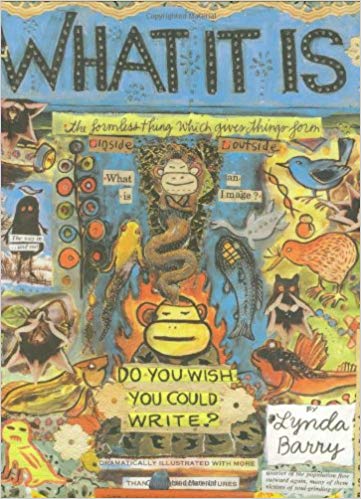
A longtime fan of Barry (and Marlys, the deeply awkward heroine of her ’90s comic strip, Ernie Pook’s Comeek), I stumbled into What It Is when I was trying to scare myself away from graphic work. It’s easy enough to do when you imagine entering a field of white dudes who basically have charcoal pencils for fingers, but decidedly less so when you crack open this brilliant tome that takes on the central question of what drives us to draw stories. Part memoir, part instructional manual, this combination of collages, essays and assignments breaks down all the moving parts of being an artist and allows you to hold each one, to imagine how it might live in you.
Tanwi Nandini Islam (a.k.a Tanaïs) is perpetually ahead of their time in vision and scope, as is evident in this lush, electric novel, which centers around three Bangladeshi Americans navigating inherited trauma while living outside of racial, religious, and gender norms. If that sounds like a lot, it’s because it is, but that precisely the joy of their work—the way it does not give up a single facet of its complication, the way it imagines itself so fully and gloriously that we are forced to do the same.
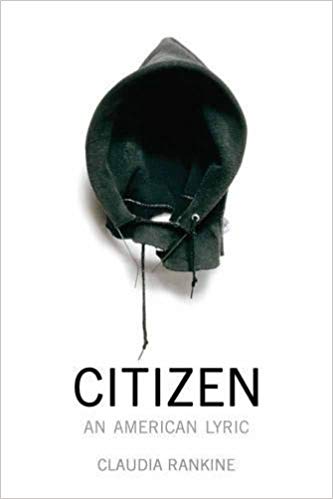
Yes, it was a National Book Award finalist, one that deftly connected the dots between the kinds of actions that whiteness will not identify as racism and the toll that action takes on blacks and brown bodies. But what I love most about this book is its form—the way Rankine soars from poem to criticism to prose to cultural commentary, the way turning each page becomes a surprise because we cannot predict where she will go next. The willingness to bend her words toward any form her subject demands makes this book an acrobatic and breathless read.
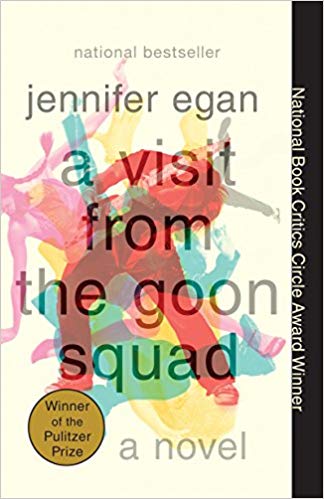
Listen, I have no idea if this book was fun to write but can I just say, it really, really seems like it was? Each of these stories is astonishing in its own right, but all together, it’s a stunner of a collection. I don’t know if Egan herself would love being called playful, especially when her sentences are cut with a jeweler’s precision, but the way she flips perspective and place and voice and time in these interlinked stories, the way she trusts her readers to stay for the minutes and decades? Yes, please.
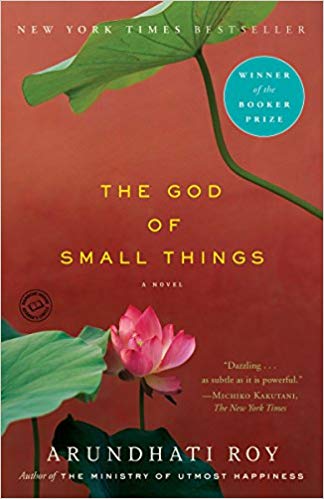
“But why did she have to write such terrible things about our community? Now the whole world will look at us and see this filth!” one of my Syrian Christian aunts lamented when this book published in 1997. Roy’s book, the story of fraternal twins whose lives are destroyed by a series of terrible secrets, went on to win the Booker Prize, and has taken up permanent residence in my mind as a book as sentence-by-sentence beautiful as it is instructive. For years I had been unwilling to discuss the worst parts of my community, knowing that it would only bring negative attention from eyes already prone to dismissing or belittling us. That changed after reading this book, after seeing parts of my own cultural experience fictionalized in a way that allowed me to reckon with them. To know myself. I always come back to this when I get scared: what it means to write the truth, and who you write it for.
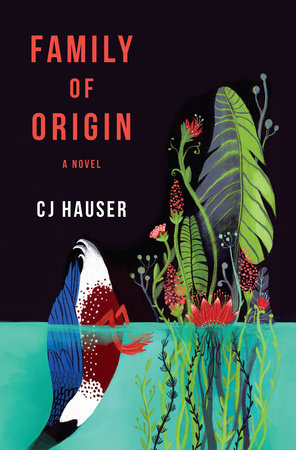
CJ Hauser’s novel, Family of Origin, tells the story of two estranged half-siblings who journey to a Gulf Coast island inhabited by quack scientists—where their father, one of said quacks, has just drowned. Isolated on “Leaps Island,” these pseudo-scientists concoct theories about evolution moving backwards; they study a local species of curiously feathered ducks to “prove” it. They call themselves “Reversalists.”
Purchase the novel
The adult siblings, Elsa and Nolan Grey, approach the enclave, each other, and pretty much everything with skepticism. As they struggle to understand why their father, a once-respected scientist, spent his final years observing ducks in seclusion, a plethora of other discomforts bubble to the surface.
CJ Hauser is a veteran of the literary world: she’s worked at multiple literary agencies, taught writing from Florida State University to the Gotham Writers Workshop, and received awards including the McSweeney’s Amanda Davis Highwire Fiction Award, the Jaimy Gordon Prize in Fiction, and Narrative’s Fall 2014 Short Story Prize.
She currently teaches at Colgate University, where we met several years ago at the Colgate Writers’ Conference. I am obsessed with the Instagram account she shares with her dog, Dr. James Moriarty. Don’t worry—we talk more about him later.
Deirdre Coyle: When I started reading Family of Origin, I immediately looked up whether the Reversalists were a real collective (and found no evidence, of course). How did you come up with their theories?
CJ Hauser: I’d actually been working on a kind of post-apocalyptic novel before Family of Origin—but I was hating every minute of writing it so I took a step back to ask myself what was going wrong. And it turned out, I wasn’t interested in what the world looks like once the worst has already happened. I was interested in how the hell a person is supposed to go about their life when they feel like the apocalypse might be just around the bend, but they still have to live in a world full of parking meters and doodle scheduling polls and ketchup-flavored potato chips. What is a person supposed to do with that?
And that’s where The Reversalists came from. They’re a bunch of charmingly grumpy scientists who move to this remote island to do research, but really, to hide from a world they can’t bear. They believe evolution is running backward because of a seaduck they’re studying, but every one of them has a different reason the duck “proves” that the world is going backward ie getting worse. I was interested in the idea that a rational person could become so totally despairing that they would lose their ability to do good scientific work any more and would instead start bending their science to prove their sentiments correct.
DC: Are you particularly fond of any real-world pseudoscientific theories?
Under what circumstances is a person morally allowed to plug their ears and sing la-la-la while the world burns around them?
CJH: So, I fucking love lake monsters. I spent a summer on lake Champlain as a kid and desperately wanted to find Champie. I will someday visit Loch Ness. I have watched Lake Placid way too many times. I aspire to find Lauren Groff’s Glimmerglass lake monster when I swim in Lake Ostego. Quagmire is one of my favorite episodes of The X-Files (I would love to fight someone about that last one…)
I actually teach a class on science-writing and scientific literacy and we talk a lot about why people believe in pseudo-sciences. I think so much of it comes down to what people are missing from their real lives that pseudo-sciences are able to offer them. Sometimes that’s people needing a more tangible way to point fingers at the government (UFO cover-ups!) and other times it’s missing a sense of control over their lives (we spend a lot of time talking about crystals) and sometimes it’s just a desire for the world to feel a little more exciting and magical than it normally does.
I love lake monsters because I really need to believe in these creatures who are bigger and older and stronger than humans who have been swimming around before us, and will still be swimming after us. If I can believe in that, then I can feel slightly less worried about humans having irrevocably disrupted and destroyed the planet. If Nessie is out there, hey, maybe we’re not as big and destructive as I fear we are.
DC: In one of my favorite threads, Elsa wants to go to Mars, trying to escape the wretchedness in both her life and the world at large. Why did you hit on Mars for Elsa, instead of a more earthbound escape plan like Australia, or opioid addiction?
CJH: Okay so the Mars One program really did draft and interview colonists for Martian settlement. Real people applied! You can find profiles of the applicants and interviews with them online. Some of these people had lovers and kids and jobs and lives and I became obsessed: what would make a person give up on earth and take a one way ticket to Mars?
For Elsa, she’s incapable of just living her life because all the greater problems of the world immobilize her. She wants to feel like she’s doing something good in the world, but she can’t imagine any choice she could make that she would be sure was good. Or be sure wasn’t good at the expense of something else better. In her mind, Mars gives her a kind of moral certainty she doesn’t think it’s possible to have anymore in this age, on this planet. And, going to Mars is also a way of sheltering herself from the problems of Earth. In space, she won’t be on the hook for dealing with them. In a way, Elsa is doing the same thing the Reversalists are doing: placing herself in a position where she can pretend she doesn’t have any agency or responsibility for the world at large anymore. It’s like a DIY Island of the Lotus Eaters. In a lot of ways the book is asking: under what circumstances is a person morally allowed to plug their ears and sing la-la-la while the world burns around them. Spoilers: there are none. We are all of us on the hook.
DC: What’s great about terrible family dynamics is that most people can relate. The Grey children, of course, have unique circumstances. Did you have difficulty writing their particular dynamic?
What would make a person give up on earth and take a one way ticket to Mars?
CJH: Writing the Grey siblings was the struggle and the heart of the book. I think what made Elsa and Nolan interesting to me was the idea that they share their father, Ian (they have different mothers), but he was their father under very different circumstances and at very different times of their lives.
The collective Greys had, years ago, tried to create a kind of utopian blended family, but it backfired extraordinarily and split the family up—I wanted to explore how that history reverberated through Nolan and Elsa’s later lives. Because they are two people who know they are bonded together by something, but with their father dead and them having lived as strangers for years, they’re not exactly sure what that something is. Nolan sometimes refers to Elsa as his ex-sister.
This is one of my hobbyhorses: the conventional rules for how people interact depend on what their relationship is (mother/daughter, boss/employee) but how do you interact with someone when you don’t know what your relationship to them is supposed to be? Nolan and Elsa are supposed to act like brother and sister, but no part of their life has trained them to do that. And when you strip away the roles and labels and conventional rules from a relationship, suddenly the participants have to negotiate terms, and make mistakes, and make new rules. I never get sick of trying to get to the bottom of how two people might do that.
DC: If you were going to Leaps Island, what’s the #1 thing you’d want to escape?
CJH: What an excellent and troubling question. In the book’s opening there’s a list of things people are trying to escape, and the list ping pongs between huge important things like climate change to petty personal things like their inboxes.
I think there’s something about being a worrying human today that causes us to mentally leap from worrying over the email we haven’t answered to worrying about children separated from their parents at the border to worrying about whether our mother’s minor surgery will go okay to worrying about whether or not all the polar bears are dying and the world is coming to an end to worrying about whether the vegetables in the fridge have gone bad.
This kind of mental vacillation is strange and exhausting and narcissistic and an inescapable part of the way so many of us live our lives these days and this manner of worrying small/large/small/large is where this book came from for me. Because it’s paralyzing and how can you do anything, small or large, when this is what your brain is doing? If I ran away to Leap’s it would definitely be to escape these mental gymnastics. But I like to think I wouldn’t run. I like to think I’d stay.
DC: Let’s talk about your very good dog for a minute. How does he handle your writing life? Is he helpful?
CJH: Dr. James Moriarty, criminal mastermind, Mori for short, is an enormous and fluffy mountain dog. He is, in fact, a very good boy. He is not a fan of my writing habits. Ie: writing. Ie: sitting at a desk for long hours. He flops on the floor and grunts and sighs.
That said, I have rediscovered walks since he came into my life. I remember learning that Wordsworth composed while on long walks and thinking HA HA must have been nice simpler times. But now suddenly I’m this person who goes walking in the woods for hours and the way my sad-rabbit of a brain starts moving when I’m out there is definitely different and better for storytelling and story-problem-solving then sitting at a desk. I usually take Mori to a trail called The Darwin Thinking Path, and this felt spiritually correct as I was working on this book about a movement of people trying to corrupt Darwin’s thinking.
Can a book change the way we think? I don’t mean that in the sense of a reader’s opinion or ideology shifting—of course the right literary work can do that. But can a book rewire the brain itself, literally changing the way one particular mind perceives and interprets the world around it?. The most convincing argument that this is possible might be the way that William Shakespeare’s work helped change the boundaries of both psychology and the English language to a previously unimaginable extent. The second best argument might be John Berger.
Berger’s book Ways of Seeinghas been altering its readers’ perceptions of media since its 1972 release—as both a television series and a book. Media literacy remains an ongoing concern around the globe; some governments have even launched programs to give their residents more tools with which to interpret and evaluate all that they encounter online, in publications, and on television.
Ways of Seeing (the book) opens with an introductory passage, letting the reader know what’s coming: seven essays, three of which consist entirely of images. “Our principled aim has been to start a process of questioning,” write Berger and his collaborators. (Before the title page, a note describes Ways of Seeing as “A book made by John Berger, Sven Blomberg, Chris Fox, Michael Dibb, Richard Hollis.” Berger’s name alone is on the spine and cover, and it was he who wrote the television version.) In a look back on Ways of Seeing published earlier this year, Vikki Bell and Yasmin Gunaratnam cited Berger’s “style of blending Marxist sensibility and art theory with attention to small gestures, scenes and personal stories.” Earlier this year, writer and theorist James Bridle wrote that “his landmark series showed how art revealed the social and political systems in which it was made.”
Ways of Seeing offers its readers (or viewers) a means to examine art that doesn’t require a host of advanced degrees to understand. But Ways of Seeing doesn’t simply confine itself to the fine-arts wing of the museum, so to speak. Instead, it also explores how these visual motifs and themes have turned up in modern media—especially advertising. There’s certainly a discussion and critique of advertising and contemporary media taking place here—but that’s not where Berger begins.
Media literacy is more important than ever, and Berger’s book continues to be an invaluable resource.
In an era where online hoaxes abound, partisan media entrenches itself, and incorrect information is spread for the lulz, media literacy is more important than ever—and Berger’s book continues to be an invaluable resource in this capacity.
In one of the essays in Zadie Smith’s recent collection Feel Free, she discusses the impact of Ways of Seeing on her life, as well as that of her late father:
…for a generation of non-experts, working-class aesthetes, generalists, TV viewers, anxious gallery-wanderers, Berger offered a long-overdue process of demystification. He urged us to throw aside the school-taught sensations of high-culture anxiety and holy awe. They were to be replaced with a fresh and invigorating mix of skepticism and pleasure.
Ways of Seeing has also spawned a legion of descendants—something that’s hardly shocking, given that the state of media in 2019 doesn’t entirely line up with the state of media in 1972. The aforementioned James Bridle, author of the fascinating and ominous New Dark Age, is behind a de facto sequel to Berger’s book, New Ways of Seeing, which aired on BBC Radio 4. As someone with a background in music writing, I’m particularly interested in author and musician Damon Krukowski’s own take on Berger’s work. Krukowski has brought his wealth of experience—he’s the author of several works of poetry and nonfiction, and has been a working musician since his days in the dreampop band Galaxie 500—to a book that pays homage to Berger’s original: Ways of Hearing.
Like its predecessor, Krukowski’s Ways of Hearing is also based on a work that first appeared in another medium: in this case, a six-episode podcast. And while the title and overarching themes line up with Berger’s work, there are also aspects of it that line up more closely with its broadcast medium, including interviews with author/musician Jace Clayton, Vanishing New York author Jeremiah Moss, and members of A Tribe Called Quest.
What soon becomes apparent about Krukowski’s approach is its breadth: while he’s writing about sounds and music, he’s also sensitive to larger trends and moments in history that may have impacted them. Early on, Krukowski addresses how technology influences how we hear. As one might expect, he also addresses questions of digital recording and sonic manipulation. But not long after that, Krukowski talks with historian Emily Thompson, who talks about the invention of the decibel meter in the 1920s and the ensuing efforts to regulate noise in cities—which in turn led to things like the acoustic design of New York’s Radio City Music Hall. From there, Krukowski addresses how acoustics are perceived, something that has ramifications for everything from opera halls to earbuds.
Here, Krukowski is taking a holistic approach to questions of, well, how we hear. It’s not simply enough to say that one format or design is “better”—instead, it’s useful to address how each one was formed, and what each was trying to convey. Like Berger in Ways of Seeing, Krukowski is willing to explore the larger ecosystems he’s writing about, and making bold comparisons between seemingly disparate entities.
As with Berger, there’s a sense of interconnectedness in Krukowski’s exploration of listening. It’s not enough to simply tell anecdotes or relay interesting sonic devices. Instead, this is a book about providing its readers (or, in its podcast form, its listeners) with some grounding to ask their own questions about their own listening. What might be gained or lost from a particular method of recording or broadcast? What historical conditions might have played a role in the creation of this style of music or this genre?
Like Berger in Ways of Seeing, Krukowski is willing to explore the larger ecosystems he’s writing about.
A great deal of writing about listening to music (or listening, period) boils down to arguments about format (LPs good, streaming bad—or vice versa), unlikely success stories (cassettes are back!), or discussions of the ethics of royalties (self-explanatory). All of these are understandable, necessary conversations to have—but Krukowski is after something more with his book, just as Berger was with his. Krukowski’s work here is about imparting critical thought processes to his readers: it’s as much Ways of Thinking About Hearing as it is Ways of Hearing.
Attempting to simply replicate Berger’s work is one thing, but doing so doesn’t necessarily make for a worthy follow-up to Ways of Seeing. Berger’s approach is a subtler one: it’s one that carefully builds a foundation for its argument before it segues into that argument’s implications. Rhetorically speaking, it doesn’t always line up with current trends in media. One can only imagine the headlines: “This One Weird Trick Unlocks the Aesthetic Secrets of Modern Advertising!” And it’s notable that Berger largely confined Ways of Seeing to a particular canon of art, rather than a more global view of it—though there’s also a difference between citing the visual approach that became influential for a particular culture and endorsing the history that led to that point. Paradoxically, Krukowski’s book ultimately succeeds as a worthy successor to Berger’s in the ways that it differs from its predecessor. Listening isn’t seeing; why should a book about one unnecessarily echo a book about the other? Krukowski gets more right by charting his own territory than he would by more closely following Berger’s blueprint.
These two books ultimately resonate on a similar frequency. The key seems to be in finding the right structure to get at the larger points: for some, it’s a series of visuals; for others, it’s a blend of interviews and other notable sounds. And it’s a solid illustration that the influence of Ways of Seeing can’t necessarily be boiled down to a formula, but can be very effective in grappling with contemporary questions. These are books that are edifying to read, but their ultimate importance is as a kind of first step. These are toolkits as much as they are tomes, and in an era where understanding the deeper questions found below numerous ongoing debates, they’re an essential part of media literacy.
“The First Day of What Remained for Tedman Ward” by Nell Hanley
As soon as he got clear of the jetty at the mouth of the harbor, there giving an amiable wave to the helmsman of an incoming fishing charter, Tedman put the Bowrider hard westward at a fair clip. She wasn’t much to look at, just an old sixteen-foot runabout, but the Evinrude outboard that came with her was a beast.
As a rule, Tedman never went out on the water alone. There were any number of disasters that could happen, friendly bay or no, and he’d never been a strong swimmer. About that his ex-wife used to say once upon a time with affection and once upon a later-time with disdain, “You swim like a tin man, Teddy. I swear.” But today he’d decided on the spur of the moment to toss his buddy-boating-only stricture and damn the torpedoes.
Dominating the bluff on the port-side stretch of shore was a new trophy home with a fifty-foot flagpole and a life-sized bronze sculpture of a breaching whale. The place belonged to Gart Mulligan, real estate pig and soon-to-be step-father to Tedman’s son and daughter, who were there now and would be there later this afternoon at their mother’s insistence for her much-fussed-over Fourth of July bash. His daughter would be lounging all day by the pool reading a book, and his son, who was a person of mood, would be holed up in his room with his guitar and downloading tablature from his computer until his mother made him come out and be sociable.
A righteous anger rose up in Tedman, and he let it. It lay dormant more and more often and for longer periods of time, now, two years since the shit hit the fan, and when it did come over him it lacked the tooth and vigor it once had, the fervid rage. He raised his arm in salute towards the house, with his middle finger extended, and leaned on the throttle. The Evinrude kicked up the water astern and threw the boat forward. Tedman had to grip the wheel with both hands.
The Evinrude groaned and the gull-wing hull thwacked into the chop. He took off his hat, lest he lose it to the wind, and tucked it into the waistband of his shorts. In the distance on his starboard side a sailboat race was in progress, colorless triangles of sail in shifting patterns, and beyond that the shapes of the lighthouse and monument across the bay at Provincetown. The sky was cloudless but for a few far off brush strokes that might just have been dissipating jet streams.
He made it to Sandy Neck around one and cruised the shore past a dozen or so leisure boats anchored in the shallows and went on to an unclaimed stretch of beach, where he steered the Bowrider into the gin-clear shallows, set anchor, cut the motor, and humped his beach chair and cooler well up the beach to allow for the turn of the tide. It came in fast out here.
Despite his late breakfast, he was hungry for lunch and went ahead and ate his Italian sub and a bag of potato chips. He’d always been able to eat anything without putting on weight. It was one of the things about him his ex-wife had come to despise. In the end, she couldn’t even be in the same room with him while he ate.
He washed it down with a couple of Narragansetts and surrendered himself to an hour’s digestive slumber in the sun, after which he took a dunk to rid himself of the stupor he felt from sleeping in the heat of the day, and then he set off to have a walk.
He’d gone maybe half a mile when a figure appeared in the distance along the shoreline. It wasn’t an upright, limbed figure. That was clear. It was something supine and amorphous. It might have been a rock or something maybe washed ashore—after the last spill, dolphins were landing blackened by oil all up and down the coastline, disemboweled and eyes plucked out. In any case it was hard to judge its distance with nothing to give it scale, like a long shot of a Bedouin in the desert, a flicker and wavering in the heat and the light. Like something out of Lawrence of Arabia, which he’d stayed up late watching the night before while drinking quantities of red wine.
He kept on, and before long and to his surprise he made the figure out to be a person flat out at the edge of the water, and when he drew closer still, he could see it was an enormous man wearing green bathing trunks and a royal blue t-shirt. The man was not in an attitude of leisure. There was something strange and too still about him, and Tedman was afraid that he might be happening upon a dead body, which would be horrible for a host of reasons, but then the man turned his head in Tedman’s direction. It was only for a glancing moment. When Tedman approached to within a few yards, the man looked at him again, yet without allowing any eye contact, and then looked away and up at the sky.
When he drew closer still, he could see it was an enormous man wearing green bathing trunks and a royal blue t-shirt. The man was not in an attitude of leisure.
He was the most enormous man Tedman had ever seen. Not so exceptionally fat, but oversized almost like an actual giant. Gargantuan, really.
Remarkable, too, was that the man’s rather pale skin was entirely covered with freckles. They were light orange and made Tedman think of the orange and white of tabby cats and Creamsicles, and a girl named Shannon who he’d kissed once in the sixth grade in the eraser room at school. The broad and rather flat plane of his face was also densely freckled, even his eyelids, and his lips were much the same color as the freckles. As was his hair, a fine, curly cap of it.
“Hey mister,” Tedman said. The man looked to be in his thirties, anyway. He wasn’t any kid. “You all right?” And the man just shook his head and closed his eyes against the sun, with the water lapping at the back of his knees. His grapefruit-sized heels were settled in shallow depressions caused by the water licking away at the sand around them. The tide had made its turn in.
Tedman stepped still closer, so he was practically right over the man, and said, “You need a hand? Did you fall down?”
“Yes,” the man said. His voice was thick and in the back of his throat. The t-shirt he had on was emblazoned with a restaurant logo and a cartoon lobster wearing a bib, on which was a cartoon of a smiling clam. It was from a well-known seafood joint out in P-town. Tedman and his ex-wife and the kids always went out there at least once every summer, made a day of it at the ocean with beach chairs and umbrellas and shovels and buckets, the works, and then into town for fried clams or lobster rolls and a stroll up and down Commercial Street, popping into gift shops and antique stores at will.
“Here,” Tedman said, and offered his hands to the man.
The man held out his right arm and Tedman took his wrist in both hands. It was nearly the size of Tedman’s upper arm. The man wrapped his hand easily around the entirety of Tedman’s forearm. His hands were of remarkable size, and, too, awash in freckles and a spray of orange hair. The flesh of his palm was uncalloused and cool.
“Can you bend your legs?” Tedman said. “If you can bend your legs—”
The man bent his legs with some effort and set his feet as though he were going to attempt a series of sit ups. Tedman stepped his right leg back and dug in. He put his weight on the forward leg, having to lean in somewhat to grip the man’s arm, and pulled. The man put in his effort to sit up, but it was clear that he wasn’t giving it a wholehearted try. It seemed strangely as though there was an acute self-consciousness in the man that was holding him back.
The man smelled strongly of coconut scented suntan lotion, and Tedman had no defense against the attending evocation of his ex-wife’s summertime skin. She was always slathering suntan lotion on herself, even when she wasn’t basking in the sun. “Just because I have Mediterranean skin doesn’t mean I don’t need sun protection,” she would say. “Skin cancer is a thing, Teddy.” She was relentless about it with the kids, especially their daughter, who had Tedman’s fair complexion.
“Wait a minute,” Tedman said. “I’m losing my grip.” He let go of the man and leaned forward with his hands on his knees. “Jesus,” he said. He was ankle deep in the water, which spread out behind him as far as the eye could see.
He stood up and said, “I wish we had a rope. It would give me some leverage.” Then he took off his t-shirt, exposing the pallor of his narrow chest, the fine coat of graying hair across his pectorals, and handed one end of it to the man. “Hold onto this,” he said. “It’ll have to do.” They took their grips, and Tedman said, “You ready?”
“Okay,” the man said.
“All right. Now, you’ve got to help me out,” Tedman said. “On the count of three.” He got into position and confirmed his grip on the shirt. “Now don’t let go,” he said. “Or I’ll be on my ass.”
On three they went at it. Tedman leaned back with all his negligible weight and pulled with everything he had until the man was in an almost sitting position, at which point, both their faces red and the tendons in Tedman’s neck risen hard from the strain, they hit an impasse.
“I don’t think that’s going to work,” the man said when he was flat out again. There was a patch of fine sand stuck to the right side of his face and a wave of dried salt along his hairline.
Tedman shook his head in agreement, too much out of breath to speak. He sat down next to the man, a few feet away, took off his hat and fanned himself with it. He was terribly thirsty. The sight of all that seawater only made it worse. He wished more than anything he’d brought a beer along with him.
After a bit he said, “I’m Ted, by the way. Ted Ward.”
“My name’s Woody,” the man said, and lifted his hand from the spread of his stomach in a brief, ironic wave. He had closed his eyes.
“You from around here, Woody?”
Woody shook his head no. “I live in Chicago,” he said.
“Huh,” Teman said. “I’ve never been, but I hear it’s a good time.”
“Yes,” Woody said. “It can be.” He licked the sweat from his upper lip and laid an arm across his face.
Tedman really couldn’t get over Woody’s size. His head and his hands and his feet were proportionately overlarge, unlike the way regular fat people can outgrow their extremities. But it was hard to judge his height from that angle, and he thought if he could lay out next to him he might gauge it pretty well by comparison to himself. He had to be well over seven feet, anyway.
“Say,” Woody said. He let his arm fall to his side and opened his eyes. “Do you think we could try again?”
“Sure,” Tedman said. “But we’ll have to try another tack.”
“Thanks,” Woody said. “I don’t do so well on my back for very long.”
Tedman had an all too vivid image of Woody’s lungs and heart, the actual lobes and chambers working in the amplitudinous cavity of his chest.
“If I could manage to get you over onto your stomach,” he said, “would you be able to get onto all fours?”
“Probably not,” Woody said.
Then Tedman figured that if he could just get Woody sitting up long enough, so that he could get down on his haunches behind him, he could get some leverage with his legs and push him forward onto his hands and knees, from where he might be able to get up.
He explained this to Woody and said, “Let’s try that. It’s worth a shot.”
“Yes,” Woody said. “Okay.”
They each took up an end of the shirt again. Tedman took an extreme stance like he was anchor in a game of tug of war, took a deep breath, and bore down so hard he feared some sort of bodily rupture. At last they managed to get Woody within reach of his knees, which he hung on to at Tedman’s urging.
“Just hold the hell on,” Tedman said.
He leapt into a squat behind Woody, pressed his back up against the spread of his, dug his heels deep into the sand and anchored his hands beside his hips. They sat like that together, catching their breaths.
“Okay, now,” Tedman said. “Let’s give it a heave ho.”
He counted off three and gave it all he had, pressing his back up against Woody’s back. He even went so far as to grab Woody by his shorts, without making apology or receiving protest, in the effort to get him off the ground. But it was a deadlock, and it wasn’t long before they gave out and their backs were heaving against each other.
Woody’s t-shirt was wet and covered with sand, and Tedman wished he’d been able to put his shirt back on.
“This is nuts,” he said. “I mean, no offense, Woody, but you really shouldn’t be out here alone. You’re lucky I came along.”
“I know,” Woody said. “I feel ridiculous.”
“Hell,” Tedman said. “Join the club.”
He looked up and down the beach, without expectation of finding any help. It was only an outward expression of his inner search for a solution. To the east he saw a smattering of color among the distant anchored boats and people on the beach, and to the west nothing but the stretch of coastline.
“What we need is a third, to pull you forward while I push,” he said.
“We might have to just wait for the tide,” Woody said.
Tedman could feel the reverberations of Woody’s voice against his back.
“I hate to say it,” Tedman said, “but that might be the only way.”
“I do feel better sitting up like this,” Woody said. “If you could stay where you are.”
Okay,” Tedman said. “But you’ve gotta do your part and lean forward as much as you can. Keep a hold of your knees and take some weight off me.”
“I’ll try,” Woody said.
“Won’t be too long,” Tedman said. The water was lapping at his buttocks. “The tide comes in out here like a mother.”
“Say—” Woody said after a minute. His voice was full of air, but then he cleared his throat and went on. “Would you mind if I borrowed your hat? I hate to ask, but the sun is getting to me. I’ve been out here a while.”
“No problem,” Tedman said. He handed the hat over his shoulder to him and said, “Might be a bit small.”
“Thank you so much,” Woody said. “It’ll do just fine.”
“No sweat,” Tedman said. He didn’t really want Woody to wear his hat, but under the circumstances he could hardly refuse. He wished he could retrieve his shirt and at least drape it over his shoulders, which would surely burn, but it was just out of reach beside them, bunched up in the water.
“So,” Tedman said, figuring that the best thing to do under the circumstances was make small talk. “What do you do in Chicago, Woody?”
“Oh I’m in computer programming,” Woody said.
“I tried to get into that once,” Tedman said. “But I don’t have the head for it.”
“Do what you’re good at,” Woody said. “That’s how I was raised. What about you, Ted? What do you do now?”
“I’m in the furniture business,” Tedman said. “You know Ward’s in Dennisport? Used to be Baxter Home Furnishings?”
“No,” Woody said. “I’m just here on vacation.”
“Right. You and the rest of the world,” Tedman said. “No offense. Anyway, it’s nothing to brag about, but it’s good to be my own boss. I used to be in advertising, back in the day. Now that I was good at.”
“Why’d you get out of it?” Woody said.
“Oh you know.” Tedman said. “The agency went under with everything else, and my wife wanted to live near the water. Ex-wife, that is. Biggest mistake I probably ever made, moving here.”
“I’m sorry to hear it,” Woody said.
“Yeah,” Tedman said. “But what am I gonna do—tie a concrete block to my leg and throw myself in to drown?”
“I should hope not,” Woody said.
“Nah, not my style,” Tedman said. “Enjoy life is what I say, no matter what. That’s what I tell my kids. Because you can never tell what’ll happen. But shit will. You know what I mean?”
Because you can never tell what’ll happen. But shit will. You know what I mean?
“Yes,” Woody said, “I do.”
“Say,” Woody said. “You weren’t kidding about the tide.”
“I know,” Tedman said. The water was already up to his waist. He had to wonder what someone who happened by might make of the two of them planted there like that with the tide pouring in around them.
“Heavens,” Woody said.
“Water water everywhere,” Tedman said, “and not a drop to drink.” His thirst had become a pressing discomfort and his thighs burned from the effort of resisting Woody’s weight. He adjusted his position as best he could, digging into the sand more with his hands to take the pressure off his legs.
Shortly there came the nasal drone of a small plane approaching. Tedman squinted at the sky and spotted it just inland, a single engine high-wing heading seaward. The the tightness of the engine’s sound loosening the closer it got. He made it out to be a Cessna, a pretty little taildragger, white with blue side stripes.
“On his way to P-town,” Tedman said.
He kept his eye on it until it became small again and the tremors it made in the air had died down and it was no longer a physical sensation, that sound, but only a noise in the distance again. It occurred to him he might try and take his son out there soon, to the airport, to watch the planes take off and land.
“Listen,” Tedman said, “this water gets much higher and I won’t be able to stick here. I’m starting to feel like a cork.” It was up to his chest, now, and he was having to fight to keep his weight against Woody’s back.
“Just a smidge more,” Woody said. “If you can.”
“Okay,” Tedman said. “But I’ve got to get reset.” He dug deep with his heels, straightened his legs to lift his hips off the ground, and pressed his palms against Woody’s back.
“Are you alright?” Woody said.
“I think so,” Tedman said. It was good to shift his weight, but the sand between their backs ground into his bare skin just that much more. He was glad at least that Woody was wearing a shirt.
“I used to think about killing myself,” Woody said. “Since you mentioned it — suicide. But then it just seemed illogical. Like it’s all over and done with soon enough, and for all you know there might be something good around the next corner.”
“If wishes were horses,” Tedman said.
The sun went behind a stroke of cloud, then, which was a relief, but passed shortly by and out over the water, casting its shadow there. There was an absence in the sky just then of gulls. Only a couple of them high and quiet.
Woody took a deep breath, then, held it a moment, let out a sharp sigh, and said, “I think if you let me lie back you’ll find I can float, now.”
“Okay,” Tedman said, but he wasn’t exactly sure how to go about it. He bent his legs and let go the pressure against Woody’s back, but as soon as he did so he was tossed off balance and went under. There was the sound of water all around him. It was good and cold on his head. When he got to his feet he wiped his eyes and saw that Woody was afloat on his back, holding Tedman’s hat up in the air.
“Your hat,” Woody said, and held it out for Tedman to take. “I don’t think it got too wet.”
Tedman took the hat and said, “Are you okay?”
“Wait,” Woody said, and he made his way out to deeper water with an unhurried, metronomic scissoring of his legs. His arms were buoyant and casual at his sides. He rode out the momentum of one final stroke of his legs, and then he shifted his weight forward in a rolling motion. He stood, bent at the waist and leaned forward for balance. Then in one slow but clean motion he straightened and stood up to his full height, belly-deep in the water, and turned to face the shore. He stood there as though to compose himself, with his head down and his hands just under the water on the spread of hips.
“Are you alright?” Tedman said, nearly shouted, loud enough to cover the distance between them. He dunked his hat and put it on as he walked out into the water until it came up to his chest.
When Woody looked up he was smiling. He came forward with labored strides, displacing the water in foaming waves around his legs, until he was towering over Tedman. The water had brought out his color. His hair, now a darker red, clung to the sides of his face, and his freckles had taken on a deeper shade, the way cedar shingles will after a rain.
“Not to worry, he said.”
His lower jaw was the sort that jutted somewhat forward so that it looked like he would have a lisp, but he didn’t. Tedman hadn’t noticed that before.
“Well, then,” Tedman said.
Woody nodded his spectacular head. “Yes,” he said.
It was obvious that neither one of them knew how to end it.
“My way is that way,” Tedman said, pointing eastward in the direction from which he’d come. “Can I give you a lift anyplace or anything?”
“No need,” Woody said. “You’ve done so much already.”
“It’s no problem,” Tedman said. “My boat’s just down the beach.”
“Honestly,” Woody said. “I prefer to swim. What about you, though? Will you be all right?”
“Hell,” Tedman said, “I’m fine.”
“Okay then,” Woody said. He bent down and took Tedman’s hand that lay buoyed in the water. He took it between his great palms and submerged their joint fist, thus allowing Tedman’s arm to be angled in a more natural handshake position rather than having to be held uncomfortably up out of the water to accommodate Woody’s height. “Thank you,” he said.
“Wasn’t anything the next guy wouldn’t do,” Tedman said.
“That’s not true,” Woody said. “Not true at all.” Woody gave Tedman’s hand a final shake, let it go, and stood up again to his full height. “I should be going,” he said.
“Right,” Tedman said.
It was a moment before Woody said, “Bye, Ted.”
“So long, Woody,” Tedman said.
Woody turned and lumbered away seaward. He looked once over his shoulder and gave Tedman a broad wave, as though from the railing of an ocean liner bidding farewell to an off-seer on the dock. Then Woody turned again seaward and laid himself into the water. He took a few breast strokes that seemed to Tedman luxuriant, the way he allowed his head to slip all the way under with each stroke, and then he set his face in the water and swam away westward at a steady crawl.
By the time Tedman made it back to his spread, his thirst had become awful. He couldn’t remember having ever been so thirsty. It was like being deprived of air. He fell upon his cooler and rejoiced to find the beer inside still cold. He downed one on the spot with a single pause to gasp and exclaim the ecstasy of his satisfaction.
Back on the Bowrider, Tedman pulled up anchor and got underway without ceremony and with thoughts of getting home to a shower and a rum and ginger ale, and grilled kebobs on the patio, and a decent bottle of red, with the particular pleasurable feeling there was to the far side of a beach day, when there was the sensation of being both spent and at the same time renewed, even after the most ordinary day when nothing at all remarkable had happened on which to dwell.
There wasn’t much chop, and the Bowrider cut a clean incision across the bay, water tossed away and falling back from her stern. When Grant Mulligan’s place came up on the starboard side, where the big bash was in full swing, Tedman drew the throttle down, came to a drifting halt, and cut the engine. There were a couple of dozen people on the beach, and a small throng on the bluff, gathered loosely around the bar set up at the base of the bronze whale, which now burned pale orange in the deepening afternoon light. It was pleasant there with the boat adrift—the easy clap of water against the hull, and the way the smell of fuel from the Evinrude hung in the air. He liked that smell in the same way he did the smell of fresh laid tar and new carpet. They were acrid and remotely reminiscent.
He was trying to spot his kids in the crowd when a heavyset woman dressed entirely in white came away from the house and strode towards a clutch of people by the bar. He couldn’t make out her face, but he knew her by the way she walked, and she was making an expansive gesture that Tedman had seen many times before. She was unmistakable, yet he could hardly put her together with the woman who’d said to him by the moonlight pouring through the windows of their honeymoon suite in Aruba, “Your eyes are all the world, Teddy. I swear,” and they had their whole lives ahead of them, then.
When you first walk into Candice Breitz’s video installation “I’m Your Man (A Portrait of Leonard Cohen),” you’re faced with a life-sized video projection of a men’s choir. The choir is singing beautifully, but intermittently, in expertly-arranged harmonies, a bunch of white men in black suits and black yarmulkes holding black folders.
This is the choir from the Shaar Hashomayim Synagogue, Cohen’s own congregation, located in the Westmount neighborhood of Montreal. I was also staying in Westmount, with my aunt and uncle, when I first saw Breitz’s piece at the contemporary art museum, MAC Montreal. It was part of the exhibition “Leonard Cohen: A Crack in Everything,” 20 commissioned artworks inspired by his oeuvre. I saw it again in Manhattan, at the Jewish Museum, where “A Crack in Everything” is in residence until the fall before traveling (somewhat stochastically) to Copenhagen and San Francisco—but there’s something very special about seeing it in Montreal, a city that loves Leonard Cohen the way I do. If I’d gotten off the bus a few stops earlier, I would have found his likeness painted on the side of a skyscraper, 20 stories tall. That’s the way I like to see him: a towering figure, one you can live inside.
My first memory of Cohen’s music is my parents listening to his then-new album “I’m Your Man” in the kitchen, which I recall as happening when I was about 14—but only because I think all music happened when I was 14. That age exerts such a strong gravitational pull on music that it collapses into a singularity where everything happens at once. In fact, when “I’m Your Man” came out, I was eight. This means Leonard Cohen was part of my life before The Simpsons, or REM, or Tamora Pierce novels, or the internet, or any number of pop cultural influences I barely remember the beginning of. He was there before I knew what MTV was, or how to use the radio, and fully half a decade before I had a CD player of my own.
The music gestures towards the poetry, which is too big to be held in a single song.
I did not particularly like Leonard Cohen’s music at that age, and not just because eight-year-olds aren’t known for their sophisticated opinions. His gravel-and-oil voice, which is now one of the most beautiful sounds I can think of, is very much an acquired taste. The melodies are repetitive, the backup singing is dated and cheesy, the instrumental parts often sound like a Casio preset. But the imperfect music makes you feel like the song itself is something larger than the singing or the instruments or even the melody, something vast and important, and we’re just seeing the cross-section that intersects with our fallen dimension. “Hallelujah,” his most-covered song, is the best example: one site that collects Cohen covers lists over 150 recordings of the song, including a version from the Shrek soundtrack and a cover of the version from the Shrek soundtrack. Some of them are translated; some use different subsets of the 80 verses Cohen originally wrote (Cohen’s first recording, on Various Positions, shares only half its lyrics with Jeff Buckley’s cover, probably the best-known). All of them feel like being exquisitely murdered with completely different weapons. But they are in effect all facets of the Platonic ideal of “Hallelujah,” the shadows on the cave wall as it turns. The music gestures towards the poetry, which is too big to be held in a single song.
I guess another way of saying this is that while I didn’t always like Leonard Cohen, I did (and do) love him, the way you love your family or anything else that’s inescapable from an early age. Loving him felt as optional as Judaism, which is to say not at all—not a choice you make, but something as deep as bone. But what I really loved, even more than Leonard Cohen the musician, was Leonard Cohen the writer. When I left home I took with me a 1968 copy of his collected poems, on whose cover my college-age dad had drawn glasses onto Cohen’s face in ballpoint pen. Every few years one of my parents contacts me to ask me to send them the poem that references a building whose windows look like they’re aflame from the setting sun. There’s no such poem—there’s only a line about “a fire in every window on the street,” a reference, in the context of the poem, to people burning documents. But that image inspired something just a bit grander and less grim in them, something that they’ve carried through 50 years.
The poems, too, are imperfect, full of self-indulgent language and microscopic obsessions. Like the songs, there is a giant overwhelming beauty lurking behind each one, like a bubble pushing through the poem’s skin—and even though it’s too big to translate onto the page, the fact that he had tried made me feel bolder. I didn’t want to write like Leonard Cohen, but reading Leonard Cohen made me think that if he could write so very much like Leonard Cohen, maybe I could write like me. In that vulnerable period between when Cohen showed up in my life and when I swiped that crumbling book to take to college, this was the best thing poems could be: not perfect, but possible.
Leonard Cohen died on November 7, 2016, the day before Trump was elected. It was the last day of the old world—a very bad world, but one that felt a little less doomed.
One of the small obsessions in his poetry, which was actually a very large obsession, one of the largest, was the Shoah—both the historical Holocaust, and the broader nuances of catastrophe. His concerns are both monumentally sad and indelibly caustic. One of his poetry collections is archly titled Flowers for Hitler. In the poem “All There Is to Know About Adolph Eichmann,” he lists off the monster’s qualities: height medium, weight medium, intelligence medium. “What did you expect? … Madness?”
I have never felt more in need of Leonard Cohen than now, when everything is spiraling towards oblivion.
My friend Brad recently said that every Leonard Cohen album exists on a spectrum of horniness to apocalypse, or maybe more accurately they can be plotted on two axes: horniness the X, of course, and apocalypse the Y. The line from which the exhibition got its name, “a crack in everything,” comes from one of the most optimistic songs on his most apocalyptic album, The Future (which nevertheless is not without its horniness). “There is a crack in everything / That’s how the light gets in,” he sings on “Anthem,” but then a few songs later: “From the fires of the homeless / From the ashes of the gay / Democracy is coming to the U.S.A.” I think both of these things are true. How can you think both of these things are true, that this imperfect world is a source of grace and also that all of our great ideals march us towards inevitable doom? It helps to be Jewish: we are death-obsessed, but in a sort of resigned way that sometimes even borders on cheerfulness. It helps to be raised on Leonard Cohen, with his knack for conjuring both the sublime and the toxically cynical from the same flawed patch of earth.
In The Flame, the posthumously-published collection of Cohen’s later poems and lyrics and drawings and notes, a printed poem called “What Is Coming” appears opposite its original in his strangely self-conscious handwriting, which looks like a child practicing formal calligraphy. “Your anger against the war / your horror of death / your calm strategies,” he writes—strategies for everything from tidying up to establishing the Fourth Reich—“these are merely / your activities.” You can control no part of the future, he says. You can’t even understand the consequences of what you do.
oh and one more thing you’re not going to like what comes after America
I have never felt more in need of Leonard Cohen than now, when everything is spiraling towards oblivion. He wouldn’t be able to cheer me up, but at least he wouldn’t try. But the fact that in the face of futility, I still grasp for words, not to stave off or distract from despair but just to give shape to it: that might have something to do with him.
You may watch the Shaar Hashomayim Synagogue choir for a while, humming and then lifting their voices to intone “THEN WE TAKE BERLIN” and then humming again, before you notice the lighted arrow that beckons you behind the screen.
What’s back there is a circle of more life-size video projections: eighteen men, all over 65, most of them white, all of them singing. Just a convention of musical dads. Most are in T-shirts, a few of them are wearing suits—one has a suit and a fedora. One’s wearing religious-looking robes. One of them sits with his cane over his knees. One does a constant, nonstop arm-swinging bop, no matter the tempo of the music. One whistles all the instrumental parts. What they are singing are the eight tracks from Leonard Cohen’s 1988 album I’m Your Man. They are not good singers, but on the choruses you hear the men’s choir from the other room, harmonizing, elevating.
The work might be more effective (although maybe not, who knows) if they weren’t mostly old white men. Leonard Cohen was an old white man, of course, but that doesn’t mean that all his avatars will be. (According to the exhibit card these men had to prove they were Leonard Cohen superfans, but two of them pulled out lyric sheets during “Jazz Police.” I know the words to “Jazz Police.” Put me in the piece.) Breitz reportedly chose only men because she wanted to celebrate and interrogate masculinity, but this is where she and I differ: I think the best way you can interrogate masculinity is by discarding it. But that’s not the point.
That’s what writing is. Your words in someone else’s mouth, past death.
The point is that in every one of these old men’s faces you see your father singing these songs in the car, and your mother singing these songs in the kitchen doing the dishes, and yourself singing these songs right now, under your breath, because you will have started singing under your breath. And in every one of those faces you see Leonard Cohen, who was also in the kitchen and the car and is here right now, because that’s what poetry is. That’s what writing is. Your words in someone else’s mouth, your tune in someone else’s throat, your heartbreak in someone else’s chest, past death.
Here’s something Leonard Cohen said about the works of Federico Garcia Lorca, when accepting a literary prize in Spain. A video of him saying it is included in one of the works in the exhibit, and it also appears in The Flame:
When I was a young man, an adolescent, and I hungered for a voice, I studied the English poets and I knew their work well, and I copied their styles, but I could not find a voice. It was only when I read, even in translation, the works of Lorca that I understood that there was a voice. It is not that I copied his voice; I would not dare. But he gave me permission to find a voice, to locate a voice; that is, to locate a self, a self that is not fixed, a self that struggles for its own existence.
And as I grew older, I understood that instructions came with this voice. What were these instructions? The instructions were never to lament casually. And if one is to express the great inevitable defeat that awaits us all, it must be done within the strict confines of dignity and beauty.
It wasn’t only Leonard Cohen who taught me that it’s possible to have a voice, or anyway that it’s possible for me to have one. That’s the kind of lesson I don’t learn easily, and I’m sure it took an army—all the mysterious “teachers of the heart” that Cohen sings about. But I do think he taught me that it’s possible—not easy, but possible—to send that voice into others, to ride across the world and past death behind someone else’s eyes, in someone else’s mouth, with the power of your words. That the ultimate goal of writing is something like an army of dads, all singing your song.
In our monthly series Can Writing Be Taught? we partner with Catapult to ask their course instructors all our burning questions about the process of teaching writing. This time, we’re talking to Ryan Chapman, author of Riots I Have Known, who’s teaching an upcoming six-week online workshop on writing in the first person. Given that his book, structured as an inmate’s written confession/prison magazine editor’s letter, was called “one of the smartest—and best—novels of the year” by NPR, we figure he knows a thing or two about writing in a character’s voice.
What’s the best thing you’ve ever gotten out of a writing class or workshop as a student?
As an annoying undergrad I asked my university president why the college didn’t offer longform creative-writing courses. (I wanted to write a novel, and I wanted course credit. Like I said: annoying.) She replied the best way to write a novel is to read them. I didn’t fully appreciate it at the time, but she was right. If you read 25-50 books a year—if you take it as seriously as the form demands—you’ll find inspiration, influence, and solutions to problems of craft.
What’s the worst thing you’ve ever gotten out of a writing class or workshop as a student?
Well, a university president said my exorbitant tuition didn’t justify a course in the one thing I wanted to learn. But spite can be a great motivator. A few years later I had a terrible manuscript to call my own.
As for worst advice, nothing too damaging comes to mind. I’m always grateful when workshops allow each writer’s particular voice to flourish, rather than consensus-seeking.
What is the lesson or piece of writing advice you return to most as an instructor?
Anne Lamott, wise in so many things, says the first draft is the just the crap in your head standing between you and the actual good writing. Getting it onto the page is part of the process.
Does everyone “have a novel in them”?
Sure. Everyone also has a painting in them, and a song, and a tapestry. We’re as creative as we believe ourselves to be. Now, is it a novel other people should read? That’s an entirely different endeavor. Always respect the reader’s time and attention. Even if that reader is just you three days from now.
Would you ever encourage a student to give up writing? Under what circumstances?
If a student is writing for themselves, they should continue despite all. By transforming their world into stories they are activating different parts of the brain and, if they’re serious, building empathy by imagining themselves into different characters.
I’m dismissive of those who don’t believe in revision. That isn’t writing. That’s ego.
If a student has their sights set on publication, I caution patience. Writing is failure. It just is. Your first draft might be miles from where it needs to be, and that’s humbling. But in that humbling is growth, and, eventually, improvement.
This is why I’m suspicious of writers who l-o-v-e their first drafts, and I’m dismissive of those who don’t believe in revision. That isn’t writing. That’s ego. In that circumstance I would say the writer should take a break from their project and return in six months. If they still can’t see how their first draft can improve, give up.
What’s more valuable in a workshop, praise or criticism?
When I’m engaging with the writer’s work my feedback has elements of both. Pure praise feels good in the moment, but it doesn’t teach anything. And pure criticism discourages one or is rejected out of hand.
I’m always asking, What is the work saying, and how can we work together to better articulate that? It might be a craft exercise, the old “Cut 25 words from every page” routine, or a recommended story or novel.
Should students write with publication in mind? Why or why not?
This would depend on the project. If you’re a dedicated reader of thrillers writing your own, it’s useful to understand the parameters of the genre and what works in the marketplace. If your aim is literary fiction, publication is far more capricious and has no reflection on the worth of your accomplishment. To borrow Rosecrans Baldwin’s metaphor, your goal should be creating a novel that breathes the oxygen of its own environment.
In one or two sentences, what’s your opinion of these writing maxims?
Kill your darlings: Too true. If you can’t do this, you’re not respecting the reader.
Show don’t tell: Useful advice when you’re just starting out. Less so later.
Write what you know: Terrible and inevitable. One should write fiction to discover the world, and to discover themselves.
Character is plot: I resisted this far too long, but it’s true. Once you know your characters—really know them, as if they were your closest friends—the plot mechanics start to better align.
What’s the best hobby for writers?
Take long walks. Swim. Anything that puts your body into a physical flow. This allows the subconscious to deliver the flashbulb ideas it’s been hiding.
What’s the best workshop snack?
Nuts. They feel filling without requiring much energy to digest. (I get downright sleepy if I have a doughnut.)
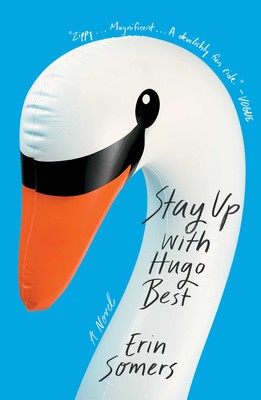
June Bloom is 29 years old, working as an assistant on the late night show Stay Up with Hugo Best when the show says good night for the last time and Hugo Best retires. Hugo is, on the face of it, the everyman Late Night host. He’s what you might expect of a man who has spent years getting away with whatever the hell he wanted to do in the name of funny business. June has read the unofficial and official biographies of the life of Hugo Best, she’s a zealot for his early comedy. And she also knows he’s had problematic relationships with younger women when she says yes to his invitation to spend a summer holiday weekend at his vacation home in Connecticut. June is everything you might expect of a millennial woman in her late twenties living in Brooklyn and dealing with being laid off before she got where she was supposed to want to go. Don’t we know where this is going? Maybe, maybe not.
Buy the book
Sure, this is a #MeToo novel. But of course, it’s more than that. What makes the novel Stay Up with Hugo Bestso uniquely smart and entertaining is the way Erin Somers handles the questions no one else has figured out how to confront in the entertainment industry. What do we do with the grey-area relationships between two consenting adults with huge power imbalances? Does it always lead to sex? What does it mean to be in your twenties as a millennial woman? Can people change? And, most importantly, what is funny now? What can funny do? Somers tackles the questions (and summons up new ones) by using the very same comedic muscles that have withered in our current political climate. In Stay Up, Somers employs humor to show us that real comedy creates an opportunity to deal with the truth, rather than obscure it.
Erin Somers and I talked about what it means to write a “timely” book, the history of late night, and where the funny can fit into the dumpster fire of today’s news cycle.
Erin Bartnett: This book is extremely “timely” right now. (A phrase I’m sure you’re hearing a lot). But obviously, its life is much longer than the news cycle. Can you talk about the genesis of this book for you?
Erin Somers: I originally wrote this as a short story in 2013, and it had the same basic outline, the same 4-day structure, the same characters. I submitted it to a lot of places and it was pretty widely rejected, so I put it in a drawer, and decided to think about it a little more. I decided the reason it was being rejected was possibly because it was too skeletal. I decided to flesh it out to see if maybe the premise could support a novel. I finished in November of 2017. Harvey Weinstein and the beginning of #MeToo had broken a month earlier in October 2017. So it was in the works for years when all that started, and it’s rare, I think, that a book becomes more timely or relevant rather than less, but that’s the way it worked out.
EB: What is your hope for the book’s reception or interaction with the #MeToo movement?
ES: I hope, first of all, that nobody sees it as me exploiting the movement in any way. “I saw what was happening and decided to write a book on it to cash in on it…” kind of thing. It would be a disaster to me if anyone thought that. My hope is that people see this as a nuanced portrayal of these grey area situations that a lot of people encounter with men who they have professional or quasi-professional relationships with, that don’t necessarily fall into the classification of misconduct, but are still kind of nauseating and weird. I hope it’s true to that type of ambiguous experience.
EB: After writing into this grey-relationship, do you think Hugo (or someone like Hugo) is capable of changing? Of being better?
We’ve come of age in an era of uncertainty. There’s no clear way forward to be successful as an adult anymore.
ES: I don’t know. I hope so. I want them to be able to. But I don’t really know. I think that’s one thing that interested me and kept me working on the book was whether Hugo could change. Is it possible for him to change? I’m not sure I have the answer. But I do think that we have to find some solution or some way that people are permitted to make amends or some way for people to apologize—depending on how horrific their offense was—because I’m not sure that ostracizing people forever for small errors is the way forward either. Not that Hugo’s mistake is small by any means.
EB: One of the other grey-area experiences you capture is the grey area of adulthood in your 20s. As you were writing this book, do you think there’s something new about the experience of being in your 20s right now? Or are we living out another iteration of an old, familiar struggle?
ES: It feels new to me. I can only speak from my experience as a millennial, but it feels like a generational thing. We’ve come of age in an era of uncertainty. There’s no clear way forward, there’s no clear way to be successful as an adult anymore. A lot of the structures have collapsed, a lot of the ways of thinking have collapsed, and I found myself, in my early adulthood, very much just making choices based on nothing. Proceeding almost at random, because I didn’t know exactly what to do. And I think that’s a common experience for people my age, people a little older, and people a little younger. Not knowing how to proceed.
EB: Not knowing what to do can be terrifying. But what I loved so much about this book is the way you handled that experience with humor. I mean, I too, look into the void of the future and can’t help but laugh to kind of endure it.
What I was so excited to see in your book was that comedy wasn’t a force for flinching away from reality, but actually a way for us to deal with and confront reality. Comedy makes us look at things straight, but also in a way we can…I don’t know…live with? How do you think comedy shapes June’s experiences and why was comedy such an important element in the narrative you were writing?
ES: It’s an important element firstly because my outlook is fundamentally comic. And it was easy to just make her like me. [Laughs.] As you pointed out, it also makes the book more palatable. This isn’t a #MeToo story in the sense that we encounter a really brutal experience. It manages to be light and satirical despite the subject matter. The comedic elements make it easier to tell the truth and, I hope, make people more willing to read it.
EB: But I also think there’s an important distinction between the monstrosity of the comedy industry and comedy. Because Hugo’s career as a late night comedian is also buoyed by people who are conditioned to look away. It got me thinking more generally about how comedy is functioning right now. Because while comedy can help us confront a lot of things, we are also reckoning with a lot of problems in the comedy world, itself. And so where does the funny fit in there?
Did any of this come up in your research on the late night entertainment industry for the book?
ES: I’m very interested in that tension, but it didn’t really exist in the same way when I was writing it as it does now. The tension was born of this stuff coming to the surface. When I was working on the book, not much had broken yet in the way of comedy world scandals. The Cosby allegations were happening. That was about it. Louis CK broke in November 2017, when the book was already done. But since all of this has happened, I think about this a lot. None of these disgraced comedians—I’m talking mostly about Louis here—have reckoned with any of it in a way that I find appropriate or funny or especially smart. No one has approached it with an iota of courage. Louis’ strategy is, as far as I can tell, to keep doing the same thing but find a grosser audience.
More generally: the whole world is fucked up! A lot of the comedy that’s trying to take on current events right now is struggling. Particularly in late night. Because how do you write jokes about genuinely terrible things? My whole book is about, somewhat, where the funny fits in and whether the format can continue to evolve to meet the culture.
EB: How does comedy affect your worldview as a writer and also just basically as a human right now?
ES: In general I think everything could be a lot funnier. Everytime I’m reading a book, the most common thought I have is “This needs more jokes.” I wish someone would buy me a rubber stamp that says “Needs more jokes” and I would be able to stamp whatever I’m reading. Comedy is inseparable from my outlook. I don’t know how else it’s possible to proceed. I don’t see how people without a sense of humor are getting by.
EB: Are there any contemporary comedians that you follow?
ES: Off the top of my head: I love Rob Delaney, Chelsea Peretti, John Mulaney and Nick Kroll, Paul Rust, Key & Peele. Everyone in the greater How Did This Get Made? podcast universe—Paul Scheer, June Diane Raphael, Jason Mantzoukas, etc. It’s not so current but I still laugh about certain Tim and Eric sketches every day (“Cinco Phone” and “Cinco Urinal” mostly). Like everyone else, I love the new Tim Robinson show I Think You Should Leave. And of course I love a lot of old stuff referenced in the book: Steve Martin, Richard Pryor, George Carlin, Joan Rivers, Chris Rock, Dave Chapelle. I could go on.
EB: Writing advice. Any adages you stick to or mantras?
ES: I like the Richard Ford quote, “Don’t take any shit if you can possibly help it.” That’s more career advice than a craft thing. But I can’t say I follow that advice a lot. I take mountains of shit.
EB: Can we talk about The MOVIE? So excited to learn that Stay Up with Hugo Best has been optioned for film, and you’re adapting for the screen. What’s that been like? Anything surprise you about adapting the book for the screen? How does writing lines for the screen differ from writing dialogue in a novel?
My hope is that people see this as a nuanced portrayal of these grey area encounters with men that isn’t necessarily misconduct, but is still nauseating and weird.
ES: Yeah! I’m writing the movie! I always wanted to be a screenwriter; that was my goal initially. I went to film school as an undergrad. By 25 I’d had some failures and saw how hard it was going to be, and I hatched a crazy plan: “I will simply learn to write literary fiction and become a novelist and then adapt my own work.” Ridiculous. Nine years later, I’m shocked and delighted that it worked. (It shouldn’t have. No one do this. It isn’t a sound plan.)
But anyway, it’s been fun so far. I love revisiting the characters and writing new conversations for them. The book is dialogue driven, but most of the dialogue doesn’t transfer well because it sounds like dialogue from a novel. Even though I try to write dialogue as naturalistically as possible, it’s still too stilted for film. But I am enjoying that I at least don’t have to describe a freaking plant or any of that stuff.
EB: Did you have feelings about “the book is always better than the movie?” before this, and have they changed?
ES: I think the book is mostly better than the movie, yeah. Except for The Godfather. But not to worry, I’ll just make it as good as The Godfather.
John Cheever stories, A Separate Peace, Mad Men, and other stories about White Anglo Saxon Protestants continue to exert an enduring appeal: there’s magnetism to the blue blazer, the understated hymn, the stiff upper lip attempted and disastrously abandoned. We sorely need many more stories by and about other kinds of people, but by looking straight at WASP culture, treating it as something unusual and strange as opposed to a kind of literary default, we might see the water we swim in and then navigate through it better.
Buy the book
My book, The Expectations, follows Ben Weeks and Ahmed Al-Khaled—a shabby genteel legacy student and an enormously wealthy son of a Dubai sheik—through their first year at St. James School, a traditional training ground for American power. I’m interested in the bargains that elite institutions oblige people from other backgrounds to make, and the snares that people at the center of power structures are caught in.
The book is also about love, legacy, the niche sport of squash, physical bliss/agony, the rise of the United Arab Emirates, money, self-doubt, how cool Tevas were in the 1990’s (why are they back?), and how fun it is to go sledding with your friends. Ultimately, it wonders what WASP culture actually is.
I love these seven books for giving an unexpected view of the American WASP—a stranger, harsher, more compassionate side—as well as the other kinds of people that WASPs crash into.
Baldwin was under enormous pressure to write a “Negro experience” follow-up to Go Tell it On The Mountain. Instead he wrote the story of a white, well-to-do American in Paris, running from his fiancée back home and falling in love with an Italian man. Baldwin gives an exceptionally nuanced view of a person suffering the consequences of denying a part of himself in order to be the type of person he is expected to be. With some of the twentieth century’s best sentences, Giovanni’s Room is among the bravest, most loving, most heartbreaking books ever written.
No understanding of WASPs would be complete without an understanding of colonialism, especially cultural colonialism. Aristocratic husband and wife Kaname and Misako belong to the ruling elite of 1920’s Tokyo, and they have acquired all the right Anglo clothes and cultivated attitudes. Kaname has built a Western-style pavilion onto his house, is fascinated by American movies, and compulsively reads an English translation of One Thousand and One Nights. But the couple is almost mute with each other and powerless to choose the divorce they both desire, and the repression of Japanese and Western white culture progressively suffocates them. The husband, Kaname, begins to see traditional Japanese culture in a new way—as a fresh expression of everyday existence rather than a musty relic—but we suspect it is much too late for him. A masterpiece.
A spectacularly innovative portrait of the consequences of post-WWII conformity in the lives of WASP women. Marriage, prosperity, stability: what more could they want? Now that these women are divorced, adrift, watching their lives wobble and crash, they see to the core of all the WASP fictions. Told in the first person plural (“We were beautiful then: newly married, not yet mothers”), Our Kind is a devastatingly observant, laugh-out-loud, outraged howl from an entire generation of white women who were told they were to be envied but who landed short of liberation.
Chee’s brilliantly lucid collection is about everything—self-discovery, politics, art—and his essay about working as a waiter in the house of ur-WASP and bigot William F. Buckley is an instant classic. Being required to make oneself acceptable to straight white people is a grim and common predicament, and Chee does not refrain from skewering the snobbery, the lethal hypocrisy, the depressingly expensive décor. But through his anger he’s able to maintain an almost heroic compassion. His depiction of Pat Buckley—heiress, battle-axe, generous patron in the early fight against AIDS—so drunk she can hardly focus her eyes, trying to express gratitude to the waitstaff at a summer party, is as moving as any writing I can remember.
A New Yorker writer once observed, “Elvis Presley was a white Anglo-Saxon Protestant, as is Bill Clinton, but they are not what anyone means by ‘Wasp.’” Denis Johnson’s debut novel Angels could serve as a response to this—or a rebuke—as it follows with hallucinatory urgency the lives of Jamie and Bill, two poor white Americans trying to hold back the tide of addiction and disaster. There is a rare, almost religious intensity to this book, and a total devotion to the interior life of people often overlooked and disdained by the rest of American culture. It’s also hard to believe any mortal could write this beautifully.
Not every title in this list can be totally unexpected. John Cheever is the original, the Rosetta Stone of WASPitude, the haunted genius who launched a thousand clichés. But please, please read him, or read him again. Just when you think you can predict his golfers and his Garden Club members, just when you think you know all about the highballs and 6:26 trains to Manhattan, human strangeness lights up the night and the very lines of reality start to blur. Listen to how his people worry about money: “Now and then she would speak in her sleep—so loudly that she woke her husband. ‘I can’t afford veal cutlets,’ she said one night.” Listen to what happens when a well-past-his-prime athlete tries to find his old varsity sweater in the attic: ““Kneeling on the floor to open a trunk, he broke a spider web with his lips. The frail web covered his mouth as if a hand had been put over it.” Now that’s danger. That’s the uncertain spark of life.
Okay, this sociological study of American aristocracy might seem like heavy sledding. And you might find Balzell’s faith in the aristocratic ideal—institutions of democracy, learning, and selflessness creating a leadership class from all Americans, not just white Protestants—hopelessly blinkered and self-serving. And you’d probably be right. But Balzell coined the term “WASP,” and he is pitiless in exposing the anti-Semitism, greed, and laziness that he worried were eroding what was best about America. Whether you agree with him or not, this book provides essential insight into the structure of the country’s power, as well as the opportunities and disasters it continues to create. Plus, his name is too good.
I remember feeling as if I was about to vomit. Sitting smack dab in the middle of an office—open layout, of course, as this was a startup—my foot tapping the hardwood floor, eyes clenched, hand gripping the hard, black plastic phone in my hand as it rang, rang, and rang. Silence pervading the office, momentarily punctuated by one of the other twenty-something people in the room clearing their throat, a stray sneeze, or hiccup. Me praying to every deity known to man for the stranger I was calling to not pick up. Then, eventually, hearing “hello?” The deities must’ve taken a day off.
My first sales call was atrocious. I was tasked with cold calling business owners in New Jersey to tell them about a local newspaper recently featuring the organization I worked for. The idea was that I would call these business owners, tell them about the story on us, and then somehow interest them in purchasing subscriptions to our service. The only problem was that I had no idea what I was doing, resulting in prospects laughing at me, putting me on speaker so that I could flounder to the entertainment of their colleagues, and, most egregiously, no deals.
Fortunately, this didn’t go on for too long. With the help of the organization’s co-founders, a healthy dose of fear, and a do-or-die mentality, I improved, closing $500 and $1,000 deals before moving to sales development—a specialized role where reps qualify inbound and outbound prospects—which was more in line with my skill set as a green 22-year-old. Within two years I was managing a team of 30 reps, the company had grown to over 200 people, and the sales team evolved from me trying not to wet my pants to a highly-disciplined, relentless, and inspiring group of people who knew no limits.
Disillusioned with the world of startups and sales, I focused on reinventing myself as ‘Mateo, the writer.’
In 2016, I left. Disillusioned with the world of startups and sales, I focused on reinventing myself as “Mateo, the writer.” After writing—but, ironically, not being able to sell agents on—two novels, I was at a loss. Fortunately, I was always reading. And at that point of desperation, I had Stephen King’s On Writing in my hands—cliche, I know, but true. Aside from King’s simple advice of writing and reading more to improve your skills as a writer, what resonated most with me was when he wrote that all he does to begin his 50+ novels is, “Put interesting characters in difficult situations and write to find out what happens.”
FLASH! BOOM! POP! The fireworks went off in my head. I felt foolish for not having thought of it sooner. From my years in the tech sales industry, as one Black man out of the few Black people I’d ever encountered in the same role, I had a unique perspective that afforded me the ability to create interesting characters and complex, difficult situations for them, which I’d then have to get them out of, or not. This realization—mixed, candidly, with a heavy sense of guilt that I could and should have done more to bring other people of color, especially Black people, into this niche industry I had gained privileged access to—planted the seed of a story that needed to be told, not only for myself, or for the other minorities trying to survive in white-dominated workplaces, but for those who have never even heard of things like Sales Development Representatives (SDRs), Annual Recurring Revenue (ARR), BANT, Marketing Qualified Leads (MQLs), Sales Qualified Leads (SQLs), and a myriad of other almost nonsensical startup sales jargon. Through illustrating the meteoric rise and earth-shattering fall of Darren “Buck” Vender, a Black salesman at an all-white New York City tech startup who hatches a plan to help other people of color infiltrate America’s sales forces, I would redefine the model of the American salesman, in reality and literature, simultaneously giving people of color the skills and knowledge necessary to enter the same world I had come from, if they desired.
But in order to achieve this goal of redefining the American salesman, I needed to better understand the place that salesmen, both real and imagined, occupy in the American subconscious. And before there was ever a Wolf of Wall Street (2013), Boiler Room (2000), Glengarry Glen Ross (1992), Tin Men (1987), Wall Street (1987) or even The Pursuit of Happyness (2006), which likely did more to warm viewers’ hearts than really reengineer their perception of salesmen, there was Arthur Miller’s Pulitzer and Tony Award-winning play, Death of a Salesman (1949). And without Death of a Salesman, featuring Willy Loman, America’s most memorable salesman of the twentieth century, there is no Buck Vender, because for literature to need a new salesman, there has to be the salesman, and Willy Loman was it.
For literature to need a new salesman, there has to be the salesman, and Willy Loman was it.
Appearing in 1949, Willy Loman embodied all that it meant to be an ideal American at the time: white, male, hard-working, and forever clutching at the well-advertised American aesthetic of being able to turn lead into gold through sheer will and being well-liked.
As far as salesman go, Willy, despite believing himself to be more charming and successful than he is, is painfully sub-par. Miller, in an attempt to render Willy as a mirror-like John Doe any disgruntled white male could see himself in, never mentions exactly what Willy sells, or is supposed to sell. All we know is that he’s aging, down on his luck, and has an adoring wife he takes for granted and two sons, Biff and Happy, onto whom he tries to imprint his illusions of grandeur. In this, Willy Loman is unparalleled. Through a maniacal range of mental machinations, Willy has the ability to distort his own perception of reality, as well as that of his family, allowing him to frequently make life appear shinier than it is, or ever will be. “Be liked and you will never want,” Willy tells his sons. “You take me, for instance. I never have to wait in line to see a buyer. ‘Willy Loman is here!’ That’s all they have to know, and I go right through.”
The unfortunate fact is that Willy, acting as Miller’s everyman, was purely a reflection of the door-to-door salesmen, and hard-working Americans, in general, of the time. For those living in the white picket fence, apple pie, Coca-Cola version of 20th-century Americana, white men in suits bearing briefcases containing samples, Hoover vacuums, or even overpriced Bibles knocking at their doors was no strange occurrence.
In the 1969 documentary Salesman, brothers Albert and David Maysles, along with co-director Charlotte Zwerin, follow four Bible salesman around America. Paul Brennan, an older employee of the Mid-American Bible Company, can be seen lamenting his lack of sales one moment, while drumming on his steering wheel and singing tunes of prosperity the next. Like Willy, Paul believes all he needs to do to turn his luck around is buckle down.
While 20th-century salesmen like Willy, Paul, and others bolstered their confidence by reconstructing the world around them in a way that often made them both hero and victim, one of the chief reasons that they were able to willfully believe they could sell to anyone was that buyers – whether unsuspecting housewives or advertisers looking to get an edge – often operated at an informational disadvantage. In his book, To Sell is Human, Daniel Pink describes the theory of information asymmetry, where “one side is fully informed; the other is at least partially in the dark.” The example he gives is that of a used car salesman: “Bad cars, what Americans call ‘lemons,’ are obviously less desirable and therefore ought to be cheaper. Trouble is, with used cars, only the seller knows whether the vehicle is a lemon or a peach.”
The stereotypical salesperson—loud, arrogant, flashy, male, and white—is still very much embedded in the American psyche.
But this information asymmetry doesn’t exist today in the same way it did for much of American history up until the late 20th century. With enforced safeguards, like warranties and terms of conditions, paired with the rise of the internet, where people can quickly Google product information, comparisons, and reviews, the salesman of the 21st century has had to adapt. And while it is still possible for modern-day Willy Lomans to exist and multiply in the breeding grounds of Wolf of Wall Street-esque boys clubs and boiler rooms, society is less forgiving.
Despite these changes in the world of sales and consumerism, the stereotypical salesperson—loud, arrogant, flashy, male, and white—is still very much embedded in the American psyche. The sex, cocaine, and money-fueled life of Jordan Belfort, as depicted in Martin Scorsese’s Wolf of Wall Street (2013), which grossed $392 million worldwide, was nominated for five Oscars, and ranked by the BBC as seventy-eighth on its list of the “100 Greatest Films of the 21st Century.” And before that there was Wall Street, for which Michael Douglas won an Oscar for Best Actor, and before that there was Glengarry Glenn Ross, the film, for which Al Pacino was nominated an Oscar and Golden Globe, for Best Supporting Actor, and before that there was Glengarry Glenn Ross, the play, which won a Pulitzer in 1983. All of this makes the goals of my novel-in-progress highly ambitious, and potentially foolhardy, but not impossible.
And it is in this context, of an America that, while regressing in some ways, is also having its ideals, models, and standards upended daily, I realize writing about a Black salesman is a responsibility I’ve undertaken and must respect. He is human. He makes mistakes. He falls into many of the same traps of material gain and fame that the salesmen I am looking to supplant glorified, but he is also the calling of a new day where his story, while being fiction, will mirror and amplify the realities that minorities striving to make space for themselves, and others like them, in the workplace know too well, regardless of if they’re lawyers, doctors, engineers, editors, entertainers, or educators.
These men are relics of what America was rather than what it is becoming, or what we might want it to be.
Boots Riley’s 2018 sci-fi film, Sorry to Bother You, succeeded in some of this, but the film is too fantastical—and its protagonist, Cassius Green, too ultimately skeptical of the world of sales—to overwrite our image of the salesman as a middle-aged white guy. If you ask Americans “Who’s the most well-known American salesman to ever grace the pages of literature or movie screens?” they’ll still think of Willy Loman, or maybe Jordan Belfort and his ilk. But this is short-sighted. These men are relics of what America was rather than what it is becoming, or what we might want it to be. While our American organizations are still disproportionately white, there are minorities of all kinds, like myself, who do not see themselves reflected in Leonardo DiCaprio’s blue eyes. And our stories must be told.
It is because of this disparity between the reality we experience and the words we read on the page that literature is sorely in need of a new salesman to root for, and, at times, hate. We are starting to recognize that the Everyman can’t be only one type of man: the white middle-class middle-aged sap, the white middle-class middle-aged shark. If the salesman is the avatar of the American dream, he—or she—can’t just be a Willy Loman. In my novel-in-progress, just as in reality, there are salesmen and saleswomen of color, gay and bi salespeople, salespeople born with silver spoons in their mouths and salespeople who still struggle to get the taste of dirt out. Because in the same way that Miller’s salesman’s failures contained a mirrored truth for white men and women of the 20th century, my salesman’s hopes for a world where people of color, and other minorities, don’t have to scream to be heard or fight to be felt embody the dreams of those in our time who understand “diversity” is only a performative buzzword online and in the workplace until people begin hacking, with an unrestrained aggression, at the roots from which our nation continues to grow.
DON’T MISS OUT
Sign up for our newsletter to get submission announcements and stay on top of our best work.
YOUR INBOX IS LIT
Enjoy strange, diverting work from The Commuter on Mondays, absorbing fiction from Recommended Reading on Wednesdays, and a roundup of our best work of the week on Fridays. Personalize your subscription preferences here.