There is an area of Central Park called Cherry Hill, located just above the Lake and east of Strawberry Fields, that is covered in a ring of its namesake trees. Ignored most of the year in favor of bigger, flatter picnicking spots like Sheep’s Meadow or the Great Lawn, Cherry Hill is overrun with visitors for a few weeks each spring. On a recent walk, I saw an engagement shoot, a couple taking wedding portraits, and a dozen tourists crowded under the pink boughs, all angling for a photograph that didn’t include someone else’s head. But soon the trees shed their petals for leaves, and now people indifferently pass by the slope, looking for the next Instagrammable shot.
The drawbacks of treating life like a highlight reel are becoming increasingly obvious, and not just to the people who have tried to do yoga in the Central Park rowboats. Many of us are trying to be more “present,” a term beloved by wellness blogs but which can be frustratingly hard to enact. What does being present look like? How do we attain this kind of tuned-in mentality? There are answers in a niche type of nature writing which I think of as field guides to being present.
Put simply, these books do what great literature does best: blend form and function. Their language is evocative and poetic, their writers generous, inquisitive, and open. For most us, it’s impossible to move to a secluded landscape and closely observe it for a year, but we can all be more engaged in the world around us. We can ask questions and observe, because the more we notice, the more we get in return.
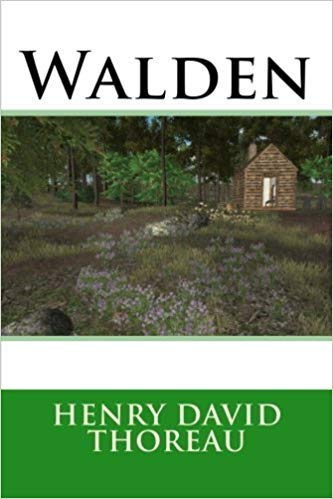
Like much of contemporary nature writing, this genre has strong ties to Henry David Thoreau. When Thoreau wrote Walden, his famous memoir-cum-manifesto about the two years he spent living at Walden Pond near Concord, Massachusetts, he obsessively detailed the natural world around him, tracking the changing colors of the pond water to the migration patterns of local birds. By capturing this “raw” wilderness (which actually wasn’t that far from town), Walden famously helped spread the idea of Transcendentalism, a social and philosophical movement that emphasizes the individual’s connection to nature. But Walden also helped popularize a literary genre in which a writer carefully observes a specific environment over a limited amount of time, usually one year.
Thoreau’s experiment at Walden Pond has inspired many nature writers, though the beauty of examining such a specific, and therefore unique, landscape, is that each writer inevitably comes to the format in their own way. Take Annie Dillard. Dillard won the 1975 Pulitzer Prize for her book Pilgrim at Tinker Creek, which captures a year spent at her house in Virginia’s Blue Ridge Mountains. Dillard combines David Attenborough’s passion for natural dramas with the voice of a poet; her prose is lyrical yet raw, and her description of the creeks—“an active mystery, fresh every minute”—could actually describe the book itself. The race to capture cherry blossoms would be anathema to Dillard, who is electrified by every aspect of her environment, and who keeps her eyes open for its surprises. For example, on the night that Dillard goes looking for muskrats, she fails to find any, noticing instead a small insect’s unlikely and inspiring escape from a spider’s web. Dillard is free from the constraints of expectation, which allows her to appreciate life’s many surprises.
Henry Beston was also trying to free himself. The year he spent living on a beach in Cape Cod was a respite from a country that was between World Wars and “sick to its thin blood for lack of elemental things, for water, for air, for the dear earth itself underfoot.” Beston recorded his observations from his isolated beachfront cottage in The Outermost House. Without a schedule or concern for time in a conventional sense, Beston’s work feels expansive and elemental. A pattern of waves might interest him for pages whereas his lunch is briefly mentioned, if at all. Of spring sand he writes, “it has entirely resumed its looseness, its fluidity, but the color still tells of winter in the faintest hint of grey.” Turning this kind of lens on something as seemingly mundane as sand is a lesson for the reader. After reading The Outermost House, it’s hard to step on a beach without thinking about how sand changes throughout the year, and then noting that day’s weight, color, and feel underfoot. To see just how much of an impact Beston had, you only have to look at the land he wrote about. The Outermost House is credited in the establishment of the Cape Cod National Seashore by John F. Kennedy, and Beston’s cottage was a national literary landmark until the 1970s, when it was tragically washed away in a storm.
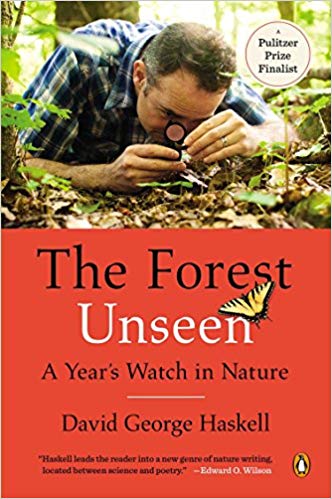
What if instead of waiting for the next big event, you carefully noted the progress of everything around you, down to a single plant? That’s what David Haskell did in his Pulitzer Prize-nominated book, The Forest Unseen, A Year’s Watch in Nature. Haskell marked off a one square meter plot of land in Tennessee’s Smoky Mountains and obsessively monitored everything that went on in this small ecosystem. As the Professor of Biology and Environmental Studies at the University of the South, Haskell is well-versed in the science of the forest floor, and his goal is to show us how nature is constantly in flux (lichen, for example, may look like a smear on a rock, but in some ways it’s actually busier than a tree, constantly altering its appearance based on the weather.) We might not all be scientists, but we can all benefit from this scientist’s mentality, and celebrate small changes rather than waiting for something huge.
During the 1950s, Edward Abbey worked as a seasonal ranger for the United States National Park Service at Arches National Monument in Utah. His account, Desert Solitaire: A Season in the Wilderness, is a series of vignettes, including beautifully rendered descriptions of the unusual, arid landscape. Abbey, like Haskell, has a keen eye for what’s changing in his landscape, especially when it comes to what’s in decline or already gone. When he realized he wasn’t spotting as many bobcats or other large predators that historically ruled the park, he tracked their loss to the Department of Agriculture’s policies, which not only endangered some species but led to an explosion of rabbits and deer that threatened the park’s whole ecosystem. Abbey’s critical probing of what he sees is an important reminder of the reason why being present matters at all; it allows you appreciate what we have before it’s gone.
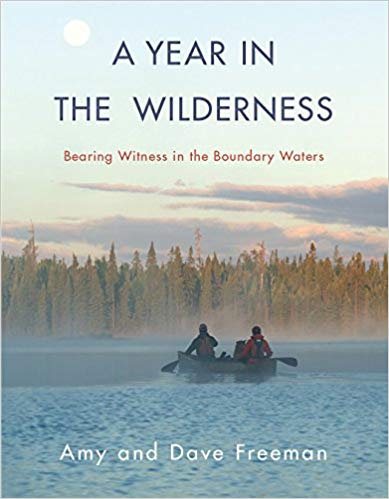
The Boundary Waters is a one million-plus acre wilderness area in the Superior National Forest in Minnesota. Despite some government protection laws from 1964, it’s seen years of disputes over actions that would destroy the landscape, including mining, vehicle use, and pollution. When Amy and Dave Freeman learned that toxic mining had been proposed for the area’s watershed, they decided to call citizens to action by spending a year in the area and documenting their experience in its wilderness. The resulting book combines both nature writing and activism; it beautifully captures the flora and fauna which are so at risk—loons skating on misty water, the wolves who trailed them through the forest—and helped spur an ongoing, organized effort to save the Waters and ensure their permanent protection.
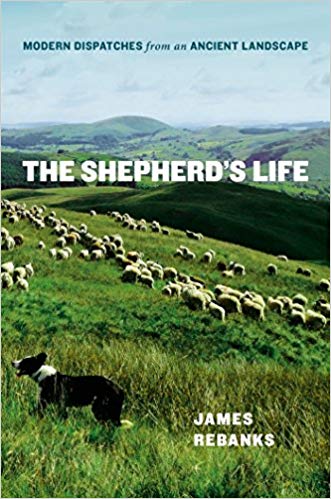
When Michiko Kakutani named an English shepherd’s farming memoir one of her best books of 2015, people took notice. In fact the book had already been a success in Britain thanks to its incredibly honest, authentic, and moving portrayal of an ancient way of life. James Rebanks herds his sheep in the Lake District, a unique mountainous landscape which has been farmed by small homesteads for generations. Rebanks himself is an unlikely character, a man who comes from a long line of shepherds and loves his work, but also found his way to Oxford and writes as well as any experienced nature writer. What comes through most in this book is Rebanks’s deep appreciation for what he has, even through its many hardships. Every season presents new challenges, but that only means more moments of success.
for a snow that didn’t come – instead, the clouds grew
varicose with rain.
I turned twenty-one and my father watched me drink
a glass of wine with his best friend,
at a table worn rough by years of dinner. This friend had trouble sleeping, and when he died
we read his journals: read catalogues of light,
the position of his head, the weight of blankets; he’d kept volumes to determine
what might let him pass into that state –
yet in Vermont, he claimed he slept like a dream, the four nights we stayed.
Remember, he wrote, in a journal we found,
the image of Natalie and Beatrice hugging in the morning. They were so beautiful. They had such ease and acceptance. Something I have never felt. Reminds me of my mother when I was young. I’m crying on the flight from Spain to Paris.
When I was ten, and flying into Iceland,
we saw below us a flaming house in the midst of a black field,
and the lights of fire trucks, too far away –
I imagined I could hear them wailing as they crawled their tiny way across the earth.
Loneliness is not a passive feeling;
it has teeth, it chews, and I believe we take some power from it,
from how it puts its mouth around our heads
and forces us to stare into the complicated tunnel of its throat.
We cannot hide if there is no one looking,
and the lonelier we are, the more we ask, who am I, to myself? Though perhaps the question ought to be,
who am I, to the winter?, and the answer – in its coldness – nothing –
might hold the truth to shrink our grief.
Vinegar Ghazal
To preserve this sight, please drop my eyes – like spring’s green fruit – in vinegar.
I’d put aside my wine for memory, and drink only thin vinegar.
New owner of antique furniture: do chairs remember bodies once held,
Do beds remember dreams of falling, or the taste of love’s skin-vinegar?
At the carnival of my ex-lovers, I watched you toss a ring: your prize?
An oak barrel of satisfaction, while you watched me win vinegar.
How did I come to be? I was distilled from yeast and sugar, heated
To a potent soul. If left too cold and still, I’d have been vinegar.
A doctor came to town and drew the crowds, crying Cure Your Loneliness
With this proprietary blend of blackened oats and Berlin vinegar!
At the café by my house, where I am known, they give me bread and oil
When I sit. They bring me salt. But they withhold my passion: vinegar.
Attic-bound, I write a drama for four sisters – wool blankets gown us,
Bittersweet piano trails the sour flute, the violin vinegar.
To make a sword that’s forged from blood, extract all iron from the body’s Veins.
To make a knife from wine and ire, harvest grapes and smelt tin vinegar.
I walked across a grassy field to find the marble entrance of your
Crypt, and moved the stone. A dark room; your casket; and therein, vinegar.
Let me tell you what I look like with my clothes off. My eyes are rabid
Mice, and above the unset table of my chest, my grin’s vinegar.
Sanded down with thirst, how I long to be invited – Dear Emma, drink
This vintage and ascend, do not content yourself with maudlin vinegar!
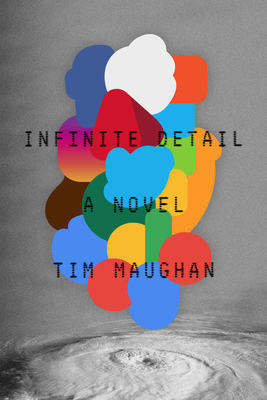
Tim Maughan is a technology reporter and fiction writer whose first novel, Infinite Detail, is about an apocalypse many of us dream about. A group of radicals in Bristol use a computer virus to destroy the entire internet, sending our hyper-connected society back to the pre-information age. We follow several characters in the U.S. and England as they cope with what often feels like civilizational collapse, and try to rebuild. Angry, keenly observed, and satirical by turns, the novel explores where contemporary digital politics might lead us. I talked with Tim over the internet, using a device he’s destroyed in his novel, to talk about political science fiction, smart cities, and why dystopia has hope at its core.
Annalee Newitz: As I was reading this novel I kept thinking of the term “cyber-communism.” There are a lot of little strands of cyberpunk in this novel, but it’s really quite different from what’s gone before in the genre because of this really strong focus on leftist politics that are named as such. These aren’t allegorical politics; they grow out of what’s happening politically right now. What are the kinds of political issues that you wanted to tackle, and how do you see them growing out of current issues?
Buy the book
Tim Maughan: It’s not because I want to be disrespectful to the kinds of science fiction that uses metaphor and tropes to discuss current political issues, because science fiction does that, even inadvertently. But that doesn’t appeal to me as a writer. I do enjoy reading books by [Ursula K.] Le Guin and classic science fiction books that tackled social and political issues through metaphor. But I want to write stuff about now that’s explicitly about now, that is kind of putting that out on the table and saying that this is what I’m doing. William Gibson had a tweet a few years ago, after I had already started this book, and he just summed it up perfectly. He said, cyberpunk isn’t particularly relevant anymore, but the tools that cyberpunk created—those narrative tools—he said he would like to see literature use those tools to explore our current situation. I thought, “Ah, that’s what I’m doing!”
AN: So I want to tease this out a little bit. What are the specific political movements you’re thinking of? We have this autonomous community in Bristol, where we spend a lot of time in the book. Are they anarchists? Are they cyber-communists? How would you describe the politics of that group?
TM: Kind of all of the above, really. And that idea came out of the community that I’ve been knocking around in for the last few years. I get invited to events that are this weird mixture of academics and people who call themselves futurists and artists. And it really came out of seeing artists in Europe, going to events in places like Amsterdam and Berlin, or Eyebeam in New York City where I used to hang around a bit. It was really exciting to see artists engaging with these issues, sometimes in very direct and forthright ways.
A person who is a huge influencer on the ideas behind this is Julian Oliver. He’s a New Zealand artist based in Berlin. A lot of his stuff has to do with jamming the internet, disabling WiFi networks, or replacing WiFi networks with other content in public spaces or in gallery spaces. He did a piece that’s like a remote control tank and you can drive it round and it blocks all the WiFi networks within range. He was trying to get people to confront and look directly at these infrastructures that are affecting and monitoring and essentially controlling them.
That was the core inspiration behind New People’s Republic of Stokes Croft—which is a real thing, I should point out. There is an organization in Bristol on Stokes Croft called the People’s Republic of Stokes Croft who are a local anarchists and community group, who do a lot of work in that area. So part of it was growing up in Bristol and seeing that conflict between community groups and social justice groups and anarchist groups and the local community around them. Because Stokes Croft used to be a very working class and very non-white neighborhood traditionally in Bristol.
AN: Cities themselves become characters in this book, and I love the fact that you have city hackers instead of traditional computer hackers. Of course they’re hacking the internet, too, but it’s ultimately city infrastructure hacking. Bristol does become a kind of character, especially as the novel goes on, as we come to understand how it’s changed and how it’s survived the apocalypse. I wondered if you could talk about why you wanted to really hone in on city hacking as opposed to looking at, let’s say, Twitter or other social media.
The crux of the book is that this technology affects people who don’t understand it or even know that it exists and then abandons them.
TM: I was writing this book for a long time, and it changed thematically early in its conception. I personally became very focused on the concept of smart cities and then looking at and writing critiques of the smart city model. It’s interesting that you talk about the cities as characters because the critique of smart cities that interests me the most is that smart cities are generic solutions. They view cities as problems and that there is a generic, off-the-shelf solution for them. That’s kind of the smart cities philosophy. But cities aren’t all the same, in terms of their communities and conflicts. So partly my aim was to give Bristol, and Brooklyn to a lesser extent, a kind of feeling that it was a unique place and couldn’t be pigeon-holed like that. And secondly, it’s a good literary device to get away from boring hacking scenes. People complain that hacking does not translate to the screen, but it translates to novels even worse now. Anyone who tried to read that terrible Bill Clinton hacking novel that came out last year can tell you that.
AN: Wow, did you actually read that? Good job. [laughter]
TM: No! I didn’t, I didn’t. A friend of mine did, and screen-grabbed lots of pages of it to Twitter and it was like, “Oh my god. I hope my book doesn’t read like this.” Because it’s hard to explain hacking concepts, right? And there’s a couple of times in the novel I have to do an infodump and explain what ransomware is, or what the internet of things and backdoors are. And it’s not fun writing that stuff. It’s very hard to do it.
AN: One of the images that really stuck with me from the novel is quite early on when one of our hacker characters, Rush, is in Brooklyn, and he is helping a homeless guy who’s collecting cans. All the cans have RFID tags, and the guy can’t turn them in for money anymore because he can’t prove that he bought them. So Rush takes basically a magic wand out of his pocket, which is an RFID hacking device—it’s an antenna—and he waves it over the cans and quickly resets all of their IDs. And as you’re reading the scene and imagining it—he looks like a wizard, and he is part of, I think, this strong current in the novel of magic realism, where we’re seeing a lot of characters respond to technology as magic or describing it as magic. They even describe branding as magic. There’s a lot of imagery of magic in the novel, and I wonder why did you want to do that? Is part of your point that we have to have this apocalypse partly because we are getting caught up in seeing this technology as magic, or is magic actually a kind of hopeful way of looking at technology? Tell me all about techno-magic.
Spoiler alert! There’s a glimmer of hope in all my writing.
TM: Exactly. Yes is the answer to both those things, I think. Some friends of mine, Natalie Kane and Tobias Revell, created a piece of work called Haunted Machines. Their interest is in how technology is perceived in magic, and what the intentions are for that. It’s something that goes back to the Apple catchphrase: “It’s just magic. It just works.” The idea of technology being magic also obscures how it works and where it is in the environment—it gets back to all those issues we have with urban infrastructure, especially surveillance.
What’s important about that scene where Rush is playing the wizard and magically fixing these cans is that the canner Frank doesn’t understand what the hell he’s doing and thinks Rush is crazy, right? And that’s the crux of the book, that this technology affects people who don’t understand it or even know that it exists and then abandons them. I kind of wanted the reader to be introduced to this character of the canner Frank, maybe have some empathy for him or maybe not because he’s a bit old and crotchety and maybe a little bit racist, even, if you read between the lines. But I wanted readers to see that he’s a person who has a role in society who has just been abandoned because of technological progress. And I think the magic thing plays into that. Magic is an interesting way of explaining technology as a metaphor, but it’s also a way of obscuring and denying us understanding of how it works and its implications.
AN: One of the ideas in the book is the radicals have destroyed the internet through what is basically a magical piece of technology. We have this magical reset where we don’t have the internet anymore, and then one of the themes that we see again and again in the book is that even though there has been this huge change, people keep making the same mistakes and trying to rebuild the machines that caused their problems in the first place. This fits in with your idea of magic, because it appears that we never really understand what the problems were in the first place.
TM: Yes, exactly. And it’s that lack of understanding about what we’re doing that leads to [the radicals] not having a plan for afterwards.
AN: Yeah, that was so interesting to me. I wonder if you could talk about that idea of not having a plan for afterwards.
Dystopias are about imagining change because the characters are trying to imagine something different to what’s being presented.
TM: So, as I was coming towards finishing the book, I wasn’t quite sure how to tie it up at the end and I knew I wanted to make a point about failed revolutions and stuff. Around that time, Astra Taylor wrote this fantastic article for The Baffler called “Against Activism.” It was about the difference between activism and organizing, and it was just brilliant. Everything clicked into place, and I said, “This is what the ending of my book needs to be about.” Protesting is important, it’s vital, it’s empowering, but without organization alongside it, without long-term organization, it doesn’t often count for much. A similar argument was made by Adam Curtis in his last film. He makes the argument that in the sixties, a lot of bourgeois white people dedicated their lives to the civil rights movement. They dropped out of their careers, they turned their academic and legal practices over to just the Civil Rights Movement in the U.S. Because they were able to have the white privilege to go to do that. But he argues that now, because of network culture, we’ve moved away from that. You can easily be involved in protests, but it doesn’t have a lot of the same long-term impact.
I was at an event giving a reading last year, and someone asked, “Do you consider yourself an activist?” I said no partly because of Astra Taylor. I’m not an activist. I write fiction, which is an incredibly selfish and narcissistic thing to do. Real activists, real organizers, dedicate their lives to these issues and I think that’s a really important distinction to make. In the Curtis documentary, he talks about “Occupy” a lot and how “Occupy” was incredibly exciting at the time. I was back in the U.K. when it was happening but little Occupy movements were springing up over there and it was very exciting to see people come together and kind of give up their lives to a certain extent. But the lack of focus and organization beyond that is why it didn’t work. That’s the argument Adam Curtis makes. I wouldn’t want to be as dismissive to Occupy as he probably is, but what he says rings true to the larger extent. Occupy is criticized a lot for not having a firm set of demands. And what came next? Well, what came next was a few people, the leaders of the movement, have lucrative speaking careers or work at Google. So I kind of wanted to tap into that a little bit and say, “Look, it’s exciting for us to have moments we can participate in activism through the internet, but unless we have a long term plan about what we want to see as a replacement for it, it’s almost as useful as being apathetic.”
AN: I want to circle back to something that you said just earlier. You said fiction is navel-gazing. But at the same time, you’re saying, well the problem of these movements is that they want to tear something down, but they don’t have this long term plan. Don’t you think fiction is part of the process of coming up with the long term plan? You first have to imagine something coming next. You can’t—
TM: Yeah, I think you’re right. And the aim of the book wasn’t to do that specifically, but it is there, right in the very end, on the final pages. Spoiler alert! I think there’s a glimmer of hope in this book. There’s a glimmer of hope in all my stuff. I get called dystopian a lot which is a term I don’t feel particularly comfortable with.
AN: Yeah, I always tell people it’s more like “topian.” There’s some good and some bad, just like the present. [laughter]
TM: Yes, exactly. I think that there’s a glimmer of hope in dystopia from the start if you’re going to use that term. Dystopias are always about someone trying to push back against the system even if they fail and that is hopeful. Dystopias are about imagining change because the characters are trying to imagine something different to what’s being presented. So yeah, I think fiction’s incredibly important in doing that and, like you say, it’s a really good structure for exercises about alternate futures. Will I write one specifically like that? I don’t know, maybe. I might have a book somewhere down the pipeline that’s almost explicitly doing that but right now it feels like the urgency is on pointing out problems. The point of Infinite Detail is that it’s vital that we have alternatives.
“Many things in the world have not been named; and many things, even if they have been named, have never been described. One of these is the sensibility––unmistakably modern, a variant of sophistication but hardly identical with it––that goes by the cult name of Camp,” wrote Susan Sontag in 1964, in her now-famous essay “Notes on Camp.” Camp, of course, existed long before Sontag ever put pen to paper, as Lena Waithe’s brilliant outfit pointed out on Monday night, but the concept itself is so evasive, so difficult to grasp for those not already part of the “private code” of camp, that an attempt at elucidating it took Sontag the length of an entire essay. By way of Sontag, camp has become a term used (and often misused) in literary analysis—and now, to align with the new Met exhibition “Camp: Notes on Fashion,” it has also become a Met Gala theme. In other words, a bunch of celebrities had to turn a concept so nebulous that people build whole cultural criticism essays and art exhibits around it into a single outfit. This mostly didn’t work. Not least because Rihanna, who usually nails every Met Gala theme no matter how oblique, was nowhere to be seen.
The hilariously impossible assignment of matching a black-tie getup to the concept of camp made us wonder what some other Met Galas might look like if they continued to be themed to literary concepts. Here are just a few examples.
Magical Realism: Florence Welch wears a lady-wizard outfit just like she wears every year. Sarah Jessica Parker wears a dress by a South American designer that in no other way references magical realism. Rihanna wears a costume of the Met the size of the Met itself, a la Borges’ “On Exactitude in Science.”
Illustrations by Jared Pechacek
Plato’s Cave: Kim Kardashian wears a Grecian-draped goddess dress made out of latex. Gisele Bundchen and about seventy-two other female celebrities wear Grecian-draped dresses made of normal Grecian-draped dress material. A bunch of men all wear suits because, um, philosophy? Rihanna somehow constructs an effect in which she herself does not actually physically appear at the gala, but her shadow is projected onto its walls.
Postcolonialism: Benedict Cumberbatch wears a Thom Browne take on a 19th century British officer’s uniform and is subsequently cancelled by Twitter. Lena Dunham wears a suit embroidered entirely with quotes from Edward Said. Rihanna, understanding that it isn’t possible for the Met or anything involved with the Met to be post-colonialist, does not attend.
Illustrations by Jared Pechacek
Deus Ex Machina: Kylie Jenner wears a naked dress studded with steampunk machinery. Lana Del Rey wears Gucci’s take on the Old Testament god (full beard, white satin ballgown). Beyonce wears something that isn’t on theme at all but she looks so beautiful, like an angel. Rihanna simply arrives at the last minute, as she usually does.
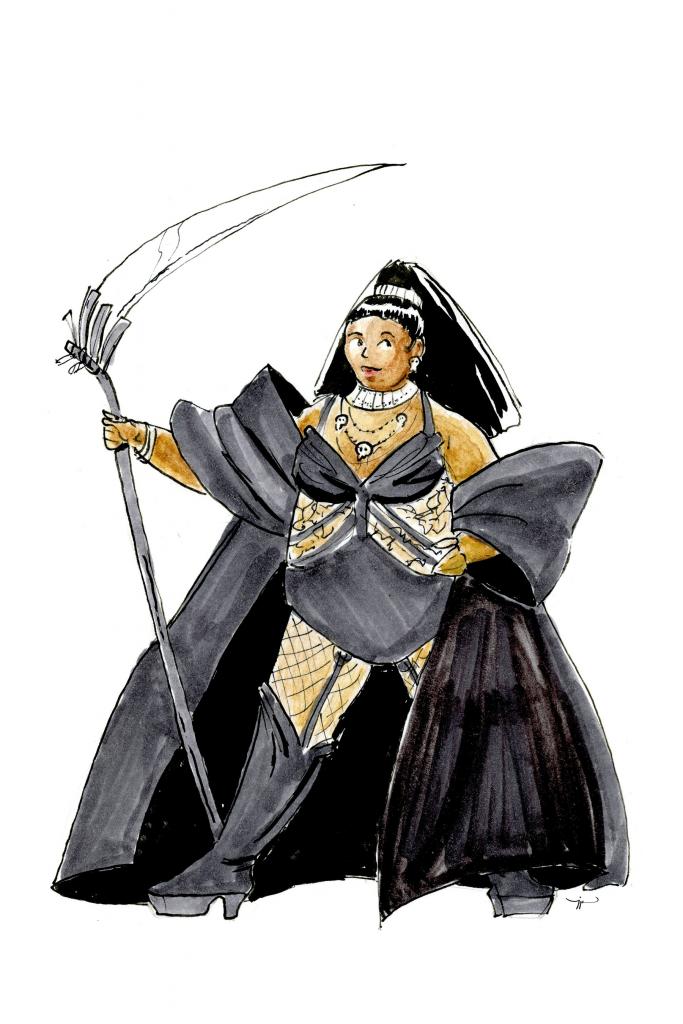
The Death of the Author: Lady Gaga wears a slinky dress with an illusion that makes her middle appear cut-out a la Goldie Hawn in Death Becomes Her. Lizzo wears a couture Grim Reaper cape and scythe with custom La Perla lingerie under it, and continues to wear it for the next two days, running around New York in it and scaring people on the subway. Cara Delevingne wears a latex bodysuit covered in fake blood. Jared Leto wears his same costume from this year. Rihanna wears a ballgown on which the “personal life” section of the Wikipedia entry for the designer has been printed, with all of the text struck through in red editing pen.
Illustrations by Jared Pechacek
Free Indirect Discourse: Hailey Baldwin wears a Jane Austen costume. Harry Styles wears a Jane Austen costume. Ezra Miller wears a Jane Austen costume. Awkwafina wears a Jane Austen costume. Rihanna wears a better Jane Austen costume than everyone else.
Pathetic Fallacy: Billy Porter wears a beautiful golden Christian Siriano tuxedo gown that maybe represents the sun shining. Taylor Swift wears a blue dress. Rihanna wears a hat that automatically pours rain every time Anna Wintour frowns.
The Panopticon: Janelle Monae wears a dress covered in eyes that seem to follow you wherever you go. Lady Gaga wears a gigantic hat in the shape of a swivelling camera. Karlie Kloss wears a sexy mini-dress, but in grey, because the carceral state is serious. Kendall Jenner wears a couture sexy-cop costume. Anna Wintour, as herself, is the only person who is truly on theme.
The letters and biographical ephemera of the (dead white male) stars of the canon are like Us Weekly for English majors. Literary stars: they’re just like us!. They forget to pay bills! They need to figure out how the laundry is going to get done and how to deal with the annoying sister who never reads any of their work! They also kind of suck at dealing with their moms!
Listen, it brings us no joy to tell you this. (Well, maybe a little joy.) Originally, when we set out to find letters written by authors to their moms, we hoped the literary greats could teach us how to express our inexpressible love (and maybe guilt) on holidays that demand those kinds of things from us. What we found instead was a series of letters from authors who were snarky, groveling, bored, and a whole host of other feelings towards their mothers.
While the letters we’ve excerpted here are not, exactly, ideal sentiments for your Mother’s Day card, they do provide further proof that a) the Dead White Males of the canon are, indeed, Just Like Us and b) moms put up with a lot of shit. Let’s be grateful for them today and always.
Edgar Allan Poe apologizes for not measuring up
In a letter to his mother-in-law/aunt “Muddy” (remember he “muddied” that line when he married his cousin), E.A. Poe first explains how much he loves her by way of imagining something horrible has happened to her, and then apologizes for being poor:
May God grand that this letter, so long delayed, may find you well—I ask no more—for I have been tortured, almost to death, by horrible dreams, in which I fancied that you were ill and helpless and I so far away from you. Oh, my dear, dear, good Muddy, I never knew the depth of my affection for you until this long and terrible separation. If you could but know my bitter, bitter grief at not being able to send you any money. But you know your Eddy’s heart, darling Muddy, and you feel that I would send it if I could get it in any way in the world.
Mark Twain is passive-aggressive with his mom
Mark Twain’s mother had a tendency to write letters to him on a series of scraps of paper. In one letter he admonishes her “Ma, write on whole letter sheets—is paper scarce in St. Louis?” But Ma goes on, doing as she damn well pleases. So Twain decides to give her a taste of her own medicine and write a letter on a series of nine scraps of paper, torn from other letters he had received. He goes above and beyond. Scholars at Berkeley have digitized them and you can read the full text here. But here’s Twain, at the end of the letter, gamely pretending that this work of metatextual snark is actually intended as an intellectual conversation:
Ma, I think it likely that some men are so constituted that they will, under certain circumstances of an irregular nature, manifest idiosyncrasies of an irrefragable and even pragmatic and latitudinarian character, but otherwise and differently situated the reverse is too often the case. How does it strike you?
Ernest Hemingway is kind of an ass to his mom
While we know that Hemingway didn’t attend his mother’s funeral and his parents weren’t totally on board with his career as an author (they returned his books to his publisher when they were sent to them), the letters acquired by Penn State over a decade ago add more dimension to that relationship. In short: Ernest might have kinda started it. After his father died, Hemingway, while living abroad, became the “head of the household,” and was managing finances for his mother. His mother was apparently not keen on the role reversal, and was resisting some of his advice. Hemingway mansplains:
Praying for advice and guidance is an excellent thing but advice and guidance even though unprayed for when accompanied by cash can be an excellent thing too.
Proust throws a tantrum and apologizes
Proust’s mom wanted to advise him on everything, if her letters are a suggestion of anything. As Colm Toibin noted in an exhibition at the Morgan Library some years ago, Proust’s mother once wrote him to ask what time he got up and what time he went to bed, leaving blanks next to each question so he could fill them in and return them to her. But as Michael Wood notes in the London Review of Books, Proust wasn’t always willing to conform to her instruction. Believed to be around 1897 (when he was 26 years old), Proust flipped out after a particularly bad fight, slamming the door behind him. The glass panes in the door shattered. While his apology has been lost, his mother’s response hasn’t been:
My dear little one
Your letter did me good—your father and I were left with a very painful sense of things…Let’s think no more and talk no more about it. The broken glass will merely be what it is in the temple—the symbol of an indissoluble union.
Your father wishes you a good night and I kiss you tenderly.
J.P.
I do however have to return to the subject in order to recommend that you don’t walk without shoes in the dining room because of the glass.
Thoreau tells his mom New York is going SO GREAT, really
In 1843, Henry David Thoreau, in an attempt to establish his individualism by way of financial independence, set off for New York, where Ralph Waldo Emerson got him a couple tutoring gigs so he could have time to write. It went well excerpt for the part where he was supposed to make more money writing, which he didn’t really. In a letter home to his Mother, he explains:
I hold together remarkably well as yet, speaking of my outward linen and woolen man, no holes more than I brought away, and no stitches needed yet. It is marvellous. I think the Fates must be on my side, for there is less than a plank between me and—Time, to say the least. As for Eldorado that is far off yet. My bait will not tempt the rats; they are too well fed. The Democratic Review is poor, and can only afford half or quarter pay—which it will do—and they say there is a Ldy’s [sic] Companion that pays—but I could not write anything companionable. However, speculate as we will, it is quite gratuitous, for life never the less, and never the more, goes steadily on, well or ill fed and clothed, somehow, and “honor bright” withal. It is very gratifying to live in the prospect of great successes always, and for that purpose, we must leave a sufficient foreground to see them through.
Ezra Pound can’t be bothered explaining why his mom knows nothing about art
Pound is nothing if not concise. In one short letter, he figures out how to insult his mother’s artistic tastes, suggest the inconvenience of writing a letter to her at all, pat himself on the back for being a good poet, and insult America (even though she was the one who took him to Europe for the first time), all in just a few lines:
Dear Mother: It is rather late in the day to go into the whole question of realism in art. I am profoundly pained to hear that you prefer Marie Corelli to Stendhal, but I can not help it.
As for Tagore, you may comfort yourself with the reflection that it was Tagore who poked my ‘Contemporania’ down the Chicago gullet. Or at least read it aloud to that board of imbeciles on Poetry and told ’em how good the stuff was.
I do not wish to be mayor of Cincinnati nor of Dayton, Ohio. I do very well where I am. London may not be the Paradiso Terrestre, but it is at least some centuries nearer it than is St. Louis.
T.S. Eliot is forced to tell his mom how great he is
In 1988, The New York Timesprinted a selection of T.S. Eliot’s letters. Eliot loved his mom. He was not afraid to express how much he needed her as he’s careful to mention in a letter shortly after his father died: “’I do long for you. I wanted you more for my sake than yours – to sing the Little Tailor to me.” Ever the child, in one particular letter, he is forced to be the one to tell her how great he is:
I only write what I want to—now—and everyone knows that anything I do write is good … There is a small and select public which regards me as the best living critic, as well as the best living poet, in England … I really think that I have far more influence on English letters than any other American has ever had, unless it be Henry James … All this sounds very conceited, but I am sure it is true, and as there is no outsider from whom you would hear it, and America really knows very little of what goes on in London, I must say it myself.
Roald Dahl is just right
There are plenty of well-founded criticisms to make about Roald Dahl as a person (mostly the antisemitism), but the beloved children’s author knew from an early age how to talk to his mom. As recorded in Love From Boy, the collection of Dahl’s letters to his mother, Roald Dahl took to writing his mother every week from the age of nine years old through the next twenty-plus years. In the first letter from the book, Roald Dahl, nine years old, is careful to cover all his bases: apologies first, justifications next, concern for the family, and then, the real ask, which is still careful to be conservative:
Please could you send me some conkers as quick as you can, but don’t send to meny [sic]. Just send them in a tin and wrap it up in paper
I live on a large underpopulated island in the middle of the Pacific Ocean. It’s ripe for the taking said our politicians yesterday, today, the day before, since two hundred years ago when early colonial settlers first came down the river behind my house and the Indigenous warrior Pemulwuy tried to chase all those ghost white invaders and their boats down the river and back out into the sea.
According to the T.V. we are always in danger of being invaded–at one time it was from the Asian countries to our north and now it’s by the refugees, or Muslims (the T.V often doesn’t distinguish between these two groups) but always, always there are hordes of people massing somewhere just outside our territorial waters waiting in their boats for that moment when we let our guard down.
The great majority of migrants and even refugees to Australia do not arrive by boat but the facts of things don’t matter much in these debates. What matters is that wide open sea which symbolises our vulnerability and the boats we place our real and imaginary fears onto.
My dad’s people came here by boat too. This was in the 1950s, a time when we reluctantly let them in because we needed cheap migrant labour to help build things and mine things. My dad’s family was a hodgepodge of foreignness, my grandmother being a Greek from Egypt who migrated to Ethiopia where she met my grandfather in Italian-occupied Ethiopia at a very complicated time when people like them ended up in British internment camps. They got on the first boat out of there. To cut a long story short, they faced a lot of the usual hardship and racism successive generations of outsiders have faced when coming to Australia. Then my dad met my mum, a woman of Scottish/English stock whose family had never met a migrant before my mum married one.
Buy the book
All this brings me to my book No More Boats and the books I want to recommend to you here. In writing No More Boats, I wanted to write something really complicated, something about how ‘outsiders’ and ‘insiders’ navigate all that fear of our borders in complicated and unpredictable ways, from the protagonist of the novel who is an Italian migrant who joins the far-right anti-migration movement in Australia, to his daughter who is on the left side of politics but forgets to really care about human beings, to his son who just grew up in a highly multicultural community and doesn’t think about it very much, to his Anglo-Australian wife who will never understand the trauma that migration leaves inside of you.
While writing my book I looked for similarly complicated texts that dealt with nationalism, identity, borders and belonging and, of course, do what really great books do, which is to give the very personal, very human story of the complicated times we live in. Here are 10 novels about our borders and our fears:
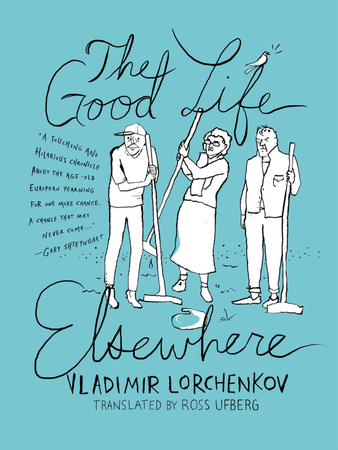
The Good Life Elsewhere by Vladimir Lorchenkov is a wholly original satire about the citizens of a small town in Moldova who are constantly attempting to immigrate to the more prosperous Italy. As most of the town is turned away from the border one by one, we begin to understand how borders and boundaries can shape the collective imagination. This is a book about big issues like a supposedly united Europe and the Soviet legacies that still hang over the former Eastern Bloc but it tells those stories by taking a microscope to the small lives of people from a small town.
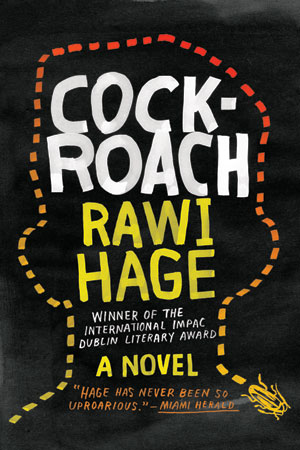
Cockroach has this wild energy in the way that Hage throws a dizzying kaleidoscope of image after image down on the page, the accumulative effect of which is to make the reader profoundly and deeply feel the conflicted and contradictory world of the protagonist. He is the immigrant outsider, the bully, the thief, someone who exposes the hypocritical and overprivileged world of the non-migrant in Montreal and someone who simultaneous longs to be bourgeois himself, someone who engages in the exploitation of other migrants and who plays on the guilt of dogooders by exoticizing his own foreignness and poverty. He also believes he is half cockroach, an effective metaphor which emphasizes his invisibility and the lack of compassion in the world around him. I love that you can never pin him down.
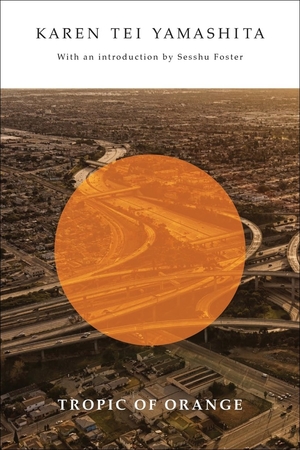
Tropic of Orange by Karen Tei Yamashita is a novel that shows what a complicated and complex discussion of what identity can look like and why fiction is often the best place to stage these discussions. Her novel is filled with the kind of transnational identities I grew up with but very rarely see in fiction – Singaporeans growing up speaking Spanish in Latino neighborhoods in the US, undocumented Chinese characters who arrive over the Mexican border–it even has a magically real character called “archangel.” All these figures wander somewhere around LA reworking and rewriting it’s geography in surreal ways that decenter both our understanding of race and place.
Splithead by Julya Rabinowich is told from two intriguing first-person perspectives both of which tell the story of Mischka and her family’s migration from Russia to Vienna and their fraught attempts to find a home in the Austrian capital. While Mischka, the main narrator, relates the story from a purely subjective position, Splithead, a surreal all-knowing character, gives the readers insight into Mischka’s Jewish family history. He intervenes whenever one of the characters is overwhelmed with life. He coldly comments on all the members of Mischka’s family, exposing their hidden fears and harrowing family memories. This novel takes that old adage that to be a migrant is to always be split in two, quite literally.
The Shadow Lines by Amitav Ghosh explores the rise of borders in the regions of India and Pakistan. Every character in this novel is in the process of crossing and recrossing or even of demanding new borders. In poetic prose Gosh looks at the way that borders not only set people apart but displace people from their own home. What is most interesting is the way that he explores the idea that borders force constrictive national and religious identities on people and the violence that often results in the state telling us who we are and who our enemies must be.
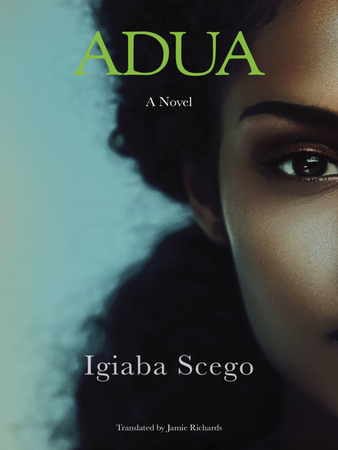
Adua by Igiaba Scego opens with the main character Adua contemplating if she should stay in Italy or return to Somalia after her father has died and she has inherited the family home. Adua once fled a brutal regime but she also fled her overbearing father and the constraints placed on women in her home town only to find that Italy was not the free and radical place she was looking to find herself in. What I find most impressive in this novel is the way Scego merges African fable and folklore, family anecdotes, and a sophisticated knowledge of both African and Western literature and cinema to explore themes of colonialism, racism, sex and power.
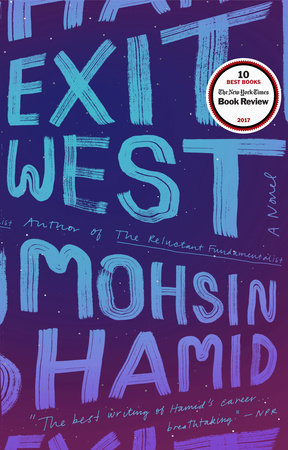
Exit West by Mohsin Hamid is the story of Nadia and Saeed, two quite different young people gradually falling for each other when war breaks out in the unnamed Middle Eastern country they inhabit. The novel is stripped back and unsentimental. It doesn’t scream its politics at the reader, which is what makes it such an uncompromising and affecting book about the individual realities of war, migration and refugees. Nadia and Saeed are flung into perpetual movement as they discover fantastical doors that act as portals to other places outside their war zone, places which are at once both comforting and unwelcoming. I don’t think I’ve stopped thinking about it since I read it.
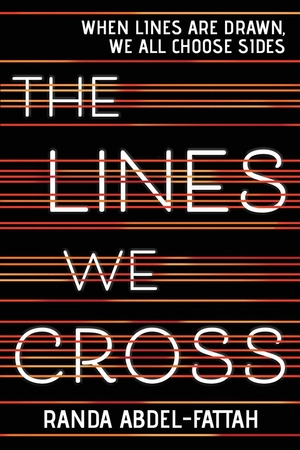
When Michael Met Mina (published as The Lines We Cross in the US) by Randa Abdel-Fattah is that very rare kind of work that delves into both sides of the story with the same level of insight and compassion and therefor asks harder questions of the reader and it’s those hard questions that ultimately allow this book to be so powerful. Michael comes from a family of far-right anti-immigration activists, Mina is from a refugee background. A relationship between them gradually develops as they meet on the opposite side of rallies and end up at the same school. What unfolds between them is a meditation on race, class, nationalism and the damage parents can do to their children by passing on narrow minded and uncritical perspectives of the world.
Last week the New York Timesreported that Woody Allen tried and failed to sell his memoir to four of the big five publishing houses. In the past, Allen’s book would have been an obvious sale; celebrity memoirs are one of the more robust genres of publishing, providing reliable and occasionally gargantuan sales, and most celebrities of Allen’s renown receive at least six-figure deals for their memoirs. On top of that, Allen has experience as a writer—he started his career as a magazine writer and has authored multiple humor works—and apparently had a full manuscript ready, which is more than a lot of celebrities can offer. And yet he’s now poison to publishers. Executives who spoke anonymously to the paper acknowledged that publishing Allen’s personal account in the #MeToo era would be daunting if not outright “toxic.” In other words, the story of his rejection isn’t just a salacious bit of schadenfreude. It introduces a bigger question: has the publishing industry finally changed?
Allen has been subject to abuse allegations for a long time without damage to his career. The accusations first came in 1992 when his daughter Dylan Farrow, then seven, claimed that he molested her at her mother’s home in Connecticut. Allen denied there was any truth to the story, but Dylan repeated her claim over the intervening years, during which time Allen married his own adopted daughter, Soon-Yi Previn, and continued to be a box office draw, making dozens of movies and working with a raft of famous actors. Publishers courted him, too; in 2003, Allen turned down a $3 million advance from Penguin because it was too low. Real pushback only came after the start of the #MeToo era, most notably in December 2017 when, following revelations about Harvey Weinstein, Dylan wrote an op-ed for the Los Angeles Times titled “Why has the #MeToo revolution spared Woody Allen?” After that piece, celebrities from Greta Gerwig to Colin Firth publicly regretted having worked with Allen, while others from his just-shot film A Rainy Day in New York, such as Rebecca Hall and Timothée Chalamet, pledged their salaries to charity.
Generally speaking, when it comes to writers, personal conduct has never mattered much to either publishing houses or the consumer. Ezra Pound and T.S. Eliot were notorious anti-semites; Herman Melville beat his wife; William S. Burroughs murdered his wife; David Foster Wallace stalked, abused, and tried to push his girlfriend Mary Karr out of a moving car. In fact, being a badly behaved (male, usually white) writer has long been seen as attractive. I recently came across a 2012 Flavorwire list of “Bad Boys in Literature,” which includes the controversial and racist French author Michel Houellebecq and literal wife-stabber Norman Mailer. What was clearly written as a harmless piece of click-bait now feels like an artifact from another era. The term “bad boy” itself reflects a culture which supported abusive men and excused their behavior.
The publishing industry has historically rejected any responsibility for not giving abusers a platform—and readers have, for the most part, not made this into a liability. For example, Stephen Rubin, the president and publisher of Holt, toldThe New York Times that “the corporate stance is that it’s not our job to judge our authors”—especially when those authors are best-sellers like Bill O’Reilly. O’Reilly was fired from Fox News and dropped by his agency, WME, following his admission that he’d paid off women to cover up years of sexual harassment, but Holt continues to publish his books, presumably because his Killing series has over 17 million copies in circulation. Similarly, Grove Atlantic and Hachette Book Group said they were “surprised and troubled” by the allegations of sexual harassment against author Sherman Alexie, but they will continue to publish his earlier books. (An additional example is Dan Mallory aka A.J. Finn, who didn’t sexually harass anyone but was revealed by TheNew Yorker to be as gross a liar and manipulator as you can find outside fiction. HarperCollins will still publish the follow-up to his best-seller, The Woman in the Window.)
Only recently have we begun to seriously consider if an author’s behavior should affect their career.
Only recently have we begun to seriously consider if an author’s behavior should affect their career, either through a self-directed consumer boycott or the industry formally cutting ties. So far, the former seems to be driving the latter; the publishing houses who rejected Allen likely did so at least in part out of self-protection. Investing in an author accused of sexual harassment has become a gamble; authors have been pulled from shelves, had their literary awards revoked, or been dropped by their agents. Online protests and boycotts can become a real thorn in the publisher’s side and a bad reputation can damage profits: Allen is currently locked in a battle with Amazon, who he is suing for $68 million after they canceled a four movie deal claiming that his reputation and actions, such as dismissive comments about the #MeToo movement, would make it “impossible to profit from Allen’s work.” If Amazon worries about being able to recoup its investment in Allen, then publishers have a legitimate reason to be wary.
Exactly how legitimate? It’s hard to say, as individual consumers are still grappling with the question of how to treat the work of an artist whose personal conduct is ethically objectionable. The trend in book sales seems to be that allegations of sexual harassment or assault hurt an author’s sales immediately after they break, but the books often rebound when it becomes old news. Look at Publishers Weekly’s 2018 review of the sales numbers for three children’s books authors who had been accused of sexual harassment. Only one, Sherman Alexie, author of The Absolutely True Diary of a Part-Time Indian, saw his book sales steadily decline after the news broke. Sales for James Dashner, the author of the extremely popular children books series Maze Runner, immediately dropped but have since picked back up, whereas sales of Jay Asher’s popular YA novel Thirteen Reasons Why actually spiked following the news, although it’s important to note that the Netflix series of the novel launched at the same time as the allegations of sexual harassment broke, and it’s likely that many people who found the book through the series weren’t aware of the accusations against the author. The same goes for the trend towards a rebound in sales; if a book isn’t pulled from the shelves or marked with some kind of warning sign, prospective readers (especially children or teens) likely don’t know the author’s history. The case of Bill O’Reilly actually sums up much of the situation for the publishers. His books did take a serious hit; the first installment in the Killing series published after his scandal sold less than half the number of copies in the first week than its predecessor. But at 65,000 copies versus 144,000 copies, it was still enough to put him in the number two slot of BookScan hardcover adult nonfiction list. Holt made a lot of money by its decision to stick by him, even if it was less than they’d hoped.
Given the money still to be made by selling Woody Allen’s memoir, publishers must be acting on ethical concerns, too—or at least acting out of a different kind of self-protection, less about their investments and more about their reputations. I think it goes back to 2017, when Milo Yiannopoulos, a writer for Breitbart and an established alt-right troll, was signed for a six-figure book deal with Simon and Schuster. Author Roxane Gay pulled her book from S&S, saying she wouldn’t be published by the same company that was putting hate speech into the world. S&S was forced to publicly grapple with the ethics of publishing Yiannopoulos, and in the end it dropped him. The conversation around the ethical side of publishing is ongoing, a crucial question that can no longer be ignored.
I don’t think publishers are going to suddenly become watchdogs for progressive values (and arguably, they shouldn’t). But thanks to financial and public pressure, we do seem to be entering a moment when it’s not worth a publisher’s time and effort to give hateful ideas or abusive people an uncontested platform and hundreds of thousands (or millions) of dollars. I see this as a heartening sign that publishing, by no means flawless, is working to be an industry that values ethical consciousness at least a fraction as much as it values profits.
An earlier version of this article mistakenly said that Allen is suing Netflix rather than Amazon.
Nicola Griffith, most recently the author of So Lucky, may have the distinction of being our first Read More Women participant who’s also been recommended by another participant: Robin Sloan describedHild, her novel about a gifted young woman in seventh-century England, as “deep, cat-purr pleasure.” So Lucky, a semi-autobiographical novel about chronic illness, brings the action much closer to home, but with the same depth and generosity.
Read More Women is Electric Literature’s series, presented in collaboration with MCD Books, in which we feature prominent authors, of any gender, recommending their favorite books by women and non-binary writers. Twice a month, you’ll hear about the five non-male authors who most delight, inspire, and influence your favorite writers.
As a child I read and still occasionally reread Mary Stewart’s The Crystal Cave, a potent and atmospheric entry in the Matter of Britain—Uther, Merlin, Arthur and the fight of Light and civilization vs. Dark and barbarism. It is heady stuff: menhirs looming from the mist, the scent of woad and wet wool, and moonlight gleaming on chased hilts and chainmail as noble warriors gather to stoop down on invaders like wolves from the fold. So far, so Dark Ages. But unusually for the genre, women are not rape toys—in fact they are largely absent, leaving 10-year-old me to imagine myself in the hero’s saddle. And the hero is not a warrior but Merlin.
Stewart chose well. The prevailing historical wisdom of the time was that in an era of petty kings and warlords, women of any class were victims without sufficient agency to do anything interesting. So Stewart writes about a man, one who is twice royal—but a bastard; straight but not a man of the sword. Rather Merlin is an instrument of divine power, his sexuality subordinated to his priestly role as mouthpiece of the Light. He is mocked by his princely contemporaries for gender noncompliance but, even as they laugh, the reader—that is, 10-year-old me—knows that he holds a far greater power than any blade. It’s enormously satisfying when he gets to flash that awful power and make those manly men go white around the eyes and tremble. Basically he’s a witch in boy drag.
What I really loved about this book, though, is how Stewart immerses us in nature. We feel it, smell it, and hear it; it seeps into our bones and infuses us with a sense of immanence and wild magic. It was this book, and Sword at Sunset by Rosemary Sutcliff, and Fire From Heaven by Mary Renault, that fired my longing to experience the landscape where I grew up without contrails and car exhaust, to feel how it might be for a woman, in a time when might was right, to be powerful enough in, of, and for herself to make a difference, to be a hero.
In my early twenties I was reading a lot of novels but writing only lyrics: songs for the band I fronted. When the band faded away, as all bands do, I found I didn’t want to stop writing. So I wrote poetry; I wrote nonfiction. Something began to gather in the back of my brain but I couldn’t access it. Then I found Mary Barnard’s translation of Sappho.
Without warning As a whirlwind swoops on an oak Love shakes my heart
Her bold, vertiginous leaps shocked me awake and open the dam in my head. I wrote 30,000 words of a novel in five days. This, I realized. This is what I will do with my life.
But, like Stewart’s, it was Sappho’s language of the the natural world, specifically using that language to talk about the body, that lit something in me. Her lyrics are fresh and astonishing. As Barnard herself says in her footnote, some of her words feel invented in that moment for that line alone. She was writing more than 2,500 years ago, yet her works speaks directly to us even today. So many of what we consider literary clichés were her original imagery: silver moon, rosy-fingered and rosy-armed dawns and moonrise, turning pale, being tongue-tied. She shaped our understanding of what it is to be human.
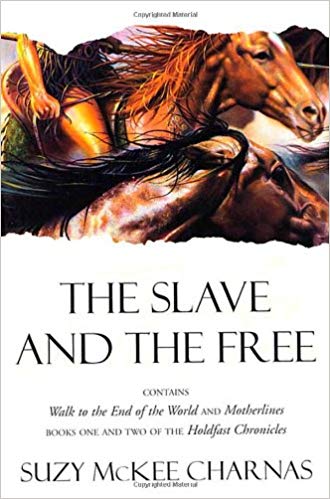
Poetry by and about women has never been too hard to find, but for a while I could find no historical fiction and very little contemporary fiction about women that was not romance. So I started to read about the future—but that, too, was about men, with the occasional space bimbo or scientist’s daughter thrown in to be explained to or rescued. I despaired until I discovered feminist science fiction. Here I’m going to cheat and talk about The Slave and the Free, an omnibus volume of the two first and best novels in Suzy McKee Charnas’s Holdfast Chronicles, Walk to the End of the World (1974) and Motherlines (1978).
Walk to the End of the World commits to an implacable sci-fi logic of post-apocalyptic gender war. The world is largely arid and inhospitable, with small isolated populations clinging on here and there. In one region men hate women, and fuck them not for pleasure but to make babies. Women are domesticated animals: bred as both beasts of burden, and food. We follow the story of one pregnant slave, Alldera, and her eventual escape. We have no idea what she’s escaping to, if anything, and if she’s walking into certain death in the desert, it seems like a reasonable choice because Walk to the End of the World makes The Handmaid’s Tale feel like a tidy little bedtime story. Like “Cold Equations,” a story that shocked a generation of science fiction readers with the relentlessness of physics, it does not flinch from its premise. It will give you nightmares, and those nightmares have teeth.
But Alldera does escape, to the world of Motherlines, a world of all women who breed their own domestic animal: not fellow humans, but horses. This is a much less terrifying book but it, too, looks right into the face of brutal choices and doesn’t blink. It was the first book I read with no men in it at all, and refutes essentialism effortlessly. For a new writer it is a marvelous introduction to, and almost perfect exemplar of, show-don’t-tell: a master class disguised as feminist legend that never was.
If you want to understand the shape of 21st-century science fiction, read Charnas and Vonda McIntyre’s Dreamsnake (1978). They are the others of us all.
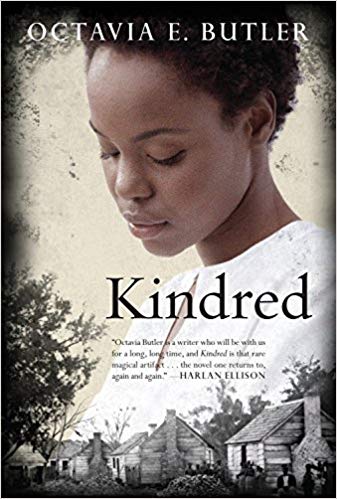
I loved reading Charnas’s and McIntyre’s futures in which women had space to roam, but I was also getting hungry for fiction by a woman about a woman set in a recognizable present. I remember picking up a copy of Octavia Butler’s Kindred, marveling at the cover illustration—a black woman who was neither half-dressed nor being threatened by a man. I had to read it—and instantly finding myself in familiar science fiction territory: time travel.
In 1976 Los Angeles, Dana, a young black woman married to a white man, is somehow called to the antebellum South to save a young white boy from drowning. She does and, bang, she’s back in L.A. But the boy, Rufus, ends up summoning her to save him every time he’s in danger. And Dana has to keep saving him to ensure her own existence, because he is the father of one of her ancestors. Each visit to the past—in which the people in the past age while Dana does not— is worse than the last, until she finally frees herself by killing the adult Rufus, already a father. What makes all this work as realism is that Dana does not escape unscathed, and her loss is tangible, not just internal and metaphorical: she loses teeth, and her left arm.
This is a book for all those women (and queer folk, and people of color) who look at their elders and sneer: I wouldn’t have knuckled under like you did! Why didn’t you fight back?? Butler shows that people in every time often do the best they can in the circumstances—probably better than you or I could—and it’s a miracle they survive, never mind conquer. History is never the inevitable, magisterial story we’ve been told; history is contingent upon circumstance, and the circumstance here is structural oppression.
This had a big impact on my work, as did two other things. One, the way Dana learns the reality of master and slave via personal, visceral experience: somatic knowledge that helps her unlearn the extra-somatic modes of dry text and TV representation. Two, that the notion of a protagonist as lone hero is bullshit; survival is all about being a member of a group, embedded in a network of others—and one’s actions have consequences beyond oneself.
In terms of craft I was fascinated by Butler’s nicely calibrated Othering. Dana suffers; her life as a slave is brutal—but not too brutal. Clearly Butler understood the nature of narrative empathy: put the reader inside your character and the character inside your reader, make them feel what they feel and learn what they learn, but don’t make it too hard, because if you do, the reader will put the book down and walk away, or at least barrier themselves up emotionally. Butler knew you can’t change the world unless you change the reader, and you can’t change the reader unless she stays open to your fiction’s great power of empathy.
Joanna Russ’s “When It Changed” (1972) was the short story that perhaps had the most immediate impact on me (Ammonite could not exist without that story), but here I want to talk about “The Mystery of the Young Gentleman,” (1982) a novelette in her brilliant collection, ExtraOrdinary People. It’s my favorite piece by Russ: fast-moving, thrilling, and sly.
It’s set on a clipper ship sailing from England to the U.S. in the late 19th century, narrated by a—well, I’ll have to say “woman,” because if you follow the textual clues that’s what makes most sense, biologically speaking at least. Though s/he could, just possibly, be an alien. And of course the point of the story is to deconstruct the notion of gender’s pernicious binary, throw out the Either/Or and replace it with Neither/Nor and a sprinkle of Yes/And. The narrator does not identify as gendered at all but, Wittig-like, insists that among their people there are no men and no women: if all refuse gender, there’s no need to perform it.
So, It’s about a woman with a young charge—who is definitely a girl, or more precisely a young woman, but in any case most certainly not a lady, oh no—who are traveling as father and daughter. Though, oh dear me, their relationship is not filial. At all.
So, It’s about a woman and girl on a transatlantic crossing who use gender performance to stay safe. Not safe from bad men. Safe from the dull-eyed herd, each plodding behind the placid beastie ahead. Our protagonists, you see, are telepaths. And Russ has a tremendously fine time fucking with everyone’s gendered heads as she ratchets up the stakes.
So, It’s sharp, witty, genderqueer science fiction. But we are talking about Russ, so that’s not all it is. It’s pulp adventure fiction, with sex and gunplay and gambling, money and reversals and danger. Also a parody of Victorian porn. And, literally, a comedy of manners. Exhilarating stuff.
Another great piece in this collection is “Souls.” Abbess Radegunde slices open the clichés of Dark Age Britain, salts them, and eats them.
Finally, if you want to know why, despite campaigns like #ReadMoreWomen, women still aren’t read, respected, or rewarded when we write about women, read Russ’s magnificent How to Suppress Women’s Writing. And then take the Russ Pledge: whenever you talk about books, talk about books by women about women.
Picture this: an existence punctuated by yoga classes and country walks, sustained on a quinoa-heavy diet, swaddled in Merino wool. That’s the schedule of the women making possible this promise: the compromise of career or family resolved, without compromise. This is Golden Oaks, known as the Farm, a surrogacy facility that allows the global elite to outsource the labor of pregnancy to surrogates.
The setting of Joanne Ramos’s debut novel, The Farm, sounds like a thought experiment, but it’s better understood as a projection of the current inequalities. In a world of ubiquitous Louis Vuitton, the most conspicuous form of wealth, the truest status symbol, is the ability to buy back time. In Ramos’s novel, gestational surrogacy, a situation where a woman carries a baby that isn’t biologically related to her for compensation, is the ultimate luxury good. For those employed as surrogates, it’s a windfall. It’s a shot at the longest shot: the American dream. It’s also a sinister reversal of the idea of invisible labor—the labor of housework and childrearing that mostly exists below the drag net of economic measurements. That work here is given its due, a dollar value. But surrogacy as work turns its women into more than a labor force—the women become units of capital. It’s the body as manufacturing belt
Those coming to the novel expecting a burning-down of this new system will, however, be disappointed. Every party has a seat at this fire. The novel rotates between four characters, the capital-owning class represented by Mae Yu, an executive at the conglomerate behind the Farm. There’s also Ate, an immigrant and a long-time caregiver bent on forcing the American dream into existence. Reagan is a white, privileged, millennial with a still-calibrating moral compass who finds herself a surrogate on the Farm. Finally, Jane, an immigrant, a mother, and now also a surrogate.
At the same time that the novel pioneers a new business model for pregnancy, it consecrates a quality of traditional motherhood. The four characters, who exist across class strata, are unified by a single motivation: they want more for their kids.
I spoke with Joanne Ramos over the phone.
Mai Nardone: There’s an excellent, mimetic moment at the beginning of the novel where a wealthy mother starts filming her nannies, saying she’s working on a documentary project about them. The Farm throughout is very deliberate about documenting lives across the class spectrum. Can you talk about writing across that divide?
Joanne Ramos: That’s a subject I tackled in that episode, but also in another section when Mae Yu tells Reagan about a friend who started a program where they bring kids from the ghetto, basically, to somewhere in the Hamptons to see what they should aspire to. I do believe many people of privilege are well-meaning and want to help when they see injustice, or inequity. But it’s hard to know how to really make an impact, and it’s also delicate. Charity done without context or an understanding of the complexities of the “divide” can come across as awkward, patronizing, even bumbling.
MN: Beyond class divides, did you feel like you had to write into the current socio-political moment, especially in response to Trump’s anti-immigrant rhetoric and immigration policies?
JR: The immigration debate wasn’t as heightened until Trump became president, but it’s always been one for me because I did immigrate here and I know people who are here legally and illegally. We came to the States when I was six. I was born in Manila. It was a typical immigrant story, you know: make it. I grew up, like many immigrants, straddling worlds. We moved to Wisconsin in the late 1970s, in the wake of auto factories closing. My sister and I were two of four Asian kids in our public elementary school and yet on the weekends we visited my dad’s family. They were part of a tight Filipino community. Then I went to Princeton. It was the first place I started to sense what class might mean, or entitlement, or really great privilege. Like many immigrants to the States my dad and mom believed in this idea of American meritocracy. All you had to do was play by the rules and work really hard. That’s how I was raised until I got to Princeton.
MN: With its yoga routines, wholesome food, and dorm dynamics, the Farm is half tech campus, half university campus. You’ve taken a character like Jane, a poor immigrant, and you’ve put her in an environment where she has the class shock that you’re describing from when you went to college. Why create this contrasting environment for the surrogates on the Farm?
JR: What I realized when I was raising my kids was that the only Filipinos I knew day-to-day in Manhattan were housekeepers and nannies and baby nurses. They would tell me about their kids still in Manila who they were supporting, and the dorms where they lived, renting beds by the half-day to save money. In my community if someone like you makes it then you’re proud of them. Like my mom knew Bruno Mars. She didn’t listen to that stuff [pop music], she liked opera, but she knew Bruno Mars because he’s Filipino. These women who became my friends, they’d say, “Oh you’re so smart. You’re the one. You made it.” Meaning: I am also Filipina, they were proud of me for ‘making it’—for going to Princeton, for having had good jobs and a nice family. I was like, “You guys work hard. You guys are smart.” It reinforces everything I felt since college that what separates a successful life in America from one deemed less successful is as much or more happenstance than any kind of merit.
Then I happened to pick up my husband’s Wall Street Journal and read this tiny article about a surrogacy facility. I started doing that “what if” thing. What if the clients weren’t just well off but they were the super-rich? Of course they’d want organic food, clean air, and everything pristine and wholesome. I’m of this generation of perfect parenting. Like this crazy college scandal here where rich people were buying their kids into college—that could have been in my book. There’s this zeal that can go crazy places when you have crazy wealth and privilege.
MN: The novel doesn’t open with the Farm, but with a portrait of New York City caregivers. You show how one privileged vision of motherhood exists at the expense of that type of motherhood for others mothers. You could call it the establishing idea behind the Farm. How did you decide to begin here?
JR: The first real thing I ever wrote was about Jane baby-nursing. She wasn’t Jane yet. She was a mother with a newborn at home who she left to be a baby nurse. Even that wasn’t taking me far enough until I read that article about surrogacy. It allowed me to broaden my lens. I could’ve written a very discrete story about Jane in a private home that still talks about race and class, but I wouldn’t be able to talk about whether the system works at all, or the corporate side of it, or how much we’re willing to let society sell. That was only available to me because the Farm suddenly became a part of a luxury goods conglomerate.
MN: For me it was notable that the novel was not representing a dystopia. Inevitably you’re going to get the comparison to The Handmaid’s Tale, but the way I read it, it was resisting that tradition. Is there a reason you have resisted the tropes and label of dystopian fiction?
I realized when I was raising my kids that the only Filipinos I knew in Manhattan were housekeepers and nannies and baby nurses.
JR: I didn’t ever mean it to be a dystopia. I meant it to be a snapshot of our world pushed forward a few inches, but not miles ahead. I was really interested in motherhood, and more broadly the sacrifice that parents or immigrants make for the next generation. Once the surrogacy part came in that broadened it to include all these questions about whether the system works anymore, whether what I was able to do, meaning work hard and change my life and my family’s life, whether that’s possible now, in a country where the middle-class income hasn’t grown at all since the ‘70s. I was less interested in making a futuristic, sci-fi thing that people may be able to dismiss. I was much more interested in pushing the world of The Farm far enough that there’s that suspense of disbelief and then after you think, “Huh, I didn’t like that world.” Hopefully the response can be, “But why?”
MN: Despite not being a dystopian book you invent a taxonomy for use on the Farm that sounds dystopian. Surrogates are “Hosts” and Golden Oaks, the surrogate facility, is “the Farm.” Why did you decide on these labels?
JR: It’s like a lot of business-speak and jargon. Here it’s less about specificity and short-hand but more about distancing from the world outside, the world of emotions and human relationships. It’s the way that we dehumanize people—I mean dehumanize is pretty strong, but you distance yourself and deaden it to make easier some decisions that would be harder if you saw people as people. As far as calling the coordinators “Coordinators,” I also think that for the Hosts it’s meant to imply that these women weren’t friends, they were handlers. Reagan knew one of them by name. But Jane never addressed any of them by name. I think that also speaks to the power differential between those characters. Agency is to some degree, maybe to a large degree, dependent on how privileged you are.
MN: Even the way Jane and Reagan see their clients is very different. For Jane it’s just a job. It’s about how it affects her pay. But Reagan feels proud when she’s told her client is a self-made billionaire with an exotic backstory.
JR: Jane’s equation is more difficult because she doesn’t have many good options. In some ways that makes it clearer. She is there to make the big money for her and [her daughter]. Of the four narrators Reagan was the hardest one to crack as far as motivation. She doesn’t need to be at the Farm. She’s educated, her dad has money, she’s privileged, she’s Caucasian. She needed another reason to want to be there. She’s someone seeking meaning, some reason for being where she is. She has more complicated reasons for wanting to be there than Jane.
MN: Because the chapters revolved through four different characters, it was hard to make an easy villain of anyone. I found it very nuanced. How did you arrive at this rotating structure?
What separates a successful life in America from one deemed less successful is more happenstance than any kind of merit.
JR: Jane and Ate were the ones who started me off. Their characters were this sediment, like this whole building up of observations and people’s stories. For instance, I have this one story in the book about one of the newer women in the dormitory in Queens being enslaved by her Filipino employers in New Jersey. Growing up I knew a Filipino family who were actually jailed because the housekeeper I had known growing up was never paid. These stories were always there if you knew or were connected to immigrants. Some of the women I met in New York had stories worse than Ate’s. I had to pare it back to make it seem realistic. Those two are the heart of the book in my mind because that’s what sucked me in. Then I realized that those two perspectives in a surrogacy facility allowed me to broaden the lens, like to the perspective of someone running it so I could talk about the system.
It goes back to debates about free trade I had with my dad growing up. He was the immigrant who came over here and fe
lt like, “I made it.” I needed my dad’s perspective, as a person who really believed in the system. That became Mae Yu. She allowed me to talk how it felt for me being a woman in a very male world when I was in finance. I had this throwaway line about how she’s the only female manager at Holloway. She’s a glass ceiling breaker. She’s very impressive in her own right. She also makes some very questionable decisions.
MN: Ate is probably my favorite character. She’s an older caregiver who sends money home, buys land at home, and supports the extended family at home. By immigrant standards, she’s a success story, but at the same time her life is quite sad because she remains, into old age, a cog in the American Dream machine, like she doesn’t know what else to do but keep turning.
JR: I think that Mae Yu and Ate, in very real ways, are similar. Both of them are not questioning the system but are trying to make it work for them, to master it. All of us compromise. We’re juggling different masters. I didn’t want any of my characters to be archetypes. Straddling worlds again, I know people who I consider my friends who have left their kids back home and work here very hard, some legally, some illegally. And I know people who have gobs and gobs of money and I’ve heard both of them demonized. To a fault I see different sides to everything.
The flipside is that you do have to come down on one side sometimes, and judge, and I’m not the best at that. I was less interested in having a “view” and getting on my soapbox to expound on my “take” on the world, and much more interested in the questions and the conversation that falls out of these questions. I met with one reader recently through a presentation. She ended up saying that what made her feel uncomfortable about the book was that a lot of this was already happening. Just to hear her say that was incredible. Was that my intent? I don’t know. I hoped to explore the questions that have consumed me for most of my adult life. I was trying to find the right, most salient questions to ask given where we are right now as a society. If some percentage of the readers feel that compulsion to want to talk about and figure out why we feel certain ways about these women and the world that we’re in, that we’ve chosen, then that’s it. That’s everything I wanted from the book.
We used to drive forty minutes into Anchorage to shop at a Korean grocery. The one vaguely Chinese store was associated with a Chinese mainlander, and mainlanders lacked values. That owner, my mother said, stirred rat meat into the ground pork; when you unwrapped the butcher paper, you might catch a faint scent of urine. Pork, in turn, was passed off as beef with a squirt of red dye. So she shopped at a Korean store no bigger than our garage, blocking pinched aisles to ponder the mystery of Korean packaging, while I snuck promising foods into the cart: purple rice, tofu that came in a squeezable tube, a can of what looked like shiny pretzels but turned out to be candied lotus root.
At the end of winter, my mother and I made our first visit to the store since Ruby had died. Six weeks had passed. Halley’s Comet had been visible as a smudge. It was to return bigger and brighter in 2061, but which of us would be alive to see it? Our aliveness was precarious. Divers had found the crew compartment of the Challenger with all of the bodies inside. Soon the wreckage would reveal that four emergency air packs had been activated; not all of them had died instantaneously.
At the grocery store my mother stood in an aisle and stared at the bottled vinegar. She walked the length of the display, following the spectrum from clear to black, and then stood staring at the blackest vinegar. We left the store without buying a thing. She pulled off the road and parked. In a series of actions that startled me, she hopped a guardrail, scampered across the forbidden railroad tracks, and led me down to a huge rock at the beginning of the mudflats. The rock was shaped like a fist, knuckles down. Standing on the rock, towering over the low beach, she said she was trying to listen to it speak, the water, but she couldn’t hear it from there. The tide was low; the mudflats were vast.
Across the rippled terrain was the same ocean she’d grown up beside; here was Turnagain Arm, which was part of Cook Inlet, which was part of the Pacific Ocean. If you cut a slanted path through the water, she said, you could end up on the eastern shores of Taiwan. Her village, even. You could stagger to land as the first light broke, coming in with the fishermen who’d just climbed down from their anchored boats. They dragged swollen nets of fish behind them on Styrofoam flats. As they came to shore in their rubber waders and boots, long squeaks marked the rhythm of their walking. On the sand, in early light, my mother waited for her father with a bamboo pole. They’d string the net over the pole and carry the fish between them. The short beach was sloped upward, so she walked at the front, and the load was easier on her.
Our aliveness was precarious.
My mother climbed off the rock and tested the hardness of the silt. These days, the sun was setting during dinner; we watched each other chewing and gulping in coppery light. In a couple of months the sun would be glowing in electric perimeters around our blinds into evening. Giving us all a charge. The previous summer, Ruby had insisted she was a fish, and my mother had fed her huge sheets of dried seaweed, folding and crumpling them into her mouth. Pei-Pei had asked to go camping with her friends. Camping! my mother exclaimed. Here, where black bears lumbered down from the Chugach Mountains, gorged on salmon at Campbell Creek, and then stuck around to swipe at your garbage cans.
Beyond a scrawny, twisted tree was a huge white boulder at the edge of the water. A person was squatting beside it. “My heavens,” my mother said, and started running. I tried to grab the bottom edge of her coat, but caught nothing, which made my hands feel empty. We ran past the tumbling of rocks and stray driftwood and made our way toward the boulder. For a while we followed the arcing tracks of a bird, stamped into the silt, a trail of half asterisks.
It was a whale, and my first impression of it was its whiteness, unsullied. It was nearly as long as my father’s pickup truck, lying in a puddle. The slump of its body came up to the chest of the squatting man, who stood up. “It’s still alive,” he called to us. “Bleached,” I thought he said, but of course he must have said, “Beached.”
“What is it?” my mother asked, though she knew about the belugas in Cook Inlet. On certain stretches of Seward Highway she told us to watch the water for their writhing bodies, whiter than the crests of the waves. Just once I’d seen a short, misty spray. But she didn’t know how to make conversation in English. She was always asking, What time is it?—with her watch curled in her coat pocket.
“Beluga,” he nearly sang, and each strange syllable was liquid and warm.
The man was short, with a wide, deep chest and arms so muscular they hung away from his sides. He was wearing a neon-orange cap with earflaps, from which a few gray curls escaped. I’d never seen such a funny hat, or such a happy color. My mother approached the whale and stopped two yards from its face. I hurried to her. The whale was situated in a crevice of mud and was wriggling its head side to side. I froze in the steady gaze of its small, oily black eye, not so much bigger than a human eye, embedded in a thick ring of skin. The protruding forehead and long mouth gave it a strange expression—a pained smile—as though we’d asked, Shouldn’t you be in the water?
“Go back,” the man said. “It’s dangerous, this glacial silt.”
“Is okay,” my mother said, and tapped the toe of her loafer against the ground. When nothing happened, she dug her toe in harder.
The whale lifted its head and slapped it back down. There was a cool, silty splatter on my arm.
“Oh,” my mother said, delighted. Her sweatpants were streaked.
Its flippers pressed against the silt and its flukes fanned the air twice. The heft of its midsection was too great for it to do more than flex. Here is a whale, I told myself, and then I wondered if it would die. It looked too big to die, too big to vanish during a sudden, silent creak of the world.
And what, I thought, had they done with Ruby’s body?
The man scratched his bristly neck and flicked the brim of his cap up. “Best she can do is stay still and wait for the tide to come back in.”
My mother sprang forward, and with a shock I saw her put her hands on the body of the whale. She ducked her head and shoved, arms locked straight, her loafers gouging tracks into the packed silt. Her feet slid out of her shoes. Her socks darkened where they soaked up water.
The man belted out a laugh. “That’s, like, two tons you’re trying to roll.”
Here is a whale, I told myself, and then I wondered if it would die. It looked too big to die, too big to vanish during a sudden, silent creak of the world.
My mother’s face hovered beside the blowhole, from which a milky foam was leaking. She slipped her shoes back on and walked around to stand before the whale’s face. She touched its forehead bump, the same gesture as when she pressed a palm to our sternums to put us to sleep at night. Pei-Pei, me, Natty. “Sleep,” she would say. And, so quietly we could barely hear, “Wake up again tomorrow.” The heavy weight of her hand, like sleep itself bearing down on us, paralyzing us where we lay. “Come here,” she said to me now. She lifted my hand to the whale’s forehead.
It was not especially cold or warm. The skin had a rough, porous texture, and behind the skin its flesh was soft, like a ripe peach; I could have left dents with my fingers.
I don’t know what kind of expression I made, but the man, a yard away, started laughing again. “This kid,” he said. I liked the way he laughed, upward, without self-consciousness.
He swept an arm back the way we had come. “Nothing to be done. We should get out of here.”
My mother did not move. She was staring hard at the whale, which began exerting more effort, its head and extremities whapping against the ground.
“Do you understand what I’m saying?” His voice sounded far behind me, and when I felt his hand on my shoulder, I started and flung it off. “Easy. Does your ma speak English?”
The wind lifted my mother’s permed hair into a mane, making her taller and more savage.
“Do you? English? Hey, kid. English?”
I looked up. A neat mustache hid half his mouth, and his eyes were translucent.
“What’s your name?” he asked.
“Gavin,” I said.
“How would you spell that in English?”
My mother kicked off her shoes. She peeled off her wet socks, rolling them into a single ball that she stuffed into her coat pocket. She picked up her loafers, one in each hand.
Immediately I wanted to be barefoot, too. The man offered an arm to me as I balanced shakily on each leg and removed my sneakers and socks. When I ran to my mother, my feet stuck to the cold silt, which turned softer, muddier, where it met the water. It sucked on my heel.
“It’s thirsty,” my mother said. “The poor thing. It’s dry and it’s thirsty. The air hurts its skin.” She dipped a loafer into the puddle and dribbled water onto the whale’s back, spreading the liquid with her hands.
I became aware of my own thirst, big and insatiable; I looked past the flats at the glinting water, out of reach, and the wind felt sharp and dry.
The man said, “Tide’s starting to come in.” There was an icy splash at our legs. The puddle around the whale overfilled. I raised one clean foot to my hand; the foot was cold and foreign.
“Let’s go,” the man said.
My mother nudged me away from the water. The man began to walk, turning around to check that we were following. He held the laces of my sneakers in one hand, and below it my sneakers danced. In front of me, my mother swung her shoes in arcs to dry them, and there was an easiness to her walk. I watched our bare feet keeping pace with his boots. His khaki pants were folded once at the hems, showing the inside threads and exposing strips of wool sock at every step. My mother’s pants were darkened up to midcalf, and mine to my knees. Though my legs were wet and cold, I felt a slow loosening in my chest as the three of us walked, as though my windpipe were untwisting and clear, unobstructed air coming in.
At the fist-shaped rock, my mother took a seat at the far end. Her legs fit perfectly into two scallops on the rock’s front edge. She pulled me up beside her. The man stood for a while, then leaned against the rock, then scooted in until he was sitting beside me.
The water had come in; it was maybe a foot high around the whale. Even from this distance we could see the whale pulsing. I rubbed the tops of my cold feet. They were nearly dry and a little ashy. Beside me, the man was working his thumb through a hole in his windbreaker sleeve.
Then he bent over and grabbed my left foot, setting it on his lap and sandwiching it between his hands. He began to rub my foot. His hands were rough, and I could feel a snag of dried skin scratching the center of my sole. He moved his hands faster, making a rasping sound, and the resulting friction was very warm. I raised my other foot in the air, and the man chuckled and warmed it, too.
He and my mother conversed haltingly about the recent spell of rain and the plummeting oil prices. It was the kind of conversation I might have overheard any afternoon at Carrs or the Qwik Stop, and I was proud that my mother was part of it. The man absently alternated between my feet, and I sat rapt at his hands.
They fell silent, then the man said, “Where are you from?” and after my mother had answered, he asked, “And what’s that like?”
My mother tilted her head. “There, not so many signs,” she said. “Danger. Stay away from tracks. Don’t fall off cliff. Do not drown. There are no signs like this.”
The man laughed, and his eyes struggled to expand below his heavy brows as he looked at my mother in a way that made me turn to her, too. The curls of her hair had been loosened by wind, and they moved restlessly about her narrow shoulders. In her wool coat, gray sweatpants, and bare feet, she belonged nowhere but this forsaken beach. She paddled her callused feet on the rock, and the man looked down at her toes. There were threads of dirt beneath her toenails.
“And children there,” she said, nudging me, “are more useful.” In her childhood, she had tied nets and cleaned fish and scraped tiny oysters from rocks.
The man was still rubbing my feet, but more slowly. I could feel the warmth slide from my heels to my toes and back, following his large and heated hands. The skin pooled, darker, around his knuckles.
“And do you have a dad?” he asked me.
“Yes,” I said.
“And do you live with him?”
My mother moved her hand very slightly and dug her fingernail into my arm. She said to me in a low voice, in Taiwanese, “Say no.”
I looked at the notch her fingernail had left on me. “Yes,” I said.
Silence followed, and then my mother said in the same tone, “Couldn’t you just have pretended?”
“Pretend what?”
“That you don’t have one.”
The man stopped rubbing my foot, and I was very sorry for it. The wind that bore down on us seemed to have traveled from afar; it carried a cold, unfamiliar scent. My damp pant legs turned icy.
My mother lurched forward and said, “Whale.”
I had to squint, for the sun had sunk lower. The whale was gone, and all that was left was water. I felt we had done this by waiting and watching over it.
“It went home,” my mother said. Her voice sounded strange to me, soft and full of too much air.
“It won’t die?” I said.
“Not today,” the man said. He flung his head back and let out a long whoop.
My mother jumped from the rock, hooked my elbow, and pulled me down, half catching me but allowing me to fall to my knees. It hurt but I didn’t show it. She picked me up by the armpits and started to run, staggering. I thought we were headed back to where the whale had been, but then she veered away. She was only running. I could not stop laughing at how she carried me, careening yet strong, each bare foot anchoring us as it drove into the ground. My legs swung like a doll’s and my toes dragged. The mudflats were clean and gleaming, raw batter shaken inside a pan, and we zigzagged across them, too nimble to sink.
When she stopped to catch her breath, I stared into her wind-raked face and said, in a voice that came out scratchy, “I love you.”
She narrowed her eyes to consider me. “Where did you learn that?” she asked.
The sound of clanging and the freight train’s whistle made my mother whirl around. The boxcars kept coming. I couldn’t have said if it was an eighty-car train or whether the cars numbered in the thousands, only that they kept barreling by, bringing their own wind, metal scrubbing metal, the couplings rattling. In winter, moose preferred the easy walking on the tracks when the snow was deep, and just two months earlier, a single train had killed twenty-four moose in one round trip. The cowcatcher mounted at the front had plowed right through them, fourteen on the northbound, ten on the southbound. My father, reading the newspaper, had rested his forehead on the dining table with a sadness that astonished us.
The freight train left behind a spoiled space and silence. My ears could still create the tone of the last whistle burst. Beneath it, a wheezing sound came from my mother.
“Let’s run again,” I said, but she didn’t respond. She was gazing at the rock. When I looked, the man was no longer there. I searched in vain for the bright blip of his orange hat.
“Let’s run,” I said.
“I don’t feel like it.”
I picked at my pants below the knee, trying to keep them from clinging to my skin.
“When can we go home?” I asked. When she didn’t reply, I said, “I want to go now.”
She scratched hard at her jaw, where there was a trace of mud. She tossed her head back so her hair settled behind her shoulders. “Why do you want to go home?”
I was stumped. A single gull cried far above us. “Natty,” I said. “Natty and Pei-Pei are home.”
“Don’t you want to go somewhere else?” she asked. “Anywhere else?”
I scraped hard at my upper lip with my lower teeth. I tried to imagine another home. Neither my mother nor father had taken to Michigan. We had lived in another home in Taiwan but had left when I was three. I could not picture it, though I had a feeling of dim, oily rooms, soggy air, sticky skin. Home was a place you could see every detail of. Not-home was a void, the outside that crept upon you when you were about to fall asleep—the thing you tried to keep at bay as you jolted yourself awake.
“Is there anything at home for us?” she asked.
I gnawed at my lip and tasted salt or blood, and when I pressed the side of my hand to my mouth for confirmation, it came away with a tiny red print.
“It’s possible to be someone else,” she said. “I used to be.”
I pretended to think about this, but the wind was constant now, as though it no longer needed to gather breaths, and I was trying not to shiver. The gull laughed. Where the sun met the water, it pulled wide into a tomato-orange strip and sent a corresponding line over the surface of the water straight at us, hot-forged steel.
My mother pinched my earlobe hard. “I’m just kidding. Of course we’re going home.”
“Yeah,” I said, “we’re going home.”
She grabbed my chin and pushed it up. “Don’t talk in English,” she said.
“We’re going home,” I said in Chinese.
My mother made an ugly face. “You never speak Taiwanese anymore,” she said. “It’s all your grandfather knows. When we visit, will you be able to say anything to him at all?”
I took a few steps toward the train tracks.
“You never speak it anymore,” she said. “Can you, even? Can you still speak it? Say something.”
“Khah kín-leh,” I said rudely, the phrase crooked and angular in my mouth.
But she didn’t hurry up. “Yes, speak like that when we visit.” Extending her arm over my shoulder, she pointed at the water, as though my grandfather were swimming out there, a speck but visible, waiting for us. I knew that in fact he was bedridden; once a month, my aunt pulled him on a wagon to the village school, where there was a phone, and they waited for my mother to call.
“Let’s go,” I said.
Home was a place you could see every detail of. Not-home was a void, the outside that crept upon you when you were about to fall asleep—the thing you tried to keep at bay as you jolted yourself awake.
“You tell him you’ve missed him, that you remember him. It wasn’t so long ago. You remember him, don’t you?”
The tracks were still many yards away, up a little stretch of scree. Beyond that was another small slope, then the road where we had parked. We would have to cross the tracks and climb back over the bent guardrail. It wasn’t far, but I had a hard time lifting my feet. A couple of weeks after Ruby had died, my mother had woken us in the dark, running from bed to bed, her large fearful face so close we could smell the decay of her teeth. I could still hear her cracking voice, saying again and again to us: Never cross the train tracks. It’s dangerous to cross the tracks. Promise me you will never cross the tracks. Promise. Promise me.
Decades later, a woman ambling along the coastal trail told me this with the grave authority of a tourist: The mudflats here, they were not to be trifled with. A man had died on these flats, two legs rooted in the silt as the tide came in. Drowning or hypothermia, she didn’t know. They attached a rope to his body and the other end to a helicopter, but only managed to tear him in half. For the mudflats could turn watery on you, like quicksand, then cement you up to your thighs. Maybe she thought I was a tourist, too: an Asian man in Anchorage, carrying a backpack. Or maybe it was the way I stood at the edge of the flats, seduced, toeing the start of the sodden beach.
DON’T MISS OUT
Sign up for our newsletter to get submission announcements and stay on top of our best work.
YOUR INBOX IS LIT
Enjoy strange, diverting work from The Commuter on Mondays, absorbing fiction from Recommended Reading on Wednesdays, and a roundup of our best work of the week on Fridays. Personalize your subscription preferences here.