The first time I crossed paths with Halle Butler’s work, it took the form of an unassuming bound galley amid dozens of other bound galleys. Back then I was a jaded book editor desperate for something to rouse me from the never-ending drawl of contemporary fiction. The galley was Jillian, a book that would become a favorite of the year for countless literary publications.
Jillian captured the complexities of anger and jealousy, disgruntlement and disgust so pristinely, you can’t help but be rapt, laughing along as Butler described social situations and conflicts so familiar can’t help but feel seen. At times, it’s cringe-inducing, at other times, you can’t help but hug the book and cry. She’s that good.
Her latest book, The New Me, increases the volume, ratcheting the drama and feels to max capacity. Thirty-year-old Millie works a temp job and is languishing until the prospect of full-time employment becomes a reality and with it the terrors of a life becoming built and defined by your job.
I spoke with Halle Butler about temping, office politics, the nuances of self-identification, the end of the world, and more.
Michael J Seidlinger:The New Me is such a well-rendered novel, I can’t help but open with craft question: Did you go into the novel with a clear idea or was it vague, growing into it over time?
Halle Butler: I feel like it was pretty clear. I knew it would be about someone getting all worked up about a potential job offer for a job they didn’t want. I think I googled “dramatic irony” and was like “ah yes, and the audience will know it’s not going to work” and then nodded slowly and felt like a genius for a few days. But then, of course, the smaller stuff, the details, grew over time, as usual. The narrator felt pretty clear from the top, but also changed slightly over time.
MJS: The novel is a testament to the countless ways we adapt to our current life situation, leading to wondering about the variations of self, or personas, we create in order to navigate society. Do you think we really need personas in order to survive (and, gulp, thrive) in society?
HB: On a really practical level, I can’t really “be myself” as a secretary, so I have to construct a false self, a kind of “Yeah, I can do that! Thanks, no problem!” self just so I don’t get into any trouble. “You’ve reached the investment bank; how may I direct your call?” self. A “Oh, I’d love to collate these files!” self. The “real me” is sitting inside, watching and criticizing everything. This can lead to what one might call “snapping” — which might be why offices are so passive-aggressive.
I can’t really ‘be myself’ as a secretary, so I have to construct a false self, a kind of ‘Yeah, I can do that! Thanks, no problem!’ self.
But on the other hand, I’m in a situation where I’m really supposed to be myself — at a party, or at a reading, or when I’m meeting someone new in a non-professional context — I catch myself doing a performance of myself based on what self-characteristics I value, and what behaviors have amused or impressed people before, basically “who I would like to be,” and when I catch myself doing that, it feels super weird. It’s me, but it’s also not. It is and isn’t conscious, is and isn’t in my control.
I’m a different person in the morning than I am at night, when I’m hungry and when I’m not, when I feel rejected and when I feel included, etc. These things might be boiled down to “mood,” but it’s important to understand mood and personality can be the same thing.
MJS: How many personas do you think it takes to be a functional person?
HB: Hundreds.
MJS: Really wish we could just be ourselves all the time. If that were true, how long do you think it would take before society would crumble?
HB: I feel like there’s no “one me.” If I could have been myself at the office (or if I could have been relaxed, maybe), I would have been so much happier. If I hadn’t been afraid of getting fired, I would have been able to joke around and make some work-friends. I wouldn’t have felt so tense and isolated and paranoid. Yeah, I wish people could be themselves all the time, too. I think society would be fine.
If I could have been myself at the office, I would have been so much happier. I wish people could be themselves all the time.
MJS: Early on in the novel, our narrator recreates an artist, Tom Jordan, in her mind, envisioning in vivid detail various menial details like buying underwear. It’s an intricate and utterly real act of debasing the very person and/or thing that caused us irritation and harm. Everyone does it and it’s such a release — why do you think it’s so therapeutic to play up a fantasy of someone’s failing?
HB: It’s very “I know you are, but what am I?” It restores the balance. When people used to tailgate me or cut me off in traffic, I’d get really mad (like everyone) and shout like “WHAT ARE YOU DOING??” and call them assholes or whatever came to mind, but it didn’t make me feel better. But then one day I just shrugged and said in a weird crazy baby voice “I guess he just has to poop!” It came out of nowhere, but it was really funny to me to try to humiliate this person for my own amusement. You can deflect when people are being mean to you. And, also, I’ve heard that you get the same kinds of chemical sensations when you’re thinking about something as when you’re experiencing it, so maybe fantasizing about someone’s inadequacy is a healthy(ish? healthyish?) outlet for anger. There are a ton of different answers for this question. I picked this one randomly.
MJS: Let’s talk routines — they’re made to keep people productive but sometimes they restrict people. Do you feel routines become their own restriction?
HB: I think structure is important. When you have structure for your day, you don’t have to worry about what you’re going to do. You can just do what you’re doing. But, of course, it depends on what you’re doing. When I was temping, I would have this really creepy feeling every morning where I was really aware of my mortality — like, “okie dokie, here we go again until I die!” That was awful. But when I think about my best, happiest times, many of them involve the routine of morning coffee, reading at night, making dinner, spending a few hours on a project, those kinds of routines.
When I was temping, I would have this really creepy feeling every morning where I was really aware of my mortality — like, ‘okie dokie, here we go again until I die!’
MJS: Real talk: The very existence of temp agencies is insane right? It’s become so convoluted that we need agencies to promote the very existence of a job opportunity.
HB: Temp agencies are totally nuts. You can’t get sick! If you stop responding to the temp agency even for a week, they stop contacting you because you’re unreliable. I had to work a conference on crutches once, it was wonderfully debasing.
MJS: Do you think we’re becoming robots — conditioned to be autonomous, performing tasks that pay us enough to continue doing those tasks?
HB: Yes. No. I don’t know. I have this paranoia about school — like K-12 — that it trains you to crave approval for being “right” more than it teaches you how to think deeply. You get the A, you get the dopamine, everybody tells you you’re doing the right thing, you continue to do what you think people want you to do, etc, so even smart people get addicted to conforming. What a waste! But this is just a guess/paranoia. I’m sure there’s tons of cultural conditioning going on almost everywhere, but I’m no sociologist, so I’d have to google stuff to back this up.
MJS: If Hell were the end of the world, what would your end of the world look like?
HB: I don’t really have grand apocalyptic fantasies — I never really went to church, maybe that’s part of it. You’re not the first person to ask me this, but I just don’t know. I’m just picturing these kitschy dinosaur ViewMaster things I used to look at as a kid. It’s too campy to be really scary. I’m afraid of confinement.
Do you remember, back in 2017, when reversing your books for aesthetic appeal was briefly a thing? Apartment Therapy posted a photo to Instagram of a bookshelf with the spines facing inward, and the dramatic response — dozens of users denouncing the trend as anti-intellectual, even comparing it to book-burning — felt, at the time, like the ultimate example of the bookish Internet’s capacity for outrage. Then Marie Kondo came for our books, and the bookish Internet proved me wrong.
Marie Kondo, for the uninitiated, is a Japanese organization expert who was catapulted to fame in 2011 when her book, The Life-Changing Magic of Tidying Up, became an international bestseller. The book advocates for the KonMari method, in which people declutter their homes by piling all of their worldly possessions together and asking of each one whether it “sparks joy.” (We’re going to talk about joy in a minute, hold on.) In 2019 Kondo was further elevated from book-famous to Netflix-famous with the release of Tidying Up with Marie Kondo, an eight-episode reality series in which Kondo walks clients through KonMari-ing their homes. As a result, your local thrift shop was quickly saturated with other people’s un-joy-sparking possessions, and the Internet suddenly had a lot of opinions about clutter.
In particular, a number of white women came to the defense of clutter in general, and books in particular, in language that was, frankly, pretty racist. Feminist writer Barbara Ehrenreich tweeted (and then deleted) a claim that Kondo’s accented English signaled the fall of American dominance, and then followed up with a tweet that is not much better: “I confess: I hate Marie Kondo because, aesthetically speaking, I’m on the side of clutter. As for her language: It’s OK with me that she doesn’t speak English to her huge American audience but it does suggest that America is in decline as a superpower.”
Ehrenreich’s focus on the aesthetics of clutter seemed to be a dog-whistle, prompting similarly racializing and xenophobic comments from American poet Katha Pollitt, who referred to Kondo’s “fairy-like delicacy and charm,” and Elaine Showalter, who in a now-deleted tweet claimed that “She is certainly a pretty little pixie … but I am immune to Tinkerbell teaching me how to fold my socks.” But if there was one thing about Kondo that really got the collective bookish internet’s goat, it was her suggestion, in episode 5, that people should get rid of books that do not spark joy.
She might as well have suggested that people shelve their books backwards for the haste with which her tidying suggestions were equated with book burning. The point of books, readers raged, was not joy. As Canadian author Anakana Schofield wrote in The Guardian: “The metric of objects only ‘sparking joy’ is deeply problematic when applied to books… Literature does not exist only to provoke feelings of happiness or to placate us with its pleasure; art should also challenge and perturb us.”
If there was one thing about Kondo that really got the collective bookish internet’s goat, it was her suggestion that people should get rid of books that do not spark joy. The point of books, readers raged, was not joy.
The racialized language in Ehrenreich and Pollitt and Showalter’s defenses of clutter carries through in Schofield’s defense of the unedited personal library. She refers to Kondo tapping books “with fairy finger motions” as part of “the woo-woo, nonsense territory we are in.” The heart of Schofield’s critique appears to be a fundamental misinterpretation of what Kondo means by joy, a misinterpretation that Ellen Oh, founder of We Need Diverse Books, calls deliberate:
There is an overemphasis on the words ‘spark joy’ without understanding what [Kondo] really means by it. Tokimeki doesn’t actually mean joy. It means throb, excitement, palpitation. Just this basic understanding annihilates Schofield’s argument that books should not only spark joy but challenge and perturb us. Tokimeki would imply that if a book that challenges and perturbs us also gives us a positive reaction, then why wouldn’t you keep it?
What about Kondo’s advice — that people should consider getting rid of some of their books, if those books have become stress-inducing clutter — is so profoundly threatening that white feminists across social media have been led to produce such very bad takes? It has something to do with the special status that self-identified book lovers attribute to books, and the corresponding outrage they feel when someone like Kondo suggests that they might be objects on par with underwear and coasters. To return to Schofield’s anger, the issue isn’t that Kondo has entered “woo-woo, nonsense territory,” but that her nonsense takes a different shape than Schofield’s own: Kondo awakens books by tapping them with her fingers, whereas, writes Schofield, “Surely the way to wake up any book is to open it up and read it aloud.” Why is it nonsense to tap books, but not nonsense to treat them like grimoires waiting to be activated?
We could pull apart the xenophobia, racism, orientalism, and classism at work in these critiques all day, but I want to focus on how self-identified bookish people reacted to the association of books with clutter, the demotion of these objects from sacred to banal — or, maybe more accurately, the insistence that they are no more sacred than any other objects. Here’s an exchange that I would characterize as both typical and illuminating:
In addition to marveling at the Twitter-beef-defusing skills of popular culture scholar Brenna Clarke Gray, let’s think about what it means to call a book an “experience.” The status of the book as object is at once denied and overburdened: the physical codex is both a stand-in for the act of reading and a trophy to demonstrate that you have the correct emotional and intellectual relationship to that act. Mere book-owners may see books as things that can be repurposed as decor or given away when they’re no longer needed, but readers know that books contain other worlds — and their book collections become status symbols, signs of their heightened sensitivity.
There is nothing new in this link between loving books and conspicuously consuming them. There is a long, classed history of book consumption as social posturing. As American culture scholar Lisa Nakamura points out, displaying books for others to view has long been “a form of public consumption that produces and publicizes a reading self.” But contemporary bookish culture extends conspicuous consumption beyond books themselves, to a range of lifestyle goods that have, in fact, played a significant role in the recent revival of independent bookstores (and in the expansion of Canadian book retailer Indigo into the U.S.). It is also more complex than a simple display of cultural or institutional capital, rooted as this culture is in a deep emotional investment in books that consumers have been taught to express through consumption. And we can see it playing out through the history of book-buying, from early bibliophilia to the midcentury Book-of-the-Month Club’s offer to help you build a personal library to millennial-aimed blogs that turn bookishness into consumer behavior. Understanding something more about the evolution of bookishness, I think, helps us understand what happened when Marie Kondo came for our bookish clutter.
There is a long, classed history of book consumption as social posturing.
In Loving Literature: A Cultural History, Deirdre Lynch traces the long history of book obsession, or bibliomania, back to the Stoic philosophers’ anxieties about unseemly attachments to books. In the late 18th century, however, the industrialization of paper production and then print created a newly robust book market that was actively invested in anthropomorphizing books, making them part of “the living world” so that people could love them (by buying them). Stoic arguments against the luxurious over-consumption of books were, as Lynch writes, “patently trickier to sustain in a culture that was … figuring out ways to vindicate consumerist passions.” Alongside these consumerist passions for books came the transformation of the domestic sphere, with “the previously commercial, quasi-public space of the house [becoming] a personal sanctuary” — and reading becoming an increasingly private activity, one that the middle-class gentleman performed in the comfort of his own home, drawing on the reserves of his own library.
Note the specificity of gender here. The bibliophile was a man, and he collected books not indiscriminately but with great attention to their status, their value, and their collectibility. But, as Lynch points out, women were still engaging with book culture, just not via consumer decisions. (Women would become increasingly responsible for domestic consumption decisions in the 20th century, which is when the book market begins to swing decisively towards the female readers). So what form did women’s bibliomania take? Lynch describes a kind of literary scrapbooking effort that bears a striking resemblance to contemporary fan fiction and fan art worlds:
The homemade manuscript anthology — a compilation of original poetry and prose mixed with hand-copies extracts from published sources sometimes augmented with clippings from newspapers and periodicals; amateur watercolor landscapes (sometimes souvenirs of travels); imaginary portraits of characters from novels or poems (especially Walter Scott’s); pastel pictures on rice paper achieving a tremendous level of zoological/botanical accuracy of sea shells, butterflies, and/or flowers; various other specimens of fashionable feminine accomplishments, decoupage and flower and fern pressing included; locks of hair; memorial cards paying homage to the recently deceased.
Hold onto this contrast between a highly discriminating form of curated library collection and a highly personalized, almost fannish, engagement with books. The latter, I think, more accurately predicts the direction that bookish culture has gone in the 21st century, perhaps because book buying has become a predominantly feminized activity. (We also see the ongoing gendering of modes of engagement in the distinction between curative and transformative fandom.) But I don’t want to skip ahead.I
Nineteenth-century bibliomania paved the way for the 20th century middle class’s fixation on acquiring a proper library, as Janice Radway outlines in A Feeling For Books. Radway explains how the Book-of-the-Month Club (founded in 1926) became a prototype for the marrying of commerce and culture in American book culture. The organization took advantage of the expanding consumer power of Americans post-World War II, as well as the growth of the professional-managerial class, which she describes as “professionals and knowledge workers [who] were necessary to circulate the huge quantities of information so essential to an integrated consumer economy.” The children of the professional-managerial class were “taught to value books and to aspire to some form of intellectual work,” but the way they were taught to value books was oriented a little differently than the canon-conscious bibliophilia of the previous century. The Book-of-the-Month Club, Radway asserts, was invested in the idea of the “intelligent, general reader,” a readerly identity that she links to the increasing focus of the book market on marketing subcategories. Here’s Radway on how reading was understood by the Club:
An implicit theory of the practice of reading served as the foundation for the business of day-to-day evaluation at the Book-of-the-Month Club. Reading was not conceived as a unitary practice, nor were books evaluated according to a single set of criteria. Rather, reading was conceptualized as elaborated and wholly context-specific. Sometimes people read to be entertained; sometimes they read to be put to sleep; sometimes they read to find out how to eat; and sometimes they read to live other lives, to think other thoughts, and to feel more intensely. … To measure the success of any given book, the Book-of-the-Month Club editors evaluated not the features of the text alone but, rather, the precise nature of the fit between what the book offered and what its likely reader would demand of it.
This non-unity of reading makes sense as a marketing strategy, and is evident in the way the Book-of-the-Month Club framed its selections, bringing together classics, weighty nonfiction tomes, and light romantic fiction under the umbrella of a generally “improving” reading practice. The figure of the “intelligent, general reader” as free to read across categories is vital to the development of contemporary bookish culture; it lets the book market moralize reading and books in general while refusing genre- or book-specific snobbery. To be a reader is better than to not be a reader, but one kind of reading or book is not better than another. This kind of reading is what Radway defines as the middlebrow, and it has a lot to do with how books make us feel.
You can see the word sliding into an identity label, one in which ‘liking books a lot’ can become one’s entire identity.
In The New Literary Middlebrow, Beth Driscoll demonstrates that feelings are still the point for contemporary middlebrow readers. Driscoll attributes eight characteristics to the literary middlebrow: it is middle-class, reverential, commercial, mediated, feminized, recreational, earnest, and emotional. We can see, in this list, traces of how 18th- and 19th-century bibliophilia transformed into the middlebrow literary culture of the present day — the link between reading and middle-class domesticity, the attempt to rationalize a reverent relationship to commercial objects — and I think we can also see how the middlebrow picked up on those homemade manuscript anthologies, encouraging an emotional, feminized, and highly mediated relationship to books. All of these forces — class-consciousness, hyper-mediation, the link between reverence and commerce, the feminization of book consumption, and especially the figure of the general, or recreational, reader — come together in the figure of the 21st-century “bookish” individual.
So let’s talk about bookishness. The OED tells us that the word can be dated back to the 16th century, when it meant, unsurprisingly, “serious about reading books” or “studious.” Alongside those neutral definitions, though, there’s also a history of the term being somewhat pejorative, suggesting people who are unhealthily invested in books and thus divorced from the real world. The way bookishness gets used in contemporary book culture resembles nothing so much as a triumphant reclamation of the term, an insistence that over-investment in books could only ever be a good thing. BookRiot, an American new media company founded in 2011 as a lifestyle destination for book lovers, is a case study in the semantic slide of the term (though it’s only one example among many). To get a sense of how the word is being used, let’s look at a few posts.
The May 30, 2018 post “‘By Age 35’: Bookish Edition,” a play on the “by age 35” meme that was circulating at the time, tells us a lot about BookRiot’s idea of bookishness. The post is both self-consciously irreverent and illustrative. It focuses on conspicuous consumption — “you should have your spouse seriously look into shoring up the foundation under whatever room in which the majority of your books reside” — as well as the elevation of quantity over quality, suggesting you should have re-bought your childhood favorites, and filled your shelves with romance novels, “doorstopper history books,” and “an entire shelf of books you know for a fact you’ll never read, but you want people visiting your house to see that you own them.” The intermingling of romance, history, and classics on the same (over-burdened) bookshelf is reminiscent of the Book-of-the-Month Club’s intelligent general reader, who knows that it doesn’t matter what you read so long as you’re reading (or at least buying) a lot of books. A January 9, 2019 BookRiot post offers challenges for a “bookish bucket list,” including traveling to a bookish destination, meeting a favorite author, and spreading bookishness through your community “by helping someone else learn to love reading.” You can see the word sliding, from “really into books” into a kind of lifestyle or identity label, one in which “liking books a lot” (any kind of books!) can become one’s entire identity.
The most interesting manifestation of the bookish identity, for me, comes through in the feature “Book Fetish,” which is, as of my writing this, on its 343rd installment. Book Fetish is a testimony to the nigh-complete expansion of bookishness into a consumer category. It is, to be clear, not about books, but about book-proximate accessories likely to appeal to people (particularly women) who identify as bookish. A scan of a few recent columns gives a sense of the range of things: pencils, notepads, and bookmarks, sure, but also cross stitch patterns, enamel pins, tea pots, dish towels, t-shirts, mugs, jewelry, planters, art, and more and more and more.
And a major theme of these collected “fetishes” is that books are more than mere belongings — which brings us back to Marie Kondo and the belligerent rejection of her premise that books are just things. We might call it ironic that this column advertises non-book consumer items that themselves advertise the non-consumer-item status of books. Let me try to break that down: the special status of books, which we can link back to that 18th-century desire to anthropomorphize books in order to support a powerful new book market, is stamped all over Book Fetish. But the column itself testifies to the deep investment of bookish culture in the book market: it celebrates the conspicuous consumption not just of books, but of accessories that advertise your conspicuous consumption of books.
Nakamura, writing about the important role Goodreads plays in contemporary book culture, points out that the platform expands the commodification of books and readers:
Goodreads shows us how social networking about books has become a commodity, a business that lays claim to all user content, admits no liability, and reserves the right to terminate user profiles and data for any reason or no reason. Our carefully maintained Goodreads bookshelves, some of which contain thousands of books, can be abruptly disappeared.
The movement of book culture online — from buying books on Amazon to reading them on a Kindle and reviewing them on Goodreads — has far from curbed the commodification of the book world: instead, it has heightened to a degree those 18th-century bibliophiles could never have imagined. The incorporation of Goodreads into the Amazon megalith further exacerbates this situation, the special status of books somehow serving as a smokescreen for whatever Amazon is really up to (fun fact: googling “what is Amazon REALLY up to” yields 1.4 billion hits!). At the same time, this leakage of book fetishism beyond books themselves into the lifestyle accessories associated with bookishness has been a major factor behind both the survival of Canada’s bookstore chain Indigo — which recently expanded into the U.S. while rebranding as “the world’s first cultural department store” — and the resurgence of independent bookstores. Is it overkill to imagine the niche indie bookstore, with its combination of carefully curated books, quality scented candles, and ironic enamel pins, as a modern-day version of the homemade manuscript anthology — a curated space in which bibliophilia might flourish beyond the limits of books themselves?
Let’s end by bringing this full circle, back to the outrage so many (white) people directed toward Marie Kondo’s suggestion that books might be things like any others. The intensity with which self-identified book lovers love books is far from “natural”: it is instead the culmination of a complex set of cultural and economic transformations over the past 300 years that anthropomorphized books while simultaneously valorizing their consumption, that made book-loving into a consumer identity so well-defined that it has birthed a thousand cross stitch patterns. So well-defined that when threatened with a competing cultural understanding of what kinds of things books are, and how you might want to relate to them, many “bookish” folks completely lost their shit.
Some years after I began writing fiction, I hit a wall. What was I up to, writing these stories? One night, while crossing the campus where I worked, ironically, as a teacher of writing, I began to doubt that a writer like me could fit in anywhere. Then a voice of reason came to me, or maybe it was a voice of grace. All you can do is be yourself. No one in the world has your exact experiences to draw on, so just write who you are.
But who was I? A southern white woman with an intact family and deep Presbyterian roots. A kid whose sixth-grade teacher recited the Bible each day and made the girls rub her neck with cold cream. A Girl Scout whose mother sent her to primitive camp at fourteen. A girl who shed tears of devotion during communion while fighting the urge to rebel. Who saw a church retreat as an opportunity to visit a biker bar. Who spent her first real paycheck on a pet raccoon.
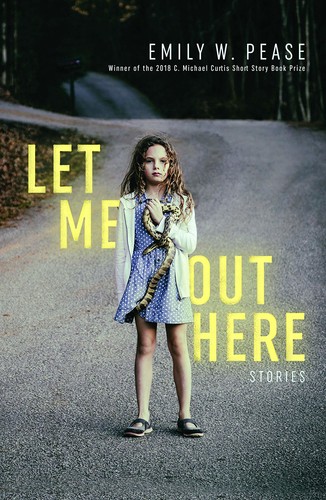
We all have our stories, and what we write, and how we write, springs from who we are: our memories, experiences, preoccupations, and obsessions. Now that I have a collection of stories, Let Me Out Here, I can see at least one strong theme emerge, and it’s based on who I am and what is mine to tell. A few of my stories are ridiculous, and a few touch on matters of the spirit, or belief. Things don’t often turn out well. So this theme might be called meaning and menace. Or let’s call it the sacred and the strange.
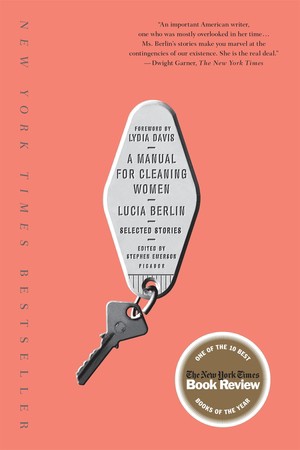
There’s no “church” in Lucia Berlin’s stories, although the worlds she creates, which for the most part are worlds she herself inhabited, are suffused with Catholic tradition. In “El Tim,” a lay teacher in a school run by nuns is assigned a pupil fresh out of detention. He needs to be “encouraged and challenged,” reports the detention center, so it’s up to Mrs. Lawrence, the lay teacher, to encourage and challenge him. Tim is pure menace, and in his presence the other pupils, and even the school principal, cower. When the boy refuses to button his shirt, his gold crucifix gleaming on his bare chest, Sister Lourdes, the principal, fumbles with the buttons and does it for him. After this, she buttons him everyday, she’s so intimidated by him. Here we have a standard set-up: the terrible boy, the trembling students and principal, and the lay teacher who will be the hero. Surely, redemption is on the way. But not in the hands of Lucia Berlin. Mrs. Lawrence hits El Tim across the mouth, stunning him. When she leads him back to class, she avoids “the beat of his walk.”
It’s the frankness in Lucia Berlin’s stories that gets to me. Everybody’s flawed, everybody’s just trying to live an OK life. But life can be brutal. Take, for instance, this passage from “Panteon de Dolores,” a story I especially admire:
Ofrendas are fun to make. Offerings to the dead. You make them as pretty as you can…On the ofrendas you place everything the dead person might be wishing for. Tobacco, pictures of the family, mangos, lottery tickets, tequila, postcards from Rome. Swords and candles and coffee. Skulls with friends’ names on them. Candy skeletons to eat. On our mother’s ofrenda my sister’s children had put dozens of Ku Klux Klan figures. She hated them for being the children of a Mexican. Her ofrenda had Hershey bars, Jack Daniel’s, mystery books, and many, many dollar bills. Sleeping pills and guns and knives, since she was always killing herself.
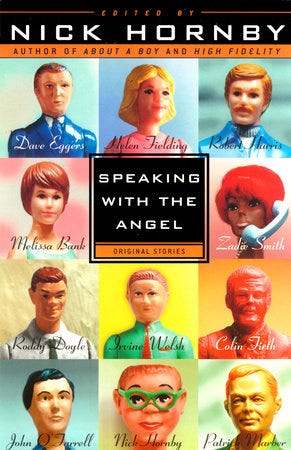
This wonderful collection of stories was created by Nick Hornby as a fundraiser for TreeHouse, a school for autistic children that his son attended at the time. The book was published in 2000, and it is, thank goodness, still in print. I say thank goodness because it contains one of the funniest and wisest short stories I know: “Nipplejesus.” In this story, Hornby gives us Dave, a hulking former nightclub bouncer (“six foot two and fifteen stone”) who lands a job as a guard in an art gallery. Because he’s such a big man, he’s assigned the room containing “Nipplejesus,” a painting composed of hundreds of cut-outs of nipples. In other words, it’s his duty to watch over Jesus, in nipple form. This is another story I could never omit from my syllabus.
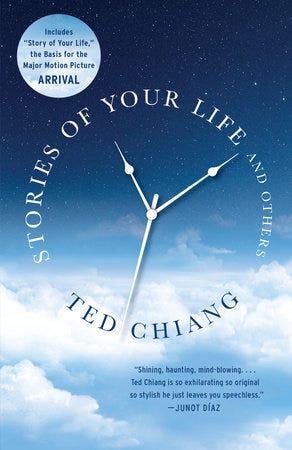
Ted Chiang possesses the wild imagination of a pure science fiction writer, so it’s thrilling to see him use key theological problems as the basis of a short story, “Hell Is the Absence of God.” Is suffering redemptive, or is suffering merely suffering? Does God cause pain, or is pain merely pain? And what about hell? In Chiang’s hands, a character named Neil Fisk learns to “love God.” But not in the way one would expect. Born with a congenital defect, Neil always wonders whether he’s been punished by God. Then the angel Nathaneal makes a fiery appearance downtown, actuating miracle cures. Yet eight people also die, thanks to the angel, including Neil’s wife. Says the narrator, “Scores of people became devout worshipers in the wake of the visitation, either out of gratitude or terror. Alas, Neil Fisk wasn’t one of them.”
Neil does go on a kind of quest, though, looking to make sense of it all. Along the way, he meets a woman named Janice who has flipper-like legs, a deformity caused by the visitation of the angel Bardiel. Unlike Neil, Janice is grateful for her affliction, her “special assignment” that gives her the power to speak to audiences and inspire them. But when yet another angel comes along, and she is given two strong legs, she loses her ability to inspire. Her gain is her loss. “Clearly,” says the narrator, “God had made her task more difficult than it was before….” You have to love this audacious irony. Is hell the absence of God?
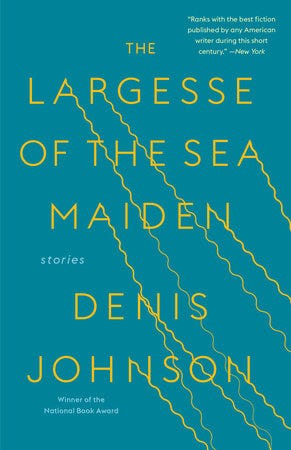
It’s rare to feel left in awe. But these final stories by Denis Johnson do it to me, leaving me feeling breathless, like you just can’t believe someone could write with such fierce empathy. “Nobody wrote with more brutality and mercy, more hilarity and grace,” wrote Elizabeth McCracken in her blurb for the book. Brutality and mercy: what a perfect pair. I’m left wanting to quote passages from every story, but instead I’ll just offer two.
From the title story: “This morning I was assailed by such sadness at the velocity of life — the distance I’ve traveled from my own youth, the persistence of old regrets, the new regrets, the ability of failure to freshen itself in novel forms — that I almost crashed the car.”
And then this, from “The Starlight On Idaho”:
“What do they feed you when you’re the Pope? Try the stuff around here sometime. For lunch they give you a marshmaller and a coffee bean. It’s a salvage yard for people who totaled their souls called the Starlight Recovery Center in Ukiah, California on Idaho Avenue. Ah hell what’s wrong with me? I won’t be sending no letter to the Pope.”
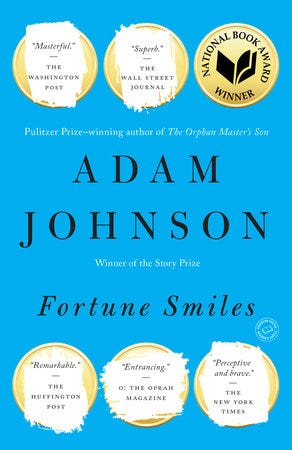
In this fine collection of seven stories, two stand out for me. The first, “Nirvana,” comes straight out of Silicon Valley, where a talented A.I. developer brings the president, recently assassinated, back to life on a screen. The president can talk, respond, and reassure, if only in two dimensions. Disembodied, he’s still able to inspire. And while he inspires thousands of people, the one he inspires most is his creator, who speaks to him out of his loneliness. His wife, a victim of Guillaine-Barre Syndrome, is confined to bed, paralyzed from the shoulders down. In her despair, she has asked her husband to promise that when she can take it no more, he’ll help her commit suicide. To ease her pain, she listens constantly to Nirvana — to Kurt Cobain, who took his own life. She can relate.
God comes in this story in the weirdest ways. I doubt Adam Johnson would agree. God? But there’s a drone in this story, and it enables Charlotte, the paralyzed wife, to visit her garden remotely. Wearing a headset, she can smell her roses. And then there’s hope for a baby: she reasons that if she can’t live, maybe she can give life. And finally there’s Kurt Cobain. “I only appreciate things when they’re gone,” he sings. He appears on a screen.
The other story in this collection I can’t forget, “Dark Meadow,” doesn’t offer anything really spiritual or redemptive, although the story does open a reader to feel deep empathy. Told in the point of view of a shaky and self-aware child molester, the story reveals the sordid business of child pornography. Imagine the risk Johnson took, conceiving such a story. Yet he manages to bring to life the pain of a man who was molested as a boy and whose memories won’t give him rest. There are sizzling moments in this story, and there are sweet, tenuous moments as well. This isn’t a story that lingers in your mind. It stays.
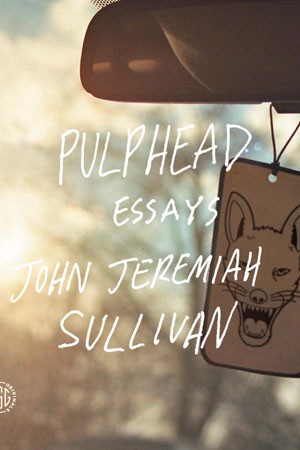
Fourteen years ago, on assignment for GQ, John Jeremiah Sullivan rented an enormous RV and headed out to Creation, a Christian rock festival in “ruralmost Pennsylvania…a veritable Godstock.” The result is a stunning piece of journalism titled “Upon This Rock,” which opens his collection of essays. Sullivan can be very funny (“Christian rock is a musical genre, the only one I can think of, that has excellence-proofed itself”), but his best gift is his openness. He observes everything openly, with a clear eye and a deft ear. He’s so open, in fact, that he ends up hanging out with five guys from West Virginia who take him in as one of them. One night, they even pile inside Sullivan’s RV for hours, talking, playing the guitar, and listening for the mountain lion that they’re sure is lurking outside.
Midway into the essay, Sullivan digresses and tells his own story: how he, a kid who grew up in the Episcopal church, got drawn into an evangelical crowd when he was in high school, how he was so drawn in that he became a leader, good at witnessing. And then how (he doesn’t go deep into this), he backed off. This part of Sullivan’s essay has the effect of validating him and making him trustworthy. Whatever he observes at the festival, he observes from a place of understanding, which leaves him open to a final moment of self-discovery. At the end of the essay, he confesses that he came to love the little gang who became his friends. “It may be the truest thing I will have written here: they were crazy, and they loved God — and I thought about the unimpeachable dignity of that, which I was never capable of.”
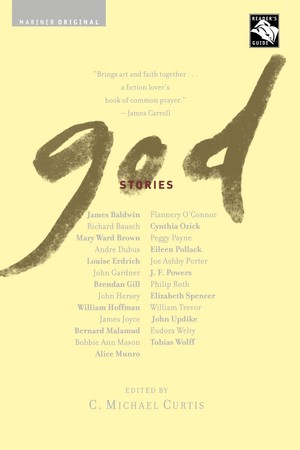
Here we have twenty-five stories “about” God, published in 1998. Conceived by C. Michael Curtis, editor of fiction at The Atlantic, this collection gives us stories that “encounter spirituality in its human dimensions,” as Curtis writes in his introduction. All manner of encounters, as it happens. Included are James Baldwin’s painful and complicated “Exodus,” Louise Erdrich’s sexy “Satan: Hijacker of the Planet,” and Andre Dubus’s classic “A Father’s Story.” To me, this collection is notable for its inclusion of “Parker’s Back,” which might just be the most brutal and vivid “Christian” story Flannery O’Connor wrote. As a teacher, I could never leave this story off my syllabus.
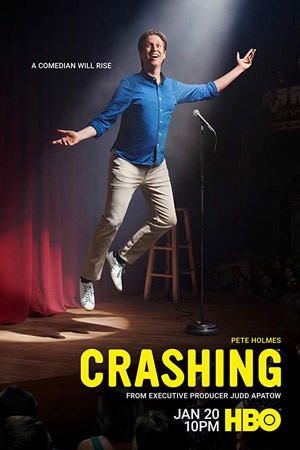
My final recommendation is not a plug; it’s not like I’m saying, “You’ve gotta watch this show!” Rather, if I have to be honest about the work that influences me — that inspires me and makes me want to create something even half as good — I must mention Pete Holmes, the stand-up comedian who writes and stars in this comedy series about: himself. Holmes came from what people used to call “a good Christian home,” and he spent his early youth in an evangelical church. He married his sweetheart. He had a talent for comedy. He started doing stand-up, and then his wife left him. He crashed.
Bereft, doubting himself and everything, he leaned on his friends. And this is the basic premise of Crashing, a comedy series he created four years ago and that’s now finishing its third season. A comedian abruptly goes from married to single, so he crashes on different couches, which happen to be the couches of fellow comedians. He keeps doing stand-up, and he keeps trying to figure out his life. There’s a darkness that keeps haunting him.
Every episode of Crashing teaches me something. Often it’s just that it’s boldly sexy. Often it’s funny, of course. Most often, it’s filled with paradox. Pete Holmes (whose show, by the way, is produced by Judd Apatow), demonstrates that faith and art can dance together, that the mystery of why things are as they are warrants our attention as writers, comedians, and artists of all genres.
This month, retired basketball player Kobe Bryant adds new lines to his resume — publisher and author — with the first volume of a children’s fantasy book series, The Wizenards, published through his multimedia content company Granity Studios. When Granity’s film Dear Basketball won the Oscar for Best Animated Short in 2018, I watched in disgust as an audience that had been applauding presenters and winners for their open acknowledgement of the #MeToo movement paused to give an award to Mr. Bryant.
I grew up one township away from Lower Merion, PA, where Mr. Bryant’s athletic career began. He was two years ahead of me in high school, and even I, not a basketball fan then or now, couldn’t escape the excitement and hype generated by such a talented player. When he was put on trial for allegedly raping a hotel worker in Colorado, in 2003, I followed the case in the news. The woman who brought the suit was subjected to the usual reputation tarnishing by his lawyers. She ultimately refused to testify in the criminal trial, which I interpreted to be a result of the intimidation tactics used by his representation and fans. A civil trial was settled for an unknown sum of money and a public “apology” from Mr. Bryant, in which he never admitted wrongdoing but expressed a vague understanding that she viewed their encounter differently than he did (i.e. as nonconsensual).
In January of this year, I attended an annual conference for booksellers at which Mr. Bryant was allotted a spot to pitch The Wizenards and his entry into our industry. The applause as he took his place at the podium was shocking to me, and felt very similar to the experience of watching him win an Oscar. My career has been spent in various areas of the book industry, a field generally understood to be a liberal stronghold and a place where women can rise through the ranks as quickly as men. But here I was, surrounded by female and male colleagues alike who were cheering a man who had settled that lengthy, nasty, highly publicized rape trial. Speaking with a number of booksellers throughout the day I was surprised to hear how many of them had forgotten about the case, or had never heard about it in the first place.
My industry is not unfamiliar with allegations of assault and misconduct against popular and critically acclaimed authors. These claims are particularly troubling when they are against authors who write for children and young adults. In recent years, I’ve spent a lot of time thinking about how, and whether, I should give space to these authors’ work within my limited square footage when accusations surface. As the buyer for a small store, part of my responsibility is deciding which voices get placement. The selection of books I carry is carefully curated with the dual goals of serving my specific community of customers and turning a profit, but there is a third goal I try to keep in mind as well: ensuring that I can stand behind the books that pay my bills. Is it my responsibility as a business owner to cater to customers who may want books like Mr. Bryant’s (“Harry Potter meets the Olympics” was his pitch in that Albuquerque ballroom), or is it to disseminate books by authors who meet my own moral criteria? I have chosen the latter as my approach, inasmuch as it can be. “Ethical capitalism” might not be fully possible, but it’s a goal that informs my decisions as a business owner every day.
As the buyer for a small store, part of my responsibility is deciding which voices get placement.
Of course, committing to thoughtful use of my power as a bookseller means that I’ll constantly be asking myself that question — what is my responsibility here? — and not every case is clear-cut. In the past few years, bestselling authors like Sherman Alexie (The Absolutely True Diary of a Part-Time Indian), James Dashner (The Maze Runner), and Jay Asher (Thirteen Reasons Why) have all been accused of misconduct. Unlike in Mr. Bryant’s case, the accusations have not yet led to criminal charges. If I make room for their titles on my shelves, am I implicitly denying the claims of the women who say they have been mistreated? If I choose not to carry bestselling books, will I lose sales, jeopardizing the health of my small business? Is it my responsibility as a cultural gatekeeper to educate my customers about my decision-making process and to let them know why they might not find certain authors in our Children’s and Young Adult section?
I take these questions very seriously. But how far back in the catalog should I go with this line of thought, and does it apply to books published for adults, as well? The late David Foster Wallace allegedly assaulted Mary Karr. Should I decline to carry Infinite Jest? I genuinely loved Junot Diaz’s Brief Wondrous Life of Oscar Wao and my customers still buy it regularly. Is it enough to have removed the shelf-talker for that title, calling attention to the book and offering a positive review from one of our booksellers? Or should I take it off the shelves altogether in light of allegations against Mr. Diaz? If there are no criminal charges, am I off the hook for continuing to profit from these authors’ books? (And continuing to put money in their pockets in the form of royalties?)
One response I’ve considered is to donate a portion of proceeds from these authors’ books to RAINN. But who are “these authors” and what are the criteria for deciding that? Is an anonymous comment on a message board sufficient to add them to my own Bad Man list? And what of the cases I don’t know about, either because I missed a headline or because the people involved have remained silent? I’ve asked myself if seeing an accused author’s book on our shelves will be triggering to visitors to my store who might themselves be survivors of assault, possibly from the author in question. New York is a city with an active literary community and we host authors for events regularly (in addition to serving them as customers), so it is certainly possible that someone on my shelves did something terrible to someone who might come to my store. It is important to me that people feel safe in my store at the bare minimum, but I simply cannot know every bad deed committed by each of the authors we carry. And so if I take on this curatorial responsibility (which I have by default in my position as the buyer for a bookstore), where does my complicity begin and end? For now, I continue to consider each case on its own as new rounds of allegations surface and make the most informed decisions I can with input from my staff and other colleagues.
With that in mind, for me it’s an easy decision not to carry the Wizenard series. There are enough men on my shelves already — whether currently writing, retired, or deceased — whose personal misconduct has caused me to reevaluate my carrying their titles. We, as a community of book professionals, all curators of literature at various stages in the creative process, must find strategies to address these difficult issues before we invite yet another accused man into our ranks whose behavior raises similar questions. Especially in the case of authors who write for children, we must look more closely at the person as a whole, and not just the work product that we sell and profit from.
We, as a community of book professionals, all curators of literature at various stages in the creative process, must find strategies to address these difficult issues before we invite yet another accused man into our ranks.
No one gets into books to get rich; we work in this field because we love books and literature and sharing stories and introducing readers to new authors and vice versa. If I wanted to make lots of money and didn’t care about the people involved, I could work in finance. Instead I chose a low-margin, labor-intensive field where the impact I have is small and very personal. The wages I pay myself are not enough to compensate for the moral dilemma of putting a book written by a potential rapist into the hands of a 10-year-old child.
1. The speaker — let’s call him Brian — is documenting the shift, à la Buber, from I-It to I-Thou relations, from subject-object to intersubjectivity. Confronted with his lover’s fast machine and clean motor, Brian can no longer maintain his stance as autonomous male subject gazing upon the Other. He and his lover merge; he is shaken.
Was I not a sufficiently fast machine? Did I not keep my motor clean? I cleansed assiduously for you, removed hairs, performed ablutions. True: over time I relaxed a little, cleansed and removed less of myself, slowed down. But is love not a sagging into each other, a softening of edges, an ooze? Was my dirt and languor not yours too?
2. The woman to whom Brian refers in the verse differs from the woman (or man or nonbinary individual) he addresses in the chorus. He uses talk of the woman in the verse to seduce, via titillation, jealousy, aspiration, etc., the choral “you.” If I speak to you of a woman’s ability to knock me out with her American thighs, Brian reasons, you will then want to knock me out with yours. His reasoning bears out: he is shaken.
You often spoke of how dumb she was. You didn’t use that word, but you implied and I inferred. A groupie, you’d called her. A wannabe who imposed upon your time with toady tributes to your poetry. I’d seen her at parties: assertively busty, cosmetically lacquered, flagrantly blonde. After said parties, I’d follow your lead and mock her. After said parties, I’d follow your lead and fuck you hard.
3. After losing his lover, Brian can’t bring himself to address her, and much remains unsaid. He recounts their time together until, overcome by memories of their all-night shaking, he calls to her across the ether. If he reminds her of their shaking, crows it over the roar of guitars, will she hear? Will she tell him to come even though, in a sense, he was already there?
Only later did I realize how much she resembled your ex. Later still I realized my once-careful grooming may have been a response to a photo I’d seen of your ex, who’d managed, in her appearance, to blend purity and smut, her perfection an invitation to blemish, to ravage and raid. Did you still love your ex? I called across the ether. Did you now love the groupie? Had you ever loved me?
4. Brian is masturbating. The woman is a product of his mind and “you” is himself. Her truth telling, her double-time on the seduction line, her meal making: these are all Brian’s fabrications, his creation of an ideal woman who is fast, mechanical, immaculate, superlative, unseeing, authentic, strong, greedy, domineering, hard-working, inimitable, faithful, humble, ravenous, calming, violent. She doesn’t exist, and Brian, unable to compromise his ideal, is left to shake himself.
Once I awoke and you weren’t in bed. I found you in the living room, pleasuring yourself. How hard you’d shut your eyes, as if trapping whatever fantasy girl you’d formed in your brain. If I’d been working double-time on the seduction line, I would have shimmied over and joined in. But I’d been depressed. I didn’t know why, but I knew it was my fault. How devoted you’d recently been. Yet I’d failed to satisfy you. What’s more, I’d forgotten to shower. I stank of myself.
5. Brian is anxious because he has to fill the shoes of AC/DC’s previous singer, Bon, who died of alcohol poisoning. A product of his anxiety and his cowriters’ grief, the point-of-view shift is an oversight, a mistake that betrays subconscious feelings for Bon. Why did he leave them? If he returned, they would shake him all night long, each for their own reasons. Unable to acknowledge their pain, they cloak their urges in boasts of heterosexual intercourse, projecting their need to shake a dead man onto a feminized Other.
One day you disappeared. Ghosted, they call it: a misnomer. A ghost is a presence where there should be an absence. You were gone when you were supposed to be here. The morning you vanished, I flitted birdlike from room to room, my head jerking at strange angles, searching for you. When I understood what you’d done, I wanted to shake you until answers flew from your throat. Instead, I rammed myself against a wall, which gently shuddered, and left, on my shoulder, a chlorine-blue bruise.
6. Brian is documenting, per the Song of Songs, an encounter with the divine. Unable to evoke his sacred love with mundane language, he turns to the sensual, celebrating God’s feminine aspects. However, Brian understands the vocabulary of masculine and feminine can be only metaphor. As the ultimate You, God transcends material forms and their signifiers. Yet God also inhabits them. Brian’s confrontation with this paradox unites him with the supreme mystery: he is shaken; he is shaker.
If you were my god, then whom did you worship? All poetry, you’d once said, entreats the divine. When you knelt before me and made me scream, was my pleasure a poem, a song to yourself? My idol, you smashed me. Yet I thank thee. I thank thee! Alone with the mess of me, I’m shaken and shaking. Shaking and shaken, I’m god of myself.
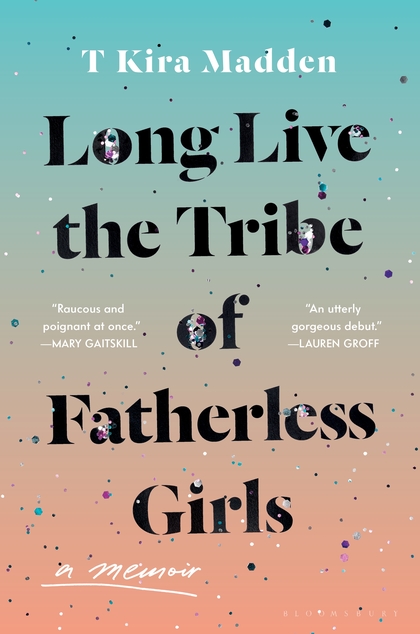
These words open T Kira Madden’s debut memoir, Long Live the Tribe of Fatherless Girls. They seem innocuous at first, nothing more than the descriptive facts of the cosmetic surgery commercial that played on loop during Madden’s early years. She recounts the details of the commercial: the women, the droplets of sandy beach water and sweat that drip down their bodies, and the man who sings to them. Their beauty is his work, his pride, his joy. In her they spark envy, curiosity, desire. As Madden then transports you years into the future, planting you in the hours and days following her father’s death, you are immediately imbued with the knowledge that here — in this world, and in this story — the women are the anchor. The women are safety. The women are home.
Purchase the book
In essays written with raw and fearless prose, Madden asks the questions to which we all seek answers. In so doing, she honors fathers and mothers and families; the ways they love, and the ways they fail. What makes Long Live the Tribe of Fatherless Girls so exceptional is the compassion Madden brings to the page. She writes in search of answers because that is what we, as humans and writers, do. But she does this all the while knowing that even in death, we are never really finished. The answers can never really be answers. And yet, we must find the semblance of them somewhere. Why not the women?
Dennis Norris II: I want to start by asking you about the beginning. Long Live the Tribe of Fatherless Girls covers so much ground in your life, so many important, intimate, intense moments. I’m wondering if there’s a particular moment that you see as the germ for this book? Whether it’s in the book or not, I’m curious about a moment, a memory, a conversation, or an incident that planted the seed?
T Kira Madden: I began writing this book in the thick haze of grief just after my father died, though I didn’t know I was writing it. I was on assignment, asked to write about a Valentine, and, instead of a more traditional route, I wrote about my first love: a full-bodied mannequin I’d named Uncle Nuke. He lived with me growing up, and we were so inseparable I began popping his joints apart, carrying his hand around in my lunchbox. It took me months to realize that that mannequin was a way into my father. My father’s hands before he died, his bulging knees; I watched life leave my father’s body in a hospital bed, and grief came to me in those flashes of body parts. Uncle Nuke was my way of writing about it before I was ready to write about it.
DN: Did writing this book complicate your relationship to, and thinking of, your father? Did it simplify it?
TKM: My father was and always will be the giant of my heart. Same goes for my mother. My hope in writing this book was to render them as full as possible. As human beings packed with complications and contradictions and fury and nobility. My father was, at times, a monstrous and abusive drug addict who threatened to kill me with a baseball bat. He was also gentle, and funny as hell, and cried in the movie theater. He liked to Facetime me whenever I went to BLM or LGBTQ protests so he could feel like he was there (he was too sick to physically make it); he was brilliant and generous. Jo Ann Beard taught me this: you can’t create shadow without casting a light. Writing into my understanding of my father will never bring him back, will never come close to the person he was, but I’ve learned to honor that failure and appreciate both how much I know about him and all the ways in which I will never know him at all.
My father was, at times, a monstrous and abusive drug addict who threatened to kill me with a baseball bat. He was also gentle, and funny as hell, and cried in the movie theater.
DN: I feel as though the experience of reading this book is a lot like consuming a montage of secrets, of memories, of conjuring details from the memories of others, and questions — so many questions! I’m reminded of the five W’s of writing we learn about as kids: who, what, when, where, why. Only in this book these are like the questions of life: (Who is my father?) (What did my mother do?) (When did this happen?) (Where was I?) (Why — so many why’s?). How did you begin to make sense of all of this, both in life, and in the writing process?
TKM: What I loved about writing this book is how much the process you’re describing plays into the final section. We all have the stories we’re told about our lives, and the stories we tell ourselves. We narrativize our personalities and create our own story arcs because life is so messy and bat shit and mostly incomplete and unsatisfactory that we need to tidy it, to story it, to make it feel full and circular and interesting. I learned through writing this book that there is no getting your own story right; forget about anyone else’s. When you’re trying to wrangle every version of yourself and harness every refraction of light and shadow from lived experiences — experiences that change color with every subsequent recall — what you get is a mess. I hope this book is as true to telling the story as it is to the story itself.
DN: One of the words that came to mind early in my reading, and remained throughout, was the word yearning. There’s a really palpable sense of yearning from the outset, and as the reader moves through the book, it seems to transform from a trickle into a crescendo. Yearning for safety, for protection, at times to be seen. Has the process of writing this book, and the essays that make up portions of it, satisfied some of that yearning? Do you think that writing in general can help us find the things we search for?
TKM: Yes, the writing is the answer. I don’t write for myself. I write because I need dialogue. I write because I need people, or even one person, to hear me. To see me. To say “I see you.” I write for the chorus. This book is about all the places one reaches for love and compassion, and all the ways in which we fail in that reach. I’ve always found the deepest love and recognition and balm and even divinity in books and in art. So I’m here to nourish that act of connection.
DN: Do you find yourself wanting to control the narrative that people take from the book, about your life, your father, your family? Is there, in any way, a sense of “I’ve gotten it right or wrong,” and is that in any way related to reactions you’ve gotten from readers?
TKM: I do hope people close the book feeling like they’ve spent time with real people, people who have failed tremendously while doing the best they could. I don’t like the hero/villain narrative. I don’t like the clichés of thought that draw us towards binaries. I’m after the in-betweens, the nuances and complications behind human beings making the wrong choices. If I got to control one thing: I’d like readers who may not (think they) know any addicts to leave this book knowing them.
I do hope people close the book feeling like they’ve spent time with real people, people who have failed tremendously while doing the best they could.
DN: I would imagine that much of what you’ve written about in this book are things that continue to haunt you, right? We don’t just create something, and then put it in a box in the attic. There are new relationships, and there are new understandings of life-long relationships. Is there, anywhere in the process, a sense of completion, whether it be about the work, or about the lives that are intertwined with yours? Is that something you’ve sought at any point in your writing? An arrival of sorts?
TKM: I think a book has three lives: the first life is when it occupies a space in the writer’s mind before it’s destroyed by being put to paper. The second — the life that’s just ended for me — is the working, writing, editing, tormented love affair between writer and manuscript (and, if you’re lucky, great editors, too). After that final edit is made when it’s time to print, the book moves onto its third life, that is, the life my book will (I hope) share with readers. It’s no longer mine. It’s no longer alive, or breathing, or something to which I can return. I am grieving that but celebrating it, too.
Regarding the events of the book, the people in it, the moving parts — no, those will never be complete. What is completion? We’re not complete when we’re dead. Not even long after we’re dead, and mythologized, and spoken about, and half-remembered. My book does not capture or complete even a moment of time; time is a narrative construct.
DN: I know you primarily as a fiction writer because we studied together at Sarah Lawrence. How has it been different, venturing into nonfiction? Did it in any way inform your craft, or your approach to the page? Or is that something you’ve not given thought to?
TKM: I actually feel extremely fortunate to have studied and written fiction before writing or teaching nonfiction. The elements of fiction and story are often disassociated from nonfiction — basic toolbox skills like character building, story arcs, tragic and comic form, setting, dialogue, etc. In my nonfiction class at Sarah Lawrence, we read across genres in order to exercise those individual skills. Our job, regardless of “genre,” is to make a work of art and to make that art feel alive and true. We need these tools to do that; we are architects, building the scaffolding upon which our language and stories are hung. Experience doesn’t “bleed out of the typewriter” as some (mostly non-writers) may suggest. It doesn’t even flop onto the page like a dead fish. It’s built both mysteriously and scientifically.
Our job, regardless of “genre,” is to make a work of art and to make that art feel alive and true.
DN: Writing about family without calling the book a novel must have presented some challenges. Were you ever asked to alter the work because it’s about, and in some ways, reflects real people?
TKM: I think something we don’t talk about enough, something that shouldn’t be so mysterious, is the fact that nonfiction writers are usually required — legally — to edit our characters in order to protect their privacy. I’m not talking about changing their names; I mean changing major details and defining characteristics — appearance, family, race, occupation — edits that seemed impossible to me when I went through this process. This is both to protect the character but also, often, to protect the writer. (I don’t blame a writer for making these changes even if they’re not instructed by a legal team. Writing about real people can be incredibly scary; consider, for example, writing about an abuser.) Finding new characteristics to describe someone, characteristics that feel as true as possible without revealing who they are, is a whole separate skill set.
DN: I began to wonder about how you define family, how you see and feel and love and honor and critique your own family, particularly when you started writing about your brothers, and then your mother’s life prior to your own birth. Can I ask, simply, what does family mean to you?
TKM: I look forward to spending the rest of my life writing into this question. It’s the question that always brings me back to the page.
When someone asks me what they should see when they come to visit my home state, I usually stare blankly, then offer the most useless of replies: “It depends on what you’re looking for.” But this is the truth, however paltry. There is no singular Alaska. A village on the frozen Chukchi Sea where trees exist solely in one’s imagination shares little in common with the state’s capital, a small city in the heart of the world’s largest temperate rainforest accessed only by water or air. Sleeping in a tent on the tundra is the antithesis of wandering the gritty, pseudo-cosmopolitan streets of downtown Anchorage where tuxedos brush shoulders with Carhartts, furs with fleece. And yet, there is a commonality: we are Alaskans, and it is the land that defines us most of all.
Like every place worth loving, Alaska has many different faces. They are not unified, and not all of them are beautiful. Caribou that trace ancient footsteps like arteries across the landscape. Oil wells that burn brightly against a moonless Arctic night. A history of exploration — of glacier-capped peaks, whale-rich fjords, uncharted territory on a scale that is difficult for most of us to fathom. A history of exploitation — of native lands, native people, and the natural resources that make this state both vulnerable and mighty. Alaska is as large in character as it is in size. It’s one of the rare places left on earth where a person can truly get lost. And yet, for all of its wildness, it’s the fragility of this land I love most. Watch a shorebird sit on its nest through a July snowstorm, defend its chicks against a grizzly nosing in the grass, then gather the courage to launch, yet again, on a journey across the globe.
Purchase the book
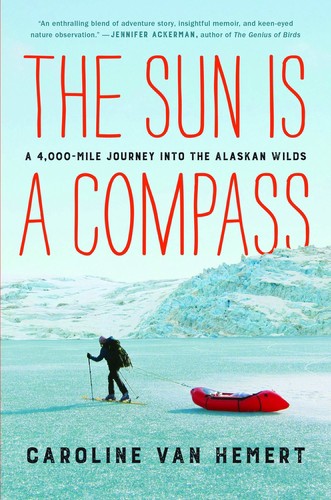
My memoir, The Sun is a Compass, is a modern day adventure story about finding my way home through 4,000 miles of wild country. As a biologist and lifelong Alaskan, I take many of my cues from birds and other animals. They teach me things about myself, and the world, that I never knew I needed. When I found myself questioning my commitment to research, balking at the impending realities of adulthood, and recoiling from the fact of my father’s degenerative illness, Alaska’s wilderness took me under her wing. And what a magnificent wing it is. For six months, I traveled with my husband from Washington State to the Arctic Ocean and beyond. Along the way, we faced a predatory bear, felt the breath of caribou as they swallowed us in their folds, and learned that humility can be synonymous with joy. Perhaps the greatest gift Alaska offers is the reminder that each of us is insignificant and infinite at once.
Voices from Alaska reflect the diversity of our landscapes and our experiences within them. Here is a selection of books written about Alaska by Alaskans that explore connections to culture, place, and wilderness in the far north.
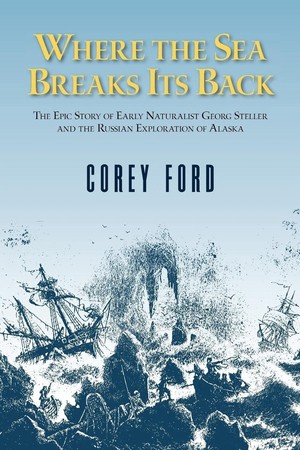
From the first pages of this book, Ford takes us to the enchanted Aleutian Islands, where seabirds nest in the thousands, mummies rest in sea caves, and the ocean rules all. The book follows the dramatic voyage of Vitus Bering, including the shipwreck that leaves them stranded for nearly a year, but it is the party’s medical officer, Georg Wilhelm Steller, who steals the show. His ten hours in Alaska provided some of the most important reports of the local flora and fauna and his journal entries reveal a marvelous writer; the book is a treat for anyone interested in adventure, exploration, and natural history.
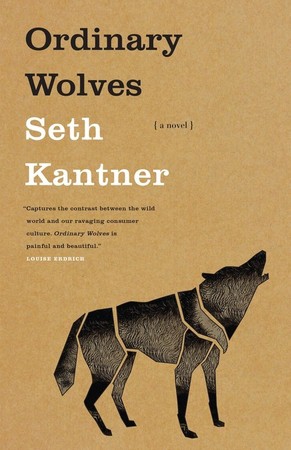
This novel, modeled after the author’s own experience growing up in a remote Alaskan cabin, explores the challenges of crossing boundaries — between bush life and city life, white and Alaska Native culture, idealism and reality. His Alaska is one of fresh caribou hides and dirty city streets, dog sledding on a frozen Arctic river and waiting in line at McDonald’s drive-thrus. Kanter has pulled off that rarest of feats, to write a book about Alaskans that Alaskans love.
Blond Indian tells a story of both heartbreak and triumph in the coastal rainforests of southeast Alaska. The systematic cultural abuse and degradation of Alaska Natives that Hayes describes in her own family and community is a defining historical feature of our state, though its influence is too often overlooked by Alaskans and non-Alaskans alike. But don’t read this book because you should. Read it because it is a beautiful tribute to the messy, complicated, and essential relationships between place and our human condition.
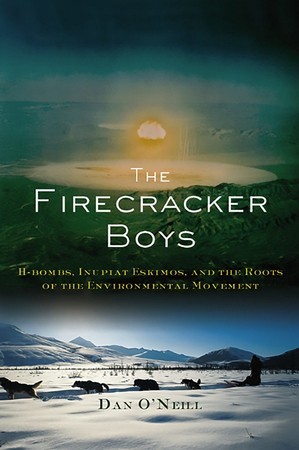
One of the most surprising and nefarious legacies of the Nuclear Age was almost realized on a small patch of tundra in northwestern Alaska. With the makings of a sci-fi novel, this meticulously researched work of nonfiction tells a tale of disaster narrowly averted, thanks to the efforts of Inupiat residents, scientists, and conservationists. O’Neill not only shares a riveting story, but reveals his talent as a science and nature writer.
Through characters as evocative as the land they explore, Ivey tells a story so rich in history and geographic detail that it’s easy to forget it’s a novel. The book’s unique structure — consisting of letters, journal entries, drawings, and artifacts — fluidly bridges time and space, carrying us from the early 1800s to contemporary society with occasional forays into the supernatural. This tale of adventure, love, and suspense captures much of Alaska’s inherent drama.
In this fascinating journey through frigid landscapes and the animals and people who reside in them, Streever explores the science, history, and culture of cold. As an Alaskan biologist, Streever offers unique perspectives and lively anecdotes from his own life. From avalanches to hibernation, permafrost cellars to pack ice, readers are transported vicariously to the planet’s chilliest locales, shivering along the way.
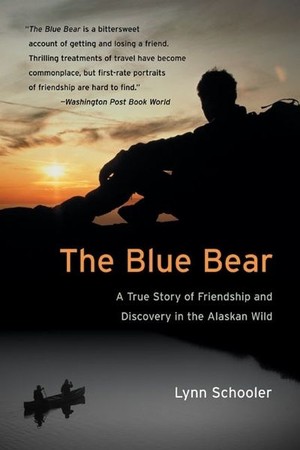
This moving memoir is as much a part of the forests, fjords, and glaciers of southeast Alaska as Schooler himself is. After losing a dear friend who showed him how to live, and to love, Schooler’s quest to photograph the elusive glacier bear takes on a greater urgency. Throughout his personal journey, Schooler guides us skillfully through a world of towering bears and rushing salmon, breaching whales and foraging gulls. It’s a portrait of Alaska you won’t want to miss.
A lyrical poetry collection from a clear, stark voice with roots in Inupiaq villages of Northwestern Alaska. She writes of places and people in transition, and the reshaping of narratives required when new ways cannot replace the old. Her poems resonate with the Arctic and sub-Arctic landscapes of her home.
For fans of adventure tales and endurance feats, this book will not disappoint. But expect to find more than thrills as Fredston deftly guides readers through the risks, rewards, and companionship she’s discovered in a small rowboat in some of the world’s most remote locations. The book travels from the author’s childhood to her expeditions in Alaska and beyond; the sum is a rich and satisfying narrative about how time spent in the wilderness can be a homecoming rather than an escape.
I grew up in a loud and busy home, where more people were considered kin than just my blood-relations. I have two sisters, but when I was a kid my parents had a sort of open-door policy, and we often had cousins or family friends or my parents’ colleagues staying with us — sometimes for months at a time. Although I frequently had to share a bed in order to make room for the extra people, I loved the raucous nature of the household, and I came to view many of our long-term visitors as family members whose exact relationship to me was difficult to describe.
Purchase the novel
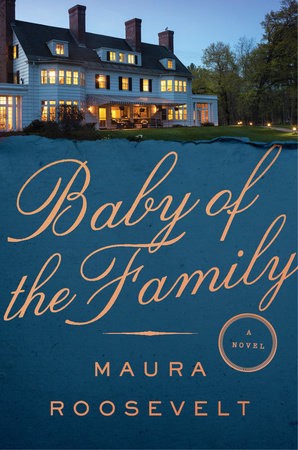
My novel, Baby of the Family, was partially inspired by the question of how families function and thrive when they are not comprised of two straight married parents with two children close in age. The book centers on three half-siblings from three (out of four!) separate marriages that their father had. These characters struggle to form relationships with one another that feel meaningful, while also endeavoring to come to terms with how their atypical family structure affects their adult decisions.
I firmly believe that all families carry with them rich histories and myths, but the stories from blended, bifurcated, and atypical families contain a layer of complexity that can be utterly fascinating. Here are some books that illuminate the highs and lows of these types of families:
This is, to my mind, the prime American blended family novel. The dad from one family gets wasted at a daytime suburban house party, kisses the mother from another family, and then, several years later, the step-siblings spend their summers together in one wild crew, creating memories and secrets that will stick with them for the rest of their lives. The story is expansive, and by the end of it the reader has passed through several decades and gets to view those children as adults, witnessing where the events of their childhoods have brought them.
This novel is based at a hippie commune, named Arcadia, and paints a vivid picture of the life of Bit, who was the first child born at the commune. While five-year-old Bit struggles to understand the relationship his two parents share in the midst of the larger group, he also lives amongst the other children and adults of Arcadia as if they were one giant family. The reader follows Bit as he grows up, with sections dedicated to him as a teenager and then as an adult, all illuminating how the relationships he formed at the commune both haunt him and bring him love for the rest of his life.
Doctorow constructs an unforgettable story told from the perspective of Daniel, the oldest son of a family (called the Isaacsons in the book) who are based on real-life Ethel and Julius Rosenberg, the married couple who were executed by the US government for being spies from the Soviet Union. In the novel, Daniel is adopted by a couple named the Lewins, and spends various stretches of his life trying to sort out how his family history affected him as a child and an adult, while simultaneously struggling to take care of his younger biological sister who suffers from severe depression.
This fascinating novel set in 19th century Ghana illuminates the social class status that surrounded the slave trade in the region, and how families were both destroyed and reconstructed in light of this evil business. The story is about Wurche, the privileged daughter of a noble family, and Aminah, the daughter of a once-happy middle class family that was subject to a brutal raid and then pushed into the slave trade. Wurche purchases Aminah, and they come together with other relatives to form a disturbing, vicious, type of atypical family.
The Girls offers a scary and fantastic look into what can happen when an alternative family arrangement is not a healthy one. The central character of this book, Evie, is swept into a cult that is based on the real-life Manson family cult, but manages to stay on the periphery of the action throughout, and acts as a somewhat objective observer of the cult’s interpersonal relationships. Of course, the girls of the cult are all brainwashed by the Manson-like male leader, but they also become like corrupting sisters, occasionally protecting each other but more often manipulating each other out of ill-will. Even the children these girls bear are supposed to be shared amongst the cult members as communal family members.
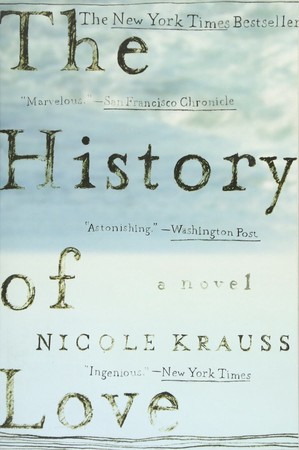
Krauss’ astonishingly good second novel is a complex, weaving tale about familial love, loss, and the sentimental — almost holy — nature of literature. In one of two central storylines, a young man named Leo impregnates his wife Alma before he goes into hiding during the holocaust. Years after the war, he searches and finds Alma, only to discover that she had assumed him dead, married another man, and given birth to another son with her new husband. In the other, parallel, storyline, the father of a young girl (also named Alma) dies and as the teenage daughter struggles to deal with her deeply sad mother, her biological brother becomes convinced that they in fact have different fathers.
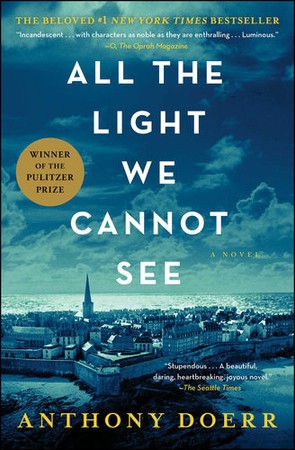
While this magnificent novel is certainly about the atrocities that WWII brought upon Europe and its citizens, the relationship between a young French girl named Marie-Laure and her father, as well as the bond between a young orphaned German boy named Werner and his sister, also make this novel a study of how familial relationships endure and change when other family members have passed away. All the Light We Cannot See illuminates the particular kind of love that the members of very small families hold for one another.
Relationships are hard. Whether they are with romantic partners or friends, it’s no easy feat navigating the dance of differing opinions that comes with introducing a new and potentially important person into your life. What is your political affiliation? Do you want kids? And probably the most controversial question — what’s your favorite book?
Sometimes, you get lucky and you find yourself in a decade-long friendship with someone who can discuss the feminist undertones of Jane Austen. Sometimes, you’ve already given your boyfriend keys to your apartment before finding out that he’s read Atlas Shrugged seven times…and loved it each and every time. Aware of this conundrum, writer Laura Relyea took to Twitter and asked her fellow bibliophiles, “What books are automatic red flags for you with people?”
What books are automatic red flags for you with people? I’ll start: I once called off a date when a dude told me his fave book was Lolita.
@laura_relyea@mashpotassium Once I said to a prospective date, jeez, how could a person ever call their daughter Lolita after reading that? My daughter is called Lolita, he said. Aaaaaaaargh.
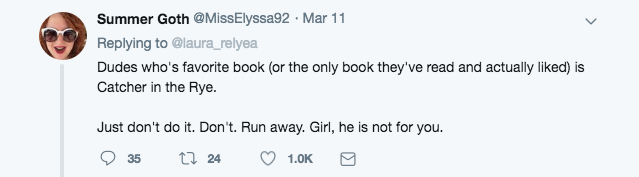
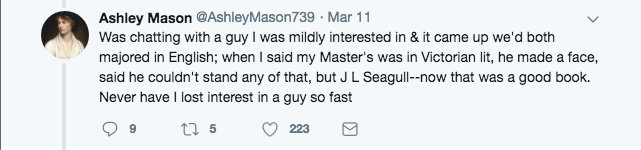
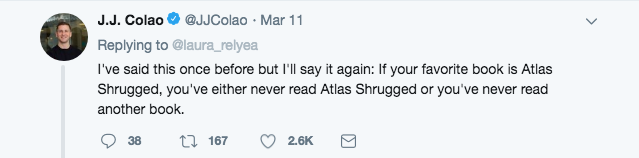
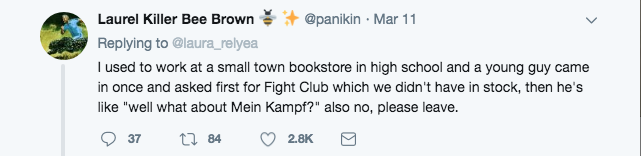
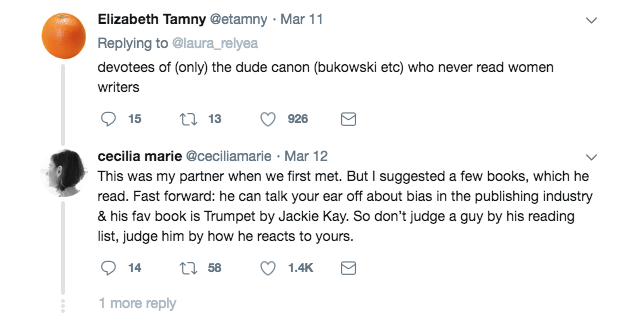
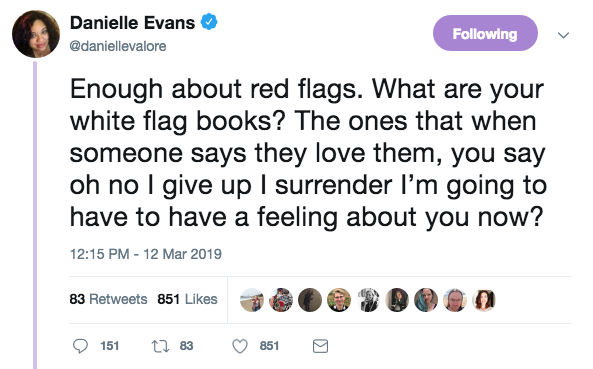
Others added their own personal dealbreakers. Warnings against Catcher in the Rye, Jonathan Livingston Seagull, and Atlas Shrugged (plus really anything by Ayn Rand) dominated.
Honestly I can't believe no one has said Ginsberg or Kerouac yet? That's like a gigantic fuck boi red flag to me. Only acceptable the first two years of college.
Some used the thread as an opportunity to recall non-romantic but still equally horrific experiences.
And there were those that took a hopeful approach, advising that maybe you are the book angel someone’s library deserves.
One writer, Before You Suffocate Your Own Fool Self author Danielle Evans responded with a post on her own personal Twitter.
And Twitter delivered love stories that would make any literature-lover weep with joy,
@daniellevalore The first book my man & I ever talked about was The Amazing Adventures of Kavalier and Clay. I fell in love- with him; a decade later I found out his first true love was Superman.
@daniellevalore My not yet husband was reading Four Ways to Forgiveness, by Ursula Le Guin (which had just come out) the first time I went to his house.
@daniellevalore One time, I took a friend to a bookstore (and I had a crush on him and I thought he liked me but never ever happened) and I mentioned that Of Mice and Men is my favorite book but I gave my only copy away, so then we were in line and he bought me a copy to surprise me and ❤️
@daniellevalore any Markus Zusak (Book Thief/Bridge of Clay are best), Eduardo Galeano (The Book of Embraces), Marilynne Robinson (Housekeeping). Tocqueville! also one time a guy I dated asked who Walt Whitman would've been as a rapper (I said Nas, but open for debate) & I kinda lost my mind.
@daniellevalore Hands down - Jonathan Strange and Mr. Norrell. A) it's amazing b) you have to commit to reading it c) you also probably enjoy snarky footnotes
Red flag books are all well and good—it’s important to be on your guard in this bad world—but white flag books can get you a beer with Mary Roach, and in the end, isn’t that what it’s all about?
This piece is excerpted from Daily Rituals: Women at Work, a collection of the daily routines of 143 women artists.
Edith Wharton (1862–1937)
In her autobiography, A Backward Glance, Wharton described her life as divided into two “equally real yet totally unrelated worlds,” which went along “side by side, equally absorbing, but wholly isolated from each other.” On the one hand, there was the real world of her marriage, her home, her friends and neighbors; on the other, the fictional world she created each morning in bed, writing longhand on sheets of paper that she dropped onto the floor for her secretary to retrieve and type up. Wharton always worked in the morning, and houseguests who stayed at the Mount — the 113-acre estate in Lenox, Massachusetts, where Wharton penned several novels, including The House of Mirth and Ethan Frome — were expected to entertain themselves until 11:00 a.m. or noon, when their hostess would emerge from her private quarters, ready to go for a walk or work in the garden. If guests needed to speak to the author during the morning, however, Wharton was willing to receive them in her bedroom. The historian Gaillard Lapsley was one such visitor, and he later wrote a memorable description of Wharton in bed, “flanked by night tables charged with telephone, travelling clock, reading light.” She would be wearing, he continued,
a thin silk sacque with loose sleeves, open at the neck and trimmed with lace and on her head a cap of the same material also trimmed with lace which fell about her brow and ears like the edging of a lamp shade . . . Edith’s mask stood out sculpturally beneath it. She would have her writing-board perilously furnished with an inkpot on her knee, the dog of the moment under her left elbow on the bed strewn with correspondence, newspapers and books.
The “dog of the moment” referred to one of the numerous canines Wharton owned over her lifetime, which included Spitzes, Papillons, a poodle, a Pekinese, and a pair of long-haired Chihuahuas named Mimi and Miza. Dogs had been a tremendous comfort to Wharton since her earliest childhood; and when, in her last years, Wharton made a list of the “ruling passions” of her life, dogs ranked second only to “Justice and Order,” and were followed by books, flowers, architecture, travel, and “a good joke.”
Evenings at the Mount, Wharton would read to her guests from the novel she was writing, or from the work of one of her favorite authors. Although she was happy to share her writing in progress, she never had much to say about the writing process itself. A guest at The Mount recalled that “very little allusion was made to it, and none at all to the infinite pains that she put into her work or her inexhaustible patience in searching for the material necessary to perfect it.” One unspoken requirement was that she follow the same schedule each day, with as little variation as possible. As Wharton wrote in a 1905 letter, “The slightest interruption in the household routine completely de-rails me.”
Zadie Smith (b. 1975)
In interviews over the years, the London-born novelist has said that she doesn’t write every day — and although she sometimes wishes she had that compulsion, Smith also recognizes the value of writing only when it feels necessary to her. “I think you need to feel an urgency about the acts,” she said in 2009, “otherwise when you read it, you feel no urgency either. So, I don’t write unless I really feel I need to.” Even when Smith does feel that urgency, she writes “very slowly,” she said in 2012, “and I rewrite continually, every day, over and over and over. . . . Every day, I read from the beginning up to where I’d got to and just edit it all, and then I move on. It’s incredibly laborious, and toward the end of a long novel it’s intolerable actually.”
Smith has also been vocal about the difficulty of writing in a world of infinite digital distractions, and in the acknowledgements section of her 2012 novel NW she thanked two pieces of Internet-blocking software, called Freedom and Self Control, for “creating the time.” She does not use social media, and as of late 2016 she did not own a smartphone, and had no plans to acquire one. “I still have a laptop, it’s not like I’m a nun,” Smith said, “I just don’t check my email every moment of the day in my pocket.”
Hilary Mantel (b. 1952)
The Booker-prize winning author of Wolf Hall and Bring Up the Bodies, as well as several other novels and a memoir, Mantel finds fiction-writing an all-consuming and thoroughly unpredictable activity. “Some writers claim to extrude a book at an even rate like toothpaste from a tube, or to build a story like a wall, so many feet per day,” the English author wrote in 2016.
They sit at their desk and knock off their word quota, then frisk into their leisured evening, preening themselves.
This is so alien to me that it might be another trade entirely. Writing lectures or reviews — any kind of non-fiction — seems to me a job like any job: allocate your time, marshall your resources, just get on with it. But fiction makes me the servant of a process that has no clear beginning and end or method of measuring achievement. I don’t write in sequence. I may have a dozen versions of a single scene. I might spend a week threading an image through a story, but moving the narrative not an inch. A book grows according to a subtle and deep-laid plan. At the end, I see what the plan was.
Mantel writes every morning as soon as she opens her eyes, seizing the remnants of her dream state before it dissipates. (Sometimes she wakes up in the middle of the night and writes for several hours before going back to sleep.) Her writing days tend to fall into one of two categories: “days of easy flow,” which “generate thousands of words across half a dozen projects,” and “stop-start days,” which are “self-conscious and anxiety ridden, and later turned out to have been productive and useful.” She writes by hand or on the computer, and considers herself “a long thinker and a fast writer,” which means that a lot of her writing day is spent away from her desk, on the thinking part. When she does sit down at the computer, Mantel will sometimes “tense up till my body locks into a struggling knot,” she wrote in 2016. “I have to go and stand in a hot shower to unfreeze. I also stand in the shower if I get stuck. I am the cleanest person I know.”
To other writers who get stuck, Mantel advises getting away from the desk: “Take a walk, take a bath, go to sleep, make a pie, draw, listen to music, meditate, exercise; whatever you do, don’t just sit there scowling at the problem,” she has written. “But don’t make telephone calls or go to a party; if you do, other people’s words will pour in where your lost words should be. Open a gap for them, create a space. Be patient.” Over the course of her career, Mantel has learned extraordinary patience: She first began considering a series of novels based on the life of Thomas Cromwell in her twenties but didn’t begin writing the first of them, Wolf Hall, until thirty years later. (When she finally began writing it, however, she worked with tremendous speed, cranking out the 400-page book in five months, working 8 to 12 hours a day.) “Sometimes people ask, does writing make you happy?” Mantel told a visiting reporter in 2012.
But I think that’s beside the point. It makes you agitated, and continually in a state where you’re off balance. You seldom feel serene or settled. You’re like the person in the fairy tale The Red Shoes; you’ve just got to dance and dance, you’re never in equilibrium. I don’t think writing makes you happy . . . . I think it makes for a life that by its very nature has to be unstable, and if it ever became stable, you’d be finished.
DON’T MISS OUT
Sign up for our newsletter to get submission announcements and stay on top of our best work.
YOUR INBOX IS LIT
Enjoy strange, diverting work from The Commuter on Mondays, absorbing fiction from Recommended Reading on Wednesdays, and a roundup of our best work of the week on Fridays. Personalize your subscription preferences here.