We Need a New Way of Thinking About Mental Illness

I n recent years, suicide rates across America have considerably risen and continue to rise in almost every state. For this reason, there is a need for a guide on reporting suicides. The CDC, in this guide, warns that there are many reasons a person might kill themselves, “Researchers found that more than half of people who died by suicide did not have a known diagnosed mental health condition at the time of death. Relationship problems or loss, substance misuse; physical health problems; and job, money, legal or housing stress often contributed to risk for suicide.” The implication here is that a “known mental health condition” is materially different from a known traumatic life event, addiction, or physical health problem.

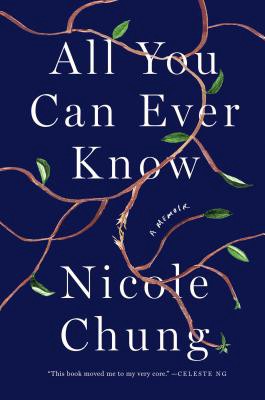
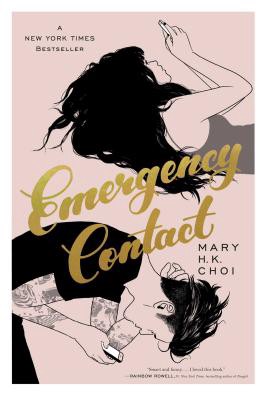
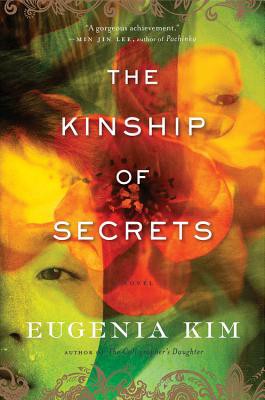
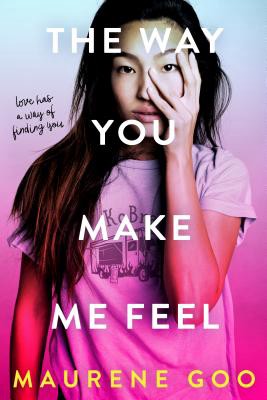
It’s a popular Western notion that mental illness is a disease of the brain — one that arises from chemical imbalances, not from life events, and that will go away if treated with medication. But as suicide rates continue to rise, perhaps we need to widen the scope of what mental illness is, how it is caused, and what we can do to help those who are suffering. I believe that losing a job, not having enough money to live, substance abuse, and something like physical health are mental health issues, and our mental health is inextricable from our physical health, our economy, and our culture. This is a belief based on my own experiences with mental health and diagnosis — but I’m not alone. Four new books on mental illness offer a similar perspective, portraying the complexity of mental health and how it is inextricably tied to every aspect of our lives and the cultural framework in which we live.

Our mental health is inextricable from our physical health, our economy, and our culture.

When I was thirteen, I attempted suicide, and was subsequently diagnosed with bipolar disorder, at the time called manic depression. Doctors told me I’d be taking Lithium for the rest of my life, and the illness would never go away. My parents thought I’d never graduate college, get married, or have children. When I was 28, the palms of my hands exploded with a thousand liquid-filled blisters, a form of eczema. A doctor told me to get used to it, because it would never go away either. I thought I’d never be able to write again.

In both cases, the doctors were right: eczema and mental illness are diseases of the body that never go away. But I learned that diseases inside the body are very often triggered by our environments. There wasn’t anything inherently wrong with me. More often than not, there was something very, very wrong with my surroundings, my culture, and the outside world. I learned to understand my body and mind, and the way I respond to the world around me. My skin issues and mental issues became manageable, and sometimes seem to disappear, though I know they never will. What I mean to say is, it’s all much more complicated than taking a pill.

Mental illness has always been a source of inspiration for books, television, and movies. Recently, because of a larger awareness of the dangers of stigmatization, popular shows and movies have made it a priority to portray mental illness in more complex, nuanced, closer to real life ways. Maniac on Netflix worked hard to get mental illness right. Sharp Objects portrayed the full range of mental illness and pathology of a mother and her daughters. But there’s a limit to how much nuance can be portrayed onscreen, and mental illness still gets flattened into a trope; Netflix’s 13 Reasons Why, for instance, though hugely popular, was criticized for glamorizing suicide and not offering hope. Books, though, are in the unique position to offer the space necessary to really dive into the causes and effects of mental illness, and recent releases have been using that space to portray how a mental illness develops in tandem within the dynamics of a family, a culture, or a country. In their own way, these books offer a more complete and complex view of mental illness than the one we might be used to.

In Katya Apekina’s The Deeper the Water the Uglier the Fish, Edith and Mae are raised in Louisiana by their mother, Marianne. Marianne never gets a formal diagnosis, but she is sometimes manic, sometimes depressed, sometimes disappears for days or weeks, eventually attempts suicide, and is hospitalized. Her daughters, one of whom she shares an almost psychic bond with, are sent to New York to live with their father, Dennis, an acclaimed and successful novelist, who is either an eccentric artist, a narcissist, a psychopath, a pedophile, or some combination of which. Dennis and Marianne met when she was a child and he was an adult. He married her when she was a teenager and he was in his 30s. In an old letter from Dennis to Marianne he writes, “I don’t know how to be with you without wanting to kill you and devour you and then bring you back to life, and then write about you and do it all again. Isn’t that love?”

The book is told in short bursts from multiple perspectives, not only Dennis and Marianne but their friends and acquaintances. It contains letters, therapist’s notes, New York Times book reviews, and transcripts of phone conversations, and moves back and forth in time as the mystery of this family and its psychology unfolds. It’s a structure that encourages the reader to wonder: when did Marianne’s mental decline begin? Did her mental illness begin with Dennis? Was she born this way? Was her deterioration willful and selfish, a product of her disease, or upbringing, or a combination of all three? Can the actions or inactions of someone close to us trigger a psychotic episode? The book made me think of mental illness as lying on an ever-shifting spectrum, not just lodged inside the body, but dependent on the culture and environment in which an individual was raised. Because of course we are inextricable from the world and the people who surround us, but this very idea of a lack of a definitive boundary between our bodies and the rest of the world is a sign of mental illness. As Marianne says, “it’s terrible to always have to keep track of the edges of things.”

The book made me think of mental illness as lying on an ever-shifting spectrum, not just lodged inside the body, but dependent on the culture and environment in which an individual was raised.

In Anne-Marie Kinney’s Coldwater Canyon, Shep is a Gulf War Veteran, with Gulf War Syndrome and PTSD, on permanent disability. He follows a young woman who he believes to be his daughter from Nebraska to Los Angeles. He watches as she works in a café and goes on auditions. He hangs out at the local strip mall convenience store, where he is a trusted friend of the family that owns the store, and where he bears witness to the dramas of the neighboring Armenian mafia. Coldwater Canyon is a story of man who is, for a myriad of reasons, is unable to face his traumas and instead avoids them, hoping for the fantasy life he has lived alongside of for years, to come true.

Shep’s behavior can be seen as criminal, creepy, abusive, sad, or any combination thereof. The reader is never asked to pass judgment on Shep, or to provide excuses for him; he is portrayed in an open and honest light, and his delusion about his daughter is not presented as a mitigating factor. But it’s still a delusion, one around which he has shaped his entire adult life. He even believes he had a hand in helping her single mother to raise her, by spying on the mother and daughter throughout her childhood. He believes the mother, a woman with whom he had a brief affair before the war, was bolstered by his presence, by his energy. It’s impossible to extract Shep’s behavior from this delusion, and it’s impossible to extract his delusion from his experiences: his father was never around, his mother died when he was young, and he was raised by a cold and unloving grandmother. He grew up knowing he was a burden. His neurosis was shaped by poverty, loneliness, grief, and then war, and then PTSD, and then the mysterious symptoms of Gulf War Syndrome. I found myself wondering: Is his stalking a crime, or mental illness? Can behavior be both, and can a criminal behavior be met with empathy and understanding?

As I read Coldwater Canyon, I thought about how our culture’s tendency to vilify men, without also vilifying it all; the culture, the country, the weight of the actions of generations, the lack of social structure that should be in place to protect us from all the things that break us, sometimes beyond repair: poverty, racism, sexism, power structures, dysfunctional families, violence, capitalism, that a few rich white men need to ceaselessly become richer at the expense of all of us, while we tear each other apart, unwilling to take the mental health of our citizens into account for their actions.

Esme Wang’s The Collected Schizophrenias and Rheea Mukherjee’s The Body Myth are about illnesses that are seemingly on opposite ends of the mental health spectrum. While both conditions are extremely complex and not readily understood, schizophrenia is viewed as an illness over which a person has little control, while the fictitious health conditions that the Munchausen’s patient comes up with are perceived as an attempt to willfully exert control over other people. But of course it’s not so simple. In both books, there is a woman at its center who finds it almost impossible to live inside of the world as it is.

The Body Myth takes place in India and there is much pondering of the American way of labeling illness in order to medicate and fuel the pharmaceutical industry. The narrator, Mira, becomes enamored with a woman afflicted by mysterious ailments — headaches, pain, seizures. She knows the woman is faking but finds her so alluring that she doesn’t care. We are pulled alongside the narrator because we want the answers to these questions: If she is faking her illness — Why? Does her husband know? Does her doctor? If so, do they care? If they are encouraging a false narrative she has for herself, what is wrong with them? Do they have an illness as well? Are those around her complicit in perpetuating her mental illness?

Mira turns to Western philosophy to help her understand this woman she yearns for. She studies Simone de Beauvoir, who says the body is not a thing; it is a situation; it is our grasp on the world. Mira paraphrases Foucault: “there was a time society regarded the insane as wise souls on a higher level of consciousness…that respond to the world asymmetrically.” Whereas in modern days, psychiatry “suppresses their tendencies and coos them back to the reality we’ve semi-agreed to all agree upon.”

Mira presents the possibility that mental illness may be an enhanced, unadulterated peek at the true world, one that takes us away from the shared world that we know as our reality. In this view, a mental illness is not inside of the body at all, and the biochemistry of the physical body is perhaps just a byproduct. In other words, we won’t know anything about mental illness if we only look at the physical body and not the divine. It’s fascinating to think about the faking of a mental illness as a mental illness in itself, and to view mental illness as a window to the divine. It’s a valuable addition to the myriad ways to think about mental illness.

In this view, a mental illness is not inside of the body at all, and the biochemistry of the physical body is perhaps just a byproduct.

Esme Wang, in The Collected Schizophrenias, also discusses this association of mental illness with the divine. The Collected Schizophrenias is a collection of essays that tell the non-linear and ever-shifting story of the author’s various diagnoses. Wang writes about the term that often accompanies a schizophrenic diagnosis — “loosening of associations.” These are associations that are socially agreed upon — our culture’s understanding of reality. Mira from The Body Myth would say a loosening of associations is likely closer to any kind of universal truth, but that’s not a place where we can live. As Wang writes, “No one ever came out of a conversation with the gods for the better.”
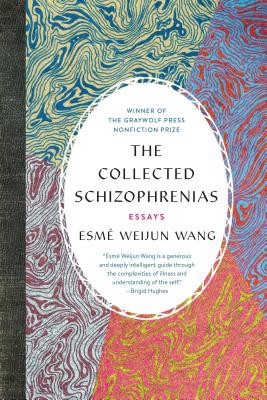
Part of the pleasure of reading these essays is in discovering how much I related to the narrator. I think about when my daughter was a baby, peacefully sleeping in her bed, and I lay awake, terrified and frozen, sure I was hearing people quietly moving through the house, moving towards my baby’s room to steal her. I heard a shoe stepping on a toy, I heard a sharp intake of breath. I heard the door open. I knew none of these things were actually happening but I had to get up and check on my daughter, and check every inch of the apartment, behind the shower curtain, inside every closet. Most nights I never made it back to sleep.

Wang’s essay “The Slender Man, the Nothing, and Me” is about the powerful imagination of young girls. In it, Wang posits that we might be part of a larger story without fully knowing how. When she was twelve, she and her friends believed they were in a book, a book that was being written about them. I had an eerily similar experience of shared stories with a friend when I was twelve. Are we mentally ill when we are twelve, or are we just twelve-year-olds? The essay explores a 2014 attempted murder perpetrated by two young girls (since diagnosed with two different types of schizophrenia) who believed they were killing to win the favor of the Slender Man, a creation of online horror fans. Wang ends the essay by saying that she believes very much that your surroundings and who, or what you may come into contact with shape who you are, and shape the development, the severity, and the existence of your mental illness.

Reading ‘Girl, Interrupted’ in the Psych Ward

Wang craves a correct a diagnosis, because it makes it easier to live with herself. Especially interesting is Wang’s resistance to the recent politically correct way we are to refer to mental illness these days — by positioning mental illness as something that happens to you, not something you are. For example, we are not to say “he is depressed” and certainly not “he is a depressive.” Instead, we are to say “he suffers from depression.” Wang prefers to refer to herself as schizophrenic, because, “Isn’t it cruel to insist on a self without illness?” This was a refreshing and wondering reminder that mental illness is personal, and an individual gets to define themselves, and that the way we understand ourselves inside of our world can, will, and should never-endingly shift.

When I think about myself when I was thirteen, I don’t think I was bipolar. I don’t really know what I was, except that I was a sensitive child living in an unpredictable and volatile home, and my life at school was not all that different. I felt big feelings, and was extremely sensitive to hormonal changes. I was also a writer with a flair for the dramatic and a tendency to prefer fantasy to reality. Aside from the violence that surrounded me when I was young, I am still the same girl, but I’ve spent a long time learning how to understand myself, and one of the best and most fun ways of doing that is by reading thought-provoking, risk-taking, dangerous and heartbreaking books.

I think what I needed to hear from doctors when I was thirteen and suicidal, and when I was 28 and exploding in rashes, was this: Here is a possible diagnosis, but really, we don’t know. Let’s see what we can do to help alleviate your suffering. There are many options, let’s try until we find something that works. You might have this now, but you won’t suffer forever. We will figure out how to manage it, and nothing is static. Nothing in this Universe stays the same, and that includes you. The world around you will shift, and the people, and your perceptions. In order for all of this to exist, there has to be both creation and destruction, and with that, beauty and violence, good and bad, justice and inequality. Our world and ourselves exist on the full spectrum of emotion and possibility. We just need to learn to be able to handle the contradictions, and harness the positive to use to fight the negative. We just need to learn how to get by, and we will. There was nobody to tell me this when I was thirteen, but now, we have books that open up new, healthier ways of thinking about mental illness.

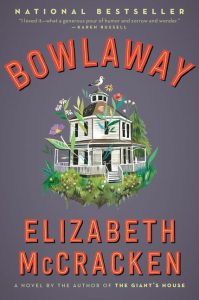
Elizabeth McCracken’s “Bowlaway” Is a Charming, Quirky Family Saga About Love and Bowling

Her first novel since 2002, Elizabeth McCracken’s Bowlaway is an epic generational story that doesn’t feel epic at all — instead, reading it is familiar, funny, alive. At the turn of the twentieth century, enigmatic Bertha Truitt appears in the town of Salford, MA, lying unconscious in a cemetery. When she comes to, Truitt by turns charms and astonishes the residents, insists she invented the game of candlepin bowling, and builds an alley in the center of town which — scandal of scandals — allows women to bowl. When Truitt dies in Boston’s Great Molasses Flood (which is real, and took place almost exactly a hundred years before Bowlaway publishes), she leaves behind the bowling alley, relatives with mysterious connections to her, and a town she changed forever.

McCracken pulled names from her own family’s genealogy, so in a way, the characters in the book are the author’s family, rooted both in fiction and in real life. And that’s how the novel feels — more fantastical than history, more workaday than a fairytale — with all the humble business of daily life: work, motherhood, military service, family duties. Truitt’s influence seems otherworldly and she belongs in concert with the best storybook mentors, like Mary Poppins or Willy Wonka. McCracken has the unique ability to be simultaneously delightful and heartbreaking, and Bowlaway leads us to examine the physical and emotional artifacts people leave behind, whether or not they touched them directly — bowling alleys, families, memories. She and I recently talked by phone about marrying the ridiculous with the tragic, how women carve out space for themselves, and the inherent humor of bowling.


Katy Hershberger: So, seventeen years since your last novel. How does it feel to come back to that form after short stories and a memoir?

Elizabeth McCracken: I think it feels alright? It has terrified me a little bit more somehow as the book comes out, I’m not sure why. And I’ve written novels in there, they just haven’t been any good. I just haven’t published them.

KH: Does it feel different from the last books you’ve published, even if they weren’t novels?

EM: Yeah, I think so. I think with the short stories, short stories are quieter publications, generally speaking. And the stories had mostly been published other places, so it didn’t feel like the first time they were being read. I guess part of it is this time I have more of that sort of panicked writer’s feeling of “what if everybody hates it? What if people really really hate it?” With the short stories I felt like plenty of people had read them. “Plenty,” that’s a ridiculous expression for short stories published in literary magazines. [laughs] I mean, plenty for me, I should say, but that’s not to say a lot. It felt like it had already been out in the world a little bit, and not so much with this. So I’m feeling a bit nervous.

I’m an Award-Winning Short Story Writer and I Don’t Know What I’m Doing Either

KH: The book is set in New England, where, you write that “even the violence is cunning and subtle.” I’d love to know about your background in New England and why you decided to set this story there.

EM: I’m a New Englander. Though it’s interesting, I’ve got an older brother who spent the same amount of time in New England as I did, but thinks of himself as a west coaster because we spent part of our childhood in Portland, Oregon. But I was born in Boston and moved back there when I was about seven and a half. And then in 2010 I moved to Texas and it feels like a different country to me. And whenever I go back to Boston, sometimes people are rude to me and I think “Oh my gosh, people are really mean here” and other times people are rude to me and I think “It’s home. I love it. People are so mean.” I saw a woman be spectacularly rude to a pair of men who were trying to buy admission to the Pilgrim Monument in Provincetown a couple of weeks ago. She was — appropriately — monumentally rude to them. My husband, who is English, was horrified and I just went “No, she’s quite right. They’re too late and it does my heart good to see her deny them admission.” And she was awful. They said, “Can we possibly?” and she went “No!” She took a really long time to explain the monument was closed. She just took great pleasure in saying no to them, which I do feel can sometimes be a New England-y trait.

KH: So it’s a far cry from Texas.

EM: It’s a far cry from Texas where people are usually really nice and helpful. I wanted to write about a place that felt like home because Texas, which I enjoy, I don’t think will ever feel like home. And I don’t think Texans will ever consider me as being a Texan in any way. That is my experience of Texans. Texas is the only state where I’ve heard people say, “I’m a sixth generation Texan.” Maybe they do that in California too. You might slightly brag about your family coming over on the Mayflower in Massachusetts, but certainly I’ve never heard anybody say “I’m a sixth-generation Massachusetts-ite,” person, whatever. We don’t even have a noun for it, that’s the thing, there’s not even a noun for somebody who comes from Massachusetts. But yes, I was missing New England.

KH: It feels like such a New England story, between candlepin bowling and the Molasses Flood, and that it has to be really rooted there.

EM: I can’t quite remember when I landed on candlepin bowling, but pretty early. And then I was delighted when I suddenly realized that the math would work to put in the Molasses Flood.

KH: The flood feels especially perfect because it’s a sort of slightly humorous and ridiculous married with the tragic. It feels like it fits in so well with these themes throughout the book.

EM: If I had a sweet spot that would be what I’m attempting to achieve in my work, it would be that. Slightly ridiculous but also tragic.

If I had a sweet spot, slightly ridiculous but also tragic would be what I’m attempting to achieve in my work.

KH: Bertha to me feels very much like a timeless, mythical character like Mary Poppins or Willy Wonka. This sort of storied mentor who doesn’t quite belong in ordinary life. I’m curious if she was based on anyone in real life or in fiction, and how you came to write her.

EM: She’s not based on anybody who I know in real life. It’s interesting because I only realized this recently. She’s a cousin to a character in a novel that I really love by Susan Stinson called Martha Moody. And I realized that Bertha Truitt is a name from the grandfather’s genealogies. I think she naturally came to be a cousin to this character from this novel, which is out of print and it shouldn’t be, it’s so beautiful. It’s about a woman who founds a town called Moody.

KH: So it seems that there’s both real life genealogy and fictional genealogy throughout the book, is that right?

EM: Yes. Yeah.

KH: I read that the names of the characters were inspired by your grandfather’s genealogies. How did that come to be? How are you inspired by the work that your grandfather had done with your own family?

EM: I essentially just went through this genealogy that he had written in the sixties. It’s quite big and thorough. He was a professional genealogist and editor of a magazine called the American Genealogist for quite awhile, and I just took names out. I just popped them right out. I don’t think any of them are close relatives, but they were so evocative to me that I just, I had a giant list of names that I looked at for awhile and then started to put them into fiction. The first two I had were Bertha Truitt and Dr. Leviticus Sprague. I can’t tell you who those people are, who those people were in real life anymore. And actually l think sort of instantly I couldn’t. I just wanted to think about the names suggested. But overwhelmingly the names in the book are names from the genealogy and only begin to break down when people got married and began to have children and I was like, oh I can’t do that anymore. But somebody named Betty Graham who was known as Cracker is from my grandfather’s genealogies. The names Luetta Mood, Hazel Forest, Leviticus Sprague, Joe Wear, Jeptha Arrison, those are all from the genealogy.

KH: So in some ways every character in the book is a part of your family.

EM: Yeah, I guess. Yeah, I suppose.

KH: Genealogy and legacy seem to be themes that you come back to in your fiction. How do those themes inspire you and what did you want to say about genealogy and legacy here?

EM: That’s interesting. Part of it is because of my grandfather is something that I was really aware of, especially on that side of my family, the McCracken side. In one of the genealogies he actually talks about how he’d intended to do my mother’s genealogy, I don’t know if that’s really true, but because my mother’s side of the family is Jewish it’s much more difficult to do a thorough genealogy. And certainly when I was growing up, that side of the family told a lot of stories about family and they also told a lot of stories about people they couldn’t quite figure out who they were.

There was a photograph of two children who my cousin Elizabeth, who is my grandfather’s first cousin, often was talked about with a great deal of mystery. She thought that they were a brother and sister who had died in Europe before the family had come to Iowa in the 19th century. And so I think I was always really interested, as I tend to be in any topic, in how it was true that genealogy was interesting but the opposite of that is also true. That it’s both important and not important. That blood relation actually doesn’t mean that much except for it often does to people. And I think I’ve always found that interesting.

KH: It’s more about the meaning you put onto the idea of family than the actual blood connections.

EM: Exactly. And those questions of what difference does it make, what difference could it possibly make if you were related by blood to somebody. My brother has actually gotten extremely into genealogy in the past couple of years and has actually found out an enormous amount of stuff about my mother’s side of the family that we never knew through his research.

KH: I think it’s so interesting that a lot of the book is about the duty of being part of a family, whether or not you’re related by blood. From the flawed but devoted mothers and the difficulty of motherhood to sometimes being stuck in the family business. Could you talk a bit about your take on those sort of expectations that can be bound up in family?

EM: I wrote another book in which having to go into the family business is a big deal though in that case the person didn’t, and I have no idea why, since certainly that wasn’t any kind of obligation I ever had. Even though I say that from my campus office at a university and my parents were both university employees all their lives. I’m not sure. The question of duty is one that I’m always really interested in. I write about it and I don’t know why! Sometimes I have an automatic answer to that question. The answer might have to do with always being interested in the family stories on both sides of my family, to think about the people whose lives are changed by being dutiful. By staying at home, serving another relative, whether it was a sibling or a parent or a child.

KH: There’s so much in the book about the role of women throughout history and having to carve out a space for oneself. Given what’s going on in American culture right now, was it a goal to write a feminist novel?

EM: I almost never have a goal in my writing but anything that I’m thinking about in my daily life goes into the back of my brain and hopefully comes out through my writing. And I, like everybody, I’ve been thinking about these questions. About how women have adjusted themselves through history to make space. And the ways in which they’ve been quietly and automatically ignored. And ignored by people who don’t even realize that they’re doing it, including other women. It’s something that’s been very much on my mind.

You know, I teach with undergraduate and graduate students and with the graduate students I’m interested in the way the women writers are taught to think about themselves and the importance of their work versus the way the men are. If I’m giving advice to a woman who’s trying to figure out what to ask for or how to approach an agent or how to approach a job, and women are often afraid to ask for things, and I always tell them, well think about being a man, and if a man would ask for that thing then you should ask for it. And you should know that what that means is that you should ask for it, it’s not that men are being outrageous in asking for it, it’s something you should ask for.

If I’m giving advice to a woman who’s trying to figure out what to ask for or how to approach an agent or how to approach a job (and women are often afraid to ask for things), I always tell them, well think about being a man, and if a man would ask for that thing then you should ask for it.

KH: I of course have to ask about bowling. I love the way that you describe bowling and say “our subject is love because our subject is bowling,” and that “it’s possible to bowl away trouble.” I wanted to ask about your connection to bowling and why you equate it with love and solace.

EM: I was a childhood candlepin bowler. And also I now have kids, and if you’ve got kids in America you will end up in a bowling alley eventually a couple of times a year. In Texas it’s tenpin bowling and I think when bowling re-entered my life when I was a parent it made me really miss candlepin bowling because it’s less brutal. Narly anybody can pick up a candlepin ball and roll it. And I really loved that and it’s also a regional variation and I was missing home, so I missed candlepin bowling.

I also just think everybody knows that bowling is an inherently funny sport, I don’t know why that is. I don’t know if it’s cause it’s an indoor sport, you don’t necessarily have to be fabulously fit to do it or to be really good at it. I discovered as I was researching the book it’s kind of mesmerizing to watch bowling even though there’s a really limited number of outcomes to bowling, especially candlepin bowling. There’s never the threat that somebody’s going to bowl a perfect game. And because bowling is inherently funny I love the idea of writing about it as being a romantic thing to do. And I do find it kind of strangely beautiful.

We Are All Winter Now

“Welcome to the Situation
[Winterfeldtplatz Markt, Berlin]”

The market makes me feel good
about myself because the people

don’t go there to feel good
about themselves. The exchange

rate I do nothing about but
watch. It has nothing to do with

the vendors beneath my house. Eighties music and
smokes are stupid enough to make me feel

nineteen again. I like my age though other folk
seem worried for me. Not fair, for it’s not the same

is it as good for me as it was for you?
Back at the nest someone asks me

if I’m in the 30–40 bracket. He’s with his dad,
who looks seventy. I am 33, and think about

the uncanny valley: all those fore-
heads that couldn’t be reached. We’ve all

gone winter, gone deep, the snow digging
its heels in the crevices of trees.

“Welcome to the Situation
[Tempelhof Airport, Berlin]” 

Shrieks sound the same
in any language. I spoke English
to avoid the shame I felt of being

alone. On the Feld, the sun
spoke in rays blown open
like a dinner party gone wrong.

Admit it, you were a little bit pleased.
Incongruous, like Wagner
playing in the hipster bar.

Outside, the kids scream why
you can’t help but wonder
how they’ll grow up,

as every Mercedes is getting more
extreme. Oh, oh, oh, it’s impolite,
but the Feld doesn’t mind

the loss of air traffic control
and you’ve never taken a bike
across the tarmac before.

The wind almost leaves
an invitation in its wake,
still with no name, just

the insistence that it will
all triumph before.

“thermodynamics”

Saturday night in Glasgow,
along the snow-packed sidewalks

needled voices say, Please,
say, I know what I’m doing, say, Mum,

say something sweet. Why do I doubt
the good, insist

on shaking my fist
after the bad. Some dumb self-

punishing mechanism.
I’m trying to be better at

forgiveness, that little floe
forged in the center of the Kelvin

determined not to melt;
I admire its stubbornness,

tire of the familiar
refusal to surrender all.

Stefi, when you opened your hands,
let them alight on my head,

the passerine trapped in the chest
where more might give gave flight.

About the Author

Kathleen Heil writes and translates poetry and prose. Recent poems appear in The New Yorker, Beloit Poetry Journal, Fence, Witness, Sixth Finch, Barrow Street, and elsewhere. More at kathleenheil.net.

“Welcome to the Situation [Winterfeldtplatz Markt, Berlin],” “Welcome to the Situation [Tempelhof Airport, Berlin],” and “thermodynamics” are published here by permission of the author, Kathleen Heil. Copyright © Kathleen Heil 2018. All rights reserved.

Eat Your Feelings at These New Restaurants for Writers

A writer’s life can be maddening. If editors aren’t ignoring your submissions, your agent is telling you the first 75 pages of your novel are “throat clearing.” Stress getting to you? Eat your feelings at these restaurants designed for writers.

The Memoir Bistro. Every dish is bitter, just like your mother made it. The plastic daisies on the tables are the only flowers that grew in your industrial hometown. All around you, families are screaming, and the waiter is arguing with you about your choices. If this place doesn’t inspire your memoir, nothing will. Sharpened pencils and paper placemats provided so you can take notes.

10 Perfect Writer Gifts We Just Made Up

The Royalty Diner. Features ramen noodles, Kraft mac & cheese, and a variety of breakfast cereals. Dishwashing and bussing positions available for authors looking to improve their financial positions. Writers paid in exposure might want to try the Charlie Dickens Food Bank down the street.

Remembrance of Things Patisserie. Three-hundred-page menu describes baked goods in scrupulous sensory detail. The perfect place to come after an agent suggests trimming your two-volume epic novel by eliminating three subplots and four main characters, and changing the tense and POV. Have a Margaret Mitchell Macchiato or a scoop of Leo Tolstoy Lemon Sorbet while trashing the agency on Twitter. Patisserie’s Wi-Fi password: biteme.

The perfect place to come after an agent suggests trimming your two-volume epic novel by eliminating three subplots and four main characters, and changing the tense and POV.

Rejection Café. Send your meal back with comments like, “The chef obviously has talent, but the spice isn’t what I’m looking for right now,” “I’m sorry, but I just had a dish like this last week,” or “You might want to bring in a consultant to help with your menu.” Don’t worry about insulting the establishment. Having a thick skin is part of being in the restaurant business. Some chefs aim to have 100 meals sent back each year.

Submittable Soda Shop. You’ll have to pay to order, and the service is slow. Try sending the cook a question about the menu, and while you’re at it send one to the Tooth Fairy. On the bright side, the restaurant is open to all, unlike The Big Five Star Restaurant, which can be entered only upon proof of 100,000 Instagram followers or publication in the Paris Review.

Pizzeria al Prizes. You didn’t win a Pulitzer. You weren’t nominated for a National Book Award. And as far as you’re concerned, a Booker is the person who takes your reservation at the Atlantic City Motel 6. Find solace at this Italian eatery where the pasta is shaped like award statues and the napkins say, “Congratulations!” Eat your heart out, Colson Whitehead! Take that, Alice Munro! We hope you’re enjoying your lobster.

Eat your heart out, Colson Whitehead! Take that, Alice Munro! We hope you’re enjoying your lobster.

The Grill. Feel free to pepper the chef with questions like, “How’s that new dish coming along,” “Where do you get your ideas for recipes,” and “How much does the restaurant earn on a meal like this?” Tell her you have an idea for a banquet, but you just don’t have the time to prepare it. Maybe she’d like to do it for you? Don’t worry about the steam coming out of the chef’s ears. That’s just your hamburger cooking.

Bestseller Saloon. Of course, some writers prefer to drink their meals. Sample the saloon’s Kill Your Darlings Cocktail, made with bottom-shelf vodka and muddled scenes from your first draft. Or if your last novel bombed, celebrate your new pen name with a Nom de Plume Martini — we’re not sure what’s in it.

What to Read Instead of Watching the Super Bowl

I n 2016, Colin Kaepernick decided that he was “not going to stand up to show pride in a flag for a country that oppresses black people and people of color.” The backup quarterback from the San Francisco 49ers took to sitting and then kneeling during the national anthem. Kaepernick became the face of a movement (and later Nike) protesting racial injustice—but at a cost. He hasn’t played a game since January 1st, 2017, and no NFL team has signed him.

Football is undeniably an intrinsic part of American life. So is racism. This Super Bowl Sunday, read these seven books on racial justice instead. From a definite history of racist thought to a manifesto on peaceful protest, this reading list serves a primer to understanding racial inequality in America.

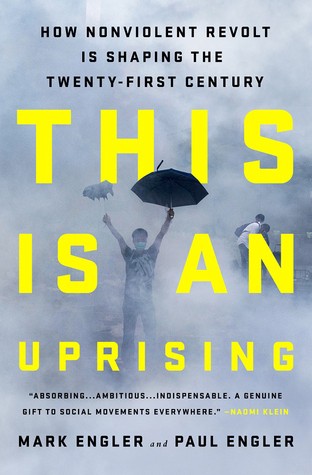
This Is an Uprising: How Nonviolent Revolt Is Shaping the Twenty-First Century by Mark Engler and Paul Engler

This is an Uprising is an ode to the power of the potential of peace protest. Co-authors Mark Engler and Paul Engler reference movements spanning decades — from Ghandi’s 1930 Salt March and Martin Luther King Jr.’s 1963 Birmingham campaign to the more recent Occupy Wall Street protests — and offer a guide on how to successfully engage in nonviolent protest.

Stamped from the Beginning: The Definitive History of Racist Ideas in America by Ibram X. Kendi

Winner of the 2016 National Book Award for Nonfiction, Stamped from the Beginning explores the complex and insidious history of racist thought. Scholar and historian Ibram X. Kendi traces the development of anti-Black ideology through the centuries, evoking the biographies of such figures as Puritan minister Cotton Mather, founding father Thomas Jefferson, abolitionist William Lloyd Garrison, scholar W.E.B. Du Bois, and activist Angela Davis. In this meticulously researched piece of nonfiction, Kendi provides readers with both familiar and unfamiliar examples of racist ideas so that they have to the tools to recognize and expose racism even in its most nuanced forms.

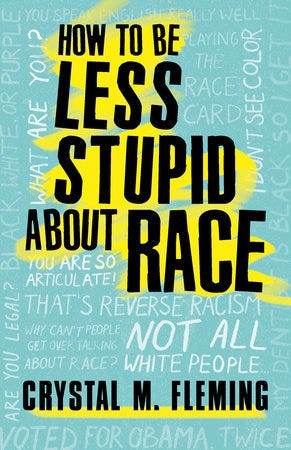
How to be Less Stupid about Race: on Racism, White Supremacy, and the Racial Divide by Crystal M. Fleming

Crystal M. Fleming’s How to be Less Stupid about Race seeks to educate readers about the Critical Race Theory. Powered by a desire to overcome her own ignorance of systemic inequality, Fleming combines formidable scholarly texts with personal experiences to guide readers through the “social, political, historical, and economic realities of racial oppression.”

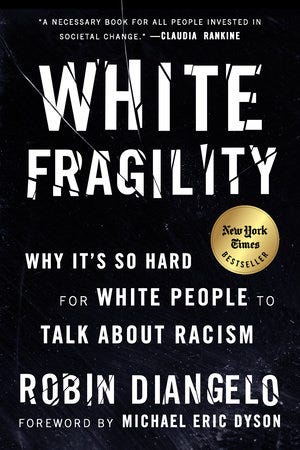
White Fragility: Why It’s So Hard for White People to Talk About Racism by Robin DiAngelo

Written by race scholar and diversity trainer Robin DiAngelo, White Fragility works to debunk the notion that “only intentionally mean people can participate in racism.” DiAngelo explains the concept of “white fragility” — feelings of discomfort white audiences experience when presented with topics of race — and challenges her white contemporaries to reassess their own reactions, telling them that they must confront their discomfort to fully engage in necessary conversations about race.

When They Call You a Terrorist: A Black Lives Matter Memoir by Patrisse Khan-Cullors & asha bandele

When They Call You a Terrorist looks into the life and work of Patrisse Khan-Cullors, co-founder of the Black Lives Matter movement. From her childhood in the Los Angeles public housing system to the incarceration of her mentally ill brother to the mobilization of what would become a global movement, this powerful book tackles poverty, mass incarceration, and police brutality.

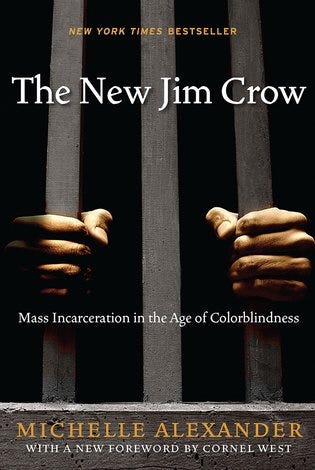
The New Jim Crow: Mass Incarceration in the Age of Colorblindness by Michelle Alexander

Civil rights lawyer Michelle Alexander’s The New Jim Crow is an in-depth examination of America’s prison-industrial complex that disproportionately incarcerates African Americans. Alexander explains how the War on Drugs, racial profiling, and overpolicing led to the mass imprisonment of black men even though white people are more likely to use drugs. Even after serving their sentences, it is legal to deny formerly incarcerated people civil rights like the right of vote and to access education and public benefits. Formerly incarcerated people also face discrimination when applying for employment and housing, relegated them to the fringes of society. Alexander’s compelling evidence-based book shows us that Jim Crow hasn’t ended in America, it’s only been repackaged.

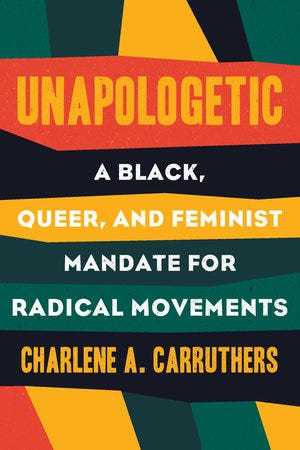
Unapologetic: A Black, Queer, and Feminist Mandate for Radical Movements by Charlene A. Carruthers

Written by Charlene Carruthers, founder of the Black Youth Project, Unapologetic reimagines black radicalism through a queer feminist lens. Carruthers draws inspiration from past models of activism as well as her fourteen years as a community organizer, proposing an inclusive version of black liberation that incorporates feminist and LGBTQ movements. She also identifies several key strategies essential to the creation of a long-lasting, self-sustaining radical movement.

8 Fictional Books in Literature

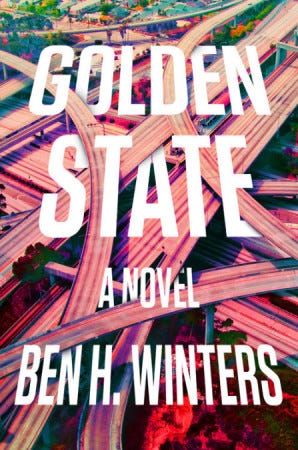
In the Golden State, the alternative-universe version of California in which my new novel is set, the preservation and maintenance of objective reality is the paramount objective of civic life and law enforcement.

What this means for you and me is that it is illegal to lie.

Purchase the novel

So when the novel’s hero, Laszlo Ratesic, discovers a novel — a fat legal thriller called The Prisoner, hidden in a suspect’s apartment — he doesn’t exactly know what it is, but he knows it’s contraband. What is a novel, after all, but a big long lie? But Laz reads The Prisoner, and is moved by it, and this encounter with the power of story is a turning point in my story, the story of Golden State, and I will tell you confidentially that it was my favorite part to write.

I’ve always found something sort of magical about a book-within-a-book. Stories about stories; storytellers telling stories about storytellers. It is like the author is reminding you, as you are reading, just how extraordinary the whole thing is; what a strange and mystical conspiracy we are all engaged in, readers and writers together.

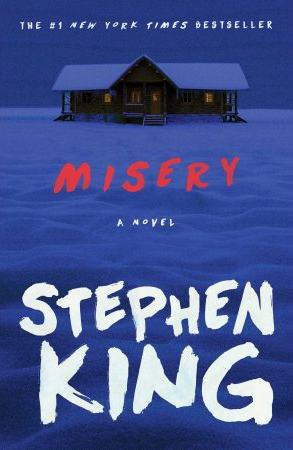
Misery by Stephen King

They do different things in different books, of course, these interpolated books. There are novels that feature authors as characters, so that an understanding of that author’s work is key to understanding the character, or propelling the plot. Stephen King has used author-protagonists once or twice — when you’ve written as many books as King, you’ve done everything once or twice — but never more powerfully than in Misery, in which a super-fan’s affection for a writer’s romance novels curdles into violent obsession.

Red Clocks by Leni Zumas

A different kind of writer-protagonist turns up in Leni Zumas’s brilliant and startling Red Clocks, a just-barely-speculative cautionary tale about reproductive freedom in America. One of the many frustrations for the high-school teacher heroine, Ro, is her inability to complete her biography of a polar explorer, who was herself frustrated by the constraints put on her, in her time. So the subject of Ro’s work in progress feels trapped, as if in sea ice, just as Ro does in her time, which is our time.

Dissertations Never Die

“Tlön, Uqbar, Orbis Tertius” by Jorge Luis Borges

What I’m trying to get across, in this description of a blurred, ambiguous shadowland between Main Book and Buried Book, is the kind of special power a sub-book can provide to the main one. Try reading, for example, the Borges short story, “Tlön, Uqbar, Orbis Tertius,” in which Borges himself (or a character with the same name and life as Borges) discovers a seemingly misprinted encyclopedia volume that includes an entry on a heretofore unheard of country, which leads him into a deep dive into the literature of that (fake? real?) country. The tale swallows its own tail in that sublime, delightful way that is distinctly Borgesian.

The Man in the High Castle by Philip K. Dick

Speaking of ouroboroses, I give you The Grasshopper Lies Heavy by Hawthorne Abendsen, who is not a real person but a character (the title character, sort of) in The Man in The High Castle by legendary science-fiction madman Philip K. Dick. High Castle is an alternate history in which the Axis powers won World War II; the characters end up searching for Abendsen, author of The Grasshopper Lies Heavy…an alternate history in which the Allied powers won World War II.

The Forgotten Works of Frederick Langley

Middlemarch by George Eliot

Metafictional mind games aren’t necessarily the point of books-within-books, of course; they can and do exist in more naturalistic form, as a mark of a character’s interests or ambition or, in the famous case of Middlemarch, his deep flaws. In that sweeping masterpiece by George Eliot (née Mary Ann Evans) Dorothea errs in marrying the dull Reverend Casaubon, who among his many flaws is obsessed with The Key to All Mythologies, the epic philosophical treatise he keeps failing to write.

The Intuitionist by Colson Whitehead & The Art of Fielding by Chad Harbach

Sometimes authors create a book-within-a-book as a source of authority or information to which their characters turn for guidance. Lila Mae Watson, in Colson Whitehead’s The Intuitionist, is a devotee of a famous text on the mystical art of elevator repair. Henry Skrimshander, in Chad Harbach’s The Art of Fielding, is a devotee of a baseball memoir also called The Art of Fielding.

The Godwulf Manuscript by Robert B. Parker

Last but certainly not least, an imaginary book can exist as a Maguffin, another version of the Maltese Falcon or microfiche or glowing briefcase or whatever that characters set off in search of. See, for example, The Godwulf Manuscript, the first of Robert B. Parker’s famous Spenser novels. An illuminated manuscript, supposedly of historical importance, has been snatched from a college campus and held for ransom.

In the decades since Godwulf, the tough-talking, gun-toting P.I. Spencer has gone searching for many things — even after Parker died and the series was taken over by Ace Atkins — but there is something fitting about his adventures having begun with The Godwulf Manuscript. What, after all, is more worth finding than a good book? Even — especially — if it’s hidden within another one.

Learning to Cook for One

I am standing in my mother’s kitchen, aggressively stabbing a sweet potato with a fork, when it occurs to me that I haven’t made a meal for myself in months.

The next day, I’ll make pasta from scratch for the first time. The day after that, broccoli rabe pesto and charred clementines smothered on a slice of crusty French bread. I will learn to enjoy cooking again. I will eat too much. I will feel something resembling pride, or maybe, satisfaction.

But for now, I am stabbing a sweet potato — much harder than I need to, really — in an attempt to nourish myself. I am stabbing a sweet potato because, after a terrible year of grief and loss, it is a weirdly therapeutic thing to do. And I am stabbing a sweet potato because I desperately need to figure out what the fuck self-care looks like.

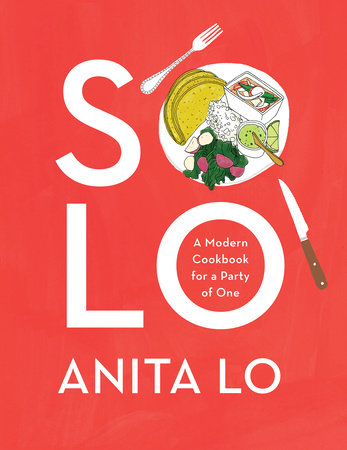
Solo by Anita Lo

I’m not alone in this venture: I have a recipe. Underneath my nose, there’s a copy of chef Anita Lo’s latest cookbook, Solo: A Modern Cookbook for a Party of One. As Lo tells it, the idea came about while she was brainstorming punny cookbook titles with a friend on the phone. They cycled through everything from “Lo Country Cooking” to “Lo and Slow: The Braising Book” — until eventually, they landed on “So-Lo,” and something clicked.

For Lo, it was personal: In college, she ate most of her meals alone, a copy of Pierre Franey’s 60-Minute Gourmet close at hand. She didn’t mind the extra effort it took to cook a complicated meal for one — but few people seemed to understand why. “All of my life, I’ve been surrounded by people asking, ‘Why would you go through all of that hassle for yourself?’” she told me over the phone last November. “For me, it’s not that much of a hassle because it’s what I love to do, and I know how to make things easy. But even then, why wouldn’t you go through all that hassle?”

The most obvious answer is that not everyone has a résumé like Lo’s. As the former chef owner of the now-closed Michelin-starred restaurant Annisa, Lo is well equipped to cook up a beautiful meal, whether it’s for one person or one hundred. But she’s also well aware that not everyone shares her particular set of skills — which is why Solo is meant to be accessible for both amateur home cooks (me) and professionals who actually know what they’re doing (Lo).

This is how I find her recipe for twice-cooked sweet potatoes with mushrooms, kale, and Parmesan. It’s an easy enough recipe: After sufficiently stabbing the sweet potato, I wrap it in a damp paper towel and place it in the microwave for a few minutes. I scoop out the soft, fluffy center and mash it with ricotta and Parmesan, before putting it back in the skin to bake in the oven. I sauté kale and baby portabella mushrooms with garlic and thyme, and pile it on top of the sweet potato when it’s finished.

Then, I shovel it down my throat until I can’t eat another bite.

Can loneliness be taught? Can it become a habit? Can it be unlearned? I’m not sure — but for me, it has always been a safety blanket.

I grew up an only child: the sole daughter of a fiercely independent single immigrant mother. From a young age, I learned to keep myself entertained, to take care of things without asking for help. I learned how to be alone — and to enjoy it.

As I got older, the habit stuck.

In many ways, I’m Solo’s target audience: I eat most of my meals alone, and I can’t afford to eat out for every meal. Unlike Chopped, Top Chef Masters, and Iron Chef America veteran Anita Lo, however, I hate cooking for myself.

From a young age, I learned how to be alone — and to enjoy it. However, I hate cooking for myself.

So, I often don’t. Instead, I stock up on frozen dinners. I make a second meal out of my work lunch. I order containers of spicy pad Thai, or boxes of thin Neapolitan pizza, and stretch them out over the week. On special occasions, I venture out for the perfect bowl of cacio e pepe, or a basket of xiaolongbao, or tacos al pastor. I relish asking for a “table for one” — which has somehow always felt less depressing to me than eating alone at my tiny kitchen table.

Ordering delivery is easily my most financially reckless habit, and probably one of my most unhealthy. But I continue to do it anyway — in large part, because I don’t think cooking an elaborate meal for one is worth the time or effort. Whenever I do cook at home, it’s usually something simple, something I can whip up in a half hour or less.

This isn’t to say that I hate cooking. In fact, I love it — as long as it’s for other people. But to me, cooking for one has always felt like a game of patience and portions. When I’m alone, every meal feels like a math equation; every trip to the grocery store, an exercise in self-control. In the kitchen, the same soliloquy: Will I grow sick of this dish by Wednesday? Can I freeze it? Should I cut the recipe in half? Will it go to waste if I don’t?

As far as input versus output goes, solo cooking is a scam. After all, most recipes aren’t made for one person — and, as Lo explains, most food items at the grocery store are packaged to reflect this. The entire food chain is made for feeding families, for entertaining friends, for romancing significant others. It isn’t for solo diners whose only company is their empty apartment and a furry friend.

When I’m alone, every meal feels like a math equation; every trip to the grocery store, an exercise in self-control.

But in spite of this, for a lot of people, solo cooking also isn’t a choice. Everyone has to eat — and whether you’re partnered or not, most people have to eat alone at some point in their lives. The ability to feed yourself is an essential life skill, and cooking at home is as much a matter of nourishment as it is one of practicality. With Solo, Lo makes the case for learning how to do it properly.

From a cultural standpoint, what she’s tackling is far more complicated than what first meets the eye. Through a lifetime of film and TV and books, I have been taught that being alone is supposed to be a temporary ailment — that it’s something to be cured. I’ve been shown, time and time again, that eating by yourself is either the pinnacle of loneliness or an irrefutable sign of stubborn, foolhardy independence — particularly if you’re a woman.

This is a narrative that Lo hopes to help change with her latest cookbook. “Cultural shifts happen slowly, and they happen because more people become aware,” she says. “There’ve been studies about how more people are choosing to be alone, or are having to be alone because of what’s happening with how people work these days. I think it’s a natural shift. Eventually we’re going to have to come to terms with [it]: There are a lot of people that eat alone.”

An essential part of changing the narrative around solo eating, Lo argues, is to change the way we view solo cooking. Rather than think of it as wasted time and effort, or a boring necessity, we should instead view it as an investment in ourselves and our wellbeing. “Food is culture, food is identity,” she says. “It can be very self-reaffirming to eat what you love.”

She’s right, of course — which didn’t stop me from ignoring her advice altogether. After I talked to Lo, I continued down the same path, stretching out meals, rationing groceries, and turning one dinner into three. I continued pushing the most basic act of self-care to the side, and continued feeding myself the “easy,” financially irresponsible way.

And then, a couple months ago, someone I love unexpectedly died of a stroke.

And then, a few weeks after that, someone else I love ended up in the ER; then the next day, another hospital, and the day after that, another.

And then, the rest of my life fell apart — which is how I found myself in my mother’s kitchen, desperately stabbing a sweet potato with a fork.

A friend tells me that grief isn’t linear — that it ebbs and flows and carries us out to sea to drown, only to spit us out again (and again, and again). For weeks, I’ve been lost — caught in the tides of a difficult year, only to find something worse waiting for me on the other side.

Have you ever seen someone you love half asleep in a hospital bed? Their face, transformed — sallow, bloated, slick with sweat? Held their limp hand until, in dreams, they mistook you for something else and pulled away — their body closing into a tight fist?

Have you ever coaxed a stubborn arm straight so the IV will drip? Slept in the hallway of an overcrowded ER? Gotten food poisoning from the only restaurant open at two in the morning? Climbed into a tiny hospital bed under a thin hospital blanket, just to be close to someone who, hours ago, you could barely recognize?

Tell me: How did you recover?

(Tell me: Will I?)

As a child, I learned to take care of everyone but myself. I learned to prioritize and re-prioritize until I was at the bottom of every list — to give and give until I had nothing left. I learned to be helpful, to be selfless. And, in the process, I neglected to learn how to do anything other than the bare minimum to keep myself alive.

Because of this, I’ve always treated self-care as more of a casual hobby than an absolute necessity. It’s something I’ve dabbled in, like knitting, or ceramics, then ultimately abandoned. After the person I love ended up in the ER, however, people began to ask me — often — what I was doing to take care of myself. This question baffled me: From my point of view, it was obvious that I wasn’t the one who needed care (at least, any more than usual). But people kept asking anyway, until eventually, someone pointed out that what I was doing was unsustainable, that I was killing myself without reason, and that I couldn’t possibly give anything to someone else if I never did anything to replenish myself.

So I decided to make myself dinner.

After the person I love ended up in the ER, people began to ask me — often — what I was doing to take care of myself. This question baffled me.

Having Anita Lo as my imaginary sous chef certainly helped. As a cookbook, Solo is light-hearted and humorous, an approachable collection of decadent recipes featuring personal stories from Lo and whimsical food illustrations by Julia Rothman. (As a side note, I personally prefer a cookbook with photos — mostly because I need to know what the final product is supposed to look like — but still, the illustrations are lovely, and the recipes delicious.) It also makes the case that cooking for one doesn’t have to be stressful or tedious; and that, instead, it should be fun and rewarding. As Lo puts it, “There’s something very satisfying about the manual labor that gets you to deliciousness.” At some point, while adding salt and pepper to the kale, I start to see it. The next night, after making a well of flour and cracking an egg in the middle to make fresh pasta, I start to believe it.

We rarely discuss the less sexy side of self-care: cleaning your apartment, drinking enough water, remembering to shower. At a time when self-care has been marketed as a luxury and a commodity, the act of feeding yourself is, comparatively, less exciting. But it doesn’t have to be — and as far as self-care goes, cooking for one just might be the most accessible starting point.

By shifting the way we approach something as simple as feeding ourselves, Lo argues that we might just have the power to shift the way we approach treating ourselves in other areas, too. As she sees it, cooking for yourself can be empowering; it can be decadent. It can be methodical or experimental; formulaic or personalized. It can be a radical act of self-love, with the power to change your mood entirely. “It’s always been important to me to eat well,” Lo says. “If I’m not eating well, I get depressed.”

At a time when practicing self-care feels inextricable from abetting capitalism, the act of cooking for yourself — and only yourself — feels like a breath of fresh air. It’s a mindful activity, one that requires attention and care. And unlike other acts of self-love, its results are always tangible — and often, with enough cheese on top, delicious.

Rebecca Makkai and Lisa Gornick Discuss Memory, Trauma, and Roasted Peacocks

I first met Lisa Gornick in 2015, when we read together at Politics and Prose in Washington, D.C. Because I was in the middle of a book tour at the time, I’d only had a chance at the time to skim the opening pages of her novel-in-stories Louisa Meets Bear. But when I got home, ready to lie in bed for a few recuperative days and sink into something that (thank bejesus) was not my book, I discovered it was exactly what I needed: fun, trenchant, immersive.

I expected these qualities from her new novel, The Peacock Feast, and found them there — but on top of that I got historical and psychological mystery, art history, and several different lush settings (Louis C. Tiffany’s Oyster Bay, modern Manhattan, 1960s San Francisco). And once again, it was exactly the book I needed.


Rebecca Makkai: I was so grateful that this book came along for me just when it did because I’m grappling, in my novel-in-progress, with memory. Specifically, the lie that most fiction tells about memory, which is that people can recapture entire scenes with perfect clarity. A woman is slicing an apple in her kitchen, thinking about her past, and suddenly she’s there, and she can recall every line of dialogue, every fiber of everyone’s clothing. Which is ridiculous, of course. But I keep worrying that if I were to write memory the way it really is for us — fragments, detached moments, things repressed or conflated or misunderstood — the novel will be too frustrating to read.

You’ve found such elegant solutions to that here — and dissections, really, of what memory is. (Part of that is that you don’t rely only on memory for our jaunts into the past. The narrator has full access to events, and characters use newspapers and other aids. But part of it is that your characters, particularly Prudence, are honest about what they can and can’t remember.) I guess what I want to know is: How did you do it?

Purchase the book

Lisa Gornick: You’ve begun with the spongy questions of how does memory work and what can a novel do! To approach the first, we’d have to weed through a lot of wonky research about short-term vs long-term memory and false memories and narrative reconstructions — none of which is consistent with those cheesy flashbacks you’re describing: woman in kitchen slicing apple, dissolve to 30 years earlier.

To circle around the second: Part of what I find so gratifying but also challenging about writing fiction is the possibility for infinite innovation. With each book, we hopefully bring what we’ve learned from the last, and can then attempt something new — as you so clearly did with the leap in scale and literary approaches between the marvelous Music for Wartime and the very different but also marvelous The Great Believers. With my prior book, Louisa Meets Bear, I’d experimented with how one story can reverberate with another so that, like memory, what we learn later both fleshes out and alters an earlier understanding.

What I find so gratifying but also challenging about writing fiction is the possibility for infinite innovation.

RM: That was one of my favorite things, actually, about Louisa Meets Bear: the way it wasn’t quite a novel-in-stories, and it wasn’t quite a novel, and it wasn’t quite a story collection. The closest analogue I can think of is Jennifer Egan’s A Visit from the Goon Squad, the way each chapter moves sort of laterally into the next. You’re doing similar lateral moves in this novel, I think — giving us so many different perspectives and so many different time periods. Did it feel similar to Louisa, as you wrote?

LG: You’ve bored into my process: the lateral moves both within and between books. I really didn’t understand how Louisa Meets Bear worked until after I finished it — how, as Bruce Springsteen says, one plus one can equal three — but once I had a sense, I tried to carry that echo chamber of different stories and points of view into the new novel. With The Peacock Feast, though, I was dealing with a larger tableau — the residues of memory and fantasy and trauma across four generations of a family — and needed a sturdier structure. The image I had in mind was a braid, with three storylines that ultimately plait to form a single narrative.

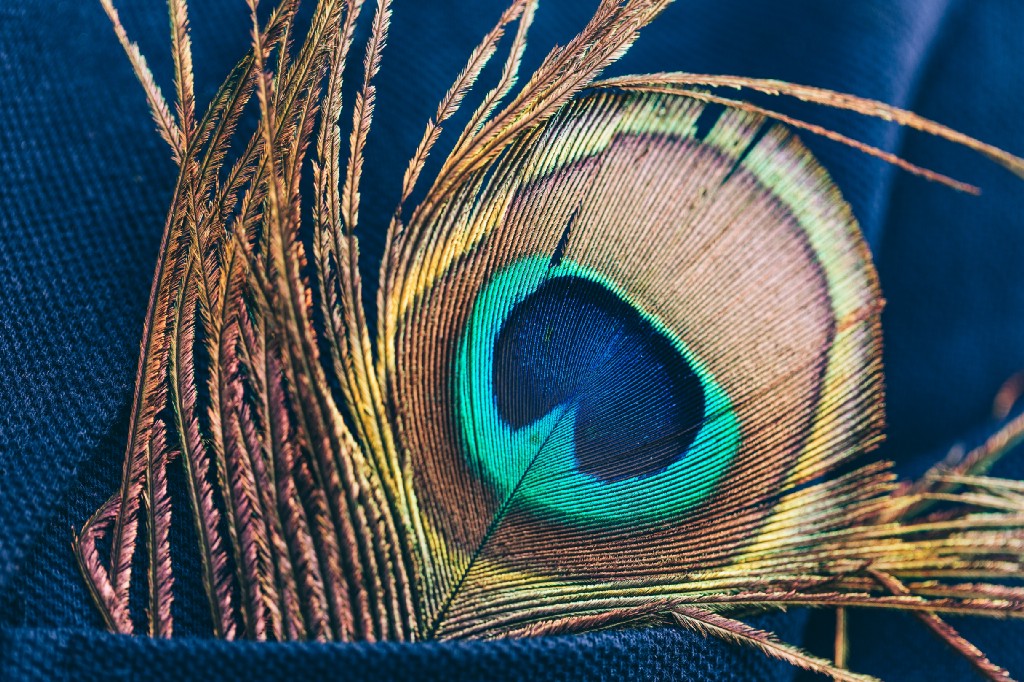
Returning to your question about how I handled memory, each storyline employs a different strategy. The first, which serves as the frame, is a week-long encounter between a 101 year-old woman, Prudence, and her 43 year-old hospice nurse great-niece, who Prudence has not known even existed. Prudence is remarkably cognitively intact but, like all of us, her early childhood memories are recalled in fragments — in part, because it would be overwhelming to remember everything (though there are rare persons who do, moment by moment); in part, because very young children operate in a register where imagination and reality are blurred; and, in part, because we sometimes repress our most painful experiences. Grace has brought a box of her grandfather’s mementoes: newspaper clippings, beach stones, photographs, a packet of letters, the top of a peacock feather. Looking through these ancient items seems to Prudence, she tells Grace, like shaking a dandelion such that bits of her youth are now floating between them. Grace’s situation is entirely different: she too vividly recalls a terrible time in her life, and struggles with whether she will share her memories with Prudence — struggles both because she’s never fully shared them with anyone, and because she fears they may cause Prudence pain. As so often happens, the exchange of memories between the two women becomes a currency of intimacy and ultimately cements their bond.

The other two storylines are Prudence’s and Grace’s individually. Prudence’s starts with her earliest memory of an event she only later realizes was Louis C. Tiffany’s Peacock Feast, and then traverses the century until she meets Grace. By relating this storyline in close third-person through the younger Prudence’s point of view, I was able to depict scenes from Prudence’s past that at 101 she remembers only vaguely or not at all. Because there’s a mystery of sorts at the core of the book, I had to be judicious about what to include — laying the seeds for what is later revealed so that it hopefully feels as inevitable and credible to the reader as it does to Prudence, but not allowing the reader to have the reveal before Prudence.

The exchange of memories between the two women becomes a currency of intimacy and ultimately cements their bond.

RM: This was something else I loved: the way you could withhold information without it feeling like you were. I was only very subtly aware of it (and only then, the way a magician at another magician’s magic show is always looking for the strings) and I never felt manipulated.

I did see Prudence and Grace as the bookends of the story — not only because they’re the oldest and youngest living members of this family whom we meet, but because they’re our investigators, the ones standing in for us and our curiosity.

LG: What an apt analogy: most writers I know do read other writers’ work with a double consciousness — for pleasure, but also with an eye for how they’ve pulled off their feats. As for Prudence and Grace as readers’ stand-in investigators, you’re absolutely right, though their investigations and revelations are constrained by their empathy for each other — each aware that both their stories and their inquiries could cause suffering for the other.

With Grace, I was guided by the aphorism that our personal histories commence with our grandparents’ memories as well as by the awareness that Grace’s storyline would need to fill in what Prudence doesn’t know about Randall (Prudence’s brother and Grace’s grandfather) — which is essentially everything after he left New York at 14, stowing away on a train headed west. Here, as you’ve observed, the reader and Prudence are in the same shoes: to understand Grace and how she came to be born on a commune in northern California and why she was raised by her grandfather, Grace’s storyline has to start with Randall on that train and recount both his tale and his son’s. Many of those stories would not be known in any detail, if at all, by Grace and therefore had to be told through other points of view — though I did pass the baton back to Grace once the narrative caught up to her being part of it and of an age to sufficiently understand what was going on around her.

RM: You’re a psychoanalyst as well as a writer, and it seems clear, both in your writing and in your answers here, that you think about your characters through that lens. Is this conscious, or (oh God, sorry, no psychoanalysis puns intended) subconscious? In other words: As you write, are you thinking about these characters as an analyst would, or are you thinking more as your characters, going on instinct about the way they’d see themselves?

LG: My thinking as an analyst comes into play during the early stages of note-taking, while I’m fleshing out my characters. Then, I want to know about my characters in the same ways when I was in practice I wanted to know about my patients: early memories, fantasies, relationships. By the time I begin what I think of as the actual writing, all of that information recedes into the background and I let my unconscious (which we know from dreams is endlessly inventive and mischievous) play a role in guiding what characters then do on the page.

RM: And of course one of your characters, Dorothy, is a psychoanalyst. This is Louis Comfort Tiffany’s daughter, a real woman who worked with Anna Freud. I kind of hate asking origin stories (if only because I hate being asked about origins, when the origins of a novel are always so many and so obscure), but did your knowledge of the history of psychoanalysis lead you to Dorothy and then to this family, or did you discover her along the way?

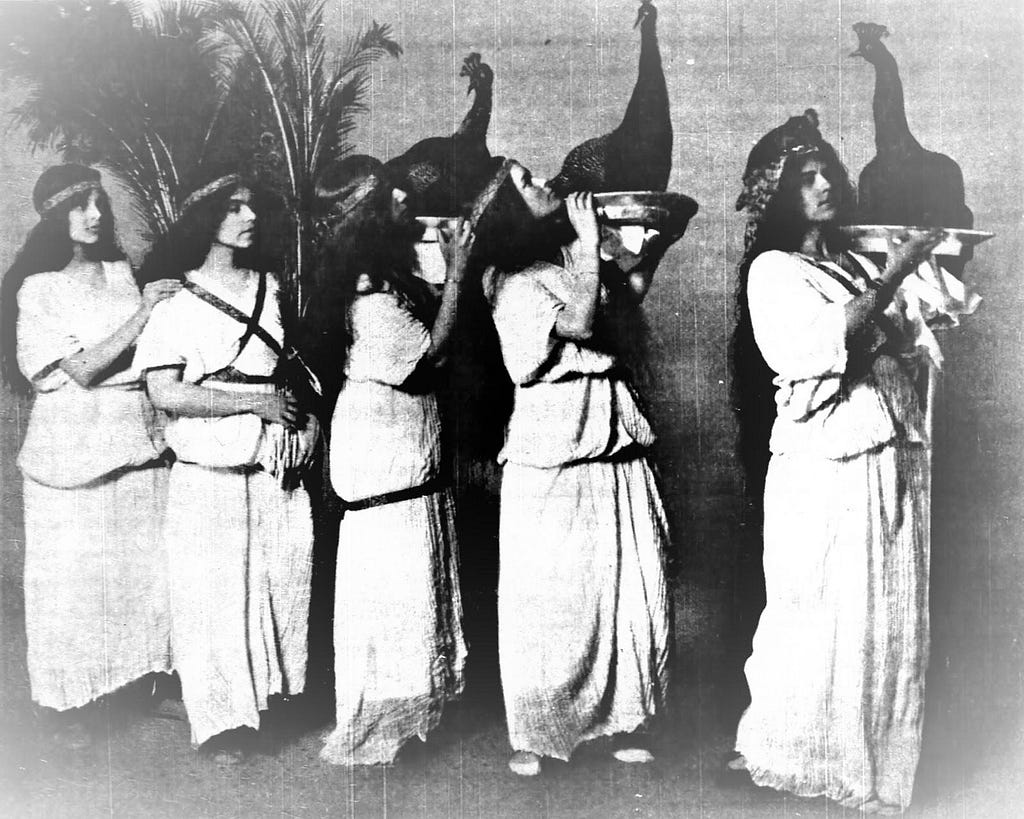
LG: The origin story of a novel: such a lovely idea! Here’s a version: The Peacock Feast began on a snowy February day in 2007 — a long time ago — at The Metropolitan Museum of Art when I wandered into what turned out to be a magnificently curated exhibit about Tiffany’s fantastical Long Island estate, Laurelton Hall. There were room after room of extraordinarily beautiful objects — Tiffany’s own paintings, the stained glass windows he’d installed in his mansion, his vases and exotic collections of artifacts — but it was a photograph, published in 1914 in The New York Times and titled “Roman Luxuries at Tiffany Feast for Men of Genius,” that stopped me in my tracks.

Who were these girls with these horrifying roasted peacocks hoisted atop their shoulders? How did they feel parading in gauzy costumes in front of the 150 “men of genius” Tiffany had invited to his extravagant and bizarre event? When I later discovered that the center girl in the photograph was Tiffany’s youngest daughter — who I recognized from her married name, Dorothy Burlingham, as Anna Freud’s partner and an important figure in the history of psychoanalysis — I knew this was my novel to write.

Who were these girls with these horrifying roasted peacocks hoisted atop their shoulders?

RM: Some real historical figures, namely Tiffany, don’t always come off terribly well in this book. (Others, like Dorothy, come off much better — but you’re still manufacturing details about their lives.) Did you have qualms about representing real people on the page? Did you feel that there were limits to what you could invent?

LG: As I say in the acknowledgments, my rule of thumb for characters who once lived and occasions that actually took place was to hew as closely as possible to the historical record. My depictions of Tiffany’s wide-ranging career (from painter to decorator of the Presidential Palace in Havana to inventor of new glass techniques), his phantasmagorical Laurelton Hall, the performance art Peacock Feast, and his behavior as a parent derive from the rich body of material on his life and work that I extensively studied — and I think accurately portray the scale of his genius and the complexity of his personal relationships. Surprising as it may seem, Tiffany appears in the novel in only one scene when, without saying a word, he peers briefly into a room where Prudence’s father is working. Most of what is recounted about him is through the stories of invented characters or through imagined conversations between historical and fictional persons in the fictive world of the novel. As for the potentially incendiary part of the novel, the implied accusation of Tiffany by Prudence’s mother, it’s left to the reader’s interpretation if what Prudence’s mother hinted really happened or is a laudanum-induced fantasy: a transformation of the powerlessness she felt as the employee of a very wealthy man into a concrete trauma.

RM: That’s indeed what I was referring to, but wow, wait a minute — it really hadn’t occurred to me that we just glimpsed him that once! He looms so large here, and of course maybe that’s precisely because we never get up close to him. Were you tempted to put more of him on the page?

LG: No. The novel is really not about Tiffany: it’s about the legacy of feeling dehumanized that spans four generations. Of feeling, as Prudence believes her immigrant servant parents had with their wealthy employer, moved around like pieces of furniture. As the poignant account of the undocumented Guatemalan housekeeper who worked at Trump’s New Jersey estate demonstrates, it’s a story that’s very much alive today.

RM: I love what a well-populated novel this is, and I don’t just mean in terms of the number of characters. It feels like there’s a narrative commitment to following all the characters, and this means we get a look at the lives of immigrant servants as well as the working class and the well-off and the extremely wealthy. I wonder if you could have written such a class-conscious book if you didn’t have such a broad cast, or if novels that deeply explore class must, by definition, be ensemble pieces. Did following those lives feel like character-led diversions, or did it feel like you were assembling these stories for a greater narrative purpose?

LG: I love what a well-populated novel The Great Believers is! And, the same could be said about the narrative commitment you made to the worlds you bring to life: the gay community of Chicago in the 80s during the AIDS siege, and the community of survivors for whom those losses remain alive thirty years later and across a sea. It’s interesting to me that we both turned from stories to multi-generational sagas. I am a great admirer of the spare prose and clean narratives of Rachel Cusk’s Outline trilogy and Sigrid Nunez’s The Friend, books with constrained casts of characters and tight time frames. But I also love books, like Alice McDermott’s novels and Jennifer Egan’s Manhattan Beach, that tackle wider swathes of society and history — and, as their many admirers demonstrate, I’m clearly not alone.

As for “narrative purpose,” I’m only now beginning to see how I might define that more clearly from the outset (a goal, in fact, for the novel-in-progress) rather than discovering it post facto.

RM: If the you who started this book could have read the finished product, what do you think would have surprised you the most?

LG: Certainly the gorgeous cover that reflects so many of the novel’s motifs. I’d always imagined using one of the black and white photographs from the actual Peacock Feast, but my whip-smart editor, Sarah Crichton, nixed that idea: it would telegraph “historical fiction,” which she pointed out would be misleading since a third of the book is set in 2013 and, of the rest, a good portion takes place from the ’60s forward. I imagine that you faced the same question about whether The Great Believers, which toggles between 1980s Chicago and Paris in 2015, should be viewed as “historical.”

I would have been surprised, too, by some of the recurring themes: art vs. decoration, the bond between brother and sister, what makes a home, what constitutes a good death. Most of all, though, I would have been surprised by how damned hard this book was to write, how many characters and scenes were left on the cutting room floor, and the number of drafts it took to complete.

Lisa Gornick is the author of Louisa Meets Bear, Tinderbox, and A Private Sorcery. Her stories and essays have appeared widely, including in The New York Times, Prairie Schooner, Real Simple, Salon, Slate, and The Sun. She holds a BA from Princeton and a Ph.D. in clinical psychology from Yale, and is on the faculty of the Columbia University Center for Psychoanalytic Training and Research. A long-time New Yorker, she lives in Manhattan with her family.

R.O. Kwon Picks 5 Books By Women You Should Read

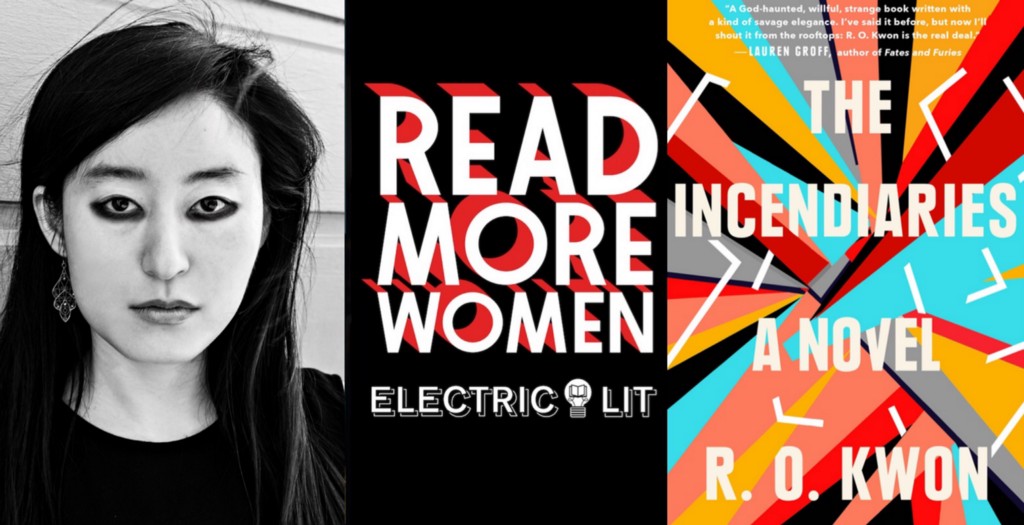
If you didn’t hear about R.O. Kwon when her debut novel The Incendiaries blew up last year, you may know her from the latest installment of her “books by women and nonbinary authors of color to read this year” series, published earlier this month in Electric Lit. This year there are 48 recommendations, more than ever before—but Kwon also did a list of 46 highly anticipated books by women of color in 2018, and 34 in 2017. Not only that, but she convened a roundtable of prominent Asian American woman writers for a fascinating discussion about race, politics, and publishing.

So you might think Kwon has already done enough to promote the cause of reading more non-men. But she’s not resting on her laurels. In the latest installment of our Read More Women series, presented in collaboration with MCD Books, she offers five ways to expand your reading list—not just to include more women, but also to include more Korean American writers.


Last year was an extraordinary year for books, movies, and television by and centrally featuring Korean Americans, a group not at all used to seeing itself on the page and screen. I’m Korean American, and a writer, and it wasn’t until after college that I first encountered the published work of other Korean American writers. This means that, until I graduated from college, I was obsessed with an art form, literature, in which people like me did not exist. I keep talking about this, it seems; I can’t stop talking about it, in part because I’m still aghast. No one should have to grow up that way, and nowadays, it’s becoming increasingly, spectacularly possible to avoid such a lack.

All You Can Ever Know, Nicole Chung

2018 was lit up by new work from, among other luminaries, Alexander Chee, Jenny Han, John Cho, and Sandra Oh, but since this is a series about reading more women, I’ll start by talking about Nicole Chung’s All You Can Ever Know. Have you read this book yet? It’s a memoir about Chung’s adoption, powerful and generous and wise, and it will crack your heart open.

If You Leave Me, Crystal Hana Kim

The fact that the Korean War is commonly referred to as “the Forgotten War” sometimes has me nearly levitating with rage and sadness. Forgotten by whom, fuckers? You know who has not come close to forgetting that imperialist, country-dividing war? Every Korean person I know. Kim’s debut novel is inspired by her grandmother’s experiences as a war refugee, and it’s as devastating as it is unforgettable.

Crystal Hana Kim Thinks Worrying About Publication Kills Creativity

Emergency Contact, Mary H.K. Choi

Emergency Contact is one of the smartest books I’ve read in some time,” said my husband, one of the best readers I know. (I’m biased, but hey.) This novel is about two people, Penny and Sam, who fall in love over texts. In addition to its aforementioned intelligence, the book is exceedingly charming. Just go read it.

The Kinship of Secrets, Eugenia Kim

Back to that not-at-all-forgotten war: The Kinship of Secrets is centered on two sisters separated by the Korean War and its repercussions. It made me cry, and it reminded me to call my own sibling. The Kinship of Secrets is based on Kim’s family’s experiences.

The Way You Make Me Feel, Maurene Goo

In this engrossing novel, Clara Shin has a summer job she doesn’t want at her father’s Korean Brazilian food truck. I first came across the book by reading an interview of Goo in which Steph Cha says, “I read Maurene’s latest, The Way You Make Me Feel, with great joy and a sense of recognition I never got to experience as a young adult reader,” to which I say hurrah and manseh.

Life Is a Joke and Death Is the Punchline

“Predestination”
by Trevor Shikaze

A popular theory of the moment, around the time of Ronan’s predestined end, held that death comes as a culminating thought. Your death, according to this view, makes perfect sense to you when it happens because it ties up the main themes of your life. You basically say, “Oh, of course this is how I go!” and then you go, having learned whatever it was you came to this plane of existence to learn. Your final thought is then entered as a line in the Great Book of the Universe, preserved there for the edification of the angel masses.

Absurd, of course, yet Ronan did sometimes find himself wondering about the mechanics of it all, now that his time was drawing near. He would find himself in the copy room, listening to the machine arrange itself within, and in the idle moments while his job still pended, while the toner cartridge warmed to a hum, before he could do much of anything but wait, he would wonder. What would it be like to die?

Of course people had wondered about this since forever, but knowing just when you were due to expire lent the matter a certain vividness. Not that there was much point in wondering, since you had no way of knowing until it happened, and then, if you were a rational materialist agnostic like Ronan, you had to assume that when the event rolled around you probably wouldn’t know, because that’s probably how it went, this life and death business: lots of wondering and then nothing.

Ronan glared at a motivational poster tacked up above the copy machine. Today was the first day of the rest of his life. That was true — and as hackneyed as ever. Yet in recent years the slogan had seen a resurgence. It was everywhere now. In fortune cookies, on bus shelters, on banners at the mall. The copy machine sucked papers through itself and spat the job out.

“It’s the foreknowledge, Mom, it’s the foreknowledge that grinds at me.”

He spoke to her softly in his cube, on the phone.

“Oh, honey, think about how we feel. If only there were something we could do.”

“How you feel? Think about how I feel!”

“I know. It isn’t fair for any of us. A parent should never have to outlive their child.”

She was not the right person to talk to about this. But who else could he talk to? Ronan had noticed that people just didn’t like to discuss it. Oh, they loved to talk in the abstract about death, especially if theirs was far away, off in their seventies or eighties. But Ronan’s was coming right up. He would die young, at thirty-four, just three months from now. Try bringing that up at a party.

“I wish I had never entered my name into the stupid system!”

“Oh, Ronan, we’ve all done it. Everyone’s curious.”

He grimaced at the ceiling tiles and sighed loudly.

“What difference does it really make, honey? You die when you die. I don’t see why it should matter whether or not you know in advance. Why don’t you quit that job and come out and spend the rest of your time with us? There’s a whole basement here — you’d practically have your own suite.”

He stared at the cube wall. It was a generous offer, but moving back into his parents’ basement was not, to his mind, an instance of living your best life. He’d never been to the Grand Canyon. He’d never been to Paris. Mom and Dad’s basement was not on his bucket list — and this bucket, by the Engine’s calculation, was very soon to be kicked.

“Of course there’s a possibility it won’t happen. At least not on the day the Engine says it will.”

The nurse taking his blood pressure gave him a pained smile.

“I mean,” Ronan continued, “this whole thing, it’s all averages and analytics. Big data. The Engine’s predictive model says I’m going to die in two months — but only predictively. You hear stories. You know, someone’s waiting for it, and then their time comes and goes and they don’t die. What’s the statistic? It’s like some fraction of one percent, right?”

She forced that smile. He realized even as he spoke that she must hear this all the time.

“I mean, someone has to slip through. Why not me? All the Engine can do is model. It can’t know.”

She jotted a number on his chart and asked him to put his pants back on.

“I just have a very strong feeling about it,” he said. “That I’ll slip through.”

The nurse told him his levels looked normal except for slightly elevated blood pressure, and that if she had to guess, she’d wager on him dying in an accident. Maybe a car crash. But she was no fortune teller. He thanked her and she hurried off to her next patient. In the waiting room, a man looked quaveringly up from the lifestyle magazine draped on his knees.

“Probably an accident,” Ronan said to the man.

The man blinked and his eyes fell back to the magazine.

On his way home Ronan stopped at the liquor store and picked up a three-liter plastic jug of vodka.

“I’m having company over,” he said to the indifferent youth behind the counter.

“Always good to stock up. Are you a member?”

“What, here? No. I brought my own bag.”

In his apartment building’s lobby, he ran into Lynne, a neighbor who lived two floors down. Ronan was standing by his mail cubby — which was empty — when he felt the unmistakable breeze that Lynne’s body made whenever she glided past. The breeze smelled like Herbal Essence and the meaning of life. He glanced toward his feet, at the organic grocery store bag and the jug of vodka within, which he told himself Lynne might mistake for a jug of laundry detergent if she wasn’t looking too closely.

“Hi, Ronan.” She made the face. He hated to see this face, yet he was in love with Lynne so he’d take what he could get. The face said, I am so, so, SO sorry. She tried to sound cheerful: “How are you?”

“I’m okay.”

She gripped his arm and gazed earnestly into his eyes. “Stay strong,” she whispered, then she left him.

He rode the elevator to his floor, got in and set the vodka on his kitchen table. Mr. Butts came charging out of wherever he’d been sleeping and meowed plaintively.

“If only you knew, Mr. Butts,” Ronan said. “I’m going to die. Who will feed you then?”

He wept as he spooned low-fat cat food into Mr. Butts’s dish. He crushed up one of the pills the vet had prescribed to manage Mr. Butts’s heart condition. He mashed the bits into the food. Mr. Butts ate happily. Ronan sat at the table and opened his breadbox. He ate a slice of bread just to put something in his stomach, then he poured himself a nice big mug of vodka.

“Statistically,” he said to Mr. Butts, “it’s not a sure thing. And I got a feeling. But . . .” He pressed his fingers to his temples and kneaded. “You know, you hear them interviewed — the people who didn’t die when the Engine said they were supposed to. And they always say, I just had this feeling.”

Mr. Butts jumped up on the chair across from Ronan and looked at him contentedly.

“But the thing is,” Ronan continued, “everyone must feel that way. Everyone probably thinks they’ll slip through. It’s just that for the vast majority of people you don’t get to interview them after the date. Because they end up being wrong. Being dead. Dead wrong. Ha.”

Mr. Butts yawned and licked his paw. Ronan drank and called his best friend Tom.

“How are you?” Tom said.

“Why does everyone say it like that now?”

“Say what like that?”

“How are you. They emphasize the are. Why?”

Tom sighed from far away. He lived on the coast, one hour behind. Ronan was getting wasted and Tom hadn’t even put dinner on yet.

“Let’s talk about something else,” Ronan said, beating Tom to the punch. “Remember Jill’s sister?”

Jill was a girl who used to go to the same all-ages shows that Ronan and Tom went to when they were teenage punks in the suburbs. Jill’s sister had had a crush on Ronan — or so Jill had told Tom one night while they were making out. Ronan never tested the claim.

“She’s an accountant now,” Tom said. “We’re friends on Facebook.”

An accountant, Ronan thought. But she’d been so young and pretty and antiestablishment. Aloud, he said, “How does it happen?”

“How does what happen? Are we talking about death again now?”

“Do you think I should get on Facebook?”

“Ronan. Don’t. It’s too late.”

That night, after looking at porn on his tablet, Ronan got on Facebook. He’d always made fun of Facebook before, but he was desperate for connection. He created a profile, friended everyone he could think of, and blacked out.

“I’m on Facebook,” he said to Lynne from downstairs as she passed him in the hall.

She gripped his arm. “That’s good. Good for you.” She made a good-for-you fist and shook it at him in solidarity. “Good for you.”

“I’m on Facebook,” he said to Yeudall at work. Yeudall’s print job was queued after Ronan’s. Ronan was printing a long document.

“Oh,” Yeudall said.

“Are you on Facebook?”

“Yeah, of course.”

Yeudall wouldn’t look him in the eye. No one at the office would. Why were they suddenly treating him like a leper? Death wasn’t contagious . . . well, sometimes it was, but if they were all about to die in a group — some horrible outbreak situation — the Engine would have warned them beforehand. No one else in the office was slated for immediate death. Yeudall was in fact destined to live another forty years. Ronan had looked him up.

“I thought you hated Facebook,” Yeudall added.

“I just never really got it before. Now I get it.”

“You mean now that you’re — “ Yeudall broke off and glared at the floor. Beads of sweat glistened on his upper lip.

The machine finished printing Ronan’s job and switched to Yeudall’s. The fire alarm went off. In the hall, someone called out that it was probably just a drill or some kid had pulled the thing again, and they might as well stay in their cubes.

“No one’s dying today!” the person yelled. “Per the Engine!”

Everyone laughed and then collectively they stopped short, and Ronan knew that his co-workers now sat flushed, cringing in their cubes, worried that they’d offended him by mentioning death. He popped out into the hall.

“That’s right!” he joshed. “No one’s dying today!”

No one laughed. Silently, mournfully, they filed out to their building’s desolate courtyard.

“Everyone treats me like I’m already dead!”

“Well, dear, you are predestined — “

“That’s not the point, Mom! If you think about it, we’re all predestined! Every single person is eventually going to die someday! So my time’s coming up a little sooner! So? So what!”

He paced drunkenly around the kitchen. Mr. Butts dashed between his legs, trying to play.

“Not now, Mr. Butts!”

“Oh, honey, what kind of a name is that for a cat?”

“It suits him, Mom! You have no idea!”

“Are you on your cell phone? You always shout when you’re on your cell phone.”

“I only have a cell phone! This is my phone! Mr. Butts, get off the table!”

Ronan looked at porn and collapsed on the futon in his living room. He wondered why he called it a “living” room. What made it a quote-unquote living room? Nothing that Ronan could see, except that it wasn’t a room equipped for any other definable purpose, any real purpose, like cooking or crapping or sleeping. In the old days, you always had a TV in a living room, but Ronan didn’t own a TV — the only TV he ever watched was the one at the gym. How long has it been, he asked himself, since I went to the gym? A long time. The treadmill, for some reason, had started to give him the existential creeps. Running in place — ugh. It seemed like a metaphor for something. But exercise was good for you; exercise was pushing back at death, and that was good. He wondered if maybe he should go to the gym. At the very least, it might offer some distraction. He could use some distraction. He’d already looked at porn. What was left?

“Oh, hey,” he muttered to himself, “Facebook.”

He went on Facebook. His friends were all there. Everyone wanted to reminisce. Everyone wanted to tell him how much he’d meant to them. Everyone wanted to memorialize tearfully while they still had time. He barely even knew some of these people. And Doreen? What was she doing here? He hadn’t spoken to Doreen in fifteen years. Who invited Doreen?

He logged out, logged off, logged into bed. He lay there like a log.

What could this stupid life of his possibly add up to?

“I’m going on a round-the-world trip!”

Yeudall seemed to want to escape from the copy room, but his job was still pending and Ronan had blocked the door.

“Good for you, man. Good for you.”

“Yeah. No more dicking around for me. It’s time to live!”

In the apartment lobby, Lynne asked him when he planned to leave.

“Soon! I booked it so that I’m in Paris when I die. Paris!”

At the mention of death, she stared askance. Her forehead buckled and her lips began to quake.

“I’m sorry,” she said, backing away. “I’m so sorry! I’m so happy for you!”

She covered her face and ran for the elevator.

“Mr. Butts? Mr. Butts, where are you?”

Ronan pulled the place apart before he found Mr. Butts curled up dead under the dresser. The discovery caused him to bawl uncontrollably for three hours. Too bad there wasn’t an Engine for housecats. Ronan could have used a warning. He called the airline and canceled his flight.

“Mom? You know that suite in your basement?”

“Oh, honey. You’re coming home?”

“I just don’t know what else to do with myself. I don’t know what I want. I quit my job. They threw me a party. I didn’t go.”

“It’s a confusing time for you. I’m sure they understand.”

But they didn’t. They didn’t understand. How could they understand? Tom met him at the airport and drove him to the suburb where they’d grown up, and the whole way they talked about everything but death.

Because what could they say? No one, really, no one understood. Certainly not Tom. Certainly not Ronan. So even though they wanted to talk about death, they didn’t. Not as they sped by chugging smokestacks, or toxin-bright rivers, or Jesus billboards that asked if they were ready to see the light. Not even when they ran over a skunk. They just laughed about the smell, and the fact of an animal where evolution had said, “Okay, for this one we’re gonna focus on the ass!” And though the predictive models had foreseen it, and the Engine had told him when to expect it, when the aneurysm hit, as he sat glumly masturbating to porn on the morning of his last day, Ronan’s final thought, the one that supposedly summed up his life, was, No, not YET —