Did Translators of Sophocles Silence Ismene Because of Her Sexual History?

What happened to Ismene? In one version of Sophocles’ Antigone, the daughter of Oedipus turns away from her interlocutor, Kreon, the ruler of Thebes, and addresses Haemon, his son, in absentia. Dearest Haemon! she says, how your father does you wrong. In another version, her sister, the doomed Antigone, replaces Ismene in the spotlight and speaks the very same line.

Ismene has been cheated of the line for hundreds of years by translators and editors, her words stolen out of her mouth and given to her sister. The transfer of the line may well be an example of the perpetuation of an age-old injustice against women who are seen as insufficiently pure.

I first discovered this when the line threw a wrench into my homework, or what passed for homework in my somewhat eccentric homeschool regimen.

The transfer of the line may well be an example of the perpetuation of an age-old injustice against women who are seen as insufficiently pure.

Mom, my homeschool educator, had elected to spare me the failings of the California public school curriculum, by far the most glaring of which in Mom’s eyes was that the system, unforgivably, allowed kids to ascend from K to 12 without once being asked to conjugate an irregular Ionic verb or scan an Alcaic stanza.

On that afternoon, Mom tasked me with translating a passage from the second episode of Sophocles’ Antigone. And I cheated. Instead of committing the passage in Greek to memory, as Mom insisted, I visited the nearby Will and Ariel Durant branch of the LA Public Library and cribbed from a translation from the shelves — the well-known David Grene version. I revamped the Grene lines so that they sounded as if they’d been composed by me, Mom’s wayward son. When I brought my work home, I checked it against the Greek text of the play — Mom favored R.D. Dawe’s 1979 Teubner edition — just in case Grene had taken liberties. Mom was exceptionally good at detecting liberties.

And in fact, Grene had done something sketchy, so it seemed — or else Dawe had. The passage assigned was the short back-and-forth between Ismene and Kreon just before Ismene and Antigone are led away by Kreon’s guards at the end of the episode. Kreon speaks a line, then Ismene, then Kreon, and so on: stichomythia, a volleying form of dialogue common in Greek tragedy. Ismene says something like Seriously, you would kill your own son’s future bride? (This and subsequent translations are mine, not Grene’s.) Kreon answers crassly, Oh sure. No shortage of other fields for him to plow. Ismene says, But he’ll never find anyone as suited to him as my sister! Kreon says, Ugh. Suited or not, my sons will never marry enemies of the state.

At this point in the Grene translation, Ismene answers, which makes sense, because in stichomythia usually the same two characters volley without interruption for a solid page of text or two. But in Dawe’s Greek text, Antigone steps in and speaks the line: O most beloved Haemon, how your father dishonors you. That made sense too, because Antigone would naturally address her future husband as “dearest” or “most beloved,” while the endearment seemed a little on the strong side for timid, reserved Ismene. So what was the deal here? Why had the line flipped? To which of the sisters had Sophocles actually given the line?

Mom handled the confusion via our usual homeschool routine, by assigning me to improvise an essay that led off with one of her gnomic utterances: in this case, “I, Ismene, am a daughter of Oedipus, and I have been silenced.”

After she critiqued (meticulously) the essay, Mom walked me through the evidence: the aforementioned Dawe Greek text; a 1978 commentary on Sophocles by Jan Coenraad Kamerbeek which we frequently consulted (“let’s see what friend Kamerbeek has to say”), and the famous Jebb commentary on Antigone, first published in 1888. Each of these editions has been highly influential in its own way, and each gives the line in question, line 572, to Antigone, not Ismene. But this apparent consensus, spanning nearly a hundred years, is a relatively new development.

Without exception, in every one of the early manuscripts of Antigone — that is, all the versions of the text that survived into the 13th through 15th centuries — line 572 is spoken by Ismene. When the play was set in print for the first time, by Aldus Manutius in 1502, in Venice, the line assignment changed: Antigone spoke the line. Many subsequent editors accepted the switch either on the authority of the Aldine edition or according to their own logic. There are, Mom said, technical issues adduced by editors to justify the emendation, but these can be dismissed (for reasons she explained, but which I won’t get into). The true basis for the change is the propensity of male editors — nearly all the editors of Sophocles have been men — to idealize and sentimentalize Antigone, and the discomfort of the editors at a heroine who, in a play culminating in the dual suicides of her and her betrothed, doesn’t once explicitly profess her love for him. Putting line 572 in Antigone’s mouth thrusts her forward, heroically, into the spotlight at a key pivot in the drama, and transforms her into a character who, conventionally, apostrophizes her lover in explicit endearment: O dearest Haemon.

Putting line 572 in Antigone’s mouth thrusts her forward into the spotlight at a key pivot in the drama.

Mom’s reasoning seemed convincing enough, and as I discovered later, agrees with other views of why the line assignment changed. But eventually I came to believe that Mom hadn’t gotten to the bottom of the problem. (“Getting to the bottom” ranked high in Mom’s repertoire of injunctions and often figured in her critiques of my daily essays.)

Let’s first assess the scope of the damage. The editio princeps (first printed edition) of the plays of Sophocles, the Aldine — an easily available, portable version of the plays — disseminated whatever errors it contained with unprecedented efficiency throughout Europe and beyond, not only to readers of Greek, but through translations based on the Aldine Greek text. The Aldine, with Antigone speaking line 572, remained the most influential edition of Sophocles for over three centuries. It was superseded in the middle of the 19th century by a spate of important German and English commentaries, yet many of these, though they drew upon new scholarship, still seized upon line 572 as an opportunity to silence Ismene and put her sister front and center. And now we come to Jebb and his famous commentary, first published in 1888.

The central place of Jebb’s commentary in my childhood household, more than a century later, reflects its longstanding outsized influence: for generations, the Jebb Antigone dominated in the teaching of the difficulties of the play. Even now, Jebb is considered an invaluable resource, as can be appreciated by a quick online scan of undergrad syllabi, many of which rely on Jebb and Jebb alone. Beyond the academic value of Sir Jebb (knighted in 1900 for his contributions to classical scholarship), the commentary, along with Jebb’s other Sophocles commentaries, exerts a potent influence owing to its prominence in the Perseus Digital Library, by far the most widely used repository of classical texts converted into device-friendly bytes. Access to Perseus is irresistible for student learners, as each text is packaged conveniently along with a commentary, translation, links to lexicons, vocabulary tools, and more. And in Perseus, Jebb rules over what survives of Sophocles. For each of the seven extant plays, the sole available commentary at Perseus is Jebb’s; only two (and not Antigone) are provided with an alternative translation. The profound consequence of this near-monopoly is that Jebb’s choice to take line 572 away from Ismene remains in force and continues to make a strong impression on readers both in English, via the translation, and Greek, via the commentary. (The Greek text of Sophocles at Perseus isn’t Jebb’s; it’s from the 1912 edition of the widely read Loeb Classical Library series. But it, too, mutes Ismene at the line apostrophizing Haemon.)

How is it possible for an editor like Jebb or, later, Dawe (1978) and Kamerbeek (1978) and others, to approach a venerable classical text like Antigone, which has a manuscript tradition dating back centuries and centuries — that is, a family of handwritten manuscripts descended from the “official” copies made in the 4th century BCE — and in a single editorial decision, upend the tradition? The manuscripts for Antigone diverge at numerous important points because of copying errors and differences of interpretation, but they’re unanimous in attributing line 572 to Ismene. What entitles an editor to blatantly contradict the unanimity and essentially rewrite the text?

The short answer is that even the oldest and most reliable manuscripts are notorious for failures to accurately label which character speaks which line. In many cases an error is repaired by an editor early in the manuscript history, and the repair is universally accepted without controversy as a repair, an obviously necessary correction. In others, the unreliability of the earliest copyists leaves open an opportunity for editors to impose their own biases, quirks, and editorial agendas.

But the longer answer, as regards line 572 of Antigone specifically, involves the unacknowledged influence of Ismene’s sexual behavior in the classical tradition. Or, as Mom might have formulated it: “I am a daughter of Oedipus, and I have been unjustly silenced because of my sexual history.”

The unreliability of the earliest copyists leaves open an opportunity for editors to impose their own biases, quirks, and editorial agendas.

Within the play itself, the sexuality of the two sisters remains implicit: there is no overt sexual history written into the play for either sister. To the extent that there is sexuality within the frame of the play, it’s entirely sanctioned and belongs only to Antigone in unrealized potential in her role as Haemon’s future bride. Ismene as a character in the play traditionally has been viewed as a foil for Antigone, timid in contrast to Antigone’s recklessness, choosing subservience and conformity when Antigone opts for defiance. Whereas sexuality attaches to Antigone through her connection with Haemon, Ismene has neither future husband nor past or present suitors.

Outside the frame, though, looms a wholly different history for Ismene. The paucity of surviving ancient Greek texts makes it difficult to know exactly how Ismene and Antigone figured into myth and literature prior to their appearance in Sophocles’ Antigone in or around 441 BCE. What is known with certainty, however, is that the archaic poet Mimnermos, writing in the late 7th century BCE, mentioned an incident in the life of Ismene that’s strikingly at odds with the character of Ismene as portrayed in Antigone. The incident has been transmitted indirectly, in a hypothesis (i.e. brief introductory comment) to Antigone written by Salustios, a 5th-century CE rhetorician. Here’s the relevant passage in the hypothesis: “Mimnermos, however, says that Ismene, while dallying with Theoklymenos, was killed by Tydeus who acted at the behest of the goddess Athena.”

This murder can’t easily be reconciled with the events in Sophocles’ Antigone, because Tydeus is one of the seven warriors who joined forces to attack Thebes and were repulsed by, among others, Eteocles, Antigone’s brother whom she buries in defiance of Kreon’s edict: when the play begins, the battle is over and Tydeus is already dead. The word I’ve translated as “dallying” (prosomilousan) can have both innocent and euphemistic meaning. That it has the latter meaning here is proved by a vase by the artist known as the Tydeus painter, which depicts the moment just before the murder.

The Tydeus painter worked in the mid-6th century BCE and almost surely would have been familiar with the incident recounted by Mimnermos. In any case, other vases corroborate the evidence. On the vase in question, now in the Louvre, Ismene reclines on a kline (couch), unclothed, her right arm raised defensively against the drawn sword of Tydeus, who grips her shoulder with his left hand. Meanwhile Theoklymenos, also naked, flees while looking back — not at Ismene, it appears, but at the sword. The setting of the murder is debated — possibly inside the royal palace at Thebes; more intriguingly, in the interior of the temple of Athena where, it’s been conjectured, Ismene is a priestess of the goddess and has incurred her wrath by trysting at the temple: thus Athena’s command to Tydeus to punish her.

This isn’t the Ismene we know from Antigone.

All in all, the Tydeus vase and the Salustios quote, along with other scant remnants, point to a pre-Sophoclean literary tradition concerned with Oedipus, his children, and the battle at Thebes. The epic poems Thebais (nearly all lost) and Oedipodea (same) were at the centers of the tradition. In this tradition as we’ve received it, a key feature is the contrasting prominence, in the bits and pieces that remain, of Ismene and her sister. Ismene survives vividly thanks to the preservation of the incident that blends sex and death. Antigone, on the other hand, is scarcely known at all. Her name doesn’t appear until the 5th century, when Antigone was written, and her involvement in the burial of her brother is mentioned for the first time only a couple of decades before Sophocles’ play, in the closing scenes of Aeschylus’ Seven Against Thebes.

Moreover, for an editor, like Jebb, approaching the play with the intent to craft a new edition, the prominence of Ismene in the earlier tradition is magnified by the fact that her tryst and the violence that ensued, as described by Mimnermos, is appended to the play itself — that is, in the early manuscript versions of the play, the hypothesis written by Salustios either immediately precedes the first lines of the play, or follows the last lines. The upshot is that in the space around the text, Antigone figures only in her 5th-century heroic version, as the sister who defiantly buries her brother, while Ismene is referenced as the woman whom a goddess ordered to be killed because of a sexual transgression.

Ismene is referenced as the woman whom a goddess ordered to be killed because of a sexual transgression.

In terms of sexual history, Antigone enters the play as essentially a blank slate; Ismene at best is guilty of a liaison with an enemy warrior, at worst the desecration, through illicit sex, of the very temple in which she may be a priestess (a priestess, no less, of the patron goddess of the city in which the play was first performed).

Against this background, it’s easy enough to reconstruct, especially for a 19th-century editor like Jebb, the logic that would lead to silencing Ismene at line 572.

The editor already knows that the attribution of the line is in dispute; the famous Aldine switched the line to Antigone, and so did major editions in the 19th century prior to Jebb’s (e.g. Boeckh, 1843; Campbell, 1871; Dindorf, 1873). The attribution of the line thus is open for consideration. If Ismene speaks the line, the line is spoken by a character whose transgressive sexual history literally has become attached to the text of the play. From this tainted character’s mouth is uttered an appeal to rectitude and honor: O dearest Haemon, how far your father goes in dishonoring you! Where’s the propriety, so a biased editor might reason, in Ismene with her unseemly past addressing as “dearest” the betrothed of the (sexually) faultless, idealized and sentimentalized heroine? Isn’t the endearment sullied if uttered by Ismene?

But if Antigone speaks the line, then, in Jebb’s words, “this solitary reference to her love heightens in a wonderful degree our sense of her unselfish devotion to a sacred duty.” The duty — the burial of her brother — is performed by a woman distinguished by, again in Jebb’s words, “intense tenderness, purity, and depth of domestic affection.” The word “purity” is curious here because the play itself touches only lightly on themes of purity of character. “Purity” seems instead to reflect the editor’s awareness of the contrast between the two sisters in their histories outside the play’s frame. To transfer the line to Antigone reinforces this contrast of sexual histories: the editorial decision removes troublesome Ismene in favor of allowing Antigone to speak from her heart in a burst of “pure” romantic love.

If Ismene speaks the line, it’s spoken by a character whose transgressive sexual history has become attached to the text of the play.

Now let’s survey, once more, the damage done.

To some extent Ismene’s silencing has been mitigated by recent scholarship that defends the unanimity of the earliest manuscripts in assigning line 572 to Ismene, as well as by translations, such as Grene (1991) and Fagles (1982), that let Ismene voice the line. Still, beginning with the publication of the Aldine in 1502, the influence of the texts that silence her has been enormous, both for readers of Greek and readers in translation. Friedrich Hölderlin’s renowned translation into German (1804) follows the Aldine and silences Ismene. So does the the widely-read Harvard Classics translation of 1909, a version whose influence persists online. Ismene is silenced as well in H.D.F. Kitto’s 1962 Oxford World’s Classics translation; on Amazon, Kitto currently ranks #25 in ancient and classical drama. These are just a few of the line-572 disfiguring translations. As for Greek editions, the Oxford Kitto is itself based on the Greek text of another high-profile Oxford, the 1924 A.C. Pearson installment in the prestigious Oxford Classical Texts series. (It wasn’t until 1990 that Pearson was replaced by a new OCT Sophocles that gives the line back to its rightful owner.) Then there are all the aforementioned commentaries and their continuing influence, most notably Jebb’s, which, instead of receding into the past, has expanded its influence thanks to its stark online prominence at Perseus Digital Library.

And to paraphrase Mom, an early adopter of Perseus who synthesized her enthusiasm for homeschool rigor with a fondness for new technology, “Reading in translation is a sin that can be forgiven, but reading without a commentary is laziness of the worst kind.”
A Reading List on Coming of Age During Wartime

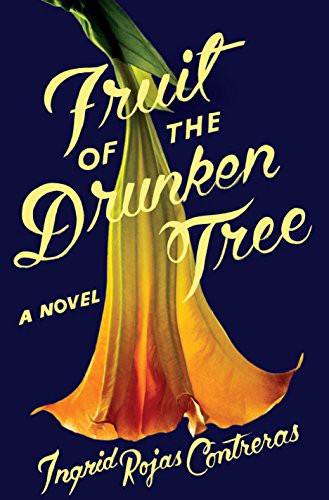
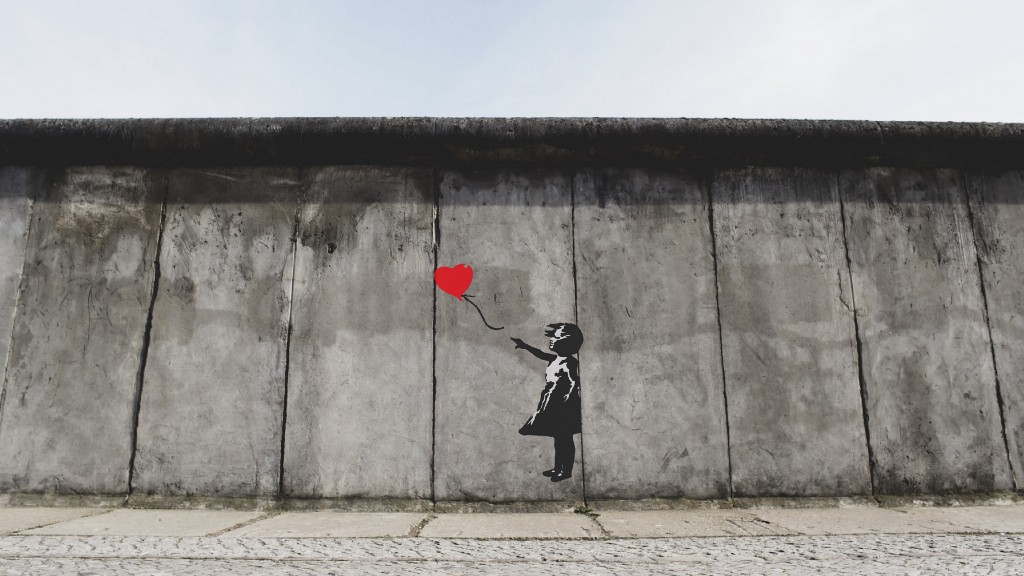
What is it like to enjoy a childhood while the world is exploding around you? It is the central literary question of my first novel, Fruit of the Drunken Tree, and it is also something I’ve pored over as I’ve reflected on my own coming of age. What I’ve realized is that you can come to love anything if you are a child. My childhood was playful and happy, though I grew up in Bogotá during a time when many things exploded in my vicinity. I plucked flowers from trees and pretended they were lipsticks, yes, like many girls the world over might have done, but the violence around us also seeped into our games.

Purchase the novel

I remember being a girl of nine, bored and sleepy in the backseat of my father’s car. We were waiting to be let in into a mall’s parking lot, but two security guards were checking each car for bombs. I thought it would be funny when our turn came to hide in the trunk. As my father lowered his window to talk to the security guard, I pulled the back seat down and crawled into the trunk. I waited, holding my breath, and when the officer opened the trunk I jumped out at him and yelled, Bú! For a second, the guard blanched and his hand latched onto his holster, but as I cackled and pointed, he slapped his knee and laughed, long and hard. My parents and sister thought this was hilarious too.

Humor is one of the things that change in times of unrest. While for children the political atmosphere becomes part of their make-believe, for adults, the notes that can surprise and elicit laughter can shift to a kind of vulgar extreme.

Here are seven coming-of-age books that tackle this question, and do it beautifully. They each offer up an entirely different aspect of child wonder, playful and darkened by the forces encircling and closing in.

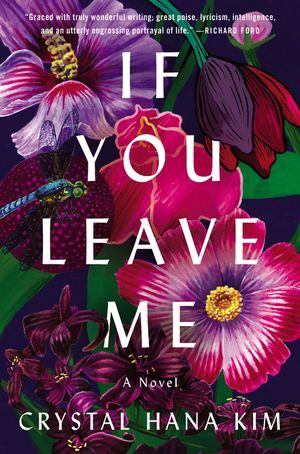
If You Leave Me by Crystal Hana Kim

“Everyone in our village whispered what they wanted to believe: the war would end and we would return to our real homes soon.” This gorgeous novel opens in a refugee camp in Korea where sixteen-year old Haemí escapes the unfolding anguish and misery of her family’s straw-roofed shelter, and sneaks to meet her childhood friend Kyunghwan. Late at night, they ride bicycles to nearby towns and scout out bars. They pretend to have different lives, to be older, to be lovers — all lies which they use to scam their way into the bars so they can be merry, even if fleetingly. For her and for Kyunghwan life goes on. But soon the reality of the war will catch up to them. If You Leave Me is told from the point of view of multiple narrators, and it is a story of love found, love absconded, and all the things we do in the name of survival.

Prayers for the Stolen by Jennifer Clement

In the village of Guerrero in Mexico girls who are beautiful disappear. So young Ladydi is disguised as a boy when she is born. “Thank God a boy was born!” Ladydi’s mother says. “Yes, thank God and the Virgin Mary,” everyone answers. “On our mountain only boys were born, and some of them turned into girls around the age of eleven. Then these boys had to turn into ugly girls who sometimes had to hide in holes in the ground.” The mothers rub coal over all the girls’ faces and have them hide in holes, because when the men from a nearby cartel do regular sweeps and see a beautiful girl, she is kidnapped and never seen again. Written in that strange timbre where humor meets tragedy, Prayers for the Stolen is immaculately playful and horrific.
Purple Hibiscus by Chimananda Ngozie Adichie

Fifteen-year-old Kambili lives in secluded safety in her wealthy family home in a compound in Enugu, Nigeria. There are high walls with coiled electrified wires, but beyond, a military coup is reshaping the political landscape. Kambili contends with her father, who in spite of being a profoundly religious and well-respected man, has disturbing and violent urges. Glimpses of political unrest — screaming protestors, a growing military presence, car searches with drivers held at gunpoint — sweep by Kambili’s window as she travels to and fro from her home to school, and struggles to become the woman she needs herself to be. I find Adichie’s first novel to be as stunning as all her subsequent work.

Papi by Rita Indiana, translated by Achy Obejas

In the Dominican Republic, an unnamed eight-year-old girl waits for her father to return from the United States. She hopes he will return with gleaming gifts — new cars, or polo shirts, or brand new Nikes. There are many families ripped apart by the violence of the drug trade, but this novel explores how a rupture is felt and understood by the young daughter of a drug dealer. “Papi is like Jason, the guy from Friday the 13th. Or like Freddy Krueger. But more like Jason than Freddy Krueger. He shows up when you least expect him. Sometimes when I hear that scary music, I get really happy cuz I know he might be coming this way.” As Indiana’s young character tries to puzzle out what it is exactly that her father does for a living, and danger looms ever closer, the prose becomes feverish and experimental, matching the suppressed anxiety of the narrator.

Kamchatcka by Marcelo Figueras, translated by Frank Wynne

In the 1970s, as those with left-leaning beliefs are rounded up and disappeared during the time that came to be known as the Dirty War, a family flees to an abandoned country house just outside of Buenos Aires. Harry is ten years old and is constantly shadowed by his brother, known to us throughout as “the midget.” In his new home, Harry berates his younger brother and commandeers missions to rescue suicidal toads who will drown in the pool. Details about the civil unrest slowly trickle in — close friends of his parents are disappearing or appearing dead, everyone is going into hiding, and Harry’s parents are fired due to their political convictions. Kamchatka is an indelibly written novel where memory, reflection, and play all have a place in understanding how to grapple with loss.

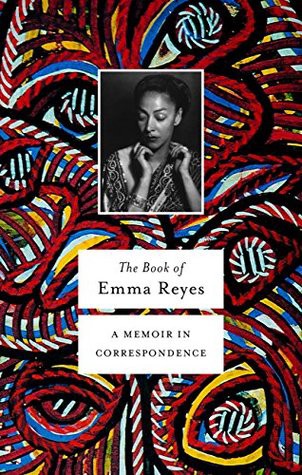
The Book of Emma Reyes by Emma Reyes, translated by Daniel Alarcón

On a visit to Colombia, The Book of Emma Reyes was pressed into Daniel Alarcón’s hands with the command that he read it. Alarcón was so taken with this book he made plans to translate it. It is no small wonder. The Book of Emma Reyes is a surprising and deeply moving tale of a childhood spent in extreme poverty in Colombia. A woman with a tangle of black hair who they didn’t know was their mother locks Emma and her sister for long hours in a dark room. When they are let out, the sisters play with the other neighborhood kids in a pile of trash. They make a clay sculpture of a man they call General Rebello. The writing is crisp and Reyes’ candor is sublime. This is a non-fiction story of a young girl at first imprisoned in a cell, and then escaping into the world.

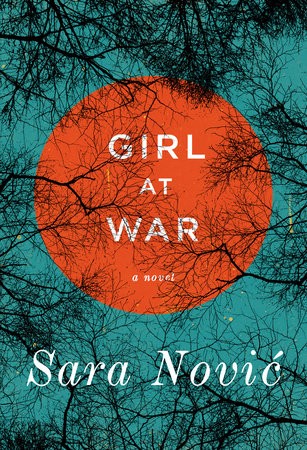
Girl at War by Sara Novic

Girl at War is a book full of intricate small interactions that carry the kind of tension possible only in a place at war. In Zagreb, Little Anna is sent to a store to buy cigarettes for her father, but there the shopkeeper asks her: Serbian or Croatian cigarettes? Not understanding how, but knowing it is a dangerous trick, Anna answers: “The one with the golden wrapper.” Anna does not get the cigarettes, but it is her first inkling that something big is about to happen. The paramilitaries loom in the horizon and on the television a man discourses on ethnic cleansing. Girl at War is wrenching and unforgettable.

9 Love Stories for People Who Hate Love Stories

The first time we met, my editor asked if we should call my novel An Ocean of Minutes a love story. She said love stories can really only end one of two ways: with the lovers together, or at least one dead. I was so intrigued and infuriated by this clever formula, that I was stumped. It took me days to think of stories that broke those conventions: In the Mood for Love, and Blue is the Warmest Color.

Purchase the book

But my ending was one thing I’d always known, even as clinching every other plot detail was like threading a needle with wet spaghetti. And I thought, if readers can accept migrant workers traveling through time to repair an apocalyptic landscape in exchange for health insurance, they can totally accept an ending beyond the binary of death or tidy happiness. But post-publication it turns out that, whether my readers love or hate the ending, many are taken aback by it. What looked obvious, inevitable to me, has been startling to some. What had I been reading, that made me so confident my ending was NBD?

I present nine titles that taught me to believe we can reclaim the Love Story from those love stories that give the genre a bad name — where abuse masquerades as devotion, or love conquers all (including complex characterization). Instead, in these nine titles, we get messy, wrinkled endings, and portraits of love that are as gnarled, sad, and resplendent as the real thing.

Bluets by Maggie Nelson

The speaker talks around her heartbreak, by the time we’re halfway through this fantastically strange memoir, her determination to distract herself has her looking at bowerbirds, colour theory, tarps, poison strips, and Wittgenstein, among one hundred other things. The few times that she finally turns her (and our) gaze towards her loss, the effect is blinding.

Empire State: A Love Story (or Not) by Jason Shiga

A shiftless young man named Jimmy carries a torch for a friend for years, and then follows her to New York. Instead of painting this mildly creepy behavior as charming, the narrative douses him in reality. But by some magic it still manages to be delicate with his feelings, and to show their depth and poignance. That gives them much more humanity, than any story that likes to romanticize stalking.

Asterios Polyp by David Mazzucchelli

Operatic in its rendering of love and heartache, but never remotely sentimental, Asterios Polyp uses every possible tool at a graphic novel’s disposal (color, margins, panel style, breaks, lettering…) to tell the story of a fool who loses the love of his life. The story insists that loss is irreversible, but yet somehow, manages to affirm the act of living. I love this book so much I tried to copy one of the chapters into my novel, but in textual form.

The Beggar Maid by Alice Munro

The title story of this collection is like the funhouse version of Twilight: it does everything to poke fun at Patrick’s idealized love, to strip away its pretenses and lay bare how it dehumanizes Rose, turning her into a literal object of his affection. But it’s the collection’s final story, which spotlights a love outside of common relationship categories, that best questions what we mean by love. “What could she say about herself and Ralph Gillespie, except that she felt his life, close, closer than the lives of men she’d loved, one slot over from her own?”

The End of the Affair by Graham Greene

Bendrix is in love with a married woman, and then she leaves him. Driven by bitter rage, he’s dogged in his quest to find out who is his ex’s next. The answer brings him suffering on a far more metaphysical level. “This is a record of hate far more than of love.” If you’re through with love, Bendrix is a good person to spend a few weeks with. Few books I’ve read describe the raptures and horrors of romance in such exquisite detail.

Never Let Me Go by Kazuo Ishiguro

Two childhood friends have been groomed their whole lives to do a certain, uh, job, but now that they’re on the eve of permanent work-related separation, they realize they’re in love. They go on a journey to find the top boss, believing that if they can show they truly love each other, they’ll be released. This book embodies that ardent, human wish that love will make us immortal, and it’s told in the most flat, affectless tone, which makes it all the more devastating. To this day, I can’t even think of the last page (or, to be honest, hear the word “Norfolk”) without tearing up.

Kazuo Ishiguro’s ‘Never Let Me Go’ Is a Masterpiece of Racial Metaphor

A Visit from the Goon Squad by Jennifer Egan

“Goodbye My Love” in Egan’s Pulitzer Prize-winning collection looks at many kinds of love — between spouses, parents and children, uncles and nieces. Egan shows how time hides the people we love, behind newer and newer versions of themselves. It is up to us to keep them in view, but do we have the fortitude? “That was all. He’d let her go, and she was gone.”

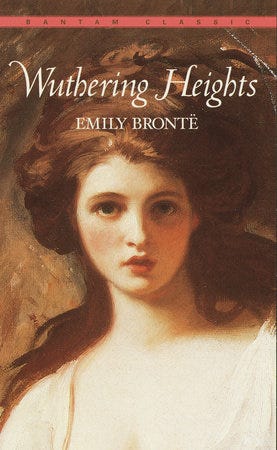
Wuthering Heights by Emily Brontë

Brontë Trojan horses us: you think you’re going to get a high-brow, corseted Victorian affair, but instead you get a spectacularly bizarre ghost story, a proto-paranormal romance, in the greatest possible way. “He’s more myself than I am, whatever our souls are made of, his and mine are the same.” Which is not that dissimilar from Kanye’s comment about Trump and dragon energy. If you like pulsing, bonkers artistic ambition, (like Kanye on his best day, not Kanye on a “slavery was a choice” day) this is the book for you.

1984 by George Orwell

(Spoilers ahead, though in my defense this novel is 70 years old.) Just as O’Brien uses Julia against Winston, Orwell takes our investment in the sparse moments of hope and tenderness in this novel, and uses it against us. He proves that oppression poisons everything, even our most private, intimate traits, the ones that make us human, or the ones that make us, us. Balls-to-the-wall bleak.

Sex, Love, and Architecture

Genevieve

I should’ve been born French
but instead I was born poor, weaned early
from my mother by the six breasts
of God, baptized in a river my brothers were taught
to swim in. I dreamed at night of burying my poverty

the way they bury afterbirth to train body sniffing dogs.
I wanted someone hot on the trail of my uselessness,
confusing my body for something as vital as death.

And didn’t this draw him out of me
the way my structures are drawn up from their landscapes
as naturally as if they’re a condensation waiting for the clouds

to pull them up and my hand to pin them down
as liquid onto paper? The way rain is translated for the starving masses

to understand grace, didn’t he think I could help time
translate his body, make it universally understood?

His tight baseball pants made him look
like a lazy ballerino, only performing when the eye
of the ball glanced his way. After his season closed

we drove his new stingray out to one of those half-framed houses
I loved because they gave the night sky
a concrete plinth to stand on,

and I wanted to, if not be enskied, at least
be connected to the sky’s pedestal. Inside the idea
of a bedroom for the longest time

he was rubbing under my skirt saying,
“How’s that feel?” Like my pubic hair
was a patch of velcro troubled
by a hook that wouldn’t latch. The night was close

and every part of me was sweat, no way to discern
wet from wet. The entire time we were fucking
I kept wondering if I should say, “I love you,” after.
“I love the feel of you,” he said after,

hedging my bets, dividing “you” from “love”,
and how clever! “Feel” was the softest cleaver
he could think of to separate us.

Then a car’s lights drove by that spooked
him out of me and when I stood up
to run off I felt him still

ringing against me like a swallowed, limp bell
and I its swallowed tongue breaking. I could hear
my mother’s voice, making a crack,

saying how I’d been deflowered and pollinated
at once. “I don’t even know you,” he said after
though we’d gone to school together since 2nd grade

and then he started crying
in little clouds that brought him to the ground.
His black hair was beautiful in the black grass,
black tears, black dew, a black so clear
you could see yourself at the end of the hallway of it.

Looking down, I wanted to kick each of his ribs in,
even his stolen rib. I wanted
to force my way into the absence
he was finally feeling, the pressure point
women know about because they’re built
and build from it.

*

I only dreamed of architecture, so I needed him to invent love for me. That summer I worked for an Amish man who needed an intermediary with the outside world to buy supplies and had excuse to frequent the feed store where he worked part of the year. I would walk in there with my hands holding up my stomach as though there were something to hold up after a week — a gesture that made his manager ask me multiple times, “You got some kinda stomach bug?” — because I was hoping he could round me out with his eyes, to stare with such intensity that the breeze from his heart would billow out my bandana, transforming me into a homespun velificans, but he only glanced back to his manager, saying wordlessly, “It’s not safe here,” then returned to his work. It was strange seeing a boy with skin that uncalloused dig his hands into different types of manure — “phosphate this, nitrogen that” — talking about each variety as though it were as distinct as a peony is from a lily, dressing up the cause until it wore the same floral gown as the effect, speaking in the high, confident tone of the rich, who can turn shit into an intellectual pursuit. He had the hands of someone who only worked during the summer; an inner glow to his flesh gave it away, like light passing through amber if the light hadn’t dirtied itself by touching anything before him.

*

Nothing ended up coming of it, but it was a nothing
with a face growing towards mine.

I realized for the first time that if my despair could change sources
so easily, from poverty to love,

then it no longer rested outside of me.
It had been planted inside long ago
and didn’t need tending. I pretended
the feeling was a shard of that first void,

that ex-nihilo nothing, but that was me
trying to connect myself to the sublime,
the purely potential. I told myself

I was the space God receded from
to make room for the world, and that even in my emptiness
I was standing in his black spotlight. And now, standing

over a bid for some museum I know will never get built,
that some idiot will deem too sculptural and unfeasible
while Frank Gehry goes on constructing buildings
that look like a tangle of Chinese dragons all in metallic rigor mortis,

the sinking feeling starts again. It’s a pulling inward,
an aquatic internal pressure on the sternum,
as if your own chest were a pool you could drown in.

I’m not afraid then because the pool, like me, is raging,
mad with whitecaps, uninviting. It’s the nights
where everything seems content with itself — some poppies shiver perhaps
in their vase, shaking off O’Keeffe’s consciousness —

I’m afraid. Those nights when nothing is wrong
and the nothing feeling surfaces,
when my pool is calm and tepid, then I’m scared of my hands,

which dangle down to the shoulder
to test the temperature of the water — water as fearfully still
as ghosts who, knowing too well the world

is made of finely-woven ash, refuse to run —
when so much less, a fingertip, a breath, would ripple
this glass into a living mirror.

About the Author

Corey Miller grew up in Southern Illinois. He has an MFA from the Michener Center for Writers and was the 2014 Philip Roth Resident at the Stadler Center. His poetry has appeared in the Best New Poets series, Gulf Coast, Kenyon Review Online, Narrative, The Southern Review and elsewhere.

“Genevieve” is published here by permission of the author, Corey Miller. Copyright © Corey Miller 2018. All rights reserved.

What’s the Point of Writing If You’re Not Going to Succeed?

An earlier version of this essay was posted as a Rumpus Letter in the Mail.

Here’s the thing no one ever tells you about being a writer: Pretty much everything about it — the act of writing, the act of publishing, especially the act of promoting — is miserable. And it only gets worse as the years unfurl.

I’ve had a decent career. Four novels and a story collection. They haven’t made me much money (after taxes and commissions, maybe the cumulative equivalent of three cars?), but they’ve brought me some awards and gotten me a tenured teaching job with a good salary and benefits.

Yet the truth is, there’s little that is gratifying about this business. A few people — the golden, the anointed — seemingly have everything go their way. Big advances, rave reviews, major prizes, SRO crowds at readings, movie deals, the luxury of not needing a day job. For the rest of us, namely for so-called midlist authors like me, it’s a different reality.

A few writers — the golden, the anointed — seemingly have everything go their way. For the rest of us, namely for so-called midlist authors like me, it’s a different reality.

Writing is torture. Particularly while writing a novel, there is an inherent terror in the process, a fear that the whole enterprise will reveal itself to have a major, irreparable flaw and everything will fall apart (a lot of times, it does). They’re not much fun, those early drafts. This is nothing new. That’s not what I’m talking about.

No, I’m talking about something else. One of the most ridiculous things I’ve read recently was embedded in an appreciation of Denis Johnson, a writer whose work I loved. The article quoted someone who’d praised Johnson for his humility, for not indulging in the usual “ego humping” whenever an author publishes a new book — the readings and tour and interviews. This is about as laughable of a misconception of writers as you can get. “Ego humping”? That’s the last thing most writers are seeking or anticipating when they release a new book. Rather, what they’re really hoping to do is avoid abject humiliation.

Let’s face it, writers are, in general, a neurotic, insecure, self-flagellating lot — often shy and withdrawn and introverted by nature. For many, that’s what drew them to writing in the first place. That’s certainly true with me. So being pressured to perform and be charming and sell myself is absolutely terrifying. Over time, I’ve learned to be a good performer, but I am still filled with dread each time I have to do anything in public. It doesn’t matter that most of the time when I give a reading, there’s hardly anyone in the audience.

Almost as bad is having to promote myself on social media, which, regardless of how delicately and infrequently you post things, invariably annoys the hell out of everybody and makes everyone hate you.

Then there’s the agony of waiting for reviews, or receiving snarky or unfair or devastating reviews, or not being reviewed or interviewed at all and feeling truly irrelevant. All the while, you know there’s a clock ticking down on your career.

Is There Such a Thing as a Good Book Review?

Being a midlist writer is the most tenuous position in publishing. Believe it or not, it’s not the first book that’s the most difficult to publish. When you’re trying to sell your first book, you have no track record, no sales figures. It’s all promise and hope. Down the road, after three, four, five books, everyone can see — via your downward sales and media trajectories — how short you’ve fallen of your promise, and it becomes harder and harder to get a publisher interested in your next project.

So the question arises: Why do I keep doing this to myself if it’s so painful, if there are so few rewards for doing it? Why does any midlist writer continue in this business? What’s the point?

I don’t get many fan letters, but early in my career I received a couple that included what I thought was an odd petition: “Please keep writing.” As if there were the possibility that I wouldn’t. Now I think those fans were prescient. It would be very easy for me to quit writing at this point. It’s actually getting to be very tempting for me to quit. Those couple of fans notwithstanding, it wouldn’t matter to most people. I doubt anyone would even notice.

Why do I keep doing this to myself if it’s so painful, if there are so few rewards for doing it?

When I bleat into this kind of self-pitying state, though, I think about a writer who was probably the most miserable person I have ever met: Richard Yates. His work is familiar to quite a few readers now, thanks to a retrospective by Stewart O’Nan in The Boston Review in 1999, Blake Bailey’s biography, A Tragic Honesty, in 2003, and the film adaptation of Yates’s first novel, Revolutionary Road, in 2008, but at the time of his death in 1992, he was largely forgotten, and all his books quickly fell out of print.

Even within his lifetime, he was a writer’s writer, meaning he had a small following among literati but otherwise was almost completely unknown. I came across his work by pure chance in my early twenties. I was in Burbank, California, living in my parents’ condo, which was sitting empty at the time, working odd jobs, and waiting for grad school in Boston to begin. I spent a lot of weekends in a vast used bookstore in downtown Burbank, roaming the aisles and picking out battered paperbacks, almost at random, for fifty cents a pop. I happened to buy Yates’s first collection, Eleven Kinds of Loneliness (how could I resist that title?), got hooked, and read everything else I could find by him.

His bio note said Yates lived in Boston, and as I was about to leave for Massachusetts, I thought it’d be cool if someday I got the opportunity to meet him. My second night in Boston, I saw Yates sitting in a booth in a bar called Crossroads on Beacon Street. I recognized him from his author photo. It took me an hour to muster the courage to walk up to his booth. I said, “Mr. Yates, I just want to say that I’m a great admirer of your work.” He said, “Sit down. Have a drink.”

Thereafter, I ran into Yates fairly regularly at the bar over the next few years. (He lived above Crossroads, and ate lunch and dinner there every day.) We’d have a drink, talk a little. He asked to look at my work, and he read one or two of my short stories, and while he said some nice things, he also took them (and me) apart. He wasn’t really a mentor — I never really got to know him very well — yet he probably taught me more about being a writer than anyone else. Initially what he did was dispel any romantic notions I had about what constituted a writer’s life.

First of all, although he usually wore a gray suit and a tie to the bar, he was an awful sight. He was a drunk, a bad one. He’d sit at a booth, hunched and slumped, chain-smoking, getting ashes all over his suit and the table, and proceed to get thoroughly soused every night. He’d once had TB, and he had a terrible hack, coughing so wretchedly and for such a prolonged time that customers would ask the waitstaff if an ambulance should be called. Phlegm would fly. Snot would drip freely from his nose onto his beard.

He had no life. He had been married twice and had three daughters, but he rarely saw them. He was bipolar, and had breakdowns that required occasional hospitalization. I never visited his apartment, but I heard that it was bleak: two tables he used as desks, a typewriter, a radio tuned to classical music stations, and a television set on the floor that he never plugged in.

Yet, religiously, he sat down to write every day, despite being convinced that he was a failure, that he would be forgotten.

He had no life. Yet, religiously, he sat down to write every day, despite being convinced that he was a failure, that he would be forgotten.

One time, I saw him at Crossroads, jotting something down on a napkin. When I asked him what he was doing, he bashfully revealed that he was listing the titles of his books on the napkin. “Nine books,” he said. “Nine’s not bad, is it?”

He died in Tuscaloosa, Alabama, of all places. “Fucking Dixie,” he called it. He had gone there for a one-semester teaching gig at the university and, enfeebled by emphysema, had stayed on for the last couple of years of his life. After he died, some professors and grad students cleaned out his apartment. They knew he had been working on a final novel, and they searched for the manuscript. They looked everywhere, to no avail, their panic growing. Finally, someone found it in the freezer of Yates’s refrigerator. He had had a fear of fires. He’d once accidentally burned down an apartment. The freezer was a poor man’s fireproof safe.

I think of what Yates had faced — his alcoholism and ill health and loneliness, his psychotic breaks and tragic, myriad insecurities — and I marvel that, in spite of everything, he continued to write.

I think of what Richard Yates had faced , and I marvel that, in spite of everything, he continued to write.

Why did he keep doing it? It was torture for him, and he was so miserable. He had every reason to quit. He never made any real money off his writing. He was unappreciated by the press and ignored by the public. He wasn’t one of the golden ones, the anointed. He knew that nine books might not be enough for him to be remembered. He had been the ultimate midlist writer.

Nonetheless, he persevered. It was what he did. It was who he was. He kept writing, even when there were so few rewards to do so, even when the work was hard, and lonely, and unfulfilling. It was his life. It was his calling.

That’s what Richard Yates taught me most about being a writer. If you want to do this, you can’t expect accolades. You can’t expect riches or fame. You can’t expect anyone will ever care one iota about what you write. You can only try to find solace and satisfaction in the work itself, and carry on.

About the Author

Don Lee is the author of the novels Lonesome Lies Before Us, The Collective, Wrack and Ruin, and Country of Origin, and the story collection Yellow. He has received an American Book Award, the Asian/Pacific American Award for Literature, the Edgar Award for Best First Novel, and the Sue Kaufman Prize for First Fiction. He teaches in the MFA program in creative writing at Temple University.

What Does It Mean to Be a ‘Brooklyn Writer’?

The Brooklyn Letters project is a series of oral histories of literary Brooklyn from 1999 to 2009, presented by Electric Literature with support from the New York City Department of Cultural Affairs.

This installment of Brooklyn Letters is a two-parter; if you missed part 1, read it here.

The meaning of Brooklyn, to outside observers and to those who’ve lived or were born here, has swung wildly over time. Once a metropolis of its own, after what Brooklynites termed “the Great Mistake” the proud city became an amalgamated part of Greater New York on January 1, 1898, taking the unhappy and slightly neglected role of one of Manhattan’s stepsister boroughs. With its port and numerous factories Brooklyn was an industrial center through the 19th and 20th centuries, and home, across its far-flung neighborhoods, to a variety of ethnic enclaves.

But it was the cheap rents that first began attracting artists, from Manhattan and beyond, to the borough. At 7 Middagh Street in Brooklyn Heights lived the bohemian commune Anaïs Nin nicknamed “February House,” because a number of the artists who lived there happened to have February birthdays, and which Truman Capote called an “ivory tower boardinghouse.” Presided over by George Davis, literary editor at Harper’s Bazaar, between 1940 and 1945 the house took in and let out Carson McCullers, W.H. Auden, Benjamin Britten, Richard Wright, Klaus Mann (Thomas Mann’s son), Jane and Paul Bowles, Lotte Lenya and Kurt Weill, and the burlesque entertainer, actor, and mystery-thriller author Gypsy Rose Lee, as well as a revolving door of sailors, bedbugs, and circus performers. The house was razed in 1945, as it unfortunately stood right in the path of Robert Moses’ Brooklyn-Queens Expressway.

For other artists, Brooklyn was a place to escape from. The author and editor Norman Podhoretz, who was raised in the Brownsville neighborhood of east Brooklyn and strove to be a part of Manhattan’s literary elite, wrote in 1967 that “[one] of the longest journeys in the world is the journey from Brooklyn to Manhattan — or at least from certain neighborhoods in Brooklyn to certain parts of Manhattan.” Thirty years later, he might only have had to make the journey from Brownsville to Park Slope. By then artists were once again moving to Brooklyn in great numbers — motivated at first by the steeply increasing rents in Manhattan, until Brooklyn itself became the place people wanted to be, rather than the place they were backing away into.

Hand in hand with the rise of hipster culture in the borough came the so-called “Brooklyn Lit movement,” exemplified by such seemingly disparate authors as Jennifer Egan, Colson Whitehead, Jonathan Safran Foer, Jhumpa Lahiri, Jonathan Lethem, Paul Auster, and Edwidge Danticat. Despite their dissimilarity, the concept of the “Brooklyn writer” (and its brand-like phrase) has nevertheless persisted, applied to a succession of other authors who’ve fallen within its geographic scope. But as Dinitia Smith asked in 2006, in a New York Times article anticipating the first-ever Brooklyn Book Festival, “are they really part of a distinctive Brooklyn literary tradition? Is there such a thing as a Brooklyn aesthetic? A Brooklyn voice?”

In an article for the New Scholar in 2007, making a survey of novels by Foer, Dave Eggers, Nicole Krauss, Myla Goldberg and others, the critic Melvin Jules Bukiet defined their work collectively as “Brooklyn Books of Wonder”: “Take mawkish self-indulgence, add a heavy dollop of creamy nostalgia, season with magic realism, stir in a complacency of faith, and you’ve got wondrousness.” The main fault of these novels, according to Bukiet, is their evasion of the emotional reality of the traumas they purport to depict, using enormity, wonder, and momentousness as a way of concealing their inability to grapple with actual human experience. It was a similar criticism as that lobbed by James Wood in his 2000 essay “Human, All Too Inhuman”, in which he describes a trend in contemporary “cabinet of wonders” novels (not strictly limited to Brooklyn authors) where “[the] mode of narration seems to be almost incompatible with tragedy or anguish.”

But their criticisms don’t seem to apply, for instance, to the work of Jhumpa Lahiri, or Edwidge Danticat, or Jennifer Egan. If not a “book of wonder,” what is the voice, style, tradition, spirit, or concern that inflects or defines the Brooklyn novel? Is there something beyond simple geography — or the fact that it’s not Manhattan — which distinguishes Brooklyn’s literary culture? In this second part of a two-part oral history (if you haven’t, read part one here), we’ll hear from some of the figures associated with the Brooklyn Lit movement as they talk about what characterized the movement for them, what happened after, and what comes next.

Elissa Schappell [author and co-founder, with Rob Spillman, of Tin House magazine; together she and Spillman moved from Manhattan’s Lower East Side to Brooklyn in the Fall of 1998]: I would be interested to know what other people think of as being the Brooklyn aesthetic, because that’s interesting to me. How does that happen? Why did it become one thing, and not another?

Rob Spillman [co-founder of Tin House magazine, which operates bicoastally in Brooklyn and Portland, Oregon]: There’s a pride in Brooklyn, and a pride in working outside the big five [the country’s largest literary publishers, based in Manhattan. Formerly the big six: Macmillan, HarperCollins, Simon & Schuster, Hachette, and prior to their merger, Penguin and Random House], and trying to truly be indie and to publish new voices, to publish people of color and women. We all pride ourselves in that. But frankly, if the Lower East Side were more affordable, maybe we would all still be there?

Then again, there’s a lot more space here, there’s a lot more cultural diversity. And for a while, 9/11 shut down Manhattan as book country. There was this void. Then there’s the physical barrier of the bridges and the river that gives the feeling we are separate. But for a lot of us I think also there’s a collective attitude of trying to avoid Manhattan, especially avoiding anything above 14th Street. Like, anything above 14th Street is suspect, and if it’s produced above 14th Street it’s probably commercial garbage. There is that collective attitude; there is a disdain for that, and maybe a collective resentment of their continuing power and reach.

That’s always been in evidence since I’ve been in Brooklyn: that spirit of wanting to band together against the Manhattan establishment.

That’s been in evidence since I’ve been in Brooklyn: that spirit of wanting to band together against the Manhattan establishment.

Eugene Lim [author of Dear Cyborgs and co-founder of Ellipsis Press]: I got to Brooklyn in 1997ish and moved to Queens in 2009. I was never part of the commercial publishing scene, and my whole experience and aspiration then, and to a great extent now, was for the small and independent presses (because like the Coffee House Press motto correctly states, “Literature is not the same thing as publishing”).

Mira Jacob [author and co-founder, with Alison Hart, of Pete’s Reading Series in Williamsburg; with Hart she ran the series out of Pete’s Candy Store bar from Fall 2000 until 2013, though it continues to run today]: The publishing industry was only choosing its favorite players to forward. We had editors and agents whom we loved and relied on, and we would ask them, “Who do you have to send us for the series?” They would always forward the same kind of person. It was very rare that they’d say, “Oh, here’s somebody that’s a little unheard of and a little bit different.” They would only give us what they thought of as their surest bets.

Alison Hart [co-founder of Pete’s Reading Series]: If you looked at the publishers’ catalogs of what books were coming out that year, it would be the same type of thing. It just wasn’t a good system for finding people who weren’t already chosen.

Lim: Three New York City indie novels I remember making a tremendous impression on me during those years were: 1) The original black-and-white edition of The Fuck-Up by Arthur Nersesian, which I think he must’ve published himself in the mid ’90s and which I found at the St. Mark’s Bookshop’s small-press-spinny-rack around then, 2) Boy Genius by Yongsoo Park, which Akashic published in 2002, and 3) Eileen Myles’s Cool For You, published by Soft Skull Press in 2000. The first “micro” press book I saw that inspired me to try to start a press was Peter Markus’s The Singing Fish, from Derek White’s Calamari Press, which I found at Spoonbill & Sugartown [bookstore in Williamsburg] in 2005. Not long after that Anthony Antoniadis ran a brilliant reading series called Littoral at the original ISSUE Project Room space in a silo on the Gowanus Canal. One night he had a reading that included the [Gordon] Lish-school writers Norman Lock, Gary Lutz, and Eugene Marten. I think Lish was even in the audience that night.

I list all those titles and names to very quickly gloss a scene of alternative writing that perhaps grew out of the East Village/Downtown Manhattan avant-garde writing scene, and which was admirably defiant of mainstream publishing but was, with notable exceptions, nonetheless, as others have noted, largely male, white and straight.

How Do Writers Who Grew Up in Brooklyn Feel About Its Literary Makeover?

Jonathan Lethem [author of Fortress of Solitude and Motherless Brooklyn; a Brooklyn native, Lethem was raised, through the ‘60s, ‘70s and early ‘80s, in the industrial, pre-gentrified neighborhood of North Gowanus, now called Boerum Hill]: I made Brooklyn a subject, and I didn’t exhaust it as a subject because I’m immersed there forever. I think there’s a book about literary Brooklyn [Literary Brooklyn: The Writers of Brooklyn and the Story of American City Life], and my face is on the cover. I have a tremendous amount of sentiment and connection to the place, but I also have some pretty loaded feelings about it. And literary Brooklyn, from which I was greatly benefitting at the time, also irritated the hell out of me; the idea you would wear a Brooklyn t-shirt around is still pretty uncomfortable. My own framework, by comparison, is almost a primordial one; growing up there I was a witness to a lot of primordial stuff. The raw displacement of entire cultural spaces, and economic spaces, and the destruction of communities.

One reason I write crime novels, even when I’m not writing Brooklyn novels (and even my books that aren’t crime novels have crimes in them) is that I came from a world of crime. Of graffiti artists, and shakedown artists. Spike Lee made it into a brand name: “Crooklyn” was a word that meant we were in a crime zone. Hoyt Street was the corridor between the A train, the Hoyt-Schermerhorn subway station, and the projects. There were so many muggings on a daily basis of the first white commuters to Manhattan who’d moved into the neighborhood. On the kid level, being yoked — having my bus pass extracted from my pocket — was just a way of life. And I wanted the hell out of there.

But I wrote Fortress of Solitude when I came back, after living in Berkley for almost a decade and not returning for a long time, and then being in Greenpoint which didn’t feel like my Brooklyn at all. What then happened was that I had to move out of that apartment in Greenpoint quite suddenly, because of a breakup. A friend of mine in Manhattan — someone who grew up in California, someone with no relationship to the old neighborhood (and don’t forget, it was hard to get an apartment in New York in those days) — said, “I heard of a great apartment in Brooklyn that is just opening up, from someone who lives right underneath it. Call this number.”

Literary Brooklyn, from which I was greatly benefitting at the time, also irritated the hell out of me; the idea you would wear a Brooklyn t-shirt around is still pretty uncomfortable.

The apartment was on Bergen Street! And I took it! Suddenly, I was back in the old neighborhood, and I wondered, “Am I really doing this?” In a way it surprised me that I ever circled back and used it as a subject. But it worked. For a little while I was in my own stewpot of self, and I was tolerating it just fine. I was angry and conflicted about that, and all those feelings go into the latter half of Fortress of Solitude, where the character comes back and is incredulous and alienated, and feels implicated but also totally dispossessed. All of those were feelings I was having. I was living in my own source code.

Naima Coster [author of Halsey Street; also a Brooklyn native, Coster grew up in Fort Greene when it had a reputation as a rough neighborhood and as it subsequently became the borough’s “cultural district”]: To me, my roots in Brooklyn have shaped my voice. The quality of my mind, that’s how I tend to think about voice, because it’s the mind that is uttering these things. I feel like my upbringing in Brooklyn gave me a couple things that shaped my sensibility and my mind.

I really value and see the interdependence of people, which is something that growing up in Brooklyn really taught me. You know, we live in close proximity to our neighbors, to our family. It wasn’t a sprawling suburb where there’s lots of space. People really turned to and relied on one another for things. For example, there was a carpool that got me to my elementary school; I went to an elementary school in another zone, because it was a stronger school that my parents were able to get me into, along with a couple other kids in my building. So I really think about and value that interdependence.

On the other hand, there’s also a kind of mental toughness that was a part of growing up here. My mom tells this story about how the bus broke down when it was snowing, and she didn’t have good winter boots and she had to carry me and my brother underneath her arms through the snow back to our house. It’s not a romantic story; it was painful and difficult for her. She has lots of stories like that, of Brooklyn life not always being easy or convenient. It requires that interdependence, but it also requires toughness, adaptability, and resilience. That’s a part of my voice when I write.

Brooklyn requires that interdependence, but it also requires toughness, adaptability, and resilience. That’s a part of my voice when I write.

Lethem: But I don’t think there’s any “Brooklyn Lit style” that’s unified enough to actually mean anything.

The whole nature of Brooklyn is that it’s a mongrel identity, and it’s assumed that anyone can participate in identifying that place. What really defines where I came from is that it belonged to everyone and no one. The claims were so rival and so multiple, so intersectional — in Downtown Brooklyn, in Gowanus, and what became Boerum Hill in particular — that to make any kind of claim of authenticity or ownership was to be full of shit from the get-go. It also belonged to someone else in a different way that made your way look paltry or silly.

Spillman: Having lived on the Lower East Side in the late ‘80s, I think that legacy from the ‘70s into the ‘80s, of Patti Smith, [Allen] Ginsberg, Richard Hell — all of that was much more focused on being transgressive and anarchist and revolutionary, more overtly leftist. I think you could make a strong claim to a Lower East Side kind of writer, more so than a Brooklyn kind.

There was this literary magazine based somewhere between Avenues C and D [in the Alphabet City neighborhood in the East Village] which was named Between C & D, and they printed it on a dot-matrix printer and put it into Ziploc bags and distributed it like drugs. Their mission was explicitly fuck you. It was all centered around The Poetry Project at St. Mark’s Church, where Patti Smith would always read her work. Here, there just wasn’t the same center.

Lethem: I felt in those years that people always had this image that the seven young Brooklyn writers had gotten together and planned something. It was very much this idea of, “if only we could get into that clubhouse and see what they’re saying to each other, we would know what their plans are.” But it just wasn’t a coherent thing.

Once Brooklyn became safe, it was a cheaper, more spacious, slightly calmer place to live. Most of the neighborhoods we’re talking about were two, three, at most five subway stops from people’s publishers or their jobs in Manhattan, if they had jobs in Manhattan. It wasn’t that much harder a life to make then living on, say, the Upper West Side. Structurally, it wasn’t that different going from a Tribeca apartment to something in Midtown, if you needed to be in Midtown. Being in Brooklyn was just a hell of a lot more pleasant, and the dollar sign was a lot smaller. It had a kind of dumb logic that precedes literary thinking. Why wouldn’t you do that, once the word was out that you weren’t going to get mugged on Hoyt Street?

Suddenly there was a next Brooklyn cultural note that sounded. It wasn’t Saturday Night Fever anymore. Get out, you know? We’re the bridge-and-tunnel people, but maybe you can cross that bridge and stay in Manhattan if you can dance well enough. It was another idea. Brooklyn promised a more bucolic version of a New York life. Maybe a slightly more authentic one, with a little tiny bit of borrowed street cred. I don’t mean that as a huge dis or anything, but if you could feel like you were participating in something a little grittier, but it was also pleasant, why wouldn’t you? Prospect Park is just as nice as Central Park, but so much less populated. There’s so much more space available. And you could live next to Prospect Park; you can’t afford to live on Central Park West. You could get an apartment and walk your labradoodle in a park that was designed by the same guy! This was just an almost impossibly appealing recipe. But I don’t think it originates in us writing in a different way than those Manhattan people. I can’t really believe that that thought occurred to any individual in an important sense, let alone to some collective body of people, let alone to these imaginary seven young writers in a clubhouse who were like, “We’re going to create Brooklyn Lit now!”

Brooklyn promised a more bucolic version of a New York life. Maybe a slightly more authentic one, with a little tiny bit of borrowed street cred.

Hart: That level of the establishment felt very distant from what we were doing. It was great, but it had nothing to do with where we were.

Jacob: That stuff was like a gala, and we were at a bar having a raucous party. It was like, “Oh, those are the gala people doing the gala thing and giving each other prizes.” It was great, but we were just there on a Thursday night, laughing and talking about the work.

Hart: You watched how the sausage got made from this weird distance. And over time you’d see how someone would start here, and then end up there.

Someone who read for us a bunch in the beginning was Gary Shteyngart. He would come every year, and it was great. And then you saw him be taken. Like this Lion King moment — you see them sort of pass into the mist.

Jacob: Into the distance. And you’re like, “Oh, there he goes!”

Hart: “I wish you well!”

Spillman: Colson Whitehead was definitely roped into that Brooklyn writer notion, as someone who was semi-outsider and indie. But I think it’s a little mythic, and just comes from looking back at the past. I really don’t think any of us identified with it at the time.

Lethem: Who are we talking about? I know who I’m thinking of: Colson [Whitehead] and Myla Goldberg. I’ve seen [Jonathan] Franzen credited as part of the Brooklyn Lit moment, and I know that’s wrong! Michael Chabon? I’ve seen him on that list. That’s not anything. Dave Eggers lived in Park Slope for a little while, but he’s a Chicago guy who’s now been a Bay Area guy for the vast majority of his adult life. So that’s not really a coherent story about anything. Then it’s just about, “Oh, we want to announce” — we meaning some sort of collective yearning on the part of an exhausted literary culture — “we want to announce that there’s a new thing. We want to say we’re tired of John Updike, and we’re going to say it by claiming that there’s a Brooklyn Lit movement, and that anything we like right now is a part of it!”

I think the idea of a Brooklyn writer is a little mythic, and just comes from looking back at the past. I really don’t think any of us identified with it at the time.

Well, it just happened that a few of the writers that anyone would get excited about were living in Brooklyn right at that moment. It wasn’t untrue that at certain points Christopher Sorrentino and Shelley Jackson and Myla Goldberg and Colson Whitehead and I were all, on a nice day, living in walking distance of one another, and some of us were regularly having a drink. But the idea of some sort of clubhouse or street vibe, where we were all writing in kinship because of physical proximity to this important place, just seems so propositional to me.

Then again, the proposition becomes real. To latecomers or aspirants, it became that thing. That ‘thing’ attracted writers; that attracted bookstores; that created reading series; that created anthologies. You have to give it up to the myths at some point, when the legends become the truth.

I asked everyone what’s next, both for their personal relationship with Brooklyn and for the Brooklyn literary scene.

Lim: I’m almost surprised that it’s already time to historicize those Brooklyn writing scene years, as for me it seems like it all just happened. But I also recognize a new phase. It was great to be in Brooklyn then, but I think the national moment (hopefully a sustained and not momentary one) of discussing more openly matters of identity and class must, as everywhere, create a more inclusive scene. Or, to put it another symbolic way––and should a gauntlet-throwing gesture be useful––as the mural on the Jackson Heights’ handball court used to say/says: “Queens Is the Future!”

Lethem: I’ve probably finished living in Brooklyn. It’s weird to say that.

Schappell: It’s not hard now to be taken seriously when you’re in Brooklyn. But in the beginning, people thought it was kind of goofy. Their reaction would be like, “Brooklyn? Huh.” They would joke about having to get their shots before they crossed the river.

It took a while. But there were lots of other things happening in Brooklyn at the same time. You had stuff happening in the arts, you had stuff in dance and music — it’s not like it was just in one place. You had all these different factors coming together to make it what it was.

Spillman: Portland is much smaller than Brooklyn. So if there’s a big literary event, or any kind of creative event, everybody’s there. And there’s a lot more collaboration across forms. There, visual artists work much more with writers. That Portlandia gag of there being projections at every single event — it’s all true! You just can’t have a literary event without projections, and also some kind of sound artist…

I miss that here. We’re pretty Balkanized.

Lethem: In the pre-internet era there were physical community spaces. The reading series, the party, the fundraiser, the bar — the place where evenings would start or end up among writers who were conscious of wanting to be with each other, with other writers. I know I’m often committed to poking little holes, but honestly, in that New York City literary culture — among young readers and aspiring writers and fledgling writers and first novelists and so forth — if there was one place that was the actual physical equivalent of the internet, it was the KGB Bar in Manhattan. That was where you would go to see and be seen, to figure out what was going on among young writers in the city. And it wasn’t in Brooklyn, so go figure. But we’re a diminishing number of people that know what life was like before the internet.

Spillman: In the literary community now, I see everybody I want to see at AWP [the annual Association of Writers & Writing Programs conference]. We live literally a block apart! Why are we having a drink in Tampa?

That’s why I’m encouraged by places like Pioneer Works in Red Hook. They’re really merging and mixing different kinds of artists, so you get to see what other people are doing. And also National Sawdust in Greenpoint — it’s another multi-genre space. They do theater, performance, visual arts and music, but they also do literary events. That’s hopefully the way of the future.

Lethem: When journalists call me from faraway places or send me an email saying, “I’ll be in New York. Can we meet for an interview?” I feel really sad that I have to disappoint them with, “Uh, I’m not in New York.” People loosely expect me to be found there. There is this idea I am partially responsible for circulating that I would never feel complete unless my feet were touching those sidewalks. But I don’t know if I’m ever going to live in Brooklyn again. And anyway, I’m kind of priced out myself. Everyone is. Everyone but the movie stars.

Then again, that story is also untrue. It is only a very tiny block of Brooklyn to which this whole narrative applies. There are vast, vast precincts where the kids are still playing street games like I did when I was growing up, and like Henry Miller did when he was growing up. The reason that phrase “only the dead know Brooklyn” exists is because it is too much to put any single definition or claim on it.

Schappell: You know, nothing would make me happier than that all of this is now happening in the Bronx or something. Where people are saying, “that paradigm, that process, that machine, that way of doing things no longer suits me. We’re going to change it, and we’re going to do this.”

I’m ready to do something else. Where’s the next thing? It could be a Brooklyn thing, but I don’t know. It was very exciting, but it will be nice to see what happens next, once people feel like, “Oh yeah, Brooklyn is so done.” I mean Brooklyn is never done, in the same way that Manhattan is never done. But I will be curious to see where people go next.

How the Bronx is Building a Vibrant Literary Community

Lethem: There was no stylistic center to what happened, and there wasn’t actually a geographic center to it. It was just an idea. It was just a series of successful myth-makings that were enjoyable until they curdled. It’s been propositional all along.

But like I said, through proposition it came to have psychic capital. Young writers for a while, before the image became obnoxious, they were flocking to Brooklyn. And it’s kind of neat in a way too, if I put aside my own personal, weird, bitter ironies. Why shouldn’t there be a place where people feel like there’s literary magic in the streets? Okay, let it be Brooklyn.

Brooklyn Letters is supported by a grant from the New York City Department of Cultural Affairs.

Networking Advice for the Antisocial Writer

The Blunt Instrument is an advice column for writers. If you need tough advice for a writing problem, send your question to blunt@electricliterature.com.

Dear Blunt Instrument,

I’ve been, for a few years, coming to grips with the fact that I’m not particularly fond of socializing with my writing contemporaries. I’m 26, have an MFA, and have had work appear in a handful of moderate-to-good journals. That said, I have almost no interest in the exhaustive process of networking which I see pervading literary Facebook and Twitter, as well as the face-to-face realm. All this feels a bit hypercapitalistic, and I don’t have the time nor desire to commit to new friends.

When I do attend readings, I find some inspiration, but I find I’m more inspired by being around and talking with my close friends, who read, sure, but whose jobs and aspirations have little to do with writing. As a result, I’m in a constant battle between choosing what I want to do, which is seeing and writing for my friends, and doing what I think I ought to be doing, which is making more literary connections. I’d like to put out a book soon, but save for a few ex-professors and even fewer magazine editors, I don’t think any literary people will care. This doesn’t bother me inasmuch as I want to be liked; it bothers me in that I’d like to have a readership.

Should I bite the bullet and become poetry’s next big cheerleader, in hopes that, one day, someone will cheer for me, or should I stick to my too-cool-to-care ethos? Either way I feel like I’m losing.

Thanks,
Rock & Hard Place

Dear Rock,

On the one hand, I get why the pressure to network and be your own publicist is off-putting to a lot of writers. It can feel like unpaid labor, of a kind that uses entirely different skills from those needed to produce good writing. Sometimes extracurricular social activity (doing readings, promoting your work on social media) is even required by a book contract, naturally in the service of potential sales. I think this is what you’re getting at when you call writerly hobnobbing “hypercapitalistic.”

However, I think your attitude toward literary friendship is a little cynical, if not borderline hostile. You’re not an introvert who never wants to talk to anybody — you say you like to spend time with your friends. But you don’t want those friends to be writers. My question is, why?

The pressure to network can feel like unpaid labor, of a kind that uses entirely different skills from those needed to produce good writing.

By thinking you have to choose between your real friends and writer friends, you’ve created a conflict where there doesn’t need to be one. Truly, you can have both! And you don’t have to look at your friendships with writers as part of an exhaustive Machiavellian process. They can be just like your other friendships, based on mutual admiration and respect and shared interests. It’s true that literary friendships might eventually have some benefit for your career, but your regular friendships have benefits beyond company too — they might hook you up with a job opportunity or watch your dog while you’re out of town or lend you a truck when you need to move. Help when you need it is a normal part of real friendship.

You seem to assume that most literary friendships are phony, that anyone “cheerleading” for other writers is really doing it for their own gains. I don’t think this is true in most cases, but even if we’re ungenerous — I know it’s not true in all cases. I have many friends from the writing world whose work I genuinely admire, so I want to celebrate it when it’s published, and I want to see it succeed. (Often, I knew these writers through their work first, and developed the friendships later.) At the same time, I feel no compunction to performatively celebrate books that I haven’t actually read, or that I have read and didn’t feel excited by. That is to say, you can be discerning, and you can form genuine connections with other writers; it doesn’t have to be a self-serving charade.

What If Someone Else Writes a Book Exactly Like Mine Before I Get a Chance?

Time is a finite resource, I know, but keep in mind — and I hope this doesn’t come off as unbearably condescending — that you’re 26. You might never again have as much time as you do now. Careers and families tend to get more complicated; aging sucks. And as a poet, unless you’re independently wealthy, you’ll definitely need a day job. Your twenties, and your early career, are the perfect time to form strong, lasting friendships you can lean on later. You don’t have to give up your other friends. But part of writing is reading, including reading your contemporaries. And if you’re reading a lot, you should naturally be finding other living writers whose work interests you and could be in conversation with yours. It’s not too far a leap, then, to consider being in conversation with the authors too.

So my hard advice boils down, as it so often does, to this: read more; make friends. In a deteriorating world, friends and books are a couple things still worth living for.

Science Says Reading a Book Makes You a Better Friend

I am tired of the misconception that loving books means loving people less. In fact, I have spent a lifetime mistakenly calling myself an “introvert,” because I thought being a reader was synonymous with introversion. Thankfully science is here to help me and other socially-minded readers out there re-identify with our gregariousness. This week, NBC news highlighted research from Professor Melanie Green, a social psychologist at University of Buffalo who is studying how the transporting experience of “getting lost” in a story affects our social relationships. She’s discovered that our ability to be transported by a story actually says a lot about how we can comprehend, interpret, and empathize with the stories of those around us in real life. A quick tour through some social psychology journals proves she’s not the only one discovering that readers are the best people to swap BFF necklaces with.

The psychological study of reading stories is fairly new. In 2000, Jèmeljan Hakemulder at Utrecht University in Germany published The Moral Laboratory, one of the first books to examine the relationship between reading and empathy. In 2011, Raymond Marr published the results of a study that found that the same parts of the brain (known collectively as the mentalizing network) that light up “to infer the mental states of others” also light up during narrative comprehension — the process we use to understand stories we are reading. In 2013, another study in the APA journal of Psychology of Aesthetics Creativity and the Arts shared empirical evidence that suggests there is a positive correlation not only between reading and social cognition, but more importantly between reading and empathy.

Reading transporting stories helps us develop what psychologists call “prosocial behaviors”—any behavior that benefits others, like volunteering, cooperating, sharing, and contributing to the community. In other words, these studies are proving that reading makes us treat ourselves and others better. But how does reading make that happen?

Some argue reading is where we get to conduct our own social experiments and observe the results. Professor Keith Oatley has been studying the relationship between reading and social life for awhile. (One of his studies is titled “Book worms versus Nerds: Exposure to fiction versus nonfiction, divergent associations with social ability, and the simulation of fictional social worlds” and was published in the Journal of Research in Personality. If that’s not a David Foster Wallace endnote waiting to be written, I don’t know what is.) He argues that reading lets us simulate social behavior we then put into practice in real life. Oatley measured the different responses to the way a story was structured — either fiction or nonfiction. Participants in the study reported feeling higher levels of emotion after reading the fiction story, and showed significant behavioral changes. It’s the act of reading, Oatley argues, that actually transforms us into better friends. Reading encourages people to develop in particular ways after personal reading experiences. As Oatley told NBC News: “It is very important in the social world to understand others, to understand ourselves, and not just get stuck.” Reading keeps us from getting stuck.

It’s the act of reading, Oatley argues, that actually transforms us into better friends. Reading encourages people to develop in particular ways after personal reading experiences.

So why do bookworms have a reputation for being antisocial? Maybe the misunderstanding comes from the assumption that because we readers are so good at finding friends in books, we don’t need anyone else. At least part of that is true: we are really good at finding friends in books. In another study conducted at the University of Buffalo (titled “Becoming a Vampire without Being Bitten” — these titles!), Professors Ariana Young and Shira Gabriel examined how reading helps satisfy the need for human connection. They had 140 students read Twilight or Harry Potter. Then, as they explained to The Guardian, using their “Twilight/Harry Potter Narrative Collective Assimilation Scale,” they asked the students to answer questions about how long they could go without sleep and whether or not they could imagine moving something with the power of their minds. Young and Gabriel recorded the results, and measured factors like mood, absorption into the stories, and general life satisfaction. Not only did the students who were absorbed in the stories report feeling levels of happiness and connection that mimic the same feelings we get in real social interactions, but they also identified with the traits of the characters they had read about in each book. Twilight readers self-identified as vampires, while Harry Potter readers self-identified as wizards. (These are, one might argue, not traits that usually make for social fluency. And yet!)

We already know that reading does a lot of good — it makes us live longer, and it reduces anxiety. And now we can say reading makes us better friends, too. To be clear, it’s totally cool if you’re an introvert. But if you’re a person who likes to read books and be around people, or you’ve been wondering why you naturally enjoy being around people who read a lot of books, you have science to back up the feelings. Go ahead, read and be friendly!

7 Books About Fakes That Are Better Than the Real Thing

M y cousin’s house was a sort-of-two-bedroom apartment — one master bedroom and a strange room with sliding doors and no window that, regardless of how it had been marketed, did indeed have a bed, one that I was crashing on. Next to the bed was a nightstand. On the nightstand was a flower in a vase.

I didn’t know if the flower was real. I touched it. I still didn’t know. The vase was filled with glass stones, and somehow I still couldn’t make myself believe it wasn’t an actual flower. It was such a good imitation. It fooled me completely — or maybe it was a real flower, a flower that had evolved beyond its water-requiring state. Maybe I was in the presence of greatness, but my limited intelligence demanded that I dub it a fake, a good fake, but certainly not a real flower—not real to me, one endowed with the ability to know the nature of reality.

Of course the flower wasn’t real. The essence of its makeup was objectively calculable, as is much of observable reality, but it is easy to be tricked, intentionally or otherwise, by the people, places, and things that surround us — and most especially by the thing we think we know best: ourselves.

My upcoming book, Fake, deals with that uncanny experience of being unsure whether something is real or not—and how come, when it isn’t, we assume it’s worse. What if the fake is better than the real? Here are seven books in which imitations, simulations, knockoffs, clones, and scams try to substitute for the real thing—and often succeed.

The Baker’s Secret by Stephen P. Kiernan

What’s the difference between ersatz food and tainted or adulterated food? Typically, it’s a matter of information awareness, but in war knowledge can be a dangerous thing. In Kiernan’s book, the protagonist Emma, a baker in occupied France in 1944, pulls a bit of a Robin Hood, taking part of the extra ration of flour she’s supposed to use to bake bread for the Nazis and mixing it with ground straw to feed her starving neighbors.

In times of ration and embargo, to survive, and more than survive but thrive, requires creativity and suspension of disbelief. Until meat, flour, sugar, and olive oil were in short supply, peanuts, potato bread, sorghum, and sunflower seed oil were not common items in the Western diet. Though straw bread is not something we eat today, the duress of deprivation and the acts of culinary desperation it inspires can have long-lasting effects, not just on individuals’ lives, but on culture for generations to come.

England, England by Julian Barnes

It’s like Epcot but for a single country. England, England, in which a theme park version of England thrives and eventually replaces the original, is the ultimate realization of the fear (mostly held by architects and philosophers, I think) that we are replacing “real” places with cheap copies.

Interestingly, Epcot itself is 36 years old, and all the countries represented in the World Showcase are still going strong—as are Greece, Paris, Venice, and New York, specifically, despite being imitated by Las Vegas resorts.

Peter Pan by J.M. Barrie

Perhaps the most famous prosthetic in Western literature is Captain Hook’s hook. I have a theory about Hook’s relationship with Mr. Smee, his bo’sun, or boatswain: I’m betting when the crocodile severed the Captain’s hand, it was up to Smee to perform the emergency amputation surgery, save the rest of Hook’s arm, and attach the prosthesis. And as this was a pre-20th century medical procedure performed by someone without training, I would imagine Hook is in pretty constant pain. So he blames Smee. He owes Smee, and he needs Smee, but he also hates him because he associates him with the physical and emotional damage inflicted on him in this incident. Hunting down the crocodile and Pan to exact vengeance may be his explicit conscious goal, but on a day-to-day basis he assuages his rage and pain by mistreating the man who did not provide him a fake hand that did what it was supposed to.

Perfume: The Story of a Murderer by Patrick Suskind

In a way Perfume is also about prosthesis, but rather than an artificial limb, the main character Jean-Baptiste Grenouille creates for himself an artificial scent to substitute for the one he should, but doesn’t, produce naturally. Fiction often portrays people with disabilities as either heroes or villains, rather than the complex imperfect people they are. (How Dr. Arizona Roberts’ leg loss is portrayed in the TV series Grey’s Anatomy was a rich exception to the norm.) Grenouille is certainly a villain, but his disability—the lack of a smell, and the need for an artificial “prosthetic” smell—is unique in literature and life.

To All the Boys I’ve Loved Before by Jenny Han

The fake relationship trope is one that pops up regularly in romance novels and made-for-TV movies alike. Often the fake relationship comes about in order for one or both parties to avoid embarrassment at a social function, to be able to face an ex, to win a bet, to sustain a lie, etc., and from this fake relationship true love typically blossoms. To All the Boys is a prime example of this much-loved genre, in which the protagonist, Lara Jean, writes letters to her crushes that were never meant to be seen. Fake-dating a guy, as she does when the letters come to light, seems like the natural progression on the way from unsent letters to really letting someone in, and there’s a built-in conflict for the third act — the people you were trying to fool finding out. Often someone gets hurt, which seems necessary for the real relationship to begin, a cleansing so the two people who became close while pretending can start anew, totally honest with themselves, each other, and the world around them.

Fake relationships take out a lot of the stress and anxiety that comes from actual dating, so it’s no wonder that the thought of them is so appealing to teenagers, as well as to anyone who’s ever had their heart broken, but they are only appealing in fiction if they give us what we really want in the end — true love. No one wants to read a book where the fake relationship ends, and the protagonist walks out the door alone, as loveless as when the story began.

Coraline by Neil Gaiman

The worst thing I ever said to my mother I said to her when I was all of five years old and stuck in bed with the chicken pox. So itchy I wanted to bite my bed posts, I was forbidden from scratching by my seemingly unsympathetic, annoyingly unpoxed mother. I screamed at her from a place of pain and told her I wished my nice kindergarten teacher, Mrs. Zolkiewicz, was my mother instead. All I knew about her was that she was nice to me in class and probably she would have made me feel better with some medicine my stupid, mean mom didn’t know about.

In Neil Gaiman’s children’s novella Coraline, our eponymous heroine gets what every kid wants at some point: idealized versions of her parents. But the Other Mother and Other Father, who pay more attention to Coraline, are more fun, and give her the things she asks for, are impersonators whose love for Coraline is no deeper than the physical similarities they bear to Coraline’s actual parents. For Coraline, the fake is only better than the real for a little while, and then she has to figure out how to deal with the choice she’s made.

Never Let Me Go by Kazuo Ishiguro

Imagine being a chicken on a farm, not knowing what you’ve really been raised for, until the day you wander behind the coop and see a friend of yours being strangled to death by the same man who feeds you every day.

This isn’t an exact metaphor for what happens in Never Let Me Go, the story of a love triangle at a boarding school that isn’t a boarding school, but it is about an individual’s sense of identity and purpose having nothing necessarily to do with society’s sense of the individual’s identity and purpose. Which wins out is a matter of war.

What’s great about this book — spoiler alert — is that the clones are not the villains, but the tragic lovelorn victims. Real people with real lives, they are so much more than the organ farms they were designed to be, and we feel for them in much the same way we do for, say, refugees, prisoners of war, or any other character trapped by circumstances beyond their control. Quite the opposite of Coraline, where impersonation is a matter of choice and the perpetrator is the one committing the crime, Never Let Me Go is a worthy reminder both that monsters are rarely born, but created by their environment, and that no human being can ever really be a fake.

Kazuo Ishiguro’s ‘Never Let Me Go’ Is a Masterpiece of Racial Metaphor

To be fake is not to be real, and the failure of reality is, to our species, fatal. Many of these books exploit this idea that, if our perceptions aren’t correct, if objects aren’t what they claim to be, if we can’t be sure of our external reality, then we can’t be sure of our internal reality and are doomed because nothing really matters. But they also acknowledge that often the fake that’s out to get us can be the fake that’s here to save us.

How Do Writers Who Grew Up in Brooklyn Feel About Its Literary Makeover?

This is the first installment of the Brooklyn Letters project, a series of oral histories of literary Brooklyn from 1999 to 2009, presented by Electric Literature with support from the New York City Department of Cultural Affairs.

This installment of Brooklyn Letters is a two-parter; read part 2 here.

There is the New York where people live and there is the New York of people’s ideas. Sometimes it can happen that the two will overlap, but far more often they will turn out to be wildly different. One day, walking down Greene Ave. in Bed-Stuy on my way to meet a friend, I came across a family milling outside a van with Missouri plates, consulting directions printed on a sheet of paper. The trunk was open and it was piled high with suitcases, folding chairs, chips, plastic toys, and a styrofoam cooler. They seemed exhausted and confused, looking around at the nondescript street and blinking at the sun that was setting over the edge of the brownstones. Seeing me one of them sheepishly approached and told me they were lost. “We came to see Brooklyn,” he said, holding out the directions. “But how do we get there?”

Who hasn’t experienced that confusion in some form, whether visiting or living in the city — of some outsized expectation or ideal, followed by a very sobering realization? When I first moved to Brooklyn I imagined there must be something about the place to account for all the literature that’s been produced here, but when I sat down to write the work didn’t feel particularly different. It was still painful, drudging work, except that it was fueled by better pizza and the backdrop was both pleasant and more costly.

When I first moved to Brooklyn I imagined there must be something about the place to account for all the literature that’s been produced here, but when I sat down to write the work didn’t feel particularly different.

Like Paris in the ’20s, Brooklyn carries a kind of literary mystique, and it’s partly the mystique itself that keeps drawing people in, which in turn allows it to keep perpetuating. But what is that mystique? Where does it come from? What parts of it are just mythic idealism, and what happens to be grounded in reality (it’s factually true that a lot of writers live and make their careers here, in arm’s reach of the publishing industry)? And what exactly are its costs? Because spaces in the borough don’t spring up out of nowhere, and when someone moves in it means someone else has moved out.

Although writers have come from and been coming to Brooklyn long before now (a non-exhaustive list includes Walt Whitman, Alfred Kazin, Norman Mailer, Marianne Moore, Richard Wright, Hart Crane, Henry Miller, Carson McCullers, June Jordan, Truman Capote, and Anaïs Nin), the period in the borough from roughly the late ’90s to the late 2000s had the feeling of a distinct and cohesive literary movement (of which another non-exhaustive list includes Jennifer Egan, Colson Whitehead, Jonathan Safran Foer, Jhumpa Lahiri, Jonathan Lethem, Paul Auster, and Edwidge Danticat). Or at least it’s been classified, mythologized, branded, and sold that way, possibly at the expense of other movements that happened to be taking place there at the same time. But whether or not the reality of that era has fallen victim to the idea that succeeded it, this ten-year period, more than any other, undeniably cemented Brooklyn’s status as a literary place. As Whitehead himself satirically wrote in 2006, in a somewhat spiky New York Times op-ed, “Google ‘brooklyn writer’ and you’ll get, Did you mean: the future of literature as we know it?

The first part of this two-part oral history looks at how the so-called “Brooklyn Lit movement” came to be, by talking to some of the literary figures who were present and those who became most associated with it — whether they wanted to be associated or not. In hearing them speak, tell stories, and reminisce, what emerges is a sense that this freewheeling period in Brooklyn’s history truly deserves to be celebrated, but that it also calls for a certain amount of revision and revisitation. Although it’s clear that this was more than just a group of people who happened to be in the same place, engaged in the same type of work, at around the same time, it’s also clear that in the creation of a singular idea of literary Brooklyn other realities were overlooked, forgotten, or even erased. In part one, we’ll hear from early Brooklyn transplants on what drew them to the borough, and from early Brooklyn natives on how it felt to see their hometown turned into a site of literary pilgrimage, overburdened with cultural myth.

Elissa Schappell [author and co-founder, with Rob Spillman, of Tin House magazine; together she and Spillman moved from Manhattan’s Lower East Side to Brooklyn in the Fall of 1998]: For years people had been telling us “you’ve got to move to Brooklyn, all of our friends are moving to Brooklyn.” In the beginning it seemed like a default for a lot of people — “we have to move because we don’t have the money.” It’s kind of like what happened when we [Elissa and her husband, Tin House co-founder Rob Spillman] moved to the Lower East Side: people start moving in and places start disappearing, and the artists all go someplace else.

Rob Spillman [co-founder of Tin House magazine]: When I moved to East Village in ’86, everybody was saying it’s over, New York is over. I should have been there five years ago. It’s totally lost its character and feel.

Schappell: A lot of people had been going out to Brooklyn for a long, long time, and were saying, “you need to come here, it’s so groovy.” But in that way that people get married, or they have a baby, and suddenly they’re like, “you need to do this.” And you think, “No! No way! I’m not doing that.” It was the same thing with Brooklyn. But once we ended up there in the Fall of ’98, it immediately felt like home.

People get married, or they have a baby, and suddenly they’re like, “you need to do this.” And you think, “No! No way! I’m not doing that.” It was the same thing with Brooklyn.

Spillman: It was a really good time to be out here, because there was sort of a mass exodus of writers. The East Village was becoming untenable and noisy, and NYU was encroaching. Brooklyn was a quieter alternative, especially with people having families. Better schools, safer, quieter. A lot of people wound up out here. David Grand, Jenny Offill, Karen Russell. [Donald] Antrim was here a couple years before we moved. Rick Moody.

Schappell: Where we were living, there’d be times when I would be home and hear this noise. It was like a pounding keyboard. Clack clack clack clack. Typing, incessant typing. I would look around. I knew no one was home next door, I looked into the neighbor’s yard, but I couldn’t see where it was coming from. I’d be out cutting roses or something, and every time I was doing something when I should’ve been writing, I would hear the noise. It was like being trapped in a Kafka story. So then one day I’m sitting out on the steps, and Paul Auster comes out of our neighbor’s building. It turns out he’s rented their entire top floor to use as an office. I hate to even imagine how much money he was paying so he didn’t have to work in his own gigantic brownstone.

Spillman: It was just his writing studio. Every day we would see Paul Auster coming in. And he used a manual typewriter, so if I was out in the garden I would hear Paul Auster hammering away, making you feel guilty for not working.

If I was out in the garden I would hear Paul Auster hammering away on his manual typewriter, making you feel guilty for not working.

Schappell: I could barely forgive him for that. It really drove me insane. When we met I was doing an interview with him, and I told him that I used to call him Mr. Keys, because the sound of those banging keys would follow me everywhere.

Jonathan Lethem [author of Fortress of Solitude and Motherless Brooklyn]: There are a couple of writers who are older than myself, who aren’t Brooklyn natives but who made themselves comfortable there — most specifically Paul Auster. He’s a real part of this story, and it’s because he writes in a really charming way that wasn’t uncool, but was honestly kind of sentimental or embracing about Brooklyn.

Schappell: But I only tell you that by way of saying that everybody needs a place to work, and there was no way in the world I could rent out an entire apartment to write in. So in 2002, when Scott Adkins and Erin Courtney started the Brooklyn Writers Space [on 1st Street in Gowanus], it was an absolute revelation. To be able to leave your house and go to a place where there are just desks, and a kitchen, and you can’t talk, was remarkable.

The first people to join I think were me and David Grand, but eventually tons and tons of now well-known Brooklyn writers joined that space. For a short period of time in the beginning Jonathan Lethem was working there. Lethem used to type really fast. You would be sitting there, in your little cubicle, and it was silent. And then you’d just hear this pounding pounding pounding pounding — you know, really fast typing. It drove everybody crazy. Like, oh my god, what the fuck is he doing over there? But that first winter in the Brooklyn Writers Space, Lethem gave us all space heaters. I remember having one under my desk, wearing a hat, hunched over and working. I can’t imagine how many Brooklyn writers actually have careers because places like that started opening up.

Lethem: The whole Brooklyn Lit movement made me say, “Wait. Wait, what?” I really never stopped saying “Wait, what,” even as I started making friends, and was enjoying the work of some of the people who were being tagged that way. I don’t deny that I probably benefited from being tagged that way myself.

I was fascinated by what was happening. It was a jubilant time. I was, to be blunt about it, arriving as a public writer, at the same time as this notion of the Brooklyn literary scene was so attractive to people, and it hadn’t started to become overdetermined or oversold. It didn’t seem gross yet, and I rode that crest. But everywhere I went I had to flash my street cred. It became really dull and exhausting, even if it was (and here’s a word that doesn’t work anymore) my trump. I had this trump card to play all the time, and I would play it, because it made people go, “Whoa!”

The whole Brooklyn Lit movement made me say, “Wait. Wait, what?” I really never stopped saying “Wait, what.”

I grew up on Dean Street, almost at the corner of Nevins [in the neighborhood that is now called Boerum Hill, formerly North Gowanus]. I went to all the public schools, and I had friends who were in the housing projects. I lived on the streets when there were a lot of bricked-up houses still around. When people felt they were experiencing gentrification in the years between the late ’90s and the mid-’00s, it took me a while not to just laugh at them, because I saw the issue of culturally similar white people incrementally pressing other, more or less culturally similar white people out as being a non-issue, compared to the things I’d been party to growing up. That was a raw, crazy, violent gentrification, from a very different reality. It was like a slow motion collision of two different worlds. My parent’s generation, these weird-sounding white people, were in on the creation of even the name “Boerum Hill.” It was invented, and invented by a woman I knew named Helen Buckler. She lived two doors down from me. There was no Boerum Hill — there was Park Slope, there was Carroll Gardens, and there was Cobble Hill. But Boerum Hill was a propositional thing. They went and they found the name of a little Dutch farmer who owned part of that area named Simon Boerum, and they were like, “Sure, we’ll use that name.” Then they added Hill, because you have to have a Slope or a Hill or a Heights or something. There’s no hill; you can look as hard as you like, but you won’t find a hill. It was an invention, because they needed to convince the city and the banks to cut loans to private citizens.

Before that Gowanus was a redline neighborhood. My grandmother had to loan my parents $5,000 for a downpayment on that house on Dean Street, which is now worth god knows how many millions. Their bank wouldn’t loan you money to do that; they saw it as a mistaken investment. That neighborhood was industrial, it was rooming houses, and it was brown people. Sorting through my feelings about that is something I never finished doing. Which isn’t to say that I haven’t come around to seeing that there have been extraordinary, substantive changes, when a place like Gowanus became a boast-worthy, fashionable, hip signifier, as opposed to a deep bruise on the mind of the Brooklynite.

I don’t mean to throw any shade. It’s just that a project like this probably needs a troll under the bridge like me to say these things.

Naima Coster [author of Halsey Street]: I really value respect and being respected. Growing up in Brooklyn, in a way, forced me to be on the alert for disrespect. Part of it was that, although there were lots of things I cherished about the place I was from, this was a place that was disrespected outside of its borders. Like, Fort Greene having a reputation — in addition to Richard Wright writing his book here, and this beautiful park, and the neighborhood being this site of rich cultural heritage, it was also a place that had a bad reputation and was often devalued. Ideas about a place are also ideas about the people who live there. Growing up in Brooklyn I was very aware of that; even as kids we had a sense that we might be disrespected elsewhere. We felt on guard and aware of that, and we took it upon ourselves to validate one another. We all wore being from Brooklyn like a badge of honor.

Ideas about a place are also ideas about the people who live there. Growing up in Brooklyn I was very aware of that; even as kids we had a sense that we might be disrespected elsewhere.

Lethem: When I go to a literary festival, and they want to put me on a Brooklyn literature panel, what I feel, compared to what I think that panel is supposed to mean, has to do with providences that I just experience differently in my body. I can celebrate what Brooklyn became in some ways; it’s a gas that it’s such a hot ticket, that there are so many beautiful restaurants and bookstores. But that’s not where I’m from. The younger cohort, many of whom wrote wonderful novels that I really enjoyed, and many of whom became real friends, they were using Brooklyn as a really attractive destination to live and create their lives in a way that… Well, it was like I was a Martian, and they came and founded a Mars colony. Like, that Mars colony is amazing! But I’m still a Martian.

Spillman: Tin House’s first issue came out in ’99, and our first office out here [the magazine’s other office is in Portland, Oregon, in a Victorian house covered in zinc siding called the Tin House] was on the corner of 3rd Ave and 8th Street in Gowanus. It was above the Four & Twenty Blackbirds pie store. It used to be a machine shop, which would send up fumes into our office, but then two sisters from South Dakota opened this small pie shop below us. We shared an entrance so we’d have to walk by their kitchen to go upstairs, and they would use our office for their overflow during the holidays, so we’d come in before Thanksgiving and our place would be filled with pies. And they paid us in pies, too.

It was a time when literary magazines were really stodgy. They were supposed to be good for you, like medicine. There was no design, it was all very flat. When we used pull quotes people were like, “Oh god, they’re lightweight, they can’t be serious.” The first issue of McSweeney’s came out six months before us. Dave [Eggers, founder of McSweeney’s] was living on 9th Street at the time, and I was living on 5th Street, and we would compare notes. The original idea for his magazine was that each issue was going to be a handcrafted thing, so it reinvented the wheel every time: the first issue was a cigar box, the second one was a pressed-tin frame where we hammered in the sides. What was in the air at the time was a feeling of going against that old self-seriousness, and trying to have fun.

Alexander Chee [author of How to Write an Autobiographical Novel and The Queen of the Night]: McSweeney’s opened a store early on, on 7th Avenue [in South Park Slope; called The McSweeney’s Store, it sold such items as a surgical mallet for $11.50, or a 4-oz. bottle of ferret ear cleaner for $11.14, as well as books]. It was this store where it was very difficult to tell what they did. I remember walking by the window one time and seeing a writer playing a fiddle. In my mind, he was a kind of marker of the Brooklyn writer’s group that was out there.

I actually recall deciding at some point that I was not going to play a fiddle inside of McSweeney’s for a reading. I thought, “Isn’t it enough that I wrote the thing?” Playing the fiddle on top of it felt like a step too far.

Lethem: When I talk about Brooklyn, I realize I’m not an early patient. I’m not patient 0, or 1, or 2, or 3 of the new literary Brooklyn. I’m the last person, the one who hasn’t quite gotten wheeled off to the cemetery from the Brooklyn before it. I’m more connected to the world of L.J. Davis, Paula Fox, Rosellen Brown, Gilbert Sorrentino — people who wrote about the exact time and place that I come from, and named the murkiness and the complexity and the awkwardness of the gentrification years, the 60s, the 70s, the early 80s. When I read them I thought, “Yes, I recognize this.”

The first thing I knew about Paula Fox was that she had saved my best friend Jeremy’s life when he was falling off a stoop. She caught him. She was buddies with L.J. [Davis], and I was in L.J.’s house because I was friends with Jeremy. L.J. was the first real writer I knew. He was on Dean Street, regally in ruins. Have you read A Meaningful Life? Get thee to A Meaningful Life. L.J.’s novels are about gentrifying Brooklyn in the 70s. He wrote four of them. That one’s set in Fort Greene; it’s a dark, dark, dark book. There’s another that’s set right on Dean Street. He was a very fascinating, morbid, eccentric character, with the affect of a Hunter S. Thompson type or a Christopher Hitchens. By then he had already ironized his role as one of the early gentrifiers. He’d been a proponent of the new Brooklyn before anyone, and then he watched it overtake him and leave him behind. He was a very strange figure, but he was a writer, and he was writing novels that were about that space and what it felt like to him, though they were politically incorrect. Then there was Rosellen Brown, who wrote stories about Bergen Street [in her collection Street Games]. They were about the lives of the brown people, and that was also persuasive to me, and real. I didn’t read the Paula Fox books until a little bit later, until her rediscovery [with Desperate Characters]; I just knew of her. But they write about that space as I recall it, those three writers in particular. Otherwise I might have lived in a place I could never have explained to anyone, until I wrote Fortress of Solitude. Before I did, I could say “read Rosellen Brown.”

I’m not patient 0, or 1, or 2, or 3 of the new literary Brooklyn. I’m the last person, the one who hasn’t quite gotten wheeled off to the cemetery from the Brooklyn before it.

But when I say I’m the last of the old times, rather than one of the first of the new kind, what I mean is that, for us, Brooklyn was a place to get out of. Brooklyn was not an identification to be sought. It was an identification to be contended with or processed. Henry Miller is from Brooklyn. Robert Stone is from Brooklyn. They did the John Travolta from Saturday Night Fever thing: they got the hell out. That’s what Brooklyn is for. Yes, it might be an enriching and conflicting and fascinating experience that you got from this place, but it’s thorny, and you’ve gone elsewhere to make your life. There is a visceral part of me that feels more like Henry Miller — he ran away to Paris and never looked back and then wrote Black Spring, partly about his street life growing up in Brooklyn. I feel a lot when I read it, because I had one of those myself. I was the last of the get-the-hell-outs. I moved to Berkeley in my twenties and started writing novels, and I barely ever stepped on those sidewalks of Brooklyn. I didn’t need to. My father was still in the house, but then he sold it and moved to Maine, and I was relieved for him. I wrote about imaginary places, about western spaces and the Bay area. I wrote four novels before I even mentioned Brooklyn. I was just a writer who happened to come from this place. That’s the old style.

Coster: My whole family lives in Brooklyn. Both my parents and my brother are still in Fort Greene. They live separately; my brother has his own apartment. He chose to stay in the neighborhood, and can afford to. My parents are rent stabilized tenants, so they’re not going anywhere. I go back several times a year. I’m the strange one who has gone off, in a way.

Lethem: I turned a giant corner at some point. I started to want to write about Brooklyn, and of course once I did I couldn’t stop. And then I wanted to live there again. But I moved to Greenpoint, a place I’d never known as a kid. It felt like Queens to me. There were three daily newspapers in Polish that were still being published every day. One of them was virulently anti-Semitic. It was a daily paper! Being published in the States, and sold in the grocery store! It was a fascinating and crazy place to be, and it did not bring back the baggage of my Gowanus childhood. But sometimes I would take the G train down, and walk around Boerum Hill. A little of it went a long way. I was actually almost too intoxicated, too freaked out by the memories and the intensities I would experience.

A weird emblem of my existence there was when I became associated with a bar in my old neighborhood called the Brooklyn Inn. It’s on the corner of Bergen and Hoyt Streets [in Boerum Hill]. It was a storefront that, when I was a kid, was boarded up for a long, long time. Very anomalously, at the end of the ’70s, someone started a French restaurant there, unbelievably prematurely with the gentrification still to come. It was kind of a success and a weird, freakish thing for a few years, and then it too failed, because it was too early. So it was boarded up again, and then it became this bar, which had this nice, old, wooden interior that signified the old neighborhood to the people who had just arrived. But to me it seemed violently new. That you could have a hipster bar in this neighborhood at all!

From His Corner, A Bodega Owner Watches Brooklyn Change

I was going there two or three times a week, because it became this ritual with me and all my new friends — the jukebox had good songs on it and there were no television screens, because we were Luddites and we didn’t like to see screens — and we would hit a kind of rolling party in that bar. To my friends, they were in a place that was deep in the hood and was an old Brooklyn place. But the whole time I was thinking, this thing just got put here. When I stand outside on this corner I remember being in a headlock and having a kid from IS-293 rub my face in dog shit, and there being no adult walking by who cared enough to stop him. I still felt it. That’s what that place was. But I fell into a habit of going there. It became a kind of perverse badge for me. I thought, “Nobody knows unless I tell them that I am in the crosshairs of my own fear, conflict, and self-loathing when I step foot in this place.” I could sit at the bar and order a Brooklyn Lager. I was hiding in plain sight.

I remember one night I was flirting in the bar with a young woman from publishing. Brooklyn was really turning into a scene, and she was just trying to catch up with how many trump cards I had to pull. She was telling me that she knew the neighborhood too, and I was saying, “Yeah, yeah, sure you do.” I was really being a jerk. I said, “Where do you live?” and she said, “I live on Dean Street between Bond and Hoyt.” And I said, “Alright, how about this: you tell me your address and I’m going to tell you the name of your landlord.” She looked at me, thinking, Nah, you’re not really going to do that. She told me 15016, and I said, “Nancy Cogen is your landlord.” She stared at me like I was stalking her! She couldn’t believe I actually had that in my head.

Nancy Cogen was the mother of my first crush, Lisa Cogen, who I used to walk down Dean Street to PS-29 in Carroll Gardens every day, and then after school, when Lisa would let me, I’d hang out with her and her mom in their backyard where Nancy was batiking t-shirts which she sold out of a storefront on Atlantic Avenue. It actually continued to exist until relatively recently: The Melting Pot. That was my Brooklyn. Not just being in a headlock and having my head rubbed in dog shit, but also the hippies and the fact that Pacific Street used to have a gay scene, which was totally wiped out by AIDS. No one even knows it was there.

These memories and this knowledge, it wasn’t ever overwritten by what was happening, the party that was being thrown by literary Brooklyn, which I would enjoy. But all I could do was constantly play this troll under the bridge, this I-know-who-your-landlady-is, It’s-not-as-nice-here-as-you-think… It’s a very wearisome role in a way, but it’s the role that was thrust upon me. I just couldn’t pretend.

Brooklyn Letters is supported by a grant from the New York City Department of Cultural Affairs.