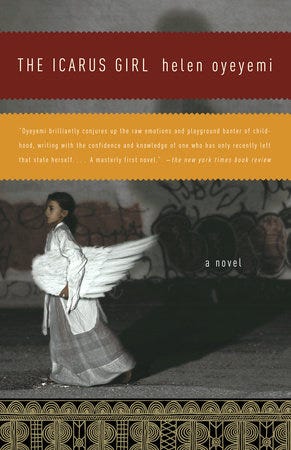
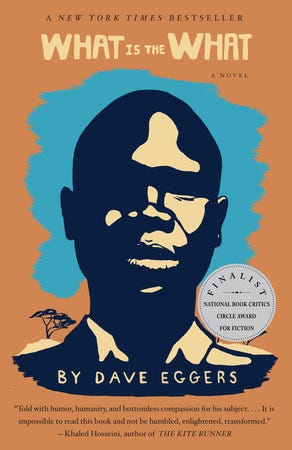
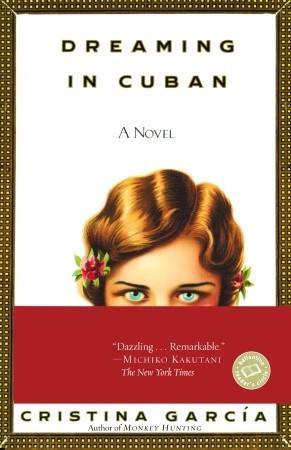
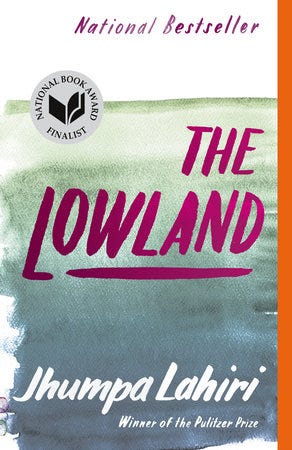
My debut, How to Love a Jamaican, is a collection of stories that explores the anxieties of Jamaicans from all walks of life, as people like to say. A few of these characters self-identify as lesbians. For a long time, I thought I was writing two separate collections. The first collection was similar in tone to the finished product but felt safer, and the second was about gender and sexuality. The latter felt more personally pressing for what I was thinking about. Over time, with a recommendation from my agent, these two manuscripts became one — How to Love a Jamaican.
Purchase the book
Over the past year, I’ve lived in Mexico City for seven and a half months. There was an evening I ended up at a social gathering with a group of queer women, and one of them turned to me when she’d heard that I am a Jamaican citizen to state that Jamaica is a hard place to be gay. I feel like I’ve had this conversation hundreds of times, and the conclusions are the same. Sometimes, I am the one to say that life in Jamaica is hard if a person is queer. “Sure,” I said that day, and then I asked if she knew of a place where it’s easy to be gay. The irony is that we were having this conversation in Mexico City, a place that is commonly believed to be unsafe. What I meant to imply then is that every place is more nuanced than we are told to believe. Every place is safe and unsafe at the same time, though yes, some places are safer and others are less safe.
Sure, it’s hard to be queer in Jamaica, but what else is it besides hard? There has to be more room for unknowingness in how we talk about lives and places. I can’t speak for every queer Jamaican who still lives in Jamaica. This is why I struggle with the fact that so much of queer literature, especially stories set in commonly believed to be homophobic regions, is about pain, humiliation, and loss. For me, that’s only a part of the story. One of my hopes for “How to Love a Jamaican” was to write honoring queer stories. What follows is a list of Caribbean authors — my brethren in this effort to write queer stories about the Caribbean.
This chapbook begins in Jamaica with the blossoming desire of two young women at a teachers college, until a horrible and violent outing. This haunting short story traces their relationship over time, place, and circumstance.
Dennis-Benn writes beautifully about Jamaican women, who feel trapped by their circumstances. They desire to love women freely, to have lighter skin, and to rise above their social class.
In this moving novel, the mystery surrounding a woman, who is believed to have murdered her father, turns out to be a story about incest, sexual abuse, gender fluidity, and sexuality.
A coming-of-age novel about Juliet, a Puerto Rican nineteen-year-old from the Bronx, who comes out to her mother on the day she is to leave for an internship on the other side of the country. A hilarious, tender turn-pager that I wish my younger self had discovered by accident on a library self.
The Pagoda follows a Chinese shopkeeper in 1890s Jamaica, who initially wears men’s clothing to leave China at a time when women weren’t allowed to emigrate. This sensual, lush novel is about queer love, gender roles, and race.
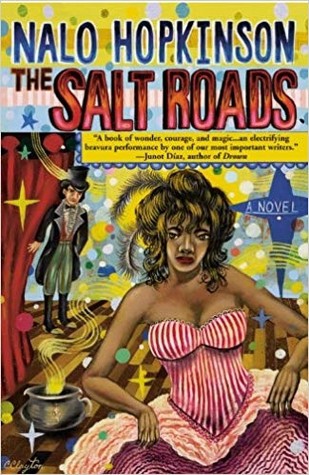
The Salt Roads is a historical and speculative novel that begins with the burial of a stillborn baby, during which slave women in Haiti conjure an Afro-Caribbean goddess. The Goddess goes on to inhabit and empower three black women separated by time and place, though all of them are on a quest for personal freedom. Hopkinson’s writing is energetic and brilliantly imagined.
I write about blackness. I write about blackness all the time. I write about blackness all the time because that’s the only way I experience this world, inside of my black, female body. Because of this, most of my characters speak African-American Vernacular English (AAVE) — a variety of English with its own unique grammar. When my characters speak this way, I don’t explain the slang or colloquial phrases to my readers because I know the people I write for will understand.
And if my readers don’t understand, then what I’m writing might not be written for them.
I’m currently working on my MFA and for one of my workshops, I wrote a short story about the policing of black students in public high schools. My protagonist, Eli, was a regular black teen. He was vocal but kind-hearted, cursed sometimes, and was an overachiever in every aspect of his life (or at least tried to be). In the first sentence of the story, Eli thought, “The food they feed us here is nasty as hell.” Throughout the piece, the protagonist said his teacher was “tripping” and used sentences like “Man, I’m so tired of this shit.”
AAVE isn’t a marker of low intelligence; if anything, it’s the opposite. To navigate both AAVE and “proper” English is an intellectual act in itself.
I received great feedback in the classroom, but the written feedback I sifted through afterward sent a different message. One of my classmates went so far as to say they initially thought Eli wouldn’t be an insightful, intelligent character because of the way he spoke. They said it wasn’t until I showed how he excelled in math class that they were convinced of my character’s intelligence. Another classmate, when asked for the story’s best sentences, said that there weren’t any; my character, they said dismissively, didn’t exactly set out to put a “remarkable twist on the English language.” Of course, these weren’t criticisms either of them said aloud during my workshop. They buried them in their written comments — left them for me to read when no one was around, when I couldn’t look them in the eyes and directly respond to their feedback.
I was hurt, and then, as I thought more about it, I was outraged. I realized that even though my classmates probably didn’t realize it, they were being racist. They believed if a person spoke in any other way than what they were taught was correct, that person must be uneducated. My classmates didn’t believe AAVE was a “remarkable twist to the English language.” They thought, instead, that it wasn’t a twist at all, but a nuisance.
But my white readers got it twisted. AAVE isn’t a marker of low intelligence; if anything, it’s the opposite. To navigate both AAVE and “proper” English is an intellectual act in itself. You have to know slang that is forever evolving and use it properly around others who understand it. You have to know what the slang translates to, and usually, these words have more than one meaning. When I am in academic spaces, I code-switch and speak as “properly” as possible. But when I am around friends or in mostly-black spaces, I speak differently. I use “ain’t” and “‘bout to” and “finna” sometimes. None of those things preclude me from speaking “well.” Being able to traverse these two languages shouldn’t make my classmates think my character is dumb. I use this language for my characters, not only because it is more accurate, but because it does some work that “proper” English won’t do. It shows personality and in some cases, it shows where my character comes from: AAVE, though universal in black communities, can differ subtly from location to location, in a way my black readers will understand. It puts words to things “proper” English may not have words for. But my classmates carry their implicit biases into the reading of my work, which hasn’t been confronted because they do it in the dark.
Writers of color are always told — not asked — to center and consider whiteness every time we write. To think about what kind of language white people enjoy reading, how much (or little) they’ll want to work to understand an experience besides their own, and how much push back we’ll get if we continuously write about race. As a black writer, I am told to do the work for the readers. I am told that AAVE needs to be muted so as to not overshadow the one language that matters to white people. I am told to make black experiences white ones instead, or at least experiences that are written in a language they find comfortable. I am asked to forget about the black girls and boys I write for, and instead, write for an audience that already has a spread of white writers to choose from.
I am told to make black experiences white ones instead, or at least experiences that are written in a language they find comfortable.
This isn’t just the case in my MFA program. I’ve seen best-selling authors of color voice similar opinions about white people reviewing their work, when these reviewers know nothing of the culture or the language the authors are shedding light on. I’ve seen white people say that they wish certain books would have taught them more about a language or a culture, as if they consider readers of color when they write—putting the responsibility on black writers to teach them about easily researchable topics.
When I started reading A Series of Unfortunate Events in second grade, I had a dictionary right next to me every time I read (excluding the times I read in the backseat of my mom’s car). Lemony Snicket wrote in a language that I wasn’t familiar with. He used words I hadn’t yet learned in class — but as a reader, instead of asking him to change the way he told the story, I committed to being part of that world. I became who he wanted me to become so I could understand the work. I still do this. If I am reading a story or poem that centers a culture or language I am unfamiliar with, I become acquainted. But I also get comfortable with the work it takes to understand an experience. I get comfortable with being uncomfortable.
I assume young, white readers also pulled out a dictionary to read Lemony Snicket. At that young of an age, it was an advanced read. I assume they asked a parent what a sentence meant, maybe even asked them to help them picture a scene. What makes him worth the curiosity and effort, and stories employing AAVE not worth a Google search?
If AAVE is a roadblock for white readers, they should do the work to get around it .
Black writers shouldn’t have to remove AAVE for their readers in order to have their work read and critiqued without racial bias. Our work should be appreciated for the (sometimes different) experiences it exhibits, the language and culture that belongs to us, and most of all, the story it tells. If AAVE is a roadblock for white readers, they should do the work to get around it — or remember they’re not the intended audience and find another read that considers whiteness first. There are plenty. I write for blackness first, and don’t intend on changing my characters to make my work more palatable.
White readers put effort toward decoding language elsewhere, but let laziness and racism stop them from engaging with the work of black writers. They shouldn’t view AAVE as a non-intellectual language, but as what it is: a language. A language, like all others, they have to work to decode. A language they have to open their mind to and let in. A language that shows the beauty in our dialect as well as everything that comes with our culture. A language that shouldn’t have to be omitted just because of white readers’ bias.
I never paid much attention to current events, all the trouble in the world you hear about. I was too busy raising a family. But my children have all gone now and I’ve started to think about things that go on. Why would my daughter live with a man and get ready to raise a baby and refuse to marry the guy? Why would my son live in a cabin by the river and not see a soul for months on end? But that’s just personal. I’m thinking of the bigger picture, too. It seems a person barely lives long enough to begin to see where his little piece fits in the universal puzzle. I’m not old but I imagine that old people start to figure out how to live just when it’s too late.
These thoughts come up at my weekly neighborhood group. It started out as a weight-reducing club, but we kept meeting even after we all got skinny. Now on Fridays after work a bunch of us get together at somebody’s house and talk about life, in a sort of talk-show format. Although we laugh a lot, for us it’s survival. And it helps me think.
It’s so hard to be nice to people. It’s something you have to learn. I try to be nice, but it’s complicated. You start feeling guilty for your own failures of generosity at just about the same point in life when you start feeling angry, even less willing to give. The two feelings collide — feeling gracious and feeling mean. When you get really old, they say, you go right back to being a child, spiteful and selfish, and you don’t give a damn what people think. In between childhood and old age, you have this bubble of consciousness — and conscience. It’s enough to drive you crazy.
After our group session last Friday, I went up to Paducah, across the county line, hoping to see this guy I know. He calls himself Jazz, but his real name is Peter. He always hated that name. Kids in school would tease him. “Where’s your peter?,” “Oh, you don’t look like a peter,” etc. Some kids from my distant past used the word “goober,” the first name I ever heard for the secret male anatomy. I thought they were saying “cooper.” That didn’t make any sense to me. Then I learned that the correct word was “goober.” I learned that in the fourth grade from Donna Lee Washam, the day she led me on an expedition to a black-walnut tree on the far edge of the playground. She came back to the classroom with two black walnuts in her panties and giggled all afternoon as she squirmed in her seat. Across the aisle and a couple of seats up, Jerry Ray Baxter sometimes took his goober out and played with it. He couldn’t talk plain, and after that year he stopped coming to school.
Jazz was at the Top Line, where I thought he’d be. He was lounging at the bar, with a draught beer, shooting the breeze. When he saw me he grinned slowly and pulled a new brassiere out of his pocket, dangling it right there between the jug of beet-pickled eggs and the jug of pickled pigs’ feet. Ed, the bartender, swung his head like he’d seen it all. “There you go again, Jazz, pulling off women’s clothes.”
Jazz said, “No, this is my magic trick.”
I stuffed the bra in my purse. “Thanks, Jazz. I guess you knew my boobs were falling down.”
He came from down in Obion, Tennessee, and grew up duck hunting around Reelfoot Lake. Now he goes to France and brings back suitcases full of French underwear. He sells it to a boutique and occasionally to friends. It’s designer stuff and the sizes are different from here. His exwife gets it at cost from a supplier in Paris where she works. He goes over there once a year or so to see his kids. Jazz works construction and saves his money, and then he quits and lights out for France. I’ve got a drawerful of expensive bras he’s given me — snap-fronts, plunges, crisscrosses, strapless — all in lace and satin.
“That’s a special number,” he said, moving close to me. “Scalloped lace and satin stretch. Molded cup, underwire. I’ll want to check the fitting later.”
I grinned. “We’ll see about that, Jazz. Tonight I feel like getting drunk.”
“You’re gonna be a granny again in a few months, Chrissy. Is that how an old granny’s supposed to act?” he teased.
“But I’m happy, damn it! I feel like I’m in love.”
“One of these days I’ll make you fall in love with me, Chrissy.”
I ordered a bourbon. What Jazz needed, I thought, was a woman who felt romantic about him. But he’d never make a claim on a woman he cared about. He’d always step aside and let the woman go fall in love with some clod who jerked her around.
Glancing up at a TV newsbreak — a local update on water pollution — I said, “All the mussels in the lake are dying. It’s all those pesticides.”
“I heard it was last year’s drought,” said Jazz. “That’s natural.”
“Here I am celebrating a new baby coming into the world — for what? To see a dead lake? And air not fit to breathe?”
Jazz touched my shoulder, to steady me. “World’s always had trouble. No baby ever set foot in the Garden of Eden.”
I laughed. “That’s just like you to say that, Jazz.”
“You think you know me, don’t you?” he said.
“I know you well enough to feel sorry I always treat you so bad.”
Ed set my drink before me and I took it eagerly. I said to Jazz, “Why don’t you ever get mad at me, tell me off?”
He punched my arm, buddy style. “You should never go away mad at a person, because one of you might get killed on the way home.”
The regular crowd was there at the Top Line — good old boys who worked at the plants, guys wandering around loose on a Friday night while their wives took the kids to the mall. A tall man entering the bar caught my eye. He walked like he had money. He had on an iridescent-green shirt, with a subtle paisley design that made my eyes tingle. His pants had cowboy-style piping on the pocket plackets. Over the shirt he wore a suède vest with fuchsia embroidery and zippered pockets.
“That’s Buck Joiner, the radio guy,” Jazz said, reading my mind.
Buck Joiner was the D.J. I listened to while I was getting ready for work. His “Morning Mania” show was a roaring streak of pranks and risqué jokes and call-in giveaways. Once, he actually telephoned Colonel Qaddafi in Libya. He got through to the palace and talked to some official who spoke precise English with a Middle Eastern accent.
As soon as I felt I’d had enough bourbon, I marched over to Buck Joiner’s table, wielding my glass.
“I listen to you,” I said. “I’ve got your number on my dial.”
He seemed bored. It was like meeting Bob Dylan or some big shot you know won’t be friendly.
“I called you up once,” I went on recklessly. “You were giving away tickets to the Ray Stevens show. I was trying to be the twenty-fifth caller. But my timing wasn’t right.”
“Too bad,” he said, deadpan. He was with a couple of guys in suits. Blanks.
“I’ve got to work on my timing.” I paused, scrambling for contact. “You should interview my Friday-afternoon talk group.”
“What’s that?”
“We’re a group of ladies. We get together every Friday and talk about life.”
“What about life?” Out of the side of his face, he smirked for the benefit of the suits.
“The way things are going. Stuff.” My mind went blank. I knew there was more to it than that. Right then, I really wanted him to interview our group. I knew we sparkled with life and intelligence. Rita had her opinions on day care, and Dorothy could rip into the abortion issue, and Phyllis believed that psychiatrists were witch doctors. Me, I could do my Bette Davis imitations.
“Here’s my card,” I said, whipping one out of my purse. I’d ordered these about a month ago, just for the privilege of saying that.
“It’s nice to meet a fan,” he said with stretched lips — not a true smile.
“Don’t give me that, buddy. If it weren’t for your listeners, you wouldn’t be sitting here with all that fancy piping scrawled all over you.”
I rejoined Jazz, who had been watching out for me. “I’d like to see Oprah nail him to the wall,” I said to Jazz.
Of course, I was embarrassed. That was the trouble. I was lost somewhere between being nice and being mean. I shouldn’t drink. I don’t know why I was so hard on the D.J., but he was a man I had depended on to start my day, and he turned out to be a shit. From now on I’d listen to his show and think, Stuck-up turdface. Yet there I was in a French bra and with an unusual amount of cleavage for this area. I didn’t know what I was getting at. Jazz was smiling, touching my hand, ordering me another drink. Jazz wore patience like adhesive tape.
In bits and pieces, I’ve told this at the Friday talk group: My first husband, Jim Ed, was my high-school boyfriend. We married when we were seniors, and they didn’t let me graduate, because I was pregnant. I used to say that I barely understood how those things worked, but that was a lie. Too often I exaggerate my innocence, as if trying to excuse myself for some of the messes I’ve gotten myself into. Looking back now, I see that I latched on to Jim Ed because I was afraid there’d never be another opportunity in my life, and he was the best of the pickings around there. That’s the way I do everything. I grab anything that looks like a good chance, right then and there. I even tend to overeat, as if I’m afraid I won’t ever get another good meal. “That’s the farm girl in you,” my second husband, George, always said. He was an analytical person and had a theory about everything. When he talked about the Depression mentality of our parents’ generation he made it sound physically disgusting. He had been to college. I never did go back and get my high-school diploma, but that’s something I’m thinking about doing now. George couldn’t just enjoy something for what it was. We’d grill steaks and he’d come up with some reason why we were grilling steaks. He said it went back to caveman behavior. He said we were acting out an ancient scene. He made me feel trapped in history, as though we hadn’t advanced since cavemen. I don’t guess people have changed that much, though, really. I bet back in caveman times there was some know-it-all who made his woman feel dumb.
After a while, I didn’t pay any attention to George, but then my little daughter died. She had meningitis, and it was fairly sudden and horrible. I was still in shock a month later, when George started nagging at me about proper grief displays and the stages of grief. I blew up. I told him to walk. What we really should have done was share the grief. I’m sure the most basic textbook would say that. But instead he’s lecturing me on my grief. You can’t live with somebody who lectures you on your grief. I’ll have my grief in peace, I told him. Kathy wasn’t his daughter. He couldn’t possibly know how I felt. That was so long ago he doesn’t seem real to me. He still lives around here. I’ve heard that he married again and that he raises rabbits and lives out in the country, out near Bardwell — none of which I would have ever imagined. But, you know, as small as this place is, I’ve never laid eyes on him again. Maybe he’s changed so much I just don’t recognize him when I see him.
“How did you just happen to have that bra in your pocket, Jazz?” I wanted to know, but he only grinned. It was like carrying around condoms in case of emergency, I thought. The bra was just my size. I’d put it on in the restroom. The one I had worn was stretching out, and I left it in the trash can. Let people wonder.
At first, I thought Kathy just had the flu. She had a fever and she said her head was splitting — a remark so calm that she might have said her hands were dirty in the same tone. It was summer, a strange time for flu, so I hurried all the kids on out to their grandmother’s that Sunday, like always, thinking the country air would make Kathy feel better. Don and Phil kept aggravating her because she didn’t want to play in Mama’s attic or go out to the barn. She lay around under one of Mama’s quilts, and I thought later, with a hideous realization, that she somehow knew she was going to die. You never know what a child is thinking, or how scared they might be, or how they’ve blown something up in their imagination. She was twelve, and she’d just started her period a couple of months before. I thought her sickness might be related to that. The doctor just laughed at me when I brought that up. Can you imagine the nerve? It’s only now that I’ve gotten mad about that. But I hear that that doctor has had a stroke and is in a nursing home. What good do bad feelings do when so much time has passed? That’s what Jazz says.
George blamed me for taking her out to Mama’s that day. He was gone to an engineering convention in Nashville; he was a chemical engineer at Carbide then. He said there was no reason a child shouldn’t recover from meningitis. He wagged a book in my face, but I refused to read what he had found on the disease. I thought it would kill me to know her death was my fault. I guess George wasn’t such a bad guy. He just had his ways. I think we all do and none of us knows how to be sensitive enough, it seems. He probably just didn’t know how to deal with the situation. It occurred to me recently that maybe he felt guilty for being away at the time, just as I felt guilty for not noticing how quiet and withdrawn she was, as though she was figuring it all out for herself. Kathy was in 4-H, and that year she was working on a Holly Hobbie display for the fair — the little girl hiding her face in the calico bonnet. Kathy sewed the clothes herself, and she was making a little stuffed dog and decorating a flower basket for the scene. I still have that unfinished Holly Hobbie scene — in the closet in a stereo box. I should probably get rid of it, because if Kathy had lived she would have grown out of that phase, but all I have is those little scraps of the way Kathy was, the only reality she ever had.
Don and Phil grew up and left as soon as they got cars. Can you believe anybody would name their sons after the Everly Brothers? I reckon I’d still do something that silly. But I never told them we named them for the Everly Brothers. Jim Ed, the father of all my children, loved the Everly Brothers, and he used to play them in his truck, back when eight-track tape decks were a new thing. Jim Ed was loose about a lot of things, and he never criticized me the way George did. I don’t know if he blamed me about Kathy. I have a feeling that if we’d stuck it out we could have learned to love each other better. But he was restless, and he couldn’t hang around when we needed him most. He moved over to Cairo and worked on the riverboats — still does. I guess he has some kind of life. The boys see him. Don’s wife ran off with one of the riverboat guys and Don lives in a cabin over there. I don’t see him very much. He brought me a giant catfish, a mud cat, on Mother’s Day. Catfish that big aren’t really good to eat, though. He sets trotlines and just lives in the wilderness. I doubt if he’ll ever marry again. Phil is the only one of my children who turned out normal. Now, what is there to say about that? A wife with a tortilla face and bad taste in clothes, spoiled kids, living room decorated with brass geese and fish. I go there and my skin breaks out. There’s no pleasing me, I guess.
Last week, Laura — my other daughter, the baby — wrote me that she was pregnant. She’s barely divorced from this museum director she met at school — he restored old pieces of pottery, glued them together. He made a good living but she wasn’t satisfied. Now she’s going to be tied down with a baby and a man, this Nick, who does seasonal work of some sort. They’re living in his home town, a little place in Arizona, in the desert. I can’t imagine what would grow there.
Laura, on the telephone this past Sunday, said, “I don’t want to get married again. I don’t trust it anymore. And I want to be free of all that bureaucratic crap. I trust Nick more than I trust the government.”
“You need the legal protection,” I said. “What if something happened to him? What if he ran off and left you? I can tell you exactly how that works.”
“I’d have to murder Nick to get him out of my life! Honestly, he’s being so devoted it’s unbelievable.”
“I guess that’s why I don’t believe it.”
“Come on, Mom. Just think, you’re going to be a grandma again! Aren’t you going to come out when the baby’s born? Isn’t that what mothers do?”
Laura was five when Kathy died. We didn’t take her to the funeral. We told her Kathy had gone off to live with Holly Hobbie in New York. If I could undo that lie, I would. It was worse when she found out the truth, because she was old enough then to understand and the shock hurt her more. I thought my heart would break when I saw Jim Ed at the funeral. I saw him alone only once, for a few minutes in the corridor before the service started, but we couldn’t speak what we felt. Jim Ed was crying, and I wanted to cling to him, but we could see George in the other room, standing beside a floral display — a stranger.
Jazz said, “Ever notice how at night it’s scary because you feel like your secrets are all exposed, but you trick yourself into thinking they’re safe in the dark? Smokey bars, candlelight — that’s what all that atmosphere shit is about.”
“That’s what I always say,” I said, a little sarcastically. Sometimes Jazz seemed to be fishing around for something to say and then just making something up to sound deep.
We were driving to see my son Don out at his cabin by the river. It was Jazz’s idea, a crazy notion that seized him. He said he felt like driving. He said I needed some air. He didn’t let me finish my last drink.
I met Jazz a year ago, in traffic court. We’d both been in minor fender benders on the same road on the same day, at different times. We’d both failed to yield. I remember Jazz saying to me, “I hope that’s not a reflection on my character. Normally, I’m a very yielding guy.” That day Jazz had on a plaid flannel shirt and boot-flared jeans and a cowboy hat — the usual garb for a man around here. But it was his boots I loved. Pointy-toed, deep-maroon, with insets of Elvis’s photograph just above the ankles. He’d found the boots in France. That night we went out for barbecue and he gave me some peachblush panties with a black lace overlay. We had been friends since then, but we never seemed to get serious. I thought he had a big block of fear inside him.
The cab of his truck was stuffy, that peculiar oil-and-dust smell of every man’s truck I’ve ever been in. I lowered the window and felt the mellow river breeze. Jazz chattered nonstop until we got deep into the country. Then he seemed to hush, as though we were entering a grand old church.
We were traveling on a state road, its winding curves settled comfortably through the bottomland, with its swampy and piney smells. There were no houses, no lights. Now and then we passed an area where kudzu made the telephone poles and bushes look as though they were a giant’s furniture covered up with protective sheets. At a stop sign I told Jazz to go straight instead of following the main road. Soon there was a turnoff, unmarked except for an old sign for a church that I knew had burned down in the fifties. We saw an abandoned pickup straddling the ditch. When the road turned to gravel, I counted the turnoffs, looking for the fourth one. Jazz shifted gears and we chugged up a little hill.
“Reckon why he lives way off out here?” Jazz said as he braked and shut off the engine. There were no lights at the cabin, and Don’s motorbike was gone. Jazz went over into the bushes for a minute. It was a halfmoon night, the kind of night that made you see things in the silhouettes. I thought I saw Don standing by the side of the cabin, peering around the corner, watching us.
Jazz reached through the truck’s open window and honked the horn.
I heard an owl answer the horn. When I was little I thought owls were messengers from the preachers in charge of Judgment Day. “Who will be the ones?” I remember our preacher saying. “Who?” Even then I pictured Judgment Day as an orchestrated extravaganza, like a telethon or a musical salute. I never took religion seriously. I’m glad I didn’t force my children into its frightful clutches. But maybe that was the trouble, after all.
We stood on the sagging porch, loaded with fishnets and crates of empties — Coke and beer bottles. The lights from the pickup reflected Jazz and me against the cabin windows. I tried the door, and it opened into the kitchen.
“Don?” I called.
I found the kitchen light, just a bulb and string. The cord was new. It still had that starched feel, and the little metal bell on the end knot was shiny and sharp. It made me think of our old bathroom light when Jim Ed and I first married. It was the first thing I’d touch in the morning when I’d get up and rush to the bathroom to throw up.
The table was set for one, with the plate turned face over and the glass upside down. Another glass contained an assortment of silverware. A little tray held grape jelly and sugar and instant coffee and an upside-down mug.
The cabin was just one room, and the daybed was neatly made, spread with one of my old quilts. I sat down on the bed. I felt strange, as though all my life I had been zigzagging down a wild trail to this particular place. I stared at the familiar pattern of the quilt, the scraps of the girls’ dresses and the boys’ shirts. Kathy had pieced some of the squares. If I looked hard, I could probably pick out some of her childish stitches.
“This is weird,” said Jazz. He was studying some animal bones spread out on a long table fashioned from a door. “What do you reckon he’s aiming to do with these?”
“He always liked biology,” I said, rising from the bed. I smoothed and straightened the quilt, thinking about Goldilocks trespassing at the three bears’ house.
The table was littered: bones, small tools, artist’s brushes and pens, a coffee cup with a drowned cigarette stub, more butts nesting in an upturned turtle shell, some bright foil paper, an oily rag. Jazz flipped through a tablet of drawings of fangs and fishbones.
“He must be taking a summer course at the community college,” I said, surprised. “He talked about that back in the spring, but I didn’t believe it.”
“Look at these,” Jazz said. “They’re good. How can anybody do that?” he said in amazement.
We studied the drawings. In the careful, exact lines I saw faint glimpses of my young child, and his splashy crayon pictures of monsters taped to the kitchen wall. Seeing his efforts suddenly mature was like running into a person I recognized but couldn’t place. Most of the pictures were close-ups of bones, but some were sketches of fish and birds. I liked those better. They had life to them. Eagerly, I raced through two dozen versions of a catfish. The fish was long and slim, like a torpedo. Its whiskers curved menacingly, and its body was accurately mottled. It even looked slippery. I stared at the catfish, almost as if I expected it to speak.
I jerked a blank sheet of paper from the tablet of drawings and worked on a note:
Dear Don,
It’s 10:30 P.M. Friday and I came out here with a friend to see if you were home. We just dropped by to say hello. Please let me know how you are. Nothing’s wrong. I’ve got some good news. And I’d love to see you.
Love,
Mom
“It doesn’t sound demanding, does it?” I asked as Jazz read it.
“No, not at all.”
“It almost sounds like one of those messages on an answering machine — stilted and phony.”
Jazz held me as if he thought I might cry. I wasn’t crying. He held my shoulders till he was sure I’d got the tears back in and then we left. I couldn’t say why I wasn’t crying. But nothing bad had happened. There wasn’t anything tragic going on. My daughter was having a baby — that was the good news. My son had drawn some fishbones — drawings that were as fine as lace.
“Me and my bright ideas,” Jazz said apologetically.
“It’s O.K., Jazz. I’ll track Don down some other time.” As we pulled out, Jazz said, “The wilderness makes me want to go out in it. I’ve got an idea. Tomorrow let’s go for a long hike on one of those trails up in Shawnee National Forest. We can take backpacks and everything. Let’s explore caves! Let’s look for bears and stuff!”
I laughed. “You could be Daniel Boone and I could be Rebecca.”
“I don’t think Rebecca went for hikes. You’ll have to be some Indian maiden Daniel picked up.”
“Did Daniel Boone really do that sort of thing?” I said, pretending to be scandalized.
“He was a true explorer, wasn’t he?” Jazz said, hitting the brights just as a deer seemed to drift across the road.
Jazz thought he was trying to cheer me up, but I was already so full of joy I couldn’t even manage to tell him. I let him go on. He was sexiest when he worked on cheering me up.
It was late, and I wound up at Jazz’s place, a sprawling apartment with a speaker system wired into every room. His dog, Butch, met us at the door. While Jazz took Butch out for a midnight stroll, I snooped around. I found a beer in the refrigerator. I had trouble with the top and beer spewed all over Jazz’s dinette. When he returned, I started teasing him about all the women’s underwear he owned.
“Put some of it on,” I urged.
“Are you nuts?”
“Just put it on, for me. I won’t tell. Just for fun.”
I kept teasing him, and he gave in. We couldn’t find any garments that would fit. We hooked two bras together and rigged up a halter. With his lime-green bikini briefs — his own — he looked great, like a guy in a sex magazine. It’s surprising what men really wear underneath. I searched for some music to play on Jazz’s fancy sound system. I looked for the Everly Brothers but couldn’t find them, so I put on a George Winston CD. To be nice, I never said a word about Jazz’s taste in music. Exhilarated, I sailed from room to room, following the sound, imagining it was “Let It Be Me” instead. I suddenly felt an overwhelming longing to see Jim Ed again. I wanted to tell him about Don going to school, drawing pictures, making contact with the world again. I wanted to see the traces of Don’s face in his. I wanted the two of us to go out to Arizona and see Laura and the baby when it came. We could make a family photo — Jim Ed and me and Laura, with the baby. The baby’s father didn’t enter into the vision.
It occurred to me that it takes so long to know another person. No wonder you can run through several, like trying on clothes that don’t fit. There are so many to choose from, after all, but when I married Jim Ed it was like an impulse buy, buying the first thing you see. And yet I’ve learned to trust my intuition on that. Jim Ed was the right one all along, I thought recklessly. And I wasn’t ever nice to Jim Ed. I was too young then to put myself in another person’s place. Call it ignorance of the imagination. Back then I had looked down on him for being country, for eating with his arms anchored on the table and for wiping his mouth with the back of his hand. I’d get mad at him for just being himself at times when I thought he should act civilized. Now I’ve learned you can’t change men, and sometimes those airs I’d looked for turn out to be so phony. Guys like Jim Ed always seemed to just be themselves, regardless of the situation. That’s why I still loved him, I decided, as I realized I was staring at Jazz’s reflection in the mirror — the lime green against the shimmering gold of his skin and the blips of the track lighting above.
Jazz followed me into the bedroom, where we worked at getting rid of our French togs. I was aware that Jazz was talking, aware that he was aware that I might not be listening closely. It was like hearing a story at my little neighborhood talk show. He was saying, “In France, there’s this street, rue du Bac. They call streets rues. The last time I left Monique and the two kids, it was on that street, a crowded shopping street. The people over there are all pretty small compared to us, and they have this blueblack hair and deep dark eyes and real light skin, like a hen’s egg. I waved good-bye and the three of them just blended right into that crowd and disappeared. That’s where they belong, and so I’m here. I guess you might say I just couldn’t parlez-vous.”
“Take me to France, Jazz. We could have a great time.”
“Sure, babe. In the morning.” Jazz turned toward me and smoothed the cover over my shoulders.
“I love you,” Jazz said.
When I woke up at daylight, Jazz was still holding me, curled around me like a mother protecting her baby. The music was still playing, on infinite repeat.
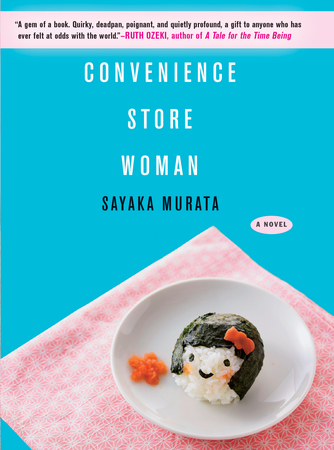
I f you’ve been looking in many bookstore windows recently, you may have seen a tiny hardcover whose sky-blue and cherry-blossom pink jacket features a rice ball made to look like a woman’s head on a plate. I recommend picking it up. Convenience Store Woman is Sayaka Murata’s eight novel, but the first to ever be translated into English. Following a hugely successful Japanese publication — Murata won the prestigious Akutagawa Prize and over 600,000 copies sold in two years — the novel went on to sell in seventeen languages in translation before finally coming out in the U.S. and U.K. last month.
How does a literary novel become an international sensation? Murata’s English translator Ginny Tapley Takemori sees the novel’s success as due, in part, to its “broad appeal”; it is written in everyday, approachable language, so that it might attract fans of manga and anime as well as the literary types, whereas “normally there isn’t much crossover.” And there’s also the fact of the book being knock-you-off-your feet good, sucking you wholesale into the strange brain of its narrator, Keiko Furukura, and carrying you quickly through a smartly constructed plot. But most of all, the book is “just so unexpected.” It’s shocking in Japan, but perhaps even more so to a foreign readership, defying all our stereotypes of Japanese literature and Japanese women.
Keiko is single at 36, and happy. She is proud of her extreme proficiency at a job typically staffed part-time by students. The store gives Keiko comfort and purpose, but it goes much further than that. At times it feels like a religious temple, glowing into the night; at others the store is an extension of Keiko’s self, its needs vibrating in her very cells. In one of many exquisite passages, she reflects:
When I can’t sleep, I think about the transparent glass box that is still stirring with life even in the darkness of the night. That pristine aquarium is still operating like clockwork…. When morning comes, once again I’m a convenience store worker, a cog in society. This is the only way I can be a normal person.
A single female narrator, uninterested in sex, completely focused on work that doesn’t constitute a “career,” is a departure from the norm in Japanese literature as much as it is in English. “I don’t think there’s been anyone, at least that I’ve come across, quite like Keiko,” Takemori tells me, “especially in not even missing having a relationship!” Sexuality as a woman is central to Murata’s work, and her novels often feature a lot of sex — though it isn’t necessarily pleasant. Murata is interested in the bizarre pressures society puts onto women. In her newest novel, out this summer in Japan, she is quite explicit: “She sees society as this big baby factory. When you become an adult you become part of this factory to create more humans.”
Takemori’s pet peeve is English editions of Japanese novels featuring elegant, frail-looking Japanese women on their covers. “The image of Japanese women in the U.S., the U.K., and elsewhere is usually quite dutiful, sexy, a bit downtrodden by men. It’s a fantasy.” So here is Keiko: “she’s not attractive, she’s not interested in sex at all — it’s just not on her radar — and she is working to live, in a very unglamorous job. It gives a different view of Japan all together.”
The beating heart of the short, haunting novel is the Hiiromachi Station Smile Mart. We enter Keiko’s world in the din of the morning rush: door chimes, advertisements ringing over the intercom, store workers yelling their greetings to customers, scanners beeping, items rustling, high heels clicking. “A convenience store,” we find, “is a world of sound.”
In convenience stores, restaurants, and shops of all kinds in Japan, store workers call out stock phrases, practiced in unison before work each morning. The greetings are so particular and so ubiquitous that no English correlate quite fits. Takemori decided to leave “irasshaimasé” — literally “welcome” — untranslated: “I decided, well, readers aren’t stupid. They can cope with one Japanese word.” She crafted other phrases to sound as formulaic as possible: “Certainly. Right away, sir!” “Thank you for your custom!” You don’t think when you say these phrases, she tells me; you just say them.
Literary translation is both a creative endeavor and a long and impossible series of problems needing solutions. Even if the language itself were your only concern, it isn’t possible to take something directly from one language into another, word for word, particularly between languages that function as differently as English and Japanese. But it’s not just the words that need to be carried over the gap. As Takemori puts it, a translator must recreate the novel’s “effect” — its atmosphere, voice, and impact on a reader.
This is where academic and literary translators divide. Academics tend to prioritize a more exact translation for scholarly purposes, whereas freelance translators like Takemori are more willing to play with the original in order to capture its impact on the reader. “By trying to be too faithful to the original,” Takemori believes, “you can actually betray it.” Convenience Store Woman is often shockingly funny. “There are parts that almost had me spitting out my coffee when I first read it, they’re so funny.” An exact translation — or as close to exact as possible — would be difficult and bewildering to foreign readers, necessarily riddled with footnotes. The humor would fall flat. The utter strangeness, distance, and charm of Keiko’s voice would be lost.
An exact translation — or as close to exact as possible — would be difficult and bewildering to foreign readers, necessarily riddled with footnotes.
So you get creative. You make a way in English for a voice that’s doing something that hasn’t been done before, even in Japanese. It’s a daunting task. “But that’s what I love about it,” Takemori says. I ask her how she did it, how she captured both the endearing and the creepy in the novel’s atmosphere. Like any art form, of course, there isn’t an easy answer. “I just had to keep plugging away at something, you know, like this is a bit flat, it’s not shocking enough… When you finally do get it right, you know you’ve got it, and that’s a really nice feeling.”
Reading Convenience Store Woman feels like being beamed down onto foreign planet, which turns out to be your own. Takemori confirms that the experience is the same in the original. “Sayaka Murata is shocking. Through this very strange character’s eyes, you see society in a different light. You know, what people think is normal is really not normal at all.” Keiko often sounds like a researcher, taking notes on her species:
My speech is especially infected by everyone around me and is currently a mix of that of Mrs. Izumi and Sugawara. I think the same goes for most people. When some of Sugawara’s band members came into the store recently they all dressed and spoke just like her…. Infecting each other like this is how we maintain ourselves as human, I think.
The morning I finished reading Convenience Store Woman, I walked around for hours in a haze, my mind eerily caught within Keiko’s voice. I took some pride in my productivity that morning, tapping away at emails like a small cog in the machine. I felt an inch apart from the racing life of the city in front of me, as if behind a pane of glass. I asked Takemori if she felt something similar while living immersed in Keiko’s voice, in the process of translating. “Certainly I started looking at things in a different way, seeing little details that I hadn’t noticed about Japanese society. I’d always just taken convenience stores for granted. I hadn’t even thought about them.”
Reading Convenience Store Woman feels like being beamed down onto foreign planet, which turns out to be your own.
But Takemori didn’t find herself as disoriented as I did. She reflects that as a foreigner in Japan, she already lives with “a certain distanced perspective.” She will never see things the way she might have if she’d grown up in Japan like everyone around her. I remark that this might have primed her to be Keiko’s medium—an outsider translating an outsider—and she agrees. Though, laughing, she adds: “I don’t think I’m quite as much of an outsider as Keiko.”
Sayaka Murata, the author, could easily be seen as an outsider herself. She writes from 2 a.m. until 8 when, until recently, she would go to work at a convenience store, which she found to be a useful anchor in her day before returning home to keep writing. In an interview with the New York Times, Murata credits the store as an antidote to her former shyness: “I was instructed to raise my voice and talking in a loud friendly voice, so I became that kind of active and lively person in that circumstance.” These days, she is close with a number of other prize-winning, radical young women writers, including Risa Wataya and Kanako Nishi. It’s worth mentioning them here because, though they’re celebrated in Japan, they aren’t well known elsewhere. Which brings us to the great gap in the English-speaking world’s knowledge of Japanese literature — and why it took so much and so long for one of Sayaka Murata’s novels to make it into English.
The Tale of Genji, widely considered the world’s first novel, was written by a noblewoman and lady-in-waiting, Murasaki Shikibu, early in the 11th century. Ever since, women have had a place in Japanese literature, which quite plainly has not been the case in English. The major prizes, the Naoki and the Akutagawa, are consistently awarded to women and men in equal numbers. Meiji-era short story writer Ichiyo Higuchi became the third woman to be featured on a yen note in 2004. Today, Japan is experiencing a great boom in extremely popular young women writers. Takemori shows me a 550-page volume of writing by women, published recently by the literary magazine Waseda Bungaku, which sold out in a week.
But most of those young women writers aren’t making it to America. Much, much less literature gets translated into English than the reverse, to begin with. But of the books that do make it into English, from all languages, the vast majority are written by men. This makes some sense in the history of Japan, Takemori explains: Japanese literature really began making it into English during the American occupation after World War II, thanks to translators like Donald Keene. The Americans in Japan during the occupation were in the military, Takemori points out, “and mostly guys!” The trend those guys began has proven doggedly persistent. Today, outside of Japan, we know of Haruki Murakami, Yasunari Kawabata, Yukio Mishima, Jun’ichiro Tanizaki — but besides Banana Yoshimoto, we might struggle to come up with another female author’s name.
This extreme disservice to the talent and vision of Japanese women writers is something Takemori is on the campaign to change. Last November, inspired by a worldwide movement among translators to create more visibility for women writers, she and fellow translators Allison Markin Powell and Lucy North held a translation conference in Tokyo: “We were deliberately provocative in calling it Strong Women, Soft Power.” It was a smashing success, with tickets sold out in advance. “It got a lot of people talking. I think we’ll be seeing more Japanese women in translation from now on, actually.”
I can only hope that this is true. In the meantime, may we buy out bookstores’ stocks of Convenience Store Woman, and yell Sayaka Murata’s name from the rooftops.
In a wonderfully enlightening piece on the dearly departed Toast, Anne Thériault makes the case for the fairytale as feminist genre. “Fairytales” she argues, are “women’s tales” — but it’s hard for us to imagine that because the fairytales as we know them have been drastically revised over time. The first edition of Grimms Fairy Tales published in 1812 did not sell well. In the interest of attracting a younger audience, the collection was revised, cut down, and republished in 1815. What got the chopping block? Sex. In 1812 lots of it, and in 1815 no more sex. Mothers eating children, chopping them up into stew is fine. But sex, absolutely not. Thériault argues that the erasure of sex, when we look at it closely, does more than show us a prude sensibility:
Not only did they remove any mention of sex, the majority of it both consensual and premarital, but all sorts of other details defining and limiting the female characters were added in. With each successive edition, the Wilhelm Grimm added in more and more adjectives describing what they thought was the perfect Christian woman; female characters were suddenly “dutiful,” “tender-hearted,” “god-fearing” and “contrite,” where once they had simply been “beautiful” or “young.”
“Fairy Tales Are Women’s Tales” in The Toast by Anne Thériault
The women who followed the new rules were rewarded with Happily Ever Afters, and the women who didn’t were supremely punished. Thériault concludes: “And so fairy tales began to feel less like women’s stories and more like a guidebook for how women were expected to behave.”
Thankfully, we have a slew of brilliant contemporary writers who were able to read between the lines of the watered down, patriarchy-pumped fairy tales we grew up on, and turn them back into transgressive, queered revisions — where chance has its day and good women are allowed to be bad and sex is not a death sentence. Here, some of our favorite fairy tale rewritings that say “screw ever after: what do we want now?”
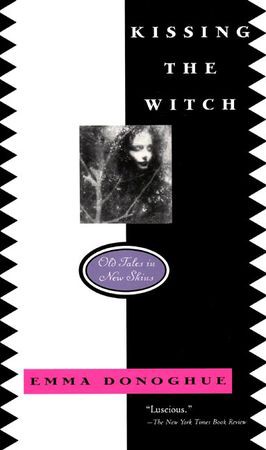
Donoghue wrote 13 stories that queer the fairy tale as we know it. In the collection, Cinderella runs off with the fairy godmother instead of the prince, Snow White wakes up with her own damn desire, and Belle who thought she could be the one to change the beast, learns that beasts, like people, don’t change. But the titular story “The Tale of the Kiss” is the penultimate feminist remaking in which the Sea Witch aka Ursula of The Little Mermaid gets her day.
Because everyone remembers the fairytale where the bachelor lures three women into his home, and eats them one by one, right? In Margaret Atwood’s reimagining of the tale of “The Robber Bridegroom,” Zenia is the debaucherous and “evil” woman ruining the lives of her three best friends. By way of Zenia’s desires, the men attached to her friends, we learn about the lives of Tony, Charis, and Roz — all riddled with loss, instability, and a wee bit of chaos.
This list would not be complete without Angela Carter, the fairy godmother of feminist fairytales. Carter brings all the sex and blood and guts and rage back to the fairytale, and The Bloody Chamber gathers some of her best revisions together in one binding. In one story, “The Tiger’s Bride,” Beauty turns beast due to her throbbing, hot and heavy feels for the Tiger who, with “each stroke of his tongue ripped off skin after successive skin, all the skins of a life in the world, and left behind a nascent patina of shiny hairs.”
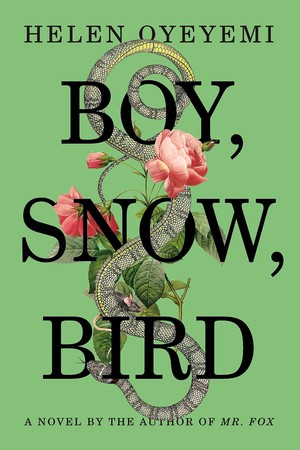
Boy, Snow, Bird is a Snow White retelling. Set in 1950s New England, the stepmother is named Boy and the stepdaughter named Snow. When Boy and Snow’s father have a baby of their own, a family secret emerges in the skin of their daughter. It’s a story examining how race, class, and gender ideology made monsters out of “everyday” people. In an interview with NPR, Oyeyemi explained why she was drawn to the fairytale as a place to tease out the “wicked” part of wicked stepmother: “I wanted to rescue the wicked stepmother. I felt that, especially in Snow White, I think that the evil queen finds it sort of a hassle to be such a villain. It seems a bit much for her, and so I kind of wanted to lift that load a little bit.”
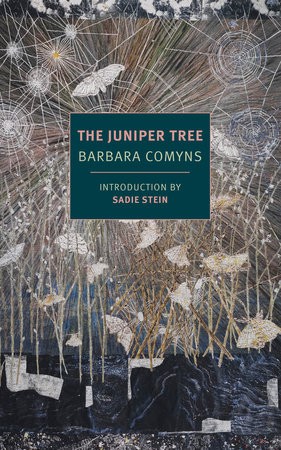
Because more modern retellings of fairy tales should trouble the whole “evil stepmom” thing. And what better way to do that than tackle another Grimms brothers fairy tale that marries infanticide with romance. In the original “Juniper Tree,” an evil stepmother kills her stepson, feeds him to his father, and then lets her stepdaughter believe she was the one who killed the boy. In Barbara Comyns’s retelling, the protagonist is Bella Winter — she’s homeless, without a job, and has a toddler whose father was a man she can’t really remember. Slowly, she endures enough to mend things, and marries a neighbor shortly after he’s been widowed. Comyns uses the grisly fairytale to problematize the clean lines between good and evil when it comes to domestic survival.
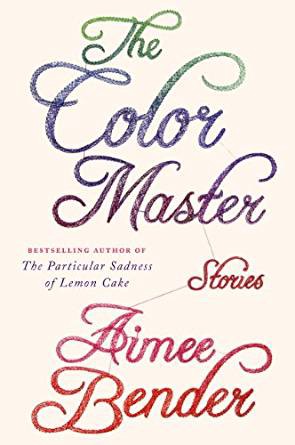
Aimee Bender imagines fairy tales where women have agency and don’t need anybody else to rescue them from their distress, thank you very much. “The Devourings,” for example, is a story in which a woman is married to an ogre. The ogre “accidentally” eats all of their children, which understandably ruins their marriage. So the woman decides to leave her husband, and does. As Happily Ever After as it can get after your children have been eaten, I suppose.
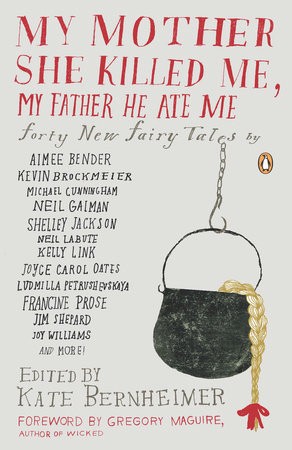
I don’t care if it’s cheating to put an anthology on this list, because this one is too good not to be included. Edited by Kate Bernheimer (who’s also written an exceptional essay in defense of the fairy tale as a legit study in literary form), this anthology not only has the best title, but it also includes exceptional writing by Kelly Link, Francine Prose, Karen Russell, Aimee Bender, Neil Gaiman, Italo Calvino, and others who take the word “spellbinding” seriously.
This collection actually reads like a spell, if only for the way it’s structured. The story “Eyes of Dogs” is told in two voices — one in the center of the page, and one in the margins. It’s a retelling of the Hans Christian Anderson tale “Tinderbox” in which a young soldier is tricked by a witch. In an interview with Lambda Literary, Corin explained the tension between the voice retelling a story, and the reader who chooses how to listen: “I thought instead of doing just one retelling I would do a double retelling and each narrative would double helix and twist into each other. And then I thought, how would I tell the original story in the first person, in my voice? So the part that is in the margins is essentially my contemporary voice telling the original plot with a much more modern sensibility — that’s really different from a historical sensibility. I like the idea of those two stories, (the main one and the one in the margin) crossing [and] the reader having to make these choices about how to read them.”
Toast co-founder Ortberg pioneered the series “Children’s Stories Made Horrific” and many of those stories are collected here. What if The Frog Prince were really a story in which we honored gender fluidity, and challenged the ways young and vulnerable people are manipulated by those who offer protection in exchange for something else? Enter Ortberg’s “The Frog’s Princess,” in which the sun falls in love with a young man’s daughter. The sun shines on them constantly, and they retreat into the woods only to find a frog who “offers” help and then demands things in return. Ortberg told Vox in an interview: “Any time you read a fairy tale, it’s very clear that somebody’s gender really influences the role they play in the story, whether they’re a daughter or a son…What would it look like if there were a world where there were still abuses of power, there was still violence and the threat of sexual violence and repression, that did not have the exact same gender roles and values as we do? So it’s not like this world is either better or worse than ours; it’s simply that power is ordered in different constellations.”
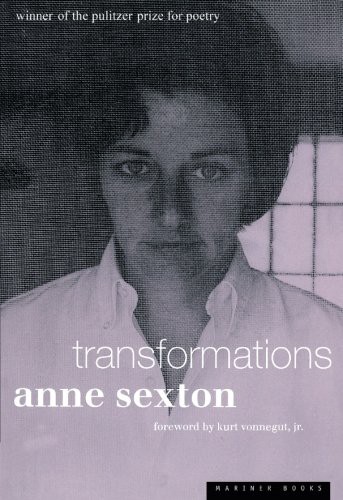
Snow White seeks revenge, Briar Rose (aka Sleeping Beauty) becomes an insomniac, and the witch’s burning in Hansel and Gretel becomes “altogether a memorable incident.” Transformations is more faithful to the fairy tale mythos as we know it, but infuses each iteration with a little more rage and revenge in the Happily Ever After bit.
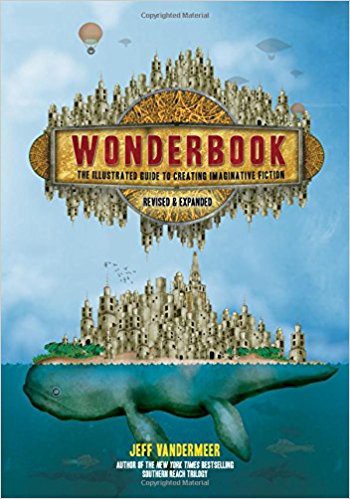
The following is adapted from a lecture given at Columbia University in April, 2018, and some of the images are reprinted from the author’s Wonderbook: The Illustrated Guide to Creating Imaginative Fiction. A revised and expanded edition of Wonderbook was published this month. Additional content can be found at the Wonderbooknow website. (Artist Jeremy Zerfoss created all diagrams reproduced here, unless otherwise noted. Click images to expand.)
Hauntings, as I see them, are one way of destabilizing the text without breaking the fourth wall, and are meant to help create texture and richness that may or may not be consciously noticed by the reader. Nonetheless, because these effects are visible to the writer, they likely change the narrative experience for the reader. (If you destabilize the text by breaking the fourth wall, all other effects you are attempting are defined by that breakage. This is also a valid approach, but not one that appeals to me currently.)
The point, too, is that we can become too enamored of the smoothness or seamlessness of our scenes and mistake that for success rather than perhaps something too pat. We can believe we are adhering to a classical idea of unity of form, when in fact we are simply creating something that might have more life if it were in some sense rougher or messier.
“Disruption” as a term is currently revolving in a decaying orbit due to the tech industry and “contamination” a negative one due to ancient instincts and, necessarily, the CDC. But both terms are useful in the context of fiction.
“Disruption” is useful in terms of the idea of either having enough distance from your creation, or seeking it, to think of ways that this might organically push back against neatness or inertia in the narrative — and “contamination” because it suggests a transaction resulting in layered richness.
In a microbial sense, “contamination” is the condition of all living things — and occurs to all of us on an hourly basis, with invisible actions and reactions taking place that demonstrate there is less difference between outside and inside, between our bodies and the world the move through. That there is a hidden agency that is often connected to the human but is not the traditional idea of “agency” in a work of fiction.
Once you realized that just at face value “contamination” acknowledges a world that is much more invisibly volatile and teeming with life than most fiction is able to portray, it is only logical to move on to ways of removing the distance between “person” and “environment” and even narrowing the perhaps too-wide gap between “Nature” and “Culture.” As, especially, I try to write from nonhuman perspectives in ways that I hope are not overtly experimental, in ways that remove an emotional reaction…all of this thought feeds into that attempt, even though it could feed into more traditional ideas of fiction.
How do I then find and adapt the structures that will best support these approaches? Structures that will perform best under the stress of a foreign regard?
This is in the back of my mind as I think about how hauntings — disruptions and contamination of the text — will help. So is the question of how much of this is actual quantifiable effect of structure in the text and how much is the scaffolding my mind needs to attempt (what I hope are) invisible experiments. Radicalizations that still mimic the form, the structure, of something familiar to the reader.
Important to hauntings is something crudely articulated as “the rate of the strange to the familiar.” This is something I have to think about after I’ve finished a rough draft, given that very strange effects will seem normal to me as the writer that may not be normal to the reader.
Important to hauntings is something crudely articulated as “the rate of the strange to the familiar.”
The point is not to “commercialize” something personal by changing or deleting what is too strange. But the point is to think of how much space you’ve left for the reader’s imagination and what kind of space it is. Are you meaning to write a work in a particular instance that rewires the reader’s brain or one that allows the reader’s brain a gentler entry point? Sometimes the gentler entry point is actually better to achieve a stranger result.
In all ways and at all times, I guess what I’m searching for are the repurposed and new tools to build something that does not exist already or to create the right “renovations” in certain instances.
In this context, it’s useful to discuss two inspirations in particular, one internal and one external, that helped me to arrive at an interesting place regarding hauntings.
I first thought about transference of emotional resonance or other qualities in my early 20s, when I embarked on a series of formal experiments in my fiction. Since I was mostly working on interlocking stories set in an imaginary city, I figured that experimental texts could in fact shore up the reality of the city using the same techniques that in describing a real place would break the fourth wall. In short, that fantasy would normalize and make less experimental post-modern technique.
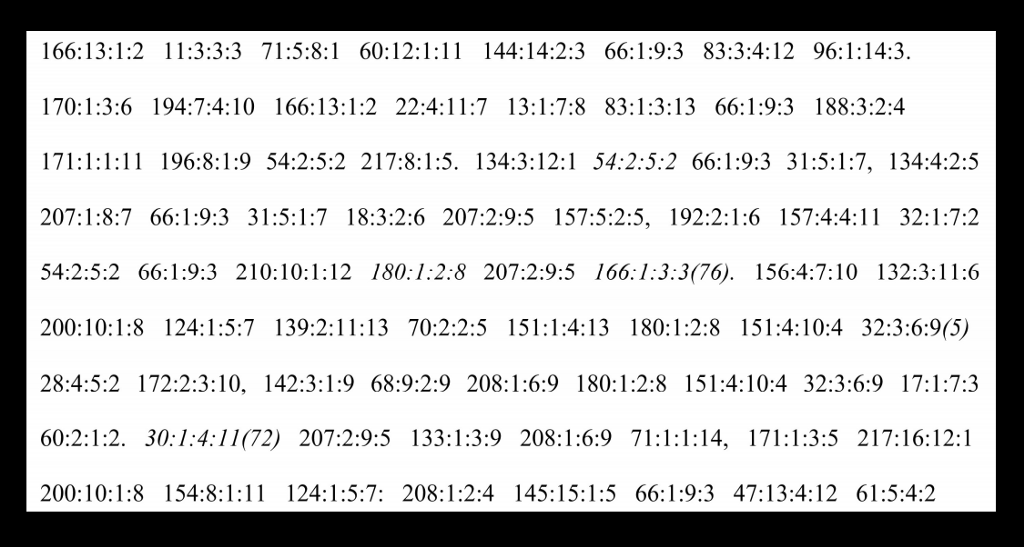
After a series of lesser experiments, I included a story in my mosaic novel or interlinked tales about the imaginary city that was all in code. A series of numbers, each set of which corresponded to the location of a word in a story elsewhere in the book. The reader had to decode the story using the rest of the collection.
The decoding in this case meant that reader was, to some extent, writing the story. And this process occurred on at least two levels.
The decoding in this case meant that reader was, to some extent, writing the story.
First, the unfurling of the plot of the story itself, word by word, and then the fact that I chose words from the rest of the book for their specific context and resonance. This was sometimes a neutral value and sometimes a very dramatic value, or a dramatic or quiet transference from the physical to the mental or vice versa. So, for example, taking the word “the” and other so-called invisible words from a scene in an unencrypted story featuring wide-spread destruction by fiery conflagration — and using these words in the encrypted story at a moment of great mental confusion and psychological drama.
The result is a story that unfolds in the reader’s mind in a way almost similar to some experiments with hypertext, but with the reader in a much more proactive imaginative position — and also adding a third mystery, which is, of course, why that particular story should be encrypted in the first place.
The audience for such a story is limited because it is a formal experiment, a kind of haunting of the text by itself that although transformative requires great patience and effort, and occurs at a slow pace. Over time, I’ve heard from about 150 readers who attempted the feat. There may be more, but I imagine not too many more. But it was a start. I began to think of how I could achieve similar effects in real time and without formal experimentation, and sometimes at a normalized tactical level.
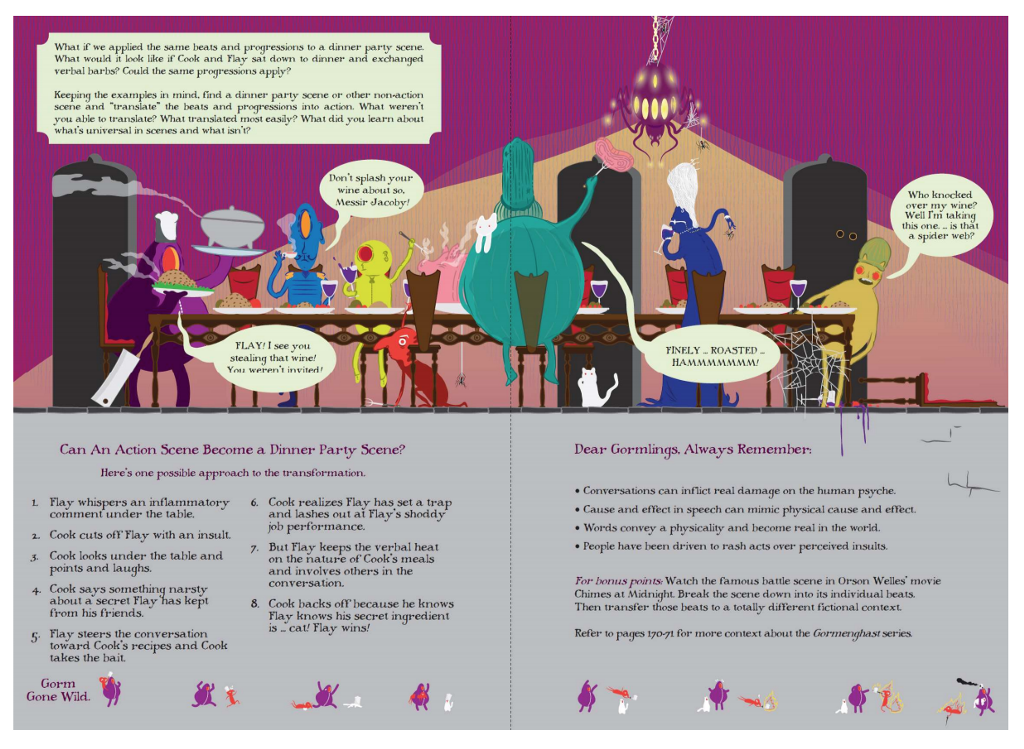
One way this ties into my prior comments on the study of structure can be expressed in an interesting way by a scene from Mervyn Peake’s Titus Groan, first book of the Gormenghast trilogy, which contains one of the great action scenes of all time. Set in a huge castle-like ancestral home, these books follow the often bizarre lives of the inhabitants — including Flay, servant to the lord of Gormenghast, who comes into conflict with Swelter, the Cook. In the chapter “Blood at Midnight,” their long-simmering feud comes to a boil — as depicted here. The long scene contradicts most rules about conveying action by using ornate language and complex sentences. It shifts point of view between Flay and Cook, which also shouldn’t work in this context.
Other fascinating attributes of the scene would be a whole different lecture. But for purposes of this lecture, I became interested in how you might find the level at which action-reaction summarized might be translated into a totally different context — for example, a dinner party. This question came into focus when I mentioned the idea at a literary festival, and the writer Victor LaValle asked me “How, exactly?”
I began to think both specifically and generally about this — generally in the sense of can you extract the structure of a scene at a certain level of hierarchy such that you can transplant it into any other context?
Specifically in the sense of the nuts-and-bolts of “translating” this particular Gormenghast scene. Could you structure the scene exactly the same way but transfer the weight from action to words? What would that look like? Would the urgency of the action scene make tension more easily expressed at the dinner party because of the source? In other words, would the fact the scene had begun life in a totally different register an context mean that the emotional residue of the original context would transfer? (Adding another layer of depth to the scene.)
Could you structure the scene exactly the same way but transfer the weight from action to words? What would that look like?
I’m still exploring the answer — even the diagram included here is just a start. But the further experiment is for me to take a scene I’ve written and apply the same transference, from action to words or vice versa, or perhaps an even more complex translation — and to see how that would not just bring in some residue or ghost of the original, but also to see if whatever personal resonance I brought to the autobiographical origins of the original scene now, at a different distance, manifests in a context that has perhaps no relationship to the first-hand thing I experienced that sparked the original scene in the first place.
One obvious reason this could be an important experiment is that finding the right distance either from one’s own life or from some element in the text is perversely enough often how a writer manages to fictionalize something in a useful way. The idea that you could “launder” your autobiography through a double-filter to get somewhere useful is fascinating to me.
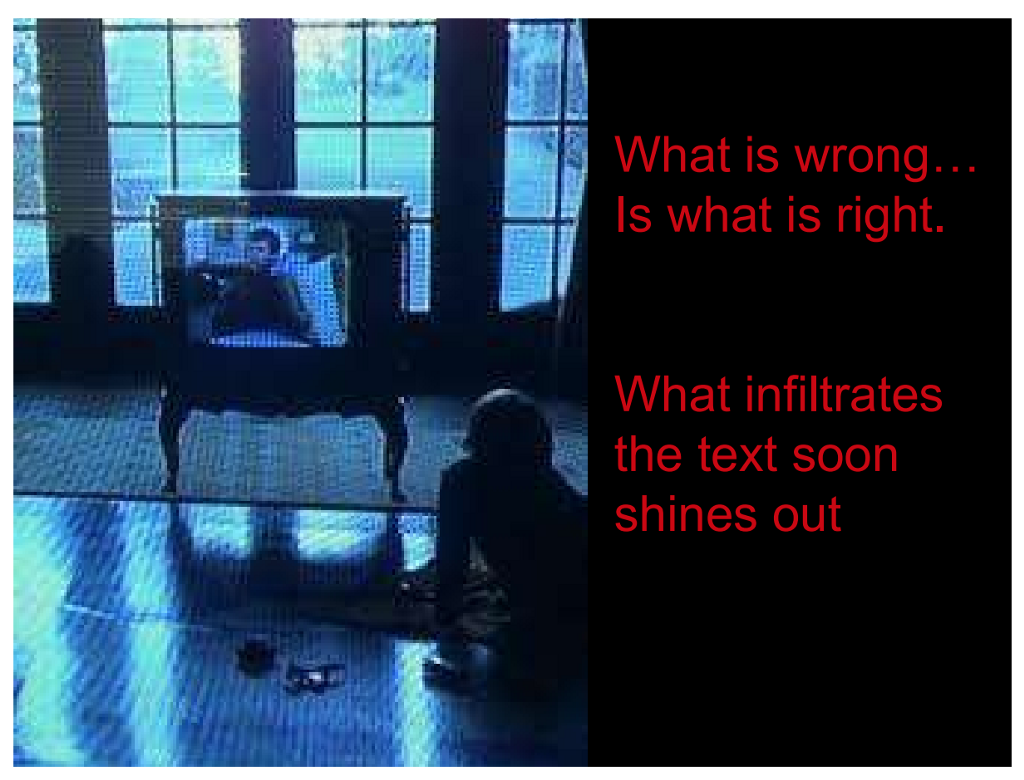
In addition to my encrypted story, I was also thinking about this image from The Shining quite a lot.
What’s wrong with this image? Well, try to put yourself in the position of a viewer from the 1970s or early 1980s.
The problem is that the TV has no cord. Now, today, a television can have no cord and still be playing, but not back then. So, the image is in fact uncanny. Being a fan of taking interesting film technique and translating it into technique for fiction, I thought what is the translation here?
In fiction, if you write a television that’s on and then say whatever the modern equivalent would be of “and it had no cord!”…that would be clumsy beyond belief. Kind of equivalent of reading that the “panther leapt like a big cat.”
I had thought about the encrypted story and that television with no cord for some time when I decided that the second Southern Reach novel required a contamination to reach the proper layering or depth.
Prior to this, I suppose the encrypted story had entered my process in at least one fairly crude way: if I felt a story was too smooth or I had somehow missed an opportunity, I would photocopy my handwritten pages and I would tear strips off of those pages, sometimes burn parts of them, and then, after a break of a month or so, I would go back to that now incomplete evidence and try to recreate the story. Usually this resulted in radical changes from the original.
If I felt a story was too smooth, I would photocopy my handwritten pages and tear strips off of those pages, and then, after a break of a month or so, I would go back to that now incomplete evidence and try to recreate the story.
But in thinking about the Area X novels, it came to me almost immediately that I could repurpose dialogue from Annihilation in Authority. Most of the incidental dialogue, then, that the main character in Authority hears while walking down corridors of the Southern Reach secret government agency is from Annihilation. In a context where the reader is already primed to uncover the next set of phrases that constitute hypnotic suggestion, as introduced in the first book.
The effect is meant to create a strong sense of directionless déjà vu in the reader. Conversely, this gave me the idea to retroactively contaminate Annihilation with Authority by using seemingly innocent phrases in Annihilation as hypnotic suggestions in Authority. An expedition back into Annihilation from Authority.
Ghosting dialogue may seem like a mere trick, but I think it is more than that. For one thing, for those readers who do notice “the trick,” source the dialogue back to Annihilation, each phrase brings with it the emotional resonance and context from that first book, until suddenly the corridors of the Southern Reach are not in fact inert, transitional environments, but ultra-alive places full of ghosts and full of words that have actual important subtext. It makes of incidental conversation something more central. It also conjures up for me, the writer, the idea of contamination and disruption in the sense of other forces at play in a very concrete way.
Performing this act in revision, a state in which I try to re-enter the fictive dream that is writing the rough draft as much as possible…this act made it easier to stick to the claustrophobic, paranoid style of Authority, a way of more or less by inhabiting the “character” of Area X as I wrote the novel, even as I also inhabited the actual main, human character.
Just as in Annihilation the physical environment impinges on and overwhelms the characters, then, via these devices that seem like a surface overlay but are in fact deep arteries embedded in the walls of the secret agency. In a sense, Authority also becomes a richer and more interesting ecosystem, even though embedded in the Brutalist settings of a secret agency building.
These then approach the density of the natural world in Annihilation, which itself used transformations that include the “trick” of blurring the difference between the animate and the inanimate — for example, a tunnel-tower that presents as stone but the biologist later realizes is a creature that is breathing. This idea too probably came from the cordless television — from my subconscious grappling with the translation.
Behind the scenes on the Annihilation movie set
In general, too, settings characters move through are more likely to change the narrative and even the plot if they are not thought of as inert backdrops but as opportunities for more useful complexity. This is also closer to the reality of the situation anyway. I like, for example, to know the total history of the settings of specific scenes, back as far as I can imagine it — back before conquest, and then back before human civilization, to prehistoric times.
Even in a brief spasm of the transformative in Nabokov’s Bend Sinister, in a sentence in which he bends time to go from fascist work camp to the Mesozoic and back to the present-day of the novel, we see the value of what you might call a geologic perspective in grounding the events in fiction.
I think you can tell, then, that although I used an uncanny technique in the service of reinforcing an uncanny thing in the text, you could use a similar mindset or perspective to destabilize and render more interesting any novel — especially if it seems something is lacking. Which may not be a character fault, but a failure to properly express environment through character point of view.
The idea of something that is both present and not-present has led naturally to other expressions of this idea. The one I would like to share comes from a novella I’m working on titled “Drone Love.” In the future of the novella, humans live on islands amid seas of garbage, stalked at times by made creatures meant to help stave off climate change that have taken on their own agency. In the air of these barren islands, molecules continually discharge bird song, although birds no longer exist — this false song the ghost of a new technology used to perpetuate propaganda by fossil fuel companies. In arid places, too, the molecules of the air convey the sound of falling rain. In all ways, the dead world coexists in this sense with the present-day of the novella. In an even more robust way, one of the biotech creatures is accompanied by the sound of a powerful aria, the molecules of the air identifying the creature by the music a composter created about it many years before.
Those on the island must now associate this beautiful music with a beast so powerful that even the presaged warning of music does not mean avoidance of death. Indeed, there is a transference, so that to the humans on the island the music is in fact a requiem, the music that will play at their funeral, so to speak. And, of course, it is, because in the future of the novella it is a kind of twilight for human beings in general.
We are now a long way from an encrypted story written in numbers and as far from a television with no cord. But I guess my point is that without these specific entry-points and the questions and narrative puzzles they formed, I would not have come to these other “tricks,” which then became central in some works because they blossomed in strange and unusual ways.
My way will not be your way because you are a different writer. But my point is that your subconscious wants to solve these puzzles as much as your conscious mind does, and you may be both invaded by an impulse and rewarded with a translating thought that is seamless and metaphorically pure. You may find the scaffolding necessary to explore something new.
Your subconscious wants to solve these puzzles as much as your conscious mind does, and you may be both invaded by an impulse and rewarded with a translating thought that is seamless and metaphorically pure.
Part and parcel of this process is a kind of trust. First of all in your imagination and secondly in a willingness to fall on your face. For every experiment that has worked, there are five that don’t, but you still learn something.
Moreover, internalizing what manifests at first as external feels akin to a haunting, because I am trying to find those mechanisms that will allow me to be adjacent to the things that fiction can never express, and find ways to express an approximation of them, at least. In the process, I become the one being haunted, and a haunting changes you at a fundamental level, changing the stories, too.
I am not at all the same writer as I was before these experiments. I know something about narrative afterwards that isn’t just a conscious knowledge but something more satisfyingly mysterious, exhilarating, and liberating.
About the Author
Jeff VanderMeer is the author of the bestselling, critically acclaimed Borne and the Southern Reach Trilogy. His work has won the Shirley Jackson Award and been translated into 35 languages. His nonfiction appears in the New York Times, Los Angeles Times, and on the Atlantic’s website.
I moved to Mumbai, India almost three years ago so I’m intimately acquainted with the concept of culture shock. When I wrote my debut novel, America for Beginners, I was curious to see how immigrants and visitors responded to the United States, but the truth is, I was curious to see how being outside of one’s native space teaches people about themselves too. Culture shock is, I think, my brain’s resistance to adaptation to what is new and unfamiliar, and that is often a reaction to changing, to being forced or asked to change. What I mean to say is, it’s really more about me than the place I’m being shocked by! What I have learned the most through living in India is about myself, how much I want to belong, and how that desire informs my experience and identity.
Purchase the book
The list below are books that help me when I’m in my most, and least, culture shocked moments, sometimes because they advocate for acceptance, for adapting, for openness, and sometimes because they reflect my desire to just get away from it all. These books around all in some way about culture shock, when traveling abroad, when confronting one’s own country or a country one is from. Sometimes the hardest thing is readapting to being in one’s own country, and that disquieting feeling of being an alien in the place you are supposed to belong to haunts some of these novels, while others are about how much better a new place suits the characters, how really, although they are far from their homeland, they are also right at home.
This hilarious and painfully accurate novel moves from biting criticism to sharp violence and back again as it follows two women, one a Japanese American shooting a television cooking show called “My American Wife” for the Japanese market, and the other an abused Japanese housewife whose husband produces the show. The pinpoint precision with which Ozeki underlines both Japanese and American cultures is excellent and the emotional resonance of the novel is hard to shake.
An incomparable classic, this memoir lovingly and hilariously recounts the trials and tribulations of a pair of British home-owners in France, and the struggles of adaptation and renovation. It gives you serious life-envy, but it’s worth the jealousy. I think of it often, whenever I’m trying to arrange a home repair in India.
The second in Ghosh’s masterful Ibis Trilogy, this novel focuses on a Parsi trader in the 1830’s whose yearly trips to China to trade opium grown in Bengal for the British reveal a double life. The way in which Bahram Modie, and the book’s many other characters, navigate (pun intended) their dual selves and identities as they transition between the mores and restrictions of each culture is as gripping as the meticulously researched history itself.
Oyeyemi’s magnificent first novel tells the story of a young girl whose mixed heritage and marvelous imagination makes it hard for her to connect with other children. A trip to her mother’s home in Nigeria unlocks a part of her identity when she meets a new friend, but the fact that her new friend might be more myth than reality is far more than she ever bargained for.
In this searing memoir, Taseer, the son of an Indian Sikh mother and a Pakistani Muslim politician, explores his own heritage and works to understand his father’s religion through the lens of a journey from Istanbul to Lahore. Trying to understand his own father’s accusation, that he is, in fact, a stranger to history, Taseer seeks out that history.
A modern classic, Eggers’s chronicle of one of the Sudanese lost boys, Achak, as he flees civil war for life a refugee camp, and finally ending up building a new life in the United States. Achak’s resilience and curiosity about the world is inspirational and his construction of his identity as he shifts through stages of his life and struggles to survive unfolds in a way that cannot fail to move a reader.
Following three generations of women from the same family, García’s story is at once epic, shocking, funny, strange and sad. The many characters watch their country transform as they experience their own personal transformations. The longing for a past that never existed, the disassociation from a present that seems unlivable, and the desire for a future that might never come to pass haunts this family. Watching these women try to decide who they are even as the world around them suffers a crisis of identity is engrossing.
Lahiri’s story of two people during Bengal’s Naxalite revolution twines itself up with their concurrent story about adapting to America, to a marriage neither party desired, to a life that feels stuck in the past despite being transplanted across the world. Sprawling and melancholic, the novel is rife with the tension of people who cannot connect with each other, or themselves. Additionally, the description of Kolkata was my first real snapshot of the city where my husband was born.
One of the best novels I have read in a long time, Nguyen’s novel is masterful, hilarious, extremely well observed and heartbreaking, all at once. Every part of it is just magnificent as a commentary on Vietnam and the United States, but there is a special place in my heart for the passages depicting the bewildering experience the anonymous narrator has as the native advisor on an Apocalypse Now style Hollywood movie for it’s sheer absurdity that can only be actual truth. I have never seen my own country so clearly as through Nguyen’s eyes.
Pratchett is one of my all time favorite writers and his Discworld series is fantasy blending with satire to perfection. Interesting Times follows his recurring character, Rincewind a hapless wizard, visiting an old friend on the Counterweight Continent (which is not at all like China, not one bit, no). I have read this bitingly funny and insightful as hell book, like most of Prachett’s works, many times, and I always find something new to love. There is nothing like the comfort of a well loved book when you are far from home, or feeling far from your home while you’re in it, is there?
Vanish. That’s the title of the first episode of HBO’s adaptation of Gillian Flynn’s novel Sharp Objects. It is also, as Flynn tells us in her book, the last word Camille Preaker (played in the limited series by Amy Adams) ever carved on her body.
The fact that Preaker, a reporter tasked with writing up a story about a recent murder in her hometown, is a cutter is revealed to us in the final moments of the episode. As the rarely sober Camille preps a bath, we finally see why she prefers long sleeves even hot and humid Wind Gap, Missouri — and why her mother Adora (Patricia Clarkson) is so wary of her being near those sharp objects of the show’s title. Her body is covered in scratched and scarred words: “Definitely.” “Omen.” “Dark.” “Mother.” They adorn her arms, her legs, her back — every possible surface except her face. Camille may well want to vanish, but it’s clear from the start that Flynn’s tale is about the way you cannot escape what’s written on your body, the stories it holds and hides. Novel and series alike, in making that point as literal as possible, force those of us reading and watching to question the liberating power of language when it comes to dealing with trauma.
Flynn’s tale is about the way you cannot escape what’s written on your body, the stories it holds and hides.
“All I know is that the cutting made me feel safe,” Camille tells us in the first-person narration of Flynn’s novel. “It was proof. Thoughts and words, captured where I could see them and track them. The truth, stinging, on my skin, in a freakish shorthand.” Her compulsion to wound herself with words literalizes the way we’re taught to understand language: as both weapon and lifesaver. The way to overcome trauma — like, say, Camille’s loss of her sister Marian when they were young — is to put it into words. But Marian’s death merely deepened the hushed silence that had fallen over Adora’s sprawling house, leaving Camille to deal with her pain on her own.
Rather than lash out and hurt others, the tomboy-turned-town-sweetheart directed her anger at herself, turning those words into weapons that would presumably save her from her grief. The compulsion to write down words that bristled within her skin predated her sister’s loss: “I was nine and copying, with a thick polka-dot pencil, the entire Little House on the Prairie series word by word into spiral notebooks with glowing green covers,” she confesses, while later writing down everything everyone said in a tiny blue notepad. But she carved her first word (“wicked”) with a kitchen knife when Marian was already gone. Yet the safety that she found in those cuts came from the desire to mark herself, to own the words that buzzed in her head and threatened to undo her: self-harm as self-containment. In lieu of cutting (we learned she eventually got treatment at an institution and has not cut herself since), it makes sense she now dulls her senses with alcohol, another way of silencing that voice that compels her to make herself into a palimpsestuous canvas. “I called myself sweetheart,” she informs us. “I wanted to cut: Sugar flared on my thigh, nasty burned near my knee. I wanted to slice barren into my skin. That’s how I’d stay, my insides unused. Empty and pristine. I pictured my pelvis split open, to reveal a tidy hollow, like the nest of a vanished animal.”
There’s that word again: vanish. She’d scarred herself with it so as to quiet the others around her. “Vanish will banish my woes,” she sing-songs to herself at one point in the novel, “Vanish will banish my troubles.” The prospect of disappearing haunts Camille wherever she goes. The more she digs into the case of these murdered girls — both of whom disappeared seemingly in plain sight — the more she muses on what it might mean to vanish herself. Untethered from her work family over in Saint Louis (or Chicago, as it is in the book), her editor playing the role of hardened but loving father, and disengaged from her family in Wind Gap, her mother as much a haunted woman as she ever was, she careens through her daily life with an aloofness that constantly risks undoing her. She falls asleep, drunk, in her car listening to music, and awakes disoriented about where she is; she drowns out the world around her while taking a bath by reaching for her ever-handy headphones; she turns party-sized booze bottles and vending machine candy into her daily diet.
Whenever Camille is forced to be present — like when she interviews the town’s sheriff, the grieving father of one of the murdered girls, or the Kansas city detective who’s been brought down to help — she retreats into scripted, hollow words. Small talk, she bemoans, is not really her thing. Even her stilted interactions with her mother show that they never did learn how to communicate with one another; Adora had always required a malleable little doll and Camille proved to be much too unruly for such a role. Using and dulling her pain with razors and liquor becomes a way to anchor herself. “I’m here,” she says to herself in the novel, “and it felt shockingly comforting, those words.” She continues: “When I’m panicked, I say them aloud to myself. I’m here. I don’t usually feel that I am. I feel like a warm gust of wind could exhale my way and I’d be disappeared forever, not even a sliver of fingernail left behind. On some days, I find this thought calming; on others it chills me.” It chills readers and viewers alike for Camille’s near-deathwish cannot be extricated from both the physical violence she’s done to herself and the nauseating violence done to those vanished girls whose stories she is now telling.
Here’s where the show’s visual storytelling picks up Flynn’s nightmarish undertones and uses them to create the flickering, glazed feel that defines director Jean-Marc Vallée’s approach. On the screen, Sharp Objects aims to put audiences in a constantly dazed state. The first episode may lay out the central plot elements that will drive this neo-noir Southern Gothic whodunnit, but it privileges wordless scenes that do more to disorient than to guide you. Take its opening sequence where a pair of young girls (a teenage Camille and her younger sister Marian) rollerblade through Wind Gap, giggling all the way, before running up the lush green lawn that leads to their house where they hope their mother won’t notice them. As the make their way up the stairs they end up walking in on Camille’s current Saint Louis apartment and waking her with a pinch of a needle. You begin with a fairy tale set-up (two little girls wandering into an empty house in the middle of the forest) and end with a twist on an old favorite (Sleeping Beauty awakened not by a kiss but by a prick). Myth and memory immediately collide.
These ghostly words that flutter around and on Camille suggest that language itself can be a prison.
Camille’s hazy and groggy memories constantly seep into the show’s visual landscape, blending past and present, reality and daydreams, flashbacks and possibilities. In fact, the screen, in Vallée’s hands, begins to mirror Camille’s penchant for cutting commentary. In the show’s second episode, as the town grapples with the murder of yet another young girl, we not only get to witness the cringe-worthy moment when Flynn’s protagonist finally gets her hand on a needle; we also see words keep appearing near her in ways that suggest they’re only there for our benefit. At one point, as she exits the car to go to the home of the grieving family following the funeral, we see “SCARED” scratched on her car door. Later, when she drives off and opts to roam around the mostly-empty playgrounds by the woods, the word has changed: “SACRED,” it reads. And when Amma, her teenage half-sister (Eliza Scanlen), shows her the lavish dollhouse she’s been working on — an eerie replica of the gothic house they’re in — we see the word “GIRL” carved on one of the mini-paintings that hang in the upstairs hall. It’s a literal blink-and-you-miss-it moment; the camera switches to a perplexed Camille as she examines her childhood home in miniature, and the word is gone by the time the shot returns.
The ephemerality of these words, in contrast with Camille’s enduring scars, jolts us awake. If fairy tales structure Flynn’s Sharp Objects, they serve to upend the lessons those stories have taught little girls for generations. Where horror and violence get tidied up in happily-ever-afters, their clash with 21st-century true crime dramas and the Southern Gothic (Flynn’s words read like a blood-splattered Tennessee Williams play) make Camille’s story all about the permanence of trauma and the immateriality of words. These ghostly words that flutter around and on Camille suggest that language itself can be a prison. Trauma, as visualized by the show, pulses in images, never in words, and it’s unclear whether anything Camille puts into writing will ever free her from the pain she’s learned to live with. In making the leap to TV, Sharp Objects stresses just how inadequate words can be in the face of grief. It explains why Vallée (working off of Flynn’s own adaptation) so disavows dialogue in favor of music-driven storytelling. Camille’s inner torment becomes codified in the music she listens to: the loving self-destructive ire of “Ring of Fire,” the self-admonishing melancholy of “I Can’t Quit You, Baby,” the encroaching madness of “There’s A Key.” And it is in those moments, when we see Amy Adams sighing or groaning, that Flynn’s protagonist feels most present, the moments when she’s on her bed, staring up above, wishing she could do the one thing she knows she’s unable to do: just vanish.
Again they cooked a meal, a good meal, maybe the best Benny had ever cooked, and they ate it slowly, with great delicacy, noting the mouthfeel of chives and onion, the muscularity of bone broth, laughing because not knowing which words would be their last had made them pretentious, and though there would be no one to document their words let alone be impressed by them, Elle wondered if the ash would remember, if she and Benny would be tossed and raked through and blended with the rest, if they would become mountain peaks, humpback whales, books — a clatter of Benny’s spoon against his bowl, and he peered up like a child, thinking what a gift it was that he and Elle could share a nice dinner behind soundproofed walls and blacked out windows, how despite growing up thousands of miles from each other they’d told the same story of the world they stitched together, only now he wanted to tell her something he’d done without her, something shameful, was that okay, he asked, and as she nodded with noodles in her mouth he began: long ago, in a McDonald’s drive-through, a nice old lady in front of him had paid for his milkshake and fries because the person in front of her had paid for her and the person in front of that person had also paid, etc. etc. and he’d wanted to keep the chain going, except that he had the stupid luck of having behind him an entire youth group packed into a monstrous van, all while the man at the drive-through window stared him down as if waiting for him to be a decent person, so he paid it forward, over $200 he paid it forward, and before he could allow himself to get on the road he did something utterly indecent: he re-entered the drive-through lane, he willed the goodness he’d launched into the world to boomerang back to him, and when he pulled up to the menu again he asked for five meals, at least three more milkshakes, a box of apple pies, etc. etc. and by the time he finished his four-movement symphony of an order, the truck in front of him had already driven off, and wasn’t that shameful, Benny said to Elle, I don’t know why I never told you, I guess I didn’t know you then, and Elle smiled because to her this was probably far from the most shameful thing he’d ever done, because the two of them might aspire to true accountability right before the trumpets rang but there would be no trumpets, the most she’d heard through the coded radio static was that it would all end in a matter of days in a literal flash, and if Benny gave all of himself away now she’d have to sit with him in the minutes or hours after, piecing together the wreckage as they waited — enough, Elle said, as she reached across the table to still his hands, did he remember when she used to give elaborate readings of his palms, and he said of course, like the time she predicted incorrectly that he would outlive her, and she said, well back then death was interesting and I didn’t want to be alone, and this made Benny quiet as he knew that in his company, Elle had at times felt the most profound loneliness of her life, and after all these years, he still could not separate the wars inside her head and the invisible anchors on her chest from how they had caused him suffering, and yet before the flash, when his comparative lack of suffering should have made him more terrified than her of what would come next, it was still Elle who looked the saddest; all this he told her, and Elle stared off at the hunting rifle by the sink and said that sad wasn’t the right word but she didn’t know what was, and before long they were sharing with each other their favorite words: woolgathering, zaftig, defenestration, 아련함, 孤独, working the sounds out of their throats and along the walls of their mouths and over and under their tongues and through the many shapes that their lips could still form as if they were chewing the words, as if words were for dessert when dessert was actually two vitamin gummy bears each, which Elle and Benny savored before throwing caution to the wind and devouring the rest in the bottle, and as they stood up and the nutrients drowned their bodies, they marveled at how long it’d been since they planted their feet like this, not to move from seat to seat but just to be upright, to let gravity run its course, though looking down at her feet, thought Elle, seemed to buck the natural order of things, an order she’d learned as a little girl when her mother died lying on her back the way most preferred to go, looking up, wasn’t that right, Elle asked Benny, and that may be true, he said, but who could really know which direction pointed to heaven, to which she groaned, realizing at the same moment that she’d forgotten the last words her mother had said or even what language they’d been in, a failure, Elle was calling herself now, she was one of the last representatives of humankind and should be giving the earth more to lose, but with a hush Benny handed over a stained dish that needed no instruction; she chucked it against the wall with the others, the crash no longer causing either of them to flinch, then she moved on to the jugs of water, the wind-up flashlight, the last of the liquor, Benny’s grandfather’s coin collection, the cards and letters they’d written each other and re-read together every time they packed up and moved, Benny always pretending for some reason that he’d never read them in private, and when Elle was done they stepped over the detritus, humming some tune, some soundtrack for their lives that they’d cobbled together over the years from pop hits and commercial jingles and even the weird demo song that came with their electronic keyboard, now overturned into a pool of cranberry juice, how they kept going, how their voices grew louder, how before Benny smashed his only working walkie-talkie he radioed their former landlord to say yes, Carl, you are racist and no, I will not forgive you, not even now, and after Elle went down her list as well and took a hatchet to the portable stove, there was a silence in the apartment so pervasive that they could hear each other blink; it was then, for the first time in months, that they unbolted the five locks and clasped their hands together and went outside, surely, they thought, to the sight of overturned cars, rubble pyramids, human fire pits, killing contests, and cannibalism, and there was some of that, but there was also in the former laundromat across the street a pack of strangers belting out separate cobbled-together songs, none of them in sync as they swung and shook and contorted also to the thumps of whatever objects were being cycled in the dryers — please god, let it not be heads, thought Benny, as Elle pulled him there over the broken glass and splintered chairs, toward the smell of sweat and piss and smoked outlets, and when she began to shimmy in front of him like a fool he could smell her too, a smell that had no other language but Elle — and there, bumping against these people, everyone the same age before the end, she looked back at Benny and thought how the earth would fold in on itself and the stars would combust and dazzling light would arc from the periphery of the eye causing a collective turn of heads toward a sight that no one would have the capacity to describe, and how for a breath before all of this everyone around her would still be alive, and not just alive, but dancing.
About the Author
Simon Han’s writing has appeared in The Atlantic, The Iowa Review, Guernica, and Fence. The winner of the Indiana Review Fiction Prize and the Texas Observer Short Story Contest, he is a 2017–2019 Tulsa Artist Fellow. Find him online at simonhan.net.
If I had a superpower I would want it to be the ability to pause time, or teleport, or summon the TV remote with my mind so I don’t have to get up. I’m open to a lot of possibilities, but one power I would absolutely forgo is foresight. While horoscopes are fun and weekly weather reports keep me from wearing flip flops into thunderstorms, true mystic fortune telling only brings chaos. I have no desire to know the day the world will end, and I was horrified when a friend confessed to always reading the last chapter of a book before the first. Where’s the appeal of the unknown? The intrigue of taking in everyday as a plot twist? You may scoff at my ignorance is blissmentality, but here is a list of titles that support my theory: Sometimes, it’s better not to know.
Previously known for his comic books, Soule breaks into the novel world with the origin story of the Oracle, an everyday New Yorker who wakes up with the ability to predict the future. A guy can do a lot with newly found superpower and an anonymous internet persona, but between dodging assassins, turning down warlords, and ticking off televangelist preachers it’s hard to predict whether he’ll survive each day. This side-splitting satire takes “Knowledge is Power” literally while invoking questions of epistemology, faith, and the selfishness of human nature.
As children, the four Gold siblings snuck out to meet a traveling psychic who foretold the day each of them would die. Varya, prophesied to live to an old, ripe age, discredits it as a trick but nevertheless finds herself counting days, Klara flirts with her inevitable death by becoming a stage magician, Simon flees to San Francisco in the ’80s, and Daniel confronts his own mortality directly as an army doctor. As the consequences of this knowledge compound, the boundary between fate and choice grows thin. Some prophecies are true only insofar as they are believed.
Dana, an African American writer in 1979 Los Angeles, doesn’t see the future exactly—she’s lived it. She is transported back in time to an antebellum Maryland plantation, where she saves a red-headed child who would one day grow up to be slave owner and, through violence, her great-great-…-grandfather. Every moment in the past is a struggle as Dana has to reconcile her knowledge of who the young, misguided boy will grew up to be and her own identity as both a modern, educated African American woman and a pre-Emancipation object to be beaten, possessed, and coerced.
Two hundred and two years is an odd distance to time travel, but Claire Randall, fresh off the front lines of World War II, has the misfortune to be transported exactly that far back. Her experience as a combat nurse is both a boon and a danger in 1743 when “germs” did not exist and leeches were still a favorite tool of modern medicine. Amidst the gruesome violence of raiding clans on the Scottish Highlands, Claire’s medical abilities make anonymity impossible, so instead she employs them to make herself useful. With a fiancé waiting for her in the future but a brawny warrior hacking down dangers in the past, the question of when Claire will return turns more into an if.
In the aftermath of the 2011 tsunami, a novelist on the Pacific coast of Canada finds a diary washed ashore in a mound a debris. As she reads it, she finds herself growing attached to the writer, sixteen-year-old Nao in Tokyo, who is struggling with an unhealthy family life, school bullying, and thoughts of suicide. The swapping narration between Ruth and Nao makes it increasingly difficult for the reader and for Ruth herself to distinguish the present from the past — what is read or recalled and what is occurring in real time. As Ruth’s grasp on reality slips, she becomes increasingly invested in saving a girl who in all likelihood is already dead.
Rachel has grown used to the predictability of eternal life: she finds work, gets married, has kids, watches as they all die, and approaches death herself only to be restored to youth. After 2,000 years of more or less the same, the 21st century does not break the pattern, but it does come with unique tribulation of its own. Through the eyes of one who has seen and done it all, Eternal Life attempts to understand humanity’s obsession with immortality, digital to botox, and what makes life worth living.
When your job is appraising antiques, you are bound to come into contact with an interesting object or two. For Semele Cavnow that interesting object happens to be an ancient manuscript foretelling thousands of years worth of disasters and a deck of tarot cards that may make a difference. Obsessed with rediscovering the deck and dodging an unknown enemy lurking in the shadows, Semele must use every tool at her disposal to unravel the truth behind the prophecies.
Most of us have already bungled our way through this play in high school, but few writers can pull of an everybody-dies tragedy as well as the Bard himself. Macbeth, a general in the King of Scotland’s army, receives a prophecy from a sketchy trio of witch who promise him a series of promotions as well as the Scottish throne. The only caveat is several people would have to die along the way. His wife says go for it, and his ambition urges him to agree. As the murder spree kicks off, more prophecies come to light that throw Macbeth and Lady Macbeth into a paranoia fueled madness. We all know how that ends.
In Homer’s Iliad: the hot-blooded warrior Achilles yo-yos back and forth between battle and pacifism, only later revealing his conflict over a prophecy that promises him either a long and happy life or everlasting glory and an early death. His hesitation claims the lives of countless soldiers. Madeline Miller retells Achilles’ story from the viewpoint of his lover Patroclus (it’s canon! Probably!). A mortal watching the grand workings of gods and demigods, Patroclus only wants to be with the man he loves; he recognizes Achilles’ great gifts and heroic destiny, but he also knows about the prophecy and fears his beloved’s death. Watching both of them navigate the tension between mundane happiness and fated glory is heartbreaking.
As long as we’re on the subject of mythology, I would be remiss to not also give a call out to Cassandra from Agamemnon, a woman blessed with foresight but cursed never to be believed. Her desperate warnings only gain her enemies and perceived insanity which drives her to death. If you ever wish for the ability to see the future, consult with the classics first.
DON’T MISS OUT
Sign up for our newsletter to get submission announcements and stay on top of our best work.
YOUR INBOX IS LIT
Enjoy strange, diverting work from The Commuter on Mondays, absorbing fiction from Recommended Reading on Wednesdays, and a roundup of our best work of the week on Fridays. Personalize your subscription preferences here.