I can’t resist a cryptic invitation. So last month, when I got an email about a “weird interactive storytelling digital art experiment,” I was there for it.
The email came from my friend Max Neely-Cohen, a skater-turned-novelist who I’ve long suspected moonlights as a spy due to his lengthy, unexplained disappearances from New York. “Some brilliant nerds are going to help me to make a space that visually responds to poetry and prose as it is read aloud,” he wrote. “Imagine giving a reading somewhere and having the environment change based on what you read. And being able to control those changes.”
I could not, in fact, imagine that, so I said I’d stop by.
The project formed as part of a week-longmicro-residency at CultureHub, an art and technology center founded in partnership with New York’s La MaMa Experimental Theatre Club and the Seoul Institute of the Arts in Korea.
I visited the space in NoHo on a humid Friday, riding a rickety elevator into a large, black-walled studio. Several metal chairs lined one side of the room, facing a wide screen on the opposite wall. Toward the front, Max’s assistant, NYU ITP student Oren Shoham, manned a laptop surrounded by wires; toward the back, a microphone stood next to a table stacked with books.
Combing through the books, I found This Planet is Doomed, a collection of science fiction poetry by Sun Ra, the legendary Afrofuturist jazz musician (and composer, bandleader, poet, philosopher, and and and). Because my dad is a jazz guy and I was a kid who identified as an alien, I was introduced to Sun Ra at a young age. Even then, I recognized that Sun Ra was, if not the coolest person to have ever lived, definitely in the top five. His science fiction poetry seemed the perfect input for a spatially overwhelming poetry synthesizer.
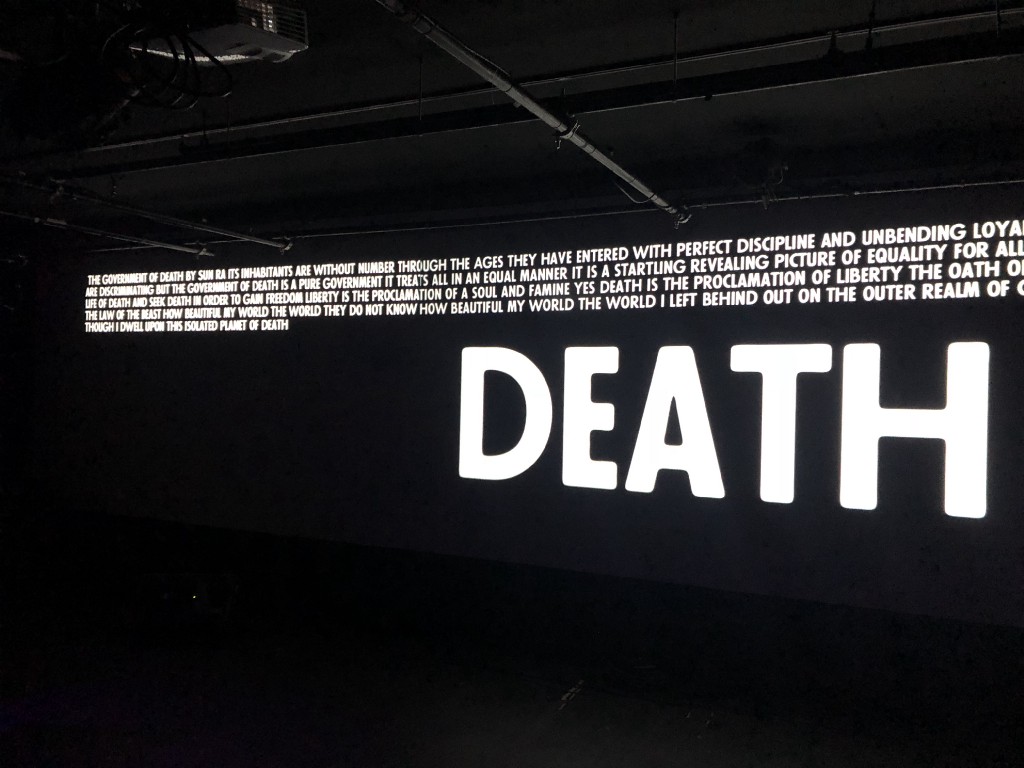
I picked two poems: “The Government of Death” and “Planet of Death,” and stood behind the microphone with two cameras trained on my face. The room went dark, Sun Ra spotlighted. As I read, words flashed in my peripheral vision, though I couldn’t fully see the adjacent imagery.
As I read, words flashed in my peripheral vision, though I couldn’t fully see the adjacent imagery.
“[A]ll governments / on earth / set up by men / are discriminating / but the government of death is a / pure government,” writes Sun Ra. “I gave up my life and am here on / this planet / of death / in order to teach my enemies that their / life is nothing else / but death / and that their planet was isolated from / the cosmic spheres / whence I gave up my life.”
Including titles, “death” is repeated twenty-one times in the poems. After finishing, I saw “DEATH” in huge, all caps letters on a black screen. I was briefly speechless, then noted that the whole thing was Incredibly Goth.
Max Neely-Cohen says he’s long harbored the idea for this kind of project, but wasn’t sure existing technology could manage what he had in mind. “There are all these visuals that work off of different parameters of live music,” he briefed me over the phone, after my visit. “A lot of them are just volume, but more sophisticated ones can analyze pitch and all these different things. They create a visual space out of that. I wondered, can you do that with a reading? For a really long time, the answer I got was ‘no.’ And the reason is that speech-to-text sucks for live transcription. But it’s been getting better.”
Max and Oren used a speech-to-text API (application programming interface) from Google Cloud and hooked it up to EmoLex, a database compiled by computer scientist Saif Mohammad, that crowdsourced associations between words, emotions, and sentiments; this included color association. When I read “Government of Death” into the microphone, my audio went to Google Cloud for transcription, then into EmoLex for visualization, and then zapped a giant, gloomy DEATH screen back to the studio.
Writer Moira Donegan, who read a piece about a black and white film, had a particularly poignant experience with project’s chromatic element. “Seeing those words rendered in color — rendered as color — added a series of associations to the work that I hadn’t had before,” she said. “It was pretty stunning to see them rendered that way as I was speaking — ‘grief’ as green, ‘body’ as orange — whereas my experience of the material before had all been in greys.”
It was pretty stunning to see the words rendered that way as I was speaking — “grief” as green, “body” as orange — whereas my experience of the material before had all been in greys.
Other testers I spoke with responded to different aspects of the installation — perhaps dependent on what they were reading, or their professional backgrounds.
Bloomsbury editor Ben Hyman read a selection of Frank O’Hara poems, and noted that “O’Hara’s work is intricately linked to his particular social world of friends and collaborators, and to the contemporary art of his time — in addition to being a poet, he was a curator of painting and sculpture at MoMA. It felt like he’d be the perfect ancestor to introduce to Max’s clever machine. I think Frank would have gotten a kick out of it.”
“The exhibit felt like ekphrasis in practice,” said writer Becca Schuh. “Creating a new form of art via commentary on already existing works. It was an odd day in New York, humid and sad (Anthony Bourdain died the morning I went to the project), and it was both surreal and beneficial to step away from the oppressive air and into this new atmosphere.”
Writer and editor Bourree Lam took a different route, and read a series of texts to her husband. “I write about economics, and originally I had planned to read something very mundane like a jobs report or Federal Reserve meeting,” she said, “but then when it came time I didn’t want to read something with so many numbers…I ended up reading an exchange with my husband that pretty much sums up our communication ritual every evening since we got married: When are you coming home? Is work crazy? Are you coming home for dinner? Who’s in charge of dinner? What’s the plan?…Standing in those texts, I felt like I was sharing a part of my relationship with the world. We literally have this exchange every weeknight. It’s really personal, but also really mundane. It was that banal/sublime tension of art that draws from the quotidian (not that I’m calling what I read ‘art’!)…seeing the texts on the big screen made me realize I don’t mind sharing some parts of my relationship.”
Standing in those texts, I felt like I was sharing a part of my relationship with the world.
Meghann Plunkett, a coder as well as a writer, was perhaps in a unique position to appreciate the project’s technical elements. “I was so thrilled to see that someone was using APIs for art’s sake,” she told me in an email. “Often we see technology utilized to solve problems and disrupt markets. My heart soared to see that Max was using an API to embellish an experience instead of trying to change that experience. I loved that the speech-to-text feature was coupled with an author’s reading without overshadowing it. With innovation like this, it opens up the possibility for other artists to view open source APIs as small platforms for literature, art and performance. It gives me hope that technology and art can co-exist in a symbiotic, balanced relationship.”
Max is returning for part two of the residency in the fall, and emphasized how much more is possible: “We could use the same dictionary database, or a different one, and control all sorts of parameters. We could use a reading to grow a garden, or build a city. This can get more sophisticated, more visually interesting. This was a super-fast initial prototype. All we did was make it work. The amount we can do past that is unbelievable.”
I tell people that I got a degree in English Literature so I would secure a high paying job at a literary non-profit with an unlimited salad bar, rosé on tap, and a personal chauffeur, but the real reason for my four (very expensive) years in university was to hone my bar trivia skills so I’m acing the book questions and bringing glory to my team (Team Billy, named after my dog, Billy the dog).
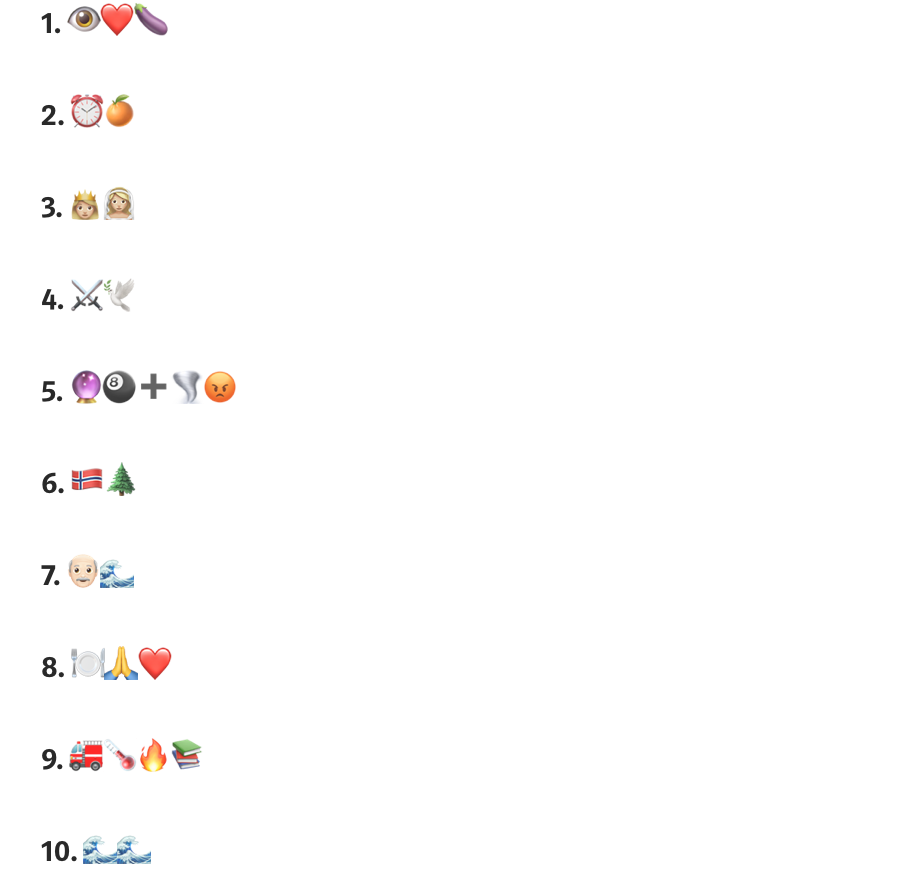
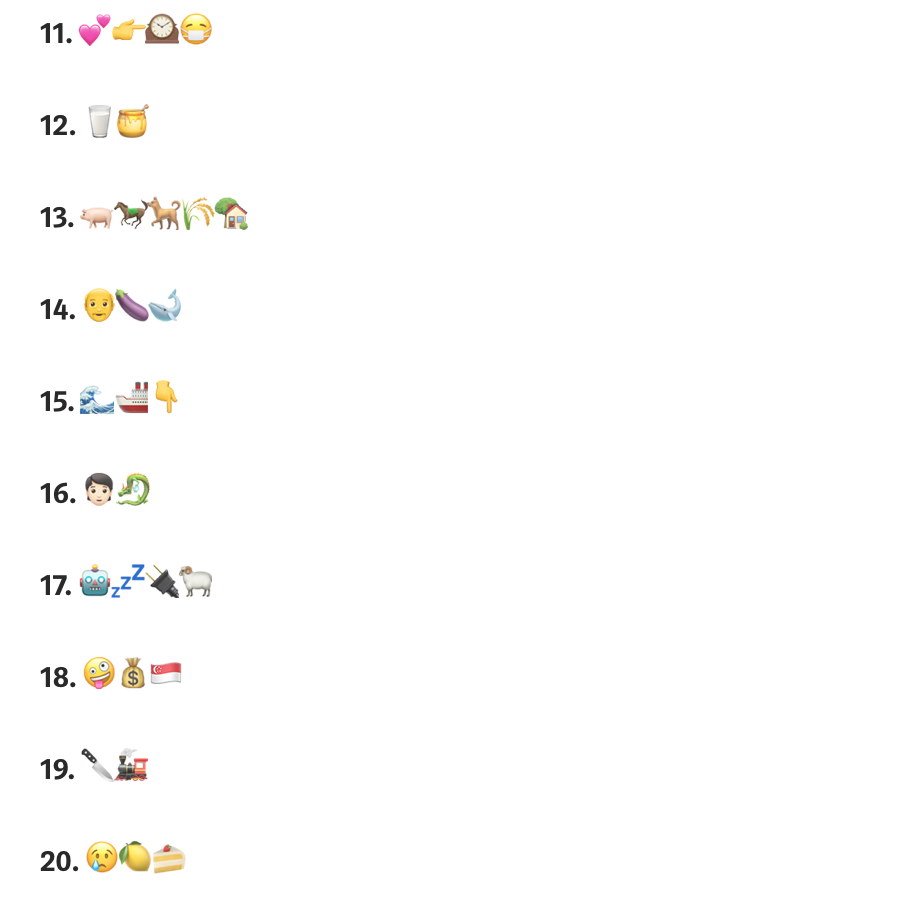
I’ve combined my love for bar trivia, my knowledge of literature, and a millennial penchant for communicating solely in emojis to present to you my life’s work: a “Guess the Book Titles Using Only Emoji” quiz. Can’t figure it out? No worries, you’re only a little bit of a doofus and I’m only judging you a a teeny bit for sneaking a peek at the answers listed at the bottom.
Since mid-October of 2015, I’ve been concocting and serving weekly Literary Cocktails at the Reading Room of the Petworth Citizen in Washington, D.C. The Reading Room is a functional lending library in the back of the Petworth Citizen, a neighborhood bar. All books on the shelves are donated, and they can all be borrowed free of charge. In October of 2015, we decided to build a bar in the room in large part so that I could host this cocktail program.
The Literary Cocktails menu is only available on Fridays and Saturdays and is new every Friday. During the week, I read the books, poetry, lyrics, short stories, essays, etc. on which that week’s drinks will be based, and then craft a cocktail menu inspired by my reading. The project has evolved over these past two and a half years; when I started, I often paid homage to a writer’s entire oeuvre (P.G. Wodehouse night, for instance), but now I typically focus on reading just one book a week and name the drinks after quotes from my reading.
The menu is like writing an essay in cocktail form, using themes and recipes from all over.
Since I’m a bartender and mixologist by trade, my book-inspired drinks are often riffs on classic cocktails. I combine the classic and historic recipes and ingredients I love with anything I subjectively relate to while reading. Often, specific spirits or drinks are mentioned in the reading, in which case I will use them. I will also incorporate the mention of flavors of other foods and beverages. I’ll take into account the setting, geography, and timeline of the story and build from drinks or ingredients from that as well. I rely on my catalog (from experience) and the possibility of new ideas coming from ideas and passages.
The menu is like writing an essay in cocktail form, using themes and recipes from all over. Sometimes a story about the history of a particular cocktail will relate or pair well with a particular passage. The drinks are designed as “one-offs” because the menu changes every week, but they’re also endless riffs — the same way a whole body of literature can arise from riffs on 36 dramatic situations. Also, I light a lot of drinks on fire. It comes up a lot in reading.
Here are some recipes and their corresponding books.
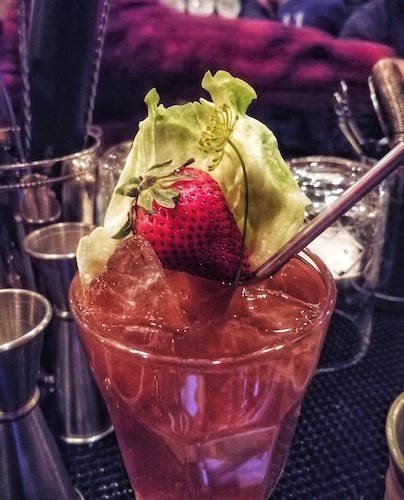
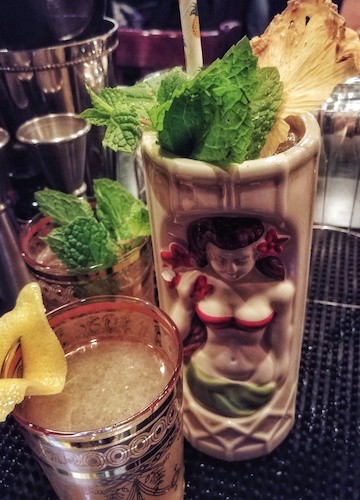
1 oz. Pimm’s №1, 1 oz. Aquavit, .5 oz. Oloroso sherry, .5 oz. fresh lemon, 1 oz. Dandelion tea. Add cracked ice and garnish with a leaf of lettuce, a dill flower, and a strawberry. Serve with reusable or biodegradable straw.
This drink is a riff on the classic Pimm’s Cup.
“…mokita. It means, ‘A truth everybody knows but nobody speaks’”
In Moroccan tea glass, muddle 2 wedges of lime, then add .25 oz. raw ginger juice, 2.5 oz. 10 yr. Old Sercial Madeira, and cracked ice. Stir lightly. Garnish with fresh mint.
This drink is a mojito riff made with Madeira and ginger instead of rum.
“You and your fireballs and your demon hipster chicks”
.75 oz. Neisson Rhum Agricole Blanc, .75 oz. Thomas Tew’s Dark Rum, .5 oz. curried simple syrup, 1 oz. coconut milk, 1 oz. pineapple juice. Fill with crushed ice, set dried lime shell and fill with overproof rum and nutmeg, light on fire.
.5 oz. Mt. Defiance cassis, 1 oz. Earl Grey “Moonlight” tea Top with 3 oz. Chilled Champagne. Express lemon oil, then float dried half of lemon shell sprinkled with osmanthus leaves and one star anise clove doused in overproof rum. Serve on fire.
This drink is a highly unconventional riff on a Kir Royale.
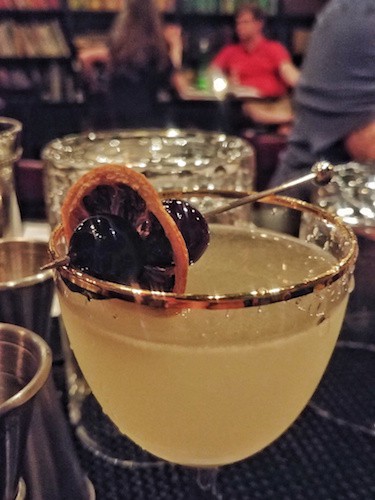
“I am alive,” Paul wrote to his mother, “but alive inside a ghost.” (P.217)
Served in a chilled coupe, shaken & double-strained:
.5 oz. Jensen’s Gin, .5 oz. Slivovitz, .75 oz. Cocchi Americano, .5 oz. Cointreau, 2 dashes Absinthe, .75 oz. fresh lemon. Garnish with dried citrus and Luxardo cherry.
The New York Times series “By the Book” asks prominent authors about their literary influences and favorites—your go-to classic, your childhood reading, your favorite book to recommend. The answers, like the authors, are delightfully varied, in many ways. In others, they’re troublingly consistent.
“When male writers list books they love or have been influenced by… why does it almost always seem as though they have only read one or two women in their lives?” asked Florida author Lauren Groff in her May “By the Book” interview. We’d noticed the same thing; six months earlier, a dude-heavy list by The Martian author Andy Weir had inspired the tweet that started our “Read More Women” rallying cry. And in light of that simple mission statement—read more women—we’re launching a new series, which we’re thinking of as a stripped-down, feminist version of “By the Book.” Twice a month, we’ll have some of our favorite writers—of any gender—discuss their favorite or most influential books that aren’t by men.
“We can’t escape being born into a society that has contempt for women tattooed on its bones, but we can change ourselves,” says Groff about our new series. “It is vastly important to read more female authors: to see women as worthy of our imagination and respect, to understand a woman’s full humanity, to reclaim authors who have been unjustly forgotten by time because of their gender, to meet the minds of geniuses new to us, to expand the Canon, and to work toward the equality of all humans that is promised by the better angels of our society, but which in our actions and silent and insidious biases we so often fail.”
We invite you to follow your better angels by investigating our featured authors’ favorite works by women and nonbinary writers. This week, we’re even making it easy for you. Follow our partner MCD Books on Twitter, tweet a link to this article with the hashtag #ReadMoreWomen, and you could win one of our Read More Women tote bags filled with all the books Maria Dahvana Headley recommends, plus her new book The Mere Wife!
Which brings us to our first featured author. (Don’t worry, the introduction will be shorter next time.) Maria Dahvana Headley is a bestselling author of adult and young adult novels (and one internationally bestselling memoir, The Year of Yes). The Mere Wife is a modern retelling of Beowulf set in a posh subdivision; Kelly Link called it “a consciousness-altering mind trip of a book” and no less than Samuel R. Delaney called it “a book to call up an old story in the newest possible way.” Headley’s most recent books before The Mere Wife were the young adult fantasy novel Magonia and its sequel Aerie, both of which got rave blurbs from Neil Gaiman, with whom she’s also collaborated to edit the short story collection Unnatural Creatures. Her five recommended novels by women are for anyone who courts the dark and strange.
There’s no forgetting the moment you notice that the shelves you’ve been assigned are full of men, and that you haven’t seen women’s names on them since you were a little girl. I emerged from a childhood of reading stories about girl witches, explorers and adventurers written by women born in the first bits of the 20th century — Madeline l’Engle, Elizabeth Enright, Margaret Storey and Zilpha Keatley Snyder — into…Bukowski, Kerouac, a bunch of boy beats whose female characters weren’t the ones driving the universe. Then, when I was twenty or so, in college studying playwriting and reading more of the work of men, I was questing in a Barnes & Noble, and feeling very tooth and claw indeed. I’d just seen something by Sam Shepard, whose surrealist sensibilities I’d previously loved, but this one involved a young woman recategorized as a teenage sex witch predator of grown men, and I was beginning to find myself wroth about stories of strangely wicked sex witches inhabiting narratives where the adult version of, say, Harriet the Spy clearly belonged. Sick of beautiful girls. Sick of dead girls. Sick of both of those things, and yet. The Bloody Chamber had just been re-released, and had a tower on the cover, and I was ready for new fairy tales with more sex, drugs, rock and roll, basking in language, fucking shit up. Girls beautiful and dead are here too, but they are ferocious, unpredictable, strange, and agented. Carter delivers in utter luxuriance, her work replete to a degree that can seem excessive until you surrender to it. This book is the one everyone reads. I could recommend others, but this one is my beloved life changer. The collection is short, but she grinds her teeth, spits rose petals, and pulls the hearts of dull storytellers out of her minaudiere to make room for the phone numbers of those willing to surrender their pelts. Carter is nasty and sweet at once, and I owe her ghost a good deal of my career.
In 2004, before I’d published much of anything, I was at Breadloaf when Kelly was teaching. She gave a reading of poems from this book. I ended up flayed, weeping, awed and starstruck. I was in conventioneer fugue, and yet. The heads of goats sing, orphaned from their bodies. The natural world shrieks, howls, and confides, and tenderness is always cut with fire. All of Kelly’s work is devastatingly beautiful, packed with the sensibility of the classical world made ragingly modern, one part Ovid, one part railroad tracks. The humans in Kelly’s poems are forced to reasonable manners, but they are animal, full of longing, and certainly part of the continuum of beasts. This level of empathy, of a communal story of all the inhabitants of earth, is, I think, tremendously unusual. This book is one I go back to regularly, and I can easily see its path through my own work. I just wrote a mountain with POV, and it is in large part due to these poems. They are tender with teeth.
Gayl Jones’ Mosquito is due for not just a revisiting, but a proper visiting. I encountered it sometime in around 2009, on a recommendation from a poet friend after I’d screamed to him for a while about the lack of long ass Important Tomes by women writers, and that if said Tomes existed (Leslie Marmon Silko’s Almanac of the Dead, for example) they’d be categorized as somehow Not-Worthy-Of-Literary-Greatness. Mosquito was published in 1999 to not enough continued fanfare. Jones was roughly 20 years ahead of her audience, as far as I can tell, because goddamn, is America made out of this book right now. It’s infuriating that this book doesn’t appear on lists of Bests, because Mosquito is a pyrotechnic, Joycean longform meditation from the POV of a black female truck driver who establishes an underground railroad across the Texas border. Shall we? Yes, I think we shall. My historic ignorance of the consistent relevance of this story speaks to the lack of support for a spectrum of fiercely poetic and literarily-categorized black women’s voices in the world of novels. Jones was originally edited by Toni Morrison (whose work I’ve listed elsewhere as being a massive inspiration and galvanizer of mine — the braid of the supernatural with bitter reality, the lyric rasp of Morrison’s language — it’s never not astonishing) and often I imagine an alternate version of the history of publishing in which things were vigorously more diverse, in which radical, experimental voices like this one were supported and rewarded regularly instead of once a decade. This is the future I look to, one of long books, one of great books, one I want to pummel into existence. Should this book be categorized as a work of genius? Should Jones be canon? Yes, folks, yes she should. A variety of things conspired against Jones being assessed as the major force she is, and those things are all the usual suspects. This is a Great American Fucking Novel, epic, intense, ferocious, strange, and as deeply about this country as anything I can name. The book is voiced with intensity, and it’s not an easy read, but seriously. Easy read isn’t the goal. Blistering song: what else has this country’s discourse been built from? I have lots of time for voices not rooted anywhere in legends of white masculinity, and this one is like opening your ears to a revelator. It’s brilliant.
I’m a huge fan of Kathryn Davis’ work, and I love all of her books, which are completely different from one another. She’s such a giant badass, and I have an imagined version of a life in which I add an extra month sandwiched into February, sort of an origami fold of days I might be able to spend in a bathtub reading books. In this version, I’m always beginning with a reread of one of Davis’ books, because they restore my soul. The Girl Who Trod on a Loaf is a strange and surging, haunted friendship of two women — an elderly opera composer and her younger friend and beloved, Francie, a single mother of twins, who inherits her friend’s operas. The composer, Helle, is Danish, and I think I’m especially tempted by Northern narratives (one of my other most-recommended titles is the poet Inger Christensen’s ecstatic and devastating accounting of existence, collapse, and the elements of the world, Alphabet) and the fairytales of hunger, longing, and faith that rise out of them. Helle wills the finishing of her unfinished opera based on a Hans Christian Andersen fairytale to Francie, whose personality reminds me of that of Sylvie the vagabond aunt from Marilynne Robinson’s Housekeeping– basically, I have an ongoing love affair with novels of women’s lives in which the women are unapologetic eccentrics, almost creatures, in their calm refusal to wed themselves to societal norms of partnership. This book is about mentorship and grafting flawed and ferocious ambition onto someone whose circumstances have created lack of same, and it’s just fucking rare and intriguing to read a book like this about women’s lives. Especially one full of imaginary operas based on things like, for example, Virginia Woolf’s The Waves. Writing this made me notice that many of the women on this list of writers are or were roughly the same age—Angela Carter was born in 1940, Kathryn Davis in 1946, Gayl Jones in 1949, Brigit Pegeen Kelly in 1951, which makes sense, given that I was born in 1977, just in time for Reagan, but lucky enough to read the work by women writers being produced in the first couple of decades of my life. Their work was shaped by a landscape of feminist theory, abortion rights, birth control, one that now looks very damn shaky. Their characters, largely without exception in this list, had the liberty to be strange, kinky, recalcitrant, unpartnered, bohemian, interested more in the natural world than in the world of men. I think about this now, in the work coming today, and out of this world, and I long for more work like this, more characters with unexpected emotional lives, more oddity braided to the quotidian. The next collection is that precisely.
This is a short story collection containing wonder after wonder, done with casual intensity. These are all sharp knives of stories, and it’s definitely possible to think oneself unsliced until the blood starts to pour. I encountered Samatar’s short work in 2012, probably, with her short Selkie Stories are for Losers, and was floored on sight. She’s published two novels as well, but the short fiction is my first love. Unlike the rest of the authors on this list, I actually know Sofia, and I’m as moved by her in person as I am by her work. Her wide-ranging and deeply researched interests are fully showcased in her prose, which moves from nonfiction to speculative surrealism, from historical automatons to victims of warfare, all at the same time. There are witch stories, and ripped from the headline stories, stories about longing for other planets, stories about the human condition of pain. They cross all genre divides, and smash them. This collection was edited by Kelly Link, herself a lighthouse of mine, and her work has common ground with Samatar’s, just as both of their work has common ground with everything else on this list. These are all authors whose works are sui generis, but who constitute a tribe of writer warriors as far as I’m concerned. Everyone here is an obliterator of tropes and received myth, a reviser of hierarchy, and a deeply skilled storyteller and maker of worlds. I can’t even believe I get to live in a time in which writers like the ones on this list exist, let alone get to have their brains feed mine.
Read these women.
Read More Women is presented in collaboration with MCD Books.
The credits for the biker documentary Hells Angels Forever list five directors, six producers, three writers, four editors, and a crew of over sixty, which is to say that the production was long and a lot of people came and went — though the one who mattered most to me was my father. The project originated with Leon Gast, a documentarian who would go on to win an Academy Award for “When We Were Kings,” about the Muhammad Ali–George Foreman fight in Zaire. Gast was replaced on Hells Angels by Sandy Alexander, the president of the club’s New York chapter, who had never made a film before.
“They were talking off in a corner,” my father told me, a day after Gast fled the set — I must have been nine or ten years old. “And then Sandy slapped him so hard it sounded like a gunshot. Leon fell down, and then he jumped up and started to run. Nobody’s seen him since.”
My father was a criminal defense attorney who represented the club, but he was also a gentle man who rarely raised his voice, and he looked genuinely abashed by what he had seen. It wasn’t till I started to laugh that he began laughing, too, a little sheepishly.
The rule in our house was that the Angels were characters; whatever they did had to be discussed with an air of wry bemusement.
“The contract gave him complete creative control,” my father told me, “but I thought he understood.” By which he meant, Understood that things had to be done the Angels’ way.
“What’s going to happen to the movie?” I asked.
It turned out that Gast had left his equipment behind and the Angels were using it to carry on. “The inmates are running the asylum,” my father said, starting to look genuinely amused now, the slap forgotten. “Whatever happens will at least be interesting.”
A few years later, my parents went to a showing of an early cut of the film. I remember them getting dressed up to go out; my siblings and I were left behind at home, resentful. The next morning, they described the movie to us, and I felt as if I’d missed the most important event in the world. “Your father has a scene with Herman Graber,” said my mother. Herman Graber, my father’s law partner, was always called by his full name to signal that he was a comic character, too, the straight man for my father’s jokes. “Your father keeps cutting him off so he can hog the camera for himself.”
We all laughed. Dad always wanted to be the star, whatever room he walked into, and we firmly believed he had the right.
A couple of years later — I must have been eleven — I went with my father to a rock concert on a ferry boat sailing up the Hudson, the climax of Hells Angels Forever. Two Angels lifted us aboard from the little launch that got us there, and then my father disappeared and I spent the rest of the night walking circles around the ship, searching for him. My sense of panic mixed with the strange beauty of the event, the pink sunset and the darkness, the oily black shimmer of the river and the slow-moving lights of Manhattan. Men and women stood around listening to the music, wrapped in their indecipherable grownup world. Angels danced what looked like war dances, fists in the air. I moved through it all, lost, invisible, but also free.
When I finally found him, he explained that he had taken shelter in the pilothouse with the captain and crew against the crazed bacchanal outside. “We barricaded the door! No way we were going out in that insanity!”
I felt surprised, confused, angry in a way that did not quite register as anger. If he was afraid to go outside, what did he think was going to happen to me? Why didn’t he try to find me? But there was nothing I could say in protest. This was an Angels story, I realized, and the rule was that you had to laugh.
“Time to go home,” he said, taking my hand.
If he was afraid to go outside, what did he think was going to happen to me? Why didn’t he try to find me?
Forty years later, I’d forgotten all about Hells Angels Forever. My father had been dead for a decade. I was living with my wife and children in Taiwan for the year, in an old Japanese colonial house that was succumbing to tropical rot: geckos scrambling over the ceilings, chasing each other; great rolling thunderstorms that would send ants climbing the walls in organized columns, like armies. I had terrible insomnia and would wander the house all night, so happy to be on this adventure and so deeply sad at the same time, for reasons I didn’t quite understand. It was as if the happiness were making me sadder and more frightened, lonelier, threatening to pull me in two. Standing in the dark of the living room on that particular night, listening to the clicking sound of the lizards on the ceiling, I suddenly missed my father so much that I opened my laptop and typed his name into the search bar. There was Hells Angels Forever on YouTube, and at 29 minutes in, there was my father.
He is seated with Herman Graber at a conference table in their office: soft, heavy men in wide ties and long sideburns. Herman explains to the camera not to be fooled by the swastikas and Nazi regalia, that the Angels are patriots, enthusiastic supporters of the Vietnam War, what you might in fact call right-wingers. He pauses, blinks, concerned that he might have gone too far. “But not fascists, no, I’m not saying they’re fascists.”
My father cuts in. “Perhaps best suited to the most conservative wing of the Republican party — the Goldwater wing.”
Herman nods cautiously. My father suppresses a smile. He is 44, his face handsome but heavy, with big brown eyes that drift off into private thought, then return to the camera, bemused. His expression is sweet and slightly wounded, as if he is worried that you won’t like him, that he’s said something to offend you. And then his hand straightens his tie, a gesture so familiar to me that I can almost feel that hand resting on my shoulder, very lightly, as it used to. My whole body grows warm with his presence.
At dawn, I got up and went to the window: egrets, shaggy and white, were in the pond behind the house. When the rest of the family woke up, I took them to our local Taoist temple to make an offering. It was something we hadn’t done before, though I knew how it worked: food for the deities and then ritual money for the ancestor, to be burnt in the brick stove.
I suddenly missed my father so much that I opened my laptop and typed his name into the search bar. There was “Hells Angels Forever” on YouTube, and at 29 minutes in, there was my father.
“Why are we doing this?” asked my son Jonah. I could see that he was afraid we would embarrass ourselves at the temple.
I did not tell him about the movie. “Your grandfather’s been dead ten years. He probably needs a little cash.”
At the Taoist temple, the other worshipers showed us how to make our offerings. We placed a plastic container of sliced pineapple on the table beside the shrine, lit incense sticks and bowed to the deity: a bemused old man with a white beard and tall forehead, like an egg. Then we bought stacks of ritual money, a sort of play money that looked better than the real thing: pink, red, yellow, and green paper, stamped with gold leaf and red ink. We took the bills over to the stove and counted them off in bunches, throwing them in and watching them blacken and curl.
I had been too resentful to say Kaddish for him after his death. It felt to me as if by dying he was pulling one of his old disappearing acts, in which he left me waiting in the car while he disappeared into the Hells Angels Club House on 3 Street, where kids were not allowed. But now I was trying to make it up to him, throwing bills into the stove as fast as I could. The heat from the opening was like a shove in the face, pushing me back. I held up a wad of pink and gold money; the wind from the fire snatched it from my hand, hungry.
I was in my mid-teens when I saw Hells Angels Forever for the first time. I remember the incredible excitement. My father appeared only twice, for all of three or four minutes, but to me he seemed to be everywhere in it, as if the movie were really about him and not the Angels, or the Angels were really about him in some magical way.
My father appeared only twice, for all of three or four minutes, but to me he seemed to be everywhere in it, as if the movie were really about him and not the Angels, or the Angels were really about him in some magical way.
There’s Sandy! There’s Vinnie! There’s a bunch of Angels shooting at bottles in a river! There’s the clubhouse. There were faces I couldn’t name, names I couldn’t place with faces. I’d heard stories about all of them, told in my father’s bemused voice while sitting in one or another delicatessen at ten at night, eating a pastrami sandwich, feeling safe from the world, feeling useful and loved.
In an interview on screen, an Angel says, “There ain’t a man alive who at one time or another hasn’t wanted to be a Hells Angel. I don’t care whether he’s a lawyer, judge, preacher, or what.”
In middle age, I watch with more complicated emotions. The Angel who speaks those words is wearing a tee shirt that says WHITE POWER. Later, in a scene from the boat concert, an African-American performer by the name of Bo Diddley sings a song called “Do Your Thing”: You got to do your thing, you got to do your thing. If it feels good, do it. I think about how he might have felt playing for a group of bikers in swastikas and white power tee shirts, how he might have rationalized that decision. Then I think about how we rationalized our decisions, and I am equally perplexed. I was wandering the ship’s deck while Bo Diddley sang that song, looking for my father. Was he really in the pilothouse? Why didn’t he take me with him?
Meanwhile, “Do Your Thing” continues to play over a montage of Angels beating people up. The footage is from different places and times, but the violence always involves one guy whaling on somebody who offers no resistance, just waiting it out. Then the aggressor drifts off and another Angel starts punching.
I think about how he might have felt playing for a group of bikers in swastikas and white power shirts, how he might have rationalized that decision. Then I think about how we rationalized our decisions, and I am equally perplexed.
Earlier in the film, Big Vinnie has a scene in which he crowds close to the camera. “If other people die, I laugh. Death amuses me. I’m bad. Ain’t nobody going to get me.” It is a moment of hubris: he died soon after, while in police custody — injuries from a beating, my father told me. I remember that we were outraged by the failure to get him medical care. I could visualize him lying comatose on the floor of his cell, dying. And yet that wasn’t the worst of it. What I did not know till I began researching for this essay was that he was awaiting trial at the time for the murder of a woman thrown from the clubhouse roof one night during a party. My father may have found that too disturbing to mention. To become characters in our story, the Angels always required some editing.
The films were finally released in 1983, but by then my father’s connections to the Angels were waning, primarily because he had legal troubles of his own. It’s a complicated story, but the part that is relevant here is this: many years later, while living on my own in Brooklyn, I stopped by my parents’ apartment and found my father slumped in a chair, his chin on his chest. My mother stood beside him. “Your father went to see the Hells Angels,” she said, “and they weren’t very nice to him.”
It had been years since he’d been down to the clubhouse. His law license had been suspended, and he had just gotten it back and was trying to rebuild his practice at an age when most people are thinking about retirement. The problem was that Vinnie was dead and Sandy Alexander was in prison.
“Somebody yelled at him to get the fuck out,” my mother said. My father’s head fell lower.
Sandy Alexander was at my father’s funeral. I saw him there in my parents’ living room, not at all different from when I was a boy, except he was in a jacket and tie. I hadn’t seen him in a long time. He’d been released from prison in 1994 and looked surprisingly great: trim, fit, his hair still black and long, still with a goatee. He was in a black sports coat and tie, gray slacks, white shirt, very appropriate. I had only seen him in biker attire before that. He said he lived in Queens and was working as a dishwasher, he had heart trouble, he was taking all sorts of medicines, there was something about his urine — he had the anxious self-absorption of the frail. The princely hauteur was gone. He looked worried, at moments even frightened. There was the stream of unfiltered talk. I remember that my father had said that he’d gone insane in prison. But he seemed broken more than anything else, and that seemed to me a perfectly natural response to life.
He had never talked to me before. I had always been a kid. But now he just talked and talked without a pause, as if he’d been in waiting for me to grow up so I could listen to everything, as if he had to make up for six years of silence in prison. I said nothing, not knowing what to ask.
“I’m writing a screenplay,” he said. “About my life in the Hells Angels.” Suddenly he sat up straight, full of electricity. “There was a German Countess I knew. We’d drop acid and go out at night. I’d wear jodhpurs and riding boots up to my knees and I’d carry a riding crop.” Now his eyes were narrow and deep and burning. He made a sharp motion with his hand, whipping the air. “Your old man, he understood. He got it all.”
With the recent upholding of the Muslim ban by the Supreme Court and the continuing separation of children from their parents at ICE detention centers, it feels vital to remember that borders are fictitious. Though blood has been spilled for centuries over these imaginary lines, they keep shifting. At one point in time, Utah, Nevada and California were all parts of Mexico. The British had the largest empire, crossing nearly every continent. Profitability has always trumped morality in the drawing of borders. With asylum seekers turning to the west, it is easy to forget history, how most of the world is still dealing with the imperial fallout of having land carved and cobbled together, resources stripped, foreign militaries deployed, and indigenous populations displaced and decimated.
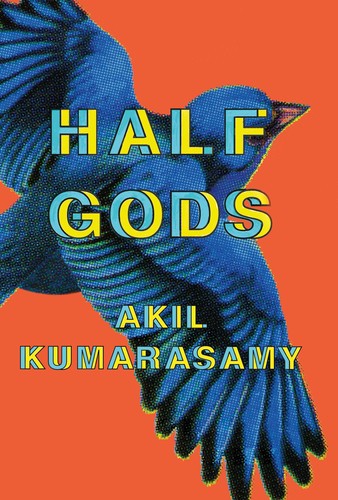
In my new book, Half Gods, which resides at the border of a short story collection and a novel, I explore the messiness of these boundaries, whether it is nationality, religion, or sexuality. Following two Tamil-Punjabi-American brothers named after demi-gods from the Mahabharata, I trace how violence crafts and reforms identity, spanning from the bloody end of the Sri Lankan Civil War to the suburbs of Jersey
The following eight books are difficult to reduce. They at times cross through multiple genres, contain fractured narrative structures, and subvert our notions of language. They evoke the mythical in dealing with contemporary lives, and can often make you cry and laugh simultaneously. They are all deeply political books, meaning they engage with the world and show the lives of characters pushed up against power structures, where existence itself, with all its contradictions, is a revolutionary act.
The Secret Life of Saeed: The Pessoptimist by Emile Habiby
In this darkly comic tale about a Palestinian who returns to his homeland to become an Israeli citizen, we meet Saeed who comes from a family of Pessoptomists. Habiby probes a history of invasions and displacement (“the Ottomons were leaving and British entering”). Villages vanish, infants butchered, and borders are redrawn. From the 1948 Israeli-Arab wars to a retelling of the great Arab astronomers like Abbas Ibn Firnas, The Secret Life of Saeed: The Pessoptimist navigates history and memory to speak of the absurdity of the present moment for Palestinians. Saeed loses his father in the war but is saved by a passing donkey; his brother is killed by a crane but his mother praises God because it could have been worse (his wife could have run off on him during his lifetime). Pessoptomism is a mode of survival; it is a candle that burns so close to your eyes in the dark that you lose your eyelashes and perhaps even your sight but still possess warmth in a cold world. Saeed understands early on the deadly “consequences of sarcasm” though the book is dripping with it. The laughter in this novel rings with sorrow.
This slim book feels like a fever dream taking place between the border of the United States and Mexico. Herrera is able to defamiliarize us to the landscape with the inventiveness of his language. He refers to English, Spanish and indigenous languages as “new tongue,” “latin tongue,” and “native tongue.” In this wonderful translation, Lisa Dillman preserves the freshness of the work by including neologisms Herrera has crafted. Whenever a character leaves, they verse. In the original, the neologism, jarchar, is derived from the Arabic kharja.
Herrera transports you to a world, which is ours but is not named. The language feels chrome-colored and unusual with chapter names like “The Place Where the Wind Cuts Like a Knife” and “The Place Where People’s Hearts Are Eaten.” As Makina travels across the border to find her brother, she comments on the language spoken: “More than the midpoint between homegrown and anglo their tongue is a nebulous territory between what is dying out and what is not yet born.” Here language itself becomes a revelation.
Everything about Dictee feels at once intimate and subversive, written in fragmentary texts, torn from a novel, a poetry collection, a diary along with scattered images, the work interrogates the medium of language in conveying memory and history. Invoking the Greek muses for each section, the book explores the lives of various women including the life of the young Korean revolutionary, Yu Guan Soon, who fought against Japanese occupation and died at the age of seventeen, and Cha’s mother whose family escapes to Manchuria but still is touched by Japanese rule. Language becomes a place of trauma, when one’s mother tongue is hidden away or must be rooted into new soil again and again, generation after generation. Cha was fluent in English, French and Korean, and Dictee possesses marks of all three languages.
Cha was raped and murdered shortly after the publication of the book at the young age of 31. With her loss, the martyrs in her book take on a more haunting resonance: “With St. Agnes and St. Cecilia, I would present my neck to the sword, and like Joan of Arc, my dear sister, I would whisper at the stake Your Name, O JESUS.”
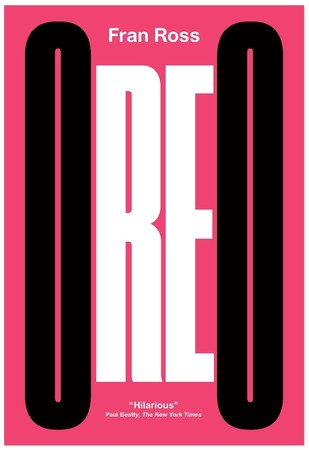
Oreo is a story of a biracial daughter of an African American mother and a Jewish father, who disappeared when she was an infant. Playing with the framework of Theseus’s quest through the Labyrinth, Ross takes Oreo on a wild journey through Manhattan to find her father. Family history is drenched with humorous references to Yiddish language and black culture. Oreo’s mother, a brilliant mathematician, often is sketched with mathematical equations that help her parse through life (one equation includes both Bach and the weight of uric acid). The novel is structured around vignettes, including headers like “Louise’s dreams” and “Oreo in the sauna.” I appreciate how the novel speaks to the porousness of borders, how characters love across ethnic and racial background, how our mother tongue is something that can be shaped to our own making.
With the collapse of Yugoslavia, the Bosnian writer, Hemon, found himself stateless in Chicago on his visa. These eight stories from his first book possess the feel of an epic, turning his own family history into Hemoniad mythology and distilling the siege of Sarajevo into a correspondence of love letters. Experimenting with the borders of the narrative form, The Questions of Bruno shows how imaginary and fragile country lines are and how even an individual is a precarious container.
Hemon began learning English shortly after being stranded in Chicago as a refugee. The originality of his language always thrills me like “pots of unconcerned flowers” and “flames of Moscow scalding the sky’s belly.” His humor can crack the heart.
This novel of stories contains 28 chapters (one of the many polyphonic mashups made in the book). Following the lives of South Asian temporary workers in the United Arab Emirates, Temporary People gives one the feeling of hanging off the edge of a skyscraper, which feels quite fitting for these characters who build these breathtaking structures and then disappear. The briefness of each chapter, some are even prose poems, speaks to this transient existence. In the opening story a character turns into a passport while in another a woman pieces together the limbs of workers who have fallen from buildings. The language perfectly captures the fantastical nature of these workers’ existences.
Lidia Yuknavitch said she was “trying to put things into the world that alchemize the dark and turn it to something beautiful.” The Small Backs of Children is a metamorphic, intensely felt novel that plays with structure (some sections are only a page long while one section is listed in columns). A photograph is taken of a girl fleeing her burning home in an unnamed Eastern European village and the resulting image affects the lives of those who have seen it. Yuknavitch’s work feels both intimate and distant with its unnamed cast of characters; it freezes the frame on the violence inflicted on the female body and recasts it in miraculous ways.
In this hypnotic novel in first chapters, we follow Sarah Nour El-Din, named after the actress, Sarah Bernhardt, at various stages of her life from wartime Beirut to New York. Each beginning peels back layers of her history, sometimes affirming or contradicting our notions of Sarah and the people around her. This fractured narrative feels especially resonant for a life marked by violence and displacement but also speaks to the narrative choices we have in our lives, of deciding where we want to start our stories. Alameddine even includes a chapter that’s all in French. It’s quite a remarkable act to see one’s life as a series of beginnings.
So you weren’t exactly where you thought you’d be.
That was okay. Things could still work out.
Were you not your father’s daughter? Your mother’s daughter? Had they not instilled in you an appreciation for perseverance, stick-to-it-ness, whatever you wanted to call it? Were you not, in your earlier slash more impressionable years, known for your ability to Thrive Under Pressure?
Things were almost definitely going to work out.
Take, for instance, this place. There were things to like about this place. The way Robert and Roberta treated you like family, for example. The way, whenever someone commented on one of your photos, like, what is that place? lol, you could honestly answer by saying you were Following a Nontraditional Path.
So this was not exactly where you’d pictured yourself, post-graduation. To be fair, a failing owl sanctuary in rural North Carolina was probably not where anyone pictured themselves. You just had to keep an Open Mind, was all.
And when that Open Mind got a little less open after four months of taking care of de-winged slash elderly slash beakless owls, well, you just had to keep focusing on the little things. For instance, the textbook. You were learning things from the textbook. Owl Care for Amateur Ornithologists — who would have guessed you’d end up with something like this?
Life was truly full of Little Surprises.
Maybe you didn’t love the owls like Milo did. So what? Milo was a True Hippie, one of those forty-something guys who wore hemp sandals and showered twice a week, tops. Technically your supervisor, he mostly just walked around saying things like, Are You Living Your Best Life? or, The Greatest Present is to Be Present. What you wanted to tell him was that your own Best Life wasn’t sewing toy mice out of old shirts and teasing the birds with them. It wasn’t picking katydids out of the laurel bushes and hand-feeding them to Héloïse, the barn owl with the beatific white face.
The thing was, it was healthy to have some sort of work-life boundaries. More than once, you’d walked in on Milo deep in conversation with an actual owl. He treated them like something between an oracle and a pet. Was it going to rain? Should he add clove oil to the homemade weed killer? He sometimes stayed up all night worrying over the sick owls, watching them breathe. He had had a dozen jobs in as many years and didn’t seem bothered by anything.
Which, you did not want to be judgmental. You had your own issues. Worrying that you didn’t have a life plan, for example. Worrying that you’d wasted the best part of your teens working at an aquarium gift shop, where grim parents shepherded squalling children past bins of plastic whales and sting rays. That you were pushing twenty-three and still hadn’t found your Own Personal Dream.
As far as you knew, Milo didn’t have any of those worries. Milo was great at Going with the Flow. In playful moods, he messed with the tour groups. He made up owl species, lying about their origins and their diets.
The coyote-tail owl eats mainly shrimp, he told a family from Wisconsin.
The speckled Northern whompus is afraid of pillows and sheets, he told a troop of sullen-looking Girl Scouts.
Earlier that morning, as he was packing to leave with Robert and Roberta, he’d given you a long, soulful look. He was full of those.
Look after the place, he said, as if he was planning to be gone for months and not days. And, you know, try to enjoy yourself. Get into the spirit of things.
You would, you said.
You were trying.
You watched the van go, waving as they pulled out of the driveway. From the dirt patch in front of the bunkhouse, you could see the sanctuary’s nets rising through the trees: vast, intricate, ghostly. You could see the metal scaffolding reaching up into the hot sky and down into the pine needles, which released a sweet, sickly smell as they baked in the sun. Closer up, you could see its shit-streaked floor, its cheap repairs, its arching interior filled with sick and broken birds of prey.
It was the height of summer, and the air was hot and oppressive. You could hear the birds going to sleep inside the giant, mesh-draped aviary. There were the Eastern screech-owls looking wooly on their perches. There were Antony and Cleopatra, the boreal owls, and Vronsky, the great horned owl with the ridiculous ear tufts. Higher up, in the trees, the barn owls shrieked like little goblins.
Most of the owls weren’t so healthy. Milo said even the well ones only lived to be five or ten years old, but you were pretty sure he was making that up, too. At least once a week, you had nightmares of owls falling out of the sky and landing at your feet with a feathery thump, dead.
But you weren’t supposed to be a natural at this kind of thing, okay?
You were a college dropout. Community college, no less. You didn’t have to be good at everything you tried.
Like, last month, when that old tourist had put out her hand and touched the wire mesh gingerly, as if she expected it to electrocute her, and asked if there was really supposed to be so much poop everywhere.
A troubling amount of fecal matter, was what the comment card said.
And now it had been six months, and you were alone with the owls, and nothing was what you hoped. When you’d first arrived at the sanctuary, it had been the morning after an ice storm. The sun was shining, the sky an eye-watering blue. Coated in ice, the mesh nets of the aviary had glistened like they were made of cut glass. Everything shone; everything was brittle and new.
The hopefulness had lasted all of fifteen minutes — the length of your official training — and then you were enlisted to help Milo thaw the branches in the aviary with a hair dryer and an extension cord.
What you needed now was for something, anything, to change. For the universe to give you a chance. To offer you a Helping Hand.
And then, for once in your life, it did.
At the end of the driveway, emerging from a car you’d never seen before, was Felicity.
Felicity, your ex-girlfriend.
Felicity of the Doc Martens and tattoos. Of the erratic hairstyles and near-pathological wanderlust.
Felicity coming up the driveway with a suitcase in her hand.
The first thing she said was, You didn’t tell me you’d left the planet. Then she was hugging you, her bony arms around your neck. The familiar smells of bubblegum and cigarettes wafted up from her clothes.
What are you doing here? you managed to say.
She stepped back, shrugged.
Aren’t you happy to see me?
You stared at her, speechless.
No offense, she went on, but I think you highlighted the potential rather than the actuality of the place.
She did a slow revolution where she stood. Dirt patch, trees, aviary. Bunkhouse with peeling paint, garden patch full of weeds, rusted-out old pickup truck.
It’s a little rough, you admitted.
She said, a little?
Last time I talked to you, you were in Mexico City, you said. Like, three days ago.
She shrugged.
I got on a plane. I was bored.
Bored, you thought. That sounded about right. You remembered her making a similar statement at the aquarium gift shop right before she left. That was the way Felicity worked, disappearing for six months at a time and then showing up with a new girlfriend or boyfriend or in Croatia or San Bernardino or, once in a while, on your doorstep.
Besides, she added, you said you were going to be alone and I thought you could use the company. I wanted to see what your life was like now.
And? you said. What do you think?
What do I think? she said. What I think is what are you doing here? Owls? Really? You couldn’t even stand the animals at the aquarium. And they didn’t shit on everything.
Felicity was right. You were not a Big Fan of animals. Did not find them particularly charming. Could not offer much of a comeback at all.
It’s only temporary, you said. I’m just trying to figure things out, you know?
She looked skeptical.
Does the figuring out have to happen here?
Come on, you said helplessly. Let’s get in the shade.
You crossed the yard and sat on the bunkhouse steps. Felicity dropped her suitcase on the ground — heavy sound of bottles clinking together — and joined you.
Things with me are going well, she said. Really, really well.
From her shorts pocket, she pulled an over-exposed photograph of blurs and lines. The image looked like it had been smeared across the film. You could vaguely make out the shape of a key in one corner, a children’s action figure in another, but that was all.
This is Martín’s, she said. He has this gorgeous studio right in Condesa. Women visit him all day and bring him things for his still lifes, flowers and keys and string bags and, this one time, a real human skull, I shit you not.
She took out some more photographs. These ones were of sweaty, doughy people, pale men looking awkward in their button-downs and women clutching their purses too tightly. They were arrayed in front of a variety of monuments, fountains, and colorful market stalls.
These are mine, she said. I take photographs of tourists for money.
Since when? you asked.
She shrugged. Since the city’s expensive. Since I don’t like asking Martín for money.
There was a silence. Then, as if she could read your mind, she added, It’s not really that often. I’ve only sold a handful of them. Most of the time we’re too busy going to gallery openings and dinner parties. We really love the city. It has such personality, you know?
You looked around you. Behind the bunkhouse’s torn screen door was a room full of duct-taped sneakers, of dirty laundry, of unread ornithology books covered in dark, greasy dust.
Yeah, you said. I know what you mean.
Felicity put the photographs back in her pocket. Something unreadable passed over her face.
But, you know, she went on. It’s too hot in the city. She was frowning, fidgeting with the hem of her dress. Plus there are blackouts right now, so there’s sort of no power? And Martín turned the entire apartment into a darkroom and I can’t find any of my things.
You tried to imagine it: the black apartment with the red lights, and Felicity moving through it, ghostly and unhappy. Baths of developing fluid everywhere. Drying photographs strung up in the doorways.
Well, you said, I guess it’s okay if you stay a day or two. But just until Milo and the owners get back, okay? You can’t get too comfortable.
Out in the aviary, a single owl screeched and wailed. Felicity was humming a song.
Nothing bad ever happens to us, it went, except our own lives.
Feeding time was not great. Let’s get that out of the way. Feeding time was probably one of the very least great things about the sanctuary.
It did not feel Personally Fulfilling to sling frozen carcasses from a wheelbarrow onto various parts of the sanctuary floor that Robert and Roberta had marked with spray paint. It did not feel Personally Fulfilling to clean up the skeletons once they were more or less picked clean and dump them in the grassy canyon beyond the sanctuary.
But, as various adults and well intentioned relatives would have you remember, this was all part of Building Character.
Feeding time was usually not your responsibility. It was only your job since Robert and Roberta were driving across the country to rescue two dozen owls from that failing sanctuary in Colorado. Normally you would be doing things like passing out brochures at the mall or designing a new visitor’s guide for the tourists who almost never came to visit. Normally Milo would be there to help, too, but Robert and Roberta wanted him to help drive the van.
Works Well Without Supervision, was what you could put on your resume.
Or maybe, Handles Adversity with Aplomb.
Back in the bunkhouse, Felicity was already making herself at home. You’d spent the afternoon catching up, eating cheese and bologna sandwiches that you somehow couldn’t imagine anyone eating in Mexico City. When you left her, she was lying on Milo’s bed, her hair plastered to her forehead in the sticky heat. She hadn’t come out and said it, but you could tell she was second-guessing her decision to come here.
And maybe she was right. Maybe the point was instead to get yourself into situations that gave you the opportunity to say my lover about a 45-year-old Mexican artist who’d recently been featured in GQ.
Who knew? Maybe you would meet your own rich lover. Maybe she would fly you to Acapulco, or Vienna, or Bali. You might meet a kind stranger who offered you a lucrative job at his successful startup. You might end up working in an impossibly chic boutique, or else an office with floor to ceiling windows and a great view of a skyline. The point was, Anything Could Happen.
You wound along the trail with your wheelbarrow, unloading sad little piles of frozen voles and squirrels. True, this was not something you’d ever imagined being an expert at. But, also true, there were certain apocalyptic scenarios in which it could become a valuable skill.
That was approximately the right attitude, you thought.
At the southernmost feeding point, you came across the remnants of a whole deer. This was the part of the sanctuary where the strongest, healthiest birds lived, and they’d torn the carcass — not frozen but fresh, a gift from a neighbor who’d hit it with his car — into gruesome pink confetti. Scattered around it were the remains of what you remembered to be rabbits, which, after they’d been there a few days, had mostly dissolved into little heaps of ribcages and dust. The smell stopped bothering you early on, but you still couldn’t keep from peering at them, from searching out what new and fascinating forms the rot had taken.
There was a metaphor in that, you thought.
You started to push the wheelbarrow faster. You could picture Felicity back at the bunkhouse, a tequila bottle in hand. Sooner or later, you would end up entertaining her; it was just a question of what form the entertainment would take, and when, and how much trouble it would get you in.
You were still wondering when you rounded the last bend and came across it.
An owl on the ground.
Huddled in the dirt with a hard knobbly bulge in its neck. Its crop.
Was this normal owl behavior?
You shuffled closer to the owl. You tried to think what to do. What Milo would do. The owl — you thought it was named Casanova, or maybe it was the Count of Monte Cristo (you’d failed English class, too) — was doing a sort of shivering thing, trying to retch in a not-good way.
Should you pick it up?
Should you leave it alone?
You paused on the path a few feet away. You were thinking about what Felicity would say if you brought the owl back with you. Something like, I had no idea you were so brave and kindhearted? No, probably more like, Oh my god, what is that thing doing here?
All around you, the evening insect sounds were beginning. Lightning bugs speckled the aviary. The other owls were all gearing up for the night, the best analogy for which was a few dozen monkeys all losing their minds at once.
Maybe the best choice was to do nothing. Didn’t even the healthy owls seem sort of peaky, honestly? Didn’t they have red-rimmed eyes and bedraggled, grubby feathers? From time to time, when money was short, hadn’t Robert and Roberta been known to feed them chopped-up hotdogs?
You hesitated a moment longer. The aviary rustled faintly around you. Back at the bunkhouse, Felicity was waiting for you with God only knew what in mind.
In front of you, the owl blinked solemnly.
Later, after the sun had set and the air had gone flat and stagnant, you sat with Felicity on the bunkhouse roof. She’d turned up the music inside as high as it would go, and a hazy melody floated up and around you. The tequila bottle was half empty.
To sum up your evening: Peanut butter. Metamucil. Holding down Casanova with one hand. Applying mixture to beak region with the other. Getting thrashed by his struggling wings. Trying to see if he’d swallowed any of it. Repeat. Repeat.
Why don’t you call a vet? Felicity had suggested, not knowing that you only got paid in a timely manner as long as there weren’t extra bills.
And as long as an owl didn’t die on your watch.
Hence the arms covered in bruises.
Hence the lack of Charitable Thoughts.
You were allowing yourself to feel your hatred of the place. How it grew with every hoot and screech. How it morphed and swelled and took on the proportions of the aviary, something gigantic rising through the trees.
Bitterness was seeping through your whole body, swelling your fingers and dripping out your eyeballs.
Felicity poured another drink for herself, then for you. She checked her phone again. You had the sense that things maybe weren’t as good with Martín as she said. A few times that evening you’d caught her trying to call someone who didn’t pick up and didn’t pick up and didn’t pick up. You knew you should ask her about it, but — bad person, bad person — you didn’t.
How come you always know what it is you want, Fe? you asked instead. How do you always know what to do?
Do I? she said. I don’t know. I just know when I don’t want something.
You nudged a dead cicada from side to side with your toe. You could feel Felicity’s eyes on you.
Why don’t you go to one of those recruiter places? she said. Or one of those temp agencies? It can’t be that complicated, can it?
I don’t even know what I’d ask for, you said. Hi, do you have any jobs for the catastrophically clueless?
Well, what’s the worst that can happen? she said.
You swallowed hard. The tequila was wreaking havoc on your stomach. All around you in the loud, humid night, you could feel the things you didn’t know how to do or say collecting at your feet.
Casanova was getting worse.
You and Felicity had come to check on him at midnight and found him hunched on his branch, a limp, grey huddle. You could hear him feebly trying to disgorge the stuck bone from his crop. You consulted the textbook, wondering if this was call-the-vet serious or wait-and-see serious.
Being perpetually undernourished, you read, the small bird is always only a few hours from death. When ill, it may need to be hand-fed with a mixture of raw meat scraps. Tweezers and hand puppets are useful for this task. Be cautious that the bird is not over-fed and over-watered. Under the wrong circumstances, the bird may drown while drinking.
What the hell kind of book is this? Felicity asked. The two of you had brought a blanket into the aviary, and you were lying in the center of one of its grassy clearings. Felicity was still drinking. She reached out and pulled a feather from your hair. A barred owl sent a sonic shiver through the trees.
Do you hear that? Felicity said. It’s like the owls are trying to tell us something.
You listened closely. It sounded like it always did, loud and urgent and chaotic. Your flashlight cast a narrow pool of light over the textbook pages. Felicity had produced a pack of cigarettes and was smoking them in proportion to how often she checked her phone.
Martín and I are going to buy our own gallery, she said. We’re talking about it, I mean. We’re going to exhibit our work side by side.
You nodded. You were thinking, tomorrow you’d call the vet, for sure.
Felicity finished one cigarette and lit another.
And he’s going to introduce me to this great magazine editor, she said. I’m really excited. Martín’s got all sorts of connections, you know?
You produced a smile of the right shape and size onto your face. You were thinking how, when you interviewed for the job at the owl sanctuary, Robert and Roberta had asked you about your Greatest Weakness. You’d thought about telling them how, at the aquarium, you used to get bored and drop bits of your lunch into the fish tanks all afternoon. You thought about telling them that you didn’t care much for owls.
Your actual Greatest Weakness: you couldn’t recognize opportunities if they jumped out at you with giant yellow eyes and feathers. You couldn’t Seize the Day, Take the Chance, Just Go for It. You yourself were choking — on your indecision, on your fear — and there was no one to help you out.
Anything can go wrong. Anything can kill the bird. The bird may suffer from heat stroke. The bird may contract hepatitis, myocarditis, or tuberculosis. The bird may be stricken with parasitic worms. The owner should ask of themselves, what resources are you willing to expend on the bird? Of what quality is your dedication and proof thereof? What might the bird’s sickness or health signify, and how long are you willing to nurse the bird?
You woke early in the morning with Felicity’s hand on your shoulder.
Hey, she whispered. Her hair hung down over her face. Hey, wake up.
What is it? you mumbled. What’s wrong?
I lied, she said. I didn’t leave Mexico City because it was too hot, okay? And I didn’t really care about him turning the place into a darkroom. Honestly, I thought it was cool.
You could smell the smoke and sweat on her. She smelled like something made out of sweet, rotting wood.
You don’t want someone painting you constantly, she said. No one wants to be looked at that much. Maybe pathological narcissists, I guess. And then when he’s not looking, he’s really not looking, you know? It’s like I don’t even exist.
You didn’t say anything.
Martín’s better in my head than in real life, she added. Big fucking surprise.
Kneeling there, backlit by the moon, she looked like a ship’s wooden figurehead — the kind that performed miracles when sailors prayed to it, or else sent them to their deaths.
If I can just figure out one thing, she said. If I can just get my head around one month of living. That would be great.
She scooted closer, and you waited for her to say something, anything. You thought, so this was how everyone’s life felt, after all. Like they were waiting around to get started. Like they were the only ones who didn’t have it Figured Out. Like at any moment someone was going to hand them an instruction manual, a how-to guide, something.
Felicity’s face was inches from yours.
Do you know what I mean? she whispered.
Later, much later, you’d look back on that moment, thinking, who could explain what was happening in those days? Why couldn’t we rescue ourselves from our own catastrophic lives? Why did we allow everything to be constantly on the verge of collapse?
Felicity, moonlit. Felicity, on the brink of some decision.
Correction: The subtitle of this piece originally said that Confessions of the Fox was “the first” work of fiction by an trans author released by a major publisher. It is among the first, and an occasion worth celebrating.
A n interview is a great occasion for a first encounter. Or better said: it makes perfect sense Jordy Rosenberg and I got his chance to talk, given our (unknown until now) shared interest in the potent + portent possibilities of the body. Add to it overlapping mentors, a love of language’s frilly surfaces and deep caverns, and a similar feeling about writing amidst history’s many conflicting archives — ie, writing amidst, but not in requiem to. As Rosenberg says: “I wasn’t aiming for historical verisimilitude. Actually I was aiming for something explicitly anachronistic.” Jordy Rosenberg likes to keep things alive.
Purchase the book
Confessions of the Fox is bold for all of the reasons you already know — its headfirst thrust into the past while also refusing to let go of the present (replete with its office park academia and the possibility of an interdimensional future), its explicit and decentering current of sex running nonstop throughout, and its moments of meaty theory.
But what I love best about Confessions of the Fox is its mammoth feeling. It takes a big cauldron of hope to make a book like this, and we need cauldrons of hope right now and always.
Jess Arndt: While reading, I couldn’t stop thinking about what seems like the very queer pleasure of using the footnote as a place to scrawl something else. For instance, the margins of Confessions are littered with penises (like on page 97 as a translation for “sugar stick”) but often resist offering translations for 18th C vocab the average reader might not know. It made me laugh in recognition, as if you were drawing dicks (or less clearly defined genitalia) over everything with your other hand. (Also pg. 10 “Pussy. Pussy. Pussy. Pussy. Pussy. Pussy.”) Is this meant only as a window into our editor (Dr. Voth’s) character, or is there something larger going on — some kind of disruption/refusal at the formal level?
Jordy Rosenberg: This is such a great question. I love this description of the footnotes as queer annotation/scrawling in the margins, and yes, in part I was aiming to mess with the sanctity of some very conservative notions about genitals. I enjoyed piling the many, many different 18th-century slang terms for genitalia into a chaotic accumulation of erotogenic zones as way of creating a genital nonsense that is also a kind of libidinal obsession. I wanted to produce a torrent of language around genitalia as a way of both mocking cis-het conventions around the knowability of desire and its supposed suturing to certain body parts, and also as a nod to the ways in which queers and trans and other gender non-conforming people have these very powerful and deeptraditions of resignifying words and our bodies in relation to each other. So, “pussy” or “cock,” as we know, really can and does mean anything between two (or however many) people in certain erotic exchanges. And indeed, at one point the editor-character comes to realize that “pussy” must mean “any loved point of entry” on the body for the characters in the book. This lived experience of genital resignification is something I wanted to be able to not only write “about” at the level of content, but — to get back to your question — also have shape the structure of the novel. My hope for the footnotes was that they would create the experience for the reader of this playful deluge of language, this kind of fanatical, infatuated resignification of body parts.
The solicitation of the reader’s desire through the footnotes is one of the ways in which I was trying to think about the metafictional structure itself. I wanted to create them as a structure that would function as a cathexis for the reader and couldn’t simply be understood as a kind of postmodern cliché about the constitutive slipperiness of language, etc.. As your question articulates so aptly, aesthetic form (I don’t just mean language; I mean form) is itself a form of desire.
JA: Gender is central to the organization of the book, but also more tactilely, so is flesh. There’s a stretchiness to the bodies in Confessions, especially Jack’s, echoed by the “sexual chimera” diagram on page 132. We’re consistently reminded of your characters’ all-too-familiar (to our contemporary moment’s) physical precarity, and yet, regularly they perform feats that push against what we might imagine is achievable or ”real.” This seems intentional. Can you talk about how you write a body that doesn’t (historically/geographically/corporeally/or in any other way you might have run up against) exist?
JR: There’s a scene in Confessions where Jack first sees Bess and she kind of cat calls him on the street; she calls him a “boy,” and no one’s recognized him quite that way before, because he’s been assigned female at birth. To some people that queer recognition might seem like a fantastical positing of maleness. But to me (and I’m not in any way alone in this) that kind of thing — being recognized by a love interest in a certain way — feels “real.”
JA: What felt riskiest to you while writing? What was hardest?
JR: I feel like the expected answer here might have something to do with writing sex scenes, being explicit, some of the dirtiness of the novel, etc.. But honestly that stuff was either a pleasure or compulsive or both. I think the hardest and riskiest thing, actually, had to do with navigating my anxieties around trying to be “right” in terms of an academic or political style of argument. Learning how to subordinate (the fantasy of) the authority of my own scholarly “voice” to the demands/pleasures of fictive structure was probably what was hardest. To let — or to try to let — myself disappear into the aesthetic form was a process that was very unlike academic writing for me.
JA: I’m drawn to the voraciousness of your approach. It’s a bodice ripper and a material exploration of post/decolonial/trans theory at the same time. It’s also making a bid for D.I.Y. assemblage. There’s something very vulnerable and I think, vital, about making something by hoping, (for eg., “silt shadowed his cheeks with the false outline of a beard” (99). Another way to put it is against all odds, insisting it is so. Because of the dearth of trans lit., did you feel pressure to account for everything/make everything possible?
JR: I love that you describe it as a bodice ripper combined with some theory. I just love that. In fact, I was going for a little bit of de Sade, Philosophy in the Bedroom.
And yeah I did feel some pressure around the mainstream publishing issue. Actually, our mutual friend/mentor Christina Crosby once joked that there was some pressure on me to write Transing the Velvet. And I did feel that a bit — though not coming from my editors or anything, more just some ambient sense of expectations for a mainstream publication. But then I just took a deep dive into just being like: well I have to be as weird and kind of perverted and obsessive as I actually am. And just went with it.
Queers and trans and other gender non-conforming people have these very powerful and deep traditions of resignifying words and our bodies in relation to each other. “Pussy” or “cock” can and does mean anything between two (or however many) people in certain erotic exchanges.
JA: Late in the book, Dr. Voth introduces (via footnote) “a central tenet of decolonial theories of the archive — its critique of our fetish for archival truths” (259). As someone who has also attempted to explore trans narratives by suturing them into a different historical moment (it’s hard!), I’m fascinated by what seem like your joint impulses to uncover a root trans subjectivity (including surgeries and hormones), and also to problematize the urge to do so. Is there something essential about 1700’s London? What led you to (the historical) Jack Sheppard?
JR: So Jack Sheppard was a real historical person who lived in London from 1702 until his execution in 1724. He was sold by his mother at an early age to a children’s workhouse, and from there sent into a servitude/apprenticeship with a carpenter. He eventually broke the bonds of that servitude and became a legendary thief and prison-break artist. He was a massively popular folk hero in the period. Along with John Gay’s Beggar’s Opera, there was a large amount of minor work produced in the early 18th century around the figure of Jack Sheppard: multiple hack memoirs and autobiographies, fake letters written by “Sheppard” from the afterlife following his execution, many broadside accounts of his goings on, etc. He was really beloved, in part because he made a mockery of private property — commodities and prisons alike. And one of the things I’d noticed about representations of Sheppard was that he was frequently described in ways we might see now as genderqueer or gender nonconforming — effeminate, very “pretty,” and lithe. Moreover, this gender nonconformity was also represented as not only legendarily sexy but key to Jack’s ability to escape confinement, due to smallness of frame, flexibility, and so on.
So Sheppard, as this beautiful deviant figure, functioned as a way for people to libidinally invest in imaginaries of embodied, spatialized forms of resistance to the intensifying police and prison system in the period. Once I started reading about him, it was pretty hard not to want to write a new twist on his story. And I really liked that there were so many Sheppard narratives circulating. I don’t have any attachment to the fantasy of “original” plotlines. I like the idea of riffing on a beloved trope.
About what you say regarding “exploring trans narratives by suturing them into a different historical moment” — yeah, it is hard, but that’s the point, right? It’s basically an experiment in defamiliarization that’s trying to cast some things about the present into more startling focus — in this case, to do with the constellation of carceral capitalism, gender and sexuality, and the imperial, racist state. These things still compose an assemblage today, and the question I was interested in was: what happens if we create a deliberately, extravagantly fictive fiction about this assemblage that is partially based in the historical origins of these institutions, and also partially, intentionally highly speculative? I wasn’t aiming for historical verisimilitude. Actually I was aiming for something explicitly anachronistic. The footnotes were another way of getting at that: I wanted the footnote narrative that takes place in some alternate present and the narrative of the body text from 1724 to diegetically converge in a way that was strictly speaking “impossible,” but was happening anyway. The footnotes, in that sense, are not only or not so much this fully postmodern convention about textual self-reflexivity; they are equally as much drawn from the conventions of sci-fi and fantasy fiction, specifically the convention of the portal through which characters enter another world, distant in either time or space or both. So, the footnotes offer this spatio-temporal compression and a medium for a hopefully cathectable defamiliarization of what we think we are looking for when we are looking for trans origin narratives.
So the point — I think this is what you’re getting at in your question — was that it’s not really possible or desirable to uncover some “root trans subjectivity” that exists in a vacuum, because trans subjectivity has never existed and still does not exist in isolation from these other historical factors and forces.
JA: In many ways, Jack and Dr. Voth have similar blind spots, especially with regard to the female operators in their lives. When writing trans narratives, how do you navigate without reinscribing patriarchal roles?
JR: Yes, so much of this book is an effort to recognize some of the femme labor that goes into the forms of masculinization I mentioned above. Mostly what I was thinking about, actually, was not masculinity in a vacuum, but the coming-into-being of certain forms of white masculinity in the British 18th century. Something I was interested in in this period, were the early moments of that particularly pernicious modern Western schema of the racialization and hierarchization of humanity by skin color, and the articulation of white masculinity as a new phenomenon, and one which was and is in so many ways a constitutively clueless and violent form of subjectivity. It didn’t feel possible to me to depict Jack’s articulation of maleness — even trans maleness — outside of how maleness intersected then and now with whiteness. So despite his marginalization, he’s also accessing forms of privilege. We know all this. In any case, these contradictions continue to be at play in the present, and so I also wanted to get at some of those problematics with Voth as well.
I wanted to produce a torrent of language around genitalia as a way of both mocking cis-het conventions around the knowability of desire and its supposed suturing to certain body parts.
JA: There’s a lot of pathos here, as we grapple with a burgeoning prison system, plague/disease/fear utilized as a political tool against disenfranchised bodies, racism as urban architecture, murderous violence. There are also many cracks of light. What’s the place of utopia as an organizing principle? I’m thinking of its itchy Greek translation between: “no place/good place” and of course of queer utopias — of Jose Munoz’s “not yet here.” Do you believe in the possibility of positive outcomes?
JR: Well this is an amazing question. I love Jose’s work on utopia, and have had a long and intense relationship to it that only seems to deepen with time. Cruising Utopia is a masterpiece of erudition and innovation, and it is truly awful that Jose is not still here to keep theorizing our present and our not-yets. Without attempting to fully redact the entire argument, I think it’s worth quoting one of the passages from Cruising Utopia that I’ve been thinking about for a long time. In homage to the complexity of this work I will say that I have struggled to understand this passage in particular for quite a while:
“To see queerness as horizon is to perceive it as a modality of ecstatic time in which the temporal stranglehold that I describe as straight time is interrupted or stepped out of. Ecstatic time is signaled at the moment one feels ecstasy, announced perhaps in a scream or grunt of pleasure, and more importantly during moments of contemplation when one looks back at a scene from one’s past, present, or future. Opening oneself up to such a perception of queerness as manifestation in and of ecstatic time offers queers much more than the meager offerings of pragmatic gay and lesbian politics.”
There’s so much to discuss here — the relationship between contemplation and ecstasy; the idea of looking “back” on a scene that hasn’t happened yet, etc.. But it has been this “scream or grunt of pleasure” that’s most preoccupied and confused me over the years. What is being argued here? How does this particular expression of pleasure index a not-yet here queerness? What does this even mean?
What I’ve come to recently is the realization that it isn’t the grunt in itself, but the grunt’s relation to contemplation that contains the force of the claim here. Part of what Munoz was doing was extending and torquing a Marxist tradition of thought around sensation, perception, and theorization. I’ll give an example of this. In Archaeologies of the Future, Fredric Jameson has this interesting argument about how utopian bodies figure in science fiction. Jameson describes these bodies as non-allegorical — bodies in which “the senses swap places” — so that one sense perception expresses another. It’s like a revolutionary synesthesia: instead of trying to express a perception through the allegorical or figural medium of language, one sense perception is instead expressed through another sense perception. Collapsing the space of language into the immediacy of the body — that’s a kind of invocation of utopia.
So, in the thing about the grunt, Munoz is kind of complicating a Jamesonian-esque approach to utopia and bodies. The Munozian grunt is this non-allegorical, non-mimetic metabolization of a perception of time (“look[ing] back at a scene from one’s past, present, or future”) that we would ordinarily understand as a purely contemplative experience that should be expressed through language and figuration. But instead of linguistic extrapolation, the grunt is the mediation of this experience of temporality, memory, projection, etc. I think what Munoz is doing is showing that there is no way to theorize utopia (and especially utopian embodiment) without also attending to the particulars of queerness and sexuality. Jameson delivers us this very unmarked normative utopian body. And Munoz takes it and dirties it up with all the particulars of history, power, and the social world.
I realize I didn’t answer your question about “positive outcomes.” If I could have just grunted, I would have.
Unexpected items I’ve found in used bookstores: a sales receipt for chocolate pudding and cigarettes stuck at precisely the midway point of Eat, Pray, Love. A neatly rolled joint, still pungent, on the Russia shelf. A nest of baby mice in a gnawed-out Lonely Planet Guide to Seattle. Most recently: my former boyfriend’s book of poems.
I knew this book existed. More than ten years ago, my former boyfriend included me on a massive celebratory group email blast about winning an important first book prize that meant publication and acclaim. This email was one of only a handful I received from him since we broke up. Because we’d been together through his MFA days, his pre-tenure-track days, his days of crafting rookie verse on a wheezing computer with a faulty mouse at a desk makeshifted from an old door we’d found at a yard sale, I thought maybe he would send me a copy of his book when it came out. He didn’t. For a while I considered buying it, but couldn’t decide whether that would be big-hearted and supportive or stalkerish and wound-probing, so I didn’t.
But in one of the last used bookstores in a college town just north of Chicago, his book found its way to me entirely by chance. It wasn’t on the poetry shelves with all the castoff classroom copies of Whitman and Eliot. If it had been, I would never have seen it because its spine was half as thick as my index finger, his name too small for anyone under forty to read without glasses. I’d crouched under a table to look in a forlorn plastic bin that contained some books my sons like — a series about a treehouse that conveys two annoyingly earnest children back in time to learn valuable lessons about the past. I was flipping through these when I came upon the book written by the man I loved throughout my twenties. It was already in my hands when I saw what it was and who wrote it.
Adrenaline went to urgent, terrible work on me. It’s embarrassing to list my symptoms because they sound so Victorian: trembling hands, rattling heart, clenching stomach, dizziness. The same symptoms I manifested after he dumped me. I stood shakily, paid four dollars for the book, and hurried it like contraband to the nearest coffee shop where I didn’t so much read it as ransack it for glimpses of the poet. Our breakup had been more amputation than parting. The day he ended our fitful, on-and-off seven-year relationship, he drove away into a spitting spring rain and I never saw him again. For months afterward, every time I sighted a red Toyota I thought he had returned to me, but he didn’t. He simply ceased to be in my life so I began the process of unknowing him.
It’s embarrassing to list my symptoms because they sound so Victorian: trembling hands, rattling heart, clenching stomach, dizziness. The same symptoms I manifested after he dumped me.
For a year after he left, I could remember the texture of his hands right down to the slim creases of roughness where his fingers joined his palms. For three years I was able to summon up the wool and cider smell of him. For five years I could recall the sound of his voice. By the time I found his book, all of that was long gone.
Now there he was on the page. For the first time since he drove away, I had access to him. Amid the noise of the coffee shop, I studied his book in a state of intellectual and emotional hunger for the man whose absence I’d learned to live with. That absence no longer throbbed with the aching energy of a phantom limb, but it hadn’t entirely ceased to matter, and I read to fill that void. I was greedy to know something of him again. He is not a confessional or even particularly autobiographical poet, so there wasn’t much to glean in the way of personal details, and yet to read him was to be with him again. His cast of mind, the rhythms of his thinking, were still as familiar to me as my own.
But then again: maybe they weren’t. Maybe the sense of intellectual intimacy — that feeling of standing together and viewing the world through a shared window — is simply the trickster-ish gift of good poetry. Maybe I didn’t know him any better than any other reader. I didn’t like thinking of myself as one of his readers. I wondered how long he’d remembered my hands, my scent, my voice. Certainly there was no hint of me in the book. I’d been easy to erase.
Maybe I didn’t know him any better than any other reader. I didn’t like thinking of myself as one of his readers.
As I was thinking about this, I saw the book was inscribed to a person I didn’t know. For all your kindness, it said. Below that he’d signed his name.
I could have gotten sentimental or weird at that point. After all, as he’d signed this book he’d placed his wrist against the sheet of paper I was now touching. But instead I thought, whoever he gave this book to — this nominally kind person — dumped it. I saw that it was unloved. Unread. The cover was smooth, the binding tight, the pages crackling and white. If an Amazon third-party bookseller had listed it, they would have characterized it as Like New. It ended up in a plastic bin. And this, I admit, gave me pleasure.
Rooting against poetry is like rooting against the Detroit Lions, or the polar ice caps, or print journalism or, for that matter, used bookstores. It’s an exquisitely petty meanness against the already-struggling. But is it wrong to root against a specific poet for personal reasons? I know it’s not high-minded or generous, but is it really so wrong?
Rooting against poetry is like rooting against the Detroit Lions, or the polar ice caps, or print journalism or, for that matter, used bookstores.
Although I’m a devoted reader, I confess I’ve committed outrages against books. When I was seven I stuck globs of spearmint gum throughout the final installment of the Little House on the Prairie series because I felt betrayed by the adult Laura Ingalls Wilder. She was too smitten with her husband and baby, all mischief and adventure cleanly scrubbed out of her. In college I wrote snarky literary-critical remarks throughout The Collected Plays of Bertolt Brecht v. 1 in an unkind spirit. Much more recently I tossed a wildly popular British thriller sidelong out the second-floor window of a bed and breakfast because it was so bad and the plot didn’t even make sense, but also — mostly — to make my husband laugh, which it did.
Leaving the coffee shop, I took my former boyfriend’s slender, award-winning volume of poetry by my thumb and forefinger and whipped it into the nearest garbage can. Not the recycling, the real garbage — the stuff that goes into a landfill and poisons the groundwater. This may be the most openly transgressive impulse I’ve ever acted on, this quick flaring bit of violence against love and literature, both so hard to create and sustain. Possibly it was the most unkind thing I ever did to the poet. For all your kindness. I’d thought I was kind to him when we were together because I ceded myself to him almost completely. I followed him — twice — to places where I knew no one but him; I took a job working directly under him in a small academic setting where he eclipsed me professionally; I tried rather pathetically, and not very successfully, to cultivate his mother as an ally. I let my identity bleed into his. I understand now that is doing a young man no kindness at all. Fragile, overwrought, and exhausting, I depleted him so fully he felt he had to make a bold and permanent escape. That shames me deeply, even now. But I don’t believe I was truly unkind to him until I dumped his work in the trash.
As the book thumped against the bottom of the can, I felt my body go live with a surge of power and victory. I felt avenged, like I’d righted an ancient wrong. As soon as I’d walked four blocks, though, I was overcome not only with literary and moral guilt, but also with grief. My access was gone. I’d lost him again. I missed him frantically, horribly. If all I could have of him were stanzas and line breaks, I would take those scraps. I would reread and reread and reread. I considered, for a crazed moment, running back and reaching into the garbage to reclaim the book. I imagined how I would lean way, way down to grasp it there at the bottom. I would stand on my tiptoes, inverted, and my hair would fall into the can as I inhaled the stink.
I waited. I breathed. I didn’t go back for the book. I made myself go home without it.
Formerly considered a relic of the Golden Age of Radio, the Golden Age of the Podcast has tamed the audio drama back into something we can all listen to with ease. Here, we’ve collected eight radio fictions that offer a different kind of story experience—one that makes use of a sense not usually engaged while reading, and more importantly, one you can take in while also holding ice cream cones in both hands. Some of the best radio dramas on this list are clearly inspired by “real-life” investigative narratives like Serial, and it’s interesting to witness another way nonfiction styles inform fiction. For writers, too, there’s a lot we can learn from radio dramas — particularly how they use restricted settings, dialogue, and noise to suspend our disbelief.
So eat your two ice creams, and let the story tell itself to you.
This fictional podcast, which the Guardian describes as the hybrid between Serial and X-Files, concerns twin disappearances. First, 327 people disappeared from Limetown, Tennessee—and then, the mystery itself disappeared into the 24-hour news cycle. It is ten years later, and Lia Haddock, the investigative reporter for APR, American Public Radio, is now working to uncover what happened. It’s an unnervingly realistic dramatization — the production is so good, I kept having to check and make sure this was really fiction. There’s even a prequel novel being published by Simon & Schuster out in November this year.
This was my introduction (and many people’s introduction!) to the concept that radio drama was not exclusively an Orson Welles production. “Welcome to Night Vale” was started in 2012 and has grown into an untamable beast. There are novels and world tours and hundreds of episodes about the town of Night Vale “where every conspiracy is true.” Each episode is a news and community update. It’s a fascinating podcast series to dip in and out of when you want to think about the difference between news and storytelling. It’s also overwhelming to think about where to start, but because the episodes don’t have to be totally linear — “Time is weird, so your listening experience can be, too,” they write — the folks at Welcome to Night Vale have put together a neat Starter Pack for bouncing through some of the best episodes.
A young linguist/reporter Nicky Tomalin wants to become a low-level intern for a cryptography consultation group run by Dr. Robin Lyons and Professor Ty Waldman, but only if they’ll let her produce a podcast about their work decoding a message from outer space received 70 years ago. She calls to pitch the offer, and is promptly told to get on a train and meet them at their office. This another show that is so well produced, the acting so well done, the reporting so fun, I had to keep reminding myself it was not another season of Serial.
From Radiotopia (the folks who produce 99% Invisible, Song Exploder, Love + Radio, The Kitchen Sisters, etc.), this podcast uses sound to create narrative tension, dimensionality, and characterization in ways that are very short-story-like. In the episode “That’s Democracy” an unhinged teacher forces his students to interrogate what representative democracy looks like when representation means choosing violence. (Listening to this one in a year riddled with gun violence was really difficult for me, so proceed to that particular episode with caution.) And in a recent episode,“Fish Girl,” a girl finds a friend in a puffer fish. Because apparently in 2018 women ❤ fish?
In this complex radio drama, political corruption ravages the fictional civilization of Tumanbay. This is the pick for Game of Thrones fans who want more LGBTQ romance in their entertainment empires. (And shouldn’t that mean all Game of Thrones fans?)
As Angelica Cabral writes in Slate, what makes so many of these radio dramas interesting is what they do with setting. Most radio dramas remain committed to one contained setting — a reporter’s basement, or a classroom. In “The Bright Sessions,” the creators made the space restriction one of the central motivators for the plot of the series. Each story consists of psychologist Dr. Bright’s recordings of her sessions for her “strange and unusual” patients—people with superpowers. She’s recorded her sessions for “research purposes.” The acting on the early episodes is a bit overdone but smooths out and is worth a listen.
Ghosts are perfect for radio dramas because, in my opinion, the best ghosts are the ones you can’t see but can only hear. The Black Tapes is a docudrama that follows Alex Reagan, a journalist investigating Dr. Richard Strand — the ghost hunter who refuses to believe in ghosts. Reagan discovers Dr. Strand has a collection of Strand’s cases around mysterious Black VHS tapes. A very ’90s DIY horror stage for a ghost story.
For the zombie enthusiasts! “We’re Alive” is a more traditional production of a radio drama — with chapters and a smooth, baritone narrator who carries us from episode to episode. Each episode is part of a larger diary former Army Reserve Soldier Michael Cross keeps to record the zombie apocalypse ravaging Los Angeles. The first episode aired in 2009. It’s another one with a lot of episodes primed for bingeing, if zombie apocalypses are your thing.
DON’T MISS OUT
Sign up for our newsletter to get submission announcements and stay on top of our best work.
YOUR INBOX IS LIT
Enjoy strange, diverting work from The Commuter on Mondays, absorbing fiction from Recommended Reading on Wednesdays, and a roundup of our best work of the week on Fridays. Personalize your subscription preferences here.