A man and his wife go on vacation to Italy. While in Rome, they go to see the Vatican. They take a grand tour and look all around.
Wow, the man’s wife says. This place is fancy!
Yeah, says the man. It certainly is something.
They ask the tour guide all kinds of questions.
These are statues, says the tour guide. And those are called frescoes.
Ah, the man and his wife say. How interesting!
When they get home, they walk in and stand in their living room.
Well, it’s not the Vatican, says the man.
No, says the man’s wife. It certainly is not.
But there’s no reason it couldn’t be, she adds.
So the two of them decide to turn their house into the Vatican — or if not The Vatican, A Vatican, whatever. It takes them a long time — apparently they have to get some permits.
Plus it turns out to be extremely expensive.
It’s so expensive, in fact, that they’re forced to take second jobs. The man works the night shift at 7–11, and his wife makes little ornamental pigeons out of clay.
She paints them and sells them on eBay.
But eventually, after many years, their Vatican is complete. It is beautiful, and very, very fancy. It looks almost exactly like the original one in Italy, only with a few additional conveniences.
There’s a race track, for example, and a holographic theater, and a nice place where you can get your nails done. And also, truth be told, there are a couple fewer statues (because the two don’t like statues all that much).
And the man and his wife are very happy with the place. They spend all their free time admiring it. Which actually isn’t much — they’ve had to keep their second jobs because the upkeep on the Vatican is expensive.
There are so many plumbing problems, and one giant electrical nightmare. But in general, the two of them are happy.
But then one day, something happens: the doorbell starts to ring.
It starts to ring because the neighbors are coming by.
Your house is amazing! all the neighbors say.
Thank you very much, say the man and his wife.
It looks just like the Vatican! all the neighbors say. Could we come in and look around? Is that okay?
Of course, say the man and his wife, and they let the neighbors in, and then they take them and show them around.
This here is St. Peter’s Basilica, they say.
And more neighbors come to visit every day.
Until, pretty soon, the man and his wife find themselves completely swamped with neighbors to show around. It’s hard to find the time, with their second jobs and all.
Maybe, they say to each other, we should start charging?
So the man and his wife begin to charge for the tour. They charge an even fifty dollars at first. They’re hoping that the price will keep the visitors at bay — but instead of keeping them away, it brings more.
You know, the people say, it’s really a fantastic deal! It’s so much cheaper than going to see the real thing! You don’t have to leave the country, or deal with the exchange rates, or find a hotel, or buy a plane ticket, or anything!
So the man and his wife decide to raise the price — first to seventy, and then to a hundred dollars.
But still it doesn’t work.
We love this Vatican! people say. We told our friends! And next week we’re planning a school trip!
The man and his wife lie in bed at night. They are rich now, but completely exhausted.
Well at least we got to quit our second jobs, the man says.
But I liked making clay pigeons, his wife sobs.
Well, says the man. So what do we do?
I don’t know, says his wife. Maybe we could hire people?
To give the tours? says the man. What a brilliant idea!
So they call in some tour management people.
And the tour management people take over the operation — which is great! But it works a bit too well. They hire a lot of guides, and offer a million tours, and now people are streaming through at all hours.
The man and his wife now lie in bed at night and listen to people stomping through their home.
They hear them in the kitchen, opening up the fridge.
They hear them poking around in the medicine cabinet.
I can’t take this! they finally say. This has got to stop. We have to lay down some boundaries or something!
So they go to the see the company who’s managing the tours.
But they’re told they have to speak to the shop steward.
Sorry, says the shop steward. That’s against the rules — we can’t block areas off, or cut down the hours. But if you’re really against it, you do have recourse: you just have to get an act through Congress.
Congress? says the man.
Congress? says his wife.
They go back to bed and huddle together.
What do we do? they say, as the footsteps stomp around.
How about, says the man, we take a vacation?
So in the morning, the man and his wife pack their bags again. But this time, they don’t go to Italy. This time they just go to a motel down the street.
There’s no A/C, but they don’t mind the heat.
It’s kind of like being at the beach! the man says, as they sit on their lawn chairs in the parking lot.
Yes, says his wife, and the ice machine is close!
(Which is good because the asphalt gets hot.)
And so they stay on. They live in the motel. Eventually the man takes a job. He works there at the front desk, checking people in and out.
It’s just for fun — he always liked the night shift.
And meanwhile, his wife has a kiln up on the roof. She’s made about a million clay pigeons. She paints them very carefully and sets them aside.
And on weekends, they go out for a ride.
They go out for a ride, down the street toward the Vatican. And they park there and walk up and down the line.
Clay pigeons! they say, to all the tourists. Five dollars!
And with the money, they buy a fine Italian wine.
About the Author
Ben Loory is the author of the collections Tales of Falling and Flying (2017) and Stories for Nighttime and Some for the Day (2011), both from Penguin. His fables and tales have appeared in The New Yorker, Tin House, Weekly Reader’s READ Magazine, and Fairy Tale Review, and been heard on This American Life and Selected Shorts. www.benloory.com
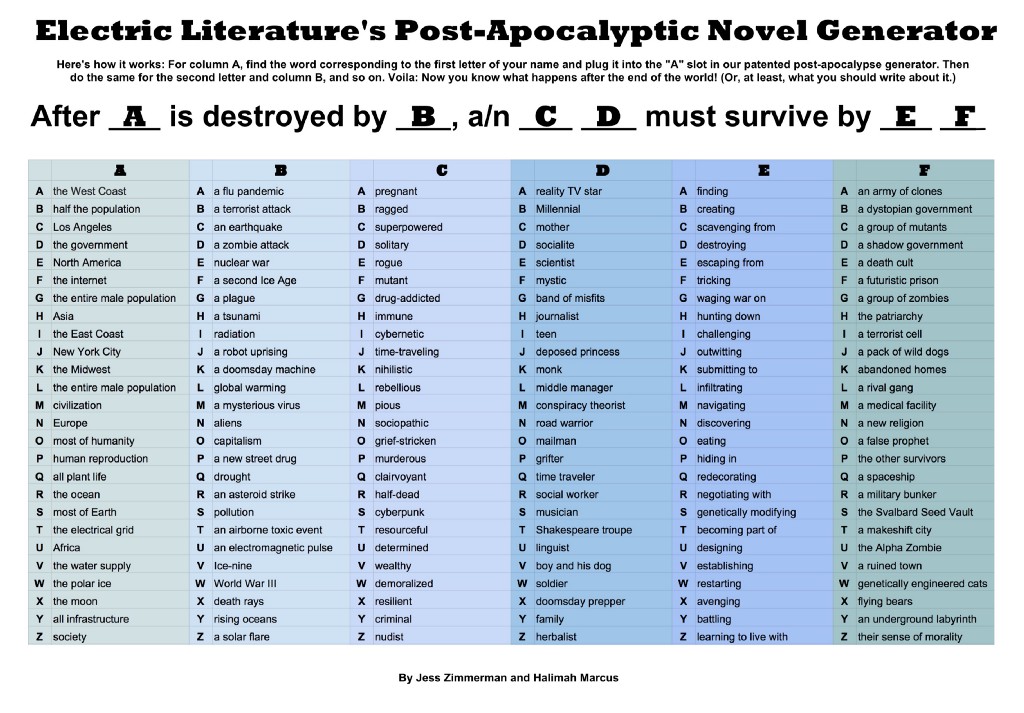
After Children of Men, The Hunger Games, The Passage, Station Eleven, the Maddaddam trilogy, Fury Road, and the upcoming Severance, are you getting post-apocalyptic story fatigue? NO YOU ARE NOT, because survivors eking out a living (or going absolutely to pieces) in the face of a world-shattering disaster is a timeless trope. We keep going back to that well because it’s fascinating to think of all the ways civilization can be destroyed and all the ways humanity can keep going—or not—regardless. Also, it beats worrying about the actual imminent end of the world.
But this morbid fascination with Armageddon means that a lot of potential doomsday scenarios have already been committed to page and screen. What if you’re intimidated by the volume of post-apocalyptic novels that have gone before, and you’re not sure where to start envisioning catastrophe? That’s where Electric Literature’s Post-Apocalyptic Novel Generator can save you (from yourself, if not from the zombies or nuclear bombs). Just use the letters of your name to create a custom-made apocalyptic plot. So for instance, if your name is Furiosa, you’d look up “f” in column A, “u” in column B, “r” in column C, and so forth, for the final result: “After the government is destroyed by an electromagnetic pulse, a half-dead teen must survive by eating the Svalbard Seed Vault.” Good luck, honey.
If your first name is less than six letters, move on to your last name (throw in your middle name too if you need to, or if you feel like it). Hooray! Can’t wait to find out how we all die!
When I look back on the relationships I’ve had, and the relationships that have made me who I am today, I can trace two distinct, parallel lines. The first is the story of romantic relationships — the men and women with whom I’ve shared erotic letters, and hotel-room bust-ups, and bank accounts. But the second, less obvious story, is the story of the women I’ve tried to be. It’s the platonic relationships I’ve had with other women — my painfully earnest childhood rival, who shamed me for wanting a teddy bear to be “cute” instead of “brave”’; the fellow writer who read and helped edit my college meditations on my ex-boyfriend before dating him herself; the journalist with whom I used to share personal diary pages as we worked, together, on the project of becoming “maenads” — that have made me most myself.
At its best, friendship can be a form of utterly unselfish love: companionship and complicity without the desire for possession. At its worst, it can be a form of narcissism: a constant measuring and remeasuring of yourself against someone who comes to embody everything you wish you were (or weren’t). Even in otherwise healthy friendships, I’ve found myself developing myself in dialogue: with one friend, famously taciturn, I take on the public persona of the “outgoing one”; with another, far more ebullient, woman, I’m known as “the reserved one.” I have modeled myself after women I’ve barely met — older girls in middle school who quoted Edna Saint Vincent Millay, strangers who are funny on the Internet. And I have modeled myself, too, after women I have known intimately: the woman whose sheer joy in life makes her weep in museums, the woman emotionally honest enough to pick away at her own personality flaws like a scab.
I’m lucky. By my late twenties, I’ve developed a close network of mutually supportive, emotionally honest female friends. But along the way, I’ve had friendships as toxic — and far more insidious — as the most brutal relationships. Some relationships brought out the worst in me — some in the women I knew. In each case, those friendships were dark mirrors: the women I did not know how to relate healthily to were the women who reflected my greatest fears back at me.
In an early conversation with my editor, Margaux, about my own novel, Social Creature, she asked me whether I related more to the extravagant, exuberant Lavinia, or to her best friend, roommate, and sometime lover, the paralytically anxious Louise. My answer was: both. I have been both “the Louise” and “the Lavinia” in friendship — and, I argued, both women in that novel were themselves both. Lavinia’s overconfidence veils a black hole of insecurity; Louise’s terror — which she thinks is so palpable — goes unnoticed by everyone but Louise herself. Their “opposition” is a function of illusion. The women are more alike than they are different: something that Social Creature comes to make explicitly, tragically, clear.
In writing Louise and Lavinia, though, I was indebted to a long, rich legacy of literary toxic friendships. The greatest stories of toxic friendship in literature are stories that capture that combination of sameness and difference. They are the stories of opposites who are more similar than they let on, of women (and some men) who do not know how to be themselves without each other.
Amelia Sedley and Becky Sharp, Vanity Fair by William Makepeace Thackeray
The Ur-text of toxic female friendship, and the template for fictive female relationships from Gone With the Wind to Gossip Girl, the story of a sweet — but dim — heiress and her ruthlessly amoral social-striving best friend takes our two, deeply different heroines, through the whirlwind of Napoleonic War-era England. While Amelia Sedley marries an undeserving cad but closes her eyes to the truth, Becky Sharp remains flint-eyed: sleeping and conniving her way to the top of the social heap. The novel’s final image: the two women meeting on opposite sides of the titular charity-fair-table, their diverging paths through life rendering them ultimately equal, challenges us to wonder what way is best.
Laura and Carmilla, Carmilla by Joseph Sheridan Le Fanu
The earliest example of the “lesbian vampire” trope, the story of a virginal heiress and the mysterious stranger who demands total love from her newfound best friend is also a powerful metaphor for toxic relationships. Carmilla doesn’t just want to possess Laura, she wants to consume her: for the two to become literally, erotically, one. “Love is always selfish,” Carmilla tells Laura: and this novel explores just how selfish love can be.
Another example of the “dumb heiress/smart upstart” trope, The Wings of the Dove traces the steely-eyed Kate Croy’s friendship with consumptive, angelic heiress Millie Theale. If Millie — in love with Kate’s secret beau, Merton — marries Merton, Kate knows, Millie will leave him a fortune in her will. Counting on Millie’s incipient death, Kate encourages the match when all three find themselves thrown together in Venice. But what Kate doesn’t expect is for Merton to fall for Millie. As Merton and Millie grow closer, it’s never altogether clear which of the two Kate is more jealous of. Ultimately, Millie’s love for Kate is the only thing to survive her.
Callous, feckless, handsome, and rich, the thoroughly thoughtless Dickie Greenleaf is everything Tom Ripley wants to be. Shot through with queer subtext, The Talented Mr. Ripley makes explicit the degree to which the desire to possess and the desire to become go hand in hand.
The Narrator and Tyler Durden, Fight Club by Chuck Palahniuk
For those who know Fight Club’s twist ending, this one’s a bit of a cheat. But the testosterone-fueled friendship between the narrator and the mysterious, magnetic Tyler Durden is one of the finest examples of how the closest friendships are always a little bit about identity.
Something between a toxic friendship and a romance, the relationship between these two Oxford undergraduates in the inter-war era is deeply foundational for them both. Flighty, aristocratic Sebastian and thoughtful, quiet, middle-class Charles need each other: and, for the rest of his life, Charles will never stop defining himself against the Flyte family. While, later in the book, he turns his attentions to Sebastian’s sister Julia, Sebastian always casts a shadow over the family house of Brideshead.
Another pre-war school friendship novel — this one is set in a New England boarding school based on Phillips Exeter Academy. Gene and Finny are both friends and rivals, each struggling to outdo the other in feats of masculine braggadocio. Ultimately, though, that rivalry — as it so often does — turns rancid, and Gene is forced to reckon with his own moral turpitude.
Elderly, priggish schoolteacher Barbara Covett and young, vivacious art teacher Sheba Hart are hardly an intuitive match. But when the younger woman embroils herself in a toxic and abusive relationship with a younger student, Barbara sees an opportunity to use that information as leverage to insinuate herself into Sheba’s life. Like in most of the books on the list, this friendship doesn’t end well.
Perhaps the most detailed, complex treatment of a female friendship out there. The four novels in the “Neapolitan Quartet” trace the friendship of two working-class Neapolitan girls — intellectual Elena and charismatic Lila — over the entirety of their lives. Unlike in many of the books on the list, Elena and Lila’s characters aren’t so clearly defined: they’re not automatic opposites. Instead, at different points in their lives, they craft their identities in opposition to each other — sometimes it is Lila who is ascendant, sometimes Elena — in a quartet that reveals the slippery nature of identity.
Who is L — the polished, elegant ghostwriter who insinuates herself into the life of middled-aged novelist Delphine? A novel that hints at being a memoir, Based on a True Story examines the nebulous nature of identity through Delphine’s increasing codependent relationship with L. Who L is is never fully resolved — but the sense of uneasiness between the two women lingers long after the book is over.
I had a brain SPECT scan a few months ago, which involved lying completely still while rotating panels took pictures of radioactive tracers in my brain to determine how much blood was flowing to different regions. Afterwards, doctors compared my results to the images of other brains. Columbia Presbyterian, where I had my procedure and where the SPECT scan was pioneered, has the largest library of brain images to which my results could be compared. It’s important, my doctor explained, to have a large library of images. “Otherwise,” he said, “They’ll only compare your scan to stroke patients and say, ‘I guess your scan looks fine.’ They won’t understand. And we won’t know how to respond.”
Siddhartha Mukherjee, in his Pulitzer-Prize winning book, The Emperor of All Maladies, quotes oncologist Howard Skipper: “A model is a lie that helps you see the truth.” This is how my doctor explained the SPECT scan library to me. The more sophisticated the interpretive model, the more data points it contains, the more likely we’ll find the truth. In my case, what we found out was what we already knew: the lack of blood flow in my brain isn’t as severe as a stroke patient’s, but it is way more severe than a healthy person, and about the same as most other patients with Central Nervous System Lyme disease. In comparison with the vast range of brain data available at Columbia Presbyterian, I was better than I could be, but I was not fine.
Two years ago, after my bloodwork came back positive for Lyme, I told my doctor my brain felt fuzzy (what did I even mean by that? Fuzzy like what — a peach? A blurry photo?). “Yes,” she responded. “Lots of patients with Lyme call it a brain fog.” This was before I knew about the Lyme spirochetes that had invaded the endothelial cells lining the blood vessels in my brain. “Brain fog,” I repeated. “That’s it.” Then I cried because being understood and believed — after so many misdiagnoses — was nothing short of a miracle.
I often wonder if the trauma of all my misdiagnoses and months of invasive treatments could have been avoided if the first doctors I saw had more patient narratives to which they could compare my experiences, more data points in their model.
I often wonder if the trauma of all my misdiagnoses could have been avoided if the first doctors I saw had more patient narratives to which they could compare my experiences.
But there were many instances where the common language of Lyme patients was alienating. Hearing other people’s Lyme stories has always been hard for me, because I’m envious of those who were correctly diagnosed the first time (usually men, whose complaints of achiness and fatigue had been taken more seriously than mine) and wary of those who have been sick for so long that they’ve moved beyond traditional treatments. At first, I didn’t want to believe my medication could fail and I worried patient’s departure from doctor-recommended treatments would only widen the growing chasm between patients and medical professionals, who are supposed to be partners. Now I avoided talking to other patients because it’s difficult for me to hear someone’s experience of Lyme — with which I am supposed to empathize — only to have it sound foreign.
So I put off reading my reviewer’s copy of Porochista Khakpour’s memoir, Sick, for most of the winter — but once I started, I found the points of commonality were validation I didn’t realize I needed. Much of my story parallels Khakpour’s: a wrongful diagnosis of depression; Klonopin; Neurontin; cognitive symptoms to match the crippling physical aches; living alone outside the U.S., with no idea what was happening inside my own body; juggling opinions of dozens of specialists; reacting to the initial diagnosis of Lyme with ignorant relief. As Khakpour described each of these trials with poetic clarity, they became for me rare moments of connection that can only result from a shared language, a shared story.
“The deal with so many chronic illnesses,” Khakpour writes, “is that most people won’t want to believe you. They will tell you that you look great, that it might be in your head only, that it is likely stress, that everything will be okay.”
As Khakpour described each of these trials with poetic clarity, they became for me rare moments of connection that can only result from a shared language, a shared story.
I hear these lines all the time, and I’ve learned to politely smile and thank people for their kind words. But while it’s helpful to know that I can pass for normal, hearing that I seem fine when I’m painfully aware every second of every day how my brain is malfunctioning creates a chasm between what others see and what I know to be true. It makes me feel very lonely in my under-oxygenated brain.
I know people say these things because they want them to be true (you seem better) or to sound encouraging (you’ve accomplished so much despite being sick), but it makes me feel like they don’t believe how bad it is. Which makes me distrust myself — just like the many doctor appointments, where people I was supposed to trust told me I was depressed, told me I just needed to toughen up, when what I really needed was antibiotics.
This disconnect between those who have experienced this weird disease and the rest of the population is at the core of Khakpour’s memoir. One of the most moving sections of Sick is when Khakpour describes interacting with her boyfriend’s mother — her first real encounter with someone suffering from Lyme. “It was hard to listen to her stories of the constant ups and downs and think that this had just come from a tick bite,” Khakpour writes, recounting the symptoms that she wouldn’t experience first-hand until years later, and describing her disbelief that no doctors could help her boyfriend’s mother. “I’d try very hard to recall my coldness to her over a decade later, my inability to channel full empathy, my distance from whatever it was that was happening to her that I felt so far away from, so I could understand better when it all got turned around on me.”
Part of this disconnect stems from the fact that Lyme is bizarre, and pain has a limited vocabulary. This makes narratives around illness difficult to construct. As author John Green writes, “We’re such language-based creatures that to some extent we cannot know what we cannot name. And so we assume it isn’t real. We refer to it with catch-all terms, like crazy or chronic pain, terms that both ostracize and minimize. The term chronic pain captures nothing of the grinding, constant, ceaseless, inescapable hurt. And the term crazy arrives at us with none of the terror and worry you live with.”
Making this physical-emotional pain comprehensible to someone who has never gone through it is an immense challenge, even for a writer. I’ve developed a million analogies: my eyes hurt like I’ve been staring at the sun for hours; sometimes English words sound like a foreign language; my head has pressure on both sides like the walls of the garbage chute closing in during Star Wars Episode IV; my muscles feel like rubber bands being pulled to the end of their elasticity; I hear sounds no one else hears like a new mother hears phantom cries from her sleeping baby. None of these are accurate, but they’re the best I can do.
And sometimes I can’t even do that. In addition to descriptors of pain being remarkably absent from our vocabulary, sometimes the inflammation in my left frontal lobe makes even the words we do have evaporate on my lips.
Ultimately, it comes down to this: People don’t want to believe something so awful, and I often find myself lacking the vocabulary and the mental acuity to make them understand.
Khakpour writes, “The hardest thing for me with those breakdowns was losing the one thing that made me happy: the ability to write. I could not form sentences, my imagination seemed crippled, plot and characters seemed so abstract, theme an impossibility, all syntax and diction just puzzles that were unthinkable to piece together.” For someone whose primary mode of thought and reflection is writing, the cruel irony of Lyme is that the symptoms of this disease leave writers unable to process the trauma of it.
The cruel irony of Lyme is that the symptoms of this disease leave writers unable to process the trauma of it.
I remember sitting in my professor’s office on the verge of tears. “What if I never write again?” I asked. Teaching English at Columbia, translating, writing fiction — all these things relied on my ability to conjure words. She shook her head, not unkindly, and gave me a list of writers with Lyme, one of whom was Porochista Khakpour. “Only to say,” my professor told me, “that it can be done, that you have something to offer.”
Sick offers validation and a greater capacity for understanding this illness among those who experience or encounter it. But this book has an even more urgent mission, encapsulated in Khakpour’s long descriptions of the process of reaching the Lyme diagnosis:
[The doctor] was convinced I had depression… I tried out antidepressants with names like sci-fi wizard goddesses, Paxil and Celexa… I tried acupuncture, I tried an ayurvedic center, I tried multiple healers, I tried nutritionists. At one point I was seeing three different sleep specialists who all seemed fairly invested in hiding how stumped they felt. I think something is wrong with me physically, I caught myself saying again and again.
The common thread among all the late-stage Lyme patients I’ve spoken to has been this: I tried to tell doctors, and they thought I was crazy.
I, too, told multiple doctors in the beginning that sudden noises made me break into tears. While I insisted I wasn’t generally unhappy or upset at all, they seemed intent on a psychological diagnosis. One night, I was actually crying to my father out of frustration, resigned to finally make an appointment with a psychiatrist, though I knew in my gut that was the wrong move. “Has anyone done a blood test yet?” he asked. “Like for mono or Lyme?” He trailed off, but the next morning, I called a new general practitioner and asked her to do a blood test for everything she could think of before my appointment. She agreed, and that’s how I was diagnosed. Because my dad, a lawyer, asked if anyone had done a blood test.
“Pain without cause is a pain we can’t trust. We assume it’s been chosen or fabricated,” writes Leslie Jamison in The Empathy Exams. But understanding someone’s pain, separate from the source of their pain, is something that all of us — not just medical professionals — struggle with. I don’t fault doctors for not making me better — Lyme is complicated and manifests differently from patient to patient, and there’s shockingly little research and consensus on courses of treatment. I fault the doctors who didn’t seem to try. An infectious disease specialist told me I was having trouble reading because I was tired. The SPECT scan would much later reveal I was actually having trouble reading because I had inflammation in my brain.
I don’t fault doctors for not making me better. I fault the doctors who didn’t seem to try.
I told another doctor that after I closed a book I had no recollection of it: the plot, the characters, the author. She waved her hand dismissively and told me she had the same problem. “In 2015, I read 250 books,” I said, trying to keep a measured tone, “In 2016, I read three.”
She told me that happens to all of us eventually.
“But I’m only 25,” I insisted, staring dumbfounded at the gray-haired woman across from me.
A few weeks later, when that doctor sent me an email suggesting I try yoga (my case apparently didn’t even merit a phone call), I couldn’t help but wonder what I had done wrong. My brothers urged me to forget about the doctors who didn’t listen. But the problem was that she had listened.
Many of these doctors — heads of departments at top New York hospitals — spent hours listening to me, and they still dismissed my symptoms as fatigue or depression or psychosomatic pain. I felt — and still feel to this day — that it’s somehow my fault that so many medical professionals didn’t take me seriously, despite what I told them and, later, despite the bloodwork, scans, and neuropsych testing that pointed toward serious issues with my brain. If I had been clearer, conveyed the urgency of my symptoms in a more compelling way, I would have been diagnosed sooner and maybe this whole thing would have been treated with three weeks of antibiotics before any real damage was done.
Khakpour writes, “It amazed me that even after all these years… I could still be in this position — helpless, crazy-seeming, confusing, inconvenient, out of their norm, a problem.” Unfortunately, mental illness is often the go-to diagnosis for doctors who don’t recognize the symptoms of late-stage Lyme: “Women suffer the most from Lyme. They tend to advance into chronic and late-stage forms of the illness most because they are diagnosed the latest, as doctors often treat them as psychiatric cases first. The nebulous symptoms plus the fracturing of articulacy and cognitive fog can cause any Lyme patient to simply appear mentally ill.” Ironically, Khakpour points out, prolonged misdiagnoses can cause considerable psychological trauma.
The Center for Disease Control estimates 300,000 new cases of Lyme each year in the U.S., more than hepatitis, breast cancer, and HIV combined. So how did so many doctors miss my diagnosis? Fail to even think my symptoms warranted a blood test?
As someone who tells stories for a living, I can’t help but wonder: why wasn’t I able to tell my own story well enough to make doctors listen?
“A model is a lie that helps you see the truth.”
I keep coming back to this.
Words are limited. Anything we write will be a sliver of the lived experience. There is no one experience of Lyme — or any disease — and it seems any narrative will inevitably ring false to both the person who endured it and to others who are supposed to relate.
It seems discouraging that a medical narrative will almost inevitably feel insufficient to those who experienced it, unrepresentative to other patients, and inaccurate to the rest of the world. Yet Sick has helped me realize the immense benefits of medical narratives: They can help the medical community see where our understanding is lacking. They can help those who have never experienced chronic illness “exercise the muscle of empathy” as writer Etgar Keret puts it; and they can help people like me feel a little less lonely with my brain.
“Sick” has helped me realize the immense benefits of medical narratives: They can help the medical community see where our understanding is lacking.
Each narrative provides a larger model for all of us — patients, friends, doctors — to use, and Porochista Khakpour’s book adds to our database in an area that is sorely lacking. Her honesty about other traumas, from drug addiction to being a political refugee, provide layers of complexity that drive home the point that each case of Lyme is a distinct person and must be treated as such. As Leslie Jamison writes, “Empathy means acknowledging a horizon of context that extends perpetually beyond what you can see.” I often think of all the people with Lyme who don’t have the resources, access, finances, or time to persevere beyond the third, fourth, fifth wrongful diagnosis or doctor who simply tells them to get more sleep.
The infectious disease specialist who ultimately treated me was a doctor who has seen Lyme patients for decades. He started most appointments with, “I once had a patient…” He’d seen just about everything; this is how I came to trust him. The most comforting words he ever said to me were at our first appointment: “I’ve treated so many patients just like you.” While each patient is different, in the absence of research and scientific consensus, the stories he carried from his previous patients helped him direct my treatment course. Doctors often warn Lyme patients not to conflate evidence with anecdote — rightly so — but for a disease so under-researched we don’t even have a way to test if a patient is still infected, perhaps we should give more weight to the collective anecdotes of patients. When it comes to this disease, sometimes they’re all we have.
For a disease so under-researched we don’t even have a way to test if a patient is still infected, perhaps we should give more weight to the collective anecdotes of patients.
Which is why having Khakpour’s narrative (and more like hers) in our collective awareness may be a matter of health or crippling illness for hundreds of thousands of people.
Being a writer with Lyme is a double-edged sword — it creates the need to share experiences, so people like me can feel less alone, so friends and family can understand, so doctors can treat patients more completely, a mission that is confounded by the Lyme itself and the cognitive havoc it wreaks. So I thank Porochista Khakpour for doing what I know to be both impossible and necessary: telling her story.
Novel Gazing is Electric Literature’s personal essay series about the way reading shapes our lives. This time, we asked: What’s a book you misunderstood?
The first time I learned to orgasm was while listening to Fanny Hill. I was 16. The blanket of shame tucked itself around me as soon as the pleasure faded.
I was a bookish, introverted girl with very few friends, and I went to bed each night with an audiobook. The comforting voice trickling from my headphones reminded me of childhood, when my mom would read to me before bed and my mind would quiet: no SATs, no homework, no fights with my father or frenemies. For hours, I scoured Librivox, a free listening site featuring books in the public domain, for classics like Robinson Crusoe and The Count of Monte Cristo. One afternoon, while exploring new genres, I discovered the Erotica section. My cheeks flamed, but I clicked on it anyway. Flustered, I could barely allow myself to skim their titles. At random, I downloaded Fanny Hill: Memoirs of a Woman of Pleasureby John Cleland, published in 1749.
That night, I curled up under the covers to the sound of a deep male voice narrating the misfortunes of young Fanny, orphaned at age 14 and trying to survive through good looks and seduction in England. She found love with her husband Charles, but when he disappeared, she was taken in by Mr. H and lived unhappily for a while as his mistress. She then embarked on numerous sexual adventures as a happy courtesan, before reuniting with Charles by chance and settling down with him in content, married life.
Fanny and I had nothing in common. I was a shy Chinese immigrant student who wore baggy sweatshirts and discount sneakers. My strict parents forbade me from prom and sleepovers. I’d never watched porn, and I was too nervous to talk to boys, let alone touch them. Nevertheless, I was drawn to Fanny’s adventurous spirit and unapologetic pursuit of lust. She was a mirror to my own sexual curiosity, and she was both student and teacher, at times the shocked voyeur observing other couples and at times the mistress luring her subjects to do her bidding. In her world, there was no such thing as deviance — all acts were natural expressions of the body, full of play and affection. Nothing was forbidden.
Despite the ridiculous plot, I found satisfaction in a narrative in which a woman does not suffer eternal shame and damnation for having embraced her desires. Fanny is the opposite of Hester Prynne. She suffers no consequences for promiscuity. On the contrary, she finds true love, bears children, and leads a wealthy, respectable life as a wife and mother after all her exploits, all while magically avoiding trauma, STDs, and unplanned pregnancies. Though the narrator of Fanny Hill is a woman, it’s no surprise that the book was written by a man — its plot is that of every man who has sown his wild oats and gone on to lead a happy life without shame. Yet, almost 300 years later, this still represents a fantasy for most women. We have been taught from a young age that following our desires leads to stigma and tragedy.
The book wasn’t just an account of lurid sex; it was also an exercise in imagination and erotic language. Cleland challenged himself to write an erotic novel without using foul words or explicit names. Instead, he relied on verbal dexterity and figurative language to convey desire, over and over again. Of course, not all desires were the same. There was the gentle affection of Charles, the primal virility of a young footman, then the performative exhibits at Mrs. Coles’ brothel. Through Fanny’s eyes, I learned to look, really look, at the male body through language. Along with detailed descriptions of female beauty, Cleland painted male subjects with equal admiration and endowed them with lush metaphors and imagery. In describing Fanny’s first love and husband, Charles, he writes,
The parting of the double ruby pout of his lips seem’d to exhale an air sweeter and purer than what it drew in: ah! what violence did it not cost me to refrain the so tempted kiss!
Then, a paragraph later,
The platform of his snow-white bosom, that was laid out in a manly proportion, presented, on the vermilion summit of each pap, the idea of a rose about to blow.
I had never heard a man described in such intricate language, usually reserved for women, and the book was full of astute, tender, and at times over-the-top observations of the male body. Moreover, I had never heard a female voice express such vehement and specific desire. The references in the passage to ruby lips, purity, kiss, and rose reminded me of the scene in Romeo and Juliet in which the two lovers meet for the first time and fan each other’s desire with playful banter. Juliet, however, would not have penned a memoir detailing Romeo’s “machine.”
Although I hadn’t yet learned the term “the female gaze,” I was embodying it through Fanny’s eyes. When I liked a boy, I tried to imagine the taste of his mouth, the texture of his hair under my hand, his smell. For the first time, I allowed myself to think of lust as something not to be ashamed of but to honor. Cleland’s excessive language celebrates Fanny’s excessive lifestyle, where at the core of lust is a timeless ritual without censure, supervision, or constraint. In fact, the word lust has not evolved much etymologically from Old English, though it was used in a broader sense, beyond the sexual context. It even has a cognate, las, in Sanskrit. Although in contemporary usage it had acquired a narrowed meaning and seedy connotation, it used to mean simply pleasure.
I had never heard a man described in such intricate language, usually reserved for women.
I envied Fanny for having words for her feelings and clarity in her desires. In my college years, when I finally began to explore sexual intimacy with men, the overwhelming emotion I felt was confusion. Desire seemed so simple for Fanny — it freed her from the burdens of life. So how come, after my first kiss with a drunken boy on the beer-stained dance floor, all I could feel was fear and dismay? The taste of another person’s mouth failed to evoke a rush of joy. In that moment, I was made aware of desire only by its absence. It was as if Fanny had given me a false map to a pleasure I could not find.
Once, a boy said me, “Tell me what you want.” All I could muster was, “I don’t know.” He wanted me to put my desire into language, but it was not a specific act or tangible object I could point to or describe. No matter how hard we searched, we could only brush against its shadow. It was like listening to a song underwater — if only I could break the surface; if only I could tell a hand where to go; if only I could put in words what I could not understand. My lust was a muffled, complicated, diluted version of what the book had led me to believe was natural. Unlike Fanny, who climaxes easily, orgasm eluded me whenever I was with another person. Only in solitude did it arrive, urgent and vengeful. For years, I felt like a broken music box. A hand would wind me up, and then — nothing.
I used to picture Fanny as an ancient Greek priestess in the cult of Aphrodite or Dionysus. Desire was her source of power, and she nourished it as much as she drank from it — she let herself be worshipped. In my favorite chapter, as revenge against Mr. H’s infidelity, she seduces a young footman and takes his virginity. Opening her legs, she grants him the privilege to marvel at the glorious sight, allowing him to caress her with trepidation and reverence.
Desire seemed so simple for Fanny — it freed her from the burdens of life.
In practice, however, I often felt powerless in the hookup dynamics of college and modern dating. The boys I encountered in college were often too awkward or inconsiderate to offer me sincere affection. Instead, they focused on their pleasure and ignored mine. Some even disparaged me out of their own insecurity. I remember feeling cold on a boy’s twin bed freshman year as he haphazardly jammed a finger inside me to “get me off” quickly so that it would be his turn next. The fluorescent ceiling light dispelled any illusion of romance. I felt alienated from him and myself all at once, the border between our bodies undeniable in our cracking joints and evasive eye contact.
In retrospect, through most of my life, the kind of desire I felt most acutely from men was calculation and aggression, the leering stares tracing my figure as I walked down the sidewalk, undressing me without permission. Once, a man stalked me all the way to the subway and got on the same car before I jumped off, right before the doors shut. Desire seemed a cage I couldn’t escape. To be wanted was to be in danger, and to want was to be ashamed. It exacted a price. I knew that as early as sixth grade, when a boy had put his hand around my waist and the other girls started calling me “whore.”
Unlike Fanny, lust didn’t unburden me. It became burden. A task to be taken care of, through a hookup or late night visit across campus, a physical need to get rid of so I could focus on other aspects of my life, to concentrate on my next exam or ace the next job interview. At times, I tried to make it my weapon, to go on the offensive and conquer another body so that I could not be subjugated, though it didn’t make me feel any safer than before. How was it so easy for Fanny? She exulted in her sexual exploits. I wanted to forget that mine had ever happened.
How was it so easy for Fanny? She exulted in her sexual exploits. I wanted to forget that mine had ever happened.
Then there were times desire manifested itself as pain. Driving home one night with a girlfriend who was recounting her sexual conquests like a waiter listing off menu specials, she suddenly asked, “Do you think I’m a slut?” The question came out of nowhere, yet its roots snaked deep in her bones. I stared at her profile, sitting in her power suit, her beautiful blond hair cascading down her shoulders, one hand on the wheel. She didn’t wait for me to react. “Oh, you don’t have to answer that. I know I am. It doesn’t matter.” She laughed nonchalantly. Only the slight tremor in her voice betrayed the pang that gnawed at both of us.
Fanny had made me fall for the allure of the female body as holy, but I no longer believe that the body is a sufficient container for desire. The lover resides in a space defiant of time. It is perhaps no coincidence that the fantasy of Fanny was concocted by a man in prison — in other words, someone with what must have seemed like an eternity to imagine. Desire cannot live in a mortal vehicle, a halfway coffin.
But the very act of writing is a practice of desire. Like the body, it tries to arrive at the slippery center of what refuses to be captured. In poetry, stanza means room. When I write, I am building a room I can go in, where I am simultaneously present and absent, touched but also untouchable. After all, desire is a form of play without temporal constraint. In language, we can build it a house to come and go, a timeless mansion for it to dance and smash around, breaking the bed.
I am standing at Lizza Aiken’s door because, more than fifteen years ago, I wrote a letter to her mother.
I wrote it on thick, expensive stationary, a gift from my grandmother. The envelopes came with gem-toned paisley interior print. Centered on the top of the page, in the same dark teal of the thin-lined borders, “Jackie Hedeman” presided over the letter in a printed approximation of script. The stationary was far too ornate for me at eleven years old, but I was also tall for my age and timelessly unhip in my Lands’ End shirts and dresses. And it was, at least, in keeping with my historical preoccupations; I liked to imagine myself a Victorian lady or waif. I would stare out at the grey Champaign, Illinois snow as though marooned inside a house on the moors. What I did not like was the name on the top of the paper. I assumed that, as an adult, I would go by Jacquelin. “Jacquelin” was grand, a name for high tea and passport control. “Jackie” was someone else, someone mired in preteen politics and sudden body hair and a tendency to turn incandescently red when called on in class. Jackie had terrible posture from stooping to her shorter friends’ level and curving in on her new breasts. Jackie had no business writing to Joan Aiken.
But I wrote to her, with my child’s name on my grown-up stationary, and we became friends of a sort, and it changed my life. And now I am standing at her daughter’s door.
“You should write to Joan Aiken,” my mother said. We were driving back from Sunday School, a place where I kept my head down and made up things for confession, always tacking “and I lie” at the end to cover all my bases. The priest didn’t know me; I followed my mother’s lead and slipped out the side door rather than face the post-mass handshake line.
I had been talking to my mom about the book I was reading, Dangerous Games (published as Limbo Lodge in Britain) by Joan Aiken. Dangerous Games was part of the Wolves Chronicles, then a nine-book children’s series taking place in an alternate 19th century. In this 19th century, James III sits on the throne of England and Guinevere is improbably alive somewhere in South America. Wolves roam in seasonally ferocious packs. Other aspects of the 1800s remain intact: child labor, gender inequality, and industrial-strength class disparity. At the center of this sooty stew is Dido Twite, one-time urchin, full-time adventurer, pants-wearing salty heroine.
At the time, I wasn’t concerned about Dido Twite. Instead, I was complaining about Dangerous Games’ lack of Simon, Dido’s friend and, later, potential love interest. Simon was dark-haired, earnest, Gilbert-Blythe-dreamy. When I read the first-published books in the series, I sketched scenes from the books where Simon appeared on school-approved quadrille paper and hung them from the wall above my bed to bring good dreams. I paired these drawings with a bedtime routine involving a boom box turned almost all the way down and a CD of melancholic and yearning Zouk music from the Antilles. And I had dreams. Simon and I rescued nobles. Simon and I rode in carriages. Simon and I had strange, mundane conversations carrying the weight of revelation. Once, Simon and I swam with sharks.
Simon and I rescued nobles. Simon and I rode in carriages. Once, Simon and I swam with sharks.
I can point to no particular moment when my allegiance shifted from Simon to Dido. I only know that it happened much later, years after that car ride, and that it coincided with a number of other epiphanies. Maybe Jo and Laurie didn’t belong together. Maybe Professor Lupin was a little patronizing and Sirius Black was Greek tragedy embodied. Maybe Edmund was the most interesting Pevensie. Maybe Dido Twite was ten times the character Simon would ever be. These revelations carried with them the weight of adulthood, the heavy realization that the people and configurations I admired as a child could be reevaluated.
These days, I consider Dido to be nothing less than an underage role model, a fictional avatar for the bold and courageous in me. I do not see myself in her — my bravery is mundane: showing up when I should, talking when it’s time — but I consciously borrow her attributes where I can. I remember driving to my first job in Chicago after graduating college, weaving through the west side and trying to calm my rabbiting heart with the muttered repetition, “Think of Dido, think of Dido, think of Dido.”
However, in the car on the way back from Sunday school I said to my mother, “I wish Joan Aiken would write more about Simon.”
“Why not write and ask if she has any plans to write more?”
I was thunderstruck. “I can’t do that! She’s a published author.”
My mother — herself a published author, though I wouldn’t think of her that way until I held the impenetrably brilliant scholarly volume dedicated to me — dismissed this. “I’ll look up the address of her British publisher,” she said. “The American one would only ignore you.”
A few hours after we returned home, she came into my room with a torn-off piece of yellow legal pad. She handed it to me. “‘C/o’ means ‘care of,’” she said. “There are international stamps in the side table.”
I am standing at Lizza Aiken’s door because, more than fifteen years ago, I came home from school to find a blue aerogram sitting on the dining room table with the rest of the mail. My mother was hovering nearby. “Look at the return address,” she said.
Joan Aiken. The Hermitage. Petworth, Sussex.
I have no access to what I felt. It was not uncomplicated joy, because I was never that child. Opening messages still comes with a twinge. The twinge is fear, and the fear is that I have asked too much.
Dear Jackie Hedeman,
Thank you for your nice letter about my books.
I skimmed the letter for disaster, then read it again with attention. Joan Aiken was surprised that I wasn’t a Dido fan, and suggested another series, a trilogy, with a central boy character. She thanked me again for my letter. She signed her name.
I needed to write back, immediately. The desk containing my thick stationary was in the next room, right by the side table with the international stamps, and she had given me her return address. What was a return address but an invitation? I had to tell her that I’d already read this other trilogy and loved it. I had to make her understand that I did like Dido. She had to know as quickly as possible that I hadn’t dismissed what was clearly one of her most beloved characters.
I wrote. Within two weeks, I had a reply. I sent another letter. She replied. Joan Aiken and I would exchange three letters a year, on average, every year until 2004, the year she died. Along the way, she mentioned that Dido Twite was based on a character from Dickens, but she wouldn’t tell me which one, or even which book. I would have to read Dickens to find out.
I was twelve. I read Dickens.
In school, we read Johnny Tremain. We read Journey to the Center of the Earth. On the playground, my friends and I acted out scenes. I was tall, so I always played competent, fatherly characters. (Later, in high school theater productions, I portrayed a series of moms.) That year, I infused Dr. Warren and Professor Lindenbrock with a certain Twitely panache, a soft core under steel snap-together armor.
She mentioned that Dido Twite was based on a character from Dickens, but she wouldn’t tell me which one. I would have to read Dickens to find out.
Meanwhile, I sent letters with international stamps bearing Dickens guesses and Joan Aiken rejected each one. I kept reading and guessing, finding pieces of Dido everywhere. Again and again I got it wrong. I told Joan Aiken what other books I was reading (Penelope Fitzgerald, Alexandre Dumas). I told her about trips I took with my parents (France, Scotland). I told her the weird story my friend Martin told me about being hailed by name from a castle in Wales by a woman he’d never seen before.
At thirteen, I went as Dido Twite for Halloween: vaguely ruffled shirt, linen capris with white tights underneath, black clogs. I didn’t do anything to my hair, which was short, as was Dido’s. No one knew who I was, but that didn’t matter. Every costume I’ve ever worn has felt like a triumph, a safe and sanctioned summoning of eyeballs and attention. It didn’t matter that my friends and classmates were increasingly prone to reject Halloween as childish, or else veer toward angel wings, a tank top, and skirt. That particular Halloween was a stepping-off point of sorts, though none of us would have recognized it as such at the time. We began to grow up right then and there — into heterosexual selves with concerns mirroring the concerns of the adult women we saw — or we didn’t. When a seventh grader came up to me on the playground and asked whether I’d go out with him, I knew he trying to make fun of me. Now, I am less sure that this was the case. He certainly nervous-laughed his way away from me, back over to his friends. Then, separated from my Bath & Body Works-scented peers by what felt like an experiential gap, I buried myself in books.
In my letters, I told Joan Aiken about the writing awards I won, first in middle school and then in high school. I had written before — stories about jumping into beanbags from great heights that my third grade teacher covered in smileys — but it wasn’t until I read Dickens (then Dumas, Charlotte and Emily Brontë, Wilkie Collins) that I wanted to be a writer. I wanted to do the thing I saw these people doing: construct a world and people that world with characters so that reader was never lonely enough to want to leave. In my letters to Joan Aiken, I never quite managed to explain that her characters assuaged my own loneliness. I never quite managed to explain that I was a writer because of her.
It was my turn to write when my mother’s colleague e-mailed her obituary. By then, everyone knew about the letter exchange. When I’d departed middle school for high school, my friend Amelia, an early Halloween costume eschewer, was tasked to give a mini speech heralding my accomplishments in front of the rest of our tiny class. She spoke around her newly adjusted braces to explain that the three things I really cared about were reading, writing, and Joan Aiken. The list was redundant, its three components so interlocked at the time that all they amounted to was one all-encompassing obsession-identity.
When Joan Aiken died, I was newly fifteen and unaccustomed to unfinished business. The undiscovered Dickens character hung over my head like unwanted mistletoe. I took out a sheet of paper and wrote on it with orange highlighter.
Barnaby Rudge
A Tale of Two Cities
The Old Curiosity Shop
David Copperfield
Then I took the aerograms and wrapped them in this paper, my uninvestigated guesses, and put the bundle in the accordion folder I kept by my bed. That folder held everything I’d ever written: printed out extra copies of the stories I distributed to family members, marked-up fiction and poetry from school, and the newsletters my best friend and I distributed around the neighborhood. I left the accordion folder there when I went to college. On breaks, I would sometimes pick it up and brush the dust off the flat, fold-down top. I flipped the catch and pulled out the old stories and poems, but I was reluctant to open the letters. Untouched, they had reverted to their original form: scraps of paper whose contents might reveal a lack of understanding. I feared that I might reread the letters and find the humoring tone of an adult donating, not sharing, time.
By then, in college, fingering the edges of old stories, I interacted with that once-sanctified category of human, published authors, on a weekly basis. I took creative writing courses with them. In these classes, I regularly encountered fiction that failed to raise my heart rate. There was nothing in John Cheever or Anton Chekhov for me. Possibly I was too young. I read the assigned stories and I felt as though I were reading them through a telescope. Every word was legible, but intangible.
I tried to contort my interests into acceptable forms. Acceptable to whom? When my classmate, at the height of the Twilight craze, wrote a vampire story, no one sneered, but I winced my way through class on her behalf. In retrospect, I wonder at that embarrassment. The author of the vampire story didn’t seem embarrassed. She had written the story she wanted to write. What stories would I have written, had I been gifted with similar boldness? It is hard for me to tell, since the stories don’t exist. For every other era of my life, I can easily chart my preoccupations and fascinations based on the writing I produced. It wasn’t that I spent my college years free of obsessions, those cozy interests that lull me to sleep at night and power my waking days, but rather that I saw no way to translate those obsessions into the sort of writing I felt I was supposed to be doing. I was cut off from written joy.
Thinking on it now, it strikes me that those moments in my life when writing has been the most difficult were overlaid with those moments when I have been the least sure of myself. Writing was a question of identity asked and answered. Who was I? A writer. In college, I didn’t feel like much of a writer, and so I began to consider all the other things I might be. Staring back at me was a disorganized tangle of feelings and suspicions. Perhaps, while I was busy dressing as Dido Twite, others had begun to make sense of their own tangles. Perhaps that explained how comparatively at home in the world they were. I recoiled. I had to be a writer. Otherwise, all I was left with was mess.
Joan Aiken wrote throughout her life, but I have no doubt that she, too, experienced these pockets of time when her own writing was foreign to her. I wish I could have written to ask. I know she would have answered. I would have opened the letter with one eye closed, afraid to see my concerns mirrored back at me ridiculous, but I would have had no need to fear. Maybe she would have answered with a new scavenger hunt through classic literature, maybe with a question, but she would have answered.
I never quite managed to explain that her characters assuaged my own loneliness. I never quite managed to explain that I was a writer because of her.
I am standing at Lizza Aiken’s door because, one summer home from college, distanced from my writing impulse, I Googled “Joan Aiken.” I don’t remember why I did, only that the first result, above Wikipedia even, was a link announcing itself directly to me, “Welcome to The Wonderful World of Joan Aiken.”
The website was beautiful, with multiple pages of content reached by clicking wiggling links on an animated desk. I was making my way through the Resources page when I noticed a link beside a mug of blue pencils. “Letters from You (click.)” Before I could click, I saw, peeking out from behind the link, a partially obscured image of an envelope. What was visible was sufficient: an American cancellation and an international stamp featuring Mount Everest. I clicked.
Scanned letters from actual readers covered the digital desk. I made myself read from the top of the page because this couldn’t be rushed. I would need to remember.
Joan Aiken loved to get letters from her readers, and as she was a terrific letter writer herself, some of these correspondents turned into good friends. I couldn’t write back to all of you when she died, but I wanted to let you know how much pleasure you gave her, and share some of your best letters here, and also some of the secrets behind the books that a few of you may already have found out for yourselves…
“Oh my God,” I said to my living room wall. Time telescoped back: I was sitting at the desk with the thick stationary where I used to write to Joan Aiken. My parents were off at work and the house was still. And as I scrolled down the page, looking for what I knew I would find, I was also writing the letter.
Dear Ms. Aiken,
I’m continuing my search of Dickens for the character that inspired Dido, but as yet it has been fruitless. Could you give me a hint? Please? So many books! So little time!
Thank you,
Jackie Hedeman
P.S. You do remember me don’t you? I wrote a while ago.
Another envelope overlaid the “Jackie Hedeman” at the head of the stationary, but I knew it was there.
Also there: a mottled, metal skeleton key sitting off to the side, tagged with a label on a string. The label read, “Want to know the secret? (click key)” and I clicked without hesitation. An excerpt from Dickens’ Old Curiosity Shop took up the new page.
“Oh, please,’ said a little voice very low down in the doorway, “will you come and show the lodgings?”
Dick leant over the table, and descried a small slipshod girl in a dirty coarse apron and bib, which left nothing of her visible but her face and feet. She might as well have been dressed in a violin-case.
“Why, who are you?” said Dick.
To which the only reply was, “Oh, please will you come and show the lodgings?”
There never was such an old-fashioned child in her looks and manner. She must have been at work from her cradle. She seemed as much afraid of Dick, as Dick was amazed at her.
I am standing at Lizza Aiken’s door. I am in graduate school and it is winter break and I am in London and I have decided it is time for us to organize a meeting. Lizza runs the Joan Aiken website and works to keep Joan Aiken’s books in print and her legacy alive. I e-mailed her immediately after discovering the website to thank her, and we exchanged a few messages but never began a proper correspondence.
Part of me is here for the story, because I have started to write again and I am seeing stories where there were once only facts of life. The other part, the bigger part of me, has been holding in a larger thank you that could only find expression in person. A handshake. Enthusiasm. Wisconsin chocolates shared over tea.
I am holding Wisconsin chocolates when Lizza opens the door. She looks a little like her mother, I think, based on the three, maybe four, pictures of Joan Aiken I have repeatedly seen on flyleaves and websites.
“Is it you?” she says.
“Yes,” I say, and I hold out my hand, which she ignores to hug me.
After I have been released but before I can offer the chocolates or take off my coat she says, “Did you know that today was Joan’s death day?”
I had no idea, though I remember my mother coming into the guest room where the computer was and where I was working on a college admissions essay. We had plans to go to England that spring and my parents had been not-so-subtly pressuring me to write Joan Aiken and arrange a meeting. I didn’t want to. I was heart-poundingly shy. I didn’t want to bother her. I didn’t want to deal with the suspense of waiting for her reply. I wanted to wait.
“I had no idea,” I say to Lizza Aiken. It is chilly outside and the words come out wet.
“It is,” she says. “Today you feel a bit like a gift from her to me.”
Later, I will tell my mother this, and she will get teary. She’ll say, with perfect skeptical Catholic logic, “Someone made that happen. I don’t believe it. But I do.”
I don’t get teary when I’m with Lizza: not when she greets me or when we part, not when she shows me the folder where Joan Aiken kept my letters, one with “Personal / Family / Friends” written on the cover, and not when she leads me out into her back garden for a look at the Joan Aiken Shed, a cozy, warm, green-painted structure full of bookshelves. The bookshelves hold all of Joan Aiken’s books, in multiple editions, in multiple languages. They also hold her notebooks, with ideas for stories Lizza can immediately connect to published works on the shelves. Lizza shows me the first page of the first draft The Wolves of Willoughby Chase, virtually identical to the words as they appeared in the book my mother read to me.
I don’t cry because it is an afternoon without nostalgia. I don’t filter our conversation through a feeling for my past self because that past self is here with me in the room. We are the same Jackie.
I don’t filter our conversation through a feeling for my past self because that past self is here with me in the room.
Lizza makes tea. We talk about books, and Joan Aiken, and Lizza’s work with feminist publishers. We also talk about our families. Lizza is midway in age between my parents; I am only a little younger than her children. We talk about politics; we bemoan Brexit and Trump. We bond over the dark reassurance of a planet that will surely outlast the human race.
I try to tell Lizza what her mother’s books meant to me — mean to me — but I stumble, because even now I’m not sure of the extent of their meaning. There have been other books, of course, that have wrapped themselves around my entire existence. I cloak myself in their characters and wear them around. These books are different from each other, and I am different reading them, living them, but taking them on amounts to the same thing. Like Dido Twite, like Joan Aiken, like the rediscovery of myself on the page at Lizza Aiken’s kitchen table, these books all say the same thing. They say, “You are worthy. Be brave.”
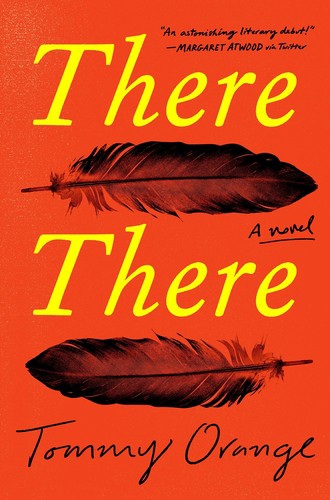
Tommy Orange is the author of There There, a novel that circles the lives of Oakland, California-based urban Indians. Tommy’s work offers varied interpretations of Native life, culture and inherited trauma, lived in and through the city. He spoke to me thoughtfully about the potential social implications of his book, so needed right now for urban Natives — living too long as ghosts in the American city.
Purchase the novel
We grew up not far from one another. I am only an hour further east, inland to Stockton, California. Our cities were post-industrial mirrors of each other, similar in class, construction, and constitution. And our lives as singular urban Natives, separated from our culture but with our culture still swimming through our blood, were submerged in the wilderness of our cities, only ever able to blend in as biracial alone; until now, as we both work to write ourselves into existence within the structures of the cities we grew up in. With work like Tommy’s novel hitting the shelves of the mainstream, priming all urban Native writers to come, we will live as ghosts no longer.
This interview took place in Santa Fe, New Mexico during the graduation residency for the Institute of American Indian Arts (IAIA), where Tommy is an alumnus and now faculty in the Creative Writing graduate department and I about to graduate with my MFA. We met in a high-end restaurant in the center of what is called The Plaza of downtown Santa Fe — an art district showcasing endless amounts of Native American art, authentic and not. It was happy hour in the restaurant and we were the only two non-white people in the place, the only Indians. We were put in a dark corner and ignored by our waitress and most of the staff, had to hunt down our waitress to finally get our check, and several attempts to flag down waiters ignored. A rush of stories ran through my head I had heard from IAIA peers and faculty about Indians being treated inhumanely in Santa Fe by the starkly white bourgeoisie, even as our art sells to these people for thousands upon thousands of dollars throughout their downtown boutiques. The irony of colonialist art appropriation practices never lost on us.
During the interview, though, Tommy and I pretended not to see the obvious — that we were the hidden Indians in the room, ignored against an all white space — so used to being treated as the ghosts we have been. Instead we focused on our work to be done, as always. We conducted our interview with much joy, conversation punctuated by laughter and our bright wide smiles, even as we sat in and spoke on the darkest parts of our historical past and present.
Marlena Gates: What is it to write about the violence and trauma of the Native in the modern sense, and how do you feel about the argument against the writing of Native life as harsh and cruel — a critique coming from inside our own Native literary community?
Tommy Orange: I’m writing to a Native audience and anybody from it knows that these are realities. I’m not making this stuff up based on nothing. It’s a grim, dark world and reality that we struggle through. I tried to have my characters transcend a lot of that stuff. They’re not bogged down by it or it doesn’t define them. I want to humanize all my characters and, sure, they experience things that are a part of our communities; but I wanted to flesh them out and have them experience joy and sadness like all humans do. One thing about Native people is that we’re turned into one dimensional people, a one dimensional thing; we’re a statistic or we’re a historical image. To make fully fleshed human characters represented in a big way, as something that gets distributed everywhere, does a lot of work to update people on what it means to be [Native], to just treat us like humans, know that we exist now, to just treat us like everybody else. We don’t get regular treatment. We are the minority of the minority. I don’t have any problems talking about the realities that we face.
MG: So making your Native representation all sunshiny bright and rainbows was not a priority?
As a reader I feel like I never read about people that I know, the people that struggle financially.
TO: Violence is such an ingrained part of our history but we’re never able to reconcile with it because people aren’t willing to admit that it was such an important piece of the conquering and the killing that has happened. We aren’t even willing to admit it, as a nation under Americans, and so there is this insidious violence. And there are other practices that aren’t direct violence that affect our lives based on policies. The thinking around us, and the erasure that’s happened, is a different kind of violence. So to represent that, as well as the real violence that happens, I liked.
MG: Then it actually humanizes the Native more to show clearly the dark side of their lived experience?
TO: I think so. That’s one of the functions of the novel — to build empathy for the reader. How do you do that? You have somebody go through an experience by having them walk in the shoes of the characters and fall in love with the characters and feel for them and you hope that that transfers somehow to real life. You hope.
MG: Tell me how you constructed your characters so real and true to life?
TO: I worked a lot with the Oakland Native population, at the Oakland Native American Health Center, but the characters were not pulled from any reality. I was not seeing people and thinking I could make a character based on them. The characters are from an imaginary Oakland. A lot of it was trying out a whole bunch of different characters, like an auditioning phase I called it, where I was just writing every day trying to write a new character, and whatever voice that felt like it would last and stick I would keep and develop those further. I created a lot of characters that I didn’t use and then after a distillation process I figured out which characters were most distinct and most essential to the narrative I wanted to write. There’s a spirit of the people of the Oakland Native community that I was channeling for every character.
MG: This book is getting so much visibility already, nationally and even internationally, with literary powerhouses such as Margaret Atwood calling it an “outstanding literary debut.” It will be read by large swaths of people and is already set to make a huge impact on the literary world as a new American genre. How is the average American reader going to benefit from understanding the plight of the urban Native in particular?
TO: My readership is for Native audiences, but you hope when you’re a writer you’re writing something that can connect to anybody. Not writing in a general way, but there’s this weird thing that the more specific you get the more universal you can be, for some reason, it doesn’t make sense but somehow it does. I think the idea of acclimating to a city environment is something that everyone has gone through. Also the way I frame environment through a Native lens has to do with understanding a way of life — to respect the “all your relations” thing. “All my relations” is a thing you hear in the Native community. It’s a way to have a relationship to your environment that gets to the cities too. It sort of counteracts this “connection to the land” Native trope, it’s a way to have connection to the land. Native people can have a connection to the city in the same way that you would any place. Like the way the sound of the freeway sounds like a river and how you can have that connection to it — a respect and love for the environment no matter where you’re at.
MG: All the urban Native characters of There There are a part of the American poor working class (PWC). In this way, through the details you map in your novel, could it then be an anchor for the PWC American to relate to the urban Native, finally, rather than continuing to see all Natives as mythic creatures in headdresses out on reservations somewhere?
TO: When you look at a lot of literature, if you do the numbers, the data, not only is it crazily white, but so much of the narratives have been upper middle class. As a reader I feel like I never read about people that I know, the people that struggle financially. A lot of the problems have been rich white people problems, and so getting the PWC onto the page was a big deal to me because I just didn’t see it. There was a gap. People do it more now, because there is a transformation happening in literature where representation is getting better. But for a long time you don’t get that many stories about people struggling. You got a lot of white privilege dramas about divorce in New York, or a college campus story.
Native people are turned into one-dimensional people, a one-dimensional thing; we’re a statistic or we’re a historical image.
MG: Can the urban Native genre as a whole help to transcend racial divides on the level of the poor, by creating a picture of the modern Native struggle in a real way, where Natives are right there alongside the PWC?
TO: I would hope so for sure. That’s an empathy connection building possibility. When you read about another culture, or another group of people who have another experience than you, but you can see yourself reflected in them anyway, it does a lot of work on your soul, on your brain. I’m a believer in the power of what books can do and what they’ve done for me.
MG: I can think of so many, but to you, what aspects of the book specifically break into that structural empathy building?
TO: Opal’s mother’s experience of domestic violence, the eviction notices they would pretend they didn’t see, riding the bus, everyone takes the bus. When you read a lot of novels people are driving everywhere, people are taking planes. When you go to an airport there’s a certain class of people at airports; poor people don’t fly. So I think a lot of the little details throughout the book connects people because I chose to have my characters living in this particular class.
MG: In many ways the Native American in general, living in America, surviving under so long a history of policies bent on destroying our bodies and cultures, is a walking contradiction just for existing. On the contradictions of the lived experience of the Native in America, outlined well in many moments across the stories in your book, in some ways are these cultural contradictions felt in the body of the urban Indian more than that of the reservation Indian?
TO: Yes. Reservation people will ask you where you’re from and if you say Oakland they will say “No, where are your people from?” even when some people go generations back in Oakland.
This goes back to the environment thing — what is your environment and what is your home and where do you belong? When you can make Oakland your home. Reservations aren’t home. That’s where we got moved to, shitty land. We got moved there because they thought it was shitty land, and then they found oil and they did more shitty things. So this idea of how to exist somewhere and feel like you belong and feel like it’s home is a contradiction because we feel misplaced.
A lot of Native families came on [the Indian Relocation Act], which had insidious reasons. But not everyone came because they got fooled. Some people were like, “I don’t want to live on the reservation, I want to live a new kind of life.” So I have a line in the book that says, “the city made us new and we made it ours.” It’s a contradiction to be from a people who are thought of to be historical and who live such a contemporary life, but 70 percent of Natives live in the city now.
We are thought of as historical, but 70 percent of Natives live in the city now.
So many people spend their time looking through glass, and around wires and cement, and that feels like a contradiction. You’re supposed to be Native yet you live in the city, and that’s most of us now. So it’s a contradiction we have to reckon with, and that’s part of the reason why I wanted to represent the urban Indian consciousness. Everyone has to reckon with this.
A lot of reservation Indians now live in cities, and their children probably will too. There’s not going to be some massive move back to reservations, so we have to forge a new identity that’s related to the city in a way that we bring cultural values and ways with us. We must leave behind some of this narrow-minded thinking on what it means to be Indian, because all this reservation identity based stuff didn’t exist before reservations, and what did it mean then? Reservation consciousness is an adaptation after removal, after being pushed there. Being Indian meant something totally different before reservations. So we can’t just refer back to reservations like we’ve been on reservations forever. We have to think of the new thing that we’re going to be. How are we going to remain Indian and not have to fall back on trope and tired stereotype? We have to make new ways.
Benny Bergsma didn’t like to talk about his father, but people who had loved the Automatika series as children always wanted to hear about him. If the subject came up he did not know how to back away.
What he would say was that his father did not discuss the creative process.
He would say, if pushed: “If a contract has to be notarized he won’t sign it.” He was always pushed.
He would say, if pushed further: “If there’s going to be a movie, he doesn’t want to go to the premiere.” He was always pushed further.
What it meant was that his Craigslist ad, offering thirty square feet of subprime real estate in Benny’s loft in Dumbo, had to be reposted eight weeks in a row, while Benny sifted through the hundreds, nay thousands of applicants who proved, upon investigation, to have read and loved the Automatika series in their rugrat days. So the Boy from Iowa was a shoo-in. Gil had not read the Automatika series because it was not set in New York.
There are 7 billion people on the planet. Of these, a mere 17 million have the privilege of living in the New York Greater Metropolitan Area. If you want stories about people who don’t live in New York, was his attitude, real life offers such stories in appalling abundance. And if you are one of the real lifers who happen not to be one of the 17 million, reading about New York is as close pending a change of luck, as you are going to get. Why would you read a book set anywhere else? [1]
As a non-fan Gil had no interest in Jaap Bergsma per se, but rooming with the embittered alcoholic son of the author of a cult series, this is very New York. Very unIowa.
He paid the deposit by PayPal, turned up a week later with his backpack, unloaded it on the bed and headed back to Manhattan.
It was his first day in New York! And on his very first day, when he hadn’t even unpacked, he saw Harvey Keitel eating a pancake in a diner! A diner in the Village! Needless to say he immediately entered the diner, not to intrude on Mr. Keitel, obviously, but simply to order the identical pancake.
Gil checked the listings in Time Out. He had saved up a list of films that he wanted to see for the first time in New York (Jules et Jim; Breathless; Battleship Potemkin; La Dolce Vita; Bicycle Thieves; The Leopard; all of Kurosawa, Mizoguchi, Ozu, because if there is a season you want to be able to immerse yourself in the oeuvre), holding out, somehow, in the face of often almost irresistible temptation, till the age of 22. [2] And now, by an amazing piece of luck, Jules et Jim was showing at the Tribeca!!!!!
Five hours permitted a preliminary pancake-fueled exploration of the island before box office time.
Gil had never had any desire to go to France, he had simply wanted to watch French films in New York. And when he saw Jeanne Moreau, at last, declaiming “To be or not to be,” he was glad he had waited. He was glad he had held out for something special.
He got back to the loft at ten p.m. or so. Benny was sitting crosslegged on a downtrodden sofa, morosely leafing through the Wall Street Journal.
Gil shared the glad tidings: “Dude!!!!!!!!! I saw Harvey Keitel eating pancakes!!!!!!!!!”
Benny: “Huh.”
It seemed best not to add to the man’s misery by mentioning Jules et Jim.
“Want a beer?” asked Ben.
“Sure,” said Gil. He felt slightly the worse for wear, truth be told, having been up since dawn the previous day, what with all the packing and discarding and fare-thee-welling not to mention actual traveling, not to mention the excitements of the day, but Iowans take their sociability seriously. He took a cold Sam Adams from the case in the fridge and joined Benny on the sofa. Benny lifted his beer-in-progress in downbeat cheer.
Benny, it quickly emerged, did not so much not want to talk about his father as not want to talk about anything else, the problem being, rather, that he did not like having to temper the wind to the shorn lamb.
“See, what happened is,” said Benny, “my dad read a letter from Roald Dahl to Kinglsey Amis saying write for kids, that’s where the money is. So he did, and there was, it just wasn’t enough.”
The more money there was, the more thousands of nauseatingly cute letters or, more recently, e-mails poured in from kids, kids who imagined that world peace could be achieved if we all just sat down and popped popcorn together. Or swapped knock-knock jokes. Or played ping pong. Why can’t we all just act like cute little kids?
A fifth of Jack Daniels into the day, Mr. Bergsma could not be guaranteed to ignore and discard. Dear Tommy, he would reply genially, Thank you for your interesting suggestion. I will pass the proposal on to Mr. Milosevic. Yours, J P Bergsma.
Only to get, meanwhile, in a mud- and bloodstained envelope, a heartrendingly charismatic letter from some kid whose whole family had been blown up when he was nine, a kid who had walked 500 miles through a warzone carrying only a battered copy of Automatika for comfort, a kid who had stowed away in a truck and now lived, sans papiers, on the streets of Paris, the whole couched in an uncomplaining stoicism, a nonchalant wit and erudition, which put the luckless Benny to shame. Mr. Bergsma would organize, at immense personal inconvenience and expense, a school, lawyer, bla. Doing irreparable damage to the personal fortune whose accumulation was the whole point of writing for kids in the first place.
The result being that Benny could never have music lessons, go to computer camp, go to private school, anything.
Gil could see why this might be somewhat disillusioning to fans of the series. While somewhat chilling and egotistical as such, anyway, though, it was the kind of thing he would definitely have expected of the embittered alcoholic son of the author of a cult series for kids. Very New York.
“Couldn’t he hire someone?” he asked.
Benny said that his father’s life was a ruined landscape of burned-out deals.
Gil would have been happy to crash at this point, but Benny, far from moving gracefully on, seemed to see a roommate as an economical substitute for a therapist.
Once, for instance, Benny elaborated, when Benny had just been accepted for admission at Choate, Jake Rabinowitz, a top entertainment lawyer, had negotiated a movie deal which included the right to two first-class tickets to the premiere.
Total dealbreaker.
Mr. Bergsma: “What is this. What the fuck is this.”
JR: “I got them to agree to first-class tickets to the premiere.”
Mr. Bergsma: “Look. I don’t want this. I never for this. I don’t want to clutter up my head with this crap.”
JR: “The contract does not require you to attend the premiere.”
Mr. Bergsma: “I don’t want to get into all this crap about what I want or do not want. I am trying to write a fucking book. You have now used up bargaining space, you piece of shit, you have squandered leverage, for something about which I do not give a fuck. I want this out of the fucking contract. I want a Crap. Free. Deal.”
Given that the whole issue of the premiere had been raised, given that it was not possible just to get on with the fucking book, given that it was necessary to discuss, Mr. Bergsma discussed the sort of thing he would have discussed had he chosen to discuss. But his lawyer, it evolved, would lose face if he went back to the other side with points the client actually cared about, such as fixing up a fixer-upper in Pittsburgh, rather than issues that were recognized as deal points by his industry peers.
Mr. Bergsma: “Look. I’ve managed a bar. I’ve had to fire people. I never do that without giving people a chance. What I say to people is, I didn’t fire you, you fired yourself.”
So that was that deal.
Benny cracked another beer while Gil made friendly Iowan noises to endorse the mild humor of the story.
Mr. Bergsma had hired all kinds of people — lawyers, agents, accountants, assistants, you name it — and they kept willfully firing themselves. To the point where he would explain the value of a fixer-upper in Pittsburgh from the get-go. You can get a house for as little as ten grand, he would explain. The value of it, obviously, is not simply the monetary value of whatever would otherwise have had to be paid for, the value is the amount of crap Mr. Bergsma’s mind would otherwise have had to be clogged up with at a time when he might otherwise have been writing a fucking book.
Somehow, though, instead of picking up the ball and running with it, people began pre-firing themselves. To the point where Mr. Bergsma just had to do everything himself.
Benny went on, for illustrative purposes, for another 15 deals, winding up 10 hours and 30 beers later, at eight a.m. Eastern time (seven a.m. Central), not because more, much more could not be said, but because his audience was semi-comatose. What it all explained was why Benny was forced to sublet space in his loft.
“Not that I’m not glad to have you, dude,” said Benny. “It’s just the principle of the thing.”
“Dude,” said Gil, “I’m wrecked.”
He sprawled on the bed beside the stranded backpack. Darkness claimed him.
With the wisdom of hindsight, it’s interesting that Benny had this wealth of privileged information at his disposal for 27 years, while Gil, when he went into action, had had a mere smattering for little more than a week.
In the morning, or rather late afternoon, of Gil’s second day in New York, he woke to find Benny incensed. A wall of the bathroom had this longstanding moldy seepage from the apartment upstairs. The seepage had now developed into a perceptible flow. It was the kind of thing Gil would have assumed was just normal in New York, but apparently a barrier had been crossed.
He would have liked to go back into Manhattan for pancakes, but an Iowan does not like to leave his fellow man in distress.
“Dude,” he said, “hey, look, I’ll go upstairs and see if I can fix whatever.”
Gil’s father had thought every boy should build his own treehouse; while not typical of Iowa, this is more easily achieved on a five-acre property with several 150-yearold trees than in a Manhattan apartment. Gil and his four brothers had each had a tree, and had, needless to say, engaged in cycles of competitive upgrading over the years, learning skills, as his father pointed out, that would stand them in good stead all their lives. [3] As now.
Gil had, obviously, brought his tool kit from home. He took it from the backpack and went upstairs and knocked on the door and a dude within told him to fuck off, which is so New York.
Gil talked on with the candid friendliness of the native Iowan. Presently (and he was too new in town to know how unthinkable this was) the dude opened the door a crack, leaving the chain on.
Gil talked nonjudgmentally on about the seepage escalation and his skills, such as they were, in plumbing and construction. The dude, eventually, did something even more unthinkable and let him in to see the source of the damage.
“Uh huh, uh huh,” said Gil, looking at the standing pool around the base of the toilet. “Well, I’m pretty sure I can deal with this.”
“We’re going out of our minds is all,” said the dude. ‘We’re trying to do an IPO. We spend all our time interacting with people. We don’t have interaction skills to spare, is the thing, on something like dealing with building management. And as for plumbers, forget it.”
The dude was wearing a T-shirt that looked like an archeological dig showing strata of pizza over the eons.
“See, if you decide that a user-friendly program needs an interactive paper clip to befriend a certain type of user,” he said, “it’s ultimately not a problem, because even if it does take more memory it’s just a question of getting more RAM, we’re talking a hundred bucks, max. But if you’re doing software development you can’t just upgrade the memory or processing speed of the human brain. Yet. To introduce spare capacity for dealing with morons. So there’s trade-offs. So, obviously, we thought the IPO would be a done deal a year ago, but see, if we had diverted interaction capability to dealing with plumbers we would probably have alienated investors even more.”
Gill was nodding and opening up his tool kit and turning off the water supply. The dude remembered the importance of names for human interaction and provided his, which was Dave. He outlined the initial business plan and the unexpected obstacles it had encountered.
The initial business plan had been, if we get lots of money we can free up our own time to do inconceivably brilliant things and we can also hire some other really smart people and just free them up to do inconceivably brilliant things, and we can also hire lots of people who are not that smart and pay them to do all the boring things we don’t want to do, freeing up even more of our own time for really interesting stuff. If we have enough people, we can deliver whatever we decide to do really fast [4] and it will make humongous amounts of money for people who are interested in money. [5]
This was a business plan that had worked for Dave’s older brother in 1996, but in the climate of 2007 it had needed fleshing out. Dave had drawn the short straw and been forced to make presentations, and in the midst of a presentation he had commented that actually they were now thinking it might make more sense to just rebuild from scratch using Lisp.
Bad move.
It had then been necessary to make a lot more presentations to new investors, investors who had not heard about the Lisp idea and could still be shielded from the full brilliance of the dudes. Dave had been forced to buy a suit and wear the fucker. But by this time, though Dave had made the ultimate sacrifice, it was 2008, and in the climate of 2008 the amount of aggro involved was making them wonder whether anything could be worth that amount of aggro.
“Uh huh uh huh uh huh,” said Gil, “do you have some kind of bucket or something I could use for the sources of blockage?”
“Um. A bucket?” said Dave. “Well, we maybe have some Colonel Sanders Chicken Buckets around, any good?”
“Good to go,” said Gil. A small horde of roaches poured from the pipe like the wolf on the fold, their cohorts gleaming in basic roach black. All very New York, but Dave seemed unhappy with the development.
“Hey,” said Gil. “I really need to replace this gasket anyway. I can pick up some roach stuff at the same time, no problem.”
Not because Gil was exceptionally nice or helpful or friendly, by Iowan standards, but because this was the way everyone talked where he came from. It would not have won him any Brownie points back home, but Dave was charmed, disarmed.
Gil went back into Manhattan for a late late breakfast of pancakes. Harvey Keitel wasn’t there today, but the point is, Gil was having pancakes knowing that at any moment Harvey Keitel might walk in. In some ways this was actually better than having Mr. Keitel physically on the premises. The pancakes were not, truth be told, better than his Mom’s, but his Mom, obviously, could not offer the possibility of Harvey Keitel just walking in off the street.
He bought roach stuff and a gasket at a hardware store that had probably been there since 1847. He bought a bucket, dry plaster, and a trowel. He bought an item of signage indicating that sanitary products should be disposed of in the receptacle provided, and a receptacle.
La dolce vita was on at the Angelika!!!!!!!!!!!!!!
He had some time to kill, and while killing time he passed a bookstore, just walking down the street, and in the window was a collection of essays by John Cage!!!!!!!!!!!!!! Which in future he could read over his pancakes in a place where, at any moment, Harvey Keitel might walk in.
After the film he got to talking to some dudes in the lobby, who invited him back to a party in their loft on Canal Street. In no time at all he was doing lines of cocaine with three investment bankers!!!!!!! Which was exactly why it was worth waiting to see La dolce vita in New York. At the age of 12 Gil had decided not to experiment with drugs, he wanted his first cocaine to be special, he wanted to try cocaine for the first time in New York, and it was definitely worth the wait. Because now, see, it was part of this whole experience of dressing like Bret Easton Ellis [6], seeing La dolce vita for the first time and going back to a loft to get high with three dudes from Morgan Stanley.
Gil started talking to a girl called Loopy Margaux, who said her dad had left his old job and gone to work for a hedge fund because it was less stressful.
“What was his old job?” asked Gil.
“Oh, arbitrage,” said Loopy. “What’s in the bag?”
Gil explained about the dudes upstairs and about the treehouse and such. With coke-fueled eloquence he elaborated on the sound system he had installed in his treehouse.
“Oh,” said Loopy. “You know how to install sound systems? I should introduce you to my dad. He had one installed by someone all his friends use, and it’s driving him crazy. If he took the business elsewhere word would get out and he would be ostracized. But if one of my friends came over it would be okay. Not that he wouldn’t pay you for fixing it on a friendly basis.”
“Sure,” said Gil, “no problem,” and meanwhile word percolated out that this was a man who had plumbing skills, electrical skills, construction skills and extermination skills, with none of the correlated obduracy, and in no time at all he had been offered three months’ free accommodation in a loft in TriBeCa in return for fixing stuff its owner was temporarily unable to pay to get fixed. Plus the offer of two tickets to Lohengrin in return for fixing more minor stuff another dude was temporarily unable to pay to get fixed. Plus other prepaid entertainment opportunities too numerous to mention. Such that Gil was able to ask Loopy if she would like to see Lohengrin in two days’ time and she said Yes!
It was nine a.m. Pancake time!
At two p.m., after a brief foray to the Metropolitan Museum of Art, he was back in Dumbo, back in his work jeans and a clean T-shirt, conferring upstairs with a different dude.
Dude B (Steve) said the dudes were thinking at this point they might be actually better off if they just went open source. If they went open source they would be dealing exclusively with their fellow hackers, and it would be fun.
“Uh huh uh huh,” said Gil, laying out the wherewithal of roach death.
There was friction among the dudes, because Steve was a Perl guru, whereas Dave was a total Pythonhead (not that Dave could not grok Perl or Steve Python, it was the philosophical issues underlying white space), but at least it was a relationship of mutual respect [7]. Whereas.
Recently Dave had presented the software, which had some powerful mojo under the hood, to investors. The display had yet to be finalized, it was just this black-and-white thing. But all the investors could talk about was the display.
“Uh huh uh huh,” said Gil. “Yeah, funny, display can totally eat up your time.” He tightened the gasket. “Hey, if you do another presentation maybe you could do a Gantt chart using my Gantt chart app.”
He began sweeping up roach remains.
“See, when I was a kid I had this Entenmann’s cookie empire, where in the early days I would buy a box of Entenmann’s for $1.19 and sell individual cookies for 25 cents at lunch and recess, and I kept growing my business to the point where I needed a web presence, and I had all these other irons in the fire, plus schoolwork. So I started doing Gantt charts in Excel. Which totally sucked, but I got a kick out of the Gantt charts, so I did an app, and yeah, it’s amazing how much time it took doing the display.”
The dudes checked out Gil’s Gantt chart app online and took in the cool display. They checked out Gil’s website, and the Mint analytics, similarly cool. A single brilliant idea occurred to the triumvirate.
Look. As things stand, using Dave for presentations, they are losing a minimum of one-third of their brainpower to fundraising crap. Instead of having three geniuses at work on the actual development they have two, and the work of those two is being delayed, in many cases, because they do not have stuff that Dave should have been developing.
But look. Why can’t they just coopt not just the Gantt charts and the cool display, but the creator of same? Why can’t they just make Gil a partner and have him do the presentations? The company has, at a stroke, 100% of its genius power available for serious work! It means assigning maybe 15% of the stock options to Gil, but the massive gains in productivity will add such colossal value to the end product that they will, in the long term, end up getting more. In the short term they will not have to pay him a salary.
This cool idea was also, needless to say, a hand-me-down from Dave’s older brother.
One with, you might think, little to recommend it at the worst time in history for an internet flotation.
Little to recommend it, at least, to a man with solid treehouse customization skills.
Gil, though, as it happened, though, had spent his teens fine-tuning his business plan, first just using Excel, then enhancing with a dashboard constructed in MicroCharts [8], and he had also spent countless happy hours playing around with R, an open source statistical graphics package. Then, as a senior at the University of Iowa [9], he had picked up a free academic license for Inference for R, a plug-in for Word and Excel which enables the user to insert R code and graphics directly into Word, or, as it might be, Excel. You set up your dataframe in R, you attach it to your document in Word or Excel, and hey presto! You can generate multivariate plots using Deepayan Sarkar’s Lattice package! Directly in Word! Or, as it might be, Excel! [10] Only problem was, it did not work in PowerPoint, which is, obviously, the weapon of choice for presentations. But, just before leaving home Gil had gotten an e-letter announcing an upgrade, such that Inference could now be used with PowerPoint. [11] Too late for his Entenmann’s empire.
Now, anyway, here was a chance to actually try out Inference in PowerPoint, with Lattice plots, in a legitimate business activity! And it was only his third day in New York!
On his fourth day in New York Gil went to B&H just to check the place out, because a tech store, run by Hassidic Jews, recommended by Joel Spolsky on joelonsoftware.com, it’s hard to get more quintessentially New York than that. He talked to some dudes who were studying film at NYU and had just won a prize for a short at Sundance. He went to fourteen galleries on 11th Street, four of which were having vernissages that very night. He met a transvestite who had unresolved plumbing issues. He met a woman who had nearly been electrocuted by her refrigerator and said it was preying on her mind — who knew when it would lash out again?
On his fifth day in New York Gil went to see Lohengrin at the Met with Loopy Margaux. On his sixth day he met Mr. Margaux, who said his sound system had a mind of its own, with an IQ of about 68.
“Uh huh, uh huh,” said Gil. There seemed to be no tactful way to say that he had better speakers in his treehouse. (His treehouse, admittedly, did not have a triptych by Francis Bacon, a Rauschenberg, a Jackson Pollock, and four flags by Jasper Johns.) He confined himself to the factual, making a number of recommendations which could easily be implemented with modest expenditure at B&H. He mentioned, shyly, the thing uppermost in his mind, the amazing Inference in Powerpoint presentation on which he had been working for the past four days, and Mr. Margaux, as a personal favor, looked at the prez on Gil’s laptop, and was sufficiently charmed to offer, as a further personal favor, to pass the word along to a couple of people who might be interested.
Gil walked back down the island through Central Park. He bought a New York hot dog with New York mustard and a New York pretzel. A troop of men on fixed-wheel bikes sped past. Pedestrians told them to fuck off. New York, New York, it’s a wonderful town!
On his seventh day in New York Loopy Margaux had scary news. She had decided to move to Berlin.
“Berlin?” said Gil.
Loops was 26 years old and had nothing to show for it. She was throwing her life away to keep a roof over her shoe collection. This was the gist. “Look,” said Loopy, and she took a print-out from her Marc Jacobs bag. “I can get a 1000-square-foot apartment with 13-foot ceilings and crown molding for $800 a month including bills. What have I been thinking?”
If Loopy had explained that she had just tried cannibalism, and that human flesh actually tasted better than pork, this he could have coped with, because cannibalism, this is something that you can imagine a New Yorker, not any New Yorker but some kind of New Yorker, doing. Or if she had confessed to a string of serial killings. But moving to Berlin? And the whole shoe stockpiling thing, the point is, this is a very New York thing to do. The idea that you would rather have a month’s rent in Berlin than a pair of Manolo Blahniks, well, huh.
Loops was saying she had sacrificed her goals, her dreams, everything she ever wanted to achieve, just to live in the City.
This sounded totally reasonable to Gil, who did not really care whether he ended up being a bartender, waiter, short order cook, or homeless dude living out of a shopping cart as long as he could stay in New York [12], but Loops made it sound like some kind of indictment.
Gil went back to the loft in Dumbo. Brooklyn was already starting to feel like exile. At some point he was going to have to break the bad news to Benny, namely that another dude must be found who had not read the Automatika series as a kid.
When he got in there was no sign of Benny. Instead there was a man who had the tormented, windswept look of Andrew Jackson as seen on a $20 bill.
“You must be Gil,” said the dude. “I’m Benny’s father. I had to come into town on business.”
Gil had heard so much about Mr. Bergsma (one night had not been nearly enough to exhaust Benny’s fund of aggrieved reminiscence) that he was surprised by how reasonable the dude sounded. Not a flamethrower in sight.
Gil said something polite. He wanted to try something new for his PowerPoint presentation. What if he used Hadley Wickham’s ggplot2 package? He took out the Sony Vaio and was soon deep in thought.
Mr. Bergsma came up behind him.
“What’s that?”
Gil explained the MicroCharts backstory, he explained about R and Bill Cleveland and Deepayan Sarkar and Hadley Wickham, and as he explained he did, in fact, generate a plot in Inference for R using ggplot2.
“When I was a kid my parents wouldn’t even let me touch their Smith Corona,” said Mr. Bergsma.
Gil remembered his chagrin at the belated release of Inference for R with PowerPoint interface. He could totally empathize.
“But yes, yes, yes, there is definitely a certain appeal. If they ever make the movie this kind of thing would be perfect for the Automatika machine.”
“Is there going to be a movie?” asked Gil.
“All I want is a crap-free deal,” said Mr. Bergsma. “It doesn’t seem much to ask. What is there about the concept that is hard to grasp? I’ve been sent a contract which includes clauses about the ice show and theme restaurant rights. They want me to get it notarized. I can’t just snap my fingers and conjure a notary public out of thin air.”
He extended a longfingered, largeknuckled hand and gently stroked the glossy metal. “Sparklines, though. Multivariate plots. I was trying to think of something fun for the new Automatika book. This looks like something kids would get a kick out of. I’ll just download this now, if you don’t mind. Maybe I can do some actual work for a change.” He sighed again. “Is it just me, or is there something sinister about Vista? Have you ever wondered whether the Church of Scientology might be behind it? It would explain so much.”
Gil went back to tinkering with ggplot2.
When he looked up five hours later Mr. Bergsma was at the far end of the loft, typing morosely into an antiquated IBM Thinkpad.
Gil went out to the kitchen for a cold Sam Adams. The contract was in the trash. He took it out.
He started looking through the clauses, and for sure the contract went on a long time.
On Day 8 Gil went back to the Margauxs’ to finalize work on the sound system. [13] This time he met Mrs. Margaux, who turned out to be the woman with electrocution issues. Which he was naturally also only too happy to resolve.
“Uh huh, uh huh,” said Gil, inspecting the rogue appliance, while Mrs. Margaux deplored Loopy’s new plan.
“What if she comes back with a German boy?” said Mrs. Margaux. “I don’t want to think of Hitler every time I sit down to dinner.”
“Eeeeeezy does it,” said Gil, edging the fridge gently forward.
“As if I don’t have enough on my mind. Kooky Fairweather has manoeuvred me into resigning from the Board of the Met. Lottie Rosenthal has just asked Dodie Pierpont onto the Board of the Balanchine. I can’t take much more of this.”
“Uh huh, uh huh,” said Gil. “Yep, I think I see what the problem is.” Three tiny mice slept unsuspectingly in a small nest of shredded paper towel.
Mrs. Margaux explained that meanwhile, in just the last month, eight of her closest personal friends had been coopted onto the boards of eight grant-making foundations for the arts, and she had not even been asked.
“Mmmm,” said Gil. He dropped a chamois on top of the nest and swept it nonchalantly up and into his tool kit. Though extermination, probably, awaited the rest of the family. “Well, what you could do…”
“Yes?” said Mrs. Margaux. (What could a mere Iowan know of the cutthroat world of New York philanthropy?)
“…is outflank. I don’t know if you know this, but J. P. Bergsma has this thing about wanting a fixer-upper in Pittsburgh.”
“Pittsburgh?” said Mrs. Margaux.
“I know,” said Gil. “I know. But see.”
He was about to make a simple, crap-free suggestion, to the effect that Mrs. M could end the 13-year dry spell of this much-loved author and be instrumental in facilitating a much-longed-for film, simply by organizing the unpopular Pittsburgh fixer-upper element which had been a stumbling block so many times in the past. One of his 200 newfound friends was a dude whose brother was a subcontractor in Pittsburgh, a dude facing problems because the developer he was working for had suddenly filed for bankruptcy. How hard could it be?
Fixing things on a case-by-case basis, though, is such an inelegant solution. It lacks scalability. It lacks grandeur. And it doesn’t give you data, that you can analyze. Whereas.
He said, “See, for ten, fifteen, twenty-thousand dollars you can get a house. A residency is normally for a maximum of 8 weeks. A typical grant is for $45,000, $50,000 for a year. So, say you go to these 8 entities, you offer the grant of a fixer-upper, for the people on the shortlist who didn’t make the grade. Among whom Mr. Bergsma is merely one. In return for a percentage of whatever artistic earnings they achieve over, say, 10 years. With some kind of cap? Making it, potentially, self-sustainable? Do a different city every year? Allow swaps? You then compare the achievements of your also-rans with those who got the actual award. And see, you could have a web presence, you could have something like minglebee’s Grand Prix dataviz, that lets you drill down to look at individual performance? And Mr. Margaux could potentially even devise an investment vehicle?”
The refrigerator was purring softly. Mrs. Margaux was initially skeptical, but when Gil called up www.minglebee.com, and she was able to see for herself the fun that could be had drilling down, well. Adam got so cross when people kept asking him for checks, but my goodness, this would actually be fun. Gil left her clicking on drivers in the Malaysian Motorcycle Grand Prix, 10/19/2008.
This elegant solution had the drawback of deferring, probably indefinitely, the resolution of Mr. Bergsma’s specific problem. Mr. Bergsma was saved, in this instance, by circumstances beyond his control.
The dudes who had won at Sundance, who thought funding was solid for their first feature, had suddenly found that the money had dried up because the producers wanted something guaranteed bankable and commercial. But the dudes had a soft spot for Automatika, the one commercial project they could even contemplate, unsurprisingly, really, because the kind of dude you would meet in B&H is the kind of dude who would have been that kind of kid as a kid. And, another of Gil’s 200 newfound friends was an entertainment lawyer with extermination issues. So, though it was not really in the spirit of rigorous experiment design, Gil pushed ahead.
Within a day it was the donest of deals. The lawyer’s extermination issues had been resolved; a crap-free two-pager, with an unconventional real estate clause, had been sent to Gil as a PDF attachment. The subcontractor had agreed to organize purchase and fixing-up of a fixer-upper in Pittsburgh, within walking distance of Carnegie-Mellon, subject to bank appeasement. One of the NYU dudes had lowered himself to make contact with his contact at Fox. Fox wanted in. And Mr. Bergsma, presented with the deal, had assigned the rights, minus the costs of the Pittsburgh fixer-upper, to Benny.
Mrs. Margaux, meanwhile, brought pressure to bear on Mr. Margaux; within a week she was able to go to her “friends” with an offer they could not, in all decency, refuse, using the new vocabulary item “drilling down” to killing effect.
Time passes.
The Dumbo dudes achieve a successful flotation and do, in fact, do something so inconceivably brilliant that their investors are happier than they could reasonably have expected. Thanks to the Iowan Investor Interface the dudes are spared actual personal contact with said investors, so they too are happier than they could reasonably have expected.
Mr. Bergsma moves to Pittsburgh and immerses himself in his Automatika world. Fifty creative types move to Pittsburgh and comprehensively outperform the types who pipped them to the post in their initial grant applications. The subcontractor realigns his construction business. Automatika the movie succeeds beyond the wildest dreams of the NYU dudes, such that they can select their projects. Loopy Margaux packs the bare essentials (five suitcases of shoes) and goes to Berlin to pursue her dream. Mr. Margaux has fun. While the actual money involved is peanuts, his genius for applying financial acumen to support of the arts and urban renewal is noticed at the White House. Mrs. Margaux is the envy of her friends.
Benny gets $500,000.
Benny got what he always said he wanted, the freedom to do what he wanted. He’s not as happy as he might have expected.
Mr. Bergsma had been talking for years about the kind of deal he was looking for, and Benny, Lord knows, had the inside track. So what was to stop Benny from pulling a CFD out of a hat? What was to stop Benny from finagling the fixer-upper? What was to stop Benny from expanding the Pittsburgh idea, to the point where Mr. Bergsma looked like a visionary instead of a crank? Meanwhile some kid just walks in the door, a kid who has never even read the books, and hands him the CFD on a plate. The son he never had.
Benny hates talking to people about his father.
Gil, needless to say, moves into Manhattan, where he lives to this day.
[1] Except, obviously, to avoid looking totally uneducated when you actually get to New York. Kafka, Borges, Proust — these you should read. Return to text
[2] There was a second list of films which he had had to downgrade to “Okay to watch in Iowa,” because he did not want to come to New York and look completely uneducated, but he had never felt good about it. He had mental conversations with an interlocutor who said “Wild Strawberries? Are you telling me Wild Strawberries doesn’t deserve first-time-viewing-in-New-York? Are you serious?” to which Gil would mentally reply that it was not a question of the artistic merit of the film, on which, as someone who hadn’t even seen it, he was unable to comment, but a question of what felt right for the viewing experience. That was the mental reply, but he felt bad about relegating Bob le Flambeur, The Crow, La Ronde, Wings of Desire, La Strada, 8 1/2, Solaris, plus much of Hitchcock, much of Mamet, all of Tarantino and others too numerous to mention. to the Iowa League. He wished he had grown up in New York, so these invidious choices would not have been forced on him, but what was he to do? The third list of films, obviously, was the list of films set in New York. But we digress. Return to text
[3] If you have never thought of a tree house as requiring plumbing and electricity, it’s probably because you have never seen tree house-construction as a competitive sport. You don’t come from a family of boys, is the inference. Return to text
[4] Dave and his partners had unhappily failed to read Frederick P. Brooks’ The Mythical Man-Month. If this business plan sounds remotely plausible to you, you may want to read F. P. Brooks’ classic work before proceeding. Return to text
[5] Dave was, obviously, not explaining the details of the actual project to Gil, because explaining the project to clueless morons who know nothing whatsoever about programming was what he did, these days, for a living. No way was he going to squander what few vestiges of patience remained on a mere randomly presented plumber. We’re talking nonrenewable resource here. Return to text
[6] Gil was wearing a slate gray shirt and slatier gray jacket that he had bought on eBay as looking like an ensemble seen in an author photo of Bret Easton Ellis, when in New York dress like Bret Easton Ellis being the thought; he attributed his ease in blending in, among real New Yorkers, to the infallible dress sense of Mr. Ellis. Return to text
[7] Dude C, Gary, was the dude who had wanted to go back to first principles and use Lisp. Return to text
[8] MicroCharts is a plug-in for Excel which enables the user to replicate the sparklines of infoviz guru Edward Tufte, emeritus professor of graphic design, politics and economics at Yale. ET’s pioneering Visual Presentation of Quantitative Information and its successors have never been reviewed in the Wall Street Journal, the Financial Times or the Economist; a sparkline, assuming you innocently placed your trust in the WSJ, FT or Economist to keep you au fait, is a small information-dense word-shaped graphic, enabling you to embed, as it might be, a time series or bar chart in text. MicroCharts, like its rival, Sparkmaker from Bissantz, runs only in Windows; Gil was a total Machead at heart, so he totally resented having to buy a whole separate laptop on eBay with Windows XP, after spending hours trying, to no avail, to get the fucker to work in Parallels or Crossover. Return to text
[9] The appeal of the University of Iowa to an Iowan father of five is pretty much self-explanatory. Return to text
[10] While R could be run in a Mac environment, Inference worked only in Windows, meaning that Gil spent further countless hours trying to get the fucker to work in Parallels or Crossover, finally retreating, bloody but unbowed, to his trusty Sony Vaio. Return to text
[11] Having read ET’s “The Cognitive Style of PowerPoint,” Gil knew that his god saw PowerPoint as the work of the devil, so he did not feel good about wanting to use it. The Columbia Accident Investigation Board had concluded: “As information gets passed up an organizational hierarchy, from people who do analysis to mid-level managers to high-level leadership, key explanations and supporting information are filtered out…it is easy to understand how a senior manager might read this PowerPoint slide and not realize that it addresses a life-threatening situation.” Hard to feel good about colluding. But if you are addressing the business community people expect a PowerPoint presentation. But, if you could do a PowerPoint presentation drawing on the Trellis plots of Bill Cleveland of Bell Labs (from which the Lattice package derives), the presentation would be data-rich and it would be totally okay. Return to text
[12] Did Giuliani realize that being President would involve moving to Washington? For four years? Was the question Gil had naturally asked himself when the nomination was up for grabs. Or, was it just part of a deeplaid plan to move the nation’s capital back to New York, where it belonged? Return to text
[13] He was not able to go back on Day 7, which was Saturday, because B&H is closed on Shabbat. Return to text
A s Nick White says in our interview, “This is the summer of the short story.” And his first collection, Sweet and Low,certainly deserves inclusion on any list of the summer’s best short story collections. The stories contained in Sweet and Low are brilliantly constructed, with each offering genuinely affecting moments. While reading White’s stories, I can’t help but feel as if I am reading a new master of the Southern gothic — one reminiscent of William Faulkner or Flannery O’Connor.
Sweet and Low centers around the lives of Southerners who are simultaneously grappling with their futures and dealing with ghosts of their pasts. White dives into issues of the South, while also exploring the complexities of masculinity. Fans of White’s debut novel, How to Survive a Summer, about a young man who is sent away to a gay-to-straight conversion camp, will find plenty to love in Sweet and Low.
I talked to Nick about the feeling of placelessness that comes from being a queer Southerner in exile, challenging the status quo of masculinity, and his recommendations on forthcoming short story collections.
Bradley Sides: How to Survive a Summer and the stories that make up Sweet and Low take place in and around the American South. I know you are from Mississippi. As a Southerner myself, I see the South as a complicated place. It’s rich with beauty, but it’s also broken in many ways. I’m curious what your relationship is like with the South.
Nick White: Yes, I too worry over my relationship with the South. Am I doing enough to capture its complexity? Am I relying too much on old tropes of past works of Southern literature? Does my voice even matter? These questions haunt me.
I lived in Mississippi for the first twenty-four years of my life, and I couldn’t wait to leave. And even though I have lived in the Midwest for almost a decade, I still have terrible bouts of homesickness. Only when I moved away did I realize, as one is wont to do, what I was leaving behind. I love living in the woods, far from everything, and I love small towns and little communities, even the toxic ones have their own kind of beauty — a wicked beauty, but a fascinating one nonetheless.
When I came out, I thought these spaces would be forever closed off to me. I don’t know if this was a notion I had learned from popular culture, or inferred from my own experience growing up there — maybe a little of both.
Right now, despite the current political climate, despite everything, I am made hopeful by some progress in my home state. Professor Jaime Harker from the University of Mississippi (along with her partner Dixie Grimes) just opened the first feminist queer bookstore in Water Valley, MS, and I am heartened by the existence of such a place in the Deep South. (Incidentally, I hope to visit the bookstore when I go down to read in Mississippi in June.)
Another highlight of queer life in Mississippi: this past March in Starkville, the queer students of Mississippi State University challenged the board of alderman’s decision to reject their request to have a pride parade in the city and eventually won the day. I gave a reading at the university on the Thursday before their big weekend of festivities, and the two students who led the charge came to my reading and presented me with a gift bag, which included a rainbow-colored Starkville Pride bracelet that I am still wearing. After the reading, they invited me to the Student Union where they were having a viewing party of the latest episode of RuPaul’s Drag Race. I don’t mean to get sentimental here — but, screw it: when I walked in and saw all these queer kids laughing and shouting and taking up space, I could barely keep it together. When I was a college student not that long ago, such an event like this was almost unthinkable. I may have wept a little, but it was dim in there, so I don’t think anybody noticed — the kids were too busy talking back to the queens on TV to worry about this weepy older guy who’d come tottering in. I didn’t know any of them, and they didn’t know me, but it was the first time, in a long time, that I have been home and felt, truly, at home.
Queer folk in Mississippi are doing some amazing work. They are braver than I was when I lived there. They have become, in many ways, my guiding light. I look to them and am encouraged to keep writing my own queer letter to the world.
BS: William Faulkner is, of course, one of the South’s most beloved writers of short stories and of novels. Your story “The Curator” holds Faulkner near its core. Has his legacy shaped your writing?
NW: Perhaps every writer from the South, certainly every writer from Mississippi, has to contend in some way with that haunting ending of Absalom, Absalom!: “‘I don’t hate it,’ Quentin said, quickly, at once, immediately; “I don’t hate it,” he said. I don’t hate it he thought, panting in the cold air, the iron New England dark: I dont. I dont! I dont hate it! I dont hate it!”
Whether I want to be or not, I am in conversation with these ideas of place and feelings of placelessness that come from being a queer Southerner in exile.
NW: “The Bear” — that long novella in his book Go Down, Moses. I grew up in a family of hunters and never understood how folks enjoyed such brutal work. Faulkner explores both the brutality and the romance of the hunt and how these are inextricably bound up with the protagonist Isaac McCaslin’s identity of himself as a “man.” Also, the sentences…my lord, they are fabulous. I think there is one in section four that clocks in at around 1600 words.
BS: The characters throughout your work, and especially the young men, seem to struggle with accepting a kind of rugged masculinity that society seems to want them to embrace. Why do you think it’s so difficult for society to welcome a new brand of gentler masculinity?
NW: Fear. When the status quo is challenged, people freak out.
At first, I did so by merely existing: I have always been a sissy. I knew I was a sissy long before I knew I was gay. My voice has always been too high, my mannerisms too femme, my obsessions with Lisa Frank and nighttime soaps too girly or camp. I was tortured for it at school. Ostracized, spit on, teased — my experience with this kind of hate is nothing new for those of us who are different, and it taught me to lie, to deny myself, lest anyone suspect I might be gay, when, of course, I probably fooled no one.
It feels so good to have to have reached a point in my life (thanks to therapy) where I know, at least, this much is true: what a gift my queerness is. I treasure being gay. But I do still understand the fear that comes from dancing outside the strict bounds of masculinity that was foisted upon me since infancy. I think exploring this fear and this uncertainty is what drove me to write much of what became Sweet and Low.
Whether I want to be or not, I am in conversation with these ideas of place and feelings of placelessness that come from being a queer Southerner in exile.
BS: One of my favorite stories in Sweet and Low is the first one, “The Lovers.” Here, we find a widow and a lover uncovering secrets about a man they both loved. It’s a beautiful and moving story. I was especially drawn to a line that begins the final section of the story: “How well can you know a person?” It’s a haunting thought, especially in the context of the situation in the story, which I won’t spoil. What do you think is the answer to the question you present?
NW: I think about this question a lot. My answer wavers, depending on current mood and the amount of alcohol in my bloodstream. I am multitudes, Granddaddy Whitman says. And I am never exactly the same person at any given point in time. There is a version of myself that I become for my students, and a version of myself for my boyfriend, and a version of myself here and now in this interview. All of them are slightly different, but all are authentically me.
I think we can usually only ever know versions of each other. Maybe that is a good thing. Another question I think my characters should probably ask is “How well can you know yourself?” The answer to this one is perhaps too frightening to consider, so I won’t.
BS: You populate Sweet and Low with such dynamic characters. Many of them are mostly good people who make mistakes. There are a few, however, who are bad dudes. What’s your take on writing unlikeable characters? Are they necessary?
NW: I don’t know that I have ever thought of a character in terms of whether or not I like them. Are they interesting? Do I want to know more about them? How did they get this way? What do they want? These questions usually clog up my brain when I am drafting.
In the early stages of writing, I always struggle to figure out the people in my fiction. When I am working with a character that readers might label a “villain,” I try to remember that the character doesn’t think of herself as a bad person, that she believes she is doing what is necessary to get what she wants. She is the heroine of her own story, even if she is causing a lot of havoc in mine. When our characters do awful things, I think we as artists have to do the work to understand the stories they are telling themselves, their motivations, even if not one bit of that information ever makes it to the page.
Wouldn’t it be kind of boring if we only had likeable characters in our fiction? Don’t we sort of love to see characters behaving badly? Would we have watched Dynasty if there had been no Alexis Carrington, or Melrose Place if there had been no Amanda Woodward? I think not. Try watching the early seasons of those shows without these women. Minus the shoulder pads and big hair, it’s a total snooze fest.
I treasure being gay. But I do still understand the fear that comes from dancing outside the strict bounds of masculinity that was foisted upon me since infancy. Exploring this fear and this uncertainty is what drove me to write ‘Sweet and Low’.
BS: I’m always interested in the genesis of characters. As I was reading, I couldn’t shake Pete from “Cottonmouth, Trapjaw, Water Moccasin” or Forney Culpepper from the linked stories in the second part of your collection.
Pete is hurt by abuse he experienced as a child, but he also does a lot of hurting. He beats his own son, causing him to leave home. At one point, you write, “Pete hoped to instill some meanness into the boy, one stroke after another.” Forney Culpepper, who appears in multiple stories — as a young boy and, eventually, as an adult — has his own troubles. He has a difficult youth, and he does some terrible things later.
What was the inspiration behind these two complex — and complicated — characters?
NW: These men are dealing with legacies of violence and neglect that they have inherited from their forebears. I’ve known men like this my whole life. I am related to men like this, lived next-door to men like this, went to school with men like this — they’ve terrorized and cajoled me. They’ve lured me into their ranks and expelled me once they found me wanting. They try and fail to make sense of their anger and loneliness, as do I.
NW: This is the summer of the short story, and, honey, I am thrilled. First, folks should read, if they haven’t already, Brinkley’s A Lucky Man and Thompson-Spires’s Heads of the Colored People — they are truly wonderful books, and I will be teaching from both of them next year in my workshops. Curtis Sittenfeld’s You Think It, I’ll Say It left me gagging as well. After finishing her story “The Prairie Wife,” I felt faint and heartsick and maybe a little broken — there is a sort twist at the end, which I won’t spoil, but is, to my mind, a masterstroke. Goddamn, what a book.
In addition to those, I am excited to share my book’s birthday with Lauren Groff’s highly anticipated collection Florida. Line by line, her stories marvel. Readers should check out the second story in that collection, “At the Round Earth’s Imagined Corners,” which is my personal favorite. It takes place over the whole lifespan of a single character, and I’ve read the story several times now and still don’t quite understand how she pulls it all off. I’ve come to the conclusion that the story must be made of magic. Anyhow, the whole book soars. A mentor of mine, Lee Martin has a new collection, The Mutual UFO Network, coming out on June 12 — he is a master of the craft, and no one understands humans more fully and more compassionately than he does. In July, Alexia Arthurs’s How to Love a Jamaican will debut, and I am here for this book, too. I read “Mermaid River” in The Sewanee Review and was blown away by her writing — the story’s ending just destroyed me. In August, I want to check out Catherine Lacey’s Certain American States. I loved her novel, The Answers, and will happily read more words from her. Also in August, Kevin Wilson’s Baby, You’re Gonna Be Mine promises to delight. His work is often both funny and bizarre, and his short fiction, in particular, is like no other. While it doesn’t come out until October, I want to add the 2018 Best American Short Stories anthology, edited this yearby Roxane Gay, because I am sure she has chosen work that will light the world on fire.
I could go on, for the summer is full of wonders: Bryan Hurt’s Everybody Wants to be Ambassador to France, Neel Patel’s If You See Me, Don’t Say Hi, Amy Bonnaffons’d The Wrong Heaven, Victoria Patterson’s The Secret Habit of Sorrow. Basically, you need to go to your local library now and put your name on reserve to read these folks’ books. No list is complete and I am sure there are many more collections I haven’t named that should be added here. Many of our best writers are doing wonderful, strange, interesting things with the short story right now: we are all so damn lucky to be able to read them very soon.
“GROUND CONTROL TO MAJOR TOM / Your circuit’s dead, there’s something wrong.” Those must have been startling words to hear in a song being broadcast during the BBC’s coverage of the Apollo moon landing. Pink Floyd’s “Moonhead” wasn’t exactly cheery and upbeat, but at least it was instrumental, leaving the song open to the interpretation of the listener. With David Bowie’s “Space Oddity,” though, the lyrics spelled out everything, leaving no room for doubt: An astronaut named Major Tom has gone into space, only to become stranded due to an equipment malfunction. Trapped in that vacuum, he’s “sitting in a tin can,” drifting “far above the world,” imploring Ground Control to “tell my wife I love her very much, she knows.”
“Space Oddity” was released as a single on July 11, 1969, five days before the Apollo 11 launch, and nine days before Neil Armstrong became the first man on the Moon. Bowie hadn’t intended the release to coincide that way; he’d recorded a demo of the song in January of that year, and the song’s pun of a title couldn’t have made it more clear that his main inspiration was all those nights in the cinema spent rewatching 2001: A Space Odyssey. But Bowie’s record label rushed the release of “Space Oddity” so that it might capitalize on the Apollo craze.
The tactic only partially worked. “Space Oddity” was miraculously broadcast during the BBC’s Apollo coverage despite it’s chilling conclusion, which couldn’t have been further from the typical cheerleading of the astronauts that was being conducted by the media. No one was more surprised than Bowie. “It was picked up by the British television and used as the background music for the landing itself. I’m sure they really weren’t listening to the lyrics at all,” he said. “It wasn’t a pleasant thing to juxtapose against a moon landing. Of course, I was overjoyed that they did. Obviously, some BBC official said, ‘Oh, right then, that space song, Major Tom, blah blah blah, that’ll be great.’ ‘Um, but he gets stranded in space, sir.’ Nobody had the heart to tell the producer that.”
Even musically, “Space Oddity” was melancholy. It was an odd mix of folk rock and cutting-edge electronics — including the Stylophone, a stylus-operated keyboard, and a more complicated sampling keyboard called the Mellotron. The former was played by Bowie himself, while the latter was played by a promising twenty-year-old named Rick Wakeman, who had only been in a recording studio once before. On one hand, the narrative of Major Tom and his calamity in space read like a straightforward adventure story out of one of Bowie’s treasured pulp magazines. On the other hand, the song’s complex arrangement, epic effects, and orchestral impact hinted at the boundlessness of space as well as the murky depths of the human consciousness — two vast reservoirs of darkness.
In a short film for “Space Oddity” made in 1969 for Love Me Till Tuesday — a promotional movie that wasn’t released until 1984 — Bowie’s face is cold, serene, composed. It might as well be made of plastic, the artificial flesh of some futuristic android. He’s wearing a silver spacesuit. Unlike the bulky spacesuits in the widely publicized photos of the ongoing Apollo space missions, however, this astronaut is clad in sleek, formfitting chrome, so as to enhance rather than obscure his lithe physique. With robotic precision, he dons a blue-visored helmet. There’s an air of extravagant vanity to this particular space explorer, as well as one of aloofness. His helmet secure, he steps outside his space capsule. He floats. The void beckons, threatening to swallow our hero. He is not humble. His name is no secret. It’s emblazoned on the front of his spacesuit in capital letters: MAJOR TOM.
There are no aliens in “Space Oddity” — those beings would factor greatly in some of Bowie’s best-known work to come — but a devastating metaphysical awe underpins the song. Faced with the vastness of the cosmos, Major Tom laments in newfound futility, “Planet Earth is blue / And there’s nothing I can do.” That ennui, bordering on paralysis, humanized astronauts in a way that NASA’s promotional sloganeering failed to do. “At the end of the song, Major Tom is completely emotionless and expresses no view at all about where he’s at,” Bowie said. “He’s fragmenting . . . At the end of the song his mind is completely blown — he’s everything then.” The influence of 2001 looms over “Space Oddity.” “I related to the sense of isolation,” Bowie said of the film, which had a “seismic impact” on him, “particularly the final, climactic images of the monolith doomed to float eternally in space.”
While Bowie never denied the obvious connection between his “Space Oddity” and Kubrick’s A Space Odyssey, other works may very well have exerted a gravitational pull on the song. The theme of astronauts lost in space was the premise behind 1953’s “The Quatermass Experiment,” the first serial in the Quatermass series that the young Bowie watched in a state of exhilarating fear from behind his parents’ sofa. A more immediate influence may have been “Beach Head,” an episode of the BBC anthology series Out of the Unknown, which aired on January 28, 1969, the same month Bowie worked on his early demo of “Space Oddity.” Based on the 1951 sci-fi short story “You’ll Never Go Home Again” by Clifford D. Simak, it’s a bleak rejoinder to the more heroic, optimistic portrayal of space exploration offered by Star Trek, which was fated to go off the air in June of 1969 due to low ratings. In “Beach Head,” an astronaut faced with the mortal terror of the unknown universe suffers a gradual breakdown — one not entirely unlike Major Tom’s slow descent into numb oblivion. There’s also Ray Bradbury’s famous short story “Kaleidoscope.” Published in 1951 as part of the collection The Illustrated Man — whose framing device, a modern-day fantasy involving a man whose full-body tattoos come alive, was clearly borrowed by Bowie for his 1967 song “Karma Man” — “Kaleidoscope” is the horrific account of the crew of a spaceship who are left adrift in their spacesuits after an accident in orbit. Major Tom would have felt right at home.
“Kaleidoscope” is the horrific account of the crew of a spaceship who are left adrift in their spacesuits after an accident in orbit. Major Tom would have felt right at home.
Many people, the producers of the BBC evidently included, assumed that since “Space Oddity” was about an astronaut, it must be a positive depiction. Bowie offered no such illusion. “The publicity image of a spaceman at work is of an automaton rather than a human being,” he said, “and my Major Tom is nothing if not a human being. [‘Space Oddity’] came from a feeling of sadness about this aspect of the space thing. It has been dehumanized, so I wrote a song-farce about it, to try and relate science and human emotion. I suppose it’s an antidote to space fever, really.” Eventually, though, the BBC caught on. After “Space Oddity” was broadcast on July 20, the song wasn’t played on BBC radio until after the safe return of the Apollo 11 crew. With astronauts risking their lives on the most dangerous new frontier imaginable, “Space Oddity” was temporarily considered too controversial for airplay. The single didn’t hit the charts until six weeks after its release. It took until November to peak at number five in the UK, thanks largely to an appearance on the popular BBC program Top of the Pops that featured Bowie miming the song and playing the Stylophone, interspersed with NASA space footage. In the States, “Space Oddity” flopped. Ahead of its time, it wouldn’t find a permanent place in the American psyche until the ’70s.
“I want it to be the first anthem of the Moon,” Bowie said of “Space Oddity.” It wasn’t an easy process, but eventually “Space Oddity” proved to be Bowie’s pivot from pop hopeful to bona fide star, and it remains the most immediately identifiable sci-fi song in rock history. It also marked a bigger pivot for popular culture as a whole. The hippies promoted a bucolic, back-to-the-land, borderline technophobic way of life, often framed in images of the zodiac and cosmic mysticism; meanwhile, military men in crew cuts were planting American flags on alien soil. As noted by sociologist Philip Ennis, “It is probably not hyperbole to assert that the Age of Aquarius ended when man walked on the Moon. Not only was the counterculture’s infatuation with astrology given a strong, television-validated antidote of applied astronomy, but millions of kids who had not signed up for either belief system were totally convinced.” The social critic Camille Paglia said, “As [Bowie’s] psychedelic astronaut, Major Tom, floats helplessly into outer space, we sense that the ’60s counterculture has transmuted into a hopelessness about political reform,” citing the lyrics “Planet Earth is blue / And there’s nothing I can do.”
Eventually “Space Oddity” proved to be Bowie’s pivot from pop hopeful to bona fide star, and it remains the most immediately identifiable sci-fi song in rock history.
An even less rosy assessment of “Space Oddity” came from The Observer in 1969, whose music critic Tony Palmer wrote that the song was a welcome breath of cynicism “at a time when we cling pathetically to every moonman’s dribbling joke, when we admire unquestioningly the so-called achievement of our helmeted heroes without wondering why they are there at all.” Ironically, Palmer would go on to produce 1979’s The Space Movie — a documentary celebrating the tenth anniversary of Apollo 11 — at the request of NASA.
Anthem or requiem? Celebration or deconstruction? “Space Oddity” was all these things. According to journalist Chris O’Leary, “Bowie once said he considered the fate of Major Tom to be the technocratic American mind coming face-to-face with the unknown and blanking out. His song was a moonshot-year prophecy that we would lose our nerve and sink back into the old world, that we aren’t built for transcendence, that the sky is the limit.” At the same time, it was embraced as the defining song of the Space Age — one full of beauty, horror, awe, and imagination, and a rethinking of our position in the universe, all the feelings that the best of sci-fi meant to elicit.
It was embraced as the defining song of the Space Age — one full of beauty, horror, awe, and imagination, and a rethinking of our position in the universe, all the feelings that the best of sci-fi meant to elicit.
With “Space Oddity,” Bowie set himself up for even greater sci-fi statements to come. But he had one more to deliver before the ’60s were through. Recorded in August and September of 1969, right after the moon landing, and released in November, just as “Space Oddity” was peaking on the British charts, “Cygnet Committee” was his most ambitious song to date. Clocking in at almost ten minutes, it’s a melodramatic, melodically meandering song steeped in a profound sadness and disappointment in failed idealism. Years from now, a utopia has collapsed, betrayed by its own ostensibly compassionate ideology. “A love machine lumbers through desolation rows,” he sings, “Plowing down man, woman, listening to its command / But not hearing anymore.” If “Space Oddity” cryptically augured the demise of the hippie era, “Cygnet Committee” made that point more brutally, encasing it in the blunt messaging of dystopian fiction. The future was barreling down on Bowie — and like the heroes of Starman Jones and the other sci-fi novels of his youth, he was either going to conquer or be conquered by it.
DON’T MISS OUT
Sign up for our newsletter to get submission announcements and stay on top of our best work.
YOUR INBOX IS LIT
Enjoy strange, diverting work from The Commuter on Mondays, absorbing fiction from Recommended Reading on Wednesdays, and a roundup of our best work of the week on Fridays. Personalize your subscription preferences here.