Sometimes the Most Feminist Thing You Can Do Is Exist as a Woman in Public

Novel Gazing is Electric Literature’s personal essay series about the way reading shapes our lives. This time, we asked: What book was your feminist awakening?

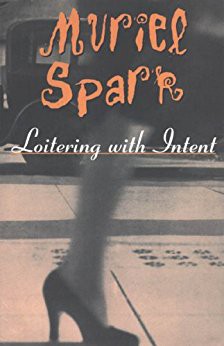
I first read Muriel Spark’s Loitering With Intent on the steps of a pub terrace in Forest Hill, South London. I’d just finished university final exams, was in London for the foreseeable future, and didn’t know what I was doing.

I felt left behind, as if time had continued for everyone else but stopped for me. Classmates talked about their plans for Masters programs, traveling, and internships with the slightly desperate smiles of people who also didn’t know what they were doing but could afford to float. A couple of my friendships dramatically disintegrated. I read articles about how my generation were screwed and articles about how we were entitled; I’d stopped writing articles of my own, feeling overwhelmed by the sheer number of opinions and confessions in my online world. I applied for one to five jobs a day, tried to visualize a future. It was June 2015 and I was stuck.

Reading Loitering With Intent was not a bright Damascene moment but a sunny-morning awakening. I saw clearly, and recognized myself.

When I’d first encountered Spark at seventeen, I had believed that feminism was all about standing up to the patriarchy, not giving a fuck, dressing up, being strong, taking control of your sexuality and flaunting it. It meant identifying as a feminist, loudly and often. The feminist bloggers I followed talked about “eyeliner that could slay a man” and “weaponized femininity”. My idea of a feminist heroine was Cordelia from the young adult novel This Is All, who unabashedly confessed how she’d decided to have sex with her boyfriend at fifteen, in a church. I thought feminism was about rebelliousness and unashamed sexuality — in other words, not exactly Muriel Spark.

By this definition of feminism, though, I was failing: I didn’t look the part, I didn’t wear makeup, I wasn’t an extrovert, and I was…weird.

It had also begun to occur to me that feminism, in the shallow form I understood it, was asking a lot of women and the stories we told. We had to reject the pressure of beauty standards and adverts, but also look good and be confident. We had to be role models, good girlfriends, examples to the youth. We had to confront male power, but not be too nasty about it, unlike those “mean, man-hating feminists” in the 1970s. We had to be open about our sexuality and personal journeys so as to be understood, without knowing if anyone would make the effort to understand — but, we also had to make feminism look fun! It seemed as if being a feminist was a performance, and an exhausting one: constantly on the beat, correcting, confronting, destroying, confessing.

It seemed as if being a feminist was a performance, and an exhausting one: constantly on the beat, correcting, confronting, destroying, confessing.

Muriel Spark gave me a new model for a feminist hero, one that made more sense to me. The feminist act in Loitering With Intent wasn’t about deadly eyeliner or bold sexuality or anything else that seemed far out of my reach. It was about loitering — about the quiet subversiveness of simply existing in public as a woman.

The story begins in 1950 with Fleur, the twentysomething heroine, writing in a graveyard in Kensington. A policeman comes over and asks what she’s doing, and she answers calmly that she’s writing a poem. Once he leaves, she finishes her poem and stays in the graveyard until sunset.

So there I was in 2015, loitering on the steps of a pub, not knowing what on earth I was doing, reading about this woman who was also hanging around without excuse—and, far from “alone and palely loitering,” she’s having a great time doing it.

The story is about Fleur working a peculiar day job while she writes a novel. Refreshingly, there are no angsty scenes of her agonizing over a typewriter or complaining about writer’s block. Fleur loves to write and is shamelessly interested in everyone and everything around her: early on, she remarks that, “If [my landlord and his wife] had thrown me out I would still have had nothing much against them, I would mainly have been fascinated.”

Going against my previous conception of feminist heroines, the story isn’t hugely concerned with Fleur’s sexuality, or with her loudly defying social norms: the primary interest is how her life as an artist collides with her job. She has an unsatisfactory relationship with her patronizing, married literary critic boyfriend, but that’s casually introduced a quarter of the way through and Fleur’s attitude towards him is humorously unemotional. On being told that her boyfriend is using his wife and herself as cover for an affair with a man, she wonders “how he found the time for us all.” The love triangle and the boyfriend’s rival novel are key threads of the story, but the relationship doesn’t define Fleur, and she is — to the horror of his wife — more concerned with her own “thoroughly sick” novel than her boyfriend.

I connected with all of this, but there was a deeper reason I felt so strongly about Fleur. It was her lack of shame that stirred me.

As a teenager, I loved walking. We lived in a rough area of the city, where I was occasionally catcalled, told to stay away from certain streets and to avoid eye contact with groups of boys. At my all-girls’ school, “men in the area” were mentioned as if they were wolves lurking outside the gates. Once we even had a solemn school assembly in response to a girl who had been overheard boasting about her new red underwear on the train.

But nobody actually told me that I wasn’t allowed to walk because it wasn’t safe, and at first I didn’t put it together. I didn’t feel any self-consciousness about walking itself: if I was wearing purple tights and leg-warmers and someone stared at me, that was their problem. Sometimes I did get spooked, finding myself on a deserted side street or crossing the road to avoid a group of men, but I had an unreasonable feeling that if I simply stayed in motion I was uncatchable.

I now put my fearlessness down to the fact that as a queer neurodivergent person, being raised by my dad, I had a slightly different experience of girlhood. Being seen as a girl, but not exactly feeling like one. Being told to be wary or modest, but not really absorbing the message, never feeling truly unsafe. I felt anxious in crowded hallways or shopping malls, but when I walked I felt I was in control of my being, just as I did when I’d written something I was proud of. It also mattered that I’m white, and I find it hard to separate the freedom I experienced from knowing that my family was permissive and that being white in the U.K. affected my experience of walking: the responses of people around me, for example, and my confidence in having the right to walk alone and seek help from strangers if it was needed.

I know I was lucky that I was never in danger — but, writing that, I feel as if I’m saying sorry for having felt so free, so secure in the world. I’m not sorry. I wish girls were objectively safe and free everywhere.

On getting to university, I learned more about sexism and intersectionality, about other people’s experience of girlhood. I marched with Reclaim the Night. I talked to girls who wanted to write but didn’t see why their writing was worth showing to anyone, and I read work by girls struggling with shame. I went to writers’ groups where I and other women were talked over by kind, well-meaning men. Slowly it sank in, the message that other young women had received loud and clear long ago: This isn’t for you, you’re not safe on the street. Don’t write. Disappear. It hurt.

Slowly it sank in, the message that other young women had received loud and clear long ago: This isn’t for you, you’re not safe on the street. Don’t write. Disappear.

So I found it healing to read about a woman artist who is so simply, fearlessly present. Fleur doesn’t apologize for her art, and she doesn’t apologize for her presence on the street — or in the graveyard. I was starting to realize that in many ways, this takes more bravery than being brash or risque.

Later on in the novel, Fleur revisits the opening scene and adds that she asked the policeman: suppose she was committing a crime by sitting on the gravestone, what crime would it be? He replies that “it could be loitering with intent”: a good summing-up of Fleur’s sharp-eyed, watchful flanerie, of how she’s driven and yet content to observe. Loitering with intent is an interesting contradiction, for loitering is purposeless yet associated with people who are up to no good.

Recently, it’s felt hard to enjoy myself outside without noticing how public space is becoming ever more policed and privatized. In my hometown’s city center, in the shiny upper floor of the central railway station, there is a shopping mall with no seats. Nobody is allowed to sit on the floor, no homeless people are allowed, and anyone who lingers gets looks: why would anyone want to stand still, anyway? Why wouldn’t you be going somewhere? “If you see someone acting suspiciously…” yells the recorded announcement over the speakers. Policemen with guns stroll past in pairs.

Recently, it’s felt hard to enjoy myself outside without noticing how public space is becoming ever more policed and privatized.

So in places like this it’s increasingly hard to loiter, which I hate because loitering — existing in public without shopping — is so vital to me.

In her essay Radical Flaneuserie, Lauren Elkin quotes the poet Anne Boyer: “The flaneur is a poet is an agent free of purses, but a woman is not a woman without a strap over her shoulder or a clutch in her hand”. Elkin notes that:

… women experience [flanerie] in a particular way, wary of attracted unwanted attention, but also wanting to be noticed, to exist, to count, to be seen on their own terms. This is the radical move of the flaneuse: I will shop, or I won’t shop, but I am not defined by it either way.

In her underrated novel Rebuilding Coventry (1988), Sue Townsend tells the story of a housewife and mother, Coventry, who commits a murder and escapes to London without even a handbag. Catapulted into public space, walking back and forth between King’s Cross and Holborn, Coventry is unsure what to do with her hands:

there they are… at my sides, carrying nothing, holding nothing, pushing nothing… So I let them hang down and after a while I forget them and am comfortable. This is how men walk.

And here’s Fleur, loitering in Hyde Park:

… And I stopped in the middle of the pathway. People passed me, both ways, going home from their daily work, like myself… People passed me as I stood… The thought came to me in a most articulate way. “How wonderful it feels to be an artist and a woman in the twentieth century”… and I went on my way rejoicing.

Here is where making art and the act of loitering collide, with Fleur’s connection between the physical act of standing still in the London homeward rush, and opting out in a more serious way. She is a loiterer by virtue of being an artist who watches and maintains distance.

Throughout the story, Fleur critiques snobbery, hypocrisy, and male power without being able to do anything except fictionalize it. As a secretary working for a rich man she’s patronized, and for her commitment to being herself she is written off by her detractors as “sick,” “mad,” and “unwomanly.” Yet she is resilient, energized by her sheer curiosity. Regarding the bizarre nature of her day job, she says: “I preferred to stay in the job; I preferred to be interested as I was than happy as I might be. I wasn’t sure that I so much wanted to be happy, but I knew I had to follow my nature.” In the end, Fleur’s success is granted by her commitment to “following her nature” as a woman artist and observer.

Fleur says that, “there was a demon inside me that rejoiced in seeing people as they were, and not only that but more than ever as they were, and more, and more.”

The bust of Virginia Woolf in Tavistock Square (National Trust photo)

It’s that act of detached one-sided observation, shading between empathy and voyeurism, that the flaneuse-artist engages in. Ideally, while the flaneuse-artist is out in public she doesn’t have to educate anyone, soothe their feelings or confront their sexism: she can simply process her surroundings, working off what she sees. Virginia Woolf wrote that “if I pass [a girl on the street] I can, without knowing I do it, instantly make up a scene… This is the germ of such fictitious gift as I have.”

A few months ago I saw Woolf’s statue in Tavistock Square for the first time, with these words on the brass plate:

Then one day walking round Tavistock Square I made up, as I sometimes make up my books, To the Lighthouse, in a great, apparently involuntary, rush.

I nearly cried to think of how Woolf adored walking, how the freedom and variety stimulated her.

And I felt sorry that so many women now feel unable to linger or walk peacefully, and how many have trouble creating anything because they were never given any space to make things up. There should be no danger for the woman walking. There should be no need for a woman to apologize for walking, observing, engaging, writing, letting her hands hang down, just being. Let us walk, let us stand still, let us make things up.

There should be no need for a woman to apologize for walking, observing, engaging, writing, letting her hands hang down, just being.

What joy to take up space on a page, on the street. What delight to stop in the homeward rush and loiter, fascinated with the world.

I used to think feminism was about renouncing shame, about confessing your sexual adventures and loudly confronting those around you on their sexism, about making yourself available as a source of education, a role model, a good example. But sometimes renouncing shame, and reclaiming your freedom and right to exist, starts by finding a heroine who is happy to just sit in a graveyard and write without apology, then go on her way rejoicing. I knew when I read Loitering With Intent that if there was space on the bookshelf for Fleur, there was space in the world for me.

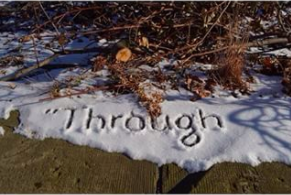
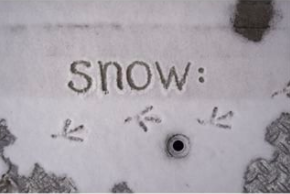
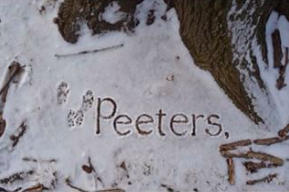
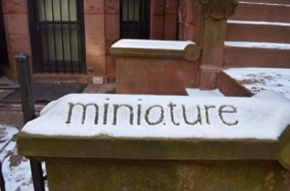
The Only Good Thing About Winter Is This Story Written in Snow

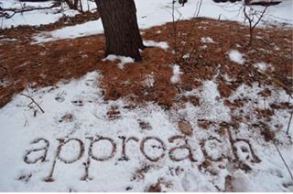
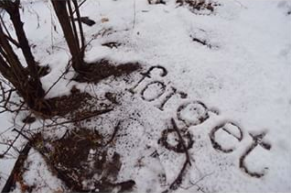
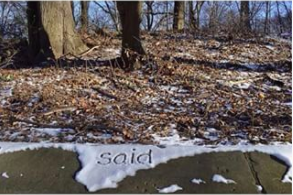
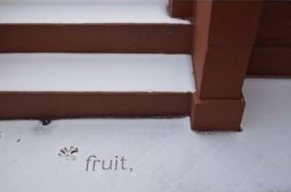
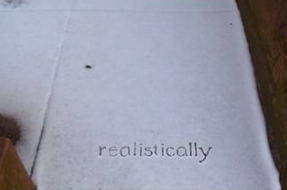
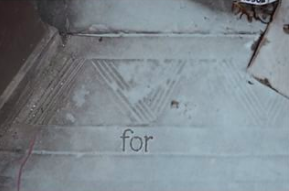
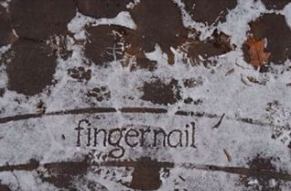
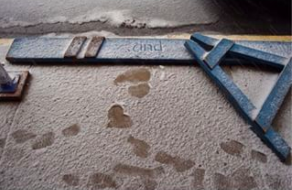
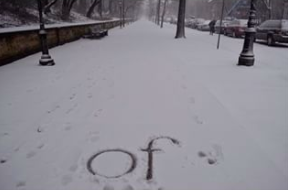
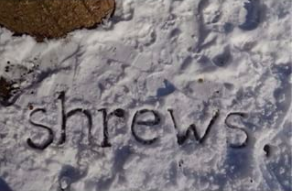
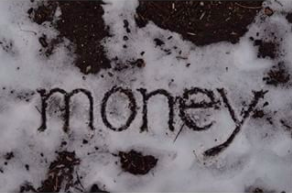
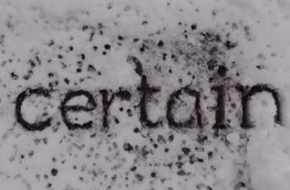
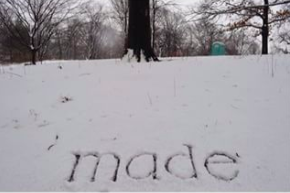
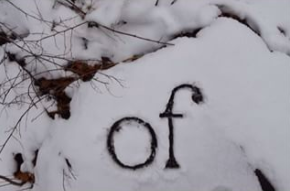
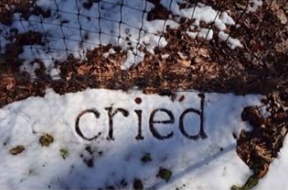
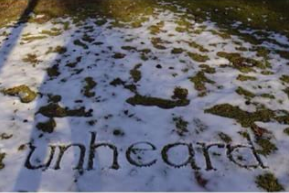
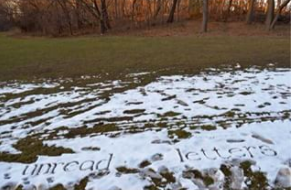
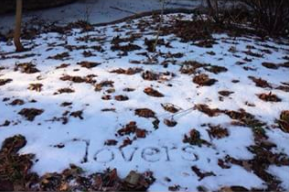
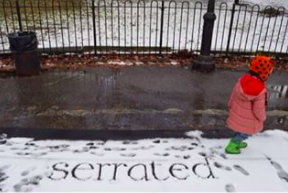
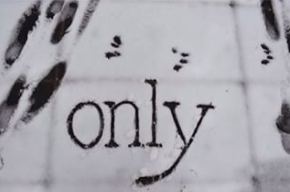
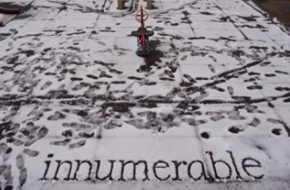
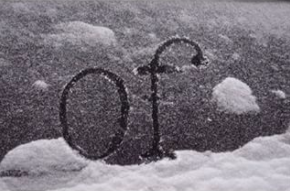
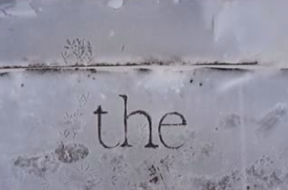
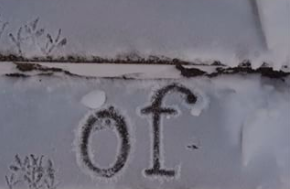
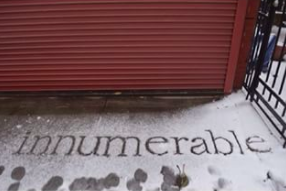
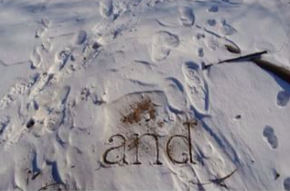
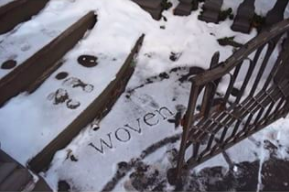
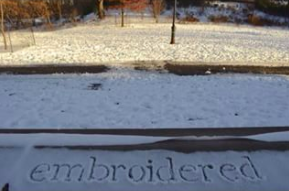
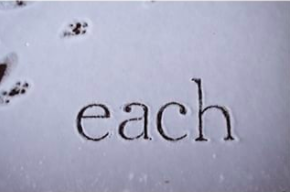
The east coast of the U.S. recently had its first major snow of the winter, which sucks in almost every conceivable way but one. The silver lining: the continuation of author Shelley Jackson’s story written in snow, which was started back in 2014 and, four years later, is still only a few sentences long. (This might be a wildly different story if we were in Iceland, but Jackson lives in New York, a city with an average snowfall of 25 inches per year and falling, and the story is written one or maybe two words at a time.)

Jackson, who has been experimenting with the forms of fiction for more than 20 years (her hypertext novel Patchwork Girl is a classic of the genre, and her story “Skin” is only published as tattoos—although she has also written two standard codex books, a novel called Half Life and a story collection called The Melancholy of Anatomy), is now entering her fourth winter of carefully embossing serif letters into light snowfall. Before this weekend, the most recent sentence, composed entirely during a snowfall in March, 2017, cut off in the middle:

There are snows that, conceiving a more perfect snow, never fall; doubtful snows that, after a few overtures, withdraw into themselves to think; snows that, addressing us at a myriad points, compose from

We now know that the sentence continues “these transactions a.” What comes next? We may not know until it snows again.

In the meantime, you can follow the snow story as it unfolds on Instagram. To whet your appetite, here are the first six sentences, which run from January to March, 2014. So far, to be fair, the tale doesn’t exactly have a rollicking plot; it’s more along the lines of Borges’ catalogue of animals. But who knows what might happen with the next snowfall?

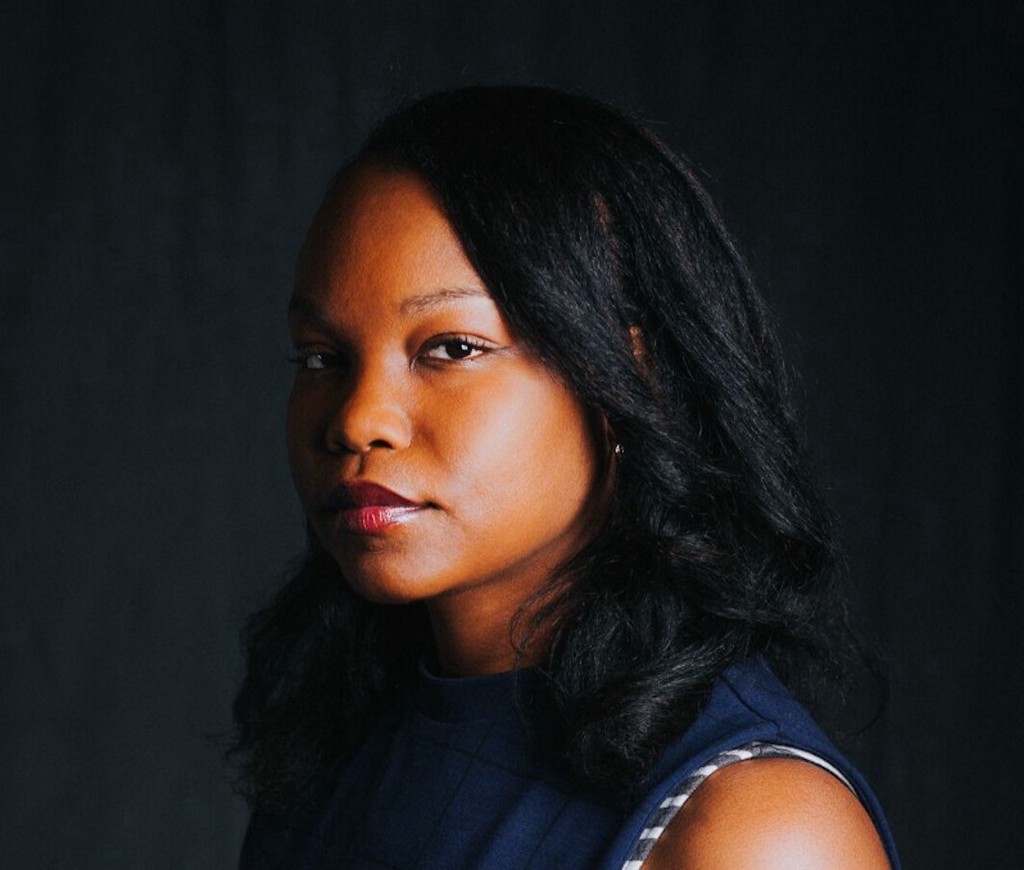
Nafissa Thompson-Spires Is Taking Black Literature in a Whole New Direction

Many Black writers remain tethered to retelling what feels like the same tale, one that overtly centers racial injustice and relies on the past instead of looking out toward the future. So, when Kiese Laymon tweeted, “Nafissa Thompson-Spires wrote what we been waiting for in Heads of the Colored People. Goodness gracious,” I knew exactly what he meant.

Image result for heads of the colored people

Heads of the Colored People, Nafissa Thompson-Spires debut collection of short fiction sketches (think along the lines of vignettes but longer), is a new narrative in the canon of Black literature, one rooted in the lives we lead right now. From bickering bougie Black mothers passing notes to one another inside their kids’ backpacks to a young girl contemplating how to best notify her Facebook friends of her impending suicide, Thompson-Spires’ collection overtly fights against the belief that Black literature has to reflect a certain narrative of racial oppression and suffering. Heads of the Colored People is a forward-looking mosaic portraying the unique lives of modern Black characters.

Thompson-Spires earned a Ph.D. in English from Vanderbilt University and a Master of Fine Arts in Creative Writing from the University of Illinois. Her work has appeared or is forthcoming in The White Review, Los Angeles Review of Books Quarterly, StoryQuarterly, Lunch Ticket, The Feminist Wire, and elsewhere. Heads of the Colored People publishes in April with Simon and Schuster’s Atria/37 Ink imprints.

I got to know Thompson-Spires when we both attended the Tin House Summer Workshop this past June. We chatted on the phone about this new nexus of Black identity, how her book introduces a unique way of examining race in fiction, and 1980s Canadian television.


Tyrese L. Coleman: I agree with Kiese that your book is what we have been waiting for, especially Black Gen Xers, Millennials, and Xennials. The stories aren’t dependent on race, but feel incidental to it. I see how race informs the lives of your characters, but does not define them.

Nafissa Thompson-Spires: In some ways, I agree with you completely and in other ways I’m not sure. I feel like the book is hyper-racial, but maybe hyper-racial in a surprising way. All the stories are really about race, or at least they could be interpreted that way. But, I think, first and foremost, they’re about these unique characters. So, maybe they’re about race in ways we just haven’t seen before — about intersections between upper-middle class identity and race, or disability and chronic illness and race. But the racial part is important.

One of the things I was trying hard to do is write about contemporary Black people. It’s important for us to be looking back because that history undergirds all the problems we’re having now, and always will. But it’s equally important for us to see stories about Black people today. I wanted to write about Black people today, at least from the ‘90s to the present, and the kind of unique struggles they deal with. Because we are one of the first generations post-integration living out everyday problems.

It’s important for us to be looking back. But it’s equally important for us to see stories about Black people today.

TLC: Your characters are a natural progression or the children of the people Margo Jefferson wrote about in Negroland. I related to some of the stories on a personal level. The characters are my age, I knew the references, and their outlook on life. And some of the stories, I couldn’t relate to because I didn’t come from a middle-class upbringing…or the West Coast. It reminded me of Paul Beatty and the very Los Angeles feel of The Sellout.

NTS: I like that you said you identified with some of it, and did not identify with other parts of it because I really appreciate that honesty.

When I was young, it seemed like whenever I read a Black book, it was almost always about some deep, tragic suffering, like people were having crosses burned on their lawn, and they were usually working-class families. I didn’t see anything about a Black girl who was stuck in a white school, which is what I was dealing with, and how to deal with being different at that level, and on being middle class or upper-middle class and not really fitting in anywhere. Now there are lots of those books, but there weren’t for me as a kid.

In some ways, I was just trying to write the stories I felt like I hadn’t seen and the characters I felt like I wanted to see more of when I was younger. Definitely, people like Paul Beatty and Colson Whitehead have represented those kind of families and individuals in recent years. Even though different contexts, Chimimanda [Ngozi Adichie] and ZZ Packer have done a little more with middle-class Black characters. But, I still felt like there were specific kinds of characters, characters who were really weird and nerdy, that I hadn’t quite seen.

When I was young, it seemed like whenever I read a Black book, it was almost always about some deep, tragic suffering.

TLC: I feel like these are the type of individuals that exist and are part of who we are that people don’t associate with Black culture. My favorite piece is the very first set of vignettes that the book gets its title from. Everyone has their own personal outlook. They are joined by their blackness but how they respond to their blackness is totally different.

NTS: All the stories in some way are trying to deal with the pressure of respectability, and the characters are either working with respectability or against it. So, somebody like Fatima in “Fatima, the Biloquist: A Transformation Story” is really burdened by her image, and so is Randolph in “The Necessary Changes Have Been Made.” They’re both hyper-aware of how people perceive them and worried about fitting in with White people and looking a certain way. Someone like Riley has all these interests in common with white people but is doing his own thing no matter what they think, and so does his girlfriend Paris in “Heads of the Colored People.” In some ways, I think the collection is trying to deal with the pressures of all that baggage, which I think we inherited from the generation before us, and to think about new ways of trying to be Black in spite of that pressure.

But I think these people have always existed. There’s always been this huge spectrum of Black people but we don’t tend to read about the ones who are marginalized within a marginalized group. Growing up, my immediate family were the only people who were upper middle class in my extended family. The rest of the family would call us the “bougie” ones or make fun of us for being like the Huxtables. It was always derogatory because they weren’t living that way. Even though we were already Black, we were perceived as the “wrong” Black. We all know that person who gets made fun of for not being “Black enough” or for hanging out with white people too much, and I wanted to talk about what it feels like to be in that situation. But also, to be in that situation and navigate it, not just to suffer.

We all know that person who gets made fun of for not being “Black enough” or for hanging out with white people too much, and I wanted to talk about what it feels like to be in that situation.

TLC: Why sketches? The stories aren’t traditional narratives with a beginning, middle and end.

NTS: I started thinking about a theme. The theme was “The Heads of the Colored People,” which is a collection of literary sketches by James McCune Smith, a Black abolitionist writer who used the sketch form to write about citizenship. Initially, I was trying to hold on to this framework…make my book in conversation with his. But it was too much of a constraint. So, I decided to tell the stories I wanted to tell and keep the title and think about heads more broadly, in terms of leadership, psychology, and literary, physical heads in the form of a concussion story. But the titular story and overarching theme came from trying to write back to James McCune Smith’s work. I would like to think of these as full stories that begin and end in medias res.

TLC: That’s interesting. The ending in medias res made me think these people were going to continue on…as if we dropped in on them in the middle of turmoil.

NTS: I’m obsessed with two things: the ‘80s and Canadian TV, and especially ‘80s Canadian TV. And Canadian TV has this thing where the kids always end in peril. There is never a nice tidy ending. It’s “I’m bawling my eyes out,” then credits. Maybe that aesthetic has influenced my writing in some unconscious way.

TLC: With such a forward-facing collection, what are you hoping to see for the future of Black literature?

NTS: I’m really proud of all the people who are writing. I love Kiese’s work. Long Division is one of the best novels I’ve ever read. I like Mat Johnson’s work. I like what I am starting to read of Jesmyn Ward’s work. I like that there’s a lot more variety now. I just read Stay With Me by Ayobami Adebayo and it’s one of my favorite books that I’ve read this year. I like that there’s variety and there is space for what everyone is doing.

I think what I want is not so much from Black writers themselves, but from the literary gatekeepers. I want them to recognize us all and not pit us against each other. There can’t only be this narrative of the one “anointed Black writer” who gets the attention at a time. People can get equal attention and an equal playing field. I also want them to recognize that Black writing is art in the same way other writing is. That we can take risks that other writers can take. I would like to see more space for all of us and more recognition of the many things we can be, which is what my collection is about.

Finding Eastern and Western Selves Through Eastern and Western Stories

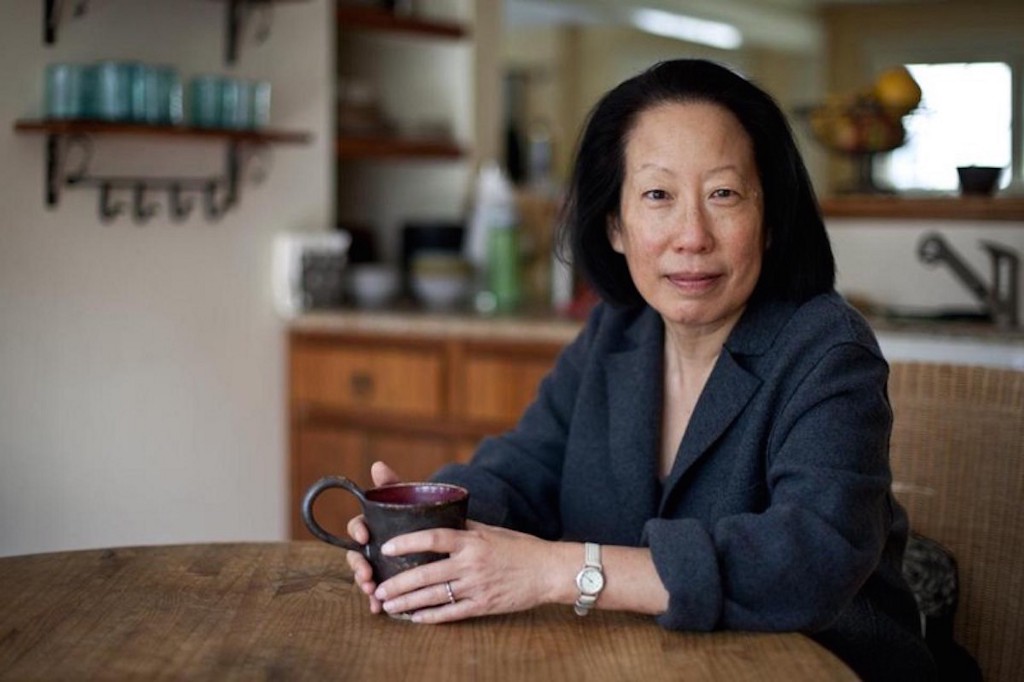
I had often taught Gish Jen’s work to my students at UCLA, but I first got a chance to meet her in at a fiction writing workshop she offered in Shanghai on “Influence and Confluence in the Short Story: East and West.” Jen’s workshop focused on deconstructing Western assumptions of literary storytelling.

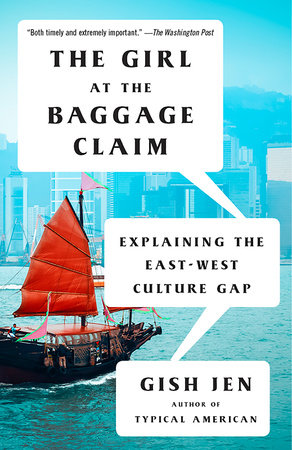
A few months later, Jen’s nonfiction book The Girl at the Baggage Claim: Explaining the East–West Culture Gap was released with Knopf. It continued not only the discussion we’d had in our Shanghai workshop, but also the exploration of East–West differences from her earlier nonfiction book, Tiger Writing: Art, Culture, and the Interdependent Self.

The Girl at the Baggage Claim by Gish Jen
Buy the book

Besides nonfiction, Jen has published five fiction books — four novels and a story collection. Her short fiction has appeared in The New Yorker, The Atlantic Monthly, and many other periodicals and anthologies, and has been included in The Best American Short Stories four times (including The Best American Short Stories of the Century, edited by John Updike). In addition to a masterful portrayal of Chinese American experiences, her fiction explores the American story of migration in other ethnic communities alongside those of alienation, assimilation, globalization, culture gap, generation gap, and more.

We talked mostly about Jen’s latest book, The Girl at the Baggage Claim, and the innovation it offers the idea of “global” art and literature.


Namrata Poddar: From literary storytelling and visual arts to cocktail hours and satirical humor, from academic settings and entrepreneurial strategies to American interracial dynamics and the minority experience, The Girl at the Baggage Claim relentlessly challenges a white West on its sociocultural assumptions. What were some of the biggest joys and struggles of writing a hybrid nonfiction book of such an ambitious scope?

Gish Jen: I really was both blessed and cursed in having so much fantastic material. The struggle was first to decide what to include — and I really had to be ruthless — and then to make a coherent narrative out of what was still an enormous amount of material: to present each nugget and give it its due, but also to make sure it led on to the next nugget, even as certain themes and motifs recurred. In many ways, it was like writing a novel except that even if I could see just what I needed to make it all work, I couldn’t just make it up.

As for the biggest joy, that was finally — yes — making it all work together. I felt like a baker who had just finished a twenty-layer wedding cake.

NP: In exploring cultural assumptions and differences, your book aptly reminds the reader that the East and the West aren’t mutually exclusive binaries, or for that matter, strict geographical concepts. And yet, it repeatedly reminds the reader how differences in Eastern and Western conceptions of the self do dominate our understanding of creative practices. Can you reiterate your understanding of East–West perceptions toward the self? What do you think are some of the factors engendering this cultural gap?

People in Western industrialized societies, especially the U.S., tend to imagine ourselves as avocados.

GJ: This is an enormous simplification but in a nutshell, people in Western industrialized societies, especially the U.S., tend to imagine ourselves as avocados: We imagine ourselves as having a big pit at our center, to which we must above all be true. What’s more, we are preoccupied with the features of those avocado pits, and the ways in which they are unique. In other parts of the world — and, I should say, many parts of the U.S. — people are also unique, courageous and capable of independent action. They have just as much integrity and just as much creativity. But if you ask them why they just undertook what they undertook or made what they made, they will not say because they did it to be true to their avocado pits. Rather, they will say they did what they did out of duty or obligation — because they wanted to repay someone for something, or because their religious beliefs demanded it of them, or because they saw themselves as a part of a great artistic tradition. This might entail self-expression, but it will not be self-expression for self-expression’s sake. That is, the reason will not be their avocado pit.

The factors contributing to this difference? There are way too many to list. But to give you an idea, they range from the realities of rice farming to the experience of immigration to the American frontier to the invention of the horse collar.

NP: As a creative writer, I’m particularly intrigued by the ways in which your book shifts the reader’s understanding of storytelling in different parts of the world. What do you perceive as some of the key differences between Eastern and Western literary storytelling?

GJ: Oh, how I hate to generalize(!) — aware as I am that, truly, every writer is sui generis. But in a general kind of way, post-19th century Western literature has tended to focus on the avocado pit — on the exploration of a single character, whose interior — visible or not — is given great consideration. This character’s idiosyncrasy is more important than his or her representativeness; the character must, above all, not have what MFA programs call a “generic” quality. And the structure of the story further reinforces the idea that nothing counts more than the avocado pit, as the pit ultimately generates the plot events.

We do not have to choose between the self that dominates in the West and the self that dominates elsewhere.

In earlier Western literature, as well as much non-Western literature, characters are more often “types,” and often cope with, rather than drive, events. Of course, they, too, have inner lives. But the uniqueness of those lives is less important; and the overall emphasis is often on a group or network of characters, even on capturing an entire world.

NP: While first person narratives are a valuable outlet for marginalized voices, you remind us how the thriving market for memoirs is a particularly American phenomenon, even if Asia, as I think of it, is a hugely diverse cultural space with a much older literary tradition. What do you think accounts for the American “popularity” of memoirs?

GJ: I talk a lot about this in both Girl at the Baggage Claim and Tiger Writing, drawing on the wonderful and nuanced work of Cornell psychologist Qi Wang. The answer in brief: As we Americans build ever-larger psychic moats around our ever-more mobile selves, we seek to foster elective ties with others. And one of our chief ways of doing that is by sharing the stories of our avocado pits — the more revealing and stirring the better.

NP: If there is one idea (and I know you have several) you would want the reader to most remember about your book, what would it be?

GJ: We do not have to choose between the self that dominates in the West and the self that dominates elsewhere. There is a middle. We can have both selves; and while, yes, the possession of both can result in conflict sometimes, it can also bring us richness, creativity and joy.

Readers and Booksellers Remember Strand Owner Fred Bass

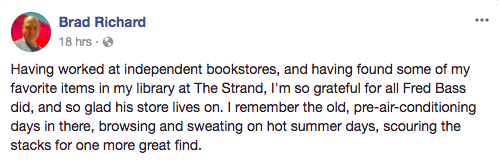
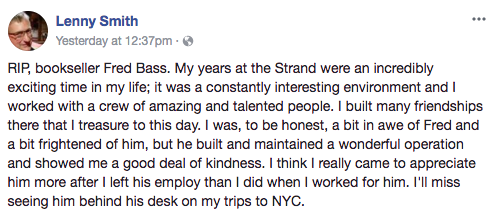
Fred Bass, for decades the owner of The Strand—the legendary New York bookstore that boasts 18 miles of used, rare, and new books—passed away on January 3, 2018. Bass, who inherited the store from his father and later co-owned it with his daughter, spent his entire life surrounded by books and considered his job to be like treasure hunting. He was a world-builder of sorts, creating a little literary city within the larger city of New York. Readers, writers, and book enthusiasts are familiar with this kind of love, and many of them took to social media this week to remember a giant of the bookselling trade.

If you have your own memories of Fred Bass, you can share them with us at editors@electricliterature.com, and we’ll add them to the list.

“Fred Bass gave me my first job in books. I probably picked up more useful information during the summer of 1990, when I worked at the Strand between my first and second years at Columbia, than I did in any other three-month stretch of my life. Watching him sort thousands of books every day, barely pausing to accept his deli order, made those books real to me in a new way: as mysterious but knowable artifacts, with secret histories and reputations beyond their texts.

‘This is good. This is bad. This is good.’ ‘Is this good?’ ‘No.’

I didn’t know Fred well, but his death is certainly the end of something for me, just as the Strand was the beginning.” —Heather O’Donnell, owner of Honey & Wax Booksellers, in an email

How Edith Wharton Changed My Understanding of Marriage

Novel Gazing is Electric Literature’s personal essay series about the way reading shapes our lives. This time, we asked: What book was your feminist awakening?

There’s a scene from Bernardo Bertolucci’s The Last Emperor in which Wenxiu (Wu Jun Mei), the second wife of the recently exiled emperor, tells her husband Puyi (John Lone) that she wants a divorce. “I do not want to be your mistress any longer,” she declares in the back of their chauffeured sedan while seated next to Puyi’s first wife, Wanrong (Joan Chen). Both women are shown draped in furs, each clutching their respective lap dogs. Later, we see Wenxiu make good on this threat as she walks out the front door of their European-style house and into the rain without an attendant or even an umbrella. It is a brief moment of triumph in the otherwise unhappy biopic.

Wenxiu (Wu Jun Mei) leaves her life as second wife behind in The Last Emperor

Being that I was around eight or nine years old at the time, most of the political history was lost on me. But I found myself drawn in by the grand images of the Forbidden City (a place I wouldn’t visit in real life until I was 20 years old), the adult themes (including opium addiction and lesbianism), and the epic tragedy of it all. The “first wife” and “second wife” statuses — which my mother assured me was the norm in China back in those days — was something I was still learning to wrap my head around about the same time I watched the film version of The Joy Luck Club. Perhaps the seemingly dated concept of polygamous marriage so struck me because somewhere in my subconscious I recognized its familiarity. I grew up fully aware that my mother and I were my father’s second family, and so I knew there was a “first wife,” whom he remained legally married to, and a first family filled with older half-siblings that I would see from time to time. I had an inkling that it was not the typical arrangement, but my parents lived together in one home, so it was close enough to a nuclear family as far as I was concerned. My parents finally separated when I was 12, and the comforts of my childhood departed along with my father in more ways than one.

I grew up fully aware that my mother and I were my father’s second family.

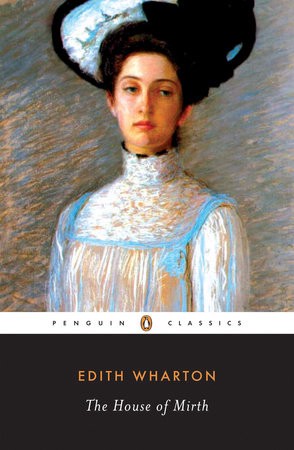
In my mid-twenties, fresh from first heartbreak and unsteady bouts of employment, I was long overdue to encounter Edith Wharton. I started with The Age of Innocence, which was perfection. But it was The House of Mirth that allowed me to see my life as a single woman in a whole new light.

The novel introduces its flawed heroine, Lily Bart, through the eyes of Lawrence Selden, a bachelor with little wealth, and who therefore is not a suitable match for Miss Bart. The first few pages read like a modern New York story: two friends run into each other at Grand Central. On account of her “thirst,” Selden invites Lily back to his place for some tea and a smoke. It is there in his Madison Avenue apartment that she remarks: “How delicious to have a place like this all to one’s self! What a miserable thing it is to be a woman.” A typical man, he doesn’t quite understand his own privilege, replying, “Even women…have been known to enjoy the privileges of a flat.” She immediately sets him straight, interjecting: “Oh, governesses — or widows. But not girls — not poor, miserable, marriageable girls!” Therein lies the central question of the narrative: how can a woman live independently? In Lily Bart’s case, she doesn’t, not if she wants to remain in the good graces of society. Wharton, of course, was writing about the leisure class. Certainly, the char woman scrubbing the steps that Lily later passes while leaving Selden’s apartment doesn’t have the same luxury of contemplating gender politics in between social calls on a hot afternoon.

Therein lies the central question of the narrative: how can a woman live independently?

In my case, it was also thanks to a certain amount of privilege that I had been able to pursue unpaid internships and underpaid gigs before landing my first full-time, salaried job at the age of 25. Only then was I finally able to afford New York City rent on my own, without assistance from my father. I realize how lucky I was to have his help in those lean times, but the money did not come without an emotional cost. I remember the year he disinvited me from spending Christmas with his first family. “It’s better if you don’t come,” he said over the phone without giving me any reason. I cried as I told my mother, and we speculated what may have caused the change in heart. Although I had never considered that he might have been ashamed of me, perhaps he thought members of his other family would be uncomfortable with my presence. Maybe to his other kids, I would always represent his past dalliance, his brief abandonment of them. When I did see my father before flying back to New York, his parting gift to me was an envelope full of cash. He traded in money instead of love. I accepted the consolation prize, but it would be the last holiday I would spend in California.

Back in Lily Bart’s time, without money from her family, a woman’s only option was marriage. As the 29-year-old approaches potential spinster age — “I’m as old as the hills, of course,” Lily jokes — the pressure to marry is inescapable. When Selden asks her, “Isn’t marriage your vocation? Isn’t it what you’re all brought up for?” she observes a clear difference between men and women when it comes to marriage: “a girl must, a man may if he chooses.” Here, she speaks to her lack of financial independence, for even as a grown woman, Lily lives as her aunt’s ward and receives an allowance. Of Gerty Farish, Selden’s unmarried cousin who has enough money to live modestly on her own but remains an outsider in society, Lily laments, “she is free and I am not.” Lily’s own situation is complicated by gambling debts and the constant need to keep up appearances. Only marriage to a wealthy man would solve her financial woes, and so Wharton draws a direct line between marriage and money — both of which went hand in hand for a woman’s survival.

Once, when I was feeling particularly blue about being single, a friend pointed out that for the majority of history women have been the property of men. Or, at the very least, they had no choice when it came to relying on men to provide them with a comfortable life and respectability. It was his way of helping me to maintain perspective. Thinking about Lily Bart’s fate, about that of so many women of literature and stories of the past, about my own mother’s struggles, I knew he was right. The lack of financial independence has proven to be the ruin of so many famous fallen women such as Madame Bovary, while Anna Karenina finds herself trapped by her class status. For these birds in gilded cages, the only way out seems to be death. For my mother, who grew up in a poor fishing village and as a second-class citizen in British-ruled Hong Kong, her fortune changed in America, where she met my father and helped him build his real estate business. And while I have come to respect her ability to free herself from their relationship, I also witnessed how her financial situation deteriorated afterward.

While I have come to respect my mother’s ability to free herself from her relationship, I also witnessed how her financial situation deteriorated afterward.

Perhaps this is why Wenxiu’s decision to leave behind her life as a royal consort in exchange for her freedom seemed incredibly brave to me. That she’s shown walking off screen, into the unknown, only added to the symbolism of the moment. We never see what happens to her in the film. In reality, she filed for divorce and was stripped of her titles. She became a schoolteacher, remarried, and died at 43. Years later, I’m reminded that the very act of being able to support oneself as a woman outside the institution of marriage is still a radical one. That women like Wenxiu, Lily Bart, and even my mother were willing to give up so much in order to live on their own terms makes me wonder why we continue to view marriage as the end goal. And that the possibility of a happy ending for women who choose to stay single or unmarried is still looked upon with doubt should compel us to rewrite the narrative.

How Kickstarter Is Changing Publishing

Laura Olin raised the money to publish her book in a little over a day.

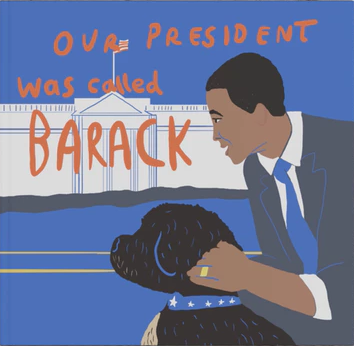
Olin, an author and social media strategist who worked on President Barack Obama’s 2012 reelection campaign, spent November Kickstarting her children’s book Our President Was Called Barack.

The book, written by Olin and illustrated by artist Franziska Barczyk, was funded in 33 hours, raising $39,792 — $14,792 more than its $25,000 goal, falling just a few hundred dollars short of its $40k stretch goal.

Billed as a “yes we can book for children,” the project tells the story of Obama’s presidency, and more importantly, the way he invited ordinary people to become activists.

“I’m not asking you to believe in my ability to bring about change — I’m asking you to believe in yours’ was his overriding message from the beginning,” said Olin. “I think it’s important that kids hear that right now. Most biographies or otherwise traditional books seem to be uninterested or downright timid about getting into that space.” She wrote the book to provide a good presidential example to her nephews and kids like them.

It’s the second book for Olin, whose novelty book Form Letters: Fill-In-the-Blank Notes to Say Anything to Anyone came out in 2016. That project was published by a traditional publisher, Harry N. Abrams. It was a process Olin described as “perfectly okay.” But she had different aspirations for Our President Was Called Barack. For one thing, she wanted to get it on shelves quickly.

“I realized that I wanted to go faster with this book than traditional publishers can go,” she said. “Their time horizons tend to be a year and a half from proposal to publication, even two years.”

Olin was also inspired by Chance the Rapper and other artists who’ve found an audience without the help of traditional publishing gatekeepers. “We’re at this point in the life of the internet where being pretty autonomous can be possible sometimes, if you’ve got something compelling to offer and you get a bit of luck,” she said.

Olin is one of thousands of authors who are choosing to Kickstart their books.

Although you may think of Kickstarter as a platform for games and gadgets, publishing has always been among Kickstarter’s offerings. It just might not get the attention games or technology do because publishing projects tend not to raise millions of dollars the way a game might, said Margot Atwell, Director of Publishing for Kickstarter.

Still, book projects do all right. Publishing, a category which encompasses books, comics, and journalism, has so far had 13,297 projects funded in Kickstarter’s nine years, raising $132 million total. Right now, there are more than 300 publishing campaigns live on Kickstarter. Those projects include bookstores, journalism projects (notably, a campaign to save Gawker), and of course, books.

So far 13,297 publishing projects have been funded in Kickstarter’s nine years, raising $132 million total.

“This really showcases that there’s a community of backers who want to support literary works,” said Atwell. A lot of backers are book lovers; according to Atwell, more than 1.5 million backers have pledged to at least one publishing project.

Authors decide to fund projects through Kickstarter for a variety of reasons. Some, like Olin, might want to publish a book fast. Authors from marginalized communities, who might not be able to get their voices heard in the traditional publishing world, can bypass gatekeepers and go straight to a community of readers. Kickstarter publishing has fewer barriers to entry; writers can publish what they think people care about, rather than what a publishing house or agent thinks will sell. But make no mistake: While crowdfunding can help an author dodge some of the baked-in biases of the publishing world, it’s still a popularity contest.

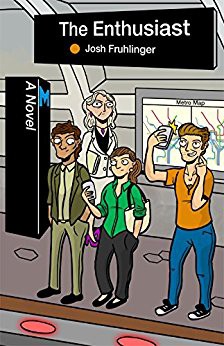
Josh Fruhlinger is the blogger behind The Comics Curmudgeon, a longstanding blog that lovingly snarks on newspaper comics. He decided to Kickstart his own novel, The Enthusiast, in 2012. His goal was $6,666, and he blew past it, bringing in $20,159. Being an established blogger with his own audience helped immensely when it came to raising that cash, he says: “If you don’t have a built-in audience existing already, or a big social media network, it might not be as rewarding.”

One of Fruhlinger’s biggest post-campaign challenges was delivering the manuscript itself. Although he has been a professional writer for almost his entire career, he’d never written a novel before. He assumed he’d have the book done and ready to go by November 2013, but the process took longer than he expected, with books shipping out in December 2015. That delay stressed Fruhlinger out; he felt like he was cheating his backers by not producing the novel by Nov. 2013. Some backers agreed—one even asked for a refund.

Authors from marginalized communities, who might not be able to get their voices heard in the traditional publishing world, can bypass gatekeepers and go straight to a community of readers.

“I had all this money sitting in a bank account that I felt responsible for for two years, and it was really stressful to me,” he said.

Fruhlinger’s advice to any writer considering a Kickstarted book? Write the book first. Atwell agrees; she always encourages new authors to do as much work on their projects as they can before they launch their campaigns.

“That has two benefits,” she said. “One, the creator can really show backers what they’ll be getting if they back the project, and they can impart confidence that the book will get done, and two, once money changes hands, it can feel like the stakes are raised for the creator, so it’s helpful to do as much work as possible before that happens.”

Kickstarter can also act as a laboratory for ideas that might seem risky to traditional publishers; creators can test ideas that might raise an eyebrow for an agent or publisher and later use the success of the Kickstarter as proof the idea worked.

Crowdfunding Fiction: Talking With Charlie Fish, Founder Of Fiction On The Web, About Patreon

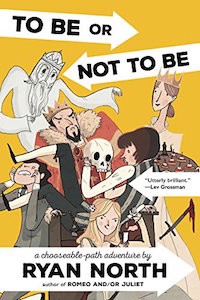
One author who did that was Ryan North, the creator of Dinosaur Comics and the current writer of Marvel’s Squirrel Girl. North had an idea: a choose-your-own adventure Hamlet. His agent, Seth Fishman, of The Gernert Company, didn’t think he’d be able to get a publisher to buy it for more than $20,000. So he suggested that North Kickstart the project.

The book, To Be Or Not To Be: That is the Adventure, met its funding goal of $20,000 in less than three hours, and ultimately raised $580,905. The success of that campaign allowed Fishman to sell the next one, Romeo And/Or Juliet, to Riverhead Books. Riverhead also picked up To Be Or Not To Be.

Fishman, who represents authors from Ann Leckie to Ryan North to Sarah Andersen of Sarah’s Scribbles, believes crowdfunding and traditional publishing can co-exist harmoniously. He Kickstarted a book of his own this summer, and many of his clients are independent web comics creators who are used to Kickstarting projects and otherwise operating independently. Fishman has seen them combine their independent projects with traditional publishing in various ways.

For example, one of his clients is Zach Weinersmith, the creator of the Saturday Morning Breakfast Cereal webcomic. Weinersmith and his wife Kelly wrote a book about emerging technology, Soonish, released in October. In June, however, the pair Kickstarted another project, Science: Abridged Beyond the Point of Usefulness, a very small book about science. They wanted to offer Soonish as one of the rewards to their backers. The rewards would count as preorders of Soonish. Fishman role was to help convince the publisher of Soonish to support the experiment and set up distribution of the book through independent bookstores.

There are other notable marriages of crowdfunding and traditional publishing, not all of which involve the Kickstarter platform. Last year, for example, Hugo winner N.K. Jemisin made news when she was able to quit her day job and write full-time, thanks to her fans funding her through Patreon.

So, with the rise of crowdfunding, do authors still need traditional publishing?

With the rise of crowdfunding, do authors still need traditional publishing?

The traditional publishing houses we reached out to didn’t respond to requests for comment, but Fishman thinks authors do need publishers and agents. Aside from the things agents do to make life easier and more profitable for their clients — having lawyers on call to review contracts, foreign rights, television and film rights, feedback on ideas, for example — a traditionally-published book can open doors for even successful independent creators.

“What I’ve found for better or worse, is that traditional publishing provides a big of focus point in terms of validation and publicity,” he said.

Many of Fishman’s clients — like North, Weinersmith, or xkcd creator Randall Munroe — are already well-established as independent artists. They already have a large audience, and they may be doing well financially, but having published a book with a traditional publisher widened their audience, says Fishman.

Munroe’s webcomic, xkcd, for example, has a huge readership, but once he’d published a book traditionally, that book functioned as a kind of permission slip; fans who worked in media had an excuse to book him as a guest on their shows. His status as a published author, says Fishman, serves as an effective advertisement for his other work.

“Financially, self publishing can be all you need,” he says, but he calls a traditionally published book “one of the most effective advertisements” a creator can get.

“I think crowdfunding is really complementary to publishing,” said Atwell. “Kickstarter is a tool that authors and publishers can use to test out an idea, build excitement for a book or project, or garner support for a project that falls outside what they normally do.”

“Kickstarter is a tool that authors and publishers can use to test out an idea, build excitement for a book or project, or garner support for a project that falls outside what they normally do.”

Launching a Kickstarter project, she said, is a lot like launching a book. Authors need all the same things: a description, an author bio, an image, and a plan for spreading the word. It’s a lot of work, but if a project is funded, it can be worth it. Olin’s campaign wrapped up on December 8, and according to her campaign, books are due to be shipped in May. She offered two post-campaign thoughts: Don’t launch during the holidays, and believe Kickstarter veterans when they say how much work a campaign is — it’s often difficult to get press for a Kickstarter, and authors often have to sink money into their project before they make any money back.

“Unless you’re multitalented or have many multitalented friends who are okay with working for free, you probably need to pay to get a video made, produce graphics, buy music, do prototypes, and so on,” she said.

Fruhlinger, who wrote his own post about the trials and triumphs of Kickstarting a novel, agrees that Kickstarting ain’t easy. While the $20,159 he raised seems like a lot of money, much of those funds went toward the production of the book itself: editing, art, printing, and postage. (Atwell says distribution and the cost of postage are often hurdles faced by Kickstarter’s authors.) After he finished printing and fulfilling rewards to backers, but before he started selling books, his Kickstarter profit — his payment for two years of work — was just $467.55.

After he finished printing and fulfilling rewards to backers, but before he started selling books, his Kickstarter profit — his payment for two years of work — was just $467.55.

In the end, Fruhlinger was very happy with The Enthusiast. The book contains art from three different artists, and was printed in paperback and hardcover. He’s sold 1,500 copies of the book so far, selling from both online and brick-and-mortar stores, and his profit rose to a more comfortable $4,369.14. But having Kickstarted once is enough for him.

“If I were going to do another novel, I would try to go through an agent,” he said.

Olin says she’d definitely Kickstart again. In fact, she’s more likely to Kickstart again than to traditionally publish. She thinks other authors should crowdfund their books as well.

“It’s a really clarifying and focusing thing to think about an idea, and how to sell its value to other people, for the length of time it takes to put a Kickstarter campaign together,” she said. “It could lead to better books for all of us.”

Asked what he’d say to an author torn between getting an agent for a manuscript and Kickstarting a book, Fishman responded that it really depends on an author’s goal for a project. He feels that it’s at least worth trying to get an agent, but if that road doesn’t work?

“If you can’t find an agent and you believe in the book, go ahead and self-publish,” said Fishman. “Prove us wrong. Because we’re wrong all the time.”

Thinking of Kickstarting your book? Here’s some advice from Margot Atwell:

Make a plan: “Spend time planning your project and looking at other campaigns that are similar to what you’re planning to do before you launch yours. Make a budget carefully: make sure you cover all your costs, but keep it as low as you can, since Kickstarter is an all-or-nothing platform, and you can always raise more than you ask for but not less.”

Be clear about what you’re writing and why: “A good Kickstarter Publishing project clearly tells the story of what the creator is making, why it’s great, and why readers will want to get their hands on a copy, using all the tools the platform provides, including a well-done video, attractive images and/or GIFs, a compelling description, and appealing rewards.”

Make sure your Kickstarter page is visually appealing: “Even though readers care about the quality of the writing and what the book contains, that old chestnut really does hold true: on the internet, a picture’s worth a thousand words. We’re all really accustomed to scanning quickly over websites, so a project description that’s just a wall of text tends to lose all but the most passionate fans.”

Get the word out: “Come up with a good outreach plan–and a Plan B and Plan C in case that doesn’t get you past the finish line. Also, don’t be shy–tell people about your project! You’ve written something cool that’s important to you–you should give other people the chance to discover it and enjoy it.”

Looking Everywhere for a Way to Deal with Death

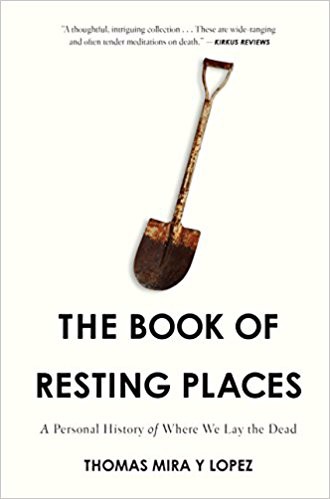
Something uncanny happens in these photographs of the dead,” writes Thomas Mira y Lopez in The Book of Resting Places (Counterpoint), his debut collection of essays. “Daguerreotype exposures took notoriously long to develop, and living subjects needed to sit still for prolonged stretches, minutes sometimes with their heads braced and bodies propped perfectly still…so that it became difficult to determine, when looking at a photo, just who is the corpse.”

Whether he’s sneaking into a defunct cemetery or racing between hospital and church, among preserved bodies in a shop outside Tucson or the Roman catacombs, Mira y Lopez shows the restlessness that makes living subjects of grief and contemplation — even as one tries to lay the dead to rest in monuments, mementoes, saplings, stars. The result is a book of remarkable range, insight, and style, which, as Mira y Lopez says below, works “to consider then reconsider then reconsider the reconsideration” of how we live and die. We corresponded about the use of research in lyric essays, persona, and the role of reportage in memoir.

Zach Savich: This book ranges among many places, many topics, but the essays feel capaciously steady, able to discuss ancient dental remedies and intricate memories on the same page. How did you arrive at this style? I’m curious, especially, about the mix of informational reportage and intimate memoir — how do you manage that balance? Juxtaposition often works by rupture, but in many of these essays it feels unusually seamless.

Thomas Mira y Lopez: The earliest essays I wrote in the book started out almost as a pin the metaphor on the donkey. I wanted to find some way of writing about memory that wasn’t just writing about myself — this is the time-honored answer that anyone who’s written a lick of personal essay must be obligated to give, whether it’s true or not — and metaphor was an easy way to pump significance, or seeming significance, into the narrative. I’m a superstitious, ritualistic person, my mother as well, and so I inherited a bunch of readymade symbols, substitutes, and monuments: my father’s tree, Egyptian mastaba as storage unit, sunspots. I set off to use these as parallels or responses to the personal, a game of Pong maybe.

Maybe successful essays are just ones where the author covers their tracks well enough to hide their initial idiocy.

But then there comes a moment when you ask what the symbol means — I mean tangibly, like what is an Ohio buckeye or a horse chestnut in actuality? What are their dimensions, proclivities, susceptibilities? You decide to find that out, and that in turn obligates you to reassess the personal, the meanings from that memory you think you already know. For the reportage, I was mostly just playing a character. I would go to sites and make up a story about the tension between the self I presented at the site and the self I present on the page. It’s kind of you to say the stories feel seamless. Maybe successful essays are just ones where the author covers their tracks well enough to hide their initial idiocy, where the hot air is collapsed yet there’s still space on the page.

Eileen Myles‘ Memoir Is Much More than Just a Dog Book

ZS: Did particular writers or books serve as models, as you were developing this approach? Did you feel there were gaps — or failings — in how people often write about death and grief?

TMYL: I tried to stay away from books about death and grief just as, if I’m trying to capture my own voice in a piece, I stay away from authors whose style I know I’ll end up trying to imitate. Many felt bound by a linearity I wasn’t interested in or they were attempting something, like Anne Carson’s Nox, I knew I couldn’t match. But the idea of place, or places, came to me before the concept and so I looked towards collections that moved with ideas that could swim several different strokes: John D’Agata’s Halls of Fame; Ander Monson’s collections; Joni Tevis’s The Wet Collection; Valeria Luiselli’s Sidewalks. And I looked towards books that helped me understand cultural attitudes towards death: Thomas Laqueur’s The Work of the Dead and Michel Ragon’s The Space of Death, in particular. I imagine there’s a nice little anthology of cemetery essays as well: Luiselli’s “Brodsky’s Room and a Half,” Wendy S. Walters’ “Lonely in America,” Randall Kenan’s “Finding the Forgotten,” Kendra Atleework’s “Dawn of Tomorrow.”

ZS: Focusing on place offers some productive displacements in The Book of Resting Places, as do metaphor and persona. This can help guide the essays to implicit, suggestive, and unexpected conclusions. At other times, these essays can be startlingly direct. I’m thinking of lines like the last sentence of “The Eternal Comeback,” an essay about cryonic preservation, among other things. It reflects on a recurring dream about your deceased father: “This dream and his return will come back for as long as I live, as long as I should live, which will hopefully be not a minute longer than my memory binds me to a body and mind.” This might relate to the tension between showing the staging and covering your tracks; could you comment on moments like this one, when the essays consider big questions and differing interpretations, but offer stark assertions?

TMYL: Well, I would say it depends which assertion you’re referring to in the quote. There’s the statement that the dream will continue to recur and then there’s the statement that I don’t want any form of my consciousness to continue after death. The latter is a rebuttal, albeit a gentle one, to the goal of cryonicists who seek exactly that. It’s never really a question in “The Eternal Comeback” about whether I myself will seek out cryonic preservation — if someone wanted to gift me $80,000, then maybe we’d be talking — but one of the things I try to keep in mind is that essays are also arguments, that I can make room as a writer for their rhetoric and polemics. That might seem obvious to say, but my natural state is to consider, then reconsider, then reconsider the reconsideration. It gets recursive. So once in a while it can feel satisfying to just throw up one’s hands and say, fuck it, this is what I mean, I hope my head never gets frozen and stuck in a cylindrical tube. At a certain point, we have to walk away and not look back.

My natural state is to consider, then reconsider, then reconsider the reconsideration. It gets recursive.

The first clause of that sentence — the statement that the dream will recur — I can never prove. It’s interesting to be returned to it, to look at the conviction with which I wrote the line and the impasse it creates. It’s just felt emotion, after all. Part of me hopes that the dream of my father doesn’t recur, that the heartache it carries doesn’t come back. And part of me hopes that it does come back because something beats nothing. That balance — between wanting to remember and wanting to forget; between wanting someone’s who died to turn into something else, such as another person or place or metaphor, and wanting the dead to stay dead — feels like an underlying tension to these essays. Sometimes, though, balance slips and we move one way or the other into an assertion.

Though, of course, I hope the assertions aren’t too stark. In the course of my research, I read the Quakers had a saying “false as an epitaph,” and did not mark their headstones with inscriptions. So I’m wary of making any such declarations or summations about a life or a lifespan, which this book, in its way, is.

A New Memoir Offers a Personal Look at How America Fails the Mentally Ill

ZS: To not write only about the self, to favor ideas that “swim different strokes,” to be wary of declarations — these impulses have some things in common. You are also a teacher. What do you tell students who wish to write essays that simply say what happened, perhaps by making declarations about the self in a single stroke?

TMYL: It’s the old “who cares?” question that I break out once or twice a semester, not in a mean way, I hope, always reminding my students I ask myself that question more frequently than any other. I think it’s important that they be able to say what happened — clearly and cogently and with some control — and, as I’m learning more as a teacher, I’m trying to respect the importance of that impulse. Once that’s down, if that’s down, then it becomes a question for me of, well, what else could have happened, what didn’t happen, why did or didn’t it happen. An attempt to broaden that impulse — how else did the same thing happen at different times and places, what else was going on when it happened — so that the self becomes not just a self, broadens into something much larger and more pleasurable. My hope is that, if students can ask those questions of themselves, they can ask those questions of the narratives and declarations they’ve written.

Support Electric Lit: Become a Member!

Lately, I’ve had difficulty with the idea of relatability when it comes, not to writing, but reading. It seems a frequent point, both with respect to students’ comments and the culture at large, is to say “Oh, I had a dog too, so I was able to relate to this,” or “I’ve never been to an accordion festival before so I wasn’t sure if I’d be able to relate to this.” I want to respect each individual’s background but also: “Who cares? It’s not about you.” Though it is, also, of course, about you. I’ve had this discussion with other teachers, and one, Sarah Minor, whom you know, tells her class that when readers comment upon the relatability of the piece to their own life or not, they’re not making a comment about the essay but a comment about themselves. And not just a comment about themselves, but the same simple self-declarations one tries so assiduously to avoid.

Maybe this goes back to where we began. Because while I’m searching for metaphors all over this book, I’m also making a metaphor of myself, and my own experience. Not all readers will relate to that experience — I certainly hope they won’t; what a dull book that would be — but maybe they’ll find room to exist in not quite one self and not quite the other.

A Love Affair Preserved by a Petrified Fetus

“Stone Baby”

by Michelle Sacks

Madame Monique of Riad Bovary in Fez, a once-beautiful Frenchwoman who didn’t seem to object to the waning of her youth or beauty, was up every morning at six a.m. It was always the same. She rose, drank the strong coffee prepared for her by Hassan and brought to her door on a silver tray, wrapped a scarf around her neck, and went downstairs. It was her favorite time of day. Too early for the guests to be up or for the rest of the staff to arrive. Only stillness, silence; the soft rattling of Hassan in the kitchen and the song of the swifts in the orange trees outside.

The sight of the riad in the morning light took her breath away. It was magnificent, the crumbling walls, the chipped remains of mosaics — everything meticulously restored and returned to its former glory. It made her feel like Scheherazade, installed in a palace, a living work of art. It had taken years and almost all her money, but she’d refused to stop until the place gleamed. A testament to her love of the city. A testament to love itself, which was more or less the same thing. She had visited the Taj Mahal some months ago on a trip to India. She wanted to see what Shah Jahan had built with his grief, this wonder of the world and the great monument to overwhelming love and despair at his wife Mumtaz’s passing. She expected to feel deeply moved when she saw it, but it was home that she longed for: these walls, this marble under foot. Riad Bovary was her mausoleum, the spectacular resting place of her great love, her only love. There was nothing else that could come close.

On the bus back to Delhi, she had closed her eyes against the heat and listened to two young women talking in English. The one sighed and said, can you imagine someone loving you enough to do all that? The other replied, hell, I’d settle for a bloody second date. Monique wanted to interrupt them, to say, no, it’s true, such love exists in the world! I have known it. She wanted to touch the taut skin of their faces and look into their bright eyes and see all the lives that were yet to unfold. She said nothing, only put her hand into her pocket and rubbed her thumb against the hard smooth baby secreted inside.

She was twenty-one when she came to Morocco. A girl, practically a child. It was on her father’s insistence that she visit, he wanted her to sleep under the stars of the great Sahara, a rite of passage he had shared with his father and one he had dreamed about enjoying with his own son. But Eduard was dead and buried, and a daughter was all he had left. Claude, her father, fancied himself an adventurer. He had joined de Gaulle’s Free French forces during the war, led troops through North Africa, and in the process fallen hopelessly in love with the continent all over again, with the endless expanse of sky and sand and the humbleness of the people, who appeared to him both regal and in possession of some arcane wisdom and grace. After the war, he returned to France with great reluctance. He was already married, his wife had suffered enough with his absence during the war, she would not consent to further marital sacrifice and a life spent living out her husband’s colonial fantasies. They rented a tiny apartment in Paris, a room really, with a little stove and a bathroom down the hall shared by everyone on their floor. It felt like prison to Claude, cramped and airless and achingly dull. He contemplated running away and once almost did, but then his wife opened her bathrobe one morning and showed him the bump that was forming.

In Marrakech, Claude had guided his daughter through the rabbit warren of the medina, past the carpet sellers and herbalists and the men sitting street side drinking pots of mint tea and arguing about the world. He knocked on the tiny wooden door of a crumbling house and, when it opened, ushered her inside a magnificent riad that smelled of saffron and lemons. The owner of the house was Omar, onetime soldier and longtime friend of Claude’s. The two men greeted each other with kisses on the cheek. Omar summoned his children and grandchildren from the other rooms and as the two families smiled and kissed, Monique was struck by the man her father appeared to be in this faraway place. It was Friday, Omar’s wife had prepared couscous with lamb and vegetables. She presented the food on a dish so large it required her two sons to carry it. They sat upon cushions on the floor around a low table.

Eat, eat, Omar urged, and she watched her father stick his hands into the food and scoop out a handful of warm couscous. He shoved his fingers into his mouth, licked the fat, and declared it delicious. The rest of the family put their hands into the dish, ate hungrily. Try it, Claude instructed his daughter, go on. She put a few fingers into the food, gingerly scooped some up, and put it into her mouth. It was the best thing she had ever tasted. She smiled, she ate more; her father gave her knee a pat.

Good girl, he said, that’s it, and she felt he had never been prouder.

In Paris she had a boyfriend, a sweet but dull man who loved her a little too much. She expected that he would propose soon enough and she would be obliged to say yes. The idea filled her with mild dread but she hid it well. Her mother was terribly excited about the prospect of a son-in-law who was a lawyer. Claude took her to Volubilis, to the ancient Roman ruins, they visited Fez and stayed in a riad that had once belonged to the philosopher Aziz Lahbabi. They got lost in the medina’s elbow-wide alleyways, paid children to lead them back to where they came from. In the markets, they sampled dates and pastries heavy with honey and orange blossom, they ate tagines cooked for hours over coals piled onto little corners of the street, and never refused the offer of a mint tea with a curious stranger. Everywhere, Claude spoke Arabic like it was his mother tongue. Monique was struck by how easily her father fit into this world, as though it was here that he belonged all along.

You’re so happy here, she remarked, and he nodded sadly.

From Erfoud, they headed into the Erg Chebbi desert, guided by Addi, a six-foot Tuareg man with a wide smile and green eyes. He had brought two camels, one for Claude and one for her. He would be on foot, and shoeless. The camels were not easy to ride over the dunes, their spindly legs seemed to give way from time to time as they struggled downhill. Monique held tight to the metal handle, felt her muscles tense and relax as she tried to move in rhythm with the animal.

You’re doing splendidly, Claude called to her.

Yes, yes, Addi agreed, your daughter is very good Berber!

The animals were flatulent and uncomfortable, but the desert — the silence and the vastness and the feeling of being alone in the world — it was magic. The first day they trekked eight or so hours, stopping only briefly for a modest lunch of nuts and fruit prepared by Addi. After lunch they continued on until they reached a small Berber compound.

We will rest here tonight, Addi said, and he helped them off the camels.

They ate a meal of vegetables and chicken, cooked in a tagine buried in the sand since the morning. The chicken’s head and feet sat in the dish, pale and fatty. As the sun began to set the sky turned pink and then orange and then black. It was the most beautiful thing Monique had ever witnessed. They sat under the stars, father and daughter, silent and content. A Berber woman covered head to toe in robes and scarves ushered them into a tent laid out with carpets to sleep upon.

It’s safe, Addi said. Berber carpets dyed with saffron to keep away the snakes!

They slept deeply and in the morning set off once again, this time with a different guide. I am Bakai, the man said.

He spoke to them in perfect French, inquired about their night and if their dinner had been satisfactory. He had gleaming white teeth and eyes dark like onyx.

Are you also Tuareg? Monique asked.

No, madame, he replied. I am a nomad.

Bakai, in his blue djellaba, also walked barefoot.

Is the sand not hot? Monique asked.

He smiled, I am used to it, he replied. It is easier for me to walk without shoes.

Claude that day seemed to be in a slight decline, perhaps too many regrets or memories at the surface. He spoke little, and rode off at a distance. Monique and Bakai had hours to talk. By the time they reached that night’s Berber camp, it had already transpired: Monique was in love. She loved the way Bakai moved, his muscles neat and perfect under the robes; she loved how he spoke, his voice deep and soft at the same time, liquid almost. He took care with her, held her hand as she dismounted the camel, offered her water and tea and looked into her eyes and through to the other side; she could hardly breathe with his gaze upon her.

That night, as her father snored in the tent, she lifted the blankets off her and slipped outside into the cool desert air. The stars were out, lighting her way as she walked softly with the sand underfoot. The camels were tethered together, each one with a hind leg bound to prevent it wandering off. It was heady, the night and the stars and the smallness of everything but the sky. She headed slowly toward the dune, felt her heart pump with blood as she climbed to the top. Looking down, she could see the tents and the camels, tiny dots in a sea of sand, a microcosm of life as opposite to her own as one could get. You are alright, madame? It was Bakai, he had followed her up the dune, as she had hoped.

Oh yes, she said. I think I have never been better.

How strange the life that finds you, the life that snatches you from everything you know to be true and holds you fast and firm in its grip, refusing to let go. She did not return to France with her father, or with her mother, who made a special trip out to Morocco to try to persuade her daughter of the lunacy of her decision.

I will never return, she declared.

Bakai it turned out was married already, with several children and one on the way. He could offer her nothing more than a few stolen days every few months, between time in the desert and time with his family. Still, it was enough, anything was enough; those hours together sacred and exquisite. She moved to Fez, rented a little room with a family but soon realized that she would need privacy in order to avoid scandal. She wrote to her father and begged him for a loan. She implored him to understand her decision, to allow her to honor her great love.

I suspect your life was not in the end the life of your choosing, she wrote, I believe that when we fight our destiny we die a little more each day, until one day nothing is left but the negative space once occupied by dreams. Please Father, she wrote, please help me. He wired her the money the following week, enough to buy the riad and a little left over to fix it up. She called it Riad Bovary to be ironic, and maybe a little dramatic, but it suited her nonetheless and she settled into her new life with remarkable ease. Madame Monique, the locals called her, always a little awed by the young French girl who lived alone in a faraway place.

You have no husband? the women asked, and when she replied that she did not, they shook their heads and speculated among themselves what the reason for such misfortune might be.

Bakai visited when he could, always knocking on the door and inquiring at the desk if he might book a room for the night. She would smile calmly while her heart beat furiously and her body braced itself for the long-awaited thrill of his touch.

Yes sir, she’d say, we would be delighted to accommodate you for the evening.

He would have no bag, no change of clothing, only a stash of fresh dates wrapped in brown paper brought for her from the desert as a gift. She would have one of the staff escort him upstairs — always to the same room — and spend the hours until evening trying not to blush. After finishing up for the night, she would head upstairs, slip into her own room to change her underwear and brush her teeth, and then knock softly on the door next to hers.

My beautiful, he would say, opening up, leading her inside where they would lie entwined in each other’s arms.

In the morning she would find him on the floor, curled into the carpet because the bed was too soft. She always asked after his family and he always told her with pride about his sons, who were strong, and his daughters, who were becoming beautiful. She did not feel jealousy toward them, only some strange sense of kinship: they loved the same man, they were one family.

When her father died suddenly, she returned for a brief time to France. Her mother was old with grief, lined and brittle as if she might break.

You must come home now, she said, we are all that is left.

She helped her mother pack up the closets and bundled up her father’s shirts and books into cardboard boxes. He had surprisingly little, for a man of so many years. In the back of the wardrobe she found his journals from his time in the war and slipped them into her coat to take with her.

I think I will die soon too, her mother said, we are not meant to exist in solitude.

Perhaps you will come to Fez, Monique said. The change would do you good.

Her mother sneered, lit a cigarette, and said with bitterness, you are just like him, happiest when farthest away from me.

Monique left after several weeks, exhausted from tending to her mother’s need and from her own grief at being fatherless. But also there was something else.

In Fez, the doctor examined her and frowned.

You are some weeks along, he said.

He regarded her coldly, prodded her belly with rough fingers that gave her gooseflesh. The nurse looked on uncomfortably. They were aware that she was unmarried. There was no way of getting the news to Bakai, she could only wait until his next visit, and there was no knowing when that might be. She sat sipping tea in the kitchen of the riad, hands trembling with a mix of dread and delight. A child, her child, their child. She knew there would be difficulties, disapproval.

She started to show some months later, a rounding of her belly which no one was shy to point out.

You are getting so fat! the women at the market declared, laughing. Yes, she smiled, I am having a baby.

One of the women said something to her friend, and both women shook their heads. Faizel, who worked in the kitchen, came to her one afternoon to tell her that he was leaving.

You bring shame upon yourself, he scowled, and shame on me if I work for you.

Soon after, the others left too. They needed the money but not at the cost of their moral standing in the community. It was too great a scandal. Monique sent a telegram to her mother, asked her to come to Fez for the birth. The reply was curt, not altogether unexpected.

I have no daughter, her mother wrote.

She signed with her Christian name, not Mother, as she had always done.

Still, Monique did not feel alone those months. She felt the hardness of her belly, the sharp pain that told her life grew there, slow and steady. She made a quilt and found a man who would build her a crib. She did not mind taking over the cleaning of the rooms and the cooking of the guests’ breakfasts; she found the labor somehow beautiful, an ode to the new life she was creating. She watched as her body changed in the mirror and imagined how it would please Bakai to see her fill out. She wrote out names for boys and girls, in Arabic and in French. If it was a boy she would name him after her father.

One day at the door there stood a man.

Madame, he said in French, I believe you are short of staff.

Yes, she smiled, it seems that Riad Bovary is not an altogether desirable place to work. She indicated her belly. It is a little scandalous, she said.

Beneath the man’s djellaba she saw that he was skin over bone. He smiled at her. Perhaps we can be helpful to one another, he said.

His name was Hassan, he had crossed over from Algeria on foot. Monique hired him on the spot, sat him down at the kitchen table, and made him eat a breakfast of yogurt and eggs and oranges.

At twenty weeks she was brought to her knees. The pain was unbearable. She ordered a taxi to deliver her to the hospital. The doctor on duty slipped on a plastic glove and opened her up with his hand.

Something is wrong, he said. We will do more tests.

They took blood and urine and another doctor put on another plastic glove and felt her insides. She curled into a ball and wept, for pain and loneliness and the terror of everything unknown. They gave her painkillers, which allowed her to sleep. When she woke the doctor told her she would need an operation.

We need to remove the baby, he said.

No, she cried, you cannot take my child.

I am sorry, he said, but there is no child. Only stone.

It was called lithopedion, she learned later, the calcification of a fetus that dies during an abdominal pregnancy. A doomed child in the wrong place, suspended in time and turned into stone. She allowed the doctor to remove it on condition that he keep the baby to give to her afterward. He looked at her sadly but agreed. As the anesthetic took effect, she had a vision of herself in the Sahara, lying on the hot sand and cradling a stone. The sun beat down on her and the wind shifted the dunes until they buried her completely under sand. I am drowning, she mumbled, and then all was dark. She woke sore and in a haze. There were nurses around her speaking quietly in Arabic. She could tell that they were talking about her, motioning at her belly and at something beside her bed. She tried to make out the words but fell once more into the quiet of sleep. Later, she saw it too. The baby in a jar beside her bed. Her baby. It was the size of a golf ball, the color of sand. She opened the lid of the jar and removed it. In her belly the pain was severe. She welcomed it, breathed into the wound and gripped her fingers around the rock-hard child in her palm. The tears she couldn’t stop, and so she let them come. The nurse came up to her and touched her gently on the head.

The pain will pass in time, madame, she said.

Monique clutched the baby and brought it to her lips to kiss. Already she loved it and would forever.

The doctor came the next day with a solemn face. There were some complications, he said. I am terribly sorry.

The baby had been too deeply lodged to her insides, there was no way to remove it without taking the uterus. There would be no more children. Only the child of stone.

Is there someone I may call to collect you? the doctor inquired, and it was Hassan’s name she gave.

Back at the riad, he tended to her with great care. He brought her meals to her room and insisted on sleeping outside the door so that she could call for him in the night. She showed him the stone baby, and he held it with fascination and tenderness.

Is it a boy or a girl, he asked, and she realized that she had no idea.

It was some weeks later that Bakai appeared back at the riad. He held her in his arms as she told him of the pregnancy and the baby and the fact that she would never bear more of his children.

You are well, he said, you are here, this is what matters.

He held the baby, traced with his finger the outline of head and torso. It is a miracle, he said.

Why? she asked.

He kissed her lips and put the stone into her palm. This child we made will live a million million years. It cannot die, it cannot turn to dust.

Because the riad was empty of guests and because Hassan was Hassan, the three of them sat together and ate dinner around the table.

Hassan has been my savior, she told Bakai.

And madame mine, Hassan replied.

Bakai took Hassan by the hand and kissed him on each cheek. Then it is good we have found each other in this world, he said.

Before Bakai left again for the Sahara, he presented Monique with a gift. It was something he’d had made for her, a little pouch embroidered with gold thread that she could wear around her waist.

So you can keep the baby close, he said. He tied it gently around her and she slipped the baby inside.

It was hard sometimes to remember those years, the tremendous longing between visits with Bakai, the elation when he would arrive at the door at last. In bad seasons, he would come only once in the year, and she would read on his face the shame and the disappointment as he stood before her.

I could lend you a little money, she offered once and never again.

It had been the cause of their first and only argument. He would never consent to taking her money. There were times when loneliness gave way to despair, when the gaze of a man on the street reminded her of everything she was missing out on. There was an American diplomat who stayed at the riad for three weeks. He asked her to prepare him dinner on a few occasions, and then insisted that she join him in eating it.

So, he said, you must be running from something or toward someone. Which is it?

After dinner he pressed his lips against hers and put his hand under her shirt. You are disarmingly beautiful, he said.

She let herself follow him upstairs and in the morning washed the stains of him from her skin. There were others, always only brief and sweet. Love was reserved for Bakai alone.

The guests at the riad were often incredulous.

But you live here, they said, all alone?

Yes, she would reply, and there is nowhere else I would want to be.

It was almost true.

She read books, she learned Arabic, she busied herself with the endless restoration of the riad.

Why do you do this? Hassan asked.

She smiled, because I would like to leave something behind when I die, something perfect and beautiful.

Any money she made from the tourists she poured into the restoration, there was always something more to be done. Years when there was a little left over, she would book a flight somewhere far away. Cambodia, India, Brazil, Turkey, Jordan. She loved the smells and the colors and the food, she loved leaving and she loved the return. There was Hassan too, of course, her constant companion, her most loyal friend.

Hassan, she often said, what would have become of us if you had not found your way to my door?

He too had no family, no home but this one. There had been only one conversation between them about his life before Fez, but she could guess at the circumstances of his departure from Algeria, his lack of family ties, his disinterest in finding a wife. They made a perfect match.

Years became decades. She watched her youth leave her, slowly at first and then all at once. She was now an old woman, not yet frail, but not far from it either. Her hair was gray, her face lined with everything that had passed. Still, Bakai called her beautiful, still he kissed her with tenderness and desire. He was old too, worn by time and sun. On recent visits, she had noticed how he breathed at night, almost a struggle. She wondered how many more crossings of the Sahara he would be able to make before his legs gave way. He told her that his youngest son was almost ready to take over from him and she was glad. His wife was ill, he said, he needed to look after her. Monique, despite herself, felt a flicker of hope. If his wife died, it might be possible for him to spend more time with her in Fez.

She walked quickly now through the narrow warren of the medina, the houses in some places so close that it was hard to pass at all. After all these years she could make her way on instinct alone, finding her way effortlessly through the old town, through the vendors and the hordes of tourists on their way to the tanneries, through the winding markets past the odd donkey laden with goods to sell. At the market she waited while the man sliced wedges of flaky pancakes and wrapped them in paper for her breakfast guests. She spoke to him in Arabic, made him laugh, and felt as always the pleasure of such an exchange. From the fruit seller she bought kiwis and oranges, she sent wishes to his wife, who was having their fifth baby, and made her way back to the riad. As she opened the door, Hassan came to her.

Someone is here to see you, he said. His face was grave.

Who is it? she asked.

He took the shopping from her and pointed her to the study. He is in there.

It was a young man, and he rose as she entered the room. He wore a blue djellaba, a nomad or a Berber, she thought. She greeted him in Arabic, which made him smile. As he did, she recognized him. It could only be him.

You are a son of Bakai, she said. She sank into the sofa.

In French, he replied. Yes, I am Bakar. And you are Madame Monique.

Hassan without a word laid a tray of tea on the table and then left the room.

Bakar, Monique said. I have heard about you from your father. You look very much like him.

Bakar nodded. Yes, all my father’s sons do.

Madame Monique, he said, please forgive my intrusion of your home, I am —

Please, Bakar, Monique interrupted, tell me why you have come. Is your father ill?

Bakar shook his head. No, madame, he said. He is not ill. He has already passed. Monique heard the words but shook her head. No, no, it is not possible, she said. It cannot be so.

Her head spun, her heart a tremendous pounding she could feel in her ears. She put a hand in her pocket and squeezed, felt the cold and hard stone against her flesh. She looked at Bakar, at the face staring back at her, familiar and strange at the same time. Bakai’s son, Bakai’s son.

I am sorry, he said. I am sorry to bear this news.

Monique clasped a hand over her mouth, shut her eyes against the tears. Is it possible, she said, is it possible I will never see him again?

Bakar shifted in his seat; she remembered suddenly that she was not the only grief-stricken woman he would have had to break the news to.

I’m sorry, Monique said, composing herself. It is a great loss for your family. For your mother.

Bakar opened his hands to the sky. It is God’s will, he said. He had a good life. Many children. He knew great love. These are things to make a man happy. He cannot ask for more.

Monique nodded. He was very proud of you, she said. I can see why.

Bakar motioned toward the tea on the table. May I take something to drink, he asked. My goodness, she said, of course. You have walked, from the desert?

Most of the journey, Bakar said.

It was kind of you to come, she said. You have done an old woman a great kindness.

Bakar drank his tea and she filled his glass again. My father told me about you some years ago, he said. He spoke of his love for a Frenchwoman in Fez, Madame Monique from Riad Bovary. He would have wanted you to be informed.

Monique shifted. You must think I am an awful woman, she said.

Bakar shook his head. No, madame, not at all. I think you are a courageous woman. You followed the calling of your heart.

Yes, she said quietly. And now that heart is broken.

You must be hungry, she said suddenly. I would like to prepare you some food. And offer you a room to stay the night. Please, she said. Let me return your kindness.

Bakar nodded, that would be very welcome, he said.

She showed him to a room and went to the kitchen. Hassan, standing over a pot, held out his arms to her. She wept on his shoulder and he stroked her hair. Together they cooked a stew of chicken and vegetables, Hassan made bread and sliced up some cake left over from the breakfast guests.

Monique went to summon Bakar to lunch, but found him already asleep in the room, flat on his back on the floor. Downstairs, the Englishman was waiting with his backpack at the entrance.

You are going today? Monique asked, struggling to remember who was due to leave or arrive.

For three nights, yes, the man said. The Path of Love and Presence. In the Middle Atlas?

Yes, yes, Monique said. Mr. Tom. Of course, you are participating in the retreat. And you will be back afterward. I am sorry, she said, waving a hand in the air. Everything is everywhere today.

He smiled at her. But perhaps everything is just where it should be, he said.

They ate together later that night, Monique and Bakar, and the next five nights after that. Monique found him to be much like his father, his gestures, his voice, the way he spoke with his eyes.

What will you do now? she asked.

Bakar set down his tea. I will take over from my father, he said. As a Sahara guide.

Do you enjoy it? Monique asked.

Oh yes, he said. I am under the stars every night, all around me there is sky and space. This is everything I need for my happiness.

Monique nodded sadly, yes, she said, that is what your father said too.

And what will you do? he asked. Will you return home?

Oh, she laughed. This is the only home I have known.

There were some things of Bakai’s that had gathered in the riad over the years, shoes and books. Monique bundled them up and gave them to Bakar.

We had a child, she said. I suppose you would have been an older brother. She showed the baby to Bakar and he turned the stone over in his hands.

It is a good reminder, he said.

Of what, she asked.

That life is strange, he said, and beautiful in its strangeness.

When he left, Monique handed him two things. An envelope of all the dirhams she had in the world, and a small pouch with a stone inside.

On Dismantling the Power of White Antifeminist America

I grew up in the America which, until recently, was not often discussed, the one ruled by fundamentalists. My father became a born-again Christian in 1979, the year Jerry Falwell’s Moral Majority swept through the country. The organization was crusading against the “signs of cultural decline”: abortion had been legalized, divorce and access to birth control were contributing to the deterioration of the traditional family unit, and women, homosexuals, and people of color were petitioning for equal rights. With the election of Ronald Reagan, the Moral Majority sought to seize control of the federal government. Reagan promised, as the current inhabitant of the White House has promised, to support conservative judges who respected the sanctity of human life, “traditional family values”, and prayer in public schools.

Purchase the novel.

When I was fifteen, my father sent me to a Christian re-education camp affiliated with Mike Pence. I’ve spent much of my adulthood terrified that Christian extremists would take over America, and, at the same time, irritated that many of my peers seemed oblivious to my concerns — or they did until 2016, when 81% of white evangelicals voted the Religious Right into power with the election of Donald Trump. This past year, as I watched my deepest fears actualize, I was thrilled to discover Leni Zumas’s Red Clocks, a darkly comic novel that explores an America overtaken by Christian extremists. Zumas follows five different women navigating life in a country where the Personhood Amendment has made abortion a crime, IVF is banned, and only married couples are allowed to adopt due to the Every Child Needs Two Amendment.

Zumas is also the author of the short story collection Farewell Navigator and the novel The Listeners, and she teaches in the MFA program at Portland State University. I talked to her about American whiteness: how it feeds an antifeminist political culture, how she writes it, and how the phenomenon inspired Red Clocks.

Deirdre Sugiuchi: I love that Red Clocks is unabashedly focused on being female and having female relationships. In some ways I feel like this is the Gen X novel I have been waiting for, the one that Sassy promised I would read. Can you talk about writing a feminist novel while living in a culture and society that frequently tries to suppress feminist principles?

Leni Zumas: I was a Sassy reader, too. I once searched every drugstore in a ten-mile radius for the issue with Ian Svenonius on the cover, as Sassiest Boy in America.

While I was working on Red Clocks, a shadow-question surfaced: “Are any men going to want to read this?” But why was I asking this question? I doubt Norman Mailer was too worried about The Naked and the Dead having no women in it, or that Ernest Hemingway spent a huge amount of time wondering how female readers would connect with a novel about (mostly) male fighters in the Spanish Civil War.

I’ve spent much of my adulthood terrified that Christian extremists would take over America, and, at the same time, irritated that many of my peers seemed oblivious to my concerns.

Recently someone asked me if I consider Red Clocks to be a feminist novel. When I said “Yes, absolutely,” the woman looked uncomfortable. I am curious about people’s resistance to the term “feminist,” even if the resistance scrapes my nerves. In this case, I was talking with a very intelligent and thoughtful person who believes fiction should be free of ideology. Whereas my take is: nothing is free of ideology. We all see the world through filters. As a feminist I look through a lens of skepticism, alert to what is hidden or buried, watchful for the “violence and power concealed under the languages of civility, happiness, and love” (to borrow a phrase from Sara Ahmed’s brilliant Living a Feminist Life). Consciously and not, my writing bears the imprint of this watchfulness. As Ahmed puts it: “If we have been taught to turn away, we have to learn to turn toward.”
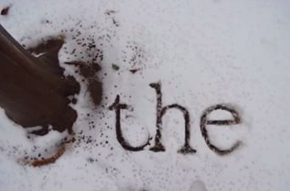
One way I “turn toward” in Red Clocks is by labeling the five main characters according to roles or functions: “Biographer,” “Polar Explorer,” “Wife,” “Mender,” “Daughter.” I wanted to call attention to the inadequacy of labels. All of us have multiple identities — play multiple parts in the world — yet we can find ourselves reduced (by immigration laws, magazine headlines, a conversation with a neighbor) to a single one. Or we may be asked to claim the “core” label, the role that’s more cherished than any other. At the 2012 Democratic National Convention, Michelle Obama said, “At the end of the day, my most important title is still Mom-in-Chief.” Hillary Clinton’s Twitter bio reads as follows: “Wife, mom, grandma, women+kids advocate, FLOTUS, Senator, SecState, hair icon, pantsuit aficionado, 2016 presidential candidate.” Why does “wife” come first? Why does “2016 presidential candidate” come last?

DS: Exactly! It’s such a weird bind to be female, to find yourself so often reduced to one role. I take being a mother very seriously but I never made being a mother the core of my identity. It’s unhealthy. There has been a strange shift in how being a mother, being a good mother, has been marketed over the past two decades. I enjoyed the interplay between the mothers in the book.

LZ: That’s exactly the right word: marketed. Being a mother is a role that gets outrageously sentimentalized, whether it’s by advertisers, screenplays, or your friends on Instagram. My love for my son, age 4, is boundless and joyfully animal, but not simple; in the mother role I feel ambivalence, doubt, conflictedness. I don’t find my experience well represented in the reductive American mythologies.

Being a mother is a role that gets outrageously sentimentalized, whether it’s by advertisers, screenplays, or your friends on Instagram.

In Red Clocks, when Susan (“the Wife”) runs into a fellow mom at a store, she’s overcome with loathing for this woman who feeds her kids homegrown chard and brags about the oldest one testing into a gifted-and-talented program. It’s one of the most cartoonish moments in the book, maybe because the degree of competitiveness, judgment, and performance anxiety among parents — in some pockets of our culture, at least — is so ridiculous.

For complex, thorny, platitude-resisting depictions of motherhood, I recommend Noy Holland’s recent novel, Bird; Sophia Shalmiyev’s forthcoming memoir, Mother Winter; and anything by Elena Ferrante.

DS: Yasmine is not a primary character, but her story is core to the book. Why did you choose to tell her story through the Daughter’s?

LZ: My novel is set in a state with a grim record of white-supremacist laws. Before I moved here, I’d heard Portland described as the whitest city in America, but I was ignorant of the structural racism in Oregon’s history. When it joined the Union in 1859, its constitution banned African Americans from living or owning property in Oregon; this ban stayed on the books until 1926. In the 1920s, the state legislature (which was heavily influenced by Ku Klux Klan members) passed a law barring Japanese Americans from owning land. These are just two of too many examples.

The Daughter (Mattie) is a white person becoming aware of her own whiteness. She is starting to realize how white privilege organizes her place in the world. Her best friend, Yasmine, who is black, has to endure some things that Mattie does not; and the depth of this inequity is revealing itself. The phrase “ignorant white girl” echoes through the book, and in one of the last chapters we learn why Yasmine said this. It was important to me to frame Mattie’s racial identity, more than Yasmine’s, as the site of conflict and unease. In this novel and beyond, I want my work to face the trouble of whiteness: how it’s been constructed, how its power is maintained, how we could imagine dismantling that power. Texts that have deepened my thinking on this question include Toni Morrison’s Playing in the Dark; Claudia Rankine and Beth Loffreda’s foreword to The Racial Imaginary; Ijeoma Oluo’s “The Heart of Whiteness,” an interview with Rachel Dolezal; and Lore Segal’s Her First American, a painfully hilarious novel wherein an Austrian Jewish refugee and a black American intellectual fall in love in 1950s New York.

In this novel and beyond, I want my work to face the trouble of whiteness: how it’s been constructed, how its power is maintained, how we could imagine dismantling that power.

DS: I’ve spent my adulthood frustrated with the lack of awareness of the Religious Right’s impact in our culture as a whole. Even now people don’t seem to realize the import of extremist Neil Gorsuch being appointed to the Supreme Court, of the Department of Justice issuing guidelines to protect religious freedom, and of the Trump Administration allowing employers and insurers to invoke religious and moral beliefs when choosing to cover birth control and other contraceptives. Red Clocks, with its Pink Wall, and Personhood Amendment, and Every Child Needs Two edict, seems prescient. What clued you into writing the hell in which we now live?

LZ: You’ve written elsewhere about the link between the Religious Right and these “re-education” institutions, and I was not surprised to learn that Mike Pence has done fundraising for Crosswinds, an organization tied to your former school. Pence is one of the politicians who helped me imagine our current hell. As governor of Indiana he sought to discipline and punish the bodies of women and LGBTQ people. In 2005 and 2007 he co-sponsored federal legislation that would recognize human zygotes as legal persons, thereby outlawing not only abortion but certain fertility treatments and all non-barrier forms of contraception. In 2016 Pence signed a bill (later blocked by a federal judge) that would require women who have miscarriages or abortions to pay for the fetus’s funeral.

Another radical conservative who gave me ideas for Red Clocks is Paul Ryan, a longtime proponent of so-called personhood amendments. He cosponsored the 2013 Sanctity of Human Life Act, which would grant full legal rights to a fertilized human egg.

DS: Are there any writers who inform your thinking on this matter?

LZ: I’m influenced by texts that worry the membrane between individual fate and collective predicament — that map characters (or narrative personas) onto broader grids of sociopolitical history. One of my longtime favorites in this vein is W. G. Sebald’s The Rings of Saturn. Three that recently blew me away are Hilary Plum’s Watchfires, a lyric memoir/essay-in-fragments about illness, war, family, and the Boston Marathon bombers; C. D. Wright’s One Big Self, a docupoetic photo-and-text series about incarceration in Louisiana; and John Keene’s Counternarratives, a collection of fictions that rip up American history and stitch it back dazzlingly true/askew.

DS: The mender, a forest-dwelling homeopath, helps many of the women in the book heal. Some who are suspicious of her describe her as a witch. This is not the first time you’ve written of witches. When did this fascination begin?

LZ: Like a lot of my fascinations, it started in books. Elizabeth George Speare’s The Witch of Blackbird Pond made a lasting impact, as did, a bit later, The Crucible, The Tempest, Macbeth, and Homer’s Odyssey.

I’m interested in how the figure of the crone — magical, unbeautiful, un(re)productive — defies the order of normative femininity, which wants the female body to be young, pleasing, and fertile. The Mender, Gin Percival, isn’t strictly a crone, but she is definitely not pleasing or compliant. She has stepped away from the order. Chosen to live out of order.

I’m interested in how the figure of the crone — magical, unbeautiful, un(re)productive.

DS: You used to play drums in bands (S-S-S Spectres, The Spells, Red Scare). The main character in your novel The Listeners is a musician coping with the loss of her band. In your short stories and your novels, you write from multiple perspectives. Do you think working and touring in a band contributed to your ability to write characters from different perspectives?

LZ: That’s cool. I hadn’t considered the link between music and multiple perspectives, but it makes sense: melody and counterpoint, echo and refrain, the textures built by different instruments or voices together. The link I’m most aware of is cadence: obviously kind of important for drumming, and crucial to how I think about making sentences. Syllables are beats, and phrases follow the logic of sound before sense. As my hero Virginia Woolf famously said, “Style is a very simple matter: it is all rhythm.”

DS: One of the things I loved about Red Clocks was the banality with which the characters accept tyranny. What are your thoughts on how we, as a society, respond to tyranny?

Susan Sontag says in Regarding the Pain of Others that “compassion is an unstable emotion. It needs to be translated into action, or it withers.” Horrors become familiar, habitual, with enough repetition. Battle footage from Iraq and Afghanistan, flickering for years on laundromat TVs and gym monitors: we stop seeing it. Photos of tiny boats crowded with people fleeing: we stop seeing them. (By “we” I mean Americans with access to television or the Internet.) In Red Clocks, there’s a gradual restoring of visibility, met by terrified recognition, when certain characters wake up to the political facts. It’s a half-waking, not an epiphanic or triumphant one; yet it pricks their numbness. It opens up space for action.