To be honest, I don’t know how I feel about this year. It feels like it was all a blur of uncomfortable headlines, aggressive arguments (how do you feel about punching Nazis?), and each day felt like a new opportunity for more bullshit to seep through the cracks. With everything going on, it’s comforting to know that the year is fairly close, so why not start looking forward to great positive gatherings of literary people? Here are literary holidays to look forward to!
Christmas presents that might all be books.
December 24: Jolabokaflod
Every holiday season in Iceland, there is the Jolabokaflod, otherwise known as the “Christmas Book Flood.” From the last weeks of September up until early November, a majority of titles reach Iceland and become exciting presents. On Christmas Eve, everyone opens their presents and spends the rest of the night reading, which sounds much better than spending Christmas Eve arguing politics while sipping eggnog.
Robert Burns.
January 25: Burns Supper
Head to your local Scottish market to prepare for the Burns Supper! This haggis, whiskey, and poetry–centered feast is a moment to remember Robert Burns, a famous and beloved Scottish poet. The meal may be formal or informal, with the formal meal including a piper and several courses. A Burns Supper celebration will likely be attended by die-hard Burns fans, but it’s okay if you’re just there for the haggis and whiskey.
Theodore Seuss Geisel.
March 2nd: Dr. Seuss Day
Dr. Seuss Day is a day to remember a key foundational author and celebrate reading. Also known as National Read Across America Day, students will usually celebrate by wearing pajamas or wacky hats to school. It can be celebrated anywhere with the purpose of the holiday as a day of remembrance and nostalgia for the cornerstone of foundational literature.
Eliza Doolittle sticks out her tongue in a screengrab from ‘My Fair Lady.’
April 23: La Diada de Sant Jordi (Saint George’s Day)
Also known as the “Day of Books and Roses,” Saint George’s Day in Spain involves a celebratory festival honoring the patron saint of Catalonia with a long-held literary tradition. Every year, on April 23rd, a rose is exchanged for a book between loved ones as the streets of Barcelona fill with stalls and special activities for the public such as workshops, recitals, traditional dances (sardanas), and human towers (castells).
Yes, My Fair Lady is musical theatre, but it’s based on George Bernard Shaw’s Pygmalion—plus, we need Eliza on this list to speak up against gender inequality and class prejudice. On May 20, we can honor her self-appointed holiday, and remember her through song, dance, and continuing to assert your presence when you are silenced.
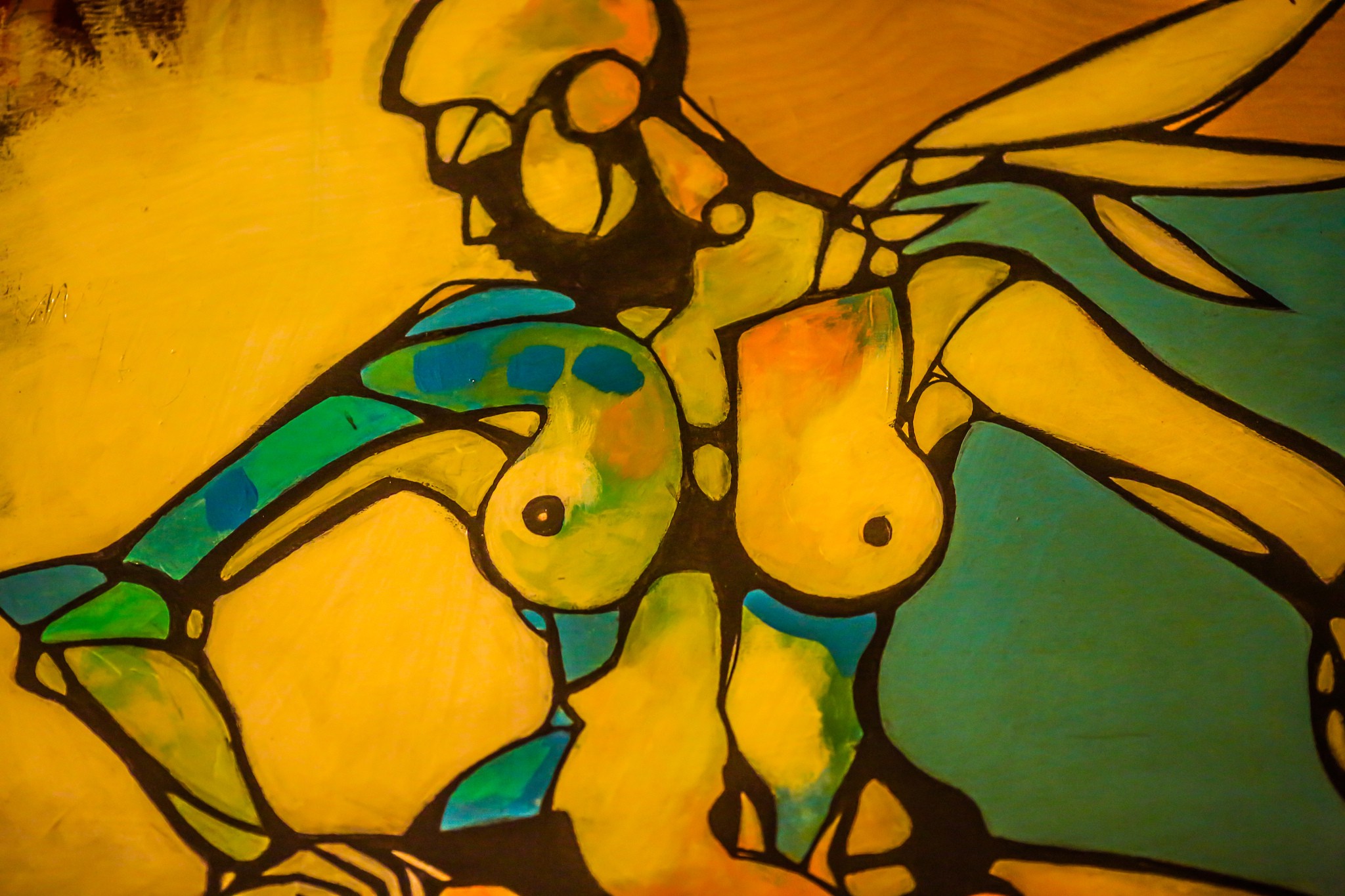
James Joyce painted on a window. (Photo by William Murphy)
June 16: Bloomsday
On Bloomsday, celebrate James Joyce’s Ulysses through pub crawls, reenactments, and readings. James Joyce chose June 16th because it was the first date with his future wife, Nora Barnacle, which ended pretty well for him, if you catch my drift. The real hardcore Joyce fans will read all of Ulysses out loud together, sometimes going longer than the day itself. The epicenter of the day is in Dublin, but many cities in the U.S., including Los Angeles, New York, Tulsa, and Wichita, take part in the celebration.
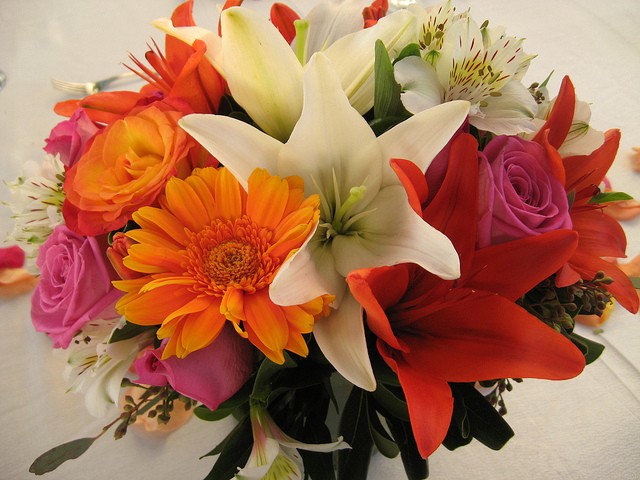
Some flowers you can buy yourself. (Photo by Natalia Wilson)
Mrs. Dalloway Day: A beautiful Wednesday in June
Finally, a holiday with some liberty. In June, pick a Wednesday that is particularly beautiful and celebrate Mrs. Dalloway Day. Take a walk around your city and listen to the way it communicates. Buy some flowers yourself. Maybe host a party at your house. Reveal in the simultaneous tranquility and chaos of a beautiful Wednesday in June!
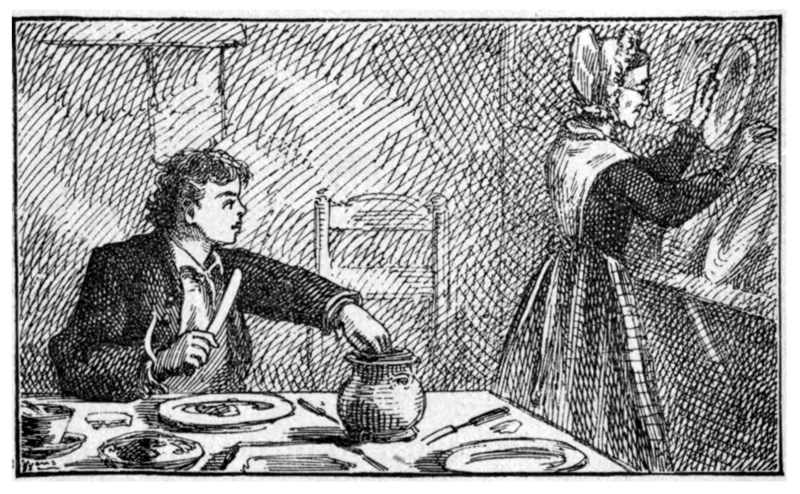
An illustration from Tom Sawyer.
July 4, 5, and 6: National Tom Sawyer Days
Don’t like Independence Day? Not a problem — there is now an option to celebrate National Tom Sawyer Days. Two days longer than Independence day, National Tom Sawyer Days celebrates a different yet still important historical setpiece. Fans of Mark Twain flock to his hometown, Hannibal, Missouri. There is much to do during these days of remembrance including a “frog long jump,” flea market, and a fireworks display over the Mississippi River on the Fourth of July, so you can still please those who wanted the fireworks show.
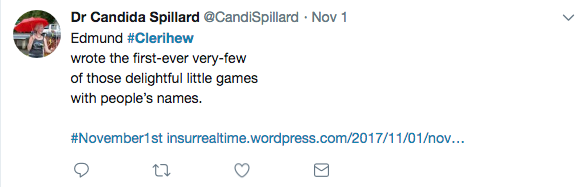
A tweet featuring a clerihew about Clerihew.
July 10: Clerihew Day
Make way for the poetry day! Clerihew Day is the light hearted day where we remember Edmund Clerihew Bentley, the creator of the four-line biographical poem. These poems are meant to be humorous and have the rhyme scheme of AA/BB with the person’s name in the first line. Celebrate the day by writing a poem about yourself or a friend and post it on twitter using the hashtag #clerihew…you never know if it’s the poem that’ll get you discovered.
July 13: “Odessa Reads. Odessa Is Read”
On Isaac Babel’s birthday this year, hundreds of voices were heard reading, spanning from the Literary Museum to the Opera house in Odessa. The literary scene in Odessa is small, yet thriving. This flash mob was a demonstration of the power of an underground literary scene. Although this only happened once in 2017, there is no reason to not expect its return next year on Isaac Babel’s birthday. You can celebrate in your city next year too! Bring out your favorite Babel text and read it in your language of choice.
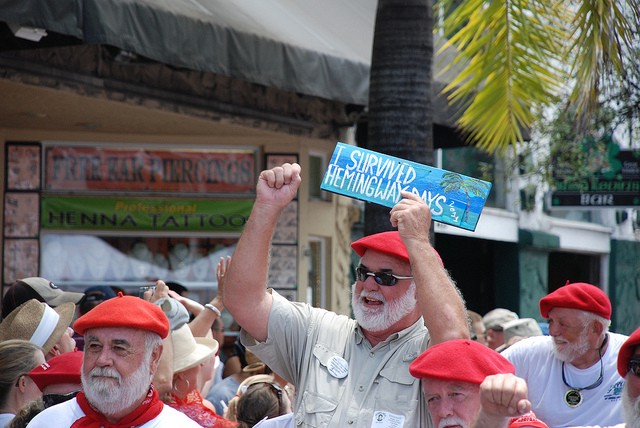
Hemingway impersonators celebrate in Key West. (Photo by Erin Borrini)
July 16 to 21: Hemingway Days
Santa impersonators never take a vacation. In December they are Santa, and in the summer they are Ernest Hemingway. The biggest celebration happens in Key West, Florida where there are short story competitions, a 5k run, theatrical performances, and a look-alike contest. So mark your calendars for late July—you won’t want to miss the hundreds of Hemingways. If you can’t make it to Florida, host your own Hemingway Day. Costumes required.
Martin Freeman as Bilbo in a screengrab from ‘The Hobbit.’
September 22: Hobbit Day
Hobbit Day is the way Tolkien fans honor the birthdays of Bilbo and Frodo Baggins. Both were born on September 22nd but in different years. Those who honor the holiday stick to the text for reference on how to party with lots of food, and others go without shoes, the same way the hobbits used to roll. On a more academic note, some teachers will use this as an opportunity to integrate Tolkien into the curriculum — and you know they had been waiting all year for this.
Katherine Faw doesn’t use social media. The only trace of her on the internet is a website, which features photos of hands bearing long nails and a gleaming manicure; a man slumped over on the subway, passed out; the author in cool girl outfits. Even in person, she still seems enigmatic to me, like a character in one of her books — refreshing in a literary landscape of writers constantly tweeting about their family members and pets and exes.
Purchase the novel.
Katherine Faw’s debut, Young God, was published in 2014, a quick kick-in-the-teeth of a book about sex, drugs, and violence. Similar themes crop up in her latest, Ultraluminous. K, the narrator, is a drug-addicted prostitute, back in New York City after years in the Middle East. She has five men in her life — four paying to be there — a sketchy past, and a fixed schedule that seems to both comfort and confine her. The structure is recognizably Fawian in that it’s fragmentary, kinetic. But in this book the language is even more spare, each short chapter a series of mini vignettes that disarm the reader in both their precision and inscrutability. The result is something thrilling and wholly unique, deliciously trashy yet highbrow, cementing her place as one of the most visionary writers around.
I talked to Faw about female insularity and the fragments that make up the patterns of a K’s life.
Juliet Escoria: I know your first book, Young God, took years to write, and was originally twice as long as it was in its finished form. Ultraluminous is told in a similar structure — short fragments that build their way into a larger narrative. Did it start out this way, or was it more like Young God, in that it changed substantially over time?
Katherine Faw: It was only once I found the structure for Young God that I was really able to write it, but Ultraluminous did start out as itself. I knew I wanted to write about almost every day of one year in the life of this woman, to make a book out of repetition and patterns and time. The shape got sharper as I went on, but it was there from the beginning. Strangely, the book still took five years to write.
For the structure of Ultraluminous, I was really influenced by film. I wanted it to be a sequence of brief images that would add on to each other and add up to a whole. And the films mentioned in the book are ones that I watched while I was writing it. They’re all of the slow cinema school — languorous and boring and relentless, with small or big moments of pleasure and sadness and violence.
JE: The film thing really came across to me. It felt kaleidoscopic, like brightly colored flashing images, very visual. Patterns, for instance, are a big theme in the book — a placeholder for order and predictability for a character who doesn’t have a whole lot of either in her life. And, for K, they seem to also function as a type of superstition. Did that element come before or after your idea of K, the drug addict-prostitute-terrorist character, developed? Do you look for patterns in your own life?
KF: She was an obsessive maker of patterns from the beginning. For her they are a way to order the ultimate condition of the universe, which is chaos. She knows they are arbitrary and yet she compulsively looks for, and therefore finds them, everywhere. She’s also obsessed with cosmology, specifically the way the universe will end, because that is the only thing that will stop chaos, when nothing exists.
She’s a junkie, too, and heroin gives you a unique relationship to time, which is the utmost pattern we humans have come up with. It seems to speed time up because you notice so much less that it’s passing. At the same time, most junkies are ritualized, compulsive people, who carefully organize every day around getting high.
That is the only thing that will stop chaos, when nothing exists.
But all that was there from the first scenes I wrote. Mainly because her psychology and worries and preoccupations are mine or were mine during the time I was writing the book. It’s the only way I know how to make a book, to just sublimate who I am at the time into a piece of art. So I am an obsessive pattern-maker, yes. I do try to keep it in check, though, as it’s only the illusion of control. But I’ve always felt this tension between order and chaos.
JE:K is a prostitute, and there’s a lot of cock sucking and swallowing and fucking in this book. There’s a woman’s sexy body on the cover. This felt both refreshing and confrontational to me, reading it now, in 2017, where I feel like the messiness of sexuality and its inherent power dynamics are being shied away from, an old taboo resurfaced in a new way. Was writing about this subject matter was reactionary? How does it feel to publish such a sexual book into a politically charged climate?
KF: While I was writing, I felt like I was writing a book about a prostitute and what a prostitute does is have sex for money. It was important to me that I describe clearly what goes on between K and her clients. She’s good at her job, too, and she’s expensive. She’s skilled at sex and fantasy.
To me the book is very feminist. I think everything I write is about female ambition. Though I’m so surprised and grateful that this cultural discussion is finally happening, I do worry about the path getting narrow. In America, when it comes to sex, everything can get puritanical fast, and then women always lose. I just hope we can all keep in mind that there are no good girls and no bad girls. There is no right and wrong way to be a woman.
JE: I love that. I think that’s one of the more refreshing aspects of these conversations about misogyny and rape culture.
K, the narrator of Ultraluminous, grew up in Stuyvesant Town in Manhattan. I lived in New York for a few years, and I feel like I could draw parallels between what Stuy Town is — this kind of insular world — and the character and narrative of your book. Was this something that was done intentionally? What drew you to this neighborhood?
KF: I knew I wanted K to be a native New Yorker but sort of sequestered from the city, too. Stuyvesant Town is on the other side of 14th Street from Alphabet City, and especially when K was growing up, which would have been the ’80s and ’90s, it was its own world. It’s leafy-green with winding paths, and it really feels like a planned community in the D.C. suburbs.
Another reason I chose it is because it’s kind of shorthand for how New York has changed. And New York has changed a lot in the 15 years K has been away. Stuyvesant Town used to be middle-income housing that was rent-stabilized — though only for white people; it was notoriously segregated — but it was sold in a huge real estate deal that went bust during the financial crisis and was then resurrected. The apartments today are market rate, which is astronomical, and now it’s only for rich people.
But when K was growing up it was still a little bit busted, like all of New York used to be. My first friend in New York grew up in Stuy Town, and she would talk about how insular it was. Like kids would only date other kids who lived in Stuy Town, and everybody in all the buildings would go to the same beach on the Jersey shore in the summer. I wanted K as a little girl to feel protected and trapped, and at the same time to know that all she had to do was cross 14th Street to be in the real world.
JE: Yeah, I saw that about the rich people thing when I was Googling… apparently there’s a lottery for “affordable” apartments for “middle class” residents, which they define as $2800 for a one bedroom, and people making $84k and upwards a year. Which seems laughable to me, sitting here, right now, in a three-bedroom house that costs much less than that, in Appalachia, where an income of $84k is considered “rich.”
You grew up in this region, but have lived in NYC for a while now, right? How does having lived in these two wildly different regions inform your writing, and your identity? What’s your relationship to Appalachia now?
KF: I knew from an early age that I would go to New York as soon as I could, and I was lucky enough to be able to do that and to be able to stay here. I’ve lived here almost 17 years. I feel like my true self in New York in a way I never did in North Carolina, and I guess I do think of myself as a New Yorker now.
At the same time, I can be very defensive about Appalachia. I don’t like people who know nothing about it criticizing it. Nobody even pronounces it correctly. People who live in Appalachia say “Appalachia” one way, and then everybody else says it another way, like the people who actually live there must not know how to pronounce it correctly. I have this protective love for Appalachia and the people who live there that will never go away. It’s the place that raised me and I feel like I understand it.
I wanted K to feel that way about New York. After 15 years away, she has come back to a home that has completely changed. And money is what’s changed it. But she still has this protective love for New York and she still understands it, as it is and not as it was. Because everything, everywhere, is always moving forward and it is never going back.
I have this protective love for Appalachia and the people who live there that will never go away.
JE: Do you listen to music when you write? Or rather, if this book had a soundtrack, what would be on it?
KF: I have to write in silence. Music especially, but also people talking, gets in my brain and changes the natural rhythms in an outside way that I don’t like. That said, total silence in New York is impossible. So the music that I did not choose but that I’m sure infiltrated the book anyway is the norteño music my neighbors blast in their backyards from May to October, Friday to Sunday, almost but not quite drowned out by whatever the longest recording on YouTube is of white-noise thunderstorms. That is the sound of this book.
I think K is the same way. I think the music she hears is what’s played in the clubs the men take her to, what comes on the jukebox in the cop bar where she drinks with the ex-Ranger, and whatever floats up through the floorboards or in through her open windows when she’s in her apartment alone.
JE: One time you interviewed me for the (sadly) now-defunct Adult Magazine, which you ended by saying: “I now have a great desire to make this an Into the Gloss interview.” Which made me really happy because I love talking about beauty products. So I’d like to end this interview the same way. What are some great beauty products?
KF: This makes me so happy, too. Thank you. How about my favorite red lipsticks? The best orange-red ever, which looks particularly good if you have yellow vampire skin like me, is Lana by NARS. For a true red, with more blue in it, I really like Sephora’s Always Red. It’s a liquid lipstick but it doesn’t make your lips look like the desert and it’s very Hollywood. My favorite pinky-red, which I wear almost every day, is Dragon Girl by NARS. It goes with everything — both snakeskin and leopard-print, my usual attire — and it’s a lip pencil so overdrawing your lips is easy. Bonus: the greatest pink of all time is Schiap, also by NARS. It manages to be both neon and classy. This interview has not been sponsored by NARS.
Each month “Unfinished Business” will examine an unfinished work left behind by one of our greatest authors. What might have been genius, and what might have been better left locked in the drawer? How and why do we read these final words from our favorite writers — and what would they have to say about it? We’ll piece together the rumors and fragments and notes to find the real story.
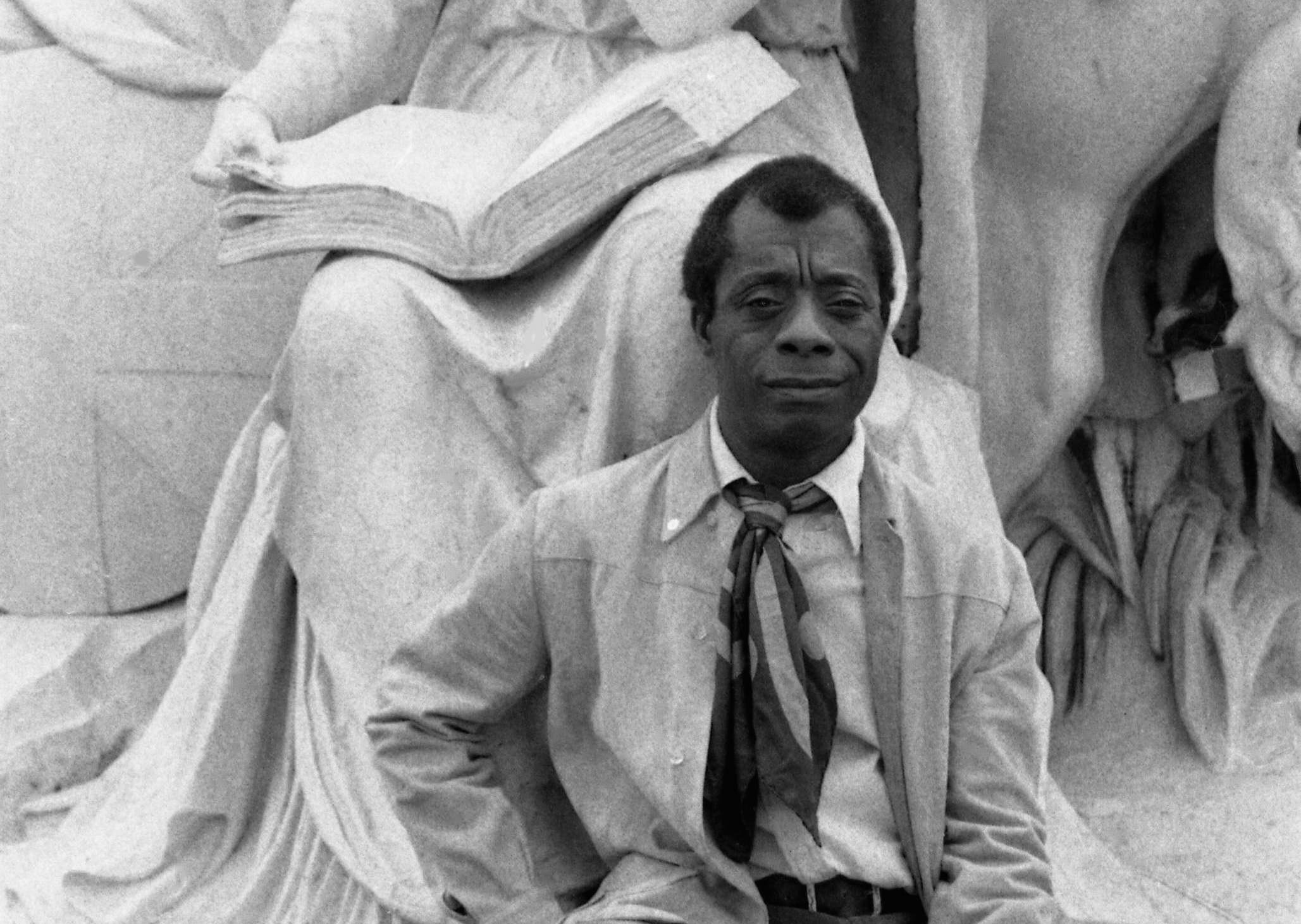
The idea for Remember This House first came to James Baldwin in 1979. He envisioned traveling back to the American South to write about three leaders of the civil rights movement: Medgar Evers, Malcolm X, and Martin Luther King, Jr. He’d write about how he had known them, how they had crossed paths and purposes in their fight for racial equality, and how within five years each had been assassinated in that fight. Baldwin had touched on these events before in 1972’s No Name in the Street, but he felt there was more to say. He planned to travel to Atlanta, Selma, and Birmingham to talk with the widows, brothers, sisters of these men—and most of all, with their growing sons and daughters. A decade after the deaths of these leaders, he wondered how they and their cause appeared to their children’s generation.
Baldwin approached The New Yorker to write a long article on the subject, but soon realized the project would be more extensive. He ultimately proposed Remember This House as a new book to his literary agent, Jay Acton. He did so, he said, “in a somewhat divided frame of mind,” dedicated to the work but aware of its emotional toll. “This is a journey, to tell you the truth, which I always knew that I would have to make, but had hoped, perhaps (certainly, I had hoped) not to have to make so soon,” he wrote.
He was about to turn 55, Baldwin remarked, with some astonishment. Time was passing, and the civil rights movement had become the civil rights era. Baldwin felt an obligation to address it, and a reticence. “It means exposing myself as one of the witnesses to the lives and deaths of their famous fathers,” he wrote to Acton. “And it means much, much more than that — a cloud of witnesses, as old St. Paul once put it.” To write this book would mean facing those children and the memories he held of their fathers. It meant facing the question of whether or not the equality they had fought and died for was any closer at the dawn of 1980.
McGraw-Hill soon paid a $200,000 advance for the book (the equivalent of $600,000 today)— the largest in Baldwin’s career. But when he died of liver cancer, eight years later, at his home in the south of France, he had only written about thirty pages of notes for Remember This House. The journey back he’d envisioned making had never been completed.
By all accounts Baldwin made several attempts to write the book, but found it to be “impossible.” Still he continued to come back to the idea again and again. Even when Baldwin was finally so ill that he could not travel, he asked his assistant, David Leeming, if he could not go to speak with the widows and the children in his place. Not long before his death he asked Leeming to help him sort some papers at his desk, including Remember This House, which he hoped to return to “in a day or so.”
By all accounts Baldwin made several attempts to write the book, but found it to be ‘impossible.’
According to Leeming, as the 1980s had progressed, Baldwin’s former optimism had given way to a “general pessimism” about the “unlikelihood of the white world’s changing its ways.” In the essay The Evidence of Things Not Seen, Baldwin wrote about a string of unsolved murders of black children in Atlanta and the failures of both the white police force and the city’s black leaders to act in the crisis.
The “new South” was a myth, Baldwin said in interviews, and he had begun to think the same of some of the ideas he’d once embraced. Whites were eager to believe that America had become more equal. That if there were black politicians and policemen and television and movie stars, progress had been achieved. Baldwin saw the reality of suburban white flight, of the rise of black imprisonment, of racists no longer aware of their racism. The American Dream could not be shared with whites who did not genuinely desire to share it. Looking back, Baldwin felt that the moment had been missed, that the old language of equality and civil rights had become meaningless and that if there was real progress to be made in the future, a “new language” would be needed.
Upon Baldwin’s death in 1987, McGraw-Hill sued his estate to recoup the $200,000 advance for Remember This House — plus interest. Their chairman, Joseph L. Dionne, took the view that, “Mr. Baldwin effectively received an interest-free loan of $200,000 to write a book as to which we await evidence that he ever wrote more than a very rough 11-page draft. As a publicly owned company, McGraw-Hill is not in a position to waive repayment of that sum.”
A New York Times article at the time interviewed a variety of other prominent publishing executives, none of whom could think of any prior situation in which a deceased author’s estate had been sued for repayment of an advance. One industry lawyer said that doing such a thing had always been “considered simply not cricket.”
It took an outcry from the Author’s Guild to convince the publisher to retract the lawsuit, which according to Baldwin’s family, would have led to the eviction of Baldwin’s 89-year-old mother from her home.
After the suit was dropped in 1990, the rights to the 30-some pages of Remember This House reverted back to the Baldwin estate. There they remained for almost two decades before Baldwin’s sister, Gloria Karefa-Smart, one day handed them to filmmaker Raoul Peck. He had been studying the estate’s archives for several years, trying to make a documentary about Baldwin.
“Here, Raoul,” she said, “You’ll know what to do with these.”
And he did.
“A book that was never written!” Peck wrote, in his companion to the documentary I Am Not Your Negro. “That’s the story. … My job was to find that unwritten book.”
Peck’s documentary, released in 2016 to wide critical and audience acclaim. It would go on to earn an Oscar nomination for Best Documentary Film. Using a new, visual language, and Baldwin’s own words, he finally took the journey that Baldwin had once found so impossible.
His life’s work would go on to inspire generations of activists to come — those who still believe in forging that new language.
I Am Not Your Negro organizes excerpts from the 30 pages of Remember This House with other bits and pieces of Baldwin’s letters and notes and interviews to tremendous effect. Peck described his role in its creation as similar to a “librettist crafting the script for an opera from the scattered works of a revered author.”
Baldwin had written in a tiny note that he Remember This House should be “a funky dish of chitterlings.” Peck took this concept to heart, combining Baldwin’s words with all manner of other things: still images, film clips, speech excerpts, news footage, song lyrics, a Chiquita banana advertisement — even excerpts from Baldwin’s own FBI file. (Along with noting Baldwin’s homosexuality, the FBI file refers to him as “a dangerous individual who could be expected to commit acts inimical to the national defense and public safety to the United States in times of emergency.”)
Peck illuminates the three civil rights heroes through Baldwin’s memories, but also bears Baldwin’s witnessing to a new generation, a new millennium, almost 40 years after Baldwin first thought of the project.
I Am Not Your Negro is an inspiring and disturbing look into all of the things that made Baldwin so pessimistic in the 1980s, and the still divided, still cruel, still unequal America we inhabit today.
On the title page of that 30-page manuscript for Remember This House — dismissed as worthless by McGraw-Hill, but of such immense value to Peck — Baldwin apparently wrote the first word as “Re/member,” which according to Leeming, suggested his desire to “put a broken ‘house’ together again.” To not just recall, but to reassemble the “‘house’ of the fallen heroes.”
Baldwin joined that house upon his own death, at his home in the south of France surrounded by loved ones. In the days before, Leeming wrote, Baldwin had him read aloud bits of Pride and Prejudice, and they watched a favorite Charlie Chaplin film. His life’s work, and his unfinished business, would go on to inspire generations of activists to come — those who still believe in forging that new language.
In the companion book to I Am Not Your Negro, Raoul Peck shares a 1973 quote of Baldwin’s with us, which was sent to him by Baldwin’s sister Gloria in 2009:
There are new metaphors. There are new sounds. Men and Women will be different. Children will be different. They will have to make money obsolete. Make a man’s life worth more than that. Restore the idea of work as joy, not drudgery.
Baldwin’s despair that such a restoration would ever come to pass kept him from completing his final project, but the hope inspires Peck’s film.
For once, the piece of writing going viral on Twitter this weekend wasn’t a bad take, a particularly insufferable Vows column, or a new piece of investigative journalism about how everything is on fire. It was a short story. Kristen Roupenian’s story “Cat Person,” which appears in this week’s New Yorker, is written from the perspective of a college sophomore who has an unsatisfying one-night stand with an older guy, and it sparked a lot of conversations about sex and dating, the value of “relatability” in fiction, what it means for a work of art to feel “universal,” and even the definition of a story. The story has sparked more than 10,000 tweets, several rounds of backlash and backlash-to-backlash, and an entire new Twitter account anthologizing negative reactions. It’s like everyone on the internet was having a contentious book club meeting out in public.
It’s a perfect storm of a story: one that deals with a young woman’s complicated experience of sex and consent, coming at a time when such experiences are a topic of national conversation, and published in a high-prestige magazine. It’s not quite topical enough to seem crass—this isn’t a story about assault or harassment, it’s a story about bad sex—but like recent reporting on those topics, it illuminates a dark corner of many women’s personal histories. Apparently, that combination made it catnip (pun intended) for Twitter.
Most of the discussion fell into one of the following categories:
“I relate uncomfortably strongly to this and think it’s valuable to talk about”
As brilliantly/depressingly relatable as everyone has said. Now imagining a world where women aren't socialised to placate men's feelings above her own safety, happiness and pleasure. https://t.co/IIF3lDvEDL
“As a man, I’m confused and angry and possibly doing some heavy posturing” (again, there’s an entire Twitter feed for these! Let’s take some time to revel in the fact that an entire Twitter feed sprang up to collect contentious responses to a short story).
“If you think this is a ‘universal’ experience for women, maybe reconsider your ideas of what universal means”
Hi, just here to point out that Cat Person points to a specific, white middle class experience and people talking about how universal it is should maybe think more broadly.
imo the weirdest thing abt the cat person discourse is that people are calling it a "piece" or an "article" (???) when it is most definitely a regular degular short story which makes me find the whole phenom interesting in terms of how we think about form & contemporary fiction
Variations on these responses included “I found this relatable but didn’t like it,” “I didn’t find this relatable but everyone else did,” “I don’t think relatability is an important factor in fiction,” “I have muted all mentions of ‘cat person,’” and “why are there no cat-people in this story?”
We’re not going to weigh in authoritatively on any of these points except one (stop calling it an article!!!), because frankly we’re just delighted to see literary analysis happening at a scale so large it’s genuinely annoying. Congratulations to Kristen Roupenian for creating a piece of writing that struck so many nerves it briefly turned Twitter into an intro-level contemporary fiction class.
Cat Person: why, it's almost like art can stage the discomfiting and ambiguous in such a way that we can enter and explore it and that's part of art's necessity and power. Almost.
I met the man when I stopped to give him a lift on my way home from town doing nothing in particular. I was on my own as usual and here was somebody with his thumb out looking for company. And because my motives weren’t entirely altruistic and I knew I was going to get into something with him, I felt only loathing as he opened the passenger door. Later that afternoon, he backed me up against the kitchen counter, his mouth hard against mine, and pulled up my skirt and put his hand between my legs. His breathing was laboured, and I thought I heard him whisper something coarse. I stopped it there and drove him to his tent out in the countryside. Getting out of the car he put his fingers to his nose and thanked me. The rest of the day I wondered, every minute, if he would appear at my door with a rucksack and his hand outstretched at waist level. I locked the door and washed my infested body but couldn’t shake the scenario playing out in my imagination that he was back and sitting on the couch in the afternoon with the curtains drawn watching sports.
The next day I took the same route into town, my eyes scanning the roadside ahead while the everyday things of the country passed unnoticed. He was standing at a junction smiling like a man who’d won a bet, but there was a fight before we got anywhere and I dropped him off near a supermarket. In the rear-view mirror, I thought he looked sad about how things turned out. He was gone, and I drove towards home too fast and with the radio turned up until his existence was explained away by old rock songs, sung loudly.
There were never many friends because I pretended stuff didn’t happen, but anyone who knew me knew it all happened, all my bad decisions hung out for all to see, like one hot star in the evening sky.
Weirdos
The couple down the track had three kids they home-schooled in a small kitchen with a slate floor at a table positioned too close to the back door and butt-up against the stairs to the small loft all three kids slept in. Being home-schooled in that house was a cold and drafty affair, played out against the thudding soundtrack of the younger kids running up and down the uncarpeted staircase.
Even further along the track lived the woman’s parents. Their large, white house, set in the kind of acreage parks are made of, belied the impoverished hippy status of their daughter’s set-up. When the old man went into rehab to detox from a diazepam addiction, the family moved into the big house and wondered how they’d ever lived in the other. A “For Sale” sign appeared where the track met the road, and after several miscalculations on the part of prospective buyers, an arrow was attached to the sign’s pole with “100 yards” written across the tail in black marker which bled with the first rain.
It took months for the house to sell. The pot-holed track, already a factor, also deterred the suppliers of amenities to people without the money to pay the additional costs. The small house was completely off the grid, which appealed to the paranoid and those with something to hide and went some way to explaining why nobody noticed the man climbing in and out of my house through the kitchen window. Alex, my short-lived dalliance with lodgers, had lost his key some weeks back, but as it hadn’t had much of an impact on his life he hadn’t bothered to mention it. His boot prints on the kitchen counter were the first sign of something out of the ordinary happening in the house, soon joined by pistachio shells in my bed and finally his revelation on a ride into town that the police were looking for him after an incident at a naval base. If I was interested, he said, I could check out the bookmarks on my computer.
He had all kinds of stories, most of them too big for my terraced house and small life, and I asked him to leave. I could have just closed the kitchen window but the bad feeling I had about him necessitated lies, and I told him I was considering adoption. He stuck up his middle finger, his parting shot.
Teachers
Nick left me suddenly for a professor on his teacher training course. Apparently, when the faculty met to discuss the students’ progress the mention of his name made her smile. I didn’t know her, and her name got lost amongst the slew of new arrivals that year, cheerful and curious creatures that stuck together like spring lambs after the thaw. When the couple in the cottage on the other side of the track felt the warmth breath of a stranger on their necks, the fact that it had taken sixteen years was the bigger surprise. She liked new things, and he wanted nothing much to change. But he loved her, and when she took up running he bought her running shorts several sizes too small, and when she got into growing vegetables he surprised her with a plot dug under the shade of an old oak, and when she met her new Brian he broke his nose and stopped her from seeing their daughter.
For months afterwards, Jill would call out to him when he was drunk, and he would go to her until some wall or tree got in the way and stopped him. When the judge made the stopping permanent, Brian took to drinking in the park near her new man’s flat and as soon as he heard her calling he’d stagger up the steps to bang on the door until someone answered. The fact that it was usually someone from one of the nearby flats who tried to shoo him away didn’t bother Brian because he could do nothing else but heed the siren’s call until the day came that a bottle of pills helped him to fully understand her false promise.
Nick went to Kenya to teach English to rural children, and the professor went back to her students. When he got in touch years later to ask me to look up the side effects of Mefloquine, I wondered why he hadn’t done so himself with the computer he’d used to send the email. But vanity borne from some distorted sense of having been selected took over, and I responded with pages of extracts from online publications. It took several more years for the penny to drop that his contact had been something else.
A new man
When the new guy moved in, it was because he was different. I didn’t care that he couldn’t reach the out-of-date condiments at the back of the cupboard or that he enquired daily about menus and clean things. Sometimes it would rain for weeks, a cold, wet sheet wrapped tightly around our lives, and we’d stay indoors and take out our frustrations on each other. Television made me wistful, and I’d stare past the TV set and out the window at the hedgerow top and flat grey sky, disappointed there wasn’t more, feeling different to the man who chose to be distracted by flickering images and minor tasks.
The new guy wanted to take a trip and arrangements were made. But our lethargy had become a habit by the time the trip came around, and we sat at home and watched TV together and told no one of our change of plan. Later that evening the plane came down, and the owner of our intended B&B telephoned to check on our whereabouts and inform us of her outrage at our lack of consideration. I asked her “what’s it to you, you’ve got your money”, and put the phone down. Shame drove me into the kitchen in search of something in the cupboards, but I could find only beer. It was clear I needed a new start with someone who was taller than me, someone I could spend the summer with.
Novel Gazing is Electric Literature’s personal essay series about the way reading shapes our lives. This time, we asked: What book was your feminist awakening?
On the morning of my first day of high school, everyone in my homeroom sat in silence — stiff-backed and rigid and afraid, sweating through the dress shirts our mothers had bought for us. No one knew what the social hierarchy was here, at this all-boys Catholic school where black-robed friars walked the halls and the upperclassmen towered over us, their voices deep enough to be our fathers’. It seemed better, that first morning, not to risk breaking any unspoken rules. It seemed better not to speak at all.
But this unnatural reserve didn’t last long: by mid-September, my homeroom buzzed with voices. The boys around me complained about our biology homework, and speculated together over whether the Bills had a shot at the Super Bowl this year. Most of all, though, they liked to talk about the girls at our sister school. Sluts, the boys called them, in an easy, matter-of-fact tone that made me flinch. Whores. Their disgust became even more pronounced when they talked about gay men. Fags, they said, the word making little tendrils of alarm uncurl along my spine. Homos. Worst of all were the times when my new classmates pretended to be gay. They lisped their words and waved around boneless wrists until it was clear that to be gay was also, in some mysterious but definite way, to be a grotesque parody of a woman.
While all of this happened, I stayed quiet. Watchful. Whenever I was at Saint Francis, my chest always went tight with fear, and I clenched my teeth until my jaws ached, reminding myself to always be careful. Every now and then, though, I slipped up.
Once, in the early weeks of school, I watched a group of freshmen play dodge ball with some upperclassmen. I couldn’t stop looking at one senior boy, the class president: earlier, he’d spoken to all the freshmen in the dim quiet of the school chapel, lecturing us about responsibility and respecting our teachers. Shirtless now in the cavernous gym, he ducked and wove and whipped until sweat gleamed against the lean muscles of his chest. I was still watching him when another boy stepped close and murmured something in his ear.
I had a fraction of a second — just long enough to feel a flicker of doubt, long enough to hear more acutely the squeak of sneakers and the boom and crack of balls — before the senior turned his head to look right at me, dark eyes pinning me in place. Caught.
And though I looked away immediately, I could feel the heat rising under my skin, shame flaring inside me like a lit match.
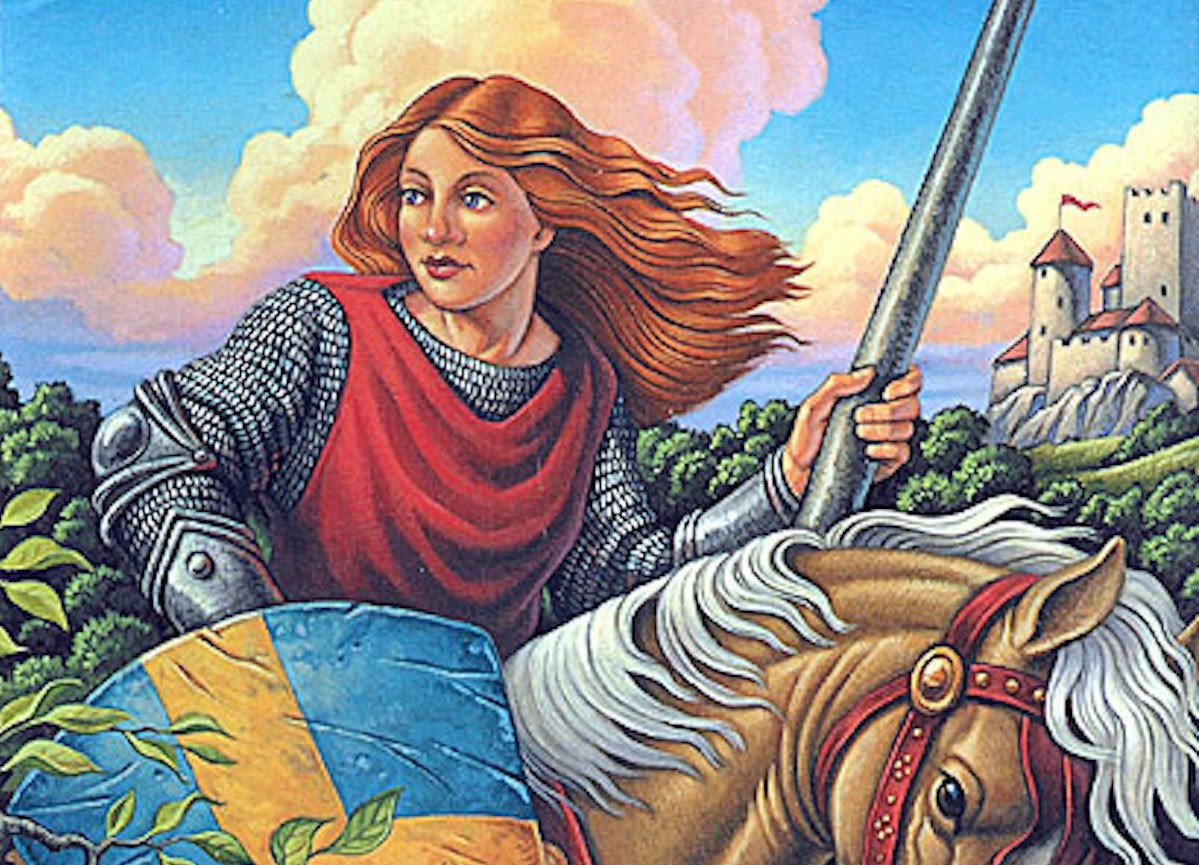
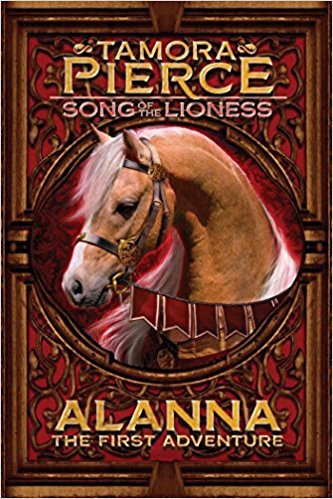
After days like these, there was only one way I knew to feel safe again, one way to make my muscles loosen and my jaw unclench. On the bus ride home, I would curl up with Tamora Pierce’s Song of the Lioness quartet, a series of young adult fantasy novels that detail the adventures of Alanna, a teenage girl who disguises herself as a boy in order to train for knighthood in the medieval kingdom of Tortall. I first began devouring the series in middle school, reading and re-reading the pastel-colored paperbacks until they were dog-eared, their spines broken from being opened again and again. But the Alanna books became even more important to me as high school began. Oddly enough, they felt relevant in a new and pressing way. Because even though she had violet eyes and a horse named Moonlight, Alanna’s daily life training at the palace ran strangely parallel to my own at Saint Francis.
In the first books of the series, Alanna has to keep her true identity a secret from her classmates. She refuses to go swimming, even on the hottest summer days, and binds her breasts once she starts developing. Despite these obstacles, she does well at the palace, making friends and facing down bullies. When one of them breaks her right arm, she starts to train with her left, practicing relentlessly until she’s ambidextrous. And yet, Alanna is still nagged by self-doubt, a creeping sensation of inferiority. Even after she finally defeats the bully who broke her arm, she can’t quite let herself feel proud of what she’s accomplished. “She was still,” the narrator tells us, from a perspective deep inside Alanna’s mind, “a girl masquerading as a boy, and sometimes she doubted she would ever believe herself to be as good as the stupidest, clumsiest male.”
For reasons I was only beginning to make out, Alanna and I were kin.
My freshman year at Saint Francis began in the fall of 1999, a time when there were very few YA novels about gay teens. But even if more had existed, I would have been too afraid to read them: afraid both to be seen with these books, and afraid to identify with their main characters. The Song of the Lioness series let me think about the experience of being closeted in a way that was safely distanced from my real life. In Alanna, I found a heroine who thrives despite her inability to come out, and despite the psychological costs of remaining in the closet.
In Alanna, I found a heroine who thrives despite her inability to come out, and despite the psychological costs of remaining in the closet.
The novels also held another truth, one I wouldn’t be able to fully register for another few years: how important it is to fight back against all those voices — both outward and inward — that claim that being either female or effeminate is disgusting and shameful.
If Pierce’s books armed me with a nascent feminism, they also helped me make real friends. Right before my freshman year began, my mother brought home a new, internet-enabled computer. I used it to find fan sites devoted to the world of Tortall. Hosted on free websites like Angelfire, GeoCities, and Tripod, these sites had names like “Lady Jayla’s World of Fantasy,” “Seraphsong’s Page,” and “The Dream Plains” — and nearly all of them, it turned out, had been made by girls around my own age. Soon I was trading long emails with half a dozen other fans. Our letters started out as detailed discussions of Pierce’s books, but before long the focus shifted to our daily lives: our friends, our schools, our families. These were the bookish, clever, sarcastic peers I couldn’t find at Saint Francis, but desperately needed in my life. Even now, almost twenty years later, I can tell you their names: Shanti, Alison, Kel, Eiram.
Before long I started role-playing with some of these friends online, in a chat room devoted to Pierce’s world. After the daily fear and silence of high school, the relief was incredible. In the chat room (which, for game purposes, was a tavern in Tortall), there was no need for macho posturing, no need to worry about my high, feminine voice or my short, weak frame. We were in a place where bodies vanished, leaving only our words — and those, too, would be gone the next time we logged in. Safe in this knowledge, I relaxed. I let myself be warm and funny and playful: all of the things I couldn’t allow myself to be at Saint Francis.
But I let myself be more than those things, too. My character, Darius, was a mage, and he always entered the chat room — the tavern — in the same way: he appeared magically, “in a blaze of silver fire.”
At school I wanted to be forgotten, to erase myself like an Etch-a-Sketch when you shook it hard enough. But in front of the new computer, chatting with all my new friends, I wanted so much more. I wanted to burn with a light that you wouldn’t soon forget.
Today, more than three decades after the publication of the first book in the Song of the Lioness series, many millennial-age women have written about how Pierce’s heroines provided them with powerful feminist role models. In her blurb for Pierce’s latest book, the author Sarah J. Maas writes that Pierce’s novels “shaped me not only as a young writer but also as a young woman. Her complex, unforgettable heroines and vibrant, intricate worlds blazed a trail for young adult fantasy — and I get to write what I love today because of the path she forged throughout her career.” Author Bruce Coville, meanwhile, observes that, “Having been with Tammy at signings and listened to the young women who speak from their hearts about how they were empowered by her books, I know it is impossible to overstate her impact.”
But the Alanna series was valuable to me for slightly different reasons. Long before I took classes in feminism and queer theory, it helped me to understand that misogyny is a weapon wielded against women and gay men alike. And it promised me, too, that this weapon could be overcome. The first book in the Song of the Lioness series culminates in a chapter where Alanna and her close friend, Prince Jonathan, enter the mysterious Black City and fight a group of evil creatures known as the Ysandir. Midway through the battle, the Ysandir realize that Alanna is actually a girl and use their magic to burn away her male clothes in an attempt to humiliate her. Although Jonathan is shocked to learn Alanna’s true identity, he keeps fighting alongside her, and together they defeat the Ysandir.
Long before I took classes in feminism and queer theory, ‘Alanna’ helped me to understand that misogyny is a weapon wielded against women and gay men alike.
In the final pages of the book, Jonathan — who has been trying to decide which of the knights-in-training he should select as his squire — asks Alanna whom he should choose. “A week ago,” the narrator tells us, “she would have told him to pick Geoffrey or Douglass. But she had not been to the Black City then. She had not proved to the Ysandir that a girl could be one of the worst enemies they could ever face.” Alanna keeps thinking about her time training at the palace, remembering all her hard work, all her accomplishments. “All at once,” the narrator says, “she felt different inside her own skin.”
Alanna tells Jonathan that he should pick her, and he says that she was already his first choice.
She felt different inside her own skin. The first time I read that sentence, more than twenty years ago, it was a promise. A promise that I would not always be so afraid, a promise that I could fight — and win — against all the voices that crackled inside me, telling me that I would never be as good as the stupidest, clumsiest male.
She felt different inside her own skin. It was a promise, but also a gift — one as beautiful and unexpected as silver fire.
In today’s cycle of culture and media, 300 editions of anything is a lot. So many, in fact, that when we tried to figure out a way to theme our 300th issue around it, there wasn’t much fodder to draw from other than movies starring a steroidal Gerard Butler. Almost two years ago, we celebrated our 200th publication with a four-part issue based on the “200 episode club,” or sitcoms that have released as many episodes: Frasier, The Cosby Show, The Jeffersons, and Love Boat. But the list for the proverbial 300 episode club was, unsurprisingly, mostly Law & Order spin-offs.
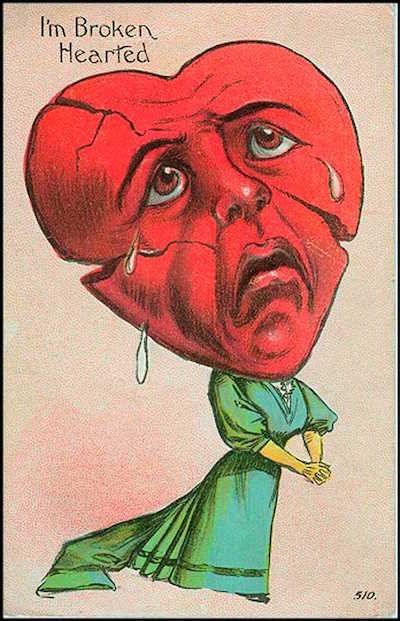
And then we noted the calendar date that our 300th issue would release: Valentine’s Day. It’s a day that brings out affection and vitriol, passion and sworn indifference, roses, chocolates, menus with astronomical prix fixes, and spikes in wishful condom purchases. (There isn’t really a way to fit this in smoothly, but it’s also our senior editor’s birthday.)
The Love Story, and its shadow, The Heartbreak Story, are a kind that will never get old — there will be versions and retellings and sequels for as long as humans exist. Love, in short, is perhaps the grandest source of anguish and inspiration. So we’ve decided that’s what we want for our 300th issue: Love, in short.
For one week, from January 8 through the 16th (yay for long weekends!), we’ll be opening submissions for 300-word love stories. Recommended Reading only publishes fiction, though it is up to you how thinly you choose to veil the scumbag character who cheats and then meets an untimely death. We are not accepting multiple submissions per writer, so make sure to pick your best one, and that it is 300 words exactly, not including the title! The issue will be composed of ten stories, and upon acceptance, we can offer $25 per 300-word story. All submissions should go through our submittable page, where you’ll also find the complete guidelines.
Electric Literature is thrilled to announce the addition of its newest board member: writer and co-founder of The Toast, Nicole Cliffe.
Electric Literature’s mission is to make literature relevant, exciting, and accessible in every sense of the word, and as an organization run by women, is also committed to publishing work by diverse and feminist voices.
“I’m thrilled and excited to be joining the board of Electric Literature, an organization that cares as much as I do about bringing great writing to everyone. I’ve loved the voices that Electric Lit has been showcasing, many of whom I remember having my hair blown back by at The Toast (in a good way!), and I’m looking forward to getting to work!” said Cliffe.
Cliffe’s appointment comes two years after Halimah Marcus was promoted to Executive Director, and four months after Jess Zimmerman joined as editor-in-chief. Jennifer Baker, creator and host of the Minorities in Publishing podcast and a 2017 NYSCA/NYFA fellow, also joined as a contributing editor in August to focus on craft, the publishing industry, and representation in literature. Since then, Electric Literature has published influential articles at the intersection of feminism, culture, and literature, including “What I don’t Tell My Students About the Husband Stitch” by Jane Dykema, an essay about Carmen Machado’s collection Her Body and Other Parties, which attracted half a million readers.
Cliffe will join board members Andy Hunter, Electric Lit’s co-founder and publisher of Catapult and Lit Hub, acclaimed novelists Michael Cunningham and Lev Grossman, Bookforum publisher Danielle McConnell, the vice president and executive editor of HarperCollins, Sara Nelson, and the vice president and executive editor of Farrar Straus and Giroux, Sean McDonald.
Along with her co-founder Mallory Ortberg, Cliffe’s legacy at The Toast, which ran from 2013 to 2016, was one of smart humor and feminist inclusivity. On The Toast’s last day of publication, Hillary Clinton contributed to the site to thank the founders for creating “spaces where women can speak their minds freely.” Although nothing can replace The Toast in the hearts of its millions of readers, Cliffe’s guidance will help Electric Lit provide a space for inclusive and progressive work about literature, without losing a sense of fun.
M y husband, baby, and I were on vacation in Andalusia. The thirteen month-old napped in the car while we drove to the next destination, the historical city center of Seville, then put him into a pack and tried to take in a site or two. We needed food. A recent rain had emptied most outdoor tables. We dove inside a restaurant on the Plaza de la Pescadería. The baby refused to stay put. He couldn’t yet walk, and his attempts at crawling his way across dirty floors to cobblestone squares made me nervous. I gulped down my meal, and, while my husband ate, carried the baby to a window. A few neighborhood kids were chasing a ball through the puddles. Baby was mesmerized — for five whole minutes.
Soccer. My eyes rested on the ball, tracing its movements. The kids pushed it between the empty café tables, using two of them as goalposts. One team took charge and ran the ball toward the pedestal of a small statue. The statue caught my attention. At that point in our trip, we’d encountered so many monuments to priests and monarchs that it took me a beat to understand that I was looking at something different.
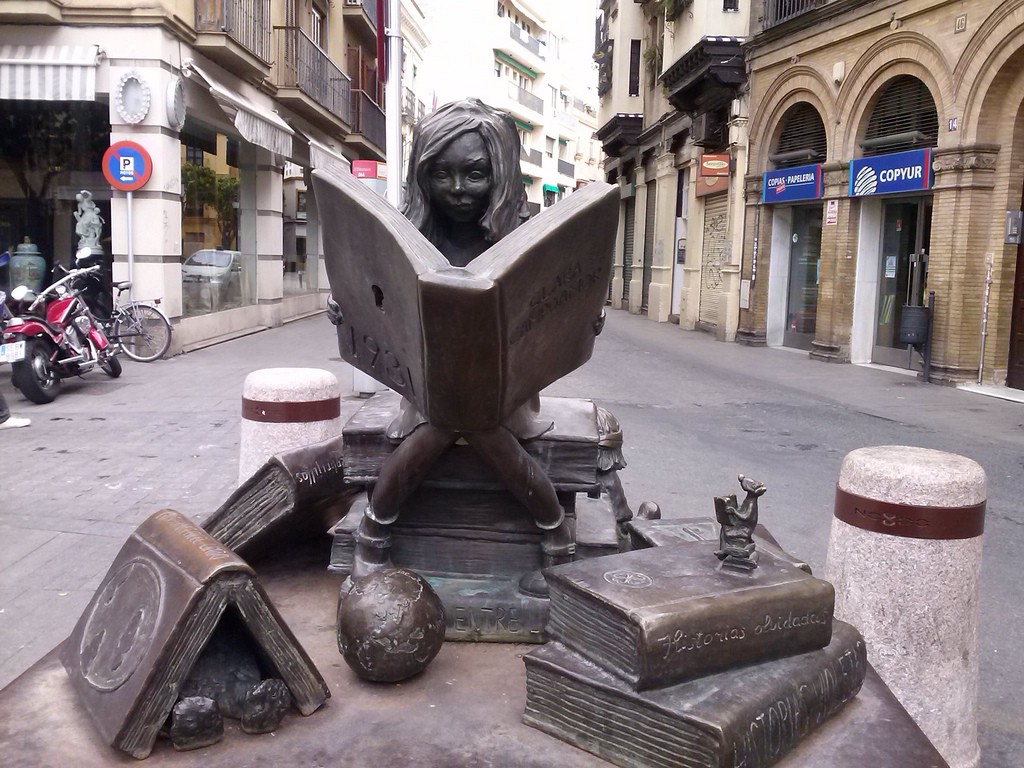
Atop a bronze pedestal sat a little girl, also cast in bronze. She perched on a pile of books, a heavy, oversized volume precariously balanced on her lap. More books were piled at her feet and a few toys lay scattered on the pedestal next to her. The girl was unimposing, as though she were in her own home, occasionally interrupting her reading to caress a worn toy. When one of the kids hit her pedestal with the ball, all of them looked up, as though to check whether or not they had disturbed her reading.
Baby squirmed in my arms. He’d had enough of looking. He wanted to be out there, chasing the ball through the puddles. The whole puddle business attracted his great attention. Dirt! Water! Bubbles! Water! We needed to move.
I took a quick snapshot of the statue. As soon as my husband finished eating, we put the baby back in the pack and ran for the next site on our itinerary.
When one of the kids hit her pedestal with the ball, all of them looked up, as though to check whether or not they had disturbed her reading.
Upon our return to San Francisco, I posted the travel photos online. A friend saw the little girl statue that had transfixed me for just a moment and translated the inscription on the pedestal. It was erected in 2007 by sculptor Anna Jonsson and dedicated by the city of Seville to the memory of Clara Campoamor “for her incalculable contribution to the work of women’s rights.” But who was Clara Campoamor? What had she done to deserve this kind of commemoration in the center of one of Europe’s most famous cities?
It took just a few clicks to gather the basics. Campoamor is to Spain what Susan B. Anthony is to the United States. In 1931, Campoamor swayed the government of the newly established Spanish Republic to extend full suffrage to women. “Only he who does not consider women to be human would affirm that all human and civil rights should not be the same for women as for men,” Campoamor had said during the debates. “A Constitution that gives the vote to beggars, to servants, and to illiterates — of which there are some in Spain — cannot deny it to women.” Her rhetoric proved convincing. Decades later, a score of schools and cultural institutions bear her name; her visage has graced stamps and coins; a recent television film dramatized her achievement in the suffrage debates; in 2006, for the seventy-fifth anniversary of the vote on suffrage, a larger-than-life bronze bust of Campoamor was erected in Madrid. That same anniversary, in 2006, occasioned the city of Seville to commission its statue.
According to photographs I found online, the Madrid bust of Clara Campoamor follows an image of Campoamor produced at the time when she, a successful lawyer, had been elected to a seat on the Spain’s Constituent Assembly. The neck of the sculpture appears exaggerated — it’s nearly as broad as her face, the sternomastoid muscles bulging. In Russian (my first language), I would describe this as a “bull’s neck” — the neck of a powerful and dangerous animal. Campoamor’s chin looks slightly upturned and her lips are extended into a quiet smile, suggesting the idea of hope and aspiration. Her short hair is combed in waves as though wind is blowing against her face. A gentle wind, by no means a storm. In the Seville statue I’d glimpsed a different story.
I read on. Campoamor was born in Madrid in 1888 (that year Susan B. Anthony organized an International Council of Women in Washington, D.C.). Her mother was a dressmaker and her father worked as an accountant in a local newspaper. When he died, ten-year old Campoamor had to quit school to help her mother. She began as a part-time seamstress and went on to a variety of menial jobs. It is this ten-year old who nurtures her dreams by reading big books that I saw in bronze on the Plaza de la Pescadería. This girl is gathering resilience for the challenging road ahead.
It is this ten-year old who nurtures her dreams by reading big books that I saw in bronze on the Plaza de la Pescadería. This girl is gathering resilience for the challenging road ahead.
Campoamor eventually became a telegraph operator and then a typist and a typing teacher. In her twenties, she wrote for popular newspapers, arguing for the rights of women, and, in particular, poor women. At the age of 33, she enrolled at the University of Madrid School of Law and participated in the debating societies in Madrid. She earned her degree at the age of 36 and was 44 at the time she won the election to the Constituent Assembly. Following the exile of King Alfonso XIII, in 1931, the Constituent Assembly was tasked with composing the brand new Republic’s constitution. Campoamor was one of only two women in the Assembly. Victoria Kent was the other and, for political reasons, argued against Campoamor on the question of suffrage. Having won the vote for all women, Campoamor lost the political battle and in 1933 was not reelected to the Assembly. In 1936, fearing for her life during the Spanish Civil War, she fled the country. Franco’s regime barred her from returning to Spain. She spent several years in Argentina, writing a biography of Sor Juana Inés de la Cruz, and later settled in Switzerland. Until her death in 1972, she continued to write on topics of feminism and her experiences in politics.
The friend who had translated the monument’s inscription shared with me a link to the sculptor’s webpage. The site was surprisingly easy to navigate in English. Anna Jonsson’s body of work was divided into four sections, “Sculptures” — all, with the exception of the Clara Campoamor sculpture, in brightly colored clay; “Embroideries,” “Dance-Performance,” and “The Super-Violeta Channel.” The biographical note explained, “Anna Jonsson was born in Skellefteå, Sweden in 1961 and has been resident in Seville since 1982 where she came to study Fine Arts. . . . Anna is a multidisciplinary artist, but sculpture has formed the basis for all her work.”
The commission for the Campoamor statue had been a competitive one, which Jonsson won. A few members of the local press had been upset that the winner was not a Seville native. Others expressed some confusion about the relevance of the depiction of an iconic female figure as a young child. Campoamor’s name had come to bear heft, and some criticized Jonsson’s imaginative approach as not reverent enough. My friend ended her note with the link to the artist’s social media page.
Campoamor’s name had come to bear heft, and some criticized Jonsson’s imaginative approach as not reverent enough.
Anna Jonsson responded to my email within days. In the next few weeks, we emailed back and forth, and she provided fuller back story about the monument on the Plaza de la Pescadería and how it became a part of Seville.
“My thoughts were, How do you pay homage to a person you really admire?” Jonsson wrote. “How do you get people to want to learn more about her? Typically, you would recommend a book by or about that person. I would like everyone to read Campoamor; everyone, and especially my own beloved daughters. So I created a girl in the space of her own, her room with toys and books. Campoamor was a lawyer; therefore, among the toys is a blindfolded doll and a mouse resting on a scale. When it rains, the cup of the scale fills with water and it looks like the mouse is swimming. The titles on the spines of the books provide clues on how to read women’s history: History in between, in limbo, invisible, purple . . . and yes! the keys to history — Who won the war? Who wrote the book?”
The books are titled “Historias obvidades,” “Historias violetas,” “Historias invisibiles,” and so on. While preparing to work on the sculpture, Jonsson reread Campoamor’s writing. Johnson wrote, “I read books by her and about her. What most impressed me was her performance in Congress during the debates on the women’s right to vote. Her speech was so outstanding, so clear-sighted, so clever and respectful — she made the rest of them sound like fools. At the time everyone was persuaded by Campoamor’s eloquence.”
Though initially the sculpture received some criticism, it has become a beloved site for locals and the tourists alike. “The neighbors in the plaza like it, they even tried to make it a place for exchanging books,” Jonsson wrote. Unfortunately, “this initiative ended when the city cleaners threw the books away.” Architecture and fine arts students have used the sculpture for their projects; it has received attention from a prize-winning photographer and even a theater company that wanted to use it for a performance. Tour guides include the sculpture on their routes, and the city cleaners do a great job of removing any occasional graffiti. Jonsson clarified, “The sculpture has been very little vandalized which is really amazing, considering that there are restaurants, pubs, and a disco in the square. I feel that people care about the girl. I wonder if she somehow touches upon everyone’s protection instinct.”
This tenderness enchanted me. I began working on an essay about the artist and her statue — my own artistic reaction to the statue. But it took a long time — over a year —to get it right. Then I realized that while I’d been identifying with the little girl, measuring my own childhood and abilities against that of little Clara Campoamor, Jonsson had approached her creation as though the famous feminist were her little girl — a child who needed her care.
While I’d been identifying with the little girl, measuring my own childhood and abilities against that of little Clara Campoamor, Jonsson approached her creation as though the famous feminist were her little girl — a child who needed her care.
She was mothering her work. Though technically I’d been a mother at the time when I encountered the girl, my baby had been very much attached then, he still felt like a part of my body. It wasn’t until a few months after the trip, when he started calling me “mama” that I began to suspect that I was one. Jonsson’s description of her statue — I’d been thinking of it often — finally landed, allowing me to understand that my point of view was shifting.
The shift is not linear, but rather a matter of adding something like a new photo filter to the existing array. My relationship with Anna Jonsson’s artwork revealed this clearly.
That winter in Seville, on the Plaza de la Pescadería, the transaction was quick. I saw the statue of the little girl and recalled my own childhood, surrounded by books. I identified with the girl the feeling of staring at the pages of the books and trying to extrapolate from them the road ahead, the future as yet unwritten, a life filled with possibilities. That girl could grow up to be anyone she wanted to be — and, looking at her, I felt like I still could, too.
When I return the image of the sculpture all these months later, knowing something about Clara Campoamor and her work, I still face the representation of her as a little girl. The sense of possibility is still there, but it’s curbed now by what I know about the facts of her life. Campoamor made an important difference in the lives of women, and yet I imagine her own filled with disappointment in things small and large. I know and so does Jonsson what it’s like to live in a country not one’s own (Jonsson has referred to her own experience as being “an inbetweener”), but she and I have chosen our homes and can only imagine what it must’ve been like for Campoamor to live out her life as an exile. Women of Spain have held on to their right to vote through the years of Franco’s dictatorship, but the battle for representation and equality is by no means over.
Jonsson wrote that the girl “somehow touches upon everyone’s protection instinct.” The desire to help, to do something for the girl feels urgent. I wonder: What could I have done for Clara Campoamor had I been her mother? How could I have mothered her in such a way as to help her build the resilience and strength needed to accomplish what I know she must on a road that is so singular and solitary? More than that, I wish for her to have arrived at the end of her life with the same sense of accomplishment I have when I look at her chapter in history in retrospect. I want to comfort her by reminding her of her own importance.
What could I have done for Clara Campoamor had I been her mother? How could I have mothered her in such a way as to help her build the resilience and strength needed to accomplish what I know she must on a road that is so singular and solitary?
Studying Anna Jonsson’s site, I’d spent some time on the page titled “The SuperVioleta Channel.” This is a series of feminist videos, executed in an absurdist style. In my favorite of these, “Perdón,” a young girl wearing a purple wig and made up to look middle aged repeats the single word apology, “perdón, perdón, perdón, perdón” for three and a half minutes, varying her expressions and intonations, reflecting the multitude of ways in which women say they are sorry. The effect is haunting.
I asked Jonsson about the collaborative aspect of her art. I had expected her to talk about the work itself, her artistic vision— instead, Jonsson focused on her two daughters. Ingrid and Greta have been her models, and from the beginning, they have also been her co-creators. Both girls grew up to be artists. The older, Ingrid García Jonsson, has achieved some prominence as an actor in Madrid. The younger, Greta, is a dancer who is also studying law. At first, most collaborative ideas came from the mother, but as time went on, Jonsson has become a participant in her daughters’ creative work. “It’s a privilege having someone so close to you who always supports your crazy projects.”
In this context, I ponder the Clara Campoamor sculpture anew. What if this little Clara really were my own daughter? If motherhood, considered in historical terms, feels like a weighty responsibility to which I’m decidedly not equal, Jonsson’s words sound hopeful. Perhaps being an artist — or a writer, or a lawyer — and a mother doesn’t have to be an either-or proposition. One doesn’t need to take away from another, but could instead nourish and enrich the other. This realization, however, requires a change of attitude and an act of resistance to a dominant cultural trope.
Becoming a mother means, it turns out, becoming a mother in my imagination. Becoming a mother also means becoming a mother to my imagination. I’ve been given an opportunity to transform my imagination, to guide it from the achievement-dominated myths about work that I’ve inherited and to look instead for plots that are additive and creative.
Becoming a mother means, it turns out, becoming a mother in my imagination. Becoming a mother also means becoming a mother TO my imagination.
Clara Campoamor changed something very real in the world, but I doubt that as a little girl she had set out to defend women’s rights. It’s heartening to see Spain celebrating her accomplishments. All the more, it’s exciting that in portraying Campoamor as a little girl, Anna Jonsson has enabled us to see her not through the power of her achievements but through the everyday scene of her as a child with a wide open future.
What do we do with the art of monstrous men?” asked Claire Dederer in The Paris Review last month. When genius creators like Bill Cosby and Roman Polanski are also known to be criminals and abusers, does it become somehow immoral to appreciate their work? Or, by contrast, is it unacceptable not to appreciate it, to let emotions like revulsion stand in the way of a purely intellectual appreciation of skill? When Dederer finds herself unable to sit through Woody Allen’s Manhattan without nausea, is she doing right by the victims, or wrong by the auteur?
It’s an interesting thought experiment, one we keep coming back to again and again — though rarely with more urgency than in the last few years, and then especially the last few months, as more and more abusers are unmasked. Is it possible to separate the art from the artist? Is it ethical? These are the sorts of philosophical questions that launch thousands of words of text. (Here’s Pacific Standard in 2014. Here’s The Guardian in 2013. Here’s Newsweek in 2009.)
But meanwhile, as we wrestle with the questions of what to do with morally hideous artists, we ignore the more hideous truth: Most of the men whose abuses are now coming to light aren’t makers of art. They’re gatekeepers.
Most of the men whose abuses are now coming to light aren’t makers of art. They’re gatekeepers.
Two and a half weeks after Dederer’s essay was published in The Paris Review, that publication’s editor, Lorin Stein — the person tasked with setting the magazine’s artistic vision and selecting the writing that does and does not appear — resigned due to accusations of sexual misconduct. He’s only the latest literary gatekeeper to fall. Hamilton Fish, president and publisher of The New Republic, resigned under similar circumstances in November. Leon Wieseltier, former literary editor of The New Republic, had a new magazine scuppered by harassment claims.
In the entertainment world, too, the abuses are being perpetrated not only by people whose art we can hand-wring over — the writers, the actors, the directors — but by the people behind the scenes, the ones deciding whose voices get heard. Harvey Weinstein, in many ways the hard-falling rock that set off this avalanche, was not a creator but a producer. “The accused are men who help to determine what art gets seen and appreciated — and, crucially, paid for,” wrote Rebecca Traister in New York Magazine. When abusers don’t just make art, but decide what art is, the calculation becomes trickier. It’s not Woody Allen’s movies that are tainted; it’s the entire movie endeavor. And as literary gatekeepers hit the ground, they spread a similar stain.
You can’t point to a work of genius by Stein and debate over whether it can still be appreciated. He wasn’t a maker, but a tastemaker — part of a network of white, male, and yes, sometimes abusive literary tastemakers who have long defined what it takes for writing to be successful, what it means for writing to be “good.” Witness, if you have the stomach for it, this nauseating-in-retrospect New York Times profile of Stein from when he took over the magazine. Stein offers to “pimp” Zadie Smith, and declares himself “kissed out” after a party, but the article also muses on his literary connections — all men — and his responsibility to the ideals of literary quality. “[The Paris Review] will stand or fall on the quality of its literariness,” says one of Stein’s colleagues in the article’s closing quote. “It has to provide beautiful, witty, rarefied fun of a distinct kind. … Lorin needs to make The Paris Review matter to people for whom literature matters.” It’s Leon Wieseltier.
This closed-system idea of literary value, defined and defended by the kind of men who have always taken their power for granted and used it for gain, reverberates well beyond any single piece, or even any single publication. Nor will it be solved simply by removing the gatekeepers from their positions of influence. The Paris Review did once have a woman editor, Brigid Hughes, though she was ousted in favor of the more famous and flashy Philip Gourevitch in 2005. (And subsequently erased from the publication’s history; I wouldn’t have known about her without a tweet thread from A.N. Devers.) In a Times profile of Hughes, written when she took over the magazine in 2004, she insisted over and over that her only goal was “to publish good writing, whatever form that takes.” When the reporter asked if she would try to shift the publication’s notoriously skewed gender balance, she demurred that “I’m not going to consciously insist on half men and half women,” although she allowed that she has “different tastes” than founder George Plimpton. It matters to have a person with different “tastes” — or rather, with different life experience, prone to noticing and appreciating different things — at the helm. But when “taste” and “good writing” are defined in large part by that network of powerful literary men, the ones clapping each other on the back about making literature matter and then being exposed as abusers one by one, it may not matter enough.
If your idea of value springs from an ethical void, it’s time to transplant it onto stronger soil.
Once you realize how much the structures of literary power are bound up with the concept of literary quality, it becomes clear — if it wasn’t already — that our entire concept of “quality” is suspect. The Paris Review publishes twice as many men as women; are men twice as good? The New York Timesdescribed Stein as “regarded by many as a champion of new talent, including some women writers,” but that “some” is poison. One can’t really make the case that Stein was a champion of women writers generally; under his auspices, The Paris Review went from one-third women writers to… one-third women writers. So who broke through to be part of the illustrious third? This is not to say that the writers who did make their way into The Paris Review’s pages aren’t worthy, but we should illuminate the hand that picked them, and the other work it cast aside. In short, if you weren’t already paying attention to the ways that whiteness and maleness determine what we value in art, you should be now.
There is such a thing as “good writing”; it’s not a purely vacuous phrase. (Most of the work in The Paris Review is, in fact, good writing, in various ways!) But any first-year writing workshop would push you to unpack the word “good.” Do you mean rhetorically effective writing? Emotionally effective? Simple and clear writing? Evocative writing full of detail? Too often, what we actually mean by “good writing” is “writing that has been ratified by the literary establishment.” But the literary establishment, we are coming to find, is bad. (Morally.) If your idea of value springs from an ethical void, it’s time to transplant it onto stronger soil.
We can ask ourselves now, again, whether we can separate the art from the artist, and ask ourselves again when the next allegations come to light. But perhaps it’s more important to ask whether we can separate art from the people who decide what art is — and, crucially, what we’ve been missing that they wouldn’t let us see.
DON’T MISS OUT
Sign up for our newsletter to get submission announcements and stay on top of our best work.
YOUR INBOX IS LIT
Enjoy strange, diverting work from The Commuter on Mondays, absorbing fiction from Recommended Reading on Wednesdays, and a roundup of our best work of the week on Fridays. Personalize your subscription preferences here.