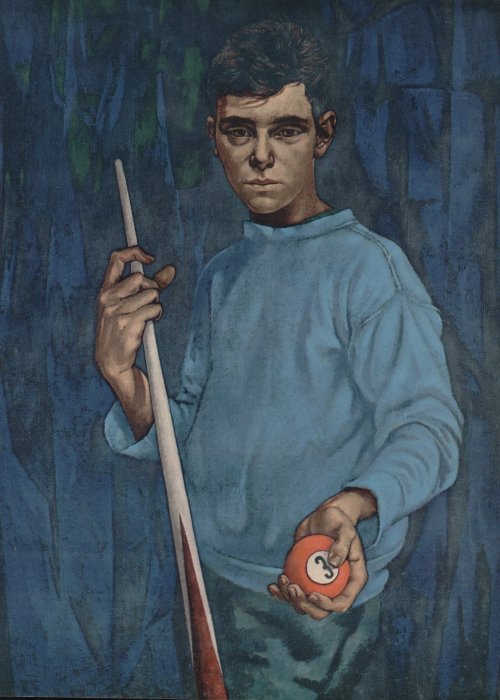
The Song that Holds the Last of Syria

“Everything Blooms”

by Zeyn Joukhadar

The cat has a tick in its neck. Even from this distance, Basim can see that. His glasses are the one thing he hasn’t lost yet. At times, he’s forgotten where he left his keys, misplaced his heart medication, lost his Sam’s Club membership card. He can’t afford to lose his glasses — without them, he can’t even see the numbers on the register.

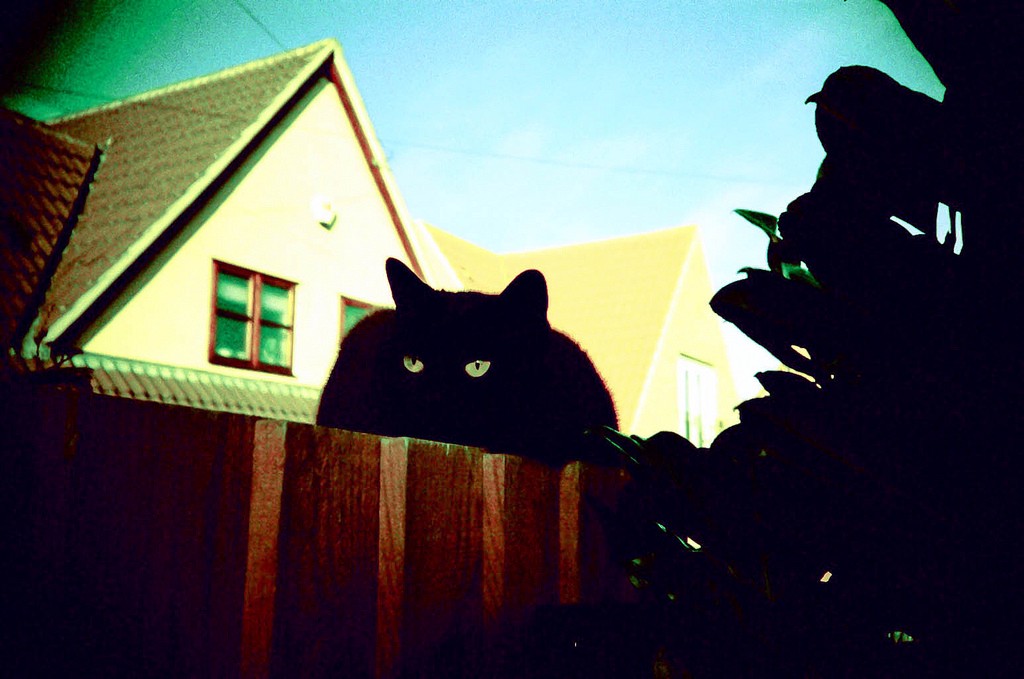
“Here, kitty, kitty.” Basim clucks, crouches. The cat doesn’t seem afraid of anything. It hurries over to him, letting out a mewl that bounces and wobbles with each step. Basim strokes its white fur and glances past the end of his driveway, toward the red-faced bank barn, the pastured cows staring with slits for eyes from across the way. Up and down the country road — no one.

Everything Blooms (Electric Literature’s Recommended Reading Book 281)

“Why did I open a music shop in a town this small? Huh, kitty?” The cat rolls over on its back, exposing the matted fur on its belly. The sun’s warmed the pavement, and the cat stretches itself out, lolling its body from side to side. Basim eyes the tick, nestled in the white fur.

“I’ll be right back.” Basim gets up and goes inside. The bell on the music shop door chimes. Sundays are always slow, no customers. Sundays are for listening to music and thinking.

Basim fetches a pair of tweezers from the bathroom and dips them in rubbing alcohol. When he comes back out, the cat’s still lounging on its back, running its tongue over the pads of one paw. It narrows its eyes at him as he emerges, the bell clanging behind him.

Basim holds up the tweezers. “Something for that pest,” he says. He kneels and runs his palm over the cat’s spine. The cat arches into his hand, stretching its legs and curling its tail. It seems friendly enough.

“Hold still, now.” He presses the tweezers to the cat’s neck. It doesn’t twist away. Basim tugs the wriggling tick from the animal’s fur and tosses it to the pavement. He crushes it with his shoe.

“There, now,” he says. The cat gets lazily to its feet and stares at him. “Go home, now.” It doesn’t move. Basim stands and brushes himself off. He pretends to ignore the cat, turning to take in his shop sign: Basim’s. How proud he was when he first opened, how proud he is now.

When Basim opens the shop door, the cat follows him.

“Suit yourself,” he says. He pushes the door open, and the bell chimes, trembles. Basim makes his way back behind the register and presses play on the CD he was listening to. The shop speakers thrum to life, releasing a plaintive woman’s voice. The cat slinks between the rows of CDs, jumps on top of the counter. It settles next to Basim, curling up for a nap.

“Do you like Umm Kulthum?” Basim strokes the cat’s bone-white back, the same color as Basim’s hair and stubbled mustache. “She reminds me of home,” he says, leaning his elbows on the counter. “Things were more simple then. My mother used to make kunafeh when things were slow and the weather wasn’t too damp. You know kunafeh? It’s a cheese pastry. You soak it in sugar syrup with a few drops of rose water.” The cat buries its head in its paws, blocking out the world.

The bell chimes again, and the cat raises its head. A boy walks in, his T-shirt tight with sweat against his shoulders. Basim searches his memory — has he seen the boy on his bike before? He can’t seem to remember anything these days. Basim lowers his head as the boy browses the rows of CDs, past the singles, the top twenties arranged by year, past classical and hip hop. He stops in front of the foreign music section, still as a ghost, hovering. Basim looks away, turns down the Umm Kulthum album two notches. The boy scans the names of tracks.

Basim’s CD skips — he’s had it over a decade, a souvenir from his last trip to his native Syria, before the cataracts and the beginnings of his failing memory made him stop traveling.

“You found my cat.”

Basim looks up and jumps, the hair on his arms twitching. The boy is standing directly in front of the counter. When did he get there? The boy’s a haunting.

“Your cat?” Basim adjusts his glasses and frowns down at the boy. “Oh — she came this morning. Had some trouble with a tick.”

“It’s a he,” the boy says. “Name’s Max.”

“Max, then,” Basim says. “You should take him home before he wanders off again.”

“This was my dad’s favorite song,” the boy says. “Didn’t see the album on the shelf.”

Basim frowns at the boy again, over the rim of his glasses. “It’s not for sale.” Annoyance rises like an itch, and Basim wishes the boy would choose something else and leave him to himself. Sundays are his only day to relax, the only day he can play what he wants in the shop. The music helps him remember the old times, the good times. He remembers his mother and his grandmother, the laundry lines crisscrossed over the streets of Homs, digging through baskets of dried lentils in the souq on early mornings. Sometimes Basim feels his memories are trapped between the notes of Umm Kulthum like sticky grains of rice in a colander. He worries that someday that will be the only place they remain, once they’ve all drained out of the holes in his aging mind.

The boy fidgets. He reaches for the cat, who rolls away from him. “Did you know my dad?” he asks. “We moved into the red house down the road, past the steer farm. Last year. He got me a bike, said I could ride it, now we moved out of the city.” He pauses. “Dad saw your signs in the window, the big foreign music section. Said you were the only other Syrian in the whole county.”

“He said what?” Something warm and agitated comes to life inside Basim, squirming like the many-legged tick. The months of keeping to himself, the feeling that no one understands. The war has destroyed most of Homs, he knows, though he never lets himself watch the newscasts when they air. He doesn’t want to see it as it is now, metal wall-supports sprouting like hair from fields of gray rubble, the sickening slant of cracked rooftops, a child’s plastic slippers mangled in the street. Basim wants to remember the city where he was born when it was still green, when the women laughed out stories, when the men clapped and danced at the tables outside the cafes.

“My dad’s from Homs,” the boy says. Sweat tracks from his earlobe to the collar of his T-shirt, uncovering a deep tan under a layer of dry Pennsylvania dust. “Was, I mean.”

“Was?”

“He died six months ago.” The boy reaches up again to pet the cat. The animal lets him, doesn’t move or even open its eyes.

Basim almost says, In the war? Instead he says, “What happened?”

“Heart attack.” The boy doesn’t even look up, says it as though it’s the name of a track on his favorite album, a line from a comic book. “Mom thought the fresh air would do him good, get him to exercise more. But then he was gone.”

Basim says, “I’m sorry.” He imagines the cat slinking out the door behind the boy, being alone in the shop again. He feels a pang like loneliness, though he doesn’t think he’s felt lonely in years. He thinks to himself that death changes a kid. He says, “I’ll give you the CD on one condition.”

The boy looks up, his hand still buried in the scruff of fur at the back of the cat’s neck. “What’s that?”

“You’ll come here tomorrow and listen to it with me.”

The boy smiles. Basim thinks of his bicycle in Homs, the way he used to lean it up against the wall of his parents’ apartment building, making sure the handlebars were in the shade so they didn’t get hot while he was inside. Inside him is a summer warmer and wider than any Pennsylvania has ever seen.

The boy extends his hand. “Nagib,” he says, “but you can call me Nate.”

Basim shakes his hand. He ejects the CD, places it carefully in its jewel case. He hands it to the boy. “Nate,” he says. “Tomorrow.”

The bell chimes. The white cat follows Nate out the door.

When Nate returns, he brings his cat. Basim is happy to see them in spite of himself, in spite of the fact that he misplaced his cordless phone just that morning. Basim gets a stool from behind the counter, and Nate settles on top of it on the other side, the cat between them. Basim puts on Umm Kulthum. She charges up with her voice like a cloud horse, rising on the wind. She repeats words, yearns like a caged bird.

“How much do you understand?” Basim asks.

“Some.” The boy seems quieter than the day before, less forthcoming. Basim lets him be. He closes his eyes, pictures his childhood to the music. A five-minute ride to his aunt’s, ten minutes to the spot his grandmother once told him used to house a communal oven when the city was filled with horses and caravans. The trellis of roses in their neighbor’s garden. Basim remembers being unable to fathom how old his grandmother was, being overwhelmed by the idea of generations stretching into generations, centuries of change.

“How long you lived here?”

Basim opens his eyes and smiles, tugging at his white mustache. “Oh,” he says, “many years. First twenty, then thirty, then forty years. I’ve lived longer in Lancaster County than in Homs.”

“Dad used to say it doesn’t leave you.”

“A very deep thought from such a small boy,” Basim says.

Nate is staring at him with those dark eyes, then flicks them away to the cat at the last second. “Max loved him,” he says. He massages the back of the cat’s neck, gently pulling on loose rolls of flesh. The cat yawns and purrs.

“Sometimes it’s good to talk about it,” Basim says.

Nate looks down and away, toward the rows of CDs. “Dad used to tell me about when he was my age, where he grew up.” He reaches into his pocket. “You seen what’s happened?” he asks. “There’s nothing left. Nothing.”

Basim squints while Nate taps and swipes at his phone. Images come up, video. Nate hands the phone to Basim. He holds it up to his face. He’s flying above the wreckage of some ancient city — no, these are apartment buildings, concrete walls, flat ceilings with satellite dishes clinging to them like thousands of ears.

“What is this?” Basim whispers.

Nate scratches the cat behind the ears. “Homs.”

A piece of Basim is carved out. It slips out under his ribs, red, inconsolable. That familiar pull of what is loved but slowly forgotten, the unbearable certainty that something beautiful has been snuffed out forever, like a piece of music erased, corrupted. Basim closes his eyes and imagines the walls painted again, bright as anything, turning slabs of brick and plaster to gold, rebar to ruby. Basim opens his eyes. The city bleeds his mother’s blood, his grandmother’s.

“Didn’t know if you’d already seen it,” Nate says.

“No.” Basim blinks, compares his memory to reality. For a moment, he’d felt lucid and whole, as though the past were more real than the present, as though a part of him had just laid his bicycle against his mother’s apartment wall. He shudders. That wriggling pain again, the sheer impossibility of hope, hard as granite. “How easy it is for things to break apart,” he says, and his old voice cracks.

Nate scoots his stool to one side, reaches his arm around the cat. The video stops. He takes the phone back and stuffs it in his pocket. Basim lets his head hang, his hands flat on the counter, listening to his breath. He shuts his eyes again. For the first time, he wishes he’d lost his glasses, wishes he could will himself to toss them down and smash the lenses so he only had to hear, rather than see.

Nate reaches over and sets one of his hands on the counter next to Basim’s, just touching his knuckles. They look at each other.

“Dad said the same thing,” Nate says. The cat stretches, rippling the muscles on its shoulder blades. “Said at least he remembered it the way it used to be. The taste of the rice, lentils. Olives. Kunafeh.”

Basim nods. “Kunafeh.” Clammy warmth spreads from Nate’s chubby fingers into Basim’s age-spotted hand. All around them, the rose of Umm Kulthum’s voice climbs the wall as though it were a trellis, and everything blooms.
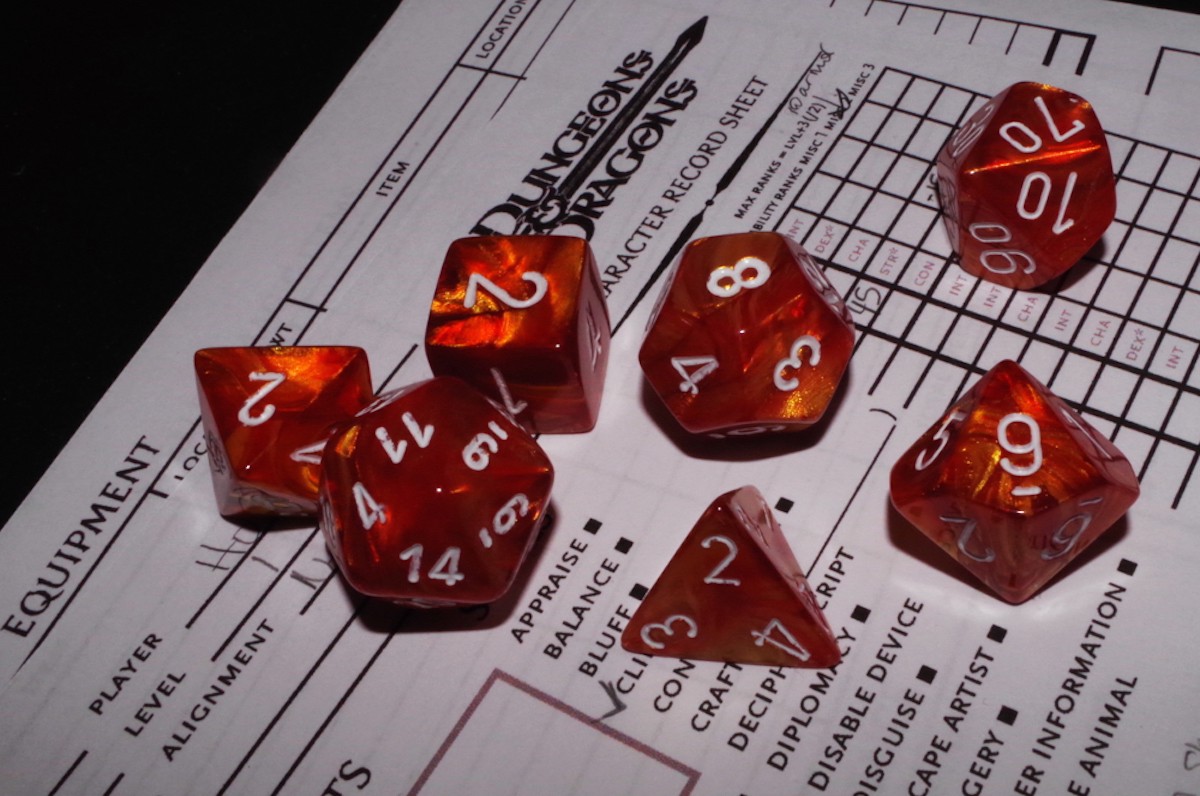
Why All Writers Should Play Dungeons & Dragons

For decades, friends have collected in basements to fight zombies and goblins, find enchanted treasure, and save countless realms — armed only with paper and dice. This is Dungeons and Dragons , the roleplaying game that has swept nerddom by storm. But at its core, D&D is a device for storytelling, an oral tradition of collaboration and cooperation, crafting some of the most epic tales of the modern era.

Dungeons & Dragons (D&D for short) is a roleplaying game, meaning each player inhabits one character. Players improvise actions and invent plot while acting as their characters, rolling a die, usually a 20-sided die, to see if they are successful. Every character has strengths and weaknesses, which add or subtract numbers from the player’s dice rolls; a muscle-bound fighter may have an easy time picking up massive boulders, say, but they’ll ruin tense political negotiations with their low charisma. Embarking on adventures together, the party interacts with the world’s people and each other. They solve problems, fight evil, and discover treasure and knowledge. The game runs smoothly with the guidance of a Dungeon Master (or DM), who acts as the game’s referee and storyteller, maintaining the setting and world where the adventures happen and playing the role of the people in the world.

The producers of the D&D podcast Join the Party — Eric Silver (the DM), Amanda McLoughlin (moon elf rogue Inara Harthorn), Brandon Grugle (warforged barbarian TR8c), and Michael Fische, aka Fish (half-elf warlock Johnny B. Goodlight) — sat down to talk about the relationship between the game and novels, the fears behind writing and playing, and what D&D can do that that reading and writing can’t.


Amanda McLoughlin: Fish, did you play D&D as a kid?

Michael Fische: Kind of. My brother and I, before we knew it had a name, would sit in my bedroom and we would tell stories to each other. And I would make up, because I didn’t have dice, elaborate ways of inducing chaos to whatever story we were telling. So my brother’s character would walk down the trail in the woods and I would have a chart where I would close my eyes, move my hand, place it down on paper and that would be what happened.

Eric Silver: That’s some Betrayal at the House on the Hill shit. Oh god.

Brandon Grugle: I feel like if I played with my little brother, it would just be like, “Oh, you die, I win!”

MF: Oh no, don’t worry, he died a lot.

AM: Why was that a lot more fun than just telling a story?

MF: It kept both of us on our toes. It meant that, even if I wanted us to do something, it wasn’t guaranteed to happen. There were so many different possibilities — he would have to make up what his character was doing, and I had to be ready to deal with whatever craziness he started.

ES: Which is what I have to do now as our Dungeon Master!

MF: Right. The game evens the playing field between the story creator and story consumers. I think if you imagine the Dungeon Master to be an author and D&D players to be characters within the story, you see how D&D gives the characters a power that they wouldn’t have in any other story. Roleplaying game characters have more power over what’s happening and their own destinies than they ever would in a typical fiction story.

Roleplaying game characters have more power over what’s happening and their own destinies than they ever would in a typical fiction story.

AM: It’s the most extreme example of your characters coming to life as a writer. When you’re writing a narrative, you feel sometimes that your characters have agency of their own — like they’re going to make decisions for themselves. But, for me, it’s really freeing not to get particularly attached to one way of doing things. I always get so overwhelmed with possibility when I’m writing that I can’t commit to one setting. Or I commit to one, then get buyer’s remorse and try to introduce flashbacks or parallel universes to cram those unused settings in there.

BG: Oh yeah, me too. My favorite books as a kid were choose-your-own-adventure books where the ending was always unpredictable. That was built into the story. And that’s why I got really interested in D&D, because there’s no possible way for me to know what’s next. I can’t force my way into the story like that.

AM: When I played pretend with my siblings I was very prescriptive: “This is what you do now.” I was dictating how they were playing in the universe. But on the other extreme, I would also get bored working on theater shows where the same thing happened every night. Unlike actors, I don’t get the idea that you can discover new meaning every night. Actors’ know what to say next, but also kind of feel through that decision or revelation for the first time over and over again every performance. I would just get bored running the same lighting cues over and over again. But in D&D, when you all sit down together, you know nothing is going to go the way anyone thinks. We’re making the magic together. There isn’t a script to follow. It’s the best compromise between “Here is a blank page, good luck!” and “Here is a script you have to follow.”

MF: The more I’ve played D&D the harder it’s been to read fantasy books, because I could just be playing it instead! I could be plotting and making decisions as the DM or as a character, shaping the world to make it more interesting.

AM: And the dice are that crucial element of chance, making you introduce conflict. As a writer, I’m too soft-hearted to make characters suffer. I love them too much! I just can’t bring myself to do it! But in a game, it would be so boring for nothing to happen — though of course there’s no way nothing would happen, because the DM is going to keep the action moving along. Then chance is going to decide for you if things succeed or not. I love that it’s not up to me to decide if my character fails or succeeds at something. I can roll with the rolls — listen to the dice, adapt to the outcome, and figure out how to make it work within the story.

ES: I mean, writing fiction is scary. Not only for all the reasons that we’ve been saying, but because the entire narrative is in your hands. If I had the choice for my characters to tell me what they would want to do, that would be AMAZING. Playing D&D together is doing that — shaping the plot — as a collaboration. I love this idea that you’re playing within a structure of a game, but everyone is working together to create a story, even as enemies and conflicts are being thrown out in front of you.

You’re playing within a structure of a game, but everyone is working together to create a story.

BG: If authors could choose to have their characters come to life, wouldn’t they choose that every time?

ES: EVERY time. Your creation is your baby anyway. Give them actual human form and… Imagine interacting with some of these flat, two-dimensional characters in real life or in the game? The hero who is only good and sees morality in black and white would die in three days in the real world.

AM: Or you would be the most boring person at your session! We all want to make a great story and to entertain each other. I think that makes us make our characters act a little more like people than you would on a page. If someone acted to type, acted totally predictably, we would get bored. If I could predict what your character would do every time? That would be so boring!

BG: But it’s not just on one person to carry that story. Splitting up responsibility forces everyone to be better. When you put four people in a room who are trying to have the most fun and most exciting time, it forces everyone to be their best.

AM: Which is quite unlike sitting at your desk writing a story, hoping someone, someday, will find it exciting. In our games I know right away if a joke falls flat, and I know if I make an exciting choice when I see your faces light up. It is instantaneous feedback.

MF: And if we were playing the game and everything was just falling flat, we could close the book, come back a week later, and start a whole new campaign. It could even be something other than fantasy. But when you write a book or a script or a play, you won’t know for months or years if something’s good. That immediacy is important, and D&D lets us apply it to our storytelling. It just makes everything dynamic and fun.

AM: But we’re not hanging each other out to dry, either. It can be funny to watch someone scramble during an improv night, but not so much when you’re sitting at a table together. The more I play, the more I realize the best part of playing is when I’m not saying anything. The best part is watching it all unfold in front of me.

ES: Since no player is trying to impress an audience, everyone has their own ideas and goals coming in. It’s the collision of everyone’s thoughts that make this thing complex. Have you ever read a novel where you knew exactly what they were trying to get at on the first few pages? Like “Oh wow, this a really cool critique of capitalism.” (Everyone laughs) “I’m excited to read 300 pages about how capitalism is bad.” But when everyone’s ideas are coming together, trying to get what they want, that’s very beautiful. It challenges the story.

When everyone’s ideas are coming together, trying to get what they want, that’s very beautiful. It challenges the story.

AM: It’s also challenging to step into for the first time, though.

ES: There is a steep learning curve when you bring people in and try to get them to play D&D, or if people investigate it on their own because they saw it wherever. But it is no steeper than trying to start any other creative project. How many times have you written four or five pages and threw them out because they were trash? I’d much rather start a scary new project within a community that’s trying to get everything to gel together, because then at least you have something. I mean, it’s a little harder for us because our learning and growing pains are on microphone. But I’d much rather have growing pains than so many five- or ten-page chunks of novels I haven’t started.

MF: Right, you can mold the story into something else if it’s not working.

AM: The game can be tailor-made for you but also surprising at the same time. It’s not a boring book where I can’t get past the first chapter and try again and again, and I’m continuously bored. Like, if that’s the case in D&D, then I’ll run out of the castle and try to seduce the barmaid.

ES: CLASSIC AMANDA.

AM: Listen, guys, gotta borrow from real life to make good character choices.

ES: The stories we make also hold up later. It’s not just this insular thing that only the people around that table can enjoy. I don’t know if every D&D game would hold up as a novel since there’s so much acting involved, but fans can flock to other people’s games when they’re adapted in a smart way to auditory or visual mediums.

D&D requires you to imagine yourself in the stories you consume.

MF: The way technology is now, you can watch a group play on YouTube or listen to a real play podcast and then go play a game of your own later that afternoon.

AM: That’s a perfect point to end on. You can listen and get inspired and play that same afternoon, which is kind of open and daring. D&D requires you to imagine yourself in the stories you consume. It’s so natural to want to participate in the stuff that you think is awesome. That was so easy to do as a kid — every kid writes fan fiction of some kind, or plays pretend in the universe of their favorite movie, or dresses up like Buzz Lightyear at school. And this is, I wouldn’t say a grown-up way to do it… it’s just a more structured and communal way to play pretend and still challenge yourself. We’re maintaining that spirit of play and saying, yes, I have a right to shape the stories that I consume. It’s nothing but awesome.

Ready to try a game of your own? Listen to Join the Party’s Beginner Episodes (part 1 and part 2) to learn the basics before diving in yourself.

The 10 Biggest Sycophants from Literature and History

We have entered a period of spectacular bowing and scraping, in which White House staff compete publicly in stroking the ego of their flattery-addicted boss. Sucking-up takes a variety of forms, from petty compliment, to cloying flattery, to outright treachery. Our responses are just as varied — from impatience and annoyance to disgust and rage. Sycophancy combines with other vices — hypocrisy, lying, manipulation, and fraud — and intensifies them. The examples of bootlicking below list a few famous historical toadies as well as some books that offer brilliant accounts of sycophancy and its corrosive effects.

History’s Bootlickers

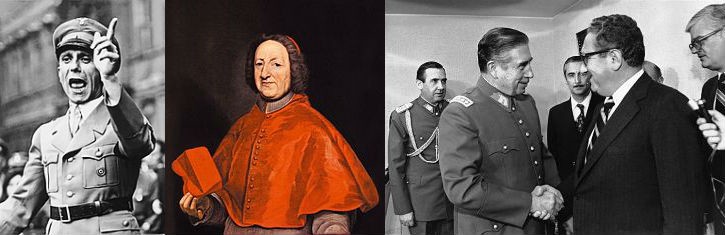
For his combination of all the worst elements of sycophancy, and his persistence in carrying out his program of flattery, Joseph Goebbels, Hitler’s Minister of Propaganda, would deserve first consideration. Goebbels’ propagandizing began with his leader. He initiated the “Heil Hitler” salute and insisted on the use of “Der Führer” as title. His letters are full of groveling praise — such as repeated testimonials that the experience of Hitler transformed his consciousness — and imagined scenes of glorious triumphs against various adversaries in which the Führer stands firm and unshakeable. Almost single-handedly, Goebbels created the prototype for subsequent versions of state-sponsored sycophancy.

The power of the state can also be marshaled in less pervasive demonstrations, as an incident from the Roman Emperor Caligula’s notorious rule reminds us. During an illness early in Caligula’s reign, a commoner vowed to give his own life if the emperor recovered. The man made his vow publicly, hoping through his extravagant offer to show his deep loyalty and to elicit a generous award for his avowal. Although Caligula did recover, the lickspittle’s tactic backfired spectacularly. Once back on his feet, Caligula chose to take the man at his word and ordered his execution. Quite the lesson that words should mean what they say. Death by sycophancy is hard to top.

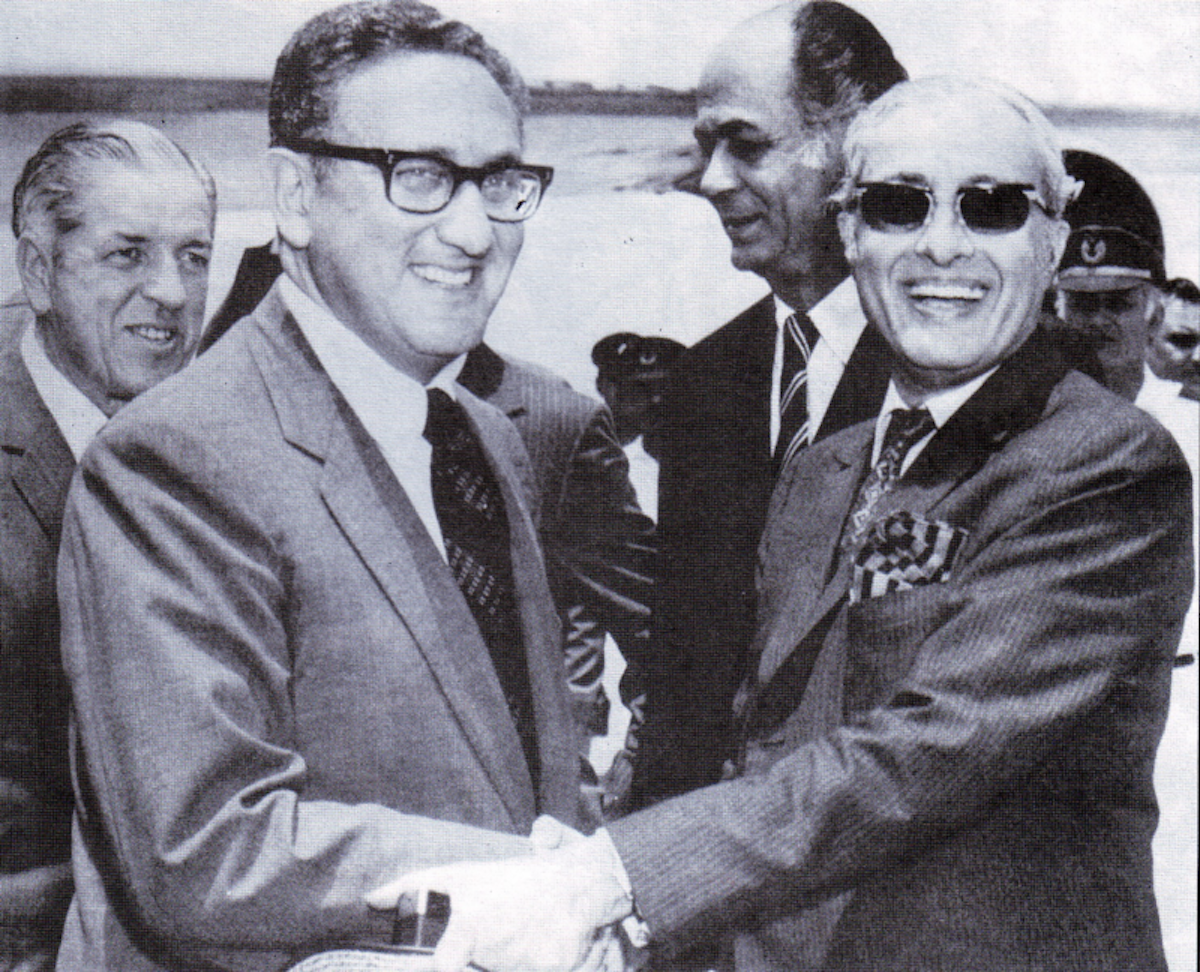
The former Secretary of State Henry Kissinger showed great promise as sycophant from his earliest days as a graduate student at Harvard’s School of Government, where his fellow students, playing upon the “A” from his middle name, called him “Henry Ass Kissinger.” But in the Nixon administration, Kissinger became a world class sycophant. One need only recall his deplorable comment to Nixon after a meeting with Golda Meir in 1973, then prime minister of Israel. Meir had implored Nixon to ask the Russian government to allow more Soviet Jews to emigrate to avoid persecution. Nixon, intent on détente with the USSR, sought to avoid the request. Kissinger had a ready response: “The emigration of Jews from the Soviet Union is not an objective of American foreign policy. And if they put Jews into gas chambers in the Soviet Union, it is not an American concern. Maybe a humanitarian concern.” Truckling to the boss doesn’t get much uglier than this.

Saint-Simon’ Memoirs records an instance of truly astonishing sycophancy. His gossipy account of the Duke de Vendôme’s insolence includes a description of the duke’s morning routine. Upon rising the duke habitually took up his “chaise-persée” (a portable toilet), upon which he held court and received official visits for hours. Vendôme welcomed one supplicant, a bishop on ambassadorial duty for the Duke of Parma, in his usual style. During the interview, he rose, turned his back to the bishop, and wiped himself. Disgusted, the bishop refused to see him again. However, diplomacy is the art of finding a way. The bishop found the perfect substitute for the peculiar requirements of negotiation with the Duke: the super-serviceable Giulio Alberoni, who had risen from poverty though a series of clerical appointments. Alberoni, treated to the same display by Vendôme, had a ready reply: “O culo d’angelo” (roughly translated, “Oh, ass of an angel!”), and he “ran to kiss” the duke’s behind. His long career within the church and among European courts was assured.

Literature’s Toadies

History give us the spectacle of sycophantic excess, but literature teaches us how to think about it. Plutarch’s “How to tell a Friend from a Flatterer sets out the nature of both the sycophant and the target, and he is unsparing to each. Sycophancy begins in the target’s self-love, which impairs his judgment. Because “everybody is himself his own foremost and greatest flatterer,” that is, complacent and trusting to his virtues, the sycophant need only second and celebrate this flatterer within. The sycophant, on the other hand, has “no nature, no abiding-place of character to dwell in.” He takes the shape of his target’s desires, ultimately leading “a life not of his own choosing but another’s, moulding and adapting himself to suit another.” Plutarch exposes the essential nullity of sycophants and in this essay offers nothing less than a flatterer’s playbook.

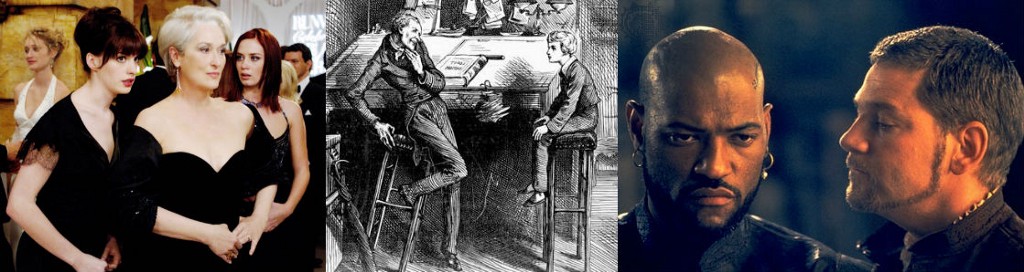
Charles Dickens’ David Copperfield provides one of literature’s most repulsive sycophants, the reptilian Uriah Heep. Dickens ensures readers will revile Heep by emphasizing his physical creepiness — he is cadaverous and lanky, with clammy hands and “sleepless eyes.” David feels slimed every time he encounters him. Initially a clerk in the employ of the lawyer Mr. Wickfield, Uriah Heep undermines his employer by weaponizing professions and displays of humility. Schooled in being “umble” by his father, Heep is always quick to affirm his lowly station and abase himself, no more so than when he invites the young David to tea. Working their young guest like a pair of tag-team wrestlers, Heep and his mother use every angle of perverse flattery to corkscrew information out of the boy. Mrs. Heep goes so far as to venture that “If I could have wished father to remain with us for any reason, it would have been that he might have known his company this afternoon.” To wish the return of a husband and parent from the grave to have tea with a twelve-year old boy surely registers high on any list of outrageous flatteries.

Chaplain to the bishop of Barchester, the duplicitous Obadiah Slope in Anthony Trollope’s Barchester Towers, epitomizes the lick up/kick down sycophant — fawning with the powerful, tyrannical with subordinates. In a campaign to become bishop himself, Slope flatters and consoles his way into the circles of the town’s best families and social coteries. Barchester’s “foolish women” readily listen to the twaddle he whispers into their ears, but not Eleanor Harding, one of his intended targets. Initially sympathetic, Eleanor denounces him as “an abominable, horrid, hypocritical man…the most fulsome, fawning, abominable man I ever saw.” Trollope exposes Slope’s every weasel-like move and hypocrisies with a satiric bite that makes this novel an irresistible read.

Lauren Weisberger’s The Devil Wears Prada explores the self-loathing endured by sycophants. Everyone who works at the fashion magazine Runway sucks up to its abusive editor, Miranda Priestly. The novel humorously exposes the sycophantic world that envelopes Miranda, who requires and ruthlessly enforces outrageous displays of ingratiation. Runway’s staff, fashion designers, restaurant owners all grovel before the diabolical Miranda. Here the “devil” seems to mete out just punishment for those willing to debase themselves in pursuit of some vacuous conception of access or success. The protagonist’s crushing humiliation is a perplexing act of self-nullification.

While the bargain struck by the sycophant — fleeting moments of vain gratification — often seems a losing proposition, the arrangement can at times have some advantage. In The Line of Beauty, Alan Hollinghurst presents a virtuoso suck- up in Nick Guest, a well-educated hanger-on in a rising conservative MP’s home. Hollinghurst brilliantly links Nick’s aesthetic sensibility to his abilities as a flatterer. Early in the novel Nick accompanies the family of a friend as they drive to a country estate. But while the family can be bored as they contemplate the visit, Nick is essentially on duty as resident sycophant. From the outside, one would be uncertain of Nick’s intentions. But upon arrival, Nick revels in the pleasures of an intense connoisseurship, tracing the beautiful surfaces of the estate, noting the details of its elegance and its rich evocation of architectural traditions. Nick is a flunkey but this seems the price of the ticket to the world of the rich and powerful. He savors the view, but he also relishes his intense response to it: Nick understands and enjoys what the family owns better than they do.

But for power of execution and depth of treatment, one must conclude with Shakespeare’s masterful account of weaponized sycophancy — his Othello. The play provides a catalog of strategies for ingratiation, subversion, and destruction, as Iago corrupts the mind of the noble Othello. No play shows the devastating personal consequences of sycophancy, or its intricate ties to other vices so starkly. The sycophant is capable of every fraud, every hypocrisy, every deceit. And no work of art evokes the mystery of sycophancy — its springs and sources in the character and life of the ingratiatory — so completely.

Swimming Made Me Gay

Swimming made me gay.

That’s not true, but I like the way it sounds. It finally lets me combine the words and the water, the sport and sexuality, that have made up my life, that have engulfed and carried me.

The first person to call me a lesbian was the mother of one of the girls on my swim team growing up. The girl lived up the hill and around the corner, and sometimes we carpooled together, inventing songs in the back seat. On hot days after early morning practices we wasted time watching educational cartoons, and hiding from her older brother and his guitar. Was that something like a crush?

One day, not so different from the rest, we decorated our plastic team water bottles with permanent marker. We wrote out all the usual slogans: Eat my BUBBLES! Swim FAST!! Kick BUTT!!! And, inside a heart, my neighbor wrote our initials, with a little plus sign nestled in between.

That was her crime. Or rather, my crime. Her mother called mine, after scrubbing off the marker with acid, and yelled. I didn’t learn about this phone call until years later, so I can only imagine how it went. “How dare you let your lesbian daughter in my house, in the locker room, in the pool with other girls?!”

In hindsight, the other odd comments she made over the years began to make sense. The time she accused my family of spying when we took the blind curve in front of their house too slowly. The time she told me I ate too much, and too often. The time her husband wouldn’t let me leave the table until I had finished everything on my plate. She wanted to keep us at arm’s length, to correct my behavior in front of her daughter so she wouldn’t turn out like me. It wasn’t my queerness (in all senses of the word) that was a problem, per se, but the idea that it might be catching.

It wasn’t my queerness (in all senses of the word) that was a problem, per se, but the idea that it might be catching.

This wasn’t the only incident with the team provoked by my version of girlhood. I stuck out. The other swimmers in the locker room wore designer brands, straightened their hair, put on makeup. I composed outfits entirely out of different shades of orange.

There’s me, maybe fourteen, in front of the computer after a long workout, having, for once, co-opted our dial-up connection. I got a chat invitation from a screenname I didn’t recognize, someone who said they were on the team with me. I accepted, and a few messages in, she said: “You have so many pubes, lol.” I demanded she reveal herself. “Who are you? How did you get my screenname?” After a few evasive answers, I got a message that said, “You’ve been tricked! This is a robot! The first few messages were programmed, but the rest has been computer generated!” The exclamation points made me cry even harder, as if the programmer took pride in this tool created for bullying. I vowed to renew my vigilance with shaving cream and a razor.

This was just one of many torments — the girls who lined up along the wall so I couldn’t climb out of the pool, the ones who told me they couldn’t imagine me dating — that served as a reminder that there’s more to competitive swimming than body meets water, more to being an athlete than physical practice.

You put on a gender-appropriate uniform. You rise for the national anthem. You chant fight songs. These little routines require patriotism and gender conformity and a healthy competitive spirit, as if a team were a training ground for the military. Was it possible, then, to be both an athlete and a queer, unkempt hair and all?

I grew up in Pittsburgh, home of the Steelers and their fiercely loyal fans. The first thing to greet visitors at the airport is a statue of Franco Harris, who I was taught at an early age made one of the most famous plays in football history, the Immaculate Reception. He sits right next to a statue of George Washington, who helped drive the French out of our city when it was just a Fort. Together they are presented as our city’s two great heroes, each responsible for putting us on the map in their own way.

Raised in this town, my sister became a convert. She followed their seasons, stayed up well past her bed time to watch their games, and jumped at the chance to go to a game, or, better yet, training camp.

Me, on the other hand? It wasn’t my thing. When the games came on and my sister started shouting at the TV, I would run upstairs to my room and shut the door. I did learn to speak passable football, but, when pressed, I can’t really explain what the Immaculate Reception actually is. I can’t name any of the players, either, except the ones who had been in the news for their off-field activities: Michael Vick. Ben Roethlisberger. Peyton Manning. Ray Lewis. They taught me from an early age that controlled bursts of on-field violence were often tied to real-life episodes.

I wasn’t surprised to learn recently that football has the highest number of convicted players at the professional and collegiate level of any sport, and nearly half of those are for violent crimes. That number doesn’t even include many of the names I can recognize, since many of those men were never convicted.

It’s no wonder that we have yet to see an active pro football player come out.

It’s hard to tease out the separate strands at play here — questions of race and class and the impact of fame go hand-in-hand with questions of gender. But there are traditional masculine ideals at the center of all this — a strong man who fights on the field like a gladiator and sometimes can’t shed that role at home; and a man on the other side of the screen, watching with a beer in hand. It’s no wonder that we have yet to see an active pro football player come out.

When I left the city of black and gold, I tried to find a different way to be an athlete, a swimmer, a body that moves through the water. I picked the college that had the best academics and the worst swim team.

Other teams in our conference opted for matching warm-up jackets, or even identical braids with matching hair ribbons, and they would emerge from the locker rooms clapping hands in unison like an approaching storm.

We couldn’t be bothered.

We tried to show up on time, but if class got in the way, we didn’t. We wore what we wanted, even if that was a hoodie that zipped up so far it covered your face. Sometimes, before a meet, we would ironically chant, “Fight fight for the inner light! Kill Quakers, kill!” And in preparation for the final meet of the year, we would dye our hair neon shades of pink and blue and green. We looked more like washed out clowns than gladiators.

I came out with the help of one of these teammates. We sat on deck icing our shoulders, discussing our crushes out of earshot of our coach, and she handed me the word lesbian like someone proffering half a sandwich at the misfits table. But we weren’t misfits, really. Or maybe everyone on the team had been one somewhere else, and now, finally, we were able to come together. No one cared about your grooming habits, or your sexuality. One year we had a lesbian coach, the first I had had in over a decade of competitive swimming, and several more teammates have come out after college.

The Queer Erotics of Handholding in Literature

That’s when I began to wonder, did swimming make me gay? Or rather, is there something queer about swimming?

Exhibit A: IGLA, the International Gay and Lesbian Aquatics association, is one of the biggest queer sports leagues in the world. I joined a team right after college, and it was a revelation to talk to so many queers with locker room horror stories. The men still lift up my arms to exclaim about my hair, but I take it as a sign of curiosity rather than scorn.

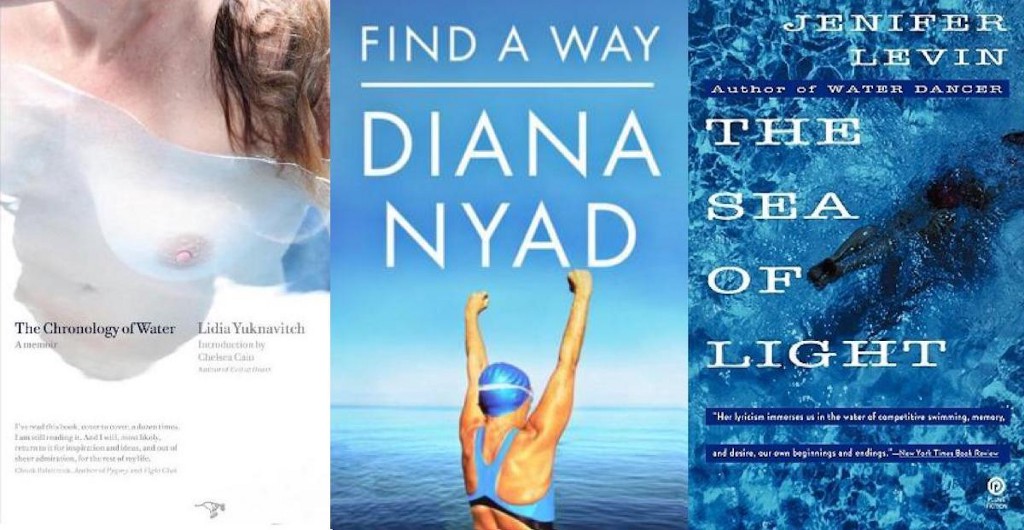
Exhibit B: Books by queer swimmers, most of them women, seem to be flourishing — The Chronology of Water by Lidia Yuknavitch, Find a Way by Diana Nyad, The Sea of Light by Jenifer Levin. It’s not just that the writers are queer. Their non-linear narratives are in opposition to the celebrity athlete memoir. Rather than claiming victories and extolling the value of hard work, they float, riding waves of memory and feelings churned up by the tides.

Their non-linear narratives are in opposition to the celebrity athlete memoir. Rather than claiming victories and extolling the value of hard work, they float, riding waves of memory and feelings churned up by the tides.

In her memoir, Lidia Yuknavitch writes, “All the events of my life swim in and out between each other. Without chronology. Like in dreams.” She calls this new timeline “the chronology of water” and employs it to tell her own life story. She touches on everything from first dates in the pool to being a member of Ken Kesey’s writing group to her difficult experiences with abuse, addiction, and miscarriage, rarely reverting to the actual lived order of things to tell the story.

Long-distance swimmer Diana Nyad’s memoir Find A Way tells the slightly more linear story of the sixty-year-old’s triumphant swim from Cuba to Florida. And yet water’s chronology carries her away right in the first chapter, where she pairs a scene from one of her failed attempts to complete the swim with a memory of standing on the beach at age nine with her mother, squinting toward Cuba. It was something she remembered while swimming. The lesbian swimmers in Jenifer Levin’s campus novel The Sea of Light also remember their pasts in the pool, and they show up every day not just to compete and to win, but in hopes of healing their traumas.

And then there’s Moby Dick. In all the myriad analyses of our Great American Novel, I don’t think anyone has come out and said it: Moby Dick is the greatest queer swimming book of all time. The homoerotic elements of the novel have been catalogued elsewhere — what I’m interested in is the swimming.

Sometimes it’s the whales, gliding through the vast ocean, and sometimes it’s the men, floundering, or even drowning. No matter who is doing it, the book is filled with gorgeous passages about creatures moving through water, and the narrative structure itself ebbs and flows, the ancestor of today’s swimming books. The repetition of sweltering mornings and endless stretches of water remind me of the routines of competitive swimming: early morning mist rising over the pool, countless laps swum over the same terrain, all that effort never taking me anywhere. And Melville’s digressions into the history of whaling? I know all too well that when faced with so much water and so much solitude, the mind will wander. Adrift, it’s easy to let the water carry you away from what it means to win and lose, to be strong, to be a man or a woman, or simply a body in the water.

Moby Dick is the greatest queer swimming book of all time.

Even with all this — the queer swim team and the queer books and the democracy of water — there’s something that keeps competitive swimming from truly being queer. It’s still a sport. There are still regulations and officials and registration fees. There are still young girls who police one another’s bodies, and their budding sexualities. How can something built on strength and competition and scrutinizing the body’s performance be queer?

It goes back to the decades-old question of what is at the heart of queer activism. Are we fighting for acceptance into the existing structures (marriage, the military, sports) or to dismantle those structures entirely? Even a queer sports league is recreating existing structure, albeit in parallel. This separatist revision of mainstream sports still leaves lots of folks on the outside: athletes of color, athletes with disabilities, transgender athletes, anyone who can’t pay the registration fees.

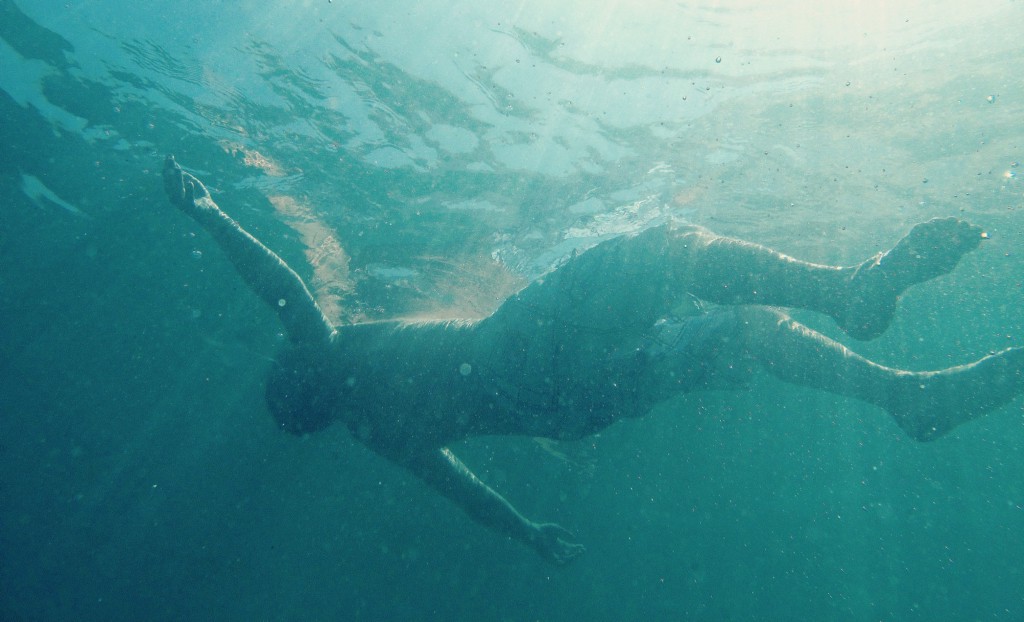
On summer mornings in New York City, and even into the late fall and early spring, you can spot little fluorescent globes bobbing in the water along the shores of Coney Island. Sometimes they appear in small pods, and sometimes there’s just one, making its determined way down the coastline. These are swimmers, but not like I’ve ever known. Clad in brightly colored caps to stand out against the blue gray of the waves, open water swimmers have left behind the confines of the pool, the rules and regulations, so that nothing stands between them and the thing they love.

I decided to join them a few years ago. On my first swim, I popped up every few minutes just to exclaim about the cold or because I thought I had seen a shark (or run into a jellyfish or, more likely, some bit of floating trash — a newspaper, a grocery bag, a used condom) or to gaze out at the Rockaways and hope I didn’t get swept away. I had never felt so small, so powerless. It was no longer an even 14 strokes from one end of the pool to the other. One hundred strokes could either take me from one jetty to the next, or nowhere at all, depending on the current. I emerged from the water with a green sea beard of algae on my face, and I was hooked.

I emerged from the water with a green sea beard of algae on my face, and I was hooked.

Just as the sport is upended, so are the unspoken rules of the community. It doesn’t matter who is fastest. To me, the kings and queens of the beach, our adult equivalent of the popular girls, are the ones who have completed the most impressive feats of endurance — they’ve swum MIMS, a marathon around the entire island of Manhattan, multiple times; they swim in the ocean in 40-degree weather; they know the tides and the currents. There’s no coach, no set workout, no fixed practice time. There are few six packs here, and little vanity. I shudder to think what my high school teammates might have said about the motley crew gathered on the beach, about our swim suits, about our faces, white with zinc.

Support Electric Lit: Become a Member!

And then I laugh to think that it doesn’t matter at all. If there is truly a queer version of my sport, this is it. Inherently gendered ideas of domination and victory are swept away, and something almost undefinable takes their place. There’s still discipline and rigor — it takes months of training to complete the more than 26-mile loop around Manhattan — but it’s hard to define what it’s all in pursuit of. Who is the opponent? Maybe it’s your own self, as you try to test the boundaries of your endurance, or maybe it’s the sea and all its elements. The salt, the currents, the cold.

Maybe it’s not about an opponent at all, but about the journey, and the encounters with the self that the solitude of the journey brings.

When I see these swimmers, when I swim among them, I think again of Moby Dick. One of the crew, off in pursuit of the white whale, falls overboard and nearly drowns. Down at the bottom of the ocean, he sees God’s foot upon the treadle of the loom.

Maybe it’s not about an opponent at all, but about the journey, and the encounters with the self that the solitude of the journey brings.

I read this passage in delight. To imagine! Words, and the very fabric of our existence, spun deep underwater on the ocean’s floor. No wonder I found the word lesbian by the pool. No wonder the water calls into question athlete and team and competition. Is it these words that bring us together in motion, or the mere fact that together we parse the warp and weft of the water?

If someone gave me a seat at the loom, I would weave new meanings into old words: Mermaid. Dolphin. Siren. Pod. Maybe I could be the one to invent the word for a group of mermaids, swimming close together, but each at her own pace.

10 Free Stories About Spirits, Ghouls, Mysteries & Monsters

Nothing brings the spectral and supernatural to life as powerfully as a good story. In that spirit (!), we’ve reanimated 10 haunting tales from the Recommended Reading archives, featuring writing by the likes of Angela Carter, Kelly Link, Viet Thanh Nguyen, J. Robert Lennon, Laura van den Berg, and more.


The Monster by Ali Simpson

Recommended by the Southampton Review

Laura has a monster in her closet. The monster comes at just the right time, easing the ache of Laura’s loneliness. Soon they become inseparable, playing Pictionary and nuzzling on the couch. At first a charming and pitiful little thing, the monster demands more and more and more as his caretaker struggles to feed his violently insatiable appetite. This short story transforms our fear of imaginary monsters lingering in the shadows into the real monsters that haunt our inner thoughts.

Deathwinked by Vedran Husić

Recommended by the Fine Arts Work Center

“What’s immediately noticeable is that ‘Deathwinked’ plays on two different registers of time,” writes another RR author, Matthew Neill Null, who introduced this story for the Fine Arts Work Center. “One moment is heady and fleeting — adolescents racing down an alley, pursued by bullets — but then…. time falls away.” The term “deathwinked” is coined by our narrator, a sniper, and is the verb he uses to describe being killed by the shot.

Stone Animals by Kelly Link

Recommended by Electric Literature

In David Lynch-like style, the everyday becomes imbued with the uncanny and the horrible in this piece by short story master and author of Get In Trouble, Kelly Link. “Ostensibly,” writes Lincoln Michel, “‘Stone Animals’ follows a husband, a pregnant wife, and their two children as they settle into a new house in the suburbs. There are no murders or monsters. Nothing explicitly horrifying happens. And yet…” Read on to discover the terror.

The Lady of the House of Love by Angela Carter

Recommended by Kelly Link

As a vampire story that invokes “Beauty and the Beast,” “Jack and the Beanstalk,” and perhaps at a stretch, “Rapunzel,” this tale is a classic, swooping Carter masterpiece and appeared in the recent (posthumously) published collection The Bloody Chamber. Of the many works in Chamber, this one is Kelly Link’s favorite: “I love ‘The Lady of the House of Love’ for the luster of Carter’s language,” writes Link in the foreword, “[for] the tensile strength of the prose; its luscious, comical, fizzing theatricality.”

This Door You Might Not Open by Susan Scarf Merrell

Recommended by Fifth Wednesday Journal

In this retelling of the legend of Bluebeard, a nightmare commentary on the power roles of marriage, Merrell makes a crucial adjustment to the story: the wife has broken her husband’s spell and holds all the power. “Two modes — the magical and the mundane — coexist in compelling tension here, as in much of Merrell’s fiction,” writes Rachel Pastan of FWJ about a story that features both a cameo from Ina Garten and a man whose day job requires spells and incantations.

The Black Parasol by Jack Pendarvis

Recommended by Dzanc Books

The best remedy for a good scare is laughter, and yet when the frightful and the hilarious meet, it makes for a great story. Jack Pendarvis hits this sweet spot with “The Black Parasol,” which follows a lonely woman, a bartender, and a ghost story collector in the pursuit of the ghouls of the the most haunted town in America. But as Guy Intoci of Dzanc Books observes, “The Black Parasol” and Pendarvis’s other fiction “aren’t merely funny stories. First and foremost, they’re sincere pieces about people more similar to us than we’d sometimes like to acknowledge.”

Black-Eyed Women by Viet Thanh Nguyen

Recommended by Akhil Sharma

Akhil Sharma recommends this story from Nguyen’s recent collection, The Refugees, which offers irony alongside tragedy, surreality next to brutal reality. Despite her mother’s insistent superstitions, a ghost writer doesn’t believe in ghosts until she encounters her brother who died on their voyage to the U.S. from Vietnam. “There is a fantastic too-muchness to the story,” writes Sharma. “But the very fact that Viet’s stories succeed reminds us that there is a too-muchness to life also.”

Where We Must Be by Laura van den Berg

Recommended by the Indiana Review

The narrator in Laura van den Berg’s “Where We Must Be” makes a living out of being monstrous, realizing others’ fantasies: she’s an actor paid to embody Bigfoot at the Bigfoot Recreation Park. “It would be so easy for that to be the story — a person in service only to others, to the fantastic, who loses themselves in the effort,” write Britt Ashley and Peter Kispert in the foreword. But it’s not the story. Instead, van den Berg “blurs the line between reality and fantasy, illuminating the narrator’s struggle for her own sense of balance between the two.”

Tin Cans by Ekaterina Sedia

Recommended by Jeff VanderMeer for Weird Fiction Review

Jeff VanderMeer recommends this horror story on behalf of the Weird Fiction Review, writing that “‘Tin Cans’ appealed to us because of the precision of detail and the dark humor, juxtaposed with real horror.” “Tin Cans” is a horror story no doubt, but the power of its horror comes from the plausibility — the accessibility — of the man and tragedy it depicts. Narrated by an old man whose wife died the day the Moscow Olympics opened, Sedia’s story captures sundry terrors of life: unemployment, impotence, and aging.

The Cottage on the Hill by J. Robert Lennon

Recommended by Unstuck

“‘The Cottage on the Hill’ is a J. Robert Lennon horror story,” writes Matt Williamson for Unstuck, which means that it’s also a story “in which the characters’ loneliness — their disconnectedness, their inability, at times, even to speak or listen to one another — is more chilling than any of the supernatural elements.” Following Richard, Evelyn, and their children Lily and Gregory through the many vacations they have at the cottage. But with through framework of an idyllic life, Lennon shows us something terrifying: “in a world where we may not be able to prevent ourselves from hurting, terrorizing, or even destroying the people we most want to protect.”

Who Gets to Write About Sexual Abuse, and What Do We Let Them Say?

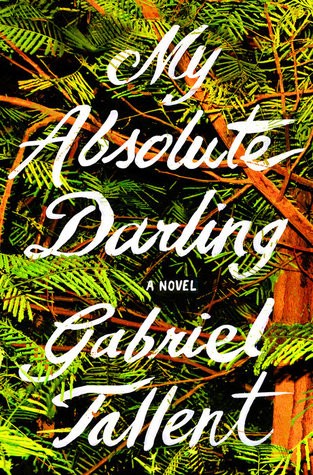
Gabriel Tallent’s debut novel My Absolute Darling came out almost exactly a month ago. In that time it has been much discussed; it was initially heavily praised and then began to draw ire, especially from influential feminists. The backlash primarily took the form of snarky comments on social media and Twitter. It started with Roxane Gay, who shot off some derisive subtweets while reading and then posted a critical review of the novel on Goodreads. By the next day the book had become an in-joke on literary twitter, prompting Nicole Cliffe, co-founder of The Toast, to remark that it was up there with Ethan Frome at the top of lists of most despised books. To make matters worse, Tallent had given a tone deaf interview to The Guardian in which he explained his project’s importance by saying, “we need more books like this…about survivors and abuse.” His white-guy-saves-the-world arrogance did not go over well with many readers. A few days later Bitch published s.e. smith’s scathing takedown of the novel entitled “My Absolute Misogyny: Male Authors Are Still Profiting from Women’s Pain,” which described it as the “most sexist book of 2017.” Somewhere in the distance a death-knell sounded for Tallent’s aspirations to enlightened manhood.

My Absolute Darling is primarily an exploration of a mind shaped by abuse. Its protagonist is a fourteen-year-old girl named Turtle who lives with her father and grandfather in the relative isolation of the hills outside Mendocino. Turtle likes to play with guns, dislikes other women, and is frequently raped by her father. She has been called “a heroine in the mold of Huck and Scout” by Parul Sehgal of The New York Times, which she is, if by that you mean she’s a self-contained youthful adventurer with a funny name who’s comfortable in what seems to be a quintessentially American natural landscape. Of course, Turtle finds herself in a much darker world than Twain or Lee ever imagined for their spunky protagonists. Here, the wolf is not only at the door, but inside the house, indeed in the heroine’s very bed. Innocence and experience mean something wholly different in a bildungsroman about a victim of incest.

One of the things that is challenging about the novel is that Turtle both adores and loathes her father. There are even times when she seems to yearn for him sexually, or at the very least participate somewhat willingly in their incest. She doesn’t think of what’s happened to her as abusive until long into the book, and doesn’t describe her father’s crimes as “rape” until the book is nearly over. Indeed, she only begins to be able to see him for what he is when he abandons her (during which time she forms an intense friendship with a teenage boy) and then returns with a ten-year old girl. When we see the way Martin (Turtle’s father) coaches the girl into accepting his abuse, we come to fully understand what has happened to Turtle before the book began, and why she remains invested in him despite his brutality.

One of the things that is challenging about the novel is that Turtle both adores and loathes her father.

Critics have been divided about whether Tallent’s portrayal of that incest is successful or responsible. Roxane Gay wrote that though she understood that Tallent was trying to suggest Turtle’s ambivalence, she “did not like the way it was handled here.” She found that “the sexual violence was written, all too often, with an uncomfortable amount of romance.” Smith too criticized the novel for exploiting, in a pornographic way, the victimization of its heroine. Sehgal also faulted the novel for relying on cliches about women, but different ones than those Gay and smith seemed to be responding to. For Sehgal the fact that “Turtle has clearly been designed to be ‘empowering’” suggested another, subtler kind of misogyny, which defines female empowerment in terms of what are traditionally viewed as “male” forms of heroism (the ability to kick ass and chew bubble gum, etc.).

Personally, I found My Absolute Darling’s depiction of the psychological costs of sexual trauma to be fully convincing. It had many faults (for me, most jarringly, the unbelievability of the teen characters’ dialogue, which Gay aptly described as “like Dawson’s Creek but in Mendocino.”) The book is far from perfect and probably not a “masterpiece” as its cover proclaims, though let’s be real: it was only Stephen King (not exactly a master of nuance) who said that. I liked it, but I’m not interested in convincing you whether to read it or not. Rather, the response to the novel got me thinking about reader reception to texts about sexual violence, and the curious shapes that reception often takes.

Discussions of the novel, particularly after Tallent’s embarrassingly self-impressed Guardian profile, often articulated the position that men should not write novels like My Absolute Darling, especially not now, when the voices of women are finally being given a platform with regard to this issue. As smith wrote in the Bitch review, “the use of sexual violence against women for shock value and literary awards is nothing new” and there is already a “huge body of literature by women who’ve survived incest and child sexual assault.” Tallent’s claim that “we need more books…about survivors and abuse” suggested his ignorance or dismissal of this canon. At best he was clueless; at worst he was positioning himself as “doing women a favor” (as smith put it) as a cover for his exploitation of their stories.

As smith pointed out, there is a whole canon of literature (both fiction and nonfiction) written by victims of sexual violence and sexual abuse like incest. This literature often gets charged with the same criticisms that have been made of Tallent’s novel : of eroticizing sexual violence, exploiting the stories of victims (even if the story is told by the victim), embellishing levels of violence, and just being generally unnecessary. I fully understand why a novel that depicts graphic sexual violence against a girl child, especially one written by a man, would call forth these questions; Tallent is, of course, the literal creator of his characters’ misfortunes, ones which presumably he has never shared (at least we can assume he has never been a 14-year-old girl who is in an incestuous relationship with her father). I generally have no personal problem with people writing about things they can’t have experienced, but I also understand that such depictions engender questions about ethics. (For example: are the representations gratuitous? Do they subject the reader to trauma for the sake of the larger narrative or merely to ratchet up the story’s stakes?) What I want to know is why the criticisms leveled against Tallent’s work dovetail so closely with those made against recent high profile memoirs — first-person accounts — of abuse written by women. Why, indeed, has Tallent’s book been less controversial than some such works?

For example, in his review of the recent memoir The Incest Diary for The New York Times, Dwight Garner praised the book but reflexively offered proof of its “veracity,” as if the question of the story’s truthfulness would be the first that would come to readers’ minds, despite the fact that it was published by high-class literary venue Farrar, Straus, and Giroux. With more self-awareness, Rich Smith analyzed his own impulse to question the story’s credibility for The Stranger, but still felt compelled to offer statistics that ‘proved’ that the author’s story was a common one. Though reviewers of both The Incest Diary and Roxane Gay’s Hunger, for instance, lauded the texts for their literary accomplishments, only reviewers of The Incest Diary questioned the text’s truthfulness. No reviewer, as far as I can tell, had the temerity to challenge Gay’s account of her gang rape. Why was The Incest Diary treated differently?

The reception of The Incest Diary places it in a tradition of incest/long term sexual violence memoirs by women that have been sharply criticized on the grounds that they are too explicit. What all these texts have in common is that they are narrated by women who describe in detail the ambivalence they felt about their victimizers. Kathryn Harrison, author of the much maligned The Kiss (1997), began an affair with her previously-estranged father when she was twenty, and this was enough for many reviewers and readers to impugn her sanity and morality. (James Wolcott, for The New Republic, famously wrote a fantastically misogynistic account, in which he called the book “trash with a capital ‘T’” and explicitly blamed Harrison for her complicity in the incest.) As Garner put it (incidentally in his Times review of The Incest Diary), The Kiss ignited “a debate…about whether the American memoir had finally gone too far.”

What all these texts have in common is that they are narrated by women who describe in detail the ambivalence they felt about their victimizers.

Harrison was largely not seen as a victim, but as a writer who had opportunistically mined her family history for its gory details. The controversy which followed the publication of her book has defined the rest of her career. Similarly, Margaux Fragoso’s memoir Tiger, Tiger (2011), an account of her relationship, which lasted into her twenties, with the family friend who began abusing her when she was eight, was criticized for what was perceived as its horrifying attention to detail; a number of reviewers, including Jenny Diski, argued that it would only appeal to pedophiles. The anonymously authored Incest Diary, explicitly about a victim’s experience of sexual pleasure at the hands of her rapist father, has proven to be one of the year’s most controversial books. All of these books were accused — as My Absolute Darling has been — of going too far, of being too graphic, and of treating sexual violence with an uncomfortable amount of ambivalence.

Those criticisms of fiction make a certain kind of sense; we don’t assume that authors are impelled to create fictional stories in the same way that they might be impelled to testify to their own histories through memoir. Presumably there are many ways an author of fiction could express an idea, and the characters through which they do so are illustrative inventions. If one such invention is particularly damning to a certain group, or draws on a very damaging cliché, we wonder why the author chose to represent the character that way; and we will probably only give the author the benefit of the doubt if we are confident that they are conscious of and in control of that aspect of the representation.

Does ‘My Absolute Darling’ Deserve the Hype?

But how can a memoir go too far? How can the truth be the wrong thing to tell? Even if talking about sexual violence were in some kind of “bad taste,” would anyone actually argue that our commitment to propriety should outweigh our understanding of actual crimes that are being committed against vulnerable people? The argument that Wolcott made in his review of The Kiss and Diski in her review of Tiger, Tiger — that people are now too willing to tell their tales of sexual woe — doesn’t hold up when one examines the rest of the culture. Exaggerated, unrealistic plots of rape can be found everywhere, particularly on popular television shows like CSI and Law and Order: SVU. They are the very stock and trade of whole channels like Lifetime and Investigation Discovery (I have friends who work in reality television who behind closed doors call these shows “rape porn” and lament the fact that they are hard to turn down because they pay so much better than more reputable documentary shows). No one who knows anything about the sexual violence statistics in this country can think that these shows accurately represent the majority of such violence. Though three fourths of rapes in the U.S. are committed by people known to the victim, the vast majority of sexual crimes on television are committed by unknown and terrifying super-predators. This disjunction suggests that we don’t watch these shows because we want to be aware of what’s really going on in the world, but because they do exactly what they’re designed to do: titillate.

How can a memoir go too far? How can the truth be the wrong thing to tell?

If we’ve accepted rape narratives as a form of entertainment (which Western culture has clearly done since at least the eighteenth century) then we can’t also argue that true stories of sexual violence have no place in the culture because they’re distasteful. There must be something else we don’t like about such memoirs. (Indeed, My Absolute Darling has been much more popular, well received, and widely reviewed than The Incest Diary, a fact which suggests that Tallent has benefited from our culture’s taste for sadistically pleasurable depictions of women while also situating his book as working against such representations.)

My suspicion is that books like The Incest Diary tend to be treated with skepticism and disapproval for a few reasons. The first, obviously, is that women’s stories about their experiences continue to be taken less seriously than those of men. To wit: a Twitter troll recently mocked me after reading my Twitter profile, which says that I study “sexual violence,” by tweeting that I study “made up sexual violence.” (Solid burn, bro!) The second, more complex reason is that incest and other forms of prolonged sexual abuse are such profound violations that they provoke a different form of disbelief than the kind that women often face when they talk about sexual violence they have experienced; when you tell your mother you’re being raped by your father, as the author of The Incest Diary does multiple times in her adolescence, you are disbelieved not because your mother is casually misogynistic, in keeping with her culture, but because she can’t believe you and uphold her understanding of the world. Incest is a violation so profound that it breaks knowledge. In these cases we disbelieve not because we’re so inured to a world where men take sexual advantage of women that such abuse seems normal, but because we can’t conceive of a world in which what we believe is normal could be so defiled.

All this said, I believe there’s still another reason why books like The Incest Diary are controversial (and I believe this sheds at least some light on why a novel like My Absolute Darling has been so upsetting for so many). The Incest Diary is written by a victim of rape, but not the kind of victim whose visibility contemporary feminism has fought for. This is both because it brings up the uncomfortable question of complicity when it deals with the author’s attraction to her father, and because the author is a person who has not survived in the sense that we mean when we call someone a “survivor” of sexual violence. Indeed, she writes that hers is a “creation story,” one in which the years of brutal sexual abuse she suffered are so central to her selfhood that they cannot be separated from her survival. They cannot be overcome, but must be integrated into her experience, and as the book ends, the author is still very much in the middle of that process.

The author writes that hers is a “creation story,” one in which the years of brutal sexual abuse she suffered are so central to her selfhood that they cannot be separated from her survival.

The Incest Diary ends without resolution, depicting the author stuck in a psychoanalytic repetition of the dynamic she had with her father with another man. The book is about the inescapability of such violence; its entire structure and story challenge the notion that one can emerge as a “survivor” from certain kinds of trauma. Though we seem more ready than ever, as a culture, to talk about sexual violence, we may not yet be ready to hear the story of the person who has lived but not “survived.” And yet, if we are as concerned about the accounts of women being taken seriously as we say we are, we should welcome such stories, even if they don’t meet our expectations or confirm our biases.

The issue is further complicated by the fact that one person’s memoir is another’s fiction. This is especially true when we talk about sexual violence and intimate trauma, where real people often disagree about what happened between them. The Incest Diary attests to this. The narrator’s family refuses to acknowledge the reality of her sexual abuse, despite some of them having literally seen her father abusing her. The author does a lot of thinking about how it can be that her brother and mother, and even her father (who believed she had “seduced” him at the age of three), perceived reality radically differently from the way she did. When Harrison published The Kiss, she faced much criticism over the fact that her first novel Thicker Than Water had dealt with similar material. She was charged with “self-plagiarism” by many reviewers, and this seemed to be further evidence for many that Harrison was simply returning to the material for the sake of its salaciousness, or perhaps even fabricating the story. Harrison’s father granted an interview to The New York Observer after the publication of The Kiss, in which he complained that the book put his life as a public figure (he was a former pastor) in “jeopardy,” but never explicitly denied her story, saying that he was uncomfortable with accusing her of lying. Harrison, on the other hand, wrote that The Kiss “exposed” her, not her father. While I, as a reader, have no doubt that the author of The Incest Diary and Kathryn Harrison were both terribly sexually exploited by their fathers, I also see Harrison’s point: memoirs tell the truth of the memoirist, from their perspective. We get uncomfortable when memoirists write about topics that we generally adjudicate in a court of law, because they expose the ambiguities that such law can never account for.

Alexandria Marzano-Lesnevich’s recently-published The Fact of a Body blends memoir and fiction to trouble this very divide, showing how it can break down in relation to the topic of sexual violence in general and the sexual abuse of children in particular. In it, Marzano-Lesnevich recounts her own abuse at the hands of her grandfather while also telling a parallel story: that of a convicted child molester and murderer on whose legal team she once briefly served. The book is half constructed from the Marzano-Lesnevich’s memory and half fictionalized: explicitly, as the author constantly reminds the reader, constructed from court documents and other records of the case. Even when dealing with her own history, Marzano-Lesnevich continually questions her motivations as a writer (as she writes of her parents, who, though they put a stop to the abuse, continued to allow her grandfather to have contact with their children): “Am I mistaking my own interests in the past for theirs? Can my parents sit across from him and never, never imagine the actions that lie behind the words they have been told, never see the story unspool before them?”

This is a book that refuses to resolve its complexities. It puts aside ideology and asks us to consider the vastness of the questions that sexual violence and in particular incest pose for all us (let alone for people who have been victims of such crimes). Marzano-Lesnevich asks us to sit with the ambiguity of contradictory truths: that her grandfather wasn’t “all bad” and that he molested her, that her parents attempted to both protect him and her, that the murderer whose story she tells was also a victim, and that there are secrets we will never resolve about both our own and other people’s families.

Support Electric Lit: Become a Member!

Gabriel Tallent’s fame (and infamy) will probably be long-lasting. As I said before, I’m not sure if you should read his book, and if you do, you should be aware of the possibility that it may be triggering if you’re carrying sexual trauma. What I do know is that it’s easy to criticize a guy who takes on a topic like this, and talks about his book with such easy confidence. I also know that a lot of important, challenging, frightening, and stunning books are being written about sexual violence, and they are often batted down with versions of the same criticism Tallent has faced. This pattern should encourage us to think about why certain narratives are more threatening than others, not because of their author’s gender or their genre, but because of their content. And if you choose to read one book about this topic this year, read The Incest Diary or The Fact of a Body. To borrow a phrase from Tallent, “we need more books like this.”

Here’s Where Your Favorite Modern Novel Was Written

Some people sneak peeks inside medicine cabinets, but I’m fascinated by writers’ writing spaces. I want to see what environment someone else has found successful for creating work. What is the structure of their inspiration?

Does the writer keep their desk space tidy and spare or messy — brown rings staining the insides of mugs, wadded tissues, grimy keyboard? What books has the writer chosen to keep close? Are they arranged in any particular order — by author, subject, spine color — or haphazard? Curious to see if the writing space offers clues to the writing practices of their user, I surreptitiously read scrawled notes, hoping to get a glimpse of a novel-in-progress, to see what their unpolished sentences look like. How does their space inform or represent their singular journey from mind to page? Does their writing space look like they write?

A writing space feels private, intimate. It’s the room where the rawest of thoughts and emotions are encouraged. The space can offer reassurance that its desktop, and therefore the writer’s practices, are as disheveled as our own. Or it presents ideas for how to restructure our space in hopes of becoming more organized in our minds and on the page. Maybe I should switch from Leuchtturm notebooks to Postalco, write my first drafts longhand rather than on a laptop. Perhaps I need a fainting couch.

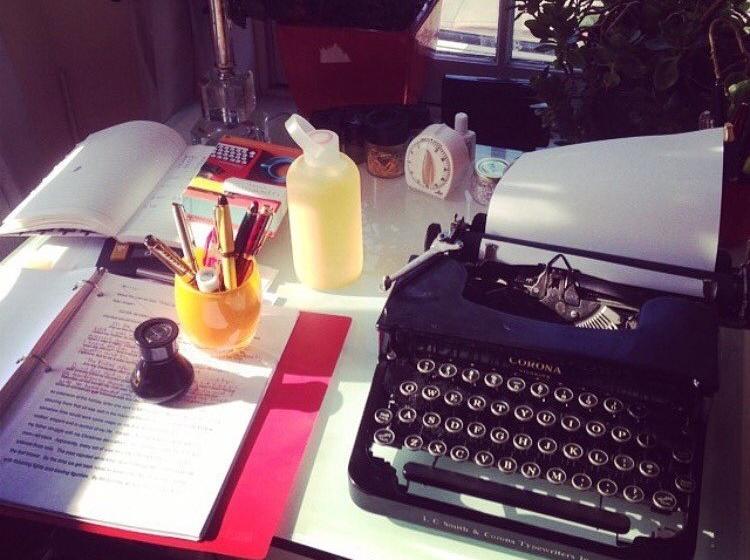
Writing Spaces Project on Instagram shares photos of writers’ workspaces. The posts capture images, both micro and macro, of what writers surround themselves with in order to make creativity happen. Following are some of my favorites.


Photo: Fernando A. Flores

Fernando A. Flores, author of Death to the Bullshit Artists of South Texas Vol. 1

“This is what happens to a table after the desktop computer sitting on it crashes and is never replaced. Above hang various typed projects soaking everything in. It is important to be reminded that the ancient glyptodont had a solid shell which protected it. Equally important is to have photographs of artists who have meant a lot to me throughout the years, like Sor Juana, Anaïs Nin, and Elizabeth Cotten.”

Library at the Wisconsin Historical Society. Photo: Chloe Benjamin

Chloe Benjamin, author of The Anatomy of Dreams and The Immortalists

“In my early 20s, writing required total silence and a controlled atmosphere: I woke up, made my bed and sat on top of it to work, a cup of coffee on the nightstand. At some point I realized that it was good to leave the house every so often and discovered earplugs, along with the pleasure of working at a coffee shop, where other worker bees provided gentle peer pressure and sustenance was at the ready.

“This year, though, I had difficulty getting into my third novel. On a whim, I stopped by the library at the Wisconsin Historical Society. “So this is why people work in libraries,” I thought, as I took a seat under the recessed, stained glass ceiling and relished the prayer-like quiet (no claustrophobic study carrels!). Total silence and a chance to leave the house: the Historical Society library might be the perfect compromise, even if I’m as late to the game as I was with earplugs.”

Photo: Manuel Gonzales

Manuel Gonzales, author of The Regional Office is Under Attack! and The Miniature Wife

“This is my writing space. An old Crate & Barrel table my wife and I bought over ten years ago that’s now our breakfast table in the sunniest room of our rental house. There are other rooms and an office at the university where I can write, as well, but I always find myself here. (I’m writing here right now at 6:30am, before anyone else wakes up.) But what’s funny to me about this image is that, while it looks like I’m writing, what I’m probably doing is looking for mentions of my book online because it was my pub day, and the sheet of paper next to my computer, if you can zoom in on it, is a list of chores I need to finish and groceries I need to buy before people come to our house after we launch the book at a bookstore near our house. So even when I’m not writing, the space just feels like I’m writing.”

Photo: Jenn Shapland

Jenn Shapland, essayist (Tin House, THE Magazine, Pastelegram, The Lifted Brow, Electric Literature, The Millions)

“This is the desk where I finished writing my book this summer while housesitting for an artist in northern New Mexico with my partner and our three cats. It had a family of putty-colored spiders living under it — my correspondents — and twice in the morning I found dead wasps sandwiched into my laptop. That’s Gary (named for Shteyngart) on the floor. My writing spaces are rarely this pristine, this designated. At home my desk is usually covered in papers, books, unopened mail. More often I write wherever I am: the couch or the bathtub or the car or the public library or my phone’s notes app at 3:30 in the morning, which is where I’m writing this.”

Photo: Alexandra Kleeman

Alexandra Kleeman, author of You Too Can Have a Body Like Mine and Intimations

“Switching between tasks is hard for me — for each project I work on I have to clear my desk and populate it with a different set of research books, distraction books, books that I look to for time or inspiration. Sometimes I just work at the kitchen table to escape all that. It feels temporary there, low-pressure.”

Photo: Tayari Jones

Tayari Jones, author of Leaving Atlanta, The Untelling, Silver Sparrow, and An American Marriage

“For me, the key is to prep my writing space before bed. I clean the desk, fill the fountain pens, make sure I’ve got paper, & I set the timer on the coffee maker. This way, when I wake up, the process is already in motion. I let the momentum carry me through my work.”

Photo: Rachel Khong

Rachel Khong, author of Goodbye, Vitamin

“I own an A-frame cabin in the redwoods near the Russian River, about an hour and a half north of San Francisco. It was really run down when I bought it in 2013 — a foreclosure that was formerly a grow operation, where the owners grew weed everywhere they could. There were also a few strange little shacks on the property, filled with trash and sort of scary seeming (I called one of them the “murder shack,” jokingly but also not; I was also sort of nervous I might someday find a dead body there). Anyway! I cut windows into this particular shack, put in leftover flooring, installed clear roofing, and built a desk. It’s still pretty crappy, but it’s now at least a pleasant space for writing in. I spent most of August 2015 working on Goodbye, Vitamin in this shack, alone in the woods and going slightly feral, before I sent it off to Marya, my agent. It sold that fall.”

Photo: Laila Lalami

Laila Lalami, author of The Moor’s Account, Secret Son, and Hope and Other Dangerous Pursuits

“When a draft is complete, I often pull out individual chapters and spread them out on my writing table, to help me look at the overall structure. I turn off my internet connection when I work, though occasionally I allow myself the use of my iPad for word references. I always need multiple pens and pencils, and lots of water. Then revision can begin.”

Follow Writing Spaces Project on Instagram.

What 7 Classic Literary Characters’ Dick Pics Would Look Like

Ah, dick pics. They’re as much a part of modern life as push notifications and Rihanna’s Instagram, and yet they’re noticeably absent from the literary universe. The greatest authors of the 20th century didn’t tend to concern themselves with the phenomenon — largely because it didn’t exist in its monstrous current form yet — and precious few pages of classic novels have been dedicated to dissecting this low-brow art form.

It’s time we addressed this oversight, and I’m the person to take up the mantle. Being well and truly a creature of the Internet age, I can’t go more than a couple of days at a time without thinking deeply about dick pics. I’ve run Critique My Dick Pic (NSFW; actually, just go ahead and assume that all the following links are NSFW) for more than three years, a website that works exactly as it sounds: I receive thousands of dick pics and critique selected submissions according to their photographic merits, considering elements such as the lighting, angle, and pose and finishing each review with a bold letter grade (“Thank you for submitting to Critique My Dick Pic. Your dick pic gets an A+”).

The thing about seeing upwards of 5,000 penis pictures in a few short years is that it’s made me good at guessing what any particular punter’s effort would look like. So I turned my imagination to the protagonists of seven classic novels to answer the question on everyone’s lips: “What would my favorite literary character’s dick pic look like?”

Sal Paradise (On The Road, Jack Kerouac)

Sal is the kind of fake-deep backpacker type who would put “sapiosexual” in his Tinder bio but ignore smart women who don’t happen to look like Nadya from Pussy Riot, so of course he’d take a terrible dick pic and think it was brilliant. His dick pic would be a bog-standard log shot but he’d send it with a caption two paragraphs long, explaining how he’d noticed the way the sunlight was streaming through the window on an idle morning (read: while jacking off) and decided to “capture the eroticism of the moment” by whipping down his pants and snapping a rudimentary birds-eye-view shot of his semi-erect penis. His underwear and feet would be visible in the shot and he’d send the same picture to four different women, each of whom would flinch upon opening it.

Atticus Finch (To Kill a Mockingbird, Harper Lee)

Atticus Finch would experiment privately with taking, but never send, a dick pic — which is a shame, because the end result would be a phenomenally artistic shot. He’d include his entire body within the frame and pay meticulous attention to the lighting, pose and setting, carefully considering each component and creating dozens of drafts until the final result was perfect. After he’d crafted an exquisite final product — a dick print, not a full-blown cock shot, because he knows the value of subtlety — he’d suddenly feel self-conscious, guiltily deleting all the evidence. Not a single woman would ever know how good Atticus Finch’s dick pic was, but he’d know.

Holden Caulfield (The Catcher in the Rye, J. D. Salinger)

Holden Caulfield is a teenager and it’s gross to imagine what even a fictional minor’s dick pic would look like. I’m not some kind of sicko.

Winston Smith (1984, George Orwell)

Within the confines of the 1984 universe, Winston could never find the requisite moment of privacy to take a dick pic — which is a good thing for Julia, because his dick pic would be an artless and utilitarian advertisement for size. In an earnest attempt to accurately represent his erectile measurements, Winston would include a beer bottle for scale, rendering his dick pic acutely unerotic and laying bare his painful insecurity about his perfectly average penis.

Mr. Darcy (Pride and Prejudice, Jane Austen)

Too elitist and humorless to create one of of his own accord, Mr. Darcy would take a dick pic only at Elizabeth’s insistence. “I dearly love to laugh!” Lizzy would badger, and surly old Darce would reluctantly oblige, taking a hurried and ultimately blurry dick pic to the great delight of his sarcastic wife, who’d roast him relentlessly afterwards.

Meursault (The Stranger, Albert Camus)

Meursault’s dick pic would be an extreme close up of the head of his penis, capturing the veins, glans and frenulum in graphic, clinical detail. He’d be as coolly indifferent to Marie’s response as the universe is to him, and he’d consider the entire process of capturing his reproductive organs on film in the hope of causing a fleeting moment of arousal an allegory for how meaningless everything truly is. In other words, Meursault would be a dick pic bore.

Jay Gatsby (The Great Gatsby, F. Scott Fitzgerald)

Jay Gatsby would bring the full force of the most state-of-the-art photographic technology to his dick pic production, yet still manage to create an underwhelming shot. He’d employ tripods and make overinvolved use of diffusers and reflectors, all for the sake of a middling, C-grade photograph. Gatsby’s dick pic wouldn’t be bad per se but it would be painfully overproduced, and Daisy would feel faint pity at how hard he’d hard he’d tried to impress her. Were the technology available to him, he’d 100% slap on a Clarendon filter.

10 Stories From Famous Authors That Were First Published in Playboy

Okay, yes: Hugh Hefner, who died on Wednesday, was not a good guy. But whether because of or in spite of its founder’s influence, Playboy has long been an undeniable platform for writers and their stories. That old joke about how people “just read it for the articles”? That’s obviously a lie, because they probably read it for the fiction too.

Whatever you thought of Hefner, and whatever you thought of his magazine’s T&A content, you have to admit that the text in between the naked ladies was frequently tremendous. Here are 10 works that helped elevate Hefner’s legacy from “dirty old man” to “dirty old man who was also sometimes a patron of the arts.”

(Credit)

Joseph Heller, “Yossarian Survives”

In The Paris Review Interviews Vol. 1, Robert Gottlieb talks about editing Joseph Heller’s Catch-22. He compared the process to surgery: “you just cut the work open, deal with the offending organs, and stitch it back up again.” They came across a chapter Gottlieb wasn’t particularly fond of—it was “pretentious and literary”—and Joseph Heller didn’t hesitate to take it out. It wasn’t too pretentious and literary for Playboy, though, and the story was billed as “The Lost Chapter of Catch-22” in the December 1987 issue.

(Credit)

Ray Bradbury, “The First Night of Lent”

Ray Bradbury was all over Playboy; he published excerpts of Fahrenheit 451 in the magazine, gave interviews, and wrote original content—such as “The First Night of Lent.” In this story, published in 1956, a writer makes a startling and humbling discovery about his reliable driver, Nick, who is described as “the most careful driver in all God’s world.” The two have a casual discussion on their Lenten sacrifices, and Nick swears that he’ll be giving up cigarettes. The next day, the first day of Lent, Nick is irritable and reckless, hurtling down the highway at an alarming speed. It turns out, instead of giving up cigarettes, he had given up whiskey. The writer pays him generously and asks that he makes sure to drink before picking him up again.

(Credit)

Gabriel Garcia Marquez, “The Handsomest Drowned Man in the World”

One of the most respected authors of our time, Gabriel Garcia Márquez, wrote “The Handsomest Drowned Man in the World,” for Playboy in 1971. A village comes together after a mysterious male corpse — the handsomest one in the world — washes up on the seashore. The story draws greatly on Lord Alfred Tennyson’s “Lady of Shallott,” but with a twist that makes it both very Playboy and very Gabriel Garcia Marquez.

(Credit)

Roald Dahl, “The Visitor”

If you don’t already know about the short stories that influential children’s author Roald Dahl wrote for a grown-up audience, you’re in for a treat—they’re surreal, disturbing, wildly inventive, and definitely not for kids. Sometimes, they’re even pretty raunchy. Dahl’s 1965 story “The Visitor” was appropriate for its venue, in that it concerns a passionate (and regrettable) sexual encounter. Womanizing “Uncle Oswald” is traveling in Cairo, and stays at the home of a man with a beautiful wife and equally beautiful daughter. At night, one of the two slips into Oswald’s bed, but it’s so dark that he doesn’t know which, and his silent companion has disappeared by dawn. This fantasy scenario takes a turn when Oswald discovers his host has a second daughter who had not been introduced to the guest—because of her contagious leprosy.

(Credit)

Joyce Carol Oates, “Saul Bird Says: Relate! Communicate! Liberate!”

Joyce Carol Oates published this piece, for which she won Playboy’s “major work award,” in the October 1971 issue. The story, a dark satire of radical campus politics, was later republished as “Pilgrim’s Progress.”

As a female writer, Joyce Carol Oates received much push back for choosing to work with Playboy. The National Organization for Women wrote to Oates vehemently disapproving of her choice with the hopes of persuading her to boycott the magazine. She responded:

I have never published anything in any magazine on the basis of my agreeing, entirely, with every page of that magazine. In a democratic society, there must be avenues of communication in publications that appeal to a wide variety of people, otherwise writers with certain beliefs will be read only by people with those same beliefs, and change or growth would come to an end. Playboy is astonishingly liberal, and even revolutionary in certain respect.

(Credit)

Haruki Murakami, “The Second Bakery Attack”

Haruki Murakami, a master of the written word, wrote for Playboy in 1985. “The Second Bakery Attack” opens with a newlywed couple unable to satisfy their hunger. This hunger, and too much beer on an empty stomach, inspires the husband to reveal to his wife that he and his friends attacked a bakery when he was younger and he feels the experience left him under a curse—one that, his wife says, can only be lifted by attacking another bakery. And so, the newlywed couple find themselves at a McDonald’s for a second go-around. This one is available to read online.

(Credit)

Jack Kerouac, “Before the Road”

“Before the Road” was published after On The Road, in 1959, but takes place before the events of Kerouac’s seminal (in a couple of senses) novel. It’s a story about freewheeling Dean Moriarty before he meets Kerouac stand-in Sal Paradise and they start crisscrossing the country together. The first page and one of the illustrations can still be seen online.

(Credit)

David Foster Wallace, “Late Night”

“My Appearance” was the original title of this story by David Foster Wallace, his first piece of fiction in a major magazine. It was republished on the five year anniversary of his death to Playboy’s online archives with an introduction from Playboy’s fiction editor for 22 years, Alice Turner. After turning down several of Foster Wallace’s submissions, Turner accepted “My Appearance” with few edits except the title, which she saw as uninteresting to readers of a men’s magazine. Foster Wallace was fond of the title because it worked on two levels—the story is about a woman who appears on David Letterman and feels anxious about being put under a microscope—and Turner notes drily, “I won for Playboy but I think he went back to his original title in his own collection.”

(Credit)

James Baldwin, “Words of a Native Son”

“Words of a Native Son,” published in the December 1964 issue, was an essay rather than a work of fiction. The piece, which was reprinted in Baldwin’s collected nonfiction anthology The Price of the Ticket, concerns writing in general, and writing a play in particular (at the time, Baldwin’s second play Blues for Mister Charlie, about a black man’s murder by a white man, was on Broadway).

(Credit)

Ursula K. Le Guin, “Nine Lives”

Ursula K. Le Guin published “Nine Lives” in 1968, under her initials so as to not intimidate the male readers. It’s a story about a spacecraft crew who are all clones of the same young man, but apparently that was less chilling to Playboy’s audience than the idea of a female science fiction author. Nevertheless, “Nine Lives” (which is available online) was endorsed by President Lyndon B. Johnson, and Le Guin gained a fast and devoted following for her work. “Nine Lives” was nominated for the Nebula Award for Best Novelette in 1969.

An Unexpected Memoir and the Chance to Honor a Partner’s Life and Death

Michael Ausiello, known to rabid television fans as the go-to person for any inside scoop on casting notices, behind-the-scenes tiffs, and shocking spoilers of your favorite shows, didn’t shy away from giving away the third act of his memoir in its title. Spoiler Alert: The Hero Dies (Atria Books, 2017) isn’t, as becomes clear, about Ausiello himself, but about his partner of more than thirteen years. Christopher “Kit” Cowan died in 2015 after battling a rare and aggressive form of cancer for close to a year. Just like its subtitle — “A Memoir of Love, Loss, and Other Four-Letter Words” — Ausiello’s moving account of those final months together nakedly tackles the heartbreak of seeing your loved one ravaged by illness with humor and grace. In that, the book stays true to Kit himself. Here was a man, after all, who had not only given his large rectal tumor a name (“The Lurker”) but had turned a two-inch campy retro B-movie monster figurine into its physical manifestation, one he placed on their coffee table facing a 99-cent store ceramic middle-finger statue right before heading to the hospital for his first treatment.

Having followed Ausiello’s columns and scoops for years, I was all eager to sit down with him to discuss his most personal writing to date. Over coffee and a bagel, we talked about how he decided to turn such painful memories into a book, why he didn’t feel the need to shy away from his and Kit’s imperfections (he’s candid about his partner’s indiscretions, his own insecurities, and the way couples’ therapy was a constant in their lives), and why the memoir works as a probing portrait of the perils of contemporary queer intimacy.

Manuel Betancourt: Let’s start at the beginning. Where does the idea to turn that last year with Kit into a book come from?

Michael Ausiello: It was not my idea. I’d been chronicling Kit’s illness, our battle, and our experience through the illness on Facebook. And a couple of months after Kit died an editor from Simon & Schuster, who was an acquaintance of mine and had been following my posts, approached me. He thought there was a book here. He asked me if I’d be up for it and interested. And I really thought about it — I thought about whether I had the strength to dive back into the worst year of my life, unpack it and then go further back into our relationship and relive all of the ups and downs. As hard as I knew it would be, I also knew I had to to do it. I knew this was an incredible opportunity to honor him, to introduce the world to him, to find some meaning in this horrible tragedy. So, he died in February, and I think it was August when I signed the contract and decided I was going to do it.

MB: That’s soon.

MA: It was very soon. After I decided I had to do it I also decided I had to do it quickly. For a couple of reasons. One was a practical one: I wanted to do it while the memories were still fresh in my head. I didn’t want to say, “Oh, I’ll wait until I’m in a better emotional place and then suddenly be like, oh shit I don’t remember half the stuff that happened — like, I remember the big stuff but not the little stuff.” My favorite things in the book are the little things. I knew I had to write this as fast as possible before I forgot. And then there was also a self-preservation aspect to it where I knew that the sooner I finished writing it, the sooner I could get on with my life.

MB: The book shuttles between that last year and then various memories from your time with Kit going back all the way to your first date. What was most challenging to write — the medical drama, or the relationship issues you trace throughout?

MA: The cancer year was by far the hardest part of the book to write. To re-live the highs and lows of that last year was definitely the hardest for me. You know, all the appointments with the doctors, which I had actually on tape and I had to listen back to in order to be as authentic as possible in the re-telling of those moments. Because. in some instances, it’s an actual transcript of those doctors’ appointments. That was really painful. To be back in those moments when you’re not sure how bad the cancer is and you’re filled with hope. And you slowly realize “Holy shit, this is terminal. There’s a really good chance he’s gonna be dead in a year.” Putting myself back in that mindset as my life started to fall apart, as I started to realize that Kit was going to die, to re-live all of that was the hardest part of the book. I actually had a really fun time going back to the beginning of our relationship and some of those early moments. And re-telling some of the stories from our relationship was like falling in love with him again. Just remembering those early days — how fun it was — I was actually surprised at how easy it was to remember so much of the stuff from back then. I was afraid that I wouldn’t remember a lot of it. A lot of it just came back. It was helped by photos. Kit took a lot of photos. That was an amazing research tool; to just go through his photos and say, “Oh yes, I’d forgotten about that.”

MB: When writing these sorts of memoirs, especially dealing with someone you’ve lost, you can often feel authors airbrushing stories and anecdotes to paint people in a better light. But you can’t really say that about Spoiler Alert, can you?

MA: Well, I knew going in that if I was going to tell this story, I needed to tell the unvarnished truth in order for it to have any power or meaning. I needed to show all of our flaws. Show that we were not perfect people. That this was not a perfect relationship. That we fought to stay together for 13 and a half years. I knew that I needed to tell the truth of the story. That said, Kit was a very private person. I am a fairly private person. So after I finished the book and I was reading it, I did feel very protective of him. I didn’t want anyone to judge him. I didn’t want anyone to have a negative opinion of him. So, it did weigh on my mind a little bit: am I giving too much away? But ultimately, I looked at the big picture and looked at the whole story and he’s just a much more interesting person when you know all of the aspects of him. I wanted people to really get to know him as he was. Not this sort of perfect caricature of something.

MB: That truly comes through, especially since not only do we get to see Kit’s less flattering side, but also we get to see that —

MA: That I am just as fucked up as he is, basically. I struggled in my life with shame, secrets, self-esteem issues — all of this stuff. I have my own demons and there was something very liberating about not giving a shit when I was writing this book. Like, “You know what? Fuck it! I’m not hiding anything any more.” I am who I am. I’m not perfect. And there was something freeing about just putting it all out there and not caring what people might think.

5 Books that Explore the Vibrancy and Diversity of Gay Male Life Today

MB: Do you think that’ll change once the book comes out?

MA: Maybe. I don’t think what’ll change. What’s already been a little weird is when I see friends of mine who maybe didn’t know — who learned a lot about me while reading the book. You feel a little vulnerable being with them when suddenly they know so much private stuff about you. Not just friends, co-workers, too. That’s a little weird. But also it feels good to let go of some of that shame, you know?

MB: The book is very much a gay story. There are obviously Big Themes here, but it struck me that at its heart, it tells a very specific gay male 21st century storyline about what queer intimacy can look like.

MA: Part of what you’re asking about is, I think, the sex stuff, which I didn’t really sidestep. I do feel like while this story is universal and relatable, there are aspects of the gay relationship that are unique. I didn’t want to sidestep those; I didn’t want to sidestep the unique struggles that gay couples face — that we faced. It was important to me to include what it’s like to be in a gay relationship. Actually, in the original draft, it was much more intimate. I’d included a lot more intimate details and I pulled back just a little bit. Not because I was ashamed or anything like that. It was more thinking that some things were personal between the two of us, and I wanted to keep something that…

MB: That was yours.

MA: I didn’t want to give everything away. Some of the struggles we faced — just about monogamy and infidelity, sexual compatibility; all of that stuff felt important to include. But I did keep some details to myself.

I didn’t want to sidestep the unique struggles that gay couples face — that we faced.

MB: Changing gears a bit, I wanted to also touch on the book’s wild tonal shifts. Given its subject matter (and title alone!) you might think this is a rather dark and dour book, but it also has passages and scenes that are laugh-out-loud hilarious. It’s a fine line to balance. Did you have any books, or even TV shows, in mind in terms of what you wanted to accomplish in terms of tone?

MA: Well, I have to confess I’m not a big reader. So I can’t spout off a list of authors that inspired me. Honestly, I just pulled from our relationship and the tonal shifts in our relationship. Because that’s exactly what it was like for us. Sometimes it would swing wildly from completely silly, stupid, funny stuff to dark, hopeless, depressing. It really wasn’t like modeled after a television show that I loved or a movie. It’s just honestly who I am. That’s who Kit was. That’s who we were. That was just what the story was. Sorry I don’t have a more interesting answer than that one!

MB: No problem. One of the reasons I wanted to ask about the tonal shifts is because I was also curious to hear what parts of the book did you most enjoy writing? There’s a sense of joy in so many of them.

MA: I loved the story about Kit toilet-training Mister Scooch. I had so much fun writing that section. I just took a weekend and literally was just having so much fun exploring that relationship between our cat and Kit, through the lens of this toilet-training experience. It amused and tickled me. I don’t always enjoy the process of writing — I mostly don’t enjoy it. I like being finished with writing and feeling that sense of accomplishment. But the actual work itself, I don’t find particularly fun. But I found that sequence really fun. I also enjoyed writing the part where I first met his mom in the hospital in the flashback. That was really fun and enjoyable reliving some of those early memories. I’m also really proud of the final chapter (which I don’t want to spoil!) but I’m really proud and happy with how that came out.

Support Electric Lit: Become a Member!

MB: As you talk about it, it’s clear that this was quite an emotional undertaking. This’ll sound a tad trite but, what did you learn about yourself while working on this book? And was that different, do you think, than what you learned while going through that final year with Kit?

MA: I learned that I’m capable of a lot more than I gave myself credit for. Just writing this book was a huge fucking undertaking. I was plagued by insecurity throughout: can I do this? Is it gonna be good enough? Am I gonna do justice to him? Am I gonna do justice to our relationship? And the fact that I did it, that I overcame those insecurities and, really, I feel like I proved something to myself. That I’m stronger than I give myself credit for and that when I decide I’m gonna do something, I’m gonna fucking do it. I spent a lot of my life telling myself, “No you can’t do that! You’re not good enough! You’re not talented enough! You’re not smart enough! You’re not strong enough!” To look back and really look at what I’ve been through, with the deaths of my parents and then growing up gay and my weight issues and then Kit getting sick and Kit dying. Then writing a book about the whole thing — it’s just, I’m still standing! I’m still here! I have my idiosyncrasies, and I have my issues but I’m still here. I sometimes maybe don’t give myself enough credit for that.

I also realized writing the book that I never took our relationship for granted. I always knew that this was something special. I always knew he was special. I always knew that it was worth fighting for. So it’s not like I look back and say, Were there are aspects of the relationship that I wish I’d been more present for? Sure. But I always knew he was special. I knew he was worth fighting for. I was reminded of that quite a bit while writing the book. That I did fight for the relationship. That I did stick it out — and there were many times when I could’ve thrown in the towel and said, no more. But he was worth it. I’m glad I did.

I always knew he was special. I knew he was worth fighting for.

MB: And he did, too.

MA: We both did. We both fought hard. 13 years of couples’ counseling! I highly recommend that, by the way. One of the takeaways people should take from the book is: “Don’t wait to go to couples’ counseling when you’re in crisis.” It’s a great maintenance tool. Don’t wait until there is a problem. Or, even if there is a problem, don’t stop going when it passes. Keep checking in with each other. You take your car in for a tune-up; take your relationship in for a tune-up.

MB: I might have to take you up on that.