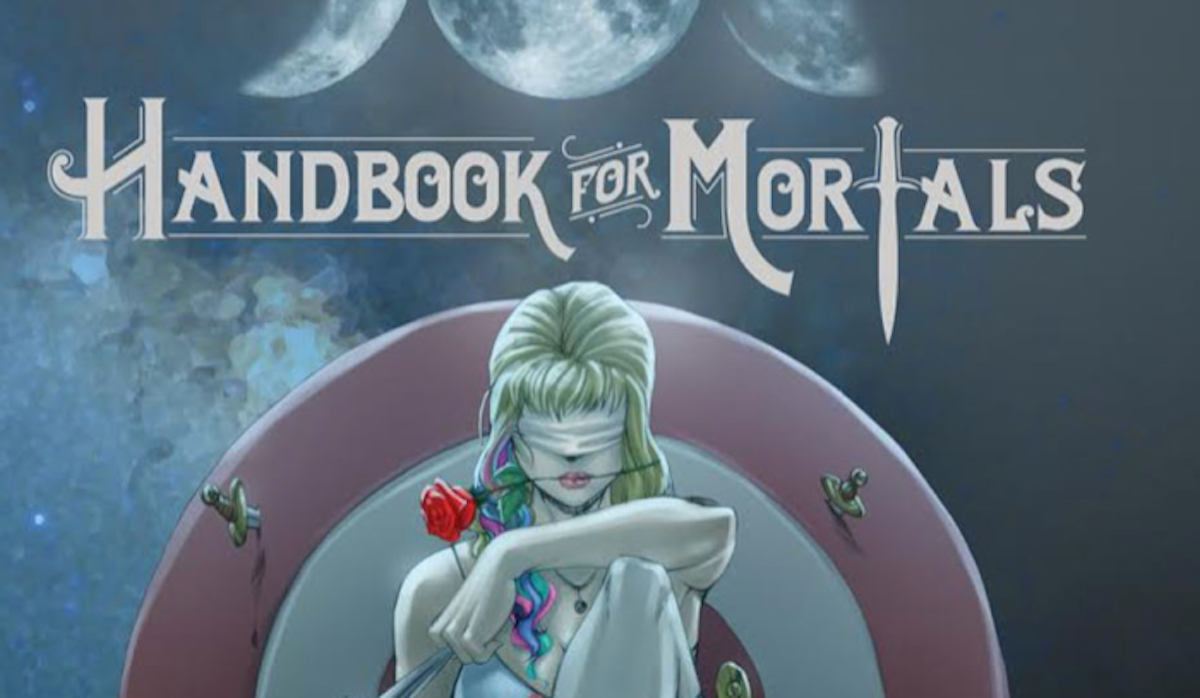
Buckle up, because this story is weird as all get-out. Yesterday, young adult writer and publisher Phil Stamper noticed a discrepancy on the New York Times bestseller list for YA fiction. Angie Thomas’ The Hate U Give, a wildly acclaimed novel (and soon to be movie) about a young black woman who becomes an activist after she sees police murder her friend, had been displaced by an unknown: something called Handbook for Mortals, by Lani Sarem, from the brand-new publishing arm of website GeekNation. And by “unknown,” we don’t mean a dark-horse phenom; we mean a book that literally cannot be bought from Amazon or Barnes & Noble, and yet somehow suddenly sold enough copies to not only make the bestseller list but debut at number one.
This is what I’m referencing. A book that’s out of stock on Amazon and is not currently in any physical B&N in the tri-state area.
Here’s how Amazon describes the book: “Zade Holder has always been a free-spirited young woman, from a long dynasty of tarot-card readers, fortunetellers, and practitioners of magick. Growing up in a small town and never quite fitting in, Zade is determined to forge her own path. She leaves her home in Tennessee to break free from her overprotective mother Dela, the local resident spellcaster and fortuneteller.” The hardcover costs $19.13 and you can’t buy it.
Although “Lani Sarem” anagrams to both Mars Alien and Anal Miser, it is not a nom de plume: Sarem is an occasional actress, music publicist, and band manager—including, at one time, for Blues Traveler—who has apparently already tapped herself to play the lead in Handbook for Mortals movie. And she, or someone at GeekNation, is apparently also a skilled book list scammer. It’s not that tricky to buy your way onto the bestseller list if you just put in some huge bulk orders; it’s legal and not even that uncommon. (Becoming an Amazon bestseller is even easier.) But the Times adds an asterisk to any book whose sales rank is affected by bulk purchases. Sarem (or someone) seems to have gamed the numbers by arranging large buys—only from verified NYT-reporting bookstores—of just under the amount that would trigger such a caveat. That’s 30 copies at a Barnes & Noble, 80 at an indie store, so we’re talking about a LOT of orders. You really owe it to yourself to read the Pajiba article that collects all the tweets that crack the case.
In any event, Sarem is a better scammer than she is a writer. Author Sarah M. Carter got her hands on a copy of Handbook for Mortals, and in her words: “hoooo buddy.” Thanks to Carter’s sacrifice, we’re able to bring you some highlights, all of which are absolutely dreadful in an incredibly specific way that those of you with cherished Livejournal memories—or, really, anyone who wrote self-important fiction about thinly-veiled Mary Sues in high school—will find deeply, cringingly familiar.
I would describe this book in a similar way that I might describe Harrison Ford: it can definitely get fucked.
And also much like Harrison Ford, it is now not on the Times bestseller list. The paper sent out an email that declined to even name the offender, let alone explain why the list was changed:
Congrats to Angie Thomas, the rightful #1:
Omg . Thanks to everyone who investigated, spoke out, and supported. This week is that much more special because of you. ❤️ this community
And congrats to Phil Stamper and other investigators for their tenaciousness, to Pajiba for doggedly staying on top of the most riveting publishing story we’ve read in ages, to Blues Traveler for getting rid of what sounds like a real liability, and of course to Lani Sarem for getting more people to read her Lani Sarem fanfic than ever before.
Presenting the tenth installment of The Bodega Project, where authors from across New York reflect on their communities through that most relied-on and overlooked institution, the bodega. Read the introduction to the series here.
The walk to Tony’s, down Xenia Street in Corona, Queens, isn’t about the Pepsi or Doritos I say I need, or the milk or American cheese my mother sometimes sends me out for. The dim interior with its two crowded aisles, neon chip bags, array of snack cakes and obligatory slinking cat aren’t that compelling. It’s what’s going on outside that draws me. I can’t say what it’s like now, but in 1984, when I was fourteen and out on my own, that’s where the whole neighborhood hung out.
There were the girls — Lisa from The House, my best friend Claudia from next door, Mel and Michelle, Tracy whose mom made her eat cigarettes whenever she caught her smoking. But more enticing were the boys: John, Jay or his brother Ajay, Harold, Omar, Claudia’s older brother William. Without fail, some or all of them would be outside, flirting, talking a big game, sharing bags of Frito’s or playing box ball with a Spaldeen on the sidewalk nearby. The boys always wore tanktops and basketball shorts, were spotless and well-groomed. They always smelled like a mixture of cumin, garlic, onion, and deodorant soap: Safeguard, Shield, Irish Spring. Decades later, my husband, who was partly raised in Venezuela and partly in a Boston suburb, described that smell to me as “house.”
My parents, first- and second-generation Jewish-Americans, moved to the neighborhood in the early 1960s. They had only been married a few years. For them, the chance to rent an apartment with an eat-in kitchen, separate dining room, and terrace, was a definite step up from the crowded tenements of Crown Heights and the South Bronx where they’d grown up. We had to take the bus to get to the subway from our third floor walk-up, but at least we had our own bedrooms.
Every so often, when our parents were out, my brother and I would hook up a ladder and shimmy out through a panel blocking the skylight in the hallway outside our door. From there we’d emerge onto the roof, our sloping street stretching off in either direction, lined with other mother-daughter houses like ours, some in rough shape and others meticulously kept. The DiDonato’s place, Francine’s, the Museum (our name for the cement yard filled with plaster statuary, including cherubs, cavorting goddesses, and an actual bubbling fountain). A few doors down was The House, a multistory building beside the long driveway where my parents parked our car, that housed a swirling universe of cousins from the Dominican Republic who’d drop in and out of town every summer. Claudia and her brothers William and Oscar lived right beside us, one floor down. A ten-minute walk east brought you to Flushing Meadows Park, with its iconic unisphere and weedy lakes. Much closer was the Long Island Expressway, the whoosh of its cars backgrounding our days and nights.
Our street was never quiet, but in the summer the volume exploded from car radios and boomboxes, most of the music and conversation in Spanish or Spanglish, or a mix of the two. Si, si, voy a la bodega, pero I don’t know if it be open. Mi hermano esta buscando el parking. The neighborhood was dominated by Puerto Rican, Colombian, Ecuadorian, Mexican, Cuban, and Dominican families — especially Dominican. The beat of our childhood was to salsa, rumba, and merengue, punctuated by The Sugarhill Gang and Grandmaster Flash. There were salsa parties in basement rec rooms of nearby apartment houses — tables swooning under platters of arroz con pollo, black beans, and buñuelos — where everyone danced. Those sweaty, joyous events were as far from a bat mitzvah at a Great Neck social hall as I can imagine.
It was with the people that hung out at Tony’s that I experienced all the firsts of young womanhood. My first couple’s dance (salsa, with Manny from The House). First kiss (Harold, in Claudia’s closet, playing Seven Minutes in Heaven). First unwanted kiss (during a tickle fight with Omar, who was more my brother’s friend). First time I purposely struck anyone besides my brother (Omar, elbow to the jaw, ending said kiss). First fair-weather friend… First friend-in-need…
Like every kid in history I just wanted to blend in, but of course there were limits. I was a white girl in a predominantly Latino neighborhood, dubbed la blancita by a sweetheart named Juan whom I dated one summer. Nobody hassled me beyond a complete mystification about the fact that we didn’t celebrate Christmas, but I felt my difference. My father was a lawyer. We spoke English at home. We were Jewish. On the 4th of July, our family would escape the neighborhood in favor of the beach, driving back slowly after dark, the borough transformed into a warlike maze of flash and sulfur, spent firecracker paper drifting in the streets. Tony’s would stay open at least until midnight, supplying the neighborhood crowd with forties and rolling papers, Mexican soda and a place to meet.
Even if I wasn’t a hundred percent at home in front of my home bodega, that didn’t stop me from trying. For a brief period in middle school I made the ill-advised move of adopting an accent that sounded like my friends from the neighborhood. I only got as far as Claudia’s apartment. Immediately she’d narrowed her eyes: Why you talking like that? I tried to play it off — Like what? — but I knew she was on to me. I quickly stopped trying, thankfully before I got my ass kicked by someone I hadn’t grown up with.
My parents moved out of Corona in 1993, right after I graduated from college. I’m not in touch with anyone from the old neighborhood now — I didn’t see them much in the years I spent at university upstate. I don’t really sound like I’m from Corona; in fact, I hardly even sound like a New Yorker. Although I drive right past my old block probably once a week on the way to my mom’s apartment, I never get off the highway. Our old building is apparently a condo now, which I only know because I looked it up on Zillow. I doubt I would recognize anyone in the neighborhood now if I bothered to drive by.
Where I live in Brooklyn the houses cost well over a million dollars, although it wasn’t like that when I moved here in 1996. One of the first things I loved back then was how much the bodegas on Smith Street reminded me of Tony’s. Even after I started eating organic, and joined the Park Slope Food Co-op, I’d go out of my way to visit the ones that still felt old school. I relished being able to slide my money across the counter and say How’s it going? in my old voice, the way I used to. The way I would at Tony’s.
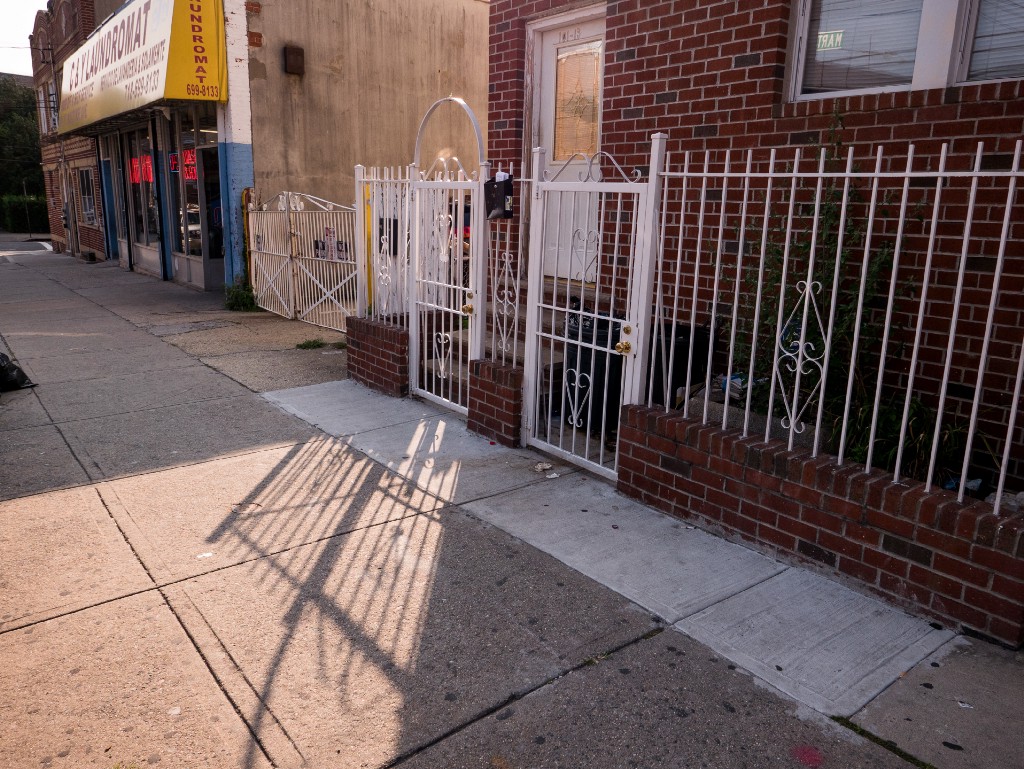
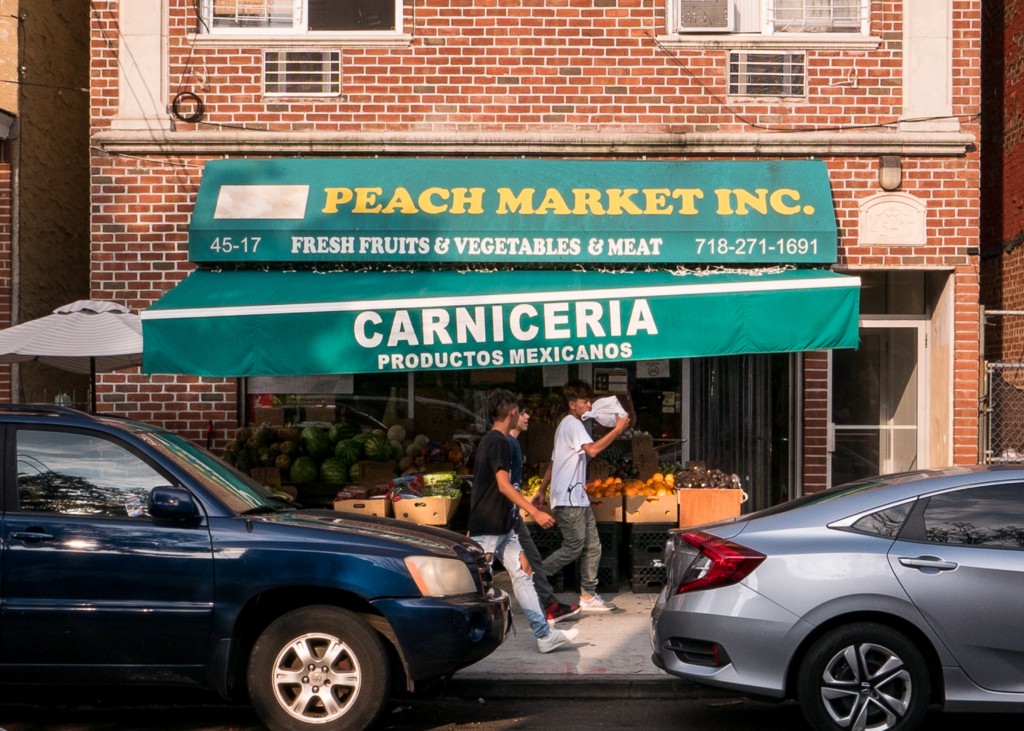
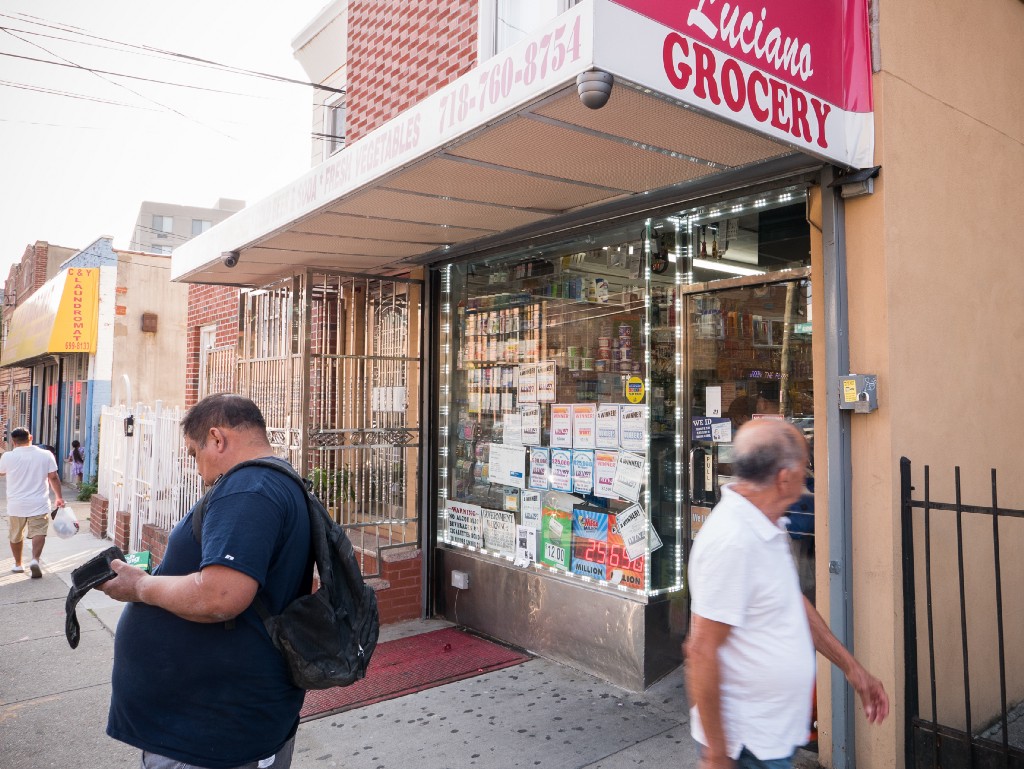
The internet coughs up photos of what Tony’s looks like today. The first thing I notice is that the awning now says “Luciano Grocery” — or maybe that was always there and I just don’t remember it. Either way, you’ll still find it listed as Tony’s Deli, the name the neighborhood knew it by, if you search for it online. Thankfully or not, nothing much else has changed. Unlike other bodegas in more gentrified parts of New York, there are no twelve-dollar wedges of cheese here, no kimchi, no cans of craft beer, no kale chips. The merchandise looks to be the same old, same old, just as I remember: Hostess, Delicias, Suavitel, Harina Pan, “Dominican Cake.” I don’t buy any of that stuff anymore (if I’m being honest, I’m more likely to get the kale chips).
The bodega I go to these days sits diagonally across the street from the apartment I rent in a leafy part of Brooklyn with my husband and two kids. It’s run by one of the nicest guys I’ve ever met, a Palestinian named Sam with whom I talk about parenting, Toyota SUVs, and the similarities between Arabic and Hebrew. He keeps an array of sweets on the counter, an impressive muffin shelf, and a sign proclaiming WE NOW HAVE LOX! in excited block letters. Sam and his brothers know us; Sam always asks about my mom’s health, and during the holidays he treats my girls to gingerbread. With my husband, Sam talks soccer, until I stick my head out the door wondering what happened to him and the ice cream or beer he stepped out for.
I probably won’t ever go back to Tony’s, although I’ve swooped around it in Google Maps. I know that some of the old crew went on to college, moved away, moved on. Others didn’t fare as well. It’s garden-variety nostalgia, I guess. But whenever I click around the old neighborhood, it feels deeper. I become unexpectedly swamped with sorrow. Not for the architecture, or our old apartment, or the street, or even the bodega itself. I think it’s for that girl on the brink of womanhood, the version I left behind. The girl who would venture to Tony’s all by herself, who danced there with a boy for the first time, who sometimes stood out on warm summer nights smoking and flirting. The girl whose roots are still buried there, if they were even hers to begin with.
About the Author
Amy Brill’s short stories and essays have appeared in One Story, The Common, Redbook,Real Simple, Guernica and the anthologies Stories from New York, Before and After, and Labor Day. She has been awarded a 2015 New York Foundation for the Arts fellowship in fiction, and a Peabody Award in documentary writing. Her debut novel, The Movement of Stars, was published in 2013.
I learned to snorkel mid-winter in an indoor pool in the suburbs of Cleveland, Ohio. The air was stifling, thick with the smell of chlorine. There was nothing to see in the pool and no explanation given for the purpose of this middle school gym unit; maybe our teachers dreamed we’d go on island vacations. I don’t remember ever snorkeling again until 2010 when I traveled to a research station on San Salvador Island in the Bahamas where I’d teach a Caribbean literature course and where I’d start writing a novel about the sediment of history’s layers. The water shimmered aqua closer to shore, deepened to a dark blue farther out. In spite of how clear the water seemed, you had to beware rocks and lionfish, and you couldn’t know where the reefs were without sticking your head beneath the meniscus of the ocean. Locals and research station staff would give instructions for different reefs around the island: where to enter the water and in which direction to float.
Locating trailheads to the ruins of the plantations on the island took the same colloquial knowledge. I needed a machete to re-clear trails that had almost disappeared after the rainy season. Some buildings I could find, somewhat intact or piles of rubble as they may be. Depending on the time of year and the amount of rain preceding my visits, different sections of the plantations were inaccessible. While I wanted my students to see the places we were reading about, the island’s lack of historical preservation became just as pertinent a topic of conversation.
While I wanted my students to see the places we were reading about, the island’s lack of historical preservation became just as pertinent a topic of conversation.
My professional training is in nineteenth-century U.S. literature, the literature of slavery and abolition a particular focus. I had never bothered to visit a restored or preserved plantation in the U.S., knowing how rare it was for such a place to be focused on preserving or illuminating the history of slavery. In the Bahamas, I wondered: wouldn’t this be the place for the descendants of the enslaved to take control of memory through preservation? Of the narrative presented to both outsiders and their own descendants?
In the span of years I’ve been going to the Bahamas, I also went to Eastern Europe for the first and second times. Three of my grandparents were immigrants — one before the war, two after. No one had ever gone back nor wanted to. But there I was in Vilnius, Lithuania — Vilna, the “Jerusalem of the North” before the war — for a literary seminar. On the plane over, I looked up the Lithuanian word for Jew so I’d know if someone called me that; I had no idea what to expect. I knew I’d be immediately identified as American, but it was disconcerting having no idea how others would be interpreting who I was.
From inside the ruins of a plantation building in the Bahamas. Photo: Rebecca Entel
The apartment I stayed in was inside the area that had been the wartime ghetto. There were some war-related plaques around town in multiple languages, most rather vague and hard to find. I wouldn’t have known the boundaries of the ghetto if I hadn’t learned them on a walking tour. Each day I crossed the street where the guarded entrance had stood. Each step I took — each meal I enjoyed in an outdoor café, sipping wine — felt weighed down with the layers of history I was moving through. Almost as though my clothes held a leftover dampness.
In the Bahamas, I wondered: wouldn’t this be the place for the descendants of the enslaved to take control of memory through preservation? Of the narrative presented to both outsiders and their own descendants?
Months after my trip a friend would return from teaching a course that traveled to sites of Civil War memory and recount walking into slave quarters for the first time in his life and worrying he’d break down in front of his students. I nodded, described “having the creeps” my entire time in Eastern Europe. Not new knowledge from the trips, but being in the places our ancestors, close and distant, survived or didn’t… There are probably no spots on earth that don’t feel this way to someone, if those someones are still around.
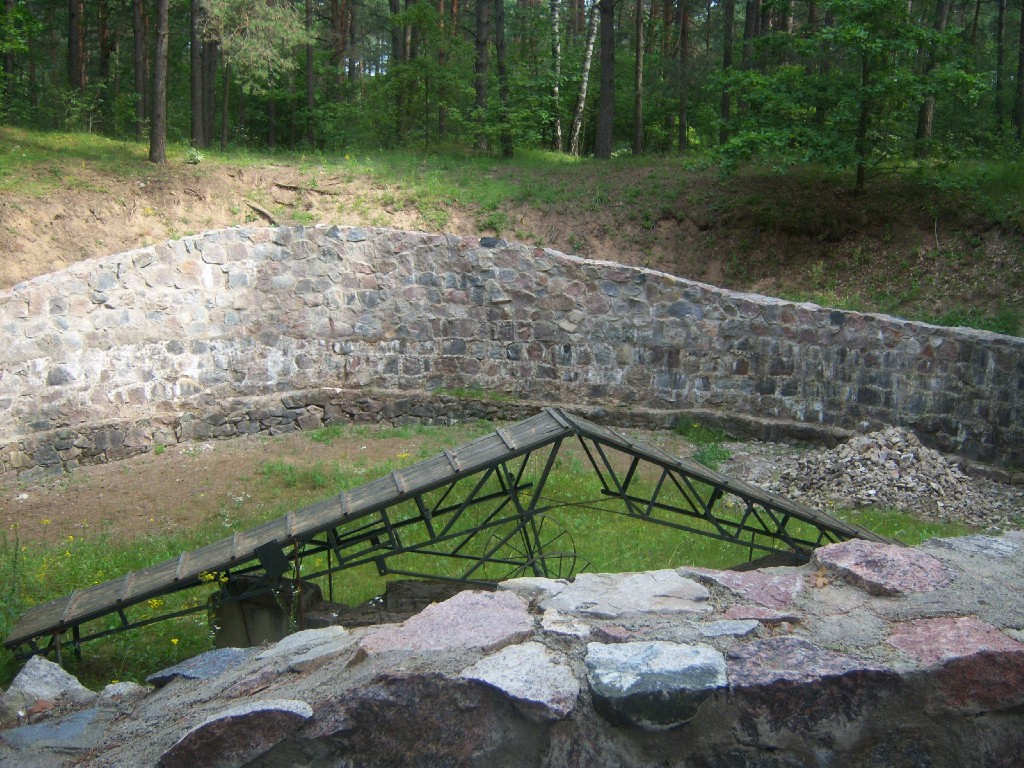
I didn’t have students with me at Panerai, a site in the forest outside Vilna where oil pits became mass graves. The group wandered silently among the pits and monuments. There were butterflies and a strong scent of pine, yahrzeit candles, a small museum space with graphic photographs. I found myself in a cluster of four, all of us grandchildren of people who’d survived the war in one or another unfathomable way: liberated from camps or in hiding. One of us murmured that she had a weird feeling that she didn’t want the non-Jewish people in our group to be there right then. Another mentioned that he’d spoken to some Lithuanians who grew up a mile away and had never been here. One floated the thought that maybe this place should just be bombed out of existence. I rambled a bit about the crumbling plantation walls I’d seen, the choice of nature’s entropy over historical preservation. We were subdued, didn’t debate. The four of us had all grown up in the U.S. or Canada. What if we lived here?
Pit at Panerai. Photo: Rebecca Entel
On the bus back to the city, the rest of the group sat in silence as though scraped down to exhaustion by what we’d seen. But the four of us laughed too loudly at something trivial. Maybe we’d become some dark version of punchy or maybe that day was a microcosm of how days just are: the reality of what we knew of this past wedged in alongside a funny story told by a friend.
Later that same day I got on another bus to Warsaw, the first time I’d ever gone to Poland. For weeks ahead of the 24-hour trip, I’d agonized about whether I should be taking a bus farther south to Auschwitz, where my grandfather had been during the war.
“Why do you need to go there?” my grandma had asked, annoyed. “So you can look at barbed wire?”
One of us murmured that she had a weird feeling that she didn’t want the non-Jewish people in our group to be there right then.
While we had this conversation on Skype, I heard my mother in the background on the phone with a friend of my grandma’s — also a survivor — and I could tell from her responses that he was bewildered, even upset, that I wasn’t going.
On this trip I was continuing to work on the novel that was partly fueled by my own bewilderment about the overgrown plantation ruins on San Salvador and the not-quite curious responses from San Salvadorans — the sense of why would you be interested in those stones?
I didn’t go to Auschwitz. Still, my grandma didn’t object to the preservation of camps as historical sites. To her, though, the sites were for those who didn’t know anything about the history — or worse, who didn’t believe — so someone like me visiting was beside the point. Was that the best use of the ruins on San Salvador: waiting for outsiders? Teaching what Derek Walcott describes in the “Ruins of a Great House” as the “leprosy of empire”?
Or: would anyone tell me if they didn’t want me walking there? To keep my blade’s edge away? Walcott: “The rot remains with us.” (My emphasis.)
In Beloved, Sethe’s notion of rememory suggests the traumatized could literally bump into their memories: “If a house burns down, it’s gone, but the place — the picture of it — stays, and not just in my rememory, but out there, in the world. What I remember is a picture floating around out there outside my head. I mean, even if I don’t think it, even if I die, the picture of what I did, or knew, or saw is still out there. Right in the place where it happened.” The past distorts the physical world into a minefield for those who wander back “out there.”
The trails to the inland plantations grow over while life goes on around the island’s perimeter, only cleared by visiting researchers who mark their tracks with fluorescent flagging tape so they can be found again and again.
As we stood at Panerai, living far, far away seemed a gift our grandparents had had the foresight to offer us. But they hadn’t deliberated; they’d fled.
As we stood at Panerai, living far, far away seemed a gift our grandparents had had the foresight to offer us. But they hadn’t deliberated; they’d fled.
“We were still trying to save our lives,” my grandma had told me about the few months she spent in Poland after the war ended. She had met my grandfather in the road, each trying to get home — him from Auschwitz, her from Wittenberg, a camp in Germany.
“How did you get home?” I’d asked.
“I walked.”
And everywhere she went she saw people walking in all different directions, speaking different languages.
Neither ever went home. Her town didn’t exist anymore; in Kielce, where my grandfather had grown up, a pogrom in 1946. The two of them went to Lodz to stay in a family friend’s spare room, but they were afraid even to speak on the streetcar since their accents would identify them as Jewish — a concept baffling to me. (When I studied Yiddish in college, my grandma told me I spoke it with a Clevelander’s accent.)
They traveled to a U.N.-run Displaced Persons camp near Munich. My mother was born there, the only doctor available a Nazi. Sick and cold and hungry, they arrived at Ellis Island in January 1947. They each traveled with a “Certificate of Identity in Lieu of Passport”issued by the U.S. consulate. On my grandma’s, the “Distinguishing Marks or Features,” was a scar. On my grandfather’s, the number on his arm. On my infant mother’s: the blank made more blank with “xxx.” Thirty years later I was born in Cleveland, white.
They each traveled with a “Certificate of Identity in Lieu of Passport”issued by the U.S. consulate. On my grandma’s, the “Distinguishing Marks or Features,” was a scar. On my grandfather’s, the number on his arm.
In the Bahamas, official emancipation came in 1834, but national independence has been in place only a few years longer than I’ve been alive. So many, many miles already traveled before that 140-year wait.
Sometimes you can’t stay; sometimes you can’t leave. No matter how many times I try to write through my glimmer of an idea about (im)migration and privilege, moving or staying put in places of peril, of genocide, I can’t find my way to a statement.
No version remotely resembles the ways these words — staying, leaving — mean in my life. The year I was snorkeling in gym class, I was the same age my grandma was when, as she put it, “the war was at my doorstep.” The monuments, memorials, and museums I saw: crafted thousands of miles from their referents.
My grandma, shaken for weeks after a trip to the then-newly-opened Holocaust Museum in D.C.: “I felt like I was on the inside, looking out.”
Skyping with my grandma from the hotel the night I arrived in Poland, I held my laptop up to the open, screen-less window. “It’s like a real city,” I said, and she shrugged. In the morning I walked into the hotel breakfast buffet and looked around at counters covered in all of my grandma’s favorite foods — the sweet smell of dark-brown breads and fruit spreads, interrupted by whiffs of herring and lox — and felt terrible. A canister marked LARD somehow made me feel better: something that made her not belong here.
After breakfast I picked up a bright yellow pamphlet advertising daylong bus trips. One went to a camp, promising tourists would see the shocking crematoriums.I can’t remember if it was going to Auschwitz or another camp. I can’t remember if it said crematorium or gas chamber. I’d put it back in its plastic holder on the lobby counter.
One tour went to a camp, promising tourists would see “the shocking crematoriums.” I’d put it back in its plastic holder on the lobby counter.
I made my way to a new Jewish museum on the Warsaw ghetto site that wasn’t technically open yet, peeked into windows on the exhibits under construction, and lingered in the gift shop, listening to Yiddish music. (In two trips to Vilna, I’d found one single person to speak Yiddish with.) The rest of the day I just wandered around Warsaw, a city neither of my grandparents had ever even visited, ducking in and out of cafes in rhythm with intermittent thunderstorms.
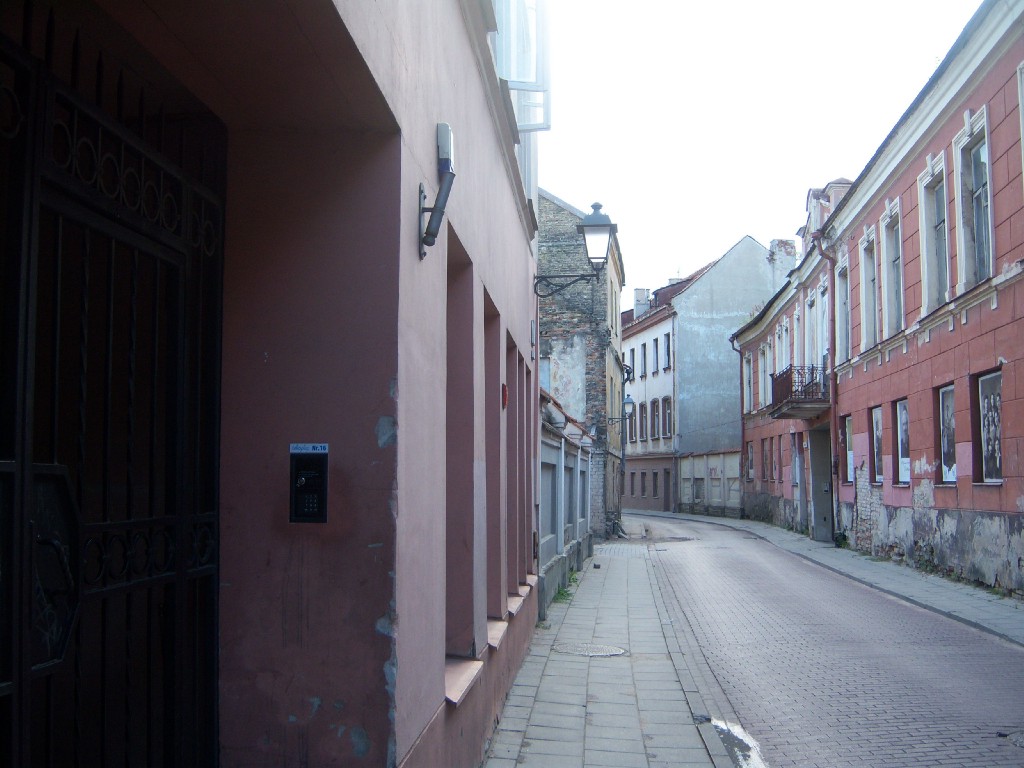
In Vilnius, Lithuania: (right) the Jewish library building that became a meeting place for the resistance in the ghetto; (left) the entrance to the apartment building I was staying in. Photo: Rebecca Entel
During one particularly long storm, I found a cafe with a charming rounded wall of windows. I sat there as the sky blackened and the windows rattled, looking through a book I’d bought at the museum: a collection of photographs from the Lodz ghetto, the first place my grandma had been imprisoned during the war and a local bus ride away from Warsaw. A bus ride I’d shied away from — I think — because I had no idea where to go once I got there.
Late in the evening I returned to the hotel to retrieve my overstuffed backpack for the overnight bus back to Vilna. When the bellhop strode from the lobby with my claim ticket, I hovered anxiously at the desk, unsure if I was supposed to wait or follow him.
The woman behind the desk told me: “Everything will be all right, madame.”
I tried to pronounce dziękuję — thank you — the way my grandma had told me the night before: the first and only Polish word she would ever teach me. I’d written it phonetically as chikoon-yay on a scrap of paper.
Upon my return from Poland, I had almost nothing to write on my travel blog. Whatever I was looking for, it wasn’t there: a point so obvious I felt embarrassed to type it.
My first time snorkeling at San Salvador’s barrier reef, I had a horrendous summer cold that turned my head to a lump of heavy clay. The July equatorial sun spangled the water and blinded me. And quashed my thought of getting a different view of hilltop plantation ruins from the middle of the ocean. (It would be almost seven years until my book about the ruins was published, two more years until my first trip to Eastern Europe, and four until Poland. Five and a half years later my grandma would die.) Disoriented, I spun in a doggy-paddle.
The July equatorial sun spangled the water and blinded me. And quashed my thought of getting a different view of hilltop plantation ruins from the middle of the ocean.
I put my head back in the water where it was cooler and hazy: an underworld you couldn’t see from above. I could hear nothing but my own breathing through the snorkel. Occasionally the water would cloud, and the coral would seem grey and dead-looking. But then: a flash of color as a spray of fish darted into hiding holes or burst forth under and around me. I dutifully cleared my mask when it fogged.
Another member of the group dove down to the sea floor and drummed her hands. The sand rustled up as a stingray longer than any of us slowly loosened itself from where it’d been submerged. How had she detected it, so well hidden? We hung in the water — admiring of its size and leery of its venom, both — watching it twist and float away.
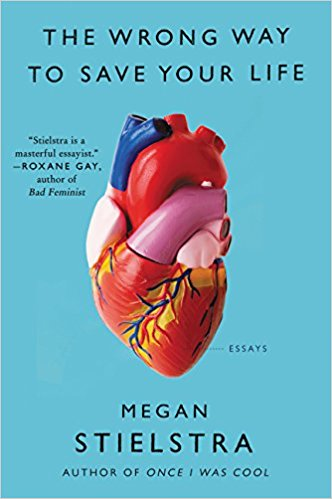
When you read Megan Stielstra’s new essay collection, The Wrong Way to Save Your Life, you know that she’s a powerful essayist. But when I talked to her about the collection, it became clear that her identity as a writer is manifold: her skills as an orator and an educator are just as honed as her prowess in memoir. Reading the collection will make you want to sit in on one of her workshops or watch her perform live storytelling in Chicago.
These stories of the classroom and of being an active participant in a vibrant cultural community weave their way into the essays that make up The Wrong Way to Save Your Life. It’s an eloquent study in the braided essay, as well as an exciting expansion of the form. Stielstra discusses the nature of growing up, how community building and radical pedagogy can build a better educational system, the national discourse on topics like gun control and sexual assault, all while building a conversation with other contemporary nonfiction writers and texts.
Not surprising given the wide range of ideas Stielstra covers in the collection, our conversation meandered all over the terrain of the problems of our society today, how to be a responsible writer and educator, and how waiting tables prepares you for a career in writing.
Becca Schuh: I loved all your writing about teaching. I graduated from a small interdisciplinary studies program, and I noticed a lot of commonalities in terms of radical pedagogy. So obviously that’s a huge topic you’re wrestling with in the book — how would you introduce people to that type of education?
Megan Stielstra: My graduate work was specifically in the teaching of writing. That’s something I think a lot of college teachers don’t necessarily have. You have this great expertise in a subject matter, but where is the support for how to teach and how to give that expertise to people. More importantly, how do you get to know the people who are in the room you’re standing in? What are their needs and wants? How can you serve the needs of the people in the room? I think that how I view education has a lot to do with just sitting and listening to people in that space. I can get really jargon-y, and I can talk about community building as a pedagogical practice, but it really boils down to that.
I was in college in the late nineties and early 2000s, and it was a hell of a lot cheaper than it is right now. I don’t want young people to be saddled with this massive debt for a single classroom. A lot of this is on the administration, too, the upper administration deciding the money that’s being spent and whether that’s going to strap young people in the future.
Each thing I say gets bigger and bigger because it’s not just administrators. We need to look at the federal government on this, because you cannot step out of college and already be underground in a hole. Just even saying that sentence out loud makes me want to set the walls on fire. This cannot be the way that it is. But it is, and it’s as crazy to me as science fiction and the machines taking over and aliens landing tomorrow.
BS: I had similar feelings to that a lot of times while reading the book, as you point out these ideas in education — not education itself but administration and how it’s handled — that just don’t make sense. It elicits this intense emotional response when you start to think about how backwards it is.
MS: While teaching I also worked in faculty involvement, so I had this interesting viewpoint, of talking to hundreds of college teachers every week and seeing what they were doing in their classrooms, the successes and challenges and frustrations they were having. And there would be this moment of realization, when I’d see that these feelings I’d been walking around with — like, dude this doesn’t seem right — they were validated and covered in conversations with hundreds of people.
A really clear example of this for me came this past October, right before the election. I teach at Northwestern, and in my creative nonfiction class, not long after the Access Hollywood tapes came out, I had several young women turn in essays about sexual assault. I think that that was not an isolated incident in this country. After the whole grab them by the pussy thing, you started hearing women talk. All of a sudden you go from one story and one isolated experience to hundreds of thousands and you just see the magnitude of not being alone in this — the power behind our stories when they’re told in volume, en masse. We can see this is real this is a problem this is not something that’s in our heads.
The next real challenge is we have is to listen to those hundreds of stories. We have to listen when students at colleges tell us something is wrong. We have to listen when half of our professorship is not making a living wage. We have to listen when women are talking about sexual assault, we have to listen to people of color, we have to listen to queer people. None of these stories are new. The thing that needs to change is the listening, and then from there the action.
We have to listen when women are talking about sexual assault, we have to listen to people of color, we have to listen to queer people. None of these stories are new.
BS: I was thinking about how the internet has increased the accessibility and availability of this information, and you know it’s so easy to gripe about the bad things about the internet, but thinking about how incredible it is that it’s this venue where people have such easy access to stories. But then, as you’re saying, you have to read them, and think about them.
MS: I think so much about the work being done by editors, and my husband is a curator, he runs an art blog, so he looks at thousands of pieces of art per day, and he finds the stuff that is incredible, and you can say the same thing about the role of an editor. I think the the idea of curation, the skill, what we’re really talking about here is media literacy. To be able to look at all of this stuff and delve into our sources and read multiple different perspectives and to be able to separate the facts from the truth.
BS:I work at a bar right now but I’ve worked at a lot of places, fancy, breakfast, the whole thing, so I was fascinated by a lot of your writing about the service industry and how it relates to creativity. There’s a passage where you say that watching customers get drunk and then tell stories helped you develop your own storytelling techniques. Were there any other things that you observed in restaurants that influenced your process as a writer?
MS: Oh my god, in the restaurant? Everything. Shit, I was at that place for twelve years. Specifically I’m talking about The Bongo Room in Chicago. There is no way I’d be where I am now without that restaurant. Not just my ability to make a living, but also living in a big city, I came from a very small town in Michigan, my father lives in Alaska, and for the longest time this was my family. Three of the women who I waited tables with for a decade were over here for dinner last night. I officiated a wedding for one of them when she married her husband last year. This is my family. I talk in the book about the year that I lived in Prague, and before I left, I went to my boss, and he said “Are you quitting or are you going on sabbatical?” And a year later I called him, we’d just got back I was so broke, so broke, and I called him and I’d just got off the plane, I’m totally jet lagged, I call thinking I’m going to try and get back in a month or so and he goes “Great I’ll put you back on for tomorrow morning.” These are the people who took care of me.
I was waiting tables while being a college professor, so people would ask, “What else do you do besides work here?” and I’m like “Well I’m a professor,” and there’s this…whoa, what. And then you can engage in a dialogue, like “Did you know that half of your college professors aren’t paid a living wage? Did you know what professors were full time and who weren’t?”
BS: You wrote: “I explain that I make more money pouring mimosas than I do teaching college students, let’s sit quietly for a moment and consider what this says about our culture.” What do you think it says?
MS: Part of the reason it was important for me to put that section in is that I don’t think with writing we spend a lot of time being really honest and upfront about the money. It’s not fair, it’s not right to young writers.
We have to talk about the basics of how do you eat, how do you pay rent, how can you be saving for retirement and not eat cat food — that is vital. There are so many voices that are being lost. There’s an organization that supports women, people, writers, who do now or have lived below the poverty line writing about poverty — the Economic Hardship Reporting Project — which is so vital, because so many people who are writing about poverty have never had that lived experience.
A thing that I think is really terrific is what Saeed Jones is doing with the Buzzfeed Emerging Writers Fellowship. You’re getting the professional support that you need, but it’s also paying you so you can live in New York for the duration. It would be incredible if that could be a model. I’m not the first person saying this, this has been said and said and said, but if internships are gateways into these positions, then the only people who are going to be able to work these internships are people who don’t need to be paid. And so again, what voices are we missing? I think that for me this all comes back to that Chimamanda Adichie lecture, “The Danger of a Single Story.” We’re just hearing from one voice what it means to survive in this country or what it means to be a young person, what it means to work. And if we’re not hearing from all sorts of voices then we’re not hearing the truth.
A lot of my students say, I want to be a writer but I’m here for pre-med or pre-law. My parents want me to do this. And the thing you want to say is, it’s your life, do whatever you want to do. But man, there is some privilege behind that comment. The young woman I’m thinking of specifically, her parents immigrated to this country. And they worked their asses off to send her to school, and there were all sorts of expectations. And she ended up writing a story about the conversation that she and I had about that. A really incredible essay.
We have to talk about the basics of how do you eat, how do you pay rent, how can you be saving for retirement and not eat cat food.
BS: I noticed in both your previous essay collection, Once I Was Cool, and this one — you talk about these manual processes that you undertake while writing essays. There was the one with the bathtub in the previous book and then in this book, dissecting the deer hearts. What was the root of the idea behind those processes?
MS: The deer heart exercise began with — I was really scared of losing my dad. That’s a piece that has been written and written and written and written — person is scared of losing family member.
So if I approach the essay with the question of ‘how do I stop my dad from climbing mountains,’ that’s not an interesting essay, because that’s been told a hundred million times, and the answer is clear: dad loves the mountains, dad will climb the mountains. So for me the question became, what do I do with all of my fear? While I was thinking about that, my dad sent us a big old box of deer hearts, and I was sitting looking at them, and I thought, ‘I don’t even know how one of these things works.’ I have twenty years in higher education where we’ve done all this shit with the heart as a metaphor, and I was sitting here with a visceral, an actual heart in my hand. The only other time I’d dissected anything was in high school with the frogs. So I was sitting there trying to cut up these deer hearts, and I couldn’t remember anything about that besides a closeup of a frog. I tried to unpack why, and then I realized oh, fuck, it’s because my teacher was Stephen Leith. [Stephen Leith was the perpetrator in a school shooting where Stielstra’s father was working in administration.] The essay made a lot more sense then. You can’t really talk about my dad and his move to Alaska without talking about this shooting. It originally wasn’t something I ever wanted to write about; for a long time, that was because I didn’t think it was my story to tell. And then…it is. This changed the trajectory of our lives. It’s an important conversation to talk about, how tragedies in our culture spill out in the big and huge ways that touch every person’s life.
BS: What else is on your mind as the book enters the world?
MS: I think there’s a single story being told in this country right now about Chicago. I want to be able to contribute to what the city really is, and to give one of many other perspectives on it, and to be able to say, “this place made me, I am here because of its arts organizations and because of its schools and because of its writers and its performers and its young people, and I’m so proud to be counted among them.” I really want to do justice to this place in some kind of a way, if this book can be a little bit of a love letter to Chicago, that means something to me, especially now.
The way you know Chicago through literature is reading about 700 different people from all sorts of corners. I’m reading I Am Not Your Perfect Mexican Daughter, by Erika Sánchez. And two other Chicago writers I love have books coming out this month, Jac Jemc and Lindsay Hunter. You hear so often the idea that Chicago is a flyover city. What people are missing by not stepping into our pages and our streets is something huge and kind of magic.
The narrator of Anelise Chen’s debut novel, So Many Olympic Exertions, is in the eighth year of her Ph.D. program and stands at risk of losing her funding. Her research area is sports, and after learning that a friend of hers — an ex-boyfriend — has killed himself, the narrator, Athena, becomes obsessed with athletes who give up: those who make the choice to do so and those whose bodies choose for them. She spends hours on YouTube watching videos of marathon runners and Iron Man competitors collapsing just before or directly after they’ve reached the finish line.
For Athena, whether or not one crosses the line is arbitrary. The effort itself is absurd. So is most everything else. The story is set in 2010, in the wake of the Great Recession, when newspapers were still patchy with items about “bank employees jumping off bridges [and] consultants swallowing their guns.” In other words, when the rules governing the American economy — the great game in which all of us participate, however skeptically — had just been rewritten, and the industry’s fiercest competitors found themselves abruptly disqualified. Chen marks such developments subtly but incisively. Before long, So Many Olympic Exertions reveals itself to be a book about much more than sport; its focus is on American systems — athletics, academia, capitalism — whose demands for achievement and continual progress can never be satisfied.
As Athena struggles to complete her thesis, the reader follows her trips to the gym, the library, her therapist’s, an academic conference in Chicago, her parents’ home in Los Angeles, a writer’s residency in Greece. She is on a mission — to finish her dissertation — but it remains unclear, despite her travel, whether she ever approaches any nearer to her goal. Chen is a thoughtful and inventive writer, and the world she creates may remind readers of certain paintings by Gustav Klimt, wherein the characters are rendered in a doleful realist hand as their surroundings shimmer with gold leaf.
I spoke with Chen about her book via Facetime Audio. Mostly we discussed athletics — watching and participating in them, and how difficult they are to quit. She was in residency at the Wurlitzer Foundation in New Mexico, and at various points our connection cut out; the residency’s internet and phone service, she explained, were unreliable.
Max Ross: What first got you interested in the field of sports research?
Anelise Chen: It was the 2010 Vancouver Olympics. I was in a hotel in Mystic, Connecticut, and the men’s luge was on TV. Earlier that week, during a training run, one of the competitors had died — something was wrong with the course, and he lost control and went over the side of the track. It cast this pall over the entire Olympics — everyone was calling it the cursed games. And while I watched I kept thinking how morbid the sport was.
I thought: The luge is such a good metaphor for how life actually feels. It seems like there’s no strategy to it. From a viewer’s perspective, it looks as if the competitors go, “Okay! I’m just going to throw myself down this track at really high speed and hope for the best!” Obviously there is a lot of strategy to it, but visually it looks completely desperate.
At the time, the economy was really bad, and this feeling of futility and things dying was in the air. And two of my friends had just passed away, a week apart from each other. It was like one event and another event and another event in rapid succession. And then I happened to in front of a TV when the Olympics were on. Before that I’d had no interest in sports. But suddenly I was enthralled.
MR: The way Athena watches sports, or studies them, doesn’t seem typical. She obsesses over the moments when athletes fail — when their bodies give up.
AC: When we watch sports, I think it normally has something to do with wanting to see the glorification of the body — of life. We’re watching really well-honed bodies in motion, and it’s life affirming. And the will to win is life affirming. The effort athletes put into their pursuits… They’re trying so hard! It’s so much!
And the act of watching activates the same areas of the brain as if you were actually moving your own body. Watching is powerful. Watching is analogous to doing. So spectatorship really becomes a conduit for experiencing what the athletes are experiencing. It’s entering into a heightened state.
On the other hand, it can begin to seem as if watching sports is some sort of ritual we’re performing to ignore the things that are really bothering us. To allay anxiety, and ignore difficulty and disappointment and — taking the metaphor to its furthest end — ignore that death exists. Ignore that we’re mortal beings, and that our bodies will ultimately fail us. By deadening us to these experiences, watching sports provides an antidote. But it can be a dangerous one.
It can begin to seem as if watching sports is some sort of ritual we’re performing to ignore the things that are really bothering us. Ignore that we’re mortal beings, and that our bodies will ultimately fail us.
MR: Have you participated in any sports yourself?
AC: I was a swimmer and a water polo player, and I was really bad at both. I became intimately acquainted with failure. And sucking, and losing.
I was competitive through high school, and we — the water polo team — had this really amazing coach. He’d coached members of the Olympic team before, and had been a college coach for a long time. So we were actually really good. Which meant that I was the worst player on a really good team. I think that contributed to my feeling that I just couldn’t cut it.
MR: But I imagine it was difficult to give up anyway…?
AC: Yes! It was really hard to give up!
The rhetoric of persistence is so convincing. And it’s definitely part of the capitalist machinery. You’re told — in various ways, and from very early on — that if you’re bad at a sport or a game, it’s your own fault. You weren’t trying hard enough; there’s some innate deficiency that is your own. With that, youth sports very quickly becomes an issue of identity. And then the stakes comes to seem impossibly high, and it becomes impossible to quit — if you quit, you’re giving up who you are.
But actually, with athletes, a lot of who’s good and who’s bad is freak circumstance. Funding is so much a part of it. And parental involvement, or the region where you grew up, and who expects what from you. And genetics. Some people are just bigger and taller than you. It’s not an equal playing field at all.
And yet, somehow when you lose there’s so much shame. And when you quit there’s even more.
Somehow when you lose there’s so much shame. And when you quit there’s even more.
MR: At times your book reminded me of that Garfield Minus Garfield webcomic, where someone’s removed Garfield from every panel, and the strip then just seems to be Jon, alone, talking to himself. But when you think of the comic as it’s supposed to be, with Garfield present, it’s still just Jon talking to a cat. Which is no less absurd.
Your book, I feel, evokes the absurd in a similar way, by thinking through what would happen if we removed competition from athletics, if athletes martyred themselves in training for no actual event.
AC: I thought about that idea a lot. The inside flap of the book is a still from Paul Pfeiffer’s interactive video piece Jerusalem (2014). Pfeiffer is a visual artist, and in this project he manipulated footage from a 1966 World Cup match between England and Germany. The players ghost in and out and you can’t see the ball they’re all chasing after. It looks like they’re running up and down the field for no reason.
His other work plays with the same idea. He’ll take footage from famous sporting events and Photoshop out all — or the majority of — the players. When the context is removed their activity becomes absurd.
MR: After seeing those images, it’s hard to feel that the game is anything but absurd.
AC: Games ultimately are absurd. There are random constructed rules. And the outcome is meaningless. It doesn’t affect world politics — except when it does — but speaking generally a game has no actual purpose to it.
It goes back to Pfeiffer’s work. If you have no opponents, and the rules of the game aren’t there or aren’t apparent, then the game loses its meaning. Why is this figure running up and down? If there’s no context, you see human life for what it is: just running up and down a field for no reason. In a way, if you perceive life from a certain angle and are inclined to think, ‘Well, we’re all just here playing this game with arbitrary rules, and ultimately we’re just alone on the field,’ then the striving and the sense of meaning and the sense of purpose — they all just dissolve.
There’s also the video work of Philippe Parreno. He made this film called Zidane: A 21st Century Portrait. It follows the French soccer player Zinedane Zidane for an entire match, and only Zidane — just a zoomed-in view of him. He’s kicking turf. He’s spitting. He scowls. But you can’t see the larger game he’s a part of. It gets at the same idea. What is he doing? What is he experiencing? What is it all for?
If you have no opponents, and the rules of the game aren’t there or aren’t apparent, then the game loses its meaning. Why is this figure running up and down? If there’s no context, you see human life for what it is: just running up and down a field for no reason.
MR: In your book then, is Athena just trying to figure out the rules? And is her frustration that she also finds them to be arbitrary?
AC: Athena’s game is also absurd. It’s, “Oh, I have to get this degree and…” There’s always an and. “I have to do this and this and this, in order to obtain this.” But what’s the purpose of obtaining this ultimate thing?
In 2010, it felt like capitalism had failed us as a structure. Its rules had led us off a cliff. In a sense we were all playing a badly designed game. And people were beginning to see that it was a daisy chain of “and then whats,” and were looking for ways out, and even investment bankers started committing suicide.
So with Athena’s friend, the one who killed himself — he’s opted out of the game. This doesn’t seem right to her, I think, this idea that you can actually drop out of the game. She had looked up to him. He was a standout student when they were in school together, he seemed to have it together, he seemed to have a promising future. But he still opted out.
MR: Is suicide the only way to opt out? That seems so bleak.
AC: Figuring that out is part of Athena’s conflict. Is it okay to opt out? Is it okay to quit? Is it okay to stop running? What will ultimately happen? If you recognize that whatever game you’re playing — soccer, academia, investment banking — is a dumb one, or if you reject the game’s parameters, you don’t have to continue on with it. But then the question is, what can you do?
There’s a section of the book where Athena’s talking about marathon runners who just stopped running. What happens to them? If you take away the metaphorical import of competition — the life and death stakes for medals and glory — competing doesn’t mean anything. Quitting just means you don’t want to run anymore. You can walk off the track. And life continues.
That’s why I like the story of Japanese runner Shizo Kanakuri, who dropped out midway through the marathon at the 1912 Stockholm Olympics. He just took a boat back home. He didn’t tell anyone and race officials assumed he’d died. Decades later, it was discovered he was actually alive and had raised a family and all that, and the Swedish National Olympic Committee invited him back to Sweden to finish the race. Which is to say, you can quit the race and nothing bad is going to happen.
But it’s still hard to quit, and that’s definitely something Athena’s grappling with. Do I want to keep playing this game that I don’t necessarily buy into, or believe in? How do I stop? I think she’s trying to find alternatives to the game that she’s been forced to play. Does this game have to be so cutthroat? Does it have to be a contest that we’re all in? Does the game have to be a competition?
Competition isn’t the only structure that play comes in. It doesn’t always have to be this win-lose binary. It can be imaginative in other ways. So trying to find another game or another structure to inhabit that isn’t antagonistic and isn’t based in competition — I think that’s what Athena’s after.
MR: But she still finds she needs rules to get by. For instance, she comes up with a set of guidelines for attending academic conferences (“Sit as far away from another human being as possible”), and sets goals for how many people to mingle with at parties.
AC: I think we all need some structure. She’s trying to find hers, if only to finish her thesis.
Is it okay to opt out? Is it okay to quit? Is it okay to stop running? What will ultimately happen?
MR: And do you think she’s successful?
AC: Ha, well. The book ends before there’s a resolution. I don’t know if it’s a cynical book, or if it’s hopeful. It’s still trying to figure that out. I don’t know ultimately what Athena discovers.
We never know if she finishes her thesis. The book ends with an image of ocean waves, which I liked because it’s so repetitive — this movement of waves crashing. There’s no beginning and no end, it just goes on and on. It’s really hypnotic. And it doesn’t stop.
During a recent visit to Boston’s Chinatown, I glimpsed a small plaque affixed to one of the storefronts. It read: “In 1761 at Griffin’s Wharf, near this site, John Wheatley purchased eight year old African-American Phillis Wheatley (c. 1753–1784) to serve as a domestic slave.” That Phillis Wheatley, the first published African-American woman in America and an esteemed poet, should have a plaque was no surprise. It was the placement of the small, unassuming marker that jarred me: not in the place where she was born, or died, or worked, but in the place where she was sold.
As a historian, I am well aware of the brutalities in history, but as a passerby, the plaque was an unsettling reminder that I stood on the ground where atrocities of the slave trade occurred. I wondered how many others had stopped to read the plaque, and how many walked by without taking notice. Stumbling upon this plaque reminded me of the immense power of monuments and memorials to shake us out of 2017 and into 1761, to humble us before the wrongdoings of earlier generations, and to foster empathy with those who lived before us.
Over the past few weeks, as activists in Durham pulled down a Confederate monument and cities and universities scrambled to remove similar statues overnight, Americans have become embroiled in debates on the importance of monuments and memorials. Some have proclaimed that removing Confederate monuments is equivalent to erasing history. Others have rebuked them, suggesting that history is better represented in books than statues. In reality, the relationship between monuments and historical scholarship is more complex. The creation, and the destruction, of a monument is part of history, just as much as the events it commemorates. The role of books and scholarship is to put those monuments in context, to understand how they arise from the values of their time — and, sometimes, to bring them in line with the values of our own.
Monuments and memorials are part of our everyday lives and part of our shared landscape, whether we are conscious of them or not. Yet when Confederate leaders literally tower above us on stone pedestals, we are forced to reckon with their symbolism. Statues of figures such as Robert E. Lee or Stonewall Jackson are valorizing and triumphant. They stand proudly or sit astride horses. For someone unfamiliar with American history, it would be difficult to critically read such visual posturing.
The creation, and the destruction, of a monument is part of history, just as much as the events it commemorates.
The glorifying poses of Confederate leaders reflect the triumphalist views of their creators. Historians have written extensively on how Confederate monuments were erected long after the Civil War, well into the first decades of the 20th century, to further the agenda of white supremacy. Yet it is uncommon for statues or monuments to include a history of their creation. A mere statue or monument cannot provide those details — it cannot provide a critical account of why it was built.
In order to understand and critically read a monument, it must coexist alongside books. The intentions of long-gone creators can only be found in historical sources and history texts.
The past is unchanging, but history — the way we understand and interpret the past — is constantly in flux. Historians uncover new sources that change the way we think about an event, or reread an old source that can be understood in different ways; we make new arguments, reinterpret events, and better understand historical actors; we seek to include the voices of underrepresented peoples. Books are the medium through which these new understandings make their way into the scholarly discourse, and then into the public consciousness.
Historical scholarship teaches us the difference between history and historical memory. While history is how we understand the past, historical memory is how the past is remembered. In making this distinction, we can see that a Confederate statue from 1911 reflects historical memory — it is more representative of the year it was built than it is of the Civil War. Statues can tell us how the past was remembered by some, but they don’t tell us that the statue was privately funded by a few supporters. They don’t tell us about those who resisted and opposed the building of the statues. A statue only tells part of the story, amplifying the voices of the few.
As history evolves, statues and monuments remain static. Historical memory — what we take pride in and what we are ashamed of — shifts, but the physical markers on the landscape do not shift with it. In a society where so much of what we use and see and create is disposable, monuments are built to weather time. They are built to outlast their creators. A monument can — and will — outlive the thinking that led to its creation.
But monuments can be reclaimed. As our understandings of history change and our society evolves, we champion different heroes and different values. Monuments should come to represent the values of today’s society, not those of centuries ago. It is our duty to reclaim those monuments and question if they best represent us, not to bow to the intentions of earlier generations. Sometimes, the best option is to record the monument’s existence, store the information in the archives, and remove the monument itself. Other times, though, there are paths to reclamation, which can include recontextualizing a monument with historical interpretation to make clear to visitors that the values espoused by its creators are not those of present-day society. One such example is the Bolzano Victory Monument in northern Italy, a monument constructed under Mussolini which is now the site of a permanent exhibit focused on Italy’s fascist history.
A statue only tells part of the story, amplifying the voices of the few.
Ensuring that monuments represent contemporary values and acknowledge the difficult parts of history can be a challenge. Often, monuments and memorials to what historians call “difficult history” are grassroots efforts, created by the communities affected by tragedy. In other cases, federal, state, or local governments or local historical associations do commemorate some of that history, such as the Phillis Wheatley plaque. However, taken as a whole, historical monuments in America reflect who has had the power to assert their interpretations of history in public spaces. Too often, historically marginalized groups have not had the resources or institutional support to memorialize difficult history.
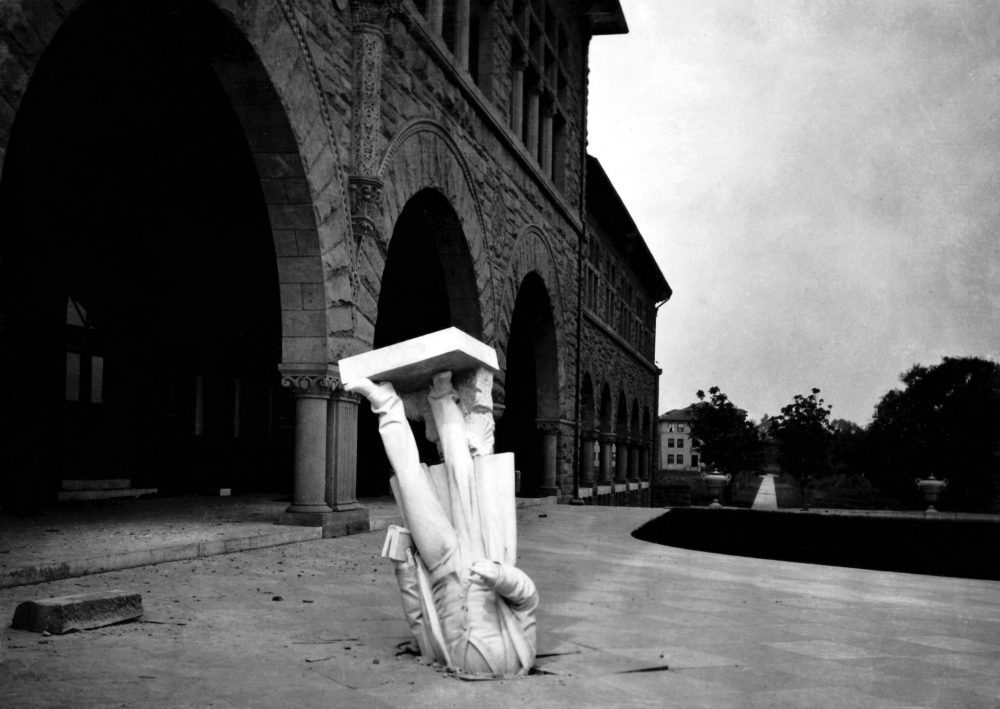
While reclaiming Confederate statues is an admirable first step (and there are some creative ideas floating around: cutting them off at the feet, burying them with their heads in the ground), we should make the markings of difficult history more visible. Efforts are underway, such as those in Shockoe Bottom in Richmond, Virginia, where the Sacred Ground Historical Reclamation Project seeks to memorialize the area’s historical ties to the African slave trade.
Here's what Paraguayans did with a statue of dictator Alfredo Stroessner (1954-89). It's an interesting compromise. pic.twitter.com/gEtUPLseDz
As we move forward, we should collectively acknowledge our country’s wrongdoings. We should recognize that the past of those in the majority is the history that has long been told and that our country’s history is more rich and nuanced. We should conceive monuments to those whose voices are often absent from historical records. And we should include contextualization and interpretation for these future monuments so that they may be better understood by generations to come. Such history can be found in books, but we should also create reminders on the visible, shared landscape, ensuring that we continue to encounter and engage with plaques and memorials to the parts of American history that we are ashamed of but don’t want to forget.
The past can’t be changed, but how we remember and commemorate it can be. Perhaps most importantly, we can change how we use history, how we teach future generations that history, and how we position ourselves and our lives against and with that history. That’s more than we can learn from a statue. But it’s also more than we can learn from just a book.
It is two in the morning on my Friday, which is Tuesday, and in the house across the street, lights are getting flipped off and on in a disoriented march towards darkness. I’m watching the scene from my window with a ginger ale, wide-awake. I’ve already had my allotment of three domestic light beers for the night and have switched to the other carbonated without regret. The home across the street belongs to but is not occupied by Terrell Presley. Standing in the middle of the street that separates our houses, in the rocky desert hills where we live, I asked him a while back one burning, ticking day if the light switches in his house were placed oddly, if there had been miswiring, because this stunted fluttering with the lights always happens with his renters, and he, not unkindly, ignored the question. The creasing around his eyes deepened and he half smiled beyond me, as if a person we both liked was arriving. I want to be able to elegantly ignore questions without malice or consequence. But I really was curious about the switches, all the lights blinking. I’ve never been in the house and can only guess at causation.
Purchase the Kindle edition
Terrell takes extravagant quarterly golf trips with men he’s known since boyhood. Men he grew up with just outside of Pittsburgh. Right now he’s in Scotland. Last year was Brazil, at a resort where mostly undressed women offered kebabs mid-course. He told me cryptically: “I did not partake.” Terrell has never been married, and in general, despite what his golf trips and the details he allows me to know might lead you to believe, is discreet.
I like Terrell because he is self-made and direct, even at his most opaque. He invented a surgical adhesive technology, sold it, and retired. He drives the same car he did pre-retirement, a pristine old Saab. He has always, until now, made a point to tell me a little about the person or people who will be renting, and reminds me to not hesitate to call the resort or him directly if there are any problems. I work from home, remotely doing IT consulting, and in all cases deal with his renters in a more concrete way than he ever does. Past renters have included an ancient couple from Ames, Iowa; a retired military chaplain; Terrell’s dim and gawking sister. I’ve helped kill a snake, jump-started a car, and, by telephone, recommended restaurants, doctors, the most affordable liquor stores. My phone number is the only other contact Terrell lists on the fridge, I’ve been told. He knows I like to talk and don’t mind questions from strangers.
Terrell doesn’t seem interested to know my impressions of his renters. I usually open on his terms, asking, “Did the check clear?” But I wasn’t able to do this with his sister, feeling it would be an overstep, so I had conspicuously little to say regarding his only kin. I couldn’t reconcile her plain yokel qualities with Terrell’s daily crispness. Of his sister, I only asked why she drove such an enormous truck, a Ford F-350. He told me he didn’t know, but said, “Without the truck, would you have asked anything about her?” before heading back inside with his hands in his pockets. It occurred to me Terrell had bought his sister the truck. Maybe to give her some mystery. I have no proof.
Invariably, we have our talks in the middle of the cambered desert-worn street sloping between our two houses. The asphalt has been baked gray and is flecked by shimmering divots. We live north of Phoenix in Cave Creek, a place people travel to for their own golf vacations, which is the reason Terrell usually has no trouble filling the house in his absence. I’ve been told he could charge double his price. Our part of the desert is craggy and undulating. We have flat red peaks. Tan and pink bluffs, guajillo, Mexican Blue Palm, adobe houses tucked behind dog-leg driveways. I’ve found houses in Cave Creek to often be secretly opulent or secretly run-down. It’s not exactly that all the houses look the same from the street, but instead that their flatness and positioning give away nothing. Landscaping is camouflage here. Locals take pride in the brutality of the summers, but I say any weather great masses of people over age ninety choose to be alive in, is weaker than advertised. Or over age fifty, for that matter. Nothing like the Midwestern crush and tumult of winter, the sickening cold. And, here, if things do get too bad, San Diego is a five-hour drive, Flagstaff only two. As far as the renters that stay in his house, Terrell doesn’t need the money, but something about his general practicality must prevent him from letting his house sit empty when it could be generating profit.
I’m at the window watching his house, now steadily dark, considering what has changed between Terrell and me. He’d said Scotland, offered the information freely, and when I asked about renters, was told there would be none. So, who the fuck is over there?
I slept late. It’s nearly ten. I call Terrell’s house, to see if the unregistered stranger will pick up — but the phone rings and rings. I walk into the kitchen and begin making something to eat. I put coffee on. I take out a non-stick skillet, spray it with olive oil, mix five eggs in a metal bowl, dump them in the skillet, now hot, and add a handful of shredded sharp cheddar cheese. I take out a can of black beans and microwave the beans in a Pyrex bowl. I take out tortillas from the fridge. I continue cooking the eggs as the coffeemaker sputters its completion. I have no idea how anyone makes scrambled eggs. I’ve been doing it this way for ten years now because I can’t remember how my wife did it. My phone rings. The caller ID reads: TERRELL PRESLEY-HOME.
I say, “Yes, hello, this is Russ.”
“You just called?” A woman’s voice.
“Yes, I did. Terrell usually lets me know when he has a renter, and so I was just calling to make sure everything is OK.”
“If I’m not supposed to be here how would calling the house help?”
“I don’t know how to — are you supposed to be there?”
“Yeah. Terrell is supposed to be here too, I’m not renting. I’m a friend.”
“It’s pronounced ‘tehr-ull.’ Like feral.” What kind of friend would mispronounce his name? He’s a Terrell like Terrell Owens, not Terrell Davis.
“I’ve never said it out loud,” the stranger says.
I don’t know what to make of this. “Well when does he get back from Scotland?”
The woman laughs, “I have no idea why he would have told you he was in Scotland. He’s in Taos. He was supposed to be back yesterday before I arrived, but there was trouble with the plane.”
I hang up with the woman and call Terrell. He answers on the first ring, and I ask if he knows there is a woman at his house. He says he knows, that everything is fine, and thank you, and that he should be back tomorrow. I can tell he’s ready to hang up, but before he does, I ask, “Why doesn’t she know how to pronounce your name?”
“I believe in the past she’s always said ‘Mr. Presley.’ Been in rooms with me where that was the norm.” And then he does hang up.
He didn’t sound surprised or annoyed. He sounded like he always does, calm and already mentally occupied with other concerns. I put the phone down, spend a few minutes finishing the eggs, and my doorbell rings.
Standing at my front door is a thick-eyebrowed woman in workout clothes. Behind her, on the street she crossed to reach my home, heat is rising off the asphalt in blurring waves. She’s wearing earbuds attached to a phone she has in an inside pocket of her open zip-up. Under the zip-up she is wearing a white sports bra. She’s young. Maybe thirty, and seems unaffected by the heat. Her dark hair is in a ponytail.
“I figured if I introduced myself, you’d see everything is OK. I’m Terrell’s friend, Jordan.”
I step aside so she can come into the house, say “Sure, sure,” in sincere welcome, and we shake hands. Shaking hands with a beautiful woman usually makes me think of one of two scenarios: 1. If the handshake is strong, her father. 2. If the handshake is weak, her single working mother, and the apartment she’d had to herself, the thousands of hours of TV. I know this is fantasy, but, still, it remains. Jordan’s was strong. Her loving father might have had no hands for all I know. No arms. The thought passes. To aid my unvoiced apology for the suspicions I earlier perpetrated on the phone, I ask Jordan if she wants any eggs, she says, “Sure, please,” and I am more surprised by this than anything she has so far told me today. She is still wearing the headphones. The presence of another person in my kitchen makes me aware of its particulars: the size of the island suggesting a level of cooking I can’t fulfill, the decorative copper roosters my wife loved still hanging, its dated brightness and comfortable femininity. Jordan sits at the island as if she was a regular customer. Her attention is not diverted by any interest in scrutinizing my home; she seems already familiar, or, possibly closer to the truth, unimpressed.
“Do you always keep those in?” I ask, pointing at my own ears. I’m standing against the cabinets in the corner of the kitchen, intent on appearing as non-threatening as I am.
“You’re the second person to say that to me today. Well, not quite. The guy at the grocery store asked me what I was listening to, and I lied to him. I told him, ‘Richard and Linda Thompson,’ thinking that would stop the conversation. I was wrong. The kid lit up. He went on about how he felt they ‘got in their own way a lot,’ but when they didn’t they were ‘really magic.’ He cited ‘I Want to See the Bright Lights Tonight’ and a particular live version of ‘A Heart Needs a Home’ as evidence.”
I make a face at Jordan. I haven’t listened to or talked about Richard and Linda Thompson with anyone in twenty years, or longer. I shift on my feet because leaning against the counter is killing my back. By the way she was talking, even if she wasn’t listening to Richard and Linda Thompson, she is making it clear she is familiar with their work. She seems dressed the wrong way to be saying the things she’s saying, and too young, but this is a simple dumbass thought I try to get rid of. And I don’t really know what the grocer meant. “What were you listening to?” I ask, getting her eggs situated on a tortilla I’d microwaved, scooping black beans over top.
“Nothing. I walk around with headphones in so people won’t bother me, but it hasn’t been working since I got here.” She tells me she is from Toronto. She watches me construct her breakfast without comment, sarcastic or otherwise, which is touching, and thanks me as I set the plate in front of her. She takes out her headphones, picks up the taco, and eats.
Her mouth full, I ask, “Why is Terrell in Taos?”
“A convention,” Jordan says, covering her mouth with her hand, “But I was unaware that you were unaware. Earlier, I mean.”
“Of what?” I ask, wanting her to say more.
“Of who Terrell is,” she says, “Of what he does.” She types something into her phone and holds it out to me. Before I look, I say, “Does he know that you are going to tell me whatever you’re going to tell me?”
“He knows you know he’s in Taos,” Jordan says, shrugging. “I called him before I came over. And he said he was in Scotland for a few days, before Taos. He told me that.” Terrell’s been gone five days. To and from Scotland is a full day of flying. It’s possible he was in Scotland before returning to the States, to Taos. But, why?
I put on my cheaters and take the phone from Jordan. On the phone is a Wikipedia entry for “Phoenix Lights.” I look at Jordan. She is again mid-bite. The entry reads:
The Phoenix Lights (also identified as “Lights over Phoenix”) was a UFO sighting which occurred in Phoenix, Arizona, and Sonora, Mexico on Thursday, March 13, 1997. Lights of varying descriptions were reported by thousands of people between 19:30 and 22:30 MST, in a space of about 300 miles (480 km), from the Nevada line, through Phoenix, to the edge of Tucson. There were allegedly two distinct events involved in the incident: a triangular formation of lights seen to pass over the state, and a series of stationary lights seen in the Phoenix area. The United States Air Force later identified the second group of lights as flares dropped by A-10 Warthog aircraft that were on training exercises at the Barry Goldwater Range in southwest Arizona.
I’m not following. I hold out the phone for Jordan who is up and looking for a mug. She’s opening cupboards until I point to the right one, and she pours herself coffee. I ask her what the deal is, say, here take the phone. She says, “Keep reading.” I audibly huff, and she smiles, drinks her coffee. I’ve succeeded in being non-threatening, dad-like. I scroll past sections detailing the timeline of the events, the arrival of the first and second set of lights in Prescott, Dewey, and Phoenix. Scroll past a heading of “First Sighting in Phoenix,” and “Reappearance in 2007,” and “Reappearance in 2008.” I scroll until I reach a section of the entry titled “Photographic Evidence.” Details of the photographic evidence of the first event yield nothing of interest; I go to the second event, and jackpot:
During the Phoenix event, numerous still photographs and videotapes were made, distinctly showing a series of lights appearing at a regular interval, remaining illuminated for several moments and then going out. Terrell Presley, of Cave Creek, captured the most often reproduced of these images. Presley’s photographs were all taken from the upper level of a Phoenix parking garage near Phoenix Sky Harbor International Airport. These images have been repeatedly aired by documentary television channels such as the Discovery Channel and the History Channel as part of their UFO documentary programming. […] The most frequently reproduced sequence shows what appears to be an arc of lights appearing one by one, then going out in the same fashion. UFO advocates claim that these images show that the lights were some form of “running light” or other aircraft illumination along the leading edge of a large craft — estimated to be as large as a mile (1.6 km) in diameter — hovering over the city of Phoenix. Thousands of witnesses throughout Arizona also reported a silent, mile wide V or boomerang shaped craft with varying numbers of huge orbs. A significant number of witnesses reported that the craft was silently gliding directly overhead at low altitude.
“He’s not golfing,” I say.
“He golfs. He just also gives talks. He was giving a talk in Taos. That’s probably what he was doing in Scotland. There are UFO conventions all over the world. That’s where I met Mr. Presley. At a talk he gave in Toronto a year ago.”
A year ago. I’m trying to remember where Terrell told me he’d gone, but I can’t remember. He could’ve said Canada.
The Phoenix Lights would have happened three months after my wife and I moved to Arizona from Chicago. 1997. Eighteen years ago. I was thirty-seven and she was thirty-nine, no kids, no dog. I was still looking for a new job. I didn’t know it at the time, but it would be another two anxious months of unemployment. She was working all sorts of shifts at the hospital, crazy hours, hours she didn’t need to work, to prove to her staff she was one of them, and had arrived to stay. They learned quickly the kind of woman she was. I still get cards from these women on her birthday, on my birthday, on days less readily marked. Undoubtedly she was working the night these alien lights hung in the sky. The night Terrell was on the top level of a parking garage taking pictures. Why was he up there? Is the answer because he had the time? I don’t know if he’d sold his adhesive patent by then or not. I don’t know what his nights were filled with. But, certain types of people don’t see UFOs would be my guess, people who are paycheck to paycheck, people with three kids, sick people, people with tangible worries and jobs; this is probably wrong. Maybe witnesses to these events span demographics, maybe because they actually happen.
We had an apartment on the fourth floor and on her days off we’d sit in shorts on our little deck and watch the sunset, ask each other, “Would you move back to Chicago if you could?” And we’d both say, “No, I wouldn’t. I like it here.” Neither of us believed the other completely. We’d left all our friends, moved to a new state where the people were different, more private, and found we were more unwilling to make new friends than we’d realized. We liked people, both of us, we liked people we didn’t know, we liked waiters and pharmacists and kids on airplanes, I mean, we hated all these people too, at times, but I’m just saying we were not wary of everyone unknown to us, we were open, just less open than we’d realized before we’d moved, but we became happier clinging to each other, married in a way we never knew we could be.
I vaguely remember reading about the Phoenix Lights in the paper. Front page news. But, I didn’t care about the event. Not in the slightest. I felt this way, feel this way, because of course there are aliens. Even if the lights aren’t extraterrestrial, if the reality is that the lights were some military happening, of course there is still something out there. The specifics aren’t important to me until the manifestation of alien life appearing on our planet moves past this speculative era. The difference for me is that life is enough. Normal routine nothing is enough. I’m interested in maps and cell phones and recycling. And the rainforest. And ocean fish that pulse glowing at pitch black depths. And baseball. Ford automobiles. Tintypes of my forebears. Helmets from the Han dynasty or pre-merger football. The house across the street. My thinking is, aren’t we enough? Huddling together in hotel ballrooms and convention centers to affirm the actuality of an event past seems a waste. There’s actuality happening right now. In abundance. But, I could be missing the point.
Terrell and I didn’t speak until after my wife died. We’d wave to him as we were building this house in Cave Creek, and he’d wave back, but we didn’t engage in any conversations in the middle of the street or elsewhere. My wife said at the time that Terrell looked like William Faulkner, then she said Howard Hughes, or a short actor playing Howard Hughes in a community theater production.
“A production of what?” I remember asking.
“Melvin and Howard,” she said, to please me. She knew that the idea of the Demme movie done onstage would make me grin. We’d seen All the President’s Men, a ten-year anniversary release in ’86, on our first date in Rogers Park near the Loyola campus at a theater long since gone, and Robards had remained something like our patron saint ever since. I’d said this to Terrell early on, told him my wife had thought he looked like Faulkner, and he’d squinted his small eyes, and said he’d never been told that. I think he started telling me about his renters because during that first talk after we were caught checking the mail at the same time, he needed something to say to the widower. To me.
Jordan is washing her own plate and mug, and I’m letting her do so without protest. She finishes, makes eye contact with me, and then looks away, meaning she is going to be heading out. I walk her to the door and she steps outside, turning to me and saying, “When Terrell gets back you should come over for drinks, the three of us.” Whatever she knows about Terrell is very different than what I know of him, so, maybe, although I say in my head, “That will never happen,” maybe it will. It occurs to me to say, “Today is my Friday, so tomorrow could still work,” but then I’d have to explain that for the past several years, since beginning remote consulting, I’ve reinstated the work schedule of my youth in retail. Friday to Tuesday. It made sense to return to the schedule I knew before married life, to shopping in empty grocery stores midweek. For my life to lack any family rhythm. I say, “Sure, you bet,” about potentially drinking together and give her an earnest thumbs-up before she begins back across the street. She’s taken four steps, I know because I’m watching her walk away too closely, I’m human, and I say, “Jordan.”
She stops and faces me.
“What’s the big fucking secret? Why wouldn’t Terrell just tell me where he was going? What he was doing?”
“Maybe he was afraid things would change,” she says, “Or maybe he thought you already knew.” And I have to remind myself she doesn’t know the state of our understanding of one another, how brief and situational our connections are. We speak in the middle of the street about people who will be staying at Terrell’s house a handful of times a year. I relay information about past renters. We wave. I do not ask Terrell personal questions; I respect the boundaries he maintains through his silence on topics he wishes to avoid. I try to make him laugh, and occasionally get a wry smile, which is just as satisfying. It’s possible that Jordan is right about Terrell being against a change in our situation. I can see how if Terrell likes being perceived as a person who keeps up with boyhood pals and takes them golfing around the world (in my previous understanding it was Terrell who paid for dinners and drinks and possibly even hotel rooms for these men) he would not want my perception dashed. Maybe he was able to see himself in the way I saw him because of our talks. Maybe he believes I know of his UFO talks and the golf and can hold those two facts in my head at once without ever speaking of the former. Maybe his understanding was that other people in town had told me of his Phoenix Lights fame and the reason our arrangement worked was because I chose to not ask him of it. Because what was there to say? What is there to say? You believe or you don’t, regardless of content. Maybe he knew me to be a believer, in general, and so any talk of inner self-definition and purpose was beside the point. The point was he’d found, in part, an equal. Maybe he wants me to be able to live inside my own created worlds, as I have done for him. I won’t be able to ask these questions of Terrell, not in a way that would give me the answers I want to know. And should I ask, I imagine he would raise his eyes to the horizon. I’ve heard it said colloquially that the ability to communicate is unlimited if a certain openness is allowed by both parties; I believe this to be far from the truth. The amount of self-knowledge pre-supposed in a word like “openness” is vast. Our neighborly pattern feels irreparably altered.
Terrell’s back. After hearing his garage door motor, I get to the window in time to see him and Jordan pull away in the Saab a few times, and I get no invite for drinks.
She leaves sometime after I’ve lost track of their comings and goings because an accounting program I helped design for an after-market golf cart accessory manufacturer in the Valley has gone awry. I have to videoconference with the same in-house tech guy for three days straight, giving him the language to calm his three bosses and an understanding of how to fix the books. I tell him at one point when he is losing all patience with the tasks he sees stacked waiting in the days ahead that we are talking about golf cart canopies and GPS systems to determine shot lengths for a leisure sport. This is not life-or-death. He is not calmed. He tells me this is his job, “It is my job to be worried.” I try and let his words stand for him by not responding, in order for him to be able to hear what he’s said and re-examine its content. But I don’t think this happens. I’m certain it doesn’t.
Chelsea Martin is funny. That point isn’t debatable. She’s been reliably funny for four books now, dating back to 2009 when she was a measly twenty-three years old. Like her four previously published books, Caca Dolce (her first book classified under “nonfiction”) is, unsurprisingly, hilarious — the kind of book that literally makes you LOL.
Her previous works have all been ultra-concise, with lots of things left unexplained and plenty of white space on the page. I always enjoyed this about her writing: its subtlety and pared-down aesthetic. Caca Dolce, however, is different — and in a good way. In these essays, Martin is bold and unflinching, poking and prodding at herself and her memories and motivations. She’s got a lot of material to mine: the time her mother started dating her father’s brother; the time she blocked her father’s emails, which came from addresses like stopbeingcrazychelsea@hotmail.com; the time she dug through her own vomit for a superglued-on fake tooth; her diagnosis, as an awkward high schooler, of Tourette’s. A lesser writer would tell these stories as cute anecdotes, and the result would have been a funny, perfectly enjoyable book. But these essays go further than that, probing deeply into not just Martin’s own experiences but what these experiences say about more complex themes such as place, class, and identity. Because of this, Caca Dolce doesn’t fall into that often-cited pitfall of the genre as being mere “navel gazing,” and is instead incredibly nuanced, relatable, and wholly distinctive.
We conducted this “conversation” via a Google doc, spanning the leisurely course of six weeks.
Juliet Escoria: Your book covers a pretty good chunk of time, from your childhood to your early 20s. How did you select which memories to include? Also, what is your first memory?
Chelsea Martin: Yeah, it’s a pretty long time span to cover. The collection as a whole covers a few thematic elements in life (money, sexuality, art, family) and my changing views about them as I grew up. And I don’t mean “themes” as in, like, a literary device or some way to frame my experiences to make them consumable. These are just the things I most commonly think about and have dealt with. The themes of my life. I thought it was important to tell the stories that show how those views changed over time.
My first memory is climbing into a kitchen cabinet to hide from my Nana and eat a PB&J. What’s yours?
I know the novel you’re working on now has your name in the title — Juliet the Maniac. I’m wondering if it is autobiographical at all? I’m curious because I think we’ve both drawn inspiration from our own lives in our work, but have taken liberties wherever the fuck we want with zero explanation. Writing about myself in a truthful way was deeply horrifying on many levels, and I’m wondering if you can relate?
JE: Mine was sitting in the basement with my mom during a tornado when we lived in Ohio.
Yes, it’s autobiographical, as is most everything I write, to some degree. I’ve written a small handful of “personal essays” and I learned that I don’t really understand the difference between writing fiction and writing nonfiction. In the essays, I felt more compelled to not make up entire scenes or embellish things, but it was really hard to not make shit up. I guess I’m just a natural liar.
There’s a stage during every book I’ve written where I feel like, WHAT AM I DOING, WHY AM I PUBLISHING THIS, THESE ARE ALL MY WORST THOUGHTS AND EXPERIENCES YET I AM SHARING THEM WITH STRANGERS??? I’m having it right now, going through edits from [our shared agent] Monika — this realization in the form of MS Word comment bubbles that, yes, somebody I don’t know that well has read this thing I made. I’ve been wondering if there is something wrong with me. Do you think there’s a certain masochism in your writing? A lot of the essays seem to cover really uncomfortable territory, such as your relationship with your dad and your stepfather. What was the most uncomfortable part?
Chelsea Martin. Photo by Ian Amberson
CM: Oh god, yeah. So masochistic. I read from Caca for the first time at this event yesterday and literally had to tune myself out because I was so ashamed of myself for getting into a situation where I’m talking about this private awful experience in front of 30 strangers.
But I guess I didn’t see the point in attempting memoir if I wasn’t going to be painfully honest. And to me that meant telling stories that made me hate myself or that I thought made me look bad or weak. It does feel unhealthy. It’s not a nice experience to put yourself through.
One thing I didn’t consider when I started Caca Dolce was that writing about an experience extends the story line of whatever you’re writing about into the present.
So, like, the hardest thing about writing about my stepdad, for example, is that I have always presented myself as someone who didn’t care about him or want love from him. He’s been nothing but an antagonist in my life, and I’ve always had a “Fuck you, loser” attitude towards him. But in writing about it, I proved that I did care, and that I was very hurt that he did not love me, and that I’m still dealing with that pain, even after not speaking with him for a decade.
It’s humiliating. You expect this kind of project to be cathartic, but it actually causes more problems and discomfort.
One thing that helps me feel better is remembering that no one gives a shit.
I’m curious what kind of things you tend to want to make up in your writing?
I didn’t see the point in attempting memoir if I wasn’t going to be painfully honest. And to me that meant telling stories that made me hate myself or that I thought made me look bad or weak.
JE: In Black Cloud, the two most fictional stories were based on very real fears of mine, things I had imagined for myself and fixated on. In the novel, it’s been more like a choice between providing the reader with a bunch of not very interesting factual anecdotes that point to what I’m trying to say, in favor of making something up that gets the idea across very quickly in what is hopefully a memorable way. Fiction is nice like that. What Tim O’Brien said in The Things They Carried about emotional vs. literal truth.
I’ve always been curious if writing about this stuff is cathartic or not. I go back and forth with it making me feel more damaged than before, and then feeling sort of disassociated with the events I’m writing about in a way that feels productive — in 12-step speak, coming to a place where I don’t “regret the past, nor wish to shut the door on it.” Kind of what you said, that it extends the storyline into my present. This thing was a part of my past, and now I’ve been able to turn it into a book. (This ‘healthiness’ is often temporary.)
I feel like if you had come to that realization about your stepfather in therapy, your therapist would be real proud of you, like, “Good job, Chelsea. You identified that cause of that pain.” But does knowing where it come from really help us? One of my therapists fixated on the fact that my mother was depressed when I was young, and that was nice to think about — that maybe my feelings of being a freak as a child, which I previously viewed as having no explanation, actually didn’t come out of nowhere after all. But I don’t know if that knowledge has helped me any. Sometimes I wonder if maybe I reject the “writing as catharsis” idea simply because it sounds corny to me and seems to cheapen a person’s work, as though it has a self-serving purpose. What do you think? Did you ever go to therapy for this shit?
CM: One of my professors in college told me that if you want to be a writer, the first thing you need to do is go to therapy and work out your dumb shit. I guess so that your work isn’t bogged down with figuring out your dumb shit. It seemed like good advice. But no, I haven’t really done therapy. I went a few times as a kid, and then I did it for a year in college when I had insurance that covered it. I can imagine that therapy could be good, and I would try it again, but I’ve had only annoying experiences with it so far.
I don’t really buy into the idea that you can identify causes of your behavior or whatever. I don’t mean that to belittle anyone’s progress in therapy. If you can find a way to frame an experience to make yourself change or feel better, then hell yeah. But everything is so complicated and the mind is so fallible and I think it’s weird to pretend you can figure anything out. My stepdad was a stupid little bitch — that much I know. I’m absolutely sure he affected my life and my personality profoundly, in both negative and positive ways. I could venture a guess, and say that living with someone who I felt smarter than at a very young age probably gave me confidence in my own intelligence. But I don’t know. Maybe it had the opposite effect, or a completely different, unexpected effect. It feels literally impossible to know.
I agree with you that ‘writing as catharsis’ sounds bad, like you’re having a breakthrough with your dumb shit in public and no one cares. But I am also not really interested in writing that isn’t self-serving. Like if a writer isn’t writing for themselves, to work something out or ask a difficult question or discuss something they’re obsessed with, then who/what are they doing it for? For strangers? For money/success/attention? Seems like the definition of selling out, man.
If a writer isn’t writing for themselves, to work something out or ask a difficult question or discuss something they’re obsessed with, then what are they doing it for?
I guess, to me, the point of writing memoir (or fiction about real experiences) is to find something valuable in something you thought had no value. Sounds corny af but maybe not as corny as this: I think memoir can also really help other people feel okay about their own experiences. Finding something to relate to can be a very big deal. When I was going through shit with my dad, and considering cutting him out of my life permanently, I looked everywhere for stories about people who had gone through this. I was looking for permission, because I truly didn’t know if it was acceptable to do that. But I didn’t find many stories about it at all. So what if my story could be the permission someone needed to cut someone shitty out of their life?
And even if it’s not a big life-changing thing like that, it can be really cool to relate about something you weren’t expecting to relate to. There is a part in Jessi Klein’s memoir, You’ll Grow Out of It, about preparing to get married, and she thinks she’s really down to earth and is just gonna get a simple, cheap wedding dress. But then her friend doesn’t like the dress she picks and she second guesses herself and tries to find something else. The longer she looks, the more seriously she takes it, until she’s about to buy this very expensive fancy dress that is the opposite of what she originally wanted/intended. I’ve never been in that situation, but it struck me as the type of situation I would definitely get myself into, but I hadn’t realized that about myself before in that particular way. So that’s another thing I like about memoir.
JE: I agree with all of that 100%. My mom being depressed surely affected me, but it didn’t cause anything to happen or not happen. And I agree about the necessity of writing being self-serving to a degree. I try to make books I would want to read. One reason why I wanted to write this novel is because most books about the same subject matter (a teenager’s experiences with mental illness, self-destruction, and being institutionalized) ring false to me, to some degree, or are very different than what I experienced. The only example I can think of that really compared was The Bell Jar, and Esther is older than fictional Juliet, much less interested in making trouble, and, of course, there’s 40 years separating them (my novel takes place in the late ‘90s).
You told me in an email that some people wanted you to change your book from essays to a memoir. Why was the essay form important to you? What essays and memoirs do you think of as being similar to Caca Dolce, or had elements that you admired?
CM: When my agent and I were shopping the collection to publishers, a few editors suggested that I reorganize Caca Dolce into a memoir. I guess a memoir is more sellable, kind of like how novels sell better than story collections. I don’t really get it, but people say that. So basically they wanted me to break apart the stories to make a single, more cohesive story line.
What I felt I would lose if I restructured it was the way I was able to let each story have its own set of rules, its own headspace, and its own specific age, without interfering with any other story’s needs. For example, I have an essay about my teeth which briefly encapsulates the lifetime of my tooth problem. The teeth stuff wasn’t super interesting as it happened in real time: having braces as a teen, having congenitally missing lateral incisors, the fact that my hometown was infamous for people not having all their teeth, wearing a retainer with two plastic teeth attached to it to make it look like I had a full set of teeth.
I mean, I guess some of that was interesting. But it didn’t make a story, in my opinion, until the moment in the essay when I lost one of my plastic retainer teeth, and faced my entire history of teeth issues — all the stigma and fear and desperation — while in the warehouse of a chocolate shop. I felt that story could only work as an essay, with its own way of dealing with time and experience, and outside of the rules of the other stories. So I’m very happy that I ended up with Soft Skull and that my editor, Yuka Igarashi, didn’t make me do that!
I was initially inspired to start the project after reading Michael Ian Black’s You’re Not Doing it Right and watching Mike Birbiglia’s My Girlfriend’s Boyfriend. I really admired the way they could tell all these different stories with varying perspectives, while moving through a single larger story line. And they’re both really funny and that’s important to me, too.
I was also thinking a lot about female essay collections by people like Emily Gould, Sloane Crosley, Lena Dunham, and Chloe Caldwell, which I love for being so honest and vulnerable but simultaneously feel alienated by, because my experience seems so far outside of theirs. So I thought it would be an interesting challenge to use a similar form and aesthetic to tell a different kind of story. Which seems really similar to your reasoning for telling a different kind of mental illness story. It’s kind of funny to think of feeling alienated as a reason to expose your deepest vulnerabilities lol.
Do you read a lot when you’re in the middle of a big project?
JE: Honestly, no. When I’m really wrapped up in writing, I don’t read much at all, because I’m so occupied, both in terms of headspace and just actual time, with my own work. When I have downtime, I want to do something dumb like play Bubble Witch 3 or look at Sephora or read about the burning shithouse that is our country.
Lately I’ve been reading contemporary books that are similar to mine in subject matter — The Girls, Girls on Fire, How to Start a Fire and Why, Panopticon — and they’re making me feel both better and worse than my own book. It is likely hubris/self-centeredness, but I’m 83% sure that my book is better than those books, which makes me feel good. (Panopticon is the best of these books btw.) But it also makes me feel bad, because my book is so not like these books. I think that might actually be a good thing but I’m not sure. Also, the majority of those books were written by nice people imagining what it’s like to be a demented teenage girl and that offends me on a spiritual level.
I’ve always been curious but never asked about the formation of your company Universal Error. I know you run it with your boyfriend Ian and your BFF William, who are both “characters” in Caca Dolce and people you met in art school. I have no idea who the other people on Universal Error’s “Contact” page are. Who are they? How did you guys decide to make this company? How does this work fit in with your writing? Also, how do Ian and William feel about becoming characters in a book?
CM: Universal Error is a shape-shifting entity that changes at my convenience. I started it with my long-time BFF William but he lost interest, so Ian and I run it now. We sell cards and zines and buttons and things like that. Sometimes we work with other artists and writers to make things. Those are the other people listed on the contact page. Most recently, Universal Error was given a grant to hold a zine fest in Spokane.
I’ve always self-published zines and little books of my work, so UE is a natural outlet for that. I think it’s really cool to put something together from start to finish, and to be able to present your work how you want. And it’s cool to be able to make a little money from it.
Ian said he likes being a character in my book. He said I wrote nice things about him, which I guess is true. William hasn’t read it yet. One interesting thing about William is that the only books he’s read in the last eight years have been ones I wrote.
There’s no better adjective to describe Joan Didion than “cool.” The famed American essayist has long epitomized a particular brand of coolness — call it a California coolness, if you want. But even when not writing about her beloved West Coast, there is a sun-kissed breeziness to her prose. Whether writing about water dams, Doris Lessing, or the Charles Manson murders — as she does in her 1979 book The White Album— Didion’s disaffected posture has always been central to her work. Even when she’s plumbing her own personal experience, of grief, of privilege, of longing, her voice on the page remains stubbornly in control, doling out one carefully whittled description after another. The effect of her writing is to draw you in, while also keeping you at arm’s length.
Didion’s The White Album plays a small but pivotal role in Matt Spicer’s dark comedic film, Ingrid Goes West. The eponymous protagonist (Aubrey Plaza) becomes gradually obsessed with an ultra cool, Los Angeles-based social media influencer by the name of Taylor Sloane (Elizabeth Olsen)—so much so that she moves across country to Venice Beach, stalking Taylor’s Instagram feed to learn everything and anything she can about her. That’s how Ingrid ends up eating in the same rustic restaurant where Taylor snapped a pic of her avocado toast, getting her hair lightened at the same salon, and adding the same books to her reading list. Curatorially photographed beside a matcha latte, the hardcover first edition of Didion’s essay collection catches Ingrid’s eye online, as does the accompanying quotation: “We tell ourselves stories in order to live.”
The connection being drawn between Didion’s coolness and Taylor’s commodified version of it is difficult to miss. The California writer serves as a shorthand for the kind of creator Taylor has modeled herself after, and an emblem of the L.A. life that Ingrid soon commits herself to living. After staging a happenstance encounter with her Insta-idol and maneuvering herself into a mutual friendship, Ingrid begins to gather information that she knows will help her stay close. Upon inviting her neighbor-slash-landlord to a party, she instructs him to not talk about anything so inconsequential as his beloved Batman. Instead, her suggested topics of conversation with the too-cool Angelenos are “food or clothes or Joan Didion.”
Given the scarcity of pop culture references through most of Spicer’s film, it’s evident that Didion symbolizes a still-contemporary California vibe for his characters. But the author is treated as a mythic figure. It’s unclear, for instance, whether carefree Taylor has even actually read the entirety of The White Album (her caption is the first sentence of the essay that gives the collection its title, and is perhaps its most widely quoted line). Indeed, for the moneyed Millennial creative class which the film depicts Joan Didion is representative, a specter floating out in the cultural imagination. When he reviewed The White Album for the London Review of Books in 1980, Martin Amis wrote that “Miss Didion’s writing does not ‘reflect’ her moods so much as dramatise them. ‘How she feels,’” he posits, “has become, for the time being, how it is.” In 2017, such a sentence almost begs to be read as a prophetic distillation of the Millennial sensibility — where one’s feelings can supersede objective reality.
A similar complaint was flung at Didion by another contemporary, Barbara Grizzuti Harrison, upon the release of her essay collection. “When I am asked why I do not find Joan Didion appealing,” she wrote in 1979, “I am tempted to answer — not entirely facetiously — that my charity does not naturally extend itself to someone whose lavender love seats match exactly the potted orchids on her mantel.” Not only did Didion’s prose self-reflexively point to her own privilege — it couldn’t help but embody it, and, as Harrison further suggests, she could never seem to write anything without circling back to herself. The alluring sense that Didion probes reality with an inquisitive if always-ambivalent eye belies, to Harrison, the fact that she centers her prose on her own point of view — on what she saw, the images and surfaces that kept her rapt and through which she transports us to places she’d been, people she’d met, emotions she felt.
Elizabeth Olsen and Aubrey Plaza in ‘Ingrid Goes West’
Through that lens, Didion emerges not only as a clear inspiration for young women like Taylor, but also as an embodiment of their artistic ambitions that came fifty years early. It would perhaps be too glib — not to mention near-sacrilegious — to argue that a young Joan Didion would have been a social media influencer who would happily have shilled for brands. But there is a degree of the carefully curated personal disclosure which she perfected that rings familiar to a generation brought up on social media. Reading her latest book, South and West: From a Notebook — a collection of notes from a trip she took South and to San Francisco in the 1970s, for pieces she ultimately never finished — gives an insight into the younger author’s writing process. Mostly that means seeing firsthand the attention to detail that’s always characterized her prose. Her jotted recollections of the places she visited and the memories they evoked practically read like captions to photos she might’ve taken — and shared — had she been so inclined:
“Oriental leanings. The little ebony chests, the dishes. Maybeck houses. Mists.”
“Climbing Mount Tamalpais in Marin County, a mystical idea. I never did it, but I did walk across the Golden Gate Bridge, wearing my first pair of high heeled-shoes, bronze kid De Liso Debs pumps with three-inch heels.”
“Corte Madera. Head cheese. Eating apricots and plums on the rocks at Stinson Beach.”
These fragments of images are not a far cry from the professional photos that litter Taylor’s Instagram feed. In fact, her social media bio could easily have been pulled from Didion’s own notes: “Treasure hunter. Castle builder. Proud Angeleno.”
What in the film seems like a distortion of the nuanced persona Didion constructed over five decades could be read as a reappraisal, in which a longstanding author is finally looked at anew. In her review of Tracy Daugherty’s biography of Didion (2015’s The Last Love Song), Meghan Daum wrote on — as her title put it — the elitist allure of the beloved essayist. The backhanded nature of the writerly investigation points to the way that Didion’s reputation may be turning. Given the tenor of many of our current conversations about American culture, Daum suggests that it’s “easy to imagine a writer of Didion’s tastes and sensibility being called out in the blogosphere and in social media as fundamentally gifted yet fundamentally ‘problematic’… in her politics and tone. For all her brilliance,” she concludes, “[Didion] might be deemed too haughty to tolerate, the ultimate white girl.”
It’s that figural image which Spicer hones in on, even as he arches an eyebrow, knowingly simplifying Didion to show the vapid nature of his own characters. Late in the film, when Ingrid’s pathological desire to live in the mediated world that Taylor projects turns dangerous, we’re given another shot of Didion’s book. Where before it had been the treasured object that brought Ingrid closer to her clueless young friend, her copy of The White Album (which she actually read!) comes to be another signifier of a life she can never have, a life that will always evade and exclude her. It seems she will forever be the girl who sits alone at home, out of money, unable to pay the bills or buy toilet paper, scrolling feverishly through her social feeds to find a semblance of a connection with those whose lives she covets.
That is, until she reaches for her copy of Didion’s book and uses it as toilet paper, metaphorically shitting on the idea of the “ultimate white girl” that Taylor-via-Didion represents, and the privileged lives they both embody. Where Taylor’s photographs and Didion’s prose project a life of carefully curated perfection, Ingrid perpetually returns us to the “real” unfiltered world.
Coolness, as Ingrid learns, requires astute compartmentalizing. It is not, as she had first gathered, an intrinsic quality but an affectation — one she constantly fails at performing. At the end, it is precisely her lack of coolness that makes her a role model in the eyes of the many young women who respond to her unruly behavior (and the frenzied videos she ends up posting on social media), and for which she appears all the more authentic. Didion may have felt that we need to tell ourselves stories in order to survive, but Ingrid’s is a different case. For her, survival depends on rejecting the need to narrativize and glamorize one’s own story, and living it instead.
Nobody policed what I read when I was a kid. It was pointless to try. I picked up any book that was left on a low shelf, and I spent a lot of time on my own in the library, and by the time I was 11 there was a used bookstore in walking distance. I read Clan of the Cave Bear, with its semi-graphic Neanderthal rape, in the living room on a family vacation when I was 12. I picked up the brilliant but polymorphously perverse Geek Lovearound age 10, when it first came out in paperback, because someone left it within reach; I remember trying to puzzle out what it meant to “sell one’s cherry.” In seventh grade, I turned in a book report on Toni Morrison’s gorgeous epic Song of Solomon, and the teacher asked if my mother knew I was reading it, presumably because it was supposed to be (and, to a great degree, was) above my head. I said it was her copy.
But even though I felt no self-consciousness about taking on wildly age-inappropriate texts, there’s one book I remember reading in secret: A Portrait of the Artist as a Young Man. Not because it was considered unsuitable, not because it was controversial — just because I happened to be in the middle of it when I was supposed to be in a high school class. It wasn’t an easy book to read, or for me to relate to, and I needed a stretch of time to concentrate on it uninterrupted, and I also needed to not go to precal or American history or wherever I was meant to be that period. So I hid in one of the first-floor bathrooms, the one with a window, and contemplated Stephen Dedalus contemplating the eternity of hell.
People have all sorts of reasons for hiding what they read. Maybe they’re ducking the watchful eye of an oppressive family, or an oppressive political regime. Maybe they’re embarrassed by their fascination with teen wizards, sparkly vampires, or conspiracies. Maybe they’re reading a book that’s celebrated in one context, but looked at askance in another: Darwin at a church retreat, Ayn Rand at a DSA meeting.
For the inaugural Novel Gazing, Electric Lit’s new essay series about the way reading shapes our lives, we want your stories of covert literary indulgence, from comic books under plain covers to Anais Nin under the sheets. Tell us about the time you tried to hide your Bible from your colleagues at the science conference, or told summer camp friends that the poetry you were reading under the covers was porn. (I did this one too. Twenty-five years later, I can finally admit: It was Reflections on a Gift of Watermelon Pickle. Sorry to deceive you, cool camp jerks.) Reflect on your first surreptitious forays into feminist essays or queer comics or Afrofuturism, and why you felt you had to hide. Share your experience reading Marx under McCarthyism or Rushdie in Iran. Remember that these books don’t have to be novels, and they don’t even have to be books: we’ll consider essays on television, film, art, and theater, as long as the focus is on stories you consumed in secret.
Essays should not be longer than 4,000 words or shorter than 800, and payment is $60 per piece. Submissions will open on September 5 and remain open through September 15. That gives you two weeks to think and write about all the books (and other narrative objects) you’ve loved so much you read them in spite of embarrassment, anxiety, repression, or shame.
I can’t wait to hear your stories.
DON’T MISS OUT
Sign up for our newsletter to get submission announcements and stay on top of our best work.
YOUR INBOX IS LIT
Enjoy strange, diverting work from The Commuter on Mondays, absorbing fiction from Recommended Reading on Wednesdays, and a roundup of our best work of the week on Fridays. Personalize your subscription preferences here.