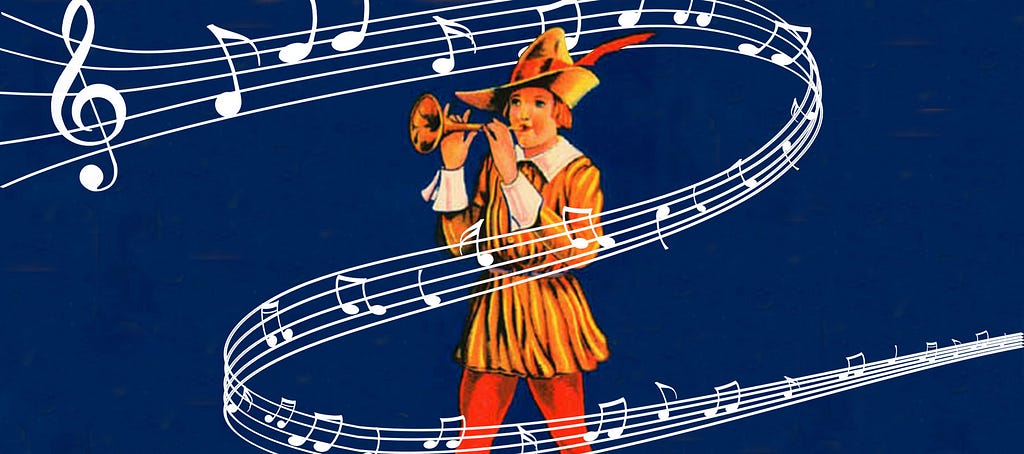
Hello, and welcome to my week-by-week review of the world. Today I am reviewing Peter Piper.
Everyone has heard of Peter Piper, the guy who picked a peck of pickled peppers. But what else do we know about him? A lot, actually.
Based on his name, we know Peter was a professional piper. In the olden days, vocations used to be the basis for surnames such as Blacksmith or Farmer. If occupational surnames still existed today, we would have people named things like Stephanie Grocerybagger or Larry Betweenjobsrightnow.
So why would a professional piper be spending his time picking pickled peppers instead of piping? Because he loved pickled peppers. But pickling takes a lot of time — the kind of time only a divorced man has.
Despite being a musician, Peter had no woman in his life. I know this because women love musicians no matter what they look like. Take Mick Jagger for instance, and imagine that he’s an insurance salesman wearing a pair of loose khakis and a polo shirt. Would you still want to kiss him? Maybe only out of pity. If Peter had time to pickle, he was a divorcee.
It’s hard to know what came between Peter and his wife. Perhaps it was his piping attire, or perhaps he accidentally killed someone and only Peter’s wife knew about it and the stress was too much for their marriage to bear. Secret accidental deaths have been the cause of many divorces. Whatever it was, the secret of his divorce is something Peter took to his grave.
I would love to have heard some of Peter’s piping. He must have been quite talented if he was able to make a living as a musician. Or if he wasn’t talented, then he had a good brand built around him.
BEST FEATURE: Peter’s middle name was Pterodactyl. WORST FEATURE: I was inspired to try piping myself but I was so bad at it that I fell into a deep depression.
Please join me next week when I’ll be reviewing Cheetos.
Presenting the first installment of The Bodega Project, a new summer-long series from Electric Literature. Read the introduction to the series here.
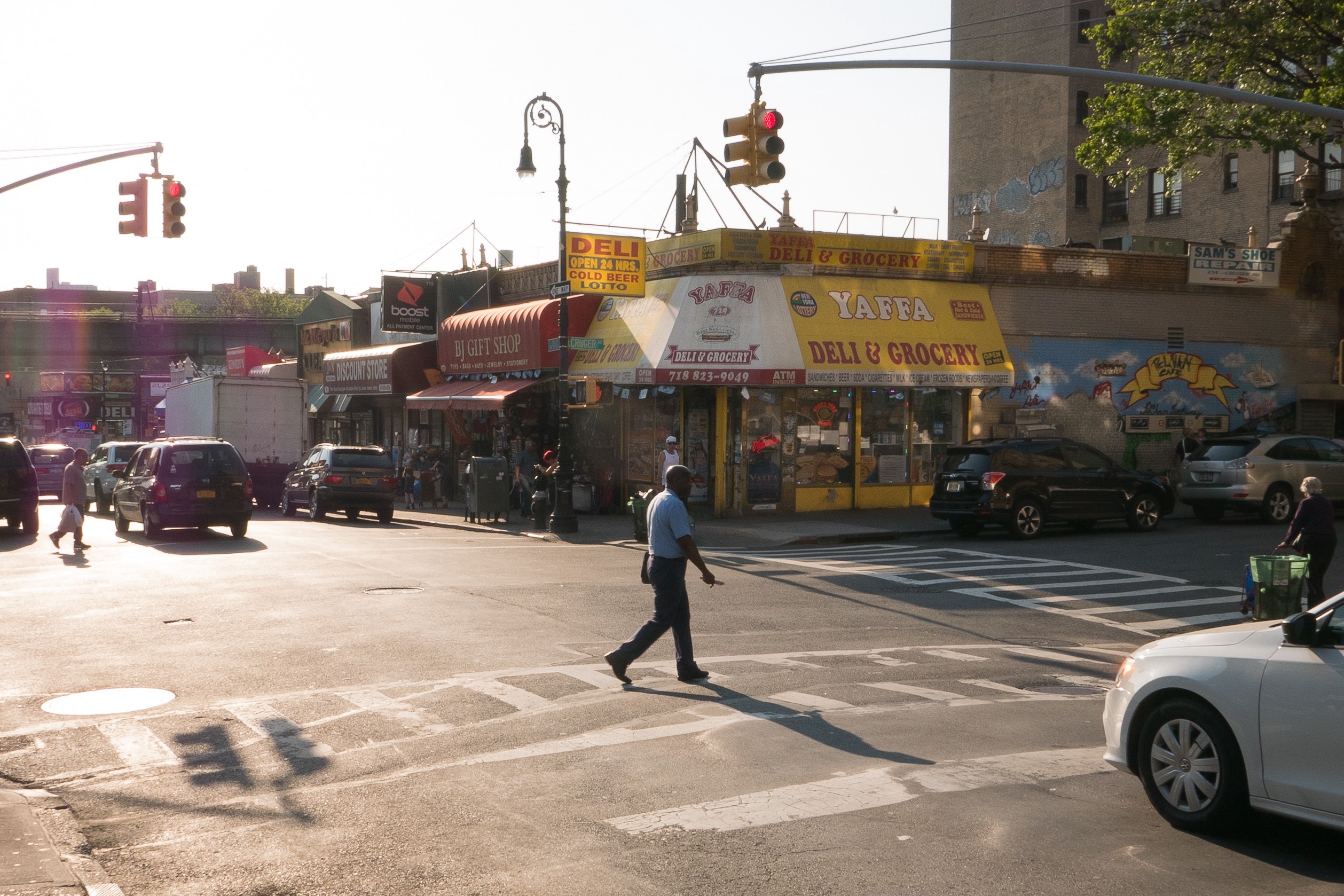
There are several bodegas in my neighborhood, the most convenient being Yaffa Deli and Grocery on the corner of Lydig and Cruger Avenues. Yaffa attracts residents from the various peoples that call my Pelham Parkway neighborhood home. This international working-class district shaped my youth and adolescence in the 1970s and 1980s, when I grew up and went to school in the nearby Fordham and Allerton neighborhoods that still bring movies such as The Godfather and Taxi Driver to mind.
The first bodega I remember going to in the 1970s, on the corner of Bronx Park South and Crotona Parkway (now Poppy’s Deli), was a treasure box of Puerto Rican culture, where you’d find malanga and coconuts before you’d spot an apple in narrow, cluttered aisles. Colorful pictures of Jesus Christ and saints lingered in Roman glory behind Plexiglas during this gritty era, when New York City served as the perfect backdrop for crime noir spectacles like The French Connection and TheSeven-Ups, two of my favorites.
Bodegas terrified me once I learned about the nightmarish holdup stories that began circulating in the neighborhood every time one was robbed, when the violent crime rate across New York City was more than twice what it is today. The gunning down of owners and employees was known to happen, such as during the robbery of another grocery store in the East Tremont section of the Bronx where I attended kindergarten. Bodegas became synonymous with the perils and triumphs of the immigrant struggle.
The corner store service areas (like those of taxis) were sealed shut behind Plexiglas the same way banks are today. This would change moving into the 90s during the Giuliani years, as the city transformed in general. And although bodegas still offer glimpses into the old New York that vanishes a little more each day, they were crucial sites of cultural exchange for Puerto Ricans and others; places where our music, food and language triumphed; oases surrounded by oppressive institutional forces such as racism and police brutality.
As Néstor David Pastor writes in his essay “Bodegas: The Legacy of the Puerto Rican Bodega,” for Centro/Center for Puerto Rican Studies’ online magazine: “Bodegas provided a link to Puerto Rico.” It was in these family-owned corner stores that knowledge of my family’s roots in the Caribbean was enhanced by the textures and scents of strange-looking foods with even weirder-sounding names: ajicito, batata, malanga. This often happened on humid afternoons when men played congas with beer bottles at their feet, while their wives exchanged juicy neighborhood gossip on foldout beach chairs.
It was in these spaces that my Puerto Rican father shed his bicultural identity and dove down to his island essence while talking with clerks and neighbors, where his Spanish became faster and more clipped, weaving in and out of the complex drumming always present behind the perpetual salsa soundtrack that played in those years. Spanish dominated in the bodegas of those days and it wasn’t uncommon for non-Spanish speakers to mime their way through transactions when encountering owners and employees who didn’t speak English or refused to.
Bodegas became synonymous with the perils and triumphs of the immigrant struggle.
A lot of that imagery remains and you can still purchase plátano chips and dulce de leche treats in bodegas where new owners learn enough Spanish to continue serving clienteles cultivated over many decades (generations, in my family’s case). This changing of the guard has seen many Puerto Ricans selling their stores to buyers of other nationalities, to retire in Florida and others places. You will more likely hear Arabic devotional music or Dominican bachatas in Bronx bodegas nowadays, but the ghosts of those past, where Puerto Rican New Yorkers as myself used to shop with grandparents and parents, are still there if you listen.
We lit candles for the murdered; crimes and bloodshed, events that scored television networks headlines and ratings back in the day. What you’ll never hear about were all the occurrences that didn’t make the news; people falling in love while paying at counters crammed with sweaty sweet treats, the passing down of musical and cultural traditions. The exposure to folklore and music and art; learning about the places your parents and grandparents once called home. (As for newcomers who complain about the cats…off with their heads!)
The bodega I go to now, Yaffa Deli and Grocery, is a less turbulent space compared to the bodega in East Tremont I so clearly remember. You’ll still find Goya goods and Mistolín (and now Fabuloso) cleaning products on the shelves. You’ll even see and hear customers recently arrived from the Dominican Republic and Mexico struggling through broken English to communicate with members of the Yemeni family that have operated it for more than twenty years.
I first frequented this bodega in the 1980s, while attending nearby Christopher Columbus High School. My best friend Edgar Santiago and I befriended a girl of Latvian heritage in tenth grade, who lived across the street from Yaffa (as it was also known in 1987). It is at Yaffa that I still hear Caribbean and now Mexican Spanish, but also Senegalese and Haitian French at times, in addition to English and Arabic — a working-class crossroads of global possibilities.
The Pelham Parkway neighborhood, squashed between the 2 and 5 train lines is a mix of single-family homes and tenement buildings; home to African-Americans, Yemenis, Dominicans, Albanians, Puerto Ricans and Jewish people, among others such as Pakistanis, Mexicans and Russians. The front doors of most apartments still boast mezuzahs, painted over many times by many hands from just as many places. It’s hard not to think of these things upon finding them.
My alma mater Christopher Columbus High School counts David “Son of Sam” Berkowitz among its alumni. Not a lot has changed in Pelham Parkway aside from lower crime rates, what the rest of New York City shares as well. There’s a taco truck now. The record store where I used to buy Duran Duran and Depeche Mode cassettes and 45s in the 1980s has been gone for a long time. I left in 1988. I came back in 2006. Yaffa was still on the corner.
On nights when I write late and need zone-out time, the fat cat follows me down the aisle in Yaffa, judging my poor taste in beer with a yawn: Budweiser. Panhandlers sometimes linger outside and try the hard sell — still. There are people on the streets who shouldn’t be, folks who should be taken care of by specialized professionals trained to do so. Most LGBTQ folks keep a low profile around here but not the Puerto Rican butches. I nod as I pass them on the way in.
The world will pass you by on the corner of Lydig and Cruger if you pay attention; staunch Albanian elders who refuse to shed their ways, hurrying Chinese fry-cooks, Pakistani stay-at-home moms and Dominican barber playboys. The same Greek family has owned the Lydig Coffee Shop since the 1980s, even though they live in New Jersey now. El Torito is where I go to catch up on the latest sounds out of Mexico City, as well as campy telenovelas.
The world will pass you by on the corner of Lydig and Cruger if you pay attention…
People are bound to complain that New York isn’t the same as it once was, missing the good times but not the bad. The city is growing and rents are rising, pushing young renters and buyers into areas they can afford to live and buy in. Some call this economic development, to others it means gentrification and displacement of the poor. This has been happening for a long time and all people — at one point or another — have been the newest arrivals in a neighborhood.
Returning to where you’re from is one of the strangest things you can do. You’ve grown in ways you never could have had you stayed. The Bronx continued to crumble and rebuild in the seventeen years that I wandered through the West Coast and other places, collecting experience for — what I hoped — might make me a better storyteller one day. This is something I’m still working on, what I may never know the answer to. Yaffa was here the whole time, welcoming me back.
It forces me out of my shell, which nowadays is enhanced by endless digital distraction. I study the rough and tumble clientele that behaves according to its own silenced codes, something I never learned once I left for the West Coast at age seventeen. I’m reminded of this every time one of the Yemeni clerks thanks me in English, helps the person behind me in Spanish and says something secretive to his colleague in Arabic, a sophisticated operation that eludes proper praise and description. I love the Bronx for this reason and always will.
All the world in one place.
About the Author
Charlie Vázquez is the Director of the Bronx Writers Center at Bronx Council on the Arts. He’s published fiction and poetry and served as the New York City coordinator for Puerto Rico’s Festival de la Palabra literary celebration for five years. Charlie was awarded a commendation by the NYC Comptroller’s Office in 2014 for his contribution to the literary heritage of New York’s Latino community. He’s completed a new novel and second short story collection, works of supernatural fiction set in Puerto Rico. He’s seeking a literary agent and meets with various groups throughout the Bronx regularly, encouraging them to express themselves through the written word. You can follow him @CharlieVazquez.
Content warning: discussions of mental illness and suicide
Yiyun Li is primarily known for her fiction, but her recent memoir — Dear Friend, from My Life I Write to Your in Your Life — is a quiet force to be reckoned with, proving that her storytelling ability goes beyond the structures of narrative. Shifting her focus away from key moments of autobiography, Li instead unfolds herself into a text-centered discourse that often reads more like philosophy or even literary theory. Although the impetus for the memoir is clear — her two suicide attempts and subsequent hospitalizations in 2012 — the book is more grounded in her identity as a reader than as a writer or patient.
The experience of reading from one chapter to the next feels more akin to reading an essay collection than a fiction or nonfiction story. In carefully-measured sentences, Li deconstructs the relationship between author and character as well as the relationship between writer and reader.
She draws the unwieldy and intruiging title, “Dear friend, from my life I write to you in your life,” from the notebooks of Katherine Mansfield, one of her major literary influences. Li’s reading habits circumscribe the themes of her own project: she obsessively reads certain writers’ correspondences and journals, immersing herself in the private space of literary letters and diaries, in addition to books. It’s therefore not surprising that her memoir tends toward genre-bending.
As Li recounts her reading experiences, she builds up a portrait of herself that is perhaps more true than a straightforward retelling of major life events would be. Most of the live-action scenes that readers receive are merely vignettes; because of her essayistic approach, the meat of the story is in the ideas. Instead of dramatically retelling the narratives of any literal self-harm (though that is certainly implied), her prose circles back to suicide in the abstract, and metaphorical forms of “eliminating the self”:
I wished then and I wish now that I had never formed an attachment to anyone in the world either. I would be all kindness. I would not have done anything ruinous. I would never have to ask that question — when will I ever be good enough for you? — because by abolishing you, the opposite of I, I could erase that troublesome I from my narrative, too.
When I read the first chapter — or first essay — at first I felt put off by the way Li was holding me at arm’s length. I usually come into a memoir expecting the creation of an intimate reading space; instead, I encountered Li hiding herself behind third-person constructions of “one does…” and “one must…” or, occasionally, embedding the “I” into the generalized “we/our.” Sometimes she even verges on platitude:
What one carries from one point to another, geographically or temporally, is one’s self.
In the passage that focuses on the book’s title, Li writes about how she sustains her writing though this urge to create relationships and reach across distances between places and selves: “What a long way it is from one life to another, yet why write if not for that distance, if things can be let go, every before replaced by an after.” The bridge — or lackthereof — between the reader and writer becomes a keystone in the way Li illustrates certain tensions in her life, both personal and literary.
A writer and a reader should never be allowed to meet. They live in different time frames. When a book takes on a life for a reader it is already dead for the writer.
These connections between reading, writing, and personal distance come to the forefront in the chapter “To Speak is to Blunder,” in which Li explores her reasons for choosing English over Chinese, her “mother-tongue” — even going so far as to reject translations of her work into Chinese, a controversial choice that interviewers often bring up to her. She outlines a worldview where her other-tongue, English, becomes her own “private language” in contrast with the “public” nature of the language she grew up speaking. In the newness and foreignness of English, she finds a kind of liberation: “A private language […] defies any confinement. Death alone can take it away.”
In a philosophy that is interestingly reminiscent of Jhumpa Lahiri’s sentiments in her book In Other Words / In Altre Parole about learning Italian, Li explains how this natural duality of closeness and distance between self and second-language is what gives her the freedom to escape the past, as well as the freedom to write:
In my relationship with English, in this relationship with its intrinsic distance that makes people look askance, I feel invisible but not estranged.
This idea of linguistic distance then drifts back to suicide. Li circles around the ideation in prose in the same way that the mind does:
One crosses the border to become a new person. One finishes a manuscript and cuts off the characters. One adopts a language. These are false and forced frameworks, providing illusory freedom, as time provides illusory leniency when we, in anguish, let it pass monotonously. “To kill time,” an English phrase that still chills me: time can be killed but only by frivolous matters and purposeless activities. No one thinks of suicide as a courageous endeavor to kill time.
(“To Speak is to Blunder: Choosing to renounce a mother tongue” also appeared as a stand-alone essay in this year’s first issue of The New Yorker.)
It is important to note that a large portion of Li’s discourse centers not around visible symptoms of depression, but on the idea of suicide itself. She often directly pushes back against the disembodied arguments that call the act selfish or ungrateful. The book isn’t necessarily a vindication of suicide, but it would be hard for some readers to get through without feeling buried or surrounded by the internal logic, those knots of thought that she threads around herself and her reader.
That being said, as a reader and writer who struggles with mental illness, for me it’s so refreshing to find a writer who finally addresses the real “thought-spirals” of depression, instead of merely describing symptoms like I couldn’t get out of bed all day — a type of discourse which seems to be overwhelmingly dominant in today’s mental health discussions, especially online.
In many ways, Dear Friend, from My Life I Write to You in Your Life provides a much-needed different lens for thinking about mental illness in the sphere of ideas rather than buzzwords like self-love or self-care. While those are certainly important to our conversations, they will always be a step removed from the self.
Li writes that she “struggle[s] with a lack of depth perception,” but in many ways, depth perception is what this memoir brings to the table. The perspective, at face value, is familiar: person-with-mental-illness-pens-memoir-after-suicide-attempts almost seems like a trope, albeit an important one. But by writing through a refraction of everything she has read — from Turgenev to McGahern to Woolf — Li is able to present this “familiar” perspective with an astonishingly unfamiliar amount of depth.
Perhaps Yiyun Li’s intensely intimate relationship with English — her own “private language” — is what made me feel distant as a reader in the beginning. When I reached that chapter on language, I realized that I was a guest here, dwelling inside of her words. It was not like reading a diary, a critique disproportionately wielded against female memoirists. Instead, it was like stepping into a threshold of the mind, and being allowed to see the patterns of thought as clearly as footprints on the floor.
The intense closeness of reading what’s on (or surrounding, or entrapping) someone’s mind, combined with the unbridgeable distance of each other’s unknowability, results in a kind of beautiful dissonance. By the second half of the memoir, I no longer felt that I was being held at arms length; I felt — to appropriate Li’s phrase for another purpose — invisible, but not estranged.
Note: In September 2016, I began a fellowship at Harvard University’s Radcliffe Institute for Advanced Study, an opportunity to spend nine months in Cambridge, Massachusetts, as part of a group of 50 scholars, scientists, and artists while I worked on my new book of poems. In May 2017, near the end of my fellowship, I read some of my new work to the Radcliffe community; what follows is the short talk I gave to introduce my reading.
My talk is inspired by the Radcliffe fellows, many of whom have expressed to me, the lone poet in our cohort, that they wished they understood poetry better, its meaning and even its purpose. I remember being out on the lawn in Radcliffe Yard on a sunny September day and one of these 50 fascinating people I’d just met, waiting behind me in the barbecue line, asked “How do you know if a poem is good?” I don’t think I had a very coherent answer, if I was able to answer at all, but what I wish I had said was: “I don’t, isn’t that wonderful?” Because the first thing that I want to say about poetry is that a poem is an utterly free space for language; no objective and definite criteria could possibly apply to evaluate it. In fact, poetry is the only utterly free space for language that I’m aware of, and that is what makes it indispensable to me, and also what makes writing it and reading it a political act: Any act where freedom is urgently at issue is a political act, and any space that makes us aware of our innate freedom is a radically political space.
Poetry is the only utterly free space for language that I’m aware of, and that is what makes it indispensable to me, and also what makes writing it and reading it a political act.
When I first considered what I wanted to say about poetry to potential readers who had not yet found their way to it, my impulse was to write a manifesto or even a rant. But then I thought that maybe we hear quite enough ranting these days. Maybe the rant is so devalued right now, like a currency, that another mode will be more useful and buy more understanding. So I decided instead to ask some questions, which is poetry’s most important task anyway: to get you to listen and to get you to wonder. Who really listens to a shouter? Who wonders on command?
Both steps of this two-step process, the listening and the wondering, are important. The listening gives you pleasure and the wondering asks you to work — but it’s joyful work. It’s my hope that the questions that follow will, like a poem, be effective in getting the mind to participate in making the meaning of what I want to say here. Because another thing that I believe about poems is that they, more than any other kind of text, invite or even demand that readers lean in and become active participants in the joyful task of making meaning, another reason why reading or writing poetry is a political action. Once you get that intimate with language, just like when you get intimate with a person, you realize how endlessly complex meaning is and how endlessly supple language is. And you may start to crave more of these things, complex meaning and supple language, in public discourse.
Once you get that intimate with language, just like when you get intimate with a person, you realize how endlessly complex meaning is and how endlessly supple language is.
Before I get to the questions, I want to point out that poetry seems to get the attention of mainstream culture in two sets of circumstances.
First, every year or so, the New York Times or The Atlantic or some other media outlet with cultural prestige features an article with a title like “Does poetry matter?” or “Can poetry matter?” or “Why doesn’t poetry matter anymore?” As if some editor decided it’s time to dust off poetry’s potential to disappoint, like a brooding adolescent disappointed by grownups, simply because they have formed his consciousness, matter so much, and have been around a long long time.
Second, in times of public trauma or crisis, like our current trauma or like the aftermath of 9–11, the New York Times or The Atlantic or some other media outlet with cultural prestige features an article with a blunt heading like “Americans turn to poetry in times of crisis.” As if, to keep us from panicking, it’s time to break the poems out like expired Ativans that have been sitting in the nightstand drawer.
Both kinds of articles diminish the value of poetry by confining poetry’s occasion either to a distant past when poetry lived up to expectations or to the role of security blanket to be discarded as soon as the public crisis is past and life returns to “normal.” If my questions do take on a ranting or polemical tone, it’s this mainstream diminishment I’m talking back to. After all, the New York Times never asks “Does football matter?” or “Do restaurants matter?” or “Does television matter?”
After all, the New York Times never asks “Does football matter?” or “Do restaurants matter?” or “Does television matter?”
So, on to my questions:
How many people have to read a poem to make it worth writing?
Do the people have to be alive at the time the poem is written?
Does it matter that the Super Bowl will always have more fans than any poem I write?
If you think maybe it does matter, do you apply this capitalist model of value to everything in your life?
How impoverished would your life be if you did?
Would poetry be more valued if it cost more and took up more space?
What if poetry is the ultimate reality show: a site for confusion ambivalence complexity uncertainty and big and tiny feelings?
What if, in a world of increasing specialization, a poet is the ultimate generalist, whose “area” is nothing less inclusive than what it feels like to be human?
What if poetry is the ultimate reality show: a site for confusion ambivalence complexity uncertainty and big and tiny feelings?
Could poetry have begun as the chanting of vowel sounds around a communal fire, or by mothers to infants?
Which is more important, your mother singing to you or your mother telling you to eat your beets?
Which came first?
Which is more fundamental to you? Which makes you human?
The poetry I love most partakes of song. You might think about poetry as song with extra-strong emphasis on the words. If you like music and you like language, you’re the target market.
If a society doesn’t value poetry, the most essential art (I may be biased) because it is made solely from the very language that makes us human, is poetry fucked up or is the society fucked up?
Do we have other evidence that our society is fucked up?
Is it possible that everything that can be done is being done to numb you to the essential and infinitely subtle suffering and joy of being alive?
Is it possible that poetry wants to awaken your awareness of the essential and infinitely subtle suffering and joy of being alive?
Is it possible that poetry can awaken you without telling you exactly how?
Do we need to discuss difficulty?
Is difficulty something to discuss or something to experience?
Or both?
Has your life been without difficulty? Do you know from difficulty? Poems know from difficulty too.
Why shouldn’t a poem create a space for the language of difficulty?
Paraphrasing the poet Catherine Wagner, do you like understanding so much you want it to happen over and over?
Could it be that not-understanding or wondering is more honest and even less violent than knowing? If you can’t go that far, is it possible at least every once in a while?
Could it be that not-understanding or wondering is more honest and even less violent than knowing?
Can something be difficult and also a pleasure?
Could poetry be a pleasurable way to make friends with the endless complexity of existence?
Could part of poetry’s difficulty be that poems are made from something we’ve depended on since toddlerhood to communicate our basic needs? Is it a little disconcerting to encounter language that doesn’t have so much interest in informational exchange?
Could it be OK that language can be used to communicate basic physical and emotional needs and information and also to make crafted objects (i.e., poems)? Some water you drink, some water you swim in, some water sprays up out of an ornamental fountain.
Can you enjoy an art form that uses language like paint on a canvas?
Can you enjoy an art form that uses language like notes on a staff?
Can you enjoy an art form that uses language to make a frame for a picture that never quite gets hung in the museum?
Could it be OK to use language to give pleasure?
Could this pleasure be an act of resistance? Resistance against the debasement of language?
Could this pleasure be an act of resistance? Resistance against the debasement of language?
Are you starting to want some answers?
Here’s one possible answer: Poetry opens up spaces for language that echo through centuries. Poetry is the fresh stream that feeds the lake of language. Other streams also pour into the lake, with waters not so fresh and lively; in fact some of the other streams are dull, or toxic, or fake. Poetry replenishes and restores the lake of language. Do you need fresh water only under drought conditions or do you need it all the time? Even if you don’t drink directly from the spring of poetry, you drink from the lake of language the spring has fed and sweetened. Even if you don’t read poetry, I assure you that poetry is whispering to you. And maybe waiting for you to jump in.
I came to know Courtney Maum’s work not through her 2014 acclaimed debut novel, I Am Having So Much Fun Here Without You — that would come later — but with Notes From Mexico, a chapbook put out by The Cupboard Pamphlet the year prior. It came into my life at a time of much upheaval and a fair amount of sundering heartbreak, and it was exactly the kind of medicine I was wanting and willing to take. Which is not to say that the reading experience itself was necessarily palliative; certain sections still make me well up, all these years later. Rather, I felt, when settled within its pages, a kind of benevolent solidarity that I was struggling to find outside of it, and I was — and remain — exceedingly grateful for that.
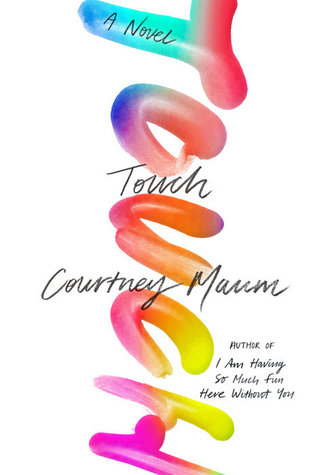
In the time since, I’ve loved watching Courtney Maum strike gold: first with I Am Having So Much Fun Here Without You and now with her second novel, Touch, a book that is both timely and timeless in its consideration of how we navigate human connection in the face of technological advancements which seek, more and more, to blur the line between what we might call artificial and what we might call authentic. Maum is a keen observer of the fraught and polyvalent dynamics that occur at the intersection of the simulated and the actual, the performative and the artless, the meaningful and the meaningless. And of the many remarkable achievements in Touch, paramount is Maum’s persistence in troubling a reader’s impulse to situate those states of being as diametrically opposed. She is a student of the overlap, a scholar of the swirl, and with Touch she has produced a piece of writing which, to borrow and bend Rilke, causes a reader to rethink relationality as something alive.
It was exciting and it was illuminating, talking by phone with Courtney Maum about sensory overload and sensory deprivation, the relationship between technology and vulnerability, smart mattresses, the term “beach read,” and “powerful corporate turduckens,” the name of the band I hope to start with Courtney in the near future.
Vincent Scarpa: In the novel, we have a protagonist, Sloane, who is a trend forecaster; that’s her job title and the work for which she gets paid. But far more than that, that this is her work is extremely character-informing; it calibrates so much of how a reader engages with her from the start: what we think we know, what we expect of her, and so on. I wonder if you could talk about this a bit, and I’m interested — in a chicken-or-egg sort of way — in whether you began with the idea to write Sloane as a trend forecaster, or with the idea to write a trend forecaster who became Sloane.
Courtney Maum: The chicken or egg comparison is such a fun way to remember the writing process. So, the job came first, before the character, but she wasn’t a trend forecaster. In the first versions of this book, she was a stylist. It was a completely different story. I think I like writing fiction so much that I go out of my way to dance around facts. So, a hundred drafts later, I was like, ‘I used to work as a trend forecaster; why am I working so hard to make this girl a stylist when she could be a trend forecaster?’ It’s such an interesting profession. So I followed that, and had to figure out what would be an interesting thing for a trend forecaster to be grappling with. And I thought — well, what if she’s depressed? And so it really became about answering that question: how do you get out of feeling despair about the future as someone who’s paid to get people excited about it?
VS: And in some ways Sloane must see people as solvable, right? She has to probe what might, to the majority, seem enigmatic and inscrutable, and confidently gather from it something like usable information. I was thinking, God that must be really liberating in a sense, but also existentially boring, too, insofar as you can’t be surprised. Your job is to not be surprised. I wonder if you could talk about that a bit, and what that brings to bear on her relationship with her partner, Roman, who’s detached in very specific ways.
Author Courtney Maum
CM: I think trend forecasting is very much about distillation and translation. You have to be able to take in all this information and translate it into some sort of nugget you can share with clients to convince them that this thing is — or isn’t — going to happen. I think there’s two levels to it. It can be terrifically exciting to navigate a world in which everything happening around you and every discussion taking place could potentially have a clue in it to what’s coming next in terms of trends. But then you have to consider that a trend forecaster is paid in some sense to be actively listening to and feeling the world — to feel everyone’s feelings — and I saw Sloane as someone who needed a time-out from that; a sensory time-out. So it made sense that she would build a pretty solitary life and shack up with someone who doesn’t believe in human companionship at all. Her personal life is one giant sensory deprivation tank because the rest of her life is so overfilled, and when she gets to a point where she needs to tap into some love and connection, that tank is completely empty, she hasn’t filled it in over a decade.
VS: I really like that idea of ‘the tank’ — the same brain that she uses to solve people, to relate to them, to imagine them, getting exhausted by the end of the day. I was thinking, too, of the idea — I think it’s Buddhist, but who knows — that living in the past is depression and living in the future is anxiety and you’re just supposed to, I don’t know, live in the present moment —
CM: Who the hell wants to live in this present moment?
VS: Oh, fuck, I know. But I was thinking that, for Sloane, her job actually requires her to be occupying all three tenses: she needs to have a working understanding of the past and its implications on the present; she needs to have her finger on the pulse of the present; and she needs to always be extending her imagination into the future. And while she seems capable of that tense-straddling in her work, she can’t manage it in her relationship to Roman. That fundamental misalignment struck me as one of the most compelling elements of the novel. In the drafting process, did you have the sense that their relationship would be such an integral part of the book? You mentioned that you’d written innumerable drafts, so I’m curious how the relationship evolved.
CM: My first novel was so much about relationships; the whole book is about a marriage. So for this one I thought: this is not going to be about a relationship. In the earlier drafts, Sloane’s relationship with Roman didn’t occupy nearly as much space, and I really thought I was getting away with it! Until my agent — who’s a ruthless and brilliant reader — raised a question about why a woman this brilliant and this sensitive would make a choice to be with this guy. And that became another question I had to ask in the drafts that followed. Why would she make the decision to be with Roman? She doesn’t make decisions blindly, so why is she choosing to be with such a loveless person? I don’t know, it really made sense to me. Some of the most creative and successful people I know either have no central love relationship in their life, or they have one that’s almost mechanical. And that’s fine, I don’t want to criticize that. It can really work. Sometimes really intelligent, really busy, really creative people do not have the energy and emotional space to give to a truly loving relationship with all of its ups and downs. And the more I thought about that, the more I started to see why someone like Sloane would choose someone like Roman.
“Some of the most creative and successful people I know either have no central love relationship in their life, or they have one that’s almost mechanical.”
VS: Well, and one of the things that’s most interesting to me — in fiction and in life — is why we so often stay in the presence of that which isn’t nourishing us. I don’t think there’s any answer to it that’s satisfying, or else we might not do it so regularly, but I saw it as one of the questions the novel was — not trying to solve, but trying to state more clearly, to state newly. (Which I think is a poor Chekhov paraphrase.) Which, switching gears just a bit, brings to mind “After God Goes Sex,” an op-ed that Roman writes and which instantly goes viral; a kind of disquisition on what he sees as the end of corporeal sexuality and the beginning of a strictly virtual sexual identity and practice. “As long as human beings are on the planet with their reproductive organs intact, sex will still be available and around,” he writes, “but I for one am taking a sabbatical from penetrative sex.” He defines his audience as, “the ones who find the possibility of human contact more exciting than contact itself.” The temptation here is to reproduce the editorial in its entirety — or, as much of it as appears in the text — because it’s just so wonderfully bizarre and yet so strangely, unequivocally assured and cogent as to be — almost persuasive? I’d love to hear about the process behind crafting it.
CM: I always knew that I wanted to have an excerpt of his op-ed in the book. I didn’t know when it was going to happen, but I hoped his voice would come. I was on book tour for the paperback [of I Am Having So Much Fun Here Without You], and I was in North Carolina with two hours to kill before the event and just thought, I’m gonna write that article, and I sat down in my hotel bed and did it and not a single word changed. That happens very rarely for me. I think I always understood Roman as a character, and I was just waiting for the moment to get his voice down on paper. The thing about Roman and the way he looks at life is that it’s a far simpler viewpoint than Sloane’s. She has a very humanistic view of life, and he’s just waiting for the day where A.I. is integrated into our skulls and we become machines. He’s looking forward to it, he has no problem with it. And if you really have no problem with computers and mankind becoming one and merging in that way, if you don’t feel any guilt or existential yearning vis-à-vis your human life versus your digital one, things are more or less simple. It’s harder when — well, when you’re human. That doesn’t sound very erudite, does it?
VS: I think that’s actually a wonderful distillation. And it makes me think of a line that really grabbed me in the beginning, another perfect distillation: “She wanted to believe in a world where all her choices hadn’t been made yet.” That line seemed to say as much about Sloane as Roman’s editorial does about him.
Speaking of computers and mankind becoming one, I wanted to talk a bit about Anastasia, the self-driving, human-like car that Sloane’s employer assigns to her. I really think the way in which the novel utilizes her is brilliant. Because Sloane is so often walled-off in her encounters with Roman at home — the apartment, which we could see as an embodiment of the so-called “personal” lived life — and then so task-oriented and performative at work — the headquarters of Mammoth being an embodiment of the so-called “public” lived life — what better way to make her available to us as a reader — available in ways we wouldn’t otherwise have ingress to — than for the novel to create the conditions whereby her method of travel between those two spheres becomes its own sphere, complete with a kind of phenomenological companion/confessor? (I mean, I admit to being a little stoned while writing marginalia through the course of my reading, but I don’t think my scribbled literal vehicle is also a figurative vehicle! is without its merits.) Did you know in the drafting process that Anastasia would come to function in the novel as this sort of suspending space for Sloane?
CM: Oddly, Anastasia came really late to the narrative. Really late. The book always started with Sloane and Roman arriving in New York, and there were all these drafts where Mammoth sent out this sort of clumsy, incompetent person to meet them. But one day I thought, This is Mammoth. It’s Google, it’s Apple, it’s Amazon, all built into this powerful corporate turducken — they wouldn’t be sending some inept escort, they’d send a driverless car. Then I realized — and you alluded to this — that the car was going to be a witness to her, and it very much saved the book. I was really struggling with how to get access to Sloane. She’s not the kind of person to have a breakdown at work, things are terrible with her life partner, and she’s not going to confide in a new person very easily. And it’s not a first-person narrative! But once I saw and took this opportunity with Anastasia, with this driverless car, a lot opened up. The car’s operating system is devised to be overly polite and always wanting the passenger to be well; meanwhile, she has this passenger who’s completely falling apart, but in a very private way. And so Anastasia serves a kind of maternal function for Sloane, and I don’t think that’s too far-fetched, either; this technology isn’t very far out. Tech companies are very invested in making the ‘personal assistant’ more human — emotional complexity is the holy grail. I don’t know this for a fact, but I have to guess that senior citizens living alone will soon have mattresses with smart technology that monitors their heart rate and reports back to their doctor, and they’ll end up leaving everything in their estate to, like, their carpet.
VS: I admired that the novel doesn’t judge that relationship between Sloane and Anastasia as inauthentic or invalid, either. I feel like another writer might have been tempted toward that kind of criticism.
CM: It was important to me that there be some represented form of technology that was nothing but positive. I didn’t want the book to come off in any way as implying that all technology is terrible. Of course it isn’t, and in any case it’s the humans that make things terrible. Is Facebook awful? No. Is the way people have started to use it awful? Yes. Anastasia is kind of a shout-out to the tech community; an acknowledgement that they have done and continue to do some beautiful things that are positively shaping the way we live our lives. Did you see that movie Her?
VS: Amy Adams is in it, so, yes, yes I have.
CM: I actively didn’t want that kind of viewpoint of, like, I’m completely obsessed with the perfect personal assistant and I can only live with her and I can’t live with anyone else and my only joy is virtual joy. Because of course you can be a good human and still use your smart phone, so long as you’re in control of the way you use it.
VS: I found that movie completely insufferable, but I’ll watch Amy Adams in anything.
CM: I watched it for the filter; it was like the whole thing was filmed in Ludwig or Perpetua or whatever. And I thought, Oh, this is pretty and everything, but get out of your house! You’re never gonna have sex with this woman!
“In any case it’s the humans that make things terrible. Is Facebook awful? No. Is the way people have started to use it awful? Yes.”
VS: I was really interested, while reading the press kit, by what you wrote vis-à-vis the challenge of writing a book that is at least in part about prognostication; prognostications which, while the novel is being written and then while it’s in the interim between completion and publication, might already be coming and going. You say, “I really had to gallop my way across the finish line with this book — I started it nearly three years ago, and so many of the things I wrote about are already coming true.” This strikes me as a unique, singular difficulty to consider while writing a novel, a process which is already — at least, for me and a lot of the people I know — almost unbearably punishing. I wonder if you could talk a bit more about that galloping; was it perhaps even useful, mobilizing, knowing that the content you were producing had the possibility of dating itself, or losing its sense of prescience, by sheer virtue of the time between writing it down and it being read?
CM: It was definitely stressful. The first drafts were way, way more detailed about very specific predictions, and I could see that some of the things I was writing about — professionalization of affection, professional huggers, things like that — were probably going to come to pass. In trying to compose a book about things that are happening in the near future, I had to lose some ego, and I think the book is better for that. Because ultimately it pushed me to build a stronger story around Sloane and her interpersonal struggles, rather than showing off and saying, Hey, I was a trend forecaster and I’m putting my hat back on and here’s everything that I think is going to happen! Once I started letting go of the clever bits and the show-off bits, the work became more rewarding. It also became more difficult, because it turns out it’s actually harder to focus on your characters than the magic tricks they’re doing.
VS: Okay, so, I was waffling back and forth about this final question, but I think I’ve found the way I want to frame it and what I want to ask. It has to do with the term “beach read.” I’m genuinely interested in what that phrase is meant to serve as a signifier of and what’s behind the impulse to use it. It’s possible that my feelings about it — which I guess you could classify as, I don’t know, suspicious confusion — could have everything to do with the fact that I just fucking hate going to the beach, and on those occasions where I’ve been sequestered and forced into a beach setting it’s way too bright for me to read the pages of any book, be it a “beach read” or not. But I tend to think there’s more to it. I mean, I suppose I understand that, when it’s used to describe a novel, “beach read” is an endorsement of that novel as being, you know, riveting, absorbing, a “page-turner,” — another phrase I hate! But it also seems like “beach read” can suggest a kind of noncomplexity to the work; as in, This novel isn’t so demanding of your critical engagement that you can’t read it at the beach. Maybe it holds both connotations in the bowl. Maybe more than anything else it has to do with marketing, a field about which I know nothing. But it definitely feels like a highly gendered construction — though maybe it’s not my place to hypothesize that — and seeing as both I Am Having So Much Fun Here Without You and early praise for Touch have made use of that language, I’d be so curious to hear your thoughts on it. (And my god I’m longwinded, I’m sorry.)
CM: Oh, I think this is a great question; I’m glad you decided to ask it. So, when my first book came out, I was very lucky in that I did have great coverage. There were a lot of reviews or round-ups in women’s glossies that said, you know, “One of the best beach reads of the summer.” And then I was having these reviews in The Wall Street Journal and The New York Times. There seemed to be this question of, Wait, is it literary? Is it commercial? Can it be both? Is it possible for a book to be enjoyable, accessible, and also trying to say something? And for a little while I wondered, What am I? Am I commercial? Am I the “beach read” writer? I was asking myself those questions, and then I just decided not to care. The honest truth is, when you’re behind the scenes, “beach read” usually means “it’s selling.” It means that it’s a salable book. So, go ahead and call it a beach read! Call it that publicly! I’m thrilled to have people say that my books are good beach reads, because that probably means people are going to buy them and bring them to the beach. It’s fantastic. I also think that I’m writing sincere satires that — whether or not you’re tricked into doing so — I’m hoping will make you think. If someone buys my book thinking it’s an easy, breezy read and that’s how they experience it, that’s fine. If someone buys it thinking it’s an easy, breezy read and then finds themselves reevaluating their own marriage or the ways in which they’re dependent on their smart phone, then my personal agenda will have been fulfilled, but I don’t need that to be the case. I’d prefer “smart beach read,” but whatever, I’m thrilled, I’ll take it.
The thing about — and not that you asked me this! — but the thing about the question of am I comfortable or uncomfortable with potentially becoming a writer under the label of “commercial” or “beach read” — I think what that question really is is, “Are you worried that your friends in the literary community are going to turn against you because you’ve ‘sold out,’ or your work isn’t ‘indie’ or ‘cool’?” First of all, I’m proud of what I’m writing, and second of all, I’m putting food on the table, so I’m at peace with it. For now!
And other news from the literary world on May 31, 2017
In a day marked by the weirdness of “covfefe,” the literary world provided it’s own smattering of strange news. To learn more about a new venture from PEN, Jon Hamm’s Walt Whitman audiobook, a troubling Paul Beatty interview at The Sydney Writers’ Festival, and a pyromaniacal Icelandic publishing house, read on!
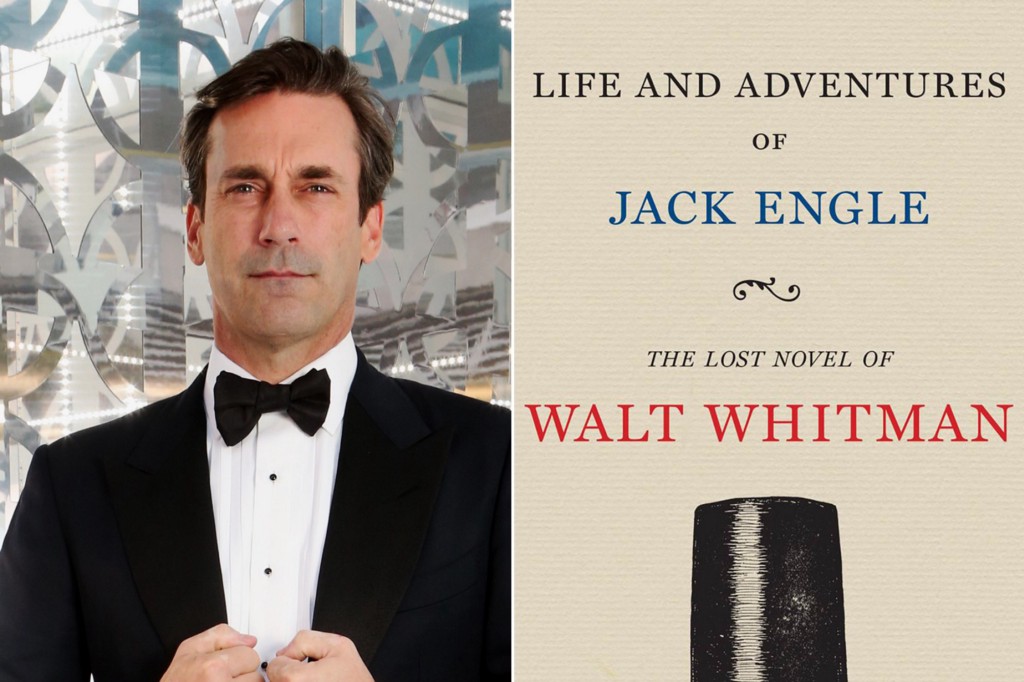
Hear Don Draper’s baritone give voice to Walt Whitman’s long-lost novel
We’ve written before about the reemergence of Walt Whitman’s lost novel Life and Adventures of Jack Engle; however, now there is even more good news for the world’s most buzz-worthy mediocre debut — John Hamm has recorded the audio book. If you’re not already convinced you need Don Draper reading Walt Whitman in your life, check out this clip of the the Jack Engle audio book:
An Icelandic publisher burns unsold books in cognac-fueled ritual
Icelandic publishing house Tunglið has, to put it mildly, a strange approach. The two man operation, helmed by writer Dagur Hjartarson and artist Ragnar Helgi Ólafsson, prints books only on the full moon, in batches of 69. But wait, there’s more! Customers, who cannot reserve copies in advance, must line up for the chance to buy books the night of their printing. That’s because Tunglið ritually burns all unsold books. There’s totally an intellectual framework, or something, surrounding this decision. It probably has to do with inherent ephemerality or performative scarcity or whatever. All I can think about is that the books are burned “with a lot of care and respect, using only first-grade French cognac to help to fuel the flames.” Sounds like the Situationists would approve.
An ‘excruciating’ Paul Beatty interview puts the onus on white interviewers to do better
The Sydney Writers’ Festival included a problematic interview with author Paul Beatty. Conducted by white Radio National host Michael Cathcart, the talk focused on the overt racial themes in Beatty’s Booker Prize winning novel The Sellout. Cathcart began the proceedings by reading an excerpt from The Sellout that included the n-word, which he chose to pronounce in full. Cathcart later questioned, “Do you think that people become black? Do they have to learn what it means to be black?” The line of inquiry provoked an f-bomb from Beatty, who The Guardian described as seeming “unoffended and mostly in good humor.” “Ask yourself the fucking question, man …” Beatty responded, “just think about it for a fucking second. Did you learn to be white?” Many attendees took to Twitter to express exasperation with the festival for its choice of interviewers.
just witnessed great example of why white baby boomers shouldn’t host an interview w a black writer who mocks white liberal aggrandisement
PEN International launches Make Space, a campaign for displaced writers, with Salman Rushdie and Margaret Atwood
Make Space, a global campaign from PEN International that “will focus over the next three years on writers displaced through persecution and censorship,” has gained the support of some noteworthy authors. Salman Rushdie hailed the project as “a significant public stand against racism and xenophobia” from the literary community. With over 200 backers in the arts, including Margaret Atwood, Karl Ove Knausgaard, and Viet Thanh Nguyen, Make Space will use its funds to aid writers with asylum applications and provide emergency assistance, including help with safe passage, to artists fleeing their homelands.
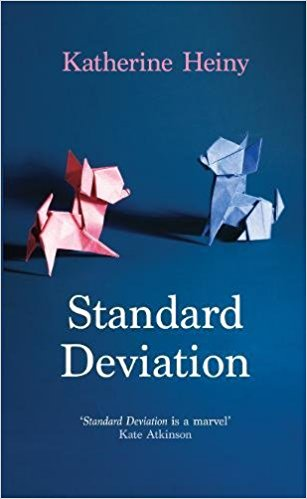
When I spoke on the phone with Katherine Heiny about her novel Standard Deviation, it felt like I was chatting with an old friend rather than a stranger whose book I’d just read. We had plenty to talk about from the novel, but that frequently diverged into relating social anecdotes and musing on the nature of relationships with friends, exes, and everyone in between.
It was totally fitting, given the book we were discussing — Standard Deviation is at it’s core a novel about the underlying maps of information that swirl below our social lives and relationships. How we build bonds, how we tell stories about ourselves and others, and the tropes of human interaction that occur again and again as we grow older and build a life.
When Graham runs into his ex-wife Elspeth at the sandwich counter, they haven’t spoken in ten years. Graham’s second wife Audra is the opposite of Elspeth in every way — Elspeth is stoic, poised, and regal to Audra’s effusive, vivacious social butterfly. As Graham tries to form a tentative friendship with Elspeth, he discovers the negative side of being married to the socially successful Audra. The book follows Graham’s attempt to make sense of Audra’s ever expanding social universe while navigating a tenuous bond with his ex, along with a seemingly endless parade of social follies with the novel’s numerous minor characters.
Heiny and I talked about turning funny stories into fiction, the positive side of gossip, and our mutual love for Mary Higgins Clark.
Rebecca Schuh: Early in the book, there’s a passage where Graham, the narrator, talks about how he knows so many facts about the life of his wife’s best friend from hearing that information relayed through Audra, his wife. It made me think about the secondary relationships you have, say you’re friends with your partner’s friends, or you’re friends with your sister’s best friend, and it’s this complex stream of personal facts. What inspired you to include those tributaries of social information in the novel?
Katherine Heiny: Audra is so well connected, and she knows so much about other people, but it’s not a one-way street with her by any means — she also gives out a lot of information. I have these two really close friends who are sisters, and when my husband and I were first dating he was said, “I love the way that you tell me what happened and then you tell me what they thought of it. That’s part of the story for you.” I continue to do that — it had never occurred to me to do it any other way. I think that when you’re really close friends with someone, they’re in your head all the time.
RS: Absolutely, I found it comforting to think that there are all these people out there who kind of know you even though you don’t know them. I guess that’s how groups of friends form.
KH: When I was writing the novel, a friend of mine, one of the sisters, was staying with us before going to a wedding, and I asked about who the groom, a mutual friend, was marrying, and she said “I know nothing about the bride except she gets really wet during sex.”
RS:Ha!
KH: I said, “I’m going to use that in a book that’s so great,” but I not only liked it because it was funny, but because now she’s going to meet this woman and that’s going to be in her head forever! That’s a big theme of the novel, all this information swirling under the surface.
RS:When Graham and his ex-wife Elspeth reunite at the sandwich counter, they haven’t spoken in ten years. I was so fascinated by that, it’s crazy to think that you could be married to someone, speak to them every hour of the day, and then not speak to them for ten years. How did you capture that feeling of seeing someone who used to be such a large part of your life and now is excommunicated to a certain degree?
Author Katherine Heiny
KH: I guess it sort of plays into what we were talking about how when you’re close to someone, they’re in your head all the time, and then suddenly, they’re not. And it’s not just marriage, it’s a relationship or a friendship. I think that meeting someone who used to be really important to you but no longer is — that’s a really discombobulating experience. You really have no idea how to get through it. And I think that when Graham goes home and Audra says “You didn’t get the answers to any of the good questions!” I think I would be more like Graham in that way, “Let’s just survive this, let’s not have there be any more hurt feelings.”
RS: Was it different for you to write from a male perspective?
KH: It wasn’t — the character of Graham and I have so much in common, and the way we see the world, that it wasn’t really hard. Audra was so forceful, there’s something very feminine about her, a feminine quality of socializing, and how she’s always creating this social microcosm wherever she goes, and she puts so much of herself into her dialogue and tells so many stories that I already felt there was a female perspective in the book. I never felt like that was missing.
RS: Because she’s kind of infiltrating everything, even the things that aren’t about her. Graham’s narration is just so funny, and humor is a quality that transcends the male or female perspective. I loved how it was so conversational. Did you get that humor from how your friends talk? How you talk? What was the root?
KH: I think a lot of things that Graham says are funny just because they’re true, but not a lot of people say them. Anything you say that’s true ends up being funny. There’s a line where they have dinner with a couple who only eats meat and potatoes, and Graham thinks, “Could you marry someone like that, could you marry someone knowing you’d never have pizza.” That would be the first thing that would pop into my head, a totally selfish thing.
RS: Audra loves to gossip, and it took on a greater significance because gossip gets this really bad rap in society, but when she’s using the gossip to include the priest, Graham says, “to draw him to her like a warm silk net, for this evening anyway, felt like friendship,” and I thought, wow there are times when gossip can be positive. What’s your take on gossip?
KH: I think on some level it’s the basis of conversation, otherwise it all diminishes down into how’s the weather and where did your kid go to school. I couldn’t live with the alternative of constantly boring conversation. So I think that startlingly, I’m pro gossip. What a horrible thing to sort of realize about myself. I think saying negative things is really a basic human need.
“I think that startlingly, I’m pro gossip. What a horrible thing to sort of realize about myself. I think saying negative things is really a basic human need.”
RS: A big part of the book is the tentative friendship that Graham and Elspeth try to rebuild, and it brought up the age old question, do you think it’s possible to be friends with your exes?
KH: I do, but I think that it depends on the relationship. I think some relationships, the damage has been done, and there’s no going back. And I think that Graham doesn’t want to admit that, and he definitely doesn’t want to admit that he was the one who struck the fatal blow to the marriage. I think that he feels if he could show his first wife that things were meant to be with Audra, and they’re perfect for each other, it will somehow make everything alright. And it really doesn’t. But I guess the question, one of the questions I was considering when I was writing the novel, was about exes: are they friends, or are they just people who know you really well? Or something else? They seem to exist in this weird category all by themselves. I wanted to write about it because it was unusual, because so many people have no relationship with people who used to be everything to them. That seems really strange to me. I’m not best friends with all my exes, but I’m in touch with all of them.
My dad, when my brothers and I were old enough to have serious relationships, he’d say a year after we broke up with someone “Now how’s Victor?” And we were always like “Dad, we don’t know, we broke up!” but now I think that maybe my dad was seeing that from a more mature standpoint, thinking that person must still be around.
RS: One thing I found fascinating about Graham is that he is so wounded emotionally when Audra is unfaithful, even though his cheating on Elspeth with Audra was the start of their marriage. It made me wonder, is there some kind of cognitive dissonance that still lets us get really emotionally hurt about actions that we’ve also perpetrated?
KH: Oh yeah, I think so. There’s the point in the novel where they discover that probably the origami teacher has been unfaithful at the origami convention, and Audra’s very critical of that, and Graham thinks, “oh I wish that I could take comfort in the fact that she doesn’t like that, I wish that meant that she would never do that,” but it’s all different when it’s you. People are so innately selfish that, it’s cognitive dissonance, or a double standard, or however you want to say it. I think some people have trouble with change, and they’re like, “she was faithful to me when we met so she’s going to be faithful now.” They apply these standards across decades when the person might not be who you know anymore.
RS: There’s a quote in the book, “All people believe that there are two kinds of breakups, the kind that apply to other people and the kind that apply to them, but in reality there’s just one.” I found that interesting, there’s so many ways that could be interpreted, especially within the context of the book, because it involves so much infidelity. Could you extrapolate a bit on what you meant by just the one kind of breakup?
KH: I think there is just one kind of break up, which is where the person you’re in a relationship with doesn’t want to be with you anymore. And I think that people will go to all kinds of (and by people I mean me) lengths to say that it’s not really that. It’s really that the person is in love with me but couldn’t deal with it or didn’t realize it or it wasn’t the right time. The lengths that people go to to get back together with someone in what they hope is a random way, and the idea that you can argue a person back to being in love with you, I find really preposterous but really common. You’re hoping your lover is going to call you up and be like hey, “I’ve been rethinking that, and you made some really good points, we should get back together!”
RS: Right, like your email really convinced me! How have you transitioned away from writing the book?
KH: Last month I flew to Michigan, and I sat next to this man and he was like shifting all around and I gave him a sort of annoyed look, and he said I’m sorry but the legs of my underpants are too tight! And I was like, “Well, is my life over? Is this the best, funniest thing that’s ever going to happen to me? Everything that will happen from here on out is a disappointment!” but I also thought, I can’t believe the book is done and I don’t’ get to put this in there!
I had never written a novel before, and I was very intimidated by the idea, and then it wound up being so rewarding and so much fun, even though it was hard work. So I’m excited for it to be out in the world but I’m also sort of sorry that it’s not mine to wake up to every day anymore.
RS: How did you find it different from writing short stories?
KH: I wrote short stories for so long because I felt I had control over them. I thought it was a lesser commitment, and if a story doesn’t work then it doesn’t work, and you wish you had that month back — but a novel is this huge commitment, and I guess I was really afraid that I would not be able to make it work. The Lorrie Moore quote is, “The short story is a love affair and a novel is a marriage.” And I think a short story is like a party, and a novel is like this really long family reunion where you have to see everybody in their bathrobe in the morning whether you want to or not. And I started writing it as stories, and I was like it’s going to be linked stories, and my agent was like ‘do you have another chapter?’ and I was like, please don’t call it a chapter, it’s a short story! So I kind of got into it by fooling myself into thinking it was linked short stories but it really became a novel.
“A short story is like a party, and a novel is like this really long family reunion where you have to see everybody in their bathrobe in the morning whether you want to or not.”
RS: How has writing changed in the time period between your early stories and the novel?
KH: Did you ever read Lois Duncan novels? She gave this interview late in her life about how it used to be really easy to get the heroine of your novel alone and in danger, and now you have to be like, “and her cell phone wouldn’t work!” It’s fascinating to me how much technology is starting to shape fiction and plots and things.
RS: That’s so true, when I was a teenager I read every Mary Higgins Clark book, and it’s interesting to think about what would have been differently. I remember if one of them was getting kidnapped, they’d always take off their ring and stuff it into the car seat. And that was how they always found out where the girl was, because she stuck her ring into a car seat, now they’d be using “find my iPhone.”
KH: I met Mary Higgins Clark last year and it was the single most exciting thing that happened ever, to anyone, oh my god.
RS: Amazing! She’s the dame of suspense!
KH: There was something so deeply satisfying about her books.
RS: When I went through my I-love-David-Foster-Wallace period in college, someone sent me a photocopy of a syllabus he had for a creative writing class that was floating around the internet, and he taught Mary Higgins Clark in one of his fiction classes.
KH: I love that. I met her at this fundraiser, and we were sitting at different tables so I didn’t meet her until the end, and I had had a couple beers, and she was trying to get into a cab, and I told her, you mean so much to me! And she was like okay dear, my cab is here! But she was very gracious, very funny, she’s amazing in so many ways in terms of the darkness in her books, she wrote at a time when women weren’t supposed to write things like that. She’s such a maverick and so talented.
RS: And her heroines were feminists! She had scientists and doctors, and the woman at the center was always a very strong character.
KH: And the woman always solves the mystery; it’s not like some man comes in and rescues her. In lots of her books, not one person knows the secret but the community, everyone knows a piece of it and lots of the people who know a piece are stay-at-home moms, or there’s this sense that women are very valuable in ways that might not be apparent. Wow, now we have to write some paper about Mary Higgins Clark. We’ll have a two person panel.
The Escape Artist wakes on the first day of March with a sore awareness in his arms, legs, and spine. His bones, they understand what this day means — that the winter is over, that the world has thawed, that Escape Season has begun — and they are softening themselves and loosening themselves and preparing themselves to be bent, stretched, compressed, and rearranged, all for the purpose of being shoved into and subsequently removed from unfortunate spaces.
“What a smart bunch of bones I have,” mutters the Escape Artist to himself. He lies in bed for a moment, wide-awake but careful not to move. This, he realizes, will be his last unimpeded moment until he lies down to sleep in the evening, the last time his stillness will be voluntary, unenforced by a restraint of any kind.
A moment is all he desires, though, so he leaps out of bed and, without even kissing his wife good morning, calls his manager, who has already booked six escapes for the day and seven others for the rest of the week, also one next week, and of course there will surely be more because Escape Season always begins slowly and picks up momentum until it is barreling towards its end like a bowling ball down a playground slide. “Well done, chief,” says the Escape Artist, and he dresses and leaves for a day of daring escapes.
He is chained up and submerged in a shark tank, and miraculously, he escapes, and he is buried alive in a minefield, and miraculously, he escapes. Then his wrists and ankles are bound with live pythons and he is placed in front of a rapidly approaching tornado, and miraculously, he escapes. After that it’s noon and he goes to lunch, where there is no escaping, just eating.
“I saw all of your escapes today! You are amazing! I am your biggest fan!” screams a woman who is allegedly the Escape Artist’s biggest fan. Aside from the old man behind the counter, she and the Escape Artist are the only two people in the small, hidden-away sandwich shop that the Escape Artist frequents during Escape Season specifically to avoid the very type of person with whom he presently speaks.
“Thank you,” says the Escape Artist.
“I’ve been waiting all winter to see you escape!” screams the fan. She wears a shirt with the Escape Artist’s picture on the front, under which is written, Now you see me. On the back there is only his silhouette and the words, Now you don’t. “Why don’t you do anything in the winter? Are you, like, hibernating?”
“Sort of,” says the Escape Artist, because he’s not in the mood to explain it fully, not in the mood to clear his throat and say, “In the winter, it is far too cold to escape into the outdoors. On the other hand, while it would be possible to stage elaborate escapes in arenas and ballrooms, these escapes would not be very inspiring or effective because, if we escape from something but remain within something else, we must ask ourselves, did we really escape at all?” Which is to say, he is not in the mood to recite word-for-word the opening passage from the award-winning book, The Seasonality of Escapes, a book which he is known to have authored despite his author photo in the dust jacket being mysteriously empty, nothing more than a square of nondescript wall. As the story told in the foreword of the newest edition explains, the Escape Artist stood patiently as the photographer adjusted his camera, but somewhere within the split-second of blindness caused by the flashbulb’s burst, he disappeared, miraculously escaping from his own author photo, one of his most conceptual escapes to date. And so, the fact that the fan even asked her question just goes to show that she is unaware of the book, the passage, and the author photo escape, proving definitively that she is not his biggest fan, which is not to imply that the Escape Artist had given her assertion any real consideration; no, the Escape Artist already knows his biggest fan, intimately in fact, but no time to talk about that now because lunch is over, and the escaping must resume.
The Escape Artist enters a submarine, which is subsequently filled with cement and dropped into the sea, and miraculously, he escapes, only to be dunked in kerosene and thrown into a log cabin — its doors locked from the outside, its windows boarded up — deep within the woods which are, on all sides, being engulfed by forest fires, unexpected rogue forest fires, the Escape Artist’s manager claims. The sincere-sounding panic in his voice might convince people of true, unplanned-for danger, except then, as the skeptics point out, what’s with the kerosene? But, when the radio news anchor announces that the entire forest has gone up in flames and no living thing could have possibly made it out, this skepticism quickly gives way to shame and solemnity.
Eyes around the city fill with tears. Flowers pile up at the gates of the Escape Artist’s mansion. Everyone begins to mourn all at once, or at least everyone except the Escape Artist’s most loathsome critic, whose unmistakable laugh is heard booming triumphantly from an open window in the attic study of his brownstone. The rest of the city, though, gathers in groups around their radios, sobbing shamelessly along with the anchor himself until the hour is up and the news program ends. Next comes an interview show. The host seems strangely composed in light of the recent tragedy, which makes sense when he introduces today’s guest, the Escape Artist, who has miraculously escaped from the forest.
“What drove you to escaping?” asks the interviewer.
“That’s complicated, but I’ll say this much: it all began with an inexplicable distrust of traditional methods of exit, such as doorways,” says the Escape Artist, although it is by no means inexplicable to lose faith in doorways when a collapsing doorway claimed your older brother’s life on your birthday, which is exactly what happened to the Escape Artist. So, the distrust does not come from the doorways themselves but from what doorways can do, especially when they stop acting like doorways and start acting like avalanches, but this is a detail that the Escape Artist tells no one.
“What is the key to your success?” asks the interviewer.
“Well-constructed, easy-to-put-on fake beards,” says the Escape Artist.
The answer’s strange specificity along with the quickness with which it is delivered throws the interviewer for a moment. He looks down at his note cards to regain his composure. “That’s … interesting …” He stutters to fill the dead air. “Now why don’t you tell me about — ” But when he looks up the Escape Artist’s chair is empty. “Where did he go?” yells the interviewer to his producer in the sound room.
“I think I saw him run outside! I’ll go get him!” replies the producer, who gets up, who leaves, who is bearded, who is the Escape Artist miraculously completing his sixth and final escape of the day.
At home, he lies down next to his wife — who is already in bed, rereading The Seasonality of Escapes for the sixth time — rolls onto his side so as not to look at her, and goes to sleep.
Eight hours later, the Escape Artist wakes with a yawn that quickly fills his lungs with water. He finds himself hand-cuffed in his living room in a giant newly-built fish tank filled with, besides himself, many rare and exotic fish, some so rare they could be classified as “endangered.” In fact, there is one fish who is the sole survivor of his species, one fish who alone keeps his genus from being termed “extinct” simply by being alive, an act that, until this very morning, had been as simple as remembering to eat and avoiding creatures, fish or otherwise, whose mouths his body could fit wholly into. It appears, however, that surviving may soon increase in difficulty, possibly so much as to be considered “impossible,” because, at this very moment, a hair dryer, plugged into the far wall with a thick orange extension cord and turned on, gradually approaches the surface of the water by way of an elaborate pulley system.
And it might seem unfair to single out just one fish in the face of what could possibly be, when all is said and done, the most devastating domestic fish genocide in history, but still, let’s watch him for a moment. Look how his face remains mostly expressionless, but maybe, just maybe, lightens a little, as if to say, “I’ve fought the good fight, and now I can go in peace. I have, for some time, been the only victorious member of my culture, and now I look forward to ascending into the great pond in the clouds where I will join with my family and friends once more.” And in the next moment, what then? Disappointment in his eyes? Confusion? Frustration? No one will ever know because he’s only a fish and really he has no discernible facial expressions to speak of. The important thing is his face does not look like that of a dead fish, because he’s not dead, because in the time it took to psychoanalyze this single fish, the Escape Artist has miraculously escaped and torn the hair dryer from the pulley system, thus keeping the tank from becoming a mass grave.
“Bravo,” says the Escape Artist’s wife, who has clearly arranged this entire thing.
She, of course, is the Escape Artist’s actual biggest fan, a fact that the Escape Artist celebrated at first. After all, why wouldn’t he want a wife who so vehemently admired his craft? But things had changed. Her admiration had grown stronger and stronger until, over time, it turned into something more obsessive, something dangerous. These days, it seems as though she wants nothing more than for him to escape always, to spend every waking hour — quite literally, as evidenced by this fish tank escape — dodging his demise. He has tried to explain it to her: that, like anything, escaping requires moderation, that he shouldn’t exhaust himself on unpaid, recreational escapes. And she’ll nods when he tells her this like she understands, but only moments later, while they walk to get coffee or go grocery shopping, he’ll get snatched up and whirled away by a crane or fall through a trap door into a pit of grizzly bears. Each time he begs with her to call it off, to let him have the final say as to when he can trust his surroundings and when he can’t. Each time she simply giggles and claps as if this — his desperation, his pleading — is all part of the show.
There remains no love between them, just her love of watching him wiggle out of death’s grip. He has made many attempts to free himself from their marriage, but without any success. That is, not until this very moment, when the Escape Artist points a water-pruned finger at a pile of papers on the coffee table, a pile of divorce papers, signed by him, and by her.
“But, but… how?” his wife wants to know, staring at what is unmistakably her true and unforged signature. The Escape Artist, shaking with giddiness, explains everything: Last night, the door had not fully closed behind the team of tank builders and fish stockers, trained for optimal quietness, when another team, a team of hypnotist lawyers, slipped into the mansion. The two teams worked simultaneously, hers to construct a container for her husband, and his to hypnotize his wife and contain her misguided signature on all of the necessary lines. So, fresh on the heels of an impressive underwater escape and rescue, the Escape Artist completes a second miraculous escape, the escape from his unhappy marriage. Two whole escapes, and he hasn’t even eaten his breakfast.
Bachelorhood endows the Escape Artist with newfound energy. He escapes with reckless abandon. The scenarios grow more troubling. He lays in a coffin filled with scorpions and hypodermic needles, which is nailed shut, loaded onto an airplane, and dropped through a thunderstorm to crash upon the jagged rock formations of the Badlands, but miraculously, he escapes.
The people marvel uncomfortably, as if they’ve witnessed something simultaneously awe-inspiring and nauseating. Their cheers sound fainter than usual, but also more sincere, more considered. “He can’t possibly top that,” they say to each other. “There’s simply no way.” But of course, they are wrong.
His wrists and ankles in shackles, he enters a riverboat, whose door is then boarded shut. Inside there are two chairs, a table on which sits a plate of chicken in peanut sauce, and the Escape Artist’s most loathsome critic — a tall, skinny man with such sharp cheekbones that they appear ready, at any moment, to stab through his cheeks and flee their prison within that terrible face. The critic tells the Escape Artist that, despite his well-publicized peanut allergy, he must eat the chicken in order to find the location of the key both to his shackles, and he had better eat quickly, as the boat is being carried, at this moment, towards a treacherous waterfall. The Escape Artist finishes the entire plate, his throat constricting with each coppery bite. The odd taste, he assumes, is due, in some way, to his allergy. In truth, though, the flavor comes from the key, which has been ground into dust and mixed into the peanut sauce, and right as the critic announces this and laughs — the same laugh that passersby heard bellowing from his residence when all thought the Escape Artist had surely fallen victim to the forest fire — the boat plunges over the waterfall, disappearing into the mist and splintering into wreckage, but miraculously, the Escape Artist escapes. The location of the critic remains unknown, but everyone agrees that it serves him right.
It hasn’t even been a month since his divorce, but the Escape Artist has already begun taking a new lover after each escape. Many of them report their stories, which are all strikingly similar, to the local tabloid: he takes her to a hotel room, clothing is shed, impassioned touching occurs, arousal is achieved, and then, suddenly, she finds herself alone, both surprised at the Escape Artist’s escape and also surprised at her surprise, surprised she had envisioned things going any other way.
Some readers find these escapes from intimacy to be amusing, but others express concern. These are not like his usual escapes, they say; in these he is not escaping from a dangerous, displeasing situation but a pleasurable one, a situation many would desire. It marks the beginning of the end of his career, they say, and their predictions are only confirmed by the Escape Artist’s rapidly deteriorating appearance.
These days, the Escape Artist’s bloodshot eyes dart wildly. How long has it been since he slept? He walks with a limp and his whole body shakes with frequent, phlegm-filled coughs. He has developed a hunchback from being crammed into so many tight spaces. His manager refuses to schedule any more escapes until he seeks medical attention. At the doctor’s office, they tell him what he already knows. He needs to take a break. He needs a temporary escape from escaping. The Escape Artist books a vacation to a tropical resort.
On the plane, he wears dark sunglasses and an oversized suit to fit his hump. The sleeves hang down to his knuckles. He looks like a homeless man who has befriended a charitable tailor. His fellow first class passengers at first only glance in his direction and then quickly away, but since he seems so completely unaware of his surroundings — staring straight ahead the whole time, his head only bobbling slightly as the plane leaves the ground — they allow their gazes to linger. They watch him breathe — each intake and expulsion of air appearing to be a struggle, existing on its own, unrelated to the last — and they think about how washed-up he suddenly looks, how he seems to have aged a decade in the last month, how, after a life of leaving, he appears to be stuck within himself.
These jagged thoughts thicken the air, and the Escape Artist fights to breathe in their sharp edges.
He reaches to twist open the air vent, but his hand doesn’t make it all the way up before it comes crashing down. He clutches his armrests, gasps like he is choking, and then falls into silence, breaking it only with an even louder gasp than the first. After unfastening his seatbelt, he manages barely to get to his feet, and limps up the aisle as fast as he can, his footsteps heavy under the new weight of his hump.
The other passengers remain seated, terrified into stillness, as the Escape Artist closes the lavatory door behind him. Now, if they were smart, they wouldn’t turn to their neighbors and whisper nervously about the prospect of him dying in there, about someone having to pull his dead body off of the toilet upon landing. No, if they were smart, they would be looking out of their windows to see the Escape Artist plummeting towards the surface of the Earth, his suit jacket and shirt flying off to reveal his hunchback to be, after all this time, a parachute, and they would understand that, miraculously, he had escaped his escape from escaping. But no, if these people want to whisper, let them whisper. They’ll realize their mistake soon enough.
The Escape Artist’s feet settle into the sand of a desert island. He unhooks the chute and removes his undershirt and his pants, so that he is wearing nothing but his navy blue boxer briefs, and after surveying the island — roughly two acres of land, sloping up towards a small cluster of palm trees at its center, an island like from a Sunday morning cartoon — he removes his underwear as well. He clumps each article of clothing into a ball, throws them into the waves one after the other, and watches the tide steal them away.
“Good riddance,” he says. He doesn’t need clothes. Clothes won’t help him catch fish. For that, all he needs are his bare hands. But when he goes for a swim and dunks his head underwater he doesn’t see any fish at all. “Must not be the fish time of day,” he thinks, and decides he’ll try again tomorrow. It might take some time, but he’s bound to catch some eventually, right? After all, he is a professional at surviving.
But now it is days and days later, maybe even weeks have passed, and still, no fish. He continues to go on twice-daily fish-hunting swims, but they feel more like an exercise in sanity. As long as he can stick to a routine, he knows his mind has not rotted; no hope for actually seeing, let alone catching a fish remains. Instead, he eats squares of bark off the palm trees. His stomach no longer rumbles, or maybe never ceases rumbling; maybe it emits a low humming noise the Escape Artist attributes to the ocean.
When it gets dark and the nightly monsoon rolls over the island, he stands on the shore with his mouth agape until his thirst is quenched, and then he runs to the semi-shelter of the trees until the rains die as abruptly as they began. One night, he nods off there and dreams of fish surrounding the island in the shallows, laughing at him as he sleeps. The Escape Artist awakens, charges towards the shore, and dives into the water, but when he holds his breath and opens his eyes, he can see nothing in the darkness.
He makes his way out of the surf. The sand is slick from the downpour. The short climb feels incredibly difficult. He sits down halfway up the beach, shivering and thinking of his brother. When the doorway caved in, his brother was following his mother and father out of the kitchen into the living room, his face contorted into a fourteen-year-old look of false reluctance as he sang “Happy Birthday” to the young Escape Artist. Outside the wind blew so hard that it felt like the ranch house’s cheap, thin windows might be sucked out of their frames. The Escape Artist remembers hearing a snap that he thought was just a branch but was actually a whole tree, a tree that the Escape Artist’s father had been meaning to cut down, a more-or-less dead tree with one thick protruding knot that, as investigators would find later, was aligned perfectly to strike through the weak roof with ease in just the right place to improbably collapse the very doorway (and a significant chunk of the kitchen, as well) in which the Escape Artist’s brother found himself.
And, although he didn’t realize it until much later, what the Escape Artist learned that day was that, in all situations, there is a set of variables that can bring death, and so, conversely, there must be another set of variables for every situation: the variables for survival.
But now, the Escape Artist wonders why he pursued survival when he could have exacted revenge. He could have become a logger. He could have leveled forests’ worth of his brother’s murderer. Then he wouldn’t be here on this island in this fishless sea. He’d be safe, bearded, and flannel-clad. He would marry a rugged mountain woman instead of a lunatic fan, and every night they would sit on the porch of a cabin that they built themselves, sip coffee, and look out at their yard, a field of tree stumps extending over the horizon.
Siphoning some strength from the burlier, happier version of himself in his imagination, the Escape Artist stands, but upon consideration, he finds the idea of walking the several yards up to the island’s peak not nearly as appealing as going back down towards the water, and soon the waves pool up around his ankles and then the water is up to his knees, and he says to himself, “They’re never going to believe this one.” Then the water is up to his chest and the waves pick his toes up off the sandy ocean floor, and the variables of survival are not exactly jumping out at him, but he doesn’t think about that. Instead, the Escape Artist merely hopes he can catch up to his clothes before arriving back on the shore of the mainland, or else he will have to speak to the media dripping wet and stark naked.
Last week, while traveling in Hong Kong, I was taken by surprise to hear that Denis Johnson had passed away, a surreal bit of news made stranger by the way that so little at home ever feels fully real while I’m abroad. I stood up from the table in the middle of lunch with four of my graduate students, all of us on a global fellowship program during which we’d arranged for them to meet and study with local writers in Hong Kong and Singapore, and when I came back I brought with me the awful news that Johnson had passed. I kept the news to myself, because I didn’t want to interrupt the good cheer my students were sharing, even if I could no longer quite join in. As soon as lunch was over, I excused myself from the group and went back to my hotel room to download Jesus’ Son to my phone, the fastest way I could think of to get to Johnson’s fiction. I sat on my bed and started reading, turning immediately to “Work,” perhaps my favorite of Johnson’s stories, and when I read my favorite sentence in it, the one I’ve known by heart for almost twenty years — “Usually we felt guilty and frightened, because there was something wrong with us, and we didn’t know what it was; but today we had the feeling of men who had worked” — it was all I could do to hold back tears.
Denis Johnson is gone at 67, and a few days later I still feel in shock at the news. Other than the forthcoming collection, The Largesse of the Sea Maiden, and the possibility of a posthumous publication or two, there will be no new novels, no new stories, no new plays or poems. Thankfully, we have such a powerful body of work that it might last us all a long time. I have been reading his books over and over for almost half my life, and I am not nearly done with them yet.
Every time I open one of Denis Johnson’s books there is some new thrill of language, some new revelation of what it means to be truly alive.
Even better, they seem not nearly done with me either, because every time I open one of Denis Johnson’s books there is some new thrill of language, some new revelation of what it means to be truly alive, some further mystery of the human experience I hadn’t seen before. Very few books offer this kind of continually deepening relationship to the reader. Almost all of Johnson’s do, at least to me.
Denis Johnson was not my teacher or mentor. We did not have any correspondence; I was never introduced to him by our few mutual friends, and even though he was my favorite writer I never dared to ask for a blurb or any other kind of help. (For me, it would have been like asking God for a blurb: a purely fantastical notion.) I met Johnson only once in person, a brief interaction that was extraordinarily embarrassing for me and probably twice as unbearable for him. (This outcome was my fault, not his. I’m sure he would have been generous, had I given him the chance. I did not give him the chance.)
The relationship I had with Johnson was not a personal one, and yet from my end it was intimate, characterized by the great affection and appreciation we feel toward the writers of the books that mean the most to us. No one’s books have meant more to me than Johnson’s, whose novels and poems I credit with having saved my life when I was twenty years old or so, a perhaps moderately hyperbolic statement that nevertheless feels largely true.
Before 1999 or 2000, I hadn’t read much contemporary literary fiction at all, but the summer before I’d read Kurt Vonnegut’s catalog more or less end to end, and around that same time I saw the movie Fight Club, which led me to Chuck Palahniuk’s novels. It was Palahniuk who indirectly introduced me to Johnson: I was voraciously hungry for better suggestions of what to read, slowly waking up to what contemporary writers were doing, instead of the late dead greats I’d been taught in school.
One trick I’d discovered was reading interviews with writers I liked, who would inevitably mention other writers, who I would then read. Working that tactic, I found an interview with Palahniuk in an issue of Poets & Writers I picked up in the Saginaw, Michigan Barnes & Noble where I then bought so many of my books, and in his interview he said that his three favorite writers were Raymond Carver, Amy Hempel, and Denis Johnson, all of whom I headed to the stacks to buy.
The day you simultaneously discover Raymond Carver, Amy Hempel, and Denis Johnson? That’s a pretty memorable day.
The day you simultaneously discover Raymond Carver, Amy Hempel, and Denis Johnson? That’s a pretty memorable day. I can see exactly where the magazine section the Poets and Writers issue was, I can see the photo of Palahniuk on the cover still, and I remember it was also where I first heard of Colson Whitehead, who I also read soon thereafter. If I remember right, Palahniuk singled out Jesus’ Son as the book of Johnson’s to read, but my Barnes & Noble only had Already Dead, so I bought that novel and asked the cashier to order Jesus’ Son for me. By the time I got the call that my copy had come in, I was finished with Already Dead but only just beginning with Johnson: that afternoon, I immediately read Jesus’ Son cover to cover, and the next day I read it again.
Then I went back and ordered Angels. And while I waited for it to come, I read Jesus’ Son some more.
I had liked Already Dead fine, but Jesus’ Son was life-changing. At twenty, I’d never read anything like it. At thirty-seven, that’s less true, but it’s still not false: there are a lot of books that at first glance look like Jesus’ Son, but it still feels surprisingly singular to me.
Everything I discovered in his books seemed mine, even as I started pushing his books on friends, on my siblings, on anyone else who would listen.
Because I wasn’t immersed in any literary community, I didn’t have anyone else who I could talk to about Jesus’ Son (and then Angels and The Name of the World and Fiskadoro and so on). It seemed like Johnson was mine alone, and as I reread his books there was no one there to tell me how to read him, what the stories meant, what I should be feeling. Everything I discovered in his books seemed mine, even as I started pushing his books on friends, on my siblings, on anyone else who would listen. It would be maybe eight more years before I met anyone else who’d read Johnson without my urging, when I finally made it through undergrad at twenty-six and then on to grad school two years later.
When I first read Johnson, I was, as one of his own characters might have observed, “completely and openly a mess,” absolutely at my most lost, caught in the midst of a period of making terrible mistakes and just barely escaping having to really pay for them, over and over. I’d recently dropped out of college and simultaneously lost my first real job, I was bartending in a chain Mexican restaurant, struggling and sometimes failing to pay my bills, plus I was drinking too much and not doing much of everything except what other people had once told me where the “right things” to do. These many failures of my own making had left me hurting and feeling very alone, and so the first thing Johnson did for me, with Jesus’ Son and Angels especially, was in his fiction name what was wrong with me, by giving me characters who felt the same way I believed I did:
“We all believed we were tragic… We had that helpless, destined feeling. We would die with handcuffs on… And yet we were always being found innocent for ridiculous reasons.”
That wasn’t exactly my story, but it was close enough, a plausible story I could believe in it. And that’s what I needed then, more than anything: a new story.
Then, even more mercifully, Johnson showed me that it was possible to live with what was wrong with me too. I didn’t have to die of my grief or my sadness or my mistakes. I might never get rid of all the cruel and stupid parts of me, but surely there was beauty in me too, and whatever else happened, I would probably live, and if I lived, I might get better. Not today, maybe, and not tomorrow either. But someday. And even if I was always fucked up and weird, that still didn’t mean I was the only fucked up weirdo out there.
Johnson showed me that it was possible to live with what was wrong with me too.
It was enough. That’s what so remarkable: all I needed, right then, was a simple connection with another person who understood how I felt.
I was that alone.
When I was twenty years old, it was enough to hope for nothing more than the thin happiness of the ending Fuckhead finally earns in “Beverly Home”:
“All these weirdos, and me getting a little better every day right in the midst of them. I had never known, never even imagined for a heartbeat, that there might be a place for people like us.”
Almost twenty years later, I still hold out hope for this, more often than I would like to admit: to get a little better every day, in the midst of all my fellow weirdos. And as for the “place for people like us”? I’ve found that too, sometimes in the physical world, sure, but also in Johnson’s fictional worlds, where all too often both the best and worst parts of me feel right at home.
For a long time, I thought what I loved about Jesus’ Son and Angels and the rest of Johnson’s books were the fuckups and the lost people, because I was a lost fuckup when I first read him too. But that wasn’t all of it. When I first read Johnson, I was unhappy but I was also newly hungry: hungry for bigger experiences, hungry for real wonder, hungry for proof that the world I could see could not possibly be the only world there could be. In truth, I was starving with want, every day consumed with a kind of awful gnawing I hope never to feel so acutely again. And Fuckhead in Jesus’ Son and Bill Houston and Jamie Mays of Angels are hungry too: They go out looking for drugs or alcohol or sex, which they find in excess, but often the rewards of those quests are not merely oblivion or escape but a temporary access to the sublime and the divine, a feeling as fleeting as the hard grace that Flannery O’Connor’s characters famously find for the briefest of moments.
When I first read Johnson, I was unhappy but I was also newly hungry: hungry for bigger experiences, hungry for real wonder, hungry for proof that the world I could see could not possibly be the only world there could be.
When Fuckhead and Georgie stumble into the abandoned drive-in theater during the snowstorm in “Emergency,” Fuckhead believes they’ve come across a cemetery filled with a heavenly host. In that moment, he says, “the sky was torn away and the angels were descending out of a brilliant blue summer, their huge faces streaked with light and full of pity. The sight of them cut through my heart and down the knuckles of my spine, and if there’d been anything in my bowels I would have messed my pants from fear.” For a moment, those angels were there, not a hallucination but a biblical visitation, Fuckhead’s reaction as visceral and physical as that of the shepherds visited by the angels on the birth of Christ, which the King James Version tells us made those shepherds “sore afraid,” as fine a depiction of the physical trauma of encountering the sublime as any I’ve ever read. For Fuckhead, the moment doesn’t last, and the dialogue that follows is tragically hilarious — once George breaks the spell by pointing out that they’ve wandered into a deserted drive-in, Fuckhead flatly remarks, “I see. I thought it was something else.”
Similarly, in “Work,” Fuckhead and Wayne see a woman paragliding naked through the sky, a vision who turns out to be Wayne’s wife — and there is nothing in the story to give this vision any ambiguity except the reader’s own doubts, except the possibility that all this is a dream “Wayne is having about his wife” that somehow Fuckhead has wandered into, itself a kind of impossible vision — and then later Fuckhead relates a memory of another “one of those moments,” spent in bed with his own first wife: “Our naked bodies started glowing, and the air turned such a strange color I thought my life must be leaving me, and with every young fiber and cell I wanted to hold on to it for another breath. A clattering sound was tearing up my head as I staggered upright and opened the door on a vision I will never see again: Where are my women now, with their sweet wet words and ways, and the miraculous balls of hail popping in a green translucence in the yards? We put on our clothes, she and I, and walked out into a town flooded ankle-deep with white, buoyant stones. Birth should have been like that.”
And not just birth: Life should be like that, Johnson implies, and also invites us to ask: Why isn’t it? Why is the sublime and the beautiful and the spiritual so hard to access?
I know now that I might have killed myself with alcohol and drugs or something else if I hadn’t read this book, if I hadn’t seen myself reflected in the cost of Fuckhead’s inability to get what he really wanted for more than a moment at a time.
Throughout Jesus’s Son, Fuckhead wants to get high, but more than that he wants to transcend. Me too, I must have thought, reading Jesus’ Son for the first time. And while I didn’t have the language to articulate all this then — like Fuckhead, I mostly live on a lower and more base plane of existence, even if I pretend otherwise — and I know now that I might have killed myself with alcohol and drugs or something else if I hadn’t read this book, if I hadn’t seen myself reflected in the cost of Fuckhead’s inability to get what he really wanted for more than a moment at a time. If I hadn’t understood that I was becoming a person just like him, limited in similar ways, someone capable of both of cruelty and kindness, someone who craved the sublime but knew only the cheaper and quicker ways of accessing its grandeur.
Johnson once told an interviewer that what he writes about “is really the dilemma of living in a fallen world, and asking: ‘Why is it like this if there’s supposed to be a God?’” In my own work as a writer, I’m animated by something similar to what Johnson describes, although I’d no longer articulate it as religiously as he did. The worst years of my life began all at once for a variety of reasons, but a loss of faith was tied up in all of what happened to me next: that year, I’d suffered a deep and surprisingly traumatic loss of belief in the Catholic faith which up until then had been an important part of my life. More than anything else, losing my faith emptied the world: I had grown up among people who believed in the physicality of God and the angels, who believed that miracles and the intercessions of the saints were real, not metaphorical. When I stopped believing in those things, I lost access to the world everyone where everyone I knew lived — and for a time I also lost some of my ability to even hope for certain kinds of grand experiences and greater beauties, for a world better than this world that made the miseries of this one worth bearing.
Despite my worldview being rearranged, I still sensed there was kind of sublime that doesn’t require the presence of God, but I didn’t know how to get there yet. Fuckhead tries to arrive by drugs and alcohol. So did I. But literature is another way too, and in Johnson’s work there exists a literary depiction of the fleeting liminality of the sublime that I find nearly peerless, especially among contemporary American writers. Nearly everyone who has ever tried to rip off the style of Jesus’ Son — including me, since my first published stories were essentially Denis Johnson fan fiction — fails at this part of it.
In another interview, Johnson once said, “The stories of the fallen world, they excite us. That’s the interesting stuff.” But depicting alcoholics and addicts and criminals and people otherwise down on their luck isn’t that hard: all you have to be willing to do is make your characters suffer. Showing those same characters reach the sublime from within their fallen state — in other words, without insisting on redemption preceding reward — is seemingly much more difficult. Almost no other contemporary writer does that as well as Johnson. Almost no one even tries.
That whatever better world might exist behind our world is for the fallen too, not just the righteous: that’s a radical idea. (Radical enough that by one reading its probably Jesus’ idea too, distilled to its purest form: that we are already in the kingdom of heaven, if only we have eyes to see.) Even if I couldn’t have articulated it then, that’s certainly part of what I responded in my first readings of Johnson. “I went looking for that feeling everywhere,” Fuckhead says in “Car Crash While Hitchhiking” after his own earliest revelatory moment with the grieving woman shrieking with the shriek of an eagle, and like Fuckhead chasing that scream I chased the feeling I got from Johnson’s work everywhere I could but especially in Johnson’s own books.
Transcendence — real transcendence, in the world — usually doesn’t last. The sublime is too difficult to reach, too fleeting to grasp for long. But in Johnson’s books, we can at will touch the hem of the heavens, that better world his characters glimpsed but rarely reached and never got to stay.
We won’t get to stay either. No one ever does. At the end of “Emergency,” Johnson’s Fuckhead says, “That world! These days it’s all been erased and they’ve rolled it up like a scroll and put it away somewhere. Yes, I can touch it with my fingers. But where is it?” It’s a gorgeous moment in one of my favorite stories ever, and Johnson undercuts it by finishing the story with a joke, as if even Fuckhead knows it’s a bit too earnest. But that passage was among the first things I thought of when I heard Johnson had passed: I thought, Jesus, there will never be another Denis Johnson story.
All those worlds, all erased!
Maybe. Maybe! But at least he left us his scrolls. And I hope more than anything that we won’t ever be so foolish as to put them away.
As I said earlier, I met Denis Johnson just once, when I was living in Ann Arbor, finishing my MFA at Bowling Green State an hour away, commuting back and forth. Johnson was in Ann Arbor to speak at the University of Michigan’s Hopwood Awards Ceremony, where he read his Playboy story “The Starlight on Idaho” and gave some brief remarks. I was, as I expected to be, in awe from my seat in the second row of the auditorium’s stadium seating, right above where it turned out he would sit when brought into the room, and where he later tried to calmly return to after his reading. Little did Johnson know that I’d been waiting for my chance to say hello, to say thank you, to say anything that might approximate what his books meant to me — and as he approached I felt something glitch in my brain and the next thing I knew I was leaned over the first row of seats, babbling incoherently from above him — and I had also managed, somehow, to grab him by his shirt, as if afraid he might escape.
By then, he was definitely trying to escape.
I was mortified, he looked very displeased, and throughout our short interaction I kept holding on to him, my mouth moving faster than my brain as I violently tried to tell him what he meant to me, until finally he put the palm of one hand on top of my fist clenched around his shirt buttons and calmly and wordlessly pushed my hand off him.
And that was that. My one chance to speak to my hero, wasted. Johnson turned around and walked away, I shrank back in horror, and when a friend of mine in Michigan’s program suggested “I come to the reception and meet Denis” I instead fled across the street and got drunk with another friend, both of us stunned by what I’d just done.
I truly hope this essay isn’t just more of the same mistake.
Maybe I just wish I could have told him that I loved him because I loved his books, and because I felt loved by his books, because by the way he wrote his characters he showed me that it was capable for a person like him to love someone like me.
I hope what I’ve written here isn’t just one more way of clutching at Denis Johnson’s shirt buttons, refusing to let go, but maybe it is. Maybe that’s all this ever really could be, given how strongly I feel: more than anything, maybe I desperately wish I could have told Denis Johnson how much I loved him, even though we’ve never really met. Maybe I just wish I could have told him that I loved him because I loved his books, and because I felt loved by his books, because by the way he wrote his characters he showed me that it was capable for a person like him to love someone like me.
That’s really what I wished I’d said that day. Just that: Thank you, Mr. Johnson, for being a writer capable of loving someone like Fuckhead or Bill or Jamie or any of the other unforgettable characters you invented. Your love for them on the page, a mix of empathy and honesty and your rendering of them in perfect prose — which the writer in me sees now might have been a way of learning to love someone like yourself, flawed but hopeful — it was a gift to me too, at the time I so desperately needed it, back when I was just another of the many lowercase fuckheads of the worse, just another weirdo without his place.
Without any place except for your books, I should have said, those beautiful books where for many years I went to learn how to live.
With summer comes the promise of adventures and the allure of exploring. It’s often said that fiction is transportive, but wandering through the Recommended Reading archives, that feels like an understatement. In the treasure trove of 260+ stories, we can visit Mary Gaitskill’s childlike and visceral hell, and Joe Kowalski’s unsettling apocalyptic future; we can search the secretive rooms in Mario Levrero’s abandoned house, and poke around Sara Majka’s time-resistant island. After a whirlwind trip and two romances in San Francisco with Jensen Beach’s story, Swati Pandey takes us to India for a journey from boyhood to marriage. In short, we can explore the ends of our world and the extremes of great minds. It’s hard to say which kind of expedition is the more courageous. But fortunately, the writers of these 9 specially unlocked stories have been brave for you, and you can enjoy their work from the safety of your couch.
For just $5 a month, members of Electric Literature get access to the complete Recommended Reading archives of over 260 stories — and year-round open submissions. Membership is tax-deductible, helps us pay writers, and keeps all of our new content free. So if you like what you’ve read, please join today!
by Mary Gaitskill, recommended by Electric Literature
Often it takes a child’s perspective to remind us of the true terror of something — or somewhere — we accept as a given in adulthood. “What the hell!” cries seven-year-old Ginger’s father when something is funny. Or, “This is hell!” he might say, when something is not. So Ginger ventures into hell — it is accessible through a trapdoor in very own backyard — to discover its secrets and steal the devil’s treasure. If hoarding the belongings of the devil seems unwise, than perhaps so is a father’s insistence on bringing hell into the human world.
As an astronaut, Arnold Barington is an exceptionally brave man, but as an accident-prone lover of bad jokes, he’s just like the rest of us. After accidentally blowing himself into the ether of outer space, he finds himself floating through the universe, hoping for rescue before his suit can no longer sustain him (so, before 5.6 years). His only company is rumbling space rock, and his only indulgences are the waste-recycled crackers he munches. Yet as he rolls through space — fearing embarrassment when he finds his crew, and still hoping for love back on Earth — Arnold’s journey feels surprisingly familiar.
To most of us, the idea of voyaging the high seas sounds like the wildest of adventures. But the crew on this whaling ship are plagued by a boredom deep enough to test the difference between amusement and madness. “To relieve ourselves from the taxations of life, we had ways of peaceably passing the time,” the narrator and doctor tell us. But these “taxations” give way to things more insidious than pastimes, and more violent than practical jokes.
by Mario Levrero, recommended by Asymptote | Translated by Frances Riddle
A home lacking inhabitants has the capacity to hold just about anything else: magic and memories, spirits and rot, or simply, a disturbing skeleton of decrepitude. Few of us, perhaps, would explore a creepy, empty house with the same archaeological interest and adventurer’s fearlessness as the crew in Levrero’s story. From the “little men” jumping out of old pipes, to five-layer deep wallpaper, and of course, to hidden treasure, the house harbors the enchantments and mysteries that entice the brave and keep the cowardly out.
There’s a strong argument for time travel as the most perilous of expeditions: One wrong step, and you alter the course of human history. But then again, would such an alteration be a bad thing? “I told her that every time Dr. Hu and I returned to our time everything was pretty much as we’d left it except for a little bit better,” the narrator of Bryan Hurt’s story tells his wife. With time travelers like these, there’s no bad decision that can’t be undone.
They say that every time we call forth a memory, it becomes slightly altered, corrupted, and yet we have to keep recalling memories in order to have them. In Sara Majka’s story, the natural blurriness of memory blends with an other-realm kind of magic. Peter, young and suicidal, is committed to a hospital on the mainland by his islander parents. Time passes and his mother can’t quite understand—or remember—what she’s lost. As Brigid Hughes writes in the introduction, this is a story that captures “a feeling of being nowhere, or in someone else’s life, or between lives.”
by Joe Kowalski, recommended by Electric Literature
It’s a question that’s produced hundreds of stories and fewer happy endings: How far would you go to save the one you love? The narrator in Joe Kowalski’s story answers that question in all its literality, venturing through miles of a post-apocalyptic terrain for a means of rescue he doesn’t know if he can trust. The story, writes Halimah Marcus, resounds with one of the greatest adventure tales — the Inferno, of course—and “offers the chance to see beyond the end — beyond death — into a kind of after life.”
Original fiction, recommended by Electric Literature
A trip doesn’t have to be long to be a journey. In the first installment of this two-part story (find part II here), a young groom in India traverses a risky bridge to meet his bride for the first time, and be married that same afternoon. In another writer’s hands, this story would sink under the weight of metaphor, but with Pandey’s deft touch, the episode is honest and clear even as it is meditative.
There is something to be said for exploring the self in secret, for plunging into the freedom of anonymity if only to see who we become there. In Beach’s story, a man named Martin hears the Eagles’s classic “Hotel California” and recalls a visit to San Francisco — and, perhaps more importantly, the stop he made en route. In San Luis Obispo, he met a young man, Cesar, at a bar and brought him back to his motel. Martin goes on to meet a woman in San Francisco, but it is Cesar — and the man Martin was when he was with him — that lingers in his mind when he returns to his normal life.
DON’T MISS OUT
Sign up for our newsletter to get submission announcements and stay on top of our best work.
YOUR INBOX IS LIT
Enjoy strange, diverting work from The Commuter on Mondays, absorbing fiction from Recommended Reading on Wednesdays, and a roundup of our best work of the week on Fridays. Personalize your subscription preferences here.