Sorry to Disrupt the Peace by Patty Yumi Cottrell has one of the strangest narrators that I have read in a long time. Helen, the main character and narrator, draws the reader in right away with her stream-of-conscious thinking. It feels like she grabs your hand and starts running, dragging you behind her. You don’t know where she is going, when she will turn a new corner, but you follow her anyway. You want to follow her. Once you are adapted to her train-of-thought it is easy to follow her along as she investigates her adoptive brother’s suicide.
The thing about Helen is that she thinks everything is supposed to go a certain way. Akin to following the plot of a movie or book, she’s the hero. She is the center of the universe. When she gets even an inkling that’s she’s not, she becomes wounded and lashes out. One example, for instance, is when she decided to show up to her parents’ house to help them with their grief. In her head she pictured them welcoming her home with open arms and a plate of warm cookies. The thing is though, she didn’t let them know she was coming —
“It hurt me a little, that my adoptive parents were not expecting me, that they were so astonished by my arrival, that they seemed scandalized by my suitcase, by the mere suggestion that I would be staying a few nights with them in my childhood home… I made a note to myself that they had not greeted me with a plate of cookies and milk, not even tea and stale muffins, as I had pictured. Then I forced my way into the house because I was certain my adoptive parents were too astonished by my sudden appearance to invited me in.”
When she finds out that a grief counselor has been helping her parents through the loss, she tries to undermine him at every turn. She rolls her eyes, she makes snide comments, scoffs at any religious comfort he tries to bring to her parents. She becomes jealous that they are relying on him instead of her. She even tries to make her adoptive funeral about her —
“I had heard them talking about the funeral in the kitchen, it was scheduled for tomorrow morning, even though no one directly asked me to go, not even my adoptive parents. I’ll show them. I’ll just show up and sit in the front row of the church, right in front of Chad Lambo, and everyone will see me and my sisterly mourning, I will create a mourning spectacle of myself.”
Her reactions to things makes the reader question her sanity, and highlights her self-centeredness. Like immediately after finding out her adoptive brother killed himself, she focuses on buying the perfect black sweater. In fact, she gets overwhelmed with the options for sweaters since she is used to wearing whatever clothes she finds on the street.
She then turns her focus on how the suicide is really at the worst possible time for her since she is on probation at work. When flowers arrive for the funeral, instead of just placing them on the table, she dumps them into a mop bucket full of bleach. She points out what she did to her parents and waits for approval like a little kid and doesn’t understand why they died and why her parents are upset.
Not many writers can pull off this sense of controlled chaos like Cottrell does, let alone adding that on top a suicide mystery, tension of race, and exploring adoption. Cottrell does a great job of balancing these many plates and keep them spinning. Helen is unlikable enough to be interesting but not too unlikeable that the reader doesn’t care about her. She uses Helen’s family and friends as a dose of reality, reminding the reader that what Helen’s doesn’t necessarily match everyone else’s.
They are constantly exasperated by her antics, some the characters flat out say they don’t like her. She uses body language to show the chilly distance between Helen and parents and partner that with key flashbacks. The choice to not use dialogue tags creates more confusion and forces the reader to really focus on the words. If read too quickly, you might missing something and have to reread the conversation again. You cannot read this book quickly.
She creates empathy for all her characters, whether they are likable or not. She also creates a conversation about suicide that should not be ignored. Sorry to Disrupt the Peace is a book you can’t put down, and once you do, the whole world shifts.
Have you ever seen a pony? I mean a pony in real life. If you haven’t, you should. Basically take a horse and shrink it down to hilariously small proportions and that’s what a pony is.
When I came across this pony at a children’s birthday party in the park, thinking it was a horse threw off my sense of perspective, and I thought the children surrounding it were enormous kids, each suffering from the same unfortunate glandular disorder. Perhaps they were part of a support group and the horse was a therapy horse.
As I got closer I discovered the children were healthy and it was the horse that had a disorder.
Knowing I hadn’t been invited to this party, it was going to be tough to get close enough to that pony to touch it. I told the partygoers that I was a park ranger and I needed to inspect the pony to make sure it wasn’t a bear or anything dangerous. A mom at the party said, “sure, whatever.” That was my ticket in!
The pony smelled like oats, which I love. I eat oatmeal for breakfast every morning, so I really felt a personal connection to this pony. I pictured him coming over for breakfast in the morning. The two of us sharing a bowl of oats and a cup of orange juice. Then the pony would give me a ride to work and all the townspeople would see us pass by and wave and be jealous of our friendship — and my independence from fossil fuels.
But this would never happen because this pony was not sentient and belonged to a party supply rental company. I stared into his eyes wondering if he could sense what the two of us could become, but as near as I could tell, he couldn’t sense anything. He just stared straight ahead. Then with his hind leg he kicked a child.
Chaos erupted and I took this as my cue to run back to my car and drive home. When I got home I spent the afternoon thinking about that pony. It left me with more questions than answers. If I saw that pony again, would I recognize it? Would it recognize me? Are pony burgers a legal thing and if I ordered one, what would the odds be that I could end up eating my almost-pony-friend?
I drove back to the park and looked for the pony, hoping it has somehow escaped and was now living free in the park. I saw a squirrel and possibly a muskrat, but no pony.
BEST FEATURE: I named it Gerald. WORST FEATURE: I think I saw lice in its mane.
Please join me next week when I’ll be reviewing a salad fork.
What happens after we die remains one of humanity’s big questions. While we may be unlikely ever to find a definitive answer, that hasn’t stopped us from trying: nearly every religion has its own take on an afterlife, and tales of people’s journeys to the underworld or the heavens have existed for millennia. Right now, we’re at a moment in time where questions of the afterlife have suffused pop culture. Charlie McDowell’s new film The Discovery hinges on the discovery of scientific proof-of-life after death. The television series The Good Place offers a skewed view of what the afterlife might be like. The acclaimed Black Mirror episode “San Junipero” and the eighth season of Doctor Who offered very different visions of how a technologically-based afterlife could operate. And George Saunders’s first novel, Lincoln in the Bardo, riffs on history, mortality, and the weight of one’s time on earth after it’s drawn to a close. Over the years, fiction has wrestled with these same questions, and come up with a narratively compelling (and disparate) series of answers. Here are ten books and stories that offer distinctive takes on afterlives, resurrections, and metaphysical questions about the nature of humanity.
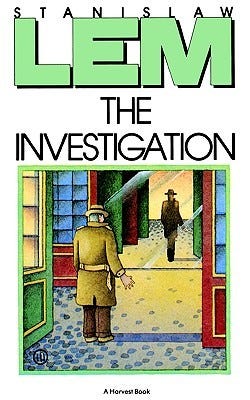
1. Stanisław Lem, The Investigation
The premise of Stanisław Lem’s 1959 novel is heady indeed: in England, a number of dead bodies have gone missing, seemingly rising from the dead and tasked with some mysterious purpose. As is the case with some of Lem’s other fiction, The Investigation is less about providing definitive answers and is more about how people grapple with events that defy rational explanation, hinting at humanity’s insignificance in the greater cosmos.
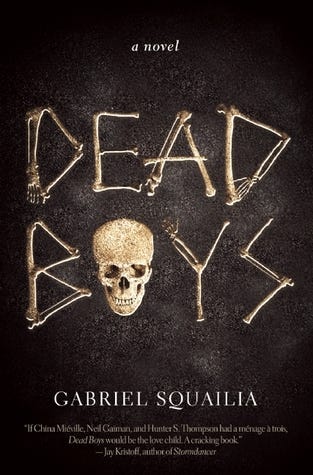
2. Gabriel Squailia, Dead Boys
You’d be hard-pressed to find a more visceral take on the underworld than the one featured in Gabriel Squailia’s Dead Boys. The novel is set in an afterlife whose population enters with decaying bodies, which its protagonist is particularly skilled in repairing. As the narrative advances, Dead Boys incorporates aspects of the quest narrative, discussions about the nature of the body and the soul, and plenty of disquieting surrealism along the way.
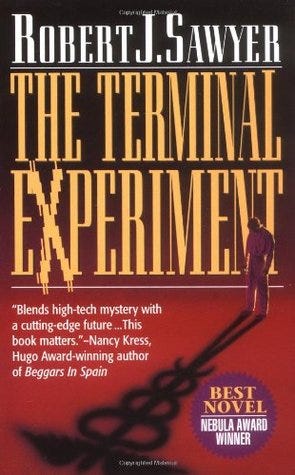
3. Robert J. Sawyer, The Terminal Experiment
The protagonist of Robert J. Sawyer’s novel The Terminal Experiment discovers evidence of energy leaving the body at the time of death — to some, confirming evidence of a soul. What follows blends the heady (discussions abound over the nature of consciousness and the existence of an afterlife) with a twisting plot, as a simulated version of the protagonist’s consciousness turns murderous.
4. Xia Jia, “A Hundred Ghosts Parade Tonight” (in the anthology Invisible Planets)
Xia Jia’s evocative, surreal short story is set in a futuristic park where the souls of the dead are encased in immortal robotic bodies, and is narrated by an ageless child who is cared for by these immortal figures. It’s a haunting, moving tale of an ersatz community, as well as a powerful depiction of the effects of time on a location that’s fallen out of public favor.
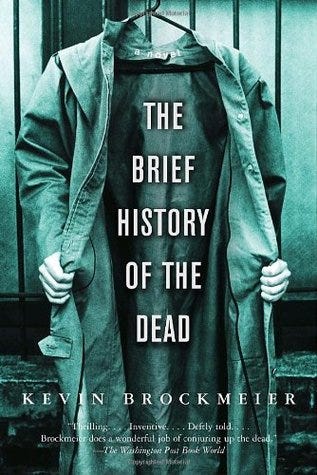
5. Kevin Brockmeier, The Brief History of the Dead
Much of this elegiac novel is set in the afterlife — envisioned here as a massive city where the dead reside until forgotten by the living. When a pandemic hits the world of the living, leaving one person left alive in relative isolation, the city’s population dwindles rapidly. The result is a wholly original work, and one that leads to an incredibly powerful conclusion.
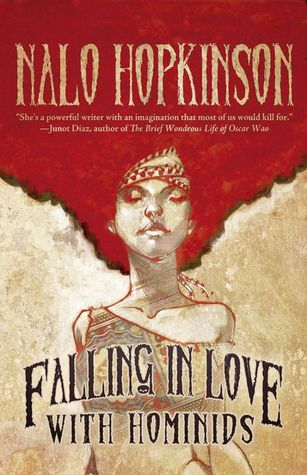
6. Nalo Hopkinson, “Old Habits” (in the collection Falling in Love With Hominids)
The characters in Nalo Hopkinson’s “Old Habits” all reside in a strange state of life after death: their souls dwell in that most purgatory-like of modern spaces: the shopping mall. The result is a tale that’s both absurdist and tragic, turning familiar sights and spaces into something unsettling, and showing how the mundane can shift into the uncanny depending on the context.
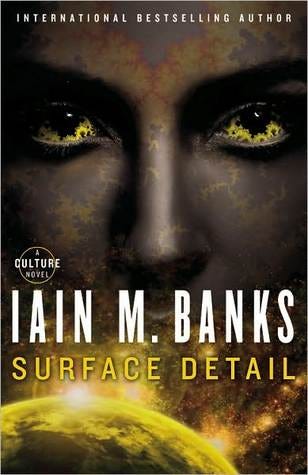
7. Iain M. Banks, Surface Detail
Iain M. Banks’s Culture novels feature high concepts in abundance: societies organized along bold political lines, the interaction between artificial intelligences and humans, and chilling moral decisions. In Surface Detail, Banks throws notions of the afterlife into the mix, as various consciousnesses are suspended in simulations of a host of heavens and hells.
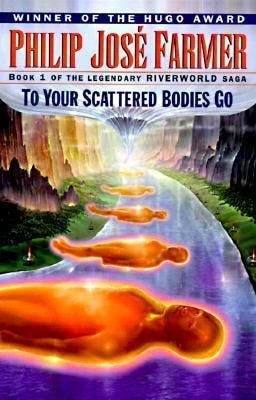
8. Philip José Farmer, To Your Scattered Bodies Go
The first book of Farmer’s acclaimed Riverworld series establishes the basic premise: at some point in the future, on a distant planet, every human who has ever lived is brought back to life along the banks of a massive river. Farmer’s novel has a mystery at its center: why was this done? But it also crackles from the interaction between different historical figures, all sharing the same space.
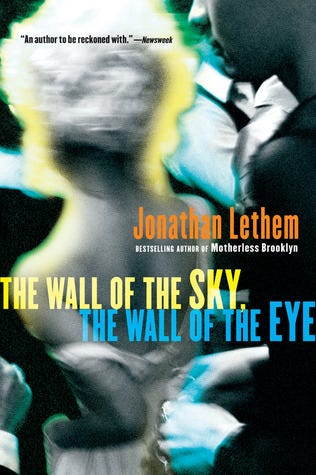
9. Jonathan Lethem, “The Happy Man” (in the collection The Wall of the Sky, The Wall of the Eye)
The narrator of Jonathan Lethem’s “The Happy Man” is dead — but he’s returned to the living world to work a job and make money for the family he left behind. Periodically, though, he returns to hell, where he undergoes torments that seem taken from a twisted fairy-tale playbook. In Lethem’s story, memories and the present coexist, life and the afterlife blur together, and worlds real and virtual haunt one another.
10. Philip K. Dick, Ubik
As with many of Philip K. Dick’s best novels, Ubik poses questions of time, space, death, and life, providing thought-provoking answers as its plot unfolds. Its storyline centers around a group of characters for whom time itself has begun to break down; a limbo-like state between life and death also plays a significant role in the book.
The arrival of Girlfriends, Ghosts, and Other Stories, the third Robert Walser collection from New York Review Books — and fourth title overall, including Walser’s celebrated novel, Jakob von Gunten — continues the publisher’s deep dive into the late writer’s work, emphasizing the vastness of Walser’s back catalog and making sure his prose remains easily accessible to English-speaking audiences. This newest offering, lovingly translated from the German by Tom Whalen, with Nicole Köngeter and Annette Wiesner, contains 88 chronologically arranged texts, and the mishmash of stories, essays, reviews, and remarks delightfully captures Walser’s playful use of language.
Though both appear over halfway through the collection, title stories “Girlfriends” and “Ghosts” nicely reflect the book’s overall mood. In the first, a protagonist hides behind a curtain, spying on two sisters as one employs the other as a footstool, while “Ghosts” finds the author using a recently read novel as a device to question the existence of the supernatural. In these stories, Walser’s narrators react to a one-sided encounter — the novelist in “Ghosts,” cannot tell when his words are being read, after all — and this method of storytelling pockmarks the collection, as Walser frequently writes as if an outsider, or a ghost himself. Also, like most Walserian tales, these two stories gracefully flit about via visual association, segueing into ruminations on independence (“Unfreedom can harbor an enormous amount of freedom; independence can be slavery”) and the small pleasures found in dime store novels:
There are little books we read as if we’re eating something delicious. We quickly forget them. After a certain amount of time, perhaps we recall them again. They’re like people we’re capable of loving because they’re not difficult. I also wish this for what I have written here.
Such moments of observation, nostalgia and political curiosity continue in several other texts, and though Walser never mentions it directly, shades of World War I sometimes linger. “The Children’s Game,” from 1919, revolves around a poet who watches a group of children as they gather “against an old tower” to play. The little ones jockey for dominance, and the poet monitors as one grows too powerful before he falls “over a branch” and is “forgotten,” leaving an opening for another child to take the lead. In 1917’s “The Murderess,” a narrator walks with a farmer over a mountain, where he sees a woman possessing a “robust healthy appearance.” After the woman passes the duo, the farmer reveals to the narrator that the woman “beat her husband to death.” Hearing this, the narrator writes, “What astonished me the most was the good, natural appearance of the woman whom we had just seen pass us so quietly and inconspicuously … not a murderess but just any upright, honest, diligent woman.” In both of these stories, Walser’s surrogates take on the role of commoner absorbing the actions of a drastically changing world, where friendly faces can hide danger and power is fleeting.
All is not political, however, and as those familiar with the author might expect, the collection also features several takes on nature. These contain an even greater sense of wonder and sanctuary for the writer and regularly continue his pattern of one-sided observation/interpretation. The very short “On the Terrace” vividly describes a rain shower’s effect on a lake; “Spring” sees Walser enjoying a bird “trying to practice its singing, endeavoring to loosen its throat”; and “Dear Little Swallow” embraces an epistolary style as the author aims his words directly at the title bird, praising its beauty and asking it to stay as long as possible to stave off the cold winter months. Even the collection’s opening story, “A Morning,” which charms as Walser recounts the tedium and minutiae of office work, speaks to his love of nature. Here, Walser toys with the confines of a traditional job, describing a harried worker as “Totally Be-Mondayed, his face pale and bewildered” and his environment “a life among desks.” Characters battle over an opened window, a woman outside sings, and the temptations on display by Mother Nature make the morning hours drag for the men stuck indoors.
The variety of work on display in Girlfriends, Ghosts, and Other Stories is impressive. Whether written as fairy tale (“No One”) or drama (“Porcelain”), spy story (“The Red Leather Pouch”) or book review (“Ludwig”), each text sees Walser manipulating language with a wry irony to suit his desires. Of course, sometimes his desires show his privilege as a white male living in a patriarchal world, and texts like “The Bob” and “The Girls” illustrate the author’s perhaps unintentional slips into sexism and degradation masked as good humor. The inclusion of these works may temper the attraction of Walser to some, yet they help round his complex character, and they add extra depth to Tom Whalen’s excellent afterword, which presents a brief, helpful bio on Walser, his correspondence with other authors, and a history of Walser’s translators.
In “Something About Writing,” Walser claims, “The existence of a writer is determined by neither success nor acclaim, but rather depends on his desire or power to fabulate anew again and again.” Though not every text bears fruit, Walser clearly shows his power to fabulate in Girlfriends, Ghosts, and Other Stories. The collection is a very strong, and it continues NYRB’s winning streak of Walser translations.
Edan Lepucki’s second novel, Woman No. 17, is a sexy noir concerning an unlikely friendship between two self-destructive women — Lady, a forty-year-old writer and Esther, a recent college grad/aspiring artist. When Lady breaks from her husband, she haphazardly hires Esther — known as “S” — to help out with her spry toddler. S moves into Lady’s guesthouse in the Hollywood Hills with family baggage and a hidden agenda, and quickly becomes Lady’s sole confidante. Though Lady confesses her deepest, darkest secrets to S, the lies S tells intensify as she begins a dangerous romance with Lady’s eighteen-year-old son, Seth, who’s never spoken a word.
Whether it’s writing a bestseller, remaining composed for a live TV interview with Stephen Colbert (where, in 2014, she became a cause célèbre — part of Colbert’s fight against Amazon), helping her students craft and publish their work, keeping up with her two small children or making readers love unsympathetic characters, Lepucki does it all with ease and enthusiasm. I love knowing her and reading her, and I was elated to have this opportunity to call her at home in the Bay Area to talk to her about bad moms, art snobs, and Woman No. 17.
Arnold: This story concerns a writer whose editor suggests she write about her son. You have a son. Did your editor or agent convince you to write about being a mom or what was the germ of the story?
Lepucki: Nobody asked me to write about my son, though the seed of the story definitely came from my own life as a mother. When my son was about fifteen months old, he wasn’t yet speaking. That’s normal for that age, but he was my first child, and my nephew spoke very early, and so I became paranoid that my own son was delayed, and not only that, but that he would remain silent. It’s sort of like when women are forty-weeks pregnant and become convinced they are never going to give birth, although, obviously, they will! I started to imagine what it would be like if your child didn’t speak, and more importantly, what would your relationship with your child be like and how would it be changed? At the same time, I had read this book by Andrew Solomon called Far from The Tree about parents of children who are different from them. There are chapters about autistic children, another about schizophrenic children, and so on; each one concerns a different community and identity, and all the parents in the book are heroic in some way. They manage to find a connection with their child and advocate for them and understand that the story of their child belongs to their child and isn’t about them. Of course, I was curious about a parent not like that. The story (of Woman No. 17) began with this idea of Lady, the mother of a kid who does not speak. I asked myself: What if she wasn’t an accepting mother? What if she couldn’t wrap her head around how to raise a child with a disability?
Arnold: An author has to love something about each of her characters. Lady and S, your two narrators, often act like awful people. What do you love most about each of them?
Lepucki: I really like both of them! [Laughs] I knew from the onset that they were going to be quote-unquote unlikable. As soon as Lady was on the page she had this kind of judgmental quality to her. She doesn’t understand herself very well. I knew people were going to have an issue with her — that, or enjoy her bad behavior. The same thing with S. She does some reprehensible things and is very reckless. But I was interested in their voices, how they speak, the way that they see the world. I think both of them are very funny. I know I wrote these characters, but they are not me: I was simply their mouthpiece. They both have troubled relationships with their own moms. They both want to connect with people. S really wants her art to reach people and she wants to understand who her mom is and why she drinks herself silly. Like S, I was a child who shuttled between divorced parents, and so I feel for her. For Lady, I identified with her struggles with motherhood. I mean, we don’t have the same situation and I wouldn’t make the same choices that she made, but I understood her sense of isolation and wanting to do the best for her child and not really knowing what that is. She doesn’t really have a model to follow. Thankfully, I do. My mom was and is a great mom, and I feel like whenever I need help she’s there for me. Lady doesn’t have that privilege, and my heart goes out to her. So they were really fun to write and it was fun to watch them spiral out of control, but I also just love them and felt their vulnerabilities.
Arnold: Is Lady a bad mom?
Lepucki: I don’t know. I think that’s for the reader to decide. One of my questions for the book is: What does it mean to be a bad mom or a good mom? For me, being a good mom means being present with my children, being patient with them, putting their needs before mine — but within reason. Handling discipline well. There are so many different elements. It’s just a constant dance. And, at times, I find it difficult to be present, and deal with their manic, child craziness…especially after not having slept! So it’s a big question for me: Am I a good mom? Aside from obviously bad mothers who harm their children, I don’t know what makes a mother good. I think it’s a complicated question. As for Lady, she doesn’t always do what’s best for herself or her children, but I also think she loves her children. It’s an imperfect love, but it is there.
“Am I a good mom? Aside from obviously bad mothers who harm their children, I don’t know what makes a mother good. I think it’s a complicated question.”
Arnold: You mentioned Seth being mute. He is otherwise healthy and normal. Why did this degree of his disability interest you?
Lepucki: After I was deep into the book I regretted my choice to some degree because it’s hard to write a scene of dialogue with someone who does not speak! At a certain point, you’re like, wait, how many times can someone raise his eyebrows? [Laughs] I knew he didn’t speak and early on I talked to a friend of mine who is a therapist. I asked her what would be some reasons why a child wouldn’t speak. She works with a lot of children and asked if he has autism, because autistic children often have delayed speech or limited speech. Or they don’t speak due to an anxiety issue. But I wanted Seth to be able to read and negotiate minor emotional social cues, and I thought if he were impaired in other ways, it would be difficult for him to be an agent in some of the drama of the narrative. I needed him to be savvy in these social ways. I also met with my friend who is a speech therapist and we talked about what his malady could be. One of the things I landed on was Selective Mutism, which isn’t an accurate diagnosis for Seth because he doesn’t speak ever and people who have Selective Mutism often speak to one or two people. I thought about how frustrating it would be, to be a parent of a child who didn’t have a diagnosis that described your child. Parents of children on the autism spectrum sometimes experience this because not everything in the diagnosis fits their child. In that case, the question is, well, do they really have an impairment? There is a frustration and pain in not having an answer to the question: Why is my child like this? I think the fact that I didn’t have a direct diagnosis for Seth works in Lady’s favor and how she struggles with Seth. I also know it’s an exceptional case. He doesn’t speak, but he can also communicate easily — he doesn’t have social anxiety. I compare it to when you read a mystery novel where there’s a unique, sensationalist murder — Is it possible? Yes. Is it probable? No. It’s fiction. Seth literally cannot speak, but he does communicate very well. The women in the novel? They talk a whole lot, but their communication skills could use some work!
Arnold: It’s implied in the novel that Seth’s early childhood trauma of losing his father, Marco, may have led him to close down. How did Marco’s absence form Seth?
Lepucki: I think it’s Lady’s perception that, because she cannot find a reason for Seth’s silence, then it must be because of trauma. One of the reasons people stop speaking is trauma. Normally, that trauma is major, such as witnessing a murder or being sexually abused (that’s what happened to Maya Angelou, as she describes it in I Know Why the Caged Bird Sings). In Seth’s case, the trauma of losing Marco was more enacted on Lady. She’s still processing it and hasn’t faced the pain of it. She’s still not over her baby daddy! But I do think that the abandonment also hurt Seth, because it meant that Lady isolated the two of them further. Had there been another person in that family dynamic the way that Karl is there now, Seth would have probably gotten better services, and the family would have integrated into a community of non-speaking people. Marco’s abandonment has more of an effect on Lady, and how Lady deals with Seth, than on Seth himself.
Arnold: I thought you did a great job capturing that self-righteousness artists sometimes have about themselves or their work. Both Esther and Kit take pictures. I loved your Elle piece about being a photographer’s muse. Can you speak here to what sparked your desire to write about photographers?
Lepucki: First of all, I did not title the Elle piece. I would never call myself a muse! When S showed up on the page I hadn’t planned for her to be a big part of the book. I didn’t think she was going to narrate half of it, but as soon as she was in scene I was really fascinated by her. As soon as she admired the photograph of the Pizza Hut in Lady’s house, I saw that she was interested in art. To my surprise, I had this artist figure — though maybe it’s not such a surprise, since I have always loved to hang out with visual artists. Like I said in the Elle piece, all my roommates in college were art majors — that is, if they weren’t English majors. And to this day I love to talk to the artists I know about process and how they come up with images.
In some way, the visual art in Woman No. 17, namely when S becomes her mother for this performance piece, is a surrogate for fiction writing. S’s project is much more extreme than writing, as you know, but when we are writing fiction we do become other people. I am not S and I am not Lady, and I would not do most of the things they do, but I did, in a sense, get to do them when I wrote. I think I poured some of that experience into S’s way of being in the world. Then there’s Kit Daniels, who is the famous photographer. I loved writing her — she’s such a bitch! I would spend, like, an hour describing her outfits for every scene.
After having written the book, I find myself reading profiles of Sophie Calle, a famous French artist whose work I love so much. And I just read an article about this woman who is a muse and has asked all these famous photographers to take her portrait. She has a collection of like two hundred portraits. That’s an act of art in and of itself. While I was reading it, I thought, Someone has to write a novel about this woman! It’s not going to be me.
Arnold: Where did the ideas for both Kit’s and Esther’s individual photo projects come from?
Lepucki: You know how it is: you start writing and suddenly things emerge. Or that’s how it feels to me, as if these ideas simply appear, without reason, and I take them without questioning where they came from. However, recently, my friend Christine Frerichs, who is a painter, read a description of the book and she wondered if she’d had an influence on the character of S. Christine reminded me that when she was in college she did a photography project about her own mother, who passed away. For the project, Christine dressed as her mother and photographed herself in these outfits, one for each day that her mother had been in a coma. I remembered the project after Christine described it to me, though I had forgotten about it until that moment. But it certainly connected to S’s project; Christine’s photos must have stuck in my subconscious in some way.
As for Kit’s photographs, I honestly have no memory where the Women Series came from, but I’ve always loved portraits taken by photographers like Diane Arbus and Sally Mann, those very provocative black and white photos of people that are kind of staged and kind of candid. They give you a sense of somebody’s identity, but there’s also a mystery about who the person in the photo really is. That stuff has always been appealing to me so it’s not surprising that I wrote about it.
Arnold: Esther’s secret project subverts the distinction between art and reality. In your mind, is there a fine line or is it clearer than Esther sees it? Is she the crazy drunk person she is portraying in this world or is she really faking it?
Lepucki: I think that’s the question of the novel! The thing about S is that she’s young. Some people at that age know very clearly who they are and what they want and how they want to be in the world, but she’s not one of those people. And because of that she has a nimble identity. That she can drink so easily and take on this role of her mother, or who she assumes her mother is, scares her. It begs the question: Is this a role, or is it her true self? You can’t fake that far! At the same time, she understands that her performance doesn’t totally match up to her mother. Her mother is far more honest than S is. Deceit is at the center of S’s project. Also, her mother is much more open with her body and very affectionate and doesn’t really care what people think of her. S wants those qualities in herself so she’s using this project as means to be those things. I wanted the reader’s idea of S to collapse so that you don’t really know what’s truly her, and what’s her performance.
Arnold: S does a lot of drinking. Did you do any research?
Lepucki: You know what’s funny — during revision I drank so much! In every scene where they were drinking sparkling wine I’d be like, “I’m getting sparkling wine tonight because it’s so good and I’ve described it in such loving detail!” [Laughs] But I didn’t do any of the private drinking of straight tequila or vodka. That sordid, secret drinking was not appealing to me. One reader review called Lady an alcoholic as well as S, and I was like, is Lady an alcoholic? And then I was like, oh my God am I an alcoholic and don’t know it?
Arnold: I’m going to ask you a question you once asked me: are you an artist? Are writers also artists?
Lepucki: When did I ask you that? Was that my pickup line for you? [Laughs] What did you tell me?
Arnold: I said no, but then I thought about it a lot and decided maybe I was. I mean, I’m definitely a weirdo and I’m artsy. When I was younger I used to make art. My mom still wears my jewelry sometimes. But she paints and I grew up believing an artist was someone who paints or draws, which I can’t do.
Lepucki: My answer is both yes and no. On the one hand, no. There’s something a little bit more mundane about writing, because all of us write every day, be it in emails or on Facebook or a note to our spouse. There’s a sense that writing is much more enmeshed in our everyday lives, which makes it less like art. But I also think that writing is an art form, and I always say that writing is the best art form because it shows us consciousness. No other art form can do that. That’s what makes it so beautiful and important. Some days I think that I am an artist because I have to step outside of myself and the situation I’m in to see it closely, and that is the role of the artist: to observe culture and comment on it through music or painting or photography or a short story. Sometimes I write a sentence that feels like art. A lot of times I feel like I’m not living up to the art that I would like to make. But that’s my life goal — to become an artist.
Arnold: What are you working on next?
Lepucki: I have seventy pages of a new book, which I will not say anything about. But of course it takes place in LA and I’m sure all the characters are unlikable!
Reading a book after the publication buzz has died down lets you see how it stands up without the protective gauze of “coverage.” Reading a canonical book knowing the reputation(s) it bears, is worthwhile because — even though it has stood the test of time — it is likely out of sync with the worldview of the current day, and is therefore a trickier test of your perspective (George Orwell’s work being a stark exception these days). As in, it’s lucky Philip Roth got in when he did because it seems probable that if he were writing today a lot of his manuscripts would be tossed out by the women — white, specifically, as Marlon James pointed out — who make up the majority of today’s publishing industry. Before this assignment, I had never read Philip Roth.
Before we go any further: this is not a hate essay about how the misogyny in Philip Roth’s novels makes them not-great literature, or makes me feel bad about liking the one I read for this series, The Ghost Writer.
Among the titles in Philip Roth’s canon that I did not choose to read for this assignment are: The Professor of Desire (1977), When She Was Good (1967), The Breast (1972), and The Great American Novel (1973), none of which, allegedly, were titled satirically. Despite having not read these or any of his other novels before, between criticism over the years, the many think pieces about Roth’s retirement in 2012, and having been an English major once upon a time, I knew enough about him to sketch a biography. I knew he was Jewish and from New Jersey. I knew that from roughly 1959 to 2012 he secluded himself in the rural Northeast so that he could do nothing but write at a remove from the world. Roth has said in interviews that in his career of 31 novels and numerous short stories, he more or less wrote the same book over and again. All of this tells me that he sought to write literature that resounds with a particular kind of timelessness, one that comes from turning very deeply inward to craft a singular human story over a long period of time.
And The Ghost Writer mostly reads like that.
When Roth published The Ghost Writer in 1979, he would’ve been between the ages and stages of Nathan Zuckerman, his recurring protagonist who appears in this novel, and E. I. Lonoff, the elder statesman author who has invited Nathan to spend an evening in his countryside home. The evening visit and the morning after comprise the entire novel. Both Zuckerman and Lonoff are Jewish men, concerned with writing the male, post-war Jewish experience. For his part, Zuckerman tells us “I had come to submit myself for candidacy as nothing less than [his] spiritual son.”
“I had written for the whole world to read about Jews fighting over money,” he disdains
Zuckerman, young and zealous, is from a Jewish neighborhood in New Jersey. Only four published stories into his career, his writing is already offending his Jewish family and community so much that his father has gone to the local Rabbi to seek both counsel and mediation. Zuckerman is outraged, indignant. How could his father, a foot doctor not an artist, understand the goals or the achievements of Nate’s art? “I had written for the whole world to read about Jews fighting over money,” he disdains. “It was not for me to leak the news that such a thing could possibly happen. That was worse than informing — that was collaborating.” Zuckerman is bitter but not disheartened because Lonoff, he will understand.
Lonoff lives like a recluse, a monk for the religion of his art, in a small cabin with his wife surrounded on all sides by untouched field, away from the writing and publishing scene of New York. Every minute of his days he is “turning around sentences” with no idea how else to spend his time. The consequence of living like this for so long, his wife Hope (“Hope”!) later tells us, is that he is now the kind of man who “takes three months to get used to a new brand of soap.” But Zuckerman considers Lonoff’s life a paradise, not purgatory. Lonoff as an embodiment of Zuckerman’s possible future is a warning the young man will almost certainly not heed. And it’s unclear if Roth thinks he should. On the pin-board in Lonoff’s office, Zuckerman observes a quote from Henry James’s The Middle Years written on index card: “We work in the dark — we do what we can — we give what we have. Our doubt is our passion and our passion is our task. The rest is the madness of art.”
Having not read Roth before, here is what might be the most late-to-the-party-esque take in this essay. With two writers at the center of the story, both Jewish (one from a neighborhood in New Jersey, one removed from New York), writing about the male, Jewish, postwar experience, the novel’s autobiographical details are shameless and abundant. So much so that it is difficult to parse where Roth ends and his fiction begins — such that I ask whether I’m meant to make that separation at all. “Not living is what he makes his beautiful fiction out of!” cries Lonoff’s wife, Hope, as she rages out of the house, once and for all, at the end of the novel. Are we to imagine this is also Roth? A man who creates reams of stories out of a life in isolation? But an author is not his fiction; to say otherwise is an insult to his imaginative powers. And Hope’s cry comes at the end, but not the very end of the novel. On the last page and at the end of the visit, Lonoff is putting on his shoes to chase after Hope; he turns to Zuckerman and says, “‘I’ll be curious to see how we all turn out some day. It could be an interesting story. You’re not so nice and polite in your fiction,’ he said. ‘You’re a different person.’”
It is difficult to parse where Roth ends and his fiction begins — such that I ask whether I’m meant to make that separation at all.
Roth’s work is a fascinating human and artistic study. He wrote for most of his life, without stopping, about every stage of life as a writer, a man, and a Jew in the postwar decades. Roth the present is in constant conversation with his ghosts past and future; he is eternally the ghost of the present. With a chapter title like “Nathan Dedalus” it’s clear Roth is writing his portrait of the artist as a young — and as an old — man. If one goal of art is, simplistically, to express oneself — to move the self out of the pneuma of thought into tangible form — then Roth has exorcised himself onto pages with a dedication that is rare. I’d only read something like it before in the Elena Ferrante books.
It is difficult to find a meaningful piece of myself in The Ghost Writer because the obstacles are so blatant and so high.
If I was to suggest a shortcoming it would be that art which has come from so deep within should have at least one kernel of human truth that I, too, can hold. It is difficult to find a meaningful piece of myself in The Ghost Writer because the obstacles are so blatant and so high. For starters, I can’t play any of the available female roles, which are as follows:
Indistinct Plaything of a Man: “…when I was left alone with those long-necked aerial friends of Betsy’s, who walked with their feet turned charmingly outward and looked (just like Betsy!) so appetizingly wan and light and liftable.”
Caricature of Hysteria (and all of the most frustrating things “hysteria” invokes; the Greek stem translates to “womb”): “…the sound of glass breaking and the sight of a disappointed woman, miserably weeping, was not new to me. It was about a month old. On our last morning together, Betsy had broken every dish of the pretty little Bloomingdale’s set…”
Victim of Ambiguous-Consent Sex / Rape: “…I confessed that the mutual friend had not been the first to be dragged to the floor while Betsy was safely off dancing her heart out…”; “On my knees, I struggled to unclothe her; not resisting all that strenuously, she on her knees told me what a bastard I was to be doing this to Betsy…I pinned her pelvis to the kitchen linoleum, while she continued, through moist smiling lips, to inform me of my character flaws.”
And, lastly, Blank Screen for Projections of Male Desire — actually wait, let’s adjust that to “Smart, Attractive, but also Blank Screen” because Amy Bellette is notably beautiful and does seem rather intelligent: “…it was for him, the great writer, that Amy had chosen to become Anne Frank…to enchant him, to bewitch him, to break through the scrupulosity and the wisdom and the virtue into his imagination…”
That’s right: in that last option, momentarily putting aside the sexism — which is a massive aside — Amy Bellette is conceived by Nathan Zuckerman to be the survived Anne Frank, symbol of the holocaust tragedy, escaped from the camps, hiding her true identity because she is tired of being in the world as, well, the storied, diary-writing Anne Frank. Now, she lusts for the fat, aging Lonoff. It’s like the anti-Semitic version of Anastasia. Elements like these are enough to make me wonder if I’m reading a tasteless satire. But because of everything I said before, I know that I’m not.
The female roles — or rather, confinements — are presented by the narrator, Zuckerman; I can’t get around him to the actual women, and I can’t identify with him because he confounds me and his narcissism shuts me out. The only character I might connect with is E. I. Lonoff and that’s because he finds the New York publishing scene tiring. This does not feel like a special connection.
After their evening, Zuckerman is put up for the night in Lonoff’s office. He tests the writer’s chair and it is surprisingly not ergonomic, bad for the back; he cowers in front of his idol’s typewriter, an Olivetti that looks just like his; he peruses his genius’s private library, replete with Heidegger, Wittgenstein. Yet Zuckerman fails to soak it all up, to get out of his head, to even be in the room. He ends up dwelling on his anger towards his father, indulging in self-pity, and masturbating. It was Wittgenstein who said, “The limits of my language mean the limits of my world.” Even though Roth has achieved the artistic goal of creating a full expression of his subjectivity, as a piece of fiction, it is exclusionary. I don’t know if that it’s necessary that Bildungsroman works be insular rather than capsular — but in Roth’s case, it is a fact. I read his work the way I look at fossils in a museum: in an encased glass box with a placard that reads: “The Male Jewish Writer’s Postwar Experience.”
The only character I might connect with is E. I. Lonoff and that’s because he finds the New York publishing scene tiring. This does not feel like a special connection.
This is part of why I hadn’t read Roth before. Because when I was in college, I started reading John Updike’s revolting novel Towards the End of Time and became very confused until, in my desperate Google searches for explanation, I found a 1997 review of the book by David Foster Wallace. Along with Updike, Wallace includes Roth and Norman Mailer in a threesome he crowns “the Great Male Narcissists” of the postwar era, and suggests the following as a possible descriptor for any of them: “Just a penis with a thesaurus.” I hadn’t read Roth because in a 2009 n+1 conversation, Emily Gould took Wallace’s coronation a step further and talked about Roth as one of the “Mid-Century Misogynists.” (For what it’s worth, Gould does go on to say that she thoroughly enjoys reading Philip Roth, but the point gets a little lost.) I hadn’t read Roth because he was on a list that I have come to be very disappointed by, written by a woman who’s work I love, to whom I and all female writers owe much: “80 Books No Woman Should Read” by Rebecca Solnit.
I don’t want anyone excluding me from art and/or literature because of my gender. (Solnit’s list contained a small disclaimer about people reading whatever they want, but it was the article’s headline that broke the internet.) The last chapter of The Ghost Writer is titled “Married to Tolstoy.” At least four times, Hope, in a winning polemic against her husband, tells Lonoff he is frightened of losing his boredom. Tolstoy defined boredom as “the desire for desires.” Imagine having no desire but the want of it, and not wanting to be any other way. I submit that curiosity is a form of desire, and if I had no curiosity then perhaps I could not read Philip Roth. This book didn’t tell me anything good about being a woman, but I’m also a human and I’m curious about men. I’m curious about how other humans understand themselves. I’m curious about eras I didn’t live through, and the attitudes of individuals and society during those times. On that level, Roth created something assiduous and wonderful.
I am fortunate that I can read the books of the canon and see them for what they are — interesting works of art, gorgeous and disturbing records of human existence.
Of course, I can say all of this as a 21st century woman. I can enjoy simply going to the museum of literature because I’ve had the benefit of Doris Lessing, Susan Sontag, Louise Erdrich, Elena Ferrante, indeed Rebecca Solnit. In the past few months alone, for my Bildungswoman reading I’ve had the pick of Sarah Gerard, Jamie Attenberg, Julie Buntin, among many, many others.
So yes, I am fortunate that I can read the books of the canon and see them for what they are — interesting works of art, gorgeous and disturbing records of human existence. I can feel excited and grateful that I’m around as the canon is broadening, that I can freely work to ensure the voices within tell all human stories — not just one.
“We cannot live in a world that is not our own, in a world that is interpreted for us by others . . . Part of the terror is to take back our own listening, to use our own voice.”
The Catholic saint Hildegard of Bingen wrote this in the twelfth century, but she could have been speaking today. As a woman writer, I’m always aware that my voice is part of a larger battle, and that battle includes the choices I make on the page, the stories I choose to tell. Hildegard and other women like her were fighting to tell their own stories. And although they would later be sainted by the church, in their time, they were extremists, bucking the expectations of family, society, and the church itself, and declaring that their lives — and their legacies — mattered.
I spent the past several years with the Catholic mystical saints — their writing, histories, and, sometimes, their mummified body parts — while working on a novel about a young woman who is drawn to these Medieval and Renaissance rebels. The saints were celebrities — from Clare of Assisi in the twelfth century to Margery Kempe in the fifteenth — famous for their intense faith, their feverish ecstatic visions, and the miracles they performed. But most miraculous to me was their determination to control their lives. Almost all of them escaped a seemingly unavoidable fate: an arranged marriage, an abusive relationship, a life in poverty, or a spouseless existence that would have left them vulnerable — economically and physically. Their faith was a kind of trapdoor to a new reality, one they clung to fiercely.
And they didn’t just live this reality. Many left, in their own words or in testimony, an account of their lives — “I, Catherine,” “I, Clare,” “I, Angela,” they wrote, at a time when such an “I” was itself an act of rebellion. They were not only making themselves heard loudly, but they had the gall to assume a legacy. A radical assumption. And whenever I think we’ve come far from the experiences of these women — many of whom were accused of being mad, possessed, vain, heretical — I remember the criticisms that often still fall heavy on women’s writing: it is too navel-gazing, overly confessional, meant only for a certain kind of reader and certainly not for all readers.
Hildegard knew that if you don’t write your story yourself, it gets written for you. For women, writing about their interior lives, their bodies, and the world as they see and experience it remains a radical act, and one that the saints were participating in hundreds of years ago when they rejected society’s designs to keep them contained and silenced. They said no to the world that was offered to them, and, instead, they reimagined their own.
Below are seven of my favorite rebel saints who #resisted, along with suggested reading about their lives — Jessie Chaffee
1. “When we are who we are called to be, we will set the world ablaze.” — Catherine of Siena (1347–1380)
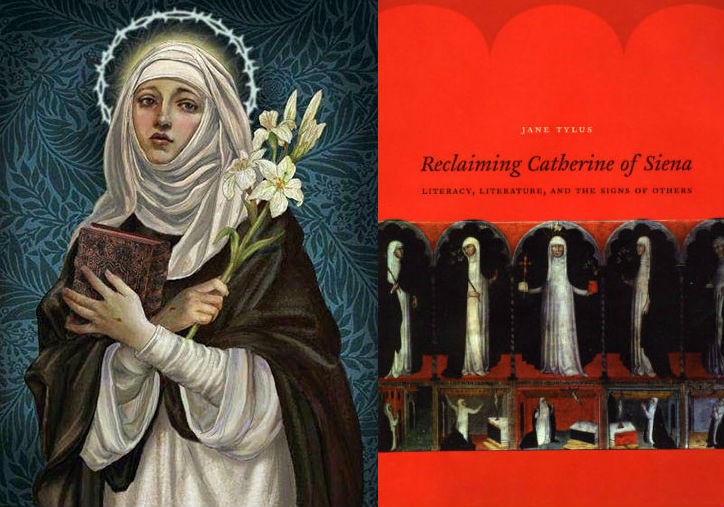
St. Catherine is one of the most well known saints, and for good reason. Her battle to enter the church was hard fought. Her parents expected her to marry well. Instead, Catherine shaved her head, slept on a board, prayed incessantly, wore a chain with small hooks around her waist that would draw blood each time she moved, and eventually grew so ill that her family relented. After joining the church, Catherine became educated and had visions — in one, she experienced a mystical marriage to Jesus (complete with Christ’s foreskin as her wedding ring). Her visions afforded her tremendous power, which she used politically, even traveling to France to convince the Pope to return to Rome. She remained a presence long after her death, leaving behind an extensive autobiography in the form of letters and spiritual writings. Her full, mummified head was also preserved, along with her finger — you can visit them in the Basilica of San Domenico in her hometown of Siena.
— Suggested reading: Jane Tylus’s Reclaiming St. Catherine, an exploration of Catherine’s work and her impact on the Italian literary canon.
2. “I am not afraid. I was born to do this.” — Joan of Arc (1412–1431)
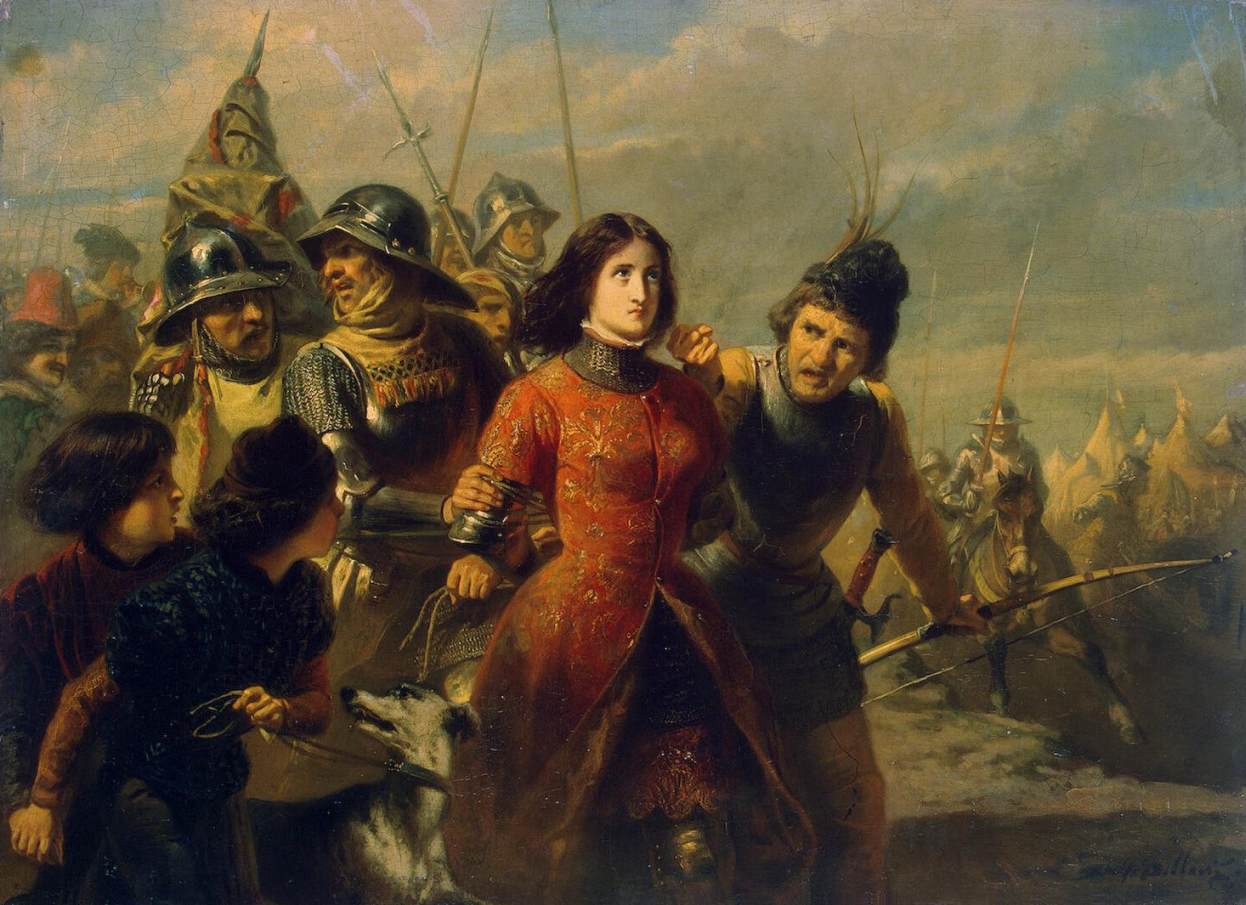
Believing that God had chosen her to lead France to victory in its war against England, Joan of Arc, a young woman born a peasant, won over the prince (soon-to-be King Charles VII) with her intelligence, faith, and sheer will, convincing him to allow her to lead the French army to free the city of Orléans. Though victorious, Joan was ultimately captured by English forces and tried for witchcraft and heresy (along with a slew of other charges, including dressing like a man). Though she had secured King Charles’s crown with her victories, he failed to intercede on her behalf, and after a year’s imprisonment, she was burned at the stake at age nineteen. Canonized in 1920, she became the patron saint of France.
3. “She was filled with inestimable satiety, which, although it satiated, generated at the same time inestimable hunger.” — Angela of Foligno (1248–1309)
Angela’s accounts of her ecstasies explore in detail the relationship between desire and pain. Like Teresa of Ávila, her writing was orgasmic — she describes: “The fire and fervor of such divine love in such a degree that I did cry aloud.” When priests, threatened by the extremity of her visions, tried to undermine their authenticity, St. Angela fired back at them: “Priests cannot preach it. They do not understand what they preach. They babble.” Like many of the saints, though she was bound by the church, she did not hesitate to challenge the institution, and her claims of a direct correspondence with God gave her the leverage to do so.
4. “Dare to declare who you are. It is not far from the shores of silence to the boundaries of speech.” — Hildegard of Bingen (1098–1179)
Hildegard felt compelled by God not only to write but to publish works based on her visions. She produced multiple books, hundreds of letters, morality plays, and homilies, as well as hymns, canticles, and anthems, for which she composed the music and lyrics, and scientific and medical works that included the causes of and holistic treatments for diseases, and reflections on human sexuality and psychology. She used her words to understand the world and to create her world. As she declared: “We cannot live in a world that is not our own.” While writing by many of the saints has been forgotten beyond the church or academia, Hildegard’s music has had a resurgence in recent decades, and is now recorded and performed all over the world.
5. “There is no one who could separate me from such great joy.” — Clare of Assisi (1194–1253) Clare was a follower of St. Francis and, in the tradition of the Franciscans (and our current Pope), eschewed material wealth. She founded her own order, later called the Poor Clares, and she was savvy about maintaining control of that order — she refused gifts from the Vatican, avoiding the attached strings, and cleverly prevented the papacy from becoming proprietors of the land on which her monastery sat, using as her defense the Franciscan philosophy that didn’t allow for personal ownership. Clare’s actions inspired a powerful grassroots movement and similar orders began popping up throughout Italy and beyond. They became magnets for women young and old in the centuries after Clare’s death, peaking in the mid-1600s.
— Suggested reading: For Italian readers, Dacia Maraini’s fictional retelling of Clare’s life, Chiara Di Assisi. Elogio della disobbeienza(Clare of Assisi: In Praise of Disobedience).
6. “But for I am a woman should I therefore live that I should not tell you the goodness of God?” — Julian of Norwich (1342–1416) Julian of Norwich’s early life is a mystery — we are not even sure of her real name. (Julian is taken from the church where she was anchoress for many years.) But as the woman who penned what is considered to be the first English-language book authored by a woman, Revelations of Divine Love, she left an indelible mark and created room for writers after her. And though, like many writers, Julian was reclusive, she still encouraged people to come to her for advice, and counseled locals navigating plague and poverty. She was also a mentor to another writer and visionary, Margery Kempe. The manuscripts of teacher and student were displayed together for the first time last year at the British Library.
— Suggested reading: Barry Windeatt’s recent translation of Revelations of Divine Love by Julian of Norwich.
7. “The archbishop said to me, ‘I hear that you’re a thoroughly wicked woman.’ I replied, ‘And I hear you’re a wicked man, sir.’” — Margery Kempe (1373–1438) Margery was married and after the birth of her first of fourteen children, began having visions that lasted the rest of her life. At age forty, she was inspired her to go on a pilgrimage — it became the first of many and she spent much of the next decades traveling. The Book of Margery Kempe, written through dictation, describes her mystical and religious experiences, her many journeys, and her interrogation and occasional arrests by men both religious and secular who accused her of lying about her beliefs. Nevertheless, she persisted, producing her eponymous work, considered by some to be the first English-language autobiography.
There was a knock. Kamu’s woman woke up and climbed over him to get the door. She picked a kanga off the floor and wrapped it around her naked body. Sucking her teeth at being disturbed so early in the morning, she walked to the door with the annoyance of a proper wife whose husband was at home.
The woman considered herself Kamu’s wife because she had moved in with him two years earlier and he had not once thrown her out. Every night after work he came home to her, brought shopping, ate her cooking. He was always ravenous. When she visited her parents, Kamu gave her money so she did not go empty-handed. That was more than many certified wives got. Besides, she had not heard rumors of another woman. Maybe Kamu banged some girl once in a while but at least he did not flaunt it in her face. The only glitch in her quest to become Kamu’s full wife was that he still wore a condom with her. With his seed locked away, she had not grown roots deep enough to secure her against future storms. A child was far more secure than waddling down the aisle with a wedding ring and piece of paper. Nonetheless, she would bide her time: condoms have been known to rip. Besides, sex with a condom is like sucking a sweet in its wrapper; Kamu would one day give it up.
The woman unbolted the door and pulled it back. She stepped outside on the veranda and stood stern, arms folded. Below her were four men, their breath steaming into the morning air. Their greetings were clipped and their eyes looked away from her as if they were fed-up lenders determined to get their money back. This thawed the woman’s irritation and she moistened her lips. The men asked for Kamu and she turned to go back to the inner room.
The woman and Kamu lived in a two-roomed house on a terraced block in Bwaise, a swamp beneath Kampala’s backside. Kampala perches, precariously, on numerous hills. Bwaise and other wetlands are nature’s floodplains below the hills. But because of urban migrants like Kamu and his woman, the swamps are slums. In colonial times, educated Ugandans had lived on the floodplains while Europeans lived up in the hills. When the Europeans left, educated Ugandans climbed out of the swamps, slaked off the mud, and took to the hills and raw Ugandans flooded the swamps. Up in the hills, educated Ugandans assumed the same contempt as Europeans had for them. In any case, suspicion from up in the hills fell down into the swamps — all swamp dwellers were thieves.
On her way to the inner room, the woman stumbled on rolled mats that had slid to the floor. She picked them up and saw, to her dismay, that the bright greens, reds, and purples had melted into messy patches, obliterating the intricate patterns her mother had weaved. In spite of the tons and tons of soil compacted to choke the swamp, Bwaise carried on as if its residents were still the fish, frogs, and yams of precolonial times. In the dry season, the floor in her house wept and the damp ate everything lying on it. In the rainy season, the woman carried everything of value on her head. Sometimes, however, it rained both from the sky and from the ground; then the house flooded. From the look of her mats, it had rained in the night.
As she laid the discolored mats on top of the skinny Johnson sofa, she felt a film of dust on her smart white chair-backs. The culprit was the gleaming 5-CD Sonny stereo (a fake Sony model, made in Taiwan), squeezed into a corner. She glanced at it and pride flooded her heart. Since its arrival just before Christmas, Kamu blared music at full volume to the torment of their neighbors. The booming shook the fragile walls and scattered dust. The wooden box on which a tiny Pansonic TV (also made in Taiwan) sat was damp too. If the moisture got into the TV, there would be sparks. She thought of shifting the TV, but there was no space for its detached screen.
The woman squeezed behind the sofa and went back into the inner room. Kamu was still asleep. She shook him gently. “Kamu, Kamu! Some men at the door want you.”
Kamu got up. He was irritated but the woman didn’t know how to apologize for the men. He pulled on a T-shirt, which hung loose and wide on him. When he turned, “Chicago Bulls” had curved on his back. He then retrieved a pair of gray trousers off a nail in the wall and put them on. The woman handed him a cup of water. He washed his face and rinsed his mouth. When Kamu stepped out of the house, each man bid him good morning but avoided looking at him.
“Come with us, Mr. Kintu. We need to ask you some questions,” one of the men said as they turned to leave.
Kamu shrugged. He had recognized them as the Local Councillors for Bwaise Central. “LCs,” he whispered to his woman and they exchanged a knowing look. LCs tended to ask pointless questions to show that they are working hard.
As he slipped on a pair of sandals, Kamu was seized by a bout of sneezing.
“Maybe you need a jacket,” his woman suggested.
“No, it’s morning hay fever. I’ll be all right.”
Still sneezing, Kamu followed the men. He suspected that a debtor had perhaps taken matters too far and reported him to the local officials. They had ambushed him at dawn before the day swallowed him. It was envy for his new stereo and TV, no doubt.
They walked down a small path, across a rubbish-choked stream, past an elevated latrine at the top of a flight of stairs. The grass was so soaked that it squished under their steps. To protect his trousers, Kamu held them up until they came to the wider murram road with a steady flow of walkers, cyclists, and cars.
Here the councillors surrounded him and his hands were swiftly tied behind his back. Taken by surprise, Kamu asked, “Why are you tying me like a thief?”
With those words Kamu sentenced himself. A boy — it could have been a girl — shouted, “Eh, eh, a thief. They’ve caught a thief!”
Bwaise, which had been half-awake up to that point, sat up. Those whose jobs could wait a bit stopped to stare. Those who had no jobs at all crossed the road to take a better look. For those whose jobs came as rarely as a yam’s flower this was a chance to feel useful.
The word thief started to bounce from here to there, first as a question then as a fact. It repeated itself over and over like an echo calling. The crowd grew: swelled by insomniacs, by men who had fled the hungry stares of their children, by homeless children who leapt out of the swamp like frogs, by women gesturing angrily, “Let him see it: thieves keep us awake all night,” and by youths who yelped, “We have him!”
The councillors, now realizing what was happening, hurried to take Kamu out of harm’s way but instead their haste attracted anger. “Where are you taking him?” the crowd, now following them, wanted to know. The councillors registered too late that they were headed toward Bwaise Market. A multitude of vendors, who hate councillors, had already seen them and were coming. Before they had even arrived, one of them pointed at the councillors and shouted, “They’re going to let him go.”
The idea of letting a thief go incensed the crowd so much that someone kicked Kamu’s legs. Kamu staggered. Youths jumped up and down, clapping and laughing. Growing bold, another kicked him in the ankles. “Amuwadde ‘ngwara!” the youths cheered. Then a loud fist landed on the back of his shoulder. Kamu turned to see who had hit him but then another fist landed on the other shoulder and he turned again and again until he could not keep up with the turning.
“Stop it, people! Stop it now,” a councillor’s voice rose up but a stone flew over his head and he ducked.
Now the crowd was in control. Everyone clamored to hit somewhere, anywhere but the head. A kid pushed through the throng, managed to land a kick on Kamu’s butt and ran back shouting feverishly to his friends, “I’ve given him a round kick like tyang!”
Angry men just arriving asked, “Is it a thief?” because Kamu had ceased to be human.
The word thief summed up the common enemy. Why there was no supper the previous night; why their children were not on their way to school. Thief was the president who arrived two and a half decades ago waving “democracy” at them, who had recently laughed, “Did I actually say democracy? I was so naive then.” Thief was tax collectors taking their money to redistribute it to the rich. Thief was God poised with a can of aerosol Africancide, his finger pressing hard on the button.
Voices in the crowd swore they were sick of the police arresting thieves only to see them walk free the following day. No one asked what this thief had stolen apart from he looks like a proper thief, this one, and we’re fed up. Only the councillors knew that Kamu had been on his way to explain where he got the money to buy a gleaming 5-CD player and TV with a detached screen.
As blows fell on his back, Kamu decided that he was dreaming. He was Kamu Kintu, human. It was them, bantu. Humans. He would wake up any minute. Then he would visit his father Misirayimu Kintu. Nightmares like this come from neglecting his old man. He did not realize that he had shrivelled, that the menacing Chicago Bull had been ripped off his back, that the gray trousers were dirty and one foot had lost its sandal, that the skin on his torso was darker and shiny in swollen parts, that his lips were puffed, that he bled through one nostril and in his mouth, that his left eye had closed and only the right eye stared. Kamu carried on dreaming.
Just then, a man with fresh fury arrived with an axe. He had the impatient wrath of: You’re just caressing the rat. He swung and struck Kamu’s head with the back of the axe, kppau. Stunned, Kamu fell. He fell next to a pile of concrete blocks. The man heaved a block above his head, staggered under the weight and released the block. Kamu’s head burst and spilled gray porridge. The mob screamed and scattered in horror. The four councillors vanished.
Kamu’s right eye stared.
Kamu’s woman only found out about his death when a neighbor’s child, who had been on his way to school, ran back home and shouted, “Muka Kamu, Muka Kamu! Your man has been killed! They said that he is a thief!”
The woman ran to the road. In the distance, she saw a body lying on the ground with a block on top of its head. She recognized the gray trousers and the sandal. She ran back to the house and locked the door. Then she trembled. Then she sat on the armchair. Then she stood up and held her arms on top of her head. She removed them from her head and beat her thighs whispering, “Maama, maama, maama,” as if her body were on fire. She sipped a long sustained breath of air to control her sobs but her lungs could not hold so much air for so long — it burst out in a sob. She shook her body as if she were lulling a crying baby on her back but in the end she gave up and tears flowed quietly. She refused to come out to the women who knocked on her door to soothe and cry with her. But solitary tears are such that they soon dry.
The woman closed her eyes and looked at herself. She could stay in Bwaise and mourn him; running would imply guilt. But beyond that, what? Kamu was not coming back. She opened her eyes and saw the 5-CD player, the TV with the detached screen, the Johnson sofa set and the double bed. She asked herself, “Do you have his child? No. Has he introduced you to his family? No. And if you had died, would Kamu slip you between earth’s sheets and walk away? Yes.”
The following morning, the two rooms Kamu and his woman had occupied were empty.
Three months later, on Good Friday, the 9th of April 2004, Bwaise woke up to find the four councillors’ and six other men’s corpses — all involved in Kamu’s death — strewn along the main street. Bwaise, a callous town, shrugged its shoulders and said, “Their time was up.”
But three people, two men and a woman, whose market stalls were held up by the slow removal of the corpses linked the massacre to Kamu’s death.
“They raided a deadly colony of bees,” the first man said. “Some blood is sticky: you don’t just spill it and walk away like that.”
But the second man was not sure; he blamed fate. “It was in the name,” he said. “Who would name his child first Kamu and then Kintu?”
“Someone seeking to double the curse,” the first man sucked his teeth.
But the woman, chewing on sugar cane, shook her head, “Uh uh.” She sucked long and noisily on the juice and then spat out the chaff. “Even then,” she pointed in the direction of the corpses with her mouth, “that is what happens to a race that fails to raise its value on the market.”
Early on in the fantasy role-playing game podcast The Adventure Zone, two of the main characters narrowly avoid strangulation-by-sentient-vine as they escape through the open hatch of a falling elevator. The three heroes of The Adventure Zone are Taako, a high elf; Magnus, a human fighter; and Merle, a dwarf cleric. In this scene, they ascend a fantasy skyscraper in order to confront a powerful foe, the Raven, who wields a relic that can manipulate natural elements. A writhing mass of vines controlled by the Raven approaches them from the elevator shaft below. Taako hangs suspended, clutching the feet of Magnus, who clings to a rope magically conjured in midair. Merle stands on the elevator platform nearby, deciding his next move. There’s a brief pause following this feat where one of the players breaks the fourth wall to comment on the story.
Clint (Merle): May I just say — good, vivid storytelling. Good storytelling. Griffin: Yes, thank you. Justin (Taako), in character voice: And nothing makes a story better than someone saying in the middle of it that it’s good. Travis (Magnus): “This is good so far!” Griffin: “Call me Ishmael, this book is gonna kick ass.” [crosstalk, laughter] “As God is my witness, this has been a fucking dope ass movie!”
It’s the kind of podcast tangent that normally ends up on the cutting room floor. But this self-conscious waffling makes it into the episode. This is a frequent move on the part of the McElroy brothers, creators of this podcast and several other productions. People love the awkward honesty of this kind of humor. It says: the McElroys aren’t suave, but they care a lot. This waffling reminds me of the kind of precious, neurotic type of narration I normally find in serious personal blog posts or in contemporary autofiction, in the vein of Sheila Heti or Ben Lerner. How should a storyteller be?
The McElroy brothers — Justin, Travis, and Griffin — are widely known for their 7-years-running comedy advicecast My Brother, My Brother and Me. In 2014, they established The Adventure Zone (TAZ) with their radio personality father after receiving positive listener feedback for a one-off RPG session. The adventure-comedy podcast brings together fantasy plot, radio show theatricality, electronica music, and RPG nerd culture. The theme song is a 1975 Mort Garson track featuring modulated synthesizers. The mood is casual and familial, with thousands of pieces of visual fan art available online. It’s a phenomenon that has widely outgrown its beginnings. And it’s teaching me a lot about engaging and meaningful storytelling.
It’s a phenomenon that has widely outgrown its beginnings. And it’s teaching me a lot about engaging and meaningful storytelling.
I’m used to books. I am used to literature being a perfectly-cast collection of words and signifiers, something I can mentally interact with and share with other people. What interests me about postmodernism, about autofiction, is the way these modes of thought deconstruct ways of thinking and play within already established rules and systems. Autofiction, for example, forefronts the construction of a self within the voice of a book’s narrator, mixing an author’s own life with the suspension of a character’s story. TAZ forefronts the construction of fantasy selves in a similar way. The fantasy characters are a mixture of fictional backstories and real-life decisions and interactions. But that construction and deconstruction isn’t stuffy or precious or trying to prove itself smart. Its overarching fantasy narrative is accessible and funny. And it entertains over the course of a long-term telling as a novel does — something that is harder and harder to do in this digital age.
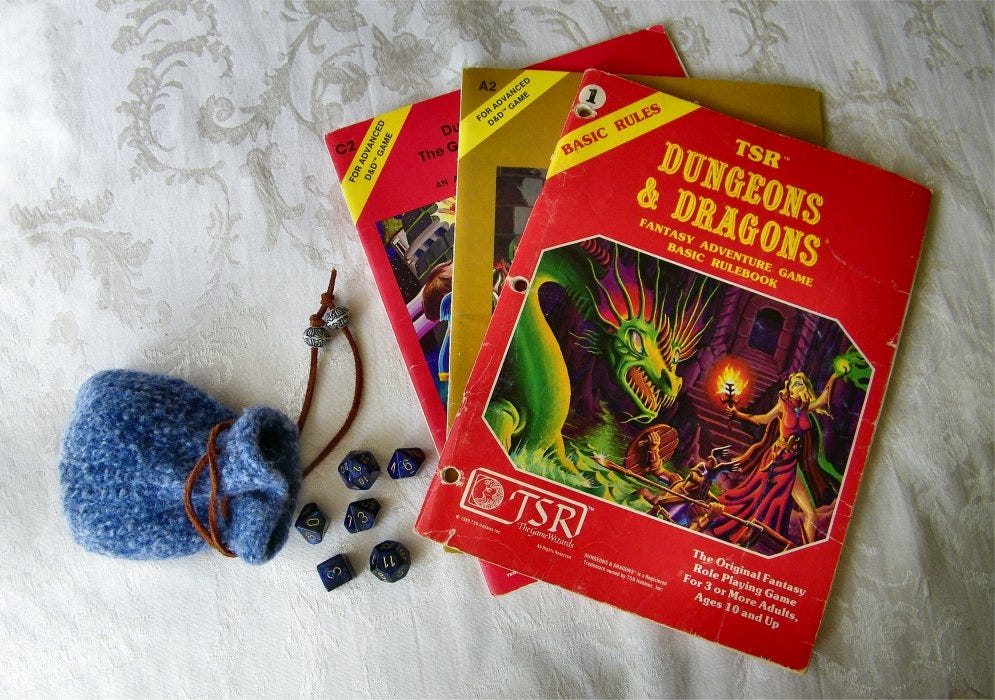
Role-playing games (RPGs) are essentially long-form make believe. They are interactive and collaborative storytelling games that can be employed in endless array. The specific tabletop RPG the McElroys use, Dungeons & Dragons (D&D), is widely regarded as the most commercially popular RPG. If one digs through the literary influences on the creators, Gary Gygax and Dave Arneson, one finds evidence of the worldbuilding of Fletcher Pratt, the spellcasting lore of Jack Vance, the surreal horror of H.P. Lovecraft, and the epic questing of J.R.R. Tolkien. In 2013, Tor.com hosted a digital series of Advanced Readings in Dungeons & Dragons to investigate over 25 different authors Gygax and Arneson most likely drew from when constructing the RPG in the early 1970s. The different classes of character you can play as — barbarian, druid, wizard, etc. — are pulled from mythological and literary sources, from pre-Christian Celtic traditions to the character of Aragorn in the LOTR universe. Geographical planes where one can play, magical spells and weapons one can use, and monsters one might fight stem from sources as disparate as Pliny’s Natural History, Paradise Lost, and Arabian Nights. This kitschy mix of every fantastic invention or story we know of makes the texture of D&D campaigns collage-like and chaotic. Since so many ideas are being reused at once, one inevitably creates a new Frankenstein’s monster of a campaign every time. The chaos is controlled by the intricate set of rules and guidelines set up by Gygax and Arneson in the first edition of the game, which has been repeatedly revised over the years.
Since so many ideas are being reused at once, one inevitably creates a new Frankenstein’s monster of a campaign every time.
To begin scenes, Griffin as Dungeon Master (DM) narrates settings, drives the plot, or introduces new non-player characters (NPCs). His role is to moderate player action and mete out plot-relevant consequences, as well as set scenes and guide overarching plot arcs. In various episodes, he describes a pink tourmaline cave with contagiously growing crystals, a monstrous purple worm that erupts from beneath dry earth on a Groundhog Day time-loop, or a guardian homunculus composed of a clay-filled suit of armor. These expositions are set in stone, as descriptions of scenery might be in realist novels. Clint, Justin, and Travis are the readers of the story Griffin spins, but they are also storytellers themselves. Their characters (Merle, Taako, and Magnus) can act however they wish, or feel emotions just as Clint, Justin, and Travis describe. Their narrative power is partially limited by the randomness of dice; the players might describe what their next action could be, but ultimately the success of their action depends on how high a number they roll, and how it shapes up against various modifiers controlled by the DM. For example, if Merle starts to fall off the side of an elevator platform, he has to make a dexterity saving throw of the dice to determine if he can grab onto the edge.
Importantly, Griffin can only enter the characters’ minds in certain moments of exposition. It’s a weird conditional omniscience that is instructed by trust, a trust in the promise that all four “writers” will tell the story in the most fulfilling way possible. It resembles the simple game where friends go around in a circle, adding a word at a time to build a sentence. In this way, when I listen to the podcast, I don’t think about what “the author” is doing (which is the way I sometimes think when analyzing novels, despite what Barthes has said about the author’s vital status). Instead, I marvel at how the story organically grows. Because control is centered outside the locus of any one person, the story feels very alive.
It’s a weird conditional omniscience that is instructed by trust, a trust in the promise that all four “writers” will tell the story in the most fulfilling way possible.
RPGs as a medium are inextricable from metafiction, which makes it an ideal genre to examine how storytelling functions. This is due to the fact that, in an RPG, the narrators of the story are the authors speaking in character persona. This seems like all fiction at first glance — isn’t Pale Fire just Nabokov narrating as an obsessive scholarly persona? — but the importance lies in the immediacy of the story. There is no filter of voice or structure or even an editing process to screen the RPG authors from their readers. There is no script. All of them are in the same room, digitally or physically. And consequently, the “writers” of TAZ are constantly talking about their own “writing.”
Take, for example, Clint’s expressed appreciation of the elevator-vine escape scene. There are many levels of narrative intersecting here: Clint as player is caught up in the imaginative visual the four of them have conjured up; Clint as father is excited about the story his family is crafting; Justin as podcaster is hyperaware of what does not make good audio content; Griffin starts spoofing on the idea of in-text evaluation via cultural references. The site of this intersection is not just waffling — it still counts as the “text” of The Adventure Zone.
The site of this intersection is not just waffling — it still counts as the “text” of The Adventure Zone.
There are other moments where Griffin as main narrator can become a kind of “vengeful god” in control of the narrative, especially since anything that’s said aloud counts as the story. When Merle tries to pry open the door of the elevator shaft to assist Taako and Magnus, Clint-as-player gets carried away with Griffin’s sense of narrative power. As he chooses his next move, vines crawl up the stairwell behind him. He tries to leverage this for dramatic flair, “so [he] can be a vivid storyteller, too.”
Clint: And I pry open the doors at the very last second. Heh. Griffin, clearly grinning: At the very last second. Ok. Clint, crosstalking: No, wait. No! No! No, no, NO! Griffin: You pry the doors open to the elevator — Clint, crosstalking: Not at the very last second, nope, NOPE. Griffin: — and a wave of vines crashes into you from behind, knocking you forward into the elevator shaft, and the doors slam behind you. Clint: Five minutes! Five minutes before! Griffin: You didn’t get there five minutes before. You — so, you have fallen into the elevator shaft, make a reflex saving throw to see if you can grab onto your party. Clint: At the last 30 seconds. Griffin, laughing: So, make a dexterity saving throw.
Griffin gleefully forces Clint to reap what he sows. That is, he treats any language or narration the players speak aloud as gospel, per se. Speaking enacts the action; you can’t rewrite the story because you realize it was a misstep. This ramps up the narrative tension.
These power dynamics among author, player and persona can also go the other way: characters can outsmart the DM. One major component of D&D play involves “leveling up” your character or purchasing magical items to assist you in your quest. For the purpose of making this rather legalistic process more palatable for listeners, Griffin creates Fantasy Costco, where the players can purchase magical items suggested by listeners. As a joke, Griffin allows an item created by the 8-year-old son of a listener to appear on the show in one of the first few episode arcs. It’s called the Flaming Poisoning Raging Sword of Doom, and it’s a deus-ex-machina of an item because, as an extremely powerful weapon, it would destroy a lot of the practical stumbling blocks that make D&D quests epic and entertaining (such as hit point values and dice rolls, which keep game outcomes random). Griffin sets the price impossibly high and leaves it there as a hyperbolic joke, seemingly to never be bought.
As a joke, Griffin allows an item created by the 8-year-old son of a listener to appear on the show in one of the first few episode arcs. It’s called the Flaming Poisoning Raging Sword of Doom.
At a later Costco visit, however, Griffin introduces another listener-suggested item, The Slicer of Tapeer-Wheer Isles, which allows the owner to persuade another character to give them their most valuable possession. Taako quietly buys this object and then immediately uses it against the Costco shopkeeper to barter for the impossibly valuable Flaming Poisoning Raging Sword of Doom. In the podcast, you can hear the absolute shock and awe of Griffin, who puts hundreds of hours into engineering the show to be a beautiful narrative, who tries to stay ahead of his brothers and father as DM, and who was out-thunk by one of the players. Even though allowing Taako to play the Slicer against the shopkeeper puts the DM at a disadvantage, Griffin feels an obligation to let Taako get the sword anyway because of the rules of narration and a trust in his fellow storytellers. It’s also just an incredibly comic moment.
In a behind-the-scenes episode released in March, Griffin admitted how much the story is affected by this constant struggle for narrative control: “The biggest thing I struggle with as DM […] is how much control over the whole narrative, the macro-narrative, do you give the players, and how much do you keep for yourself.” The show is thrilling because of this balancing of narration. This creates delicious dramatic irony, when the players know things their characters shouldn’t, or when narration needs to be juggled around to make sense. In fact, the best moments in TAZ occur when the DM is caught off-guard by a player’s choice, or the players learn something about the world that destabilizes the fiction they’ve created. As a young writer, I feverishly consume this kind of drama, and struggle with how to depict it in my own writing. Because I know good storytelling when I hear it.
Wolf in White Van, published by Farrar, Straus and Giroux in 2014, is a novel written by John Darnielle about the master of a role-playing game. In it, the fictional world of the game is destabilized when two players confuse the game with reality. The novel’s narrator, Sean, is a fiercely imaginative young man who dreams of epic survival. After a violent head injury, Sean is cut off from most human interaction, seeing no one but his parents and nurse. In place of public interface, Sean designs the world of Trace Italian, which he advertises as an RPG ($5 per month gets you four mail-in “turns”). He builds a customer base, and ends up running the game for several hundred mail-in players. The goal of the post-apocalyptic RPG is to reach Trace Italian: the last safe fortress in an irradiated world raw and unforgiving. Each player’s story is different, because each choice they make takes them down a different branch of the game-narrative Sean designed. For each “turn,” he sends the player a description of the adventure’s latest development, ending with a series of actions the player might take.
The second-person narration of Trace Italian resembles the D&D narration that Griffin provides for TAZ, but in Sean’s consciousness there is a greater sense of desperation:
Where the railroad used to run, there’s a little less overgrowth. As you travel, you keep your eyes on the ground ahead of you, trying to make out a path. Hours turn into days. You become a human bloodhound. You notice things others didn’t as they tried and failed to walk the path that now is yours. As you progress the path becomes less clear: with every less clear point you know you’re going beyond the places where the others lost the trail. Stopping to rest, you see a spot where plants seem to grow higher. If they have followed your path faithfully, bounty hunters will be here within the hour. North lies Nebraska. […]
FORAGE FOR ROOTS
FOLLOW THE RAILROAD
WAIT FOR HUNTERS
NORTH TO NEBRASKA
The player then mails back their response. Sean notices that players tend to explicate much more than necessary — they become deeply involved with their characters, to the point of being one and the same. That’s the whole point of the game, anyway: to suspend reality and become that desperate character. For Sean, these RPG exchanges become the communication and human sustenance he clearly craves. He admits how deeply he identifies with the playing character: “Every move I send out begins with the same word: You. When I first wrote most of them, so long ago now that it’s incredible to think of it, I had in my mind only a single player, and of course he looked almost exactly like me […]. I was building myself a home on an imaginary planet.”
Two players named Lance and Carrie take Sean’s instructions extremely seriously — they carefully plot each move they make as a pair. As the game progresses for them, they begin to believe that the Trace Italian is real. The two of them collaboratively construct a new reality together, and this belief turns out to be fatal. In the novel, Sean struggles with the idea of Lance and Carrie’s infatuation, but he also seems to understand why they fell for their own illusion. RPGs have real power.
In the novel, Sean struggles with the idea of Lance and Carrie’s infatuation, but he also seems to understand why they fell for their own illusion. RPGs have real power.
This power is investigated in a scholarly article in the journal Symbolic Interaction, “Role-playing and Playing Roles: The Person, Player, and Persona in Fantasy Role-Playing.” In addition to years spent playing D&D in their own personal time, the authors (Dennis Waskul and Matt Lust) took observational notes on D&D sessions held near them to build a critical argument regarding self-building and personas. One of their big sticking points is the idea that the gameplay interaction that takes place during a D&D session is seen as almost enchanted to the players — that the characters they play must be kept different from their actual real-life selves: “role-playing sessions are ephemeral situations encased” by “symbolic boundaries” that separate societal roles from gaming roles. This kind of reverence, the authors argue, is what allows players to create a kind of liminal space where character (and thus self-) creation can occur, because as much as players might try to separate themselves from their characters, that persona nonetheless absorbs your own characteristics. This self-creation is what caused Lance and Carrie to delude themselves; they lost sight of the boundaries of reality and fiction.
The McElroy family hardly ever pretends to follow boundaries. They center their comedy on the idea of failing to be that sacred or precious about their roles. Instead of veering toward seriousness, though, they veer toward humor. They mock one another persistently, and even playfully mock the few that object to their devil-may-care approach to D&D. At one point, Griffin pointedly declares that he has noticed some D&D purists tweeting that elevators would be anachronistic in a D&D fantasy setting. In response, he adds elevators as often as possible, and even sends the characters to a museum-like room called “The Magical World of Elevators.”
They center their comedy on the idea of failing to be that sacred or precious about their roles. Instead of veering toward seriousness, though, they veer toward humor.
For them, it’s not about an escape into a fantasy world, or the bizarre ability to conjure up an enormous avatar of Della Reese as a temporary guardian (something Merle does at one point). It’s the joy of creation and play. The imaginative power of TAZ lies not necessarily in the players themselves, but in the community that’s sprung up around it. I sense the power in the thousands of pieces of fan art, depicting each of the many fantasy characters in dozens of forms. I sense it in the hundreds of animatics uploaded to Youtube, where talented young people test out animation skills. I sense it in the extensive lore the fans create, tracking connections and plot developments in wiki pages and on personal blog posts.
In studying the history of literature and the implications of contemporary fiction for the past several years, I think I lost sight of the wonder of storytelling. Yes, my appreciation of the transportive abilities of fiction has always been there, driving me to learn more about how writing works and what it offers to human culture. But I began to think of storytelling as a sort of idealized miracle-working, something with a secret that I had to work for ages to uncover. The Adventure Zone has taken apart that belief, and rebuilt it in the form of something much more communal and welcoming. Part of TAZ’s success comes from its oral medium: it feels like improvisational theater, and it’s easily consumable as a podcast. But most of its storytelling value comes from the immediacy of its creation, the kind of joy that stems from spontaneous narrative. I feel as if I am down in the dirt with them as these four authors assemble the story. I feel that this is how a storyteller should be. Or at least, the kind of storyteller I want to be. The McElroys would laugh at my praise, but that’s because they know how to play. To take themselves seriously would ruin the game.
On a July bank holiday in 1841, about four hundred people arrived at the Loughborough train station with tickets for Thomas Cook’s first tour. It was a modest excursion: eleven miles from one English village to another, where they’d have a picnic of the squeaky-clean Anne of Green Gables variety — games, lemonade, tea and cakes — then back home. Bridges along the way were packed with people watching the vacationers’ train speed down the track.
The year 1841 had already been one of firsts for English travel. Between January and July, Britain occupied Hong Kong and colonized New Zealand, David Livingstone (of “Dr. Livingstone, I presume”) arrived at his first African post, and the explorer James Clark Ross braved Antarctic temperatures to discover an ice shelf the size of France. Amidst all this to-ing and fro-ing and building of empire, I doubt many people in 1841 were thinking, Wow, that tour guide Thomas Cook, with his picnics and cheap train tickets, he’s going to be the one to shape the world. Yet today Thomas Cook is regarded as the father of tourism.
Tourism, now one of the world’s biggest industries, began as the personal mission of a zealot. Cook had taken the temperance pledge at twenty-five and dedicated his life to converting others, a mission that shaped his career and perhaps his physiognomy: his granddaughter described him as having “the black piercing eyes of a fanatic.” He’d grown up in a working-class town, the kind of community in which drinking was the primary leisure activity, and, as one nineteenth-century clergyman describes, “a visit to a distant market town is an achievement to render a man an authority or an oracle among his brethren, and one who has accomplished that journey twice or thrice is ever regarded as a daring traveler.” Aristocrats and nobles traveled the world, but few regular people had ever been out of their hometowns. The vast majority of English men and women had never seen London.
Cook, however, had begun his career as an inter-village missionary. While wandering the dusty roads between towns, he’d observed his own feelings of exhilaration at seeing new places, as well as the shared tedium of his countrymen’s lives: doing the same things, seeing the same things, every day. This, he began to believe, was what they were trying to escape by drinking — then the drinking itself became one of the habits they could not escape. With the advent of passenger trains, Cook saw an opportunity for “lifting them out of the dull round of everyday life.” He arranged a package deal so that individual tickets were affordable and remade himself as a tour guide.
“No two movements are more closely affiliated,” wrote Cook of temperance and tourism. When one thinks about spring breakers ordering buckets of beer in Cancun and retirees getting tipsy on Caribbean cruises, Cook’s surety is funny and a little sad. Yet his theory of why travel should contribute to temperance still rings true. We grow restless in static lives. We create habits to make tedium bearable, but unvaried habits eventually become part of the same old: morning coffee, smoke break, happy hour. This is why we need travel, which, according to Cook, “helps to pull men out of the mire and pollution of old corrupt customs.’’
I learned all this from Cook’s biography, which I read on the ninth floor of the Columbia library stacks, sipping the coffee I’d snuck in. I sipped in plain sight because the only other person around to care — a squat gray-haired man with a black patch over his left eye — didn’t. We know each other, kind of, as we’re often the only people up here. He’s probably an alum, like me, milking our lifetime access to one of the few quiet places in Manhattan. His focus is better than mine: he reads court records all day, spine curved and one finger following the type, never getting up, not even to go to the bathroom, though an enormous plastic cup of iced tea sweats in front of him (smuggling that in is a serious accomplishment). Occasionally he asks me the time, though it doesn’t seem to have any bearing on what he does.
In contrast, I’m up and down all day. Going to get a book. Going to the lobby to use my phone. Going out to get a snack that I have to sneak back in. Crossing and uncrossing my legs. Sighing. My mom has the same restlessness, a symptom of anxiety, for which she joined a support group. They have a phone tree, and when one of them is anxious they call one of the others. These calls have become a source of great anxiety for my mom.
She’s a hospital nurse, which is a good use of all her nervous energy. I like research for the same reason: it’s a lot of walking around looking for books and talking to people. Still, I manage to get distracted. I found Cook’s biography because I’d gotten bored with the books I’d gathered on boredom, left my coffee to cool and the old man to figure out the time on his own, and wandered down to the travel section of the stacks.
I was thinking of taking a trip, though I didn’t have any money. Fortunately, the travel section of a college library is a terrible place to plan a vacation. It’s all biographies and histories and outdated research. Here in the murky deep sea gloom of the stacks, Ukraine is in the U.S.S.R., Istanbul is Constantinople, Louisiana has yet to be purchased, and the ground I stand on is empty air above a small green island, where coyote stalk prey and bears hibernate. I like these books. The further back the narrative, the fresher the world seems, the sins of our fathers confined to their limited range.
I like these books. The further back the narrative, the fresher the world seems, the sins of our fathers confined to their limited range.
Cook’s biography is the story of a relatively recent time, and, like all Western histories of the nineteenth century, it’s a blend of unbelievable innovation and uncomfortable colonization. The only reason I pulled the bio off the shelf and brought it upstairs was that I knew Cook’s name. An old boss of mine was obsessed with Cook, along with Hemingway, steamer trunks, and anything tweed. This boss — a willowy Gwyneth Paltrow type who looked glamorous even in the safari-style khaki skirts, snakeskin belts, and clacking wooden bracelets she wore around Manhattan — ran a luxury travel company, where I was a copywriter, and she talked about travel elegiacally, the way literary critics discuss the death of the novel. “The Golden Age of Travel,” she said more than once, “begins and ends with Cook.”
Plenty of people living in the nineteenth century would have disagreed. Cook’s tours caught on quickly, filling popular destinations with tourists and spawning imitators who did the same. Within two decades, Cook’s tourists were everywhere and, if you listened to the critics, ruining everything.
Many critics were just snobs: the wealthy English in Egypt classed tourists among the plagues, sniggering at their gauche “wideawakes and tweeds” (the Hawaiian shirt and Bermuda shorts of the nineteenth century). Detractors also found fault with tourists’ lack of “reason” for traveling. Not explorers traveling for discovery, merchants for gain, or aristocrats on educational or health pretexts, Cook’s clients toured for “the experience of strangeness and novelty,” in the words of the sociologist Erik Cohen, “valued for their own sake.” The italics are Cohen’s, emphasizing how strange this was. It’s still pretty strange, if you think about it, but now it’s such a part of our culture — novelty is the primary theme of advertising, the raison d’etre for the entertainment industry — that it’s easy to overlook.
But the most common and lasting criticism was that tourists were changing the landscape. Hotels, a new invention, suddenly began to pop up everywhere, like “a white leprosy,’’ according to the art critic John Ruskin, who took the tourist occupation of Switzerland particularly hard. Another one of Cook’s peers complained that tours brought “cardinal British institutions — tea, tubs, sanitary appliances, lawn tennis and churches” to all comers of the globe. The Sunday Review fretted that rising numbers of tourists made true escape impossible: “We talk glibly enough of leaving England, but England is by no means an easy country to leave.”
Tourism, when looked at this way, becomes an insidious form of colonization: instead of using military force and laws, tourists colonized with their pocketbooks and their habits.
Though Cook’s mission was helping people kick “old corrupt customs,’’ by “customs” he meant booze, and he was happy to oblige more innocuous requests, such as teatime. Businesses in tour destinations quickly followed suit; collectively, tourists were great for the economy of wherever they visited. Nearly two hundred years later, you can go almost anywhere in the world — from Taiwan to Equatorial Guinea — and stay in a Western-style room, eat Western-style food, start the day with coffee or tea and close it with a cocktail. The tourism economy is as much about catering to habits as it is about supplying novelty.
What seems on the surface like a positive transaction — tourists get hot beverages, locals get money — has been a source of contention ever since. Today, many travelers complain about the tourist economy for the same reasons they did in Cook’s day. “Touristy” has be come a derogatory term, describing places that attract tourists by catering to their habits, and every year more places gain this descriptor. As suggested by the Wired study of the most common phrases in successful dating profiles, the majority of us are attracted to the idea of exploring and trying new things; but the more people who trek out to find novel places, the less novel these places become. Pictures are posted online; people who see the pictures make plans to visit the new hot spots, where familiar foods and drinks and languages begin to appear, attracting even more familiar faces; and all this familiarity feels like the antithesis of adventure, reminding travelers of the mundane ordinary that they’re trying to take a break from. Meanwhile, according to the author and Antigua native Jamaica Kincaid, locals who can’t afford to travel often hate tourists for reasons that are “not hard to explain . . . they envy your ability to leave your own banality and boredom, they envy your ability to turn their own banality and boredom into a source of pleasure for yourself.” Feeling bored doesn’t require any sort of privilege, but doing something about it often does. Taking a trip, seeing a movie, drinking a beer, wearing or eating anything new and different all cost money.
Yet boredom doesn’t necessarily go away when you’re doing any of these things, even traveling. Wherever we are, time demands to be dealt with, and when managing time-especially free time-habits are our handiest tool. According to Camus, “everyone is bored, and devotes himself to cultivating habits.” Far from home, each day lying unbroken before us, we might be forgiven for wanting to bookend that unwieldy stretch of time with a coffee at daybreak, a beer at dusk, and, for Cook’s English tourists, a cup of tea in the afternoon: habits that break time into manageable chunks, even as they change the places we visit.
Our dependence on habit and desire for novelty are both so ingrained that usually we don’t think about them. While reading about them I had to think about them and became annoyed with the coffee I was drinking, a symbol of my reliance on habits — with a hot coffee I can sit still a good half hour longer than usual — and my craving for novelty, since it was a really unhealthy hazelnut cream thing that I’d bought hoping the treat-like aura of it would help me focus even better.
“Do you have the time?” the old man asked. His own habitual beverage appeared to be untouched.
“Sure. Um, quarter past eleven,” I told him, refraining from asking what I always want to ask: Is it hard to read all day every day with an eye patch? Do you ever wish you had a different hobby? At least I assume his library lurking is a hobby, but maybe it’s work. That’s why I lurk here. Or maybe he lives here, which would explain why he has no sense of time, as there aren’t windows in the stacks. Watching him, I thought I might write (or at least be willing to watch) a TV show called Stack Pirates. Here’s the scenario: a group of recent graduates can’t find jobs (probably there’s a recession), so individually they begin to spend their days in their college library in order to avoid roommates or landlords or parents, as well as the restless torpor of sitting around the house all day. Eventually they find one another and decide to band together and figure out how to live in the library full-time. Their guide on this quest is the old man with the eye patch, who they discover has been living in the library since his own graduation in the sixties (he was avoiding the draft, maybe). They call him the Captain, because of his eye patch but also because he’s been obsessively researching the history of piracy for years, his own version of Ahab’s white whale. I’m not sure what they do once he teaches them how to find food and where to sleep. Probably they solve crimes.
I realized I was staring and that my coffee, now that I’d spent so much time thinking about it, wasn’t helping me focus anymore. I got up, stretched, and headed back down to the travel section. I pressed the elevator button a few times, but it seemed to stop on every floor, and after a few minutes I was so restless that I just took the stairs.
A Thomas Cook journey, farewell.
Modern tourism started in England, which makes sense — a colonizing country is probably a restless country — but by the mid twentieth century people from all over the world were touring. Tourism became a thing; you could tell because people had started studying it. The stacks are full of their books: The Ethics of Sightseeing, The Language of Tourism, The Tourist Gaze, and so on for longer than you’d care to read. Before venturing into the stacks I’d never read a book on tourism, but I knew the industry from working in it, first as a guide and then as a copywriter.
Like many people who grew up in small, gray-skied working-class towns (Cook, D. H. Lawrence, Geoff Dyer, to name a few), I’d always wanted to travel. It was the most obvious means of escape possible, and seemed like the cure for everything: small town, small life, sad family. My mom was a nurse, my dad a pastor, and both were depressed, which seemed at odds with their caregiving jobs. I was told that helping others gave purpose to life, yet the people who taught me this suffered painfully from a sickness defined by meaninglessness. He talked around the edges of suicide. She withdrew. I planned to get away. But I couldn’t just go. Unlike in most of the travel books I read and loved, in life there were practicalities to consider. I needed contact lenses and birth control. I needed to pay back my student loans. I needed cash. So — again, like Cook — I became a tour guide.
Unfortunately, I didn’t really understand until I was one that most guides don’t travel outside their “zone of expertise.” Mine was first Alaska, then San Diego, and in each my adventures were limited to a square mile of sea on which I paddled a kayak while telling middle-aged tourists fun facts: leopard sharks aren’t aggressive; sea lions are aggressive; the garibaldi is the state fish of California; an eagle’s nest can weigh up to two thousand pounds.
As a copywriter I traveled more, but it was definitely business travel, which I actually prefer. Having to work gave my days structure and lent a purpose to sightseeing: if I was doing stuff in order to write about it, the purpose was work; if I was doing something unrelated, the purpose was shirking work. I find distractions most enjoyable when work is an obstacle.
Still, I wouldn’t recommend copywriting to an aspiring traveler, at least not one who’s as easily broken as I am. Writing marketing materials for tourism was like being asked to build a part for the mechanical innards of a beloved dog I’d always assumed, until being handed the screwdriver, was flesh and blood. According to my boss — the Paltrow ringer who loved Cook — true adventure was a thing of the past, which meant my task was to transform our travel company into a time machine, filling brochures with phrases like “timeless wilderness,” “authentic villages,” “hark back to the days of yore,” “step into the past,” “follow in the footsteps of explorers.”
Writing marketing materials for tourism was like being asked to build a part for the mechanical innards of a beloved dog I’d always assumed, until being handed the screwdriver, was flesh and blood.
My boss wasn’t nuts; she was practical. What I was doing in my midtown cubicle was the same as what any other travel copywriter was doing in any other cubicle. Almost all travel advertising focuses on time: space tourism ads promise a glimpse of the future, tours for new parents or honeymooners offer the opportunity to press pause on the present (“time stands still,” “live in eternal time”), but most often — so often that the sociologist Graham Dann accuses the industry of “unashamed wallowing in the past” — travel ads suggest that a certain tour, cruise, or even whole continent has the power to take us back in time.
The “past” of marketing is fictional. Sitting at my desk, whispering “adventure-scuffed decadence” at a computer screen, I created a whole world: the past in all its everything-is-fresh glory, sans poverty and oppression, plus modern plumbing, simultaneously ripe with novelty and fragrant with nostalgia. My everyday life paled in comparison. How could it not?
A fictionalized past is the most tempting of destinations. Even as far back as the sixteenth century, Don Quixote found life dull compared with the semi-mythical past of the novels he read. He loved the past so much more than the present that he began hallucinating that he actually lived there. Today, tour companies would love to replicate his madness. Even the most prosaic trip to my hometown could be an adventure if I saw the pimply motel desk guy as a castle keep and the town’s Hummer factory as a training ground for battle-ready giants.
Granted, certain landscapes lend themselves to this brand of fantasy more than others. Travelers flooded New Zealand in record numbers after the Lord of the Rings movies were shot there. Ireland and Iceland similarly both received much-needed economic boosts from tourists who’d seen them in Game of Thrones. Cambodia’s Angkor temples are hundreds of years older than Hollywood, but when I stood in Ta Prohm, a temple held in the grasping fingers of enormous tree roots, my first thought was not of the people who prayed there but of Indiana Jones. Entertainment has layered new meaning onto these old places, but they were chosen as shooting locations because they invited fantasy to begin with.
Cook’s tourists were drawn to similarly past-evoking destinations. “The mystery of ages,’’ he wrote in a promotional pamphlet, “is plucked from the vivid story of past centuries for those who thus sail in foreign seas and become familiar with many lands.” He took his clients to Roman ruins, Egyptian pyramids, and Civil War battle grounds (though actually, the last of these weren’t historic quite yet, as tourists wrote home to report “skulls, arms, legs, etc., all bleaching in the sun’’ war zones aren’t always exciting for soldiers, as evidenced by the writing of Brian Turner and Shani Boianjiu, but war zones both ancient and fresh have long been fascinating to civilians in the same way that war stories are; companies specializing in “conflict tourism” offer tours of grave sites, concentra tion camps, and battlefields).
From Cook’s brochures to mine, travel marketing seems to be to blame for our collective time-travel fantasy. But while ads certainly aggravate the situation, they’re only responding to existing longings, the same as those of Don Quixote: the desire to visit a world that’s brighter and bigger than our everyday, never boring, and unblemished by any thing as ordinary as habits.
To see this desire spelled out, I only had to look as far as the classics my boss encouraged me to read: Isak Dinesen on Africa, Bruce Chatwin on Patagonia, Henry Miller on Greece, D. H. Lawrence on Mexico — great sources for copywriters because they’re all about escaping the bland present on a quest for an idyllic past. “We do not travel in order to go from one hotel to another, and see a few side shows,” wrote D. H. Lawrence. “We travel, perhaps, with a secret and absurd hope of setting foot on the Hesperides, of running up a little creek and landing in the Garden of Eden.”
Tourism research, as it turns out, is built of the same behind-the-curtain stuff as copywriting, only more so. On the travel-section shelves are books on sex tourism, conflict tourism, health tourism, and party tourism (I suspect Cook would have appreciated that the last of these ended up being the bleakest, what with drunk spring breakers so regularly falling off balconies). Tourism’s colonial undertones and emotional consequences were explored in depth. I learned about a condition called dromomania, whose sufferers have to be always on the move. Other people become so overwhelmed by the inconsistencies between travel marketing and real destinations that they become paranoid and delusional, a condition known as Paris syndrome for the frequency with which it happens to tourists visiting the famously romantic city. I learned about post-tourism, which is just research jargon for traveling hipsters: believing there’s no authenticity left in the world, they enjoy tourist attractions ironically.
Sitting on the library floor between shelves, I paged through these books and traveled to some pretty dark places. When the timed lights between the shelves flicked off, it seemed appropriate.
What can get lost in all this research is that travel is a treat: the vast majority of our ancestors didn’t travel for fun, and plenty of people now don’t either. It’s not free or mandatory. Like many other things we analyze and criticize — television, movies, books, foods, sports, social media, spas, and manicures — we always have the option to just opt out.
But, barring suicide, we can’t opt out of life, so we’ve invented pastimes. Tourism interests me because it’s not just a means to fill free time; by removing familiar places and faces and responsibilities, it makes free time more free.
There are different ways to deal with this. The kind of tourists who went on my kayak trips usually had lunch plans at an iconic restaurant afterward, then they’d visit a museum and/or ruin, then dinner and dancing. They’d straitjacketed their time with sightseeing. On the opposite end of the spectrum were clients of my Cook-loving boss’s luxury travel company. In the brochures I wrote, travelers were encouraged to relish breakfast in bed and take luxurious afternoon siestas beneath gently swaying trees. This was their free time, and they were encour aged to answer Nietzsche’s question “Free for what?” with “Naps!”
Between those two jobs, I had the chance to figure out what I would do with the freest of free time. After a couple of years of guiding, supplemented by working in restaurants, I’d saved enough to travel. A friend and I quit our jobs, sold our furniture, collected our security deposits, and left. We’d be backpackers, a lifestyle that sounded promisingly like that of travelers in books: we’d carry our lives in packs, eat street food, not take tours, meet locals, just…be free. We planned to travel this way for a month or two, until money got low, then come back to the United States and get new jobs (this would be harder than we’d hoped; I’d spend months cobbling together work before being hired by the Cook-loving boss). It was a reckless and exhilarating thing to do, or so we thought, until we stood in the middle of Khao San Road and realized that everyone else our age, from all over the planet, was doing the exact same thing.
We were officially on the Banana Pancake Trail.
Named for a dish commonly offered in anticipation of semibroke young Western tourists, the Banana Pancake Trail includes all the recommended destinations in the Southeast Asia edition of Lonely Planet. If you rely on that guidebook, as we did, then you’re on the trail, and if you’re on the trail, travel becomes less like an uncharted adventure and more like a stroll through the parking lot outside a Phish show. Dirty feet, tangled hair, fisherman’s pants, and yoga beads adorned the bodies of our fellow travelers. Beer, coffee, pancakes, cheap jewelry, and T-shirts printed with the region’s unofficial motto — “Same-same but different” — were for sale in every town, giving meaning to the motto while giving us all familiar things to do: get caffeinated, bargain shop, eat, get drunk. Though we meant to have big adventures — like Don Quixote without the delusions — my friend and I turned out to be bigger creatures of habit than we had anticipated. We filled our free time with iced coffees and silver bangles.
“Same-same but different” described more than the trappings of tourism; it also described the experience of seeing other travelers over and over again. We ran into the same white-blond Australian in three different countries, an occurrence he assured us was “cosmic.”
The Australian indulged in the same habits as we did, but without our “are we using this time right?” anxiety. He had no reason to be anxious; he was traveling indefinitely. Over the course of our first month, we’d met a surprising number of these “career travelers,” people who didn’t plan to return home soon or maybe ever. None claimed to be wealthy, but none were really poor either; they were all somewhere on the broad spectrum of middle-class. The Australian was the son of a plumber, and though he ardently did not like his father (most of the career travelers we met had bad relationships with their parents), it was from his father that he’d learned the skills that kept him on the road. Starting out working for room and board on a farm in Italy, he’d been so helpful that it led to a handyman job at a yoga retreat in India, which he’d parlayed into a landscaping position at a sister retreat in Thailand, which he’d just quit when we met him. I learned all this at our second meeting, on an island in the Mekong, where a group of us tourists drank lukewarm beer and moved from the shade of one palm to another in an attempt to escape the midday heat.
“I‘ve just always had this ability to know when it’s time to move on,” he told us. “I feel restless, you know? My mom’s psychic so, I don’t know, I probably inherited it.”
You don’t need to be psychic, I thought, to get bored. It was an uncharitable thought, but that afternoon I was irritated. Irritated with the sticky heat, with the strands of hair that stuck to my temples, with myself for having spent everything on this trip (was this how freedom was really meant to be used?), and again with myself for being irritable on the trip I’d spent all my money on (irritation was surely not the best way to use free time). All this irritation found its target in the unreasonably blond Australian who was always on the move.
“Cool,” I mumbled. “Good for you.” Then I excused myself to go swimming. After fighting the current for half an hour I was able to admit to myself that I didn’t really think there was anything wrong with the Australian (besides the New Agey cosmic/psychic stuff). If you don’t have kids and feel okay about not being insured, why not be transient? That’s how past travel writers lived — Henry Miller, Patrick Fermor, Bruce Chatwin — and I like to think I could live like that too, but I don’t, which was probably why the Australian irritated me. His life was more interesting than mine and he wouldn’t stop talking about it.
Irritability is one of the key emotions psychologists associate with boredom. We get irritated standing in line, sitting in traffic, or listening to a long-winded story (“Every hero,” wrote Ralph Waldo Emerson, “becomes a bore at last”). Our tendency toward bored irritation is why elevators have door-close buttons and crosswalks have request-to-walk buttons, even though most of those buttons don’t actually do anything: pressing a button lets us believe that we have agency over our time. Maybe the Australian really knew how to be free, a secret that eluded me, or maybe moving was his version of a door-close button, allowing him to think he was changing because his surroundings changed, even though he brought his habits and hang-ups (the bad dad, the psychic mom) wherever he went. Maybe we weren’t so different from each other.
“Excuse me, do you have the time?” asked the old man in the library.
“Let’s see . . . half past four.”
“Thank you,” he said, which is what he always says, never “I’m late!” or even “Lunchtime!” He doesn’t have anywhere else to be, as far as I can tell. He just likes to know.
What would I do if I had nowhere to be? Because I’ve been fortunate enough to travel aimlessly for a couple of months, I can tell you: I’d be irritable. Free time is daunting. The world has been shaped by our inability to deal with free time. Cook intended for tourism to pull us out of the mundane ordinary, and people who can’t travel (like Jamaica Kincaid’s tourist-hating locals) desire to do so for that reason. We travel to escape a losing battle with time — the autoworker Ben Hampers “war with that suffocating minute hand” — but we still have to deal with time, by napping it away or filling it with sightseeing or traveling to the brighter past that travel ads promise. For the majority of us, free time has proved too unwieldy to manage without habits, and, from Ruskin’s “white leprosy” of hotels to the Banana Pancake Trail, the habits of travelers have reshaped the world.
Free time is daunting. The world has been shaped by our inability to deal with free time.
It would be easy to admit defeat, to become the “post-tourists” researchers write about, committed to the idea that there’s no such thing as authentic experience so we might as well laugh at it all. That seems like the most boring fate of all. Surely it’s better to struggle, to scrimp and save, to be irritable swimming in the Mekong, and suddenly find yourself at a tiny empty beach surrounded by jungle where — if only for a minute or an hour or an after noon, who can say — you escape time completely?
We might as well, because most of us will struggle either way. The parishioners who came to my dad for advice all asked versions of the same question: How can I be free? Free from grief, from anxiety, from anger. Free from the purposelessness of boredom, the result of a dull job or a stale marriage or the tedium of too many identical days in a small town. But, depressed, my dad wasn’t free either; so there they sat, week after week, year after year, prisoners theorizing about their chains. Travel, at least in the books I read, offered to press pause on those questions in order to ask a single question that, if it could be answered, would make it one hundred times easier to figure everything else out: Freefor what?
I still can’t answer this question, and I haven’t traveled much since I left the industry, unless you count voyaging restlessly, like the Australian, from floor to floor of the library stacks. Here’s the sixteenth century, there’s the twenty-third, and here’s the Arctic, mis-shelved next to New Jersey. It’s adventure of a sort, though you have to squint to appreciate it, like Don Quixote maybe, or my one-eyed companion, the original Stack Pirate, lost in his books, asking the time out of habit while I sip this hazel nut cream coffee for the same reason
About the Author
Mary Mann is the author of Yawn: Adventures in Boredom. Her writing has also appeared in The New York Times, Smithsonian, The Believer and The Los Angeles Review of Books.
Sign up for our newsletter to get submission announcements and stay on top of our best work.
YOUR INBOX IS LIT
Enjoy strange, diverting work from The Commuter on Mondays, absorbing fiction from Recommended Reading on Wednesdays, and a roundup of our best work of the week on Fridays. Personalize your subscription preferences here.