There was a knock. Kamu’s woman woke up and climbed over him to get the door. She picked a kanga off the floor and wrapped it around her naked body. Sucking her teeth at being disturbed so early in the morning, she walked to the door with the annoyance of a proper wife whose husband was at home.
The woman considered herself Kamu’s wife because she had moved in with him two years earlier and he had not once thrown her out. Every night after work he came home to her, brought shopping, ate her cooking. He was always ravenous. When she visited her parents, Kamu gave her money so she did not go empty-handed. That was more than many certified wives got. Besides, she had not heard rumors of another woman. Maybe Kamu banged some girl once in a while but at least he did not flaunt it in her face. The only glitch in her quest to become Kamu’s full wife was that he still wore a condom with her. With his seed locked away, she had not grown roots deep enough to secure her against future storms. A child was far more secure than waddling down the aisle with a wedding ring and piece of paper. Nonetheless, she would bide her time: condoms have been known to rip. Besides, sex with a condom is like sucking a sweet in its wrapper; Kamu would one day give it up.
The woman unbolted the door and pulled it back. She stepped outside on the veranda and stood stern, arms folded. Below her were four men, their breath steaming into the morning air. Their greetings were clipped and their eyes looked away from her as if they were fed-up lenders determined to get their money back. This thawed the woman’s irritation and she moistened her lips. The men asked for Kamu and she turned to go back to the inner room.
The woman and Kamu lived in a two-roomed house on a terraced block in Bwaise, a swamp beneath Kampala’s backside. Kampala perches, precariously, on numerous hills. Bwaise and other wetlands are nature’s floodplains below the hills. But because of urban migrants like Kamu and his woman, the swamps are slums. In colonial times, educated Ugandans had lived on the floodplains while Europeans lived up in the hills. When the Europeans left, educated Ugandans climbed out of the swamps, slaked off the mud, and took to the hills and raw Ugandans flooded the swamps. Up in the hills, educated Ugandans assumed the same contempt as Europeans had for them. In any case, suspicion from up in the hills fell down into the swamps — all swamp dwellers were thieves.
On her way to the inner room, the woman stumbled on rolled mats that had slid to the floor. She picked them up and saw, to her dismay, that the bright greens, reds, and purples had melted into messy patches, obliterating the intricate patterns her mother had weaved. In spite of the tons and tons of soil compacted to choke the swamp, Bwaise carried on as if its residents were still the fish, frogs, and yams of precolonial times. In the dry season, the floor in her house wept and the damp ate everything lying on it. In the rainy season, the woman carried everything of value on her head. Sometimes, however, it rained both from the sky and from the ground; then the house flooded. From the look of her mats, it had rained in the night.
As she laid the discolored mats on top of the skinny Johnson sofa, she felt a film of dust on her smart white chair-backs. The culprit was the gleaming 5-CD Sonny stereo (a fake Sony model, made in Taiwan), squeezed into a corner. She glanced at it and pride flooded her heart. Since its arrival just before Christmas, Kamu blared music at full volume to the torment of their neighbors. The booming shook the fragile walls and scattered dust. The wooden box on which a tiny Pansonic TV (also made in Taiwan) sat was damp too. If the moisture got into the TV, there would be sparks. She thought of shifting the TV, but there was no space for its detached screen.
The woman squeezed behind the sofa and went back into the inner room. Kamu was still asleep. She shook him gently. “Kamu, Kamu! Some men at the door want you.”
Kamu got up. He was irritated but the woman didn’t know how to apologize for the men. He pulled on a T-shirt, which hung loose and wide on him. When he turned, “Chicago Bulls” had curved on his back. He then retrieved a pair of gray trousers off a nail in the wall and put them on. The woman handed him a cup of water. He washed his face and rinsed his mouth. When Kamu stepped out of the house, each man bid him good morning but avoided looking at him.
“Come with us, Mr. Kintu. We need to ask you some questions,” one of the men said as they turned to leave.
Kamu shrugged. He had recognized them as the Local Councillors for Bwaise Central. “LCs,” he whispered to his woman and they exchanged a knowing look. LCs tended to ask pointless questions to show that they are working hard.
As he slipped on a pair of sandals, Kamu was seized by a bout of sneezing.
“Maybe you need a jacket,” his woman suggested.
“No, it’s morning hay fever. I’ll be all right.”
Still sneezing, Kamu followed the men. He suspected that a debtor had perhaps taken matters too far and reported him to the local officials. They had ambushed him at dawn before the day swallowed him. It was envy for his new stereo and TV, no doubt.
They walked down a small path, across a rubbish-choked stream, past an elevated latrine at the top of a flight of stairs. The grass was so soaked that it squished under their steps. To protect his trousers, Kamu held them up until they came to the wider murram road with a steady flow of walkers, cyclists, and cars.
Here the councillors surrounded him and his hands were swiftly tied behind his back. Taken by surprise, Kamu asked, “Why are you tying me like a thief?”
With those words Kamu sentenced himself. A boy — it could have been a girl — shouted, “Eh, eh, a thief. They’ve caught a thief!”
Bwaise, which had been half-awake up to that point, sat up. Those whose jobs could wait a bit stopped to stare. Those who had no jobs at all crossed the road to take a better look. For those whose jobs came as rarely as a yam’s flower this was a chance to feel useful.
The word thief started to bounce from here to there, first as a question then as a fact. It repeated itself over and over like an echo calling. The crowd grew: swelled by insomniacs, by men who had fled the hungry stares of their children, by homeless children who leapt out of the swamp like frogs, by women gesturing angrily, “Let him see it: thieves keep us awake all night,” and by youths who yelped, “We have him!”
The councillors, now realizing what was happening, hurried to take Kamu out of harm’s way but instead their haste attracted anger. “Where are you taking him?” the crowd, now following them, wanted to know. The councillors registered too late that they were headed toward Bwaise Market. A multitude of vendors, who hate councillors, had already seen them and were coming. Before they had even arrived, one of them pointed at the councillors and shouted, “They’re going to let him go.”
The idea of letting a thief go incensed the crowd so much that someone kicked Kamu’s legs. Kamu staggered. Youths jumped up and down, clapping and laughing. Growing bold, another kicked him in the ankles. “Amuwadde ‘ngwara!” the youths cheered. Then a loud fist landed on the back of his shoulder. Kamu turned to see who had hit him but then another fist landed on the other shoulder and he turned again and again until he could not keep up with the turning.
“Stop it, people! Stop it now,” a councillor’s voice rose up but a stone flew over his head and he ducked.
Now the crowd was in control. Everyone clamored to hit somewhere, anywhere but the head. A kid pushed through the throng, managed to land a kick on Kamu’s butt and ran back shouting feverishly to his friends, “I’ve given him a round kick like tyang!”
Angry men just arriving asked, “Is it a thief?” because Kamu had ceased to be human.
The word thief summed up the common enemy. Why there was no supper the previous night; why their children were not on their way to school. Thief was the president who arrived two and a half decades ago waving “democracy” at them, who had recently laughed, “Did I actually say democracy? I was so naive then.” Thief was tax collectors taking their money to redistribute it to the rich. Thief was God poised with a can of aerosol Africancide, his finger pressing hard on the button.
Voices in the crowd swore they were sick of the police arresting thieves only to see them walk free the following day. No one asked what this thief had stolen apart from he looks like a proper thief, this one, and we’re fed up. Only the councillors knew that Kamu had been on his way to explain where he got the money to buy a gleaming 5-CD player and TV with a detached screen.
As blows fell on his back, Kamu decided that he was dreaming. He was Kamu Kintu, human. It was them, bantu. Humans. He would wake up any minute. Then he would visit his father Misirayimu Kintu. Nightmares like this come from neglecting his old man. He did not realize that he had shrivelled, that the menacing Chicago Bull had been ripped off his back, that the gray trousers were dirty and one foot had lost its sandal, that the skin on his torso was darker and shiny in swollen parts, that his lips were puffed, that he bled through one nostril and in his mouth, that his left eye had closed and only the right eye stared. Kamu carried on dreaming.
Just then, a man with fresh fury arrived with an axe. He had the impatient wrath of: You’re just caressing the rat. He swung and struck Kamu’s head with the back of the axe, kppau. Stunned, Kamu fell. He fell next to a pile of concrete blocks. The man heaved a block above his head, staggered under the weight and released the block. Kamu’s head burst and spilled gray porridge. The mob screamed and scattered in horror. The four councillors vanished.
Kamu’s right eye stared.
Kamu’s woman only found out about his death when a neighbor’s child, who had been on his way to school, ran back home and shouted, “Muka Kamu, Muka Kamu! Your man has been killed! They said that he is a thief!”
The woman ran to the road. In the distance, she saw a body lying on the ground with a block on top of its head. She recognized the gray trousers and the sandal. She ran back to the house and locked the door. Then she trembled. Then she sat on the armchair. Then she stood up and held her arms on top of her head. She removed them from her head and beat her thighs whispering, “Maama, maama, maama,” as if her body were on fire. She sipped a long sustained breath of air to control her sobs but her lungs could not hold so much air for so long — it burst out in a sob. She shook her body as if she were lulling a crying baby on her back but in the end she gave up and tears flowed quietly. She refused to come out to the women who knocked on her door to soothe and cry with her. But solitary tears are such that they soon dry.
The woman closed her eyes and looked at herself. She could stay in Bwaise and mourn him; running would imply guilt. But beyond that, what? Kamu was not coming back. She opened her eyes and saw the 5-CD player, the TV with the detached screen, the Johnson sofa set and the double bed. She asked herself, “Do you have his child? No. Has he introduced you to his family? No. And if you had died, would Kamu slip you between earth’s sheets and walk away? Yes.”
The following morning, the two rooms Kamu and his woman had occupied were empty.
Three months later, on Good Friday, the 9th of April 2004, Bwaise woke up to find the four councillors’ and six other men’s corpses — all involved in Kamu’s death — strewn along the main street. Bwaise, a callous town, shrugged its shoulders and said, “Their time was up.”
But three people, two men and a woman, whose market stalls were held up by the slow removal of the corpses linked the massacre to Kamu’s death.
“They raided a deadly colony of bees,” the first man said. “Some blood is sticky: you don’t just spill it and walk away like that.”
But the second man was not sure; he blamed fate. “It was in the name,” he said. “Who would name his child first Kamu and then Kintu?”
“Someone seeking to double the curse,” the first man sucked his teeth.
But the woman, chewing on sugar cane, shook her head, “Uh uh.” She sucked long and noisily on the juice and then spat out the chaff. “Even then,” she pointed in the direction of the corpses with her mouth, “that is what happens to a race that fails to raise its value on the market.”
Early on in the fantasy role-playing game podcast The Adventure Zone, two of the main characters narrowly avoid strangulation-by-sentient-vine as they escape through the open hatch of a falling elevator. The three heroes of The Adventure Zone are Taako, a high elf; Magnus, a human fighter; and Merle, a dwarf cleric. In this scene, they ascend a fantasy skyscraper in order to confront a powerful foe, the Raven, who wields a relic that can manipulate natural elements. A writhing mass of vines controlled by the Raven approaches them from the elevator shaft below. Taako hangs suspended, clutching the feet of Magnus, who clings to a rope magically conjured in midair. Merle stands on the elevator platform nearby, deciding his next move. There’s a brief pause following this feat where one of the players breaks the fourth wall to comment on the story.
Clint (Merle): May I just say — good, vivid storytelling. Good storytelling. Griffin: Yes, thank you. Justin (Taako), in character voice: And nothing makes a story better than someone saying in the middle of it that it’s good. Travis (Magnus): “This is good so far!” Griffin: “Call me Ishmael, this book is gonna kick ass.” [crosstalk, laughter] “As God is my witness, this has been a fucking dope ass movie!”
It’s the kind of podcast tangent that normally ends up on the cutting room floor. But this self-conscious waffling makes it into the episode. This is a frequent move on the part of the McElroy brothers, creators of this podcast and several other productions. People love the awkward honesty of this kind of humor. It says: the McElroys aren’t suave, but they care a lot. This waffling reminds me of the kind of precious, neurotic type of narration I normally find in serious personal blog posts or in contemporary autofiction, in the vein of Sheila Heti or Ben Lerner. How should a storyteller be?
The McElroy brothers — Justin, Travis, and Griffin — are widely known for their 7-years-running comedy advicecast My Brother, My Brother and Me. In 2014, they established The Adventure Zone (TAZ) with their radio personality father after receiving positive listener feedback for a one-off RPG session. The adventure-comedy podcast brings together fantasy plot, radio show theatricality, electronica music, and RPG nerd culture. The theme song is a 1975 Mort Garson track featuring modulated synthesizers. The mood is casual and familial, with thousands of pieces of visual fan art available online. It’s a phenomenon that has widely outgrown its beginnings. And it’s teaching me a lot about engaging and meaningful storytelling.
It’s a phenomenon that has widely outgrown its beginnings. And it’s teaching me a lot about engaging and meaningful storytelling.
I’m used to books. I am used to literature being a perfectly-cast collection of words and signifiers, something I can mentally interact with and share with other people. What interests me about postmodernism, about autofiction, is the way these modes of thought deconstruct ways of thinking and play within already established rules and systems. Autofiction, for example, forefronts the construction of a self within the voice of a book’s narrator, mixing an author’s own life with the suspension of a character’s story. TAZ forefronts the construction of fantasy selves in a similar way. The fantasy characters are a mixture of fictional backstories and real-life decisions and interactions. But that construction and deconstruction isn’t stuffy or precious or trying to prove itself smart. Its overarching fantasy narrative is accessible and funny. And it entertains over the course of a long-term telling as a novel does — something that is harder and harder to do in this digital age.
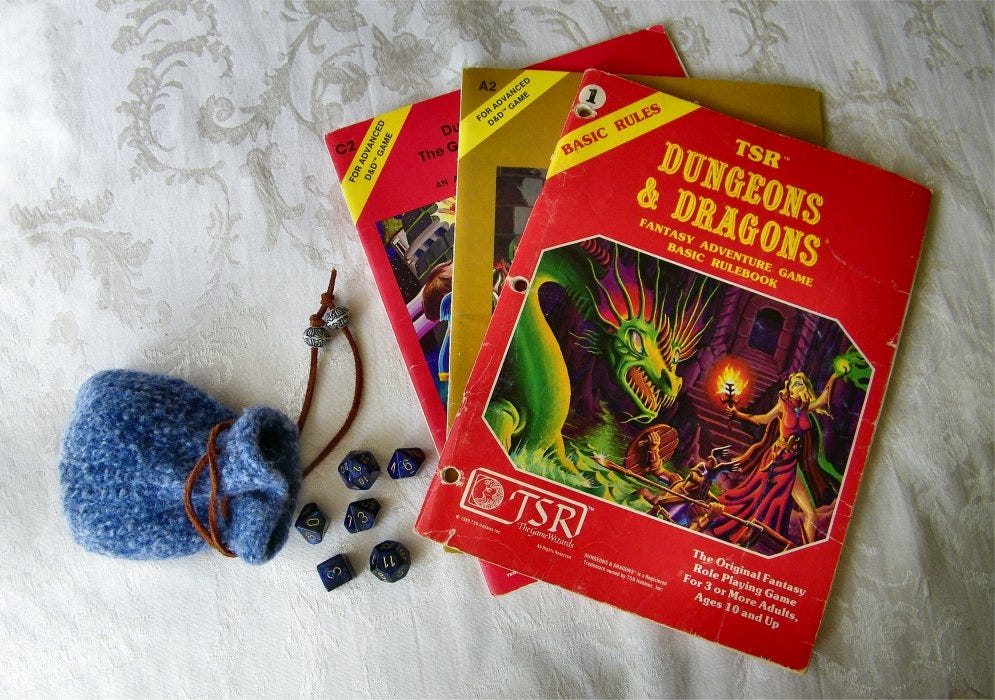
Role-playing games (RPGs) are essentially long-form make believe. They are interactive and collaborative storytelling games that can be employed in endless array. The specific tabletop RPG the McElroys use, Dungeons & Dragons (D&D), is widely regarded as the most commercially popular RPG. If one digs through the literary influences on the creators, Gary Gygax and Dave Arneson, one finds evidence of the worldbuilding of Fletcher Pratt, the spellcasting lore of Jack Vance, the surreal horror of H.P. Lovecraft, and the epic questing of J.R.R. Tolkien. In 2013, Tor.com hosted a digital series of Advanced Readings in Dungeons & Dragons to investigate over 25 different authors Gygax and Arneson most likely drew from when constructing the RPG in the early 1970s. The different classes of character you can play as — barbarian, druid, wizard, etc. — are pulled from mythological and literary sources, from pre-Christian Celtic traditions to the character of Aragorn in the LOTR universe. Geographical planes where one can play, magical spells and weapons one can use, and monsters one might fight stem from sources as disparate as Pliny’s Natural History, Paradise Lost, and Arabian Nights. This kitschy mix of every fantastic invention or story we know of makes the texture of D&D campaigns collage-like and chaotic. Since so many ideas are being reused at once, one inevitably creates a new Frankenstein’s monster of a campaign every time. The chaos is controlled by the intricate set of rules and guidelines set up by Gygax and Arneson in the first edition of the game, which has been repeatedly revised over the years.
Since so many ideas are being reused at once, one inevitably creates a new Frankenstein’s monster of a campaign every time.
To begin scenes, Griffin as Dungeon Master (DM) narrates settings, drives the plot, or introduces new non-player characters (NPCs). His role is to moderate player action and mete out plot-relevant consequences, as well as set scenes and guide overarching plot arcs. In various episodes, he describes a pink tourmaline cave with contagiously growing crystals, a monstrous purple worm that erupts from beneath dry earth on a Groundhog Day time-loop, or a guardian homunculus composed of a clay-filled suit of armor. These expositions are set in stone, as descriptions of scenery might be in realist novels. Clint, Justin, and Travis are the readers of the story Griffin spins, but they are also storytellers themselves. Their characters (Merle, Taako, and Magnus) can act however they wish, or feel emotions just as Clint, Justin, and Travis describe. Their narrative power is partially limited by the randomness of dice; the players might describe what their next action could be, but ultimately the success of their action depends on how high a number they roll, and how it shapes up against various modifiers controlled by the DM. For example, if Merle starts to fall off the side of an elevator platform, he has to make a dexterity saving throw of the dice to determine if he can grab onto the edge.
Importantly, Griffin can only enter the characters’ minds in certain moments of exposition. It’s a weird conditional omniscience that is instructed by trust, a trust in the promise that all four “writers” will tell the story in the most fulfilling way possible. It resembles the simple game where friends go around in a circle, adding a word at a time to build a sentence. In this way, when I listen to the podcast, I don’t think about what “the author” is doing (which is the way I sometimes think when analyzing novels, despite what Barthes has said about the author’s vital status). Instead, I marvel at how the story organically grows. Because control is centered outside the locus of any one person, the story feels very alive.
It’s a weird conditional omniscience that is instructed by trust, a trust in the promise that all four “writers” will tell the story in the most fulfilling way possible.
RPGs as a medium are inextricable from metafiction, which makes it an ideal genre to examine how storytelling functions. This is due to the fact that, in an RPG, the narrators of the story are the authors speaking in character persona. This seems like all fiction at first glance — isn’t Pale Fire just Nabokov narrating as an obsessive scholarly persona? — but the importance lies in the immediacy of the story. There is no filter of voice or structure or even an editing process to screen the RPG authors from their readers. There is no script. All of them are in the same room, digitally or physically. And consequently, the “writers” of TAZ are constantly talking about their own “writing.”
Take, for example, Clint’s expressed appreciation of the elevator-vine escape scene. There are many levels of narrative intersecting here: Clint as player is caught up in the imaginative visual the four of them have conjured up; Clint as father is excited about the story his family is crafting; Justin as podcaster is hyperaware of what does not make good audio content; Griffin starts spoofing on the idea of in-text evaluation via cultural references. The site of this intersection is not just waffling — it still counts as the “text” of The Adventure Zone.
The site of this intersection is not just waffling — it still counts as the “text” of The Adventure Zone.
There are other moments where Griffin as main narrator can become a kind of “vengeful god” in control of the narrative, especially since anything that’s said aloud counts as the story. When Merle tries to pry open the door of the elevator shaft to assist Taako and Magnus, Clint-as-player gets carried away with Griffin’s sense of narrative power. As he chooses his next move, vines crawl up the stairwell behind him. He tries to leverage this for dramatic flair, “so [he] can be a vivid storyteller, too.”
Clint: And I pry open the doors at the very last second. Heh. Griffin, clearly grinning: At the very last second. Ok. Clint, crosstalking: No, wait. No! No! No, no, NO! Griffin: You pry the doors open to the elevator — Clint, crosstalking: Not at the very last second, nope, NOPE. Griffin: — and a wave of vines crashes into you from behind, knocking you forward into the elevator shaft, and the doors slam behind you. Clint: Five minutes! Five minutes before! Griffin: You didn’t get there five minutes before. You — so, you have fallen into the elevator shaft, make a reflex saving throw to see if you can grab onto your party. Clint: At the last 30 seconds. Griffin, laughing: So, make a dexterity saving throw.
Griffin gleefully forces Clint to reap what he sows. That is, he treats any language or narration the players speak aloud as gospel, per se. Speaking enacts the action; you can’t rewrite the story because you realize it was a misstep. This ramps up the narrative tension.
These power dynamics among author, player and persona can also go the other way: characters can outsmart the DM. One major component of D&D play involves “leveling up” your character or purchasing magical items to assist you in your quest. For the purpose of making this rather legalistic process more palatable for listeners, Griffin creates Fantasy Costco, where the players can purchase magical items suggested by listeners. As a joke, Griffin allows an item created by the 8-year-old son of a listener to appear on the show in one of the first few episode arcs. It’s called the Flaming Poisoning Raging Sword of Doom, and it’s a deus-ex-machina of an item because, as an extremely powerful weapon, it would destroy a lot of the practical stumbling blocks that make D&D quests epic and entertaining (such as hit point values and dice rolls, which keep game outcomes random). Griffin sets the price impossibly high and leaves it there as a hyperbolic joke, seemingly to never be bought.
As a joke, Griffin allows an item created by the 8-year-old son of a listener to appear on the show in one of the first few episode arcs. It’s called the Flaming Poisoning Raging Sword of Doom.
At a later Costco visit, however, Griffin introduces another listener-suggested item, The Slicer of Tapeer-Wheer Isles, which allows the owner to persuade another character to give them their most valuable possession. Taako quietly buys this object and then immediately uses it against the Costco shopkeeper to barter for the impossibly valuable Flaming Poisoning Raging Sword of Doom. In the podcast, you can hear the absolute shock and awe of Griffin, who puts hundreds of hours into engineering the show to be a beautiful narrative, who tries to stay ahead of his brothers and father as DM, and who was out-thunk by one of the players. Even though allowing Taako to play the Slicer against the shopkeeper puts the DM at a disadvantage, Griffin feels an obligation to let Taako get the sword anyway because of the rules of narration and a trust in his fellow storytellers. It’s also just an incredibly comic moment.
In a behind-the-scenes episode released in March, Griffin admitted how much the story is affected by this constant struggle for narrative control: “The biggest thing I struggle with as DM […] is how much control over the whole narrative, the macro-narrative, do you give the players, and how much do you keep for yourself.” The show is thrilling because of this balancing of narration. This creates delicious dramatic irony, when the players know things their characters shouldn’t, or when narration needs to be juggled around to make sense. In fact, the best moments in TAZ occur when the DM is caught off-guard by a player’s choice, or the players learn something about the world that destabilizes the fiction they’ve created. As a young writer, I feverishly consume this kind of drama, and struggle with how to depict it in my own writing. Because I know good storytelling when I hear it.
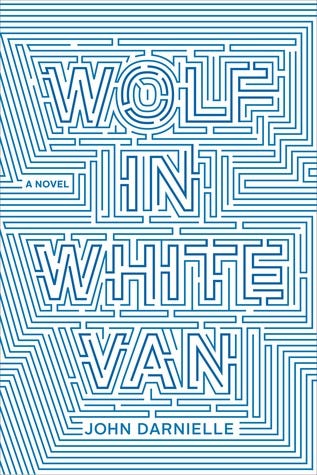
Wolf in White Van, published by Farrar, Straus and Giroux in 2014, is a novel written by John Darnielle about the master of a role-playing game. In it, the fictional world of the game is destabilized when two players confuse the game with reality. The novel’s narrator, Sean, is a fiercely imaginative young man who dreams of epic survival. After a violent head injury, Sean is cut off from most human interaction, seeing no one but his parents and nurse. In place of public interface, Sean designs the world of Trace Italian, which he advertises as an RPG ($5 per month gets you four mail-in “turns”). He builds a customer base, and ends up running the game for several hundred mail-in players. The goal of the post-apocalyptic RPG is to reach Trace Italian: the last safe fortress in an irradiated world raw and unforgiving. Each player’s story is different, because each choice they make takes them down a different branch of the game-narrative Sean designed. For each “turn,” he sends the player a description of the adventure’s latest development, ending with a series of actions the player might take.
The second-person narration of Trace Italian resembles the D&D narration that Griffin provides for TAZ, but in Sean’s consciousness there is a greater sense of desperation:
Where the railroad used to run, there’s a little less overgrowth. As you travel, you keep your eyes on the ground ahead of you, trying to make out a path. Hours turn into days. You become a human bloodhound. You notice things others didn’t as they tried and failed to walk the path that now is yours. As you progress the path becomes less clear: with every less clear point you know you’re going beyond the places where the others lost the trail. Stopping to rest, you see a spot where plants seem to grow higher. If they have followed your path faithfully, bounty hunters will be here within the hour. North lies Nebraska. […]
FORAGE FOR ROOTS
FOLLOW THE RAILROAD
WAIT FOR HUNTERS
NORTH TO NEBRASKA
The player then mails back their response. Sean notices that players tend to explicate much more than necessary — they become deeply involved with their characters, to the point of being one and the same. That’s the whole point of the game, anyway: to suspend reality and become that desperate character. For Sean, these RPG exchanges become the communication and human sustenance he clearly craves. He admits how deeply he identifies with the playing character: “Every move I send out begins with the same word: You. When I first wrote most of them, so long ago now that it’s incredible to think of it, I had in my mind only a single player, and of course he looked almost exactly like me […]. I was building myself a home on an imaginary planet.”
Two players named Lance and Carrie take Sean’s instructions extremely seriously — they carefully plot each move they make as a pair. As the game progresses for them, they begin to believe that the Trace Italian is real. The two of them collaboratively construct a new reality together, and this belief turns out to be fatal. In the novel, Sean struggles with the idea of Lance and Carrie’s infatuation, but he also seems to understand why they fell for their own illusion. RPGs have real power.
In the novel, Sean struggles with the idea of Lance and Carrie’s infatuation, but he also seems to understand why they fell for their own illusion. RPGs have real power.
This power is investigated in a scholarly article in the journal Symbolic Interaction, “Role-playing and Playing Roles: The Person, Player, and Persona in Fantasy Role-Playing.” In addition to years spent playing D&D in their own personal time, the authors (Dennis Waskul and Matt Lust) took observational notes on D&D sessions held near them to build a critical argument regarding self-building and personas. One of their big sticking points is the idea that the gameplay interaction that takes place during a D&D session is seen as almost enchanted to the players — that the characters they play must be kept different from their actual real-life selves: “role-playing sessions are ephemeral situations encased” by “symbolic boundaries” that separate societal roles from gaming roles. This kind of reverence, the authors argue, is what allows players to create a kind of liminal space where character (and thus self-) creation can occur, because as much as players might try to separate themselves from their characters, that persona nonetheless absorbs your own characteristics. This self-creation is what caused Lance and Carrie to delude themselves; they lost sight of the boundaries of reality and fiction.
The McElroy family hardly ever pretends to follow boundaries. They center their comedy on the idea of failing to be that sacred or precious about their roles. Instead of veering toward seriousness, though, they veer toward humor. They mock one another persistently, and even playfully mock the few that object to their devil-may-care approach to D&D. At one point, Griffin pointedly declares that he has noticed some D&D purists tweeting that elevators would be anachronistic in a D&D fantasy setting. In response, he adds elevators as often as possible, and even sends the characters to a museum-like room called “The Magical World of Elevators.”
They center their comedy on the idea of failing to be that sacred or precious about their roles. Instead of veering toward seriousness, though, they veer toward humor.
For them, it’s not about an escape into a fantasy world, or the bizarre ability to conjure up an enormous avatar of Della Reese as a temporary guardian (something Merle does at one point). It’s the joy of creation and play. The imaginative power of TAZ lies not necessarily in the players themselves, but in the community that’s sprung up around it. I sense the power in the thousands of pieces of fan art, depicting each of the many fantasy characters in dozens of forms. I sense it in the hundreds of animatics uploaded to Youtube, where talented young people test out animation skills. I sense it in the extensive lore the fans create, tracking connections and plot developments in wiki pages and on personal blog posts.
In studying the history of literature and the implications of contemporary fiction for the past several years, I think I lost sight of the wonder of storytelling. Yes, my appreciation of the transportive abilities of fiction has always been there, driving me to learn more about how writing works and what it offers to human culture. But I began to think of storytelling as a sort of idealized miracle-working, something with a secret that I had to work for ages to uncover. The Adventure Zone has taken apart that belief, and rebuilt it in the form of something much more communal and welcoming. Part of TAZ’s success comes from its oral medium: it feels like improvisational theater, and it’s easily consumable as a podcast. But most of its storytelling value comes from the immediacy of its creation, the kind of joy that stems from spontaneous narrative. I feel as if I am down in the dirt with them as these four authors assemble the story. I feel that this is how a storyteller should be. Or at least, the kind of storyteller I want to be. The McElroys would laugh at my praise, but that’s because they know how to play. To take themselves seriously would ruin the game.
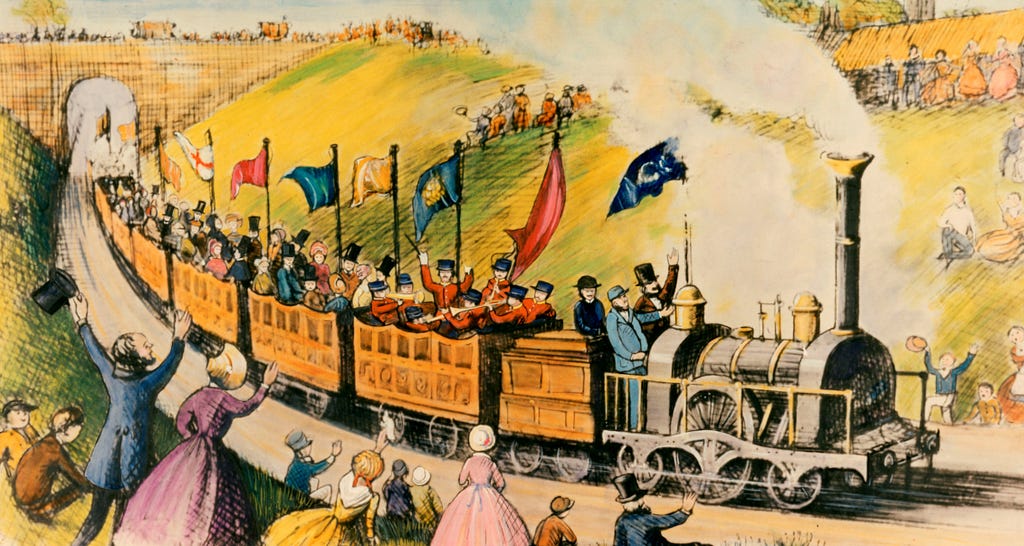
On a July bank holiday in 1841, about four hundred people arrived at the Loughborough train station with tickets for Thomas Cook’s first tour. It was a modest excursion: eleven miles from one English village to another, where they’d have a picnic of the squeaky-clean Anne of Green Gables variety — games, lemonade, tea and cakes — then back home. Bridges along the way were packed with people watching the vacationers’ train speed down the track.
The year 1841 had already been one of firsts for English travel. Between January and July, Britain occupied Hong Kong and colonized New Zealand, David Livingstone (of “Dr. Livingstone, I presume”) arrived at his first African post, and the explorer James Clark Ross braved Antarctic temperatures to discover an ice shelf the size of France. Amidst all this to-ing and fro-ing and building of empire, I doubt many people in 1841 were thinking, Wow, that tour guide Thomas Cook, with his picnics and cheap train tickets, he’s going to be the one to shape the world. Yet today Thomas Cook is regarded as the father of tourism.
Tourism, now one of the world’s biggest industries, began as the personal mission of a zealot. Cook had taken the temperance pledge at twenty-five and dedicated his life to converting others, a mission that shaped his career and perhaps his physiognomy: his granddaughter described him as having “the black piercing eyes of a fanatic.” He’d grown up in a working-class town, the kind of community in which drinking was the primary leisure activity, and, as one nineteenth-century clergyman describes, “a visit to a distant market town is an achievement to render a man an authority or an oracle among his brethren, and one who has accomplished that journey twice or thrice is ever regarded as a daring traveler.” Aristocrats and nobles traveled the world, but few regular people had ever been out of their hometowns. The vast majority of English men and women had never seen London.
Cook, however, had begun his career as an inter-village missionary. While wandering the dusty roads between towns, he’d observed his own feelings of exhilaration at seeing new places, as well as the shared tedium of his countrymen’s lives: doing the same things, seeing the same things, every day. This, he began to believe, was what they were trying to escape by drinking — then the drinking itself became one of the habits they could not escape. With the advent of passenger trains, Cook saw an opportunity for “lifting them out of the dull round of everyday life.” He arranged a package deal so that individual tickets were affordable and remade himself as a tour guide.
“No two movements are more closely affiliated,” wrote Cook of temperance and tourism. When one thinks about spring breakers ordering buckets of beer in Cancun and retirees getting tipsy on Caribbean cruises, Cook’s surety is funny and a little sad. Yet his theory of why travel should contribute to temperance still rings true. We grow restless in static lives. We create habits to make tedium bearable, but unvaried habits eventually become part of the same old: morning coffee, smoke break, happy hour. This is why we need travel, which, according to Cook, “helps to pull men out of the mire and pollution of old corrupt customs.’’
I learned all this from Cook’s biography, which I read on the ninth floor of the Columbia library stacks, sipping the coffee I’d snuck in. I sipped in plain sight because the only other person around to care — a squat gray-haired man with a black patch over his left eye — didn’t. We know each other, kind of, as we’re often the only people up here. He’s probably an alum, like me, milking our lifetime access to one of the few quiet places in Manhattan. His focus is better than mine: he reads court records all day, spine curved and one finger following the type, never getting up, not even to go to the bathroom, though an enormous plastic cup of iced tea sweats in front of him (smuggling that in is a serious accomplishment). Occasionally he asks me the time, though it doesn’t seem to have any bearing on what he does.
In contrast, I’m up and down all day. Going to get a book. Going to the lobby to use my phone. Going out to get a snack that I have to sneak back in. Crossing and uncrossing my legs. Sighing. My mom has the same restlessness, a symptom of anxiety, for which she joined a support group. They have a phone tree, and when one of them is anxious they call one of the others. These calls have become a source of great anxiety for my mom.
She’s a hospital nurse, which is a good use of all her nervous energy. I like research for the same reason: it’s a lot of walking around looking for books and talking to people. Still, I manage to get distracted. I found Cook’s biography because I’d gotten bored with the books I’d gathered on boredom, left my coffee to cool and the old man to figure out the time on his own, and wandered down to the travel section of the stacks.
I was thinking of taking a trip, though I didn’t have any money. Fortunately, the travel section of a college library is a terrible place to plan a vacation. It’s all biographies and histories and outdated research. Here in the murky deep sea gloom of the stacks, Ukraine is in the U.S.S.R., Istanbul is Constantinople, Louisiana has yet to be purchased, and the ground I stand on is empty air above a small green island, where coyote stalk prey and bears hibernate. I like these books. The further back the narrative, the fresher the world seems, the sins of our fathers confined to their limited range.
I like these books. The further back the narrative, the fresher the world seems, the sins of our fathers confined to their limited range.
Cook’s biography is the story of a relatively recent time, and, like all Western histories of the nineteenth century, it’s a blend of unbelievable innovation and uncomfortable colonization. The only reason I pulled the bio off the shelf and brought it upstairs was that I knew Cook’s name. An old boss of mine was obsessed with Cook, along with Hemingway, steamer trunks, and anything tweed. This boss — a willowy Gwyneth Paltrow type who looked glamorous even in the safari-style khaki skirts, snakeskin belts, and clacking wooden bracelets she wore around Manhattan — ran a luxury travel company, where I was a copywriter, and she talked about travel elegiacally, the way literary critics discuss the death of the novel. “The Golden Age of Travel,” she said more than once, “begins and ends with Cook.”
Plenty of people living in the nineteenth century would have disagreed. Cook’s tours caught on quickly, filling popular destinations with tourists and spawning imitators who did the same. Within two decades, Cook’s tourists were everywhere and, if you listened to the critics, ruining everything.
Many critics were just snobs: the wealthy English in Egypt classed tourists among the plagues, sniggering at their gauche “wideawakes and tweeds” (the Hawaiian shirt and Bermuda shorts of the nineteenth century). Detractors also found fault with tourists’ lack of “reason” for traveling. Not explorers traveling for discovery, merchants for gain, or aristocrats on educational or health pretexts, Cook’s clients toured for “the experience of strangeness and novelty,” in the words of the sociologist Erik Cohen, “valued for their own sake.” The italics are Cohen’s, emphasizing how strange this was. It’s still pretty strange, if you think about it, but now it’s such a part of our culture — novelty is the primary theme of advertising, the raison d’etre for the entertainment industry — that it’s easy to overlook.
But the most common and lasting criticism was that tourists were changing the landscape. Hotels, a new invention, suddenly began to pop up everywhere, like “a white leprosy,’’ according to the art critic John Ruskin, who took the tourist occupation of Switzerland particularly hard. Another one of Cook’s peers complained that tours brought “cardinal British institutions — tea, tubs, sanitary appliances, lawn tennis and churches” to all comers of the globe. The Sunday Review fretted that rising numbers of tourists made true escape impossible: “We talk glibly enough of leaving England, but England is by no means an easy country to leave.”
Tourism, when looked at this way, becomes an insidious form of colonization: instead of using military force and laws, tourists colonized with their pocketbooks and their habits.
Though Cook’s mission was helping people kick “old corrupt customs,’’ by “customs” he meant booze, and he was happy to oblige more innocuous requests, such as teatime. Businesses in tour destinations quickly followed suit; collectively, tourists were great for the economy of wherever they visited. Nearly two hundred years later, you can go almost anywhere in the world — from Taiwan to Equatorial Guinea — and stay in a Western-style room, eat Western-style food, start the day with coffee or tea and close it with a cocktail. The tourism economy is as much about catering to habits as it is about supplying novelty.
What seems on the surface like a positive transaction — tourists get hot beverages, locals get money — has been a source of contention ever since. Today, many travelers complain about the tourist economy for the same reasons they did in Cook’s day. “Touristy” has be come a derogatory term, describing places that attract tourists by catering to their habits, and every year more places gain this descriptor. As suggested by the Wired study of the most common phrases in successful dating profiles, the majority of us are attracted to the idea of exploring and trying new things; but the more people who trek out to find novel places, the less novel these places become. Pictures are posted online; people who see the pictures make plans to visit the new hot spots, where familiar foods and drinks and languages begin to appear, attracting even more familiar faces; and all this familiarity feels like the antithesis of adventure, reminding travelers of the mundane ordinary that they’re trying to take a break from. Meanwhile, according to the author and Antigua native Jamaica Kincaid, locals who can’t afford to travel often hate tourists for reasons that are “not hard to explain . . . they envy your ability to leave your own banality and boredom, they envy your ability to turn their own banality and boredom into a source of pleasure for yourself.” Feeling bored doesn’t require any sort of privilege, but doing something about it often does. Taking a trip, seeing a movie, drinking a beer, wearing or eating anything new and different all cost money.
Yet boredom doesn’t necessarily go away when you’re doing any of these things, even traveling. Wherever we are, time demands to be dealt with, and when managing time-especially free time-habits are our handiest tool. According to Camus, “everyone is bored, and devotes himself to cultivating habits.” Far from home, each day lying unbroken before us, we might be forgiven for wanting to bookend that unwieldy stretch of time with a coffee at daybreak, a beer at dusk, and, for Cook’s English tourists, a cup of tea in the afternoon: habits that break time into manageable chunks, even as they change the places we visit.
Our dependence on habit and desire for novelty are both so ingrained that usually we don’t think about them. While reading about them I had to think about them and became annoyed with the coffee I was drinking, a symbol of my reliance on habits — with a hot coffee I can sit still a good half hour longer than usual — and my craving for novelty, since it was a really unhealthy hazelnut cream thing that I’d bought hoping the treat-like aura of it would help me focus even better.
“Do you have the time?” the old man asked. His own habitual beverage appeared to be untouched.
“Sure. Um, quarter past eleven,” I told him, refraining from asking what I always want to ask: Is it hard to read all day every day with an eye patch? Do you ever wish you had a different hobby? At least I assume his library lurking is a hobby, but maybe it’s work. That’s why I lurk here. Or maybe he lives here, which would explain why he has no sense of time, as there aren’t windows in the stacks. Watching him, I thought I might write (or at least be willing to watch) a TV show called Stack Pirates. Here’s the scenario: a group of recent graduates can’t find jobs (probably there’s a recession), so individually they begin to spend their days in their college library in order to avoid roommates or landlords or parents, as well as the restless torpor of sitting around the house all day. Eventually they find one another and decide to band together and figure out how to live in the library full-time. Their guide on this quest is the old man with the eye patch, who they discover has been living in the library since his own graduation in the sixties (he was avoiding the draft, maybe). They call him the Captain, because of his eye patch but also because he’s been obsessively researching the history of piracy for years, his own version of Ahab’s white whale. I’m not sure what they do once he teaches them how to find food and where to sleep. Probably they solve crimes.
I realized I was staring and that my coffee, now that I’d spent so much time thinking about it, wasn’t helping me focus anymore. I got up, stretched, and headed back down to the travel section. I pressed the elevator button a few times, but it seemed to stop on every floor, and after a few minutes I was so restless that I just took the stairs.
A Thomas Cook journey, farewell.
Modern tourism started in England, which makes sense — a colonizing country is probably a restless country — but by the mid twentieth century people from all over the world were touring. Tourism became a thing; you could tell because people had started studying it. The stacks are full of their books: The Ethics of Sightseeing, The Language of Tourism, The Tourist Gaze, and so on for longer than you’d care to read. Before venturing into the stacks I’d never read a book on tourism, but I knew the industry from working in it, first as a guide and then as a copywriter.
Like many people who grew up in small, gray-skied working-class towns (Cook, D. H. Lawrence, Geoff Dyer, to name a few), I’d always wanted to travel. It was the most obvious means of escape possible, and seemed like the cure for everything: small town, small life, sad family. My mom was a nurse, my dad a pastor, and both were depressed, which seemed at odds with their caregiving jobs. I was told that helping others gave purpose to life, yet the people who taught me this suffered painfully from a sickness defined by meaninglessness. He talked around the edges of suicide. She withdrew. I planned to get away. But I couldn’t just go. Unlike in most of the travel books I read and loved, in life there were practicalities to consider. I needed contact lenses and birth control. I needed to pay back my student loans. I needed cash. So — again, like Cook — I became a tour guide.
Unfortunately, I didn’t really understand until I was one that most guides don’t travel outside their “zone of expertise.” Mine was first Alaska, then San Diego, and in each my adventures were limited to a square mile of sea on which I paddled a kayak while telling middle-aged tourists fun facts: leopard sharks aren’t aggressive; sea lions are aggressive; the garibaldi is the state fish of California; an eagle’s nest can weigh up to two thousand pounds.
As a copywriter I traveled more, but it was definitely business travel, which I actually prefer. Having to work gave my days structure and lent a purpose to sightseeing: if I was doing stuff in order to write about it, the purpose was work; if I was doing something unrelated, the purpose was shirking work. I find distractions most enjoyable when work is an obstacle.
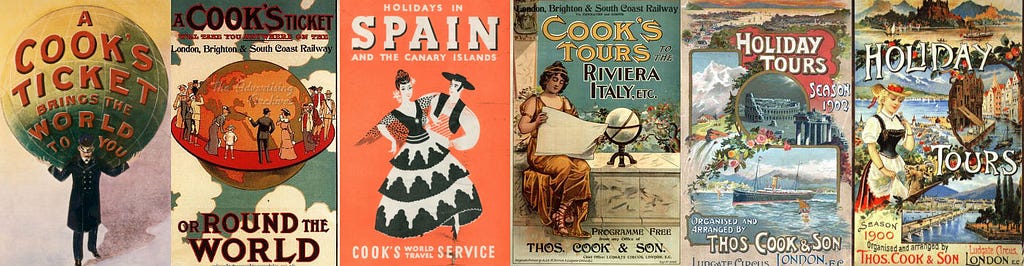
Still, I wouldn’t recommend copywriting to an aspiring traveler, at least not one who’s as easily broken as I am. Writing marketing materials for tourism was like being asked to build a part for the mechanical innards of a beloved dog I’d always assumed, until being handed the screwdriver, was flesh and blood. According to my boss — the Paltrow ringer who loved Cook — true adventure was a thing of the past, which meant my task was to transform our travel company into a time machine, filling brochures with phrases like “timeless wilderness,” “authentic villages,” “hark back to the days of yore,” “step into the past,” “follow in the footsteps of explorers.”
Writing marketing materials for tourism was like being asked to build a part for the mechanical innards of a beloved dog I’d always assumed, until being handed the screwdriver, was flesh and blood.
My boss wasn’t nuts; she was practical. What I was doing in my midtown cubicle was the same as what any other travel copywriter was doing in any other cubicle. Almost all travel advertising focuses on time: space tourism ads promise a glimpse of the future, tours for new parents or honeymooners offer the opportunity to press pause on the present (“time stands still,” “live in eternal time”), but most often — so often that the sociologist Graham Dann accuses the industry of “unashamed wallowing in the past” — travel ads suggest that a certain tour, cruise, or even whole continent has the power to take us back in time.
The “past” of marketing is fictional. Sitting at my desk, whispering “adventure-scuffed decadence” at a computer screen, I created a whole world: the past in all its everything-is-fresh glory, sans poverty and oppression, plus modern plumbing, simultaneously ripe with novelty and fragrant with nostalgia. My everyday life paled in comparison. How could it not?
A fictionalized past is the most tempting of destinations. Even as far back as the sixteenth century, Don Quixote found life dull compared with the semi-mythical past of the novels he read. He loved the past so much more than the present that he began hallucinating that he actually lived there. Today, tour companies would love to replicate his madness. Even the most prosaic trip to my hometown could be an adventure if I saw the pimply motel desk guy as a castle keep and the town’s Hummer factory as a training ground for battle-ready giants.
Granted, certain landscapes lend themselves to this brand of fantasy more than others. Travelers flooded New Zealand in record numbers after the Lord of the Rings movies were shot there. Ireland and Iceland similarly both received much-needed economic boosts from tourists who’d seen them in Game of Thrones. Cambodia’s Angkor temples are hundreds of years older than Hollywood, but when I stood in Ta Prohm, a temple held in the grasping fingers of enormous tree roots, my first thought was not of the people who prayed there but of Indiana Jones. Entertainment has layered new meaning onto these old places, but they were chosen as shooting locations because they invited fantasy to begin with.
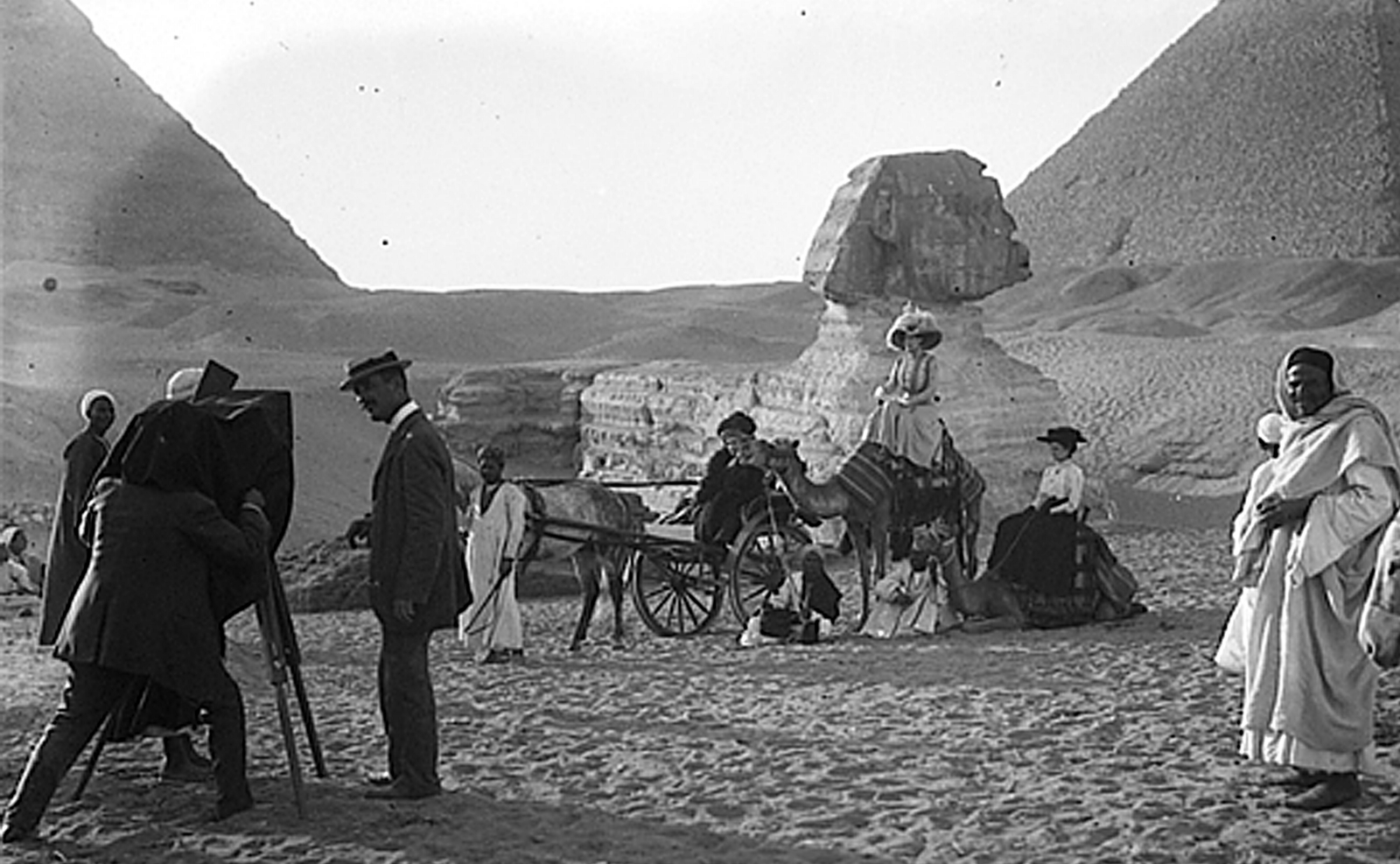
Cook’s tourists were drawn to similarly past-evoking destinations. “The mystery of ages,’’ he wrote in a promotional pamphlet, “is plucked from the vivid story of past centuries for those who thus sail in foreign seas and become familiar with many lands.” He took his clients to Roman ruins, Egyptian pyramids, and Civil War battle grounds (though actually, the last of these weren’t historic quite yet, as tourists wrote home to report “skulls, arms, legs, etc., all bleaching in the sun’’ war zones aren’t always exciting for soldiers, as evidenced by the writing of Brian Turner and Shani Boianjiu, but war zones both ancient and fresh have long been fascinating to civilians in the same way that war stories are; companies specializing in “conflict tourism” offer tours of grave sites, concentra tion camps, and battlefields).
From Cook’s brochures to mine, travel marketing seems to be to blame for our collective time-travel fantasy. But while ads certainly aggravate the situation, they’re only responding to existing longings, the same as those of Don Quixote: the desire to visit a world that’s brighter and bigger than our everyday, never boring, and unblemished by any thing as ordinary as habits.
To see this desire spelled out, I only had to look as far as the classics my boss encouraged me to read: Isak Dinesen on Africa, Bruce Chatwin on Patagonia, Henry Miller on Greece, D. H. Lawrence on Mexico — great sources for copywriters because they’re all about escaping the bland present on a quest for an idyllic past. “We do not travel in order to go from one hotel to another, and see a few side shows,” wrote D. H. Lawrence. “We travel, perhaps, with a secret and absurd hope of setting foot on the Hesperides, of running up a little creek and landing in the Garden of Eden.”
Tourism research, as it turns out, is built of the same behind-the-curtain stuff as copywriting, only more so. On the travel-section shelves are books on sex tourism, conflict tourism, health tourism, and party tourism (I suspect Cook would have appreciated that the last of these ended up being the bleakest, what with drunk spring breakers so regularly falling off balconies). Tourism’s colonial undertones and emotional consequences were explored in depth. I learned about a condition called dromomania, whose sufferers have to be always on the move. Other people become so overwhelmed by the inconsistencies between travel marketing and real destinations that they become paranoid and delusional, a condition known as Paris syndrome for the frequency with which it happens to tourists visiting the famously romantic city. I learned about post-tourism, which is just research jargon for traveling hipsters: believing there’s no authenticity left in the world, they enjoy tourist attractions ironically.
Sitting on the library floor between shelves, I paged through these books and traveled to some pretty dark places. When the timed lights between the shelves flicked off, it seemed appropriate.
What can get lost in all this research is that travel is a treat: the vast majority of our ancestors didn’t travel for fun, and plenty of people now don’t either. It’s not free or mandatory. Like many other things we analyze and criticize — television, movies, books, foods, sports, social media, spas, and manicures — we always have the option to just opt out.
But, barring suicide, we can’t opt out of life, so we’ve invented pastimes. Tourism interests me because it’s not just a means to fill free time; by removing familiar places and faces and responsibilities, it makes free time more free.
There are different ways to deal with this. The kind of tourists who went on my kayak trips usually had lunch plans at an iconic restaurant afterward, then they’d visit a museum and/or ruin, then dinner and dancing. They’d straitjacketed their time with sightseeing. On the opposite end of the spectrum were clients of my Cook-loving boss’s luxury travel company. In the brochures I wrote, travelers were encouraged to relish breakfast in bed and take luxurious afternoon siestas beneath gently swaying trees. This was their free time, and they were encour aged to answer Nietzsche’s question “Free for what?” with “Naps!”
Between those two jobs, I had the chance to figure out what I would do with the freest of free time. After a couple of years of guiding, supplemented by working in restaurants, I’d saved enough to travel. A friend and I quit our jobs, sold our furniture, collected our security deposits, and left. We’d be backpackers, a lifestyle that sounded promisingly like that of travelers in books: we’d carry our lives in packs, eat street food, not take tours, meet locals, just…be free. We planned to travel this way for a month or two, until money got low, then come back to the United States and get new jobs (this would be harder than we’d hoped; I’d spend months cobbling together work before being hired by the Cook-loving boss). It was a reckless and exhilarating thing to do, or so we thought, until we stood in the middle of Khao San Road and realized that everyone else our age, from all over the planet, was doing the exact same thing.
We were officially on the Banana Pancake Trail.
Named for a dish commonly offered in anticipation of semibroke young Western tourists, the Banana Pancake Trail includes all the recommended destinations in the Southeast Asia edition of Lonely Planet. If you rely on that guidebook, as we did, then you’re on the trail, and if you’re on the trail, travel becomes less like an uncharted adventure and more like a stroll through the parking lot outside a Phish show. Dirty feet, tangled hair, fisherman’s pants, and yoga beads adorned the bodies of our fellow travelers. Beer, coffee, pancakes, cheap jewelry, and T-shirts printed with the region’s unofficial motto — “Same-same but different” — were for sale in every town, giving meaning to the motto while giving us all familiar things to do: get caffeinated, bargain shop, eat, get drunk. Though we meant to have big adventures — like Don Quixote without the delusions — my friend and I turned out to be bigger creatures of habit than we had anticipated. We filled our free time with iced coffees and silver bangles.
“Same-same but different” described more than the trappings of tourism; it also described the experience of seeing other travelers over and over again. We ran into the same white-blond Australian in three different countries, an occurrence he assured us was “cosmic.”
The Australian indulged in the same habits as we did, but without our “are we using this time right?” anxiety. He had no reason to be anxious; he was traveling indefinitely. Over the course of our first month, we’d met a surprising number of these “career travelers,” people who didn’t plan to return home soon or maybe ever. None claimed to be wealthy, but none were really poor either; they were all somewhere on the broad spectrum of middle-class. The Australian was the son of a plumber, and though he ardently did not like his father (most of the career travelers we met had bad relationships with their parents), it was from his father that he’d learned the skills that kept him on the road. Starting out working for room and board on a farm in Italy, he’d been so helpful that it led to a handyman job at a yoga retreat in India, which he’d parlayed into a landscaping position at a sister retreat in Thailand, which he’d just quit when we met him. I learned all this at our second meeting, on an island in the Mekong, where a group of us tourists drank lukewarm beer and moved from the shade of one palm to another in an attempt to escape the midday heat.
“I‘ve just always had this ability to know when it’s time to move on,” he told us. “I feel restless, you know? My mom’s psychic so, I don’t know, I probably inherited it.”
You don’t need to be psychic, I thought, to get bored. It was an uncharitable thought, but that afternoon I was irritated. Irritated with the sticky heat, with the strands of hair that stuck to my temples, with myself for having spent everything on this trip (was this how freedom was really meant to be used?), and again with myself for being irritable on the trip I’d spent all my money on (irritation was surely not the best way to use free time). All this irritation found its target in the unreasonably blond Australian who was always on the move.
“Cool,” I mumbled. “Good for you.” Then I excused myself to go swimming. After fighting the current for half an hour I was able to admit to myself that I didn’t really think there was anything wrong with the Australian (besides the New Agey cosmic/psychic stuff). If you don’t have kids and feel okay about not being insured, why not be transient? That’s how past travel writers lived — Henry Miller, Patrick Fermor, Bruce Chatwin — and I like to think I could live like that too, but I don’t, which was probably why the Australian irritated me. His life was more interesting than mine and he wouldn’t stop talking about it.
Irritability is one of the key emotions psychologists associate with boredom. We get irritated standing in line, sitting in traffic, or listening to a long-winded story (“Every hero,” wrote Ralph Waldo Emerson, “becomes a bore at last”). Our tendency toward bored irritation is why elevators have door-close buttons and crosswalks have request-to-walk buttons, even though most of those buttons don’t actually do anything: pressing a button lets us believe that we have agency over our time. Maybe the Australian really knew how to be free, a secret that eluded me, or maybe moving was his version of a door-close button, allowing him to think he was changing because his surroundings changed, even though he brought his habits and hang-ups (the bad dad, the psychic mom) wherever he went. Maybe we weren’t so different from each other.
“Excuse me, do you have the time?” asked the old man in the library.
“Let’s see . . . half past four.”
“Thank you,” he said, which is what he always says, never “I’m late!” or even “Lunchtime!” He doesn’t have anywhere else to be, as far as I can tell. He just likes to know.
What would I do if I had nowhere to be? Because I’ve been fortunate enough to travel aimlessly for a couple of months, I can tell you: I’d be irritable. Free time is daunting. The world has been shaped by our inability to deal with free time. Cook intended for tourism to pull us out of the mundane ordinary, and people who can’t travel (like Jamaica Kincaid’s tourist-hating locals) desire to do so for that reason. We travel to escape a losing battle with time — the autoworker Ben Hampers “war with that suffocating minute hand” — but we still have to deal with time, by napping it away or filling it with sightseeing or traveling to the brighter past that travel ads promise. For the majority of us, free time has proved too unwieldy to manage without habits, and, from Ruskin’s “white leprosy” of hotels to the Banana Pancake Trail, the habits of travelers have reshaped the world.
Free time is daunting. The world has been shaped by our inability to deal with free time.
It would be easy to admit defeat, to become the “post-tourists” researchers write about, committed to the idea that there’s no such thing as authentic experience so we might as well laugh at it all. That seems like the most boring fate of all. Surely it’s better to struggle, to scrimp and save, to be irritable swimming in the Mekong, and suddenly find yourself at a tiny empty beach surrounded by jungle where — if only for a minute or an hour or an after noon, who can say — you escape time completely?
We might as well, because most of us will struggle either way. The parishioners who came to my dad for advice all asked versions of the same question: How can I be free? Free from grief, from anxiety, from anger. Free from the purposelessness of boredom, the result of a dull job or a stale marriage or the tedium of too many identical days in a small town. But, depressed, my dad wasn’t free either; so there they sat, week after week, year after year, prisoners theorizing about their chains. Travel, at least in the books I read, offered to press pause on those questions in order to ask a single question that, if it could be answered, would make it one hundred times easier to figure everything else out: Freefor what?
I still can’t answer this question, and I haven’t traveled much since I left the industry, unless you count voyaging restlessly, like the Australian, from floor to floor of the library stacks. Here’s the sixteenth century, there’s the twenty-third, and here’s the Arctic, mis-shelved next to New Jersey. It’s adventure of a sort, though you have to squint to appreciate it, like Don Quixote maybe, or my one-eyed companion, the original Stack Pirate, lost in his books, asking the time out of habit while I sip this hazel nut cream coffee for the same reason
About the Author
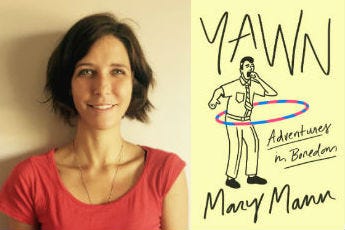
Mary Mann is the author of Yawn: Adventures in Boredom. Her writing has also appeared in The New York Times, Smithsonian, The Believer and The Los Angeles Review of Books.
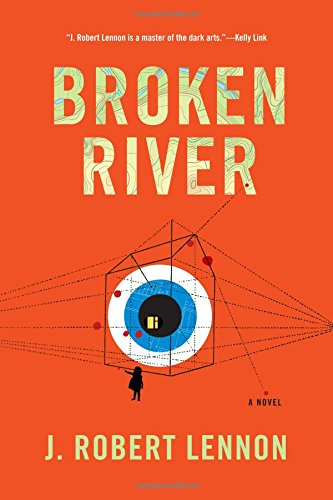
After enduring cancer and infidelity, the family at the center of J. Robert Lennon’s novel, Broken River, leaves their arty life in gentrified Brooklyn for Broken River, a small town in upstate New York, home to a prison and not much else. As if the town’s name is not enough of an omen, the house they choose — where they’re going to repair their fractured family bond — was the site of an unsolved double homicide. There are moments where Lennon gives his characters the chance to change course, but cowardice is as inevitable as the gruesome conclusion. Over e-mail, Lennon and I discussed autobiographical fiction, regret after publication, and writing in the age of Trump. [ed. note — J. Robert Lennon is the Editor-in-Chief of Okey-Panky.]
Adalena Kavanagh: This is a novel about a troubled marriage between a writer and an artist. They’ve just moved to a house that was the site of a tragedy a dozen or so years prior and their pre-teen daughter has a growing obsession with that tragedy. Without giving too much away, in this novel there is an observer figure that hovers over the narration and seems to gain omniscience as it gains consciousness. How and or why did you come up with this conceit? Is it a commentary on third person POV and omniscience?
J. Robert Lennon: The opening chapter of this book is an impromptu riff that I tossed off one bleary morning… I had no idea what it was going to be. It started out as an exercise, an intentional echo of the middle chapter from To the Lighthouse, and it turned almost incidentally into a crime thriller. Anyway, the Observer was just a rhetorical device at first — I was trying out this floating-camera perspective, and then realized it could also serve as an emotional distancing tool during the murders that occur a couple of pages in. Later, when I realized I’d begun to write a novel, I figured I could give the Observer a kind of character arc, which, many drafts later, I expanded and refined with the help of my editor, Ethan Nosowsky. There’s definitely a bit of meta-narrative there; the Observer stands in, variously, for the reader, for the writer, for the unconscious motivations that shape our lives.
Kavanagh: Why would you want to create emotional distance during the murders?
Lennon: I’m not interested in writing horror! I couldn’t see the point of presenting a vivid closeup of rape and murder in the opening pages of a literary novel. The reader should understand that something terrible and traumatic has happened, but they needn’t be compelled to wallow in it. I didn’t want to write that, and I wouldn’t want to read it.
Kavanagh: In your story collection, See You in Paradise, the men are endearing fools, but the father here is drawn in a way that makes him less endearing, perhaps a bit more contemptible. At the very least, one doesn’t get the sense that he’s the hero of his own story. Was that a conscious decision to work against the types of men in your previous work?
Lennon: Not really. At the time, I was feeling guilty about my own shortcomings as a husband and father, and wanted to write about that in an indirect way. As with most of my characters, the result doesn’t resemble me much — I’m not perfect, but I’m by no means the kind of self-absorbed, lumbering cad I’ve created in Karl. He’s not the hero of his own story, but he sure thinks he is.
When my younger son was a toddler, he used to get night terrors that centered on this sinister character called “Daddy Man.” It was a monster version of me — vicious, hairy, bloodthirsty, a werefather! At the time, I read it as an expression of my son’s fear that good and comforting things could turn bad. I mean, he was right, they can, but you don’t tell a three-year-old that. “Yes, excellent observation, evil lurks within us all, now go back to sleep!” Anyway, it was hard not to feel wounded by the whole concept. Were these horrible characteristics things he saw in me, somehow? Things I couldn’t see myself? I think Karl has got a bit of Daddy Man in him; Irina, the daughter, almost lets herself see him this way, and calls him “Ape Dad.”
Kavanagh: Daddy Man! Sounds like a great premise for a comic. In this book the daughter secretly read her mother’s work, and the husband, after having *pretended* to read his wife’s work, finally does, and is surprised how much he likes it. Have your own kids read your work? Do you want them to?
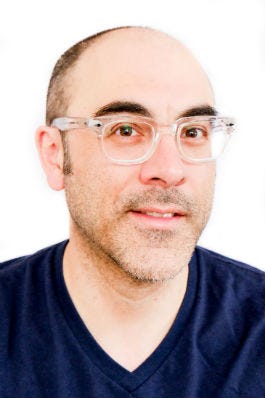
Author J. Robert Lennon
JRL: I think my older son has read my collection of very short stories? I don’t believe either has ready anything else. My older was hanging around the apartment when the box of Broken River-s arrived, though, and I gave him one, so perhaps he’ll give it a spin. I don’t think they’ve read their mother’s work, either. Is that odd? I’ve never asked other writers this question. It’s strange that thousands of strangers might know me in this intimate way that my children do not. I guess I do want them to.
Kavanagh: I recently read somewhere that writers who aren’t from the jack-of-all-trades school (you know the ones — the ones who were part of the rodeo and did various manual labors before picking up the pen) struggle to give their characters work that isn’t writing-adjacent. Do you share that struggle? The father in this book is a sculptor. How did you decide on that profession?
Lennon: I do not share that struggle, I don’t think. The parts of this novel I enjoyed writing the most, in fact, were about a guy who manages a carpet warehouse. Though I tend to keep it out of my author bio, my family comes from working-class roots, and I’ve done a fair amount of manual labor. I feel pretty comfortable writing characters all across the class spectrum.
That said, I’m a book-writin’ Ivy-League college professor now, so I don’t pretend to have any special insight. In this case, I made everybody a creative artist of some kind because I wanted to think about the ways people invent their own realities, the way they narrativize their longings, and lead themselves into catastrophe. Everybody does this, of course, but there was something appealing about taking these creative Brooklynites out of their native environment and watching them squirm in the woods; their creative projects make for fun set pieces about their insecurities and delusions.
“There was something appealing about taking these creative Brooklynites out of their native environment and watching them squirm in the woods; their creative projects make for fun set pieces about their insecurities and delusions.”
As for Karl, his manipulation of glass and steel is an expression of his dumbass masculinity — or at least he believes it is. He likes to think of himself as Hephaestus or something, fashioning art out of the very earth with blades and fire! When what he really is, ultimately, is a guy selling knives on eBay. I’m tempted to think there’s a little bit of Trump in him.
Kavanagh: Was there any real life inspiration for this story and setting? I’m thinking of the house and its past.
Lennon: Yeah, the first house my ex and I bought was the site of a notorious local murder! She’s a writer, too, so this was practically a selling point for us. I hadn’t even been thinking about our old place when I started writing this book, but I’m sure it was somewhere back there, poking at my subconscious.
Kavanagh: I think it says something about you (besides love of a bargain) that you bought a murder house! I can safely say I will never knowingly buy a murder house. Some people don’t believe in coincidences (therapists come to mind) but you did subconsciously write about *a* murder house. I’ve been thinking about how writers and readers approach autobiographical details in fiction. It really shouldn’t matter for the reader at all, and it’s not their business — the text is their business — but it could be interesting for a writer to self-examine if they’re so inclined.
Have you ever been surprised by what a piece of writing revealed to you about yourself?
Lennon: Yeah, that does happen when I look back at old work — it always seems, in retrospect, so transparently of its moment in my life. I do have a treasured narrative about myself that I don’t write autobiography, and when I’m writing, I believe it’s actually true. But even a cursory review of my work reveals that I write about myself incessantly. I think I’ve just internalized the process of depersonalizing experience for the purpose of refining and repurposing it…I have to believe my own propaganda to get the stuff done!
Kavanagh: Have you ever published anything you regret publishing?
Lennon: My old stuff is mildly embarrassing, but for the most part I don’t regret publishing it — it’s just callow juvenilia, nothing to be remorseful about. I do wish I’d done more work on my novel Happyland; a bunch of the characters are lesbian college students, and one of them is Asian, and though they’re all sympathetic and I think earnestly drawn, I’m a lot more sensitive now than I was then to the nuances of writing characters different from me. I’d like to think we all are — the literary world is far from fully woke, but it’s been changed for the better in the past decade by an influx of strong nonwhite, non-straight, non-cis voices.
Also, one time an interviewer asked me if I thought I owed anything to independent bookstores, and I got annoyed at the question, which I found pushy and sanctimonious, and I replied that I didn’t owe anybody anything. I regretted that one instantly — it’s pretty fundamentally false. My career would probably be in the shitter without independent booksellers. The interview’s still out there somewhere on the internet, I’m sure, mocking me.
May I say my Hail Marys now?
Kavanagh: You said: “I’m a lot more sensitive now than I was then to the nuances of writing characters different from me. I’d like to think we all are — the literary world is far from fully woke, but it’s been changed for the better in the past decade by an influx of strong nonwhite, non-straight, non-cis voices.”
How have you consciously or unconsciously changed your approach to writing characters different from you? What resources or people have informed this shift? How might writing difference best be addressed in MFA programs like the one you teach at?
Lennon: You know what — I think the main resource for my own education has been Twitter. Gamergate and Black Lives Matter got me following more African-American and vocally feminist personalities, and I’ve been slowly absorbing the things these writers talk about, and reading the things they link to, and the books they recommend. To be honest, at this stage, I think I’ve become more averse to wading in, especially when it comes to race — I think I’m less likely to try to write nonwhite characters than I once was. I’m starting to understand how little I understand. And, at the moment, writers of color are doing extraordinarily strong work that obviates the need for input from people like me. On the other hand, I’m much more comfortable now talking with people different from me, and I think I know better than I once did what I can and can’t bring to the MFA workshop table, to help students of color. Or at least I’ve learned how to listen better.
I don’t think I’d encourage a white student writer to inhabit characters of color, right now. Obviously, there are no rules; and in my experience, students are usually respectful and tolerant of each other’s forays into unfamiliar territory, and forgiving of mistakes. But…it’s hard for even the most empathetic white writer to avoid the pitfalls of privilege, while trying to write themselves out of it. The important thing, to me, is that all of us write things that are meant to be read by all, that our work invites people into our worlds.
Kavanagh: You have creative interests outside writing (for example I know you’re a musician and have an interest in photography). Do these creative pursuits inform the writing in any way?
Lennon: Perhaps? Mostly, it’s that I always feel restless when I’m not making something, and I get burned out easily on my writing, and then have to shift my drive to other things. Even reading for pleasure is hard for me; I keep wanting to get up and play the guitar or cook some food.
Kavanagh: Earlier you mentioned the crime thriller elements in this novel. Do you have any desire to write a straight crime novel? If so what would the allure and difficulties be?
Lennon: I did write one! It’s called Born Again. It’s a police procedural. I almost sold it, but ultimately it didn’t work out. I sort of want to revise it and self-publish it as a pseudonymous ebook. The allure was that I love police procedurals and read them all the time — their rhythms are close to my heart. But I lack the aptitude for a good puzzle. The plot’s frictionless, that’s the book’s problem.
Kavanagh: Imagine a book tailor-made to capture your interest RIGHT NOW. What is it?
Lennon: A quasi-science-fictional narrative about a psychological conundrum, told in a dry, straightforward style. Maybe I should write it myself!
Kavanagh: How is your writing going these days in light of our new President and the unfolding events? It feels similar to a post-9/11 moment. You either have to write from “before” or write differently. Has it changed how you write?
Lennon: Ben Winters asked me to contribute a short story for Slate’s Trump Story Project, which he was editing, and I’m very glad he did. I ended up doing a cover of Nabokov’s “A Visit to the Museum,” and it felt good to use that story’s dreamlike logic to channel my anxieties about current events. My work since inauguration — only a few months’ worth — has been more hallucinatory, less realistic, than other recent work. Maybe that’s the way forward.
The Trump transition has maybe been less difficult for me than the 9/11 one was — this time, I feel like there’s something I can actually do about it. 9/11 just made me sad. I know it was highly politicized eventually — devastatingly so — but at the time, all I felt was grief and helplessness that were hard to write through.
But Trump? Man, he’s our very id made real. He’s the monster white America created out of all our faults — sexist, bigoted privilege that got bitten by a radioactive spider. Literarily speaking, he feels inevitable — right in my wheelhouse, I’d venture to say. And though there’s nothing good about Trump, his rise has energized all the best people. I’d like to think writers are among them.
HBO is considering multiple “successor shows” to the smash hit Game of Thrones
While fans are still waiting for The Winds of Winter — book six of the A Song of Ice and Fire series — to finally be published, that doesn’t mean author George R. R. Martin isn’t busy. Already this month news has broken that SyFy channel is adapting one of his novellas and that HBO is considering four different Game of Thrones spin-off shows with Martin involved in writing them. Yesterday, Martin took to his LiveJournal to elaborate on the Game of Thrones sequel shows:
It was stated in some of the reports that I am working with two of the four writers. That’s not quite right. I’ve actually been working with all four of the writers. Every one of the four has visited me here in Santa Fe, some of them more than once, and we’ve spent days together discussing their ideas, the history of Westeros and the world beyond, and sundry details found only in The World of Ice & Fire and The Lands of Ice & Fire… when we weren’t drinking margaritas and eating chile rellenos and visiting Meow Wolf. […]
And there’s more. We had four scripts in development when I arrived in LA last week, but by the time I left we had five.
Martin stressed that none of these shows are spin-offs in the sense of “Joey or AfterMASH or even Frazier or Lou Grant, where characters from one show continue on to another.” Instead, the shows will feature different characters and possible entirely different settings than Game of Thrones, while still taking place in the same world. This means we sadly won’t be seeing the continued adventures of Arya and the Hound, or even a prequel show about Robert’s Rebellion. Martin also said adaptations of his prequel Dunk & Egg novellas was not in the works.
What the shows will be about is still a secret, and it’s impossible to know how many (if any) of them will get made. As for fans of the books? Martin had this bolded message:
And yes, before someone asks, I AM STILL WORKING ON WINDS OF WINTER and will continue working on it until it’s done. I will confess, I do wish I could clone myself, or find a way to squeeze more hours into the day, or a way to go without sleep. But this is what it is, so I keep on juggling. WINDS OF WINTER, five successor shows, FIRE AND BLOOD (that’s the GRRMarillion, remember?), four new Wild Cards books, some things I can’t tell you about yet… it’s a good thing I love my work.
What is your best advice for new writers looking to find “their voice”? I was reading Bird by Bird and while it’s an amazing book full of knowledge and great tips — I am still having a tough time finding it. I want to find a happy medium between who I am as a person and my writing voice/style.
Thanks!
Maria Portuondo
Dear Maria,
First, let’s take a minute to establish what I think you mean by your “voice,” which is not exactly equivalent to your writing. Your voice is the style that people would recognize you by — your tone, your syntax, your quirks of vocabulary, your structure and organization, your point of view, where you focus and where you don’t — and, one hopes, the style you want to be recognized by. In other words, your voice as a writer is something you cultivate and protect.
As a new writer, you may be at a stage where you’re producing writing, but you don’t yet feel that your writing is distinctive or recognizable, or, even if it is, you don’t yet feel prideful ownership of, or that you have meaningful control over, whatever your stylistic quirks are. So how do you get to that place where you understand and command your own style?
The easiest answer is that you get there simply by writing
The easiest answer is that you get there simply by writing, and trusting that your voice will emerge through greater experience with the medium, which will lead to greater control. Tennis players (probably?) don’t worry too much about how to “find their serve” or “find their forehand” — even though professional tennis players do have distinctive strokes and playing styles — they just play a whole lot of tennis, almost every day, to get better at the game, and those styles naturally come about. They even do the equivalent of reading when they’re not writing, by watching lots of tennis. Writing is the same! The more you write (and read), the better you’ll get at writing (and reading), and the more you’ll find that you’re developing a style. Even if you don’t recognize it, your readers will.
They’ve found their voice, why haven’t you?
So yeah, you should write more. That said, I can offer a few specific tips that are more directive.
You mentioned that you want to find a medium between who you are “as a person” and your writing voice. My advice: Don’t strive to make your writing voice much different or more special than the way you speak. You’ve been talking for longer than you’ve been writing, and you probably already have an innate “voice.” So start by writing (roughly) the way you talk or, if you prefer, the way you think, when you think in language — but with better grammar, because writing can be edited, and with more structure, because writing can be planned. I always think you can tell when someone’s prose is labored over because they want you to think they’re a stylist — there’s a contrived extra-ness that usually feels like poorly imitated maneuvers you’ve seen used by more famous writers. Don’t try to add style like a top coat! A great bit of writing should come to you like a thought — that’s not to say it’s going to be easy, but that you may need to spend more time thinking to find the thoughts that will shape your voice.
They say “kill your darlings,” but I think darlings are your voice — your favorite parts, the parts you’d admire even if you didn’t write them. Why destroy what you love?
In service of that, be on the watch for moments where you recognize something great in your own writing — a moment where you stop and think, “yes, that’s a great sentence, that’s exactly what I wanted to say, and if an editor wanted to change it, I’d argue with them.” They say “kill your darlings,” but I think darlings are your voice — your favorite parts, the parts you’d admire even if you didn’t write them. Why destroy what you love? If you feel that strongly about something you’ve written, pay attention! That’s a sign that you’re establishing a voice. If people are telling you your darling isn’t working, it may just be that you haven’t found the right setting for your darling, a context that’s worthy of its greatness.
Getting good at recognizing your own moments of greatness will change your life as a writer — you’ll be exponentially better as a self-editor. You’ll be able to tell the difference between a shitty first draft and something you can’t wait to show people. That doesn’t mean your writing won’t need to be edited, but you’ll get better at “editing up” — understanding when to push back on an unnecessary or detrimental edit. You may also run into situations where you just can’t work with an editor, because their edits run too counter to the piece you want to write. Once you know your voice, and you know an editor hates it, you can just decline to work with them, rather than trying to make them happy if it means ruining the piece by your own lights.
If you’re looking for more direction on figuring out your own standards for greatness, check out my answer to another writer’s question: How do you know if your writing is any good?
According to a DJ on K92, Justin Bieber — a Canadian pop star and heartthrob who’s afraid of elevators and clowns and who once got an F in school but changed it to a B so he wouldn’t get in trouble — is taking a much-needed vacation in Hawaii, where he’ll stay at The Water Falling Estate: a mansion that sits at the edge of a promontory overlooking the Pacific. For $10,000 a night, you too can enjoy the amenities of The Water Falling Estate, which includes a rooftop helipad, a central Daytona 52-inch round pneumatic air-compression elevator that allows access to all floors of the main house, a basketball slash tennis court with stadium style seating for 450 spectators, and a trail leading to a naturally-occurring, three-tiered waterfall. According to Pinnacle List, which markets luxury real estate to affluent buyers and is likely correct in assuming that its potential customers prefer residences that “evoke an unforgettable experience of living life beyond the limits of ordinary luxury expectations,” the Water Falling Estate is available for purchase at the cost of 18.9 million dollars. I know this because — using the World Wide Web — I looked inside of it. Its interior appears to be made of mahogany and marble and looks a little as if it had originally been designed as the World’s Largest Funeral Home. Nothing about the phrase “Service Corporation International” suggests that it is — and it is — the world’s largest funeral home and cemetery conglomerate, which may be the reason it operates under the name “Dignity Memorial.” According to an article titled “Ten Companies that Control the Death Industry,” death in America generates over 15 billion dollars in revenue a year for companies that supply bereaved humans with flowers, stones, plaques, caskets, urns, crypts, and funeral home equipment. Though you may be familiar with the concept of “embalming a corpse,” did you know that the fluids drained from bodies are likely to enter your local public sewage systems? Grief management pioneer Erich Lindemann argued that bereavement can become complicated for those who never had the opportunity to view the body of a dead person they loved; this may have something to do with our country’s longstanding, if highly invasive, insistence on corpse preservation. As effective as modern-day embalming practices are in ensuring that cadavers remain “life-like,” bodies filled with formaldehyde will — like those preserved by ancient Egyptians, who believed souls would return to adequately preserved bodies — eventually deteriorate. The best and most environmentally responsible option for the disposal of dead bodies might involve alkaline hydrosis, during which the deceased is placed into a chamber of water and lye, and heated at a high pressure to 160 degrees — a process that results in green-brown liquid and porous, easily crushable bone fragments. The fluid is then discarded, and the remains pulverized using a Cremulator, a machine invented by a company called DFW Europe, one that separates ferro and non-ferro metals (that is, metals that contain appreciable amounts of iron and those that do not) while automatically filling an urn with the resultant “ash.” The home page of DFW Europe — which, as you might guess, has nothing to do with David Foster Wallace, the bandana-wearing, tobacco-chewing author of intellectually challenging literary fiction, who committed suicide by hanging himself from a patio rafter — features a photo of a series of three cremation furnaces: chunky, symmetrical, stylized blocks that look as if they might’ve been designed by avant-garde German architects; into one of these furnace chambers, an ivory casket appears to be in the process of entering the red-hot mouth of an incinerator. Humans are rarely pictured on DFW’s site, and when they do appear they look friendly and pleasantly engaged, as do the people on the company’s “Training/Course” page, who are wearing all black and enjoying tea while learning about the theory and practice of operating a cremation furnace, during which time the presenters will explore “the question of what is exactly meant by a calamity and how to deal with it responsibly.” I can’t be the only person on earth who hears the word “calamity” and thinks immediately of Calamity Jane, the American frontierswoman whose vices, according to one of her friends, “were the wide-open sins of a wide-open country — the sort that never carried a hurt.” Jane may not have been quite as daring as she claimed, and her exploits likely did not include the shooting of Indians; nonetheless, she made appearances in so-called “dime museums” across the United States. In 1892, Kohl and Middleton’s Globe Dime Museum, in which Calamity Jane was once featured, ran an advertisement in the Chicago Tribune that announced: FIRST TIME ON PUBLIC EXHIBITION, 6 PEOPLE TURNING TO STONE, LIVING PETRIFIED, FAMILY FROM IDAHO, THE GRANDFATHER OF THIS REMARKABLE FAMILY IS A SOLID MAN TURNED TO ROCK, HE HAS NOT BREATHED FOR 20 YEARS, SLUMBERING WITH THE GREAT MAJORITY. This beguiling caption was accompanied by a somewhat primitive cartoon of a group of smiling figures who appeared to be unable to bend their knees or elbows. If “slumbering with the great majority” rings at all familiar to your ears, it may have something to do with a section of a nine-part poem by Edward Young titled “Night-Thoughts,” which includes the following observation: “Life is the desert, life the solitude, death joins us to the great majority.” Such words might prove comforting to those who fear the unknown: everyone who has ever lived has emerged from it; to it everyone will return. Most of us, however, will remain, as ever, somewhat troubled — if not downright afraid — by the thought of our eventual demise, and because we will continue to seek solace where we can find it, we will be grateful when we turn on our radios and hear one of our country’s beloved pop stars crooning his most current hit, a tune that came to him on one of those nights when, after taking a single hit from a water pipe — a lungful of Jack Flash his bodyguard scored at a Denver marijuana dispensary, and which The Cannabist had described as “astounding in every way… flavor, yield and mind-body potency are virtually unparalleled” — the young man swam to the edge of the Water Falling Estate’s 25-meter Olympic-size infinity pool, noted the sound of distant waves crashing on the rocks below and the moonlight glimmering like a thousand knife blades upon the Pacific, said a prayer for all the blessings of his improbable — if admittedly ephemeral — existence, and began — without thinking too much or even at all about where he was going — to sing.
In early 2016, a twitter account called “Paperback Paradise” went viral by replacing the titles of cheesy paperback books (Nancy Drew, The Hardy Boys, etc.) with hilariously crude substitutes. Some of the cover art includes gems from the 60’s/70’s age of pulp science fiction, which practically begs for parody: Science fiction is always trying to predict the future, the artistic interpretations often become dated faster than books from any other genre. But as comical as theses covers are (my favorite is the one simply entitled, “Run Faster, you Bipedal Bitch”), do these parodies prove that some concepts are just too weird to be good? If your cover art features a vampire taking over a space station, a UFO shooting a pterodactyl in space with a laser, or a Grecian hero riding a giant Cat-man across a Martian landscape, does that mean that the text couldn’t possibly be emotionally complex or a rich exploration of the human condition?
“This novel is a stunning example of science fiction, but more than that, it is the most human book I’ve read in years.”
The answer is no. Just because the concept of a story is bizarre on the surface has no bearing on the quality within, and writers of genre fiction know this best. As proof, I submit to you Jeff VanderMeer’s Borne: A post-apocalyptic story of two scavengers, a shape-shifting tentacle monster, a magician, and a skyscraper-sized flying bear. This novel is a stunning example of science fiction, but more than that, it is the most human book I’ve read in years. This result is counter-intuitive to say the least, but when you lay out the factors that have borne Borne, it is easy to see why. Science Fiction does not have to be a vehicle for simple allegory and metaphor. At its best, sci-fi stories can be touching, profound, and shockingly beautiful, no matter how many eyes a person has.
VanderMeer and his partner, Ann, are without a doubt the de-facto experts of all things sci-fi — in 2016, they co-edited The Big Book of Science Fiction. This incredible tome not only features stories from famous authors, but a well-researched history of the genre and the people who helped create it. Along with an extensive writing career that spans decades, he’s also the author of the critically-acclaimed “Area X Trilogy,” comprised of the books Annihilation, Authority, and Acceptance. Under the title Annihilation, this trilogy is currently being adapted to film.
This considered, Borne has quite a bit to live up to, but don’t let that cloud your judgement before reading it. The fact is that Borne is a spectacular, meticulous, and gorgeous novel — much like the creature Borne itself, it is utterly complex and yet presented in relatable and riveting form. With Borne, VanderMeer capitalizes on his knowledge of biology to create his own mythos, beyond the common tropes of spaceships, laser guns, and talking robots. The world of Borne is one in which wounds are healed by worms inside your body, door locks are created from insects, self-protection comes from hand-held spiders, and you can wind down from a long day by swallowing some alcohol minnows, culled from the few sources of water not contaminated by chemical waste.
Rachel and Wick live in the Balcony Cliffs, an apartment stronghold they’ve created to protect themselves from the danger of a planet ruined by the rampant biotech experiments of the Company. They both have their strengths: Wick is a former scientist who worked with the Company, and has an intimate knowledge of the biotech that can help and harm them. Rachel is an experienced scavenger, able to pull useful food and supplies out from the wreckage of the world and set traps for the dangers that would try to follow her back. Together they have a semblance of a life, a relationship based on need and, after a time, trust.
Wick helps make ends meet by dealing memory beetles to the stricken remainders of the destroyed city, who love nothing more than to stick one in their ears and be flooded with the memories of someone else for a while. Always there is the danger of Mord, a giant bear created by the defunct Company before the world went to hell. He dominates the land and sky, destroying whatever he wishes, and becomes an omnipresent part of life for those who dwell in the city ruins.
Some people take it upon themselves to worship Mord as a god, but others, like Rachel and Wick, simply acknowledge him and grow somewhat accustomed to his presence. Rachel even takes it a step further, becoming comfortable enough to scavenge what she can from the shaggy fur of Mord, knowing where his blind spots are. It is during one of these scavenging missions that she discovers Borne, at that time a small pod tangled up in the hairy mass, an enigma ripe with possibility.
From the beginning, Rachel is protective of the strange pod, asking Wick to not take it apart when she returns. As the thing begins to grow and change, she gives it the name “Borne” taken from something Wick had told her about the creation of his infamous fish project at the Company: “He was born, but I had borne him.” Just listen to one of her initial descriptions of them —
“He had abandoned the sea-anemone shape in favor of resembling a large vase or a squid balanced on a flattened mantel. The aperture at the top had curled out and up on what I chose to interpret as a long neck, sprouting feathery filaments, which almost seemed like an affectation.”
Like a parent might do, Rachel is already assigning personality traits to Borne, even though he is physically the farthest thing from a human child. Soon Borne is able to speak, and after initial fear and skepticism, Rachel is soon teaching Borne everything she knows, about her own life and the world around them. Borne’s speech and curiosity grows exponentially, often resulting in stumbles in context and syntax. These mix-ups range from the humorous — one can just imagine a toddler in Borne’s place when it exclaims “Long mouse!” at a picture of a ferret — to odder things, like Borne claiming it “knows” the lizards it eats.
Wick is much more skeptical of the developing creature, pointing out the sinister things Rachel chooses to ignore, like the fact that it never excretes anything. As a former Company employee, Wick is distrustful of any biotech he doesn’t understand, particularly when the unprompted Borne begins to ask if it is a weapon. Rachel responds with a telling line, “You are a person, but like a person, you can be a weapon, too.” Despite all her affection and projected humanity toward Borne, she simultaneously recognizes that it is still a great unknown, one that seems to be growing (physically and mentally) without a very clear explanation.
Through Borne’s awkward adolescence, Rachel continues the mother-child dynamic, even when things begin to unravel. Borne soon surpasses the phase of “not knowing any better,” becomes evasive about his movements and behavior, and even moves into an apartment of his own. Paranoia rises with Wick, who believes Borne knows more about itself than it is telling, and confrontations erupt that mirror that of typical childhood drama. Borne continually surprises Rachel with his increased diction and emotional capacity, far more than he could have learned from the library at Balcony Cliffs.
“Okay,” Borne said, and his eyes formed a kind of reproachful smile. “I don’t always understand, Rachel. I love you, but I don’t understand.”
Pressures from outside begin to take their toll as well. A new force in the city, simply known as the Magician, is consolidating power and holding leverage over Wick through unknown means. Mord extends his rule over the city through the Mord Proxies, bears which are normal-sized, but incredibly fast and equipped with venomous claws and fangs. Mutated feral children, some equipped with emerald-green wasp eyes and other horrors, become bold and more organized in their attacks. Yet even as things get worse, in regards to Borne and the world around them, Rachel goes against her survivalist instinct and protects Borne from the fears of Wick and the new dangers. She does this because of what Borne has done for her, the light in her life which only an innocent mind could create —
“Borne didn’t know it was all deadly, poisonous, truly disgusting. Maybe it wasn’t, to him. Maybe he could have swum in that river and come out unscathed. Maybe, too, I realized right then in that moment that I’d begun to love him. Because he didn’t see the world like I saw the world.”
Couldn’t any parent, any human being, find even the hardest of hearts softened by this presence of innocence, and the peace that it brings them on a chaotic planet?
This is Science Fiction doing what it does best. VanderMeer has created a narrative familiar and close to the hearts of many — the struggles of parenthood — and enmeshed the reader emotionally in these characters, despite the weirdness of the premise. His master-stroke waits down the line, as he takes this amazing world he has built and manipulates it in gut-wrenching ways.
Borne makes the readers question their own relationships, the reality of trust, and the nature of family in a devastated world. Like a clever biotech creature, VanderMeer has lured you into a trap, one in which you are drawn to with floral, familiar scents and has left you utterly vulnerable. “I prefer the old betrayals, the kind based on trust,” Rachel quips toward the end of the book, within a climactic conclusion that confirms that the fault is truly not in our stars, but in ourselves.
VanderMeer has created an encompassing, original world, filled with concepts that are seemingly alien but disturbingly familiar, like the bizarre creatures of Wayne Barlowe’s Expedition. More importantly, Borne addresses questions we as a species will need to consider when the biological things we create start talking back to us: Things that can learn from us, but must experience life in very different ways. Simply put, Jeff VanderMeer is doing for biotech what Isaac Asimov did for artificial intelligence.
I have no doubt that Borne will be considered a giant of Science Fiction, alongside masterpieces like Dune, the Lilith’s Brood trilogy, and Childhood’s End. I believe that it is the duality of its nature that makes it special — it is fantastic and familiar, silly and mysterious, epic and down-to-earth. What’s more, it does not try to include these things in a haphazard way. The elements of Borne fit together perfectly, a strange little thing filled with wonder and secrecy, hinting at even more complexity just out of sight. Borne will dazzle you with its wonders and horrors, revealing itself as another piece of the puzzle, a reflection on the terror and beauty of being alive.
From the first pages, “Encircling” hits that tantalizing pace of a classic whodunit. For every question author Carl Frode Tiller answers, five more are posed, forcing the reader to tear through this Nordic thriller.
It’s partly the precision of the chapter titles: “Saltdalen, July 4th, 2006.” Or how the story oscillates very slightly around small windows of time. Or that the book is broken up into three successive perspectives, each of which is narrated in the first-person and then in a letter addressed to the same mysterious David character, who has lost his memory and needs friends to send their recollections to him in the hopes of his recovery.
The culmination of these skills is a dark narrative and exacting treatment that will have readers squirming from start to finish.
At times the story is intensely self-wrought, with whole paragraphs devoted to a character’s intentions, which are often not their subsequent actions. This inscrutability can make the dialogue feel halting, but also reflects the awkwardness of human interaction with an accuracy that most literature misses.
The gap between a character’s intent and what they actually communicate is largest with Jon, the first character that Tiller introduces. After being kicked out of his band, melancholy Jon heads back to his home-town of Namos to spend time with his mother. The difference between what Jon says or wants to say and how others perceive him is jarring; the reader sees a sweet thoughtful man who, to his family and friends, appears as a curmudgeon loser.
In addition to acting as an interesting form of exposition, this distance between fact and fiction becomes one of the biggest themes of this dark tale. Aside from the psychological implications, the methodical building on this theme until it crescendos in the final paragraph is tremendous and speaks to Tiller’s foresight as well as talent.
At times the prose drags with the weight this introspection, but moments of clarity are injected with Tiller’s specific descriptions, in in excepts like this —
“[H]e looked exactly as you would expect a laborer to look: big, burly and with a way of talking and acting that spoke of a strange innate blend of arrogance and inferiority complex.”
Next the reader is introduced to Arvid, David’s semi-estranged step-father who is dying alone in the cancer wing of a hospital. Arvid’s melancholy narrative paints a different picture of this absent loved one, remembering him as a lost young boy working to define himself against the stagnancy of small town life.
Although his portion is the shortest, it acts a bridge between David’s two best friends and lovers, who are the other narrators, providing a sounding board.
By the time we arrive at Silje’s tale, David is more of an enigma than ever. This trick is clever: the more we learn about this central character the less we know. Is he a tortured, closeted teenager stuck in a small town? Or a kind young boy who is upset about his mother remarrying? Or a straight Romeo who is saddled with a whiny, gay friend? David simultaneously appears to be whatever the other characters needed from him.
Paired with sinister hints at his dark personality, like his collection of small animal bones or knack for re-invention, David’s looming figure rises like a specter from the pages. His mysterious figure is clearly the heart of this tantalizing series.
The slow unraveling of truths makes every fact suspect to the reader, and this constant questioning of a truth both moves the plot forward and leaves the reader with an overwhelming sense of foreboding.
This gradual, slow and steady tension would be the ultimate tease if this weren’t the first book in a trilogy. And that would be one of the only critiques of the work: that it feels more like an introduction than a work of its own. To be sure, the final twist gave the tale enough heft to stand alone, but it feels thin compared to what seems to be coming down the pike.
And with a little luck and work from Graywolf Press, English readers won’t have to wait too long for the next in this electrifying series. This reviewer is counting down the days.
Spoiler alert: The Wanderers is a space exploration novel that never leaves Earth. That’s not really a spoiler, but the book’s cover art — and comparisons to The Martian — might give you the wrong impression. Luckily, the terrestrial nature of Meg Howrey’s latest novel makes it no less fascinating than fiction set among the stars. In fact, The Wanderers should be required reading for anyone interested in becoming an astronaut.
In the near-future, three astronauts train for the first manned mission to Mars by spending 17 grueling months in the Utah desert, trapped in claustrophobic copies of their space modules. Where The Martian focused on science, The Wanderers explores the human psychology of space travel — not just how it affects astronauts, but the toll it takes on their families as well.
Meg Howrey was a professional ballet dancer at the Joffrey Ballet and the City Ballet of Los Angeles before co-writing City of Dark Magic and City of Lost Dreams with Christina Lynch, under the pen name Magnus Flyte. I recently spoke with Howrey via email about space, Mars, writing from so many distinct points of view, and the future of NASA and private space exploration.
Adam Morgan: Why was it important for you to write about a training mission on earth, instead of an actual mission to Mars?
Meg Howrey: The inspiration for the book’s setting was an experiment I read about: a simulated Mars mission designed to study the physiological and psychological effects of long duration missions in space. At that point, I knew very little about space science so what really stuck me was the simulation aspect. Simulations are troubling and fascinating. Jean Baudrillard has suggested that part of our unease with them comes from the fear that, “Simulation…always leaves open to supposition that, above and beyond its object, law and order themselves might be nothing but simulation.” Along with law and order we might add “love” and “sense of self.” There’s also — in this case — the element of observation, and being tested and evaluated. All of this was territory I wanted to explore.
Morgan: What did your research process entail? Did you approach NASA or any private space companies for help?
Author Meg Howrey
Howrey: I was nervous about what I was doing and half-drowned myself in research for a while. I read. I practiced every form of note taking: the index card, the highlighter, the color-coded binder. I attended a one-week astronomy workshop for writers called Launch Pad, run out of the University of Wyoming. I toured some facilities and went to lectures and symposiums. After reading a lot of astronaut memoirs and interviews, I became too much on the side of the astronaut to want to conduct an interview with one myself, especially as I was decimating the privacy of my fictional astronauts. If I were an astronaut, I would not want to tell me anything either. After I finished the book, I asked two space scientists to vet for errors, and they couldn’t have been kinder or more generous.
Morgan: As a former ballet dancer, what drew you to astronauts? Would you ever volunteer for a trip to space?
Howrey: I thought I was venturing far, far out of my backyard when I started thinking about astronauts, but comparing the two professions is a fun experiment. Let’s see: dedication to precision, ability to withstand endless repetition, the presence of constant scrutiny, necessity of lifelong training, stoicism in the face of physical discomfort, much more time spent rehearsing than performing, permanent damage to the body, early retirement. Ballet dancers aren’t generally risking literal death when they step on stage, but they have a similar prayer: Please don’t let me f — k up. (Or whatever version of that you can print!) I wonder if ballet technique would be helpful for things like space walking, or negotiating different gravities? I volunteer to test this.
Morgan: Did you spend time in Utah to help with the book’s sense of place?
Howrey: The astronauts’ time in Utah is either spent inside their crafts, or, when they’re outside them, under significant virtual enhancement, so I stayed inside the simulation with them and worked mostly from photographs of Mars. I also made a lot of drawings of the interiors of Primitus and Red Dawn. But I wish I had gone to Utah. Also Mauna Loa, where they’ve a Mars analog mission program called HI-SEAS. Oh, and also, Devon Island, in the Canadian Arctic. Let’s add Mars while we’re at it.
Morgan: Writing from multiple perspectives — particularly when the points of view are so diverse — is a tall order. How did you find and maintain so many different voices?
Howrey: More than anything, writing convinces me that free will is an illusion. At a certain point, every character comes to feel inevitable and you don’t feel you are crafting them, it’s more a process of recognition and acknowledgement. For years the people of my book were my constant companions, and I’m still lonely for them. I can see that it’s a risk to divide a narrative seven ways, but it couldn’t have happened any other way. And every time I switched over, I felt such excitement. “Oh, HELEN.” “Oh, Luke, how ARE you?” I act everyone out while I’m writing, including accents and physical gestures. I write at home, so as to not frighten others.
“More than anything, writing convinces me that free will is an illusion.”
Morgan: Based on your research, are you more excited or apprehensive about the future of real-life space exploration in the next 20–30 years?
Howrey: Space science right now is wildly exciting, but given the current political climate, it’s hard not to be apprehensive about all possible futures. One thing to be noted about human missions to Mars, though, is that they’ll almost certainly require an international collaboration. It will have to be “Discovery First.” Scientists and artists tend to be very good at that, so that’s where I allow myself to hope.
DON’T MISS OUT
Sign up for our newsletter to get submission announcements and stay on top of our best work.
YOUR INBOX IS LIT
Enjoy strange, diverting work from The Commuter on Mondays, absorbing fiction from Recommended Reading on Wednesdays, and a roundup of our best work of the week on Fridays. Personalize your subscription preferences here.