Life in the Hollywood Hills

Relationships are complicated when you’ve got two children by different fathers and you’re not currently living with either of them. In Edan Lepucki’s new novel, Woman №17, mother Lady Daniels takes on as live-in help a young woman who likes to be known simply as S. In her job ad, Lady has not mentioned the pool circled with astro turf overlooked by a line of houses which her estranged husband Karl calls The Eavesdroppers. Neither, more crucially, has she revealed that she not only has a two-year-old son, Devin, but also an eighteen-year-old, Seth, who does not speak.

Lady was born with the name Pearl, but having literally stepped into her mother’s high-heeled shoes at age one, “became someone else.” She is writing a book, or rather failing to do so, about bringing up Seth. S is an artist whose current projects include role-playing her mother, who is alcohol-dependent. S, real name Esther, says:

“There were… two Esthers: the one my dad took care of, and the one who took care of my mom.”

From the start there is something equivocal in the relationship between Lady and S, questions over who is relating to whom, questions too about games people play.

All the relationships in Woman №17 are uneasy. The tensions are expertly spun by Edan Lepucki through the heat of the end of summer in LA. As the story unfolds in alternate narrations by Lady and S, Marco and Karl — fathers to Seth and Devin respectively — dip in and out of the household, as does Karl’s successful artist sister Kit, whose actions are pivotal to the plot of the novel. It is through her that Lady met Karl in the first place, and Lady is the subject of her photograph Woman, №17.

The photograph is in a book of Kit’s pictures; the original hangs in the closet in the bedroom which Karl and Lady had shared. There is a crucial difference between the original photograph and the copy in the book. Unknown to Lady, S develops a fascination with the photograph. Meantime she starts using photographs herself in an art project. Photographs and film overlay and interpret life for S, and also for Seth as the story progresses.

What quickly becomes apparent in Woman №17 is that almost all interactions between the characters in the book are mediated by something else, be it photographs, money, alcohol, the use of social media or a combination of these. Seth is non-verbal, but is perfectly able to communicate through not only sign language but also written media. As well as using e-mail and texts he is a regular user of Twitter. His mother, who checks his account every day, says “His tweets were clever and wise,” but that he doesn’t want her to have an account. However it is no time before the sight of a man reading a pink copy of the Financial Times — “in that moment the color choice felt frivolous, and frivolity was what I craved” — is all it takes for Lady to open her own door to the world of virtual communication with strangers.

Her intention to have no followers does not last and anonymity does not last. Responding to a tweet from Seth, Lady inadvertently feeds S’s obsessions. And who is pulling the strings in all this? Does Seth use Twitter as a means of control? And where does truth lie in communications which are only 140 characters in length?

This novel has humor sewn through it: S’s father calls her and says:

“Did you get my e-mail, with the video of me and Maria taking that trapeze lesson?”

but, as elsewhere in the narrative, humor turns dark and poignant as the conversation continues:

“I got it,” I said. “Looks like it was a lot of fun.”

“I can tell you’ve been drinking tonight.”

“How?”

“Because I was once married to your mother.”

“I have to go,” I said.

Now it was his turn to say my name, but I wasn’t as mature as he was, and not nearly as needy, and I hung up.

Lady has, she says, not had a true friend for eighteen years, since she gave birth to Seth. Yes, she has a friendship with Kit, but it is compromised by the photograph Woman №17, and by Kit’s attitude to Seth. Now she pays S extra money to be her friend as well as a nanny, but this is always going to be a compromised friendship given the money, the drinking — which they now do together — and the sexual tension between S and the adolescent whose silent presence hums in the background at all times.

Edan Lepucki’s narrative is sparky and compelling. She draws us into a close-circling world which I think few of us would chose to inhabit but which we are nonetheless fascinated by, a world in which, for S, sex begins to feel like “a drink to distract from the pain of other drinks, merely more of a bad thing. Dog hair.”

If Lady craves frivolity, it is to escape something which is deeply painful in her life, the fact that Seth is non-verbal and she feels that either she, or the breakdown of her relationship with Marco, is the cause of this. The novel provides insight into the pain and frustration experienced by parents of non-verbal children. In a particularly insightful and illuminating passage, she reflects on what it was like trying to communicate with him before he was literate:

“Until then, he subsisted almost entirely on context, impoverished. And I, without a child to interrupt me, to demand clarification and remind me that the nuances of adult speech are full of mental cul-de-sacs and thorny forests, rambled on and on, referencing a whole world of things and ideas my son couldn’t possibly comprehend.”

You can read this book with the frivolity that Lady craves. You can read it as a skit on the destructive habits of people in the Hollywood Hills with too much money and time on their hands. You can read it as a tongue-in-cheek commentary on the shallowness of much of contemporary art. All this is valid, but this book led me somewhere deeper and left me with a sense of sadness. Sadness that money can buy no-one happiness, sadness that people start relationships with good intentions but get snagged by a failure to communicate honestly face to face, and sadness that people are fooled into thinking that the web relationships forged through social media add up to a real community.

Edan Lepucki demonstrated in her first novel, California, she can envision convincingly a dystopian world that leads directly from the circumstances of today. Woman №17 starts and finishes in the here and now, and shows up the fragility of the facade of civilization that we all in the Western world, be it in American or Europe, like to think we hold up.

What People Do When Things Turn Bad

The ‘Othering’ of Animals and Cultural Underdogs

When I first read My Cat Yugoslavia, I didn’t know that it was an international sensation. All I knew was that it was a debut (I’m partial to debuts) written by a then 24-year-old, Pajtim Statovci, who had moved from war-torn Kosovo with his family to Helsinki, and it had a quirky cover. Then I saw all the prizes: the Helsingin Sanomat Literature Prize and the shortlist for the Young Aleksis Literature Prize and the Flame Bearer Prize.

Author Pajtim Statovci

I don’t think I’ve ever read a novel like My Cat Yugoslavia, so thrillingly inventive and alive that I felt small electric shocks of pleasure. (I know that sounds weird.) It’s about a Muslim family who immigrated to Finland, a gay man desperate for love, but settling for a talking cat and a boa constrictor. The novel is about feeling like an outlier, fearing connection, about loyalty, fathers and sons and so much more. I’ve been telling everyone about this sad, joyful, disturbing, wonderful novel and I couldn’t be more excited than to talk to Pajtim Statovci. — Caroline Leavitt


Caroline Leavitt: I always think that to write their books, writers must be haunted. What was haunting you? What was the “Why now?” moment that got you to write My Cat Yugoslavia?

Pajtim Statovci: I started writing it in 2010. Back then I was working in a grocery store and studying comparative literature at the University of Helsinki. One night, after a late shift, I asked myself what am I waiting for? Since I know and have always known that I want to be a writer, and even have some ideas about a story, what is stopping me from starting right now?

So I came home, sat down and began writing the first chapters of the novel, inspired by a field called “animal studies” that I’d come across at the university. The study tries to locate how animals are “othered” — in the same way as ethnic or sexual “others” — by humans who, in a way, steal their voices and their right to represent themselves. We place animals in different contexts, such as literary works, where they are anthropomorphized and interpreted through the human world, for example as symbols of human characteristics, even though we don’t have access to animal consciousness, and we certainly don’t know what it’s like to be an animal. The difference between animal others and other “cultural underdogs” of the society, though, is that animals can’t defend themselves in the same way as humans, so the process of “stealing” is much more complex and much more unethical.

I wanted to play with this theory in the novel by using all kinds of cats and snakes as tools to show how misleading stereotypes are — stereotypes about ethnic, sexual and religious minorities, for example. We don’t know about what’s happening or has happened in someone else’s life, but many times think we do. This is why I wanted to have a human-like talking cat, a pet cat, talking snakes and pet snakes in the novel, just to underline that we’re all different and unique, and we don’t have the power to represent anyone else but ourselves, even if we belong to a “minority”.

Animals have a sort of “reputation,” too, in a similar fashion nationalities have, because they are represented and interpreted in different ways depending on who’s representing them and where. And this is the reason why, according to the field, animals have been and are to this day carefully used in war propaganda, for example. Nations promote their strengths by picking animal representatives from the top of the food chain–eagles, lions, bisons, tigers and horses–and often subjugate those who are not a part of “us” by selecting a culturally despicable animal from the bottom of the food chain to highlight their weaknesses. In Finland cats are domesticated animals whereas in Kosovo they are seen as dirty. Somewhere in the book Bekim says: “Because it’s one thing to tell someone you are Swedish, German, or English and quite another thing to say you are Turkish or Iranian. It’s only very rarely that someone’s home country is of no significance at all.”

CL: What kind of writer are you? It’s astonishing that this is your first novel and you had the courage to just sit down, write it out, and then send it to an editor. Had you written anything before this? Did you have other people look at the manuscript before you sent it to publishers? Did you think it was going to be published?

PS: I worked on the novel for a year-and-a-half on my own, and didn’t have the courage to show it to anyone since it was my first attempt to write a fictitious novel. One late Monday evening in March 2012 I reached a point where I just didn’t know what to do with the 500 pages I had written, how to modify the story, what to cut out and what to add. So I thought it was time to send it to someone. In Finland all the publishers accept manuscripts via email, so I decided to send my story to three publishing houses. At 2 a.m. I filled out a form online, wrote a brief cover letter with my contact information on it and attached the manuscript. Then I went to bed, nervous, covered in shame and regret because now I, of course, suddenly realized what I should’ve done differently.

To my surprise I received a phone call the next afternoon. An editor from a major publishing house called and wanted to meet me. I met them over lunch the day after that, and they offered me a publishing contract. I was in disbelief, and it didn’t feel real to me at all. I’d been prepared to wait 6 to 12 months for an answer.

Later that week another editor from another publishing house called me, and I met with them as well, and when they too wanted to publish my work, it felt very overwhelming, and I started having second thoughts about the novel and myself. Do I really want this? I asked myself. Maybe it was because I was in my early twenties and lacked confidence as a writer, maybe I somehow felt that one can’t just go ahead, sit down and start writing a novel, not without studying creative writing, not without showing the text to someone else, this just doesn’t go like this.

But, after a couple of months, after processing everything and after carefully thinking about it, I made a decision to sign the publishing contract and started working on the novel. So I guess sometimes these things do happen!

CL: There is so much in My Cat Yugoslavia about the feeling of not belonging anywhere or to anyone. Emine, Bekim’s mother, is married by arrangement to a brutal husband who is not a partner. Bekim, as an adult, lives in Helsinki, and though he can’t connect with his family, or other gay men, he depends on his pet boa constrictor and a talking cat he picks up in a bar. But even the cat and the snake in the story can be seen as others, because neither really behaves the way we expect a snake or a cat to behave. I’d love to hear you talk about this, please.

PS: I think Bekim, even though he is terrified of snakes, buys the boa and decides to take care of it because he relates to it. He relates to how people dislike snakes in general, he relates to the fact that snakes are highly misunderstood creatures. And the boa speaks to him because he, as well, is being misinterpreted, always through his ethnic background that he’s learned to become ashamed of. Also, you can interpret the boa as a symbol of Bekim’s history, especially his father. It appears that the boa is like no other boa, it doesn’t want to spend his life placed in the terrarium, a place he’s expected to stay put, doing nothing. And neither does Bekim’s father who struggles in Finland because he’s expected to be something he’s not, something he can never be. In a way he’s a man in a glass box.

Later on in the novel Bekim lets the cat move in with him, a cat that has very strong opinions about migration and is highly disrespectful to everyone around him. The cat says things like: “I hate gays!” And Bekim lets the cat say and do whatever he wants, and take over his apartment. Maybe this is because he feels like the attraction, the occasional love and warmth he gets from the cat somehow means more because he represents everything the cat seems to loath. Maybe he thinks that love from someone like the cat, is a different kind of love, stronger and more powerful, because it has crossed borders and walls.

In life, everyone is “an other.” At some point and in some way that inevitably happens to everyone, or so I think. You’re too old, or too young, or in the wrong place in the wrong time. And so is the cat, even though he wants to be seen as someone in charge, and it becomes clear later on, when the cat begins to gain a lot of weight and starts suffering from depression. Suddenly the cat doesn’t want to go out of the house anymore because he thinks that he looks terrible and ugly, and that people are staring at him because he’s a cat with long dirty claws and greasy fur. Eventually he leaves Bekim saying something like: “A cat in a world like this, no thank you.” So the cat is acting out because he’s in pain himself, too, and feels left out as well because, well, he is a cat living in the world of people.

“In life, everyone is ‘an other’…You’re too old, or too young, or in the wrong place in the wrong time. And so is the cat.”

CL: You grew up in war-torn Kosovo and you’ve said in interviews that you did not want to talk about it when you were a child, that you were so ashamed. Yet, now as an adult, you flawlessly write about it. What changed and why? Was this a relief? Did anything surprise you as you wrote?

PS: In the novel Bekim somehow feels that media has demonized his nationality by always showing only one side of Kosovo and Yugoslavia, by always showing that Kosovo is somehow restless and broken, torn apart by war. And he feels that as an Albanian he represents that world, and starts being ashamed of it. So he lies about his nationality, his name, his history because he feels like the truth is not enough or too shameful for others.

And I can relate to this, of course, because the wars in the former Yugoslavia occurred when I was a child, and the restlessness was in the daily news. Since the media had made it a subject of discussion, I was being constantly asked about it, and in everyday situations as if I was somehow obligated to give an answer. But who would want to talk about war? About the most painful thing inside you?

I noticed how I gradually became the face of my respective culture, and I was seen as a part of the world that I’d left behind, that I didn’t recognize being my world. And when I told people where I come from, instead of interest I many times received pity. Again, like I mentioned when I was talking about how nationalities and animals are not seen equal, I don’t think this would’ve happened if I had moved to Finland, let’s say, from Norway or Denmark. Maybe this sensation of being seen as less fortunate just because of my nationality motivated me to write this novel and inspired me to confront these emotions. Maybe there was a need to prove that I am my own individual, and my relationship to my nationality, to my mother tongue is unique and distinctive, just like everyone else’s. That I am my own language, my culture, my country.

“Maybe there was a need to prove that I am my own individual, and my relationship to my nationality, to my mother tongue is unique and distinctive, just like everyone else’s. That I am my own language, my culture, my country.”

CL: Thomas Wolfe has written that “you can’t go home again,” yet that is what Bekim’s encounters with the cat push him to do, and that is what helps him in reconsidering his father, and leads him to healing. Was writing this novel healing for you in any way?

PS: I find writing in general very therapeutic. I mean, you basically have the whole world in your hands, and you can do anything inside it, create people and make them talk, fight, love, you can go anywhere you like, in space and under the ground, you can travel to the future and back in time. It’s a privilege and I love it and I’m so happy and lucky to get to do what I want.

The concept of home is relatively difficult to me because of my background, and I don’t always know whether to call Finland or Kosovo my home. But I do know this: When I write, that’s home to me, and I only need my laptop and phone to feel at home. So maybe Wolfe’s beautiful thought is about how one’s home is a state of mind, and because we are constantly developing and changing, we can’t access the places that we once called our home.

CL: “Where are you from” is a question that haunts your characters, but do you think that, “Where are you now going?” might be the one they should be asking?

PS: Absolutely. This question definitely haunts my characters because the answer to it somehow strips them from their power to be individuals, representatives of only themselves. We should ask each other more about our hopes and dreams, the places we want to go, because that’s the most interesting part, that’s the part we can have an influence on, that we can change.

CL: I’d also like you to talk about the language of the book. The prose was so dazzling. Here’s part of the last sentence: “I look at his hand, his concave knuckles and his fingers, straight as bullets, and his white skin where the frosted light thickens like brilliant ice.” What comes first for you, the language and images, or getting the story down?

PS: I try to plan the story ahead as far as possible in my mind before starting to write. In the best possible scenario the right words just come to me when I start writing the story. Many times, however, they don’t, and that’s when I know that I need to take a break, and not look at the manuscript for at least two or three days. I don’t want writing to feel like a chore because I like it too much, and I don’t want to be burdened by it. This being said, I might stop for hours, for a whole day even, to think of a single metaphor that feels just right.

CL: What’s obsessing you now and why?

PS: I don’t know if I can say it’s an obsession, frankly, but I am writing a new book, a novel. And as a writer yourself, you know how there are two kinds of days: Days you feel like you can see a slightly faded finish line somewhere in the horizon, and then there are days filled with self-doubt, voices telling you that you can’t do this, you will never finish this. It can be very overwhelming and frustrating!

A Wolf in Jutland: Dorthe Nors On The Writing Life In Denmark

Sci-Fi Icon William Gibson Imagines a World in which Hillary Clinton Is President

And more news from around the literary web

Today in the literary world we saw a creative bookstore Instagram, a study proving British people love lying about what they’ve read, and (probably not related) Granta’s take on the best young American writers. Oh yeah, and a novel that imagines what a Hillary Clinton Presidency would have been like (alas). Also, Marcel Proust loved to complain about his neighbors’ loud sex…

Independent Bookstore in France Brings Books to Life Via Instagram

Librairie Mollat, in independent bookshop in Bordeaux, has started a clever Instagram campaign that brings book covers to life. The photos mash-up faces of customers and staff with cover images. Check them out here! And prepare to be lost to an hour-long daydream about whimsical book shopping in wine country. This is pretty much out of the Amélie playbook, right?

[Mashable/Gianluca Mezzofiore]

New Sci-Fi Novel Set in World Where Hillary Won

Agency, the new novel from sci-fi and speculative fiction heavyweight William Gibson, is due out in January 2018 and will reportedly imagine an alternate future in which Hillary Clinton won the 2016 US Presidential election. The story will jump between present-day San Francisco and a post-apocalyptic vision of London 200 years in the future. Gibson wrote most of the novel before learning the results of the election in November 2016, assuming, like many others, that it simply wasn’t possible for Donald Trump to become President. So, you know, even visionaries have their limits.

[The Guardian, Danuta Kean]

Proust’s Complaint About Neighbor’s Loud Sex Revealed

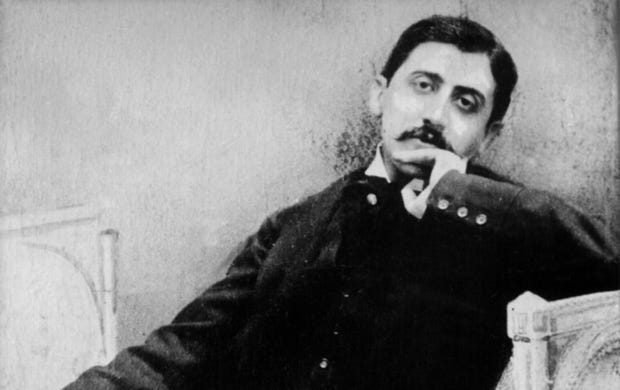
Among what is being described as “a treasure trove of letters and diaries revealing the secrets of some of France’s greatest literary figures” — soon to be auctioned off in Paris — there is a rather amusing note from Marcel Proust. Written to his landlord’s son, Proust complained about the volume of his neighbor’s sex: “Beyond the partition, the neighbors make love every two days with a frenzy of which I am jealous.” What would you pay to own such an item? Say, two hundred euros? What’s the exchange rate for madeleines these days? The collection also reportedly includes notes from Flaubert contemporary to the creation of Madame Bovary and a private diary belonging to Victor Hugo.

[The Guardian/Danuta Kean]

25% of Young Britons Lie About Reading Lord of the Rings

A new study by The Reading Agency, the British pro-literacy group, has confirmed a universally acknowledged fact: people lie about what they’ve read. Adults 18–24 were the worst offenders, with 64% confessing to stretching the truth about their reading habits. 25% of that group claimed to lie about reading J.R.R. Tolkein’s Lord Of The Rings trilogy, when they had actually just seen the films. Other frequently fibbed titles included Ian Fleming’s James Bond books, The Chronicles Of Narnia, The Da Vinci Code, and The Hunger Games. Wait, are people impressed if you save you’ve read Dan Brown?

[The A.V. Club/Matt Gerardi]

Granta Best of Young American Novelists List Released

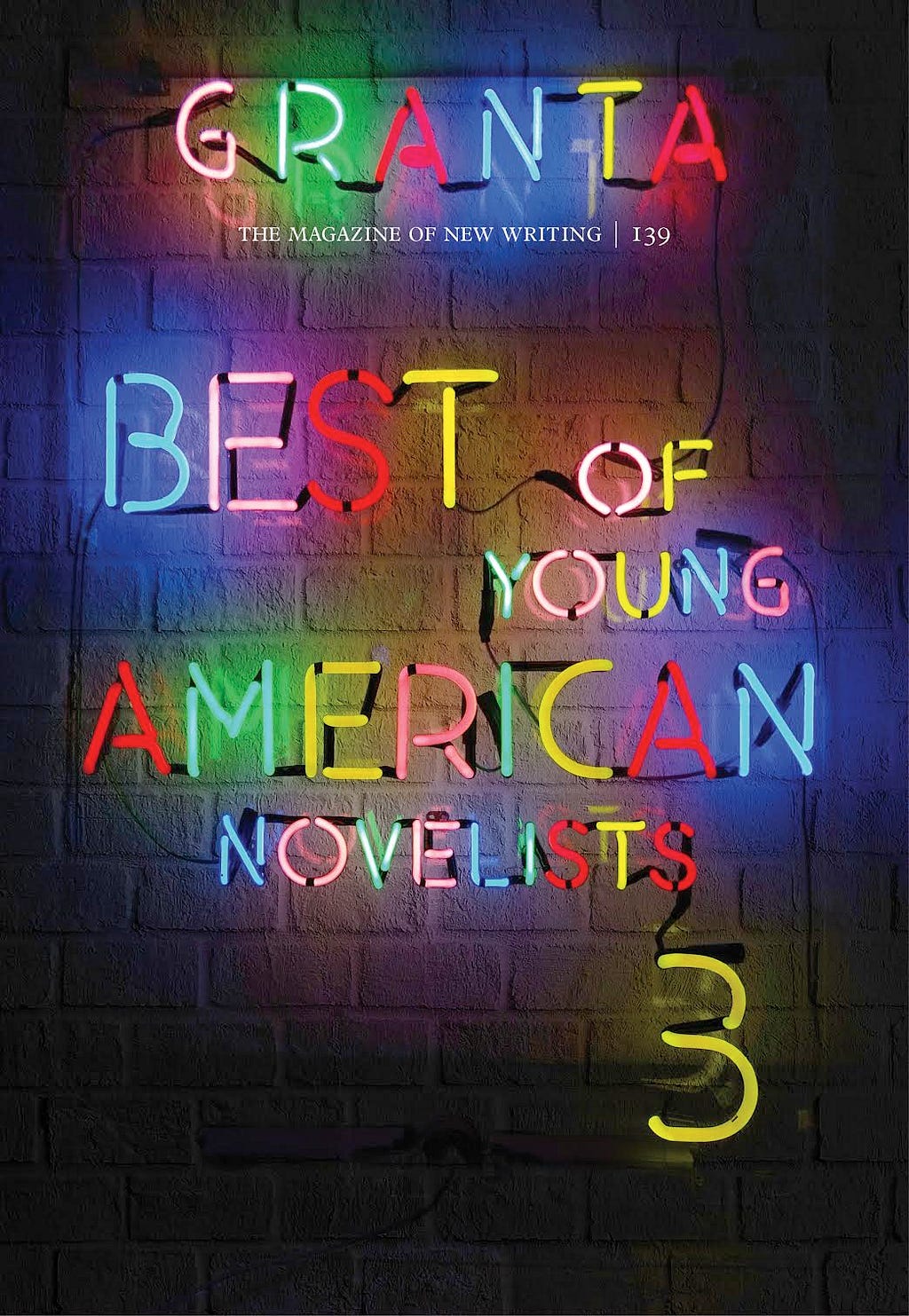
Granta has released its latest “Best of Young American Novelists” edition. Released every ten years, the list includes writers under forty whom the magazine considers to be at the forefront of American writing. This decade’s roster is headlined by Emma Cline, Yaa Gyasi, Ottessa Moshfegh, and Ben Lerner. You can check out the whole group here. Because you know what Americans really love? British people declaring which of us is best.

Why We Do Weird Things: An Interview With Ottessa Moshfegh, author of Eileen

Streep, Sondheim, the Women’s March, and a Call to Arms at the PEN America Gala

Last night at the Museum of Natural History, the fight for free speech hit close to home

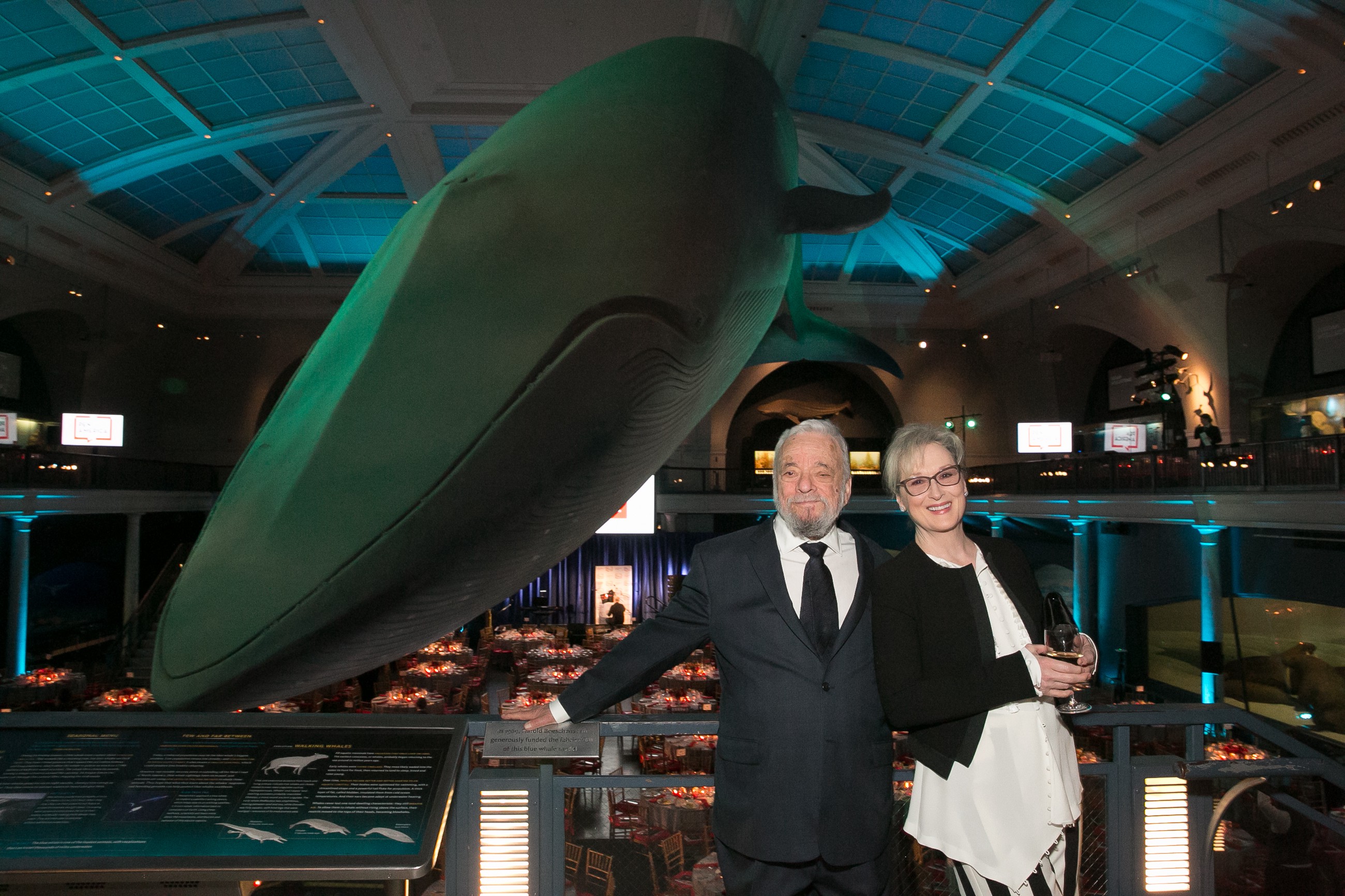
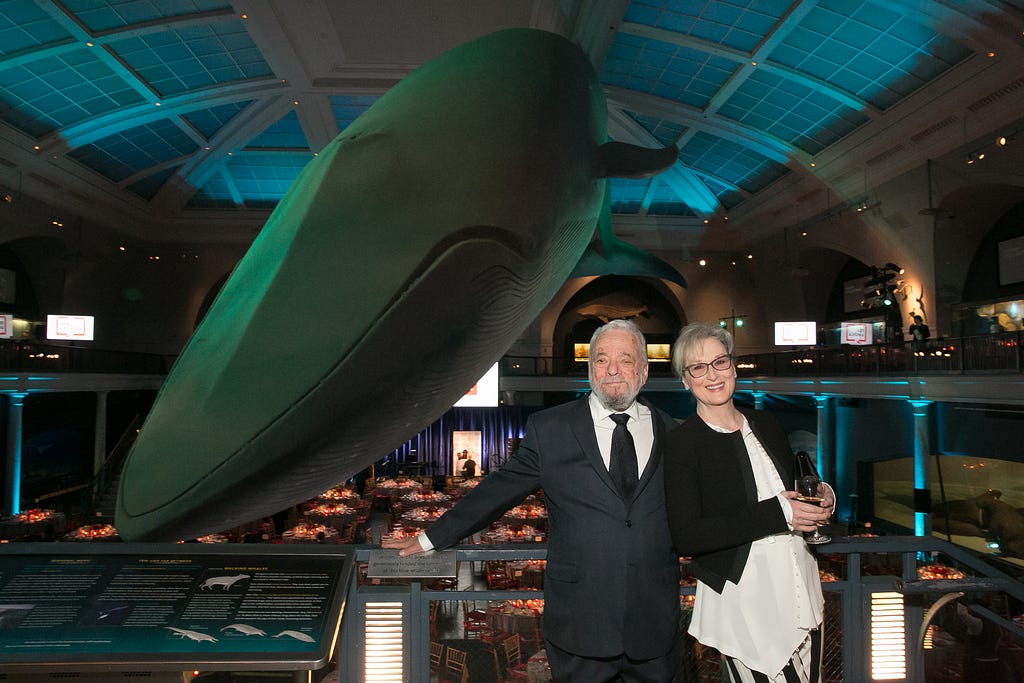
Stephen Sondheim and Meryl Streep

It’s a new era for PEN America. The organization, which has long helped champion freedom of expression around the world, is now grappling with new threats on the home front, namely a President who is openly hostile towards members of the media, wants to abolish the National Endowment for the Arts, and not only condones but creates fake news. PEN America’s President, Andrew Solomon, addressed the tense political climate in his opening remarks: “We are living in a time of unprecedented attacks on freedom of expression in the United States. The truth is routinely denied by the highest officials of government and untruths are proclaimed as if they were authentic.”

That tone of defiance and determination would carry through the evening. The night’s first award went to John Sargent, the CEO of Macmillan. In his acceptance speech, Sargent spoke about the importance of upholding the First Amendment and defending writers with controversial opinions. But rather than speaking only of the threats coming from government bodies, he acknowledged that the literary community must also face their own biases and pressures. “There are fewer and fewer of us deciding what books to publish…or what books to pull,” he said, hinting at the recent controversies over hate speech and Simon and Schuster’s book deal with online troll and white supremacist Milos Yiannopoulos.

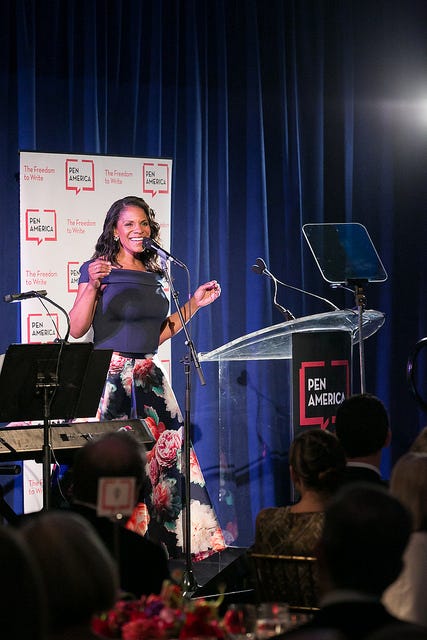
Audra McDonald

Next up: the bold-faced names. If there was one person who could generate the same excitement as last year’s celebrity presenter, J.K. Rowling, it was Meryl Streep. Streep awarded the PEN/Allen Foundation Literary Service Award to Stephen Sondheim for his contributions to musical theater and his defense of the arts. Streep was perfect (anyone surprised?), employing a deft mix of humor — “as an actress in a room full of great writers I feel like a pilot fish on a whale” — and her now trademark candor in criticizing the current administration. Sondheim humbly accepted the award, joking that he felt better about receiving a writing prize for musical theater, since “Bob Dylan can win the Nobel.” After the award was presented, Tony-winner Audra McDonald came on stage to perform Sondheim’s “The Glamorous Life.”

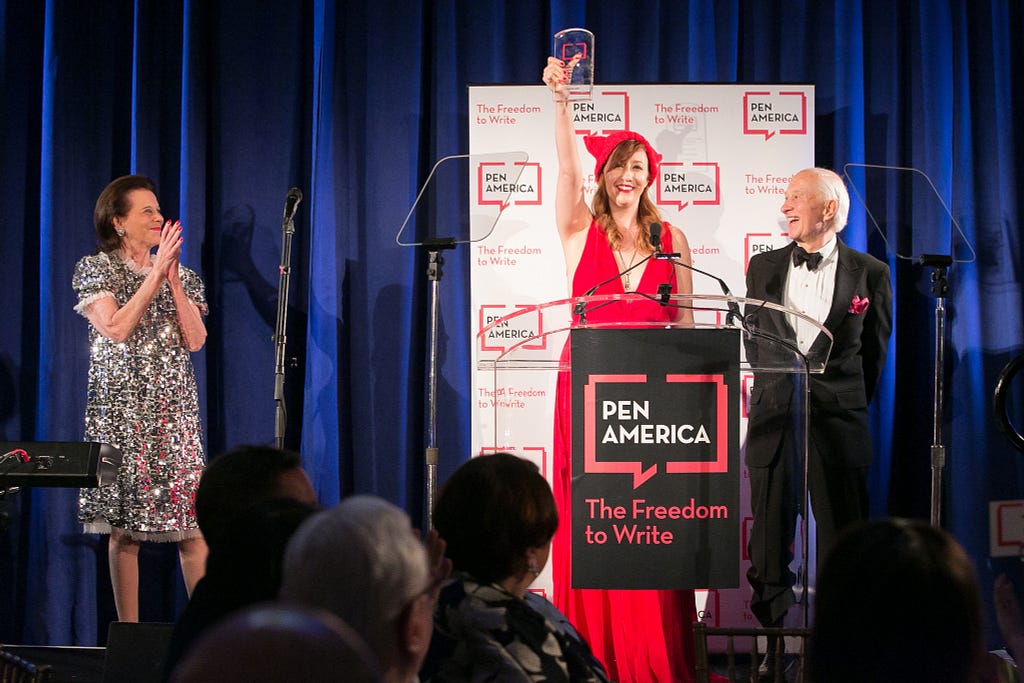
Apart from Meryl Streep’s amazing black-and-white striped pants, the best sartorial moment of the night came from Bob Bland, the Women’s March organizer and winner of the James and Toni C. Goodale Freedom of Expression Award. Bland wore a knitted red pussy hat above her elegant red evening gown, nicely emphasizing her message; in addition to speaking about the importance of courage, inclusiveness and diversity, she argued that we must continue to fight (hats optional) post-March and push for women’s rights and parity in all levels of government. Bland accepted the award on behalf of her co-organizers, Linda Sarsour, Tamika Mallory, and Carmen Perez, as well as the estimated 5 million people who marched on all five continents on January 21st.

Toni Goodale, Bob Bland, James Goodale

In an apparently impromptu moment, the award-winning actor Alan Cumming then read a letter written to PEN by Oleg Sentsov, the honoree of the PEN/Barbey Freedom to Write Award. Cumming’s ridiculously powerful reading was a moving tribute to the Ukrainian activist, writer, and filmmaker, who was arrested by the Russian secret police on spurious terrorism charges and is currently serving a 20-year sentence in a Siberian penal colony.

Rita Dove, the first African-American Poet Laureate Consultant in Poetry to the Library of Congress, closed out the evening with an impassioned call to save the National Endowment for the Arts. It was a fitting end to the ceremony, which began with a video called “It Can Happen Here: Free Expression in America.” The message was clear: PEN America is relevant at home, and will likely become even more so over the next four years. Importantly, the organization didn’t lose site of the global context, reminding us through the Sentsov tribute, videos of newly freed political prisoners, and even a shout-out to gala-attendee and fatwa survivor Salman Rushdie, how lucky we still are compared to so many around the world.

Photographs courtesy of PEN America, by Beowulf Sheehan

How to (Inadvertently) Write a Novel About Depression

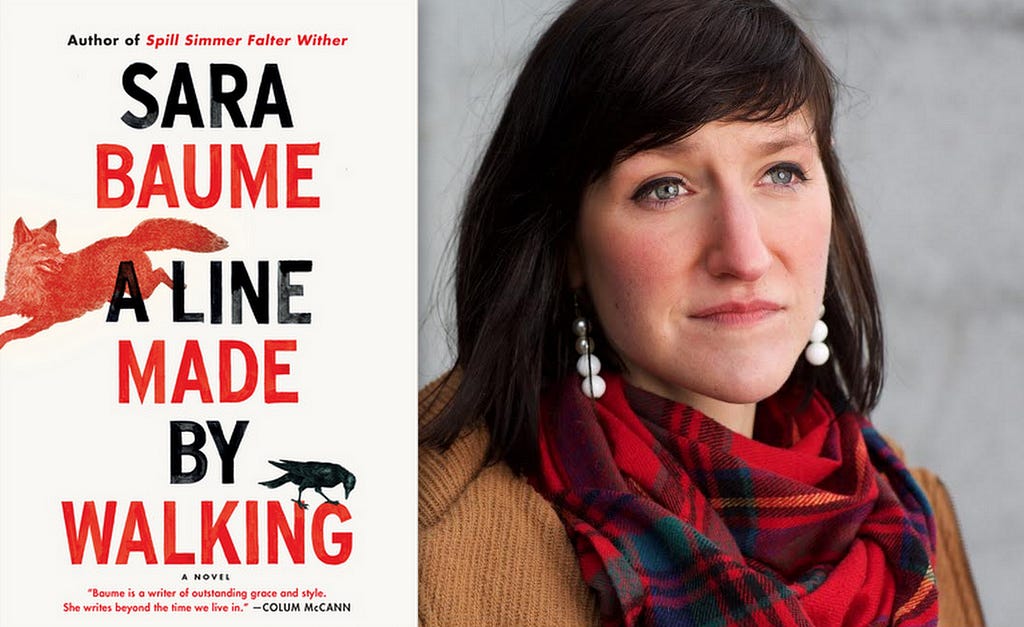
Sara Baume’s award-winning debut novel, Spill Simmer Falter Wither, told the story of Ray, a curmudgeonly old man who finds an unlikely companion in a mangy mutt named One Eye. Having a soft spot for both grumps and dogs, I was immediately drawn to the book’s premise. Yet more than the plot it was Baume’s sentences which riveted me; they were quiet yet poignant, mixing unexpected observations about humanity with gorgeous, often tender, descriptions of nature. Her new novel, A Line Made by Walking, may have a different protagonist, but luckily her literary style remains the same.

A Line Made by Walking tells the story of Frankie, a twenty-something sculptor who, struggling with depression and disillusionment, drops out of art school in Dublin and moves to her deceased grandmother’s house in rural Ireland. (Baume herself went to art school before getting her M.A. in fiction at Trinity College.) As the months pass, Frankie takes photographs of dead animals, tests herself on the details of endless works of art, drinks wine, and watches celebrities discuss their mental issues on TV. This last action is one example of the way that Frankie tells us the story of her depression; elliptically, a series of small clues embedded in how she sees the world. These loaded observations — cooking broccoli as a mark of sanity, a stolen bicycle as proof that humanity is crap — expose her profound estrangement from her art, from the world’s expectations, and from herself.

I had the pleasure of speaking with Baume over email about creative non-fiction, her obsession with conceptual art, and portraying mental illness on the page.

Author Sara Baume. Photograph: Patrick Bolger

Carrie Mullins: There are more autobiographical elements in this book than in your first novel, Spill Simmer Falter Wither. Apart from the obvious point that you’re closer in age/gender to Frankie than Ray, you’re also trained as a visual artist. How different is it to write a book whose protagonist is closer to your own reality? Have readers approached the work differently?

Sara Baume: Line started several years ago as a short piece of ‘creative non-fiction’ about a period of my life spent living alone in my dead grandmother’s empty bungalow in rural Ireland. This was during an economic depression, about two years after I finished art school. I was unemployed and increasingly disillusioned and Frankie’s voice draws heavily from those feelings of confusion and despair. Some details remain true, but many more are invented, and stepping back to look at Frankie now, I find her perplexing, even a little cruel. She is me, and not me, but then I’d say exactly the same of Ray in Spill Simmer.

When it comes to readers, I’ve found that, with Line, they are much more likely to ask whether or not it is an autobiographical novel, whereas with Spill Simmer, people are most inclined to ask how I went about — as a young woman — writing in the voice of a much older man. Ray is as much me as Frankie is, because, to my mind, a person is most essentially defined not by age or gender but by experience. Ray is me in the smallest details of his life, in his feelings, in the things that interest and illuminate and frighten him.

CM: Even when she can’t be bothered to eat more than a chocolate bar for dinner, Frankie tests herself to name artworks on a particular subject, from blinking lights to flowers. It was fascinating to learn about these pieces, and I was struck by that word, test, because it’s so active and outside Frankie’s general behavior. How did this recurring element come about? How did you choose the actual works?

SB: Well, first off, the novel is named after an artwork by Richard Long. A Line Made by Walking was an ‘action’ undertaken in 1967 when Long was still a student in St. Martin’s School of Art in London. He caught a train out of the city, and in a field, walked up and down and up and down in a straight line until his footsteps had worn a visible track through the grass, then he documented the site in photographs. It’s just one of roughly seventy artworks which, at intervals throughout the novel, Frankie prompts herself to remember. Each one is a work she learned about in art school, and she sets herself the task of recalling them partly just because she’s afraid of forgetting and wants to feel as if she is continuing to learn in spite of the fact that her formal education has come to an end, and partly as an attempt to find meaning and direction in the so-called ‘real’ world.

When it came to selecting the artworks, it was important to me that each rose naturally to mind in accordance with the sights and objects Frankie stumbles across, the places and situations she finds herself in. I would not allow myself to struggle to call them to mind, or hammer them in where they did not rightfully fit.

And so I was, naturally, drawing from what I already knew — and liked, and remembered — my own frame of reference. I’ve always had an obsession with — and fascination for — conceptual art, and more specifically, the period dating from, roughly, the 1960s up to the noughties. This was a really vibrant, radical, experimental period — taking in modern movements from Pop, Performance, Installation, Minimalism, Land Art, and so on.

My Year in Re-Reading After 40 #5: The Sea, The Sea by Iris Murdoch

CM: You paint such wonderful visual images of creatures — crows, foxes, even slugs — and they feel like a seminal part of your work. What draws you to them?

SB: I grew up in the countryside, and live again now in an even wilder place than the one where I grew up. The fields and trees and sea beyond my desk are a constant source of fascination, companionship and influence, and nature has become a theme which is central to my writing. Just recently I’ve read a handful of books which seem to be treading the ground, beautifully, between novel, essay, artwork and ode to nature — The Outrun by Amy Liptrot, H is for Hawk by Helen Macdonald, Things That Are by Amy Leach, perhaps — and I’d love to think that Line has some territory in common.

“The fields and trees and sea beyond my desk are a constant source of fascination, companionship and influence…”

So Spill Simmer was structured around the seasons and Line is structured around a series of photographs I took over the course of a couple of years. Each shows a dead creature lying where it fell and as I found it, and each of the ten chapters is named for the creature, from ROBIN through to BADGER. In June 2009, I travelled to Gorzów Wielkopolski in western Poland to take part in a group exhibition in a disused orphanage, and there I showed the photos alongside little creature figurines which I’d carved out of balsa wood. I don’t know exactly what it is about these photos which makes me return to them again and again — one on its own isn’t interesting, but I find that there’s something tremendously poignant about the prints all together.

CM: When you’re trying to sell a novel, the conventional emphasis from agents and publishers is on plot, even for literary works. (What’s the hook? Will the pace be enough to capture an audience? et-soul-crushing-cetera.) Your novel has successfully dispensed with much of the traditional idea of plot. Was that a conscious decision as you were writing? Was it ever hard to get buy-in, even for a second novel?

SB: Well, for me, getting published was a somewhat unusual process. With Spill Simmer, I never dreamed any of the bigger publishers would be interested. I didn’t have an agent and I only sent it out to a handful of small, indie presses. It got picked up very quickly by Tramp Press, a new Irish publisher, which I guess would be similar to the like of Dorothy Project in the US. It did really well here at home, and so then I signed with an agent and the rights sold on to bigger houses in the UK and US, and in translation. I signed a two-book deal pretty early on, with just a first, rough chapter of Line. I expected, at every stage, that I’d be told it was a completely unmarketable novel, but I seem to have been blessed with really brilliant, open-minded editors on both sides of the Atlantic.

CM: This is a story about a young woman struggling with depression, and it doesn’t end on an arbitrarily happy note, which I appreciated. Can you talk a little about the ending, and about depicting depression on the page?

SB: Strange as this might sound, I don’t think I was really aware, during the process, that I was writing a story about depression; it was certainly never my intention to start a conversation about mental illness. Here in Ireland, there is no shortage of such conversations in the media, and Frankie is frankly bored by them. Though she is clearly sad and struggling to cope with adult life, she angrily resists labels and medication, choosing to deal with her sadness and disillusion in atypical ways and in defiance of professional advice. But would she have been better off doing as she was told? It’s a novel, not a polemic. I was more interested in the way a troubled mind flits and the things it alights upon — I’ve reached no particular conclusion.

I chose to end with the description of an artwork, and it took me some time to decide upon the right one.

A Story of Intellectualizing an Affair

“Her Thirty-Seventh Year, an Index”
by Suzanne Scanlon

A
Anecdote,
You tell him that you are writing a story about him. You ask if he’s heard the one about Flannery O’Connor and the young and handsome textbook salesman. He courted her, took her for a drive, kissed her. She didn’t know how to kiss, as it happened. I had a feeling of kissing a skeleton, he described the experience in a letter to a friend. Some weeks later, upon hearing that he’d married, she sat down to write “Good Country People”; she sent the finished story to him, with a note: This is not about you.

B
Belief, In the height of summer, just past the solstice, she fell into what her doctors characterized as a chthonic depression. The young shrink on the case noted that she’d been off medication too long. She lost weight; she wasn’t sleeping — sort of classic and boring was how she described it to a friend. She explained something of her desires to the young shrink, who responded, “I don’t think you really feel that way. I think that’s the voice of depression talking.” A part of her wants to believe the young doctor — to believe that her beliefs — her overvalued beliefs — are borne of a chemical disorder. A chemical imbalance. Something separate from what feels like herself. That would comfort, in its way.

Blind spot, The thing about one is that you can’t see it. You will feel like you are flying but then wonder if you are falling. You are falling. You are falling.

Boredom (see also: inner resources, see also: Marriage), Which Tolstoy defined as the desire for desires.

C
Cabbages
(see also: Happiness, see also: Woolf, Virginia), Sally asked (she herself was extremely happy); for, she admitted, she knew nothing about them, only jumped to conclusions, as one does, for what can one know even of the people one lives with every day? She asked, Are we not all prisoners? She had read a wonderful play about a man who scratched on the wall of his cell, and she had felt that was true of life — one scratched on the wall. Despairing of human relationships (people were so difficult), she often went into her garden and got from her flowers a peace that men and women never gave her. But no; he did not like cabbages; he preferred human beings, Peter said.

Cake, Which you eat as you sit in the cafe, waiting for him. Frances Mcdormand will be sipping tea at the next table and you will find it difficult not to stare. She will stare back, in a nice way. She isn’t wearing makeup. She will be beautiful in real life, more beautiful than she appears on film, and this will remind you of something.

Closure, As when you tell him that it was his fault, that he took advantage, that you were vulnerable. Also: what you hoped his arrival might offer, what we all hoped, with the knowledge that one lover will call up a past love or experience, the knowledge that fantasy will intermingle with reality.

Confession (see also: Language), He wants to talk: There are so many things about myself that I want to tell you. You want to stay on the phone with him for hours. You will fall in love with his voice, which is not the body, but links to it.

Consequences, It may cause you to suffer, the wetness of your panties; your desire to be touched by a married man.

Containment (see also: Memory, see also: Theater), Dearest X, I was watching a woman on stage last night, a young woman, and I had a memory of a woman from the ward for promising young women. Meredith. She was something of an aberration on the ward. Everything about her was contained. She was perpetually tan and maintained, somehow, a crisp, short blonde haircut. She wore tennis skirts and tight little sundresses that revealed her thick tan legs, which were punctuated by white Keds. She smoked thin Virginia Slims. She was from Greenwich; she would be sure to tell you. She would talk with the Aides and laugh, but when she laughed her mouth only opened so far and the rest of her face didn’t move. There was such a sadness about her — the containment — so it didn’t bother me or anyone too much the way she talked about the others: Ava with her scars, Maria with her fingers down her throat, Jennifer with her various personalities. Jennifer who, we all knew, would never leave. Jennifer who had become a part of the place. Jennifer whose father raped her lying face down in his work shed. Jennifer who still ate nails, liked the taste of nails, couldn’t help herself.

Courtship, He will ask for more. I want to read you, he will write.

Cupcake, You walk together to the counter. He will say, “Let me handle this,” which you like. You eat chocolate cupcakes with chocolate frosting and beautiful flowers. Your body will feel like it’s on fire. You will want so badly for him to touch you. You will call Dread. He will refer you to his expensive healer. You will call the expensive healer. She will call you sweetie and she will tell you that it’s going to be okay.

D
Death
(see also: Friendship), Dearest X, Last night I went out for expensive Korean food with a girlfriend. I drank one glass of wine and felt a little drunk. She is so intense, my friend. Later I had that Kierkegaardian feeling that I give her too much, that she takes something of me, from me, that it’s vampiric, our friendship. She tells me her mother was this way, and I don’t know what it would be like to have a mother so invested in me, my well-being, I don’t know and so I take this from my friend, this is why I love her why I was first drawn to her, she cares about me — and she tells me this. I care about you, she says. I believe her. Is that foolish? Later we drive home and decide that we’re each having a midlife crisis, in our own personal special stupid ways. Her childhood friend has cancer, she explains: “And I feel like saying to her, Now really did you have to get cancer? Do you have to remind me that we’re all going to die, that I’m also going to die, which is something I cannot accept right now? At all. Really did you have to?” She starts to cry. I get it, I say. It’s why I’m obsessed with desire, I say, which is the opposite of death, as Tennessee Williams wrote, but also dangerous, in the way death is dangerous. As my desire for death is dangerous. We laugh then. I care about you, too, I say. I never say things like this to friends, but she brings it out in me. She makes me a better friend. Which is why I will say it here to you, too, my dearest: I care about you.

Dreams, Of airplanes, tall buildings, healing; you wake at two a.m. to see the Manhattan skyline over the promenade. You know yourself again, or think you do. I am home. I am home, you say to the sky, the water, the possibility of all things.

Desire (see also: Boredom), A friend describes it this way: My crushes are usually like — I want him to fuck me against the wall. Another friend explains, For me, marriage — monogamy, rather — means that I will never reach my sexual potential.

E
E-mail,
You will read his one line: looking forward to hearing your voice, and it will make you wet. He eschews capitalization, which somehow makes the note sexier. If it were from a student, you would not find the use of lowercase sexy; you would find it disrespectful, an indication of stupidity. you sit at your desk wet, wondering at the link between language and desire. You walk into class. You teach the poems of Edna St. Vincent Millay with your panties wet. You wonder if this is the only real thing in the world anymore, the only true thing: the wetness of your panties.

Exceptions, He loves you but feels three things: bored; lonely; invisible. Also: he thought this sort of longing, desperation, was for sad old people.

F
Fantasy,
A dog will present as a lobster, a child as a serpent.

Friendship (see also: Love, see also: desire), For example, you meet a man to whom you reveal a secret that may or may not be true. You discover that there isn’t language for this sort of friendship.

G
Good People
(see also: Tragedy), From a letter in H.’s safe box, Nov. 2009: My dearest X, You are a good person and because you are a good person I am going to like you even more than I already do. But still there might exist a part of me that wishes you were not such a good person, that instead you would say, Let’s meet somewhere for a day or a night. And if you said that I would say Yes. And we would meet and have really hot sex, and it would be great. Afterward, we would return to our conventional lives where we attempt to be good people. But instead, of course, you say, Let’s be friends! and I say, Yes let’s! And we become friends in the manner of Oscar Wilde, where friendship is more tragic than love, if only because it lasts longer.

H
Hardwick, Elizabeth
(see also: Betrayal, see also: Hunger), Seduction may be baneful, even tragic, but the seducer at his work is essentially comic. The seducer as a type, or as an archetype, hardly touches upon any of our deep feelings unless there is some exaggeration in him, something complicated and tangled and mysteriously compelling about a nature that has come to de ne itself through the mere fact of sex. For the most part, the word “seduction” indicates effort of a persevering, thoughtful sort. A seduction is the very opposite of the abrupt, which is, of course, rape. The most interesting seducers are actually rapists; for instance, Don Giovanni and Lovelace. Their whole character is trapped in the moil of domination, and they drudge on, never satisfied, never resting, mythically hungry.

Holiday, I took a hot bath. I spoke to you. I drank two glasses of wine. I kissed my baby. I left the room. I had trouble communicating. I read three poems by three men. I read “The Pornographic imagination.” I sleep. I dream of you.

L
Lessons
, You will teach “One Art.” You will tell your students that writing is like losing. That writing is losing. You correct yourself. They look confused. you try to explain. When you read the poem, as when you read Auden, you cry. A student sits with his ass hanging out of his pants. You want to pull up his pants.

Lispector, Clarice (see also Love, see also Solitude), At this time of day she often wishes to be alone and dead to everything in the world, except for the one man whom she does not yet know and whom she will create for herself.

Loneliness, You remember reading an interview with Anne Carson who said that loneliness is not a significant problem. The doctor will ask you, How bad does it get, the loneliness? And you feel uncomfortable measuring such a thing; you feel she’s failed to understand your experience. She meant to be comforting, but the question only makes you lonelier.

M
Marriage
, Your husband will call. I miss you, you will say. I love you, you will say. I want to move back to New York, you will say. He will either not hear you or he will ignore you. I have to get some work done, he will say. We can talk tomorrow, he will say. Goodnight. Love you. Goodnight.

Memory, A teacher reading a poem about a married woman who wanted the gas attendant to put a hand on her breast; who wanted to grab a pretty woman, a friend burning with desire, complaining about the normative brotherly lust of marriage. And the way you giggled, you and your silly Catholic schoolgirl classmates, embarrassed for the teacher, wishing away her gooey lust.

Mothers (see also: Bliss, see also: desire), Dearest X, Yesterday I visited a friend with a new baby, a friend who told me that she does not feel as happy as she should feel. That she expected to feel sheer bliss at the arrival of her second child, but instead it has been something else, a letdown. She does not have a personality like mine, she does not tend toward the darkness, and so it surprised me to hear her speak this way. But I understood her, though I cannot understand. I understand, I told her.

P
Passive Intentionality, A friend calls it, warning you.

Pathos (see also: Platonic affair, see also: religion), Dearest X, I think we are lovely. I think we are searching, blind, groping in the dark, like all chosen people. I went to church yesterday. I haven’t been in years. I liked that the priest quoted Keats. I liked that the priest noted that we are all Zacchaeus — but I feared the inherent anti-Semitism. I want things to be different. I want to believe in God. I want to believe in something.

Phaedra (see also: Lacan, see also: Poetry, see also: Racine), In Coeur de Lion, A. Reines writes, “I love when Racine makes / Phaedra say I LOVE instead / Of I LOVE YOU. She was / not too proud.” Simone Weil calls Phaedra’s love impure. In her case, Weil writes, the passion of love goes as far as vegetative energy. Sontag writes: The obscene, that is to say, the extremity of erotic experience, is the root of vital energies. Human beings live only through excess.

Philosophy, Your analyst will say, “your marriage is not working because you are depressed” and you will agree; your friend will say, “you are depressed because your marriage is not working” and you will agree.

R
Reality
, As when he speaks of the life that is real and the life that is unreal. As when you ask: how can one tell the difference? Or the way you forget that his interest in you is wholly professional, that he wants something, merely. You will forget and you will feel a connection to him, to his voice on the phone, to the promise of his body across from your own, which is hysterical and problematic, an insoluble problem. Your body. You will stand next to him. He will bring you water, Dixie cups full, over and over again. You are so thirsty.

Religion (see also: Memory, see also: desire), Didi: Do you believe in the life to come? Gogo: Mine was always that.

Rendezvous, He will suggest meeting. He will write: coffee/tea/Danish? It will turn you on. You will wonder about yourself. But not so much as to stop you from replying, and too quickly, Yes.

Romero, Encarnación Bail (see also: Mothers), variously described as an undocumented worker/migrant worker/illegal immigrant; Romero’s two-year-old son, Carlos, is taken from her when the plant where she works is raided; she is put in jail. Carlos is taken by the state until he is allowed to be adopted. Encarnación remains in jail. She will never again see her son.

S
Sad
, You might feel alive again, connected again to something that has been lost, that you lost years ago. You might imagine accessing the infinite through him, through this, which is all you’ve ever wanted.

Sanity (see also: Sontag, see also: Weil, Simone, see also: Truth), Susan Sontag writes that of course she comes down on the side of sanity that of course no one would wish for his/her child to live as Simone Weil and yet everyone reads Simone Weil, searching for the truth that they know she possessed. Sontag begins in a flurry, stating that Weil’s truth was necessary for this age that it was the hysteric voice that we needed a truth to contrast with the other problematic voices and yet what we also know was that it was not true. In conclusion, she states that she believes in the truth of sanity, but she will not say that the voice of insanity is untrue.

Seduction, He will read your book. Poetry: academic, obscure, abstruse is how the critics describe it. No one reads your book, but he will read it: thoughtfully, carefully.

Sontag (see also: Truth, see also: inspiration), Art must mount a full-scale attack on language itself, by means of language and its surrogates, on behalf of the standard of silence.

T
Theater
(see also: Memory, see also: Containment, see also: Madwomen), My dearest X, these women will always be with me. I don’t know where they are, if they are alive or dead. But they often appear to me, and in the most unexpected moments. I used to walk by Meredith’s room and catch her arranging her many tiny glass figurines on the shelves of her room. She would spend hours arranging the tiny glass figurines and, because our rooms didn’t have doors, I often stood there watching her. No one was allowed to have glass, but for Meredith an exception was made. She needed the figurines, needed to arrange the figurines, needed to be contained. The allusion to Tennessee Williams was so heavy, so obvious, that no one spoke of it. Maybe Lyle spoke of it in one of his lectures to medical students. It was the kind of detail he savored.

Time, As when you tell him you have plenty. Which you have not told anyone in years.

Tragedy, As when you tell him that you are happy that the two of you are going to be friends.

Triangulation (see also: Sestina, see also: Marriage), On day ten, he will tell you that he is writing a sestina for a woman. And so you will tell him that your husband writes sestinas. Would he like to read your husband’s sestinas? You will know that it is inappropriate to mention your husband’s talent with the sestina. But then you will remember: he is not your boyfriend. He is married. You were just trying to be a grown-up, you will say, apologizing. You tell him that you don’t know the etiquette. Is there etiquette? You ask. He will say Yes. The first piece of etiquette, he explains, is that you don’t mention your husband.

W
Wishes
(see also: Desire), And toward the luxurious quotidian: I wish for one or two more students like the one who shook my hand and said It’s been a pleasure or the one who said Thank you for the semester as if it were a gift (it was) or the one who asked me to watch his favorite movie and then whispered, And e-mail me after you do. A Single Man. A sad movie, from a Christopher Isherwood novel I haven’t read. A day in the life of a grieving man. I e-mail the student, but I don’t tell him that I understand that grief, how perception alters, shifts, what it is to be undone by grief, the effort that must go into daily life. I tell him that I was moved by the highly stylized, melancholy movie. I tell him I liked especially when the single man (I forget his name) tells a student: the only thing that’s made the whole thing worthwhile has been those few times when I’ve been able to really truly connect with another human being.

Woolf, Virginia (see also: Orgasm, see also: Cabbages), Something now leaves me; something goes from me to meet that figure who is coming, and assures me that I know him before I see who it is. How curiously one is changed by the addition, even at a distance, of a friend. How useful an office one’s friends perform when they recall us. Yet how painful to be recalled, to be mitigated, to have one’s self adulterated, mixed up, become part of another.

Weil, Simone (see also: desire), To see each human being (an image of oneself) as a prison in which a prisoner dwells, surrounded by the whole universe.

Writing (see also: Cixous, Helene), To my sincere surprise, which is only the product of a form of blindness, I realized in time that the writers I love above all are of the dying-clairvoyant kind.

X
X,
or Xing, Which might refer to sex, or to love, or to you (see also: X marks the spot, see also: X-rated, see also: Xed out). The thing is, I really need you with me in this story.

Founding Fathers and Pagan Goddesses

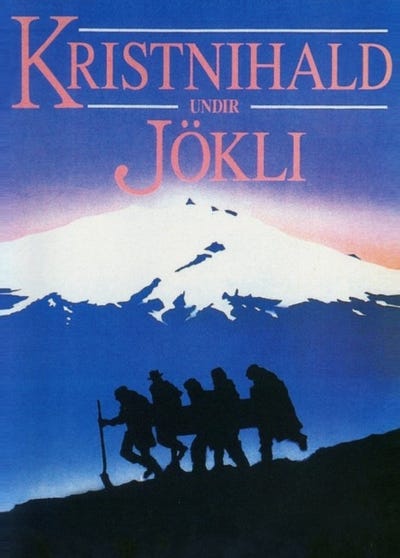
Iceland’s sole Nobel laureate Halldór Laxness (1902–1998) published twenty-two novels, among many other things, during his long career. I’ve not read all of them, but of those I have Kristnihald undir Jökli strikes me as by far his strangest, his funniest, and his most radical. Susan Sontag once declared, “It is like nothing else Laxness ever wrote” and I’ll take her word for it. I’m also told that it was the last novel he completed before turning to playwriting.

The English-language translation we have is called Under the Glacier, but the literal title is something closer to Christianity Under the Glacier, and it was first published in 1968. That was a time, some of us will recall, of tremendous transformation and upheaval in the arts. The staid and dominant order was breaking down. It was the year of the White Album and White Light/White Heat, of Planet of the Apes and 2001: A Space Odyssey. Disruption was in the air. New and radical ideas permeated the popular culture to such an extent that the very notion of a popular culture finally became suspect. Adventurous artists in seemingly every medium broke free of the old strictures.

Christianity Under the Glacier did likewise. To the best of my admittedly limited knowledge, it seems like an aberration in Laxness’s oeuvre, a change in direction — and the end result of decades of writing novels. There’s little that’s traditionally Christian about Christianity Under the Glacier. Although he had referenced and retold and relied upon the medieval Sagas of the Icelanders innumerable times, this particular novel strikes me as his greatest effort to launch an entirely new and secular — which is to say profane — epic saga of his own.

Disruption was in the air. New and radical ideas permeated the popular culture to such an extent that the very notion of a popular culture finally became suspect.

I don’t feel like there’s any need to mansplain the continued relevance or vitality of the Sagas of the Icelanders, but it is difficult to discuss the works of Halldór Laxness without giving them their due. From what we can tell, the mythic histories that constitute those Sagas were recorded in the fourteen, fifteen, and sixteen-hundreds, the height of the Middle Ages. Like the Old English poem of Beowulf, the Icelandic Sagas were Christian-era tellings of stories about great pagan heroes and deeds of the past.

It was the Russian formalist critic M.M. Bakhtin who, in his essay “Epic and Novel: Toward a Methodology for the Study of the Novel,” distinguished the novel from the epic. It’s a distinction that Laxness would undermine in Christianity Under the Glacier. Bakhtin’s essay also detailed three primary characteristics of an epic, all of which we see in the Sagas.

First, an epic will likely describe a “national epic past” or “absolute past” of a particular place. Second, the epic could be said to detail national traditions rather than the personal or individual experiences of its peoples. Third, and I think most interestingly, the epic establishes absolute distance that “separates the epic world from contemporary reality, that is, from the time in which the singer (the author and his audience) lives.”

To Bakhtin’s point, the Sagas clearly demarcate the bygone heathen epoch from their Christian retellings. In doing so, they also serve as the epic origin myths of Iceland — of that “national epic past.” Bakhtin may well have had the Sagas of the Icelanders in mind when he wrote: “The world of the epic is the national heroic past: it is a world of ‘beginnings’ and ‘peak times’ in the national history, a world of fathers and of founders of families, a world of ‘firsts’ and ‘bests.’”

The ugly phallocentrism on display here is no accident. Here in the United States, when we refer to the so-called “Founding Fathers” of our nation we are casting them and their actions in epic terms. In valorizing the drafting of the Declaration of Independence, for example, we risk making it impervious to criticism. We pretend that the framers were not, for example, misogynistic slave owners.

Iceland’s own mythic and heroic past is the subject of many of those Sagas and, we will see, of Laxness’s eventual subversion of them in Christianity Under the Glacier. That novel cuts through the cheap historiography. It tells the story of a Pastor in a remote village who abandons the conventions of the church and begins what appears to be a new tradition. In effect, Laxness has invented an entirely new saga, one reflective of the counter-cultural anti-authoritarianism and searching secularism of the late 1960s.

In valorizing the drafting of the Declaration of Independence, for example, we risk making it impervious to criticism. We pretend that the framers were not, for example, misogynistic slave owners.

The story is recounted in notes compiled by a parish clerk named Tumi Jónson, who is hired by the Bishop of Iceland to travel to the remote settlement of Snæfellsjökull (or Snæfells Glacier). He’s there to check up on the local pastor, who has been neglecting his duties. Rumors abound that the pastor no longer buries the dead but instead has them placed on the glacier itself.

When Jónson arrives, he finds that things are even more bizarre than he had been led to understand. In his report, he writes: “As far as the undersigned can see, Christian observance is at a minimum in the district.” And, “clerical duties are hardly performed at all in the parish unless ministers from outside are called in. Burials neglected. No services at Christmas, etc.”

Pastor Jón — who also goes by the name Prímus — had deviated so far from his Christian duties that he has more or less begun a new cult. Jónson’s account of his time there describes the beginning and perhaps the founding of a decidedly un-Christian community. In other words, Prímus — and of course Laxness himself — have put in motion some new and rather unorthodox local traditions.

As Bakhtin writes: “By its very nature the epic world of the absolute past is inaccessible to personal experience and does not permit an individual, personal point of view or evaluation. One cannot glimpse it, grope for it, touch it; one cannot look at it from just any point of view; it is impossible to experience it, analyze it, take it apart, penetrate its core. It is given solely as tradition, sacred and sacrosanct, evaluated in the same way by all and demanding a pious attitude toward itself.”

While that remains true of the Sagas of the Icelanders, Jónson’s experiences defy this. The epic origins of the new traditions at Snæfells Glacier are no longer “walled off from all subsequent times by an impenetrable boundary.” They are happening in the present moment in the book.

Through Prímus’s actions, Laxness peels away the centuries of religious dogma and returns his characters — and his readers — to the pre-Christian tradition of goddess worship and to the feminine origins of European mythmaking as described in, among many other sources, Robert Graves’s The White Goddess.

Graves cites a twelfth-century English book that describes the eternal goddess as: “Earth, divine goddess, Mother Nature, who dost generate all things and bringest forth ever anew the sun which thou hast given to the nations, Guardian of the sky and sea and of all Gods and powers.” He also cites how Christianity attempted to supersede the worship of the timeless goddess figures.

The goddess at the center of Snæfells Glacier and of Laxness’s new epic saga goes by many names, but she’s best known as Úa (“Ooh-a”). She provides the divine inspiration for Prímus and many others. Jónson describes her: “So wonderful was this creation that it’s no exaggeration to say she was completely unbearable” and “There was never anything like her.”

Úa is both absent and present, real and extra-real.

The Trolls in Our Midst: What Fairytales Can Tell Us about Online Behavior

Prímus says: “The Úa who came is not the one who went away. Because in the first place Úa cannot go away, and in the second place she cannot come back. She doesn’t come back because she didn’t go away. […] She didn’t remain just outwardly but above all within myself. Who could take your mother away from you? How could your mother leave you? What’s more, she is closer to you the older you become and longer it is since she died.”

Úa’s seemingly supernatural not-present presence refutes Bakhtin’s notion that “The epic world is an utterly finished thing.” Bakhtin also writes: “One can only accept the epic world with reverence; it is impossible to really touch it, for it is beyond the realm of human activity, the realm in which everything humans touch is altered and re-thought.”

The great contribution of Christianity Under the Glacier is Laxness’s insistence that that’s no longer true. The novel excises any religious dogma in favor of the ancient goddess-worship traditions that Christianity attempted to repeal and replace.

Recalling Graves’s White Goddess, Jónson comes to learn that: “The foremost women of the world all speak to me with one mouth: the Virgin Mary with the Infant on her knee; the Greek golden age with washerwoman bun and Venus from Willendorf, vulgar and Simon-pure with her face hidden behind her hair and her buttocks bare, the bitch-goddess of mythology, the Virgin Whore or Romanticism, Ibsen’s fate-woman, the Mater Dolorosa of the Gospel — but above all the good abbess, Saint Theresa from Spain, in search of a new Saint John of the Cross.”

Christianity Under the Glacier displays little reverence for the Christian origins of the Sagas of the Icelanders. It also closes any “absolute epic distance” between the events of an epic and of its later telling. The ramifications of that are radical.

What I mean is, it asks each of us to question and ultimately distrust the political agendas and machinations of epic storytelling itself. And once we rethink the orthodox stories of whatever glorified “founding fathers” we’ve been told to worship, we can then start to envision how to retell those origin stories — our own origin stories — with more honesty and more inclusivity.

[Adapted from an April 7, 2017 talk at the “Celebrating the Legacy of Icelandic Author Halldór Laxness” symposium at the University of Maine.]

Zen and the Art of Motorcycle Maintenance Author Robert Pirsig Has Passed Away

The Best-Selling Author Was 88 Years Old

We are sad to report that author Robert Pirsig, best known for his 1974 philosophical novel Zen and the Art of Motorcycle Maintenance, died at his home in South Berwick, Maine yesterday.

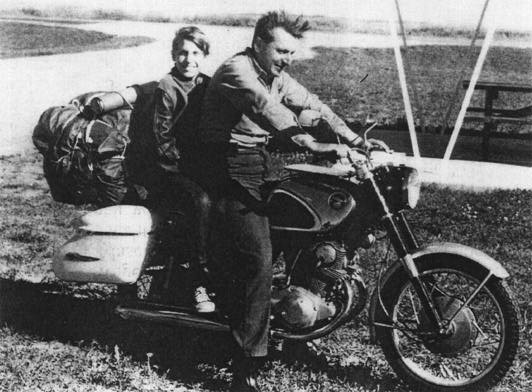
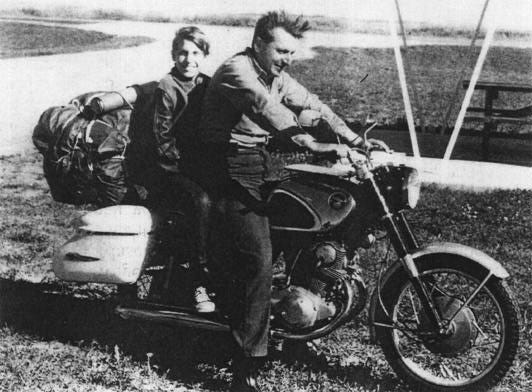
Pirsig’s best-selling debut tracks a 1968 motorcycle road trip across the American West that the author took with his son Chris. It also includes flashbacks to the elder Pirsig’s hospitalization for Schizofrenia earlier in the decade. Despite being rejected by 121 publishers, Zen and the Art of Motorcycle Maintenance went on to sell over five million copies. It's composed of meditations that, as the author put it, “set out to resolve the conflict between classic values that create machinery, such as a motorcycle, and romantic values, such as experiencing the beauty of a country road." The book made Pirsig a seminal voice in American culture during the turbulent 1970s.

He published a sequel, Lila: An Inquiry into Morals, in 1991. According to The Guardian, Pirsig had been experiencing “after a period of failing health.” He was 88 years old.

April Fiction Prompts Culled from the News

Jeff VanderMeer & Cory Doctorow Discuss the Future of Sci-Fi & the World

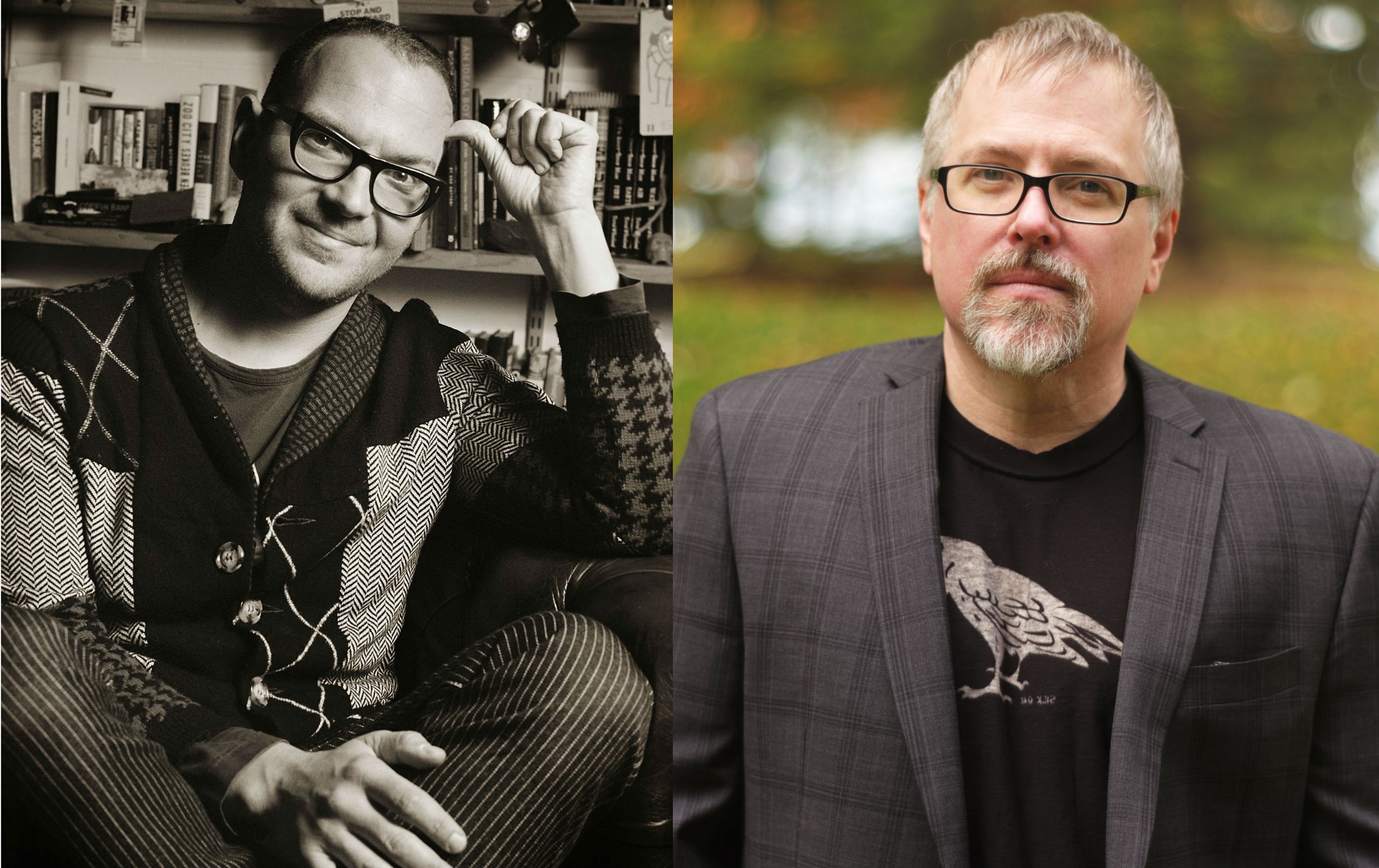
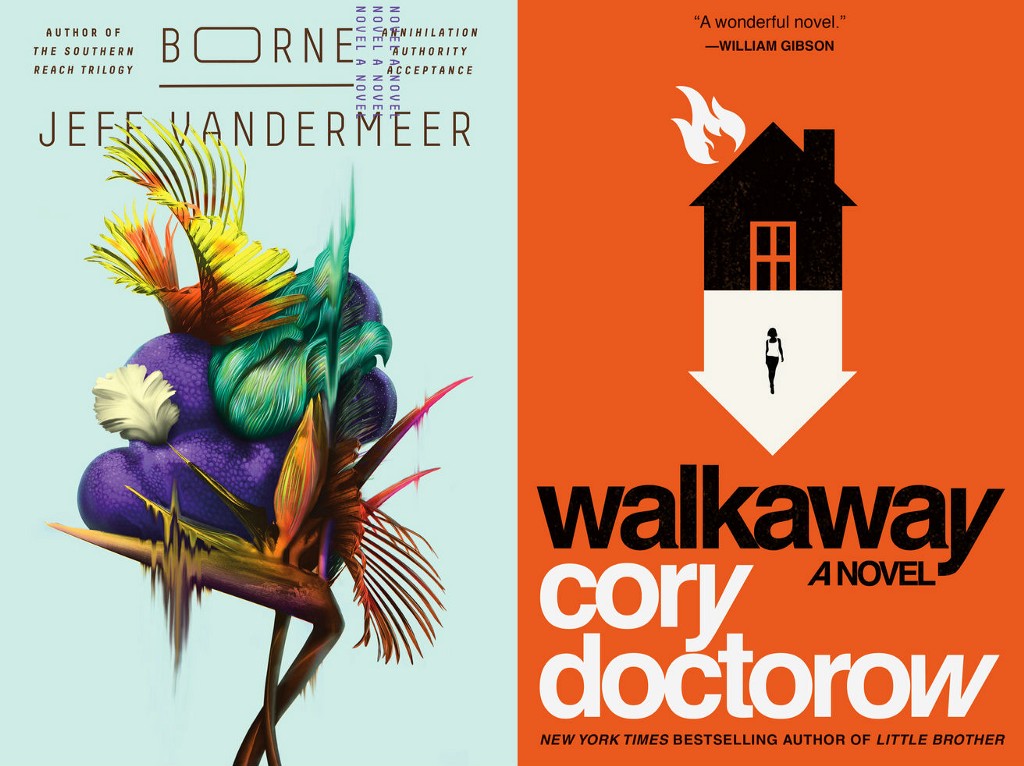
Twenty-five years ago, Cory Doctorow and Jeff VanderMeer both attended the Clarion Writers Workshop, the premier science fiction and fantasy writing program. Since that time, VanderMeer and Doctorow have each gone on to long literary careers. By chance, their new novels, Borne (VanderMeer) and Walkaway (Doctorow) are being published on the same date this year, April 25th, which got them to talking, which got us to publishing their conversation.

Jeff VanderMeer: Fresh-faced and eager as we both might seem, I’m calling it: we’re pretty much grandpas now. (Literally, too.) Looking back over the past quarter century, it’s pretty clear that a lot has changed. And a lot of it for the good. The genre boundaries are much more fluid now. I’m one of those continual label-evaders so this suits me fine. I’d prefer to shape-shift, in part because my interests and curiosity vectors are always changing. One way I think we are definitely alike is in adapting well to the new environment, if in very different ways.

Cory Doctorow: We’re in the midst of a curious era for nerdy subculture, which is something I’ve been involved with since I started taking the subway to Saturday D&D clubs when I was 9 years old. Back then, it was *really hard* to find other people who found genre sensibilities satisfying. The covers of paperbacks on buses became a recognition semaphore (“I see you are reading a John Wyndham novel; I too, have read of the Triffids!”) Networked communications brought subcultures together — counterculture fashion identities like goth and punk; out-of-mainstream political identities from anarcho-syndicalism to intersectional feminism to (alas) neo-fascism.

VanderMeer: Coming into Clarion, you were a Heinlein enthusiast and I was an Angela Carter devotee, and we didn’t so much clash as — as I recall — have a few discussions about it. But I was definitely young and arrogant, so have to imagine I was annoyingly vehement. Sorry about that. I also know that I’ve taken great pleasure in watching your career take off — I feel like we’re both survivors over a pretty long span now, though we’ve taken different paths.

Doctorow: No apologies needed! If you’re not abrasive at some point at Clarion, you’re probably not trying hard enough. (I’m sure I was!)

VanderMeer: Oh, you were. But it was a group of total eccentrics and I think the whole nature of throwing 18 strangers together — especially a bunch of introverts and weirdos — and expecting harmony is kind of absurd. As for Heinlein, though, I still don’t like his work. Do you still read him? It’s curious how he’s become invisible to readers recently, especially given some of his libertarian leanings would seem to match the times.

Doctorow: Heinlein invented and refined a lot of the field’s signature moves, and moreover was at the epicenter of a lot of high weird craziness in his “real life” — he was a socialist Upton Sinclair doorbell-ringer; a Crowley-adjacent polyamorous pioneer whose alcoholic “white witch” story-doctor wife took up with the recently discharged ex-Navy-man L. Ron Hubbard; a vicious racist who was certain he wasn’t. Today, he’s a litmus test of sorts. You can learn a lot about a person by what they think Heinlein was all about. I personally love the way that contemporary SF is engaging with him — Charlie Stross ripping into the guts of Friday with Saturn’s Children; John Varley using the juvies like Red Planet to savage GWB’s war on terror; and now Ian McDonald’s Luna books, a frontal assault on Randism by way of The Moon is a Harsh Mistress. It’s deeply kinky, taking all this problematic stuff and just *owning* the way it bent the field, using it to bend the field in the other direction.

VanderMeer: I want to get back to this idea of how the landscape has changed since we started our careers. On the negative side, it can be noisy and time-consuming in how writers are expected to engage on social media. But creatively I find it very positive in the sense that the fracturing of media and of hierarchies leads to all kinds of beautiful cross-pollinations. If there’s one thing I’ve been devoted to my whole career it’s been to breaking down barriers between speculative fiction and realism, if you will — in my fiction but also in the anthologies my wife Ann and I edit. For example, it was great to publish you in The Big Book of SF alongside Borges.

Doctorow: I think of it in terms of our communications tools, which always constrain the kinds of experiences we can have. When all you have is live performance, every live tale told is either a stage-play or a puppet show. Invent movies, and all the stories that had been shoehorned onto the stage (but really need to be movies) are liberated from stages and brought to the screen — meanwhile, all the tales that had lurked in potentia, unable to find any expression in the constraint of live performance, finally come to fruition. What’s left behind on-stage is irreducibly stage-like; it’s a purer expression of what you could only ever do onstage. And so on! Youtube gives us “shows” that are 19 seconds long, or 75 hours, things that couldn’t have lived on stage or cinema or TV screens.

The Rise of Science Fiction from Pulp Mags to Cyberpunk

VanderMeer: I’m definitely thinking in terms of fabulist fiction this time around, but I’m also interested in the moral/ethical questions involved with biotech, against a backdrop of a scarcity scenario. I think that’s what’s beginning to play out now in the world, and I wanted to approach the present through the future in a more direct way than I was able to in the Southern Reach books.

As I read Walkaway, I’m struck by some similarities at the paragraph level in the way we both deploy biotech, but you’re of course working from a kind of post-climate-change scenario. I read your Wired essay about hope and dystopias, and I agree whole-heartedly that it’s important to conceive of hopeful futures — Borne is meant to convey a hopeful future, because we’re still in it. But I do wonder at what cost imagining hope comes, in terms of things that are uncontrollable, i.e., we cannot manipulate our environment to the extent necessary to reach a post-scarcity scenario right now without basically eating or burning all the biomass on the planet that is not ourselves. I’d like to think we can just go kind of post-post-capitalist and get there, but I’m not sure. I like your example of people sharing food during a disaster…but we all know there will also be complete bastards out there. We live in a world that’s full of bad people doing bad things, but also good people doing good things. But it’s good that my approach in Borne and yours in Walkaway are so different, because we need as many different possibilities and entry points as possible in such an urgent conversation.

Doctorow: I think that a signature stfnal move is to mix in some technological whoppers with some truths and hope that the reader doesn’t notice ’em, they’re protective coloration.

VanderMeer: Ha! Yes, I like that, a lot. Because fiction is implausible anyway. Even the most realistic fiction is just an approximation anyway.

Doctorow: So I’ve got all this plausible utopian business — material objects designed to gracefully decompose back into the material stream, networks designed for censorship resistance and graceful failure modes, etc., and then there’s a hand-waving whopper, the idea of consciousness uploading, which is described as though it was just as plausible as the rest of it, though, of course, it’s purely metaphorical and completely incoherent on a neurological or technological level.

I felt like the biotech in Borne was similarly symbolic and not meant to be read as literal — no amount of squinting at the fine-print and inference from clues would tell you how a building sized-bear used “biotech” to fly over a city, etc. It was meant (I thought) as a kind of frankensteinian symbol for our inability to contain and steer the technologies we spawn.

VanderMeer: In anything I write, the monsters or animals or whatever have to be literal and visceral, and then figurative. But I’m not asking anyone who narrates the novel to understand how to create these creatures. We don’t know how to make a smart phone or even fix our cars anymore — I don’t think the future of biotech is going to be any different. And we’ll normalize to it, so we won’t think in terms of explanations just of purpose or outcomes. Sometimes explanations are what we do when we can’t actually envision the future. Which is tough, of course.

Doctorow: I definitely wanted to put Walkaway closer to present than my other “utopian” work like Down and Out in the Magic Kingdom, to at least give the impression that you could walk from here to there. Walkaway is meant to have just enough familiarity/plausibility to get you walking toward it, though, of course, anything like it would require a very long and arduous journey indeed.

VanderMeer: Getting back to biotech and the big issues in both of our novels — which one way or the other have to figure in climate change: What are your thoughts on issues like human populations relative to resources? Obviously, they’re tough topics. But seriously taking them on and doing forward planning strikes me as one of our biggest problems right now. For me this is deeply tied up with bio-diversity and it simply being wrong for us to save ourselves while dooming wildlife, especially since it seems to me we de-link ourselves from the biosphere at our peril.

Doctorow: I believe that what makes “nature” — biodiverse, stasis-seeking, teeming life — beautiful and desirable is *our* relationship to it, and its relationship to itself. Bees and chimps and coral, to the extent that they have a point of view, seem to want to exist, as do we, and ideally, we will figure that stuff out. But I’m a human, and I suspect that bees and coral would be OK with it if we disappeared, and one of the things that makes being a human pretty cool is that we *would* care if the bees or coral died. Which all leads me to think that the thing that matters is getting humans to survive, and then figuring out how that survival can make all this other life also viable — because *we care* about it.

VanderMeer: I’m not keen on defining something in relationship to ourselves in what we write about the future. Shouldn’t we be trying to get beyond the human gaze as part of that speculation? We’ve brought the planet to this juncture and directly killed off thousands and thousands of species. All this other life was and is already viable. My argument isn’t that humans should go away but that our relationship to the world we live in has to change drastically for us to survive.

Doctorow: If we’re going to locate the reason for saving other species in whether we can survive, then we’re in vigorous agreement. Species wipe each other out like crazy. “Nature” itself obviously doesn’t care about preserving species diversity — let alone life! — but *we* do, because that stuff keeps us alive and because we find it deeply, aesthetically pleasing.

VanderMeer: The idea of “aesthetically pleasing” with regard to animals is both interesting and troubling to me — it’s one reason we pay more attention to “cute” and “non-dangerous” animals and say to hell with sharks or centipedes. I’d much rather we recognize that our standards are incredibly “dumb.” And that the world doesn’t just exist because we perceive it.

The planet, in terms of geological time will be here regardless, and new forms of life will sprout up in millions of years. I take some comfort in that, but of course I’d much prefer a solution closer at hand. We’re already seeing fungal research that can yield biodegradable equivalents to Styrofoam, and if we can find ways to break down plastics and to slap a heap of socialism on top of our capitalism, that would also help. I’m curious, though, how you perceive the situation with Trump in control and all kinds of ecological safe guards on the scrap-heap. Is the market itself enough to counterbalance this, given interest in green energy?

Doctorow: I think the problem of getting markets to solve problems is that markets are, by definition, externalizers — when a problem can be solved more cheaply by offloading it on someone else than it can be through actual change, the former will always win. That’s why carbon offsets have been such a failure: companies are profit-maximizing machines, not carbon-minimizing machines. But solar is a technology, not a fuel, and it’s in a competitive marketplace, which means that firms can realize higher profits by reducing the material/labor/energy inputs to their products. However, energy is also digital in nature — we will make our hybrid, renewable grids work by using computers to do heavy lifting to coordinate supply, storage and demand — and where you have digital, you have a repertoire of tricks for monopolization: “your” smart meter belongs to a power company that can game it and spy on you with it and manipulate the market with it. So solar will continue because it is profitable, and it will improve because it is competitive — but it will not save us so long as it is embedded in a crony-capitalist “market.”.

VanderMeer: On a lot of these and similar topics, I admire that you use your platforms to push for a progressive vision of the future. It’s something that feels like it’s 24–7 for you.

Doctorow: On good days, the activist work feeds into my artistic work, each informing the other, or being escape-valves for one another’s pressures. On bad days, the frustrations in one realm blow over into the other — wrestling with activist causes will make art seem like a pointless deck-chair rearrangement exercise. I just try and power through it. How is it for you?

VanderMeer: The same, although my emphasis comes less through the tech side and more through the environmental side. I am working on a nonfiction book about storytelling and climate change, and although it can be depressing to do that research, it’s also enlightening and very hopeful in its way. So many people are engaging with it and in so many different ways. Just this week I spoke to an MFA student whose fiction is heavily into seeing animals in a way more consistent with current animal behavior research and also to someone working on expressing climate change through performance art, along with the guy who leads the energy center at Rice, and my own stepdaughter, who wrote two chapters of the World Wildlife Fund report on sustainability last year. So, between that and hiking, which is all about experiencing our world in the moment, I do feel hopeful to some extent. We shouldn’t underestimate the good we can do day-to-day no matter what the future holds.

April Fiction Prompts Culled from the News

True stories that are strange enough to be fiction

Stuck on an idea for your next short story? Every now and then we gather news headlines that are strange enough to be fiction. Here’s a batch of headlines to get your creative juices flowing along with suggested genres:

Historical Fantasy: People used to live in little hobbit stump houses!

True Snake Crime: Meth-addicted python put in rehab

Drunk Borges Fan Fiction: Bar owner in India builds labyrinth to access booze

Tasty Road Trip Novel: 8-year-old steals car to drive to McDonald’s

Capitalism Horror: Desperate people made to kiss a car for 50 hours in contest

Wildlife Martial Arts: Horse battles alligator

Children’s Adventure Story: “Buttery and ashamed” squirrel rescued from dumpster

Vampire Diet Guide: Salad recall after dead bat found in lettuce

18 (More) Amazing Novels You Can Read in a Day