The Nostalgia of the Neighborhood Hardware Store

The dog and I walk to the hardware store in the snow like that first winter in Chicago when we were still young and brave. We were one and 22 then. We are 12 and 33 now. We need keys for the new place where we’re starting our new life, and snow makes newness feel safe. We slide down the sidewalk with that old sense of promise, two girls against the world, the city a glistening pearl at our feet.

In front of the store, a crowd disperses as a truck slips and swerves away from the curb. Inside, the man at the counter wears a utilikilt. I say, “I need to copy this key,” and he says, “I was just helping those guys push their truck out and I ate it on the ice.” He rubs his right arm and winces while I stand there, stupid, key in hand. As usual, I missed the whole thing.

Another employee comes in from the snow and asks Utilikilt if he’s okay.

“I’ll be fine,” he says. He has a viking beard almost as orange as his vest.

“You fell down hard, man,” his coworker says.

“It’s not so bad,” he says. I think he should go to the hospital. I think he should wear pants.

While Utilikilt Viking cuts my keys with his remaining good arm, the dog and I roam the aisles looking at parts. I wouldn’t know what to do with most of them, but they’re soothing all the same. This nut fits that bolt; this joint threads with that pipe; intention and usefulness abound. In the housewares aisle, I pick up dish soap, the fancy kind, and picture wire, and hooks. The dog sniffs a box of rat poison on a low shelf until I notice and pull her away.

In the back of the store, a wall of toilet seats makes me cry. There are reasons, but how silly they sound: the way our old landlady had warned us about the toilet when we moved in, “I mean, I don’t know what you eat, but just in case.” The time we stood in the too-small bathroom of that too-precious house and named the fish on the shower curtain. How my new landlady is more nosy and less kind, and my new apartment has a bigger bathroom with a better toilet, and how I wish he could see the sink, the way it fits into an old wooden cabinet with plenty of room for two people’s things. How I had believed my days of going to a hardware store alone to fix up an apartment for just me and the dog were long gone. I sink to the floor beside a plunger display and the dog sticks her face in mine. “Sorry, kid,” I say. I want to scream obscenities until someone calls the police. I want to fill my arms with every kind of hammer and run down the street breaking windows and heads.

I read somewhere that the end of a significant romantic relationship affects the brain the same as death; grief is grief, no matter the cause. Some days, I envy the widowed and terminally ill, publicly praised for their bravery and strength. There is no honor for the heartbroken bereft. I am not brave or strong, I am merely surrounded by bathroom fixtures and alone. Cry me a whatever, woe the fuck is me.

“My girlfriend loves this soap,” says Partnered Utilikilt Viking as he bags my things. If he saw me by the toilet seats, he isn’t saying a word. This store is quite small.

“You should put the rat poison up higher,” I say. “Since you’re dog-friendly? It’s kind of unsafe.”

“I never would have thought of that,” he says. He still isn’t using his fallen-on arm.

He hands the dog a large biscuit, and me three identical keys, and I tell him he should go to urgent care.

“Yeah thanks,” he says, “You take care, too.”

Twelve in dog years is 84 in human, common wisdom says, but really it depends on the dog. The vet told me mine could live to be 16, which would be 112, which is very old, but still not enough. I think when the dog dies, I’ll die, too. I’ll be 37 then. It’s young, but people can understand that kind of giving up.

We walk out the doors into snow already turning to slush. Winter never lasts in this town, which should be some sort of relief, but imagine if snow stuck around long enough to count. Imagine if love never died, and neither did dogs, and winter did its job for once. We head towards our new home, two old girls against a world already starting to forget. The city is a riverstone, a comforting weight. It will pull us under if we let it, but we won’t, we can’t, we won’t.

Five Essays, by Josh Russell

Which Novelists Are Writing for TV in 2017?

From Fargo to American Gods, The Leftovers to Legion, find out which of your favorite shows are employing your favorite novelists

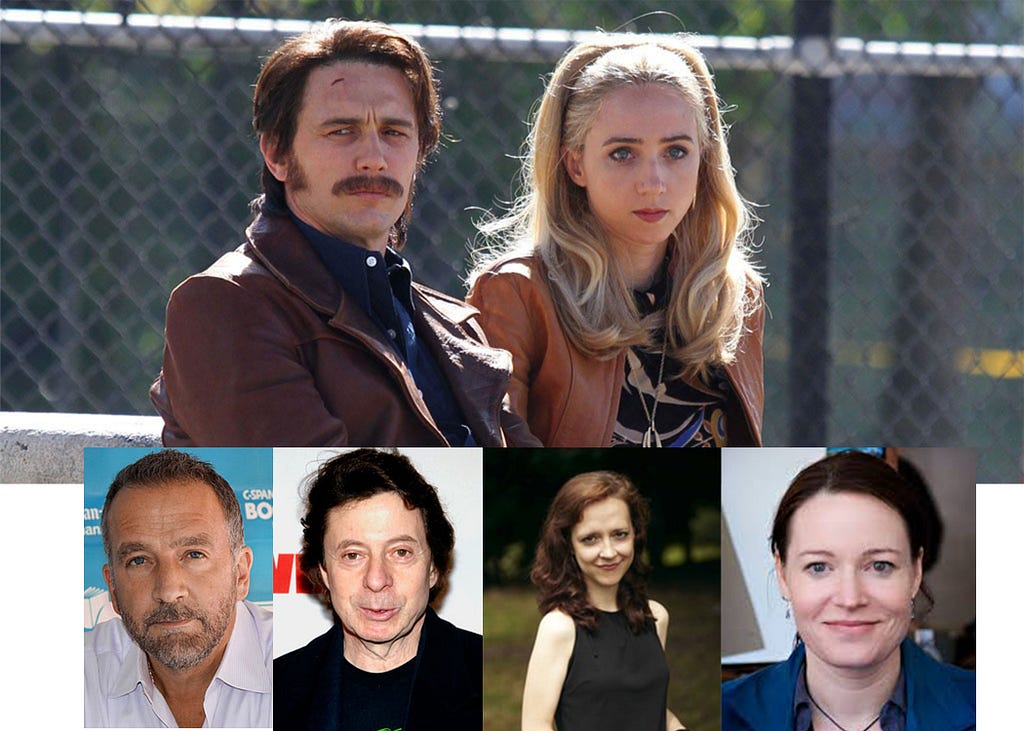
clockwise from top right, a whole lotta novelists

Maybe it’s the insatiable appetites of online behemoths Amazon and Netflix, gobbling up IP and talent like the studios of yesteryear. Maybe novel advances are down or ambition is up, or maybe it’s just been a cold string of winters in New York and hell, Los Angeles looks pretty damn good from that fourth-floor walk-up in Bed-Stuy. Whatever the reason, it seems like every year we do this list, there are more and more novelists making a go of it in TV-land. And this year the writers aren’t just hired hands for showrunner visionaries. Increasingly, novelists are coming to the fore, whether it’s Richard Price or Noah Hawley continuing a run of excellence, crime fiction legend Leonardo Padura trying his hand, or Philipp Meyer’s production company placing a Texas-sized gamble on a frontier epic for AMC. And it’s not just a boys’ club, either. (Although, let’s be frank here — it’s still mostly a (white) boys’ club, unfortunately.) This year, two of the brightest stars in crime fiction, Megan Abbott and Lisa Lutz, join the David Simon universe, while Gillian Flynn’s Sharp Objects looks to pick up where Big Little Lies left off, with another female-led mystery drama for HBO Sunday nights.

TV isn’t going to replace the novel anytime soon, but with barriers to entry dropping and audience demand for new content on the rise — and not just content, but well-crafted, narratively ambitious story—there’s no reason to think this is a passing trend. Now, at some point, yes, there’s a chance that the old-fashioned novel-writing industry will experience some significant brain drain, since TV is where the money and the audiences reside. But for the time being, let’s assume that a well-told story is a worthwhile thing no matter the form, and that the two media are actually somewhat simpatico and maybe even mutually-nourishing. Are you a fan of Westworld? Guess what? You’re gonna love the books of Charles Yu, one of the show’s writers. Or take the reverse. Are you a crime fiction devotee but every once in a while you’d like to put down the book and turn on the tube? Good news! Quarry and Four Seasons in Havana are every bit as good as you dreamed.

So, here’s our 2017 list of novelists and other literary types writing for TV. Have we missed some people? Almost certainly. Let us know and we’ll keep things up-to-date. Now let’s all give thanks for Ian McShane & Neil Gaiman.

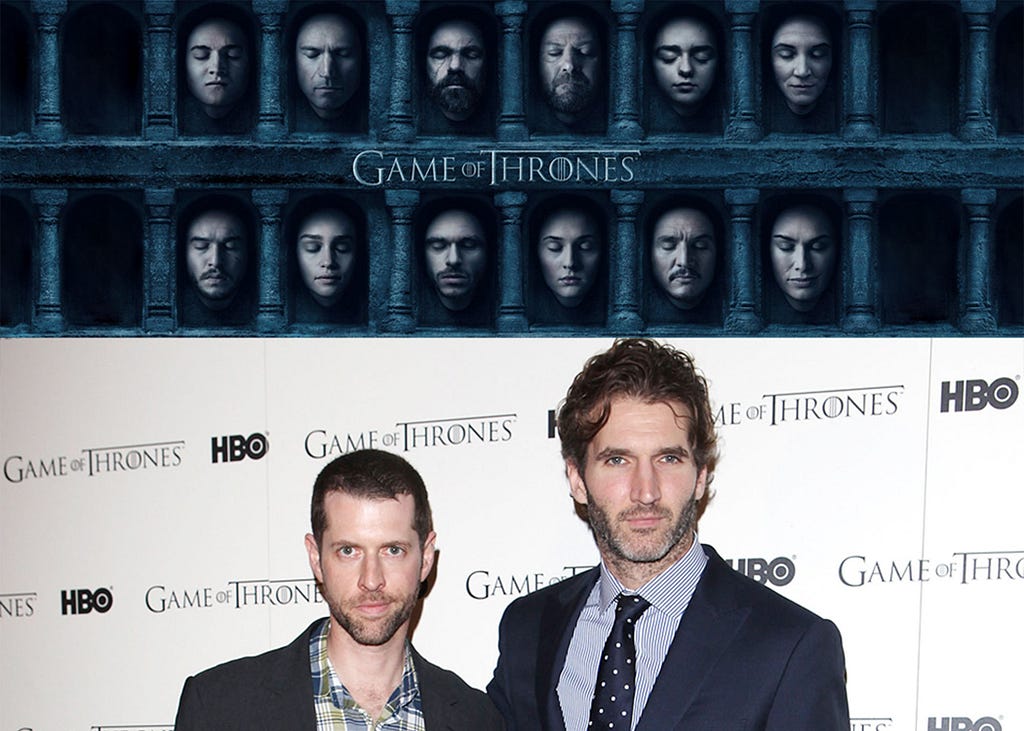
David Benioff & DB Weiss, Game of Thrones (HBO)

For two more glorious (slightly abbreviated) seasons, Benioff & Weiss will reign atop just about every list-icle and think piece about TV’s continued run of pop culture excellence. Why should this one be an exception? Benioff (author of The 25th Hour) and Weiss (author of Lucky Wander Boy) are still at the head of TV’s most beloved and critically-acclaimed show, and who knows, after it’s all done, maybe they’ll go back to their novelistic roots. In the meantime, here’s to another 16 episodes of what American Gods’ Ian McShane lovingly referred to as ‘the greatest literary adaptation of our time’…oh wait, no, he said it was a show about ‘tits and dragons.’ Our bad.
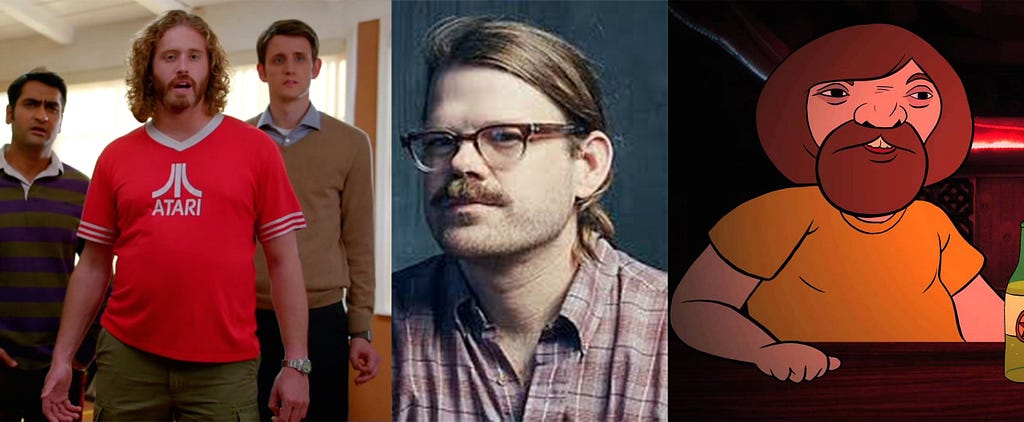
Carson Mell — Silicon Valley (HBO), Tarantula (TBS)

Mell is a longtime Electric Literature favorite — we even published the eBook of his brilliant Saguaro. Nowadays we enjoy his work on HBO’s hit comedy, Silicon Valley, where he serves as a story editor with several episode credits. And pretty soon his original creation — Tarantula, an animated series about an unlicensed tattoo artist in a residential hotel — will be on TBS. In short, Carson Mell is a lowdown crazy genius and we can’t get enough of his work.

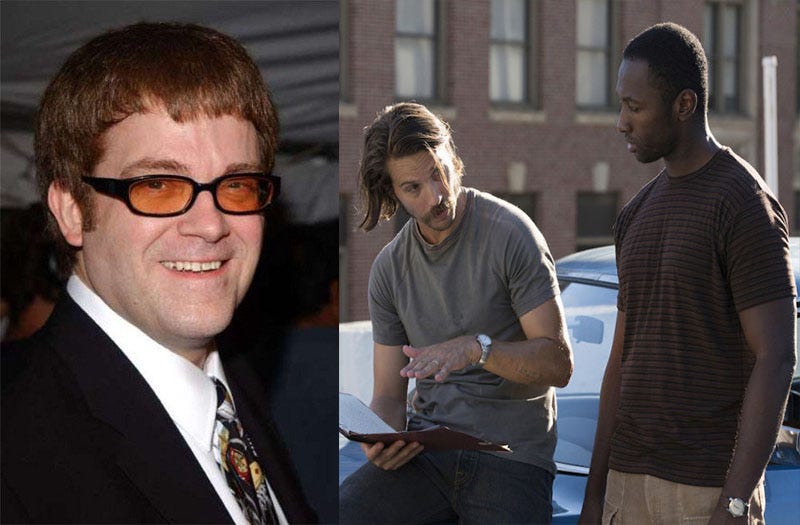
Max Allan Collins — Quarry (Cinemax)

For a two-month stretch at the end of 2016, Cinemax’s Quarry had a perfectly legitimate claim to the title of best crime series on TV. At press time, the show’s cast and crew are still waiting for the go-ahead on a second season, but if Cinemax has any good sense (and given its Banshee track record, it would appear the network most likely does), it will quickly pony up while the gang is still together. Max Allan Collins, the author of the beloved series of Quarry novels (beloved might be the wrong word for material this dark, but you catch our meaning), published by Hard Case Crime, is on staff and deeply involved in the show, with writing credits on the teleplays for all eight episodes of the series. Collins is an incredibly prolific writer — we’re talking multiple novels, graphic novels, and comics each year — yet somehow Quarry seems to be gaining new life all the time.

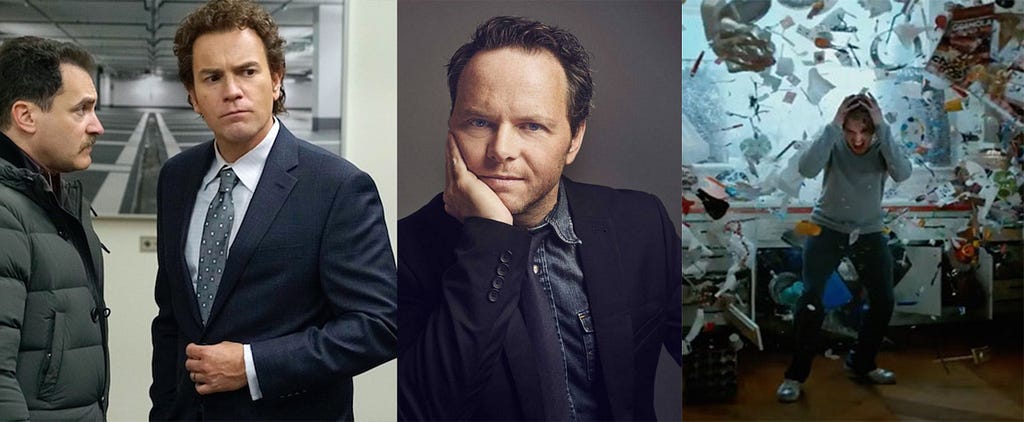
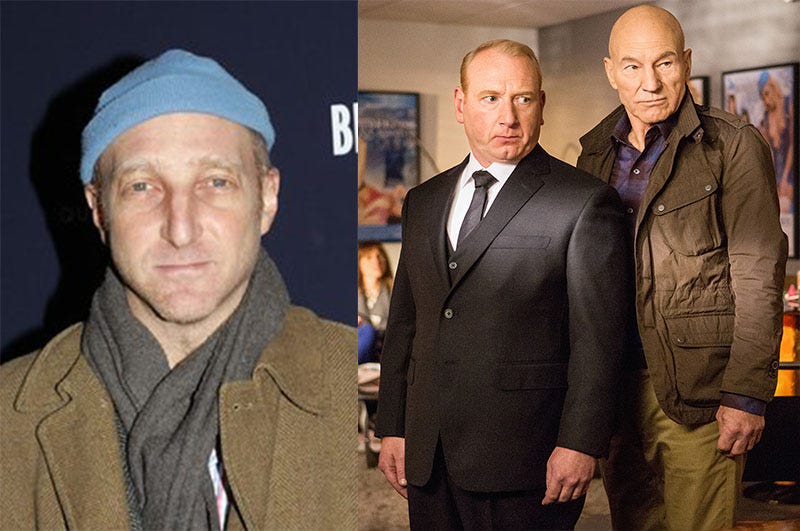
Noah Hawley — Fargo, Legion (FX)

Noah Hawley is giving the late James Brown a run for the title of hardest working man in show business. In addition to publishing a new novel (Before the Fall), Hawley has also kept busy writing season 3 of the hit FX show, Fargo, and season 1 of the network’s new X-Men-universe pyschological thriller, Legion. All three projects have received critical acclaim, and Hawley shows no signs of letting up. Just as Fargo season 3 hits screens, Hawley is reportedly pushing for a quick turnaround on season 2 of Legion, aiming for a 10-episode arc set to air in spring 2018. FX seems entirely happy to oblige.

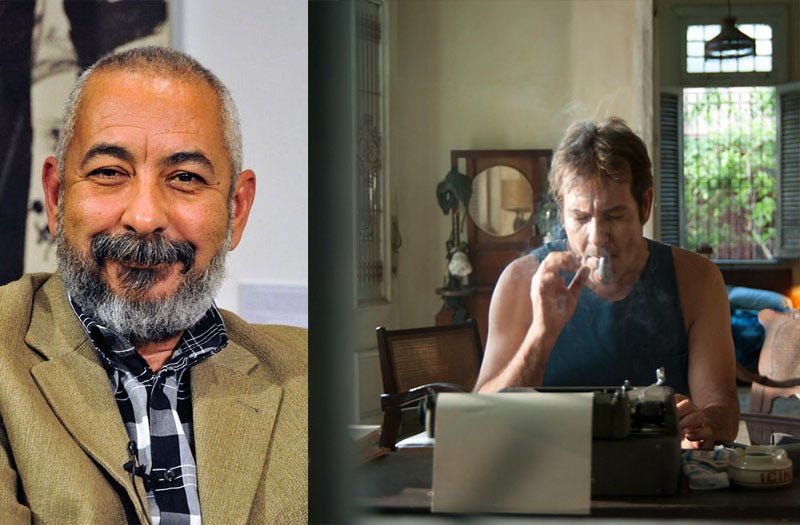
Leonardo Padura — Four Seasons in Havana (Netflix)

Netflix hasn’t given this limited series the push it deserves in the US market, but hidden away in the Spanish-language section of your account is a gem: Four Seasons in Havana. Leonardo Padura is an icon of Latin American crime fiction, with a voice and style all his own: gritty, sensual, learned, cynical in one breath, sentimental the next, all with a vast affection for Cuba and Cubans that permeates every page. Four Seasons in Havana adapts Padura’s most famous quartet — one book per episode (episodes run at about 90 minutes). The author created the series alongside his wife, the screenwriter Lucia López Col. They managed to film on location in Havana, and the show has some of the most poignant, rich cinematography you’ll find anywhere on TV. No word yet on whether Padura will be adpating more work for Netflix.

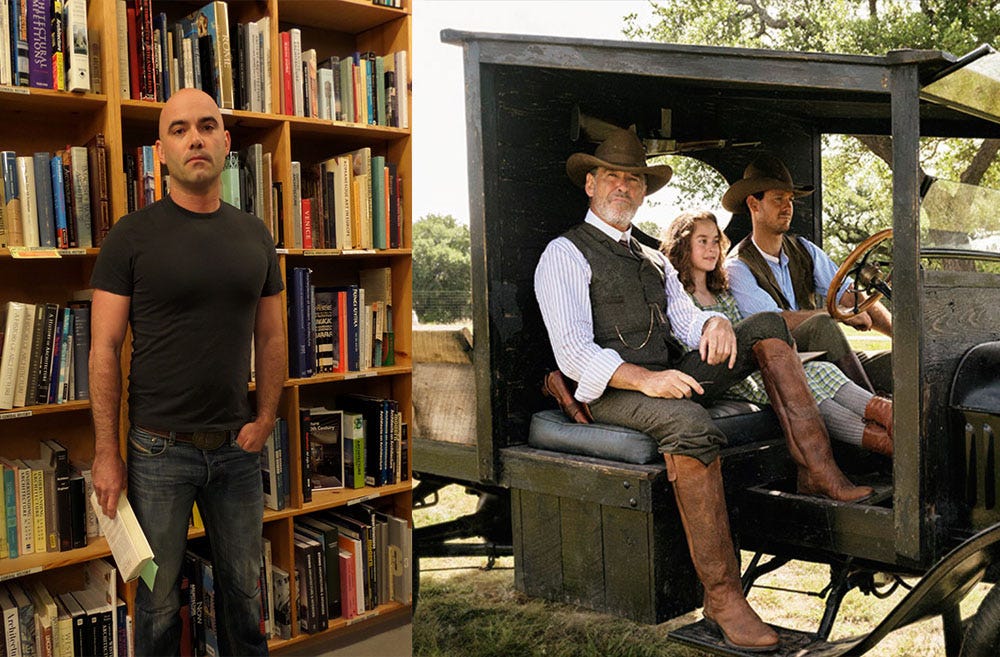
Philipp Meyer — The Son (AMC)

Meyer is directly involved in the adaptation of his 2013 novel, The Son, a multi-generation Texas epic that premiered this weekend (April 22nd) on AMC. According to a recent article in The New York Times, the author is on-set and even overseeing accent work and Comanche bow technique. (Pierce Brosnan praised Meyer for his “swagger” — pretty good notch in the belt right there.) The series is being produced by newcomer El Jefe, the company Meyer founded in 2014 along with old UT-MFA classmates Brian McGreevy and Lee Shipman. There’s a lot riding on the success of The Son — El Jefe is currently working on TV adaptations of Meyer’s American Rust, Wil Hylton’s Vanished, and Smith Henderson’s Fourth of July Creek. The company’s goal is to make sure even more novelists are able to stay involved in the screen adaptations of their work.

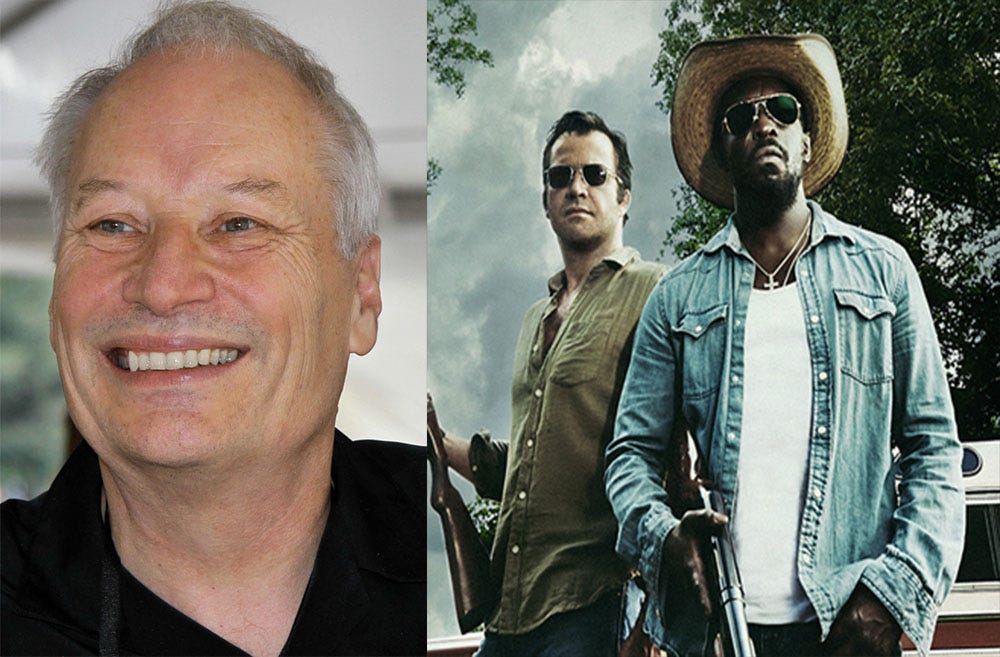
Joe Lansdale — Hap & Leonard (Sundance)

It warms the heart of crime fiction aficionados everywhere that Joe Lansdale’s Hap & Leonard has found a home on TV, and with a damn impressive cast, too — Michael Kenneth Williams, James Purefoy and Christina Hendricks. 2017 is still young, but we’ve already seen two Hap & Leonard novellas — Coco Butternut and Rusty Puppy — and the debut of season 2 of the Sundance series, based on Mucho Mojo. The show is helmed by Nick Damici and Jim Mickle, but Lansdale is a big presence — reviewing scripts, offering up ideas and notes, and even finding time to be on set during filming. His vision of East Texas is a distinct one, so it’s no wonder the showrunners have been eager to keep him involved in the adaptation.

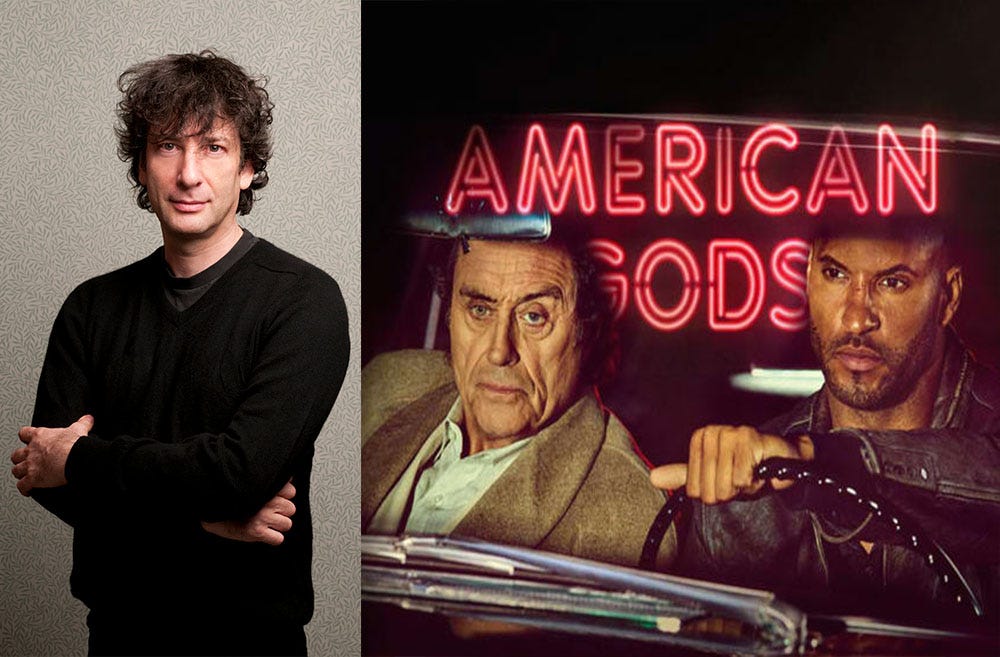
Neil Gaiman — American Gods (Starz)

Gaiman isn’t an fixture in the writers’ room on American Gods. He describes himself as “a kibitzy sort of executive producer. What I can do is read scripts, comment on them, give notes, talk to things in general terms.” The new show, set to premiere April 30th on Starz, is one of the most highly-anticipated programs of 2017 — thanks to the beloved source material, some badass poster work, and the presence of Ian McShane. Meanwhile, Gaiman is doing some teleplay writing of his own: he’s reportedly working on a 6-part limited series script for Good Omens, the fantasy novel Gaiman wrote in collaboration with the legendary Terry Pratchett. The adaptation was recently picked up by Amazon Studios and is on target for a 2018 release.

Which Books Are Coming to TV in 2017?

George Pelecanos, Richard Price, Megan Abbott & Lisa Lutz — The Deuce (HBO)

When it comes to novelist bona fides in TV writers’ rooms, The Deuce is in a class of its own. Going back to The Wire and Treme, David Simon has always had a knack for assembling literary talent. With The Deuce, he’s back to working with crime fiction icons George Pelecanos and Richard Price (now a TV heavyweight in his own right, after co-creating HBO’s 2016 hit The Night Of) and brought on board two of the reigning queens of literary noir: Megan Abbott (whose most recent novel, You Will Know Me, you can read about here) and Lisa Lutz (author of The Passengers and the Spellman series). The Deuce is shaping up to be one of the year’s most talked-about shows. It’s 1970’s NYC in all its seedy glory — a story about smut-peddlers, prostitutes and Times Square, starring James Franco and Maggie Gyllenhaal. HBO has said we can expect a 2017 premiere date; rest assured, Electric Lit is on it.

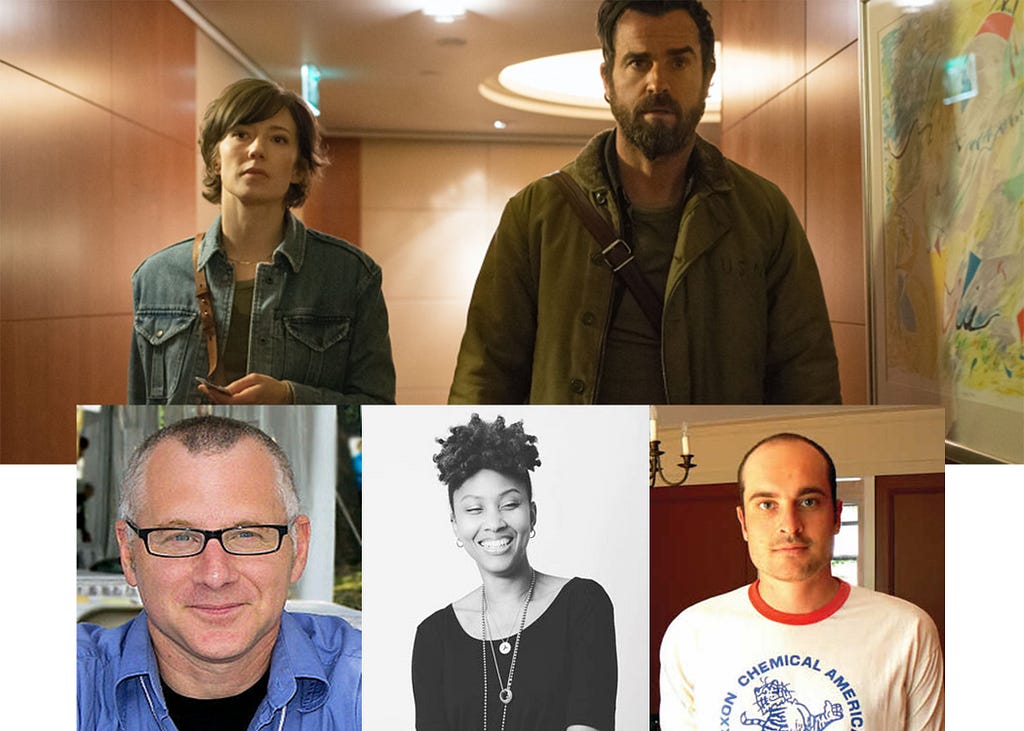
Tom Perrotta, Tamara P. Carter & Patrick Somerville — The Leftovers (HBO)

In addition to Tom Perrotta, who wrote the source material and co-created the TV adaptation along with Damon Lindelof, HBO’s The Leftovers has an impressive roster of fiction writers on-staff, including Tamara P. Carter (Lovestoned and Behind Those Eyes) and Patrick Somerville (The Cradle, This Bright River and two short story collections). Somerville was also recently signed to write The Maniac, Netflix’ upcoming half-hour prestige project, starring Jonah Hill and Emma Stone, with Cary Fukunaga slated to direct. The Leftovers, which has moved well beyond the action of Perrotta’s novel, just started its third and final season, Sunday nights on HBO.

Trouble and the Shadowy Deathblow

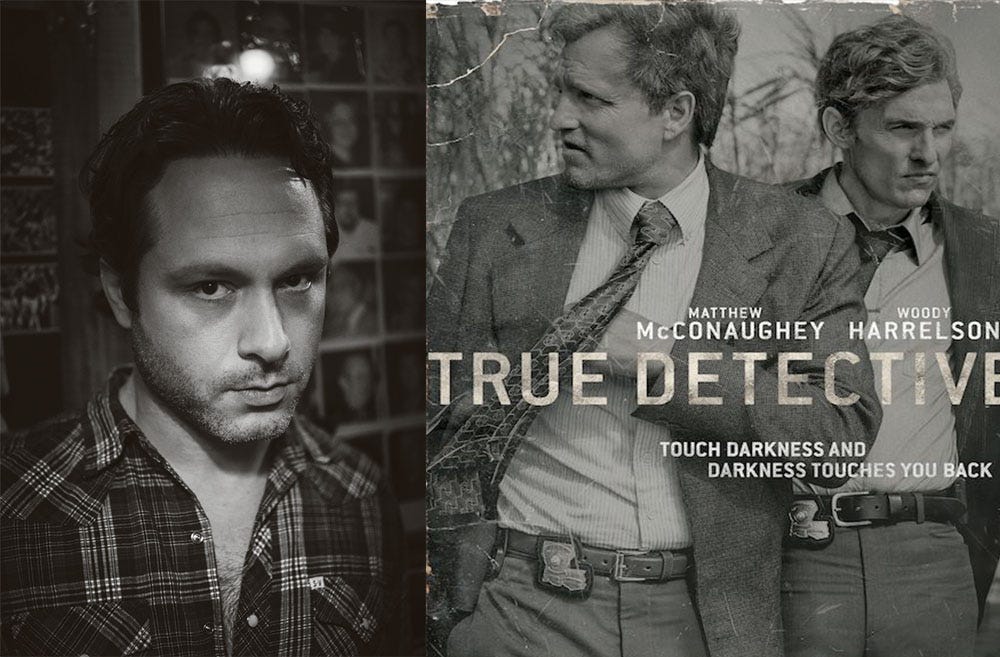
Nic Pizzolatto —True Detective…Season 3 (HBO)

You really thought Frank Semyon, a badass moustache and some Molly binanca could kill True Detective? Well, for a while it looked like you were right, but the new report is that none other than David Milch (HBO OG and, since we’re on the topic of novelists, former Robert Penn Warren protégé) is coming in to help Pizzolatto write a new season of the once-and-future king of TV crime fiction. Will Milch convince the author of Galveston to return to his Texas roots? Or will season 3 deliver on Pizzolatto’s old promise to write about “hard women, bad men and the secret occult history of the United States transportation system”? Couldn’t we get both of those things? And, please, if Milch does us this solid, could HBO throw him a couple bones and (1) jumpstart his long-gestating Faulkner adatations, and (2) give us the Deadwood movie we all deserve? Oh, and Pizoalatto is also supposedly developing a Perry Mason show for Robert Downey, Jr. (*mic drop*)

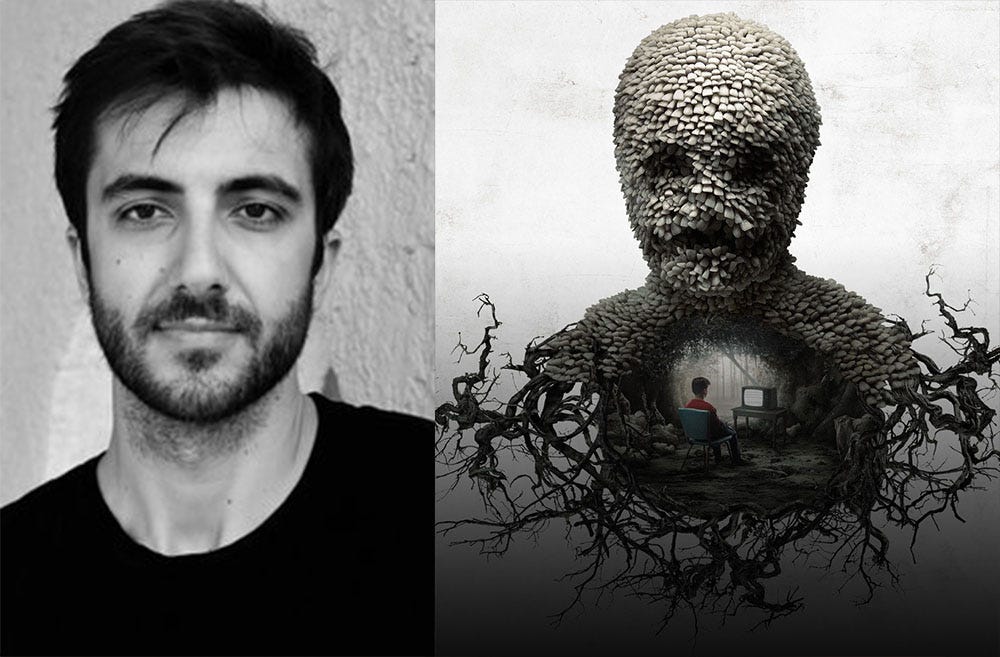
Nick Antosca — Channel Zero (Syfy)

Antosca, the author of Fires (2006), Midnight Picnic (2009), and The Girlfriend Game (2013) has been handed the keys to Syfy’s kingdom: Channel Zero, a horror anthology with episodes based on creepypastas. Antosca is the creator and showrunner, and with SyFy already committing to a second, third and fourth season, he’s going to be at full-writing-employment for quite some time. New episodes are slated for fall 2017.

Jonathan Ames, World’s End (TBS), Blunt Talk (Starz)

Ames — the bard of Brooklyn, or one of them anyway — is now a TV veteran, with three seasons of Bored to Death and two seasons of Blunt Talk under his belt. His newest creation, World’s End, is signed up for a TBS pilot, with Ames at the helm and Hamish Linklater and Wanda Sykes set to star. The show’s about an English professor (obviously) leading a mental institution revolt (a little less obviously, but not that far outside Ames’ wheelhouse).

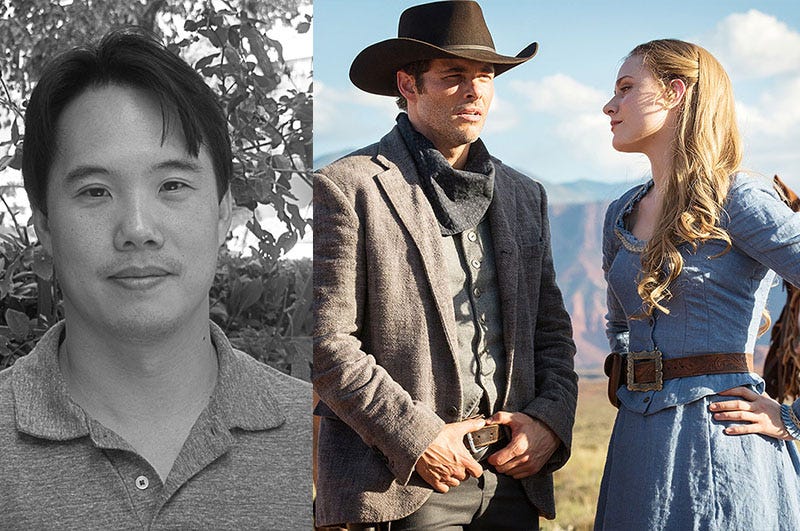
Charles Yu — Westworld (HBO)

Charles Yu, the author of How to Live Safely in a Science Fictional Universe, Third Class Superhero and Sorry Please Thank You is a bit of a polymath. Besides his gig writing fiction, Yu was also, until recently, serving as in-house counsel for the consumer electronics company, Belkin. But that was until Jonathan Nolan, Lisa Joy and HBO came calling, inviting Yu to join the Westworld writers’ room. Yu serves as a “story editor” for HBO’s high concept Sunday night mind-fuck; over the course of season 1 he earned three writing credits, so you’d have to expect he’ll be back for season 2 — Samurai World!

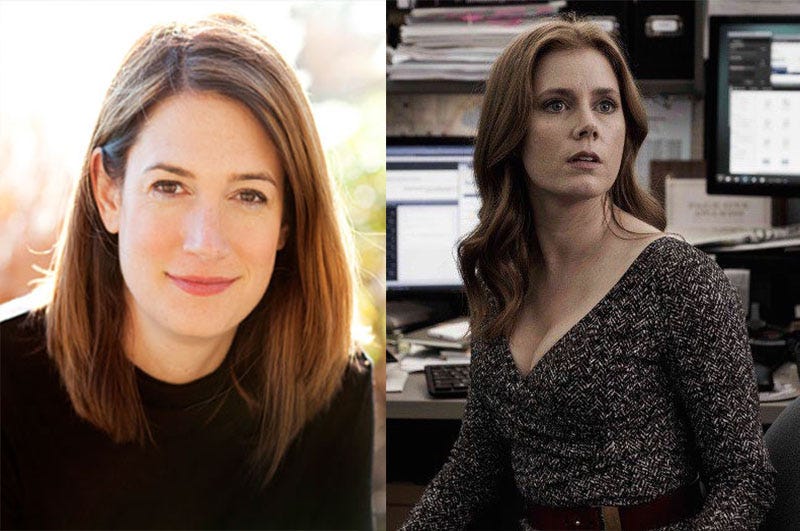
Gillian Flynn — Sharp Objects (HBO)

This long-awaited HBO series is finally coming together. A year after HBO first announced a straight-to-series order, filming on Sharp Objects has finally begun in Los Angeles. Amy Adams and Chris Messina will star, with Jean Marc Vallée directing, Marti Noxon serving as showrunner, and of course Gillian Flynn writing episodes (along with Noxon). The series adapts Flynn’s bestelling mystery novel. The story follows a journalist just out of a mental hospital who returns to her hometown to investigate a string of murders. After a series of rumored projects, Sharp Objects will be Flynn’s first script to hit screens since penning David Fincher’s 2014 Gone Girl film adaptation.

18 (More) Amazing Novels You Can Read in a Day

In ‘Exes,’ We Are What We’ve Lost

Max Winter’s debut is full of backwards, inside-out, and upside down pleasures

If I was to go about describing someone, I’d most likely list a few things that he or she is: short, bearded, kind, devious, a banker, slightly deranged, obsessed with antique armoires, very good at chess, sometimes bad at following directions, etc.

But if that someone is a character in Exes, the stunning debut novel by Max Winter, I would instead have to tell you what they are not. Or what they were, or what they’d lost, or what they are an ‘ex’ of, because Winter knows that often it is in our negative image that we can best understand one another and ourselves.

For instance, there’s Clay Blackall III, who isn’t really the novel’s protagonist, and who really shouldn’t be living in Twinrock, a hundred-year-old, seventeen-room summer cottage in Narragansett Bay. Once, Clay, like the cottage, was fairly well-off. Once he had a brother, Eli, recently deceased after his second car crash into the same house, and whose absence the entire novel revolves around. Clay, who feels his self split in two by the loss, retreats to the abandoned summer cottage, which belongs to the uncle of one of his brother’s exes, a girl named Alix, to try to make sense of it all by looking over the stories of people close to Eli.

“I spread them out,” he explains, “these exes, friends and neighbors. These stand-ins and one-night stands, body doubles and doubles.”

There’s Vince Vincent, an ex-actor, who looks exactly like Judge Reinhold and who almost got the part of Brad Hamilton in Fast Times at Ridgemont High. He now lives his life as not-Judge Reinhold, always acutely aware of the career he doesn’t have, except when he occasionally pretends to actually be Judge Reinhold, as he does when he spends the night with Alix, Eli’s ex.

Another ex of Alix’s is Rob Nolan, another ex-caretaker of Twinrock, who is also an ex-convict. Later we’ll hear from Cliff, who tries to help Rob become an ex-addict. There’s also an ex-high school class president, an ex-Jew, an ex-friend, an ex-foster father… but if this sounds at all exhausting, don’t be led astray.

The Dark Side of the Sunshine State

Winter handles the intricacies of each story masterfully, presenting us with genuinely moving portraits of those who have lost out or come up short. Each lends their own verse, and their own voice, to the unfolding story. Clay interjects between sections with his own footnoted observations.

Perhaps unsurprisingly the best of these vignettes belongs to Alix herself, who describes how Eli fell in love with her (he was her ex-teacher) as devastatingly as she later recounts watching him waste away before her eyes. She briefly ruminates on her ex-friend, Vivian, a performance artist in a women’s art collective called “Polyesther.” Tomboyish Alix says she prefers to think of herself as a garçon manqué, or a “failed boy.” The French, she explains, “can feel the presence of an absence like no one else.” They use the same word, she tells us, for “backwards, inside out, and upside down.”

Winter is a marvelous writer and Exes is a brilliant book, full of backwards, inside-out, and upside down pleasures. Reading his novel is like witnessing a slideshow made out of all the negatives. By which I mean, in the best possible way, that it is unlike anything you’ve ever read before. It’s so finely wrought, so playful, and so readable that you’ll somehow both savor it and speed right through to Clay’s final footnoted footnotes, where the book returns to his search for answers in grief once more.

Ted Wilson Reviews the World: Spaghetti

★★☆☆☆ (2 out of 5)

Hello, and welcome to my week-by-week review of the world. Today I am reviewing spaghetti.

Eating spaghetti is like eating a big plate of flavorless hair. I know this because I once ate a big plate of flavorless hair when a jokester presented it to me as spaghetti. The two are no different. That’s how I was able to eat all that hair without noticing.

But spaghetti doesn’t have to be used as spaghetti. If you take a cheese grater to dried spaghetti, it will turn into a flour-like powder which can be used to make other pastas, like rigatoni, macaroni, or others. Wet spaghetti can be squeezed into a ball in your hands and when dried it makes a pretty good paperweight.

Despite its transformative properties, most people just eat it as spaghetti. I recently went to an Italian restaurant to ask the customers what it is they liked so much about spaghetti. Unfortunately I couldn’t get past the maître d because I didn’t have a reservation.

I tried standing outside and mouthing my questions to customers through the window, but people kept turning away.

Given how cheap spaghetti is, it’s not so surprising people eat it. Price is a big factor in people’s diets. That’s how places like McDonald’s and Burger King survive. They make food so cheap that people are willing to forgive the flavor. If either of them started selling spaghetti they could really clean up!

But they’d also have a lot of messes to clean up because spaghetti is really easy to spill. Did you know that 36% of spilled meals are spaghetti? And that’s just in America. It’s probably a much higher percentage in Italy.

As much as I don’t care for spaghetti, I still eat it a lot because years ago I inherited a bunch from a cousin who passed away. He was a spaghetti collector. Some say hoarder but I say collector. It sounds less tragic that way, and I don’t want his life’s work to go to waste.

BEST FEATURE: It gives you an exaggerated sense of your own strength when you break a handful in half.
WORST FEATURE: It’s impossible to break in half a handful of wet spaghetti.

Please join me next week when I’ll be reviewing an alligator.

The Great 2017 Indie Press Preview

Beyond Voiceover: ‘Big Little Lies’ & Female Interiority on TV

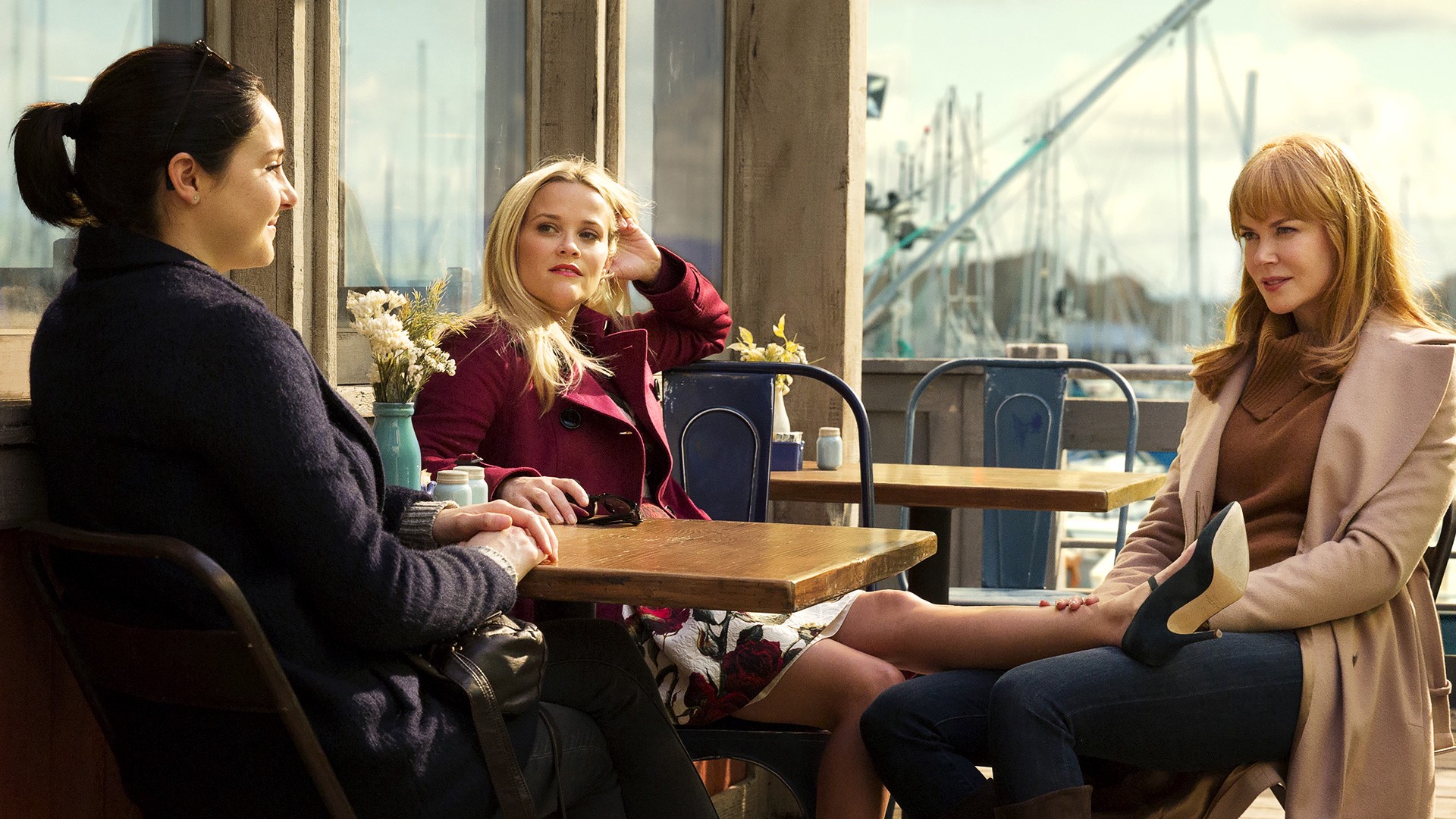
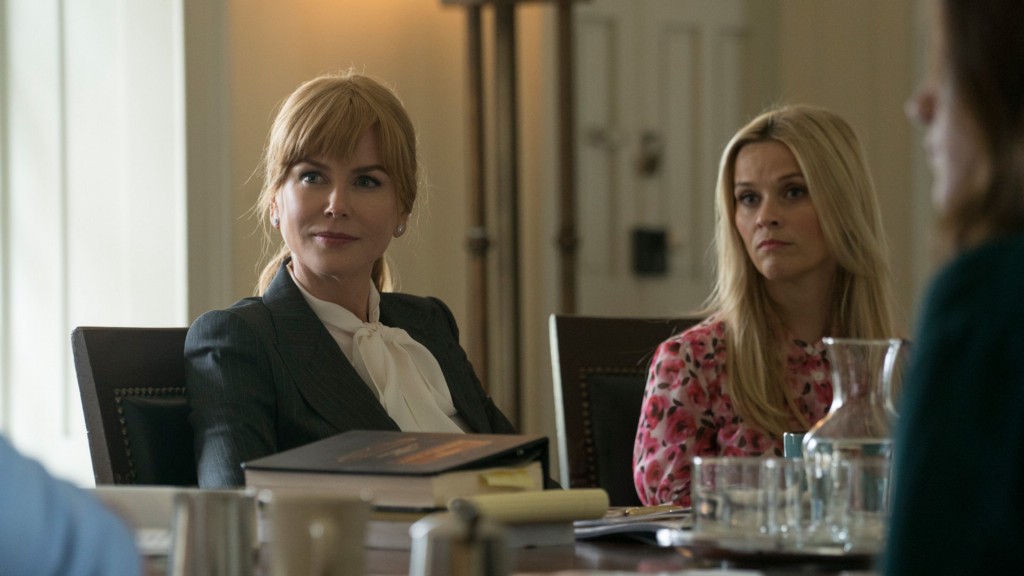
Big Little Lies opens with a crime scene. A school fundraising trivia night cheekily themed “Elvis and Audrey” has been marred by a tragedy. Police and ambulances are on the scene. Amidst bedazzled jumpsuits and Breakfast at Tiffany’s–lookalikes lies a body. Its identity is not revealed. Much as in Liane Moriarty’s novel of the same name, the recent David E. Kelley-penned and Jean-Marc Vallée-directed HBO miniseries is structured as a whodunnit, where the names of both the victim and culprit are left unspoiled, until the climactic final episode.

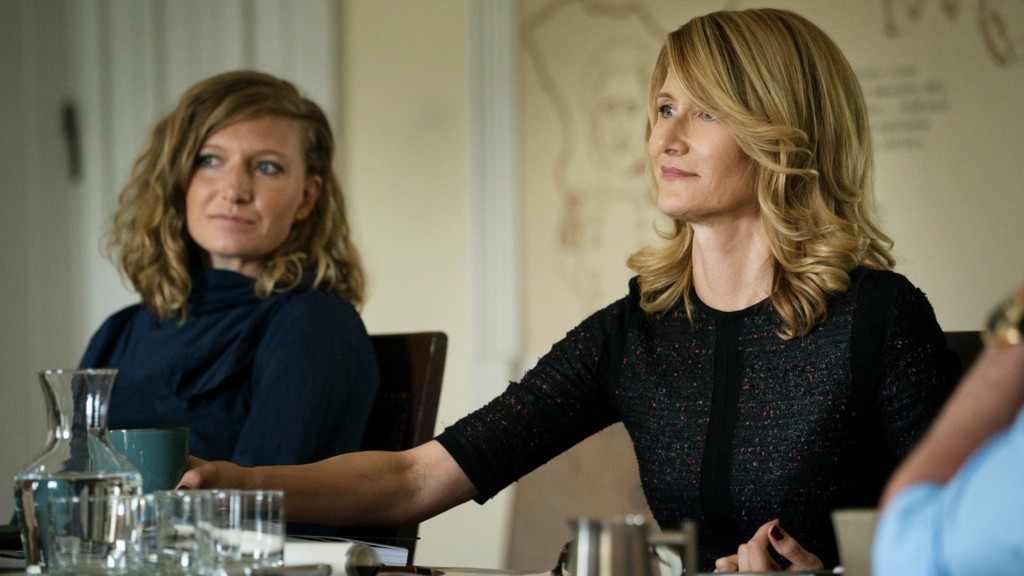
“It all goes back to the incident on orientation day,” we’re told by one of the witnesses being interviewed by the police. The incident at hand involves a young girl named Amabella (not Annabelle; it’s French, so her mother Renata, played by Laura Dern, says to everyone and no one in particular), who has been choked by one of her new classmates. Amabella points her accusatory finger to the newcomer in the area, Ziggy. His single mother Jane (Shailene Woodley) firmly believes that her sweet boy couldn’t have attacked anyone; he doesn’t lie. Gradually the school’s mothers take sides with one or the other. Madeline (Reese Witherspoon) — her young girl having taken a liking to Ziggy — stands by Jane, as does Celeste (Nicole Kidman), the mother of a pair of twins. The ensuing school politics end up having a ripple effect which, we’re led to believe, set the stage for the tragedy that strikes on trivia night.

Laura Dern (far right) as Renata Klein in ‘Big Little Lies’

Despite its genre trappings, which might cause you to mistake Big Little Lies for a kind of chick-lit murder mystery, Moriarty’s novel instead belongs among a long list of works which look to domestic spaces in order to flesh out and interrogate women’s inner lives. Moriarty’s use of free indirect discourse throughout the book allows her to shuttle between her three main characters — Jane, Madeline, and Celeste — giving voice to their lives of, not just quiet, but silenced desperation. While the incident at the school immediately frames the concerns of the novel around issues of gendered violence, the more access we’re given to these particular women’s stories the clearer it becomes that the novel’s interests lie in examining how domestic abuse comes to mark day to day life. What is often shamed and silenced instead becomes visible through her prose.

Take for example an early passage, which gives us access to Celeste’s view on her marriage to the dashing and doting Perry. Behind closed doors, and in frequent fits of rage, her husband lashes out and hits her — something she has come to understand as a flaw in their relationship, rather than as an indicator of a case of domestic violence. The narrator asks:

“How could they admit to a stranger what went on in their marriage? The shame of it. The ugliness of their behavior. They were a fine-looking couple. People had been telling them that for years. They were admired and envied. They had all the privileges in the world. Overseas travel. A beautiful home. It was ungracious and ungrateful of them to behave the way they did.”
These insights crucially advance the larger themes of the novel, concerned as it is, as the title suggests, with the kind of white lies which get away from us when left unchecked.

These inner monologues are not so easy to translate to the screen. They seem to more readily lend themselves to that most hackneyed and maligned of filmic tools, the voiceover. After all, voiceovers allow the viewer to literally “hear” a character’s innermost thoughts, unmistakably spelling them out. One can imagine a scene in HBO’s miniseries where a close-up of Nicole Kidman as Celeste would lead to a hesitant voiceover narration, announcing how and why her moneyed and beautiful character feels so conflicted about her marriage to Perry (played by Alexander Skarsgård). Thankfully we’ve been spared such an approach. Kelley and Vallée instead find a variety of ways to visualize the inner lives of these women, nudging us to map, onto the quiet fleeting glances and evasive gazes, newfound insights about what might really be going on behind their seemingly mirthful lives.

In the show’s first episode, Jane, soon after meeting both Madeline and Celeste, voices this very thought. It comes even as she’s enjoying the impromptu welcome coffee date which has made her and her son’s move to Monterey feel like the right choice. “I look at you and you’re so beautiful and you guys are just right,” she tells her new friends. “And for some reason that makes me feel wrong. I know it’s crazy. I know I sound crazy.” While Madeline purports to have no idea what she’s talking about, Celeste catches her eye, a clear acknowledgment that she knows only too well what Jane is getting at. This tension — of precious appearances which hide deeper insecurities, at risk of being revealed if one only let one’s guard down — is also at the heart of Moriarty’s novel. When Madeline first describes Celeste to Jane in the book she says that she is tall, beautiful, and often flustered. Right on cue Jane asks, “What’s she got to be flustered about if she’s tall and beautiful?” — a question the novel takes upon itself to gradually unpack, by letting us see just what it is that haunts these women’s everyday thoughts.

The more she has to deal with Renata and the school’s administration, with regards to the threat that her sweet Ziggy presumably poses, the more time Jane spends jogging all around Monterey (the setting of the novel is the fictional Australian seaside town of Pirriwee). The activity both soothes and overwhelms her: with her headphones plugged in these are moments when she can tune everything out and try to focus on self care, except for the pesky images of the ill-fated and violent one night stand that begat Ziggy which keep swirling up through her mind. Prior to confiding in Madeline about her fear that the violent streak she experienced in Ziggy’s biological father might have been passed down to her son, these jogging montages keenly connect Jane’s motherly concerns with the trauma she herself experienced in that nondescript hotel room. Placing us in Jane’s headspace, the quick-cut montages (a hazy image of the hotel room joined to a nightmarish jump off a cliff; a view of her Ziggy sleeping soundly collapsed with a faceless and threatening man choking her), often ending with a shot of her stranded in a smudged party dress in the middle of the beach, conjure up Jane’s anxieties without ever needing to spell them out too tidily.

Vallée is aided by his self-aware use of contemporary music, featuring, among others, Frank Ocean, Sade, and Sufjan Stevens. Most often associated with Madeline’s daughter — the precocious Chloe (Darby Camp), who plays DJ at home and in her mom’s car — the tracks punctuate and explicate the world of the women living in sunny Monterey. After Madeline fights with her eldest daughter from a previous marriage, and the teenage girl elects to move in with her dad, Chloe gifts her mom a song which captures exactly how she should be feeling: “See, I’ve been having me a real hard time, but it feels so nice to know I’m gonna be alright,” the Alabama Shakes sing, as Madeline sheds a tear. Small moments like these add to the sense that Big Little Lies is relying on an entire televisual vocabulary, to capture what Moriarty’s prose did in far blunter terms.

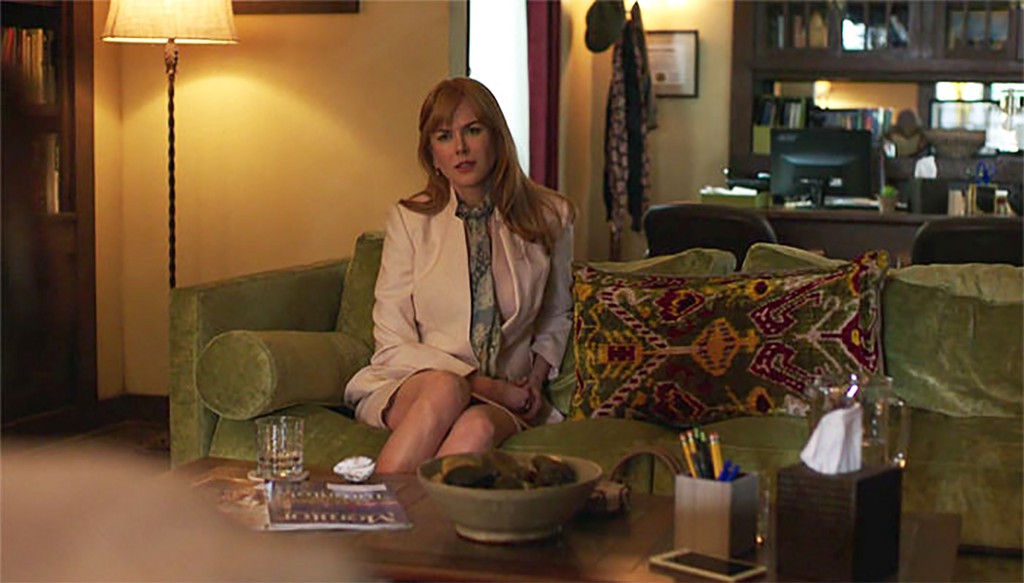
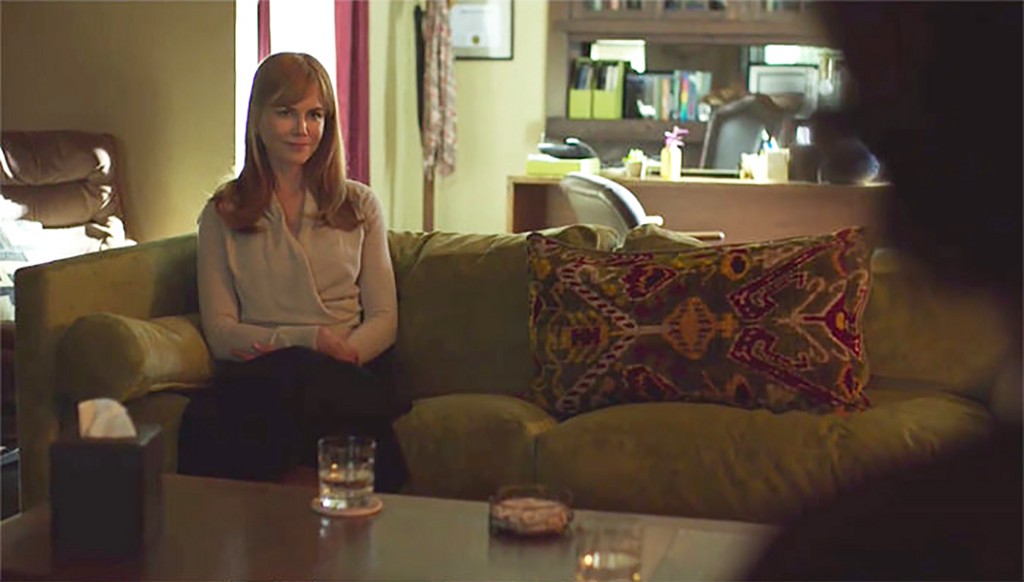
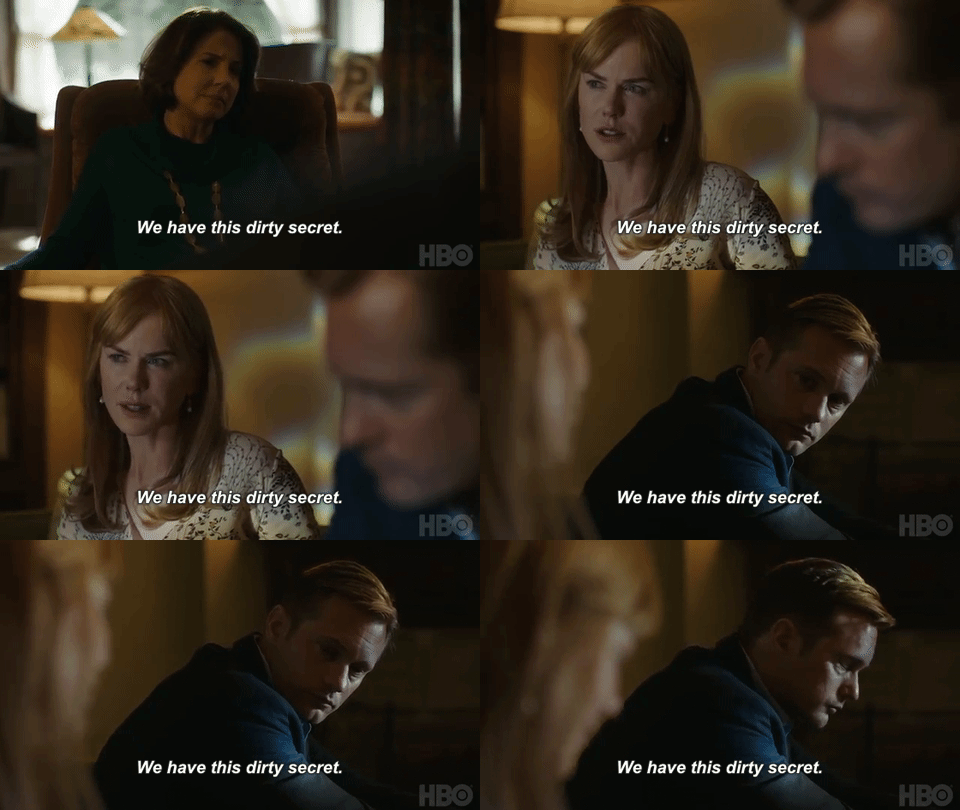
Similarly, in the way the novel allows its reader ready access to its characters’ interior consciousness, perhaps the TV adaptation’s most thrilling take on the book is in the scenes of Kidman’s Celeste visiting her therapist, Dr. Amanda Reisman (Robin Weigert). In Moriarty’s novel Celeste can barely muster up the courage to ask Perry to try couple’s therapy. She instead visits the sterile office of a counselor herself, one whose expertise happens to be in victims of domestic violence. Celeste appears to find the situation laughable — the incongruousness of a beautiful happily married woman seeking help from someone whose specialty is with people who are actually being abused by their spouses. The visit nevertheless triggers thoughts that eventually lead Celeste to reassess what is wrong with their relationship — or what might in fact be wrong with Perry. Though little actually gets said at the session, we are made privy to the acrobatic mental tricks Celeste plays out as she carefully divulges glimpses of the violence which often leaves her bruised (though never, of course, on her face). As Moriarty writes,

“each time she didn’t leave, she gave [Perry] tacit permission to do it again. She knew this. She was an educated woman with choices, places to go, family and friends who would gather around, lawyers who would represent her. She could go back to work and support herself. She wasn’t frightened that he’d kill her if she tried to leave. She wasn’t frightened that he’d take her children away from her.”

That certainty begins to falter, however, the more she is urged to share about her life at home.

Keenly aware of how crucial those moments of self-reflection are for the character of Celeste, the TV adaptation opts to expand on the role of the therapist in the show. They are perhaps the most electric scenes in the entire series, a perfect setup in which to explore the real-life perils of openly voicing one’s inner thoughts and fears. Vallée alternates between long takes of Kidman and Weigert, as they square off in terse exchanges that bristle precisely for what is clearly being left unsaid. The decision to frame Kidman in a medium shot — particularly during her first visit to Dr. Reisman’s office, when she brings Perry along — allows us to track Celeste’s numerous reservations about what is being shared in this seemingly safe space. We can see her tense up when Perry alludes to the violence that defines his anger and their subsequent lovemaking. By the time she returns to Dr. Reisman alone, the shot highlights Perry’s absence in the same frame, reminding us of his power over every word choice and pithy anecdote Celeste gives herself permission to share.

In those moments when Kidman tugs at her sleeves, unwittingly pulling attention to the bruises we know lie underneath, or half-decides to grab her handbag as if she were about to storm off, we glimpse the full range of Celeste’s inner conflict about opening up to Dr. Reisman. Every interaction becomes a minefield, and each reaction shot we get of Weigert ends up mirroring our own. More than just a meaty performance showcase for Kidman, these scenes achieve the well-meaning didacticism that Moriarty’s book espouses, teaching us how women’s shame about domestic abuse is so often apparent for anyone to read, if we only know what to look for.

The climax of both versions of Big Little Lies is in the revealed identities of the murderer and the victim. But by the time we find out who, how, and why they died, it’s clear that the investigation has served more as a frame through which to study the lives of these women. Peppered throughout Moriarty’s novel and the HBO series are testimonies from those in attendance at the school’s trivia night, who spare no thought before speaking openly about the bickering between Renata and Jane, the explosive marriage of Celeste and Perry, and Madeline’s ongoing problems with her ex-husband and daughter. The gossipy tone of these interjections may setup a hokey structure, but they remain key in establishing Big Little Lies as a narrative about deconstructing façades and looking behind picture-perfect-looking lives. “None of us see things how they are,” a character nonchalantly explains to her husband at one point in the show. “We see things as we are.” Big Little Lies thrills because it doesn’t just show us its characters, it lets us see the world as they are.

Hitler Was a Secret Junkie — but Does It Actually Matter?

An analytical look into Norman Ohler’s Blitzed

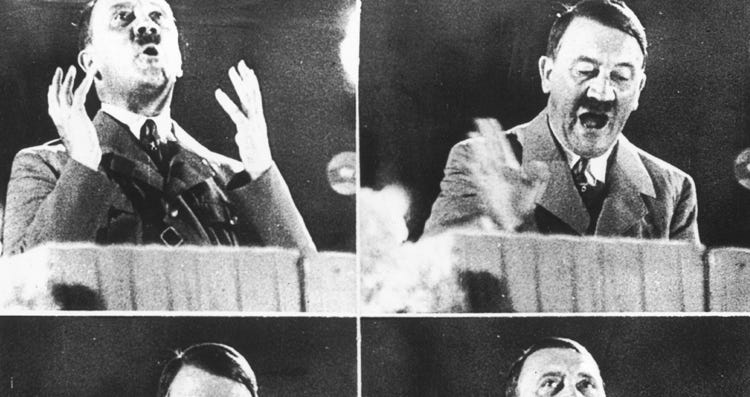
Adolf Hitler, the ruthless and inhuman German dictator that nearly murdered millions of people (ruined countless people’s lives and erased history through the decimation of European cities), was apparently on a drug cocktail of cocaine and opioids throughout World War II? Well, he was — and it’s the subject of Norman Ohler’s latest nonfiction book Blitzed. It’s always been a mystery as to why Hitler’s unrelenting, and often times, crazed manic optimism never seemed to dissipate as the war progressed, despite the fact that the Third Reich was losing the war they waged. And really, it’s not so hard to put the pieces together when you realize most of the Nazi party was drugged up and blitzed out.

The evidence is all there: in obscure letters, records, and diary entries of various Nazi party members, including Hitler’s personal doctor, Theo Morell — who treated Hitler up until 1945 when he was fired (Hitler finally seemed to “realize” Morell drugged him as a way to deal with his health issues). Ohler researched all of this in the German federal archives and other collections. According to Ohler, the drug was manufactured in ridiculous quantities, in 35m tablets — and claimed that average civilians Pervitin became a routine “grocery item.”

The book describes three phases of Hitler’s drug use administered solely by Morell: the first being high doses of vitamins, the second starting in 1941 with opiate usage, and the third starting in 1943 with heavy opiate usage.

Hitler, who bragged about being a celibate drug-free vegetarian (who refused to drink), initially started waging his war alongside propaganda that he would make Germany a drug-free state. Of course, this was far from the truth, especially considering with relationship with Eva Braun, who was hidden from the public for this reason. This bizarre duality — the false illumination of purity and the real life of grotesque psychopathy and excessive behaviors — showcase the hypocrisy of the Nazi party, as well as highlighting the fact that the war was not a war to “help” Germany or to be more pure, but merely a war on the Other (people who were Jewish, disabled, gay, etc).

Starting in 1941, as the war turned a rather dismal turn for Germany (thanks, Russia), Morell began giving Hitler opiates when he became sick for the first time. Between 1941 and 1944, his health declined — which has been noted significantly by historians, but it has been speculated to be the result of Parkinson’s Disease. Hitler may have suffered from the disease, as it appeared Morell did give him medication to treat it; however, his declining health could have also very well been a result of intense drug usage — and then withdrawal when he fired Morell in 1945.

A Perfect Introduction to a Genre Bending Master

But Hitler wasn’t the only one on drugs; so was the entire Nazi army. It all started in the mid-1930s when Berlin pharmaceutical company Temmler developed Pervitin, a methamphetamine, which we call crystal meth. The drug, which Ohler claimed, was used so widely and commonly that it became used to anything from depression to fatigue by the German civilian population, as realized by Professor Otto Ranke, who then started doing tests on German soldiers and realized it was the precise drug needed to win the war, as it reduces fear, need for sleep, and increases focus and attention.

This resulted, very quickly, in tablets of methamphetamine supposedly being given like candy to the troops regularly — two before an advance, and then another pill after 12 hours, and then so on and so forth. Basically, all of Germany was blitzed out — and clearly, the rest is history. In general, at the time, the Temmler factory made 833,000 pills a day. Apparently, even Leo Conti, the then-minister of health was concerned about Germany’s addiction — although nothing came of his worries.

While the drug use has never been so widely and publicly written about before, it’s also not necessarily the first book of its kind. While the information was indeed hard to find and coded in some of the documents (for instance, Morell, while writing lengthy daily entries about Hitler’s drug use, often obscured the language so if the entries were checked, it would be hard to know exactly what the drugs were), there is some controversy over how widespread the drug use was. While the New York Times, “Hitler biographer Ian Kershaw called it ‘a serious piece of scholarship,” other scholars believe that Ohler has overplayed the drug usage in a way that presents as false historical picture. Richard J Evans wrote in the Guardian as such, stating:

“Earlier historians have shown in detail the limited extent of Hitler’s drug abuse, while there are other books, notably Werner Pieper’s Nazis on Speed, which put the military employment of methamphetamine into perspective. Ohler’s skill as a novelist makes his book far more readable than these scholarly investigations, but it’s at the expense of truth and accuracy, and that’s too high a price to pay in such a historically sensitive area.”

It’s also crucial to note that Ohler, whose book is definitely fascinating, may also be misleading — and that could be dangerous especially in a time of political turmoil and growing public racism. For instance, in the book itself, Ohler said that he purposefully wrote with a “distorted perspective,” which as a reader, automatically questions his authority and intention. While I don’t think Ohler is anti-Semitic, I also do wonder about the outcome of this book and the intention of portraying a drugged-up Germany.

For example, this portrayal of a “blitzed” out Germany and Hitler could be seen as sympathetic, as it almost makes it seem like the German people and soldiers didn’t entirely know what they were doing — or were too preoccupied with getting their fix that an entire genocide seemed to be happening without much thought. While I’m not a moral police, that thought, or implication, has serious ramifications, especially for those who World War II wasn’t a direct affect in their families’ lives. As someone whose entire family served during World War II, and whose family has relatively recent immigrant roots, I also can’t help but question some of it, even though it is a fascinating part of history.

The bigger questions to raise are if Hitler’s and the Nazi party’s drug use actually matter? And should we allow it to matter? While Ohler did state that Hitler was the “master of his senses” and that he knew what he was doing, it also seems to present its own duality within the text itself that isn’t fully resolved or acknowledged enough — yes there was drug usage and yes, drugs do terrible things to our bodies as humans, but racist psychopaths who murder people are still morally responsible for their actions, regardless of what chemicals runs through their bodies. While Ohler says this, some of it remains ambiguous in a way that is unsettling, especially now.

How to Harness the Energy of Female Rage, Creative Destruction & the Cosmos

Lidia Yuknavitch and Sarah Gerard dive deep on artistic violence, Trump, rewarding male tantrums, and the fabric of time and space

NGC 7293, aka “The Helix Nebula.” (2012) Captured by the Galaxy Evolution Explorer, courtesy of NASA.

The first book I read by Lidia Yuknavitch was Dora: A Headcase. Though all of my friends were busy devouring her timeless, immediate-cult-classic memoir The Chronology of Water, it was Dora that first established Yuknavitch in my mind as a writer I needed to follow. It’s a reimagining of Freud’s most famous case study, set in present-day Seattle, with Ida (alter-ego: Dora) at the center. She’s an artistic, loud-mouthed, rule-breaking teenage girl who longs for intimacy — needless to say, I related to this. The book drips with sex and dark humor and sarcasm, and anger, and white-hot teenage girl rebellion. Most importantly, it’s told from Dora’s point of view. Like an atom bomb, it breaks apart an old story to bring new energy into it.

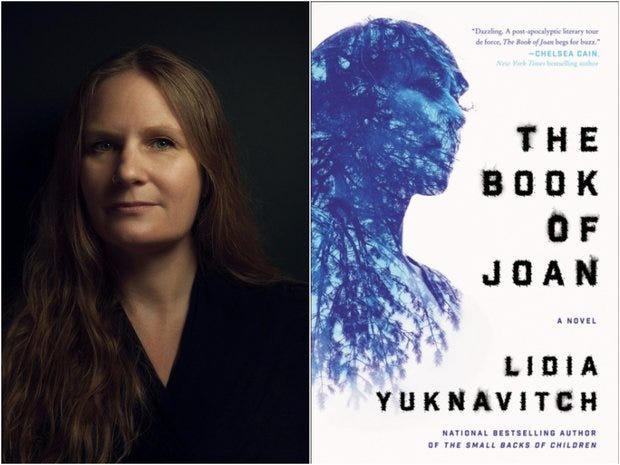
In The Book of Joan, released this month, Yuknavitch takes the story of Joan of Arc as her raw material. As with Dora, her reimagining frees the character of Joan from the constraints of her original version, and in doing so calls into question our received definitions of God, the body, womanhood, war — even what it means to be human. Yuknavitch describes the novel as a love story, but although it includes a romance, I suspect she’s using the term more broadly, to encompass of all of humanity, all life on earth, all possible life in the universe.

The setting is post-apocalyptic: split between Earth, decimated by world war, and CIEL, a sterile spacecraft hovering above the planet, where the remaining humans have defected. Earth’s surface is radioactive, unable to sustain anything more than the barest forms of life and a few human survivalists. Humans on CIEL have evolved into pale, sexless, hairless creatures burning stories into their skin — a reminder that our stories are what link us, bodily, to our past.

Like The Chronology of Water and her last novel, The Small Backs of Children, whose protagonists are an Easter European war orphan and the photographer who garners critical acclaim for her photograph of the girl, The Book of Joan is ferocious and indelible, grappling with what it means to love in the midst of violence; and how we transform fury, agony, and history into art. It is huge in its scope, moving seamlessly, quantumly, between dirt and cosmos, and through the wormholes of nonlinear time. I talked to Lidia via Skype about The Book of Joan, the current state of our world, and art-making as transformation.

Sarah Gerard: I was reading The Book of Joan this morning and thinking about how violence and tenderness are intermingled. What do we do with the tenderness we feel toward people who have hurt us?

Lidia Yuknavitch: They make a helix in ways that we don’t really know how to navigate. The pleasure/pain helix, or the violence/tenderness helix: we’re terrible at negotiating that, but they’re always intertwined. I’m always spouting off about how the beautiful and the brutal are next to each other, we just don’t like to admit it. I know you know what I mean because all of your characters have that quality, and that’s one of the reasons I love your work. I got interested in the idea of how anger and love are actually two sides of the same thing. But I don’t mean, like, “We should accept abuse into our lives.” I just mean that if we look at them as energies — and I don’t mean in the west coast “wu” way; I just mean in terms of physics — because that’s all we are: energy and matter — if we look at it as energy, we can ask better questions about what to do with it.

SG: Right now, my challenge as a writer is that I’m feeling a lot of anger and a lot of violence toward the world.

LY: Yes.

SG: At the same time, I’m trying to work through a very specific line of love and pain, that helix, in the form of a new novel. I don’t want to isolate this one story about love and pain, and yet I have to, because that’s the only way I can finish the story. It’s hard to negotiate. Rather, it’s hard to parse those feelings, because the story of the book seems to be constantly changing, as I navigate these feelings in my everyday. What’s important in the story seems to be constantly changing.

LY: In Joan, I tried to make a character who represents this thing we’re talking about. So she’s as connected to destruction as she is to creation, which is all I’ll say about that. I wanted to make this kind of troubling figure who’s carrying these contradictory impulses. And worse, I made her a woman! Gasp! Not supposed to do that, right?

SG: But what else could you do?

LY: Exactly. You used the word love a second ago. For me, The Book of Joan is a love story, except I had to, in my head, kind of let myself radically reinvent what we mean by a love story.

SG: Oh man, I was going to ask you about love! Can we try to define it today? This is so great.

LY: Yeah! I think I identify with your work because in your stories, and your characters, you’re often unearthing these bizarre forms of tenderness or love that people don’t usually acknowledge, but I see them very big, like you’re speaking my language. I get it.

SG: I’m thinking a lot about love these days. I’m seeing someone new, and loving in a completely new way.

LY: Yes!

SG: It’s freaking me out because I’m not used to it. I’ve never felt something so soft before. I don’t know what to do with all of this softness. I don’t really know how else to put that. In every other relationship that I’ve entered, in the beginning, I’ve built myself up for what was about to happen. You know? So, “This is probably going to go wrong. At some point, this is going to get ugly. I already see the warning signs, but I’m walking into the fire anyway because the fire is beautiful.”

LY: I know. It’s like there’s a pre-existing story, and so we all kind of gravitate toward it, because it’s what we know. Right? We’re going to have to, in our lives and in our art, really reinvent ourselves. Even listening to what you just said — that’s, like, the most beautiful thing I’ve heard in a decade.

Author Lidia Yuknavitch.

SG: How do you keep yourself tender on the inside when there’s so much hurt in the world?

LY: Oh, yeah. I guess this sounds a little smarmy and cliché, but I actually think our vulnerabilities are our strengths, and we’ve just fucked up so far by thinking that our strengths are these exterior shells of surviving this or that, or being able to fight and win. When really, our strength is stillness and the ability to stay open and vulnerable, which corresponds more to the natural world and even the cosmos. You know, a kind of quiet, a kind of stillness, a nothingness before a thing gets born. It’s actually not hard for me to continually try to embrace our vulnerabilities because embracing the show, quote-unquote, of our “fictional strength,” is starting to look absurd to me. It’s less and less hard for me to embrace vulnerability, because that other thing just looks stupid.

SG: Yes, it does.

LY: The zenith of that other thing is Trump.

SG: But it takes humility to live in the other way.

LY: It does.

SG: That’s the difficult thing, I think, because you make yourself vulnerable to attacks from the outside. It’s like in a relationship, when you admit that you’ve done something wrong and then take steps to change your behavior. The relationship needs to be a safe place wherein you can change your behavior and not face constant criticism.

LY: It’s hard to find the fellow mammal where you can let that be true. I mean, I struck out a whole bunch of times. This is my third marriage and it’s my seventh long-term relationship.

When you find it, it’s astonishing. If both of you will let the other continually recreate, that’s amazing.

SG: Then, also, on a public level, too. Thinking of somebody like Trump, who’s in the position of needing to change his behavior in a serious way. He’s very sensitive to the portrayals of himself in the media, and that constant criticism. And so, how does a man like Trump — I mean, it would be a radical act of humility for him to change his behavior at this point. What do you do if you’re Trump?

LY: I hate thinking of anyone as a lost cause because, I mean, I work with people in jails, and I’ve been in jail, and I work with rehabbers, and I’ve been the addict — so, I hate ever saying someone’s a lost cause. But talk about someone who missed developmental stages. He seems locked in that preteen space of: if I don’t get constant attention and reinforcement, I’m going to throw a tantrum.

SG: He’s just a constant tantrum.

LY: I guess I’m infantilizing him, but it’s a little bit true that he didn’t make it through the stages where you have to separate and individualize. I also think he’s just a classic narcissist. He doesn’t need us, except that he needs to be showered with praise.

SG: He’s the epitome of the toxic narcissist.

LY: Yeah, which we’ve all met.

SG: Are you finding that this presidency is affecting your work? Because it’s really confusing me. It’s making me feel all kinds of mixed-up.

LY: Can an answer be yes and no? I mean, because I started out as a writer who was agitated and who also tried to agitate with their writing, it’s not that different for me. I think what’s creeping in that is different is this feeling that more is at stake. I’ve always been pissed off. I’ve always felt like an outsider. But the threat now seems closer to our actual front doors, because it is. It used to be that I could sit down and, no matter what weird creative thing was coming out, I just chased it — like, “I don’t know what that is, but it looks interesting.” I find that now, when I sit down, it’s kind of somber. It’s sort of like, “I shall not write this silly thing.” So, that worries me a little bit, actually.

“I’ve always been pissed off. I’ve always felt like an outsider. But the threat now seems closer to our actual front doors…”

SG: It feels like you have less room to play.

LY: Yeah, and so I know to fight that. I know that’s not true, and I know it’s deadly to creativity, but I’m having a little bit of struggle there.

SG: I’m finding that it’s harder to forget that the outside world exists. I’m feeling really distracted.

LY: I agree with that, and maybe that’s a good thing for us right now. That other way, where you get to just be the artist alone in your imaginal, that’s beautiful, and I love it. Like I said the last time I saw you: I would stay there if I could — I could stay there. I love it. But maybe this is a good wrenching.

SG: I think it’s a good thing and a bad thing. I’m finding it a lot harder to create and to find time to create because — and this is just a matter of admitting that I am the creature that I am — what I need is solitude and silence, because I’m super sensitive, and I’m shy. That’s just who I am. But I also feel like there’s more at stake, so when I sit down to write, I’m less afraid to say the real thing, because there’s no time to waste.

LY: Oh yeah, I feel that too. It’s like, fuck it. There’s no other now.

SG: Exactly. What are you writing now?

LY: I feel like I’ve been editing for three years because I had those two books in a row, and you did, too. I feel like I’m in this weird editing mode that I don’t like. Do you feel that?

SG: I’m writing something new now — and I wrote and edited Sunshine State in a little over a year, right after Binary Star came out, so I feel like I’ve just jumped from one project into the next, into the next. I kind of rushed myself into writing the next thing right away because I didn’t want my ideas to expire. I also wanted to ride the wave of my first book.

LY: I have a fictional thing moving in the direction of a novel — it feels longform — coming out of me, and a kind of non-fictional thing. But for me, I don’t know what the form will be until it tells me, so I haven’t quite detected the form on either one of them. I just know the fiction one has a feral child in it, and the non-fiction one is definitely not traditional.

SG: How so? I feel like we’ve exploded tradition.

LY: Yeah, it’s not useful now, is it?

SG: It can be, in an experimental way, if you’re looking for the shape of something. It can be a place to start.

LY: True. Well, when you say it that way, I’m borrowing forms from the tradition but then I’m letting them become something else. I guess I’m a form junkie. Are you a form junkie?

SG: When I teach writing, so much of what I’m teaching is how to find your voice through form. Like, what does this form actually mean? How does it shape the story? How does it shape the meaning of the story? How can you best say the thing with this?

LY: One of the dangers for me is I love form so much that sometimes I stop caring about content. So I guess in these new things that are coming out of me, I’m kind of longing for content to show itself. There’s a kid in the center of one of them, which is not very surprising because I seem kind of obsessed with putting children in the center of things, but this kid is really interesting me because there’s no way to know it — because of what I’ve decided it is: it’s a creature.

SG: You can’t get inside it?

LY: I’m having to invent ways to get inside it that aren’t necessarily human. That’s why I use the word creature. It’s really fun, and I have no idea what I’m doing, and therefore I like it.

SG: But you know that it’s a child?

LY: I do.

SG: So what does the point of view of a child afford you as a writer?

LY: What I love about children is not children. I didn’t think I would have children, and I wasn’t the mom who really wanted them, and I didn’t feel the biological clock. I had a bad experience that was tragic and then a boy creature came out and he’s amazing, but I wasn’t in the maternal zone. But what I love about children is that they’re not finished forming, and so they’re like raw language in that way. They can be anything. I guess this is true of animals, too: They’re forming toward something we all know about and we all assume will turn out a certain way, but there’s always this chance they might not. And you get one that turns out really weird. I love that idea. They’re just this side of signification. You know, they’re entering signification, but they’re not quite there yet, and so they’re in this state of pure imagination, with all these drives. You have to show kids what good and bad, violence and passion are — you have to show them. What they come with is sort of berserk. When they’re really little, they’ll stick their finger in the plug, or they’ll poke the dead thing with the stick and then try to eat it. They’re really interesting.

“What I love about children is that they’re not finished forming, and so they’re like raw language in that way. They can be anything. I guess this is true of animals, too.”

SG: I feel like poking the dead thing with the stick is cool. If I were a mom, I’d be like, “Go ahead and find out what that is.”

LY: Totally. I’m probably the worst mother on the planet.

SG: No, you’re probably the best mother on the planet.

LY: Every single one of those instances, I was like, “Ah, cool!”

SG: Kids are fascinating. They have their own agency in a story. You never know what they’re going to do.

LY: The only reason I wanted to take it a step further by making it a feral child was so that I could know them even less. It’s probably a terrible idea. I took language away from this creature, and I took human behavior away from this creature, so how am I going to write that?

SG: It sounds like they’re working their way into the story, right? So the story has a direction then.

LY: That’s right. That’s right. And the story kind of has to come to them to make its meaning.

SG: Here’s the question I’m asking today about stories: how do you feel satisfied as a writer, or can you ever? The story that you’re writing isn’t necessarily the story that you emotionally need to be telling. Well, in a way it is — it’s like an emotional problem that you’re trying to solve, right? But the story has a life of its own, too, so the place where it ends up isn’t necessarily the place where you need it to go in order to completely answer this question within yourself.

LY: Always, yes.

SG: So, there’s the rest of this need hanging over. Do we just consider that the next story we tell? I guess,what I’m asking is, can we ever tell a complete story, a story that satisfies us completely?

LY: You hit on it profoundly. You start out in the motion of telling and then the story takes you somewhere different, and you can either rein it back in — which I think some writers do, and they’re my least favorite writers, to be honest with you — or you can follow it and let it become what it is. And then what’s left over, the residual, has brand new energy for other artistic production. I think that’s mesmerizing and exciting, and how you keep your own writing alive. I think you worded that perfectly and profoundly.

SG: Thanks, Lidia.

LY: You heard it here.

SG: Then there’s the thing about the way a story changes you. If our writing follows our own personal development, then by the time we reach the end of the story we’re somebody completely different.

LY: When you finished Binary Star were you different?

SG: Oh, yeah.

LY: When you finished Sunshine State were you different?

SG: Profoundly.

LY: Totally, completely agree.

Author Sarah Gerard. Photo by Levi Walton.

SG: It was like I had awoken from a dream. Sunshine State was all of these things I didn’t know I wanted to say, and here they are in 400 pages. I had no idea that was going to happen.

LY: I started thinking about it as…I collect snakeskins. In addition to having a hair fetish — because I have a collection of people’s hair — I started collecting snakeskins because they’re such metaphoric reminders that, after every book, you kind of shed the skin you didn’t know you don’t need anymore. You come out with this new skin, and it’s like everything is on the surface, and everything is new and it kind of hurts. But that skin that kept you, you don’t need it anymore. And then there it is, and you can look at it. It feels like that a little bit. Also, snakeskins are just cool looking.

SG: I collect seashells for a similar reason. Well, first of all because they’re like us: like the beautiful refuse of the world, of the ocean, of the thing we all come from.

LY: I see you put that in your work all the time. I see you put objects in there, and I see you put shells of things, you know, shells meaning more than one thing, and I see you marking the beauty of the detritus or the left. I’ve seen it in your work a lot, I love that feature.

SG: Thanks.

LY: I’m your biggest fan.

SG: This is a mutual admiration society meeting.

LY: Well, so what, ’cause the world fucking sucks, like hard. So what?

What Makes Florida So Florida?

SG: And yet there’s beauty, right?

LY: There is.

SG: So what’s the function of beauty then?

LY: That’s such a good question. Well, because I’m talking to you, we can agree that beauty can come from what other people might look at and call monstrous, or atrocious.

SG: Right.

LY: And so, I’m glad I’m talking to you about this question because I think that part of the function — I mean, I don’t know the answer, but I think part of the function of beauty is to remind us that being alive is more than just surviving or functioning. It’s dreaming and imagining, and probably if humans evolve — and it’s not looking positive right now, we may devolve — but if humans were to evolve we actually move farther towards the imaginal, or the dream, or the kind of space of creation, and away from just functional, and action, and physical success in the universe. So I think beauty has to do with that motion, but I could be full of shit.

SG: I think you’re right. I think it also shows us how the world can be more symmetrical, or balanced.

LY: All those times in Binary Star where you go to the cosmic, for me personally, they were huge moments of going from micro to macro. In terms of what it means to be alive.

SG: Yeah, you do that in The Book of Joan, too.

LY: Every moment of that just blew my mind. I love that so much, and when I teach that book I make everyone pause a long time to consider that. I turn the lights off and I show images of black holes and white dwarfs, like cosmic things that also kind of remind you of internal biology and the human eye, and stuff like that.

SG: Exactly. I was thinking about that when I was reading The Book of Joan, too. You just go from this cosmic field down into the dirt.

LY: I was really obsessed with the idea of the back-and-forth option of being.

SG: It’s built right into the plot. It’s the whole plot of the book.

LY: That’s right. Well, thank you for noticing. It’s a weird book. I think some people won’t see that.

SG: I say that whenever someone compliments Binary Star, too. I’m like, “Thanks, it’s a weird little book. I don’t know what I did there.”

LY: But it’s not like we don’t know they’re weird, right?

SG: That’s why they’re great. You and I, a couple of months ago, when we were having our last mutual admiration society meeting — we were talking about God and how we think about God, and because these books are so similar, I guess I wanted to ask you how you define that. I’m using “God” as a shorthand — but what is that to you?

LY: Well, I moved really far away from any theological definitions of that word, or any organized religion definitions of that word. I can still have respect for people who apply those definitions, but I’m not one of them anymore. For me, what has replaced the word has more to do with physics and space and science and stuff that is asking a similar question, like: Is consciousness bigger than we think it is? Does it move? Are we part of something larger than this ego meat-sack thing? Those are similar to theological questions. I just am uninterested in the belief system pack. I’m more interested in: What if we let go of old definitions of being and opened up to other possible definitions of being? So, that word [God] isn’t very useful to me anymore — just personally. There’s no less awe, there’s no less wonder. Even when I was talking to Miles last summer — we were outside at night, and he always does this, he busts out with a sentence that makes me think, “Where does this creature come from?”

SG: You!

LY: And he’s just looking up at the sky and he goes, “What kind of asshole would think things are less wondrous because you take God out of it?” And he was just looking at the night sky, and I’m like, “Dude, you are so awesome.”

SG: He hit on it exactly.

LY: I know! The sense of the sublime or the ineffable or the wondrous doesn’t go away because I took traditional notions of God out. It actually gets bigger.

SG: You know, I was raised in the New Thought Movement, where there is this big focus on transcending the limitations of our material selves and learning to heal ourselves with the power of our own minds. I love that, but I think I would kind of flip it on its head and say that we’re not transcending our material selves because our material selves are imperfect — we’re becoming more closely entwined with our material selves and thereby connecting ourselves to the matter of the whole universe.

LY: If we could open our understanding to the actual materiality of being, it would expand or shoot out —

SG: We could harness its energy.

LY: I concur, Professor Gerard. Totally, completely agree.

SG: I wonder how much we can actually do with our bodies. I think of myself as being very in tune with my body, you know, as somebody who has struggled against it a lot. I know exactly what it is, you know? I can’t say that I’m in tune with my body every day in an athletic sense, but I think a lot about what my body is doing, how it’s feeling, and its emotional state, and how emotions are physical, and how I’m carrying my emotions in my body. I think a lot about the power of my body, and I wonder what I could do if I harnessed it.

LY: I think we barely understand what we’re doing in these forms, and I don’t know if I’ll live to see us expand that understanding. But even when I see versions of it that are silly — on a plane recently, I watched Doctor Strange, which is a superhero movie. It’s absurd. It’s stupid. It has Benedict Cumberbatch in it. It’s ridiculous. But the thing that Tilda Swinton’s character does with her body in that movie, I’m like, “THAT!” It’s that!” It’s silly, but when I see versions of it I’m like, “Oh, someday we’re not going to laugh at this.”

SG: I think New Thought was onto something. I think the way they used hypnosis was very prescient. Learning to control our minds might be the first step.

LY: My mother was under hypnosis when I was born, so I agree with you. I’m fascinated by it and I know we have yet to figure the mind-potential thing out. Lots of neuroscientists and astrophysicists are getting closer to proving that there’s more here than we thought. I hope I’m here to see those — I hope I’m here. But I’ll be here, somewhere.

SG: Somewhere in the quantum universe.

LY: Yes. I planted so many quantum theory and string things in the Joan book — it made me so happy to write it.

SG: I wanted to talk to you about time-travel — time and space travel — because it’s so much a part of what you were doing in Joan. I don’t really know what the question is, though. I just think it’s so cool. Like, how do you think about time as a writer? It’s something that we manipulate, we open up. We also completely live in the past. We’re fascinated with the breadth and depth of time, and the capabilities of time. It’s the thing we can’t let go of. It’s our main obsession.

LY: Well, I don’t believe in linear time anymore and neither do physicists, which I know you know, but another thing I’ve been thinking about pretty hard lately is that narrative is quantum, and that’s a cool idea. Because narrative can move forward, backward, sideways, up, down. In the same ways we talk about new definitions of time. And so my question is, why are we writing stories the same way? We always have — and you’re not. One of the reasons I love your writing is your risking letting narrative be something besides linear. This thing you just said: as the tradition has given us storytelling and narrative as a way to recount the past — what if it’s quantum? That idea just blows my mind.

SG: I mean, it is, because a story dictates its own time. Because it comes from memory, from imagination, its associations are built into our neuroscience, and time isn’t linear inside your brain.

LY: No, or inside your body.

SG: No. Exactly, and so my other question had to do with time and memory, and how we record these things in our bodies. I figure that there are three different kinds of time that act on the body. There’s our perception of linear time: our lived experience, which leaves scars and sunspots and freckles. Then there are memories, which we carry around in our bodies, and these things are alive within us. Then there’s the story, and the story can be enlivening. It can make us physically stronger in the sense that we’re letting something go, or reinforcing something.

LY: Completely agree. I don’t know how it took this long for us to find each other.

SG: I know.

LY: Completely agree with you. So there’s another movie — I’m also a movie junkie. I can’t help it, I’m just afflicted…

SG: I am, too.

LY: There’s another movie that just came out recently called Arrival.

SG: I love that movie! Yes.

LY: My god!

“Fuck you guys — that’s how time is!”

SG: People are trashing on it. I’m like, “Fuck you guys — that’s how time is!”

LY: They’re idiots.

SG: I know. I’m like, “That’s what language is and that’s what time is, and UGH.”

LY: They’re idiots. Also, the aliens didn’t come here to kill us —

SG: Yeah, they came here to give us something.

LY: I know, it’s brilliant. It’s completely brilliant.

SG: That the key is storytelling? Perfect.

LY: And language. Completely great.

SG: I also have a huge crush on Amy Adams.

LY: Understandable. Actually, one of the reasons I love The OA is because I have a huge crush on Brit Marley. Basically we’re moving through life with girl crushes.

SG: I also think writers just fall in love easily. I feel like I’m always, not just looking for it, but falling for it. I can’t help it.

LY: And thank oceans we can fall like that. That word “fall” is so right.

SG: We were talking about time and Arrival

LY: Since I have no use for linear time anymore, I’m attracted to art that reflects back to us that there are many times and there are multi-verses. I’m going to spend the rest of my life being into that because I feel certain about it. I feel it is our next incarnation to understand being as moving and multiple, and that includes memory and language and bodies, and who we’re going to be next. I mean, it’s kind of interesting to me that we have this political crisis going on, because we’re having to confront the question, “Who do you want to be next?” in such acute terms. Out of this destruction can come reinvention and understanding. So, in some ways I feel kind of lucky to be around right now, even though things are poop.

SG: I feel grateful to be an artist right now.

LY: I guess that’s what I mean.

SG: We were talking about beauty earlier and how it kind of shows us the way, but I wonder if perfect beauty is possible — if unity is possible? And, if it’s not, are we just running in place? I don’t know.

LY: I don’t either. Although, I’m less and less attracted to figuring out the answer to that, and I’m more and more interested in just the movement of it. Like, less and less I care about, “Well is the answer beauty? And is there a beauty zenith?” And more and more I care about, “What if beauty is an energy?” And I don’t even know what I mean by that. What if it’s just the motion and we’ve been asking the wrong questions? And that being is just this endless expansion, contraction, motion-like breath? Kind of like the in-and-out of breathing. What if the whole cosmos is that breathing action and there’s no origin point and there’s no telos?

SG: Right, we’re letting go of the notion of time’s origin, its seeming linearity. I forgot, see? It’s easy to slip into it.

LY: Right? So on the page, we have to let go of the idea that there’s a beginning, a middle, and an end.

SG: But then how do you know if you’re asking the right questions?

LY: I don’t, but who cares?

SG: I just want to know if I’m living life right.

LY: Well, that I can’t help you with that, having fucked up so hard and so often and spectacularly, but I am the person who thinks our mistakes and errors are really portals.

SG: We have to keep reminding ourselves of that.

LY: Don’t worry, you will.

SG: Do you ever beat up on yourself still? I really try not to, but I do every day.

LY: Less and less. I also don’t love myself. I can’t follow that narrative, “If I could just love myself…” It’s just not my jam. I can’t do that. But, I beat myself up less and less because what a waste of energy. You know?

“I can’t follow that narrative, ‘If I could just love myself…’ It’s just not my jam. I can’t do that.”

SG: Yeah, it is. I think self-reflection is important, though. I think everybody can stand to engage in more of it. Every single person on earth.

LY: Agree.

SG: It’s important to admit when you’ve done something wrong —

LY: Agree.

SG: And then to kind of make the vow to improve yourself, you know?

LY: I agree with all of that, but then when we get stuck in a kind of self-as-center thing. We’re worried about how we are, how we look, how we behave, are we right or not? We’re forgetting that the better use of our energy is to help the person standing next to you.

SG: Yeah, it can become a really narcissistic cycle. Like, “I’m an idiot, I’m the worst, I’m X, Y, and Z.” It’s kind of —

LY: It’s putting yourself back at the center.

SG: Yeah and it’s not just self abusive, it’s kind of abusive to whoever happens to be around you and becomes responsible for holding you up, you know?

LY: Absolutely.

SG: Defending you against yourself. It’s really irritating.

LY: It is, isn’t it? So we don’t want to be that.

SG: No we don’t. I wanted to talk to you about male rage and what we do with that particular kind of energy.

LY: Well, male rage — I don’t know if you agree with this, but male rage, in American culture in particular, is sanctioned and rewarded in all its various forms. Even when male rage goes the berserk abusive way, the whole culture bends itself to make it okay and reward it anyway. So then, feminine, or whatever word we want to put in there — female rage — the only choice is to repress it and stamp it out. And the day that dynamic changes, we really will have a cultural shift. Because they’re energies we’ve been doing dunderheaded things with. So, I’m not among the people who thinks we should erase rage —

“In American culture in particular, is sanctioned and rewarded in all its various forms. Even when male rage goes the berserk abusive way, the whole culture bends itself to make it okay and reward it anyway.”

SG: No, I agree. I’m in favor of certain kinds of violence. You mentioned good violence and bad violence earlier —

LY: Yeah, yeah. I’m interested in redefining — or, you know, defining other uses for those energies. A lot. But our culture is built on male rage being powerful and something to harness, and reward, and sanction. Do we need more proof that that’s a terrible idea?

SG: It’s cloaked in romance.

LY: Oh god, yes.

SG: It’s like, exciting or enthralling — it’s thrilling when a man is raging. It’s portrayed as this beautiful power.

LY: That’s exactly it.

SG: And that’s kind of narcissistic too because I think the story we tell ourselves as women is that he won’t direct the energy towards us, and so we’ll be the special one. That rage is going to be used to protect us while it does violence to everyone else, but that’s never the case. It’s such a lie.

LY: It’s always been a false fiction. Ever since we invented rageful gods, like in the Old Testament, it’s always been a false fiction. We hang on to it cause we’re scared of being alive and we need a story that might protect us, and so we made this story up of the male protector who would wage war, but in our lived experiences with one another it’s just putrid. It just brings harm to all of us, and we’re going to have to kick it. We’re addicted to it, we’re addicted to the romance you just described, and if we don’t kick it we’re literally dead.

SG: The love that women share amongst ourselves is so healing. I’m really finding this in my life now.

LY: When I watched the Women’s March — I wasn’t at it, I was teaching a workshop because that’s my job — but I got this tiny hit of: “Oh my god, what if the love women are capable of could be a sanctioned energy? Could be a recognized energy, and not just be funneled into being wives, or mothers, or daughters.” I just had this flash of, “It’s coming.” Even though things look kind of grim right this second, things didn’t go how people expected, it felt like for a second, it’s coming.

SG: Yeah, well, both things are happening. We’re more deeply divided as Americans than we ever have been, but I also want to say that that isn’t true — it’s just more visible now than it ever has been.

LY: I think B. is truer, and I was actually trying to write in the Joan book that extreme destruction is also the cusp of extreme creation, and that those two also make a helix like when we first started this conversation. You have to recognize both in order for either to have any motion. I think it isn’t worse than ever. I think it’s more visible like you’re saying.

SG: Yeah, and I think it’s really exciting, this woman energy. I felt it that day. I was in DC, and it was just pouring out of everyone. Nobody even knew how many people were there — there was no way to tell how many people were there while it was going on, but there were so many of us that we couldn’t even move. We couldn’t even march.

LY: That’s beautiful.

SG: It was so wonderful, and I thought, “What if this love right now is just going to spill over and heal everything.”

LY: That’s what I mean. I felt it acutely, like, “It’s coming.” Like a wave. We’re pretty impatient, but I think it’s coming.

SG: I think writers are some of the most patient and impatient people in the world.

LY: Yeah.

SG: I feel such impatience with my own work because the messy middle stage can be really uncomfortable. You know? All those unresolved feelings. It’s hard to carry them around, and I get really impatient with the limitations of my own body, in creating the work. It’s hard to sit in one place for hours and hours every day.

LY: I know. It makes me drink more when I’m in the middle.

SG: Yeah, I smoke a lot of weed.

LY: Same thing. But it’s also sort of glorious because you’re right in the sweet of it — you’re in the flex of the muscle right then.

SG: And then you have to go on a date that night and you haven’t spoken a word aloud for twelve hours, and you’re the most awkward date on the planet. Like, you don’t know how to speak anymore.

LY: That’s awesome.

SG: It’s like my lips are sutured shut — combining into one. My mouth is just going to disappear one day. I’m glad that I’m a complete social moron, though. I wouldn’t have it any other way.

LY: I wouldn’t either. I don’t want to be another way, ever again. I like us. I like our little tribe.

Civic Memory, Feminist Future

SG: I like exploring all of the weird dark caves of myself. I like that this is the life I’ve made. It can be scary at times, especially when I’m flat broke. And sometimes I have to make compromises about what kind of work I’m doing. That’s painful, but it’s still a gift.

LY: It is and we’re going to experience fear and pain no matter what we do. It’s not like you ever get to avoid that. So, I’d rather be in the, like you’re saying, the weird little caves, and the peaks and valleys of artistic practice than some other way of being.

SG: I wanted to ask you something else about Joan. The sections when she’s looking for Leone are in the first-person. Why?

LY: Well, on the one hand you can’t inhabit the character of Joan of Arc and claim first person-ness because that’s absurd. So, when I moved into her subjectivity, I decided that I wouldn’t try and become Joan or make the Joan voice. The “I” wavers. She’s not secure in it. She doesn’t claim authority inside of it, and she breaks down, literally de-materializes, and so I decided to do that inside the “I” pronoun. Focus on her dematerialization, rather than try to claim the “I” of Joan of Arc.

SG: The story itself is a reimagining. The word “Joan” is already not perfectly signifying Joan of Arc.

LY: Right, I was pretty obsessed with dislocating her from history and theology, and even if that’s all I did, that’s great from my writer’s point of view, because the way that she’s lodged there makes her meanings kind of limited and shut down. So if all I did was just dislodge it a little bit, that’s enough for me as an artist. That’s what I wanted to do.

SG: That’s how you freed her energy.

LY: Yeah, that’s what I mean. Or in my head, anyway.

SG: A book has its own energy.

LY: Yes, and literature is alive.

The Great 2017 Indie Press Preview

A comprehensive look at what’s in store for small presses in 2017

Well, this was surely a long time coming — the third edition of the Great Indie Press Preview. In previous years, I encouraged the participation of the indie lit community in both nominating and endorsing their most anticipated titles of the forthcoming year. With the 2017 edition, I discovered how much the community has grown. In just a little over a year, so many new presses have been founded (including 7.13 Books, Catapult, Cinestate, andUnnamed Press). 2017 is already underway, but from one quick scroll through you’ll see just how much independent publishing is flourishing.

Indie presses are also really refining their own unique aesthetics. There’s no confusing a Two Dollar Radio book for a Copper Canyon title, no way to confuse a Coffee House Press title with a Soho Press book.

I’d also like to note — to all publishers and presses not included in the preview, fear not: Electric Literature will be adding to this preview throughout the year. I tried my damnedest to make this comprehensive, and that also means keeping it malleable, evolving with the year itself. Comment on this post with your press schedules, and I’ll be sure to make sure every small press is accounted for.

I’m raising my coffee mug as a toast to the year ahead. Hope you’re all caffeinated and ready to dive into your next great read.

1913 Press was founded in 2003 by l’editrice and is committed to publishing transcending poetry, poetics, and prose with a focus on their intersections with arts of all forms.

  • A Turkish Dictionary by Andrew Wessels (April)

7.13 Books, founded by Leland Cheuk (Letters from Dinosaurs, Thought Catalog), is a press committed to publishing experience that’s respectful to and even reverent of first-time authors.

  • The Glamshack by Paul Cohen (June)
  • Planet Grim by Alex Behr (October)

Akashic Books is an acclaimed Brooklyn-based independent company dedicated to publishing urban literary fiction and nonfiction by authors ignored by the mainstream.

  • The Painted Gun by Bradley Spinelli (March)
  • Hadriana in All My Dreams by René Depestre (May)
  • Trinidad Noir: The Classics edited by Earl Lovelace and Robert Antoni (May)
  • Getting It Right by Karen E. Osborne (June)
    In Search of the Lost Chord: 1967 and the Hippie Idea by Danny Goldberg (June)
  • ME: A Novel by Tomoyuki Hoshino (June)
  • This Is the Noise That Keeps Me Awake by Garbage and Jason Cohen (June)
  • The Tower of the Antilles by Achy Obejas (July)
  • Atlanta Noir edited by Tayari Jones (August)
  • New Haven Noir edited by Amy Bloom (August)

Algonquin Books was founded in 1983 in a woodshed behind co-founder Louis Rubin’s Chapel Hill, N.C., home. It has since become a widely-regarded publishing house responsible for launching the careers of Julia Alvarez, Amy Stewart, Larry Brown, and more.

  • Our Short History by Lauren Grodstein (March)

Alternating Current was founded in 1993 aimed as a boutique independent press dedicated to creating chapbooks, paperbacks, zines, online resources, zine libraries, spoken word events, poetry readings, national book tours, and literature collections, as well as offering services in author and press promotions, such as blog tours, book tours, book trailers, audio recordings, merchandising, editing, critiquing, and book clubs.

  • A Room in Dodge City by David Leo Rice (February)

Ahsahta Press champions and promotes surprising, relevant, and accessible experimental poetry that more commercially minded small presses avoid; in making it widely available, they aim to increase its readership.

  • On a Clear Day by Jasmine Dreame Wagner (February)
  • Civilization Makes Me Lonely by Jennifer Nelson (April)

Astrophil Press was founded in 2008 as a press dedicated to publishing innovative literary work that is fertile in imagination and mind — literary art that many major presses and independent presses overlook.

  • Buckskin Cocaine by Erika T. Wurth
  • The Whitmire Case by Joanna Ruocco
  • The Strangers Among Us by Caroline Picard

Atelier26 is an indie press based out of Portland, Oregon that exists to demonstrate the powers and possibilities of literature through beautifully designed and expressive books that get people listening, talking, and exchanging ideas.

  • A Thousand Distant Radios by Woody Skinner (November)

Awst Press endeavors to feature impressive work from diverse voices. By enlisting the help of guest curators from a variety of genres, emerging authors gain the exposure their unique voices deserve.

  • Bronzeville at Night: 1949 by Vida Cross
  • The Brick House by Micheline Aharonian Marcom.

Bellevue Literary Press is devoted to publishing literary fiction and nonfiction at the intersection of the arts and sciences under the belief that science and the humanities are natural companions for understanding the human experience.

  • Talking Back, Talking Black: Truths About America’s Lingua Franca by John McWhorter (January)
  • Sleeping Mask: Fictions by Peter LaSalle (January)
  • Jerzy: A Novel by Jerome Charyn (March)
  • The Topography of Tears by Rose-Lynn Fisher (May)
  • Freud’s Trip to Orvieto by Nicholas Fox Weber (May)
  • A Fugitive in Walden Woods by Norman Lock (June)
  • Autopsy of a Father by Pascale Kramer translated from the French by Robert Bononno (July)
  • Wolf Season by Helen Benedict (October)

BLF Press is an author-centered independent, Black feminist press dedicated to amplifying the work of women of color. The goal of the press is to create a space for forward thinking through exceptional writing.

  • A Failure to Communicate by S. Andrea Allen (January)
  • Solace: Writing, Refuge, and LGBTQ Women of Color edited by S. Andrea Allen and Lauren Cherelle (January)

Bull City Press was founded in 2006 to publish books, a small quarterly magazine, Inch, and poetry chapbooks through the Frost Place Chapbook Competition. In 2015, Bull City merged line of fiction and nonfiction chapbooks originally published by Origami Zoo Press.

  • Then Winter by Chloe Honum (April)
  • In Defense of Monsters by B.J. Hollars (April)
  • Behind This Mirror by Lena Bertone (Summer)
  • Everything, Then and Since by Michael Parker (Summer)
  • Little Climates by L.A. Johnson (Fall)

Cardboard House Press is an independent press that takes the name from the first book of the Peruvian writer, Martín Adán, published in 1928, which is considered a precursor to the Latin American literary boom. The press is dedicated to helping to break the mold and give literature a new dimension.

  • My Lai by Carmen Berenguer, translated from the Spanish by Liz Henry (March)
  • Litane by Alejandro Tarrab, translated from the Spanish by Clare Sullivan (May)

Catapult is an all-encompassing publishing house that publishes books of the highest literary caliber, offers writing classes taught by acclaimed emerging and established writers, produces an award-winning daily online magazine of narrative nonfiction and fiction, as well as hosts an open online platform where writers can showcase their own writing, find resources, and get inspired.

  • The Middlepause: On Life After Youth by Marina Benjamin (March)
  • Exes by Max Winter (April)
  • Guesswork: A Reckoning With Loss by Martha Cooley (April)
  • Large Animals by Jess Arndt (May)
  • Dirt Road by James Kelman (July)
  • Beyond The High Blue Air by Lu Spinney (August)
  • Montpelier Parade by Karl Geary (August)
  • PEN America Best Debut Short Stories 2017 (August)
  • A Loving, Faithful Animal by Josephine Rowe (September)
  • Landslide by Minna Proctor (September)
  • As Lie Is To Grin by Simeon Marsalis (October)
  • I, Parrot by Deb Olin Unferth and Elizabeth Haidle (November)
  • Reservoir 13 by Jon McGregor (November)

Cinestate is a Dallas-based entertainment company seeking to connect bold, authentic creators with audiences who love bold, authentic content. Award winning producer Dallas Sonnier (Bone Tomahawk, Bad Milo) and publisher Will Evans (Deep Vellum Publishing) founded Cinestate to improve upon the status quo entertainment by eliminating the arbitrary separation between mediums.

  • The Narrow Caves by S. Craig Zahler (Audio) (May)
  • Hug Chickenpenny: The Panegyric of an Anomalous Child by S. Craig Zahler (September)
  • My Pet Serial Killer by Michael J. Seidlinger (October)
  • The Megarothke by Robert Ashcroft (November)

Civil Coping Mechanisms (CCM) is a DIY kind of press aiming to publish raw, innovative, and honest voices through fiction, nonfiction, poetry, and hybrid forms. The press advocates an undying sense of authorial outreach via its online community, Entropy, and the blog, Enclave.

  • The Yellow House by Chiwan Choi (February)
  • A Shadow Map: An Anthology by Survivors of Sexual Assault edited by Joanna C. Valente (February)
  • Swallow the Fish by Gabrielle Civil (#RECURRENT) (February)
  • As I Stand Living by Christopher Higgs (#RECURRENT) (February)
  • One Way Down (Or Another) by Calder G. Lorenz (February)
  • Wild Heather by Siân S. Rathore (February)
  • Aviary by Seth Berg and Bradford K. Wolfenden II (Artistically Declined) (March)
  • Work Safe or Die Trying by Bud Smith (September)
  • The Doubles by Scott Esposito (September)
  • How to Keep You Alive by Ella Longpre (#RECURRENT) (September)
  • Drowsy. Drowsy Baby by Jared Joseph (#RECURRENT) (September)
  • In this Quiet Church of the Night, I Say Amen by Devin Kelly (Siren Songs) (September)
  • Dumbface/Stupidheart by Cooper Wilhelm (Siren Songs) (September)

Coach House Books is a collaborative press between a dedicated staff and an ever-changing number of people from the writing, artistic and publishing communities.

  • Shot-Blue by Jesse Ruddock (April)

18 (More) Amazing Novels You Can Read in a Day

Coffee House Press is an internationally renowned independent book publisher and arts nonprofit based in Minneapolis, MN; through their literary publications and Books in Action program, the press acts as a catalyst and connector — between authors and readers, ideas and resources, creativity and community, inspiration and action.

  • The Long Dry by Cynan Jones (April)
  • At the Lightning Field by Laura Raicovich (April)
  • The Gift by Barbara Browning (Emily Books) (May)
  • The History of the Future essays by Edward McPherson (May)
  • Stephen Florida by Gabe Habash (June)
  • Fugitive, in Full View by Jack Marshall (June)
  • Thousand Star Hotel by Bao Phi (July)
  • Little Boxes: Twelve Writers on Television edited by Caroline Casey (August)
  • Good Stock Strange Blood by Dawn Lundy Martin (August)

Common Deer Press is a small Canadian press established in 2016.

  • MOM by Collin Piprell (April)
  • Genesis 2.0 by Collin Piprell (October)
  • Unwrap Your Candy by Jesse Miller (September)
  • The Great and the Small by Andrea Torrey Balsara (October)
  • Resurrections by Collin Piprell (2018)
  • Captain NoBeard by Cody B. Stewart and Adam Rocke (2018)

Copper Canyon Press was founded in 1972, as a nonprofit publisher that believes poetry is vital to language and living. The press has published more than 400 titles including works by Nobel Laureates Pablo Neruda, Odysseas Elytis, Octavio Paz, Vincente Aleixandre, and Rabindranath Tagore.

  • Where Now: New and Selected Poems by Laura Kasischke (April)
  • The Lice by W.S. Merwin (April)
  • Together and By Ourselves by Alex Dimitrov (April)
  • Patient Zero by Tomás Q. Morin (April)
  • Time Will Clean the Carcass Bones: Selected and New Poems by Lucia Perillo (April)
  • Hard Child by Natalie Shapero (April)
  • The Essential W.S. Merwin by W.S. Merwin (May)
  • The Silence That Remains: Selected Poems by Ghassan Zaqtan (August)
  • Early Hour by Michael McGriff (August)
  • Selected Poems by Dan Gerber (Fall)
  • blud by Rachel McKibbins (Fall)
  • Book of Twilights (Crepusculario) by Pablo Neruda (Fall)
  • Unaccompanied by Javier Zamora (Fall)
  • Saudade by Traci Brimhall (Fall)
  • Maps by John Freeman (Fall)
  • Late Empire by Lisa Olstein (Fall)
  • Barbie Chang by Victoria Chang (Fall)

Counterpoint LLC and Soft Skull Press is an author-driven press devoted to fresh, cutting-edge literary voices. The press publishes fiction, nonfiction, poetry, graphic novels, and anthologies, all of which collectively focus on current affairs and politics, counterculture, music, history, memoir, literary biography, religion, and philosophy.

  • Sam Shepard: A Life by John J Winters (April)
  • Gifted by John Daniel (April)
  • David Jones: Engraver, Soldier, Painter Poet by Thomas Dilworth (April)
  • That Wondrous Pattern Essays on Poets and Poetry by Kathleen Raine (April)
  • Eating Promiscuously Adventures in the Future of Food by James McWilliams (May)
  • The Use of Fame by Cornelia Nixon (May)
  • Tracks Along the Left Coast Jaime de Angulo and the Pacific Coast by Andrew Schelling (May)
  • The Round of a Country Year A Farmer’s Day Book by David Kline (May)
  • The Widow Nash by Jamie Harrison (June)
  • The Romance of Elsewhere by Lynn Freed (June)
  • Because It Is So Beautiful by Robert Leonard Reid (June)
  • Tamed by a Bear: Coming Home to Nature-Spirit-Source by Priscilla Stuckey (July)
  • Sex and Rage by Eve Babitz (July)
  • Pages for Her by Plyvia Brownrigg
  • The Complete Poison Blossoms: The Zen Record of Zen Master Hakuin (July)
  • Tower Dog by Douglas Scott Delaney (April)
  • Turf by Elizabeth Crane (June)
  • Night Class by Victor P. Corona (July)
  • Hollow by Owen Egerton (July)

Curbside Splendor was conceived as a punk rock band in the early 1990s and re-established as an independent press in 2009. The press seeks work that explores hybrid forms and examines contemporary culture. In August 2016, Curbside opened the Midwest’s first indie-only bookstore, Curbside Books & Records, located in Chicago’s South Loop.

  • Revise the Psalm edited by Quraysh Ali Lansana and Sandra Jackson-Opoku (January)
  • Body Horror by Anne Elizabeth Moore (April)
  • Tacky Goblin by T. Sean Steele (April)
  • The Hypothetical Man by Paul Maliszewski and James Wagner (May)
  • Kedzie Avenue by Darryl Holliday, Jamie Hibdon, and E.N. Rodriguez (May)
  • Ars Botanica by Tim Taranto (July)
  • Charlatan by Cris Mazza (September)

Deep Vellum Publishing is a not-for-profit literary arts organization that seeks to enhance the open exchange of ideas among cultures and to connect the world’s greatest writers with English-language readers through publishing international literature in translation, while fostering the art and craft of translation, and promoting a more vibrant literary community in the Dallas community and beyond.

  • Recitation by Suah Bae (January)
  • The Magician of Vienna by Sergio Pitol (April)
  • Not One Day by Anne Garréta (May)
  • The Golden Cockerel & Other Writings by Juan Rulfo (May)
  • Bride and Groom by Alisa Ganieva (September)
  • Moonbath by Yanick Lahens (August)
  • The Imagined Land by Eduardo Berti (October)

Disorder press was founded by siblings Mik Grantham and Joseph Grantham to publish books that defy and are difficult to categorize, work that is sometimes a struggle to put into words.

  • Dust Bunny City by Bud Smith with illustrations by Rae Buleri (March)
  • SISTER SUITE by Christine Stroud (April)
  • Temporal by Troy James Weaver (November/December)

Dostoyevsky Wannabe is a strange and unwieldy dissident underground publishing house. It’s sister-site Swimmers Club is the same but for pop culture (well…what we call popular culture anyway).

  • Napalm Recipe by Shane Jesse Christmass
  • Exit Ambition by Jake Reber
  • Abstract Slavery by RC Miller & Gary J Shipley
  • 150 Pornographers by Victoria Brown
  • Marcel by Grant Maierhofer
  • Five Women by Philippa Snow
  • Girl at End by Richard Brammer
  • For We Are Young And Free by Maddison Stoff
  • Cassette 94 Guest-Edited by Elle Nash
  • u make me laugh in a different way by Richard Barrett
  • Gross in Feather, Loud in Voice by Judson Hamilton

Dzanc Books was created in 2006 to advance great writing and to impact communities nationally with our efforts to promote literary readership and advocacy of creative writing workshops and readings offered across the country.

  • Heritage of Smoke by Josip Novakovich (January)
  • All Back Full by Robert Lopez (February)
  • The Lost Daughter Collective by Lindsey Drager (March)
  • Inside My Pencil by Peter Markus (March)
  • Dreamlives of Debris by Lance Olsen (April)
  • A Moral Tale and Other Moral Tales by Josh Emmons (April)
  • Seven Years to Zero by Amy Benson (May)
  • The Australian by Emma Smith-Stevens (May)
  • Not Constantinople by Nicholas Bredie (June)
  • The Veneration of Monsters by Suzanne Burns (July)
  • Darkansas by Jarret Middleton (August)
  • The One You Get: Portrait of a Family Organism by Jason Tougaw (October)
  • Dead Girls and Other Stories by Emily Geminder (October)
  • This Book Is Not for You by Daniel Hoyt (November)

Elderfly Press is an independent press established in 2016 to shine a light on the excellent niche fiction and non-fiction stories that would never find their way in the traditional publishing world. The press is dedicated to telling stories that illuminate the mundane and celebrate everyday people living in an everyday world.

  • Valley of the Bees by Amanda L. Webster (March)

Ellipsis Press was started in 2007 by Johannah Rodgers and Eugene Lim. Ellipsis Press takes advantage of cheaper production methods to promote works that succeed in making new forms in order to express something previously unexpressed, to expand the realm of the articulable.

  • Sonata in K by Karen An-Hwei Lee (February)

The Feminist Press is an educational nonprofit organization founded to advance women’s rights and amplify feminist perspectives. The press publishes classic and new writing from around the world, creates cutting-edge programs, and elevates silenced and marginalized voices in order to support personal transformation and social justice for all people.

  • Tell Me About Sex Grandma by Anastasia Higginbotham (April)
  • August by Romina Paula translated by Jennifer Croft (April)
  • And the Spirit Moved Them by Helen LaKelly Hunt (May)
  • Since I Laid My Burden Down by Brontez Purnell (June)
  • Sea Girl Feminist Folktales from Around the World: Volume III (August)
  • We Were Witches by Ariel Gore (September)
  • The Hunter Maiden Feminist Folktales from Around the World: Volume IV (October)
  • The Iliac Crest by Cristina Rivera Garza translated by Sarah Booker (October)
  • Radical Reproductive Justice edited by Loretta Ross, Erika Derkas, Whitney Peoples, Lynn Roberts, and Pamela Bridgewater Toure (November)
  • Translation as Transhumance by Mireille Gansel, translated by Ros Schwartz (November)

Fiction Advocate is a small press and online publication devoted to exceptional fiction. The operation specializes in literary criticism and conversation in and around other mediums including music, movies, and politics.

#gods by Matthew Gallaway (Spring)

Forest Avenue Press was founded in 2012 in Portland, Oregon to publish page-turning literary fiction. The work published strikes a balance between the fresh, complex, sometimes nutty, and often-wondrous approach to storytelling. Forest Avenue is the home of the Main Street Writers Movement.

  • The Hour of Daydreams by Renee Macalino Rutledge (March)
  • Queen of Spades by Michael Shou-Yung Shum (October)

Fig Tree Books publishes novels and nonfiction (including memoirs) that chronicle and enlighten the beautiful and sometimes challenging mosaic of the American Jewish Experience.

  • My Jewish Year: 18 Holidays, One Wondering Jew by Abigail Pogrebin (March)

Future Tense was started in Spokane, Washington in 1990 by Kevin Sampsell and had a brief stint in Arkansas before moving to Portland, Oregon in 1992. The press has published authors like Gary Lutz, Chelsea Hodson, Jamie Iredell, Zoe Trope, Susannah Breslin, Aaron Gilbreath, Wendy C. Ortiz, Myriam Gurba, Jay Ponteri, Sarah Grace McCandless, Shane Allison, Mike Topp, Elizabeth Ellen, May-Lan Tan, Chelsea Martin, and more.

  • Assisted Living by Gary Lutz (Scout Books)
  • I Don’t Think of You (Until I Do) by Tatiana Ryckman

Gramma Poetry is an independent press established in 2016 to publish a diverse array of poetry, both online and in print. Gramma seeks to broaden its audience and to be poetry ambassadors by collaborating with people and organizations in other art mediums.

  • Ugly Time by Sarah Galvin (March)

Graywolf Press is a leading independent publisher committed to the discovery and energetic publication of contemporary American and international literature. The press has discovered and/or published the work of Deborah Baker, Leslie Jamison, Ander Monson, Maggie Nelson, Claudia Rankine, Tracy K. Smith, and more.

  • 300 Arguments by Sarah Manguso (February)
  • Whereas by Layli Long Soldier (March)
  • Wait Till You See Me Dance by Deb Olin Unferth (March)
  • A Little More Human by Fiona Maazel (April)
  • FEN by Daisy Johnson (May)
  • Broken River by J. Robert Lennon (fMay)
  • Confessions Of A Recovering Environmentalist by Paul Kingsnorth (August)
  • Don’t Call Us Dead by Danez Smith (September)
  • Her Body & Other Parties by Carmen Maria Machado (October)
  • Bunk by Kevin Young (November)

Hawthorne Books is an independent literary press founded in 2001 and is based in Portland, Oregon, with a national scope and deep regional roots. Many of their titles have gone on to win numerous awards. Hawthorne is a go-to independent small press for the playful and deeply literary.

  • Narrow River, Wide Sky by Jenny Forrester (May)

Brian Alan Ellis started House of Vlad Productions in 2003, mainly to publish his poetry via zines, chapbooks, and broadsides and has since become a means of collaboration among talented illustrators (Waylon Thornton, Michael Seymour Blake, and JB Roe), audio/visual wizards (Andrew Seward), ass-kicking rock and roll juggernauts (Strange Lords and Room Full of Strangers), literary outsiders (Sam Pink), and New Jersey construction workers moonlighting as poets (Bud Smith).

  • Failure Pie in a Sadness Face: New and Selected Stories by Brian Alan Ellis (January)
  • Something to Do with Self-Hate: A Novel by Brian Alan Ellis (July)

Hub City Press is a non-profit independent press in Spartanburg, SC that publishes new and extraordinary voices from the American South. The press is committed to high-caliber novels, short stories, poetry, memoir, and works emphasizing regional culture and history. Hub City is particularly interested in books with a strong sense of place.

  • Magic City Gospel by Ashley M. Jones (January)
  • Flight Path by Hannah Palmer (April)
  • Strangers to Temptation by Scott Gould (June)
  • Ember by Brock Adams (September)

Ig publishes original literary fiction from writers who have been overlooked by the mainstream publishing establishment, and political and cultural nonfiction.

  • Somebody in Boots by Nelson Algren (March)
  • Malcom Lowry’s Under the Volcano: Bookmarked by David Ryan (April)
  • Mark Z. Danielewski’s House of Leaves: Bookmarked by Michael J. Seidlinger (May)
  • F. Scott Fitzgerald’s The Great Gatsby: Bookmarked by Jaime Clarke (May)
  • Empire of Glass by Kaitlin Solimine (July)
  • Ash Falls by Warren Read (July)

Influx Press is an independent publisher founded by Gary Budden and Kit Caless. The press specializes in stories from the margins of culture, specific geographical spaces and sites of resistance that remain under explored in mainstream literature.

  • Attrib. and other stories by Eley Williams (March)
  • Signal Failure by Tom Jeffreys (April)
  • Ghosts on the Shore by Paul Scraton (June)
  • Hold Tight: Black Masculinity, Millennials and the Meaning of Grime by Jeffrey Boakye (July)

Ink Press Publications is a collaborative effort directed by Amanda McCormick and Tracy Dimond. Their mission is to blur the lines of genre in writing, visual, and performance art in Baltimore and the universe through the publication of handmade books, manual printing, and experimental events.

  • She Named Him Michael by Heather Rounds (May)

Instar Books publishes literature in electronic form, embracing contentious new models, welcoming the creative chaos of a destabilized industry. In addition to digital publications, the press is intrigued by the possibilities of texts as social destinations, as performance, and also as digital sculptures, or “seeds.”

  • Nerve Endings: The New Trans Erotic edited by Tobi Hill-Meyer (February)
  • Getting Off by Jonathan Reiss (March)
  • Shifting: Part Two of The Fold by Miracle Jones (April)
  • If I Have a Thesis, It Is This: The Collected Stereotype Threat, 2011–2015 by Imogen Binnie (July)
  • Partners by Simon Jacobs and Meghan Murphy (August)
  • Escape to Chokeland by Anna Anthropy (December)

Literary Wanderlust was founded in 2014 with the goal of helping new and experienced authors achieve their dreams of publishing. The press is a coalition of college graduates with degrees in publishing, marketing, production, and design, and other writing professionals.

  • Apocalypse All the Time by David S. Atkinson (January)

Little A is dedicated to publishing literary fiction and nonfiction. Its publishing list includes compelling short stories, risk-taking novels, memoirs and biographies, and narrative nonfiction.

  • The Practice House by Laura McNeal (April)
  • Hemingway Didn’t Say That by Garson O’Toole (April)
  • A Small Revolution by Jimin Han (May)
  • North Haven by Sarah Moriarty (May)
  • The Sky Below by Scott Parazynski (July)
  • Beautiful Bodies by Kimberly Rae Miller (July)
  • The Man Who Could Be King by John R. Miller (July)
  • Kings of Broken Things by Theodore Wheeler (August)
  • Rummage by Ife-Chudeni A. Oputa (August)
  • City of Spies by Sorayya Khan (September)
  • Mad City by Michael Arntfield (October)
  • The Lost Prayers of Ricky Graves by James Mattson (October)
  • Halsey Street by Naima Coster (October)
  • I Wore My Blackest Hair by Carlina Duan (November)

Little Island Press is an independent publisher of fiction, poetry and essays. Based in the UK, it is the work of a few dedicated individuals who believe that great literature survives in great books: each one a little island of its own.

  • White Plains by Gordon Lish (June — UK/July — US)
  • The Way of Florida by Russell Persson (Aug — UK/Sept — US)
  • Darker With the Lights On by David Hayden (Sept — UK)
  • A German Picturesque by Jason Schwartz (Oct — UK)

Magic Helicopter Press was founded in 2007 in Ashland, Oregon. It teethed in the Pioneer Valley of Massachusetts from 2007–2011, lived in Baltimore for a year, moved back to Northampton, MA in 2012, spent 6 of 2015 and 2016’s seasons in Portland, OR, and now lives under vigas in Santa Fe, NM.

  • When There is No One and There is Everyone by Rex Leonowicz
  • The End Part One by MC Hyland
  • Holodeck One by Jess K. Baer
  • Gladness and Other Stories by Amy Bergen

Mason Jar Press has been publishing handmade, limited-run chapbooks and full-length books since 2014. The Press is dedicated to finding new and exciting work by writers that push the bounds of literary norms. While the work Mason Jar seeks to publish is meant to challenge status quos, both literary and culturally, it must also have significant merit in both those realms.

  • Not Without Out Laughter by The Black Ladies Brunch Collective (May)
  • The Bong-Ripping Brides of Count Drogado by Dave K. (November)

McSweeney’s is a publishing company based in San Francisco.
As well as operating a daily humor website, we also publish Timothy McSweeney’s Quarterly Concern and an ever-growing selection of books under various imprints.

  • Sorry to Disrupt the Peace by Patty Yumi Cottrell (March)

New Meridian Arts is a creative community dedicated to giving voice
to original writers of talent and scope.

  • Flashlight Girls Run by Stephanie Dickinson (February)

Noemi Press is a 501(c)(3) literary arts organization based in Las Cruces,New Mexico, dedicated to publishing and promoting the work of emerging and established authors and artists. Noemi is housed at New Mexico State University.

  • The Gospel of Regicide by Eunsong Kim (Spring)
  • MOUTHS by Claire Marie Stancek (Spring)
  • A Manual for Nothing by Jessica Anne Chiang (Spring)
  • You Da One by Jennifer Tamayo (Spring)
  • Beast Meridian by Vanessa Angelica Villarreal (Spring)
  • Still Nowhere by Roberto Tejada (Spring)
  • Indictus by Natalie Eilbert (Fall)

Founded in 2001, Ooligan is a teaching press dedicated to the art and craft of publishing. Affiliated with Portland State University, the press is staffed by students pursuing master’s degrees in an apprenticeship program under the guidance of a core faculty of publishing professionals.

  • Seven Stitches by Ruth Tenzer Feldman (February)
  • Ricochet River: 25th Anniversary Edition by Robin Cody (April)
  • At the Waterline by Brian K. Friesen (May)
  • The Ocean in My Ears by Meagan Macvie (November)

The Operating System is a queer run small press, arts organization, and online platform/magazine based in Brooklyn NY. The OS focuses on underrepresented voices, mixed-genre, avant-garde, and politically critical work, as well as on community engagement with process writing and storytelling across creative disciplines, geographies, and language barriers.

  • To Have Been There Then: Memories of Cuba, 1969–1983/ Estar allí
  • Entonces by Gregory Randall (January)
  • The Science of Things Familiar by Johnny Damm (February)
  • The Color She Gave Gravity by Stephanie Heit (March)
  • agon by Judith Goldman (April)
  • What The Werewolf Told Them / Lo Que Les Dijo El Licantropo by Chely Lima (May)
  • INCANTATIONS — 2017 Chapbook Collection (June)
  • A Flag of No Nation by Tom Haviv (June)
  • Nothing is Wasted by Shabnam Piryaei (July)
  • Secret Telling Bones by Jessica Tyner Mehta (July)
  • Flower World Variations (Expanded Edition, original edition 1982) by Jerome Rothenberg and Harold Cohen (August)
  • Marys of the Sea by Joanna C Valente
  • The Furies by William Considine
  • Love, Robot by Margaret Rhee (September)
  • Lost City Hydrothermal Field by Peter Milne Greiner (September)
  • Fugue State Beach by Filip Marinovich (October)
  • The Book of Everyday Instruction by Chloë Bass (October)
  • Viaje de Regreso / Return Trip by Israel Dominguez (November)
  • One More Revolution by Andrea Mazzariello (December)
  • In Corpore Sano: Creative Practice and the Challenged Body edited by Lynne Desilva-Johnson and Jay Besemer (December)

Platypus Press is a boutique publisher based in England. The press seeks to unearth innovative contemporary poetry and prose from a broad variety of voices and experiences.

  • Mannish Tongues by jayy dodd (February)
  • Shards of Glass by L.G. Corey (May)
  • The Going and Goodbye by Shuly Xóchitl Cawood (August)
  • Malak by Jenny Sadre-Orafai (November)
  • A Portrait in Blues (an anthology)

Plays Inverse Press is an independent publisher of dramatic literature, publishing plays and performance texts based on literary merit rather than production records from new, established, and cross-genre writers.

  • Medea by Catherine Theis (February)
  • Psalms for the Wreckage by Joshua Young (Spring)
  • Arcadia, Indiana by Toby Altman (Summer)
  • Your Healing is Killing Me by Virginia Grise (Fall)

Prelude is a journal of poetry and criticism based in New York. The magazine publishes online each month, in addition to a yearly print issue. Likewise, Prelude also publishes full length books.

  • The Portable Man by Armando Jaramillo Garcia (February)
  • Here High Note, High Note by Catherine Blauvelt (March)

Schaffner Press has been in operation for 15 years and have published over 30 titles, all but four of which are still in print. The press has garnered awards and accolades, and one title has enjoyed the status of simultaneously appearing on the NY Times, Wall Street and Publisher’s Weekly bestseller lists.

  • Cages by Sylvia Torti (May)
  • Do Geese See God?: A Palindrome Anthology by William Irvine, Illustrations by Steven Guarnaccia (July)
  • Day In, Day Out by Héctor Aguilar Camín, translated from the Spanish by Chandler Thompson (November)

Soho Press is an independent book publisher based in Manhattan’s Union Square. Founded in 1986, Soho Press is known for introducing bold new literary voices, award-winning international crime fiction, and compelling young adult mystery and thrillers.

  • Savage Theories by Pola Oloixarac, translated from Spanish by Roy Kesey (January)
  • Sonora by Hannah Lillith Assadi (March)
  • Mad Country by Samrat Upadhyay (April)
  • The Boy in the Earth by Fuminori Nakamura, translated from Japanese by Allison Markin Powell (April)
  • D’Arc by Robert Repino (May)
  • Marriage of a Thousand Lies by SJ Sindu (June)
  • Sip by Brian Allen Carr (August)
  • Solar Bones by Mike McCormack (September)

Sundress Publications is a (mostly) woman-run, woman-friendly non-profit publication group founded in 2000 that hosts a variety of online journals and publishes chapbooks and full-length collections in both print and digital formats. The press is also known for publishing the annual Best of the Net Anthology, celebrating the best work published online, and the Gone Dark Archives, preserving online journals that have reached the end of their run.

  • Big Thicket Blues by Natalie Giarratano (January)
  • Babbage’s Dream by Neil Aitkin (February)

The Song Cave is dedicated to recovering a lost sensibility and creating a new one by publishing books of poetry, translations, art criticism, and making art prints and other related materials.

  • HAIRDO by Rachel Glaser (March)
  • Motor Maids across the Continent by Ron Padgett (May)
  • Professionals of Hope, The Selected Writings of Subcommander Marcos (June)
  • Songs for Schizoid Siblings by Lionel Ziprin (July)
  • Fort Not by Emily Skillings (September)
  • Riddles, Etc. by Geoffrey Hilsabeck (November)

Split Lip Press, an independent publisher of poetry collections, short fiction collections, novellas and anthologies was launched by J. Scott Bugher, the founder of Split Lip Magazine. The Split Lip Press mission is to get well-designed, quality books into the hands of appreciative readers, and to bring this undertaking to life, Split Lip is entering the scene with a different perspective on publishing.

  • Antlers in Space and Other Common Phenomena by Melissa Wiley (February)

Stalking Horse Press is a independent publishing house, launched by James Reich, novelist and chair of Creative Writing and Literature at Santa Fe University of Art and Design, New Mexico. The press is committed to radical voices in fiction, poetry, and non-fiction.

  • The City, Awake by Duncan Barlow (March)
  • The Messenger Is Already Dead by Jennifer Macbain-Stephens (March)
  • Bigcity by Scot Sothern (March)
  • The Shaky Phase by Jessie Janeshek (April)
  • Pax Americana by Kurt Baumeister (April)
  • Absolutely Golden by D. Foy (September)
  • A Long Curving Scar Where The Heart Should Be by Quintan Ana Wikswo (October)
  • Epistolary by Julia Goldberg (October)

Subito Press is a non-profit publisher of literary works based out of the Creative Writing Department at the University of Colorado at Boulder.

Confessional Sci-Fi: A Primer by Kirsten Kaschock
Genevieves by Henry Hoke
He Always Still Tastes Like Dynamite by Trevor Dodge
Sam’s Teeth by Patrick Culliton

Transit Books is a nonprofit publisher of international and American literature, based in Oakland, California. Founded in 2015, Transit Books is committed to the discovery and promotion of enduring works that carry readers across borders and communities.

  • Such Small Hands by Andrés Barba (April)
  • Kintu by Jennifer Nansubuga Makumbi (May)
  • Swallowing Mercury by Wioletta Greg
  • Lessons for a Child Who Arrives Late by Carlos Yushimito

Tilted Axis publishes the books that might not otherwise make it into English, for the very reasons that make them exciting to us — artistic originality, radical vision, the sense that here is something new.

  • The Sad Part Was by Prabda Yoon, translated by Mui Poopoksakul (March)
  • The Impossible Fairytale by Han Yujoo, translated by Janet Hong (May, UK + Commonwealth only, Graywolf have US rights)
  • Abandon by Sangeeta Bandyopadhyay, translated by Arunava Sinha (October)

Turtle Point Press is an independent publisher distinguished by books of superior literary content and elegant design. The Press has been actively publishing fiction, poetry, memoirs, translations, and rediscovered classics since 1990.

  • More Than Everything: My Voyage with the Gods of Love by Beatrix Ost (April)
  • A Piece of Me: My Childhood in Wartime Bavaria by Beatrix Ost (April)
  • Nomadologies by Erdag ̆ Göknar (April)
  • Taliban Beach Party by Eric Howard (April)
  • That Crazy Perfect Someday by Michael Mazza (June)
  • Havana without Makeup: Inside the Soul of the City by Herman Portocarero (August)
  • Swinging on a Star by David Trinidad (August)
  • It’s My Party by Jeannette Watson (September)

Two Dollar Radio is a family-run outfit founded in 2005 with the mission to reaffirm the cultural and artistic spirit of the publishing industry. The press publishes books deemed too loud to ignore, and many of their books been featured in The New York Times Book Review, O, The Oprah Magazine, National Public Radio, Slate, Salon, The Believer, and more.

  • Seeing People Off by Jana Beňová (May)
  • Found Audio by N.J. Campbell (July)
  • White Dialogues by Bennett Sims (September)
  • They Can’t Kill Us Until They Kill Us by Hanif Willis-Abdurraqib (November)

Ugly Duckling Presse is a nonprofit publisher for poetry, translation, experimental nonfiction, performance texts, and books by artists. The press has championed emerging, international, and “forgotten” writers, and its books, chapbooks, artist’s books, broadsides, and periodicals often contain handmade elements, calling attention to the labor and history of bookmaking.

  • The Happy End / All Welcome by Mónica de la Torre (April)
  • The Most Foreign Country by Alejandra Pizarnik (April)
  • Lowly by Alan Felsenthal (May)

The University of Pittsburgh Press is a scholarly publisher with distinguished books in several academic areas and in poetry and short fiction, as well as books about Pittsburgh and western Pennsylvania for general readers, scholars, and students.

  • Jackknife: New and Selected Poems by Jan Beatty (February)

Unknown Press is a small press run out of apartments in New Jersey and New York City. The press publishes books and chapbooks of fiction, nonfiction, and poetry. Their books have been featured by Lenny Letter, The Rumpus, Vol. 1 Brooklyn, and more.

  • Sexting the Dead by Joanna C Valente and Monica Lewis (November)

The Unnamed Press publishes literature from around the world. The press is particularly interested in unlikely protagonists, undiscovered territories and courageous voices.

  • For Love of the Dollar by J.M. Servin, translated by Anthony Seidman (March)
  • Hooper’s Revolution by Dennie Wendt (April)
  • Florence in Ecstasy by Jessie Chaffee (May)
  • Blue Money by Janet Capron (June)
  • Fingerprints of Previous Owners by Rebecca Entel (June)
  • Djinn City by Saad Z. Hossain (July)

West Vine Press is a press from Michigan that moves stuff around. We do our best to make physical books written by Future Dead Writers.

  • They Say by Kenyatta JP Garcia (May)
  • Black Water in Milk Glass by Octavia Sunday (May)
  • The Fear & The Going Part 2 by Andrew H. K. (June)
  • Charlatan Code by Kjartan Code (July)
  • Kingdom Machine by Jesse S. Mitchell (August)

Colossal Is a Good Film but Bad Surrealism

The new monster movie should have taken a lesson from The Lobster, Exit West, or Buñuel — with surrealism, less is often more

Oscar and Gloria in Colossal (2017)

Colossal, Nacho Vigalondo’s monster dramedy starring Anne Hathaway and Jason Sudeikis, has elicited a lot of strong reactions over the last few days, especially that part about Anne Hathaway controlling a city-stomping monster rampaging around Korea. It’s been described as having a “blithely bizarre conceit,” an audacious concept, and even as being “a delirious, moronic mess.” Most reviewers, even the haters, can’t help but appreciate its creativity. Gloria (Anne Hathaway), a directionless party girl bordering on alcoholism, returns to her hometown after being kicked out by her boyfriend. There, she discovers that she controls the movements of a giant monster that has been periodically crushing buildings and people in Seoul. The milieu is somewhere between monster movie, rom-com gone wrong, and what I’ll call the “magical portal” genre, which includes works such as The Wizard of Oz, Alice and Wonderland, The Lion The Witch and the Wardrobe, and, for a more contemporary example, Mohsin Hamid’s novel Exit West.

Each of these magic portals sets the characters on journeys to learn a lesson or facilitate a process of self-discovery. Alice, Dorothy, and the children of The Chronicles of Narnia learn bravery, sympathy, and a new appreciation for home. In Exit West, the lesson is more painful: Nadia and Saeed gain the phantom limb of a lost homeland. Colossal’s writer/director Vigalondo has described the movie as Being John Malkovich (1999) meets Godzilla (1956 & beyond), the former taking magical-portals further into surrealist territory.

Colossal, too, is organized around a surrealist conceit: Gloria manifests in two different places at once, in two different forms, while maintaining a single consciousness. (The monster has no consciousness — it cannot see, hear, or otherwise experience the world around it.) As Colossal delves deeper into its realist plot, which concerns issues of alcoholism and abuse, this surrealist conceit has the potential to amplify and deepen the film’s meaning through metaphor. If only that’s how it played out. Instead, Colossal falls victim to an old surrealist foe: the “rationalist” explanation.

How (and Why) to Write Realistic Aliens and Magic

I put rational in quotes because, despite the compelling originality and emotional urgency of the plot, Colossal’s keystone explanation is a failure. Every work with surrealist elements must strike an intricate balance between explicitly stating the rules of its surreality and leaving them loose or implied. Alice and Wonderland, for example, has clear rules for entering Wonderland — fall down the rabbit hole — but how to leave Wonderland is murky — fall asleep when the Queen comes for your head….? A trip to Oz, on the other hand, would be difficult to recreate (get caught in a tornado), but the route home is prescribed: tap your ruby slippers three times and appreciate Kansas with each click. At the intersection of surrealism and logic, there are rules which govern the fictional universe. In Colossal, if Gloria enters the boundaries of the playground near her house at 8:05AM, the monster materializes on the other side of the globe. Gloria discovers these rules and establishes them for the audience by watching live videos online of the monster and comparing them to her behavior, eventually testing her theory by making distinctive gestures and verifying that the monster mirrors them. This set of rules works: much of the subsequent plot hinges upon both the audience and the characters understanding their functionality. The problem comes when the movie starts asking why.

Dorothy and Toto wonder how to get to Oz in The Wizard of Oz (1939)

Resisting the impulse to (over-) explain has long been a hallmark of surrealism, at least when it’s done well. In Colossal’s spiritual cousin, Being John Malkovich, the magical portal leads to a person. By climbing into a closet on the 7 ½ floor of an office building, the characters discover they can enter the actor John Malkovich’s body for fifteen minutes; afterward, they are expelled to the side of the New Jersey turnpike. The workings of the portal are eventually explained in detail (it’s controlled by a company called LesterCorp and used by old men to extend their lives), but, thankfully for the audience, its physics never are. (Leave that kind of storytelling to Interstellar.) Similarly, in Mohsin Hamid’s Exit West, there are magical doors that lead from a war-torn country to new cities in the West. These doors are a fact of the world of the novel, and their existence is never explained.

The Spanish director Luis Buñuel, one of the fathers of the surrealist film movement, is the king of knowing when, and when not, to explain the rules. In The Exterminating Angel (1962), guests become unable to leave after a formal dinner party. They’re trapped until starvation eventually leads to suicide and human sacrifice. Why they are trapped is never explained, the only rule is that they cannot leave, until they can. When the surrealist movement began in 1924, lead by André Breton, a rejection of rational thought was among its primary concerns. Surrealist cinema, developing around the same time, also prioritized irrational, dreamlike, and absurdist imagery.

Panicked dinner guests in The Exterminating Angel (1962)

For a rare example of a contemporary film that truly embraces the spirit of surrealism, look to Yorgos Lanthimos’ 2015 The Lobster (now on Amazon Prime). Buñuel’s fingerprints are all over the film, including the final scene, a direct allusion to Un Chien Andalou (1929). The Lobster is confident enough in its vision (its surreality, you might say), that there’s no need to delve into the motivations or explanations for its rigid, bizarre rules. Much of the film takes place in a grand hotel where guests are turned into animals if they fail to find a mate in 45 days. Why or how this practice was established is not addressed, but it’s understood by everyone to be inflexible. Guests may choose any animal — David (Colin Farrell), has chosen a lobster — but after the procedure, which takes place behind a closed door, the animals remain on the hotel property. The guests could just as easily appear as animals in another location, in their natural habitat. How will David, as a lobster, ever make it to the ocean? Why would anyone select a creature, such as a tropical bird, that could not survive in the cold, wet environs that surround the hotel? Who cares? The film has other concerns. By setting clear (surreal) boundaries, the rules of the film are neatly aligned with the rules of the hotel. The universe of the characters and the universe of the film are the same size.

How will David, as a lobster, ever make it to the ocean? Why would anyone select a creature, such as a tropical bird, that could not survive in the cold, wet environs that surround the hotel? Who cares?

Within these boundaries, the hotel has other rules. Guests can buy more time by shooting so-called “loners”: poncho-wearing singletons that live in the woods behind a hotel. When David escapes to join the loners, the universe expands only slightly during a trip into town establishes that, in this society, it’s illegal to be single. Thus far, the rules of the film have been about societal attitudes and science: in this society, which loathes single people, they have developed a procedure to turn them into animals. And yet in its final third, The Lobster goes further and contorts the very rules of attraction.

Earlier, another guest at the hotel smashed his face against a poolside to induce a nosebleed that would endear him to a woman who suffers from chronic nosebleeds. Initially, one assumes he is desperate and shy and the nosebleed will give him a reason to talk to her. His plan works, they connect, and his deception continues throughout their relationship. When David joins the loners, he takes an oath to remain exactly that: alone. Nevertheless, he and another loner, known only as the “Short-Sighted Woman” (Rachel Weisz), connect because they have something in common; he too is short-sighted. Soon, they are in love. As with the nose-bleeder, the film seems to be mocking the superficial ways people connect in modern romance — scanning online dating profiles looking for someone who likes the same books and music as they do, but rarely evaluating their partner’s deeper values until it’s too late.

When the leader of the loners learns that the pledge has been violated, she blinds the Short-Sighted Woman as punishment. Her relationship with David quickly falls apart. When David prepares to blind himself in the film’s final scene, it becomes horrifically evident that these couples’ reliance on common traits was never satire; it was yet another bizarre rule of this inspired, weird little film. Being changed into a lobster is funny and strange, but David’s self-mutilation is where the film becomes truly avant garde.

David and the Short Sighted Woman in The Lobster (2015)

The aesthetic and emotional cogency of The Lobster is proof that a film does not need to provide satisfying psychological explanations in order to be successful. On the contrary, The Lobster adamantly denies psychology in favor of its own internal logic. In The New Yorker’s review of Colossal, Richard Brody writes, “Metaphors, if they’re any good, distill complexity not into simplicity but into clarity, bypassing the details of particular situations to find and represent their unifying universal traits and ideas.” That may be true in almost every genre, including realism, fables, fantasy, satire and allegory, but decipherable metaphors have never been the project of surrealism. The Exterminating Angel is a take-down of the upper class, their indulgences and their petty inefficiencies, but what does it mean that the party guests are unable to leave the mansion until they re-create their dinner party scene at the moment they became trapped? What metaphor can be found in the arbitrary forces have governed this whole, sordid affair?

Foolish as it may be to explain metaphor with metaphor: Attempting to find the metaphor in The Exterminating Angel is an endlessly branching path, each possibility worth pursuing. Attempting to find the metaphor in The Lobster is like following a labyrinth that only leads to dead ends. Finding the metaphor in Colossal is like walking a poorly marked trail: it only goes in one direction, but the brightly-colored markings are sporadic and inconsistent.

Colossal is undeniably strange, ambitious and compelling. But that still leaves the question: “Was it any good?” The Verge summed up its response with a quote from The Simpsons: “Short answer, yes with an if; long answer, no with a but.” Despite more than one “if,” Colossal is good; it’s bold, inventive, playful, and arresting, but the film’s logic and metaphors are at once over-articulated and under-developed. A premise as illogical and fascinating as Colossal’s demands restraint — the rules of its world are inherently gripping. What’s interesting is watching how the characters navigate these rules, not the origins of this surreality’s creation. Unfortunately, just where restraint is called for, Vigalondo dives in.

Colossal is good; it’s bold, inventive, playful, and arresting, but the film’s logic and metaphors are at once over-articulated and under-developed.

(Now we’re really getting into spoilers, in case you’re reluctant…)

As revealed in flashbacks that grow subsequently longer, Gloria and her friend Oscar (Jason Sudeikis) entered the park in question 25 years ago on the way to school, at 8:05 AM. The wind took Gloria’s diorama of Seoul into the fenced-off area of the park, which was a construction site at the time. She believes Oscar is going to save her beloved school project, but when he retrieves it, he smashes it instead by stomping all over it like Godzilla. Gloria is furious, and as she watches in anger, lightning strikes them both and links them to their toys: he to a robot and and she to a monster. You can read all of Greek mythology without finding an origin story this literal. And yet the scene is shot confusingly, cut as if Gloria and Oscar are turned into the toys, and framed in such a way that it’s unclear if Gloria conjured the lightning with her anger, or if was some kind of metaphysical coincidence. Vigalondo also completely loses tonal control. The visual motif — darkly lit and half-remembered — is one often used for suppressed trauma. As the Gloria recovered the memory, I actually wondered if, as children, Oscar had molested her.

But Colossal’s fundamental flaw isn’t tonal control. Its real problem is offering one explanation too many, taking the rules one step too far. How did Gloria and Oscar enter a tear in the spacetime continuum to be cosmically connected to a monster and a robot? What does it mean that Gloria is a monster, not a lobster or John Malkovich?

What I would give not to know any of this. Surrealism has a proud history of turning humans into animals. We don’t need to know why Gregor Samsa turned into a cockroach. The more interesting question, the one Kafka takes on, is what Gregor’s going to do when the chief clerk shows up demanding answers. (Yes, The Metamorphosis predates Breton’s Manifestoes, but we can all agree that Kafka was the movement’s progenitor — Surrealism 101.) Colossal’s problem is that it can’t leave well enough alone. It has insists on explaining — taking the rules one step too far.

Rational explanations belong to the world of science-fiction. We’re all fortunate never to learn of some grave sin in Gregor’s past, or the scientific underpinnings of the person-to-animal procedure in The Lobster, or the details of the spell cast on the mansion in The Exterminating Angel or the magical doors in Exit West, or the inner workings of the closet to person portal in Being John Malkovich. The unexplained rules that govern fictional worlds imbue stories with authority, insight and wit. Despite a promising start, those belong to a surreality Colossal never quite manages to find.

The Very Best Episodes of Girls Are Perfect Short Stories

What Happens in Daycare Stays in Daycare

“Bears are Robbers of Bees”

by Matt Dojny

Jellybeans Daycare occupies the entire ground floor of a brownstone on North Dominick, and — apart from a childish drawing of a red jellybean taped beneath the bottom buzzer — its presence is nowhere acknowledged on the building’s exterior. Peter insists that this anonymity must be in order to prevent its location from being advertised to predators. But to Allison’s eyes, the lack of signage lends Jellybeans a disturbingly provisional quality, and every evening, when she arrives to retrieve Dashiell, she half-expects to find the building emptied of furniture, toys, and children.

Jellybeans is owned and operated by a woman called Anzhelika Nizhnyaya. Allison assumes she is Ukrainian, because all of the Lincoln Park daycares are run by Ukrainians nowadays, but in reality the woman was born in the Tuva Republic of southern Siberia. If Peter and Allison were to hear the story of her journey from Siberia to Chicago — crossing the Tannu-Ola mountain range at the age of thirteen, eating only zhimolost and myshey and rotten cheremukha, huddling in catchments after nightfall to avoid the red wolves, the black wolves, the white wolves — Peter would surely find the tale both glamorous and heartrending.

Allison would find it disturbing, yet somehow unconvincing.

When Allison visits Jellybeans for the first time, and attempts to pronounce Anzhelika Nizhnyaya’s name aloud, it is suggested that Allison should simply call her “Miss Niz,” as the children do. After that, whenever Allison addresses the woman by this name, she feels as though she is herself a child, or a hapless employee, forever on the verge of losing her job.

The woman — Miss Niz — is not unpretty. She is in possession of a fleshy ampleness that some men might find enticing, in that it makes her appear sexually available. She wears brightly-patterned peasant dresses without a brassiere, and is frequently barefoot in the classroom. Her waist-length hair is silvery white — despite the fact that she can’t be much older than 30 — and her cheeks are forever flushed pink, as though she is still on her journey through the mountains. Her eyes are wet and overlarge and the color of dirty snow.

Allison finds the woman’s body to be a bit excessive, its womanliness over-exaggerated, as though she were a primitive fertility statuette come to life. The woman’s immoderate breasts and hips and thighs seem like a direct reproach to Allison’s boyish chest and nervous skinniness. Allison is thought to be beautiful by many — a barista recently told her, “I would kill for your cheekbones” — and she is regarded with envy by the other mothers at Jellybeans. Although, after having Dashiell she has been steadily losing weight, and her beauty has tipped into severity, the presence of her skull too obvious behind the taut skin of her face. She has always had an underlying air of morbidity to her, with her bloodless skin and wine-red lips, and she continues to dress in all black, as she has done since she was a sophomore in high school. Allison has shed her other adolescent Gothic affectations. She no longer smokes cigarettes, no longer dyes her hair. But she feels like a liar every time she tries to wear color.

Another thing that won’t go away: there is a small white scar above Allison’s eyebrow where she pierced it when she was twenty-two, and sometimes at work she strokes it while deep in thought. She is ashamed of this scar, and likes to touch it.

There are thirteen children in Dashiell’s class, overseen by the woman’s two assistants — a pair of attractive and seemingly interchangeable girls who are, in fact, Ukrainian. Their role is to help Miss Niz herd the little ones from Breakfast Time to Play Time to Lunch Time to Nap Time to Circle Time to Snack Time, until the parents start trickling in from work to herd their children home. The two girls appear to be hardworking and capable caretakers, although Allison is often taken aback by their provocative outfits: the short skirts, the midriff-baring halter tops, the oversized earrings. They do not look like caregivers so much as employees at a mid-level escort service.

The Ukrainian girls treat Miss Niz with a deference bordering on fear. Without any words exchanged, the girls appear to intuit her wishes at any given moment, hurrying from room to room and retrieving the necessary snacks or books or baby wipes. Allison is reminded of the way ants communicate, using subtle sounds, scent, and touch.

Allison is never certain of the names of these two girls. After a time, it seems too late to ask.

The first morning that Allison drops him off at Jellybeans, Dashiell throws a tantrum, begging her to stay and clinging to her ankles. Allison is finally forced to scurry out the door as the woman, smiling serenely, wraps her arms around the sobbing child and pins him firmly to her chest.

All that day Allison waits for the inevitable phone call from Miss Niz, telling her that Dashiell is inconsolable and must be picked up immediately. But no such call comes. When Allison slinks out of work at 5:30 and hurries back to Jellybeans to retrieve her son, she finds him nestled against the woman’s bosom, sucking his thumb, half asleep.

“Dashy was brave soldier today,” says Miss Niz, petting the boy’s hair. Her voice reminds Allison of an actor doing a bad Transylvanian accent. “He cried in the start, but then I make him happy.”

Allison reaches for her son’s hand. “Let’s go home, honey. I’ll make you some piggies in blankets.” She feels an urgent need to get out of this place, this overwarm room with its insistent odors of sweat, gingerbread, bleach, sour milk.

Dashiell nestles deeper into the woman’s body, looking like he is part of it, growing out of it, like a mushroom spore on a rotten stump. “I couldn’t sleep at Nap Time,” he says proudly. “So she took me to the Jellybean Room. I got a red.”

“A red what?”

“A red jellybean!” Dashiell cackles at his mother’s ignorance. “Then I was soooooo tired, I was like this.” He spreads his arms, letting his limp figure loll between the breasts of Miss Niz.

“You’re a lucky boy, getting such a nice treat,” says Allison. “You know you aren’t allowed to have sugar unless it’s a special occasion. But the first day of school is special, I suppose.”

The woman shows her teeth in a quick grimace. “Dashy enjoy the Jellybean Room very much,” she says, then lowers her voice to a stage whisper. “Children are like the donkey. They answer to the promise of carrot — or the threat of the whip.” And then the woman beams at Allison, as though she has imparted some ancient wisdom, or perhaps made a terrific joke.

Allison presses her lips together into what she hopes is a smile. She grabs Dashiell in a single quick movement, before he has time to protest, and shouts her thanks over her shoulder as she carries him out the door.

That night — after Dashiell falls asleep, and Allison and Peter are on the couch, eating bánh mì and drinking Grenache and watching Shark Tank — Allison casually suggests, during a commercial break, that perhaps they should transfer Dashiell to another daycare. Busy Bubbles on North Elston, or maybe Little Einsteins, where Michael and Nicole send Sullivan.

“Why in the world would we do that?” says Peter, not taking his eyes off the television. On the screen is a beautiful young woman in a leotard doing the downward dog on a scenic hilltop, the sun rising behind her. She suffers from genital warts, but with the help of her new medication, she won’t allow this to prevent her from fulfilling her potential. Possible side effects include dry mouth, heart palpitations, vertigo, and premature death.

“I don’t know,” says Allison. “There’s something about that place. It doesn’t look clean, for one.” She is thinking about the uninterrupted black smudge that runs along the baseboards of the Play Space, as though the room had been inexpertly renovated after a fire.

“You seemed okay with it when we took the tour.”

“That woman calls him Dashy. Dashy. What an awful nickname.”

“What woman? Anzhelika?”

Allison gives Peter a side-eyed look, and opens her mouth to ask him a question, but does not ask it. Instead she says, “Oh, and listen to this.” She repeats what the woman said about the carrot and the whip.

“I’m sure it’s some old adage from the motherland. ‘Zee child, eet is like veal calf — you must keep eet in box all day long, until zee body become soft and delicious.’” Peter grabs at his wife’s stomach, giving it a squeeze, but Allison slaps his hand away. She is staring at the wall above the television as though watching some refracted scene play out there.

“Allie. What is it?” Peter mutes the commercial and touches her arm. In a low voice, he asks, “Are you thinking about Kidzville?”

“No,” she says. “I don’t know. No.”

“Because that was awful, of course. But it was just a random thing. Those people — ”

“I said that’s not it.”

“Then what’s the matter?”

But Allison cannot find the exact words to explain her concern. She’s thinking about the carrot, the whip. She’s thinking about refined sugar and the smell of sour milk. She is also thinking of the thick black hair that sprouts from the woman’s armpits — black, despite the whiteness of the hair on her head — and how this hair is somehow pornographic, forcing Allison to imagine the mass of black curls between the woman’s legs, the black spidery hairs crawling up towards her belly. She imagines Peter, kneeling before the woman on the carpet, burying his face between her flowing white thighs. He is suckling at the thing there as though he were a baby. The woman stroking his hair as she stares ahead, patiently taking her pleasure.

“Anyways,” says Peter, “we’d lose our $750 deposit if we took him out now. Let’s sleep on it.” And then Shark Tank comes back on, and Peter unmutes the television, and no more is said of the matter.

At work, Allison googles is my daycare licensed chicago and makes her way to the site for the Illinois Department of Children and Family Services. Jellybeans had been so highly recommended on the Working Moms listserv, it had never occurred to her to check its credentials. She types jellybeans into the Search and after an interminable wait, she is delivered to an empty page. No data to display. Her heart flashes with panic. She tries jellybeans, inc and jellybeans daycare and jellybeans, llc and jellybeans daycare, llc. With every unsuccessful search she feels as though she is sinking a little deeper into the floor. Then she searches for Little Snowflakes, the new daycare on South Halsted. No data to display. She searches for Little Einsteins, Tiny Bubbles, and Chickpeas, but none of them turn up. Perhaps she’s not entering the correct search terms? Or perhaps all of the daycare centers that she and her friends send their children to are unlicensed. Perhaps that’s normal, one of those things that everybody knows but no one talks about, an open secret.

Then her manager comes to her with a question and Allison closes the browser window, deciding in that moment that the site is clearly broken and that she will not return to it.

When Allison and Peter first started dating, she would lie in bed with him and enumerate her fears, beginning with the smallest and working her way up to the largest and most outrageous. A perceived slight by a coworker; the suggestion of a lump beneath her armpit; the possibility of becoming bipolar late in life, like her Aunt Mary. Allison once described to him a vision she’d had while eating lunch at Au Bon Pain: there was a nuclear war and she was somehow the sole survivor, caught eating a Roasted Eggplant and Asiago Hot Wrap, haunted by an entire city of ghosts.

Peter would listen quietly to these fears, touching Allison’s hair, running his hands lightly across her body beneath the sheets, and when she was finished speaking he would say to her in a quiet voice: All shall be well, and all shall be well, and all manner of thing shall be well. At the time, Allison did not know that Peter was quoting the medieval Catholic mystic Julian of Norwich. It sounded as though he were speaking from a position of authority and foreknowledge. Coming out of Peter’s mouth, the words had the ring of truth.

Peter was born and raised on Staten Island, not far from the area known as Fresh Kills. Originally a salt marsh, Fresh Kills was transformed into a massive garbage dump in the late 1940s. At its peak of operation, 650 tons of trash were added daily, eventually turning it into the world’s largest man-made structure — a range of small mountains molded from 150 million tons of solid waste. After 9/11, the site was filled with the wreckage and debris from Ground Zero, including the unidentified remains of victims from the attack. Soon thereafter, it was determined that Fresh Kills had reached full capacity, and the facility was shut down.

The mounds were covered over with layers of compressed dirt, rip-rap, water, plastic, concrete, and topsoil; the noxious landfill gas and leachate byproducts were sucked out of the mounds, siphoned off by an unseen network of drainage channels; and native grass and tree species were planted on top of the mounds, so that the site was ultimately transformed into a verdant public park that betrayed no signs of its former purpose. A visitor to this park could conceivably stroll the grounds without being aware of what lies beneath his feet.

It has occurred to Allison more than once that her husband, as he moves through the world, is not unlike a visitor to this park.

After the first day, Dashiell goes to Jellybeans without any fuss. When Allison retrieves him after work he is glassy-eyed, drunk with exhaustion. Over dinner he talks non-stop, rattling off the new information that his small, spongy brain has absorbed: Butterflies taste their food by standing on top of it. There’s a worm that eats itself if it can’t find any dinner. Baby humans are born with no knees. Rats laugh when you tickle them.

“They laugh? Is that actually true?” asks Peter.

“Eat your peas, Dashiell,” says Allison.

“It is true. Anzhelika said.”

“She might be confused,” says Allison. “There’s a slight language barrier.”

Dashiell’s face grows serious and thoughtful. “When Grandma and me was walking down the street, we saw a rat one time.”

Peter grins. “And did you tickle it?”

“No. We saw it in the street and Grandma went into Baskin & Robbins and got a snow shovel.”

“Someone at the Baskin & Robbins gave her a shovel?” Allison seems somehow vexed by this idea.

“No, Grandma bought it. It was made of gold.”

“Grandma has very expensive tastes.” Peter smiles and winks at no one in particular.

“And she took the shovel and killed the rat with it.”

Peter begins to laugh. “I have to say, Allie, this does sound like something your mother might do.”

“Dashiell, please stop talking nonsense and eat your peas.”

Dashiell picks up a pea, holding it in front of his nostril, as though considering whether or not to insert it. “Anzhelika says bears are robbers of bees, because they steal their honey.” He pops the pea into his mouth. “But it’s okay, because it’s Mother Nature. And you know what else?”

Right now, her son is reminding her of an ex who used to do too much coke and talk at her for hours, as if every single thought in his brain were worth expressing, moving from topic to topic without any discernible transitions. Dashiell’s voice is turning into a kind of white noise. Allison tries to tune back into it.

“What else,” she says.

Issue №257

Jump to story

AN INTRODUCTION BY HALIMAH MARCUS

Walking to work in New York City, no one waits for the light to change. I’ve heard you can get tickets for jay-walking, but I’ve never seen it happen. I stand four feet out in an intersection to peer around parked cars. If a fellow pedestrian finds an opportunity to cross that I’ve missed — seized a brief moment between passing cabs, for example — I feel left behind, a little jealous and a little impressed.

My Brooklyn neighborhood is favored by couples with young children, couples like Allison and Peter who we meet in Matt Dojny’s “Bears Are Robbers of Bees.” I notice these parents dutifully waiting at red lights, pushing a stroller or gripping the hand of a toddler. When I see these parents, I think, when I have a child, I too will diligently wait for the light to change, teaching my child safe habits. Then I wonder, will I always? What if there is no one coming, what if the streets are deserted, what if we have someplace to be? Will I stand there unmoving, too aware of the gruesome possibilities that may befall the precious life for which I am responsible, to cross against the light?

If coping with daily life requires a certain degree of acceptance by the childless, it requires self-deception by the parent. Driving on a highway, crossing the street, standing near the edge on a crowded subway platform: hold your habits in slightly different light and they become suddenly terrifying. “Bears are Robbers of Bees” is a wonderful, creepy story, cast entirely in that light, one where real-world daycare disasters and Grimm’s fairy tales have equal bearing on how a mother worries about her son.

Allison and Peter have just enrolled their son Dashiell in Jellybeans Daycare. The teacher, Miss Niz, as she’s known to the students, is indeed someone out of a fable. “She is in possession of a fleshy ampleness,” Dojny writes, and her eyes are “the color of dirty snow.” In one light she’s a doting school marm, a child-whisperer; in another, she is witch-like and sexually perverse. These observations are filtered through Allison’s insecurities about her own maternal signifiers and paranoias drawn from the nightly news.

Beyond her speculations, she has only Dashiell, her exuberant, playful son, from whom to get first-hand information. This is the same child who rattles off questionable facts he learned in school (“There’s a worm that eats itself if it can’t find any dinner”; “Baby humans are born with no knees”), and tells a story about his grandmother killing a rat with a gold shovel she bought at Baskin & Robbins. So when his reports of what goes on at Jellybeans Daycare become more disturbing, the reader is as unsure as Allison whether to believe it.

Through expertly layered uncertainty and subtle evocations of dread, Dojny demonstrates that the burden of the parent is also a virtue of the writer: the ability to see and describe the world as a series of strange, intertwining dangers.

Halimah Marcus
Editor-in-Chief, Recommended Reading

Reading In The Schools by Hannah Rahimi


Dashiell is changing. He is changing in subtle, almost undetectable ways — ways which only a parent would notice. Although even Peter does not seem to notice many of these changes.

When Allison tries to discuss the changes with Peter, he makes the observation that children are constantly changing, and how can one really keep track? “The Buddhists have an expression,” says Peter. “Life is change.” He sighs contentedly, because he feels that this is a satisfying way to end this particular conversation. Peter is a collector of quotations, pieces of wisdom — not trite banalities, but things that strike him as being so true that he has an obligation to commit them to memory. Many years ago, Peter told Allison that his motto was, “Be regular and orderly in your life, so that you may be violent and original in your work” — although Peter’s work is in real estate, which does not offer much opportunity for originality, or violence.

Dashiell appears to be losing weight, growing long and lean, emerging from a chrysalis of babyfat. Is he too skinny? He eats like a horse and he glows with good health but his ribs are so pronounced now. Allison doesn’t like being aware of the skeleton inside of her child.

Dashiell’s hair feels persistently greasy, despite the fact that Allison washes it every night. He has a new and distinct odor, or rather, two odors: the clammy tang of flopsweat, and also an exotic, smoky scent that reminds her of the joss sticks that she burned in college. He perspires when he sleeps and when Allison makes his bed in the morning she sees that his sheets are imprinted with a damp yellow discoloration, a vague body-shape that reminds her of the Shroud of Turin.

From time to time Dashiell awakes in the middle of the night jabbering and crying, inconsolable. Peter sleeps like the dead so it’s always Allison who runs into her son’s bedroom to care for him. During these terrors, Dashiell will scream at her that his hands hurt, his feet hurt, his tongue hurts. She gets him water and sings to him and rubs his back until he finally exhausts himself and dozes off. Dashiell is bright and happy in the morning, having no memory of the night before. Both he and Peter listen to Allison with blank politeness as she recounts the awful scene that occurred at 3 AM. She finds herself wishing that there were another witness to these night terrors. She shouldn’t be the only one.

There are symptoms during the day as well. Dashiell says there is a crawling sensation on his heart, as though it is covered with ants. He says it feels like there are feathers moving inside his blood. He says that he can smell electricity when he closes his eyes. Allison resists the urge to look up these symptoms on the Internet but at night she lies in bed wondering if her son has some rare disease — the type that’s so obscure and deadly, they don’t even bother fundraising for a cure.

When she can no longer stand hearing these complaints, Allison brings Dashiell to Dr. Keller for a check-up. He laughs when she describes some of Dashiell’s symptoms. Dr. Keller tells her that the boy’s health is fine, just fine. He speculates that the boy has an overactive imagination, and possibly low potassium levels. Dashiell needs to eat more bananas.

Dashiell had been a difficult and greedy baby, always wanting to nurse, always at Allison’s breast, always needing to be held. The moment he was placed into his crib he’d begin screaming. Maternity leave was hard on Allison. When Peter arrived home from work in the evenings, she would thrust the baby into his arms and go and lock herself in the study with a magazine and a glass of wine. When her leave finally came to an end, she felt a guilt-ridden thrill at the prospect of returning to the quiet and boredom of her cubicle.

Allison understands now that she is not temperamentally suited for having a child. She is not made of the stern stuff necessary to shepherd a child through this life. She was not like one of those frontier women who could have a child die in the morning and would resume harvesting grain in the afternoon — no, she was like one those barren and hysterical Victorian women who would lie in bed with a false illness, staring wild-eyed at the peeling wallpaper.

Dashiell continues to have daily complaints, and each description of each new symptom fills Allison with a fresh bout of anxiety. Peter listens to Dashiell’s symptoms with amusement, asking scientific-sounding questions, goading him on. Peter lacks the imagination to experience any fear of the unknown, and in this regard he is perfectly suited for parenthood.

Another new thing is the baby talk. It creeps in slowly — at first it’s just the occasional mispronunciation, the intentionally garbled syntax, gradually increasing in frequency until one day Allison realizes that there is nothing but baby talk coming from the mouth of her son. Dashiell is fully committed to this new mode of speech, a method actor who refuses to break character.

“Anzhewika says I’m huh wittle baby boy,” he explains at dinner, “so now me tawk wike a wittle baby.”

Peter jokes about it with their friends, saying his son talks like Edward G. Robinson in Little Caesar. But Allison cannot bear it. She imagines strangling Dashiell, very measuredly and gently, until he speaks normally again.

“You’re my little baby,” says Allison, stroking the fine blond fur on the nape of Dashiell’s neck. “But please use your big-boy voice.”

Naughty wittle baby,” he sings.

“Dashiell, I mean it.” Her voice has gone hard now. “Speak normally.”

“But me can’t, because me a wittle baby.”

Allison turns to Peter, her eyes imploring. Peter sighs and pats his son on the shoulder. “Buddy, we can’t understand you when you speak like that.”

“No! Me have to speak wike — ”

“Dashiell! Do you want a Time Out?” Allison glares at the chair in the corner of the living room. The Time Out chair is actually the nicest chair in the house — a white leather Eames knock-off that, despite its inauthenticity, was still outrageously expensive. Peter refers to it as the Chair of Sorrow. He often threatens to send Dashiell to the Chair of Sorrow, but rarely follows through.

Peter murmurs, “I read that we’re just supposed to ignore it, not punish — ”

“Dashiell’s a big boy,” says Allison, looking wildly back and forth between her son and her husband. “He needs to speak like a big boy. If he wants to talk like a baby, he can do it during his Time Out.”

Allison quickly gets to her feet, preparing to drag her son to the chair. But Dashiell slides out of his seat and hurries past her. He grabs a wooden spoon from the countertop and, grinning at his parents, hops up onto the Chair of Sorrow. “Naughty wittle baby,” he sings, smacking himself on the forehead with the spoon, keeping time. “Naughty wittle baby, buzz buzz buzz.”

“That voice makes me want to jump out the window,” says Allison, later, pouring herself more wine. Wine seems to have lost its effect on her, and has just become a kind of dry, mildly unpleasant water. But she keeps drinking it, hoping it will once again make her feel relaxed and adult.

“The Voice of Defenestration.” Peter smiles as though he’s been waiting for an opportunity to use that particular phrase.

“And he’s got a funny odor now. Have you noticed?”

“Funny how?”

“Remember the way he used to smell? His hair, when he was a baby?” Allison bows her head and closes her eyes and inhales, as though that baby is at her breast now. “He smelled like nothing at all.”

“He’s just going through a phase, Allie.”

“I don’t think so.”

Peter studies her curiously. “What do you mean?”

She doesn’t know what she means by that herself, but it feels true.

Dashiell comes into their room in the middle of the night. He stands over their bed. Allison wakes up to the sound of his breathing, sees his black silhouette.

I’m going to abduct you,” he whispers.

She sits up, unsure if she’s having a dream. “What?” She reaches her hand out to him but can’t find his body in the darkness. “Dashiell? What did you say?”

I was honest.” Dashiell sighs and climbs up into their bed, nestling between her and Peter. “I was honest, but I gave up,” he murmurs. His eyelids flutter, then grow still.

“What did you say?” Allison gently shakes him, peering down at his face. “Dashiell. What did you say.”

The following night, Dashiell returns to Peter and Allison’s bedroom, crawling over their sleeping bodies and sliding silently beneath the duvet. And suddenly that’s the new routine: Dashiell coming into their bed every night. Peter tries to put a stop to it, occasionally frog-marching Dashiell back into his own room — but he usually remains asleep, oblivious to his son’s presence.

Allison likes having her baby boy next to her. Dashiell slept in their bed when he was first born, a tiny thing crawling upon her in the night. However, Dashiell has grown so long-bodied, it is like she is sleeping with two men. In his sleep Dashiell turns and braces the bottoms of his feet against her side, a constant pressing. If she rolls away from him, he whimpers and once again finds her with his feet. It reminds her of how, before Dashiell was born, he would press his feet against the inside of her belly. As though trying to keep her at bay before he was even outside of her body.

Some nights, Allison lies awake, anticipating Dashiell’s arrival. When he finally enters the room, she feigns sleep, waiting to feel his feet against her stomach.

One evening Allison arrives a half hour late to pick Dashiell up at Jellybeans and can’t find him. She doesn’t see him in the Kitchen Area, or in the Toy Zone, or in Book Corner. There don’t seem to be any adults anywhere, only a few exhausted-looking children idly playing or just sitting scattered across the floor.

“Dashiell?” she calls, trying not to sound alarmed. “Hello?”

One of the the two Ukrainian girls emerges from the bathroom, holding hands with a crying child. The Ukrainian girl is dressed in an orange halter top and an A-line miniskirt with kitten heels. She wears donut-sized hoop earrings and smells like Obsession, which was the perfume that Allison herself wore when she was a very young woman.

“Sorry, um — ” Allison places a hand on the girl’s shoulder in lieu of saying her name. Allison has questioned Dashiell many times regarding the names of the two Ukrainian girls. He claims that they are called Poopy and Weep-Weep. “I’m looking for Dashiell? I’m a little late…”

The Ukrainian girl points toward a door in the back of the Toy Zone. “Jellybean Room,” she murmurs.

Miss Niz materializes in the doorway as though on cue. Dashiell is behind her, clutching her skirt. There is something wrong with his face — it appears puffy, with bright red splotches on the cheeks. He catches sight of his mother and hurries in her direction, emitting a low moan. Allison reaches out as he passes but she does not touch him.

“Dashiell,” she says as he disappears around the corner. There is the sound of a door slamming.

The woman walks up to Allison and wrinkles her nose. “He is going to make a Number Two,” she says.

“Is he okay?” Allison wants very much to go after him, but remains where she is. “He looked — tired, or something.”

“Dashy is very bad napper,” says the woman, shaking her head with disapproval. “You must fix the sleeping plan. He is too old for your marriage bed at night.”

“What?” Allison turns and looks at the woman. She is gazing serenely at Allison, eyes shining and bulbous. Her body appears particularly over-ripe today, breasts bulging at the fabric of her dress, as though she has the heads of two small children hidden under there. Allison wonders if the woman is pregnant, or is simply somehow succumbing to voluptuousness.

“Dashy tells me he sleeps with you and Daddy,” says the woman. “My advice is, this makes a bad attachment, and will confuse healthy sleeping. Also, for you to be a happy Mommy, you and Daddy must have…” The woman interlaces her fingers and pushes her chapped red hands together as though killing an insect. “Adult friendship,” she says.

Allison laughs brightly, looking away from the woman and her hands. “Dashiell doesn’t really sleep in our bed,” she says. “I’m not sure why he told you that.”

The woman turns abruptly and leaves the room, as though summoned by an unheard call. Allison watches her go, then lowers herself onto a child-sized chair and remains seated until the woman returns with Dashiell. He appears almost like a different child now, his face relaxed. He smiles at his mother strangely — the tight half-smile that one might give to a coworker on the street — then he retrieves his jacket from the coat closet and walks out the door.

That evening, Allison considers skipping the nightly ritual of Bath Time, but her desire to have a clean child triumphs over her ennui. When the water is the correct temperature she peels off Dashiell’s clothing and places him into the tub. He stands there, shin-deep in water, staring at her blankly.

“Sit down, honey,” says Allison. “I’m not in the mood to fight you tonight.”

“Tell me a stowy and it has to be twue,” he says quickly.

“Yes. Okay. Fine. Just — sit down.”

He eyes her with suspicion, as though unsure if she is going to keep her part of the bargain, then gingerly lowers himself into the water. “Tell it,” he says.

Allison and Dashiell both find Bath Time unspeakably boring. Allison has never quite gotten accustomed to cleaning the body of another, and as she methodically scrubs Dashiell’s armpits, his feet, his bottom, it always feels as though she’s overlooking some crevice where the grime is invisibly accruing. About a year ago, Dashiell informed her of his new policy: he would submit to Bath Time on the condition that Allison tell him a story while bathing him. It could not be a made-up story, it had to be a true story from Allison’s life — an adventure, a catastrophic near-miss, anything involving violence, embarrassment, disease, bodily functions, thievery. So Allison had dredged up a lifetime of memories, recounting every juicy story she could think of: being robbed at knifepoint in Venice; defecating into a backpack while stuck in a traffic jam; vomiting in the hot tub on her wedding night; on and on and on. Eventually, as she began running out of choice material, her stories became less and less interesting. Finally she had to resort to fibbing, claiming to have experienced things that had actually happened to friends of hers, or occasionally presenting a news item as a personal experience. Lately she had been forced to invent her stories from scratch, a new lie every night.

“Tell it!” says Dashiell. “Tell the stowy.”

Allison nods and begins to speak without knowing where her words will take her. “One time,” she begins, “when I was a little girl… I was very tired.” She yawns, stalling for time. “I was so tired, and, so I got in my bed and went to sleep.”

“Was it night time?”

“Yes. So I went to sleep, and I started to have a dream. And in this dream — ”

“Dweams is not weal,” says Dashiell. He is always very strict about the rules of Bath Time storytelling. “Tell a twue stowy.”

“This is true. Because, this dream wasn’t like a normal dream. In the dream, I was aware that I was in a dream. This is called lucid dreaming. And so when I woke up inside my dream, I realized that I could do whatever I wanted to do. I thought to myself, I want to fly, and I started floating around the room. My dog Lizzy came in and I made her start singing Happy Birthday to me.”

Dashiell laughs at this. “Dogs can’t sing!”

“I know, but, I was the boss of the dream, so I could control the whole world. Then I decided — I wanted to some dessert. And suddenly, right on my lap, a giant marshmallow appeared.”

“How big?”

“This big.” Allison holds her arms out in front of her like someone preparing to waltz. “So I started eating it. It was really, really yummy, and I ate and ate it, I couldn’t stop. But then, I began to feel full. I decided I wanted to wake up and get out of my dream. I woke up for a second, opened my eyes, and then went falling back down, down into the dream. This happened over and over. Like I kept getting sucked back to the bottom of a deep ocean.”

She pauses, and Dashiell snaps at her: “Then what?”

“I kept doing this for a while, trying to wake up. Whenever I went back into the dream, I was still eating the giant marshmallow. I felt so full, my tummy was about to explode. In my dream I was rolling around, eating this pillow, and then in real life I rolled out of bed and fell on the floor and woke up. And I saw that my pillow was all wet, and I realized that I’d been chewing on it all night when I thought I was eating that giant marshmallow.” Allison pauses, wondering if that’s the end of her story. She had thought she was making the whole thing up, but now it has the feeling of an actual childhood memory, accidentally unearthed.

Dashiell claps his hands together. “You ate your piwwow!”

“No baby talk. Yes, well, I was trying to eat it. Isn’t that funny?”

He chews on his lip, thinking. “Sometimes, at Nap Time, I fall asweep and have a fast dweam and get scared and start cwying.”

“Oh, honey. I’m sorry. Does anyone help you?”

Dashiell nods. “Anzhewika comes and takes me to Jehwybean Woom.” He lowers his voice and regards Allison slyly. “She says I’m huh fayvwit wittle boy.”

“Please, no baby talk. You’re her what?”

Fayvwit! She gives me a wed jehwybean, evwee day, and then…” He stops short, pressing his lips into a thin line. His eyes enlarge with some unexpressed emotion.

“And then what?” Allison drops the washcloth into the water and studies Dashiell. His body looks so thin and white beneath the water. It calls to mind a dying oarfish that she saw once while kayaking along the Gold Coast — which is ridiculous, because her son looks nothing like an oarfish. “And then what, Dashiell?”

He covers his face with his hands and whispers between his fingers, “I can’t tell you.”

“What do you mean?”

Shhhhhhh,” he says, glancing to the side as though addressing an invisible companion.

“Dashiell, I — ”

“It’s a secret.”

A dreadful prickling sensation gathers at the base of Allison’s skull, crawls up her scalp, and covers her forehead like a veil. A child with a secret seems like a precursor to calamity, tragedy. “Tell me,” she says. “Remember, no one can ask you to keep a secret.”

“Uh-uhn.” Dashiell farts in the water and laughs a cloying, babyish laugh.

Allison grabs his shoulders with such force that his laughter immediately pitches up into a shriek. “You do not keep secrets from Mommy,” she shouts, surprised by her own ferocity. Upon seeing the look of terror on Dashiell’s face, she quickly releases him. Two bright pink thumb-shaped marks glow on his pale shoulders.

“Sweetie,” she says, “I’m sorry, but — you have to tell me.”

Dashiell hesitates, then says in a small voice: “She give me a shawt.”

“A what? No baby talk.”

He sighs. “She gives me a shot.”

Allison becomes very still, watching her son. “What are you talking about? Who does?”

“Anzhelika.” Dashiell sticks his face in the water, blowing bubbles. “I’m not supposed to tell,” he adds, smiling at her radiantly.

Allison shakes her head. She does not believe him, of course, not for an instant, but she cannot stop herself: “Where on your body do you get this shot?”

Dashiell shrugs, bored now that his secret is out. “Different places. Today it was here.” He points to the crook of his left elbow. Allison grasps his arm and brings it to her face. There is a tiny red bump there. It is perhaps a bug bite, or a clogged pore. Some kind of birthmark. She should know every single mark on the body of her son, shouldn’t she?

“Dashiell, I know it’s fun to tell stories sometimes. But this is serious.”

“It’s twue.”

“It can’t be true. You’re just being silly.”

“It’s twue, it’s twue, it’s twue!”

“You swear to God? No baby talk.”

“Anzhelika gives me a shot. At Nap Time, when the other kids are asleep. Then she gives me a jellybean, and I can sleep.”

Allison sits back on her heels and runs a wet, soapy hand through her hair. “I know you are lying to me,” she says quietly, and starts to cry.

After Dashiell is asleep, Allison slips out of his room and goes into the bathroom. She slowly removes her clothing, watching herself in the mirror as she does so. She is thinking about what Dashiell told her, a shot, what could that possibly mean? She pushes the thought away, gazing at her body. A shot. Allison’s breasts seem to be receding into her chest. Her hip bones jut out like axe handles. Have they always done so? Her clavicles make her think of a cartoon character who has swallowed a coat hanger. A shot. She tries to picture the pendulous breasts of Miss Niz hanging from her own thin frame. She cups her hands in front of her and feels their heaviness in the air.

A shot.

When Allison emerges from the shower, Peter is in bed reading The New Yorker on his phone. She sits on the edge of the mattress and tells him what their son has confessed to her. She has to repeat it twice before Peter responds.

“Dashiell is a nut,” he says, not moving his eyes from the screen.

“So you don’t think it’s true.”

“Do I think it’s true that the sexy Siberian lady gives Dashiell a daily injection?” Peter inflates his cheeks, then deflates them, shaking his head. “I do not.”

“Sexy?”

“Don’t you think Anzhelika is a little bit sexy?”

“She’s fat.”

“She’s… Rubenesque. More cushion for the pushin’.” Peter falls silent for a long moment, then says, “Did you read about this chef who got tongue cancer?”

“Why are you being so awful?”

He finally lifts his head and looks at his wife. His expression changes, and he touches her elbow and says, “Hey, c’mon. You’re the only sexy lady I know.”

“I really don’t care if you want to fuck the daycare teacher.”

Peter squints at his wife as though performing a complex math problem in his head. After a long pause he says, “You’re worried about what Dashiell said.”

“No.” Allison gets into the bed, pulling the duvet up to her chin. She stares at the ceiling. “He kept insisting it was true. He would not crack. It was kind of weird.”

“Because your son is a weirdo.”

“I was thinking of asking Miss Niz about it. Just to put it to rest.”

“I don’t know, Allie. She’ll think you’re insane.”

“Could there be something happening at that school? Maybe it’s his way of telling us… something else?”

“This is about that whole Kidzville thing, isn’t it.”

“No. I don’t know.”

Peter places his palm on his wife’s forehead, as though taking her temperature. “That brain of yours. Releasing its black ink.” He removes his hand, then says, carefully, “You know how you were talking about going back on some kind of meds? My sister claims that Paxil has changed her life. Maybe — ”

“Why would you even say that?”

“I just want you to be, like, the best version of yourself.”

“Okay, Oprah. Thanks for the feedback.”

Peter grins and says, “How dare you call me Oprah.”

Allison drags her hand across her eyes. She’s quiet for a time and when she speaks again, her voice sounds small and uncertain. “It’s not just Kidzville,” she says quietly. “There was also all that horrible daycare stuff that happened in California, when I was a kid.”

“I meant to tell you — last month there was an article in the Atlantic about that. I didn’t realize how bonkers the whole Satanic Panic thing was. Kids were testifying that they were forced to have sex with clowns and robots. Forced to watch their teacher drown baby mice and then eat them.”

“God.”

“At one daycare in Dallas? These kids said they were put on a plane every day, flown to Mexico, and filmed having sex with Mexican soldiers. Then they’d be flown back home in time to be picked up by Mommy and Daddy.”

“I really don’t want to hear — ”

“My point is, it turned out all these kids were just making shit up. Almost every single case from that time has been overturned. The police coerced these crazy testimonies from four-year-olds. I’ll send you a link to the article.”

“I’m just wondering about Dashiell’s state of mind. How could he come up with something like that?”

“Didn’t he recently tell us that your mother killed a rat using a golden snow shovel?” Peter rolls onto his side and curls his arm around Allison, moving his face close to hers. “He’s four. He makes things up. Our job, as the adults, is to stay here. In reality.” Peter’s voice is like a warm blanket wrapping itself around her head. The relief she feels makes her skin tingle, makes her eyes wet. “All shall be well, and all shall be well,” Peter says, resting his palm flat upon Allison’s hip. “All manner of thing shall be well.”

Allison turns to her husband, lightly touching his chest. Then she switches off the lamp and climbs on top of him, taking him in her hands, worrying his body with knowing urgent fingers.

Peter looks up at her, startled, clutching his phone to his chest as though it might protect him. But it is too late: she has greedily surrounded his body with hers, moving over him as though he is a pile of earth that she is tamping down. After a short performance, she rolls off him, spent, and falls almost immediately to sleep.

Peter’s body continues gesturing upwards, towards nothing.

When Allison and Dashiell arrive at Jellybeans the next morning, Miss Niz is at the stove making Farina, and the two Ukrainian girls are getting the children settled at the little tables. Allison hangs up Dashiell’s coat and kneels in front of her son.

“Dashiell,” she says.

His eyes are elsewhere, scanning the room. “What, Mommy?”

Allison follows his gaze over to the woman, standing at the stove. The woman is watching them with a look of intense concentration as though attempting to memorize their features. Or perhaps she is thinking about something unrelated, a fight with a boyfriend, some unknowable Siberian reverie.

Allison turns back to her son. She takes hold of his chin and directs his face towards hers. “Dashiell!”

“What?” he says, blinking up at her.

I cannot bear the thought of you having to move through this world for another single second.

“If you play outside today,” she says, “please try not to get your new shoes all muddy.”

“Okay.” He kisses her distractedly, then wanders away, joining Harrison at the Science Table. The two boys put their hands into the Texture Bin, scooping up the dried multicolored pasta and heaping it into piles. Dashiell selects a piece of fusilli and takes a bite. Harrison laughs and Dashiell takes a bigger bite. He spits the dry pasta onto the floor, then looks around. Mommy is gone. Anzhelika calls them to the table, and the children eat their Farina with raisins and almond milk. Afterwards they clean the kitchen while singing the Tidy Up song. Natasza reads them a book about Volcanoes, then Agata brings them into the Art Room and they make volcanoes out of construction paper and pipe cleaners and glitter. They go outside to the fenced-in yard and play Parachute and Shadow Tag and Button Button until Anzhelika calls them back in. Natasza and Agata line the floor with sleeping mats and turn on the white noise and dim the lights and the children lie down on the floor. Dashiell is asleep, and then he awakes with a start, whimpering. He sits up in the darkness. His eyes are half-open and he is listening to the sounds of the room, the breathing of the children around him.

Anzhelika’s hand comes to rest on his shoulder. He whispers to her that he had a bad dream. Anzhelika nods and leads him silently through the maze of sleeping children into the Jellybean Room. She crouches down and whispers to him that she is his Mama Bear and he is her wittle baby, that she will make those mean dreams go away, she will gobble them up. She places her fingers on his brow, as though extracting unseen strands of dark thought through the wall of Dashiell’s skull. She cups her hands, holding the bad dreams within them like a bug she has captured, then lifts her hands to her face, pressing her palms against her lips. She chews the air, swallows.

Anzhelika smiles. She whispers, “Roar,” and shuts the door behind them.

Copyright © Dojny 2017. All rights reserved.