We’re psyched to kickoff the one month countdown until the premiere of American Gods on Starzby sharing with you the recently released opening credits. As with any Bryan Fuller show (throwback to Hannibal and Pushing Daisies), there’s the expectation that he’s going to mess with your mind, and this latest neon-crazed, trippy teaser assures us that Fuller is in no threat of losing his touch.
The series is based on Neil Gaiman’s novel of the same name American Gods, and it follows the protagonist Shadow Moon after he is released from prison just days after his beloved wife dies in a mysterious car crash with his best friend. On the way home, an odd man who calls himself Mr. Wednesday propositions him to work as his bodyguard, driver, and errand boy. Pretty soon Shadow Moon discovers that he’s caught in the cross-hairs of “an epic war for the very soul of America,” and that mythology is far more connected to reality than he had previously believed.
Get crackin’ on the novel if this kind of story piques your interest! It’ll be worth it, if only for the opportunity to triumphantly tweet that it’s so much better than the show (even though we have to admit, it’s shaping up to look pretty dang awesome).
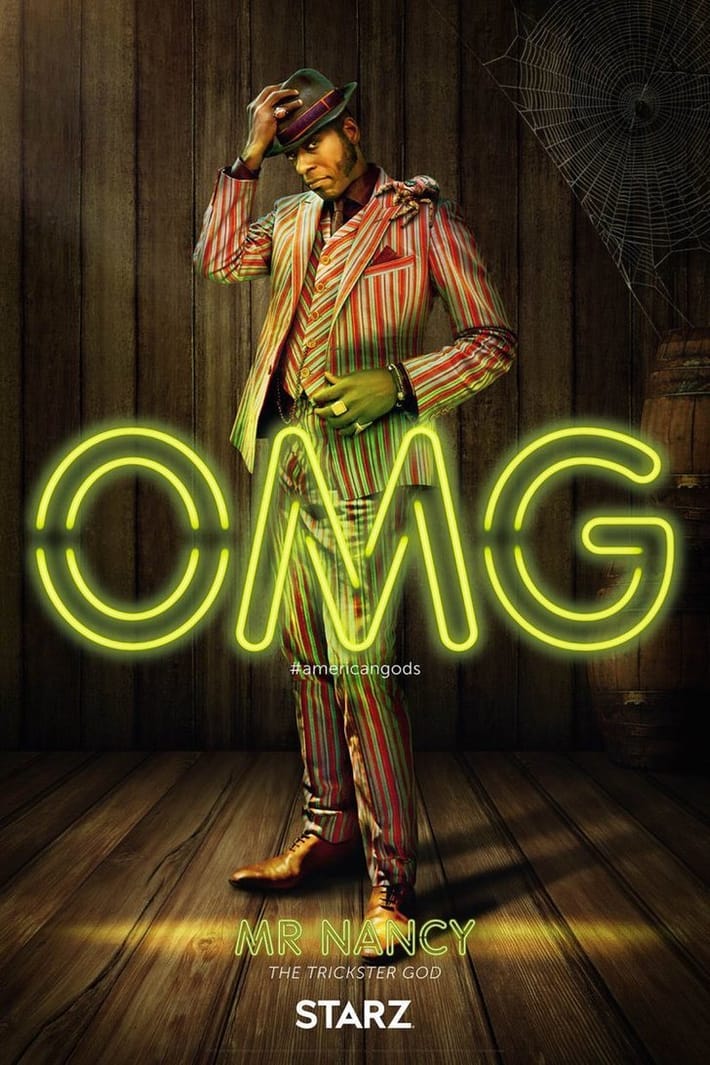
If you want to get even more acquainted with the characters, take a look at the awesome cast posters below!
Jeremy Robert Johnson’s Entropy in Bloom opens with an introduction by Brian Evenson in which he warns readers that the collection they are about to read could possible alter them in profound ways. The introduction is fitting for a plethora of reasons, but two of them deserve to be mentioned here. The first one is that Evenson introducing Johnson’s biggest release to date is the equivalent of a literary passing of the proverbial torch; one of the best living American writers welcoming someone into the club and letting readers know how he earned his membership. The second reason is that the opening paragraph mentions author Stephen Graham Jones. Along with Johnson and Evenson, Jones complete an (un)holy trinity of the most creative, wildly entertaining, most genre-bending voices in contemporary literature, and everything that follows proves that Entropy in Bloom is an instant classic, a carefully curated manifesto whose main goal is to tell the world one of the brightest stars in indie lit is now too brilliant to remain hidden.
Entropy in Bloom contains fifteen short stories that are arguably the best produced by Johnson since the beginning of his career and one previously unpublished novella, “The Sleep of Judges,” which would be worth the price of admission even if it was being published alone. The narratives are a mix of horror, crime, bizarro, sci-fi, and literary fiction, and all those genre appear mixed each other in different stories. The selection is superb because it offers a look at the larger themes that have crisscrossed Johnson’s oeuvre since his first publication while also offering readers tales that have either been option for film, won awards, been translated, or actually been turned into award-winning short films, which is the case with “When Susurrus Stirs.” Loss, fear, revenge, desire, paranoia, the apocalypse, body horror, the impact of drugs on the human psyche are all elements of cohesion that make Entropy in Bloom a strong collection that lets readers know they are reading the work of a consummate storyteller with a knack for words and a deep understanding of the darkest recesses of human nature.
There are no throwaway tales in this collection, but discussing them all would lead to a too-long, uninteresting review that would keep readers from discovering some of the gems that lie within the pages of Entropy in Bloom. However, there are some narratives that deserve special attention. The first one is “When Susurrus Stirs,” a tale that uses an intelligent parasite to explore identity while never ceasing to be an outstanding story that pushes the boundaries between literary fiction and body horror:
“He doesn’t speak to me as an individual; I can feel that in his voice as it creeps through my nervous system and vibrates my tympanic membrane from the inside. The idea of “self” is impossible to him. When he speaks to me as “You” I can tell he’s addressing our whole species, every last human representing a potential host.”
Other exceptional stories include “Persistence Hunting,” which explores loneliness and desire through a regular man who becomes a thief in such a way that it ends up being one of the best crime short stories of the decade; “The Gravity of Benham Falls,” which manages to somehow make the classic ghost story something new and exciting; “Dissociative Skills,” a story about mental illness and self-harm that is as gory as it touching and opens with a line that captures darkness like few others: “Curt Lawson felt like a surgeon right up to moment he snorted the horse tranquilizer”; and “A Flood of Harriers,” where fear and revenge collide in the ruins of a man’s shattered sense of masculinity after a wild time doing psychedelic drugs at a festival right after an attack by some Native Americans:
“My body is in the grasp of tremors, shaking to this rhythm that was never mine. The sun drifts behind a mountainous ridge and dusk floats down, spreading gray light across the Sheenetz River. I can see the rest stop. My pulse is the sound of long dead tribesmen calling down the flood.”
Those same feelings of paranoia and inadequacy are also present in “The Sleep of Judges,” the crowning jewel of this collection. In this novella, a man is forced to deal with crippling fear and a shattered sense of masculinity after burglars break into his house while he and his family are away and take some of their priciest possessions and mess with a family photo. With his wife and daughter safe in her parents’ house, the man tackles the project of walking through the property with a cop, securing the house, cleaning up after the robbers, and dealing with the insurance. Unfortunately, the burglars seem to want more than his earthly possessions.
What follows is a tense, atmospheric, gripping narrative with a Lovecraftian touch that quickly spirals into a surreal nightmare of deadly proportions. Between the neighbor’s warnings, what the man finds inside his house, the strange cop that showed up at his door, the mysterious house in the neighborhood that is occupied by bizarre people no one knows, and the sounds he hears coming from outside his house, “The Sleep of Judges” is as creepy as anything else Johnson has written and as strange, touching, and smart as readers have come to expect from him.
After the success of Skullcrack City, Johnsons’s previous novel, Entropy in Bloom feels more like the next logical step than an impressive but unexpected outing. Johnson has been the writer other great authors talk about (he’s been praised by Chuck Palahniuk, Laird Barron, Ben Loory, and John Skipp, among others) for a long time, and this collection should turn him into the writer everyone is talking about. These fifteen stories and one novella show a powerful imagination, a great talent for storytelling, writing chops that allow him to tackle any genre, and a flowing, dynamic voice that, if Johnson were a singer, would extend to an impressive eight octaves.
Hello, and welcome to my week-by-week review of the world. Today I am reviewing the color purple.
There’s no denying that the color purple is the least liked color in the spectrum. Technically mustard brown is less appealing, but it’s used so infrequently that it doesn’t receive the same quantity of hatred as purple.
Some people still insist on using purple, and that’s usually a good litmus test for their sanity. According to a poll 90% of people who like purple are sociopaths.
Anytime I accidentally get locked in the library overnight, I find myself free to do a lot more research for my reviews, and this was one of those times. I started with the book The Color Purple, starring Whoopi Goldberg. This book was a moving tale that in no way helped me understand the color purple.
But why research something that I know in my gut to be true? Think of all the things in your life that are purple. Now imagine your life without them. You probably just smiled a little, or even possibly orgasmed.
Five years ago when I reviewed purple nurples I found them to be just the worst. Is it a coincidence that something with purple in the name is so unpleasant? Not when you look at the evidence.
Purple grapes can be turned into wine, which can cause alcoholism. Purple crayons can be stabbed into someone’s eyeball, by accident or intentionally. Purple flowers sound harmless enough, right? Wrong. You’re wrong. Imagine leaning in to smell a purple flower and a bee comes out and stings you in the nose. Or even worse, it flies into your nose and stings you on the interior of your lungs. Thanks, purple.
I’ve only ever found one purple thing that isn’t horrible, and that is Ronald McDonald’s friend and/or pet Grimace. He’s always friendly and promotes unconventional body shapes. He never defecates and has no genitals. Up close he appears to be warm and soft. I love Grimace, but he can’t change my mind about purple.
BEST FEATURE: n/a WORST FEATURE: I saw a woman get her purple scarf stuck in the door of a taxi and she was dragged/strangled to death.
Please join me next week when I’ll be reviewing Uncle Sam.
It’s not TV. It’s the motherlovin’ Neapolitan Trilogy. Set your DVRs.
Lately it seems like there’s a lot of books-to-screen news, right? (Seriously, scroll through our Scuttlebutt feed if you want to watch some awesome trailers.) Well, if that’s your kind of thing (it’s ours), prepare yourself…
There’s a fresh development on the Ferrante front! Earlier this month, EL reported on the exciting news that the new adaptation of the cult-favorite Neapolitan Novels — My Brilliant Friend, The Story of a New Name, Those Who Leave and Those Who Stay and The Story of the Lost Child — hasfound a director, Saverio Costanzo, and is due for a 2018 release. Today, Variety broke the news that HBO will be joining up with Italian state broadcaster RAI to give the highly anticipated show an international home (not to mention the ultimate prestige TV seal of approval — that coveted HBO backing).
The producers Wildside and Fandango are planning a 32-episode series that will cover the complete storylines of all four books. For now, HBO has signed on for the first eight episodes, but the future seems promising. HBO Programming president Casey Bloys optimistically predicts that “these ambitious stories will no doubt resonate with the HBO audience.” (Resonate? Who are you kidding with that understatement? This show will richochet off the damn walls, Bloys. Or anyway a reader can dream.)
Get ready to remember why clowns are absolutely terrifying
Ladies and gentleman, steel yourselves: Pennywise is back, and thanks to digital innovation the kid-eating clown is more nightmare-inducing than ever. I’ll never forget my first time watching the 1990 miniseries mistakenly thinking I was in for the more wholesome King adaptation, Stand By Me. Boy, was I in for a hell of a surprise (and my parents did not enjoy me asking if I could sleep in their bed for the next month).
All the way back in 2012, it was announced that director Cary Fukunaga (you know, Beasts of No Nation / the guy who won the True Detective credit/blame game) would helm a new big-screen adaptation of Stephen King’s 1986 horror novel. But soon enough Fukunaga was out (except for a script credit) and Andrés Muschietti (2013’s Mama) was in. Now, after a long five-year wait, the remake — or the first half of it anyway — is almost here.
It: Part 1 — The Losers Club is due to hit theaters in September, and the first teaser trailer has just dropped. So, what do we know? Bill Skarsgård is playing Pennywise, and from the looks of this clip he’s having no problem living up to Tim Curry’s petrifying legacy. Also, Stranger Things fans rejoice!Finn Wolfhard (aka Mike) plays Richie Tozier, one of the “Loser Club” misfits.
Let the countdown to September 8th begin, and in the meantime, don’t follow any red balloons!
Over the course of 2014, LA-based artist Audrey Wollen became Instagram-famous and, then Internet-famous for her Sad Girl Theory. The theory was both smart and simple: “Sad Girl Theory is a proposal…that girls’ sadness and self destruction can be re-staged, re-read, re-categorised as an act of political resistance instead of an act of neurosis, narcissism, or neglect.” Wollen stressed that her theory had a “resonance now” thanks to the Pollyanna-ing of modern-day feminism, those urges towards self-love and positivity that chafe if, like so many women, you’re not great at cutting yourself a break:
I feel like girls are being set up: if we don’t feel overjoyed about being a girl, we are failing at our own empowerment, when the voices that are demanding that joy are the same ones participating in our subordination.
Reading the theory felt like exhaling after you’ve been holding your breath without realising you’ve been doing it. Wollen’s battle cry that she wanted “to stand with the girls who are miserable, who don’t love their body, who cry on the bus on the way to work” because “I believe those girls have the power to cause real upheaval, to really change things” was everything after years of Lean In and Sasha Fierce and Amy Poehler’s Smart Girls — which seemed to come with the implicit message that to be a good feminist, a woman must be strong and positive and engaged.
Lean In and Smart Girls seemed to come with the implicit message that to be a good feminist, a woman must be strong and positive and engaged.
Wollen has over 25,000 followers on Instagram, which is a lot, but also feels minimal when examining how far her theory has diffused into the ether of wider pop culture. Because while Wollen dominated 2014 and 2015, giving interviews and expanding on her ideas, 2016 feels like the year her theory began to usher in some sort of sea change in the way women were portrayed.
But maybe this was just because last year was my first year as a full-time Sad Girl, so, of course, I saw Sad Girls everywhere I looked. Normally, I wake up cheerful every gorgeous morning for no obvious reason. My bank account isn’t flush, my career isn’t stellar; for the past few years, my romantic life has been — that most of euphemistic of adjectives — eventful. But all the same, the only period of depression I’ve ever had was triggered by taking an archaic birth control pill for a few months when I was 18. That is, until January rolled round.
The worst of it was, nothing in particular had happened — sure, there had been small disappointments and slights. The abrupt end of a new friendship, stress at work, a particularly ruthless rejection from the person I’d been dating, a not-quite-quarrel with one of the people I’m closest to that still hasn’t healed. But none of the reasons I totted up felt like a justification for feeling so consistently sad last year, sad when I woke up, sad when I went to bed.
None of the reasons I totted up felt like a justification for feeling so consistently sad last year, sad when I woke up, sad when I went to bed.
And reflecting on last year from the perspective of 2017 makes what felt a lot like depression seem even more repulsive. There was the Muslim Ban, the second immigration ban, Trump’s move to reverse Obama-era guidelines on bathroom use for transgender students. Meanwhile, in my home country, Germany, hate crime has rocketed — the Interior Ministry reported this year that nearly 10 attacks per day were made on migrants over the course of 2016. As a cis, white woman living in Europe, my privilege is undeniable. As such, my issue with 2016 felt like T.S. Eliot’s problem with Hamlet, the “objective correlative” — “Hamlet…is dominated by an emotion which is inexpressible, because it is in excess of the facts as they appear.”
So maybe it was just sad, doughy me, at home stuffing the void with takeout, but it felt like Sad Girl Theory had infiltrated all the biggest moments in pop culture over the past two years. Beyonce’s visual album Lemonade, Phoebe Waller-Bridge’s breakout TV show Fleabag and Rachel Bloom’s My Crazy Ex-Girlfriend each fixated on two things: being sad and being a woman and the connection between both.
Lemonade
Is Lemonade Beyonce’s big reveal of her true alter-ego to the world — Bey coming out as a Sad Girl, not a Sasha Fierce? To some extent. Obviously there’s the flashes of classic Beyonce, the righteous and raging Beyonce we’ve seen before. Less Sad Girl, more strong woman. The baseball bat, the yellow gown, the “if you cheat again, you’ll lose your wife.” Perhaps Beyonce is too much herself to get sucked into the ebb and flow of the zeitgeist. And then there’s that strange, forced fairytale ending, of course. Did it make you wince? “True love brought salvation back into me. With every tear came redemption and my torturer became my remedy.” Less sad, more sadomasochism.
And then there’s that strange, forced fairytale ending, of course. Did it make you wince?
But those weren’t the parts that I remembered long after I finished watching. What stuck with me, despite the women crowded round Beyonce in almost every scene, was the palpable sense of loneliness. In the words of Beyonce (via Warsan Shire) “Ashes to ashes, dust to side chicks.” It was testimony to my mood that I was convinced first time round that the line was “Ashes to ashes, dust to sad chicks.” Because while there were moments of anger and moments of togetherness, I couldn’t see past all those sad chicks. Sad chicks who couldn’t escape themselves in sleep (“She sleeps all day, dreams of you in both worlds”); sad chicks who cried unceasingly in their waking hours (“She cries from Monday to Friday, from Friday to Sunday”); sad chicks who applied lipstick and thought of their mothers and regret (“You must wear it like she wears disappointment on her face”).
If you watch the film again, you might notice that the women in Beyonce’s video do not look at each other a lot. Instead, they are all alone together, gazing with gravity into the camera. While Lemonade appears to reference a whole range of filmmakers and video artists (Terrence Malick and Pipilotti Rist being perhaps the most obvious of these), for me, the work that first came to mind when watching it was the tumblr account, webcamtears.tumblr.com . The website effectively functions as a virtual gallery wall, except the art isn’t paintings but people crying into their webcams and when you hit play, the video loops over and over.
What stuck with me, despite the women crowded round Beyonce in almost every scene, was the palpable sense of loneliness.
Users can heart the videos and the video with the most hearts, by a very long shot, shows a woman with the sort of face that adorns romance novels and pillowy lips who cries at you with unsurpassed gracefulness (punctuated by the occasional delicate sniff, she keeps her face very still and lets tears edge their way down her cheekbones). I couldn’t help but think of her when watching Beyonce, who is also very good at being both pretty and sad all at once, gazing up into the lens with vast saucer eyes.
And maybe watching Lemonade first was what made watching BBC’s great comic hope Fleabag feel so unsettling, because the titular Fleabag (who never gives us her real name) is also big on eye contact with her viewers, but for different reasons: she doesn’t want our pity or our admiration. She’s constantly trying to make the audience complicit in the tragicomedy of being female.
Fleabag
Fleabag isn’t, on the surface, dissimilar to Michael Fassbender’s character of Brandon in Shame. She’s a sex addict who is consumed by self-destructive behavior, who has an uneasy relationship with her sister and who keeps everyone around her at arm’s length (though in Fleabag’s case, via pisstaking, satire and the odd slap at anyone foolhardy enough to attempt a hug). She is not, presumably, intended to be an everywoman.
But Fleabag is constantly courting us, the audience, shooting us conspiratorial looks and cocking one perfectly formed brow at the idiocy of the world around her. The comedy in the show works because its creator has assumed that the sadder aspects about being a girl are universal enough for the female viewer to identify with. Like having enough hang-ups about your flesh prison to sympathize with Fleabag and her sister Claire shooting their hands up when a feminist lecturer instructs a room of women to “raise your hand if you would trade five years of your life for the so-called perfect body” or Claire’s insistence on chiming “I’m fine, everything’s fine” through gritted teeth when it definitely isn’t or the compulsion to reinvent yourself in some minor way (braids!) on getting PMT.
The comedy in the show works because its creator has assumed that the sadder aspects about being a girl are universal enough for the female viewer to identify with.
The predictable comparisons to Girls and Bridget Jones’ Diary have been made, but perhaps the show has struck a chord because it feels so much more radical than both of those works. Fleabag feels like the first character in a female-led comedy whose brokenness seems emblematic, not of her private sadnesses (though the show makes an excellent case for why Fleabag would be so fucked up) but of the broader politics of being a woman.
Sure, there are flashbacks to her own personal tragedy, but these aren’t half as unsettling or effective as her side-eye at the audience while the man she’s having sex with squashes her head down mid-thrust. It’s scary because it’s simultaneously dehumanizing and, if you’ve ever had clumsy sex with someone more set on their own orgasm than on yours, familiar.
This sounds misandrist, and sure, there’s plenty of lousy male characters in the mix. But the show is every bit as critical of its women and their coping mechanisms. Perfectionist Claire’s need for control, whether over her “surprise” birthday party or her calorie intake feels as unhealthy as Fleabag’s retreat from the dark spaces of her brain into the physical, into fucking and jogging.
The jogging — the physical manifestation of the “I’m fine, everything’s fine” refrain of the show — felt familiar to watch. In early summer, when the sadness hadn’t passed and when I couldn’t stop waking up at 4am every morning (google: “anxiety and depression can be associated with early morning awakenings”), I caved to the received feminist wisdom on the topic and embarked on a self-care kick. I went on punishing jogs round the park near my house, sweating in the heat until I’d worked up a headache that pulsed so close to the surface of my skin that it felt as if it was both in my temples and suspended directly outside them. Like Claire, I became obsessive about food, compiling long shopping lists of “good” foods (though my turn-on was endorphins, not a lack of calories) and I ate so much tomatoes and oily fish that summer that now both foods in combination make me throw up. Unlike Fleabag, I tried to face up to things. I went to therapy and tried to think of something to say, how to explain it, fumbled for the words and my therapist told me to “sit with your sadness.” I meditated, or tried to, but my mind bristled and I couldn’t sit with my anything, least of all my sadness. I wasn’t capable of the one thing that might have helped, because that summer I felt too hollowed-out to cry.
Inevitably, one morning at the tail-end of July, I packed my bags and cut my losses.
My Crazy Ex-Girlfriend
Rebecca Bunch is “so happy” in New York, so much so that she can’t stop making statements no truly joyful person has ever made, like “This is definitely what happy feels like.” Coupled with her crushing work schedule, her proximity to her ruthless mother and her grey-hued corporate world, this statement has us rooting for her to outrun her sadness by relocating to West Covina, California. Sure, she’s doing it for a man, her summer camp ex-boyfriend Josh Chan and she confesses as much on multiple occasions — but given that the other aspects of her life seem so much better there, given that she has a work/life balance and great friends and is just two hours (“four hours in traffic”) from the beach, we still tentatively endorse her decision.
But ultimately, while she gets the boy, it doesn’t help. Rebecca eventually muses to her therapist at the end of Season 2:
Well, I moved to West Covina ’cause I thought my problems would be solved by a boy. Now I’m with that boy, and I still have the same problems. So I don’t know, maybe it’s something else. And if he is not the answer, what could it be about? It could be my own issues.
And if he doesn’t help and the great new friends don’t help and the beach proximity doesn’t help, maybe running away doesn’t work. It’s basically the 2017 version of Plath’s depression classic The Bell Jar. Remember Esther Greenwood’s reasoning as to why place doesn’t matter?
This was my litmus test. So it couldn’t have been “real” depression, like Esther Greenwood or like Rebecca Bunch had, because changing up location worked. Unlike both heroines, I wasn’t trapped under the glass bell jar of my doldrums.
For all the pep talks about facing your problems and still being the same person in a different postcode, I never feel more myself than when I’ve moved solo to a new place. I love the adventure of it and the peaceable quality of hardly knowing a soul in a city. So, when that strange hollowness didn’t pass, I set up temporarily in a cheaper, emptier city for the rest of the summer. As I mapped out the contours of the place on a half-broken bike (and fell off again and again until my whole body was patterned with bruises) and swam naked in lakes by myself and smoked cigarettes with my new housemate while perched on our kitchen windowsill, I finally started to feel like myself again. I came back in autumn and my home city looked good to me again and I could sleep the whole night through. I was finally happy, just because.
“Just because.” It’s picturesque. But how much can you ever trust the “just because” of a writer? I can’t help but wonder if the real appeal of the location wasn’t its novelty, but that as a stranger in town, nobody can reasonably expect anything much of you. That whenever I’m in a new place, my unfamiliarity with everyone around me means I can press pause on the people-pleasing I’m so prone to and I can finally do whatever I want to. That moving there, if only for a few months, involved ducking out on the emotional labour of my home city.
Of course, “just because” is doubly duplicitous because it doesn’t acknowledge the privilege involved in feeling better — whether the privilege of being able to work anywhere with a wifi connection or the privilege of being able to move to a heavily white German state with high levels of unemployment and not experience the racism that can come with the territory. Just like Esther Greenwood getting her stay in the fancy mental institution paid for by her literary patron or Rebecca Bunch being able to afford good therapy, I didn’t start feeling better due to some sort of personal integrity or innate character grit, but because I’m privileged.
Of course, “just because” is doubly duplicitous because it doesn’t acknowledge the privilege involved in feeling better.
Normally, in this kind of pop-culture/confessional Frankenstein of an essay, I’d sum up by telling you how I’ve changed and what I’ve learned. But to suggest I learnt something from being endlessly sad would mean deriving some sort of value from something that shouldn’t be capitalized upon and/or glamorizing depression (or its ilk). Let’s leave it at this — it was the year where I couldn’t stand to be told to just exercise more. It was the year I couldn’t always talk to the people closest to me about what I was feeling because I’ve so relentlessly constructed my identity around being happy. It was the year when all the Sad Girls in pop culture made me feel less alone.
Dan Chaon knows to trust what pops into his mind. His latest book, Ill Will, is a thriller about self-deception and what happens when memories fail us. The novel follows a middle aged psychologist who, as a child, accused his adopted brother of causing the deaths of his parents, aunt and uncle. The two are now adults, and the brother has been exonerated of the crime. It’s a story that first came to Chaon over a decade ago, but he trusted himself enough not to write it — yet. Years later, characters, plot, and setting eventually fell into place, and Chaon knew the thriller was finally ready to be written.
In addition to his writing, Chaon teaches creative writing at Oberlin College. I reached him by phone the day Ill Will was published. We talked about why the mind fascinates him, how teaching has helped him creatively, why he might want to write a western, and more.
Adam Vitcavage: Congratulations on the publication of Ill Will. It’s out for the world to read. How are you feeling?
Dan Chaon: Kind of nervous. It’s always weird watching the reviews come in.
Vitcavage: Still weird even after three books and a few short story collections?
Chaon: Yeah. There’s always the fear that it’s going to be a disaster. This is a weird book, so who knows?
Vitcavage: Well, you’ve published a lot and people clearly like what you produce. How do you keep plot ideas fresh so that they’re exciting to you, but will still be enjoyed by your established readership?
Chaon: I guess I don’t really think about them. I don’t know who they are. I know there are people out there who like my works. If they do like them, they’re going to like Ill Will because it’s trying to do something different instead of repeating what I’ve already done.
Vitcavage: When you’re coming up with idea for a short story of a novel, are you always looking for ideas to be vastly different than your last idea or are you just writing whatever comes natural? Is it a conscious effort?
Chaon: As much as I’m conscious of anything. I’m writing whatever I want to spend a lot of time with. There has to be some spark that makes you want to go back to it over and over. It might be because you like the mood. It could be like an album that you like the tone of, and you can’t stop listening to it. Or there could be a question in it that you keep wanting to dig. You may not even know what the question is.
That’s usually what it is for me. That’s maybe why I decide to go into something because I don’t know what the answer is. It’s more fun to write about something where you don’t know how it’s going to turn out.
Vitcavage: What was it about Ill Will that kept drawing you back to it while you were writing it?
Chaon: I think it’s the stuff about memory and about self-deception. Particularly this notion of what we know and what we don’t know about ourselves. That’s something I’ve been circling around for awhile. It’s something I’m super curious about. There are things that come out of you, and you don’t really know where they come from.
Vitcavage: I find the idea of hidden memory interesting — where you remember something that happened to you, or maybe you don’t. Or maybe it didn’t happen to you and you suppressed it out of your memory.
Chaon: Right.
Vitcavage: Is that similar to the idea of deceit within yourself?
Chaon: I do think that that’s part of it. I’m also thinking about the idea of self-knowledge. Like having an idea of yourself that isn’t accurate, but you’ve closed off other kinds of knowledge to maintain that identity.
For instance there are plenty of assholes who don’t seem to know they’re assholes. The only way they’re not going to know that is if they’re closed off to certain types of knowledge.
Vitcavage: Some people have this asshole persona because they think it’s humorous. But when does the persona become the actual person? You’re lying to yourself on some level, but you might not even be aware of it.
Chaon: Right. I think that’s deeply built into the concept of repressed memory. The concept of the debunked idea of recovered memory syndrome. I do think there are plenty of people that form their lives around not trying to think too hard about disturbing thoughts.
Vitcavage: This book could be called ‘disturbing’ in certain places. It’s a physiological thriller, which pushes people to places they might not be comfortable with. You originally came up with the idea fifteen years ago, right?
Chaon: Yeah. My brother-in-law was a student at one of the University of Wisconsin satellite schools, where there was a drowning on campus. All of the kids had the idea that because there was a drowning on another campus, there was a serial killer. I thought it was a really interesting idea and I wrote it down, but I never really knew what to do with it. Eventually, it started to click in with this other stuff I was writing about.
Vitcavage: When did it click?
Chaon: Pretty recently. I started this book maybe three or four years ago. That’s when things started to churn around in a way that it felt like this was going to be a novel. It was just pieces, before.
Vitcavage: So these pieces came together naturally? You weren’t trying to shoehorn them together.
Chaon: No. I don’t think so. I always wanted to write a serial killer novel. This one doesn’t exactly end up as a serial killer novel, but it has the trappings of it.
Vitcavage: There’s this idea that genre books can’t be “literary.” Maybe that’s not even true anymore.
Chaon: I don’t think it’s so true anymore. I think some people are kind of snobby about it.
Vitcavage: Even my note for our chat read “mysteries are no longer confined to just a genre anymore.” I don’t think it’s true. I think a lot of things can be high brow or literary. Whatever you want to label it.
Chaon: I think high fantasy and really hardcore SF are still ghettoized pretty hard. I can’t really imagine Jonathan Franzen doing a Game of Thrones-type of thing. Although that would be awesome and hilarious. I think otherwise, Colson Whitehead did zombies, right?
Vitcavage: Even Underground Railroad is speculative in a way. I guess I was leaning toward trying to find out if you ever worry about being “too genre” — or is that even a thing?
Chaon: I think about genre, because genre gives you a container, it gives you a shape for something. Shape isn’t the first thing that comes to me. I tend to write in little pieces. Having a container is really useful.
I’m interested in genre as a given form. It’s like a sonnet, but you can do whatever you want in this form. I’d actually really like to try out a bunch of different genres before my life is over. Maybe try a western. Maybe try a spy thriller. Just because I like reading those things, so why shouldn’t I try to write one?
“I’m interested in genre as a given form. It’s like a sonnet, but you can do whatever you want in this form.”
Vitcavage: Do you have ideas you want for these genre stories?
Chaon :I have an idea for a western that I’m very interested in writing. It’s kind of based in the part of Nebraska that I grew up in. I’ve always been really interested in the fates of orphans, adopted children, and foster children. The fates of those kids in that particular period were interesting and fucked up.
Vitcavage: So thematically it will still fit into what you’ve written about.
Chaon: Yeah, into the stuff that obsesses me. The things that grab my brain.
Vitcavage: Some things I found interesting about this book — and I think a lot of people are gravitating toward this — are the multiple stylistic choices you made. Whether it’s text messages embedded into the story, or side-by-side columns of text, or the use of first-, second- and third-person narration. Were these things you’ve always wanted to try?
Chaon: I mean, it is something I wanted to try. Part of it stemmed out of an exercise that I gave my students. They were restricted to writing in small boxes. Each scene needed to fit into a box that fit onto a sixth of a page. That was done to teach them to be concise and teach them what a scene was. Then all of the stuff that came out of that exercise was cool, and it all had this sort of flowing poetic quality. I thought, “Wow, I want to try that.”
I also found a lot of what Jennifer Egan was doing in A Visit from the Goon Squad was inspiring. It helped me create the mood I wanted for Ill Will. It wasn’t done deliberately, as in — “I think I will do experiments with text in this novel.”
Vitcavage: Within the creative writing classes that you teach, is that the sort of projects you’re throwing at your students?
Chaon: I tend to be pretty exercise-based. Mostly because I think the one thing kids need more than anything is to learn how to generate work. At that age you don’t need a lot of heavy workshop criticism. I think it’s very damaging to young writers. They get these voices in their heads that they’re never able to get ride of. I try to teach them how to work past a block or methods to generate new work or how to experiment or play around with something. Even how to get to that fictional place that is sometimes hard to get to. I feel like I’m doing them more of a service if I do that than if I give them three pages of critical notes on a short story that they wrote in a week.
Vitcavage: Are these exercises things that you do yourself?
Chaon: A lot of them are. I’ve been working a lot with the cartoonist Lynda Barry. We run a workshop together on occasion, and the two of us have been working on this book of exercises that works both with writing fiction and writing comics. It’s been a really big inspiration for me, learning her techniques and sharing different ideas for exercises.
The two of us are doing a workshop at Clarion [Science Fiction and Fantasy Writers’ Workshop at University of California — San Diego] this summer which is going to be really interesting. Then we’re doing another one at the Omega Institute in Upstate New York. Those are two very different climates, so it will be interesting.
Vitcavage: What are other excises you do yourself or give to your students?
Chaon: I have one exercise that breaks apart some of the elements of what I think go into writing a story. It breaks it up into little sections. You write one section that’s setting or one section where a conflict arises. Doing it in little pieces helps students think about what the elements of fiction are.
I have a similar one that’s just a character building exercise. I use it in conjunction with that Michael Ondaatje story “7 or 8 Things I Know About Her.” It starts with a general imitation of the Ondaatje story then works its way toward something a little further away from what he’s doing.
Vitcavage: What do you look for in eighteen or nineteen year olds’ writing?
Chaon: You look for some kind of sensitivity of language. Then for some kind of insight into their characters. I think there is a quality of observation where you notice if a student is looking at people and paying attention. They’re paying attention to their surroundings in a way that seems writerly or interesting to me.
I’m not necessarily looking for polish. It’s more that I’m looking for that observational spark that goes beyond what most people generally see. People generally see things in categories or easily digestible pieces. You’re looking for some kind of disturbance or a skewed point of view, in a sense.
Vitcavage: What’s something you wish younger writers would avoid?
Chaon: I hate to be prescriptive in that sort of way, but I think there’s an urge for students to try to shy away from things that are actually obsessing them. This is a weird thing that I’ve been noticing a lot. A kid will have this really intense stuff to write about, but instead they think they need to write a story that’s more of a George Saunders story, because that’s what everyone likes right now. But, no! Write stuff you do really well.
Students are afraid to get into a rut. You won’t get into a rut unless you’re writing the same stuff thirty years from now. Then try to change it up. Right now, you better mine this material. There’s this fear of repeating themselves or this need to show they have this broad range. The truth is that a lot of writers need to really go down and intensely write one thing for a while. It’s the stuff that is going to bring out all of the subconscious heat that you have but you don’t know what will come out of it.
I don’t want to hear Tom Waits do a hip-hop song, you know?
Vitcavage: That actually makes a lot of sense when you say it like that. Going back to Ill Will, where did the multiple perspectives come from?
Chaon: I was trying to find an organic way to portray the disassociation that I wanted to write about. This seemed like a natural way to do it that would teach the readers how to read it without being too overt about it.
Vitcavage: And I know you’ve talked about my next question a lot, but it’s something that fascinates me. You write for a set time with a timer then reward yourself in a way? How did you come across this method?
Chaon: It started with just realizing I had a limited amount of time to work. Most writers have another job and personal lives. You can’t spend the whole day just futzing around. I also realized that if given my druthers, I’ll spend an hour surfing the internet, writing a sentence, looking out at the wind, then writing a sentence. It’s sort of self-sabotaging in a way that I can’t stop. Having some kind of discipline has helped me.
Knowing some of my own bad habits helps. Like lingering over a sentence and trying to edit it into something beautiful before I know what the story is about. Or deciding I need to research some tiny element before I know what the story is about. Like would they have had this kind of car during this time period? Then I’m on the internet trying to figure it out instead of just writing the story and figuring out the shit about the car later.
It was all of those bad habits that I was trying to break. The idea is that writing for a set period of time without stopping is when you’re really going to open up and discover stuff you wouldn’t be able to get to without forcing yourself. I really believe in the power of free writing as a way to open yourself up.
Vitcavage: I always find the different answers to habits amazing. Another thing I always need to know is what’s next for an author. I know you recently said you were working on adapting Ill Will for a television spec pilot?
Chaon: When I sent the book to my film agent, it was her idea that I should do this. I’ve done a TV pilot a couple times before and I did the film script for Await Your Reply. I mean, none of this saw the light of day. I’m working on this pilot to see whether I could do it or not. It’s going along okay.
Vitcavage: What do you find different when writing scripts compared to your prose?
Chaon: The biggest trick is to find some scenic corollary for the interior stuff. Since I write a lot of interior, and a lot of what happens takes place inside my characters’ heads, there’s a challenge of finding something that’s filmic that is scene- or image-based that can match that. It’s a useful and fun project to try to do, even if you’re not writing a script: to ask yourself is there some way I can show this in scene rather than in my character’s head.
Vitcavage: Are you strictly just focusing on this spec script or is that western happening?
Chaon: That might be happening. I started to mess around in that world. There’s a possibility that there is another thing that may be about fake news and espionage. I’m just worried that it might be too topical right now. I feel like it’s going to be so crazy, but then I read the news and realize it’s not that crazy, man. It’s not that crazy.
Vodka is the science of alcohol, the moonshiner told me. And whiskey is the art.
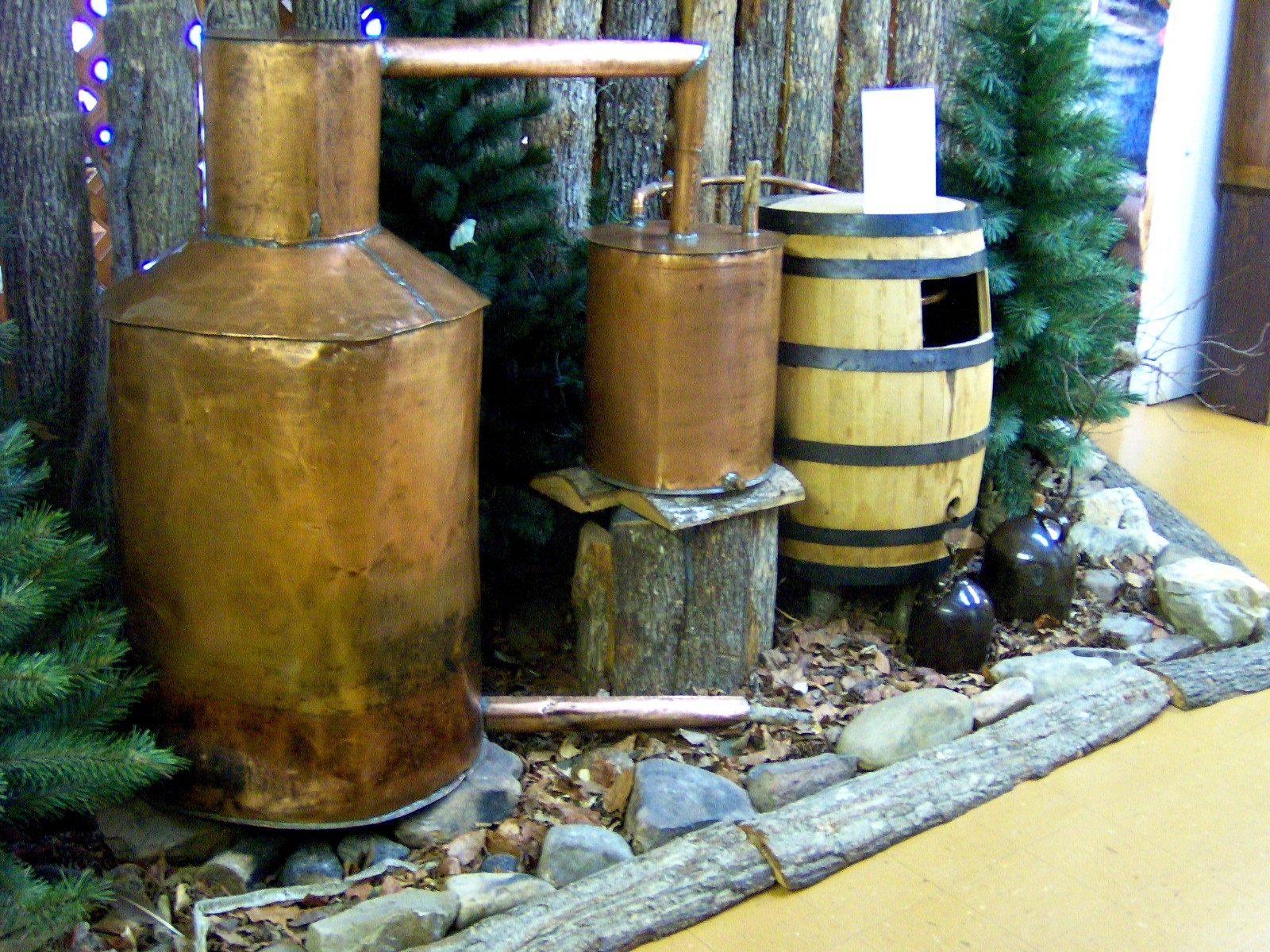
A soft rain beat down against the tin roof above us as he stroked the dark train of his beard. It was a quiet moment made holy by the barrel of mash fermenting in the background. This was what I had come for: to hear an artist meditate on his medium and to let it breathe new life into my own.
This trip was equal parts inspiration and research. I’d traveled three and a half hours from my home in New Jersey to Sal’s barn in West Virginia because I’d fallen in love with mountain whiskey when my first book came out a few years ago. In it, I’d written about the sexual assault I’d once sworn to keep secret and the widespread damage it caused in my small hometown in the Rust Belt. I was one of several silent victims, and my memoir debuted to an onslaught of accusations. When it came out, I was also two months pregnant. I was called disgusting, a liar, and a cheat by people who had once been friends. I felt proud to publish that memoir, but it came at a price. My own art had left me exposed, vulnerable, and tired.
This was what I had come for: to hear an artist meditate on his medium and to let it breathe new life into my own.
It was a lonely and mournful period, one that caused me to question my own artistic instincts. I knew that good art often offends, but I didn’t know it would hurt so much. I couldn’t get myself to write through it. That was asking too much of myself. In my experience, a writer doesn’t always write. Sometimes she just thinks. Despairs. Feels. Instead of writing, I decided to lend my strength to welcoming the pain I’d censored since my adolescence. I’d never before experienced such necessary isolation, and it lasted for months.
Then I came across a string of stories about mountain moonshiners in the Appalachian anthology Foxfire, and it kept me the best company. Any time my world would start to buck or pitch, I’d picture old moonshiners with their buckets and spirals of copper, sitting by the fire and working alone in the dark. It wasn’t the whiskey itself that drew me; it was the process of creating it, the way a ‘shiner steps into the night and doesn’t look back. I had done the same with my own work — I had weighed the cost of retreating to safer territory and chose to remain. Those mountain men assured me that I was right where I was meant to be. There is no art if there is no risk.
It wasn’t the whiskey itself that drew me; it was the process of creating it, the way a ‘shiner steps into the night and doesn’t look back.
After my son turned a year old, my stories returned to me. I wrote about moonshine, about love, about loss. For our anniversary, my husband and I spent a day hunting for real corn whiskey and a real distiller to go with it, and by midday we’d only come across sugar shine made in Kentucky and sold at tourist traps. I’d read about Sal on the internet, and we drove past his property a few times before we parked in his gravel lot and took a wagon down the slant hill behind it. The ground was covered in mud and fog curled around the pines.
“Smell it,” Sal said, nodding at the barrels.
Together we leaned over his latest batch of whiskey. It smelled like roasted corn, earth, and summer.
“It’s not ready to run yet,” Sal said. “Still needs time.”
He took my baby in his arms and looked out over his hill. The expanse of the field behind the barn gave way into the mountains and reminded me of Van Gogh’s wheat fields, the way each stalk raises its hand toward the swirling sky. In the Corn Belt, grains are culled, soaked, and fermented before they’re born again into liquor. Sometimes I think our hearts break like that — a kernel at a time, finding its flight in the wind.
Sometimes I think our hearts break like that — a kernel at a time, finding its flight in the wind.
Like artists, moonshiners know how to befriend sorrow. They spend hours in solitude, often awake while the rest of the world dreams. The nickname “moonshine” was coined for the midnight hours distillers spent working in secret in the woods. It’s been illicit by nature since its origins when Scots immigrated to the hills of western Pennsylvania and the Virginias and used their whiskey to barter for food and other necessities. They were using it to survive — a truth that proves making art is as much a necessity as it is a luxury. A moonshiner’s work may never see daylight, and it runs the risk of being destroyed by rain or wind or the law. This is what makes it precious — its strength and its fragility. Sharing my story had left me similarly potent, but raw, and what I needed was to chase that darkness instead of run from it. I let my first book cut my heart open so I could begin to write again.
Even Sal’s first batch of moonshine came in the wake of a broken heart. The barn he uses for his whiskey and bourbon had been built for his beloved black draft show horse who had died. It wasn’t just the horse Sal and his family missed. There’s an art to coaxing a powerful animal to bend at the slightest touch, and Sal’s family missed that ritual of togetherness, of nurture. I find a secret here that resonates for me as writer and as a human — our best work often births itself from absence. I have a mantra I repeat to myself when I fear all is lost: Destruction isn’t the opposite of creation. It’s the antecedent. This is why I like abandoned buildings and overgrown Ferris wheels. It isn’t just because they remind me of the home I left. They remind me every sentence I write is a chance to build something new from the wreckage.
A moonshiner’s work may never see daylight, and it runs the risk of being destroyed by rain or wind or the law. This is what makes it precious — its strength and its fragility.
I imagine it might have been something like that for Sal, who began in his kitchen with a small 10-gallon still fashioned from a lobster pot. The first batch was terrible, Sal told me, but it was a starting point. As the author of many failed first drafts, I understood him well. He’d used an old family recipe that substituted sugar for corn, a shortcut that made the liquor taste like rubbing alcohol. It gave a good buzz, but it told no story of what it had once been. In time, Sal tested his way toward his own trademark, a whiskey that tasted like the West Virginia grain it had come from. He had no models, only a desire to let his moonshine speak for itself.
There’s an old Appalachian saying about this kind of survival that every artist reckons with: root, hog, or die. I like it because it’s imperative rather than formulaic, as the best advice tends to be. I once heard Colum McCann caution against writing what you know. Write toward what you want to know, he said. Standing in his barn between his pot of mash and his gleaming copper still, Sal has somehow accomplished both. He set out to discover what his ancestors had already attempted — a magic concoction of corn, sugar, and fire — and in it, he found his art.
Formulas for mountain whiskey are like creative writing classes in one way: they both talk of necessary mystery and make no promise of finding it. Sal didn’t mind sharing his moonshine recipe with me because he didn’t need to keep it a secret. It’s a mash-up of ratios and gut feeling, an hour to an hour and a half of boiling, days of waiting for the mash to ferment. Even if I attempted Sal’s recipe myself, I couldn’t recreate his flavor. The dirt is different where I come from, the water, the air. Each bottle of whiskey has a voice all its own.
Formulas for mountain whiskey are like creative writing classes in one way: they both talk of necessary mystery and make no promise of finding it.
It’s funny that I fell for moonshine almost from the moment I could no longer drink it. Throughout my pregnancy and a year of breastfeeding, mountain whiskey became less of a spirit to me and more of a story in a bottle. Like this: Fireside, old ‘shiners raise their glasses and sing songs of heartache and young love and children growing old. Bootleggers earned their names from the flasks they hid in their boots, and the Scots-Irish passed down stories of stills stowed beneath gravestones, trails of wooden crosses left to lead the law astray, and spatters of furnace bricks erected in memorial at the season’s end. Once the leaves fall and expose their hidden stills, they spend the winter remembering the fruits of their labor, and drinking it, too. Many moonshiners work to make enough money during the swell of summer to last them through the leaner months, the same way a good book keeps us company through the darkest of times. I’m no moonshiner, but that’s why I started writing so many years ago — to reach out of the jar that bound me and go palm to palm with the life of a stranger.
It takes only two weeks to make moonshine, and it’s tempting for me to say “if only” when I consider the glacial pace required in getting myself to write the truth and write it well. But here’s the larger picture. Corn is planted in winter and abandoned for months in the dark before its shoots break ground. The soil that cultivates it has been tilled for generations. It’s impossible to define the moment a jar of moonshine began just as it’s impossible to say when the stories inside me first took root.
Just before we left Sal’s barn, his wife poured me a shot of whiskey, and I drank it slowly.
“Tastes just like sitting on your back porch,” she said, and she was right. It was warm and smooth and lingered in my throat like an old secret.
Moonshine taught me that art is necessarily subversive. It may be born in the dark, but it doesn’t have to live there. It’s true that we sometimes attempt things others wouldn’t dare. We make people angry. With every word, every drop, we hope to stop time. We fail. And even still, when the time comes, we can shine.
and if the City falls but a single man escapes he will carry the City within himself on the roads of exile he will be the City
— Zbigniew Herbert
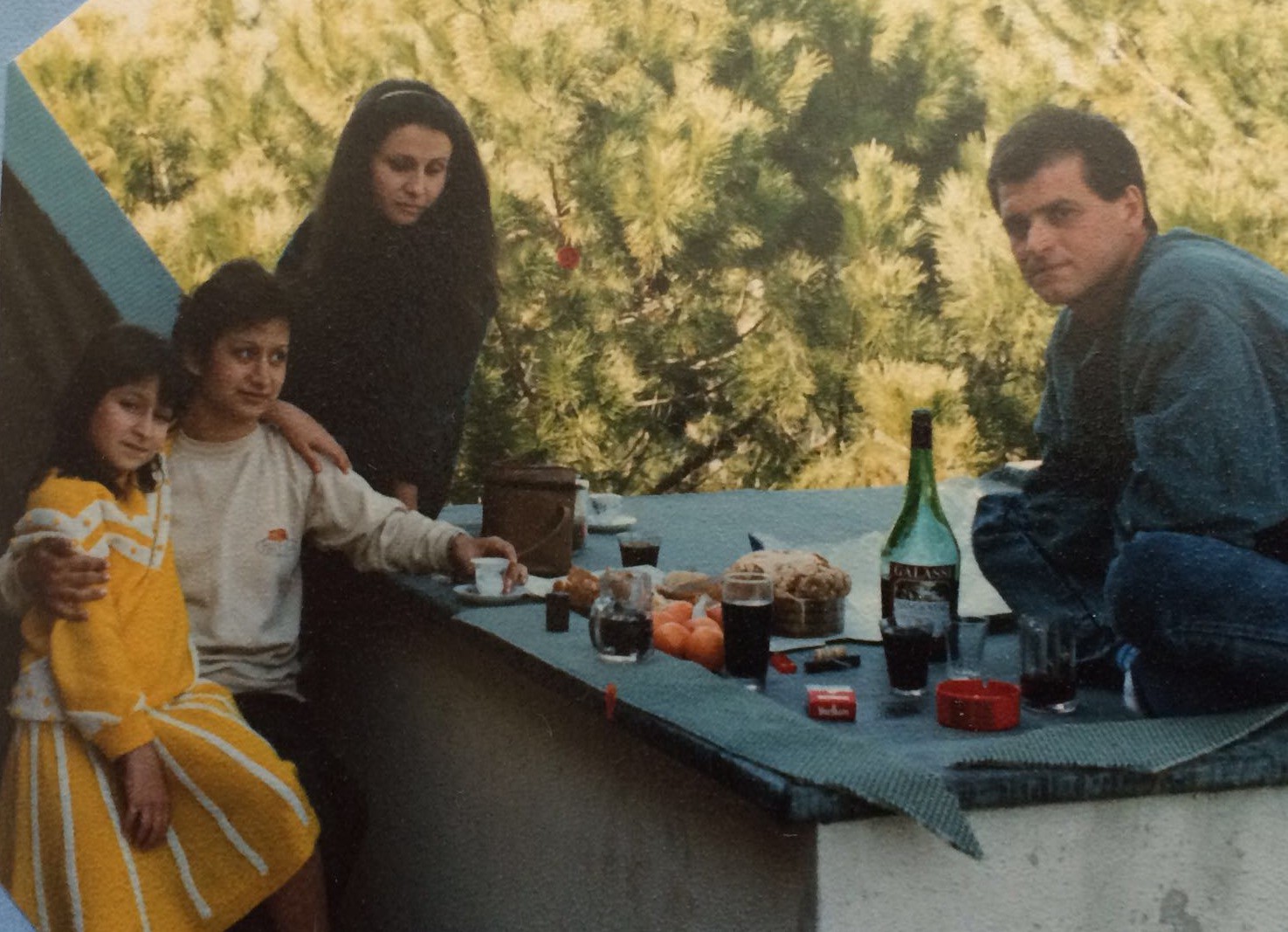
For two seasons when I was nine, I lived in a refugee hostel outside Rome, a place where time had stopped and people waited without purpose, plan, or country. Arriving in government cars, we spotted Hotel Barba from far off roads or neighboring villages, the great house on the hill, dotting the landscape. In the late eighties, for just two years, the owner leased it to the government to house the likes of us, an eclectic circle, rich and poor, young and old, illiterate and scholarly, who came from Afghanistan, Iran, Romania, Poland, the Soviet Union, and wherever else turned out refugees in those days. Our lot included professors, surgeons, internationally known preachers, field workers, soldiers, activists. My mother, an outspoken Christian doctor, had fled Iran with my younger brother and me in 1987. We had already spent a year as refugees in Dubai.
Despite a charming exterior, Hotel Barba was a refugee camp and we were to stay put, having been granted no status in Italy. But, to its residents, many of whom had escaped death, the deafening quiet of Mentana village was a purgatory. All day we sat around and languished in the winter chill, praying that by summer we’d be gone from there — all except two, a young Romanian fleeing with his wife, and my mother, both of whom filled their days with work. I read English books and played hopscotch and became obsessed with having a home again, with ending the wander days, rooting, and with the mysteries of adulthood. Each day when the postman arrived, the crowds outside the mail cubbies swelled, jostling for a good view. We wanted to know, “Who got his letter today?” If someone had, the crowd hushed as he opened his envelope, fingers trembling, eyes scanning, then either cried quietly into his palm, muttering curses, or loudly on his knees, thanking his god. Everyone was frantic for a letter from America or England or Australia, roomy Anglophone countries. All we did was dream, a maddening state, and battle loneliness.
We fought boredom in increasingly desperate ways: an Afghan grandmother collected bricks from a nearby construction site and carried them back to her room under her chador. Her daughter read fortunes from the remnants in mugs of instant coffee. A 20-year-old Iranian soldier with his face half bleached from a wartime chemical burn taught the children soccer. Later, the same children snuck into a neighboring orchard to steal unripe peaches and plums, because our tongues itched for sour and had nothing else to soothe the craving. I offered an English class, attended by a handful of burly Russian men. I skipped around the yard in my pink skirt with the men following, taking notes as I pointed to things: tree, fence, chador, babushka (they indulged me). People grumbled. They complained. They fought.
One day, an unhappy wife fled into the arms of her young friend, the only other Romanian, aside from herself and her husband, then residing at Barba.
Probably the couple had befriended their compatriot, a student with a guitar and a spasm of curly brown hair, before their sentence at Hotel Barba began. Day after shapeless day, the three sat in that Italian courtyard, smoking and suffering quietly together, the only Romanian speakers in a house of political outcasts. I imagined that they spoke of home. Mostly they watched the children play.
She wasn’t beautiful. Her face was flat, her eyes sleepy — but she had a sly smile, the look of a secret always on her mouth. She was tall with dark hair, wide hips, and painted-on jeans. The couple had no children. In the evenings the husband returned from a hard day in the gardens, looking worn. He drank a beer on his balcony, too sated with work to engage in human theatre. But his wife pined and slinked about. She whispered with her lover behind the hotel.
Her husband was a clean-cut man with sad eyes and a kind smile. He worshipped her. A few days after their arrival, though he was college educated, he found a cash job as a gardener so he could buy dresses for her. “So she doesn’t feel like a refugee,” he said. Residents of Barba didn’t have jobs, though it wouldn’t have been unheard of to help the local builder lay some brick, or hold down a bleating lamb for the butcher, or deliver a few newspapers in the early morning. But this man labored with purpose, every day, and it seemed that he craved to diminish himself to show her his love. What then — the adults wondered aloud — did she want? One day in the sunny courtyard, with the husband just over there, the student looked at her with a hunger so intense that, as a child, I recoiled.
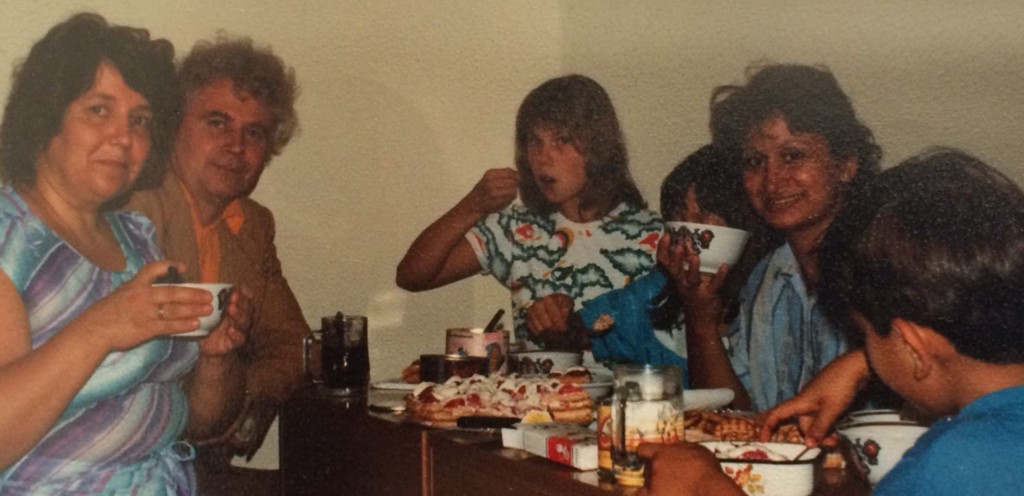
Every night the three shared dinner. At mealtimes we sat with our own tribe, slipped into our native tongue, complained in our own way. As a single community, the residents of Barba had only a handful of rituals: gatherings around the mail cubbies, displays of affection for the boy who ladled the soup course with a singsong “Zuppa!”, morning stampedes for the strawberry jam and collective contempt for the grape which seemed to multiply and became a symbol of our many deprivations. And, of course, we gossiped. The women whispered about the Romanian wife, “She’s so foolish, so cruel.” Once, when my mother was trying to teach me about reputation, wisdom, and gravitas, she said, “Do you know how many strangers from all over the world got to know her only as that stupid woman?”
At mealtimes we sat with our own tribe, slipped into our native tongue, complained in our own way.
Like my mother, I believed she was stupid. Soon, her husband was spending most daylight hours away from Hotel Barba, sweating outdoors despite the winter chill, to make extra money for her. He would return after dark and give her small gifts and kiss her and they would smoke together. But she spent her days flirting with her friend, and talking to a Polish woman who became a repository for her breathless confessions. Later my mother told me that in Hotel Barba, no one knew anyone else’s situation. Was the shabby old man at the breakfast table a brilliant professor? Was the red-clad woman humming in the yard an heiress or a housemaid or a doctor with nimble fingers? Had she fled political or religious persecution? We couldn’t know. All we knew was that everyone was bored, watching each other, and why would you want to become their jester only to find out later that the squinting eyes fixed upon you belonged to a president or a poet or a judge?
The former Hotel Barba, viewed from nearby hill.
As far as love triangles go, I’ve only seen two others as intense as that one. Like our Romanian neighbor, my mother and I each experienced one in our early thirties. My mother left my father and our life in Iran because she found love elsewhere, inside a competing story. Her pursuit of Jesus, her Christian faith, and the promise of freedom and spiritual purpose drove her with no less passion than the young wife’s lust and ennui drove her. For that love, she left family, home, and a beloved country, carving a permanent hole in her heart. Two decades later I too fled from a marriage (and a home and country; I lived in Amsterdam) under a similar spell — a young lover who felt like a connection to Iran, a home I badly missed. He too had a guitar and a reckless streak. Though, unlike my mother (who still loves Jesus) and the Romanian wife (with her high hopes from her lover), I lived under no delusions that this man was anything more than a long arm reaching out from the shore. He would hold on until I could breathe again and then he would go.
What interests me now is this: why do such stories share so many details, no matter their setting? The unhappy wife of a good man — it happens so often.
In 2011, just before our separation, my husband, Philip, and I decided to look for Hotel Barba. At the time, it had seemed important to make this pilgrimage. Maybe we sensed an end coming. maybe this chapter of my history held answers for our troubled marriage. We made phone calls but no one in Mentana remembered the hotel. We rented a scooter and drove there anyway. Long before we arrived, I spotted the house on a hill from the road toward town. I didn’t need confirmation. I knew that hill, that manor on the horizon surrounded by valley.
It had been renamed Hotel Belvedere, a place for businesspeople to rest and to eat forgettable meals on their way to conferences. It was a hot summer day and we roared up to the dirt path, our cheeks were flushed and windblown. For the second time in my life, I felt the elation of pulling up that steep, meandering road to Hotel Barba, watching it appear — that jolt of the heart. Each time I was overcome by a sensation of perfect rescue, the feeling that I was plucked by some unseen hand from an awful fate.
Barba had been more than a house to us, the exiles it sheltered. Some places travel on with you.
The refugees were gone, the building renovated, the courtyard converted to a parking lot and the canteen turned into a restaurant and espresso bar. Something about the building conjured transition for me. It felt like change and homelessness, like stripping off a costume and setting off anew. Barba had been more than a house to us, the exiles it sheltered. Some places travel on with you. They grow up with you, at the same pace. As I jumped off the scooter and ran the rest of the way, I could see that Barba and I had grown in strange parallel, scaling up our exteriors, like sisters reuniting in adulthood, all done up for each other.
I requested to see our old room. I didn’t know the number, only the balcony overlooking the courtyard (now parking lot). The concierge took me from room to room in search of the correct view. It was a slow day. He promised to introduce me to the owner afterward. For whatever reason, standing on that balcony preparing to have my photo taken, I blurted, “A Romanian man used to climb our balcony to get to the one a few doors down. He was in love with the wife.” I had forgotten that detail, the student climbing. Then another lost detail returned. “Oh god,” I said, looking into the yard. “They ran away together. How could I forget that part?”
Russian and Persian tea, Hotel Barba.
The first time I saw Barba, from a black car in 1988, it must have been chilly and dark because I recall arriving after dinnertime in winter. My mother, brother, and I were bundled in the backseat, grubby from our international flight. Inside, we sat on our one bed and wondered what we would eat, where we would get money, if we would find friends among our neighbors. Would we meet Farsi speakers? How long would we stay? Which country would accept our asylum petition? Before long, someone knocked on our door. A punkish hotel employee, no older than twenty, told us we had missed dinner. That night, I saw the glass room for the first time, empty, dark. We ate leftover pasta and thanked God that meals were provided here.
My mother didn’t succumb to boredom or partake in the human drama of the place — she wasn’t interested. When it became obvious that we would be at Hotel Barba for a while, she made it her job to continue our education. She refused to languish in the hotel like the other exiles. “It won’t happen faster if we sit and wait. People pay a fortune to visit this country.” So she stuffed our backpacks and we rode buses to Pisa, Venice, and Rome. My mother was thirty-two, my age when I returned to Hotel Barba the second time on Philip’s scooter. I can’t imagine the kind of adventurous drive that would motivate her to brave Italian public transport alone, in summertime, with no money, no language skills, and two whiny children.
In a remote village with no car, our options for school were limited. Some Barba children had enrolled in local Italian schools, but my mother insisted on English. She found a group of American homeschoolers at a church in Rome, over an hour away by bus. She devised a plan so we could attend school during the day but still receive the three daily meals that Hotel Barba offered. She enlisted the help of the punkish staffer and the brick-gathering Afghan grandmother. Each day at lunch, the employee would entrust our meals to the Afghan grandmother, who would wrap them up and save them for us. At night when we returned, we would eat those lunches, saving our fresher dinners for lunch the next day. No matter what was served, my mother would transform the components into sandwiches (hard, crusty rosetta rolls came with every meal) and hang them in plastic bags in our balcony where they might cool and survive the morning bus ride to Rome. I still remember the strangely satisfying texture of a sandwich made with pot roast and a layer of green peas, the rosetta finally soft enough, after a night spent soaking in gravy.
Memories of the old Afghan woman — scurrying behind the hotel with a brick under her skirts, saving our bag of food, kissing my cheeks — brings a fleeting smile to my lips. Now I wouldn’t recognize her in a lineup of grandmothers; funny the daily nothings by which an entire person becomes known. My mother wants me to learn this as I grow older — How many strangers know her only as that stupid woman?
Because we had joined the school halfway through the year, they didn’t have workbooks for us. My mother spent her days erasing hundreds of pages of used ones, making sure she removed every marking so we could do our work without temptation of old answers peeking through. When the weather got warm, we would sit in the courtyard all afternoon, my mother erasing her fingers raw, my brother and I writing. It cut the tedium, and soon our boredom died down.
Over the months my fascination with the Romanians grew. I wasn’t sure why they had left home, just that it was a Communist country then. As with all Barba guests, something frightening had happened and they had fled. Their rooms were on the same hallway as ours. An agile person could climb from balcony to balcony. Once I climbed to the couple’s room and knocked on the window, and the husband gave me a sip of his drink. It was my first taste of beer, and I hated it.
The second or third time I noticed the affection between the young wife and her friend, I had wandered into the empty dining room. I found them alone, their heads almost touching. She looked up abruptly and offered me milk and sugar with a few drops of coffee, a concoction I hated (foreign drinks became a problem for me over the years: I hated sodas, coffee, beer, skim milk, frozen slushies, tonic. I was an Iranian girl — I liked yogurt soda, still water, and sweet tea). Later, I saw her in the courtyard with her husband. He held her hand and they watched me in that amused, longing way lonely couples look at other people’s children. I wasn’t confused by what I had seen. I thought, “She loves both men, but she’s already married so it’s too late.” I didn’t attach any possible emotion to the too-lateness of it.
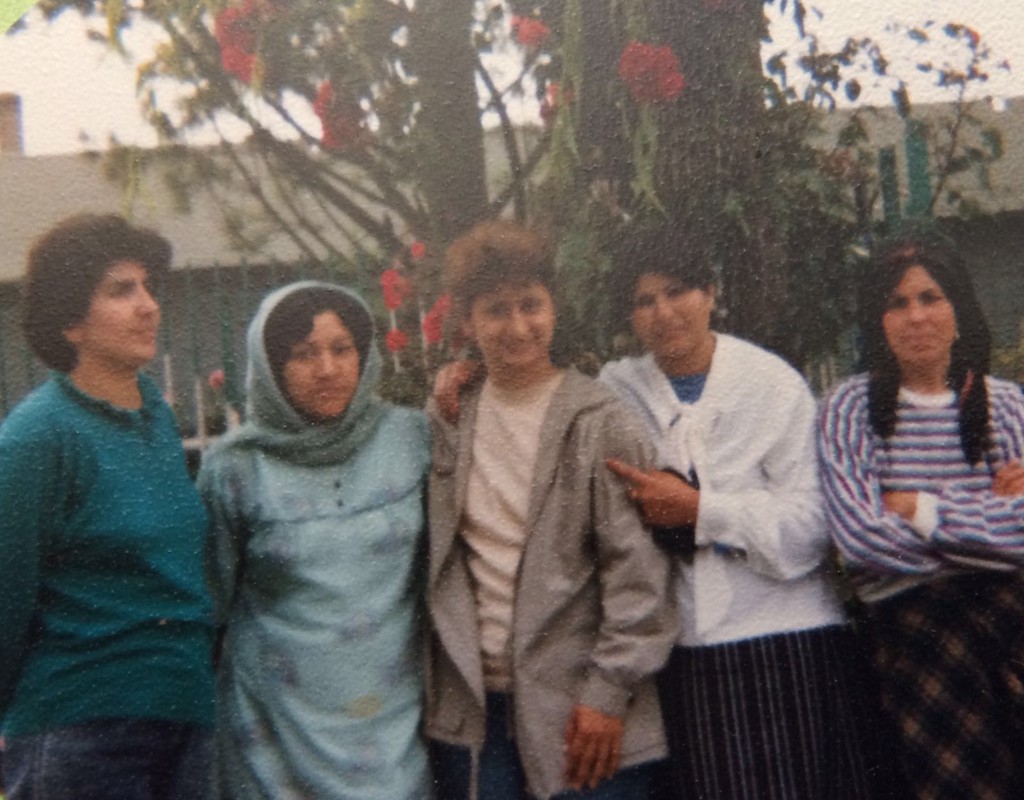
Iranians and Afghanis at Hotel Barba.
A few months into our stay news spread that the young woman had abandoned her husband and fled with the young friend to the Swiss border on foot, hoping to cross over illegally. She was tired of waiting for asylum, tired of the boredom, tired of her husband. She was withering in our shared purgatory. The rumors flared up again. The lovers were hitchhiking to Switzerland. They had vacated Hotel Barba, becoming fugitives in Italy. I’m not sure if we were allowed simply to leave Hotel Barba. Yes, we left every day for school, but could a person just pick up their bags and move out? We were, after all, carrying flimsy documentation and were largely unemployable, un-house-able, and without options. We were social cripples and Barba was our temporary guardian. What would they do alone in the inhospitable bowels of a foreign country with nothing but their passion and his guitar? “They’re just bored,” the older women would mutter. “The days are so long here.” I’m sure that such words were whispered in Barba’s many languages, though my gossipmonger of choice was the Afghan grandmother.
The pair had disappeared in a delirium of spring fever and, for some days afterward (my memory tells me two weeks, but was likely much less), I had my first opportunity to witness heartbreak up close. The husband grew pale. He sat alone in the courtyard or in his room drinking dark beers, his head in his hand, probably thinking he could have bought her more things. Some days he sat in his balcony, frothy mug in hand, looking out at the winding gravel driveway. He stopped working. What were they doing, alone in the open world? Did the student hold her hand as they walked? Did she lose her fingers in his curls? Did they pretend to be Italian and rent a room and share a bed? I imagine he strummed guitar for her on Italian roadsides, spending their meager lire (too few for train tickets) on pizza and Coke to share with her as he flagged kind motorists, shivered in his thin jacket, and slowly noticed her flaws. Back then, I pretended they were visiting Pisa and Venice as we had done — I pictured him kissing her on the cheek and I blushed at the idea. At nine, I was curious and opinionated and I judged her. Her husband was the more handsome one anyway, I decided, and look how he suffered for her sake. I hated her and hoped God would punish her with permanent asylum to Canada.
The pair had disappeared in a delirium of spring fever and, for some days afterward…I had my first opportunity to witness heartbreak up close.
In time, the runaways returned. They were caught at the border and sent back to the camp with their heads hanging. My memory puts regret on their faces. Only a few months more and they might have been welcomed into a new country, able to leave Hotel Barba with respect and warm goodbyes. Now here they were again, back in their old rooms, forced apart from each other and enduring the silences of the man they had betrayed. Probably their recklessness delayed all three of their visas.
They had no choice but to reconcile with the husband, to eat with him silently every night, to make chitchat about books, to smoke in the courtyard. It was a spectacle and everyone watched in awe and secret fascination. What gall! Where would she sleep? Of course, she returned to her husband’s room, since she was assigned to it. After that, the student spent his days in his single room — as in real life, it was his moment to disappear, his memories of youthful adventure bringing him satisfaction and nostalgia but no heartache, leaving the couple to suffer alone. But at meals, they were still the whole of Romania, and so they shared a table. Maybe a new exile would soon arrive and relieve them of the burden of three, but such trios aren’t free from each other even in the wider world.
Sometime in that turbulent season, when the weather was warming and the restless residents of Hotel Barba were overcome by renewed desire for a country, we discovered why the Afghan grandmother was collecting bricks. In mid afternoon a crowd was forming around the mail cubbies again. The Iranian soldier with the white-blotched face was trembling, thanking Jesus. “I’m going to California!” he shouted. It saddened me; I would miss him, and our ball games. Having left my own father in Iran, I was attached to him. As it turned out, a few days later, we would receive our letter too and would be on the same flight as my soldier friend. As the crowd dispersed, someone saw the Afghan woman scurry up the stairs with a brick under her arm. The punkish staff member or Zuppa man or somebody followed her and insisted on seeing her room. Soon news spread around Hotel Barba that she had built a shower seat and was spending hours a day sitting happily under the stream, wasting the hotel’s water. They dismantled her seat. She threw an epic tantrum. The tedium had reached new heights of toxicity. We were drinking it now, mad with it.
A year or two later, we visited that Afghan grandmother and her daughter in California. It turned out they were from a wealthy, important family, a fact we could easily see when we met them in their own house. “Do you remember that Romanian woman who ran away with the younger man?” the daughter asked my mother as she poured skim milk over my cereal — my first taste of the vile blue water. That detail was all they remembered of a woman who had shared their home for months.
Thinking back on this story, I wonder if my mother knew that I was watching, if she saw all that I committed to memory under her nose, as she was rubbing out answers to math problems. I missed my father, my aunts and uncles. I wanted to know why people leave each other. Maybe my mother too was thinking about love in those days, alone as she was after a decade, with no companion, no consolation but her unwavering belief in Jesus. And weren’t we all obsessed with love? Despite the daily burdens of refugee life — unfamiliar food, hot buses, lack of school, the possibility of being sent back to face imprisonment and death — I believe that everyone there continued to function on that register. Even when first order needs were in question, love was all, the only thing more basic than home or country.
Mentana, circa 2011.
Decades later, I drank an espresso in the same dining room, our familiar canteen, while the grandfatherly owner patted my hand and offered me a wafer. I thought: years ago I drank milky coffee in this room, unable to imagine that one day I’d enjoy the taste. I thought of the Romanians. Why do stories repeat themselves in this way? How does love stop being love, and how can I tell if it’s happening to me?
“This room is exactly the same,” I said. “Those windows…”
“It’s much nicer,” the owner said; the concierge translated. “Big renovation.”
“It seems the same to me,” I said, looking out at the leafy landscape below the dining room. “It was nice then too.”
“Probably because your taste improved at the same rate as the renovation,” Philip joked. I recalled the bitterness of those first coffees and beers, the watery milk. Now, as an adult, I had brand new senses. The world had reset. Most people return to childhood sites and find them shabbier or smaller, though the places are unchanged. Barba seemed the same to me, maybe because we grew in step. Had my husband and I grown in step? Did our love keep up with our changing palates? Did we carry our years together, as one carries a city or familiar gravel road or a beloved house, and would we continue to carry them, even as we moved on from each other?
Most people return to childhood sites and find them shabbier or smaller, though the places are unchanged. Barba seemed the same to me, maybe because we grew in step.
Maybe this was just what happens to love — in a secluded refugee camp or in a yuppie apartment in a big city center. Over the decades, I’ve lived in a bustling Iranian village, a sleepy Oklahoma suburb, a chaotic Italian refugee camp, on a New York avenue, and an Amsterdam canal. I’ve learned: the same things happen. Now I travel only for details I can’t imagine or invent, not for broader understanding. We are hardly original. It seems to me that some human tribunal predating known cultures has drawn out every footpath and built high walls around it, just out of sight. Detours are tempting, like running off to the Swiss border with no paperwork, but inevitably temporary. The walls will soon appear. People will fall in love; they will live for a few years in ecstasy and delirium; then love will end. They will be lost for a while. They will crawl back toward the main road. Who decided this?
And yet, these patterns make stories pleasurable for me, their soothing echo insinuating some buried answer. Why does love end? When does a marriage stop being a marriage? I’m reminded of Alice Munro’s words: “It’s as if tendencies that seem most deeply rooted in our minds, most private and singular, have come in as spores on the prevailing wind, looking for any likely place to land, any welcome.”
The name Hotel Barba still fills me with dread and nostalgia: that first lick of a Cornetto, the crunch of unripe peaches stolen from the garden, the tinny taste that filled my mouth in embassies. After my second visit, it also conjures images of myself as the unhappy wife of a good man, in a green summer dress, trying to find the tree whose peaches I had stolen, the bench where I taught Russian men a few words of English, the sound of a Romanian student climbing over my balcony with his guitar. For years, the characters in Hotel Barba have appeared unbidden in my fiction. Young heroes arrive with milky scars whitewashing half their face. Menacing lovers carry guitars and have curly hair — fingers are lost in it. Grandmothers in chadors hide little indulgences under long skirts. Idle women with sleepy eyes make themselves silly with yearning. Back then, the worn-down paths seemed new to me. But I saw things and I began to learn the patterns: All Love ends. Without a country, a fire is quenched, another flares. Limbo is temptation itself — the itch to make life happen, faster and faster.
Thinking of the lovesick wife of Hotel Barba, another truth presents itself: only two people in that refugee camp loved enough to seek work, toiling to dull the sting of exile for someone else. Does love have to end? My mother and the Romanian husband struggled for it; for them, it didn’t come cheap. I want to try it for myself. I want to love enough to labor and slog, to diminish, to rub my fingers raw. And yet — I can’t curb this other, darker instinct; I try to imagine what it would have been like to be stuck with two lovers in a purgatory, and I crave the unnatural closeness, the spark of fear, the drive to create and destroy and create again. I long for the drama. Despite all that I’ve seen, the common endings I’ve come to know, I still manage to think, what a good story it would make, so original and new.
— A version of this essay originally appeared in Epoch.
We at Electric Lit call New York City our home, but in our reading as well as our travel choices, we’re enthralled by cities far-flung and across continents. In the dark labyrinth of a city at night, a mystery, a love affair, a crime might take seed at any moment. In the bald light of an urban morning, millions of characters wake to swarm the avenues. Often, a city becomes an illustrious and capricious character in and of itself. In their wildness, cities contain heartbreak and ambition, art and loneliness, poverty and dreams. It’s hard to think of a more fecund plot in which short stories might grow.
So in homage to our city and yours, we’ve unlocked 9 stories from the Recommended Reading archives for a limited time — cities are, after all, home to transients. For just $5 a month, members of Electric Literature get access to the complete Recommended Reading archives of over 250 stories — and year-round open submissions. Membership is tax-deductible, helps us pay writers, and keeps all of our new content free. So if you like what you’ve read, please join today!
The Dirty Kid by Mariana Enriquez, recommended by McSweeney’s
In the of Constitución, the most dangerous neighborhood in city of Buenos Aires, a woman has chosen to return to and live in her family home, her grandparents’ house. She forms an acquaintance with a child who she has seen outside the window of her home, sleeping on a mattress in the street with his mother, an addict. The body of a decapitated child shows up in the streets days after an altercation with the mother, and the narrator is sure it is the mother’s child. Through the scaffolding of a crime story, the author of the acclaimed collection Things We Lost In the Fire moves through issues of class, gender, politics and lineage.
The Time Machine by Dino Buzzati, recommended by Kevin Brockmeier
Buzzati imagines a city, Diacosia, built around a special electrostatic field called “Field C” which slows down the growth rate of living beings. Humans within an 800-meter radius of the field’s center can live for two centuries, giving the city it’s ancient-sounding name. Buzzati grounds this fantastical premise in language that reads with the clarity of anthropology, but, as Kevin Brockmeier writes, “shades gradually over into poetry.”
Blackass by A. Igoni Barrett, recommended by Chinelo Okparanta
Okparanta, acclaimed author of Under the Udala Trees, describes the novel from which this excerpt comes as a Lagos-based retelling of Kafka’s The Metamorphosis: “A young man wakes up to the realization that he is no longer who he once was, but has become a different kind of ‘being.’ In Barrett’s version, the young man goes to bed a black man and wakes up white.” When Furo’s skin color-changes, he must renegotiate a city and relationships with which he was once intimately familiar, but has now become foreign.
Eddie is new to the suburban town of Elverton, where he finds friendship with Trevor, a fellow outsider. But Trevor proves to be more unusual than Eddie bargained for: his hobby of rigorously recording the buildings and homes of Elverton so that he can rebuild them precise miniatures makes him an outcast. Despite constant ridicule, Trevor never gives up on his project. In this musical story of boyhood and loneliness, the question surfaces: are we destined to our environment, or can we create the domain of our dreams?
After leaving the city she was born in, Jeanie has chosen a life of alienation: she moved away from her mother to the “blue Moslem [sic] town” and spends half her time in a Muslim house and half with Nazarenes. “The highest street in the blue Moslem town skirted the edge of a cliff,” the story begins, and it is here, overlooking rock and seawater, that Jeanie meets her one friend, Zodelia, everyday. As Lynne Tillman writes, Bowles “never [writes] an unnecessary word.” While “Everything is Nice” conveys the airy confusion of being a stranger in your environment, it is Bowles’s precise language that shows the beauty of being lost in the world.
Gogarty by Michael Deagler, recommended by Electric Literature
The title character, Gogarty, lives in a Hamburg Süd shipping container in the West Kensington neighborhood of Philadelphia. Recommended Reading’s Editor in Chief Halimah Marcus is a Philly native, and can attest that Gogarty is “a character representative of that city you know and love despite also knowing everything that’s fucked up about it.” Like those characters and those cities, “Gogarty” is a story that anticipates grit and violence, and finds something compassionate and humbling instead.
Secret Stream by Héctor Tobar, recommended by ZYZZYVA
Riding his bike down a busy road, Nathan happens upon Sofia, her clothing caught on a roadside fence. On the other side of the fence, there is a concealed stream that Sofia is on a private mission to track. Though it rings with the curiosity and possibility of childhood summer adventures, this story is set in contemporary L.A., with two adult protagonists guiding us through the story. If cities are playgrounds for grownups, then this is a story that insists adventure and make-believe are ageless.
The Unraveling by A.N. Devers, recommended by David Gates
The endeavor to find an apartment in New York City is enough to convince some people they should live somewhere else. In Devers’ story, the horror of the apartment search sinks to a new level of darkness. Told through the correspondence of emails, husband and wife Cecelia and Gregory enlist one Edward Askew, known broker of a desirable Brooklyn neighborhood, to help them find a new home. As the messages from Edward grow increasingly unsettling, and the happy couple are warned to avoid Mr. Askew, the story takes on an eerie tone, somewhere between a fable and a nightmare.
Cathay by Steven Millhauser, recommended by Aimee Bender
Through a series of micro chapters, each of which, Aimee Bender notes, is “as carefully tended as a Japanese garden,” the Pulitzer Prize-winning author of the novel Martin Dressler delivers a portrait of an Emperor ruling his city. The vignettes such as “Birds,” “Eyelids,” “Dragons,” and “Ugly Women” wander through mystery, sadness, art, and imagination. As Bender writes, this is a story that “uplifts, and saddens, and bewilders, and shimmers.”
DON’T MISS OUT
Sign up for our newsletter to get submission announcements and stay on top of our best work.
YOUR INBOX IS LIT
Enjoy strange, diverting work from The Commuter on Mondays, absorbing fiction from Recommended Reading on Wednesdays, and a roundup of our best work of the week on Fridays. Personalize your subscription preferences here.