Your wait for new installments of Smiley & Guillam is almost over.
For the first time in over 25 years, a new John Le Carré book will feature George Smiley, according to a report from the Associated Press. The famous fictional spy, best known for his appearances in The Spy Who Came in from the Cold and Tinker Taylor Soldier Spy will play a prominent role in Le Carré’s latest, A Legacy of Spies, which will be released by Viking in September. Another fan favorite, Peter Guillam, will narrate the novel.
Considered by some to be the anti-Bond, Smiley relies on subtlety and careful observation, rather than more common thriller techniques, like acrobatics and beachside seduction. However, like 007, he has several on screen avatars. Most notably, Sir Alec Guinness starred as Smiley in the 1979 BBC adaptation of Tinker Tailor Soldier Spy;Gary Oldman picked up an Oscar nomination for his rendition of Smiley in the 2011 film adaptation.
Set in the present day, the A Legacy of Spies finds Le Carré’s heroes forced to defend their past spying against “a generation with no memory of the Cold War and no patience with its justifications.” According to a statement from Viking, the novel includes several callbacks to Le Carré’s earlier work: operations featuring Alec Leamas, Jim Prideaux, George Smiley, and Peter Guillam “that were once the toast of secret London…will be scrutinized under disturbing criteria.”
Given the contemporary setting, Le Carré fans are already raising questions about Smiley’s role. After all, the veteran Cold Warrior, who last appeared in The Secret Pilgrim (1991), would now be at least 100 years old. Some have theorized he only appears in flashbacks. Perhaps the end of his life will be detailed. Maybe, however, he still lives and Le Carré will surprise his readers with a gritty Gran Torino-esque portrait of a very old man talking slowly.
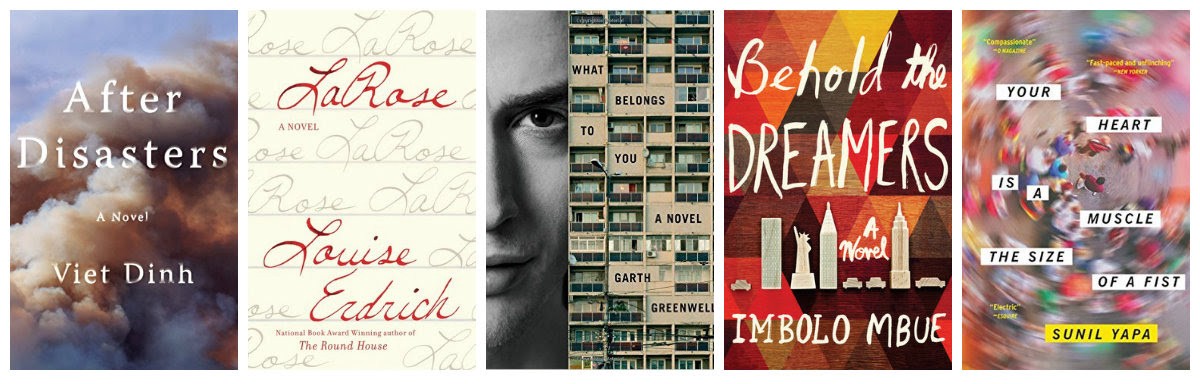
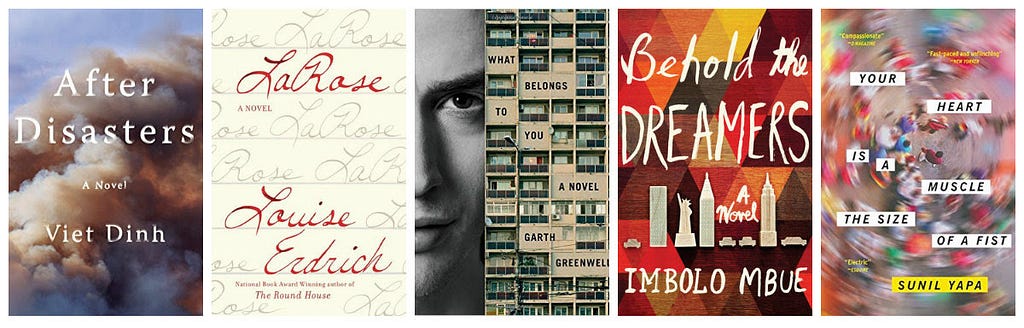
The five 2017 PEN/Faulkner award finalists have just been announced, and as Ron Charles at Washington Post notes, it is a very diverse set of finalists. In past years, the award has gone to authors such as Don DeLillo, Sherman Alexie, and Deborah Eisenberg. The winner will get a prize of $15,000, with the runner-ups getting $5,000 each.
I sometimes worry that there will come a point in my reading life where I won’t be able to have the kind of visceral, unmanageable reaction to a book that I’ve often felt was made possible by my being young, hypersensitive, and — frankly — unmedicated. I worry that it’s behind me now, the time where I can be positively torn asunder by a text the way that I was when I read Elizabeth Wurtzel’s Prozac Nation at sixteen, Virginia Woolf’s Mrs. Dalloway at eighteen, Maggie Nelson’s Bluets at twenty-one. I never have the opportunity to worry about this for very long, however, because invariably what happens is that a book will land in my lap that proves I’m still (and hopefully always) alive and vulnerable to language, wielded expertly, which brings into being new, singular cartographies of emotional landscapes.
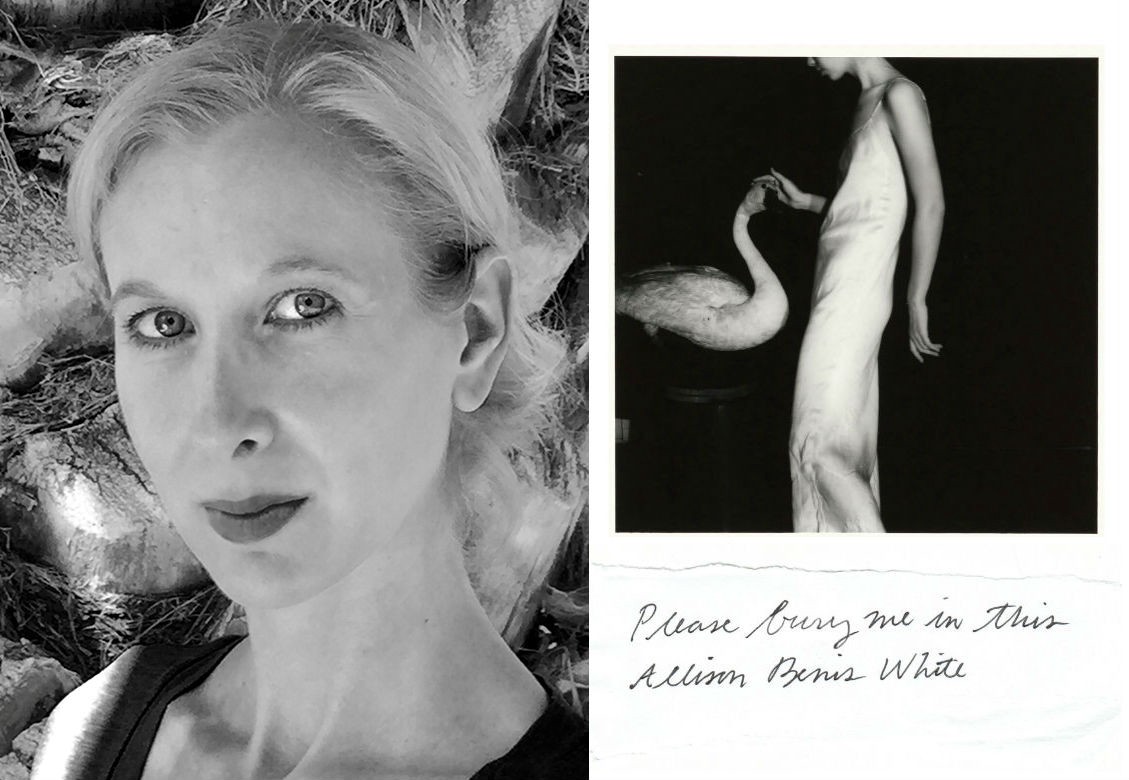
Allison Benis White’s Please Bury Me in This is such a book. Its effect in my first reading cannot be overstated. I texted a photo of a page — of which I’d highlighted the entirety — to a friend and wrote, simply, “I’m gutted.”
As is the nature of anything sublime, White’s collection of poems combats easy synopsis or concise abbreviation. I’m inclined to call them elegies of a sort, if, as Mary Jo Bang suggests, we understand that the objective of an elegy is “to rebreathe life into what the gone once was.” But the elegy that extends throughout Please Bury Me in This is as much about the haunting insufficiency of language as it is about the cruelty and greed of time and the disunity with which it can frame one’s life. White’s poems have no interest in ribbon-tying or putting everything in its right place. There are no bright, right places — that is grief. The beauty and the power of these poems, then, lies in the acknowledgement of this and the persistence to search anyhow; a gesturing, a reaching toward, that constitutes its own species of expression; its own grammar of grief.
It was so gratifying — and not a little emotional — to speak with White by email about Please Bury Me in This, out March 7th from Four Way Books.
Vincent Scarpa: The epigraph for the book comes from an article that appeared in The New York Times in 2014: “Mental illness is not a communicable disease, but there is a strong body of evidence that suicide is still contagious.” I thought the best way to open up a discussion of the book might be to ask what led you to situate this as the epigraph? It seems multivalent, multipurpose — both the placement and the sentence itself. I suppose this is also a question about intention on a larger scale, too. Was there something specific that set these poems into motion and found them cohering into a collection?
Allison Benis White: Yes, the epigraph refers to something specific that set these poems in motion — well, two specific events, both of which are gestured to in the dedications: “For the four women I knew who took their lives within a year” and “For my father.” After a very dear friend committed suicide, three more women (who were in our close and extended group of friends) took their lives as well — one every three months for a year. Each suicide was in some way a reaction to the previous suicide(s) — and this epigraph about suicide contagion was a succinct way to situate the poems’ originating traumas, and to locate the speaker as a potential victim of this contagion. My father’s death was also an originating event for these poems and is, more subtly, folded into the epigraph, as he suffered from significant mental illness, although his death was natural.
VS: Rachel Syme wrote a very interesting piece recently in The New Republic; a review of Sarah Manguso’s 300 Arguments that placed the book in a lineage of “many short, intensely personal works by women that have in recent years blurred the boundaries between poetry and prose.” As I told you before we started this interview, I place Please Bury Me in This on the same shelf as some of my all-time favorite books — Maggie Nelson’s Bluets, Rebecca Reilly’s Repetition, Jennifer Denrow’s California, Jenny Boully’s one love affair — because I found this collection as vulnerable and stunning and precise as those books in the way it maps the tectonic shifts of feeling and thought. The question of lineage, though, or the fact that these “intensely personal works” were all written by women and were all, to some extent, fragmentary/genre-blurring in nature, hadn’t really occurred to me — or, it hadn’t occurred to me as especially notable — until reading Syme’s piece. She says, “These are expansive narratives, but ones that take place inside compact vessels. It is as if these writers feel they need to pack as much into as little space as possible…and attempt to infuse it with a new resonance and weirdness, with something human and desperate.” I’d be interested in hearing you ricochet off of this — the possibility of there being a kind of reticulum between gender, genre, form, and content — in whatever way you feel compelled. All I could land on with any lucidity in my own thought process, particular to your book, is that the fragmented form can be a machine of meaning-making by virtue of the fact that it dramatizes isolation both in content and on the page itself, cut through with white space, and it dramatizes the fraught nature of connection as it arranges some lines to feel linked to what come before or after them and others to stand utterly loose, unstabled.
ABW: Wow, what a gorgeous analysis — what gorgeous insights. My instinct is to just let your words stand and not poison them with my own. But this is an interview (!), so I’ll try and say a few things. First, I’m in love with all the books you mentioned (bar the recent Manguso, which I haven’t had the chance to read yet), and I’m honored to be in their company. Each one of these books has paved the way for my act of articulation in Please Bury Me in This. I can say, on the page, I’m interested in violently but carefully carving away the unnecessary in an effort to access essential heat. I’m also obsessively interested in the virtue of “lightness” on the page, as Italo Calvino describes so beautifully in his first essay in Six Memos for the Next Millennium. Ultimately, I think form is emotional and intuitive. At one point, in a poem toward the end of the book, I wrote, “I mean the sentences cannot touch.” And I was like, oh, O.K., that’s what’s been going on this whole time: a kind of necessary isolation and illumination of (white) space via a series of double-spaced sentences as a means to represent the speaker’s fraught aloneness/weirdness and need to connect/gather. In the same poem, the line “…so the emptiness can pass through” arose. This seemed to communicate (to me) the goal of the form as well: to create space for passage — a cage for release.
VS: As I was reading and then rereading, I wondered whether it came about naturally in drafting or if it was perhaps more purposeful, your inviting certain figures — Woolf, Sexton, Plath, Duras — to be something like interlocutors in the text. At certain moments, you’re using their words directly, but at others you seem to be almost addressing them, or speaking from a locus that their work has opened up for you. Can you talk about the process by which these and other women — Lispector, Dickinson, Stein, O’Keeffe — made their way into the body of Please Bury Me in This?
ABW: I think the process was both natural and purposeful — natural in that these women, these minds, (what I call “my good voices”) are the ones I keep open on my desk while I write, the minds I want/need to be in conversation with. And purposeful in that I don’t want to be (and terribly want to be) alone. Employing their words periodically, and speaking to them (or near them), is an act of (or gesture toward) communion. I want to be with them (as well as with my dead friends), and so I’ve made a room, several rooms, in which to safely do that.
VS: The collection has a number of interests, but chief among them — in my reading, anyway — seemed to be the (in)sufficiency of language as a conduit for expressing/communicating experience — specifically, the experiences of grief and of suffering, emotional or physical. This is an area in which I’ve always been interested and which I, too, have written about, so it’s unsurprisingly one of the elements of Please Bury Me in This that most activated me emotionally and intellectually. Throughout the collection are moments where you touch down on this. In one poem you write, “I want a larger cage: every page, every letter;” a kind of acknowledgement that language is inherently an immuring agent, but that one can still state the desire, through language, for an increase in its capacity. (And perhaps that, in and of itself, is an enlargement!) I wonder if you could talk a bit about this, specific to what your vision for Please Bury Me in This was at the start and then the architecting of it with, as you say, “these words, their spectacular lack.”
ABW: Well, this is everything, isn’t it? — the need to use language on the page (because I can’t paint or sing, which will never cease to disappoint me — although I can dance (!), but not well enough to meet my needs to convey/invent) and the inherent failure of language to communicate trauma (the unsayable). This tension is the nexus: the only way I can scratch toward articulation is to begin with an admission of failure. This act of telling the truth (to myself) allows me to persist. Language cannot resolve grief or contain it, but it can sometimes make a box (a poem, a book) within which something alive (heat-producing) can be experienced.
VS: Following that thread a bit further, I wonder what your thoughts are now, having finished the book, about moments in the text wherein you seem to be flagging a failure of language, of communication, of writing, especially as it pertains to addressing another. “I am not any closer to saying what I mean,” you write in one poem. “Someday I believe, in order to be free, what I say will trample me,” you write in another. And then, on the penultimate page, in a particularly wrenching moment in a book unsparingly replete with them, you write, “I am writing to you as an act of ending.” I love that line so much for its choice not to designate what the speaker aims to end, only that she aims to end something via the act of writing. I’m not interested in — I’m not asking about — the question of whether or not writing is cathartic. (A question to which, it has always seemed to me, there’s exactly one honest, unsatisfactory answer: only so much and no more.) Rather, I guess I wonder what you feel you’ve ended — if you feel, even — with writing and now publishing Please Bury Me in This, which you dedicate to four women you’ve lost to suicide and to your father. Do you feel closer to having said what you meant? Or is the best one can hope for something like the effect you describe when you write, “What makes the shape become visible, and breathe, is the angle and variation of absence”?
ABW: I have three immediate responses to these questions: 1) Can I please steal your line and someday title a book, Only So Much and No More — or will you please write a book with that tile? 2) At this moment, I only know/feel that I’ve ended writing Please Bury Me in This, and 3) I suspect I may be closer to having said what I meant based on this series of interview questions.
VS: Oh, that’s happy-making to hear! And yes, the title is all yours.
My final question, fittingly, has to do with a line on the final page: “I mean the death of death leaves a hole.” That line was like an apple corer to my heart. And it reminded me of a line from Amy Hempel’s story “Beg, Sl Tog, Inc, Cont, Rep”: “The worst of it is over now, and I can’t say that I am glad. Lose that sense of loss — you have gone and lost something else.” Something essential, yet almost incommunicable, is being pointed to in both. Not that one would necessarily want to treasure or cling to one’s pain or angst or grief — though I think it’s quite common, and not at all inexplicable — but that it becomes familiar, and there is a manner of comfort in the familiar, and the pain can come to calibrate you, even dictate a sense of purpose. It can, as you write, “assemble the soul.” Having had the last word — at least, the last word in this book — on the set of concerns and emotional territory which, I can only assume, were what drove you to write these poems in the first place, I wonder if you feel that hole of “the death of death,” the loss of that sense of loss, and what you do with it. I ask, perhaps, because I’ve recognized in my own writing about pain a certain kind of resistance to completion, fearing what will and will not be on the other side of writing, what wrecked city the pain might leave behind when it leaves.
ABW: These questions are destroying me (in the best way). Will you marry me? Oh wait, I’m already married. OK, that was weird. Bear with me. I’ve been alone with this work for a very long time, and your words are a kind of knowing and understanding that is just brutal. I will just say that after finishing Please Bury Me in This, I wrote another manuscript in a fever (within a year) so as to remain in close proximity to my losses. They’ve piled up in such a way I don’t know who I am without them.
Prior to joining the White House staff, Steve Bannon was the executive chair of Breitbart News, the alt-right (euphemism for white-nationalist) media outlet known for breathlessly circulating conspiracy theories. In his current position as chief strategist to the President of the United States, Bannon is now in a position to whisper sweet-supremacist-nothings into the ear of (deep breath) the leader of the free world. This past weekend The Huffington Post unearthed a strange and disturbing tidbit about Bannon’s intellectual history: his abiding love for the French novel, The Camp of the Saints.
HuffPo’s Paul Blumenthal and JM Rieger noticed that when Bannon discussed immigration issues on Breitbart podcasts and radio programs, he consistently appealed to the widely-despised 1973 novel. The reporters put together a short clip of Bannon’s references. In addressing a perceived “invasion” of immigrants to the US and other western countries, Bannon consistently characterizes the situation with tired phrases like, “I call it the Camp of the Saints.”
If you’ve never heard of The Camp of the Saints before, it’s probably because you’re not a bigot. The book never gained traction in circles beyond the far-right. When an English version was released in 1975, Kirkus took no prisoners, concluding: “The publishers are presenting The Camp of the Saints as a major event, and it probably is, in much the same sense that Mein Kampf was a major event.”
You might be wondering: “Could it really be Mein Kampf bad?” Well, let’s just take a look at the book’s premise, as summarized by HuffPo:
The plot of The Camp of the Saints follows a poor Indian demagogue, named “the turd-eater” because he literally eats shit, and the deformed, apparently psychic child who sits on his shoulders. Together, they lead an “armada” of 800,000 impoverished Indians sailing to France. Dithering European politicians, bureaucrats and religious leaders, including a liberal pope from Latin America, debate whether to let the ships land and accept the Indians or to do the right thing — in the book’s vision — by recognizing the threat the migrants pose and killing them all.
That paragraph pretty much speaks for itself.
The novel was penned by Jean Raspail, a man Wikipedia describes, in high continental fashion, as an “author, traveler and explorer.” He has produced an extensive body of work in his lifetime and has received accolades for his contributions to geographical study. Oh, and in 2004 he was sued by the International League against Racism and Anti-Semitism for inciting racial hatred, although the petition was ultimately rejected by the court.
The book has gone to reprint a handful of times in the U.S. Scribner was the first American publishing house to take on the translated manuscript, but after poor sales the torch was handed to Cordelia Scaife May, sister of the conservative benefactor, Richard Mellon Scaife. The third time the book went to print was by John Tanton’s small publishing house, Social Contract Press, which advocates for extreme population control and has troubling historical connections to white nationalist groups; it has been named a “hate group” by the Southern Poverty Law Center. The book’s most recent run was in 2001; we wouldn’t be surprised if Bannon soon encourages a new edition.
The entire HuffPo article is well worth a look. But one more question for our own readership: how terrifying is this news? Readers and writers know better than most just how much our personal literary proclivities reveal.
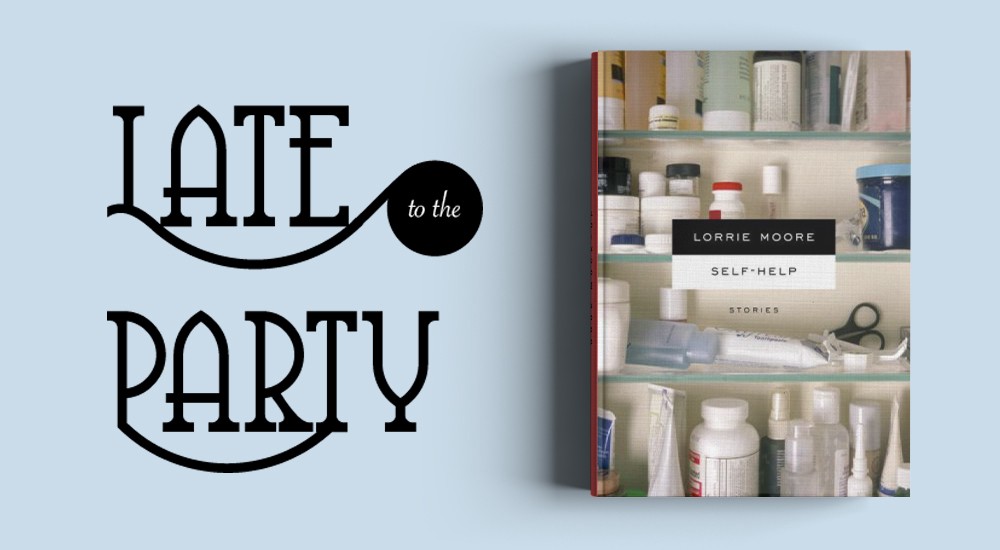
Late to the Party is a new Electric Literature series where we ask writers to write about an author that, for some reason, they’ve never read. The idea for the series came about when I mentioned that I’d never read Lorrie Moore and a cry of “WHAT??!?” echoed through the office. On the one hand, I’m a short story writer and editor living in America with one degree in English and another in Fiction, which makes it surprising that I haven’t read Moore. On the other hand, no matter how well read any of us are, we all have enormous gaps. Talking in the office, my co-workers listed authors they’d never read — Margaret Atwood, Herman Melville, Tolstoy, Bolano, “any of the Brontes.” It takes a lifetime to read a library.
But we thought it would be interesting to start a series where authors write about their impressions — positive or negative — of an author they haven’t read, then read one of their most famous works and see how their uninformed opinion holds up. (Hat tip to Court Merrigan’s “My Year in Re-Reading After 40” series at Electric Lit for the idea of the two part structure.)
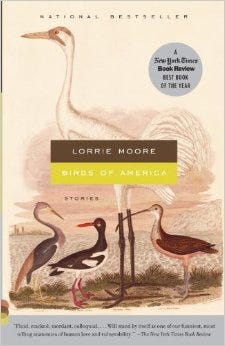
So why haven’t I read Lorrie Moore? For the most part, I simply haven’t gotten around to it. It isn’t as if my mother’s dying wish was that I read Birds of America yet I refused her even this because Moore once stole my sandwich from the freezer at MacDowell. In the office, I offhandedly said I had the impression that Moore was the type of “MFA writer” that normally doesn’t quite do it for me. I was told that I was dead wrong. I was told Moore was far more widely read than just the MFA universe, that she was read by “all women,” and that she “invented the instructional second person short story.” (The last bit seems like saying a doctor invented genital herpes, but to each their own.)
I’ve always been someone who rolled my eyes at the “MFA writing is all the same” camp. The range of authors who have attended an MFA — from Flannery O’Connor and Ben Marcus to Joy Williams and George Saunders — encompasses almost any style of literary fiction out there. And as an editor, I’ve read countless Raymond Carver clones from writers without an MFA. So my comment was lazy.
Still, there is a certain style of witty-but-not-actually-funny kinda-dark-but-not-really-dark literary realist story composed of poetic-but-definitely-not-too-poetic sentences that dominates much of what gets published in literary magazines and submitted to undergrad or MFA workshops. Normally there are couples having bad sex, parents divorcing, and grandmothers dying of cancer. Some of this is great, even transcendent, but I’ve just read enough of it in my life.
Still, there is a certain style of witty-but-not-actually-funny kinda-dark-but-not-really-dark literary realist story composed of poetic-but-definitely-not-too-poetic sentences that dominates much of what gets published in literary magazines and submitted to undergrad or MFA workshops. Normally there are couples having bad sex, parents divorcing, and grandmothers dying of cancer.
So my assumption — again, I want to stress that this is just my uninformed impression of an author I have never read — was that Moore was in that camp. About the only thing I’ve heard about Moore is that she’s very funny. So I assume she is a funnier Raymond Carver or a less biting and brilliant Joy Williams. Somewhere between those two.
At the bookstore, they had the two collections I’d heard praised, Self-Help and Birds of America. I picked up a copy of her breakthrough book, Self-Help, since it was about 1/4th the size and, as her early work, I figured it would be more daring and experimental. I’ll let you know what I think.
How to Dislike a Lorrie Moore Story
Reader, I hated it.
Or, to phrase it like a Lorrie Moore character: “Feeder, I skated it.” (More on Moore’s obsession with nonsensical puns in a bit.)
I went into this series expecting to love Moore and to realize that all my impressions and stereotypes were dead wrong. Instead, I’m hesitant to even write about the book, since I’m sure to offend a lot of my friends. But, oh well, the point of this series is to give an honest reaction, and Moore has achieved enough acclaim, sales, and awards that I doubt she will care what I think.
When I wrote my pre-reading impressions, I gently mocked the kind of story that is ubiquitous in undergrad creative writing classes and MFA programs: “Still, there is a certain style of witty-but-not-actually-funny kinda-dark-but-not-really-dark literary realist story composed of poetic-but-definitely-not-too-poetic sentences that dominates much of what gets published in literary magazines and submitted to undergrad or MFA workshops. Normally there are couples having bad sex, parents divorcing, and grandmothers dying of cancer.”
If you replace “grandmothers” with “relatives,” this is a Nostradamus level prediction. Virtually every story here features bad sex, divorcing parents, or relatives dying of cancer… often all three at the same time. If you’ve ever read slush for a lit mag or gone through an MFA, you will recognize all the moves and styles in these stories from vague but kinda poetic titles (“What Is Seized,” “Go Like This,” “To Fill,” etc.) to a complete lack of plot or story.
How to Write Serious Literary Fiction in the 1980s
Moore is so popular that perhaps her work is cliche because she invented the cliches. Certainly she must have helped spread them. That said, Self-Help was published in 1985. By then, Raymond Carver had published all of his major works. Joy Williams, Frederick Barthelme, and Alice Munro had all been publishing for over a decade. Mary Robison, Jayne Anne Phillips, and Ann Beattie were well established. The blueprint of MFA realism was already there. Additionally, there is a story in Self-Help about being in creative writing classes in which the cliches of MFA realist stories are mentioned and, to Moore’s credit, mocked.
Cliche inventor or not, what distinguishes Moore’s stories from the other 80s literary realist short story writers? Compared to the authors listed above, Moore’s work stands out as being far more, well, privileged. While the 80s K-Mart realists were known for writing about poor and working class Americans who were often overlooked in literary fiction, Moore sticks to your average educated white upper/middle class characters who don’t really seem to have jobs or problems beyond their family or lovers. (The few times jobs are mentioned, they’re just fodder for arch jokes or else details that never impact the characters’ personalities or actions.)
Beyond the white middle classness of her work, there are two things that seem to make Self-Help unique from Moore’s contemporaries: puns and the second person POV.
How to Tell a Joke aka How to Spell a Coke
Get it? “Spell” and “coke” rhyme with “tell” and “joke” so it counts as a joke besides not being witty nor making any sense in context. Time and time again in Self-Help, the reader is confronted with an awkward line or an irrelevant detail only to learn it was set-up for a pun:
“You’re turning into a cat mom. Cats, Trudy, are the worst sort of surrogates.”
Tell him you’ve always wanted to run off and join the surrogates.
*
The castle’s doorman’s fly is undone. Smile politely. In the elevator, say “The unexamined fly is not worth zipping.”
*
“So, you’re a secretary?”
Squirm and quip: “More like a sedentary”
These jokes almost never advance or complicate plot/setting/mood/etc, and since almost every character has this “quirk,” it doesn’t distinguish one from another. It’s random humor divorced from plot or character, like Family Guy jokes written by a PhD student.
It’s random humor divorced from plot or character, like Family Guy jokes written by a PhD student.
How to Write a How To Story
The second distinguishing feature is the “how to” format that Moore is apparently known for inventing. Six out of the nine stories feature the second person, and four have “How” in the title. Today, this story style is extremely popular in undergrad creative writing classes. But I can believe this is because of Moore’s influence and that people weren’t writing them in her day.
However, few of the “how to” stories in this collection play with the idea or form of how to guides. Most of them read as if they were traditional third person stories that the writer later searched through in order to change pronouns from “he” or “she” to “you,” without making any other substantive edits. That’s fine, but it feels like a missed opportunity.
Stylistically, the most interesting story is the last one, “To Fill,” where Moore adopts a nicely bizarre and ungrammatical voice that features plenty of oddly poetic lines. It opens: “There is no dignity in appetites. That blanched pathetic look at salad bars, those scramblers for some endless consumption I am no exception.” And yet Moore can’t avoid passages like this:
Do I grow slinky? I think of carrot sticks and ice and follow Jeffrey’s lead. I am snapping my fingers, wiggling, bumping, grinding. Mom, giggles Jeffrey. That’s too kinky.
And later, alone, the night outside grows inky, like my thoughts, my thoughts.
I am dying for a Twinkie.
How to Make Fun of Yourself
By far the funniest story in Self Help is “How to Become a Writer,” in part because it seems to be mocking every other story in the collection. The (second person) protagonist is a writer who has no concept of plot or much of an imagination, but instead populates aimless stories drawn from real life with bad puns. The protagonist keeps a folder of writing ideas like “Possible plot? A woman gets on a bus” and turns in stories to workshop with titles like “For Better or for Liverwurst” and “Mopey Dick” — the latter is about “Monomania and the fish-eat-fish world of life insurance in Rochester, New York. The first line will be ‘Call me Fishmeal.’” This is all deflated by the other characters who are bored by the fake wit and lack of any story in the protagonist’s workshop submissions.
So, Moore is certainly aware of her habits, even if she doesn’t change them in this collection.
How to Admit Moore Is Certainly Not a Bad Writer
While Moore in Self-Help does almost everything I dislike in the genre of “MFA realism” fiction, I don’t want to pretend this is a bad book. The puns aside, Moore has many strengths. She is great at writing the small but meaningful moments, has an eye for the well-plucked detail, and peppers the stories with plenty of nice lines, metaphors, and scenes.
I think what left me ultimately feeling cold to these stories is the fact that despite their strengths, they don’t seem to add up to much.
How to Like Quiet Realist Fiction
Moore, like many writers of literary realism I’ve read, fills her stories with little details, quirky character traits, small events. Many of these are interesting, some very moving. The problem, for me, is that they aren’t linked to a story. Too often, they feel interchangeable. I mean that literally. I’m pretty positive I could swap around lines and paragraphs from these stories and readers wouldn’t notice. The details don’t feel chosen to affect the story, but rather are just there because the writer thought the detail was in itself interesting. They don’t build to something.
(And, yes, I’m positive I’ve been guilty of this in my own writing. As a writer, it’s always tempting to cram an interesting detail, a clever metaphor or, I guess, a corny pun into a story even when it doesn’t serve a purpose.)
When a story is written this way, no matter how memorable the parts, I’m left forgetting the whole.
How to Read 1980s Fiction in 2017
There is another element of my dislike of these stories that isn’t specific to Moore. I imagine I’d have a similar feeling with a re-read of Beattie, Carver, or Munro. And that is how irrelevant they feel in 2017. With a reality that is growing increasingly absurd, surreal, and darkly comic, these quaint, quiet “realist” tales of people entirely unaffected by the world around them feel, frankly, unreal. And in a time when the world seems on the brink of chaos, the US political system is completely dysfunctional, and religious and ethnic minorities are being terrorized at home and abroad, it’s simply hard to care about the plight of educated middle class characters who can’t decide if they want to keep having a sad affair that they never enjoyed in the first place.
With a reality that is growing increasingly absurd, surreal, and darkly comic, these quaint, quiet “realist” tales of people entirely unaffected by the world around them feel, frankly, unreal.
How to Actually Like a Lorrie Moore Story: Birds of America
Because several EL staff members told me Self-Help wasn’t nearly as good as Moore’s middle period work, I decided I should at least read one story from Birds of America. After writing the above, I read the first story, “Willing,” and I was almost shocked that it was the same writer.
While this story is about, yes, an upper class woman having an affair, the character (an actress aging out of the sexist film industry) is a fully realized creation. She has (or had) a job, and the job impacts her and her actions. She has thoughts and feelings that feel unique to her. Moore’s writing still sometimes has a hodgepodge feel, where sentences and paragraphs don’t necessarily follow from each other and there are asides that feel like they come from the author not the character. (“The thing with tapas bars was that you just kept stuffing things into your mouth.”) But here the arrangement feels purposeful and masterful. It works to create an effect. In Self-Help, it sometimes felt like Moore was taking clever lines she’d written down in a notebook then forcing them into whatever story she was working on. It does not feel like that here.
Even better, I found “Willing” truly funny, and I believe that’s because the humor comes from the actual actions and drama of the characters instead of weird puns or wry jokes being made by the author. I burst out laughing at this point, when the actress finds out the car mechanic she’s been sleeping with — whom she doesn’t actually like — slept with another woman:
A bone in her opened up, gleaming and pale, and she held it to the light and spoke from it. “I want to know one thing.” She paused, not really for effect, but it had one. “Did you have oral sex?”
He looked stunned. “What kind of question is that? I don’t have to answer a question like that.”
“You don’t have to answer a question like that. You don’t have any rights here!” she began to yell. She was dehydrated.
For my money, both the surprise oral sex question and the “She was dehydrated” line are perfectly placed.
I also quote that passage to note a tactic — frequently used in this story — that Moore seems to have popularized along with the “how to” format: the use of a sudden florid line to heighten emotionally important moments. This move is as common as the page 2 flashback in MFA literary realism, but I can believe that Moore popularized it. It works well here. Moore used these in Self-Help too, but there were so many jump-out-of-the-page lines in each story that none really jumped out. And they weren’t placed as strategically for emotional impact.
If I had a criticism of this story, it would be that these power lines are sometimes vague and too metaphorically confused for my taste. The bone that turns into some kind of megaphone is a bit awkward, but I can kind of go with it. A better example: “There was something numb and on hold in her. There were small dark pits of annihilation she discovered in her heart, in the loosening fist of it, and she threw herself into them, falling.” This, to me, reads a little too much like goth poetry. And there’s just too much there. The feeling inside her is “numb,” “on hold,” “small dark pits of annihilation” and near her “loosening heart” that she then throws herself / falls into. Do we need all that?
This is not to say that I think you can’t be over-the-top with your power lines. I quite loved this beautifully ridiculous moment:
Might be willing…” he was saying. But she was already turning into something else, a bird — a flamingo, a hawk, a flamingo-hawk — and was flying up and away, toward the filmy pane of the window, then back again, circling, meanly, with a squint.
Still, “Willing” is a very well-written story that makes me understand Moore’s appeal and influence. It may be MFA realism, but it’s a lot better than most of her imitators…or her own early work.
Division, secrets, and lies abound in Katie Kitamura’s spare and unsettling A Separation, a novel that focuses itself on the end of marriage and the stories that exist within such a murky, and often opposing, area.
Kitamura’s novel opens in a cloud of confusion. Isabella, the unnamed narrator’s abrasive mother-in-law, can’t get her son, Christopher, who is in Greece doing research on mourning for his latest book, to respond to her messages, and she’s upset. Isabella hopes that the narrator, Christopher’s young wife, will have some news about Christopher’s whereabouts, but Isabella is sorely disappointed. The narrator hasn’t heard from him either. There is more going on in A Separation than a set of unanswered messages. In fact, there’s a big secret that no one knows. The narrator soon admits to us, “I didn’t tell her that Christopher and I had separated six months earlier, and that I hadn’t spoken to her son in nearly a month.” Isabella’s concern prompts the narrator to make an “extravagant gesture” by traveling to Greece to find her estranged husband.
Once in Greece, the narrator struggles to find her husband. She travels to his hotel but finds it and the area surrounding it to be largely desolate. She speaks with the cabdriver and the hotel attendants, but no one has clear answers regarding Christopher’s whereabouts. He’s, at least as far as anyone can confirm, missing.
The narrator does casually look for Christopher, but there’s not any real indication that she’ll care if she finds him. Her view of their marriage, and most marriages, is hardly flattering. She says, “In the end, what is a relationship but two people, and between two people there will always be room for surprises and misapprehensions, things that cannot be explained. Perhaps another way of putting it is that between two people, there will always be room for failures of imagination.” And why shouldn’t she feel this way? After all, Christopher is a flake of a man, someone the narrator describes as “always running away before he was running toward anything.” He’s also a serial cheater.
As the story picks up steam — and a surprise murder enters the picture, it seems as if the second half of the novel will transition into a thriller (or a mystery at the very least), but it doesn’t. Instead, A Separation functions as a quiet, literary kind of horror novel, told with lyrical prose and minutely-observed commentary about the fear found in failing marriages and the monsters who occasionally exists within these pairings.
A Separation is cleverly deceptive, and it possesses a strange, unsettling tone. Kitamura writes with an eeriness that is hard to shake. Near the beginning, just after the narrator lands in Greece, the novel firmly establishes itself as a macabre one. We already know there’s something weird about Christopher, but even the landscape along the coast seems ominous. There’s a certain dreariness as Kitamura describes the deserted, charred, and “black” hills. Even the beach surrounding the resort where the narrator stays seems largely indicative to the novel’s overall feeling:
“It was a harsh and rocky shore, hardly luxurious, although the landscape was more than picturesque, edging toward a bleak and extreme blankness.”
A Separation is largely void of any voice except the one that carries it, and it’s a richer novel because of it. Reading of the narrator’s intricacies and personal lamentations creates a rich, intimate story that is addictively engrossing.
The sudden ending is sure to leave some readers (including myself) feeling, at least initially, unsatisfied. But then I think about the story that came before it. Really, what else could I expect? The unknown is where much of life exists. There’s horror and there’s comfort in it. A Separation reminds us that not knowing is okay. In fact, sometimes it’s for the best.
She forced it out in a steady stream and stared at the tiled floor. The last thing she wanted was to need the toilet during her appointment. If she moved even slightly in her seat, Dr Hughes seemed to know what she was thinking about. He never said anything, but she knew he knew. It was there in his monstrous eyebrows and his straight mouth. Sometimes she’d sit and look at his eyebrows rather than his eyes and she’d look for so long and so hard that she thought she could see movement. She didn’t imagine insect life in there, but rather several small, very small, minute, versions of the doctor. Once she’d had this thought months ago, right at the start of their appointments, she was unable to unthink it, and now it was almost as if these tiny versions of Dr Hughes actually existed and were watching her and judging her too.
She’s been having dreams about him. This wasn’t unusual apparently. During her second appointment, he’d looked at her with that all-knowing manner of his and said,
“It is likely that over the coming days and weeks you will find yourself thinking and indeed dreaming of me, and of this room.”
She’d nodded, waiting for him to get on with whatever it was he planned to go on about this time. But he waited for her to say something because, as he’d made clear to her at the start of the first session, he was big on verbalising rather than internalising. When he said “verbalising” he leaned forward and squeezed her knee. And then he settled back in his chair and pointed at his stomach when he said “internalising.” She could see the word “internalising” in big, squishy bubble writing sitting inside him like a greedy baby, waiting to be fed emotions that would never be voiced. She realised after what could have been two minutes or twenty — that was one of the reasons she was seeing Dr Hughes, her inability to follow time — that he was waiting for her. She couldn’t think of what he wanted her to say. She’d taken a breath.
“What kind of dreams?” It was a guess, this question, but she’d guessed right.
He struggled to contain a smile.
“All sorts of dreams — you will dream of our appointments. They will start as they actually happened.” He closed his eyes for a long blink. “I may ask you about your feelings concerning your mother, and then let us imagine the door opens and someone you have not seen for a long time comes in angrily. Or the chair you are sitting on may change into a lily pad or a cockroach or perhaps we will suddenly start kissing passionately.” He smiled at her.
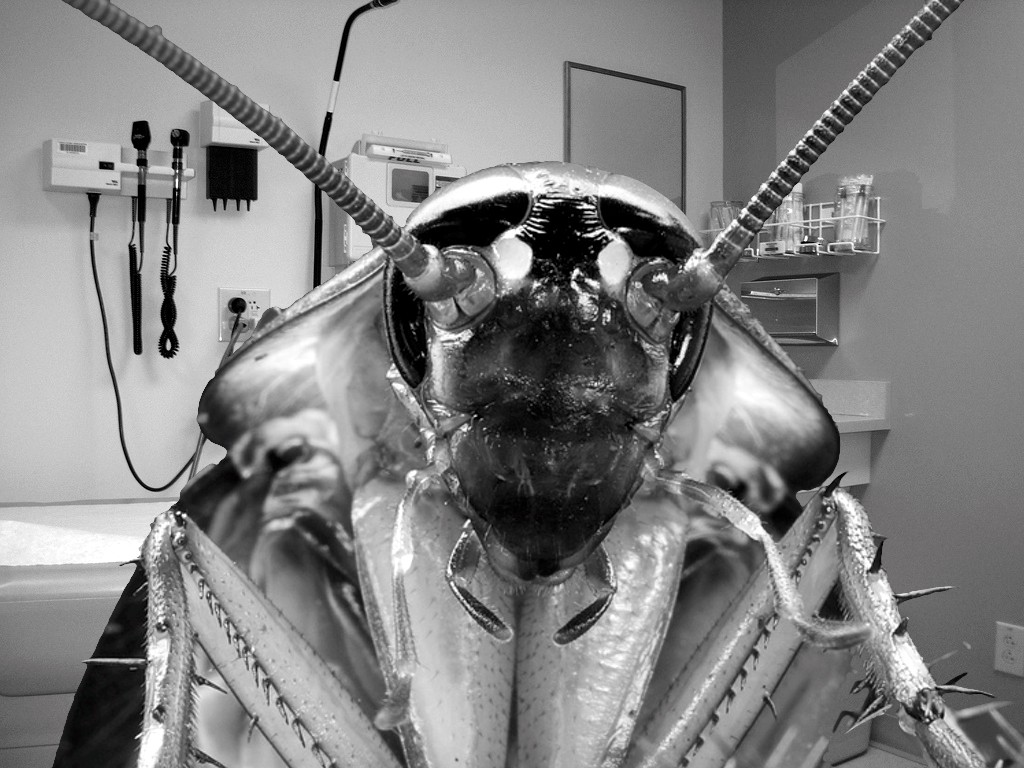
Of course the things he suggested all happened in her dream that night. Thankfully, the huge cockroach she was sitting on bucked her off its back, rose on its two hind legs and gobbled the doctor up. She spent the rest of the dream rifling through the filing cabinets while the cockroach leaned back in the doctor’s chair and tried to fold its tiny arms behind its head.
Naturally, the doctor wanted her to talk about her dreams. But what was the point? He was never going to tell her what they meant, he just wrote them down in his pad and nodded occasionally. As far as she could tell, he wasn’t doing anything with the dreams to help her. She suspected he was using her dreams to write screenplays, very detailed ones with narrative arcs and supporting characters. She’d once seen a book entitled You Call the Shots: a Beginner’s Guide to Writing Movies in his bookcase. It was gone the next week. She was becoming increasingly resentful about this theft of her ideas.
If she wasn’t being dropped off and collected by her nervous father every week, she’d have stopped attending weeks ago. But she wouldn’t put it past the doctor to communicate secretly with the bill payer if the patient wasn’t attending. He could tape an X in the office window that would be easily seen as the bill payer’s car pulled up at the kerb. Or there could be an abbreviation in the invoices that would tell tales like “AWOL” or “Abs”. Or maybe he would just pull the blind open as the car pulled up and lift his eyebrows definitively.
In any case, she knew her father was paying a lot to have her treated and the least she could do was go along with it. Her father was less nervous since she’s started her weekly sessions. Though that might have been down to Brenda.
She was glad he’d met Brenda as it took pressure off the dinner planning schedule. On the nights he stayed out, she could eat anything she felt like. Mostly she’d make sandwiches with whatever was in the fridge. Usually what she felt like was eating a cheese sandwich.
This was another area of her life that the doctor was keen to hear about. He wanted every detail of what she’d eaten. Between that and the dreams, she knew she’d be better off just keeping a diary, but clearly it was important to her father that some sort of intermediary, a trained intermediary, interpret her daily happenings. What nobody seemed to understand was that it might be helpful to her to be informed of his interpretations. It had been nearly six months now and so far the doctor had made no report on his findings.
The toilet stall was made of a sludgy-green faux marble. She committed the white-streaked pattern to memory; it would give her some background for when she wanted her mind to switch off in the session. The tiles on the floor were about the size of squares of processed cheese but much paler than the stuff she bought from the discount supermarket.
If she didn’t get going she’d be late. She reached into the dispenser for paper and realised that there was only a couple of squares left. She thought about what the best plan of attack would be here. Scrunching it up wouldn’t make up for the lack of surface area, but it might act as a sponge; folding it up would be better, but then she’d likely get her fingers wet. She didn’t have another option though so she gave herself a small, focussed shake, folded the paper up slightly and did the best she could. That would give her something else to think about to run interference when the doctor was asking questions.
Thankfully there was no one else at the sinks when she came out of the stall. The last thing she wanted was to make chit chat or smile politely. Plus the only other people using this bathroom would either be another client of the doctor or his teeny-tiny partner, Dr Griggs. She sometimes saw Dr Griggs waving clients off and had noticed that she wasn’t one for eye contact. She’d say goodbye looking over the client’s head — no mean feat when you’re a midget. That took some serious looking-over-not-at dedication. Perhaps the doctors decided between the two of them at intake, which patients needed to be looked at, and which needed to be looked over.
She moved along the corridor towards the waiting area, running her fingertips over the textured wallpaper. She couldn’t quite tell what the texture was meant to be — probably something organic, but not somewhere where insects might live — that would be too threatening. One man sat sleeping in the corner, in her seat. She’d have to sit next to the water cooler, which could be noisy, but was at least away from the dull gaze of the receptionist. There were several receptionists who appeared to work on rotation, perhaps on a monthly cycle. Though they were wildly different-looking women, they all had the exact same expressions: one for the doctors (shyly smiling) and one for the non-doctors (I’m better than you and bored). She hated to accidentally catch their eye and didn’t check in any more. She was obviously waiting for her appointment; she knew which door to go through; she knew how things worked. Why should she involve a third person?
She stared at the door. As if on cue, it opened and Dr Hughes filled the doorway. His eyebrows filled his forehead. Light filled the room behind him and she stood as if being pulled by a rope and moved towards the door. He stood aside very slightly so she had to push past him to enter the room. He closed the door.
As he bore down on her, she coloured her mind in with streaks of white on a pine forest green background.
Is there any such thing as a pleasant apocalypse? Probably not, although the cozy catastrophes of post-World War II seem to suggest that a global cataclysm might do the world a favor by wiping clean the slate, enabling the “right sort” of people to reclaim it.
There’s no shortage of dystopian and post-apocalyptic literature out there — over 3,000 novels deal with nuclear aftermath alone. In my debut novel, Lotus Blue (Talos, 2017), I envisioned a future ruined through corporate greed, careless governance and unregulated technological experimentation, a logical extrapolation of climate change denialism coupled with military applications of artificial intelligence and autonomous weapons systems. Dune was the novel that initially inspired me, but what I ended up with is more along the lines of Fury Road.
End-of-the-world scenarios leave us wondering who or what we might become, and if our species might end up getting precisely what it deserves.
From Capitalism to Underpopulation, here are the top 13 horrible apocalypses that make people question their faith in humankind.
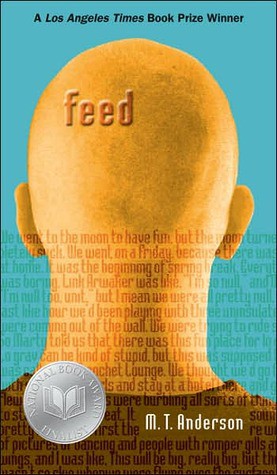
Capitalism: Feed by M. T. Anderson
Protagonist Titus isn’t a bad guy, really, he simply possesses no mechanisms for thinking for himself. This YA novel interbreeds neoliberal capitalist consumerism and social media, pushing them to their logical conclusions and farthest extremes — what happens when all the shouty infomercial advertainment chitter chatter lives permanently inside our skulls? The answer is, of course, varying degrees of nothing good. The apocalypse will be digital…
Cannibalism: The Road by Cormac McCarthy
A man and his young son travel the frozen roads of North America, heading south towards the ocean and whatever hope it might provide. Why the father, as an expression of his undeniable love, doesn’t put a bullet in the boy’s head early on to spare him from the lingering horrors of a barren, resource depleted ash and dust encrusted wasteland replete with murderous, marauding cannibal gangs, we will never know. All the love left in this world will never be enough. Despite the many rough-road tales to come before it, The Road still manages to emotionally bludgeon readers with a couple of specific scenes. If you’ve read the book or seen the movie, you’ll know.
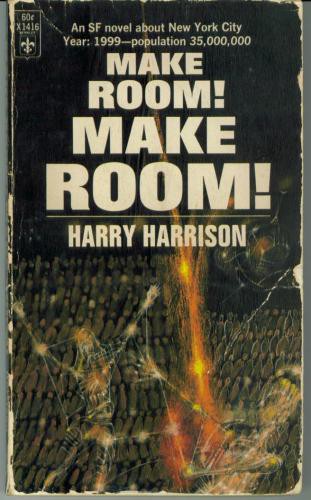
Overpopulation: Make Room! Make Room! by Harry Harrison
Human overpopulation was one of the chief concerns of science fiction’s ecocatastrophe writers of the 60s and 70s. Even if you haven’t seen the film, you’ve likely heard the catchphrase: Soylent Green is people! The novel contains no mention whatsoever of cannibalism via humans recycled as luridly colored protein bars but it is more stifling and relentlessly claustrophobic than the movie, with its utter lack of spectacle or punch line. Just more and more people scrambling for crumbs, squeezed into less and less space.
Underpopulation: The Children of Men by P.D. James
The novel interrogates the shapelessness of existence once all human fertility has ceased and cities increasingly become peaceful repositories of the docile aging. Despite resources aplenty, the Warden of Britain encourages atrocities against foreign workers, the feeble aged and troublemakers in general, running the country as his own private fiefdom.
Alfonso Cuarón’s 2006 movie is arguably more visceral, chilling and sophisticated than the book, focusing on acts of government brutality rather than the protagonist’s inner turmoil — it is impossible not to draw parallels to harsh contemporary world treatment of refugees. If Children of Men is a cautionary tale, then we clearly missed the message.
Biopunk: Oryx and Crake by Margaret Atwood
Wrapped in a decaying bedsheet, Jimmy, aka Snowman (as in, abominable), picks through the ruins of society, worshipped by genetically engineered Crakers, a designer humanoid species with lurid blue genitals, no smarter than they need to be. They’re set to inherit a nightmarish anti-Eden crawling with monstrous biological blends such as rakunks, pigoons, wolvogs, snats and ChickieNobs, animals recklessly engineered for their commercial usefulness back before a deliberate pandemic wiped out most of the human race. Which pretty much had it coming.
Ecological: The Death of Grass by John Christopher
Many kids loved Christopher’s Tripods novels: The White Mountains, The City of Gold and Lead, and The Pool of Fire, where the kids get to fight back against alien invaders. Written for adults a decade earlier, The Death of Grassportrays self-centered human survivalism at its most despicable: a convoy of London refugees enacting across two days an analogy for the fall of civilization, committing whatever violent acts they deem necessary to reach John’s brother’s farm, deciding their own survival is all that matters.
Climate Change: The New Atlantis by Ursula le Guin
Belle’s husband Simon, newly released from labor camp, meets in secret with their scientist cohorts to discuss their solar battery that could solve the world’s energy crisis. They know it’s hopeless but they continue anyway, because that’s the essence of who they are. The most depressing element of this story is not its horrendous, unholy blend of neoliberal capitalism and totalitarian collectivism governance, but the fact of how casually polar ice melt, rising oceans and other realities of climate change are mentioned in passing as a backdrop to the narrative. This story was published in 1975 by one of speculative fiction’s greatest voices, and yet, here we are today.
Mica and Pearl are girlies, raised and schooled in the virtues of CHOM: compliance, humility, obedience and modesty; palliation vehicles for the desires of Men. The luckiest among them will be selected as womanidols, living out their allotted time in perpetual and glorious sacrifice in the Orchid Nursery. You really don’t want to know what that entails. It is not the first SF novel to tackle the brutalism of enforced female purity, but the one that leaves the worst taste in your mouth. Religious fundamentalist sexism taken to its farthest and most hideous extreme.
Post Peak Oil: The Drowned Cities by Paolo Bacigalupi
Young orphaned Mahlia assists kind-hearted Dr. Mahfouz, despite having had her right hand hacked off by Army of God soldiers. The jungle infested shattered ruins of Washington DC crawl with squabbling warlord factions, coywolvs, panthers and monstrous half-men bred from a DNA cocktail of tiger, dog and hyena. When Mahlia and fellow orphan Mouse discover a killer Augment named Tool half dead in a swamp, an unlikely partnership is formed.
One of those YA titles that seems too relentlessly horrible for its marketing category. Still, it’s a damn good read.
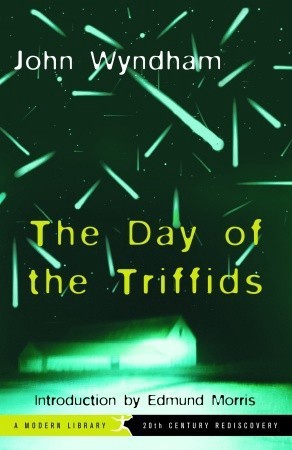
Disability: The Day of the Triffids by John Wyndham
Almost the entire population of the world is rendered blind overnight after witnessing a pyrotechnic meteor display, the result of an accidental weapons malfunction in orbit… If that weren’t bad enough, aggressive monster plants, triffids, the outcome of ingenious biological meddlings, roam the streets, attacking helpless humans.
The triffids are by no means the scariest aspect of this story, they are nothing compared to the abject horror of an entire world fallen blind and helpless. The few remaining sighted have the upper hand and the world is now their playground.
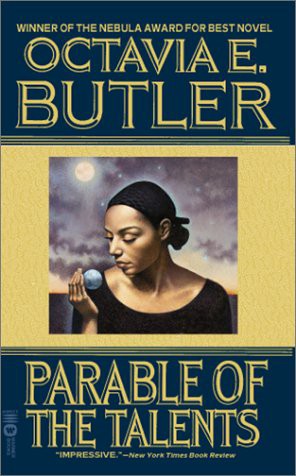
Demagogue: Parable of the Talents by Octavia Butler
It’s 2032 — a variety of wars are raging all around the climate change afflicted world, but the members of Acorn, led by Lauren Oya Olamina, have built a relatively secure, workable community. They follow Earthseed, a faith developed by Lauren on the road. But when far Christian right Senator Andrew Steele Jarret is elected as POTUS, promising to ‘Make America Great Again’ (sound familiar?), Acorn is destroyed and its people slave-collared with devices that deliver painful punishment at the whim of their controllers.
Parable gives the reader the experience via the power of literature of what it might actually feel like to be a slave. In a nutshell: furious and powerless.
Nuclear: A Boy and His Dog by Harlan Ellison
Vic is a solo, part of Our Gang, who run the local Metropole cinema, where men sit around jerking off to ultraviolence and beaverpicks in the ruined aftermath of the Third World War, which killed off most of the girls. Rovergangs run everything that matters aboveground: from power plant to reservoir to marijuana gardens. The middle-classers escaped to enclaves underground. The smart ones stay down there.
Vic’s best friend is a talking dog called Blood, who, as well as having taught Vic to read and write and correcting his gangland grammar, uses his enhanced psychic abilities to sniff out women for Vic to rape. Utterly charming. Especially the end.
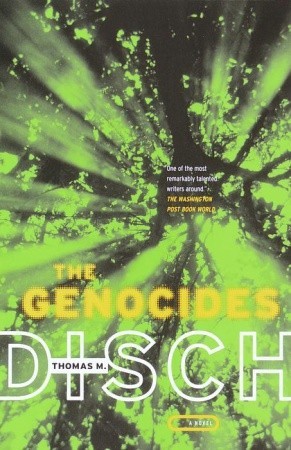
The Earth has become overrun with fast-growing alien plants, 600 feet tall with leaves the size of billboards. As arable farmland is consumed, the human population dwindles, from famine, violence or spherical alien incendiary devices, which eventually force survivors underground into the roots of the alien plants. Protagonist Buddy isn’t much of a hero. His pregnant wife is forced to survive on the food scraps he leaves in the pot.
Readers will find themselves rooting for the plants way before the humans start burrowing, because these nasty brutish stragglers are way past being worth saving. The cannibalism might be forgivable, but not their fierce, unreasoning Calvinist cruelty.
Bonus story: Disch also penned “Casablanca,” hands down the most disturbing short story about tourism gone wrong ever written.
Hello, and welcome to my week-by-week review of the world. Today I am reviewing butter.
It surprised me to learn butter is made from milk, due to the contrast between milk’s grossness and butter’s deliciousness.
To make butter, first, a farmer has to squeeze a cow’s breast until milk shoots out and into a bucket. Then that farmer puts it into a butter churn and churns it about until it becomes butter. A simpler solution would be to go to the supermarket and just buy some butter. Then the farmer wouldn’t have to get up so early.
A lot of people will tell you to limit your butter consumption because it contains large quantities of fat, which can lead to health complications. Those are people who care more about rules than flavor. I am not such a person. I believe in breaking the rules even if that means risking heart failure. Some of the world’s most famous people have died of heart failure.
Anti-flavor opportunists created a butter substitute called I Can’t Believe It’s Not Butter. Only I can believe it’s not butter because it says so right on the package. They may as well have called it This Isn’t Butter But We Think You’re too Dumb to Tell Even Though We Just Said It’s Not Butter.
Then there’s something called margarine but honestly I have no idea what that is.
I love butter so much I will sometimes eat a stick of butter all by itself. If it’s hot out, I’ll drink the stick of butter. Butter goes with any food, from salad to steak. I dare you to put butter on something and not like it — even non-edible things. Sandpaper won’t feel good if you lick it, but put some butter on and it will at least taste good.
I guess what I’m saying is sometimes I’ll fill my bath with melted butter and bathe in it. And I know this is not a common practice but I feel like I shouldn’t be ashamed for being who I am. And no, I do not derive any sexual pleasure from a butterbath. But if I did, that would be fine though. We’re all just people on this crazy planet and as long as no one is getting hurt, so what? That’s what I told my plumber when he had to unclog my drain which had become filled with congealed butter. Turned out to be a pretty expensive fix. Next time I want to take a butter bath I’ll do it at a hotel.
BEST FEATURE: It floats. WORST FEATURE: They confiscate it at the airport even if you have a note from your doctor explaining it’s for a medical condition.
Please join me next week when I’ll be reviewing smallpox.
DON’T MISS OUT
Sign up for our newsletter to get submission announcements and stay on top of our best work.
YOUR INBOX IS LIT
Enjoy strange, diverting work from The Commuter on Mondays, absorbing fiction from Recommended Reading on Wednesdays, and a roundup of our best work of the week on Fridays. Personalize your subscription preferences here.