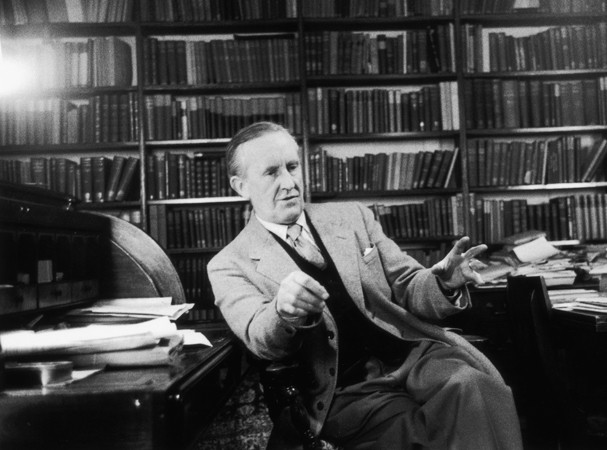
After several decades, a rare recording of J.R.R. Tolkien reading passages from The Lord of the Rings resurfaced just in time for Tolkien Reading Day! For the last fourteen years, the Tolkien Society has designated March 25th as a reading holiday in honor of the adored writer of The Hobbit, The LotR trilogy, and The Silmarillion. Diehard fans of The Lord of the Rings will recognize this as the date that the nefarious ring was destroyed in the blazing fires of Mount Doom. According to Aletia, Tolkien, a medievalist scholar and Catholic, presumably chose this day as a nod to Medieval Catholicism, which formerly subscribed to the belief that March 25th was the date Jesus died on the cross and triumphed over evil.
A reader of the website Brain Pickings, Eugene F. Douglass, Jr., dredged up the long-forgotten recordings of Tolkien reading from LoTR to commemorate his legacy. It starts with with Chapter 1 of Book I of The Fellowship of the Ring. Enjoy the full recording here:
The Writer’s Wallet is a new Electric Literature series focusing on writing, money, and the often long-distance relationship between the two. This month, we’re looking at how to pay taxes on your freelance writing income, and next month we’ll probably look at ways to make the process easier for next year — even if we know we’ll give up after a few weeks. The author is in no way a financial advisor or expert, but he is trying to boost his financial literacy without using words like “adulting.”
If you have questions about money and the writing life, tweet them at @benasam, and he’ll try to get you a real answer in an upcoming column. If you live near NYC, come to Electric Literature’s The Writer’s Wallet panel at The Center for Fiction with Tracy O’Neill, Jennifer Baker, Amanda Clayman, Benjamin Samuel.
Although there’s some debate about who said it first (Benjamin Franklin, Daniel Defoe, Christopher Bullock, or Mark Twain), the fact remains that there’s nothing certain in life other than death and taxes — except, as far as I’m concerned, the commitment to avoiding both. I don’t think I’m alone in the feeling that I’d rather die than deal with tax forms. Every year, I tell myself that I’ll get ahead on my taxes, that I’ll be prepared, that I should just get it over with. As tax season approaches, I’ll lull myself to sleep murmuring “tomorrow, tomorrow, tomorrow,” only to awaken in a panic come April, wondering why I’ve put myself in this position again.
As a freelance writer (with a full-time job) and devout procrastinator, identities which feel inextricably linked, paying taxes is particularly overwhelming and dreadful. I don’t understand what I owe, why I owe it, or even how to find out, so I’d rather just avoid it all together. But this year was different. That’s right. Sound the trumpets, start the parade, and don’t forget to send that taxman over with a briefcase bursting with confetti, because I’ve filed my taxes and it’s not even April yet.
What helped me find the motivation was the reassurance that I wasn’t the only one struggling with the process, and I owe that to Amy Smith, Co-Founder and Co-Director of the Headlong Dance Theater company and patron saint of tax-fearing writers. I first heard of Smith when the New York Times visited her workshop for the Whiting Awards, where she helped winners of the $50,000 prize prepare for the financial realities of their good fortune (which, in part, meant learning about the taxes they’d owe). Smith considers herself an artist first and a financial teacher and tax preparer second. In other words, she understands both artists and the IRS, and she’s on our side. “It’s become my personal mission to help other artists with their financial literacy,” Smith told me during a recent phone call.
Smith and I spoke as the desolate tempest of tax season loomed, the horizon darkened by a cloud of W-2s and 1099s. While Smith didn’t help me file my taxes, she was a beacon that assured me I could get through tax season without getting lost. What follows is Smith’s insight for writers hoping to get past taxes and back to their real work.
Here’s what you can still do before April 18:
1) Choose your weapon:
Using a professional tax preparer or software will come at a cost, but it could save you money and time in the long-run. As Smith sees it, the time you’re spending on your taxes is time you could have invested in your writing — or, if you’re like me, making excuses about why you’re not writing.
Last year, about two weeks before taxes were due, I handed over a stack of papers that included my financial records and recent employment history to a harried tax-preparer in downtown Manhattan. “Good luck!” I told him. “Please don’t steal my identity.” When I returned about a week later, he told me what my return would be, and I gave him a check for $85. It was fine, I guess, but I never really felt I had an opportunity to learn or challenge anything.
While I am curious to learn more about the taxes I pay and the deductions I’m taking, I’m not ready to fill out a tax form solo. If there’s anything more daunting than the blank page, it’s the 1040. So this year I used TurboTax for the first time, which Smith recommended for its reputation and customer service. Surprisingly, using software was more expensive ($135 because, in addition to the 1040 for my full time job, I was filing Schedule C for my self-employed income that came from freelance writing), but I did feel more in control of what was happening. And I did call customer service. Repeatedly. And no one made fun of me for my ridiculous, paranoid, and esoteric questions.
If TurboTax isn’t the system you want to use, there are plenty of other alternatives. And there may even be free resources in your community to help you pay your taxes. Check with your local public library, or take a look at this list for other options. However, some free tax prep services won’t assist with Schedule C, which is what you’d use to file your self-employed income from freelance writing. If you’re going solo and paying your taxes with little more than a calculator and a sheaf of papers, godspeed and good luck. (Also, if you know how to do that, maybe you should be writing this instead.)
2) Deduct everything you can
Forget about what your step-dad thinks about your poetry: writing is work. (We can get into why writers need to be paid for their work another time.) And as with any work, that means you’ll have income and expenses. Expenses are where those helpful tax deductions come in. Your expenses lower your net income, which means you’ll owe less to the IRS.
So what’s a deductible expense? According to Smith, deductible expenses are ones that are ordinary and necessary to your work. In other words, “If it’s something you bought because you’re a writer, it’s deductible.” Some of the tools you require as a writer may serve double-duty, like a computer, cellphone, or internet bills. “Those are necessary to your work,” Smith said. “So even if you would have bought them if you weren’t a writer, it’s still totally or partially deductible on your tax return.” Another big one to consider is rent. If you do the majority of your writing at home, and have a dedicated place for your writing, you’ve got a home office and you can deduct that percentage of rent from your taxes. (The same applies if you rent office space for your writing.) “It’s really fine to do that, and it’s appropriate to do that because it’s ordinary in your line of work to have a desk that you write at and necessary to your work to have a desk to write at,” said Smith. To me, that sounds like a good reason to get a bigger, more deductible desk.
Now, here’s a quick look at how deductions can lower your income and, as a result, the amount you’ll owe in taxes. Let’s say you’re working on a novel, but you support yourself through a full-time job and some freelance writing. In addition to tax liabilities from your day job, you’ll have to file Schedule C to pay taxes on your freelance writing, which brought in $5,000. First of all, congratulations! Now let’s look at your expenses:
Supplies (paper, pens, and a new laptop) = $1,500 Research/books/meetings at coffee shops = $50 Rent for your home office = $2,400* Utilities = $120* Total expenses = $4,070 Your net income from writing is then $930, and you’d only owe taxes on that, not the full $5,000.
*We’re assuming your home office, where you do the majority of your writing, is a 10×10 ft space in your 500 sq ft apartment, where your total rent is $1000/month and you pay $50/month for the internet. That means your office is 20% of your apartment, so you can deduct $200/month in rent and $10/month in utilities. Also, these numbers are simplified, so please don’t complain about what real rent costs are in your neighborhood.
3) Be prepared to pay, but don’t be afraid to lose
I’ve ended many, many tax seasons wondering how I could owe any money to the government when I made so little. It was frustrating, and it hurt, both emotionally and financially. How would I recover from that unexpected expense? How did I get surprised by this again? If you’ve also been surprised by how much you owe on even the humblest freelance income, you’re in good company. Even if your income is low enough to qualify for the Earned Income Tax Credit, which, according to Smith, many artists are, “you still might owe a little bit because of that [15.2%] self employment tax on Schedule C.” Again, that self employment tax is in addition to whatever taxes you owe on your 1040, if you have a full-time job.
It might feel unfair to pay taxes on the money you’ve hustled to make when you’re still barely getting by, but there’s a reason for it, and it might make that blow a little more bearable. Those taxes you’re paying on your freelance work are there “because you have not been paying into Social Security and Medicare the way you would be if you had a W-2 job,” said Smith. If you had a full-time job with a W-2, that 15.2% would be split between you and your employer. Since you’re your own boss, you have to pay it on your own. If that isn’t exactly a consolation, it might at least clarify what you’re actually paying for. “In a way,” Smith said, “knowing that, helped me feel a little bit better about it.”
Most likely, you’re going to owe taxes on your freelance income. Unless, that is, your expenses exceed your income, in which case you’d be filing a loss. Since writing is work, when you’re freelancing you’re actually running a business, and sometimes even businesses don’t make a profit. “It’s normal for business to have expenses before they have significant income,” Smith said. “That’s called being a startup.” But don’t take that as incentive to take a dive, only deduct your actual ordinary and necessary expenses. And you might want to get some help before you make that filing. “If you have very minimal income and significant expenses, you might want to check in with someone before filing,” said Smith. “But it’s normal and appropriate to have a loss on Schedule C.”
Writers may be masters of language, but most of us are not what Tom Wolfe called “Masters of the Universe.” And, like any other group of professionals, writers have different experiences with money — we may earn less or more than our peers, we may have debts or dependents, we may be financially savvy or financially illiterate — but we all have to pay taxes in the end.
If you’re a writer with questions about finances, tax-related or otherwise, tweet them to @benasam, and he’ll try to find an answer for an upcoming column.
A tragic reminder that you should never burn books
History teaches us that nothing good comes from burning books. That’s true even if you are doing it for non-ideological reasons. Last week, an unidentified Florida man threw historical caution and basic common sense to the wind, and started an ill-advised paperback bonfire in his yard. Well, that wind picked up the sparks, and the result was a devastating 400 acre wildfire that has destroyed 10 homes and led to the evacuation of 150 residents.
In a statement obtained by UPI on Wednesday, Annaleasa Winter of the Florida Fire Service said, “It was an illegal burn. It was paper. It got away from him.” Initially firefighters were able to contain the fire to a five acre radius, but the lethal combination of dry conditions and gusty winds is proving to be a significant challenge for the 200 personnel from five local agencies who are tirelessly trying to keep it from spreading more than it already has. As it stands now, the fire is about one-half mile wide and 2 miles long. Nassau County Emergency Management Director Billy Estep describes the origins of the fire as accidental, but the man who started the book burn will still have to pay for the man power and equipment that has been allocated to stopping the fire.
Let this tragedy serve as an unfortunate reminder that there are dozens of effective ways to get rid of unwanted books that don’t involve a match and kerosene: donate, sell, recycle, or get really creative and hollow them out and repurpose your hardbacks as the perfect hiding spot for your deepest secrets and/or jewelry. The ideas on Pinterest are endless.
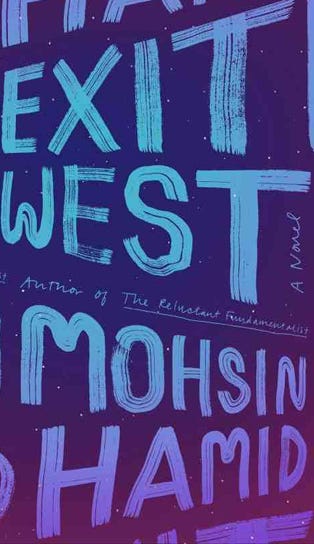
Double Take is a literary criticism series wherein a book goes toe-to-toe with two authors as they pick apart and discuss its innermost themes, its successes and failings, trappings and surprises. In this entry, Gabino Iglesias and Hannah Lillith Assadi delve into one of March’s most buzzworthy and exciting titles, Mohsin Hamid’s Exit West. In the novel, two characters, Nadia and Saeed, meet and soon fall into a deep love affair; all the while, the city around them teeters on the brink of civil war. Soon they have no choice but to leave their homeland and old lives behind. As you’ll see in Hannah and Gabino’s discussion, Exit West is a heartfelt and harrowing narrative that transports the reader to a world so alien and torn while, at the same time, introducing two characters the reader won’t soon forget.
Gabino Iglesias: During the process of reading the book, there were a few little things I kept noticing, and was curious about. One, for example, is the fact that the city is nameless. I know the violence is real — the severed heads, disappearing buildings, military violence, and even the guys playing soccer with a human head are pulled from real life — but given the surreal elements in the novel and the fact that the author never names the destroyed city, it sounds like he (or perhaps it was an editorial choice?) wanted to create extra space between the narrative and reality, a space where fiction acts as a cushion, so that readers can focus on the developing relationship between the main characters.
Hannah Lillith Assadi: The fable like quality of the narration and the unnamed city is indeed interesting, and I agree with you that perhaps the author’s intention was to draw us into the story of the relationship between Saeed and Nadia versus setting the novel in a place where we could draw parallels to the news (and as a result potentially get distracted by the real facts of that place).
The decision to keep that city unnamed vis-a-vis the Western places that are, i.e. Mykonos, London, Marin, was also powerful to me. Often, when we speak of terrible things in the news, we use proper nouns to summarize the horrific: The siege of Aleppo, the protests at Standing Rock, conflict in the Congo. Hamid’s refusal to name the place from which the two protagonists flee makes it, in some ways, more present and immediate to the reader. Though it is obviously foreign (to a Western audience), it is still a town that houses an apartment with a lemon tree, a place where two people smoke joints and hook up, a place where underground music is played, a place where people pray, and — yes — a place where people are killed, and parents die. It doesn’t matter that it has a name. It’s home to these characters. More home than London, Marin, etc.
Oddly it was not in the moments of bloodshed (the severed heads, the disappearing buildings), but in the moments where magic begins to enter the lives of the protagonists, I found myself brought to tears by the book. In some ways, it captured the desperation of a world that only magic and magical doors can resolve.
GI: I agree with you on that special sense of “home” Hamid manages to make us feel through his characters. I also found the way Saeed’s father, prayer, and at one point even smoking a joint also became “home.” It’s just one of those small things that made it an outstanding read. I’d also like to add the way Hamid looks at telephones, social media, and the inexplicable sense of drifting apart Nadia and Saeed start feeling, which, at least for me, brought about the most emotional passages in the novel. What were your favorite elements and why?
“There is also the motif throughout the book […] of the way our technological connectivity reflects the network of lights in cities.”
HLA: It’s interesting that you also noticed the way technology is treated in this novel. On the one hand, the characters’ phones’ function almost like the magical doors offering passage out of their war-torn reality and then, of course, later in the novel as a distancing device once the relationship begins to fall apart. The phones are another symptom of the mass surveillance system used to track the migrants across the world. There is also a very disorienting scene depicting Nadia not knowing whether the photo she is seeing on her phone of a woman in robes is indeed her at that very moment and whether she is living two realities — one virtual and one corporeal.
Despite the terrifying capacity of the technology we carry with us now, I think the book provides one of the most forgiving portraits of the way these devices add solace to our lives. For instance, when the signal is switched off on all mobile phones in Saeed and Nadia’s home city, it is almost more terrifying for them than the bombs falling around them — that feeling of being marooned without contact.
There is also the motif throughout the book, which I found quite moving, of the way our technological connectivity reflects the network of lights in cities. The way that darkness can be beautiful when thinking of the Milky Way cast over the cities of New York, Paris, etc. in a French photograph but when it happens — i.e. when London goes dark over the migrants — it can be utterly terrifying.
“Hamid manages to dissect [characters drifting apart] without having to explain it.”
GI: Yes! The scene with Nadia looking at Nadia/not-Nadia made me pause mid-reading for a few minutes. It appears, with his relaxed style and straightforward storytelling, Hamid generated a conversation with academics like Jean Baudrillard while exploring the shifting nature of mediated identity. I thought that was brilliant. The same goes for the way he used light sources, both artificial and natural. And I love that you bring connectivity to the discussion because the motif runs throughout the narrative in technological and emotional form. Just like electricity comes and goes, we see a change in the way Nadia and Saeed perceive each other.
Hamid makes us feel like this is a natural process because “personalities are a single immutable color, like white or blue, but rather illuminated screens, and the shades we reflect depend much on what is around us.” In a way, his treatment of their drifting apart became, through a few passages as great as the one I just quoted, the inevitable theme of the novel that I knew would come back to haunt me in the shape of a question.
We’ve all been there and there is plenty of fiction that tackles this growing sense of distance between two people, but I think Hamid manages to dissect it and expose without having to explain it. That touched a nerve with me. How did you react to the last third of the book?
HLA: Unlike most reading experiences I’ve had, where the last third is where I feel the most moved, with this book, it was the first third of the novel that pulled at my heartstrings. Regarding the tragedy that befalls Saeed’s parents, his mom being killed and his father left behind, I felt more tugged into that sense of inevitable distancing that most of us must face in this life — away from our families and toward our potential partners.
I think I truly began to weep on the train when Saeed leaves his father like that knowing they would never see one another again. The stakes in that departure felt so much more critical than Nadia leaving the shanty in Marin and beginning her new life. This isn’t a criticism just a statement on what spoke to me emotionally. I was very satisfied with the end, but it was more as if I had gone on a journey with characters that resolved itself elegantly and comfortably rather than tore my heart into pieces which is probably a good thing given all they had been through.
One thing I wondered about was the interspersed departures from the Nadia/Saeed narrative to the auxiliary characters whose stories Hamid tells — including the maid in the end in Marrakesh, the older woman living in Palo Alto, the sleeping woman in Australia, etc. It felt to me those small anecdotes were being used to mimic the globalization of the “refugee issue” (for lack of a better term). When I reached those sections, I wondered if the novel would have functioned as well without them. Not to nitpick a near masterpiece but it was just one of the techniques Hamid uses that sometimes tripped me up, other times really moved me.
GI: I don’t think the departure or Saeed’s losses made me sadder than the average narrative centered on “loss,” but there was a line that — as an immigrant who left home and family behind — made me stop: “…when we migrate, we murder from our lives those we leave behind.” Hamid is a fantastic author and he knew there were plenty of words he could have used here, but he went with murder, and that made the line striking and powerful. This is one of those rare novels that understands Otherness at its core and shares it with readers. I love encountering such novels, and enjoy watching them succeed and generate buzz, especially when they deal with these tough themes.
I’m glad you brought those auxiliary characters into the discussion! At first, I thought that, as happens in other narratives, those stories/lives were somehow going to collide in a meaningful way. They never did. Maybe he was letting us know that the experience is, as you say, a global one that’s repeated in countries worldwide. Maybe he knew that the Nadia/Saeed binomial was heavy with emotional grit and he wanted to give readers a small reprieve; while not entirely “light,” the sections recounted things that happen to characters we’re not as emotionally invested in. I’m not saying my answer is applicable to everyone, but as a book critic, I think the novel would have worked just as well without those narrative parentheses.
“This is one of those rare novels that understands Otherness at its core and shares it with readers.”
HLA: Yes, that line is particularly powerful and echoed toward the end as Hamid closes on the anecdote of the old woman living in Palo Alto: “We are all migrants through time.” Perhaps what affected me so much about leaving the father was the violence of the departure (despite its magical qualities) — through a one-way door, versus the distancing between Nadia and Saeed later on in the book, which was far more graceful and organic. Something like a murder.
It’s certainly a pleasant thing to witness all the buzz generating around this book given its politically relevant undercurrent (and its beauty). I wonder what sort of attention this book would have received had it been published two or three years ago, when the refugee crisis in Syria and elsewhere was just as horrific, but not as prevalent on our radar in the States.
In general, and to steer away from the book as it exists in and of itself, and to examine its reception, I find it endlessly fascinating that the press and the industry celebrates a narrative that manages to portray aesthetically what’s already dominant on the news. As if we need fiction to “name” the thing, personalize it for us, make it human. This is more a question of what fiction can do and what it does well. On the other hand, are novels subject to the “right place, right time” of journalism? Has it always been this way? Can they ever stand alone?
Since you asked my experience of reading this on an emotional level, I want to ask you how you experienced the novel, reading it as an immigrant yourself as you mention below. I’m the daughter of a Palestinian refugee but I was born and raised in this country. We all have lenses through which we read, and I know that I have some distant family members who disappeared from Syria a few years ago. Some turned up in Europe, some did not. A few may have drowned in the sea. I can’t deny that Hamid didn’t name the home city of Nadia and Saeed, I imagined it as a city in Syria in my own mind. Did you have a place in mind while reading?
“I find it endlessly fascinating when the press celebrates a narrative that manages to portray aesthetically what’s already dominant on the news. As if we need fiction to ‘name’ the thing, personalize it for us, make it human.”
GI: Indeed, I think the book deserves to be described as beautiful. It’s one of those strange narratives that make you say, “You should read it! I mean, it’ll hurt, but the hurt will be so, so good.”
In terms of the novel’s reception, my guess is it has something to do with the “Hollywoodification” of everything. There is a great love story here. It’s framed in a way that overpowers everything else. Details become huge. Feelings become a world. Maybe that has something to do with it?
Strangely enough, I also had Syria in mind. I’m sure it has to do with that photo of Alan Kurdi, the drowned refugee boy whose tiny body we all saw on the shore. More than any other of the many horrific images we’ve seen, that one stuck with me. If you care about fellow humans, it’s hard to keep Syria out of your mind for long, and that’s where my head went once devastation made itself present in the novel.
There is a multiplicity of migration types, and mine belongs to the “good” side of the spectrum. I call my mother every day. I can go home at any time. Even if I got to put up with folks complimenting my English and “subtle” accent. I have an American passport. For others, like the family members you mention, their story is different. Their leaving home is wrapped in dark uncertainty and danger.
Reading Exit West, there were some passages that struck a chord, lines that made me feel that all migrants share a universe. However, there were some strong differences. I had a friend who died in the streets, face down in the gutter. They ended up that way because of gangs and drugs, not politics and war. Between young men dying in the streets and men playing soccer with a human head there is a large gap, and it’s one that I have thankfully never crossed.
HLA: It’s interesting you speak of those dying in the streets from drugs versus those dying in war zones, but I think of the streets as another sort of war zone albeit ones not with bombs falling but with bags and cash exchanged for self-destruction.
I, too, experienced my fair share of early death among those I loved, many from drugs and I chose to write into that grief. I’ve always felt personal loss as a galaxy of pain in its own rite.
You brought up the love story, which I realize, we haven’t touched on much. I did find it particularly moving but not at all in the bombastic Hollywood way. It seems to me in Hollywood one of them would have to die or disappear to accommodate the screen lust for romantic tragedy. But in Exit West, they only drift apart after coming through so much together, and that felt so true. Maybe I’m contradicting myself to what I said earlier but such is the reading life.
I’m so glad it ended as it did, the two encountering one another as strangers just as the book began, in their home city, still dreaming of the Atacama.
GI: It’s so true. The streets are a war zone. In countries all over the world, street life has claimed more young people than war itself.
What I was trying to unwrap and make sense of earlier was how Exit West is, at its heart, a love story but it feels so much more about war and death. It felt real and the narrative has, as you mention, an ending that is both believable and perfect for the narrative.
“The streets are a war zone. In countries all over the world, street life has claimed more young people than war itself.”
HLA: I completely agree — in the way the love story in The English Patient creates sympathy across supposed enemy lines in the desert, this story humanizes the Otherness of Nadia and Saeed. There are details that still linger with me, which is how I know I won’t be soon forgetting this book: the lemon tree, Nadia’s records, her emotion for the girl in Mykonos, the father witnessing that horrific soccer game.
GI: There’s a lot of imagery in the novel that sticks with you. For me, it also left a lingering sense of unease: If these two souls go through so much together and still drift apart, how are the rest of us going to build truly meaningful, lasting relationships?
My dog got ahold of a chicken bone covered in fire ants. This is a metaphor for pornography. This a metaphor for the time in high school when I read my girlfriend’s sister’s diary and was sure, though her thirteen-year-old sister’s prose was so purple it was hard to translate into a coherent confession, that my girlfriend had a fling while on a family vacation. This is a metaphor for teenaged sexual desire. This is a metaphor for AIDS as depicted in late-1980s health center pamphlets and posters I saw while an undergraduate at the University of Maryland. This is a metaphor for the will to power. This is a metaphor for the retrospective guilt I felt decades after I stole a few coins from the wicker Sunday school collection plate in the basement of the Baptist church my Marxist parents cleaned every Monday as part of the $75 rent they paid for the foursquare on Mulberry Street in Normal when I was in fourth grade. This is a metaphor for five of the seven deadly sins. This is a metaphor for the time when I was fifteen years old and I was caught shoplifting a paint marker from a drugstore in Wheaton Plaza and it took my dad a long time to come and collect me because he felt it necessary first to shower and put on a tie, and a metaphor for the time my daughter was four years old and stole gum from a drugstore, proudly showed it to her mommy in the parking lot, and had to go back inside and confess her crime. This is a metaphor for Ronald Reagan. This is a metaphor for the Internet. This is a metaphor for free market capitalism. This is a metaphor for populism and fascism. This is a metaphor for consciousness.
For Borges
Borges writes, All men, in the vertiginous instant of coitus, are the same man. All men who speak a line of Shakespeare are William Shakespeare. Shakespeare can cause pleasure I agree is akin to vertigo, as can coitus, as can one byproduct of coitus — my kid — whose diapers I changed when she was a baby, and whose hair I’ve washed for a decade. Any squeamishness I ever had about my body disappeared when I was allowed access to the bodies of others. There was blood in my stool for a month so my doctor sent me for a colonoscopy and it turned out I had cancer. Six weeks later a surgeon used a robot to remove from the body in which I’ve lived with few complaints for forty-seven years ten inches of my colon and a tumor. The topography of my asshole has been altered. I do pelvic floor exercises in order to relearn how to hold my shit. Could be worse, could be dead. Instead I walk my daughter to school in the morning and drive her to dance class in the afternoon and read to her at bedtime and laugh with her and alone I read Shakespeare and Borges and I feel the bed and then the world fall away when my beloved presses me down into twisted sheets.
Verso
The USA’s too new for Baedeker’s legends of cathedrals built atop mosques built atop temples. The closest we come are TV shows and movies about what happens when a subdivision or 7-Eleven is built over a Native American burial ground. In Denver, I tried to find daguerreotypes in antique stores and was told no one in Colorado circa 1840 was allowed the vanity of having her portrait made. Even our oldest cities are all surface, our visions of their evolutions just visions of our aging selves we see flashing in their shop windows and puddles. The city of the last night with one lover and the city of the first night with another, the city of leaving in what feels like defeat and the city of returning in what feels like triumph, the city of madness and the city of sanity: it’s a single city. On the verso of an old postcard a message written in a fin de siècle hand fades to sepia while the recto shows a landscape unchanged.
For Charles Simic
From the coffee shop window I watch as across the street a campus cop proudly unrolls twin targets to show a buddy how he’s clustered his shots and perforated the bright blue chests of two featureless paper criminals, and I think, If only he’d patterned those bullet holes into a pretty pair of Valentine’s hearts.
Dirty Pictures
Cleaning up last night after everyone else was asleep, I found under a library book on the kitchen counter the torn drawing. On one scrap, the crotch of a woman, triangle of scribbles, on another, the crotch of a man, disproportionately large penis hanging beside single ovaloid testicle. I pieced the picture together. The nudes stood side by side, nothing drawn below their thighs or above their innocent bellybuttons — or were they supine, perhaps postcoital? My daughter’s nine. What boy passed her this? She’d ripped it up but not thrown it away. I tried to remember how old I’d been when first I’d seen some kid’s penciled version of sex, probably nine, maybe ten — and it hadn’t been this chaste. I decided to talk to my daughter about the drawing in the morning. It would be a serious conversation. I went to bed feeling uneasy about entering a time in my life in which I would have to think about sex in a new way — and it occurred to me, just before I fell asleep, my disquiet was perhaps in part nostalgia for the moment in my childhood when because of a dirty picture a time in my life had begun in which I had to think about sex in a new way. At the breakfast table I said, I found a drawing of a woman and a man, and instead of looking embarrassed, my daughter looked amused, and my wife said, I drew that. She wanted to know what a naked man looks like, so I drew that.
I’m a contributing writer at Electric Literature. I was discussing writer residencies with some of the EL editors and we thought it might be a good topic for your column. Basically, as a writer, I feel like everyone I know is doing them, but I’m not sure what value they provide, i.e. is it just a good, free place to write? Are they valuable for your resume? Also as someone who works in NYC, it’s difficult to take off, so how do people navigate that issue?
Cheers
This is a great topic, but having never done a writing residency myself, I didn’t feel qualified to answer your questions. Instead, I spoke with author Sandra Beasley, who is much more versed in this area than I am.
Sandra Beasley is author of three poetry collections: Count the Waves; I Was the Jukebox, winner of the Barnard Women Poets Prize; and Theories of Falling, winner of the New Issues Poetry Prize, as well as the memoir Don’t Kill the Birthday Girl: Tales from an Allergic Life. Honors for her work include a 2015 NEA Literature Fellowship, the Center for Book Arts Chapbook Prize, and three DC Commission on the Arts and Humanities Artist Fellowships. She lives in Washington, D.C., and is on the faculty of the low-residency MFA program at the University of Tampa. You can find out more by visiting SandraBeasley.com
The following interview took place over email in February of 2017.
You’re someone who has done multiple writing residencies. How did you get started? What was your first residency experience like?
I’m writing this for you while at the Hermitage Artist Retreat in Florida. I’ve been up since 3 AM. The beach of Manasota Key is a hundred feet to one side of my bedroom; the bay is fifty feet to the other side. My fellow residents, housed in four adjacent forms of housing, are a drummer, a novelist, a composer, and two photographers, though by next week the mix will be different. I’ll be here through March, working primarily on nonfiction. The last time I was here, I had to keep my curtains tightly closed at night lest the light from my reading lamp lure baby sea turtles in the wrong direction.
One funny thing about being a writer on the road is that a few years in, you forget what it’s like to travel without an anchoring reading, or a classroom visit, or a concentrated opportunity to write. Traditional vacations lose their appeal. If I can spend 3–4 weeks at a residency each year for the rest of my life, I will, with the occasional exception to prioritize a getaway with my husband.
How did I get here? I graduated from the University of Virginia in the spring of 2002. By that fall, I was working full-time at a nonprofit simultaneous to earning my MFA from American University, where I also served on the editorial staff of their literary journal. I had a partial fellowship, but I also had loans and a lot of pressure on my shoulders. Applying for residencies was a way of pushing back on all of that. I’ve never been good at creating boundaries. I say Yes to things more than I should. I suspected that those who’d gotten used to siphoning off my time would respect the formality of a residency, and that hunch proved correct.
My first residency was in June of 2003, at Vermont Studio Center. That’s an expensive one, though I didn’t have any reference point. I thought of it as budgeting for a vacation, and in a way I was. You stay in beautiful buildings along the Gihon River. The residency carries an opportunity to conference with a visiting Master Artist, which in my case was poet Carol Moldaw, who was generous in her feedback. The Red Mill’s community library is particularly rich. I fell so hard for Karen Chase’s collection Kazimierz Square that I stole VSC’s copy.
You + nature = productive af
Jeez, my heart leaps, remembering. We’d go to a nearby watering hole and pick off baby leeches afterwards. I bought a 99-cent bottle of Miracle Bubble and walked down the stretch of highway that is Johnson’s main drag, blowing bubbles at the passing truckers; I took a lot of photos with my last proper film camera, an Olympus with a panoramic option. The visual artists threw the good parties. Eight of us would drag a couch out into the gravel parking lot, turn up the volume on Louis Armstrong and His Hot Five, and stand around talking and drinking into the early hours. At age 23, this was heaven.
What value do residencies offer for writers? Is it mainly a way to get time and space to write? Or are they also important for resume-building, industry networking, getting an agent, getting a job?
The value of residencies is the work you do while you’re there, with social networking as an option. What you do is really and truly up to you. One of my favorite things I ever heard was said on my first day at Millay: “You’re here to honor yourself as a writer,” the residency director said while giving the tour. “If that means reading, rather than writing, that’s fine by us.” I found that really liberating — and of course, once I felt free to do what I craved, which was curl up on the studio couch with a handful of poetry collections, I was inspired to write.
Different residency spaces, and how long you have in them, shape the work that will get done. A brief stay might be best for editing an existing story or essay. A studio with pegboard walls and lots of floor space is perfect for laying out pages that need to be ordered for a poetry manuscript. A desk next to a big window might inspire new drafts, while an Adirondack chair beside a river might become a favorite reading spot. I make a conscious effort to take cues from the setting.
I’m always subconsciously looking for excuses to not write, and I don’t want the landscape to be one of them.
Personally, my ideal setting is “pretty but not too exotic.” I’m always subconsciously looking for excuses to not write, and I don’t want the landscape to be one of them. Many of the spaces that become residencies have fascinating back-stories. On the grounds of Millay you can still see the ghost-outline of poet Edna St. Vincent Millay’s tennis court, and track down her repository field of empty gin bottles. The Hermitage was a nudist colony at one point.
As an added line to a resume or curriculum vitae, attending a residency won’t make a big difference. But most gatekeepers, by whom I might mean a prospective agent or someone interviewing you for a teaching job or fellowship, are members of the literary world themselves. If you can deepen your connection with them based on shared familiarity with a residency — Yaddo and MacDowell are known to have the power to do this — that can help.
How do you stay productive? How do you structure your time?
I love lists, so I usually end up making three lists on arrival. The first captures the elements of an ideal residency day, meaning the balance of reading, writing, and physical activity I need to feel rested and refreshed. I don’t make a to-do list of the actual residency work, or the order in which it needs to happen; that would make me claustrophobic. The second list gathers and, I hope, compartmentalizes the practical tasks that tie me to life back home, such as getting a student recommendation letter in or returning proofs on a freelance piece. The third list is a holding pen for fun stuff I hear about from other residents — “Oh, you have to check out that barbecue joint” — or destinations I identify when researching the area, such as a nearby Botanical Gardens or independent bookstore. I usually drive, which gives me the freedom of taking a few hours off and exploring; sometimes a residency will have a loaner bike or car.
In terms of the social time, the intensity of that can vary. Some writers crave the spontaneity of field trips, parties, after-dinner conversations, and maybe a board game or round of ping-pong. These friendships tend to spark quickly, burn bright, and flicker out a month after the residency ends. Some writers seek out the same few people every lunch — they’re probably looking for a few takeaway friendships, or even relationships where you might later exchange work for critique. Some writers hide, period. Other writers want specifically to hang out with the artists and composers; their lives back at home are already well stocked with writer-types.
What’s the best way to find the right residency for you? Are there different residencies for different genres? Any specific recommendations for women, writers of color, writers with disabilities, chronic illnesses or other special needs?
There are lots of residencies out there. I mention Yaddo and MacDowell, but that’s like describing MFA programs in terms of the University of Iowa and NYU; just because they’re the famous ones doesn’t mean they represent the apex of this type of experience, much less the gestalt. Poets & Writers magazine has an annual issue devoted to residencies, as well as a database of conferences and residencies. Kim Roberts of Beltway Poetry Quarterly, in DC, curates an in-depth index of Artist Residency Programs that is sorted by type, geography, and genre, though most residencies welcome all genres of writing.
Increasing accessibility and inclusivity in the writing community, including residencies, is a much bigger conversation than we can have here. Here’s what I will say: if a program specifically solicits applications from a marginalized community of which you are a member, take a close look at why. Is it because their deep infrastructure is genuinely welcoming, and they want to get the word out to more people? If so, by all means give it a shot. A good example of this is a residency is fully outfitted with ADA-compliant design, often as a result of a specific donor gift.
Or…does this opportunity exist because your “kind” is not represented in their constituency, and they need you? If so, be aware that you might feel isolated or tokenized, and you’ll probably have to do some work of educating. Make sure your creative energy won’t be constrained by being an organization’s guinea pig, no matter how well intentioned they may be.
An alternative, if you have an existing literary community that is nourishing but lacks a “residency” outlet, is to create your own residency.
Residency time is precious and kind of fragile. An alternative, if you have an existing literary community that is nourishing but lacks a “residency” outlet, is to create your own residency. Reach out to that community with which you already gather for workshops or conferences, and see if anyone would be interested in splitting the cost of a short-term rental, where the specific purposes is unstructured and private writing space. There are retreats, such as The Porches in Virginia, which lend themselves to being occupied by self-made groups.
Also, remember that residencies evolve over time. One case study that comes to mind is Hedgebrook, on Whidbey Island in Washington state. They’ve been around since the late 1980s; I first looked at applying in the mid-2000s. At that time, Hedgebrook was a quirky option — you had to like rural cottage life — that happened to be exclusive to female applicants. The rumor was that they were open to emerging writers, meaning I had a viable chance at getting in.
I wanted to apply, but hesitated. I’d never dealt with my food allergies so far from home, not for a whole month. There was also a rule was if you got in, then couldn’t go, you forfeited future opportunity. This made sense from the perspective of a fledgling organization with minimal staff and limited resources. But it was scary for a twenty-something unable to guarantee, six months in advance, time off from work or funds for travel, which in my case would have been a very expensive cross-country plane ticket. So I went with another residency, on the East coast, which was the same size but was close enough that I could drive — saving money on travel, and ensuring access to a grocery store.
Today Hedgebrook has a prestigious and thriving alumni community, with associated salons and master classes and a slogan, “Women Authoring Change.” Deferrals are permitted, and they’ve modified their language to make clear that “women” welcomes those of trans- identity or other nontraditional gender expressions. They are clearer about how community meals are prepared; there’s even a Hedgebrook cookbook that emphasizes farm-to-table. There’s also a complicated process of deliberation, with three rounds of judging, and a narrow window for applying. I really want to attend, but I suspect I’ll have a tougher time getting in than if I’d applied in 2006. I wouldn’t worry at about the food now; still not sure how I’d pay for my airfare.
Can you do a residency if you have a full-time job?
You can definitely do a residency while in a full-time job. The terms of how long you can get away have to be negotiated with your employer, of course. [Ed. note: There is a real range of residency time periods, from as little as a week to up to 9 months. But even a week can be productive.] I notice that people whose workloads are cyclical — teachers, arts administrators, or those who work at nonprofits with a “slow” season — dominate the residency pool. If your job has no slow season, ask if you can have a specifically designated check-in day of each week, where you turn your studio into a virtual office and stay on top of critical responsibilities. You might pair that day with a day when residency life is typically interrupted anyway. Is every Wednesday night a showcase for resident works-in-progress? Cool. But if you work like I do, then you might as well set aside all of Wednesday the weekly errands, emails, and phone conferences.
You’ll want to scope out the tech resources in advance. Increasingly, residencies are wired for internet; some places provide WiFi in sleeping quarters, but not studios. A few places specifically resist such encroachments: Blue Mountain Center in New York doesn’t provide WiFi and cell phones are prohibited, except for emergency purposes. Jentel doesn’t have any such rule, but it is so far outside Sheridan that I remember having to stand on tiptoe at the top of a hill to get a Verizon signal. Also, know that printing and computer repair may not be as readily available as back home. Look for residencies that have a college campus nearby, as a back-up resource.
Any tips on applying to residencies? What to do and what not to do?
Submit the strongest possible work sample for two-thirds of the allotted pages. If your strongest work is completely different from the work you’re setting out to do, make sure that other third represents relevant material. That said, don’t worry too much about your project proposal. Everyone understands that a plan is theoretical, especially since months may pass between submitting an application and attending a residency. What evaluators are looking for is an ability to articulate goals, an ability to scale those goals specific to the time you’re requesting, and a connection to the particularities of their residency space.
What evaluators are looking for is an ability to articulate goals, an ability to scale those goals specific to the time you’re requesting, and a connection to the particularities of their residency space.
If you are required to send letters of recommendation, and you happen to know alumni of the residency, they are more compelling references than those of someone outside the community.
People will tell you to apply in a residency’s “off season” to increase your odds of admission; for example, they’ll suggest, apply for the upstate New England residency in a winter month. The accuracy of this tip probably varies, and administrators aren’t excited to answer queries about how to game the system. They’ll tell you to apply for when you genuinely want to attend.
Since we’re on the subject of how residencies are administered: if you get one of these opportunities, say thank you at every turn. Say thank you to the staff. Say thank you to the benefactors. If you publish a book that includes work you wrote while at the residency, mention them in the acknowledgements. Offer to write a letter of support for the residency’s future funding applications. Don’t take one minute of this for granted, especially in a moment when arts dollars are hard to come by.
Do residencies tend to be more social or more isolating? What happens if you’ve got family — can they ever come along or at least visit?
Whether a residency represents an opportunity to be social or isolated varies widely based on their circumstances, and yours. Larger residencies like UCross, Virginia Center for Creative Arts, and Vermont Studio Center do tend to have reputations as being “summer camp” for writers and artists, even when there’s snow on the ground. There is simple camaraderie in numbers: if you’re looking to take a break or open the wine, someone is always ready.
There are also residencies with service components, if you’re looking to be pulled out of your normal rhythms. In Tennessee, the Sundress Academy for the Arts asks residents to put in about five hours a week at Firefly Farms. Other residencies ask artists to visit local schools.
For me? I’ve lived in Washington, D.C. since 2002. I’ve got a very vibrant community that includes friends who go back to MFA days, an informal poetry workshop group, a book club of fellow women writers, and the Arts Club of Washington, where I volunteer my time. I love those folks but it makes for a very full calendar. At residencies I work in my room, for long and often late hours, and I skip group meals when I can. Not because I don’t like people, but I’m just so thrilled at the prospect of unfettered time.
Having family visit can be tricky. First off, it does happen. I’ve seen kids, parents, lovers, and spouses visit. Even though you may miss them like crazy and want them to see the residency, don’t underestimate the interruption that will occur — not only for you but for your fellow residency-mates — in terms of hours and focus of energy. That said, a day-trip visit is usually fun. An overnight will probably be okay, but will not be sanctioned; don’t expect the chef to make an extra serving of eggs for your partner in the morning. Any visit longer than that is usually overstepping your bounds.
There are a handful of residencies open to writers who need to travel with their families, and some provide stipends for childcare either on or offsite.
There are a handful of residencies open to writers who need to travel with their families, and some provide stipends for childcare either on or offsite. The Sustainable Arts Foundation is a key resource for writers with children. They recently gave New York’s Writers & Books a grant for programming co-situated between Neighborhood of the Arts, in urban Rochester, and the rural location of Gell: A Finger Lakes Creative Retreat. After choosing a location, artist-parents can be accompanied by their children and one other adult for a one-week stay. Applications are closed for 2017, but it’d be wonderful to see that become an ongoing program. The Hermitage welcomes artists with young children for one- or two-week stays in the month of June. The Island Hill House Artist Residency Program in Michigan gives the artist a whole house, which can sleep up to four.
Are there challenges to be aware of? Have you ever had a bad experience or totally blown the residency?
People in adjoined spaces get into thermostat wars. Bring a blanket and a fan so that you can self-regulate your temperature. While you’re at it, also pack an extension cord, noise-reducing headphones, and a flashlight. In residencies with buffet meals, people will complain about the cooking. In residencies with communal kitchens, people will complain about the housekeeping. Please, whatever you do, do not be that person who leaves dirty dishes in the sink. These are usually minor complaints in what everyone recognizes is an overall gift of a situation.
International residencies have their own risks. I’ve heard a few hair-raising stories about getting to an obscure city and discovering you’re someone’s B&B guest in a space with musty décor, dim light, and an uncomfortable chair. On the other hand, who isn’t tempted to take a chance on a castle? Luckily, word gets around fast if a residency is truly failing to thrive, especially in the age of social media.
More and more residencies are staggering the possibilities of arrival and departure dates. The model of being part of a curated “family” for exactly 28 days is becoming the exception, not the rule. That increases variety among those who can take part in a residency, which is wonderful, but be aware that your fresh start may be someone else’s or mid-residency crisis. When you sit down to lunch on your Day 1 and the composer across the table gives you a thousand-mile stare, it’s not about you; it’s about all he still wants to do in the three days before he leaves.
You’re walking in on other people’s romantic lives, too. People get divorced coming out of residencies. People get married coming out of residencies — I got lucky in that respect. My husband is a painter that I met at Virginia Center for Creative Arts back in 2012. We quickly realized we lived only blocks from each other, in northwest DC, which distinguished the relationship from a residency fling. There’s nothing wrong with residency flings, per se. Just be sure you don’t flirt around with the guy who was, prior to your arrival, romancing the woman who makes the service assignments for the residency. You’ll end up with two weeks’ kitchen duty, scrubbing sheet pans and cleaning bread mixers. Trust me.
On November 14th, 2008, Governor Schwarzenegger declared a state of emergency for Santa Barbara county. A small bonfire set by about ten college students in the Montecito area had caught the highly flammable vegetation after years of drought. For three days between November 13th-November 15th, the town of Santa Barbara, nestled between the Santa Ynez mountains and the Pacific ocean, watched as a gigantic half crown of flaming thrush lit up the mountainside.
My neighborhood was evacuated almost immediately, and my boyfriend and I (good graduate students that we were) found ourselves frantically packing up our cat and books and even a few items of clothing before heading down to the motel 6 in Carpenteria to wait out the hellscape. Even in the daylight, the ash floating throughout the usually Disney-fied downtown looked like a scene out of Milton’s hell. Cars were covered in a thick film of soot, and I felt my own asthmatic lungs spasm for weeks after the incident. As an east coaster, raised most of my life outside of Philadelphia, I had always found the vast open stretches of California vistas incomprehensible.
The calm, limitless Pacific lapping towards the red towering rock which in turn always seemed to bow down to a happy meadow of yellow weeds running alongside the 101 — the beauty of these scenes seemed unthinkable and overwhelming to someone who was used to strip malls, suburbs, and a line of fast food chains blotting the major east coast highways of the tri-state area. As a twenty three year old barely a few years into a graduate program, Santa Barbara seemed like a place out of time. And yet now here it was, a smoldering paradise made wicked by fire. And even stranger, here I was transfixed by its rage and unbecoming. To be so captivated by its relentlessness gave me some unease.
Fire was not an element I understood very well in the context of this region. To me, I felt as if I was witnessing a catastrophic, biblical event. In reality, fires in Santa Barbara county aren’t rare at all. In fact, 2008 had its share of destruction from the Great Gap fire of July to what was eventually called the Tea Fire of November that year. In 2016, the California Climate Change Center estimates that due to extreme weather variations, we could see a 300% increase in wildfire risk, and just this past August, the Rey fire above Lake Cachuma in Santa Barbara county burned over 32,000 acres.
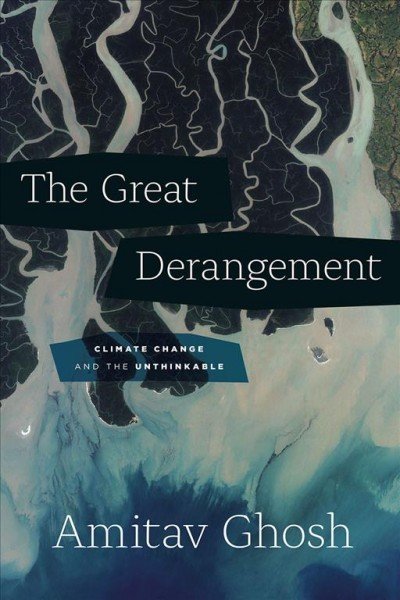
I begin with this story, because I think we probably have all had an experience such as this one. A feeling that what we were witnessing was an uncanny, freakish, or improbable event, and that by witnessing such an exceptional sight, we were documenting a rupture in the natural world. I also begin here because that is how Amitav Ghosh begins his book. Only eleven pages into The Great Derangement: Climate Change and the Unthinkable, Ghosh recounts an experience in Northern Delhi in March of 1978. Crouching on the floor of a nearby balcony, Ghosh, to his astonishment, hears “a frenzied pitch” of wind that begins to tug at his clothing and then sees “an extraordinary panoply of objects flying past– bicycles, scooters, lampposts, sheets of corrugated iron, even entire tea stalls. In that instant, gravity itself seemed to have been transformed into a wheel spinning upon the fingertip of some unknown power.”
After the “event,” some papers reported it as a cyclone. Others used the phrase “a funnel shaped whirlwind.” Ghosh learned later that he actually had witnessed the very first tornado to hit Dehli in recorded meteorological history. He writes:
“What had happened at that moment was strangely like a species of visual contact, of beholding and being beheld. And in that instant of contact something was planted deep in my mind, something irreducibly mysterious, something quite apart from the danger I had been in and the destruction I had witnessed; something that was not the property of the thing itself but the manner in which it had intersected my life.”
Beholding and beheld. A species of visual contact. A manner of intersection. What is being communicated in this mesmerizing contact or intersection? Perhaps a reality of climate change that we continue to fail at imagining? Hence our collective derangement. But perhaps what is most interesting about Ghosh’s provocative narration of this seemingly chance encounter is that increasingly, these are becoming not chance encounters at all, but the very makeup of our daily lives. He asks us to imagine a narrative style of improbable events and chides a novelistic reflex that focuses, channeling Franco Morretti, too much on “fillers” that make novels “compatible with the new regularity of bourgeois life.”
Here, he suggests that a fidelity to representing routines of modern life and the habits of a modern mind make large scale events inconceivable to narrate. The catastrophic has long been regulated to genre fiction (science fiction, climate sci-fi, fantasy, horror), but to continue to think of genre in this way has great ethical implications for Ghosh who sees the “sense of place” in these texts as part of a dangerous delaying trend to some dystopian future when narrativizing climate change and disaster. “The future is only part of the Anthropocene,” he argues in one section. Ghosh’s determination to reorient our climate despair in the present is reminiscent of Lauren Berlant’s Cruel Optimism, a text which critiques the compulsory “eventilization” of disaster and ignores how crisis is rooted in our everyday routines and habits of consumption. Ghosh write of these “events”:
“To treat them as magical or surreal would be to rob them of precisely the quality that makes them so urgently compelling — which is that they are actually happening on this earth, at this time.”
Ghosh’s book is divided into three sections: stories, history, and politics. His writing is erudite and elegant with some broad, associative leaps from researched to anecdotal accounts of climate crisis to support his major theses. Each of these sections come to quick and surprising conclusions that feel slightly out of pace with the rest of the book, perhaps betraying a mild impatience on the part of the author who takes (among politicians and religious leaders), writers and artists to task most of all for their complicity in the great derangement. This is not a structural issue to brush aside. Climate despair is a kind of trauma and often traumatic events are nonlinear and non-causal.
Ghosh is a seasoned writer of global history and migrations, particularly across Indian ocean diaspora. His work has always attended to patterns of displacement or trade routes, and his writing is eerily anticipatory as evident by books like The Calcutta Chromosome which seemed to predict questions about bioengineering and biopolitics. In contrast, The Great Derangement feels nervy and speedy, moving the reader from one continent to another, from one staggering statistic to another, without enough room to fully grasp the gargantuan swell of the threat. To feel dwarfed and destabilized is part of the intended effect.
Ghosh points out some well mapped neoliberal myths about the dangers of personal authenticity, sincerity, and interiority in novels that do not spend enough time talking about “men in the aggregate” and furthermore, he suggests that if politics can be defined as a collective survival, then what is missing from contemporary fiction is exactly that: the collective. This is a difficult argument to digest since contemporary fiction, especially to a newer writer such as myself, feels so varied, experimental, and heterogenous, but perhaps what Ghosh was suggesting is that even if there were a plethora of novels dedicated to a present day representation of “men in the aggregate” representing a specifically atmospheric climate change disaster, that it would still somehow fail to move or alter the popular literary imagination.
Yet if we think of climate change as that which frays our idea of a nation-state and geopolitical terror, I think of Lidia Yukanavitch’s recent book, The Small Backs of Children. If I think of superstorms and the threat to megacities, I think of Ben Lerner’s 10:04. If I think of people so lobotomized by their televisions that they eat the inedible, consume the inorganic, quietly starve as they sit lithe in front of their programming, I think of Alexandra Kleeman’s You Too Can Have a Body Like Mine. If I think about the ways that animals have served as objects of disgust and abjection, but also metaphors of deviant sexuality and disposable bodies, I think of Aaron Apps’ Intersex. In other words, it is possible that we are all interpreting the effects of climate change the only way we know how to encounter threats of competing vitalities: through discourses of otherness. When we write about bodies that are deemed disposable, we are writing about climate crisis. It is the paradigmatic form, borrowed from critical race, disability, queer, and postcolonial studies, in which our derangement manifests. And vitality is important to Ghosh here. After all, part of what made the tornado experience so riveting was the forced acknowledgment of a mighty, nonhuman power.
Spending some time parsing out the narrative kinship between human and nonhuman forces in the world, Ghosh treads on academic fields such as posthumanism and new materialism. While scholars important to those fields such as Bruno Latour and Timothy Morton are cited frequently, there appears to be a missing intellectual history of feminist and queer science studies critics who have discussed widely the relationship between a vitalist nonhuman agency and a contemporary environmental politics (Jane Bennett, Donna Haraway, Stacy Alaimo, Mel Y. Chen, Karen Barad, etc).
Borrowing language from discourses on toxicity, physics, and biodiversity, these scholars often position the Anthropocentric as a lens to uncover the bodies most vulnerable to ecological debt. As Stacy Alaimo argues in her book Bodily Natures: Science, Environment, and the Material Self:
“Race, for example, has been well documented as the single most important factor in the placement of toxic waste sites in the United States.”
Ghosh offers an pointed history of the effects of industrialization and urbanization on climate crisis. Port cities such as London and Amsterdam are protected from open waters by “bays, estuaries, or deltaic river systems,” but cities built after European global expansion in the seventeenth century such as Mumbai, New York, and Chennai, are instead built directly on seafronts and therefore are the most susceptible to superstorms. Ghosh writes: “A special place ought to be reserved in hell… for planners who build with such reckless disregard for their surroundings.” Build on an estuarine landscape, Mumbai’s soil has lost much of its absorptive ability and in the great deluges of the 21st century, 2.5 million people were “under water together” during the floods.
Ghosh traces the new brewing seismic activity and cyclonic profiles in the Arabian Sea off the west coast of India and provides evidence that for the first time in history as of 2015, the Arabian Sea has provoked more storms on the west coast than cyclonic activity in the Bay of Bengal on the east coast of India (which has typically born the brunt of tsunamis and tropical storms). His point in this comparison is to illuminate the vulnerability of a country now flanked by storms on both sides:
“Suddenly the waters around India were churning with improbable events.”
The great derangement is essentially a great denial of climate crisis, but not by climate deniers on the fringe of politics, but actually as Ghosh argues, by state sanctioned engineers and government agencies themselves. The idea that we are planning for the “exceptional” event is maddening. The idea that disaster management is mostly focused on “post-disaster” response is to neglect and disregard a risk that feels more like an inevitability. If Mumbai floods, the most dangerous threat to the region is that it is one of the only world’s megacities with two nuclear facilities within its urban periphery. “Both these plants sit right upon the shoreline.” Perhaps it should come as no surprise then that the Pentagon is among one of the most dedicated investors and researchers of climate crisis, because they take seriously the need for green security.
Ghosh recounts the words of Col. Lawrence Wilkerson, the former chief of staff to Colin Powell while he was the Secretary of State:
“The only department in… Washington that is clearly and completely seized with the idea that climate change is real is the Department of Defense.”
And yet even green security might be stuck in the same deranged echo chamber, in an endless feedback of the same problematic hermeneutic loop, as Lindsay Thomas, a scholar of literature, media, and security studies at the University of Miami suggests: “The word “recovery” itself — a favorite word of the Department of Homeland Security, for example — is telling: it assumes not only that disasters are something out of the ordinary, but also that they are something we can “recover” from. Something that we can “return” to “normal life” from, as if normal life is not part of the disaster itself.”
The second section of Ghosh’s book is entitled “History,” and it details an astonishing account of climate risk for Asia. Ghosh argues that Asia will be the most vulnerable continent to environmental disaster simply because of the “numbers game” stating that, “the brute fact is that no strategy can work globally unless it works in Asia.” I have yet to read such a distilled and cogent telling of the risks and statistics posed to the region. Cyclones hitting the low lying lands of the Bengal Delta have killed people in the hundreds of thousands for the past half century. Bangladesh and Vietnam are two of the countries most jeopardized by rising sea levels with necessary migrations from those lands estimated between 50–75 million people.
Desertification in Pakistan and India could cause famine and agricultural disaster with China’s desertification problem causing annual losses of about $65 billion. The water crisis in Asia, in particular water sources in the form of ice in Tibet and the Himalayas, “sustain 47 percent of the world’s population,” yet this region is “warming twice as fast as the average global rate.” The statistics are paralyzing. With the industrial expansion of Asia from the 1980’s onwards, Ghosh posits an important argument about imperialism, decolonization, and the myth of Western modernity as singular.
The truth is that “every family in the world cannot have two cars, a washing machine, and a refrigerator — not because of technical or economic limitations but because humanity would asphyxiate in the process.” We know this, but the rhetoric of our foreign policy and supposed geopolitical allyship seems to continue to make promises that are more than impossible, they are outright dangerous and misdirected. As Dipesh Chakrabarty has argued, the Great Acceleration is itself linked to decolonization.
China and India are now major competitors in the carbon economy and, as Ghosh illustrates in his book, despite the fallacy of Western exceptionalism, they have always been intellectual authorities of energy invention and politics. The truth is that before decolonization, much of the financial gain and raw resources went to serving imperial powers and that perhaps now countries in Asia and Africa justifiably feel entitled to the wealth of the carbon economy. As Ghosh states, “The argument about fairness in relation to per capita emissions is, in a sense, an argument about lost time.”
The Great Derangement: Climate Change and the Unthinkable is a timely book in the era of a Trump presidency precisely because it investigates gaslighting and accountability. It is no coincidence, I think, that Ghosh chooses “derangement” as an apt pathology of the zeitgeist in a moment when facts are rendered meaningless and instead, the clumsy, misleading, and dangerous interpretations of scientific evidence are recreational fodder for the highest political office in the United States.
There was a protest after the election at the small liberal arts college where I teach. Professors and students could “walk out” during class and meet on the quad in the middle of campus for a demonstration. Of course, I participated as did many of my colleagues in the humanities. But it was my colleague in engineering that surprised me the most. He stood in front of his classroom and said, “I am also walking out. I am walking out because I believe in science.” A small, simple, seemingly obvious gesture that in our current moment, feels so bizarrely radical. And while some of Ghosh’s critiques of contemporary fiction may come across a little damning, the lesson to learn here from Ghosh is that what we are doing in the name of climate change, as writers and artists, is still not enough. Perhaps it has never been more important than it is now for scientists and artists to collaborate and politicize together. I wish I had said something similar to my students as I led some of them out to the quad, so they could understand the consequences of the very derangement that allows for a continual repression of fact.
This is an administration in which climate data will literally disappear. I should have also said to my students: I believe in science and science is telling us (again and again and again) that the sky is falling.
Ghosh’s incredulity is not precious. He is telling us to look up.
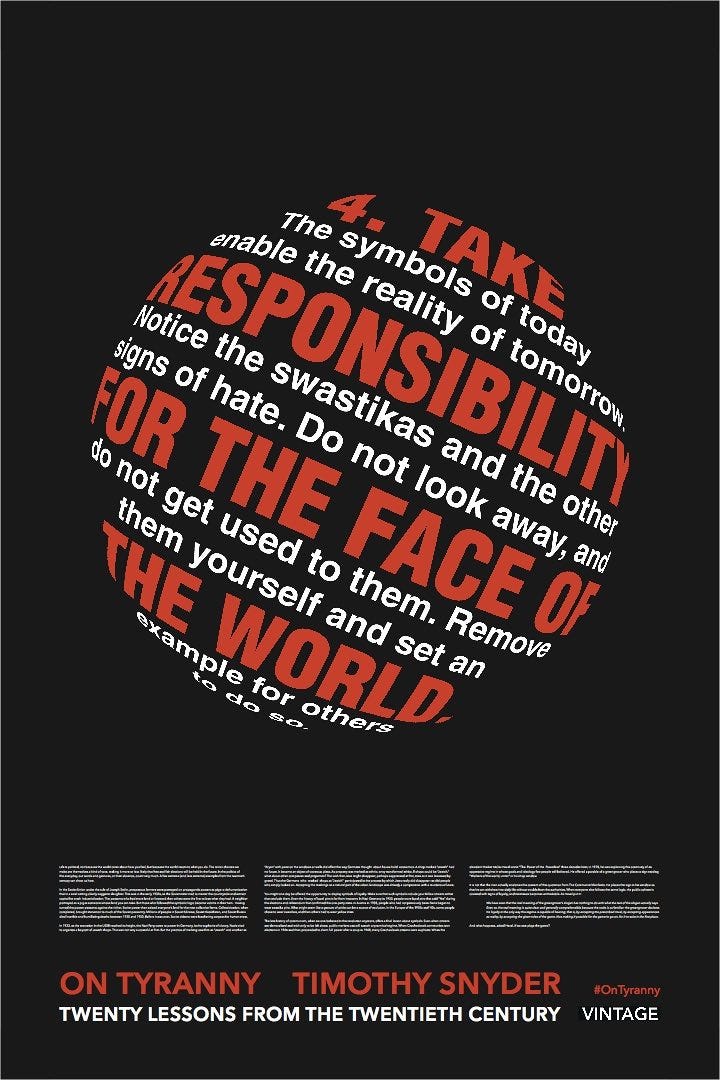
A Yale scholar’s ‘how-to’ guide for resisting authoritarianism is about to be released as a series of posters on London’s streets
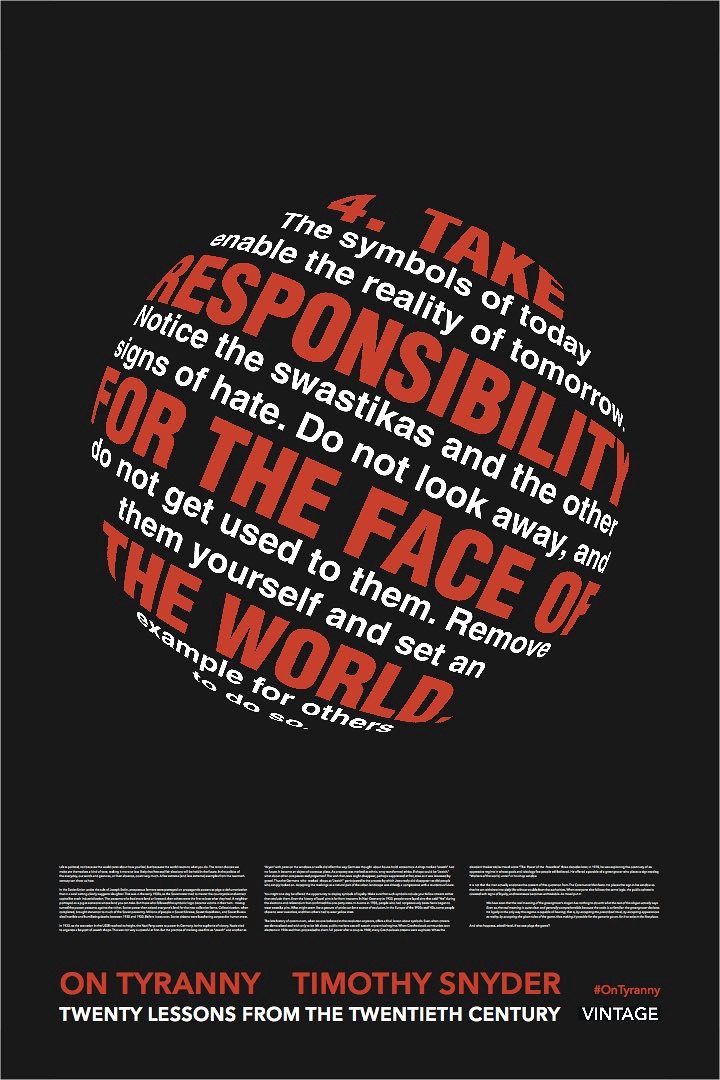
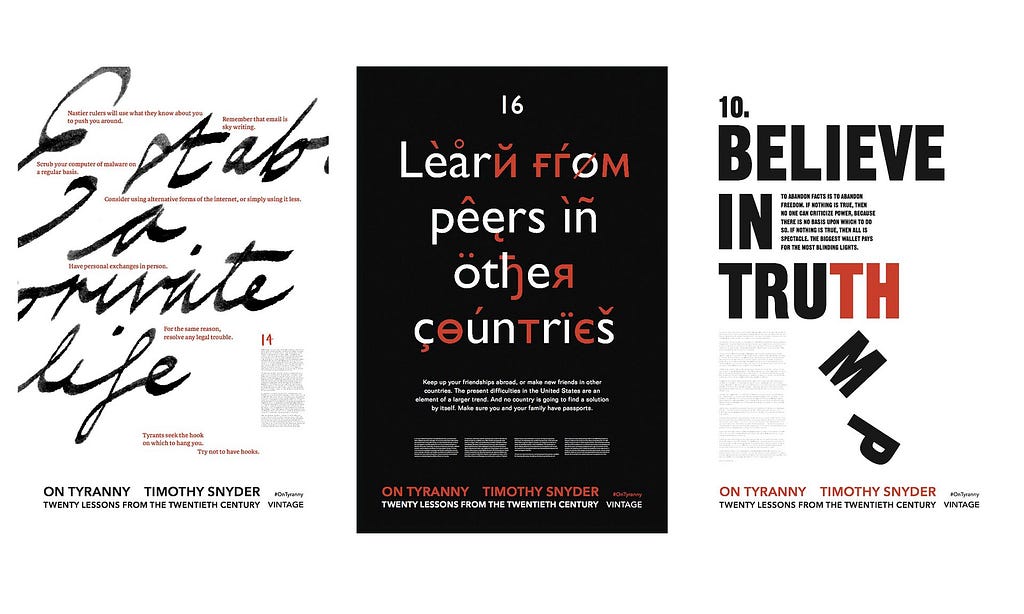
Yale historian Timothy Snyder is unveiling his latest scholarly work On Tyranny in an unprecedented fashion. According to a report from the Guardian, Snyder, who specializes in European History, will be fly-posting 20 posters with the help of Vintage creative director Suzanne Dean and a team of students from Kingston University. Each poster contains the full text of a chapter from Snyder’s book, which is essentially a how-to manual for thwarting the rise of repressive regimes and counteracting the official and non-official evil perpetrated by little hands clinging to nuclear codes.
llustration: Rosie Ackroyd, Charlotte Allen, Ella Anthony, Leah Fredrickson, Grace Lister (left), Sophie Harris (centre) and Julia Connolly (right)/Vintage
In the book, Snyder endeavors to “distill what [he has] learned about the 20th century into a guide for action today.” He says the primary impetus for undertaking the project was the widespread shock and helplessness he’s witnessed many U.S. and British citizens express in the wake of their countries’ political unravellings. An obvious goal of the fly-posting (besides the publicity, of course) is to raise awareness about how ordinary citizens can take meaningful action against the rise of populism, which Snyder describes as an “urgent” concern for anyone who enjoys their freedom. In that vein, the posters will be pasted around Leonard Street, at the heart of the creative bustle in London. Snyder’s publisher chose the location because “every other person around there uses Instagram and Twitter,” and they hope the messages will gain sweeping traction on social media.
Though Snyder admits that it took him a minute to understand the poster campaign when it was initially proposed, he said in a statement:
“I will be more than happy if the posters themselves convey its message. We have become unused to the stakes being high, but they are: those who control the executive branch of the US government want a regime change in my country, and the basic sense of freedom that many of us have come to take for granted in the west is under threat.”
When this comes from a well-respected historian who has extensively studied European history and the Holocaust, people ought to pay attention.
Hello, and welcome to my week-by-week review of the world. Today I am reviewing The Mayo Clinic.
The Mayo Clinic is widely regarded as one of Minnesota’s top hospitals. To find out just how good it really is, I drove to Rochester to see for myself. Then I drove home because I accidentally drove to Rochester, NY which is a much easier drive for me. I then flew to Minneapolis and then took a shuttle to Rochester. For such a great hospital, they put it in a really out-of-the-way place.
As you near the Mayo Clinic, you will be greeted by the Mayo Clinic mascot — an anthropomorphized mass of cancer cells — spinning an arrow shaped sign on a street corner and directing you to a “BONANZA SALE.” Or so I thought. It turned out to be a bunch of grapes directing me to a mayonnaise sale at the Aldi supermarket.
After I stocked up on mayonnaise and grapes, I made my way to the real Mayo Clinic. They had no mascot or big sale. Not even any coupons.
The best way to tell if a physician is worth his or her salt is to see if he or she is able to diagnose false symptoms. A bad doctor will believe anything you say just to make a quick buck. Another way to identify a bad doctor is see if you can seduce them. I tried both these techniques and my doctor didn’t fall for either of them.
The most intimate thing she did was to stick a light in my ear after I told her my ears and nipples get warm when I eat spicy food. She didn’t even touch my nipples. A bad doctor would have touched them a lot.
She seemed to be the real deal and refused to prescribe me any cocaine despite me saying I wanted it for medical use only. As near as I could tell, this was a legitimate hospital. Not like the one I normally visit.
So the doctors aren’t bad, but what about the rest of the hospital?
SECURITY: The security guards are top notch. When I dressed up as a doctor and tried to visit patients, the security guards chased after me as fast as they could.
DOORS: Every door in this place opened exactly as it should, and I couldn’t find a single unlocked door that was supposed to be locked.
WINDOWS: I tried to throw a chair through a window and it didn’t even crack. It could have been my weak arms or the light plastic chair, but those windows just would not shatter.
I couldn’t really find any flaws in The Mayo Clinic. But does this make it the best hospital in Minnesota? I have no idea because I didn’t visit any others.
BEST FEATURE: The cafeteria has some really decent pudding. WORST FEATURE: Like any hospital, it’s a place full of sick people spreading their germs around.
Please join me next week when I’ll be reviewing a tadpole.
True stories that are strange enough to be fiction
Stuck on an idea for your next short story? Every now and then we gather news headlines that are strange enough to be fiction. Here’s a batch of headlines to get your creative juices flowing along with suggested genres:
Sign up for our newsletter to get submission announcements and stay on top of our best work.
YOUR INBOX IS LIT
Enjoy strange, diverting work from The Commuter on Mondays, absorbing fiction from Recommended Reading on Wednesdays, and a roundup of our best work of the week on Fridays. Personalize your subscription preferences here.