The Damage of ‘Crazy Ex-Girlfriend’

Winona Ryder recently did an interview with New York Magazine about acquiring the label ‘crazy’ — how speaking openly about “common emotional challenges” landed her there, how this phenomenon is born of the tendency to “[shame] women for being sensitive or vulnerable.”

Women in and out of the public eye have long been consigned to the rank of ‘crazy’ at rates that should overwhelm our mental institutions and suggest that some staggering proportion of the population is barely making it through the day. In her once-anonymous advice column Dear Sugar, Cheryl Strayed asks the tongue-in-cheek question of the century: “How can it be that so many people’s ex-girlfriends are crazy? What happens to these women? …is there some corporate Rest Home for Crazy Bitches chain in cities across the land that I am unaware of that houses all these women who used to love men who later claim they were actually crazy bitches?”

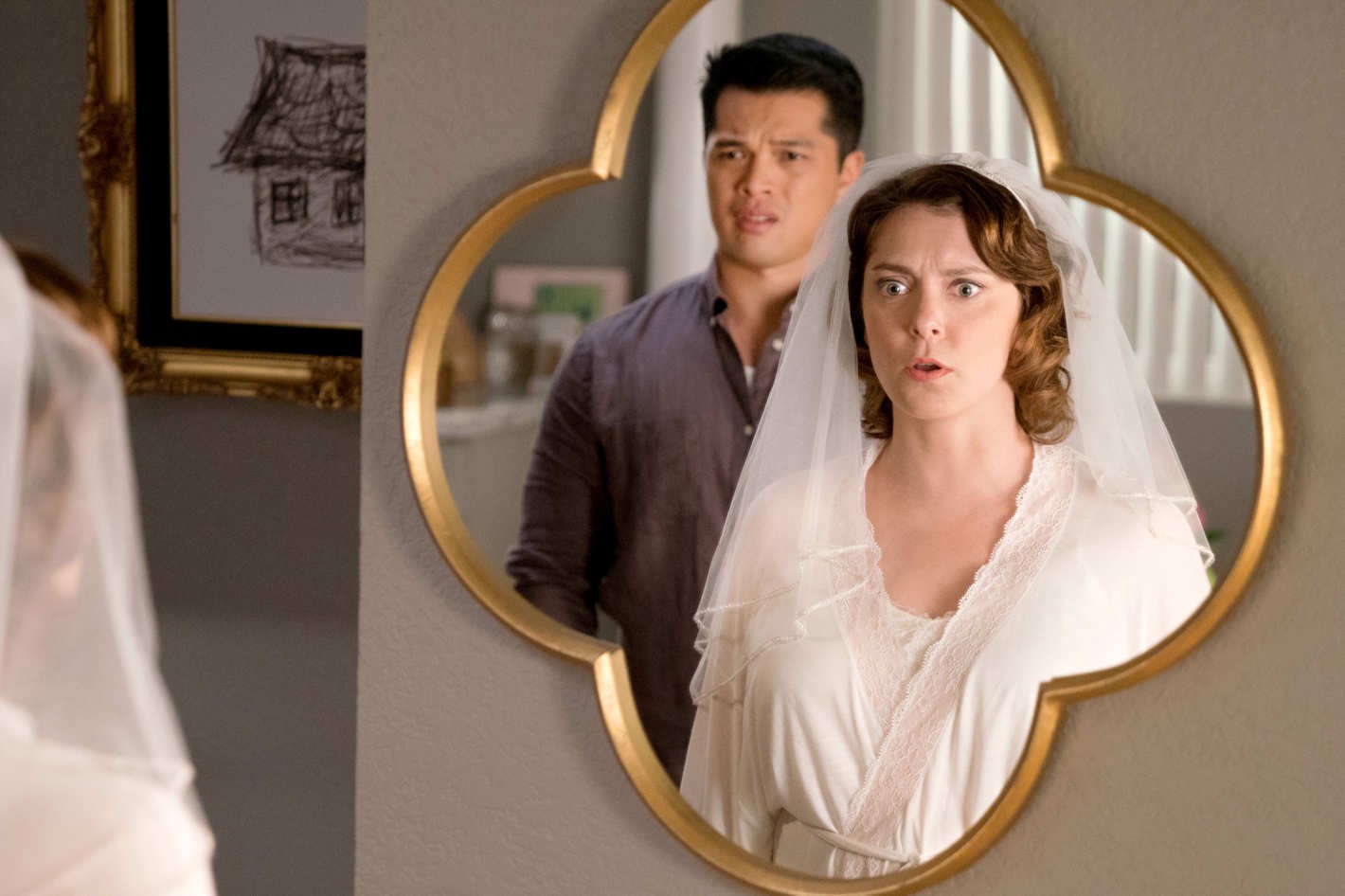
When I first heard about the CW’s Crazy Ex-Girlfriend — from several of my smart, feminist friends and just about every critic at a major media outlet — a glimmer of hope shone through the sea of crazy. Its title suggests the show will be one of two things: either playing into the oldest gender clichés or directly challenging them. And according to the creators, the series is “a feminist deconstruction of the word ‘crazy.’” The theme song and intro credits indicate the same thing. “She’s the crazy ex-girlfriend,” a cartoon cast of characters sing from the sidelines, to which Rebecca, the show’s protagonist, responds, “What? No I’m not.” When the cartoons repeat, “She’s the crazy ex-girlfriend,” Rebecca insists, “That’s a sexist term.” From the outset, the show promises to debunk the notion of the crazy ex-girlfriend and illustrate sexism’s role in promoting it.

Last month, the second season wrapped on the CW, which means it’s now available on Netflix to a new and broader audience. In January, it was approved for a third season. Much to celebrate if, in fact, this show is the feminist manifesto it claims to be, saving grace of maligned ex-girlfriends everywhere.

What I found, though, when I finally sat down to stream it, was a show that does something far more insidious than the worst of the anticipated options — a show that purports to challenge gender stereotypes while actually playing directly into them. Crazy Ex presents Rebecca Bunch, a Harvard-educated, self-described feminist who moves across the country to convince someone she dated ten years ago at a summer camp to be with her — Josh Chan, around whom the show’s characters and plotlines orbit. Once in her new town of West Covina, California, Rebecca befriends character after character who promises to increase her proximity to Josh, while full-on stalking him (think binoculars and web of lies).

The show seems to want to discuss the word “crazy” in regard to mental illness, but it fails to follow through on that either. In the first episode, Rebecca gleefully dumps out her pills, only to later realize that going cold turkey on medication might not have been the wisest choice. But the issue of returning to medication or finding the right one only serves to provide the show with a quick drama — she so badly wants some uppers that she breaks into a therapist’s house to steal some — and then, once it’s no longer narratively expedient, the question of medication vanishes. She does (very occasionally) meet with said therapist — but mostly to complain about Josh while the therapist rolls her eyes, as if to indicate that Rebecca’s a lost cause. Instead of actually engaging with mental illness, the show presents a lying, manipulative, self-obsessed woman with a vague and undiagnosed mental health problem, a woman who takes one or two steps toward getting help and then stops short when it would spoil a plotline. Help is not what the show wants for Rebecca. If it were, any one of the ritualistic epiphanies that she has about her own behavior would stick — but they never do. Like clockwork, Rebecca makes a poor life decision in pursuit of Josh’s affection, realizes her folly and then unrealizes it in time for the drama of the next episode to gather and unfold. In short, it presents nothing more nuanced than the word “crazy” itself, nothing that might make viewers consider the difficulties and realities of living with mental illness or the way the word “crazy” can reduce the wide-ranging struggles to one distant, hazy other.

Even worse, the show attempts this exploration of mental illness while simultaneously attempting to address the sexist notion of the crazy ex-girlfriend, which muddles its message further and ensures that it fails on both counts.

What this leaves us with is not an investigation of how the phrase “crazy ex-girlfriend” gets used and why it is so pervasive, but an underlying assumption that the right combination of devotion and rejection will send any woman into psychosis. The men of the show are nothing to model yourself after, certainly, but their own poor decisions pale in comparison to Rebecca’s. Josh is a little dense and seems incapable of being alone. Greg pines after Rebecca even as she repeatedly treats him like her second-rate plaything. Darryl insists that Paula is his best friend, despite her indifference, if not disdain for him. But Rebecca does only that which benefits her directly. She is seemingly incapable of being a good person if it involves sacrificing any moment with Josh or opportunity to be near him. (She can’t get a crucial recommendation letter written on time for Paula, who is supposedly her best friend, because she spends the week chasing Josh from event to event; when she agrees to babysit Paula’s son, she drags him to a nightclub where she suspects Josh will be and subsequently loses the boy; she breaks into Josh’s apartment to delete a text she regrets sending; she lies to Josh about being pregnant with his baby to get his attention). And with the exception of Paula, who plays out her own crazy ex-girlfriend tendencies enabling and provoking Rebecca, the rest of the show’s women each become the ‘crazy ex-girlfriend’ themselves at some point. Once again, there is no nuance, as the theme song assures us, there is no closer look into Rebecca’s character that reveals complexity and allows us to sympathize. There is only reinforcement that — yup, bitches be cray.

There is no closer look into Rebecca’s character that reveals complexity and allows us to sympathize. There is only reinforcement that — yup, bitches be cray.

It’s a show that nods at character development in a way that might allow you to mistake it for character-driven narrative. We learn that Rebecca’s father abandoned her as a child and that she has since been hell-bent on filling his place with the love of a man. We learn that her mother has been critical of her in a tough-love kind of way, so that she now desperately seeks approval. But none of this is sufficient to humanize decisions like planting ten thousand dollars in someone’s suitcase before she leaves the country in the hopes of getting the woman arrested and charged with a felony. Or breaking into Josh’s new girlfriend’s salon to delete footage of Rebecca running over the new girlfriend’s cat. The plot is a series of lazy narrative choices which the writers try to counteract with questions like, “But why did you really do that?” in reference to the latest unbelievable action of a character who is not fully human, who exists more as stereotype than individual.

What makes the whole thing so infuriating is that the show is not without its merits — there are plenty of norms it does subvert. It casts an Asian male, for example, as the show’s romantic lead — a shockingly rare occurrence in network television — and takes care that his Filipino background is never used as grounds for cheap comedy. The second Josh in this group of friends is referred to as “White Josh.” The white character, for once, is the “other,” while Josh Chan is simply Josh. Once Darryl comes out as bisexual, his orientation fades into the background and becomes just another feature of his life. It never drives the humor of a scene, as for so many sitcoms it would. In the second season, Paula has an abortion and the drama relies on her failure to share the experience with Rebecca, not on the morality of the procedure. Throughout, Crazy Ex is making plenty of careful decisions to undo harmful cultural assumptions and at times can do so quite gracefully. It’s so explicit and clearly capable in its aims that, when it comes to the one in the title, the omission is glaring. For the biggest promise of the show, the one it premises and sells itself on, we get essentially a giant, narrative shrug.

It’s so explicit and clearly capable in its aims that, when it comes to the one in the title, the omission is glaring.

Me, My Anger, and Jessica Jones

So why has this shortcoming been bothering me since the earliest episodes, when I first lost confidence that the show would make good on its promise? Why does the series matter? Several of the smart, feminist women I spoke to who like Crazy Ex admitted that they had fairly low expectations and were able to enjoy it on those terms. Or for its songs, which are catchy and often smart. Or its pockets of effective satire. The show certainly has its charming moments and, stylistically, is downright groundbreaking. Why, then, is it important that it rise above sitcom standards when it comes to depicting women? That we not meet it where it currently operates, in the world of boring, recycled gender presumptions?

Because in light of what the show does challenge, something dangerous is being conveyed about gender: that this stereotype — the crazy ex-girlfriend — does not warrant challenging, that this might be something society has right. Or right enough.

And because the word “crazy” is not harmless. With regard to mental illness, it flattens and others. And with regard to women more broadly, it insists that emotions and motivations are rooted in something illegitimate, that they are inhuman tendencies not to be taken seriously. And when women are not taken seriously, as for so much of history they haven’t been, as so often they still aren’t, their safety is at risk. Based on the theme songs (there’s one per season), I suspect that Crazy Ex is aware of these things and imagines itself to be helping. But the result is a show which presents itself as “a feminist deconstruction of the word ‘crazy’” and in reality suggests that, even from that angle, you can only expect women to act so rationally. It accepts a premise of women as irrational in order to point fingers at rom com culture and societal expectations for making women that way. The effect is even more damaging than the rom coms Crazy Ex wants to blame because it’s cloaked in feminist ideals. At various points, Rebecca explains body dysmorphia to Valencia and laments beauty standards for women. She even cites the work of Roxane Gay as transformative. But none of this gets the show where it wants to go — a deconstruction of the word ‘crazy.’ In fact, the pockets of effective satire or commentary are all undermined by a basic premise in which the woman is little more than a stereotype. (If you are about to argue that she is Harvard-educated and well-read and a good lawyer, then note the important client meetings in which Rebecca texts Josh instead of paying attention or the fact that she devotes herself to “the largest class-action lawsuit LA county has ever seen” so she can spend time with Josh and he’ll be proud of her).

The show is not alone in understanding female emotion and motivation through the blurred lens of irrationality. This is older than Aristotle, who insisted that women lack the rational capacity to control their irrational impulses and for this reason require subjugation to men. Older than the word ‘hysteria’ which, of course, has its roots in the Greek word for ‘womb.’ It’s a millennia-resistant cultural mainstay that landed women in institutions or attics when the emotions they exhibited exceeded the understanding of the men around them. Our current, wildly pervasive use of the word “crazy” is a direct descendant of this impulse, if not, at its core, the very same one.

It’s a millennia-resistant cultural mainstay that landed women in institutions or attics when the emotions they exhibited exceeded the understanding of the men around them.

A few months ago, I was visiting my boyfriend at the time in Washington, D.C. It was December 2016 and there was worse news every day coming out of Aleppo. That morning, the BBC ran an article about the collapse of the ceasefire and how, contrary to Assad’s claims, tens of thousands of civilians were still waiting to leave. Embedded in the article was a video of evacuees crying and running amidst the sounds of gunfire, interviews with families separated, a photo of children who could see the evacuation convoys from their home — convoys that would do them no good now that evacuation was halted. Heavy, horrible things.

That evening, I was working at my computer while my boyfriend played a video game on the couch — a first-person shooter game, set in a monochrome, rubble-strewn landscape. I have never liked first-person shooter games, the realistic depictions of human beings that you can set your crosshairs on and imagine killing. Growing up, my brother and I weren’t allowed to play video games like these, and I’m sure that has something to do with my distaste for them. As kids, violence and simulations of violence were strictly forbidden from our play — toy guns were never allowed in the house, our Halloween costumes were blood-free. Even now, violence as play causes me some discomfort. With real human destruction such a constant in the news, with our increasing ability to dissociate from that which doesn’t directly touch us, this crossover of violence into entertainment represents something deeply sad to me about the human condition. But this particular video game, that so strongly recalled the terrain of Aleppo, especially unsettled me. My boyfriend had been ill that year and video games were one of the few things that helped distract him from an otherwise constant nausea and pain. So I decided to take my computer into the hall — the only other available space — and work there. On my way out, he asked if something was wrong. I was having trouble focusing, I admitted. He offered to put the game on mute. It wasn’t the sound, I said, it was just bumming me out. “You should keep playing,” I told him. “It’ll be easier for me to focus in the hall.”

The next day, during an argument, he brought it up: “That was some crazy shit last night.”

“Last night?” I asked. I wasn’t sure what he was referring to.

“The video game,” he said. “I mean, only an insane person would react that way to something so trivial.” A month later, he would stand by this interpretation.

I walk you through the minutae of this interaction because, in my experience, this is so often how the word “crazy” gets used. By men engaging in the most superficial way with the externalized emotion of a woman. It is not only men doing this, of course — women are plenty disposed themselves — but in my experience it has often been gendered. When people don’t take the time or energy to imagine why someone might be feeling or acting a certain way, they arrive at a faster conclusion: she’s crazy. She’s acting crazy. When another’s emotions are different in nature or degree than one’s own, how easy it is to arrive there.

When people don’t take the time or energy to imagine why someone might be feeling or acting a certain way, they arrive at a faster conclusion: she’s crazy.

I should stress that the person in question, my most recent boyfriend, is a brilliant, thoughtful person and a feminist. That in group settings, he made sure to amplify my voice and never talked over me. That he values women as human beings and values women’s rights. So, yes, his comment was made in a moment of anger, but the fact remains that even my thoughtful feminist boyfriend was susceptible to this kind of thinking. That all of us are.

And this is only the petty, everyday use of the word. The experience I described is inconsequential compared with the experience of sexual assault survivors whose stories are not heard, whose testimonies are not believed. The experience of women who are murdered by spouses or coworkers after someone did not believe them. But they are built of the same failings of empathy, the same disinterest in parsing emotions or actions we don’t understand.

So, yes. Crazy Ex-Girlfriend does harm. It may be a mere formulaic sitcom, but there’s plenty of ground that it is breaking and none of that ground involves the word ‘crazy.’ Hundreds of thousands of people watch the show and receive the message that — yes, their ex is crazy, they always knew women were secretly plotting their every move around a man, manipulating freely and irrationally. The underlying assumptions about gender are of a piece with the forces that kept Hillary Clinton from office, that made it so easy to paint her as calculating and untrustworthy and not rational enough to lead. We still have a problem with the word ‘crazy’ and this show, despite its feminist packaging, is doing nothing to alleviate it.

If Crazy Ex won’t do the work, then someone else write the show — The Ex-Girlfriend Labeled Crazy by Lazy Thinkers and Empathizers, Who is in Fact a Complex Person with Human Motivations. That’s a show I want to watch.
“Forgotten” by Jonathan Baumbach

“Forgotten”

by Jonathan Baumbach

“We work in the dark — we do what we can — we give what we have. Our doubt is our passion and our passion is our task. The rest is the madness of art.”

— Henry James, “The Middle Years”

Click to purchase the Kindle edition.

This, what follows, would be the story I planned to write, had I not, in sitting down to write it, forgotten what it was. As almost all my stories tend to be about love or its absence, I have to believe that this one, the temporarily lost and forgotten event, would fall or slide on its self-created ice into that approximate mode. It may be, this story, about a man and woman, who have been close friends for a long time, each married to another, who discover when it’s too late or almost too late that each has been the great love of the other’s life. That could be the story I had in mind, but I tend to doubt it. In the story I might have conceived, only one of the friends would discover that he loved the other and the other would resist believing her friend’s revelation. And then they would fall into bed and one or the other or both would regret acting impulsively. The needs of self, of perceived love, would not be repressed. The act itself, the acting out of long-denied imperatives, the violation of moral restraint, would be glorified, if uneasily acknowledged, by the trick of memory.

Or it could well have been the story of a couple, each married to someone else, who have an off-and-on affair over the years and finally decide that they want to be the main event in each other’s lives for as much time as they have left. It’s a delusion of course and they discover, in short order, that their relationship in order to survive needs the space their decision to live together has deprived them of. Or at least one of them feels that way. And the other, or the same one, much as he has justified his behavior by finding fault with his former spouse (who had taken him for granted, had failed to appreciate him sufficiently, had renounced sex or at least sex with him), feels debilitatingly guilty for causing his deserted wife pain. When he and his lover got together for their once a week liaison, there was a lot to talk about — it was a time of catching up — or talk itself was less important than the fast-fleeing time they had to make illicit love. Once they move in together, the exhilaration of urgency is hopelessly lost. So what comes of it, what’s the implication of the story? They can’t go back to what they’ve willfully destroyed. So they pretend to be happy in the new arrangement — they can’t do otherwise — and so suffer in begrudged silence, displacing their regret. This story is too unrelentingly sad. Even the ironies are unamusing. If this was the forgotten story, which I doubt, letting memory trash it, even if circumstantial, is undoubtedly the right choice.

Possibly the forgotten story had been about a married writer like the author, though younger, more like a former self, in residence one summer at an artist’s colony in upstate New York being visited, unannounced, by a married woman with whom he had a brief affair, which separation had ended several months earlier. The day of her arrival is the day, as it turns out, of a trip he has planned to take to the college town of Copington on the border between New York State and Vermont to visit this famous writer, I.M. Tarkovsky, whose latest novel he, Joshua Quartz, had reviewed in The New York Times. The review, admired by its subject, has elicited the celebrity’s invitation to come to dinner. Josh has no choice but to invite his inconvenient guest to join him on this trip, which will include another more established writer from the colony, a sometime friend and rival of the celebrated Tarkovsky, and an older woman painter, with whom the other writer, who is fucking his way through the female population of the colony, is presently involved. That’s the down payment of the story.

The story itself is an old one or a version of something that had actually happened that I had been holding on to in the hope of reimagining eventually into something livelier and more complex, but it is probably not the forgotten story of this occasion. That doesn’t necessarily exclude its possibility. If we are to go on with it — it may be all we have at the moment — we’re going to have to give our four characters greater definition. But then I think the reason the story has not been written before is that, beyond the charge of its given, nothing of consequence is in the cards for the two illicit couples making the trip. The character revelations are for the most part predictable and consequently trivial.

Say they get lost on the trip over, take a wrong turn which goes undiscovered for an extended period of time. Or they have a flat tire that neither of the men seems able to contend with. That the story takes a comic, even a farcical turn does not preclude it from an ultimate seriousness.
Or Harry Berger, the other writer on the trip, a mid-level celebrity in his own right, makes himself charming to Joshua’s aggrieved guest, offering the smart and sexy Genevieve an occasion to get back at Josh by making him jealous.

Or, more likely, they arrive uneventfully at Tarkovsky’s house in Copington, make small talk, munch peanuts, take a turn around the college grounds, return for a sit-down dinner of roast chicken, mashed potatoes and string beans. Perhaps not string beans, perhaps carrots and peas. The stack of sliced white bread on the table, even for the 1960’s, suggests a kind of unsophistication with potentially comic implications. Everyone is exceedingly civil until Mrs. Tarkovsky, Anna, mentions an interview given by Berger in which he off-handedly disparages one of Izzy Tarkovsky’s recent novels.

In defensive astonishment, Berger insists that he has been misquoted.

But Anna Tarkovsky comes back at him with a wholly different occasion in which Berger is also perceived to deprecate Tarkovsky’s work.

Berger mutters something unintelligible, furious at being put in the wrong, though in truth he is not a fan of Tarkovsky’s more recent work.

Genevieve, who has been silent throughout dinner — it is her mode these days not to give up words in the company of strangers — speaks up in Berger’s behalf in a gesture that surprises virtually everyone. “Harry didn’t volunteer these negative remarks you cite,” she says in her dreamy way. “Someone, some journalist looking to make noise, asked him a question which he tried to answer honestly. Journalists are always looking to create melodrama through overstatement.”

“Exactly,” Berger says.

“Let’s let the matter drop,” Tarkovsky says.

“Oh Izzy,” his wife says. “Stand up for yourself. These people aren’t your friends.”

“Let’s finish our meal,” Tarkovsky says. “That’s enough, Anna. Sha. I accept Harry’s explanation.”

Anna looks as if she has something more to say, but censors herself with notable displeasure. Izzy will hear about it again after these guests are gone.

To break the tension, Josh compliments Anna on her cooking.

“It was very simple,” she says. “I only do simple things.”

“Yes,” Lisa Strata says. “Simple is good. Making a meal is like making art. And art should always be simple. Of course cooking a meal is more useful than making a painting.”

“You may mean well,” Anna says, “but I don’t believe a word of what you say.”

During the dessert course (ice cream and cookies), Tarkovsky, apropos of nothing, delivers a lecture on the deficiencies and presumptions of the recent trend toward a “heartless formalism.”

“To deny the human in art, is, in the final analysis, to leave out everything that matters,” he says, stopping himself momentarily to take stock of his audience. No one has moved. Everyone is in place.

“I understand what you’re saying, Izzy,” Berger says, his willfully denied condescension showing through invisible cracks.

And where can the story go from here? The alert reader has already noticed that the story has virtually foreclosed itself.

Berger’s flirtation with Genevieve (or is it the other way around?) has no place to go while the characters remain, sitting at the dinner table, in Tarkovsky’s house on the Copington campus.

Rudimentary courtesy keeps the competitive tension between Berger and Tarkovsky from reaching the level of narrative-defining melodrama.

Tarkovsky has been Berger’s mentor, but Berger, insofar as he reckons his own accomplishment, has not only surpassed his former master but has become unwittingly privy to the other’s hitherto concealed weaknesses.

Josh, on the other hand, is still emerging as a writer and concedes a certain minor indebtedness to Tarkovsky’s early work. In the unacknowledged war between Berger and Tarkovsky, Josh is a relative neutral with one foot perhaps in the Tarkovsky camp. Lisa Strata is a bemused observer. Genevieve wants Josh, imagines she is in love with him, but remains, enclosed by silence, protected by vagueness, not quite explicable even to herself.

If there is no story to this point, there is at least a dynamic to its embryonic possibility.

After dinner, Tarkovsky will address himself to Josh away from the others.

“Are you working on a novel?” he asks him. “Isn’t that what you told me over the phone?”

“I am,” he says. “I’m hoping to have my rewrite finished before I leave Dadda.”

“Send me a copy when you’re ready to show it,” Tarkovsky says.

Josh merely nods, too pleased by Tarkovsky’s unexpected offer to find the appropriate language with which to thank him. “I’ll do that,” he says.

Later Josh will mention Tarkovsky’s offer to Genevieve, underplaying his elation in a way that gives it away twice.

“Congratulations,” she says. “He’s showing you that he’s a better person than Harry Berger.”

“Is that what you think?”

“It’s one reason,” she says, “but probably not the main one. It’s obvious that he respects you a lot.”

“He said that my review was the best thing ever written about one of his books.”

“You don’t need his praise,” she says. “You’re too good for that.”

Lisa Strata helps clear the table overriding Anna’s awkward protest that such a gesture is unnecessary. Berger wanders into the living room, checking out Tarkovsky’s library. He notes that two of his five books on these carefully alphabetized shelves are a notable absence.

And then, following an after-dinner drink, which Josh alone foregoes, it is time to return to Dadda. Handshakes are exchanged. This is not a period in which men embrace in public. Anna remains in the kitchen, calls out a goodbye when it becomes clear that Izzy’s guests are clearing out.

And still there is no story of consequence beyond what I think of as the unacknowledged unspoken. Our story, if it ever claims itself, is embedded in unimagined, perhaps unimaginable possibility. Of course there is the trip back to be dramatized with Lisa and Harry in the back seat, amusing themselves at the Tarkovskys’ expense. Josh, on the other hand, is an unwitting eavesdropper, ashamed of his unwillingness to defend the older writer from his cruel satirists. There is some compensation, however, in his situation. He can imagine writing the story of this dinner at the Tarkovskys one day to Berger’s disadvantage And there’s the more immediate compensation of Genevieve’s sly hand in his lap as he drives. They will have great sex that night, perhaps their best ever, fueled by the fallout of the visit. Genevieve will leave the next day to attend graduate school in California and they will not see each other again for almost a year.

Berger and Lisa Strata will sleep this night in their own rooms, which one assumes, has been Berger’s decision, wanting to keep something in the tank for the final gestures of his book, which is stored each night in a refrigerator to protect it from nuclear attack or local conflagration. We are still in the era of typewriters and longhand and it is not easy to protect ones creations from the unforeseen.

Lisa will reward this slight by doing a painting of Berger from memory, showing the back of his head neatly coiffed, doubled in surreal surprise by a mirror image of the same. The painting entitled “The Other Side of Fame” will be a critic pleaser in her next one-woman show, singled out for praise in virtually every review.

Tarkovsky will write a generous blurb for Joshua’s first novel which will appear in large type on the back cover and, had there not been a newspaper strike at the novel’s appearance, would have played a significant part in the book’s reception.

In short order Berger will publish the novel he had completed at Dadda and he will win a Pulitzer for it, his first of several.

None of these consequences is a particular surprise to the attentive observer and none is a direct consequence of the trip from Dadda to Copington to visit I.M. Tarkovsky.

Something seems to have been left out, something important that has slipped our attention.

Eighteen months after the Tarkovsky visit, Joshua will separate from his wife and move into a furnished room not far from Genevieve’s loft apartment in what will later be known as the East Village. A year or so down the road, a time punctuated by a series of agreements never to see the other again, Joshua and Genevieve will move in together, marry, have children, separate, divorce.

Let’s backtrack a moment, not all the way back to that summer at Dadda, which is at the center of our narrative, but back to a period when Joshua and Genevieve have temporarily broken up.

During that period, Berger and Genevieve run into each other circumstantially and Berger bestirs himself to be charming, remembering how smart and sexy Genevieve seemed that evening at Tarkovsky’s. As they are going in the same direction, they walk together for a while at Berger’s urging. When they are about to separate, he invites her to come up to his place for a glass of wine. Genevieve declines — she has an appointment with her therapist in twenty minutes — but promises she will come by another time. Berger takes her number, but never gets around to calling. Two weeks later, they run into each other again at the very moment Berger is wondering where he had deposited the slip of paper with Genevieve’s number on it.

This second meeting, in which the fingerprints of fate seemed notable, offers the opportunity for each to make good on failed promises. “I’m just around the corner,” Berger says. “Why don’t you come up for a glass of wine.”

“I don’t know,” she says, which is not so much a rejection of his offer as an opportunity for Berger to make his petition easier for her to accept.

“What don’t you know?” he asks. “What makes this such a hard decision for you?”

“One glass of wine and that’s it,” she says. “Okay?”

“Absolutely,” he says. “I never urge anyone to do anything she doesn’t want to do. I think we understand each other.”

And so they walk together (and apart) to Berger’s brownstone duplex apartment , which is actually three blocks away from where they had been. They chat as they walk. He seems interested in her story, which in her telling is never quite the same story twice.

What is Genevieve thinking? one wonders. She can always say no, she might be telling herself, if it comes to whatever it’s likely to come to. If she doesn’t say no — perhaps he won’t even make a pass — she can always tell Josh she had, assuming that she and Josh get together again, which remains an angry hope and an inescapable expectation. More to the point, she gets off on living dangerously, she always has, so however it plays out, the frisson of her visit is likely worth whatever the ultimate price of admission.

The apartment is unexpectedly incomplete, bookcases partially filled, unpacked boxes on the floor, paintings guarding their potential space on the wall. This is mostly true of the living room where they sit, facing each other across an oversized slate coffee table, drinking expensive French wine.

“How are things going with you and Josh?” he asks her.

“Okay,” she says. “Why do you want to know? I wouldn’t think that would interest you.”

“Everything about you interests me,” he says.

“You’re just making conversation,” she says.

“Yes,” he says. “Do you like the wine?”

She knows or thinks she knows or doesn’t know she knows that if she wants to be in charge of herself, a second glass of wine is a mistake. She knows that, doesn’t she? She has cautioned herself in advance not to have more than one glass of wine, though at the same time she wants to be open to the moment, to collaborate with the moment in making her decision.

It is already too late. She has with a self-effacing laugh let him fill up her glass for a second time.

She also knows, or some part of her does, that if she sleeps with Berger, which is the obvious end game of his determined kindness, that Josh would hold it against her virtually forever. That’s his problem of course and only marginally hers. And it is very good wine to which the label attests and her taste buds insistently acknowledge.

And still she thinks, not now, not this time, or why not? She sips carefully, savoring the wine.

“How is it you’re not living with anyone?” she hears herself ask him.

“I don’t know,” he says. “That’s just the way it is at the moment.”

“Is it?”

“It is,” he says. “Do you think I should be living with someone?”

A laugh escapes her, occupies the space between them. She wonders at the source of the laugh and considers, against her saner judgment, turning her head. “It’s none of my business,” she says. “With someone like you, it probably makes no difference anyway. Whoever you’re with, you’re always alone.”

Berger says nothing, looks away, looks back, looks like someone on the deck of a ship with the wind blowing in his face. “That’s a cruel thing to say,” he says. “It’s also very shrewd, possibly even true.”

She feels flattered by his compliment, though it is not an unmixed pleasure, and she chokes back a ‘thank you,’ which is all too readily and embarrassingly available.

And when is he going to make his move? she wonders. Berger may well be wondering the same thing himself.

“I’d better go,” she says.

“Must you run off? Finish your glass first.”

“It’s wonderful wine,” she says. “Are you trying to get me drunk?”

“Do I get any points for making that admission?”

Another laugh gets the better of her private decision not to be amused. “I don’t give out points,” she says. “If I did…”

He stands up. “Did you have a coat?” he asks. “I really have to get back to work. We’ll do this again soon, I hope.”

“My coat, it’s lying on one of your boxes,” she says, unsure of what’s going on.

He holds her coat for her and she gets up, feeling a bit unstable, to accept his gesture, wondering if he is protecting her from herself. Nevertheless she feels, as she works her arms into her coat that she’s the one that’s being deprived. At the door, where she initiates a kiss, she notices that her wine glass, her second glass of wine, perhaps her third, is approximately half full.

She will go to bed with Berger on her next and last visit to his apartment. And ten years later, she will confess it to Josh, who is her husband now, during a stay in the south of France.

The confession is the beginning of the end of her marriage, which will last another two and a half years, coming apart as if it were a slow motion replay of its burgeoning failure. She knows Josh will never forgive her for sleeping with Berger and she will grow to hate him for being so unforgiving.

This is the forgotten story or at the very least its stand-in. For the moment, if you can imagine it, we are back in Josh’s five year old Volvo, his inamorata Genevieve in the passenger seat, Lisa Strata and Harry Berger in the back, en route to Copington Vermont to have dinner at the home of the celebrated writer, I.M. Tarkovsky. We are frozen forever in a moment of unbridled expectation.

Colin Dexter, Author of the Inspector Morse Series, Passes Away at 86

The beloved and bestselling crime writer died at home in Oxford

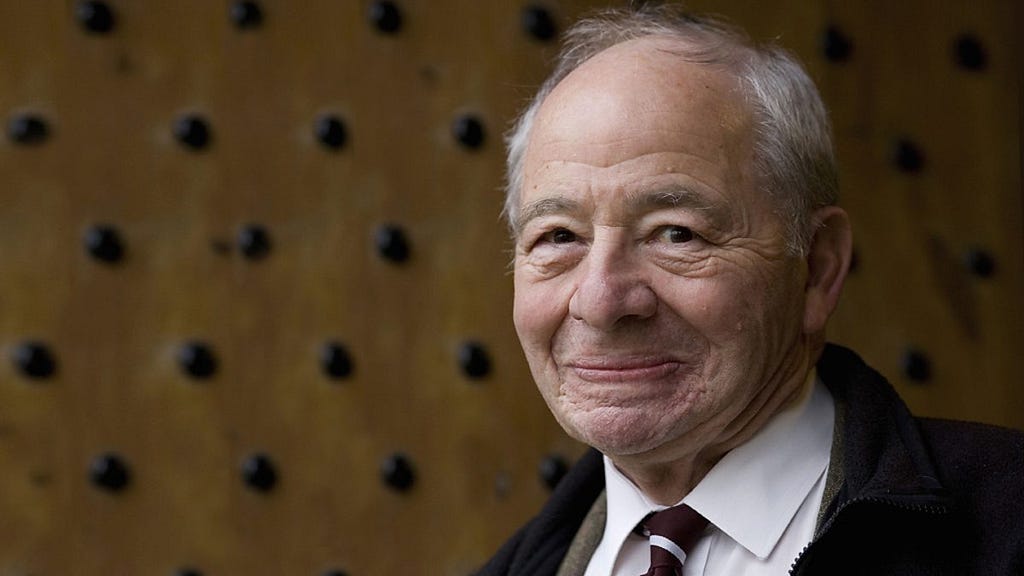
Author Colin Dexter.

Colin Dexter, the British crime writer and creator of the Inspector Morse series, passed away this morning. His longtime publisher, MacMillan, made the announcement and said that the beloved author “died peacefully at home in Oxford.”

Dexter sold millions of copies of his 13-book Inspector Morse series, which he wrote between 1975 and 1999. Like a certain other famous literary detective, Morse is best known for his curmudgeonly and idiosyncratic behavior; although, where Sherlock Holmes had a soft spot for morphine, violin music, and Irene Adler, Morse’s passions were British ale, crosswords, Wagner, and subverting authority. Dexter threaded the line between creating a prickly character and an unlikeable one by calling out Morse’s shortcomings through the presence of Robert Lewis, Morse’s Sargent, a working-class counterpoint to the sleuth’s intellectual elitism. Dexter’s mysteries took place in Oxford, an inspired setting — one that was both charmingly atmospheric (where mysteries could be plausibly connected to Greek cults and medieval alchemy), and one that allowed Dexter to explore social themes, like the problematic ‘old boy’ network of England’s elite universities.

Dexter’s popular characters became even more so when the books were adapted for television. Inspector Morse ran on ITV in the U.K. and PBS in the U.S. from 1987 to 2000. Dexter himself played cameo roles in all but three of the thirty-three episode series. Lewis, a spin-off, also proved widly popular during its run from 2006 to 2015. Most recently, Dexter consulted on a prequel of Morse’s life called Endeavor, which is going into its fourth season.

Dexter won numerous awards for his work, including two Gold Daggers and an Officer of the Order of the British Empire for services to literature.

He was eighty-six years old.

Oxford Comma Settles Overtime Dispute

Sometimes poor grammar saves the day

“Who gives a fuck about an Oxford comma?” Vampire Weekend might not, but a group of dairy drivers in Maine now do.

For anyone rusty on grammar, this screen shot provides a helpful reminder of the efficacy of the Oxford comma:

As for the dairy farmers, their missing (or not?) comma comes from a section on when overtime pay wouldn’t be paid out:

The canning, processing, preserving, freezing, drying, marketing, storing, packing for shipment or distribution of:

(1) Agricultural produce;
(2) Meat and fish products; and
(3) Perishable foods.

The drivers for Evergreen Dairy argued that without an Oxford comma, “shipment or distribution” signified different types of packing, removing the act of distribution from the law’s jurisdiction. Previously a District Court had ruled against the drivers. Following a Circuit Court appeal reminiscent of an SAT tutoring session, judge David J. Barron ruled that once again the interests of laborers and grammarians have aligned:

At issue in this case was whether the delivery drivers for a Maine dairy company fell within the scope of an exemption from Maine’s overtime law. Specifically at issue was an exemption to the overtime law that covers employees whose work involves the “packing for shipment or distribution of” enumerated food products. The drivers argued that these words referred to the single activity of “packing,” whether the packing was for “shipment” or for “distribution.” The district court granted summary judgment to the dairy company, concluding that “distribution” was a stand-alone exempt activity. The First Circuit reversed, holding that the exemption at issue is ambiguous, and, under Maine law, must be construed in the narrow manner that the drivers favor in order to accomplish the overtime law’s remedial purposes. Remanded.

While I’m a generally a proponent of the Oxford Comma when writing fiction, light journalism, and superfluous lists, maybe this one should remain absent.

What We’ve Known All Along: Less Agreeable People Care More about Grammar

14 Authors on the Life-Changing Impact of the NEA

The President has finally released his budget proposal, and the news is not good for artists, museums, schools, or cultural institutions. As it currently stands, the plan would completely eliminate the National Endowment for the Arts and the National Endowment for the Humanities, bringing over fifty years of federal arts support to an abrupt end. Combined, the two programs’ budgets amount to less than $300 million, a fraction of the government’s $1.1 trillion in discretionary spending and about .002% of the federal budget. That money plays an outsized role in the nation’s culture and in the lives of Americans of all stripes. The NEA and NEH directly support artists, writers, magazines (like Electric Literature), libraries, local television stations, radio programs, therapy for military veterans, classes for underserved students, concerts, plays, exhibits and thousands of other projects; federal grants also motivate states and civil society organizations to provide even more funding. On signing the bill that created the programs, President Lyndon B. Johnson spoke of their value: “Art is a nation’s most precious heritage. For it is in our works of art that we reveal to ourselves and to others the inner vision which guides us as a nation. And where there is no vision, the people perish.”

Some of the most celebrated authors in American letters have written with the help of NEA grants, from Alice Walker and Norman Rush to Sherman Alexie and Joyce Carol Oates. In the days since the President’s proposed budget was first released, we reached out to 14 authors who have received NEA grants and asked them what getting one meant for their writing and what programs like the NEA and NEH mean to our country’s culture.

Jess Row, Jennifer Haigh, Porochista Khakpour and John Domini

Jess Row, author of Your Face is Mine, Nobody Ever Gets Lost, and others

I received an NEA fellowship in 2003, and it allowed me to take leave from my (full-time) teaching job to write in the winter of 2005. That was the first time I’d ever received a grant to be a writer — to make writing my only occupation, for that short period. Though it wasn’t an enormous amount of money, it felt like a huge endorsement of my work. And often that’s the way it works with writers and other artists: the NEA grant arrives at the moment when you’ve begun a career but no one has heard of you yet. It’s a potent form of cultural capital, a calling card that helps you get jobs, readings, the attention of agents or publishers, and/or (if you’re lucky enough to teach full time) some breathing room away from the pressures of academic life.

What the NEA fellowship isn’t — this is a vital distinction — is a way to make a living. Writers and artists in other so-called “developed” countries, like Canada, can apply for government fellowships that actually support them, year after year. We don’t have anything like that in the US; what we have instead is a flourishing culture of creative writing in the academy. We don’t have a cultural consensus around the idea that artists should be encouraged just to be artists, and that the government should support them as a public good, a necessity. Instead, we have a nonprofit arts sector and a tiny government agency, the NEA, that do great things for artists, but in a marginal way that doesn’t make up for the robust government support we need and deserve.

Because American conservatives imagine freedom as a negative space — a wasteland where all traces of social cohesion or society, period, have been blasted away, like the desert setting of the Mad Max movies — nothing drives them crazier than the NEA. The NEA to them is like the National Parks where they’re not allowed to ride snowmobiles. Its vulnerability, its marginality, its mere suggestion that another system of value exists, makes it a perfect target, as it has been since the Reagan years. It’s been under threat so many times that sometimes I feel the Republicans will never actually move to dismantle it because they need it so badly as a target.

But I want to say something else, too: this conversation about the need to protect the NEA as it currently exists is important, but more important, to me, is to say that the NEA is not enough. We deserve better than this. American writers and artists deserve dependable, sustainable, career-long government support, and we deserve, like all Americans, affordable healthcare and housing, and the social safety net that makes it possible to do the work we do. We need to be speaking out for a progressive agenda that will make today’s NEA look like the band-aid it is.

“We deserve better than this. American writers and artists deserve dependable, sustainable, career-long government support, and we deserve, like all Americans, affordable healthcare and housing, and the social safety net that makes it possible to do the work we do..” — Jess Row

Jennifer Haigh, author of Heat & Light, News from Heaven, and others

My NEA grant bought me time to finish writing my fifth book, News From Heaven, a collection of short stories I’d been chipping away at for seven years. The support was more than monetary; it gave me the encouragement I needed in the final stretch of a project that the publishing industry wasn’t exactly clamoring for: stories from a dying town whose people had lost their livelihoods and identities when the coal mines closed. The truth is that writing literature is almost never profitable, but an occasional grant can sometimes make it possible. I hate to think of all the books that will never be finished if the NEA disappears.

“The truth is that writing literature is almost never profitable, but an occasional grant can sometimes make it possible.” — Jennifer Haigh

Porochista Khakpour, author of The Last Illusion and others

I was an NEA fellow in 2012 (meaning I applied in 2011). At the time I had just taken a job at a university that was for-profit and I knew I could not endure another minute of the unethical operation. I had a second novel that was done, but try as we could, my agent and I could not get it sold. I had a few other problems but didn’t know it — a fiancé that would be no longer soon and mysterious health problems that ended up actually being a very pernicious Lyme Disease case. I was 33 and in bad shape. I applied to NEA for the first time thinking it would just be practice for all the many more times I would be applying. I gave it my all, especially because I wanted to see what happened when we submitted a chapter of this second novel that was getting rejected everywhere. Well, about six months later I was on a fellowship in Germany, struggling in all sorts of new ways, and I found out I had received this amazing award. (I was actually on a weekend away in a bar in nearby Prague, drinking very heartily, when I got some frantic calls on a borrowed flip phone, from my agent. I couldn’t understand what it was all about — something about the government needing me?! — and I was certain I had done something wrong. I nearly spit out my svařák when I realized it apparently was one of those rare times I did something right!)

And in a year, the second novel sold (record time for this particular book that had already been circulating for a year and a half)! I’m almost certain it was because of the NEA — I suspect it gave my publishers courage to take on a very unusual and risky book. But before that happened I became very seriously ill for many months. Again, no one knew for sure what was happening until they finally found out it was Lyme. I was bedridden and had no health insurance and no job — and suddenly no way to work on a book as I’d lost most my ability to read and write at that point. I can truly say the NEA actually saved my life. I know we say that about art all the time — and I do believe art does have the power to save us. But here, it actually saved me in a non-art way too. It paid for all sorts of doctors and visits to doctors (I couldn’t drive) and it ultimately paid for many experimental treatments. If I didn’t have that award I don’t know if I’d be alive today. It was that chunk of money that got me better faster so I could return to my book, sell it, work on it, and move back to New York City where all sorts of other work was.

So many hardships come to those who choose a life of art — or rather art chooses them — and we often forget health and wellness is part of that story. The NEA not only gave me the confidence to believe in my second book when it felt like no one else did, but it also gave me the confidence to believe I could stay alive. I can’t imagine another gift like that in the world. I still somehow refuse to believe we will lose the NEA — at least not for good — because, to be very honest, I can’t imagine a world without it. How do you simply part with something that you owe your entire life to?

“The NEA not only gave me the confidence to believe in my second book when it felt like no one else did, but it also gave me the confidence to believe I could stay alive.” — Porochista Khakpour

John Domini, author of the story collections Bedlam and Highway Trade and the novel Talking Heads: 77 and others

My own NEA Fellowship came during the first decade after it was set up. so the amount was smaller — but then again, given cost of living, not much smaller. I set up payout in two lump sums, and for maybe 20 years after the first one arrived, it remained the biggest single check I’d ever received. Pretty cool, I guess, but what did it mean for my recently-fledged artistic soul? From my current perspective, torn and frayed, I can see that having an NEA firmed up my spine a bit. It provided what we’d now call “validation,” an attaboy with some authority behind it. I’m not so immune to what others think that this didn’t matter, or go on mattering; I enjoyed the same as recently as last fall, when the NEA came up in interviews for my latest book. Yet while such pickmeups are nice, I think now that Fellowship left me with a more durable nugget of, of wisdom or whatever. I believe that the two summers “off” the NEA paid for set up patterns I’ve known ever since that I needed to sustain: the daily commitment to dreaming and carpentry. I remember that during a roundtable discussion in Boston c. 1982 (at an early AWP), I heard John Leonard speak as one of those who helped design the Fellowship. Frowning and raising a fist, he defended a simple but essential core purpose: “We help artists buy time for their work. Nothing matters more for an Arts Endowment.”

“I heard John Leonard speak as one of those who helped design the Fellowship. Frowning and raising a fist, he defended a simple but essential core purpose: ‘We help artists buy time for their work. Nothing matters more for an Arts Endowment.’” -John Domini

Tayari Jones, Kaitlyn Greenidge, Clare Beams, and Paul La Farge

Tayari Jones, author of Silver Sparrow, The Untelling, and other books

The NEA’s contribution extends much farther than the $25K individual artist grants. Next time you go to a reading, participate in a conference, or attend a book festival — take a look at the program. In the corner you will likely spot the unassuming logo of the NEA. Without the support of the NEA the art we make would have a much harder time reaching the people for whom we make this art.

My novel, Silver Sparrow, is part of the NEA Big Read library. Through this program, books are given to school kids, seniors, inmates, and just everyday citizens. Recently, my book was handed out at a food pantry and then everyone was invited back for a book club discussion. Honestly, it was the most meaningful experience I have had as an author and it was all made possible by the National Endowment for the Arts.

“Recently, my book was handed out at a food pantry and then everyone was invited back for a book club discussion.” — Tayari Jones

Kaitlyn Greenidge, author of We Love You, Charlie Freeman

I was born middle-class but within seven years, we slipped below the poverty line. Before I was 21, I’d been evicted and moved more times than I could count. When bill collectors called our house, when benefits workers called my mom, sometimes they’d ask her why’d she have so many kids, if she knew she was going to be poor (for the record, there were three of us). When you grow up poor, you develop an instinctive distrust of bureaucracy, of forms, of government oversight. Usually because these programs are designed to be as difficult to understand as possible, designed to ensure you are slightly humiliated a bit more each time you interact with those entities, until you feel you can’t go back. You develop a form of poverty PTSD, a dread of forms, of constantly having to prove how unworthy you are. For this reason, I was wary of applying for the NEA — conceptually, I knew this was one of the few government agencies that was designed for something different, not for bland cruelty but for actual uplift. But those forms. But those having to justify who and what you were. But the NEA is a version of government that I was raised to believe in, even as I interacted with its punitive underside. The idea of government that believes something’s utility and necessity exists outside of some measurable outcome. The idea of a government that wants to hear as much as it can from its citizens, through their songs and dances and plays and stories. I don’t know if that government still exists. I think, if the NEA goes, we’ll have to recreate it ourselves.

“[T]he NEA is a version of government that I was raised to believe in, even as I interacted with its punitive underside. The idea of government that believes something’s utility and necessity exists outside of some measurable outcome.” — Kaitlyn Greenidge

Clare Beams, author of We Show What We Have Learned

The NEA directly changed my life — or the writer part of it, anyway. My book (We Show What We Have Learned) would not exist without it. This is true because the NEA contributes to funding my publisher, the marvelous Lookout Books, and because it funded the time I used to write and revise many of the stories that became We Show What We Have Learned. The phone call in 2013 telling me about my grant came just as it was becoming clear that the novel I’d spent eight years writing was not going to sell. I had an eight-month old, and we had just moved to a new city where I knew almost no one; I think I would have kept writing without that phone call, but I can’t be entirely sure. I didn’t know where I was going to find another eight years to try again. Making art is a long road, and the opportunities for encouragement along the way — while you’re in that subterranean mid-process land where all the work occurs, all the many hours that eventually produce the book, or play, or piece of music — are rare. It can be a frightening place, that land. It’s very very possible to get lost there. The NEA lit everything up for me. It’s done that for so many writers over the years. (There’s a full list of them here, searchable by year or name.) When I look at the list of those writers’ names, I think about what the world would be like without their books — because for some of them too, I’m sure, that light came at just the critical, fragile moment when everything might have turned a different way — and without the acknowledgment of and support for what art adds to our lives in general. I know I wouldn’t recognize that world.

“The NEA lit everything up for me.” — Clare Beams

Paul La Farge, author of The Night Ocean and others

I applied for an NEA literature grant to work on my novel The Night Ocean, all the way back in 2011, and I was eating lunch at the Village Diner in Red Hook, NY, the town where I live, when I got a call from Washington D.C., informing me that I’d got the grant. It was the best thing that happened to me that year. I used part of the NEA to travel to Florida and Mexico City, to see the places where my story took place, which is an amazing thing to do — you learn much more by actually going to a place than you ever could by looking it up on the Internet. When I was ready to write the book, I used the rest of the grant to take four months off from teaching. I’ve rarely worked so hard; I wrote about half of The Night Ocean during that time. I don’t know how the book would ever have got done without the NEA. Either it would have taken years more than it did, or I wouldn’t have been able to write it the way it needed to be written.

“I don’t know how the book would ever have got done without the NEA. Either it would have taken years more than it did, or I wouldn’t have been able to write it the way it needed to be written.” — Paul La Farge

Imagine American Literature Without Immigrants

Patricia Engel, R.O. Kwon, and Richard Thomas

Patricia Engel, author of The Veins of the Ocean, Vida, and other books

I received a fellowship from the NEA in 2014 to support the research and completion of my novel, The Veins of the Ocean. As a result of the NEA fellowship, I was able to make several research trips without which the novel would have turned out very different. To know the NEA had invested in my work was an enormous source of confidence and solace in the otherwise very lonely journey of writing of a book. I felt comforted by their support, and this inspired and invigorated me as I neared completion. I am filled with gratitude to the NEA, and when I served as a judge for the 2016 fellowship cycle, I learned firsthand how much care and work the NEA devotes to the selection of its fellows and how much it believes in each recipient’s potential. The NEA is a bright spot in an artist’s undoubtedly uncertain future. Countless among my favorite books were written with the support of the NEA. Without the organization, the arts and culture of this country will suffer and, in turn, our literary and artistic landscape will become a much bleaker and darker place.

“The NEA is a bright spot in an artist’s undoubtedly uncertain future.” — Patricia Engel

R.O. Kwon, author of the forthcoming novel, Heroics

One night, I opened a short email from the NEA: I hadn’t been answering my phone, it said, and when would be a good time to talk? My body responded first. I found I was jumping before I could think, I might have an NEA. I wasn’t sure, though. Maybe they’d called just to let me know I’d made a terrible mistake on my application, and could I please save everyone’s time by never applying again? I lay awake through the night, afraid to be too excited.

When morning came, the news was wonderful: I was going to be a 2016 NEA fellow in literature. I’d been working on a novel for over eight years. I was so tired, and the grant provided encouragement I badly needed — how beautiful, to think that my country was giving me money to write. Within a few months, I’d at last finished and sold my book. The NEA provided vital help, and I’m so thankful. Hope runs a bit low these days, but I hope I wasn’t in one of the last classes of fellows. I’ve been calling Congress; art-makers, art-lovers, I hope you are, too.

“Hope runs a bit low these days…I’ve been calling Congress; art-makers, art-lovers, I hope you are, too.” — R.O. Kwon

Richard Thomas, author of Disintegration, Breaker, and other books

A few years ago I received a small grant from the NEA for my work on a group project here in Chicago, at Flying House. I was paired with another artist, Christina Loraine, and we collaborated on a creative endeavor — her painting with my words to showcase an interactive performance piece. It was very exciting.

What made the NEA grant so important was that it made me feel legitimate. I felt I was being recognized by an organization that had a lot of power and influence, a group I have respected and admired for a very long time. I was now part of a larger narrative, a group of artists that have influenced me, and my work.

Quite often when we write, we do it alone — in an office, or a classroom, or at home. We build worlds out of air, spill out blood on the pages, and share intimacies and truths, in an effort to relate, to entertain, to inspire. Sure, we have support systems — family, friends, peers — but any kind of attention from the NEA, well, that was something that meant a lot to me, something I held onto when sending out stories, piling up rejections, when I struggled to write or find an idea, or the right words. Much like my first professional sale — or any acceptance really, along with the nominations and awards that have come now and then over the years — the grant from the NEA gave me confidence to keep writing, to believe in what I was doing, and the money — that was just another level of respect, something that helped me feel real, alive, and successful.

When I think about the prospect of the NEA going away, it carves a bit of my heart out of my chest, leaving a void, the wrong direction for this country. It is a cold decision lacking in empathy and compassion, an illogical choice, one of many in a series of bad decisions. We are so much better than this, and the voices that rise up to condemn these actions, they will only get louder. Mine included.

“I was now part of a larger narrative, a group of artists that have influenced me, and my work.” — Richard Thomas

Kelly Link and Catherine Chung

Kelly Link, author of Get In Trouble, Magic for Beginners and others

In 2005, I opened a letter telling me that I was going to be given an NEA grant in fiction for the year 2006. What an astonishing thing, to have it in print that a group of fellow writers, reading for the National Endowment for the Arts, thought that the kind of stories that I wanted to write were worth pursuing. How useful that money was! But how much better, even, to serve on the NEA panel three years later, in 2009, and be given the opportunity to read (anonymously) samples of other writers’ novels and stories. How much better even than that letter to sit with the rest of the panel, in a room in Washington, D.C., and discuss the work that we’d all been reading. We talked through the day (and I pumped milk in a storage room). We discussed the work that we’d read with great seriousness, with camaraderie, and also with gratitude, because it means something to serve on a jury of peers, and to see diverse and thoughtful and challenging and difficult work given the necessary support, space, and time that a grant provides. The kind of work made possible by such grants — and such an organization — enlarges and expands the boundaries of the country in which we live. The kinds of stories that we tell ourselves about ourselves matter. The work that the NEA does matters. The cost is small and the scope of its success is so very extraordinary.

“The kind of work made possible by such grants — and such an organization — enlarges and expands the boundaries of the country in which we live.” — Kelly Link

Catherine Chung, author of Forgotten Country

There’s a lot I could say about how my literature grant from the National Endowment of the Arts benefitted me personally: I was able to take several months off from my teaching job to write the pages that would allow me to sell my second novel, and was able to travel to libraries and universities in Germany to research the things I needed to know in order to write that novel, to say nothing of the boost I received in terms of morale and the prestige connected to such an award. And six years before receiving that grant, it was the National Endowment for the Arts that funded my fellowship to the MacDowell Colony, where I would finish my first book and meet other writers and artists who would come to form my tribe.

But far more valuable than any personal or professional benefit I’ve received from the NEA (which to be clear, was substantial and life-changing) is the larger social benefit we receive from its existence. It was created by Lyndon B. Johnson in 1965 to function “purely as an escalation of the spirit,” and over the years it has allowed our government to support (among others) thousands of writers and musicians and painters and arts organizations. It has done so in the belief that individual expression is part of our heritage, and can bring us together as a country made up of human spirits. The very existence of the National Endowment for the Arts has been encouragement to me as an artist and as an American, and most importantly as a member of a larger community who has been moved and changed by both its mission and the art that has been created with its support. It affirms that sharing our dreams and stories — with all our myriad backgrounds and experiences — is worth honoring, and can indeed expand and elevate our lives, our very spirits. What a thing it would be for us to give that up. What a thing to lose.

“It affirms that sharing our dreams and stories — with all our myriad backgrounds and experiences — is worth honoring, and can indeed expand and elevate our lives, our very spirits.” — Catherine Chung

Emily Raboteau and Jennifer Croft

Jennifer Croft, writer, translator and editor

When I received the call from the NEA letting me know I’d been awarded a Literary Translation grant, my pen was poised over a contract to translate a massive work of mediocre criticism that I desperately did not want to sign. It would have taken me a year, and away from all the exciting projects I did want to work on, but I was pressed for money and didn’t really see any other option.

In my anxiety I initially mistook the NEA for telemarketers, gruffly requesting they call back some other time, but once that was cleared up, I rushed to recycle the page on which that contract had been printed and began translating Olga Tokarczuk’s brilliant novel Flights. I was also able to start work on my own novel, Homesick (first written in Spanish as Serpientes y escaleras), and to start saying no to the smaller academic translations I had been doing of necessity so I could pursue only the translations I was passionate about, like Romina Paula’s August, which will be released in a couple of weeks by The Feminist Press at CUNY.

It wasn’t just the money — the exposure provided by the NEA grant put me in touch with some amazing publishers for my various projects, and the following year I served as a judge for the Literary Translation grants, which connected me with even more fantastic literary folk. And everyone at the NEA was so consistently helpful and delightful that I truly can’t imagine where I would be now without their support. Receiving a grant from the NEA completely changed my life, as it has done for so many others, bringing essential art from all different (and many underrepresented) backgrounds to a wide audience. We cannot let it disappear.

“Receiving a grant from the NEA completely changed my life, as it has done for so many others, bringing essential art from all different (and many underrepresented) backgrounds to a wide audience.” — Jennifer Croft

Emily Raboteau, author of The Professor’s Daughter and Searching for Zion

Adding to what’s been articulated about the big impact of the NEA Literature Fellowship upon the individual careers of the authors represented on this page (and the greed underlying its possible repeal), I want to note that unlike many other prestigious literary awards that subsidize creative writers in the U.S., this one is judged blind. The names of the applicants are not permitted on the applications. The applications are disqualified if the authors identify themselves. As a former NEA recipient (2006) and judge (2015), I appreciate that the grant is solely based on the merit of the work submitted, rather than on favoritism, name-recognition, connections or Old Boy networks. This makes the process fittingly meritocratic for a program funded by a federal democracy. The work it supports is designed to be representative of our nation’s exceptional diversity of experience. The National Endowment for the Arts has arguably been more progressive about representation than the publishing industry. For writers — particularly those on the fringe of dominant society — not to have this opportunity will be a low-blow. It will also be unfortunate for readers who might have been entertained, influenced, or sustained by the work produced. I hate to think of the books that won’t be written because of such defunding, but it’s interesting to imagine the books that will in some way address the stupidity behind it.

The National Endowment for the Arts has arguably been more progressive about representation than the publishing industry.

Death and Starlight in Chile’s Atacama Desert

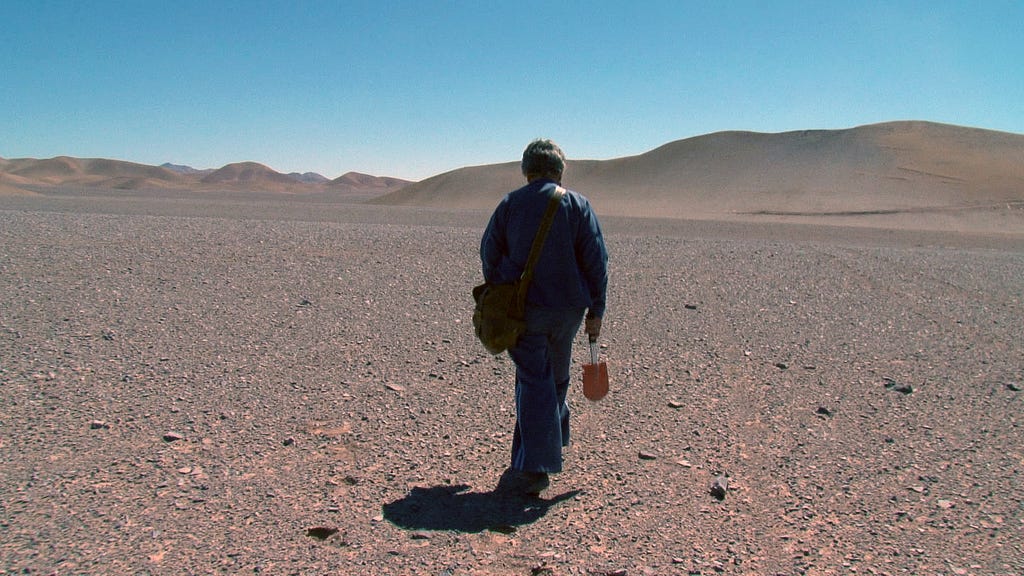
Patricio Guzmán’s documentary Nostalgia for the Light (2010) paints a stunning portrait of Chile’s Atacama Desert — from its otherworldly, international preeminence as a site for beholding the stars, to the scarred traces still present in the arid land of horrific acts committed under the Pinochet dictatorship.

The film opens with a disorienting sequence, of an ancient, creaking telescope coming to life, until at last it is ready to turn its lens onto the far more dazzling cosmos. The old telescope represents a more innocent era, before Pinochet’s regime and the subsequent mass disappearances that swept Chile. But to Guzmán, this telescope also stands as a reminder of his country’s rapidly disappearing historical memory, a memory that’s become ever more creaky and confined to the outliers of society — in this case, to those who continue to wander the desert, the sole bearers of witness to the past, working to preserve their dead.

Still from ‘Nostalgia for the Light’

In the Atacama, the technological effort accompanying the astronomer’s devotion to the past — their primary source of information, as the light reaching us from distant objects comes after hundreds, thousands, millions of years have passed — is set throughout the film against the more painful and painstaking efforts of the various women still searching the desert for the remains of family who were disappeared in the 1970s. The shiny modern machines opening their lenses to the sky rise out of the same land that’s host to the ruins of concentration camps and the bodies of the missing.

Guzmán shows us a woman, in the last light, bending down in the hope of finding little more than a shard of human bone that might once have belonged to her husband. This scene occurs not far off from one in which we see a group of astronomers sitting behind their computer screens, excitedly explaining how the calcium in our bones can be traced all the way back to the Big Bang. In this quiet juxtaposition, Guzmán delivers a potent message on the kinds of quests society willingly tolerates, preferring the scientific searches of the deep and distant past over that more painful effort to preserve those recently forgotten and shunned.

The woman, Violeta, goes on to articulate a wish that these astronomers might for once point their telescopes into the ground, to “see through the earth” and hunt for the dead, just as they do among the lifespans of stars. There are others, too, who walk the desert looking for tiny rock drawings preserved in the salty desiccated landscape from thousands of years in the past. Above the Atacama stars die and nebulae form, while inside it so much evidence of human strife remains untouched. Archeology and astronomy in the film are presented as synonymous efforts: as Guzmán’s awing eye takes us to the most brilliant reaches of outer space, he also lovingly and hauntingly returns us to a set of petrified feet in the dust.

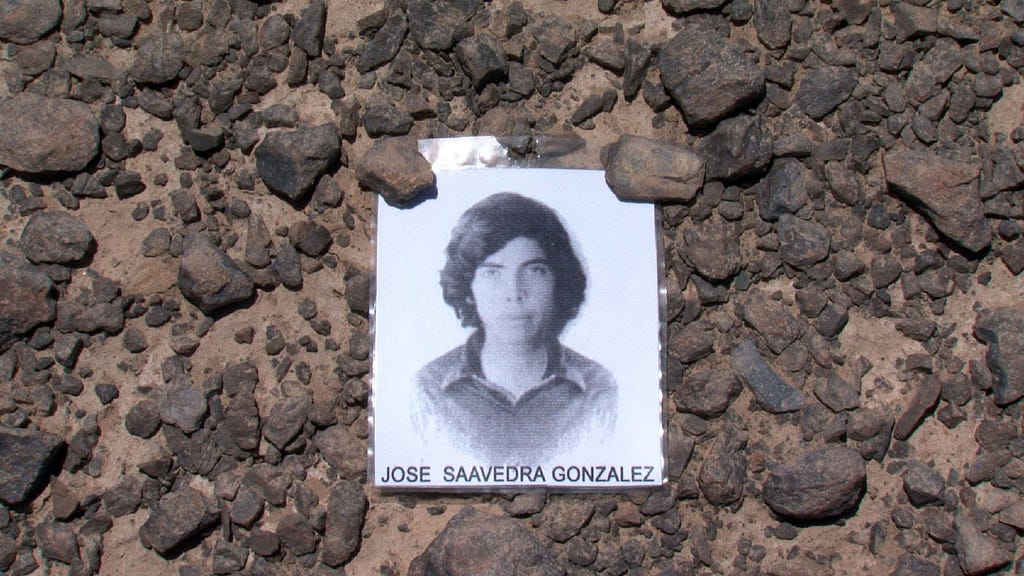
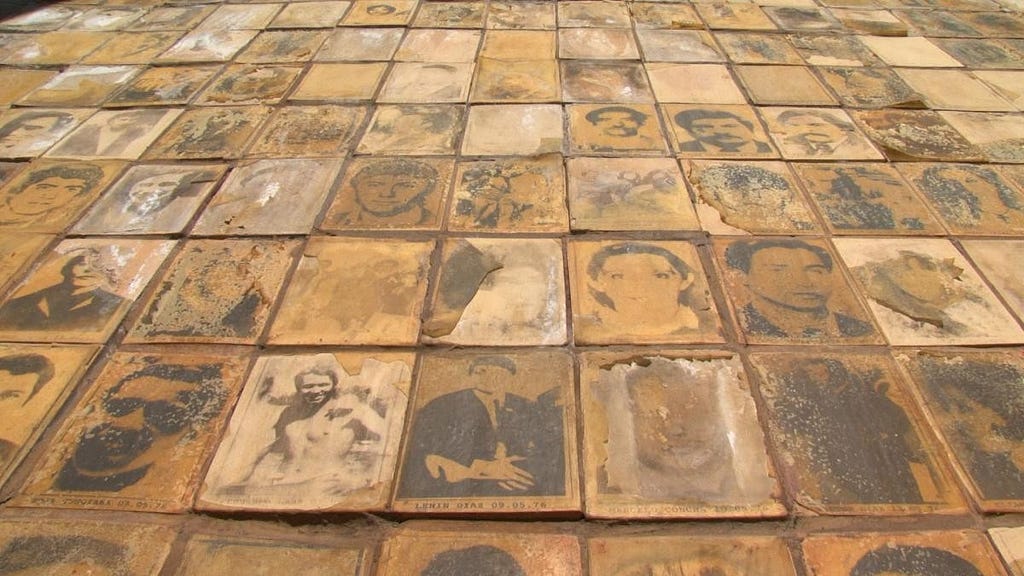
The force of his documentary is in its willingness to equate the universe of personal loss with that of our cosmic longing for answers about where we come from, who we are. The faded faces of the disappeared adorning a glittering sunlit wall become as momentous as the twinkling stars above, from which we receive messages of our collective origin as a species.

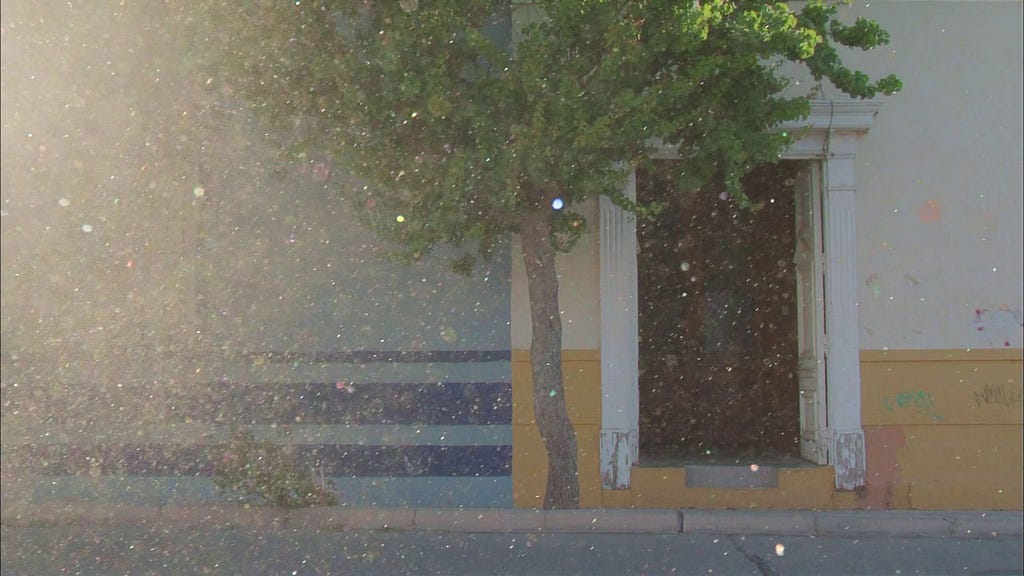
Guzmán’s investment in the past is also deeply personal, and his nostalgia, as often is the case, conjures up memories of his childhood. The dust falling through his family home at the very beginning of the film blurs into the cosmic dust that swirls in space.

His childhood, Guzmán suggests, is also synonymous with his country’s, a time when wonder could flourish, when looking in awe at the cosmos did not have a parallel to searching in the desert for those who’d been murdered. But there is also that which we don’t remember, the childhood of our existence which originated with the Big Bang, that first explosion of light to which we owe the calcium in our bones, among everything else.

Close to the end Guzmán reflects, in voiceover, on seeing for the first time the skeleton of a whale in a museum, and believing that the skeleton could serve as the roof of a home for other whales to reside in. We too live beneath the roof of thousands of long-dead celestial bodies. And yet, beneath that brilliant canopy, as the director so hauntingly portrays, we have not yet given sufficient attention to the past and its damages which continue to live with us, equal in part to that in us which is made of stars.

Hannah Lillith Assadi received her MFA in fiction from the Columbia University School of the Arts. She was raised in Arizona and now lives in Brooklyn. Her debut novel, Sonora, is out this month from Soho Press.

Through the Desert Fog

The Bard of Black American Loneliness

To read the poetry of Morgan Parker is to meet a voice brash with intelligent humor and sadness, both youthful and wise, analytical and lush. It’s a voice that assembles a worldview equal parts museum art and pop culture. It likes its wine but is weary of social injustice, and it finds a swagger in observing the everyday tragic.

Parker’s debut Other People’s Comfort Keeps Me Up At Night was selected by Eileen Myles for the Gatewood Prize in 2013. Her new collection, There Are More Beautiful Things Than Beyoncé (Tin House Books, 2017), is a high-concept meditation on the tensions between individual agency and systematic inequality, the weight of history and the ever-visibility of the Digital Age, beauty and black America and performance. Recently, Parker took a break from “slowly answering a billion emails and coming up with bad tattoo ideas” to discuss space on the page, why she doesn’t have time for gimmicks, and carving life cycles into a collection.

O’Neill: There’s a line in “The President’s Wife” that goes, “Is lonely cultural.” I think many of the poems in the collection gesture toward that question. Could you talk about that? Also I’m wondering if there is any truth in the inverse, that countercultures offer a model of radical sociality. Is it more complicated than that?

Parker: Dang, ok. So, I think it’s probably both, like, we need countercultures to help us feel like we belong to something, and I guess I’m talking specifically about POC or marginalized folk because black American loneliness feels like a particular type or at least, for myself, I’ve been trying to understand the connections between the history of black women in America, the weight of it, and my own neuroses, deep sadnesses. My number one thing in therapy is loneliness, followed closely by America, so I guess a lot of the book is trying to get at that connection.

America has systematically placed loneliness on us, like, we’ve been separated from our families, pitted against each other, etc. We’ve been divorced from a sense of belonging or home. Weird example but you know how in High Fidelity dude is like, was I sad because I listened to pop music or did I listen to pop music because I was sad?

O’Neill: Yes.

Parker: My thesis question is something like that, what came first, what belongs to me versus what I’ve internalized and was placed on me

O’Neill: That comes through really beautifully throughout, but I’m struck by a poem toward the end. “The Book of Revelation” ends, “She says peace is something/ people tell themselves.” There’s a restlessness to the speaker(s) of this collection, and I’m wondering if we’re meant to read this lyric ‘I’ as one speaker, first off, and second, if so, is peace what the telling of these poems constitutes or gestures towards?

Parker: Well, peace is the goal. The speaker(s) are ISO peace, but also skeptical that it even exists. That question of if the speaker is one or many… I think the answer is both? Obvi I wrote all the poems but each speaker’s in a different state of mind/challenging specific and different sources, and I guess part of the project of the book was trying on all of those voices and inhabiting all of them as truth because people are complex! I feel like I’m minimum 17 people throughout the course of one day. Lol is my book leaves of grass?

O’Neill: Yeah, I’d peg you as a cooler Walt. Also, I love the moments where the speaker(s) reflects on her self. Many times reading the collection I was struck by moments of swaggering melancholy or maybe melancholic swagger in your lines, which was really seductive to me. The speaker(s) carries sadness, certainly, but there is also this big, magnetic personality that seems a little bit aware that she kills.

Parker: Yup. It’s like the tragic heroine, I guess, how miserable it can be to hold greatness and to have your greatness continually obscured and doubted.

O’Neill: The speaker(s) of your poems returns repeatedly to the sense that she is not sufficiently woman.

Parker: There’s a thread in the book that wants to ask what femininity is and again, who gets to define it, standards of beauty, etc. I mean, the impetus for some of the first poems in the book was just looking at Beyoncé, so of course there’s this meditation on beauty, on what’s expected and accepted, which also has to do with traditional ideas of femininity, desirability. Man, they ask so much of us.

“There’s this meditation on beauty, on what’s expected and accepted, which also has to do with traditional ideas of femininity, desirability. Man, they ask so much of us.”

O’Neill: Truth. In a weird way, I think this comes out most in “Beyoncé Prepares a Will.” There’s a sense that even when she’s dead — which, first off, the unimaginability of it to some people is pretty indicative of how she’s become a symbol beyond human — she’s going to have this image to uphold. I shouldn’t say that’s where it emerges the most. But it is evoked.

Parker: For sure! And it goes the other way too, like before, during, and after life, she doesn’t have ownership over her own body or narrative. I guess that’s one thing Beyoncé and I have in common.

O’Neill: Oh I think you guys have more in common. You’re both very strong and stylish and moving. You have a much stronger voice, though. The Bey Hive is going to come after me. Whatever. I love Beyoncé. Onward.

Parker: Lol my thoughts exactly.

Magical Negro #607: Gladys Knight on the 200th Episode of The Jeffersons

O’Neill: Going back to that question of control over the narrative, I also think about the way you use money as a trope in the collection. In Hottentot Venus, you write, “No one worries about me/ because I am getting paid.” In “Welcome to the Jungle,” you write, “art is nice but the question is how are you/ making money are you for sale.” There seems to be a logic there: you are still paying even when you earn. If that makes any sense. And I’m not just talking about in the marketplace.

Parker: Yup.

O’Neill: Although when aren’t we?

Parker: For sure! You’re buying and being bought at the exact same time, and money is supposed to be this kind of salve or apology, but it’s empty.

O’Neill: Speaking of empty, you beautifully spatialize silence in “The President Has Never Said the Word Black,” so that what is not said becomes a physical gap on the page; you really make us attend to elision, using the page to make visible what’s become naturalized or uninterrogated. Can you talk about how you use spatial techniques in other poems like “Lush Life,” “13 Ways of Looking at a Black Girl,” “The Book of Negroes,” “Rebirth of Slick,” and “Beyoncé On The Line For Gaga”? Shit. That’s a lot. Maybe you could just discuss more generally.

Parker: This is the best thing about poems. They get to be visual and flexible in a way prose can’t. The way I use space in “The President Has Never Said The Word Black” is different than how I usually do, but in general, poetry is about reading between the lines, reading what isn’t there as much as what is.

O’Neill: You used to work in the world of visual art and flag “We Don’t Know When We Were Opened (Or, The Origin of the Universe)” as after Mickalene Thomas, the painter. Obviously, I already brought up “Hottentot Venus,” which is also an allusion to visual art. How do you see your work in conversation with other artistic media?

Parker: It’s also visual.

O’Neill: Oh wait sorry did I go too fast? Eager fucking beaver over here.

Parker: No! Was just about to say it’s visual. We on the same page, like, “13 Ways of Looking at a Black Girl” feels almost like a piece of visual art more than a poem. If I were a painter I would make it a painting somehow. But I ain’t, lol. The visual arts are super important to me, huge inspiration for so many of the poems. I also wanted the book to be visual, if that makes sense: the imagery, the setting, the clothes, the hair, the vision. And it was important for the book to be in conversation with not only literature but music, visual artists, etc.

O’Neill: You mention jazz.

Parker: I loooove jazz because I am a grandpa.

O’Neill: And yet, you also thread throughout the collection a very contemporary and complicated relationship between humans and machines. There’s discussion of white emoticons. In another poem, the speaker describes herself as a screen. Then, in “Beyoncé, Touring in Asia, Breaks Down in a White Tee,” there’s that line: “honey we need the machines to live.” Can you talk a little bit about that?

Parker: Yeah, I never really think about that, but it’s true — I think it’s because I’m meditating so much on how we’re perceived, what our bodies are, how we see ourselves, and that’s very wrapped up in technology in 2016. 2017? Whatever, rn. Technology teaches us about ourselves and also distances us from ourselves. It’s how we communicate and it also replaces language. That sounds kind of basic, but it felt important to touch on, in terms of authenticity, performance, presentation

O’Neill: I don’t think it’s basic. “It’s how we communicate and it also replaces language” is a way I wouldn’t have thought to think of it. I have a couple of more general questions, but first I want to ask: what do people miss in your work or misinterpret?

Parker: Hmmm. I worry about the work being labeled superficial, because of its use of pop. I worry about it being labeled unserious, because I like telling jokes. Of course, assuming that it’s anti-Beyoncé, or even particularly pro-Beyoncé, is false

O’Neill: I see it as very serious and in dialogue with a lot of the excellent writing that deals with the semiotics of pop culture.

Parker: I agree that pop culture is incredibly pertinent and scholarly. I do think it’s easy — especially because I’m a young black women — for people to write my poems off as fluff, or opportunistic, or gimmicky. Frankly I do not have time for gimmicks. I’m like trying to get out from under the white supremacist patriarchy.

“Frankly I do not have time for gimmicks. I’m like trying to get out from under the white supremacist patriarchy.”

O’Neill: It also seems like those critiques are premised on some very incorrect notions of what poetry is and what poetry should do.

Parker: Yuuuup. Man I am sick of talking about that.

O’Neill: Could you discuss the work of arranging poems into a collection? What were you thinking about in structuring the book?

Parker: I love ordering books. This went through very many rounds. There were so many journeys the speaker could take, and so many different poems I could use to anchor the book. In the end, I decided to loosely structure the book around life cycles.

The life cycle of Beyoncé — “Poem on Bey’s birthday” and “Beyoncé Prepares a Will” as bookends.

There’s another cycle that’s loosely about depression or loss, or maybe, the battle with the self/ the self’s history, so… “Hottentot” being up front as a kind of background/ source for the speaker of the book, and “Funeral for the Black Dog” is literally a kind of funeral for my own depression. So the book goes through a metamorphosis of self-loathing, investigating the source of that self-loathing (which includes owning but also seeing that the self isn’t the only culprit), and then resolving to regain agency.

I should be clear that I don’t expect readers to pick up on all of that, but there’s a ghost of that general trajectory in the ordering of the poems.

O’Neill: You’re an editor at Little A, as well as a poet. All writers edit their own work, of course, but I’m wondering the extent to which your editor self and writer self — if you even think of these as separate parts — interact in your writing practice.

Parker: I definitely self-edit as I’m writing, but not to the extent that everything I write is gold. I allow myself to write a lot of bad poems. That’s the writer me. The editor me comes in around draft three, or after a significant amount of time. I also learn a lot of editing techniques from working with other writers. There’s so much more room to bend and play and be flexible when the work isn’t your own, so I do try to take that kind of fresh approach to my own work when I can.

Bob Silvers Has Passed Away

We’re saddened to learn that Robert B. Silvers, founder of The New York Review of Books, has died after a brief struggle with an undisclosed illness. An announcement was made this afternoon by the NYRB via Twitter.

Silvers was a titan of American letters. In 1963, along with Barbara Epstein, A. Whitney Ellsworth, and Elizabeth Hardwick, Silvers founded the landmark publication, which would soon become a standard-bearer for literary criticism and intellectual engagement at home and abroad. Over the years, the NYRB regularly featured the writing of Susan Sontag, Norman Mailer, Truman Capote, Joan Didion, Hannah Arendt, James Baldwin, Harold Bloom and Joyce Carol Oates. Silvers and Epstein edited the magazine for over forty years.

The Chicago Tribune once described the NYRB as “one of the few venues in American life that takes ideas seriously…it pays readers the ultimate compliment of assuming that we do too.”

Silvers was recently the subject of the HBO documentary The 50 Year Argument, which memorably portrayed him, a stalwart of old-school publishing, dictating emails over the phone from the back seat of a cab.

Silvers was 87 years old.

This post will be updated as more information becomes available.

Coming of Age at Harvard and in Hungary

The Idiot begins with Selin, the novel’s main character, arriving at Harvard for her freshman year. She navigates uncomfortable dorm politics and struggles with which posters to put up where, and what they will say about her. When, under pressure from her roommate, she picks one depicting Einstein, she is subjected to an almost endless parade of people criticizing her decision. To her, an Einstein poster seemed benign, but it had turned into a signal of her ignorance.

Elif Batuman’s debut novel is a coming-of-age story and Selin’s attempt to grow out of her innocence and ignorance is one of the book’s emotional thrusts. Batuman does this well. Still, the plot itself is simple and unsurprising. It spans about a calendar year and, as one does during the first year of college, Selin changes a lot. But the element that sets The Idiot apart is the writing itself.

“In The Possessed, she was effective. In The Idiot, she is masterful.”

In some ways, this novels feels like evidence for those who might argue that writing cannot be taught. Batuman’s eye is good, her descriptions so emphatically her own, it seems unbelievable that anyone could match it. A large part of it, certainly, is Selin’s depth as a character, but there are deep characters who do not see as clearly. Even in benign moments, the writing can feel revelatory. Here, for example, is how Selin describes walking into a dining hall.

[They] were open late for exam period. At a table near the door, two students were slumped over their books, either asleep or murdered. In a corner, a girl was staring at a stack of flash cards with incredibly ferocity, as if she was going to eat them.

The prose is simple and to the point and the manner in which Batuman deconstructs the familiar is impressive and makes reading, on a sentence-to-sentence level, a joy. Selin is a perceptive character, except, as is the case with many perceptive characters, when it comes to her own relationships, where she is often particularly hapless.

Selin is in love with an older student at Harvard named Ivan, and spends an unhealthy amount of time worrying about him and what he thinks of her. Their relationship begins innocently enough, first in class and then in simultaneously coy and provocative email exchanges. As it escalates, to date-but-not-date-nights and more frequent interactions, the fraught nature becomes clearer and clearer to the reader.

The Star of the Show

How much Selin knows about how bad the power dynamic between the two of them is, for the most part, unclear. One is left to assume: She does not know much about it.

Eventually, he introduces her to someone he knows that sends English teachers to Hungarian villages in order and Selin takes the opportunity. There is a small amount of introspection, though perhaps not enough, focusing on what set of incentives have caused her to do so. Ivan is Hungarian and will be in Hungary (though not always where she’ll be) and they would be able to see one another. She will also have an opportunity to learn more Hungarian, and she believes, rather deeply, that learning about one’s native language can be useful in learning about the person themselves.

This is discussed often in the book, and Selin uses Turkish (a language her family speaks) to convincingly justify her position.

Turkish, for example, had a suffix –mis, that you put on verbs to report anything you didn’t witness personally. You were always stating your degree of subjectivity. You were always thinking about it, every time you opened your mouth.

It is not difficult to see how something like that tense would require a speaker to alter their perception of their place in the world. The important caveat is that it seems to only apply when one is speaking Turkish and not every time someone fluent in Turkish speaks. The nuanced questions that this necessarily raises — does a Turkish speaker become more confident in conjecture in another language? Or is it an attitude one cannot get rid of? — are left unanswered, and Selin does not interrogate her point of view, or at least not early on enough to help her.

Ivan, on the other hand, has a more cynical view of language and its ultimate futility. He is a mathematician at Harvard and in his heart and language’s fundamental lack of objectivity is amusing to him. At one point, he tells Selin a wonderful joke about a scientist who is given a grant to study fleas.

He would shout, “Jump, and measure how far the flea jumped. After a while it got boring because the flea always jumped the same distance, so he pulled off the flea’s legs one by one. The distance got shorter and shorter, until finally, he had pulled off all six legs and he flea didn’t jump at all. “If you remove six legs,” the scientist concluded, “the flea cannot hear.”

It is, of course, a joke, but the subtext is that using language and one’s response to language as a means of understanding the world is fraught with room for error.

Batuman, through Ivan and Selin, manifests both arguments effectively. Her critical acumen in this and other areas is hard to miss throughout the novel, and it is one of the book’s unique delights. Her first book, The Possessed, is a critical memoir of her time studying Russian literature and she balances its twin interests well. Though the project of that book was different, the task of juggling narrative and argument is similar. In The Possessed, she was effective. In The Idiot, she is masterful.

Selin is a neurotic character and she is always concerned about something, as most college students are. Other books set in similar situations would and have shied away from genuinely engaging with the day-to-day issue that undergraduate students face with regard to their classes, but Batuman does not. Translations of her readings for her Russian class, for example, appear in the novel, as do her discussions of them with her classmates. It helps that Batuman is smart enough to make these exchanges interesting. She notes the way the story bends its sentences unnaturally to accommodate the students’ limited grammar and how their expanding grammar impacts the story as they read excerpts of it throughout the semester. This is, in a way, procedural. It is an acknowledgement of how language classes at American colleges and universities operate. But it is also made meaningful by how and when and where and with whom Selin discusses it.

At times, the novel can seem too stuffed full with characters and ideas that it can’t follow all of its relevant threads. Perhaps its inspiration from the Russians she admires (maybe, particularly, Fyodor Dostoevsky, and maybe, particularly, his excellent book The Idiot). Perhaps it is a commitment to an authentic portrayal of that time in a person’s life, when the newness and the nearness of college endlessly introduces students to people with whom they will only have a short term relationship. Whatever the reason, it can be exhausting and disappointing to lose grip of people so quickly.

Still, Batuman’s brilliance is always shining through. In her memoir, The Possessed, she writes about struggling to write a novel, how she would take large chunks of time to write and the frustration and aimlessness she felt doing so. The Idiot is proof that, however frustrating the work was, however many novels were started or abandoned or stuffed away, it was worth it.