Ed Skoog: I’m curious about beginnings: how did you get started writing poetry?
Jess Williard: What got me started writing poems was reading poems, of course, and then imitating them, approximating certain gazes with my own “voice,” approximating voices with my own gaze, and then hopefully something on the other side of that.
What do you mean, more precisely, by gaze?
By “gaze” I mean the kind of appreciative, revelrous lenses I observed early on in poems, specifically poems by Philip Levine and Elizabeth Bishop. This is perhaps kind of obvious, but I was and continue to be struck by the way poems seem to be unique vehicles of gratitude in their attentions to the world. The way Levine considers time and physical landscapes in his poems, for example, are gazes that I find imminently affecting. Or Bishop’s attention to atmosphere in her poems. Or, more recently, Marie Howe’s consideration of daily minutiae; making something large out of something small by looking at it. These are the kinds of exacting, appreciative lenses I try to look through in making poems. They are borrowed lenses, but what they offer are ways of looking at the world that can animate any gaze and give it singularity.
By voice I mean finding ways to organically adopt those lenses, to make them more my own. And that’s its own way of appreciating things, I suppose; acknowledging the ways you’ve been impressed and trying to do something with that.
I read an interview with the singer The Weeknd last year in which he was asked about the influence Michael Jackson has had on his music (The Weeknd sounds a lot like Michael Jackson). “I want to make it very clear that I’m not trying to be Michael,” he said. “He’s everything to me, so you’re going to hear it in my music.” I really like that. I think that making things involves, in some way, locating yourself on the creative continuum that existed long before you and will exist long after.
You mention The Weeknd and Michael Jackson — what does contemporary music mean to you as a poet? As a person who write poems?
Contemporary music means a whole lot to me as a person who writes poems! I mentioned “atmosphere” earlier, which I think is something that music can manufacture in ways nothing else can. To this I think poems can and should aspire. How that happens on the page, exactly, I’m not sure (though I can point to many successful examples: Keats! Plath! Carolyn Forché! Brigit Kelly!), but it’s part of the magic that can occur in the discrete space of a song or a poem.
And speaking of discrete spaces, I think the album as both a collection of discrete song-units and a single, cohesive whole is the most useful model or correlative to the book/group of poems. The way pieces can bleed into and speak to one another while casting their own individual shadows is something best demonstrated in albums, I think. The best books of poetry exist in that way, rewarding both a read of a single poem and an entire sequence. I see so much overlap there.
As far as contemporary music specifically, I don’t think it’s acknowledged enough that music is happening around us all the time. It’s the result of proliferative technologies, but it’s also (and I think more importantly) an aesthetic and creative evolution. When I watch older movies I’m always astonished at how quiet they are — there’s no background music urging a constant pathos. Atmosphere there is cultivated by different means. But so much contemporary music is used as under-girding and is consumed passively. I suppose this is all to say that it deserves being paid attention to, especially with the idea of understanding and creating atmosphere in mind.
Contemporary music, specifically hip-hop, also utilizes what we often refer to as the “speaker” in poetry; a voice or perspective that directs the piece but isn’t necessarily the voice of the artist or author. That’s so interesting to me! And especially interesting for the ways in which these identities within and without the text get confused. As artists I think we need to be cognizant of the kinds of artifice that give access to the work itself. I’d like to hear musicians talk about this more.
I like what you say about atmosphere and quietness in old movies and certain music. Poetry gives us this, of course. If it’s something we seem to need so badly, why is it so rare?
Oh man, I wish I knew. It probably has something to with the de-valuing of real attentions, the kinds of perceptive faculties that can absorb nuance and subtly. Similar to the way the act of reading has been reduced, in many ways, to a character limit. It also probably relates to that passive mode of consumption I mentioned before, where there’s such a constant stream of stimuli that it becomes tuned out, easily ignorable if it isn’t super sensational.
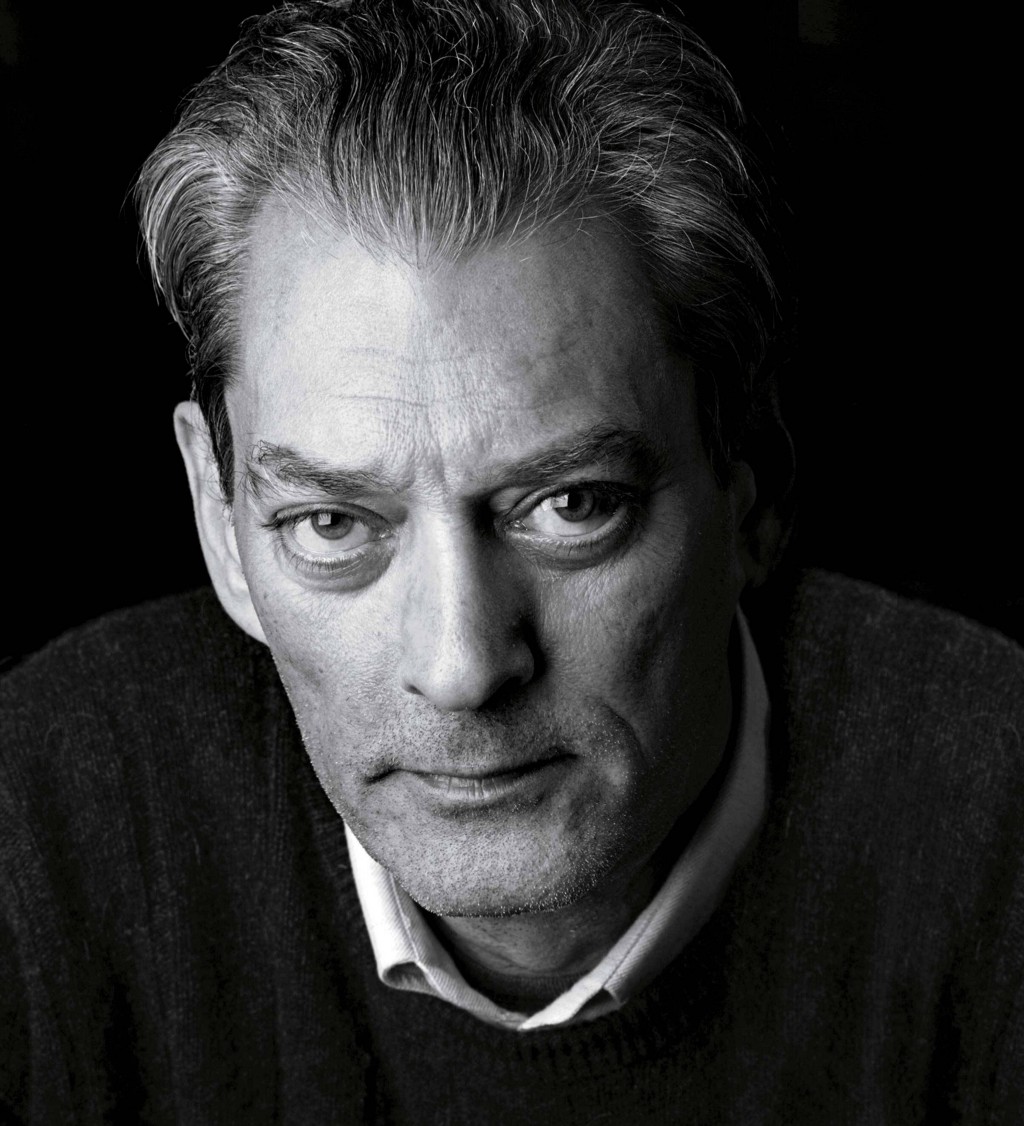
Paul Auster is an iconic Brooklyn writer, popular in Turkey and Germany, New Zealand and many other places. Famous since the New York Trilogy in the ‘80s — City of Glass, Ghosts, The Locked Room — Auster has now published over thirty books. With his 1995 film Smoke, Auster became a symbol of New York at its best: welcoming, liberal, good-humored. Over the phone, Auster is a thoughtful and gregarious interviewee, ever embodying these qualities.
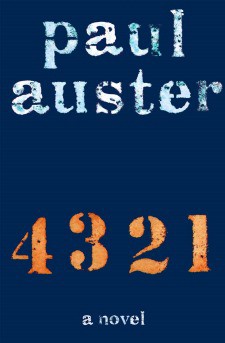
4321, his first novel in seven years, clocks 866 pages. It follows four alternative lives for protagonist Archie Ferguson, Newark-born in 1947 (Auster’s birthplace and year, too). Peppered with important twentieth century American history, from JFK’s assassination to the ’68 Columbia University protests. Auster remains an advocate for the Big Apple. “Dear, dirty, devouring New York,” 4321 puts it.
We discussed Auster’s process, solitude, traumatic history, and the joy of reading. And, pre-Inauguration, Trump and the rise of authoritarianism.
Alexander Bisley: Just before Trump’s election you said: “I’m scared out of my wits. Everyone I know is on the edge of a nervous breakdown.” Here we are.
Paul Auster: Here we are. It’s happened. I was hoping against hope that it wouldn’t. But I had this terrible feeling that the polls were wrong and I think it was Brexit that opened the door to another way of thinking for me. And when that vote was announced, I thought to myself: “It’s possible Trump could win.” I never could shake that feeling and lo and behold it’s happened.
AB: Much as New York is one of my favorite cities, people like Trump and Giuliani are symbols of its dark side.
PA: It seems like Giuliani’s gone crazy. He’s becoming a fire-breathing maniac. At the Republican convention; he was shrieking that Hillary Clinton could be but the end of civilization as we know it, something to that effect. I think he’s so far out now that Trump didn’t even want him in the cabinet.
AB: Marine Le Pen and her vile family will get help from the fascist Russian tsarist this year.
PA: I don’t think the National Front will win but then again, I’ve been wrong so many times recently that I’m not gonna guarantee it by any means.
AB: Conservative candidate Francois Fillon is bad (and a Putinista), too.
PA: Yes. So, my beloved France is in trouble too.
AB: In one of your memoirs you wrote about 1968: “The year of fire, blood and death.” You said that unfortunately your protests at Columbia University, featured in 4321, accomplished not much.
PA: Not much of anything. Looking back on it all now, especially from the vantage of today with what’s been happening in the country, tumultuous and wrenching as those times were, we were engaged in a huge war that was tearing apart the country. It was a moment of tremendous racial conflict in the United States. The civil rights movement started in earnest in the fifties, slowly, by around 1960 was picking up steam. I think pretty much by 1965 the Martin Luther King view of civil rights changed in America and the non-violent approach was over. I think that famous Selma — Montgomery march was the last hurrah of the civil rights movement which united black and white people together in the effort to change the laws of the country. After that things became much more fractured.
The black power movement started, a new kind of black nationalism was in the air, divisions between blacks and whites deepened, rather than improved, leading to a tremendous, wrenching chaos in the late 1960s. Riots in many cities, and the Newark riots are in the novel too because that’s the town I’m from, and I was there. I know what happened in Newark in 1967.
(And then, of course, the next year was the Columbia protests, where I was a student. Now in the book, the Ferguson who goes there, he’s working as a reporter on the Columbia Daily Spectator. Which was the student newspaper which covered the events very well, with great professionalism. I myself was not a reporter for the Spectator. My character is, but that’s not autobiographical.)
Still though, despite all this hurt that was going on, and all the hundreds and hundreds of thousands of young men who were over there in Vietnam and the tens of thousands who suffered and were killed, I had more hope about what was going on because it was a movement against the war. There was still a big, organized effort in the country, even despite of the conflicts, for improvement in race relations.
I’m praying that young people get involved again, because without them we’re gonna be going down a very dark road indeed.
We’ve had little moments recently where I’ve thought some new kind of mass movement is brewing, for example the Occupy Wall Street moment a few years ago, but things have fizzled out. I think Trump is going to unleash, perhaps, a new era of youthful activists. I’m praying that young people get involved again, because without them we’re gonna be going down a very dark road indeed.
AB: Obama’s facile leftists critics should consider the unprecedented scorched earth opposition he’s faced from the Republicans.
PA: That’s right. That’s a good way to put it. Well OK his opponents got what they wanted [elegiacally], now let’s see what they do.
AB: Toni Morrison was wise when Bush and Cheney were elected in 2004. She wrote: “This is precisely the time when artists go to work. There is no time for despair, no place for self-pity, no need for silence, no room for fear. We speak, we write, we do language. That is how civilizations heal.”
PA: I wholeheartedly agree. Artists must go on making art and we must all do what we can do and also to hold leaders responsible and accountable. And that’s our job, and we have to do it.
AB: The traumatic history in 4321, like Trumpism, reminds me of that enduring line from William Faulkner’s: “The past is never dead. It’s not even past.”
PA: I’ve always been amazed in America that we don’t have a museum of slavery. Why don’t we have it? Why shouldn’t it be there? Maybe in every city in the country a museum of slavery, just to know how this country started and on what it was built. And why not a museum everywhere of the American Indian? How they were massacred by the whites who came here…there’s this desire always to put a pretty face on it all and ignore the past, and so I agree with Faulkner wholeheartedly. It’s not past, it’s here. It’s with us now.
AB: How do you remain productive? T.C. Boyle told me: “Well most artists generally produce more art prior to death than after death.”
PA: It’s a very funny comment. I like it very much [laughs]. Yeah, of course. Listen, with this book, this big, big book, I didn’t do anything for three years except write the book. I turned down invitations to travel, to do interviews, to do readings. I more or less stopped all of the subsidiary activities that writers can do if they’re of a mind to do them, and I thought I have to just sit in a room and do the book because I wanna live to finish it. I’m at this point now where it becomes a question. I’ve outlived my father now by almost four years. He died suddenly of a heart attack at 66 and now I’m pushing seventy, and I must say passing through that 66-year old boundary was a strange experience for me, to have outlived him. And so, I know my days are numbered. Maybe I have a year, maybe I have a day, maybe I have ten years or fifteen years? I don’t know. But the odds are getting worse. Every time I wake up in the morning the odds are stronger that the next morning I won’t wake up in the morning, if you understand what I mean.
AB: Only as old as you feel, Paul.
PA: Yeah, well today I feel really old [laughs].
AB: Salman Rushdie praises how you explore how lives can take different directions, an idea you develop in 4321. Do you think about how Paul Auster’s life might have turned on moments?
PA: Doesn’t everyone? I think this is one of the things that binds us all together. We’re constantly, especially when you get to a certain age, we’re constantly imagining and thinking back: What if I turned right instead of left? What if I have said yes instead of no? How would things have changed for me? What if I had not met that person and married her or him? What if I had a child who was damaged in some way, how would that change my life? What if my child did not get run over by a car when he was four years old? All the things that are possible to think about, which gets back to what we were talking about earlier, the imagination. You don’t have to be an artist to have an imagination. Every human being has one. We think about these things, not every minute, but at moments of reflection we do, and I think this is the urge of this big novel. What if? I’ve been thinking about this question all my life.
AB: Any regrets?
PA: Of course, everyone has regrets. We’ve all done things we wish we hadn’t done. But then again as I say in the novel, the narrator says, you know the pain of it all is you can only be on one road at any given moment, you can’t be walking on all four, or twenty, or fifty. You can only be on one road and that becomes the story of your life. I think to live with bitter regret about the things you’ve done is not a very satisfying way to live, because as long as you’re still breathing, there’s today and tomorrow to look forward to as well. And if there’s something you truly regret having done, well, there’s still a possibility of not precisely undoing that, but at least making sure you never do that thing again.
AB: Starting with The Invention of Solitude, I feel you’ve always understood solitude.
PA: What I was trying to do in The Invention of Solitude, especially in the second part, the second half called The Book of Memory, was to prove in a sense that we’re all inhabited by other people. We’re made by other people. So even when you’re alone, the very fact that you can say to yourself: “I’m alone,” means that you’re not alone because the word “alone” was taught to you by other people. You learn language by interacting with other people, no one creates a language by himself or herself. You see how physically you might be isolated from other people, but the fact that we can think even when we’re alone is a product of our having been born out of the body of a woman, raised by other people and taught how to become a human being by other people. So, it’s very complex. It’s not simply loneliness.
Solitude is a neutral term, it seems to me. It means you’re not with anyone else physically at that moment. Whereas loneliness has all kinds of sad connotations to it. It seems to imply that you’re pining for contact with others and don’t know how to find it.
You have to really have a taste for being alone to be a writer.
You have to really have a taste for being alone to be a writer or a painter, I suppose, or a composer, anybody creating art. You have to enjoy it. You have to feel very fully alive when you’re alone in your room, painting your painting, or writing your book. So not everyone is cut out for that. Most of us don’t want to do that. That’s why when you look at the numbers, statistically there are not that many artists comparing to all the other people in the world. Even though you sometimes think that everyone’s a writer or everyone’s a painter.
AB: Something you’ve referred to, most famously in your classic film Smoke, is the story of Mikhail Bakhtin smoking pages of his own work. Do you have any notable authorial habits?
PA: I’ve stopped smoking as of about two and a half years ago, after doing it for fifty years, but I’ve switched over to electronic cigarettes. So, I vape and it’s been a good way to cut out tobacco from my life, which I needed to do, just as a matter of preserving my ever-diminishing body.
AB: Being a New Yorker, have you ever met Trump?
PA: No, no, no, [laughs] I’ve never crossed paths with him. I don’t think I’ve been within a thousand yards of him at any time in my life.
AB: People worry Trump will shoot down the first amendment.
PA: The first big questions will be how quickly are they going to try to pass legislation to undo things that have been in place in our society for decades. And then how much pushback will there be on the cabinet appointments, whether they will all be rubber stamped in and approved, or if there’ll be battles. I just don’t know how this is going to play out yet. By the time this piece is published we’ll probably know some answers.
AB: Do you think you could write fiction about this election?
PA: Sure, anything is possible, but seems to me that it’s too soon. You can’t fictionalize something that is still playing itself out. I know we’re gonna be jumping over many years, but this is the prime reason why the new novel I’m publishing is mainly dealing with events that are forty, fifty and sixty years old. I think it takes that long to understand the consequences of what’s happening at any given historical moment. I mean you look at War and Peace, one of the great novels of the 19th century. Tolstoy published it in 1870, but the material he’s writing about took place in around 1810 to 1815, that’s the scope of the book. So, it takes, I think, all this time before you can really write about it. Even the Civil War in the United States, which, remarkably enough, did not produce a lot of very good literature. The very best book, The Red Badge of Courage, that small brilliant novel by Stephen Crane, didn’t come out until 1890, which is a full 25 years after the war was over. I don’t know how anyone can possibly write a novel about this election at this point yet.
AB: 2008’s Man in the Dark is set in the aftermath of 2000?
PA: Yes, my poor protagonist lying in bed with a bad leg, and he’s unable to sleep, is making up stories and one of them is about an imagined civil war in the United States after the 2000 election. I’ve always looked at it as an illegal coup, the Supreme Court handed to George W. Bush the election. I was always appalled that America just rolled over and let it happen when it was so clearly illegal. And I’ve never gotten over it, to tell you the truth. And so much damage has been done to the country and the world because of that horrible decision by the US Supreme Court.
AB: You say that you believe written stories will continue to survive because they answer an essential, current human need.
PA: Yes, I agree with that. Because books have no practical use, because they really are useless in some way, when you compare it say to someone putting in a toilet in the house or any of the thousands of occupations people have to keep society on its feet. It’s easy to forget art, it’s easy to push it aside. But, in another way, try to imagine life without stories. Try to imagine life without music or theatre or films or dance, and it becomes such a grey landscape that it would be pretty difficult to live in it I think. Almost impossible.
It’s easy to forget art, it’s easy to push it aside. But, in another way, try to imagine life without stories.
It’s not that every single work of art is valuable. But we need these great armies of people trying so that there’ll be some things, or even quite a few things, that will be worthwhile and will satisfy people’s hunger for excellence and beauty. We do need beauty in our lives.
AB: So, you’re writing from your home these days?
PA: Yes, we have a house in Brooklyn. We’ve been here for almost 25 years now. It’s an old house. It has four stories. It’s a narrow house but it’s tall. Siri has a study on the top floor and I have a study on the bottom floor. There are two floors between us, during the day we rarely if ever talk. When we finish our work in the late afternoon that’s when we become a couple again, and we start talking and doing the things that other married people do. But during the day it’s the powers of silence here.
AB: Do you ever write to music?
PA: No. Silence. I need quiet. When I listen to music, I want to listen to music; it’s never background for me.
AB: Do you still write by hand?
PA: I have a fixation on a certain kind of notebook that I write in, with quadrant lines, squares, graph paper, I get them in France whenever I’m there. I write everything by hand. Most of it with a fountain pen, sometimes with a pencil. I work on a paragraph again and again and again until it seems to be coming into shape. Then I go to my old manual typewriter and I type it up.
That’s how I’ve written all my books. I don’t jump around the way some writers do. I write the first sentence and then the second, and then third, all the way to the last one in the book. I don’t work with an elaborate plan. I have impulses, ideas, inclinations, stories, all these forming as I’m working on it. I discover things in the act of doing them. This is at times so frightening because you have no idea what the next sentence is going to be, but at the same time it’s thrilling to be on that adventure.
Generally, I write at home. Other people seem quite happy writing in public parks, cafes, restaurants, on trains, buses, airplanes. I can’t do that. I need to be alone and somehow holed up in my little bunker and that’s where I feel freest and best able to think.
AB: Do you have any writer’s tips for avoiding the distractions of modern life?
PA: Well, I don’t have a cell phone or a mobile phone, however you want to describe these things. I decided at certain point early on and I didn’t want to do that. I didn’t want to be so reachable. I figured that if people wanted to get hold of me, they’d find a way. So, I’m free of that. I don’t do email. I don’t have a computer. I have just refused the digital revolution. I live as a dinosaur. But I do have ways of participating. I have a young woman who helps me out with various things and she fields emails for me, and I do have a fax machine, so when she gets them, she faxes them over. But it gives me time to reflect on what I want to say and not feel that I’m in this constant whirl of messages and responses to messages, which most of us now seem to take as a normal part of life. It’s too frenzied for me. I need the quiet and the slowness of the old ways.
I watch my dear wife so overwhelmed by all the things that come into her computer every day, and most people seem frazzled by it rather than happy and so I thought if I could save myself that aggravation I will. If I had another kind of job, then needless to say, I would have to participate.
AB: A good quote from The Brooklyn Follies: “Reading was my escape and my comfort, my consolation, my stimulant of choice: reading for the pure pleasure of it, for the beautiful stillness that surrounds you when you hear an author’s words reverberating in your head.” Still?
PA: Yes, of course. Isn’t that the joy of reading? We’re talking about novels, and then poetry, writing as art. But we also read history, biography, science, all kinds of other things that could be enrapturing. Well-written history, well-written biography can ignite the mind in the same way that good fiction can.
AB: I thought there was a prescient comment in Smoke when Augie says, kidding on the square: “Three or four years it’ll be illegal to smile at strangers on the street.”
PA: That’s right. I have an interesting thing to tell you about just this kind of interaction. As you know I live in Park Slope, Brooklyn and I’ve been here for a long time and this neighborhood I feel is a bit like living in a small town. You get to know everybody. Even though I’m not a particularly talkative person when I go into shops, I’m not silent either, and I’ve built up friendships or warm relations in any case with people who run restaurants or stores of various kinds. Last March, it was still very cold out and I went into my stationery store where I buy all my supplies here in Park Slope. After Donald Trump’s berating of immigrants and all this hatred he poured on the people who were not born in this country and live here, I go into this stationery shop. It’s owned by a man born in China. His assistant is a man born in Mexico and the cashier is a woman born in Jamaica.
We’ve had some nice conversations over the years. I walked in there eight months ago, and it was a chilly day outside and my nose was running, but I wasn’t aware of it. I was up at the counter to pay, and instead of telling me “Your nose is running,” she just plucked out a Kleenex from her box of tissues and reached across the counter and wiped my nose for me. And I found it so kind and so gentle. Some people would object, wouldn’t they? They’d say: “She has no right to touch me without my permission.” I didn’t feel that at all. I thought it was an act of real friendship and kindness.
AB: What might surprise readers about 4321?
PA: Boy, I have no idea. It’s so hard for me to step back and look at myself from the outside. The books are written from within, and I don’t know how people respond to them. I know that over the years many people have loved my books, other people have despised them.
AB: In your memoir Winter Journal, you recall your formative years as a young poet in Paris, engaging the young professional named Sandra who recited Baudelaire to you and introduced you to the Kama Sutra?
PA: It was one of the most extraordinary nights of my life, to run into this young person who was a prostitute in Paris but she also knew French poetry by heart, and so I put it in the book because it was so memorable. So unexpected, so extraordinarily wonderful, that this should have happened to be. People might not believe it, but I swear to you it’s true. It really happened, just as I wrote it.
AB: You’re translated into over 40 languages now, including your beloved French.
PA: French is the only language I have any mastery over, except English. I can comment on the manuscripts that come in with the translations of my books and they do send them to me. I read them carefully and I also make suggestions, but I can’t do that with any other language. I’m at the mercy of the skill of the person translating the book and I truly cross my fingers and hope that they’re doing a good job but I don’t have the ability to read German or even Spanish well enough to have anything useful to say to the translators.
AB: Obviously, you’ll be looking forward to taking 4321 to Paris?
PA: Yes, eventually. It’s not coming out right away, not for the whole year after the English version. Interestingly in Germany, they’ve hired four translators and so it’s all done, it’s printed now. And so, it will be coming out simultaneously in German and in Dutch, they’ve done a quick job of the translation as well. In other countries, it’s gonna be more in the middle of the year. And then, eventually, France. I think January of 2018.
AB: Another thing that I admire is that you’ve been versatile over the years. What interests you now, in addition to opposing Trump?
PA: I will find it eventually. I’ve written all these novels, yes, but I’ve written five autobiographical books also. And then I’ve written essays. Translations. I don’t do that much anymore but there are translations in the new novel, particularly the Apollinaire poem which I worked on with great happiness I must say. Over the course of about a year I kept going back to it and refining the translation till I thought it worked. I’ve written movies, I’ve directed movies, I’ve put together anthologies a few times. I don’t know what’s next.
About the Interviewer
Alexander Bisley is a card-carrying member of the ACLU, He writes on books for Playboy and The Guardian. His work has been translated into French and Russian.
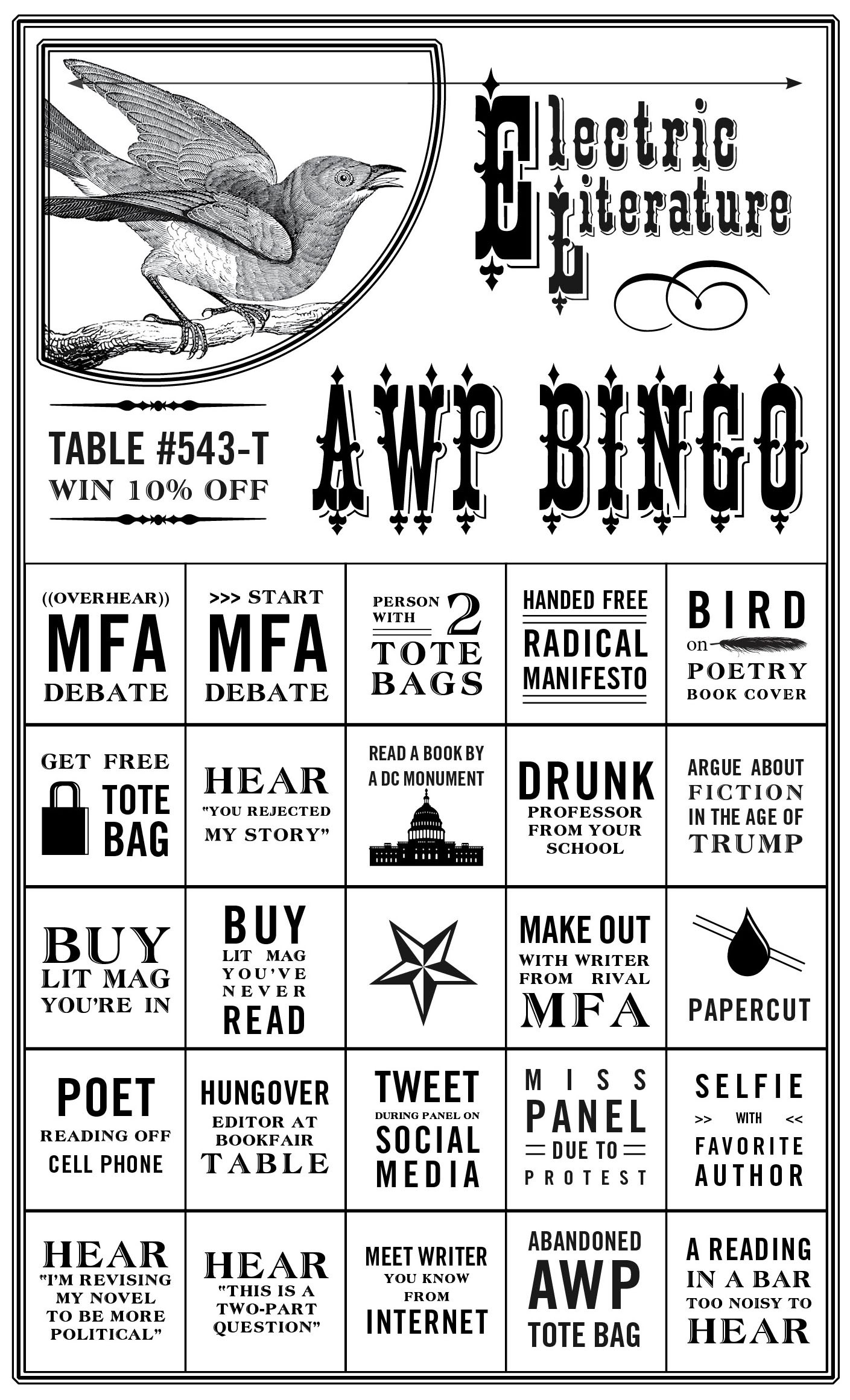
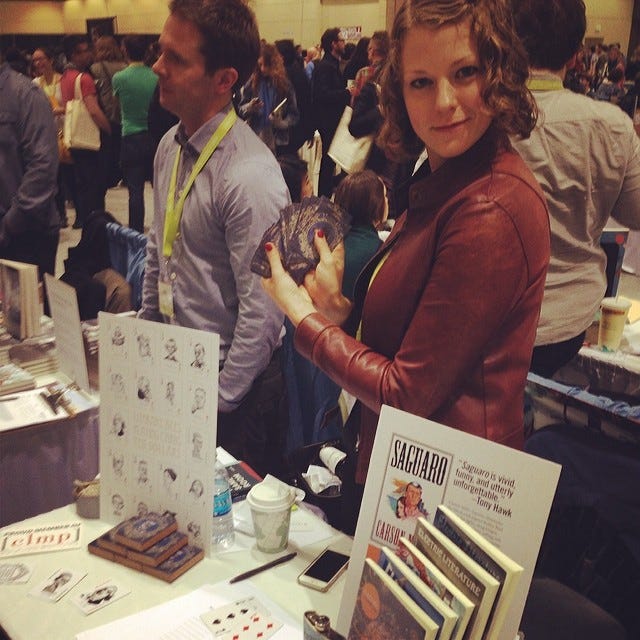
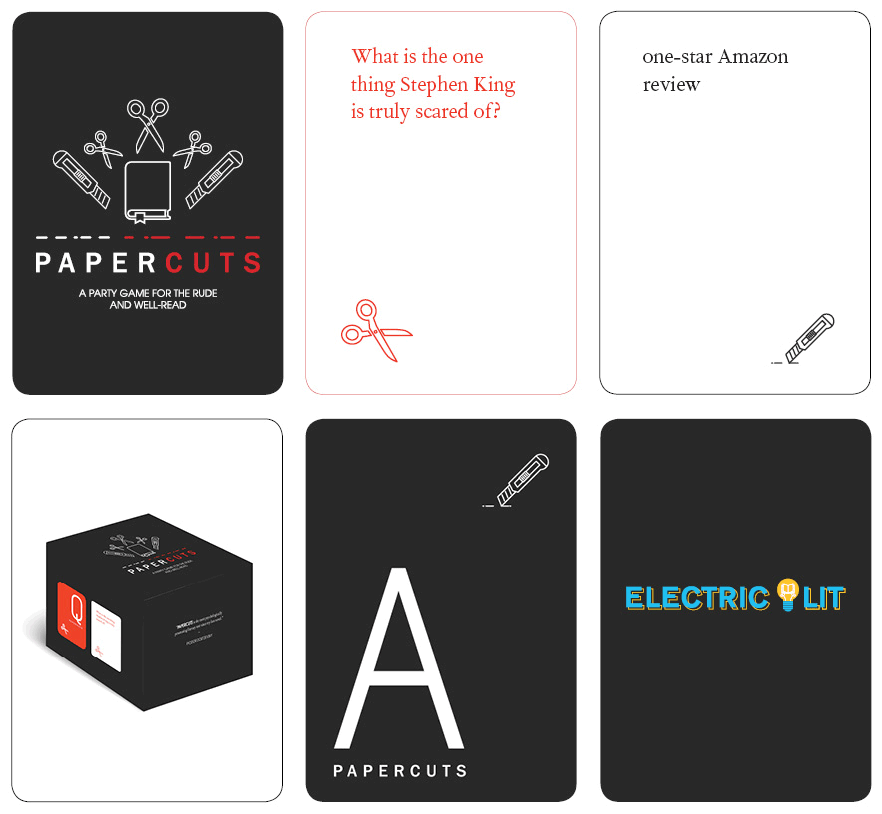
Are you one of the countless writers, teachers, and editors heading down to the nation’s capital for AWP? If so, print out this AWP bingo card and see how quickly you can fill it out. We’ll give you a 10% discount at table 543-T on anything from our literary aces playing cards to our new Papercuts game.
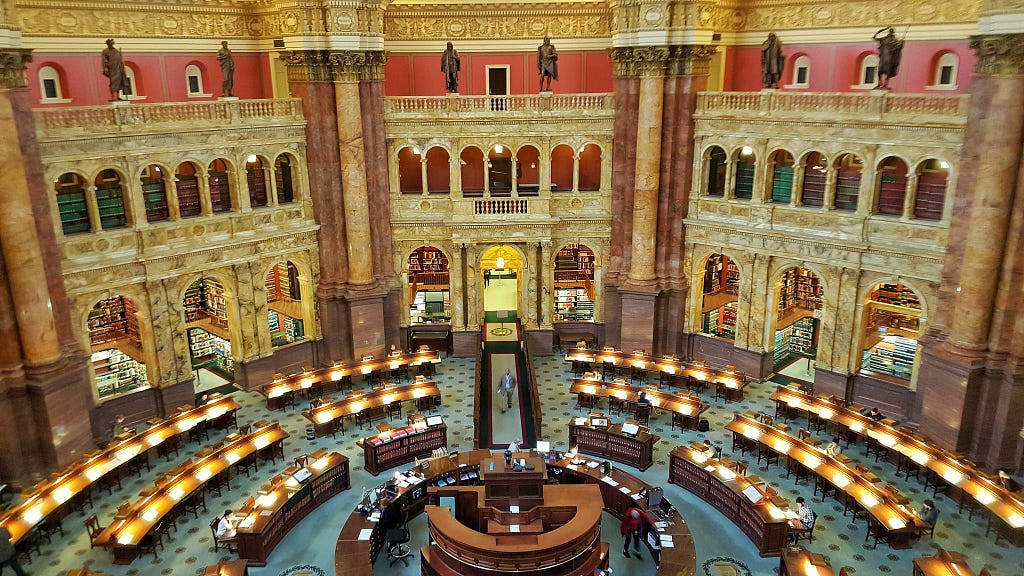
This is the Library of Congress in Washington DC. The AWP conference will be held in a harshly lit conference hall somewhere nearby. Photo: Dren Pozhegu on Flickr.
In just two short days, the 2017 AWP Conference and Bookfair will be underway in Washington D.C. All the the cool-kid writers, teachers, students, editors, and publishers will be there, including Electric Literature. For our readers who are among the estimated 12,000 attendees, we’d love to see you! EL’s editors will be participating several panels and off-site readings, listed below. (Information about writers protesting Trump is here.) We’ll also be tabling Thursday through Saturday at booth 543-T. Make sure to stop by to play AWP bingo and high-five a hungover editor.
EL Executive Director Halimah Marcus and Catapult Contributing Editor Jonathan Lee at some other AWP
You also won’t want to miss the chance to buy Papercuts at a discounted price of $20 (they’re expected to sell out fast)!
Electric Literature’s interim Social Media Editor, Kyle Lucia Wu, joins Prairie Schooner’s Ashley Strosnider, Southern Humanities Review’s Aaron Alford, and Sarabande’s Ariel Lewiton to discuss editorial careers for writers.
Event Description: Not all graduate students in creative writing seek teaching jobs after graduation. How might you prepare for the editorial job market while earning your creative writing degree? The editors on this panel share how they landed editorial positions soon after — or even during — their graduate studies.
Time: 9:00 am to 10:15 am
Location: Room 202A, Washington Convention Center, Level Two
Featuring EL’s Contributing Editor, Kelly Luce, along with other panelists: Michael Noll, Manuel Gonzales, Daniel José Older, and LaShonda Barnett
Event Description: When talking about narrative structure, we often focus on the macro: three acts, plot points, beginnings, and endings. But there are micro ways to think about structure while working with character, dialogue, the movement through time and space, and shifts between interiority and exterior action. Authors of literary, fantasy, and YA fiction featured in the forthcoming Field Guide for the Craft of Fiction will discuss how they developed (and stumbled upon) structure in their novels and stories.
Time: 12:00 pm to 1:15 pm
Location: Virginia Barber Middleton Stage, Sponsored by USC, Exhibit Halls D & E, Convention Center, Level Two
Featuring EL’s Contributing Editor, Kelly Luce, along with other panelists: Bich Minh Nguyen Nguyen, Rob Spillman, Christian Kiefer, and Derek Palacio
Event Description:As fiction writers, we often feel pressure to write inside the confines our own experience, as defined by our ethnic identity, gender, sexual orientation, economic class, and so on. This panel explores the edges and interstices of that pressure. In what contexts is it acceptable to write outside such confines? In what contexts is it not? What does “diversity” mean when creating a fictional world? As writers, who has cultural permission to press past the confines of one’s own identity?
Time: 3:00 pm to 4:15 pm
Location: Room 202A, Washington Convention Center, Level Two
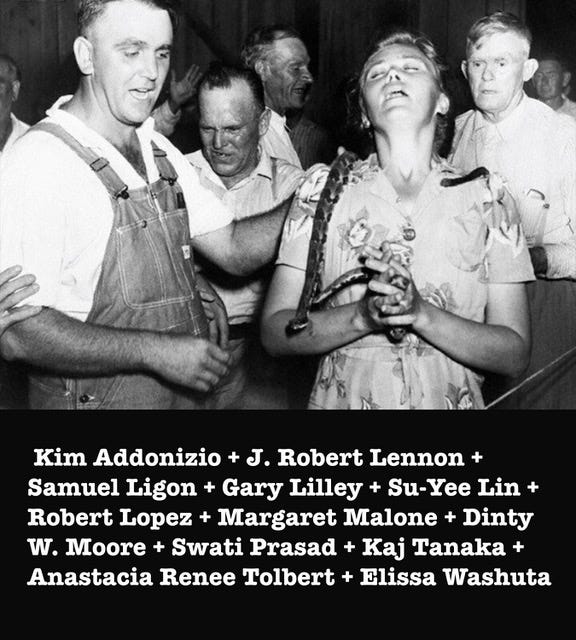
Event Description: Our weekly magazine of literary oddities, Okey-Panky is co-hosting with off site event with readings by Okey Panky’s Editor-in-Chief,Robert Lennon along with Okey-Panky contributors Dinty W. Moore, Su-Yee Lin, Elissa Washuta, Swati Prasad, and Samuel Ligon, Electric Literature contributors Kim Addonizio, Margaret Malone, and Kaj Tanaka, along with future-EL contributors Robert Lopez and Gary Lilley.
Time: 6:00 pm
Location: The Boundary Stone, 116 Rhode Island Ave NW, Washington DC, 20001 (This is an offsite event!)
Electric Literature Founder Andy Hunter joins Steven Church, Joe Bonomo, Jill Talbot as they read from their work and discuss the reboot of venerable indie-press Soft Skull. (Andy is stepping in for Dan Semeka.)
Event Description: Four writers representing a wide range of styles, interests, and subjects, while still embodying the Soft Skull spirit, will read from their latest nonfiction books and discuss their experiences writing, editing, and publishing their work with one of the country’s more unique and influential small presses. Their subjects include music and pop culture, savagery, love, loss, and family dynamics; and their forms vary from collections of essays to memoir to the book-length essay.
Time: 10:30 am to 11:45 am
Location: Room 206, Washington Convention Center, Level Two
Featuring Recommended Reading’s Assistant Editor, Brandon Taylor, along with Nancy Hightower, Amber Sparks, Stephanie Feldman, and Mitchell Jackson
Event Description: For increasing numbers of writers, MFA programs are an entry to the publishing world. How does this trend affect writers without the degree? What kinds of nonacademic credentials can help all writers in their careers? How does one become part of a literary community? What are the attitudes towards writers who do not teach? This diverse panel discusses the increasing cross-pollination between writers with MFAs and writers with other academic degrees that create a stronger literary community.
Time: 1:30 pm to 2:45 pm
Location: Liberty Salon N, O, & P, Marriott Marquis, Meeting Level Four
J. Robert Lennon, Editor-in-Chief of Okey-Panky, will join Alice Sola Kim and Kate Bernheimer in a discussion moderated by Anton DiSclafani. (J. Robert Lennon is stepping in for Michael Taeckens, who can no longer attend. )
Event Description: Kathryn Davis is widely considered by critics to be one of the most important women writers of the 20th and 21st centuries. Across seven stylistically breathtaking novels she has challenged and inspired a generation of readers, and ignited a movement of diverse, fabulist, posthuman, feminist authors. Her books constantly and electrifyingly ask the question of what is possible on the page. Students and colleagues of Davis speak about her work, ending with a reading from Davis herself.
Time: 1:30 pm to 2:45 pm
Location: Room 209ABC, Washington Convention Center, Level Two
…
Andy Hunter is the Chief Operating Officer of Catapult and the Publisher of Lit Hub. He is also a founder of Electric Literature and serves on its Board of Directors.
J. Robert Lennon is the author of two story collections and seven novels. He teaches writing at Cornell University and is the Editor-in-Chief of Okey Panky.
Kelly Luce is the author of Three Scenarios in Which Hana Sasaki Grows a Tail and the novel Pull Me Under. A contributing editor at Electric Literature, she is a 2016–17 Radcliffe Institute fellow.
Brandon Taylor is a PhD candidate in biochemistry at the University of Wisconsin–Madison. He was a 2015 Lambda Literary Fiction Fellow, and is the Assistant Editor of Electric Literature’s Recommended Reading. His writing has appeared in Chicago Literati, Wildness, and Out Magazine Online.
Kyle Lucia Wu is the managing editor of Joyland and a PEN prison writing mentor. She has an MFA in fiction from The New School.
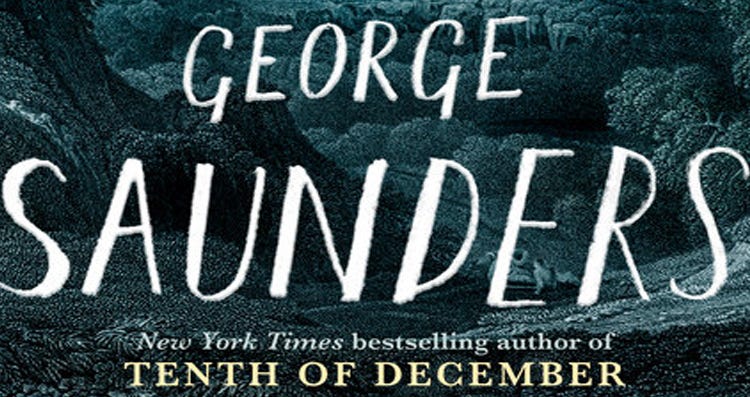
Lincoln in the Bardo takes place in February 1862, the month that brought the first major casualties of the Civil War, along with the death of Abraham Lincoln’s own 11-year-old son, Willie. At the time, rumors circulated of how the grieving president would return at night to the Oak Hill Cemetery crypts to cradle Willie’s body; Lincoln in the Bardo uses this image as its quasi-historical foundation. If, to you, the notion of a book built on a little boy’s corpse sounds depressing, that’s because it’s a depressing book. It’s also very fun: dramatic, witty, and unabashedly sentimental. What else would you expect from George Saunders, the Willy Wonka of American letters, who coats life’s cruel absurdities in a sugary glaze?
To be clear, Lincoln in the Bardo is a novel, but if you glanced at a few pages, you might mistake it for an oral history, the script to a radio play, or maybe one of David Shields’ anti-fiction bricolages. In some chapters, a chorus of historians and contemporary sources describe, from afar, a First Family at the intersection of personal and national crises. Some sources are authentic, some invented; Saunders never makes explicit which are which, though his playful little forgeries are often easy to spot. (“Nearly lost among a huge flower arrangement stood a clutch of bent old men in urgent discussion, heads centrally inclined,” for example, sounds a lot less like a 19th-century socialite than a 21st-century fiction writer.) Most of the book retains this chorus-form, but to more straightforwardly fictional ends, as a community of hapless ghosts fight to save Willie Lincoln’s soul.
In Lincoln in the Bardo’s afterlife — which is only ever called “the bardo” in the title — divine justice is dispensed with totalitarian arbitrariness, and souls are locked in their bodies’ moment of death. Willie’s two main interlocutors, Hans Vollman and Roger Bevins III, appear, respectively, with hideously swollen genitals and a dent in his skull, and as a many-eyed, many-limbed blur; the Rev. Everly Thomas “always arrives at a hobbling sprint, eyebrows arched high, looking behind himself anxiously, hair sticking straight up, mouth in a perfect O of terror”; one woman remains ever-blissfully oblivious to a pursuer’s incessant molestation. Elise Traynor, trapped to the cemetery fence, has it the worst. She arrived in the bardo “as a spinning young girl” about Willie’s age, but now she’s demented and grotesque, transmuting into images of ruin. This is one of the more sadistic diktats of this universe (or of God, or karma, or George Saunders…blame whomever you’d like), that if children stay in the bardo too long, they get stuck there, and their suffering compounds the longer they remain.
So how do the ghosts leave the bardo, in Lincoln in the Bardo? They choose, very Buddhistly, to let go of their earthly attachments (i.e., their desire to live). Then, with a “bone-chilling firesound” and a blast of light, they vanish. This “matterlightblooming phenomenon” petrifies the ghosts, most of whom are in deep denial about their mortality—which, incidentally, them about the worst companions imaginable for Willie, who, like Elise on the fence, is beginning to become trapped to his crypt. Complicating matters further is the 16th president, who returns to reenact the Pietá with his son’s dead body. After this embrace of fatherly love, Willie cannot bring himself to leave. The ghosts, almost all of whom have long since been forgotten by the living, are likewise bowled-over by this display of affection, even though they know what consequences Willie will face if he remains.
Weepy stuff, as you can see. Reading Lincoln in the Bardo might, at times, call to mind funeral dirges, throngs of ululating women. The book wears its mawkishness like a crown, and it works: isn’t grief, a huge emotion, best expressed hugely? Still, after the reader finds herself, 70 some-odd chapters after Willie dies, reading yet another account of how in his final days he was “suffering horribly,” she might feel like her nose is being rubbed in a tragedy — an actual tragedy, a real boy’s real death, deployed to raise the stakes of a ghost story. As Joan Didion says, writers are always selling someone out; one senses that this novel knows, at some level, that it’s selling out the real Willie Lincoln, so it overcorrects, insisting ad nauseum that the reader mourn him. But one can only listen to ululations for so long.
Lincoln in the Bardo’s other shortcomings appear to be borne of this sort of finicky impulse. (And no doubt its successes — its eminent readability, playful language, and unrelenting narrative momentum — arise from this trait, which could as easily be called perfectionism, as well.) For example, too concerned with closing every circle, Lincoln in the Bardo rambles on for a few more chapters after it should’ve ended. Or take the matter of slavery: it would be remiss for a novel set in Washington D.C. in the 1860s to fail to address America’s original sin. And the novel does address it, two-thirds of the way through, when “several men and women of the sable hue” meander over to Oak Hill from a nearby mass grave, demanding to “have their say.” Then they have their say, for eleven pages. One man wishes he could go back and murder his masters; another finds both solace and sorrow in his memories of “free and happy moments” (“On Wednesdays, for example, when I would have two free hours for myself”). Here, one senses the novel’s self-awareness again, that it knows all its major characters are white men, and it’s perfunctorily trying to compensate.
By the same token, why call this afterlife “the bardo”? Bardo is a Tibetan term that refers to the liminal space after death and before reincarnation (it’s often compared to purgatory in Roman Catholicism). Bardo Thodol, the Tibetan religious text known in the West as the “Book of the Dead”, refers to a “bardo of the moment of the death,” which seems to be represented in novel by the ghosts’ stuck positions. Likewise, the “matterlightblooming phenomenon” might be a nod to luminosity, “the clear light of reality” said to be the state of consciousness in death. But this sort of engagement is superficial at best, reference without contemplation. And furthermore, Bardo Thodol also says that the period between death and rebirth lasts only 49 days. Outside of its title, Lincoln in the Bardo skews far more Christian than Buddhist. Engaging with Christianity is understandable, probably unavoidable, being that we’re dealing with a cast of dead white antebellum men, and the 49-day tarrying period would inconveniently obliterate the narrative stakes. But still, paired with the quickie slavery dialectic, what we see is a thin veneer of multiculturalism, clearly well-meaning but little more than cosmetic.
However, the book does engage in a complex way with matters of faith, largely through the Reverend Everly Thomas, the lone ghost who knows he’s dead. Not only that, the Rev. knows he’s going to Hell, though he says he has no idea what mortal sins he committed, and the reader has no reason not to believe him. He fled from judgement, and now he’s laying low in the bardo. After his spectral troupe encounters some souls from Hell (but not the worst one, they insist), the Rev. says:
As I had many times preached, our Lord is a fearsome Lord, and mysterious, and will not be predicted, but judges as He sees fit, and we are but Lambs to him, whom he regards with neither affection nor malice; some go to the slaughter, while others are released to the meadow, by his whim, according to a standard we are too lowly to discern.
It is only for us to accept; accept his judgement, and our punishment.
Oh, but I was sick, sick at heart.
So much of Lincoln in the Bardo is nakedly pleasurable, even—especially—at its most depressing, but what a bleak view of the universe it has. Yes, it finds comfort in the commonplace joys of being alive (“Such as, for example: a gaggle of children trudging through a side-blown December flurry; a friendly match-share underneath some collision-tilted streetlight; a frozen clock, bird-visited within its high tower; cold water from a tin jug…”), but it forces its characters to suffer until they renounce these joys, to embrace terrifying uncertainty, to deny the world and explode into nothingness—with no assurance that their suffering will subside. The fleet-footed sentences, prodigious research, unabashed sentiment, and rollicking plot, in the end, are all glacé. Underneath is an acrid core, which makes Lincoln in the Bardo George Saunders’s most complex and satisfying work to date.
I cannot identify. I think of all the green tongues of my plants. Want
to show them: my womb is bigger than my heart. The only two organs inside me. Tonight
I get so animal I bark. A mammal in my bones stirs. My skin is so defensive I can barely see. I meet the poet
ten drinks later. She teaches me about thirst:
there is a resolution in the body for desire.
The poet discovers a herd lost in me. Her eyes — twin coins flashing a scummy truth. Her hair —
some rope of earth. Her tits —
call them two new moons, fists of sun, paws marking her rewards. She looks
at my collection of hides. She scents the room orange. Her wings grow large
and she shows me a Mountain. It is a body ruptured. A bird
headless and winged.
I Met Thirst in a Forest
My rings slipped off cold fingers. I was returning from a wake and wanted to see the geese framed flying in blue. So many jagged windows. The dead was someone I knew in tiny ways. Like geese droppings on a lawn. Waterfowl cover the open fields at night. Melting into another’s neck, a v of tail, wet hearts flattened orange on the ground. Sun filtered
through the fragile skin of windows in the funeral home’s bathroom. I was taking my time and feeling the pressure of bones was the easiest kind. How long I still had to go — photos and rosaries to finger. Ligaments and anticipation to break — I am a woman after all, and always hungry. The open coffin
seemed to glow like the refrigerator at night — bare feet cool and full. He had a body once and now it is just behind the handle, my hand on it, my mouth full of wet.
I Am Not Married
I walk through a tunnel of blades. White under my eyelids. On the rest of me
is ripened skin — my mother’s or the lady’s next door. She hung herself
to dry and I saw her. Dripping. These swords want to split something, and I dream
a plot of whispering teeth. When I glimpsed the lady she had a husband — a man
everyone said. But he has departed long ago. Now, I see the red and blue and coupling
of dusk. I wonder if that is what the question feels like, a strange engraved
thrill. A caw comes out like blood. But all the red remains inside. Once, I would like a crow
to be a beacon of hope. Once, a knife cut a bit of rope — enough to be a ring.
The most iconic line in Jeffrey Eugenides’s novel The Virgin Suicides (1993) has to be this one: “Obviously, Doctor, you’ve never been a thirteen-year-old girl.” It is, Eugenides says, the closest thing to a suicide note that we get from Cecilia Lisbon after she decides to slit her wrists with her father’s razor. No one understands why she’s done it. She’s pretty, healthy, cared-for. She’s only thirteen. As the doctor points out, stitching up her wrists, she isn’t old enough “to know how bad life gets.” She tells him he can’t possibly understand, before, weeks later, flinging herself out a window.
Almost no one in The Virgin Suicides has ever been a thirteen-year-old girl. Nor, for that matter, has Eugenides himself. His novel is dominated by an indeterminate number of male narrators. They recount a boyhood spent trying to decipher Cecilia and her sisters, who in turn commit suicides as inexplicable as Cecilia’s. To the boys, the Lisbon sisters are mysterious, mythic. The boys peer through windows at them and collect their discarded objects. They want to understand the source of unexpected violence within them.
The boys peer through windows at them and collect their discarded objects. They want to understand the source of unexpected violence within them.
Of course, there’s a better way to get inside the head of a thirteen-year-old girl than by studying her salvaged high-tops: ask her. Lucy Corin does just this in her 2004 novel Everyday Psychokillers: a History for Girls. In this disjointed, disorienting novel-in-vignettes, we venture into that unknowable space within a thirteen-year-old girl like Cecilia Lisbon. Inside, it’s terrifying.
Pirates rape chained-up princesses. Egyptian gods tear off one another’s penises. Children’s heads turn up on roadsides.
Everyday Psychokillers takes on the form of its subject. Corin dismembers her story into loosely-connected chapters. She dissects her scenes, examining the fleshy innards of each character. Most importantly, she enters a young girl, opens her up and lets us see her contents the way she knows we want to, the way she knows psychokillers want to. Her narrator — an unnamed girl growing up in swampy suburban Florida — takes control of her own opening-up:
This is the age when you start noticing that you are a series of orifices. People are looking at your mouth. They’re looking at your ass. There’s a way that cutting yourself is a matter of beating them to the punch, of breaking your skin before it’s broken for you.
Corin is relentless in showing us cut-up girls: Anne Boleyn, the Venus de Milo, Ted Bundy victims. Her narrator sees violence everywhere. One day, her uncle Ted shows her his amateur bug collection. He’s a pale and pathetic man with good intentions, the most present parent figure in her life. He shows her how he pins his insects, placing a live rhinoceros bug on a piece of corkboard and driving a pin through its back: “As I looked at the bug, I wondered about the bug, which meant, for me, that I imagined a pin through my back.”
Corin’s character recognizes herself in vulnerable creatures. She realizes that, as a girl, she occupies the most vulnerable position she possibly could. Girls wander through a world filled with those who could hurt them. Most don’t want to hurt them — and this is good, because this is the only comfort possible when you’re a girl or an insect.
Corin’s character recognizes herself in vulnerable creatures. She realizes that, as a girl, she occupies the most vulnerable position she possibly could.
While the “stranger danger” warnings of our parents and teachers are rarely gendered, girls eventually realize that they can’t move through the streets the way the neighborhood boys do. Adults hint that things are different for them: they want their daughters to be virginal and demure, and they don’t tell them that this is so that fewer people will want to hurt them. But girls are observant.
Cecilia Lisbon sees it in the fish flies that descend on her Detroit suburb every summer, breeding briefly before dying all at once, leaving millions of carcasses to be swept away like fallen leaves from the streets and yards. Fish fly season coincides first with Cecilia’s suicide and then, a year later, with those of her sisters. The story is bookended by these periods of spectacular death.
Cecilia, staring at the dead flies with her “spiritualist’s gaze,” sees herself in them: “They’re dead,” she said. “They only live twenty-four hours. They hatch, they reproduce, and then they croak. They don’t even get to eat.” And with that she stuck her hand into the foamy layer of bugs and cleared her initials: C.L.
To the neighborhood boys, it’s just one more example of Cecilia’s inscrutable oddness. For them, danger stays far away in Detroit, “the impoverished city we never visited.” As long as the boys stay in their suburb, the violence and poverty of Detroit’s slums can’t touch them: “Occasionally we heard gunshots coming from the ghetto, but our fathers insisted it was only cars backfiring.”
Violence against women — as Corin’s psychokillers and battered daughters attest — doesn’t end at the city limits.
But if boys and their fathers can ignore violence, their female neighbors cannot. Violence against women — as Corin’s psychokillers and battered daughters attest — doesn’t end at the city limits. Violence is everywhere for girls — in the cities, in the suburbs, in themselves.
Fish flies — better known as mayflies in many parts of the country — are the only members of the order Ephemeroptera, or ephemeral wings. Grotesque but fairy-like, they recall Gabriel Garcia Marquez’s yellow butterflies, lending The Virgin Suicides a quality of fabulism. The Lisbon girls, too, seem lifted from a fairytale. They are beautiful and mysterious and tragic. The boys refer to them as “our naiads.”
Corin’s readers, meanwhile, stumble from myth to myth, through a swamp of exaggerations and spectacles — but the effect couldn’t be more different. The overwhelming feeling of Everyday Psychokillers is not wonder but fear. Not magic but menace.
When you are a boy, girlhood seems romantic. Eugenides’s narrators are awed by the glimpses of tampons and compact mirrors they catch inside the Lisbon house; the bric-a-brac become objects of enchantment. But being the girl, Corin suggests, is a battle.
Eugenides’s narrators are awed by the glimpses of tampons and compact mirrors they catch inside the Lisbon house; the bric-a-brac become objects of enchantment. But being the girl, Corin suggests, is a battle.
Corin’s tone may be bleaker than Eugenides’s, but she also seems to have more hope. Ultimately, her novel is driven by its heroine’s survival. In a world where psychokillers want to cut girls up, girls cut themselves to learn how to live through it:
So you can feel what it feels like, so you can watch it try to heal, so you can watch yourself live through. Your body seals itself up and the marks leave a record, writing on a wall, a kind of hieroglyph, your skin like paper.
Facing physical and psychic dismemberment at every turn — by psychokillers, by advertisers, by newspapers, by novelists, by readers — girls need to know they’ll survive. Seeing women as tragic waifs, as beautiful ephemera, is a privilege reserved for boys. That’s why Everyday Psychokillers is a book written for girls — and The Virgin Suicides is one written for their spectators.
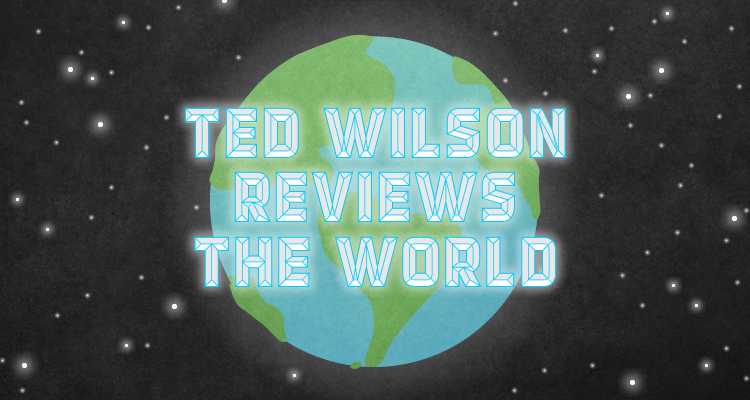
Hello, and welcome to my week-by-week review of the world. Today I am reviewing Patreon.
As robots continue to replace the workforce, the workforce is forced to work out a way to make money. Luckily for some, many new types of jobs have appeared in recent years, from taxi drivers who uses their own cars to computer screen prostitutes.
One of the most intriguing new models of employment is one where instead of a boss in a suit who watches his watch while you eat your lunch, your boss is a bunch of strangers on the internet who just give you their own money out of their pockets and the goodness of their hearts.
With the help of a librarian and two people who looked like teenagers I was recently able to get my own Patreon website page. Patreon is a website where you ask strangers for money in exchange for a job they never hired you for in the first place. You decide what your job is and strangers decide if they want to pay you for it.
Via Patreon I’m inviting you to become my boss for as little as $1 or as much as whatever it takes to put you into crippling debt. My salary goal is a collective one million dollars because I want a million dollars. At the time of this writing, I’m 0% of my way toward that goal.
Anyone who becomes my boss and pays me more than $5 a month will receive a personal review of themselves. DISCLAIMER: I can’t guarantee you will be reviewed favorably, but I will review you.
At it’s heart, Patreon allows people to put a literal price on how much they value a person’s life’s work. If Patreon had existed when Van Gogh was alive, he would have had zero patrons. And then he would have Photoshopped his ear off.
BEST FEATURE: The potential for all my financial dreams to come true. WORST FEATURE: Internet access is required to pay me. There is no cash option. If you would like to pay me in cash, please call me at (617) 379–2576 and I will give you my address. I don’t want to put my address on the internet because I don’t want white supremacists to know it.
Please join me next week when I’ll be reviewing Wade Boggs.
Add ‘join the resistance’ to your itinerary as AWP goes to D.C.
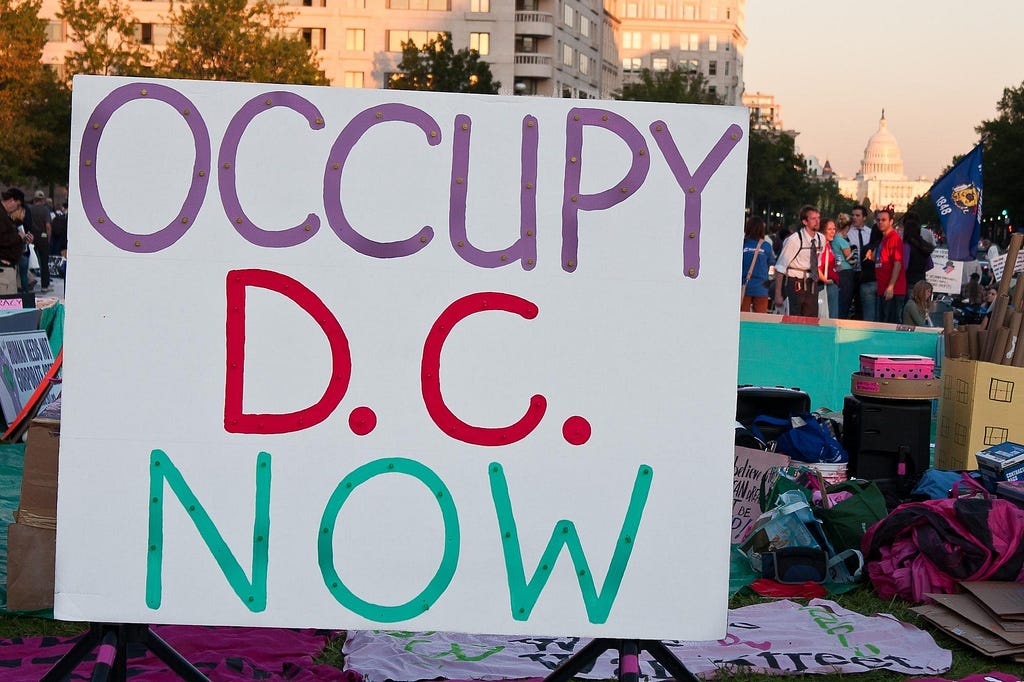
In a little over a week, writers, editors, students, teachers and publishers from around the nation will gather in Washington, D.C. for the 2017 AWP (Association of Writers and Writing Programs) Conference and Bookfair. The event regularly attracts crowds of over 12,000, and at this year’s gathering, participants plan to capitalize on the convention’s fortuitous location by organizing protests and rallies against the Trump train wreck.
Earlier this week, Flavorwire reported that the Facebook group, Writers Resist Trump (with almost 900 members) is planning a “field trip to Capitol Hill” on Friday, February 10th, so that writers and other members of the literary world can drop in on their legislators to demand action against the Administration and its racist policies. Any and all are welcome to join.
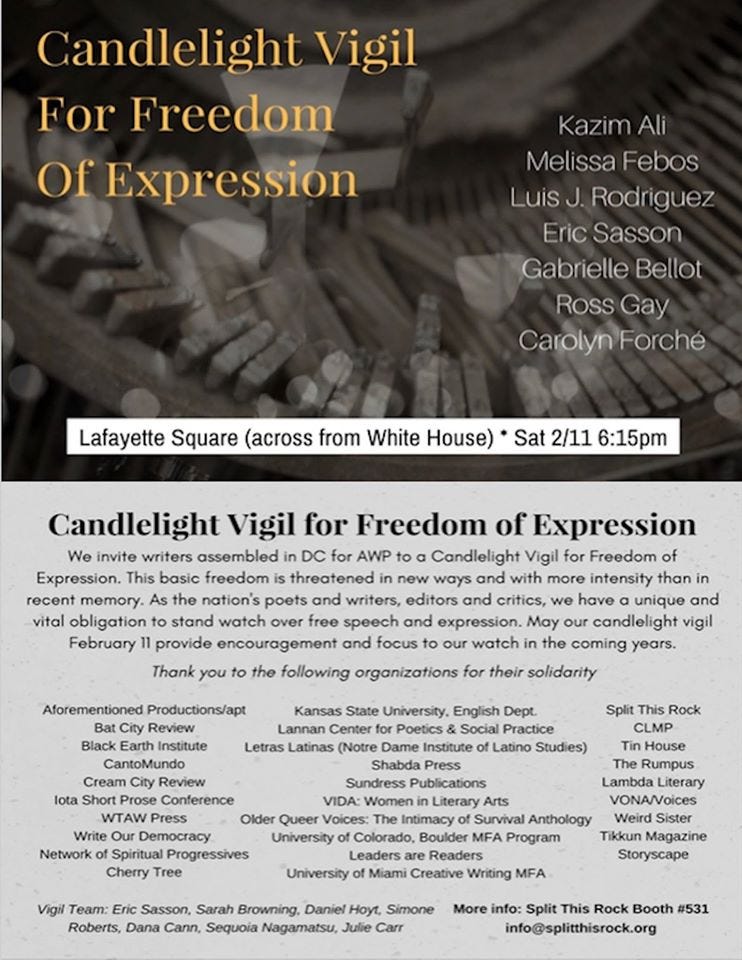
On the evening of Saturday, February 11th, a “Candlelight Vigil for Free Speech” will be held at Lafayette Park, across from the White House. Numerous publications are co-sponsoring the event, including Community of Literary Magazines & Presses, Lambda Literary, The Rumpus and Tin House. Kazim Ali, Gabrielle Bellot, Melissa Febos and many others are scheduled to speak. RSVPs for the event currently stand at over 500.
If you’re not going to AWP this year, there are plenty of other ways to get involved in literary demonstrations. Write Our Democracy is a budding initiative that was born after poet and VIDA co-founder, Erin Belieu, encouraged writers to organize community events on MLK Day. In less than a month, her original call to action has inspired more than seventy-five global events. The group’s website does an excellent job of keeping tabs on upcoming gatherings worldwide. Check out their ever-growing list, and discover ways to get involved in your neck of the woods. Do you live in East Bumble, devoid of revolution? Organize your own resistance.
We’ll update you with more information on rallies and protests forming at AWP over the coming week.
All the best literary links that are fit to, well, link
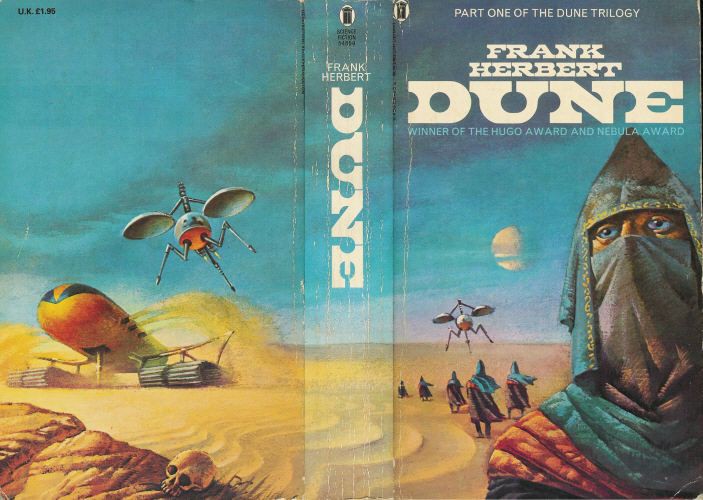
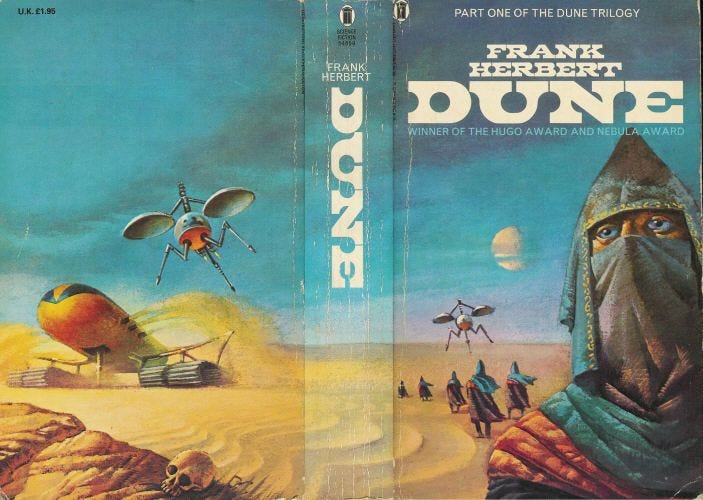
Frank Herbert’s science fiction classic, Dune, is getting a new adaptation. This time from Denis Villeneuve (who most recently directed the Ted Chiang adaptation Arrival).
Publishers Weekly profiles author (and The Mountain Goats frontman) John Darnielle: “Bending over his writing desk, Darnielle opens a drawer, pulls out a black drawstring bag, and from it pours dozens of multi-colored gaming dice onto the desktop. Picking up a particularly pointy die and rolling it around in his fingers, he explains its idiosyncrasies.”
How Yukio Mishima’s work made a writer move to Japan: “Mishima himself was a controversial, even repellent, figure: obsessed with bodily perfection, militarism, and imperialism. He committed ritual suicide after staging a failed coup. Yet this ugly tale is told in some of the most exquisite prose I had ever read, beautifully rendered by translator Alfred Marks.”
Valeria Luiselli once tried to write a novel from an, uh, unusual perspective: “It was a really bad novel at the beginning. My idea was that it should be narrated by this plant. It was like, well, how would this plant know, see what happens in my apartment now and what happened in his apartment back then. Imagine the boredom of this plant, seeing the world from only one corner. It was a very bad idea, but it led them to other explorations that were much more worthwhile, and that eventually became a novel.”
Sign up for our newsletter to get submission announcements and stay on top of our best work.
YOUR INBOX IS LIT
Enjoy strange, diverting work from The Commuter on Mondays, absorbing fiction from Recommended Reading on Wednesdays, and a roundup of our best work of the week on Fridays. Personalize your subscription preferences here.