The famed dictionary is interested in documenting neologisms associated with the President and his brand of bigoted leadership.
It’s only fitting that a President who champions made-up facts would inspire a bevy of made-up words, each of them striving to describe some aspect of the lunacy that is Donald J. Trump. According to the Guardian, the famed Oxford English Dictionary has taken notice of these terms and added several to a watchlist of words under consideration for the dictionary’s next update.
The Trumpisms gaining the most widespread traction include:
— Trumponomics — a reference to the President’s alleged economic policy
— Trumpertantrum — tweeting lewd lies in the day’s wee small hours
— Trumpkin — Jack-’o-anterns bearing his unfortunate visage
— Trumpflation — the coming currency disaster
— Trumpist — a Trump supporter
— Trumpette — a woman who supports Trump
— Trumpista — a Latina Trump supporter
2016’s political dumpster fire resulted in “Brexit” and “alt-right” finding their way into the dictionary — why not a few more to round things out?
Not all the slang currently up for OED consideration is a play on Trump’s name. “Healther,” a term that riffs on the “birther” conspiracy theory, is in the mix (according to the Guardian — “a person who believes that Hillary Clinton has a serious, undisclosed illness”). However, lexicographers doubt this lingo will be relevant for much longer given the results of the election.
During the campaign, Trump was quoted as saying, “I went to an Ivy League school. I’m very highly educated. I know words, I have the best words…but there is no better word than stupid. Right?” He happened to be referencing the State Department’s endeavor to provide aid and relief to Syria. But in light of this weekend’s events, I’d have to agree with him…there truly is no better word than stupid to describe our freshly inaugurated President. It seems there may be a few new synonyms for his particular brand of stupid.
Every day, eight hours (give or take; the boss is easy-going) in a five-mile circle, 55 or 60 or 65 miles per hour, fully loaded or just the tractor unit depending on the protocol. At the end only the tires change. They take the tires away to measure the wear and tear and he gets new ones, some new type or formulation, and does it again.
He took the job because he likes to drive. It’d be a pretty sad joke if he didn’t, and he’s seen jokes like that get played on other guys, so he’s grateful. The songs on his cassette tapes say that driving is freedom but that’s not this. Even before the job, he’d drive in a circle and come back home. It just got him out of the house for awhile.
He can play whatever music he likes, doesn’t have to talk to anyone most of the day. There’s two lanes to the loop, but there will never be two trucks again; the business has mostly gone over to indoor tracks and computer models. He’s the only driver, and if the boss makes a Dunkin’ Donuts run or gets called away then he’s alone. The truck is a little cranky; sometimes the A.C. will go out, and every so often when he puts it in reverse the engine dies, but he knows where to kick it or finesse it to make it run again.
The scenery is just interesting enough that he never has to think much unless he wants to. Where it was cleared to build the loop, he’s watched a generation of tall grass and thistle and chokecherry give way to a generation of mountain ash and staghorn sumac. Where it wasn’t, he’s watched the beeches and sugar maples thicken, watched a few fall to beetles or lightning. He’s seen, and once in awhile run over, rabbits and squirrels, raccoons, deer, the occasional fox. Glimpsed skulking coyotes. Last year, a couple of beavers dammed the stream that cuts under the loop through two culverts, flooding a section of road along the eastern side, and they had to be trapped and taken out. At the time they were a novelty, got their picture in the paper, but he knows that next year or the year after a new pair will show up and do the same thing and be taken out in turn. He likes animals, and he likes knowing the patterns of things.
One of the patterns: under the trees, his summer days end in shadows, and in deep winter half his shift is in the dark. It’s dark today, although winter is starting to thaw into spring, a few skunk cabbage leaves poking through the patches of grayish snow on the shoulder. He enters the stretch furthest from the office, where the trees close in like a tunnel, and sees a pair of glints up ahead.
He takes his foot off the gas, waiting to see which way the deer will run in the hope he can miss it. But it doesn’t run, and now he realizes that the eyes are too high for even the most massive buck. He flicks on his headlights. That just tells him that what he’s seeing doesn’t make any sense. Whatever it is doesn’t look like it’s going to start running in time. Instinct locks in and he swerves to the right as much as he dares.
It’s enough — he misses the eyes and the body they’re in, catching a sidelong downward glimpse of it out the window as he passes. It looks like a human form, but gigantic, too tall and broad to be right even though it’s stooped like an old drunk. The flesh is hairless and peach-colored, sort of patchy, raw in places, like it’s suffered a bad burn or itched itself to an oozing pulp. A bear? A bear with mange? A black bear shouldn’t get that big either, jesus christ.
It lets out a moan, standing in the swirl of dirty air in the truck’s wake. He shouldn’t be able to hear it with the windows closed and the engine running, but he does hear it. It sounds like pain. And the moan turns into an electric whine that makes his truck whine in sympathy. The headlights flicker, and he’s sick with sudden heartburn.
He grabs the steering wheel too hard as he forces the truck out of the swerve. If he goes in the ditch now he thinks he’ll have a heart attack right there in the cab. The headlights flicker again, then die, taking the cabin lights, all the lights in the world maybe, with them. The whine gets louder.
When he glances in the mirror, the thing is still standing in the middle of the left lane, not nearly as far away as it should be by now. He can’t see the speedometer needle. He presses the gas anyway, but the truck ignores him. He starts repeating to himself “oh shit oh shit oh shit”, the most relevant prayer he has.
And then he passes out of the tunnel of trees. As soon as sunlight hits the cab the whining cuts off. His headlights flick back on and burn steadily. Only the full-body fear remains.
Fear keeps his foot on the gas, 75, 85 miles an hour, a ridiculous speed for the curve of the road and the heft of the truck. He’s going to tip, wind up mangled in the creek, die in flames among the maples. He can think that, but it isn’t real enough to make his foot come back up. He’s about half a mile out past the office when the obvious crawls into his brain, that given the nature of the road he’s on, he’s now running towards what he was running away from.
He slows then. But what next? The road isn’t wide enough for a u-turn. Reverse is too risky. If he stops, he can either stay in the cab til the end of the world or get out and walk. It’s not a long walk back to the office, but by the measure of having that thing at his back it’s no good. The best way out is another pass through that tunnel of trees.
It didn’t get him once — was it trying to get him? Most times, animals are more scared of you than you are of them. If it is an animal.
If it’s still in the road, he decides, he’ll hit it. Risking the swerve was stupid to begin with. Hell, maybe he’ll be putting it out of its misery.
He puts his foot back on the gas. It takes a moment to convince himself to push down. As much as he dreads the trees, as much as he wants to never reach them, he needs to get inertia on his side. His hands slip on the wheel. He tightens his grip.
He waits for those shining eyes to appear, but they never do. The lights don’t flicker, and as the shadows close over him there’s nothing there.
He scans one side of the road, then the other. Nothing. There’s nothing when he comes back out into the open, no evidence that anything crashed through the brush, nothing running across the fields to the north. He even looks up into the sky; nothing but a few thin clouds. He rolls down the window, catches no distant whine. The blast of cold air smells faintly of bad eggs.
When he reaches the office again, he pulls over.
“What’s up?” the boss asks, barely glancing up from the TV; he doesn’t bother concealing his Sally Jesse Raphael addiction any more. “Damn thing break down again?”
“I’m gonna have to call it a day. I feel like crap.” It occurs to him to lie, blame it on bad mayo in last night’s sub or something, but that would mean admitting to himself that he doesn’t want to tell the truth.
The boss grabs the remote and turns the volume down. “You want me to call Becky to give you a ride home? You look like you got kicked in the nuts.”
“Nah, I’ll be ok.”
As he drives home, he thinks about quitting, never going back. Never having to drive under those trees again. There are other jobs.
He microwaves dinner and wonders if he should move. He could go stay with his sister in New Jersey. See the ocean. People drive trucks in New Jersey.
The hum of the microwave, with the slight whine of the dying motor underneath, prickles him until he has to leave the kitchen. In the bathroom he opens the window to let in air on the edge of cool and cold.
In the pond across the road a few spring peepers have begun to call, the same calls as every year, as high and as eerie as the electric sounds but part of the world, part of the pattern. Too soon, he thinks, but every year a few come out too soon and yet the chorus as a whole always survives. There might not be peepers in New Jersey. That’s when he decides he’ll go back to work in the morning. Let a thousand more miles cover it over.
Acclaimed novelist Joshua Mohr’s Sirens immediately earns a place on the list of great addiction memoirs, and then it gets better. Substance abuse, rationalizing, and guilt are the cohesive elements that bring Mohr’s personal narrative together, but failure, lost love, parenthood, the possibility of redemption, health issues, and a constant struggle against the monster of relapse are what ultimately turn this memoir a special reading experience and make it one of the most unapologetically searing and brutally honest nonfiction books indie publishing will see in 2017.
Jumping back and forth in time and ranging in tone from depressive to hilariously surreal, Mohr offers readers an unadorned and sometimes uncomfortably straightforward look at the stages of his life. From his early life drinking his mother’s leftover alcohol, his time spent as a substance abuser willing to experiment with anything and unable to see the damage he was doing to himself and others, and finally his days as a husband, devoted father, and heart surgery survivor, the author’s life is an open book from which he reads the juiciest, darkest, funniest, and most dangerous/cringe-inducing passages . In the process, he discusses writing, the nature of relationships, rehab, violence, and shame. The result is an outstanding memoir that is not only about addiction and recovery but also about all the things that occupy the space between those two things.
The writing in Sirens is very personal, but Mohr manages to pull the reader into the story of his life and to turn his experiences into something that everyone can learn from; the private story of an individual that, through sharing and questioning, becomes a collective experience full of lessons:
“What do you struggle with — what’s that one thing in your life that you wish to control, yet the compulsion spins constantly, relentlessly? We all have that seductive adversary, the voice in our head calling us to calamity. What’s yours?”
When writing about the self, there is usually a level of either detachment (usually steeped in practiced nonchalance) that helps the individual cope with the past/present or a shamelessly self-serving filtering and (re)constructing of the past in order to place the writer under a positive light. Neither one of these is present in Sirens. Instead, Mohr does something that, at first light, seems counterproductive but ends up working very well: he drags out his demons in an attempt to keep them at bay and opens up old scars to offer readers the blood of truth. Mohr did awful things in the past and still struggles with the pull of narcotics and alcohol, but he wants it all out there, wants his daughter to know her father won the battle despite having touched the bottom in a way that almost cost him his life:
“The MRI showed a lesion on my brain, a scar from a stroke in my past. When I mentioned my enthusiastic drug history to the neurologist, she said I probably had the first stroke when I was a loaded and might not have known. I imagined myself sitting at a dive bar, coked up and twisted on whiskey, and stroking right there, surrounded by other sorrow machines, me speaking in tongues, brain curdling, and no one noticing, including me.”
“I’ve told you terrible things about myself in this book, and while I’m not a Nazi doctor, I do question my own worth,” writes Mohr. This moral questioning can be found throughout the memoir, and asking the question and seriously pondering it becomes more important than arriving at a conclusion. In fact, Sirens is about uncertainty and changing, about duality and knowing one familiar road is always there, beckoning, but having the willpower to take a different, unknown one for the sake of that which we love most. Yes, this is a true story about a man coming to terms with his mistakes and knowing that a bad step leading back to the abyss is always a possibility, but it is also a narrative about learning that love is perhaps the most powerful motivator in the world.
Perhaps one of the best things about this memoir is that its author systematically avoided the elements readers expect to find in the genre. Mohr plays with time and his own chronology. He talks to a dog and to the ghost of Dr. Forssmann, a man responsible for the operation that saved his life who also happened to be a Nazi doctor. He deals with the emotional and intellectual battles of addiction, loss, relapse, and rehab. He deconstructs his actions in order to understand himself, and the writing that emerges out of that process is at once heartfelt and humorous, entertaining and uncomfortable to read, slightly fantastic and as full of pain and regret as only the best nonfiction can be.
Mohr already demonstrated his is a superb storyteller with his novels, and Sirens now proves he is just as great at writing nonfiction. This memoir is touching and funny in ways that feel natural. It is a study in what it means to be a parent and about learning to accept the inherent multiplicity of human nature. In a way, Mohr becomes a philosopher, even when he never mentions occupying that skin in this book. His words grant him that title and make Sirens a very exciting addition to Two Dollar Radio’s already amazing catalog.
“We are never just one thing. I was never only the heart defect, only the author or junkie or husband or father or professor or drunk. I wear all these layers of skin. Like stars creating a constellation.”
This article was written in partnership with the Authors Guild for their Writers’ Resource Library. The Authors Guild is the nation’s trade organization for authors. It supports authors in their professional lives, and it advocates for authors on issues of copyright, fair contracts, free speech and tax fairness. Memberships are available for writers at all stages of their careers, and include new membership categories for Student and Emerging Writers.For more about joining the Authors Guild visit authorsguild.org.
Submitting your work to magazines can be a discouraging process. You work for months on a short story, send it to your favorite magazine, and six month to ten months later, receive a form rejection. Here at Electric Literature’s Recommended Reading, where I’m assistant editor, we open submissions for one month at a time a few times a year. Reliably, we receive over 1,000 submissions in under 30 days. For editors, searching for a story to publish in the submissions queue can be like searching for a needle in a haystack: it takes ages to find that needle, but when you do finally grab it, it pricks you to let you know it’s there.
Most writers say that if you’re not getting rejected, you’re not submitting enough. Others say that you should aim for 100 rejections a year. This is solid advice, but at a certain point, if you’re trying to establish a career as a writer, some of those rejections need to turn in to acceptances.
Reading as many stories as I do, I’ve compiled a list of common problems I see in stories from “the slush pile” (an unkind industry term for unsolicited submissions), that prevent promising stories from getting past the form rejection. This article, used as a pre-submission checklist, and combined with time, patient self-editing, and honest self-assessment, can help your story become that needle editors are looking for.
Have you written a story?
It seems terribly basic, doesn’t it? After all, you’ve written the story. You’ve polished it. You’ve gotten rid of all the typos. You’ve put it in a respectable font. But is it a story? Stories that don’t actually tell a story are commonplace in the slush pile. They aren’t about much. A character who is having some thoughts moves from room to room and gazes longingly out of windows. These stories may be filled with beautiful, lyrical language, but at the end of the day, nothing much has happened or changed. The non-story is a character sketch or set piece, at times very profound about the workings of the human mind or heart, but the people in these non-stories don’t actually go out and do much of anything. What is this story about? What happens in this story? These are questions that can quickly reveal if you’re dealing with a non-story. Where is its center? Where does it turn? What is at stake? What are the plot points? Why have we spent our time reading the story? A story doesn’t have to do much, but it has to necessitate its own telling.
Are you bored?
Take a moment to read through your story. Read it from start to finish. Mark the places where you grow bored. Assume that an editor will stop five pages before that. If the editor or reader assigned your story stops reading on the second sentence, then perhaps the easiest way to stay in the game is to open boldly. I do not mean that you need to start with sex or death or violence or a powerful image (though these things can be useful). Rather, I think a bold opening is an opening that strongly and clearly lays out a route to the heart of the story. Effective openings frame the architecture of the story’s meaning. At the end of an effective opening, we have gained some clue as to the story’s voice, structure, and plot. Bold openings come in a variety of shapes — they can be lyrical or concrete, spare or maximalist, witty or solemn, action-packed or meditative — but they are never boring. So be bold. It’s gut-check time. Are you bored? If you are bored, then the reader will be bored. Go cut out the boring parts. Can the story still stand without them? If not, find a different solution. Refuse to be bored. Refuse to write the easy thing.
Does the world need another story like this, told this way?
Often, writers think about clichés as well-worn phrases that have been drummed of all meaning by excessive usage. Consider another application of the term: the story that is so familiar to the reader that they don’t even have to finish the first page to know how it will end. The drug addict, the orphan, the sex offender, the hardboiled detective, the malaise-stricken divorcee — a cast of characters familiar to any person who has taken a writing class. Of course, if written masterfully, even a cliché rises to the level of compelling narrative. There are always exceptions to the rules. But is your story an exception? Does the world need another stream-of-consciousness piece about a young man on heroin as he wanders from place to place on his college campus? Do we need another manic pixie dream girl or a star-crossed story of kids with cancer? Does the world need another alcoholic middle-aged man who behaves badly because he has a sadness he cannot comprehend? Possibly, but have you reinvigorated the limp story? Have you brought something fresh to the trope? Do you have something to say?
Flashback as story
If the most (or only) interesting part of the story happens in a flashback, editors sometimes wonder why that isn’t the story itself. Flashbacks can be clarifying and can provide emotional weight, but they can also feel like narrative dead-ends. After all, we know how they end — they lead up to the story thread that is happening in the present — and they can’t drive a story forward, at least not usually. In stories that rely heavily on flashbacks, the present thread of a story typically feels extraneous. There is little action or little in the way of motivation. In some ways, this is a specific application of the non-story. Consider the balance between past and present and think about ways you can shift the tension so that the story feels like it moves forward (often achieved by adding action to the present thread).
Are you turning your story into a screenplay?
There is a danger in being over-descriptive. When a moment in a story is painstakingly described, it becomes impossible to enter that moment as a reader. For example, if you tell the reader about every movement, every breath, every door that is shut or open, then you’ve left little room for the reader’s imagination. In a sense, stories operate in the tension between what the writer has put down on the page and what the reader creates as they read. This isn’t an imperative to write sparsely, but rather to choose your details carefully and to leave room for the reader. The story that reads like blocking for a screenplay is a common sight in the slush pile, and rarely does one of these make it past the early rounds of consideration.
Are your characters motivated?
One way to grab an editor’s attention is to populate your work with vivid or interesting characters who have human motivations. One way to jumpstart a non-story is to give a character a motivation and have them try to see it through. This is one of the keys to narrative tension. A character with a motivation is immediately more interesting than a character without one. It also introduces questions that can propel a story forward. What do they want? Will they get it? How will they get it? How will they overcome the minor complications that arise from trying to achieve their goal? This is so basic as to be almost redundant, but a shocking number of writers forget this fundamental idea. It is also important to note that sometimes the first draft of a story is writing toward discovering a character’s motivation, and that’s okay. It’s part of the process.
Is this piece ready?
Have you read it out loud, start to finish? Have you set it aside for a week? Did you get fresh eyes on it? If not, don’t submit. Sit on the story. Think it through. Find a solution. If you notice a problem, the editors will notice it, readers will notice it, everyone will notice it. If you are anxious about anything at all, work on it. Work at it until you have made peace with it. If you worry about the pacing, the characterization, whether or not you have too many characters, if you should dramatize more, if you should summarize more, if the story feels flimsy in the middle, if the ending bugs you — fix it. Make your story as good as possible. Don’t settle for almost there. Take your story to the very limits of what you’re capable of. Don’t stop until you can picture your story alongside the work of your favorite authors. Submit only your very best. That being said, don’t let perfectionism be an excuse for never submitting your work. To paraphrase the French poet Paul Valery, a piece of writing is never finished; it is only abandoned.
Are you comfortable with receiving edits?
Once you’ve submitted your story, instead of spending this time anticipating rejection, biting your fingernails, and pulling out your hair, keep writing, but also take the opportunity to reflect on what kind of edits you would be willing to make if the story is accepted.
There are as many different ways to edit as there are editors. Some editors like to offer broad comments. Some editors like to get into the weeds. Some editors like to copyedit. Some like to actually shape the architecture of the piece. Some editors don’t do anything except read and accept or decline stories. Consider what kinds of edits you are open to and what kinds of edits you are not willing to accept. Where do you want to stand firm and where do you want to give ground? It’s important to think about this beforehand so that, if your story is accepted, you’re ready when the editor comes with their suggestions to engage in a dialogue. The best editing is always a conversation, and it’s easier to engage in the conversation if you’ve thought about it ahead of time. Also, know that it’s okay to walk away from an acceptance if you feel uncomfortable making certain changes. And if the story is rejected, you may have generated ideas for further revision.
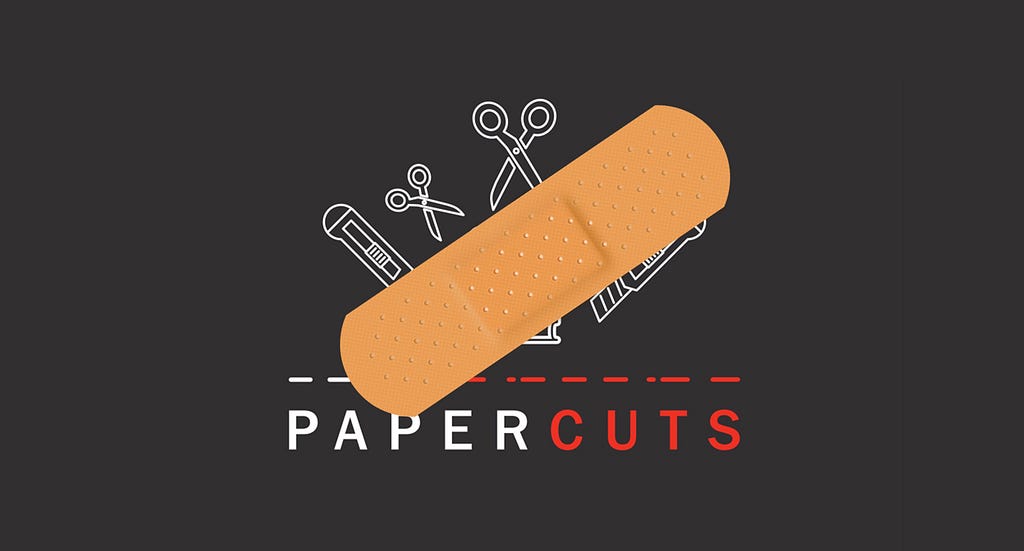
Hello, and welcome to my week-by-week review of the world. Today I am reviewing Papercuts.
There are few things in this world that unite us all, regardless of race, gender, or religion. One of those things is the universally held disdain for paper cuts. That’s why it’s so curious that Electric Literature chose to name their card game Papercuts after one of the world’s most unpleasant physical sensations. They may as well have named it Talking at the Movies or Stolen Laptop.
At first I had assumed the title was a warning, telling me that whatever was inside the box would put me at risk for small, thin lacerations. And I was right. I received almost nine paper cuts from the contents of the box. Not much of a surprise since the box contains nothing but paper. Each piece of paper is in the same size and shape of a playing card and if you try to shuffle them, that’s when you really get into trouble. Those suckers can cut.
Unfortunately the instructions to the game were obscured by all of my blood so I had no idea how to use the game. I felt exactly like how Ralph Hinkley must have felt when he lost the instructions to his alien costume in The Greatest American Hero.
In a way it was freeing to not be bound by a rule book. I was able to enjoy the game on my own terms, which meant putting on a pair of mittens, and sitting in silence with my back to the pile of cards for several hours.
The cards remain in a heap on the floor as I’m reluctant to risk putting them back in their box. I considered asking a neighborhood kid to do it for me, but I don’t want a lawsuit on my sliced up hands. Hopefully if I leave the window open the wind will blow them away over time.
Until then I’ll just have to stare down at the cards occasionally and try to understand what they mean. One of them reads “vest worn by Jeffrey Eugenides.” I have no idea who he is or why he’d be wearing a vest. Vests have been out of fashion for years.
Another card reads, “porny drawings by Dr. Seuss.” I’m guessing that’s just an embarrassing typo and should read “pony drawings.” It doesn’t sound like this game was ever copy edited.
I have given Papercuts 4 out of 5 stars because I fear retribution.
BEST FEATURE: The hidden morse code message above the title. WORST FEATURE: My paper cuts got infected.
Please join me next week when I’ll be reviewing oil.
In West Virginia, a hometown isn’t simply where you were born and raised. It’s also a map to your future life, a repository of places and people who instill you with their values, views and virtues, and who ultimately circumscribe your life’s trajectory. For the novel’s protagonist Jamie Paddock, this qualifies it as something of a prison, an invisible cell that’s followed him to New York City in his bid to escape it. As Joe Halstead’s debut novel opens, he’s trying to make it in The Big Apple as a self-defining writer, yet remnants of his Appalachian past — be it his accent or his palpable inferiority complex — are holding him back, preventing him from assuming full ownership of his existence.
And there’s also the matter of his father’s suicide. As the novel begins, Jamie is skirting around it, with his unwillingness to contemplate funerals and family visits being a clear manifestation of his unwillingness to be pulled back into the grip of his home state. At a party in the novel’s first chapter, the unnamed third-person narrator informs us, “His only thought was the overpowering desire to have sex and that seemed to happen when he was thinking of death, which he’d been doing since his father stopped his truck on US Highway 19.” Since he’d vastly prefer not to dwell on his father’s annihilation and the grim prospect of returning home, he spends this brief opening chapter sharing “a sandwich bag of mushrooms” with other partygoers and eventually, after a semi-conscious encounter in a bathroom, taking home a girl who “seemed like a squatter” and “fucking her really hard.”
It’s this girl — later revealed by one of Jamie’s friends to be called Sara — who essentially kick starts the plot and sends it on its way. She does this by walking off with Jamie’s leather jacket soon after their intoxicated tryst, taking with it an arrowhead that was buried in one of its pockets. Admittedly, an arrowhead might seem like a fairly innocuous and inconsequential object to purloin, yet even before the first chapter is over it becomes plain that it is in fact a fairly transparent symbol of the direction of Jamie’s life.
It becomes clearer still when, in the second chapter, the story of how Jamie came into its possession is recounted. On a deer-hunt when “five or six years old,” Jamie “fell on his butt and noticed the arrowhead lying under a laurel bush.” Having been saved from this laurel bush, its status as a metaphor is made redundantly palpable in the dialog that immediately follows, with Jamie asking, “Wonder what it’s pointin to then,” and his father replying, “Maybe the search for whatever it’s pointin to is better than whatever it’s pointin to.”
Somewhat heavy-handed as a metaphor it may be, yet the disappearance of the arrowhead in conjunction with the death of his father serves to introduce the reader to the fact that Jamie has fallen into an existential crisis, no longer sure of who he is or where he’s going. “In all things Jamie strove to be like his father,” yet the loss of his father means that he now effectively faces a choice between either one of two things: continue imitating his father by ending (either literally or metaphorically) his own life, or forge a new, more individuated identity that doesn’t rely on his deceased role model (and his home state) for its substance.
What follows is the all-but inevitable return to West Virginia, where Jamie escapes from the “steel skyscrapers” and “hipster guys” of NYC. Back home, he stays with his ailing mother and semi-reclusive sister, re-immersing himself in his roots with a varying mix of apathy and antipathy. He goes to confederate-flag-waving parties with his cop cousin Will, who he catches at one point pleasuring himself while some upstanding member of society named Boojee takes extreme license with an unconscious female. He goes around selling venison with his sister Carol, who accompanies him on a visit to “these black people up the road” in order to atone for having repeatedly supplied said people with something that wasn’t quite deer meat. And he takes in the “dark woods and hollers and freshly dug strip mines” of West Virginia, which of all the novel’s various landscapes and characters is captured in brutally affectionate detail, with Halstead figuratively comparing the Appalachian topology to such ominous things as “enormous graves large enough to bury a race of ten-thousand people.”
Where West Virginia becomes more interesting is with its subtle assertion that it isn’t so much the poverty and backwardness of Jamie’s home state per se that causes him despair, but rather the apprehension that he can’t escape its influence on him as a person. When he visits someone who knew his father, he reacts with horror to the man’s affirmation, “Now you are the dead spittin image of your daddy now,” with the unnamed narrator adding, “and Jamie just wanted him to stop.” Similarly, when he’s sat with his racist extended family around a dinner table one evening, he glumly muses to himself, “you were always meant to come back. This was, he knew, how you lived with West Virginia.”
With such gloomy admissions on the rootedness of identity, the novel slowly emerges as something of an existentialist one, as depicting the classic existentialist struggle between the individual’s “facticity” and his desire to be more than his facticity. Yet what makes West Virginia a decidedly contemporary book is its suggestion that, in attempting to move away from our roots and become individuals, we lose our authenticity, becoming fakes and imitators instead.
This dilemma comes out in how Jamie speaks and thinks of New York — the city to which he’s relocated in an attempt to become more than an expression of West Virginia — as if it were a massive lie or some kind of VR simulation. Because he found it replete with people like him who’re trying to (re)make themselves, he became jaded and disoriented by all the poses and pretenses, the narrator telling us, “He wondered why he kept living in a place that wasn’t real.”
And it’s not just his inner and outer dialogs that emphasize this New Yorkish artificiality, but the details Halstead weaves into the narrative’s texture. At one point before Jamie leaves for West Virginia, he and Sara cosy up to repeatedly watch “a vaporwave music video,” vaporwave being a genre of electronic music that emphasizes the virtual, the simulated, and the hyperreal. At another, he’s roped into providing the voiceover for a manga video the ad agency he works for is producing, finding it very difficult to stomach the incongruity of proclaiming, “The time has come to return to Dimension Z.” With such moments, the novel renders New York as the inauthentic foil to West Virginia’s gritty, mountain-guaranteed authenticity, thereby underlining the existential quandary in which Jamie has found himself.
It’s precisely in the playing out of this quandary that the novel develops and ends, with Jamie’s visit to West Virginia providing the occasion for him to compare his older self against the self he might become. Of course, it would be unfair to divulge just how exactly it ends, but suffice to say Halstead offers no easy answers and no simple resolutions, most likely because there aren’t any (at least not in the ‘have our cake and eat it too’ sense). Some readers might find the lack of black-and-white clarity unnerving and frustrating, yet it’s necessary insofar as it reinforces Jamie’s realization that, in order to leave behind the “blown-out tires and buzzards devouring road kill” of WV, he has to leave behind the connection to place and past that endows him with a certain ‘realness.’
And while there are certain parts of the novel that don’t seem especially ‘real’ in the sense they’re a little overstated — the glaring arrowhead metaphor being a prime example — for the most part the book charts a journey that’s entirely sympathetic and relatable. In the end, it penetrates into the emotional conflict that comes with being caught indecisively and indeterminately between two cultures, and it teases out the realization that, after all, there’s nothing particularly wrong with being caught between two cultures. But more than that, it reveals a new and promising debut writer, who has found his own voice by speaking the voices of two places at once.
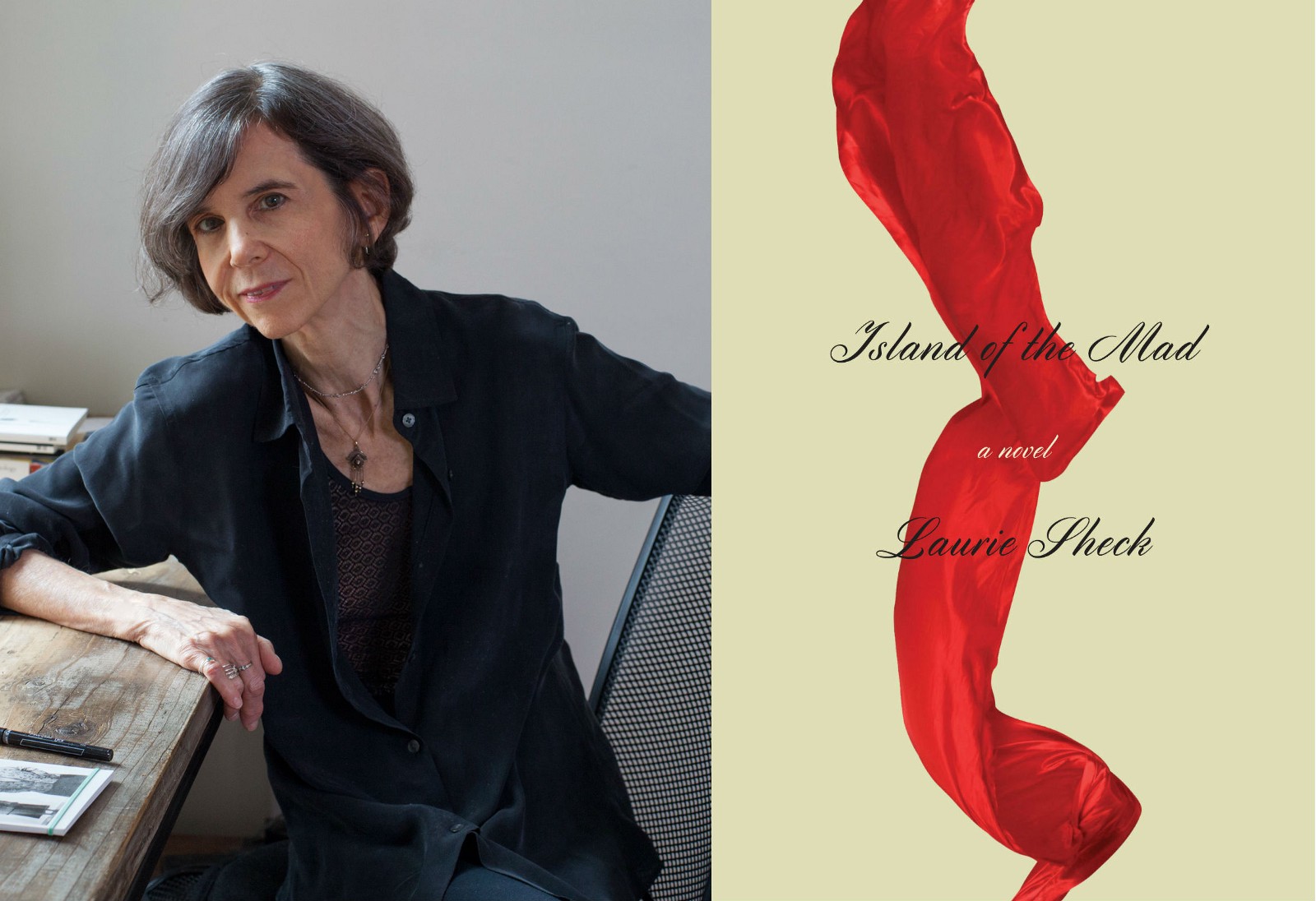
Laurie Sheck is the author of five books of poetry, including Willow Grove, which was a finalist for the Pulitzer Prize. In recent years, however, Sheck has written two genre-bending novels to great critical acclaim, including A Monster’s Notes (2009), narrated by Frankenstein’s monster, which the Washington Post described as “a remarkable creation, a baroque opera of grief, laced with lines of haunting beauty and profundity.” Her most recent work, Island of the Mad, features more of Sheck’s unique approach to novel-writing, in which the narrative consists of notes from a hunchbacked man’s journey to Venice to seek a notebook. The man ends up on the island of San Servolo, the site of one of Venice’s isolation hospitals, and there he encounters a number of characters, some historical, some fictional, including Pontius Pilate, Bulgakov’s Margarita, Titian. But the character who haunts Island of the Mad is Dostoevsky, whose suffering makes for a timely reminder of what happens to art under despotic regimes. Soon after the novel’s release, I corresponded with Sheck over the course of two weeks. We discussed Dostoevsky’s terrible trauma, exile, illness, Frankenstein’s monster, and the “radically ungraspable” nature of today’s technology-soaked reality.
Lorraine Berry:Neither of your novels follow a traditional narrative structure. Some have described them as a series of prose poems whose connections are as intricate as spider webs. Are you comfortable with that description?
Laurie Sheck: It’s intriguing to me that the issue of structure is initially framed in terms of what the books do not do. In a sense the scene is set against a background of what’s considered the norm — which would seem in this case to be traditional narrative structure. But which tradition? Whose? From where and when? For me, part of what books give us, and I think we become active participants as we read, is the enactment of a freedom of the mind, the whole being, or at least a keen striving for it, through the medium of language. And by freedom I don’t mean formlessness or being freed from constraints, limitations or one’s own narrowness. I think of freedom as allowing for a striving toward the genuine.
This freedom includes the liberty to explore anything that feels necessary, however fraught, confused, contradictory, including feelings of enslavement, sorrow, oppression, entrapment, as well as states that are more calming or joyous. If we use the word “text” do we approach a book with a more open, flexible curiosity than if we say “novel”?
The notion of genre has uses, but it also risks being reductive, misleading. Did Proust use traditional narrative structure? Did Melville? Did Dostoevsky? Sebald? Woolf? Certainly not Stein! Isn’t one of the joys we find in books the ways they’re sites of great diversity and idiosyncrasy. That there’s a kind of unbowed spirit.
Writing is deeply architectural. And as with architecture there are period styles, but also much that’s divergent, and some that’s totally outside the dominant framework. How does a text, like a building, grow out of its own particular necessities? How does it stay true to them, make them palpable? To me what counts is that a text is a site of vital becoming — imperfect, flawed — but its flaws are just as beautiful a part of its being as anything else because they’re genuine and necessary.
It doesn’t matter if I’m comfortable with how a book I write is described. My comfort is irrelevant. The book is a language-act, a world of language that came out of me, but I’m not its owner. I was a controlling, partly pushy, partly baffled participant in this process that involves language, and somehow the interaction between myself and the language, the books I’ve read, the art I’ve looked at etc., brought it into being.
In the case of Island of the Mad and A Monster’s Notes before it, I assembled for myself initial areas of fascination, in the earlier case Mary Shelley’s Frankenstein and the ‘monster’ as well as the Shelleys, and now in Island of the Mad Venice and Dostoevsky, and then set forth as best I could to have an experience within the medium of language. How I came to this was hardly straightforward, but it involved a desire for a different kind of experience with language than I was having with poems, and a pretty deep dissatisfaction with what I’d been doing. It involved, as well, a period of illness, first mine, then my husband’s. Those things change you. I also felt a strong pull to do research that wouldn’t just inform the work from outside but become in itself an intrinsic part of the text. I was curious about the interaction of fiction and non-fiction.
Certain events had pressed down pretty hard on me and I wanted to think about how strong facts are, how brutal, how the imagination is real but so are facts you can’t change or break free of. Beyond that, I was pretty clueless. Certainly clueless about how I would feel and hear the various voices involved in such a pressing, sustained and immediate way. Their intense presences. I was just clueless about most all of it. All I knew was I was bringing to what I was doing my poet’s experience and interest in structure, in words, syllables, language on an almost cellular level. I didn’t label what I was doing — still don’t — I had no word, no category, for what I was writing. Somehow there seemed a kind of justice in that. Rough, not smooth. I see now how that very concern runs through both books, the interrogation of categories, assumptions, labels — In what ways do they harm, comfort, betray, mislead, seduce, promise? How do they reinforce particular thought patterns, privilege certain actions over others?
Berry: In several of your poems and in your two novels, you are engaged in relationships with other writers: Mary Shelley, Dostoevsky, Gertrude Stein, etc. How would you describe these relationships? And what called you to these particular writers?
Sheck: To live with these writers brings me great comfort. Through their work I am in the presence of these amazing questioners, these explorers. I feel very strongly Mikhail Bakhtin’s notion as set forth in his book on Dostoevsky and elsewhere, that a self comes into being in the process of active dialogue with others. And some of this dialogue is not through speech, but through the written word, through books. Books, too, are living, changing beings. The book is changing and I am changing. We both have unvarying identities, but there is also flux, shifting contexts, there are shadows, angles, time, space, history. When I was younger I felt a writer had a vision and that vision was expressed through their books and it was my obligation, my privilege, to see what they “meant,” to enter into their line of vision. But I think Bakhtin is right — the author is one player among several. How fully does the author know and control the work? What happens beyond intention? In a good book, a whole lot. The texture of human consciousness can be served by intention, craft, discipline, but that’s different from being owned or controlled by it.
Books, too, are living, changing beings. The book is changing and I am changing.
Even though I’m finished with Island of the Mad I’m still in the thrall of Dostoevsky. As I’ve mentioned elsewhere, to my mind The Idiot contains one of the most daring, tender, radically re-defining scenes in all of Western literature — the night when Prince Myshkin, vulnerable, epileptic, stays and comforts the murderer Rogozhin. Dostoevsky is criticized for dwelling on “cruelty,” the perverse etc., for indulging in the melodramatic, but in fact he is an astonishingly tender, compassionate, realistic writer. And so brave and intricate. Well, he was a genius. And as a person he was very brave and his biography moves me.
They all suffered. Even Stein, who seems so willingly combative, provocative, playful, jaunty, a real fighter — I read a comment of hers that’s stayed with me — I haven’t been able to find it again but I’m still looking —
She spoke about what it cost her and other artists to be up against so much ridicule and misunderstanding. It was said strongly but almost in a whisper, as if there were an element of danger in letting it out. And in Patriarchal Poetry she makes a kind of plea to be heard, part nursery-rhyme, part insistent command, to let women’s voices in, to let them be heard. “Let her be.”
Writing is both very lonely and not lonely at all. Everything that’s most hurt in me, most despairing, has found a home with these writers. And as Bakhtin pointed out so wisely, it’s not that I merge with them. Part of what makes the experience of being in their presence feel right and stringent, convincing, is that I can’t. I stand outside them. It interests me that Bakhtin developed his ideas about dialogism and the polyphonic novel — that is, the necessity of a self continually coming into being by being in the presence of others, an active, receptive part of an inter-change — under very isolated circumstances. That isolation partly brought him to this insight about connection. He lived in internal political exile in Russia and suffered with Osteomyelitis, a very painful, incurable infection of the bone he contracted in boyhood and that kept him periodically bedridden. Eventually one of his legs was amputated. Hardly any of his work was published in his lifetime.
There is a way these isolate figures — Bakhtin, Dostoevsky enduring an epileptic seizure, Mary Shelley’s abandoned “monster,” Prince Myshkin who ends up mute in a Swiss Sanitarium — all echo each other. I can’t imagine my life, my thinking, who I now am, apart from them.
Berry: How did you develop your style of prose? Had you written much prose prior to your career as a poet? What did you write as a young woman? A child?
Sheck: I always loved words. From the very beginning. Their sounds, shapes, how some letters seem shy or almost starving while others are brash, still others more cryptic, hard to decipher. But I was never a storyteller. From early on I was a mixture of concentration and distraction. The whole idea of learning, of having to learn and retain information made me anxious, at times to the point of panic. As a child if I tried to write a story I think I would have felt on some level I was being too overtly forceful, taking up too much space. Thinking was alluring but also frightening.
There must have been something about the contained space of a poem, so small yet immensely kinetic, partly secretive but secretly bold, that drew me. If I had any expectations at all, it was to spend my life within and among poems. It simply didn’t occur to me I would write anything, ever, that would be called a “novel.” It didn’t occur to me until it started happening.
I think largely in images, symbols — or I guess I should say I did. But I also felt like my brain was partly asleep, muffled. I felt my writing was quite limited. And I had many psychosomatic symptoms. For all I know my body was struggling toward a more expansive mental state to move around in, a space open to more of the world, to non-fiction.
I lived for a number of years with a painful neuralgia on right side of my face. Often the pain intensified and when it did it spread through my entire right side or further and all of me would stiffen. As many people do in such circumstances, I thought what a great gift normal everyday life is, just to have that basic sense of well being, to sit, read, work, talk with friends, make coffee. I’d been born into the middle class of a wealthy country without wars on its soil, and I felt I was squandering what I’d been given. How many people on this globe even have adequate shelter, food, sanitation? Not all that many. When the neuralgia was finally diminishing, and by then my husband was falling ill with a genetically-linked illness that lasted for four years until it started to burn itself out, something in me had finally sharpened. My desire to learn was intense. There were still a lot of glitches but also a kind of fierce, excited curiosity and determination.
My husband was very ill and in a sense I had lost him, had lost, certainly, our long, sustained conversations. For various reasons I picked up Mary Shelley’s Frankenstein. Before I knew it, it seemed the monster was always with me. I felt him, or my version of him. If I went to the movies he came with me. If I picked up a book he was reading it also. But he was with me in a way he could never know and that kept him lonely. I started to wonder what would interest him. If he could choose, what would he read? Soon I was pursuing various areas of investigation…or in part he was pursuing them through me. Maybe this sounds a little crazy, but it felt clear, systematic. I started taking notes — on genetic engineering, robotics, genetic privacy, the Geneva Accords, the nature of time, space, perplexity. These notes were in prose. And along the way I’d become fascinated by the Shelleys.
Before I knew it, it seemed the monster was always with me. I felt him, or my version of him. If I went to the movies he came with me.
Claire Clairmont, Mary’s step-sister, had run away to France with Mary and Percy. They were teenagers. Percy was the young, married father of two children. Claire eventually had a child, Allegra, by Lord Byron, who was taken from her and put by Byron in a convent where she died at the age of 3. Claire kept a journal; there was also a volume of her letters. Not to mention Mary’s, Percy’s, Mary Wollstonecraft’s, the Frankenstein manuscript’s first 40 or so pages overwhelmingly in Mary’s hand but Percy’s was there also. I was writing my way into all of this material. Just writing. And it was in prose. I found the interaction with facts thrilling. I tried to make each page justify its existence, while feeling my way forward. I paid a lot of attention to the felicities of chance, to the reality of a multiplicity of voices, to the integrity of the texts I was using. Nothing is more radical than the real. The prose seemed to open a way to being more attached to the world, less reclusive, it allowed a greater waywardness and questioning.
Berry: In Island of the Mad you include the details of a true story I had no idea about, I’m embarrassed to say. After reading it, I had to put the book down for a few minutes because it had made me cry. On page 214, you detail Dostoevsky’s enormous suffering in the Russian prison system. You said he was arrested but “confessed nothing Refused to be destroyed ‘by an empty word.” And one of the ways he was punished was that he was read the death sentence, dressed in execution clothes, and marched to the place of execution. At the last minute, he was given a reprieve.
The psychological terror inflicted on him just seemed unbearable. Do you have a sense of how he survived his experiences?
Sheck: It’s an astonishing story. His life was full of excruciating extremity. People said he always looked ill. You can see this in the photographs. But even in regard to this, Dostoevsky came in from an uncanny angle: “…a person does not always look like himself,” he wrote in his essay Apropos the Exhibition.
After the mock-execution at Semyonov Square he was sent to Siberia, to the prison camp at Omsk where he remained for four years (he’d been convicted of political sedition), and then served another five years in another part of Siberia in enforced military service. During his years at Omsk he wore five pound shackles on his ankles, as did all the prisoners. Joseph Frank’s magisterial 5 volume work on Dostoevsky’s life and work is one of the best books I’ve ever read on anything. All the details are in there, and much more. There’s a short book by Robert Bird that’s also very good as a basic overview.
The timing is somewhat in dispute, but it seems most plausible that Dostoevsky’s epilepsy started shortly after his arrival at Omsk, possibly triggered by the extreme shock of the mock-execution. Another member of that group afterwards went mad. After prison Dostoevsky was also for a period of time a compulsive gambler, which may also be traceable back to this trauma, and one reason her went abroad for a few years after prison was to escape his creditors. He wrote The Idiot, the book I explore in Island of the Mad, while in Geneva. At least he started it there. He finished it in Florence where he and his wife lived after the death of their first child, Sonya, who was born during the writing of the book and lived for only three months. They couldn’t bear to stay in Geneva after she died. They were both broken, and yet somehow he finished The Idiot. There are very strong currents of grief in that book’s second half.
Robert Bird writes of Dostoevsky’s radical doubt. I think that’s a good way to put it. As a novelist (as opposed to in his journalism) he questions everything, lets in all sorts of angles. Nothing is stable. One could speculate that trauma partly made him the great writer he became. There were many other difficult aspects of his life as well. In The Idiot Prince Myshkin speaks at length about the inhumanity of state sanctioned executions. He’s also epileptic — his whole being inseparable from disruption, extremity, unstoppable neurological events that come without warning and over which he has no control. Dostoevsky himself often felt humiliated and ashamed about his seizures. This shame was especially deep when one occurred at the very time his wife was giving birth to his daughter.
But extremity isn’t all negative. Dostoevsky wrote in The Idiot and The Possessed of the ecstatic aura that preceded the seizures. It lasted for just a few seconds, but that transcendent experience had a profound effect on him. So, too, living among the other prisoners at Omsk for four years, most all from much lower classes and from deprived and violent backgrounds, taught him things it’s hard to imagine he would have otherwise known. His experience at Omsk is most directly presented in House of the Dead but it infuses all his other work as well.
All of this is crucial to his ideas about realism. I mean, his biography is such that had a novelist written it, that writer could easily be accused of crossing over into the unbelievable. He deeply, deeply felt and understood how extreme and brutal reality is. And one part of what makes him so amazing as a writer is how along with casting an unsparing eye over everything he held his characters with such careful and abiding tenderness.
Berry: As I mentioned to you in earlier correspondence, I read an advance copy of Island of the Mad during the week that I had been evacuated from the barrier island where I live during Hurricane Matthew. I felt as if I were reading the perfect novel during that time period because of the theme of exile that plays such a large part.
I also know from your writings that you have been a quasi-Luddite when it comes to adopting the technological “wonders” of the past 40 years. As a writer, do you feel a sense of exile from a culture that seems less interested in the written word and more interested in the whizz-bang of wherever technology is leading us?
Sheck: Despite not owning a smart phone (though I plan to get one) and never having sent or received a text message, I find a lot of the new technology and specifically what’s happening with the internet, exciting. Even if the culture is moving and changing in ways it’s hard for me to relate to or understand, in certain ways I’m following as best I can.
Certainly the internet’s been enormously important to me as a writer. I can’t imagine I’d have written my most recent books without it. It’s given me access to all sorts of information, and just as importantly, it’s modeled and enacted a web-like structure, and taught me a great deal about movement, linkage, recombination.
But it’s also overwhelming, and in our world as it is technology is inextricable from danger, aggression, mistrust, deceit, annihilation. I’m thinking now of Eliot’s “human kind cannot bear very much reality.” Given our century our various terrors are, and will be, wound up with technology, especially as ours is a very powerful, militarized, crudely profit-driven nation.
But so many of our beauties are wound up with the technological as well. I can go online and see Emily Dickinson’s manuscripts with their variations uncensored, intact. I can see Virginia Woolf’s typed and handwritten drafts. Or take another manifestation of technology — glowing screens. While it’s true they can be used in garish, disturbing ways, as in Times Square, at the same time architects are turning to them as an almost moth-like, sensitive alternative to walls — more vulnerable than drywall, more skin-like, less imposing, static, monolithic. So in feeling and tone they’re kind of like Bakhtin’s vision of the dialogic — porous, flexible, receptive boundaries, but embodied in the material world rather than in language.
I live in downtown NYC, I was here during 9/11. The smell of it, so many things, the hundreds of ash-covered people walking past my building, the sky weirdly quiet, no cars, no buses, no mail delivery, xeroxed faces of the “missing” on buildings and fallen onto sidewalks, all of that’s so vivid. And now every year in September two faint, blue columns of light are cast into the sky as a memorial. They look frail, dignified, almost unbearably gentle. In this way technology makes possible the apprehension of the deepest human feelings.
I find really interesting Giuliana Bruno’s exploration of the virtual in her book Surface, as she works through the ways in which surfaces are also depths. Screens, computers, smart phones, 3d printers, none of them invented human sadness or alienation. Like so many others, I think the bedrock cruelty in our culture lies elsewhere, in economic, racial and other injustices, and also in the belief in meritocracy which turns the gaze away from where it truly belongs, which is on inequality.
To be living now, for me, feels kind of like a strange mixture of closeness and distance, as if skin is flesh but at the same time virtual.
I don’t own a TV, I don’t really understand social media, though these words I’m typing are meant for the internet. To be living now, for me, feels kind of like a strange mixture of closeness and distance, as if skin is flesh but at the same time virtual. A few clicks on my laptop and whole stretches of outer space appear, captured by the Hubble telescope. There are lunar events in real time. Astronauts describing the smell of outer space — distinctly metallic but mixed in with something that’s acrid, burnt but also un-nameable. It all goes back in a way to what Dostoevsky knew about reality and never pulled back from — how extreme it is, how radically ungraspable.
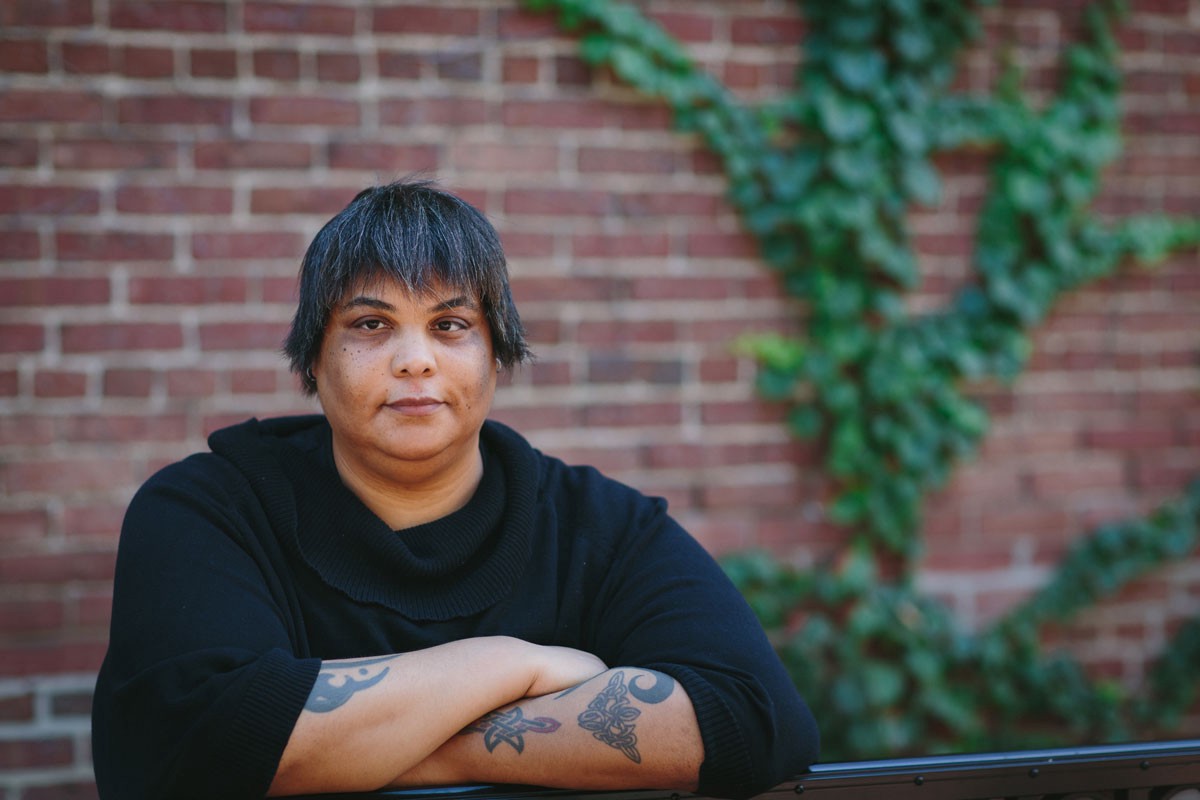
Responding to Simon and Schuster’s plans to publish “alt-right” troll Milo Yiannopoulous’s new book, Roxane Gay has officially pulled her forthcoming title, How to Be Heard, from the publisher’s TED Books imprint.
Gay spoke with BuzzFeed News about the decision: “I kept thinking about how egregious it is to give someone like Milo a platform for his blunt, inelegant hate and provocation. I just couldn’t bring myself to turn the book in…I guess I’m putting my money where my mouth is.” On Twitter, she added, “I can afford to take this stand. Not everyone can. Remember that.”
At the end of last year the publishing house announced that its Threshold Books imprint had reached an agreement to publish Yiannopoulous’s forthcoming memoir, the cover of which resembles a cologne advertisement, and that Yiannopoulous would be paid a $250,000 advance. Electric Literature covered the initial book world backlash, but if you need any further confirmation that Milo Yiannopolous is a resoundingly horrid person, try reading literally any of the content he has ever produced.
Earlier this week, Carolyn Reidy, Simon and Schuster’s President and CEO, wrote to the house’s authors, assuring them that Yiannopoulous’s book would not contain hate speech: a bold claim, considering hate speech encapsulates nearly the entirety of the author’s public persona.
Roxane Gay — the author of Bad Feminist and Difficult Women, not to mention an incisive cultural critic — was unswayed and asked her agent to sever her relationship with TED Books. While the future of How to be Heard remains unclear, we hope the book finds a new home and sells wildly.
“A dark farce that will keep you on the edge of your seat wondering when it will end.”
Photo by Gage Skidmore
One of the most annoying aspects of the book world is blurbs. All books have them, and all publicists have to blast them out in emails to reviewers. But writers hate asking for them, and readers complain about how universally positive they are (no book ever gets bad blurbs). Typically, though, blurbs are reserved for book covers and movie trailers, not politics.
Trump is changing that.
Today, the Trump administration — which has spent the past several days whining that he hasn’t been able to “enjoy” his presidency because he of the criticism leveled against him — decided to counter the millions who marched in the streets with a round-up of blurbs:
Yes, that’s real. Like any good set of blurbs, the Trump team selectively pulled quotes to make mixed or even negative articles seem like rave reviews. Take, for example, the first blurb from The Atlantic in context:
“[I]t’s a lot harder to use that bully pulpit if you’re not always viewed as a winner, so Trump insists he’s a winner even when he is not.
The result, paradoxically, is that he’s coming out as a winner on many issues. Some of these victories may prove to be pyrrhic. Getting shaky and unprepared nominees confirmed is a good way to produce shaky and unprepared Cabinet secretaries. Retaining manufacturing jobs works well until companies start automating and laying people off anyway.”
So that’s where we are at. A famously thin-skinned president starting his administration by lying about how popular he is and sending out blurbs.
No word yet on what Kirkus or Publisher’s Weekly have to say.
I was twelve years old doing homework at the kitchen table, and Greg had already finished. We had tried working at the same time, but between Greg needing our mom to help him with every assignment and her need to check that we were not only finishing but excelling at our work, there was not enough Mom for the two of us.
I was making what my teacher called a spider chart to prepare for our first essay of the year. The center of the spider chart was supposed to be the spider’s body, and in that body we were supposed to write the “big idea” of the essay: a person, real or fictional, who was quirky.
I wrote the word “quirky.” The legs were splayed across the page, and on them I wrote my topic ideas: Homer Simpson from the Simpsons and Stu Pickles from the Rugrats. I looked at my spider; it looked stupid. It looked like a spider I would rather squash than make into an essay.
I looked at my spider; it looked stupid. It looked like a spider I would rather squash than make into an essay.
“What about Greg?” I asked my mom. The idea didn’t come from anywhere — it just happened. One second I was crushing spiders, and the next the spider had become my brother.
“What do you mean ‘What about Greg?’” she asked. “Are you saying that Greg’s quirky? Are you saying that he’s weird?” My mom was a pufferfish — frightening and sharp-looking. I felt small. I felt like I had pushed a button I hadn’t known existed.
“Yeah,” I said. “He is. It’s not a bad thing. He just marches to the beat of his own drummer, you know?”
My mom deflated. “You know, Matt, that’s a really great way of putting it. That sounds like a great idea.” I knew that already, but liked that she thought so too.
I called my essay “My Quirky Brother.” Even though the idea was mine, and the majority of the words were mine, the effort was ours. There was my desire to write about my brother. And my mother’s humility, her tacit acceptance that she had jumped the gun, the thought that maybe there could be people who could see the eccentricities and not think WARNING: DISABLED CHILD. My mother learned the word “quirky.” I learned the word “autism.”
My mother learned the word ‘quirky.’ I learned the word ‘autism.’
I didn’t tell Greg about the essay even though the essay was about him. Was it embarrassment? Fear? That my brother wouldn’t find it particularly it interesting? Or maybe on some level, I knew it wasn’t really about him. Even though I wrote about how he “marched to the tune of his own drummer” and “taught me to be empathetic,” this is not what I thought about when I stood up and read my essay to the rest of my English class. It felt like I was reclaiming my identity. I knew the word ‘autism’ had power, that even though I wrote my essay about Greg, it was about more than him. It was an idea I could mold and twist in ways I saw fit. No matter how I manipulated this idea, though, Greg would always remain Greg.
By the time I was 14, we no longer shared our mother at the kitchen table. As Greg’s work took longer, my mother trusted me to complete my work on my own. But she still held standards that felt impossible to reach. She was certain that if she pushed me hard enough, I would get into Princeton or Yale. For Greg, she just wanted a college education.
She was certain that if she pushed me hard enough, I would get into Princeton or Yale. For Greg, she just wanted a college education.
My parents refused to compare us; I could do nothing but.
“Greg has it so much easier than me,” I told my mother one day. “He could get all Cs and you’d be totally fine with it.”
“I could bring you to a hypnotist, you know,” she threatened. “You could switch minds with your brother for a month and see how easy you think it is.” I was old enough to believe the threat was baseless but young enough to doubt my intuition. To even consider living my brother’s life was enough to make me balk. If I could re-live this moment, I would call my mother on her bluff, not to be a smart-ass but to try and answer the question that continues to nag me: Who is my brother?
My brother the quirk. My brother the martyr. My brother the autistic. At the end of my junior year of college the question became more and more urgent. Who is this person I grew up with? What is it like to live inside his head? I began to work on a collection of linked short stories — mini-explorations into the life of a family with an autistic son. For research I read Boy Alone, Karl Taro Greenfeld’s memoir about growing up with a severely autistic brother.
The question became more and more urgent. Who is this person I grew up with? What is it like to live inside his head?
Even though Greg is not severely autistic, and rarely reads as autistic to strangers, I felt a kinship with Greenfeld. While our personalities and situations were vastly different, there were moments of interiority that felt as if they were taken from my own mind (“I always tell them: I don’t know what it feels like to have any other kind of brother.”). Moments that evoked the fears that I had yet to articulate (“I don’t know [my brother]. He is, I suspect, unknowable. Yet he remains the center of my life.”). Moments that reminded me of the unfairness of being told that Gregory and I are equal, that there is no difference between us, and yet there were the constant reminders of how lucky I should consider myself to not be autistic (“How wonderful that must feel. To not have to try or study or observe but to just be and for that to be enough.”).
Before Boy Alone I had not met anyone willing to so candidly discuss their experience as the sibling of an autistic person. I had my parents, and the families of children I worked with through my town’s recreation program, but nobody whose struggles I could identify with.
For my high school graduation my godfather gave me a copy of The Giving Tree and inscribed it with a note of how proud he was of me for being such a strong, courageous, older brother to Greg. It was a kind, entirely sincere gesture, and I knew that nobody would understand how angry this made me. (When I showed an earlier draft of this to my mother, she said I had to emphasize the kindness of the gesture). Gregory was the only kind of brother I knew, and I was the only kind of brother I knew how to be. That is not bravery; that is necessity.
It was a kind, entirely sincere gesture, and I knew that nobody would understand how angry this made me.
Maybe Greg needed to feel this, too. I tried to point him towards books like John Elder Robison’s Look Me in the Eye: My Life with Aspergers, hoping that, despite his lifelong animosity towards reading, he would find the same kinship I felt with Greenfeld. But after the first chapter he stopped. He just didn’t feel that connection.
Despite this, I insisted that Greg would benefit from seeing other autistic young adults, or even a fictional character like him. And it made sense that if anyone could write a fictional character that talked like Greg, it would be me. I was working on that collection of linked stories about him anyway — why not try writing as him, too?
I knew the way he talked, how he spent time, but even after growing up together I understood little of the way he processed the world around him. I asked him if he would mind keeping a journal for me. He seemed hesitant, unsure of exactly what I was asking for, but he agreed. Two months later, when I was home for a weekend in the summer, my mother proudly gave me the journal entries he wrote and recounted how eager he was to help me. He had messaged me several times asking me for more specifics: What was he supposed to write about? What did I mean by “write about his life?”
If anyone could write a fictional character that talked like Greg, it would be me.
I was nervous when I began reading. Who was this person I had been writing about for so long? How would reading this journal change the way I felt about my brother? Would I still be able to call him autistic after reading about his inner life? For so much of my life I had taken on the identity of “sibling of autistic person;” if I couldn’t call Greg autistic, then what would I call myself?
There were four journal entries, none spanning longer than a paragraph. “Today I went to work and then I went to class.” “I had a test today and it was pretty hard but I’m glad it was done.” “I’m excited to go to Lake George next week with my family for vacation.”
I was hoping for something that felt authentic, something less concrete. What did he think about that class he went to after work? Did he think it was pointless? Did he think about how he’d rather be at the pool than taking a biology lab? What does he worry about? What are his dreams? How often does he think about sex? Does he like anyone? Does he like me? What does he think of me, as a person? Do I exist as a person to him or just as an older-brother figure?
Why did I not ask him these questions afterwards? Why did I not ask him to write more, to expound more? I don’t think it was because I was afraid of insulting him; I have edited so many of Gregory’s essays, pushed him to clarify his arguments so many times, that I know exactly how to frame this:
“Thanks so much for these, Greg. These are great, but can you write a few more? Would you mind elaborating on your feelings a bit? Can you tell me the kinds of thoughts you have throughout the day?”
Was I afraid to see what he actually though about, what fantasies he conjured when nobody was looking? Not quite — it was the possibility that I would learn nothing. It was the idea that, just like in any other relationship, learning his innermost thoughts would not change the way I see him: that Gregory was, at his core, my quirky, autistic brother.
Was I afraid to see what he actually though about, what fantasies he conjured when nobody was looking? Not quite — it was the possibility that I would learn nothing.
“Quirky” stuck. Greg was quirky. The fact that he re-watched three second segments of cartoons over and over again was quirky. His compulsion to never be late for anything was just him being quirky. “My quirky brother” soon became “my quirky son” and “my quirky nephew” and “my quirky cousin.” When my brother turned 12, my mom explained to him the root of this quirkiness.
“Your brain’s wired differently,” she said. “It takes you longer to figure some things out, but if you work really hard you can. The brain is just a bunch of filing cabinets, and you need to look through more of them than we do. It means some good things too, though. You have a great sense of direction and you’re a kind person and you’re fantastic at videogames.”
To say that my brother has a great sense of direction is an understatement. One day, while my mother was driving Greg back from the Allegro School, a preschool designed for young autistic children, she took a wrong turn. She kept making wrong turns until she was helplessly lost in Morris County, New Jersey with her five-year-old autistic son. I don’t know what my brother saw — maybe it was a certain crossroads, or a statue, or even just the way the trees clustered in peoples’ front yards, but it triggered something. A memory, a sequence of places and words and actions that he had relived every weekday, a stream of consecutive images that burst forth from his memory.
She kept making wrong turns until she was helplessly lost in Morris County, New Jersey with her five-year-old autistic son.
“Take a left up at the light,” he barked. And from there more instructions: right here, go straight until you see the McDonalds, left at the Home Depot (or, as Gregory called it, “Home De-pot”). It only took them fifteen minutes to get home. We called him “the human compass” and then later “the human Mapquest.”
My brother understood “human Mapquest” and having “a differently wired brain,” but we should have known better than to assume this understanding would be generalized. I should have known better. Born 18 months apart, he may as well be my twin. We shared the same room, the same teachers, the same soccer coaches, and too often the same clothes. We share a streak of aggression and a fierce competitiveness. Growing up, we would have brutal, physical fights over the stupid small things: who would get to have the middle seat in a car ride, or who got to be Player One when we played videogames.
I knew that he didn’t understand reference. Whatever part of Greg’s mind that was supposed to interpret metaphor as something beyond its literality had never fully developed. One night in one of the many summers we stayed up late playing videogames and watching Disney movies we were too old for (more Country Bears than Toy Story), I asked him if he knew the truth about Santa Claus.
“Yeah!” he said. “Dad is Santa Claus, and did you know that Mom is the Easter Bunny too? It’s so awesome!” Instead of telling Greg that Santa and the Tooth Fairy were imaginary, my mom tried to go the more merciful route: “Well Greg, I just wanted to make sure you understand that Dad and I are really Santa and the Easter Bunny.” I then explained to him that, no, our parents were not actually Santa and the Easter Bunny. They were imaginary; what our mother had said was just a figure of speech.
Was autism just another Santa Claus for my brother? Before he learned how to name his disability, could he have possibly believed that, as our mother told him, our minds really were just made up of file cabinets? No matter how many times you say, “Greg thinks literally,” you inevitably return to a metaphor.
No matter how many times you say, “Greg thinks literally,” you inevitably return to a metaphor.
In his junior year of college, my brother confessed to me that he was terrified when he found out about autism. “I thought that I wasn’t going to survive in my journey when I experienced autism,” he said. My brother is most comfortable reciting his emotions in platitudes (Me: “What was it like to work as a camp counselor for children with special needs?” Greg: “I felt that I learned a lot from working with kids that need support, love, and guidance.”), but I had a hard time doubting this fear. Anxiety is finely ingrained within our blood; it is more us than our dreams are.
When I was a senior in high school, my friends and I often talked trash about a girl who became friends with a classmate’s mother. The two of them would get dinner together, shop together, and gossip about boys together. I was disgusted that my classmate could try and replace her own flesh and blood, that she could feel that desire.
I think about this girl whenever I write about Gregory. When I try to pin him on the page I can’t help but feel connected to her. When I sit at my computer, figuring out how to twist and break my memories to fit the confines of my container, I feel like I am trying to replace him. When I was twelve he became the syncopated drummer for my composition class. When I was eighteen he became the nucleus of my life for a college essay. These changes were comfortable. What harm is there in making your brother into a martyr, in turning your parents into saints? I wonder if the people who read my essays feel the same disgust I felt.
What harm is there in making your brother into a martyr, in turning your parents into saints?
I took my first nonfiction writing class when I was 21, and, for a fact-embedded piece, I again wrote about my brother. I wove together the history of autism theories with my vision of Leo Kanner’s experience writing “Autistic Disturbances of Affective Contact,” the first medical paper to define autism. I wrote about how my teenage dream was to go to Brown and become a geneticist. Then I tacked on a piece about my brother. I remember feeling so accomplished, that my writing had matured so much since I the last time I had written about him. The final line came fully formed, three pages before I finished the draft: “Gregory is my Donald Tripplet; people deserve to know that he exists and that he is not just a list of symptoms.”
The critique was rough. My essay was really two different pieces smashed together: one about my brother and one about the history of autism. The prose was too florid. Someone in the class mentioned how they did not see enough of my brother. “You talk about how he is not a list of symptoms, but that’s all you talk about in this piece. I wish you had actually shown us who he is as a person.”
“I just don’t think you like your brother,” my mother said. It was a quarter to 11 at night and I was nursing a hangover. My parents and I were driving home after spending the day, a hot, sunny July day, up at my aunt’s house drinking by her pool. My father and I were stunned.
“No, I’m serious. I just don’t understand the double standard. You want to work with kids with special needs but you can’t stand being around your own brother.” There were forty minutes left in the car ride — forty minutes of arguing, and, eventually, a silence that threatened to collapse from under us.
I had gone to the local fireworks show with some friends from high school and did not invite my brother to come with us, even though I knew he did not have other friends to go with. He was upset. He went by himself. I saw him, but did not call out to him to join us. Nobody would have minded; Greg is kind and earnest, if a bit awkward around others, and he had grown up with us.
I saw him, but did not call out to him to join us.
But I didn’t want him there. I lived with him, shared a room with him for almost my entire life, and I wanted space. I knew how lonely he was, how much it would have meant for him to spend time with my friends and me, but convinced myself that I could treat him as one of two things: my brother or an autistic young man. I would rather see him as a peer than as a charity case. What my mother saw as cruelty, I saw as a kindness.
She was not entirely wrong. I did like my brother, but not as a friend. I did like my brother, but only parts of him: the parts of him that giggled but wouldn’t tell us why, that would get flustered when I antagonized him, that would get too competitive when we played Mario Party.
But how could I ever truly like him if I insisted on defining him as exclusively “brother” or “autistic?” How could I truly treat him as a peer if I had to excise an aspect of his identity is in order to do so?
When I read past essays I’ve written about him, it is impossible to ignore that the Gregory I wrote about is a caricature, a conflation of symptoms and exaggerated pity. I cringe at the realization that I was not my brother’s advocate, as I so claimed. In these essays, I was nothing less than exploitative of his disability, seeking out the cheap emotional beats that made me seem more mature and talented than I actually was.
The Gregory I wrote about is a caricature, a conflation of symptoms and exaggerated pity.
I hope that I have matured, that I have learned to not use my brother’s disability as a garish pedestal upon which to stand. I have revisited the linked short stories I started in college. A year later, all I can see is a gimmick: a devaluation of my brother’s life, of all of my family’s lives, for the sake of standing out from other young fiction writers. I read one story, and I see a young man who feels so much anger at his family that he fails to see his own shortcomings. I read another, and I see a revenge fantasy on behalf of my brother. The Greg in these stories is less a character than a thematic prop.
My brother, obviously, did not need this. What my brother needed, and still needs, is to discover a way to navigate a world that will not hesitate to reduce him to a word. This past year he graduated cum laude from a college he loved. While there, he joined a fraternity in which he felt appreciated and liked. It’s wonderful, without a doubt, but along with this wonder came the end of his time as a student. There is no more homework that our mother can double-check.
Sometimes I was still awake when Gregory left for work. We both still lived at home, but we no longer shared the same room. I rarely knew if he was awake or asleep or even home, but I could expect to hear his car scraping the bottom of the driveway on his way to work.
What my brother needed, and still needs, is to discover a way to navigate a world that will not hesitate to reduce him to a word.
He lifeguarded at our community center’s pool, and twice a week he worked the opening shift, 6am to 10:30am. It paid poorly, and he was the oldest lifeguard there. He covered any extra shift that was asked of him and was always on time, but still the owner threatened to fire Greg after he was unable to persuade a cantankerous swimmer to follow his instructions. He came home from that shift rattled, left the anger to our parents and me. We had all known his job could not last for too long but kept putting off the full-time job search. None of us missed the kitchen table routine, the hours of researching and helping him study and looking over his work and checking in to make sure he did not miss any of his deadlines, and we all dreaded its eventual return. This time, however, there would be no flashcards to memorize and no essay to craft. Gregory needed a resume, and he needed to learn how to interview.
I was almost two years out of college and still underemployed — an unpaid intern who scraped together freelance and part-time work and paid off his private-school loans with borrowed money. Despite this, I was the one my parents turn to when faced with the challenge of Greg’s employment.
“Do you think you can write Greg’s resume and cover letter?” my mother asked the night Greg almost got fired. I looked at her bug-eyed.
“You’re kidding, right?”
“Well, it would be a huge help.” After almost two decades of working with my brother, from spending hours allaying his meltdowns as a toddler to quizzing him before college exams, my mother was tired. “I know that you’re applying for jobs too, but you’d do such a better job of it than I would.”
“I can do the resume, but I won’t do the cover letter.” I conceded. “But this is really unfair of you to ask.” She knew that, of course, but I wanted her to feel it.
The resume was easy — I used my own as a template and just filled in the blanks. But where I could write about my accomplishments conducting independent research and holding leadership positions in clubs and groups, Greg had only his fraternity (which had only officially formed in his junior year), a few volunteer projects with his church parish, and the various lifeguarding jobs he held throughout college. His resume was a sad husk, more blank space than ink; it did not look like my brother.
His resume was a sad husk, more blank space than ink; it did not look like my brother.
My mother agreed. We decided it would be best to ask my aunt, a former marketing executive, for help. She had critiqued my resume and coached me for interviews when I first started hunting for internships, and she would be back from a consulting job in the Philippines soon. I was not expected to help anymore; Jean would be enough.
The day Jean came, I joined her and my mother for lunch at the kitchen table. I had not expected to help, but when Greg came up to the table, I did not leave. Jean, my mother, and Greg rehashed the past four years while I wrote. I had forgotten that Gregory was originally an education major, had completed internships and teaching practicums before realizing he would not be able to pass the Praxis and switched majors, that he had been a guest speaker for a conference on disability at a local university. I took two pages of notes in the hour and a half they talked.
There was no comparing this to the first draft — they looked like they belonged to two different people: one to the idea of my brother, and the other to Gregory.
While Jean and my mother taught Greg how to interview, I formed the notes into a cohesive document: cutting phrases, playing with kerning, and spinning duties into accomplishments. By the end, Gregory’s resume looked largely like mine, margins blown out and type spaced just widely enough to not look cluttered. There was no comparing this to the first draft — they looked like they belonged to two different people: one to the idea of my brother, and the other to Gregory.
This resume, a narrative unto itself, was the best essay of Gregory I have ever written. Tracing his employment, the fraternity, the internships — it is the only story I have ever truly told about my brother. In every other essay I’ve written, Gregory is not a person but an idea — the event that changed my family, the reason I am the way I am, the response to a prompt. I have been writing my own story and naming it after my brother, taking his history and transposing it upon my own. In trying to construct Gregory’s identity on the page, I have ignored the fact that I will never understand someone as intuitively as I do my brother. We have shared bathrooms, teachers, and hotel beds; I have woken up to his ragged snoring. Insisting to treat Gregory as either autistic or my brother is rejecting the obvious truth; he is both. He is my quirky brother.
DON’T MISS OUT
Sign up for our newsletter to get submission announcements and stay on top of our best work.
YOUR INBOX IS LIT
Enjoy strange, diverting work from The Commuter on Mondays, absorbing fiction from Recommended Reading on Wednesdays, and a roundup of our best work of the week on Fridays. Personalize your subscription preferences here.