Hello, and welcome to my week-by-week review of the world. Today I am reviewing my potato sack.
With the exception of potato farmers, these days almost no one wants a potato sack. And it’s exactly that lack of demand which has driven the price of potato sacks so far down that it’s economically irresponsible to not purchase one to wear as a shirt.
Admittedly, when I ordered my potato sack from the back of a magazine I thought I was ordering a potato snack. When it arrived I was pretty disappointed that I couldn’t eat it, but when I discovered that it was the perfect shape for disguising my lumpy torso, I was thrilled. To look at me in it, you wouldn’t know that I have small male breasts.
All my polo shirts literally went out the window. Then I had to go pick them up because they’d blown across into my neighbor’s yard and she was pretty angry about it. I suggested she might feel better if she wore my potato sack for a little while but she wasn’t interested. Now my polo shirts are in a bag in the front hall closet.
I don’t know a better sack than the potato sack. Not only has my potato sack been an awesome shirt, it’s also been an awesome pillow case. You’d think the rough, scratchy texture wouldn’t be very nice to lay your face against, and you’d be right. The potato sack as pillow case keeps me up all night, but it also prevents me from oversleeping. I haven’t missed a single episode of Good Morning America.
There’s one thing I could have done without regarding my potato sack, and that was all the bugs living in its fibers. I don’t know what kind of bugs they were. Are scabies a bug? They were everywhere, all over me. I’d be talking to Frank at the corner store and then he’d say, “There are bugs all over your face.” Then I’d start swiping at them in a panic and Frank would ask me to please leave. It was embarrassing.
Despite the bugs, my potato sack has brought me a lot of unexpected joy, and I think that’s what life is really about. In a way, my potato sack is why we all exist. Except we each have our own personal potato sack.
BEST FEATURE: It smells of potatoes no matter how many times I wash it. WORST FEATURE: Everyone kept asking me questions about it and all the interest worried me someone might steal it in the middle of the night.
Please join me next week when I’ll be reviewing a wallaby burger.
Could the new annotated edition prove to have historical value in our troubled times?
Spanish philosopher George Santayana is credited with the powerful proverb: “Those who do not learn history are doomed to repeat it.” That’s the optimistic way to look at the successful run of “Hitler, Mein Kampf, A Critical Edition,” spending 35 weeks on German publisher, Der Spiegel’s, best-seller list in 2016. According to theNew York Times, the publication of the annotated text follows a 70-year ban in Germany. Its release has been met with plenty of controversy. Andreas Wirsching, the Director of the Institute of Contemporary History in Munich, believes that the project’s historical value has proved worthwhile. He argues that “the discussions about Hitler’s worldview and dealing with his propaganda [has] presented an opportunity — at a time when authoritarian political beliefs and far-right slogans are again gaining in popularity — to re-examine the ominous roots and results of such totalitarian ideologies.”
Since the sales are processed by the booksellers, the Institute is able to keep tabs on who exactly is buying the book and they claim “by and large it appears to be customers who are generally interested in politics and history, as well as people who are active in political education, such as teachers.” Apparently, the fear that the primary readers of the 2,000 page text would be alt-right, xenophobic bigots has yet to come to fruition.
Nevertheless, there’s something profoundly sad about having Hitler’s abhorrent worldview proliferated once again through his dangerous manifesto. One can only hope that his hateful words serve as a lesson of what can happen when we allow demagogues into power and ignore how words are often the precursor to catastrophic action.
Joyce Carol Oates begins her latest book — a four hundred-page nonfiction collection — with a trio of combative, idiosyncratic essays about inspiration, both as an abstract writerly concept and the process by which Oates completed a string of history-inspired stories. Combative, here, because Oates is not above picking fights with writers of stature: Socrates “dares to say” (says Oates) that writerly inspiration is divinely gifted, not humanly crafted; and Plato’s concurring opinion (says Oates) is “churlish.”
If Oates insists that writerly inspiration does not come from above, there might yet be hope for the rest of us not-nearly-as-productive souls. The collection, which borrows its title from an Emily Dickinson poem, is (so says its cover) a set of essays ostensibly about “Inspiration” and “the Writing Life,” though the essays and reviews between these covers seem collected less out of thematic connection and more out of a time for harvest. It’s time to check in on what Oates has been reading, and why, this collection implicitly announces to the reader, and we follow.
The first essay in the book, “Is the Uninspired Life Worth Living?,” discusses the struggles her predecessors have faced while searching for inspiration and, later, creative survival, focusing on daunting characters like Mary Shelley and Herman Melville. (In discussing the latter’s early detractors, Oates characterized critical reviewers of Moby Dick as “human-sized harpooners surrounding a mighty Leviathan.”) In a subsequent essay, Oates discusses her own inspiration for the stories in Wild Nights!: Stories About the Last Days of Poe, Dickinson, Twain, James, and Hemingway, all of which, as she describes in Soul at the White Heat, are rooted in a love for the authors-in-question and an impulse to jiggle their language and mission, lovingly. “I take for granted the fact of Hemingway’s genius,” Oates writes here, “[and] this is true for all of the subjects in Wild Nights!”
“[Joyce Carol Oates challenges the idea that] writerly inspiration is divinely gifted, not humanly crafted.”
The rest of Soul at the White Heat collects a number of Oates’ recent book reviews and critical essays, best read as a wealth of new recommendations from a bright person with very great taste — new recommendations, that is, for readers like me who do not religiously read or adequately remember who reviews what in The New York Review of Books, where most of these pieces originally appeared.
This puts me, Oates’s reviewer, in the unenviable position of reviewing a review — or, a series of reviews — which is only so fair to Oates and her subjects and to my own readers here.
But it is fair to say that, even in her book reviews, Oates reveals dizzying mastery. Her review of Claire Tomalin’s biography of Charles Dickens begins with analytical summary of the strengths and weaknesses across Dickens’s entire body of work — written as though the language breezed effortlessly from Oates’s fingers, as does much of Oates’s best writing (“One might say that [Dickens’s] subject is his unique rendering of his subject, in the echo of Mark Rothko’s statement, ‘The subject of the painting is the painting’”). Her authoritative prose suggests that, rather than restating information from the book she is reviewing, Oatesis the expert here.
“Even in her book reviews, Oates reveals dizzying mastery.”
Add these reviews to Oates’s Wild Night!-esque historical canon. Oates’s essays on Dickens, Lovecraft, and Georgia O’Keefe (whose lives Oates views through the lenses of their published biographies) are fitting companions to her famous fictions about Robert Frost, Marilyn Monroe, Jeffrey Dahmer, and Ted Kennedy, to name but a fraction of the contemporary historical figures Oates has memorialized, intelligently, in print. The strongest of her essays here concerns Mike Tyson, and though it’s most technically a review of Tyson’s memoir, Oates draws heavily on her longstanding admiration and knowledge of boxing, and drifts — as in a story — into lyric analytical modes, stating, for example, “A classic long fight divides into acts, or scenes, as in a play.”
The more conventionally structured book reviews in the collection (labeled “Contemporaries” in the Table of Contents), are, truth be told, less exciting than Oates’s bio-essays discussed above, but this is to a noble and respectful end: here, Oates allows her wizardry to take a backseat to description and discussion of her fellow writers’ work, never overloading her analysis with scene-stealing prose that would deflect attention from still-living writers (J. M. Coetzee, Lorrie Moore, Louise Erdrich, and Paul Auster, et cetera, et cetera). Oates’ contemporary reviews are less interesting when read in succession than they would have been in their original, newspaper form, but they contain all the pleasures of a loving, thoughtful recommendation and summary.
Soul at the White Heat will be no one’s favorite book. Due to the specificity of its subjects, it will not join the canon of great craft books from twentieth-century masters. Think of the book more as a worthy bonus volume of literary contribution from one of our best and most prolific geniuses. At times flashily essayistic, at times conventionally literary reportage, Soul at the White Heat is if nothing else a window into a strange and blessed writerly mind — a mind to which we’re granted lucky access. Think of the book as (as Oates writes of Doris Lessing) “a gift that cannot be analyzed; it must only be honored.”
Announcing Catapult’s Winter 2017 Writing Courses co-presented by Electric Literature
Is your New Year’s resolution to get writing again? Or to finally finish that project you’ve been working on for years? Enroll in a writing course at Catapult co-presented by Electric Literature and put these cold winter months to good use. Transform your ideas into a novel, short story, TV script, or nonfiction essay, while getting feedback from our dedicated instructors and a talented group of peers.
The Village Voice named us the “best place to meet your literary heroes and get better at writing, too” in their 2016 Best of NYC issue — and our students tend to agree. In less than two years, Catapult’s writing program now has over 500 accomplished alumni. They have been accepted into prestigious MFA programs, publish regularly in variety of literary magazines, and a few have even signed book deals with publishers like Little, Brown and Merit Press.
We host classes online and live in our New York City offices with some of today’s top working writers and publishing industry professionals. Writing courses are open to writers of all levels who are eager to join a dedicated community. Winter and spring classes are already filling fast, so we recommend applying ASAP.
This winter, we’re offering a mix of fiction and nonfiction workshops and single-day intensives, in addition to an online class on TV writing, a twelve-week novel generator, and a book proposal workshop. This season’s instructors include Elissa Bassist, Ryan Britt, Chloe Caldwell, Scott Cheshire, Garrard Conley, Nicole Dennis-Benn, Michele Filgate, Grant Ginder, Elizabeth Isadora Gold, Tanwi Nandini Islam, Mira Jacob, Mitchell S. Jackson, Jolie Kerr, Porochista Khakpour, Rachel Khong, Alex Mar, Manjula Martin, Scott O’Connor, Shelly Oria, Kristen Radtke, Christine Reilly, A.O. Scott, Heather Sellers, Jade Sharma, Nadja Spiegelman, Leigh Stein, Lynn Steger Strong, Rachel Syme, Rufi Thorpe, and more.
According to the Orlando Sentinel, two Florida library employees are the latest martyrs of the “money wars” erupting throughout U.S. automated bureaucratic systems. George Dore, the library branch supervisor of East Lake County Library, and assistant Scott Amey, were caught red handed after devising a bogus patron, “Chuck Finley,” to check out 2,361 struggling books in 2016 in order to keep the titles on the shelves. Dore explains that he was left with few other options except to fabricate Finley — with a fake drivers license and address to boot, due to the hierarchical nature of the technology which sorts and keeps the library’s books in circulation. Typically, if a book has not been checked out in the last year or two, it is removed. This decision will unequivocally be made, oftentimes in spite of the library staff who are armed with years of experience, and understand the cyclical nature of books fading in and out of popularity.
In an article discussing this situation in Boing Boing, Cory Doctorow invokes Cennydd Bowles, and claims that this is an example of “datification at its worst.” Doctorow raises a serious question about what happens when we start relying on computers to “optimize” or put value on books based on scales of popularity that are ever-shifting or subjective, and thus cause us to undervalue the human experience of a librarian’s book recommendation:
“The problem here isn’t the collection of data: it’s the blind adherence to data over human judgment, the use of data as a shackle rather than a tool.”
For now, George Dore is on suspension, and it seems that his experiment with library card fraud may ultimately cost him his job. Oh, and in case you’re wondering, Chuck Finley is based on a real person… Dore and Amey used the retired left-handed pitcher for the California Angels as the namesake for their escapade for reasons still unknown, but they were probably hoping for a strike out just one last time.
Actor John Turturro narrates a fairy tale form the Italian fable master
As our present reality grows every more unreal, there may be no writer more fitting to read that Italo Calvino. Calvino was most famous for his fabulist fiction, works of literary fiction inspired by fairy tales — a form he studied and collected in the 1956 book Italian Folktales. In the video below, the actor John Turturro (perhaps most famous as Jesus from The Big Lebowski) reads a dark fable called “The False Grandmother” with animation from Kevin Ruelle.
Elsie Martin’s husband beat her unconscious because she called him twice for his dinner while he was talking to his brother. To be fair, she did not simply call him. She blew the horn of the Hiace van to summon him.
He had never beaten her unconscious before. He was surprised and a little frightened when she lay down and did not get up. He was a small man but she was even smaller, weighing barely seven stone, and she was further handicapped by being five months pregnant. Afterwards his mother said that if Elsie had fed herself better instead of wasting good money on them fags she’d have been able to take the few wallops and get over them the way any normal woman would.
‘He didn’t mean nothin’,’ the elder Mrs Martin said. ‘He got a bit ahead of himself. But she shouldn’t have blown the horn at him that way. A man won’t take that kind of treatment from any woman and I wouldn’t expect him to. He has his pride.’
She leaned on the caravan door while she spoke, staring out at the twisted remains of a bicycle, a rusty milk churn, a variety of plastic containers, three goats, two piebald ponies all tethered to an iron stake, and a scattering of clothes hanging on the fence which separated her domain from the town dump. Behind her, Elsie lay stretched. Her jaw had been wired in the hospital and was still aching. The bruises on her legs were fading and the cut in her head had been stitched and was healing nicely now, thank God.
‘You’ll be grand again, with the help of God,’ her mother-in-law said, watching the ponies reach for a fresh bit of grass on the long acre. ‘Grand,’ she repeated with satisfaction as if by saying the word she made it happen, God’s help being instantly available to her. ‘You’re grand. I’ll be off now and I’ll cook him a bit myself. I’ll get one of the young ones to bring you over a sangwich. You could manage a sangwich.’
Elsie closed her eyes, trying to squeeze out the pain. Her stomach had not shrunk back to normal. The baby was only gone a week. She folded her hands over the place where he had been. She was sure he had been a boy, the way he kicked. She grieved quietly for him, for his little wasted life that never got the chance to be more than a few small kicks and turns inside her body. But she was sorry for herself too, because she had had a feeling about him, that he would be good to her. He might have been the one to protect her when the others were married with their own wives. She could tell by the older boys that they would hit their wives to control them. She wouldn’t interfere but she would not stay around to watch her history being repeated. She had planned a life for herself with this baby. The plan would have to be changed.
Brigid, her eldest daughter, stepped lightly into the caravan and stood beside her. ‘Nana says would you like a drink of tay with your sangwich.’ ‘Shut the door,’ Elsie said crossly. ‘You’re letting the wind in. And sweep out the place. Didn’t I tell you to do it this morning? Do you ever do anything you’re told?’
‘I did it. Them childer have it destroyed on me.’
‘Who’s minding them? Are they all at your Nana’s? Where’s Mary Ellen? Where’s your father?’
‘I dunno.’ The child took the sweeping brush and began to sweep the floor. Her sullen expression annoyed her mother almost more than the careless way she swept the bits of food through the caravan door and out on to the green. A dog poked hopefully through the crumbs, then looked up expectantly at Brigid. She said, ‘Geraway outa that,’ without enough conviction for him to move. He placed a paw on the step. She pushed it off and stared maliciously at him. ‘I’ll tell my daddy on you, you little hoor,’ she whispered and then, a living image of her grandmother, leaned on the brush handle surveying the scene.
‘Look, Mama,’ she called. ‘The sky is orange. Why is it orange?’
Elsie lay back, floating between waves of pain, bathing herself in its persistence. She tried anticipating its peaks, the way she had been learning to anticipate the peaks in labor pains for the baby who was born dead. For the first time in her sixteen years of childbearing she had attended an antenatal class. It had all come to nothing. She should have known better. Her husband hadn’t wanted her to go. He had been persuaded by the social worker to let her try it. But he had grumbled a lot after her visits and told her she was getting too smart. Baby or no baby, he said, you’re due a beating. Keeping in with the country people isn’t going to do you any good. And they don’t care for you anyway. You’re only a tinker to them.
She turned her head to see what Brigid was up to. The child had dropped the brush and was standing very still staring at something. ‘What are you staring at?’ the mother called.
‘The pony is orange too,’ Brigid said softly. ‘The pony is orange.’ She had cross eyes of a strange pale grey and the glow of the sunset lit them and changed their color to a near yellow. One of the ponies suddenly tossed his head and flicked a quick look in her direction before turning his attention back to his patient grazing. Brigid wondered what it would be like to ride him. She was never allowed to try. If she did, her brothers knocked her off. She was beginning to think that she didn’t want to ride. She would soon forget that she had ever had such a desire. Her brothers rode like feudal lords, galloping through wastelands and even through the crowded streets, proud and defiant. Brigid fixed her sombre gaze on the pony’s back. It must be like the wind, she thought. It would be like racing the wind. That’s why her brothers were so proud and cocky. They could race the wind, and she couldn’t. Her father did it once. Her mother never did it. Her mother got beaten and had babies and complained. Her mother was useless.
Elsie called out, ‘What are you sulking about now? Would you take that look off your face? If you can’t do anything for me would you go away and leave me in peace.’
When she was gone, Elsie wanted her back. Brigid, she cried hopelessly, Brigid. It was a pity she wasn’t lovable so that Elsie could cuddle her and tell her she was sorry for being cross. But what was the point? Brigid was eleven years of age and she should be doing things for her mother. What did she do all day? Gave them their breakfast in the morning and pushed the small ones in the buggy but beyond that — nothing. She spent most of the day moping around, listening to the gossip in the other caravans.
The caravans were arranged in a circle around the small caravan owned by Hannah, Elsie’s mother-in-law. When her children married and had their own caravans they took their place in the circle whenever they came for a gathering. Their father was dead. There were nine surviving sons and seven daughters. When the father was sixty he stopped beating Hannah and got religion very bad. He paid frequent visits to the holy nun in the convent who could cure everything but death. He died peacefully, like a baby asleep, and had a huge funeral. From England and Scotland and all over Ireland the relations came to bury him. The casualty department in the hospital was kept going for two days with the results of their mourning. Hannah was very proud, though she wept for weeks, being supported by all her daughters and all but two of her daughters-in-law, Elsie and Margaret Anne.
Elsie remembered Margaret Anne, the way she used to drink the bottles of tawny wine so that she wouldn’t feel the beatings. One night she drank a full bottle of vodka and choked on her own vomit. She was twenty-three. There were no fights after her funeral. There was no public lamentation. Her children cried and her husband cried and took the pledge for six months. Two years later he married her youngest sister and they went away t’England. There were plenty of sites in London for them. They would simply break down a gate, pull the caravan in and stay put until they were evicted. England, Elsie’s youngest sister said, was a grand place. They had been put up in the best hotels for months because they were homeless.
Elsie often thought of staying in the best hotels too. Her husband called it one of her notions. His sisters said, ‘That one has too many notions.’ She had notions about not wanting to do the houses with them, about not wanting to stay home, night after night, while her husband went drinking with his brothers. The worst notion of all was when she arranged to get her dole money split so that she got her own share and the share for half the children. The welfare officer gave her dire warnings that if she changed her mind again, as she had done before, she would be left with nothing. Her husband coaxed, threatened and beat her but she would not surrender.
She had notions about Fonsie when she met him at the horse fair in Spancel Hill. Her parents had pulled their caravan into a by-road a few miles from the village. It was a scorching day when she saw Fonsie tussling with a colt, backing him up, jerking his head to show his teeth, running his hands down his fetlocks, slapping his flanks. The animal reared and bucked and frightened bystanders.
‘Aisy, aisy,’ a farmer said, ‘you’ll never sell him that way.’
‘I’m not asking you to buy him,’ Fonsie said smartly.
‘You’re not, for I wouldn’t,’ said the man. ‘I never saw any good come from a tinker.’
‘You wouldn’t have the price of him,’ Fonsie said and turned his head and winked at Elsie. His red hair was like a mad halo and his eyes were a blazing blue. She was like a rabbit hypnotised by a weasel. She followed him everywhere. She badgered her parents until they consented to the wedding. She was fifteen. She ignored all their warnings about his bad blood. He was the middle of the brothers and above and below him they were all the same. Always drinking. Always in trouble. Always dodging the law, frequently in jail or facing the judge and getting some smart solicitor to get them off on a technicality.
Fonsie never went to jail. He was too smart. But he didn’t want her to be too smart. Smart women annoy me, he said. So be smart and stay stupid. One night when she was three months pregnant, he hit her because she was too smart by half, an ugly bitch who gave him the eye at Spancel Hill and was probably after being with someone else and the child could be anyone’s.
There were different notions in her head then when she picked herself up from the floor and cried for her own people who were travelling up North. Through one of her sisters-in-law she got word to her own sisters. One of them travelled to see her and give her advice.
‘Don’t be saying anything to him when he is drunk.’
‘I didn’t say anything,’ Elsie said.
‘Well maybe you should have. Did you look at him? A man can hate a hard look. He’ll take it as an insult.’
‘I looked at the floor,’ Elsie said. ‘I was afraid to look at him.’
‘Well, there you are then. That’s how it happened,’ her sister said triumphantly. ‘You didn’t spake to him and you didn’t look at him. Sure that explains it.’
‘He says the child isn’t his.’
‘An old whim he has. His brothers putting him up to it. They’re too much together. They should be at home with their wives instead of always in each other’s company. They’re terrible stuck on each other.’
Elsie knew that was the trouble. A man was all right on his own with a woman but put him in with the herd of men, especially the herd of his own family, and he lost his senses.
Her sisters had always given her plenty of advice. Don’t get too fat or you won’t be able to run away when he wants to bate you. Learn the houses that are good to the Travellers. Don’t try them too often. Don’t look for too much the first time. Always bring a baby with you. If you haven’t one, borrow one. Keep half of the money for yourself. Her mother gave her one piece of advice. Keep silent and never show a man the contempt you feel for him. It is like spitting in the face of God.
It was good advice, especially the bit about the money. Her sisters had not told her how to keep the money, where to hide it, what to do with it. For them that was the simplest part. They could thrust their hands down into the recess between their breasts and pull up a wad of notes worth a couple of hundred pounds. When a caravan was needed their men would call on them as others would call on a banker. Their interest rates were negotiable and were never paid in kind but in behavior or favors granted. Her sisters knew how to control their husbands but they were simple men and not as cute as hers. He always seemed to know when she had money accumulated and usually managed to beat it out of her. His spies were everywhere, his sisters and mother always prying and asking questions of the children. She stopped bringing the small children on her rounds. In spite of warnings it was easy for them to let out important information, like where she had been for the few hours of her absence. Elsie knew that she was one of the best of the Travellers for getting money from the settled people. They liked her because she was polite and handsome and clean. She didn’t whine and she didn’t exaggerate. Pride and a certain loyalty to her own people wouldn’t allow her to tell the truth about her husband’s drinking and beatings. For some of her regulars it wasn’t necessary. Her black eyes and bruises were enough.
The latest accumulation was lying under a stone in the mud bank, twenty paces from her caravan. £353.00 in twenty-pound notes and ten-pound notes and five-pound notes and one-pound notes. She had counted it lovingly, feeling the notes, smoothing them out, folding them into twenty-pound bundles held in place by elastic bands, the whole lot wrapped in a plastic supermarket bag. If her husband moved the caravan her treasure was still measurable. It was thirty-five paces from the third cement pole, holding the last section of fencing around the dump. If someone moved the poles it was a hundred paces from the bend in the new road. If the country people decided to change the road, as she knew from experience was a likely occurrence, it was two hundred paces from the last brick house on the estate. If that went then it was straight under the last rays of the setting sun on 23 September. If there was no sun on 23 September she would dig the bank from dump to road in the middle of the night until she found it. If there was no bank — If someone came with a bulldozer — She sat up suddenly. She wanted to rush out to claw at the clay, scrabbling like a dog crazy for his buried bone, in the mud and bare-rooted trees.
She lay down again, her secret like a flame to be kept alive but not so alive that it would leap up and consume her. At long last she had learned discipline. At long last she had learned her mother’s secret of silence. When she used the Hiace horn she almost broke the secret. The sound of the horn had its own words and her husband understood them. Only that morning he had looked at her and said, ‘You’re due a beating and when I have time I’ll give it to you.’ She should have been there waiting for him, dinner ready, whenever he turned up. She should always wait around the caravan, never farther away from his mother’s or his sisters’ vans. He didn’t like her going to his brothers’ vans where she might gossip or plot treason with their wives, or worse, be unfaithful with one of the brothers.
Once only had Elsie and the sisters-in-law plotted. The great idea came to them that they would run away together and leave all the children to Hannah. There were forty-three children under the age of twelve. They sat contemplating the idea in wonder on a sunny morning when the men had gone to collect their dole money and the sisters were gossiping with Hannah. The idea had been thrown out by Mary Teresa and when the magic of it had been chewed over and gloried in it was Mary Teresa who began to destroy it. She said my Danny would never be able to look after himself. After that it was a landslide of surrender. Kathleen said her two boys were wild already and if she left them to their father, no knowing what would become of them. They’d end up in trouble with the law. Bridie said her fellow wouldn’t take a bite from anyone only herself. Eileen said mine are all at school. He’d never bother sending them and they’d lose all the schooling they had. And she’d never mind them — meaning Hannah. She’s all talk. When it comes down to it she won’t look after another woman’s children even if they are her grandchildren. All talk, that’s all she is. Elsie thought uncomfortably of Brigid and how she hadn’t got around to giving her all the loving she should have done and how her father had eyed her a few times but she couldn’t put that thought into words. She said I’d be worried about Brigid. Then suddenly all the women remembered their daughters in surprise and confusion and began to name them off, one by one, picturing each child, pretty or plain, cross-eyed or red-haired, loving or defiant, as if naming them became their remembrance.
Elsie lay thinking about all of this as the sunset deepened into a scarlet glow, filling the caravan with its radiance, bouncing off her brass ornaments and mirrors, turning her faded blanket into a brilliant rug, a kaleidoscope of purest wonder. She dozed for a while, soothed by the sun’s strange lullaby. She was disturbed by shouts and the thunder of hooves around the caravan. She twitched the curtain to peer out. The magic had gone out of the sky but over the town the pale shape of a crescent moon could just be seen. The pickers were beginning to set fire to the dump and its acrid smelling smoke drifted in a long low swathe towards the housing estate. The cries of children at a last game before bedtime reached her and above them came the shouts of her two eldest sons who waved their arms and ran after one of the piebald ponies. As Elsie peered through the window she could see the animal tearing away into the distance, towards the high church steeple, with its rider hanging on for dear life.
More trouble, Elsie thought. Someone had stolen the pony.
Then the door was pushed in and Johnny and Danny burst upon her, pulling at her blankets, crying, ‘Get up, get up, Brigid has taken the pony.’
Fonsie was after them, face red with rage, shouting, ‘That’s your rearing for you, the little bitch has gone off riding like a tinker on the piebald.’
Well then, thought Elsie, stroking her wired-up jaw, here’s a right how do ye do. The little bitch is up on a pony and away like the wind.
‘Wait till I lay hands on the little rap,’ Fonsie said bitterly. ‘Bringing disgrace unto the whole family. She’s your daughter all right. But is she mine? Answer me that will you?’
‘She is yours,’ Elsie said. ‘She didn’t get that wild blood from me. Did you ever see one of my sisters up on a pony? Have any of my family got red hair? Every one of us has brown eyes. ’Twasn’t from the wind she got the blue eyes and the hair.’
‘She could be Danny’s. From day one he was hanging around you. From the minute I brought you back.’
‘He was twelve then,’ Elsie said, wearily playing the chorus to an old tune.
‘What has that got to do with it? You were fifteen. Brigid’s near twelve now. She’s not like a girl at all. There could be something wrong with her. When your jaw is better let you see to it and when she gets back here I’ll give her a lesson she won’t forget. Don’t give me any of your old guff.’
‘Supposing she doesn’t come back?’ Elsie had started to say, but he didn’t want to hear it and he jumped off the step and joined his brothers who had gathered to grin at his discomfiture. Elsie watched them, a few thrusts of fists, a few raised voices, another soothing voice and they climbed into Danny’s van and drove away.
One of the pickers stopped by her window, his sack full of bits of copper and aluminium, the wheel of a bicycle hanging like a huge medallion down his back.
‘You’ve got a bold one there,’ he said. ‘And to look at her you’d think butter wouldn’t melt in her mouth, cross eyes and all. Have they gone to fetch her?’
‘Gone to Old Mac’s,’ Hannah joined in, leaning her large behind against the caravan, looking the picker up and down. ‘Did you get much today? That’s a miserable old wheel you got. I’ll take it off your hands for 50p.’
‘Go back to your knitting, old woman,’ he said scornfully. ‘I have a buyer for this. A proper bicycle dealer.’
‘Well that shifted him,’ Hannah said, as he heaved his load up on his bicycle and wobbled away down the road, disappearing like a ghost in the fog of burning plastic bags and litter. ‘Poking his nose in where he isn’t wanted. I hope you told him nothing.’
Elsie turned her face to the wall and groaned.
‘Hurts you, does it?’ Hannah asked. ‘You shouldn’t have let that black doctor put the wire in. I wouldn’t let a black doctor next or near me. Nor one of them women doctors either. But you were always the one with notions. I’ll go away now and look after your poor childer for you. They’re crying with the hunger, I expect, if they’re not watching the telly.’
The blessed peace when she had gone flowed over Elsie, better than any painkiller. The second pony munched near her window, stretched the full length of his tether. Brigid could have fallen off by now. She could be lying on the road with a broken arm or leg. In the distance the siren of an ambulance screamed hysterically. That’s probably her, Elsie thought. They have picked her broken little body up and brought her to hospital. She’s unconscious or maybe dead. I’ll never see her again.
The dark closed in on the caravan. Elsie listened for the voices of her children as they made their different ways to their aunts’ caravans. If Brigid were here she would come and say goodnight to her. She would cuddle up against her and she would not push her away impatiently. Brigid, Brigid, she groaned aloud.
‘I’m here, Mama.’ Brigid was beside her, hopping up and down on the bed. ‘Did you see me? I never fell off once. Did Dada see me?’
Exasperation filled every inch of Elsie’s body. It took charge of the pain. She wanted to sit up and shake Brigid till her teeth rattled. She opened her mouth to say our father’ll kill you and good enough for you when Brigid said, ‘I wouldn’t have done it if he hadn’t turned orange. The sun turned him orange and I wanted to ride him while he was that color.’
‘He wasn’t that color at all,’ Elsie said. ‘You only thought he was that color.’
‘He was. I saw him,’ Brigid insisted, her crossed eyes glinting with temper. ‘Can I cuddle into you, Mama? Can I sleep here with you?’ What was the use of anything, thought Elsie. The child was safe and sound and wanting to sleep beside her and she didn’t want anyone in the bed with her. She wanted to toss and turn and groan in privacy.
‘I might keep you awake.’
‘You won’t, Mama. And I’ll get you anything you want. Will I make you a sup of tay? Did the fellas see me? What did they say?’
Elsie began to laugh. ‘Oh my God,’ she groaned, ‘don’t make me laugh. My jaw aches. They were raging. They’ll kill you when they get their hands on you.’
‘I don’t care,’ Brigid said. ‘It was worth it. I’ll kick them and I’ll ride the pony again and again. I’ve him tethered now. I fell off loads of times but I got up again. It’s easy. I’ll practise. If they see I’m good, they’ll let me do it. I’m not like you, Mama. I’m like my Dada and no one will bate me into the ground. You shouldn’t let Dada hit you.’
Oh Mary, Mother of God, intercede for me at the throne of mercy, prayed Elsie silently. Give me patience. Help me to say the right thing. She said nothing. She thought of the money wrapped tightly under the stone waiting to liberate her.
Brigid was almost asleep. She flung an arm across Elsie’s stomach and said, ‘I’ll make money for you when I’m big and you’ll be able to buy anything you like.’
‘Won’t you want to buy things for yourself? Maybe your own pony?’
‘When I’m big I won’t care about the pony,’ Brigid said. ‘When I’m big.’ She was already asleep. Elsie looked down at her pale freckled skin and carrotty eyelashes and she smiled. An orange sun and an orange horse and orange hair. She looked with love at Brigid and she understood her world. For a moment she had a glimpse of some meaning beyond the caravan and the dump and the pile of money buried under the bank. Was it heaven that she was thinking about? Some place up there, way beyond the sky where you could go to bed and rest easy, a place like the Dallas off the telly without the fighting and arguing. All the arguing would wear you out. You either got worn out or as fat as a pig like some of her sisters-in-law who stuffed themselves even when they weren’t hungry. It was the opposite with her. Her stomach couldn’t take food when the arguing and shouting was going on. After a beating she couldn’t eat for weeks.
An orange horse was like a flame, she thought. It would burn the air up as it raced by your window. It would warm your heart but never singe your soul. It could fly up to the clouds and down again. It could give you more notions than anyone would ever know. You could touch it and not feel it. You could feel it and not touch it. It could have a meaning that you might never understand but knowing it was there would change your life. It would help you find a way to spend the money you saved. It would save your life if you let it. It would make your jaw ache less. It was better than the holy nun, God forgive her for thinking such a thing. If Margaret Anne had seen it she might never have choked on her own vomit. An orange horse that never was could be the greatest secret of all. She stroked Brigid’s hair and fell asleep.
People in the town said afterwards that the flames of the fire turned the sky the maddest orange they had ever seen. Three of the caravans went up together but the only casualties were a mother and daughter. Their caravan went up first. The heat was so intense it was a wonder the whole lot of them didn’t go up. A gas cylinder exploded. The police were questioning a man who had thrown a can of petrol into the first caravan and set it alight. He was drunk. He didn’t know what he was doing. There were screams from the caravan, terrible screams that those who heard them would never forget. But the firemen found nothing.
It was the heat, they said. It was an incinerator. A Hiace van was burned and left a carcass of twisted metal. A pony died and left a charred body but in the caravan there was nothing. Nothing.
“I have no doubt this book reflects the flaws of my memory and biases I’ve developed, many unconsciously, over a lifetime. I ask the reader’s forbearance for these shortcomings.”
— Gen. Stanley McChrystal, retired
“What do you think is going to happen to him?” Michael asked me over the phone from his home in Vermont.
With the receiver pressed against my ear, I looked up from my cubicle’s computer in Rolling Stone’s Midtown Manhattan office. This was June, 2010. It was after 10 p.m. and I was tired after another long day at work. A painting of a shirtless Axl Rose hung from the opposite wall. In the office behind me, the art director finalized the issue’s cover featuring Lady Gaga, a pair of machine guns militantly pointed from her black bustier. My desk was empty aside from the computer and a stack of papers that I had printed in order to keep track of my work. I had just spent the previous week fact checking a feature profile of Gen. Stanley McChrystal, the commander of all U.S. troops in Afghanistan.
By that point in the week, as we wrapped up the latest issue of the magazine, I knew strangely intimate details about McChrystal. I knew his wedding anniversary. I knew his graduate ranking at West Point. I even knew a beer that he liked to drink. But aside from how the profile provided me with my last paycheck as an assistant editor at Rolling Stone, I didn’t really care about any of these McChrystal facts.
I didn’t even really believe that something could be factual — so what did it matter what we printed?
That isn’t to say that I had anything against McChrystal. I simply didn’t care about facts in general. I didn’t even really believe that something could be factual — so what did it matter what we printed? Most journalists — and probably most nonfiction readers — would take issue with my indifference when my main responsibility as an editor was to simply verify the facts.
But that’s how cynical I’d become with journalism by the time that Michael Hastings asked, “What do you think is going to happen to him?”
Michael had gained unprecedented access with the general and his inner circle over a month in Europe that spring. In those weeks abroad, Hastings heard McChrystal’s aides make juvenile jokes about Vice President Joe Biden (“Biden? Did you say, ‘Bite Me’?”). Another called National Security Advisor James L. Jones a clown. McChrystal himself was quoted as being critical of U.S. diplomats Karl Eikenberry and Richard Holbrooke. The relationship with the latter was apparently so strained that one of McChrystal’s aides insinuated that Holbrooke’s emails were as welcomed as piss sprayed across the general’s legs. President Obama came off as weak in the comments made by McChrystal’s men, who supposedly referred to themselves as Team America, further making themselves out to be the ill-advised, drunken miscreants that Hastings portrayed them as in an extended scene in a Parisian bar.
It was a big story for Michael — his first for Rolling Stone. I had never worked with him prior to that week. As for myself, I was scheduled to quit Rolling Stone just a week after closing the McChrystal story. After six years of growing apathy in New York, I was finished with journalism, and for months, possibly years before quitting the magazine, I was finished with facts. I’d become so jaded with “truth” that I never bothered to think about how the comments attributed to McChrystal and his staff would lead to one of Time magazine’s Top 10 U.S. News Stories of the year.
I’d become so jaded with “truth” that I never bothered to think about how the comments attributed to McChrystal and his staff would lead to one of Time magazine’s Top 10 U.S. News Stories of the year.
“I don’t know,” I told Michael over the phone, aloof about the article’s content. “He’ll probably just get a slap on the wrist.”
“Yeah,” he said, sounding much farther away than Vermont. “You’re probably right.”
And for the next three years, I believed Michael when he agreed with my blasé response. For another day, I believed in my own detachment.
But when the story was leaked to Politico and Time over the weekend, facts suddenly mattered to me again.
As a Rolling Stone fact checker, it was my job to verify any detail that could be proven wrong. The wedding anniversary. The favorite beer. But also the quotes. Many major publications have fact checkers, of course, but not all magazines check the quotes. Rolling Stone’s research department verifies quotes through the reporter’s notes, interview transcripts, or in some cases, through the original source (albeit worded differently in order to confirm the essence of what was said). Michael’s story was nothing without the quotes. Whether or not McChrystal and his staff said anything cited in the article made the story international news. The quotes would lead to the end of McChrystal’s 34-year-long military career. Whether the quotes were true would also determine Rolling Stone’s reputation.
Michael’s story was nothing without the quotes.
As the leaked story rapidly circulated across the media, however, there was a major problem: I didn’t know if any of the quotes were true.
June 2005
A journalist doesn’t stop believing in facts over night. After majoring in journalism in Minneapolis, I moved to New York in 2004 for an internship with The Village Voice and then The Nation. After spending my college years covering topics as disparate as campus protests and high school equestrian sports, I dreamed of working on major stories — the types of articles that might actually change history. Within a year of living in New York, however, I found myself at Rolling Stone as a freelance fact checker.
I obviously knew Rolling Stone. I had subscribed as a teenager but that was when the magazine was better at covers of Laetitia Casta posing naked on a bed of rose petals than it was at generating buzz with its political coverage. I was mostly embarrassed to be working for Rolling Stone in 2005. Us Weekly was just down the hall. The Dave Matthews Band was on the cover.
I was mostly embarrassed to be working for Rolling Stone in 2005. Us Weekly was just down the hall. The Dave Matthews Band was on the cover.
But after working on a few issues, I was put on a political article, and then another one, and very quickly I realized that Rolling Stone was essentially doing the type of left-leaning political work that I had envisioned for myself after graduating. It was not a dream job. I considered it a stepping stone to something better. But that stepping stone stretched for five years. It was a very long five years. Without having actually read any Nietzsche in that time, I slowly developed the rather Nietzschean thought that there are no facts, only interpretations.
In my first months, I immediately noticed some journalism school red flags: Editors often told fact checkers that we could rely on whatever source material the reporter supplied, even if we couldn’t be sure of where it came from — something that could easily lead to a Stephen Glass or Jayson Blair episode of fabulism. In other cases, some reporters edited quotes far more than is generally allowed in a newsroom. At least one writer put words in a speaker’s mouth.
Being a young and naïve purist made the job wildly more difficult for not only me but any editors working above me. In my first couple of weeks on the job, I had an issue with a tiny blurb related to the marriage of the White Stripes’ Jack White and the model and singer-songwriter Karen Elson. In a tiny photo caption running only a few words long, the editor wanted to refer to Elson as “Mrs. White.” It was a last-minute addition to the magazine just before going to press. At 11 p.m. on a Friday, however, we weren’t going to get official confirmation on whether Elson was actually taking White’s last name.
It seems ridiculous to me today. But it didn’t when I was 23 and everything had to be correct. As far as I knew, an inaccuracy could mean my job and tenuous livelihood in New York. Perhaps it could even mean any future work in journalism. It’s forgivable to be naïve at 23. But the argument with that editor over “Mrs. White” lasted more than 20 minutes and involved the input of at least two other Rolling Stone employees. “Mrs. White” was what ended up on the page. Though Elson never actually changed her name.
As far as I knew, an inaccuracy could mean my job and tenuous livelihood in New York.
Despite these learning experiences, I still fully embraced the fact as a somewhat holy thing in that first year. Everything had to be true. An editor might have final say over a fudged detail. But at some point in the editorial process, I needed to cover myself by documenting how I had at least tried to make the detail as true as possible. As a fact checker, your job is to never be wrong. And since the magazine did employ fact checkers, the blame over errors was rarely placed on the writer. The blame was placed on the person whose one job was to never be wrong.
This created an anxiety that grew out of me like a fully-grown twin, taking over my body, making me incredibly irritable and on edge. Being a purist was bad for my health. It was bad for my relationships. Trying to feel better about myself, I’d scrutinize new issues of other magazines, like Harper’s, to see if they published any corrections. On the rare occasion that they needed to set the record straight, I felt incredibly relieved: If Harper’s isn’t perfect, my mistakes must not be so bad. But I didn’t make mistakes because I was too tightly wound to let any errors leave our office for the printing press. I was a truly great fact checker. The editors appreciated it. I was given more high-profile work. No error could get past me. But I slowly became borderline neurotic in the process.
July 2010
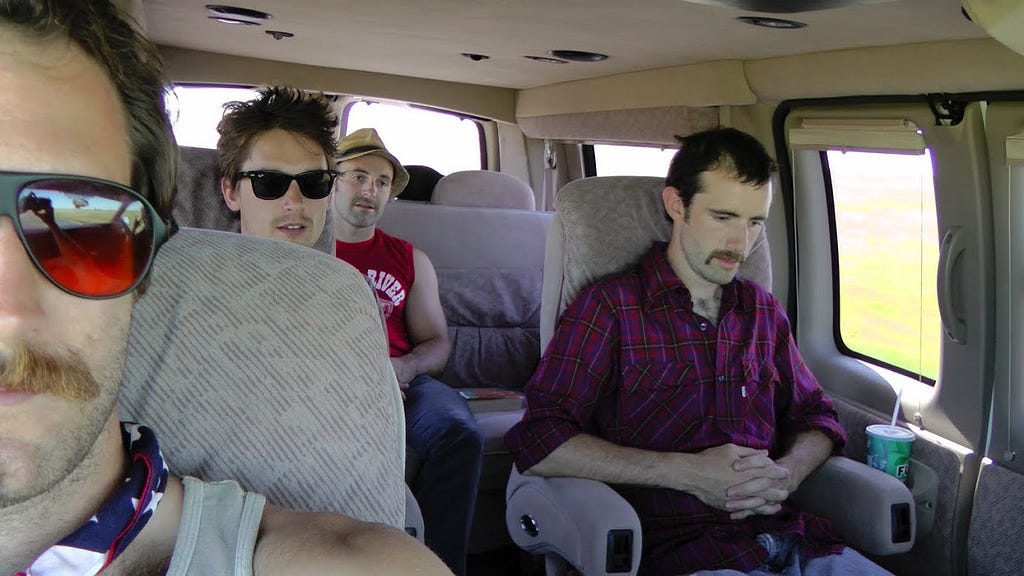
A month after leaving Rolling Stone, I took a road trip with three of my long-time friends from Minneapolis. We drove west from the Twin Cities to meet more friends scattered across the Rockies. I don’t know if the trip had any particular meaning for them. But for me, it was a time to decompress and cleanse myself of the five years that I had just wasted sitting tense behind a computer at Rolling Stone.
Photo courtesy of Eric Magnuson
After the first day’s 12-hour drive in our rented conversion van, my friends and I stood on a gravel road cutting down the middle of a Nebraska cornfield. By July, the stalks rose high above our shoulders, swaying like silk handkerchiefs beneath the night sky. Before moving on, we needed to piss or smoke weed or both. But I’d stepped out of the van at 9 p.m., stretching my legs as if I’d just stood up from another incredibly long day at Rolling Stone, and I cheerfully cursed the same way that I might if I’d never seen rain or snow.
I’d stepped out of the van at 9 p.m., stretching my legs as if I’d just stood up from another incredibly long day at Rolling Stone, and I cheerfully cursed the same way that I might if I’d never seen rain or snow.
The sky wasn’t sequined by only Ursa Major or Ursa Minor. Nor was it only Cygnus’s beak or Sagittarius’s bow and arrow. The arena of blinking constellations lit up the mosquitoes bobbing around our heads.
While looking straight up at the stars, I jogged across the dirt and gravel with my arms spread out as if taking flight. After living six years among the artificial lights of New York City, I wasn’t the least bit sarcastic or even stoned when I said, “It feels like traveling through space.”
June 2006
After a year at Rolling Stone, I was anxious to move on. I wasn’t writing for the magazine. I was still fact checking. I was only freelance without any security. But I had done something rare in the research department: I had gained the trust of the national affairs editor Eric Bates. I was fact checking most of the magazine’s political coverage, and Bates had a big assignment for me: I’d contribute research and fact checking to a massive story by Bobby Kennedy Jr. that purported to uncover how the 2004 presidential election was stolen by Republicans.
I had done something rare in the research department: I had gained the trust of the national affairs editor Eric Bates.
It was a major project. One of our national affairs writers was also assigned to the task. After Bobby handed in the article, we worked for four months to clean it up and provide substantial additions to the reporting. I was essentially told to make it better. I wasn’t, however, really made aware of how extra research was needed because Bobby’s previous story was a mess. In the weeks before I began working for Rolling Stone in 2005, Bobby had written a terrible article connecting autism to vaccines, which was simultaneously published by Rolling Stone and Salon. The list of corrections and clarifications that it led to was laughably long. (Salon, unlike Rolling Stone, later retracted the story.) I was never told this but Bobby essentially needed a babysitter on his new article. That’s not how I felt, though. I felt like I was being given a truly important assignment — working with a Kennedy no less.
The article covered a wide array of malfeasances, from shoddy electronic voting technology to voter suppression in its many forms. It was enough to make most observers say that the country’s elections needed better oversight. But an odd thing happened as we inched closer to our June publication date: 350,000 suddenly became the magic number. That was the number of uncounted Ohio ballots that we needed to tally in order to say that, if counted, the election should have tipped to Kerry instead of Bush. So rather than focusing on the glaring tools of suppression that definitely needed to be addressed, we were suddenly trying to figure out how to come up with that specific number. We did this in as many roundabout ways as we possibly could. If Bates wanted 350,000 votes, we were going to find them.
If Bates wanted 350,000 votes, we were going to find them.
Nearly as soon as the article went to press, however, Farhad Manjoo wrote a Salon article that eviscerated every vague word choice and piece of half-baked logic that we tried to pass off as fact. One of the most glaring discrepancies in the article was when we wrote, “a total of 72,000 [Ohio] voters were disenfranchised through avoidable registration errors — one percent of all voters in an election decided by barely two percent.” That number wasn’t wholly invented on our part. A report by the Greater Cleveland Voter Coalition did say that about 42,500 votes “may have been lost” across the state. But in our quixotic search for the magic number, we also included 30,000 votes that the report said were only “at risk” of being lost. So nearly half of those voters weren’t disenfranchised. Perhaps they were at risk of being disenfranchised. But who knows? I personally didn’t care about the magic number. The other voting oddities made the article important. The number, however, was what ended up on the cover of the magazine.
The print magazine never addressed the discrepancies outlined in Manjoo’s Salon article. I was racked with so much stress over Bobby’s story that I never even read Manjoo’s article in full until I did research for this essay. As the letters poured in from across the country that month, my second self constantly clogged my throat, constricting tighter any time the article was mentioned.
At one point, reporters from a major Nevada newspaper wrote to question info about their state that we’d included in a sidebar. In a last-minute addition to the story, we said that “the state’s two most populous, Democratic-leaning counties recorded no presidential vote on 10,000 ballots.” That would be a lot of people showing up at the voting booth in a presidential election only to not actually vote for president. The Nevada journalists said that they hadn’t heard of any such issues. The U.S. Election Assistance Commission, for example, found that Nevada counted only 1,976 such votes statewide, which might sound like a lot but it certainly wasn’t 10,000 in two counties.
I’m not sure how I let the much larger number into the story. A Nevada citizen had brought a lawsuit that included the number. But I had no idea where she was getting it herself. I tried reaching out to her without success. But Bates did not want to run a correction. He told me to keep searching. I was tasked with finding a source that would make the number real. And this is the mentality that would slowly become my mantra. Anything could become true if you made it true.
I was tasked with finding a source that would make the number real. And this is the mentality that would slowly become my mantra. Anything could become true if you made it true.
But I hadn’t yet fully succumbed to it then. After much more research and a growing panic, I went to Bates again and apologized. I couldn’t make the number true. So I was given the fact checker’s most dreaded task: He told me to write a correction. My heart sank. I couldn’t believe that one of my articles would need a correction. And it was an article that I worked so hard on, contributing a swath of new reporting. I was more than just a fact checker in this story. But in the end, I had only one job. I had to be right. And I was wrong. So I wrote up the correction.
Looking at recent corrections printed by the magazine then, I decided to end it by writing, “We regret the error.” When I showed the correction to Bates, he told me to cut that line. We apparently didn’t regret the error. After a few more hours of fearing that I’d be sent back to the dregs of American Idol articles, I learned that the entire correction had been cut from our Letters page. It wouldn’t show up online either.
I could not make the number true on my own. But a higher editor had. We ran no corrections in relation to Kennedy’s piece. I realized that facts didn’t always need to be true.
July 2010
“It does!” my friend Chris said as he tilted his head back in the middle of the Nebraska night. He softly jogged between the rows of corn under the blanket of constellations. “It does feel like being in space!”
April 2007
Despite my “clean” record, the fear of publishing a correction grew overbearing in my five years at the magazine, so much so that all possible errors, no matter how mundane, became equal to me. It didn’t matter if it was correctly spelling Lil Wayne’s name without an apostrophe or triple-checking that a public figure truly said something potentially slanderous in our pages. Fact checking, or needing to be right, or at least believing to be right at all mental costs at every hour, created such enormous stress that I largely grew blind to any actual reality around me. Journalism, by its very nature, pushes people toward this sort of detachment. It encourages people to approach life in ways that most professions — or at least decent people — would never accept.
Fact checking, or needing to be right, or at least believing to be right at all mental costs at every hour, created such enormous stress that I largely grew blind to any actual reality around me.
In 2007, I worked on an article by Erik Hedegaard, a reporter who primarily did stories on celebrities, like Robert Downey Jr. or Carrot Top. But for some reason he decided to do a feature on E. Howard Hunt, a controversial figure in America’s Cold War-era spying world who supposedly knew WHO REALLY KILLED J.F.K.
The article ended with the not-at-all-likely conspiracy theory that Lyndon B. Johnson ordered Kennedy’s assassination. Two years into my tenure with Rolling Stone, I was well-acquainted with the magazine’s relationship with facts. But I wasn’t yet prepared to let an error onto the page. The L.B.J. theory was one thing but Hedegaard had at least attributed it to somebody. That wasn’t even the weirdest thing about the story:
The article also included a strange anecdote about the actor Kevin Costner offering to pay Hunt for the truth about Kennedy’s assassination. Costner had supposedly been in contact with Hunt numerous times. The actor even visited the former spy’s home in the hopes that he’d be able to finally extract this incredibly important correction in American history. But the anecdote had come solely from Hunt’s son. Hedegaard never attempted to confirm it. He merely left it in the article as if it was fact. He didn’t even attribute it anyone. So I thought, What the hell? Let’s see if Costner has anything to say about this.
I sent Costner’s people a list of questions about the anecdote that I hoped to confirm.
Catching me completely off guard, the actor actually called me after receiving the questions. He said he wouldn’t comment on them and went on to make a somewhat serious threat about “severe consequences” if we printed anything untrue about him. This was highly atypical of a celebrity. Usually an actor would just say “no comment” through their publicist. So perhaps he was being weirdly paranoid. Or maybe he was just bored that day. But unlike a normal adult who’d respect what would be a reasonable request in other circumstances, I continued to harass him:
“So you’re saying that this story is untrue?” I asked.
“I’m not commenting on that. I’m saying that if you print anything false about me, there will be consequences.”
“So you’re saying that the story is true?”
“That’s not what…”
“So parts of it are true?”
July 2010
Our van careened down the western slope of the Rocky Mountains a day after leaving the Nebraska cornfield. Chris pressed the accelerator, sending the speedometer over 85 miles per hour, swerving in and out of slower traffic down the steep interstate. A metal guardrail lined our right side, flush with the edge of the narrow lane. Past that cliff stood rows of pointy green fir tops that were rooted far below us. Iggy Pop and the Stooges blared from the speakers: The tin-can lead guitar of “Search and Destroy” kicked back and forth from my passenger-side door back to the rear end ten feet behind. The friends who were spread across the backseats seemed unaware of how many times we could have landed in a hawk’s nest or been impaled by a Colorado pine. Chris noticed me looking at the speedometer.
“Vince says we gotta get to Hotchkiss by three,” he said.
“Why three?” I asked.
“Tibetan monks.”
“Tibetan monks?”
“I have no idea.”
2007–2008
In 2007, I was finally offered a full-time job as an assistant editor. The managing editor Will Dana approached me at my desk. He had a big goofy grin on his face, and said, “Do you want a job?” as if it was going to be the best news I’d ever heard.
But I looked up at him and said, “I don’t know.”
He walked away as if I’d just ruined his day.
Admittedly, fact checking for the magazine did at least lead to good stories to tell people. I once spoke to Cormac McCarthy, who was so wonderfully reclusive that when I told him, “It’s an honor to speak to you,” he nearly said the same thing to me until he realized that he was Cormac McCarthy. For another story, I spoke to Heidi Fleiss, the former “Hollywood Madam” who made headlines in the 1990s. Based on my speaking voice over the phone, she told me that I should fly to Nevada and be a prostitute at a new male brothel that she was planning to open. And then some days I’d come into the office to see The Band’s Robbie Robertson with his feet up on the desk at another cubicle.
I once spoke to Cormac McCarthy, who was so wonderfully reclusive that when I told him, “It’s an honor to speak to you,” he nearly said the same thing to me until he realized that he was Cormac McCarthy.
But fact checking at a pop culture magazine like Rolling Stone provides a different type of stress every issue. Sometimes you need to talk to a famously difficult scientist who refuses to dumb down any of his work for a popular readership (or for the fact checker who’s at least trying to be dumbed down right). Sometimes a Pentagon spokesperson doesn’t want to admit that the crew on a multibillion dollar defense shield uses Adirondack chairs on top of the thing. Sometimes the reporter can’t remember the restaurant that he ate at with Zac Efron. He tells you that all he can remember is that it was on L.A.’s Riverside Drive and a Bob’s Big Boy was across the street, and this is still a couple years before every single restaurant is on Google Maps, so you’re stuck calling the manager at Bob’s Big Boy, asking if there’s a diner with a green awning across the street, and even after you track the place down, you realize years later that you spelled the diner’s name wrong.
But sometimes you feel like you’re doing incredibly important work, so the stress is worth it. Sometimes you work on a Matt Taibbi article about wasteful defense contractors in Iraq that feels so necessary that for a moment, you believe in the power of facts, that they could change, say, the direction of a war. They don’t. But you believe it at the time. At least you do until the next issue when Taibbi writes a story with the following lede: “Quietly and miserably, like an anxious mother tiptoeing away from an autistic child who has fallen asleep with his helmet on…” And you wonder how you could have ever been so naïve.
But sometimes, in exceedingly rare moments, you realize that the “facts” in these articles aren’t just entertainment to everyone. They aren’t only filler between ads. I worked on a story that documented the deaths of eight soldiers who had served in Iraq or Afghanistan. Again, this was a story written by a reporter who didn’t normally cover politics. The reporting was generally sub-par. So I ended up speaking to the families of nearly all of these men and women, going over the excruciating details of their short lives. I’d listen to these mothers and fathers tear up, one after another. But they each got through it. They all wanted the story to be told. And they wanted the story told right. When I returned home to my Brooklyn apartment on those nights, I completely broke down, crying on my bed, feeling helpless to do anything.
They all wanted the story to be told. And they wanted the story told right.
That might have been the last time that I full-heartedly cared about facts.
July 2010
Our van wound along the narrow county roads that twisted through the mountains and hills leading to Hotchkiss, Colorado, population 944. The music shouted over us, none of us saying a word as we barreled into our friend Vince’s hometown. The tires squealed as we cut corners. The guys laughed out of excitement and nerves. We plunged into Hotchkiss’s tiny downtown, circling its few blocks for the Creamery Arts Center, where Vince told us to be by three o’clock. It was 3:05.
Chris parked the van askew. We ran to the Creamery’s front door, bursting in as if searching a burning house for children, and found an incredibly crowded but completely silent hall. We turned heads with our laughter until we realized that we were ruining the quiet. A third of the town’s population — sun burnt men and women with starkly blue eyes who wore southwestern patterns — quietly waited as nine Tibetan monks slowly filed into the room.
2008–2009
I could make a simple graph that charted the trajectory of my career at Rolling Stone alongside my belief in facts. The line charting my years at the magazine would consistently go up at a 45-degree angle, of course. The line charting my belief in facts, however, would start high but consistently go down at a 45-degree angle. The midpoint of that graph, the dead center of the X, came along with one of our features reporters.
When fact checking a piece that he wrote on the War on Drugs, I turned up information from his sources that was so drastically different from what he originally reported, that Bates felt obligated to give me a research credit on the story — a rarity at Rolling Stone. In a story about a flawed medication, the reporter actually invented dead bodies. He wrote that numerous corpses had been found neglected in the basement of Danvers State Hospital in Massachusetts. This wasn’t true at all. The closest corollary that I could find was a hospital in Salem, Oregon, that had retained urns full of ashes of its unclaimed deceased patients. I’m not sure how he got his information. Another fact checker told me that he said he only dreamed something that he put into another one of his articles.
…it’s impossible to fact check a dream.
Despite this, he continued to write for the magazine. It was infuriating because it’s impossible to fact check a dream. You inevitably waste hours searching for something that never even existed. But by the midpoint of my time at Rolling Stone, I realized that good reporting didn’t make a successful reporter. You just needed to be able to present things in a way that would be interesting — perhaps it could even be turned into a fictional movie.
July 2010
The Tibetan monks circled a table displaying a sand mandala that they’d meticulously created for a week in this tiny Colorado town. The monks wore orange and maroon robes. Their hats spiked over their heads like yellow mohawks. One of them began throat singing: The ominous grumble forced from his mouth sounded like a bullfrog bellowing into a didgeridoo. The others rhythmically chanted along. In finely timed flourishes, each introduced a new instrument to the song: a drum, cymbals, six-foot-long horns that reverberated into the floor, more horns sounding like trumpets. The mandala’s red, blue, and green sands glittered between them.
Photo courtesy of Eric Magnuson
Tibetan Buddhists believe that deities are present in the sand, and the artwork is supposed to convey positive energies to the community viewing it. But as soon as the instruments were put aside, one of the monks revealed a hand brush and hunched over the sand. He slowly swept away the intricate designs of the mandala, letting days of work disappear with small flicks of his wrist.
2009
By 2009, my fourth year at the magazine, I was in a strange stage with my relationship to facts. The stress of being right all of the time never really abated. But I also didn’t really see the point in anything that we were doing. I needed to be right in order to continue receiving paychecks. But I hated my job. So I began to shut down, largely becoming unfeeling, completely indifferent to anything. This affected more than my work life. I was finally dating a woman who had been my dream girl since 2001 — but I broke up with her because I had very little grip on reality. I drank more than usual. I’d worked on so many stories about other people that I didn’t really know who I was anymore. I certainly wasn’t a journalist but I’d played one for many years.
I’d worked on so many stories about other people that I didn’t really know who I was anymore.
I worked on Matt Taibbi’s infamous Goldman Sachs article where he equated the banking giant to “a great vampire squid wrapped around the face of humanity, relentlessly jamming its blood funnel into anything that smells like money.” I didn’t think that the joke would work because the vampire squid doesn’t actually have a “blood funnel.” I told Taibbi this. Certainly the marine biologists would write in. But he didn’t really care. I told the editor, Bates again, the same thing. But he may have cared even less. Perhaps it was obvious that the vampire squid didn’t have an appendage as ridiculously named as a “blood funnel.” Bates seemed surprised that even the “vampire squid” was real. But I was beyond jokes at that point in my career. I was only droning along, waiting for each day to end. But then there’d just be another day.
July 2010
With the mandala’s sand swept into a small pouch, the monks led everyone in the room out the front door and into the sun. A couple hundred people casually walked down the town’s main street, filling both lanes as the monks continued playing their drums, cymbals, and horns. My friends and I followed along, grinning over what we’d stumbled upon as the monks led us down to the North Fork Gunnison River, a thin waterway that bubbled westward.
June 2010
“What do you think is going to happen to him?” Michael asked me.
Who could have guessed that my last assignment for Rolling Stone would actually be one of those very few articles that truly changes the course of history, the type of thing that I’d wanted so badly five years earlier?
I was so misanthropic that I wasn’t even aware of it.
I was primarily annoyed with the article. Working with Michael did not go smoothly. A responsible reporter sends all of their relevant notes to the fact checker. If somebody at Rolling Stone considered how inflammatory the comments would be, there probably should have been interview transcripts. Michael sent me a couple of notebooks that were half-full of indecipherable scribblings that needed a Rosetta Stone for translation. This is odd considering how he later wrote in his book The Operators that after his month with McChrystal, he had “seventy pages of single-spaced notes [and] over twenty hours of audio recordings.” I never saw any single-spaced notes. When I asked him for the audio, he refused to send it, telling me that it would be impossible to go through all of it in time prior to our deadline. Though he managed to go through it all himself when writing the article in 48 hours and sending it to Bates, as he notes in The Operators.
After a raucous night in Paris described in the article, Hastings also writes in The Operators that upon returning to his hotel, he “typed up what happened that night, down to the last detail.” I never saw anything written in detail. I vaguely recall seeing the word “AFGHANISTAN!” written in his notes, but like nearly everything, there was no context around the word. The capped name could have meant anything. That was the case with nearly all of the quotes, at least the quotes that were legible in his notebook. Most of them were not. Did the notebook say “Bite Me”? If it did, it wasn’t clear to me.
It was my last assignment. I wouldn’t need to fact check anything again. What did it matter if the quotes were accurate?
But whatever. It was my last assignment. I wouldn’t need to fact check anything again. What did it matter if the quotes were accurate? Almost as an afterthought, I sent McChrystal’s spokesperson a list of details that I wanted to confirm.
But when I woke up on the morning after the story had leaked to the media overnight, the spokesperson was already fired for letting the general seem so careless in the press. Within hours of the leak, McChrystal was called back to Washington by President Obama.
I was internally panicking. I had no idea if the quotes were true. I could already envision myself testifying in court due to a defamation case. Bates wanted me to come into the office as soon as possible.
I ticked off the minutes of the day, waiting for McChrystal to deny everything said in the article. I knew that something must be coming: My last assignment would be a grand fuck-up that nobody could have predicted, no matter how apathetic I’d become.
But as the day wound to a close, McChrystal never denied the major details. He actually issued an apology. I thought that I was going to collapse at any moment. Perhaps Michael was as well. In The Operators, he also notes how “they weren’t denying it… By apologizing, they had confirmed the validity of the story. I was relieved,” which is a strange thing to admit if he was certain about the story himself. Why would they deny it if he’d done diligent reporting? But Michael went on to cover for himself, saying that a denial “would have been difficult to do anyway because of the tape recordings and notes I had of the interviews.” Though he wouldn’t even let me, his fact checker, see or hear the majority of those records.
It was a terrifying and exciting week. In Kandahar on another assignment, Michael was supposedly getting absurd warnings from friends about how Americans “might try to take” him out. While sitting in the stands at a Mets game on the following Saturday, my coworker and friend Meredith sent me a text saying that my list of questions had been leaked to the Washington Post. The newspaper actually published all of them on its website. I immediately panicked but I didn’t even have a smartphone so I couldn’t look them up.
“Is it bad?” I texted back. My three friends next to me immediately pulled out their phones as I cringed over what they might say. “Does it say my name?” I asked, trying to not become frantic.
I had made a national news headline: “Rolling Stone fact checker sent McChrystal aide 30 questions.” But to my relief, the article didn’t name me. It barely contained any information outside of the email exchange with McChrystal’s aide. It only said, “The questions contained no hint of what became the controversial portions of the story.” This can be read two ways: 1.) I’d either pulled off a sly journalistic move to cover our intentions, or 2.) I simply didn’t care enough about the article to run some of the info by the spokesperson.
I had made a national news headline: “Rolling Stone fact checker sent McChrystal aide 30 questions.”
Rather than deny the comments in the article, McChrystal resigned from his post. I couldn’t believe it. I’d somehow taken part in one of my biggest goals as a naïve journalism student years earlier. But I’d droned through it like it was the most useless white collar work imaginable.
By the day that my email had leaked, however, I did feel something like a celebrity. I obnoxiously told my parents, “I’m the most famous fact checker in the world.” I went to Meredith’s apartment to celebrate her birthday with friends. The place was full of leftwing journalists. Some reporter with military contacts approached me to say, “The Army hates you.” Apparently the entire Army, if that’s possible. Some of us drank Bud Light Lime, mocking McChrystal’s favorite beer. At least we said it was his favorite beer in the magazine. Talking to his press aide, that probably wasn’t exactly true. But that detail was funnier so we left it in.
All three of us — Hastings, McChrystal, and I — knew to some extent that there was no such thing as a fact. Humorously, McChrystal notes in his memoir My Share of the Task that on the night of the story’s leak, he was actually at a meeting attended by both Eikenberry and Holbrooke, the two men who he’d disparaged in the article. McChrystal obviously doesn’t rehash any of those comments in his own book. For his part, McChrystal dedicates little more than a page of his 452-page memoir to the downfall precipitated by Rolling Stone. Michael Hastings is never named in the book.
All three of us — Hastings, McChrystal, and I — knew to some extent that there was no such thing as a fact.
McChrystal shapes his own narrative: “With us would be a reporter from Rolling Stone who was periodically interacting with our team, to give him an appreciation for the difficulty of the task they faced.” From McChrystal’s perspective, his team had a difficult task. That’s all they had to show the reporter. There is no reason for him to remember any other narrative. Nobody reading only his book could remember anything different.
July 2010
In Tibetan folklore, a creation myth says that the stars first appeared in the sky “because of the past good deeds of the gods.” Along with the sun and moon, the constellations are a reminder that “our world was once a peaceful, beautiful place, free from suffering and pain.” Elsewhere, the Dali Llama emphasizes how the Buddha taught followers to have a “correct view of reality.”
I barely knew Michael but I’d later learn that we each suffered the same pain — the overbearing need to find reality.
June 2010
My future wife’s mother asked her, “Are you sure he’ll still want to quit after all of the excitement?” Bates said, “People think it’s crazy that you worked on this and you’re just going to stop now.” Michael went on to be fairly famous. He made numerous television appearances, talking about and often defending the story. He went on to write more damning reports on government officials, the types of things that likely created a torrent of anxiety that, in my opinion, wasn’t balanced by the journalistic payoff. McChrystal largely went quiet for the next year, waiting out the storm. A couple months after leaving Rolling Stone, I briefly became a cheesemonger.
Despite my one connection to McChrystal, I liked him after reading his memoir. I was largely indifferent to him in the week that I was first acquainted with his life. But after seeing his side of the story, he was more than a drunken buffoon gallivanting across Europe. He was an intelligent man. A man who cared about the soldiers working for him. A man who obviously faced an unwinnable battle and sometimes needed to blow off some steam over the decisions he wasn’t able to make himself. He was every single person who’s ever had a boss.
“Life would go on,” he wrote in My Share of the Task. “In April 2011, the Department of Defense inspector general’s office would release a summary of its review into the allegations outlined in the Rolling Stone article. The investigations could not substantiate any violations of Defense Department standards and found that ‘not all of the events occurred as portrayed in the article.’”
Michael, however, wrote that the report “reads comically,” and went on to deride its inconsistencies. He particularly disliked how the report stated, “We were unable to establish the exact words used or the speaker.”
But here’s the thing: Neither could I. Considering my experience, that line sums up the incidents better than anything else I’ve heard. The article may have given Michael’s interpretation of his time with McChrystal. But who knows what’s completely true?
“These conclusions came out quietly,” McChrystal continues, “almost a year after the tornado of controversy the article created, but they were important to me.”
And why wouldn’t they be important to him? McChrystal gets to have his truth. It might not be what everybody remembers. But who really remembers Stanley McChrystal anymore? Brad Pitt’s upcoming straight-to-Netflix movie based on Michael’s book doesn’t even use McChrystal’s real name. My mother-in-law sometimes sends me articles on Gen. David Petraeus, mixing up the two men and their indiscretions. And I recently saw a teenage girl on a field trip at an art museum: She wore a t-shirt that had a picture of the Rolling Stone cover with the McChrystal story. Lady Gaga stares across the page, the two machine guns violently pointing from her breasts like a nightmare. The girl wearing the shirt likely had no idea what the words “Obama’s General” in the bottom corner of the cover meant as she must have been no more than seven years old when the story appeared. The facts matter very little in the end.
McChrystal gets to have his truth. It might not be what everybody remembers. But who really remembers Stanley McChrystal anymore?
The copy of McChrystal’s memoir that I checked out from the San Diego Public Library happened to be a copy signed by the general himself. The signature couldn’t convince the book’s original owner to save it on their own shelves. In the end, most of us are the equivalent of that unloved memoir. We believe in something so wholeheartedly that we’ll tell the story until it is true. Some of us will even publish those “facts.” We’ll even sign our names, saying, This is who I was. But in the end, even those versions of the truth will be lost with so many other unread books. That isn’t necessarily something to be sad about.
July 2010
Everyone crowded around the monks as they concluded their ceremony. People pushed through thorny scrub brush lining the river. Others stood on a low bridge that barely cleared the water. Children climbed trees to see from above. While some of my friends stood farther back on shore, I made sure to stand where the water met land, getting a clear view of the robed monks at the river’s edge. The sun warmed my scalp as I freed myself from the brush and trees looming overhead.
A single monk stood ankle-deep in the river, wetting the ends of his robe. I watched him slowly shake out the colored sands from his pouch. The grains poured into the water, slipped and slid over each other, and drifted free.
Today
Michael Hastings is dead now. On June 18, 2013, at 33 years old, he sped through Los Angeles in his Mercedes, launched over a median, smashed into a palm tree, and was trapped in a fireball when his car exploded at 4:25 a.m.
I didn’t really know Michael outside of Rolling Stone. But he was apparently “paranoid by nature,” as he notes in The Operators. In the book, he goes on a long tangent imagining how a woman at a bar in Berlin is likely a spy trying to extract information from McChrystal and his team. “The idea that this woman might be a spy — sent by a foreign intelligence agency to snoop on General McChrystal — seemed both dangerous and hilarious.” The paranoia, however, seems to have fallen more squarely into the former category in the year leading up to his death. His stories’ subjects had reportedly made him increasingly paranoid. According to a New York magazine article, Michael told a neighbor that he’d noticed more helicopters flying over his house than usual. He said that his family and friends were being interviewed by the FBI. He told one employer that he needed to hide for a while.
When Michael asked me “What do you think is going to happen to him?” I honestly believed him for three years when he agreed with me. It’ll probably just be a slap on the wrist. Even in his book, he repeats what he essentially told me: “I didn’t think it was possible for him to be fired. No way.” But after learning more about Michael, my memory of that conversation doesn’t make him sound so sure. He sounds worried. He doesn’t know what’s going to happen to him next. Knowing what I know now, both about Michael and my own experience, I wonder if the assignment had created so much stress for him that he just wanted somebody to say that everything was going to be okay — that the career that he’d built for himself wasn’t going to be swept away. But as a journalist, that’s exactly what I needed.
Few contemporary writers are called upon to render opinions more often than author Roxane Gay, a consequence of amassing a readership through, among other ways, critiquing the culture at large with generous, entertaining essays, independent of the topic. To Gay, the Fast and the Furious movie franchise is as worthy of intellectual consideration as any obscure tome exhumed to brace esoteric points. Gay is always relevant and often correct, which not only explains, to some small degree, her popularity among fans across genres and aesthetics — from her new Marvel comic to co-writing a film adaptation of her debut novel — but also makes her opinion a highly-desired commodity, even if the matter at hand is of little significance or relevance to Gay. This leads to miscommunication, for lack of a better word, played out within Gay’s Twitter timeline, where fans and trolls alike commune for kind words or invective or impromptu requests for some kind of labor — intellectual, literary, even emotional — offering to young writers a glimpse of what literary stardom looks like, the necessity to remain, with restrictions, accessible to fans while protecting one’s private life.
Following the critical and commercial successes of her debut novel, An Untamed State, and her essay collection Bad Feminist, both published in 2014, Gay returns with Difficult Women, from Grove Press, a collection of short fiction that solidifies Gay as a writer just as committed to technique as she is to storytelling itself. The book includes the seminal stories “North Country,” “I Am A Knife,” and “Break All The Way Down.” Each word and every sentence in Difficult Women invites instead of repels the reader. Her erudition and ardor always strive for connection, and her blunt stories are anchored by curiosity and emotional depth while avoiding the maudlin, or needlessly grotesque plots. I spoke with Gay via email about Difficult Women, the short story form, her writing life, and the challenges of completing her new memoir, Hunger, due later in 2017.
Mensah Demary: “I Will Follow You,” originally published by West Branch, and again in Best American Mystery Stories, begins Difficult Women, a collection of realist yet vibrant stories of women and their lives, seen from their perspectives, told in their voices. It’s a disquieting story about two sisters and the trauma they both shared and endured. Why are they difficult women who, as written in the epigraph, “should be celebrated for their very nature”?
Roxane Gay: I don’t know that they are explicitly difficult women. The collection gets its title from one of the stories and certainly, many of the women in the book are difficult in one way or another, but not all. The protagonists in “I Will Follow You,” are, more aptly, women who have faced difficulties.
Demary: Many of these stories were published prior to your debut novel An Untamed State, soon to be adapted into a film, and Bad Feminist, the New York Times bestselling collection of essays. The stories are fresh and relevant to readers, and you’ve written quite a bit since they first appeared. Do the stories still feel fresh and relevant to you, the writer? Should such a question be of any concern to a writer?
Gay: I’ve long thought that most writers write the same story over and over, and certainly, in my fiction, there are some prevalent themes. When I re-read the stories in Difficult Women, there is a sense of being at home. I know these women and I know their hearts and in that, they are always going to feel fresh and relevant to me and hopefully my readers. The question I concern myself with is not if a story is relevant, but rather, if a story is both timely and timeless but that concern comes when I am revising. When I sit down to write, I just sit down to write what’s burning in my fingers.
Demary: Bad Feminist introduced your nonfiction to thousands, but many readers will be introduced to your short fiction for the first time with Difficult Women. Often, readers presume fiction to be a set piece for actual memories, or lived experiences. To what extent does this presumption prevent the reader from experiencing a short story as art, that is, as valuable independent of the story’s materiality relative to reality? Have readers forgotten how to enjoy a short story for its own merits, its imagination?
Gay: I’m not sure I understand the question. Readers often assume fiction is thinly veiled autobiography. They assume there is no art or craft to fiction. Those presumptions make for an impoverished reading experience. I cannot imagine thinking so little of a writer’s capacity for imagination. Alas. Some readers have forgotten how to enjoy a short story without obsessing over a story’s “truth” but not all and it’s our job as fiction reminders to continue to remind readers that fiction is fiction is fiction. The story is not about the writer at all.
Demary:Difficult Women’s titular story succeeds as it plays with roles assigned to women: “Loose Women” and “Crazy Women” act as sub-classifications further explored via vignettes entitled “What a Crazy Woman Eats” or “How She Got That Way.” The story is disinterested in edifying those who perpetuate these roles, caring more for reclamation and redefinition of language as it relates to women. The titles of your books make the same in-roads to this reclamation. Can a difficult woman be a bad feminist; do the ideas intersect in your mind? How should fans of your previous books approach Difficult Women?
Gay: Certainly, I am challenging the traditional idea of a “difficult woman,” much in the same way I challenge traditional notions of feminism with the phrase “bad feminist.” There are all kinds of intersections at play here. I don’t have any prescriptions for how fans of my other work should approach Difficult Women other than to read the stories with an open mind and an open heart and to recognize that as a writer, I contain multitudes and a very dark imagination.
I contain multitudes and a very dark imagination.
Demary: “Bad Priest” is a memorable story, and one of the earliest collected in Difficult Women, dating back to 2009, now a suddenly distant era. Father Mickey, a Catholic priest, and Rebekah, “a perfume girl in a department store who still lived with her parents,” have an affair: “The first time they fucked, they were in the church, and it was late — two in the morning.” Rebekah falls in love with Mickey but Mickey is preoccupied with himself, that is, with his soul in the eyes of mother and god. Mickey uses Rebekah to offload his shame. At what point does Rebekah get to deal and be present within her own life, absent the burdens of others, men, such as Mickey? When does a difficult woman get to drop her guard?
Gay: Why do you assume Rebekah isn’t dealing with her own life? In love, people often tolerate all kinds of bullshit. In “Bad Priest,” Rebekah is willing to tolerate Mickey’s self-absorption because she loves him and because, perhaps, she enjoys the taboo of having an affair with a priest. Rebekah isn’t passive in their relationship, nor is she naïve. I think Rebekah and Mickey see each other exactly as they are. Sometimes, that’s a relief.
I don’t know that a difficult woman ever drops her guard. She knows better.
Demary: Do you still write short stories? Are there collections you’ve recently enjoyed, or those that remain memorable to you?
Gay: I still write short stories. I will always write short stories. I’ve got a few I’m working on right now but sadly, I always have to put them at the back of the queue of what I’m working on. No one is ever clamoring for short stories from relatively unknown writers but that’s okay. I write them anyway. I recently enjoyed Always Happy Hour by Mary Miller and Homesick for Another World by Ottessa Moshfegh — both dark, strange, a bit uncomfortable, sexy. One of the most memorable collections remains How to Suffocate Your Own Fool Self by Danielle Evans. Each story in that book is exquisitely crafted. Whew. That woman can write.
Demary: Your Marvel comic, Black Panther: World of Wakanda, published its first issue in November, 2016. What has been the response, the feedback, from your readership, now larger and all the more diverse as many comic book fans read your words for the first time? What is it like to write a world populated and influenced predominately, if not entirely, by black women?
Gay: The response, so far, has been overwhelmingly good. I was really nervous about World of Wakanda because I am new to comics and I was writing into a really established canon but readers have been very generous. It’s exhilarating to write a world dominated by black women. We need more work like this, work where whiteness isn’t the default, and where it isn’t even something of relevance to the stories we tell.
Demary:In GQ, a article in conversation with John Malkovich advised against ambition as a motivating factor in every day life, and in art, dismissing it simply as “the need to prove something to others” and “a need for rewards outside of the work.” You’ve written about ambition before, and it appears as a theme more than once in Difficult Women. Can ambition distract at times from the work, in this case, the writing? How much does ambition motivate you toward new challenges, writing a comic book for the first time, for example?
Gay: Eh, people have strange ideas about ambition as a dangerous thing because they only want certain kinds of people (ahem) to be ambitious. I vigorously encourage women and people of color to be ambitious, to want and work for every damn thing they can dream of. We’re allowed to want, nakedly, as long as we’re willing to put in the proverbial work. Ambition is a distraction if it’s the only motivator. I am ambitious because I love what I do, not simply for ambition’s sake. Ambition is what allows me to take creative risks and try things I never thought I could do. Ambition makes me a better thinker and writer. Ambition makes me.
Ambition makes me a better thinker and writer. Ambition makes me.
Demary: Do you maintain a writing routine, a regiment perhaps forced due to workload, and if so do you work in time to write for yourself, to write something other than work assigned or commissioned by third parties? How often do you read for pleasure these days?
Gay: I have no real routine or regimen. Because of a very hectic schedule, I write when I can, where I can, as often as I can. I am writing this at 2 am at my parents’ house. My brother is snoring loudly two rooms away and I can hear him. Before I started tackling these questions, I finished the first draft of the screenplay for An Untamed State which I mostly wrote on a couch in Los Angeles and finished up here. Tomorrow, I’ll finish revising Hunger and work on my anthology Not That Bad which I hope to assemble and turn in by 1/3. I don’t really write for myself as much as I want but when I do, I write fiction. I try to make the time at least once a month. I read for pleasure quite a lot, pretty much on a daily basis, before bed, in the morning. I read a lot on airplanes.
Demary: Your first memoir, Hunger, also to be published in 2017, is highly anticipated; you revealed via Twitter some struggles in completing the book, and I imagine there is some trepidation in being so revealing of yourself for art’s sake, which makes me think you decided to write Hunger for reasons beyond yourself, for a goal other than personal catharsis. Should that be the goal of all memoirs, the reach toward the outside, toward other people, in spite of the form’s inherent insularity?
Gay: The vulnerability demanded by Hunger terrifies me so I have dragged my heels quite a lot. It will have delayed the book a year when all is said and done. I am, in fact, a very private person but I think it is absolutely necessary for more people to write about different kinds of bodies, the truth of living in those bodies, without necessarily framing those stories in narratives of triumph and conquer. So, yes, I am absolutely writing this book not just for myself, but for anyone, and especially any woman, who has struggled with trauma, being overweight, the cultural expectations we place on bodies, and the perpetual diet so many of us are on. Personal catharsis has nearly nothing to do with it. This is my first memoir so I would not presume to declare what the form should do but I believe all great writing looks both inward and outward.
Why is it that almost immediately upon falling in or out of love there is often a gravitational impulse toward music? Perhaps songs can speak directly to a person in thrall because they are usually in similar state, or perhaps musical fixations are just another side-effect of being temporarily insane. I cannot pretend to know, but I have made and been made enough mix tapes to know it is the closest thing to a fact of love, of which there seems to be so few facts.
A few years ago, I began to earnestly wonder about whether one could overlay a musician’s or writer’s or artist’s biography with their output and find the connections between their love life and their work. With the zeal of a conspiracy theorist, I began collecting stories about the personal lives of hundreds of 20th century artists, charting the connections of who slept with whom, who painted whom, and who wrote about whom. How many links were there from Miles Davis to Anaïs Nin? From Lou Reed to Josephine Baker? From Georgia O’Keefe to James Baldwin?
Eventually I realized what had begun a pastime had become a part-time job, so I turned to the artist Forsyth Harmon to organize and illustrate these strands of love and influence, and thus The Art of the Affair: An Illustrated History of Love, Sex and Artistic Influence (Bloomsbury USA) was born. Here are a few songs created by or about those featured in the book.
1) “Gertrude Stein” by Ed Askew
If we could give an award to the person in The Art of the Affair who knew almost everyone and facilitated countless relationships and alliances, the award would go to, of course, Gertrude Stein. I love the wide-eyed, dazed quality of this song by Ed Askew. Plus Alice Tolkas, Picasso and Dora Maar all get name-checked. Stories about all four made it into the book.
2) “J’ai deux amours” by Josephine Baker
Seemingly thousands of American artists and writers in the mid-twentieth century fled to Paris to escape boredom, racism, homophobia or all three. Josephine Baker was one of the many artists to do so.
The title of this song translates as ‘I have two loves,” though the song is not about one of Baker’s many affairs, but about her status as an ex-pat in Paris. Baker had an affair with Le Corbusier on a transatlantic journey, an alleged affair with Frida Kahlo when she visited Paris and was part of the inspiration for Coco Chanel’s use of menswear in her designs.
3) “Forbidden Planet, Main Titles (Overture)” by Louis & Bebe Barron
This may not seem like an overtly romantic track, but Louis & Bebe Barron, an under-appreciated pair of musicians from the midwest, basically invented electronic music with this album, a soundtrack to the 1956 film Forbidden Planet. Even after they divorced they kept working together. Bebe was also great friends with Anaïs Nin, a writer notorious for her well-documented liaisons.
4) “Ondine” by Lower Dens
The myth of Ondine, though told several different ways over the centuries, usually contains an element of a spirit or goddess becoming human through the experience of romantic pain. Also Ondine, the Andy Warhol super star, reportedly met Warhol at an orgy.
Andy Warhol at the Factory, 1966.
5) “Potato Head Blues” by Louis Armstrong & His Hot Seven
One of my favorite stories in the book is the incredible love and collaboration between Louis Armstrong and his second wife, Lil Hardin Armstrong. This track was also beloved by Armstrong’s fan and friend, Tallulah Bankhead, one of my favorite badly-behaved actresses of the twentieth century. She used to play it backstage before performances to psych herself up. Other backstage behaviors include causing a commotion with her lover, Billie Holiday, insulting Tennessee Williams while stark naked, and doing plenty of cocaine. Potato Head Blues! It’s a great song for all sorts of activity.
6) “Blue Room” by Miles Davis
Miles Davis produced some of his most iconic an moodiest tracks on the heels of his relationship with the French actress and singer, Juliette Greco. When Jean-Paul Sartre once asked Davis why he didn’t marry Greco, Davis replied he loved her too much to make her unhappy. American anti-miscegenation laws made their and other relationships of the time nearly impossible.
Miles Davis & Juliette Greco
7) “It Hurts Me Too” by Karen Dalton
We wanted to include Karen Dalton, an incredible and unappreciated folk singer who at one point had a relationship with Bob Dylan, but we couldn’t find the right way to tie her in. If you haven’t gotten to know her repertoire yet, prepare to be haunted. She’s one of the great forgotten musicians who didn’t even know they would some day be eligible for the Nobel prize in literature.
8) “Pablo Picasso” by The Modern Lovers
I’ve always loved this song, despite the fact that it’s about a bro complaining about how unfair it was that Pablo Picasso was popular with women and the singer, apparently, is not. “He was only five foot three but women could not resist his stare.” Jonathan Richman croons, “Pablo Picasso was never called an asshole.”
I don’t have a problem calling Pablo Picasso an asshole. He was, it seems, an asshole, but it does seem that had good taste in muses.
9) “Candy Says” by Lou Reed (live with Anohni)
We chose to end the book with a page on Lou Reed & Laurie Anderson, a pair who met later in their lives and married the same year that this rendition of Candy Says was recorded live at St. Anne’s Warehouse. Lou sings with Anohni (who then performed as Antony of Antony & the Johnsons), an ideal voice to evoke the story of Candy Darling, Lou’s muse for the song.
DON’T MISS OUT
Sign up for our newsletter to get submission announcements and stay on top of our best work.
YOUR INBOX IS LIT
Enjoy absorbing fiction from Recommended Reading on Mondays, strange, diverting work from The Commuter on Wednesdays, and a roundup of our best work of the week on Fridays. Personalize your subscription preferences here.







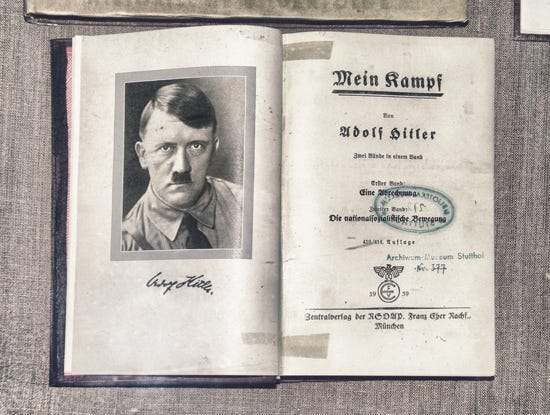

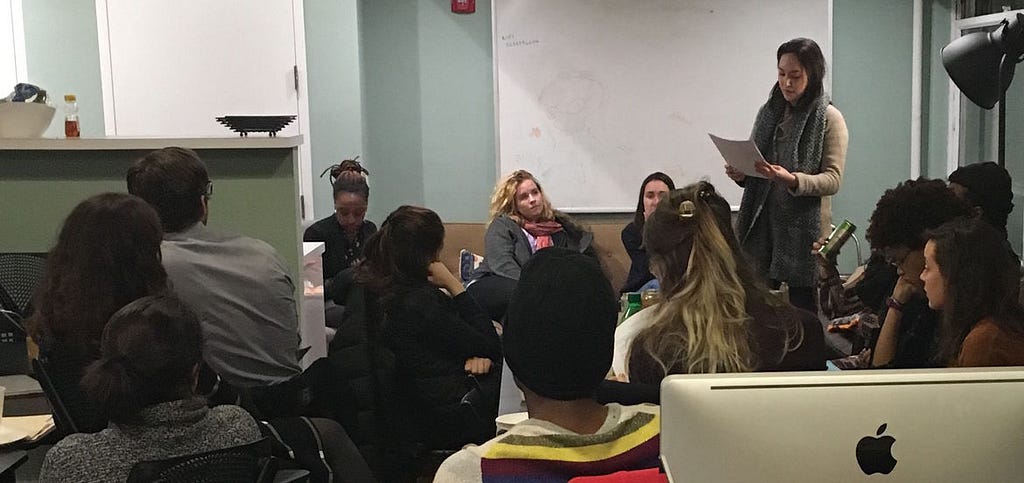


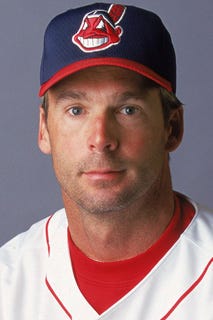
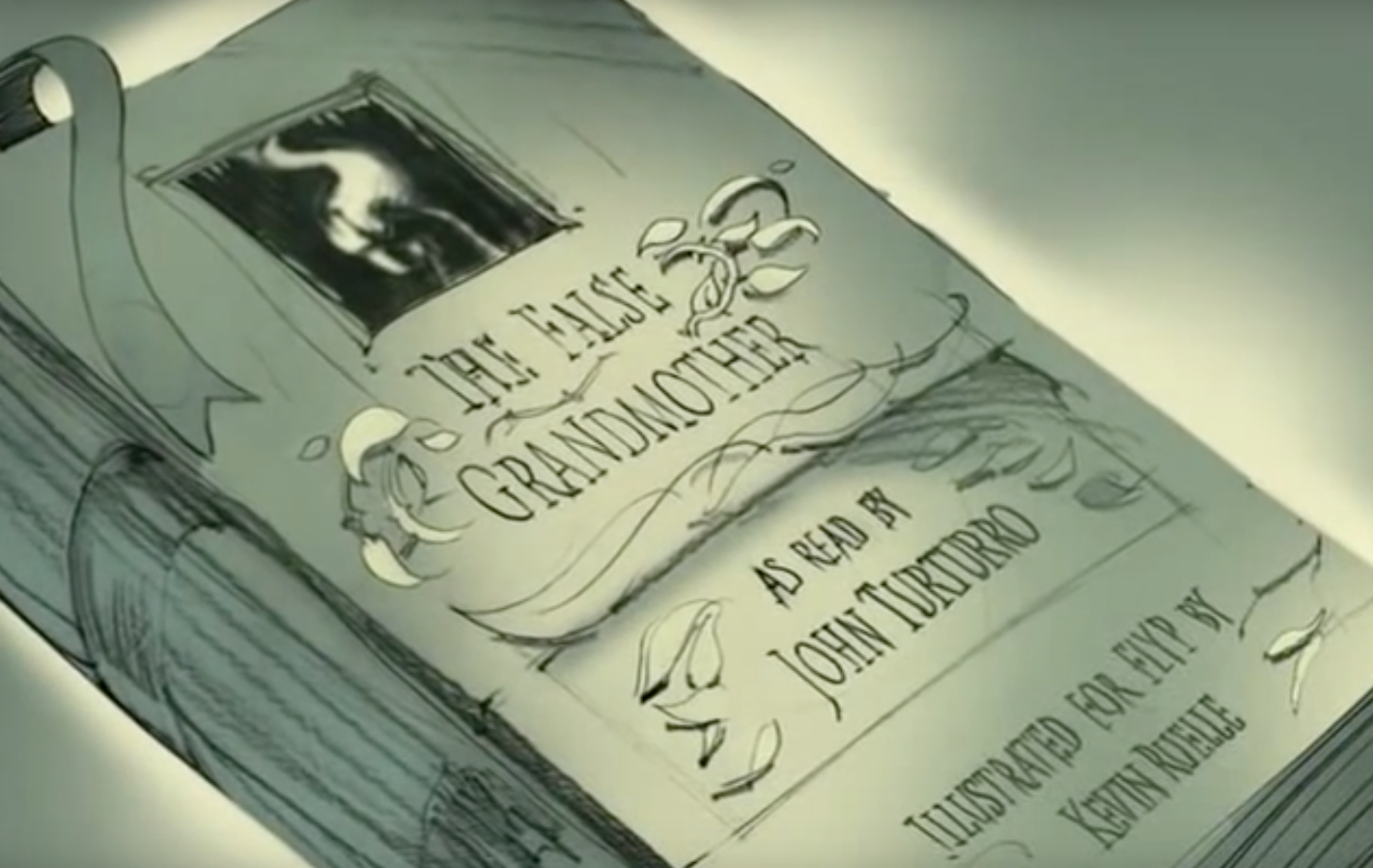

 Elsie Martin’s husband beat her unconscious because she called him twice for his dinner while he was talking to his brother. To be fair, she did not simply call him. She blew the horn of the Hiace van to summon him.