Mauro Javier Cardenas’s first novel, The Revolutionaries Try Again, links the stories of three graduates of San Javier, an elite prep school in Guayaquil. Antonio, Leopoldo, and Rolando were all once part of the same Jesuit volunteer group, all idealistic, all ambitious, and, by the novel’s start — and certainly by its finish — they all have had that idealism and that ambition suffocated.
But more interesting than any aspect of The Revolutionaries Try Again’s plot is its language, which also looks rather conventional, at first; then the sentences start to lengthen, and we run into Spanish phrases here and there, and some theatrical dialogue; by the end, the reader’s wavering between pages-long sentences and phrase-fragments cordoned off by dashes and slashes.
Cardenas seems to have telegraphed his influences. A quick Googling will unearth his interviews with literary heavyweights, particularly ones known for dense, monologue-driven novels, where politics press upon the lives of individuals: Laszlo Krasznahorkai (Hungarian), Antonio Lobo Antunes (Portuguese), Horacio Castellanos Moya (Salvadoran), among others. Enlivened by foreign influences — including those of its Ecuador-born author — the English of The Revolutionaries Try Again expands and contracts, twists and deforms. In every sentence is a churning mind. Words tumble on, and the experience of reading begins to resemble the the sensation of thinking, of remembering.
…what Antonio will remember of that spiritual retreat is that after their evening Mass, disregarding Father Lucio’s warning that no one was to leave their rooms upstairs — stay alone with the lord, Drool — Antonio escaped from his room and evaded the pack of Dobermans that had been unleashed by the priests and sneaked inside Leopoldo’s room, where late into the night they argued about what god wanted from them and we have a responsibility to him, Leopoldo says, the lord has chosen us, Antonio says, the Dobermans barking outside Leopoldo’s room as Leopoldo raises his glass toward the light and says we must be transparent like this glass so that god’s light can pass through us.
This is a typical sentence not only in its form — how it meanders through sense and memory, its plurality of voices, its sheer length — but also in its nostalgic treatment of religious belief and friendship. And nostalgia, of course, follows loss. The Revolutionaries Try Again is about lost faith, and not just in God, but in institutions, such as religion and government, and in people, such as your friends and yourself.
Through Leopoldo, who grows up to be a government economista, we get scenes of bureaucratic absurdity. Antonio presents an alternative: as soon as he graduates from San Javier, he leaves for the United States. Antonio is the novel’s central character, and his biography resembles his author’s: both from Guayaquil, both of their fathers were ministers in Cordero’s government, both attended San Javier and Stanford. And Cardenas says that he, like Antonio, planned to return to Ecuador and run for office. But instead of returning, he wrote a novel.
Antonio, at the novel’s start, has all but given up the dream of his triumphant return. (Now he’s a writer who “imagine[s] the possibility of deforming American English as revenge for Americans deforming Latin America.”) Leopoldo phones Antonio on an impulse and convinces him that they should run for president like they had always talked about. It’s a dramatic instigating event, the fateful call made possible by a lightning-struck payphone, a scene that seems to suggest that we’re in for some sort of magical realist political thriller. But no, this is literary fiction, a genre whose authors only rarely deign to tell an exciting story. So The Revolutionaries Try Again is a a sort of mocking title (though it suggests a harsher irony than the book actually possesses). It’s not about a revolution; it’s not even about trying, certainly not trying again. Antonio and Leopoldo’s prospective candidate is another San Javier grad, a rapist from a rich family, who doesn’t even care about politics. They all chitchat, go to parties, and spark no upheaval. The Revolutionaries Try Again doesn’t quite fulfill the drama that its opening seems to promise, but nor does it get mired in the doldrums of typical lit-fic plotlessness. The book succeeds because the mechanics of the mind, much like those of politics, tend to whirl in place rather than move forward. For a novel about stifled ambition, this form fits.
Or theseforms fit, thatmight be more accurate, because the novel’s always shifting; its syntax twists and untwists; lines stagger down the page; two chapters are in Spanish. But the form that makes the strongest impression first appears in the Rolando and Eva chapters. Their story takes up far fewer pages than Antonio and Leopoldo’s, but when the novel’s focus trains on Rolando and the two women whom he’s obsessed with (Eva, his lover, and Alma, his sister), Cardenas writes in his least conventional mode.
…the surface of the road on the way to Eva’s house shifting abruptly from pavement to gravel to craters that rattle the bus that’s speeding by with a hand-sized flag of El Loco attached to its antennae that sounds like the shuffling of cards — which reminds Rolando of nothing — of his father who never played cards backgammon chess — switching off the headlights as he parks by Eva’s house — to remain silent is to give the impression that one wants nothing — to shut off the lights in one’s house is to give the impression that one wants — a surprise? — shut up — that one is asleep — that one is embracing someone other than Rolando Alban Cienfuegos carajo — stop that — that one has shut one’s eyes to the world — let it rot Rolando — winning the chess championship at San Javier three years in a row but his classmates turning it into a joke — Gremlin eat Queen ha…
It’s a destabilizing effect, temporally distorted and fragmented, fitting for the unstable Rolando. (In his first appearance, after his father tells Antonio and Leopoldo that he is starting a radio station, he lashes out at his former classmates, screaming that they are “thieves.”) Eva wants him to use his station to produce and broadcast political radio dramas, but Rolando rather play Ricky Martin, because, he believes “nothing changes without violence.” Violence looms over these chapters, which do not only stand in contrast to Antonio and Leopoldo’s on stylistic grounds. This is how the moral weight of the novel starts to accrue, with the human consequences of systemic corruption made manifest.
A self-consciousness about literature and literary convention; a distortion of linear time; a depiction of reality as fragmented, using various, internalized, questionably-reliable perspectives, as well as grammatical and syntactic irregularities: this sounds like a Modernist novel. Cardenas uses the trappings of Modernism to traditionally Modernist ends — mirroring the workings of consciousness, and depicting a society, reeling from violence, that has lost faith in itself — but The Revolutionaries Try Again is setin a country and time that we don’t normally associate with Modernism: the Ecuador of the mid-90s, in the months leading up to the demagogue “El Loco” Bucaram’s election.
So, in a sense, this novel belongs to the past—to Ecuador’s history, and to Cardenas’s life, and to the innovations of Modernism. But I hope, as thousands migrate northward, that this novel belongs as much to the future. Wouldn’t that be fantastic, if this dense, brilliant, bilingual novel by an immigrant is what the future of American literature looks like?
Hello, and welcome to my week-by-week review of the world. Today I am reviewing The Equestrian Collection: DVD Collection.
If you enjoy videos of horses, then this DVD collection is for you. It’s 38 DVDs with a total running time of over 19 hours. This may seem like a lot, but when you consider that horses can live up to 30 years, 19 hours isn’t so much.
The horses are beautiful, and do everything you would expect to see, including running, sitting, eating — you name it. It’s hard to tell the horses apart but I counted about six different ones. One of them might be a mule but it’s hard to tell because the videos appear to have been filmed through someone’s living room window, across the street from someone who has some horses on their property.
At several points there are big trucks driving past that temporarily obscure the view of the horses. Between traffic and moments when the horses wander out of frame, the actual screen time of horses is probably more like 16 hours. Still a pretty good amount though.
Unfortunately, even with 19 hours of video, we never learn what any of the horse’s names are. I named one of them Black Stallion because it was the only name I could think of and I was in a hurry to name it.
There’s a barn in the distance and I wonder if there are more horses inside it. Hopefully if there is a sequel to this DVD collection, we might find out more about this barn and the mysteries it holds.
I found these DVDs for sale at a truck stop and no other stores I have been to seem to carry it or even know what it is. There are no references to it on the internet and no one I’ve met riding a horse has ever heard of it. The fact that this is such an obscure collection makes me think it must be incredibly valuable, but it only cost me $11.99. I imagine one day my descendants will be taking this DVD collection to Antiques Roadshow and discovering it is worth thousands of dollars. I hope they’ll remember my name and say it on TV.
The only real downside to this is it’s very hard to distinguish the DVDs from one another, especially because they aren’t numbered or anything. So if you’re not careful, you may end up accidentally rewatching some and not immediately realize it. That happened to me a few times, so it actually took me about 23 hours to watch all of these. That was a little aggravating.
BEST FEATURE: There’s a sex scene. WORST FEATURE: A passing truck hits a pigeon and it looks like one of the horses wants to eat the dead pigeon but can’t reach it because of a fence in the way.
Please join me next week when I’ll be reviewing a bag of flour.
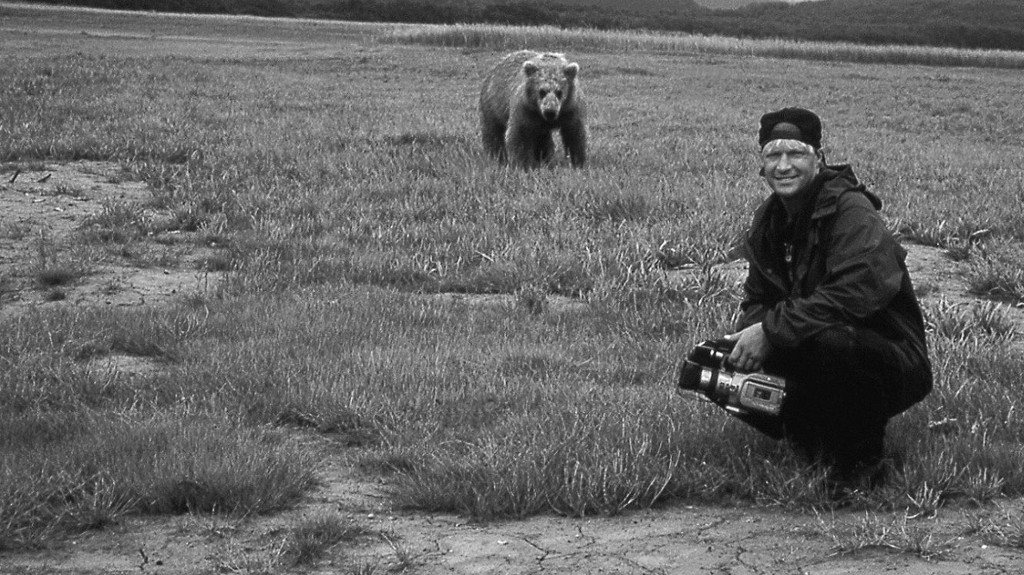
Though there’s no photographic record of the fatal encounter, no eyewitnesses, we know that on October 5, 2003 a large grizzly bear killed and ate most of Timothy Treadwell and his girlfriend, Amie Huguenard. All that was found of Tim were his spine, his right arm and hand, the watch still on his wrist. Everything else — bones, flesh, viscera — had already been eaten or scattered into the dense Alaskan brush. Amie’s partial remains were found nearby, half-covered in a pile of dirt and leaves, suggesting that the bear had gotten its fill and was saving the rest for later. Most of what we know of Tim and Amie’s deaths has been pieced together after the fact, from Treadwell’s journals, his film footage, and an audio recording of the fatal attack that speaks to the cataclysmic end of their relationship.
Timothy Treadwell in ‘Grizzly Man’
The would-be rescuers who arrived on the scene shot and killed a large male grizzly, which had been dubbed “Bear 141” in Treadwell’s notes — a bear he had not even bothered to name, perhaps because he knew that to name and anthropomorphize this bear would mean acknowledging that he couldn’t control or contain it. When they later cut open Bear 141, they found evidence of human remains. From the campsite they recovered a video camera, which contained a gruesome six-minute audio recording. Or perhaps the right word is “grisly.” It stays with you… At least, I imagine it would be difficult to leave behind, to get the sound of it out of your head. I can’t know this, however, because I’ve never actually heard it.
In one of the more powerful scenes in Werner Herzog’s 2005 documentary film about the attack, Grizzly Man, the director himself bears witness to this auditory horror. Herzog is presented on-screen, sitting in front of Treadwell’s long-time friend, and former girlfriend, Jewel Palovak. The camera peers over Herzog’s shoulder, revealing the thinnest profile of his face at the frame’s edge, its gaze instead focused on Jewel’s face while she herself watches Herzog, a large pair of headphones clamped over his ears, as he listens to the recording of the attack.
There is something odd about making this craft choice in a documentary film. To have the director appear in-scene is clearly not an example of cinemaverité, where the camera functions as an impassive and objective fly on the wall. Instead, we get a film in which our narrator is also the director, the controlling orchestrator of what we can access, as well as a character, witnessing the things we cannot, the things we have even been kept from witnessing. The movie offers up Herzog as the surrogate for our morbid curiosity, a vessel to contain the violence and the horror. We watch Jewel watch him listening, in an intoxicating loop of subjective, mediated witness.
Herzog tells her that he can hear Treadwell yelling for Amie to run away, to get away; that he is screaming for her to run. Herzog puts his hand up to his face. We cannot see his reaction, only Jewel’s, who, like us, has also never heard the tape. In the gaps of silence we just barely approach something close to the experience, although we cannot get all the way there with only our imagination. There is no other sound during this scene in the film. When he hands the headphones back to Jewel and tells her never to listen to the tape, and not to look at the autopsy photos, he also warns that the tape will be “the white elephant in the room all your life.”
The white elephant in the room all your life. It is such an odd thing to say, though I suppose it does suggest a truth about the recording: it’s the thing you don’t talk about but that you still feel the presence of in the margins of your everyday existence. When I watch this scene and hear Herzog’s warning, part of me still wants to ask him to hand the headphones to me. I want to hold them over my ears and tell him to rewind.
What does it sound like when the line is finally crossed, at the moment when there’s no turning back? I can almost imagine Treadwell’s high-pitched voice, frantic, shrieking at Amie, saying anything he can to get her to run and hide, to go away. It’s true that you can now find online what claims to be the actual audio recording of the attack. I could easily hear it with a single click, one tap of my finger. But I don’t. Ultimately it’s not the grisly reality that interests me, but the ecstatic reality: I want the mediated truth more than the actual recording. I want to watch Jewel watch Werner Herzog listening.
In an interview in Harper’s Magazine, as well as in a number of other interviews and lectures, Herzog has said that what he’s seeking in his documentary films is the “ecstatic truth,” a truth shaped not strictly from facts but also from fabrication and imagination. He has admitted in the past to scripting and staging certain “real” scenes in his documentary films, even to using actors instead of the actual people. But it is clearly also not pure fiction or fantasy he’s after.
In watching Grizzly Man, you would be forgiven for wondering whether the coroner, Dr. Franc Fallico, is really an actor reading lines he’s rehearsed for the purpose of playing a part. Throughout the movie, in every scene, he seems to overact, speaking with more clarity, poise, and enthusiasm than truly seems natural. At the end of one scene, set in the morgue with what appears to be a body on the table, hidden and unaddressed beneath a plastic sheet, Franc delivers his final line, before looking off-camera at Herzog, as though for approval.
The camera lingers in this moment for a beat or two longer than seems appropriate. Franc’s hands drop to his side and his posture relaxes. The resulting scene feels bizarrely amateur; it reads as messy and strange, like an editing mistake, a tail that should have ended up in a trash bin of cuts. But Herzog intentionally keeps it in, leaving us suspended in an uncomfortable space, uncertain about how much here is real and how much has been scripted, rehearsed, or even fabricated. It is an oddly seductive state of not-knowing; it is actually a kind of finely crafted and principled confusion.
This confusion leads us back to another question: Did Herzog actually listen to Treadwell’s death, or just act like he did? And does it matter? Whatever the case, Herzog thankfully did not resort to giving us a dramatic recreation of the attack, which would have been a different kind of ecstatic truth — too easy and simple, too reductive, melodramatic, and sensational. In a sense it would at once have been too fictional and too representationally “realistic,” instead of being, merely, true. Something about our filtered witness of Treadwell’s death — the strange experience of watching Jewel watch Herzog as he listens (or pretends to listen) — invites us into the experience in ways far more nuanced and complicated than a traditional documentary recreation, or a first-person, wholly factual testimony, could achieve. In making room for us to use our imagination, to speculate and to wonder, we feel our way towards what might be true.
The ecstatic truth is a truth that at once creates certainty and uncertainty, a truth that’s bigger, more wild and vibrant, more alluring and often more convincing even than a truth shaped entirely by fact or by one person’s interpretation of the facts. Stories that are apocryphal but undeniably appealing, ghost stories, tall tales, myths — perhaps all stories we tell each other again and again — depend on such ecstatic, felt truths. It is these truths that put us into a state of sublime confusion, a state out of which true knowledge of self and of the wider world emerge.
In the early Fall of 2009, my wife and I took our two kids camping in Sequoia National Park. We’d just come out of a rough patch in our lives and in our marriage and were trying to do more together as a whole family, working to stave off a divorce, our own little white elephant in the room. As it happened, the trip came during a particularly active bear season in the park, and there were signs everywhere warning about their presence. Early snows had pushed the bears down from higher elevations in search of food, desperate to pack on pounds for the coming winter. Nonetheless we remained undeterred, and I was even a little extra excited.
Our campsite was a patch of dirt beside a picnic table perched on a hillside, surrounded by other campsites with little space between us. We kept our food in a locked metal bear-proof box, and made sure that we didn’t have anything with an odor inside our tent. After setting up camp I loaded our daughter into a backpack carrier, and the four of us set out on a short hike, up a main road to an area with trails. We were hardly more than a few hundred yards away from the camp, winding through clear-cut forest on a dirt path, when we saw our first black bear. He was ahead of us, off the trail, foraging in the thicker brush but still clearly visible. And he looked big, at least three hundred pounds. We all stopped and watched him for a few seconds and it was exhilarating. I wanted to get closer, and took a few steps towards him with my daughter on my back.
“What are you doing?” my wife asked.
“I just want to see it better.”
“Um — no. Seriously. Come on, Steve, let’s go.”
Behind me, my daughter chattered and pointed at the bear. She tugged on my ears. My son meanwhile looked up at me with concern on his face.
“Really?” I implored. “You guys don’t want to see the bear.”
“We can see it from here, Daddy,” he said.
We turned around and went back to the camp. Later that evening my son and I were sitting at the picnic table as dusk settled over the campground, and we heard something in the distance, out in the half-light. It was slowly walking, crunching the twigs and leaves. It was coming towards us.
I turned on the flashlight, playing the beam down the hillside from our camp, moving it back and forth until I caught the glow of a pair of eyes, and the silhouetted form of a bear. My son and I stared and watched it come closer, its head wagging back and forth, sniffing the ground for food.
My daughter was asleep in the tent with her mother. I wasn’t sure what we should be doing. I was about to yell or throw something, make a ruckus to scare it away, but for a moment I continued to dwell in that space of awe, just before fear sets in. It was as if I were frozen there, in that brief, transient state, a state which had an undeniable attraction.
Before we really had a chance to be afraid, out of nowhere, it seemed, several men approached wearing headlamps and carrying guns. In addition to a number of large, bright lights, one of them held some kind tracking equipment. The Bear Suppression Unit — a special team of Park Rangers, trained and charged with protecting park visitors from hungry black bears — had appeared from out of the dark, armed and highly illuminated. My son and I watched as they shone their beams across the bear and blasted it with either propelled bean-bags or rubber bullets — something non-lethal, I assumed. We heard but couldn’t see as the bear crashed off into the brush, fleeing back to the dark. And, just as quickly, the rangers also departed, leaving me and my son to stare out into the waning light.
“That was crazy.”
“Yeah,” he said. “Let’s go to bed.”
As my family slept that night I lay awake, listening to the night sounds, my mind spinning and racing, as it often does. Strangely it wasn’t so much fear as curiosity and overstimulation that kept me awake, as though I’d taken a bump of some drug. It was in this heightened state that I heard the bear again, listening as it approached our campsite, the sound of its soft paws plodding on the dirt. I felt, at once, both afraid and curious. More than anything, what I wanted was to unzip the tent and to see the bear up close — to smell its musky odor, run my hands through its dusty coarse fur — but I just lay there listening, the fabric walls just separating me from the bear. The bear itself meanwhile didn’t waste any time. I heard it slam its paws into the door of the bear-box, making a loud racket, but then it quickly moved on to look for another, easier mark, leaving me alone in the ringing silence.
The next morning, as their mother slept on in her tent, I told the kids about the bear once again visiting our campsite. I recounted to them about the beast slamming into the metal box, trying to get to our food, and how, unsuccessful, it had finally left, roaming on to another campsite. Their eyes widened, and they asked to hear the story again. And again.
But somehow, between my telling them and their subsequent retelling of the tale to friends and family later on, the story subtly shifted. In their memory of the event, crafted from my narration and their imagination, filling in what I’d only heard in the dark, the story became one in which the bear not only banged against the box but also broke into it to eat up all of our food. To this day, my children are convinced this is what happened. They sometimes even conjure up corroborating images from the next day — torn chip bags, scattered crumbs, open, tattered boxes, their mother’s shock at the mess, the whole family together confronting the aftermath. They argue against me, knowing that the ecstatic truth they hold in their possession is bigger, wilder, and more vivid than the paltry facts I can offer. At some point I have to concede to them and agree: the narrative of the relentless bear that broke into our camp and consumed everything on which we’d planned to survive really is a better story. And not only that, but it also happens to be true.
One had to lose the noise of the mechanism, not least the ever-deafening inner echoes of it. One had to dispel practicality. Then something else could be heard — if one was lucky, if the sun was shining, if the paths were well made, if one wore the right garments, and if one made no attempt at definition or popularisation.
— Robert Aickman, “Into the Wood”
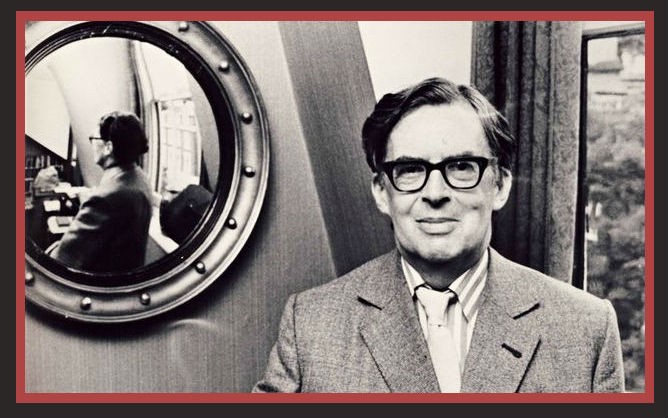
Thirty-five years after his death, Robert Aickman is beginning to receive the attention he deserves as one of the great 20th century writers of short fiction. For the first time, new editions of his books are plentiful, making this a golden age for readers who appreciate the uniquely unsettling effect of his work.
Unsettling is a key description for Aickman’s writing, not merely in the sense of creating anxiety, but in the sense of undoing what has been settled: his stories unsettle the ideas you bring to them about how fictional reality and consensus reality should fit together. The supernatural is never far from the surreal. He was drawn to ghost stories because they provided him with conventions for unmaking the conventional world, but he was about as much of a traditional ghost story writer as Salvador Dalí was a typical designer of pocket watches.
Laird Barron once noted that “[t]he surest way to comprehend Aickman is to read a lot of Aickman.” Until now, that task was, for many, all but impossible.
Tartarus Press has done heroic work over the years to keep Aickman in print, first with 1999’s two-volume Collected Strange Stories, then, beginning in 2011, with exquisite reissues of each of the individual collections, culminating with The Strangers and Other Writings in 2015, a collection of work previously unpublished, as well as nonfiction that had never been reprinted before. The Tartarus editions are jewels, but they are limited editions, and most casual Aickman readers will not want to spend the money on them (even though they are bargains given the quality of their production).
In 2014, the centenary of Aickman’s birth, Faber & Faber released in the U.K. inexpensive paperback and e-book editions of four of Aickman’s story collections, as well as his novella The Model and novel The Late Breakfasters. Over the next six months, Faber’s editions of the stories are arriving in the U.S., and Valancourt Books has recently published The Late Breakfasters and Other Strange Stories.
For the first time in decades, the majority of Aickman’s work will now be generally available in the U.S and the U.K.
Such a wondrous situation poses challenges for new readers, though, who might wonder where to begin. That question is easy to answer: You can’t go wrong with any of the four Faber collections, particularly The Wine-Dark Sea and The Unsettled Dust, both put together posthumously to reprint some of Aickman’s best tales. All together, the Faber collections reprint just over half of Aickman’s complete stories, with only “Bind Your Hair” appearing more than once. The Late Breakfasters and The Model are odd, fascinating, and beautiful, but a bit atypical; the stories are what sit at the heart of the Aickmanesque.
The question of Aickman now is not so much what to read, but what to do with what is read: how to experience and interpret his work in the most satisfying way. Aickman is a difficult writer for many readers, but the difficulties are not inherent to his writing (which is usually quite accessible) so much as they are to the lenses through which we see that writing.
It is among aficionados of esoteric horror stories that Robert Aickman’s name is best known. But Aickman himself preferred other labels — he associated the horror story with sadomasochism, a goal different from his own. Even if we define “the horror story” more broadly, however, focusing on Aickman only as a horror writer does a disservice to the range and originality of his work. Further, such a focus sets up expectations that may warp how the stories are read. It is one thing to start reading expecting a horror story; it is another to start reading expecting an Aickman story.
He typically called his fiction “strange stories”, an accurate label, and one that sets the right expectations for any reader making a first journey into Aickman’s world.
The “strange stories” label also helps us place Aickman in a broader lineage: not just that of great writers of terror and the supernatural, but also of great writers for whom there is no one label or even a recognized tradition. Though it is certainly accurate to say that Aickman’s work often falls into the realm of the ghost story, we will understand his achievement better if we think of him among such unsettling writers as Franz Kafka, Elizabeth Bowen, Paul Bowles, Flannery O’Connor, Shirley Jackson, and even — particularly in his approach to story structure — Anton Chekhov.
In his introduction to The Wine Dark Sea, Peter Straub writes:
Aickman’s characters find themselves trapped in a series of events unconnected by logic, or which are connected by a nonlinear logic. Very often neither the characters nor the reader can be certain about exactly what has happened, yet the story has the satisfying rightness of a poem — a John Ashbery poem. Every detail is echoed or commented upon, nothing is random or wasted. The reader has followed the characters into a world which is remorseless, vast, and inexorable in its operations.
Much of Aickman’s best work obliterates any certainty between real and unreal, dream and waking reality. In one of his greatest stories, “Into the Wood” (in some ways an ars poetica), an insomniac tells the protagonist: “Dreams … are misleading, because they make life seem real. When it loses this support of dreams, life dissolves.” Aickman’s project was to explore all the repercussions of this idea.
“Dreams … are misleading, because they make life seem real. When it loses this support of dreams, life dissolves.”
Given his stories’ frequent interest in dreams, imagination, and the unconscious, it is no surprise that Aickman read plenty of Freud. Yet while Freud’s influence is clear in many of his stories, they are far from being simple illustrations of Freudian concepts. (In this way, they are interesting to compare to the tales in May Sinclair’s 1923 collection Uncanny Stories, which hew closer to Freud.) Large, dull theses could be written relating Aickman’s fiction to Freud’s “The Uncanny”, Beyond the Pleasure Principle, and Civilization and Its Discontents at the very least. In the first of the introductions for the eight volumes of The Fontana Book of Great Ghost Stories he edited from 1964–1972, Aickman declared:
Dr. Freud established that only a small part, perhaps one-tenth, of the human mental and emotional organization is conscious. … The trouble, as we all know, is that the one-tenth, the intellect, is not looking after us: if we do not blow ourselves up, we shall crowd ourselves out; above all, we have destroyed all hope of quality in living. The ghost story, like Dr. Freud, makes contact with the submerged nine-tenths.
Here, then, Aickman sees the ghost story as a melding of Romanticism and surrealism: it escapes the intellect via the subconscious. He also saw it as related to poetry, reiterating throughout his Fontana introductions (all collected in the Tartarus Press edition of Night Voices) something similar to what he said in the fourth volume: “The ghost story, like poetry, deals with the experience behind experience: behind almost any experience.” Such a story is an expression of imagination, not reason, and as such Aickman viewed it as superior to science, which he tended to denigrate. Truth, he thought, lay far beyond rationality, and science, along with the technologies it sprouted, was smothering the truths available via imagination, poetry, and religion. The power of mystery must be respected:
The essential quality of the ghost story is that it gives satisfying form to the unanswerable; to thoughts and feelings, even experiences, which are common to all imaginative people, but which cannot be rendered down scientifically into “nothing but” something else. In a world of meaningless fact and meaningless violence, people shrink from admitting that they still harbor entities of the imagination. The element of form in the ghost story is, therefore, crucial.Giving satisfying form to the unanswerable is what makes Aickman’s stories often perplexing on a first reading, because satisfying form is not the same as satisfying answers. Seeking answers for the unanswerable is, to Aickman, the murderous foolishness of modern science, and his stories stand in stubborn opposition to such quests.
Aickman is often celebrated (and frequently condemned) for the ambiguity of his stories: ambiguity of cause and effect, ambiguity of motivation, ambiguity of resolution. Few Aickman stories have a neat ending, and it is in this sense that he seems to me most Chekhovian, though Aickman and Chekhov came from almost entirely opposite world-views: Chekhov, after all, was a doctor with much respect for science and little use for religion or mysticism. Where they overlap is in their sense that individual human perception is immensely limited, and that, to compensate for such limitations, the prose must pay careful attention to objective details. (“The artist should not be a judge of his characters or what they say, but an impartial witness,” Chekhov once wrote in a letter.) Michael Dirda also makes the Chekhov connection, writing in the introduction to the Tartarus edition of Tales of Love and Death,
Like Chekhov, Aickman seldom attempts to rouse our emotions: he sets down what happens without narrative histrionics. Not even the most astonishing turns of event elicit much surprise or wonder. As a result, that affectless, unruffled tone adds immeasurably to his work’s distinctive, unsettling eeriness. Odd or horrible things occur but they do so without fuss, and they are observed with a dispassionate, Olympian clarity.
Not even the most astonishing turns of event elicit much surprise or wonder.
The dispassionate tone is especially important to third-person narratives; the first-person stories of both Chekhov and Aickman betray the two writers’ passion for theatre and often read like extended monologues.
Aickman, who cherished Oscar Wilde, was drawn to epigrams and aphorisms, and first-person narrators allowed him particular opportunities to employ his wit:
It is strange that people train themselves so carefully to go to waste so prematurely. (“The Unsettled Dust”)
It is amazing how full a life a man can lead without for one moment being alive at all, except sometimes when sleeping. (“The Fetch”)
There are no beautiful clocks. Everything to do with time is hideous. (“The Clock Watcher”)
If one goes to parties or meets many new people in any other way, one has to take protective action quite frequently, however much one hates oneself in the process; just as human beings are compelled to massacre animals unceasingly, because human beings are simply unable to survive, for the most part, on apples and nuts. (“Ravissante”)
…it is no joke being a married woman in East Anglia, if the woman has the smallest imagination. (“Wood”)
Regardless of the narration, though, in both Aickman’s and Chekhov’s stories, seemingly irrelevant details serve to indicate a world beyond the protagonist. In Chekhov, it’s often a larger world of social systems and of nature; in Aickman, it’s a world beyond the limited realm of human perceptions. Aickman was as interested in subjectivity as any Modernist, but he chose the seemingly outmoded conventions of the ghost story for his explorations of perception’s limits, rather than the conventions of interior monologue. In stories like “Meeting Mr. Millar”, Aickman plunges us into a character’s consciousness, but does so without fanfare, simply letting the accumulation of what the narrator chooses to relate contribute to a steadily-growing feeling of claustrophobia.
The portrayal of consciousness as limited and perception as narrow is not an end in itself, though, which is why, for Aickman, the uncanny is essential. The world is not what our consciousness presents, and our conscious mind cannot bring the world’s truths to us. The supernatural, like the subconscious, can be glimpsed, sensed, even experienced, but it is often beyond most sorts of perception, and always beyond understanding. The first sentence of “The Hospice” could point to the location of truth in all of Aickman’s stories: “It was somewhere at the back of beyond.”
Another key to Aickman’s writing is his hatred of modernity. His collaborator and (briefly) lover Elizabeth Jane Howard wrote in her memoir Slipstream that Aickman believed “everything had declined.” She says he felt that
Before the beginning of the century, life had held more promise. The arts, architecture, hotels, food, clothes, furniture, the governance of the country — everything you could think of — had been better. … There had been nothing, since those unspecified and halcyon days, but a steady diminution in all standards. We were approaching the end of civilization.
This sense of civilization’s decline and impending fall rarely leads Aickman’s stories toward nostalgia, but instead toward an always-present sense of doom. His characters generally survive their encounters with oddity, but there is little sense of triumph, and anyone who still believes in the possibility of triumph is a dolt or a cad. Aickman had more than a little impulse toward satire, but the sharp despair inspiring the satire is what makes any laughter provoked by Aickman’s stories disturbing on reflection.
Consider, for instance, “Growing Boys,” a tale of twins who grow quickly and don’t stop until they have become destructive giants. It’s a darkly funny story in its premise and even its title, taking a familiar, happy phrase and literalizing it. But the story itself is no lark — it enters the territory of Doris Lessing’s The Fifth Child. What are parents to do when their children are, truly, monsters? To this, Aickman also brings in questions of gender and imperialism.
Quite a few of Aickman’s best stories feature women as protagonists, and for all his preference for the life of the past, he does not seem to have wished to return to a time of conventional gender roles or sexual expectations. Millie, the mother in “Growing Boys,” is plagued not only by monstrous children, but by an oblivious and self-centered husband and a patriarchal uncle who wants nothing so much as to protect fragile white womanhood as he thinks he did in India and Africa. (He is a devoted reader of The Imperialist magazine.) Millie’s salvation comes from a woman who represents a very different tradition: Thelma, a gypsy fortune-teller (an unfortunate stereotype, though not used for entirely stereotypical purposes in the story). Thelma tells Millie to flee and make a new life for herself. Later, Millie dreams of climbing Mount Everest with Thelma. The story’s enthusiasm for female homosociality is clear. Thelma is the only person who gives Millie useful help, the only person who sees that Millie needs somehow to get away from men who take advantage of her (her husband), from men whose masculinity is predicated on war and domination (her uncle, whose guns prove impotent), and from men who want nothing so much as to eat her alive (her sons).
After reading the story, Joanna Russ wrote:
I can’t shake off the impression that “Robert Aickman” is a pseudonym and the author is a woman, since the tale’s subject is the cannibalistic horror of family life, from which the Everywoman heroine is offered two escapes: decamping with another, friendly woman (the heroine dreams at one point that they’re happily climbing the Himalayas together) and an ideal, protective substitute father. The ending is the kind mothers — but not fathers — dream of.
Men in Aickman’s stories tend to suffer all sorts of repression, while women are often more liberated, their terrors the result of proximity to men who are (or yearn to be) good patriarchs who follow the laws of the fathers. The chaos that comes to their lives is a chaos caused by repression and patriarchy, with violence and imperialism often linked to that patriarchy. (For all his conservative tendencies, Aickman was a pacifist and had been a conscientious objector during World War II.)
Of his own experience with a patriarch, Aickman wrote in The Attempted Rescue (one of his two autobiographies), “My father, as I knew him, was impossible to live with, to be married to, to be dependent upon.” Aickman assisted his father some in his business as an architect, and architecture is important to many of the stories, where traveling characters often encounter strange houses and buildings. In such stories, Aickman feels close to Kafka: not just The Castle and the various spaces of The Trial, but also the confining bedroom of “The Metamorphosis,” the tunnels of “The Burrow,” and other structures. Walls protect no one, and building them only creates new areas to hold mysteries within the greater area of the mysteries of the universe.
It is his devotion to the mystery of the universe that leads Aickman to the images and forms in his stories, and those images and forms link him not only to his fellow writers of supernatural fiction, but also to many writers who find unanswerable worlds in everyday experience — there is no reason, it seems to me, not to speak of Aickman alongside such celebrated “realists” as, for instance, David Constantine and Joy Williams. The reading protocols we use when making our way through the pages of Tea at the Midland and The Visiting Privilege are ones that would serve us well when approaching The Wine-Dark Sea and Cold Hand in Mine. Some volumes of strange stories get shelved as horror fiction, and some others do not; that has as much to do with marketing and happenstance as it does with how we should read and value those books.
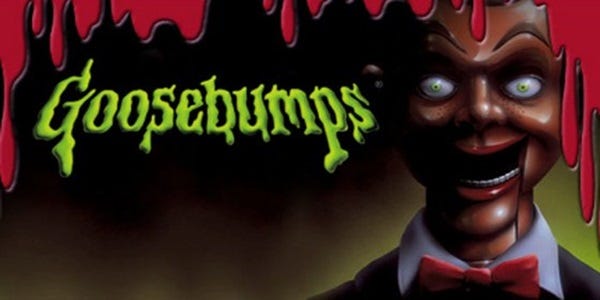
The daycare censors are coming for you, R.L. Stein…
Stephen King’s latest spooky children’s book, Charlie the Choo-Choo, probablywon’t be making it onto daycare bookshelves in Washington state anytime soon. Neither will R.L. Stein’s Goosebumps series,or any other story that contains a hint of hair-raising imagery for that matter. According to the Guardian, daycares in Washington that receive support from the state government are being encouraged to self-censor their book collections, and their government subsidies are on the line if they don’t choose wisely. The Washington State Department of Early Learning awards grants based on a points system, and one of the newer stipulations for qualification is that daycare programs ensure only “appropriate books” are available.
The National Coalition Against Censorship is particularly perplexed by the provision discouraging daycares from having “books that glorify violence in any way or show frightening images are not considered to be appropriate.” The organization worries that the state is ignoring the educational value of narratives that scare children, or push them beyond comfort zones.
Sadly, it seems that book censorship has become a regular phenomenon for children growing up in this era. PEN America recently conducted a study which found that children’s books are more likely to be banned if they feature diverse characters.
While the effects of the new policy in Washington are yet to be felt, I for one can state with certainty that I wouldn’t be the same person I am today if I hadn’t read Roald Dahl’s James and the Giant Peach and lived in fear of the Cloud Men impaling me with snow if I said something snarky (despite growing up in sweltering Georgia). Come to think of it, aren’t all our favorite childhood fables a little disturbing? Maybe that’s just what some kids need at that age.
Which other childhood classic might run afoul of state authorities? What about Neil Gaiman’s Coraline, or Maurice Sendak’s Where the Wild Things Are? What will become of Washington’s children without them? Let’s hope that these kids have access to books at home, or at least a decent library that isn’t quite so firmly under the state’s thumb.
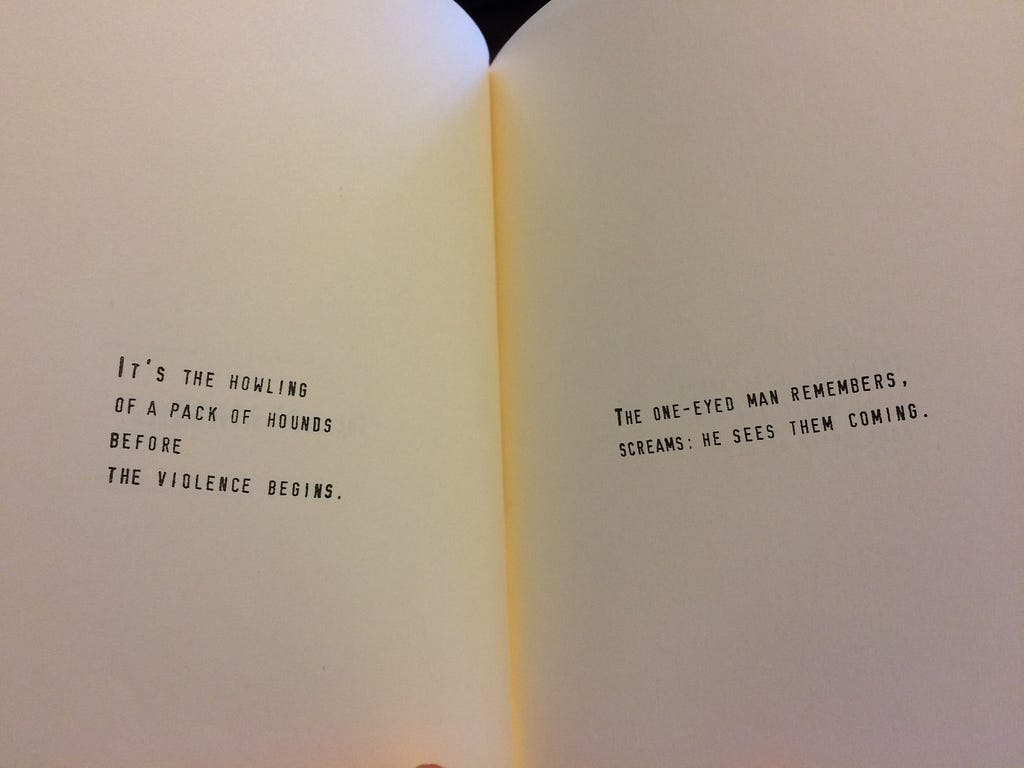
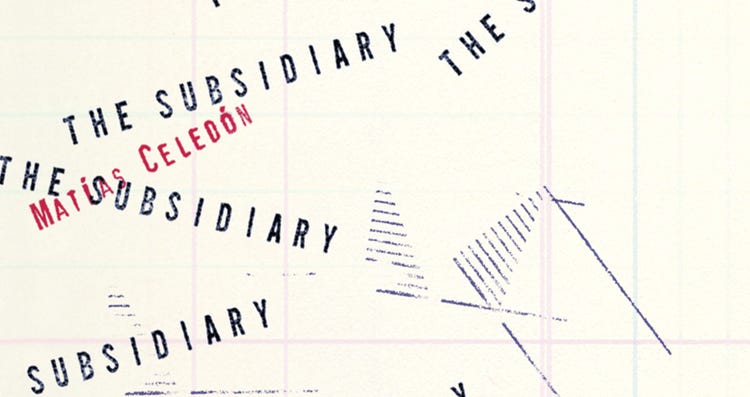
The first and last pages of Matías Celedón’s The Subsidiary appear to be images of the top and bottom of a stamp pad. Between these pages are the ink impressions of an anonymous narrator, an office worker documenting in rubber-stamped snippets his experience during an unnamed crisis.
My medium is decidedly less interesting, but if I’m not careful, I’ll quickly exceed the source material’s low word count.
The book offers no backstory or setup. Personnel — of precisely what entity, we don’t know — are notified to remain at their workstations in advance of a power loss. Exits are soon blocked, phone lines cut, and shouts pour in from outside. The employees are left alone. The reader and characters remain equally clueless, but while the latter appear uninterested in an explanation, I, for one, actually wondered what might be going on.
The narrator, trapped in the offices, documents the situation’s steady decline via his only available tools — the very rubber stamps he uses to approve possibly nefarious directives within a sinister corporate bureaucracy. His testimony is the story.
Allow me to say up front: I’m not gimmick-averse, and I’m always a sucker for workplace satire or commentary on draconian office politics. Locked in cubicles beneath harsh fluorescent lights, drudging along, our animal instincts threatening to boil over at the slightest hint of a rupture in the societal order — please, do tell. Replace decorum with bloodthirsty, survival instincts, and I’m happy.
And yet, there is both more and less to this story. More, in that considering the author’s Chilean heritage, one can’t help but read it in light of the often brutal history of 20th century Latin America, with its timeline of assassinations, death squads, coups, protestors violently squelched, dissidents quietly disappeared.
In The Subsidiary, there are commands issued from above. There are attack dogs. Bodies are quietly removed. The methods are all there. The book reads like poetry or a series of cryptic koans, each page usually only a single sentence or even a single word. Considering the nature of its composition, this makes sense.
The medium is the message, and the effort in composing a message via rubber stamps requires patience, deliberation, and economy. To give you an idea, rubber stamp sets actually come with a pair of tweezers to select and place the tiny characters. The sparse writing is certainly consistent with concept.
Sure, Celedon’s self-imposed limitation could be labeled a device, but I find it a wonderful premise.
If this was an actual, historical document, I would marvel at its existence.
The book could be an artifact from a group of people who’ve gone missing, or have been disappeared. If uncovered from a mass grave or presented as evidence to indict a brutal, murderous dictator, it would be an amazing document. I would even clamor for its publication. That said, however fascinating an artifact, as a story or literary work, it’s ultimately unsatisfying.
Sadly, I doubt that even a third reading would soften my opinion that many of the events and characters verge on complete inscrutability. The ease with which you can dive back in and read several pages somehow makes it all the more frustrating when you close it, having gained no further insight.
This dissonance between value as artifact versus value as novel begs the question of how much to suspend my disbelief and play along, because a narrator change late in the third act confirms Celedón wants us to read it as such a document. If read as an accompaniment to a history of Pinochet or another human rights nightmare, it would certainly resonate. Sans that context, however, it’s difficult to engage with a text so purely idea-driven.
As a physical object, it does appeal to a resurgence in print versus e-books. Publishers Weekly and the Codex Group recently cited a possible “digital fatigue” among consumers, and stories with qualities unique to printed books are ripe for success. Reading The Subsidiary, I thought, this could only exist as a printed book. It is a story defined by its device. I heard Chris Ware speak during the release of his massive project, Building Stories, about sales in bookstores being boosted by graphic novels and their appeal as unique objects versus mutable variations of “content.” They are stories only able to be told in book form.
To my surprise, I discovered The Subsidiary is available for the Kindle. I can’t even imagine. What good comes from this book, what thoughts it engenders, what horrors it suggests, stem from its inherent possibility as testimony to historical tragedy or farce. To download such a thing, a missive from a dark corner of a frightened bureaucrat’s office during a political or corporate cleansing, is absurd.
Had I read the e-book, I can tell you this review would be much shorter, considering much of the discussion surrounding it is and will be its storytelling device. As a piece of literature, there’s simply too little to discuss.
The handful of characters are all named after their particular physical limitation. “Blind girl,” “deaf girl,” “lame man,” “one-armed man,” “one-eyed man,” “mute girl.” What symbolism there is, or why a corporation hires only the disabled is unclear. At one point, “The mute girl moans. The one-armed man applauds.” There’s the koan-like (and in this case, groan-inducing) nature I mentioned.
At one point the Mute Girl tells the narrator that the Lame Man is holding a young boy captive and teaching him to read. “The Mute Girl went on calmly and in detail. The boy was lost. He was poor, without manners: the Lame Man had to bathe him.” There are no further details. How did this boy get into the office? How, over the course of the book’s two-week narrative, was the idea to teach a child to read something that entered the imagination? What office has a bathtub?
The ending is somewhat chilling, but having no emotional investment in characters or story, it’s hard to know how to feel. The original office worker’s record lives on, accessed by another anonymous bureaucrat. Despite briefly acknowledging the horror within, it’s clear the incident will be filed away, covered up, buried. The final image is an impression of the lines of a rubber stamp devoid of text. Only the blank stamp has been covered with ink and pressed to the page. Nothing left — or permitted — to be said.
Celedón thus maintains verisimilitude, as I’m sure similar accounts exist in international courts created by people whose names we’ll never know, who died horrible deaths in isolation. But in so doing, the story never transcends its device. It is a self-contained document that remains impenetrable.
Maybe it’s a failure of my own imagination. Maybe it says something about my lack of humanity, or maybe it’s the privilege of living a comfortable existence in the United States that prevented me from connecting with The Subsidiary. If November heralds the rise of President Trump, at least I know a third reread will take little time, and I can draw comfort from the knowledge that rubber stamp sets are very affordable.
Mark Slouka is no stranger to authordom. He’s published six books, fiction and nonfiction. His work has been in Best American Fiction and Best American Essays both. He’s won awards. He’s done some press, you know? And yet as I prepared for this conversation, I kept thinking, God, he must be so worried about what I’m going to say.
Even by the standards of memoir, Nobody’s Son (W.W. Norton & Co., 2016) is personal. It’s not heart-baring so much as bone-baring: look, this is how I work inside. These are the veins, this is the tissue. This is all I am. Lucky for Slouka, he happens to express his innermost thoughts and pore over his darkest memories in laconic, gorgeous prose.
Nobody’s Son travels from Slouka’s mother’s abuse-filled childhood in Czechoslovakia to the post-World War II refugee world on four continents to Brewster, New York, where a novelist realizes he’s been writing about himself in disguise. It would have been cheesy to call this book Portrait of the Writer as a Son, but that’s what it is. Well, it’s all kinds of portraits, but that’s the first and central one. The rest? You’ll see.
Lily Meyer: You must be very scared of interviewers for this book.
Mark Slouka: When you have personal material, it’s hard not to be invested. But this book is a rescue operation as much as a memoir. It had to be written. It had been sitting back there for forty years, so by the time I got to it — no, by the time it mugged me, which is more how I feel about it, it was like, What the hell is happening — anyway, by the time I got to it, it just poured out of me. I don’t even remember writing big chunks of it. The book just went. Seven, eight months and it was done. Like literature in a microwave. And now here it is, my heart with a cover on it.
LM: I am shocked to hear that. This book is so formally aware of itself, so calculated-seeming, I was sure that you’d been writing it for years.
MS: Nope, seven months. I wrote it in a kind of white heat. Five, six hours a day, and I wouldn’t notice the time. I’d stand up and my back would be locked. But I was so happy! There was a sense of unburdening, of clarity, of seeing the light ahead. I don’t know if I’ll ever feel that kind of creative energy again.
LM: How much did you edit? And what was that process like?
MS: I’m an obsessive re-writer, but I re-write from the beginning, continually. If I don’t have the first stone correctly laid, I can’t put another one on top. So when I sit down in the morning, I read through what came before and prune, adjust, re-write. By the time I’ve finished a draft to my satisfaction, then, it’s a finished book. Though I should say, I believe that Hemingway line that any story can be made better by being made shorter, so there was some condensing and distilling at the end.
LM: Who is this book a portrait of first, or most?
MS: It’s a self-portrait in the sense that I’m thinking about my past, my history, the story I inherited, the ghosts that were handed down to me. It’s a portrait of my parents, too, but from there I’d have to say it’s a portrait of memory and how memory works, how memory spills into fiction all the time. And it’s a portrait of abuse, and how abuse is handed from generation to generation. It took me a long time to understand that the abuse my mother suffered changed forms and then came down to me.
It’s an argument for the defense, too. I’m trying to say, Listen, I was a good son. At some point I had to pull away from my mother, and I carried a lot of guilt for that, so part of this book was a self-exoneration. It’s one of those big baggy many-thing books, which I happen to have a real affection for. It doesn’t fit neatly into a genre, which is fine, since I’m not completely sure I believe in the genres.
LM: Something you didn’t say is that this book is a portrait of a writer, and of the writing process.
MS: I suppose it is. The process is so much a part of who I am, maybe it’s invisible to me. But it was embarrassing to think back on Brewster or on some of my short stories — on a good many things I’ve written — and think, Good God, man, you just didn’t see what you were trying to say. You didn’t know what you were writing about. So yes, it’s about self-revelation through writing.
LM: You flag what you’re doing very explicitly, too. You spend the whole beginning writing about how you’re beginning, and then there’s a point about forty pages in where you say, “Might as well begin with the end.” Same at the end, too. You say, “I’m ending now, I’m ending now,” and then the book ends. The reader can watch you watch yourself writing.
MS: That’s what was so liberating about it. I’ve always hidden myself in my books, and suddenly it was like, Get your ass out on the microscope slide. I’m going to take a look at you. I tried to look at myself as objectively as possible, and I had to do that through the lens of my parents and my history. But the more I did that, the more I understood that chronology just isn’t useful to me. Take an ending: when is it really an end? My father died three years ago; I dreamt about him three nights ago. He’s very vivid to me. I’m more interested in how we navigate our memories and histories than in chronology.
LM: You contrast that experience to what you call Big History, which you define as thing follows thing.
MS: Well, certain things happened! I have no patience with revisionism. Certain things happen in big and small history both, but once a thing has passed, we shape it into a story. We leave certain parts out, stress other parts. Once an event is in the past it becomes a kind of fiction.
Once an event is in the past it becomes a kind of fiction.
LM: It does seem that your mother is more resistant to your storytelling than anyone else. As a reader, I felt like I was chasing her through the book.
MS: Well, we were impossibly close when I was a child. The sound of her laughter is something I’ll remember the rest of my life. She was so fun to be with, and that’s what made what followed so extraordinarily difficult. For a long time, I didn’t understand, and for a long time after that I tried to save her, and after that was the anger and sense of betrayal, and then I was just fighting to save myself.
LM: You don’t spend much explicit time on your mother’s being a survivor of sexual abuse, or on your mother’s addiction. Why does that come so late in the memoir? And why does her lover come so late in the memoir?
MS: The drugs come late because I discovered them late. I was fifty-six years old before my father told me my mother had been an addict for the better part of thirty years. How she remained standing is beyond comprehension. As far as F., her lover, goes, I don’t know if I can answer why he appears in the memoir where he does, but I can say that I think of him as the core of this memoir. You know, it’s kind of a love story, really. I remember him very well; I thought he was a wonderful man, and I think he came really close to saving my mother.
LM: I’m fascinated by the total lack of shame in Nobody’s Son, and in the way you’re talking to me about it now. How did you learn that lack of shame?
MS: When I was a teenager and my family life began to go sideways, I developed a willingness to look at myself. That’s how you learn to see outside you, by looking at yourself. I really believe that. So shame is not something that plays a big role in my life. That’s not to say that writing this memoir wasn’t excruciating. I had this notion of my mother pleading with me, saying, Don’t do this. It felt like a brick in my chest, the idea of her begging me not to write it. I externalized that feeling. I put it in the book. I’d sit there with tears in my eyes, unable to write, and then I’d remember how much my mother believed in literature. She was a librarian for thirty years, and a real reader. Books were almost a religion to her. And her standard for writers was always fearlessness. A writer shouldn’t flinch. If you’re going to flinch, find something else to do; if you’re going to write, then fucking well write.
A writer shouldn’t flinch. If you’re going to flinch, find something else to do; if you’re going to write, then fucking well write.
LM: Are you working on another book now?
MS: I’ve been working on a sequel to Brewster. The protagonist there was thirty years old, and he’s fifty-eight now. And there’s another book that has to do with Milan Kundera, but it’s harder to describe.
LM: Does it feel different to write fiction having written this memoir?
MS: Absolutely. This was a liberation book for me. It freed up my voice, I think, and unclouded my vision. There’s something about having written in this naked first person that was liberating creatively in ways so big I haven’t figured them out completely. It’s like I’m ambidextrous now, or like I’ve added something new. Sitting down to write feels different now. It feels good.
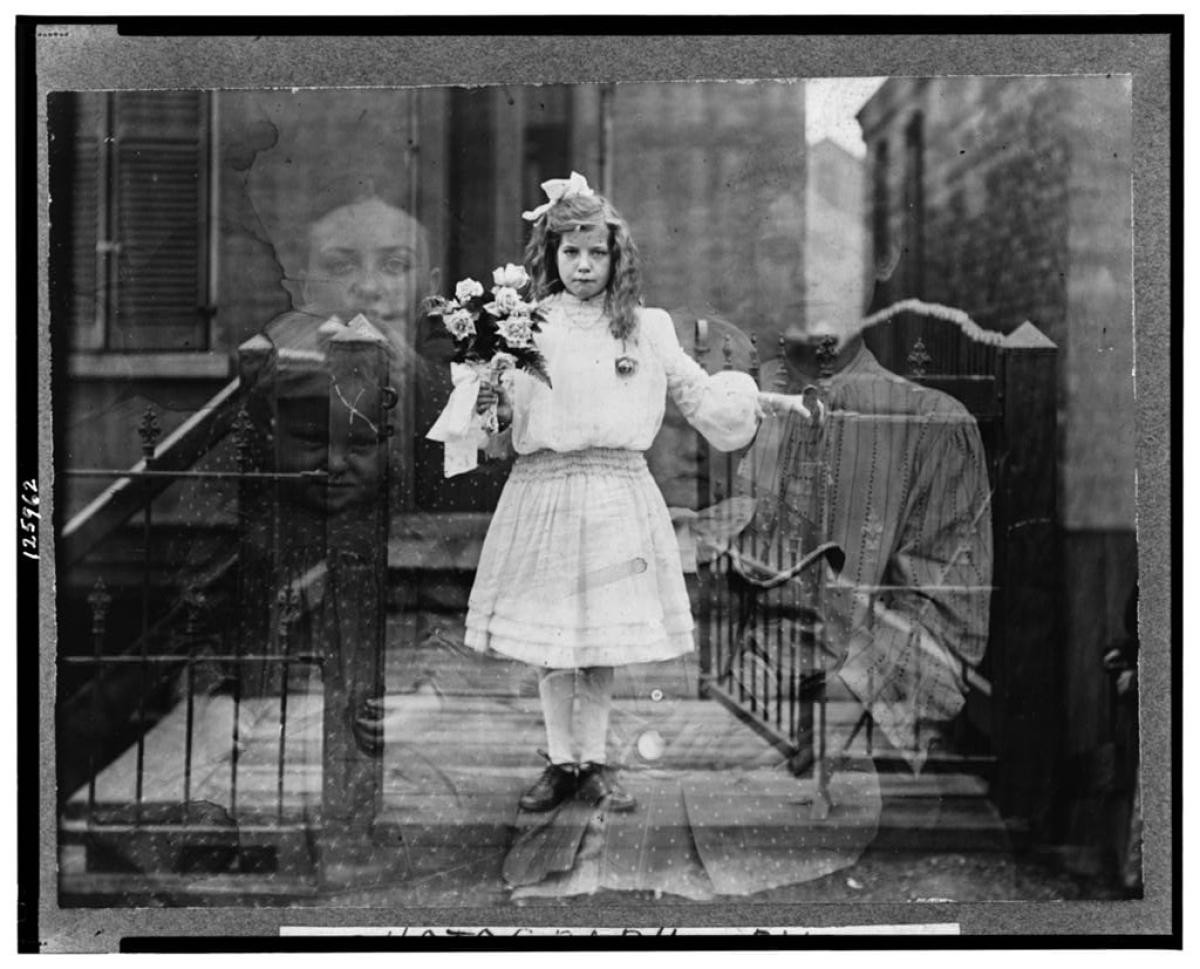
The ancient Greeks believed that the boundary between the land of the living and the underworld of the dead was permeable. Orpheus and Odysseus both made it to Hades and back, and their experiences were traumatic. (Orpheus bungled his wife’s rescue mission and Odysseus spotted his mother, who he didn’t know was dead.) Humans have been obsessed with animating and interacting with the deceased — in other words, with ghosts — forever. Our fascination with breaking down the boundary of this life and the next results, in part, from the fact that we humans are so permeable ourselves. We don’t truly let anyone or anything go; every experience penetrates our consciousness and stays there, threatening to come back and make us feel all over again.
Ghosts are problems, emotional knots to be untied (no ghost is sticking around to see who wins the Giants game), which makes them popular devices in literature. Of course, hauntings come from endless sources. Characters can be haunted by ex-lovers, lost parents, or bad life choices. Being haunted simply means a forced reckoning with your past — which, depending on your life, can be much more terrifying than seeing dead people.
In that vein, here are 11 novels with emotional ghosts, plus a few dead people moving furniture, because it’s Halloween season, after all.
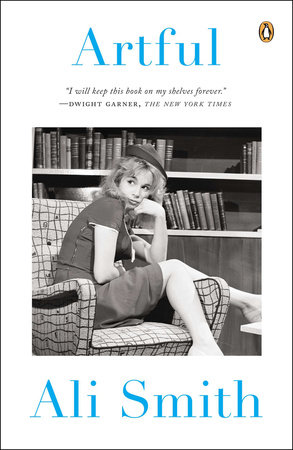
This enchanting book is delightfully strange and essentially Ali Smith — she took four talks which she gave at Oxford University on Comp Lit and put them into a ghost story. We open with the narrator speaking to her dead lover, a ghost who has maintained some proprietary instincts about the apartment. The ghost is there, puttering around, stealing TV remotes, and slowly decaying. By mixing essay, meditation, wordplay, and love story, Smith achieves an original, sincere picture of loss.
Another hybrid tale, this debut is a poignant mix of novel, fable, and prose poem. When a man’s wife dies suddenly, he and his two sons are faced with the challenge of processing the titular grief. Help comes to them in the unexpected form of a supportive yet rather sassy crow. But that’s the thing about grief — being in its throes can feel like being sucked into a hallucinatory alternate reality, one where you might just find solace in a large, smelly, talking bird.
Bolaño’s episodic novel is the story of two poets, Arturo Belano and Ulises Lima, who are on a quest to find Cesárea Tinajero, a Mexican poet considered to be the mother of Visceral Realism. But it’s also about young male artists coming of age, Mexico City in the 1970s, and the impressions that we leave behind. Belano and Lima themselves become ghost-like — for much of the book, we learn about them through other people’s glimpses, tales, brief encounters, and lingering fragments of memory.
Those who only know Ferrante from the Neapolitan series might be surprised that her other novels tend to be slim, intense works that take place over a short time frame, in this case, a few days. Troubling Love is both a mystery and a meditation on parent-child relations, as the narrator, Delia, comes back to Naples for her mother’s funeral. Investigating why her mother committed suicide, Delia is sucked into the smelly, passionate, vulgar world of Naples and must confront uncomfortable truths about her childhood that have haunted her for years.
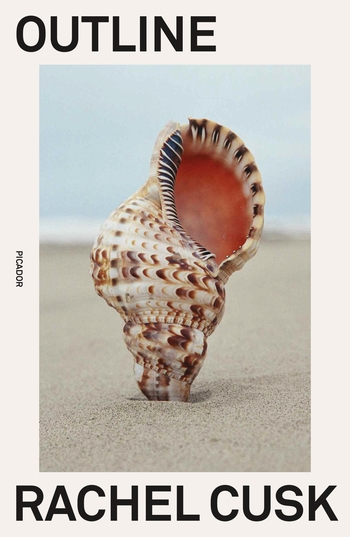
A writer is in Athens to teach a course; we know that she is a mother and divorced, but that is about the extent of the information that Cusk gives us in this ingeniously crafted novel. Though short on names and details, the past of the narrator, and the people she speaks to, reverberate through every sentence. Reading this novel makes you realize how much of the present is spent talking about the past.
A butler goes on a car journey to see an old colleague, and as he passes through the bucolic English countryside, he recounts his career working at Darlington Hall from the heydey of the great English houses through their decline after World War II. Ishiguro’s works tend to be preoccupied with the immutable past, but I found Remains of the Day to be especially devastating. Stevens, the narrator, captures the battle between regret and acceptance that we all must suffer when the past didn’t go as planned, when it feels incomplete, suddenly over, and we realize, only too late, that we would do it differently if we could do it again.
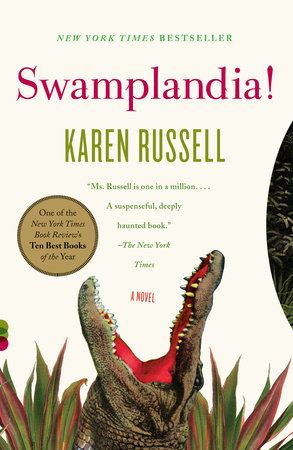
You could say that the characters in this Pulitzer Prize-nominated novel are haunted by an exclamation point. After the death of mamma Bigtree, the Bigtree family park deteriorates from a thriving alligator wresting park (!) to an empty relic of the family’s once happy past. As in other pieces written by Russell, characters also attempt to find literal ghosts in the creepy, watery world of the Thousand Islands off the coast of Southern Florida.
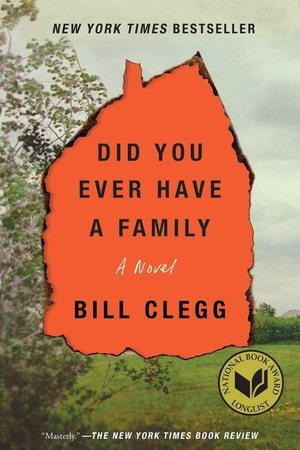
Bill Clegg’s novel isn’t just content with one ghost; it has many. The day before her wedding, a gas explosion kills June Reid’s daughter, her daughter’s fiancé, her boyfriend, and her ex-husband. Clegg explores such an overwhelming magnitude of loss in a surprisingly quiet, thoughtful way.
This is the first book of Gardam’s series starring Edward Feathers, or Old Filth (from the saying, Failed In London Try Hong Kong), a Raj orphan who grew up in British Malaya. When his wife Betty dies, the stiff, proper Feathers, who is in retirement in England, is pursued by memories of their life in Hong Kong. Like Stevens in Remains of the Day, Feathers is haunted by a past which he has idealized but is starting to show its flaws.
Beloved uses a literal ghost to create one of the most powerful images in literature. Sethe, a slave who escaped a brutal plantation in Kentucky, is haunted by the baby she killed rather than allow her to be sent back into slavery. The haunting extends to the figurative level, as every character is plagued by what they’ve experienced in the ugly, hellish world of slavery.
Roy’s atmospheric novel features a wide cast of characters but at its center is Nomi, a young woman who returns to the seaside town of Jarmuli to investigate her past, particularly the Guruji — leader of a large ashram — who sexually abused her when she was a child. Guruji is the ghost here, and though he’s gone he continues to influence her, from her inability to connect with her foster mother to the way she dresses as a punk.
Paul Beatty’s The Sellout is the first American prizewinner
As you likely already know, yesterday Paul Beatty took home the 2016 Man Booker Prize (and $60,000) for The Sellout, making him the first American to win the award and, regardless of nationality, a rare comedic victor.
The controversy surrounding the 2014 decision to extend eligibility to all novels published in English in the UK (i.e. to include Americans, among others) hasn’t exactly dissipated over the past couple years. During the lead-up to last year’s announcement, The Telegraph published an article ominously headlined “American Dominance of Man Booker Prize longlist ‘confirms worst fears.’” The year before that, novelist Philp Hensher bemoaned American inclusion, commenting it would be like “an economic superpower exerting its own literary taste,” and Jim Crace provided the particularly British insight that something ineffable would be “lost” from the prize should Americans be added to the bill. All that is to say, Beatty’s victory has certainly aggravated some still healing wounds across the pond.
This year, the Irish Times posted a particularly scathing write-up that equates Beatty’s novel, the satiric tale of a narrator named ‘Me’ who, despite his African-American heritage, attempts to reinstate slavery and segregation in his “agrarian ghetto” outside Los Angeles, to “TV shows and sketches, or any number of screwball movie plots,” calling the choice “a bit of a sellout.” The same article also noted that “as darkening clouds of disbelief continue to gather over the US, anything can now happen.” Just a wonderful sentiment. To their credit, the Irish Times did consider Elizabeth Strout’s My Name is Lucy Barton, eliminated after the long-list, both a “great American novel,” and a worthy contender for the Booker Prize.
The Guardian took a more optimistic view, lauding Beatty and the Man Booker Committee in two separate pieces, titled “The Sellout Rips Up Rulebook For What Award-Winning Fiction Looks Like” and “How Paul Beatty’s Win Shakes the Jonathan Franzen-Loving US Literati.” The common theme running between the two is an appreciation for writing that is both difficult and unbound from expectation. However, a more tacit critique of a “polarized literary culture of the United States,” which author Michelle Dean perceives to be an undoubted truth, is also present. While this interpretation of the American literary scene is more than a tad reductive, and The Sellout certainly was not really that overlooked on its home turf, I can, counterarguments aside, endorse prizewinners who operate in a high literary register and critics who consider Jonathan Franzen to be an absolute blowhard without getting too up in arms.
Back stateside, the response has been more unequivocally joyous. For The New Republic, Alex Shephard wrote, “it’s hard to think of a better first American Man Booker winner than The Sellout, a profane, hilarious, and often uncomfortable look at America.” He also added the spirited aside, “if nothing else, the Man Booker Prize finally confirmed what has always been true…Americans write the best books.”
The New York Times, characteristically, took a more demure and balanced approach, acknowledging the controversy without positing a divisive stance. The Gray Lady did, however, include a lovely quote from Beatty on his novel:
“It was a hard book for me to write; I know it’s hard to read. I’m just trying to create space for myself. And hopefully that can create space for others.”
Congrats, Mr. Beatty. And well done.
DON’T MISS OUT
Sign up for our newsletter to get submission announcements and stay on top of our best work.
YOUR INBOX IS LIT
Enjoy strange, diverting work from The Commuter on Mondays, absorbing fiction from Recommended Reading on Wednesdays, and a roundup of our best work of the week on Fridays. Personalize your subscription preferences here.