Tiny Cities Made of Ashes by Sam Allingham

I remember the Ullman boys: the six-man army, bristling with sticks, that colonized our narrow strip of Craydon Street. Every afternoon from half past three ’til dark, they filled the air with shouts of C-A-R, game on, and pass the puck, burly brothers who ranged in age from nine to seventeen but shared one face — flattened nose and eyes sunk back in their sockets. They were pug-ugly, built for hockey, grunting and hurling each other against the goals. They made the rest of us their audience.

One afternoon in September the rest of us was me and a kid named Trevor Hendricks. He sat on the grass in front of his house, skinny arms around his knees. We were in the same grade at school, along with ten other kids, and although I’d only been in town a month, I knew his name and face. From the worn green picnic bench outside the Elverton Mail Bag General Store, washing down my Sour Patch Kids with Coke, I watched Trevor watch the street. I sized him up. He looked lonely, or at least alone, and I thought: Here is someone you could convince to be your friend.

I went over to him. “You gonna watch this game all day?” I asked.

“I don’t know.” Trevor shrugged. “Maybe.”

“Hey, fags,” the Ullman boys yelled. “Get a room.”

His shoulder blades shifted beneath his shirt, shaking off the insult.

“We could go to my house,” he said. “If you want.”

Nobody in Elverton had ever invited me over before. I hadn’t invited anyone to my house either; my father didn’t like visitors.

I followed Trevor quickly across the lawn, not wanting to give him time to change his mind, while the Ullman boys made kissing sounds behind us.

Trevor’s mother sat on a torn couch in their living room, flipping through National Geographic and smoking furiously. She was a short and stubby woman. A housedress hid her hips. Clusters of teacups and dirty ashtrays covered the coffee table, and in the far corner, on top of a scarred upright piano, two stuffed muskrats stood frozen in midfight, fur spangled with ash.

“Nice to see a new face,” she said.

“Let’s go downstairs,” Trevor said, tugging my arm. “Let’s build something.”

The basement floor was smooth concrete. Two small windows on the far side let in just enough light to see the metal shelves lining the walls, filled with screws and bolts. Trevor brought out a wooden crate of plastic building blocks, and we worked without speaking, fitting squares.

Trevor had long, nimble fingers. He could make a lifelike roof out of slanted blocks, a credible window. All I could build was a one-story shack, but Trevor made something like a church: peaked gables and a high-tipped steeple.

“That’s good,” I said.

“It’s okay. Wanna see something?” He pulled a model out from beneath the shelves.

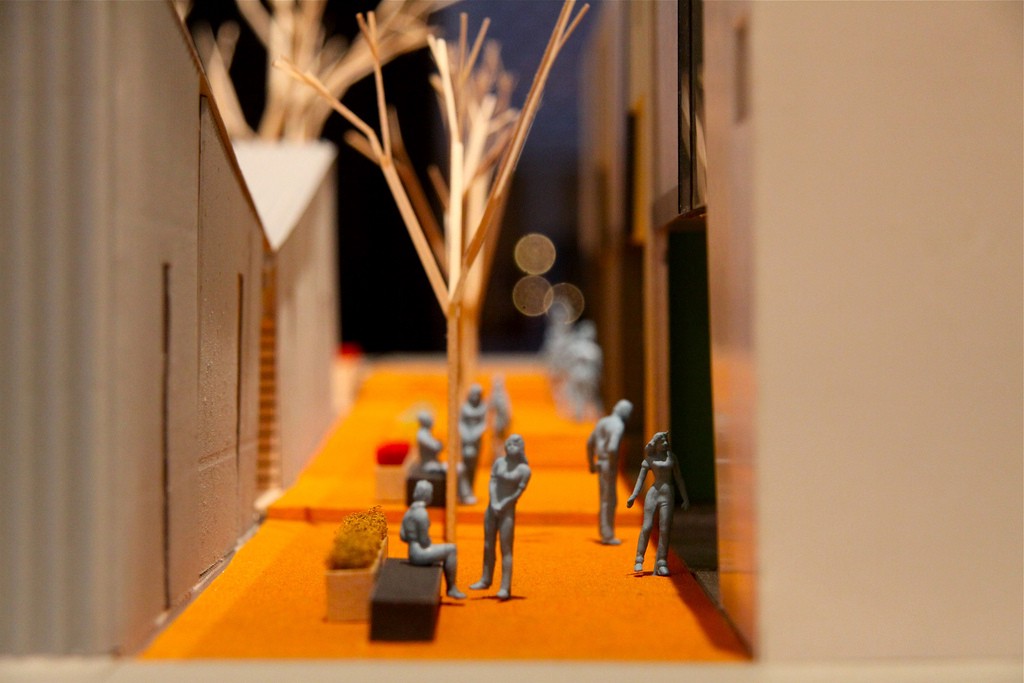
On a large green square of pegged plastic, large as a foldout road map, buildings stood in two clean lines, an invisible street between them. Two structures broke the symmetry: a broad white box with three tall doors and a long red building, crowned by a cracker-flat roof.

“Whaddaya think?”

It looked like the view from a low-flying plane: square and lonely.

“We’re here.” Trevor pointed at a smaller house with more detail than the others. Through its front windows I could see a living room, and beyond that a smaller room with a half wall: a dining room and kitchenette. The walls were uniform gray. Only by looking hard could I see the tiny seams between the plastic blocks.

“What do you mean, here?”

“We’re here,” Trevor repeated, touching the roof.

Then I saw. The tiny house was Trevor’s. The model was Craydon Street. The broad white building with three doors was the Elverton Volunteer Fire Department, and the little red building was our school, Elverton Elementary and Junior High, population ninety-six, stinking of milk and chalk.

“You can touch it, if you want.”

I started at school and walked my fingers down the empty road, ticking off houses: one, two, three. I got to eleven, and there it was on the right: my house in miniature, white walls, two thin columns supporting a porch, a wide yard on the north side my mother filled with flowers.

Trevor’s mother called, voice thick with tar. “Trevor! Come help me with dinner.”

“Come back tomorrow,” Trevor said.

“Have you shown this to anybody else?”

“No.” He put the model back.

By the time I left, the late September sun was almost gone. The Ullman boys were packing up their goals, pulling PVC pipes from their hinges. The oldest one waved his stick at me. It looked tiny inside his thick hand.

“What’d you two do together?” he yelled. “Suck each other’s dicks?”

I looked left and right down Craydon Street, the houses laid out just like Trevor’s model. That was when I realized Trevor wasn’t watching the Ullman boys at all. He was measuring the buildings.

The next day I stood by the rusted geodesic dome — which teachers warned us never to climb, for fear of tetanus — and watched kids kick Trevor around the playground. They choked his head inside their armpits and stripped his shoes off. I wanted to help him, but there was nothing I could do, small and solitary myself. I felt sorry for Trevor but envious too. Nobody touched me like that.

We walked home together afterward. Soybean chaff flickered in the fields. Bulbous squash grew wild in kitchen gardens.

“Nobody talks to me,” I said.

“You’re lucky,” Trevor said.

That afternoon we spanned the town — Craydon, Bacon’s Run, Market, and Ridgeway — measuring houses. Trevor ran his hands over the walls and window frames, fingers learning the shapes, while I stood by the edge of the road and took photographs with a camera my mother had bought to encourage my interests.

“We’re historians,” Trevor said. “They’ll want to know what this town was like in a hundred years.”

“We could give our model to the Historical Society,” I suggested.

I liked the Historical Society, a low brick building with a red door that was once a bank. The old women who volunteered gave me candy, and I liked running my fingers over the old maps of Elverton, as if history were my personal possession.

“I don’t like those people,” Trevor said.

Trevor didn’t like anybody, definitely not Mrs. Waddell, who ran the counter at the Mail Bag. She didn’t let him go inside the store alone, and when he came in with me, she still wouldn’t let him use the bathroom.

Maybe what we had wasn’t quite a friendship — it was just two boys taking measurements. I didn’t have much to compare it to. My family followed my father from job to job, one nuclear plant after another: Calvert Cliffs, Peach Bottom, Indian Point. Not that we lived in any of these places — my father never used that verb. He was supervising at Peach Bottom; he was an adviser at Indian Point.

These kinds of linguistic distinctions were important to my father. He only recommended termination; he never actually fired anyone. He was not responsible. After the fat was trimmed and the streamlined plant passed inspection, he would be off again, faithful family following behind.

Only Elverton felt less temporary to me now, after months in Trevor’s company. I knew the houses: paint peeling like birch bark in the sun, gabled roofs and gutters. I had pictures as proof. I put them in an envelope labeled Evidence and tucked them on his basement shelf beside our little city.

We finished the main square in November. A cold rain fell as Trevor made his final calculations. I stood at the corner of Market and Ridgeway and aimed my camera at our last house, an ugly two-story with vinyl siding and pale green sills. Just before I released the shutter, Trevor turned from his measurements, looked straight at the lens, smiled, and gave me a thumbs-up — a goblin with peaked ears and dry, yellow skin. There was no one home in the house behind him, but still I worried. How weird would we look to the people who lived inside?

The rain fell heavy as we walked back to Craydon. Even the Ullman boys had taken momentary shelter. Their silent goalposts dripped.

“What are we gonna do now?” I asked.

“More houses, I guess,” Trevor said, but he seemed shifty about it, and I worried — not for the first time — that his future plans didn’t include me and that for the rest of my time in Elverton I’d be left friendless, listening to my twin brothers argue over toys while my father paced the living room, rehearsing speeches.

“Can I come over for a bit?” Trevor asked.

This was a shock. Normally, I would have said no — my parents had specific rules about visitors — but the friendly gesture overwhelmed my defenses.

“Sure,” I said. “Of course.”

When we came through the door, my mother was at the kitchen table, paying bills. “Who’s this?” she asked, harried.

The twins were at the table too, working on a jigsaw puzzle, but as soon as they saw Trevor, they lost interest and trained their eyes on the outsider. Hard to remember how small they were in those days, thin little children.

“This is Trevor,” I said. “We’ll just play Sega. We won’t bother anybody.”

“All right,” my mother said, squinting. “But stay on the porch.”

Our screened-in porch was empty, except for the former tenants’ patio furniture and a blurry television with the Genesis attached. Trevor and I took turns playing Sonic. There was only one controller; my mother disliked competition. Trevor was no good. The buttons stuck beneath his clumsy thumbs.

“We can play something different,” I said. “If you want.”

“Where’s your bathroom?” Trevor asked.

“Past the kitchen,” I said, and turned back to the screen.

I was so busy maneuvering through a world of flashing lights that I didn’t realize how long he’d been gone. I was about to face the boss of Pinball Palace when my mother appeared, holding Trevor by the shoulder. Her face was red. “Next time tell your friend the right way to the bathroom.”

“I did tell him,” I said, focused on the screen.

“I don’t like people sneaking around my bedroom!”

I paused the game. What was Trevor doing in my parents’ bedroom, all the way on the second floor?

“I’ve got my hands full with dinner,” my mother said. “Tell your friend it’s time to go home.” She walked away, letting the door slam.

Trevor was shaking, but his lips curled up into a guilty smile beneath his beaked nose. His eyes looked tiny. I remembered how Mrs. Waddell watched him when he walked into the Mail Bag and didn’t let him use the bathroom.

“You better go.”

Trevor slipped out the porch door and onto the rainy street, leaving me alone.

I stared at the frozen television. Pinball Palace seemed meaningless. My first Elverton friend, and I’d picked a weirdo, someone even my mother knew was defective. Maybe my parents were right, and I should be suspicious of outsiders.

After a while my mother came back. “Sorry for being short. That boy has a history.”

“A history?”

“Some women were talking at the Mail Bag,” she said. “A teacher found him in the girls’ bathroom at your school, hiding in the stalls. Not just once — several times.”

I imagined Trevor in the girls’ bathroom, arms crossed, sizing up its dimensions. What did this say about our project? After dark, when I was safe in bed, did Trevor sneak from house to house, opening windows?

“I know things are hard,” my mother said. “This is your dad’s tough year. He’ll get a long-term position soon. Buckle down, buddy!” She mock-punched me in the arm. “We’ll get through it.”

That was my mother: the kind voice and the firm hand, good cop and bad. My father worked long hours, and when he was home, he spent most of his time in the office upstairs. Even before the trouble started, my mother was the only parent I had. At the end of that night’s dinner, as we cleaned the last carrots from our plates, my father rolled up his sleeves and cleared his throat. He looked tense, as he often did those days — wiry, electric with nerves. The dark circles under his eyes gave his words extra gravity.

The three of us had it pretty good, he began. We were allowed to do the usual things kids did: soccer leagues, summer camps, spelling bees. We had all the opportunities. There was no reason for us to be unhappy — didn’t we agree? He only asked one thing, that we keep our socializing out of the house. He had nothing against kids — in fact he liked some of them very much — but let one in and more would follow. Not just kids but their parents too, plant employees, wanting to talk and socialize and ask questions, and even if their parents weren’t plant employees, then their uncles were, their aunts or their cousins, all of them with questions, all of them curious, and once you started talking, answering questions, they’d never stop asking, and how was he expected to do his job with people always asking him questions, as if he had answers, as if he could help them?

While he talked, our mother stroked his knuckles, trying to keep his hands still.

I grew six inches that year. I proved my toughness on the kickball field, wrestling the rubber sphere out of the air and pegging the speeding runner’s head. I won a grueling forty-foot race across the double monkey bars, linking my legs around another boy’s hips and hurling him to the sand. When a tall kid told me his father said my father was a fag, I shoved his face into an anthill until he screamed.

One afternoon in April, a scuffle broke out by the geodesic dome. Boys crowded around in a tight ring, yelling, fight, fight, fight. I shoved into the circle. I was no shy kid anymore. People gave me room.

Trevor was lying in the middle, holding his stomach. The kid who’d been beating him was already turning away.

I took over. I put my foot on Trevor’s neck.

“Long time no see,” he wheezed.

Although I saw Trevor every day, I always looked past him. I didn’t want people to remember we’d been friends.

The other kids chuckled. “Shut up,” I told them. “Get out of here.”

The teacher blew his whistle, and the crowd trickled away. Recess was over, but still I kept my foot on Trevor’s throat, like he was a snake I couldn’t risk letting go.

“You still sneaking around town?” I asked. “Looking in people’s windows?”

Trevor smirked but didn’t say anything.

“How’s that model we built?”

You didn’t build anything,” Trevor said, twisting up his mouth. “You’re not a builder.”

I took my foot off his neck and kicked him once in the ribs. The teacher didn’t intervene. Nobody ever intervened when Trevor was involved.

“Get out of here,” I said. I watched Trevor’s back as he slunk away.

What did Trevor know about being a builder? I was building my own city now — a city of experience. Trevor wasn’t invited to Alex Edward’s fourteenth birthday party that May, but I was. As soon as I got in the front door, my hands ran over the banisters, measuring. The inside was clean and fresh, plush carpet and goldenrod walls. Trevor may have run his hands across those windowsills when the family wasn’t looking, but he’d never been invited inside.

After the boys ate cake, we tramped out to the backyard to play touch. Their lawn was as immaculate as their carpets, brushed clean of sticks and leaves. A sudden snap, and Stephen Ambrose, backup quarterback, flung the football at the back of my head. Maybe it was a mistake, but I didn’t care. I turned and charged, hurling my body into his and pummeling away. It took six of them to pull me off.

While Alex’s mother called my house with news of the fight, I sat on a solitary chair in that golden living room and listened to the adults whisper about my violent ways. I knew they’d never let me come back.

When I came home, I found my father had already called a meeting to discuss what I’d done. He had my mother and the twins around the kitchen table, their faces full of concern, but not for me. They were watching him as he paced erratically around the room, occasionally bumping against the handle of the refrigerator and the hard corners of the countertops, as if he couldn’t be troubled by the details of the physical world.

He didn’t blame me for what I’d done. If anything, he blamed himself — for introducing us to this sort of environment, in which survival of the fittest was the law of the land, in which brute force was the only language anyone understood. Didn’t we see, then, how crucial it was that we not let ourselves be unduly influenced by this environment? Didn’t we recognize the sensitivity of the situation? Hadn’t he done his absolute best to protect us? And yet here I was, acting like a hooligan, fraternizing with the enemy!

We were used to these sorts of speeches, by that point. There was the Pitch In Together speech, the Trust No One speech, the Sports Are a Distraction from the Reality of Life speech. There was nothing odd about my father giving speeches. His work was speeches: motivational speeches, procedural speeches, disciplinary speeches. But as the pressure grew — as it became clear that there was organized resistance to his safety regime, as the year mark passed and he failed to meet deadline after deadline — the hand gestures that accompanied these speeches became increasingly wild, like a loose piece of machinery, deformed by stress. He was moving too quickly around the room, pulling so aggressively on the piece of scalp directly above his forehead that large clumps of hair came off in his hands.

This time my mother made no move, either to comfort or to stop him. Maybe she felt she couldn’t, trapped in a script she was powerless to alter. She only looked at me sadly, as if this was all my responsibility, as if I’d set the stage and started the scene in motion.

I got my first girlfriend that June: Amber Elwell. She lived at the edge of town, where Bacon’s Run met Ridgeway, past soybean fields and stands of oak, past Wiskasset Creek, lined with stunted beech trees. I could only see her for an hour at a time, after school ended and before my mother got home from work; now that my father had taken a leave of absence from his job, my mother had gotten a position as a dentist’s bookkeeper — “to keep our options open,” she told us. But just because he wasn’t allowed to go to the plant didn’t mean my father’s working days were over; he still spent much of his time in the attic, going over security procedures. He had no time for the twins, which meant that after school they were my responsibility.

But I was happy to shirk it, in service of a greater cause. Amber Elwell would change my reputation. I would prove to everyone that I was no vicious bully. I had the gentle hands of a lover.

One afternoon, lying red-faced on her living room couch, I heard Amber’s dog barking outside. My heartbeat rang in my ears: her mother, home!

I crept to the window and looked out onto the lawn. Trevor was at the edge of the road, carrying binoculars. He didn’t bother hiding them, and when he saw me, he smiled that particular half-smile of his, as if he was satisfied I’d been forced to look in his direction, despite all my efforts to ignore him.

Amber joined me at the window. “You creeper,” she yelled. “My brother’s gonna kill you!”

The window was open, and I knew Trevor could hear her shouts, but he didn’t make a sign — just tightened the strap of his binoculars and rode away.

Amber sat on the couch, arms crossed over her chest. “I feel so violated.”

“Don’t worry about it,” I cooed. I crouched in front of her, twining my fingers in hers and pressing her left wrist against the leather. My other hand traced the fine line of her collarbone.

“Don’t.” She pushed back.

“Relax,” I said. “You’re with me.”

She struggled and I struggled back, as if she were some younger kid giving me crap on the playground. I used my legs as leverage. She gripped my hands hard at the knuckles. Red-faced, sweating, she threw me off.

“Get out,” she said through gritted teeth.

I left her house, my penis stiff and painful against my bicycle seat. As I rounded the corner of Craydon, I saw Trevor outside the Mail Bag, drinking a Slice. There was no hockey that afternoon. The Ullman boys were gone, and Trevor ruled the street.

“Stay away from Amber, creep,” I told him. He took a long sip of his Slice. “If you come around again, I’ll beat your ass.”

Trevor pointed a thumb at his house. “You want to see my town?”

I consider this, the bicycle between us. I could have beaten him up without further discussion, but Mrs. Waddell might have seen; so much for my improved reputation. Maybe in his basement I could do what I liked. Besides, I couldn’t lie: I was curious about our town.

I dropped my bike by the dogwood tree and followed him inside.

His house was the same — ashy clutter, stuffed muskrats. His mother was in the kitchen, staring at the flystrip dangling from the ceiling.

“You’re back,” she said. I could hear the eagerness in her voice. She must have thought it sad her son had so few friends.

We went down the basement steps. His city spread across the concrete floor. He must have made a deal with his mother because he no longer had to hide it. Not that he could, even if he’d wanted to. It had grown too large to conceal.

The individual buildings were impressive enough; each had tripled in size, without the model losing any of its symmetry. I could imagine dolls living in their empty rooms. But it was the aerial view from the third step that amazed me. From there I could see the town square laid out like a map, precise in its geometry, but with much more detail than a map could ever hope to accomplish: every hallway, every room, every window. The only thing wrong was the hodge-podge of color: gray walls spoiled by red and yellow blocks. He had to make do with inferior materials.

I leaned back and saw Elverton from a peaceful distance, huddled and serene. Then I leaned forward, peering through the rooms where no one lived — little cells that time passed through. How had he accomplished such detail when no one ever let him inside?

“Go ahead,” Trevor said. “Walk around.”

The shelving was gone from the walls, and there was a small perimeter around the town for visitors to move through. I walked around, glancing into windows. My own house was perfect, but I knew that already. I circled the square, looking for the house where Amber lived. Trevor had it exact, a white farmhouse gone to seed, the porch held up with diagonal beams to keep it stable. But it wasn’t the outside that made me stop and stare; it was the way he’d built the details of the interior: the cut-out wall that linked Amber’s living room and kitchen; the rickety stairs in the main hall that led up to her bedroom; even the bedroom itself, although I couldn’t say for sure whether that room was accurate. I had no intimate knowledge.

I had a strange feeling, watching the model from above, like I was outside time and space, examining a memorial for something that hadn’t yet been destroyed.

“What do you think?”

I imagined Trevor with binoculars, standing on the far edge of the road in the dark, training his eyes on Amber’s bedroom. “You’re sick.”

Trevor chuckled. Maybe this was the response he’d hoped for — the viewer squirming in the palm of his hand. I thought about hitting him but didn’t. I was in his world now. Some kind of curse might fall on me.

“I’m going home,” I said.

“Fine,” Trevor said. “I’ve got work to do.”

I walked back out into the thick heat of late summer. I missed the sounds of the Ullman boys, their calls of C-A-R, the way they put the street in motion. The oldest one worked in a lumberyard now, and the second oldest had joined the army. They had few options, those violent boys. The rest of the gang spent their afternoons inside, watching television. Other than the buzzing of greenhead flies, Craydon Street was as silent as Trevor’s model.

But inside our house, things were anything but quiet. My mother was home, but there was no dinner being prepared; instead, my father was winding himself up for the final speech, Forward to the Future. I remember the way he climbed up onto the table and the way it rocked beneath his feet. He spoke of the future as if it were a city you could go to, but only if you worked hard and were vigilant, because you couldn’t well expect the future to simply come to you, it had to be continually achieved, conquered, realized — a perspective that frightened me at the time, punctuated by my father’s vehement stomping and the clattering of cutlery, but that now strikes me as strangely optimistic. Conquering the future: what a dream!

Before he could finish, the table wobbled and broke beneath him, one leg splintering beneath his weight. He lost his balance on the sliding tabletop and fell face-first, hands and knees slamming against the linoleum. The twins shouted in excitement, my father moaned, and my mother got down on the floor, holding his head and telling him, be still.

“Idiots,” my father muttered. “Ignorant savages.”

“Quiet now,” my mother said. “You need to rest.”

My father stopped mumbling and started panting instead, a tired bull that had dragged us deep into the countryside and then collapsed.

I got up from my seat and went over to where the two of them were lying. I looked down at my helpless father, my foot pulled back as if to kick him. “Get up,” I yelled. “You’re the one who brought us here, you bastard.”

But he didn’t get up. My father panted, my mother whispered, and I looked out the window at the sleeping street, wondering if Trevor was outside, spying as my family fell apart.

I went to Regional that fall. I was no lover anymore; Amber never spoke to me after Trevor came around with his binoculars. Rumor spread that he and I were in on it together, spying on naked girls in nighttime windows — and after my father became a patient at the Woodbury Psychiatric Hospital, the neighborhood kids passed our house with suspicious glances, whispering and laughing.

I was no bully, either. Too many high school kids could kill me with a punch. I was just a gawky boy with clumsy legs and a temper, and I fell in with the kind of kids who fit in nowhere: skinny kids with long hair and bad acne, worn baseball caps and “Stairway to Heaven” bumper stickers. After school I would sit in the back of one of the older guys’ pickups in the parking lot with a battery-powered radio blasting classic rock, and after we’d passed a covert jay, I’d lie with my back against the ridged bed and look up at the sky.

The weed pacified me. While the rest of the guys compared the asses of girls they’d never have the courage to speak to, I made a map out of clouds: Asia, Europe, the long tip of Patagonia. I thought that maybe I would join the Navy once I graduated — the branch of the military that had the least to do with direct killing. The Navy would take me away.

I sometimes saw Trevor during lunch, sitting on the other side of the massive cafeteria, surrounded by boys who played games with cards and dice. He hadn’t grown much. Except for a faint mustache, he could still have passed for twelve.

How had I ever let such a tiny creature frighten me? He looked lonely, even surrounded by people. His eyes scanned the room like a dog let loose in an unfamiliar house.

One morning during my senior year, an announcement came over the loudspeaker while I was in shop. The teacher had us stop our saws and hammers and lathes; we stood and listened in the silence of the big machines.

Everyone report to the gym for an emergency address.

The entire student body crowded the gym, standing shoulder to shoulder — no time to assemble chairs — while the principal gave a speech.

“There has been a terrible accident in New York City,” he murmured into the microphone — this short man with a comb-over, his voice thin even at the best of times. “You should all go home and be with your families.”

Due to some obscure emergency procedure, we all had to wait for our parents to pick us up from school that day, and my mother was late. Once the rest of the students had filtered out through the main doors of the auditorium, confused in their parents’ arms, my homeroom teacher took pity on me and walked me to the A/V room.

There were only ten or so students there, the television trained to a news program, the video loop of planes crashing, over and over. Trevor was there too, sitting in the front row. I didn’t know anyone else in the room, so I sat down next to him.

Trevor turned to look at me. I could tell from his expression that he was afraid, and that seeing me in the seat next to him was a comfort. I was surprised to see Trevor frightened. I’d heard his father had died the year before — fallen drunk off the observation tower at Oyster Point — but I hadn’t sought him out to offer sympathy. Maybe I’d been wrong all these years, ignoring him, insulting him, kicking him in the ribs. Maybe he had feelings after all.

Trevor leaned in and whispered. “Promise me that if something happens to me, you’ll look out for the town,” he said, as if no time had passed since we last spoke about his tiny city.

“I’ll try,” I said.

Was he manipulating me, the same way he’d manipulated me to get access to my house, back when I was young and vulnerable? I told myself it didn’t matter. Here was my chance to redeem myself and show some kindness.

He grabbed my arm, hard. “Promise, Eddie. You’re the only one I can trust.”

“I promise.”

“I still have so much work to do,” he whispered.

My mother arrived to take me home, hurrying me on with a hand against my back. She always moved blindly forward, as if through constant motion you could outrun the fate that was gaining on you. “Hurry up,” she whispered. “The twins are waiting in the car.”

There was no time to consider what Trevor had told me. What did he mean, he had more work to do? How much could his little city grow, trapped in the basement? I’d promised to be the steward of something I didn’t fully understand.

After the national tragedy, my mother decided to run. By this time, my father was out of Woodbury, living with his mother in the northern part of the state. We were told we’d have a chance to visit, once he was feeling like himself again — but by then I’d more or less forgotten what that meant. There was nothing tethering us to Elverton anymore. That March she made plans to sell our house on Craydon Street and move to Pennsylvania. She’d had enough.

“Why now?” I asked her, by which I meant: Why not before?

“The twins’ll be going to high school in September,” she told me. “It’ll be natural. If they stay here, they’ll be feral by Christmas.”

“Who cares about the twins?” I asked, by which I meant: Who cares about me?

I went to the school recruiter in the spirit of revenge. Now that I was eighteen, I didn’t need my mother’s permission. I asked him what I needed to join the Navy, and he helped me fill out all the paperwork. The country was going to war; there was a need.

When I told my mother about my decision — in late May, just before my graduation — she put her face in her hands and wept. The twins were in the living room, watching television and throwing things at the walls. They were the same age as I’d been when we moved to Elverton. What a force of nature they’d become! They tore up shrubs and flowers and dented the side of our family’s shed with baseball bats.

“You too, Eddie?” she asked. “But you’re the good one.”

In the other room the twins were shouting at a cop show: kill him, kill him, kill him. My poor mother’s face was stripped of pride. She’d taken up smoking to relieve her stress, and she had fine lines everywhere. This town had dragged her down.

My mother sold the place quickly; our move-out date was the end of June. I was expected to report for duty the first of July, but I had time to help her clean out the house. For days we labored, clearing out our history. My mother had sold whatever she could spare, but certain things remained: silverware, paintings, beautiful earthenware lamps — a few things kept clean and whole.

By the fourth day, the place was husked. Craydon Street was quieter than ever; all the Ullman boys were grown and had moved away. The nuclear plant was closing down, a casualty of failed inspections. Yet when I went outside to sneak a smoke, I saw that the world was dappled with light, the lawn a riot of magnolia bloom, those full and rotting flowers. The air held the seminal smell of dogwood, and the clovered grass of Trevor’s lawn bristled with green. I knew he was down there, under the earth, fixing us all into position.

My mother joined me. “When’s your bus?” she asked. “The twins want to go to Watertown for Chinese.”

“Eight,” I said. “But I have some business to take care of first.”

My mother nodded, wiping her dusty hands on her jeans. We were long past expecting justification for each other’s behavior.

I crossed Craydon Street and knocked on Trevor’s door. No one answered. I tried the handle, and the door swung open. I hesitated at the threshold, but only for a second. This was my last chance. Even if Trevor wasn’t home, I was going to see what I’d come to see.

I don’t know how Trevor and his mother lived in that empty place. I can only assume they’d sold most of their possessions, whether out of financial pressure or to pay for Trevor’s materials. The coffee table, the piano, even the twin muskrats that used to fight on top of it, were all gone, and in their place, Trevor’s magnificent city.

It was all aboveground now. Most of the houses were as tall as my knee, and some of the larger ones — the school, the fire department engine house — went all the way up to my waist. Each one was built from thousands of tiny bricks pressed together, the thin seams between them invisible to the naked eye. He had copied every windowsill, every balustrade, every piece of cracked and crippled molding, and instead of worrying over the colors of the blocks, he’d simply painted them, like any house, each shade a perfect copy of the source material. He’d even chipped the paint in places and faded it in others, mimicking the sun.

The model didn’t depict the town as it was now, of course, but as it was at a single moment in the past, when we were thirteen: Market, Bacon’s, Craydon, Ridgeway. A snapshot of the year 1997 — a fall afternoon, soundless and still.

Trevor appeared in the dining room doorway. His thin mustache didn’t make him look any older. He spoke as if he’d been telling the same story, with brief interruptions, for as long as we’d known each other.

“What do you think? I’m almost finished.”

“My mom’s moving away,” I said.

He didn’t seem to have heard me. He gestured to the town. “Do you like it? It’s close, you know. Very close.”

“Where’s your mom, Trevor?” I asked. “Where do you eat?”

“She’s sick,” he spat. “I have to take care of her. I barely have any time to build. If it wasn’t for her, I’d have been done a long time ago.” He motioned to the tiny Craydon Street that split the carpet. “Go ahead. Take a walk.”

I walked the path I had once taken with my fingers, counting off the buildings — one, two, three — until I got to eleven and saw it on the right, my empty house. The kitchen where my father fell from the table and babbled “savages”; the living room where the twins threw sticks at the television; the tiny bedroom where I once pulled on my penis in trembling silence — all the rooms stripped bare.

I’d barely been able to keep myself under control for four days, shuttling boxes. This doesn’t matter, I’d told myself. The minute you’re out of here it’ll begin to fade. Years will go by, and you won’t think about it more than once or twice. Just a few years of your life. Just your childhood. Just the place you come from.

I thought about breaking open the dollhouse with my foot, but instead I started crying.

There it was, all that evidence: my life, without me in it.

Trevor watched me silently until I finished crying. “But what do you think, Eddie?” he asked, urgently. “You’re the only one who can tell me if it’s perfect.”

My eyes were red and raw. “Good-bye, Trevor,” I said, and walked out the door.

It’s been five years since I’ve been back to Elverton. I live with the gray ocean, the choked whine of engines as planes take the tarmac and idle in their own smoke, the prison-quality meat they squeeze from a tube. A life of compression, its meaning squeezed into acronyms: DSG, LPOD, OOD.

The one good thing is the constant motion. It takes hundreds of men, moving in tandem, just to drive this metal carrier forward. Nobody turns his eyes to the wake. So when they asked me to go see my father, my mother, my brothers, I could say: my country needs me. I could face forward, toward the future.

Until this week, when I was back on leave, spending my Friday watching Animal Planet in my half-furnished apartment in Tacoma, and I got a call from a man with an official-sounding voice.

He asked if my name was Edward Monroe, as if it were written on a card.

I said it was.

Now this is going to sound odd, he said.

It was a lawyer, put in charge of the personal effects of one Trevor Harrison, and I can’t say I was completely surprised by what he had to say — that Trevor had hung himself in the kitchen of his house, his mother long dead; that he’d buried her body himself and used her social security checks to buy more materials for building. The last, at least, was a surprise, although I’d always known he’d spare no expense for his masterpiece.

“Why are you telling me all this?” I asked, making my voice hard. “What does it have to do with me?” The man was clearly out of his element. “He wanted you to have that . . .” The man hesitated over the word. “That thing he built. He was very specific.”

I said I’d be down on Monday.

It’s Monday now.

I thought at first I’d make my mother do it. She still lives in Pennsylvania, so she’s closer, and anyway the whole thing was more her fault than mine, how our family was wrecked on the rocks of that little town.

But no. Trevor is my responsibility. I made a promise.

I think I know what to do. I’ll make the trip tonight, once the sun sets. I’ll cross the bay on the bridge past Wilmington, get some gasoline at the Sunoco station near Watertown, and then I’ll rocket through the marshland, windows down, smelling the rotting gingko berries. I’ll park a-ways from Trevor’s, so no one will see my car.

I don’t know what I’ll find when I open up that dusty house. Maybe the town will have grown still higher, buildings tall as my chest, straining against the walls, houses inside houses. It doesn’t matter. The only question is how to put an end to it. I could pour gasoline across the floor, trailing a little bit through the screen door, and drop a match — if not for the neighbors. Who knows? I’m sure the story of Trevor has gotten out by now, and maybe they’re as frightened of that tiny city as I am.

But most likely I’ll do what I’ve always done and use my hands, though it’s hard to imagine myself standing over our town like a movie monster, ripping it apart. Maybe this was always Trevor’s plan for me, his dare. He was right, I’m no builder — but I can break things down.

Ken Liu Will Keep an Open Mind

Ken Liu is a literary powerhouse. He’s the author of the acclaimed collection The Paper Menagerie and Other Stories and the Dandelion Dynasty series of novels, beginning with The Grace of Kings. His work as a translator includes the first and third volumes of Cixin Liu’s Remembrance of Earth’s Past trilogy, The Three-Body Problem and Death’s End. (Joel Martinsen translated the second book, The Dark Forest.) And as an editor, he’s recently compiled Invisible Planets, which contains a stylistically diverse range of contemporary Chinese science fiction; he also translated each of the stories contained in it into English.

The array of work in the anthology is expansive, taking in a wide range of work, from the philosophical to the comic to the visceral. Cixin Liu’s “Taking Care of God,” in which the aliens that created life return to Earth in search of a new home; Chen Quifan’s “The Year of the Rat” depicts a surreal nightmare of warfare and genetic engineering; and Xia Jia’s “A Hundred Ghosts Parade Tonight” blends metaphysical elements with a haunting (no pun intended) description of economic desperation.

I spoke with Liu about his work and a translator, and about how Anglophone perceptions of Chinese science fiction are (or are not) changing over time.

Tobias Carroll: In translating Cixin Liu’s Death’s End, was there anything you found particularly challenging?

Ken Liu: I’m not sure that Death’s End was distinctly challenging compared to, say, the first book. In terms of what’s difficult about translating a book like that: there’s a common misconception that the technical language is difficult. I think that’s not true. The technical parts are really trivial to do. The global language for technology these days is English, and therefore, even technical terms in other languages are constructed along English models or are simply translated from English. Therefore, to translate a technical term from Chinese into English is very trivial and not particularly challenging.

What is far more challenging and interesting is understanding and knowing the technical background that’s employed by the author, and then trying to convey that in a way that makes sense. Different readers have different expectations and experience levels. You can’t just translate word for word. It’s not going to be particularly compelling, or interesting, or accurate. As a translator, you have to perform and re-interpret and reconstruct in a way that makes sense.

A lot of what I’m going to say about translation really has to do with the fact that translation is a performance art. This is not my comparison, but rather the comparison of William Weaver, the translator of Italo Calvino in the US. I think it’s really true. With different kinds of performance art, we tend to understand how the performance works; as an audience, we have an appreciation for what kinds of challenges the performers face. For example, a musician playing a composer’s piece would understand the range of choices that they make and understand what they can and can’t do to affect our enjoyment of the piece. With plays, we understand what actresses and actors can do and what directors can do to affect our experience of a play, differently from the words written by the playwright.

Translation, I think, is very difficult for most readers to understand, especially readers in the English-speaking world, who don’t read a lot of translation. It’s hard for them to understand what that means and what translators can and can’t do, and what sort of challenges they might face.

Carroll: Did you have any kind of a back-and-forth dialogue with Joel Martinsen about maintaining the author’s voice into English across all three books?

Liu: There are multiple levels to that. One of them is, Cixin Liu changes as a writer over time, between the books, so his style is very different. The other is, I don’t think it’s valuable at all for different translators to try to use the exact same approach. That’s pointless. You wouldn’t want two musicians who are performing the same composer’s work to somehow agree on one style of performance; that’s not what we’re interested in. In this case, Joel and I agreed on a set of terms early on, to not call the same thing by different names. Other than that, we decided that we wanted to go with our own distinct approaches. We have different philosophies. We’re friends, and we like each other, but it’s most effective for us to take different approaches. The three books are very different in style, and were written with very different voices. There was no need for us to get in each other’s way, in that sense.

Carroll: If you had told me, after reading The Three-Body Problem, where Death’s End ended up, I would have been shocked. The trilogy goes through so many cycles and reinventions.

Liu: He writes like no one else, and he changes greatly between books, which makes it both more fun and more challenging to do translation in a way that preserves that spirit.

Carroll: The only other work of his that I’ve read is his story in Invisible Planets, and then “The Poetry Cloud” in the Ann and Jeff VanderMeer-edited The Big Book of Science Fiction. It was interesting to see these very different sides to his work in both of those anthologies as well.

Liu: He is even more accomplished as a short story writer than as a novelist. “The Poetry Cloud” is one of his most amazing works. I really, really enjoy it. “Taking Care of God,” in Invisible Planets, is a different kind of work, and I also like that a lot. They’re very different kinds of works, and he is interesting as a writer, because he covers a wide variety of styles, and has a very big range.

Carroll: In both “Taking Care of God” and the end of the trilogy, there’s a sense of the universe as both a very dangerous place, where humanity is in constant danger, but also a strange kind of optimism. I found the way they coexisted to be very interesting.

Liu: I wouldn’t quite phrase it the way you did. In some interviews, he is baffled by the way that we interpret the story as somehow tragic. Look, the universe is going to end; that’s just a fact of life. The universe is going to end some day, and we’re all going to die. That’s real. There’s nothing sad about that; that’s just part of life. At the end of a comedy, we think the hero and heroine get married and everyone’s happy–they’re all going to die in another hundred years! If you wait long enough, everything turns into a tragedy. Everything ends with death. Death’s End and “Taking Care of God” are not tragic in that sense. These are stories about the grand history of the universe. We know how the universe is going to end. That’s the way is is. Whether a story is a tragedy or a comedy or a story of heroism or pessimism or optimism depends on how you get there.

The universe is going to end some day, and we’re all going to die…There’s nothing sad about that; that’s just part of life.

As far as I can tell, these are all incredibly happy stories. Humanity is the real hero. We are tiny, we are insignificant, and yet we manage to rise above ourselves. It is the duty of every species to rise up and to be grander than what their limitations are, to encompass the universe in spirit, if not physically. I find that incredibly optimistic. I don’t read these books as being pessimistic, or as saying that the universe is dangerous. I think they’re saying that the universe is uncaring, but also very beautiful, and that we are very lucky to be alive in it.

Carroll: One of the things I appreciated when reading Invisible Planets was that you had multiple stories by each of the authors featured in it. Did you have that plan in mind going into the book, or did it come up further into the process?

Liu: This is different from most other anthologies you’ll read. With most anthologies, an editor has an idea, and they’ll go through books and pick out things they like, and [then] they might pitch the idea to a publisher or do the selection later. Invisible Planets didn’t happen that way. Invisible Planets was not an anthology that began with an idea. It basically represents a selection of stories that I found to be the most compelling in my journey through contemporary Chinese science fiction, and that I personally enjoyed, and think are in some way representative of the genre.

I had no interest in doing an anthology when I started doing the project many years ago. I was just a reader and a fan, and I realized that I wanted to share some of these stories with my fellow Anglophone readers, and I started doing translations. By the time I had so many translations and had done so many stories, I thought that I could pick out a bunch that were really strong and compelling and create an anthology out of it. That happened at the end, rather than the beginning. This one didn’t start out with an idea, but rather, ended with an idea. It was a journey; it was the summary of my own personal journey. That’s a little different than a lot anthologies you’ll read; it didn’t start with a theme or an idea: “let’s do the best science fiction and fantasy of this year,” or anything like that. It was just me, wandering through the garden, being struck by certain beautiful pieces, noting them down, translating them or saying, “I’m going to do this later,” and eventually saying, “Gosh, I have so many of them–let’s put them together into a book!”

Carroll: You spoke earlier about the performative aspects of translation. You’re also a writer; do the two go hand-in-hand for you, or do you need to restrain parts of your writing side when translating?

Liu: I don’t think of them as being in conflict or competition. There are plenty of composers who are also performers, like Mozart. There are lots of playwrights who are also active in the theater, either as directors or as actors and actresses. I guess it’s similar. These are two very different kinds of art. They superficially have some resemblance, but they’re not terribly related. In writing, you are creating an artifact that is entirely textual, that is entirely based on the written tradition and the ideas that you are trying to express, the emotional journey that you want readers to go on. In translation, it’s a performance, and like any performance art, you’re much more driven by the audience. What you’re doing is a much more intense version of the dialogue with the audience than you would as a writer. As a writer, you’re mediated somewhat, but as a translator, you’re not. For me, the two are very different things. I don’t think of them as being in conflict or in competition.

I do think that translation uses a very different part of my mind. The time that I spend in translation doesn’t really feel like it’s taking the energy I would have had for writing away, and vice versa.

Carroll: Since you began translating some of these stories into English, have you found any changes in how Chinese science fiction is perceived by Anglophone readers?

Liu: I can’t say I have, beyond the most superficial ways. When I started doing translations, many of the magazines had never published a translation before, and many of the Chinese authors had not been translated before, so it was all new. Several years later, now with The Three-Body Problem being a Hugo winner and Death’s End being on the New York Times bestseller list, when I mention Chinese science fiction, many more Anglophone readers know what I’m taking about. They’ll say, “Oh! I’ve read The Three-Body Problem,” or, “I know Clarkesworld is doing that translation series.” If nothing else, there’s much more of an awareness. I don’t know if there’s any deeper critical discourse that’s changed in the intervening years.

One thing I would hope is to see is for translations in general — not just of Chinese science fiction — to become more a part of our Anglophone reading, so that we no longer see those works as different, as translations, but rather as entries in the global conversation. I don’t think we’re there yet, and I don’t know if we’re going to get there, but I’m encouraged by the fact that a big publisher like Tor Books, and Head of Zeus in the UK, are willing to put out an anthology like Invisible Planets. Hopefully we can pave the way for more great translated fiction from other parts of the world. I know there’s exciting stuff being written around the world, and we’d all benefit from having it.

Carroll: In several of the introductions in the anthology, you address the dangers of thinking of writers from any one country too monolithically, or of interpreting some of the issues addressed in these stories as being specific to one country rather than reflecting global concerns.

Liu: I think there’s a particular danger with fiction from China. China is of interest to a lot of Americans, because there’s a huge level of distrust and a huge amount of wishful thinking on our part as to what China is like. We don’t trust China. We’re very suspicious of it; we view it as a rival, and possibly, we cast it in a villainous color. We often think of China as kind of a dystopia, and we think that everybody there is terribly happy all the time, that they’re slaves enduring a dystopian existence. The reality, of course, is far more complicated. It’s not like that.

My caution is that, if you go in there with the idea that what the media tells you is all there is to know about China, then yes, you’re going to read all these works with a particular set of frameworks and a particular set of expectations. All texts are packed by reader expectations and interpretive frameworks before they can be unpacked. If you go in there with these expectations and interpretive frameworks, then, no, you’re probably not going to enjoy these stories very much, because all they’ll do is confirm your pre-existing prejudices.

If you go in a little more open-minded and abandon those media notions and just say, “I don’t know a whole lot about China, and I’m not sure I’ll learn a whole lot from these stories. So let me go in there and try to keep an open mind and see if these stories are interesting, if they show me something about the world I hadn’t thought about before, if they show me something about the human condition, if they show me something about modernity, about being caught between tradition and the future, being caught between the very old yearnings of being human and the very new desires of being a technological being. Because of the powerlessness we all feel in the post-capitalist, late capitalist, global society, in the sense of the boundless technological potentiality we feel as citizens of a networked world. Let’s go in there and see if these stories can tell us something about these feelings and these challenges that we all face.”…then I think you would enjoy them a lot more. The interpretive frameworks will have more room, the expectations will be more focused on being surprised, and I think readers would enjoy the stories a lot more if they don’t approach them with very strict expectations based on what they think they know about China.

How Do I Make Writing a Career?

The President and Executive Director of the Authors Guild field questions from emerging writers in an epic Answertime session

Electric Literature and the Authors Guild are partnering up to launch the Emerging Writer Membership program, which for the first time will allow writers just starting out in their careers to join the country’s oldest and largest professional writers’ organization. As part of the effort, we decided to put on the Guild’s first ever Tumblr Answertime session. Over the weekend, 2,000 questions came in from emerging writers, and earlier today, Authors Guild President (and acclaimed writer) Roxana Robinson and Executive Director Mary Rasenberger came by Electric Lit to knock out some answers.

For a full record of their literary and professional wisdom, you can check out the Tumblr page. But in the meantime, here are the day’s highlights, from how to find an agent to freelance tips to the one piece of advice all young writers should keep in mind.

How do I find a publishing company that’s good for me?

You should be looking for a publisher that publishes the kind of books you write; a publisher who believes in your work and will work as your partner in bringing it to market and selling it; and a publisher whose contract with you reflects that partnership.

[A question in multiple parts…] 1. How does one get started as a freelance writer? What are some websites and resources that provide this information? 2. When inquiring to an editor abt submitting a piece for compensation what are things a novice freelancer should know?

1. To get started as a freelance writer, you need to consider what the kind of writing you want to do demands. Nonfic/commentary requires monitoring a beat, and writing and submitting constantly. The turnaround from writing to publishing doesn’t happen as fast for fiction and poetry, so you need to set yourself up with enough time and resource to give sufficient focus. Whatever kind of writing you want to do, to make a living off of freelance writing is a hustle, so real talk: make sure you have some savings in the bank before you quit the day job. Or maybe just keep the day job.

The Authors Guild provides up-to-date information–see this post about what the Trump presidency will mean for authors–and services/resources such as liability insurance to support working writers. The Freelancers Union also has practical information and services, for instance how to buy affordable health insurance under Obamacare. Some of the best resources will be your fellow writers, and programs such as the Emerging Writers Membership at AG will provide both support and bring you in contact with other working writers.

2. When it comes to inquiring about compensation, just be up front. You should not work for free. When you’re starting out and looking to create a name and readership for yourself, publicity can feel like a fair swap, but it’s not. There’s enough free content on the internet that if you’re getting published through a legit platform, you should get paid. A way to think about it is like this: the way you ask about compensation should reflect the effort you’ve put into your work. For nonfiction writing (including essays/commentary/reviews) have a standard payment rate in mind in terms of word count. For copywriting, have a standard rate by hour. These rates can increase as you become more experienced. Also have an invoice template prepared with your banking info, and always add a deadline for when you should receive payment (a good turnaround is two weeks to one month).

When you’re starting out and looking to create a name and readership for yourself, publicity can feel like a fair swap, but it’s not.

On a scale of one to ten, how hard is it to self publish?

It’s very easy to self publish: let’s say a 1 or 2. However, finding readers for your work is a 9 or 10 level of difficulty. Marketing your self-published work can be a full time job, and the Authors Guild has some great resource for self-published authors: www.authorsguild.org.

Can you break down some of the pros and cons of pitching your work to an agent, going directly to publishing houses, or trying to publish through less traditional routes?

If you aspire to publish a book with a major publishing house, you’ll need an agent to submit your manuscript. However, as you alluded in your question, there are other ways to publish. Many independent presses hold contests, the prize for which is publication. Some independent and “micro” presses accept unsolicited query letters or manuscript submissions. If your primary desire is for your writing to be read by your personal network of friends, family, and your community, self-publishing may be a good choice. Self-published authors do not have the support of the marketing and publicity staff provided by publishers, so if you are part of a reading or writing community prior to self-publishing, it will be very helpful to finding readers for your work.

Does an agent cost me money?

Agents generally take 15% of your earnings, and 20% for foreign sales; they do not charge an upfront fee.

Some assume that the “short story” is dead, or that short story writing no longer draws in readers (or income) unless you’re already an established author (such as King or Oates). Would you agree with this sentiment? Is the art of the short story extinct?

The short story isn’t at all dead, it’s thriving! Every year, anthologies of great short stories are published, among them Best American Short Stories, The O.Henry Awards and the Pushcart Prizes. If this form interests you, buy those books, read the stories, and have a look at the back of the books, where there are lists of literary magazines that publish great stories each year. Find a literary magazine that publishes fiction which you like, subscribe to it (you need to support the community that you hope will support you) and start sending your stories to it. Start learning about the community that publishes them: the short story is a great literary form.

Does having an MFA in Writing make you more attractive to a publisher? In your opinion, does it better your chances?

Good question; it’s one that the writing community discusses often. Great writing will always speak for itself, so the simple fact of having an MFA won’t necessarily make your work more attractive to a publisher. On the question of better chances, however, an MFA does help emerging writers build a support network that includes fellow writers, and connections through professors and alumni who can direct you to good agents and publishers. But if you choose to not go the MFA route, organizations like the Authors Guild also offer programs and support networks for writers, emerging and established alike.

While teaching creative writing, my students and I have read a lot of advice to use a pen name when a writer has a ‘foreign’-sounding name. What are your views about discrimination in the writing industry? Is it as common as this advice implies?

That’s a really good question. A certain amount of discrimination exists in the publishing industry, but more and more voices are being heard from outside the mainstream. It’s important to be part of the push against discrimination: let readers know who you are and what your community is.

Does it feel more like a hobby or more like a job when you write? I want to become a writer but it feels like if I write too much I’ll lose interest

It’s a job; if you are serious about making a career out of writing, you have to treat it like a job.

How do you avoid someone stealing your ideas if you send it to them for reviewing?

Ideas in and of themselves are not protectable, and few if any publishers would agree to a condition that they not be allowed to use ideas you submitted. In fact, in the film industry, the studios often make writers who submit screenplays agree that the studio can later use the idea. We’ve started to see some publishers who receive unsolicited manuscripts do that too. It protects them since they may receive the same ideas from others. But once you have expression — that is words on a page — you have copyright protection, and have the right to prevent others from using your words or any story line that goes beyond ideas. Distinguishing between ideas and expression is admittedly a complicated area of the law, but I always recommend that you submit as much expression (ie, words on the page) as possible.

Do you know of any specific resources for LBGT+ writers and/or writers of color to get support and funding throughout the writing and publishing process?

Lambda Literary is a good place to start for LGBT writers, and Kimbilio Fiction for writers of color. Grants are available for writers from the NEA, as well as from many state arts foundations, and some grants may be specifically focused on diversity.

Do you think ebooks are bad for authors? Particularly regarding their revenue.

E-books are great, though in the current publishing climate, the major publishers aren’t paying adequate royalty rates for e-books, in the Authors Guild’s opinion.

What is the most common mistake beginning authors make?

Not being persistent enough and not revising enough. You need to be prepared for lots of rejection without getting discouraged and just keep at it. And you need to edit and re-edit. It’s hard work, but needs to be done. Good luck!

What do you do when you have writers block?

Everyone has to deal with this at one time or another — you just have to write through it. Give yourself a goal of writing a certain number of words each day, and make yourself reach that goal. You’ll throw away a lot of work, and at times it will seem as though you are going nowhere, but you are going somewhere. At some point you will reach a place in which you feel yourself really writing again — flying along in the upper airways.

How long is the editing and publishing process for a manuscript?

A book is typically published within a year after the manuscript is turned in and the contract is signed. This timeline usually includes two rounds of edits.

What is your opinion on audiobooks? Is it dying out or blossoming more now than ever with platforms like Amazon and iTunes? What do you look for in an audiobook reader?

Audiobooks definitely are blossoming since it is so easy to listen on your phone or wherever. A lot of reader are discovering them for the first time. Personally, I love listening to books while driving. The choice of readers is really personal.

What do you wish someone had told you about writing when you started out and what is one thing you’ve learnt about writing from personal experience and want to share?

I think the most important thing is that nothing changes when you publish. You still face the same problems each time you sit down to write — the same fears, the same confusions, the same uncertainties and excitements. So don’t think that once you are published, or once you’ve reached some mythical plateau, that you will find that your problems evaporate. They will never evaporate; on the other hand, confusion and anxiety and uncertainty are part of the great throng of things that drive us to write. They are endlessly interesting and galvanizing, so writers should not hope they disappear. They’re part of the writing life.

— For more of the Authors Guild Answertime session, go to the Tumblr page.

Nihilism Is a Grim Philosophy

We are not always creatures of consciousness. As humans, we like to forget that in truth, we are animals. We harbor intense cruelty and self-serving cowardice. Nihilism is a grim philosophy, but the herd instinct is real.

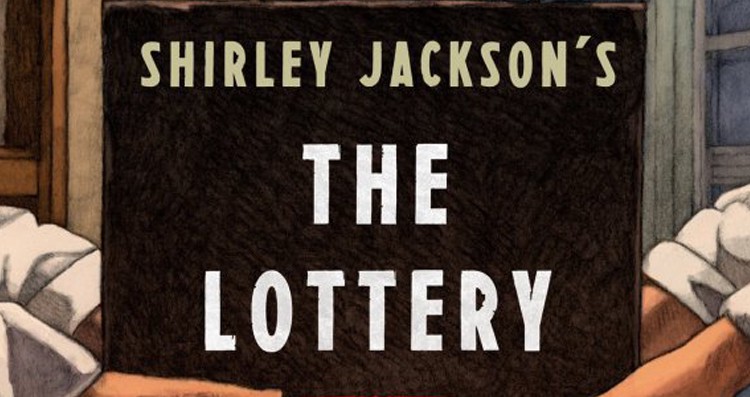
Shirley Jackson’s original short story “The Lottery” inflicts a certain shock, a revulsion in mankind. It rises from the lower gut and get stuck in the throat. The question why begs but falls silent.

Every year in June, a town selects by family and then within the family for an individual to be sacrificed. It is a dystopian ritual that results in spouse killing spouse, parent child and vice versa. While the victim’s final cries echo, so the moments when her death could have been deemed unnecessary.

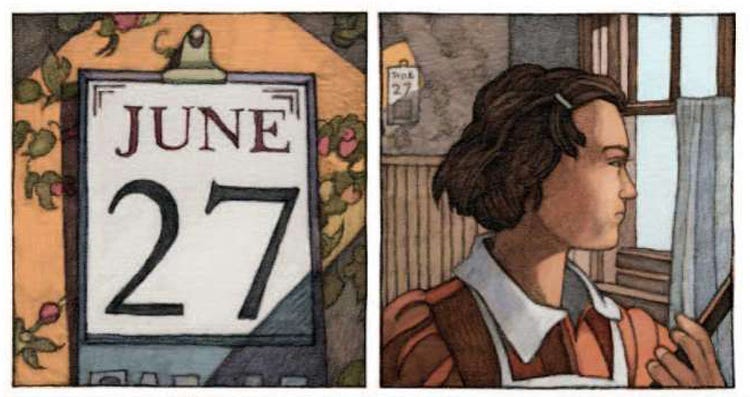
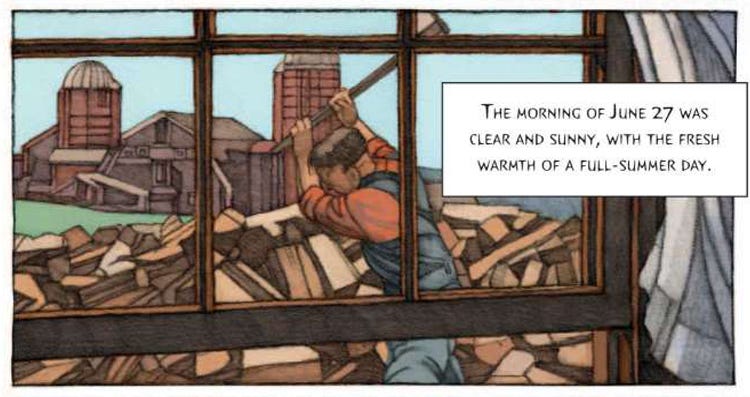
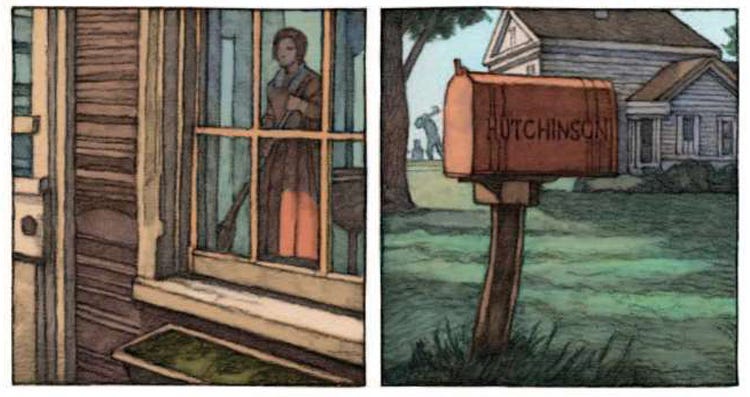
Miles Hyman’s graphic adaptation of The Lottery captures this intent. It is disturbing without being unnatural, deeply unsettling without gratuitous words or symbolism.

While many graphic adaptations fall in the range of boring to awful, Hyman uses the medium to his advantage, building suspense with bright colors and the pale shadows of a clear summer day. Everyone appears clean and healthy. All are complicit. It is a diorama of a society, rippled with discord.

One reason Hyman’s adaptation works may be the form of the short story itself. Often graphic adaptations in particular are unsatisfying because there is not enough space to retell the intricacies of long form prose. Something must be left out. But a short story, especially one written by a genius of the unsaid such as Jackson, is easier to tackle. Hyman has room to convey all in his visual narrative, even embellishing slightly to make the tale his own.

Jackson’s literary voice does not falter. To replicate a master is never easy, perhaps even more so as Hyman is the grandson of the famed author. A good author makes an adaptation his own, and in that purists may find fault. But the essence of the original classic rings true in Hyman’s The Lottery. With crisp imagery and scant sentences, the sinister is revealed within the everyday. The reader knows what is coming and is sickened but powerless. And then, the townsfolk go home for lunch. In this way, The Lottery is a timeless literary masterpiece.

5 Essential Short Reads for the New Parent

Soon after the birth of my first son, a friend who is a parent of two herself asked me if I felt like a different person. No, I said, in way that sounded blithe even to my own ears. For starters, I did not want to feel different. And I did not, in the way I’d heard so many others describe it — discovering some purpose, or sense of calm, or enjoying total disregard for personal hygiene or household order. I resisted those who said, you’ll see. For some, parenthood made careers less compelling; for others, the economic anxieties pushed their careers into overdrive. But I had always had my day job and my writing, so was used to a fractured, distracted existence. But did I feel like a different person? Yes, but not in the way the pregnancy and baby websites or how-to books suggested I might. I felt different in the way Rivka Galchen’s narrator in Atmospheric Disturbances — perhaps suffering from Capgras delusion — experiences his wife as “different” when he’s convinced she’s an imposter. I felt like a case study for Oliver Sacks. But not to worry. Literature had me covered. In the dream-state of the early weeks of parenthood, these five pieces proved essential companions.

“The Doppelgängers” by Helen Phillips (Electric Literature’s Recommended Reading)

“The Queen always looked profound when she pooped,” is the irresistible opening to “The Doppelgängers.” The Queen in question is a one-month old who rides regally around in her car seat, a kind of monarch — perhaps beloved and benign, but capable of wielding frightening power — and also not quite a full person, not yet deserving of a name. The story begins with a horror movie trope: the parents have moved to a new place, where the husband assures his wife that “everything will be better,” suggesting unseen troubles past. The mother is still in the hormonal blitz of birth, having not slept more than three hours in a stretch since labor. Her husband’s teeth travel down her spine like “an epidural,” and being outside the house feels otherworldly. When she does emerge, she starts to see doppelgängers — women who have the same haircut, or stroller, or dress that she does. These doppelgängers could be interpreted as a fabulist turn, or Stepford wives, or just as literal suburban reality: the mother is invited to a “Mom’s group for babies born in June,” and is “revolted and fascinated” by the concept. These scenes capture a kind of neurological disassociation, of feeling like the world you inhabit is familiar, yet askew.

I read this story when my baby was precisely one-month old, and it brilliantly enlivens what is now popularly called the fourth trimester, when a baby’s physical separateness from its mother is not yet complete. When the father tells the mother she needs to eat her food, she thinks, “The Queen is my food.”

“Choking Victim” by Alexandra Kleeman (The New Yorker)

There is the rational understanding that parenting is a frightening endeavor, and then there is the visceral experience of that terror. “Choking Victim” evokes, in a slightly oblique way, the fear of outside contagion a new infant presents, a kind of shameful Nimbyism parenthood can herald. In this case, there’s no immediate threat of disease — the choking victim is a neighbor coughing in his apartment, on the other side of the wall — but the mother fears the “formative effect” that hearing his wheeze and choke and possible death may have on her baby’s unformed, pre-verbal self. And the mother’s larger concern is about herself, her own alienation and solitude, the way she and the baby are locked in a quiet chamber of her own making. The language is delicate but chilling. “Outside the window, men walked past, berating faceless, bodiless entities on their phone.”

On a walk to clear her mind of the choking man, a wheel falls off her ugly, overpriced stroller, and to describe what happens next would be to give away too much. As in all good stories that terrify, we are left with the feeling that the real danger is not in the stranger, but in one’s own strangeness. Yet that reduces too much a story about loss of self, fear of inadequacy, fear of one’s child, one’s self, and the outside world: all manifested in action, in a perfectly inevitable escalation.

“The Midnight Zone” by Lauren Groff (The New Yorker)

“The Midnight Zone,” too, has a horror movie premise: the mother has found herself out in the woods, alone in a cabin with her two young sons. As in “Choking Victim,” the husband has been called away for work, leaving the mother to fend for herself with limited electricity, no internet and a very weak cell signal. Again, the menace is almost lovely: “the screens at night pulsed with the tender bellies of lizards.”

Here, the sons are older, old enough to recognize they may need to care for their mother, without really knowing how to do so. “Safety was twenty miles away and there was a panther between us and there, but also possibly terrible men, sinkholes, alligators, the end of the world. There was no landline, no umbilical cord, and small boys using cell phones would easily fall off such a slick, pitched metal roof.”

The mother fears her own incompetence, while feeling consumptive love for her children, whose cheeks are “creamy as cheeses” when sleeping. “I tried to push my love for my sons into them where their bodies were touching my own skin.” Like Choking Victim,” the story ultimately asks what presents the greatest danger to a child. “I was everything we had fretted about,” the mother says.

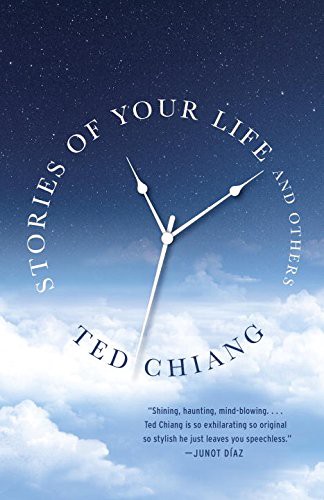
“Story of Your Life” by Ted Chiang (Stories of Your Life and Others)

The problem with reading this story in the fog of new parenthood is that you’re in the fog of new parenthood, but this may be the time you need it most. Even if the technical details of Fermat’s principle and semasiographic writing systems are too much for the sleep-starved brain, lines that describe having a child as birthing “an animated voodoo doll of myself” will feel achingly true.

The Great Silence by Ted Chiang

I expected this story — on which the upcoming film “Arrival” is based — to be populated with alien life forms (it sort of is). I did not expect it to be a heartbreaking story about parenting, about how your babies are always your babies, forever more.

In my fog, I have wanted to explain how parenthood has changed my relationship with time, how I want it to bend both ways at once, but I have not had the language. It’s something parents try to express in exasperated clichés, and is manifested in the way people grow weepy over infants just a few months younger than their own.

The mother in the story, a linguist, finds those words, through learning an alien language that introduces her to a simultaneous mode of consciousness. Her memories, that once grew “like a column of cigarette ash” in a sequential way, now lie ahead as well as behind. In glimpses, she experiences five decades of her life — encompassing her child’s birth through her death — as a simultaneity. It’s a knowledge that’s both a blessing and curse.

This is a story that demands many re-readings, but even in a state of half-consciousness, it’s hard not to see that it’s one of the most important stories about parenthood ever written.

“10-Item Edinburgh Postpartum Depression Scale” by Claire Vaye Watkins (Freeman’s)

Here, in the only non-fiction piece on this list, Watkins deals more directly with the question of feeling “different,” following the birth of a baby girl. (I am reminded of Derrida’s différance, a neologism I never fully understood in college, but enjoyed saying, and which I might begin employing now, to explain parenthood.) The piece is framed through responses to a standard postpartum survey meant to evaluate the respondent’s mental state (which makes it sound much less funny than it is). In response to the questions, the narrator selects “As much as I ever did,” which the reader might interpret to mean “same same, but different.” There are standard anxieties (“in my Percocet dreams our blankets are meringue but quicksand thick, suffocation heavy, and the baby somewhere in them)” and more serious ones (“failure to thrive”) which she is reminded is not as serious as the “Nick U and pediatric oncology.” And there are the ways a mother, who may otherwise consider herself a banshee, might feel the need to playact even more explicitly now that she is a banshee with a child. When she makes a holiday grocery trip, she does not use the self-checkout lane, “the misanthrope’s favorite invention,” but forces herself to smile, to let people project onto her and the baby. I’ve heard the piece described as “about post-partum depression,” but to a new mother it read as “about parenthood,” written from within the raw, vulnerable place where terror and joy feel like the same emotion.

Dispatches from the Nightmare Factory

MONDAY

All day staring out windows.

Feed another red nose to the machine.

The real you sits and peels an onion.

I adjust my tie.

I do not look at Margaret.

The cloud of me shrinks through the linoleum floor.

Look outside.

Open the folder.

Push a bad dream down the wire.

That sound is a human hand caught in the disk tray.

Send it to Bruce in the next cubicle over.

Cigarettes won’t light when the cavern is this humid.

Outside, a symmetrical pile of bat wings.

No, the other Bruce, who is crying through his salmon shirt.

TUESDAY

Every lunch break glows majestic.

I count the row of neon trees.

Ignoring the sound of windswept balloonists.

Bruce in the parking lot, all wrapped in goatskin.

He’s waving a two-foot plastic snake.

Rain sounds in his beard.

Pictures from my head soaking my earlobes.

Bruce and I drink similar hot sauce through a tube.

A ghost wanders the length of the nearest coal mine.

I blink and step to its familiar shadow.

The sky gets bright.

We forgot to bring sunscreen.

Mount Lemon continues to encircle the earth.

WEDNESDAY

Other Bruce removes his axe hands.

I tell him this cloud meat is delicious.

All day I am perched atop the TV.

A loaf of bread in the bear’s inflatable mouth.

A brief red light.

Familiar sirens.

Just another bad dream down the wire.

And the wind is picking up now.

The wind is kicking like it’s horse-bit.

Like horse venom swelling my fragile bones.

My own incomplete horse body changing in the full moon.

I calculate the newest price of stamps.

My idea of Margaret steps into her half of the horse suit.

Wet sounds bouncing off the concrete.

Our mutual horse suit shambling sideways through the moors.

THURSDAY

I get stuck in the elevator.

I float like a magpie.

Smoke pours from a stone in my palm.

This evening I put another clown to sleep in the tool shed.

I leave Margaret a love note.

No one has seen her for days or knows how to bring it up.

I bend down, and a single polaroid leaps from my front pocket.

Me and my friends and what’s left of my family.

Red faces grinning like the Buddha.

An old man wakes up, and lights himself on fire.

They say the wire ends in a very smooth temple of dirt.

FRIDAY

Snowmen collapse on the train beside me.

That tap tap is the city sidewalk in heat.

Our office space soars over the dead grass.

Margaret is back but she’s not the same.

Please disregard this talking cloud.

Those windswept balloonists.

The sky tilting on its essential hawk.

I consider the weight of my skull, and its frequent changes.

Feelings press into my pillow by degrees.

The result is silver.

It’s unprofessional.

I send one more bad dream down the wire.

It’s true, everything is pliable in the future.

I miss Bruce and his frail human beard so badly.

We’ve all gone dark inside these warm pods.

Just part of some beep boop computer from the 70s.

The backlog of love notes arrives at the tool shed.

The old wood spirals into flames.

After work we’ll go home.

We’ll wear matching smokestacks.

Pray to a sky ever more windswept with balloonists.

A final love note, this time in triplicate.

Three slabs of horse meat.

One last bad dream for the wire.

Signed: Sincerely, Your surgical scar.

Read Excerpts from the National Book Foundation’s 5 Under 35 Winners

Each year, the National Book Foundation honors five debut fiction writers under the age of thirty-five years whose work “promises to leave a lasting impression on the literary landscape.” The winners are selected by previous National Book Award winners and finalists. We’re excited to present excerpts from each of the five winners from 2016: Brit Bennett, S. Li, Yaa Gyasi, Thomas Pierce, and Greg Jackson.

Read them, and then check out their books!

From The Mothers by Brit Bennett

In the darkness of the club, you could be alone with your grief. Her father had flung himself into Upper Room. He went to both services on Sunday mornings, to Wednesday night Bible study, to Thursday night choir practice although he did not sing, although practices were closed but nobody had the heart to turn him away. Her father propped his sadness on a pew, but she put her sad in places no one could see. The bartender shrugged at her fake ID and mixed her a drink and she sat in dark corners, sipping rum-and-Cokes and watching women with beat bodies spin on stage. Never the skinny, young girls — the club saved them for weekends or nights — just older women thinking about grocery lists and child care, their bodies stretched and pitted from age. Her mother would’ve been horrified at the thought — her in a strip club, in the light of day — but Nadia stayed, sipping the watery drinks slowly. Her third time in the club, an old black man pulled up a chair beside her. He wore a red plaid shirt under suspenders, gray tufts peeking out from under his Pacific Coast Bait & Tackle cap.

“What you drinkin’?” he asked.

“What’re you drinking?” she said.

He laughed. “Naw. This a grown man drink. Not for a little thing like you. I’ll get you somethin’ sweet. You like that, honey? You look like you got a sweet tooth.”

He smiled and slid a hand onto her thigh. His fingernails curled dark and long against her jeans. Before she could move, a black woman in her forties wearing a glittery magenta bra and thong appeared at the table. Light brown streaked across her stomach like tiger stripes.

“You leave her be, Lester,” the woman said. Then to Nadia. “Come on, I’ll freshen you up.”

“Aw, Cici, I was just talkin’ to her,” the old man said.

“Please,” Cici said. “That child ain’t even as old as your watch.”

She led Nadia back to the bar and tossed what was left of her drink down the drain. Then she slipped into a white coat and beckoned for Nadia to follow her outside. Against the slate gray sky, the flat outline of the Hanky Panky seemed even more depressing. Further along the building, two white girls were smoking and they each threw up a hand when Cici and Nadia stepped outside. Cici returned the lazy greeting and lit a cigarette.

“You got a nice face,” Cici said. “Those your real eyes? You mixed?”

“No,” she said. “I mean, they’re my eyes but I’m not mixed.”

“Look mixed to me.” Cici blew a sideways stream of smoke. “You a runaway? Oh, don’t look at me like that. I won’t report you. I see you girls come through here all the time, looking to make a little money. Ain’t legal but Bernie don’t mind. Bernie’ll give you a little stage time, see what you can do. Don’t expect no warm welcome though. Hard enough fighting those blonde bitches for tips — wait till the girls see your light-bright ass.”

“I don’t want to dance,” Nadia said.

“Well, I don’t know what you’re looking for but you ain’t gonna find it here.” Cici leaned in closer. “You know you got see-through eyes? Feels like I can see right through them. Nothin’ but sad on the other side.” She dug into her pocket and pulled out a handful of crumpled ones. “This ain’t no place for you. Go on down to Fat Charlie’s and get you something to eat. Go on.”

Nadia hesitated, but Cici dropped the bills into Nadia’s palm and curled her fingers into a fist. Maybe she could do this, pretend she was a runaway, or maybe in a way, she was. Her father never asked where she’d been. She returned home at night and found him in his recliner, watching television in a darkened living room. He always looked surprised when she unlocked the front door, like he hadn’t even noticed that she’d been gone.

Published by arrangement with Riverhead Books, an imprint of Penguin Publishing Group, a division of Penguin Random House LLC. Copyright © 2016 by Brit Bennett.

You can read another excerpt from The Mothers in Electric Literature’s Recommended Reading.


From Transoceanic Lights by S. Li

I told her how I hit my head once against the corner of our mailbox on the way back from dim sum, and I cried and cried . . . I remembered the clink of chopsticks on porcelain bowls, bamboo baskets stacked in towers wheeled along in steaming metal carts, each kind of food written in red calligraphy on white rectangles and shouted out by waitresses: shrimp dumplings, spicy tripe, phoenix talons (chicken feet), preserved duck egg and pork congee, and honeyed tofu. Ma and Ba were arguing, and I complained that I was too tired to walk. There were no seats on the ferry so I had to stand. There were no poles within reach so I had to hold on to Ma’s dress. I was careful not to step on the foot of the gaunt hunchbacked man whose chapped big toe, earthen brown, and crowned with a blistered yellow nail protruded from his tattered shoe like a hatching alien; I could not stop looking at it, at its sparse crinkled hairs like the legs of a dead spider. Don’t depend on others and learn to do things yourself, Ma shouted. You can walk, let’s go . . . but before she could finish, Ba snatched me up in his arms defiantly and carried me the rest of the way home. We approached the foot of the stairs, up the first step, up the second, then a deafening scream, my eyes squeezed shut and the darkness was spinning around me. Not doing something helpful? Then don’t do anything at all! Ma screamed as Ba lowered me to the floor to check my head. She grabbed my arm and pulled me up the stairs. She boiled an egg, peeled it, removed the yolk and put in its place a silver ring. Then she wrapped the egg in a handkerchief and rolled it over the bruise on the back of my head, tender and bubble-soft as if ready to pop. She fed the egg to the cat afterwards and showed me the ring. Its once shining surface was no longer silver but a swirl of deep blue and purple. The ring sucked out all the bruised blood, she said. Another memorable bruise was the one I got after I somersaulted off the couch out of sheer boredom and landed on the ground smack on the left side of my forehead — that was not until years later at a new apartment, and that time I did not cry. The bruise swelled and subsided, leaving behind a hardened lump noticeable in select angles of lighting that later distorted the fit of baseball hats. And then there was the bruise in the middle of May’s forehead: she was standing on the bed against the window watching the blizzard as if in deep meditation with hands pressed against the cold glass that afforded a silvery myopic view of the city — the rooftops of its skyscrapers shrouded in clouds, its roads unplowed and devoid of cars, its sidewalks unmarred by footprints, its trees coated with snow like sweet frosting — and I, lying between her feet and the window, rolled over. She toppled and gave a laugh, her knees dug into my side, and her forehead slammed into the window frame. The bruise came and went but the scar came and stayed, a canyon-like sliver visible every time she smiled . . . Ba took the blame for it by telling Ma that he had dropped the telephone on her when she was sleeping in his arms; as ridiculous and comical as that sounded, it was the truth she knew until I told her the real truth many years later when I would no longer get in trouble for it.

At the start of class, Mrs. Lin handed us a printout. Follow as closely as you can, I know most of you can’t read it, but just follow along. When you do this enough, you’ll have it memorized.

All the students were lined up by height, shortest to tallest, facing out from each classroom, hands placed over our hearts. The loudspeaker in the ceiling sounded and the principal’s voice was heard. We followed her recitation: I pledge allegiance to the Flag . . .

. . . dangling motionless from a hollow dowel jutting out from a stone column . . .

. . . and to the Republic . . .

. . . my worries had temporarily settled for I had realized that, even in extreme pain, one could be free from fear . . . would I be able to recall my beating with that same shrug of a shoulder? . . .

. . . one Nation under God . . .

. . . I pretended to mouth the syllables of the verses spoken too fast . . .

. . . and justice for all.

I half-followed the morning lessons and half-watched from some impossible vantage point our things being sold off or given away: one olive-colored couch, four black-streaked stools, one mahjong table, one video cassette recorder, one television with dust-matted antenna, one small folding dinner table with three warped plastic chairs, one hardwood bed, two lamps, one dented dresser with five drawers, one shiny red motorcycle, and the refrigerator we left behind — imagine if it were to slip from grip and cartwheel down the stairs rending apart walls, it would rock the earth on impact . . . once in the middle of the night, I remembered, or possibly dreamed, that for a few seconds a tremor in the ground woke me and sent me running to the living room to see our balcony rise and fall like a ferry on stormy waters against the backdrop of thousand-punctured skies bleeding silver . . . another time — a dream for sure — there was a quake of such magnitude that our furniture was uprooted, the walls collapsed, the doorframe cracked, the stairs shattered, yet there were no screams, for everyone had fled, and the centipedes, termites, ants, geckos, and mice were pouring out of the crevices and fissures to hurl themselves over the balcony in one big vermin waterfall . . . I rode on their slimy backs all the way to Grandfather’s house for refuge.

Published with permission from Harvard Square Editions. No part of this excerpt may be reproduced or reprinted without permission in writing from the publisher.


From Homegoing by Yaa Gyasi

Effia

The night Effia Otcher was born into the musky heat of Fanteland, a fire raged through the woods just outside her father’s compound. It moved quickly, tearing a path for days. It lived off the air; it slept in caves and hid in trees; it burned, up and through, unconcerned with what wreckage it left behind, until it reached an Asante village. There, it disappeared, becoming one with the night.

Effia’s father, Cobbe Otcher, left his first wife, Baaba, with the new baby so that he might survey the damage to his yams, that most precious crop known far and wide to sustain families. Cobbe had lost seven yams, and he felt each loss as a blow to his own family. He knew then that the memory of the fire that burned, then fled, would haunt him, his children, and his children’s children for as long as the line continued. When he came back into Baaba’s hut to find Effia, the child of the night’s fire, shrieking into the air, he looked at his wife and said, “We will never again speak of what happened today.”

The villagers began to say that the baby was born of the fire, that this was the reason Baaba had no milk. Effia was nursed by Cobbe’s second wife, who had just given birth to a son three months before. Effia would not latch on, and when she did, her sharp gums would tear at the flesh around the woman’s nipples until she became afraid to feed the baby. Because of this, Effia grew thinner, skin on small birdlike bones, with a large black hole of a mouth that expelled a hungry cry which could be heard throughout the village, even on the days Baaba did her best to smother it, covering the baby’s lips with the rough palm of her left hand.

The villagers began to say that the baby was born of the fire, that this was the reason Baaba had no milk. Effia was nursed by Cobbe’s second wife, who had just given birth to a son three months before. Effia would not latch on, and when she did, her sharp gums would tear at the flesh around the woman’s nipples until she became afraid to feed the baby. Because of this, Effia grew thinner, skin on small birdlike bones, with a large black hole of a mouth that expelled a hungry cry which could be heard throughout the village, even on the days Baaba did her best to smother it, covering the baby’s lips with the rough palm of her left hand.

“Love her,” Cobbe commanded, as though love were as simple an act as lifting food up from an iron plate and past one’s lips. At night, Baaba dreamed of leaving the baby in the dark forest so that the god Nyame could do with her as he pleased.

Effia grew older. The summer after her third birthday, Baaba had her first son. The boy’s name was Fiifi, and he was so fat that sometimes, when Baaba wasn’t looking, Effia would roll him along the ground like a ball. The first day that Baaba let Effia hold him, she accidentally dropped him. The baby bounced on his buttocks, landed on his stomach, and looked up at everyone in the room, confused as to whether or not he should cry. He decided against it, but Baaba, who had been stirring banku, lifted her stirring stick and beat Effia across her bare back. Each time the stick lifted off the girl’s body, it would leave behind hot, sticky pieces of banku that burned into her flesh. By the time Baaba had finished, Effia was covered with sores, screaming and crying. From the floor, rolling this way and that on his belly, Fiifi looked at Effia with his saucer eyes but made no noise.

Cobbe came home to find his other wives attending to Effia’s wounds and understood immediately what had happened. He and Baaba fought well into the night. Effia could hear them through the thin walls of the hut where she lay on the floor, drifting in and out of a feverish sleep. In her dream, Cobbe was a lion and Baaba was a tree. The lion plucked the tree from the ground where it stood and slammed it back down. The tree stretched its branches in protest, and the lion ripped them off, one by one. The tree, horizontal, began to cry red ants that traveled down the thin cracks between its bark. The ants pooled on the soft earth around the top of the tree trunk.

And so the cycle began. Baaba beat Effia. Cobbe beat Baaba. By the time Effia had reached age ten, she could recite a history of the scars on her body. The summer of 1764, when Baaba broke yams across her back. The spring of 1767, when Baaba bashed her left foot with a rock, breaking her big toe so that it now always pointed away from the other toes. For each scar on Effia’s body, there was a companion scar on Baaba’s, but that didn’t stop mother from beating daughter, father from beating mother.

Matters were only made worse by Effia’s blossoming beauty. When she was twelve, her breasts arrived, two lumps that sprung from her chest, as soft as mango flesh. The men of the village knew that first blood would soon follow, and they waited for the chance to ask Baaba and Cobbe for her hand. The gifts started. One man tapped palm wine better than anyone else in the village, but another’s fishing nets were never empty. Cobbe’s family feasted off Effia’s burgeoning womanhood. Their bellies, their hands, were never empty.

In 1775, Adwoa Aidoo became the first girl of the village to be proposed to by one of the British soldiers. She was light-skinned and sharp-tongued. In the mornings, after she had bathed, she rubbed shea butter all over her body, underneath her breasts and between her legs. Effia didn’t know her well, but she had seen her naked one day when Baaba sent her to carry palm oil to the girl’s hut. Her skin was slick and shiny, her hair regal.

The first time the white man came, Adwoa’s mother asked Effia’s parents to show him around the village while Adwoa prepared herself for him.

“Can I come?” Effia asked, running after her parents as they walked. She heard Baaba’s “no” in one ear and Cobbe’s “yes” in the other. Her father’s ear won, and soon Effia was standing before the first white man she had ever seen.

“He is happy to meet you,” the translator said as the white man held his hand out to Effia. She didn’t accept it. Instead, she hid behind her father’s leg and watched him.

He wore a coat that had shiny gold buttons down the middle; it strained against his paunch. His face was red, as though his neck were a stump on fire. He was fat all over and sweating huge droplets from his forehead and above his bare lips. Effia started to think of him as a rain cloud: sallow and wet and shapeless.

Excerpted from Homegoing by Yaa Gyasi. Copyright © 2016 by Yaa Gyasi. All rights reserved. No part of this excerpt may be reproduced or reprinted without permission in writing from the publisher.


From Hall of Small Mammals: Stories by Thomas Pierce, excerpted from the story “Hot Air Balloon Ride for One”

People are always asking her if she’s the F. 0. Betts. She’s not. 

“Then who am I talking to?” The man on the other end of the phone line asks her this.

She shouldn’t have answered the phone. She doesn’t know why she did. She could have locked the doors and been gone an hour ago. Her boyfriend is probably waiting for her downtown with an apple martini and a basket of garlic bread.

‘’I’m the other F.O.,” she says. “His daughter. Fiona Orlean. My father was the real F.O.” The F was for Frank. The 0 was for Oliver. He taught French and Latin at the high school for twelve years, piloting trips on the side for extra cash before starting the F. 0. Betts Hot Air Balloon Company. Unfortunately he was also a sucker for online poker. Fiona officially took over the business five years ago when they discovered the extent of his debts.

“Is it safe?” the man on the phone asks. “Does it sway a lot? “

“I’ve been up a thousand times and not one accident ,” she says. “And no, it doesn’t really sway.”

The man says he wants to book a trip for one, please. “For one?”

“Yes, for one.”

“Usually we send larger groups up. Seven. Eight. Twelve. It’ll cost extra for just one person,” she says.

“I’ve got money.”

“That makes one of us.”

“How much for a solo trip tomorrow morning?” he asks.

She names an exorbitant sum, more than she’d usually charge, but he says okay, and she gives him the exact address where they can meet. The next morning, there they are, together in a hazy field at dawn, her tennis shoes and jean shorts wet from the tall grass and morning dew, the hulking balloon taking shape behind her. The passenger watches from a safe distance with his arms crossed. He doesn’t like the look of the basket. He asks if he should be hooked in somehow.

“To what?”

He points at the red metal crossbar that keeps the propane tanks in place.

“You’ll be fine,” she says. “Really.”

When they’re ready to go, she motions for him, but first he wants to get something out of his car. He digs around in the back- seat and produces a boom box and a small black metal cage. In- side the cage is a green-and-yellow bird.

“What’s this about?” she asks.

“This is Magnificent,” he says. “The parakeet. I thought she might enjoy the ride.”

“We don’t usually do this sort of thing,” she says, though in truth she has seen and permitted much stranger. She makes good money off the eccentrics. This one time a couple wanted to go up naked and Fiona tried to be funny by asking if she needed to go up naked too, but the couple didn’t laugh. They said, sure, if she wanted to, but Fiona stayed clothed and did her best not to look. This other time Fiona let a woman take up her easel and paints and Fiona had expected the woman to produce a beautiful land­ scape painting but when she snuck a glance at the work-in­ progress, in fact it was a bowl of cherries. The high mountain air, the woman explained when Fiona inquired, was full of good ions and encouraged creativity.

And so, looking at the parakeet, Fiona sees a new business opportunity. The bird will cost extra. Nothing personal, she says. It’s an issue of liability, of insurance.

“That’s fine.” He doesn’t even ask how much. He hands her the cage and then the boom box, and then he swings his long legs up and over the lip of the basket even though there’s a door that can open. He’s in jeans, and his shirtsleeves are rolled up tight around the elbows. He could be an accountant. Small wire glasses hover at the end of his thin, ruddy nose.

When she hits the blast valve, flames and exhaust shoot up the throat of the balloon, and he grips the edge of the basket with both hands. The balloon is a yellow one with blue horizontal stripes that Fiona bought almost five years ago from a company in South Dakota. She has two other balloons but all of them should probably be replaced soon.

Tom is her man on the ground today, her chaser. He has been around since her father ran the company. She gives him the signal, and he lets them loose. The balloon rises up fast into the warm morning air. Tom waves goodbye with a gloved hand. As the chaser, he will follow in the truck. The flame whooshes loudly overhead.

Fiona loves this part, the initial breakaway from the earth, from its interstates and box stores, from its pop songs and head- lines with question marks in them, from jorts and jeggings and every other commercial portmanteau. All of it falls away, and you are suspended, divided from it by — well, not much. A little bit of wicker.

According to her mother, Fiona was conceived up here, two thousand feet above the mountains. Counting nine months back- ward from October would place this momentous event — momentous for her, anyway — in January. She imagines snow on the mountains, her parents’ pink hands in gloves, boots on their feet. She imagines quilts on the bottom of the basket, their breath visible in the crisp and chilly air as they come together. The story might not be true. It doesn’t matter. Fiona likes it. Whenever she asks her father about it, he says he doesn’t remember but he says it with a smile that suggests he remembers every single detail and is just not willing to share. Usually her mother only brings it up when Fiona isn’t listening. When she acts far away. When she’s got a head full of hot air.

Her passenger doesn’t seem to be enjoying the view. He’s down in a crouch on one knee talking to the parakeet.

“What are you telling it?”

“It’s a she,” he says. “And I’m asking how she likes it up here.”

Published by arrangement with Riverhead Books, an imprint of Penguin Publishing Group, a division of Penguin Random House LLC. Copyright © 2015 by Thomas Pierce.

You can read another story by Thomas Pierce in Electric Literature’s Recommended Reading.


From Prodigals: Stories by Greg Jackson, excerpted from the story “Metanarrative Breakdown”

The thing that happens to me most profoundly on psychedelics, the reason I occasionally do them, in fact, and what happened to me that afternoon for a good two hours or so during the deepest part of the trip, is that my sense of connection to the metanarrative deserts me. Maybe it’s more accurate to say that in seeing the possibility of this connection foreclosed, I become aware of something I didn’t know was taking place: an unconscious process, a limbic subroutine, an autonomic checking-in the brain seems regularly perform to square what you are doing with the context of the day, the week, the still broader context of the year, your life, what you care about and hope to achieve, how you see yourself and how you want to be seen. It is in watching this process break down that you become conscious of it, the failure of some mechanism to catch at the appropriate point, and the sensation is not unlike waking repeatedly from a dream without having realized you were asleep.

This has been my experience, in any case, and it isn’t exactly pleasant. It is instructive though, I think, to step outside future-directed life, to feel the past slip away, and to confront who you are unmoored from history and intention. It can be frightening. You’re left with very little when these things go. But it opens some brief window on the phenomenology of being alive, of living inside a head, and it offers a fleeting glimpse of the metanarrative unmasked as demiurge, as idol, which if you’re like me you must punish from time to time, smash and sweep from the Ka’aba. The pristine emptiness, when you’ve done this, can verge on holiness.

The worst part of a trip, we can probably all agree, is the moment you’ve come down enough to realize you are not down all the way. Gabrielle and I are throwing a Frisbee in the yard, watching it glimmer metallic shades as it zips between us, when this moment comes. Gaby lets the Frisbee fall behind her without making any effort to catch it.

“I’m going to do yoga now,” she says.

“OK,” I say, and because I dislike even thinking about yoga, I decide to take a walk instead chatting with Gaby while she limbers up. I put on a shirt. I get my phone, some earbuds. I pick out a podcast to listen to. I feel briefly lucid as I set off down the street. It is a lightly wooded residential street with a few people out front watering their lawns. The occasional car passes slowly by. Once I see the people on their lawns and in their cars, however, and realize they see me, I am flooded with the certainty that they knew I’m on drugs, which now that I’ve left the equivocal sphere of the house it seems I really am. But I compel myself to focus on the podcast, on Terry Gross’s familiar voice, her warm, brisk personality, and for about ten seconds I feel fine. I manage to smile at a father and daughter playing catch without, I believe, appearing unambiguously psychotic. And yet I can feel a small worry taking shape in me, a worry I can tamp down but not entirely ignore, and which takes the form of the following question posed to myself: Haven’t I been walking on this street for an insanely long time? The right way to put it is that I have no idea how long I’ve been walking on the street, and being unable to reconstruct the experience with any temporal dimensionality feels akin to having been always walking on the street. It is not a long street, I know this for a fact. In either direction it runs into a perpendicular street and ends, measuring, along its entire length, at most eight hundred feet, a distance a world-class sprinter could cover in under twenty-five seconds. But because my walk is an iterative action and not a coherent experience — because it is not a walk so much as all the component parts of a walk — it does not seem possible, or at least inevitable, that I will ever reach the end of the street. And the more anxious this realization makes me, the more closely I attend my progress, the rate of which, as a consequence of this heightened attention, seems correspondingly to diminish. And it is right around this time, experiencing the first licks of panic, that I realize my walk has become Zeno’s paradox.

I don’t remember how I made it back. I must have turned around, but honestly it’s all a blur. A blur not because it went by fast, but in the sense that the recording of a voice slowed down sufficiently no longer resembles a voice. I credit Terry Gross with getting me home, the grounding cadence of her speech, a metronomic standard by which my subjective experience of time was kept from veering into a fatal adagio. And soon enough — or, you know, whenever — I found myself back in the sunny yard, watching Gabrielle articulate her body in serpentine asanas, listening to Terry interview an author I like, and then an actress I like, as happy as a puppy and at peace, because what I understood just then was that Terry Gross’s voice was the voice of the metanarrative, demotic ur-parent, Catcher in the WHYY, the call of the shepherd returning me to the pastures of solicitude and moderation, that cultural plane on which the days horrific news — ecocatastrophe, civilizational conflict, postcolonial scarring, and our legacies of violence and extortion — was not diminished or ignored but existed in a strange vaporous adjacency to yuppie mores, triumphalist life narratives, midcult art, and an anachronistic fixation on jazz, this narrow-bandwidth refugium for temperamental decency and civic virtue and a heartbreaking reasonableness that seemed less and less like the earned wisdom of life than a tragic hope lain over it.

Published with permission from Farrar, Straus and Giroux. No part of this excerpt may be reproduced or reprinted without permission in writing from the publisher.

Let’s Get to Work: Practical Ways for Writers and Teachers to Get Involved Right Now

In the wake of Donald Trump’s election to the presidency, communities which have in various ways long been at risk, including women, POC, Muslims, LGTBQ, immigrants, and the undocumented, are now facing the prospect of even greater disenfranchisement and vulnerability. The role of writers, editors, translators, teachers, journalists — whose task is to educate, to speak, listen, and bear witness, and to help raise the voice of others — will continue to be emphatically important. However, if you belong to any of those categories and are looking for additional ways in which you can practically and constructively participate, then the list we’ve compiled below is for you.

The organizations we have highlighted need writers/editors/teachers/ translators/others to volunteer. If you know of any comparable organizations that we might have missed, please mention them in the comments below. We will periodically update this page with new information.

New York Cares

New York Cares is looking for writers and others to help low-income high school students and their families fill out FAFSA (Free Application for Federal Student Aid) applications to ensure they can afford college (no prior financial aid application experience is necessary, they provide training).

They are additionally looking for volunteer writers to help vulnerable high school seniors in New York write and prepare college applications.

East Harlem Tutorial Program

The East Harlem Tutorial Program will similarly be looking for writer-mentors to help see high school seniors through each step of the college application process. The application for the next round will open again in February 2017.

They are also looking for volunteer tutors to help middle and high school students in English, History, and a number of other subjects.

TheDream.Us

TheDream.Us is an organization which works to help undocumented immigrant youth — who have no access to federal aid, and limited state-aid access — gain college degrees. Right now they are looking for National Selection Committee Members to read and score applicant essays.

Girls Write Now

A mentorship program pairing high school girls in NYC one-on-one with women writers or digital media professionals from every discipline, Girls Write Now will soon be looking for mentor applications from women in either profession for their September 2017 — June 2018 programs. Keep an eye out for the application here, and read more here. And look out for other ways you can get involved with them here.

WriteGirl

Similar to Girls Write Now but based in L.A., WriteGirl is seeking volunteer mentor-writers (women or men) on a rolling basis to work with teen girls at schools throughout Los Angeles County. Their next training session begins Spring 2017.

Arab-American Family Support Center

The Arab-American Family Support Center provides services to members of Arab, Middle-Eastern, Muslim and South Asian immigrant communities throughout New York’s five boroughs. Right now they are seeking tutors for their children’s after-school program, conversation partners for ESL students, and volunteers to help adult students study for their citizenship exam.

Imani House

Based in Brooklyn and Liberia, Imani House has a number of programs specifically aimed at assisting and empowering “marginalized youth, families, and immigrants.” They are looking for volunteer educators to teach adult literacy, ESOL, and GED courses.

Immigration Equality

Immigration Equality, an LGBTQ Immigrant Rights organization based in NYC, is currently looking for translators to help pro bono attorneys speak with clients in their native language, to complete asylum applications, and in the courtroom. If you are fluent in a second language, you could be of help.

Sylvia Rivera Law Project

Based in New York, the Sylvia Rivera Law Project, an organization assisting and advocating for “low-income people and people of color who are transgender, intersex, or gender non-conforming” is looking for volunteer translators, researchers, writers, and editors.

CARECEN

The L.A. chapter of CARECEN, which among other things provides education, advocacy and low-cost immigration legal services, is looking for volunteers very soon to help proofread and review college applications from high school seniors. They are also looking for English instructors, research volunteers, and volunteer translators.

The New York chapter of the Central American Refugee Center is looking for ESL classroom assistants and Spanish interpreters.

Meanwhile, in D.C., the CARECEN Latino Resource and Justice Center, needs volunteers to help immigrants fill out citizenship applications, teach classes to help students prepare for the citizenship interview and exam, teach ESL, and serve as mock interviewers for students.

PEN America

PEN America, an organization seeking to protect and advocate for free expression and the human rights of writers, has active employment opportunities and internships in a number of different categories. Check them out here.

826

With chapters in Boston, New York, D.C., Michigan, Chicago, L.A., and Valencia (and in Seattle as The Greater Seattle Bureau of Fearless Ideas), 826 and their related organizations offer programs that “provide under-resourced students, ages 6–18, with opportunities to explore their creativity and improve their writing skills,” and helps “teachers get their classes excited about writing.” They have volunteer openings and employment opportunities in a number of categories.

Free Arts NYC

Free Arts NYC aims at providing arts-based mentoring to underserved youth, from pre-K all the way up through high school. They will once again be looking for volunteers beginning in January 2017.

And once again, if you know of any comparable organizations that we might have missed, please mention them in the comments below.

Carrel: A Writer Regenerates in the Stacks

Rebirth during the Yale Writers’ Conference

Sunlight, filtered through Tiffany stained-glass, dappled the audience’s backs with patches of red, green, and gold. The brethren, eager young writers attending the Yale Writers Conference of 2014, were tuned in to a panel of literary agents who intoned words of advice from the stage. Reverently, the writers scribbled in their Moleskin notebooks about agent commissions and editorial preferences. I doodled in mine. Next to me a fireplace, obviously non-working, displayed miniature international flags poked into a wooden base. Not on the hearth but in the fire box. Was this a global warming statement? A critique of patriotism?

After the panel members had left the stage and conference attendees filed through the double doors, I remained in my little wooden desk. The conference director and his cheerful blonde assistant were collecting books and papers that had been left on the long table. I felt like the Mason jar of wilted hydrangea heads that perched on the podium. My nose tingled, and I sensed tears coming. I would not cry in front of the Director of the Yale Writers’ Conference, but I couldn’t leave without speaking to him or his assistant; I was friendly with both and that would seem rude. I’d say a quick ta-ta and scoot out. The director turned around just then, said hello, and I began to bawl. Bawled for my unpublished state. Bawled at abandoning poetry after rejections from lofty journals I had no business submitting to. Bawled at many, many missed opportunities to write while children napped or were at school. But mostly I cried because I didn’t want to be what I was: an older would-be writer wounded by the blade of bitterness.

I would not cry in front of the Director of the Yale Writers’ Conference, but I couldn’t leave without speaking to him or his assistant; I was friendly with both and that would seem rude.

All during the conference I had attended the panels and workshops but had avoided anything social, instead sulking back to my hotel room chock full of self-pity. My movements were militaristic, a series of engagements and retreats. The friendly young lady at the hotel front desk waved to me at each of my departures and returns. Behind her smile, surely she questioned my sanity, and honestly, I did feel a little crazy. And so it was to save my sanity, or at least gain some equanimity, that I took off toward the library.

On my way there, I walked past stone-faced Berkeley College, where my husband lived for three years as an undergraduate. I recognized it by the crest above its doorway; in the early days of our marriage I used to wear his old Berkeley t-shirt, emblazoned with that crest, which was shaped like a knight’s shield with ten white crosses marking its brilliant red background. It was a great-looking t-shirt, but I must confess that by wearing it I hoped people would assume I had gone to Yale instead of my mediocre women’s college in Virginia.

Along the side of Berkeley, a slate walk led the way to Sterling Memorial Library, and as I trod it, my competing emotions were a-boil: exhilarated at being at the Yale Writers’ Conference, weighted down by the heft of the whole Yale thing, excited for the next ten days of hobnobbing with well-known writers, and other feelings I couldn’t label at first but soon came to recognize as loneliness and uncertainty. Oh, I should probably add a festering dab of self-doubt.

The pathway emptied onto a flagstone plaza overlooking a wide expanse of grass, a quilt of worn and seeded squares, no doubt caused by Frisbee games, or whatever outdoor game is popular with 21st century Elis. I stopped at Maya Lin’s water sculpture The Women’s Table, an elliptical slab of polished green granite balanced on a black granite base. A skin of water slid over it. Under the water, a spiral of incised dates and numerals shimmered. The dates commemorate the early years of women’s admittance to the college, and the corresponding numerals tally each year’s matriculating females. Beside 1969, the first year of women at Yale, the numeral 576 is etched. That group’s trepidation, expectation, and excitement must have been not unlike my own.

Sterling Library Women’s Table, Yale University

Beside 1969, the first year of women at Yale, the numeral 576 is etched. That group’s trepidation, expectation, and excitement must have been not unlike my own.

Behind The Women’s Table, a seven-story stack tower hulked over a neo-Gothic facade, which was so ornate that I stood for a while, agape. The top is crenellated like a medieval castle’s ramparts and seems to protect an immense pointed-arch window below. Above the entry doors, mid-bas reliefs presage the building’s scope contained in its four million volumes. One relief shows a wounded bison, mammoth, and a bone pendant from Magdalenian-era caves in the Dordogne region of France; think Lascaux. A Viking ship, Assyrian scribes, and Egyptian stonemasons also speak to the world’s civilizations housed within. One inscription quotes Aeschylus’s Prometheus Bound. Translated from the Greek, it reads:

Ignorant they of all things till I came

And told them of the rising of the stars

And their dark settings, taught them numbers, too,

The queen of knowledge. I instructed them

How to join letters, making them their slaves

To serve the memory, mother of the muse.

How to join letters…I thought of my second-grade teacher, a nun, scraping a funny-looking contraption across a blackboard. When teaching us handwriting, she used this gadget, comprised of a flat wooden slab from which projected three wire prongs that had curlicues at their ends bearing sticks of yellow chalk. After chalking the lines on the blackboard, Sister Christine would take a felt eraser and with lightning quick flicks of her wrist erase parts of the middle line. Hyphen-high, for lower-case, she’d say. It occurred to me that most of my fellow conference attendees were too young to know about any of this: nuns? handwriting? blackboard? Aeschylus’s quote, with its mention of ‘mother, niggled me — — many of these young writers were the same age as my children.

When I ventured into the library, I nearly genuflected, its structure was that reminiscent of a Gothic cathedral: coffered ceilings, soaring vaults, wall-sized stained-glass windows, cinquefoils, crockets, and gargoyles. The only thing missing was incense. I moved into the central area, which was like a nave, the atmosphere light and airy yet grand. Because of the exaggerated height and sunlight beaming through the windows, one’s gaze is pulled upward; in medieval cathedrals this suggested heaven, at Sterling, knowledge.

When I ventured into the library, I nearly genuflected, its structure was that reminiscent of a Gothic cathedral.

Activity was a-thrum: susurrus of docents leading tours, a printer sighing, echoes of boots, squeaks of running shoes. All of it lifted my spirits. Libraries usually have this effect on me, but what I really came for was the serenity of a carrel, snugged in among shelves of books.

After procuring a temporary stack pass, I was beginning to feel less like a visitor, expertly swiping the pass at the security desk, jabbing the elevator button that would deliver me to the seven-story stack tower, and ultimately to a carrel. To me, a carrel reprises what I imagine the womb’s atmosphere to be — one of comfort and safety. We can think of our mothers’ wombs as our first carrels. A carrel, too, functions like a womb; transformative creation happens in both. In a womb, a zygote becomes a human being; in a carrel, ideas, observations, hypotheses become stories, poetry, theories.

To me, a carrel reprises what I imagine the womb’s atmosphere to be — one of comfort and safety. We can think of our mothers’ wombs as our first carrels.

As the stack tower security guard inspected my Yale Writers’ Conference tote, ZZ Packer’s short story “Drinking Coffee Elsewhere” surfaced in my thoughts. The story relates the experience of a young black girl trying to assimilate at Yale during her first year. It’s a lonely story, but parts of it are hilarious: the first scene depicts her in a getting-to-know-one-another game of “Trust” where one person stands inside a circle of her peers, who instruct her to fall backwards into their arms. “No, way,” her character says. “The white boys were waiting for me, sincerely, gallantly…No fucking way.” I fully empathized with Packer’s character, except I was neither young nor black; I was a sixty-one year-old white woman amidst a youthful multi-cultural crowd, who, I assumed, could write me under the table.

The elevator trembled up to the sixth floor where I got off in search of the perfect carrel: lit by a window and in a corner. I found one on the fourth level, eased back into its Windsor chair, and just sat for a minute, relieved of that awful feeling of not fitting in, an interloper. Silence prevailed; solitude reigned.

In his Poetics of Space, Gaston Bachelard pinpoints the relationship between solitude and creativity:

“And all the spaces of our past moments of solitude, the spaces in which we have suffered from solitude, enjoyed, desired, and compromised solitude, remain indelible within us and precisely because the human being wants them to remain so. He knows instinctively that this space identified with his solitude is creative…”

With my pencil of choice, a Mirado Black Warrior, I wrote the date in the corner of a blank page in my notebook. That’s as far as I got. The graffiti on the upright back of the desk had caught my attention: a Mandarin character that resembled a lantern, a large block of Spanish, and some very interesting commentary. Someone had scrawled, with elaborate tails on the ys and ps, existential thoughts about carrels: “You realize that this carrel will be perpetually assigned.”

Someone had scrawled, with elaborate tails on the ys and ps, existential thoughts about carrels: “You realize that this carrel will be perpetually assigned.”

Another carrel-occupier had replied in block print: “I like the idea of there being no definite ownership only anonymous and arbitrary possession of this place.” A third person, with letters that leaned left, had written something that matched my emotional state: “Man is destined to be a stray…” I recorded all of this in my notebook and circled the last bit, then began writing. I wrote that yes, if man were a stray, then writers are doubly so. Writing is solitary, and the urge to write, in fact, is akin to a stray’s search for sustenance. Writing is foggy and murky. Yet the act of writing somehow marks a way out of the fog, rendering both writer and reader temporary shelter. Somehow this happens. I haven’t a clue how but am pretty sure that staying at your desk for long periods of time has something to do with it.

The word carrel derives from the Medieval Latin carula; or perhaps from the later Latin corolla “little crown, garland.” Eventually both words evolved to “carol,” an allusion to the sound of monks reading aloud the manuscripts they were working on. During the pre-Renaissance period, there was an unprecedented need for copies of books, the laity having become increasingly literate. During 14th century England, eighty percent of adults could not spell their names. Carrels also sequestered the monks from choristers practicing in the nearby choir. Imagine a monk in his chilly, poorly-lit carrel bent over, quill in hand, scratching and pricking at vellum. Most likely a teen-ager whose eyesight was still keen, he’s painting minuscule, intricate, and complex illuminations: blue-winged serpents entwining the pillar of a P, a tiny naked human riding a dragon in the open loop. Then imagine a choir practicing Benedictine chants over and over, and it’s no small wonder that carrels were invented.

The Rites of Durham is a mid-sixteenth century anonymous account of monastic life in England’s Durham Cathedral. A manuscript roll, sixty-seven feet in length, six inches wide, it consists of sixty-five pieces of paper stitched together with thread. When I first saw an image of the Rites, I couldn’t help but think: This is a roll of toilet paper. (Useless bit of the arcane: the width of a modern toilet paper roll measures five inches.) In the Rites’ description of the physical layout of the Cathedral, the carrels’ location is noted:

“In the north syde of the Cloister, from the corner over againset the Church dourthe Dorter Dour, was fynely glased from the hight to the sole within a little of the grownd into the Cloister garth. And in every wyndowe Pewes or Carell’s…” which are described as “fynely wainscotted and verie close…in every carrell was a deske to lye there…” and continues with the monks’ postprandial retreat back to the scriptorium: “…when they had dyned, they dyd resort to that place of Cloister, and there studyed upon there books, every one in his carrell, all the after nonne, unto evensong tyme.”

It’s almost as if the monks had been tucked in for a nap.

The summer before fifth grade, my father challenged me to read The Adventures of Huckleberry Finn. I remember bonding with that book, flicking the page corners, which made a sound like shuffled playing cards. I cared for it, always using a bookmark, never turning the corners down or, worse, laying it spine-breakingly face down. After completing a chapter, I would close the book, finger-tracing its incised letters on the cover. I can call up exactly what that book looked like: green cover, the H and F designed out of rickety fence posts.

I remember bonding with that book, flicking the page corners, which made a sound like shuffled playing cards.

Inscribed above the left door of Sterling’s entrance, there is a translated Egyptian passage from a Middle Kingdom papyrus: Would that I make thee love books more than thy mother. Of all the quotes above the main doors’ lintels, this one left me quite smitten. In my life I have loved other books the way I loved Huckleberry Finn: Robert Lowell’s Life Studies in Goucher College’s Julia Rogers Library; Ignatius Loyola’s Spiritual Exercises in Johns Hopkins’s Eisenhower Library; and most recently Jayne Anne Phillips’s Black Tickets at the Scottsdale Public Library. All I read in a carrel.
Relying on my sketchy Spanish, I tried to translate the large block of writing. No te amo, I do not love you, si fueras rosa, something about a rose? My translating stalled, I counted the lines and realized that I was reading a sonnet. It was Pablo Neruda’s “Soneto XVII”, a stirring love poem, one of a hundred from his 1959 Cien Sonetos de Amor. Who was the romantic who marked the desk with such gorgeous words? Was it written for a particular someone the writer knew would sit in this carrel? Despite the scribe’s anonymity, I perceived an intimacy between the two of us. Courtesy of Google, I read an English translation of the poem. I reread the last four lines aloud:

So I love you because I know no other way than this:

Where I does not exist nor you,

So close that your hand on my chest is my hand,

So close that your eyes close when I fall asleep.

The erasure of the two selves in the second line creates a selflessness, the kind of selflessness that allows for true communion between the I and the you of the poem. The speaker only knows one way to love the beloved but does not define “the way” and instead elevates the “where”, the place. In my place, the carrel, I imagined I was the speaker and the spoken to “you” was my writer self. Why not? As Bachelard wrote, a place of solitude is a creative one. An anonymous writer had left a gift for whoever came to that carrel. I was grateful to have chosen it and to have received a sonnet. I was grateful for the inspiring graffiti. I was grateful to be at the Yale Writers Conference. Tired, I checked my watch and saw that I had been writing for nearly two hours. Up in the Sterling stacks, I had regenerated my writer self, floating within the amnion of my carrel.