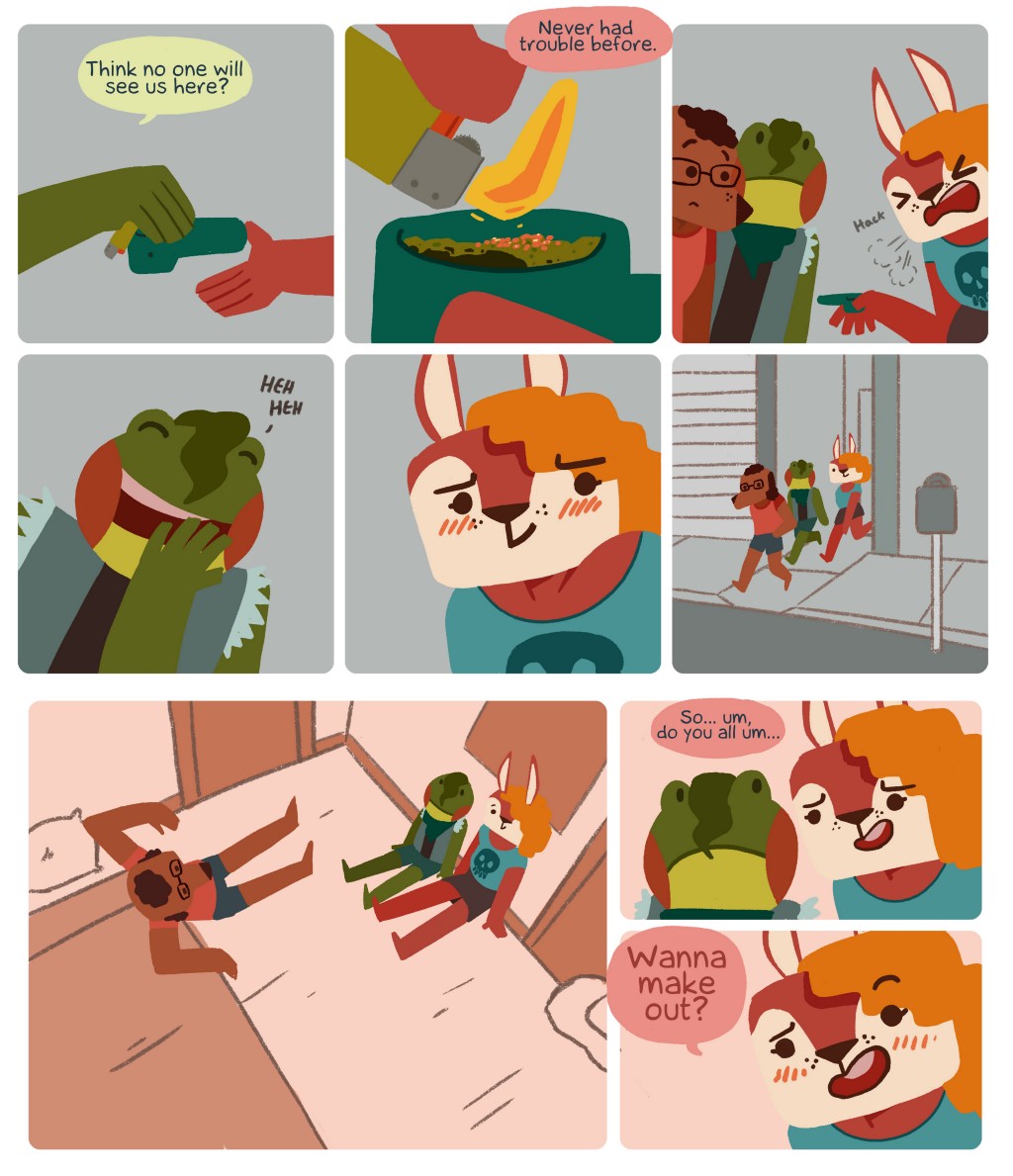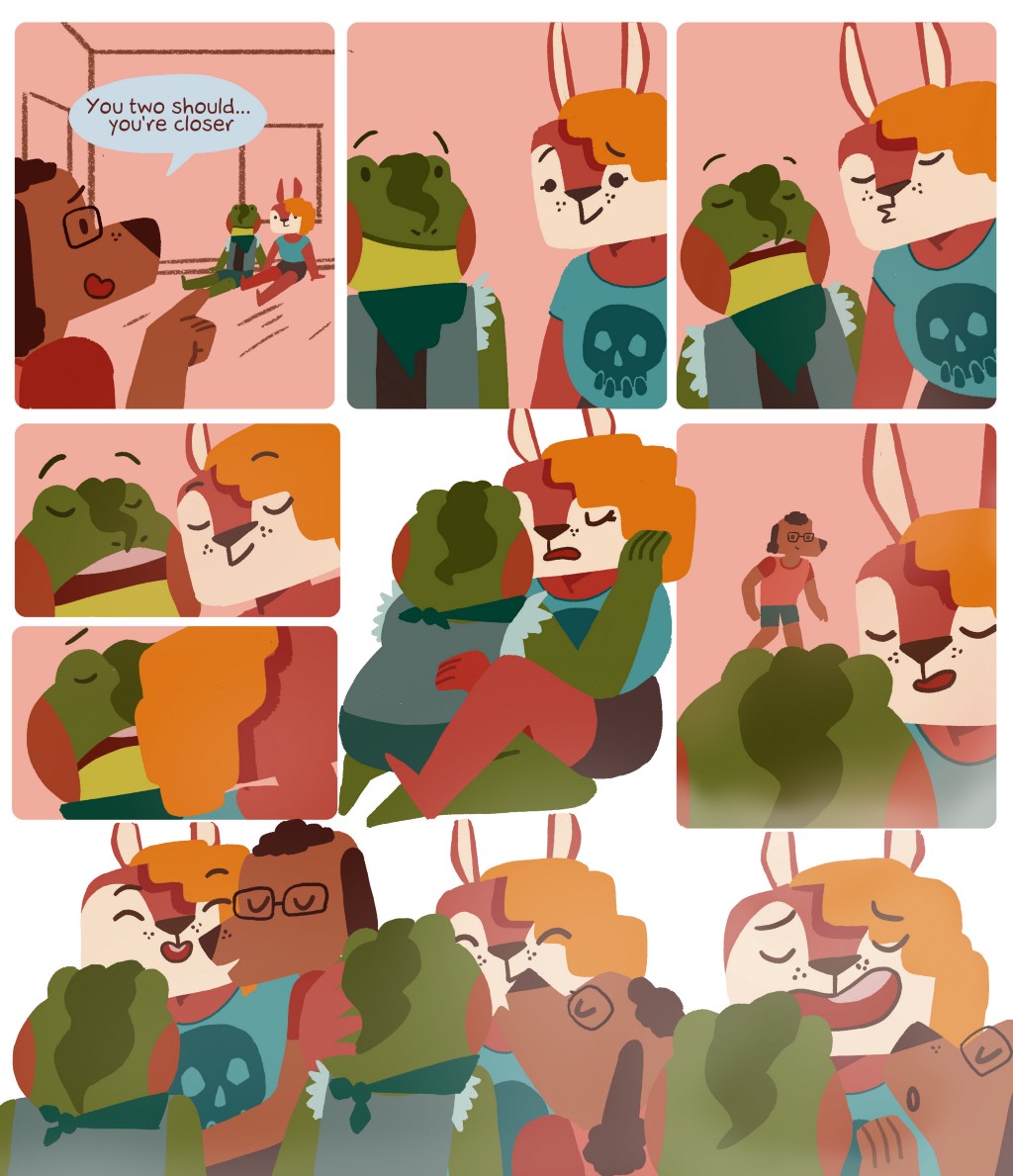
Cabin Creek by Madeline ffitch

By small aircraft, the crew, their packs, and the shifting, stinking stack of pressure-treated two-by-eights were set down 40 miles into the Idaho backcountry. There were no engines and no wheels allowed, besides the engine and the wheels of the small aircraft. The plane shook itself down onto the buffalo-grass landing strip, jostling the chemical boards against the crew, so that they had to brace themselves against the windows. The pilot waited long enough for the crew to unload the boards, then lifted his plane back into the sky. The crew watched it carve up across the valley, blink out over the ridge, gone. The valley grew dark. There was no one there to meet them.

The place was called Cabin Creek but they didn’t sleep in the ghosty low cabin, pierced every few feet by posts to hold up the roof, 120 years old. They pitched their tents in sight of the cabin, but slept outside on the ground, amid the silver sagebrush and sand drop-seed along the valley’s edge. They lit their stoves and drank powdered hot chocolate and the creek ran.

It was a government job and they had a radio. The office relayed the plan to the crew, and they waited for the packer to arrive with his mules. The first part of the plan was for the mules to carry the boards to the bridge site, two miles from the landing strip. The next part of the plan was for the crew to build the bridge.

The crew boss was a young woman in baggy clothes. She was the boss of three people, two young lovers and a debtor. The lovers had missed the hard weather of the fall and spring, when trees fell and bridges washed out, when trails flooded and the boss hiked all day alone with a fire axe, trying to make it down from the ridges before the lightning came, finding dry tinder only by scraping the underside of logs. The lovers had missed all of that. They had arrived for the summer season and were there to stare at each other. They only set up one tent, though they had packed two into the aircraft. They kept the others up all night.

The boss had been like them once, like them but lonelier. She had joined a crew one summer, yet found herself many months later, eating a stringy Thanksgiving turkey at the ranger station, huddled together with other people who preferred not to talk to each other, who didn’t have plans for the off-season, who couldn’t remember what to do with their per diems. That’s how she became the boss. She just stayed.

The debtor was at least 10 years older than the rest of the crew. He was in his prime. He was in credit card debt. His other life was a dark mystery, something about contracting, but he took the job on the crew to earn money and not spend it. He had worked all spring, and planned to stay until the snow came. Each night at dinner, he tallied up the money he had made so far, cloistered away from temptation. In the backcountry there were no wheels and there was nothing to buy. He was jocular with the lovers, clean jokes always. The worst he would call a person was bonehead or clown. He set store by rituals, making sure everyone saw the small gold cross at his neck, the way he touched it — right hand then left hand — before eating. It chilled the boss. The debtor didn’t like it that a young woman was his boss. The morning after they arrived, he asked, “What are we supposed to do while we wait for the packer, just sit here? Just sit here making our hourly like a bunch of clowns?”

The boss said, “We can make improvements. There are plenty of improvements to be made.”

“It’s illegal for us to make improvements,” the debtor said. “This is by definition an unimproved area.”

“Not those kind of improvements,” the boss said.

“We have the boards so why don’t we just carry them to the bridge site?” the debtor asked.

“We’re going to wait for the packer to bring the mules. Meanwhile, we’ll clear the trail,” the boss said.

“Clear the trail with what?” the debtor asked.

“We’ll use the crosscut saw,” the boss said, and retrieved it from the cabin’s toolshed. When she assembled it, she had trouble remembering how the handles fit, and it was especially hard to do it with the debtor watching her. The two lovers, who had plunged naked into the creek before breakfast, volunteered to take the saw and walk together out onto the trail.

“And you can fix the cabin step please,” the boss said to the debtor.

“With what shall I fix it Dear Liza?” the debtor asked in a singsong.

“Use a large stone,” the boss said. “Just prop it up.”

“Whatever you say, you’re the boss,” the debtor said. He walked sideways up the slope, pulling goldenrod, innocent, smiling, his teeth gleaming into the sand.

The boss left the clearing. She passed the lovers pulling the crosscut back and forth through a white pine that had fallen across the trail. She cut down out of the valley, waded through Cabin Creek at a shallow place. She came up out of the creek bed into the next canyon where the trail made a narrow line through the prairie clover under the wide open sky. She kept on two miles. The ranger had reported that the pack bridge had washed out, had relayed it by radio to the office. The boss found the place, a collapsed bank with some railroad ties tossed aside by winter storms. Coneflower nodded down into the hole, primrose climbed up out of it. The river branch took it all in, eating the bank, claiming it. The boss took some measurements and began the walk back to camp.

This time, before the bend that led down to the creek, she saw a rusted wheel on its side, partly buried in sand. A large wheel. An old wheel. A wagon wheel. Old trash, out here, was to be left alone as history. Yet it was hard to keep track of what was to be left alone, what was history, what was trash, what was an improvement. A tin can was history if it was made before can openers. A wire was history if it had been used to carry telegraphs before this place had been shut off to improvements. The boss could hardly tell one kind of wire from another, yet the wagon wheel she could tell was history, and it also had the dangerous possibility of becoming an improvement. If you picked up the wheel and rolled it, it could help you, which was not allowed. The boss kept her eyes on the trail, let the wheel lie.

But re-crossing the creek, the boss saw a wrapper at the feet of an elderberry stand, a red plastic wrapper that told the story of the bar it had wrapped. It told the story of a guy who had just been a guy in a garage with a snowboard, a mountain bike, and a trumpet, and then one day he just got sick of those other bars, so he made his own bar and it tasted great! This wrapper was easy. It was new trash. It was not history. It had clearly been left way out here by some hunter, some hiker, maybe even another crew, though the crews were supposed to know better. The boss picked the wrapper up and put it in her baggy pocket. She would come back with a garbage bag if necessary, to clean this place up. The boss felt that in the eyes of the debtor she must make resolute decisions, brook no contradictions.

When she got back to camp, the packer had arrived, followed by the pack string of eleven mules and two horses fitted with blinders.

The packer was blatantly handsome with a ravaged unsettling face. For many long years he had chosen the lone job, the job of packer, so he didn’t see many people. When he did see people they asked to take his picture because they weren’t sure what they were seeing. An old man or a young man, acne scars or the weathered face of a cowboy, a brown-skinned person or a white man, no nose or the nicest nose. He stirred people, the way he fit into his jeans, luxuriated in taking a good piss against a ponderosa, yet chewed tobacco with discretion, the way he was perfectly, equitably friendly. He barely showed his preference for his girlfriends when he had them. He was either always flirting or never flirting. Women wanted him to look at them, and then he looked at them and it made no difference.

The packer tipped his hat briefly to the boss, his eyes on his mules. He unhitched them, set them out to graze alongside the cabin, and he and the boss walked over to the landing strip. They could smell the pressure-treated lumber. It outdid the wild smell, the smell of the yarrow, the buffalo-grass, the smell of the mules, everything.

The packer looked at the boards, rubbed the back of his neck. “The pack string will not carry these,” he said. “They are the wrong shape. They are too long. If I try to rope these across my animals’ backs, they will be spooked.” He raised his hand to his mouth and spit tobacco behind it.

“But the people in the office said,” the boss said.

“Yes. The people in the office are the people in the office,” the packer said. “They don’t understand mules. They don’t understand horses. They don’t understand what the pack string will carry.”

“Shit,” said the boss. “If only we could use a wagon. Or a cart.”

“If we could do that, a lot of things would be different,” said the packer. “Probably none of us would be here.”

The boss lifted an acrid board to her shoulder, closed her eyes against the chemical smell. She let it fall back into the other boards. The pile slumped.

“You’re not thinking of carrying them, are you?” asked the packer.

“It’s not so heavy,” she said.

“It’s two miles to the bridge site. That’s out of your pay grade,” the packer said. “I’ll radio the office.” He held out his hand for the radio, and she relinquished it without argument.

While the crew stayed outside, the packer moved into the ghost cabin. He stretched out in it, put his feet up on the deep low windowsill, strung a line between the dark posts to hang up wet socks, walked around in his underwear. The packer drank coffee from beans that he boiled in a pot on the woodstove. He kept his distance from the crew, but he set up a backgammon board on the front step.

Outside, the crew cooked on small stoves with blue flames. The tradition was that they shared the evening meal. The boss cut an onion directly on a rock.

“I think we’ll get germs from that,” the debtor said, tossing jelly beans into his mouth.

“Almost certainly,” the boss said. The lovers whispered to each other. As a game, they used a bungee cord to hook their belts together and they walked around like that, glowing.

The packer came out of the cabin and stood on the front step in his socks. He dipped some tobacco. He took off his hat and held it quietly until the crew stopped what they were doing.

“Did you radio the office?” the boss asked.

“The office radioed me,” the packer said.

“What did they say?” the boss asked.

“They say there’s a fugitive,” the packer said.

“A fugitive?” the boss asked.

“There’s a guy on the loose,” the packer said. “Someone running, someone on the run. He’s wanted for something. A guy who. Who killed someone. A deputy sheriff. He killed a sheriff or a sheriff’s deputy they think.”

“Holy moly,” the debtor said. The lovers listened, their fingers linked together, their eyelashes velvety and damp.

“What should we do?” the boss asked. “I mean, what does the office say we should do?”

“The office says to stay calm,” the packer said. “Don’t go looking for the fugitive. Don’t try to take him in. It’s not our job.”

“But what if we see him?” the debtor asked. “What if he comes through here?”

“If we see him, or if we see his camp, or if he passes us, they say to radio it in,” the packer said. “That’s what the office says.”

“The office. Those clowns,” the debtor said.

The boss did not like to agree with the debtor, but it was true that the office were clowns. The office told them to report every smoldering stump, which they did not do because they did not agree with the office policy on fire management. The office told them to treat their water with iodine or a filter, but they took their chances and drank from clear rushing streams, and sometimes their shit gushed forth painfully but mostly it didn’t. Mostly they were fine.

“They can say what they want,” the packer said. “If I see him, I’m taking him.”

“But maybe he’s a hero, we don’t know,” the boss said. “Like Robin Hood.”

“A hero? They say he killed a sheriff’s deputy,” the packer said.

“Is there a reward?” the debtor asked. “I bet there’s a cash reward.”

“We don’t know what he did,” the boss said. “We only know what the office says.”

“He’s a bonehead,” the debtor said. “Who does he think he is, Rambo? Does he think he is Rambo?”

“Do you think he can make it?” the boss asked.

“Make it, what does that mean?” the packer asked. He spit tobacco into a can. “Look,” he said. “We probably won’t even see the fugitive. The wilderness is vast. It would take a lot to flush a man out. No one seems to understand that.”

“He’d have to want to come near us,” the boss said.

The packer put his hat back on. “I told the office about the two-by-eights,” he said.

“What did they say?” the boss asked.

“They said the pack string can carry them to the bridge site,” the packer said.

“Oh good,” the boss said. “What a relief.”

“The mules can’t move those boards,” the packer said. “They will not do it.”

“Oh,” the boss said.

“Why don’t we just move them ourselves?” the debtor said. “It’s what I’ve been saying all along. What do you think?” He looked at the lovers and the packer, not at the boss. The lovers shrugged and twined together. The packer raised his eyebrows but didn’t get involved. He was the packer and not part of the crew and he liked it that way.

“Carry them to the bridge site?” the boss asked.

“Where else?” the debtor said.

“The bridge site is two miles away,” the boss said.

“What else do we have to do?” the debtor said. “I bet I could carry two at a time.”

The packer shifted, and the front step cracked beneath his weight, lowering him slowly to the ground. For the first time, he looked directly at the boss. She blushed.

“Think your crew could fix this step?” he asked.

“I told you to fix that step, ” the boss said to the debtor. “Why didn’t you fix it?”

The debtor smiled. “I didn’t want to move a large stone,” he said. “It takes rocks like that nearly 100 years to build up such a patina.”

The boss said, “But we are supposed to build things with rocks, I mean instead of man-made things. Just as long as we don’t use an engine or a wheel.” If the debtor had not fixed the step, what had he done instead? Some preparation, some arrangement, another of his rituals? If there was a veil, she tried to see through it, to steady herself, but she couldn’t.

“We can move the two-by-eights tomorrow,” the debtor said, smiling. “It sure beats just sitting around.”

The next morning, the packer sat around while the crew moved the two-by-eights. The boss was not surprised to find out that you can do nearly any stupid thing if that’s all that you are required to do. It was a 10-hour workday and it was a government job, so they carried the pressure-treated two-by-eights, 12 feet long, two miles to the bridge site, one at a time or two at a time, all day long. If that’s all that’s required of you, you can do it all day, and they did. Use a work glove to cushion your shoulder, hoist the board up so that it balances, then down the path to the creek bed, wade across, feel the water fill your boots, climb out the other side into the wide open canyon. Up the bank, along the rut through the sagebrush and clover, come to the bridge site, crash another board down on the pile. The river rushed over the railroad ties, the primrose climbed, the coneflower leaned, the boards stank. They crew passed each other all day on the trail and spoke words of encouragement. The lovers called each other by names that were not their real names, ridiculous names that no one else could understand. If the boss spoke to one of them, they looked at the sand and laughed. The debtor carried two boards at a time. The boss carried one. “Let me know if you need help,” the debtor said. “I know how it is. Some people are better at holding the clipboard, that’s just true.”

They took lunch at the place in the trail where the boss had found the wrapper. Their sandwiches and sardines tasted like the boards, like chemical molasses, rancid candied ginger. After, the boss went to dig a cat hole behind a tree, fifty feet up out of the creek bed. She got her pants down, squatted, then noticed, right next to her boot, a pile of human shit. Sitting there on the leaves. Steaming there with a pinecone on top of it. The boss felt cold. She felt like she had shit before she had shit. Then she looked up and she saw the color red through the trees. She did not know what it was, but this time it was not a wrapper. It flashed out at her through the leaves. The creek bed was far too green, too lush, too much dogwood and elderberry, too many leaves radiating out and out so the boss couldn’t understand distance, depth or height or if she was looking up a slope. She could have been looking into a mirror, but among the leaves a swatch of red. It could be red flannel, canvas, a tanager, a scrap of something larger. Her bowels lost their urge. She got a prickle, sensed a presence. She pulled up her pants and went back to the crew.

“Find anything exciting back there? Enlightenment? Gold?” the debtor asked, which was what he asked when anyone came back from shitting. The lovers laughed, fed each other the crusts of their sandwiches.

“Nothing,” the boss said. “Nothing you would be interested in.”

That night, alone in her tent, the boss turned on her flashlight and its beam caught a lock of her own hair, hanging in a slipknot from the mesh ceiling. She was so frightened that she shut off her light and sat in the dark, feeling cold dread drench her, listening, listening. That was when she began to believe that the debtor was a witch. That was when she began to be really afraid. His bland smile covered his close watch of her, his furious sideways glance, the talisman at his neck. He was a hidden person, he was watching her, looking for a weakness. Quivering there in her tent, as the lock of hair cast a shadowed semaphore on the wall, she planned to drop her fingernails into the creek where he would not be able to retrieve them, to bury her hairbrush, to save her spit after she brushed her teeth. She thought about how she was a part of everything, all the bits of her going on forever burrowed beneath the dry sand, beneath the rushing, speaking creek.

The next morning at breakfast, she watched the debtor hide his evil nature. He drank a cup of coffee, hocked a loogey. He said to the lovers, “One time I was in traffic and the guy ahead of me was being a real bonehead, like going real slow in the fast lane, so I said to myself, what is it with this guy? What a clown! And then I pulled up to pass him and looked in his window, and guess what? He really was a clown! With a red nose and a rainbow wig and everything. Can you beat that?” He laughed and the lovers laughed, but the boss just stirred her hot chocolate, looking up at the debtor from under half-lowered lids, appraising him. He dabbled in the occult. If he planned to destroy her, she must make herself powerful. She must amass help. Yet who could she talk to? The packer would probably agree that the debtor was a witch but he probably wouldn’t care. He would just rub the back of his sunburnt neck, chew tobacco, gaze at his perfect boots. It was impossible to talk to the lovers. She didn’t want to try.

After carrying the boards all day, the crews’ necks were itchy and red. Their eyes watered from the chemical that had been used to treat the boards. They had headaches. The lovers went in the creek and the boss and the debtor soon followed. It was the only way. They soaked their bandannas and lay them against their necks, raw where the lumber had rubbed. They made their bodies flat down in the creek. The boss and the debtor kept their clothes on, but the lovers let the creek water drip off their pubic hair so that it looked like they were peeing. The lovers found a submerged log and draped themselves across it. The water eddied off their lithe bodies. Nearby, the mules stamped. One horse laid its head upon the other horse’s back. They lashed their tails against the flies.

The packer lounged on the cabin step. “It’s probably dangerous for you to be carrying those boards so close to your brains,” he said. “I wouldn’t do it. Do you know what they use to treat those boards with? Arsenic maybe or something. Rat poison.”

“Oh, holy moly,” the debtor said. He looked at the boss. “Now that is something it would have helped to know ahead of time.”

“Are you joking? You’re the one who wanted to do it this way,” the boss said.

“Me, I’m just a cog in the wheel,” the debtor said.

“Did you tell the office we’re doing it this way, when you radioed?” the boss asked the packer.

“This morning the office said there’s a cash reward for bringing in that fugitive,” the packer said.

“I knew it,” said the debtor. “Does the office get the reward or do we?”

“He might be armed so they say just let him pass,” the packer said.

“What about carrying the boards? Did they say anything about that?” the boss asked the packer.

“They say whatever gets the job done, just move them. Just build the bridge. Even if you put it on overtime,” the packer said. “I don’t know that I would do it, but that’s what they say.”

The boss stretched out her shirttails, wrung them out. She twisted her hair under her hat. She took off first one boot, then the next, emptied water from them. She put her boots back on, left them halfway unlaced. She stuffed a peanut butter sandwich in her pocket.

“I’m going to take a walk,” she said.

The boss found the fugitive easily. When she had seen that pile of shit, some part of her had known. Some part of her had known that the fugitive was in trouble. If you can’t even cover your own shit you probably don’t know how to hide out for long. And the red wrapper. And finally the flash of red through the trees. So she went back to that green radiating place, she returned to the elderberry stand and looked up the creek bed, and she saw the glimmer of red again, but this time she turned off the trail. She went towards the red. As she crashed through the undergrowth, she kept her eye on that red piece, until she drew close enough to see that it was the corner of a tent. A tent with a red rain fly, a fire ring on the ground, a backpack spilled open, energy bars in red wrappers strewn on the ground. The boss stepped into his camp.

“Hello,” she called. “Hello, I found you.” First there wasn’t a sound but there was a low fetid odor and the moments passed and she began to consider a dead body. But then the tent’s zipper came down, and he put his head outside the door. The odor poured out with him. “I’ll fucking shoot you,” the fugitive said. “Or give me some food or some help.”

“Don’t shoot me,” she said. “I’m not going to hurt you.”

“No, you’re not,” said the fugitive. “I could hurt you. Give a man a chance. It wasn’t my fault even though they say it was. I could shoot you.” He blinked further into the light. He climbed all the way out of his tent. He pulled himself to his feet. He wore a windbreaker, blue jeans that bagged at the knee, some broken hiking boots. The fugitive was a small man. He had a beard, many days’ growth. He smelled like cheese and vinegar, stale cigarettes, fear. He did not seem to have a gun.

“I just want to talk to you,” the boss said.

“Fuck talking, could you get me some food? All I have to eat are these bars,” the fugitive said. “Used to like these things, too. Can’t believe it, they’re like a candle melted onto cardboard.”

“I brought you some food,” the boss said. She took the damp sandwich from her pocket and he fell upon it.

The boss was momentarily disappointed. She’d had higher hopes for the fugitive. In her mind, she had conjured him as someone who only ate pemmican, who walked into the wilderness with one bullet, stuffing brush down into his clothes, who hunted and gathered, not someone who ate these irritating bars, who ate this damp sandwich as if it were steak. But then she thought, if you are on the lam, you just eat whatever’s easiest, and those bars are all over the place by the crate load just sitting there behind every convenience store. Just grab a few and run. The boss felt that prickle again. She had made up her mind before she’d even set foot in the fugitive camp, before she’d even seen him. She knew she would not turn him in.

“I saw your shit,” she said. “You should cover it if you don’t want to be caught. You should not litter wrappers. This is a pristine area.”

“Listen to yourself,” said the fugitive with a mouthful of peanut butter. “Who are you?”

“I’m the crew boss,” she said. “I’m out here building a pack bridge. Give us a week. Once we build the bridge you can cross it and keep going. The others want to turn you in but I don’t. It’s like I told them, we don’t even know what you did. You could be a hero. You could be like Robin Hood.”

“I stopped paying child support,” the fugitive said. He finished the last piece of crust, belched. “Couldn’t keep up with it. Never could. Never did. Then they came after me with a warrant and I lit out, and on the way I maybe took a pot shot at the sheriff’s car, but that kid was always an asshole, he had it coming, I grew up with that guy. Seriously. I’ve always got the bad side of things, and now I’m being hunted down like a dog. But I’m foxy. They can’t catch me. Let them try.”

“I can see your tent from the trail,” said the boss. The fugitive looked at her.

“You seem like you know what you’re doing out here,” he said. It felt good to hear.

“I do,” she said. “I’m the boss.”

“You could help me hide better,” he said.

So together, they found a new place for his camp, staked his tent low behind a black cottonwood tree. The boss told him: no fires allowed, they will see your smoke. Clean up the wrappers. Go further back to shit, dig a deep hole, cover it with needles and leaves so no one can see where you dug. The fugitive nodded obediently to all orders. Then it was nearly suppertime.

“I will come back when I can,” she said.

“Bring more food,” he said. “Coffee. Cigarettes. Fuck all, I’m bored. Bring something to do.” He did not thank her.

At camp, the debtor did not take his eyes off her, but she pretended not to notice. They cooked supper. The boss cut a carrot directly on a rock. Many times the debtor opened his mouth as if to ask her a question, but when he finally spoke, he said, “Cutting on a rock will dull the knife.”

“Almost certainly,” the boss said.

After dinner, they took turns playing backgammon against the packer until it was dark. The boss went to her tent and sat inside its doorway to take off her boots. The lovers murmured in the dark of their tent. The debtor’s tent was quiet. The packer turned down the lantern in the cabin. For a while, it was only the cicadas. Then, from behind her, in the lodgepole stand, the boss heard something. A crack. A break. She peered through the back screen of her tent. At first, nothing. Then she saw a movement in the stand, a brief separation of shadows. The debtor stepped furtively from behind a pine. He looked to either side of him, then continued along the tree line, skirting the clearing. The boss held her breath, watched him circle the camp, lost him in the deepening night. What was he doing out there? The witch, the boss thought, the witch. But though the arches of her feet panged and her mouth went dry, she thought of her fugitive and felt stronger. The boss lay awake a long time. She did not hear the debtor return.

While the others splashed in the creek, walked the horses, or played backgammon, the boss spent quiet afternoons with the fugitive. He did what she told him to, but he was not very grateful. He pressured her for sex.

“I’ll go right for your eyes, you try anything” she said, showing her thumbs. She had brought him leftover oatmeal and they shared it, poured on some freeze-dried marshmallows. He wore a pair of her socks.

“Then what are you after?” he asked.

“A secret,” she said. “I want to show them I can do this. I’m the bravest. I’m the best at this job. I do it my own way. They think I’m like some kind of example of affirmative action or something.”

“They? Who is they?” he asked.

“It’s just one guy,” she said. “It’s this guy on my crew. He’s older than me. He’s only doing this job because he owes money. I’m glad I’ve got you to talk to.”

The fugitive laughed.

“What’s funny?” she asked.

“Talk to me? Talk to me about what?” he asked.

“About my real feelings. About how much I hate this fucking guy. Sometimes I think he wants to kill me,” she said.

“Now let’s not go there,” he said. “You don’t know the first thing about it.”

“He acts all squeaky clean, but he’s a chauvinist,” she said.

“So? Lots of people are,” the fugitive said.

“He’s in credit card debt,” she said.

“So? Lots of people are,” the fugitive said.

“One of the things I do is try to show him that I’m stronger than him,” the boss said.

“But you probably aren’t,” the fugitive said. “You’re a girl.”

“I can out-hike him,” she said. “And I’m a harder worker because I have to be. So I hike next to him and talk about the project and he can’t talk because he’s too out of breath and that’s how I show him who is the boss.”

“Y’all are sad,” the fugitive said.

“You aren’t sad?” the boss asked.

“About what?” the fugitive asked. “I’m feeling very alive.”

“But everyone is sad,” the boss said.

“Who is everyone?” he asked.

“I’m sad,” she said.

“See? Just like I said,” he said.

“The world is fucked up,” she said. “I mean for one thing death is as unknowable and terrifying as it has ever been. There is racism and poverty, there are small things like stomach aches and loneliness. Why even list all the reasons there are to be sad? Just think about global warming.”

“Oh come on, that shit’s not going to happen,” he said. “When I was in the jungle, meaning Vietnam, I looked around and knew the only god was mother nature and since then I knew she’d provide and I’m not worried about people messing it up. We can’t even make a dent.”

“That doesn’t make any sense,” she said. “That’s just a fantasy.”

“A fantasy? Whoo boy. You don’t even want to hear my fantasies,” he said. “Can’t you bring me a deck of cards or anything,” he said. “Can’t I light a fire?”

“I said no fire,” the boss said. “We’ve got to keep you safe.”

In the lodgepoles and along the trail, the boss found traces of the debtor’s craft: a knot of grass, a symbol made of twigs, a small arrangement of stones. She gazed at these, transfixed, then shook herself, kicked dirt over them, scattered the stones with her boot. When she came upon the debtor holding his pendant, looking at her sideways, she kept her head high, looked through him. Now she had the fugitive, she was not so afraid.

The boss hoarded food for the fugitive, filling her pockets, hanging it in the trees after supper each night. Granola, granola bars, bananas, packets of tuna. During the day, the work came more easily as she considered would bring the fugitive next. The boss began to look forward to the walk back through the valley once she had left one rank board and was going to retrieve the next one. She sang an old song through the prairie clover, hard times come again no more. She let her arms swing free. She met the debtor coming towards her with two boards. He smiled hugely, leaned the boards down to rest against the sand. She felt strong, unafraid.

“Let’s use the wheel,” the debtor said.

“The wheel?” she asked.

“You’ve seen it, don’t act like you haven’t,” he said.

“No wheels,” she said. “No wheels, no engines.”

“Let’s use it to build a cart,” he said.

“It’s from the Oregon Trail,” she said. “It’s part of history. It’s a covered wagon wheel. We can’t use it.”

“Who is going to know?” he asked.

“The packer,” she said.

“It would be a secret from him,” the debtor said. He smiled at her. “I’m not so bad,” he said. “I know I can be a bonehead, but I’m not so bad.”

The lovers came up behind them, pushing the wheel. Their laughter was like the creek, like the clover. One of them gently brushed the hair from the other’s eyes. They were like wild ponies. The boss tried to maintain her wide armed stance, her open-hearted strength, but she felt the familiar feeling of her power flowing out of her, dissipating into the sagebrush and sand. She hesitated. She wanted the cart too.

So they fastened a board on either side of the wheel to make an axle, and they used it as a cart. They loaded the cart with two-by-eights, and the boss pulled it, and the lovers steered it on either side, and the debtor went along behind with a pine branch, wiping away the snakelike track they made along the trail.

One morning, the crew woke up and the backgammon board was gone.

“The fugitive,” the packer said. “I knew he was around here, I had a strange feeling.”

The boss flushed, thought quickly. “Why would the fugitive steal your backgammon board?” she asked. “Of all things.”

“Then where is it?” the packer asked. The boss could not think how to answer.

Then the debtor was there, sucking down coffee, talking fast. “I’m sure the fugitive didn’t take your backgammon set,” the debtor said. “If he’s on the run, he would not be able to carry something like that with him. It wouldn’t be practical.”

The packer looked at him, then at the boss. He paused. “Why are you making it your business to defend the fugitive? ” he asked. The boss felt calcified, slow. She opened her mouth, but the debtor cut in.

“You must think we’re a couple of boneheads,” he said. “Why would we defend him? We don’t even know where he is,” he said. The boss, cold, looked at the debtor. She tried to stay calm. The debtor drank the last of his coffee. He looked at her sideways, caught her eye and held it.

“Someone’s playing a prank,” the debtor said. “Someone’s being a clown.”

Out of sight of the packer, they loaded lumber onto the cart. This way, they could take six boards at a time. After they dropped the first load at the bridge site, the lovers skipped back ahead through the canyon, taking it in turn to give the other one a piggy-back ride. The boss and the debtor pulled the empty cart behind them. The boss tried to clear her mind, tried to just breathe, tried to feel her power. She tried to speak. But the debtor said, “That was close back there, with the packer. He was almost onto us, don’t you think? Holy moly, wasn’t that wild?”

“Onto us?” she asked.

“About the fugitive,” he said. When she didn’t say anything, he said, “Oh, come on, I know you’ve been visiting him, too. He told me. I think he likes you.” The debtor nudged her.

“But when?” the boss asked. “When have you visited him?”

“At night,” said the debtor. “I bring my lantern over. We play cards, backgammon, drink Dr. Pepper, just a snifter. After all, it’s an early morning for me.”

“I told him no lights,” the boss said.

“What a stick in the mud. You’re not his boss, you know,” the debtor said.

“He’s my friend,” the boss said. “I want him to be safe.”

“Oh, right, your friend,” the debtor laughed. “I understand him,” he said. “I understand why you might need to run away from your life. I’m not saying he doesn’t like you, too. He does, I think. I think the fugitive likes you as more than a friend. I mean, you may not be great looking, but.”

“Okay, but what are you going to do?” she asked.

“Eventually I’m going to turn him in,” the debtor said.

“But you just said it. You said he’s your friend,” the boss said.

“Ha. He’s more like an experience I’m having,” the debtor said. “He’s nice and all. But he doesn’t even believe in global warming. He’s a real bonehead. He killed a guy. It’s not my fault this can’t last.”

“It’s the reward, isn’t it?” she said.

“Well,” the debtor said. “Darn. Okay,” he sighed. “I need that. I could really use that reward. You aren’t going to ruin this for me?”

The boss saw each small thing separately, the silver leaves of the sagebrush, the frayed rope, the skewed wheel, the track in the sand behind them. She saw each thing, yet could not grasp them, the way they trembled in the light, nearly lost their edges. She felt her power return, surging up into her from the valley floor. She had to act, she had to warn her fugitive, she had to keep him safe. She turned to the debtor. “Don’t worry,” she said. “I don’t care about the reward.”

The boss went to the fugitive’s camp right after work. She made no pretense, and the debtor waved at her, and gave her a broad wink as she left camp. The boss was past caring. She was full of her mission. I will save him, she thought. I will get to him in time. I will let him know that the witch is duplicitous. The witch seeks to destroy him, just as he seeks to destroy me. She crashed up the creek bed, she burst into his camp, she saw the fugitive, sitting with his boots up on a log, the green valley choking up around him, cradling him in place, the heap of wrappers and cigarette butts clogging the camp. Unable to budget, he sat eating the last of his bars, playing backgammon against himself.

“Little lady,” he said. “What did you bring me? A man’s gotta eat. I’m nearly out of bars.”

She thought, That witch, that debtor is a double crosser. She thought, I have to warn him. But instead she said, her voice ringing and bitter, “You betrayed me.”

“Me?” he said. “Oh lord, little lady, you fiery thing. What the hell is your damage? Are you on the rag?”

“You’ve been fraternizing with other people on my crew and you didn’t even tell me,” she said, and now, to her own ears, her voice sounded like a whine.

“Oh, what is it with women, always so jealous. Come on, girl. What did you bring me? Please tell me it’s not more bars. I could use a decent cup of coffee,” he said, and moved a backgammon piece.

“I thought you were my friend. That debtor’s a piece of shit. Worse than that, he’s a witch,” the boss said.

“A witch? Where did you pick that up?” asked the fugitive. “Look, you’re alright company even though you won’t put out. I am humbly grateful for the time we’ve had together. But then that friend of yours started coming around.”

“He’s not my friend,” she said.

“Well, he started bringing me all kinds of things you never did. A map. Some jerky. This backgammon board.”

“I would have brought you those things,” she said, her voice pleading, high pitched. “I would have. That debtor’s trying to destroy me. He’s trying to destroy you too.”

“I like him,” the fugitive said. “He’s a man’s man. You complain a lot. He never complains. You always brag, you’re trying too hard, you’re trying to prove something. Not him. And you ever notice how many plants he knows? Edible things. Which mushrooms not to eat. You ever on the run from the law, he’s your man.”

Seeing her face, he laughed. “Pity party,” he said. “Sad violin. Come over here and play me.”

“I don’t feel like it,” she said.

“Oh, come on, don’t pout. One round,” he said.

“I don’t want to,” she said, beginning to wilt.

“You can have first go,” he said. He wagged a backgammon piece at her. Quietly, she sat down beside him.

“The others think we should turn you in,” she said. “But I would never do that.”

“I know you wouldn’t,” he said. “I trust you.”

At night, the rain began and the boss lay in her tent being concerned for the fugitive. His cheap tent was probably a lake by now in that low place they’d staked it. Then the boss had to pee. Naked, she crawled from her sleeping bag. She unzipped her tent and took two big steps downhill away from it so that her pee wouldn’t trickle back inside. She squatted and set forth a strong stream of urine. It steamed up beneath her from the mud, sending its warm smell back into her face. When she was finished, she realized she could not see a thing, not her tent, not her hand before her face. She did not have her flashlight. She was naked in the rain. She took two big steps back in the direction she thought she had come, but she did not reach her tent. She opened her eyes until they stung, which did nothing. It was a blackout. She reached her arms out around her in a wide circle, but still she did not feel her tent. The boss lowered herself again to all fours. She crawled uphill, because she knew her tent was uphill, but soon she was crawling into a thicket, feeling pine needles and rocks beneath her. She had left the clearing. So she backed up until she found herself return to an open place, which she hoped was camp. She tried to orient herself but that was now impossible. The rain came harder. She was getting cold. The boss had heard of people lost in blizzards, in whiteouts, being found dead just feet from their tents. Sometimes they had crawled in circles around and around their tents and had never found their way inside, and had died that way, as lost as if they had been miles from safety. The boss thought of calling for help, but she was naked. And she was embarrassed. So she kept crawling. On all fours, she moved forward into the dark force that pressed against her, she pushed at it, she tried to make it give way.

It was a long time later that a light came on. The boss was shivering, desperate. Her hair hung in dripping ropes alongside her face. Her fingernails were full of mud. She was exhausted, beginning to dim. But still, she hesitated before she crawled toward the light. It was the packer, on the front porch of the cabin. He was right there before her on the step, not forty feet away. The step, the cabin, had been that close the entire time. He looked out into the dark. “Hello,” he said. “Is there someone there?” But she stayed silent. She had become a skittering thing of the night, a thing with sharp teeth, a thing that came from the creek, that bit into live animals and drank their blood, a staring raw-eyed thing that did not come near the human settlement. She backed away from the light. Now she knew where the cabin was, she could orient herself. She knew her tent was directly behind her, maybe ten paces away. She knew she could make it. “Hello?” the packer called. She didn’t answer, but she backed into the tool cache and metal clattered. She crouched, stayed still. “Who’s there?” the packer’s voice came again. Silently, she waited him out. Eventually, he turned off the light. It was black again. She heard nothing from the cabin. She stayed low, turned around, and crept toward home.

The boss reached out for the door of her tent, stretched her arm, stretched her fingers, and something caught her foot and pulled her down. She hit the ground and a rock came up into her mouth against her teeth and she tasted blood. An arm came up behind her and buried her face in the mud. Her elbow buzzed and her knees rang out, she was in a tangle with another warm body. That other body was grunting. “Phheuw, Hunnng” it said, other noises from the gut, she was crushed beneath it. She could not see the other body, but it pinned her. She rested.

“Got you,” he said. It was the packer. “You fugitive. I got you. What do you want, is it food or guns, what is it? What did you do? Huh? Tell me what you did.”

“First it was child support,” the boss said. “Then I tried to shoot my way out. That was my mistake.” She rested in the black cold mud.

“What?” he said. “What?”

“It’s me,” she said. Her laugh surged up low and liquid in her throat.

The packer hesitated. His body went slack, uncertain. Then he reached up and felt her left breast, an appraising squeeze, a weighing. He breathed in sharply, backed up, took his hand away.

“It’s you. Oh Jesus,” he said. He switched on the flashlight. “I thought you were the fugitive out here,” he said. “What the fuck, what’s going on, what are you doing? Why are you naked?”

“I got lost,” she said.

“What was that about child support?” he asked.

Nearby, the debtor’s light came on, setting his tent aglow. Inside, the debtor’s shadow swung up against the cloth walls. The boss heard the brief shrill of the zipper, saw the door fall open.

She sat up. She pulled the packer to her, clamped his sinewy forearm. She dug her nails in.

“What the hell?” he said. “Let go. You’re hurting me.”

“I found the fugitive,” she told the packer. It had begun raining again. The boss held onto the packer and did not let go. “I know his camp. I know him. We have to radio the office. We have to turn him in.”

Outstanding issues, such as the packer’s groping hand in the dark, the boss did not bring up. She didn’t mention it, but she would consider that hand for years. That hand weighing her breast, that quick furtive hand in the dark. The hand that belonged and did not belong to the packer. In the light, it was not his hand, but in the dark, in the mud, it was.

The Limitations of Punching Up

Back in 2014, I was reading online reviews of the first book in my Internet Apocalypse trilogy, when I came across a reader who found the novel problematic. The issue, he wrote, was that my book satirized all members of society equally. I reread the criticism many times, confused how the equal distribution of criticism had somehow led to an unjust result. After all, I had always been inspired by dramatist George Wolfe, who said (paraphrasing) that the highest form of satire critiqued both sides of an argument. But increasingly I began hearing from some friends and writers that good satire only punched in one direction, specifically up. The concept is that satirists should stay focused on attacking only those in power or at least those typically associated with success and comfort.

The highest form of satire critiqued both sides of an argument…

Last year, Gary Trudeau put forth that argument when he condemned the slaughtered Charlie Hebdo cartoonists, for what he called their near “hate speech.” Whether Hebdo’s various controversial cartoons typically involving Islamic fundamentalism were artistically valid or flawed gave way to Trudeau’s larger and generalized pronouncement that great satirists “always punched up.” The purpose of satire, he said, was to “comfort[] the afflicted while afflicting the comfortable.” Humor publications seemed to agree, and some I wrote for even included “punching up” requirements in their guidelines. So now, in 2016, with the release of Reports on the Internet Apocalypse, I wanted to examine what has become an accepted maxim for satire writers, and explain that despite its omnipresence and good intentions, the phrase “good satire always punches up” is not only false and ill-informed, but ultimately dangerous to the future of the art form.

By its very definition, satire is concerned not with identity or social standing, but behavior. Specifically, satire is a literary device designed to expose and mock human vice and folly. Accordingly, it is not satirists’ job to ensure the behavior being attacked is being perpetrated only by the highest members of society. Instead, satirists expose and explain all of humanity’s failings with humor.

Being careful with our definition is no mere pedantic point because adherents of “punching up” like Trudeau seem to be conflating satire with mere ridicule. Indeed, Trudeau declared “[r]idiculing the non-privileged is almost never funny — it’s just mean.” And who would disagree? Everyone knows you shouldn’t put a stumbling block before the blind or kick someone when they’re down. But by definition, satire is not mere ridicule, and the “punching up” rule should not be confused with valid prohibitions against victimizing the most vulnerable members of society. The downtrodden don’t need rules to keep them safe from satire because satire, by its very definition, is self-limiting.

Satire is not mere ridicule, and the “punching up” rule should not be confused with valid prohibitions against victimizing the most vulnerable members of society.

Again, for satire to be satire it must attack not mere identity but actual vice and illogic. Being part of a minority, whether that’s being black, Latino, Jewish, gay, or any other oppressed class is neither a failing nor an affront to reason. If you go up to a homeless guy and roll your eyes, saying, “Hey, nice shirt!” that’s not satire, and no one has ever mistook it for satire. Same with polish jokes or dumb blonde jokes. Insult humor never professes to be exposing character flaws or wrongheaded thinking. And of course that kind of humor becomes especially unkind when directed at the disenfranchised. But by the same token, members of groups outside the ruling class are not exempt from satire when exhibiting flaws worthy of being satirized.

It is difficult to understand how this “punching up” position has become so entrenched given satire’s long history of critiquing the folly of those both within and outside of the ruling class. Take a novel like Don Quixote, one of the most revered books in literary history. Readers have understood the novel as a rebuke of a world so wicked that only an insane man has the capacity to see justice. But Don Quixote, weak, old, and with a troubled mind deluded by too many badly written books, is also an object of ridicule. His age and instability do not get him a pass. Cervantes takes great delight in wringing dark comedy out of Quixote’s wrong-headed sense of importance and nobility. Early in his journey, Quixote believes he’s come to the aid of an overworked and underpaid shepherd and demands the boy’s master pay him all that he is owed. Quixote rides off, thinking he has done a good deed, but all his bravado has really accomplished is getting the boy whipped until he’s near dead.

Cervantes takes great delight in wringing dark comedy out of Quixote’s wrong-headed sense of importance and nobility.

Franz Kafka routinely skewered both oppressors and the oppressed in his fiction. While The Trial exposes an arbitrary and byzantine justice system, Kafka’s greatest attacks are reserved for Joseph K, the victim of that injustice. Kafka mocks K’s groundless sense of self-importance and hypocrisy. In one scene K grandstands, claiming the justice system is obsessed with sex, and in the next, he misses a meeting with his own lawyer to court a sexy maid. Elsewhere, a group of accused rise when K enters the room which he believes is a sign of respect before he learns they rose from pity, believing K to be a hopeless case. Kafka’s short story A Hunger Artist also takes shots at characters on both sides of the power equation. The story, which involves a performer who captivates audiences with long fasts, condemns the amoral and capitalistic practices of a cruel circus that treats the “artist” worse than a caged animal once he falls into obscurity. But by the story’s conclusion Kafka explains the protagonist is not an artist at all, and deserves no acclaim. Starvation is his natural state and his art required neither training nor discipline to perform. Even a desiccated wisp of a man, abused and forgotten by a cruel system, is not safe from Kafka’s critique when that character has flaws to expose.

Or far more recently, let’s look at the great “Celebrity Trial Jury Selection” skit from The Chappelle Show. There, Chappelle satirizes a black juror seemingly incapable of convicting any black celebrity whether it be Michael Jackson, O.J. Simpson, or R. Kelly. Chappelle mocks those in the black community who required an unreasonable level of proof to secure a conviction — including testimony from R. Kelly’s own grandmother personally identifying Kelly on the sex tape of him urinating on a minor. And yes, in the same skit, Chappelle also masterfully skewers a justice system so corrupt and racist that it naturally has given birth to skeptical black juries. In the spirit of the George Wolfe quote above, Chappelle has satirized all aspects of the argument and delivered ridicule wherever he found folly. He did not dole out disproportionate mockery based on his targets’ social standings. He did not only punch up. Good satire punches up and down. It punches anything that needs a punch.

Good satire punches up and down. It punches anything that needs a punch.

Sure, criticizing multiple groups or sides of an argument at once can be complicated, but if your target is so clearly evil (corrupt politicians, fallen preachers, criminals) I’d argue you don’t need a tool as wonderfully illuminative as satire. It’s like those moments on The Daily Show when the Republicans would do something so off the rails obstructionist that Jon Stewart would simply play a piece of video before looking at the camera and exclaiming, “What the F*ck?!” Of course, Jon Stewart has created some of the greatest political satire in the last fifteen years, but I doubt he’d point to those moments as the show’s highest achievements. Contrary to Mr. Trudeau’s words, that’s not satire at its best; its satire at its easiest. The kind of satire anyone can achieve. Just look at Twitter. Is there anyone online who can’t sarcastically reply to Donald Trump’s latest racist, sexist tweet? Surely, that can’t be the standard by which we judge satire.

And Twitter, along with the rest of the Internet is relevant to this discussion. In our current technological world, we can TIVO out commercials, download individual songs from full albums, and subscribe only to sites that deliver the news we want to hear. In short, we’ve become tyrants to our own experience, creating comfortable, personalized worlds. We’ve not only become accustomed to comfort, we’ve become hostile to discomfort. But satire trades in that discomfort. It relies on visceral reactions to create moments of reflection that lead to deeper understanding.

Just look at the most famous example of satire in the English language: Jonathan Swift’s “A Modest Proposal.” Swift attempted to stir English apathy towards the plight of the starving Irish by proposing the consumption of Irish babies. First off, it’s not entirely accurate to say this piece “punched up” by critiquing the cold English ruling class. Instead, some have argued that the impetus of the piece was to criticize charity groups who at that time had incredibly convoluted and impractical proposals for dealing with Irish poverty. If that’s true “A Modest Proposal” would be punching sideways at best.

But more importantly, the notion of eating babies is meant to make readers uncomfortable — to make them reflect on what’s causing the discomfort and what can be done to stop it. Perhaps, that’s a reaction we’ve lost the stomach for these days, but if you’re reading “A Modest Proposal” and shut down at the mention of infanticide, odds are slim you’ll reach the point of illumination. The deepest lessons learned are often those the hardest going down. That is a vital source of satire’s power, and I hope we never grow so fond of our comfort that we lose the chance to learn about all sides of an argument. If satirists are doing their job, they’ll attack wherever there is illogical or bad behavior to be found, and we’ll be glad we kept their hands free to do so.

Donald Trump in Literary Figures

In the realm of all things Trump, fact often cedes to fiction. Outlandish behavior dominates, and disregard for reality reigns. Comparisons to Andrew Jackson, Ronald Reagan, and Adolf Hitler are obvious at best and hyperbolic at worst. But maybe fiction provides the best guide to the essential truth of Donald Trump.

Literary parallels allow us to step back from political partisanship and avoid the associations — whether admiring or loathing — that trail historical figures. Asked who in fiction best represents the Republican presidential candidate, English professors offered up a slew of literary counterparts drawn from Shakespearean comedy to Gothic horror.

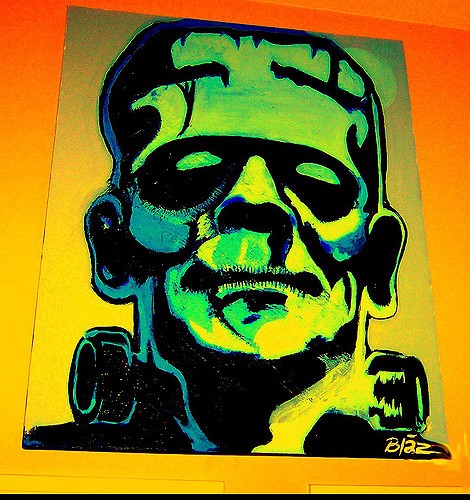
1. Unruly behavior: The monster from Frankenstein.

Talking to reporters, Nevada Democrat and Senate minority leader Harry Reid tied Trump’s rise directly to Republican rhetoric that created the “monster.”

“Trump is no anomaly. He is the monster the Republicans built. He is their Frankenstein monster,” Reid said. “Everything that he’s said, stood for, done in this bizarre campaign that he’s run has come, filtered up from what’s going on here in the Republican Senate.”

Political cartoons, too, play with monster imagery. One illustration from John Darkow in the Columbia Daily Tribune shows a monster-like Trump teetering forward, arms outstretched, grumbling, “Immigration bad! Mexicans criminals!” Next to him, an aproned GOP elephant holds jumper cables and muses to a Tea Party hunchback, “To be fair…we did kind of create him.”

“Trump is no anomaly. He is the monster the Republicans built. He is their Frankenstein monster,” Reid said.

The Republican party’s failure to disavow bigotry in its ranks is responsible for Trump’s rise, according to Robert Kagan, a senior fellow at the Brookings Institution. “Trump is the GOP’s Frankenstein monster. Now he’s strong enough to destroy the party,” read the headline of Kagan’s recent op-ed piece in The Washington Post.

“It was Republican Party pundits and intellectuals, trying to harness populist passions and perhaps deal a blow to any legislation for which President Obama might possibly claim even partial credit,” he wrote. “What did Trump do but pick up where they left off.”

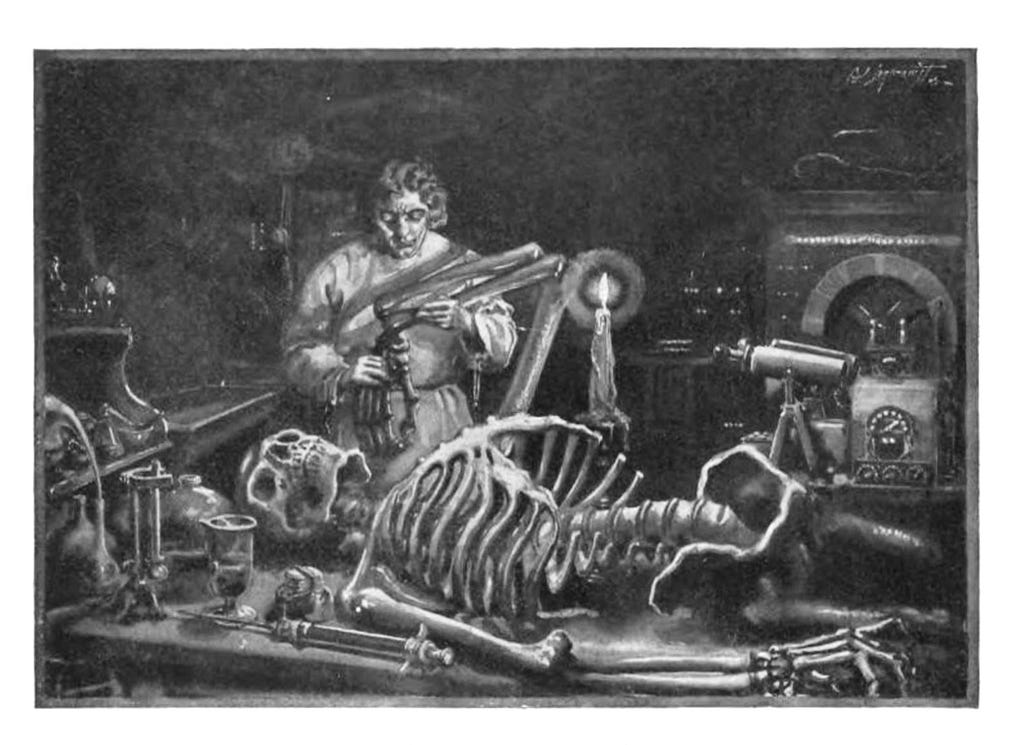
Susan Wolfson, a professor of English at Princeton University, said the monster comparison holds water.

“The basic gist is that the GOP has been a Frankenstein laboratory for decades, and the Creature to which they have finally given rampant life is Trump, who promises to wreak havoc not only his creator but on the world in general,” wrote Wolfson in an email. “It is a barometer of the post-novel, durable cultural life of the basic fable…of a creation that not only has gotten out of the control of its creator but also reflects something deeply monstrous about the political laboratory.”

The nuance which Mary Shelley brings to her representation of the Creature is lost on Trump.

Yet, in Shelley’s classic, the monster is intelligent and sensitive, tormented by his loneliness and the rejection of others. “Once I falsely hoped to meet with beings who, pardoning my outward form, would love me for the excellent qualities which I was capable of unfolding,” the Creature laments. “I was nourished with high thoughts of honour and devotion. But now crime has degraded me beneath the meanest animal.”

The nuance which Mary Shelley brings to her representation of the Creature is lost on Trump, Wolfson said. Instead of apology or remorse, Trump deflects wrongdoing: “It was locker room talk,” he said after being criticized for his boasting comments about touching women. In other instances, the GOP candidate simply denies having made statements that the record — often times video — shows him to have made. (Familiar refrains include “Wrong,” and “I never said that.”)

The novel offers one possible ending to the story of Trump and his creator, the GOP: “I have devoted my creator, the select specimen of all that is worthy of love and admiration among men, to misery; I have pursued him even to that irremediable ruin,” the Creature says.

2. Fame and finances: Mr. Merdle from Little Dorrit

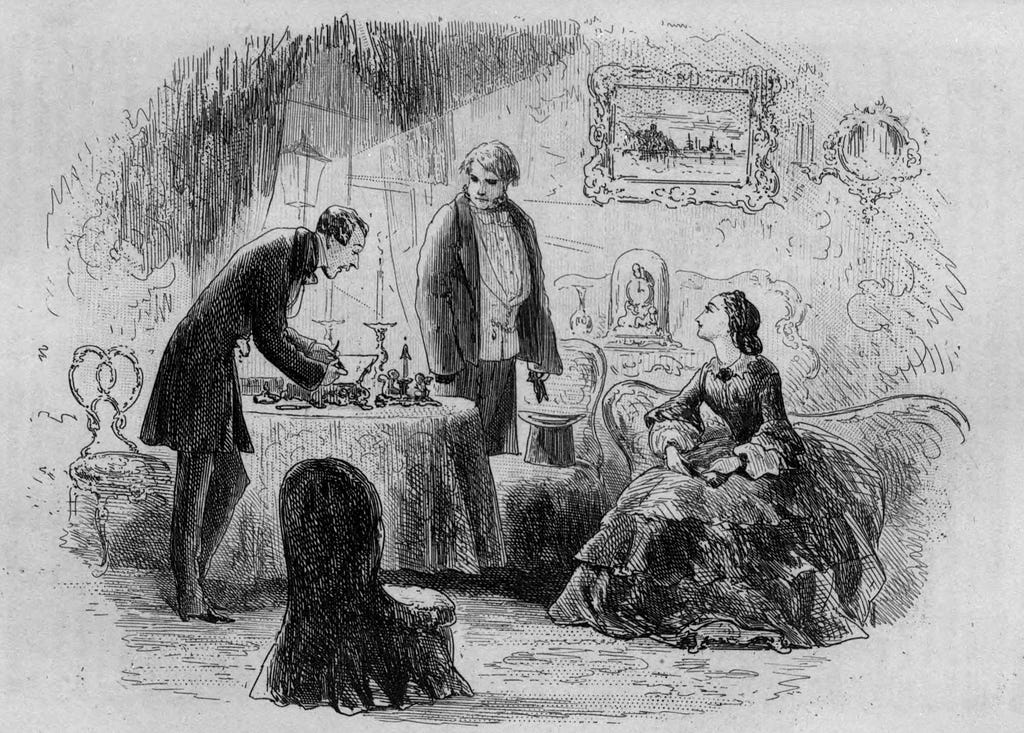
In his self-serving pursuit of wealth and celebrity, Trump finds a kindred spirit in Mr. Merdle from Charles Dickens’s Little Dorrit. Merdle, whose name recalls the French “merde” (feces) soars to fame despite an apparent lack of talent.

Merdle’s facade of wealth, however, turns out to be a fraud. (Dickens based Merdle on John Sadleir, the Irish railroad speculator who later became a member of the House of Commons, who embezzled money and bankrupted the Tipperary Joint Stock Bank before killing himself. Before his demise, he enjoyed fame for his perceived financial success.)

“The famous name of Merdle became, every day, more famous in the land. Nobody knew that the Merdle of such high renown had ever done any good to any one, alive or dead, or to any earthly thing. All people knew (or thought they knew) that he had made himself immensely rich; and, for that reason alone, prostrated themselves before him,” the narrator tells us.

Merdle’s name — while not emblazoned on his towers in fat, gold letters — precedes him. The media seems to adore the man: “Mr. Merdle’s right hand was filled with the evening paper, and the evening paper was full of Mr. Merdle.”

Merdle’s name — while not emblazoned on his towers in fat, gold letters — precedes him.

Merdle’s wife is but an extension of his possessions, appreciated for her display value. “It was a capital bosom to hang jewels upon. Mr Merdle wanted something to hang jewels on, and he bought it for that purpose,” the narrator says. “Like all his other speculations it was sound and successful.”

But Merdle, like Trump, is no stranger to financial woes. Despite what the narrator calls his “wonderful enterprise, his wonderful wealth, his wonderful Bank,” Merdle falls deep into debt with his creditors. Trump, a rich man “suspiciously familiar with bankruptcy court,” as the Atlantic’s Andrew McGill put it, might sympathize.

“The critique of his lack of moral (never mind financial) worth reminds me of the contrasts made with Hillary: that’s he’s never done anything for anyone besides himself,” wrote Garrett Stewart, an English Professor at Iowa State University, in an email.

3. Sheer confidence: Bottom from A Midsummer Night’s Dream

Throughout the presidential race, Trump has exuded a seemingly endless reserve of bluster and confidence.

“I think my strongest asset — maybe by far — is my temperament. I have a winning temperament. I know how to win,” Trump has said.

That “winning temperament” could have been pulled straight from the character of Nick Bottom in Shakespeare’s A Midsummer Night’s Dream, said Peter Holland, a professor in Shakespeare studies at the University of Notre Dame. In describing Trump, other obvious parallels like Richard III, spring to mind, Holland said. But in many ways, Bottom best demonstrates Trump’s unfaltering belief that he alone can fix America.

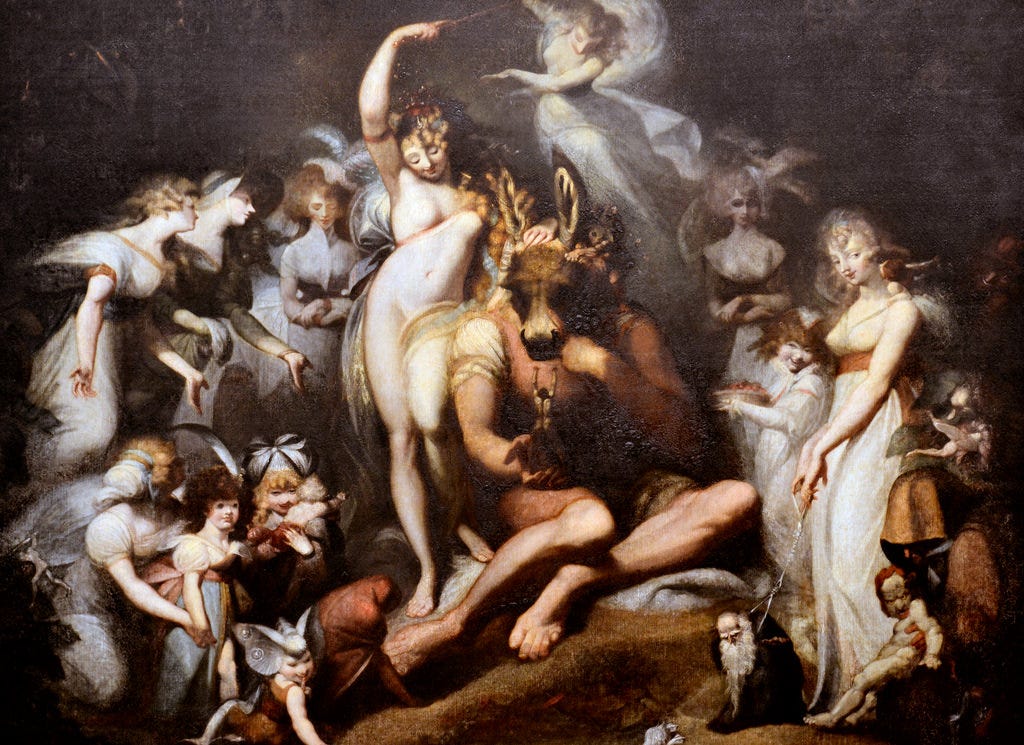
When the craftsmen receive their roles for the performance of Pyramus and Thisbe, Bottom, a boastful aspiring actor, insists he can play any of the characters: the gallant lover, Pyramus; Thisbe, the object of his affection; even the tyrant, Ercles.

“If I do it, let the audience look to their eyes; I will move storms, I will condole in some measure. To the rest: yet my chief humour is for a tyrant: I could play Ercles rarely,” Bottom says.

Even when he is transfigured by the prankster, Puck, who turns Bottom’s head into that of a donkey, Bottom fails to notice. Instead, he shifts blame to those who point it out: “I see their knavery: this is to make an ass of me; to fright me, if they could. But I will not stir from this place, do what they can,” he says.

A comedic character, Bottom touches on themes of trust and gullibility, performance and reality. He wonders out loud whether the ladies in the audience will be frightened by his portrayal of Pyramus’s death, or misinterpret the roars of an actor in a lion suit for those of a real lion.

A comedic character, Bottom touches on themes of trust and gullibility, performance and reality.

However, Holland said, Shakespeare’s characters are thoroughly un-Trumpian in another regard: even in the depths of madness, they maintain some semblance of eloquence. Even King Lear, in his more incoherent moments, or Othello, when he falls into an epileptic fit, do not rival Donald Trump in his use of run-on sentences:

“When you look at what’s going on with the four prisoners — now it used to be three, now it’s four — but when it was three and even now, I would have said it’s all in the messenger; fellas, and it is fellas because, you know, they don’t, they haven’t figured that the women are smarter right now than the men, so, you know, it’s gonna take them about another 150 years,” Trump said at a speech this July in Sun City, South Carolina.

As Holland put it, “There is not even in Shakespeare anybody of quite the extravagant madness of Trump.”

4. Womanizing, racism, and xenophobia: Tom Buchanan from The Great Gatsby

The image of Donald Trump is hard to separate from his relationship to his possessions and other people. In a May 1997 profile of the real estate tycoon in The New Yorker, Mark Singer described Trump’s appearance, down to the complying strands of hair.

“He wore a navy-blue suit, white shirt, black-onyx-and-gold links, and a crimson print necktie. Every strand of his interesting hair — its gravity-defying ducktails and dry pompadour, its telltale absence of gray — was where he wanted it to be,” wrote Singer.

Compare that with the description of Tom Buchanan as he enters the “Great Gatsby.” Buchanan, standing before his Long Island mansion, exhibits his ownership of the things and people around him.

“He was a sturdy straw haired man,” the book tells us, “with rather a hard mouth and a supercilious manner. Two shining arrogant eyes had established dominance over his face, and he gave the appearance of always leaning aggressively forward…it was a body capable of enormous leverage — a cruel body.”

Tom Buchanan shares not only Trump’s hair color, but also his stance on the state of humanity. “Civilization is going to pieces,” Buchanan says before declaring himself a “terrible pessimist.” He has been reading a book called The Rise of the Coloured Empires. He tells the narrator, “The idea is, if we don’t look out the white race will be — will be utterly submerged,” laments that recall Trump’s thinly veiled euphemisms of “inner cities” and his descriptions of issues facing Black communities.

Tom Buchanan shares not only Trump’s hair color, but also his stance on the state of humanity.

“Buchanan is the villain of the Great American Novel,” said Daniel Torday, professor of creative writing at Bryn Mawr College. “He is a human instead of a monster.”

In the end, these human qualities are precisely what make both Buchanan and Trump scarier than Frankenstein’s creation, he said.

“What he ultimately does over the course of that novel is manipulate people in the goal of his self-interest. Myrtle’s death and Gatsby’s death — both events are the result of Tom’s having run rampant over people’s lives,” said Torday. “It’s hard to imagine a character that overlaps more clearly with this year’s GOP candidate.”

Native Voices Won’t Be Silenced

As a blogger for Ploughshares I cover indigenous and Asian lit from around the world. My coverage also, naturally, includes the US, Canada, and other Western nations. When blog readership stats came in recently I saw something that confirmed my suspicions of the reading and writing public who supposedly champion POC authors: There’s a lot of talk about reading POC, the C or color part of that acronym doesn’t extend beyond the Caucasian or African American mainstream.

Where is the indigenous element in POC?

That’s where critically acclaimed Native nonfiction writer Elissa Washuta comes in. Author of personal essays and the memoir My Body Is a Book of Rules, she doesn’t dress up her writing with literary versions of moccasins and beaded buffalo hide dresses. Her skin might be a little too pale to suit the stereotype, as she’s said and written, yet she is an “unapologetic” member of the Cowlitz tribe.

Elissa holds an MFA from The University of Washington and currently serves as the undergraduate adviser for the Department of American Indian Studies at the University of Washington and a nonfiction faculty member in the MFA program at the Institute of American Indian Arts. She is a faculty advisor for Mud City Journal.

I interviewed her about November as Native American Heritage month, where to find work by indigenous writers, and being an edit-as-I-go writer.


Nichole L. Reber: Some of my friends from other countries have been asked by editors to mitigate the ethnic references in their work. My Guyanese friend, for instance, is a poet who’s been told he should eliminate his inherent Hindu references to be more accessible to readers. Have editors tried to censor you like this? Have you come across Native writers who self-censor?

Elissa Washuta: An editor has never told me to take out references to being Cowlitz/Cascade from my work. I don’t know that this means that I haven’t been censored. Like pretty much every other writer, I’ve been rejected many, many times, and I have wondered whether any of those rejections have to do with the fact that my work might be seen as “not Native enough” by readers who are looking for work with markers from a set created by Hollywood writers, fake shamans pulling a profit from paperbacks, and other non-Natives whose representations have come to be so strongly associated with us in too many people’s imaginations. Regarding other Natives who self-censor: it’s not something I think about, and certainly not something I’d call out a writer about. Each of us has an individual relationship with Indigeneity and it’s not up to me to evaluate whether it’s all there on the page. Not everything needs to be shared for readers’ consumption.

Reber: At the beginning of the month, Americans will vote for a President, then at the end of the month they’ll gorge on food and football in a supposed celebration of thanks for Natives’ helping out the first colonists. Few, however, recognize that it’s also Native American Heritage month. Does Native American Heritage month mean anything to you?

Washuta: I’ve become pretty jaded about Native American Heritage Month, because I sometimes see outlets only paying attention to Native voices and issues during November. That’s when the lists of notable Natives come out from publications who don’t publish work about Native writers the rest of the year (and still might not actually feature any Native bylines in November). Last November, the brick-and-mortar Amazon.com store in Seattle presented my book in a special “Native Voices” display in November. The book wasn’t in the store when I returned during the first week of December. All that said, I do look forward to the flurry of activity — readings, gatherings, other events — that happens in my communities in November.

Reber: What’s your favorite/most irritating myth about Natives? How would you set that record straight?

Washuta: Most irritating myths: That our identities are based completely in what a DNA test might say about us (bullshit) or in what we present that’s in alignment with something someone saw in Thunderheart (bullshit) rather than in our relationships and our roles in our communities. I try to set the record straight every day by continuing to live authentically and visibly as an unapologetic Cowlitz woman.

I try to set the record straight every day by continuing to live authentically and visibly as an unapologetic Cowlitz woman.

Reber: What are some of the best resources to find Native writers and their works? Who are some Natives you read, in this country or others?

Washuta: Facebook groups and pages are good resources for me. I recommend following “IAIA MFA in Creative Writing” to see the incredible things our faculty and students are doing. Follow Daniel Heath Justice on Twitter — he’s a citizen of the Cherokee Nation and a writer, and he tweets the name of an Indigenous writer every single day. Read The Yellow Medicine Review, Red Ink, As/Us, and Mud City Journal.

Reber: What’s your favorite part of the writing process? In a Poets & Writers piece you wrote that perhaps it’s not daily word count that gets a writer where she needs to be. Can you elaborate on how writing entails more than marching the words across a page?

Washuta: It’s true — I’m not into trying to hit a daily word count, ever. I don’t write every day, but I know that if I have three days without distractions, I can write 10,000 usable words. I binge on writing time just as I’ve always binged on Tootsie Rolls — I’m an all-or-nothing person, and having large chunks of writing time allows me to become deeply immersed in the work, which facilitates the making of connections between personal and public that come up throughout my work. Bringing together documents and fragments from American pop culture and history with my own experience, and being an edit-as-I-go writer always seeking to get the first draft to be stellar, makes for a slow process for me.

In the Poets & Writers piece, I talked about the fact that writing breaks are important for me in protecting myself from the process of working with traumatic memories. I have PTSD. I am resilient, but the work of remembering, uncovering, and rendering traumatic experiences is still likely to be deeply triggering. Being triggered in this way has a very real impact on my life: I will be emotional and reactive, I’ll have brain fog, I’ll be exhausted, I’ll feel unsafe and insecure, and I’ll have a ridiculously heightened startle response that makes me jump out of my seat or choke on my food. The work that leads to this cannot be a part of my everyday life.

Reber: In addition to My Body Is a Book of Rules you also published the novella-length Starvation Mode. Many nonfiction writers don’t seem to be aware that that length exists. What are its benefits and, because “novella-length” irritates me with its inherent fiction reference, how might we nonfiction writers agree to some kind of neologism for it?

Washuta: I think the benefit of the short book-long essay — which is what I like to call it, rather than “novella-length memoir” — is simply that the size and shape of stories’ containers are incredibly important to me, as important as the content (or more important), and some work just needs to have a container that is smaller than the standard book and longer than the standard essay.

Your ultra-cool style of writing, which incorporates so many forms and hybrids and lengths, is so refreshing. How do you encourage other writers to enter the world of alternative/hybrid forms?

Washuta: Thank you! I think a necessary first step is to shift one’s thinking about what an essay is “about.” For me, essays like this aren’t just “about” the subject matter — the form is the content. It’s important to consider the significance of any presentation of a subject, whether that’s a traditional, chronological narrative structure or something in the form of a term paper. What’s the very best vessel?

Reber: There’s a doc on Netflix called Reel Injun that discusses Hollywood’s perpetuation of a certain Native narrative. Have you seen it?

Washuta: Yes! I used to teach classes on Native representations in film at the University of Washington, and I used Reel Injun often.

Reber: Some of the clips used in The Reel Injun are from Terrence Malick’s The New World. I can imagine how you feel about that film but would like to hear your words. Malick tries to humanize the native experience, and he shows European actions as ridiculous and barbaric. But the film isn’t merely centered in the politics of history. It’s exceptionally artistic. I think this, like the rest of his films, is a lyric essay set to film. It’s visually poetic, told in snapshots, up to audience interpretation. Have you noticed that?

Washuta: It’s been a couple of years since I watched The New World, and I’m sure I’d have a lot more to say about it if I were to watch it again — but what I remember most about the film is that it’s long, pretty, and mostly without dialogue. The natural world is something to look at, something to appreciate for its aesthetic qualities. This is unlike any Native peoples’ views of the world that I’m aware of. While cultures differ quite a lot in land-based practices and stories surrounding them, I think a common thread is that Native peoples have long-standing relationships with the land — living on it, working with it, having a history with it, respecting different ideas of personhood embodied by it. Just looking at the landscape seems to me to be a practice brought here by settlers. Scrolling through a National Geographic digital image list has pretty much nothing in common with the act of going to the river for salmon ceremony because of a long-standing obligation to honor the gift of their lives that the salmon give us. So I see The New World as a piece of art that looks at the land (having been filmed, I see, very close to the place where the events took place) but can’t possibly embody the people’s relationships with that place.

I also think the silence in the film is a continuation of the representations of silent Indian maidens that have such a long and troubling history in film. I’m thinking of Sonseeahray in Broken Arrow, who eventually does speak quite a lot, but says very little when she is introduced as White Painted Lady, placed in the role of healing Tom Jeffords’s wounds while looking lovely. And I’m thinking of “Look” in The Searchers: she is mostly without a voice, she’s the butt of jokes, and Martin’s violent act of kicking her down a hill is meant to get laughs. And there’s Disney’s version of Pocahontas, too: she’s the protagonist of that film, and she does speak quite a bit, but when she meets John Smith, she has no words until she adopts his language. In all these roles, the Native woman is quiet, subservient, nice to look at, compliant.

The silencing of Native people has been an important tool of genocide: in boarding schools, Native children were forbidden from speaking the languages of home. Stories have been lost, and stories tell us how to live in our world: how to honor the beings with which we have longstanding relationships, how to treat one another, what to do and what not to do as human beings in order to live as well as possible. The replacement of these stories with silence is the replacement of old and durable ways of living and knowing with young, convenient, and untested narratives about “progress” and “improvement.” Native storytellers maintained these ways of knowing over many, many generations. So for a non-Native filmmaker to build his representation of a Native community from silence seems consistent with the erasure that has been happening for hundreds of years.

The silencing of Native people has been an important tool of genocide.

All that’s to say — I don’t remember the film, entirely, but I remember how it made me feel, which was uncomfortable. And so it’s possible that it is like lyric essay, in a way (although I think it’s a fiction, in that it’s not an accurate depiction), in that I think lyric essay relies a lot on reader effort.

Reber: Speaking of lyric essays, we talked earlier about alternative and hybrid forms. There are many nonfiction writers out there, even those who studied writing at uni, who remain unaware of forms such as the braided essay, the fragmented essay, the hermit crab, all of which are increasingly popular. You in fact write in some of these styles. Could you take a stab in explaining what these are and why you think they’re gaining in popularity?

Washuta: I think all these formal approaches to the essay rely on a heightened awareness of form (the visible shape of the text, determined by organization of its paragraphs, breaks, and other elements). Both the writer and reader are aware: in essays that most people think of as more formally “traditional,” I think the writer is often aware of the form but crafts the essay in such a way that the reader doesn’t have to be.

In many of these more fragmented or formally innovative essays, the form is as important as the content, and the two rely on each other. In my own work, I do make a lot of formal choices to create what people are calling “hermit crab” essays. I’m not sure where that label originates, but it might come from Brenda Miller and Suzanne Paola, who write in Tell It Slant: Creating, Refining, and Publishing Creative Nonfiction, “This kind of essay appropriates existing essay forms as an outer covering, to protect its soft, vulnerable underbelly.”

I like that way of looking at these essays, but it’s not exactly how I think of the work. I think of form and content as vessel and contents held. My yellow bottles from the pharmacy are meant to hold pills, but I can also repurpose them to hold safety pins. I can’t use them to hold apple slices, because they’re not the right size. Similarly, I can appropriate the text form of the prescribing information that comes with those pill bottles, employing the direct address, elements of voice, progression of information, and other characteristic elements. I used that form in My Body Is a Book of Rules to tell the story of my own experience with prescription drugs. I don’t think it would be useful for holding contents that have to do with my experiences with online dating — I’ve used a different form for that.

I think this kind of formal innovation is gaining in popularity because people are encountering them more and more, in part because of online journals and digital resource sharing (like recommending essays via Facebook, which I see happening a lot). I think the more people see formally innovative essays, the more prepared we are with the tools to prepare us to learn an essay’s internal logic and rules, and we’re less likely to see these essays as weird failures because they don’t follow the rules. “Fragmented” used to be seen as a problem — now people are beginning to see that it’s a neutral quality.

Reber: Have you written any collaborative works? How do you imagine the collaborative works benefit the writers and the reader? Do you have any suggestions on how we/readers might start one? Most of the collaborations I’ve seen and read are from Julie Marie Wade and Denise Duhamel.

Washuta: I haven’t. I imagine that I’d be a terrible artistic collaborator. My writing process involves pushing myself further into traumatic memory than I think I can safely go without being completely overtaken by my PTSD, and simultaneously pushing myself to put that content into a container that’s more unusual than what I’ve come up with before (or at least as unusual). I can’t imagine subjecting anyone else to that, and also, the process is so personal and intuitive that I don’t think it would hold up if I let someone else in.

Reber: In your piece in The Weeklings called “I Am Not Pocahontas,” you wrote about that age-old question Americans like to ask: “How much Indian are you?” I love this essay because it reminds me of when I temped at a DNA firm in Sarasota, Florida, and received dozens of phone calls from people who believed if they could prove their Native heritage they would receive a bald eagle. It took quite a few of those phone calls to learn how to answer them without laughing. Yet on the other hand I could relate because I too wanted to verify what my father had told me about having Native blood. I do have some, a DNA test indicated, an infinitesimal amount that would, unfortunately for my mother, not qualify me as getting a full-ride to uni. Somehow having that confirmation, despite decades of my father telling me so, added another dimension to my existence. On the flip side I wonder about the times I’ve heard Natives banter friends or family members for not being Indian enough. What does that mean? How does one get to be Indian enough?

Washuta: There are so many different ways of being Native (enough) that it would be impossible for me to answer for anyone but myself. When I was in high school in New Jersey, where I didn’t know any Native people I wasn’t related to, I was anxious about being “Native enough” because there were white kids who questioned my authenticity and presented themselves as arbiters of Native realness. But their conception of Native authenticity probably came largely from Hollywood representations and from passed-around misinformation about what it means to be a tribe member — all that bullshit about Indians not paying taxes (so not true).

Now I’m an adult and I am very sure that I’m “Indian enough.” For me, that looks like enrollment in my tribe, which means that I have a formalized relationship with my community and am able to participate as a citizen. And it means having relationships within that tribe. And it means that I’m descended from people who lived in North America before settlers seized the land, people who have stories and land-based practices that have endured despite deliberate efforts by the U.S. government to eradicate our ways of living and knowing.

Announcing Papercuts: A Party Game for the Rude and Well-Read

Attention all literary fiends, card game junkies and holiday gift-givers: Electric Literature has just gone live with a Kickstarter for Papercuts: A Party Game for the Rude and Well Read! Until now, the game was just a chimera — a whisper of a rumor of an idea — but after months of painstaking R&D (i.e. — wine, pizza & night shifts at the EL editorial offices), Papercuts is now a fully designed, ruled and playable game. All it needs now is your backing!

Here’s how the game works: the “Editor” draws a question card, and each of the other players (the “Writers”) submits an answer card. Based on whatever clever/twisted/idiosyncratic/perverted/erudite criterion suits the Editor’s mood, a winning card is chosen and a point is awarded. Pass the deck of questions, name a new Editor, and keep the fun going. Have you ever played Apples to Apples™ or Cards Against Humanity™? Then you get the gist. Things are going to get rowdy — and literary, and possibly a little crazy, but also probably mind-expanding and definitely weird. Papercuts has been exhaustively play-tested by EL staff and calibrated for maximum bookish fun.

The Kickstarter campaign, which was launched today, needs to raise $15,000 over the next month. Papercuts will then go to print and be ready by the second week of December — just in time to ship for the holiday season. Rewards include first-run sets of Papercuts, totes, t-shirts, year-round submissions to EL’s Recommended Reading, and review of your work from EL editors.

And remember — Electric Literature is a non-profit dedicated to paying writers, amplifying the power of storytelling, and ensuring that literature remains a vibrant presence in popular culture. So support this game!

A Lifetime in Personas

D. Foy’s Patricide, his second novel, is an unusual hybrid that pushes against the edges of literary fiction with the unfiltered violence, frustration, and angst typically found in noir novels but does so with an elegance and lyricism that echo giants like Cormac McCarthy and Walt Whitman. Equal parts devastating coming-of-age (and beyond) narrative and philosophical examination of fatherhood, Patricide is, more than a novel about a man who survives a devastating, abusive childhood, a text that explores both identity construction/deconstruction/reconstruction cycles and the generational recurrence of aberrant behavioral patterns and falsehoods.

Patricide follows Pat Rice as he suffers through and eventually tries to leave behind an awful childhood spent at the hands of a lying father with a short temper and heavy hands and a mother who shifts between molesting him and assaulting him. As Pat matures, the fabrications he has been exposed to since birth begin to crumble and his parents are slowly revealed for what they truly are. Unfortunately, the damage is already done and constructing a great future from a shattered past is impossible, especially when drugs, alcohol, constant uncertainty, and resentment are part of the equation. Told in first and third person and from the unique perspectives of ten different personas that range from the scared, abused youngster to the (in)mature self-destructive addict who is unable to cope with his past or present, Patricide is a narrative that contains a lifetime of fear and growth filtered through philosophy and mercilessly dissected in search of ultimate truths and understanding.

Foy’s novel inhabits a space between all its elements. This is a narrative about dread, hatred, anger, weakness, truths revealed, and resentment, and the story takes places in a plethora of places within that bleak psychogeography. Pat, like any other child, is placed on a route of discovery, both of the self and of those around him. Unfortunately, those around him are deeply flawed individuals, especially his parents, and that has a direct and very adverse effect on his development. The formative years, those that are supposed to be spent in a semi-constant state of amazement, are for Pat nothing more than a perennial and unfruitful quest to be accepted and to escape the vicious wrath of his mother and father. This state, in turn, becomes a desire to escape, to break free of his own life, to move into a new set of realities that differ from those that are constantly being revealed to him:

“You are stricken with wonder. But this wonder isn’t a wonderful wonder, this wonder is no wonder of serenity and grace. It’s a wonder of madness, a wonder of terror and doubt. It’s a wonder that civility, concern, humility, kindness — that compassion itself — haven’t utterly collapsed.”

While Pat is the main character, his father occupies the epicenter of the narrative. At first, the father is The Father and, albeit somewhat inadequately, he manages to provide what his son requires of him: support, moments of positive reinforcement, and a few intellectual, moral, and philosophical building blocks that will help him become a man. Then cracks begin to appear in the construction that Pat and his Father have built together and two moments, one of violence directed at his father and one in which both of his parents deny him a guitar, destroy the idea of The Father. The catharsis that ensues is a maelstrom of suffering that shakes Pat to his fragile core and signals the escape/expulsion from the home both literally and figuratively.

“Either the father is The Father, or he’s just some other guy.

Because The Father is invincible, indefatigable, impermeable to bribery, sleaze, and vice, beyond corruption of any sort, purity incarnate, authority supreme.

The moment of The Father’s tainting is the moment of The Father’s death — he crashes into the slime of being with all its hateful masses.”

A lot of things lead up to the shattering of The Father and the painful emergence of the father, but that shattering also signal a rebirth within the narrative. Furthermore, that break allows Foy to explore pain and ennui and those things to addiction, violent behavior, and destroyed relationships. In a way, Patricide is an intellectual and emotional map of agitated stagnation and ennui: “The ennui was endless, the lunacy, too, and the sadness, and the heartache and injuries and illness, the plain old dirty pain.”

Patricide is a literary ouroboros that explores how abused sons become abusive fathers who have abused sons who become abusive fathers. Inside this cyclical dynamic, Foy has packed a philosophical treatise on fatherhood, a cautionary tale about vices and the lives we build around them/because of them, and an extremely poetic novel about family and redemption. The result is a novel that digs deep into Americana and pulls out its most embarrassing, chaotic, tender, and scatological scenes and brings them to center stage so that they may, for one brief moment, shine so bright that they transform into mirrors.

Behind the blitzkrieg of ideas and lyricism, Patricide is a celebration of language. Foy constantly alternates between writing that sustains conversations with thinkers like Foucault and Freud and one-line paragraphs that rival David Foster Wallace’s most vivacious passages. This is writing that erupts like a volcano of words and then folds in on itself only to begin the explosive process all over again.

“My father is a man of such limitless contradictions that it doesn’t seem possible he walks this earth. And how is it possible I’ve survived this long, having been raised in this world by such a man as my father… And how can I live each day in the midst of such terrible ambivalence, how can I hold at once such awesome love and despicable burning hatred?”

With his previous novel, Made to Break, Foy announced the emergence of a voice that worked inside a framework it had built for itself. The novel was dark and poetic in ways that heralded great things to come. Patricide delivers on that tough promise and cements its author as one of the most talented and polyrhythmic voices in literary fiction.

Wendy C. Ortiz Chronicles a Dreamscape

The idea of pure transparency is pivotal when discussing the work of Wendy C. Ortiz. Her most recent book, Bruja, is described as a “dreamoir,” and the book opens with a definition of the form— “a narrative derived from the most malleable and revelatory details of ones dreams, catalogued in bold detail. A literary adventure through the boundaries of memoir, where the self is viewed from a position anchored into the deepest recesses of the mind.” From there, Ortiz launches into those malleable and revelatory details. The most shocking and exciting part of reading them is recognizing that through this catalog of unguarded and subconscious moments, we really do see a sort of narrative emerge — a recurrence of characters, settings and situations. The book itself is organized by month, opening in the spring, with April. Each dream ranges from a few sentences to a few pages, with the only discernible indication that the dream is ending and another beginning is through an artful use of white space. One passage appears this way:

“I found an invisible button and pushed it.
Everything — everything — turned white. A complete blank white slate, no forms, shadows, dimensions.
It reminded me of Bugs Bunny cartoons when the animator showed up and erased the backgrounds around the characters, then erased the characters.”

The secret conceit — and the brilliance — of this book is Ortiz’s ability to cause the reader to relate. It’s a feat that ought to be impossible, considering we’re reading the transcriptions of someone else’s dream. But after a few passages, we can’t help but reflect on our own dreams, our own subconscious desires, the recurring settings that transfer in and out of our dreamscape like a computer background, and the recurring cast of characters from our lives that transport themselves into our own personal dream spaces.

Ortiz and I talked about social media, the book’s cover art (Bruja’s is the work of another LA-based artist named Wendy Ortiz), and giving over to your most personal moments.

Nicholas Rys: I’m very curious about the inception of this project, how the idea of publishing a chronicle of your dreams as a work of literature came about? I think it’s beautiful.

Wendy C. Ortiz: Thank you. Initially it was text I captured from a website I was keeping, exactly like the text that would become Hollywood Notebook. I was keeping notes on dreams at the same time. When the website went down, I knew I’d want to work with the text down the road, so I saved it. When Michael Seidlinger asked me if I had anything for him to look at for CCM, I knew this was probably something he could appreciate. In my first emails with him I called it a dreamoir and explained briefly what I meant by that term, and he was immediately on board and supportive of the work.

Rys: So I’m fascinated by this book conceptually and the process of it. Is it safe to call this a dream journal? Did you take notes right after you’d wake up or did you write these much later?

Ortiz: It’s safe to call the original text a dream journal, though when I published it online I made sure to never use the word “dream” or point out that it was a collection of dreams. At different periods in my life I’ve kept some kind of dream journal, and have several volumes of them, sometimes in small notebooks or more formal journals, some on loose pieces of paper I kept. I typically wrote them just after waking, but would impose some form on them before publishing them on the website.

Rys:Are the passages laid out chronologically?

Ortiz: These dreams are totally chronological. The original version had exact dates, but in editing, we decided to go with just the months, and several dreams were edited out.

Rys :For some characters, full or first names are given, while others go by abbreviations like Sh or N. could you tell me about the process? Were you protecting certain identities? How did you decide who would be anonymous and who be given a name?

Ortiz: I mainly wanted to keep hold of the pseudonyms I’ve given others in all my previous writing. “Abigail,” for example, is a character in Excavation, and she appears frequently in Bruja under that pseudonym. “Michael” shows up constantly in Bruja, but has made only one appearance in a published essay. “Sh.” and “S.” appear throughout Hollywood Notebook, and so on and so forth. A few names are not pseudonyms in Bruja, and my feeling was that they did not need protection, and frankly, I enjoyed what could be read into the dream. “Sandy” appears in Bruja, and she is Sandy in real life.

Rys: How does the title relate to the book?

Ortiz: My grandmother and my mother are women who I describe as witches, with their particular abilities and insights, though they would never describe themselves as such. For much of my life it’s felt like a given that I have some sort of vibe that others have described as “witchy,” and my partner and I see this in our daughter as well. A bruja, to me, is one who can, among other things, live on other planes than just the one we think we know and refer to as reality. In Bruja, I’m describing the world I lived in while asleep, that felt just as real, just as emotional and vibrant and frightening as the world I lived in during the day. In that sense, I lived in two different planes and tried to document that experience. The word bruja, Spanish for witch, then, just references one of the identities I inhabit.

A bruja, to me, is one who can, among other things, live on other planes than just the one we think we know and refer to as reality.

Rys: So I’m curious if writing about your dreams adds more distance or makes you feel, I don’t know, almost more vulnerable, like you are giving over your subconscious, in some way. I suppose I’m curious how writing about your dreams compares to writing about other, personal aspects of your life? I’m really in awe of how brave you are, specifically as a memoirist, in the manner in which you confront difficult, personal experiences so artfully and sincerely. I’m curious if writing about such an unguarded and private aspect of your life feels logical, as you’ve already given so much of yourself to “The Reader”, or if it was in some ways different, more difficult, more challenging? Does any of this make any sense?

Ortiz: This makes total sense! I do feel an additional sense of uncomfortability with this dreamoir. It’s like removing another veil. Some of the dreams I omitted felt they like they gave away too much of my psyche. Seeing dreams placed this way — and taking into consideration when the dreams occurred, what else was going on in my life on this plane — feels very revealing. But then there is the way in which a dream works as a lens, and it can also obfuscate. I like this element — you might feel you understand more of a person via their dreams, but you might actually understand less.

Rys: Did you find any dream/passage surprising as you read it back during the edits?

Ortiz: I’m always surprised reading the constant dream conversations and conflicts I was having when it comes to partners. Do I marry this one or that one; I don’t want to be married at all; I want both; I met “The One.” It’s hilarious.

Rys: I love the book because as it progresses the reader can begin to see recurring images, motifs form water/water creatures, traveling/packing for traveling, settings that pop up again and again. This is fascinating to see unfold, to watch settings recur and characters drift in and out. Inevitably — perhaps it’s unavoidable as someone else who writes — but I found something at least vaguely resembling a narrative structure emerges. Was this something you thought about from the onset? Was it something that just happened to emerge as you were writing the book?

Ortiz: I did not set out with a narrative structure to impose on the book but imagined it would become on its own through the editing process. I also see a narrative structure that no one else has access to because I was the dreamer and the main player even in the labyrinth that is dream life. I also imagine that the lack or presence of “narrative structure” in the book will depend on the reader and how she reads (into) it…

Rys: Could you tell me about the cover art?

Ortiz: On instagram I found another Wendy Ortiz, an accomplished artist. I had been receiving stray emails meant for her, and started following her — and my first thought was, These are the kinds of images I imagine I would wish to illustrate if I had even one artistic bone in this body. Her images are haunting, beautiful, and dark. I got in touch with her and she lives in Los Angeles, too. I’m very pleased and fortunate that she was open to letting me use her work for the book cover.

Rys: What is your writing schedule like? Do you find an importance in a daily routine?

Ortiz: I don’t have a schedule, really. Every morning I write two longhand pages in a journal, that’s it. It’s more of an exercise, a wish to keep going with the journals I’ve kept since I was a kid, only there’s a discipline to it now. It’s total bullshit writing with occasional moments of aha, but mainly it’s what I will use maybe ten years from now when I write the memoir about this particular period of my life.

Rys: You are very active on social media which, in some ways, is a sort of self-curated live stream of our day to day — I’ve been sort of thinking about the ways that social media is almost like an extension of or at least connected to the concept of memoir — to what you do. Do you have any thoughts on this?

Ortiz: I have so many thoughts on this. The platforms I use — fb, twitter, instagram, tumblr, snapchat — for each I utilize what could be described as a different persona because they each definitely have a different and particular audience. I sometimes think, if these platforms were layers, the outermost would be fb, next would come twitter, then insta, then tumblr, then snapchat, snapchat having the most potential for the innermost layer, because it’s there I could tell a secret and have it be deleted from my story and from the snapchat servers 24 hours later. Each layer requires a different persona. This, to me, is fun to untangle, get tangled in, and mess with. Also, I find that a lot of readers seek me out in these places and do seem to appreciate the occasional windows into my day to day life — and that sometimes even builds into relationships with readers and other writers where these virtual spaces can be generative, warm, and supportive.

An Elegy for Ecuador

Mauro Javier Cardenas’s first novel, The Revolutionaries Try Again, links the stories of three graduates of San Javier, an elite prep school in Guayaquil. Antonio, Leopoldo, and Rolando were all once part of the same Jesuit volunteer group, all idealistic, all ambitious, and, by the novel’s start — and certainly by its finish — they all have had that idealism and that ambition suffocated.

But more interesting than any aspect of The Revolutionaries Try Again’s plot is its language, which also looks rather conventional, at first; then the sentences start to lengthen, and we run into Spanish phrases here and there, and some theatrical dialogue; by the end, the reader’s wavering between pages-long sentences and phrase-fragments cordoned off by dashes and slashes.

Cardenas seems to have telegraphed his influences. A quick Googling will unearth his interviews with literary heavyweights, particularly ones known for dense, monologue-driven novels, where politics press upon the lives of individuals: Laszlo Krasznahorkai (Hungarian), Antonio Lobo Antunes (Portuguese), Horacio Castellanos Moya (Salvadoran), among others. Enlivened by foreign influences — including those of its Ecuador-born author — the English of The Revolutionaries Try Again expands and contracts, twists and deforms. In every sentence is a churning mind. Words tumble on, and the experience of reading begins to resemble the the sensation of thinking, of remembering.

…what Antonio will remember of that spiritual retreat is that after their evening Mass, disregarding Father Lucio’s warning that no one was to leave their rooms upstairs — stay alone with the lord, Drool — Antonio escaped from his room and evaded the pack of Dobermans that had been unleashed by the priests and sneaked inside Leopoldo’s room, where late into the night they argued about what god wanted from them and we have a responsibility to him, Leopoldo says, the lord has chosen us, Antonio says, the Dobermans barking outside Leopoldo’s room as Leopoldo raises his glass toward the light and says we must be transparent like this glass so that god’s light can pass through us.

This is a typical sentence not only in its form — how it meanders through sense and memory, its plurality of voices, its sheer length — but also in its nostalgic treatment of religious belief and friendship. And nostalgia, of course, follows loss. The Revolutionaries Try Again is about lost faith, and not just in God, but in institutions, such as religion and government, and in people, such as your friends and yourself.

Through Leopoldo, who grows up to be a government economista, we get scenes of bureaucratic absurdity. Antonio presents an alternative: as soon as he graduates from San Javier, he leaves for the United States. Antonio is the novel’s central character, and his biography resembles his author’s: both from Guayaquil, both of their fathers were ministers in Cordero’s government, both attended San Javier and Stanford. And Cardenas says that he, like Antonio, planned to return to Ecuador and run for office. But instead of returning, he wrote a novel.

Antonio, at the novel’s start, has all but given up the dream of his triumphant return. (Now he’s a writer who “imagine[s] the possibility of deforming American English as revenge for Americans deforming Latin America.”) Leopoldo phones Antonio on an impulse and convinces him that they should run for president like they had always talked about. It’s a dramatic instigating event, the fateful call made possible by a lightning-struck payphone, a scene that seems to suggest that we’re in for some sort of magical realist political thriller. But no, this is literary fiction, a genre whose authors only rarely deign to tell an exciting story. So The Revolutionaries Try Again is a a sort of mocking title (though it suggests a harsher irony than the book actually possesses). It’s not about a revolution; it’s not even about trying, certainly not trying again. Antonio and Leopoldo’s prospective candidate is another San Javier grad, a rapist from a rich family, who doesn’t even care about politics. They all chitchat, go to parties, and spark no upheaval. The Revolutionaries Try Again doesn’t quite fulfill the drama that its opening seems to promise, but nor does it get mired in the doldrums of typical lit-fic plotlessness. The book succeeds because the mechanics of the mind, much like those of politics, tend to whirl in place rather than move forward. For a novel about stifled ambition, this form fits.

Or these forms fit, that might be more accurate, because the novel’s always shifting; its syntax twists and untwists; lines stagger down the page; two chapters are in Spanish. But the form that makes the strongest impression first appears in the Rolando and Eva chapters. Their story takes up far fewer pages than Antonio and Leopoldo’s, but when the novel’s focus trains on Rolando and the two women whom he’s obsessed with (Eva, his lover, and Alma, his sister), Cardenas writes in his least conventional mode.

…the surface of the road on the way to Eva’s house shifting abruptly from pavement to gravel to craters that rattle the bus that’s speeding by with a hand-sized flag of El Loco attached to its antennae that sounds like the shuffling of cards — which reminds Rolando of nothing — of his father who never played cards backgammon chess — switching off the headlights as he parks by Eva’s house — to remain silent is to give the impression that one wants nothing — to shut off the lights in one’s house is to give the impression that one wants — a surprise? — shut up — that one is asleep — that one is embracing someone other than Rolando Alban Cienfuegos carajo — stop that — that one has shut one’s eyes to the world — let it rot Rolando — winning the chess championship at San Javier three years in a row but his classmates turning it into a joke — Gremlin eat Queen ha…

It’s a destabilizing effect, temporally distorted and fragmented, fitting for the unstable Rolando. (In his first appearance, after his father tells Antonio and Leopoldo that he is starting a radio station, he lashes out at his former classmates, screaming that they are “thieves.”) Eva wants him to use his station to produce and broadcast political radio dramas, but Rolando rather play Ricky Martin, because, he believes “nothing changes without violence.” Violence looms over these chapters, which do not only stand in contrast to Antonio and Leopoldo’s on stylistic grounds. This is how the moral weight of the novel starts to accrue, with the human consequences of systemic corruption made manifest.

A self-consciousness about literature and literary convention; a distortion of linear time; a depiction of reality as fragmented, using various, internalized, questionably-reliable perspectives, as well as grammatical and syntactic irregularities: this sounds like a Modernist novel. Cardenas uses the trappings of Modernism to traditionally Modernist ends — mirroring the workings of consciousness, and depicting a society, reeling from violence, that has lost faith in itself — but The Revolutionaries Try Again is set in a country and time that we don’t normally associate with Modernism: the Ecuador of the mid-90s, in the months leading up to the demagogue “El Loco” Bucaram’s election.

So, in a sense, this novel belongs to the past—to Ecuador’s history, and to Cardenas’s life, and to the innovations of Modernism. But I hope, as thousands migrate northward, that this novel belongs as much to the future. Wouldn’t that be fantastic, if this dense, brilliant, bilingual novel by an immigrant is what the future of American literature looks like?