The humans use Arecibo to look for extraterrestrial intelligence. Their desire to make a connection is so strong that they’ve created an ear capable of hearing across the universe.
But I and my fellow parrots are right here. Why aren’t they interested in listening to our voices?
We’re a nonhuman species capable of communicating with them. Aren’t we exactly what humans are looking for?
The universe is so vast that intelligent life must surely have arisen many times. The universe is also so old that even one technological species would have had time to expand and fill the galaxy. Yet there is no sign of life anywhere except on Earth. Humans call this the Fermi paradox.
One proposed solution to the Fermi paradox is that intelligent species actively try to conceal their presence, to avoid being targeted by hostile invaders.
Speaking as a member of a species that has been driven nearly to extinction by humans, I can attest that this is a wise strategy.
It makes sense to remain quiet and avoid attracting attention.
The Fermi paradox is sometimes known as the Great Silence. The universe ought to be a cacophony of voices, but instead it’s disconcertingly quiet.
Some humans theorize that intelligent species go extinct before they can expand into outer space. If they’re correct, then the hush of the night sky is the silence of a graveyard.
Hundreds of years ago, my kind was so plentiful that the Río Abajo Forest resounded with our voices. Now we’re almost gone. Soon this rainforest may be as silent as the rest of the universe.
There was an African grey parrot named Alex. He was famous for his cognitive abilities. Famous among humans, that is.
A human researcher named Irene Pepperberg spent thirty years studying Alex. She found that not only did Alex know the words for shapes and colors, he actually understood the concepts of shape and color.
Many scientists were skeptical that a bird could grasp abstract concepts. Humans like to think they’re unique. But eventually Pepperberg convinced them that Alex wasn’t just repeating words, that he understood what he was saying.
Out of all my cousins, Alex was the one who came closest to being taken seriously as a communication partner by humans.
Alex died suddenly, when he was still relatively young. The evening before he died, Alex said to Pepperberg, “You be good. I love you.”
If humans are looking for a connection with a nonhuman intelligence, what more can they ask for than that?
Every parrot has a unique call that it uses to identify itself; biologists refer to this as the parrot’s “contact call.”
In 1974, astronomers used Arecibo to broadcast a message into outer space intended to demonstrate human intelligence. That was humanity’s contact call.
In the wild, parrots address each other by name. One bird imitates another’s contact call to get the other bird’s attention.
If humans ever detect the Arecibo message being sent back to Earth, they will know someone is trying to get their attention.
Parrots are vocal learners: we can learn to make new sounds after we’ve heard them. It’s an ability that few animals possess. A dog may understand dozens of commands, but it will never do anything but bark.
Humans are vocal learners too. We have that in common. So humans and parrots share a special relationship with sound. We don’t simply cry out. We pronounce. We enunciate.
Perhaps that’s why humans built Arecibo the way they did. A receiver doesn’t have to be a transmitter, but Arecibo is both. It’s an ear for listening, and a mouth for speaking.
Humans have lived alongside parrots for thousands of years, and only recently have they considered the possibility that we might be intelligent.
I suppose I can’t blame them. We parrots used to think humans weren’t very bright. It’s hard to make sense of behavior that’s so different from your own.
But parrots are more similar to humans than any extraterrestrial species will be, and humans can observe us up close; they can look us in the eye. How do they expect to recognize an alien intelligence if all they can do is eavesdrop from a hundred light-years away?
It’s no coincidence that “aspiration” means both hope and the act of breathing.
When we speak, we use the breath in our lungs to give our thoughts a physical form. The sounds we make are simultaneously our intentions and our life force.
I speak, therefore I am. Vocal learners, like parrots and humans, are perhaps the only ones who fully comprehend the truth of this.
There’s a pleasure that comes with shaping sounds with your mouth. It’s so primal and visceral that throughout their history, humans have considered the activity a pathway to the divine.
Pythagorean mystics believed that vowels represented the music of the spheres, and chanted to draw power from them.
Pentecostal Christians believe that when they speak in tongues, they’re speaking the language used by angels in Heaven.
Brahmin Hindus believe that by reciting mantras, they’re strengthening the building blocks of reality.
Only a species of vocal learners would ascribe such importance to sound in their mythologies. We parrots can appreciate that.
According to Hindu mythology, the universe was created with a sound: “Om.” It’s a syllable that contains within it everything that ever was and everything that will be.
When the Arecibo telescope is pointed at the space between stars, it hears a faint hum.
Astronomers call that the “cosmic microwave background.” It’s the residual radiation of the Big Bang, the explosion that created the universe fourteen billion years ago.
But you can also think of it as a barely audible reverberation of that original “Om.” That syllable was so resonant that the night sky will keep vibrating for as long as the universe exists.
When Arecibo is not listening to anything else, it hears the voice of creation.
We Puerto Rican parrots have our own myths. They’re simpler than human mythology, but I think humans would take pleasure from them.
Alas, our myths are being lost as my species dies out. I doubt the humans will have deciphered our language before we’re gone.
So the extinction of my species doesn’t just mean the loss of a group of birds. It’s also the disappearance of our language, our rituals, our traditions. It’s the silencing of our voice.
Human activity has brought my kind to the brink of extinction, but I don’t blame them for it. They didn’t do it maliciously. They just weren’t paying attention.
And humans create such beautiful myths; what imaginations they have. Perhaps that’s why their aspirations are so immense. Look at Arecibo. Any species that can build such a thing must have greatness within it.
My species probably won’t be here for much longer; it’s likely that we’ll die before our time and join the Great Silence. But before we go, we are sending a message to humanity. We just hope the telescope at Arecibo will enable them to hear it.
On October 28th, Electric Literature will host our second annual Genre Ball! To get in the spooky spirit of the season, we asked some of our Genre Ball hosts — Lynne Tillman, Nicole Dennis-Benn, Tony Tulathimutte, Teddy Wayne, James Hannaham, Helen Phillips, and Kelly Luce — to tell us about their favorite scary stories.
Our Genre Ball will be held the Friday before Halloween at the Ace Hotel in NYC. If you love books, booze, and seeing famous authors in funny costumes, you’ll want to get your tickets before they run out!
Check out the list of scary reads below.
“You Are Not I” and “Pages from Cold Point” by Paul Bowles
Chosen by Lynne Tillman
Paul Bowles’ stories “You Are Not I” and “Pages from Cold Point” are psychological nightmares, from which a reader might never wake, and all in the family. There’s madness in one, incest in the other, respectively, rendered as only Paul Bowles could: quietly, furtively, mysteriously, revealing the most terrifying of delusions and self-deceptions.
“The Moving Finger” by Stephen King
Chosen by Tony Tulathimutte
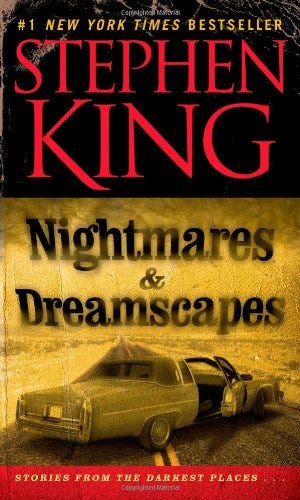
I have to say, for sheer purity and simplicity of premise, it’s tough to beat midcareer Stephen King — he has a story in Nightmares & Dreamscapes called “The Moving Finger,” not to be confused with the Agatha Christie novel. It’s an atrociously written overlong story about a guy watching Jeopardy at home when a finger starts to come out of his bathroom sink drain. The finger keeps coming out and getting longer, with more and more knuckles. In increasingly goofy prose he fends it off with Dran-o and a weedwhacker, puke and blood get everywhere, but goddamnit, that premise. The story ends with the poor guy asking: “Have you ever thought about how many holes to the underworld there are in an ordinary bathroom? Counting the holes in the faucets, that is? I make it seven.” Toilet, toilet tank, faucet, sink drain, shower, tub faucet, bathtub drain — yup. Does the finger symbolize anything? Is it a Telltale Heart? Nah. Just a moving finger.
“Daughters of Eve” by Lois Duncan
Chosen by Teddy Wayne
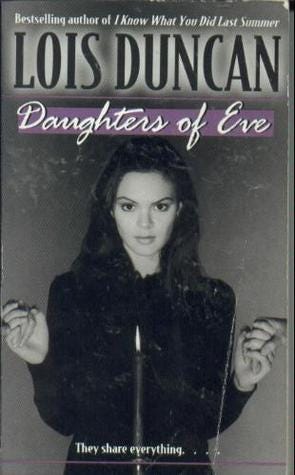
“I remember little from this book except reading it as a kid and being terrified,” said Teddy Wayne. In the story, a group of high school girls in a small Michigan town fall under the influence of their persuasive teacher Irene Stark. Preaching a version of women’s liberation, Irene draws the girl’s attention to the omnipresent patriarchal oppression in their lives, and suggest they take revenge. It begins innocently, with the head shaving of a vain boy in at school, but things quickly escalate in a sinister way.
Beloved by Toni Morrison
Chosen by James Hannaham and Nicole Dennis-Benn
Hannaham: If a novel about the zombie child of a murdered black girl whose mother killed her rather than have the family get sent back into slavery who then returns from the beyond in order to mess with her mother and sister’s and everyone’s else’s mind and sleep with her mother’s lover is not a horror story, I don’t know what is. Especially when you consider that the mother’s plan actually works: she avoids capture by slicing her child’s throat with a saw, which freaks out the slave catchers so much that they leave her alone. Many people see Toni Morrison’s Beloved as a tragedy about a woman driven to extremes in order to save her family from the atrocity of slavery; I think it’s about how oppression can drive people so crazy that they may decide their only way out is to abuse what little power they have and either leave behind or forget the ghosts who engendered their freedom. Or so they think!
Dennis-Benn: My favorite horror story is Beloved by Toni Morrison. When I was younger I thought it was a scary story of a baby ghost haunting a mother after she killed it. I didn’t get the concept until college where it resonated with me in more ways than one — tackling race and identity and the price of freedom. Morrison opened up my eyes to the craft of storytelling, delving into complexities of characters and situations, telling a truly haunting and tragic tale of redemption.
In Link’s hands, mundane objects (a toothbrush, a bar of soap) transform into haunted ones, and familiar tropes (a mother painting the walls in preparation for a new baby) become otherworldly and ominous. The questionable level of (un)reality throughout this story, and the threats that may or may not be about to emerge from the suburban scenery, put the reader in a state of ever-deepening, ever-mysterious horror.
The Cipher by Kathe Koja
Chosen by Kelly Luce
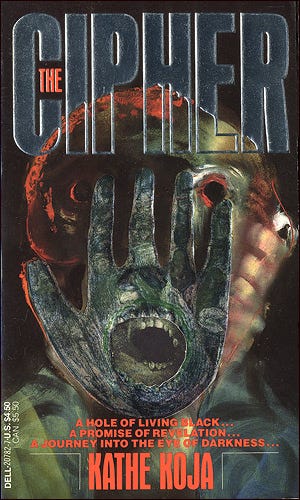
Obsession, desperation, violence, and a weird bottomless hole in a couple’s apartment floor. This novel is poetically grotesque, delightfully horrific and surreal. Don’t get too close to the Funhole, y’all.
Electric Literature is opening submissions of personal and critical essays starting next Monday, as well as humor that reflects on the world of reading, writing, literature, and storytelling in all its forms. We’re particularly interested in pieces that examine the intersection of the literary world and other creative disciplines: film, fine art, music, video games, architecture — you name it.
If you’re the type of person who’s always dreamed of hopping in a VW van and road tripping the United States, but lack the time (or money), the folks over at Books on the Wall may have a solution for you: read your way across the country! They put together an infographic that features a book per state, and the collection of recommendations certainly renders a colorful picture of the fifty nifty. (Not sure all Coloradoans would choose King’s horror novel The Shining, to represent them, but it’s a part of the imaginative journey!)
Anne Valente’s new novel, Our Hearts Will Burn Us Down(William Morrow, 2016)tells a slant of reality by looking at a community reeling after a fictional mass shooting. The shooter is dead, his murders an irrepressible public memory. The carnage occurs in Lewis and Clark High School in St. Louis, Missouri. The event is senseless, and everyone is left to pick up the pieces, since the shooter can’t answer for his actions.
Gun violence is a hard issue to talk about in America, let alone write about. We need books like Our Hearts Will Burn Us Down to infiltrate our everyday routines. Still, writing the introduction to this interview proves challenging. Anything I say here could divide readers, and I can’t know whether I’ve asked enough questions of the material.
Valente — the author of By Light We Knew Our Names, winner of the Dzanc Short Story Prize — isn’t prone to dance around difficult conditions, and Our Hearts Will Burn Us Down is up to the task. Originally from St. Louis, Valente is on faculty in the Creative Writing and Literature Department at Santa Fe University of Art and Design. I corresponded with her by email over a couple of weeks spanning the beginnings of our teaching semesters.
Jason Teal: Reading the acknowledgements is interesting because the original publication credit goes to Iron Horse Literary Review for the short story “Our Hearts Will Burn Us Down.” Can you talk about why you were compelled to push the scope of this narrative from a few pages to, then, hundreds?
Anne Valente: I never thought I’d be a writer to expand a short story into a novel, since almost every story I’ve ever written has felt like its own contained world. But after writing the short story, which was focused on an elementary school instead of a high school, I felt like there was so much more to explore. I’d written the short story in the aftermath of Sandy Hook, and after no gun legislation changed despite so many heated debates and so much news coverage, the short story felt unfinished. I wanted to further understand a community’s rebuilding and if rebuilding is even possible, beyond the twenty pages of a short story — and beyond the brief eye of the media that so quickly pulls away from mass tragedy. A novel felt like a better terrain to delve into these questions, and a high school better suited to exploring the individual lives of those affected.
JT: Speaking of community, how did you decide on the yearbook staff as taking focus amid other candidates, including surviving faculty and family — even the shooter himself? The point of view, a roving first-person plural that splinters into close-third in the character-building chapters, seemed especially potent.
AV: Point of view was one of the most crucial aspects of craft for me while writing this book — not only for how to best approach this story, but for the politics of storytelling and who controls a narrative like this. I absolutely knew I did not want to focus on the shooter, not even in speculating throughout the book on motive. We see so much of this in media already, and so much less on the families, the community, the friends and siblings and partners. A yearbook staff that both experienced and didn’t experience what their classmates went through felt apt, in grappling with the question of what is and isn’t theirs to mourn, and also what memory means and how we make sense of violence and the past. A yearbook is about memories, and presenting the best possible version of those memories, and I was interested in so many weeks and months of moving beyond this terrible event, and what memory could possibly mean in light of an event where there is no best possible version. I alternated between the first-person plural and the close-third point of view of these four main characters because this allowed me to contend with how a community mourns — what is everyone’s to mourn — and what is singularized and personal in a mass experience, the individual’s unique response to violence and mourning.
JT: St. Louis, too, is vividly drawn for readers. In one scene we find Zola observing the ritual of cicadas in beautiful detail, recalling their specificity to the region:
A Midwestern sound … A sound that had marked every year of her memory. A wave of noise as August burned off into September, then louder still as autumn deepened into October … They were everywhere. On the news, in the grass, clinging to the sapling branches of trees … Zola had listened to their sound each summer, a drone stretched through the screens of her bedroom windows, a sound that summoned the coming of fall.
You are from the area. Do you think the setting contributes to the response of the novel — to outside events and actions in the book?
AV: I hadn’t written much fiction at all about St. Louis before working on this novel, a place I knew intimately by growing up there. But in writing away from myself by writing about a kind of violence and communal grief I’d never experienced firsthand, I made it more familiar to my own understanding by setting it in a version of St. Louis I knew well. Beyond setting’s relationship to content, however, the landscape of fiction has always been extremely important to me as an element of craft. I began writing this book in the West, at a time when I was greatly missing the Midwest, and finished it back in the Midwest at a time when I was greatly missing the West. These characters are as attached to St. Louis, a place that marks their childhood and their home, as much as they need to leave it for what’s happened to their community, and how violence has altered their understanding of where their lives began. In some ways, this novel’s setting is a meditation on the ways that a landscape can break your heart. For me, it is a love letter to St. Louis as much as it is a backdrop for the community.
JT: Was it difficult writing four unique characters grieving altered communities? Did one student come more naturally than the rest?
AV: It was a challenge to imagine four distinct lives and the nuances of their experiences — both in response to grief, but also in what their lives looked like before this tragedy happened and how those concerns are still central to them. As my editor astutely suggested in revisions, these are characters who are shaped by collective grief, but they are also four teenagers who have their own lives and teenage concerns. It was as much of a challenge to write four different takes on grief as it was to write how each of the four managed their sorrow alongside the everyday conflicts in their individual lives — for example, whether they felt guilty for still feeling caught up in their high school relationships. I don’t think one student came more naturally than others, but I did want to make them distinct enough from one another — in their hobbies and activities, but also in their modes of processing the world and what is happening in their community. I think the greatest challenge was sanding the edges between passages of pluralized narration and more individualized third-person narration, and bridging the collective experience to the specific experiences of these four characters.
JT: Fire, in more than one way, plays a big part in the book. I don’t think naming arson will spoil too much. So, researching arson for the book, what most surprised you about fire?
AV: Research has always been one of my favorite aspects of writing — a way of learning so much about the world that I don’t know. For the novel, I checked out a number of arson and homicide investigation textbooks from the library, and I also found research articles on fire science. As a writer, I feel like I’m always stumbling upon connections between seemingly disparate topics — either a self-fulfilling prophecy, or else proof that everything is connected if you find the right constellation. What struck me most about researching fire was the surprisingly beautiful and poetic language used in these textbooks to describe burning: that two stages of fire eruption are smoldering and free burning, or that specific gravity is a substance’s weight in relation to the weight of water, or that the term for a substance’s flash point shifting from a solid to a gas is sublime. To me, all of these words also felt right for describing the process of grief.
JT: I like that you’re thinking about grief as its own language. Was this part of the motivation for writing the lyrical chapters? They read so audibly.
AV: At first, I think I was using the shorter, lyrical chapters as a means of conveying information that might sound forced in the mouths of characters, but I also know I’m a writer drawn to lyricism, and also to shorter forms. Before writing Our Hearts Will Burn Us Down, I wrote a chapbook of flash fiction and a short story collection, and even in a novel was still drawn to condensed language. I wanted short, concentrated sections that communicated sorrow in a mode beyond linear narrative, since grief is so often anything but linear. But I was also influenced by Mikhail Bakhtin’s literary theories of heteroglossia and polyphony. I’m really not much of a theory person at all, but I’m drawn to Bakhtin’s idea that novels are spaces for multiple voices, and for characters with their own subjectivities — that the author’s voice isn’t an objective stance but instead takes a backseat to the multiple perspectives that emerge within a novel. It sounds almost ridiculous to say, but I really didn’t feel like the authoritative, guiding hand in this book. Even going back to the politics of point of view, and whose grief is whose to mourn, for this novel it felt right for a multiplicity of perspectives and voices to come through — the collective point of view and the individualized third-person narratives of these four main characters, but also the outside voice of the newspaper, the television, the police and their diagrams, and these more lyrical sections. If the main chapters are a linear narrative, I also wanted more timeless, varied voices in this novel within these shorter sections. This felt right not only for privileging multiple voices, but for the ways in which grief bends and breaks a sense of linear time — and for the ways that grief yearns to reverse and stop time.
JT: I’m keen to understand if writing the book gave you space to grieve this kind of tragedy? When violence happens locally, the impact is of course devastating, but fictionalizing such a community heavy document is an important task. What new perspectives did writing about this difficult subject offer?
AV: This is such an important question, and one I honestly struggled with in writing this book. Much like the collective-first perspective of four yearbook staff members who experienced this in their school but didn’t experience violence directly, I grappled — and am still grappling — with what is and isn’t mine to grieve. This didn’t happen at my high school. This kind of violence hasn’t happened to me directly. As a fiction writer, I build narratives beyond autobiography. But I’ve still felt devastated each time a violent shooting occurs, in high schools and everywhere else, and have felt ashamed by that devastation — that my grief is nothing compared to that of the families and communities who have directly experienced it. Even though this book is fiction, it also isn’t fiction. It could happen anywhere. Our access point for tragedy is so often through our television and computer screens, but this shouldn’t be an excuse to separate ourselves from the pain of others — to simply shut off the television and perform the act of disavowal, that because it’s happening there it can’t be happening here.
Our access point for tragedy is so often through our television and computer screens, but this shouldn’t be an excuse to separate ourselves from the pain of others.
This book was one means of imagining a community after the television cameras pull away, after media decides there is no more story to tell. In my immediate world, I don’t know how the families in Littleton are doing seventeen years after Columbine, or how a community in Charleston still grieves a year later, or how and if a nightclub in Orlando rebuilds. We have so little access to others’ lives beyond the glare of a television, so little means of knowing the process of grieving and the attempt to move on. We can only imagine, an act of empathy, and this is the same foundation of fiction. Our imaginations are of course faulted, filled with assumptions and cultural biases, so I couldn’t rely exclusively on my imagination: this book addresses such a difficult subject, as you say, and I had to research and inform that imagination. I hope informed imagination is what creates the empathy that our world — and our creative work — so desperately needs. Writing this book was one way of trying to access what happens after the media stops telling us a particular story, and to look beyond what our televisions tell us.
JT: I saw your characters struggle alongside you, a similarly polarizing code of ethics, when tasked with writing yearbook profiles for students they didn’t know: Christina writes of another student, “What else is there to say?” Is there anything more for these characters to say? What is your next project about, if you don’t mind talking about it, and what do you anticipate for it, after moving away from this book?
AV: Since finishing this first novel, I’ve moved from the Midwest out to Santa Fe. Landscape and place have always been central to my writing, and I’ve found that the transition out West has inspired my writing in different ways. I’ve written and completed a new novel across my first year in New Mexico, a road trip novel that incorporates various pockets of research that are completely new to me — falconry, NASCAR, paleontology and climate change. But before I even came up with the content for this new book, I knew I wanted to write something that moves. Our Hearts Will Burn Us Down remains stationary in the fixed setting of St. Louis, which is its own wonderful challenge and was necessary for that narrative, but I wanted to try something new and see how a novel might develop differently across a variety of settings — in terms of backdrop, but also in terms of structure. Beyond a new novel, I plan to return to stories and essays here and there this year. It’s been awhile since I’ve written shorter forms, and I’m looking forward to seeing what develops.
JT: The array of names used in your fiction is of particular note — for example Zola, Wren, Betsy, and (maybe I’m biased here) Teal. Can you talk about the process of naming characters, if one exists? Likewise: Our Hearts Will Burn Us Down. By Light We Knew Our Names. Where do you find inspiration for your titles?
AV: That’s nice of you to say, because I feel like I’m terrible with names in stories, and also with titles! Naming characters is often so difficult, and I usually just allow a character’s personality to suggest the right name for them. The short story, “By Light We Knew Our Names,” was really one of the only times that I purposefully connected all of the characters’ names under the same umbrella — Wren, Kestrel and Teal are the names of birds, and these girls felt very much to me like caged birds waiting to take flight. As for the title, By Light We Knew Our Names — language that never actually appears in the story, or in the collection as a whole — felt right for a group of women who truly knew themselves by aurora light, which is to say, away from what a town of predatory men told them they were. As for the novel, I realized only after the fact of naming it that it follows the same aural, syllabic cadence of the collection’s title. In general, I’m drawn to language that has a rhythm, pulse and clear sound. With that said, the working title of my new novel manuscript is a single word. I’m feeling a little sheepish about long titles at the moment and wanted try something more clipped!
JT: The ambition of this book is impressive — it is a mystery, yet it is fabulist and experimental. The book tackles a mainstream topic, and does so with aplomb. It is also your debut novel with a major press. What advice do you have for writers facing a similar initiative? How did you keep yourself writing in the face of grief?
AV: Thanks for these kind words. To be honest, I wasn’t quite sure how to write a novel when I began working on this manuscript. I’d been working exclusively on short stories for several years, but a number of things came together in my life at the time that led to working on a novel. I’d started a doctoral program, and the challenge of a novel as my dissertation was one I wanted to take on. But then I transferred doctoral programs and the transition was far more jarring than I anticipated, and I funneled that sense of instability into the stability of working on a single project, every single day. I started and finished this novel across one intense year, both in terms of the transition, the book’s subject matter, and sitting with the grief of this book every day. I think there are all kinds of ways of structuring and writing a novel, and every writer I know has a different process. But for me, this was the only way I could do it, and the second novel manuscript I just finished was written in much the same way — every day, across one year. I think I’m the kind of writer that needs this centering, and I wrote this second novel through another cross-country move and transition. Though this new project hasn’t been as heavy as writing Our Hearts Will Burn Us Down, I think my mode as a writer has been to not turn away from the difficulty of the subject matter. It’s hard, as hard as watching the news and seeing yet another incidence of gun violence or police brutality, but past a point, looking away becomes harder. With this novel, and with subsequent projects since, I find that I’m often writing to sit with the grief, to allow it to just be instead of letting myself grow complacent or uncomfortable with it.
Though I know everyone’s process is different, my advice to a writer taking on first novel is to first and foremost make time for it every day. I set myself a daily word count and built a visual map above my desk for the novel’s timeline, events and researched information. Even if another writer approaches this process differently, I think it’s essential to touch upon the work in some way every day to stay immersed in the narrative’s world. Beyond that, my less tangible advice is to not be too concerned about audience or how the work will be received. I didn’t let anyone read a word of this book until I had a solid draft finished, and even then, only two people read it until my agent began sending it out — and one of those people was my partner. I was protective of it not because I was afraid of criticism, but because I didn’t want to be derailed from my own vision of the book through too much advice. It’s not a book for everyone. As you say, it’s a bit of a strange hybrid. But I wanted to make it mine instead of anticipating criticism or reception before I was even done. So my best advice for other writers is to write what you feel passionate to write, regardless of market trends or what other people might want to read — doing this helped me maintain and preserve my own voice.
After graduate school, I decided to get a dog. It was entirely selfish, maybe the most selfish thing I had done in my life. Underpaid and uninsured, I had a lifestyle unfit for taking care of anyone (including myself), and a carpet covered with small, secretly malign objects — hairpins, vitamin bottles, Christmas socks with holes in them — that could end up in a dog’s stomach.
What would I do if the dog needed to see the doctor? What if, like my mother, I’d yell at the dog every time it got sick because I couldn’t afford to take it to the hospital? What if I’d yell not out of hatred, but because life had disappointed me…again?
I wouldn’t be yelling at the dog. I would be yelling at life.
What if he wanted to go to college?
Despite these worries, I kept up the dream. Why? I had always wanted what I considered to be the crème de la crème of household pets. I grew up in a working-class family; we were never able to afford one. So I convinced myself now that I was done with school forever, that this was my time.
Quite frankly, dogs are more alive than most people I know.
I had just moved into a house that I rented in Wallingford — a sleepy, liberal, family-oriented neighborhood of Seattle. I imagined it to be, in some ways, my dream house, my quiet writing abode, and I began searching on the internet through digital catalogs of beady, canine eyes.
One summer afternoon, I went to Cost Plus World Market to look for housewares, affordable “ethnic stuff” for my place.
In the salt and pepper shaker aisle, a stringy-haired woman with a paisley bandeau tied around her blonde head carried a canvas bag with a dog poking out of it. Black wavy hair, dropped-down ears, a perfectly-matte nose but wet nostrils, and eyes so full, so full of sadness or hope or something. I couldn’t help but fall.
I asked the woman, “What kind of dog is that?”
She looked up from a cylinder of tea that she had been contemplating in her shopping basket. “A Havanese.”
“I’ve never heard of that dog. Where did you get him?”
“From this breeder in Texas. I can give you their website. You can give them a call.”
It seemed ludicrous to get a dog off a website from a breeder in Texas. How would I manage to obtain this dog? Would it ever lose its Southern twang? What if, due to all our rain and cloud, it got S.A.D.?
I proceeded to research the breed on the internet. I found out that the dog was small, non-shedding, had minimal exercise requirements, was suitable for apartment living, and had the charm and personalidad of a clown.
I then contacted the breeder with questions like, “How much?” “When?” “Now?” “Send me pictures!”
The breeder crammed my inbox with photos of pristine Havanese and Havanese mix puppies and then I saw her: Polly.
The One!
Polly was a Havanese/Maltese mix, mostly-black but tan around the mouth and on the paws and eyebrows. Every photograph of her (the breeder provided multiple angles and various living scenarios — “Polly on top of a living room table!” “Polly on the couch, mouth agape, tail-wagging.” “Polly!”) evoked an undeniable joy and revelry in life.
The pooch was cute.
She had the sparkle in her eyes and the exuberance in her open maw. She was to die for.
At that time, I had two jobs — one as the editor of a literary journal, the other as a receiver for a local bookstore. I spent evenings reading and eating microwave dinners. Three days a week, I stuck price tags on books.
My back hurt. My nostrils were always filled with cardboard dust. Breaking boxes of books all day. Stacking books all day. Putting little stickers on the backs of them and then filing them away for someone else who could afford to read them.
I had been living the dream, supposedly. The writer’s dream of poverty and toil and unfinished stories. The dream. And, yet, I would come home and do nothing but fantasize about the puppy, Polly.
Some people look to God or volunteer work for salvation, from themselves, from their worries or dreams.
Other people buy things on the internet.
After a series of awkward financial transactions and conversations via email, the date was arranged for Polly, two months old, my Polly, to land in my life as LIVE CARGO on a plane from San Antonio to SeaTac.
In preparation for her arrival, I bought a six-foot leash, a heart-shaped nametag, and a fleece-lined bed that matched my sheets — khaki and brown.
I informed friends and family of the decision to expand my current domestic partnership of one. It became all that I talked about…no more dead-end writing, no more dead-end job, no more dead ends, period.
I showed my friends pictures of the sparkling eyes, the wagging tail. Everyone approved; everyone applauded. “Good for you,” they said. “How exciting!”
But one week prior to Polly’s arrival, I got a phone call from the breeder.
She said that Polly had been acting strangely. Polly refused to eat.
The breeder said that she could not send Polly on a plane in that condition. She would watch Polly and take her to the vet. We’d have to wait until Polly’s condition stabilized, until she ate properly, pooped properly, did the “usual dog-thing” properly, before the breeder could send her on the treacherous journey across so-and-so states.
Of course, I was heartbroken, but, convinced of my undying love, I agreed to all of the breeder’s terms. I thanked the breeder for keeping me updated, for taking care of my Polly, for whom I had already paid through an electronic transfer from bank to bank.
But the day Polly had been scheduled to arrive at SeaTac, the day I was to pick her up from the airport, liberate her from the plastic crate, clasp a nametag around her neck, squeak toys and drive her home in a car filled with “soothing music,” Polly died.
The breeder’s husband, an Englishman who lived in Texas, called to inform me. Polly had died of puppy leukemia.
In his British accent, he stated she had “terrible diarrhea” and a “beautiful soul.” He cried on the telephone.
I hung up. I stared at the ceiling and wailed.
When I opened my medicine cabinet, I saw the dog toothpaste standing beside my own. The dog toothpaste had the image of an open-mouthed Collie on it.
Grief became paranoia and rage. I demanded from the breeder another dog. They emailed me photographs of different puppies, as if I was embarking on some deadly, puppy hostage exchange program.
One of the puppies—in a clear attempt to appease me, the grief-stricken buyer—had been named “Polly2.” Even the breeder conceded that none would have the courage and the tenacity of the original “Polly,” an “old soul,” but all of the puppies were nonetheless beautiful and deserving of a good home.
After two weeks, I found him.
I did not feel that ripe blush of love and panic when I first saw his picture. Rather, he just looked perfectly wise and content.
His name was Imus — a Havanese mix, mostly white with black rings around his eyes, black ears and a large black spot on his back.
His left eye was lazy and he was a little bow-legged.
When I first picked him up from the airport, I played him Ella Fitzgerald in the car, like it was Starbucks. I had read on the internet that the dog would need soothing music when meeting its new owner for the first time. Nonetheless, he whimpered behind the bars of his carrier for the entire ride.
When I got him inside of my house, I opened the crate and he sprang out like a wild animal. He ran to me, wanted to crawl over me, my shoulders, my head, like a raccoon. Then he ran to a corner of the living room, keeping his eyes on me, curtsied, and peed on my landlord’s carpet.
“No!”
I quickly grabbed him and took him outside to the backyard and stood there with him for thirty minutes, waiting for him to pee again, but he didn’t. I took him inside and he peed in the same corner. And I cleaned and cleaned and cleaned.
That night, I read Puppies for Dummies cover to cover in bed as the dog, in his own bed on the floor, spent the whole time crying, trying to reach me.
Weighing in at a hefty four hundred pages, Matt Bell’s latest story collection, A Tree or a Person or a Wall (Soho), comes in the wake of his critically-acclaimed novels (also from Soho), In the House upon the Dirt Between the Lake and the Woods (2013) and Scrapper (2015). An early-career retrospective of sorts, much of the material contained in A Tree or a Person or a Wall originated in Bell’s Indie-published volumes, 2010’s How They Were Found and 2012’s Cataclysm Baby. There’s new work here, seven stories worth of it — the title piece, “Doll Parts,” “The Migration,” “The Stations,” “Inheritance,” “For You We Are Holding,” and “A Long Walk with Only Chalk to Mark the Way” — but, to a great extent, this volume revisits Bell’s earliest material. In the process, A Tree or a Person or a Wall can’t help but provoke questions about artistic development and the interplay between commerce and creativity. The basic issue: Does Bell’s early work stand comparison to what he’s producing now; or, does this collection represent an attempt to leverage old material in light of recent success?
“Bell is a literary experimentalist who never lets his experiments overtake his fiction’s need for dramatic effect.”
We deal with related concerns all the time in the literary world, and by “we” I don’t just mean book critics. Readers, writers, and critics, no one in America is immune to the impact of literature’s commercialization, a necessary consequence if writers are to make any sort of living from their work. Still, the profit motive can, and often does, go too far. Whether we’re talking about the Lee family’s cash grab, Go Set a Watchman (a supposed sequel that wound up being an early draft of To Kill a Mockingbird), or any number of other examples (John Kennedy Toole comes to mind with his posthumous masterpiece A Confederacy of Dunces followed some years later by his only other book, a truly terrible novella he’d written as a teenager, The Neon Bible), attempts to fleece consumers are common in America, certainly not just in literature.
But I think most writers with literary ambitions would like to believe they’re offering the best work they can, that they’re providing fair artistic value to their readers, not simply trying to cash in. (And here, in fairness to the authors mentioned above, they didn’t have much say in the suspect publications, owing to advanced age for Lee, suicide for Toole). Beyond that, successful writers like Bell must wonder whether their early work was the equal of whatever garnered them their “break,” if all they were missing was a little timing or luck to have had that break years before.
Even if we set aside thoughts of success and its trappings — considerations such as units sold, prize nominations, and general notoriety — the author’s hope has to be that he really was good enough once upon a time, even as he toiled in what might have been relative (or even true) obscurity. For that author, there’s got to be some vindication in seeing work he believed in finally reach a broader audience. If we’re honest with ourselves as writers, readers, and critics, though, the question we come back to, the only question that really matters, is whether this newfound attention is justified, whether it is deserved. When it comes to A Tree or a Person or a Wall, the only answer I can give is a resounding, “Yes.”
A talented, at times even daring, stylist Bell is a literary experimentalist who never lets his experiments overtake his fiction’s need for dramatic effect, that necessary quality of making the reader want to read. This is something many literary writers forget or even disdain: the fact that it’s their responsibility to attract readers and keep them interested, not the other way around. And it’s a lesson Bell seems to have learned from an early age. Fearless in terms of the subject matter he’s willing to write about and perhaps ever more so in the unexpected, sometimes extremely dark angles he takes in fleshing out his stories, Bell has the goods, no question.
Whether we’re considering the earlier work like “The Cartographer,” “The Collectors,” and the epic cli-fi novella “Cataclysm Baby” (vast in scope; beautiful and haunting, disturbing and thought provoking in execution) or the more recent standouts like “The Stations,” “The Migration,” and the collection’s final piece, the heartbreaking ode to the victims death leaves among the living, “A Long Walk with Only Chalk to Mark the Way,” overall, A Tree or a Person or a Wall more than lives up to the hype generated by Bell’s successful novels.
“A Tree or a Person or a Wall is, as a whole, a substantial piece of art.”
More than a basic chronology designed to consume space at the expense of quality, A Tree or a Person or a Wall is, as a whole, a substantial piece of art. Bell has taken the time to really piece this material together, to develop an overall seven-part structure that feels at once like an early-career retrospective and a unified piece of work. These are not linked stories per se (or, not overtly so), but in their overwhelming attention to humanity’s self-destructive love affairs with itself and its world and a human experience that is a constant quest for understanding, a quest that seems to succeed and fail simultaneously, again and again, this is a text that asks to be reread.
A Tree or a Person or a Wall is one of the best books I’ve read this year. From prose that is simultaneously elegant and muscular to its hybrid of mystery, wisdom, and earned emotion, from its notes of slipstream and fabulism to those of outright fable, this volume does indeed answer the literary question I posed earlier. This is a justified, even necessary collection, one we should be grateful to Soho for bringing out. Only in his mid-thirties, Matt Bell is a great short story writer, and has been now for many years. The lingering question is just how good Bell can become, whether we will look back on this volume and see it as a prelude to greater things still. Only time will tell.
Randa Jarrar’s Him, Me, Muhammad Ali opens on nine-year-old Qamar as she sits on the rooftop of her apartment building, trying to capture the moon. She has a crush on her 24-year-old neighbor, and he has told her, underestimating the sincerity and determination of a young girl in love, that if she can bring him the moon, he’ll be hers forever. The other neighbors worry about Qamar, watching her theatrically — all gathered at the foot of the building, heaving “a collective sigh” — but they don’t discourage her either. “The moon’s expensive,” they tell her. “It costs ten nights, ten whole wakeful nights… and you can’t nod off, not even for a second.”
Although Qamar falls asleep on the tenth night (only “for an instant”) the neighbors acknowledge her accomplishment. “The moon was descending,” writes Jarrar, “everyone agreed that it was.” Qamar’s act even makes newspaper headlines: “Girl Makes Moon Disappear.” In this first scene, Jarrar establishes a world (this time Egypt, but later the United States, Gaza, and once in open air among flocks of birds) where everyday life mixes with magic and superstition, just as pain mixes with both whimsy and darker kinds of humor.
In that first story (“The Lunatics’ Eclipse”), Qamar doesn’t reach the moon on her first try. Then, six years later, her parents are both killed in a car crash, indirectly related to a lunar eclipse, on their way to watch her perform ballet in St. Petersburg. When she finds out that they’ve left behind orders for her to marry a family friend, a man who makes her feel “like a Mouled doll [made of sugar], as if there were millions of ants chewing her body from the inside out,” she becomes an acrobat, making progressively risky gambles with death: walking the high wire en pointe, without a safety net, doing flips, and adding animals to her act. But even in the midst of desperation, she is lively, funny, and reads just as her admirer sees her: “to him, she resembled the sun of an entire cosmos.”
Jarrar’s collection is full of characters like this, whose pain exists side-by-side with their vibrant, witty, no-bullshit personalities. In “The Life, Loves, and Adventures of Zelwa the Halfie,” the titular character is a divorce lawyer, human from the waist up and Transjordanian ibex from the waist down. Ashamed of the family’s ungulate heritage, her father tries to convince her to have surgery. While Zelwa resents getting messages on dating sites from men seeking BHLs, or Beautiful Half Ladies, she accepts her body and struggles to understand her father’s point of view. “Lost in Freakin’ Yonkers” introduces us to Aida, who at 18 is carrying the baby of an alcoholic 10 years her senior, and who describes what happened on a “lovely stroll” to work like this:
Getting mugged at knifepoint two blocks from our apartment and having to give the kid my backpack, which contains three interlibrary loan books from Sahar Khalifeh, all in Arabic. He must have felt like one lucky motherfucker.
Aida’s father has kicked her out of the house, so she meets up with her sympathetic mother behind his back, as if they were “secret lovers.”
If Aida has lost her place at her family’s home, others in Him, Me, Muhammad Ali have also been displaced, through phenomena as diverse as war, seasonal tourism, kidnapping, and simply growing up. Birds, moths, and airplanes appear over and over throughout the collection, but “Testimony of Malik, Prisoner #287690” literally tells the story of a bird, a kestrel found in Turkey with an Israeli research tag and taken in for questioning. The kestrel, Malik, can’t pinpoint his home to one specific location, but instead tells sweeping stories about his, his father’s, and his grandfather’s travels, from “Aqraba, over Jerusalem, past the Dead Sea and the ruins of Petra, along the Red Sea, and over Umluj and Jeddah.” Later on, Malik gets a human mirror in the unnamed narrator of “A Frame for the Sky,” a Palestinian man locked out of his home country by war at least twice, the last time while on a business trip to Manhattan with his young son. “If we make America our home, does that mean we’re going to lose our home here too?” his son asks. “Will there be a war here, too?”
War looms throughout Him, Me, Muhammad Ali at various distances. In “The Lunatics’ Eclipse,” Qamar considers the role it played in her parents’ death, as indirect but undeniable as the eclipse that distracted their fellow passengers on the van, thereby distracting the driver:
If, many years ago, Dulles hadn’t thought Nasser was bluffing, Egypt would never have found an ally in Russia, and her performance may have been held in Washington, where van drivers rarely hold romantic sentiments about the moon or any other heavenly object.
It comes closest in “The Story of My Building,” a tribute to Isaac Babel’s “The Story of My Dovecote” that follows Muhannad, a young boy who lives in Gaza. His daily life (of studying, playing with cousins, and visiting the pigeons that live on his roof) is punctuated by gunshots and eventually invaded by tanks.
Jarrar’s nod to Babel makes perfect sense. Just as he wrote about Jewish people amid rising antisemitism in his native Russia and beyond, she writes about the Arab diaspora in all its human complexity during a time of increasing Islamophobia, her book coming out less than two weeks after Trump’s campaign compared Syrian refugees to randomly poisoned Skittles. Jarrar’s style — sensitive, peculiar, and closely observed — also has roots in Russian literature, but its rhythm sounds modern and entirely her own. Her best descriptions are about relationships and the details we observe in the people we kind of hate but mostly love, like this one, which the narrator of “Accidental Transients,” Dina, gives about her family:
We are the kind of Muslims who pray for tax breaks (Baba), Nintendo DS games (Jaseem), anatomy coloring books (Waseem), pussy (Abe), and a guilt-free conscience to move the fuck out of the house (Yours Truly). The one thing keeping us from being outright atheists is that none of us had ever eaten pork. We were bound to God through the absence of pig grease.
In “Building Girls,” Jarrar captures the complicated dynamic between Aisha and Perihan, childhood friends now separated by geography, race, and class (and their daughters separated by all that, plus language). Wealthy Perihan only visits Egypt during the summer, whereas Aisha lives there full-time and even then rarely ventures beyond the paths of her daily routine. On a trip to the beach, she compares Perihan to a soaring kite and herself to a novelty pet crab on a leash, an image that manages to be all at once weird, hilarious, melodramatic, gorgeous, and sincerely resonant. Like the rest of the book it comes from, I can’t get it out of my head.
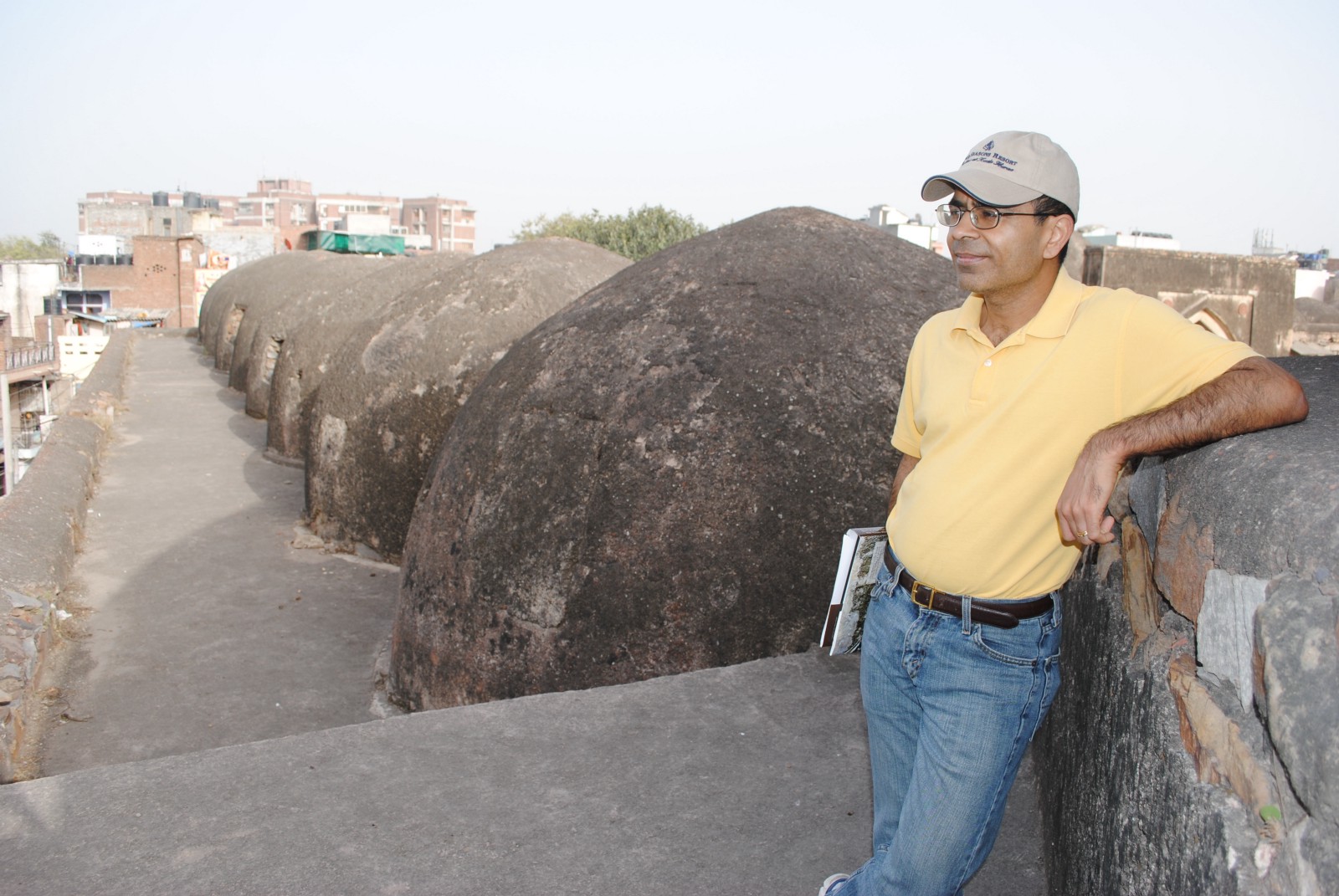
Akhil Sharma stands on the sidewalk waiting for me as I descend the long set of stairs from the Delhi Metro. It is only mid-morning but the street outside Rohini West Metro station is heaving with traffic. I steel myself for the cacophony of shrieking horns and roaring engines. If this were Manhattan, where Sharma lives today, he might be holding a Starbucks cup. But we’re in Delhi, so he sips milky tea from a Dixie-size cup bought from a street vendor for five rupees (about 10 cents). It is mid-February in 2011, Valentine’s Day in fact, and cool beneath an overcast sky.
Sharma isn’t tall, but he seems brighter and more vivid than the other pedestrians around him, as though he were Photoshopped into the wide, bustling street. He wears an orange merino wool sweater, jeans and elaborate running sneakers with shiny trim. In this part of north Delhi, men wear kurtas or collared shirts with polyester trousers, and flip-flop sandals or pleather shoes, not cushioned Reeboks. His dark hair is cropped nearly to a crew cut, and flecked with silver. He wears black wire rim glasses.
Sharma isn’t tall, but he seems brighter and more vivid than the other pedestrians around him, as though he were Photoshopped into the wide, bustling street.
I took the Metro across the city’s sprawl, from New Delhi, the British-designed part inaugurated in 1931, up past Old Delhi, the northern section founded by a Mughal emperor three hundred years earlier. I’ve come to nearly the end of the line, to a northwest neighborhood that tourists have no reason to visit. I had been living in Delhi nearly five years, but I would see the city in a different way: through the eyes of an author whose first book is set in the city of his early childhood and whose second book starts here before its narrator emigrates to the U.S. I’ll follow Sharma as he visits relatives and family friends in three neighborhoods of north Delhi, as though doing a walking tour of his childhood memories. We’ll be traversing different worlds, touring the love and loathing of families, the present overlaid on the past, and places and memories transformed into fiction.
Sharma is the author of An Obedient Father, a novel that won the PEN/Hemingway Award in 2000. In 2014 he will publish his novel Family Life after 13 years of struggle. Writing it was like a “nightmare, like chewing stones, chewing gravel,” he told The Guardian. A couple years after our walk in north Delhi, I sat with Sharma on a bench in Central Park one summer day as he took a phone call from his literary agent to discuss a draft of the novel. When he finished the call, Sharma calmly told me Family Life might be axed.
In 2014 he will publish his novel Family Life after 13 years of struggle. Writing it was like a “nightmare, like chewing stones, chewing gravel.”
But the toil will pay off: In June 2016 the book will win 100,000 euros for the International Dublin Literary Award, the world’s largest prize for a single novel. But all this is in the future. Today we are focused on the past, where his two novels are grounded. Sharma’s memories of Delhi — quiet dirt lanes where he played cricket, cinemas showing Bollywood matinees, and rooftops where he napped — form the backdrop of An Obedient Father and the start of Family Life. Sharma grew up in New Jersey but spent summer vacations in Delhi with relatives through his early 20s. He was born in Delhi in 1971 and his family immigrated to the U.S. in 1979, when he was eight. A couple years later, tragedy struck. Anup, Sharma’s 14-year-old older brother, hit his head in a swimming pool in Virginia. He remained severely brain damaged for the rest of his life. Family Life is based on the accident and its destructive force on a family.
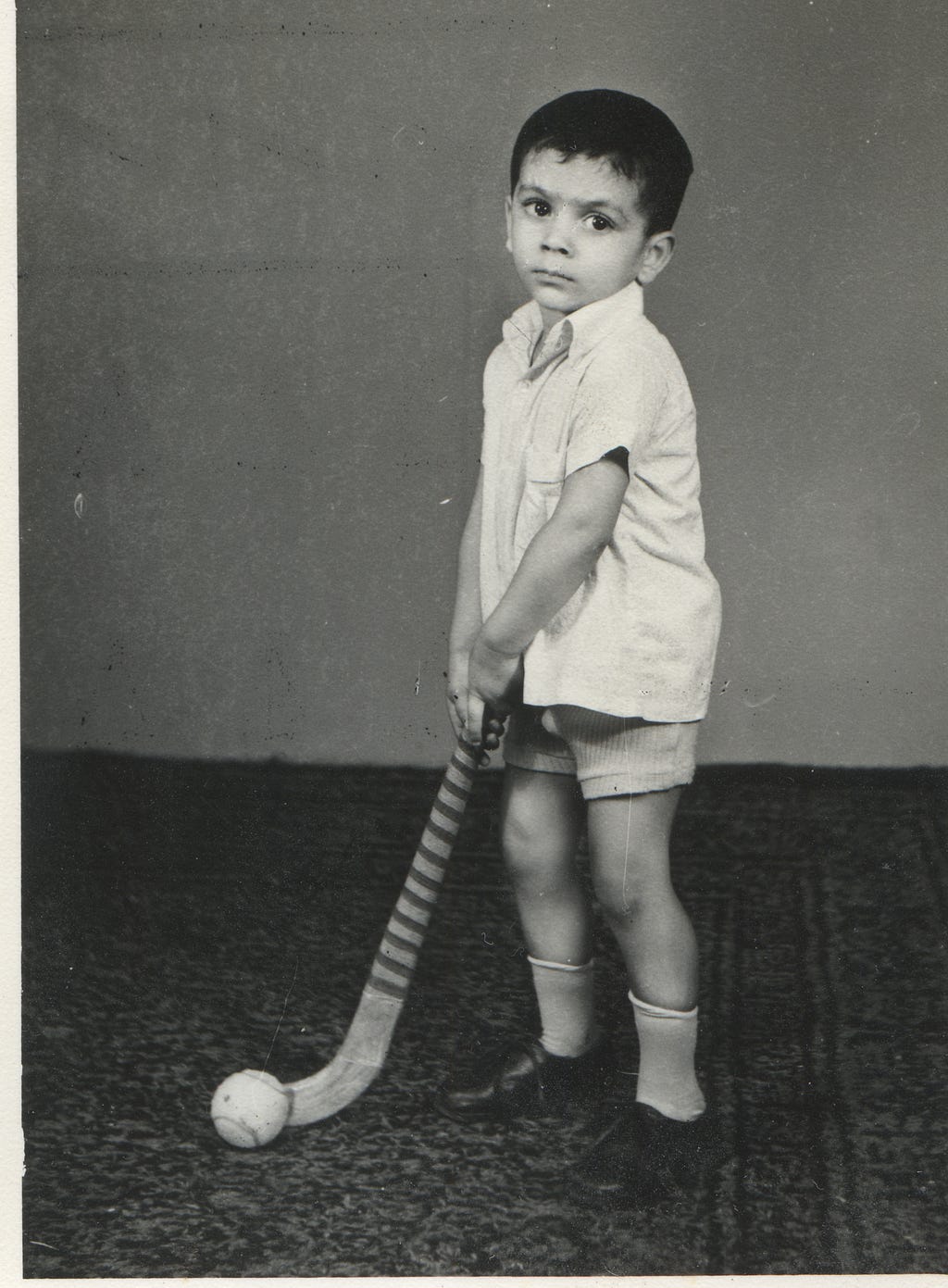
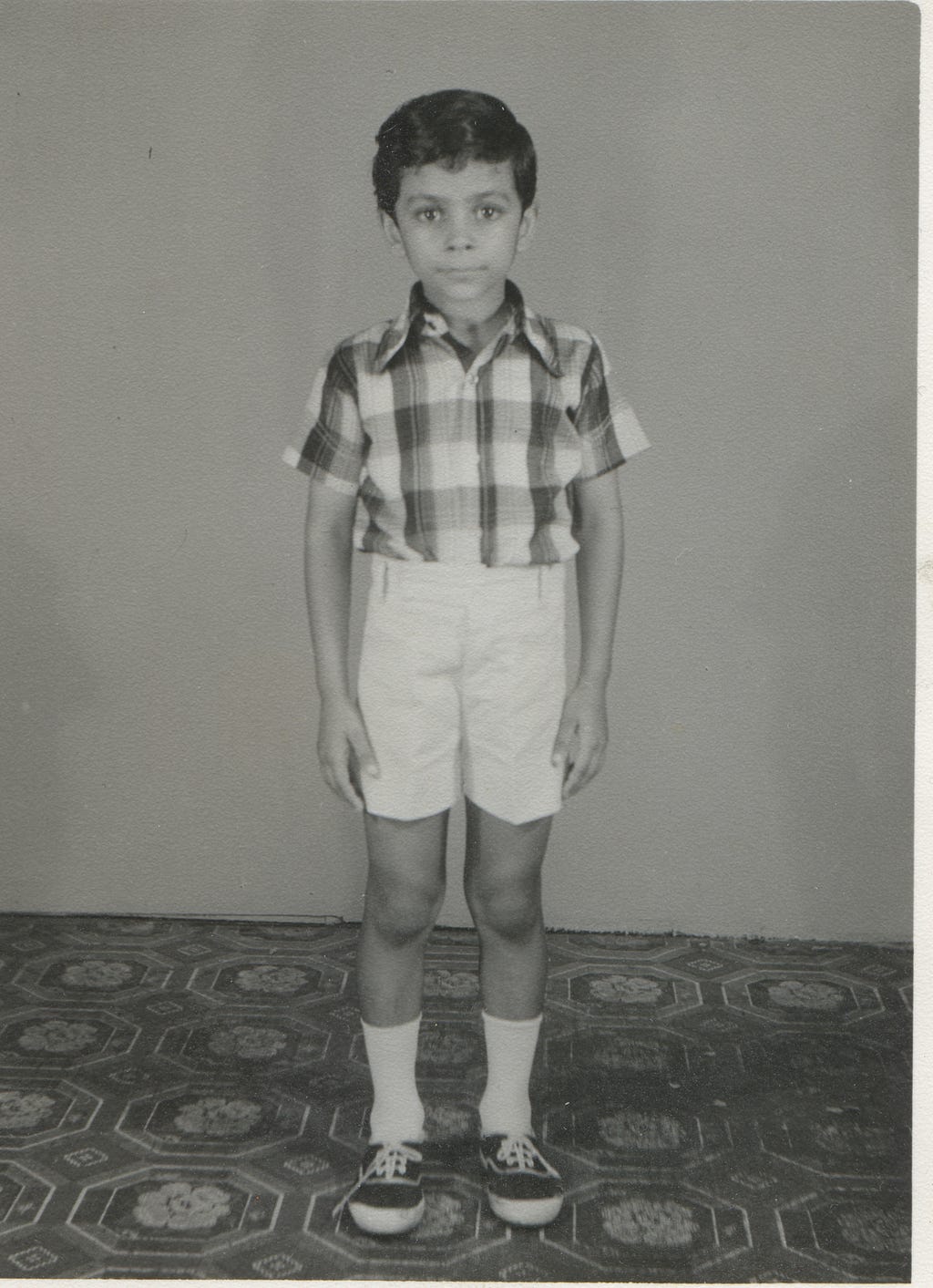
Akhil Sharma as a boy in Delhi. Photo: Courtesy of Akhil Sharma
I was living in New York when I first read an excerpt of An Obedient Father. I was struck by the brutal yet beautifully-written tale of corruption, incest and the unraveling of Ram Karan, a repugnant narrator living in Delhi. I had no inkling that several years later I would move to Delhi as a journalist and that India’s capital would become my home. Places mentioned in the novel — the popular neighborhood of Defence Colony, the chaotic Inter-State Bus Terminal (ISBT), the opulent Oberoi hotel where the lobby smells like citrus, the wide boulevards of New Delhi designed by British architect Edwin Lutyens — would one day become as familiar to me as places in Manhattan. And on this unusual tour, I would get to see Delhi’s streets, houses and landmarks, introduced to me in An Obedient Father, with the ideal guide. The world created in Family Life lies in the future when the book is finally published, but I would get to see its foundations in the Delhi of Sharma’s past.
Our first stop is the home of an uncle and aunt in Rohini, a nondescript neighborhood I hadn’t heard of before. Sharma and I walk on the edge of the street next to the crumbling sidewalk while casually dodging motor scooters and bicycle rickshaws tinkling their bells. Roadside vegetable carts are piled with mounds of large black grapes and stacks of greenish, lumpy oranges. We turn onto a side street lined with homes and shops bearing signs that read “Cyber Café and Computer, Hari Om Communication” and “World Vision India Pentecostal Church.”
Sharma stops when we reach a one-story white concrete house bounded by a wall and metal gate. There’s a four-story apartment block across the street. Laundry hangs from the balconies: shirts, pants, and pink bed sheets printed with big flowers flap in the breeze. The clean smell of laundry detergent powders the air.
We turn onto a side street lined with homes and shops bearing signs that read “Cyber Café and Computer, Hari Om Communication” and “World Vision India Pentecostal Church.”
A gray-haired woman in her 70s with large glasses comes outside and greets us. This is “Auntie.” Sharma introduces me briefly in Hindi and she smiles, then hugs me. Her name is Shanti Sharma and she wears her hair in a long braid down her back, with stray hairs secured by straight barrettes behind her ears. Inside the house, we step into a bedroom where her husband, J.N. Sharma, known simply as “Uncle,” sits up in a raised hospital bed. Uncle has liver-spotted skin, a large, hooked nose and shiny eyes. He greets me excitedly though I can’t understand his murmurs and he grips my hand in his warm fist.
Their surname happens to be Sharma, but Auntie and Uncle aren’t blood relatives. Still, they are precious to him. “There are many, many ways this family saved us,” he tells me. When Sharma was a child, Uncle and Auntie were tenants in his parents’ house in Delhi. Later their paths crossed again in the U.S. when both families were living there.
Sharma matter-of-factly explains that his family and relatives were uneducated, rough and unscrupulous. I’m reminded of the world of Ram Karan, the unsavory narrator in An Obedient Father, an education department administrator who collects bribes from schools. Uncle and Auntie were different from Sharma’s relatives. Uncle was a young economist at Delhi University and seemed refined and respectful compared to Sharma’s family. “They were the only really decent people we knew,” Sharma recalls. “They spoke to children in the formal ‘you.’ They were respectful and never spoke meanly. We assumed they were rich. They seemed like they belonged to a different world.”
If his parents hadn’t immigrated to the U.S., Sharma says he would have been a kid who got into trouble. Becoming a writer would have been unimaginable; no one read books in his family much less wrote them. Later Sharma found out that Uncle pulled himself out of poverty to become educated.
Becoming a writer would have been unimaginable; no one read books in his family much less wrote them.
Auntie and Uncle were also important to Sharma and his family after his brother’s accident. In the summer of 1981 when Sharma had just turned 10, his family was visiting relatives in Arlington, Virginia. His older brother Anup snuck into a swimming pool at an apartment building, dove in, and hit his head on the bottom. He remained underwater for three minutes. Anup required 24-hour care for the rest of his life. He was fed through a stomach tube, cleaned after bowel movements, and had to be turned to prevent bedsores. It was an unfathomable twist of fate for a family already struggling to adapt to the U.S. and cope with its own problems.
At the time, Uncle was an economist at the World Bank in Washington D.C. Sharma’s parents didn’t speak English very well so Uncle helped interpret for doctors and nurses. Auntie came to visit Anup and the grieving family in the hospital every day for the next 11 months. Auntie recalls visiting during the harsh winter and her shoes filling with snow as she made her way to the hospital.
Auntie recalls visiting during the harsh winter and her shoes filling with snow as she made her way to the hospital.
Auntie, Sharma and I are sitting in the living room, which is furnished with a large double bed and heavy wooden chairs. A TV sits in one corner covered with a white doily. The freshly-painted yellow walls are bare except for a plastic clock ticking loudly from its perch above the doorway. As we sit, a young female cook sets stainless steel plates on the coffee table in front of us. Sharma and I each have a bowl of plain curd (yogurt), and a hot parantha, a flat bread stuffed with onions and potatoes. A hunk of melting butter slides across my parantha and settles in an oily pool at its center.
Uncle and Auntie bought this house in Rohini in 1989 for about $11,000. Back then, the area was desolate and undeveloped, a “horrible area” where rain flooded the streets. It was so remote that milk and vegetable vendors didn’t come here, but within two years the area began to develop and shops opened as more people moved there. When the Metro opened in 2004, the area was transformed and property prices shot up. In 2011, the house is worth about $170,000, I’m told.
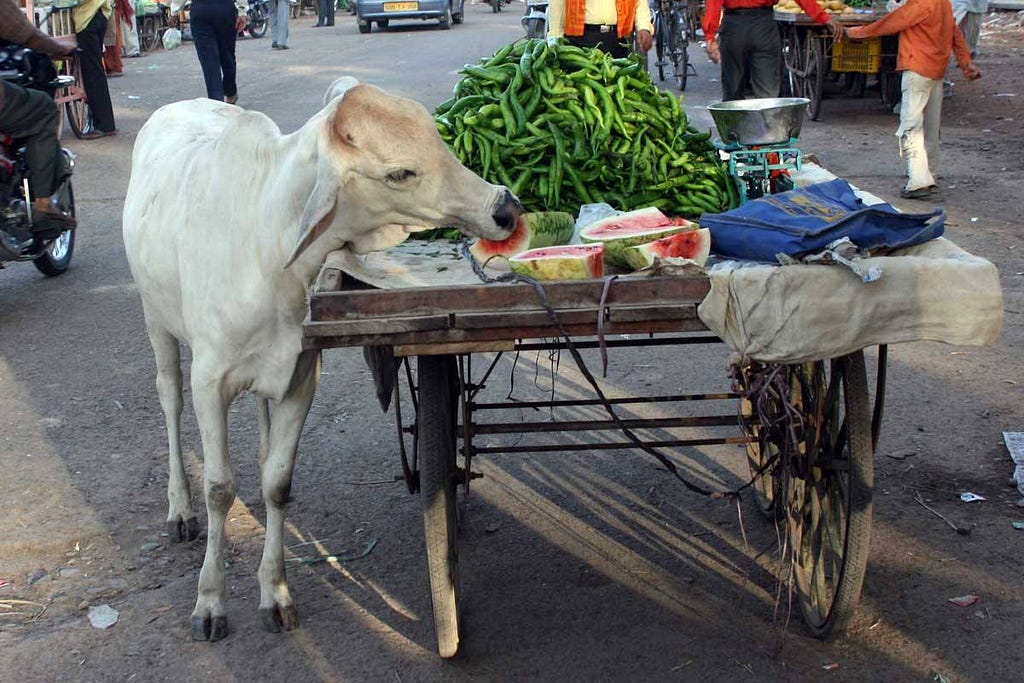
Fruit, vegetables and cow in Delhi. Photo: Risha Hess
Auntie wears a teal chemise with a gold paisley pattern, loose mauve pants, a soft blue-gray sweater vest and a purple shawl. This muted palette gives her a gentle, wooly aura. She wears a slender gold bangle on each wrist. Auntie reckons she is 78 or 79. Sharma remarks that she looks much younger than his own mother, who is only 70. “Your mother and I have had different lives,” she reminds him gently.
The years after Anup’s accident were bitter. Sharma’s family was living in Queens but because Anup was hospitalized in Virginia, he and his mother moved there for a year. Sharma’s father had a clerical job with New York State’s insurance department and commuted from New York to Arlington every weekend. The family’s health insurance did not fully cover Anup’s care so money problems created further strain.
Sharma was already a sensitive child and the accident made things worse for him. “I used to cry a lot in school. Everything felt really hard, impossible.” He remembers not wanting to visit Anup in the hospital; he wanted to be home watching TV like other kids. “At that time I felt no gratitude for anyone,” he recalls. “I just remember being there alone.” His mother was resentful of relatives who did not come to the hospital. “She thought if you’re not there all the time you’re being disloyal. The only person my mother feels awe for is this Auntie.”
After the accident, Sharma became “crazy,” he states. “I was an unusually imaginative child and this was an unusually severe trauma.” His childhood whimsies turned into behavior that Sharma describes as OCD-like. It lasted years. Some of the behaviors included walking with his fingers crossed or obsessively counting his knuckle joints to ward off evil. Sharma became terrified of the dark and of supernatural things. At one point, he says, “I thought God would kill me and replace me without anyone knowing.” He recalls a teacher sent him outside because he couldn’t stop crying in class, so he walked into a field while sobbing. That happened after Sharma imagined God spoke to him and asked if he would switch places with his brother. It was his own reply that distressed him: “No.”
“I was an unusually imaginative child and this was an unusually severe trauma.”
After a year in Virginia, the family moved to New Jersey so Anup could live in a long-term care facility that happened to be in a bucolic suburb. “It was the first time I was out of an urban space. I couldn’t believe how green and quiet it was,” Sharma remembers. Eventually the family bought a house in Edison, New Jersey and Anup lived at home.
Home life was excruciating and that experience is reflected in Family Life where the narrator’s family“fought so much that the walls vibrated with rage.”Sharma’s father was overwhelmed with maintaining a house and “became hysterical after moving in,” Sharma tells me. The American tradition of do-it-yourself and hardware stores was an alien concept; in India there are plenty of low-cost electricians, plumbers and workmen on hand. “He didn’t know how to do stuff. I remember him swearing about how to drain the heater.” In Family Life the father descends into alcoholism and depression. “I want to hang myself every day,” the father bitterly tells his son.
Sharma’s mother was already “unpleasant” and the accident only made things worse. She chided people for their incompetence, told them they were bad. “My parents fought like mad dogs,” Sharma says. “My mother’s disrespect for my father was clear.” Even as a child, Sharma was convinced that his parents were not role models. “I thought, ‘This is not the way. This is not going to lead to happiness.’”
At home, nurses cared for Anup in two shifts, from 8am to 4pm and 10pm to 6am. The family helped too. Young Sharma bathed his brother in the morning, cleaned him after bowel movements, exercised him, fed him, read to him, moved him from side to side hourly.The only thing he didn’t do was replace Anup’s “G tube,” the plastic tube that fed directly into his stomach.
Young Sharma bathed his brother in the morning, cleaned him after bowel movements, exercised him, fed him, read to him, moved him from side to side hourly.
I ask Sharma if Anup was ever able to communicate after the accident. He thinks for a moment. “At one point he would sometimes smile. But the last time that happened was years ago.”
It is now past noon and we needed to head to our next destination: Sharma’s childhood home in a neighborhood called Model Town. We get up to leave and say goodbye to Uncle in his bed. Auntie walks out with us and I request Sharma to ask how she can be so resilient. She nods and smiles. He translates her reply: “‘What else could I do if I cried all day. What else is there? This is all a part of life.’”
Outside the house, some marigolds are starting to bud in a strip of soil. Auntie gestures at them and Sharma translates. “She says her husband likes to look at flowers.” He beams at Auntie affectionately. “Oh man, these people are wonderful.”
Sharma and I walk back on the traffic-choked streets to the Metro station. He has been on the Metro only once before so I show him how to buy a token. At a counter, we pay 23 rupees for a blue plastic chip, which we flash over the turnstile. The plastic gate parts in a mechanical whisper to let us pass. “Cool!” Sharma exclaims.
The sleek train eventually emerges above ground onto elevated tracks.
Beneath a slate-gray sky, we bullet past low houses with walls discolored by black smudges. We get off at Model Town station, where Sharma and I step onto a shiny, modern platform that contrasts with the ramshackle houses and garbage piles glimpsed during our subway ride.
The street noise seems even more overwhelming, if that is possible. Buses roar, horns screech and a jackhammer pounds. Sharma waves at the river of traffic and the congested storefronts. “When I was a child, all this was just dust,” he says. We turn onto a side road, past the “Bombay Fire Hairdresser” and a snack stall where men rhythmically pat chapati with flour-covered hands.
“When I was a child, all this was just dust.”
Sharma says there used to be an open sewer here where he and his friends retrieved stray cricket balls. “We used to play cricket in this street because it was so empty.” Drying cow dung patties used to line the road, to be burned for fuel later. There was a swampy wilderness at the end of the road where he and his brother used to roam.
“There were big changes after 1991,” Sharma recalls. “The buildings got taller.” Before 1991 India had a closed, stagnant economy. But reforms ushered in by finance minister Manmohan Singh, the soft-spoken Oxbridge-educated economist who became prime minister in 2004, paved the way for a modern economy. As we walk, a tonga horse-drawn cart, passes us. The horse trots briskly alongside careening cars and its hooves clop loudly on the pavement. This scene is quintessential India: old and new jostling against each other, often quite literally.
Our destination is a three-story house behind a white wall. Sharma lived here as a child with several aunts, uncles and their children in a large extended family. It is dim inside the house. Fluorescent lights wanly illuminate a sitting room occupied by three men. A huge velour tiger skin hangs on one wall. An older man with gray hair sits in a worn arm chair eating lunch. He scoops lentils with his fingers and pieces of roti. This is Uncle Chachaji, a gym teacher at a local school and the second-youngest brother of Sharma’s father. He watches a television showing a Hindi movie. Uncle Chachaji wears a dingy button-down shirt with a blue-checked lungi — asarong.
This scene is quintessential India: old and new jostling against each other, often quite literally.
Another Uncle, Kul Bhushan Gaur, sits in the other worn armchair. He also has gray hair and wears a blue sweater vest. Sharma and I sit on a twin bed that is made up like a sofa. We sit opposite a middle-aged man who is Sharma’s cousin.I’m told that he’s a lawyer. The cousin sits on another bed-settee and coolly watches me watching him. Sharma tells them that I am a journalist writing about him. “Him?” sneers the cousin. “Why, is he some kind of celebrity?” Sharma doesn’t react.
“He’s not a celebrity,” I reply. “I read his book when it came out.”
“Do you think you will give the right picture of India?” the cousin asks me accusingly.
“I don’t know if it will be the right picture. It will be just a picture, a glimpse through the eyes of one person,” I say.
There are some family photos on the bland walls. Sharma points out the various relatives in the photos: this uncle, that cousin. “There are very few good-looking people in my family,” he observes.
I laugh at his bluntness. “What do you mean?”
The cousin-lawyer interjects. “Our family has rustic roots. We are from Haryana. We are farmers. Short.”
After a moment Sharma heads toward the back of the house to greet another aunt. We enter a cavernous dining room with a heavy wooden table and a refrigerator in one corner. A row of windows lets in stark white light but it doesn’t penetrate the dimness cloaking the room. An older gray-haired woman sits alone at the table eating roti and vegetables from small metal dishes. Her fingers are wet with food. Sharma greets her and we sit. On our way here he warned me that this aunt was extremely unpleasant, possibly crazy, and made hateful remarks to family members. But from their cordial interaction I would not have known.
On our way here he warned me that this aunt was extremely unpleasant, possibly crazy, and made hateful remarks to family members.
Sharma looks around the room with its high ceilings. “For a little child, all these places seemed so large,” he says. “The rooms echoed.”
The author as a boy in Delhi. Photo: Courtesy of Akhil Sharma.
Near the dining room, he shows me a small outdoor courtyard, a square of empty space at the center of the house. Here, clothes were hand laundered, tomatoes boiled in a cauldron to make ketchup, and wheat was ground with mortar and pestle. Sharma and his brother used to play cricket here too. A rusty metal basketball hoop still hangs from a wall.
We climb to the second floor where another aunt and uncle live. Their living room is brightly lit and it lacks the feeling of stagnant time like in the apartment downstairs. A balcony looks out over a “tank,” a man-made pond slightly larger than a soccer field circled by a tree-lined path. There are plastic boats in the murky green water and a few couples languidly paddle around. For India, it’s quite an impressive view.
“Wow,” I say.
Sharma gazes at the pond. “This is really hard-core luxurious,” he agrees. In Manhattan he lives on the Upper West Side a couple miles from where I used to live near Central Park. In India, we’ve re-calibrated our standards of luxury.
It’s a tranquil scene but noise still drifts through the air: dogs barking, honking car horns, shrieking construction machinery and squeaking pedals turning in boats. “It used to be so quiet,” says Sharma. “There used to be a dirt path around the tank. I remember as kids we found all these discarded medicine capsules outside. We played with them and put them back together. We had so few things as a child.” In Family Life, the narrator recalls that his family was so thrifty they saved the cotton inside pill bottles and also split matches with a razor blade. This frugality “made them sensitive to the physical reality of our world in a way most people no longer are,” the narrator observes.
In Family Life, the narrator recalls that his family was so thrifty they saved the cotton inside pill bottles and also split matches with a razor blade.
We stand outside on the balcony with Sharma’s aunt, uncle and their middle-aged son. They were living in Virginia when the accident happened. This petite auntie in her 70s wears a maroon cardigan over an ecru sari etched with a delicate maroon design. Jewelry glints on her: a diamond stud in her nose, jeweled earrings and a gold bracelet. Raj Kumar, Sharma’s cousin, explains in English that they went to the U.S. where his uncle was working for Washington Gas. He wears a khaki polo shirt tucked into a voluminous white cloth wrapped around his waist.
Sharma chats in Hindi with his aunt and uncle and I glean that they are talking about the accident, trying to piece together fragments of that day. His aunt says that Anup left Akhil at the library so he could sneak off to the swimming pool at an apartment building.
“I remember living in Queens after the accident,” says Sharma.
“No, you were living in R.K.’s house,” his aunt corrects him, shaking her head.
They continue to piece together fragments of memories, like comparing faded pages torn from different books.
Uncle accompanies us to the top floor, to a barsati, a rooftop apartment where Sharma and his family lived for the first eight years of his life. The weather is cool and pleasant and we have an excellent view of the palm trees surrounding the pond. The apartment is vacant so the door is padlocked. Inside, sunlight pours in from two windows onto a dusty bare bed and desk. There’s a small boombox radio on a shelf and an exercise machine that looks like an antique ski machine. The rooms are nearly empty, yet they seem to pulse faintly with ghostly memories.
“I remember being cold and lying in bed in the winter,” says Sharma. “Catching flies on the balcony, feeling a tickle. Watching boring TV movies.”
“You had a TV?” I ask. It was the 1970s in India.
“Yes, but there were no channels.” He pauses and looks around the room. “I remember intense emotions but I have little actual memory of things.”
The bathroom is in a separate room outside on the roof. There’s just a toilet in the corner, a spigot and a drain in the floor. The toilet seat has wide grooved ‘wings’ on the side so someone can squat on top rather than sit if they prefer. “There were few people with western toilets,” notes Sharma. “I was very imaginative as a child. I used to clog the drain with a shirt, so the floor would fill with water, and pretend I was swimming.” This rooftop and bathroom appear in Family Life. At the outdoor sink, beneath a “sky full of stars,” the father brushes his teeth until his gums bleed and he spits blood.
“I was very imaginative as a child. I used to clog the drain with a shirt, so the floor would fill with water, and pretend I was swimming.”
A metal ladder leads to the roof of the apartment, and Uncle is suddenly clambering up. Next, Sharma climbs up and I join them. Electrical pylons squat in the distance. A flock of birds, inky black hatches, suddenly race across the sky overhead. A row of three-story concrete buildings sit across the street. “Those buildings used to be one floor,” observes Sharma. There was a swamp where the pylons stand today, he adds. Family Life describes Delhi in the 1970s: quietness, roads so empty of traffic that children played cricket in the middle of the street.
Back downstairs we have tea and snacks in the more-welcoming second-floor apartment. We sit at the dining table and munch sweet round cookies, rectangular fried ones, and namkeen, a snack of puffed rice, peanuts, chopped green chili and spices. Uncle and Sharma chat in Hindi and I gobble some cookies. They reminisce about the days when they brought their wheat to the local miller for grinding. When they picked up their flour, the miller gave them free cookies. Now they buy their flour at the store, along with packaged cookies. I reach for another one and bite into it.
Our next stop is the Old Vegetable Market, where Sharma used to spend summer holidays with relatives. On the street outside we hail an autorickshaw and Uncle negotiates. For 40 rupees (less than $1) the three-wheeled buggy wends a few miles through raucous traffic to a busy junction with a clock tower. The ghanta ghar, ‘clock house,’ is a white cement obelisk that appears often in An Obedient Father as its narrator stops by a roadside dhaba for a snack or heads home to the Old Vegetable Market. As we drive past, Sharma notes that the clock was stopped for years, its hands stuck in time. The tower’s concrete was cracked and scarred. It was only after India’s economy opened in 1991 that the clock displayed the correct time again.
It was only after India’s economy opened in 1991 that the clock displayed the correct time again.
We get out of the autorickshaw and walk past vendors selling piles of oranges, bananas, garlic and dark, oval berries from bicycle carts. Other street vendors sell all kinds of goods spread on the ground: colorful bangles, plastic toy cars, toy guns, sponges, clown dolls and plastic storage containers. These days, there are no vendors lighting kerosene lamps resembling “iron-stemmed tulips,” as there were in An Obedient Father.
Sharma turns into an alley and we pause at the open doorway of what looks like a temple. It is a temple devoted to a god similar to Hanuman, the Hindu monkey god; it’s also a gym for wrestlers. Inside, two beefy young men wearing only red and green underwear grapple with each other in a wrestling ring filled with rich, brown dirt resembling brown sugar. The wrestlers have other duties, notes Sharma. “They are also minor gangsters hired to seize property,” he adds as the men clutch each other’s waists and bore their heads into each other like young bulls.
Wrestlers practice in north Delhi. Credit: Fehl Cannon
There’s a narrow, winding staircase and before long a few young men appear over the banister to watch us. In Hindi, they call to Sharma who asks me, “Do you want to go upstairs?”
“Sure,” I reply.
We climb the stairs. A yellow plastic mat painted with a red circle covers the entire floor upstairs. A poster of an elephant god sits on a window sill next to cones of incense releasing tendrils of fragrant smoke. Half a dozen young men wearing briefs and loin cloths surround us and look at us curiously. Sharma speaks to them in Hindi. He learns that one of the men is a national gold medalist in wrestling. The men seem delighted to have visitors and are keen to show off. They start trotting in a circle like young horses to warm up and seem crestfallen when we tell them we have to leave.
He learns that one of the men is a national gold medalist in wrestling. The men seem delighted to have visitors and are keen to show off.
Sharma and I return to the main road, packed with small shops selling gold, religious paintings, sacks of rice, and Nokia cell phones. We pause at a small church with dilapidated carved wooden doors wedged between buildings. It is a dharamasala, or a rest house, built in 1939 that appears in An Obedient Father when the narrator searches for a priest to give rites on the anniversary of his wife’s death.
We turn down another alley, past a stand where a man presses clothes with a giant iron filled with hot coals, and reach a quiet courtyard with a few homes. Young men lounge on old scooters parked in the courtyard and chat as though they are sitting on park benches. We stand in front of a multi-storied house with a lime-green faux brick façade and rickety balconies that look like fire escapes. A “Happy Diwali” sign hangs over a gray door even though the Hindu festival of lights was in October, nearly four months before.
This is the home of Sharma’s aunt and uncle, his mother’s sister and her husband. Sharma hasn’t been here since 2001. He spent childhood summers in this house and liked coming to India in spite of the scorching summer heat.
A “Happy Diwali” sign hangs over a gray door even though the Hindu festival of lights was in October, nearly four months before.
“I wasn’t lonely because all my cousins were here,” says Sharma. “I didn’t want to be at home in New York.” In India, there were always people around. As if on cue, a man emerges onto the top balcony and leans over to watch us. This house is reminiscent of the narrator’s home in An Obedient Father. I picture corpulent Ram Karan stepping onto the balcony and watching a box kite with a candle floating in the night sky. I imagine him shutting the windows as his daughter screamed so the neighbors wouldn’t hear.
Sharma continues. “We were poor but we didn’t think of ourselves as poor. We had an aggressive desire for education.” Sharma’s cousins went onto professional careers. One is a cinematographer, another a school principal, two are scientists. Then he mentions his family is of the Brahmin caste, so he supposes that is why they still felt culturally elite.
The lugubrious call to prayer sounds from a nearby mosque. By now it is late afternoon and sunset is approaching. Sharma remembers childhood mischief where he used to “catch mice and throw them into the squatters’ colony” — the small warren of shacks nearby.
“You want to look in the squatter colony? It’s going to smell,” he warns. In reality, it’s not bad at all. The lanes in the colony are paved and criss-crossed with electrical wires as power is siphoned from a main line. One house has a hill of tiny flip-flop sandals outside its door, hinting at a TV and a gaggle of children inside.
“You want to look in the squatter colony? It’s going to smell,” he warns.
We return to the main street and pass tiny storefronts selling kachori — fried doughy snacks — and a man carefully cutting a piece of wood on a chattering jig saw. A lean striped cat slinks between parked vehicles. A woman covered with a black veil eyes me as we pass each other. This busy street also appears in An Obedient Father, when riots are poised to break out after the 1991 assassination of prime minister Rajiv Gandhi by a female Tamil Tiger suicide bomber. In that scene, the street was forbiddingly empty as people peered down from their rooftops, “watching like a circus”, in anticipation of lynchings, lootings and riots.
On the main street, a magazine vendor tends to his wares spread on a plastic sheet on the ground. When Sharma was a boy there were only Hindi newspapers and the occasional English-language Indian one. Today the tarp is covered with a colorful variety of Indian and foreign magazines. There are copies of Elle, GQ, Men’s Health. A Cosmopolitan cover blares “Love! Sex! Men!” — a sight unimaginable in the closed India of Sharma’s youth.
We forge on and dodge a couple licking Fudgesicles, then a wooden cart heavy with translucent blocks of sugar covered with a net. Sharma reminisces about eating spun sugar as a child and pushing his way through a scrum of kids to drink a bottle of Campa Cola. Sharma points across the street to a brick rooftop and a sliver of sky between two buildings. As a boy Sharma and his cousins used to watch morning Bollywood matinees at the local cinema then nap on that rooftop. Movies played in Delhi cinemas for 25 or 50 weeks, since there were so few options, recalls the narrator in Family Life. In the distance stands the tall brick chimney of a textile mill. A bell at the mill would ring at 1pm to signal lunch — and disturb Sharma’s rooftop naps.
As a boy Sharma and his cousins used to watch morning Bollywood matinees at the local cinema then nap on that rooftop.
From high up, the rooftops would form their own landscape. I can see why the narrator of An Obedient Father would have concocted a story for his granddaughter about a man who walked across Delhi from roof to roof, using ropes and ladders to cross from the balcony of their home to the squatter’s roofs to the Old Clock Tower.
The oppressive noise and crowds fade when we turn down a narrow lane of residential buildings. Some of them are new and tall, showing signs of recent wealth. Others are unrenovated and still have creaking old wooden balconies with ornate filigree. The afternoon light is growing dim but we see a refined older woman with a bun of white hair approaching us. She wears a cream-colored vest and an aqua salwar kameez. A white dupatta scarf flows over her shoulders.
“Mamiji!” Sharma calls out. This is another aunt and we are going to the house where she lives with a large extended family.
Just then a mustached middle-aged man zooms past on a scooter and stops abruptly. “Akhil!” he cries. This is Akhil’s cousin, the son of the aunt on the street.
The family’s home is an unremarkable multi-storied building. We walk up a menacingly steep stone staircase. “Every single person has fallen down these stairs,” Sharma warns. The home is built around a large courtyard so that an empty shaft of air occupies the center. Sharma remembers spending summers here visiting his cousins. “We’d lay on charpoys and listen to the radio,” he says. We sit in a parlor overlooking the courtyard on heavy wooden chairs with those white doilies.
We walk up a menacingly steep stone staircase. “Every single person has fallen down these stairs,” Sharma warns.
Akhil’s cousin is a lawyer and speaks English but the two of them chat in a mix of Hindi and English. A large plastic doll with blonde hair sits like a mute guest on the settee next to Akhil’s cousin. I look at the black-and-white photos in a recessed alcove next to a blue stuffed bunny. Soon, an uncle with a salt-and-pepper mustache enters the room. He has lived in this house all his life, for the last 75 years.
After many polite protests, Sharma manages to decline invitations to stay for dinner. By the time we leave, it is dark. Uncle accompanies us to the main street, which roils with commerce and noise. Streetlights illuminate the road and shops, including a liquor store, glowing with fluorescent lights. Uncle says there was a neighborhood petition to prevent the liquor store from opening but it didn’t work. Sharma and Uncle gaze at the shop and tsk tsk disapprovingly.
“It’s horrible!” cries Sharma. I’m surprised by their reaction since India is the world’s largest market for whiskey and liquor is ubiquitous at parties and dinners. But this part of Delhi seems still rooted in a more conservative, traditional life — even if a street vendor sells copies of Comso touting sex advice.
The cousin insists on driving us to the Metro station since a group of aunties have to go to a wedding reception. We stuff ourselves into the car overflowing with matronly flesh and saris. I am crammed against the door, practically sitting on an auntie’s lap. We reach the Metro station and I profusely thank everyone as I extract myself from the car. Sharma and I carefully cross the street throbbing with homicidal peak-hour traffic and we enter the Metro station.
The tour ends where it began — at a Delhi Metro station. We will go to opposite ends of the city, Sharma back to Rohini West and me to south Delhi. Before we part ways, I ask about the family member I didn’t meet but who was still at the heart of the day’s memories and conversations, much like the courtyard, that column of air, at the heart of a Delhi home.
A Metro station in Delhi. Photo: Delhi Metro
Sharma muses about his brother Anup. “When I was a child, I thought I didn’t like him.” After the accident, Sharma remembers, “I cried so much. I didn’t know how much I loved him. I want the people in my life to know how much they matter to me.” This sentiment is echoed in Family Life when it is published in 2014.
Family Life will paint scenes of an older brother boiling frozen corn for his younger brother after school; stopping the bullying of his younger brother at their new school in Queens; and fulfilling his parents’ dreams by passing the grueling entrance exam for the Bronx High School of Science. He would have been a surgeon, muses the book’s narrator. Yet, like the narrator, the brother is also someone who “enjoyed bullying people,” who, fed up with studying for his exams, grabs a kitchen knife and screams at his mother, “Kill me!”
The swimming pool accident cruelly cut short the promise of a young life and cast ripples of anguish over a family for years. Yet “occasionally there were moments of kindness,” says the narrator in Family Life.
In early 2012, I will meet Sharma again in Delhi when he returns with his family to scatter his brother’s ashes in the Yamuna River.
In early 2012, I will meet Sharma again in Delhi when he returns with his family to scatter his brother’s ashes in the Yamuna River. Anup had been ill for years and had difficulty breathing and would aspirate phlegm. One morning, he couldn’t breathe and had a heart attack. Anup was 44 years old when he died after decades of care from his family.
As we stand near the turnstiles to enter the Metro, Sharma and I are the only people not rushing to get somewhere. Waves of people part around us like a river coursing around rocks that futilely block surging water.
“We don’t realize how much people matter to us,” Sharma tells me pensively as we say goodbye. It’s a rare moment of stillness in this busy crossroads, a final moment of convergence before we part ways and Delhi’s current flows on.
Hello, and welcome to my week-by-week review of the world. Today I am reviewing the sneeze I had.
Except for a woman I dated who had a condition that prevented her from sneezing or French kissing, almost everyone sneezes. When you sneeze, it feels a lot like what I imagine a really quick exorcism feels like. I’ve never been exorcised personally, so I’m going with my gut on this.
The sneeze I had came on so quickly I didn’t have time to put my hand over my face and the spray went everywhere. It made me wish I had been standing over a salad bar so there would have been a sneeze guard handy. That’s why if I’m about to sneeze at Olive Garden I immediately sprint for the salad bar. Maybe I should have one of those installed in my house. I’d get a lot of free salad that way.
Unfortunately without a sneeze guard anywhere near me, the spray drifted through the air, covering all my belongings in a light coating of sneeze. I couldn’t see it of course, but I knew it was there. So I had to cover everything in bed sheets to prevent the germs from spreading. It made my house look abandoned which I think attracted the raccoons.
The sneeze came just in time, though, because I had no idea what to review this week. Sometimes the overwhelming number of things I have yet to review can be paralyzing. Should I review a pen cap or should I review a different pen cap? What about reviewing the Great Wall of China or another different pen cap? There are too many choices! That’s when my sneeze happened and it was like fate stepped in and said, “Review that sneeze!”
It was a gratifying sneeze — not like one of those sneezes where you’re right on the edge of sneezing and it never comes and then you want to kill yourself. This one was hearty and made me feel as if I’d unclogged something deep inside me. Almost as if it was something spiritual. But it wasn’t, it was just boogers.
BEST FEATURE: No need for a tissue. WORST FEATURE: I think I sprained my neck.
Please join me next week when I’ll be reviewing lint.
DON’T MISS OUT
Sign up for our newsletter to get submission announcements and stay on top of our best work.
YOUR INBOX IS LIT
Enjoy strange, diverting work from The Commuter on Mondays, absorbing fiction from Recommended Reading on Wednesdays, and a roundup of our best work of the week on Fridays. Personalize your subscription preferences here.