Will the enhanced editions of the fantasy epic mark a new wave of innovation for publishing?
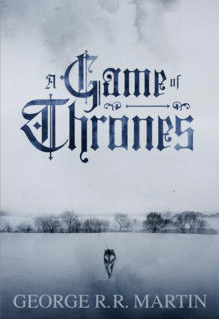
Twenty years ago, George R. R. Martin published the first installment of A Song of Ice and Fire, which has become a cultural obsession thanks in part to the HBO adaptation Game of Thrones. In celebration of the book’s milestone anniversary, Martin, along with Apple and HarperCollins, announced “a new period in the history of publishing” with the introduction of the Exclusive Enhanced Edition of the first book, with the next four soon to follow suit.
According to the product page on iTunes, the digital books feature “interactive maps, author notes, glossaries, family trees, and illustrations,” which will heighten the reader’s experience and certainly help keep track of characters’ journeys throughout the whole of Westeros.
Martin is very excited about how the release will impact his readers. He says, “Anything that confuses you, anything you want to know more about, it’s right there at your fingertips. It’s an amazing next step in the world of books.” In other words, he’s thrilled people will have this resource available so they can stop bombarding him with questions.
For now, only A Game of Thrones is available on iTunes. A Clash of Kings will be released on October 27th, followed by A Storm of Swords on December 15th. A Feast for Crows and A Dance with Dragons are respectively due in February and March of 2017. However you can go ahead and add them to your iTunes wish list as early as today.
One more note of excitement for diehard fans of the series: The enhanced edition contains an excerpt from the long awaited sixth installment, The Winds of Winter. It used to be up on Martin’s site, but now the sneak peak is exclusively in the iBook. So if the sigils, family trees, and glossaries weren’t enough, perhaps this added incentive will push you to purchase. There is still no word on an official release date for the forthcoming book, but we wouldn’t be surprised if it debuts in this avant-garde format too.
With the novel Girls on Fire, Robin Wasserman does not illuminate what compels teenagers to murder each other and commit impulsive acts of violence. She zooms in on the frenzy of ideas whirring between two girls blasting music in a Buick until their urges exceed their grasp. She empathetically captures what is at work when one person is seen by another and somebody thinks: “I don’t know why I did it, except that life was small and this seemed huge.”
Prior to Girls on Fire,Wasserman wrote for young adults, and this book addresses in the older reader the desire to have read something like this when they were young, a little distance willed between that self and the present self. Some of the novel’s darkness comes from scenes of torture and cruelty, but just as frightening is the naïveté, the poses the characters assume, the reader’s knowledge that the urgency the characters experience will wane and keep life small forever compared to their consequences.
In the rust belt wasteland of Battle Creek, Pennsylvania, high schooler Hannah Dexter wants to become what classmate Lacey Champlain sees in her. Dex, who thinks of herself as an easily railroaded nonentity, needs Lacey to affirm that there is something not invisible in her, something cool and powerful that attracts dangerous Lacey. Lacey, who thinks of herself as too much, as offensive to the sensibilities of anyone who thinks of themselves as good, needs Dex to affirm that there is something out there she can’t destroy (all the while refusing to acknowledge Dex’s fortitude, chalking Dex’s commitment up to how she herself has captivated the girl).
The vivid flashes of sex and violence may be perceived as adult material, but they are the fruits of ideas about lust and power that coalesce in the teen years when one is straining to see what one can be in another, in their eyes and in their bodies. When Lacey contemplates testing Dex’s loyalty, she does so by taking advantage of Dex’s dad and his bad boundaries. It’s inevitable as weather that an older man will look at a younger girl and want to forget who he is and become only what she sees and (he wishes) needs. Wasserman depicts it as the low blow it is and does not let Dex’s dad off the hook for how he allowed his insecurity to inform his behavior.
Without Lacey, I was incapable of wildness, that’s what he was telling me. When I had Lacey, he had a little piece of her, too, could love me more for the things she saw in me. Now that she was gone, he expected I would revert to form. I would be the good girl, his good girl, boring but safe. He was supposed to want that.
Nothing feels genuine about the way the characters interact, especially when it comes to Dex and Lacey interacting with other teenagers, and that is because those interactions are not genuine — the baiting, posturing, and acting. The characters perform in order to live up to each other’s ideas of what they’re supposed to be, and it is one of the most effective facets of the novel. It makes for a chilling and familiar experience, like coming upon a Livejournal from high school that alludes to a crime you cannot remember committing.
Nikki told us how in sixth grade she’d gotten bored with her then best friend, Lauren, and convinced all the other girls in their group to ice her out for the rest of the year. I remembered this: I had joined the I Hate Lauren club — which never existed as anything more than a membership list circulated to half the class, then left anonymously on Lauren’s desk the next morning, just as the I Hate Hannah list had the year before — not because I did hate Lauren, but because it seemed to have slipped into the zeitgeist that Lauren was hateable, and it was safer to be against than for.
As much as Girls on Fire resembles real incidents of brutality between American teenagers, it explicitly recalls the true story that inspired Peter Jackson’s 1994 film Heavenly Creatures, about two high school girls desperate to get lost in each one’s idea of the other, to be seen as great and part of an epic tale, to become a piece of the art they make together. But the central characters in Heavenly Creatures, Pauline and Juliet, commit murder in order to prevent their separation and the shattering of their shared world, and as a result, they are unable to ever see each other again. Dex and Lacey feel themselves coming apart and commit murder in order to get fully lost in one another, prevented from truly being seen by anyone else ever again.
The fragmented incident that incites the climax — which sees Dex throttled through humiliation after humiliation — retrofits a current phenomenon to the novel’s Nevermind-era setting. The contemporary flavor of the brutality in the novel (readers are exposed to so many reports that sound like the events of Girls on Fire that it seems of a piece with daily events of 2016) relieves the trappings of small-town counter-culture, of corsets and lipstick and Nirvana, from being implicitly blamed as an accessory to the characters’ cruelty.
Narrating alternating chapters, Dex and Lacey get space to articulate their motivations as the humiliations accumulate — someone wakes up after a night of drinking covered in inked-on epithets, someone gets offloaded to a church — and when they take revenge, they do not pay for it. It does not feel right to characterize them as having gotten away with it, and the ambiguity is appropriate — it wouldn’t feel right to get satisfying closure from a story about violence. The reader of today knows better. The darkness and Satanic appurtenances of Girls on Fire are ornamental to the very relatable loneliness and longing that Dex and Lacey inspire in each other.
Hello, and welcome to my week-by-week review of the world. Today I am reviewing sprinkles.
Not to be confused with sparkles, sprinkles are tiny, colored, flavorless cylinders made out of I think chocolate, or maybe just cardboard. I mistakenly asked the Walgreens employee for sparkles and she directed me to the arts and crafts section. I had glitter stuck in my teeth for a week. I should have brushed my teeth.
Sprinkles can take an ordinary cupcake and turn it into a cupcake that looks like a rainbow shattered and fell all over it, and then the leprechaun at the end of that rainbow hid inside the cupcake and the only way to get him is to eat it.
There are many ways to adorn your cupcake with sprinkles. Sprinkling them on is the most traditional way but I prefer to individually insert each sprinkle so it looks like my cupcake has hair — like it’s a little creature that I’m about to devour. I always enjoy eating things more when it feels like I’ve conquered them. That’s why I never allow myself to be spoon fed. It’s boring.
It’s not just cupcakes that can benefit from the addition of sprinkles. Try sprinkling some onto your meatloaf, spaghetti, or soup. It’s a great way to make your dinner special if it’s your anniversary and all you know how to make is soup. Your significant other will be like, “Soup again?!” Then when you pull some sprinkles out of your pocket and throw them onto the soup your significant other will shut up and eat the soup.
Or if you’re out of food altogether, sprinkle the sprinkles all over your tongue and watch what happens in the mirror. There’s an 80% chance you’ll eat them and I’m not even a psychic. I dare you to not eat sprinkles after you put them in your mouth.
What’s most amazing is that sprinkles never go stale. I bought a used van that ended up having 20 cases of sprinkles in it back in 1963 and I’m still eating them. I wish I knew the science behind the long shelf life of sprinkles and wish it could be applied to other foods. I found a sandwich in my luggage and it had definitely gone bad. I may as well have just thrown away that $8.99 at the airport vending machine.
It sounds silly to think that sprinkles may be the key to unlocking food shortages around the world, but the evidence speaks for itself. If anyone reading this is a scientist and needs some sprinkles to study, I’m more than happy to donate some of mine.
BEST FEATURE: If it’s warm enough, sprinkles can be melted together into a sprinkle ball that can be eaten like an apple. WORST FEATURE: If you get too close to the sprinkles, their cylindrical shape makes them look like logs, which can be overwhelming if you think you have to eat a bunch of logs.
Please join me next week when I’ll be reviewing Metallica.
I read Christian Lorentzen’s piece on questioning whether it’s really the story that keeps us reading stories the other day. I was particularly struck by this part:
“The thin traces the plots of even the most memorable near universally read books can leave in our minds. If a work of fiction has any force to it, we close the book with a head full of images, lines, and emotions.”
Looking back at the first four entries in My Year of Re-Reading, I see that I can’t much remember the plots, or the names of the characters; what I’m chasing when I re-read is that experience, the one that remains lodged in the brain years later. A year or five from now, I’ll no doubt have forgotten those plots … again.
Like re-watching Season One of GoT and you’re all like, “Who the hell is that guy?”
Let’s try it out on some famous books. How closely can I recite their plots? Not at all, it turns out. A random sample (with help from Wikipedia):
• Midnight’s Children: a guy gets lost in a swamp during a civil war in Bangladesh? (That happens, but the book is totally not even about that.
• Wuthering Heights: a jealous jilted ex-lover goes and gets rich in order to get revenge on the object of his affection’s daughter, a more twisted Great Gatsby? (I mean, sort of …)
• The Brief Wondrous Life of Oscar Wao: a nerdy Dominican kid learns who he is growing up in New York thanks to some charm and Lord of the Rings? (Yeah … not really.)
• Freedom: lol, j/k, like I’d read this. There are enough ponderous bores in real life without reading one, too.
Despite the fact each of the first three books deeply moved me, I can’t even recall basic plot points about them. Lorentzen’s point that emotion and characters rather than plot forming the glue of what we love about the books we love seems self-evident to me. The best books envelope us in a fictive dream more real than reality. But like a dream, they fade with time, leaving only the glimmer of impression. How often does the shadow of a passing girl or certain peppery scent wafting on a spring breeze jar us suddenly back into a dream we once woke from smiling?
Which brings me to The Sea, The Sea. I love this book, unreservedly. I also couldn’t tell you the first thing about what happens in its pages. Some English dude — a poet, maybe? — takes a lot of walks along the craggy English coast in a sweater, drinks wine, and obsesses over a girl. I also can’t remember the names of the characters, or what they want, or why, or if they get it or not. Actually, I’m not sure much happens at all. I’m also one hundred percent sure I don’t care.
I recall looking up from the pages of The Sea, The Sea upon a first read to find the world atilt and vaguely unreal. Certainly dimmer in comparison to the world Iris Murdoch summoned, certainly a rougher and vastly less beautiful place. I had to get up from the couch, I had to fix something to eat, I had to sleep and the next morning there would be work and all the quotidian demands of the workaday world, and it all seemed horribly unfair that I couldn’t just crawl back inside those pages and stay there for good or at least a long, long while.
I don’t recall what, exactly, about the book propelled me to such fantastical heights, but I’m aiming to find out with this re-read.
AFTER READING:
Reading The Sea, The Sea felt rather like a magnificent High Mass I once attended in a Midwestern cathedral in a rundown Rust Belt city, replete with incense and organ chords echoing up to the rafters which seemed to ripple with ominous flapping. An odd sense of unreality attached itself to the proceedings, the prayers of the bishop at the altar, the clanging of the bells, the creaking of pews as the congregation engaged in Catholic calisthenics, stand, kneel, sit, stand, kneel, sit. Oh, the Mass was real enough to taste and smell, and the grand old cathedral with its pews worn smooth by generations of worshippers stood as solid as a human architectural construction can be. But watching those priests and bishops and their Hosannas before the glow of the altar and the congregation with their Missals and Christ crucified overlooking all, I was seized by an odd sense of detachment. As though I were observing myself from a distance.
Not from Hawaii, for some reason.
That’s the double bind The Sea, The Sea put me in: I was reading the words, all right, but somehow I wasn’t quite there. At 40, I’m too old and life is too short to construct a bunch of sentences about the various “meanings” I could extract from the text. Faced with having to have something substantial to say about this book, so pregnant with feeling and impressions, I can do no more than reach for analogies, it seems. No narrative thread has presented itself; no clever insights. Only tenuous, weak analogies.
In point of fact, I’ve been struggling for nearly two weeks now to come up with something meaningful to say about this book, which seems an odd thing to say about a book you love. I mean, ordinarily I’d say that my interest level in reading 502 pages about a poncy retired English playwright would hover at somewhere around less than zero; in truth, I plowed through The Sea, The Sea in only a few days (which is something of a miracle of speed with two children at home … did I mention it’s soccer season again? Somehow children’s soccer season seems to encompass roughly 47 weeks a year). Which is additionally remarkable because, as I suspected, not a whole hell of a lot happens in this book.
Oh, Charles Arrowby, gets in some scrapes obsessing over his long lost and now rediscovered childhood love. Nearly drowns, in fact, and would have, too, had his saint-like cousin not levitated down into a tidal surge to save him (I think). A young man dies, an old man dies, an old woman (Arrowby’s ex-lover) flees to Australia. Wine is drunk, friends from London come and go, betrayals and reunions abound. A bit of a muddled mess when it comes to plot, really. And what’s more, and more relevant, is that nearly two weeks later, the details have already escaped me. Because this marvelous hurricane of a book requires no foundation of mere plot to remain lodged in one’s consciousness.
A curious feature of The Sea, The Sea is that it is hard to summon individual sentences or even paragraphs to stand forth as representatives. The writing is not quotable, if you will, in the way that someone hilarious like Lorrie Moore or someone inspired like James Baldwin. Rather, the propulsive force of the words piled one upon another pummel you into submission, your brain a galley slave to Iris Murdoch’s imagination. This makes for looooooooong paragraphs, full of twists and perspective shifts, leavened by foreshadowing and symbolic gestures, but not pointing to any reality but that of the book itself (and let it be said, I chose a paragraph alluding to a “terrible thing” happening to show that you don’t even need to know about the terrible thing, which turns out not to be that terrible anyway, to appreciate and savor the prose):
After that, and until the terrible thing happened, the evening seemed quietly to break up, or to become diffused and gently chaotic like the later stages of a good party. Or perhaps it is all just confused in my memory. There was some light over the rocks, though I do not recall where it came from. Perhaps the clouds were still giving off light. A moon had made its appearance, randomly shaped and spotty, large and pale as a cloud itself. The fierce foam at the edge of the sea seemed luminous. I wandered looking for Lizzie, who had vanished. Everyone seemed to be walking about on the rocks, precariously holding glasses in their hands. An owl was hooting somewhere inland and the intermittent voices of my guests sounded equally distant, equally frail and hollow. I also wanted to find James, because I felt that perhaps I had been rude to him. I wanted to say something to him, I was not sure what, about Aunt Estelle. She had shone somehow upon my childhood. Che cosa e amor indeed. I went to the cliff and watched the waves pounding it. There was a soft growling of thunder. I could see the glowing whitenesses of the wave-crests out to sea. Gilbert’s babbling baritone started up not far off. Stay dainty nymphs and speak, shall we play barley-break tra la la? Then later on, in another quarter, Titus also by himself could be heard rendering Jack of Hazeldean. There was something absurd and touching about the solipsistic self-absorption and self-satisfaction of these drunken singers. Then at last I heard Lizzie’s voice distantly singing Full Fathom Five. I listened carefully but could get no sense of direction, so loud was the accompaniment of the restless rushing sea. Then I thought, how strangely her voice echoes. It seems almost amplified. She must be singing inside the tower.
Such baroque writing ain’t normally my cup of tea; but done this way, it’s easy to get swept up along in the tide, and I was only too happy to do so. Murdoch is a such virtuoso, you’d feel compelled to read her Fitbit updates (9,389 steps! Nearly there!). The writing reminded me of nothing so much as Proust, whose In Search of Lost Time I once read in its entirety. The prose rolls and roils your brain, leaving you a little dazed in its wake, and somewhat at a loss for words (ahem). I think that’s why I struggled for so long after re-reading to find something worth saying about this book.
As Christian Lorentzen intuited, emotion trumps plot. Or character.
But while we’re on the topic, let’s talk about Charles Arrowby. A horrid little man, the book’s protagonist has managed to, despite wealth and experience and age, attain exactly no wisdom. Selfish, sexist, condescending, utterly self-unaware. He wrecks the lives of others to keep himself amused, rather as a toddler will trash a dinner table just for the fun of seeing a mess. In his romantic life, Charles Arrowby makes mistakes worthy of a swaggering sixteen-year old; in his career, those of a petulant seventeen-year old; in his daily life, those of an ill-formed eighteen-year old college freshman living on his own in a dorm for the first time. By page 200 or so, when you start to realize how goddamn dumb Charles Arrowby is about damn near everything in the world he inhabits, it is not so much infuriating as it is irritating, like a splinter lodged in the flesh of your palm and you’ve got no needle.
At least this dummy had the virtue of being funny.
Charles Arrowby is the worst sort of narcissist, so unaware of his own self-centeredness that he almost seems written as an object lesson. Kids, the moral of the story is don’t be a selfish asshole!
Except Iris Murdoch could hardly have had so prosaic an end in mind. For all the petty rancor of its main character, the book as a whole is anything but petty or rancorous. In this lies the book’s strange magic, I think, and try as I might, I don’t know how else to put it.
Someday, years from now, the spell will have worn off again, and I’ll re-read it once more, and once more, be enchanted.
DOG-EAR REPORT:
The aforementioned difficulties with finding quotable quotes in The Sea, The Sea have not been surmounted upon review of the pages I dog-eared. Stripped of their context, the following quotes, while still great, have lost their original impetus; they are the desiccated fossils of a far greater creature. Take them in that spirit, because they’re still fuckin’ great.
For use the next time someone asks you why you aren’t married yet:
I wanted a wife once when I was young, but the girl fled. Since then I have never really seriously thought of marriage. My observation of the state never made me fancy it.
The speech all writers secretly dread they will one day hear:
You never did any good for mankind, you never did a damn thing for anybody but yourself. If Clement hadn’t fancied you no one would ever have heard of you, your work wasn’t any bloody good, it was just a pack of pretentious tricks, as everyone can see now that they aren’t mesmerized any more, so the glitter’s fading fast and you’ll find yourself alone and you won’t even be a monster in anybody’s mind any more and they’ll all heave a sigh of relief and feel sorry for you and forget you.
A sentence so nearly-maudlin you or I would never dare write … and yet, and yet …
The grass on the other side of the road was a pullulating emerald green, the rocks that here and there among the grass were almost dazzlingly alight with little diamonds. The warm air met me in a wave, thick with land smells of earth and growth and flowers.
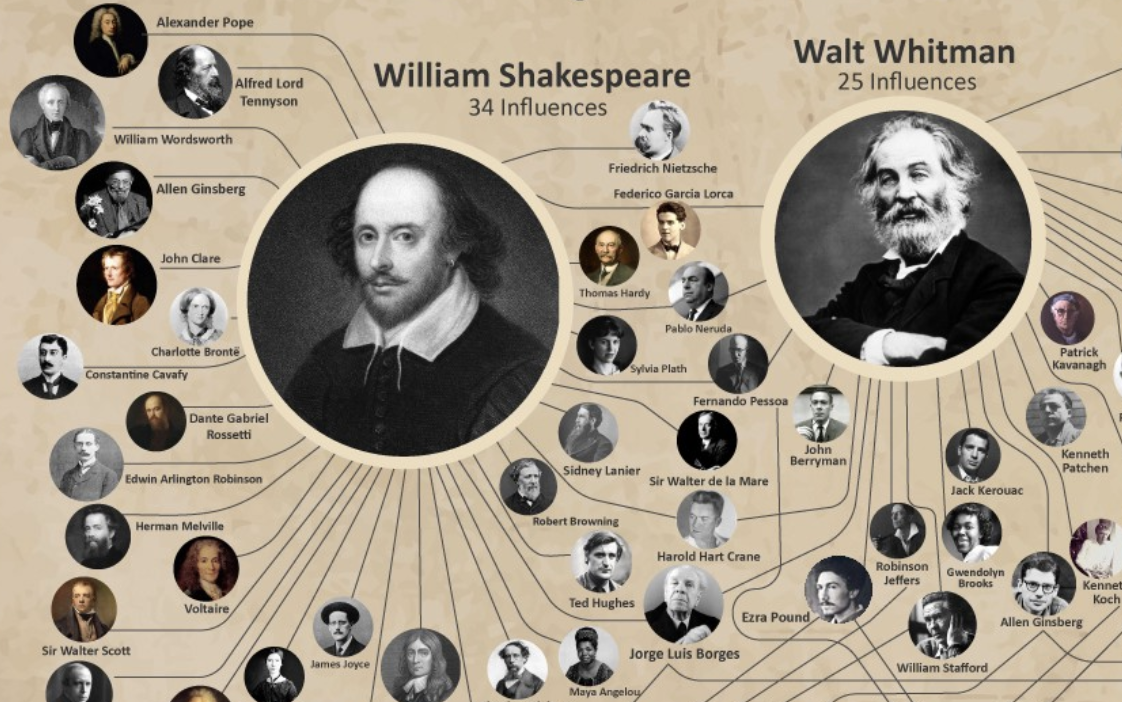
Although the title of the infographic implies it is looking at all poetry, it seems pretty clear that this is more a list of the most influential poets in Western English-language poetry, not all poetry from around the world.
How did they come up with this list?
We conducted extensive research to find out who the top poetry influencers were and studied approximately 250 poets to determine whether they were influenced by any other poets, and, if so, who. We entered more than 1000 influences into our database to come up with our top ten, which you can see in the infographic.
As long as there have been stories, humans have tried to assign meaning to nature. What is the natural world to man, if not a governing force, a collective of anthropomorphic beasts calculating our demise, or an arm of a vengeful god? Or is nature more appropriately considered as the perfect order of things, the model by which we are meant to live and let live, to surrender to the perfect imperfection of surprise? Ali Shaw challenges all of these perspectives and more in his novel, The Trees. Shaw opens the book with a great, creaking transformation — the contemporary world (from the vantage point of England) is suddenly interrupted by a thick forest. In a great burst, the earth groans, splits, and a snarl of fully grown trees choke out man’s development. Shaw’s work is imbued with the mystical feel of an older tale, but its inclusion of 21st century elements give it an apocalyptic sensibility. Though Shaw’s premise feels at first a little thin, like it would have been better suited to the confines of a short story, eventually it is the depth of his characters’ interactions and their subsequent understanding of each other, as well as those characters’ understanding of what the trees — the event of their growth — means to each of them that elevates Shaw’s work beyond a simple journey through an unknown world to a complex and otherworldly meditation on nature.
Shaw’s book is told from an omniscient third perspective that shifts between members of a small band of travelers, but he begins with former teacher, Adrien. An everyman eating takeout and watching Westerns at home when the trees come, Adrien’s life is entirely devoid of purpose. His wife is away on business with another man, in Ireland, and Adrien has all but given up on his own life. Shaw’s writing as he describes Adrien encountering the sudden growth is lush and reverent. As he describes the moment of the trees’ arrival, he establishes both his voice and the all-consuming power of nature:
The forest burst full-grown out of the earth, in booming upper-cuts of trunks and bludgeoning branches. It rammed through roads and houses alike, shattering bricks and exploding glass. It sounded like a thousand trains derailing at once, squealings and jarrings and ducklings all lost beneath the thunderclaps of broken concrete and the cacophony of a billion hissing leaves. Up surged the tree trunks, up in a storm of foliage and lashing twigs that spread and spread and then, at a great height, stopped.
“In the blink of an eye, the world had changed.”
Shaw’s musical diction and awe of natural world shine in his work. The opening scenes of destruction give his characters a push to leave — they want to find out if the trees blanket the globe; they want to find food; they want to get to their loved ones. Adrien joins Hannah and her teenage son and they set off for Ireland. Though Shaw’s pace in the 500-page tome is initially slow, it picks up. The journey becomes dark, and each character’s losses impact their world-view deeply.
Though The Trees follows a classical quest structure, Shaw deviates from a too-strict interpretation of the archetype because his protagonist is not the seeking hero who looks for retribution, salvation, or even a treasure. Adrien’s reluctance and laziness make him a more contemporary protagonist, and lend complexity to what could have become too simple or easy. He has to be pulled along his journey rather than pursuing a lofty ideal. Adrien “wanted to be a good man,” Shaw tells us:
“[I]deally a great one. A man who would go down in history as the solver of some global crisis or the architect of some peace treaty (he didn’t much care which). Yet he also wanted to get up late. He wanted, if at all possible, to sit for most hours of the day in his boxer shorts, eating junk food…”
Adrien’s lack of purpose drove a wedge into his marriage long before his wife left. When the trees come, it no longer matters that he’s jobless and listless. But the journey to Ireland with the others gives his life activity, if not immediate purpose. Adrien, who had never been one to spend time outdoors, has to reconcile his ideas about the natural world, his sense of right and wrong, and who — or what — he wants to be.
Shaw’s premise, the immediate and total growth of trees, creates a catalyst for personal consideration within each character. Relationships, likes, dislikes, and world-views are all heightened in the shadow of the new growth. While Hannah, a former worker at a nursery, sees the natural world first as perfection, she has to consider also its heartlessness and unaffected cruelty. “Now that things are back to normal,” a man they encounter says, “there isn’t fairness. There isn’t compromise. There is only the coming together of force against force. Stags locking antlers.” Hannah’s son, Seb, an amateur web designer and writer, has to live with the ephemeral nature of disappearing human creation. His friend, Hiroko, a Japanese student stranded on a field trip, struggles to put into practice the training of a mountain man who took her through America’s forested areas. “Look the world in the eye,” he told her — and yet staring murderers and a new, lawless existentialism in the face once the trees come is difficult. Shaw includes mystical beings — kirin, and what the characters call “the whisperers,” small creatures inspired by medieval carvings of natural grotesques — these familiars draw the characters onward, leading toward the realizations Shaw wants them (and us) to make.
While at times, Shaw succumbs to the temptation to overwrite his character’s conclusions (“Love was a trail through the forest of yourself,” he writes at one point), his sure hand shows in how he writes the journey of this haphazardly assembled band through a forested continent. Shaw’s language sings on the page whether he writes of the musty undergrowth of roots sinking into soil or the cool freedom of the ocean on his characters’ skin. The Trees is Shaw’s homage to both the destructive and generative power of the natural world.
Six lives converge for a surrogacy in Gina Frangello’s gut-punching novel, Every Kind of Wanting (Counterpoint 2016). Six people want, as Frangello says, “for [a] three-pound infant to save their lives,” and yet the desperation of each character — for truth, for acknowledgement, for legitimacy — consumes and ruins them. Some context: Frangello’s work centers on four Chicago area couples — Lina, an unreliable narrator and stripper, and her femi-nazi academic girlfriend and dom, Bebe; Lina’s brother, Miguel, who is haunted by his past in Caracas, and Chad, Miguel’s husband — they’re the ones who want a baby. Chad and Miguel involve various members of the moneyed North Shore in their quest: Gretchen, Chad’s sister, who donates her eggs to the cause, and Gretchen’s abusive husband, Troy, who she does not inform of her decision, the men also pull in Emily, the surrogate, and her husband, Nick, a playwright whose ties to Lina are questionable. In the midst of this tangled setup — one involving lies and pretense from every character as the baby is conceived — Frangello writes about how emotional vulnerability in relationships is as much a calculated decision as the lies we tell each other.
Frangello and I had the opportunity recently to discuss her story, as well as the satisfaction of telling stories through layers of perspective.
Heather Scott Partington: Lina says that “all empathy involves a kind of method acting.” In some ways, this novel looks at human emotion from an outsider’s view — many of the characters are trying to figure out how they should appear to feel as much as how they should actually feel. Every Kind of Wanting speaks to the duality of our persona — the interior vs. the exterior. Was that something you wanted to focus on? How has your approach to writing changed as you’ve published each successive novel?
Gina Frangello: I love this question because it was — yes — so much something I wanted to focus on, and there’s a thrill when an early reader identifies that. On both a craft level and a psychological level, I’m fascinated by what numerous points-of-view can offer a novel, in terms of the ways in which characters’ different truths contrast markedly. Perhaps nowhere is this more visible than in the schism between how a character perceives herself or himself, vs. how they appear in other characters’ narratives…so that, alone, is something I very much wanted to explore.
However, taking that a step further, yes: some of the characters in Every Kind of Wanting are also explicitly attempting to put on a kind of public face that contrasts significantly from their inner lives. The gap between who we may want to be seen as, vs. who we fear we are in the darkest corners of our psyches, is a deeply compelling space to excavate, for me as a writer.
I also love, in terms of point of view issues, creating the tension between whether the various characters’ points-of-view are even reliable and real. I was doing a lot of that in my early writing too, but back then I fretted over it, since I was often told that this kind of thing made my work unmarketable and too “cerebral.” I worried I’d never get published if I didn’t conform more to what the market expected, particularly of women writers, but I’m not sure I could have conformed to that even if it had been my desire. My brain just doesn’t work in those kinds of linear or binary ways, maybe. Janet Burroway has that great quote that, in fiction, “only trouble is interesting.” To me, only complexity and layers and contrasting truths are interesting. I’ve become unapologetic and don’t worry anymore about the “marketability” of things. There are amazing people like Counterpoint’s Megan Fishman to do that for me, but on a deeper level I also think “the market” is a diffuse and illusory entity and that making any attempts to cater to it just send a writer in wrong and inauthentic directions. It thrills me when a writer like Lidia Yuknavitch, who was once publishing on avant-garde imprints and definitely being judged as too damn weird and edgy for the mainstream market, is now a bestseller for essentially doing the same kinds of body-centric, language-centric work she’s always done. “The market” isn’t actually…you know…a sentient being. It’s just a set of conjectures posited by various disparate people in marketing meetings. A lot of times they get it wrong. Writers can only follow their own heat — that’s what makes writing compel us.
HSP: One of the most wonderful things about Every Kind of Wanting is how you write with sympathy for each character’s limited perspective. The idea that “we’re all the heroes of our own narratives” — there’s no clear bad guy in the story, although a case could be made for that role being shared a bit by everyone. Were you influenced by any stories or other writers as you took on that approach? I wondered as I was reading if your experience with trying to write the (capital letters) Other, which I’ve heard you speak on several times, informed how you tried to look into what makes people act in ways that unintentionally hurt those around them.
GF: In terms of literary influences, one of the pieces of fiction that made the biggest impact on me, and speaks in an implicit way to our all being heroes of our own narratives, is the section in The Unbearable Lightness of Being where Kundera gives us Sabina and Franz’s “Short Dictionary of Misunderstood Words.” Essentially, Kundera interrogates the deep meanings that various words or concepts hold for the two, and the chasm of misunderstanding that is often unavoidable between people, even lovers or siblings, who each bring their own deep subtext to everything, and to whom nothing can possibly mean exactly the same thing. That section of the novel — I know it’s not in vogue to praise Kundera these days, and that he’s become pretty stagnant and politically outdated in his current work — but he taught me more about the editorial omniscient point of view than any other writer, and he also taught me things about the subjectivity of truth that were explosive to me as a fiction writer creating characters who would, yes, be the heroes of their own narratives, rather than simply foils for one dominant worldview in a novel.
That all comes to play in issues of writing the Other, too, of course — whatever Other may mean to a given writer. I’m massively against the idea of “representation,” i.e. that if I write a character who is bi, or Latino, that character is supposed to somehow embody all bisexual or Latino people and serve in any way to “educate” the reader about cultural and political issues. A novel may engage cultural and political issues, obviously — arguably more American novels should do so, according to many critics, though I would actually say that many do, and that sometimes “political” is defined too narrowly. But what I mean is that no one expects a white character, or a straight character, to serve in these representational ways — no one thinks Jonathan Franzen’s characters, for example, are supposed to represent All Straight White People — but readers and sometimes even astute critics will sometimes read fiction about various marginalized or repressed groups through that kind of lens. The problem behind that phenomenon is that much of the public erroneously and offensively continue to view Whiteness or heterosexuality as somehow cultural default norms, against which everything else is seen as “alternative” or “exotic” or “other,” and therefore homogenous in their opposition to straight whiteness, which is granted multiplicity and individuality in the cultural consciousness while anything else is often reduced to collectivity alone. And basically, I think that’s grotesque and false. I wrote extensively about this for the Powell’s blog recently, but at the bottom line what I mean is that we all bring so much deep individual subconscious material to our own realities, and identity politics is, of course, a part of that whole, but the differences between any two people of any particular “category” — two Italian-American women raised in Chicago in the 1980s — are still going to be so enormous that any illusion of representation is going to be not only false but flat. Characters have to breathe and bleed. In order to do so, they can’t be object lessons or political agendas or allegories. Writers have to be fearless and irreverent about anyone whose skin they crawl inside on the page — I would rather make spectacular mistakes, ambitiously and out of love for and intimacy with the characters I’m portraying — than to create something bland and safe and reductively instructional.
Characters have to breathe and bleed. In order to do so, they can’t be object lessons or political agendas or allegories.
HSP: Can you talk about why you structured the book the way you did? I didn’t realize until after I finished it and went back to the beginning that you start with Act III, and then go to I, II, and IV.
GF: I’m very interested in characters telling their own stories, and in order to play with that, structurally, at least one of the characters needs to be speaking from a vantage point of already knowing what “happens,” so to speak. I’m less enraptured by stories where the characters are just getting whalloped in the face by the plot and we’re watching them reel and there’s no sense of retrospective perspective or volition as to what is revealed and when. I don’t like “this happened, so that happened, which made the other thing happen” and we just sit there like passive spectators, watching the collision. I like a character’s ability to have volition and a kind of curation of the narrative, and in that sense I have a tendency to open novels — all three of my novels have opened this way, to varying degrees and in different ways — from a point that isn’t “the beginning” on the timeline. I don’t believe in starting at the beginning, maybe, because only from a later lens can we really understand what the beginning even was of a particular story.
HSP: One of the characters mentions the adage that history is written by the victors. In some ways, and I mean without a hint of nuance that this is a thing I love, this story is a history written by beautifully damaged and well-meaning losers. Stories are how we bear witness — just like relationships — another point made by a character in Every Kind of Wanting. Do you think that’s the particular benefit of story over history? Or am I making too much out of this tiny distinction? What was the first germ of this story that came to you?
GF: I could not agree more that this is one of the great beauties of literary novels — the ability not to have a glossed over “version” of the past created by those who most benefitted from given events. Art — and I, too, mean without a hint of nuance or irony that this is a thing I love — is the imaginative space that allows us to enter terrain on which history has often closed the door. Many novels engage that space far more than Every Kind of Wanting, which is a story about contemporary times and primarily focuses on people who, although they are very troubled, are also educated and have ways of expressing their own voices and stories, should they choose. But I’m thinking of a novel like Laila Lalami’s The Moor’s Account — you know, art is the space where we can explore facets and hidden doorways and silenced stories that didn’t make it into the history books. My debut novel was a retelling of Freud’s “Dora” case in ways that attempted to allow the young woman to speak for herself rather than being reduced to meaning by a middle aged man in a role of authority over her, potentially acting out after the “rejection” of her terminating therapy. From Morrison’s Beloved to the down and out drunks and “losers” in, say, Bukowski, novels allow us to explore the underbelly of history and move outside of the accepted textbook view of what human life looks like. It’s important to note that of course often there are actual recorded histories that reflect similar terrain (12 Years a Slave is a powerful example), but many times those narratives aren’t widely accessed by the public until art somehow draws greater attention to them.
Every Kind of Wanting was inspired by a real-life gestational surrogacy, and like much in the way of fiction, I was attempting to get at certain emotional truths by changing the facts. It might be said that novels try to get at the emotional truths left out by history — things invisible from the outside by just looking at the “end result.”
HSP: “A word about desire: there are no words about desire.” This refrain appears several times, yet it hangs over the desperate wanting that we see from everyone. I love how the ineffability of loving children, siblings, parents, and lovers is interrogated. “I don’t need to tell you about that night,” Lina writes,
“I don’t want to write about our first night because of what it means to me, and how schmaltzy, how cliché the narrative of adultery is, and how the act of pinning the words to the page like butterflies no longer in flight will cheapen them […] I refuse to try.”
There’s a sense that pinning things to words immediately creates falsehood — that rendering them with shapes on a page makes them untrue. And yet… this is one of the most honest inquiries into the raw, sometimes ugly need that comes with love that I’ve read in a long time. It seems like you relished the challenge of writing about topics that fall so easily into clichés, like love, mental health, and cancer. I’m not going to say it’s brave, because ew. But you write those things without mercy for the saccharine. How do you keep challenging yourself to write about traditionally cliché topics and emotions?
GF: There’s so much to this question that I care about more than just about anything else in terms of writing. First, just the essential, constant struggle to bridge the gap between language and experience, which is an unattainable pursuit on the most basic level. The best writer on earth cannot make our skin bleed by writing “she bled” — on a literal level, there is an experiential gap between how language permits us to communicate and the lived experiences of being in our bodies. And I am…obsessed with that. I’m obsessed with the ways we both illuminate and reduce, in trying to pin things down into words. I’m obsessed with what reveals most, which is not always direct presentation, and with the awareness, which Lina is grappling with, that there is no amount of revelation that can ever equal or reproduce the lived thing.
But we try. Literature — both fiction and the growing body of narrative nonfiction that explores previously taboo terrain — is how we feel less alone in the world. Studies prove — which those of us who love books could have told everyone without needing a research budget — that reading literary fiction actually rewires and develops people’s capacity for empathy. Books also, on a very literal level, save lives. Many of the people I care about most only began to believe there might be a place for them in this chaotic and painful world once they began to read voraciously and find their emotions and experiences on pages written by strangers, in the unbelievably intense, meaningful and endless conversation-across-the-generations that is literature.
Many of the people I care about most only began to believe there might be a place for them in this chaotic and painful world once they began to read voraciously and find their emotions and experiences on pages written by strangers…
These things seem to be at odds, but they’re not. It is impossible to capture in language what it is like to be alive and to live a life — and simultaneously we must try to capture in language what it is like to be alive and to live a life. We need to read stories of other people, being alive, feeling, struggling, loving, and of course wanting. To shirk away from subjects that most easily fall into cliché is to shirk away from the subjects that are the greatest lightning rods, emotionally, in our lived lives: death, illness, sex, love. Those are the things that interest me. The things that are the absolutely hardest to pin down in words, that are so elusive and can be butchered and turned hackneyed with one lazy misstep. That is where all the electricity is for me, as a writer. It’s where character is revealed and where language is pushed to the limits of what’s possible and where individual consciousness butts up most against cultural stereotypes and group think and clichés. It’s simultaneously true to say something like I don’t find writing about sex or illness hard because those are the things that burn and therefore are the things that compel me to write to begin with, and to say, Sex and illness are utterly impossible to write about because there is no possible way for language to replicate physical ecstasy or physical agony. Having fallen in love, having had cancer, I am acutely aware of that essential chasm every time I sit down to write. And bridging the chasm of language and these transcendent or brutal human experiences is also why I sit down to write. We are both alone and not alone, and that’s the paradox of human life, and of art.
HSP: What’s next for you? You’re one of those people who always have multiple projects happening — you’re certainly an incredibly busy citizen of the literary community. Anything coming up that you’re excited about?
GF: Most of my adult life and career, I’ve been an editor as well as a writer, often of numerous projects at once — for a while I was running my own independent press, Other Voices Books, simultaneously with editing the fiction section at The Nervous Breakdown and serving as the Sunday editor at The Rumpus. These days, I have to work more paying jobs than I once did, so I’m not able to be involved in as many philanthropic or volunteer nonprofit projects as I was, and that’s been difficult for me, because I loved that work and I derived incredible meaning from that work and getting to know and champion so many writers. I’m grateful for the opportunity to be the faculty editor, right now, at The Coachella Review, which gives me a chance to continue to offer writers a platform and connect actively with bringing work to readers. I’m not sure I could have a satisfying literary life without the ability to do that in some capacity, regardless of how well my own books might be doing. I was weaned on “community” in the lit tribe — I started reading for a literary magazine in 1994 and have never not worn an editorial hat — so right now, I’m excited to be helping the MFA students who edit The Coachella Review begin to shape our next issue, forthcoming in December. There is just nothing like the rush of falling in love with a piece of writing, and being able to actually be in a position to say, “I’ll publish that,” and letting other readers out there also fall in love.
The UK is releasing awesome stamps to celebrate the 100th anniversary of her first novel
One hundred years ago, Agatha Christie completed her first published novel, The Mysterious Affair at Styles (released 1920).To celebrate, the UK’s Royal Mail has issued a series of six new commemorative stamps, each one celebrating one of Christie’s best known works. Although narrowing down the famed mystery writer’s eighty plus titles seems like an unenviable task, the folks in charge made some good selections.
Designed by Studio Southerland and illustrated by Neil Webb, the stamps are, as far as stamps go, quite an artfully done collection. Beyond their aesthetic appeal, the images all contain their own hidden mysteries that the artists encourage collectors and regular letter senders alike to explore.
While they’re all worth a closer look, our favorite stamp is dedicated to The Mysterious Affair at Styles. The scene (pictured above) features the author’s famous recurring detectives — Hercule Poirot and Arthur Hastings — examining a bottle of poison that, if you magnify it, has a smaller reproduction of the image on its label.
Writers are always thinking about readers. As John Cheever put it: “I can’t write without a reader. It’s precisely like a kiss — you can’t do it alone.” Yet, as poet C. D. Wright reminds us: “Readers have to be sought out and won to the light of the page, poem by poem, one by one by one.” And since writers are, or should be, first and foremost, readers of the insatiable sort, ones who have located in books read from infancy onward a kind of gap or channel missing — a space into which we might insert our own fresh phrases or rancid rhythms for readers to come — we are always thinking about the kiss, as Cheever articulates it: is my poem seduction enough for you? is the relationship we build together as writer and reader enough to uphold the poem, to make it resound, reflect? is social media the only way to seek out readers, to follow Wright’s remark, teasing them with tweets that read less like poems and more like marketing ploys, causing one lone tweet to receive tens-of-thousands of “impressions” on Twitter — whatever that means; however that is gauged — and making one wonder if the tweet is doing the seduction or if the poem is. Beneath which social or sexual relationship is the writing subsumed: is the reader an excavator or a lover plumbing the depths, wanting to grab the gristle before deciding to either stay the night or take the first train home?
We are always thinking about the kiss, as Cheever articulates it: is my poem seduction enough for you?
Lately, I have been thinking a lot about readers, perhaps because I miss them; perhaps because I have lost them; perhaps because I have failed even at that. For the past several years, I have been balancing writing criticism and book reviews, as well as editing them, with more creative writing; into the juggling mix was thrown yoga and meditation practice, as well as social media, from which it seems no writer today can escape. There are times when this recipe yielded fruitful bounty; there are other times when jumping ship seemed a wiser idea — and so I did. And so I do.
I had unwittingly adjusted myself to deadlines and pitches (and the pitch of his body; the sound of him breathing hoarsely beside me every night), wedded my words to publishers’ publication dates (waited for him to fall asleep to chant, to write, to breathe), and sketched out the skeletons of pieces to editors before they had fully formed in my mind, let alone on the page.
I became accustomed to writing for others, I suppose, as well as losing myself beneath my lovers’ desires, differences, schedules, skepticisms. And during a bleak time, I decided that I would abandon the company of other writers — and the readers for whom all writers thirst — and redirect my focus inward, as terrified and as anxious as that made me feel. I wrote a piece on unplugging from social media in August 2015, and in many ways — despite some flirtations, some casual encounters as if with men whose names I never recalled by the light of day — I have yet to return to it. I’ve thought about it, about social media; I’ve missed it on a few occasions, like I miss a body beside me in the morning after having acclimated to the at-first-queer chiaroscuro, his body forcing mine into shadow or relief. During a particularly dizzying breakup with A., I thought about tweeting cryptic phrases or half-born poems as I had done in the past, relaying some kernel of my story, my truth, to an audience on whom I hadn’t realized I’d grown to rely until too late — until I was no longer in front of them, doing the social media version of passing letters, holding placards, patting fellow writers’ backs.
I became accustomed to writing for others, I suppose, as well as losing myself beneath my lovers’ desires, differences, schedules, skepticisms.
This break from social media, and an attendant pause in pitching critical pieces to editors or commissioning pieces which I myself would edit, was intended to coincide with my sense of an urgent pull downward, inside, into the wreck — to use Adrienne Rich’s metaphor — which is where my daily Kundalini practice was taking me. But, since writing is an act of turning inward even more than thirty-one minutes of daily chanting can accomplish, I hoped that without expectations and deadlines and an endless cascade of timelines to which I felt I had always arrived too late that I would somehow unearth a source of sorts: the potential for the writing to dig down into shadows even I knew nothing about, bringing truths to light I might find harsh or appalling or downright violent; the potential for the writing to be wholly unfettered, tied down by nothing but the previous word and whatever logic that word mandated. It could go wherever it wanted; it could take on whatever form it saw fit as the piece developed, morphed, turning inside-out or upside-down as it pleased: no editor to machete or excise her way through the manuscripts meant, I thought, a freedom for the writing process (perhaps also from the writing process), permission to journey as far down as I was prepared to go since there would be no readers, no audience whatsoever. Or at least there would be no readers until I chose to share these hoarded pieces, these poems written in metaphoric caves (sometimes while fasting; sometimes under stark, ascetic conditions I thought matched the bony husk of some of the stanzas I encountered or else invented)… There would be no indelible footprints on the poems or on social media timelines that would somehow cage the poems in time, leaving traffic on my blog, leaving more “likes” than constructive feedback.
There would be no indelible footprints on the poems or on social media timelines that would somehow cage the poems in time, leaving traffic on my blog, leaving more “likes” than constructive feedback.
And I thought that I needed this kind of self-imposed isolation in order to write in, as Woolf phrases it in The Waves, “the dismal days of winter” that was as yet one of the most temperate winters on record — at least until I broke up with A. for the third time, and then later when he broke up with me for the first and final time. As Neville says:
You say nothing. You see nothing. Custom blinds your eyes. At that hour your relationship is mute, null, dun-coloured. Mine at that hour is warm and various. There are no repetitions for me. Each day is dangerous. Smooth on the surface, we are all bone beneath like snakes coiling. Suppose we read The Times; suppose we argue. It is an experience. Suppose it is winter. The snow falling loads down the roof and seals us together in a red cave. The pipes have burst. We stand a yellow tin bath in the middle of the room. We rush helter-skelter for basins. Look there — it has burst again over the bookcase.
From our red cave that winter, I cared about the desiccated bookcase that held my teaching copy of The Waves; from our red cave that winter, A. cared solely for the financial pages of The Times — and, as I will explain, for his skin. And yet we were cocooned together, stewing in a slowly-forming animosity. The poems might be ways out for me, but they were traps for him. I would hear him cry out as the metal snapped against his ankle out there in the snowdrifts, and instead of coming to set him free, I would imprison him in lines he was too frightened would not only outlive him, but be deciphered by someone who came long after he had perished. “This is not poetry,” I said to him, to assuage his fear, “if I do not write it.” Suffice it to say, in agreement with Neville: “Each day is dangerous.”
With A. and without the community of other writers and readers to which I had grown accustomed on social media, I began to flounder in the hermetic pieces I was writing, never knowing when they were complete, unable to gain enough distance from them. I no longer knew for certain when pieces wanted to see the light of day, to be read, to be consumed by others or else if they preferred to languish in a bedside drawer. For in asking A. to love me, to own me, to name me his, wasn’t I also asking him to read me? Wasn’t I opening myself up to him, baring all, as one would open a well-thumbed book, pointing out the underlined passages, the sections where others had tread lightly or left rape-marks (“Oh God,” he exclaimed when I told him I had been raped, “you didn’t write about that, did you?”) — those core elements of myself with which I needed him to engage, unravel, puzzle out if he were to accept me as I was, to, in effect, consume me, as Rhoda says?
There was a star riding through clouds one night, and I said to the star, “Consume me.”
As the bookcase example demonstrates, A. was not a reader; in fact, the first few poems — which were about him insofar as a poem about plums in an icebox is about plums in an icebox — he read with greened interest, as if there might be some mystery in them for him to solve. But he soon became unnerved; he admitted to feeling violated — this, my lover and reader, this transaction of the kiss — as if I had placed him within stanzas without his permission despite never once naming him apart from the ambiguous use of pronouns and the even vaguer use of the second person. He said he felt that anything he said or did would end up being written about, caged, fish-hooked, placed forever beneath glass or amber. A. was more frightened that readers of my poems would judge him than that I, the one who wrote them, was judging us, trying to figure out through words — the only way I have ever been able to suss anything out — if we were going to last the winter.
For in asking A. to love me, to own me, to name me his, wasn’t I also asking him to read me?
Which perhaps leads to a larger question: Do writers crave readers or do we merely crave attention? And do we fully understand that with attention can come judgment? Twitter is obviously populated by a great number of writers; I recall conversations about books and events and rumored translations in which I took part (and which I miss those nights A. droned on about his mother) that seemed to be conversations taking place in a community of ghosts — we were writers talking to other writers from our cubicles or home offices or local coffeeshops where, by day, we were copyeditors or professors or data-entry clerks or else in between jobs entirely. The conversation, the company, the camaraderie were ways to prove that the other half of ourselves — the writer part — still existed during the more mundane moments, that it wasn’t buried beneath our bosses’ complaints or the looming conference call or the student who plagiarized an essay straight from Harold-fucking-Bloom.
We validated each other, in a sense, perhaps more so than the publication of our pieces did; we read each other’s work, or claimed we did, but being scattered geographically made connecting with other writers on social media easy: it made us feel less isolated, not only during the necessary jobs we all loathed so much but also in our personal lives. Because A. can be anyone; indeed, he is every nonwriter lover into whose bed and into whose life a writer has tumbled. He is the one with whom we share the banal aspects of our lives: we go food shopping with him; we fuck him; we go out to dinner with him before catching a film; we meet his mother and suppress our desire to break her china; we argue until 3 a.m.; we walk lizardly hand-in-hand wherever there is green space beside a slick shock of water. But A. does not know the more metaphysical sides of our lives, or, if he knows about these dimensions, he does not attempt to comprehend them in the slightest.
Because A. can be anyone; indeed, he is every nonwriter lover into whose bed and into whose life a writer has tumbled.
Perhaps for the sake of a short argument, then, A. is not a writer, but the casualty in a relationship between me, my writing, and his body, for his body is much more what I require than his fears about my poems or his incredulity about my past. His body serves its purpose every night, as far as bodies go. Yet he thinks his work is more important because several global companies rely on the decisions he makes, whereas whether I use the word “crenelate” or “notch” — a matter which, to me, is of almost existential weight in the moment of writing — is to him trivial, inconsequential as an itch.
ii. Epidermis
February through March
As the winter wanes there is both a body and the absence of one. A.’s body becomes invisible, it is the elephant that we dare not discuss, sprouting red spots, causing him to scratch himself raw all night long, keeping me awake with his nails scraping like talons across the surface of his skin. He is the one infected first. We think of sex as an act involving genitals, lips, tongues; we take precautions with condoms and PrEP and regular STI screenings, yet we rarely think about another person’s skin — covering ours like an angel or a shroud. A. slept with his clothing on beside me, terrified he would pass whatever it was he now had on to me; similarly terrified, I tore off his shirt and pressed my body against his — “Consume me” — touching even the crevices of his armpits with my fingertips.
Soon, I, too, am covered with welts, lesions; I can’t stop scratching myself: no lotion or cream or antihistamine numbs the impulse that leaves bloodmarks on my flesh. I scratch his back and he scratches mine — well, not quite: we eventually sequester ourselves, he in one corner of the room and I in another. Now we are trying to read the other from a distance since up close we have transmitted some form of contagion; from opposite ends of the living room, we blame ourselves, or else, if it’s easier, we blame the other. Who brought this thing in on their skin? Who passed it on and from whom did it originate? Our language used to be flirtatious and bawdy, caustic and crudely sexual. A. once told me of a time he waited for a guy to cum inside his underwear so that he could then put the semen-stained briefs on his own body, to repeat the act again, like a gay sex party version of the game of telephone. Now, past deviations or even fantasies are safe even if they’re off limits as far as conversation goes: they’re irrelevant to the problem at hand; they offer no solution or diagnosis — not even the doctors can provide the latter, but we are experimented on, prescribed ointment after ointment, pill after pill, subjected to biopsy after biopsy.
Since we can no longer fuck or even touch one another for fear of recontamination, I read aloud fragments of things I’ve written since I’ve last seen him, awaiting judgment like some thief out of Camus: seeking absolution yet expecting nothing apart from a quick toss into the Seine. A.’s shelves are piled with business management texts; my copy of The Waves looks forlornly snobbish beside them. I read poems that are about A. and that are not about A., but a nonwriter dating a writer presumes that all words are real. He doesn’t realize that the poem might begin with him, but where it then ventures is beyond both him and me. “If the poems make sense only to you,” he jabs, “then why are you reading them to me?”
He doesn’t expect that the poem might begin with him, but where it then ventures is beyond both him and me.
How can I explain that I’m reading these paltry poems so that he can know me, whatever unconscious me morphs him into a mandrake in one poem or has me dancing quadrilles with him in another? That my poetry contains truths about me he will have to accept, truths that run more obscure than sex or even infection, more abstruse than our calamine-scented skin and our sad, pocked epidermises? That I am offering up my most unconscious self, the dusty and darkened pieces, for judgment, criticism, condemnation? That I am a writer even when I am not writing, something the workaholic in A. fails to understand: how can I be writing a poem while we’re hiking along the towpath? how can I be writing an essay as we’re having dinner on the pier?
(Seeing me itch one evening in class, my yoga teacher reiterates that skin is the largest organ, often illustrating on its surface what is going on inside the body. “What are you holding in your body that wants to get out?” she asks. “Poems,” I say, without even a moment’s reflection; “poems.”)
In The Waves, Neville lusts after Percival despite knowing that they are so different — not to mention that Percival is not homosexual — that nothing lasting will come of it. He confronts his own fantasy:
He will forget me. He will leave my letters lying about among guns and dogs unanswered. I shall send him poems and he will perhaps reply with a picture post card. But it is for that that I love him. I shall propose a meeting — under a clock, by some Cross; and shall wait and he will not come. It is for that that I love him.
And so it is with A. and I: the discrepancies are there, but so is the desire for connection, for fusion, for creation before the inevitable parting. “I shall send him poems and he will perhaps reply with a picture post card” … perhaps! “I shall propose a meeting… and shall wait and he will not come.” But fuck if that isn’t the exact reason why I love him, for I propose other meetings after waiting in a train station for him for five hours; I get in his car and say nothing. The next evening I read him Neville’s lament; I tell him it is he and I to the letter; he scrunches his eyebrows; he says it’s too “abstract” to understand; no one really talks that way; ad infinitum. We might as well come at one another with daggers, our skin already so bloodied no one will know the difference; there will be no one to blame because we both foolishly remained.
I don’t realize that I’m using A. as a reader because he can no longer be my lover: he sleeps on the couch; I sleep on the bed. He has made it clear that our skin can no longer touch, “not till we’re cured of this thing — whatever it is.” The poet in me paradoxically and masochistically revels in this, much as Neville himself does: the beloved is present but absent in the Barthesian sense, here but not here, attentive but languid, physically poised on the edge of the couch and yet eons, eons away so that my words or Woolf’s words or any words at all can’t be savored for their rhythms, their flavors, the timbre of the voice reading that is full of such yearning.
I don’t realize that I’m using A. as a reader because he can no longer be my lover: he sleeps on the couch; I sleep on the bed.
I send a poem to a fiction writer friend of mine; he immediately asks who my new lover is, as the words prove I am evidently besotted as well as infected. I read this same poem to A. and he clicks his tongue against the roof of his mouth like he’s chewing gum or having a seizure; he is infuriated, remarking on how violent the poem seems to him, how untrue, yelling: “How can you do this to me, how can you do this to me, how can you do this to me?”
iii. Fortunetelling
April
In the cruelest month, it dawns on me that I have indeed been using A. because I no longer have a connection to other writers. We visit a psychic whose bay window looks out over the Hudson on the wrong side of the river. Her sign announces her as “Madame X” which makes me think immediately of John Singer Sargent’s painting, so I ask: “After Sargent?” She looks at me incredulously; A. looks at me as if I’m mad, hisses into my ear: “What the fuck are you talking about?” For not only is A. not a writer, but he is a corporate drone who believes that no poem can alter a person’s life, changing it irrevocably, let alone a painting — art, at any rate, is to be shown off at the house upstate, a capital investment not to be analyzed for deeper meaning, and most certainly not to be discussed with someone who will soon be telling your fortune.
A. goes into the inner chamber first, and I’m left to look around the small waiting area at the bric-a-brac assembled on the walls, complete with sticky paper labels placed beneath each item. There is a rock purporting to have been chiseled from Stonehenge; a diamond that claims to have been dredged out from the Nile’s depths; an unlabeled crystal whose prismatic, enneagram surface shows me nine sides of my anxious face. When A. opens the door, he looks as if he has just been released from a session of extreme torture, the lines on his already haggard face chiseled a bit more deeply. I think I know who has been hammering away at Stonehenge behind the backs of the national guardsmen.
When A. opens the door, he looks as if he has just been released from a session of extreme torture, the lines on his already haggard face chiseled a bit more deeply.
And with this thought, Madame X ushers me into her sanctum, a white-speckled room whose haphazard paint job is belied all the more by the stains of smoke along one side where a conical incense burner sends out more smoke than I do on a night battling insomnia. Before I’ve even sat down, she’s shut the door behind us, caging us in the room she has made to resemble her idea of the shrine at Delphi; she snaps in my ear: “You must leave him. You must leave him.” I am so stunned that I don’t know what to reply with; I turn my palms upward against my kneecaps, wondering if she will scrutinize the lines; I look to a red-draped table to see if there are Tarot cards or a pot of tea whose leaves she will read or even an axe standing in a lone corner, should she be a soothsayer who still believes in the ancient art of haruspicy.
I look for a reason on her gold-stained lips, but she offers nothing but a sigh as she sits down and beckons me to do the same across from her. For ten minutes, there is only the swish of traffic outside on the ring road along the River; perhaps there is the sound of gulls or croaks of waves crashing on the bank’s distended side. And it is in those ten minutes that my skin begins to itch uncontrollably; I can envision A. feeling the same sensation in the waiting area, fingers gnawing at his skin like the tines of a rake. I look again for a reason on Madame X’s inscrutable face, but the reason has been inside me all along, ever since A. failed me not only as a lover, but also as a reader. This is also Susan’s failed sacrifice:
For soon in the hot midday when the bees hum round the hollyhocks my lover will come. He will stand under the cedar tree. To his one word I shall answer my one word. What has formed in me I shall give him.
And the most troubling aspect of acknowledging this — leaving red lines on my arms and chest as I scratch the truth out — is that I’m not sure which is worse: the fact that I require a lover to read or at least try to comprehend me, or that I have been asking him to take on the role of audience or community on which I have willing turned my back? Is it wrong of me to desire what I have relinquished? Is it asking too much that the man with whom I sleep, the man who fucks me every night, the man whose skin has somehow tainted mine… is it so wrong that I want this man to be able to consume me, to know all the rancid depths in me? To be able to see me beneath and between my lines, even if he doesn’t know who Sargent is, even if he doesn’t understand why Neville waits and waits and waits for Percival as I, too, have waited, even if he decries how I have laid myself bare for so long to an audience of some kind, solely for the perverse and likely selfish need to feel known, justified? The writing is not for the vacuum in which it was written, nor for the body whose presence is etched in the space between words; rather, the writing is a prelude to a kiss, it is me offering up my eager lips.
So I turn my back on it all. I leave Madame X sitting in her wicker chair with the sun speckling the grooves on her face, grooves as deep as those on the rock and the stone and the crystal she has placed like exhibits on her shelves — or at least as deeply as the passing of time those objects denote, to which they bear witness — and I open the door to see A. digging fields in his neck with his fingernails, his face crimson from the exertion. It is in that moment that I know I will leave him, that I will take the unopened bottle of Vicodin from his kitchen cabinet as a delusional kind of parting gift, a bottle I uncovered on a sleepless night when the itching was so intense and his snoring so virulent — or is it virile? — that I stocked up on ways to waste time or else make it pass more quickly since there is only so much meditation a person can do in the dead hours. It is in that moment, too, that I know I must stop expecting him or any other man to understand the words: to them, I might be as ineffable as the fortuneteller deluding herself that she is back in the days of Delphi.
It is in that moment that I know I will leave him, that I will take the unopened bottle of Vicodin from his kitchen cabinet as a delusional kind of parting gift.
For aren’t those words mine, mine alone? Why do I feel this compulsion to share them, to disseminate them like samizdat? Why do I feel the need to flay A. as I stupidly expected readers to flay me for staying with him as long as I did, for carrying both my desertion and my desire on my skin in this visible way? I can’t help but feel that I have passed along the infection, or, rather, that if I were to return to the community of writers I abandoned, I would somehow bring this pox with me, infecting those who might come into contact with my words.
This is the third time I leave A.; it is not long before two predictable things occur: I emit the word “forgive” and I end up sleeping next to his itching, heaving, inconsolable body again — out of what masochism or what sadism, I am still uncertain — and I reinstall social media, flirting with it as I would a lover, trying to regain the sense of camaraderie and fellowship that I felt was such a distraction and yet which now has proven to be such a sustaining force. Were my correlations logical? Is it reasonable to expect that the person with whom I share my body should know every aspect of me, all nine sides that the enneagramatic crystal reflected back, all six voices of Bernard in The Waves, sitting together at the table:
Thus when I come to shape here at this table between my hands the story of my life and set it before you as a complete thing, I have to recall things gone far, gone deep, sunk into this life or that and become part of it; dreams, too, things surrounding me, and the inmates, those old half-articulate ghosts who keep up their hauntings by day and night; who turn over in their sleep, who utter their confused cries, who put out their phantom fingers and clutch at me as I try to escape — shadows of people one might have been; unborn selves.
Is it even acceptable for me to expect that others who are strangers, mere pixels on screens, will also feel compelled to read me, and, in doing so, to somehow unravel parts of my story? And yet, I, like all writers, desire to be read; the poems are eager and sometimes loud, clamoring out of the nightstands and notebooks into which I cram them. But I begin to wonder at what expense I wish to be read, or if I can even offer anything in return to others — not to mention my lovers — when I begin to make half-articulate metaphors about how the poems are like my pockmarked skin, how they are capable of infecting like a lover’s body can infect… The strange riddle: how we require readers to legitimize the act of writing; how I only want to let a man fuck me if he has looked my nine-sided self in the eye and accepted each self fully. Are these that different from one another after all? For we never once stopped arguing about the words. Bernard: “I need a little language such as lovers use, words of one syllable such as children speak… I need a howl; a cry.”
iv. Moulting
May through August
Craving seclusion; craving intimacy — Cheever’s textual kiss: these are paradoxes with which I grapple in my writing life, my digital life, my love life. After A. leaves, I slough my skin nightly with a coarse sponge, apply creams and potions, the lesions the only trace he’s left behind: the only evidence that he had ever been there at all. I start to erase my digital life; I delete all my tweets, I create a secret blog, I install apps on my phone to make sure that I do not use it. There is a constant sense of retreating, and yet this surge, this pulse, to reconnect.
I start to erase my digital life; I delete all my tweets, I create a secret blog, I install apps on my phone to make sure that I do not use it.
Is it masochism, that I stayed with A. despite the words coming between us, despite their tendency to make him recoil as if I would divulge his secrets in stanzas so cryptic he could not recognize himself as the interlocutor my poems’ “I”s addressed? If the “you” is unknowable, even if the “you” is you, then what is the danger in designating you “you” anyway? Is it another type of masochism — or is the strain similar to the diagnostic criteria — that causes me to deny myself the community of other writers, those who know all about words, that I instead seek out body after body in the hope that one of them will somehow read me as I am?
Whatever the drive and whatever the diagnosis, I write for no audience for another season, scratching my skin and leaving scars in my fingernails’ wake. “What are you holding in your body that wants to get out?” The real answer to this is: what am I not holding? what do I not want to release? The loss of a lover; the severing of ties across social media; the pitying eyes of doctors, still unable to arrive at a diagnosis for the skinspots A. brought into our bed — the insane impulse to scratch my skin raw is the same impulse, at its heart, that drives the poems to seek readers, to complete a proper scene of bloodletting; it is the same impulse that makes me regret leading a hermetic existence on digital terrain.
Release; reconnection: I require both, in equal measure. I need my distance from the endless timelines, but somehow my poems are in dialogue with that speed of communication; their energy is a collective one which, in isolation, forces the poems to lapse like plants I always forget to water, the fronds of which I find in the morning in the cat’s mouth. I write fragments here and there, pieces that have no logic, shards that are diaristic rather than poetic; but I can write nothing of cathartic value — I cannot write “you” out — without some form of audience, even if it’s composed of one lone reader. Those evenings that A. caught me writing in a notebook while he slept and I didn’t; how he asked me, cuttingly, on his way to the bathroom to read him what I was writing; how this act of being prodded to embody — if only for a moment — my identity as a poet was enough to keep me going. It was enough to keep me waiting, as lovestruck and neurotic as Neville, as hopeless and broken as Bernard.
I can write nothing of cathartic value — I cannot write “you” out — without some form of audience, even if it’s composed of one lone reader.
Even the sensation of scratching my skin, though knowing I will leave more scars, recalls A. and makes me realize the loss is too immediate, the “gift” he gave literally too raw, oozing, pus-filled. In the past, I would yell out through the poems to the reader, hoping that he or she would find me when I could not find myself. I produced and I provoked and I stalked images, past lovers, dead things, rapists; I kept the poems alive so that I would always be writing, so that I would always be read, as if the reading secures my identity more so than any other sort of relationship. The audience does not make me a writer, but it makes my identity as one palpable; in the background, A. yawned at my verse or silently shredded my manuscripts.
Again, I flirt with Twitter. Many there are silent as judges, others I will never know and perhaps never did know; but there is a bolt of shame I haven’t felt in months when a writer acquaintance messages me and asks what I’ve been writing during my absence and where he can read my work next. Nowhere? Everywhere? In a jumble of folders on my desktop; in ink across the calloused side of my hands; in the margins of books I am currently reading, teaching… With the freedom from deadlines and the flight from social media, I thought that time would be filled with less distractions, that the poems would have room to grow. Instead, for months both I and my writing were stuck in a quarantine zone, rendered mute from a contagion my lover passed on to me with his kiss. What this other writer’s message drives home to me is that for some reason, and in a way I cannot fully explain, the community holds one accountable for one’s work. It is two different hungers meeting at a crossroads. Whatever A. brought into our relationship, whatever parasite or infection or time bomb, it was because I had invited him in: into my poems, into my body, into my heart, into the most vulnerable parts of myself that I had somehow already been sharing openly and eagerly with strangers online.
I tweet; I take on new lovers; I begin to reconnect; I enroll in Kundalini yoga teacher training; I complete 365 straight days of meditation. My skin receives the antidote from an unexpected source — a man in Astoria whose bedroom is rocked by the Q train all night long — and things, cells, memories begin to fall off. The poems come when the poems come; my body cums when I need it to cum: again, these two are inextricably linked. In desiring a reader I also desire a lover; I want, above all, to feel that the tethers that bind me to others — to lovers, to readers, to other writers — are ones I have chosen rather than ones into which I have fallen, that I am as okay with the silence as I am the noise that community brings. Fuck, in those winter months, in that infected bed, did I ever miss noise, did I ever miss you.
I tweet; I take on new lovers; I begin to reconnect; I enroll in Kundalini yoga teacher training; I complete 365 straight days of meditation.
Perhaps what I want is too much to ask for, and so instead I ask nothing. I remain on the proverbial bank, writing all the while in my head even if I have nothing to show for it: the emptiness on his side of the bed somehow becomes, or is, a jumble of words that either belong together or are different poems entirely. I can no longer differentiate between these two states. I believe for a time that I cannot return to a place that I have left, even though I forget that I returned to him over and over again; I begin to open my hands, slowly, and hope that you will see me.
If the words are a ghostly trace I have left behind, their trail or scent is still there, noticeable enough for me to pick up where I left off. I have never found it easy to forget lovers, especially when they brand my skin in such literal ways; but I know that people do forget. I write poems about a new lover, but stop myself from reading them aloud; I let my body speak instead — but there is something missing. Some tweets go viral or receive “impressions” but lack any click-through. If you are not reading what I am writing, at least you are reading about the fact that I am writing. I suppose, above all, there is a worry: that my words do want you to read them; that I do miss your company and our daily interactions even though I left — can you forgive me? — in order to grieve alone in a red winter cave.
I write poems about a new lover, but stop myself from reading them aloud; I let my body speak instead — but there is something missing.
Did you see a shimmer of it? Do you know that I miss you? Do you know that you are “you”? Do you know how I worry that you will have forgotten all about me when I have remembered you so vividly, especially on the nights when the itching kept me awake and I was writing words no one would read? There is an urgency here that has gone quiet, dormant from lack of use like vocal chords or limbs or even sphincters. I have been nursing you and the poems all this time, hoping to one day return (I know that now), impress you — or at least impress them upon you — and say how much I respect you, admire you, how much I need your support through the banalities so that we can know for sure who we are. I could not — I don’t think — do this without you. Some season, whichever it is, will prove to be mine: I will reconnect; I will juggle; I will find the words and the readers I lost in the company of A. And even if there is silence, there is still a connection there, a recognition: I do not ask that you miss me, only that you see me and read me for whatever and whomever it is I am, newly-skinned.
I suppose it’s because my first novel was recently published that I’m feeling so unusually sensitive to the question of posterity. But the truth is it’s always been a hang-up of mine. Knowing how unlikely it is that my work will find its way into contemporary culture’s favor, I’ve clung to the fantasy that some future generation might discover it long after I’m gone and appreciate my writing as few of my living peers ever will. If I ignore the more likely scenario — in which the Earth is an enormous roiling hot tub devoid of human life — I can draw comfort envisioning my future as an adored, if deceased, writer of tremendous importance.
Pulp crime writer Jim Thompson once had an equally optimistic scenario in mind. “Just you wait,” he told his wife from his deathbed. “I’ll become famous after I’m dead about ten years.” It’s true that Thompson wrote some inarguably excellent books, among them The Grifters, The Killer Inside Me, and Population 1280. And it’s also true that he managed to achieve — as most writers never will — decades of financial solvency on the strength of his creative output. Still, considering that all of his books were out of print in the U.S, that he was never a great critical darling, and that he was working in a genre that wasn’t taken seriously, it seems curious he would adopt such a sanguine stance on the life of his books.
His prediction, like my daydream of future fame, wasn’t completely without merit. Anyone who’s paying attention knows that artistic work dismissed or even ridiculed in one era might at any moment enjoy an unexpected recovery, especially works once considered lowbrow by the elite.
Indeed Thompson turned out to be right. Starting in the late 1980s, roughly a decade after his passing, his work did become the subject of a renaissance. Thanks largely to the publishing house Black Lizard, his books were brought back into print. Then, in the mid-1990s, Robert Polito wrote an award winning biography of Thompson securing for him a place in the pantheon of great crime writers.
It happens in other art forms too. Douglas Sirk, the director of films like Magnificent Obsession (1954), All That Heaven Allows (1955), and Imitation of Life (1959), waslong dismissed as a purveyor of glossy weepies and “women’s pictures.” Now he’s praised for his clever subversiveness and the stylish beauty of his direction. Given their obvious worth in the eyes of modern viewers, it’s easy to forget that his films were once thought of as something like Lifetime made-for-TV movies. It wasn’t until the 1971 release of Sirk on Sirk, a collection of interviews with the director, that he — and the genre of melodrama itself — received due reconsideration more than a decade after the films that defined his career. Just five years earlier, the book Hitchcock/Truffaut had done the same thing for the suspense thriller and for Alfred Hitchcock’s career.
Horror writer H.P. Lovecraft died broke and in almost complete obscurity nearly 80 years ago, yet today he routinely pops up in news stories of one type or another, whether it’s to announce a new annotated collection, the release of a novel centered on his life and work, or yet another video game based on his mythos. Though Edmund Wilson once wrote of Lovecraft’s work in the New Yorker that “the only real horror in most of these fictions is the horror of bad taste and bad art,” his stories now exist in an ever-deepening cycle of increased appreciation, analysis, and attention.
In thinking about this phenomenon — this second, more powerful wave of a creator’s work — I keep returning to that famous saw “Comedy is tragedy plus time,” a concept forever exemplified for me by those enormous inflatable slides made to look like the upended Titanic. On at least one website, its sales copy reads, “Go completely overboard.” If one hundred years can transform a genuine maritime tragedy into an occasion for both wordplay and slip sliding fun (“Feel the thrill and rush as you slide down and escape the sinking Titanic.”), then it must be true that even less time is required to turn the milder disasters of so-called “low art” into art that is now considered great or even essential.
Of course, artistic rediscoveries are hardly limited to people operating outside of popularly accepted modes. Plenty of non-genre writers don’t get their due during their lifetimes either. Zora Neale Hurston’s work didn’t find its audience until a decade-and-a-half after her death. Kate Chopin’s took a decade. John William’s novel Stoner sold badly and went out of print a year after it was first published in 1965, but since being reissued in 2003, it has enjoyed such an insane volume of support and praise that I once wrote an essay about how tired I am of hearing about it. Finally, here’s a fact so grandiose in its grotesque injustice that it is practically tattooed on my brain: Moby-Dick destroyed Herman Melville’s career.
What can we possibly glean from such outrageous case studies, except that our present selves cannot be trusted?
What can we possibly glean from such outrageous case studies, except that our present selves cannot be trusted? What great art we must be missing today! I mean, it’s easy to say in an offhand way that, yes, Van Gogh sold only one painting in his life before dying in what most believe was a suicide, but it’s quite another thing to grapple with the reality of that. It’s staggering, really.
Yet “making it” in one’s lifetime certainly doesn’t afford the artist any guarantees either. In a YouTube video of an on-stage panel discussion titled “American Writers: The Fragility of Fame,” poet, novelist, and academic Jay Parini recalls a time in the mid-1970s when, as he was researching a piece on the now-famous Modernist poet Wallace Stevens, he came upon the following (presumably paraphrased) quote: “He looks like an interesting, promising poet, this Wallace Stevens, but let’s face it, he’s no Trumbull Stickney.”
Parini recalls asking an older professor — the now-unknown, one time Pulitzer winner and National Book Award winner, Richard Eberhardt — “Who is Trumbull Stickney?” To which Eberhardt replied, “When I was a student at Dartmouth in the early 20s, we all wanted to be the new Trumbull Stickney.”
Taking the point further, Parini describes surveying a class of twenty-one senior English majors at Middlebury College asking, “How many of you have read the work of Norman Mailer?”
The response? “Not one person could identify Norman Mailer. Not a single one…Nobody had heard of Norman Mailer. So let’s just say the Great Eraser has been busy.”
How could this be? Norman Mailer was once a giant. He appeared on talk shows, had public feuds, made movies, and got into fistfights. The man co-founded The Village Voice, which, of course, those students have probably never heard of either. But, for crying out loud, Mailer won the National Book Award and two Pulitzer Prizes, one of them — for The Executioner’s Song — as recently as 1980. And yet, it appears he is very close to being forgotten, gobbled up by history until such time as he is rediscovered. Or not.
In individuals, evolving reactions to (and recollections of) works of art are commonplace. Take, for instance, discussions about how a movie seemed better or worse upon a re-watch, a book better or worse upon a reread. I’ve often heard myself say that a book or movie didn’t “hold up,” as if the work itself had lost its integrity or power, or as if on my initial encounter I had been tricked somehow, caught up in an illusion I could see through on a more careful or clear-eyed examination, the way a magician’s tricks can fold under scrutiny.
The Catcher in the Rye is the quintessential text famous for eliciting different reactions from readers as they age. Readers at the height of teenage angst and narcissism find Holden Caulfield perfectly relatable. “You tell em, Holden,” I thought as a sixteen-year-old. But years pass and opinions shift, sometimes with every encounter. Depending on a reader’s point of view, Caulfield can alternately seem like a whiney shit, a desperate character crying out for help, a jerky antagonist, a truth-telling hero, or a pitiful soul too sensitive to survive in the world. And, because reactions to books are often mixed together with the perceived relatability of their characters, readers can cycle between regarding The Catcher in the Rye as a good book or a bad one many times over a lifetime — perhaps as often as they’re willing to reread it.
A main character who uses racist slurs or holds sexist views might seem fine, or at least typical, in one era but like a bastard in another. The freewheeling sexuality taken for granted in a book from the late ‘60s or early ‘70s might seem alien or even disgusting in a more puritanical period. Or perhaps a work of art is disliked for being the first of its kind, a break with current storytelling styles, later retroactively lumped in with other more successful works it helped usher in and inspire.
It’s impossible to account for all the reasons a single person’s perspective on a piece of art might change, why a movie might make you cry on one viewing, then seem silly on another, so of course it’s hopeless attempting to grasp all the possible reasons the culture at large, or even just the culture of criticism might change its valuation.
Consider the 1999 Sam Mendes film American Beauty. At the time of its release it met with near-unqualified praise. Practically everyone at the time considered it a big, important film, and it won five Academy Awards that year: Best Picture, Best Director, Best Actor, Best Original Screenplay, and Best Cinematography. An unaccountable backlash soon followed, and by 2005, American Beauty topped Premier magazine’s list of the “20 Most Overrated Movies of All Time.” Even Mendes himself has since described the film as, “a little overpraised at the time.” In 2014, Entertainment Weekly ran a lengthy reappraisal of the film titled “Examining ‘American Beauty’ at 15: A Masterpiece, or a Farce?”
One can’t help wondering, if reviews and appraisals of art shift so radically with the passage of time — even a relatively short time — then what exactly is their value? As someone who feels obligated to at least head-fake a defense of my own occasional (and possibly indefensible) book reviews, I can only rationalize that the highest purpose of any review I write might lie in its future use as a yardstick measuring how far we’ve travelled from such retrograde or plainly incorrect viewpoints. Maybe, in some undefined future, someone will look back on one of my reviews (some of which seem completely wrong to me even just a few years later) and say, “This is what people said of that book then. Look how terribly incorrect they were.” Or, stretching to another point in a work’s life, “Look how correct they were.”
The truth I’ve settled on is simply that there is no truth about what constitutes good art or bad art, particularly beyond a certain I-know-it-when-I-see-it level of writerly or artistic competence. Increasingly, it seems to me that the truest answer to any question about a work’s quality is, “it’s complicated.”
It seems to me that the truest answer to any question about a work’s quality is, “it’s complicated.”
Better we should surrender to our own idiosyncratic preferences, embracing that rather than “good” or “bad,” works of art might be more fittingly characterized as “for me” or “not for me.” Or — because, who knows, I might still change my mind about Infinite Jest — “for me right now” or “not for me right now.” There’s a freedom within the contradiction that art can be both good and bad, that a book can have a 50% approval rating in the wild and still be 100% perfect to an individual reader.
But, forgetting the audience for a moment, what can all this possibly mean for us creators of art? Well, perhaps it’s good news. If there truly is no bad art, or if all art has its day in the long run, the outlook for artists is optimistic. It means that the real job of the writer, photographer, painter, or filmmaker is simply to create work that arises from one’s singular perspective, then to launch that work into the flow of culture. After that, one can only stand along the banks and see what’s accepted and what’s spit back, never knowing if the initial verdict will stand or shift. Freeing one’s self from present day appraisals means that there is no failure, only the potential for delayed gratification — understanding that the delay will likely extend to some time after your death.
F. Scott Fitzgerald famously died believing himself a failure, that The Great Gatsby hadn’t and wouldn’t find an appreciating audience or receive any real acclaim. The New York Times said of him in his 1940 obituary, “The promise of his brilliant career was never fulfilled.” There’s such sadness in that kind of departure, particularly looking back with these futuristic goggles of ours, able to see (for now anyway) the genius of his work. But when we embrace the secret — that the only real failure in art is to fail to produce it — we’re all better positioned to die like Jim Thompson with that boastful deathbed claim, “Someday they’re going to love me.”
DON’T MISS OUT
Sign up for our newsletter to get submission announcements and stay on top of our best work.
YOUR INBOX IS LIT
Enjoy strange, diverting work from The Commuter on Mondays, absorbing fiction from Recommended Reading on Wednesdays, and a roundup of our best work of the week on Fridays. Personalize your subscription preferences here.