Weighing in at a hefty four hundred pages, Matt Bell’s latest story collection, A Tree or a Person or a Wall (Soho), comes in the wake of his critically-acclaimed novels (also from Soho), In the House upon the Dirt Between the Lake and the Woods (2013) and Scrapper (2015). An early-career retrospective of sorts, much of the material contained in A Tree or a Person or a Wall originated in Bell’s Indie-published volumes, 2010’s How They Were Found and 2012’s Cataclysm Baby. There’s new work here, seven stories worth of it — the title piece, “Doll Parts,” “The Migration,” “The Stations,” “Inheritance,” “For You We Are Holding,” and “A Long Walk with Only Chalk to Mark the Way” — but, to a great extent, this volume revisits Bell’s earliest material. In the process, A Tree or a Person or a Wall can’t help but provoke questions about artistic development and the interplay between commerce and creativity. The basic issue: Does Bell’s early work stand comparison to what he’s producing now; or, does this collection represent an attempt to leverage old material in light of recent success?
“Bell is a literary experimentalist who never lets his experiments overtake his fiction’s need for dramatic effect.”
We deal with related concerns all the time in the literary world, and by “we” I don’t just mean book critics. Readers, writers, and critics, no one in America is immune to the impact of literature’s commercialization, a necessary consequence if writers are to make any sort of living from their work. Still, the profit motive can, and often does, go too far. Whether we’re talking about the Lee family’s cash grab, Go Set a Watchman (a supposed sequel that wound up being an early draft of To Kill a Mockingbird), or any number of other examples (John Kennedy Toole comes to mind with his posthumous masterpiece A Confederacy of Dunces followed some years later by his only other book, a truly terrible novella he’d written as a teenager, The Neon Bible), attempts to fleece consumers are common in America, certainly not just in literature.
But I think most writers with literary ambitions would like to believe they’re offering the best work they can, that they’re providing fair artistic value to their readers, not simply trying to cash in. (And here, in fairness to the authors mentioned above, they didn’t have much say in the suspect publications, owing to advanced age for Lee, suicide for Toole). Beyond that, successful writers like Bell must wonder whether their early work was the equal of whatever garnered them their “break,” if all they were missing was a little timing or luck to have had that break years before.
Even if we set aside thoughts of success and its trappings — considerations such as units sold, prize nominations, and general notoriety — the author’s hope has to be that he really was good enough once upon a time, even as he toiled in what might have been relative (or even true) obscurity. For that author, there’s got to be some vindication in seeing work he believed in finally reach a broader audience. If we’re honest with ourselves as writers, readers, and critics, though, the question we come back to, the only question that really matters, is whether this newfound attention is justified, whether it is deserved. When it comes to A Tree or a Person or a Wall, the only answer I can give is a resounding, “Yes.”
A talented, at times even daring, stylist Bell is a literary experimentalist who never lets his experiments overtake his fiction’s need for dramatic effect, that necessary quality of making the reader want to read. This is something many literary writers forget or even disdain: the fact that it’s their responsibility to attract readers and keep them interested, not the other way around. And it’s a lesson Bell seems to have learned from an early age. Fearless in terms of the subject matter he’s willing to write about and perhaps ever more so in the unexpected, sometimes extremely dark angles he takes in fleshing out his stories, Bell has the goods, no question.
Whether we’re considering the earlier work like “The Cartographer,” “The Collectors,” and the epic cli-fi novella “Cataclysm Baby” (vast in scope; beautiful and haunting, disturbing and thought provoking in execution) or the more recent standouts like “The Stations,” “The Migration,” and the collection’s final piece, the heartbreaking ode to the victims death leaves among the living, “A Long Walk with Only Chalk to Mark the Way,” overall, A Tree or a Person or a Wall more than lives up to the hype generated by Bell’s successful novels.
“A Tree or a Person or a Wall is, as a whole, a substantial piece of art.”
More than a basic chronology designed to consume space at the expense of quality, A Tree or a Person or a Wall is, as a whole, a substantial piece of art. Bell has taken the time to really piece this material together, to develop an overall seven-part structure that feels at once like an early-career retrospective and a unified piece of work. These are not linked stories per se (or, not overtly so), but in their overwhelming attention to humanity’s self-destructive love affairs with itself and its world and a human experience that is a constant quest for understanding, a quest that seems to succeed and fail simultaneously, again and again, this is a text that asks to be reread.
A Tree or a Person or a Wall is one of the best books I’ve read this year. From prose that is simultaneously elegant and muscular to its hybrid of mystery, wisdom, and earned emotion, from its notes of slipstream and fabulism to those of outright fable, this volume does indeed answer the literary question I posed earlier. This is a justified, even necessary collection, one we should be grateful to Soho for bringing out. Only in his mid-thirties, Matt Bell is a great short story writer, and has been now for many years. The lingering question is just how good Bell can become, whether we will look back on this volume and see it as a prelude to greater things still. Only time will tell.
Randa Jarrar’s Him, Me, Muhammad Ali opens on nine-year-old Qamar as she sits on the rooftop of her apartment building, trying to capture the moon. She has a crush on her 24-year-old neighbor, and he has told her, underestimating the sincerity and determination of a young girl in love, that if she can bring him the moon, he’ll be hers forever. The other neighbors worry about Qamar, watching her theatrically — all gathered at the foot of the building, heaving “a collective sigh” — but they don’t discourage her either. “The moon’s expensive,” they tell her. “It costs ten nights, ten whole wakeful nights… and you can’t nod off, not even for a second.”
Although Qamar falls asleep on the tenth night (only “for an instant”) the neighbors acknowledge her accomplishment. “The moon was descending,” writes Jarrar, “everyone agreed that it was.” Qamar’s act even makes newspaper headlines: “Girl Makes Moon Disappear.” In this first scene, Jarrar establishes a world (this time Egypt, but later the United States, Gaza, and once in open air among flocks of birds) where everyday life mixes with magic and superstition, just as pain mixes with both whimsy and darker kinds of humor.
In that first story (“The Lunatics’ Eclipse”), Qamar doesn’t reach the moon on her first try. Then, six years later, her parents are both killed in a car crash, indirectly related to a lunar eclipse, on their way to watch her perform ballet in St. Petersburg. When she finds out that they’ve left behind orders for her to marry a family friend, a man who makes her feel “like a Mouled doll [made of sugar], as if there were millions of ants chewing her body from the inside out,” she becomes an acrobat, making progressively risky gambles with death: walking the high wire en pointe, without a safety net, doing flips, and adding animals to her act. But even in the midst of desperation, she is lively, funny, and reads just as her admirer sees her: “to him, she resembled the sun of an entire cosmos.”
Jarrar’s collection is full of characters like this, whose pain exists side-by-side with their vibrant, witty, no-bullshit personalities. In “The Life, Loves, and Adventures of Zelwa the Halfie,” the titular character is a divorce lawyer, human from the waist up and Transjordanian ibex from the waist down. Ashamed of the family’s ungulate heritage, her father tries to convince her to have surgery. While Zelwa resents getting messages on dating sites from men seeking BHLs, or Beautiful Half Ladies, she accepts her body and struggles to understand her father’s point of view. “Lost in Freakin’ Yonkers” introduces us to Aida, who at 18 is carrying the baby of an alcoholic 10 years her senior, and who describes what happened on a “lovely stroll” to work like this:
Getting mugged at knifepoint two blocks from our apartment and having to give the kid my backpack, which contains three interlibrary loan books from Sahar Khalifeh, all in Arabic. He must have felt like one lucky motherfucker.
Aida’s father has kicked her out of the house, so she meets up with her sympathetic mother behind his back, as if they were “secret lovers.”
If Aida has lost her place at her family’s home, others in Him, Me, Muhammad Ali have also been displaced, through phenomena as diverse as war, seasonal tourism, kidnapping, and simply growing up. Birds, moths, and airplanes appear over and over throughout the collection, but “Testimony of Malik, Prisoner #287690” literally tells the story of a bird, a kestrel found in Turkey with an Israeli research tag and taken in for questioning. The kestrel, Malik, can’t pinpoint his home to one specific location, but instead tells sweeping stories about his, his father’s, and his grandfather’s travels, from “Aqraba, over Jerusalem, past the Dead Sea and the ruins of Petra, along the Red Sea, and over Umluj and Jeddah.” Later on, Malik gets a human mirror in the unnamed narrator of “A Frame for the Sky,” a Palestinian man locked out of his home country by war at least twice, the last time while on a business trip to Manhattan with his young son. “If we make America our home, does that mean we’re going to lose our home here too?” his son asks. “Will there be a war here, too?”
War looms throughout Him, Me, Muhammad Ali at various distances. In “The Lunatics’ Eclipse,” Qamar considers the role it played in her parents’ death, as indirect but undeniable as the eclipse that distracted their fellow passengers on the van, thereby distracting the driver:
If, many years ago, Dulles hadn’t thought Nasser was bluffing, Egypt would never have found an ally in Russia, and her performance may have been held in Washington, where van drivers rarely hold romantic sentiments about the moon or any other heavenly object.
It comes closest in “The Story of My Building,” a tribute to Isaac Babel’s “The Story of My Dovecote” that follows Muhannad, a young boy who lives in Gaza. His daily life (of studying, playing with cousins, and visiting the pigeons that live on his roof) is punctuated by gunshots and eventually invaded by tanks.
Jarrar’s nod to Babel makes perfect sense. Just as he wrote about Jewish people amid rising antisemitism in his native Russia and beyond, she writes about the Arab diaspora in all its human complexity during a time of increasing Islamophobia, her book coming out less than two weeks after Trump’s campaign compared Syrian refugees to randomly poisoned Skittles. Jarrar’s style — sensitive, peculiar, and closely observed — also has roots in Russian literature, but its rhythm sounds modern and entirely her own. Her best descriptions are about relationships and the details we observe in the people we kind of hate but mostly love, like this one, which the narrator of “Accidental Transients,” Dina, gives about her family:
We are the kind of Muslims who pray for tax breaks (Baba), Nintendo DS games (Jaseem), anatomy coloring books (Waseem), pussy (Abe), and a guilt-free conscience to move the fuck out of the house (Yours Truly). The one thing keeping us from being outright atheists is that none of us had ever eaten pork. We were bound to God through the absence of pig grease.
In “Building Girls,” Jarrar captures the complicated dynamic between Aisha and Perihan, childhood friends now separated by geography, race, and class (and their daughters separated by all that, plus language). Wealthy Perihan only visits Egypt during the summer, whereas Aisha lives there full-time and even then rarely ventures beyond the paths of her daily routine. On a trip to the beach, she compares Perihan to a soaring kite and herself to a novelty pet crab on a leash, an image that manages to be all at once weird, hilarious, melodramatic, gorgeous, and sincerely resonant. Like the rest of the book it comes from, I can’t get it out of my head.
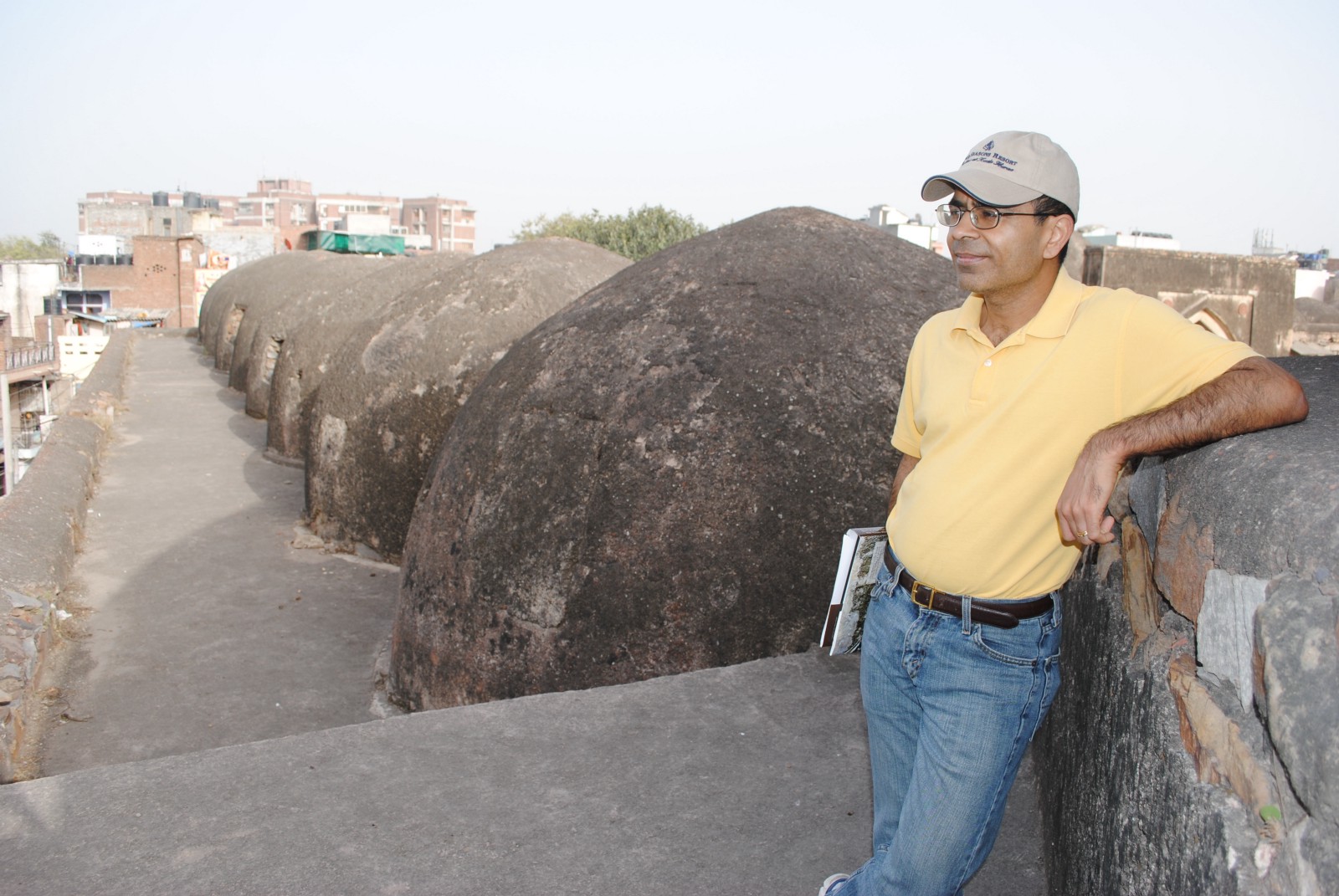
Akhil Sharma stands on the sidewalk waiting for me as I descend the long set of stairs from the Delhi Metro. It is only mid-morning but the street outside Rohini West Metro station is heaving with traffic. I steel myself for the cacophony of shrieking horns and roaring engines. If this were Manhattan, where Sharma lives today, he might be holding a Starbucks cup. But we’re in Delhi, so he sips milky tea from a Dixie-size cup bought from a street vendor for five rupees (about 10 cents). It is mid-February in 2011, Valentine’s Day in fact, and cool beneath an overcast sky.
Sharma isn’t tall, but he seems brighter and more vivid than the other pedestrians around him, as though he were Photoshopped into the wide, bustling street. He wears an orange merino wool sweater, jeans and elaborate running sneakers with shiny trim. In this part of north Delhi, men wear kurtas or collared shirts with polyester trousers, and flip-flop sandals or pleather shoes, not cushioned Reeboks. His dark hair is cropped nearly to a crew cut, and flecked with silver. He wears black wire rim glasses.
Sharma isn’t tall, but he seems brighter and more vivid than the other pedestrians around him, as though he were Photoshopped into the wide, bustling street.
I took the Metro across the city’s sprawl, from New Delhi, the British-designed part inaugurated in 1931, up past Old Delhi, the northern section founded by a Mughal emperor three hundred years earlier. I’ve come to nearly the end of the line, to a northwest neighborhood that tourists have no reason to visit. I had been living in Delhi nearly five years, but I would see the city in a different way: through the eyes of an author whose first book is set in the city of his early childhood and whose second book starts here before its narrator emigrates to the U.S. I’ll follow Sharma as he visits relatives and family friends in three neighborhoods of north Delhi, as though doing a walking tour of his childhood memories. We’ll be traversing different worlds, touring the love and loathing of families, the present overlaid on the past, and places and memories transformed into fiction.
Sharma is the author of An Obedient Father, a novel that won the PEN/Hemingway Award in 2000. In 2014 he will publish his novel Family Life after 13 years of struggle. Writing it was like a “nightmare, like chewing stones, chewing gravel,” he told The Guardian. A couple years after our walk in north Delhi, I sat with Sharma on a bench in Central Park one summer day as he took a phone call from his literary agent to discuss a draft of the novel. When he finished the call, Sharma calmly told me Family Life might be axed.
In 2014 he will publish his novel Family Life after 13 years of struggle. Writing it was like a “nightmare, like chewing stones, chewing gravel.”
But the toil will pay off: In June 2016 the book will win 100,000 euros for the International Dublin Literary Award, the world’s largest prize for a single novel. But all this is in the future. Today we are focused on the past, where his two novels are grounded. Sharma’s memories of Delhi — quiet dirt lanes where he played cricket, cinemas showing Bollywood matinees, and rooftops where he napped — form the backdrop of An Obedient Father and the start of Family Life. Sharma grew up in New Jersey but spent summer vacations in Delhi with relatives through his early 20s. He was born in Delhi in 1971 and his family immigrated to the U.S. in 1979, when he was eight. A couple years later, tragedy struck. Anup, Sharma’s 14-year-old older brother, hit his head in a swimming pool in Virginia. He remained severely brain damaged for the rest of his life. Family Life is based on the accident and its destructive force on a family.
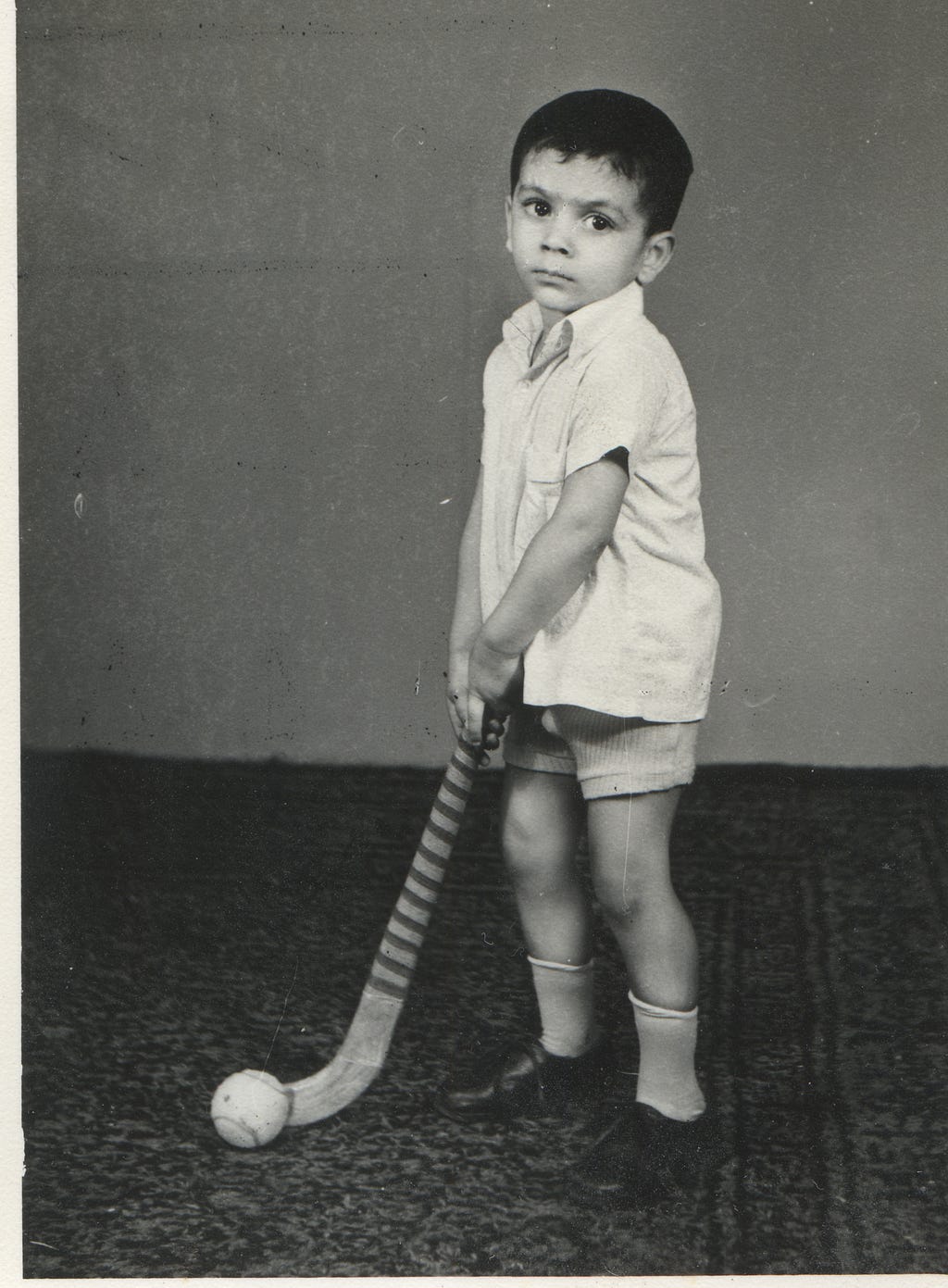
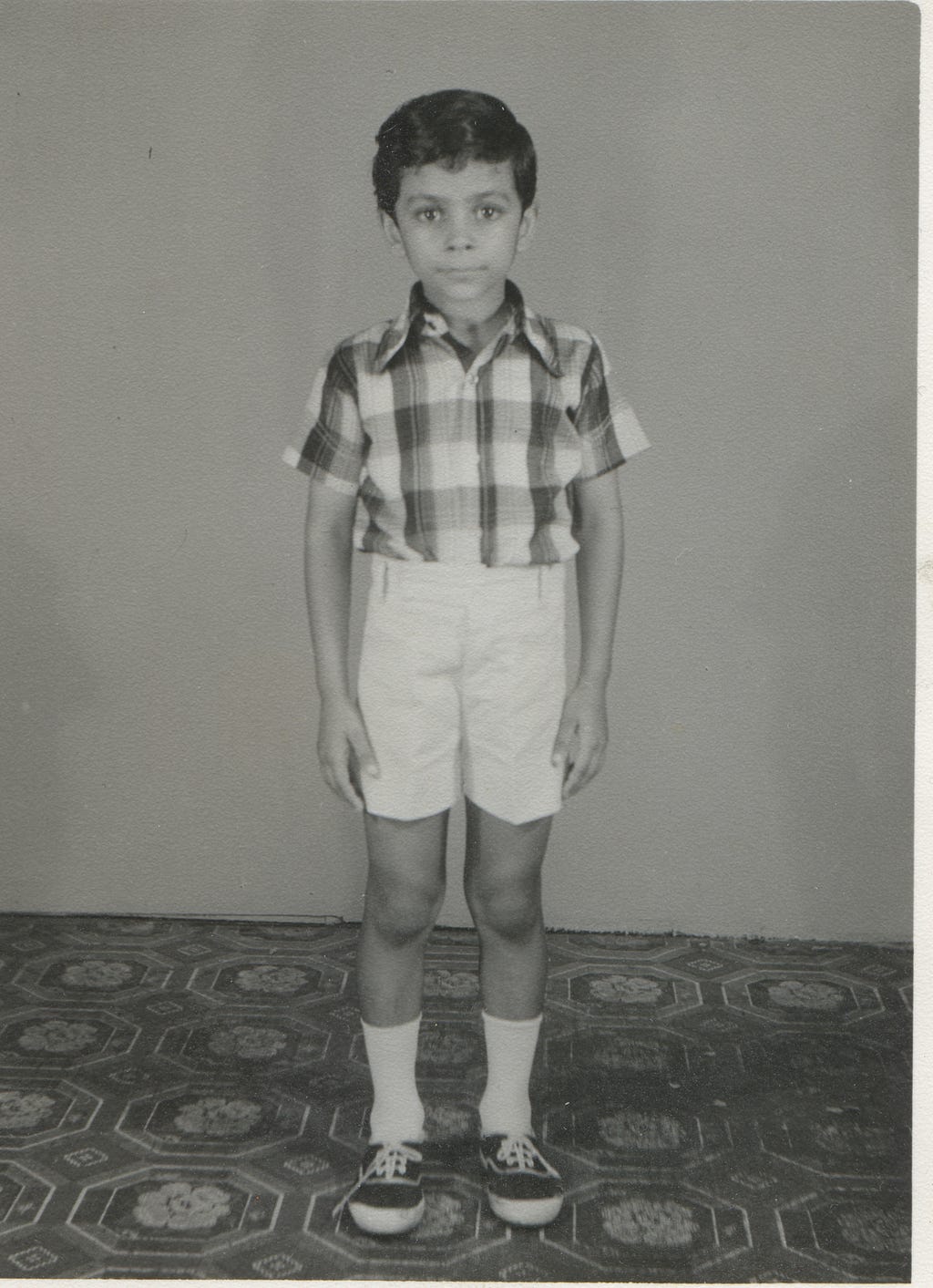
Akhil Sharma as a boy in Delhi. Photo: Courtesy of Akhil Sharma
I was living in New York when I first read an excerpt of An Obedient Father. I was struck by the brutal yet beautifully-written tale of corruption, incest and the unraveling of Ram Karan, a repugnant narrator living in Delhi. I had no inkling that several years later I would move to Delhi as a journalist and that India’s capital would become my home. Places mentioned in the novel — the popular neighborhood of Defence Colony, the chaotic Inter-State Bus Terminal (ISBT), the opulent Oberoi hotel where the lobby smells like citrus, the wide boulevards of New Delhi designed by British architect Edwin Lutyens — would one day become as familiar to me as places in Manhattan. And on this unusual tour, I would get to see Delhi’s streets, houses and landmarks, introduced to me in An Obedient Father, with the ideal guide. The world created in Family Life lies in the future when the book is finally published, but I would get to see its foundations in the Delhi of Sharma’s past.
Our first stop is the home of an uncle and aunt in Rohini, a nondescript neighborhood I hadn’t heard of before. Sharma and I walk on the edge of the street next to the crumbling sidewalk while casually dodging motor scooters and bicycle rickshaws tinkling their bells. Roadside vegetable carts are piled with mounds of large black grapes and stacks of greenish, lumpy oranges. We turn onto a side street lined with homes and shops bearing signs that read “Cyber Café and Computer, Hari Om Communication” and “World Vision India Pentecostal Church.”
Sharma stops when we reach a one-story white concrete house bounded by a wall and metal gate. There’s a four-story apartment block across the street. Laundry hangs from the balconies: shirts, pants, and pink bed sheets printed with big flowers flap in the breeze. The clean smell of laundry detergent powders the air.
We turn onto a side street lined with homes and shops bearing signs that read “Cyber Café and Computer, Hari Om Communication” and “World Vision India Pentecostal Church.”
A gray-haired woman in her 70s with large glasses comes outside and greets us. This is “Auntie.” Sharma introduces me briefly in Hindi and she smiles, then hugs me. Her name is Shanti Sharma and she wears her hair in a long braid down her back, with stray hairs secured by straight barrettes behind her ears. Inside the house, we step into a bedroom where her husband, J.N. Sharma, known simply as “Uncle,” sits up in a raised hospital bed. Uncle has liver-spotted skin, a large, hooked nose and shiny eyes. He greets me excitedly though I can’t understand his murmurs and he grips my hand in his warm fist.
Their surname happens to be Sharma, but Auntie and Uncle aren’t blood relatives. Still, they are precious to him. “There are many, many ways this family saved us,” he tells me. When Sharma was a child, Uncle and Auntie were tenants in his parents’ house in Delhi. Later their paths crossed again in the U.S. when both families were living there.
Sharma matter-of-factly explains that his family and relatives were uneducated, rough and unscrupulous. I’m reminded of the world of Ram Karan, the unsavory narrator in An Obedient Father, an education department administrator who collects bribes from schools. Uncle and Auntie were different from Sharma’s relatives. Uncle was a young economist at Delhi University and seemed refined and respectful compared to Sharma’s family. “They were the only really decent people we knew,” Sharma recalls. “They spoke to children in the formal ‘you.’ They were respectful and never spoke meanly. We assumed they were rich. They seemed like they belonged to a different world.”
If his parents hadn’t immigrated to the U.S., Sharma says he would have been a kid who got into trouble. Becoming a writer would have been unimaginable; no one read books in his family much less wrote them. Later Sharma found out that Uncle pulled himself out of poverty to become educated.
Becoming a writer would have been unimaginable; no one read books in his family much less wrote them.
Auntie and Uncle were also important to Sharma and his family after his brother’s accident. In the summer of 1981 when Sharma had just turned 10, his family was visiting relatives in Arlington, Virginia. His older brother Anup snuck into a swimming pool at an apartment building, dove in, and hit his head on the bottom. He remained underwater for three minutes. Anup required 24-hour care for the rest of his life. He was fed through a stomach tube, cleaned after bowel movements, and had to be turned to prevent bedsores. It was an unfathomable twist of fate for a family already struggling to adapt to the U.S. and cope with its own problems.
At the time, Uncle was an economist at the World Bank in Washington D.C. Sharma’s parents didn’t speak English very well so Uncle helped interpret for doctors and nurses. Auntie came to visit Anup and the grieving family in the hospital every day for the next 11 months. Auntie recalls visiting during the harsh winter and her shoes filling with snow as she made her way to the hospital.
Auntie recalls visiting during the harsh winter and her shoes filling with snow as she made her way to the hospital.
Auntie, Sharma and I are sitting in the living room, which is furnished with a large double bed and heavy wooden chairs. A TV sits in one corner covered with a white doily. The freshly-painted yellow walls are bare except for a plastic clock ticking loudly from its perch above the doorway. As we sit, a young female cook sets stainless steel plates on the coffee table in front of us. Sharma and I each have a bowl of plain curd (yogurt), and a hot parantha, a flat bread stuffed with onions and potatoes. A hunk of melting butter slides across my parantha and settles in an oily pool at its center.
Uncle and Auntie bought this house in Rohini in 1989 for about $11,000. Back then, the area was desolate and undeveloped, a “horrible area” where rain flooded the streets. It was so remote that milk and vegetable vendors didn’t come here, but within two years the area began to develop and shops opened as more people moved there. When the Metro opened in 2004, the area was transformed and property prices shot up. In 2011, the house is worth about $170,000, I’m told.
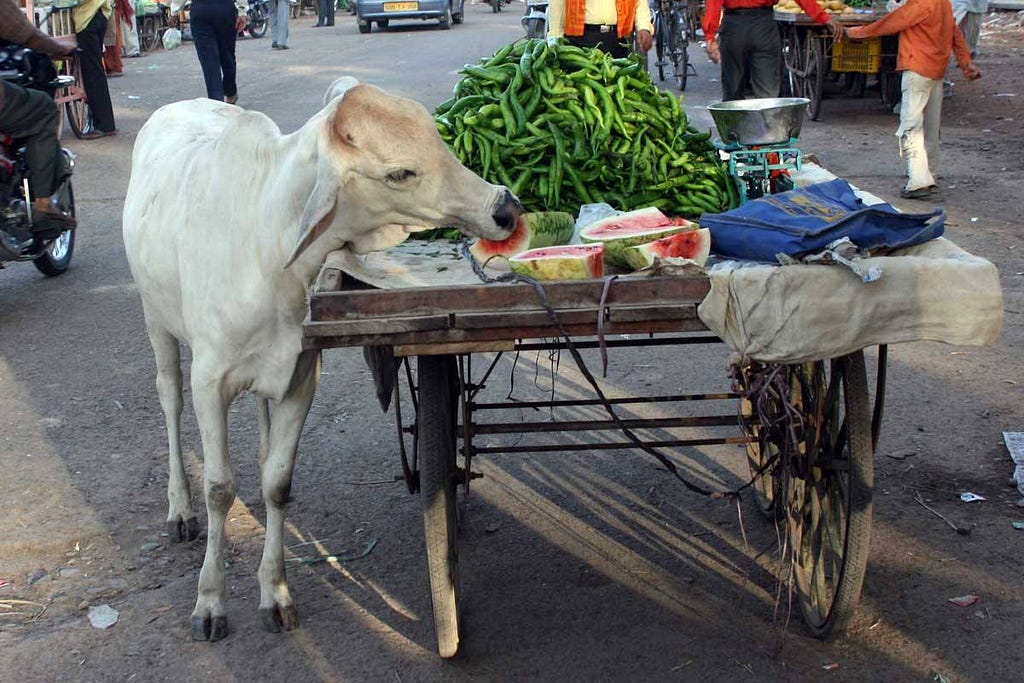
Fruit, vegetables and cow in Delhi. Photo: Risha Hess
Auntie wears a teal chemise with a gold paisley pattern, loose mauve pants, a soft blue-gray sweater vest and a purple shawl. This muted palette gives her a gentle, wooly aura. She wears a slender gold bangle on each wrist. Auntie reckons she is 78 or 79. Sharma remarks that she looks much younger than his own mother, who is only 70. “Your mother and I have had different lives,” she reminds him gently.
The years after Anup’s accident were bitter. Sharma’s family was living in Queens but because Anup was hospitalized in Virginia, he and his mother moved there for a year. Sharma’s father had a clerical job with New York State’s insurance department and commuted from New York to Arlington every weekend. The family’s health insurance did not fully cover Anup’s care so money problems created further strain.
Sharma was already a sensitive child and the accident made things worse for him. “I used to cry a lot in school. Everything felt really hard, impossible.” He remembers not wanting to visit Anup in the hospital; he wanted to be home watching TV like other kids. “At that time I felt no gratitude for anyone,” he recalls. “I just remember being there alone.” His mother was resentful of relatives who did not come to the hospital. “She thought if you’re not there all the time you’re being disloyal. The only person my mother feels awe for is this Auntie.”
After the accident, Sharma became “crazy,” he states. “I was an unusually imaginative child and this was an unusually severe trauma.” His childhood whimsies turned into behavior that Sharma describes as OCD-like. It lasted years. Some of the behaviors included walking with his fingers crossed or obsessively counting his knuckle joints to ward off evil. Sharma became terrified of the dark and of supernatural things. At one point, he says, “I thought God would kill me and replace me without anyone knowing.” He recalls a teacher sent him outside because he couldn’t stop crying in class, so he walked into a field while sobbing. That happened after Sharma imagined God spoke to him and asked if he would switch places with his brother. It was his own reply that distressed him: “No.”
“I was an unusually imaginative child and this was an unusually severe trauma.”
After a year in Virginia, the family moved to New Jersey so Anup could live in a long-term care facility that happened to be in a bucolic suburb. “It was the first time I was out of an urban space. I couldn’t believe how green and quiet it was,” Sharma remembers. Eventually the family bought a house in Edison, New Jersey and Anup lived at home.
Home life was excruciating and that experience is reflected in Family Life where the narrator’s family“fought so much that the walls vibrated with rage.”Sharma’s father was overwhelmed with maintaining a house and “became hysterical after moving in,” Sharma tells me. The American tradition of do-it-yourself and hardware stores was an alien concept; in India there are plenty of low-cost electricians, plumbers and workmen on hand. “He didn’t know how to do stuff. I remember him swearing about how to drain the heater.” In Family Life the father descends into alcoholism and depression. “I want to hang myself every day,” the father bitterly tells his son.
Sharma’s mother was already “unpleasant” and the accident only made things worse. She chided people for their incompetence, told them they were bad. “My parents fought like mad dogs,” Sharma says. “My mother’s disrespect for my father was clear.” Even as a child, Sharma was convinced that his parents were not role models. “I thought, ‘This is not the way. This is not going to lead to happiness.’”
At home, nurses cared for Anup in two shifts, from 8am to 4pm and 10pm to 6am. The family helped too. Young Sharma bathed his brother in the morning, cleaned him after bowel movements, exercised him, fed him, read to him, moved him from side to side hourly.The only thing he didn’t do was replace Anup’s “G tube,” the plastic tube that fed directly into his stomach.
Young Sharma bathed his brother in the morning, cleaned him after bowel movements, exercised him, fed him, read to him, moved him from side to side hourly.
I ask Sharma if Anup was ever able to communicate after the accident. He thinks for a moment. “At one point he would sometimes smile. But the last time that happened was years ago.”
It is now past noon and we needed to head to our next destination: Sharma’s childhood home in a neighborhood called Model Town. We get up to leave and say goodbye to Uncle in his bed. Auntie walks out with us and I request Sharma to ask how she can be so resilient. She nods and smiles. He translates her reply: “‘What else could I do if I cried all day. What else is there? This is all a part of life.’”
Outside the house, some marigolds are starting to bud in a strip of soil. Auntie gestures at them and Sharma translates. “She says her husband likes to look at flowers.” He beams at Auntie affectionately. “Oh man, these people are wonderful.”
Sharma and I walk back on the traffic-choked streets to the Metro station. He has been on the Metro only once before so I show him how to buy a token. At a counter, we pay 23 rupees for a blue plastic chip, which we flash over the turnstile. The plastic gate parts in a mechanical whisper to let us pass. “Cool!” Sharma exclaims.
The sleek train eventually emerges above ground onto elevated tracks.
Beneath a slate-gray sky, we bullet past low houses with walls discolored by black smudges. We get off at Model Town station, where Sharma and I step onto a shiny, modern platform that contrasts with the ramshackle houses and garbage piles glimpsed during our subway ride.
The street noise seems even more overwhelming, if that is possible. Buses roar, horns screech and a jackhammer pounds. Sharma waves at the river of traffic and the congested storefronts. “When I was a child, all this was just dust,” he says. We turn onto a side road, past the “Bombay Fire Hairdresser” and a snack stall where men rhythmically pat chapati with flour-covered hands.
“When I was a child, all this was just dust.”
Sharma says there used to be an open sewer here where he and his friends retrieved stray cricket balls. “We used to play cricket in this street because it was so empty.” Drying cow dung patties used to line the road, to be burned for fuel later. There was a swampy wilderness at the end of the road where he and his brother used to roam.
“There were big changes after 1991,” Sharma recalls. “The buildings got taller.” Before 1991 India had a closed, stagnant economy. But reforms ushered in by finance minister Manmohan Singh, the soft-spoken Oxbridge-educated economist who became prime minister in 2004, paved the way for a modern economy. As we walk, a tonga horse-drawn cart, passes us. The horse trots briskly alongside careening cars and its hooves clop loudly on the pavement. This scene is quintessential India: old and new jostling against each other, often quite literally.
Our destination is a three-story house behind a white wall. Sharma lived here as a child with several aunts, uncles and their children in a large extended family. It is dim inside the house. Fluorescent lights wanly illuminate a sitting room occupied by three men. A huge velour tiger skin hangs on one wall. An older man with gray hair sits in a worn arm chair eating lunch. He scoops lentils with his fingers and pieces of roti. This is Uncle Chachaji, a gym teacher at a local school and the second-youngest brother of Sharma’s father. He watches a television showing a Hindi movie. Uncle Chachaji wears a dingy button-down shirt with a blue-checked lungi — asarong.
This scene is quintessential India: old and new jostling against each other, often quite literally.
Another Uncle, Kul Bhushan Gaur, sits in the other worn armchair. He also has gray hair and wears a blue sweater vest. Sharma and I sit on a twin bed that is made up like a sofa. We sit opposite a middle-aged man who is Sharma’s cousin.I’m told that he’s a lawyer. The cousin sits on another bed-settee and coolly watches me watching him. Sharma tells them that I am a journalist writing about him. “Him?” sneers the cousin. “Why, is he some kind of celebrity?” Sharma doesn’t react.
“He’s not a celebrity,” I reply. “I read his book when it came out.”
“Do you think you will give the right picture of India?” the cousin asks me accusingly.
“I don’t know if it will be the right picture. It will be just a picture, a glimpse through the eyes of one person,” I say.
There are some family photos on the bland walls. Sharma points out the various relatives in the photos: this uncle, that cousin. “There are very few good-looking people in my family,” he observes.
I laugh at his bluntness. “What do you mean?”
The cousin-lawyer interjects. “Our family has rustic roots. We are from Haryana. We are farmers. Short.”
After a moment Sharma heads toward the back of the house to greet another aunt. We enter a cavernous dining room with a heavy wooden table and a refrigerator in one corner. A row of windows lets in stark white light but it doesn’t penetrate the dimness cloaking the room. An older gray-haired woman sits alone at the table eating roti and vegetables from small metal dishes. Her fingers are wet with food. Sharma greets her and we sit. On our way here he warned me that this aunt was extremely unpleasant, possibly crazy, and made hateful remarks to family members. But from their cordial interaction I would not have known.
On our way here he warned me that this aunt was extremely unpleasant, possibly crazy, and made hateful remarks to family members.
Sharma looks around the room with its high ceilings. “For a little child, all these places seemed so large,” he says. “The rooms echoed.”
The author as a boy in Delhi. Photo: Courtesy of Akhil Sharma.
Near the dining room, he shows me a small outdoor courtyard, a square of empty space at the center of the house. Here, clothes were hand laundered, tomatoes boiled in a cauldron to make ketchup, and wheat was ground with mortar and pestle. Sharma and his brother used to play cricket here too. A rusty metal basketball hoop still hangs from a wall.
We climb to the second floor where another aunt and uncle live. Their living room is brightly lit and it lacks the feeling of stagnant time like in the apartment downstairs. A balcony looks out over a “tank,” a man-made pond slightly larger than a soccer field circled by a tree-lined path. There are plastic boats in the murky green water and a few couples languidly paddle around. For India, it’s quite an impressive view.
“Wow,” I say.
Sharma gazes at the pond. “This is really hard-core luxurious,” he agrees. In Manhattan he lives on the Upper West Side a couple miles from where I used to live near Central Park. In India, we’ve re-calibrated our standards of luxury.
It’s a tranquil scene but noise still drifts through the air: dogs barking, honking car horns, shrieking construction machinery and squeaking pedals turning in boats. “It used to be so quiet,” says Sharma. “There used to be a dirt path around the tank. I remember as kids we found all these discarded medicine capsules outside. We played with them and put them back together. We had so few things as a child.” In Family Life, the narrator recalls that his family was so thrifty they saved the cotton inside pill bottles and also split matches with a razor blade. This frugality “made them sensitive to the physical reality of our world in a way most people no longer are,” the narrator observes.
In Family Life, the narrator recalls that his family was so thrifty they saved the cotton inside pill bottles and also split matches with a razor blade.
We stand outside on the balcony with Sharma’s aunt, uncle and their middle-aged son. They were living in Virginia when the accident happened. This petite auntie in her 70s wears a maroon cardigan over an ecru sari etched with a delicate maroon design. Jewelry glints on her: a diamond stud in her nose, jeweled earrings and a gold bracelet. Raj Kumar, Sharma’s cousin, explains in English that they went to the U.S. where his uncle was working for Washington Gas. He wears a khaki polo shirt tucked into a voluminous white cloth wrapped around his waist.
Sharma chats in Hindi with his aunt and uncle and I glean that they are talking about the accident, trying to piece together fragments of that day. His aunt says that Anup left Akhil at the library so he could sneak off to the swimming pool at an apartment building.
“I remember living in Queens after the accident,” says Sharma.
“No, you were living in R.K.’s house,” his aunt corrects him, shaking her head.
They continue to piece together fragments of memories, like comparing faded pages torn from different books.
Uncle accompanies us to the top floor, to a barsati, a rooftop apartment where Sharma and his family lived for the first eight years of his life. The weather is cool and pleasant and we have an excellent view of the palm trees surrounding the pond. The apartment is vacant so the door is padlocked. Inside, sunlight pours in from two windows onto a dusty bare bed and desk. There’s a small boombox radio on a shelf and an exercise machine that looks like an antique ski machine. The rooms are nearly empty, yet they seem to pulse faintly with ghostly memories.
“I remember being cold and lying in bed in the winter,” says Sharma. “Catching flies on the balcony, feeling a tickle. Watching boring TV movies.”
“You had a TV?” I ask. It was the 1970s in India.
“Yes, but there were no channels.” He pauses and looks around the room. “I remember intense emotions but I have little actual memory of things.”
The bathroom is in a separate room outside on the roof. There’s just a toilet in the corner, a spigot and a drain in the floor. The toilet seat has wide grooved ‘wings’ on the side so someone can squat on top rather than sit if they prefer. “There were few people with western toilets,” notes Sharma. “I was very imaginative as a child. I used to clog the drain with a shirt, so the floor would fill with water, and pretend I was swimming.” This rooftop and bathroom appear in Family Life. At the outdoor sink, beneath a “sky full of stars,” the father brushes his teeth until his gums bleed and he spits blood.
“I was very imaginative as a child. I used to clog the drain with a shirt, so the floor would fill with water, and pretend I was swimming.”
A metal ladder leads to the roof of the apartment, and Uncle is suddenly clambering up. Next, Sharma climbs up and I join them. Electrical pylons squat in the distance. A flock of birds, inky black hatches, suddenly race across the sky overhead. A row of three-story concrete buildings sit across the street. “Those buildings used to be one floor,” observes Sharma. There was a swamp where the pylons stand today, he adds. Family Life describes Delhi in the 1970s: quietness, roads so empty of traffic that children played cricket in the middle of the street.
Back downstairs we have tea and snacks in the more-welcoming second-floor apartment. We sit at the dining table and munch sweet round cookies, rectangular fried ones, and namkeen, a snack of puffed rice, peanuts, chopped green chili and spices. Uncle and Sharma chat in Hindi and I gobble some cookies. They reminisce about the days when they brought their wheat to the local miller for grinding. When they picked up their flour, the miller gave them free cookies. Now they buy their flour at the store, along with packaged cookies. I reach for another one and bite into it.
Our next stop is the Old Vegetable Market, where Sharma used to spend summer holidays with relatives. On the street outside we hail an autorickshaw and Uncle negotiates. For 40 rupees (less than $1) the three-wheeled buggy wends a few miles through raucous traffic to a busy junction with a clock tower. The ghanta ghar, ‘clock house,’ is a white cement obelisk that appears often in An Obedient Father as its narrator stops by a roadside dhaba for a snack or heads home to the Old Vegetable Market. As we drive past, Sharma notes that the clock was stopped for years, its hands stuck in time. The tower’s concrete was cracked and scarred. It was only after India’s economy opened in 1991 that the clock displayed the correct time again.
It was only after India’s economy opened in 1991 that the clock displayed the correct time again.
We get out of the autorickshaw and walk past vendors selling piles of oranges, bananas, garlic and dark, oval berries from bicycle carts. Other street vendors sell all kinds of goods spread on the ground: colorful bangles, plastic toy cars, toy guns, sponges, clown dolls and plastic storage containers. These days, there are no vendors lighting kerosene lamps resembling “iron-stemmed tulips,” as there were in An Obedient Father.
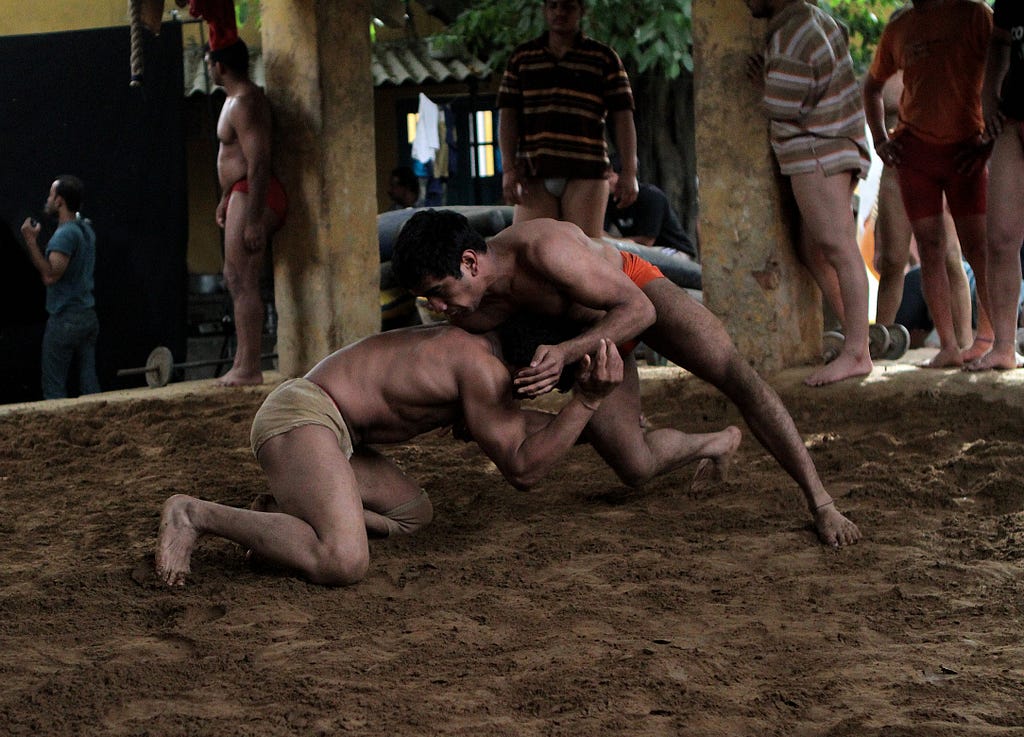
Sharma turns into an alley and we pause at the open doorway of what looks like a temple. It is a temple devoted to a god similar to Hanuman, the Hindu monkey god; it’s also a gym for wrestlers. Inside, two beefy young men wearing only red and green underwear grapple with each other in a wrestling ring filled with rich, brown dirt resembling brown sugar. The wrestlers have other duties, notes Sharma. “They are also minor gangsters hired to seize property,” he adds as the men clutch each other’s waists and bore their heads into each other like young bulls.
Wrestlers practice in north Delhi. Credit: Fehl Cannon
There’s a narrow, winding staircase and before long a few young men appear over the banister to watch us. In Hindi, they call to Sharma who asks me, “Do you want to go upstairs?”
“Sure,” I reply.
We climb the stairs. A yellow plastic mat painted with a red circle covers the entire floor upstairs. A poster of an elephant god sits on a window sill next to cones of incense releasing tendrils of fragrant smoke. Half a dozen young men wearing briefs and loin cloths surround us and look at us curiously. Sharma speaks to them in Hindi. He learns that one of the men is a national gold medalist in wrestling. The men seem delighted to have visitors and are keen to show off. They start trotting in a circle like young horses to warm up and seem crestfallen when we tell them we have to leave.
He learns that one of the men is a national gold medalist in wrestling. The men seem delighted to have visitors and are keen to show off.
Sharma and I return to the main road, packed with small shops selling gold, religious paintings, sacks of rice, and Nokia cell phones. We pause at a small church with dilapidated carved wooden doors wedged between buildings. It is a dharamasala, or a rest house, built in 1939 that appears in An Obedient Father when the narrator searches for a priest to give rites on the anniversary of his wife’s death.
We turn down another alley, past a stand where a man presses clothes with a giant iron filled with hot coals, and reach a quiet courtyard with a few homes. Young men lounge on old scooters parked in the courtyard and chat as though they are sitting on park benches. We stand in front of a multi-storied house with a lime-green faux brick façade and rickety balconies that look like fire escapes. A “Happy Diwali” sign hangs over a gray door even though the Hindu festival of lights was in October, nearly four months before.
This is the home of Sharma’s aunt and uncle, his mother’s sister and her husband. Sharma hasn’t been here since 2001. He spent childhood summers in this house and liked coming to India in spite of the scorching summer heat.
A “Happy Diwali” sign hangs over a gray door even though the Hindu festival of lights was in October, nearly four months before.
“I wasn’t lonely because all my cousins were here,” says Sharma. “I didn’t want to be at home in New York.” In India, there were always people around. As if on cue, a man emerges onto the top balcony and leans over to watch us. This house is reminiscent of the narrator’s home in An Obedient Father. I picture corpulent Ram Karan stepping onto the balcony and watching a box kite with a candle floating in the night sky. I imagine him shutting the windows as his daughter screamed so the neighbors wouldn’t hear.
Sharma continues. “We were poor but we didn’t think of ourselves as poor. We had an aggressive desire for education.” Sharma’s cousins went onto professional careers. One is a cinematographer, another a school principal, two are scientists. Then he mentions his family is of the Brahmin caste, so he supposes that is why they still felt culturally elite.
The lugubrious call to prayer sounds from a nearby mosque. By now it is late afternoon and sunset is approaching. Sharma remembers childhood mischief where he used to “catch mice and throw them into the squatters’ colony” — the small warren of shacks nearby.
“You want to look in the squatter colony? It’s going to smell,” he warns. In reality, it’s not bad at all. The lanes in the colony are paved and criss-crossed with electrical wires as power is siphoned from a main line. One house has a hill of tiny flip-flop sandals outside its door, hinting at a TV and a gaggle of children inside.
“You want to look in the squatter colony? It’s going to smell,” he warns.
We return to the main street and pass tiny storefronts selling kachori — fried doughy snacks — and a man carefully cutting a piece of wood on a chattering jig saw. A lean striped cat slinks between parked vehicles. A woman covered with a black veil eyes me as we pass each other. This busy street also appears in An Obedient Father, when riots are poised to break out after the 1991 assassination of prime minister Rajiv Gandhi by a female Tamil Tiger suicide bomber. In that scene, the street was forbiddingly empty as people peered down from their rooftops, “watching like a circus”, in anticipation of lynchings, lootings and riots.
On the main street, a magazine vendor tends to his wares spread on a plastic sheet on the ground. When Sharma was a boy there were only Hindi newspapers and the occasional English-language Indian one. Today the tarp is covered with a colorful variety of Indian and foreign magazines. There are copies of Elle, GQ, Men’s Health. A Cosmopolitan cover blares “Love! Sex! Men!” — a sight unimaginable in the closed India of Sharma’s youth.
We forge on and dodge a couple licking Fudgesicles, then a wooden cart heavy with translucent blocks of sugar covered with a net. Sharma reminisces about eating spun sugar as a child and pushing his way through a scrum of kids to drink a bottle of Campa Cola. Sharma points across the street to a brick rooftop and a sliver of sky between two buildings. As a boy Sharma and his cousins used to watch morning Bollywood matinees at the local cinema then nap on that rooftop. Movies played in Delhi cinemas for 25 or 50 weeks, since there were so few options, recalls the narrator in Family Life. In the distance stands the tall brick chimney of a textile mill. A bell at the mill would ring at 1pm to signal lunch — and disturb Sharma’s rooftop naps.
As a boy Sharma and his cousins used to watch morning Bollywood matinees at the local cinema then nap on that rooftop.
From high up, the rooftops would form their own landscape. I can see why the narrator of An Obedient Father would have concocted a story for his granddaughter about a man who walked across Delhi from roof to roof, using ropes and ladders to cross from the balcony of their home to the squatter’s roofs to the Old Clock Tower.
The oppressive noise and crowds fade when we turn down a narrow lane of residential buildings. Some of them are new and tall, showing signs of recent wealth. Others are unrenovated and still have creaking old wooden balconies with ornate filigree. The afternoon light is growing dim but we see a refined older woman with a bun of white hair approaching us. She wears a cream-colored vest and an aqua salwar kameez. A white dupatta scarf flows over her shoulders.
“Mamiji!” Sharma calls out. This is another aunt and we are going to the house where she lives with a large extended family.
Just then a mustached middle-aged man zooms past on a scooter and stops abruptly. “Akhil!” he cries. This is Akhil’s cousin, the son of the aunt on the street.
The family’s home is an unremarkable multi-storied building. We walk up a menacingly steep stone staircase. “Every single person has fallen down these stairs,” Sharma warns. The home is built around a large courtyard so that an empty shaft of air occupies the center. Sharma remembers spending summers here visiting his cousins. “We’d lay on charpoys and listen to the radio,” he says. We sit in a parlor overlooking the courtyard on heavy wooden chairs with those white doilies.
We walk up a menacingly steep stone staircase. “Every single person has fallen down these stairs,” Sharma warns.
Akhil’s cousin is a lawyer and speaks English but the two of them chat in a mix of Hindi and English. A large plastic doll with blonde hair sits like a mute guest on the settee next to Akhil’s cousin. I look at the black-and-white photos in a recessed alcove next to a blue stuffed bunny. Soon, an uncle with a salt-and-pepper mustache enters the room. He has lived in this house all his life, for the last 75 years.
After many polite protests, Sharma manages to decline invitations to stay for dinner. By the time we leave, it is dark. Uncle accompanies us to the main street, which roils with commerce and noise. Streetlights illuminate the road and shops, including a liquor store, glowing with fluorescent lights. Uncle says there was a neighborhood petition to prevent the liquor store from opening but it didn’t work. Sharma and Uncle gaze at the shop and tsk tsk disapprovingly.
“It’s horrible!” cries Sharma. I’m surprised by their reaction since India is the world’s largest market for whiskey and liquor is ubiquitous at parties and dinners. But this part of Delhi seems still rooted in a more conservative, traditional life — even if a street vendor sells copies of Comso touting sex advice.
The cousin insists on driving us to the Metro station since a group of aunties have to go to a wedding reception. We stuff ourselves into the car overflowing with matronly flesh and saris. I am crammed against the door, practically sitting on an auntie’s lap. We reach the Metro station and I profusely thank everyone as I extract myself from the car. Sharma and I carefully cross the street throbbing with homicidal peak-hour traffic and we enter the Metro station.
The tour ends where it began — at a Delhi Metro station. We will go to opposite ends of the city, Sharma back to Rohini West and me to south Delhi. Before we part ways, I ask about the family member I didn’t meet but who was still at the heart of the day’s memories and conversations, much like the courtyard, that column of air, at the heart of a Delhi home.
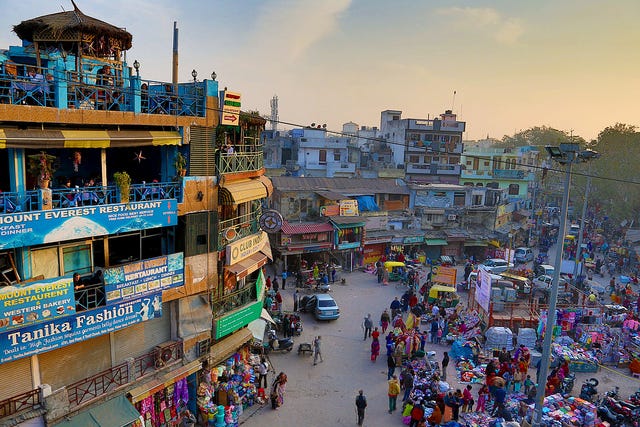
A Metro station in Delhi. Photo: Delhi Metro
Sharma muses about his brother Anup. “When I was a child, I thought I didn’t like him.” After the accident, Sharma remembers, “I cried so much. I didn’t know how much I loved him. I want the people in my life to know how much they matter to me.” This sentiment is echoed in Family Life when it is published in 2014.
Family Life will paint scenes of an older brother boiling frozen corn for his younger brother after school; stopping the bullying of his younger brother at their new school in Queens; and fulfilling his parents’ dreams by passing the grueling entrance exam for the Bronx High School of Science. He would have been a surgeon, muses the book’s narrator. Yet, like the narrator, the brother is also someone who “enjoyed bullying people,” who, fed up with studying for his exams, grabs a kitchen knife and screams at his mother, “Kill me!”
The swimming pool accident cruelly cut short the promise of a young life and cast ripples of anguish over a family for years. Yet “occasionally there were moments of kindness,” says the narrator in Family Life.
In early 2012, I will meet Sharma again in Delhi when he returns with his family to scatter his brother’s ashes in the Yamuna River.
In early 2012, I will meet Sharma again in Delhi when he returns with his family to scatter his brother’s ashes in the Yamuna River. Anup had been ill for years and had difficulty breathing and would aspirate phlegm. One morning, he couldn’t breathe and had a heart attack. Anup was 44 years old when he died after decades of care from his family.
As we stand near the turnstiles to enter the Metro, Sharma and I are the only people not rushing to get somewhere. Waves of people part around us like a river coursing around rocks that futilely block surging water.
“We don’t realize how much people matter to us,” Sharma tells me pensively as we say goodbye. It’s a rare moment of stillness in this busy crossroads, a final moment of convergence before we part ways and Delhi’s current flows on.
Hello, and welcome to my week-by-week review of the world. Today I am reviewing the sneeze I had.
Except for a woman I dated who had a condition that prevented her from sneezing or French kissing, almost everyone sneezes. When you sneeze, it feels a lot like what I imagine a really quick exorcism feels like. I’ve never been exorcised personally, so I’m going with my gut on this.
The sneeze I had came on so quickly I didn’t have time to put my hand over my face and the spray went everywhere. It made me wish I had been standing over a salad bar so there would have been a sneeze guard handy. That’s why if I’m about to sneeze at Olive Garden I immediately sprint for the salad bar. Maybe I should have one of those installed in my house. I’d get a lot of free salad that way.
Unfortunately without a sneeze guard anywhere near me, the spray drifted through the air, covering all my belongings in a light coating of sneeze. I couldn’t see it of course, but I knew it was there. So I had to cover everything in bed sheets to prevent the germs from spreading. It made my house look abandoned which I think attracted the raccoons.
The sneeze came just in time, though, because I had no idea what to review this week. Sometimes the overwhelming number of things I have yet to review can be paralyzing. Should I review a pen cap or should I review a different pen cap? What about reviewing the Great Wall of China or another different pen cap? There are too many choices! That’s when my sneeze happened and it was like fate stepped in and said, “Review that sneeze!”
It was a gratifying sneeze — not like one of those sneezes where you’re right on the edge of sneezing and it never comes and then you want to kill yourself. This one was hearty and made me feel as if I’d unclogged something deep inside me. Almost as if it was something spiritual. But it wasn’t, it was just boogers.
BEST FEATURE: No need for a tissue. WORST FEATURE: I think I sprained my neck.
Please join me next week when I’ll be reviewing lint.
Space exploration has been in the news recently in a way it hasn’t in a number of years. That’s largely a result of the Elon Musk’s company SpaceX announcing detailed plans for a manned mission to Mars. If the most ambitious scenario succeeds, humans will set foot on the Red Planet by the year 2024. Not to be outdone, the CEO of Boeing vowed to get to Mars even sooner. It seems like a proper space race, albeit one in a form befitting the current age of privatized spaceflight. (For a nonfictional look at how we got to this point, Margaret Lazarus Dean’s Leaving Orbit is highly recommended.)
Looking at detailed videos and images that explain how a trip to Mars could be accomplished, and how permanent human habitation might be implemented, a host of fictional treatments of the same subject come to mind. Some novels about space exploration posit it as the next logical step for human society; others treat it as a necessity for the survival of the species. (Sometimes literally.) And still others use the idea of the exploration and colonization of space to explore the flaws and frailties of human society and humanity itself. Here’s a look at eleven novels that come at the notion of the exploration of space from a wide variety of angles and aesthetics.
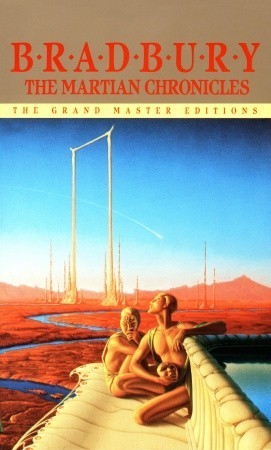
The Martian Chronicles, Ray Bradbury
Ray Bradbury’s collection of stories set over several decades as humanity colonized Mars wasn’t the first book about humans exploring a new world, but the emotional and stylistic range contained within its pages is what makes it impressive. Some of the stories evoke a sense of wonder, while others venture into the horrific. The changing dynamic between humans and Martians (and between Earth and Mars) evokes a number of disastrous and potentially disastrous human conflicts.
Nigerians in Space, Deji Bryce Olukotun
The space programs of two nations are at the center of Nigerians in Space, which focuses on a lunar geologist living in the United States who is recruited to help start a space program in Nigeria. After finishing his novel, Olukotun learned that some of its more speculative elements about a Nigerian space program were far closer to the truth than he had anticipated.
Radiance, Catherynne M. Valente
The idea of space exploration gets an alternate-universe spin in Radiance, set in an alternate 20th century in which the solar system has been colonized using the kind of technology that one might encounter in a Jules Verne novel. The furthest-flung planets from the sun have habitable atmospheres, and bizarre alien fauna complicate matters. Retro technology combined with heady plotting, and some left-field Big Ideas, deliver a compelling narrative about storytelling and new frontiers.
Aurora, Kim Stanley Robinson
Some tales of space exploration take place within the limited lifetime of their characters, and therefore focus on journeys to planets that can be conceivably reached. Other space stories deal with the concept of the “generation ship,” which is built for century-long treks (or longer) to reach the distant stars. Kim Stanley Robinson’s Aurora is a novel about the latter, and the aspiring inhabitants of a planet in the Tau Ceti system. The plot delves into the conflicts they face getting to their destination and settling there.
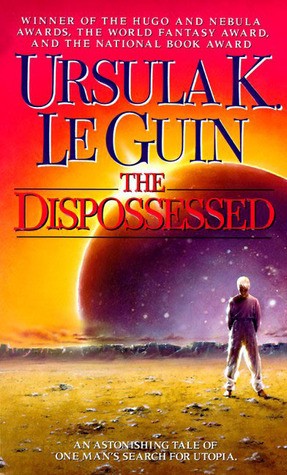
The Dispossessed, Ursula K. Le Guin
A number of the works of Ursula K. Le Guin are set in the Hainish Cycle, a group of stories and novels in the same universe. These books follow the spread human societies across a host of planets. Settlers in these novels stay in touch using a high-tech device known as the “ansible,” which allows for instant communication across vast distances. Le Guin’s classic novel The Dispossessed focuses on the political conflict between a pair of twin planets — one of which has a more utopian system, while the other is mired in a series of ideological clashes.
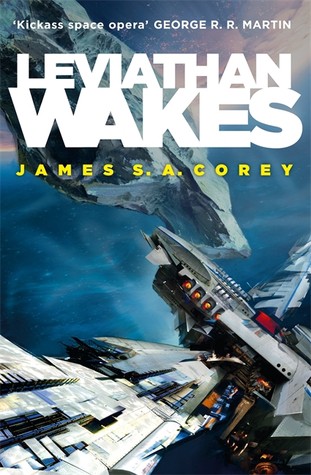
Leviathan Wakes, James S.A. Corey
Colonizing the universe’s planets may seem like a dream for some sci-fi lovers, but there are others who view the possibility as a mere expansion of the Earth’s geopolitical issues. Leviathan Wakes is the first installment of a six book series; you may also be familiar with the TV adaptation, The Expanse.
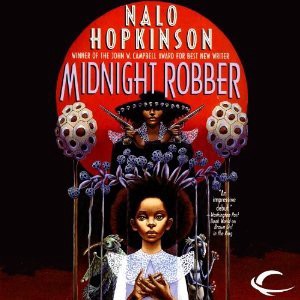
Midnight Robber, Nalo Hopkinson
In Midnight Robber, human exploration of space leads its characters to distant worlds and other dimensions. It begins on the planet of Toussaint, where the young protagonist Tan-Tan and her father reside. After an act of violence, they flee to an alternate version of the same planet, known as New Half-Way Tree. As Tan-Tan grows older she begins to understand the alien species living in this new world.
The Dark Beyond the Stars, Frank M. Robinson
Frank M. Robinson’s award-winning novel is set on a generational ship captained by an immortal human in search of extraterrestrial life. Robinson memorably captures what life on a long-running vessel might be like; shifts in the shipboard society, mechanical issues, and factional conflicts all play a part in how the book unfolds. Throw in an amnesiac protagonist and a host of mysteries, and the result is a compelling work where the journey truly is the destination.
Seveneves, Neal Stephenson
In some novels about space exploration, humanity’s primary motivation for venturing into the unknown is the desire to see the rest of the cosmos. In Seveneves, it’s done out of necessity; A mysterious event destroys Earth’s moon, leading to a planetary bombardment of asteroids that will render the planet’s surface uninhabitable. Stephenson takes the reader through the mechanics of devising a plan to create a sustainable society in space in a limited amount of time, and then leaps forward thousands of years to show how these events have altered human evolution and society.
The Dark Forest, Cixin Liu
Like other space exploration books, Cixin Liu’s Remembrance of Earth’s Past trilogy also features a spaceship traveling vast distances for a long period of time. What makes his novel unique is the ship’s occupants are aliens from a distant planet, and the world they’re looking to colonize is our own. In the trilogy’s second book, The Dark Forest, human technology has advanced to point where Earth has a state-of-the-art spacecraft of its own, with the ability to venture further than any techonology has before.
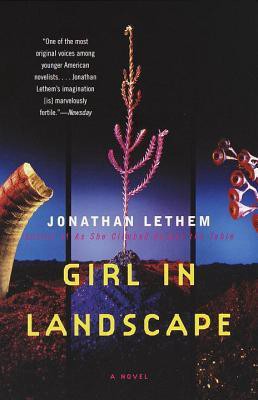
Girl in Landscape, Jonathan Lethem
Drawing parallels between space exploration and the United States’ westward expansion in the 19th century is something several writers have done across multiple mediums. (Firefly is probably the most prominent “space Western” that comes to mind.) Jonathan Lethem’s Girl in Landscape, offers a thoughtful spin on this; It is simultaneously a novel about human exploration (and colonization) of space, and a riff on the Westerns directed by John Ford (with a heavy dose of analysis and critique of John Wayne’s screen persona).
A: Because I’m not up to date with my thank you notes.
S: You’re a punk.
She was the opposite of me in every way
S: …her name is pronounced not like GEN-uh-vieve, right? It’s Gen-VEE-ev? That’s the right one.
A: Yeah, I always say Gen-VEE-ev.
S: I was reading that Anders Nilsen profile on TCJ and that was the first thing. What other music were you listening to when you first heard her? What was your taste?
A: That was a really big turning point because it was the first time I heard the Microphones, which was what that song was. And that’s the first time I heard her voice —
S: “Solar System.”
The Microphones’ album Mount Eerie
A: Yeah. It was this incredible piece of music, and it came to me, but I didn’t know whose voice that was. I had no context for it. It was just this very interesting, beautiful voice. And it wasn’t until two years later that I saw her at a show and I was like THAT’S THE VOICE. Then that led me to Beat Happening, and all that other K Records stuff.
S: When you saw her, that thing where she said to stop smoking. Did you think it was cool that she was in command of her space? She was at work.
A: I thought she was the coolest woman I had ever seen. She was the opposite of me in every way.
Did you want to live in Olympia?
S: When we went to that Calvin Johnson show (in Baltimore in 2013), I don’t think I realized how special that was for you guys… I was just like, yeah, everyone likes Calvin Johnson. But you and Sarah were both like…
A: Yeah! That was really special. The last time I saw him I was photographing him in Montauk, and we stayed in a hotel with him and his mom.
S: How old were you?
A: I was 23.
S: Did you guys bond?
A: I was too nervous.
S: Did you want to live in Olympia?
A: Yes. My dad still makes fun of me because I always said I was going to move to Olympia after college. He was like, why.
S: In your imagination, what did you think it would be like to live there, at that time?
A: I think my idea of what it would be like… I think it was not that dissimilar from what it would actually be like, but I would be removing the actuality of who I am and the things that I need.
S: Was living in Baltimore more like what you imagined Olympia would be?
A: Yes, it was this level of more focused community… it was hard to leave. You put down roots. It takes two years.
S: It takes exactly two years.
Prisoners from the white-collar prison
A: …so once I found out who this woman was, I started listening to her. She became a star in the constellation of music I was into. And then the radio show…I didn’t know who was listening. It was almost this illusion of being able to share these things with people outside of my…actually people did listen to my show. There was one dude who I used to go to high school with who went to another school in the area, and he used to call in sometimes…
S: Was it a call-in show?
A: Not really. I told people to call in and they would sometimes. Prisoners from the white-collar prison…
S: Really?
A: Yeah. They used to call in and say that it sounded like I had a nice face.
S: Ew. There’s something grisly about that.
A: Or that the receiver wasn’t working, because I played all this lo-fi music and it sounded crappy and they were like, the receiver’s fucked up.
But the illusion of sharing things with people, especially since I felt so isolated all the time. That was important. Even though I wasn’t isolated, really. I was living with a bunch of friends. But all of this stuff happened while I was alone. I was in my bedroom. My friends didn’t know I wasn’t going to class, or sleeping fifteen hours a day. They didn’t know everything wasn’t fine, because I’d go to parties. And I never missed a radio show.
Everyone doing it together
S: Did you know about her visual artwork by the time you saw her play?
A: No. It all just kind of unfolded over the course of many years. I mean, relative to the fact that all this information was readily available online. I just never looked into it.
I had those two albums — the well-known one, Alone in the Forest, and then something she did with The Watery Graves.
Geneviève Castrée. Photo by Jason Saul.
But the way I absorbed music at that time…maybe we’re the last generation to even think about this. I personally didn’t do a lot of thinking about the lives of the musicians who were making what I was listening to. Any information I found out about them was just by happenstance.
S: Did you read music magazines?
A: Not really. I would listen obsessively, but I think on some level I thought I was the only one listening.
S: Maybe on the east coast at that time you could probably get away with preserving that feeling of privacy. I guess that would be in opposition to how it would be if you were on the ground in Olympia, having it be purposefully communal, everyone doing it together.
A: I was in suburban Connecticut. Dave Matthews land. For us, I mean, getting stuff. The internet was there, but it wasn’t like —
S: I just watched what my friends’ older siblings listened to and they gave us cool stuff.
A: I had camp counselors who turned me on to The Softies…and, like, Wilco.
S: Camp counselors! Were any of them riot grrls?
A: They were men. They were all dudes. Big brother types. They were like, here. Check out Wilco.
S: Oh!
Someday, everyone’s gonna appreciate what you are
A: I was into it. I just wanted to share. I think it [having a radio show] came from not having anyone to share that stuff with in high school. No one would listen to the Softies with me.
S: Did you make mix CDs for them?
A: All the time! I tried. There was this kid I had a crush on who was really into the band Brand New. And I was like, okay, how do we turn this into Black Flag, slowly spoonfeed…so I was like, okay, here, I’m gonna change your life. And then we can get married and go to NYU together.
S: Did you ever read the Jessica Hopper book? There’s this one story about when she was a young teenager, and she liked this guy, so she bought a Soundgarden t-shirt and wore it to the party, trying to get this guy’s attention by pretending to like Soundgarden. But in your case, you were the opposite. You were trying to fix him. You’re like wrong wrong wrong.
A: In the yearbook he wrote to me, he was like, someday everyone’s gonna appreciate what you are.
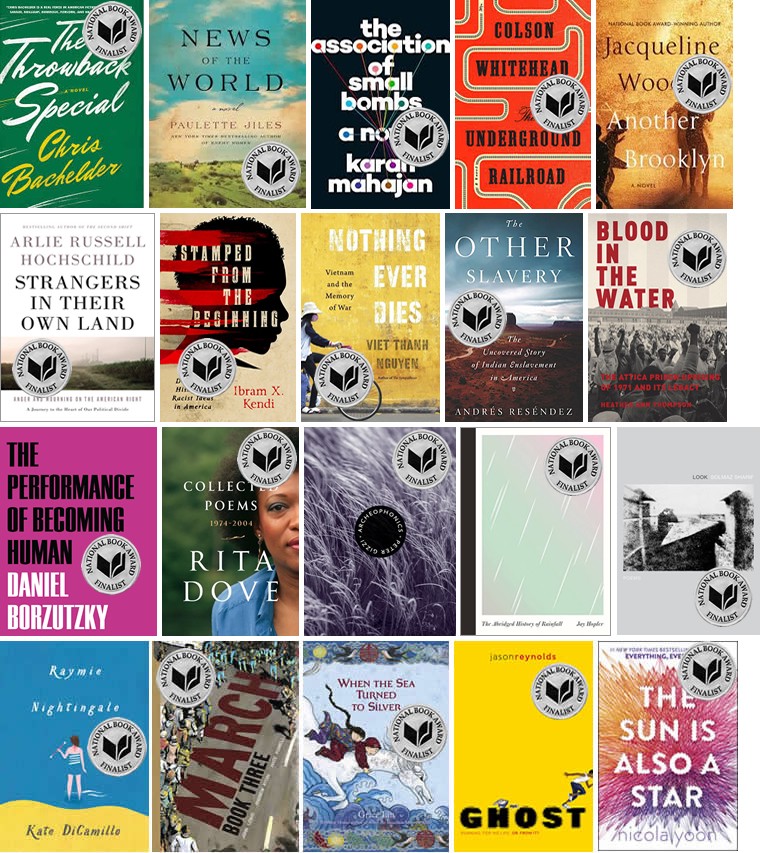
Colson Whitehead, Karan Mahajan, and Rita Dove have moved to the last round
About a month ago, we posted the National Book Award Fiction Longlist, and today the wait to hear who the winners are is over. The National Book Foundation just announced the finalists in all of the categories, and noted how “memory, childhood, and the legacy of race in America are preoccupations that propelled works in each of the categories for this year’s finalists.” Nobody is surprised to see Colson Whitehead’s The Underground Railroad on the fiction list. The novel, which is arguably the most celebrated book of the year, takes the reader through a slave fugitive’s harrowing journey to the North.
Will Whitehead’s book be able clinch the ultimate prize? Stay tuned for November 16th when the winners of each category will be announced at the National Book Awards ceremony!
For now, here’s the list of the 20 finalists. Congratulations to all of the authors!
Melanie Finn’s second novel, The Gloaming, opens with the end of a marriage. The scene is a mutual friend’s home outside of Geneva, and the catalyst for the collapse is a young woman, Elise, who the novel’s narrator, Pilgrim, sees approach her husband while the three are on a group walk. Pilgrim continues on ahead of the pair, and she looks back occasionally to watch them chat. Her husband, Tom, leans toward Elise; Elise covers her face to laugh. They flirt in a “breathless air,” caught in a moment where everything seems “amplified, impulsive,” and yet Pilgrim never interrupts their encounter. It’s almost as if she knows a chapter of her life is coming to a close.
On paper, the exchange lasts just two paragraphs, yet the economy of language employed by Finn in this well-crafted opening is brilliant, relaying everything one needs to know about the gut-punch reality of seeing a life drift away via simple gestures and observation. Never does the author slip into tired melodrama, and this decision helps sets the tone for the entirety of The Gloaming, which, despite a somewhat deflated conclusion, offers an engaging take on redemption narratives.
Time passes. Tom and Elise, now a couple, have recently had a baby. Meanwhile, Pilgrim lives alone in Arnau, Switzerland, in the apartment she once shared with her husband. Her life is relatively solitary, and while she’s a year removed from that fateful walk outside Geneva, Pilgrim still tries to understand how to approach her new reality — as an American, for example, she isn’t sure why she remains in a small European town.
Then one day Pilgrim swerves to avoid a dog in the road and crashes her car into a bus shelter, killing three children. Though she is ultimately found innocent of any wrongdoing, her community cannot ignore the tragedy. They see her as nothing but a killer, and Pilgrim suspects the father of one of the lost children is regularly breaking into her home. Thus, saddled with guilt, disconnected from her surroundings, Pilgrim uproots herself — her name lends itself to such action — and relocates to Tanzania, first settling in the small community of Magulu before taking up residence in Tanga.
At this point in her novel, Finn could transform her protagonist’s story into something akin to an Eat, Pray, Love knockoff. Thankfully, she shies away from such epiphany quests, instead setting Pilgrim off on a far more ambiguous journey. The character has no particular ambition other than to hide from her old life, and so she sets up house and finds herself integrating into the day-to-day lives of the locals: police officer, Kessy; quirky doctor, Dorothea; and later, in Tanga, Gloria, who has come to Africa from the United States to build an orphanage for children living with AIDS; and Harry, a drunkard pilot. While Finn injects elements of danger into these locations in the form of Martin Martins, a mercenary who arrives one day out of the blue, as well as in the discovery of a mystery box containing shriveled body parts, her focus primarily falls on the limbo nature of Pilgrim’s time in Tanzania, where everything — safety, life, happiness — is tentative. Here, we see the novel’s title truly blossom, for just as dusk separates day and night, Pilgrim’s life slowly teeters between security and chaos in this unfamiliar land. Early in her residency, after she is mobbed and attacked by a group of local children, Pilgrim washes her face back at her room, and her mind — remembering her car accident — wanders between Switzerland and Tanzania:
Their gender and their number are a coincidence. A girl and two boys. From huts in the bush. But there, again, is the odd loosening, the wavering, and I force myself to look in the mirror. Here I am. Here. My hands are on the sink. The solidity of things. Touch my face with my fingertips. Feel my skull under the skin.
This tangent, and the others that introduce Pilgrim’s state of uncertainty to the reader, are potent, and despite the somewhat rambling nature of her travels, Pilgrim’s narrative grabs the reader. So it’s a shock when, a little over halfway though her novel, Finn abandons her protagonist’s first-person, diary-like chapters to spend the rest of her book looking at the world through the eyes of those Pilgrim meets. We travel back in time and location to spend a long section with Strebel, the police inspector assigned to investigate Pilgrim’s accident. Finn playfully uses these pages to retell scenes in which the pair interacts, rounding each out with the injection of Strebel’s thoughts and his attraction toward the striking divorcée, but she also employs Strebel to show what happens in Switzerland after Pilgrim flees. Soon enough, the policeman is on a plane to Africa himself, convinced that Ernst Koppler, the bereaved father of one of Pilgrim’s victims, has decided to hunt down and kill her.
From here, the author fills in the gaps of Koppler’s murderous quest, and, in turn, Pilgrim’s ultimate fate, by devoting other sections to Dorothea, Gloria, Harry, and Martin Martins. The move is bold, and it jars the reader from any sense of comfort, yet these sections, perhaps due to Finn’s decision to switch to primarily a third-person subjective perspective, only sometimes find the same precision in voice evident in the novel’s first half. As the final pages wind down, and Pilgrim’s story comes full circle (with a bit of convenient character shuffling), it’s hard to tell if this structural decision truly pays off. Yet there’s enough allurement throughout The Gloaming to stave off boredom. This is a pure example of a literary page-turner, one that begins with an ending and ends with a new beginning, written by a very smart author.
In 2012, Chloe Caldwell published her first book, the essay collection Legs Get Led Astray. She was only 26, and the book was warmly received by both readers and critics. Women, a restrained and beautiful novella followed in 2014. Her third book, an essay collection entitled I’ll Tell You in Person(Coffee House), was published Tuesday. The book covers a lot of ground, chronicling the life of a young woman who is in turns reckless, fastidious, self-aware, solipsistic, depressed, and joyful, and the combination of these contradictions makes the book both surprising and familiar. It’s a fun, funny, heartbreaking book, one that also happens to be compulsively readable.
I’ll Tell You in Person is the second release from the new Emily Books imprint under Coffee House. Emily Books isn’t new — they’ve been an eBook store run by Emily Gould and Ruth Curry since 2011, selecting “underappreciated novels and memoirs, mostly by women.” They published the eBook of Women, and other writers like Eileen Myles, Renata Adler, Nell Zink, Chelsea Hodson, and Melissa Broder (and also myself).
I interviewed Caldwell about the book, her publishing process, a substance called Kratom, writing about Lena Dunham, and other things, via email. Full disclosure: Caldwell and I are friends.
Juliet Escoria: I have had a hard time with figuring out the difference between fiction and nonfiction in my writing. Has it been easier for you? When did you know that Women was fiction and not an essay? Do you worry about bending the truth with your essays? Did any of the essays in I’ll Tell You in Person begin as something else?
Chloe Caldwell: I differentiate by structure. I’d never written in the structure of Women, like a novella, so that helped me fictionalize. For essays I go into them with some internal conflict, which you can see in most the ITYIP essays. ITYIP would never be a short story collection, for example. If I wanted to write a short story collection, I’d broach it completely differently.
I feel like your first book could read more like short stories, and you use plot more, whereas my essays don’t usually have plots other than emotional plot. When I’m using emotional plot, it’s just super nonfiction essay-ish to me.
I’d been working on Women for about two months before I began fictionalizing, bending truth, and adding characters. What freedom! I’d like to write in that style again. I’m pretty drained on the personal essay form.
No, I don’t worry about bending the truth in my essays too much because I’m usually not reporting on plot-like stories or quoting tons of people. Most my essays are my internal thoughts. I don’t bend the truth as far as I know. I dramatize it, sure, with emotions, but I don’t bend it.
JE: I love Emily Books, and think it is very cool that you are one of the first authors to be published under their Coffee House imprint. Can you talk about your publication & editing process with them?
CC: We are so lucky to live in a world where Emily Books exists. When they bought the collection it looked quite different. With their direction, I added “Failing Singing” and“In Real Life,”and developed most of the other essays. We kept changing the order and talking about section titles (which ultimately felt unnecessary).
After they bought it, Emily sent me a long “big picture” letter pointing out my strengths and weaknesses and discussing thematic ideas, essay by essay. I took that letter and went back to the MS for about four months, and then began the line editing process with Ruth. So they did all the editing stuff and then the Coffee House team came in with marketing questionnaires and cover ideas. It’s been a unique experience, especially since I was friends with Emily and Ruth ahead of time. That makes it even more special, because I can text them about TV shows and shit as well as professional stuff. Like I was just asking Emily which dress I should wear to my book party. It’s a lucky place to be in.
JE: One thing I like about writers who write nonfiction and/or autobiographical fiction is that the actual life of the author becomes art, and part of a larger story that gets more complicated and nuanced with each book. Do you think of your three books in that way? How do you see them in relationship to Chloe Caldwell, the person?
CC: I’m so close to it that it’s challenging for me to answer questions like this. The biggest thing for me is how they’ve organized my life. I look back at my books to remember where I was living, who I was dating, where I was working. Legs Get Led Astray was my move-to-Portland-start therapy-stop-doing-drugs book. After selling Women I moved into my apartment and got my shit together in many ways. With ITYIP I began teaching, bought a car, bought a couch. (Not off my advance, with teaching money.) That’s how I look at my books. Ha.
JE: The essay “Hungry Ghost” is about your experiences with a celebrity who you describe as “somewhere on the spectrum between Eileen Myles and Beyonce” and as “someone [you, the reader] admire too — or you might hate her and think she’s fat.” Did you feel weird or uncomfortable or hopeful when thinking about her reading it? Were you worried you were portraying her in an unflattering way? Was there any particular weight to it, considering you were writing about someone who is so famous? What were you considering when you decided not to name her, but to make it fairly easy to figure out which celebrity you were talking about?
CC: I suppose my superpower is not thinking about stuff like that when I write. I really let myself write the essay how I want to, because I’m writing for fun, and I can decide later to publish it or not. Mary Karr, I think, has what she calls a “compassion read.” I guess I do something similar and during line edits, by triple-checking if there’s any lines that are unnecessary or exposing or hurtful, and if so, then I delete them. I try to strike a balance of fairness. I don’t know if I achieve it but I attempt to.
I was extremely worried Lena Dunham would feel disrespected, and fretted a lot about it, which now seems funny now. When galleys were sent out, I sent her a copy and an email warning her. That’s my rule, not letting people be surprised. She was totally understanding and said something like, “When you do what I do, you can’t get mad at anyone else for what they do!” Later when she read it, she sent me a kind email and we processed a bit and that was the end. This has been my experience for the most part with nonfiction and writing about people: it’s never as horrible as you imagine it will be. She understood I wasn’t trying to call her a flake, it was just good ground for an essay and I tried to make myself look like the retard in the essay. Which was easy! I did consider sending her the essay pre-galleys but ultimately didn’t want to change anything I’d written and not using her name was a way for us both to feel better about it, I think. I’m talking openly now that it’s her because she said that’s fine.
Remember that reading we did in Chicago last winter? One chick came up to me afterwards and asked if it was Mindy Kaling!
This has been my experience for the most part with nonfiction and writing about people: it’s never as horrible as you imagine it will be.
JE: I’ve had this weird experience after publishing stuff I wrote that was based on the not-so-great parts of myself and my past. It always feels embarrassing at first but then eventually things shift, in a way that feels sort of like a healthy kind of compartmentalization. Is it like that for you? You certainly don’t seem to be concerned about making yourself out to be this person who has it all together, which is one of the things I most admire about your work.
CC: I’ve noticed when my books first release there’s total adrenaline and it’s absolutely mortifying and then over a year or so, it starts to feel more like “work.” You read so much from your shit and answer all these questions that there’s a distance, more like a chore. You get tiny chunks of money for different things. I read from Women the other night and honestly have a feeling now of like, who wrote this? It’s bizarre. I guess I’m good at disassociating. I do that when I give readings as well, thinking about baseball in my head as I read so I can disconnect from the material.
I just read an article in Psychology Today, which my therapist lets me take from her waiting room because it’s my guilty pleasure, about rewriting our life stories into a way you can live with. It says:
We can’t change the past, but we can change how it affects us and who it makes us. When we tweak what we tell ourselves about the past, we can redirect our future. In our relationships, through our life choices, or at our jobs, we can recognize our mistakes, move on, and start to embody a different story. Rewriting helps you gain perspective, sort out your emotions and increase narrative coherence — your understanding of who you are, how you became that person and where you are going.
That really resonated with me.
JE: ITYIP covers a lot of ground, both in subject matter and tone. You have funny, gossipy essays like “Hungry Ghost,” and then heavier, more devastating essays like “Maggie and Me: A Love Story” and “Berlin.” Were you conscious of making sure you covered a wide variety of emotional experiences? How did you decide on the arrangement of the essays, and the decision to break the collection into three parts?
CC: I’m glad it reads that way. I collected all of the essays I had into the MS, then cut some shitty ones and added others. I wrote a few specifically for the collection, such as “Sisterless” and “The Music & The Boys.”There was no reason for it to be chronological so we played around with order. The segments aren’t labeled which I like because the reader can take away whatever themes emerge for them on their own.
Most collections are split into parts so I was just mimicking other books. I do sort of like how it starts off more druggie-like and self-destructive but then gives way to essays about women writers who have touched my life in some way. I don’t know how conscious I was. I just worked with what I had and prayed for the best!
JE: I thought it was neat that you open your collection with a short essay about your relationship to personal essays — your experience with reading and publishing them, and also reactions you’ve gotten from other people. And then there is the conversation you once told me about, with another writer who was acting as though there was something unsavory or unliterary about the personal essay as form. Do you feel self-conscious about publishing personal essays? Why do people hate on them, or act as though there’s something tawdry about writing about oneself? I mean, isn’t all writing, in some way, about ourselves? At least personal essays are up-front about it.
CC: I feel self-conscious about it in some ways, but not enough not to do it. I’d likely feel self-conscious about any career choice I’ve chosen.
I don’t know why people hate on them. I think when people write openly about flaws, it reminds readers of parts of themselves they hate or aren’t always in touch with. Some people are so embarrassed by the personal essay that they won’t publish them, where I’m not that embarrassed, and that makes the difference between what they do and what I do — I put mine out there. It takes all kinds. Sorry for being corny. I just like, don’t care anymore. About genre snobbiness and people’s thoughts on personal essays. It seems beat. I don’t care if people find me “literary” or not. I enjoy writing and that’s more than I can say for a lot of writers. Excuse the rant.
I don’t care if people find me “literary” or not. I enjoy writing and that’s more than I can say for a lot of writers. Excuse the rant.
People keep asking me why they’re hated on, but that’s not my experience. Sure, people think fiction is a higher art. But in my world I publish them, read them, and teach them, so I’m biased and in a bubble of people who love and support them.
My existential attitude of “We’re all gonna die who cares” has been helpful for me when it comes to this stuff. Because we’re all gonna die. Who cares? Let people write/read what they want. And yeah exactly — if I’m upfront about my flaws and stupid shit I’ve done, I guess I feel I’ve gained some control on that part of my life and since I’m calling it out first, it makes me in some way feel protected from what reviewers and people say.
JE: One time you gave me Kratom before a reading and all it did was make me feel shaky and nervous. What the hell is Kratom? What does it do for you? Why do you like it so much? Also just now while Googling to make sure I was spelling Kratom correctly, I came across this article, which says as of 9/30, the FDA will designate it as a Schedule I drug. How does this make you feel? WHAT ARE YOU GOING TO DO?!
CC: Juliet, I’m fucked. I can’t even get into it here. It’s too devastating and private. I don’t understand how Kratom did that to you, probably cause you mixed it with Red Bull or something. But I’m also relieved, I knew this day would come eventually.
JE: Have you seen the Pitchfork series “Over/Under”? (If not, I highly recommend the Kathleen Hannah, RiFF RAFF, and Earl Sweatshirt episodes.) Can we play over/under with the following?
CC: Never seen it, but I do love Erik Andre.
JE: Ben Lerner.
CC: Would anyone call Ben Lerner underrated? People cream their pants for his books.
JE: Elizabeth Ellen.
CC: HARD UNDER. EE is behind-the-scenes supportive of so many women writers and has helped me emotionally and financially. And romantically. Just kidding. Maybe.
JE: Bread.
CC: HARD UNDER. Why the fuck does no one eat bread anymore? Trust no one who doesn’t. In an ideal world, I eat bread every day.
JE: Hummus.
CC: OVER. Don’t get me wrong, I eat it, but you can just put chickpeas in a blender and make it instead of paying 6.99.
“If trees could scream, would we be so cavalier about cutting them down?” the humorist Jack Handey once asked. “We might,” he admitted, “if they screamed all the time, for no good reason.”
In his superb The Hidden Life of Trees, the German forester Peter Wohlleben indicates there may be some truth in Handey’s joke. “When trees are really thirsty,” he writes, “they begin to scream.”
Newly translated into English and subtitled “What They Feel, How They Communicate,” this revelatory book offers a numbers of deep thoughts about the towering giants in our midst. “We know how the sounds are produced, and if we were to look through a microscope to examine how humans produce sounds, what we would see wouldn’t be that different,” Wohlleben writes. “The trees might be screaming out a dire warning to their colleagues that water levels are running low.”
Could trees really be talking to each other? Now, don’t be hasty. “That doesn’t necessarily mean anything,” Wohlleben admits.
And yet.
Scientists at the University of Western Australia were able to record trees’ roots crackling at a particular frequency. And, Wohlleben notes, whenever “seedlings’ roots were exposed to a crackling at 220 hertz, they oriented their tips in that direction. That means the grasses were registering this frequency, so it makes sense to say they ‘heard’ it.”
So are trees really capable of communication? To University of British Columbia ecologist Suzanne W. Simard, “using the language of communication made more sense because we were looking at not just resource transfers, but things like defense signaling and kin recognition signaling.” In a recent interview, she added: “The behavior of plants, the senders and the receivers, those behaviors are modified according to this communication or this movement of stuff between them.”
These findings called to mind J.R.R. Tolkien’s Ents, the talking trees in The Lord of the Rings. Were those fantasy books even more prophetic than previously thought? The possibility made me eager to flip through a few other new volumes about biodiversity and the wondrous world in which we live.
Robert Macfarlane has become my favorite living nature writer in large part because his passion for adventure and his etymological derring-do. His awe shines through in every sentence and he maintains a rare humility in the face of the natural world. He’s a Fellow at Emmanuel College, Cambridge and his latest book, Landmarks, revels in rescuing lost naturalistic words from obscurity.
Each chapter of Landmarks includes a glossary of odd words otherwise in danger of being forgotten. In Northamptonshire, he tells us, “brattlings” are “loppings from felled trees” and the “stump of a tree after the trunk has been felled” is a “nubbin.” He culls his naturalistic vocabulary from, among other sources, various regional dialects of Great Britain, nature poetry, and forestry manuals. Learning names for things I look at every day has helped me to really see them. Weeks after finishing the book, I still catch myself returning to his word-hoard time and again.
In Richard Fortey’s new The Wood for the Trees, the former paleontologist at London’s Natural History Museum describes a year spent studying four acres of woodland he purchased in Oxfordshire, England. He has the eye of a taxonomist or collector. “I wanted to collect objects from the wood, not in the systematic way of a scientist, but with something of the random joy of a young boy,” he writes.
It’s an understandable impulse. The window sill of my Philadelphia living room is cluttered with objects my wife and I have found while hiking, many from the nearby Wissahickon Creek Park. But my own materialism doesn’t always sit right. Perhaps I should have left these trophies — a hand-wrought key, a seashell, a hunk of coal — where they were.
Fortey’s is a lovely book and it provides a useful reminder to attend to the trees in our midst, but the assumption that the woods exist primarily for human pleasure — and plundering — is not one I’m entirely comfortable with. That said, Fortey’s love for the outdoors is entirely contagious. A few passages made me stop reading so I could absorb the imagery:
Overnight, several inches of snow have settled in the wood. A slow, steady fall of big flakes has left every holly leaf with a burden of white icing. The tiered branches of the small yews, usually so discreet and dark, are suddenly blatantly arrayed for a winter festival.
The book is subtitled “One Man’s Long View of Nature” and it crossed my desk during a transitional time at the end of the summer when — according to Wohlleben — trees begin to devote less energy to their leaves.
In the three years my wife and I have lived in our rowhouse, we’ve planted four trees in the small backyard: redbud and pagoda dogwood, coral bark Japanese maple and a small fig tree I adopted from a farmer in Amherst. Now that I’ve read The Hidden Life of Trees, I ask myself if I’ve done those trees and the others in the surrounding yards a disservice by introducing them into a foreign realm.
It’s difficult to imagine planting trees could be a bad thing, and yet it would be foolish to take our new scientific knowledge about trees lightly. Every year, it becomes more obvious how interdependent we are with the natural world — and how rapidly we are depleting its resources. By one account, 20,000 square miles of the Amazon rainforest vanish every year.
Even Tolkien’s Ents lament about their dwindling numbers. In The Two Towers, the wayward hobbits Meriadoc and Pippin meet the talkative Ent named Treebeard. “You see, we lost the Entwives,” Treebeard says.
“How was it that they all died?” Pippin asks, setting up the worst joke in all of Middle-earth.
“I never said they died. We lost them, I said. We lost them and we cannot find them.”
If Wohlleben is correct about the ability of trees to communicate — and I suspect he is — we all have a lot to lose every time a trees falls. Like Landmarks, The Hidden Life of Trees has me looking at my own little backyard with different eyes. That parcel of land doesn’t belong to me any more than it does to the squirrels and, now, to this fig tree. I am nothing more than a temporary caretaker. Wohlleben’s book makes me want to be a better one.
There’s so much we don’t know about trees, and likely never will. That’s perfectly OK with me, especially because my recent reading makes me want to adopt a less human-centric vision of the natural world. I’m certain that most trees would be better off without our meddling and the pollutants we belch into the atmosphere .
Every time I drive on the New Jersey Turnpike, for example, I am forced to wonder how many oaks and walnuts, pines and mulberries were chopped down to build a Service Area named for Joyce Kilmer (a man who wrote, “I think that I shall never see / A poem as lovely as a tree”).
Similarly — and I don’t mean to throw shade at these thoughtful nature writers — it’s also true that every time I read a book about trees I wonder if it’s worth the paper on which it’s printed. A precious few certainly are.
DON’T MISS OUT
Sign up for our newsletter to get submission announcements and stay on top of our best work.
YOUR INBOX IS LIT
Enjoy strange, diverting work from The Commuter on Mondays, absorbing fiction from Recommended Reading on Wednesdays, and a roundup of our best work of the week on Fridays. Personalize your subscription preferences here.