Iconic Graphic Novel to Be Reissued for a New Generation Because the Rent Is Still Too Damn High

“If Amerikkkan society has an orifice,” Seth Tobocman writes in the opening chapter of his underground classic graphic autofiction, War in the Neighborhood, “a mouth through which it breathes, an asshole through which it shits, it is the Lower East Side of Manhattan. Which orifice depends on who you ask and what their political agenda is.”

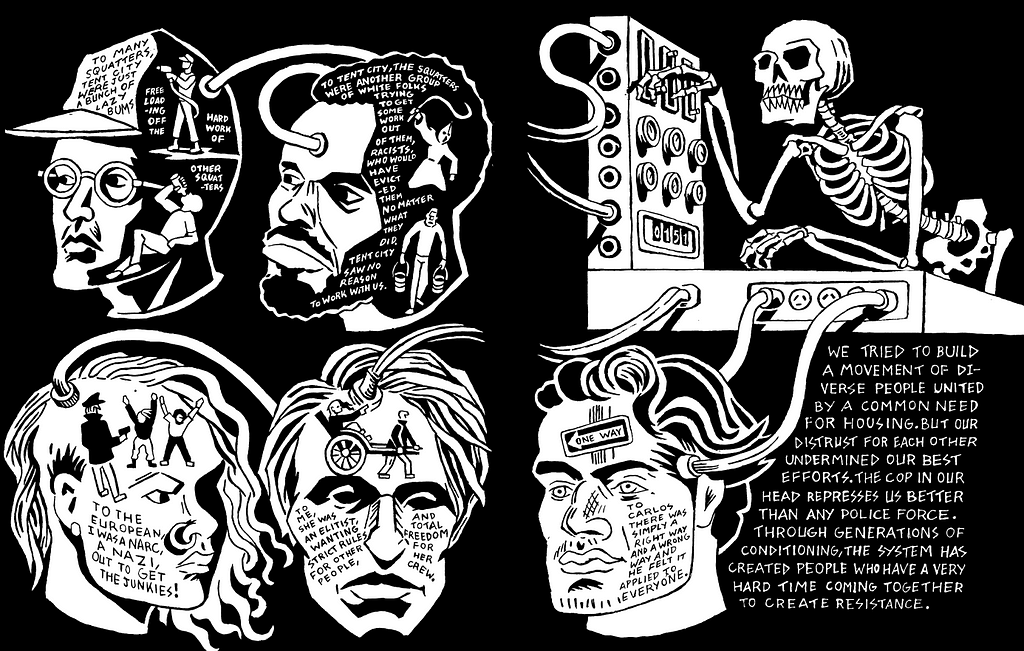
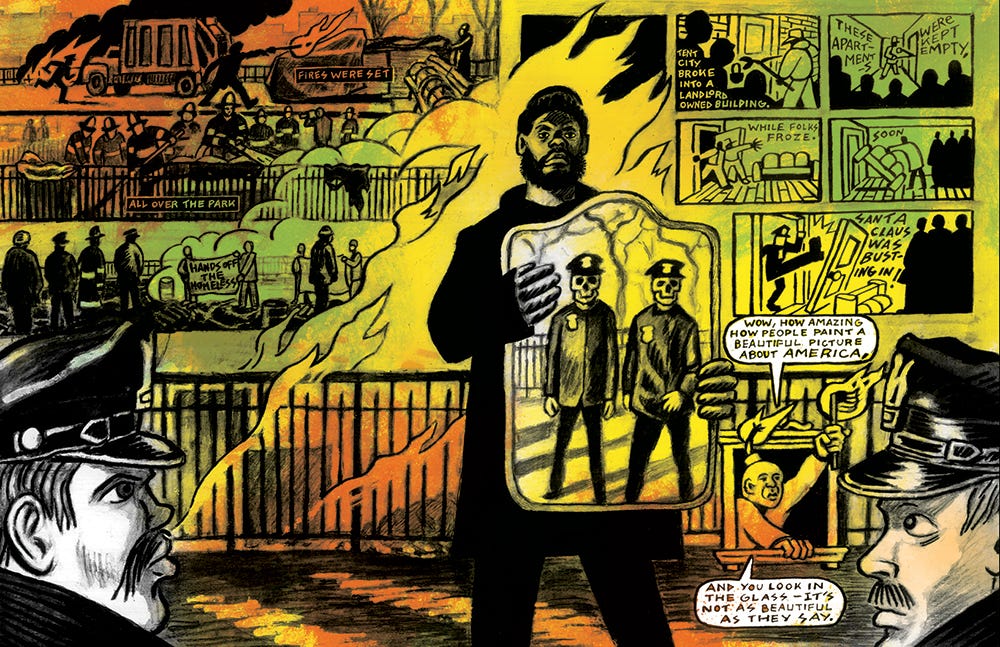
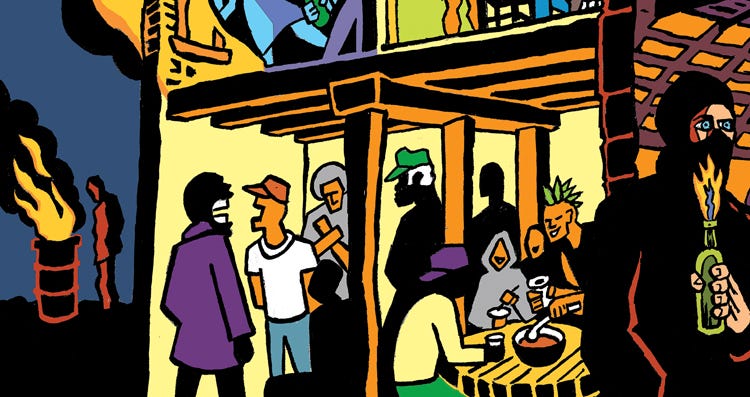
War in the Neighborhood is a document of and reaction to the Lower East Side in the 1980s and 1990s, a period of increasing class conflict and rapid gentrification that saw the end of an affordable Manhattan. The book’s linked stories take place mostly in the squats: formerly abandoned buildings taken over and rehabilitated by squatters for a variety of reasons ranging from activism to a simple, acute need for housing. A few stories are centered in and around Tompkins Square Park, which for generations served as the heart of radical political speech and action in New York. It was the site of the Tompkins Square Park Riot of August 1988 and the homeless encampment known as Tent City — both of which are documented in the book.

The stories come together to form a picture of a diverse community at a unique sociopolitical moment. The squatters and the homeless and the activists in these pages struggle against each other and themselves as much as they struggle against the police and the politicians and the real estate developers and the ever-encroaching tide of gentrification. There are no pure heroes to be found; there are no pure villains. Tobocman casts himself as a character — at once full participant and witness — but he is also the semi-detached narrator who presents the story with clear eyes and a fair, even hand. In Tobocman’s world, everyone is complex and flawed. Everyone makes mistakes. Everyone is capable of hurting others. Everyone is worthy of love and safety, and a place to call home.

War in the Neighborhood was first published in 1999 by Autonomedia, and went out of print in 2004. (The book still passed from hand to hand, its reputation growing as the price for the few remaining copies skyrocketed on Amazon.) At the time of its publication, it was a comment on the very recent past. 1995 and 1996 saw the last of the City’s massive, militaristic evictions of squats on the Lower East Side, and the years immediately following were a time of uneasy quiet, when squatters were trying to work toward an agreement with the City to turn their buildings into permanent low-income co-ops. That agreement was, indeed, struck, and the eleven remaining squats in the neighborhood began to convert to legal status in 2002, but even with that (somewhat controversial, perhaps pyrrhic) victory, it was clear that the economic and cultural climate that birthed the squats and allowed them to develop and, in some ways, thrive, had come to an end. And so when it was first released, the book served as both a mourning for what had been lost and a call to action for continued activism in a city where affordable housing was nearly extinct.

But War in the Neighborhood is not just about affordable housing. It is about individuals trying to live together in groups. It is about compassion and understanding and the absence of compassion and understanding. It is a reminder to all groups — particularly activist groups — that none of us are untainted by the white patriarchal power structure we’ve been raised in. In many of these stories, the squats are weakened by internal rifts caused by sexism and racism, leaving the groups fractured when it comes time to face the external forces of government and police. We see white squatters holding black people who would join the squats to different standards than they do white males. We see female squatters threatened and intimidated by male squatters. We see long-established squatters trying to drive out newcomers who are just looking for a roof over their heads.

Tobocman writes, “We come face to face with the cop, which is us. With the landlord, which is us. With the racist, which is us. With the sexist, which is us. With the fascist, which is us.”

We find ourselves now, in 2016, more in need of housing rights activism than ever. Not just in New York, but nationwide. At the same time, many of us are turning inward to recognize how even in liberal and radical spaces, racism and sexism are enormous obstacles. And so it seems particularly timely that into our current climate, once again at a unique moment of sociopolitical tension and possibility, publisher Ad Astra Comix is reissuing War in the Neighborhood. They’re running an Indiegogo campaign to support the publication, but it will be reissued regardless of the outcome of the fundraising. The new edition will feature the same compelling stories illustrated in Tobcman’s bold, angular, black-and-white style, with a new introduction by AK Thompson and, unlike the first edition, a binding that won’t fall apart in your hands. Highly recommended for the reader, the graphic-novel fan, the activist, the human being.

Fall Bounty: 11 Books About Food & Desire

From Eric Ripert to Han Kang, stories of appetite and invention

There’s never been a better time to read or write about food. Americans have accepted that food is more than sustenance, it’s an experience. As we move away from a universal, pre-packaged meal landscape, food becomes a cultural, economic, and emotional barometer. If Holden Caulfield was operating today, he’d be on Reddit talking about how David Chang is a phony and avocado toast is bullshit. Gatsby’s vineyard in Napa would do invitation-only tours.

The downside to the proliferation of food writing is a glut of poorly written chef memoirs, blogs turned into wordy cookbooks, and listicles about bacon. Great food writing is more than a description of a dish. It runs a double narrative; people who are hungry for food tend to be hungry for something else, be it love, sex, or success. That’s why this list includes both novels and memoirs. The important element isn’t whether a dish is real or imagined, but if food propels the narrative towards a bigger revelation about oneself or culture. The people in these books endure hazings in hot kitchens for little money, they eat foods to rediscover places they’ve lost, they cook for people in an attempt to emotionally connect. They are, in short, exploring the complicated relationship that humans have with food, the endless quest to identify just what it is we’re hungry for.

1. Kitchens of the Great Midwest by J. Ryan Stradal

Stradal’s debut novel is the story of Eva Thorvald, a food prodigy with an impeccable palate and amazing culinary abilities; this girl is growing and selling her own hydroponic habaneros by age 10. But Kitchens of the Great Midwest is also an exploration — and occasional satire — of the modern American food scene in all its high-low paradoxes. Stradal points out that we’re living in a world that embraces cheap and convenient Subway sandwiches while also lusting after thousand dollar tasting menus and artisan ingredients. Perhaps it’s enough said that we all get the joke when Eva informs a woman at a party that her favorite “heirloom tomato” is actually a Monsanto hybrid.

2. Blood, Bones, and Butter: The Inadvertent Education of a Reluctant Chef by Gabrielle Hamilton

Gabrielle Hamilton is the chef and owner of Prune in the East Village but she also holds an MFA in creative writing from the University of Michigan. Her well-written memoir recounts her indirect path to owning her own restaurant, from family lamb roasts in rural Pennsylvania to working her way up through the tough kitchens of New York. This is the chef memoir to read if you’re interested in more than kitchen gossip; the details are sharp and the writing immersive.

3. Sweetbitter by Stephanie Danler

Danler’s debut novel follows Tess, a newcomer to New York City who, like so many others, finds work as a waitress. Tess is soon sucked into the crazy, exciting, exhausting world of restaurants, but it’s not just the restaurant industry that’s a whirl, but book the book itself, a fast paced story of ambition, culinary education, and romantic entanglements. As Danler told Electric Literature: “I wanted the experience of reading to be as close to the kind of dance of dinner service as possible.”

4. 32 Yolks by Eric Ripert

Eric Ripert has been at the helm of Le Bernadin since 1994 — a notably long time in the current age of celebrity chef empires. That doesn’t mean that Ripert’s memoir is dull, quite the contrary: Ripert had the (seemingly requisite) tumultuous childhood in which food was his passion and creative outlet. He left home for Paris at age 17 and worked for some of the best chefs in the world, including stints under David Bouley and the demanding yet genius Joël Robuchon (classic anecdote: in addition to his other kitchen duties, Ripert had to prepare an exacting dinner for Robuchon’s pet dog). In an age when many chefs would rather open restaurants than cook in them, it’s refreshing to read about someone who genuinely loves to be in the kitchen.

5. Gastronomical Me by MFK Fisher

Published in 1943, Gastronomical Me is a hybrid of memoir, travelogue, and dining play-by-play that fans of Ruth Reichl, Anthony Bourdain, or any other of today’s “food writers” will recognize. Fisher was born in California and moved to France in 1936, and this book describes a wonderful collection of her experiences, from an early peach and cream pie to her first French oyster. When it comes to food writers, Fisher is still one of the best.

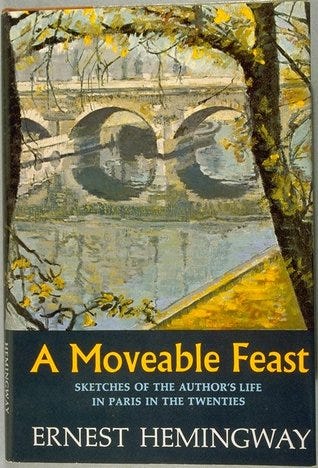
6. A Moveable Feast by Ernest Hemingway

Don’t dismiss this memoir of Hemingway’s early years in Paris as a quotable depiction of the zeitgeist of the 1920s. Hemingway writes with a hunger, both metaphoric and literal: the ambitious but still unsuccessful writer was occasionally too poor to grocery shop, hence the famous scene of him hunting for pigeons in the Jardin du Luxembourg. His descriptions of multi-course meals at Gertrude Stein’s house are transportative, and includes a contender for the best sentence ever written about eating oysters: “As I ate the oysters with their strong taste of the sea and their faint metallic taste that the cold white wine washed away, leaving only the sea taste and the succulent texture, and I drank their cold liquid from each shell and washed it down with the crisp taste of the wine, I lost the empty feeling and began to be happy and make plans.”

7. Heat by Bill Buford

The subtitle to Buford’s memoir sums it up nicely: An Amateur’s Adventures as Kitchen Slave, Line Cook, Pasta-Maker, and Apprentice to a Dante-Quoting Butcher in Tuscany. Buford was a writer for the New York Times when he was asked to profile New York City star chef Mario Batali. Instead of a mere profile, Buford went to work in the Babbo kitchens, learning first hand the intense realities of a restaurant kitchen (i.e. stifling heat, endless repetition of tasks, and a strict hierarchy that even reporters aren’t exempt from). It’s a fascinating behind the scenes look at professional cooking — one that will also stop you from thinking, yeah, I could do this, the next time you’re eating at a restaurant.

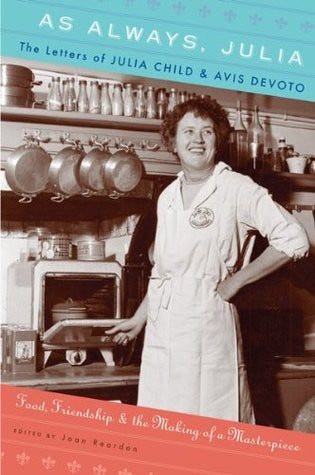
8. As Always, Julia: The Letters of Julia Child and Avis DeVoto edited by Joan Reardon and Avis DeVoto

Julia Child’s memoir, My Life in France, is a fantastic read, but I was really enthralled by this collection of letters written between Child and her friend and champion, Avis DeVoto. The two women had the kind of relationship that young pen pals can only dream of: after receiving a letter from Child in 1952 in regards to her husband’s recent magazine column on kitchen knives, the two began to correspond regularly. They wrote over one hundred letters in two years, most of them about food. As Always, Julia also chronicles the long road to success for Mastering the Art of French Cooking, which was difficult for Child to sell. DeVoto was instrumental in the book’s acquisition by Houghton Mifflin and later Knopf.

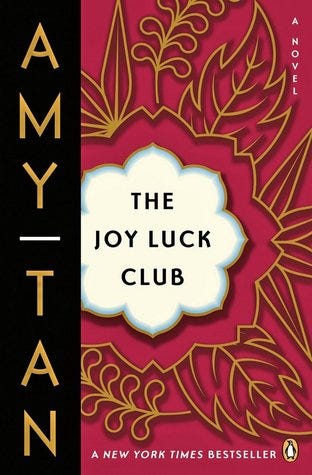
9. The Joy Luck Club by Amy Tan

The Joy Luck Club is a multigenerational novel about four women who fled China for San Francisco in the 1940s and their four American daughters. Food literally brings the older women together — they meet weekly for mah jong and dim sum — and throughout the book Tan mines the rich Chinese culture of food-related symbols and traditions. In China, a daughter cuts off a piece of flesh to put in her mother’s soup, then in America, the women show their love “not through hugs and kisses but with stern offerings of steamed dumplings, duck’s gizzards, and crab.”

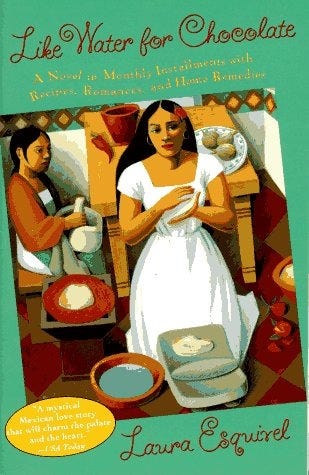
10. Like Water for Chocolate by Laura Esquivel

As the youngest daughter of the De La Garza family, Tita is bound to be her mother’s caretaker; she’s explicitly forbidden to marry until her mother dies. But Tita falls in love with Pedro, who is entranced by Tita’s cooking. Pedro, unable to marry her, marries her sister Rosaura, starting a tale of twenty-two years of unrequited love. Esquivel’s novel is structured around the twelve months of the year, and each month around a recipe.

11. The Vegetarian by Han Kang

In this wonderfully unsettling novel by South Korean novelist Han Kang, Yeong-hye vows to become a vegetarian after she dreams that she is a plant. This seemingly benign life choice leads to a increasing level of discord within her family, who don’t understand and can’t accept her decision. (In one scene, Yeong-hye stabs herself rather than eat a piece of sweet and sour pork that her grandfather is trying to force down her throat.) Yeong-hye’s choice is about more than diet: the book grapples with philosophical questions about control, desire, and violence.

Oscar Wilde Commemorated at Reading Prison

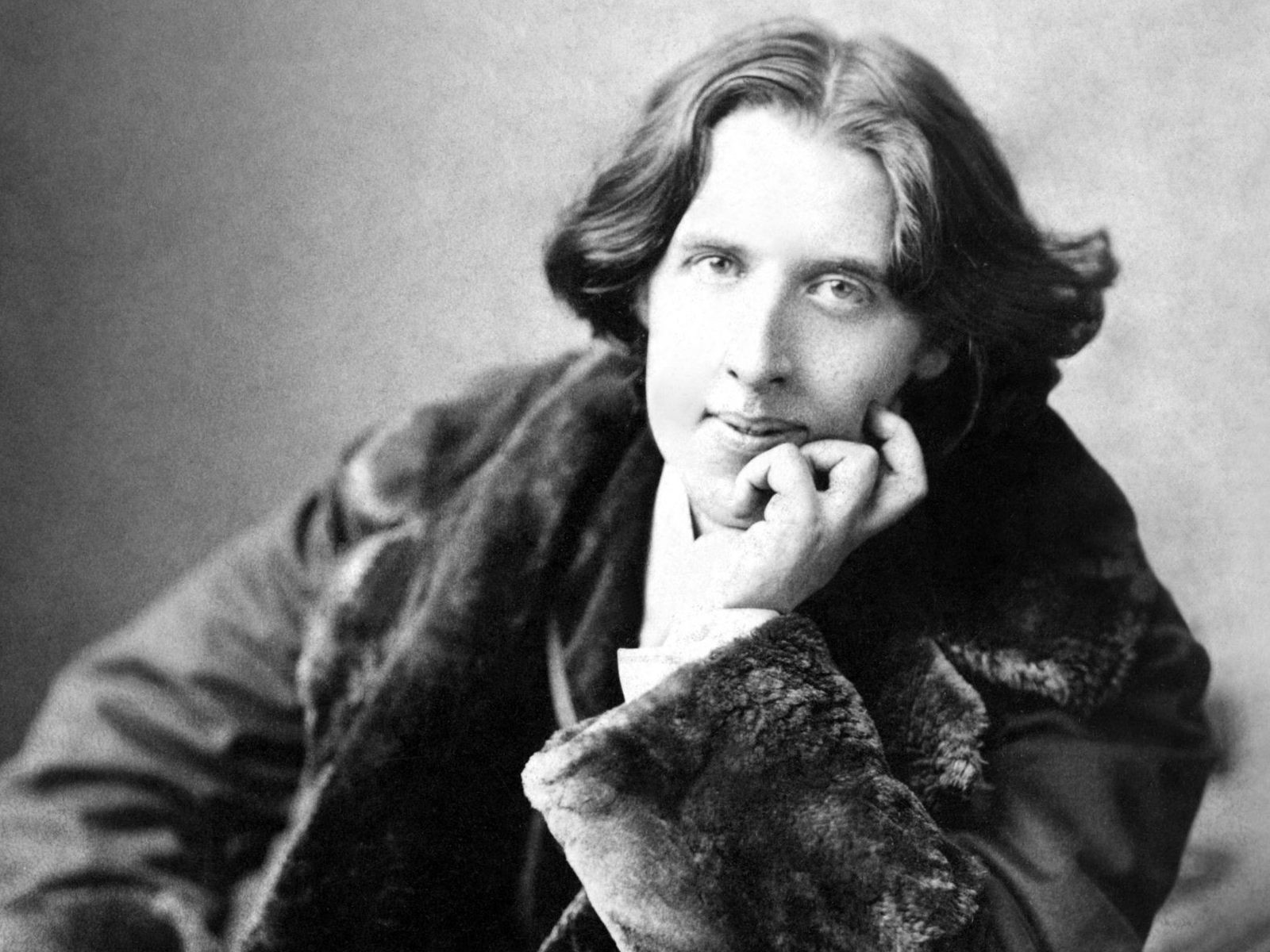
During his two-year sentence at Reading Prison (1895–1897) Oscar Wilde was held in his cell 23 hours per day, forbidden from interacting with other inmates at all times. Those intimate with his biography hold the time directly responsible for his untimely death three years later at the age of 46. Now, the prison, which shuttered as a functioning detention center in 2013, is hosting a temporary art exhibition in the writer’s honor.

Production duo Artangel are curating “Inside: Artists and Writers in Reading Prison” with the permission of the British Ministry of Justice. The New York Times reports, they’ve organized the exhibit a-linearly, encouraging visitors to traverse the grounds on their own accord, encountering visual work that range from direct representations of Wilde to more abstract meditations on captivity. Former Chinese political prisoner Ai Weiwei headlines the impressive list of artists that also includes Nan Goldin, Marlene Dumas, and Ragnar Kjartansson. Their work, operating in a variety of mediums, appears in the halls, narrow high ceilinged prison cells, and resonant open common spaces.

Wilde’s former dwelling, a 4×2 yard alcove, is left bare. In neighboring units, viewers will find stacked vintage copies of Wordsworth, Keats, and Hafiz, some of the only texts the writer had access to in his second year of captivity. He was banned from all forms of reading and writing during the first. A large wooden door that lead to Wilde’s cell is the only item contemporary to his time at Reading on display.

De Profundis will also be central to the exhibition. The 50,000 word letter to his lover and friend Lord Alfred Douglas that Wilde produced while imprisoned reflects on his life as an artist and self-identified provocateur. It will be read aloud by series of noted authors, including Patti Smith and Colm Toibin. The durational performances will take between five and six hours each.

For those who aren’t familiar with the history, Wilde’s imprisonment started with a lawsuit he launched himself, accusing The Marquees of Queensberry of libel. The nobleman had publically denounced Wilde as a “posing sodomite,” a legal offense at the time. In court, Wilde conceded his case after Queensberry marshalled an excess of damning evidence obtained through a network of private investigators and harsh cross examination. Shortly after, Wilde was the one on trial, where he was convicted on charges of “gross indecency.”

Wilde’s time in prison inspired him in the years after his release. The posthumously published epic poem The Ballad of Reading Gaol, depicts the hanging of Charles Thomas Wooldridge, which occurred on the prison grounds during his incarceration. He also composed two long letters to the Daily Chronicle describing, in detail, the conditions at Reading and the necessity for British prison reform.

Splendiferous News for Roald Dahl Fans

The OED is honoring the Dahl centenary by adding his words to the dictionary.

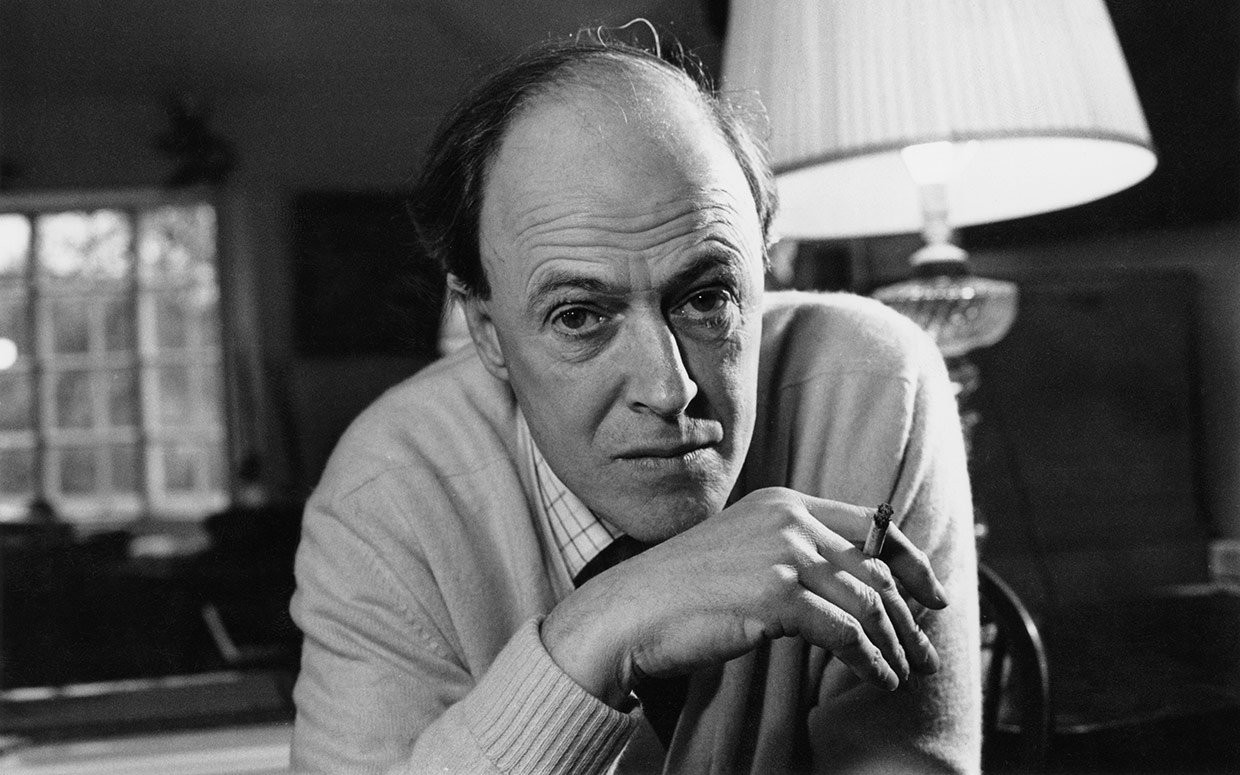
For many readers, Roald Dahl is affectionately remembered as the first author to dazzle their imaginations with books like Matilda, The Twits, and Charlie and the Chocolate Factory. Dahl’s ingenuity for storytelling also took on a decidedly darker tone in his adult short story collections, which have been dropping jaws for generations. He just had a way of putting things that was… well, Dalhesque.

If Dahl couldn’t find the perfect word to describe something while writing, he’d make it up. On what would have been his 100th birthday, the Oxford English Dictionary chose to commemorate one of literature’s most iconic storytellers by adding six new terms to their lexicon.

Here are Dahl’s Dictionary Additions:

Dahlesque, adj.– “Resembling or characteristic of the works of Roald Dahl.” According to the OED, the standout features of Dahl’s work are “eccentric plots, villainous or loathsome adult characters, and gruesome or black humour.”

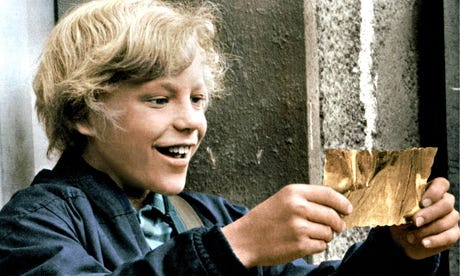
Golden Ticket, n.– A reference to the golden tickets found in the chocolate bars in Charlie and the Chocolate Factory is now officially canonized in the dictionary.

Human Bean, n.– “We is having an interesting babblement about the taste of the human bean. The human bean is not a vegetable.” From Dahl’s BFG.

Oompa Loompa, n.– Who doesn’t remember the “tiny” workers with “funny long hair” who worked in Willy Wonka’s chocolate factory?

Scrumdiddlyumptious, adj.– From perhaps one of the most memorable lines of The BFG: “Every human bean is diddly and different. Some is scrumdiddlyumptious and some is uckyslush.” The term is reserved for only the most delicious humans.

Witching Hour, n.– Another one from The BFG: “a special moment in the middle of the night when every child and every grown-up was in a deep deep sleep, and all the dark things came out from hiding and had the world to themselves.” However, this term is first credited for appearing in Shakespeare’s Hamlet.

Since the OED is constantly evolving alongside popular culture, they also introduced several other new terms this month, which include: biatch, cussing, moobs (yes, man boobs), and Yoda. With millions of words already inhabiting the English language, it’s nice to be reminded that there’s always room for more, no matter how silly they may sound. Thanks for teaching us about limitless possibilities, Roald Dahl. Happy belated.

Laia Jufresa on Grief, Language & Mexico

How can I explain, in just a few sentences, the richness of Umami (Oneworld, 2016) by Laia Jufresa? Translated from the Spanish by Sophie Hughes, Umami explores a community of five homes in Mexico City, clustered around a small courtyard. Each contains its own story. There’s twelve-year old Ana, dealing with the loss of her little sister. There’s the widower Alfonso, typing a record of his relationship with his late wife Noelia. And there’s Marina, a painter who doesn’t paint but invents colors like cantalight (a melon-y orange that appear in the sky at twilight). Jufresa, who speaks several languages and has spent her life across at least three continents, talked with me about crafting the five voices that narrate this richly textured novel.

Amaranto by Laia Jufresa

Monika Zaleska: You were born in Mexico, spent your teen years in France, returned to Mexico, and now live in Germany. I was hoping you could speak about how living with different cultures and languages has shaped your writing.

Laia Jufresa: I was born in Mexico City and then we moved to a very rural area when I was six. I became a reader there, thanks to my grandfather who would send me books in English. So I have this old relationship with English, but it’s mostly in the written form, because I’ve never really lived in an English-speaking country. Then, I moved to France. I’ve lived in Spain, Argentina, and now Germany. I think this has shaped me in many ways. One is that it has just made me adaptable. I think on a very practical level of how you inhabit characters, the fact that you’ve seen different cultures has an effect [on your writing]. I think that does something for empathy and for imagining yourself in other people’s lives.

Zaleska: I wanted to talk to you about the role of English in this book, and in your writing process. You actually started writing some of these characters in English and then brought the project back into Spanish. Is writing in English something you had done before? Why the impulse to switch languages when writing?

Jufresa: I think that’s how I work in many cases. Because I read so much in English, it often just comes naturally to me to write in English when I’m starting a draft. That shapes my writing at lot, because then I’m not necessarily working with a first draft in Spanish. I’m already translating, and so I’m looking for nuances. English is such a rich language and sometimes it’s very frustrating to translate from English because you really can’t find an equivalent. With Umami, Ana and Pina’s voices started in English. But it quickly became a very Mexican book, not only in its content, but also in its language.

Zaleska: In Alfonso’s narrative, a lot of time is spent exploring an older, indigenous Mexico and how that is contrasted by the modern country. On the one hand, as an anthropologist, Alfonso is really fascinated by ancient grains such as amaranth, milpas, and the pre-colonial culture of Mexico. On the other, his wife Noelia makes fun of pretentious women who wear “indigenous Mexican outfits, but designer.”

Jufresa: Mexico is very ambiguous in this sense. It’s a very nationalistic country. Yet people who are very proud of their past, will at the same time be very racist. It’s almost like there’s this line that they trace to say, “This was our past. It was amazing. We are an old culture,” but then they will look down on anyone who has an indigenous background. I grew up very close to this because my mother is an anthropologist, though not a food anthropologist like Alfonso. She studied public health. All my childhood I would be taken away from my little school in Mexico City and I would travel with her to very far away indigenous parts, where we would be camping or sleeping in the tiny room that served as a health clinic. I was aware, very early on, of how many different countries Mexico [had inside it] and how different it was to be a city kid from a rural kid. I would go to these schools, and I would be the only one with shoes. I have always been angry and fascinated by these things. I didn’t choose to become an anthropologist, but I think this comes through in my fiction, whether I want it to or not.

Zaleska: And then there’s the irony of Ana trying to plant a milpa in Mexico City, where the soil is full of lead. There’s this butting up of those two Mexicos.

Jufresa: Yeah, also the characters in Umami are very middle class. There’s still this idea, even inside Mexico, that if you write about Mexico you have to write about the real rural, violent Mexico, as if all the other things were not Mexico. Yet [the middle class] is overly represented in literature because people who become writers grew up with houses with books. It’s not so mysterious. I sometimes felt uncomfortable writing Umami, but the truth is I did it at a time when [the middle class] was not overly represented. Now the war and the violence are over-represented.

Zaleska: You touch on the imbalanced relationship between Mexico and the United States in several small moments in Umami. For example, there’s Alfonso’s fear that he’s really working for “gringo academics,” who will discover his research and get all the credit for it. Worse, that amaranth will be the next quinoa or avocado — a food trend for Americans.

Jufresa: I don’t think I can convey to you how present the United States is in Mexico. Culturally. All the TV. All the music. Everything. And in a very non-mutual way. We have the feeling of being fairly invisible to the United States. Or, being visible in a very prejudiced and short-sided way, because of immigration and war and drugs. Visible in a very unfair way, because the United States never takes responsibility for its part in the war that is destroying Mexico. Really, it is the consumer and provider of guns, and the consumer of drugs. But we don’t think of this conflict as between two countries. We think the Mexicans are coming.

I don’t think I can convey to you how present the United States is in Mexico. Culturally. All the TV. All the music. Everything. And in a very non-mutual way.

I am married to an American, so I have very slowly discovered my own prejudice against the United States. When you haven’t lived in the United States and all you have consumed is like Hollywood movies, it’s hard to imagine that people are not really that shallow. You need to go to a more particular level of really meeting people one-on-one, to break [these prejudices]. I think that’s what literature does — stories allow you to have these kind of one-on-ones without really knowing people. I know a lot of people don’t agree, I always have this conversation with writer friends, but I do think that literature creates empathy.

Zaleska: I want to spend a few moments on the structure of Umami. There are four sections, and within those sections there are chapters that count down: 2004, 2003, 2002, 2001, and 2000. Each time we return to one of these years in the next section, we have the same narrator. For example, Luz, Ana’s little sister who later drowns, always narrates 2001.

Jufresa: I needed to go backwards in time so that we can have Luz speak when she’s alive in 2001. My very first idea of the structure would be that you would have the whole 2004, and then the whole of 2003, etc. But when I decided to chop them and do it several times around, it became very rich. There was the possibility of crossing bridges, the possibility of having someone say something that has repercussions three years later. It was like grief waves. This structure allowed [Luz’s] voice, but also worked with one of the big themes of the book.

Zaleska: Why was it important to you to explore so many variations or nuances of grief? It seems to me that each of these characters has a smaller or larger tragedy to contend with. How did this exploration develop and why was it important to you as a writer?

Jufresa: I left Mexico again in 2008 because I was in the north, working, and there was a shooting and they killed fourteen people. It happened a few meters away from me. And then I decided to leave Mexico. I realized I didn’t know what was happening in my country. I didn’t see it, fortunately, because there was a wall between me and the shooting. I only heard it. I was terrified. I saw the guns but I didn’t see the people being shot. That night I heard people from the town speaking and they were all very hurt, of course. They had lost a lot of people. They lost a baby. It was awful. But they were not surprised. To me, that was heartbreaking. I couldn’t imagine continuing to live in a country we have become so used to violence that people coming in two trucks and killing fourteen people is something that happens, and happens every day.

I didn’t want to write about the violence. I didn’t want to give it any more space.

I didn’t want to write about the violence. I didn’t want to give it any more space. One of the most horrible things that happens with this level of violence is that people who die become just a number. Because when there are so many dead, you don’t have time to mourn them. I felt at the time that everyone was writing about the guns and the violence and the blood. For a long time, in the back of my mind, I was thinking that grief needed more space. You read Umami and it has nothing to do with the violence in Mexico, or the war. But I think that for me, it does, in the sense that it gives grief space.

Zaleska: The structure of the book also allows that grief to become more complicated as we circle back to it. For example, Alfonso has his wife Noelia on a pedestal at the beginning of the book, and he’s so terribly sad about her death. But later, he’s able to admit there are things about their life together that disappointed him.

Jufresa: You know he’s the only one who is actually writing [a journal]. Little by little, the writing allows him to be more clear on what he is feeling and more free to say the things that, without the writing, he also couldn’t have, because it would be a sort of betrayal.

Zaleska: I was wondering if you could talk about your relationship with Sophie Hughes, the translator. It seems like it was a really creative, collaborative relationship.

Jufresa: I feel [Sophie] works a lot like a writer, not only in the sense that she cares about language, but that she really goes into the character. She wonders, what would the character say here, in English? What is she feeling? How does she say it? I think that’s very deep work. It kind of makes me think about good actors, you know? You can tell when an actor is inhabiting a character, or just saying the lines. I think she really inhabited the characters. She nailed so many of the different voices. I could have attempted to translate it myself, but I don’t think I would have ever been able to reach her level.

“Amaranto ” by Laia Jufresa

Amaranth, the plant to which I’ve dedicated the best part of my forty years as a researcher, has a ludicrous name.

One that, now I’m a widower, makes me seethe.

Amaranthus, the generic name, comes from the Greek amaranthos, which means ‘flower that never fades.’

I’ve been a widower since last Mexican Day of the Dead: November 2, 2001. That morning my wife lay admiring the customary altar I’d set up in the room. It was a bit makeshift: three vases of dandelions and Mexican marigolds, and not much else, because neither of us was in the mood for the traditional sugar skulls. Noelia adjusted her turban (she hated me seeing her bald) and pointed to the altar.

‘Nah, nah, nah-nah-nah,’ she sang.

‘Nah, nah, nah-nah-nah, what?’ I asked.

‘I beat them.’

‘Beat who?’

‘The dead,’ she said. ‘They came and they went, and they didn’t take me.’

But that afternoon, when I took her up her Nescafé with milk, Noelia had gone with them. Sometimes I think that what hurts most is that she went without me there. With me downstairs, standing like a muppet by the stove, waiting for the water to boil. The damn, chalky, chlorinated Mexico City water, at its damn 2,260 meters above sea level, taking its own sweet time to make the kettle whistle.

Noelia’s surname was Vargas Vargas. Her parents were both from Michoacán, but one was from the city of Morelia and the other Uruapan, and at any given opportunity they’d publicly avow that they were not cousins. They had five children, and ate lunch together every day. He was a cardiologist and had a clinic just around the corner. She was a homemaker and her sole peccadillo was playing bridge three times a week, where she’d fritter away a healthy slice of the grocery budget. But they never wanted for anything. Apart from grandchildren. On our part at least, we left them wanting.

By way of explanation, or consolation perhaps, my mother-in-law used to remind me in apologetic tones that, ‘Ever since she was a little girl, Noelia wanted to be a daughter and nothing else.’ According to her version of events, while Noelia’s little friends played at being Mommy with their dolls, she preferred to be her friends’ daughter, or the doll’s friend, or even the doll’s daughter; a move that was generally deemed unacceptable by her playmates, who would ask, with that particular harsh cruelty of little girls, ‘When have you ever seen a Mommy that pretty?’

Bizarrely, my wife, who blamed so many of her issues on being a childless child, would never get into this topic with me. She refused to discuss the fact that it was her mother who first used the term “only a daughter” in reference to her. And it occurs to me now, darling Noelia, that your obsession may well spring from there; that it wasn’t something you chose exactly, but rather that your own mother drummed into you.

‘Don’t be an Inuit, Alfonso,’ says my wife, who, every time she feels the need to say “idiot,” substitutes the word with another random noun beginning with i.

Substituted it, she substituted it. I have to relearn how to conjugate now that she’s not around. But the thing is, when I wrote it down just now, ‘Don’t be an Inuit, Alfonso,’ it was as if it wasn’t me who’d written it. It was as if she were saying it herself.

Perhaps that’s what the new black machine is for. Yes, that’s why they brought it to me: so Noelia will talk to me again.

I have a colleague at the institute who, aged fifty-two, married a woman of twenty-seven. But any sense of shame only hit them when she turned thirty and he fifty-five, because all of a sudden it no longer required any mathematical effort to work out the age gap: the quarter of a century between them was laid bare for all to see. Something more or less like this happened to us in the mews. Numbers confounded us when, in the same year my wife died, aged fifty-five, so did the five-year-old daughter of my tenants. Noelia’s death seemed almost reasonable compared to Luz’s, which was so incomprehensible, so unfair. But death is never fair, nor is fifty-five old.

I’ll also make use of my new machine to moan, if I so choose, about having been left a widower before my time, and about the fact that nobody paid me the slightest attention. The person who showed the most concern was our friend Páez. But Páez was more caught up in his own sorrow than mine. He would call me up late at night, drunk, consumed by the discovery that not even his generation was immortal.

‘I can’t sleep thinking about you alone in that house, my friend. Promise me you won’t stop showering,’ he would say.

And then the inconsiderate ass went and died too. Noelia always used to say that bad things happen in threes.

They couldn’t have cared less at work, either.

‘Take a year’s sabbatical,’ they told me. ‘Languish in life. Rot away in your damned urban milpa, which we never had any faith in anyway. Go and wilt among your amaranths.’

And I, ever compliant, said, ‘Where do I sign?’

A first-class howler, because now I’m losing my mind all day in the house. I don’t even have Internet. I’m sure the black machine should hook up to Wi-Fi but so far I haven’t made any attempt to understand how that works. I prefer the television. At least I know how to turn it on. These last weeks I’ve got into the mid-morning programming. It is tremendous.

I hadn’t heard anything from the institute since the start of my year’s sabbatical. Then, two weeks ago, they came and left a machine. I’m told it’s my 2001 research bonus, even though that god-awful year finished six months ago and was the least productive of my academic life. Unless ‘Living With Your Wife’s Pancreatic Cancer’ and then ‘First Baby-Steps as a Widower’ can be considered research topics. I imagine they were sent an extra machine by mistake and that they can’t send it back because then, of course, they would be charged. All the bureaucratic details of the institute are counterintuitive, but the people who run it act as if it were perfectly coherent. For example, they tell me that I have to use the machine for my research, presumably to get to grips with online resources and move into the twenty-first century, but then they send a delivery boy to pass on the message. That’s right, along with the laptop, the delivery boy brought a hard-copy agreement. Because nothing can happen in the institute unless it’s written in an agreement and printed on an official letterhead with the Director’s signature at the bottom.

The kid pulled out a cardboard box from his Tsuru, not so different from a pizza box, and handed it to me.

‘It’s a laptop, sir. In the office they told me to say you gotta use it for your research.’

‘And my sabbatical?’ I said.

‘Hey, listen, man, they ain’t told me nothing more than to make the drop and go.’

‘So “make the drop” and go,’ I told him.

He put it down and I left it in there on the doorstep in its box. That was two weeks ago.

Then finally today I rented out Bitter House. It’s gone to a skinny young thing who says she’s a painter. She brought me my check and, by way of guarantee, the deed to an Italian restaurant in Xalapa. I know it’s Italian because it’s called Pisa. And this is a play on words, according to the girl, who told me that beyond referring to the famous tower, it’s also how Xalapans pronounce the word pizza.

‘Although, strictly speaking they say pitsa,’ she explained, ‘but if my parents had called it that, it would have been too obvious we were jerking around.’

‘Ah,’ I replied.

I only hope she doesn’t take drugs. Or that she takes them quietly and pays me on time. It’s not much to ask, considering the price I gave her. She was happy with everything save the color of the fronts of the houses.

‘I’m thinking of painting them,’ I lied.

The funny thing is that after signing — which we did in the Mustard Mug, because it’s next door to the stationary shop and we had to photocopy her documents — I left feeling good. Productive, let’s say. Or nearly. On my way back I bought a six-pack and some chips, and took The Girls out onto the backyard’s terrace. Having positioned them so they could preside over the ceremony, I opened the box — the one now propping up my feet, and a very comfy innovation, I might add — and went about setting up the machine. I have to say I felt a bit excited as I opened it. Only a little bit, but even so, the most excited I’ve been so far in 2002.

The machine is black and lighter than any of my computers to date. I’m writing on it now. I was particularly proud of how swiftly I set it up. Set it up is a manner of speaking. The truth is I plugged it in and that was that. The only work involved was removing the plastic and polystyrene. For a name, I chose Nina Simone. My other computer, the old elephant in my office where I wrote every one of my articles from the last decade, was called Dumbo. In Dumbo’s Windows my user icon was a photo of me, but someone from tech support at the institute uploaded it for me. My expertise doesn’t stretch that far. In Nina Simone’s Windows my user icon is the factory setting: an inflatable duck. Microsoft Word just tried to change inflatable to infallible. Word’s an Inuit.

Dammit! Noelia used to come up with a different word beginning with i every time. I’m just not made of the same stuff.

I’m an invalid, an invader, an island.

When she was little, Noelia didn’t want to be a doctor like her dad, but rather an actress like a great aunt of hers who had made her name in silent movies. After high school Noelia signed up to an intensive theater course, but on the second week, when the time came for her to improvise in front of the group, she turned bright red, couldn’t utter a word and suffered a paroxysmal tachycardia. A bloody awful thing: it’s when your heart beats more than 160 times a minute. It’s certainly happened to me, but never, in fact, to Noe. Noe was just self-diagnosing: she had a flair for it even then.

After her disastrous course she enrolled at the National Autonomous University of Mexico, where, after a number of grueling years — even today, having spent my whole life around doctors, I still don’t know how they do it — she qualified as a cardiologist. Noelia would say, ‘That’s consultant cardiac electrophysiologist to you.’

Noelia told me all this the first time we had dinner together. It seemed strange to me that public speaking could be more frightening to her than being confronted with someone’s insides.

‘Why medicine?’ I asked. ‘Why not something easier?’

It was 1972 and we were in a restaurant in the Zona Rosa, when the Zona Rosa was still a decent sort of neighborhood, not like now. Even though, truth be told, I don’t know what it’s like now because it’s been years since I ventured out there.

‘I had this absurd idea that in medicine you get to really know people, on a one-to-one level,’ said my wife, who that night was no more than a girl I’d just met.

She downed her tequila.

‘I suppose I’ve always been a bit naive.’

And that was when the penny dropped that she was a flirt, something you wouldn’t have guessed at first. And naive? You bet. But only about certain things, and with the kind of ingenuousness which didn’t remotely diminish her razor-sharp mind. She was naive when it suited her. Noelia was very practical but a little scatterbrained. She was openhearted, cunning and gorgeous-looking. She was also, on that first night and for the following three weeks, a vegetarian.

She liked one-to-ones. She liked going out for coffee with people. She liked to sneak out for a cigarette with the nurses and get the latest gossip on, as she put it, ‘everyone and their mother.’ She stopped being vegetarian because she adored meat. Even raw meat. Steak tartare. She always ordered Kibbeh on her birthday. I haven’t gone back to the city center because it stirs up too many memories of our birthday trips to El Edén. Nobody warns you about this, but the dead, or at least some of them, take customs, decades, whole neighborhoods with them. Things you thought you shared but which turned out to be theirs. When death does you part, it’s also the end of what’s mine is yours.

Noelia didn’t mention on that first evening that her father had been the top dog at the Heart and Vascular Hospital in Mexico City before opening his own clinic in Michoacán. Nor that it was there, at the tender age of twelve, that she learned to read holters, which means detect arrhythmias. Nor did she mention over dinner that she was one of just five (five!) specialists in her area in the entire country. She told me the following morning. We were naked on the sofa in her living room, and before I even knew it I’d knocked back my coffee, scrambled into my clothes and hotfooted it out of her apartment. I didn’t even ask for her number. In other words, as she accurately diagnosed it the next time we saw each other almost a year later, I ‘chickened out, like a chicken.’

To say I chickened out is an understatement, of course. In reality, and using another of Noelia’s expressions, I shit my pants. I was petrified, and only came to understand the root of my panic later, when I began to analyze who I’d spent the subsequent twelve months bedding: all of them well-read, highly educated young women. Basically, my students. I was even going to marry one of them: Memphis, as Noelia nicknamed her years later when they finally met (I think because of the boots she was wearing, or maybe it was the haircut, what do I know?). Mercifully, just before the wedding I had a dream. I was a bit macho, yes, a chicken, certainly, but before either of those things I was superstitious as hell: having received the message, I knew I had to heed my subconscious, so I turned up unannounced at Noelia’s apartment. For a minute she didn’t recognize me. Then she played hard-to-get for a while, like two weeks. But as time went on we became so inseparable, so glued at the hip, that now I can’t understand. On my job at the National Institute for History and Anthropology, on my grant from the National Organization of Researchers, on all those qualifications which supposedly mean that I know how to deal with complex questions, I swear I don’t get it. I don’t understand how I’m still breathing if one of my lungs has been ripped out.

The dream I had. Noelia was standing in a doorway with lots of light behind her. That was it. It was a still dream, but crystal frickin’ clear in its message. Threatening even. When I woke up, still next to Memphis, I knew I had two options: I could take the easy route, or the happy one. An epiphany, you might call it. Incidentally, the only one I ever had in my life.

Noelia had a soft spot for sayings and idioms. If ever there was something I didn’t get — which was often — she would sigh and say, ‘Shall I spell it out for you?’ I remember one time Noe sent me flowers to the institute for a prize I’d won, and on the little card she’d written, ‘You’re the bee’s knees.’

But sometimes the sayings and idioms were home-grown, without her having consulted anyone. For example, she tended to come out with, ‘A scalpel in hand is worth two in the belly.’ And I always thought this was a medical saying, but Páez assured me that he’d only ever heard it come from Noe’s mouth and that no one in the hospital really knew what it meant; some thought it was something like ‘better to be the doctor than the patient,’ while others understood it as ‘better to take your time while operating than to botch it in a hurry,’ et cetera, et cetera.

On the other hand, Noelia couldn’t abide riddles. Or board games. And general-knowledge quizzes were her absolute bugbear. They put her in a flap and she’d forget the answers then get all pissy. We once lost Trivial Pursuit because she couldn’t name the capital of Canada. She also loathed sports and any form of exercise. She had a fervent dislike of dust. And insects. For her, the very definition of evil was a cockroach. And she didn’t clean, but rather paid someone to clean for her. Doña Sara stopped working for me a few months ago with the excuse that she’d always planned to move back to her home village, but really I think seeing me in such a state depressed her. I paid her her severance check; she set up a taco stand. She did the right thing. Hers really were the best tacos in the world. And it’s a good thing too, I think, for me to deal with my own waste.

For much of my life I really did believe I was the bee’s knees, because unlike my colleagues I liked to get my hands dirty actually planting the species we lectured on. I always kept a milpa in the backyard because, in my opinion, if you’re going to say that an entire civilization ate such-and-such thing then you have to know what that thing tastes like, how it grows, how much water it needs. If you’re going to go around proclaiming the symbiosis of the three sisters, you have to grab a hold of your shovel and take each one in turn: first the corn, then the beans, and after that the squash. But now I see my whole agricultural phase differently: I had time on my hands. Time not taken up by youngsters. Time not taken up folding clothes. It’s so obvious but only now do I fully understand that it’s easier to get your hands dirty when you’ve got someone to clean everything else for you. But there you go, I was always the most bourgeois of anthropologists.

These days, when I hit the hay, quite often the only productive thing I’ve done all day is wash the dishes I used, or clean up the studio, or take out the trash. I suck at it, but I give it my all. Once The Girls are in the stroller, I push them to whichever part of the house is messiest. I like to have witnesses.

‘Look at me,’ I tell them. ‘Sixty-four years old and my first time mopping the floor.’

Noelia did like children, but from a safe distance. She’d never wanted her own, and then when she did finally want them it was too late. She wasn’t into drama. Or rather she was, but other people’s. She liked fried food but hardly ever let herself indulge. She liked the smell of spices — cumin, marjoram, lemongrass — pressed clothes, and fresh flowers in the house. She paid one person to come and iron and another to bring the fresh flowers. She liked to pay well and tip on top. She liked earthenware, as long as it wasn’t fussy. She refused to keep the best china for special occasions.

‘Every chance I get to sit down to eat is a special occasion,’ she used to say. ‘At least till my beeper goes.’

The arrival of the beeper was such a momentous event in our lives that not even its evolution into snazzier, more compact devices stopped us calling everything that interrupted our meals or siesta the beeper. Above all the siesta, because traditionally it was the time we would make love. I preferred the morning (when she was in a hurry), and she preferred nighttime (when I was tired), so the siesta was the middle point that always worked for us.

Noelia smoked Raleighs until her younger brother had his first cardiac arrest and the family learned that even cardiologists can be touched by heart problems. I only ever smoked the odd cigar, but her smoking didn’t bother me, and when she gave up I felt like we’d both lost something. I never told her that, of course. Each year, or at least for the first decade of her abstention, we’d put on a party in celebration of another 365 days smoke-free. That we lost something is perhaps not the right way to put it. We left something behind, I mean. We turned a page, no looking back, as the boho poets from the Mustard Mug would say.

The Mustard Mug is the bar around the corner which I dip into when my body so demands. Nobody knew about these trips until one of my tenants, the gringa who lost her daughter, also started going. I used to call her gringa to her face but with hindsight it sounds a mite assy. The thing is, I never felt too kindly toward that family. They’re a noisy bunch and form a majority in the mews because they rent two houses: Sweet and Salty. They live in one of them and use the other as a studio, teaching piano and drums and God knows how many other instruments. Everyone in the family knows how to play at least two. The eldest daughter is the only one I get along with, perhaps because she’s notoriously tone deaf, or perhaps simply because she was born right in the middle of the brief period when Noelia regretted not having children and we found ourselves cooing like idiots over every baby that came our way. But it’s also true that I started to take a shine to Agatha Christie, or Ana, as she’s really called, as she got older, because she was a misfit, and because she liked me. While helping me out in the milpa in the evenings, she would explain — as if they were puzzles — the various dilemmas faced by Poirot and Miss Marple in the pages she devoured. I never solved a single one, by the way, and not for lack of trying. Sometimes I didn’t want to open the door to her, because I preferred to be alone, but the more time I spent with her at my side, the more I grew to like myself. It doesn’t take a rocket scientist to work out that my empathy toward Agatha Christie is a form of self-affection, because she is who I once was: a young kid left to her own devices in this exact same nook of a huge city. Seeing her reading huddled in corners made me mad at the parents, who went on making more babies instead of paying her the attention she deserved.

Noelia, on the other hand, loved the whole family. She nicknamed the mother Lindis and forgave all the late rent on the basis that Lindis and her husband were artists and had many mouths to feed. When the mouths were very small, we used to do things together as a group: long discussions over drinks in the evening, barbecues. Linda used to toast my amaranth and sell it all over the block, and one time they organized a string-quartet concert on my milpa, a real sight to behold. But later on, the tenants started keeping themselves to themselves. Or maybe Noelia and I grew too old and frumpy for their liking so they stopped inviting us. It was around that time that I took to calling her the gringa. Only last year did she go back to being just Linda, one day when she turned up at Umami with a selection of scarves.

‘I’ve come to teach your wife how to make a turban,’ she said.

The hair loss from the chemo had floored Noelia. What did I tell you before, Nina? Noe was a real coquette, and she couldn’t bear anyone seeing her bald head, so she insisted on covering it with beanie hats, caps and god-awful wigs that made her scalp itch like crazy. And her silly self-torture drove me crazy in turn. Agatha Christie must have related some of this private drama to her mom, and at first I didn’t know how to react to Linda’s unsolicited call. I worried that Noelia would take offense. But, as I’ve proved on countless other occasions in my life, I don’t possess a scrap of the female intuition that men these days are supposed to have, and Linda’s crash course turned out to be a hit. The rags, as Linda called them, were a real relief to Noe, and for a time, if the two turbaned women happened to cross paths in the passageway, the mews looked like some kind of spiritual retreat.

Then, one day Linda turned up at the Mustard Mug and sat down at my table. From that day on we’ve held a tacit pact not to mention our meetings to anyone. She too had been signed off work. Apparently that’s the way that our cultural institutions deal with loss; perhaps it’s their way of debunking the stereotype that in Mexico we know how to live hand in hand with death.

Linda orders vodka in the Mug, out of discretion. I drink tequila, since I no longer have anybody to smell it on me. Every now and then the barman pulls out all the stops and serves me my tequila shot with a chaser of delicious spicy sangrita, which Linda then eats with her finger, dunking then sucking it. I’ve tried hard to find something erotic in this gesture, but my best efforts are hampered by an overriding feeling of tenderness toward her. She’s also a tall lady, and I like my women compact: Noelia was as short as a toadstool.

We never have more than a couple of drinks each. Me because I’ve always been a lousy drinker, and her because she has to go afterward to pick up the kids from school. Linda stays till one thirty at the latest, and the vodka always sets her off. She has deep-set green eyes, and when she cries they go puffy and pink. Some days we talk, and others we don’t even get beyond hello. Every now and then I well up too, in which case Linda will ask for some napkins and we’ll sit there blowing our noses. If we do talk it’s about old times: her gringo childhood, my Mexico City youth, our lives before our lives with our dead. Or we talk about operas we remember. Or food. I give her recipes for exotic sauces. She explains how to make fermented pickles.

Now that I think about it, marriage isn’t all that different from mid-morning TV. In the end, to be married is to see the same old movies — some more treasured than others — over and over again. The only things that ever change are the bits in between, the things tied to the present: news bulletins, commercials. And by this I don’t mean that it’s boring. On the contrary, it’s awful what I’ve lost: the cement that held the hours together, the comfort of Noelia’s familiar presence which filled everything, every room, whether she was at home or not, because I knew that unless she had a heart attack on her hands she’d be home to eat and have a siesta, then back again for dinner and to watch TV, finally falling asleep with her cold feet against my leg. The rest — all the world events, falling walls and stocks, personal and national disasters — was nothing. What you miss are the habits, the little actions you took for granted, only to realize that they were in fact the stuff of life. Except, in a way, they also turned out not to be, because the world goes on spinning without them. Much like amaranth when they banned it. What must the Aztecs have thought when the Spaniards burnt their sacred crop? ‘Sons of bitches,’ they must have thought. And also, ‘Impossible! Impossible to live without huautli.’ But they were wrong and so was I: Noelia died and life goes on. A miserable life if you like, but I still eat, and I still shit.

‘Those bugs,’ my wife would say.

I never got my head around how anyone could see something ugly in a butterfly, especially someone from Michoacán, the land of monarchs.

‘They flap around you!’ she argued.

Then she’d come out with far-fetched theories, tall tales from her childhood.

‘If moths hover close to your eyes their powder can blind you.’

‘What kind of scientist are you?’

‘A paranoid one. That’s very important, listen: you must always make sure your doctor’s a believer, or at least that he somehow fears the final judgment, because the rest of them are nothing but butchers.’

Here the top ten nuptial movies reshown in this household over the last thirty years:

Tough Day at the Clinic — Pour Me a Tequila

A PhD Student Calls (I’m Not In) Procreation (The Prequel) Amaranth and Milpas

The Tenants

Belldrop Mews

For Whom the Beeper Tolls

Only a Daughter

Umami

The Girls

Noelia constructed an entire oral mysticology around the term ‘only a daughter,’ which I’ll do my best to reproduce here, both from what I remember and with the help of Nina Simone. I’m a son too, only a son, and now an old son, but I never identified with all the things Noelia insisted were symptoms of our chosen condition as nobody’s parents.

Noelia named this state of being only a daughter ‘offspringhood.’ I told her that the concept was flawed because it was the same as the state of being ‘human’ or even of ‘being’: we’re all someone’s offspring.

‘I don’t care,’ she said.

Then I suggested that, seeing as we have maternity, paternity and fraternity, it might make more sense to call it ‘offspringity.’ But she wasn’t having any of it.

“Mysticology” isn’t a word either, of course, but after three decades, one person’s bad habits stick on the other, so now it’s my turn to make up words at whim. When all’s said and done, no one’s going to pass judgment on Nina Simone. I won’t let an editor near her, nor would I dream of sending her into the rat hole that is the peer-review system.

I was saying: while I myself didn’t identify with the characteristic features of ‘offspringhood,’ Noelia diagnosed me with all of them. I strongly denied the accusations held against me, at least in my inner courthouse. Because the same defects she branded me with (and which I acknowledged, sometimes), I also noticed in my friends with children. Especially as we grew older. We could all be impatient, irritable, intolerant, inflexible, spoiled, ailing, and pig-headed. Very pig-headed in fact: Páez had three kids and became more and more pig-headed with every one. Noelia said that it was because I didn’t have kids that I was the way I was sometimes: ‘If you’d had kids, your concentration and memory would be better, and you’d be more tolerant and disciplined,’ she’d say to me.

‘What’s any of that got to do with children, woman?’

‘If you have children you have to go to school every day at the same time to pick them up, and if you forget it hurts real bad.

‘Well, it does hurt me when I forget things.’

‘Nuh-uh, Alfonso. It can’t hurt real bad unless there’s someone to remind you that you forgot.’

It was Noelia Vargas Vargas’s job to let me know when someone was teasing me, because I didn’t ever catch on. We had a code for it. She would tilt her head forwards, and I’d proceed to defend myself. Once or twice I tried to work out exactly where the gibe had come from, but it never worked so I learned that it was better to wait for her signal, then object.

‘Guys, quit messing with me, will you?’ I’d say to everyone. Often the culprit was Noelia herself, and in such cases, once we’d left wherever it was we were, she would amuse herself spelling it out for me. She always thought me naive. She used to say — in a friendly way, as if it were just another of the quirky upshots of having married an anthropologist (if we were among doctors), or of having married a Mexico City chilango (if we were among her folk from Michoacán) — that I had three basic failings: I never learned how to mess with people, drive, or swim. If you ask me, the last one isn’t quite true because I can doggy-paddle just fine, thank you very much.

The point is that Noelia certainly had it in her to be more bitch than beauty. Especially at the beginning, when she was often defensive (according to her because she worked solely among men, but who knows). The first time we fought badly she told me something I never forgave her for, despite all her efforts to make it up to me. Her words were succinct, and arguably valid: ‘You fuck like a rich kid.’

Now I feel like the inflatable duck. So let him be my alter ego. Why not? I’m going to sign everything I write here under Widow Ducky, Lord Amaranth. Let’s see if I remember how to save things. At what point, I wonder, are they going to change the symbol for saving files from a floppy disk?

By the way, Ms. Simone, I should probably clarify that I’m not on a real sabbatical. On paper it might be a sabbatical, but let there be no mistake: in mind and in spirit I’ve retired. If I gave up work officially, on my measly pension I’d starve to death. Starve! Me! The world expert on sacred amaranth. The man who introduced the concept of umami into the national gastronomic dialog! Starve! And all because the old fool hasn’t tended his milpa since 2001: corn is hardy stuff, but it’s not invincible. Even corncobs need their little drops of water. Even a widowed duck needs love. Come on.

What else?

Laptop. Triceratops. Doo-wop. What’s the research topic for the new machine going to be?

It’s going to be Noelia.

2016 Man Booker Shortlist Announced

Paul Beatty, Deborah Levy, and more make the shortlist for the prestigious prize

Today the Man Booker Foundation released their shortlist for the organization’s yearly literary prize. Starting with 156 nominees, the candidates for the prestigious award were whittled down to a longlist of thirteen in July. Now only six remain in contention for the £50,000 prize. Notably, two-time recipient J M Coetzee (’83 and ’99) missed the cut.

Started in 1969, the prize was limited to authors from The UK and British Common Wealth until it was expanded in 2014. To date, an American has yet to win, although Paul Beatty could reverse the trend with The Sellout.

Here are the six finalists:

Paul Beatty (US) The Sellout (Oneworld)

Deborah Levy (UK) Hot Milk (Hamish Hamilton)

Graeme Macrae Burnet (UK) His Bloody Project (Contraband)

Ottessa Moshfegh (US) Eileen (Jonathan Cape)

David Szalay (Canada-UK) All That Man Is (Jonathan Cape)

Madeleine Thien (Canada) Do Not Say We Have Nothing (Granta Books)

Teddy Wayne Plumbs White Male Privilege

An interview with the author of the incendiary new novel, Loner.

If you’ve enjoyed Teddy Wayne’s prolific output of humor pieces in McSweeney’s and The New Yorker, or if you read his breakout second novel The Love Song of Jonny Valentine — a brilliant first-person account of a Bieber-esque pop star’s life on tour — none of this would prepare you for Loner. In the pitch-black story of Harvard freshman David Federman’s obsession with a female classmate, Wayne plumbs male privilege and status anxiety with disturbing insight. It’s a novel I read in one sitting and then immediately pressed on friends and strangers, if only so I could repeatedly exclaim “Holy shit!” and “That ending, right?”

It’s not a stretch to say the Whiting Award winner’s third novel might become the most incendiary book since Bret Easton Ellis’s American Psycho. Or at least the most subversive graduation gift for the class of 2017. I conducted this exchange with Wayne over email on his brief vacation before the book’s publication.

Chapman: I think of the campus novel as the writer’s equivalent of the pop ballad: everyone thinks they can do it, and yet 99.999% of them are terrible. Walk me through the genesis and composition of Loner. Did the clichés of the campus novel cast a shadow? Did you have any particular examples in mind while writing?

Teddy Wayne: I wrote a bad campus novel when I was 24, so I guess I am the 99.999%. Amateurish craft issues aside, it was the kind of book you’d expect — overly sentimental, semi-autobiographical in all the wrong ways, conventionally coming-of-age. Thankfully, it was never published, and I discovered in part through writing it that I’m better at imagining protagonists who are dissimilar from me, which I did in my next two books. I remained interested in returning to a campus novel, but knew I would have to do it in a subversive, darker way to avoid the problems that had plagued my first effort. The Secret History is an obvious antecedent in that regard. But I was guided more by a few other non-campus works of art: The Talented Mr. Ripley, Lolita, Notes from Underground, and Taxi Driver, especially. If you take the flesh of one genre and hang them on the bones of another, you often get interesting results.

If you take the flesh of one genre and hang them on the bones of another, you often get interesting results.

Chapman: One of the narrator’s more troubling aspects is his relative innocuousness, at least on first impression to both the reader and the other characters. I’ve met several David Federmans. I imagine we all have. It’s tempting to say his pretension and intellect shield his monstrousness — a New Jersey born, 18-year-old Humbert Humbert — there is, equally, the environment of the Ivy League campus, circa now. Harvard’s codes, class system, and culture of enabling (to use a loaded word) is much more present than, say, The Secret History’s lightly drawn Hampden, which felt more like a town-and-gown container for the characters’ movements. What do you think the relationship is between David’s actions and Harvard in 2016?

Teddy Wayne: Those are two separate elements: Harvard, and 2016 (or whatever contemporary year the novel is set in, which is undefined). For the former, David is drawn to Harvard for the same primary reason nearly all its students are: its name. There are other legitimate reasons to go to the school, but its global reputation is what first gets the attention of its aspirants, especially the highly ambitious and status-conscious, which David is. Humbert wants to recreate his lost childhood love and gratify his perverse urges. David wants recognition, he wants to be the best, and he wants to elevate himself beyond his already cushy New Jersey-suburban-professional background and into the rarefied air of Manhattan’s upper crust. Harvard — and Veronica — is his ticket to do so.

As for 2016, if this novel were set when I attended college — the late 1990s and early 2000s — it would be very different. Although that era came at the tail end of the first modern collegiate wave of identity politics, it’s much more powerful and widespread now, and David, as an insecure and entitled young white male, chafes against it. He is threatened by what he sees as the silencing of his own voice, feels he is being persecuted for the sins of his ilk elsewhere, and most of all frustrated that he is not reaping the sexual and social benefits of his privileged status. But, as you pointed out, he seems relatively innocuous at first. It was important not to portray David as an outright monster from the start, or it would render him cartoonish and fail to implicate any readers who might share similar attitudes.

Chapman: To borrow a half-remembered concept from those days, identity politics is a rhizomatic subject, with particular challenges to representation in fiction. Were there different approaches in the earlier drafts that you eventually abandoned? How much did research play a role?

Teddy Wayne: The book became more suffused in identity politics, or at least in David’s simmering-anger response to it, as I revised it. The first draft was a more straightforward exploration of obsession, with class as the main complicating factor (David is from a professional suburban background, but wants entrance to the world of Veronica, who is from the upper echelons of Manhattan.) After I finished it, I realized it was just as steeped in David’s relationship to his masculinity and to current gender politics. Right around this time, Elliot Rodger went on his rampage in Isla Vista and published a disturbing manifesto that was directly about his feelings of masculine inadequacy, and that, too, informed my revisions.

As for research, aside from attending the school a while ago and reading the books and authors that are name-checked in it, I went back to Harvard for an event while I was writing it and spent a night with a group of freshman boys, getting a feel for them socially and asking them questions about their experiences, and hung out with some other current students. I also tried to get into a final club party, to refresh my memory, but they wouldn’t let me in, which felt appropriate.

Chapman: While Kapitoil and The Love Song of Jonny Valentine were also voice-driven narratives, there was an innocence and lightness to them. Was it difficult to stay inside David’s head? I’m imagining cold showers after each writing jag.

Teddy Wayne: Loner can be read in a few hours, so the reader is spared from living in David’s mind for too long. It took me about two and a half years to write, and at times it was reminiscent of the feeling I get when I end up curiously poking around horrible anonymous user comments on the internet or tweets: a fascinated disgust that makes you despair for humanity and makes you flagellate yourself for being curious about it in the first place. David’s thoughts aren’t quite as aggressively noxious as the kind of comments I’m talking about, but he sinks into a nastiness that was sometimes hard to shake off after a writing session.

At times it was reminiscent of the feeling I get when I end up curiously poking around horrible anonymous user comments on the internet or tweets.

Incessant bleakness can make for an unpleasant reading experience, so I tried, too, to make David’s narrative voice funny when possible — Lolita, aside from the lyricism, gets a lot of mileage out of Humbert’s humor that cuts against his misdeeds.

Chapman: Let us never forget “(picnic, lightning)”… We have to tip-toe around the plot, since the ending is a forehead-slapper that makes one want to immediately grab the nearest bystander, form an impromptu book club, and debate/discuss/rend garments. Without giving anything away: how did you come to the confessional mode of address and the larger frame of the novel?

Teddy Wayne: This, again, changed substantially in revision. Initially, it was narrated just in the first person, and then I changed it so David addressed Veronica as “you” throughout. (This is far from the only book about obsession that uses this first-person-addressing-a-second-person voice; it’s a convenient way to magnify the narrator’s voyeuristic sights on his quarry.)

Where David was at the start and end of the novel, at what point in time he was narrating from, and whether this was an interior monologue or written document also changed substantially (as did the events at the end). Originally, he was explicitly narrating from the present, thinking about the past; then he was writing about the past; in its final form, it starts in the present, with early foreshadowing that tells us he is writing this from some period of time later. It adds (I hope) tension without giving away exactly what has happened, and without explaining why David is writing the text that is Loner.

Chapman: I imagine this book will be hotly debated and argued over by plenty of readers, but I wondered if you had anyone specific in mind: undergraduate book clubs? Recent high school grads? Bros about to attend their ten-year reunion?

Teddy Wayne: Who ends up reading is completely out of my hands, but I suppose it would yield some interesting and possibly productive discussion among incoming college freshmen. I suspect Harvard will not be assigning it for this purpose.

Chapman: Let’s hope some insurrectionist alumni airdrop copies during freshman orientation. With three novels under your belt — and dozens, maybe hundreds of published short pieces — I’m curious to hear your 30,000-ft view of The Wayne Oeuvre.

Teddy Wayne: A good portion of those short pieces are not written to be Profound Timeless Art but more to Pay the Monthly Rent, so let’s remove those from consideration. The three novels, now that they’re all finished, all feature outsiders who enter some high-stakes late-capitalist arena (Wall Street, music industry, Harvard) trying to make their mark and simultaneously forge intimate relationships, and the ongoing question is whether they’ll be able to retain their souls under such duress. The (more serious) journalism is usually concerned with whether we’re losing touch with our humanity because of technological shifts. The (sharper) humor pieces typically take aim at some fundamental hypocrisy or absurdity in the culture. So I suppose what interests me in all my writing is some combination of the topical, via cultural critique, and the universal challenge of human connection.

Indirection of Image: Revealing the Interiority of Characters

Revealing the interiority of a character in a way that feels natural, yet resonates powerfully within a reader is one of the most difficult tasks of the fiction writer. Considering how powerful that emotional connection between reader and character can prove, and how empty a story can feel without it, it’s vital that the writer bridge the distance between reader and character in ways that are subtle and inconspicuous — unless, of course, an author has some higher purpose in being intentionally conspicuous — rather than clumsy, so as not to call attention to the writer’s hand at work and thereby break the fictitious world of the story, what John Gardner dubbed the ‘narrative dream.’

But how does one accomplish this? It depends on the circumstance, of course. There are occasions in fiction where it’s perfectly appropriate for a narrator to say, So-and-so felt sad/happy/anxious. But rarely are such basic expositions enough to make me feel known as a reader, to illuminate aspects of my own experiences that I didn’t yet understand or couldn’t yet articulate.

The most obvious alternative — a lengthy expository digression into the psyche of a character, perhaps accompanied by physical cues, i.e., So-and-so felt more upset than she’d felt in her entire life, so upset she thought she might die, her stomach was in a knot, her throat was on fire… generally proves detrimental to how I experience the story. Such straightforward descriptions, even when accompanied by metaphor, rarely provide any greater nuance of emotional experience and usually pull me out of a story’s fictitious world rather than draw me into it.

Something as simple as a car parked on the street surely looks different to a lottery winner than to someone who just got evicted.

A third option — what I’ll call indirection of image — is often a more successful approach, especially in crisis moments in a story, when emotions are most charged and complex. By indirection of image, I mean an instance in which a writer takes into consideration how a certain character would see (or, for that matter, smell/hear/etc.) a particular setting or image based on his/her emotional state. Something as simple as a car parked on the street surely looks different to a lottery winner than to someone who just got evicted.

In other words, indirection of image is a way to take abstract emotions and project them onto something concrete. Doing so creates the potential to explore interiority at a greater depth than what’s afforded by mere exposition. It’s a way to portray emotions that transcend simply happy or sad or anxious and instead swirl together a whole host of others that are more intense and nuanced and ambivalent. This swirling often creates a more compelling interior emotional landscape — the human heart in conflict with itself, which Faulkner said was the only thing worth writing about.

This swirling often creates a more compelling interior emotional landscape — the human heart in conflict with itself, which Faulkner said was the only thing worth writing about.

A good example occurs midway through ZZ Packer’s story “Brownies.” The narrator, Snot, belongs to a group of Girl Scouts who decide on their second day of Brownie camp to “kick the asses of each and every girl” in their rival troop 909. Snot is a quiet character — she reads “encyclopedias the way others read comics” — one who’s not accustomed to getting into trouble, let alone causing it. Yet Snot is the one who comes up with the idea to jump troop 909 in the bathroom. A change is occurring within Snot, an interior progression, and Packer relies on the physical setting of the camp bathroom to reflect that: “Inside, the mirrors above the sinks returned only the vaguest of reflections, as though someone had taken a scouring pad to their surfaces to obscure the shine.”

Snot is becoming a person she herself wouldn’t recognize — simple enough. But the choice to reveal this through indirection of image is an important one. The description of the mirrors works first on a physical level to establish a vivid setting — mirrors in many public camp bathrooms do in fact look like that–and thereby transport the reader. More importantly, the image of the mirrors, and that Snot notices their scouring, works on a metaphysical level to reveal her interior emotional landscape, something Snot herself cannot express in explicit verbiage in the narrative present — she’s only a fourth-grader, after all.

Alternatively, because “Brownies” is a retrospective narrative, Packer might have chosen to utilize a sort of flash-forward. Snot, wherever she is while recounting this past-tense story, might reflect on her fourth-grade self, revealing explicitly to the reader things that younger Snot cannot in the narrative present (in fact, Packer does so successfully at the end of this story). But it’s not the best choice at this moment, as a flash-forward would at best break narrative momentum and at worst pull the reader out of the fictitious world Packer has created, shattering “Brownies”’ narrative dream.

As it reads now, using indirection of image, Packer invites the reader to experience Snot’s interior state as Snot herself experiences it. Packer doesn’t reduce Snot’s interiority. As a result, the reader feels alongside Snot the foreignness of her first inklings of this self-realization. Indirection of image leaves the reader room to project their own emotional experiences onto the narrative, to match them up against Snot’s and see where the edges fit and where they don’t. Because of this, a reader is more likely to identify with Snot and feel known by the fiction itself. Packer’s is a graceful maneuver that occurs in a single line, and the dramatic action of the story continues along.

A similar example occurs midway through William Gay’s story “My Hand Is Just Fine Where It Is.” The story’s protagonist, Worrel, takes his lover, Angie, who is sick with terminal cancer, to the hospital. Angie is married to a different man. Needless to say, the emotions at play here are vast and complicated.

Sitting in a hospital’s waiting room, here’s how Worrel comes to view a copy of Newsweek magazine — something that at first glance (or first draft) might seem insignificant to the story:

…The sheer amount of work that had gone into producing the magazine he held in his hands made him tired. Lumberjacks had felled trees that had been shredded and pulped to make paper. Ink had to come from somewhere. Other folks ran presses, stacked the glossy magazines, delivered them; the US Mail shuttled them across the country…. The magazine grew inordinately heavy, all these labors had freighted it with excess weight. He could hardly hold it.

Like Packer’s mirror, Gay’s Newsweek works on multiple levels. It’s admittedly unusual that Worrel reads so much into the magazine, but Gay establishes earlier in the story that Worrel is a thinker and a wonderer — when reminiscing about his many kisses with Angie, the narrator claims on Worrel’s behalf “In these tawdry moments are worlds, universes.” Rather than smacking of literary device, the way Worrel sees the copy of Newsweek is believable and adds depth and nuance to his character.

The way he sees that magazine contains his ongoing struggle in loving an unattainable woman, one who is dying.

Packer’s child protagonist, Snot, is unable to describe explicitly how she feels in that camp bathroom, at least in the narrative present. Worrel, on the other hand, might well be capable of describing his feelings — at least on a surface level. He’s tired, of course. He’s worried. But rather than rely on Worrel to describe how he feels, Gay projects the way Worrel feels onto something concrete. Through this projection, Gay achieves a more accurate reflection of Worrel’s interior state. In a crisis moment of the story, the reader experiences Worrel’s exhaustion and his worry manifested, beyond surface-level adjectives. The way he sees that magazine contains his ongoing struggle in loving an unattainable woman, one who is dying. In that copy of Newsweek, Worrel — and thereby the reader — reckons with his helplessness and his sense of unfairness in the world. It’s an impressive breadth and depth of emotion, and Gay’s use of indirection of image — the way Worrel’s interiority is simultaneously revealed and left, to a degree, ambiguous — invites the reader to experience it the way that Worrel does. Even if the reader can’t articulate precisely everything that Worrel is feeling — are there even words for it? — they surely experience it on a level that is deep and resonant.

As a final example of how indirection of image can reveal complex interior landscapes, consider Rebecca Lee’s story “Fialta.” A couple of especially strong instances at the end of the story encapsulate, in ways that call little attention to Lee’s hand at work, the richly ambivalent crisis the story has been building toward.

A watered-down premise of the story: while at an architecture residency, an unnamed narrator falls in love with another resident named Sands. But Stadbaaken, the architect who runs the place, has dedicated Fialta, the residency, “not to the fulfillment of desire but to the transformation of desire into art.” As another Fialta resident puts it: “It means not to fool around.” Yet Stadbaaken is perhaps sleeping with Sands. He eventually catches the narrator and Sands making out, makes a big show by sweeping a Thanksgiving turkey off the dinner table, and the next morning Sands meets up with the narrator in a cow barn on the Fialta grounds for a last goodbye.

“And then the door opened. The cold, dim day rushed in, and, along with it, Sands.” The sensory details in the second line are unlikely and curious — the narrator wants badly to see Sands again, but doesn’t expect to; in fact he’s certain that he won’t. Then she appears, and the day seems to him “cold, dim.” Lee makes a similar move in the next full paragraph. The narrator acknowledges explicitly that he will have to leave Fialta, and then comes another unusual description of Sands: “But there was still the morning. [Sands’] hair and skin were the only moments of darkness in the brightening barn.” The inverse of this imagery would be a more obvious way to reveal the interior state of the narrator; Sands’ hair and skin would be the only moments of brightness in the dark barn — he is, after all, happy to see her.

The work of this reversal is (at least) twofold. On a surface level, it challenges the expectation of the reader, which calls less attention to the authorial move here — the indirection of image — making it feel like less of a literary device and holding intact the story’s narrative dream. But moreover, the imagery in this moment acknowledges the ambivalence of this situation, the scope of what’s actually occurring in this crisis moment. The narrator is happy to see Sands of course, but their relationship is effectively over. On its surface, this is a situation with emotional upswing — the narrator is getting a thing that he wants. But Lee inflects the imagery of the moment with darkness — emotional downswing — to remind the reader of the temporary nature of the narrator’s happiness. Lee orchestrates a beautifully ambivalent moment here in which she simultaneously holds to the light jubilation and grief, almost in equal measure, at the same time.

Lee orchestrates a beautifully ambivalent moment here in which she simultaneously holds to the light jubilation and grief, almost in equal measure, at the same time.

Unlike Snot and perhaps Worrel, this nameless narrator is perfectly capable of explicitly articulating just how he feels and does so in the story’s final paragraph: “I could practically have predicted my leaving to the hour, but my heart was caught up in the present, whirring away and still insisting that this was the beginning, not the end.” That’s beautiful — it’s as if the emotional tenor of the story is folding in on itself. The language in which the narrator describes his emotional state is hugely compelling, and the sentiment is all-encompassing, at least insofar as the concerns of this story. But Lee first employs indirection of image to lay crucial concrete groundwork for this final exposition. Without the initial curious descriptions of Sands’ face, the ambivalent disparity inherent in those moments’ construction, the narrator’s final exposition wouldn’t feel as whole and total.

It could be that Faulkner was a touch narrow-minded in his aforementioned evaluation. Perhaps the human heart in conflict with itself isn’t the only thing worth writing about. However, it is one worthy and gainful thing — replicating in art interior emotional landscapes that make readers feel known, especially when those landscapes can’t be adequately explicitly articulated. Packer, Gay, and Lee all three utilize ndirection of image to plumb this tenuous, shadowy, ambivalent landscape, each in ways that are emotionally resonant, all without calling attention to the artifice of their fictions.

America Is in a Literary Recession

The NEA’s Annual Arts Basic survey shows literary readership is at an all time low

Last month the National Endowment for the Arts published their Annual Arts Basic Survey (AABS) and the results were bleak, if not surprising. For decades there has been a downward trend in American adults who read literature — although there was a brief uptick in 2008 — but 2015 marks the first year in 33 cycles of research that the percentage has dropped below 45% to a dismal 43%.

While it looks bad, it’s important to note that the NEA only considers “reading novels, short stories, poems, or plays not required for work or school” as literary participation. With the exclusion of non-fiction, it’s hard to gauge how illiterate U.S. society truly is.

The study also shed some light on who is reading. Unsurprisingly, the more education one has, the more likely they are to read.

From the NEA’s Annual Arts Basic Survey (AABS)

An individual with a graduate degree is more than twice as likely to consume literature than a high school graduate. The largest margins of difference are seen in this demographic factor. The gender gap in literature is also significant. Only 36% of men are reading literature, while about 50% of women are engaging in reading some type of literary form. (Let’s be clear that this isn’t only because of the Fifty Shades of Grey franchise.)

Ageists who want to fault millennials for the continual decline in literary reading are wrong to do so. Across the board, there wasn’t much considerable variation in the amount literature age groups read. Everyone is hanging out in the 39–49% range.

From the NEA’s Annual Arts Basic Survey (AABS)

In the age of iPhone apps and Netflix streaming, it can be hard to find the time and concentration to read good literature. If you ever feel that you are among the 57% of Americans not reading enough, Electric Lit is always here with a recommendation, or a short story (oh, and we have an app for that).